PACIFICATION KILLS TOO

Diarmuid Breatnachpreviously published in the Pensive Quill

(Reading time main text: 6 mins.)

At the end of last month, in Johannesburg, South Africa, over 76 residents perished in a fire sweeping through one of a number of “illegal” buildings, home to some of the city’s poor who are desperate for somewhere to live.

How is this possible we may ask. Didn’t the South African people win their struggle after many years of sacrifice? Didn’t Mandela and the ANC lead them to victory in 1994?

The huge South African majority people fought a long and hard struggle against the domination and exploitation of a European settler minority and institutional racism. But they also fought against capitalist exploitation and imperialist plunder of their rich natural resources.

Some of the results of the Sharpeville Massacre, 1960 after South African police opened fire without warning at unarmed black people protesting the pass (apartheid) laws. In total, 69 people were killed and more than 180 people were injured, mostly shot in the back as they fled the violence. A later report would state over 700 bullets had been fired, all by police. (Photo sourced: Internet)

Despite the riches of those natural resources in gems, precious metals and minerals,1 most non-white Africans2 in South Africa lived in abject poverty with poor health care, scarce or non-existent infrastructures and services, including education and training.

In the decades leading up to the fall of the formal apartheid system, that struggle was led by the ‘triple alliance’ of the (banned) African National Congress,3 the National Union of Mineworkers (of S.A.) and the (banned) Communist Party of South Africa.

Township in South African photographed in 2018, over 20 years after enfranchisement and ANC government (Photo credit: Andrea Lindner/ Getty Images)

Their struggles defeated the apartheid system and in April 1994 all residents of South Africa were enfranchised. National elections brought 1990, was elected President of the country.

Yet shortly after that great change, it was noted that the living standards of the mass of people were even lower than before, that the settler capitalists continued to reap their profits and that imperialism had actually intensified their penetration of the South African economy.5

Today approximately 55.5 percent (30.3 million people) of the S.A population is living in poverty at the national upper poverty line (~ZAR 992) while a total of 13.8 million people (25 percent) are experiencing food poverty. Municipal services to the huge ‘townships’ are unreliable at best.

Almost one in every three of work-available people is unemployed and only 95% of the population have basic literacy, which means that one in 20 doesn’t have it.

It is in that context that we can begin to understand hundreds of people living in an “illegal” building without even a fire escape, obliged to take the risk of such accommodation, in a land that continues to be rich in great wealth which however, never comes near the mass of people.

PACIFICATION PROCESSES

In the 1990s a number of people began to promote processes to resolve a number of long-ongoing conflicts around the world, mostly where imperialism or colonial settlers were oppressing the people of a country. The promoters called them “peace processes”.

Palestine was the first of those in which a “peace process” was introduced and South Africa was next in 1994, followed by Ireland in 1998. As it took root in one country, former resistance activists went from there to other conflicts to encourage people there to embrace the process too.

In fact the progress of this process seemed like the US imperialist ‘dominoes’ theory, only in reverse: rather than ‘communism’ in one country influencing people in another to go the same way, capitulation in one country was used to infect the next.

Palestinian and South African delegates attended Sinn Féin congresses to promote their ‘peace process’ to the party’s membership; subsequently SF delegates in turn joined South African ones in selling the process to the Basque national liberation movement.6

Arnaldo Otegi (centre photo) foremost of the Basque movement’s ‘official leadership’ and EH Bildu party in 2019 – the banner behind asks for “one further step” in Castilian (Spanish) and “yes” in Euskera (Basque). (Photo cred: EFE)

Some movements declined to imbibe the process wine but those that drank it found their movements split, their leaderships increasingly accommodated to their people’s exploiters and nowhere at all were any of the movement’s principal objectives achieved.

Except, that is, in South Africa, where at least the people were enfranchised. But the right to vote is intended to help shape the polity for improvement and that has not happened in South Africa. The ANC, NUM and CPSA of the ‘triple alliance’ have become part of the system instead.

THE OPPOSITION BECAME THE SYSTEM’S GUARDIANS

Western imperialism recognised the vulnerability and isolation of the minority settler regime, convincing its leadership to concede mass enfranchisement rather than suffer revolution. And in order to prevent the mass going ‘too far’, they brought the resistance leaders into the deal.

Bishop Tutu7 once remarked that “The ANC stopped the gravy train just long enough to get on it”, which angered his friend, Nelson Mandela. But when forty striking miners were murdered by police of the ANC Government with NUM collusion in 2012, Mandela did not condemn them.

The kopje or hillock at Marikana, near the Lonmin mine, South Africa, where the striking miners were massacred by police of the ANC government in 2012. Over a decade later, plans for a memorial park have still not borne fruit. (Photo sourced: Internet)

This corruption did not grow overnight. Jacob Zuma,8 while President of the ANC, has been formally accused of rape, indicted a number of times and eventually convicted of financial corruption. Winnie, Mandela’s ex-wife led a clique accused of political corruption and murder.

Cyril Ramaphosa, now President, was a millionaire even during the apartheid regime while General Secretary of the National Union of Mineworkers and, because the striking mineworkers in 2012 were rejecting the NUM as corrupt, is widely believed to have organised the massacre.

There should have been many signs of this corruption in the ANC prior to entering government – and there were.

The ANC ran concentration camps notably in Angola, Zambia, Tanzania and Uganda where they punished and even killed “dissidents”.9 And in South Africa perhaps they had their own ‘Steak Knife’10 to organise “Pirelli necklacing”11 for alleged informers.

Mandela knew about the camps and the “necklacing” but did not condemn them, possibly out of mistaken solidarity or ‘the greater good’ theory, as acted upon by some of the solidarity movement abroad.

Ronnie Kasrills, a senior member of the Communist Party of SA and formerly on the ANC’s National Executive Council, who now criticises the pacification process, claims they were concentrating on the political process and took their eye off the economic one.

And no doubt many at home and abroad thought all this could be sorted out once the domination of the white settler regime was broken and African majority had the vote. But political plants grown in contaminated soil do not grow healthy fruit.

And so we come to 76 or more poverty-stricken dead and well over a hundred injured by fire in a building owned by the City, which is run by a black South-African administration that doesn’t care, in a state run by a corrupt black South African government in partnership with the settler class.

Plastic-shrouded bodies of some of the 76 fatal victims of the fire in the housing block in Johannesburg, South Africa. (Photo cred: Jerome Delay/AP )

Armed resistance campaigns, uprisings and revolutions kill but they have in their favour that they are striving for a better world. Pacification processes kill without any chance of achieving a substantial improvement.

Pacification processes murder dreams but kill physically too: in massacres and avoidable disasters but also by overwork, ill-health, work injury, despair, substance abuse, suicide, and the many ways in which the capitalist-imperialist system causes misery wherever it lives.

End.

FOOTNOTES

1South Africa holds the world’s largest reported reserves of gold, platinum group metals, chrome ore and manganese ore, and the second-largest reserves of zirconium, vanadium and titanium. In 2021, South Africa’s diamond production amounted to 9.7 million carats, an increase on the previous year’s 8.5 million carats. The country ranked fifth among the world’s largest diamond producers by volume.

2The racialcategories introduced by the Apartheid regime remain ingrained in South African society with South Africans officially continuing to classify themselves, and each other, as belonging to one of the four defined race groups (Blacks, Whites, Coloureds and Indians).

3Banned by the South African settler government from 1960 until early 1990; now a mass party in government.

4The ANC is still in government at the time of writing, without a break since 1994.

5See The Shock Doctrine – the rise of disaster capitalism by Naomi Klein (2007).

6Palestine faded as a promoter of the pacification process since it had failed spectacularly there, its mass rejection resulting in the resistance upsurge of the Second Intifada followed by the fall of Al Fatah and the Palestinian Authority from their leadership position and the huge turn to the Islamist Hamas by a society generally voting along political rather than religious lines.

The Spanish ruling class was interested only in crushing the Basque resistance and made little attempt to sweeten the surrender of the leadership (Arnaldo Otegi and company) who nevertheless capitulated. Other areas where the process landed or attempted to do so were Colombia, Sri Lanka, Turkey (Kurdish national liberation movement), India, Phillipines (both latter agrarian movements). Only in Colombia was it adopted by both the rulers and the resistance and proved a disaster for the latter.

7A Christian bishop and campaigner for most of his life against the rule of the settler minority.

8South African politician who served as the fourth President of South Africa from 2009 to 2018. Zuma was a former anti-apartheid activist, member of the ANC’s military wing Umkhonto we Sizwe, and president of the ANC from 2007 to 2017.

9See Sources.

10MI5 codename for senior Provisional IRA member Freddie Scappaticci who led the guerrilla organisation’s internal security department, which tortured and executed alleged informers.

11A car tyre, doused in flammable fuel, was placed over the terrified victim while still alive and set alight, often in front of a crowd.

SOURCES

https://www.theguardian.com/world/2023/sep/01/grief-and-anger-in-wake-of-deadly-johannesburg-blaze

https://www.breakingnews.ie/world/factbox-what-are-johannesburgs-hijacked-buildings-and-why-do-people-live-there-2-1521491.html

ANC concentration camps: https://www.amnesty.org/es/wp-content/uploads/2021/06/afr530271992en.pdf
SWISS GOVERNMENT PLANS MASS SLAUGHTER OF WOLVES

Diarmuid Breatnach

(Reading time main text: 4 mins.)

The imagination’s land of the Red Cross, cheese, cuckoo clocks and chocolates plans the massacre of 70% of its wolf packs.1

In reality of course Switzerland is a very regulated country, with a rich financial/ industrial economy and is a major arms producer.

However in 2020 Swiss voters made their desire to protect endangered species clear, when 52% of voters rejected a hunting law that would have made it easier to kill endangered species such as wolves.2

Despite the vote, the Swiss parliament passed a new law in December 2022 that allows the wolf population to be ‘regulated’. Then, just days ago, the government proposed a regulation that will wipe out 19 of the 31 wolf packs remaining in Switzerland!

Eurasian Grey Wolf in snow (Photo sourced: Internet)

WOLF MYTH & REALITY

Childhood and adult fiction is replete with horror stories about wolves (to say nothing of werewolves) attacking humans but, when set against reality, these seem like propaganda. The reality is that it’s not to humans that wolves are generally a danger but to their livestock.

Wolves (Canis lupus) are highly intelligent pack canines and, apart from having donated the dog (Canis lupus famialaris) as a worker and companion for humans, is well aware of its survival boundaries with Earth’s very apex predator – humans (Homo sapiens).

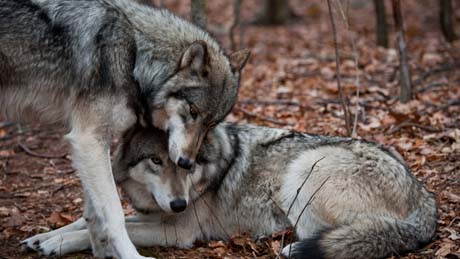
Wolf fondling another; pack members are very affectionate to one another while the alphas maintain boundaries. (Photo source: Internet)

Wolves prey substantially on rodents but must also, for pack survival, prey on larger mammals such as deer, mountain goats and boar. When these are in poor supply or other prey is temptingly easy, such as cattle and sheep, they will take those too.

The traditional human fear of wolves is therefore not one based on self-preservation but on economic priorities. And in the moralistic story of “The Boy Who Cried ‘Wolf’” it is not the human villagers that are attacked by the wolf pack but the community’s sheep.

However, if humans are to continue consuming a diet that will include meat, they will of course need to protect their livestock from wolves and have being doing so even before history was written.

Traditionally the main agent in that protection has been, ironically perhaps, the wolves’ own descendant, the dog – or more specifically, several livestock guardian breeds of dog.

Known livestock guardian dog (LDG) breeds include the Aidi (Atlas Mountain Dog), Carpathian Shepherd, Estrela, Greek Shepherd, Komondor, several breeds of Mastiff and Sardinian Shepherd; a known extinct breed is the Alpine Mastiff (before 5th century BC to 19th century AD).3

Mastín (Mastiff) amidst sheep it guards near Lagunas de Somoza (León, Spain). (Photo sourced: Internet)

Livestock guardian dogs are socialised to the livestock and to their immediate human ‘family’ and will not tolerate the close approach of any potential predator (which often includes even other humans). The primary role is to protect the herd, warn of danger and if necessary, attack.

Where employed in the past, LGDs have been highly effective in protecting their charges, in most cases not even having to fight predators but rather intimidating them. If they have to fight, they are bred for fearlessness and tenacity and their throats also protected by a “wolf-collar”.

Anatolian or Kangol Livestock Guard Dog, with sheep herd it is protecting, Eastern Turkey. (Photo sourced: Internet)

Predators, however courageous, also have strong survival instincts which warn against danger to life or limb (the latter, for a predator in the wild, often in time equalling the first). Unless absolutely desperate they will move on to safer although more difficult-to-catch prey.

For a good LGD however, there is no backing down possible, it is in defence of its own (as a wolf pack might defend its pups). The herder, when present with a firearm, is mainly an additional protection, as well as an alpha member of the dog’s ‘pack’ to obey and protect.

In contemporary times, LGDs have proved effective throughout the world, even in the experimental reintroduction of wolves to the USA.4 So why are they not being more widely employed and, instead, the remaining large predators being exterminated?

Central Asian breed of Livestock Guardian Dog beside its owner (Photo sourced: Internet)

It is no doubt more profitable for big livestock famers to have huge herds roaming freely and when they run out of edible pasture, to move the herd by herding dogs, mechanised herding vehicles or even helicopters. But is it all-around better? And are huge herds environmentally viable?

Apart from other considerations, wolves have been shown to have an environmentally positive effect in a balance between predator, prey and the environment, including vegetation and even water courses, for example in the famous case of the reintroduction of wolves to Yellowstone.5

Deer are pretty to look at but eat young trees and cause damage to reachable branches, while wild goats will eat almost anything, right down to the roots. Wild boar can also be very destructive and, being omnivorous like humans, even prey on ground-nesting birds.

Eurasian Grey Wolf in woodland (Photo sourced: Internet)

All of those invade agricultural crop lands to eat, in the course of which they also trample other crops; wild boar6 are now invading villages and suburbs in a number of towns and cities, overturning large refuse containers for their edible contents.

Female wild boar with litter of piglets in German urban area (Photo cred: Florian Mollers)

Wolves and other predators keep those species down to numbers in better balance with the environment but also of less bother to human settlements. Wolf packs on the other hand do not grow in size beyond the food supply that is fairly safely available.

The human race has made a huge impact on the environment which is sustainable up to a point beyond which, however, we are rapidly passing. We live in a sustainable balance with the environment — or we perish. Perhaps “let the wolf live” can be part of the lesson we need.

End.

FOOTNOTES

1https://theswisstimes.ch/rssfeed/criticism-of-planned-wolf-culling-by-environmental-groups-in-graubunden/

2Including the European Brown Bear, European Lynx and Eagles.

3https://en.wikipedia.org/wiki/Livestock_guardian_dog

4“After the reintroduction of wolves, that were eliminated in the United States in the 1930s, American farmers were losing about a million sheep annually to wolf attacks. 76 farmers took part in the Coppingers program, which introduced European livestock guardian dogs into the US sheep breeding (in their project they used Anatolian Shepherd Dogs). In all farms, where, in the absence of dogs, up to two hundred attacks of wolves per year happened, not a single sheep was lost under the protection of LGDs. At the same time, none of the predators protected by law got killed: the dogs simply did not allow them to approach the herd.” – https://en.wikipedia.org/wiki/Livestock_guardian_dog

5https://www.yellowstonepark.com/things-to-do/wildlife/wolf-reintroduction-changes-ecosystem/

6A wild boar is much more likely to attack a human than is a wolf in Ireland, where the Wolfehound breed was famous, it was a boar that mortally gored Diarmuid of the legendary Fianna after his return from exile. Wild boar also carry diseases that can infect domestic pigs and humans.

SOURCES

Planned Swiss wolf massacre: https://theswisstimes.ch/rssfeed/criticism-of-planned-wolf-culling-by-environmental-groups-in-graubunden/
https://euro.dayfr.com/local/792716.html

Switzerland as arms exporter: https://www.swissinfo.ch/eng/politics/switzerland-contributes-to-global-arms-trade-boom/46565762
https://www.swissinfo.ch/eng/culture/arms-trade–swiss-neutrality-as-business-strategy/48457830
https://www.bloomberg.com/news/articles/2023-03-07/swiss-arms-exports-jump-29-as-industry-laments-neutrality#xj4y7vzkg

Livestock guardian dogs: https://en.wikipedia.org/wiki/Livestock_guardian_dog

Boars as a problem in urban areas: https://www.nationalgeographic.com/animals/article/wild-boars-are-wreaking-havoc-in-europe-spurring-creative-solutions
https://www.nationalgeographic.com/animals/article/hong-kong-urban-dwelling-wild-boars

The Yellowstone Park wolf introduction experiment: https://www.yellowstonepark.com/things-to-do/wildlife/wolf-reintroduction-changes-ecosystem/

SINN FÉIN WANTS HOUSING MINISTRY IN COALITION GOVERNMENT

Diarmuid Breatnach

(Reading time: 2 mins.)

In a Sinn Féin “think-in” on Friday regarding a national election, the party’s leader was reported stating that in any coalition government of which they were a member their party would insist on taking the ministry responsible for housing.

Mary Lou McDonald was quoted as saying this was a “red line” for them. Some will be surprised since the housing situation in the Irish state is in crisis and any new government will be under considerable pressure to deliver significant improvements in that sector.

(Picture: David Young/PA Wire)

Sinn Féin does not look like a party that is prepared to embark on an extensive program of building public housing for rent and taking over empty properties, in other words stepping on the toes of landlords, property speculators and banks – although clearly what’s needed is nothing less.

Still, the party’s own supporters and many who decide to vote for its candidates in a general election will be relieved to see the newcomer to government take over a sector which has been visibly neglected by all the other parties that have been in government in recent decades.

“A Sinn Féin-led government will build the homes that our people need,” said Ms. McDonald, going on to say “we will deliver the biggest affordable and social housing programme this state has ever seen. That is the level of action needed to match the scale of the challenge we face.”

However, supporters may be in for a substantial disappointment, given that the party spokesperson reportedly refused to give a date by which the numbers of homeless would have dropped significantly or even disappeared.

A crash program of building affordable housing for rent, the only real solution to the housing crisis, if seriously undertaken, could be completed in two years at most. The fact that the party is unwilling to give a date for the completion of such a program cannot inspire confidence.

End.

SOURCES

https://www.independent.ie/irish-news/mary-lou-mcdonald-says-sinn-fein-will-not-enter-into-coalition-government-unless-party-gets-housing-ministry/a1509329463.html

https://www.irishexaminer.com/news/politics/arid-41226946.html

LOVELY BUT HARDY LATIN-AMERICAN MIGRANT

Diarmuid Breatnach

(Reading time: 2 mins.)

She’s been here a while now but has lost none of her beauty. She’s by no means fragile – very adaptable, in fact, like many of our own emigrants to other lands. She sounds kind of Japanese but isn’t, not at all.

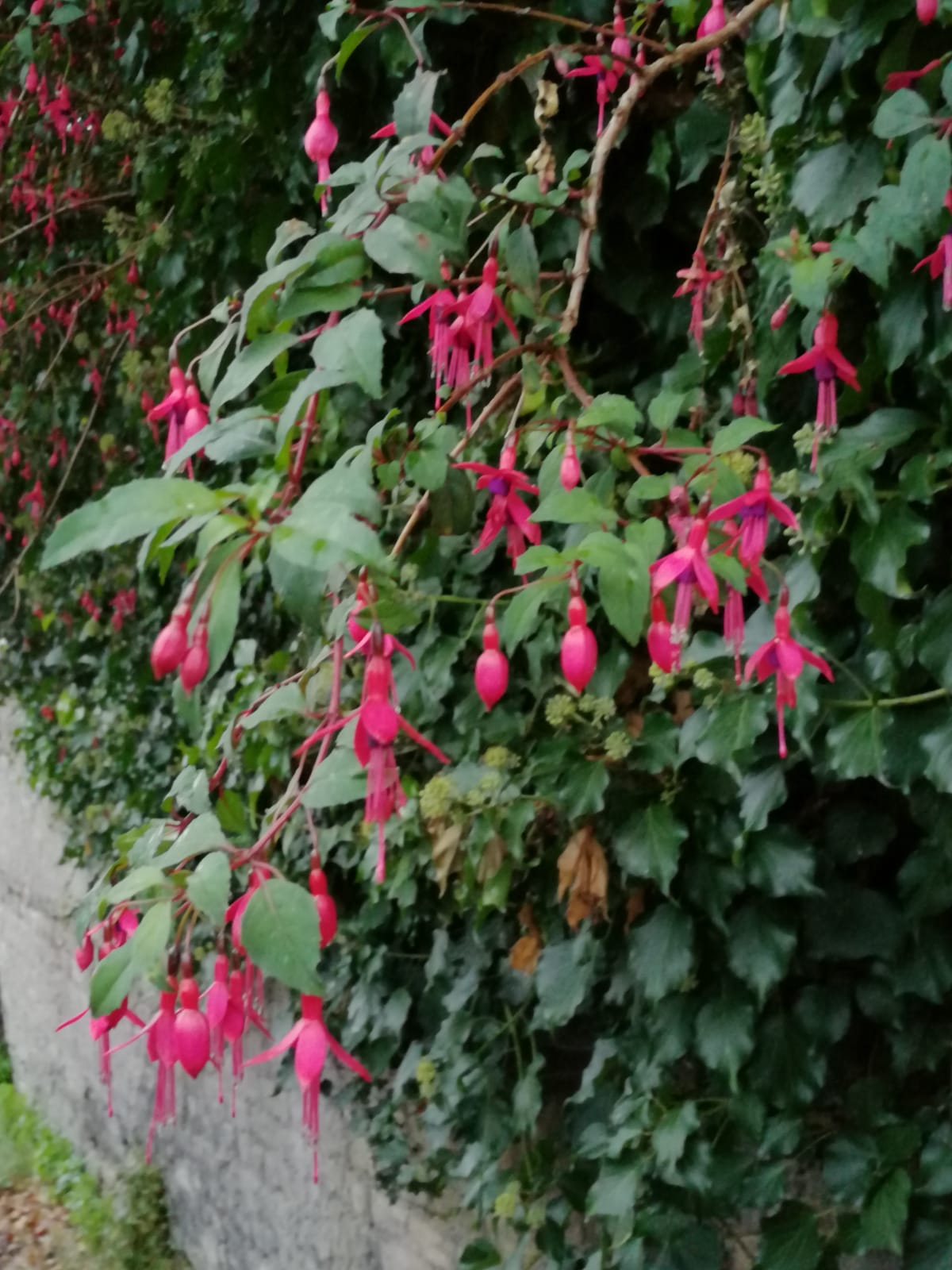
It’s the fuchsia shrub, seen often in gardens but the hardy Fuchsia magellanica ‘Riccartonii’ variety grows naturalised in Ireland, especially along our west and south-west coasts where the soil tends to remain warmer than inland in winter.1

Naturalised Fuchsia (& Montbretia) in a country lane, West Cork (Photo cred: Stone Art Blog)

The first of her kind to receive European classification was Fuchsia triphylla on Hispaniola (now Haiti and Dominican Republic), baptised by French friar and botanist Charles Plumiere in the late 1690s in honour of the German botanist and medical investigator, Leonhart Fuchs (1501-1566).

We tend to pronounce her name as “foo-shia”, which sounds Japanese (to me at any rate) but in keeping with the origin of the name perhaps we should be pronouncing it “fooch-sia”, with the “ch” pronounced as the Irish one, e.g in the word “loch”.

Giúise (g’yoo-sheh) is its Irish botanical name but it has also been popularly known as “Deora Dé” which translates as “God’s tears” but can also mean “Drops of God’s blood” (more appropriately when the flower has yet to open).

There are 110 varieties of the plant, not counting cultivars, of which there are many also. The natural varieties are nearly all native to South and Central America, with a few varieties in New Zealand2 and Polynesia, testifying to the Silurian period connection between those landmasses.

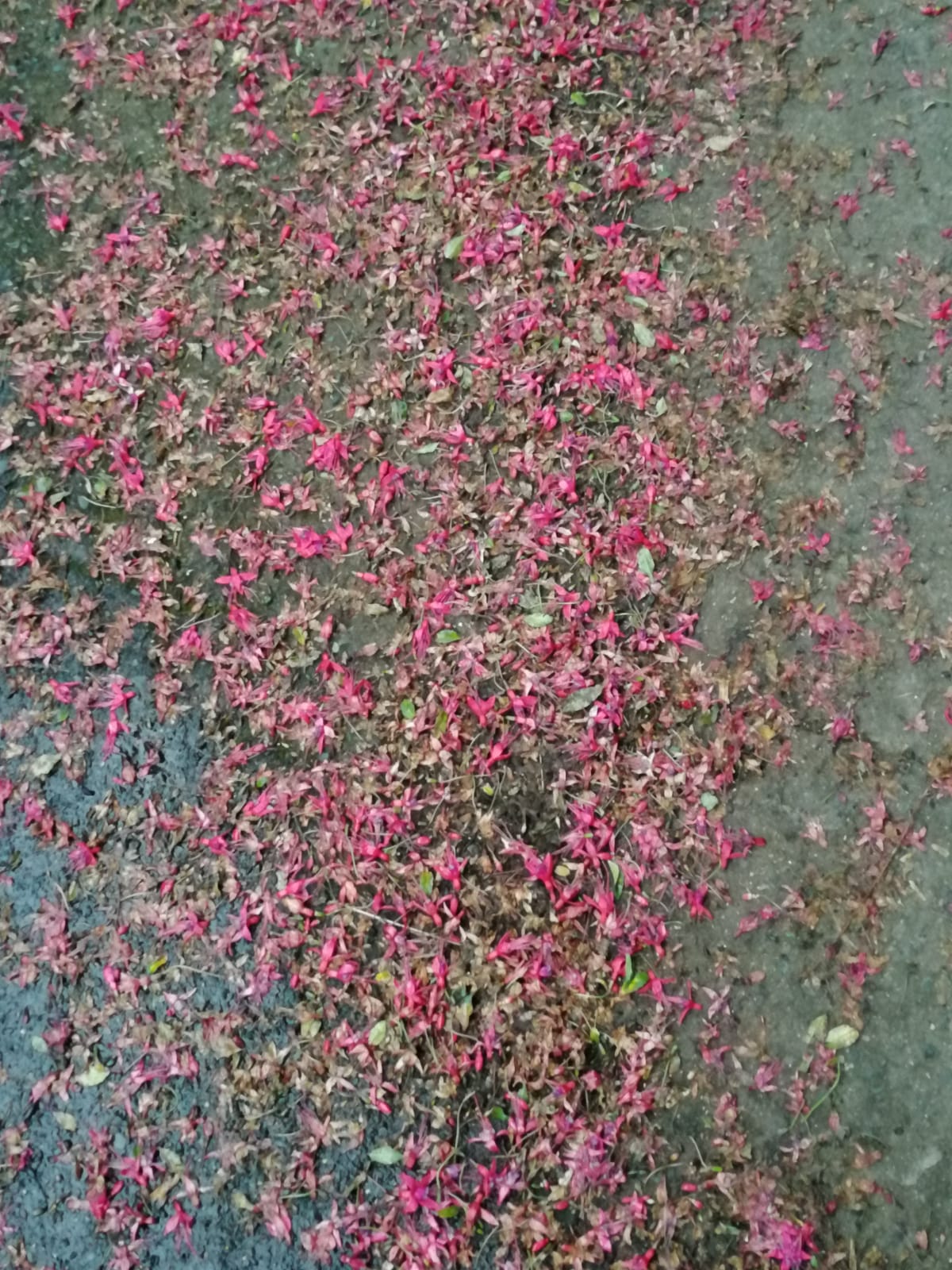
Hanging fuchsia blooms from a bush growing in a Drumcondra garden a few days ago against its back wall, with many dropping to form a carpet in the lane beneath. (Photo: D.Breatnach)

In many parts of Latin America the flowers were pollinated by different species of hummingbirds but here in Ireland they do well enough with bees, both native and imported, to assist in their procreation.

The fruits are small and vary from sweetly edible to unpleasant to taste. As children we didn’t try the developed fruits but we did pluck the flower and chew the dark red part of the stem that becomes the fruit when the flower drops – and could often taste a faint sweetness.3

The fuchsia has been in Ireland a long enough time – since the early 19th Century — and, though not native, is not generally referred to as “alien”, much less “invasive” to Ireland, unlike for example Cherry Laurel, Japanese Knotweed and a number of water plants such as Parrot’s Feather.

The Rhododendron and the Cotoneaster, which probably ‘escaped’ from gardens at the same time as the fuchsia, however do cause serious enough problems.

A fallen fuchsia bloom carpet in a Drumcondra lane at twilight a few days ago. (Photo: D.Breatnach)

The naturalised South American migrant fuchsia brings bright colour wherever she grows for four months of the year, from June to October.

Fáilte roimpi – bienvenida!

end.

FOOTNOTES

1That favours rooted plant life so long as they can withstand the wind-chill factor and Atlantic gales.

2An exception to the bush/ shrub nature of the fuschia is one New Zealand species, the kōtukutuku (F. excorticata), which grows up to 12–15 m (39–49 ft) tall.

3I admit that I still often do that.

SOURCES

https://en.wikipedia.org/wiki/Fuchsia

https://www.independent.ie/regionals/wicklow/lifestyle/fuchsia-a-not-so-fragile-beauty/34145375.html

COLONIC TIMES: DEFENDING UKRAINIAN STATE DEMOCRACY

8 September 2023 IrmaPreversky

(Reading time: 3 mins.)

We are very sincere about defending democracy in the Ukrainian state and particularly so since the Russian invasion of February 2022. This is not easy since increasingly some people are doubting that there is democracy at all in Ukraine.

One of the acts of the Ukrainian Government being quoted as ‘anti-democratic’ was the banning of a dozen different political parties. However, surely being banned is no great problem when the due elections have been postponed indefinitely.

Some people have complained about the cancellation but after all, the country is under martial law, as Prime Minister Zelensky says, so it’s not a good time for elections.

(Martial Law is when all civil rights are suspended and the Government can make laws without parliament and jail people without trial if it needs to).

There have been some accusations about censorship and state control of media but some of those allegations are by journalists hostile to the Ukrainian regime, such as Gonzalo Lira who is in jail for posting material critical of the Ukrainian government.

And Natalie Sedletska reported on former premier Poroshenko holidaying in the Maldives with his family while our country was at war. Obviously he should not have done that but really is this the time to report on such things?

Naturally she got into trouble over that with state security, even when Zelensky took over.

So did her agency, the Ukrainian Service of Radio Free Europe/Radio Liberty. You’d think they’d know better, since the US State funds that radio network and everybody knows that the USA is thankfully supporting our fight against Russian occupation.

However, whilst it is true that all mass Ukrainian media is now under state control, not many Ukrainian journalists complain about censorship. And yes, it is illegal to criticise the memory of Ukrainian national heroes – unless they were communist, of course.

Stepan Banderas is a national hero of Ukraine with annual torchlit parades in his honour but he was definitely not Communist. It is true that Banderas killed many Poles and Jews but at the time he was working with German Nazi occupiers of the Ukraine during WWII against the Soviets.

One of the most frequent slanders on Ukrainian democracy is to suggest that the state is fascist, which is ridiculous. It is true that the Azov Battalion and Right Sector militias were – shall we say – extreme nationalists; but they have now been incorporated into the National armed forces.

Another propaganda attack on the Zelensky government regards recruitment for our valiant armed forces, with accusations of people being grabbed off the street – even sick and disabled people – and forced into the army. Well, not nice if true but the Russians have many more soldiers than us …

Thankfully, not many of these allegations reach the public in the West; if they did, it might lead to emotional demands to cease supplying us with weapons. We know we’re going to get a huge bill for aid at some time in the future but right now we desperately need it to keep fighting!

Of course, there are communists in the West (why are they permitted to even be there?) who spread these allegations, especially through social media, although some of the platforms like Face Book, Twitter and even Youtube do their best to block them.

It may be hard to believe, perhaps, but there are also some socialists in the West who work hard to discredit those communists, calling them “Putinistas”, supporting the social media platforms closing them down and even sometimes demanding they do so!

In fact, anyone who publicises those allegations, if not a communist, is surely some kind of fellow-traveller. Even though the Russian Federation is no longer communist.

Thank you for reading. We must all keep on working hard to continue defending democracy in Ukraine under President Zelensky.

End.

CONCESSIONS TO COLONIAL LOYALISM

News & Views No.8Diarmuid Breatnach
(Reading time: 2 mins.)

According to media reports, Taoiseach Leo Varadkar said he expects to see a united Ireland in his lifetime. I think he’s wrong but he’s entitled to his opinion. However, some of his following remarks are objectionable and need to be challenged.

Varadkar claimed that in a united Ireland “there will be roughly a million people who are British.” That is false. There may – or may not – be a million IRISH PEOPLE who consider themselves British in a united Ireland, we’ll see. But they will be IRISH CITIZENS.

And they should have equal rights with all other citizens. They should have an equal right to vote, to housing, to their language, without any special restrictions, not to mention pogroms – in other words, nothing like the way their statelet treated its large Catholic minority.

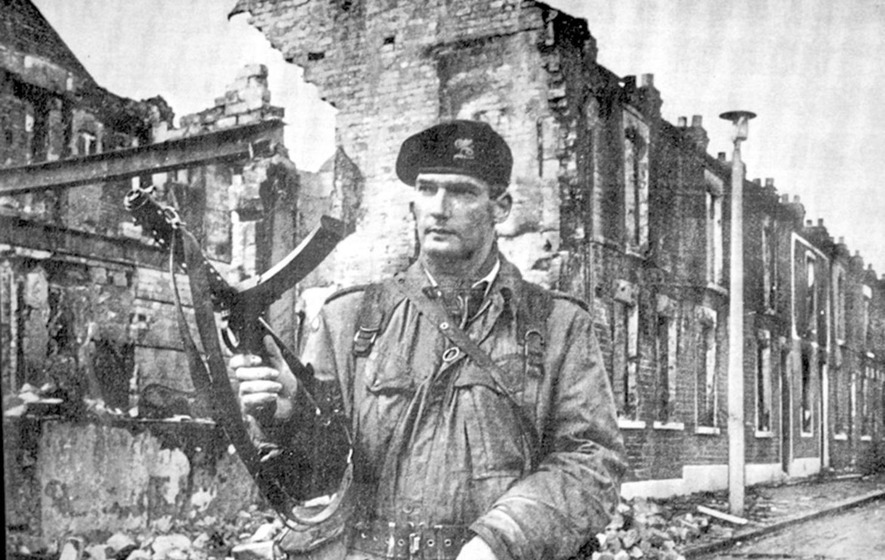
A British soldier stands in front of a section of the burned out houses of Catholics in Bombay Street, Belfast in 1969 (which the Army did not try to prevent Loyalists burning). The arson was the Loyalist response to demands of Catholics for civil rights (while the colonial police response was batons, bullets and gas). (Photo source: Clonard Residents’ Association)

I agree with Varadkar that the quality of a country should be judged “by the way it treats its minorities.” So Varadkar, how did and does your Gombeen State treat its probably oldest ethnic minority? You know, the Irish Travellers?

It is true that “a Republican ballad, a nice song to sing, easy words to learn for some people can be deeply offensive to some people.” Presumably he means to Unionists and Loyalists. Yes, and antifascist and anti-racist songs can be deeply offensive to fascists and racists.

It is also true that some people in the Southern States sing songs about the Confederacy and Robert E. Lee and call it their culture. And the comparison fits – but not with Republicans but with Loyalists!

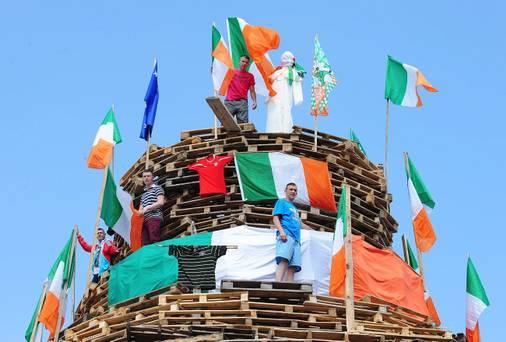
One of the charming annual expressions of Loyalist culture: a huge bonfire to burn Irish Tricolours and representations of Catholicism. Palestinian flags and representations of Celtic FC are frequently burned too. Slogans such as KAT (‘Kill All Teagues [i.e Catholics]) are often displayed also. (Photo source: Wikipedia)

It’s not Irish Republicans who spread racism and sectarianism: the Republican creed came into existence precisely against sectarianism. And we know Varadkar actually knows that because not long ago he made some remarks about the wide embrace of the Irish Tricolour.

The Irish Tricolour: a flag presented to revolutionary Irish Republicans by revolutionary French Republican women in Paris in 1848. Not a flag of monarchism, sectarianism or collusion with imperialism or colonialism.

While we uphold Republican principles we don’t have to apologise to anyone, least of all in our own country, Varadkar. It’s you and your party (and the rest of them serving the Gombeen class who threw away independence and slaughtered Irish Republicans) who need to be ashamed.

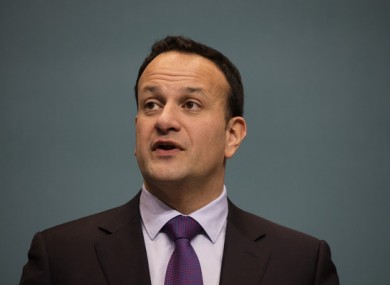
Leo Varadkar, Taoiseach (Prime Minister) of the current Coalition Government, who made the remarks this week. (Photo sourced: Internet)

People living in Ireland can think and feel what they like, good or bad. But in public, we will celebrate the valuable things in our history and culture. And we’ll do so proudly without apology to anyone.

On the other hand, public displays of Orange sectarianism, racism, homophobia, fascism and anti-LGBT targeting won’t be tolerated in an independent, reunited Ireland. Not for one minute.

End.

SOURCES:

https://www.breakingnews.ie/ireland/taoiseach-believes-there-will-be-a-united-ireland-in-his-lifetime-1524031.html

NEW POSTAGE STAMP CELEBRATES PARTITION OF IRELAND AND DOMINATION OF COLONIES

Diarmuid Breatnach

(Reading time maint text: 7 mins.)

The Irish State has issued a new commemorative stamp to celebrate its joining the League of Nations in 1923 to which its representative referred as commemorating “the significance of Ireland taking our place among our fellow nations.”1

Well, sorry to poop on your party, Gombeen Government and to point out your lie. The truncated Irish State was admitted to the League of Nations, not “Ireland”, of which one-fifth was held in arms by the British occupier – who was one of the founders of the League.

Furthermore, the Gombeen state’s management committee entered the League as the victors in the Civil War – Britain’s proxy war in Ireland – dripping in the blood of those who fought for Ireland’s freedom. But that was not unfitting for the League was full of blood-drenched governments too.

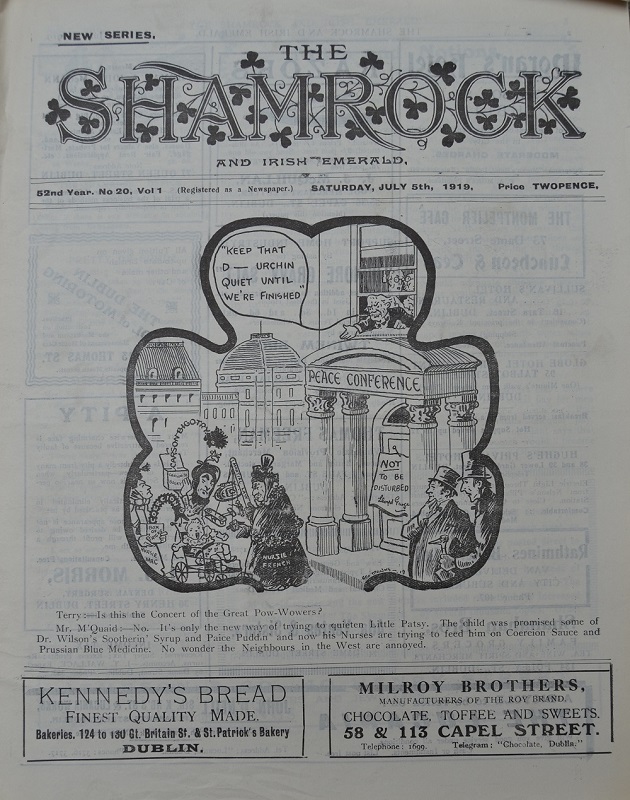
The League was formed in 1920 and though the true government of the Irish nation, the First Dáil,2 applied for membership, its emissaries were not even received. At the Paris Peace Conference, US President Woodrow Wilson did not even reply to the Irish Delegation’s letter.3

Irish nationalist media commentary on the exclusion of Ireland by Lloyd George from the Paris Conference (Image sourced: Internet)

The original permanent members of the League’s Executive Council (it had four non-permanent members too) were Britain, France, Italy and Japan and its languages reflected those of the dominant European and American powers: English and French.

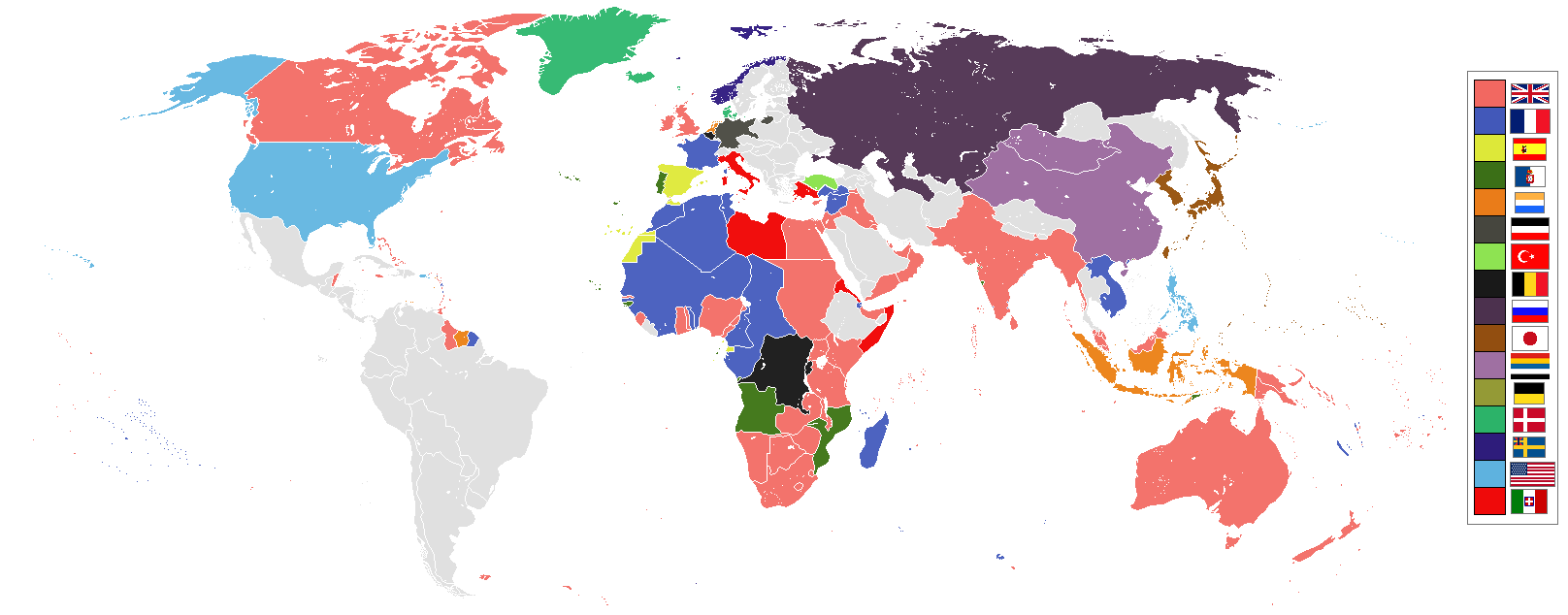
Britain came into the League with its Empire of allegedly independent states: Australia, Canada, India (which incorporated present-day Pakistan and Bangladesh), New Zealand and South Africa.

Map showing empires and colonies in the world in 1920 but there were also areas of influence apart from colonies. (Image sourced: Wikicommons)

PEACE?

Allegedly about peace, the League was formed as a club to discuss the areas of the world owned by the European colonial powers and to create a space where the losers and winners could discuss those lines, over which they had just fought a four-year bloody war.

Henceforth, there would be many, many wars, but mostly of colonial conquest and repression of resistance – but the European powers would not war among themselves, leastways except by finance and diplomacy. Until another 19 years, that is.

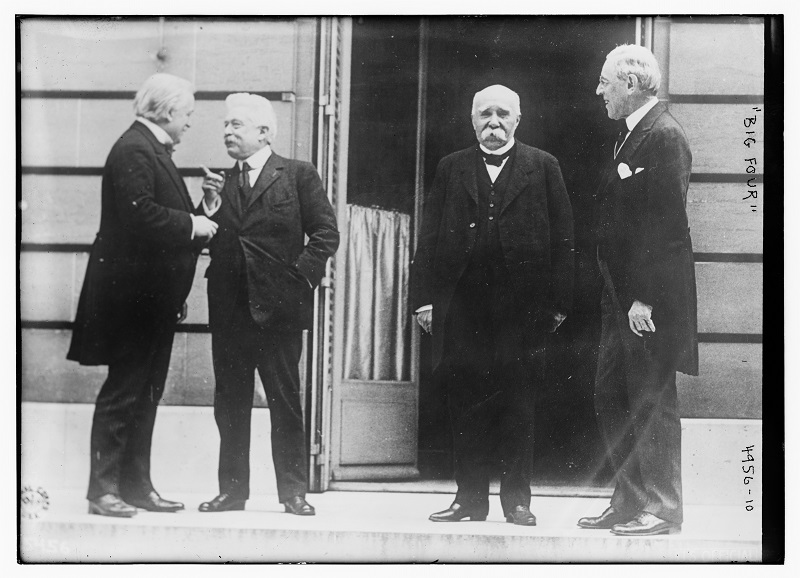
In fact, one of the major causes of WWII was the Treaty of Versailles, containing the crushing and humiliating WWI reparations demanded of Germany by the British and French imperialist powers. That Treaty was incorporated into the terms of the League of Nations.

The Big Four that framed the Treaty of Versailles; L-R: Lloyd George of Britain, Vittorio Emanuele Orlando of Italy, Georges Clemenceau of France, and Woodrow Wilson of the U.S. (Photo sourced: Internet)

Ireland would see short armed liberation struggles in the 1930s, 1940s and of three decades from 1969. Hundreds of armed liberation struggles would break out across the rest of the world, in every continent except Antartica. And yes, including Europe.

The League of Nations was a club, chiefly of European colonial powers in which the conquest and suppression of a huge number of other nations was agreed and ratified. It was followed by the hugely-expanded United Nations after the next World War.

The UN has much the same role and of its 193 members, its only binding decisions are made by five Security Council Permanent Members voting without dissent: USA, UK, France, Russia and China. The vast majority of the other states are clients of one or other of those five.

The Irish state joined that earlier League not as one of the colonial powers but as a defeated nation, a neo-colonial client regime, an experiment in native self-government under external colonial control, one to be adopted by the other imperial powers and replicated across the world.

The Irish state joined the United Nations in December 1955 in exactly the same client relationship to its old masters but over time the yearly tribute has been shared among new part-masters, first the USA and then EU imperialism.

Neither the state’s advent to the League of Nations nor to its successor, the United Nations, has anything whatsoever of which to be proud. An opportunity for Irish real independence and world friendship of nations was squandered.

The new stamp should carry a black border in mourning.

End.

FOOTNOTES

1Words of Mícheál Martin, the Tánaiste (Deputy Prime Minister) of the Irish Government quoted in numerous media reports.

2The First Dáil was founded in January 1919 in defiance of British occupation, based on the results of the UK’s December 1918 General Election results in Ireland which returned 73 MPs of the newly-reconstituted Sinn Féin party out of a total of 101 MPs elected in Ireland. The SF members set about organising an Irish Government and, though declared illegal by the British occupiers shortly afterwards, continued to operate as a government until it split over whether to accept the terms of the British offer in 1921, which led to the Civil War of 1922-1923.

3 See https://www.irishtimes.com/culture/heritage/how-the-plea-for-irish-independence-made-its-way-to-paris-1.3742328. Though interestingly, Wilson did reply to the young Ho Chi Minh’s in respect of Vietnam (Ho Chi Minh, while working in Britain, had commented admiringly on the Irish capacity for resistance at the time of Mac Swiney’s funeral march in London from Brixton Jail to Southwark Cathedral). Most of Indochina at the time was a French colonial possession.

SOURCES

https://www.breakingnews.ie/ireland/new-stamp-marks-irelands-admittance-to-league-of-nations-1523570.html

https://www.dfa.ie/about-us/ourhistory/100years/1919-1929/1923/

https://www.dail100.ie/en/long-reads/message-to-the-free-nations-of-the-world/

Text First Dáil Message to the Nations of the Free World: https://en.wikipedia.org/wiki/Message_to_the_Free_Nations_of_the_World#:~

https://en.wikipedia.org/wiki/Member_states_of_the_League_of_Nations

https://en.wikipedia.org/wiki/League_of_Nations

https://en.wikipedia.org/wiki/Treaty_of_Versailles

BASQUES AGAINST NATO AND EU – Interview with Herri Ekimena organisation.

Oscar DíazTranslation from Castilian Spanish by D.Breatnach
(Reading time main piece: 10 mins.)

1. What is Herri Ekimena?

Herri Ekimena is an initiative that emerged in March 2022. A series of organizations began to get together due to concern about the offensive of Atlanticist imperialism in Ukraine, in addition to the blatant manipulation of the media to get us to support their war strategy.

We also observed that, in a context of capitalist crisis and with the excuse of the war against Russia, economic measures were being imposed that resulted in greater impoverishment of the working class.

That is why we took to the streets at that time with the slogan “NATO and the EU condemn us to war and misery”, to turn the official discourse around a little and point to these two organizations as the main ones responsible for the increase in international tensions, as well as for the oppression of the working classes of the imperialist bloc itself.

Also in the month of June of that 2022 we called a demonstration in Bilbo, “against the imperialism of NATO and the EU” and calling for the end of the Russophobia that is still being promoted.

In parallel to the NATO summit that was held in Madrid, we also carried out a 48-hour poster campaign in Gernika, a city with great anti-fascist symbolism that the Ukrainian Nazis tried to appropriate, citing it in a speech before the Spanish Parliament by Zelensky himself.

After a short break, we resumed the fight in the streets at the end of the year, with the “Free Euskal Herria out of NATO and the EU” campaign. In March we held a massive demonstration in Bilbo, together with Askapena1 and the Bardenas Ya2 collective.

View of demonstration against NATO and war in Bilbao, June 2022. (Photo source: Bultza Herri Ekimena)

This demonstration was exciting to us as we saw that the work that had been done was already bearing fruit and that the anti-imperialist spirit that has historically characterized Euskal Herria was projected in the streets.

We are currently in a restructuring process in order to be more effective, and give new impetus to the anti-imperialist struggle in the streets, which is where this game is truly played.

2. Why combine anti-fascist and anti-imperialist slogans?

The imperialist offensive, which has to do with the systemic crisis of capitalism and the rise of new economic powers, is being accompanied by a general reduction of rights and freedoms.

Those in power fear popular revolts, like those that have been taking place in the French State in recent months.

In Euskal Herria we know well what emergency laws or illegal practices are employed to put an end to dissent, but these types of measures are spreading and becoming normalized throughout Europe. Concentration camps for migrants, deportations without any type of legal guarantee, electronic anklet tags are also normalized…

And also in the case of the countries bordering Russia, imperialism is responsible for waving old supremacist and anti-Slavic flags, such as is happening in Ukraine or Poland.

We see therefore that capitalism, in its most decadent phase, has little scruple when it comes to reactivating liberticidal policies or inciting openly Nazi military and paramilitary shock forces.

So in effect, we believe that the anti-imperialist struggle and the anti-fascist struggle are inseparable parts of the same struggle for our rights and freedoms.

3. A few years ago one could see Donbass flags in the stands of Atlethic3. Why mix football and politics?

Through various institutions, including football clubs, they want to force down our throats the supposed “depoliticization of public spaces.” It is false, because they are the first to try to control absolutely all areas of our lives that we may become submissive and uncritical people.

The media bombardment is constant, generating false debates among humble people about insecurity, occupying empty properties… They thus try to legitimize, by action or omission, measures of social control and police repression that are very, very worrying.

So when someone puts a poster on the street to denounce any injustice, or puts up a banner, or paints graffiti… They are calling into question that false normality that they want to impose on us.

Banner displayed by Athletic Bilbao FC fans during a match. The text is difficult to see in its entirety but in general it is clearly in solidarity with the Donbas region against attack from the Kiev administration.

It is sad — but this situation also reflects the weakness of the system in terms of political legitimacy. Who explicitly supports them? Who is not fed up with everything that is happening? So they are afraid of the flame that starts a prairie fire.

Sports venues do not escape this logic of imposing false normality, even if the laws have to be twisted or passed directly through the triumphal arch.

A Donetsk flag, for example, ruins their photo and calls into question the story that people agree with what they do. So they impose fines of €3,000 just for displaying the flag of a People’s Republic.

Let’s hope that in not many years we will be able to analyze all this as the blows of a dying regime, but for now it is up to us to organize the response and popular solidarity. Repression should not be normalized, nor should people who step forward feel alone.

4. Is EH Bildu4 being favorable to NATO?

We do not believe that the social base of EH Bildu is in favor of NATO. That is, if we asked EH Bildu voters if they were in favor of NATO, surely 99% would say no. The problem is that, for its leaders, opposing Atlanticist imperialism is not currently on the list of priorities.

Regarding the issue of the war in Ukraine, Arnaldo Otegi5 has openly positioned himself in favor of Ukrainian “sovereignty” and against the Russian “occupation.” Is Ukraine now a sovereign state? Or is it rather a puppet of NATO in its offensive against Russia?

Doesn’t Russia have the right to defend itself from NATO attacks? What about the thousands of people killed in Donbass since 2014? Should Russia have been obliged to watch this genocide impassively?

Have the self-determination processes in Donetsk, in Lugansk, in Crimea … not been practical exercises of sovereignty? In this context, we can say that the speech of some EH Bildu leaders has favored and continues to favor the interests of NATO.

Their support for the State Budget deserves special mention, which includes a 25% increase in military spending. A measure imposed precisely by NATO to approach 2% of GDP in 2029, which is truly outrageous.

So… perhaps it is harsh to say that EH Bildu is in favor of NATO so let us put it another way: What is EH Bildu doing to make Euskal Herria break with NATO? What teaching are they carrying out among their social base and at a public level to create a truly anti-imperialist consciousness?

Very little or nothing, we believe, that is the reality.

5. Will it be possible to continue to see reliable information about Ukraine in the Basque Country and the Spanish state now that military juntas have been formed in African countries that have expelled French embassies? They are very different countries and thousands of kilometers away…

The events that are taking place in the SAHEL area are complex processes, and surely have many sides that make it difficult for us to equate them with the decolonization processes that we have known historically.

But we would be committing a mistake if, due to these supposed “imperfections” with respect to the theoretical manual, we stopped supporting countries that are fighting for nothing less than to expel their occupiers (since those are true occupiers who try to impose themselves by force of weapons thousands of kilometers from their borders) and also to gain control of their enormous natural resources.

How can it be that in extraordinarily rich countries, like Niger or Gabon, the majority of the population survives in absolute poverty? We will have to carefully observe all these processes, but in anti-imperialist Euskal Herria we can only rejoice and tell them that they are not alone.

In this land that, to a degree, also knows what it is to fight against armed occupiers and various collaborators, we know very well that solidarity is the love between people.

Regarding the quality of the information that we are able to receive in Euskal Herria or in the Spanish state, we believe that right now it is below minimum.

It is pathetic to see how, every time an event occurs that could undermine the hegemony of Atlantic imperialism, the mainstream media wait to receive instructions before even reporting the event.

The control of capital over the big media is a reality, so we must promote and support alternative means of information and communication. And also to fight openly in the streets, so that they have no choice but to report our demands.

6. Couldn’t the creation of a multipolar world be dangerous on a war level?

Yes, in fact it already is. We had been talking for years about the end of Yankee hegemony and the economic rise of countries like Brazil, Russia, India, China and South Africa, the so-called BRICS.

Perhaps we thought that this change of orientation of world hegemony was going to be a calm process, without any surprises…

But nothing could be further from the truth. While it is true that Yankee imperialism is mortally injured (which we believe it is), the truth is that it seems willing to kill as it dies.

Currently it has restructured NATO in a few months, has de facto absorbed the European Union and is reconfiguring its alliance policy on a global scale. It is increasingly easier to identify “which side” the different states are on, which can be the prelude to a conflict on a planetary scale.

We have been able to verify this recently with Morocco. NATO and the EU buy Morocco and abandon the Sahara to its fate.6 What should the Sahrawis do if Algeria, Russia or China offer them help to win their rights and survive as a people?

Of course there may be geopolitical interests in this aid from emerging powers, but it is necessary to analyze whether the agreements, commercial exchanges, donations and aid are produced with mutual respect for sovereignty and benefit the currently oppressed nations.

Of course, from a revolutionary point of view we have to be exacting, and not give a blank cheque to these emerging powers.

In this entire process of multipolarity, whether we like it or not, which is already making its mark upon world geopolitics, there is a class struggle that we must not ignore.

But this critical stance cannot lead us to fall into ninism and evade our own historical responsibility: to combat Atlanticist imperialism from the very heart of the beast.

7. You say “Euskal Herria free from NATO.” And what about the rest of the Spanish state?

We say Euskal Herria should be free outside NATO, but also outside the EU. We believe that this contribution is important, since for many years consideration of leaving the EU has been a kind of taboo, also in Euskal Herria.

Some thought that the EU might even support a possible independence process in Euskal Herria, just as was thought in Catalonia.

“A Free Basque Country out of NATO and the EU”.

But the EU has definitively been revealed as a capitalist lobby, as an instrument at the service of elites with a more than dubious past, even with regard to their support for Nazism.

Úrsula von der Leyen, Josep Borrell… are faithful representatives of the EU of Capital, authoritarian and totally committed to the interests of the US. That is why we say that neither the nation nor as a class have a future within the EU.

We make this statement from Euskal Herria, which is our area of struggle. But of course it extends to the entire Spanish State, as well as to the French State and all the peoples of Europe.

A future in freedom is not possible belonging to these criminal organizations, neither in Euskal Herria nor anywhere else.

8. What do you think of the military administration by Margarita Robles of the PSOE/UP government?7

Margarita Robles is a pit bull of Spanish politics, a woman who knows perfectly the ins and outs of the State from the offices to the sewers. Not for nothing has she been in positions of power for more than 30 years, originally in the shadow of Belloch, later of Rubalcaba…

At first it may have been surprising to see her at the head of a Ministry like the Defense Ministry, she who comes from the judiciary and who, even in relation to the conflict between Euskal Herria and the Spanish State, had adopted a dialogue profile at certain times.

We are missing a lot of information (I wish that we in Herri Ekimena knew what was going on in the Ministry of Defense, haha), but Margarita Robles is probably dedicating herself to doing in the Spanish military what she also did in her day in the Ministry of Justice and Interior.

That was to send the most archaic elements to the refrigerator in a non-traumatic way to perfectly adapt to the current standards and guidelines of NATO and the EU. Change a minimum so that everything remains absolutely the same.

Can anyone imagine Spanish generals standing up for Spanish national sovereignty in the face of Atlanticist imposition? This could happen in the French State, in fact it would not be unreasonable for something like this to happen.

In the Spanish State it is much more unlikely, but it is the responsibility of politicians like Mrs. Robles that nothing should deviate from the script written by Washington and Brussels.

In this regard, it is worth highlighting the role of the PSOE in what has been the process of integration of the Spanish State into imperialist structures. In addition to Felipe González, we could mention Javier Solana (who became Secretary General of NATO), Josep Borrell8

Whether it is a matter of affinity, or a matter of pragmatism, the truth is that it appears that the PSOE generates a lot more trust among the imperialist powers than any other political party at the level of the State.

9. There were elections this past July 23, 2023. Did any of the political forces propose the departure of NATO from the Spanish state?

We are not aware that this was the case. As we have said before, this government is responsible for the largest increase in military spending in history, and faithfully complies with NATO and EU mandates.

“No to NATO – Out of Bardenas!”

Vice President Yolanda Díaz has publicly supported sending weapons to Ukraine and, as far as we know, no party that supports the government has opposed these shipments as a matter of principle.

We remember that these are weapons that are being used by Nazi soldiers to bomb and murder, not alone Russian soldiers but also the civilian population of Donbass. So we have to organize and fight in the streets, because if we don’t, things will remain exactly the same or worse.

This is the reason for existence of Herri Ekimena, to activate the popular struggle against the imperialism of NATO and the EU. We are working at it and, if all goes well, there will be good news in this regard in the coming weeks.

SOURCE

http://oscar-elbloquedeleste.blogspot.com/

FOOTNOTES

1Askapena was the internationalist solidarity arm of the broad Basque national liberation organisation but split from it many years ago in concern at the deviation from the path of resistance by the leadership under Arnaldo Otegi.

2Bardenas Ya is an organisation campaiging against the military installation in Bardenas, Nafarroa (Navarre).

3Athletic Bilbao FC, whose fans and many of its players have a strong anti-fascist and pro-Basque independence tradition.

4EH Bildu is the political party of the current compliant ‘official’ leadership of the Basque national movement, replacing the Herri Batasuna of the past.

5Leader of EH Bildu who has led the party into what many consider its collaborationist current stance.

6Western Sahara was a Spanish colonial possession and it abandoned it without decolonisation, which allowed Morocco and Mauritania to invade and occupy it against the wishes of the Saharawi people. As a result of the national liberation struggle of the Polisario Front, Mauritania withdrew but Morocco remained in occupation and carrying out repression against the resistance. Shortly before Trump’s departure from the USA’s presidency, he agreed to endorse Moroccan defiance of the UN-recognised Sahawarwi resistance to occupation in exchange for Morocco reversing its long anti-Zionist policy and formally recognising the Zionist occupation of Palestine, which the Moroccan Kingdom has done.

7The recent coalition Government of the Spanish State, the social-democratic PSOE with the Left-social democratic alliance of Unidas Podemos. Currently, the PSOE is endeavouring to form a government in coalition with a somewhat reconfigured Left-social democratic coalition called Sumar.

8All three have been PSOE politicians, Felipe González a prime minister and widely believed head of the GAL anti-Basque terrorist gang. Borrell was President of the European Parliament (2004-2007) and Minister of Foreign Affairs of the Spanish Government from 2018 to 2019. He attacked Catalan self-determination which he characterised as part of a disease, despite his own Catalan origin and he is now the Foreign Minister of the European Union.

ANOTHER AFRICAN FRENCH COLONY REBELS

Diarmuid Breatnach

(Reading time main text: 4 mins.)

News reaches us that military forces in Gabon, yet another colony (say neo-colony) of French imperialism in West Africa, have carried out a coup, deposed the titular President and put him under house arrest.

Actually, some of the reporting called it “an attempted coup” which seems strange: the military in control of its own bases, national broadcastings stations and with the former leadership under arrest seems a lot more than an “attempt”.

Map of African states and cities (By: GISGeography Last Updated: August 9, 2023). Gabon is located on the west coast (down from Cameroun and up from Angola).

Given recent nationalist military coups in a number of former French colonies, a lot of speculation is taking place as to whether this case is a harbinger of future uprisings against French imperialism and also as to whether the new apparently nationalist administration of Gabon has a future.

CENTURIES OF SCRAMBLE FOR AFRICAN RESOURCES

Throughout the 17th, 18th 19th centuries, European colonial powers scrambled for control of African natural resources, including slaves (and slave-like labour after the abolition of slavery). Vast resources of oil, valuable metals, minerals and gem stones are still being extracted from Africa.

Much of Africa was conquered and occupied by French colonialism1 and in most of those countries French is a ‘national’ language of the state and sometimes the only one so recognised. After “independence” France continued to extract natural resources and labour power from the regions.

Recently2 the military of some of those neo-colonies carried out coups and overthrew their France-aligned rulers, accusing them of being effectively administrators of French neo-colonialism. Niger was the most recent in July 2003, Burkina Faso in January 2022 Mali in August 2020.

There have been others too but those three countries border one another and have also declared an alliance against any invasion, such as that threatened by the pro-imperialist alliance of ECOWAS3 of which the dominant member is Nigeria.

NEO-COLONIALISM

There have been historically more than one method of effectively colonising a country. It may be invaded and resistance crushed, the administration (taxation etc) henceforth being managed directly from the invading country or from a government dependent on the invader.

The system may include large-scale settlement of land (as in Ireland and Algeria) but in any case the cities will include enclaves of invader settlers and administrators, charitable, religious and educational institutions, nearly always teaching a curriculum based on the occupiers’ culture.

Deposed President Ali Bongo Ondima in Residence Libreville 30 September 2023 (Photo cred: BTP Advisors to the President via AP)

There were also ‘protectorates’, such as Palestine for example, under British control and accepted so by other powers, without a direct system of colonial occupation or administration.

Ireland had the colonial-settler-parliament system under the British occupation until 1800 when by bribery and self-interest, the Irish Parliament4 dissolved itself and almost immediately joined the United Kingdom, Irish elected MPs then having to attend parliament in Westminster.

In 1921, that system continued for the British colony of the Six Counties but control of the rest of Ireland was exercised a distance through the governments and State departments of the majority section of the Irish national capitalist class, the Gombeens.5

That system was developed by British imperialism throughout its Empire, piece by piece. The French followed but the ruling classes of Belgium, Holland and Portugal were slower to adapt. After WWII, the USA used the system increasingly in Latin America6, Africa and Asia.

GABON HISTORY

Gabon of course has a long history before Africa was ever occupied and settled by European powers. Africa after all is the cradle of humanity.

Bantu migrants settled the area in the early 14th century. In the late 15th century Portuguese explorers and traders arrived in the area and in the 16th century the coast became a centre of the transatlantic slave trade with European slave traders arriving to the region.

France occupied Gabon in 1885, but did not administer it until 1903. In 1910 Gabon became one of the four territories of French Equatorial Africa. On 15 July 1960 France agreed to Gabon becoming an independent state but the reality was that it became one of France’s neo-colonies.

Unexpectedly perhaps, there was a WWII battle there: in November 1940 Free French forces were sent by De Gaul to take the area from the Vichy-loyal administration there. The Battle of Gabon lasted four days and ended in victory for De Gaulle’s forces.

WHERE TO NOW?

Whether Gabon’s neighbours would invade remains to be seen and the country is separated by over 2,000 km distance from Niger, the nearest one of the three Sahel French colonies in rebellion, a shortest distance that traverses the currently hostile major state of ECOWAS, Nigeria.

Crowds celebrating the army coup in Libreville, capital of Gabon, 30 August 2023 (Photo cred: Al Jazeera)

The three Sahel colonies themselves seem somewhat more secure in so far as they can support one another7 and also in so far as the clients of the Western powers are reluctant to take military action against them, a reluctance already demonstrated by the failure of ECOWAS to invade to date.8

Overall, these developments cannot but have given heart to national liberation forces, including revolutionary ones, across Africa and even beyond. French client regimes will be looking over their shoulder but so too will the client regimes of the British and the USA.

End.

FOOTNOTES

1For an indication of how Africa was carved up for exploitation by European powers even in the 1940s, see the map https://omniatlas.com/maps/sub-saharan-africa/19401108/

2Not so recent was Algiers, where the people fought a hard and bitter struggle against the colonists and France and declared independence in 1954. Some other countries also declared independence but were subverted or imperial client regimes came to power in them, often also by coup.

3Economic Community of West African States.

4For most of its history since the Reformation, only Anglican MPs had been admitted to this Parliament and for much of that time too, only Anglicans could vote. Progressive national bourgeoisie such as Grattan and Tone had failed to overturn this exclusiveness and it was that which convinced Wolfe Tone and other United Irishmen that a revolution was necessary. They rose unsuccessfully in 1798 and again in 1803.

5Na Gaimbíní, the Irish capitalist class that arose under British occupation to which it was subservient. Some at least of the wealth accumulated by this class was through gaining control of lands abandoned or having to be sold at a loss by their occupants during the Great Hunger of 1845-1849. The name has now passed on to describe the foreign-dependent client capitalist class of the Irish state, first subservient to British colonialism, then to US imperialism and finally to EU imperialism.

6As we recognise USA dominance of Latin America today through invasions, sponsored coups and financial controls, we are likely to be surprised to find that Latin America was largely a British imperialist preserve through much of the 19th Century and up until WWII, when it had to cede much of it to the USA in exchange for war material support.

7And perhaps be supported by nearby Algeria.

8Despite the deadline the organisation issued for reinstating Niger’s deposed President having long passed.

SOURCES AND USEFUL LINKS

https://www.breakingnews.ie/explained/the-wealthy-dynastic-leader-of-gabon-who-believed-he-could-resist-a-coup-1521039.html

https://omniatlas.com/maps/sub-saharan-africa/19401108/

Gabon history: https://en.wikipedia.org/wiki/History_of_Gabon
https://en.wikipedia.org/wiki/Battle_of_Gabon