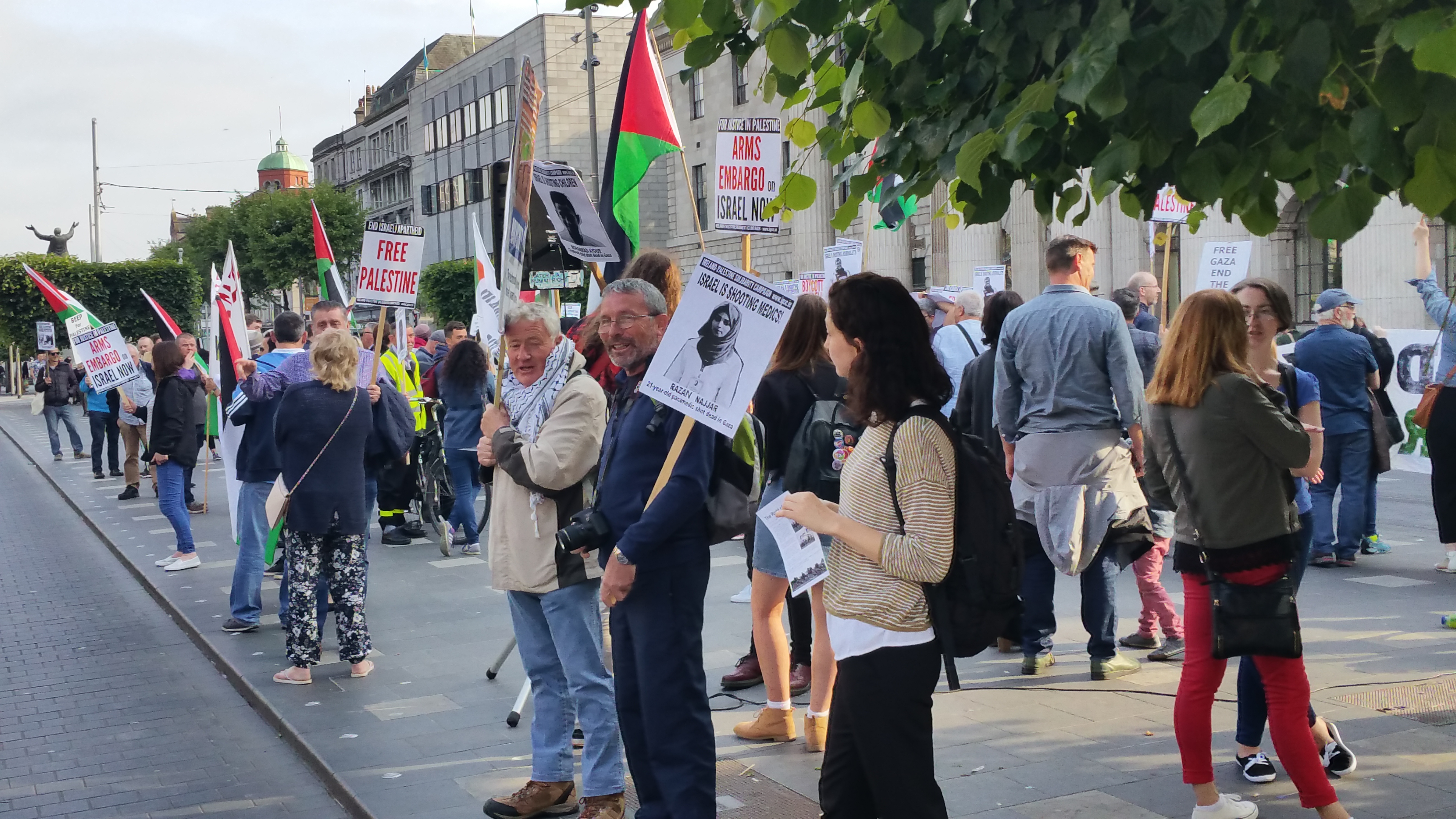
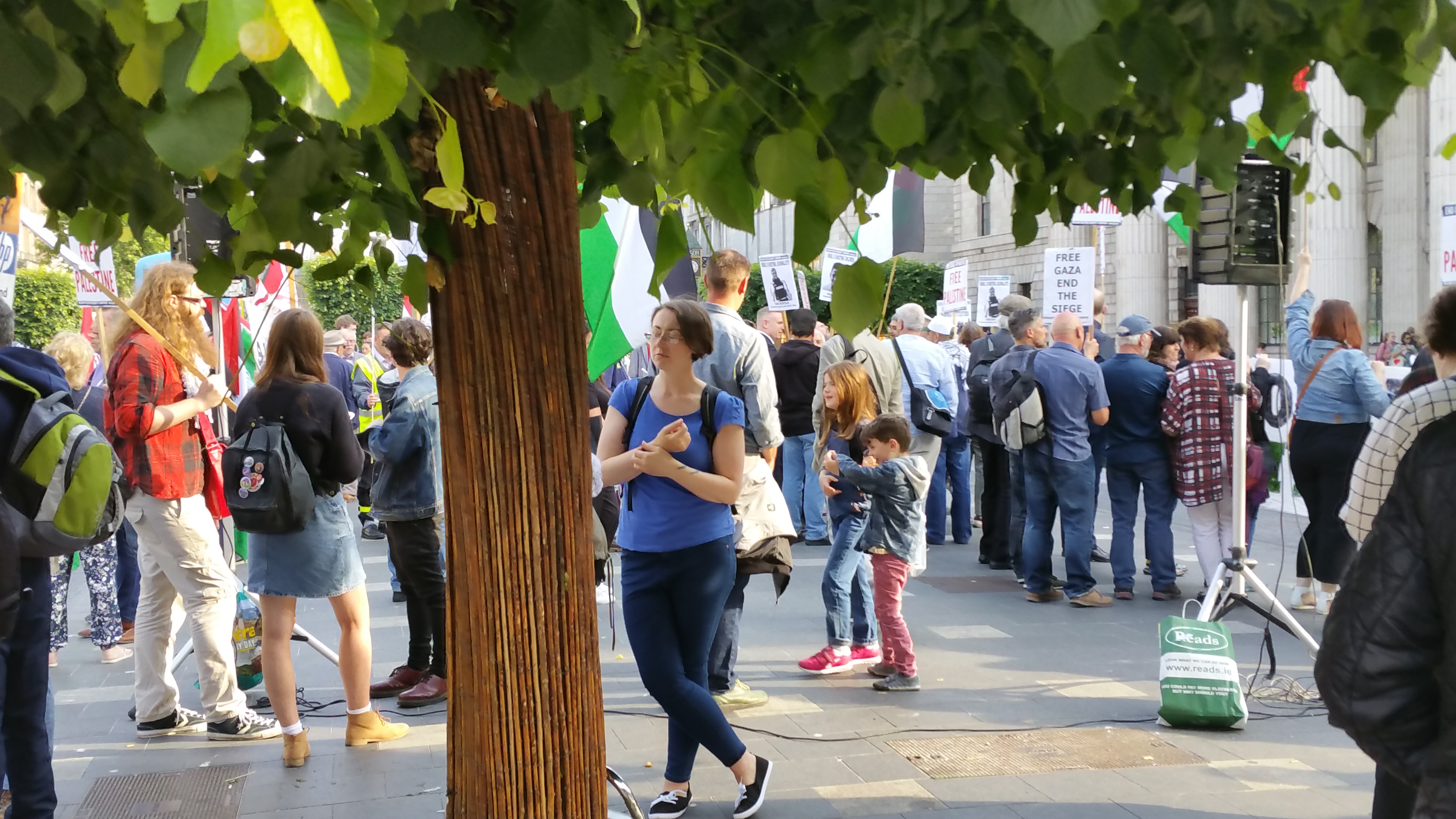
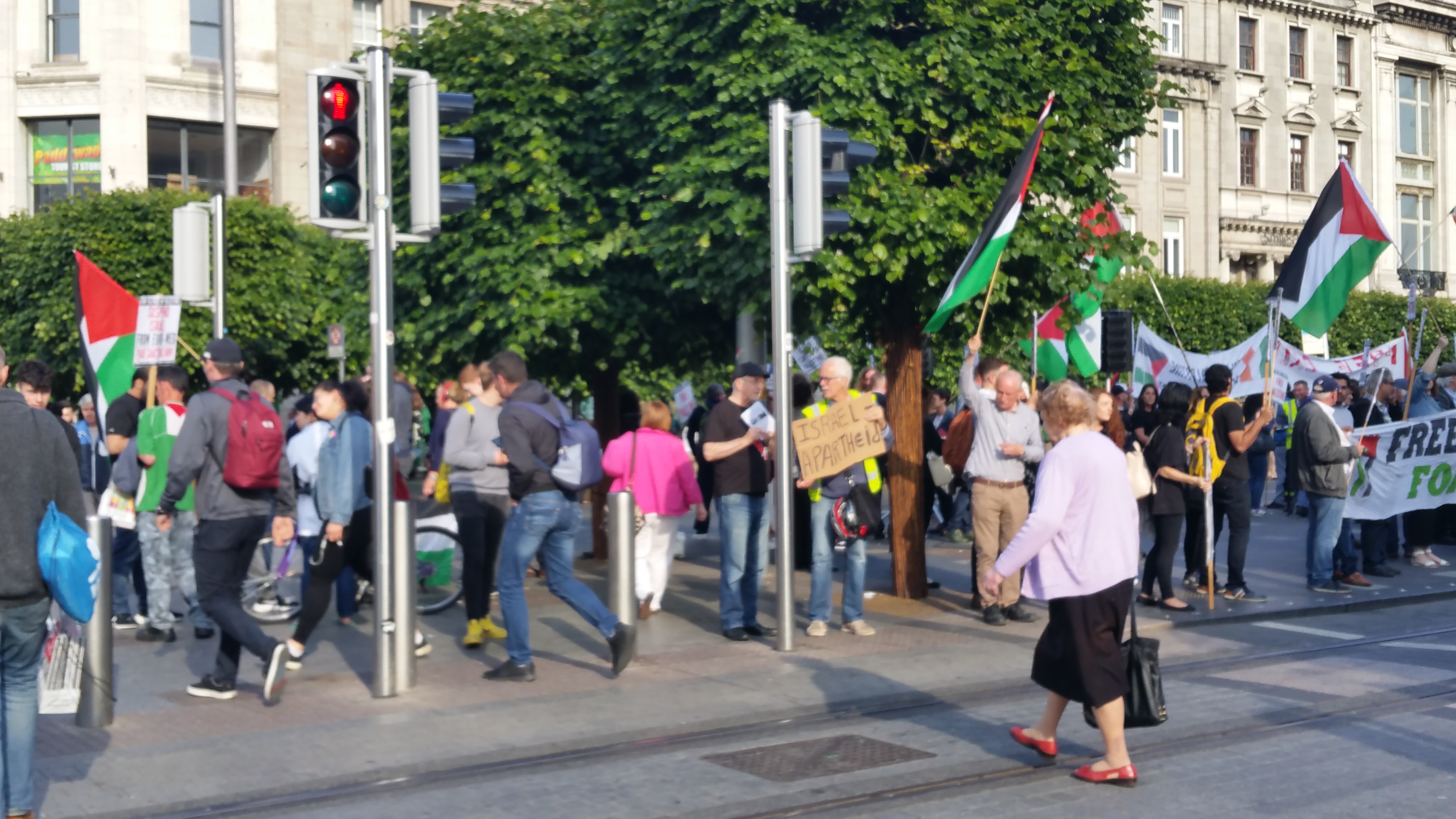
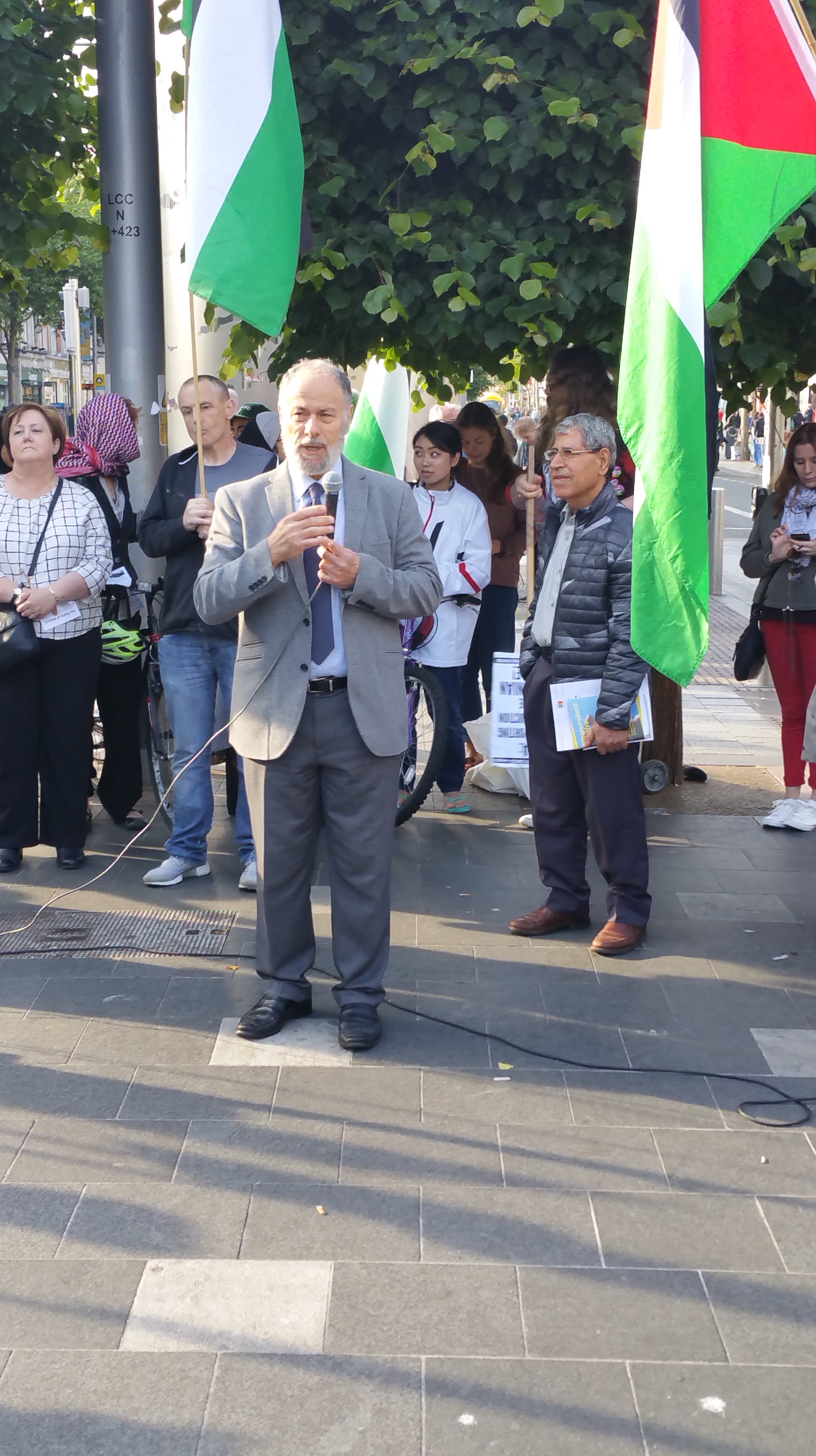
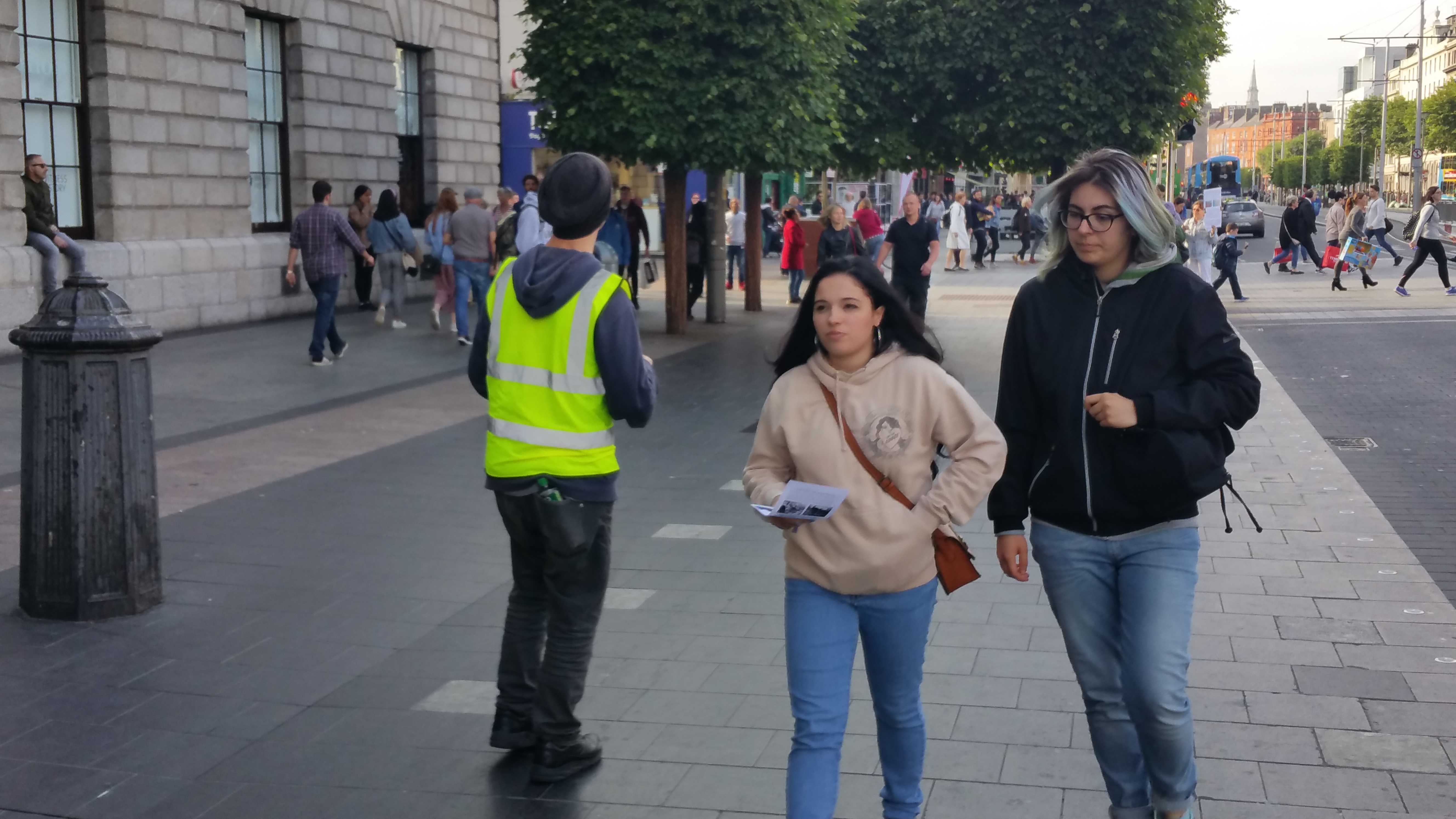
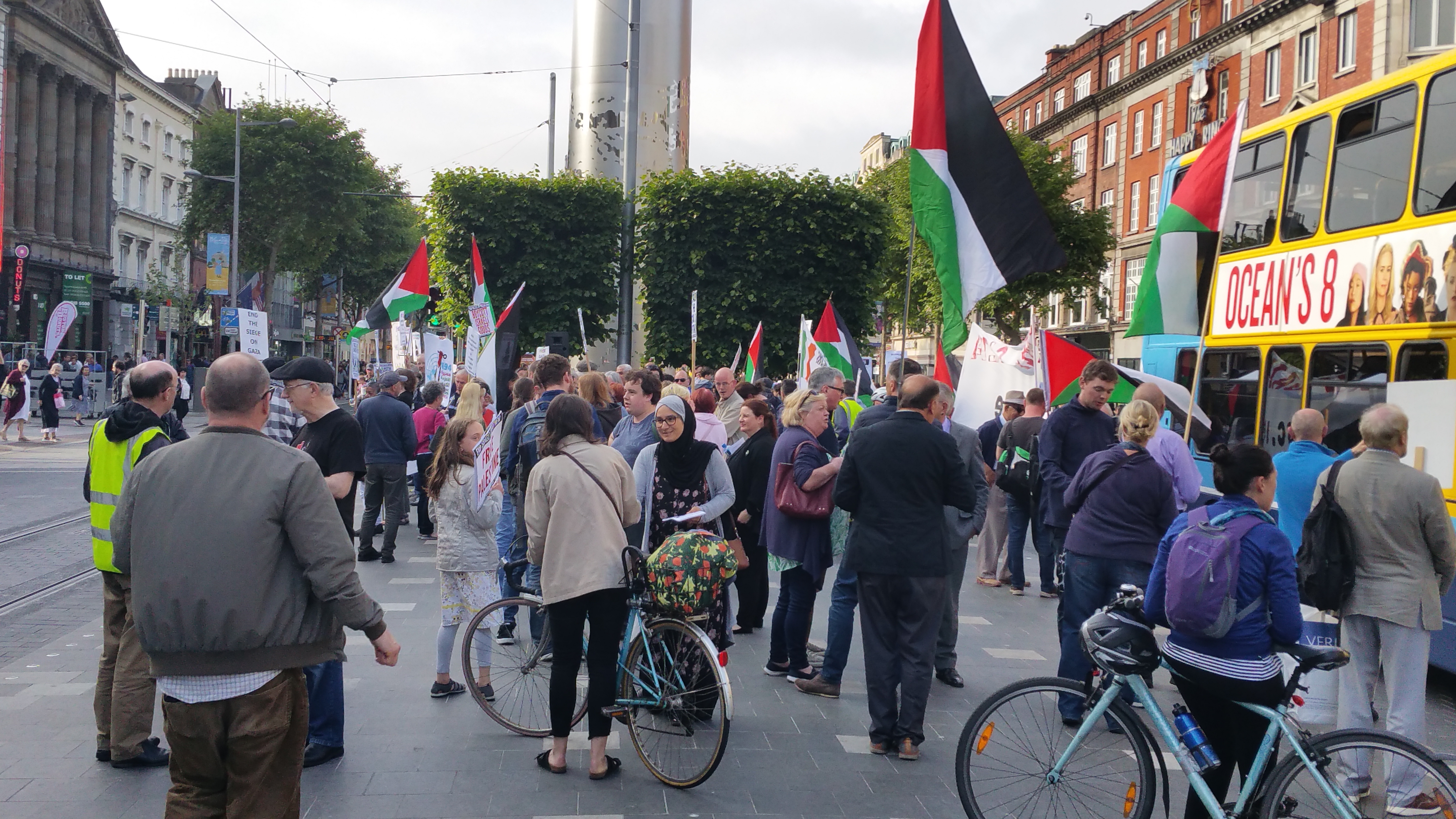
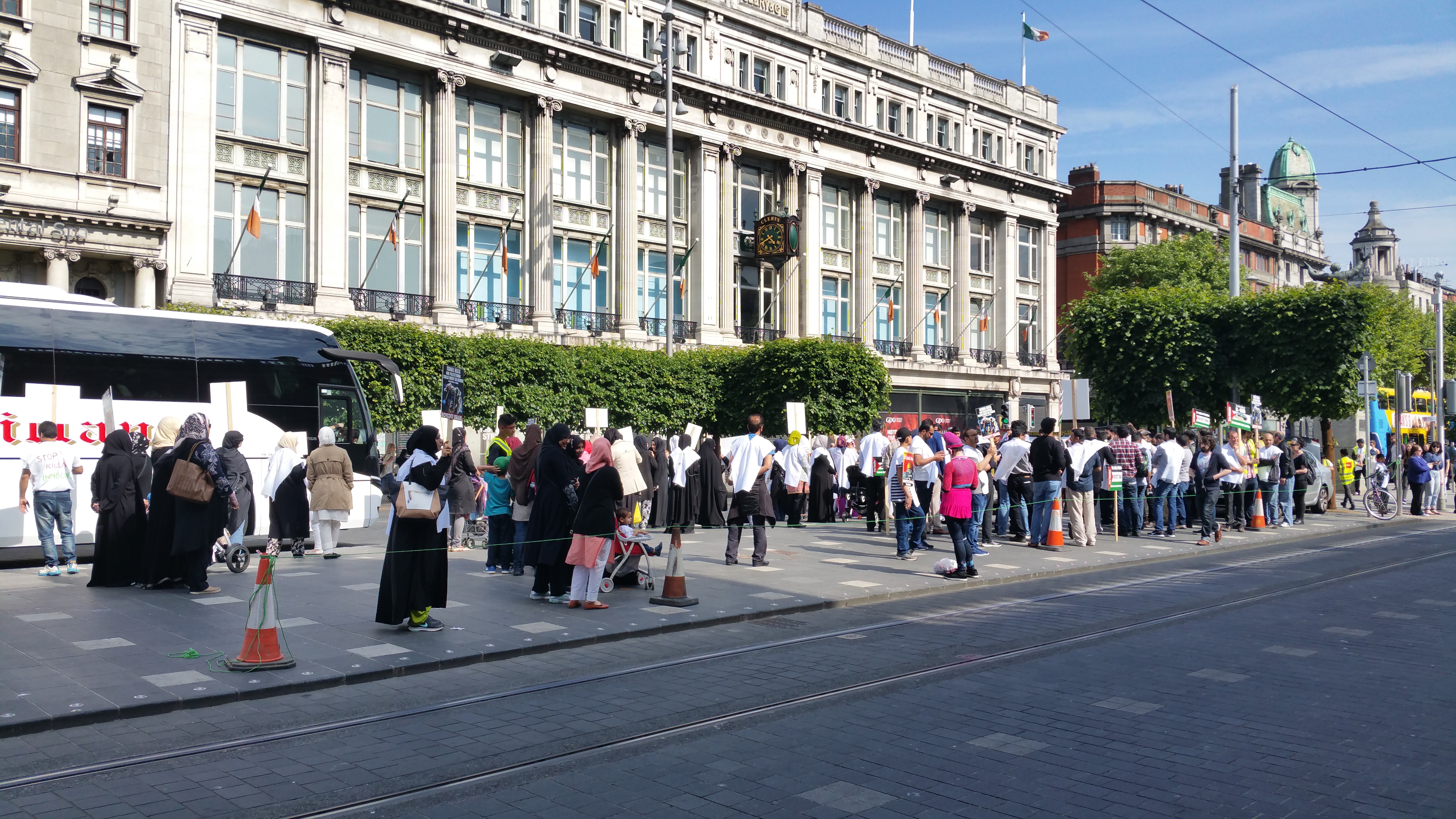
People gathered early evening Thurday (21st) on O’Connell Street, Dublin city’s main street, to protest the convictions and sentencing of the Altsasu Eight. They held Basque and Catalan flags and displayed placards demanding “Free the Altsasu Eight!” and another pointing out the severity of the sentences for what was a bar brawl with Spanish police.
Section of protest and conversation with passers-by (Photo: D.Breatnach)
From the leaflet distributed: “In November 2016, during a festival in Altsasu, Nafarroa (Navarra) Province of the southern Basque Country, a lieutenant and sergeant in the Spanish Guardia Civil police force, both off-duty with their girlfriends, entered a late-night bar well-known as a place for pro-independence Basques to socialise. An altercation occurred in which the police said they were attacked by the Basque youth and claimed a fractured ankle suffered by one; others say it was just some shoving and pushing.
(Photo: D.Breatnach)
“The Navarran regional police force, the Policía Foral, first on the scene, treated it as an alleged assault case which is how the local court wished to deal with the issue. However the Spanish state Prosecutor intervened and, transferring the case to Madrid, accused eight youth of “terrorism” for which they could face a total of 375 years in prison. He failed to prove that but on charges of public disturbance, assault and threats alone, on 1st this June the eight youth were variously sentenced to between 2.5 and 13 years in jail as well as fined thousands of euro.”
Leaflets were distributed to raise awareness of this injustice and many passers-by stopped to talk and ask questions. One group of interested youth was from Zaragoza, which is in Aragon province and not far from the Basque Country.
Protesters including musicians (Photo: D.Breatnach)
Live music was provided for the participants and passers-by: two women sang Txoria Txori in harmonies and a Basque sang a new song that has been composed about the Altasasu 8, while another accompanied him on guitar (hope to post the lyrics and translation). Txoria Txori is a short simple allegorical song about a man who loves a bird and says that if he cuts its wings it would stay with him but he can’t do that because then no longer would it be a bird – and he loves the bird. This song is well-known and loved in the Basque Country.
The picket was an event of internationalist solidarity, not only because it was carried out in Ireland in support of victimised youth in the Basque Country, but also because the picket line included Irish, Basque, Catalan and Italian people.
(Photo: D.Breatnach)
Further information in the English language on this case (and other events in the Basque Country) will be posted from time to time on https://www.facebook.com/dublinbasque/
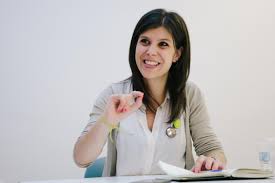
Very recently, the pro-Catalan independence on-line periodical VilaWeb interviewed Marta Vilalta, the spokesperson for the ERC (Republican Left of Catalonia) party, an important component of the pro-independence majority in the Catalan Parlament. Her replies and statements presumably reflect the thinking in the leadership of the ERC party or, if it should not be unanimous, at least the thinking of the dominant section of the party’s leadership.
Marta Vilalta photographed during interview (Photo by online Catalan newspaper VilaWeb)
ERC has 32 Deputies in the Catalan Parlament (and two Members of the European Parliament). The other components of the Catalan independist majority at the time of writing (June 2018) are JuntsxCat (Together for Catalonia – 34 seats) and CUP (Candidatura d’Unitat Popular — 4 seats). The latter is taking the ‘confidence and supply position’ (i.e they will not vote with the Opposition and will vote to keep the Government in power if necessary).
ERC’s President, Oriol Junqueras, has been in a Madrid jail since the October Referendum, awaiting trial on charges of “Rebellion”. The party’s General Secretary, Marta Rovira, went into exile to avoid a similar fate.
The party, along with JuntsxCat, whose President Carles Puigdemont is also in exile, has faced repression by the Spanish State, as has also the cultural organisation ANC (Asamblea Nacional Catalana), whose President, Jordi Sànchez i Picanyol,is also in the Madrid jail.
The independist parties are to be commended for continuing their stance for independence and for facing up to Spanish State repression. In this, they enjoy the support of the majority of the Catalan population, as evidenced by votes in the December elections and the mobilisations and votes cast in the October Referendum, albeit disrupted by Spanish police raids to confiscate ballot boxes and assault voters and demonstrators.
But how prepared are they for the struggle ahead? How critically do they evaluate their past performance and expectations? How willing to learn from mistakes? The signs are not encouraging.
ILLUSIONS ABOUT THE SPANISH STATE
“The Spanish State has been capable of everything …. to defeat independence and the Republic project”, Vilalta says in the course of the interview, with what seems to be an air of surprise, meaning one presumes that there was no lengths to which they were not prepared to go to suppress Catalonian independence. If the Spanish state has been capable of everything, one must assume that it will also be “capable of everything” in future, at least in the absence of some limiting factors, which were not mentioned by Vilalta (except perhaps in the context of reactions outside the Spanish state, which we can look at under the heading of “Illusions about other states”).
So this admission of Vilalta should imbue us with confidence that ERC is taking that into tactical and strategic consideration. However, this appears to be far from the reality, based on the insistence of Vilalta that their struggle will be based exclusively on both “peaceful and democratic” means; nor is this only an iteration of Vilalta’s but it has been stated repeatedly by leading figures of the ERC and of the JunstxCat, i.e of the parties with by far the most numerous deputies in the Parlament. We’ll look at this more carefully under the section dealing with Pacificism but for the moment we can reflect that history in general (and the history of the Spanish state in particular) demonstrates that the combatant that relies principally on moral and or legal means must be defeated by the aggressor who relies on force and its tactical application.
“I suppose the Spanish State understands and agrees with the International treaties that it has signed and which are included in the Constitution,” says Vilalta, in reference to the right to self-determination recognised by the Charter of Human Rights of the United Nations. Why does Vilalta suppose that the Spanish State “agrees” with this right? On the contrary, all its actions with regard to the nations incorporated within its state territory show that it fundamentally disagrees with them, at least where applied to itself. In fact, its own Constitution forbids the secession of any part of the State without a majority vote in favour in the Spanish Parliament and further underlines that the Armed Forces are the guarantors of the Constitution!
Of course, it is possible that Vilalta is being somewhat ironic here, or making a statement for its propaganda value. Maybe she only means that the Spanish State should uphold the right to self-determination in the international treaties which it has signed. Let us hope so. But surely it would be more useful to point out that the Spanish State has a record of fundamentally violating most of the human rights to which it has signed up, including some actually stated within its own Constitution? Such an exposure would help in any project of isolating the Spanish state internationally, undermine its propaganda and, crucially, help to prepare the Catalan people and their allies for what the Spanish State may bring against them.
The Spanish Statehas repeatedly violated not only the human rights to life (for example in running assassination squads against the Basque movement for independence); the right to serve one’s prison sentence in a prison near one’s relatives, children and friends (by deliberately dispersing its political prisoners as far from their homes as possible); the right for terminally and seriously ill prisoners to be released on parole to continue their sentences at home or in hospital (routinely violated in the cases of political prisoners); the right to freedom from torture (routinely used until very recently against political detainees and against some migrant minorities); and the right to upholding one’s language (by originally outlawing the use of Iberian languages other than Castillian and currently banning them from the Spanish Parliament).
Furthermore the Spanish State has a lively record of violating the civil rights of political activity, of assemply, of speech, of publishing, of broadcasting: it has banned Basque demonstrations, cultural and political organisations, radio stations, newspapers and even seized the financial and property assets of organisations; it has jailed Basque and Catalan (and some Spanish) political and cultural activists; jailed and fined rappers and cartoonists and social media posters elsewhere in the Spanish State. It is illegal to “insult” the Spanish King publicly in speech, writing, or other means. Fairly recently the Spanish State created a law which makes it illegal to film police misbehaviour in public, to insult them (i.e denounce what they are doing) or to hold demonstrations in the vecinity of certain state buildings, including Ministries and the Parliament, with very high fines and/ or prison sentences for transgression of any of these prohibitions.
Marta Vilalta, representing Esquerra Republicana, major party of the Catalan independist majority. (Image source: Internet)
PACIFISM
For pacifists, of course, pacifism is a principle. For others, peaceful methods and civil disobedience are tactics, i.e responses to specific issues at a particular time and place, not principles to uphold in all situations on every occasion.
It is a fact that no class has freed itself from domination by peaceful means alone and that similarly, no nation has liberated itself from colonial or imperialist domination without resorting to the use of force. This is not, in a sense, a choice for oppressed people – it is the oppressor itself which uses force and obliges the oppressed, in self-defence, to use force too.
Some recent examples will hopefully suffice to convince the doubtful. The first public actions against the division of Vietnam and the grooming by the French and USA of a puppet regime in the southern part of the nation were largely pacific. Demonstrations were suppressed and activists arrested by the puppet regime. Monks immolated themselves in public. Monks too were suppressed. Anti-imperialist forces within the southern part united in armed action with the Vietnamese state set up in the northern part of the country, which was supported by the People’s Republic of China (the Chinese communist state). Decades of terrible war followed but today the country of Vietnam is united and largely independent of imperialism.
In fact we can observe that all of the states of Europe which were formerly under the domination of another have had to rely on armed force to free themselves from their armed dominators: e.g Austria, Belgium, France (from Nazi Germany), Denmark, Holland (from Spain, France, Nazi Germany), Hungary, Italy (from France and Austria), Norway, Poland (from Russia, Nazi Germany), Switzerland (from the Austro-Hungarian Empire), and indeed the Spanish state itself (from France).
If that were not enough and though it should be, the history of the Spanish State itself shows its reliance on armed force, from the medieval period right up to the 20th Century. The Kingdom of Spain was created firstly by the joint kingdoms of Castile and Aragon, picking up other allies, driving out the Arab kingdoms (and incidentally driving out also Jews, the origin of the Sephardics, along with the Arabs, even their own allies who would not convert to Christianity. The Spanish kingdom became an imperial force outside its own state territory and conquered and plundered territories from the Canary Islands to the Caribbean, the South American sub-continent, Central America and parts of what are now the southern USA. It did the same to parts of Northern Africa and the Philippines. In no circumstance did it refrain from the use of armed force.
In the struggles within the State itself, the ruling class suppressed by armed force the uprisings of the Communeros and many others regionally-based and, crucially, both the First and Second Republics, which had come into being through popular elections. To take the most recent, the ruling class instigated an uprising among its military against the elected Spanish Government, which led to what some call the Spanish Civil War (1936-1939), with enormous loss of life and destruction, and the instalation by the victors of a fascist military dictatorship and a monarchy.
Unlike the other fascist states of Europe (with the exception of Portugal and even they had their Carnation Uprising), no purges of former fascist rulers took place within the Spanish State; on the contrary, the heirs of the fascist military leaders, politicians and industrialists continued in the footsteps of their parents and in the luxury of their appropriations.
Under some external and internal pressure, a veneer of democracy was drawn over the State after the death of the dictator Franco and the social-democratic PSOE and the Communist Party of Spain were drawn into an alliance with the existing fascist ruling class1 in what is often called the Transition (i.e to “democracy”). Far from this addition adulterating the fascism of the ruling class, the reverse happened and both political parties colluded in the suppression of movements of resistance both national and of class; the PSOE in government actually ran assassination squads against the Basque independence movement in the 1980s.
Hopefully this short review of Spanish State history has been sufficient to illustrate the readiness of the State to resort to violence against opposition, whether peaceful or not. What then are the prospects of a resistance which will confine itself to peaceful means alone? Its leadership will be killed or imprisoned, as will the cadres of the popular movement, repression will be the order of the day. The militants will be driven underground, dispersed and the movement will lose the initiative, which is fatal for a revolution.
As to the prospects of a comparatively small nation like Catalonia2 in insurrection against a major power and its military resources, we shall address near the end of this article.
INADEQUATE SELF-CRITICISM
With regard to the issue of preparedness for the actions of the Spanish State, Vilalta responds to a question by saying that ERC have carried out self-criticism of their inability to defend the Catalan referendum against Spanish State attack. Such an admission should not shame them nor demoralise their followers and allies (though it sometimes does so, sadly) – on the contrary, an organisation that does not admit its mistakes is unlikely to learn from them and in any case is not going to be honest with its membership and followers.
It is however worrying that a party pursuing an independist and Republican path in the teeth of the historical and well-known opposition of the quasi-fascist and monarchical state, should have been unprepared for the response of that State. Nevertheless, one could draw reassurance from the fact that ERC acknowledge their error and carried out self-criticism. Or at least, that would have been the case were it not for the fact that Vilalta states that “it is very easy to look back with perspective and think that it could have been done in a different way. I do not dare to say what we should have done differently. The decisions taken at that time, in a specific context and with the information that was had, seemed the best.”
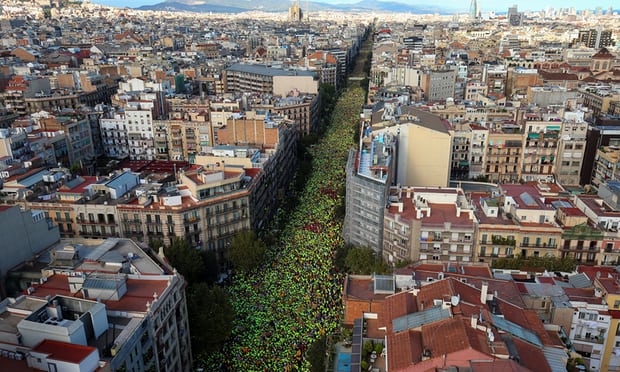
Huge Barcelona Demonstration (in green) for self-determination on Catalonian day, Diada 11 Sep2017, three weeks before the Referendum. (Image sourced: Internet)
Whether that can be called “self-criticism” is debatable but it certainly does not qualify as adequate. It amounts to saying “we were wrong but could not have come to any other conclusion and even now I can’t think of what we could have done differently.” Which is almost to say “We are likely to be as mistaken and to prepare as insufficiently in future.”
As discussed earlier, both the history of national struggles in general and the history of the Spanish State in particular should have informed the independist forces of the full range of possible responses of the Spanish State. Those who were unable to anticipate the actions of the Spanish State need to ask themselves a vital question: “Why, despite that accumulation of historical practice, were we unable to count on a police invasion as one of the possible measures of our opponent?” A truthful reply to that question would tell them and us a lot about their limitations but their refusal to even consider the question is more worrying than whatever their current conceptual limitations might be.
ILLUSIONS ABOUT OTHER STATES
In the course of her interview, Vilata commented that “the international situation is key.” She said that in the context of forcing an unwilling–to–negotiate Spanish State to, in fact, negotiate. How she sees this happening is not very clear. In this context she also said the following:
“The Charter of the United Nations recognizes the right of self-determination of peoples. The Spanish government has had and has the opportunity to discuss and negotiate how other countries, such as the United Kingdom and Scotland, have done. They have opted for repression to the limit and always say no. It is they who have pursued political leaders and freedom of expression. We will continue to defend dialogue and negotiation by asserting that Spain has subscribed to the right of self-determination and confronting violence and repression.”
Leaving aside the fact that Scotland is not truly independent, somehow Vilalta envisages using the treaties referred to above to force the Spanish State to negotiate or to have “it is forced from the outside. This mandate to make it possible to negotiate can come from international spheres.” What does she mean by “international spheres”? She is not specific but in this context mentions the reversals for Spanish extradition warrants, the Catalan Members of the European Parliament (and presumably other friendly MEPs) and the Catalan politicians in exile in European countries, presumably all coordinated by the Council for the Republic, which also gets a mention.
But even in a best case scenario, how is the Spanish state to be “forced”? Economic sanctions? They can only be imposed by individual states or by groups of states, for example the EU. The European Parliament has not seen fit even to condemn in words the repressive actions of the Spanish state and, in fact, the EU President, Junkers, commented that they don’t wish to see “an EU of 99 states”, a clear indication that the independence of Catalonia and other states breaking away is not something the EU would welcome.
And in fact, even without Junker’s comments, that attitude could easily have been predicted. In the case of a successfully independent Catalonia, not only would the Spanish state be vulnerable to similar bids by other nations within its state territory but so would the French and Italian states also. It seems that Vilalta expects the EU to act against the interests of not only its Spanish member state but the interests of two other major European states as well. But why would it do that or, more to the point, why does Vilalta think they will or even might?
Possibly Vilalta envisages some kind of external moral pressure or perhaps “good neighbour advice”. With regard to moral pressure, the Spanish state, both during and after Franco, has shown itself impervious to that. Its practice of torture and impunity for torturers has been criticised regularly by relevant committees of the United Nations and the EU and every year by Amnesty International. None of that has brought about any change.
The European Court of Human Rights has found against the Spanish State on a number of occasions (failure to investigate torture allegations, illegal extension of sentences by retrospective legislation — but never on actual torture, which is “difficult to prove”); the Spanish State sometimes appeals the judgement (and loses) but eventually pays the fine, releases the prisoners at their release dates and …. carries on as before.
The major European state response to the PSOE Government’s undercover campaign of terrorism in the northern Basque Country (i.e within the French State) has been to facilitate the extradition of Basque refugees to the Spanish state (sometimes without even bothering with a court appearance).
No doubt the Spanish State has been given “good neighbour” advice from time to time from European states and even by the USA, advised to appear nicer, to be more democratic etc and even advised that it was in the long-term interests of its own ruling class to do. Perhaps the Spanish State responded, with well-known Spanish fascist arrogance, that it knows its own busisness best or perhaps they replied that only an iron grip can keep Spain “Una, Grande y Libre” (United, Great and Free”, i.e non-communist). In either case, neither good neighbour nor critical state has shown an interest in taking any kind of coercive action against the Spanish State and there is no reason to believe that they will do so now.
European states may not wish to soil their hands doing Spain’s dirty work for them by extraditing refugees to Spain on dodgy European Arrest Warrants but that is a long, long was from being willing to act in a coercive way against a major European partner.
It seems almost certain that Vilalta, in discussing “international force” against the Spanish state was referring to action by other European states and traditionally when “the international community” has been invoked in discussions of ‘peace processes’ and sanctions that is generally what is meant. But there is another way of looking at international pressure.
To examine that possibility, we need to ask ourselves: What are the circumstances in which the Spanish State would be unable to send armed forces to suppress Catalan independence or, if it did, that they would be neutralised?
Such a situation could only be envisaged occurring when the State faced insurrections and similar crises in many other parts of the State at the same time as its crisis in Catalonia. And in fact the Spanish state, of all those in the EU, is probably the most vulnerable to such a scenario. Along with Catalonia and the Catalan Countries, there are the nations of Asturias and Galicia (both of Celtic culture) and the four southern Basque provinces.
Within those areas and in all others of the Spanish state, there is a major disaffection with the dominant order. Never have the institutions of banking and politicians been so widely exposed in corruption, never has the Royal Family been so condemned, nor repression by police so exposed. Unemployment is high as is work on short-term or casual contracts, the housing crisis is serious and numerous victims of eviction have publicly comitted taken their lives over the years. Both political parties of the traditional bi-party system (PP and PSOE) have lost prestige and electoral support, so that now each can only govern as a minority party and their decline has allowed the emergence of a two more sizeable parties, Podemos of the Left and Ciudadanos of the Right (without however much hope of a fundamental change from either). Huge demonstrations have taken place across the state and in particular in Madrid. The collusive trade unions of the Comisiones Obreras and the Unión General de Trabajadores have been found wanting and many independent unions have sprung up.
In other words, the prestige of the State has been slipping and its enemies multiplying. But to tap into these currents of disaffection with the Spanish State, the independist forces would need to do more than threaten the State with the independence of Catalonia. It would need to develop a social-economic program that would not only benefit the majority of Catalons but would also serve as an illuminated example to the rest of what is currently the Spanish territory.
Vilalta does talk a little about a socio-economic program emanating from the Catalan Government and local authorities but says next to nothing about its content. Last week a man about to be evicted in Catalonia killed himself and there are many others facing eviction through inability to pay their rents or their mortgage instalments. A solution to that problem would not only bring many doubters in Catalonia over to the side of the Republic but serve also as an example of what could be done elsewhere in the Spanish State. Support for a Spanish military intervention would be severly undermined in such a scenario, both externally and from within the armed forces and the breaking out of many fires across the state would leave the firefighters stretched too thinly to carry out their task.
This scenario could also affect the French state should it consider a military intervention of its own and the Bretons, northern Basques, northern Catalans and Occitans might seize that opportunity to advance their own claims for independence or autonomy.
The problem for ERC with instituting deep socio-economic changes in Catalonia and in appealing to wide national and class disaffection is that, notwithstanding the “Left” in its title, it is a bourgeois or capitalist party and can hardly be expected to cut off its own head just because it will make its legs firmer. And the JuntsXCat is even more so, at its core a liberal capitalist party.
All of which might serve to remind us of the quotation from James Connolly, a revolutionary socialist who also fought for the independence of a small nation – Ireland. Recognising that only the working class was unable to gain some advantage through a compromise with the imperialist and coloniser, he wrote: “Only the Irish working class remain as the incorruptible inheritors of the fight for freedom in Ireland”. If the words “Irish” were to be replaced by “Catalan” and “Ireland” by “Catalonia”, leaving the rest of the statement intact, would it also be true?
End.
FOOTNOTES
1This was necessary for the Spanish fascist ruling class not mainly as partners in the production of the farce of ‘democracy’ but chiefly for their control of the two main non-fascist trade unions then (and still): the Comisiones Obreras of the CPE and the Unión General de Trabajadores of the PSOE, both illegal until that point but also powerful and with a potential for creating industrial and political instability.
2For the sake of convenience, Catalonia is being described here as a nation, although for many, including the ERC party, at least in the past, it is the Paises Catalans (Catalan Countries) which is the Catalan Nation, a territory extending from Pau in the French state through Catalonia to Tarragon, Valencia and the Balearic Islands.
My full translation to English of introduction and interview:
Marta Vilalta (Torregrossa, 1984) is the spokeswoman for Esquerra Republicana since March. A journalist by profession and Parliamentary representative since 2015, Vilalta has been a member of the ERC since 2004 and, after handling several responsibilities, has now taken a step forward as a result of the repression suffered by the party, with President Oriol Junqueras in prison, Secretary General, Marta Rovira, exiled and members of the Executive persecuted and prosecuted by Spain for having collaborated in the organization of the 1st October Referendum.
We talked with Vilalta about theCatalan political situation, the Republic, autonomism, the new Government of the Generalitat, the effects of repression and the new road map that ERC must approve in its national conference at the end of June . Young, energetic and smiling, Vilalta takes this new stage as a personal challenge, but with the bitter aftertaste of having had to go through the situation of repression against the party and independence.
– Is it true that you do press conferences prepared not to answer questions? Will you respond to this interview?
– [Laughs] I did not say that! It was a joke in relation to this and Sergi Sabrià [the previous spokesman], speaking to the journalist, said laughingly that he had advised me not to answer the questions. We laughed, but it was included in the interview. I am a journalist and I am empathizing with you, it is about responding well.
-Good! Now that there is ‘effective government’, how is the Republic to be brought about?
-Firstly, getting the Government back has been an important and indispensable step towards achieving the objective, which is the Republic. We advocate that to make the Republic real and to complete it we must be strong at all levels and have all the possible tools. Therefore, this also means recovering the Government and the institutions, being connected with the social mobilization and citizenship, being strong in the international bodies, the city councils and the Parliament. We have to be stronger and stronger, to increase and have an amazingly hegemonic social majority that will allow us to bring into existence the Republic we have decided to have, but unfortunately we have not yet been able to make it effective. But it will happen, we’re sure.
-Let’s talk about the ERC strategy paper, the new roadmap to be approved. A fear has been expressed because a section of the grassroots, such as the Mayor of Montblanc, Josep Andreu, believes that the unilateral path is not given enough importance.
-I think that the debate or the controversy about the strategic presentation has been magnified, I do not know if deliberately or not. It analyzes the situation based on the lessons of recent months. It places us where we are and helps us to define what we do and with what instruments to do it in order to bring about the Republic. That’s why it is called ‘Let Us Create the Republic’. We do not rule out any path, providing it is peaceful and democratic, to arrive there. Yes, it is true that it emphasises the need to be stronger and stronger, to expand support in many sectors that share the anti-repressive struggle but yet do not see the need for the Republic. And it defines the multilateral framework of play because it is a process where many political, judicial, economic, and social agencies intervene … We need to know how to move in all this multiplicity of agencies and to maximize opportunities.
– And the unilateral path?
-The paper does not rule out the unilateral path, we understand it as part of the multilateral framework. Perhaps part of the membership thinks that we have not been explicit enough. We are in the process of making amendments so that all the membership can participate and improve the text. We debate with a wish to reach a consensus and for everyone to feel represented. We are very pleased with the level of participation, with 1,400 amendments. Some 1,100 have been incorporatedto be negotiated. This shows a vital strength in the organization and the very participative health of the membership of ERC.One must shine the lights ahead to see the medium term to bring about the Republic and to see what we need to do to achieve it.
-Andreu regretted, however, that there was little participation in the territories (? Trans), and he made a public appeal.
-Yes, the call to participation should be done by all. But I insist, there has been a huge volume of amendments. In 2013, some 300 amendments were presented and now there are 1,400! There have been assemblies in the territories. We hope that on June 30 and July 1 there will also be a lot of participation because the moment requires it. The more participation, the more endorsement of the final paper.
-The CUP accuses the Government of being autonomist.
-We have heard them say this several times, but I do not agree. Whenever we have had the chance to rule, we have done it with a republican call and overtaking autonomy. Interest in autonomy is minimal. Willingness to create a republic, total. This is what the Government of the Generalitat is doing at the moment. The examples of recent days show that there is no intention to go for autonomy nor to drag out the process.
-What examples?
-We need to recover the institutions because we believe that makes us stronger. This is not autonomism, it is to put them into the hands of the citizens and in the service of the country to be able to move forward. With the first government actions alone, both symbolic and effective, it was shown that it was essential to recover the Government. Unlock the money that social agencies had to receive, more than 300 million euros, the reactivation of delegations abroad, the money to recover the quality of TV3 and Catalunya Ràdio, 250 million for social rental … Damn it, they are essential policies! And since they are destined to improve the country, we are sure that they will help us to add more people (to our support — Trans).
-The people who have doubts about independence understand this?
-This is one of the main ideas. From government action and being able to respond to people’s needs and make policies with Republican logic, we can show that with good governance and caring for the citizenship we are able to respond to needs and to improve well-being. We are convinced that this will lead us to make more people see that this is the only way to defend the social, civil and political rights of citizens. This will surely result in an increase of the people who will see that the republican project is the only alternative to guarantee well-being, social justice and equal opportunities. There is no other project that guarantees us all this. It has become clear that in Spain these fundamental rights are not guaranteed and that they have been violated. We have to be capable and must strive to explain all this.
– Will this legislature be a constituent process?
-The intention is that it will be. I cannot say when. We see it as a great space for debate about how we want the country in all its aspects. It also has to serve to reach many people who feel called to participate. In fact, the project of the Catalan Republic is the only one which will ask this of the citizens. The Spanish state will not enact any constituent process. It is only with that that many people can see the opportunity that there is an opportunity for real change and everything that implies. To think and rethink how we want to organize ourselves and how we want our society to be. This will happen, soon; we must ensure maximum participation of the convinced people and of those who feel called to participate. It will help us to add to our numbers and open the project to accumulate forces. It must be a consensual process, with territorial capillary (reach? – Trans) that allows us to know what we want and what goals to have as a country. The constituent process can be one of the tools at our disposal to exceed the limits of the Republican project.
-The conclusions of the citizens’ debate within the territory will be taken to Parliament?
-I do not know the methodology nor what the phases are. To be successful, we will have to agree with all the political, social and economic actors that can participate. Therefore, we will see what steps must be taken. It is obvious that everything that comes out of the constituent process must be channeled institutionally so that it has the effects that we want and so that it does not remain only in a debate.
-Your party has carried out self-criticism of the October events?
-Yes, it’s been done. In any case, it is very easy to look back with perspective and think that it could have been done in a different way. I do not dare to say what we should have done differently. The decisions taken at that time, in a specific context and with the information that was had, seemed the best. Everything was done with the intention of making effective the 1-O (Referendum – Trans) and to be able to vote, after facing the repression and proclaiming and bringing about the Republic. Unfortunately, we could not defend it. Maybe over time we will have more information. In any case, I really appreciate that everything that was done was because at that time it was believed that it was the best way to reach the goal that we all wanted. From now on, I think the most important thing is to learn from lessons. One of the most important is that Spain is willing to anything. We thought they ‘would not be able’, that ‘could not be allowed’, but they were.
-The Spanish state has been capable of everything.
-To defeat independence and the Republic project, it has been capable of dispensing with the rule of law and democracy. This is a very important lesson, because we moved in an ambit of democracy and defence of rights and freedoms, and we continue there. But we have seen the axis upon which Spain moves. We have to be stronger and stronger because it is the only way to face this repressive and strong State. We must continue defending all democratic channels with allies at all levels. Surely we will have a new opportunity. If we keep alive and resisting, we’ll be able to win.
– Do you have any expectation of the new Spanish government? On Thursday, Grande-Marlaska disclaimed the responsibility for bringing the political prisoners closer to home and then Llarena reminded him that this depended on the Ministry of the Interior (of which Grande-Marlaska is Minister — Trans).
– Different things. First of all, to go back a little. We supported the motion of censure (against the PP Government of Rajoy – Trans) because we believe that it was the responsible action to remove the PP and bring down Rajoy. That Government that had repressed us, the leader of repression and corruption …
-The PSOE too.
-Yes, yes. I say that was the responsible action at that time to make that government fall. Not to support the PSOE. That said, obviously, a new scenario opens, but we do not have much expectation of it. We will observe the following steps. On the concrete question of the prisoners, it is shameful what happened on Thursday. The Minister and the Judge passed the ball about the prisoners to one another. It is an aberration, an arbitrariness, that they are detained as hostages, as revenge. And we demand, it is not contradictory, that they bring them to Catalonia. It is a correct action, the law says, that they be as close as possible to families and children. If the Spanish Government had wanted to, it could have already made the decision.
-The other day you commented that any negotiation should start from the first of October. What does this mean?
-We continue defending dialogue and negotiation. If we want a sincere and effective dialogue, we must be able to speak of everything, without renunciations or initial conditions. We should not only talk about concrete demands of economic, social and sectoral policies that have been dragging on for many years, but also about the situation in Catalonia and how we exercise the right of self-determination and make the Catalan Republic real. When we say that we must start from the first of October, let’s talk about it. Conflict must be resolved through the political path, negotiation and dialogue. The 1-O is the founding moment of the Catalan Republic, marks a point of departure in our most recent history.
– Can this be negotiated with Spain?
-I suppose the Spanish State understands and agrees with the International treaties that it has signed and which are included in the Constitution. The Charter of the United Nations recognizes the right of self-determination of peoples. The Spanish government has had and has the opportunity to discuss and negotiate how other countries, such as the United Kingdom and Scotland, have done. They have opted for repression to the limit and always say no. It is they who have pursued political leaders and freedom of expression. We will continue to defend dialogue and negotiation by asserting that Spain has subscribed to the right of self-determination and confronting violence and repression.
– If we want to open a negotiation, the international field will be important. Until now, Spain has refused to accept any mediation offer. Does the Council for the Republic have any role in this regard?
– The international situation is key. When we talk about negotiating with the State, we know that it will not negotiate because it has not given any evidence (of such willingness — Trans). We must force the State to negotiate, or force it so that it is forced from the outside. This mandate to make it possible to negotiate can come from international spheres. The judicial battles of the exiles must also be taken into account. Spain has suffered the first judicial reversals because no European justice recognizes non-existent crimes that are and invented to punish and silence the people of Catalonia. International action must be organized and coordinated. It is clear that the Council for the Republic can be an instrument that helps us to make heard this voice of the demands of Catalonia everywhere and that can help us denounce the violations of rights and repression. We will help the voice that we have in the European Parliament, the exiles, the government delegations that will be reopened … With all these tools we must be able to win.
– Will Marta Rovira be part of the Council for the Republic?
-We will have see how it will be composed. Much has been said about it, but it must be ascertained how the Council is composed by the Republic. Marta Rovira was forced to leave because of this brutal persecution by Spain and will surely play a relevant and important role in the international arena in defense of individual and collective rights and freedoms. We’ll see what role everyone has.
– Does she participate in the internal life of the party?
– She is the General Secretary of Esquerra Republicana and that continues to be the case. She participates in internal meetings and we hope that in the future she will have a more public role. It continues on a daily basis in the way that new technologies permit her.
– In this situation of abnormality and repression, ERC has recovered from having the General Secretary in exile and the President in prison?
-Our organisation has suffered a brutal persecution. They have tried to behead us to weaken, frighten us and make us disappear. In addition to Marta Rovira in exile and Oriol Junqueras in prison, we have many members of the Executives accused and activists persecuted for having done everything possible so that Catalans could vote on 1-O. It was a tough blow, but luckily we are a broad, strong and cohesive organisation. Other people who have been able to take up the duties and responsibilities to continue resisting and persisting, despite the cruelty of the moment.
-The municipal elections will be a good test to measure if the base has been expanded?
-Once polling has taken place we will count and validate the majority in favor of independence and the Republic. Democracy does not frighten us. That is why we know that the Republic will end up winning. The democratic and peaceful way is ours and what we have to use to reach the Republic. In addition to revalidating the majority, we must increase it to show that we are many and that we are multiplying. The independentist movement has grown in recent years, although we still have on the margins many people who have not taken the step but that are in favor of democracy, rights and freedoms.
– Will more than 50% of the votes in the municipal councils involve some change in the political landscape?
-For a start, it places us in a new scenario. Let’s see how the correlation of forces turns out. Surpassing 50% is to pass over one of the important thresholds to validate and certify the majority in favor of independence. We will have to evaluate new steps because we will be stronger and stronger, which is what we want. I cannot specify what will happen, but it would be a very important step to advance, materialize and consolidate the Republic.
– Is it decisive if independentism wins in Barcelona?
– It is very important. But also in other important cities and other capitals, such as Lleida and Tarragona.
-The usual debate has been begun. United lists, separate lists.
-We must be able to compare the projects with everyone in all the elections, whether they are municipal or parliamentary. Confronting all ideas and projects makes us maximize results for all. The elections on December 21 were a test, distinct from September 27. When we present all together as one, it is difficult to widen the base, we are small. When we each present separately, each trying to maximize their results with their project, is when we truly achieve the maximum widening of our perimeter. With the results achieved there will be a need to agree, join and have unity of action to going ahead with the town councils and the policies that are decided. The municipalities must serve so that there are as many republican and independentist city councils as possible. We can make a qualitative leap in many areas, especially in the metropolitan area and the capitals.
-Do you think that you can govern Barcelona without a pro-independence list being the most voted? The last published survey gave a draw between Barcelona in Comú and Citizens.
-If the votes independentist lists are compiled and achieve a majority, we can govern. The Council will end up being controlled by those that who can unite and that are able to agree. So, obviously, yes.
-Will ERC agree with the communes (Catalan version of Podemos – Trans.) and the PSC (Catalan version of the PSOE – Trans.)?
– We do not rule out any option with the objective of being able to guarantee republican, independentist city councils and allowing us to develop the policies to advance. In each case we will have to look at how that turns out. Right now we do not rule it out. But our logic and the priority is to have as many republican city councils as possible for the better. We know that ERC can often be this binding agent, this project that from the centrality of the independentism can unite the most.
-Oriol Junqueras was your teacher. You have a very personal relationship with him. Did you watch the videos from inside Estremera prison?
-I did not want to see them. I have seen some images, but nothing else.
-What did you hear?
-From the little I have seen and what I know, the dignity of these people is clear. The images have been stolen and that is undignified. But their dignity, even though the State holds them as hostages in prison … They are good people. Oriol is one of the best people we know and is kidnapped because he is able to lead, bring together and unite like no one else. With an open mindedness and caring, to be in the company of people and to listen. He and the rest of prisoners are seen as a threat to the State, and that is the reason they are kidnapped.
-Well there is a government in Catalonia, change of Executive in Spain, is there a risk of normalizing the situation of political prisoners?
-We must do everything possible so that it is not normalized. This country will not be normal until all judicialization is ended, until all imprisoned people are on the street or until all exiled people return home. We know that all acts to remember reprisals, lunches and yellow dinners, actions to raise money and report the situation help to ensure it is not normalised. The prisoners tell us not to cry but rather to demand their freedom.
-The situation of the party has led you personally to have to take a step forward. How have you found it?
-It’s a contradictory and bittersweet feeling. Any new responsibility is always accompanied by enthusiasm, but at the same time I have the bitter and sad feeling of having to do it in this context. In addition, it coincided with the second round of imprisonments of Carme Forcadell, Dolors Bassa, Raül Romeva, Jordi Turull and Josep Rull. And when Marta Rovira went to exile. Therefore, in a very tough context. But absolutely convinced that we all have to fight and each one contributes the grain of sand and plays the role that falls to us in the anti-repression struggle and which at the same time advances the Republic. This we do, not only myself, but many colleagues, each with the desire to be of use for the project.
The regular blowing of horns by passing motorists, including taxis and buses, would have indicated that something of interest was happening in the city centre yesterday, Monday 5th June. As people came within sight of the centre of O’Connell Street, they could also see the Palestinian flags flying, the banners and the placards.
View of the rally on the east side of the central pedestrian reservation, looking southwards. (Photo: D. Breatnach)
The Great Return March
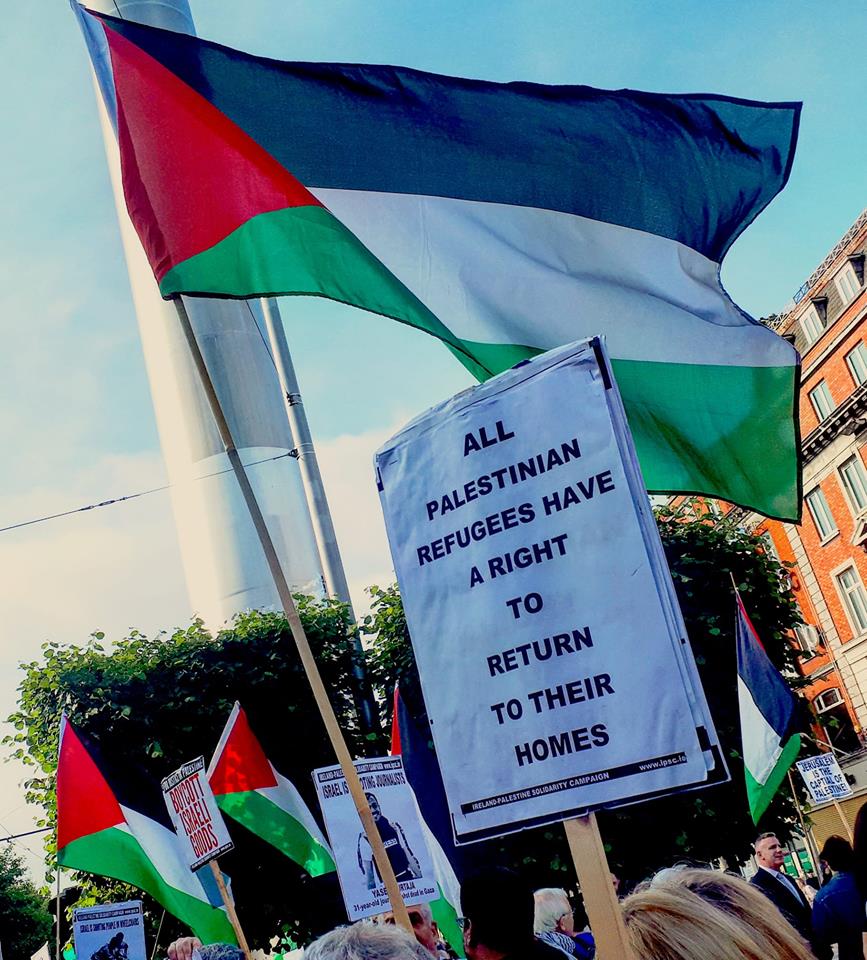
The Ireland Palestine Solidarity Campaign had convened a rally of hundreds in the central pedestrian reservation of O’Connell Street, main street of Ireland’s capital city, near to the Spire and opposite the historic and iconic building, the General Post Office. Billed as a rally in solidarity with the Great Return March of Palestinians, demonstrators carried placards denouncing the shooting dead by Israeli soldiers of demonstrators as well as of journalists and paramedics. The Palestinian death toll since March 30th has reached 120, with over 5,500 injured. Palestinians have also accused Israeli snipers, when they wish not to kill, of shooting young men through parts of their legs calculated to ensure permanent disability. The shooting dead of unarmed protesters, the killing of paramedics and journalists (who wear clearly identifiable clothing), are all crimes according to international law but, as Palestinians and their supporters repeatedly ask, who will hold Israel to account?
A view of part of the rally on the central pedestrian reservation, looking southwards. (Photo: D. Breatnach)
The demonstrators being targeted by Israeli military are protesting the expulsion by Israel of 700,000 of what was then the majority Arab population of Palestine in 1948, followed by their exclusion and that of their descendants from Israeli-controlled Palestine. There are an estimated four million Palestinians 1 barred from entry to Palestine, their lands or those of their grandparents, while anybody in the world who can prove his or her Jewishness, even though their families had not lived there for thousands of years2, can gain entry and claim Israeli citizenship.
Placards held by supporters in the rally yesterday upheld the right of the Palestinians to return to their homeland. It is ironic that the Zionists since 1924 at least have been upholding that demand for people who had never set foot in the land, nor whose ancestors had not for thousands of years but are denying that right to Palestinians driven out within living memory and their descendants.
View of the rally on the west side of the central pedestrian reservation, sretching southwards. (Photo: D. Breatnach)
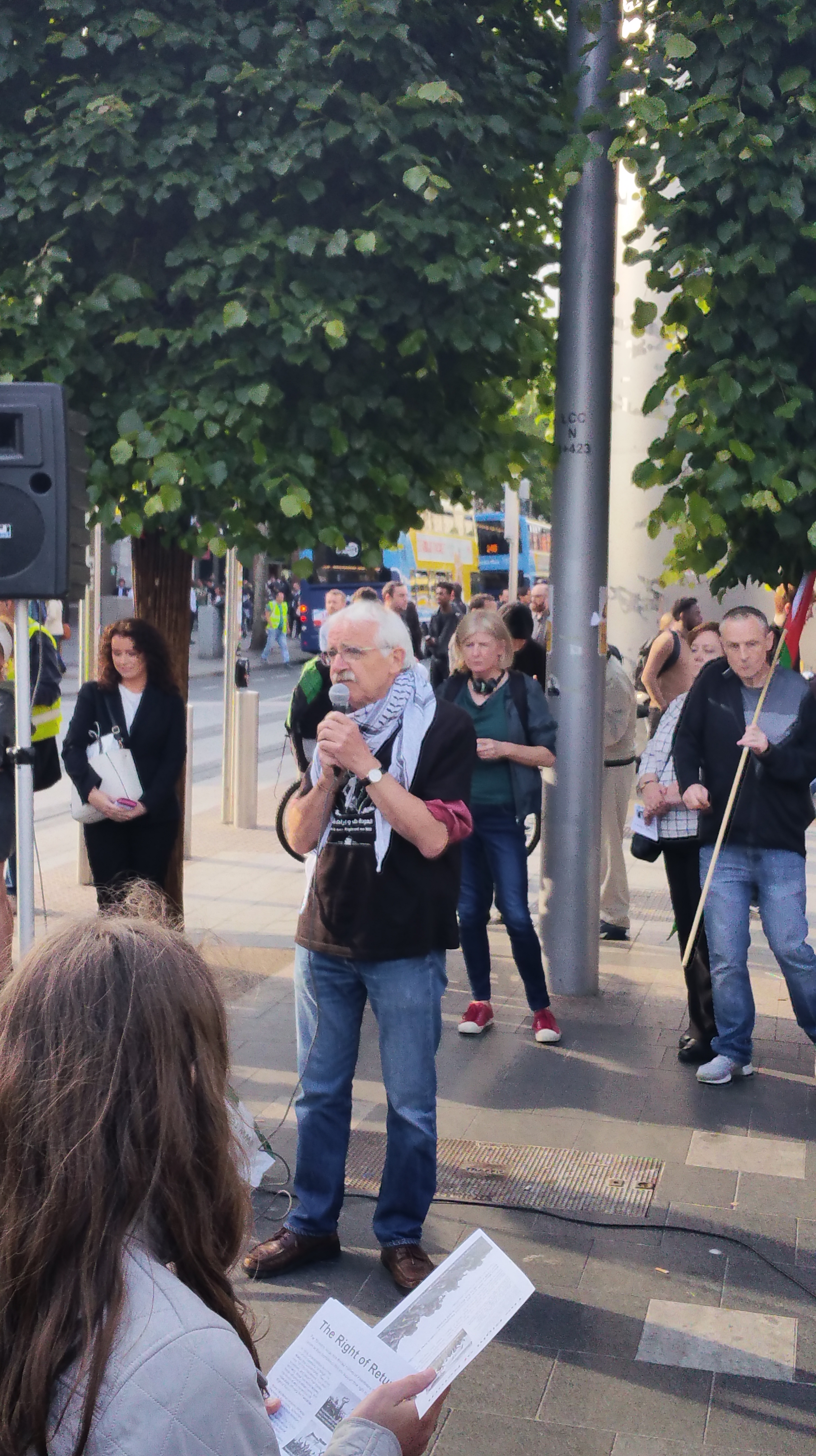
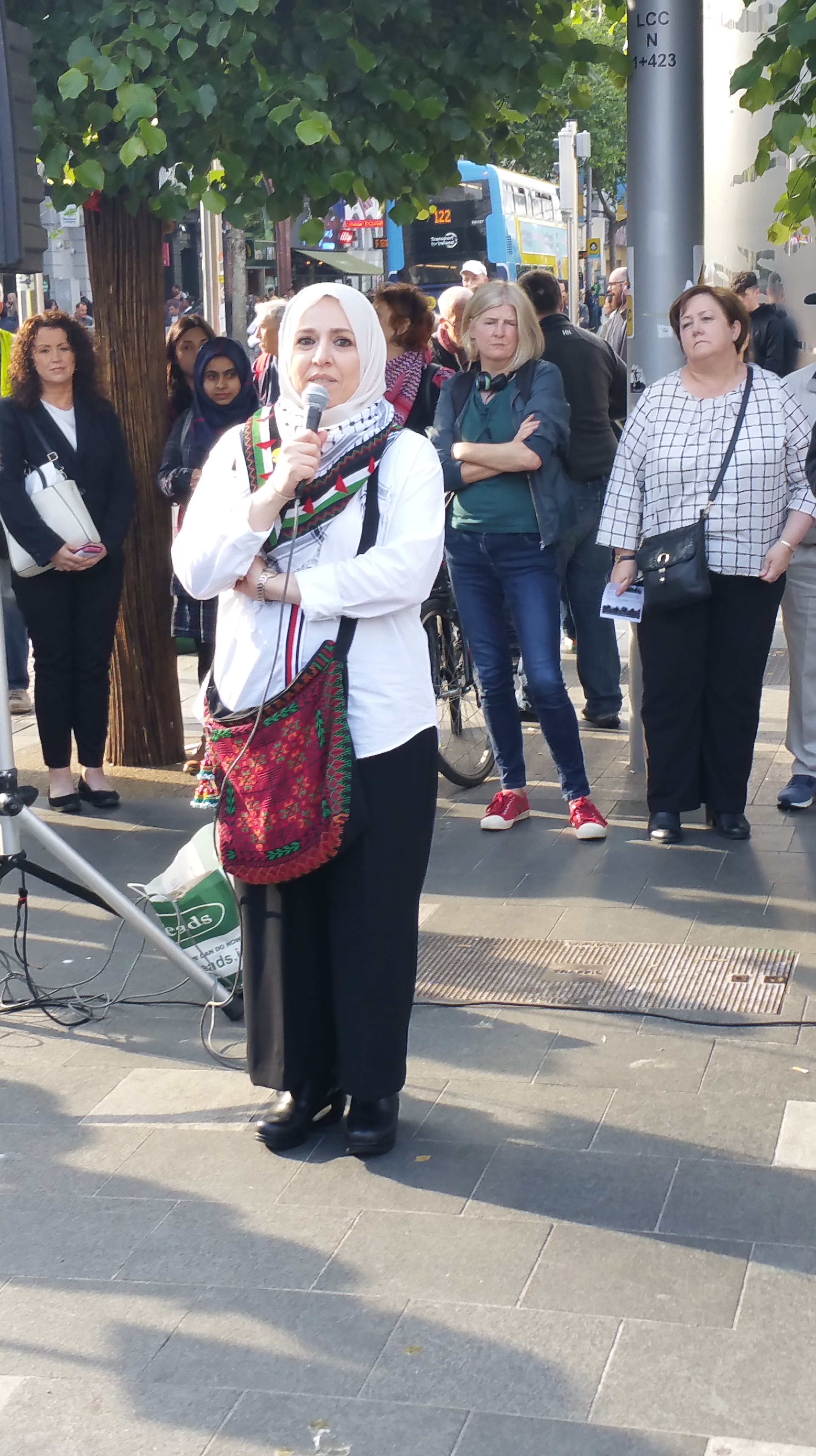
Speaking through a microphone, Martin Quigley thanked those attending the rally and after some remarks, introduced the Chairperson of the IPSC, Fatin Al Tamimi. Speaking about the right of return of Palestinians, Tamimi also said that she had relatives in both Hebron (West Bank) and in the Gaza strip and spoke about the privations of the people there blockaded by Israel, including contaminated water and lack of electricity. However not only is Israel guilty but also Egypt, as Tamimi alluded to when she said that Egypt had only temporarily opened the Rafah Crossing Gate, which Egypt maintains, for the feast of Ramadan, as a result of which she was expecting to be able to see her sister for the first time in seven years (the crowd cheered and applauded this news).
Marting Quigley for IPSC. (Photo: D. Breatnach)
“Expel the Israeli Ambassador and close down the Embassy!”
Two other Palestinian speakers addressed the rally, including one who had come out through that very Rafah crossing, Asad abu Shark who was introduced as from the Great March of Return and Ahmad El Habbash, introduced as representing the Palestinian Community in All Ireland3. All speakers drew attention to the Nakba (from Yawm an-Nakba, meaning “Day of the Catastrophe”, referring to the expulsion of thousands of Palestinians in 1948 –), to the right of return, the terrible conditions within the Gaza strip (which place, they said, would become uninhabitable by 2020 — see link), the impunity of the Israeli authorities and the inactivity of “the international community”.
Fatin Al Tamimi, Chairperson of IPSC, addressing the rally. (Photo: D. Breatnach)
Al Tamimi was cheered loudly when she called for the expulsion of the Israeli Ambassador to Ireland and the closure of the Israeli Embassy, a call repeated by other speakers.
Ronit Lenten, who introduced herself as “an Israeli Jew” and representing Academics For Palestine (Ireland), also spoke briefly.
Last to speak was John Lyons, a Dublin City Councillor for the People Before Profit party, who made similar points. Referring to visit of his own to Palestine he referred to the courage and persistence of the Palestinians in merely trying to live their daily lives under the conditions of Israeli military occupation, apartheid and harassment and called on the Irish people to match that determination in taking action in solidarity with the Palestinians.
An Ireland-based Palestinian speaker addressing the rally. (Photo: D. Breatnach)
Throughout the speeches, the solidarity beeping of horns of passing car and bus drivers could be heard and occasionally shouts of encouragement from open bus or car windows.
Bill to ban imports from Occupied Territories
All speaker highlighted the importance of the BDS campaign (Boycott, Divestment and Sanctions) and the need for Irish people to contact their elected public representatives to ask them for concrete action in support of Israel, including for a Bill to be introduced in the Seanad by Senator Francis Black, (well-known singer, also campaigner for human rights and for support for recovery from alcohol addiction). The Bill in question is the Occupied Territories Bill, the intention of which is to place a national ban on any products shown to be exported from territories under illegal occupation. The Bill, a draft of which has already been approved in committee (see link), is expected to go before the Seanad in July, though that may change and, if passed twice there, will go on to the Oireachtas for debate and, if passed there, into Irish law.
One of the IPSC’s leafleters and passers-by who have just accepted a leaflet. (Photo: D. Breatnach)
Calling on all present to stay in touch with the IPSC or with other Palestine solidarity organisation, Martin Quigley brought the event to an end by leading the rally in leading a number of chants: “From the river to the sea, Palestine will be free!” “Free, free Palestine!” “One, two, three, four – occupation no more!” “Five, six, seven, eight – Israel is a fascist state!”
Early moments as Palestinian supporters gather, view northwards. (Photo: D. Breatnach)
Argentina cancels scheduled football match with Israel. Dozens of Palestine flags defy GAA ban.
In a separate but related development, the national soccer team of Argentina yielded to calls to abandon its scheduled ‘friendly’ match with the Israeli national soccer team (see relevant link). Strong advocacy for the cancellation had been brought about by the movement for BDS both within and outside Argentina but statements of team officials to the media made it appear that members of the team had been threatened (but without producing any evidence of such).
And on Sunday, dozens of Palestinian flags were flown during a match at Omagh between Senior Gaelic Football teams Tyrone and Monaghan. The actions seemed not only to represent solidarity with the Palestinians at this time but also defiance of GAA officials who had removed flags and a banner at a previous match (see relevant link).
End.
POSTSCRIPT:
Palestinian solidarity demonstration in Dublin Friday 8th June (not organised by IPSC). (Photo: D.Breatnach)
Footnotes:
1“Today the number who qualify for UNRWA’s (United Nations Refugee and Welfare Agency) services has grown to over 4 million. One third of whom live in the West Bank and Gaza; slightly less than one third in Jordan; 17% in Syria and Lebanon (Bowker, 2003, p. 72) and around 15% in other Arab and Western countries. Approximately 1 million refugees have no form of identification other than an UNRWA identification card.”
2Or the many Jewish converts who never had any contact whatsoever with Palestine.
3 Actually no individual or separate organisation can claim legitimately to “represent the Palestine community in Ireland or anywhere” but there does exist a Palestinian organisation in Ireland which has appropriated that title as its organisational name. A number of different organisations (and none) find support among the general expatriate Palestinian community, including Hamas, Al Fatah and perhaps the PFLP.
The minority right-wing government of Rajoy’s Partido Popular fell on a motion of no confidence proposed by Sanchez, leader of the second Spanish party in terms of electoral strength, the social-democratic PSOE. The ostensible reason for the motion was the recent court decision implicating officials of the PP in a massive financial corruption case. But will the change make any basic difference?
In order to be successful, in addition to his own party’s votes, Sanchez had to call on the support of the elected representatives of Podemos, the Basque Nationalist Party (PNV) and the Catalan representatives in the Spanish Parliament.
In proposing the vote, dedicating two seconds of his speech to the Catalans, he said that he would talk to them. He almost certainly promised the PNV beforehand that he would honour Rajoy’s recent budgetary sweetener for them. He may not have made Podemos any promises but with the PP having 137 seats out of the 350 in the Cortes (Spanish Parliament) and Sanches only having90, with other right-wing parties having 48 between them, the social democrat is going to need all of Podemos’ 71 and all the rest of the help he can get for his party to stay in government.
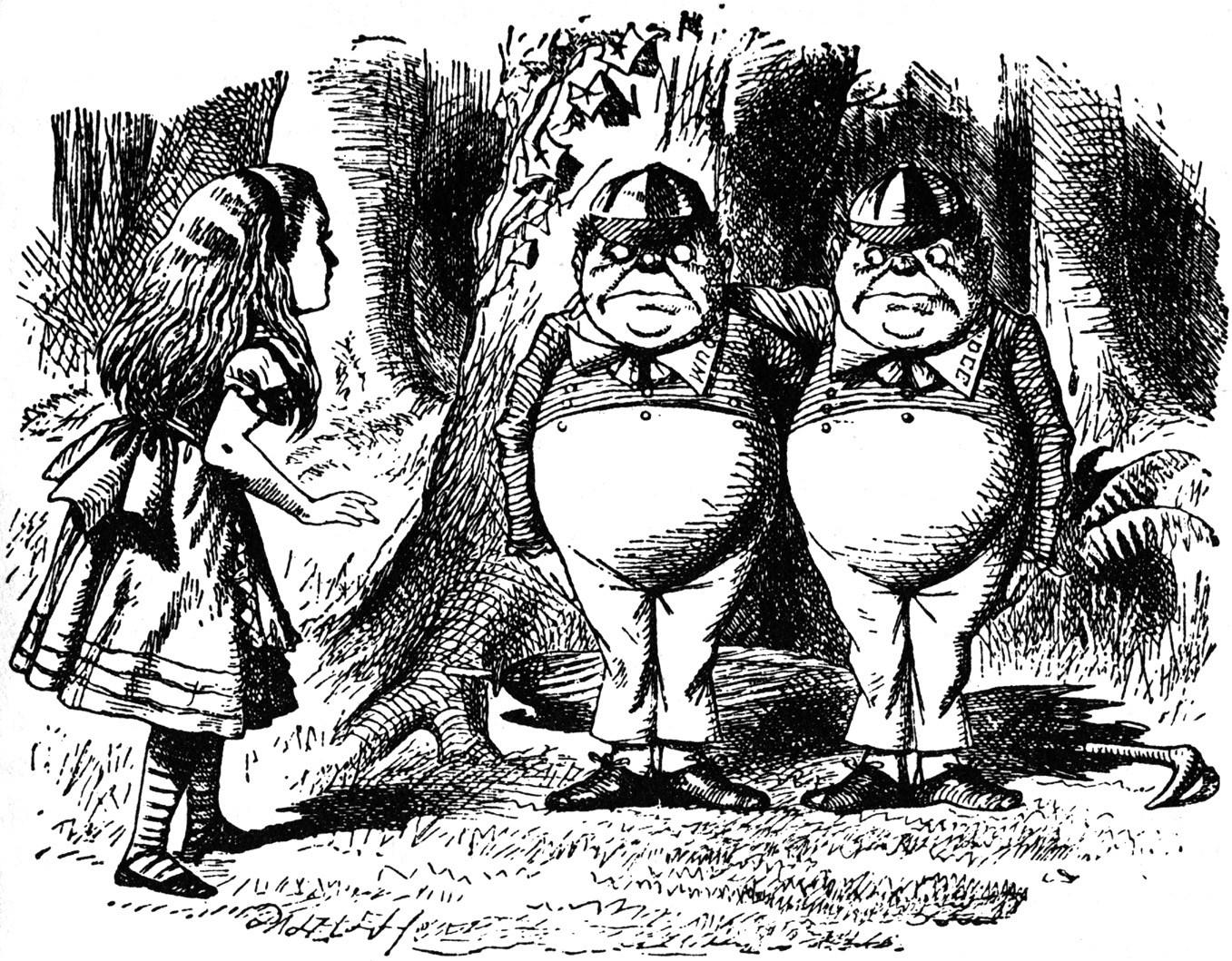
Alice: “Excuse me, one of you is the new Government of Spain, right? But which one, please?” (image from Alice Through the Looking Glass)
The PSOE (Partido Socialista Obrera de Espana) was outlawed during Franco’s dictatorship but after Franco’s death was brought inout of the cold, along with the Communist Party of Spain (PCE) by a deal done during the Transición to the new way of running the Spanish state.
The PSOE has been in government before and collaborated with the monarchy which was imposed on the Spanish people by Franco and his successors. In addition, the PSOE was the party reputedly responsible for the creation of the GAL terrorist and assassination squads against the Basque national liberation movement during the 1980s; one of the PSOE Government’s Ministers went to jail over that and although it was widely believed that the Prime Minister was the main force behind the gangs he was never even questioned by the police.
During recent developments of the Catalan independence bid, Sanchez and the the PSOE’s Catalan version, PSC-PSOE (usually referred to simply as the PSC) were hardly less hostile to the Catalan independists than were the Spanish Government or Ciutadans (right-wing Catalan party with roots in the PP).
Nobody who understands history in general and that of the Spanish state in particular can believe that a PSOE Government is going to anything much else than fight tooth and nail against Catalan independence. But Sanchez might try the velvet glove before revealing the steel fist underneath. One thing he might do is to release on bail the Catalan elected representatives and cultural activists who have been in jail since October awaiting trial.
Translation by D.Breatnach of Castillian (Spanish) language article by José Antonio Gutiérrez D (a Latin American activist based in Ireland) first published in Anarkismo, original at this link: http://anarkismo.net/article/30977) La versión originál en castellano se puede encontrar por el enlace previo.
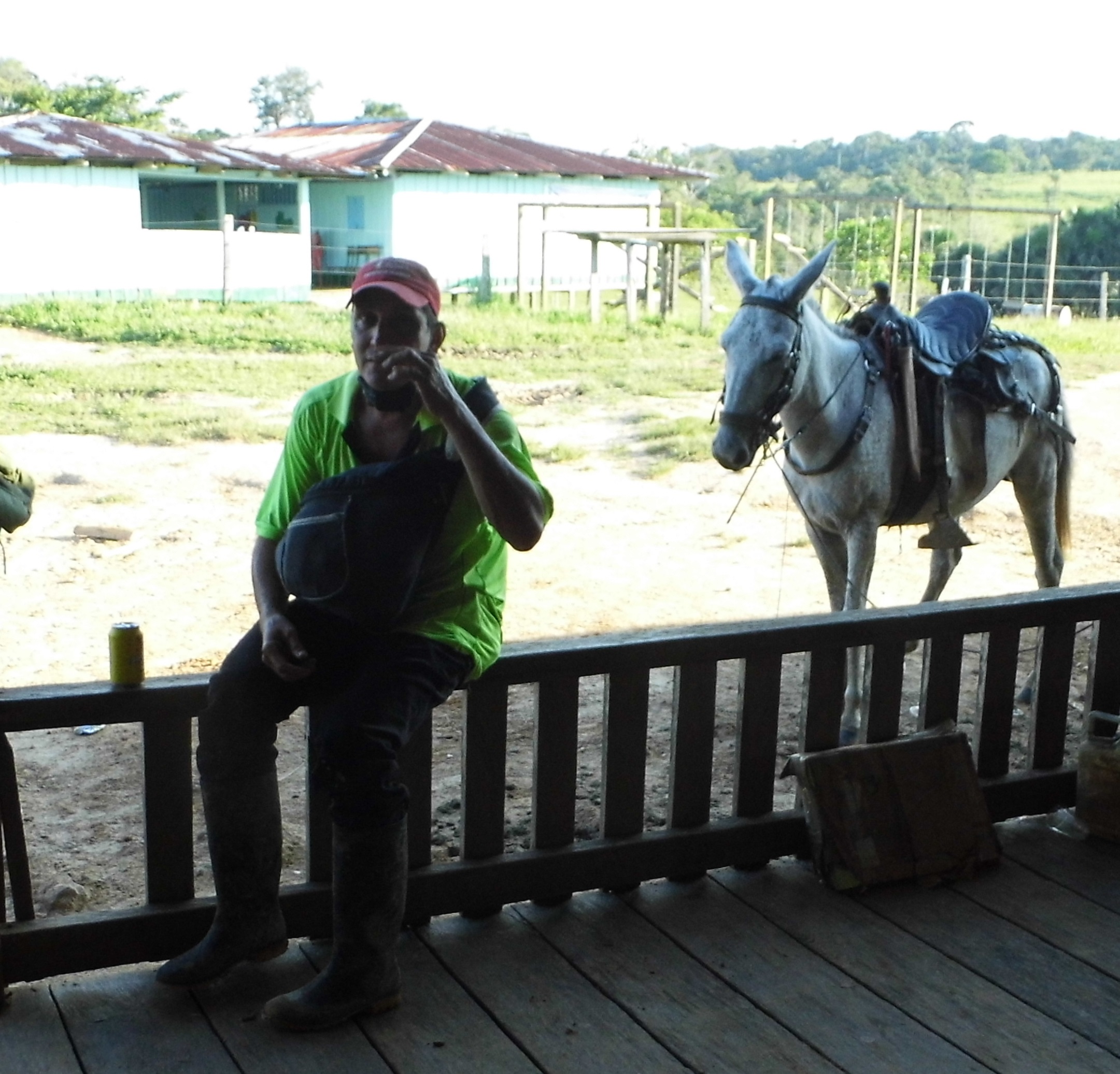
Friday, May 4, saw the swelling of the growing list of victims in the popular movement in times of “peace”1. In the outskirts of his home, in the El Triunfo neighborhood, in La Guadalosa, in the vicinity of Cartagena de Chairá, Jorge Vega Galvis received seven pistol shots from a group of hooded men, who left him there for dead. By a miracle, he survived to arrive at the local health centre, from which he was sent to hospital in Florencia, the area capital, because of the severity of his injuries. Today, four days after this atrocious crime, he is still unconscious and battling for his life.
Jorge is originally from the administrative region of Cesar, from a small town near Poponte in Chiriguaná, where he was born into a humble peasant family, experiencing work from an early age and all kinds of deprivation. So that they would not be eaten alive by the mosquitoes and the midges in the bush, while he was working, he told me once that they had to smear their bodies with petrol and lemon juice, while they worked under the scorching sun. With social ideas instilled in him by his mother, he also knew the meaning of the word solidarity from an early age and while almost a child, he was already participating in the mobilizations for peasant rights.
Jorge Vega Galvis in Monterrey, Cartagena de Chairá, September 2017 (Photograph by José Antonio Gutiérrez D.)
With the infestation of the Cesar area by paramilitary gangs under the command of Jorge 40 of the AUC,2 Jorge had to leave at the end of the ’90s and head towards Caqueta lands. Little is left of his coastal accent now since he made his home in Cartagena de Chairá, where he makes a living, looking for what is to be had. He works as a taxi driver, sometimes as an electrician, and sometimes on farms. His home is in the midst of a humble shanty town settlement. But in different areas he has stood out as a social leader, promoting the Peasant Workers’ Association of Caguán (ASTRACAMCAG, connected to Fensuagro), being President of the Cartagena de Chairá section; the El Triunfo and Villa Clar neighbourhood, community organizations, and also as a worker attached to the union of motorcycle taxi drivers of the CUT in Cartagena de Chairá. He has also held leadership positions in both the Patriotic March and the Alternative Democratic Pole.
The attack against him is a blow at the heart of the popular processes in Chairá and Bajo Caguán. It is an attack that seeks to continue the disruption of popular processes brought about through the militarization of the region. It is part of the social-murder 3 that is being carried out throughout the territory and which claims the lives of hundreds of social and agrarian leaders. We had already requested, in 2014, that the threats and harassment against Jorge be investigated4. Again in 2016, there were reports of threats received from paramilitaries.
The intimidation directed at Jorge by the troops has been almost continuous. In September 2017, we were suspiciously detained at a military checkpoint in Cartagena de Chairá, in the La Hacienda sector, while returning from visiting trials of peasants. Jorge asked them, “Hey, are not we in a peace process? And you’re doing this …”, to which a soldier, who did not want to identify himself and who covered the insignia of his battalion with a cloth, answered simply,”Of course, that’s why we can do this”5. This attitude, Jorge explained to me, was normal. That night we had to sleep in the house of a peasant in the sector, because the army did not authorize our passage through until six in the morning of the following day, by which we were able to reach the crossing of the Caguán River and reach Cartagena. However, that night we alerted human rights organizations through Fensuagro because we had a well-founded fear that in the darkness of the night, there could be an “attack”.
This time, there was no intimidation: the threats have turned into terrible facts, before the unconcerned gaze, if not complicity, of the civil and military authorities.
It is not enough to ask that Jorge’s life be guaranteed by the authorities. We demand that they stop the bleeding of popular leaders that is happening, if not with their complicity, at least with their connivance and thanks to their calculated lack of action. In addition, it should be noted that with the so-brave militarization of Cartagena de Chairá, the activities of civic and popular organizations take place under constant fear. Guaranteeing the life of Jorge and the other social leaders in the Bajo y Medio Caguán, would lead to ensuring the full return to civil life in the municipality and that the army stops operating what is really a military occupation, in which they act with dictatorial powers.
Enough of this ‘counterinsurgency’ campaign, this militarization and let the parks of Cartagena be free of rifles. Those of us who have had the good fortune of knowing Jorge personally, know how much he has fought for peace with social justice; what a paradox it is now that during the “peace”, they have pulled the trigger to silence him. Certainly, we know that this is not the peace for which Jorge risked his skin. For now Jorge, from your friends and colleagues, we send you a big hug, all our energy and we assure you that we will not leave you alone for a second. We send you strength to keep fighting, mate. Do not leave us.
José Antonio Gutiérrez D.
May 8, 2018
Postscript by D. Breatnach: My information is that Jorge Vega Galvis survived the attack and continues to recover. We wish him a speedy recovery and send our solidarity greetings.
1DB: The “Peace Process” was about reaching a deal between PresidentJuan Manuel Santosand the Revolutionary Armed Forces of Colombia – People’s Army(FARC–EP) to bring an end to the Colombian conflict. Negotiations, mainly taking place in Havana, Cuba, began in September 2012. A final agreement to end the conflict was announced on August 24, 2016 but a referendum to ratify it was unsuccessful, with a slight majority voting against. Afterward, Congress ratified a revised deal agreed between the Colombian government and the FARC. Critics from the Left and from some human rights groups complain that the standing down of the guerrilla forces is allowing the State’s repressive forces and the paramilitary assassination squads to operate with impunity in areas where they would not have dared to previously (or at least would have been punished by the people’s forces).
2 DB: Paramilitary drug-trafficking gang with close relationship to the the Colombian Armed Forces (also supported by local big landowners) which attacked FARC and ELN and their civilian supporters. (For more about “Jorge 40” see link above about Rodrigo Tovar Pupo).
I stand shoulder to shoulder with my fellow countrymen and women against the injustices wrought on the people of my beloved country, be it civil rights or human rights I will stand with you. If I ask you the people of Ireland to stand with me to ensure my civil and human rights are upheld – will you? Or will you exile me to foreign soil to seek a medical procedure that is denied to me here unless I`m at death’s door?
I grew up in the 70`s & 80`s. Abortion was not a subject that was openly discussed, the general consensus was only “floozies” had them. Abortion came into my young life when a conversation between adults was overheard: “yer one took the boat”; “she is a baby killer”; “the babbie was deformed” etc. Their victim was a mother of one who had an abortion due to FFA (fatal foetal abnormality); if she carried to term like she was advised by doctors it would have resulted in her death. This woman lived the rest of her life filled with shame and guilt not only for making the choice to terminate but because of the closed minds and nasty hateful words of those around her. Cancer claimed her life, in her words “it was God`s punishment for killing my baby”. Like so many women before and after her she had to leave her baby’s remains in a foreign clinic, forever separated because of laws that said a mother trying to save her own life was a criminal! Her husband and son had the baby’s name engraved on her headstone, uniting them again if only in name.
Here we are in 2018, a so-called new liberal age when marriage between same-sex couples is legal, they are rightfully afforded the same rights as a heterosexual married couple, yet a woman is denied the right to her own bodily autonomy. The fear-mongering is still the same, cries of “it will be used as a form of contraception!” echo the cries of “Floozie”.
I am a mother of three much wanted children; my eldest daughter from my first marriage was conceived with the help of ICSI. I miscarried two of the embryos implanted with her early in the pregnancy and in time suffered more miscarriages. I was then blessed with my son and youngest daughter with my second husband. I have also suffered because of the 8th Amendment. I was forced to have three major abdominal surgeries against my will to save the life of the baby. My eldest was delivered a month early as my waters broke but not completely. The decision was taken to deliver her by c-section when I developed an infection that they feared would put the baby at risk although she showed no signs of any ill effects. I was put under general anaesthetic and did not get to see my baby till the next day due to my reaction to the anaesthetic. I developed a massive infection in my wound in the hospital which took six months to clear. My son was delivered in the same way as I was not progressing fast enough; I was in labour a mere five hours.
After my first experience I was terrified, in the height of pain and in great fear I refused. My husband was told if I kept refusing I would be sectioned under the mental health act and he could lose me and my son. The doctor was somewhat sympathetic, he allowed my husband to try and comfort me yet at the same time booking the theatre for the c-section.
I was lucky this time, I was awake for the birth but again developed a massive wound infection while in hospital.
My third and final dance with the 8th came when I was told during my pregnancy on my youngest daughter that as my womb was so weak due to the previous sections and subsequent wound infections I would not be allowed deliver her naturally. All my children suffered with shock due to their arrival into the world. My consent was not needed for any of these major surgeries, my body was not my own because the baby`s life came before my own, I live with the consequences of the infections to this day.
RAGING DEBATES — HOW FAR HAVE WE COME?
The raging debates regarding the upcoming vote have brought out the worst in many. I have had my life threatened, been called the vilest of names, my morals and suitability as a mother called into question because I`m pro choice. Ridiculous arguments thrown at me, I answer all these arguments with “I am pro-choice be that keep, abortion or adoption”, only to be met with more scorn and a refusal to engage in a sensible debate. I have been judged without people knowing what brought me to my stand on repealing the 8th: the suffering of a mother, my own experience of the 8th, a love for the women of my country.
100 years after a minority of woman were given the right to vote, I hear about sexual equality but I have to question this when an unborn foetus up until birth shares the same if not more rights than the woman who is used as a vessel. How far have we truly come in this liberal country? How can we speak of equality or loving both when our women have no say over their own body at the most vulnerable time of her life?
Crisis pregnancies, FFA, happen each day, the support we offer these woman is to exile them in shame to face a medical procedure in many cases alone on foreign soil. We force women to procure abortion pills online putting her life at risk in fear of discovery and face up to 14 years in prison, we force women to leave the babies remains in a foreign clinic, or to smuggle it into the country to bury it in secret, to have the cremated remains delivered in the post.
I will vote to repeal the 8th as I want to live in a country where I have a say over my own body, for my daughters and all the generations to come. I will stand shoulder to shoulder with all the women in Ireland. I will stand against the shame and fear culture we inflict on our women. I will vote Yes so young girls like Ann Lovett do not die because she could tell no one she was pregnant, so young girls like the X Case have a choice, for all the women like Savita Halappanava who died unnecessarily. Ireland owes it to our women to put them first.
Narrated by Roger Waters of the Pink Floyd band, a useful documented discussion on how the population of the USA, the main political and financial supporter of the Israeli Zionist State, is conned into supporting Israel.
NB: “The US mind” is the subject, not “the American mind” — there is no reference to Latin American or Canadian thinking on the issue.
The film exposes the use of the US media combined with Israeli propaganda, pressure on politicians and media figures and demonisation of opponents.
Interestingly, at least one prominent commentator argues that the USA agrees with Israeli policy largely because it agrees with its own — but doesn’t tell us what that US policy is, much less explain it. Perhaps that’s beyond the film’s scope or the film is aimed at liberal opinion and exposing naked imperialism would be going too far — but in places, the narrative does hint at it.
Interestingly too that line of argument undermines the narrative that the Israel lobby (incorrectly termed “the Jewish lobby”) is the dominant factor is US policy towards Israel. A USA Jew also points out that most of his co-religionists in the US do not agree with the hard, right-wing, neo-liberal politics of the Israeli leaders.
Worryingly, in reference to a strand of fundamentalist Christianity in the US which supports Israeli policy, a commentator tells us that one in three US citizens believes that the Bible is factual.
But very encouragingly, the film argues that Israel is at last — finally — losing its propaganda grip on US youth in the colleges and in black communities.
Worth watching to understand the history of US public support for Israel but also to learn how untruthful propaganda works with regard to words.
The heights around Phibsboro and Glasnevin were reported snowbound so I decided to head down to the Tesco post for my shopping. Bundled up warm and with boots coated in dubbin, I stepped out into snow powder whipped up by the icy wind. I had to close my eyes to slits when it blew against my face.
Heading towards Drumcondra Tesco station
A whistle woke the dogs and they came out of their snow-holes, shaking themselves and trotting over. Handing out small pieces of meat which they wolfed down, I called Buck to follow me over to the sled, where he sat supervising while I put the other dogs in harness. They were eager to go, skittish, whining, tail-wagging, occasionally growling at a perceived trespass by a team-mate. Buck stared down the most fractious but ignored Bríd altogether. Lately she’d been getting at Buck, undermining him. I didn’t know what to do about it. I couldn’t put her in the lead as, apart from that reversing the problem, the team probably wouldn’t follow a bitch. A dog team is like a wolf pack – there can be a dominant male and a dominant female but in almost all cases the male is the lead, the top dog.
Heaving the sled to left and right a couple of times I broke it free of its ice, took the leads and, with my shouted “Mush!” we were off.
A little later, going down towards the frozen Tolka, I had to apply the brakes a little to ensure the sled didn’t run into the hindmost dogs. They all felt the drag and then the jolt as the left brake hit something hard frozen under the snow, canting the sled momentarily to one side. Buck looked back at me reproachfully. You think dogs can’t look reproachful? Many can … and Buck is a master at it.
“Sorry, Buck, couldn’t help it … couldn’t see it.”
But he was already turned away, his shoulder muscles bunched, pulling along, leading. We crossed the Tolka no trouble despite one of the hindmost dogs slipping for a moment, righting himself some what embarrasedly, continuing. The sled runners hissed from the snow, then a grating tooth-gritting high-pitched scraping and then a low hiss across the ice.
Crossing the frozen Tolka
“Up boy, pull away!” I shouted but Buck was already bunching himself for the slope of the far bank, pulling steadily, all dogs in the traces pulling together. As soon as the sled was clear of the ice I jumped off and ran alongside it, one hand on the sled. As it gained the top of the bank, the dogs already over, I jumped back on and mushed them on to the Tesco post, the wind whipping ice powder towards me, sometimes higher than my head but often only at knee height.
There was another sled there, hitched to the rail outside the post, its dogs still in traces, huddled down against the wall. Swinging the team around by pulling on the leads, I got the sled in near the other dogs with my team furthest away. I didn’t want to come out to the aftermath of an argument between that team and mine.
Hitching the sled to the rail, I walked up to the front entrance, scraped the snow off my boot soles on the steel scraper and slapped it off where I could reach on my fleece-lined jacket. Opening the door, I stepped in quickly on to the mat and closed the door behind me.
Arnka Flaherty was on duty at the register and flashed me a smile.
“Fuar go leor duit?” I enquired.
“It is, yes it is cold enough,” she replied, still smiling, the blue eyes and curly hair looking a little out of place on her broad Inuit face. But her smile would light a dance hall.
I saw a few pairs of snowshoes by the door and guessed some customers had hiked it in. Not too bad really at the moment with snow only a foot to two feet deep most places, though in some hollows you might sink up to your waist in drifts.
Bart was there, a big Dutchman from over Santry way, as I already knew. I’d recognised his sled and some of his dogs outside.
“Bart”, I nodded.
“Diarmuid,” he nodded back.
“Looks like getting worse,” I said.
“Yes, says on the Internet.”
“Best get supplies in then, right?”
“Right.”
So saying, we went about our separate business. In that little exchange, we had enquired without the exact words about one another’s mental and physical health, whether we each had enough fuel and food. And said that we cared about one another and would help, were it needed.
Going through the aisles picking up my items I nodded to the other customers, a spry old woman who must have snowshoed in and two young students from the college not far away, a male and a female, perhaps a couple, perhaps not. Their winter clothes looked on the expensive end of the range.
I picked up some tins of fish (though I might catch some fresh later, hole-fishing through the Tolka ice), frozen meat for the dogs, a bag of tatties and a smaller one of rice, a parcel of briquettes, a bag of porridge oats and laid them in front of Arnka. Then I went back for milk powder, beet sugar, frozen butter, olive oil, frozen greens and a butane cylinder.
Arnka raised her eyebrows at the latter. “Where’s the empty?” she queried.
“I forgot and left it at home. I’ll bring it in tomorrow. I promise.”
She said nothing and started to tot up my account. Perhaps she minded, perhaps not. It was hard to tell with Arka. I paid, bid her slán on my second trip outside with the last of my supplies, waving to Bart and to the old lady on the way.
Outside, the wind had died down below but up above the clouds were moving fairly fast, leaving a clear starlit night. Beautiful but cold and soon to get colder. The dogs were already on their feet, shaking themselves, some whining. I loaded up the sled, pulled by scarf across my nose and mouth and we mushed back homeward, the dogs glad of the exercise and knowing they’d be fed soon. We crossed the Tolka ice, now glittering in the starlight or ghostly shining in places and up the opposite bank, the dogs straining, me pushing the heavy sled this time and trying not to slip ….
Then clear and pulling away up the rise into Drumcondra proper and soon to be home. Hot food and warmth for me, defrosted meat for the dogs and their own holes in the snow, curled up inside and soon warm with the snow piling up around them.
When one hears or reads the words “Gaelic Ireland”, the reference usually takes one of four forms:
Historical
Geographical-cultural
Nostalgical
Sneering
Historically
“Gaelic Ireland”, when used in a historical sense, is a reference to either a time when the majority of Irish people spoke the Irish language (up to 1800 CE many scholars agree) or to a time when the Gaelic order of society was dominant or when the Gaelic Order survived in some part of Ireland (for example up to the Flight of the Earls in 1607) .
Geographically-Culturally
Perhaps used to describe those shrinking parts of Ireland where Irish remains the mother tongue, more normally called the “Gaeltacht” or “Gaeltachtaí”.
Nostalgically
This is a usage which corresponds somewhat to the historical sense above but is also imbued with nostalgia, a regret for what passed then and perhaps a wish to restore it. Despite the accusations of many of those hostile to the Irish language, relatively few people — including among Irish speakers, have any wish to return to that historical period.
Sneeringly
When referred to in this way, it is to link Irish-speaking with out-of-date things, some kind of anachronism, a backward thing, not suitable for our modern society; frequently linked also to Irish nationalism and De Valera’s concept of the desirable kind of society for Ireland and the 1937 Constitution, therefore linked also to the social and political dominance of the Catholic Church. Such a disdainful attitude is often connected to the disparaging way in which a person may speak about a “Gaeilgeoir” — it is as though the person referring to the Gaeilgeoir, which originally meant only “Irish language speaker”, has in mind a devout Catholic wearing an Aran jumper and generally unfashionable clothes and hairstyle, with a gold “fáinne” (a ring-shaped pin awarded for proficiency in Irish) in his or her jacket (probably Irish tweed).
I fear that this type of attitude is present in most enunciations of “Gaelic Ireland” — certainly outside those of the historical sense.
Although by no means associating the writer of a recent article with this contemptuous opinion of Irish speakers, there was more than a hint of a disparaging attitude expressed, in my opinion, in an article much-praised by many Republicans and some socialists, commenting on the racist expressions of some people after the recent lethal incident in Drogheda recently. Dieter Reinisch, whom I understand to be a left-wing Irish Republican, wrote to separate Irish racist commentators on the recent fatal incident in Drogheda from Irish Republicanism.
The article had a progressive intent and made some valuable points but it also linked this Irish racism with “Gaelic Ireland nationalism”1. Although the article does this through reference to individuals it smears “Gaelic Ireland” through doing so. I would doubt that those Irish racists were even Irish speakers, never mind campaigners for the retention of the language.
IRISH NATIONALISM AND REPUBLICANISM
Reinisch is of course correct historically to say that Irish Republicanism is not fundamentally linked to “Gaelic Ireland” but what is the point he is making? Irish nationalism as a force, in the sense of wanting and acting to achieve an Ireland under its own cultural-social order and not under the economic, social and political rule of a foreign power, can be traced as far back as the time of the O’Neill and O’Donnell partnership, who tried to unite the clans of the native people, the Gael, to oust English occupation from Ireland. They came close to succeeding but in the end, failed and with their exile and that of other Irish clan chiefs the Gaelic Order of society collapsed. The Gaelic Order by the way was in many ways socially superior to that of the feudal Norman invaders, which is one reason why most of the invaders adopted so much of it that, less than two centuries after the start of their invasion of Ireland, their England-based relatives called them “the degenerate English” and passed laws to forbid their adoption of Irish custom and law and end their integration into Gaelic Ireland.2
Irish nationalism continued to try to assert itself, finding large-scale expression at two particular moments in the 17th Century – firstly against Cromwell and secondly against William of Orange. Irish nationalism at that point fought in alliance with the Gall-Ghael, the Irish-speaking or bilingual descendants of the Norman invaders (“the degenerate English”, according to their England-based relatives in 1366), who were mostly concerned with preserving and defending their religion against the imposition of the English Reformation.
A kind of Irish nationalism later began to develop among the colonial settlers, a similar type to that expatriate or colonist nationalism developing among the colonists of Northern America and of what is now called Latin America. Since what made them Irish rather than English, Welsh or Scots was that they lived in Ireland (and for many, had been there for a few generations), they looked through the history of Gaelic Ireland to establish a historical background. They organised the Granard Harp Festival in 1786 and the Belfast Harp Festival in 1792. Edward Bunting noted down the airs played at the latter and published a collection in 1796 (and twice again over following decades).
The colonists of North and Latin America did not, for the most part, incorporate the original natives into their new nationalism3. They did not incorporate them in Ireland either but the United Irishmen did have that as their program and they did try to make it a reality. When Grattan’s attempt to open the Anglican-sectarian Irish Parliament to Presbyterians and Catholics failed through bribery and fear of Anglicans being outvoted, of planters losing the lands their ancestors had grabbed, the United Men became convinced that only armed insurrection could bring about a majority (male) democracy and Irish control of Irish affairs. And the symbol on their flag was that of Gaelic Ireland: the Harp. Underneath it, they had the words: “It is new-strung and shall be heard”.
United Irishmen Harp Motif (Image sourced on Internet)
Reinisch in his article quotes approvingly on three separate occasions from the writings and speeches of Seán Ó Brádaigh. It might surprise some readers to know that this same Ó Brádaigh and his brother the late Ruairí, were Irish-speakers and writers and promoted the speaking of the language.They were for a Gaelic Ireland, albeit a Republican one. They and the organisation they helped create, Provisional Sinn Féin and Provisional IRA, unfortunately in many ways bowed to the influence of the Catholic Church, even thoughthe hierarchy and many clergy denounced them continuously. Mac Stiofáin, who also gets a mention in Reinisch’s article, told me once that although he believed Church and State should be separated, in true republican fashion, also maintained that there should be no freedom to propagandise against religion!
Could Irish Republicanism in the 1700s not have adopted the language of the majority of the people? Some did indeed learn Irish and probably most Ulster Presbyterians, at least outside Belfast city, were at least competent in the basics up to 1798 and many probably fluent. It is hard to imagine that anyone living in Mayo in that year, whether planter or native, was not conversant with the Irish language and certainly it would have been the language of the vast majority there and in the surrounding counties. Wexford is generally agreed an exception by historians, in having been the most Anglicised of Irish counties in 1798.
English was the dominant language of the State and of the colonist administration. But also of the United Irishmen leaders, we can assume – certainly it was the dominant language of their political discourse as recorded in both their own publications and in the reports of the Crown spies and witnesses. Radical and revolutionary ideas were coming in from Revolutionary France and from the revolutionaries of the United States, as Reinisch relates but also very importantly from England – for example Tom Paine’s “The Rights of Man”. The native Irish were either totally excluded from the strata of society where – and the language in which — these ideas were being discussed or they occupied a much more insecure position in which they tried to improve their situation through English without calling down disfavour or even repression upon themselves. There was probably a strata which tried to advance itself under colonial rule and considered that Irish would ‘hold them back’.
There is very little contemporary folk record in existence in Irish of the United Irishmen and one must go to Mícheál Óg Ó Longáin4, Irish language scholar, poet and Unitedman who was “out” or “up” that fateful year, to find his “Buachaillí Loch Garman” (“the Boys of Wexford”) and lyrics of “Sliabh na mBan” to the song’s wonderful air …. and probably “Maidin Luan Chincíse” too.5
The Rising of 1798 failed as did Emmet’s attempt in 1803. Irish Republicanism and Irish nationalism continued to exist and were partly asserted by O’Connell’s campaigns for Catholic civil rights and repeal of the Union as well as by trends such as those of Mitchell and the “Young Irelanders”, most of the latter being Protestants and often hostile to what they saw as O’Connell’s linking Irish nationalism to Catholicism. Mitchell was not a democratic republican but other Young Irelanders were.
Here again, the creation (or renewal) of an Irish nationalism did not incorporate the Irish language although there were nods in its direction. Again, most of its leaders were Protestants but they looked back, as others of colonist background had before, to a Gaelic Ireland. Take Thomas Davis’ celebration of the 1798 uprising in Mayo:
That chainless wave and lovely land Freedom and nationhood demand; Be sure the great God never planned For slumb’ring slaves a home so grand. And long a brave and haughty race Honoured and sentinelled the place. Sing, Oh! not even their sons’ disgrace Can quite destroy their glory’s trace.
For often, in O’Connor’s van, To triumph dashed each Connacht clan. And fleet as deer the Normans ran Thro’ Corrsliabh Pass and Ardrahan; And later times saw deeds as brave, And glory guards Clanricard’s grave, Sing, Oh! they died their land to save At Aughrim’s slopes and Shannon’s wave.
Davis here looks to the history of the Gaelic clans of Connacht resisting foreign invasion, incorporating also the mostly Gaelicised Norman-Irish clan of Clanricarde, the Mac Williams who became Burkes or De Búrca.
It is well to remember, particularly for those who link “Gaelic Ireland” with Irish Catholic nationalism, that many of those prominent in the latter category had no time for the Irish language – in fact, on that issue at least, they would have seemed very at home among those today who say the words “Gaelic Ireland” with a sneer. Daniel O’Connell, who was a native Irish speaker and apparently spoke only Irish until five years of age, stated that he was “sufficiently utilitarian not to regret ….. the gradual abandonment” (of the Irish language) – and this at a time when probably 40% of the country’s population were Irish-speaking.
Portrait of Daniel O’Connell, campaigner for Catholic rights and the repeal of the Union — but no lover of the Irish language (Image source: Internet)
Irish nationalism and republicanism continued as a strong thread through Irish history, peaking again in the late 19th Century with the Fenians. The Irish Republican Brotherhood or ‘Fenians’ as we know them in that period today contained many Irish-speakers including the famous O’Donabháin Rosa, who wrote his biography in Irish but the Irish language was still not their main language of political literature.
Some of the IRB were deeply working class and they were accepted into the First International Working Men’s Association in England, championed by Marx and Engels (the latter was learning Irish with the intention of writing a history of Ireland which sadly he did not bring to fruition). In the USA also most of the Fenians would have been working class although they included some of the upper middle class among the Irish diaspora. The Fenian conspiracy in Ireland was discovered and plans for insurrection largely upset, leaders and journalists arrested and the military units considered at risk sent away out of Ireland.
IRISH LANGUAGE REVIVAL
Another kind of Irish nationalism saw a resurgence in the later years of the 20th Century and, again, it was the Anglo-Irish, descendants of planters and mostly Protestant, who were the intelligentsia leading it. A kind of antiquarian and romantic interest in the Irish language and culture was followed by a more practical and restorative one and the Gaelic League (now Connradh na Gaeilge) was founded in 1893 by a group led by Douglas Hyde (Dubhghlas de hÍde)6, an Anglican and son of Anglican clergy, who became fluent in the language. This was followed in 1898 with the founding of the Irish Texts Society, a publishing initiative with Hyde as one of the founders and its publication of Dineen’s thick dictionary, Foclóir Gaedhilge agus Béarla, which was first published in 1904 (and still a wonderful source of words and phrases).
The Gaelic League promoted Irish dance, games and culture in addition to the language. Although Hyde’s passion for an Ghaeilge originated in his childhood and early adolescence in Co. Roscommon, he graduated in 1884 as a Moderator in Modern Literature from Trinity College, Dublin, where he had became fluent in French, Latin, German, Greek and Hebrew.
The League/ Connradh grew fast, branches and courses attracting not only the Anglo-Irish aristocracy and upper middle classes but also other social strata. In fact it became a mass movement, with 600 branches in 1903 and through its influence the language was introduced to 1,300 national schools.7
A year later, Conradh na Gaeilge’s membership extended to some 50,000 members in 600 branches8, probably assisted by rising nationalist feeling but in turn it certainly fed that outlook. As a mass movement, it took in professionals and others of middle-class background, as well as labourers and tradesmen.
Among the many prominent Irish nationalists and Republicans (called “progressive nationalists” at the time) of those years was Patrick Pearse/ Pádraig Mac Piarais and Reinisch reminds us that his father was not Irish. Son of a Cornishman and Unitarian who formally converted to Catholicism, Pearse soon gained prominence as a writer and speaker in both English and the Irish language and also founded a school to teach through the medium of the Irish language.
Like many other active Republicans of his day, Pearse was recruited into the IRB and chosen to give the seminal oration at the interment of repatriated Fenian O’Donobháin Rosa’s body in 1915. As related earlier, O’Donobháin Rosa was an Irish speaker and when Pearse spoke at his grave, first in Irish which is rarely quoted, in the rest of his speech in English he said: “The clear true eyes of this man almost alone in his day visioned Ireland as we of to-day would surely have her: not free merely, but Gaelic as well; not Gaelic merely, but free as well.”
Pearse was chosen again as Commander-in-Chief of the insurrectionary forces in the 1916 Rising. Pearse’s memory is often attacked by ‘revisionist’ historians and some of the “Gaelic Ireland with a sneer” crowd – accusations of a repressed homosexual identity, of ‘green nationalism’, of blood-thirst etc. However, a fair assessment of his life would reveal a political activist who sympathised with the workers fighting the Lockout in 1913 and objected to Redmond’s refusal to allow women to speak at a meeting on Home Rule; would find also an individual generous with his time and energy, a talented writer who sought the creation of a modern literature in Irish on a par with those of England, France and Germany, as well as being an educator and proponent of progressive youth educational theory that stands well the test of time.
Pearse was among the people that Hyde accused of politicising the language, which Hyde gave as his reason for resignation of the Presidency of Connradh na Gaeilge. Looking back now, we might well ask how could it have been otherwise? Everything cultural of a national aspect was becoming politicised in those years: sport, song, drama, literature, journalism, oratory, lectures, representational art – even cooperatives, trade unions and some commercial ventures – why expect language to be any different? In fact, surely instead expect politicisation there first of all!
The other Irish nationalists of the time, the Irish Parliamentary Party led by John Redmond, ‘constitutionalist’, Catholic and socially conservative, expressed no great interest in the Irish language. Another branch of Irish constitutional nationalism, represented by William Martin Murphy, was no friend of the Irish language either and ran the most vicious campaigns against the Irish Republicans.
Of the Seven Signatories of the 1916 Proclamation of Independence, four (Ceannt, MacDiarmada, Mac Donagh and Patrick Pearse) were members of the Connradh. The remaining three were at least neutral or approving of the movement. Of the fifteen executions by British firing squads and one by hanging following the Rising, at least six were members of the Gaelic League. Large numbers of activists and leaders in the Republican movement from 1916 to 1922 were Irish speakers, either fluent or at least competent and christening records of the period show increasing numbers of Irish language names (or Irish versions of names from abroad) given to children. This period was the last great flowering of the Irish language as a mass movement in modern history.9
What of the Left in Ireland? A house painter by trade, Peadar Kearney (Peadar Ó Cearnaigh)10 of Catholic background joined the Gaelic League and at some point attendees at Irish classes he taught included the socialist writer and founder of the Irish Citizen Army, Sean O’Casey11 (Seán Ó Cathasaigh), of Anglican background. Irish was taught in Liberty Hall, HQ of the Irish Transport & General Workers’ Union.
Later, native Irish speaker Peadar O’Donnell, republican fighter, socialist activist and writer, was employed for a while teaching in Aranmore, Co. Donegal, an Irish-speaking area, where he apparently adopted socialism and joined the IT&GWU, for which he also became an organiser. In later years he founded the ill-fated Republican Congress, fought against Franco and founded The Bell literary journal. O’Donnell seems to have written little in Irish but in his acclaimed “Islanders”, the construction of dialogue is clearly derived from the Irish language. Later still, Brendan Behan (Breandán Ó Beacháin), a socialist Republican, wrote in Irish and in English and a Republican who became a Marxist, Connemara man Máirtín Ó Cadhain12, wrote in Irish and campaigned on the rights of Irish speakers and of people living in the Gaeltacht.
In and around those names there would have been many others, Left activists and supporters, unknown now but native speakers or those who learned the language, thought it important and spoke it.
Many socialists seem sometimes to think that the “unity of the working class” is best achieved by doing away with different cultures. They seem to forget that though there is one working class, there are a great many national cultures — and what a poor world it would be if those cultures disappeared.
THE STATE AND POLITICAL PARTIES
Some of the attacks on “Gaelic Ireland” seek to tie it first of all to the right-wing neo-colonial state set up in 1921, or the form it took after 1922, or as mentioned earlier, the De Valera/ Fianna Fáil state from the mid-1930s.
The New State
When the Irish Free State was set up as a compromise with British imperialism and colonialism, backed by a section of the nationalist-Republican movement and in alliance with Irish gombeen capitalism and the Catholic Church, it was actually a very insecure and uncertain endeavour. This perhaps explains the ferocity of the State in the Civil War and afterwards, with large-scale repression, 83 official executions and around a 120 assassinations of Republicans – in less than a 12-month period. Two years later, in 1924 the State faced an attempted Army mutiny and possible coup d’etat, led by Major-General Liam Tobin, with a number of prominent right-wing nationalist politicians in support.
The new owners of the State tried to ensure that nationalist symbols were not left unclaimed to be appropriated by Irish Republicans and so appropriated them themselves: the Tricolour, the Soldiers’ Song and the Irish language. However, this was no foregone conclusion nor an easy process. They had to bear in mind also the British, who had merely stepped off stage into the wings, who were also on stage in the Six Counties, as well as the large constituency of Unionists on both sides of the Border.
For example, God Save the King was played and sung at some State and many other formal occasions, though The Soldiers’ Song was sung by many Republicans. Let Erin Remember was the song favoured by some in the State and it was the air played for the Irish State at the 1924 Paris Olympics. After a struggle, The Soldiers’ Song was finally agreed as the National Anthem in 1926.
Far from being enthusiasts for any kind of “Gaelic Ireland”, the new State continued to use English as the language of administration, even in areas where 80% of the population were Irish-speaking.
A qualification in Irish was required to apply for state jobs but a high level of fluency was not needed13, “and few public employees were ever required to use Irish in the course of their work. On the other hand, state employees had to have perfect command of English and had to use it constantly. Because most public employees had a poor command of Irish, it was impossible to deal with them in Irish. If an Irish speaker wanted to apply for a grant, obtain electricity, or complain about being over-taxed, they would typically have had to do so in English.”14 As late as 1986, a Bord na Gaeilge report noted “…the administrative agencies of the state have been among the strongest forces for Anglicisation in Gaeltacht areas”15
The two main daily newspapers at the time in Ireland were the right-wing nationalist Irish Independent and the Unionist-minded Anglophile Irish Times16 and neither promoted the Irish language nor even covered Gaelic games, although they reported on rugby and cricket matches.
Fianna Fáil and the Blueshirts
Fianna Fail was created early in 1926 and in 1932, only six years later it was in government of the State. One year later, the right-wing Army Comrades Association adopted the uniform which included the blue shirt and by that time had over 30,000 members and battles were taking place between them and the IRA and other Republicans. Eoin O’Duffy had been an IRA guerrilla leader in the Irish War of Independence, a general in the Free State Army in the Civil War and Commissioner of the state’s police force, the Garda Síochána from 1922 to 1933. After Fianna Fáil’s easy re-election in February 1933, De Valera dismissed O’Duffy as Commissioner and a few months later O’Duffy took leadership of the ACA and renamed it the National Guard, adopting the straight-arm Roman salute favoured by the fascists.
That same year the Blueshirts planned a march on Dublin, believed my many historians to be a prelude to a coup d’etat; certainly De Valera thought so and, unsure of the Army’s loyalty, banned the march and subsequently outlawed the organisation. That year also Fine Gael was formed, incorporating the Blueshirts, Cumann na nGaedhal and the National Centre Party, with O’Duffy as its President.
De Valera founded the daily newspaper Irish Press in 1931 which had an alternative version of its title in Irish – Scéala Éireann – and as well as covering the GAA games, had sections in Irish. However the position of the Irish language in the affairs of the State did not change.
Though the Great Hunger caused he most impressive loss of Irish-speaking modern Ireland on the map, the percentage lost by the Irish state is greater. (Image source: Internet)
Throughout Fianna Fáil and Fine Gael governments, the Gaeltacht – the Irish-speaking areas – continued to suffer deprivation of resources. Even by the early 1960s, many homes in those areas did not have electricity, running water or sewage drains. Primary schools typically had a headmaster and female teacher to administer and teach all subjects at all levels. Deprivation led to massive emigration, not only to the metropolis but also to the USA and to Britain. Today, the Gaeltacht is 9.1% the size of what it was when the Irish State was created or, in other words, the State has presided over a Gaeltacht decline of over 90%17 — as a friend commented: “Not even Cromwell or the Great Hunger wreaked such linguistic devastation”.
In the 1960s, no matter what party was in government or in local authority, Irish-language campaigners had to fight for minimal funding for land allocation, schools and broadcasting in Irish. People went to jail for civil disobedience and were fined for refusing to pay for their TV and radio licences and, briefly, a pirate Gaeltacht radio station was in operation.
The Labour Party and Sinn Féin
The Labour Party, whether to the right or left, has never shown itself to be a friend of the Irish language.
Sinn Fein (Provisional) would nominally be expected to be supportive of the Irish language but the real test is in its campaigning and practice within its own party. Its public and internal meetings are held in English (as with other Republican parties) and throughout the three decades of the war in the Six Counties it did not organise or mobilise the Gaeltacht people to improve their position and defend their communities from emigration and the penetration and eventual supremacy of the English language.
In conclusion, to associate the Irish language or culture with any of the political parties or any administration of the State is fundamentally incorrect from a historical point of view.
FOCAL SCOIR ORIN CONCLUSION
Would those who sneer when they say “Gaelic Ireland” do likewise at the mention of “French France”, “Spanish Spain”18, “Italian Italy”, “German Germany” or “Polish Poland”? I think not. No, national cultures are not sneered at by the Right or the Left in Ireland – only Irish culture and, particularly, the language.
John Kells Ingram19, an academic, mathematician and writer of planter descent from southeast Donegal (and probably bilingual), in 1843 wrote the lyrics “In Memory of the Dead” (better known as “Who Fears to Speak of ’98”). He was decrying the distancing by Daniel O’Connell and his Catholic movement from the deeds and principles of the United Irish Men in 1798. If I may paraphrase him a little to refer to the kind of Irish person today who says “Gaelic Ireland” with a sneer: “He’s all a knave or half a slave, who slights his people’s culture thus”.
3The North American republicans did not admit the Indigenous People as citizens and many set out to exterminate them. Many also condoned slavery and some owned slaves. The Latin American republicans also mostly sought the expropriation of Indigenous people and also organised massacres but, for the most part, abandoned slavery earlier than the USA.
4Cork poet and strong Republican Mícheál Óg Ó Longáin (1766/-1837) is usually credited with writing Buachaillí Loch Garman and Sliabh na mBan (although one source, probably mistaken, credits his son Peadar with the latter two). Mícheál’s work as a scribe, scholar and teacher was a useful cover for acting as a United Irishmen courier.
5There are a few songs from Mayo too, by unknown authors.
6Douglas Hyde (Dubhghlas De hÍde) was elected first Uachtarán na hÉireann (President of the Irish state) from 1938-1945.
10Peadar Kearney was a member of the Irish Volunteers and IRB, fought in 1916 and was interned; he became a prolific writer of nationalist ballads — but also of “Labour’s Call”, a song with very socialist lyrics – and is the co-author with Patrick Heeney of “The Soldiers’ Song”, the national anthem of the Irish state.
11Sean O’Casey (1880-1964) was born in Dublin into a lower middle-class family in straitened circumstances.
12Máirtín Ó Cadhain (1906-1970); interned by the Irish State during the 2nd World War years and later activist for the Gaeltacht which led to the founding of the Rath Cairn Gaeltacht in Co. Meath. Ó Cadhain’s most famous written work, the novel “Cré na Cille” (1949) was later translated into many languages. Ó Cadhain was also a founder and leading activist of the original Irish-language civil rights campaign Misneach which engaged in agitation and civil disobedience (another campaign by the same name now exists) in Dublin and other places.
13Hence the jibe about the mere “cúpla focal” of Irish of politicians and civil servants.
15Advisory Planning Committee of Bord na Gaeilge, The Irish Language in a Changing Society: Shaping The Future, p.41. Criterion, 1986 (quoted in Wikipedia – see Sources).
16Both had called for the punishment by the British of the 1916 Rising leaders but the Independent had actually called for the executions of Connolly and Mac Diarmada.
18In fact, there are ground for objecting to the terminology of “French France” and “Spanish Spain” but only because those two states do not value and even suppress the other national languages within their state boundaries, e.g Euskera, Catalan, Occitan, Corse, Asturian, Galician ….
20Franz Omar Fanon (1925-1961) was born and raised in Martinique; qualifying as an MD and psychiatrist, practised in Algeria during the war of liberation against the French, where he was a covert member of the resistance. Fanon was a politically radical intellectual, Pan-Africanist and Marxist humanist whose written work is very influential in particular in “post-colonial studies”. He described the psychopathology of colonisation in quite accessible writing, showing how – among other things – the colonised internalise the image of themselves projected by the coloniser and aspire to the “sophistication” of the latter and his culture (see two of his works listed in the Sources & References section.