Last Saturday (26th April) in Dublin a march took place in support of Irish neutrality and in opposition to Irish Government attempts to remove an obstacle to joining some future imperialist military alliance.
The march was organised by the Irish Anti-War Movement, an organisation that flickers into life on occasion as desired by the leaders of the People Before Profit organisation, although some of its activists are not members of PBP. And not all marching by any means were members of either.
I have a regular commitment on Saturdays elsewhere until 1.30 and it’s at least 1.45 by the time I’m free. I caught up with the march as it began to wheel around Trinity College. At its destination1 I looked around to see how many flags were representative of the Irish nation.
I counted three Irish Tricolours and one other which was also combined with a Palestinian flag. I was carrying a Starry Plough flag (the original version of gold design on a green background).2 A total of four Irish national flags in a march of several hundred amidst lots of Palestinian flags.
The stupidity is almost beyond belief. The march was not organised primarily to express solidarity with Palestine but to call for Irish neutrality and for remaining outside NATO. However, one-sixth of the nation is inside NATO without even the pretence of democratic agreement.
The other five-sixths are what constitutes the Irish State, the one upon which the march was focused, to save the Triple Lock,3 to prevent the Gombeen Government from driving us into NATO or some other military alliance. But apparently to be done without symbolising the Irish nation.
Again, the stupidity stretches credulity. We have passed through a number of years in which the Far-Right and outright fascists, in order to disguise themselves as Irish nationalists, have appropriated primarily the Tricolour but also the Irish Republic flag which was created in 1916.
A situation was permitted to arise whereby to see many Irish Tricolours being carried was to suspect a far-Right event — and usually to have that suspicion confirmed as accurate. This occurred because the broad anti-fascist anti-racist movement in general allowed it to happen.4
The fault is primarily that of the Irish socialist Left and their dislike or distrust of nationalism and their association of the Tricolour with the Irish State. They fail to recognise it as a democratic, anti-colonial, anti-imperialist republican symbol of national sovereignty and resistance.
The design was presented to the Young Ireland movement by revolutionary women in Paris in 1848, the ‘Year of Revolutions’ in Europe. Its colours represent national revolutionary unity (White) between the indigenous Irish (Green) and the descendants of colonial settlers (Orange).
Unlike its presence among racist and homophobic gatherings, the Tricolour was completely appropriate for a march in support of Irish neutrality. But somehow this did not occur to the organisers of the march nor, apparently, to most of the participants.
There would be no need to exclude flags representing the socialist or anarchist movements nor indeed of struggles in other countries but on this march they should have been outnumbered by Irish Tricolour and Starry Plough flags.
The Republican movement, for all its faults, would not have failed in this representation. Sins of omission in politics can be as bad as those of commission and the almost absence of Tricolours on this march epitomises how badly some of the movement in defence of neutrality is being led.
The general absence of the Republican movement from this march, whatever their reasons, is to my mind another part of this problem.
End.
Note: If you found this article of interest, why not register with Rebel Breeze for free, so that you will be notified by email of subsequent articles. You can de-register any time you wish.
1Molesworth Street, facing Leinster House, home of the parliament of the Irish State.
2Essentially the original design of the flag of the Irish Citizen Army, a workers’ defence militia during the 1913 Lockout which also fought in the 1916 Rising.
3A measure which does not permit the State to send more than 12 personnel abroad on a military mission unless with 1) a government decision, 2) a majority vote in the Irish Parliament and 3) a UN mandate. Recently leaders of the Coalition Goverment parties have been saying that a vote in the Parliament would not be necessary.
4This is not alone the fault of the PBP but also of the anarchists who did fight the fascists but also of the Republicans who, some notable attacks on the National Party aside, largely ignored the fascist and far-Right protests.
(Reprinted from author’s substack on 01/03/2026 and reformatted for WordPress. All graphic images created or chosen by R. Breezeeditor)
The English band Chumbawamba recorded a song called The Day The Nazi Died about how the Nazis never really went away.1
The song references the Nazi leader Rudolf Hess, who was not executed following WWII but was instead held a prisoner in Spandau Prison until he took his own life at the age of 93.
The song asks why when we were told that the Nazis had died did they all come out on the day Hess died and points to the boardrooms of companies as maggots getting fat on the decaying flesh of capitalist society.
The band were not wrong. Some of the Nazis and boards of companies that did not go away are now involved in the genocide in Palestine.
Goosestepping as a military parade practice has gone out of fashion in most Western countries, but stomping on the peoples of the world is very much in fashion.
Many companies such as Porsche, Mercedes, Volkswagen and even IG Farben – the manufacturers of the gas used to murder millions in the camps – went unpunished after WWII. Some companies were even compensated for the damage to their factories.
Lots of other German companies passed under the radar.
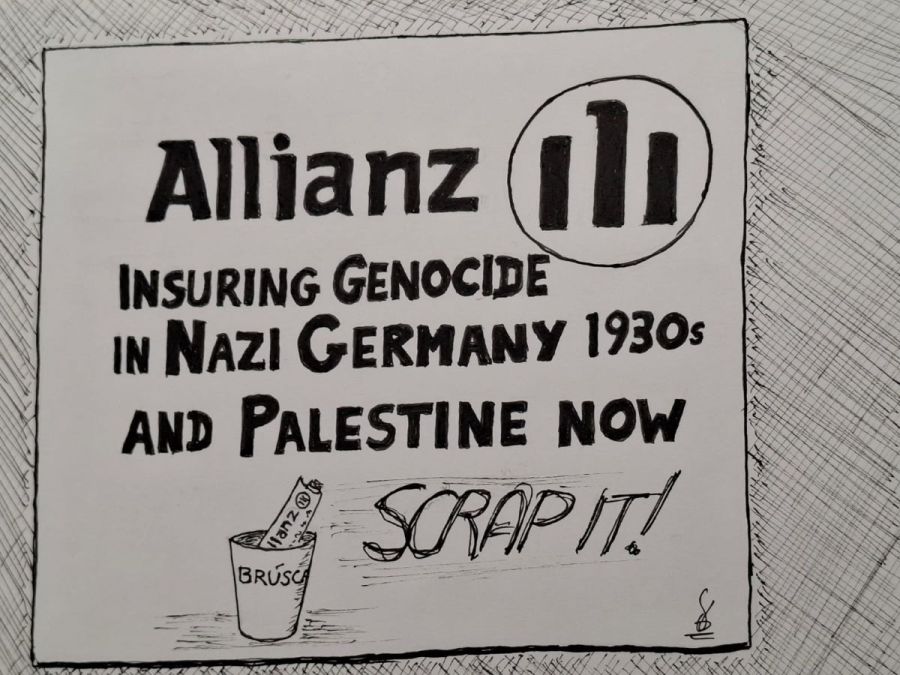
Hugo Boss was never taken to task for making the Nazis look so sexy in their murderous swagger and Allianz the German insurance company that insured parts of the camps and the ghettos against fire and damage to their installations survived intact.
Apparently, they didn’t specifically insure the ovens or gas chambers, but the camps were a whole unit. Any part insured contributed to all of it running smoothly.
Of course those who died in the gas chambers and were pushed like peat brickettes through the ovens were not covered, just the Nazi property.
Hugo Boss can make no claims to being pressured, he was a member of the Nazi party before Hitler ever took power. He wasn’t betting on which horse won the race, he was the horse in the race.
Allianz likes to present itself as just another company that did business with the Nazis in order to continue functioning and that they had no choice, Krupps makes similar claims about its use of slave labour, saying they had to.
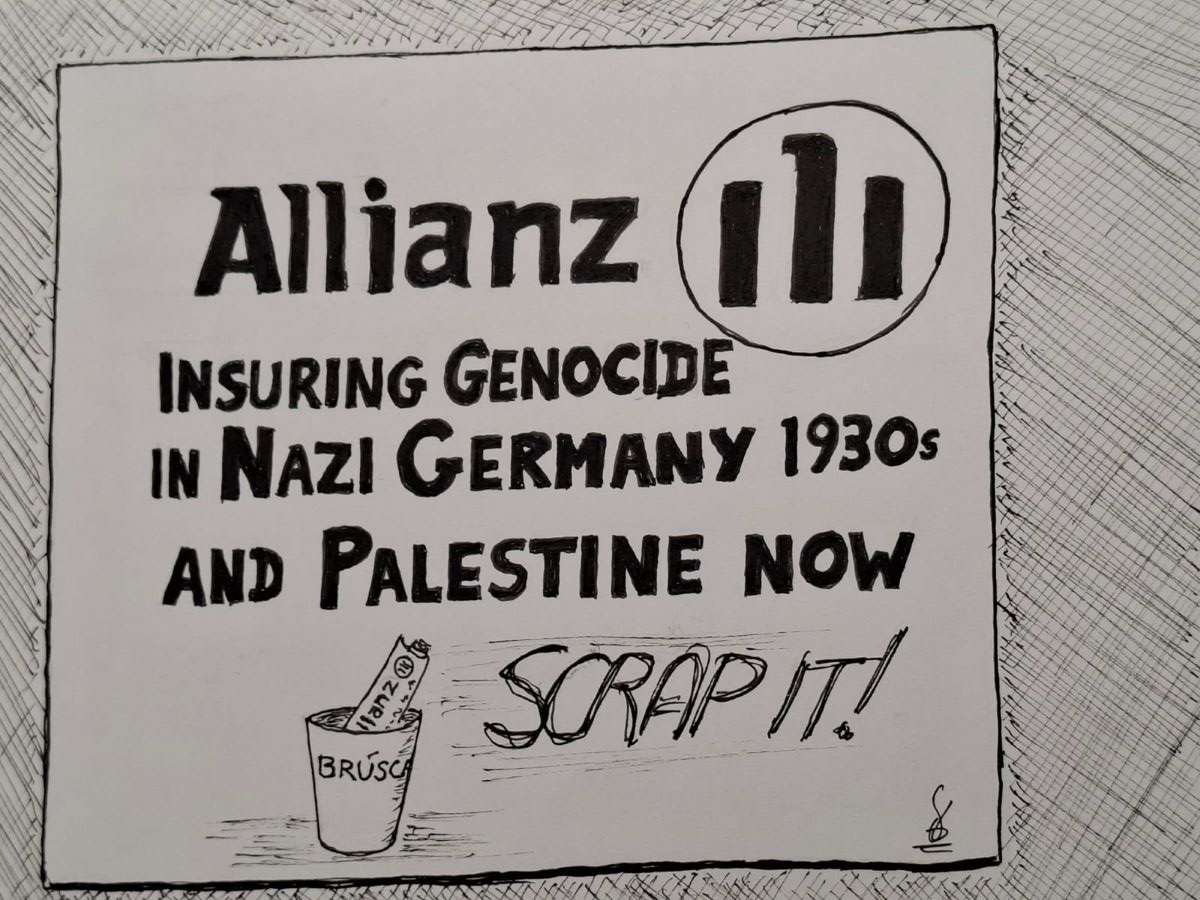
Cartoon by D.Breatnach
That is a dubious claim, when you look at their history. But also morally there is no basis to it. You always have the choice, some Germans lost their lives fighting the Nazis, not losing your money is hardly an excuse.
What companies such as Allianz did is make a cost benefit analysis. They calculated that not doing business with the Nazis would affect their profits, so they insured the camps but not the people pushed through the ovens.
The company claims a certain naivety on its part about what was happening.
But you can only take that at face value if you ignore that the director general of the company the antisemite Dr Kurt Schmitt resigned his post with Allianz in 1933 to become Hitler’s first Reich Minister of Economic Affairs.
He had previously turned down the post when it was offered to him by the Von Papen government before the Nazis took over.
He had to step down for health reasons, but when he recovered he went back to Allianz to administer it. It also claims it made no money from the camps contract.
This does not mean there was no money to be made, it means it wasn’t as profitable a contract as it thought, but it managed to get other contracts from the Nazis.
If you read the company’s website you come away with the distinct impression that they would like us to think they were a victim of the Nazis and we should pity them.
It turns out because they were on the losing side and because the war didn’t go ahead as planned with Hitler steamrollering his way to Moscow, the war was not as profitable as it should have been for insurance companies.
In the following quote it is clear that 1943, following the Nazi defeat at Stalingrad, the tide turned not only in the war but in the accounts ledgers.
After Germany overran Poland in 1939, the business of the insurance sector became characterized by the risks associated with the war.
Doing business in wartime meant obeying the principle of “minimizing new dangers and taking maximum advantage of new business opportunities.”
The repercussions of the war were detrimental to business as a whole and at the end of the war, Allianz was on the brink of ruin. Even so, until 1943 the company had managed to increase its profits by a considerable margin.2
Even today the company whitewashes its record and states in glowing language that:
Kurt Schmitt’s energetic course of expansion in the 1920s had made Allianz the largest insurance company in Germany. In 1933, Schmitt became Minister of Economic Affairs in Adolf Hitler’s government.
In 1935, he resigned from this post as he was unable to implement his political ideas and his health was failing. After his recovery, he returned to Allianz and in 1938 became General Director of Munich Re.3
No, not true, the Nazi stepped down because he had a heart attack, not over disagreements about economic policy and though it is not stated, there is a sleight of hand which leaves you wondering whether he had disagreements over the treatment of Jews.
This antisemite had no such disagreements with the Nazis at all. He was well known to them before they ever took power. He knew who and what they were.
The company’s site is not that detailed about the period and there are lots of sleights of hands in how it presents information. For example, it is mentioned that the company opposed Nazi attempts to nationalise the insurance industry.
But not because they opposed the Nazis, but because it might affect their profit margins.
But not even Allianz can completely deny reality. Their site does acknowledge that it began to come clean about its role following a lawsuit in the US against insurance companies and set up a study into its activities.4
It did it, because it was forced to. Had they really been forced to insure the Nazis against their will they wouldn’t have waited till 1997 to start publicly owning up.
They commissioned Dr Feldman a Jewish historian to look at their history. He quotes Schmitt as talking about the Nazi position on Jews as explained to him by Göring that:
I must honestly say, that I had no reservations about this line, for it cannot objectively be contested that in our public and intellectual life, beginning with the Reichstag, in the press, and also in many scientific faculties, in the legal field and above all in the Berlin banking business, the Jews had too strong and too loud and also an unhealthy influence.5
Feldman goes on to say of this that:
…it is important to recognize that the responsibility for the evils that he [Schmitt] and his organization [Allianz] were to experience and perpetrate during the coming years lay to an important extent in the fact that he (and others like him) shared a political culture and an anti-Semitic posture that made the coming and installation of the Third Reich possible.6
Of Schmitt he says that:
Schmitt was rather more enthusiastic and active than his colleagues in pandering to the new order at this time.
Not only was he prominently on display at the aforementioned Hitler birthday festivities, he also catered to the “socialistic” side of the regime while playing the public defender of employer interests with the new rulers as well.7
Now we have come full circle. The people who tried to profit from the Third Reich and the camps are once again involved in a genocide, not only as an insurance company but also as a direct investor.
Allianz has invested USD 960 million in Israeli war bonds, or genocide bonds as they are more accurately known. I
n 50 years’ time, they might hire some Palestinian historian to write the history of collaboration in yet another genocide and their website might just say they had no choice but to maximise profits in line with their legal duty to their shareholders or some such rubbish.
Last time, none of the Allianz board were sent to the gallows. They all did very well out of the war and the company went on to become not just Germany’s largest insurance company but a major player in the global insurance industry.
It is as the Chumbawamba song says:
The world is riddled with maggots; the maggots are getting fat They’re making a tasty meal of all the bosses and bureaucrats They’re taking over the boardrooms, and they’re fat and full of pride.
This time, should we ever get a day of reckoning to cite the much abused quote from Karl Marx we should make no excuses for the terror. They should have all their assets confiscated and they should meet their end hanging from a rope.
So if you meet with these historians, I’ll tell you what to say Tell them that the Nazis never really went away. They’re out there burning houses down and peddling racist lies And we’ll never rest again until every Nazi dies.
Note: If you found this article of interest, why not register with Rebel Breeze for free, so that you will be notified by email of subsequent articles. You can de-register any time you wish.
(Transcribed in entirety but reformatted for Rebel Breeze by permission of the author from his 16 August 2025 article in Al Mayadeen titled Declassified: CIA’s covert Ukraine invasion plan.)
Introduction
We tend to see US Imperialism as the hidden hand behind the Zelensky regime and understandably so, as the US is the leader of NATO. But British Intelligence has played a major role there from many decades in the past right up to the present.
Kit Klarenberg’s article discussing plans of the CIA in earlier times to invade Ukraine also deals with the much-less understood role of the British secret services in similar objectives. British spy planes are supporting the genocide in Gaza and their spooks are active in Ukraine.
Many of the invasion assessments of these agencies in times past had to dispense with propaganda in the interests of accuracy and in fact bear out what many opponents of the NATO-proxy war and Ukrainian regime have been saying about the various sympathies of the people in Ukraine.
Expressing these realities had us, despite the track record of many, being labelled ‘Putinistas’ by elements of the electoral Left as well as by liberals. Klarenberg is an investigative journalist exploring the role of intelligence services in shaping politics and perceptions.
Diarmuid Breatnach
Kit Klareberg writes:
On August 7, US polling giant Gallup published the remarkable results of a survey of Ukrainians. Public support for Kiev “fighting until victory” has plummeted to a record low “across all segments” of the population, “regardless of region or demographic group.”
In a “nearly complete reversal from public opinion in 2022,” 69% of citizens “favour a negotiated end to the war as soon as possible.” Just 24% wish to keep fighting. However, vanishingly few believe the proxy war will end anytime soon.
The reasons for Ukrainian pessimism on this point are unstated, but an obvious explanation is the intransigence of President Volodymyr Zelensky, encouraged by his overseas backers – Britain in particular.
London’s reverie of breaking up Russia into readily exploitable chunks dates back centuries, and became turbocharged in the wake of the February 2014 Maidan coup.1
In July that year, a precise blueprint for the current proxy conflict was published by the Institute for Statecraft, a NATO/MI6 cut-out founded by veteran British military intelligence apparatchik Chris Donnelly.
In response to the Donbass “civil war“, Statecraft advocated targeting Moscow with a variety of “anti-subversive measures”. This included “economic boycott, breach of diplomatic relations,” as well as “propaganda and counter-propaganda, pressure on neutrals.”
The objective was to produce “armed conflict of the old-fashioned sort” with Russia, which “Britain and the West could win.”
While we are now witnessing in real-time the brutal unravelling of Donnelly’s monstrous plot, Anglo-American designs of using Ukraine as a beachhead for all-out war with Moscow date back far further.
In August 1957, the CIA secretly drew up elaborate plans for an invasion of Ukraine by US special forces. It was hoped that neighbourhood anti-Communist agitators would be mobilized as foot soldiers to assist in the effort.
A detailed 200-page report, Resistance Factors and Special Forces Areas, set out demographic, economic, geographical, historical, and political factors throughout the then-Soviet Socialist Republic that could facilitate or impede Washington’s quest to ignite local insurrection, and in turn the USSR’s ultimate collapse.
The mission was forecast to be a delicate and difficult balancing act, as much of Ukraine’s population held “few grievances” against Russians or Communist rule, which could be exploited to foment an armed uprising.
Just as problematically, “the long history of union between Russia and Ukraine, which stretches in an almost unbroken line from 1654 to the present day,” resulted in “many Ukrainians” having “adopted the Russian way of life”. 2
Problematically, there was thus a pronounced lack of “resistance to Soviet rule” among the population.
The “great influence” of Russian culture over Ukrainians, “many influential positions” in local government being held “by Russians or Ukrainians sympathetic to [Communist] rule, and “relative similarity” of their “languages, customs, and backgrounds,” meant there were “fewer points of conflict between the Ukrainians and Russians” than in Warsaw Pact nations.
Throughout those satellite states, the CIA had to varying success already recruited clandestine networks of “freedom fighters” as anti-Communist Fifth Columnists. Yet, the Agency remained keen to identify potential “resistance” actors in Ukraine:
“Some Ukrainians are apparently only slightly aware of the differences which set them apart from Russians and feel little national antagonism. Nevertheless, important grievances exist, and among other Ukrainians there is opposition to Soviet authority which often has assumed a nationalist form.
Under favorable conditions, these people might be expected to assist American Special Forces in fighting against the regime.”
‘Nationalist Activity’
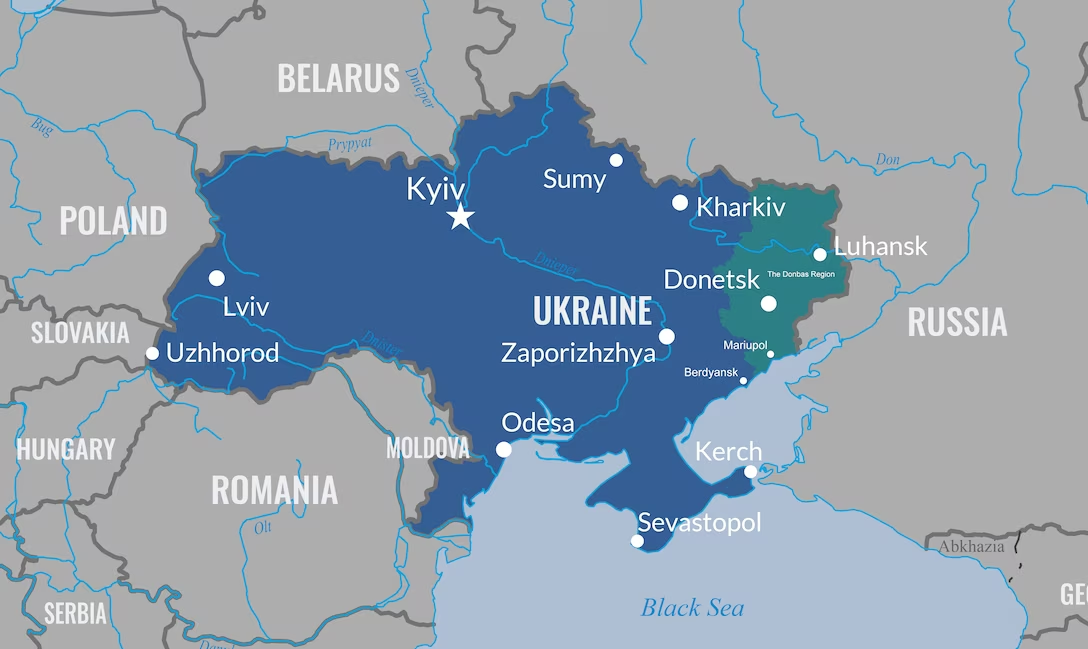
A CIA map split Ukraine into 12 separate zones, ranked on “resistance” potential, and how “favorable population attitudes [are] toward the Soviet regime.” South and eastern regions, particularly Crimea and Donbass, rated poorly.
Their populations were judged “strongly loyal” to Moscow, having never “displayed nationalist feelings or indicated any hostility to the regime,” while viewing themselves as “a Russian island in the Ukrainian sea.”
In fact, as the study recorded, during and after World War I, when Germany created a fascist puppet state in Ukraine:
“Inhabitants of Donbass strongly resisted Ukrainian nationalists and at one point created a separate republic, independent of the rest of Ukraine. 3
In the following years, they defended Soviet rule and Russian interests, often attacking the Ukrainian nationalists with more zeal than the Russian leaders themselves.
During the German occupation in the Second World War, there was not a single recorded case of support for the Ukrainian nationalists or Germans.”
Still, invading and occupying Crimea was considered of paramount importance. On top of its strategic significance, the peninsula’s landscape was forecast as ideal for guerrilla warfare. The terrain offered “excellent opportunities for concealment and evasion,” the CIA report noted.
While “troops operating in these sectors must be specially trained and equipped,” it was forecast that the local Tatar population, “which fought so fiercely” against the Soviets in World War II, “would probably be willing to help” invading US forces.
Areas of western Ukraine, including former regions of Poland such as Lviv, Rivne, Transcarpathia, and Volyn, which were heavily under control of “Ukrainian insurgents” – adherents of Stepan Bandera4 – during World War II, were judged most fruitful “resistance” launchpads.
There, “nationalist activity was extensive” during World War II, with armed militias opposing “pro-Soviet partisans with some success.”
Conveniently, too, the mass extermination of Jews, Poles, and Russians by Banderites in these regions meant there was virtually no non-ethnic Ukrainian population left.
Furthermore, in the post-war period, “resistance to Soviet rule” had been “expressed on a great scale” in western Ukraine. Despite “extensive deportations”, “many nationalists” remained in Lviv et al, and “nationalist cells” created by Bandera’s “task forces” remained dotted around the country.
For example, anti-Communist “partisan bands” had taken up residence in the Carpathian Mountains.
The review concluded, “It is in this region [US] Special Forces could expect considerable support from the local Ukrainian population, including active participation in measures directed against the Soviet regime.”
It was also determined that “Ukrainian nationalist, anti-Soviet sentiment” in Kiev was “apparently moderately strong,” and elements of the population “might be expected to provide active assistance to Special Forces.”
The capital’s “large Ukrainian population” was reportedly “little affected by Russian influence,” and during the Russian Revolution, “provided greater support than any other region for Ukrainian, nationalist, anti-Soviet forces.”
Resultantly, “uncertainty about the attitudes of the local population” prompted Moscow to designate the Ukrainian SSR’s capital, which it remained until 1934.
The CIA document further offered highly detailed assessments of Ukrainian territory, related to their utility for warfare.
For example, “generally forbidding” Polesia – near Belarus – was noted to be “almost impossible” to traverse during spring. Conversely, winter provided “most favorable to movement, depending on the depth to which the ground freezes.”
Overall, the area had “proved its worth as an excellent refuge and evasion area by supporting large-scale guerrilla activities in the past.” Meanwhile, “swampy valleys of the Dnieper and Desna rivers” were of particular interest:
“The area is densely forested in its north-western part, where there are excellent opportunities for concealment and maneuver…There are extensive swamps, interspersed with patches of forest, which also provide good hiding places for the Special Forces.
Conditions in the Volyno-Podolskaya Highlands are less suitable, although small groups may find temporary shelter in the sparse forests.”
‘Strongly Anti-Nationalist’
The CIA’s invasion plan never formally came to pass. Yet, areas of Ukraine forecast by the Agency to be most welcoming of US special forces were precisely where support for the Maidan coup was the highest.
Moreover, in a largely unknown chapter of the Maidan saga, fascist Right Sector militants were bused en masse to Crimea prior to Moscow’s seizure of the peninsula. Had they succeeded in overrunning the territory, Right Sector would’ve fulfilled the CIA’s objective, as outlined in Resistance Factors and Special Forces Areas.
Given what transpired elsewhere in Ukraine following February 2014, other sections of the CIA report took on a distinctly eerie character. For instance, despite its strategic position facing the Black Sea, the Agency warned against attempting to foment anti-Soviet rebellion in Odessa.
The agency noted the city is “the most cosmopolitan area in Ukraine, with a heterogeneous population including significant numbers of Greeks, Moldovans and Bulgarians, as well as Russians and Jews.”
As such: “Odessa…has developed a less nationalistic character. Historically, it has been considered more Russian than Ukrainian territory.5
There was little evidence of nationalist or anti-Russian sentiment here during the Second World War, and the city…was in fact controlled by a strongly anti-nationalist local administration [during the conflict].”
Odessa became a key battleground between pro- and anti-Maidan elements from the moment the Maidan protests erupted in November 2013.
By March the next year, Russophone Ukrainians had occupied the city’s historic Kulykove Pole Square, and were calling for a referendum on the establishment of an “Odessa Autonomous Republic”.
Tensions came to a head on May 2, when fascist football ultras – who subsequently formed the Azov Battalion – flooded Odessa and forced dozens of anti-Maidan activists into the Trade Unions House, before setting it ablaze.
In all, 42 people were killed and hundreds were injured, while Odessa’s anti-Maidan movement was comprehensively neutralized. In March this year, the European Court of Human Rights issued a damning ruling against Kiev over the massacre.
It concluded local police and fire services “deliberately” failed to respond appropriately to the inferno, and authorities insulated culpable officials and perpetrators from prosecution despite possessing incontrovertible evidence.
Lethal “negligence” by officials on the day, and ever after, was found to go far “beyond an error of judgment or carelessness.”
The ECHR was apparently unwilling to consider that the lethal incineration of anti-Maidan activists was an intentional and premeditated act of mass murder, conceived and directed by Kiev’s US-installed fascist government.
However, the findings of a Ukrainian parliamentary commission point ineluctably towards this conclusion.
Whether, in turn, the Odessa massacre was intended to trigger Russian intervention in Ukraine, thus precipitating “armed conflict of the old-fashioned sort” with Moscow that “Britain and the West could win” is a matter of speculation.
End.
Note: If you found this article of interest, why not register with Rebel Breeze for free, so that you will be notified by email of subsequent articles. You can de-register any time you wish.
FOOTNOTES
1The US-sponsored coup that removed pro-Russian President Yanukovych and installed pro-Western powers Poroshenko (Zelensky’s forerunner).
4A fascist and Nazi occupation collaborator which President Yuschenko (Yanukovych’s forerunner) tried to recognise a Ukrainian national hero in 2010 (while criticising ‘national heroes’ was also declared a crime), which only failed due the requirement for candidates to have been a Ukrainian citizen, which Bandera had never been. His birthday is nevertheless celebrated annually by the State and features a torchlit parade of far-Rightists and fascists.
The Save Moore Street from Demolition campaign group gratefully accepted an invitation to participate in the Comrade Corner on Sunday 3rd January in order to spread the word about the campaign and to make further contacts.
The Comrade Corner is part of the Libertine Market Crawl that takes place on the first Sunday of each month 12-5pm and is spread through a number of pubs, mostly in the Liberties area of north Dublin city: The 4th Corner, Dudley’s, Lucky’s, Molly’s Barand Peadar Brown’s.
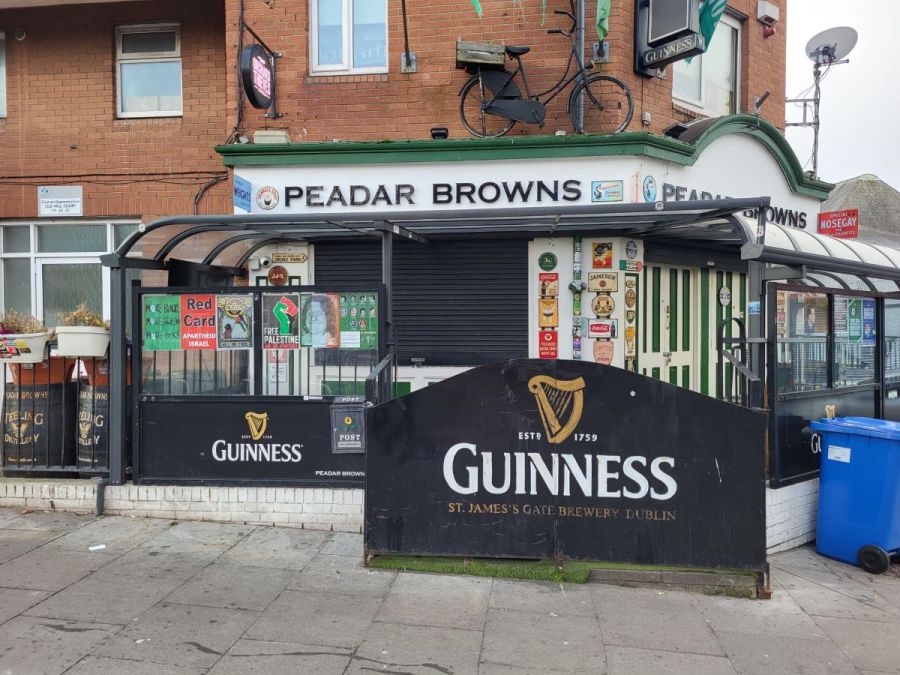
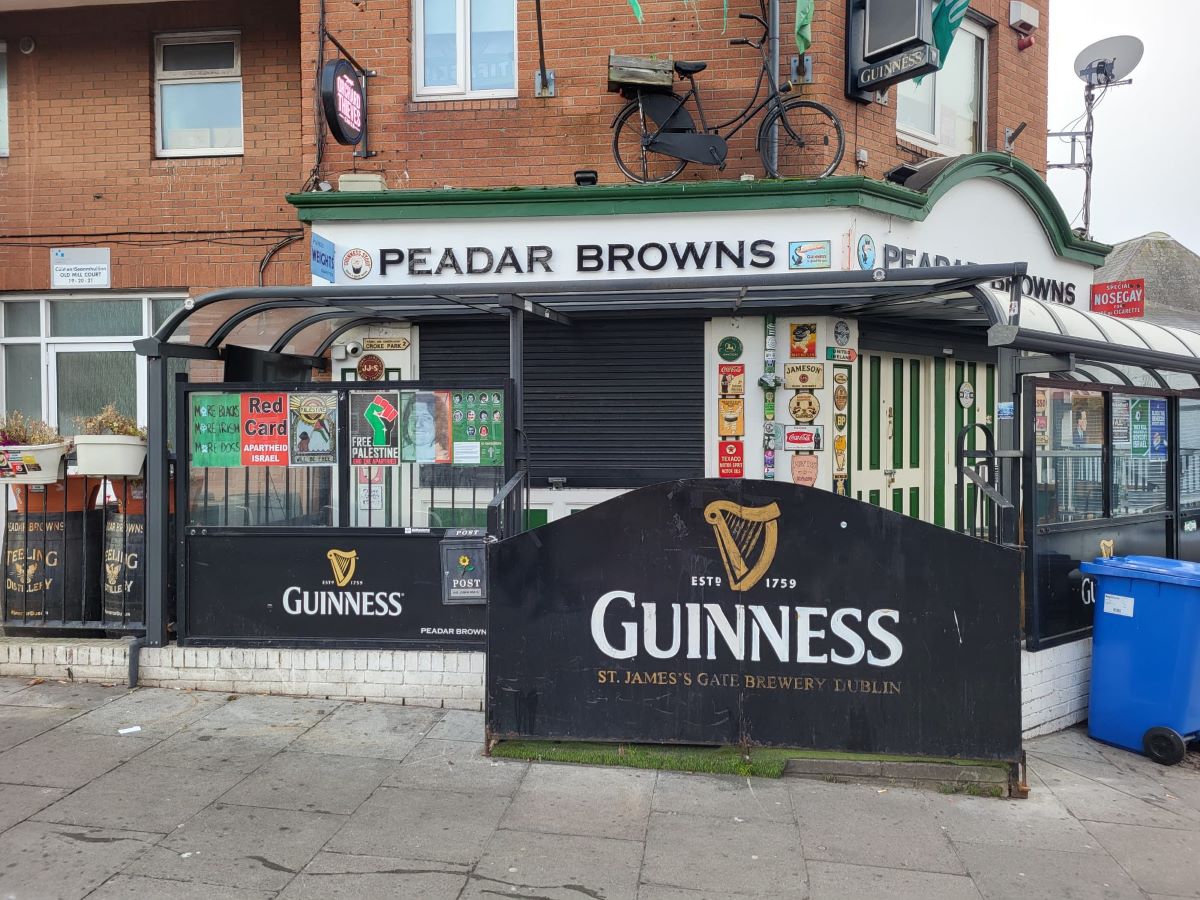
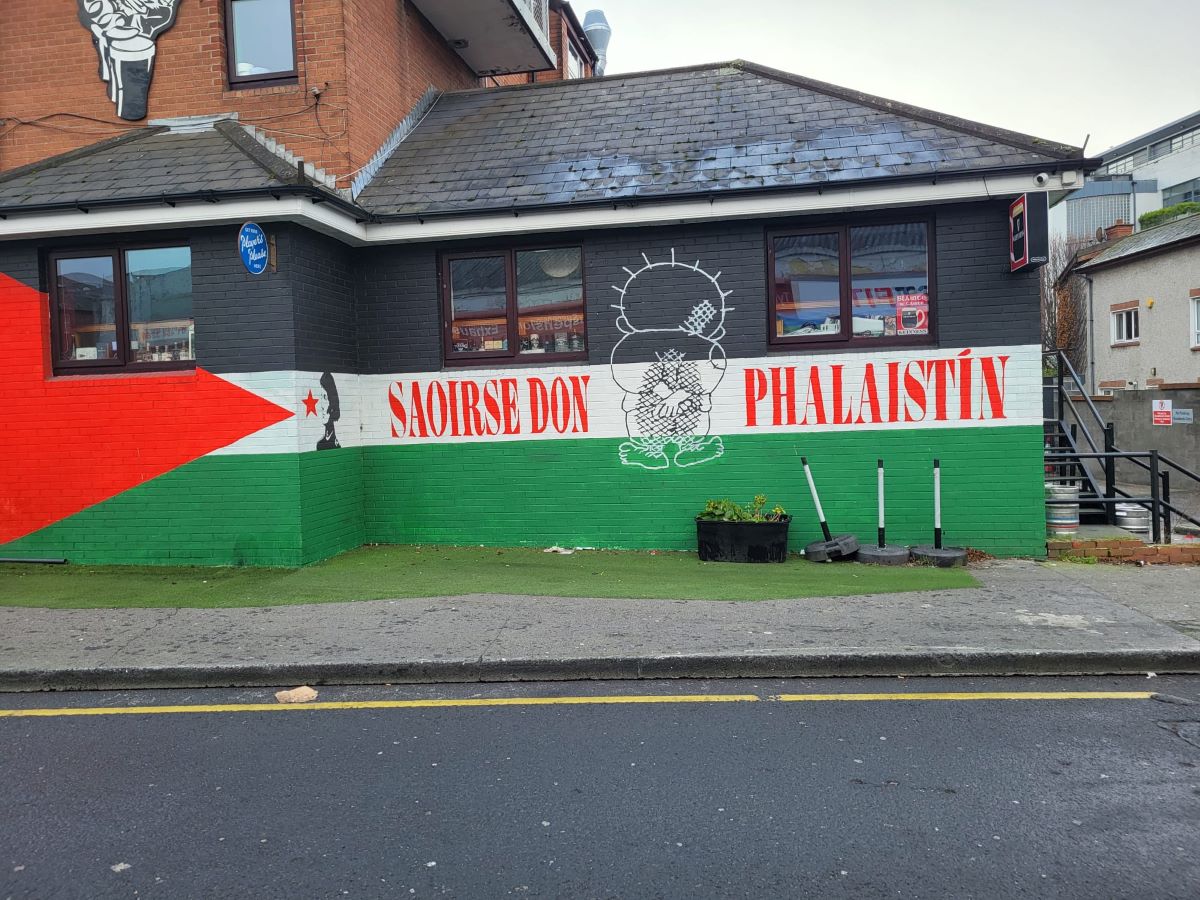
Front of the Peadar Brown’s pub building, Clanbrassil Street. (Photo: R. Breeze)
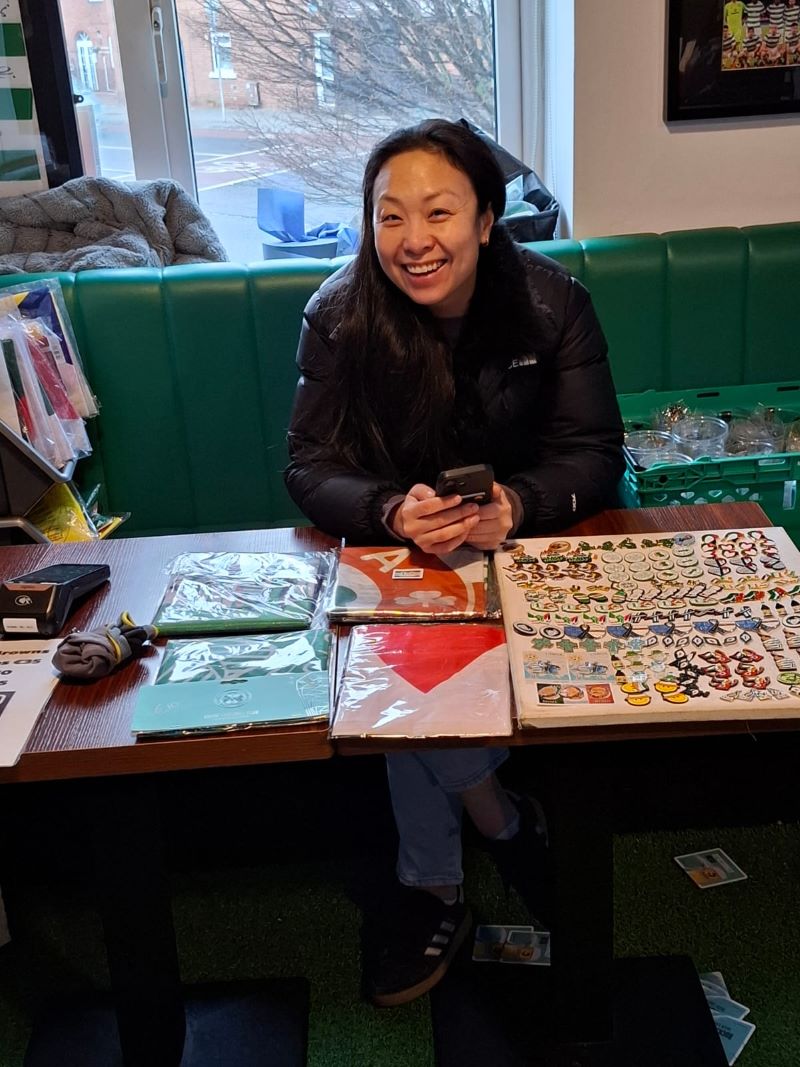
The Comrade Corner’s section of the monthly market take place upstairs in the Peadar Brown’s pub, open to campaigning and community groups to book a table to promote their campaign or group on which they had campaign leaflets, a QR to sign on line and campaign badges.
The latter represented a grotesque on the roof of No.55 Moore Street, missing wingtips shot off by a British bullet during the battle there in 1916.
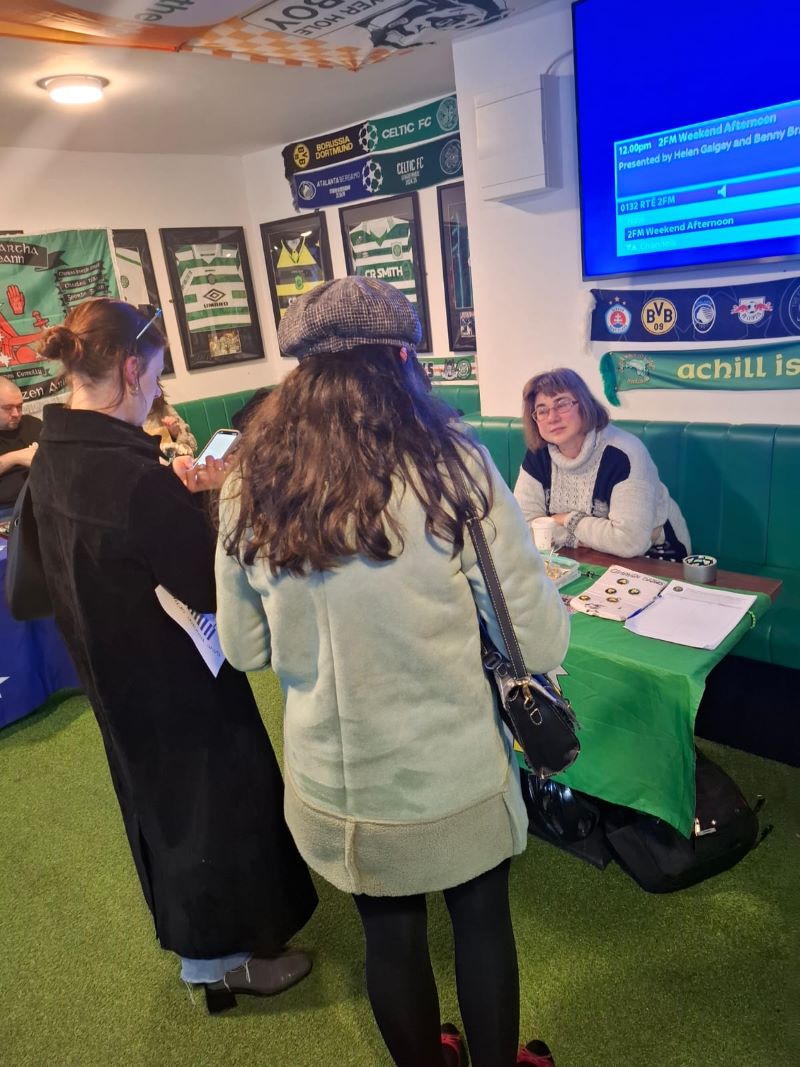
Two of a number of visitors tothe Comrade Corner engaging with the Save Moore Street From Demolition campaign stall at which campaign activist Orla Dunne is seated. (Photo: R. Breeze)
“Over the 12 years of our group’s existence campaigning on the street we have engaged in outreach work often enough,” said one of the two staffing their table in Peadar Brown’s, “including taking our banner to protest marches, giving talks, interviews and conducting history tours.”
The group has been campaigning with a weekly Saturday table for conservation and against demolition in Moore Street since September 2014. “We want to see a busy street market with small independent shops, not chain stores,” said Orla Dunne, also staffing their table in Peadar Brown’s.”
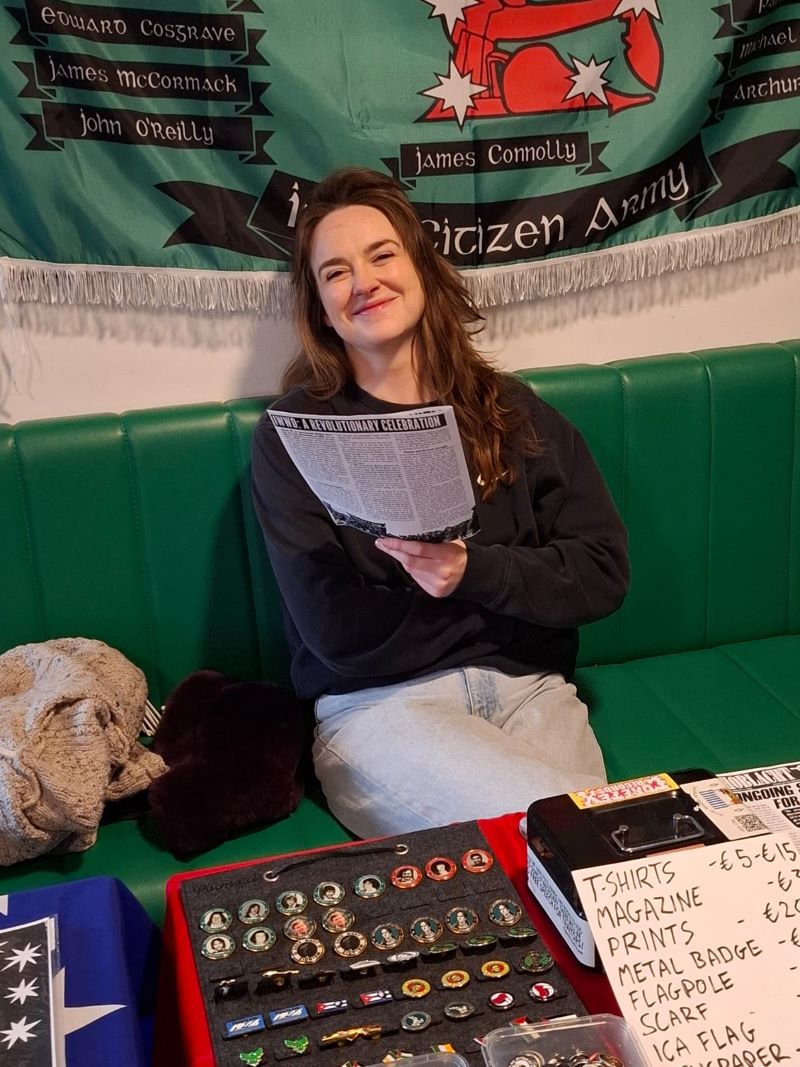
One of the team staffing the Darragh Ó Faoláin stall in Comrade Corner. (Photo: R. Breeze)
“And the history of the 1916 Battleground properly commemorated,” she went on to say, alluding to the fact that of the Seven Signatories of the Proclamation, no less than five spent their last hours of freedom in the Moore Street houses before taking the painful decision to surrender.
Those were Patrick Pearse, James Connolly, Tom Clarke, Seán Mac Diarmada and Joseph Plunkett, all shot by firing squad, along with Willie Pearse, also late of Moore Street as were another ten prominent figures, including Roger Casement, though hanged in Pentonville Jail somewhat later.
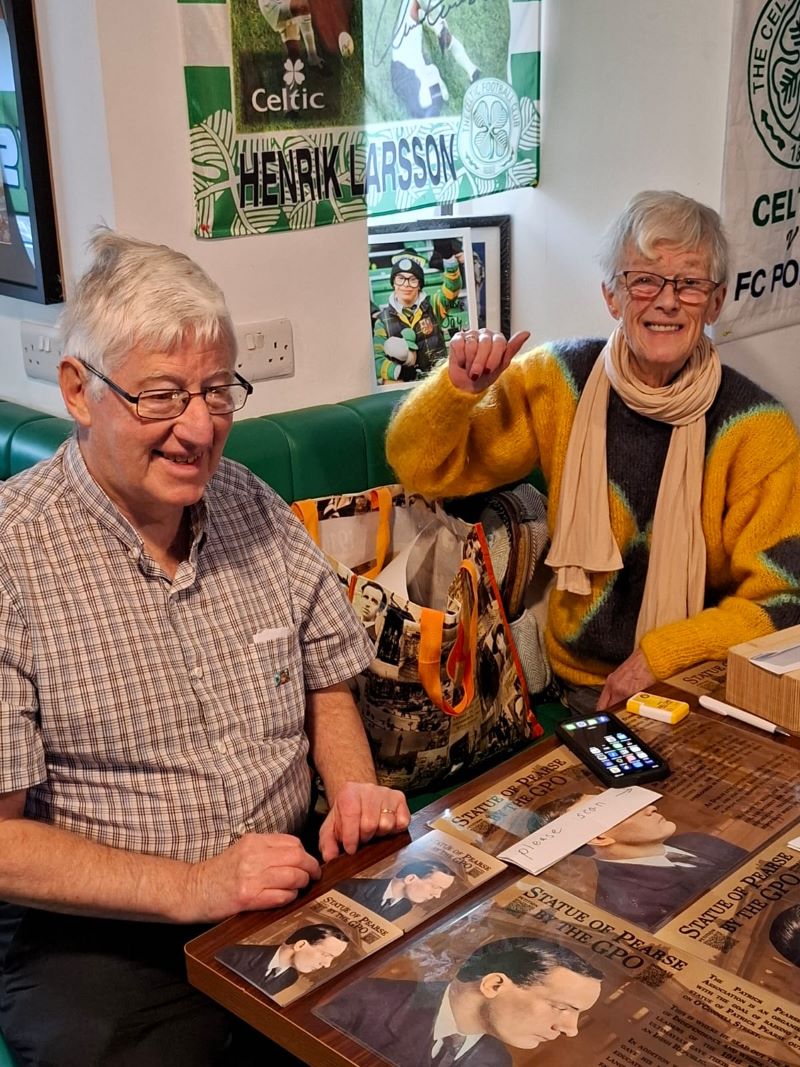
The team staffing the Statue of Pearse by the GPO campaign stall in Comrade Corner. (Photo: R. Breeze)
The GPO Garrison had left the burning building on the Friday of Easter Week and, heading to relocate at the Williams and Woods factory, got only as far as Moore Street before they came under intense machine-gun and rifle fire from the encircling British forces in Parnell Street.
Pausing to take a breath and plan their next moves, around 300 men and women occupied the whole central terrace (Nos.12-25), tunnelling through the walls, along with some other buildings. The leader of a failed charge on the British barricade died in a lane now named O’Rahilly Parade.
As he lay dying he wrote a farewell letter to his wife and children, the magnified script reproduced on an impressive monument in the lane-way.
The current Hammerson plan includes at least seven years of construction on the site (with no food stalls possible meanwhile), a new street cut through the 1916 Terrace to O’Connell Street, a hotel in Moore Lane and a Metro entrance in O’Rahilly Parade additional to the O’Connell Street one.
INSIDE PEADAR BROWN’S
The Peadar Brown’s stall in Comrade Corner. (Photo: R. Breeze)
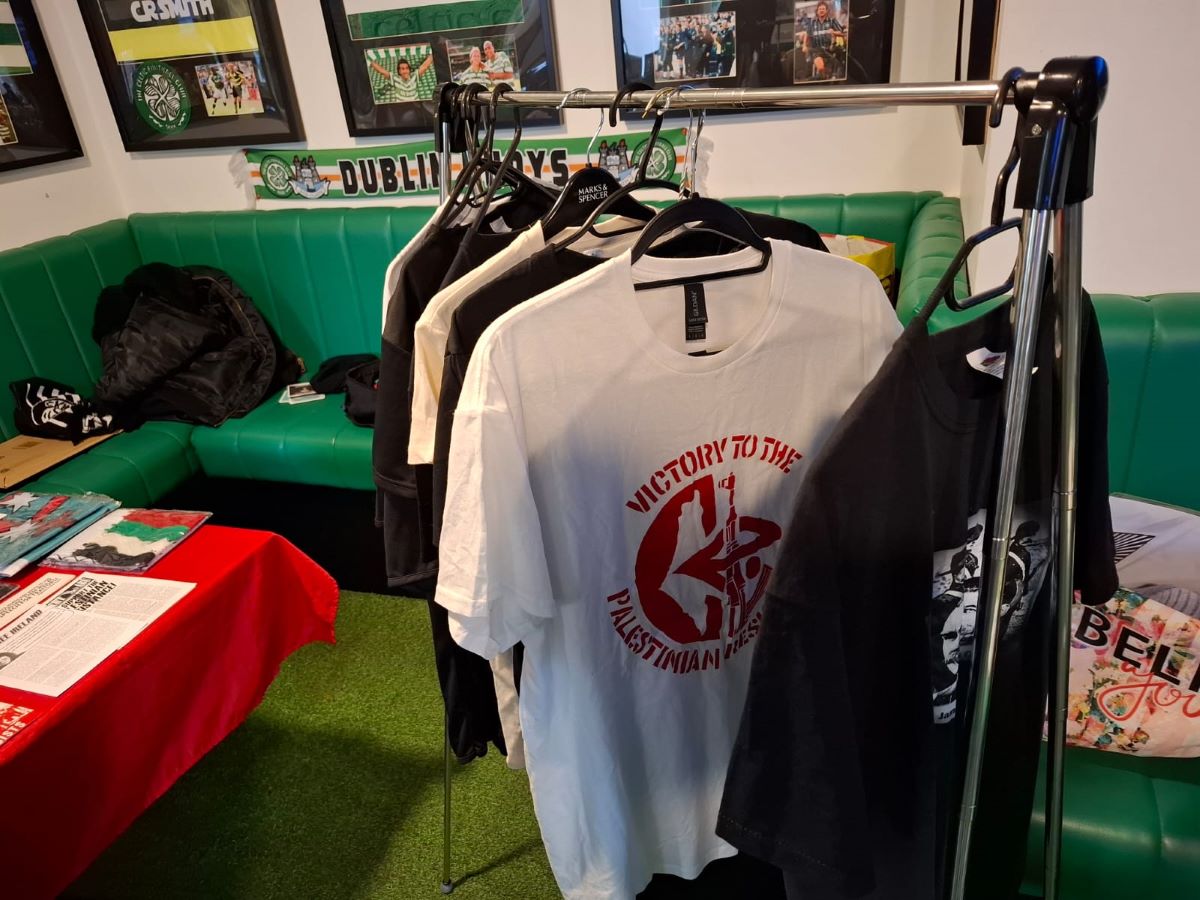
People drifted into the upstairs room in twos and threes, stopping at some or all of the stalls to examine the literature or merchandise on display and to chat to some of the groups. In addition to SMSFD’s, Peadar Brown’s had their own merchandise of badges and T-shirts.
Also selling merchandise within that range was a revolutionary anti-fascist stall, while another table was held by a group campaigning for the erection of a monument to Patrick Pearse in O’Connell Street, near to the GPO where he was located in 1916 before evacuation to Moore Street.
T-shirts merchandise near the Darragh Ó Faoláin Stall in Comrade Corner. (Photo: R. Breeze)
It was notable that the latter group also directed people to the SMSFD group’s table. Many of the visitors had origins outside Ireland, a sector for which perhaps this kind of event would be more usual. How did the SMSFD team feel their table had done for their hours there?
“We did alright,” said Dunne, “though it wasn’t very busy today.” “If we had boosted our online petition signatures alone, which we did, it would have been worth it,” said Breatnach. “Besides, I always wanted to see the famous Pub,” added Dunne, smiling.
Mural on the side of the Peadar Brown’s building. (Photo: R. Breeze)
Much artwork of an Irish Republican nature decorates the inside of the pub downstairs, including a mural along the wall behind the small stage area. The Irish Tricolour, Starry Plough and ‘Irish Republic’ flags hang from the exterior along with anti-racist posters in the outside drinking area.
Last year officials in Dublin City Council sought unsuccessfully to have Peadar Dunne’s remove the large Palestine flag painted on the side of their building. It has a reputation not only as an Irish Republican pub but also of decidedly internationalist solidarity and antifascist character.
Also last year, some fascist and far-Right elements threatened the pub with a demonstration which failed to materialise, to counter which antifascists had packed the pub to overflowing. The far-Right’s anger was aroused by the banning of a musician for allegedly uttering racist comments.
The Peadar Brown’s T-Shirt rack by their stall in Comrade Corner. (Photo: R. Breeze)
End.
Note: If you found this article of interest, why not register with Rebel Breeze for free, so that you will be notified by email of subsequent articles. You can de-register any time you wish.
A campaign for conservation of the ancient Moore Street Dublin inner-city street market area and 1916 Battleground, in its 11th year of Saturdays on the actual street is seeking to reach 2000 on-line signatures for the group’s petition this year.
The site was formerly under threat of construction of a giant ‘shopping mall’ from the ILAC to O’Connell Street. However ‘shopping malls’ are not making so much money nowadays so the new plan is largely a ‘shopping area’ with an hotel and a new road from the ILAC to O’Connell Street.
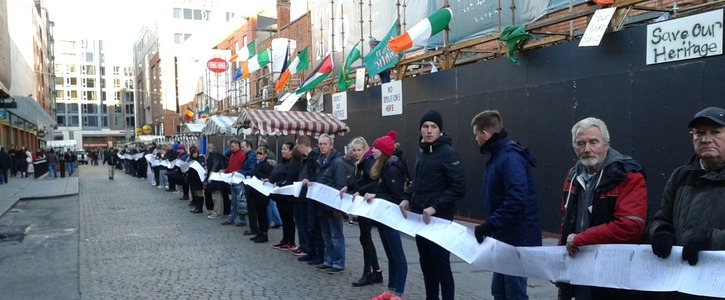
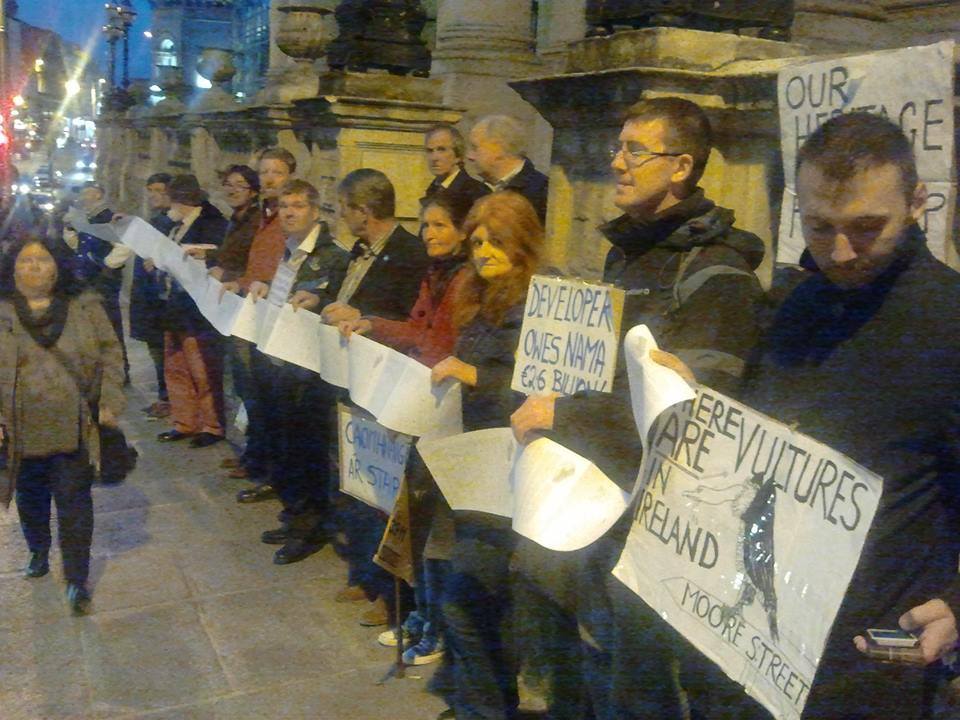
Picket/ lobby of Dublin City Council in 2014, petition stretch and posters organised by the Save Moore Street From Demolition Group, founded a couple of months earlier to prevent Dublin City Council City Manager giving property speculator Joe O’Reilly Nos. 24-25 in exchange for Nos.14-17, which would have allowed him to demolish from No.25-No.18. The campaign was successful in preventing that as councillors voted against the swap. (Photo: SMSFD archives)
Moore Street is of course already ‘a shopping area’ but what that means to property speculators is a street of chain stores, something like the Grafton and Henry Streets. Such streets are busy during shopping hours but largely deserted at night and anathema to the living social city centre.
Independent small shops and street stalls characterise a street market, typically with some cafes, a bakery and restaurant. But the agent of Hammerson, the speculator company, has closed down a bakery and a number of successful restaurants and cafés on the street.
On the Friday of Easter Week, 300 or so of the GPO garrison evacuated the burning building and occupied the central terrace in Moore Street to gain a respite, setting up their new HQ there and a field hospital caring for their wounded and for a wounded soldier of the British Army.
The new intended street would cut right through the historic 1916 terrace, the footprint and path traversed by much of the 300 or so GPO Garrison in 1916 as they evacuated their burning former HQ and prepared to relocate to William & Woods site in nearby King’s Inn Street.
Moore Street, according to campaigners, is of great Irish cultural and historical importance but is also of international historical stature: surrender site of the first anti-colonial uprising of the 20th Century and of the first rising against World War and last location in freedom of five of its leaders.
Those five, Connolly, Pearse, Clarke, Mac Diarmada and Plunkett, were also five of the Seven Signatories of the 1916 Proclamation, a document of huge symbolic significance in history and still often referenced in contemporary discourse.
Campaigners point to the presence in the street of the Irish Citizen Army, which they claim as “the first workers’ army” and of its leader, Connolly along with three of the first women’s republican military organisation, Cumann na mBan: Elizabeth O’Farrell, Julia Grenan and Winifred Carney.
The Irish Citizen Army recruited women too, including appointing some of them as officers in command of male Volunteers, another first in world history.
Signed petition sheets sellotaped edge to edge in January 2016, stretched along Moore Street as the 6-day occupation of the endangered buildings came to an end and shortly before the 6-week blockade began. (Photo: SMSFD archive)
SUCCESSES AND DEFEATS
The campaign has had some previous successes, including four buildings being declared a historical monument in 2007, refusal of land-swap in 2014 (see photo), a six-week blockade of the site and a High Court declaration in 2016 of the whole area being a national historical monument.
However, the campaign insists the historical monument is all 16 buildings in the terrace, not just four. And the High Court decision was successfully appealed in February 2017 by the Minister of Heritage on the grounds that a Judge did not have the power to declare a national monument.
The campaigners, now in their 11th year of Saturdays on the street, say that they stopped counting hard copy petition signatures once they passed 380,000. But last year they started an electronic petition in which they aimed for 1,000 by year’s end — and exceeded their target.
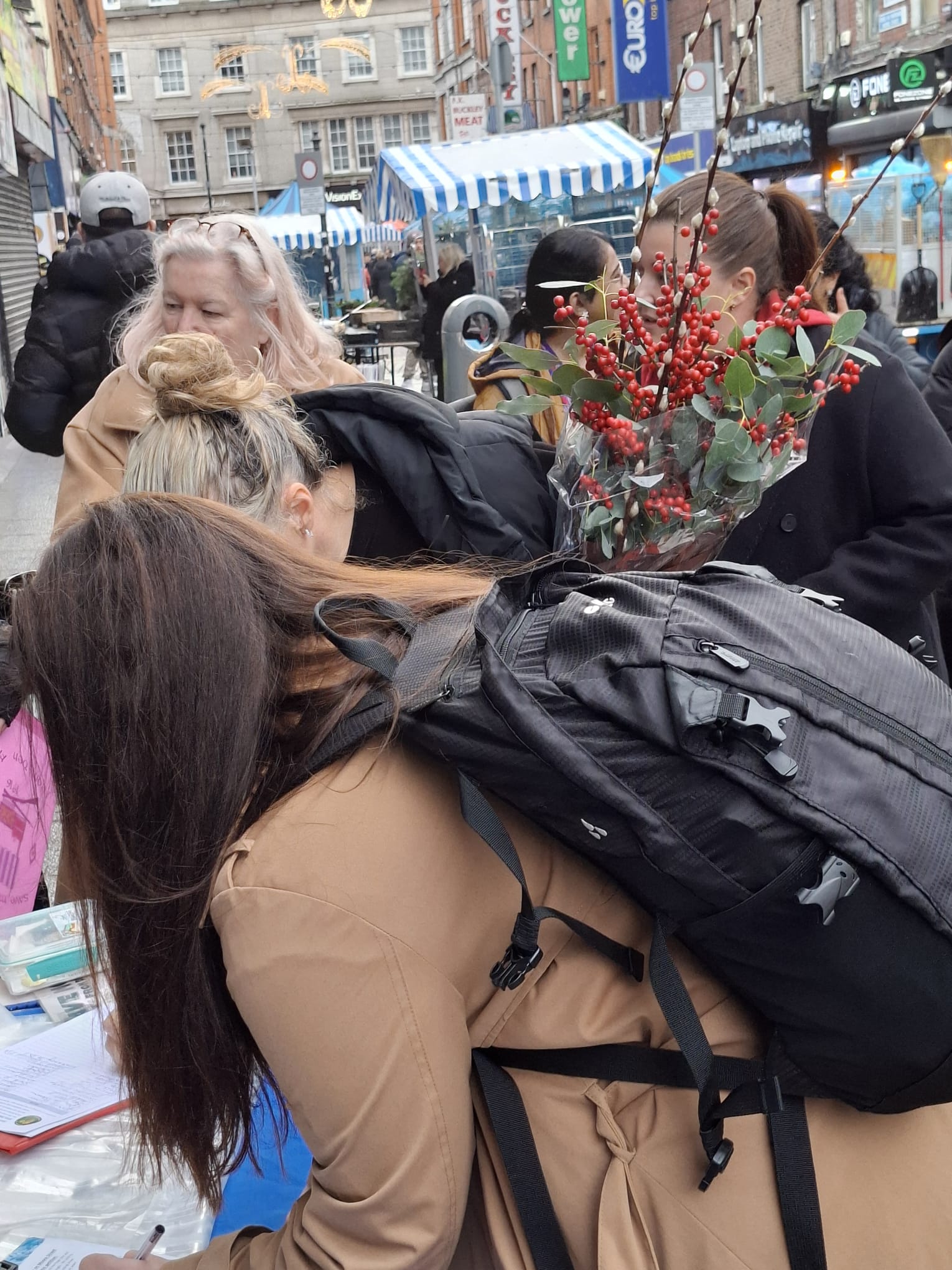
Women Christmas shopping crowding around the petition table to sign hard copy and on-line petition last Saturday. (Photo from weekly SMSFDalbum 20 December 2025.)
This year they’ve aimed to reach 2,000 but, with nearly another 300 needed with a week to go before the end of 2025, reaching their target seems very unlikely.
The campaign group supporters say that they have held the line so long because of the support of hundreds of thousands, not only of indigenous Irish but also of settled migrants (the latter being the mainstay of the traditional fresh fruit and vegetable stalls) and want the signatures to reflect all that.
“At this stage, the strongest help we can get from ordinary people is to sign the on-line petition and to get their contacts to do so too,” said one of the campaigners on the street recently. “On-line signatures are identifiable to one person, verifiable and the total can be checked on line.”
“The authorities will remember that people took direct action in the past to halt demolition, as in the occupation and blockade of 2016 but thousands of online petition signatures are an indication that the activists represent much more than themselves alone”.
The Save Moore Street From Demolition campaigners are on the street every Saturday from 11.30am-1.30pm and their online petition is on https://my.uplift.ie/petitions/save-moore-street The group has Instagram and Facebook pages also.
end.
Note: If you found this article of interest, why not register with Rebel Breeze for free, so that you will be notified by email of subsequent articles. You can de-register any time you wish.
Diarmuid Breatnach (slightly edited repost from 2014)
(Reading time:3 mins.)
In England it is called “Boxing Day” but in Ireland the 26th of December is “St. Stephen’s Day”. Despite the Christian designation it has long been the occasion in Ireland for customs much closer to paganism.
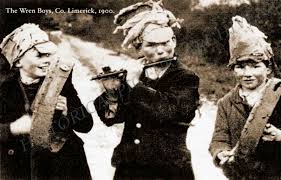
It was common for a group of boys (usually) to gather and hunt down a wren, a small songbird.
The wren can fly but tends to do so in short bursts from bush to bush and so can be hunted down by determined boys. The bird might be killed or kept alive, tied to a staff or in a miniature bower constructed for the occasion.
The Dreoilín singing on a mossy rock.
The Wren Boys would then parade it from house to house while they themselves appeared dressed in costume and/or with painted faces.
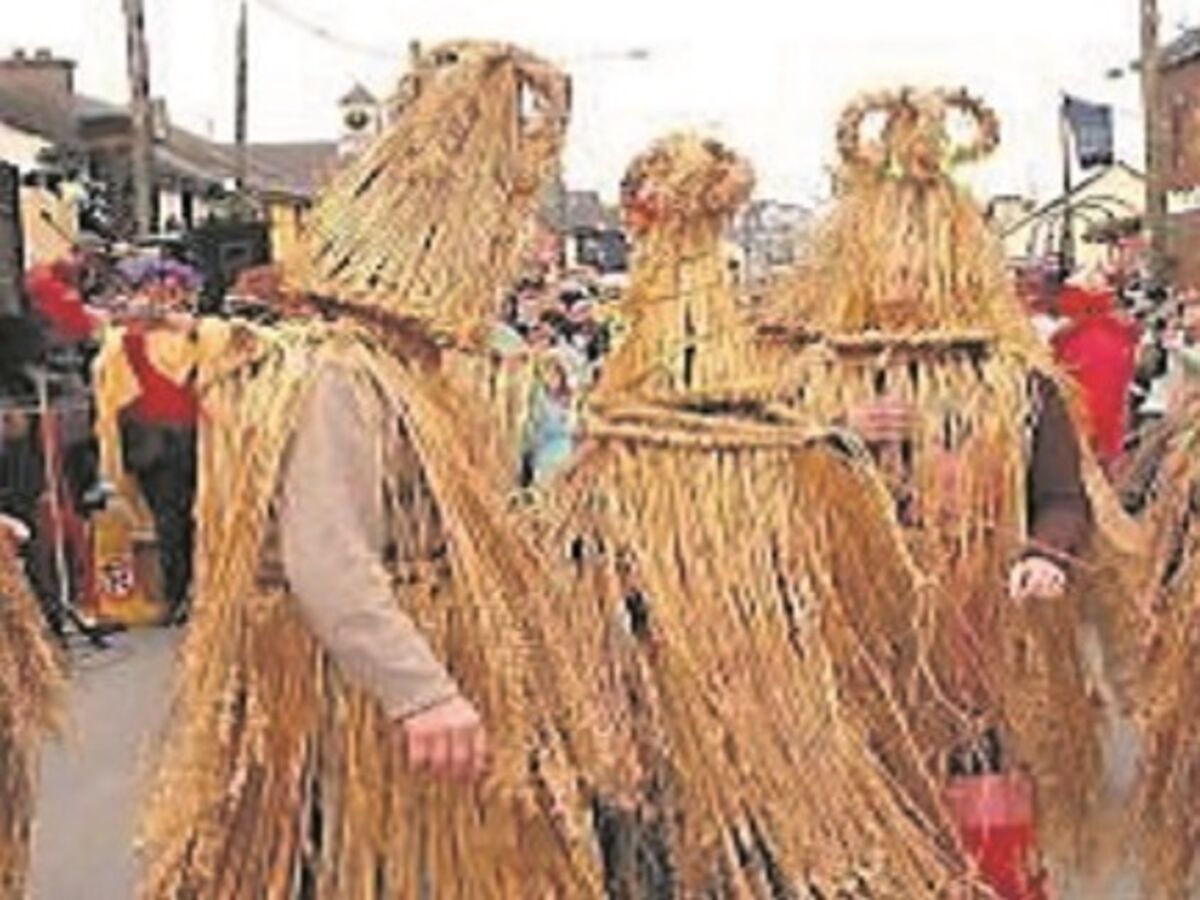
In some areas they might only carry staff or wands decorated with colourful ribbons and metallic paper while they might in other areas dress in elaborate costumes, some of them made of straw (Straw Boys) and these were sometimes also known as Mummers.
However a distinction should be drawn between these two groups. The Mummers in particular would have involved acting repertoires with traditional character roles and costumes, music and dance routines.
The simpler Wren Boys however might each just contribute a short dance, piece of music or song. In all cases traditional phrases were used upon arrival, the Mummers having the largest repertoire for in fact they were producing a kind of mini-play.
The origins of the customs are the subject of debate but a number of Irish folk tales surround the wren.
Straw Boys at a festival.
The bird is said in one story to have betrayed the Gaels to the Vikings, leading to the defeat of the former. There is a Traveller tradition that accuses the wren of betraying Jesus Christ to soldiers while another tradition has the bird supplying the nails (its claws) for the crucifixion of Jesus Christ.
Yet another tradition has the wren as King of the Birds, having used its cunning in a competition to determine who would be the avian King, hiding itself under the Eagle’s wind and flying out above the exhausted bird when it seemed to have won.
By the 1960s the Wren Boy custom was beginning to die out even in areas where it had held fast but it slowly began to be revived by some enthusiasts. Nowadays fake wrens are used.
Christmas Day in Ireland was traditionally a day to go to religious service and to spend at home with family or to go visiting neighbours.
It was not a day of presents or of lights or Christmas Trees, customs brought in by the English colonizers in particular from Prince Albert, the British Queen Victoria’s royal consort, who was German.
St. Stephen’s Day may have celebrated the turn of the season heralded by the Winter Solstice (the wren being a bird that on occasion sings even in winter) but moved to a Christian feast day.
In any case it produced colour and excitement at a time which did not have the religious and commercial Christmas season to which, in decades, we have become accustomed.
The lovely song The Boys of Barr na Sráide from a poem by Sigerson Clifford takes as its binding thread the boys in his Co. Kerry childhood with whom Sigurson went “hunting the wren” but follows also their fight against the invader and their subsequent emigration to England or the USA.
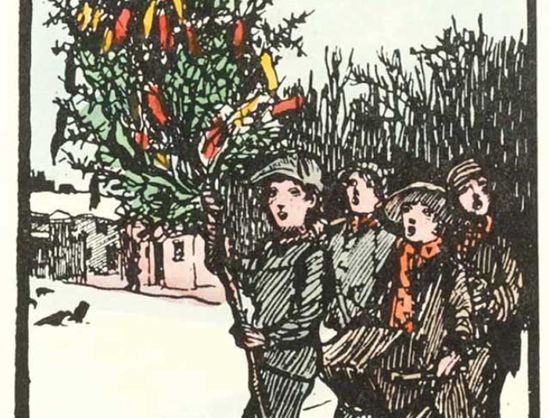
Drawing of Wren Boys out on their round.
I’ve been singing this song in private recently but also at the December gathering of the monthly 1916 Performing Arts Club in Dublin.
In this recording it is sung by Muhammed Al-Hussaini (then resident in London and part of the singing circle of Comhaltas Ceoltóirí na hÉireann, meeting in the Camden Irish Centre) in which I had the pleasure of participating on a visit to London in 2014 (see The London Visit on the blog).
There are recordings of others performing this song well but the unusual origin as well as its quality persuaded me to choose this one and, in addition the memory of participating in a singing circle with this lovely and modest singer in London, who greeted me in Irish.
Muhammed also plays the violin on this recording, accompanied by Mark Patterson on mandolin and Paul Sims on guitar.
Mummers from Fingal, north of Co. Dublin
Ends.
Note: If you found this article of interest, why not register with Rebel Breeze for free, so that you will be notified by email of subsequent articles. You can de-register any time you wish.
The photo with the recording shows some of the Limerick fighters of the Kerry IRA in the War of Independence (1919-1921) or perhaps in the Civil War (1922-1923)
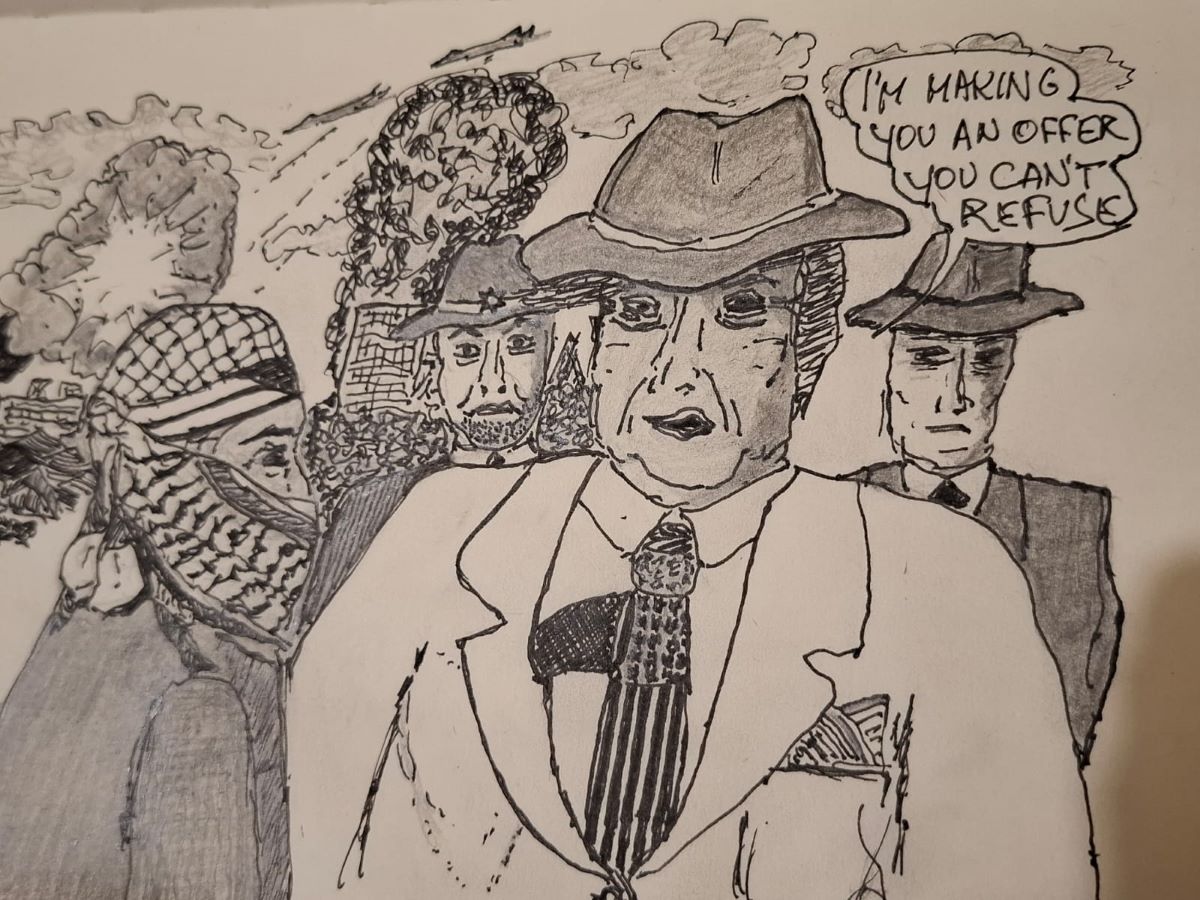
It was great to see the Irish pacification process being referenced with regard to the Trump plan for Gaza1 because that is exactly what the latter is: a plan to pacify the Resistance while ensuring it gets none of what it fought for.2
In other words, exactly like the Irish pacification process.
(Cartoon by D.Breatnach)
Hamas and Palestine Islamic Jihad grew out of previous Palestinian pacification processes. The Madrid Conference (1991) and the Oslo Agreement (1993) were imperialist/ Zionist attempts to pacify the wide-scale militant Palestinian resistance period of the First Intifada.3
Fatah at that time was the leading group in numbers and influence in the Palestine Liberation Organisation (from which Islamic groups were excluded) but also in Palestinian society in general. But Fatah had agreed to recognise ‘Israel’ and also the two-state solution (sic).
In the Oslo Agreement, furthermore, the question of the return to their homeland of the refugees was left aside. It appears that the Fatah leadership had lost faith in the eventual victory of their people’s struggle and had decided to get what they could by using the struggle to bargain.
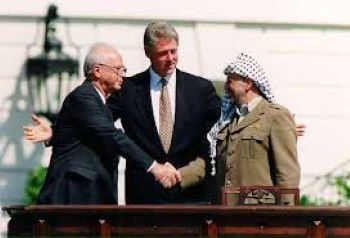
The Oslo Agreement: US Imperialism’s President Clinton oversees Yitzak Rabin, Premier of Zionist state of ‘Israel’ shaking hands with Yasser Arafat of Fatah, then leader of the PLO.
What Fatah got was Palestinian Authority control in the first elections (1996), with internal control over/ management of the Palestinian population of the West Bank and Gaza, but not of the Palestinians in Jerusalem (captured by ‘Israel’ in 1967): a far cry from a free Palestine.4
In the Algiers conference of 1988 Fatah had won majority agreement to recognise ‘Israel’ and to accept the two-state solution5 (sic), i.e. embodying a Palestinian state on 20% of Palestinian land, under the eyes and guns of their Zionist neighbour).
Fatah’s rule became known for corruption and nepotism, which then had to be protected and defended from the Palestinian masses, leading to authoritarian, repressive and often arbitrary rule. And repression of the Resistance, along with direct collusion with the ‘Israeli’ State.
Continuing ‘Israeli’ repression and settlement expansion in turn led to the Second Intifada; Fatah lost to Hamas in the Palestinian parliamentary elections of 2006 followed by defeat of Fatah’s attempted coup in Gaza in 2007 (but the West Bank remaining under unelected Fatah control).
Mahmoud Abbas of Fatah has refused to announce elections since, sitting in unelected control of the PA’s office in the West Bank, collecting the various international grants, presiding over corruption,6 repressing Palestinian resistance of deed or word and colluding with the ‘Israeli’ Occupation.
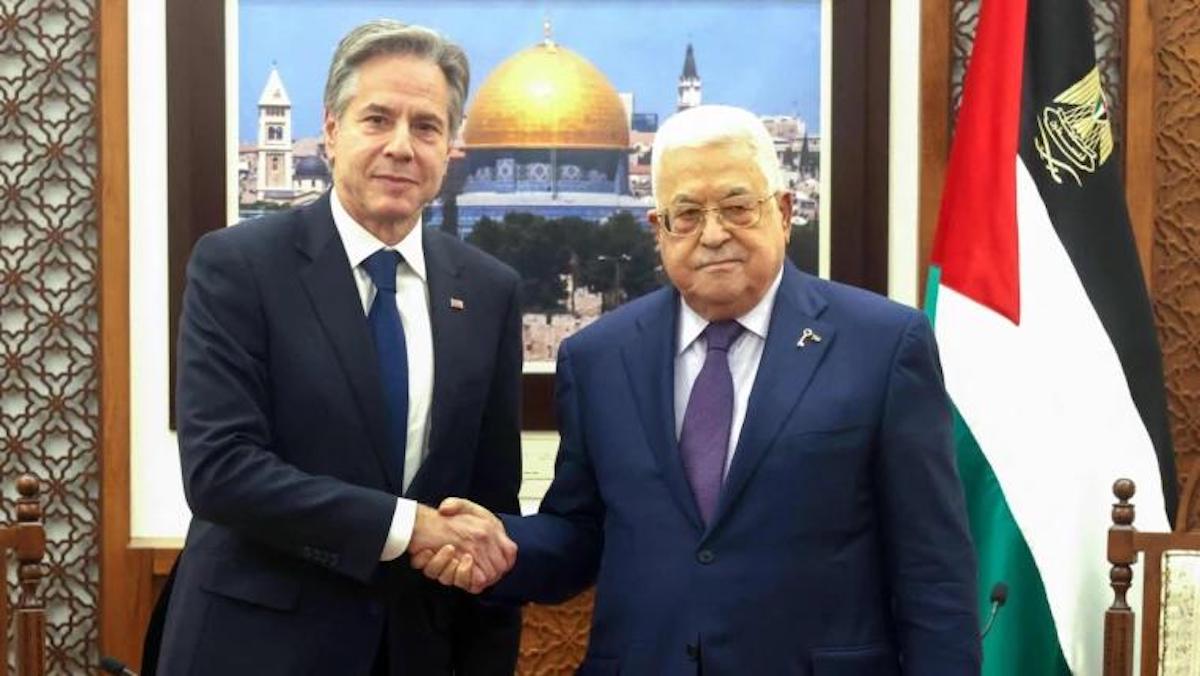
US Imperialism’s then Secretary of State Anthony Blinken and the PA’s Mahmoud Abbas in Palestine, soon after the start of the accelerated Zionist genocide in Gaza, December 2023
BUT WHAT ABOUT THE IRISH CONNECTION?
Starting with Palestine and South Africa in 1991, an imperialist pacification process spread to Ireland, Basque Country, Kurdish Turkey, Colombia, India, Philippines, Sri Lanka. With some variations the drive has been the same: to give up revolution and join the system.
One of the features of this process was the apparent need of a recognised leader to sell it to the resistance support base and to front it for the world: Arafat (Palestine), Mandela (S. Africa), Adams/McGuinness (Ireland), Ocalan (Turkish Kurdistan), Otegi (Basque Country).
The Provisional IRA was by far the major organisation in the Irish Republican resistance; it gave up armed struggle in return for vague promises and the release of its prisoners under licence.7 Another organisation complied also even as new ‘dissident’ fighters were being jailed.
Nearly 30 years after the signing of the Good Friday Agreement, Ireland is no nearer the Provisional IRA’s declared aims Irish reunification, independence and sovereignty. The Sinn Féin party helps run the colony8 and is attempting to become part of the neo-colony’s government.
Sinn Féin representatives Tina Black (Mayor of Belfast) and Michelle O’Neill, First Minister of the British colony, laying a wreath at the British War Memorial in Belfast, July 2022 (Cred: Liam McBurney/ PA Wire)
Neither the Spanish, French nor Turkish states were interested in other than crushing the Basque and Kurdish resistance and the corresponding movements disabled themselves without getting anything in exchange other than continued repression.9
The resistance movements in parts of India and Philippines continue to resist but in Sri Lanka was wiped out.10
One feature of the spread was the contagion-like way in which leaders of one infected resistance sought to entice others to follow suit: S. Africa and Palestine to Ireland; S. Africa and Ireland to Basque Country; Ireland to Colombia (where only the FARC but not the ELN accepted it).
In only one iteration of the pacification processes was there a partial achievement of the stated aims of the resistance: South Africa got national enfranchisement but the economy remained under imperialist extractive control and its working people under repression.11
In the course of giving up armed struggle, allegedly just changing the methods, the leaders gave up what they had fought for, the very reason for which they had first come into the struggle. Of course, they could still shout the slogans, just not make them real in any way.
The Irish version (and the Basque one) decommissioned their weapons, which makes it very relevant to the Trump Plan for the Palestinian Resistance, particularly Hamas and PIJ. No resistance movement should even discuss giving up their weapons until the defeat of the enemy.
(Image sourced: Internet)
It will be interesting to see what positions the former parties of Irish and Basque resistance, Sinn Féin and EH Bildu12 and their supporters take on this US/ ‘Israeli’ plan for the Palestinian Resistance.
One of the features of the pacification process was the apparent need of a recognised leader to sell it to the resistance support base and to front it to the world: Arafat (Palestine), Mandela (S. Africa), Adams/McGuinness (Ireland), Ocalan (Turkish Kurdistan), Otegi (Basque Country).
Who will the imperialists find to play this role in Palestine?13
End.
NB: If you found this article of interest, why not register with Rebel Breeze for free, so that you will benotified by email of subsequent articles. You can de-register any time you wish.
4“This mirrors Israel’s post-Oslo approach to the occupied West Bank in pacifying the population through economic incentives, avoiding political concessions, and entrenching structural dependence. This model, often dubbed “economic peace,” has transformed the Palestinian Authority (PA) into a subcontractor of occupation – flush with foreign funds, but powerless to deliver sovereignty.” https://thecradle.co/articles-id/34757
7Those released under licence could be returned to jail (and a number were) at the decision of the Secretary of State for Northern Ireland without trial, hearing or details of why the individual was considered to be ‘a threat to public safety.’
8Its representative, Michelle O’Neill, is currently First Minister of the colony’s government. In the Irish State, the party has 33 TDs (MPs), only two behind the party with next largest representation, Fianna Fáil. They Party has abandoned its opposition to the repressive legislation of the State, welcomed British Royal visits to both parts of Ireland, supports recruitment to the colonial gendarmerie and its leader refused to rule out coalition with the neo-colonial political parties of membership of the British Commonwealth. https://www.thejournal.ie/mar-lou-mcdonald-commonwealth-4561600-Mar2019/
9The Basque leadership abandoned armed struggle unilaterally at the time without gaining even the end of dispersal of their jailed fighters throughout the state. The Turkish Kurdish PKK tried to make progress through political electoral means only under continuing repression. But their Syrian version of armed Kurdish forces got a new lease of life with the vulnerability of the Assad regime in Syria but ended up as a NATO proxy in the latter’s war for regime change. The PKK in Turkey very recently agreed to disarm while their Syrian part remains in difficult relationship with the new (formerly ISIS) regime in Syria and some other ISIS elements under Turkish influence.
11See The Marikana Massacre of striking miners by the ANC Government’s police.
12Both parties support the Two-State proposal for Palestine.
13Some liberal and social-democratic sections seem to have fixed on Marwan Marghouti in this role, which of course is no reason not to support his release on human rights grounds. https://www.youtube.com/watch?v=q6IgjlHaaIs
If it is true that language at least influences the way we think, then surely it behoves us to pay more attention to our choice of words. But not only because of the influence of our words on others but indeed on us as we utter them.
Take the word ‘Ireland’ – surely a neutral one describing a geographical entity? But if we query “the population of Ireland” on line and receive a reply that the figure is 5.83 million, whereas we know it to be over 7 million, we experience at least puzzlement at the disparity in figures.
Of course, what has has occurred is that “Ireland” is being considered in political terms and the Six County colony’s population is being omitted. The reply may qualify that it is referring to “the Republic of Ireland” (as when commenting on the FAI’s football selection internationally).
But this does not really make everything alright semantically (i.e. in meaning) either. True, the Irish State holds regular elections and does not acknowledge a monarch, so it generally fulfils the description of ‘a Republic’. But that is not a historically or politically-neutral term in Ireland.
The word has a long history in Ireland as applied to the nation and was always imagined as referencing the whole geographical entity. The most influential use of the word in documentary form was probably the 1916 Proclamation, which did not in the least anticipate partition.
Even the 1937 Constitution, which formally baptised the Irish State a ‘Republic’, claimed sovereignty over the entire 32 Counties, a position that stood until the removal of Articles 2 and 3 from the Constitution by the current State in 1999.
The Football Association of Ireland is actually only the Association of the sport for the 26 Counties state and the use of “R.o.I” on the screen to refer to the State’s team during games is, as explained, deeply problematic. However the Irish Rugby Team is indeed an all-Ireland one.
As is the largest sports association of Ireland, the Gaelic Athletic Association. And also Tennis Ireland, Cricket Ireland, Table Tennis Ireland, and both Badminton Ireland and the Irish Judo Association organise on a four-province basis.1
If we call the entity the ‘Irish State’ instead we would be correct. And we could call its territory ‘the Irish state’, with a lower-case ‘s’ to distinguish between the political construction and the territory over which, in constitutional and legal terms, it holds power.
Or we could call it the ‘26 Counties.’ Or, seemingly becoming increasingly popular in some quarters: ‘the Free State’.2 But what about the entity’s parliament? That’s ‘the Dáil’, right?
That’s how we hear it described and, as “Dáil” is an equivalent of ‘parliament’ in Irish, that’s ok, right? No, not at all really; its full title is actually “Dáil Éireann” and we’ve already established that not even by Constitutional lip service does this parliament govern the whole nation.
The first time we had an all-Ireland parliament, open to election across the whole of the nation and open also to participation of all elected candidates was in January 1919 but it was banned in September by the occupying British authority, thenceforth operating under conditions of secrecy.
Then in January 1922, the pro-Treaty majority in the Dáil supported the British Treaty, including Partition, ending Dáil Éireann. There has not been a Dáil Éireann since. The most accurate brief description of the current institution is “Leinster House”.3
Is this the home of Dáil Éireann? Leinster House, west-facing side. (Image: Wikipedia).
Well, does it matter what we call them – we know what they are, right?
If it’s true that the words we use to describe things influence how we think about them, then it matters quite a lot. And how we describe them may also influence how others think about them, which also matters a great deal.
If we want to imply by the words we use that this state is independent and covers the whole nation – and that its parliament administers the whole nation – well then, there’s no need to change our words. Especially if we think that the extent of Irish sovereignty is fine or sufficient.
But if we don’t think along those lines then perhaps we need to examine our terminology more carefully and, where appropriate, amend it.
End.
Note: If you found this article of interest, why not register with Rebel Breeze for free, so that you will be notified by email of subsequent articles. You can de-register any time you wish.
FOOTNOTES
1Interestingly, I note that the Irish Ten-Pin Bowling Association (ITBA) is in the process of becoming a 32-county association.
2This was the official title of the State following its adoption of the terms of the Anglo-Irish Treaty.
3The building is actually formally called “Leinster House” since it was the city resident of the Duke of Leinster, of the Cambro-Norman invader dynasty of FitzGeralds and FitzMaurices. The Duke was Lord Deputy and at times Chief Justice of Ireland under the English Occupation.
Diarmuid Breatnach (edited from article posted in Rebel Breeze 2014)
(Reading time: 6 mins.)
Part 1 – who and what gets ‘remembrance’
In the lands under the direct dominion of England, i.e. the “United Kingdom”, and in some others that are under its influence, the dominant class calls the people to join in a cultural event in November which they call “Remembrance”.
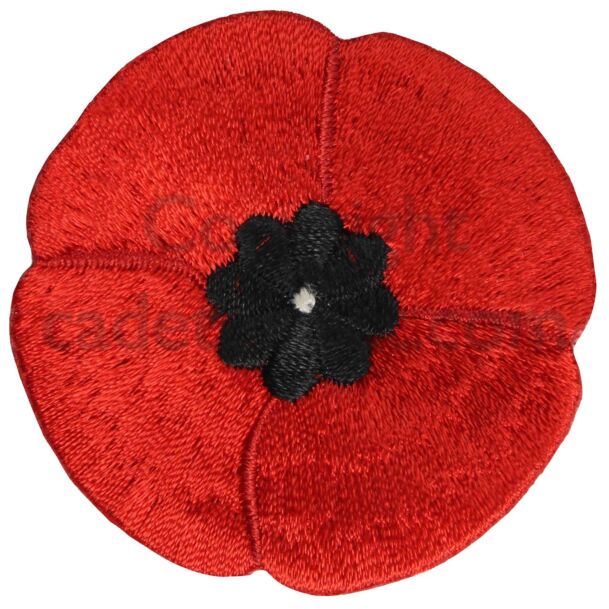
The organisation fronting this event in the ‘UK’ is the Royal British Legion and their symbol for it (and registered trademark) is the Red Poppy, paper or fabric representations of which people are encouraged to buy and display — and indeed often pressured to wear.
In some places, such as the BBC for personnel in front of the camera, they are forced to wear them. In many schools and churches throughout the ‘UK’, Poppies are sold and wreaths are laid at monuments to the dead soldiers in many different places.
Prominent individuals, politicians and the media take part in a campaign to encourage the wearing of the Poppy and the participate in the ‘Festival of Remembrance’ generally and of late, to extend the Festival for a longer period.
High points in the ‘Festival’ are the Royal Albert Hall concerts on the Saturday and the military and veterans’ parades to the Cenotaph memorial in Whitehall, London, on “Remembrance Sunday”. (Also a focus for commemorations by the British far-Right and fascists).
“The concert culminates with Servicemen and Women, with representatives from youth uniformed organizations and uniformed public security services of the City of London, parading down the aisles and on to the floor of the hall. There is a release of poppy petals from the roof of the hall.1
An embroidered version of the poppy emblem (Sourced: Internet)
“The evening event on the Saturday is the more prestigious; tickets are only available to members of the Legion and their families, and senior members of the British Royal Family (the Queen, Prince Phillip, the Prince of Wales, the Duke of York [not this year!] and the Earl of Wessex). 2
“The event starts and ends with the British national anthem, God Save the Queen3(and) is televised. Musical accompaniment for the event is provided by a military band from the Household Division together with The Countess of Wessex’s String Orchestra.”4
The money raised from the sale of the “Poppies” and associated merchandise is said to be used to support former military service people in need and the families of those killed in conflict. On the face of it, military and royal pomp apart, the Festival may seem a worthy charitable endeavour.
Also one which commemorates very significant historical events — therefore a festival which at the very least, one might thing, should not be opposed by right-thinking and charitable people.
Yet the main purpose of this festival and the symbol is neither remembrance nor charity but rather the exact opposite: to gloss over the realities of organised violence on a massive scale and to make us forget the experience of the world’s people of war.
And to prepare the ground for recruitment of more people for the next war or armed imperialist venture – and of course more premature deaths and injuries, including those of soldiers taking part.
Video and song “On Remembrance Day” from Veterans for Peace lists British conflicts (including Ireland) and condemns the Church of England for supporting the wars, calling also on people to wear the White Poppy (see Part 3 for the White Poppy)
Partial Remembrance – obscuring the perpetrators and the realities of war
The Royal British Legion is the overall organiser of the Festival of Remembrance and has the sole legal ‘UK’ rights to use the Poppy trademark and to distribute the fabric or paper poppies in the ‘UK’.
According to the organisation’s website, “As Custodian of Remembrance” one of the Legion’s two main purposes is to “ensure the memories of those who have fought and sacrificed in the British Armed Forces live on through the generations.”
By their own admission, the Legion’s “remembrance” is only to perpetuate the memories of those who fought and sacrificed in the British Armed Forces – it is therefore only a very partial (in both senses of the word) remembrance. More recently it tries to hide this exclusivity.5
It is left to others to commemorate the dead in the armies of the British Empire and colonies which Britain called to its support: in WWI, over 230,500 non-‘UK’ dead soldiers from the Empire and, of course, the ‘UK’ figure of 888,246 includes the 27,400 Irish dead.
Cossack soldier volunteers WWI. Imperial Russia was an ally of Britain and France; the war was one of the causes of the Russian Socialist Revolution 1917. The following year, the war ended. (Image sourced: Internet)
The Festival excludes not only the dead soldiers of the British Empire and of its colonies (not to mention thousands of Chinese, African, Arab and Indian labourers employed by the army) but also those of Britain’s allies: France, Belgium, Imperial Russia, Japan, USA … and their colonies.
No question seems to arise of the Festival of Remembrance commemorating the fallen of the “enemy” but if the festival were really about full “remembrance”, it would commemorate the dead on each side of conflicts.
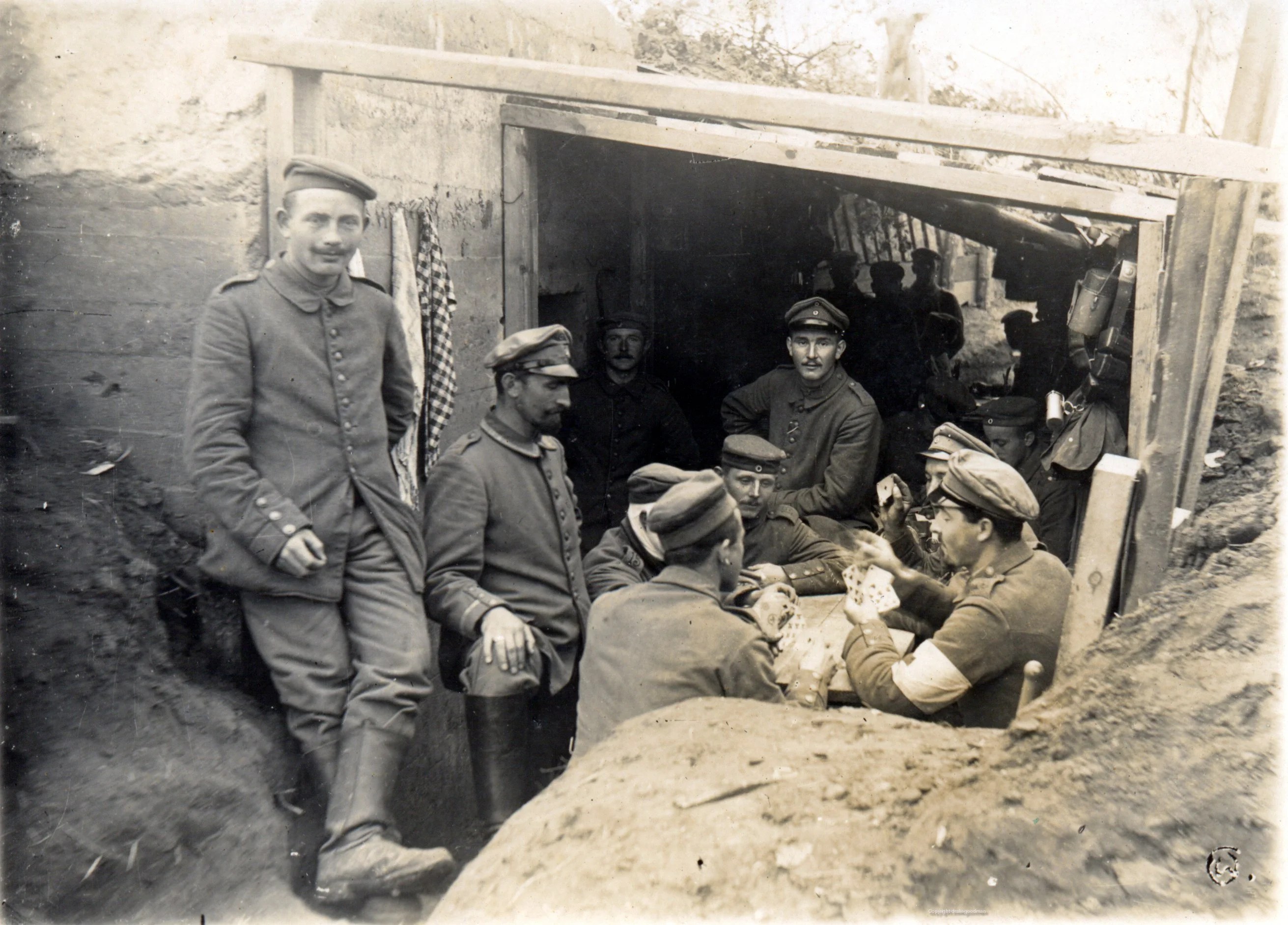
German soldiers playing cards during WWI. Photos of Germans in WWI more readily available show them wearing masks and looking like monsters. (Photo sourced: Internet)
That would particularly be appropriate in WWI, an imperialist war in every respect. But of course they don’t do that; if we feel equally sorry for the people of other nations, it will be difficult to get us to shoot, bomb or stab them in some future conflict.
A real festival of remembrance would commemorate too those civilians killed in war (seven million in WWI), the percentage of which in overall war casualty statistics has been steadily rising through the last century with increasingly long-range means of warfare.
Very recently, the Royal Legion has tried to claim that the “acknowledge innocent civilians who have lost their lives in conflict” but add “and acts of terrorism.” Since we know that that ‘terrorism’ is a highly politicised word and for imperialists has mostly meant resistance struggle, that is hardly welcome.
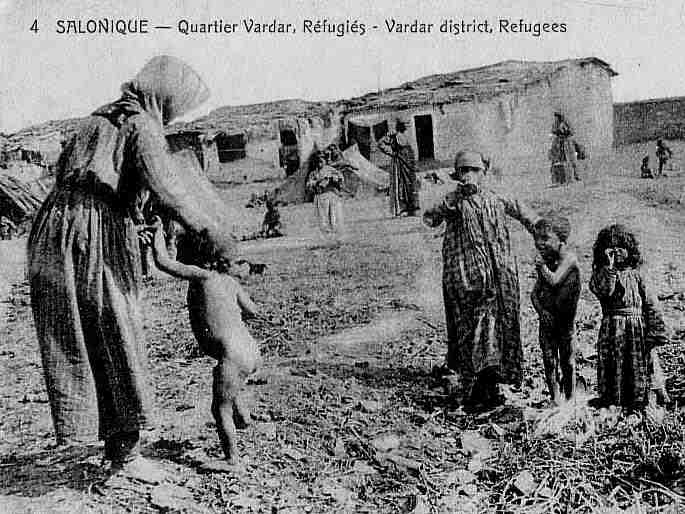
Civilian war refugees in Salonika, NW Greece, WWI (Photo sourced: Internet)
Civilians in the First World War died prematurely in epidemics and munitions factory explosions as well as in artillery and air bombardments, also in sunk shipping and killed in auxiliary logistical labour complements in battle areas.
And through hunger, as feeding the military became the priority in deliveries and as farmhands became soldiers.
In WWII 85,000,000 civilians died in extermination camps or forced labour units, targeting of ethnic and social groups, air bombardments, as well as in hunger and disease arising from the destruction of harvests and infrastructure.
Air bombardments, landmines, ethnic targeting and destruction of infrastructures continue to exact a high casualty rate among civilians in war areas.
One admittedly low estimate up to 2009 gave figures of 3,500 dead in Iraq during the war and aftermath and another 100,000 dead from western trade sanctions, along with 32,000 dead civilians in Afghanistan.
Another review up to 2011 gave a figure of 133,000 civilians killed directly as a result of violence in Iraq and “probably double that figure due to sanctions”.6
The number of civilians injured, many of them permanently disabled, is of course higher than the numbers killed. Most of those will bring an additional cost to health and social services where these are provided by the state and of course to families, whether state provision exists or not.
Real and impartial “remembrance” would include civilians but not even British civilians killed and injured are included in the Festival of Remembrance, revealing that the real purpose of the Festival is to support the existence of the armed forces and their activities.7
And contributing at the same time to a certain militarisation of society and of the dominant culture.
If the Festival were really about “remembrance”, they would commemorate the numbers of injuries and detail the various types of weapons that caused them.
But that might reflect unfavourably on the armaments manufacturers, who run a multi-billion industry in whatever currency one cares to name, so of course they don’t.
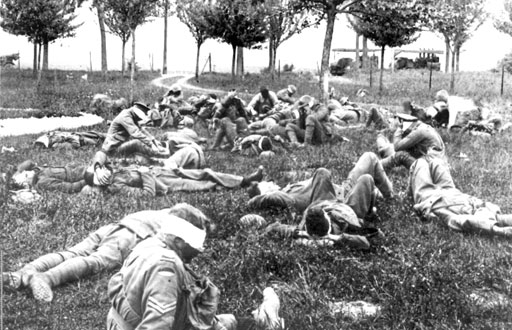
Australian soldiers who survived gas attack but injured by it awaiting hospitalisation, Northern France, WWI 1916. (Photo sourced: Internet)
And if really concerned about death and injury in war, they would campaign to end such conflict – for an end to imperial war.
But then how else would the various imperial states sort out among themselves which one could extract which resources from which countries in the world and upon the markets of which country each imperial state could dump its produce?
So of course the Royal British Legion doesn’t campaign against war. That’s not its role. Quite the opposite.
End. (Parts 2 and 3 to follow).
Note: If you found this article of interest, why not register with Rebel Breeze for free, so that you will be notified by email of subsequent articles. You can de-register any time you wish.
FOOTNOTES:
1Sourced from the British Legion’s website in 2014, its WW1 centenary year.
(Another one from the Rebel Breeze archives, this one from 2015)
I write to express my admiration for your work and my sympathies with regard to the criticisms with which you are currently being bombarded.
I hope you will forgive my ignorance of much of the work you have been doing in the area of Heritage, which is not really where my strengths lie. But I love the way you talk, the way you shoot down those critics, especially those TDs who ask those nasty questions.
And I’m sure you had something to do with removing Westport House from the NAMA sell-off, even if it is in Enda’s constituency. Such a fine example of our colonial architectural heritage!
Heather Humhpreys, Minister for Arts, Heritage and the Gaeltacht
But as we know, Minister, that wouldn’t be the kind of thing that would be appreciated by your critics. They’d rather you devoted your talents to a shabby row of Dublin houses of dubious architectural importance in a grubby street market.
A street which they say is “pre-Famine” — as if that were something to boast about! Laid down earlier than Sackville Street (now O’Connell Street) they say ….
Sure why would we want to keep a street that old …. or remember that embarrassing episode in our history either, when we lost a third of our population to over-reliance on one crop! We learned from that, though, didn’t we? Sure we grow hardly any crops at all now and get them all in from abroad.
And we live in cities now — who wants to be getting up at 6 a.m. in all kinds of weather and plodding through muck? If people like growing things that much, get a house with a garden, I say. And a gardener to do the donkey work.
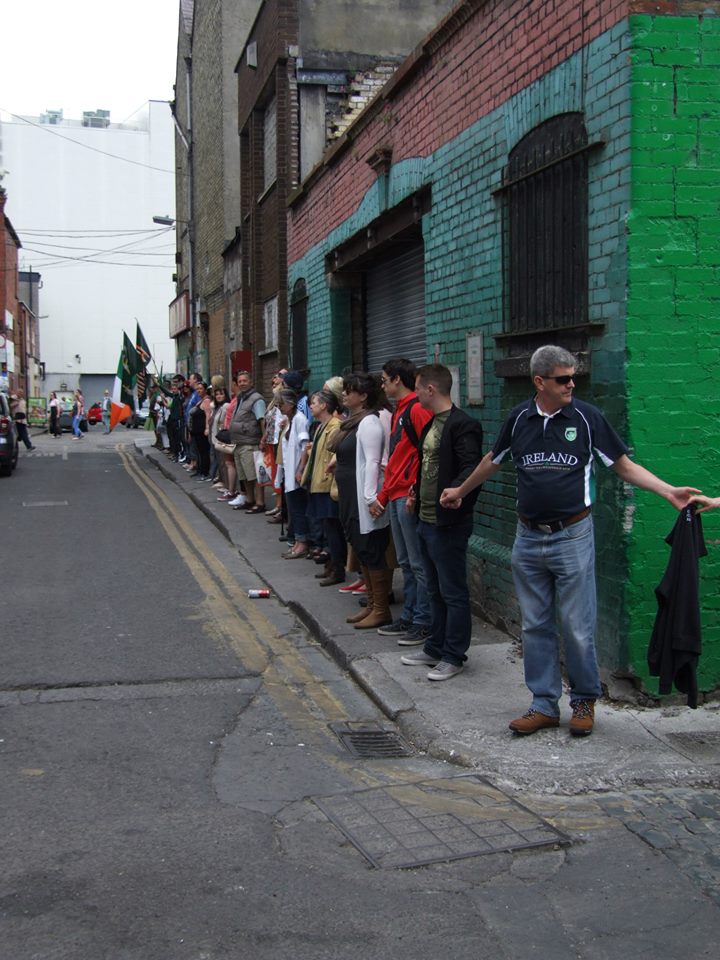
Supporters at the symbolic Arms Around Moore Street event organised by the Save Moore Street From Demolition campaign in June 2016. This is the corner of Moore Lane and Henry Place, across which Volunteers had to run under machine-gun and rifle fire from Parnell Street (at the end of Moore Lane, to the right of the photo) and at least one Volunteer died here.
But I’m digressing, Minister, my apologies. Apparently the reason they want to save that shabby terrace, that “pre-Famine street” — and the backyards and surrounding lane-ways, if you please! — is for HISTORICAL reasons. Historical!
Sure have we not had enough of history – Brehon Laws, Golden Age, Clontarf, Normans, 800 years of British occupation, blah, blah, blah! Weren’t we sick of it at school?
I’ve never liked Labour too much (somehow even the word sounds sweaty) but I have to admire their Education Ministry’s efforts to remove history as a subject from the compulsory school curriculum.
I’m sure they’re doing it for their own reasons – after all, wasn’t their party founded by that communist James Connolly? Sorry, revealing my own knowledge of history there, ha, ha! But whatever their reasons, they are on the right track.
Who wants to know where we are coming from? It’s where we ARE and where we are GOING TO, that matters!
But some people just can’t let it go, can they? They trail history around like something unpleasant stuck to a shoe. So what if 300 of the GPO garrison occupied that terrace in 1916?
The Rising, if you ask me, was a big mistake and I know plenty of people agree with me, even if most don’t have the courage to say so. Wouldn’t we be much better off if we’d stayed in the UK? And kept the Sterling currency? And as for the War of Independence …. don’t get me started!
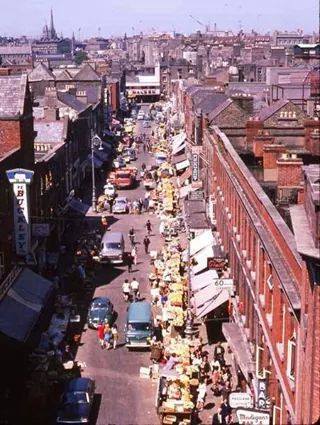
Aerial view Moore Street, looking northwards, 1960s, before the building of the ILAC and the running down of the street market.
And then there’s all that communist-sounding stuff about treating “all the children of the nation equally” — what kind of rubbish is that? Some are born to big houses with swimming pools and some are born to flats, or even rooms. That’s just the way of life.
And some will claw their way up to get to own big houses and if they are a bit uncouth, well that can’t be helped, they still deserve where they get to. And their children at least will be taught how to fit into their new station. That’s democracy! But everyone equal? Please!
Sorry, back to the Moore Street controversy. OK, after the mob pressured the Government, four houses in the street were made a national monument. But was that enough for the mob? Oh, no, not at all — eight years later the State had to buy the four houses to satisfy them.
Thankfully the specul ….. sorry, the developer, got back a good return on his investment – four million, wasn’t it? That’s the kind of thing that makes one proud to be Irish – buying run-down buildings and letting them run down more, then selling them for a million each.
That’s your entrepreneur! If only we had more like that, to lift this country up!
I must say I really liked that developer’s plan to build a big shopping centre from O’Connell Street into the ILAC, knocking those old houses in Moore Street down (although I know he had to leave those “national monument” four houses still standing in the plans).
I do hope whoever has bought the debt off NAMA and now owns those houses will carry on with that plan. Actually, I’d like the whole of O’Connell Street under glass if it were possible.
Wouldn’t it be great to do your shopping from the north end of the street to the south and from left to right, without ever having to come out into the weather? Of course, not much shopping there now, with Clery’s closed …. still ….
And then they’re going on about the market ….. traditional street market …. blah, blah. What’s wrong with getting your veg and fruit from the supermarket? Or getting them to deliver it your house, come to that? “Traditional street market” my ar….. excuse me, I got carried away there.
Those street markets are all very well for your Continentals, your Africans, Asians, Latin Americans and so on. Or for us to go wandering around in when we’re abroad on holiday, maybe. But back home? It’s the nice clean supermarkets for me any day.
Well now, if the mob insists on saving the street market, here’s an idea: why not provide a showcase stall or barrow, stacked with clean vegetables and polished fruit, right in the middle of the new shopping centre. After all, that’s heritage, isn’t it? And aren’t yourself the Minister for Heritage?
Most sincerely,
Phillis Tine-Fumblytil
Note: If you found this article of interest, why not register with Rebel Breeze for free, so that you will be notified by email of subsequent articles. You can de-register any time you wish.