For many years the Starry Plough flag in Ireland, associated with socialist Irish Republicanism, was the form of the Ursa Mayor1 constellation in white or silver stars on a blue background, from the time of the Republican Congress (1934-’36).
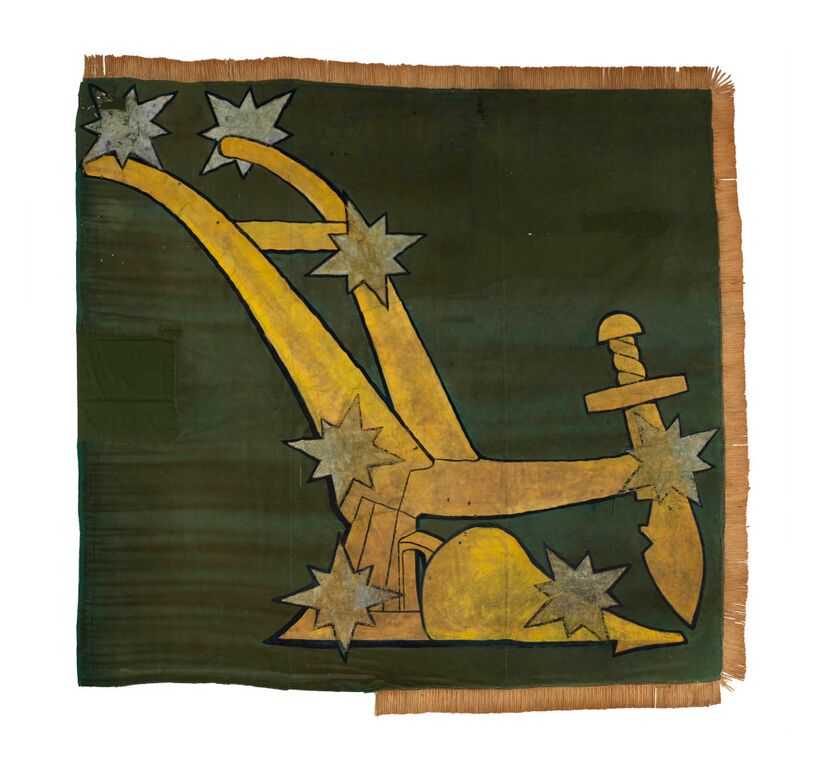
Somewhat later a different design including an actual plough following the stars and shape of Ursa Mayor on a green background began to be seen. But which was the original? And how, when and why did the other version come into existence?
It is not disputed that the Starry Plough was designed for the Irish Citizen Army, nor that it came to be designed in 1914, as the ICA was reorganising following the defeat of the Dublin workers in the 1913 Lockout. Whatever its colour, that was clearly the original.
It is beyond dispute that the Starry Plough was raised above Clery’s building, across the road from the GPO, during the 1916 Rising. It survived the burning of the building even though one witness spoke of a melted glass stream from its windows running across O’Connell (then Sackville) Street.
The flag disappeared thereafter. A British officer claimed to have taken it as a trophy. If there was more than one copy of that flag at the time, no-one has spoken of it.
When the Republican Congress was founded in 1934 the need for its own flag was felt. The Starry Plough of the ICA seemed appropriate and former members of the ICA were consulted as to the original design and colour and it appears that memories diverged on that issue.
Some remembered the background colour as green, some as blue. Prominent in the latter group was playwright Sean O’Casey, who had been Secretary of the ICA for a brief period in 1914 and presumably was present when the flag design was approved.
Whether or not, between April 1914 and April 1916, surely the flag had been paraded through the Dublin streets on a number of occasions and in any case it had flown over Clery’s in O’Connell Street for five or six days.
Nevertheless when the former members of the ICA were consulted in the 1930s there appeared to be uncertainty about the background colour – was it green or blue? Possibly the majority remembered it as blue or perhaps the opinion of O’Casey, who insisted on blue, was taken as the most valid.
In May 2022 former IRSP comrades of former leading IRSP activist Mick Plunkett stretch the blue Starry Plough version over the coffin containing the remains of the latter. During the 1970s-to the 2000 the blue version of the flag had been particularly associated with the IRSP.(Source photo: Seamus Costello Memorial Committee FB page).
So the flag of the Republican Congress was made a plain blue background with the shape of Ursa Mayor outlined in white or silver stars (and no actual plough design). That design was flown in Irish Republican colour parties from the 1960s at least and adopted too by the Irish Labour Party.2
A problem for the claim that the original was blue arose in the 1950s when an ex-British Army officer offered the Irish National Museum what he claimed to have been the Starry Plough which he said he had removed from the ruin of Clery’s. The background colour was green.
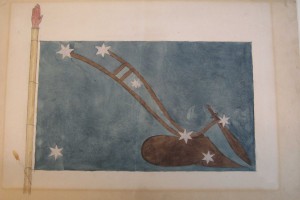
O’Casey was contacted by the NMI and insisted it could not be the original, maintaining that had been blue. To bear this out, he submitted a watercolour of what he claimed was Megahey’s (original artist) design work, in which the background was blue but did include a plough.3
The watercolour submitted by O’Casey which he claimed was the original design of the man who designed the flag, William Magahey. (Copied from article about the conservation of the original flag in History Ireland).
There was no way to prove the provenance of the watercolour. Nor was it impossible that a change of mind had led from a blue background on a design artwork to green on the produced flag. But O’Casey insisted that not only the artwork but the finished product had been blue.
Well then, why not investigate the artefact, the one claimed to be that which had been taken back to England by the British officer?
The original flag in the possession of the NMI back to front prior to conservation work. (Copied from article about the conservation of the original flag in History Ireland).
The NMI curator invited former members of the ICA only4 to view the artefact and although distressed at the state in which they saw it they confirmed that it matched their recollection. For the curator it seems that was the clincher and he then authorised its purchase in 1956.5
Around 2012 (the article does not give a date) an NMI curator charged with preserving the artefact set out to carry out modern method analysis of the material and its construction, paint and the more than 50 holes in it corresponding to .303 machine gun bullet impacts.6
The original Starry Plough flag in correct orientation (Photo sourced: NMI on line)
Former ICA members had remembered a golden edging on the flag, traces of which were indeed found on the green specimen. It all checked out. A clever hoax? Possibly, but for an eventual price of £150, a relatively small amount even back in 1954?
The ICA members viewing the artefact believed it was the original, the British Officer testified as to his having taken it and also produced an Irish Times account by himself dated 11 May 1916.7 The NMI tests all pointed to the conclusion that it was the original flag – and the background was green.
But O’Casey was adamant that it had been blue. And what about the blue watercolour, allegedly the artist’s design?
It’s possible that between the design outline and manufacture, a change in the desired background colour had taken place. But not only colour – the plough design on the watercolour is very different from that on what we must now conclude was the original flag.
We have no evidence to verify that the watercolour was the original designer’s. O’Casey might have painted it himself, from his mistaken memory, for example. Or is it possible that he falsified its origin in order to convince the NMI that the flag had been blue and not green?
Any such effort would not have been about an aesthetical judgement in favour of one colour over another but rather about removing the colour associated with nationalism.
O’Casey resigned from the ICA in a dispute8 about allying with nationalism but more tellingly, he disagreed after the fact with Connolly throwing himself and his forces into an uprising against colonialism9 – a nationalist rather than socialist uprising, as O’Casey would have seen it.
Connolly’s thesis was that the advance towards socialism was not possible in a colony such as Ireland without allying the socialist forces with the most progressive and revolutionary national bourgeois forces, i.e the IRB and the Irish Volunteers.10 O’Casey could not agree with that.
In Innisfallen Fare Thee Well (1949)11 he wrote: “The Easter Rising had pulled down a dark curtain of eternal separation between him and his best friends: and the few that had remained alive and delightful, now lay deep, with convivial virtues, under the smoking rubblement of the Civil War.”
The symbolism of the original green, the colour of Irish Republicanism since the United Irishmen of the late 18th Century would have been anathema to the later O’Casey. Was he indulging in revisionist wishful thinking?
Or perhaps trying to ensure that in any future conflicts, the Irish Republican and Socialist trends would be kept firmly separate?
Two green Starry Ploughs on view among other flags carried by a section of marchers at the Bloody Sunday massacre commemoration March for Justice in Derry in January 2025. The one in centre of photo is a mass-produced reproduction whereas to the left one can see part of a quilted sewn individual one. (Photo: D.Breatnach)
There are others who strive to ensure the exact opposite, who as Connolly did, see in the combination of those two strands Ireland’s only chance for freedom from colonialism, neo-colonialism and an advance towards a socialist society.
For them, the original design and colours of the Starry Plough is their flag and its entire symbolism points the way forward.
End.
FOOTNOTES
1In the USA this constellation is commonly referred to as “the Big Dipper”.
2Rarely used by the Irish Labour Party nowadays. It was popular with the Irish Republican Socialist Party for decades but nowadays a version in white stars on a black panel on a red flag is flown by the organisation.
7‘The rebels, on taking possession of the Imperial Hotel in Sackville Street, hoisted their flag over the building, and there it remained intact on one of the ridges of the front wall while the entire contents of the premises were being consumed by fire. At great personal risk the flag was eventually brought down by second Lieutenant T.A. Williams of the 9th Reserve Cavalry, Kildare Barracks, assisted by Inspector Barrett, Dublin Metropolitan Police.’https://historyireland.com/citizen-armys-starry-plough-flag/
8https://www.dib.ie/biography/ocasey-sean-a6553 O’Casey objected to the enrolment of Constance Markievicz in the Irish Citizen Army because she was also a member of Cumann na mBan, which had been set up as a female auxiliary organisation to the Irish Volunteers. O’Casey proposed that membership of the ICA precluded joint membership with any Irish nationalist organisation. Having had his motion defeated, O’Casey resigned from the ICA in July 2014.
9‘[Connolly’s] speeches and his writings had long indicated his new trend of thought, and his actions now proclaimed trumpet-tongued that the appeal of Caitlin Ní hUllacháin—“If anyone would give me help, he must give me himself, he must give me all”—was in his ears a louder cry than the appeal of the Internationale, which years of contemplative thought had almost written in letters of fire upon his broad and noble soul. Liberty Hall was now no longer the headquarters of the Irish Labour movement, but the centre of Irish National disaffection.’ https://historyireland.com/sean-ocaseys-battle-of-words-with-the-volunteers/
The states of India and Pakistan seem to be approaching war, never a good thing but particularly worrying when both states have nuclear weapons. The British Raj ran both territories as one colony but separated them from one another in 1947.1
Since then there have been a number of conflicts between them including war and it will be no surprise to any politically-educated person that Imperialism has had a hand in that. But they may be surprised to find that so also did the Irish State.
(Image credit: Al Manar)
Ireland of course had a strong connection with the anti-colonial movement in what might be called the Indian sub-continent at least from the time of the Fenians and much more so during the War of Independence, for example with the McSwineys in correspondence with the Ghandi family.2
I found the reference to the Irish State’s involvement in a 2nd-hand copy of This Great Little Nation (1999) by Gene Kerrigan and Pat Brennan, about scandals of corruption and injustice in Ireland which I am reading, a few scandals at a time.
It is always interesting reading, at times highly amusing but largely depressing, even for one who holds that this is a neo-colonial state.
I reproduce the relevant article here verbatim and in full (but reformatted for WordPress publication).
It is difficult, looking back from this distance, to comprehend that Ireland once had an independent policy on international affairs.
Those dour, pompous, conservative old men – of whom De Valera was the most visible – sincerely saw themselves as founders of a state, as statesmen, as the equals of the leaders of the great powers.
While aware of the realities of Ireland’s economic dependence on British markets, they sought to take an independent line. As leaders of a former colony, they had particular sympathies with the Third World.
The trimming of that dependence, and the gradual falling into line with the new world order, began in the early 1960s.
The USA was taking over the role previously filled by Britain and the other European colonisers, now exhausted by the Second World War. The USA, confident, triumphant, had a young, assertive President, John Kennedy.
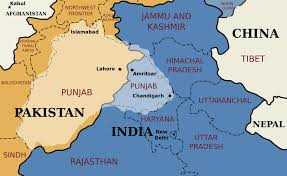
In 1962 India was taking a particular line in its long-running dispute with Pakistan over the former state of Kashmir. Ireland’s representative in the United Nations, Frederic Boland, had discussed the matter with India’s foreign minister, Krisna Menon and had agreed to back the Indian position.
In June, John Kennedy phoned the Irish Ambassador to the US, Thomas Kiernan, and asked him to help change Ireland’s position on Kashmir. He wanted Ireland to propose a motion pushing the US line.
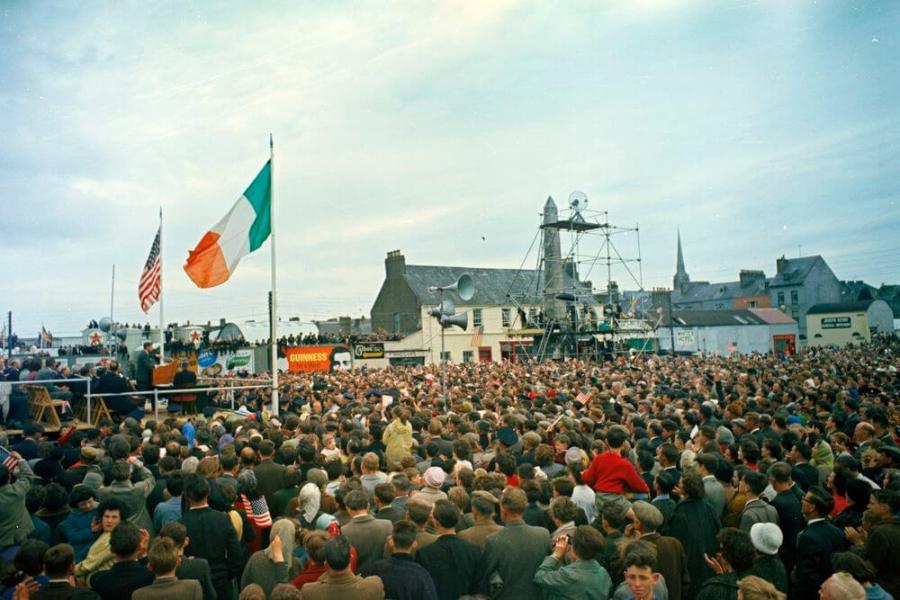
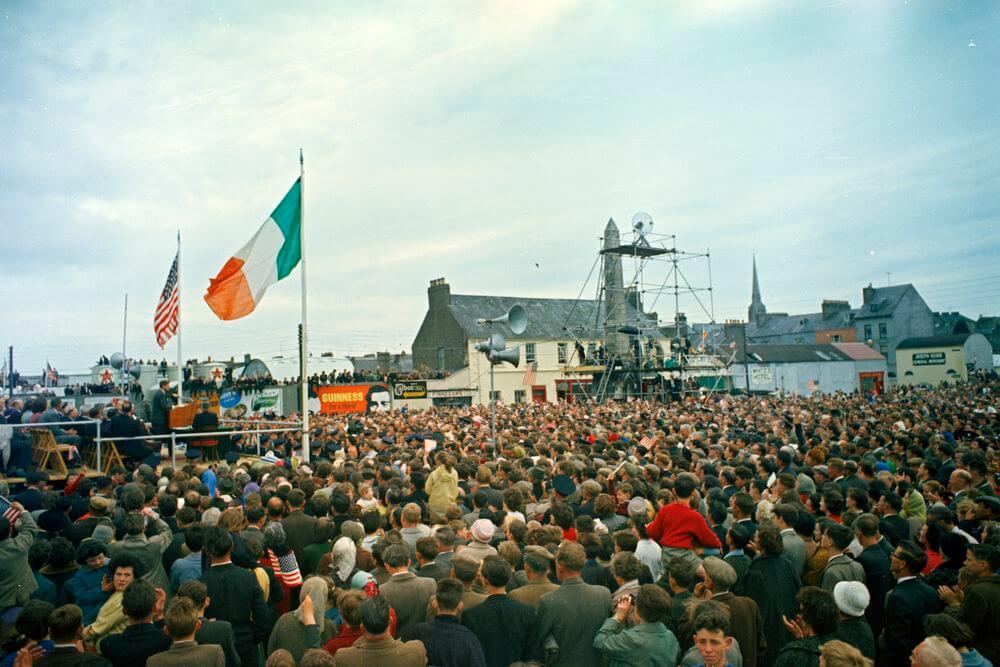
John F Kennedy, flanked by the Tricolour and the Stars and Stripes, speaking during his four-day visit to Ireland in 1963 (Photo sourced: Internet)
“We can’t put it forward ourselves, without it being knocked, and we want Ireland to put it forward”, Kennedy said, according to Kiernan. “If we can get you to come along we’ll get others.”
In the same phone call, Kennedy said that his friend and aide Kenny O’Donnell had “mentioned something to me. I’ll look after that.” Kevin Boland balked at proposing the US line. He already had a deal with Krisna Menon. “He’ll be wild,” he said.
“We have a certain friendship with India from the old days, and so on, and we can’t do it.” Ambassador Kiernan went over Boland’s head, to the Fianna Fáil Minister for External Affairs, Frank Aiken. And Aiken immediately directed that the US line be followed.
“When he heard the request came from Kennedy he agreed without demur, no difficulty whatever”, Kiernan remembered. “We introduced the resolution, it was put through.”
So far, no scandal. Just some top-level and effective lobbying by Kennedy, the kind of thing that happens every day in foreign affairs. But was that something that Kenneth O’Donnell mentioned to John Kennedy, about which the president said “I’ll look after that”?
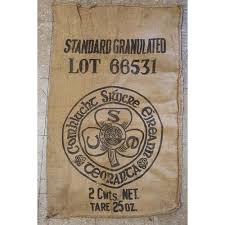
Ireland had for some time been trying to get into the US sugar market. To do that it needed to be included in a number of countries allowed to sell a sugar quota to the US. Ambassador Kiernan lobbied the president’s friend Kenny O’Donnell, and O’Donnell mentioned it to Kennedy.
Nothing happened for quite some time, until Kennedy mentioned it obliquely in his phone call to Kiernan. In his book, JFK and his Irish Heritage, Arthur Mitchell reports that “a new bill suddenly appeared, specifically including Ireland.”
Ambassador Kiernan said, “We, for the first time, got into the US sugar market. The Wall Street Journal said that it was hard to understand how it happened, but somebody with a large smile in Washington seemed to have been responsible.” We sold our independence for a few tons of sugar.
The following year, Kennedy visited Ireland. The young master, taking over responsibility from the tired old colonialists of Europe, was touring his estate.
Four years later, when an RTÉ current affairs crew was about to depart Ireland to do a first-hand report on Vietnam war, Frank Aiken intervened and the RTÉ Authority were told to call off the trip, which they did.
Independent reporting of the war would probably be critical; this would annoy the Americans; and that wasn’t allowed. The cancellation, said the government, “was in the best interests of the nation.” Not to mention the sugar business.
COMMENT
It’s interesting to identify the exact moment (or something like it) at which the Gombeen State switched from being England’s to being the United States’ bitch. Of course, there’s been a period of EU imperialism subservience and there’s always England, again3 … The bitch can switch.
By some kind of coincidence, considering the story earlier, India is a major sugar-producing country too. But … the Irish state was exporting sugar?!!
Ireland once had its own sugar industry going back to the mid-19th Century and the Irish State, building on that, nationalised it in 1930. In 1976, according to a study, the company was employing more than 10,000 people full-time, in fields, refineries, factories and in sales teams overseas.4
A further 15,000 people found employment in industries using the sugar as a raw material, industries that sprung up in the wake of the sugar factories and which, by 1976, were themselves earning the nation £20 million annually in foreign currency5.
Sugar quotas were imposed by the EEC and the State began successively to reduce the industry in Ireland, finally privatising it in 1991 by selling to Greencore, who closed the last factory down in 2006.6 We were still consuming high amounts of sugar but now importing it all.
We used to import it from the USA, and so the earlier story comes around to its starting point once more. More recently France, Netherlands, UK and Belgium have taken over supplying us.7
We imported sugars and sugar confectionery to US$536.42 Million during 2024, according to the United Nations COMTRADE database on international trade.8
Sugar is used directly as a sweetener for the table but also in the making of confectionery and it is an important component in the fermentation process of drinking alcohol. Beet pulp waste can be a valuable animal feed and production, refinement, packaging and transport all provide employment.
Nowadays, ethanol fuel and bio-degradable plastics could also be produced from beet9 which would be great for Ireland, along with the more traditional benefits. But that requires an independence-conscious planned State economy — so looks like it will remain just a nice idea.
April 17th is the annual Palestinian political Prisoners’ Day and it was marked in O’Connell Street, the main street of Dublin’s city centre, by an event with speeches, banners and chants organised by the Ireland Palestine Solidarity Campaign.
Palestine national flags fluttered about the crowd being addressed by a number of speakers with occasional toots of solidarity from passing traffic – a common occurrence at Palestine solidarity events in most of Ireland.
View of eastward of section of the crowd at the event (Photo sourced: IPSC)
Dáithí Doolan was one of the speakers and though saying some progressive things about solidarity with Palestine and the terrible situation in which the occupiers have them, soon revealed the political poverty and lack of solidarity with resistance of his Sinn Féin party.
Doolan reminded his audience of when there were political prisoners in Ireland, as though this was no longer the case, presumably because the prisoners now are not of his party. Nor did he mention the current attempts to extradite Irish Republicans to British administrations.
The SF speaker went on to extol the South African process, perhaps not caring about the betrayal of the struggle and sacrifice of the masses there, the deepening grip of imperialism on the rich natural resources, the corruption and repression of the ANC regime and the massacre at Marikana.1
If Doolan thought about it he must have hoped that his audience did not remember that the South African process had a twin, the Palestinian one at Oslo which sabotaged the Palestinian struggle and brought into being the corrupt Palestinian Authority2, the Israeli proxy in the West Bank.
Sinn Féin has achieved a somewhat similar position in the Six Counties colony and has been working hard to reach a corresponding role in the Irish state. And why not, when it endorses the “Two State solution” giving the Palestinians 20% of their land under Zionist eyes and guns.
The very least, Doolan said, that the Irish Government could do to help the Palestinians, would be to enact the Occupied Territories Bill but he proposed nothing further, not even the ban on US military flights through Shannon Airport or on Israeli arms flights through Irish airspace.
Darragh Adelaide from the People Before Profit party spoke too about Palestine and solidarity but also about the Palestine refugees that have had to sleep in tents on Irish streets and the attacks on them both by the authorities and by fascists and other racists.
Palestinian prisoner conditions
A woman gave a detailed list of statistics relating to Palestinian political prisoners but also went through the tortures and terrible conditions in which they are kept. She concluded reminding her audience that each prisoner is a human being, a parent, a child, a sibling and not a number.
View of the crowd southward from behind a speaker (Photo sourced: IPSC)
In a year and a half, more than 15,800 Palestinians have been arrested, including 500 women, 1200 children, and thousands of detainees who were placed under arbitrary administrative detention. 64 Palestinians have died in prison since October 2024, including a child.3
The prison administration’s special units have carried out violent raids on prisoners’ cells, administering severe beatings, torture, and ill-treatment.4
Prisoners have suffered power and water cuts, and all of their belongings—including clothes, electrical appliances, and hygiene items—have been confiscated.5
They have been placed under complete isolation, family visits have been completely banned, and the International Committee of the Red Cross has been prevented from visiting them inside prisons.
Additionally, a policy of starvation has been implemented against thousands of prisoners, who are being provided with only two extremely poor-quality and quantity meals a day.6
The MC of the event led chants in which he called out Palestinian political prisoners! and the audience responded with Free them all! Similarly with Free the children prisoners — Free them all! and Free the women prisoners! — Free them all!
Symbolising the Palestinian political prisoners (Photo sourced: IPSC)
He also referred to the woman arrested outside the Irish Embassy in Berlin for speaking in Irish and, in defiance, led the audience in a chant in Irish expressing solidarity with the Palestinian people: Saoirse don Phalaistín! (Freedom for Palestine!)7
What was notable in its total absence from all the speeches was any call to step beyond the marches and similar measures which have been supported by thousands in Ireland over more than 18 months but which have not succeeded in moving the Government even to enforcing its formal neutrality.
This is replicated in most solidarity events across the state, leaving those few who take action to increase greater pressure on the ruling class to face the repression of the Irish State, as with 23 men and women in three different events over a four-day period in Dublin recently.8
Political prisoners from the armed resistance
The Joe McDonnell Ballad9 would have been most appropriately performed at this event, in particular the chorus line: You dare to call me a terrorist, while you look down your guns … But the IPSC would hardly endorse the singing of that song nor wish to be associated with it in public.
There were two large prisoners’ solidarity banners of the IPSC at this event but it is remarkable how rarely one sees them on the IPSC’s national marches. The problem with the prisoners for liberal organisations is that some of them, at least, have been armed fighters of the Resistance.
This, combined with ignorance perhaps, accounts for the comparatively low numbers at this event. However, it has to be said that known revolutionary organisations were also visibly absent.
View south-westwards with the iconic GPO (General Post Office) building in the background. (Photo sourced: IPSC)
Doolan’s party was a problem for liberals when many of the political prisoners here had been armed Irish Republican resistance fighters; it’s still a problem for them today — but also for Doolan and his party now that the current Irish political prisoners are no longer associated with them.
If solidarity does not embrace resistance then it’s charity, not solidarity. And if resistance is to be embraced then it should be so for all its expressions, artistic, cultural, mass mobilisations, strikes, boycotts … and armed. Including solidarity with those who, because of resistance, end up in jails.
Free them all!
End.
NOTES
1Culminating on 16th August 2012 (while Mandela still lived) the police of the ANC Government carried out a massacre of over 40 striking miners over a period of three days. The massacre was to suppress a strike in a platinum mine of the Canadian Lonmin company, repressing also a breakaway union from theANC-allied National Union of Mineworkers. The massacre is widely believed to have been organised by Cyril Ramaphosa, then a millionaire and vice-President of the ANC Government and recent leader of the NUM, now President of South Africa.
2Which also beats and incarcerates Palestinians resisting the Occupation (exact figures are difficult to obtain) and has murdered some.
7This slogan has now become well known in Ireland in voice but also in writing, appearing on flags, banners and placards. It represents a partial success for those of us who have tried to insert a measure of the Irish language into Palestine solidarity, in the belief that it is important for the Irish language to be present in progressive movements.
9By Brian Warfield of the Wolfe Tones band in honour of Volunteer Joe McDonnell of the Provisional IRA who died on hunger strike in 1981; the song also names other hunger strike martyrs of the Provisionals Vols. Bobby Sands, Francis Hughes, McCreesh but adds Vol. Patsy O’Hara of the Irish National Liberation Army. In total, seven of the Provisionals and three of INLA died on hunger strike in 1981.
A night of resistance and other songs on Friday night in Peadar Browne’s Dublin pub raised funds to assist in fighting state repression of Palestine solidarity activists in Ireland, as Palestine solidarity activists face persecution across the Western world.
The evening’s performance consisted of a mix of political and other songs, a number of which were original material. However it was the political material that most drew interest, ranging from international struggles to the rich Irish Republican tradition.
Olive and Fynn in performance at the fund-raising event (Photo: R.Breeze)
To begin the event Diarmuid Breatnach explained the need to support Palestine solidarity activists against the repression of the Irish authorities, hence the fundraising event and announced that in addition to performing he would be standing in for the event’s MC who had been unable to attend.
Breatnach began his set combining two songs from the German antifascist tradition, three verses of Peat Bog Soldiers and three from the Hans Beimler ballad.1 Then from the Spanish Anti-Fascist War he sang Ay Carmela!, the air of which he said was from an anti-French occupation folk song.
Next the MC announced a performance by two performers, half of the four-strong Croí Óg ballad band. During their performance with voice, guitar and banjo there was an incident from a couple of unruly elements nearby who had substantial drink taken and had been very loud throughout.
Two members of the Croí Óg band performing at the fundraising event (Photo: R.Breeze)
A man who had been refused permission to sing solo began shouting that the songs were not Republican, ironically interrupting Grand Old Country, a song about the Fenian tradition. It became clear that what he wished was to perform the Grace ballad, which he began to sing loudly.
A male confronted the interrupter; the latter’s friend, a big elderly Glaswegian protested; others took to the floor … but the incident wound down, the interrupters and audience resuming their seats. However, the putative Grace singer threw threats at his earlier confronter across the room.
The big Glaswegian then crossed the room to confront the audience member, a female audience member intervened, he brushed her aside and the audience section erupted, only the quick arrival of the pub’s landlady preventing a fight … And the musicians resumed their performance.
Among the songs performed by Croí Óg were Crossmaglen and British Soldier Go on Home. The MC called for appreciation applause for them, made some barbed comments about the recent anti-social behaviour and welcomed the song-and-guitar duo Olive and Fyn to the stage.
Sage Against the Machine performing at the fundraiser event (Photo: R.Breeze)
The duo performed their own material in lovely harmonies, mostly non-political, also including their ironically titled Save the Landlord! After they had left the stage to applause Breatnach got up on stage again to announce a short break and to remind the audience to contribute to the funds.
His additional comment: “Remember when someone sang in a Dublin pub and everyone went quiet? Remember those days? Remember?” was followed by loud applause throughout the pub.
Breatnach restarted the second half, singing a capella again two songs celebrating Irish women’s resistance,2 ending with songs in Irish including the ballad of Rodaí Mac Corlaí. After concluding he introduced Sage Against the Machine to take to the stage, singing solo with guitar.
Sage’s material was mostly original, sung in English but went on to Masters of War in a spirited concluding verse, followed by Gallo Rojo, Gallo Negro3 in Spanish from the anti-fascist tradition in Spain. The MC then presented Eoin Ó Loingsigh, also with voice and guitar.
Eoghan Ó Loingsigh performing at the event (Photo: R.Breeze)
Although no further incidents occurred, the volume of ‘conversation’ between a number of people not far from the stage was high. Loingsigh’s material included Only Our Rivers Run Free, Viva La Quince Brigada4and a satirical song contrasting the fates of the rich and the poor after death.
The evening’s scheduled performances concluded with Seán Óg, also solo with voice and guitar, his selection including Ho Chi Minh, republican ballads Boys of the Old Brigade, The Patriot Game, Boolavogue and his own composition Boys of Gaza to air and structure of The Boys of Kilmichael.5
Breatnach thanked the attendance for their support, restating the context of the event and asked for another round of applause for all the performers, who gave their time and creativity for free, then called for people to stand for the Irish national anthem6 which he led with the first verse in Irish.
Diarmuid Breatnach in performance at the fundraiser event (Photo: R.Breeze)
At the concluding line of “seo libh, canaig …” the audience exploded to complete the words “Amhrán na bhFiann!” followed by launching into the chorus, also in Irish.
The event had been organised by two broad Palestine solidarity organisations, Saoirse Don Phalaistín and Palestine Action Ireland and among the attendance were a number of their activists, including some victims of state repression.
Most of the charges to date have been under the Public Order Act but also some around ‘criminal damage’ and the potential is there for more serious charges and possible jail sentences, as have been the case in some other European administrations.
In addition to actions of their own, including occupying and picketing the Israeli Embassy, Axa Insurance and picketing the Palestine Authority, Saoirse don Phalaistín and Palestine Solidarity Action organised Resistance Blocs to participate in mass demonstrations organised by the IPSC.
Seán Óg performing at the fundraiser event (Photo: R.Breeze)
Peadar Browns pub has become increasingly known as an Irish Republican tavern on the south side of Dublin city. Its small stage area is decorated with Republican artwork on the walls and on many of the bodhráns7 hanging there, along with some Glasgow Celtic celebratory material.
The side of the pub, on a minor street, carries a large mural representation of the Palestinian national flag, along with the slogan SAOIRSE DON PHALAISTÍN. However Dublin City Council have directed that it must be removed, to the anger of a great many people.
Mural on the side of the Peadar Brown pub (Photo sourced: Internet)
Historically cultural events of this type have a function other than to raise defence funds and to promote the cause: they are also occasions for replication of the cultural face of resistance and for expression of new cultural compositions but additionally for the creation of a community of resistance.
4About the Irish who went to fight against fascism in 1930s Spain.
5Also known as The Kilmichael Ambush, celebrating a famous event in West Cork during the War of Independence (1919-1921). However, the air of both songs is that of an older ballad about the 1798 Rising called Men of the West.
6The lyrics were originally written in English and later translated to Irish in which language it most usually sung today.
7A shallow one-sided Irish drum, same shape as a tambourine but much larger, played with a wooden striker on the outside with variation in tension achieved by hand pressure on the inside.
Recently Donald Trump scandalised much of the world with his suggestion that Gaza could be turned into an attractive location after its inhabitants, the Palestinians, were removed.
Was this a serious proposal? If so, could the US and Israel manage it? What are the chances?
Firstly, a quick look at the territory envisaged and its recent history.
GAZA
A strip of land 365 km2 (141 sq mi)1 on the eastern coast of the Middle Eastern land of Palestine, bordered by the State of ‘Israel’ and the State of Egypt, with an estimated Palestinian population of 2.1 million in 2024 (since hugely depleted by genocide and removal).
Gaza had been settled mainly by Palestinian refugees expelled from Zionist-occupied Palestine in 1948 and by those fleeing Israeli Occupation Force persecution and harassment in the West Bank in subsequent years added to of course by their descendants born and growing up there.
The strip was occupied after the 1967 War by around 5,000 Zionist settlers – illegally even by international law — who took up around 40% of the land there but after the Second Intifada,2 left in 2005, as did the Israeli Occupation Army.
In the 2006 elections in Gaza and the West Bank, Hamas won, ousting the Fatah party which had won the previous elections. However, Fatah refused to accept the results and had to be physically removed in Gaza in 2007, though Hamas stepped back from doing the same in the West Bank.
The Western powers, those bastions of the democratic way of doing things, refused to acknowledge the Palestinian popular will and blocked Hamas from all aid, which went instead to the undemocratic Palestinian Authority, which the Fatah party control.
‘Israel’ blockaded Gaza from then onwards, keeping the population at a marginal level of existence and regularly attacked it, what they called “mowing the lawn” in 2008/9, 2012, 2014, 2018/19, 2021 until the Palestinian breakout and counter-attack of October 2023.3
In October 2023 Hamas and Islamic Jihad broke out of their concentration camp, overran the ‘Israeli’ armed forces overseeing them and seized captives to exchange for the many Palestinian captives in ‘Israeli’ jails. Other groups and individuals also poured through the gaps in the wall.
The IOF besieged Gaza, cutting off its supplies of food, clean water and other supplies. It dropped 85,000 tonnes of explosives4 on that highly-concentrated population, killing an estimated 46,000 (with another 10,000 buried in rubble)5 and injuring at least 110,265 (one in every 20).6
The IOF destroyed nearly all wells and rooftop water tanks, along with desalination plants,7 destroyed totally or in part 90% of residential buildings,8 at least 27 hospitals and 12 other medical centres,9 along with schools, higher education buildings, mosques and churches.
Some 1.9 million people have been displaced, 90% of the population, with many of them forced to move repeatedly.10 “Nearly 1.9 million people in Gaza are internally displaced, of which nearly 80 percent are living in makeshift shelters without adequate clothing or protection from the cold.
“UN agencies estimated that nearly half a million are in flood-prone areas. Authorities in Gaza said about 110,000 of the 135,000 tents being used as shelters in the Gaza Strip are worn out and not fit for use.”11
PROPOSERS OF ETHNIC CLEANSING
The USA – In March 2024 Jared Kushner, property developer, senior policy adviser and son-in-law of Donald Trump (then former US President and now President again) commented that Gaza after the removal of the Palestinians would make a great site for a beach-front property development.12
Donald Trump, after being re-elected, commented in somewhat similar lines and bluntly proposed the expulsion (‘voluntary relocation’) of Palestinians from Gaza. But to where? Well, to Jordan and Egypt in particular, whose ruling regimes would accept them, he assured.13
The Democratic Party wing of the US imperialist ruling class expressed horror at such crass statements of ethnic cleansing but had supported the ‘Israeli’ state in maintaining the siege, periodic bombing attacks and in demonising Hamas along with the whole Palestinian resistance.14
‘Israel’: Prime Minister Netanyahu and a number of his cabinet made statements supporting the plan.
REACTION OF ARAB & IRANIAN STATE LEADERS
The leaders of Arab states and of Iran have opposed the ethnic cleansing plan, all of them concerned at further destabilisation of the Middle East (and threat to their regimes). Most (excepting Yemen and Iran), advocating instead Gaza as part of a Palestinian state (sic) alongside the ‘Israeli’ one.15
WHAT EUROPEAN STATE LEADERS SAY
All of the leaders of European states that have commented have opposed the plan, all of them concerned at further destabilisation of the Middle East and, with regard to Palestine, advocating instead Gaza as part of a Palestinian state (sic) alongside the ‘Israeli’ one.16
All of the main political parties in the European states have also opposed the ethnic cleansing and advocate the “two state solution” (sic).
RUSSIA & CHINA also oppose Trump’s plan as do many states in AFRICA and in LATIN AMERICA. The top levels of the United Nations also oppose Trump’s idea.
WHY MOST STATES OPPOSE THE PLAN
Those objecting to the ethnic cleansing of Gaza and transporting Palestinians to other destinations may well have moral objections to that plan but their political and practical reasons for objecting are much stronger.
Lebanon already has a Palestinian refugee population of 60% and in 1975-’90 a war there saw fascist Lebanese forces combined with the IOF fight Palestinian and Druze forces with massacres of refugees as “Beirut” became a byword in urban destruction, invasion and ethnic conflict.
The Jordanian regime is heavily foreign-dependent and vulnerable to imperialist pressure but it also knows that it walks a tightrope and can’t afford to add to the economic, social and political pressures by taking in a large influx of Palestinians forced out of Gaza.
Nearly 25% of Jordan’s population is composed of Palestinian refugees and their descendants.17
The King of Jordan, an imperialist stooge trained in the UK, nervously attended the meeting with the real king, Trump, to which he was summoned, evidencing his unease with a nervous tic taking over his face. He agreed to take 2,000 injured children, not at all the same thing as Trump wanted.
Egypt, a bigger power though also US-dependent (especially its military) has its own economic, social and political reasons for rejecting a proposal to integrate a large population of forced Palestinian refugees into its society and economy and declined an invitation to meet Trump.
US ally Saudi Arabia, which has not been pressured to the degree of Egypt and Lebanon, nevertheless has reasons to reject the plan and that is the de-stabilization of the whole Middle East by a further expansion of the Zionist State and growing population of stateless refugees.
That is the other and fundamental reason why the Saudi ruling class is opposed to the expulsion of Palestinians and they have stated it in terms of the need for a ‘Palestinian state’ – within the framework of a two-state ‘solution’ (i.e. a partitioned Palestine with about 20% for Palestinians).
The Saudis have also proposed to rebuild and set up Gaza with the Palestinians remaining there but in the course of which they intend to have somebody other than Hamas – whom the people elected, let’s not forget – administer the area.
The Palestinian Authority (sic) despite its role as proxy policeman for the Zionist State and US Imperialism, would not welcome the loss of a large part of its possible fiefdom and certainly could not politically afford to agree to the ethnic cleansing of Palestinians.
Macron, for the French imperialist ruling class, has welcomed the Saudi proposal. It is not beyond possibility that the US ruling class will approve and it may even have been part of its plan to frighten everyone and make such ‘solutions’ as that of the Saudis more generally accepted.
UAE is not vulnerable internally to anything like the degree of Egypt and Jordan and on the other hand is at times in contention with Saudi Arabia for influence in the region but also ally of the USA is nevertheless opposed the Trump ethnic cleansing process.
Qatar, home of Al-Jazeera news channel and much more in contention with Saudi Arabia and also the UAE, is also an ally of the USA but opposed to removing the Palestinians from Gaza.
The elites of the WesternEuropean states, from imperialist to lesser capitalist states wishing to coexist with imperialism, including the colonial and neo-colonial states of Ireland all oppose the ethnic cleansing of Gaza, saying it threatens the ‘two state option’.
That option would copper-fasten Israeli occupation of around 80% of Palestine and control over the remaining 20% as a client state. They would hope to isolate the Palestinian resistance under collaborator rule and help and assist in the stabilisation under imperialism of the Middle East.
A DIFFERENT BASIS FOR OPPOSITION
The ruling elites of IRAN and YEMEN18 see ‘Israel’ as an important foothold for US and other Western imperialism in the Middle East and also as an aggressive colonial force in its own right. Therefore they are fundamentally hostile to any kind of ethnic cleansing of Palestinians.
That too is the position of Hezbollah, a major political and military force in Lebanon.
IS THE ZIONIST ARMY CAPABLE OF ETHNICALLY CLEANSING GAZA?
The Israeli Occupation Army is unlikely to welcome being sent back into Gaza to fight the Palestinian resistance there once again. And signalling that, rather than an inadvertent slip, may have caused the admission of very high combat fatality figures by the IOF’s commander.19
Eyal Zamir, ‘Israel’s’ new Chief of Staff, referred in a recent interview to the “5,942 of bereaved families”20 since October 2023, terminology only used by the IOF to refer to the families of their soldiers killed and also noted that some families likely lost more than one member.
Those numbers, apart from being around six times those previously admitted by the IOF, are not such that can be replaced in the short term.
Furthermore, the Palestinian resistance in Gaza (and presumably Hezbollah in Lebanon) targeted officers whenever they could resulting in a high attrition rate among higher ranks engaged in combat. These take longer to replace due to their experience, training and skills.
It has long been suspected in many quarters that Israel was concealing its war casualty numbers by imposing press censorship, installing IOF officers to answer queries at hospitals and issuing untrue statistics for foreign and home consumption.
Zamir also stated that 15,000 soldiers were suffering from physical or mental injuries.21 As early as December 2023, the ‘Israeli’ publication Haartez, quoted their Health Ministry figures of a staggering 10,548 injured as opposed to the 1,593 stated by the IOF.22
“In October 2024, Haaretz also reported that around 1,000 wounded soldiers were admitted to rehabilitation centres each month, along with new injury claims associated with past incidents.
“The report stated that the rehabilitation division estimates that by 2030, around 100,000 Israeli soldiers will be classed as disabled, and almost half also experience some form of psychological challenge.”23
Statistics show a military age population in ‘Israel’, male and female, of around three million24 of which some are already serving, many exempt from recruitment due to specific occupation or studies, pregnancy, general health or ability, criminal status or psychological unfitness.
This is without taking into account the Haredi, formerly exempt from service due to religious studies but since June last year eligible to call-up. However this has led to Haredi protests and only 10% of those called actually presenting for service — and also strains Netanyahu’s coalition.25
On the other hand, there is general agreement among commentators that the Resistance, in particular Al-Qassam Brigades (Hamas military wing) have already replaced their fallen across the ranks. The survivors are likely to be for the most part battle-hardened, motivated and confident.
‘Israel’ fought the war in Gaza largely from the air through bombing and missile strikes along with artillery at a distance or a little closer by tanks. The IOF Merkava tanks have been severely depleted due to roadside IEDs (bombs) and Resistance-developed or modified RPGs.
The IOF generally did not take the Resistance on in soldier-to-soldier combat and when they did, were generally defeated. IOF snipers were often themselves sniped or they and their spy-posts eliminated by a rocket with thermobaric warhead.
Gaza still contains a vast network of sophisticated tunnels of which the IOF know very little nor, when an entrance is discovered, do the IOF go in there to fight. The IOF-created rubble landscape with rarely any building for the IOF to hole up but no way of spotting tunnel exits.
As demonstrated in the prisoner handover events, Hamas is not short of weapons, though level of ammunition stores is an unknown factor. Given the huge amount of unexploded bombs dropped by the IOF, possibly as high as 15% the Resistance will not be short of explosives either.26
CONCLUSION
Whether Trump was serious about the plan to ethnically cleanse Gaza or was merely soft-soaping Netanyahu and his most fascist Zionist supporters remains to be seen. Equally, the US may have wanted to scare Palestinian Arab neighbours to step forward to police Gaza for them.
Let us not forget that Brett McGurk under Biden’s administration discussed the need to consider how to manage Gaza “the day after” the war there ended and that a revamped Palestinian Authority might be able to do the job27 – Abbas rushing to assure his masters that the PA was indeed ready!
Proving themselves ready for Gaza management was probably the reason for the PA’s siege of Jenin and then participating in attacks upon the Resistance there alongside the IOF. However, it is unlikely that the imperialists have much faith in the corrupt PA’s ability to take on running Gaza.
The ethnic cleansing of Gaza, whether it was ever really contemplated by Trump or not, will not happen in the near future because none of the regional stakeholders – other than the blindest fascists of the Israeli Government – can afford to agree with it.
Also because the only ones reasonably available to attack Gaza again, the IOF, got really badly chewed up in their fifteen months of genocidal warfare there. But then perhaps the whole threat was scare-bait to get Arab states to collude even further with ‘Israel’ in managing post-war Gaza.
On the other hand, an unthinkable idea has been thought of and widely publicised. And when the unthinkable becomes part of public discourse, it breaks the taboo around it and makes it easier to put into practice at some point in the future.
Resumption of and constant bombing of Gaza is therefore not totally beyond possibility but it seems unlikely the master, the USA (Trump variety) wants that and, while that is the case, it cannot happen.
2The 2nd Intifada (uprising) was against the ‘Israeli’ occupation but also against the Oslo Accords, the perceived sell-out by the ruling Fatah party of Palestinian self-determination and the right of return for Palestinian refugees.
14Since the IOF pulled out of Gaza and the election of Hamas by the people, five US Presidencies have supported ‘Israel’s’ actions and supplied them with the financial and military means to carry them out: George Bush Jnr, Barrack Obama, Donald Trump, Joe Biden, Donald Trump (again). Two individual Presidents have been Democrats, two Republican; two Presidencies have been Democratic and three Republican.
18And seems to reflect the opinion of their countries’ masses also.
19Given the secrecy around the real statistics he may have been not only signalling disapproval of resuming the war in Gaza but also feeding information ammunition to others who might also be opposed to that return.
No Nations No Borders was the title of a meeting I saw advertised recently and also a slogan I had heard chanted some years ago1 on a counter protest to fascists and other racists. I wondered then and wonder now: Have they thought this through?
Clearly the utterers and followers of such a slogan see many negative things emanating from nations, probably war, oppression, repression, racism, even genocide. But are those things fundamentally attributes of nations – or even of states that are founded upon nations?
The definition of a nation is not universally shared among historians, philosophers and sociologists but they are generally agreed that it is applied to a people who share a territory and common history, along with a language and culture, incorporating customs and law.
Some argue that nations only came into existence historically in the 18th century, others maintain that they existed long before that, in the Middle Ages and even further back. In Ireland, Thomas Davis published the lyrics of A Nation Once Again in 1844, nearly half-way into the 19th Century.2
Davis, whose father was Welsh, drew on the classical Romano-Greek education of the British ruling class as inspiring his awakening nationalism:
When boyhood’s fire was in my blood/ I read of ancient freemen/ Of Greece and Rome who bravely stood/ Three hundred men and three men3/ And then I hoped I yet might see/ Her fetters rent in twain/ And Ireland long a province be/ A nation once again!
Plaque in Middle Abbey Street to mark the site of The Nation, a patriotic newspaper founded in Dublin in 1842 by leaders of a group that became known as The Young Irelanders. (Photo sourced: Internet)
However, the United Irishmen who rose in revolt in 1798,4 the first Republican uprising in Ireland, certainly conceived of their nation, the French too in their 17895 revolution and the 13 Colonies, the precursor of the United States of America, in the American Revolution 1765–1783.6
The leaders of the United Irishmen were mostly English-speaking while the majority of the population, indigenous clans and Gaelicised descendants of Normans and Vikings, were all Irish-speaking and they had earlier appealed to Rome in terms of an oppressed nation.7
It can be argued that in passing the Statutes of Kilkenny in 13668 the English occupation recognised Irish nationhood, albeit in the form of a malignant influence upon the Norman invaders who were ‘going native’, “the degenerate English” having become “more Irish than the Irish themselves”.
An Irish nation-building process may be perceived over three centuries earlier, with Brian Boróimhe trying to unify Ireland under his kingship and defeat the Dublin Viking colony. As Brian was killed9 at the Battle of Clontarf (sic),10 this remains unproven.
All the attempts to achieve national independence starting with the United Irishmen until at least 1923 were built upon democratic formulations according to their time and – in the case of the 1916 Proclamation – in actual advance of it in terms equality of women and of civil and religious liberty.
Monument to Thomas Davis (1814-1845), writer, publisher (founder of The Nation newspaper) and composer, erected in Dublin’s Dame Street 1966. (Photo sourced: Internet)
NO NATIONS?
If nations are to be abolished, how might this be achieved? Presumably their languages, cultures and customs would need to be eradicated … and replaced with what? Actually, there have been ongoing attempts at that eradication for centuries – by colonialism and imperialism!
In those cases, the conquering power would seek to replace the language, culture and history of the conquered with their own – or with an allegedly ‘cosmopolitan’ culture (i.e allegedly independent of any national culture). It might be unpleasant for the “no nations” people to reflect upon that.
It was fashionable in the 1980s among certain intellectuals to claim that nationalism was moribund (and history too), quickly refuted even in Europe by the Balkan wars, not to mention by the Irish and Basque anti-colonial struggles.
A German movement among the Left known as anti-nationalismus in opposition to the nationalism of the German State, because of fears of return to nazism, extended its application of that to opposing national liberation struggles (e.g in Ireland, Basque, Palestine) and to support for Zionism.
I have heard John Hume quoted as saying that “We are all Europeans now”, understood to indicate the end of the various national entities in Europe – or at least their importance as nations.
I failed to find that quotation but he said something similar in his acceptance speech for the 1998 Nobel Peace Prize (shared with Loyalist leader Trimble)11 — a speech either hugely naive or reflective of imperialism at a time of its rampant reign and proxy wars across the world.
The eradication of nationalism, even were it possible, would entail the elimination of a huge reservoir of different languages and cultures around the world, the different ways of expressing being human as we understand that concept.
The replacement, if achievable, would be a sterile mono-culture. Or possibly even that culture might fragment over time into different forms of expression in parts of the world.
NO BORDERS?
Let us suppose that the people of a nation are not to be removed nor their culture eliminated but that it’s merely proposed that its borders be removed. If we do not agree – or it should prove impossible to – eliminate the nation as a political-cultural construct, what about just removing borders?
It would be wonderful to be able to travel around the world without ever encountering customs posts or border guards – wouldn’t it?
The monument to Charles Stewart Parnell (184 -1891), political party and Land League campaign leader, erected in Dublin at the junction of Sackville (now O’Connell) and Parnell Street in 1911. An inscription on the monument opposes borders or boundaries but in another sense, as a limit to the nation’s independence: “No man has a right to fix the boundary to the march of a nation. No man has a right to say to his country thus far shalt thou go and no further.” (Source photo: Wikipedia)
Of course it would and hopefully one day that will be a reality, without having eliminated nations. But in the era of imperialism and colonialism, nations that free themselves will need to maintain borders as part of the defences against their invasion by their former masters or prospective ones.
During that period, those borders will need to be defended and monitored in terms of financial, scientific and commercial exchanges, imports and exports and – yes — passport control. Not very libertarian, for sure but some idea of entrances and exits will be needed for a number of reasons.
This is the era of imperialism and colonialism on the one hand and national liberation on the other. To attack the idea of the nation at this time is to objectively side with the projects of those reactionary forces and progressive forces need to oppose projects against nationalism.
However, inside the nations, there are also necessary struggles to be fought: of class, of democratic rights and freedoms and these can and should be fought, while at the same time defending the rights of nations to exist and develop.
End.
FOOTNOTES
1This was by a small politically sectarian group which seems to have left the active stage for some years now.
3The ‘three hundred men’ men refers to the Spartans (who actually had other allies there too) led by Leonidas I at the battle at the Pass of Thermopylae to delay the Persian army’s invasion of Greece led by Xerxes I in 480 BCE; the “three men” is a reference to Horatio’s stand with two comrades on the bridge in 509 BCE in an attempt to deny an invading Etruscan army access to the city of Rome. Coincidentally or not, the story was published in McCauley Lays of Ancient Rome in1842, two years before the publication of Davis’ A Nation Once Again.
4Although the leadership was nearly all descended from settlers, they did seek a democracy enfranchising the indigenous Irish.
5The French Republic could justifiably claim to represent the French nation but what of the Breton and Corsican nations, along with parts of the Basque and Catalan nations over which La Republique claimed domination? Or the French colonies in Africa, Asia, America and the Caribbean?
6This is a most problematic concept of a nation, being entirely constructed of a minority of settlers imposed on the Indigenous population and the imported slave population, both of which were totally excluded from the polity.
7I have seen a copy of the appeal but now cannot find it, however at the time of post-WWI Paris Peace Conference Seán T. Ó Ceallaigh seeking Vatican support for Irish independence declared: Ireland’s righteous and time-honoured claims have been frequently recognised by Your Holiness’s Predecessors and even actively assisted by them as far back as the sixteenth century.https://www.difp.ie/volume-1/1920/appeal-to-vatican/35/#section-document page.
8Quotations from the preamble to The Statutes of Kilkenny 1366 legislation: “In essence its purpose was to codify laws passed over the previous decades which had sought to halt and reverse the Gaelicisation of English settlers in Ireland. For instance the use of Irish language, dress, and customs by all English and Irish subjects who had sworn loyalty to the king was forbidden.” https://cain.ulster.ac.uk/othelem/chron/ch1169-1799.htm
101014, the Battle lasting around 12 hours could not have been fought at present-day Clontarf, which did not exist then and that site is not mentioned in any of the early accounts of the Battle. The site has never been indentified but was likely around the Glasnevin/Drumcondra area.
11Awarded for his work in helping to create the imperialist pacification process in Britain’s colonial conflict in Ireland: If I had stood on this bridge 30 years ago after the end of the second world war when 25 million people lay dead across our continent for the second time in this century and if I had said: “Don’t worry. In 30 years’ time we will all be together in a new Europe, our conflicts and wars will be ended and we will be working together in our common interests”, I would have been sent to a psychiatrist. But it has happened and it is now clear that European Union is the best example in the history of the world of conflict resolution and it is the duty of everyone, particularly those who live in areas of conflict to study how it was done and to apply its principles to their own conflict resolution.https://www.nobelprize.org/prizes/peace/1998/hume/lecture/
Myself and my sister, Brenda went on the Rebel Women’s Tour in the General Post Office on Saturday, 1st February 2025. Our Guide was Kim.
Two women’s groups were highlighted: Inghinidhe na hÉireann which was founded by Maud Gonne in 1900 and inspired Cumann na mBan. Inghinide na hÉireann is Irish for “Daughters of Ireland”. It was founded solely for women and adopted Saint Brigid as their patron saint.
Cumann na mBan:
In 1914, Inghinide (modern spelling ‘Iníní’) na hÉireann was merged with Cumann na mBan (abbreviated C na mBan, translated in English as the “Women’s League”). It was formed in Wynn’s Hotel on Lower Abbey Street on the 2nd of April 1914.
Brenda’s husband’s grandmother, Christina Caffrey, was a member. Our Grand Aunt, Theresa Rudkins nee Byrne was also a member as was also an old neighbour of our sister Eileen, Mary Breslin. Cumann na mBan was then led by Kathleen Lane O’Kelley.
One key member whom we are all familiar with is Countess Constance Markiewicz who took an active role in the 1916 Easter Rising which I will come to later.
Cumann na mBan uniform on display in the GPO Museum (Photo: O. Dunne)
1913 Lockout:
During the 1913 Lockout by an employers’ consortium, women including Dr Kathleen Lynn, Helena Moloney, Delia Larkin (sister of Jim Larkin) and Rosie Hackett opened soup kitchens at Liberty Hall to assist struggling workers and families.
The 1916 Easter Rising:
It is estimated that approximately 200 women took part in the Rising and 77 were imprisoned. The only woman sentenced to death was Countess Markiewicz who was second-in-command to Commandant Michael Mallin in St. Stephen’s Green.
Constance Markievicz (colourised) in ICA uniform (Source photo: Internet)
However due to her being female, it was then changed to life imprisonment. She subsequently served 13 months in prison in both Ireland and England. She was outraged that she would not be executed.
Winifred Carney:
Winifred Carney was named as the first woman to enter the GPO on Easter Monday 1916. It is thought that she entered the building wielding a typewriter and revolver.
Winifred Carney (Source photo: Internet)
Elizabeth O’Farrell:
Elizabeth O’Farrell was one of the last three women to remain with the GPO garrison along with Julia Grennan and Winifred Carney and all three spent their last days of freedom in Moore Street. Ms O’Farrell accompanied Patrick Pearse on his journey of surrender to the British forces.
Elizabeth O’Farrell(colourised) after release from jail (Source photo: Internet)
There is a photograph of this and all that can be seen of her are her feet and the end of her dress, as she stood at the far end of Pearse from the photographer.
Julia Grennan (Source photo: Internet)
WOMEN DURING THE WAR OF INDEPENDENCE:
Women also played a significant part during the War of Independence. Over 300 women are believed to have assisted by smuggling weapons and ammunition into Ireland and relaying messages from area to area.
WOMEN DURING THE IRISH CIVIL WAR:
The Irish Civil War lasted for almost one year from June 1922 to May 1923 and again women participated in the struggle, believed to have been mainly on the Anti-Treaty side. Female members of the Irish Citizen Army were armed.
Grace Gifford (colourised) with paintbrush and easel (Source photo: Internet)
One such example is Grace Gifford Plunkett who married her beloved fiance, Joseph Mary Plunkett in May 1916 just hours before his execution. She herself was incarcerated in February 1923 in Kilmainham Gaol for her part in the Civil War.
While there she painted a copy of Mary and Child on the wall of the cell.
FEW CAN SEE – Censoring the Conflict was screened last week (Wednesday 4th night) in the Irish Film Institute to a moderately-sized audience, followed by questions of film-maker Frank Sweeney and Betty Purcell by Ruairí McCann from Belfast.
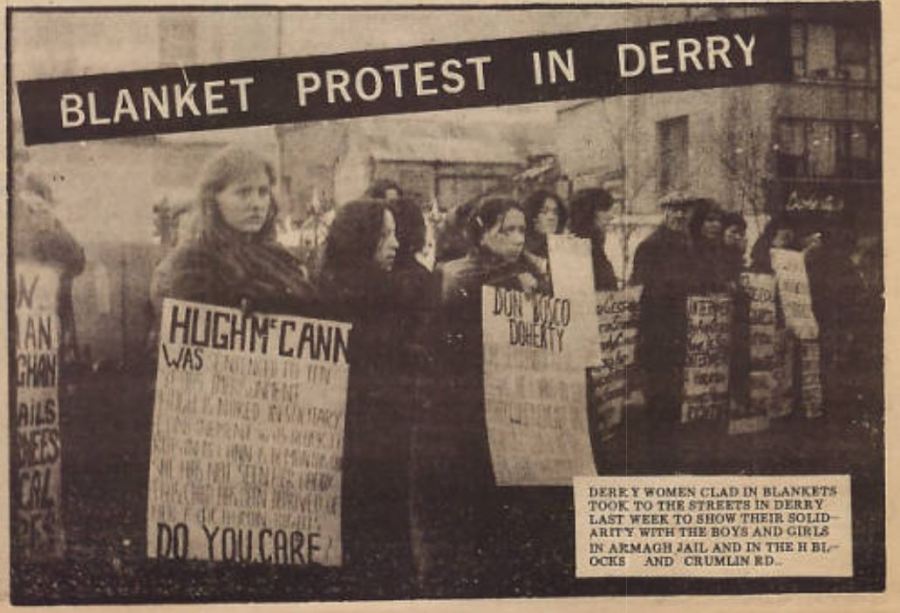
Sweeney took a look at state censorship during the three decades’ war in Ireland which was effected through the introduction of Section 31 of the Broadcasting Act, the sacking of the entire RTÉ Board of Directors and the jailing of a journalist.
Henceforth, self-censorship was the rule.
Specifically, the State ban applied during this period in refusals to interview any member of the IRA (Provisional or Official) and was later extended to Provisional Sinn Féin. It was enforced within RTÉ by management including members of the Workers’ Party1 who also led one of the unions.
Docudrama Few Can See focused on the application of the ban to spokespersons of people in the occupied Six Counties and of a number of campaigning groups: Gays Against the H-Blocks; Concerned Parents Against Drugs; the Gateaux bakery strike in Finglas (factory closed 1990).
Gay rights activists in Cork also campaigned against the H-Blocs and were subjected to censorship under Section 31. (Photo sourced: ICCL website)
Frank Sweeney said he had been intrigued by Betty Purcell’s memoir of her time producing programs for RTÉ and her battles with censorship there2. Conducting interviews with people about their experiences of being censored, he then worked the material into a script.
The format was of a 1980s studio with a program presenter in the style of the times and smoking, intercut with grunge-style footage, electronic interference noise and visuals, then narrowing to interviews with actors playing the parts of victims of the ban at the time.
If the intention was to show how ridiculous it could be to apply a political ban aimed at alleged terrorists instead to community struggles against oppression and the heroin epidemic, the struggle of gays around legality and health and a bakery strike, it succeeded.
The ‘RTE presenter’ in the docudrama screening (Photo: R.Breeze)
However, the issues of whose interests the State was representing in that period of heavy censorship and why it felt threatened were not teased out. Nor why it was able do what it did.
Had those issues been addressed we might have observed a vulnerable neo-colonial ruling class during a high point of struggle against the very colonial and neo-colonial nature of the state and the colony of its imperial neighbour, which also imposed censorship on broadcasting at home.
An aspect of such censorship which might not occur to one but which was discussed in the documentary is the effect of censorship not only on struggles of the time but also on the lack of available footage for archives in the future, leaving history the poorer in material.
Few Can See film has been screening around the world this year and has won some awards including the Tiger Short Award at International Film Festival Rotterdam and is due in Barcelona next year, hopefully to be screened in Ireland again, followed by a fuller discussion.
Film maker Frank Sweeney (centre) speaking during post-screening discussion at the IFI with Ruairí McCann (left) and Purcell (almost out of shot, right). (Photo: R.Breeze)
In addition to exposing the State-led censorship of the past, Sinn Féin might benefit from the film as those who were being gagged were either members or were thought to be supporters of the party. However, SF has its own history of censoring critics both within the party and outside.
And as one member of the audience was heard to remark: “It’ll be the dissidents, not SF that will be getting censored now.” True, though no longer enforced by the State, rather voluntarily by program makers, editors and by the reporters themselves, as with the genocide in Palestine.
Indeed both Sweeney, Purcell and a member of the audience alluded to ongoing censorship around that subject. But it is not only suppression of the truth which is the problem but also the obligatory insertion of the false narrative that everything began on 7th October with the Palestinian raid.
BACKGROUND: THE BROADCASTING BAN MECHANISM
Section 31 of the Broadcasting Authority Act 1960 empowered the Minister for Posts and Telegraphs to issue a ministerial order to the government-appointed RTÉ Authority not to broadcast any material specified in the written order.
The first order under the section was issued in 1971 by Fianna Fáil Minister for posts and Telegraphs Gerry Collins.It instructed RTÉ not to broadcast
any matter that could be calculated to promote the aims or activities of any organisation which engages in, promotes, encourages or advocates the attaining of any particular objectives by violent means.
Collins refused clarification when RTÉ asked for advice on what this legal instruction meant in practice and RTÉ interpreted the Order politically to mean that spokespersons for the Provisional and Official IRA could no longer appear on air.
The following year, the government sacked the RTÉ Authority for not sufficiently disciplining broadcasters the government accused of breaching the Order.
RTÉ’s reporter Kevin O’Kelly had referred to an interview that he conducted with the then Provisional IRA Chief of Staff, Seán Mac Stíofáin, on the Radio Éireann This Week programme. The recorded interview was not itself broadcast, nor was Mac Stiofáin’s voice heard.
Premiere balladeer Christy Moore (right) marching with Provisional Sinn Féins Joe Cahill (Photo sourced: Internet)
Mac Stiofáin was arrested after the O’Kelly interview and charged with membership of the IRA, an organisation listed as illegal by the State.
Soon afterwards O’Kelly was jailed for ‘contempt’ at the non-jury Special Criminal Court because he refused to identify a voice on a tape seized by the Gardaí as that of Mac Stiofáin. However Mac Stiofáin was convicted anyway in the “sentencing tribunal” of the SCC.
O’Kelly appealed to the Supreme Court and a fine was substituted as a means of purging O’Kelly’s alleged contempt. O’Kelly declined to pay the fine but it was said to have been paid anonymously and O’Kelly was released.
In 1976, when Conor Cruise O’Brien (Labour) Minister for Posts and Telegraphs amended Section 31 of the Broadcasting Act, he also issued a new Section 31 Order. This censored spokespersons for specific organisations, including the legal Sinn Féin political party, rather than specified content.
That prevented RTÉ from interviewing Sinn Féin spokespersons under any circumstances, even if the subject was unrelated to the IRA campaign in Northern Ireland conflict.
Visually impacting and clever punning in placard parade protest against Section 31. (Photo sourced: Internet)
Bizarrely even a call-in show on radio about gardening was interrupted once because a caller was a member of Sinn Féin.
The changes undermined the relatively liberal interpretations by RTÉ of its censorship responsibilities under the original 1971 Order and encouraged a process of self-censorship and illiberal interpretation.
However in 1976 O’Brien attempted to extend the censorship to newspaper coverage of the conflict, targeting in particular The Irish Press, revealing his thinking in an interview with Washington Post reporter Bernard Nossiter, naming as a possible target Press Editor, Tim Pat Coogan.
Nossiter immediately alerted Coogan, who then published the Nossiter-O’Brien interview in the Irish Press (as did The Irish Times).
Due to public opposition the proposed provisions were amended to remove the perceived threat to newspapers.
But Fine Gael and Labour were not to be left out as the 1973-77 Fine Gael/ Labour Coalition Government also tried to prosecute the Irish Press for its coverage of the maltreatment (not to say torture) of republican prisoners by the Garda ‘Heavy Gang’, with the paper winning the case.
1The Workers’ Party grew out of Official Sinn Féin which was declining after the split which led to the creation of Provisional Sinn Féin in 1970 and later another split, resulting in the 1974 creation of the Irish Republican Socialist Party. The WP was extremely hostile to the IRSP and PSF, in particular the latter.
2Inside RTÉ – a memoir, Betty Purcell, New Island Books (2014).
NB: Rebel Breeze shares this near the anniversary of the fascist military coup in Chile, the same date as the Twin Towers massacre years later.. The article is a year old but relevant as long as British imperialism exists.
As the Pinochet regime rounded up and murdered its political opponents after the 1973 coup, a UK Foreign Office propaganda unit passed material to Chile’s military intelligence and MI6 connived with a key orchestrator of the coup, newly declassified files show.
Foreign Office helped Pinochet regime to develop a counter-insurgency strategy based on British military campaigns in Southeast Asia
MI6 officer David Spedding was attached to British embassy in Santiago in 1972-4, and had relations with a key member of the military junta
The UK government assisted Chile’s military intelligence in the aftermath of the brutal 1973 coup against elected president Salvador Allende, newly declassified files show.
The assistance was authorised by the Information Research Department (IRD), a secret Foreign Office propaganda unit which worked closely with Britain’s secret intelligence service, MI6.
Foreign and Commonwealth Office building, Whitehall, London. Many a dark deed was planned here. (Photo accessed: Internet)
The IRD had long seen Allende as a political threat. As Declassified previously revealed, throughout the 1960s, the unit had sought to prevent Allende from ever becoming president through election interference and covert propaganda operations.
After Allende was elected in 1970, the IRD’s distribution of propaganda material became “strictly limited”, with the British embassy having fewer reliable contacts in the Chilean government.
This all changed after the coup.
In January 1974, the IRD began to “extend the distribution” of its material, which was now passed “to the Chilean Ministry of Foreign Affairs, Government information organisations” and, crucially, the dictatorship’s “military intelligence” services.
At this time, Chile’s security forces – including the country’s intelligence apparatus – were responsible for massive human rights violations, including the widespread use of torture as a political weapon.
The UK government was under no illusions about this. As Foreign Office official Christopher Crabbie noted three months after the coup in December 1973, “I do not think that anyone seriously doubts that torture is going on in Chile”.
Reliable figures indicate that, between 1973 and 1988, Chilean state agents were responsible for over 3,000 deaths or disappearances and tens of thousands of cases of torture and political arrests. This was in a country which, in 1973, had a population of only 10 million people.
Chile Army 1973 coup soldiers watch detainees – many were shot, many more tortured then shot, many more still ‘disappeared’, probably tortured and shot. Many, many more were jailed where they were also tortured; young children were also abducted and given to fascist childless couples. (Photo accessed: Internet)
‘Hearts and minds’
The nature of the information passed to Chile’s military intelligence remains unclear, though the files suggest it may have included material for use in propaganda, research reports on left-wing activity, and even manuals on domestic security operations.
For instance, newly declassified files show how the UK government secretly helped the Chilean authorities to develop a counter-insurgency strategy, using techniques refined during Britain’s colonial interventions in Southeast Asia.
The idea for such assistance was first raised during the visit of British navy chief Sir Michael Pollock to Chile in late November 1973, two months after the coup.
The timing of Pollock’s visit was “politically tricky”, noted the British ambassador in Santiago, Reginald Secondé, since there was “much critical attention” being given “to the Chilean Government’s treatment of their political opponents”.
However, there were “two frigates and two submarines for the Chilean Navy under construction in British yards” – an arms deal worth around £50m – and “this was not a moment to prejudice the historic tradition of Anglo-Chilean naval friendship”.
“This was not a moment to prejudice the historic tradition of Anglo-Chilean naval friendship”
In Santiago, Pollock and Secondé met with a number of regime officials, including navy chief José Toribio Merino Castro, defence minister Patricio Carvajal Prado, and foreign minister Ismael Huerta.
With Huerta, the British officials spoke about the UK government’s “hearts and minds” campaign in Northern Ireland, a counter-insurgency strategy inspired by Britain’s war in Malaya (1948-60).
Huerta “seemed impressed with the concept”, and Secondé “later twice heard him muttering to himself ‘hearts and minds’”.
Subsequent meetings were held between Secondé, British information officer Tony Walters, and Captain Carlos Ashton, the director of overseas information in Chile’s Ministry of Foreign Affairs.
Like Huerta, Ashton was “very receptive to the idea that this kind of approach to Chilean security problems might be the right answer”, and requested “details of what practical measures a ‘hearts and minds’ exercise would involve”.
Ashton’s request for assistance was forwarded to Rosemary Allott, the head of the IRD’s Latin American desk.
In a letter dated 15 February 1974 and marked ‘secret’, Allott agreed to provide the Chilean regime with counter-insurgency advice, but limited this to material on Britain’s past colonial interventions.
“In view of the delicate political considerations involved”, Allott wrote, “it would be best to confine, at this stage at least, the material we send you of insurgencies of the past, rather than those currently preoccupying HMG” such as Northern Ireland.
The Pinochet regime was soon issued with three books on British counter-insurgency strategy, alongside a “Manual of Counter Insurgency Studies”.
“Britain agreed to share its colonial policing methods with the Chilean junta”
Allott also tracked down “various official reports on Malaya” including “The Fight Against Communist Terrorism in Malaya”, the “Review of the Emergency in Malaya (1948-57)”, and “two booklets on the Philippines insurrection”.
Britain’s military campaign in Malaya involved the “resettlement” of over 500,000 civilians, aerial bombardment, and an intensive propaganda operation.
Embassy officials suggested that they were teaching Chilean officers “tactics of tolerance and magnanimity”. However, brutal repression often lay behind the UK government’s rhetoric about “winning hearts and minds”, and the Chilean authorities were only sharpening their repressive techniques.
None of the material given to the Pinochet regime was “for attribution to HMG”. This meant that the Chilean authorities could use the information but not source it to the UK government.
The extent to which Britain’s advice was acted upon remains unclear; the Pinochet regime was certainly not lacking in support from the CIA.
Nonetheless, it is clear that Britain agreed to share its colonial policing methods with the Chilean junta, with the goal of stabilising Pinochet’s regime against domestic opposition.
MI6 in Chile
Evidence of British assistance to Chile’s intelligence services raises further questions about what Britain’s own secret intelligence service, MI6, was doing in Chile.
In 1972, MI6 officer David Spedding was attached to the British embassy in Santiago – his only foreign posting outside of the Middle East throughout his career.
This was not Spedding’s first visit to Chile. As a postgraduate student at Oxford University during the mid-1960s, Spedding had spent his gap year in Santiago and found work as an assistant in the British embassy’s press office.
Spedding’s first role in the diplomatic service was thus in the same British embassy that had been directing covert propaganda operations against Allende throughout the 1960s. The job gave him “an entrée into SIS [MI6]”, historian Nigel West noted.
Spedding remained in Chile until September 1974. He was subsequently made responsible for MI6 operations across the Middle East, and would go on to become MI6 chief between 1994 and 1999.
‘Our relationship with Admiral Merino’
Spedding’s name rarely appears in declassified Foreign Office files on Chile.
Yet in one file, dated 4 December 1973, Spedding informed the Foreign Office that 2,800 civilians and 700 armed forces personnel had been killed during and after the coup.
“In order to protect our relationship with Admiral Merino”, Spedding noted, “we would not like these figures to be quoted, at least for the time being”.
Admiral Merino was one of the key orchestrators of the 1973 coup. He was head of the Chilean navy in September 1973, and remained in post until the fall of the dictatorship in 1990. Merino claimed responsibility for convincing Pinochet to join the coup.
Some of the culprits saluting (Photo accessed: Internet)
One of Spedding’s roles, then, was to ensure close collaboration with the Chilean junta by covering up its responsibility for massive political repression and human rights violations.
The MI6 station in Santiago was only closed down in 1974 amid the UK Labour Party’s return to government.
It would not be surprising if MI6 played a supporting role to the CIA’s covert operations against Allende during the early 1970s. It was recently revealed that the Australian Secret Intelligence Service (ASIS) had “opened a base in Santiago to assist in the US Central Intelligence Agency’s destabilisation of the Chilean government” in 1971.
Britain’s secret assistance to the Pinochet regime was consistent with the UK government’s position on the coup.
The Conservative government under Edward Heath had welcomed the coup and rushed to give diplomatic recognition and arms to the Chilean junta, with the Foreign Office noting that it had “infinitely more to offer British interests than the one which preceded it”.
The coup against Allende inaugurated a 17-year dictatorship under General Augusto Pinochet, who only left office in 1990.
end.
John McEvoy is co-directing a forthcoming documentary investigating Britain’s hidden role in the death of Chile’s democracy and rise of the Pinochet dictatorship. You can support the film’s production here.
The photo of the massive antifascist rally in London on 28th July following a march from Russel Square shows the recapture of Trafalgar Square from Tommy Robinson and his sea of Union Jacks. Not for the first time, the Irish made their mark upon the place.
There the only two high flying flags were the Irish Tricolours and the Palestinian flags, the Irish contingent being one of the few on the day to see the fight in Britain against the fascists as part of the same fight against the fascist Zionist regime.
Irish and Palestinian flags in Trafalgar Square rally against racism, end July 2024 (Photo cred: PA)
We are mindful of the history of our occupied territories and our 1930s fight against the anti-Semitic Blackshirts1 in London (e.g. standing with the Jewish community at the Battle of Cable Street, 1936) and against the Bridgeton Billy Boys in Glasgow in the 1930s.2
On 28th July our flags sent out a message: We stand against all fascists, at home or abroad. That day we could not but remember all our brave men and women who marched past here from 1971 to 1998 carrying our fight to the heart of government3 in harder times.
We also know that the anti-racist movement now takes its new life from the strength of the Palestinian solidarity movement in Britain and needs to recognise this.
It was strange being in Trafalgar Square again with Tricolours given that we were barred from being there during the ‘Troubles’. Irish solidarity events were banned from using the Square under any circumstances from 1972 to 2001, well after the Good Friday Agreement.
The ban was lifted only once for an Irish event during that period and that was for the Peace Women4 (sic) calling for an ‘end to violence’ (mainly that of the Resistance) and famous US folk singer/ political activist Joan Baez displayed her ignorance of the Irish situation by speaking there.
It was interesting that a reporter for GB News of the British mass media was aware that a picket had been held in Dublin in protest against the assassinations of Palestinian and other Arab resistance leaders. He tried to link the Irish contingent in Trafalgar Square with ‘support for Hamas’.
The linkage was hinted in his broadcast report though he was careful enough not to report a direct link as the Irish group in Trafalgar Square had in fact no connection with the Dublin group. The reporter asked how to pronounce ‘Saoirse Don Phalaistín’ — but still got it wrong in his report.
One of the Irish contingent spoke to the young GB News journalist: He had the stuff from Dublin on his phone and wanted to say that the Irish in the Square were part of the Dublin group.
“Next thing you’d know the Zionists would call for a ban on the Irish for ‘supporting Hamas’”,5 commented one of the veteran Irish activists. “We also get targeted because of the flag and our placards.”
The UK State and the police are all pro-Zionist and the Zionist press tries to trap the Irish into dangerous statements but “We know our history and are well able for them; we just say we support Palestinian resistance to Israeli occupation just as we did with the British in Ireland.”
Irish contingent with flags on Palestine solidarity march to Downing Street very recently (not sure whether the SW person is part of it). (Photo sourced from participant).
The Irish Tricolours, often in the company of the Palestinian national flag with Saoirse Don Phalaistín printed on it have been seen on Palestine solidarity marches in London since the current Zionist genocide began but also on anti-fascist rallies and in support of Julian Assange.
This is in keeping with the history and tradition of the Irish in Britain who helped found the republican United Englishmen6, the Chartists,7 many trade unions, a section of the First International8 and also gave the British working class their anthem9 and their classic novel.10
Classic novel of the working class in Britain was written by Robert Noonan, aka Robert Tressell, from Dublin. (Image sourced: Internet)
In later times they were prominent in organising solidarity with Vietnam and of course Ireland, against repressive legislation and fascist organisations, solidarity with Nicaragua, Palestine etc. and in struggles against state repression, including within the jails.
The Prevention of Terrorism Act (1974), forerunner of the current Terrorism Act (2000) specifically targeted the Irish community in Britain with suspension of habeas corpus for a period of up to five days, refusal of access to solicitor, as did also the framing of a score of people.
In the midst of the Irish Hunger Strikes of 1981, the Irish community broke out of the State terror stranglehold and formed the Irish in Britain Representation Group, among its objectives being the abolition of the Labour Government-introduced Prevention of Terrorism Act.
End.
Saoirse don Phalaistín and Irish Tricolour flags on Palestine solidarity march this year photographed against Westminster’s ‘Big Ben’. (Photo cred: being investigated)
NOTE ON AUTHORS
Pat Reynolds is a former trade unionist, social worker, a veteran anti-racist, anti-fascist activist, also for Irish independence and for rights for the Irish community in Britain. He was PRO for the Irish in Britain Representation Group for two decades, founding the Haringey Branch and the Green Ink Bookshop. Reynolds is from Granard in Co. Longford and lives in London.
Diarmuid Breatnach is a former trade unionist, worker with homeless/ substance misusers (manual worker before that), also a veteran anti-racist, anti-fascist activist and campaigner for Irish independence. For a decade he was on the Ard-Choiste of the IBRG, founder of the Lewisham Branch and of the Lewisham Irish Centre. Breatnach is from Dublin to which he has returned to settle.
FOOTNOTES
1The British Union of Fascists led by Sir Oswald Moseley which had substantial support in the British elite, including the publisher of the The Daily Mail with police attacks on anti-fascists.
2The Billy Boys were founded and led by Billy Fullerton, a former member of the British Fascists. Fullerton also later became a member of the British Union of Fascists in the 1930s. The Billy Boys adopted a militaristic style of behaviour, marching on parades, forming their own bands, composing their own songs and music, and all dressed in a similar manner.[3] The Billy Boys also formed a junior group whose members were teenagers called the Derry Boys. (Wikipedia)
3From Trafalgar Square to the Houses of Parliament in Westminster runs a broad thoroughfare, in the centre of which is the Cenotaph and a little further, the entrance to Downing Street.
4The organisation/ campaign was founded by Betty Williams and Mairead Corrigan in 1976 after a car driven by an IRA fighter mortally wounded by British soldiers in Belfast crashed into pedestrians and mortally wounded three children of Anne Maguire, sister of Mairead. Branding itself as against all violence the Peace Women in fact targeted primarily the Republican movement, secondarily the Loyalist paramilitaries and hardly ever the Occupation Army. Williams accused the IRA unit of having fired on the Army unit that killed the driver which was untrue (but is repeated on her Wikipedia entry). Both founders received the Nobel Peace Prize in 1976 and a substantial cash prize. Williams resigned from the group in 1980 and disappeared from Irish-related activities though prominent externally. Corrigan however remained politically active in Ireland and elsewhere against war and has campaigned among other things for the end of the ‘Israeli’ siege on Gaza, being arrested with crew and passengers on the Spirit of Humanity aid ship in 2009 by by the Zionist navy, taken to ‘Israel’ and subsequently deported.
5Hamas is proscribed organisation in the UK since March 2001 and a person promoting it would be liable to prosecution under the Terrorism Act.
6A spin-off from the United Irishmen in Ireland; the English chapter led the Spithead and Nore naval mutinies. The Irish also reformed the United Scotsmen when it was faltering.
7Karl Marx called the Chartists “the true mass movement of the working class” – two of its principal leaders, Bronterre O’Brien and Fergus O’Connor were Irish, as their surnames would suggest.
8The Fenians were accepted into the First International Workingmen’s Association.
9The lyrics of The Red Flag were composed by Jim Connell from near Kells, Co. Meath and set to the brisk air of The White Cockade, later changed to the mournful air of Tannebaum.
10The Ragged-Trousered Philanthropists was written by Robert Tressell (real name Robert Noonan) from Dublin.