APPROPRIATE MEMORIAL FOR MAGDALENE LAUNDRIES VICTIMS: CAMPAIGN WINS IMPORTANT BATTLE IN DUBLIN CITY COUNCIL

Diarmuid Breatnach

Dublin City Councillors at their meeting on Thursday (13th September) voted by huge majority not to sell the former Magdalene Laundry building in Seán McDermott Street in the city centre. Deputy City Manager Brendan Kenny had earlier announced the possibility of the Council selling the building at an expected price of €14.5 million to a Japanese company that planned and hotel and supermarket on the site.

A campaign group called Separate Church & State had lobbied for the building to become a memorial to the suffering of the inmates of the Magdalene Laundries. The group called people to support an event outside City Hall to coincide with a motion being put forward to prevent the sale of the building.  A range of people attended, seeming mostly Left social and political activists independent of any party and a sprinkling of People Before Profit activists.

The motion was propose by Gary Gannon, a Councilor of a very small political party (with only one member on the Council), the Social Democrats. However the motion was supported by the overwhelming majority of a Independent councillors (i.e of no party) and those belonging to a number of other parties and was passed with 37 voting in favour, eight against and two abstentions.

Campaigners and supporters in front of Dublin City Hall from across the street
(Photo: D.Breatnach)

The successful motion called on the Council not to sell the building and land and that instead those who suffered abuse there should be commemorated with a memorial. Other than preventing the sale, exactly how the memorialising might be put into effect remains to be outlined and agreed. There is talk of the State taking it over but whether by donation of the Council or sale has not been clarified. There are very few memorials to the Magdalene Laundry victims and all but one of them are small

The Sean McDermott building appears to have been the last of the Magdalene Laundries in Ireland and was closed in 1996. It is also the last of those buildings in the possession of Dublin City Council.

(Photo: D.Breatnach)

The significance of the victory is greater than that of elected representatives versus unelected City Managers, the former being more responsive to public pressure than to the demands of high-ranking officials who seem happy to hand over much of the city centre to property speculators, shopping centres, hotels and large student accommodation complexes.

The terms in which the issue was raised are an attack on the legacy of the Catholic Church’s grip on secular society and its relationship with the State.  The campaigners clearly see the Council vote as a victory, though a moral one, against that legacy.  And they are planning to press ahead with the offensive in the terms indicated by the title of their campaign, indicating further targets such as the national health and education services, along with legislation to follow on the national referendum’s rejection of Amendment 8 of the Constitution outlawing abortion.

The Magdalene Laundries – some brief background

       The Magdalene Laundries were a major institution of the Irish Catholic Church from the 18th to the late 20th Century. There were some Protestant parallels too in the Six Counties (“Northern Ireland”) run by the Anglican and Presbyterian churches but the vast majority of the Irish population were of the Catholic faith. The Laundries took in and accommodated women who were considered “fallen women” which at first meant sex workers but later included unmarried women who had a child or children or even women whose behaviour was considered immoral or flirtatious (or even whose beauty attracted male attention) and they were put to work in the laundries for no pay. Ostensibly at first a charitable initiative, their title drew on the New Testament story of Mary Magdalene who, from being a “morally loose” woman, after meeting him became one of the most ardent supporters of Testament’s Jesus.

But if the name was associated with the alleged mercy and lack of judgementalism of the Christ, it also implied moral sin and judgement. In the extremely conservative Catholic Church that it became after the Great Hunger, the main element was likely to be punishment and, when allied to an also socially reactionary political class, the Laundries became an institution of social control of the Catholic Church in Ireland and of the new Irish State.

The Magdalene laundries soon became known to their inmates as places of hard work and ill-treatment, mostly of a psychological nature but also physical. If women left them without permission, they were pursued by the police and brought back. Continuous escapes could lead to jail sentences.

(Photo: D.Breatnach)

During their time in operation an estimated 30,000 Irish women were kept in these institutions in Ireland, approximately 11,000 after the State was created in 1922.

The horrors of these “charitable institutions” began to be revealed to the public during the last decade of the 20th Century, notably in 1993 after a mass grave of 155 corpses was uncovered in the north Dublin convent grounds which housed one of the laundries and the last Laundry was finally closed down in 1996. The Church never accepted any financial responsibility for reparations.

The Irish State set aside a sum of up to €58 million (about half of which has been paid out – see Links) but the religious institutes concerned, the Sisters of Mercy, Sisters of Our Lady of Charity of the Good Shepherd and Sisters of Charity refused demands from the Irish Government, the UN Committee on the Rights of the Child and the UN Committee against Torture, along with other groups in Irish society, to contribute to the compensation fund for the the surviving victims, an estimated 600 of whom were still alive in March 2014 (see Wikipedia in Links).

(Photo: D.Breatnach)

The Taoiseach (Prime Minister) of the Irish State apologised publicly and emotionally in the Dáil (Parliament) in February 2013 but the State never accepted any legal responsibility, its representatives saying that they did not control the Church. When they were reminded that the victims had washed not only clothes and vestments of priests and nuns but had also done laundry service for such state institutions as Aer Lingus, the Irish Army, the Gárdai, the State’s representatives declared that the Laundries were like any other contractor in that regard and that the State could could not accept responsibility for how contractors treated their “employees”. But it is known that State courts sent a number of women to the Magdalene Laundries. And it was the State that allowed the Catholic Church to dominate social care, health care and education, areas which are usually considered the responsibility of the State.

The general story of the Laundries is fairly well-known in Ireland now through media coverage and the testimonies of victims and even abroad in some countries through the 1992 Peter Mullan film Magdalene Sisters (see Links) and a number of documentaries for TV. Mary Coughlan sang a fierce attack on them too the same year as the film, composed by J.Mulhern (see Links for a Youtube video).

View of the protesters outside the meeting (some were inside) looking eastward.
(Photo: D.Breatnach)

There are very few monuments to the suffering of the victims of the Magdalene Laundries and they are all of a small size except the statue in Ennis which aroused some local controversy.

The monument at Forster Street, Ennis, Co. Clare, dedicated to the Magdalen women and a subject of some controversy.
(Photo: Mike Shaughnessy)

Despite the duration of their existence and numbers involved and the international coverage, the Pope claimed when tackled by some survivors on his recent visit to Dublin that he had no knowledge of the existence of the institutions.


Sale of Council buildings and land – the legal position and some background

Due to a legislative change some years ago, Dublin Council Executives such as the City Manager and Senior Planning Officer can make major decisions without consulting elected Councillors and even against their expressed wishes. In this way, for example, the planning permission for the Shopping Centre Plan over the Moore Street Battleground and Market quarter was firstly agreed and secondly, even after the High Court judgement that it is a national monument, was renewed in 2016 by the Chief Planning officer of the time, Jim Keogan.

Many feel and have felt since such decisions that this is an unhealthy state of affairs, with no democratic controls and leaving key officials open to suspicion of bribery from developers influencing their decisions.

Fortunately however when it comes to the disposal of Council assets, the Councillors must agree by majority. This prevented the “land swap” proposed in 2014 by Joe O’Reilly of buildings in Moore Street, which if successful would have enabled his company to demolish half the 1916 Terrace: responding to campaigners and interested elected Councillors, the Council voted the proposal down against senior officials’ recommendations in November of that year.

Links:

Separate Church & State campaign group: https://www.facebook.com/separatechurchandstate/

Short article on the Dublin Council lobby and vote in Look Left: https://www.lookleftonline.org/2018/09/dcc-votes-not-to-sell-off-ex-magdalene-laundry-site/

Closing of the Magdalene Laundry on Sean McDermott Street: https://www.irishtimes.com/culture/last-days-of-a-laundry-1.89388

Proposed sale of the Sean McDermott Street building: http://www.thejournal.ie/sean-mcdermott-magdalene-laundry-3941031-Apr2018/

State compensation package: https://www.rte.ie/news/2013/0626/458868-magdalene-report/ and https://www.irishexaminer.com/ireland/flanagan-257m-paid-out-to-682-magdalene-laundry-survivors-462711.html

The Magdalene Laundries on Wikipedia: https://en.wikipedia.org/wiki/Magdalene_Laundries_in_Ireland

The Pope “had no knowledge”: https://www.buzz.ie/latest/pope-magdalene-laundries-297205

Film The Magdalene Sisters, Peter Mullan (1992): https://en.wikipedia.org/wiki/The_Magdalene_Sisters

Song Magdalene Laundry by Mulhern and sung by Mary Coughlan (Sentimental Killer album (1992)): https://www.youtube.com/watch?v=GHWsLYtxzz0


(Photo: G.Guilfoyle)
Irish TV (RTÉ) cameraman filming the protest (Photo: D.Breatnach)


Section of protest (Photo: D.Breatnach)

WAR, SPLIT AND PLANNING INSURRECTION

Diarmuid Breatnach


On the 5th August 1914 the Supreme Council of the IRB, one months after the British had declared war on Germany, decided in principle to instigate a rising for Irish independence.

On 5th August 1914, one month after the British had declared war, the Supreme Council of the Irish Republican Brotherhood decided in principle to lead a Rising. They envisaged, as many observers did too, that the War would not last long and arming and preparing for an insurrection would be difficult within that timeframe. The war continuing well beyond the at most expected period of a year, provided the IRB with the space to organise, plan, prepare – and also with an ally to arm them: Germany.

The split in the Irish Volunteers caused by Redmond’s speech at Woodenbridge, offering the Volunteers to British Imperialism for the war against German Imperialism and Turkey, left the secret Irish Republican Brotherhood in a position to take control of the remainder, those who declined to fight for Britain and determined instead to fight for Ireland’s independence.

Over a number of months Patrick Pearse became Director of Military Organisation, Bulmer Hobson Quartermaster General, Joseph Plunkett became Director of Military Operations, Éamonn Ceannt, Director of Communications, while Thomas MacDonagh became Director of Training.

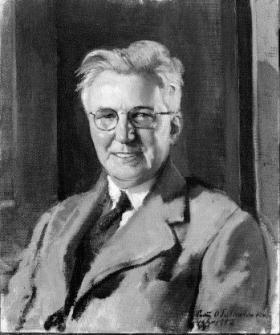
The Gaelic scholar Eoin Mac Neill, titular head of the Irish Volunteers prior to and after the 1914 split. He would later be disgraced in the eyes of many for his public cancellation of the 1916 Rising which went ahead without him but much diminished in numbers. (Image sourced: Internet)
Bulmer Hobson in later years. By 1916 be had separated from the IRB he had helped reorganise and was even put under armed detention for a period by the IRB.
(Image sourced: Internet)
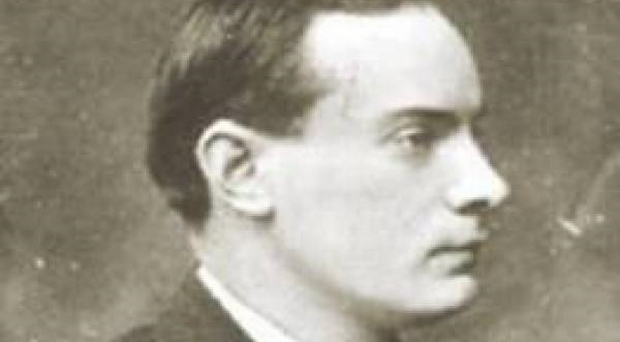
Patrick Pearse
(Image sourced: Internet)

The titular head of the Volunteers, the Gaelic scholar Eoin Mac Neil, and such founding figures as The O’Rahilly, while in prominent positions and refusing to follow Redmond, did not embody the same coherence and determination for insurrection as was embodied in the IRB.

That list above contains four of the later signatories of the 1916 Proclamation. Seán Mac Diarmada and Thomas Clarke are missing but, though central figures in the reorganisation of the IRB over preceding years, that is not surprising: the older Fenian, veteran of 15 years in British jail in conditions which, it is said, sent one third of his comrades insane and another third to early graves, preferred to work in the shadows. No doubt he had instructed his student and energetic organiser, Mac Diarmada, to do likewise in so far as possible. However, they too joined the expanded Military Council in late 1915.

Thomas Clarke, ex-Fenian prisoner and the real head of the IRB in Ireland. (Image sourced: Internet)
Seán Mac Diarmada, recruited into the IRB by Hobson but became a close supporter of Clarke’s. (Image sourced: Internet)

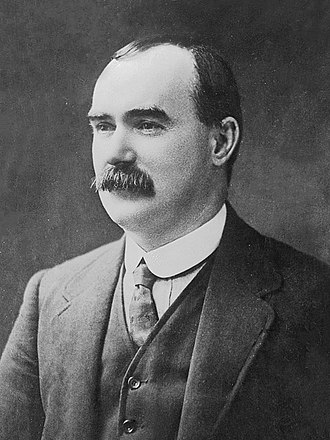
The fifth of the Proclamation Signatories missing is James Connolly, who in August 1914 was recovering and rebuilding the Irish Transport & General Workers union, months after the end of their exhausting 8-month struggle against the Dublin employers. But he was horrified by the imperialist war and the pitting of workers against one another, divided by the ruling classes of their respective locations, uniforms of different colours concealing their common interests. Connolly wanted a rising – not just for independence but also against the coming butchery of War. The reorganisation of the Irish Citizen Army, the worker’s defence militia, began to engage Connolly’s energies but he was only sworn into the IRB in January 1916, three months before the Rising.

James Connolly, photographed in 1900. (Image sourced: Internet)

So many different threads in Irish life – cultural, political, class and nation – had been coming together, to weave a tapestry that would be read in different ways over decades but would still have powerful images, colours and words to move women and men over a century later.


End.

SHOWING THE BRITISH ROYAL COUPLE AROUND DUBLIN

Diarmuid Breatnach

English Prince Harry Windsor and his bride Meaghan were in Ireland this week and were shown around Dublin.


“Ah yeah, this is where we fought yez in 1171 ….

“Our people were banned from the city for a while after that. Yes, security … quite ….

In 1366 yez got in a strop wit yer own people for starting to talk Irish, wearing Irish clothes, playing Irish games ….  Called them ‘the degenerate English’ … said they’d become ‘more Irish than the Irish themselves.’ Yes, a few of them got hung.

There’s where some of our chieftains’ sons escaped your jail in 1592 after you took them hostage — some never escaped of course, ha, ha and their heads remained on spikes.  Yes, a bit gruesome.
Then in the 1640s again because yer people wouldn’t change their religion (nor us, as it happens).  Yes, old Oliver.  I know, your family’s not too fond of him either ….
“This used to be ours, Meaghan.”
Prince Harry Windsor and Meaghan in Dublin Castle, July 2018.
(Photo source: Internet)
Yes, Trinity College, founded by yer own Queen Elizabeth. What, no, bless me, not her Majesty now — the first one! Well, to educate yer people here in the Protestant faith because they were being sent off to Catholic countries to be educated.
Just down the hill there’s where yez arrested the Leinster Directorate of the United irishmen in 1798.  No, mostly Protestants …
And the bridges there, where yez hung a lot of their followers, putting their bodies in Croppies’ Acre afterwards, just across the river there. No, not a graveyard as such — a mass grave, just a hole in the ground.  There are quite a few songs about that period. Yes, still sung today.
And across the road there is where the irish Parliament was — well, Anglicans only — abolished to precede the Act of Union in 1801.  Yes, that was when all of Ireland became part of the UK.
….. Back up there, Robert Emmet was hung and beheaded two years later …. Yes, there is a song about that too.
Ah yes, and just down from the Castle, which was yer Headquarters, is where the The United Irishman newspaper was suppressed in 1848 and its editors and writers sent to Australia and Tasmania.  No, not for a holiday — as convicts.
Now, across the river … Worker killed there during the 1913 Lockout and many injured by police the day after too. Oh, it lasted about eight months. Yes, it is a long time, your Highness. But they had some help from England. Oh, not from the Government, not at all, bless your Highness. From British trade unionists. Yes, a few songs about that Lockout also. Yes, we are very musical, thank you.
Oh yes, Bachelor’s Walk Massacre over there, 1914 …. No, nothing to do with stag parties — though sometimes …. No, not by the IRA — by the Scottish Borderers, British Army.
1916 Rising fighting post there …. there …. over there to the East …. further back there to the west…. and south …. and there. Yes, fourteen executed in the Kilmainham Gaol Museum …. no, it wasn’t a museum at the time … Oh, many, many songs …
Now, over there was where Kevin Barry was hung … Yes, there is a song about that as well, your Highness.
One of the RIC G-men shot there by our people… and another over there … Ah, the RIC? Well, sort of like yer PSNI up north now …
Civil War, yes, 1922 -’23. Yes, Collins was glad of yer cannons for that.
Dublin Bombings …. yes, in 1974. The IRA? No, bless me, not at all! Yer own intelligence service and loyal allies. Yes, it was …. biggest number of deaths in one day during the whole recent 30 years war. No, strangely, not one arrest ……
No, the British Embassy’s not in the City Centre anymore, Your Royal Highness Meaghan …. not since 1972. Well it got burned. No, not accidentally — a big crowd burned it after Bloody Sunday up in Derry, you know, when 14 were killed by your father-in-law’s regiment ….
end

BASED ON HISTORY BUT FAR FROM IT– McCann’s “After the Lockout”.

Diarmuid Breatnach

History can and should be researched, interpreted, discussed, argued and used for lessons on current questions and projections into the future. It can also be used in fiction: as the backdrop for a novel; as a way of bringing historical events to life; as a what-if speculative story.

James Plunkett (21 May 1920 – 28 May 2003) used the Dublin Lockout as a backdrop for his Strumpet City and did it wonderfully well; Walter Macken (3 May 1915 – 22 April 1967) wrote a fictionalised account of brothers in the War of Independence and the Civil War in The Scorching Wind and also did it well1. Roddy Doyle did NOT do it well at all in his historical novel (A Star Called Henry) and sadly nor did Darran McCann in “After the Lockout”. Interestingly, the central characters in both latter books were what one might call “Left critics” of the leaders of the struggle and one is tempted to conclude that the attitudes of the central characters mirror those of their creators.

(Image sourced: Internet)

It seems fair enough that we can play with history in fiction but, when using it as a backdrop for a story, it should be accurately represented – otherwise, surely one should invent something else entirely?

Doyle did some reading on the GPO garrison’s struggle for the background of his “A Star Called Henry” but seemed to have done none for the War of Independence, in which he had his hero and heroine like a kind of Republican Bonny and Clyde living in ditches and shooting up the Free State forces. McCann seems to have done hardly any reading on the Lockout (and not that much on the GPO garrison’s fight either). Having Jim Larkin give a speech from the restaurant in Murphy’s Imperial Hotel restaurant window is bad enough – when we know he only got to say a few sentences before the Dublin Metropolitan Police ran in to arrest him – but having him then shin down a rope and get away is absolutely ridiculous.

McCann set the story of his central character, Victor Lennon, in between the 1916 Rising and the War of Independence and it has many of the elements of the story of James Gralton (17 April 1886 – 29 December 1945), the only Irish person to have been officially exiled from Ireland by an Irish government (in 1933).

The arrest of Jim Larkin after he spoke briefly from the Imperial Hotel in 1913. He did not shin down a rope!
(Image sourced: Internet)

McCann’s Victor Lennon, a communist and member of the Irish Citizen Army, gets people in his home town to build a dance hall in opposition to the local Bishop, which a mob then burns down. Gralton, a communist also, did that too, in Leitrim; however, he ran dances there and also gave talks – it was a success, to a considerable degree. The Irish Catholic Church vehemently opposed Gralton and in McCann’s novel the Bishop and local supporters also mobilise against Victor: the hall is burned down before any dance is held in it. Like Gralton’s story, there is a shooting incident around the dance hall too – a fatal one, in which Victor’s father and two IRA men are killed. But instead of being deported from Ireland, as Gralton was (illegally) by an Irish Government, which in McCann’s story had not yet come into existence, Victor heads off for Dublin to join the Volunteers in what will become the IRA and the War of Independence.

Newspaper photograph of James Gralton in the process of his deportation in 1933 (note he is described as “Irish-American” as though to justify his deportation, though in fact he was born in Ireland and did not leave for the USA until 23 years of age, subsequently returning to fight in the 1916 Rising and the War of Independence.
(Image sourced: Internet)
What actually happened after Larkin spoke briefly from the Imperial Hotel — a vicious police baton charge and indiscriminate beating of all in the area.
(Image sourced: Internet)

Roddy Doyle wrote very disrespectfully about Volunteers, Pearse and a number of other leaders and even salaciously about anonymous wives of martyred men. He did so by placing those words and thoughts in the mouth and mind of his central character, Henry Smart. McCann does somewhat the same but to nowhere near the same extent as did Doyle.

I admit to finding that lack of respect extremely distasteful but also from a historical point of view I see it as anachronistic. I find it hard to believe that those who took part in the Rising despised those who fought alongside them, no matter the difference in ideology – or that they spoke so contemptuously of their leaders, martyred or not. Disagreed, certainly – disagreed strongly, probably. But disrespect and contempt? No, that is attaching a post-Free State intellectual revisionist attitude on to participants in the Rising and in the War of Independence. Later, there would be fear and hatred, during the Civil War, but even then, none of that contemptuous and dismissive attitude.

I am not the only critic from a historical perspective, as I see from a quick Googling. Reviewing the book for the Irish Independent in 2012, Pat Hunt had this to say:

The opening section set in Dublin reads more like a 1917 Thom’s Street Directory and a survey of political events and personalities of the time. The seediness of the red-light Monto district in the inner city does not ring true. The period feel of the city of Armagh is much better realised.

The author’s editor has done him no favours. It was never possible to hop on a train at Amiens Street and hop off at Harcourt Street station (not unless one took a scenic route via Bray).

The Big Wind of 1839 occurred on the Feast of the Epiphany, not Pentecost. Forecasts of wine lakes and butter mountains (concepts that emerged with the EEC and its common agricultural policy) could not have been envisioned by even the most ardent socialist in 1917.”

Hilary Mantel, who writes historical fiction, praised McCann’s book and I can only assume that she knows very little of Irish history, nor indeed should we expect that she should – her background is not Irish. Glen Patterson, novelist from the Six Counties, praised it highly too and I assume did so on the composition of the writing, turn of phrase, story-telling etc – but I sincerely hope he did not do so on a historical basis.

After the Lockout, Darran McCann, Harper Collins 2012.

End.


FOOTNOTE:

1 Though not perhaps as well as the other two books in the trilogy, those dealing with the Cromwellian war and Great Hunger periods: Seek the Fair Land and The Silent People)

IRA VOLUNTEER, PAYROLL HEIST MAN, THRILLER WRITER


Diarmuid Breatnach


To discuss a thriller-writer who was in jail in the USA for one of the largest payroll heists in US history and who before that was in the H Blocks, an incarcerated IRA Volunteer, is to have most people thinking one is writing about a fictional character – but I’m not. The man exists and his name is Sam Millar.

WRITER

Millar has a number of novels and a memoir to his credit, all the most recent published by the O’Brien Press. Some of them are detective novels, centred around Karl Kane, a tough private investigator, back-talking cops and gangsters alike. Yes, we’re familiar with the type, from Chandler’ Philip Marlowe to Spillane’s Mike Hammer, Hammet’s Sam Spade or Towne’s Jake Gittes in Chinatown (1974). But if we’ve liked his type in print or film before, them then we tend to like him again. To be truthful, Kane is a bit different: I can’t recall or even imagine any of the others ever opening their front door dressed only in their lover’s short pink dressing gown and falling on their arse, accidentally flashing their tackle at passing schoolgirls. And Kane’s health problems are perhaps more reminiscent of some of the Scandinavian fictional police detective heroes (and heroines) than his fast riposting counterparts in the USA-based stories.

Cover Dead of Winter, a Karl Kane novel by Sam Millar.

The dialogue and commentary in the Karl Kane novels is good with some very funny lines, his plots interesting and he keeps the story moving along at a good pace, with a few twists along the way. Kane, like Marlowe has a conscience pushing through his hard exterior and though he’s tough he tends not to invite more slaps after the first few. And not every thread in the story is tidily tied up at the end of the book.

The dialogue is not so slick in some of his other novels (one set in the USA) but the conjuring of the ill-boding atmosphere is well done, as is the description of the thinking in the adolescent characters’ minds.

Belfast is where his writing is centred now:

“I have deliberately used (Belfast) as a backdrop for all my crime noir novels for a number of reasons”, he was quoted as saying in a Crime Review author profile “- mainly because I know it so well, but chiefly to bring the imaginary one-dimensional Belfast of badly written novels into the modern era.”

Sam Millar
(Photo source: Democrat and Chronicle)

His stories are dark (which is part of the meaning of “noir”) but generally not without humour or redemption, at least for some of the characters. The Police Service of Northern Ireland are not presented as shining good guys and in that Millar fits in with the general attitude to the enforcers of law and order in the detective noir stories: the cast of cops usually includes the downright nasty (and often corrupt), the in-between and the good guy – the latter being the cop who feeds the private investigator information or warns him of trouble coming his way from the cop’s superiors. For the genre and for Millar’s stories it works, providing one doesn’t step back too much to think about the sectarian and often murderous RUC now transformed by name into the PSNI.

However, Millar doesn’t try and paint a rosy picture of a post-Good Friday Agreement society and has been quite open about his own views: I hate bursting people’s bubbles, everybody wants to believe something like a fairytale has happened over here but it hasn’t”, he said in a 2014 interview with David Henessy in the Irish in Britain weekly The Irish World.

It’s changed superficially but for working-class Protestants and working-class Catholics it hasn’t changed. There’s still a lot of people out of work, a lot of poverty and it seems the politicians are the only ones who seem to benefit out of this Good Friday Agreement which has been a terrible let down, to be honest with you, especially in nationalist communities.

“But for myself being a writer, of course, I have been able to move away and I felt guilty. You don’t want to turn your back on your neighbourhood but at the same time, I’ve young children. I want them to have a better life…”

SELLING WELL ABROAD

A number of Millar’s books have been translated and sold well in France (where he was won a number of literary awards), Italy, Germany and Poland and some as far as Turkey and Bulgaria. He is not without Irish awards either: the prestigious Aisling Award for Art and Culture; Martin Healy Short Story Award; Brian Moore Award and Cork Literary Review Award, et al.

I could probably sell more books in Ireland if I kept my mouth shut about what I thought,” Millar commented more recently. Perhaps he’s right. I find it hard to believe I never heard about him until picking out a book by chance in the library, saw it was about a PI working in Belfast and with a sigh, felt obligated to read it. But without any great expectations, having come across some novels allegedly about the Six Counties that seemed to be about somewhere else in the world but also bearing Ulster place and family names. I was glad I chose it and am now working my way through his other published works.

Asking some Dublin Republicans about Millar and his writing, I was again surprised that they had not heard of him, particularly since they would share his view of the Six Counties today.

IRA VOLUNTEER AND HEIST

Millar was brought up a Catholic in Belfast (but with a Protestant grandfather), became politically active and went to jail in 1973, “the first nationalist put away under the Diplock court system. That’s a forgotten historical footnote, except for me”, he says. Released in 1975, his days of freedom were short, like many another in those days and a year later he was back inside after being caught with explosives in Belfast city centre. He joined the blanket protest against the British policy of criminalisation of Republican prisoners.

Released from the H-Blocks in 1982, he got acquainted with Bernadette, now his wife, whom he had known as a child, a few streets away from his family‘s home.

Photo source: New York Times

Moving to the USA, in 1993 Millar got involved in the New York Brinks Armoured Car Depot robbery, “the biggest in US history” (in which no-one was killed), for which he got caught a year later and served six years in a penitentiary, to be released by Clinton. Millar wrote about the heist in On the Brinks (2003) and apparently investigators believe that though Millar masterminded the robbery, he fictionalised some of the details in order to protect some accomplices.

Cover of extended version of the best-seller On the Brinks, Millar’s memoir of Republican activism, British colonial jail and the Brinks Heist of 1993.

Warner Bros. bought the rights to the book for a screenplay before backing out of making the film and a long “and draining” legal battle followed as Millar fought to win back the rights, so as to have some other company make the film.

 THRILLER WRITER AND REVIEWER

Writing for the New York Journal of Books, Millar said he had “reviewed tons of books”, in reply to an accusation by Armagh author Stuart Neville that he had indulged in “sock puppeting”, i.e using fake identities to rate his own work highly and do down some others, including Neville’s.

If you look at my books reviewed by people on Amazon,” said Millar to Nuala McCann for BBC News in September 2012, “you will see one stars and two stars, some by writers. I have never asked Amazon to remove them, nor complained on line about them.

“Ironically, the only book I’ve ever read by Mister Neville I reviewed for the influential website New York Journal of Books,” he added.

“I think if you read it, it wasn’t too bad a review. I get lousy reviews sometimes myself, but take it on the chin. I’ve reviewed ‘tons’ of fiction/crime books for writers, and never given a negative review of any of them.

“If I don’t like a book (after a few chapters) I will not review it, as I do not like to give bad reviews to fellow writers, as I know how difficult enough it is without adding grief.”

Cover of Millar’s next novel, with a new anti-hero, due out in June.

Sam Millar has another anti-hero novel (not Kane) novel due out in June, The Bespoke Hitman, as part of a three-book deal with O’Brien. I’m looking forward to reading it.

End.

BIBLIOGRAPHY:

Dark Souls (April 2003)

The Redemption Factory (July 2005)

The Darkness of Bones (2006)

Bloodstorm: A Karl Kane Book (2008)

The Dark Place: A Karl Kane Book (2009)

The Dead of Winter: A Karl Kane Book (2012)

Brothers In Arms (Stage play 2012)

Black’s Creek [originally Small Town Killing] (2014)

On The Brinks, O’Brien Press (April, 2014) [but originally by Wynkin de Worde (Sep. 2003) then bought by Millar’s present publisher, The O’Brien Press]

Past Darkness: A Karl Kane Novel (2015)

LINKS FOR SOME SOURCES:

http://crimeire.blogspot.ie/2015/03/sam-millar.html

http://www.theirishworld.com/sam-millar-back-from-the-brinks/

http://www.bbc.com/news/world-europe-19465081

https://www.nytimes.com/2016/08/14/nyregion/brinks-heist-made-for-hollywood.html

https://www.democratandchronicle.com/story/news/2016/03/21/brinks-heist-may-become-hollywood-film/82085488/

Author’s website: http://www.millarcrime.com/

HAVING IT AWAY – AN ARMS RAID, CAPTURE AND PRISON ESCAPE

Diarmuid Breatnach


The prison experience and escape of IRA man Seán Murphy as related by himself in book form was launched on 31st March to a large audience in Wynne’s Hotel. Republicans of all shades not part of Sinn Féin (and perhaps some of those too) attended the event, bought copies of Having It Away and queued to have them signed by Seán’s widow, Betty Murphy. Seán O’Mahony, whose assistance with the publication of the book was acknowledged by Sean Murphy’s family, presided over the event.

Seamus Murphy
(Photo source: Internet)

On 13th August 1955, a party of the IRA led by Ruairí Ó Brádaigh raided Arborfield British Army Depot and came away with many guns and ammunition; the party’s members were Seán Murphy, Donal Murphy (no relation), Frank Skuse, Jack Hick, Tom Fitzgerald, Joseph Doyle, Liam Walsh and Paddy Considine. One of the party’s vehicles was apprehended by British police and the weapons later recovered. Three IRA Volunteers of those ten who took part were captured and, after trial, sentenced to life imprisonment. Donal Murphy and Joseph Doyle were two of them, the third was Seán Murphy and the book is his story.

Section of crowd at book launch event in Wynne’s Hotel
(Photo: D. Breatnach)

The book is what most people would call “a great read”. Murphy’s descriptions of the grim realities of prison life, his interactions with other prisoners political and non-political, as well as the screws (prison officers) and Governor, are pointed and yet often humorous.

Cathal Goulding was in the jail before Murphy arrived and after an attempted escape was obliged to wear “patches”, these being large and of a contrasting colour, sown on to a prison uniform. A prisoner wearing “patches” was under constant surveillance in the prison and was kept in solitary confinement when not on exercise. The prison Governor tried to get Goulding to promise not to escape, which Goulding felt unable to do, considering it his duty to escape whenever a decent opportunity presented itself.


(Photo: D. Breatnach)

Murphy’s opinion expressed in the book is that Goulding should have given his promise and then escape when possible, considering that one was not bound to honesty with one’s captors. Murphy’s position is not without rationality and even morality but it is in strange contrast to he and his two co-accused refusing to provide a defence against the charges, since that would have meant “recognising the British court”.

The Republican prisoners considered themselves political prisoners but they did not seek segregation from social prisoners as later generations of Republican prisoners have done. And in fact, Murpy made friends among a number of prisoners convicted of social rather than political offences, some of whom went to some lengths to help him and put their scheduled liberty at jeopardy in doing so. Murphy has this to say about them (and Sean O’Mahony quite rightly included that phrase too in his written introduction): “Taken all round, the circle of friends we had collected in this prison were made up of men, generous and decent almost beyond belief and one would be hard put to find their equals in any walk of life.”

On the other hand, interaction with other political prisoners also forms part of the narrative. These included Klaus Fuchs, a German Communist who had fled Nazi Germany and became naturalised in Britain. He was a physicist and after the War was hired as part of the team developing the Atomic Bomb at Los Alamos in the USA. From there he had passed information to the USSR to help them in their development of the their own atomic weapon. for which he was sentenced in 1950 to fourteen years imprisonment and had his British citizenship removed. Released not long after Murphy’s escape, having served nine years, we went to the GDR (East Germany) where he remained until his death in 1988 at the age of seventy-six.

Klaus Fuchs, German Communist, jailed for feeding information on the USA’s development of the atomic bomb to the USSR. He was in Wakefield Prison at the same time as Murphy.
(Photo source: Internet)

Although Fuchs was already there when Murphy arrived, other prisoners arrived afterwards from the struggle against the British in Cyprus. These were from EOKA, a Greek-Cypriot guerrilla organisation which from 1954-’59, fought to end British rule in Cyprus and for union with Greece (“enosis”). Many soldiers, guerillas and civilians were killed in the conflict, the British executed a number and also practiced torture on prisoners. In addition, the British recruited their colonial police force exclusively from among the Turkish minority on the island, which helped entrench and deepen communal tensions. Unlike EOKA B, which was considered right-wing, had links to fascist Greek colonels and was responsible for a massacre and rape of Turkish-Cypriot civilians, Eoka had socialist national liberation leanings and one of the prisoners in jail with Murphy went on to translate James Connolly’s writings into Greek. Some of EOKA supporters, like Bishop Makarios, later went on to advocate complete independence from either Greece or Turkey but an attempted EOKA B coup sparked a Turkish invasion and another massacre, this time of Greek-Cypriot civilians. Today the island is partioned between an independent Cyprus and the Turkish state, each area more or less abandoned by the other major ethnic group.

Eoka guerrilla fighters in camp (Photo source: Internet)

One of the EOKA prisoners sharing Wakefield Prison with Murphy was Nicos Sampson who had a dark history by then and which got no lighter as time went on.

Almost incredibly, one of the Eoka prisoners, serving five years in jail, was a member of the British Army who had deserted and fought alongside the Greek Cypriots – his name was Tony Martin.

The typography of the book leaves much to be desired – something seems to have gone amiss between editing, proofing and checking the galley copy. Punctuation has suffered and occasionally spelling too; sentences are broken up by large spaces and footnotes end up half-way down the the next page. Somehow however, though one is aware of those faults, the narrative grabs most of the attention.

More irritating than the faulty typography are the omissions: what went wrong that of the escape party of five, only one made it? How did those left behind fare? Did the British seek his extradition from the Irish state? What did Murphy make of the subsequent twists and turns in the Republican movement and of its various splits? Some information on the subsequent lives of some players in the prison and escape organisation is provided in two pages of Biographical Notes but I found it nowhere enough to satisfy my curiosity. For example, Murphy rates Cathal Goulding very highly in the book’s narrative yet I am given to understand that he did not support the line taken by what became Official Sinn Féin (and eventually The Workers’ Party) and the Official IRA, led by Goulding.

All that said, the book is very readable and also well worth reading.

Although Murphy’s writing reveals a strong leaning towards socialist republicanism and therefore the comment in the Irish Times obituary that “he did not embrace Goulding’s move to socialism” should be treated with caution. Nevertheless he did not by all accounts support the Official IRA after the 1969 split in the Republican movement; this may have been due to the failure of the IRA leadership to organise support for an escape, while most of those who did spring him seem to have come from the Saor Uladh or Christle faction groups. Murphy appears to have dropped out of active participation in politics after his escape but in recent years was known to be opposed to the Belfast Agreement.

Seán O’Mahony, who presided at launch of “Having It Away” and Betty, widow of Seamus Murphy, the author.
(Photo: D. Breatnach)

Seamus Murphy was born 1935 and raised in Castledermot, Co.Kildare and joined the IRA while attending Terenure College, Dublin. In 1963, four years after his escape and return to Ireland, Murphy married Betty O’Donaghue from his home county in 1963; they settled down in Bray and had a son, Pearse. Murphy was writing his memoire unbeknownst to most people and though he received some assistance with it he died in 2015, three years before it was published.

A RESISTANCE SYMBOL SOWN AND GROWN BY IRISH REPUBLICAN WOMEN

(approximate reading time 10 mins.)

Diarmuid Breatnach

Women’s Day and the approach of Easter again might be appropriate times to remind ourselves of the great role women in Ireland have played in the nation’s struggles.  Most Irish people, including sadly some of those who wear it, will be unaware that the idea to create the Easter Lily was that of Republican women and that they were the first to produce and sell them.

          The Easter Lily emblem, although in close relationship to the Easter Rising of 1916, represents to some all of those who have died for Irish freedom.  Traditionally, some people will wear the emblem at Easter, whether in the paper form or enamelled metal, at Easter, while some wear the latter all year around.

THE WOMEN CONCEIVE OF THE EMBLEM IDEA

          In 1926, three years after the defeat of the Republican forces by those of the Irish Free State (sic), the Republican women’s organisation Cumann na mBan1 produced the Lily badges and sold them. They used them to raise funds for the Republican prisoners of the Free State and for their dependents but it was also a way for them and others to declare visibly their support for the Republicans at a time when the new State had an iron grip on its opposition, many of its enemies in jails or in concentration camps, in hiding or had left the country. The formal executions of prisoners by the State had ceased in 1923 but the assassinations carried out by CID and Irish Army murder squads had continued afterwards (overall 80 formal executions and up to as many as 153 shooting of captured fighters and assassinations).

It may also have been intended as a visible counterpoint to the British Legion’s “Poppy”, which was worn by thousands in Ireland in those years (tens of thousands of Irish had been killed in the British Army and a great many maimed) .

The 12,000 Republican prisoners of the Free State included around 400 women, members of Cumann na mBan, Sinn Féin or of the Irish Citizen Army but towards the end of 1923 most of these were released. However, it was a brave person who publicly declared their support for the defeated Republic — the banned Cumann na mBan, most of whose members had opposed the Treaty, stepped forward to occupy that dangerous public space.

 A SPLIT IN THE REPUBLICAN MOVEMENT

          The same year that Cumann na mBan developed the Easter Lilly, De Valera and Aiken, formerly of the Republican forces, formed the Fianna Fáil (“Soldiers of Destiny”) political party to campaign within the Dáil (the Irish Parliament) for a Republic, their elected public representatives entering in 1927, having taken the Oath of Allegiance to the Free State and of fidelity to the English monarch in Ireland.

Meanwhile, the rest of the Republican movement, IRA, most of Cumann na mBan and Sinn Féin, remained opposed to participation in what they considered to be an endorsement of the partition of Ireland. During the early period thereafter Fianna Fáil continued to grow while Sinn Féin and the IRA declined in numbers and electoral votes but largely supported Fianna Fáil electorally at first, though the IRA prohibited its members from joining the party.

While Fianna Fáil was heading towards Constitutional methods, the IRA in November 1926 captured 11 Garda Síochána barracks, in the course of which they shot dead two Gardaí. The Free State reacted immediately, interning 110 IRA men without trial the following day. The following year IRA Volunteers assassinated Free State minister Kevin O’Higgins for his responsibility in executions of Republican prisoners during the Civil War.

FROM PAPER FLOWER TO BADGE

          Originally the Easter Lily was actually a three-dimensional paper flower rather than a badge.  The flower on which it was modeled was the Easter Lily but now is more imagined as the Calla Lily (Zandeteschia aethiopica).  Anne Matthews, who wrote a rather hostile history of Cumann na mBan, also wrote in her blog a good account of the origins of the Easter Lily emblem within the organisation.2

In early 1926 the reformed (fourth) Sinn Féin party3 instigated the first Day of National Commemoration, to commemorate the tenth anniversary of the 1916 Easter Rebellion at Glasnevin Cemetery on Easter Sunday. Cumann na mBan planned to take part in this event, and early in February the Executive saw an opportunity to use the event to raise some funds and perhaps increase membership and they decided to hold a flag day at the cemetery.

Over a series of meetings of the executive committee the women discussed the idea of the flag day, and decided instead to make it a ‘Flower Day’. Sighle Humphreys said they had considered flowers that bloomed in spring such as the crocus and the pansy, but eventually decided on a flower known generically as the Easter lily (botanical name is Lilium longiforum).

Within weeks Fiona Plunkett sent a circular letter to all branches of Cumann na mBan to explain the purpose of the Flower Day.

The flower we have decided upon is a lily (enclosed find sample) as we consider this would be the most suitable for Easter and it has also the Republican colours…You ought to call a meeting of all Republican women and young girls… and arrange for the collection at masses and at Commemoration Parades, football matches or fairs during the preceding week.

The Easter Lily flower, Lilium Longiflorum — this was reproduced as a paper flower, the first Easter Lily symbol by Cumann na mBan (Photo sourced: Internet)

The first Republican Easter lily was a paper flower. Cumann na mBan ordered 45,000 and asked the IRA for support by issuing a joint proclamation and assisting them in selling the flower. The men refused the invitation. The first Easter lily ‘Flower Day’ made a profit of £34 (£1,453 at today’s rates — DB4) but despite their disappointment with lack of support from the IRA, they gave them half the profits. Undaunted, the women continued with the Flower Day campaign every Easter. In 1929 and Cumann na mBan in its circular proclaimed:

Funds are needed to create an atmosphere favourable to our army… Funds are needed to educate people to resist the Free State and Northern “governments” …When you buy an Easter lily you are directly helping to overthrow foreign rule in Ireland.”

By the early 1930s the membership of Cumann na mBan had shrunk to such small numbers they could not do it alone and an Easter lily committee was formed comprising members of Cumann na mBan, the IRA, and Sinn Féin, consequently Cumann an mBan lost control of the venture.

In 1933, there was difficulty in sourcing Irish-made paper for the artificial flowers, and as Cumann na mBan were spearheading a ‘buy Irish’ campaign, a decision was taken to stop making the flowers and instead create a paper flag/badge, which could be worn on the lapel. However, the Lilium longiforum/ Easter Lily did not transfer well to the flag and the resulting image is more like the Calla Lily. The design they chose is the same design that is sold to this day.

The design of a typical (pinned) paper Easter Lily badge nowadays.
(Image sourced: Internet)

In 1937 Cumann na mBan made a statement about the money raised by the Easter lily campaign:

The men of Easter Week laid down a very definite road for the Irish people to travel towards freedom… All those who support the lily campaign can rest assured that the money raised is devoted to no other purpose than the propagation of these ideals and the securing of the necessary materials for their realisation.‘”

The Calla Lily (Zantedeschia aethiopica), which the paper badge image came mostly closely to represent.
(Image sourced: Internet)

THE LILY EXTINGUISHES THE TORCH

Fianna Fáil continued its policy of participation in the Dáil in opposition until it was able to form the Government in 1932, abolished the Oath of Allegiance and brought in a new Constitution in 1937, and soon became the political party most often in Government of the Irish State. On coming into power in 1932 Fianna Fáil unbanned the IRA, released interned Republican prisoners and during the early years Republicans largely supported the party even if they didn’t join it.

Another version of the Easter Lily enamelled badge.
(Image source: Internet)

Cumann na mBan continued to sell the Easter Lily and not only they, Sinn Féin and IRA wore and sold it but many supporters of Fianna Fáil also. But in the mid-1930s the differences between Fianna Fáil and Republicans who contested the legitimacy of the Dáil sharpened and during this period too the IRA grew considerably in numbers. Agitation around social conditions within the new state was attracting more people to the IRA as was the struggle against the “Blueshirt” fascist movement and their supporters among the original Free Staters’ political party, Cumann na nGaedheal. In 1935 the Fianna Fáil Government again banned the IRA, along with the Blueshirts.

In February 1935, after the IRA killed Richard More O’Ferrall (due to his eviction of 11 families from his lands in 1934), the Fianna Fáil Government cracked down hard including introducing trial without jury in the Special Criminal Courts and Military Courts, against the sentences of which no appeal was permitted.

The FF party’s leadership instructed its members to stop selling the Lily. However, as many would no doubt at least continue to purchase and wear the emblem, the party attempted to introduce a replacement badge, the “Easter Torch”.

Advert for FF’s “Easter Torch” or “An Lóchrann” badge (supplied by Méabh O’Leary, grma)

It was abandoned after a number of years having failed to gain popularity and many FF members and supporters continuing to wear the Lily.

An Easter Lily enamelled pin — there are a number of versions, some with a legend inscribed and some without.
(Image source: Internet)

‘STICKIES’

          In 1967 Sinn Féin produced a version of the Easter Lily paper badge with a gummed surface on the reverse. This seemed an interesting innovation, doing away with the need for a pin but as the day wearing it progressed, the badge had a tendency to become unstuck at one end or another – and sometimes both – and to curl unattractively.

Sinn Féin and the IRA both experienced an acrimonious split over a number of issues in 1969 from which emerged “Official SF” (and OIRA) and Provisional Sinn Féin (and PIRA). For the annual traditional commemoration of the Easter Rising in 1970, the ‘Officials’ continued with the new gummed version while the “Provos”, less for aesthetical than for symbolic reasons perhaps, reverted to the older pin-secured version of the badge.

Whoever baptised the Official SF and OIRA “Stickies” as a result is unknown but the use of the term became so widespread as to gain almost official (forgive the pun) status. The party continued to be known by that nickname through a number of splits and incarnations and today, the Workers’ Party have not quite shaken it off.

An attempt to baptise the other Republicans as “Pinnies” or “Pinheads”never really gained ground.

Easter Lily cloth badge — rarely seen.
(Image source: Internet)

SELLING THEN – WEARING TODAY

          Those who sold the Easter Lily in the Six Counties or who wore it were liable to arrest under the colonial statelet’s Flags and Emblems (Display) Act (1954-1987). It was not formally illegal in the Twenty-Six Counties (the Irish State) but sellers were subject to Garda Special Branch harassment under the excuse that the sellers did not have a license to sell (they declined to ask the partitioned State for permission and perhaps they would not have been be granted one). Flags and donations were seized by Gardaí and sellers at times arrested.

“Whenever they tried grabbing the Lilies and money from me, I slung it all on the ground. Let them go picking it all up if they wanted it!” commented a veteran Republican to me a couple of years ago. One can imagine that in such a situation, onlookers might pick the money and badges up, some to return to the victim or his comrades and some perhaps to keep for themselves. In either case, the Special Branch would be presented with the difficulty of badges blowing in the wind and coins rolling in all directions.

Placard parade defending right to sell and wear the Easter Lily — late 1950s/ early 1960s?
(Image source: Internet)

Today, the Easter Lily is visible much less than it was up to perhaps the 1980s. It is viewed by most people who know what it represents (many do not) largely as a Republican emblem (either SF or “dissident”). That is a pity. It should be viewed, I would submit, as a badge of national resistance, of anti-imperialism and as a commemoration honouring generations of men and women who have fought the colonial occupation and exploitation of their land. But let us also remember that it was the women who created the emblem and braved non-cooperation and repression to popularise it.

End.

References and further information:

https://en.wikipedia.org/wiki/Easter_Lily_(badge)

http://annmatthews.ie/blog-post/622/

FOOTNOTES

Cumann na mBan (“The Women’s Association”) was an Irish Republican organisation formed in 1914 in Wynne’s Hotel in response to the formation of the Irish Volunteers in 1913. It was organised, as were the Volunteers, along military lines and although set up originally as an auxiliary to the men’s organisation, it had its own uniform, structures and commanders. In that respect and in its insurrectionary intentions, it was the first women’s organisation of its kind in the world. Other revolutionary women at the time joined the Irish Citizen Army, also the first of its kind in the world, where women and men were accorded equal status. Both organisations played prominent roles in the 1916 Rising along with a number of other organisations. Cumann na mBan survived the ICA by a number of decades.

See url in References and Further Information at end of article

The word “fourth” is a reference by Matthews to the various incarnations of the party which started off as a nationalist one seeking a dual Irish and English monarchy for Ireland, with limited autonomy. The current party to which people normally refer when they say “Sinn Féin” may be seen as the party’s fifth or even sixth version, although the current party claims its origin in the first incarnation.

FOREIGNERS!

Diarmuid Breatnach

I’m sick of seeing foreigners everywhere. I mean, don’t get me wrong, I’m not racist or anything …. but they’re just everywhere. And as for Muslims building mosques! Here, in Ireland!

What’s wrong with that? We’ve got hundreds, maybe thousands of churches in Ireland.

Yeah, but we’re a Catholic country.

Do you object to Presbyterian, Anglican, Methodist and Unitarian churches too?

Er … no, they’re Christian religions. Muslim is completely different. We’re a Christian country – always have been.

Actually, no.

What do you mean?

We were pagans once. Before Christian missionaries came in.

OK, before St. Patrick. And yes, I do know he was a foreigner. But since then, we’ve been a Christian country, right?

Yes, I grant you that.

That’s what we need to go back to – Christian Gaelic Ireland.

An bhfuil Gaeilge agat?

No, I don’t speak it. No need to be smart. That’s another thing that was taken from us!

They teach it at school, though.

Not very well. And they force it, which turns people off.

They force maths on people too. And other subjects.

Yes …. well. Anyway, this is getting away from the subject. I was talking about … Getting back to the old Christian Ireland. The Ireland we fought against the British for. Which so many people died for.

James Connolly Monument, across from Liberty Hall, Beresford Place.
(Photo: D.Breatnach)

Like James Connolly, Patrick Pearse, Tom Clarke ….

Yes, exactly!

James Connolly was born in Scotland, Tom Clarke in England.

Well I knew about Connolly, but Clarke … are you sure?

Yep, Isle of Wight, SE England.

OK …. but …. they were still Irish, weren’t they …. like our soccer team?

Yes, I agree with you there.  And about Constance Markievicz ….

Listen, don’t try that one on me! She married a Polish count – but she was Irish.

She was born in England too.

Was she? Well ok, but of Irish stock too.

Gore-Booth – not exactly a Gaelic name, is it?

Look, let’s go back to Pearse – he was Irish through and through. He wrote in Irish – articles, stories and poems, didn’t he?

He most certainly did.

Well then!

His father was English, though.

What? You’re codding me!

No, seriously. James Pearse was English. And had married previously in England.

Now you’re telling me Patrick Pearse’s father was a BIGAMIST?

No, no, calm down. She died – he was a widower. Thomas Davis’ father was Welsh, by the way.

Thomas Davis Statue monument and fountain, Dame Street, Dublin, Irealand
(Photo: D.Breatnach)

Who wrote A Nation Once Again? That Thomas Davis?

Yes. And The West’s Awake.

OK, OK but Thomas himself was born in Ireland, wasn’t he?

Yes. Eamon Bulfin wasn’t though.

Bulfin? Who was he?

He hoisted the tricolour up on the GPO on Easter Monday 1916.

Did he? Was he born in England too?

No – in Argentina.

WHAT?

Yep. And De Valera’s da was apparently Cuban. Dev was born in the USA.

OK, OK, OK – but they were all part-Irish or wholly Irish …. in blood, I mean. Part of what they call the Irish diaspora.

True. But Erskine Childers wasn’t.  Totally English.

Ah now you’re trying to wind me up. He was President of Ireland – of course he was born here.

That Erskine Childers was but his Da wasn’t.

OK, so what?

Well, he’s the one who brought the Mausers into Howth. In his yacht. And he was murdered by the Free Staters in the Civil War.

That was him?

The Irish tricolour flag — presented to the ‘Young Irelanders’ by Parisian revolutionary women in 1848. (Image source: Internet)

Yeah, and part of the crew were two women – one born in England and one in the USA. By the way, the Tricolour that Bulfin hoisted on the GPO? You know what it signifies?

Yes. Peace between the original Irish, the Catholics and the descendants of the planters, the Protestants.

OK. Well, that’s not originally Irish either.

What? The Tricolour? Not Irish?

Not originally, no.

Where is it from then? Please don’t say England!

No – Paris. During the Paris uprising of 1848, French female revolutionaries presented it to an Irish Republican delegation.

So the Irish flag before that was …. just Green?

Well, Green yes, often with a harp in gold ….

Yes, Green, forever green, always the Irish colour …

Well, I hate to tell you this but …………..

End.


BLOOD ON THE STREETS OF GIBRALTAR

Diarmuid Breatnach

On the 6th of March 1988, an undercover unit of the IRA in the Spanish State was being tracked by Spanish police.  As the unit headed in to Gibraltar, their surveillance was taken over by a British Army unit of the Special Air Service.  Very soon afterwards, the SAS attacked the IRA unit and shot them down, shooting them again with execution shots on the street.  The IRA unit were unarmed and there was no attempt made to arrest them.  The SAS claimed that they had a bomb ready to detonate but no such bomb was ever found.  The three Volunteers were Mairéad Farrell, Seán Savage and Daniel McCann.

Above: Gibraltar 3 murder scene. Below: Daniel McCann, Mairéad Farrell, Sean Savage. (Source: Stair na hÉireann)

A Gibraltar woman, Carmen Proetta, who witnessed the murders from her flat and testified to what she had seen was villified and libelled in the British media (she successfully sued a number of them later).  A Gibraltar inquest judged the killings to have been unlawful.  Amnesty International in Britain denounced the killings — one of the few occasions in which Amnesty criticised the British Government with regard to its conduct in relation to the 30 Years’ War in Ireland.

Almost two months after the shootings Margaret Thatcher and her Foreign Secretary Geoffrey Howe tried to prevent an independent British TV company’s documentary on the killings, Death On the Rock and the career of the lead Editor, Roger Bolton,  suffered severely, although an independent investigation of the program vindicated the program.

Coffins of the Gibraltar Three being carried through West Belfast (Source image: The Irish News)

Streets of Gibraltar song

By The Irish Brigade (long version) + verse by DB*

Chorus

Oh, sad are three homes in Belfast Town,

all Ireland shares their sorrow;

as they walked in the sun, the Brits drew their guns

and they died on the streets of Gibraltar.

1

They flew out of Belfast with an ambitious plan

to carry the struggle to free Ireland –

Mairéad Farrell, Seán Savage and Daniel McCann –

and they died on the streets of Gibraltar.

Chorus

2

Hidden eyes had been watching, they followed each one
They knew they weren’t armed, that none had a gun
They
gave them no warning and no chance to run
For the three must die on Gibraltar.

3

Each of them unarmed, without mercy gunned down, *

shot again in the head as they lay on the ground

by the Special Air Service, assassins of the Crown –

they were murdered on the streets of Gibraltar.

(Chorus)

4

The SAS stood there, so proud of their deed –

three more freedom fighters shot down in the street:

Mairéad Farrell, Seán Savage and Daniel McCann –

they died on the streets of Gibraltar.

5

Mairéad, while in prison we watched you with pride;
True to all you believed in and for this you’ve died
With two fine volunteers Dan and Sean by your side —
A part of us died in Gibraltar.

(Chorus)

6

It happens each time that a Volunteer dies —
They screen out the truth with a cover of lies;
But we know what happened on that warm peaceful night
The Brits planned their deaths on Gibraltar.

(Chorus)

And their blood stained the streets of Gibraltar.

End.

The Lark

The Lark

Diarmuid Breatnach, London, May 1981.

Bobby Sands, Officer Commanding Provisional IRA prisoners in H-Blocks before hunger-strike (Image source: Internet)

Last night, from afar, I watched the Lark die

and inside me, began to cry,

and outside, a little too.

There’s nothing more that can now be done,

to save the life of this toilers’ son;

another martyr – Bobby, adieu.

Imperialism takes once more its toll,

another name joins the martyrs’ roll

and a knife of sadness runs us through.

But sorrow we must watch,

for it can still,

yes, it can kill

the song that Bobby listened to.

And if his death be not in vain,

let’s fuel our anger with the pain

and raise the fallen sword anew;

and this sword to us bequeathed:

let its blade be never sheathed

’till all our foes be ground to dust

and their machines naught but rust ….

Then will the servant be the master

            and our widening horizons ever-vaster

                  and our debt

                       to Bobby

                            paid

                                 as due.


(Written in London as the death of Bobby Sands was imminent or had just occurred, after the author had attended pickets and demonstrations in solidarity with the hunger strikers in attempt to avert their deaths by pressurising the British Government to accede to their just demands. Bobby Sands died on 5th May 1981, to be followed by nine others in the weeks and months that followed. The struggle was one for the human dignity of Irish Republican political prisoners of Britain in the Six Counties British colony).

Senior Metropolitan Police officer accompanied by Constables harass Sands solidarity protesters in London
(Image source: Internet)
Skylark in Flight
(Image source: Internet)
Gates Long Kesh
(Image source: Internet)