Last Saturday (November 28th) saw the centenary of the Kilmichael Ambush, when a column of the West Cork IRA commanded by Tom Barry ambushed two lorry-loads of Auxiliaries and fought them to a finish, losing three of their own in the fight. It was a battle of tremendous importance in rural Ireland during the War of Independence, when the forces of British occupation of the nation turned to undisguised terrorism and employed the Auxiliaries as the knife edge of that terror. Despite the Covid19 pandemic restrictions, the 100th centenary was marked by physical commemorations in addition to on-line talks and articles. However, it appears that the “patriots” of the Far Right and fascists1 in Ireland failed to commemorate this important event – why might this be?
The Auxiliary Division were all ex-British Army officers but were recruited in July 1920 as a mobile strike force to bolster the British colonial police, the paramilitary Royal Irish Constabulary. This was in addition to another police support group which became known as the “Black and Tans”. The massive swelling of the ranks of the police was because the British rulers wanted to deny that they were fighting a liberation war and instead to present it as a policing problem (though they were obliged to use 20,000 British Army nevertheless)2. Both the ‘Tans and the Auxies gained a reputation for rough and arrogant treatment of civilians, torture of captives, theft, drunkenness and general indiscipline. However, a fear of the the “Auxies” had also grown, a feeling that they could not be beaten. The Kilmichael Ambush smashed that myth and was as important in the rural areas as the wiping out of much of the British intelligence network in Dublin was for the city.
Auxies raiding the James Connolly College and Irish Socialist Party at 42 North Gt. Georges Street, November 1920 (they raided the building twice that month, along with many other organisations considered subversive by the colonial authorities).
However although they have been posing as Irish patriots, we saw no sign of the commemorative celebration of the Kilmichael Ambush from the Irish Far-Right and fascists. They have played patriotic ballads and anthems often at events and strutted around under — and sometimes wrapped in — Irish flags. They have tried to appropriate Irish patriot heroes and martyrs including Wolfe Tone, James Connolly and Terence MacSwiney. But they left Tom Barry untouched.
Niall McConnell, head of the fascist organisation (registered as a business) Síol na hÉireann, posted about James Connolly as though Connolly would have supported McConnell’s type of people and claimed Connolly was born in Ireland. Laughable though it may be to think that revolutionary socialist and anti-sectarian, anti-imperialist Connolly would ever have supported a little Ireland religious sectarian and fascist like McConnell, the latter did try to appropriate him. And although Connolly was born to Irish parents in Edinburgh, where he grew up, that was not enough for McConnell, who had to claim he’d been born in Ireland.
Wolfe Tone, a revolutionary patriotic democrat who strove to unite the mass of people in Ireland of different religions and who fought for a secular independent state, would have crossed the street to avoid the likes of McConnell – but that didn’t prevent McConnell from trying to appropriate him.
Recently we passed through the 100th anniversary of the death on hunger strike of Terence MacSwiney – and they tried to appropriate him too. MacSwiney was a devout Catholic but the IRA, of which he was a prominent officer in Cork, was a non-sectarian body. Presumably MacSwiney, like his IRA comrades, fought under the principles of the 1916 Proclamation, part of which read: “The Republic guarantees civil and religious liberty to all ….” Nevertheless, got up somewhat reminiscently of the Ku Klux Klan, McConnell led a small torchlit group allegedly to MacSwiney’s grave and had himself videoed making a speech there.
Dee Wall (real name Dolores Webster), whose Saturday afternoon screeching on behalf of the QAnon negationists and conspiracy theorists assails the ears of people passing the GPO in Dublin and whose social media tries to reach those who avoided that experience, tried to claim MacSwiney too, only she pronounced the surname as rhyming with “tiny” instead of like “sweeney” (as one who had never heard the name before might from the spelling alone).
Jim Dowson, a British fascist and sectarian Loyalist, who has shared a platform with fascists Rowan Croft (aka “Tan” Torino) and Herman Kelly of the Irish Freedom Party (but formerly of UKIP), has cheered the armed fascists of the National Party in attacking unarmed counter-protesters, calling them “my Fenians”. Yes, bizarre to call his fascist comrades anything to do with the revolutionary Irish Republican Brotherhood but even more so when “Fenians” is one of the hate-names of Dowson’s Loyalist brethren for Irish Republicans.
Another centenary we passed by very recently with a number of commemorations held outside the stadium was that of the Bloody Sunday Massacre in Croke Park by Auxiliaries, ‘Tans and RIC. Apparently the fascist National Party sneaked in an early videoed commemoration of their own before anyone else on the day and left a wreath among other floral tributes there.
Yet, despite this focus on recent centenaries in the Irish struggle for independence, the “patriots” of the Far Right and fascists in Ireland seem to have let that great event of the Kilmichael Ambush slip them by without a commemoration of any kind. Not a murmur, not a video, not a post, not a photo, not even a tweet from these publicity-obsessed types.
The start of the action in the Kilmichael Ambush as depicted in a scene from Loach’s film The Wind that Shakes the Barley. (Image sourced: Internet)
THEIR PROBLEM WITH KILMICHAEL AND TOM BARRY
What possible reason could there be for this omission by the fascists and Far Right?
Was it because Tom Barry, who led that ambush was anti-sectarian and proved it by publicly punishing two men who had robbed from a Protestant chapel in West Cork? Doubtful, because that did not stop the fascists trying to appropriate Wolfe Tone, whose main effort was precisely to end sectarianism.
Photo of a young Tom Barry, guerrilla leader, on the cover of a reprint copy of his memoir (Image sourced; Internet)
Or was it because following the Kilmichael Ambush, the IRA were condemned by the Bishop of Cork, Daniel Colohan? We might be on to something there. “Demented” Dee Wall, Niall McConnell and National Party representatives all attended the anti-Muslim protest earlier this year, organised by Gemma O’Doherty, who unfurled a banner bearing the slogan “Make Ireland Catholic Again”, where they prayed the rosary through amplification. The new fascist parties, far-right organisations and the anti-mask people are building on the remaining fundamentalist hard-right reactionary core of the Catholic Church in Ireland who have seen its grip on the social and political life of society slipping over the years, due to its scandals and people’s democratic desire for equality.
By the way, Barry commented in his memoir that, although practicing Catholics, the threat of excommunication deterred the patriots of West Cork not in the least, as they were able to separate their religious from their patriotic views.
It may be that the false patriots have another problem with Barry: he fought against the Free State at least twice. Tom Barry, like the overwhelming majority of the military part of the resistance movement, rejected the terms of the Anglo-Irish Agreement of 1921 and refused allegiance to the 26-County Free State. The latter, in 1922 under Michael Collins, opened artillery fire upon the Republicans, launching a civil war which persisted until 1923 and during which the State, apart from those killed in battle, killed at least another 120, either through shooting prisoners, martial court executions or covert assassinations. Barry was part of the IRA’s leadership in the Civil War.
Bombardment of Republican-held Four Courts in Dublin by Free State forces from the bottom of Winetavern Street (with British artillery on loan) starts the Civil War on 28 June 1922 (Source Internet)
Although because he felt the war could no longer be won and was narrowly outvoted on ending it, Barry had resigned his leadership position shortly before the end of the Civil War, he rejoined the IRA leadership in 1927 and was jailed by the DeValera Government in 1934 for seven months on a charge of illegal possession of firearms.
In March 1936 Barry was suspected — but never charged — of involvement in the assassination of retired Vice-Admiral Henry Somerville at his home in Cork, because he was attempting to recruit people into the British Naval forces3. In 1937 Tom Barry was elected Chief of Staff of the IRA after the resignation of Seán McBride but resigned the position himself in 1938 over a tactical dispute.
Yet another problem for the Far Right and the fascists is that from the 1970s onward, though he publicly disagreed with some of their actions, Tom Barry stated he supported the Provisionalsand later, Republican prisoners in the H-Blocks. At a commemoration at Crossbarry in 1980, the scene of another of Barry’s famous battles, shortly before his death, he was quoted as saying:
‘I don’t want you to fall out4 until the same prayers are said for men who are being crucified in H-block, Long Kesh. I want you to say prayers for them to show our unity with these men, many of whom are completely innocent and are railroaded by the same British that killed these men whom we are commemorating.’
The Far Right and fascist “patriots” have a big problem with the Provisionals5 and others who were, during the recent war of three decades, at the time fighting against British occupation for a united, independent Ireland.
IN CONCLUSION
Of course, given their flexibility with history, logic and integrity6, there is no guarantee that at some time in the future the Far Right and fascists will not try to appropriate the Kilmichael Ambush. However, their present difficulty with commemorating the event and celebrating the memory of a true patriot, Tom Barry, exposed the false patriotism of the Far Right and fascists in Ireland. But it did more: it gave a clear indication of what they do support.
The Far Right and fascists in Ireland support:
the 26-County neo-colonial State
the continuation of British colonial occupation and division of Ireland
a Catholic Church dictating in political and social affairs to the population within the Irish state
The Far Right and fascists, for all their slogans about “freedom”, “free speech” and posturing as “patriots”, are in oppositionto freedom, both national, social and individual. There is nothing patriotic about them.
End.
FOOTNOTES:
1 Though the dividing line in Ireland between most of of the Far Right and committed fascists is a thin one, it nevertheless exists but it is important to note their past cooperation in staging public events and the continued presence of fascists within the Far Right.
2 Wikipedia gives the following figures: British Army 20,000; Royal Irish Constabulary 9,700; Black and Tans 7,000; Auxiliary Division 1,400; Ulster Special Constabulary 4,000 (i.e a total of 42,000 combatants). These were opposed in fighting by little more than 15,000 IRA and about 250 ICA (although those were supported by a large network of formal and informal non-combatants).
3 With the signing of the Anglo-Irish Agreement of 1921, the British had retained the three deepwater “Treaty Ports” of Lough Swilly in Donegal, Berehaven and “Queenstown” (Cóbh) in Cork. The Irish State took these ports over with British agreement in 1938. De Valera’s refusal to allow the UK to use these ports during WW2 led to a threat of invasion by Churchill and the resultant declaration of an “Emergency” by the Irish Government and recruitment into its armed forces; the threat was unfulfilled and the Irish State remained neutral through the war though generally friendly to the Allies.
4 A military parade command: “Fall out” indicates that the parade is formally over and soldiers may disperse for recreation or take up other duties.
5 However the history-illiterate Dee Wall of the QAnon group, protesting outside Maghaberry Jail in solidarity with an anti-masker jailed for a few days in Maghaberry for refusing to give his name, stated that Bobby Sands had died there. Bobby Sands, the first of ten hunger strikers of the Provisional IRA and of the INLA, died on hunger strike in the H-Blocks of the Maze prison, which was closed 20 years ago.
6 Along with their willingness to libel with the most vile and outlandish personal accusations individuals who oppose them
In Irish history, which arquably is full of such wars, what is generally termed “The War of Independence” began with the Soloheadbeg Ambush on 21st January 1919 and ended with the Anglo-Irish Treaty on 11th July 1921 (which however, because of its limited measure of Irish independence led shortly afterwards to the Civil War 1922-1923). That ambush was one of many during the war by Irish guerrillas on the Royal Irish Constabulary, the British colonial police force and these attacks continued with a three-fold aim: to capture arms for the guerrillas, to eliminate much of the intelligence source for the Crown from rural districts and to open up areas of relative safety in the Irish countryside for the forces of independence.
In 1920 two different constabulary forces were recruited in Britain to bolster the Royal Irish Constabulary: the “normal” recruits in January and the Auxiliary Division RIC in July1. There were insufficient police uniforms for the “normal” constable recruits at first, leading to their being issued a mix of dark green RIC and khaki Army uniforms (usually Army trousers and RIC tunics) and Christopher O’Sullivan wrote in the Limerick Echo that they reminded him of the “Black and Tans”, from a well-known pack of Kerry beagles in the Scarteen Hunt. The nickname spread quickly and soon they were almost universally known (and thereafter in Irish history and folklore) by that name or shortened to “the ‘Tans”. The Irish translation is “na Dubhchrónaí” but it is likely that even in the Gaeltachtaí, the Irish-speaking areas, they were also known as “na ‘Tans”.
WW1 had ended in November 1918 and many of the ‘Tans were ex-British Army soldiers. Some were perhaps even demobbed (discharged) specifically in order to enlist in the new force. At the time there was ongoing agitation for discharge from the armed forces and even riots among thousands of British soldiers, many of whom had been conscripted but whom the British High Command was reluctant to allow to leave, knowing that many would be needed to suppress resistance to British colonial rule across the Empire, on the Indian sub-continent, in the Middle East, Africa and China.
The Tans quickly gained a reputation for brutality towards prisoners and the general civilian populace when conducting personal and home searches. They were also considered generally indisciplined, liable to intoxication on duty and to carrying out theft and harassment of women. Their behaviour towards civilians was so bad that even some British Army officers and loyalists in Ireland complained of it. The fighters of the Irish Republican Army, the new name for the reorganised Irish Volunteers, though they might fear being captured by the Tans, quickly enough gained their measure and were soon engaging them with arms.
The Auxiliaries, or “Auxies” as they became known, were a different matter. Their role was a rapid response motorised strike force and every single member was a War veteran and ex-officer, some indeed having been awarded battle decorations. Just as inclined to brutality and indiscipline in some respects, they gained a fearful reputation for their counter-guerrilla aptitude; though their commanding officer, Frank Crozier, sacked 21 of them in January 1921 because of their brutal raids in Trim, Co. Meath and murder of two Republicans in Drumcondra, Dublin, Chief of Police Henry Hugh Tudor reinstated them, so that Crozier resigned. One IRA officer commented that if the Tans were ambushed they would hide behind cover to return fire, whereas the Auxies would quickly be seeking to outflank their opposition and counter-attack.
The relaxed but warlike attitude of the Auxies is evident in this photograph of two of them with a Dublin Metropolitan Police officer (not sure what unit the fourth man represents).
(Source photo: Internet)
The Auxies could carry out operations against the IRA and the civilian population with impunity, it seemed. The Kilmichael Ambush was planned specifically to take on the Auxiliaries and smash the myth of their invincibility.
THE LEADER AND THE COLUMN
The operation was led by a 23 year-old ex-British soldier: Tom Barry, Commandant of the West Cork Flying Brigade was at the time only 23 years of age and only a little over three months active in the IRA. When news of the 1916 Easter Rising reached him and other British troops fighting the Ottoman Empire in Mesopotamia (now Iraq), he “had not a nationalist thought in my head”, he confessed in his book Guerrilla Days in Ireland (1949). Barry was discharged at the end of the War but did not join the IRA until the capture and torture of Republicans Tom Hales and Pat Harte by Arthur Percival of the Essex Rifles in July 19202 so appalled him that he joined the IRA’s 3rd Cork Brigade, operating in the West Cork area. Barry’s highest rank in the British Army had been Corporal, in which role the limit of his command would usually have been of seven to 14 men. By the end of 1920, Barry had quickly risen to command 310 men in the IRA, operating over large areas of West Cork and occasionally further afield.
Early print of Tom Barry’s memoir by Anvil in pulp fiction paperback cover style. (Image sourced: Internet)
Later reprint copy of Barry’s memoir showing Tom Barry at the age of 23 when he commanded the Flying Column (Image sourced: Internet)
One of the many innovations of the IRA at that time was the flying column, designed to maximise the effective striking force of a guerrilla army in rural Ireland. This had been advocated by Seán McLoughlin while organising in South Tipperary. McLoughlin had been a member of the Irish Volunteers during the 1916 Rising, employed on reconnaisance and communication work by Commandant James Connolly in Dublin. He was only 20 years of age when, impressed by his conduct up to that point and during the evacuation from the GPO to Moore Street, James Connolly3 promoted him to Dublin Commander. Later, McLoughlin had proposed the flying column tactic in discussion with guerrilla leaders from Tipperary, Limerick and North Cork4 and recommended it to IRA HQ in Dublin, where the idea found favour and was soon disseminated. In West Cork the flying column organisation reached perhaps its apogee.
Younger and mature men in a rural community are likely to be engaged in agriculture or servicing that economy. In the first they are needed intensively at particular times of the year and families may depend on their work. Servicing work is usually more evened out throughout the year but is also less likely to have long periods when those employed in it are not needed. This is one reason why maintaining a medium-sized permanent guerrilla force in the field was difficult.
Another restricting factor was the shortage of armament – the guerrilla movement was dependent on firearms and ammunition captured from the opposing armed forces, confiscated from loyalists or purchased in small amounts at home or abroad. Some explosive material could be home-made but was sometimes of unreliable effectiveness, especially so in the case of hand-grenades.
Supposing sufficient armament could be found, a force of around 50 fit men could be maintained in a flying column, trained in the field, flexible, able to travel fairly long distances, carry out an attack and then travel far enough out of the area to avoid enemy encirclement. They had to carry their equipment and their own food or be fed by civilians in the localities through which they passed.
But this arrangement left a larger potential force of men mostly untrained and inactive. Barry solved that problem by the rotation of men to the flying column in his brigade area. For a period of a number of weeks, a force of perhaps up to 100, fully armed, would be engaged in a training program in the field, in the course of which at least one attack operation would be planned and carried out. A small core of permanent officers and guards would be maintained to ensure continuity of command, intelligence, armament supply and security. After their training period, the majority of the column would be demobilised, leaving the command core and at some point a new batch taken on. The arms carried by the previous trainees would be distributed to the next batch. Smaller groups could be rotated in and out of the column too.
The highest number fielded by Barry at any one time was a little over 100 when, on the 19th March 1921, four motorised columns totaling 1,200 British Army and Auxiliaries, supported by spotter planes, set out to encircle the column at Crossbarry5, Co.Cork. In a fighting retreat, the column killed at least ten of the enemy but lost only two men (a third, senior officer Charlie Hurley, had been surprised by the encircling British just prior to the engagement at a local house some distance from the main body and shot dead).
Charlie Hurley, Adjutant to Tom Barry, was the first casualty of the Crossbarry Battle and his monument lies a little distance from the centre of the main fighting. (Photo sourced: Internet)
This development of the flying column proved effective and made the West Cork area a particular problem to the British occupation forces and it was not long before Cork was declared a “martial law area”, along with Limerick, Kerry and Tipperary (December 6th 1920). The military in these areas were empowered to execute anyone found carrying arms or ammunition and intern people without trial, also to carry hostages on their trucks to discourage attacks.
Auxies with prisoner explains the caption on this photo but the unfortunate passenger may have been a hostage against attack. (Image source: National Library Ireland)
In November 1920 local IRA intelligence had noted the regular travelling on Sundays of two British Army lorries, Crossley Tenders, from the Auxies’ base at Macroom Castle to Dunmanway and it was decided to attack them. The Crossleys normally carried up to three men in front and eight in the rear so the maximum force with which the IRA would need to contend would be 22, well-trained and armed. The flying column had only recently been given permanent status and three days’ training with only three rounds for firing practice (due to shortage of ammunition). Barry mobilised a force of 37 for the operation, barely sufficient to take on two lorries, no more.
On the 28th Day of November,the Auxies came out of Macroom;
They were seated in two Crossley Tendersthat were taking them straight to their doom.They were on the road to Kilmichael and never intending to stop .....
The spot chosen for the ambush was at Dus a’Bharraigh, on a stretch of the road between the village of Kilmichael and Gleann but it was remarkable in IRA ambush sites in having no obvious escape route for the attackers to use in case the operation were unsuccessful or only partially so.
The start of the ambush is fairly well represented in a scene from the Ken Loach-directed film The Wind That Shakes the Barley (2006). Barry, dressed in Irish Volunteer uniform on the assumption that most British soldiers had never seen one and would take it as being of an officer in some branch of their own armed services, flagged down the leading lorry, threw one of two Mills grenades at the driver, fired a pistol and the attack began (Loach has the ambush organiser in British officer uniform, standing by an apparently malfunctioning motorbike and shooting the driver when he slowed down).
Still from the film The Wind that Shakes the Barley, depicting Auxies approaching an ambush site.
(Image sourced: Internet)
The earliest full account of the ambush is Tom Barry’s (in Guerrilla Days etc) and that should be read but Conor Kostik put together an even fuller account, drawing on material that would not have been available to Barry in 1949.6
Those Auxies not killed outright quickly took cover and fought back. They were pinned down and surrounded and their position was hopeless without reinforcements, of which there was no reason to expect any soon. The Auxies called out they wanted to surrender and two IRA men stood up, whereupon the Auxies immediately shot them dead. Barry had signalled to cease firing but had also issued orders that none of the ambushing party were to reveal themselves until he gave the order to do so but the two Volunteers, flushed with the battle and success, had forgotten the order and left their cover.
Raging at the treachery of the Auxies and at the unnecessary loss of two of his men, Barry ordered the battle to continue, ignoring all further cries of “we surrender” until every single Auxie appeared dead or seriously injured. The ambush party then, with the exception of the lookouts, came down into the road, collected the enemy’s arms and, removing the bodies from the vicinity of the Crossley tenders, set fire to the vehicles. Two men of the Flying Column were dead and a third was seriously wounded: Vice-Commandant Michael McCarthy in the fighting and Volunteer James O’Sullivan and 15-years-old Signals Lieutenant Pat Deasy7 by the false surrender, the former dead and the teenager dying.
Then Barry did a truly remarkable thing. Amidst the bodies of the Auxies, near the burning lorries, he took his men suffering from reaction through parade drill, then in front of the rock where the bodies of Michael McCarthy and Jim O’Sullivan lay, they presented arms as a tribute to the dead Volunteers. It was half an hour after the opening of the ambush when Barry called down the lookouts and the column moved away southwards, intending to cross the Bandon River upstream from the British-held Manch Bridge. Eighteen men carried the captured enemy rifles8 slung across their backs. It started to rain again and the men were soon drenched. The rain continued as the IRA marched through Shanacashel, Coolnagow, Balteenbrack and arrived in the vicinity of dangerous Manch Bridge. The Bandon River was crossed without incident and Granure, eight miles south of Kilmichael, was reached by 11pm.
One severely wounded Auxie had survived and was rescued when the British arrived at the scene. The driver of the second lorry somehow got away and made it to a house when two local IRA sympathisers took him prisoner — he was executed the next day and his corpse hidden.
The lorries were ours before twilightAnd high over Dunmanway town
Our banner in triumph was waving
For the Auxies were beaten right down.So we gathered our rifles and bayonets
And soon left the glen so secure
And we never drew rein till we halted
At the faraway camp at Granure
In the first planned attack on the Auxiliaries, the IRA had defeated a platoon of 18 (the lorries were not travelling full to capacity), of which they had killed 16. The guerrillas’ casualties were two dead, one of whom had been victim of the false surrender and the second victim severely wounded; these were removed to safe houses by horse and cart. The column had all the weapons and remaining ammunition of the Auxies and had burned the two lorries. It was a hard slog after the battle and carrying all that equipment to their billet in an empty house at Granure, eight miles away, which they reached at eleven. There the wounded were treated, they were fed by local people and the Column’s support structure, with men and Cumann na mBan standing guard over them while they slept.
Pat Deasy died during the night and temporary graves had to be found for his and the other two bodies until the area had calmed down.and high over Dunmanway town
Pat Deasy died during the night and temporary graves had to be found for his and the other two bodies until the area had calmed down.
BATTLE TACTICS
BATTLE TACTICS
The topography along the Auxies’ route had made the choice of a good ambush site far enough away from quick enemy reinforcements impossible, which was what dictated the eventual choice of the site by Barry and Vice-Commandant McCarthy. Available cover for the ambush was in short supply and even more so along any possible route of evacuation; which would mean heavy casualties for the guerrillas in any retreat from an undefeated enemy at that site. This in turn meant that the battle had to be fought to a successful conclusion – the complete defeat of the Auxie column. In this respect the planning of the engagement violated the general practice of the IRA at that time as well as the general rules of guerrilla warfare, which are of heavily outnumbering the enemy at the point of attack9 and at least being able to withdraw quickly and safely from enemy reaction. Barry and McCarthy no doubt knew this and were opting for daring rather than caution, taking a calculated risk (which is not the same as being reckless).
Old but post-ambush photo showing the ambush location.
(Image sourced: Internet)
For a maximum enemy number of 22, Barry had mobilised a force of 37 but three of those and perhaps more would have to be scouts, to alert of the approaching Auxie lorries and to guard against being surprised by British reinforcements. Eventually, 34 including Barry were appointed to the actual fighting, his command post with three riflemen, another two sections of ten and a third section of twelve — but six of those would have to be prepared to hold off a third lorry if one appeared. The ratio of attackers to the target force was therefore just under two to one, which is far from ideal for an attacking force and less so when taking the topography into account. It would indeed have been wonderful for the Column had they the 100 in the ambush party group later claimed by the British!
The enemy could be expected to have the latest in Lee Enfield rifles, firing two clips of five bullets before needing to reload and also quickly re-loadable. In addition, they carried holstered revolvers. They would probably have some grenades and might well have at least one Lewis machine gun. Against that impressive potential and even certain firepower, the IRA column had a mix of rifles, shotguns, a few revolvers and two grenades10.
These considerations dictated the order of battle for the guerrilla force and plan of action: the battle could not be a long one and many of the enemy had to be eliminated at short range and in the first few minutes of the battle. This meant that after throwing one of their two British Army-issue Mills grenades, to disable the first lorry and front occupants, the attack on those in the rear of the lorry would have to be savage and almost hand-to-hand after discharge of shotguns at close range, followed by bayonet and rifle-butt.
Apart from Barry who had experience of combat in the British Army, few of the guerrillas had any military experience other than guerrilla training periods during earlier months and most had no combat experience whatsoever. The force they were intending to attack however were all ex-military, probably every single one with combat experience at least in WW1, which had ended only two years previously.
In terms of leadership, all of the Auxies had held officer rank and, if in the field, had commanded a minimum of 30 soldiers if at the rank of lieutenant and 120 if a captain. Barry would hardly have commanded more than 14 at a stretch and no more than seven normally. All the British officers other than those who had been appointed in the field during wartime perhaps, would have received training in officer school whereas Barry had had to train himself while also training their fighting force.
One hundred years ago this force of guerrillas in West Cork carried out a courageous and successful attack on a merciless enemy, in conditions both physically and emotionally difficult. The result was a huge boost in morale for the forces of Irish resistance at a time when it was needed, in particular in rural Ireland, while other responses were being developed to meet the changing tactics of the enemy in the cities, for example seven days earlier in Dublin with the wiping out of the “Cairo Gang” of British Intelligence. Both events shook the British occupation authorities but did not deter them and the war thereafter intensified further.
AFTERMATH
As was becoming standard behaviour of the British armed forces after an attack on them, they retaliated against the civilian population. All the houses near the ambush site were burned but they also went on to burn houses, shops and barns in Kilmichael, Johnstown and Inchigeelagh. And four days later, on 3rd December, three IRA Volunteers were arrested in Bandon, Cork County by soldiers of the Essex Rifles; after beating them, their dead bodies were dumped on the roadside.11
Barry wrote that some of the British media printed lies about the Kilmichael ambush, claiming that the dead Auxies had been mutilated but of course that could have been on the basis of information supplied by the British occupation forces; certainly there had been close quarter fighting which included bayonets and rifle-butts. He also recorded that after that War, the British State had written to him asking him to confirm details of the Auxies’ deaths for the sake of pensions to relatives and that he had declined to reply. However the body of Gutteridge, the driver of the second lorry, who had been killed after escaping the ambush site, was disinterred in 1926 by the IRA at the request of relations and buried in the Church of Ireland graveyard in Macroom.
The false surrender of the Auxies was an important issue to explain the wiping out of the column which otherwise might have been seen as execution of prisoners after the battle. The incident was described in a number of recorded accounts, of which the earliest was in 1937 by participant Stephen O’Neill. Tom Barry’s, although years later (1949), remains the fullest published account of the battle by a participant. The false surrender was mentioned in a number of British sources, including by the Auxies’ former commander, Crozier, who quoted an unnamed source in the area in his Ireland Forever (1932).
In The IRA And Its Enemies Professor Peter Hart (1963–22 July 2010) took issue with the false surrender account, focussing on Tom Barry’s recall in his book. Mistakenly believing Crozier’s to have been the first published account (and a concoction), Hart asserted that the false surrender claim was invented to conceal the killing of surviving Auxiliary officers after surrendering.
Most of Hart’s claimed sources in interviews in 1988 have been disproved in research by a number of historians, including Meda Ryan, Brian Murphy and Niall Meehan, among others (including by some of his supporters): one participant was already dead when supposedly interviewed by Hart, another was considered by his son incapable due to ravages of age and a stroke (he would have been 97 years of age) and some utterances quoted were matched to recorded interviews, including Fr. John Chisholm’s in 1970, taken long before Hart’s alleged interviews (and to which only Hart had been given access for over a decade).
It would seem that the issue has been long settled but the controversy continues albeit without any real substance. Hart was one of those people active around Irish history who have been called “revisionists” which, in the Irish context, means historians who wish to present an alternative discourse to the popular one of anti-colonialist Irish forces fighting a courageous war of resistance against a powerful and ruthless military occupying power.12 History is not just about the past but also about the present and the future, in which we all have a stake, which no doubt influences what some historians would like to believe (and to make others believe). Understandable though all that may be, to plagiarise and to falsify in order to achieve the desired result is inexcusable.
The Kilmichael Ambush modern monument (Image sourced: Independent Left)Information text and diagram display at the ambush site (Image sourced: Internet)
TOM BARRY
After the 28th of November 1920 the myth of Auxiliary invincibility had been well and truly shattered and there would be many further engagements between the IRA and the Auxies, with varying results. A figure of 12,500 British Army troops stationed in County Cork during the conflict has been quoted but it is not clear whether this includes the ‘Tans, Auxies and the regular RIC. The war would continue with assassinations by both sides, ambushes and attacks on barracks by the guerrillas, burning of homesteads and towns by Crown forces along with raids including murders, detentions, torture and executions. Barry stated that the West Cork Flying Column had suffered 34 fatalities but that his 310 men had killed over 100 enemy combatants and wounded another 93 during that conflict.
The Truce of 11th July 1921 was followed by the Anglo-Irish Agreement, signed in London by Michael Collins and the Irish negotiating party against the advice of their English adviser Erskine Childers13 and ratifed by a slim enough majority in the First Dáil, the separatist Irish Parliament. Its limited provisions would lead to a vicious Civil War in which the majority of the guerrilla fighters and their close support structures were opposed to the new Free State Government; the latter however had the support of British armament and transport and a hastily-recruited regular army of native personnel.
During the Truce, Tom Barry married Lesley Mary Price, a 1916 Rising veteran (and later Director of Cumann na mBan, the Republican women’s auxiliary military organisation) and survived the War of Independence. He took the Anti-Treaty side and was appointed to the IRA Executive (although he later wrote that the considered the struggle unwinnable once Dublin was lost to the Free State forces – he believed a decisive blow should have been struck at the outset against the Free State and to challenge the British). Barry was taken prisoner with most of the Republican garrison of the Four Courts in the Battle for Dublin in July 1922 and imprisoned in Mountjoy Jail, later transferred to the internment concentration camp at Gormanstown in Co. Meath.
In September Barry escaped from the concentration camp and headed south, where he was appointed to command the Southern Division of the Republican forces, which eventually defeated, ended their resistance in May 1923. However, Republicans continued to be liable to arrest (and murder) by Free State forces and had to remain on the run (or emigrate) at least until the Amnesty of November 1924.
Narrowly outnumbered in a leadership vote on whether to end the Civil War, Barry had resigned from the IRA leadership as the Republican resistance limped on for a short period before the order to cease hostilities. However he returned to the leadership in 1927 and during the 1930s, like Republicans elsewhere in the territory of the State and the Republican Congress in Dublin, he was engaged in fighting the “Blueshirts”, the Irish fascist movement led by former IRA officer and comrade Eoin O’Duffy.14 And in May 1934, under the De Valera government, Barry was convicted of arms possession and jailed until December of that year. In March 1936 Vice-Admiral Henry Somerville was shot dead in his home in Castletownshend, Cork for attempting to recruit men to join the Royal Navy and Barry, though not tried for the act was believed to have been involved. When Sean McBride resigned as IRA Chief of Staff, Barry was elected to the position but resigned in 1938 over a tactical dispute.
Otherwise Barry settled down to a civilian post as Superintendent of Cork Harbour Commission from 1927-1965, during which he published his book but was much in demand for interviews and led Cork Republicans in commemorations of the War of Independence and of the Civil War. In the 1970s he publicly declared his support for the Provisional IRA (while disagreeing with some of their actions).
Tom Barry in 1966 addressing a meeting at the site of the Kilmichael Ambush at the age of 69 (Image sourced: Internet)
Tom Barry died on 2nd July 1980 — despite a number of questions regarding his political trajectory,15 perhaps Ireland’s foremost guerrilla leader, certainly in modern times. He had led many engagements against the British enemy and had lost not one; although in those engagements his force suffered some casualties they were always relatively very low. There are monuments to two of those battles at the site of the initial engagements, the Kilmichael Ambush and the Crossbarry Retreat, and to him personally at Fitzgerald Park in Cork City, near the bank of the river Lee (which also holds a monument to fellow Corkman and Barry’s opponent during the Civil War, Michael Collins).
Tom Barry bust in park in Cork City, where there is also the bust of an urban guerrilla who became an adversary of his but who died long before Tom Barry.
THE BALLAD
In admittedly light research, I have been unable to find the date of the composition or publication of the Boys of Kilmichael ballad (which I presume to have been around the mid-1960s) and only a little about the author? (listed on a couple of sites), Declan Hunt himself, who played with groups Battering Ram and Marks Men. The musicians received enthusiastic reviews for the quality of their singing and playing, as well as for commitment impact of their lyrics.
From a historical point of view the Kilmichael song contained a surprisingly inaccurate theme in its depiction of the ‘Tans as being the targets of the ambush and perhaps this is a reflection of the also inaccurate description of that conflict as “the Tan War”. I amended the lyrics to figure the Auxies instead of the Tans and, in order to maintain the rhythm, had to change one line completely (see footnotes to lyrics).
The song has a number of slightly different versions both published and in the vernacular16 and has been recorded by a number of artists. The structure and even some of the lyrics are strongly based on an earlier song, Men of the West, by Michael Rooney (1873-1901)) and the air to which it is sung is the same as the other’s. Men of the West is about the 1798 United Irishmen rising in Mayo with some French military assistance and Conchúr Mag Uidhir won a prize for the translation of the lyrics into Irish as Fir and Iarthair at the 1903 Feis Ceoil (a traditional music convention held in different areas annually) in Mayo.
The video below (reproduced with kind permission of Anti-Imperialist Action) includes near the beginning a clip of the ballad being sung in Glasnevin Cemetery, Dublin at the end of last month. There are of course better renditions musically but this is the only one publicly available to date in which the lyrics record that it was the Auxiliaries who were defeated there.
LYRICS OF THE BALLAD (amended by me for historical accuracy)
BOYS OF KILMICHAEL
By Declan Hunt?
I
While we honor in song and story The memory of Pearse and McBride17 Whose names are illumined in glory With martyrs who long have since died; Forget not the boys of Kilmichael Who feared not the might of the foe: The day that they marched into battle They laid the Auxilliaries low.
Chorus
So here’s to the boys of Kilmichael Those brave lads so gallant and true — They fought ‘neath the green flag of Erin And conquered the red white and blue.18
II
On the 28th day of November The Auxies came out of Macroom; They were seated in two Crossley Tenders That were bringing them straight to their doom. They were all on the road to Kilmichael And never expecting to stop, They there met the boys from the Column Who made a clean sweep of the lot.
(chorus)
So here’s to the boys of Kilmichael …
III
The sun in the west it was sinking ‘Twas the eve of a cold winter’s day When the Auxies we were eagerly waiting Sailed into the spot where we lay And over the hill came the echo The peal of the rifle and gun And the flames from the lorries brought tidings That the boys of Kilmichael had won.
(chorus)
So here’s to the boys of Kilmichael …
IV
The lorries were ours before twilight And high over Dunmanway town Our banners in triumph were waving For the Auxies were beaten right down19. So we gathered our rifles and bayonets And soon left the glen so secure And we never drew rein till we halted At the faraway camp at Granure.20
(chorus)
So here’s to the boys of Kilmichael …
End.
FOOTNOTES
1At its height the Auxiliary Division RIC numbered 1,900.
2For whose capture Percival was awarded the Order of the British Empire.
3James Connolly, born to Irish migrants and reared in Edinburgh, developed into a revolutionary socialist and was Dublin Commandant of the Easter Rising but could not have known that McLoughlin would later himself become a communist.
4McLoughlin proposed the formation of bands of around 40 in which those for whom there were not enough firearms would be employed in roles such as first aid and demolition (scouting would have been another obvious role). Of course, as arms were seized those men could be armed. Interestingly, Liam Lynch had proposed the inclusion of Cumann na mBan and McLoughin had agreed; given the attitudes of the time one assumes their role would have been in an auxiliary one to that of the fighters.
5The location’s name is not directly related to Tom Barry but rather to the Norman family De Barry or, in Irish, De Barra; or possibly in West Cork of Ó Báire, an ancient Irish family name.
6I came across that account while searching for images for this article which by then was nearly completely written; had I come across it much earlier I doubt I would have written on the event at all but I hope I have added an additional something to the account, even if no more than about the ballad and about Barry himself.
7He had not been enlisted for the ambush party but followed them at a distance, his presence being discovered when nearing the site. He had begged to be allowed to stay and, unfortunately for him, had convinced them to do so.
8The Auxie who ran away had left his rifle behind so the Column had gained 18 modern rifles.
9Obviously this does not include the sniper or bomb attack.
10A number of accounts state that each of the attacking party had a rifle with 35 rounds which, if accurate, since accounts agree that shotguns were used, must mean some men carried a rifle in addition to a shotgun, which hardly makes sense. It is more likely that there were insufficient rifles for all and that some had shotguns, those in particular being assigned close-quarter fighting.
11Barry wrote that apart from the Auxies and Tans, who soon gained no mercy from the IRA, generally those who surrendered to the IRA were deprived of their weapons, told not to take up arms against the Irish people again and set free. Because of their treatment of civilians on raids and prisoners, an exception was made of soldiers of the Essex Regiment – but not until a note from Barry to their Commanding Officer warning him to have his men – and in particular his Intelligence Officer Arthur Percival — desist from torture and murder, was ignored. During WW2, to the disgust of many British, Dominion and Empire troops under his command, and civilians on the island, Lieut-General Percival surrendered Singapore to the Japanese Imperial Army along with 80,000 of his command, most of whom had not fired a shot. More than half of those POWs never returned home.
12Peter Hart rejected the term “revisionist historian”, saying it was pejorative, which in terms of Irish history it generally has been. In some other historical contexts however, for example the USA, revisionist historians have gone against the historical canon and have been concerned to tell the stories of the working class, women, indigenous people, slaves and ethnic minorities. Something similar has occurred in Britain. In Europe some revisionist historians have questioned the dominance of the post-Nazi discourse of a generally resisting population and researched the degree of collaboration among the occupied populations.
13Erskine Childers was an English sailor and author of the best-seller The Riddle of the Sands. He had brought his yacht The Aud, crewed by his wife and others, to Howth in 1914 to deliver Mauser rifles for the Irish Volunteers; these were in particular use during the 1916 Rising. He enlisted in the British Army for the duration of WW1 but, returning to Ireland, joined the reorganised Volunteers/ IRA, where he directed the insurrectionary war’s publicity department. Siding with the majority of the resistance military against the Anglo-Irish Treaty, he was captured during the Civil War, condemned to death by Free State military tribunal and executed. His son became fourth President of the Irish State.
14These were later incorporated into the Fine Gael political party, for generations one of the two main political parties in Governmentwhich, at the time of writing, is in coalition government with the Fianna Fáil and Green parties.
15He had advocated joining forces with Fianna Fáil during the 1930s and had also opened relations with Nazi Germany which he maintained up to 1939 while during WW2 he worked for the Irish State’s Army intelligence for the Southern Command with the rank of Commander and even wrote for its publication An Cosantóir.
16As for example in the lines
"For the boys of the Column were waiting
With hand grenades primed on the spot
And the Irish Republican Army
Made shit of the whole bloody lot."
17Two of the 14 executed by the British in Dublin after the 1916 Rising; Patrick Pearse was Commander-in-Chief and stationed at HQ (GPO and Moore Street) while Major John McBride joined the garrison at Jacobs at the last minute (he had his rank from the Irish Transvaal Brigade, in which he had fought the British in the 2nd Boer War).
18The Tricolour, not the green flag was the generally-accepted national flag at this time. The “red, white and blue” are the colours of the “Union Jack” the flag of the United Kingdom. The name of Ireland is “Éire” and “Erin”, although often used, does not exist (probably originally taken in error from the Genitive “na h-Éireann” or the dative, “in Éirinn”).
19My substituted line for “to show that the Tans had gone down”.
20The song lyrics I saw list “Glenure”; there are two places listed as “Glenure” in Cork County, both a long distance from Kilmichael, even without having fought a battle and being loaded down with captured equipment. However, in the military pension statement of Stephen O’Neill, one of the participants, I found the place listed as Granure which, at just over 8 miles away from the ambush site, was more reasonable, though still a heavy slog. They reached it about an hour before midnight.
(Note: It was intended to post this on the anniversary of MacSwiney’s death but technical problems prevented that.)
(Reading time text: 15 mins.)
Terence MacSwiney, Lord Mayor of Cork died in Brixton Prison, London, on October 25th 1920: it was the 74th day of his hunger strike. His struggle brought international attention not only to his sacrifice but also to an Ireland in the second year of its War of Independence, a political and guerrilla war against the occupying power, the British State.
Between 1917 and 1981, twenty-two Irish people died on hunger strike against the injustice of British occupation of Ireland.1
HEROISM AND SELF-SACRIFICE
MacSwiney exhibited heroism and self-sacrifice in a number of steps he took before he embarked on his fatal hunger-strike. He did so first of all in putting his liberty and very life in jeopardy in opposing the colonial occupation and domination of his land. He took a second step towards endangering his liberty and life by joining the Irish Republican Brotherhood, an organisation dedicated at the time to the overthrow of British rule in Ireland.
Thirdly, he took the trend further still by not only joining the Irish Volunteers in 1913 but by being one of the founders of the Cork Brigade. Fourthly, MacSwiney opposed Redmond’s offer of the Volunteers to the British imperialist Army and stood with the dedicated minority in the subsequent split.
Fifthly, he joined the IRA after the 1916 Rising.
His sixth step was to take the Lord Mayor position in which his predecessor, Tomás Mac Curtain, had recently been murdered by Crown forces. Seventh, he embarked on his hunger-strike to the end.
Tomás Mac Curtain and family; he was murdered by British agents two months after his election to Lord Mayor of Cork City.
(Photo sourced: Internet)
That trajectory reminds us all that the path of revolution is a dangerous one, requiring courage and sacrifice, though not necessarily always to that same degree.
PACIFICISM
Because he chose in the end to offer up his life in a hunger-strike to the death, Terence MacSwiney is often held up as the ideal example of pacifism and especially so when a particular phrase of his is quoted: It is not those who can inflict the most but those who can endure the most who will conquer.
Of course, the reality is that both are absolutely necessary. No struggle can be won by endurance alone, no more than a struggle can be won merely by inflicting damage upon the enemy.
There are genuine pacifists and fake ones. I don’t agree with either but I have some respect for those who put their liberty and even their lives at risk in a pacifist struggle. For the others, the social democrats and liberals who enjoin us to have all our resistance be peaceful, while they support the violence of the ruling class and their states at home and abroad, we should have nothing but contempt. It would indeed suit our enemies if we set out to endure every attack and made them pay nothing in return!
Those who remind us only of that quotation from MacSwiney, or of the one from that other hunger-striker and poet Bobby Sands, that “Our revenge will be the laughter of our children”, choose to forget – and try to make us forget – a very important fact about Sands and MacSwiney: each was a revolutionary soldier. Each was arrested because he was known to be a member of an armed force of resistance – the IRA.
INTERNATIONALIST SOLIDARITY
For some people, internationalist solidarity is almost all, ensuring that they don’t become any danger to the State in which they live or to its ruling class.
For some others, internationalist solidarity is something kind of extra, to be indulged in now and again.
I think both those tendencies are wrong. We need to confront our own ruling class and State, not only for the benefit of our own working class but also as a contribution to the world. But at the same time we need to pay attention to questions of solidarity with other struggles around the world.
And that can serve as a barometer too – for I have noticed in a number of organisations that when the leadership was heading towards giving up on revolution, inconvenient internationalist solidarity was one of the first things they threw out the window.
MacSwiney’s hunger strike drew the eyes of much of the world to his struggle and to that of his people. In India, the Nehru and Gandhi families made contact with MacSwineys and those connections were maintained for decades afterwards. It is said that Ho Chi Minh was working in a hotel in London when he heard of MacSwiney’s death and remarked that with such people as that, Ireland would surely win her freedom. In Catalonia, people fought daily battles with the Spanish police outside the British Legation in Barcelona. The story reached the Basque Country too and the example of Cumann na mBan was taken a little later to create the female section of the Basque Nationalist Party.
Photo Ho Chi Minh
A young Ho Chi Minh (not his name then) at Marseilles conference in 1919
(Sourced on Internet)
Some of AIA front Hunger Strike Memorial Glasnevin MacSwiney Commemoration Oct 2020Spanish police fought Catalans sometimes daily outside the British Consulate there during MacSwiney’s hunger strike as they protested in solidarity with the Irish patriot.
(Photo sourced: Internet)
Photo shows the Emakume Abertzale Batza, the women’s section of the Basque Nationalist Party, parading in celebration of Aberri Eguna, Basque national day, in 1932. Their formation was inspired by learning of Cumann na mBan. (Photo sourced: Internet)
In Britain too, there was great solidarity, a fact not often spoken about; 30,000 people walked in his funeral procession from the jail to St. George’s Cathedral in Southwark. Who were these people? Certainly many were of the Irish diaspora, the longest-established and largest ethnic minority throughout most of Britain’s history. But there were English socialists too.
At that time, the London Borough of Poplar – not far from the area where the anti-fascist Battle of Cable Street was fought, the anniversary of which we celebrated recently — was in dispute with the Government, who were expecting the rates to be collected there to be on the rental value, which meant the poor East London borough had to pay more than rich boroughs of West London.
The Councillors were planning to refuse to set the expected rates and were threatened with jail, whereupon their leader, George Lansbury said they would be proud to go to the same jail where MacSwiney was being kept. British socialists of that kind marched in the funeral procession (besides, at least two of the Poplar Councillors bore Irish surnames: Kelly and O’Callaghan).
In my opinion, it is a great pity that the leaders of the Irish struggle for independence did not work on building links with the British working class. In 1920 the British ruling class was in serious trouble – it had thousands of military conscripts wanting demobilisation after WWI but the British didn’t want to let them go as they felt they would need them to suppress risings in many parts of the British Empire. The working class in industry was building a strike movement and in 1919 the Government had sent soldiers to shoot strikers in Liverpool and to threaten strikers in Glasgow. The great coal strike of 1925 was not far off, nor was the General Strike of 1926.
If the leaders of the Irish independence struggle had made those connections, not only might the history of Ireland have turned out differently but that of the very world.
The preceding is a very close approximation to the speech I gave on the 25th October 2020 by the Hunger Strike Memorial in Glasnevin Cemetery at the Terence MacSwiney commemoration organised by Anti-Imperialism Action Ireland.
Hunger Strike Martyrs’ Memorial, Republican Plot, Glasnevin Cemetery.
(Photo D.Breatnach)Some of Anti-Imperialist Action in front of the Hunger Strike Memorial, Glasnevin Cemetery, after their MacSwiney Commemoration Oct 2020 (Photo: D.Breatnach).
FUNERALS AND FUNERAL PROCESSIONS IN DIFFERENT COUNTRIES
The working class Irish, who had had some scuffles with the police during vigils at the jail, were there in their thousands at the funeral procession in London in their Sunday best, with the middle class represented too. Some of the Irish women could be identified at a distance, wearing their traditional shawls of Irish city and countryside. The Mayor of Poplar was not the only town mayor to walk in the procession. British socialists took part as did visitors from abroad and the world media was well represented. Aside from the procession, huge crowds lined the South London streets as the cortege passed.
World media interest was intense. The funeral procession, the vast majority walking, travelled the 3.5 miles (nearly 6 kilometres) from Brixton jail northwards to the cathedral where McSwiney’s body was to be received for requiem service the following day.
London Funeral Terence MacSwiney St.George’s Cathedral, Painting by John Lavery
The church where Terence Mc Swiney’s body was laid out under IRA guard of honour, with 30,000 filing past was St. George’s, on the south side of the river, near Southwark Bridge. It had been formally opened in 1848, known as “the year of revolution” in Europe and Ireland had its own contribution with the Young Irelanders’ brief rising. St. George’s was the first Catholic Cathedral of London until the Catholic Westminster Cathedral opened up in 1903. The English Catholics, who were a very small minority in their country had not dared challenge the anti-Catholic restrictions for generations but under the influence of large Irish Catholic congregations became more assertive; however that did not mean that the mostly aristocratic English Catholics were eager to rub shoulders with their largely plebeian Irish brethren and also, north of the river were the main desirable areas. So in 1903 they built the Catholic Cathedral in Westminster and left St. George’s to the Irish plebs on the south side of the Thames.
The Bishop of Westminster in 1920, Cardinal Francis Bourne, head of the Catholic Church of England and Wales, did not comment publicly on the hunger-strike but let it be known in private that he considered it suicide. The London inquest however, at the insistence of his widow Muriel and the evidence of the Governor of Brixton Jail, had recorded the cause of death as heart failure. A week after MacSwiney’s funeral mass in Southwark, Bourne conducted a mass in Westminster for Catholic British Army officers killed in Ireland.
Front view Westminster Catholic Cathedral (Photo sourced: Internet)
Muriel McSwiney before here widowhood (Photo sourced: Internet)
The next day after the removal of the body from Brixton Jail, Bishop William Cotter of Portsmouth gave the Solemn Requiem with Bishop Amigo, Archbishop Daniel Mannix of Melbourne, and Archbishop Anselm Kennealy of Simla, India, in attendanc. It was a ticket-only even; six of those who had tickets were a close group of men, all wearing long coats – once inside they stripped these off and revealed their IRA uniforms. After the previous Republican guardians departed, McSwiney’s body was guarded by six men in the uniform of the army to which he had belonged and of which he had co-founded its Cork element. The Bishop of Southwark might or might not have been pleased but it would not be for long.2 Certainly Peter Emmanuel Amigo, originally from Gibraltar, Bishop of Southwark from 1904 to 1949, had pleaded publicly for MacSwiney’s release before he should die, writing to politicians at Westminster petitioning his release. In a telegram to prime minister David Lloyd George on September 5th, Bishop Amigo warned: “Resentment will be very bitter if he is allowed to die.”
After the service a large entourage accompanied the body in its coffin to Euston Station for the train journey to Hollyhead. From there it was to go on to Dublin, to be received by the people of the Irish capital and then onwards to his home city and final resting place. But it was not to be.
The train left Euston station early with many police on board. At Hollyhead the grieving relatives and friends were informed that the boat they had engaged would take them and the body instead to Cork. The funeral party protested, produced their contract of shipment — to no avail. Porters were called to remove the coffin but were resisted and left. The police were summoned and, manhandling the protesting mourners, seized the coffin (sadly it was not the only kidnapping of an Irish rebel’s body in history, one of the other occasions being by the Irish State with Vol. Michael Gaughan’s body in 1974).
The British authorities feared fueling the fire of patriotic fervour already burning in Dublin at the news of MacSwiney’s death and the impending execution by hanging of Volunteer Kevin Barry. The funeral party were determined to travel to Dublin as arranged and had to engage another ship, which they finally succeeded in doing. While McSwiney’s body travelled on to Cork, the reception was held in Dublin, a city in official mourning declared by the First Dáil and in the midst of an urban guerrilla war against a foreign military occupation.
Mourners in Boston, Chicago, Melbourne, Newcastle upon Tyne, and Manchester held symbolic funerals with empty caskets.
When the Rathmore dropped anchor in Cobh harbour, the coffin containing MacSwiney’s body was transferred to the Mary Tave tug to travel on to Cork to deliver the body to a waiting funeral party. The deck was packed with Auxies, murderers of his predecessor, the final indignity.
Arrival MacSwiney’s Coffin tug surrounded by Auxies Custom House Quay Cork. (Photo sourced: Internet)
A special meeting of Cork Corporation was convened where councillors (those not “on the run”) expressed their condolences and raw emotion at losing the City’s Lord Mayor.
The Deputy Lord Mayor Councillor Donal Óg O’Callaghan, revealing that he had received death threats, issue a defiant statement, decrying that despite Terence’s death, the merit of Republicanism would still linger and pass on:
“The only message that I on behalf of the Republicans of Cork give today over the corpse of the late Lord Mayor is that Cork has definitely yielded its allegiance to the Republic, that the people of Cork will continue that allegiance unswervingly and that those of us who man the Municipal Council will attempt as far as in us lies to follow the noble and glorious lead of the two martyred Republican Magistrates.
“The Republican hold on the Municipal Chair of Cork ceases only when the last Republican in Cork has followed Tomás MacCurtain and Terence MacSwiney into the Grave. Death will not terrorise us”.
After a funeral service in Cork Cathedral a massive crowd accompanied his coffin to the cemetery, with Republican organisations and ordinary citizens in the procession. The occupation authorities had banned marching in uniform or even in military fashion, or display of flags.
Nationalists under colonial occupation of European powers (including nations within Europe) would be taking inspiration from the Irish struggle for decades. The war of resistance in Ireland would continue, with Cork County and City seeing more than its share. The special terrorist units of the British and their regular army would burn the City on the night of 11th-12th December of that same year. Irish Republicans in Britain would concentrate on supplying intelligence and arms to the struggle at home, in addition to organising some prison escapes. Some British socialists would continue solidarity activities on a publicity level and liberals and social democrats would protest the British reprisals on the Irish civilian population.
But the body of Terence McSwiney had come home.
End.
MacSwiney’s Free, composed and performed by Pat Waters, with video footage:
Footage London & Cork funeral processions Terence MacSwiney:
Terence MacSwiney Cork funeral only footage:
FOOTNOTES
1Some, like MacSwiney and the ten in 1981, died of the depletion of the body through the hunger-strike while some were killed by force-feeding, like Thomas Ashe in 1917, Michael Gaughan in 1974 and Frank Stagg in 1976. Others survived hunger strike and force-feeding but their bodies (and sometime their minds) suffered for the rest of their lives, such as the Price sisters (1973-1974).
2Part of that journey was marked in reverse by the Terence MacSwiney Commemoration Committee with a march in 1989. The idea as far as I can recall had been Brendan O’Rourke’s, an Irish solidarity activist and at that time Manager of the Lewisham Irish Community Centre, the Management Committee of which I was Chairperson and with a few others, Brendan and I led that Commemoration Committee.
The march, supported by Irish Republicans and some English socialists, rallied at Kennington Park, on the lookout for National Front or police attack but knowing that in Brixton itself, an area of high Afro-Caribbean settlement, both those misfortunes were unlikely. We were led by a Republican Flute Band from Scotland and applauded by people as we marched past the police station (the State garrison of the area) and through the centre of Brixton. The march proceeded without incident up Brixton Hill to the entrance of the road leading in to the Jail, held a moment’s silence there and marched down to the centre of Brixton Town, ending there for people to proceed to a reception at Fr. Matthew Hall.
It was the last such march as we could not get another band from Scotland to lead us. We were independent of Provisional Sinn Féin and Scottish RFB members told us that the bands had been told, unofficially of course, that participating in our events would adversely affect their chances of being invited to play at annual events in the Six Counties, which for those bands was the high point of their annual calendar.
Michael Quill forever changed labor relations in the USA. The founder of the powerful union representing New York City’s bus and subway workers, Quill’s numerous achievements helped transform the lives of millions of workers by his setting national standards for equal pay for women and minorities, health benefits and paid medical leave. However, it was his leadership of the 1966 Transit Strike that made “Red Mike Quill” a celebrity, famous for defying the Mayor and a jail sentence, when Quill shut down public transportation in the nation’s largest city.
Michael Quill photographed during mass meeting of the union. (Image source: Internet)
Born in 1905 into a humble, Gaelic-speaking family in rural Kilgarvan, Co. Kerry, which was restive under British rule, Quill inherited his desire to fight for justice from his father. “My father,” recalled Quill, “knew where every fight against an eviction had taken place in all the parishes around.”
During the War of Independence, the fifteen-year-old Quill fought in the 3rd Battalion, Kerry No. 2 Brigade of the Irish Republican Army. On a solo scouting mission, Quill stumbled on a patrol of Black and Tans asleep in a ditch. Instead of fleeing, he quietly stole all their ammunition, gleefully returning home with his stolen loot.
During the war, Quill fought bravely and met almost all the top military leaders, providing him the rare opportunity of personally knowing many of Ireland’s most famous patriots. The war also started in Quill a lifelong animosity towards the Catholic Church. While on the run, Mike and his brother were gutted when their parish priest refused their request for temporary amnesty to attend their mother’s funeral.
Opposed to the Treaty creating the Free State with a partitioned British colony, Quill fought against Michael Collins’ National Army and in the conflict Kerry Republicans suffered greatly, especially at Ballyseedy, where 23 anti-Treaty fighters were murdered with dynamite by Free State soldiers. That fight’s unbelievable brutality and injustice never left Quill.
EMIGRATION
Being on the wrong side of the Treaty, Quill, unable to find work, left for America, arriving in New York the day before St. Patrick’s Day in 1926 with just $3.42 in his pocket. Through his uncle who was a subway conductor, Quill got a job on the Interborough Rapid Transit company (which ran the original subway system in New York), first as a night gateman, then as a clerk or “ticket chopper”. The IRT quickly employed many of Quill’s comrades who were also ex- anti-Treaty fighters. Moving from station to station, Quill got to know many IRT employees. He learned they craved dignity and wanted to be treated like human beings, but Quill knew this meant fighting. He said, “You will get only what you are strong enough to take. You will have to fight for your rights—they will never be given to you. And you cannot win if you fight alone.”
James Connolly was a life-long inspiration to Michael Quill (Image source: Internet)
While working night shifts, Quill, who had only attended national school, used dead time to read labor history, especially the works of James Connolly. To fight the low pay, terrible working conditions and long hours of I.R.T workers, Quinn used Connolly, the leader of the Transport Workers Union in Dublin, executed by the British for his role in the 1916 Rising, as his inspiration, and Connolly’s ideas guided Quill throughout his life. Like Connolly, Quill believed that economic power precedes political power, and that the only effective means of satisfying the workers’ demands is the creation of an independent labor party, which creates and supports strong unions. He would honor Connolly by also calling his American union the Transportation Workers Union and years later, as president of the TWU, Quill only had two pictures on his office wall, Abraham Lincoln and James Connolly.
In his union-organizing activities, Quill got the cold shoulder from many established Irish-American organizations. “When we first started to organize the union, we asked for help from the Knight of Columbus and the Ancient Order of Hibernians”, he said. “We were booed and booted out. The Irish organizations did nothing for us, and the Church campaigned actively against us.”
Rejected by mainstream Irish Americans, Quill was embraced by the American Communist Party, which helped him obtain the money, the mimeograph machines and the manpower to launch the Transport Workers Union. Quill, though, merely used the Communists, while knowing he wanted no part of them. When they thought he should attend “Workers School” for indoctrination, Quill told them he needed no indoctrination and soon left the party.
Fearing anti-union informers, Quill organized the TWU, using the methods of the Irish Republican Brotherhood, a secret Fenian society dedicated to a violent rising against British rule. Employing cells of five so that no man knew the names of more than four other workers in the organization, messages were also sent in half-Gaelic and half-English to confuse company spies, known as “beakies.” One night, the “beakies” attacked Quill and five other activists in a tunnel as they were returning from picketing the IRT’s offices. Falsely arrested over the incident for incitement to riot, Quill gained huge notoriety amongst his fellow workers and the charges were eventually dismissed. On April 12, 1934, fighting back against 12 hour days, six days a week, at 66 cents an hour, Quill and six other men formed the T.W.U.
Quill soon became union President and succeeded in getting his union into the American Federation of Labor. He then began unionizing the other transportation companies of New York. In January 1937, the Brooklyn-Manhattan Transit Coorporation dismissed two boiler room engineers from their power plant in Brooklyn for their union activity. Quill immediately called a successful sit-down strike and the BMT had to reinstate the men, which further raised Quill’s standing amongst the rank and file.
ANTI-RACISM
At a time in American history when bigotry and discrimination were commonplace, Quill became famous for fighting prejudice. An ardent opponent of the pro-Fascist Fr. Coughlin, Quill said, “Anti-Semitism is not the problem of the Jewish people alone. It is an American problem, a number one American problem.” He also fought for African Americans against the prejudice of many in his own union. He explained, “The bosses hired you and the same bosses hired the blacks. You are on one payroll; you come to work and leave through the same gate; you punch the same time clock. Unless there is one union to protect all of you, the employer will train these men and use them to displace you—at half your wages.”
Quill became an early ally of Martin Luther King who referred to Quill as “a fighter for decent things all his life” who “spent his life ripping the chains of bondage off his fellow man.” Quill once asked, “Do you know what I’m most proud of? That in TWU we have eliminated racial discrimination in hiring and in promotions and within the union’s ranks. Blacks, Hispanics, Orientals, American Indians and women are holding appointive and elective office.”
STRIKE AND JAIL
Perhaps Quill’s finest hour was during the Transit Strike of 1966. Newly-elected patrician Mayor john Lindsay wanted to get tough with Quill and the TWU. Journalist Jimmy Breslin summarized the conflict succinctly: “…[Lindsay] was talking down to old Mike Quill, and when Quill looked up at John Lindsay he saw the Church of England. Within an hour, we had one hell of a transit strike.”
Quill attacked the Mayor just as if he were a British soldier, chiding Lindsay for his “abysmal lack of knowledge of the fundamentals of labor relations.” He castigated Lindsay as “a pipsqueak, a juvenile” and jested: “We explored his mind yesterday and found nothing there.” To add insult to injury Quill intentionally repeatedly mispronounced the mayor’s name as “Linsley,” proving that even in the heat of battle Quill never lost his sense of humor.
Then Lindsay made a fatal mistake, jailing Quill, who defiantly said, “The judge can drop dead in his black robes!” While in prison, Quill suffered another heart attack and was sent to the worst of city hospitals. The only person who called Mrs. Quill asking if he could help was Senator Robert F. Kennedy of New York. No other politician inquired about the stricken Quill. While Quill was in the hospital a deal was reached granting the TWU a 15% wage increase along with improvements in the health, welfare and pension systems. In all, it was a great victory. The strike over, he was released from police custody, but just three days later Quill died at age sixty with many claiming that the stress of the strike led to his premature passing.
Quill tearing up the court order banning the strike.
(Image source: Internet)
Mike Quill left an enduring legacy. Today the Transport Workers Union is composed of an estimated 60 percent minorities and Quill is still revered within it. He had an inclusive vision of labor, which minority workers respected, strengthening the movement. Pete Seeger dedicated a ballad to Quill and producers Macdara Vallely and Paul Miller have made a biographical film about Quill entitled Which side are you on?
(Image source: Internet)
(Image source: Internet)
Aerial view Mike Quill Centre with feature in the shape of Ireland. (Image source: Internet)
End.
POSTSCRIPT: Mike Quill and Vice-Admiral Nelson
In the Dublin City Centre, in the middle of its main street, is a curious steel erection which most people call “The Spire”. But from 1809 until 1966, something else stood there: a granite column with the English naval hero Nelson atop it, very much in the style of the one that stands in London’s Trafalgar Square today.
British soldier standing beside ruined GPO building (left) and Nelson’t pillar is visible (right), post-Rising 1916. Quill’s offer to Dublin City Council to demolish he Pillar and replace it with a monument to an Irish national hero was refused but the dissident group Saor Éire blew it up in 1966 in advance of the annual Easter Rising commemorations. (Image source: Internet)
About 50 metres away from what was colloquially called “The Pillar” stands the General Post Office building, which operated as the command HQ of the 1916 Easter Rising and is therefore a traditional gathering place for State and other commemorations of the Rising.
As the 50th Anniversary of the Rising drew near, Mike Quill contacted Dublin City Council and offered to have the statue removed for free and replaced with a more suitable monument. Quill’s first choice was a statue of Jim Larkin, who led his and Connolly’s Irish Transport and General Workers Union in resisting the 8-month Dublin Lockout – the tram crews had walked off their vehicles once they reached the Pillar and Dublin Metropolitan Police had run riot against the people in O’Connell Street shortly afterwards on Bloody Sunday 1913. But Quill offered the Council other options too. A private trust and not Dublin City Council owned Nelson’s Column, he was informed and there the matter rested. Until, on 8th March 1966, the Pillar was blown up by Saor Éire, a socialist split from the Irish Republican Movement, in advance of the 50th Anniversary commemorations.
The Jim Larkin monument in O’Connell Street today (Photo: D.Breatnach)
A rally outside Leinster House organised by the Irish fascist National Party for Saturday 10th October survived a clash with antifascists thanks only to the protection of a large force of Gardaí. The rally was a continuation of the attempt of the Far-Right in Ireland to use popular frustration over the Government’s haphazard and stop-go restrictions to build up their fascist and racist organisations.
The Irish Tricolour and both versions of the socialist Starry Plough, the original one of the Irish Citizen Army and the later one of the Republican Congress. (Photo source: AFA Ireland)
A broad coalition of antifascists, Irish Republicans, Socialists, Communists, LGBT activists etc, led by Antifascist Action Ireland, mobilised a counter-protest to the National Party’s presence. Immediately the counter-protesters arrived, the two forces clashed. The NP supporters were visibly taken aback as the barriers between them and their opponents flew aside or were thrown down, some actually going into the air. Two flash-bangs they threw into the antifascists seemed to have no effect and it was the Gardaí with baton blows that saved the NP. The rally’s banner was seized by antifascists and only retrieved by Gardaí.
NP supporters (right of photo) in shock as the antifascists (right of photo) clash with them. (Photo source: Internet)
The National Party, formed in 2016, are a fascist, racist, homophobic and fundamentalist sectarian Catholic organisation. Their leader Justin Barrett recently commented that when he got into power he would remove the citizenship of the current elected Mayor of Dublin, Ms. Hazel Chu, although she was born and raised in Ireland. The party propagates the “Replacement conspiracy”, where the EU is supposedly planning to replace all Irish people with migrants, proposes hanging for doctors who carry out a pregnancy termination and opposes LGBT equality. A prominent member of their organisation boasted about having organised the mob of up to 60 men who attacked a peaceful counter-protest on Custom House Quay on August 22nd with iron bars and lengths of timber.
With threatening batons and at times striking with them, the Gardaí first of all pushed all the counter-protestors into Molesworth St. where uniformed Gardaí and POU (Public Order Unit) faced off the antifascists, who alternated between shouting at the fascists over the heads of the Gardaí and shouting at the Gardaí themselves, e.g “Garda Blueshirts!”1
Original defensive screen for the NP of Gardaí with drawn batons (Photo source: Rebel Breeze)
At one point POU officers blocked off access to some antifascists who were on the steps of one of the buildings in the street and proceeded to search them but apparently found nothing. They did not conduct searches among the supporters of the NP, who had earlier thrown the flash-bangs and some other missiles at their opponents. Nor were they seen confiscating any flags from the NP supporters, while they wrenched flags from a number of antifascists – including a tricolour on a long fairly fragile carbon plastic rod (shown on Breaking News, which also showed NP supporters in a different photo striking at antifascists with flags that seemed to be on metal rods).
Public Order Gardaí forcibly searching an antifascist but nothing found (Photo source: Rebel Breeze)
Things could have remained at stasis at that point but the Gardaí several times pushed the antifascists savagely back, a few feet at a time. They were successful in doing so over some metres but it was not made easy for them – there was strong militant resistance and a number of clashes.
During the whole of these interactions after the initial clash with the NP, a number of antifascists were guarding the rear of their numbers and some fascists approaching, presumably latecomers for the rally, were turned away.
The Public Order Unit, which took over from the Gardaí and began to aggressively push the antifascists back but were resisted. The fascists may be seen beyond, with the Irish Parliament beyond that. (Photo source: Rebel Breeze)
At one point it appeared that the Gardaí were mobilising numbers to block off the antifascists’ exit but in response to a call to fall back, the solid mass passed through the Gardaí’s incomplete lines thereby defeating any intention of “kettling” the antifascists and shutting down their mobility.
NP SPEAKERS AND SPEECHES
The fascists chanted “Pedos off our streets!” in response to the antifascists’ calls for “Nazi scum off our streets!” — to the fascists, LGBT people are “paedophiles” and they find it a handy though baseless slogan to throw at all antifascists. The antifascists, apart from regularly chanting also met any attempt at fascist speeches with a barrage of shouts, rhythmic clapping, whistles and booing. Consequently, although the speakers were visible to the antifascists albeit at a distance, the content is known only from media reports.
The speakers were Mick “Chopper” O’Keefe, Rowan Croft (“Tan” Torino)2 and Justin Barrett. According to The Beacon, Barrett claimed that the Government is altering the death figures in relation to COVID-19 in order to justify its actions and that that the virus is part of a wider agenda on the part of “international finance capital”3 to destroy the world’s economies. Barrett insisted that the “restrictions are here to stay” as part of the economy-destroying agenda.
(Photo source: Rebel Breeze)
(Photo source: Rebel Breeze)
(Photo source: Rebel Breeze)
Prior to the event, on social media the NP cautioned its supporters to be friendly towards the Gardaí: “The Gardaí know the reds are scum, remember the migration compact protest: the Gardaí were having the banter with us, they had their batons out for the reds. We need to maintain that dynamic.”
(Photo source: Rebel Breeze)
According to the Beacon, Barrett, who beats the law-and-order drum, told the Gardai “you are of us and we are of you”.
(Photo source: Rebel Breeze)
FASCISTS CHASED AND REPORTING
After mocking the fascists as they left, the antifascists marched off in apparently the opposite direction, then swung around to pursue the NP supporters. Apart from the Garda circle around the latter, they also threw up a cordon against the antifascists at the Nasseau Street junction with Kildare Street.
The main body of antifascists turned then and marched through the city centre chanting “Fascist scum off our streets” to applause from some bystanders, then rallied at the GPO. Gardaí reported two arrests and it is known that they arrested an antifascist in Moore St for having allegedly confiscated a POU cap back in Molesworth Street. There are rumours that a few unguarded fascists were also met by antifascists to the dismay of the former but these have not been confirmed.
Media reporting varied, from a wildly inaccurate account in Dublin.Live to RTÉ’s equating of both groups on the same level, with the Irish Times giving the very erroneous impression that the NP were as eager to get to grips with the antifascists as the antifascists were with them.
Commenting on the events in a statement later, Anti-Fascist Ireland said: “The NP event was a failed attempt to use current Covid-19 restrictions as a rallying point to attract unsuspecting members of the public who may hold genuine grievances with the lockdown.”
Quoting the London-based Anarchist antifascist Albert Meltzer (1920-1996) “there’s no such thing as a fascist march – only a police march”4 the statement referred to” the massive Garda operation required to ensure the larger anti-fascist mobilisation was kept away from the underwhelming fascist presence.”
Referring to the recent fascist boast of about ‘controlling’ the streets of Dublin, the AFA statement commented that “they seemed genuinely shocked and scared by the sight of hundreds of working-class anti-fascists in Dublin today” and reported that “A nervous Torino was spotted leaving the vicinity immediately after his rant and did not even stay around for Justin Barret’s rambling long speech.”
The statement pointed out that the NP oppose the use of masks to prevent the spread of Covid19 and that their supporters disregard any restrictions. “We know that huge numbers of our supporters did not take to the streets today out of concern for the most vulnerable in society”, the statement continued. Those of us out today did so out of a sense of necessity and true patriotism to protect our country from their dangerous and toxic ideologies.”
The statement concluded: “AFA Ireland is a militant anti-fascist organisation formed in 1991. We believe in physically and ideologically confronting fascism whenever and wherever it rears its ugly head. As always, we encourage all anti-fascist minded people across the island to reach out to us and work together in a militant, disciplined movement against fascism. Profound thanks again to all our members and supporters in the republican, socialist, grassroots, LGBTQ+ and trade union movements.
Beir Bua. La Lucha Continúa. No pasarán.”
FAILURE OF THE LEFT FACILITATED GROWTH OF THE FAR-RIGHT
The National Party is one of a number of similar organisations and parties that make up the Far-Right in the 26 Counties (in addition there are the Loyalists in the Six Counties). There are also the Irish Freedom Party led by Herman Kelly, Síol na hÉireann led by Niall McConnell, QAnon led by Dee Wall (real name Dolores Webster) – who was at the NP rally, Anti-Corruption Ireland led by Gemma O’Doherty and Irish Yellow Vests, led by Glen Miller and Ben Gilroy (who also has his own promotion through the Tiger Reborn FB page). Despite their wide representation on social media, most of these are tiny groups which is why until recently they have been banding together at a number of events and in particular participating in events organised by the more popular Irish Yellow Vests. The IYV have been making a comeback since they fizzled out a couple of years ago after the Islamophobia of Miller, opportunism of Gilroy and racism of some of their supporters was exposed.
The failure of the Irish Left to mount a comprehensive resistance to the attacks of the Irish ruling class on working people over the years and, in particular, its failure to construct an adequate response to the Covid19 pandemic and to the Government’s handling of it has proved a boon to the ‘Vests and they have provided platform and marching space for all the other parts of the Far-Right, including the obvious fascists, but also attracting a number of innocent but confused people.
Recently the ‘Vests have been trying to clean up their image a bit by dumping the likes of O’Doherty, despite having using her notoriety up to now, along with the parties led by Barrett, McConnell and Kelly. And a report in the Examiner recently suggested that the State wished to assist the Vests in gaining popularity, as the report quoted unnamed senior Garda sources alluding to their alleged investigation of the “penetration” of the anti-mask movement “by fascist organisations”. If this is so however, the Gardaí on Saturday seemed to have not yet received the message – unless it was just their old prejudice against Republicans and the Left coming into play.
The media reported that Gardaí were going to “investigate the organisers” of the NP event (pretty obvious really!) and of the antifascist counter-protest. This is a ritual verbal response from a police force which has left the weekly QAnon protest outside the GPO unmolested from the very start of the Covid19 restrictions, while they harassed Debenhams workers’ pickets around the corner in Henry Street and their Special Branch did the same to political prisoner solidarity pickets further down O’Connell St.
End.
LGBT and Irish Tricolour flown among the antfascists. (Photo source: Rebel Breeze)
FOOTNOTES
1A reference to the fascist movement in 1930s Ireland, the leader of which was the former first Commissioner of the Free State Gardaí.
2Rowan Croft nicknamed himself the “Gran Torino” but has been nicknamed “Tan Torino” by opponents due to his past service in the British Army and possibly also due to his participating in a panel, along with Herman Kelly, with notorious fascist and British Loyalist Jim Dowson.
3This term in the past has been and today too is often a coded expression of anti-semitism and Barrett has let slip some remarks indicating in that direction.
4Based on the experience of antifascists when fascist marches are accompanied or even led by police, as for example in London at Cable Street in 1936 and Lewisham in 1977.
Around 30 Irish Republican prisoners in Roe House, a wing of Maghaberry Prison in Co. Antrim (occupied Six Counties) and in Portlaoise Jail in the Irish state announced a two-week hunger strike on Wednesday 16th in solidarity with Dr. Issam Hiijawi, a Palestinian, who is also on hunger strike within Maghaberry jail. Over 30 attended a solidarity picket this evening in Dublin, which was harassed by Garda Special Branch.
(Source photo: Internet)
A number of Irish Republicans in the Six Counties were arrested some weeks ago in what was admitted to be an operation fed by MI5 intelligence and which involved entrapment with a British agent named in a number of reports as Dennis McFadden. Dr. Issam Hiijawi, a Palestinian, was arrested along with them.
All the arrested were remanded in custody and went through solitary confinement in a different block to the usual one for Republican prisoners, allegedly for Covid19 quarantine but have been back in Roe House for some time. Dr. Issam Hiijawi had been waiting for an MRI scan due to his medical condition but, after finally being taken to an outside hospital for the scan, was returned to solitary confinement once again upon his return to the prison. This is in Foyle House, which the prisoners describe as “filthy and dilapidated” and point out that Dr. Hiijawi could easily have been quarantined in Roe House, in communication with other political prisoners but was not permitted to do so. The prison guards who accompanied him to the hospital are under no restrictions. Vindictive harassment and oppression and not health requirements appear to be the real motivation here and Dr. Hiijawi went on hunger strike.
The Irish Republican prisoners of Maghaberry Jail, Roe House and Portlaoise Jail landings E3 and E4 said in a statement that Dr. Hiijawi has been subjected to “concerted, petty targeting ……. since entering Maghaberry” and took their action in solidarity with him. The IRPWA called on “the Maghaberry regime to step back from confrontation and apply common sense by transferring Issam to Roe House ….”
Banner in Irish on the Dublin picket (Source photo: D.Breatnach)
DUBLIN PICKET HARASSED BY POLITICAL POLICE
Over 30 Irish Republicans and independent socialists responded to a short-notice call by Saoradh and the Irish Republican Prisoners’ Welfare Association to assemble in Dublin to highlight the hunger-strike. The picket was held on O’Connell Bridge and received some support from passing vehicle drivers and pedestrians, with others interested in reading the leaflet being distributed or hearing the reason for the picket.
A small section of the picket on the other side of the road. (Source photo: D.Breatnach)
A section of the picket (Source photo: D.Breatnach)
There were a number of uniformed Gardaí hanging around on both sides of the Bridge, including some in plainclothes, i.e the specifically political section known as “the Special Branch”. It was not long before two of the latter force began to accost picketers, demanding their names and addresses under threat of arrest if they refused, under the Offences Against the State Act. This Act is supposed to be used by the police to prevent a crime being committed but these Branchmen were using it to build up profiles on peaceful and legal political activists and also as an act of intimidation.
Two Special Branch officers who had been harassing the pickets. (Source photo: D.Breatnach)
Some of the Gardai in the vicinity of the picket, including three Special Branch officers. (Source photo: Internet)
Picket looking northward towards O’Connell St. (Source photo: D.Breatnach)
Some passers-by took notice when one of the picketers began to shout out to them explaining what was happening but the Branchmen just ignored him and carried on filling their notebooks.
The Dublin protest was the first on this issue but others are planned in various towns and cities in Ireland, in particular in the occupied Six Counties.
A group of antifascists, broad in composition but not large in numbers, went to counter-protest a rally in Dublin last Saturday and were attacked by a much larger mob, some of them armed, leaving one of the counter-protesters unconscious.
The Gardaí then intervened, including members of the Public Order Unit, treating the assailants gently but pushing and shoving the anti-fascists and threatening them with drawn batons. What was all this about?
Section of the crowd at the anti-Covid19 restrictions rally at the Custom House, 22 August 2020. (Source photo: Internet)
The event had been called by a rarely–heard-of organisation called Health Freedom Irelandand was advertised as being a “Protest Against Oppressive Government Restrictions and Mandates”, in opposition to Government restrictions around the spread of Covid19, against social distancing and the wearing of masks requirements and against any notion of the implementation of a vaccination program.
According to the media, HFI is led by anti-vaccination campaigners Maeve Murran and Kelly Johnston, claiming that vaccination can cause autism.
So one might object to the stated purpose of the rally on health grounds, or intellectually reject the implied conspiracy theories, but why would antifascists specifically want to counter-protest this event?
The answer becomes clearer when we examine the organisers of the event, some of the speakers and some of the supporting groups.
Antifascists walking on to Custom House Quay a minute before they were attacked. 22 August 2020. (Source photo: Internet)
The event was to be officially co-hosted by the Irish Yellow Vests, a very small group led by the notorious Islamophobe Glen Miller.
He and Ben Gilroy, one of the featured speakers, had tried to bind together such disparate groups as campaigners around the right to housing, water, against the bailouts of the bankers and subsequent austerity measures, evictions, against corruption, State repression — but also those with strange conspiracy theories.
As a result the Yellow Vests had briefly enjoyed some support from a cross-section of forces opposed to the Government until Miller’s Islamophobia and the racist agenda of some of his supporters became clear, after which the group faded from the scene (though Miller could occasionally be seen supporting events of the Far-Right, such as in February outside Leinster House, against mooted “anti-hate speech laws”).
One of the speakers to be featured was Dolores Cahill, 2nd in the leadership of the Irish Freedom Party, another small anti-immigration and for a “Catholic Ireland” right-wing party and in attendance was its Chair Jim Corr and PRO Herman Kelly, the latter having in the past been PRO for Farrage’s UKIP and also taken part in a panel with Ulster Loyalist and British fascist Jim Dowson.
Numerous figures of the Far-Right were vociferous in their support for the rally, including activists of the QAnon group who have been taking advantage of the Government restrictions around Covid19 to regularly protest against them outside the GPO, apparently free from any Garda action (while sacked Debenhams workers and their supporters demonstrating around the corner in Henry Street, though masked and observing social distancing, were nevertheless victims of police intimidation and harassment).
The QAnon group, including their chief spokesperson Dee Wall and others prominent in the group, also demonstrated recently against the letting of Croke Park to a group of Muslims to celebrate the Eid festival, supporting another Far-Right racist activist, Gemma O’Doherty, who declared her wish to “make Ireland Catholic again” (sic).
Of course, not all the hundreds who attended the rally on Custom House Quay were racists. Just days before, a member of the Irish Government, other politicians and business people, around 80 in total, had attended a parliamentary golf society dinner in Clifden, Galway, in apparent oblivion to all Government restrictions.
People who are subjected to those restrictions, unemployed as a result or losing their business, were understandably angry, some even questioning whether the restrictions were really necessary. After all, if prominent people , including a member of the very Government, don’t seem to think them important ….
One of the many strange conspiracy theories among supporters of the Far-Right, seen at the anti-mask etc rally 22 August 2020. (Source photo: Internet)
There are those who are not racists but who believe, contrary to overwhelming scientific evidence, that vaccinations do more harm than good. And there are believers in all kinds of conspiracy theories, other than the rational ones about capitalism and imperialism, who imagine a global conspiracy by dark forces encouraging homosexuality, immigration, etc, etc, allegedly pushed by the Communist Party of China through the UN and the EU!
Some of those conspiracy theorists are racist and some are not but all find a welcoming home in the ranks of the Far-Right, whose own official parties and organisations are tiny. Some hard-line fundamentalist Catholics like John Waters, along with strident racist Gemma O’Doherty, seem able to set aside the alleged message of love for humanity in the Christian New Testament and are also embraced by the Far-Right.
COUNTER-PROTESTS
Events of the Far-Right are often counter-protested by groups and individuals called together informally, without anyone exercising leadership. This has been the case with counter-protests to Gemma O’Doherty in Dublin, for example and to Niall McConnell, of the tiny fascist party Síol na hÉireann, who was expelled along with his propaganda stall from outside the GPO in an unannounced action some months ago.
Indeed, it has been a remarkable feature of most gatherings of the Far-Right in Dublin at least that no organisation or network has called publicly to oppose them (the one notable exception since 2016 has been the December 2019counter-rally outside Leinster House). None of the main parties of the Irish Left or Republican movement, although all opposed to racism and fascism, have made a public call for those mobilisations.
But in advance of the Custom House Quay event, this time there were two public calls for a counter-protest, one from the Belfast IWWU (International Workers of the World) trade union and the other from the Dublin Republicans Against Fascism network.
A small group of antifascist activists, gathered from such varied sectors as republicans, socialists, anarchists, anti-racism and animal rights met on Eden Quay with the intention of proceeding to mount a counter-protest to the rally.
A PREPLANNED ARMED ATTACK
At the advertised time of 1.30pm the relatively small group of counter-protesters came on to Custom House Quay, on the far side from where the invited speakers were standing. Further along the river wall, a mass of men was gathered, many wearing masks and gloves.
Given that the rally was called specifically against Covid19 restrictions and wearing of masks, one must assume a different reason for their wearing them – such as avoiding identification and gloves for concealing fingerprints (which in turn makes it likely that many have fingerprints on Garda records).
Armed fascists charge antifascist counter protesters, seen here striking antifascist with flagpole. 22 August 2020 (Photo source: Internet)
According to statements of some of the counter-protesters, they had hardly stepped out on the Custom House Quay from under the railway bridge when they were attacked by the mob. One of the antifascists in the lead was heard to shout “Stand fast!” and then the wave of fascists struck, howling, punching, many wielding metal bars and wooden clubs.
As soon as any antifascist went down many assailants joined in on kicking and stamping on him. The antifascists fought back but had no weapons.
Antifascists fight back, one trying to wrest flagpole from fascist 22 August 2020. (Source photo: Internet)
Shortly afterwards, the Gardaí – including members of the Public Order Unit — moved in and opened up a space between both groups. According to participant and video evidence, they concentrated their numbers and ferocity on the smaller, unarmed group, the victims of the attack, shouting at them to leave, threatening them with drawn batons and shoving them hard. One of the counter-protesters lay on the ground, apparently unconscious but the police prevented any of his group going to his aid.
The Gardaí ceased their pushing and threats only when they had got the counter-protesters about half way along Butt Bridge, by which time they had knocked a number to the ground, whereas their attackers were permitted to remain more or less where they had been, now taunting their victims.
Antifascists continue fighting back (note three assailants at least on antifascist by river wall. 22 August 2020 (Photo source: Internet)
Hyped-up and confused fascists attack one of their own (centre). 22 August 2020 (Photo source: Internet)
BIZARRE REPORTING
A bizarre aspect of the whole event was the media reporting, with earlier reports making no reference at all to the conflict. Later reports included vague references that in no way described the situation, with a general projection of the Gardaí as an impartial order-keeping force in minor disturbances.
An early photograph on the Irish Times website of the Public Order Unit and other Gardaí confronting antifascists on Butt Bridge quickly disappeared. When the conflict was finally described, in a report on Monday by Conor Lally of the Irish Times, allegedly from Garda sources, it was as though the antifascists had preplanned an attack!
A few days later, the item was quietly edited.
Some reports, for example of RTÉ and print media, briefly mentioned a “counter-protest” on Butt Bridge, without any mention of how that counter-protest ended up there.
22/8/2020 Plenty of fascist weapons in evidence. Antifascist pushed back by numbers, falls over junction box (legs only in view, far right of photo). (Photo source: Internet)
Given that the counter-protest had been promoted on the pages of the Belfast IWW and Dublin Republicans Against Fascism, had either organisation been approached by the media for comment? No, neither had, according to representatives of each.
Ógra Sinn Féin, one of whose members had been knocked unconscious by the armed fascists, posted a very short statement condemning the attack, along with a mention of the Gardaí making four arrests, one for possession of an offensive weapon. Taken in context, that too was bizarre – as though that Garda response was in any way an appropriate one in the circumstances.
Behind the rental bicycles, a number of fascists are attacking an antifascist. 22 August 2020 (Photo source: Internet)
QUESTIONS AND ANSWERS
Did the antifascists expect what happened?
Perhaps not entirely on the scale of it but according to various individuals who were there, they had all been made aware of the threats on the day and of reports that the fascists were carrying weapons.
Possibly point at which Gardaí began to intervene — retreating fascists getting in some final blows on downed antifascist. 22 August 2020 (Photo source: Internet)
“They were informed that we expected to be attacked and that some at least of the fascists were armed,” said a DRAF participant. “They still chose to go ahead. About half of them were women and some very small in stature. Hardly any seemed to have much experience of street fighting. Nevertheless, they chose to go ahead.”
There were also indications prior to the day, as people claiming to be antifascists had engaged in threats and counter-threats with fascists on social media. “Most of those antifascists made threats they couldn’t back up and then didn’t even turn up themselves,” said a young woman who was there in obvious disgust.
“I can’t even begin to express the contempt I feel for that kind of behaviour,” said a Republican who was also there.
An attack on such a scale and preplanned is something new. If the Left had forgotten history and needed a warning about the potential for violence of fascism, they were certainly given a reminder on the 22nd August in Dublin.
Senior Garda officer screaming and threatening antifascists (who seem to have captured a tricolour from the fascists). 22 August 2020 (Photo source: Internet)
How to explain the action of the Gardaí? To threaten, push and shove the unarmed victims of the fascist attack? And their mild confrontation with the armed attackers?
“They knew exactly what they were doing,” according to one of the counter-protesters. “Even before we were attacked it was clear that was the intention of the fascists. They cops allowed the fascists to attack for a few minutes, then moved in, shooing the fascists away and shoving us, shouting and threatening us with waving batons.”
Viewing the video and hearing other accounts bears out her assertions.
What about the four arrests Gardaí made reported by media, one for “offensive weapon” and “three for public order offences”?
Counter-protesters are adamant none of their number were arrested. “There was one arrest at the east end of the bridge about half an hour after the fascist attack but none of that big armed mob that attacked us at the west end of the Quay were touched,” confirmed several.
Mild police restraint of armed fascists after attack (none arrested even for offensive weapons). 22 August 2020 (Photo source: Internet)
Was this something new in the behaviour of the Gardaí?
“In scale, yes,” replied a Republican, “but not in essence. “The Gardaí favoured the Far-Right every Saturday at the GPO while they harassed Debenhams pickets around the corner, using Covid19 legislation. They also harassed our pickets about political prisoners a few hundred metres away, quoting the Offences Against the State Act.”
OK, harassment, but toleration of violence?
“A few weeks ago, an antifascist was assaulted in plain view in front of the GPO, even attempting to push him out into the traffic. Four Gardaí rushed over and took him away, questioning him. His assailants? Nothing. A few weeks before that, the Gardaí permitted people from the same group to cross the road and confront antifascists standing in the middle pedestrian reservation.
Then one of the fascists walked in among the antifascists and assaulted a Republican who was sitting down; he retaliated and in a minute they were both rolling around in the southbound traffic lane. The Gardaí separated them, in the course of which one of them punched the Republican several times, then escorted the fascist safely back to his group. They didn’t even take his name, never mind charge him.”
A number of media reports mentioned “a counter-protest on Butt Bridge”, omitting the antifascists were pushed, shoved and threatened with drawn batons by Gardaí to there from the Quay after being attacked by fascists. 22 August 2020 (Photo source: Internet)
Testimony of some participants in a counter-protest to the 11th July Far-Right protest would have given a strong indication too.
The Far-Right had mounted a homophobic protest under the guise of being against pedophilia, using certain statements decades ago of the British-based activist Peter Thatchell and the fact that years ago, Roderic O’Gorman (who is gay), long before he became the current Irish Minister for Children, Disability, Equality and Integration, had appeared in a photograph with Thatchell at a Gay Pride parade.
The homophobic rally had gained most publicity due to the presence as a speaker of dramatist and TV actor John Connors, who later apologised for his appearance and his words, claiming he had allowed himself to be manipulated by the Far-Right.
A very small “March of Innocence” counter-protest had been organised and one of its participants said that even before they got around in view of Leinster House, the Gardaí told them they were not going to protect them. As they neared the rally, they were handled roughly with some blows and shoves by about 40 Far-Right “security”, without interference by the Gardaí, true to their word.
The Gardaí only intervened when the Far-Right “security” withdrew and the general mob came forward to attack.
But what could be the reason for such Garda partiality towards the Far Right and hostility towards the antifascists? It is almost as though they see the Far-Right as the legitimate group and the counter-protesters as the problem.
Could it be because the police are regularly confronted by some of the same people as are found among the antifascists on issues such as water meter protests, housing, austerity measures, republican prisoners, repression, etc? Or might it be even more sinister?
Could it be that the Irish ruling class and State are keeping the fascists handy as a backup, in case they are needed to help cope with resistance to forthcoming austerity measures? Fascists have played that role in a number of countries.
Person arrested at east end of Custom House Quay, possibly man charged with possession of a knife. By this time police had pushed antifascists on to Butt Bridge. 22 August 2020 (Photo source: Internet)
BEIDH LÁ EILE AG AN bPAORACH
The fascists and Far-Right, including a number of the actual participants are crowing about the outcome of this attack on their social media networks.
Was it wise to counter-protest a rally so large with so few? Were the fascists in effect handed a victory?
“It kinda makes me angry when we get criticised for our low numbers,” said one who was there. “Other times, people have complained they didn’t know, hadn’t been informed.
“This time there was a public call. If we are few it’s because all the other antifascists don’t join in, it’s as simple as that,” she said.
“Are we supposed to just stand by and let them build up and up and do nothing?” asked another. “I don’t want our children and grandchildren to grow up in a fascist or racist country.”
Another expressed the hope that the incident would wake up the wider antifascist, antiracist movement.
“They might be crowing about it now,” said an Irish Republican, referring to the Far-Right, “boasting about how with weapons and twice the numbers they beat a small force of unarmed antifascists, about half of which were women. Although they can’t deny that we didn’t run and it was the cops who pushed us out of there.
“And they had to work at it too.”
“Beidh lá eile ag an bPaorach”, said a member of Dublin Republicans Against Fascism. It’s a saying in the Irish language – its meaning in essence being ‘There will be another day.’
“Whaaa ?” You wake up suddenly, wondering what was that noise. Your partner sits up beside you. The bedside clock says it’s 5 a.m While you’re still wondering what it was, there’s another crash. Your front door? “The children!” you think, jumping out of bed to protect them, as you hear men bursting into your house, running up the stairs ….. Too late, they’re in the doorway of your bedroom, shouting at you, at your partner, pointing guns at you … you can hear one of the children screaming ….
On Tuesday this week, 18th August, members of the Garda Armed Response Unit raided the homes of Irish Republicans in Dublin, Cork, Laois and Kerry, smashing through the front doors of their houses, frightening children ….
They took away laptops, phones, paperwork (including children’s school work and test results). In helpless rage or frightened, their victims could only watch ……. they were outnumbered and the invaders of their homes were armed.
Much more than an information-gathering exercise, this was a brutal act of State terror, to intimidate Republican activists, terrify their partners and children.
On the other side of the British Border, the counterparts of the Gardaí, the PSNI, armed British colonial police, raided Republican centres in Belfast, Derry, Dungannon and Lurgan, turning the places upside down, confiscating electronic equipment and documents. On Tuesday 18th, they also detained people, holding seven men and two women without charge and, according to a legal firm acting for some of the victims, were intending to hold them for further five days without charge.
PSNI, mostly in their ‘normal’ uniform at one of the scenes of raids (Photo source: Saoradh)
The activists subjected to the early morning raids by the Garda Armed Response Unit are all supporters of the socialist Republican organisation Saoradh and it was their centres that were raided by the PSNI. For months members have had their cars stopped by the PSNI and searched as they went about their lives. The raiding parties claimed to be searching for evidence of involvement in “the New IRA” (a previously unheard of organisation).
SHAMEFUL REPORTING AND FELON-SETTING
The media reporting on this was a shameful exercise in parroting the line of the States involved, giving the victims no voice to tie the “New IRA” (sic) in with the killing of Lyra McKee, which has never been proven and going further to call it “murder” (i.e intentional homicide) which has not been proven either (and was most likely unintentional – an organisation calling itself the “IRA” did claim the shooting and stated the killing was accidental).
Irish newspapers quoted Sinn Féin fears of bomb attacks on them by the organisation on the basis of information they allegedly received from the PSNI, which is dubious reporting at best (hearsay second-hand from an unverifiable source) and absolutely shameful felon-setting collaboration from Provisional Sinn Féin. BBC reporting to its credit did not report the PSF-PSNI allegations, nor call the killing of Lyra McKee “murder”, though it did link “the New IRA” to her killing and also prejudged the detained (who have not even been charged), calling them the “New IRA nine”; interestingly, the report gave MI5 as the source for the intelligence upon which the raids were allegedly based.
Felon-setting: Gerry Kelly and Michelle O’Neill, Vice-President SF, who publicly alleged ‘dissident’ bomb threat against them on the basis of unverified PSNI statement. (Photo source: Internet)
The linking of the raids both sides of the Border on the proclaimed basis of information from the British secret service, MI5, raises questions not only about democratic rights and the powers of the states in question but even about the alleged independence of the Irish State. It intensifies the speculation that was rife when Drew Harris was appointed Garda Commissioner, having come straight from the PSNI, with allegations that he was an MI5 asset.
SOLIDARITY?
What should be our response to these raids, as Irish Republicans, as Socialists or as just plain Democratic people? Clearly it should be solidarity with the victims and condemnation of the attacks by the states. Of whatever the states may or may not suspect the organisation, according to the alleged democratic system, they are supposed to charge them or leave them alone. We are not supposed to tolerate the states deciding they don’t like an organisation or consider it “dangerous” and on that basis set out to harass and intimidate them and terrorise their families. States where that can happen are not democratic and we are all vulnerable to those assumptions of secret services and the actions of police forces. Gárdaí acting in this manner led to the unjust jailing of the IRSP Three, the false confession forced out of Joanna Hayes and her family, the harassment of the McBrearties, etc. In Britain it led to the jailing of a score of innocent Irish people in five different cases in the 1970s (including the Birmingham Six) under the Prevention of Terrorism Act and, in fact, the successor of that Act is now the Terrorism Act in the UK, the one under which nine Republicans are detained currently in the British colony.
PSNI, the British colonial police, next to a Saoradh centre. (Photo source: Saoradh)
It is not too difficult to proclaim one’s solidarity with struggles far from home, particularly when they gather a lot of international support. It is a different matter to stand in solidarity with the victims of the State at home. It is also more of a test when one may not agree with the ideology or some of the actions of those persecuted by the State. But if we do not stand in solidarity with victims of the State, we are telling it, in effect, that it may continue acting in the way it is doing, until the early morning we wake to our own doors being battered down, our own partner and children being terrorised and ourselves sitting in cells without daylight being deprived of sleep and interrogated without access to solicitor, family or our own doctor.
end.
British colonial police, the PSNI, raiding a Republican centre, some with guns unlimbered. (Photo source: Saoradh)
This series of short pieces sets out to demonstrate not only that the “patriotism” claimed by the Far-Right in Ireland is profoundly fake but that so also are their chief symbols. It is not that the flags and songs are false in themselves – far from it — but that they are being employed falsely, i.e in disregard of their origins and in total contradiction to their historical context and meaning. The “patriots” displaying them are fake, not only in their use of the flags and songs but in the contexts in which they employ them, their discourse and the direction in which they wish to take the Irish nation.
OTHERS TO FOLLOW SEPARATELY:
Flag: The “Irish Republic” flag
Flag: The “Starry Plough”
Flag: The Harp on a green field flag
Patriotic song: Amhrán na bhFiann
Patriotic song: A Nation Once Again
The Far-Right creed of fake patriotism
The Irish Tricolour flag (Photo sourced: Internet)
1. THE IRISH TRICOLOUR
This is the flag design most commonly associated with Ireland and the official one of the Irish State, though it was not officially adopted by the State until the Constitution of 1937. The flag gained prominence during the 1916 Rising, when it was flown on the Henry Street corner of the GPO roof and was the flag of the Republic during the War of Independence (1919-1921). The Free State which came into being in 1922 controlling five-sixths of Ireland was not the Irish Republic most people had fought for and, in fact, it went to war against those who upheld that Republic. However, the neo-colonial State feared to leave all the symbols of Irish nationalism in the exclusive hands of its enemies and therefore eventually appropriated the flag, adopted the Irish language as its symbolic first language and the Soldiers’ Song to represent it.
On the other hand its display in public in the Six Counties colony was held to be illegal under the Flags and Emblems Act of 1954 until its repeal in 1987 and a number of street battles took place there when colonial police moved in on people to confiscate it.
Although the first use of the colours of green, white and orange as a tricolour arrangement (on cockades and rosettes) was in 1830, when Irish Republicans celebrated the French revolution of that year restoring the French Tricolour as the flag of France, their first recorded use on a flag was not until 1848.
On 28th July 1846 a group of progressive Irish nationalists had broken from Daniel O’Connell’s movement to Repeal the Union, i.e to give Ireland an Irish parliament again but under ultimate British rule. Meagher was one who led the breakaway, opposing the Repeal Association resolution to refuse the option of armed resistance in any and all circumstance, in a famous speech about the right to use weapons in the struggle for freedom, which earned him the nickname Meagher “of the Sword”.
The group became known disparagingly as The Young Irelanders but, like many mocking names, became fixed with respect in Irish history. One of its leaders was Thomas Davis, co-founder of The Irish Nation newspaper and composer of such iconic works as A Nation Once Again, The West’s Awake (songs) and Fontenoy (poem).
Monument in Dame Street to Thomas Davis, Republican, Young Irelander, author, composer, journalist. (Photo: D.Breatnach)
During what became known as “the Year of Revolutions:, 1848, Meagher went to Paris, which was in the hands of revolutionaries as an envoy to the Provisional Government and was there presented by revolutionary women with the Irish Tricolour, which they had sown in fine silk. They explained that its design was intended to reflect the revolutionary ideal of peace, represented by the colour white, between the Catholic Irish (indigenous and Norman descendants), represented by the colour green and the Protestants, descendants of planters and other colonists, represented by the colour orange. But an active peace, a collaboration in national liberation from English rule and the establishment of a secular Republic.
It would not be surprising had those women been aware of Les Irlandais Unis (the United Irishmen), who had risen less than fifty years earlier for a secular and independent republic and had sought military assistance from the French Republic.
Returning to Ireland with the flag, Meagher unfurled it in public for the first time on 7th March 1848 while speaking from an upper-floor window of the Wolfe Tone Club in Wexford to people celebrating the revolution in Paris. In Dublin it was unfurled in the Music Hall in Lwr. Abbey Street on 15th April 1848 but there was another Irish flag which at the time was more popular and the question of which flag was to represent an independent Ireland (or the movement to achieve such) was left undecided.
Plaque in Waterford recording the first public unfurling of the Irish Tricolour in Ireland. (Photo sourced: internet)
Plaque in Abbey Street recording the first public unfurling of the Irish Tricolour in Dublin. (Photo sourced: internet)
Illustration of the trial of Meagher, McManus and Donohoe. (Image sourced: internet)
Meagher was sentenced to transportation to Van Demien’s Land (now Tasmania), later freed on condition of not returning to Ireland and emigrated to the USA. He supported the Union in the American Civil War for the abolition of slavery and he and his wife actively recruited for the Union Army; he served as a Brigadier General in the Irish Brigade, of which one regiment, the 88th New York, became known as “Mrs. Meagher’s Own”. The Irish Brigade fought many important engagements against the Confederacy and suffered 4,000 dead in the course of the war; two of its commanding officers including Meagher were wounded and three killed. Meagher was believed drowned from a Missouri riverboat on a trip on 1st July 1867, leading some to suspect that he had been murdered, possibly by the nativist anti-migrant organisation known as the “Know Nothings”.1
Thomas Francis Meagher as Union Army officer and Governor of Montana. Plaque in Waterford recording the first public unfurling of the Irish Tricolour in Ireland. (Photo sourced: internet)
The Far-Right in Ireland, composed as it is of racists, fascists, Catholic conservatives and religious sectarians, seeks an Ireland far removed from the republican ethos of the flag, presented by French republican revolutionaries to their Irish republican counterparts. It is a flag symbolising inclusion rather than exclusion and explicitly, in its colours, rejecting religious sectarianism. It flies in declared opposition to those who seek an Ireland “made Catholic again”2, oppose immigration and seek an Ireland based on “Irish ethnicity” (meaning blood), a prescription that would have had no place for Thomas Davis’ Welsh father, nor for Meagher, who led thousands of Irish migrants who fought against slavery of Africans in the USA. Their Ireland would have had no place for the Young Irelanders who, like Thomas Davis, were mostly Protestant Republicans.
The Far-Right in Ireland wave the Tricolour flag outside Leinster House in this protest of theirs demanding “free speech” for racist diatribes in February 2020 in sharp contrast to the flag’s meaning and history. (Photo: D.Breatnach)
The irish Tricolour in Kilmainham Jail (now museum) in the execution yard of 14 patriots of the 1916 Rising (Photo source: Aitor Munoz Munoz, royalty-free).
FOOTNOTES:
1A nickname they earned through their habit of saying that they knew nothing in answer to questions by the police or in court.
2Slogan put forward by notorious racist and conspiracty theorist Gemma Doherty in preparation for an islamophobic rally outside Croke Park on 31st July, supported by fascist organisations Síol na hÉireann and the National Party, both parties opposed to immigration and promoting a racist concept of “Irishness” based on blood.
On 26th July 1914 there was unusual crowding on the East Pier of the fishing harbour of Howth, Dublin and great excitement which grew as the sail of yacht was spotted making for the harbour. Among those gathered on the pier were members of the Irish Volunteers and of Na Fianna Éireann, the Irish Republican youth organisation. As the yacht, the Asgard, maneouvered to pull into position along the pier, mooring ropes thrown were quickly made fast. Then an amazing number of Mauser rifles and ammunition began to be unloaded into eager hands.
Unloading rifles at Howth, 1914, Erskine and Molly Childers in foreground. Erskine was English but would later join the IRA and was executed by the Free State regime in 1922. (Source photo: Internet).
On Sunday 26th July this year the annual commemoration of the historic event was organised by the Anti-Imperialist Action group to take place in Howth. A group of people formed up at the start of the pier and proceeded along to the end, where the commemorative plaque is and where the ceremony was to be held. A small colour party preceded the procession, followed by a banner against the extradition of Liam Campbell, in turn followed by another banner stating: “This Is Our Mandate, This Is Our Republic” (from the Democratic Programme of the First Dáil, 1919), with the rest of the procession following behind.
Attendees or onlookers? (Photo source: Rebel Breeze)
Part of the attendance at the event. (Photo source: Rebel Breeze)
The idea of arming the Irish Volunteers to counter the arming of the Ulster Volunteers, who had declared their aim to prevent the limited autonomy of Home Rule being given to Ireland by the British Government, had been discussed in 1914 by a group that could best be described as Anglo-Irish, middle class and including even an aristocrat – nearly all of Protestant background. The eventual sailing of the gun-laden yacht from off the Belgian coast to Dublin was accomplished by a crew of the Asgard assembled for the purpose: Erskine and Molly Childers, Molly Spring-Rice, Conor O’Brien and two seamen from Gola in Donegal: Patrick McGinley and Charles Duggan. Apart from the Captain, Erskine Childers, they all had some Irish in their backgrounds but only Conor O’Brien and the Donegal men were of indigenous stock, with only the latter two native Irish speakers.
The rifles were successfully landed and were used effectively during the 1916 Rising, though only single-shot against the five-shot magazines of the British Army’s Lee-Enfield rifles, of which the Volunteers had only a few (and no machine-guns at all).
THE COMMEMORATION
When the commemorative procession reached the pier head, the attendance fanned out in a square with an open end facing Margaret McKearney, who was to chair the event. The colour party stood to to one side, the flags bearing the designs of the Irish Citzen Army and Na Fianna Éireann, along with the Tricolour, fluttering in the gentle sea-breeze.
McKearney called for a minute’s silence in remembrance and honour of all those who had given their lives in the struggle for Irish independence, during which the colour party performed the presentation, lowering and raising of the flags. Floral wreaths on behalf of Anti-Imperialist Action and Spirit of Freedom Westmeath were then laid underneath the commemorative plaque to the historic landing of the weapons.
Laying of wreaths by AIAI and by Spirit of Freedom Westmeath. In foreground, Margaret McKearney, chairing the event. (Photo source: Rebel Breeze)
McKearney, a life-long Republican from a Republican family in East Tyrone, had once been described by Scotland Yard as “possibly the most dangerous woman terrorist in Britain” but had legally defeated extradition attempts to extradite her from the Irish state in 1975. Two of her brothers had been killed on active service and another murdered by Loyalists during the three-decades war in the Six Counties; another brother had barely survived 53 days of the 1980 hunger strike upon its termination.
Recounting the events of the obtaining of the rifles and ammunition and their landing at Howth in 1914, McKearney went on to tell of the failure of the colonial Dublin Metropolitan police and British Army to confiscate the weapons and how at Bachelors’ Walk, the King’s Own Scottish Borders opened fire on a crowd mocking their failure and bayoneted at least one, killing four and injuring 38.
The guns had been used in the 1916 Rising, McKearney related and went on to refer to the long struggle for Irish independence since, still uncompleted, with the Good Friday Agreement seeking to draw a line under it and preserve the status quo.
Side view of the colour party with Howth harbour in the background. (Photo source: Rebel Breeze)
Referring to the growing danger of fascism in Ireland and in the world, McKearney pointed out that as the financial losses incurred during the Covid19 epidemic mounted, the ruling class in Ireland and its government would be seeking to break the resistance of the people in order to impose austerity upon them and it was then that they might well turn to the fascists.
The chair then introduced historian Peter Rogers of the Spirit of Freedom who delivered a lengthy speech on the nature of Irish Republicanism and the struggle for independence. Rogers referred to Good Friday Agreement as having failed to resolve the situation with even Francis Molloy (a Provisional Sinn Féin TD, i.e member of the Irish Parliament) remarking that they “had been sold a pup”. The speaker concluded saying that Sinn Féin must be given time to fail in the Dáil when the option of a united Ireland would be more easily embraced.
Peter Rogers of Spirit of Freedom Westmeath giving an oration. (Photo source: Rebel Breeze)
A speaker from Macra – Irish Republican Youth was then called forward and delivered a short statement.
Diarmuid Breatnach, representing the Anti-Internment Group of Ireland, was next to speak. Pointing out that internment without trial of Republican activists was continuing albeit under other forms, Breatnach related how Irish Republicans were being charged and refused bail prior to being brought before non-jury special courts on both sides of the British Border. In the unlikely event of their being found not guilty subsequently, they had nevertheless spent two years in jail. Also the practice of rearresting without trial or even charge of Republican prisoners released on licence constituted a form of internment, Breatnach said.
Going on to speak of the historic Howth event, the speaker remarked upon the varied nature of those who had planned and carried out the operation, including a number who would not have satisfied the criteria for “Irishness” of the current crop of Irish racists and fascists of the Far-Right in Ireland. Yet some involved in the gun-running had made that contribution before leaving the struggle, while most had gone on to fight in the 1916 Rising, joined there also by the workers’s Irish Citizen Army. Many had gone on the fight in the War of Independence and while some had sided with the Free State in the split and Civil War in 1922, most of the fighters had remained on the Republican side.
Diarmuid Breatnach, who spoke on behalf of Anti-Internment Group of Ireland and also sang Amhrán na bhFiann at the end. (Photo source: AIAI)
The lesson he drew from that, Breatnach continued, was that the fight for freedom had to be extended in as broad an alliance as possible but also remaining aware that some of that alliance would be temporary and to prepare accordingly.
The speaker commented on the historical importance of possession of weapons when facing an armed enemy and concluded by saying that though the time for weapons might not be now, the lesson of history is that such a time would come in the future.
McKearney thanked the organisers, attendance and all the speakers for their contributions and announced the handing over of a donation from Anti-Imperialist Action to the Loughgall Memorial Martyrs’ fund.
Donation from AIAI to the Loughgall Martyrs’ Memorial fund against the background of the plaque commemorating the landing of the rifles. (Photo source: Rebel Breeze).
The event then concluded with the singing of a verse and chorus of Amhrán na bhFiann, the Irish national anthem, sung in Irish by Breatnach.
HISTORICAL POSTSCRIPT: THE ASGARD TODAY
The boat was built in Norway by an acclaimed Scottish migrant boat-builder and sold in 1904 to the Erskine Childers and his USA bride, Molly (Mary Alden Osgood), with the interior built to the specifications of Erskine and Molly. Childers, though English and had volunteered for the British armed forces during WWI, nevertheless took up the cause of Irish independence, joining the IRA in the War of Independence and continuing on the Republican side. He was captured by the Free State forces and executed by the State in 1922 (his son Erskine Hamilton Childers was elected the 4th President of the State in 1973).
The Asgard in its separate Exhibition in Collins Barracks. (Photo source: Rebel Breeze)
Part of the deck of the Asgard in its separate exhibition in Collins Barracks. (Photo source: Rebel Breeze)
The Asgard was sold and in 1961 Journalist Liam Mac Gabhann discovered the vessel in the River Truro, Cornwall and wrote about it. After lobbying, the Irish State purchased and overhauled the ship and sailed back to Howth in 1961, where the original event was re-enacted with surviving members of the Irish Volunteers. The Irish Navy used her as a sail training vessel but in 1974 the Yacht was dry-docked in what was in essence a large shed in Kilmainham, partly open to the elements, until new restoration work began in 2007. In 2012 the yacht was moved to the National Museum complex at Collins Barracks, where it has resided since in a separate and permanent exhibiton, along with memorabilia and related information and photographs. In normal times the National Museum is open six days a week and entry is free to both the Asgard exhibition and the general Museum exhibitions.
Anti-Imperialist Action Ireland banner and Starry Plough flags at the event. (Photo source: Rebel Breeze)


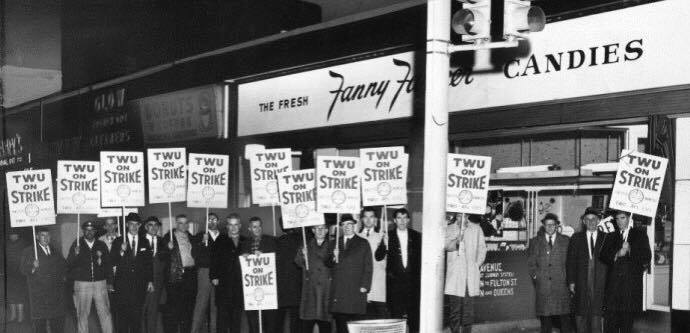
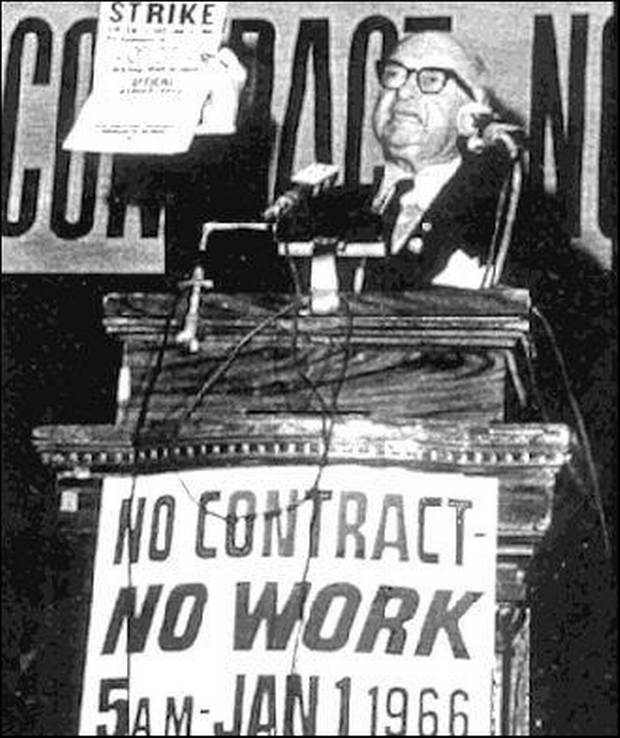
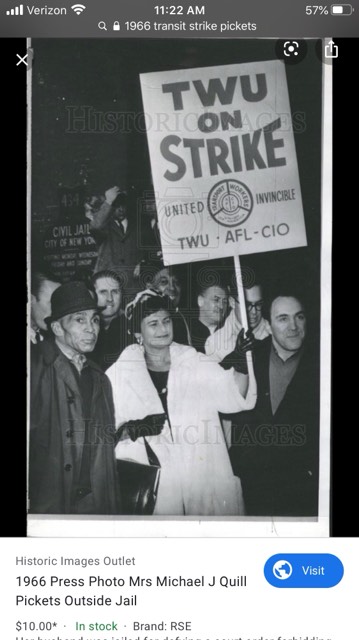
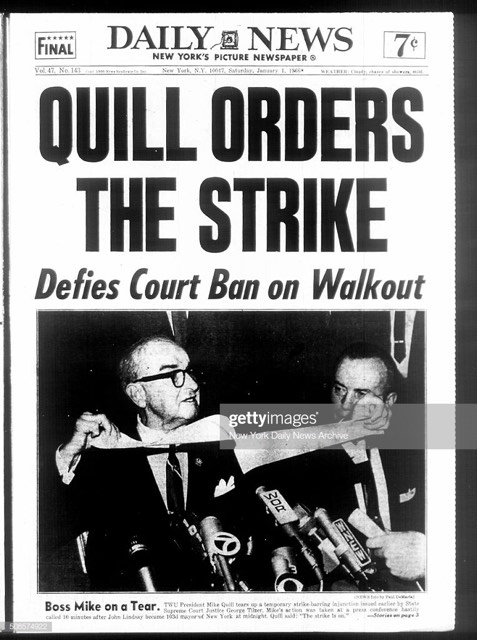
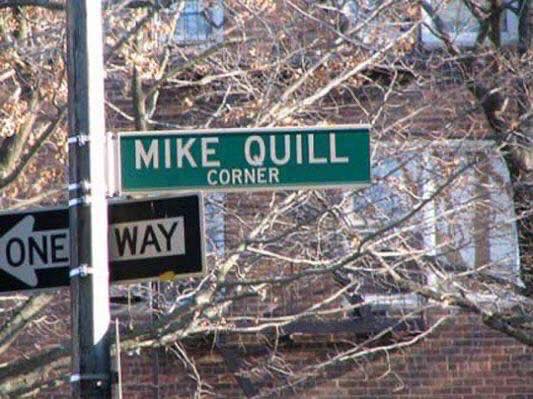
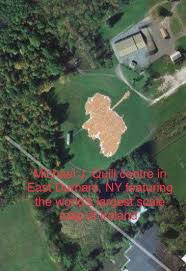
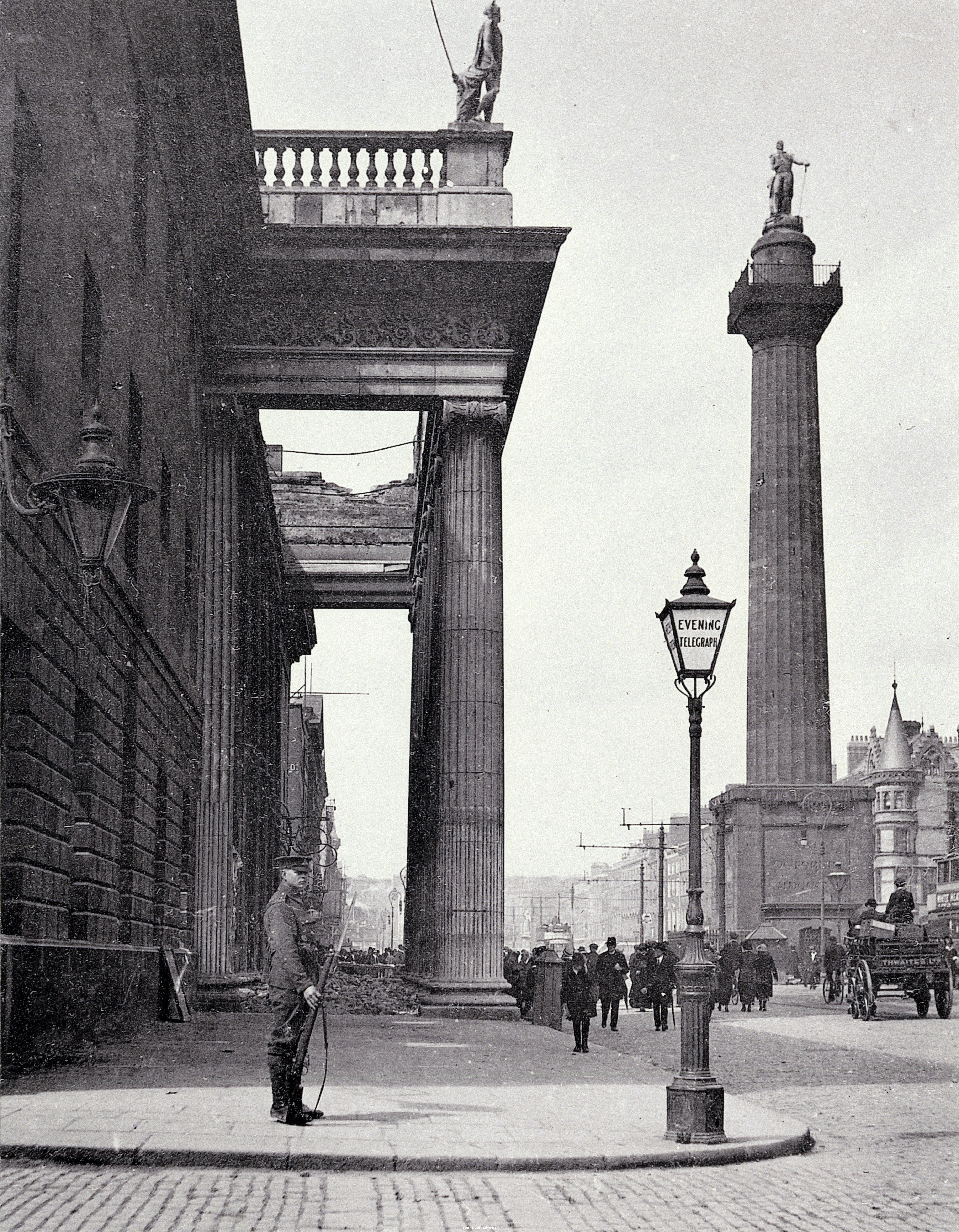
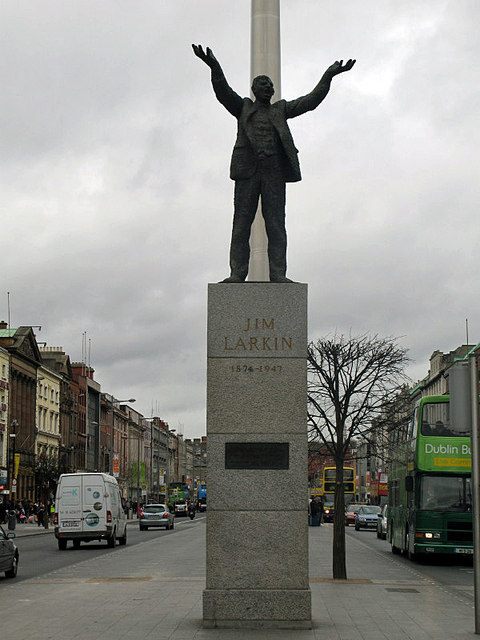
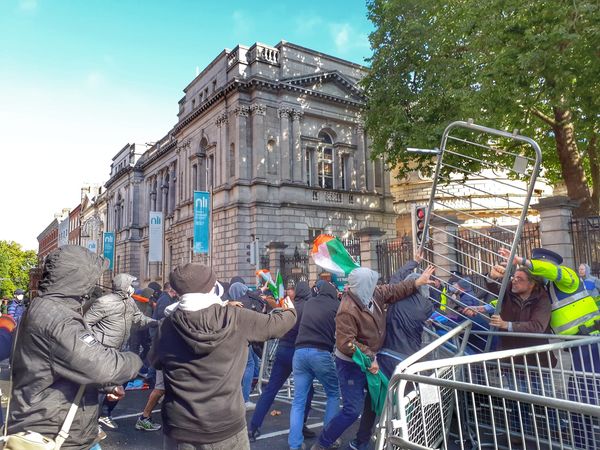
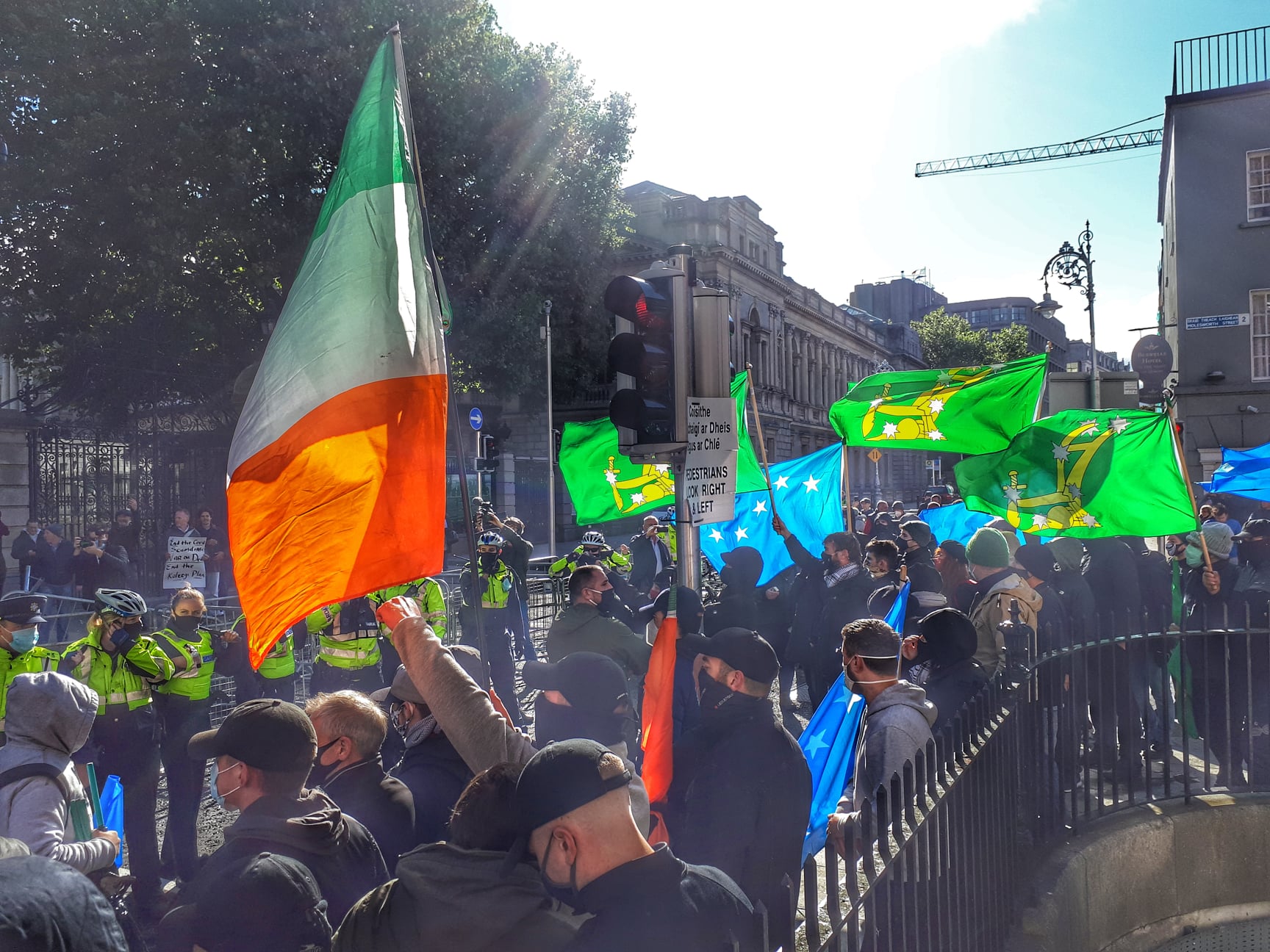
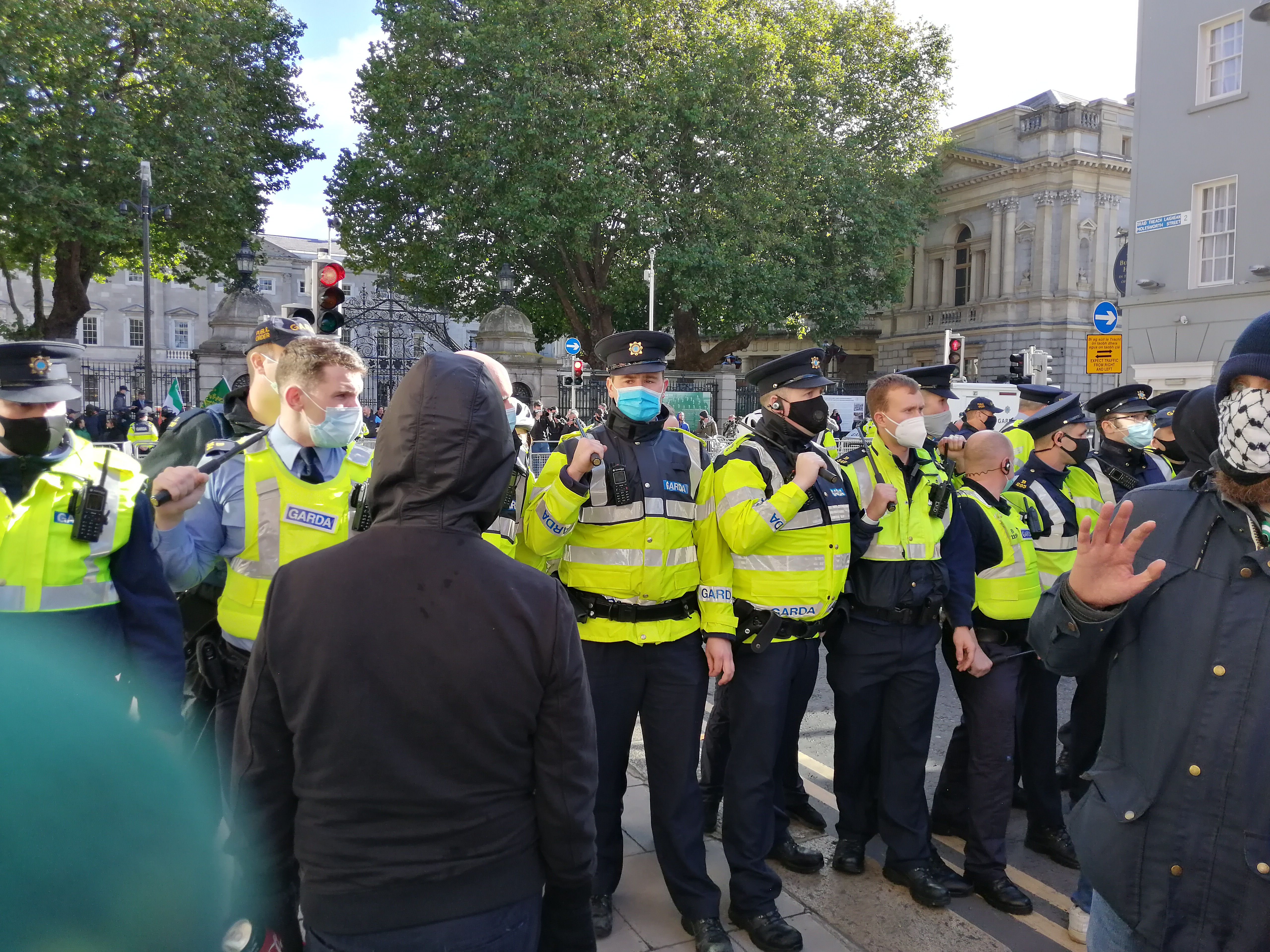
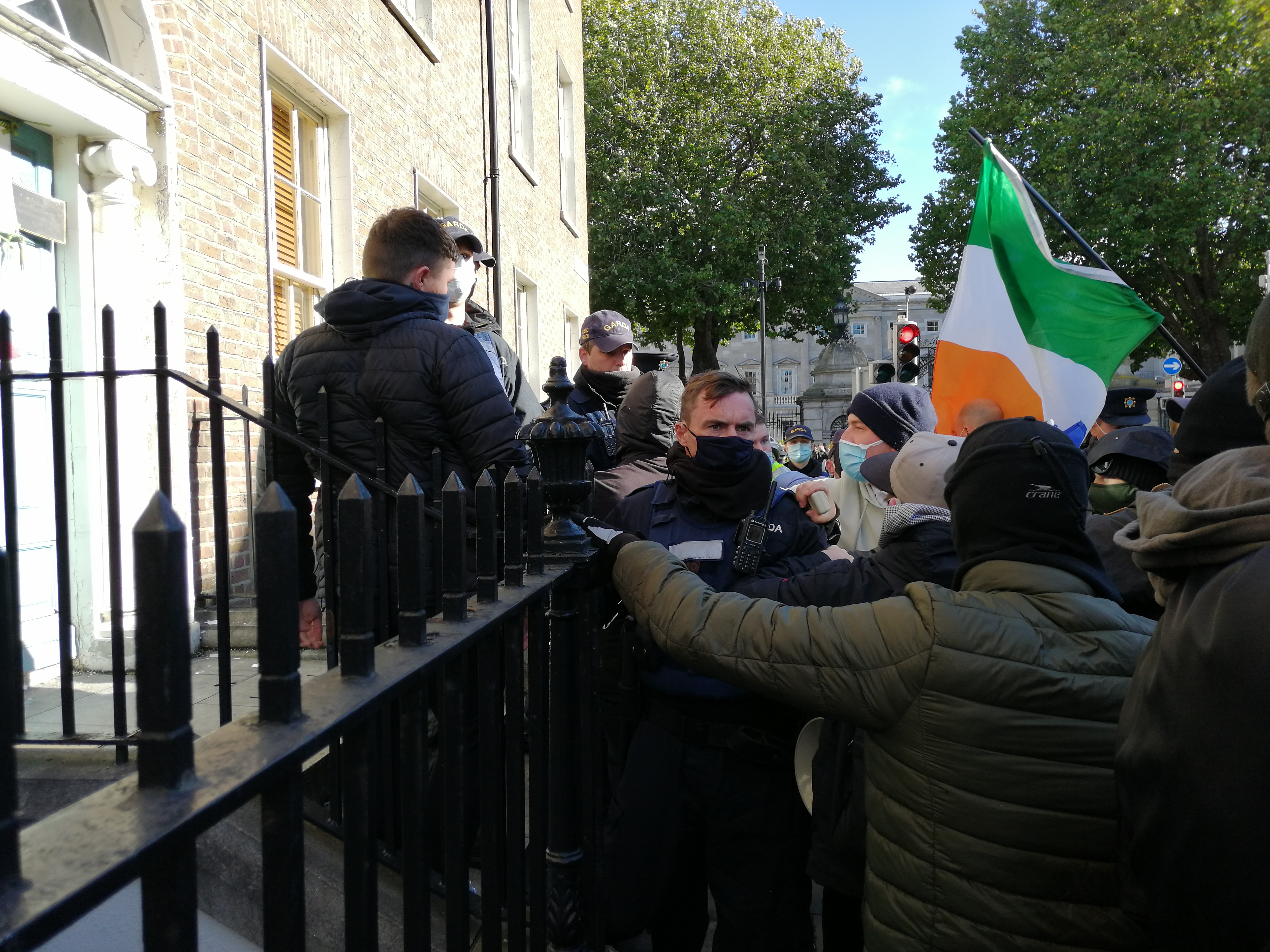
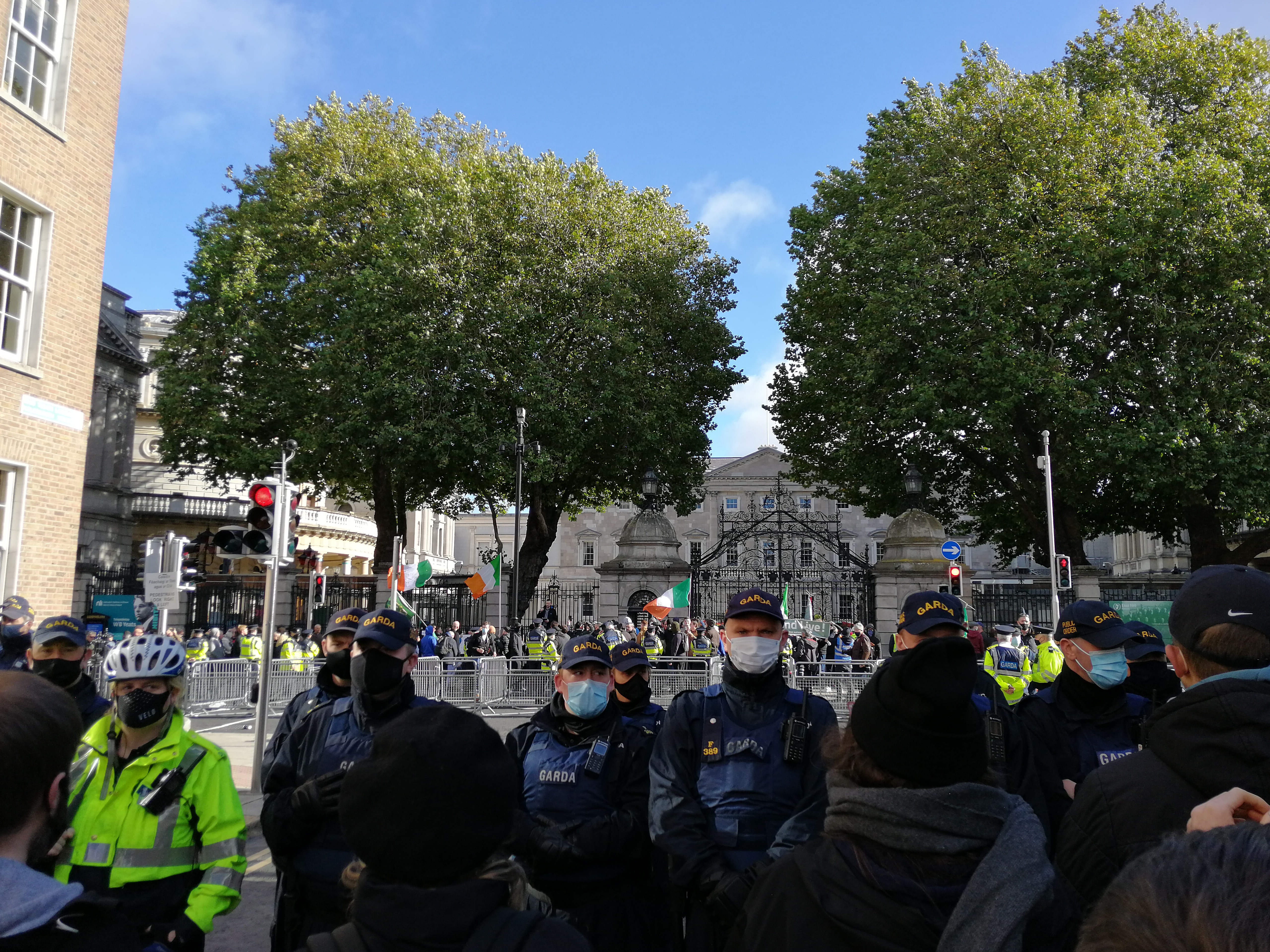
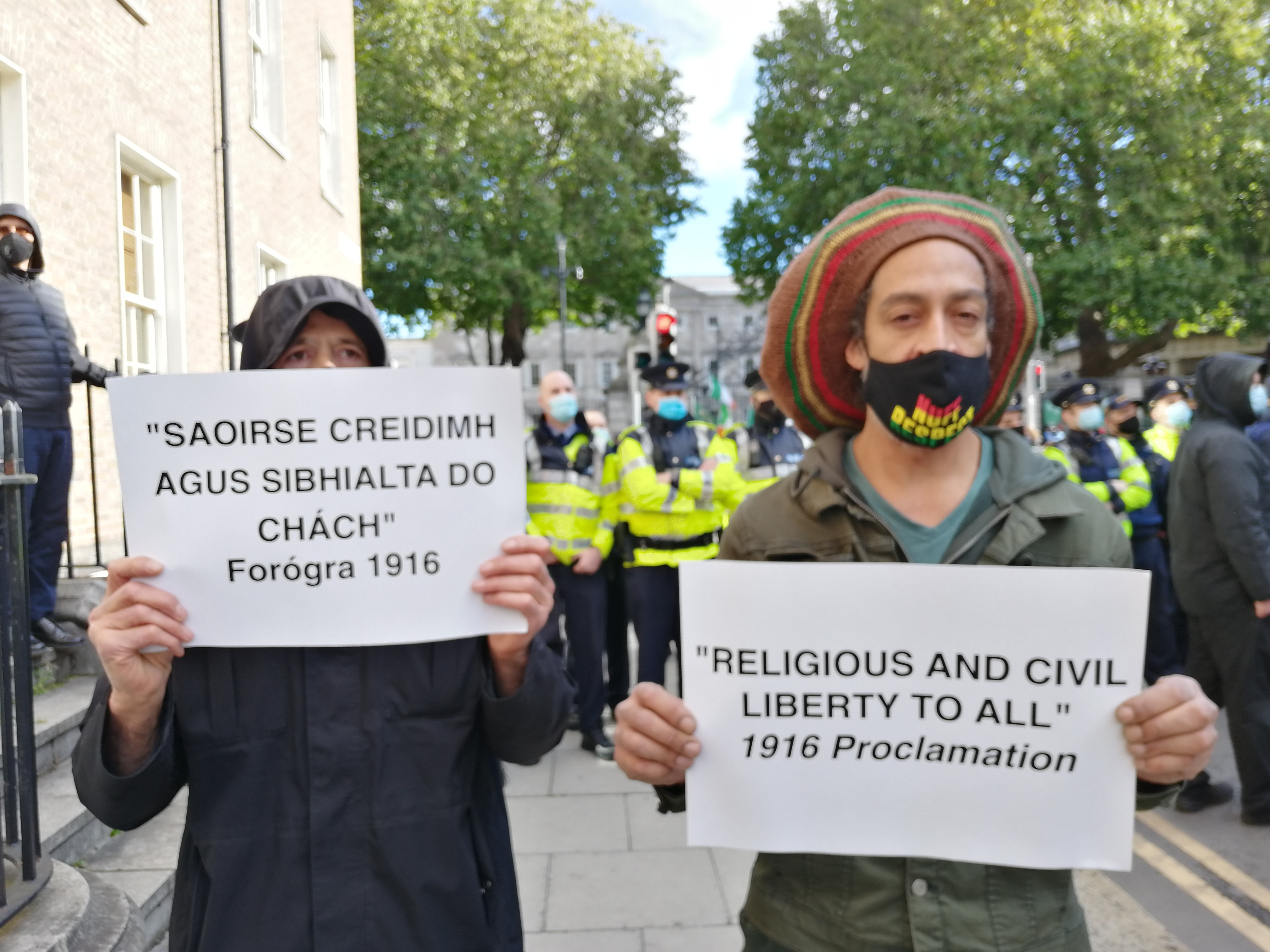

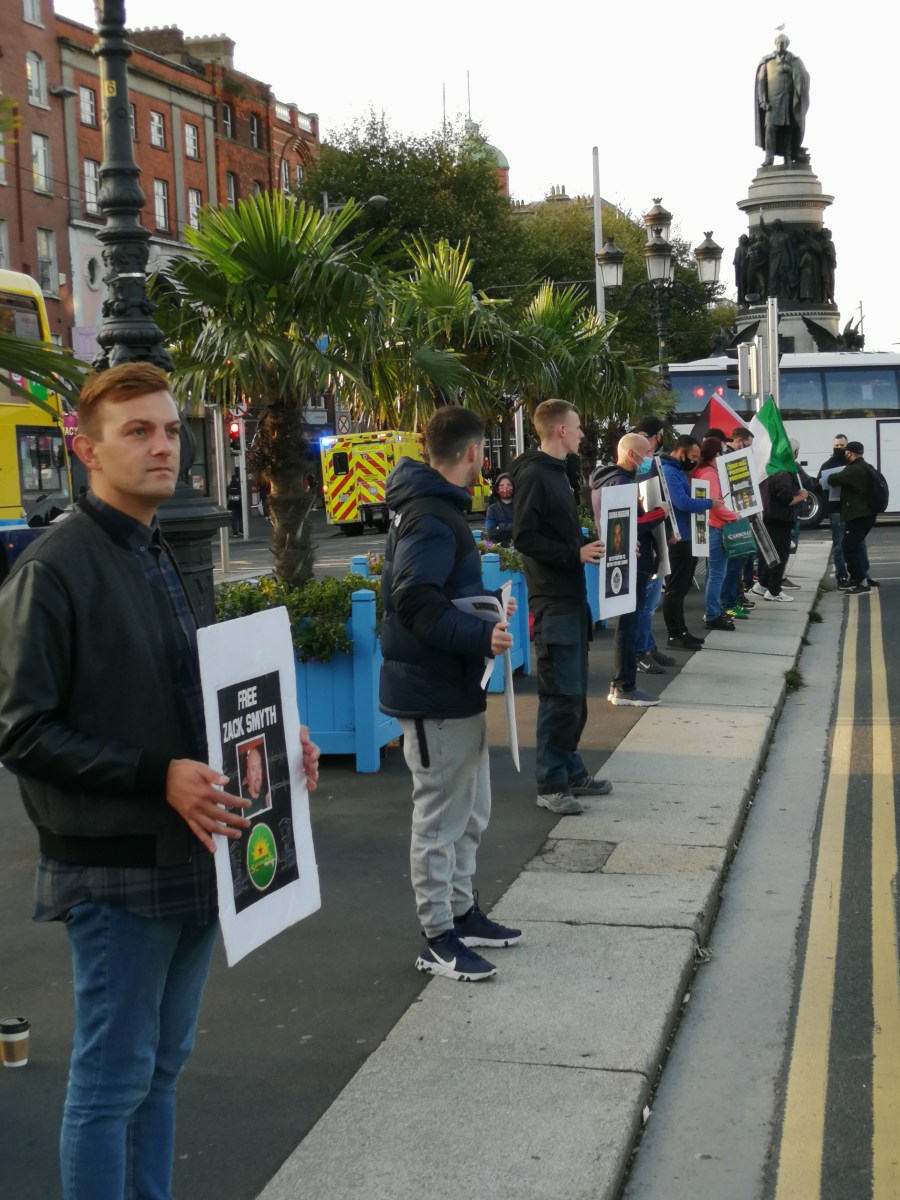
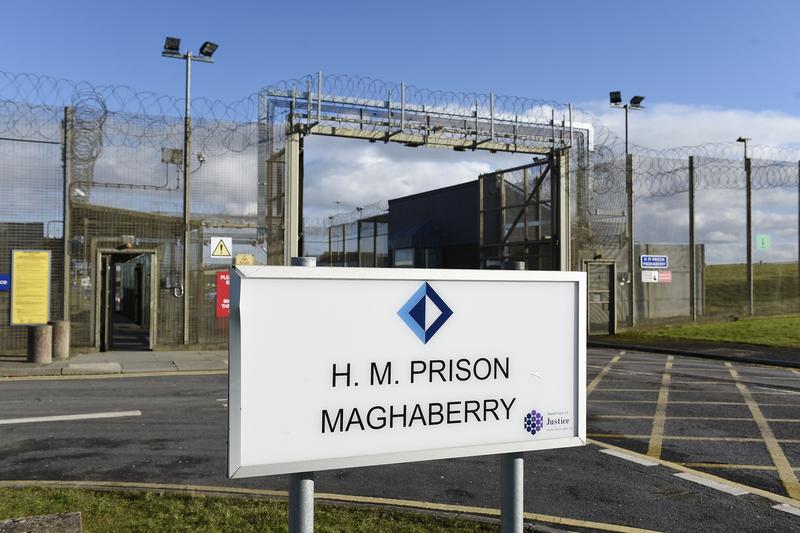
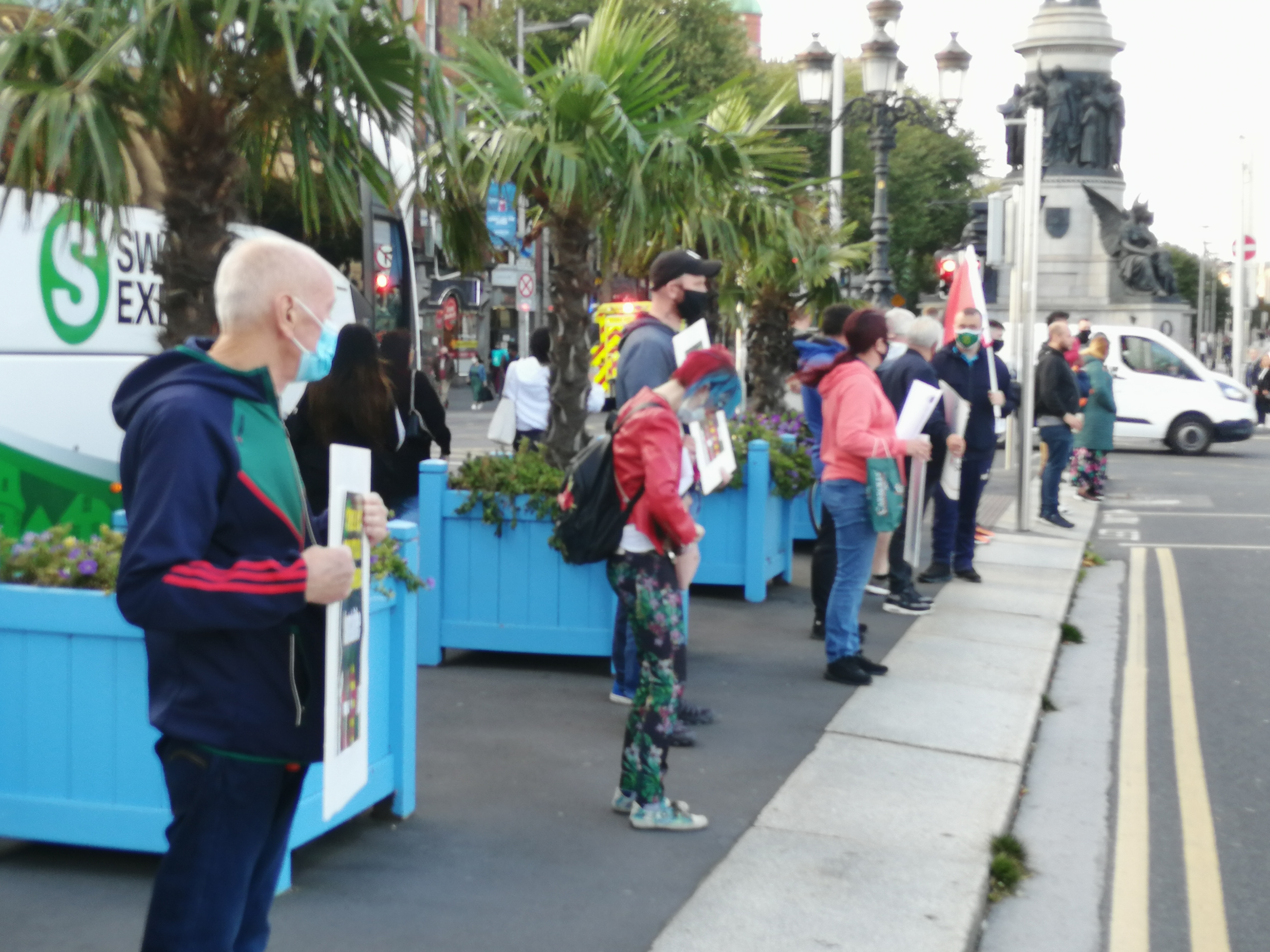
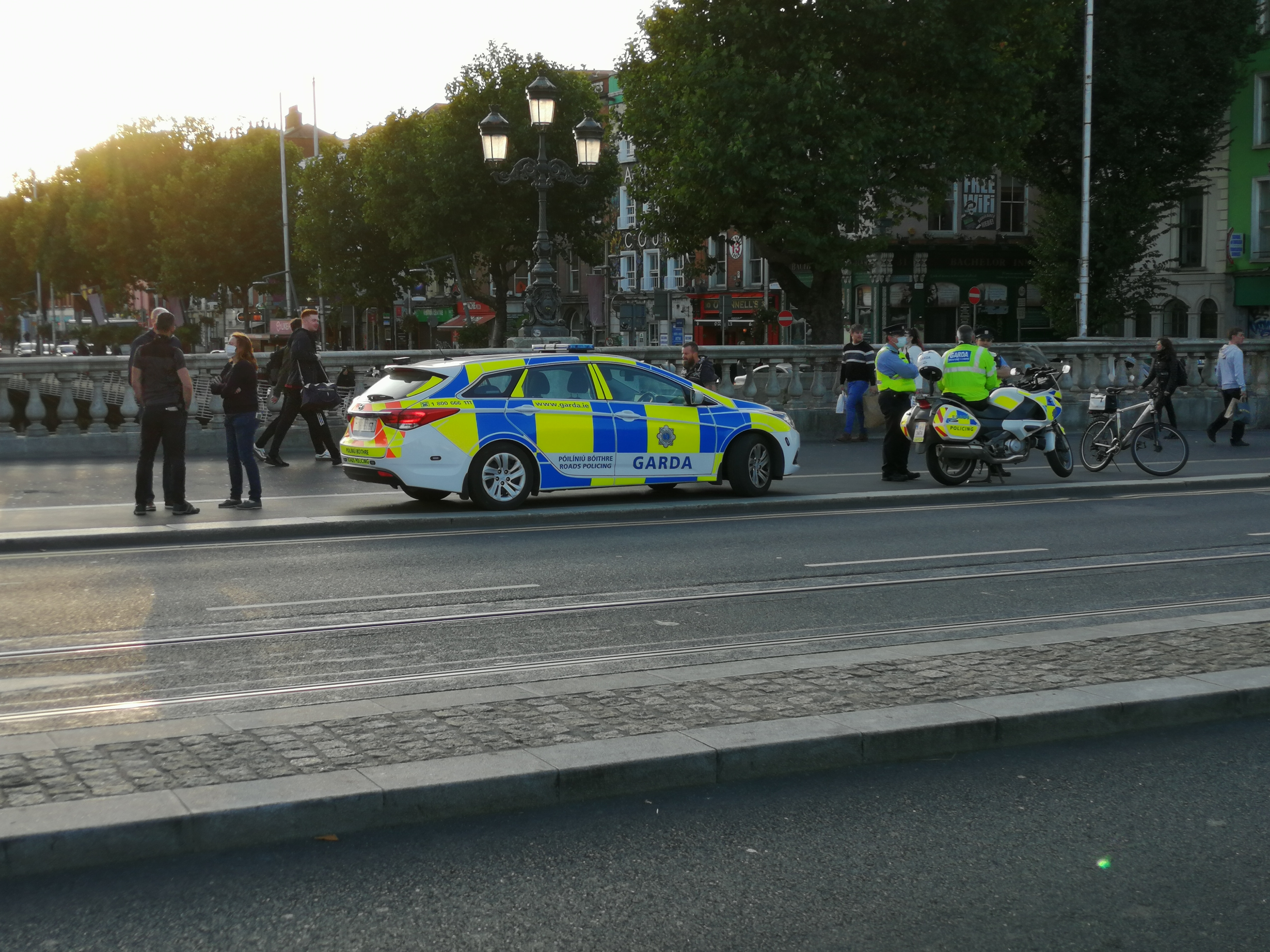
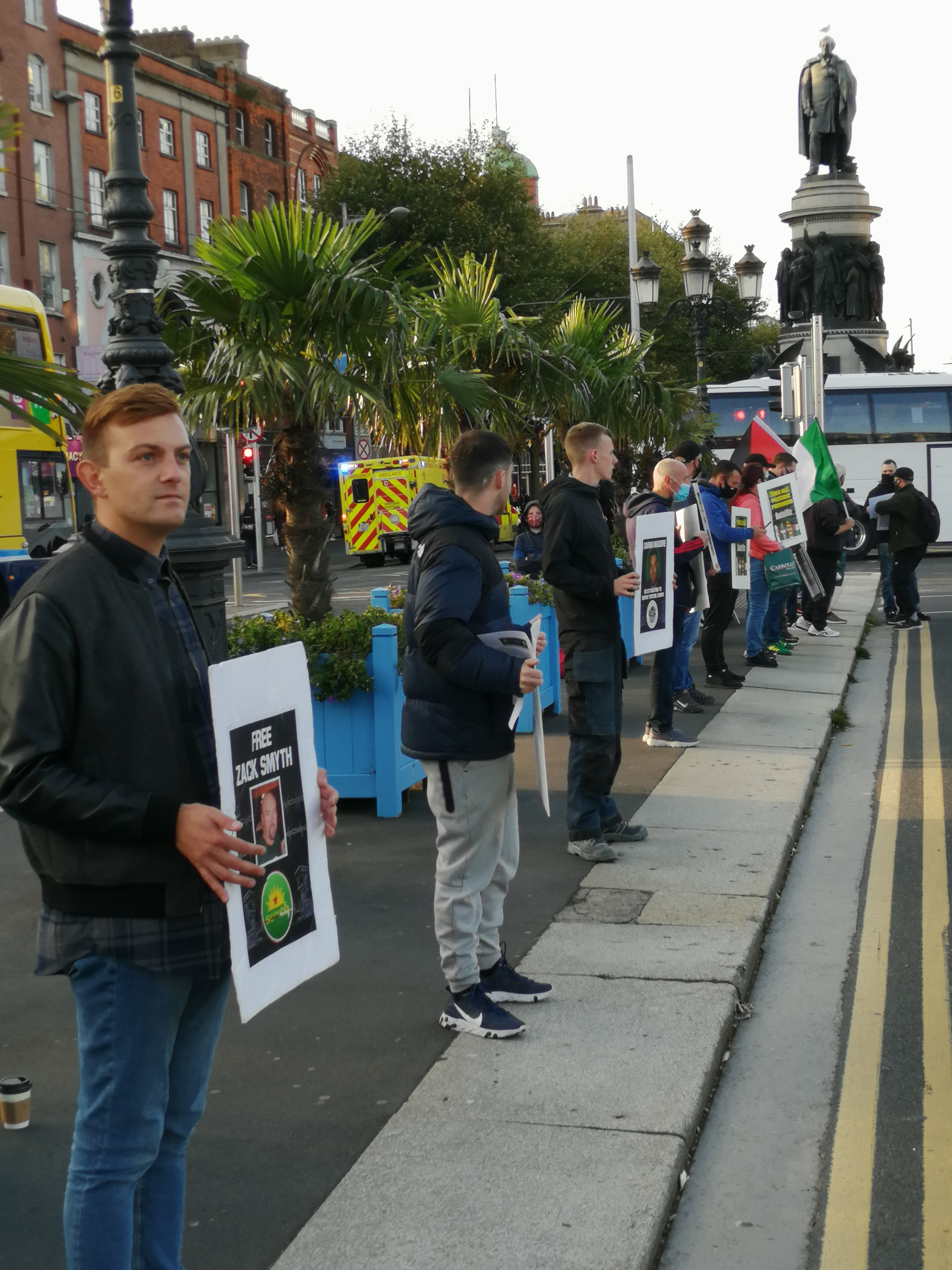
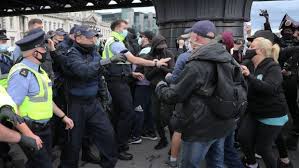

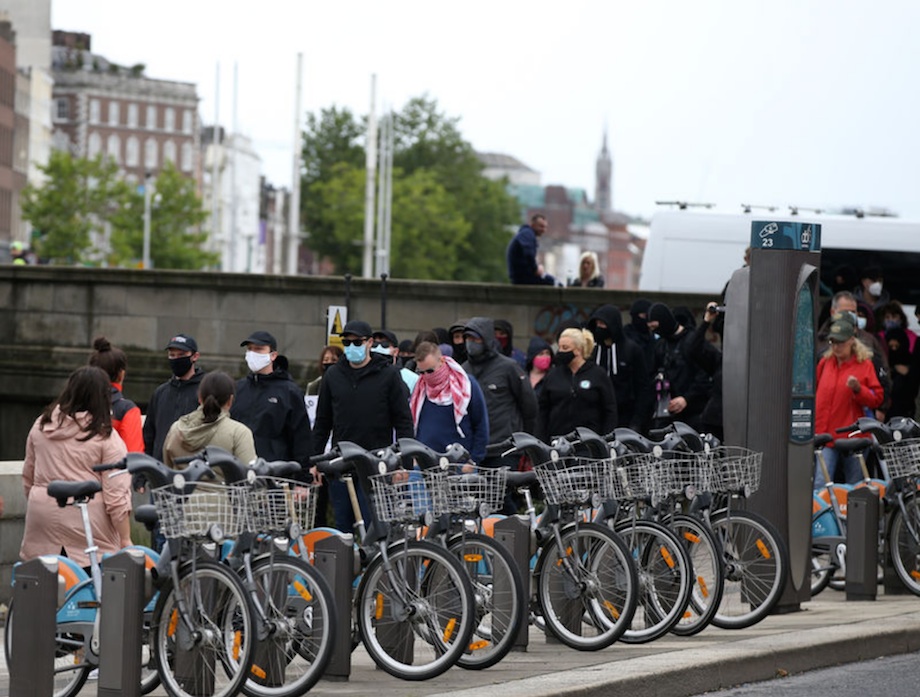


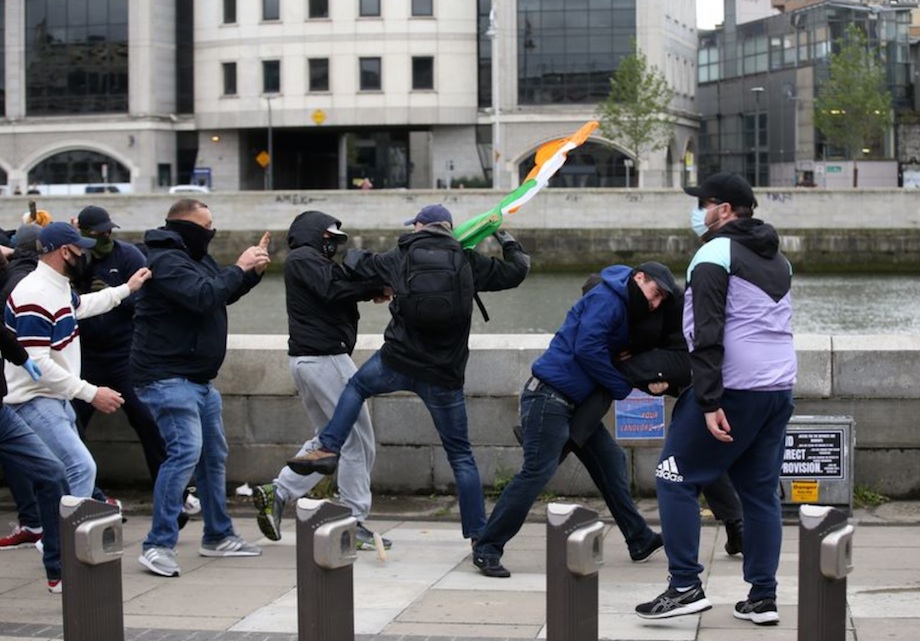
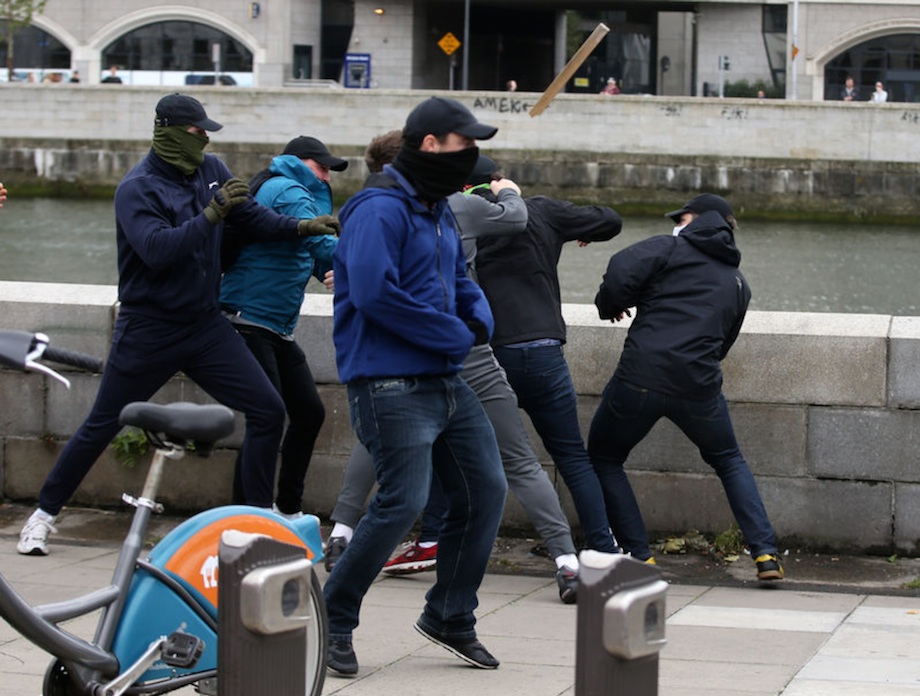
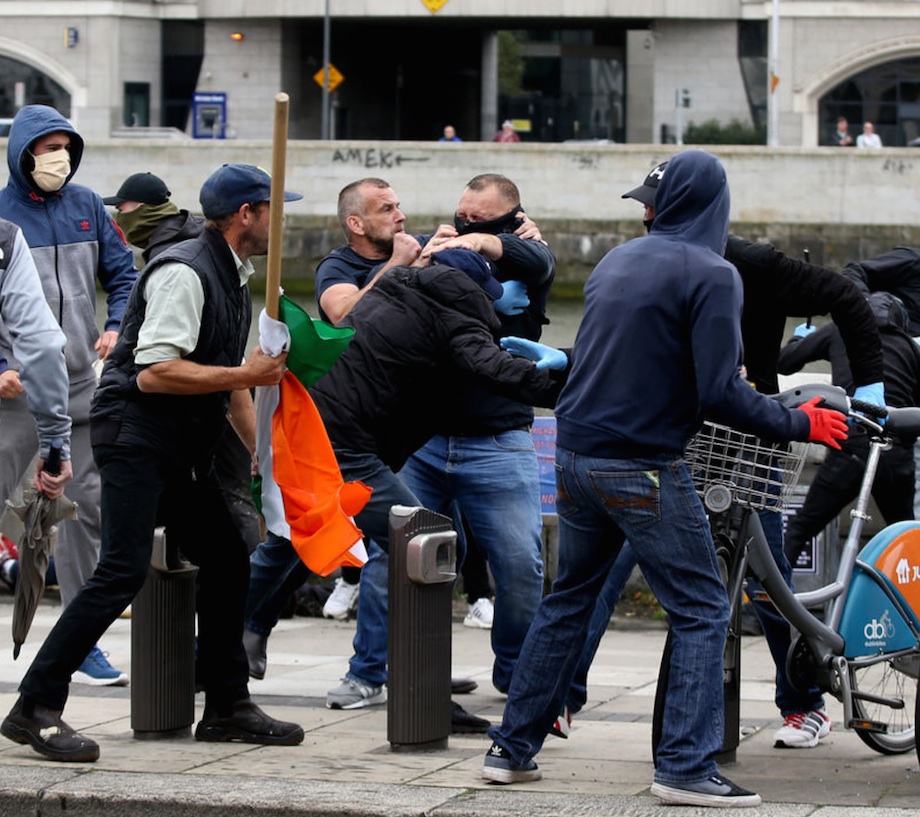
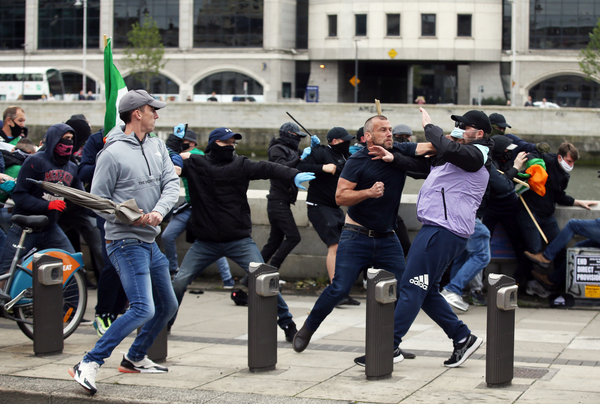

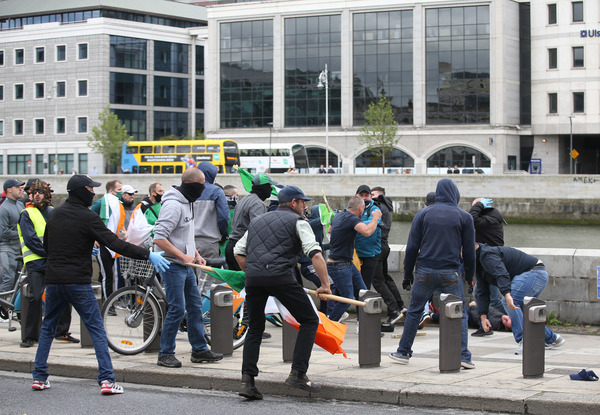

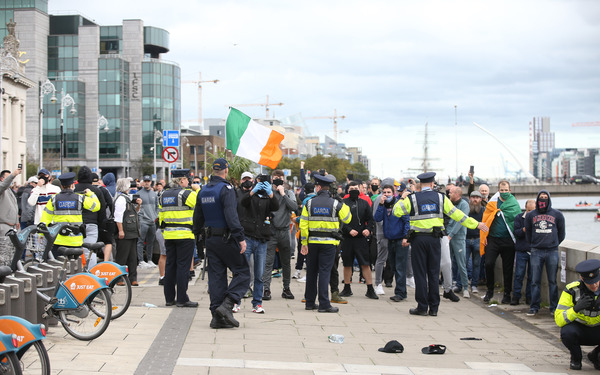
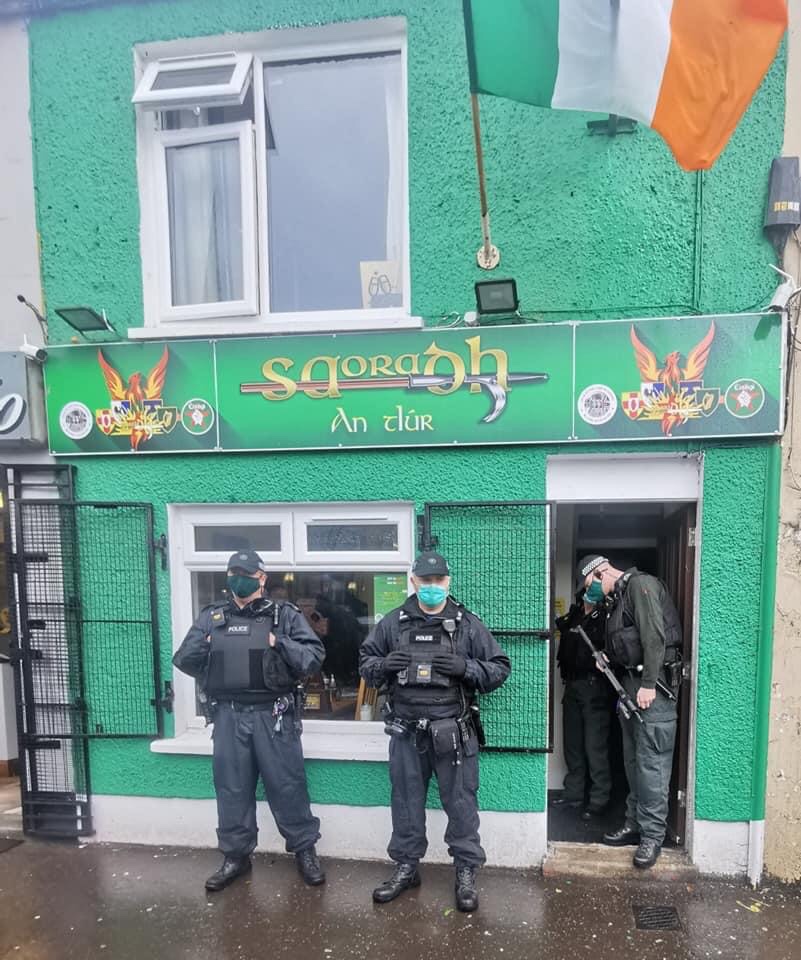




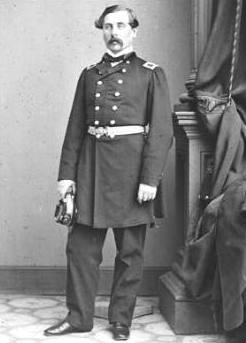


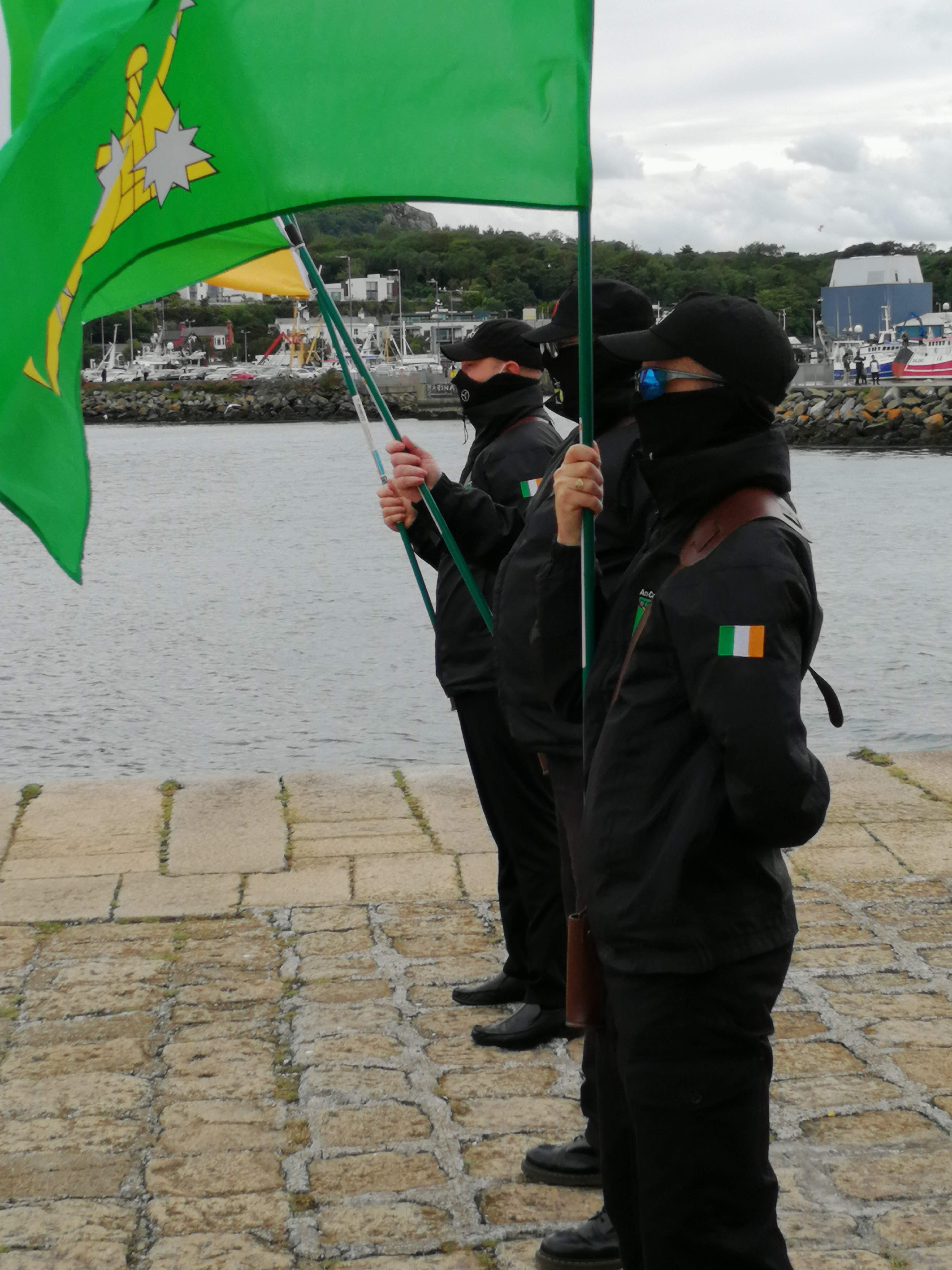

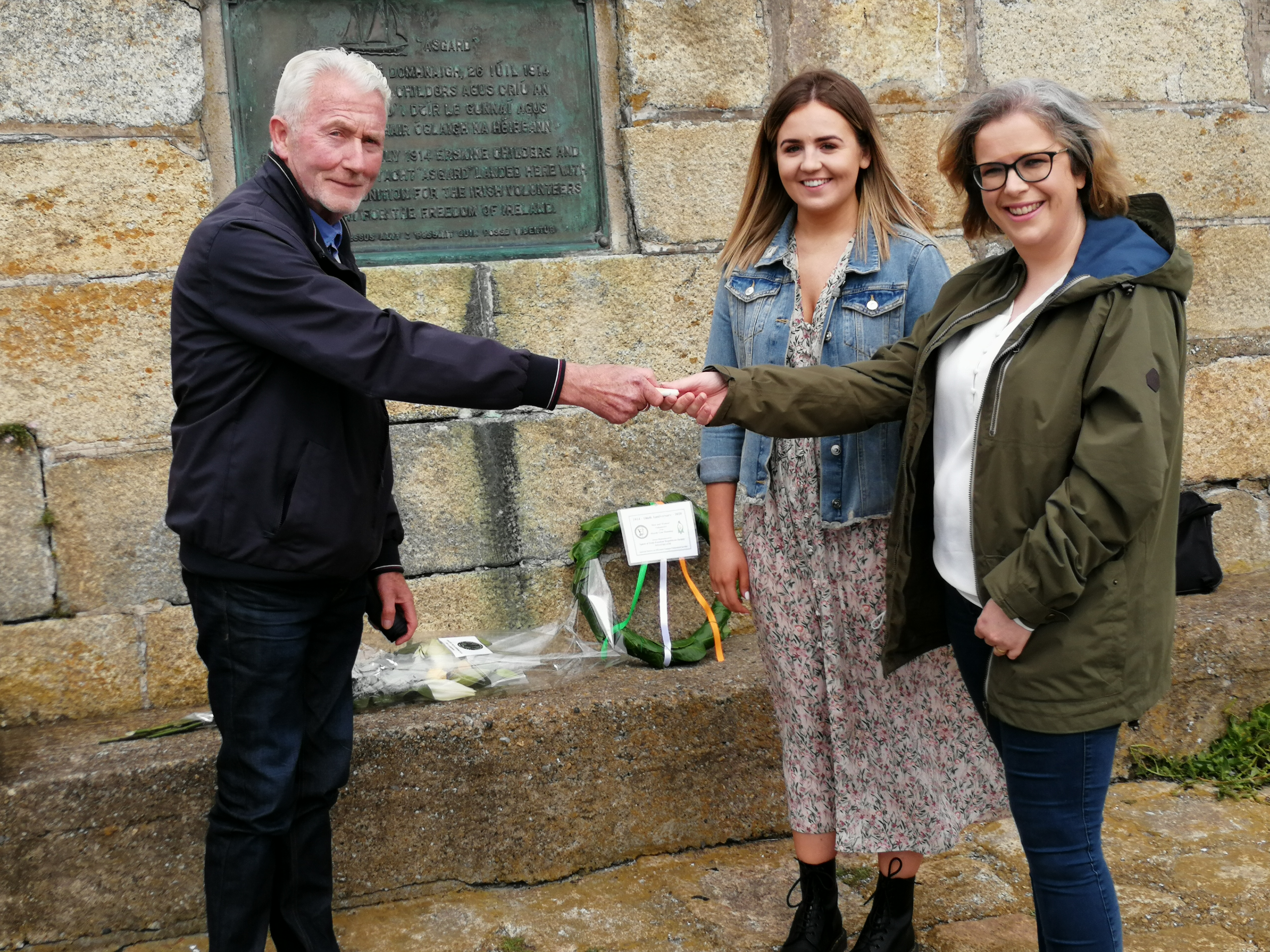

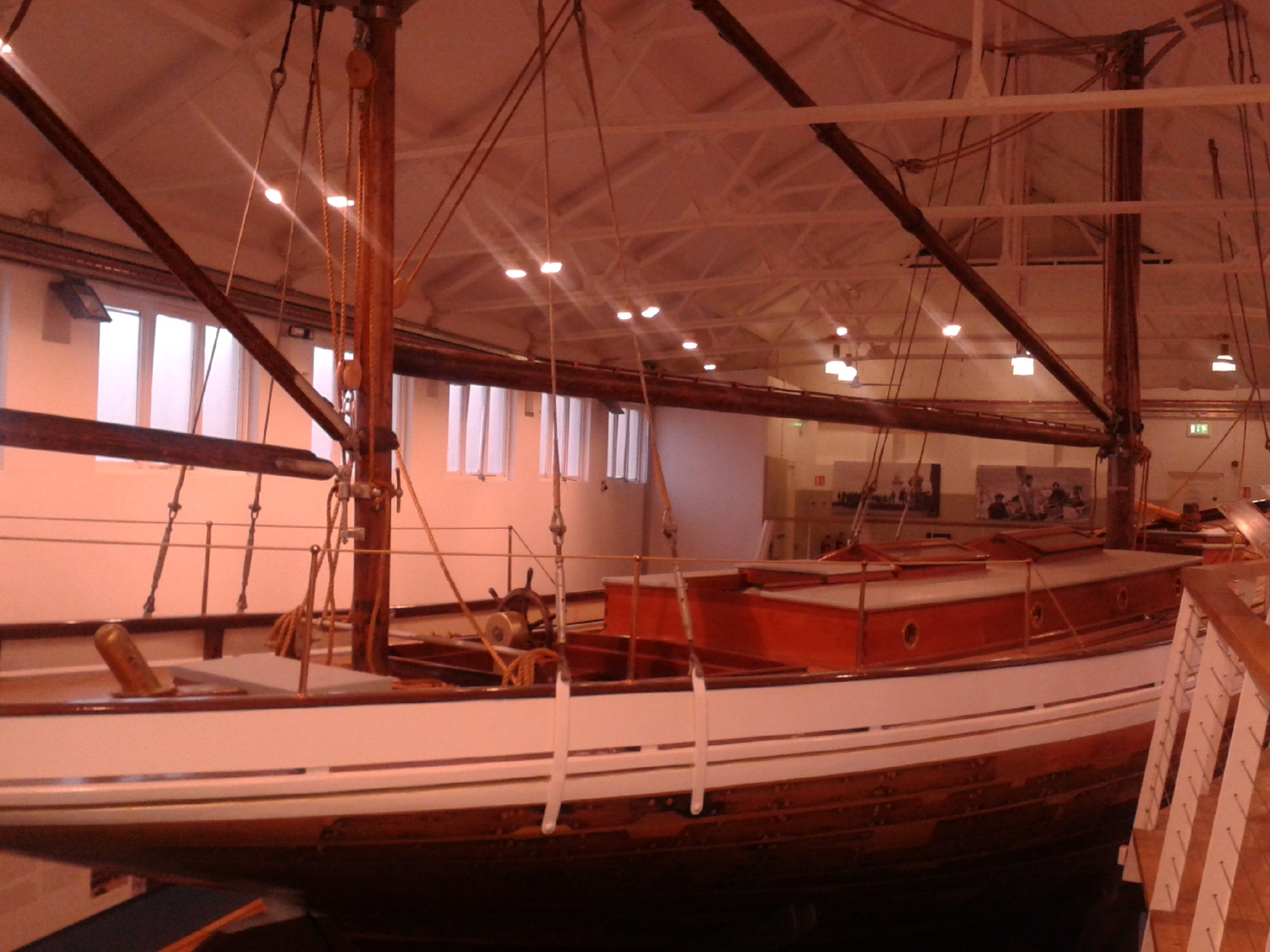
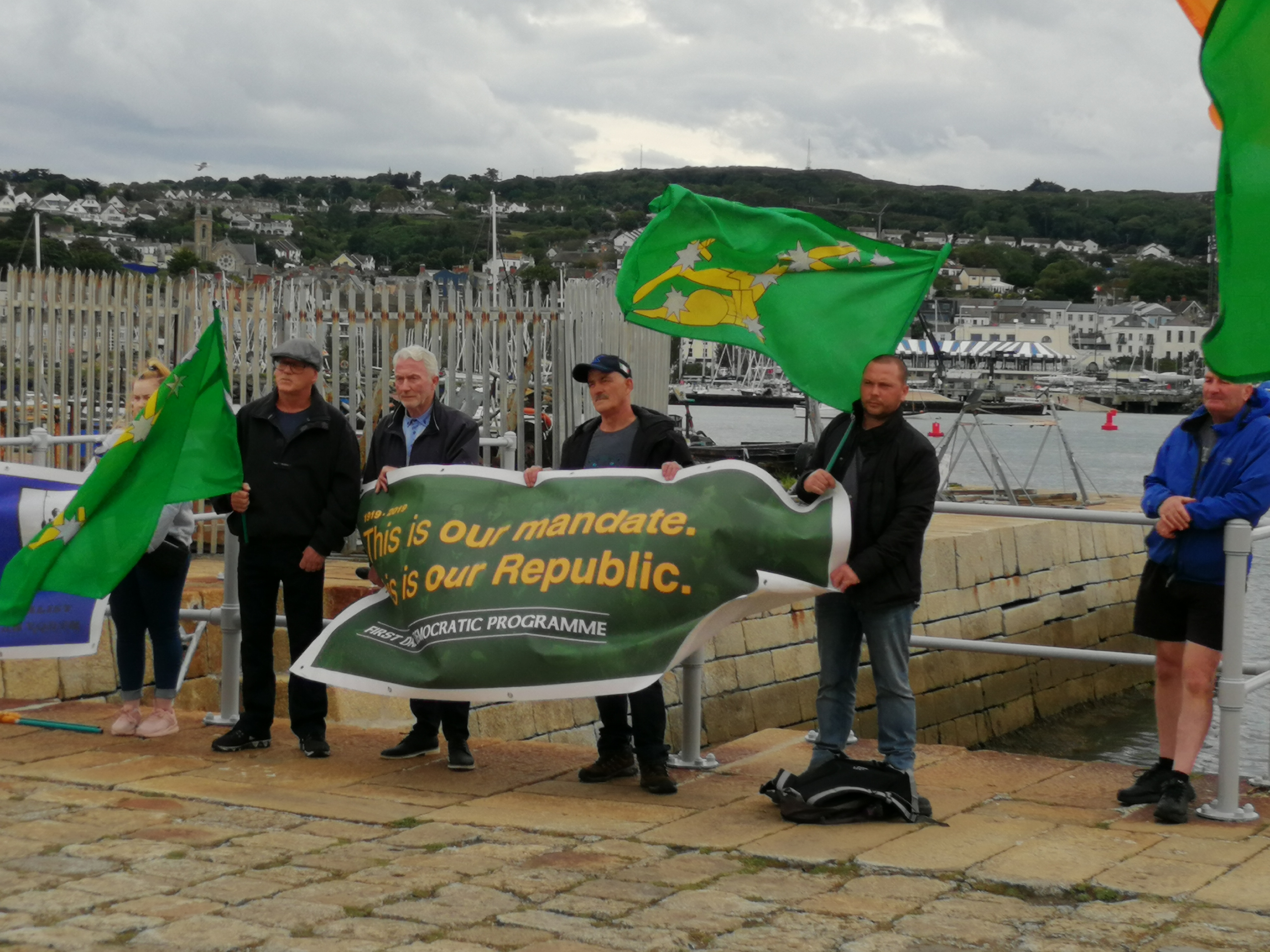
 rebelbreeze