THE TRUMP GAZA PLAN AND IRELAND PACIFICATION

Diarmuid Breatnach

(Reading time main text: 4mins.)

It was great to see the Irish pacification process being referenced with regard to the Trump plan for Gaza1 because that is exactly what the latter is: a plan to pacify the Resistance while ensuring it gets none of what it fought for.2

In other words, exactly like the Irish pacification process.
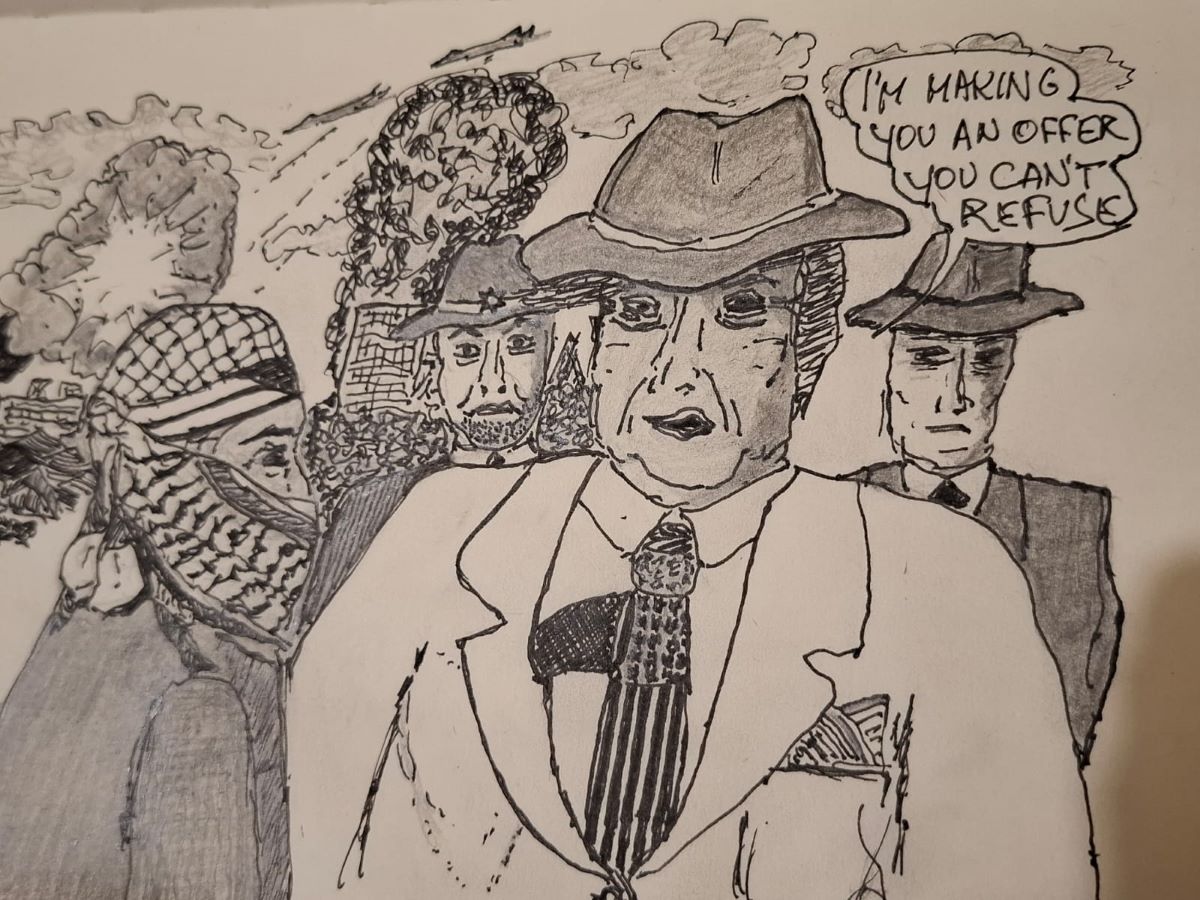
(Cartoon by D.Breatnach)

Hamas and Palestine Islamic Jihad grew out of previous Palestinian pacification processes. The Madrid Conference (1991) and the Oslo Agreement (1993) were imperialist/ Zionist attempts to pacify the wide-scale militant Palestinian resistance period of the First Intifada.3

Fatah at that time was the leading group in numbers and influence in the Palestine Liberation Organisation (from which Islamic groups were excluded) but also in Palestinian society in general. But Fatah had agreed to recognise ‘Israel’ and also the two-state solution (sic).

In the Oslo Agreement, furthermore, the question of the return to their homeland of the refugees was left aside. It appears that the Fatah leadership had lost faith in the eventual victory of their people’s struggle and had decided to get what they could by using the struggle to bargain.
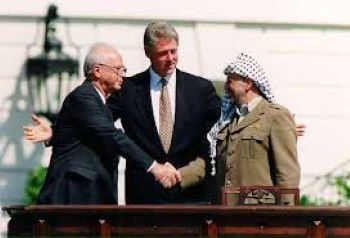
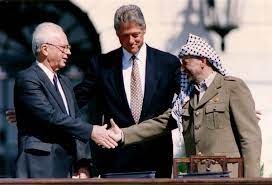
The Oslo Agreement: US Imperialism’s President Clinton oversees Yitzak Rabin, Premier of Zionist state of ‘Israel’ shaking hands with Yasser Arafat of Fatah, then leader of the PLO.

What Fatah got was Palestinian Authority control in the first elections (1996), with internal control over/ management of the Palestinian population of the West Bank and Gaza, but not of the Palestinians in Jerusalem (captured by ‘Israel’ in 1967): a far cry from a free Palestine.4

In the Algiers conference of 1988 Fatah had won majority agreement to recognise ‘Israel’ and to accept the two-state solution5 (sic), i.e. embodying a Palestinian state on 20% of Palestinian land, under the eyes and guns of their Zionist neighbour).

Fatah’s rule became known for corruption and nepotism, which then had to be protected and defended from the Palestinian masses, leading to authoritarian, repressive and often arbitrary rule. And repression of the Resistance, along with direct collusion with the ‘Israeli’ State.

Continuing ‘Israeli’ repression and settlement expansion in turn led to the Second Intifada; Fatah lost to Hamas in the Palestinian parliamentary elections of 2006 followed by defeat of Fatah’s attempted coup in Gaza in 2007 (but the West Bank remaining under unelected Fatah control).

Mahmoud Abbas of Fatah has refused to announce elections since, sitting in unelected control of the PA’s office in the West Bank, collecting the various international grants, presiding over corruption,6 repressing Palestinian resistance of deed or word and colluding with the ‘Israeli’ Occupation.
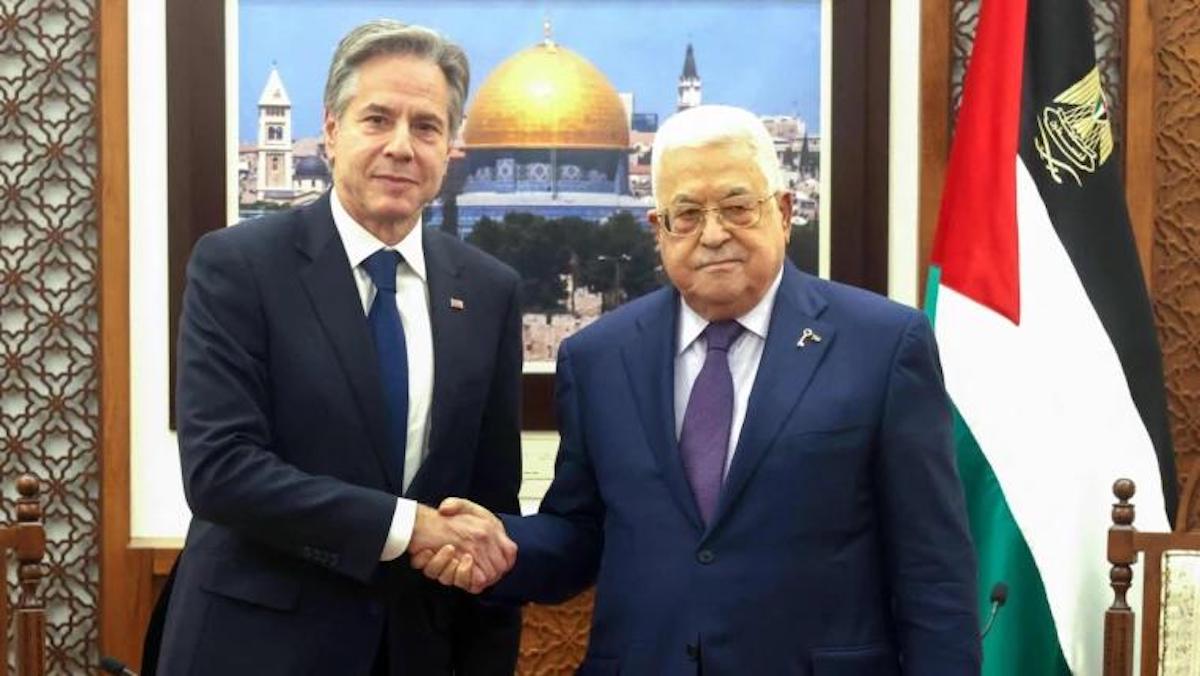
US Imperialism’s then Secretary of State Anthony Blinken and the PA’s Mahmoud Abbas in Palestine, soon after the start of the accelerated Zionist genocide in Gaza, December 2023

BUT WHAT ABOUT THE IRISH CONNECTION?

Starting with Palestine and South Africa in 1991, an imperialist pacification process spread to Ireland, Basque Country, Kurdish Turkey, Colombia, India, Philippines, Sri Lanka. With some variations the drive has been the same: to give up revolution and join the system.

One of the features of this process was the apparent need of a recognised leader to sell it to the resistance support base and to front it for the world: Arafat (Palestine), Mandela (S. Africa), Adams/McGuinness (Ireland), Ocalan (Turkish Kurdistan), Otegi (Basque Country).

The Provisional IRA was by far the major organisation in the Irish Republican resistance; it gave up armed struggle in return for vague promises and the release of its prisoners under licence.7 Another organisation complied also even as new ‘dissident’ fighters were being jailed.

Nearly 30 years after the signing of the Good Friday Agreement, Ireland is no nearer the Provisional IRA’s declared aims Irish reunification, independence and sovereignty. The Sinn Féin party helps run the colony8 and is attempting to become part of the neo-colony’s government.

Sinn Féin representatives Tina Black (Mayor of Belfast) and Michelle O’Neill, First Minister of the British colony, laying a wreath at the British War Memorial in Belfast, July 2022 (Cred: Liam McBurney/ PA Wire)

Neither the Spanish, French nor Turkish states were interested in other than crushing the Basque and Kurdish resistance and the corresponding movements disabled themselves without getting anything in exchange other than continued repression.9

The resistance movements in parts of India and Philippines continue to resist but in Sri Lanka was wiped out.10

One feature of the spread was the contagion-like way in which leaders of one infected resistance sought to entice others to follow suit: S. Africa and Palestine to Ireland; S. Africa and Ireland to Basque Country; Ireland to Colombia (where only the FARC but not the ELN accepted it).

In only one iteration of the pacification processes was there a partial achievement of the stated aims of the resistance: South Africa got national enfranchisement but the economy remained under imperialist extractive control and its working people under repression.11

In the course of giving up armed struggle, allegedly just changing the methods, the leaders gave up what they had fought for, the very reason for which they had first come into the struggle. Of course, they could still shout the slogans, just not make them real in any way.

The Irish version (and the Basque one) decommissioned their weapons, which makes it very relevant to the Trump Plan for the Palestinian Resistance, particularly Hamas and PIJ. No resistance movement should even discuss giving up their weapons until the defeat of the enemy.

(Image sourced: Internet)

It will be interesting to see what positions the former parties of Irish and Basque resistance, Sinn Féin and EH Bildu12 and their supporters take on this US/ ‘Israeli’ plan for the Palestinian Resistance.

One of the features of the pacification process was the apparent need of a recognised leader to sell it to the resistance support base and to front it to the world: Arafat (Palestine), Mandela (S. Africa), Adams/McGuinness (Ireland), Ocalan (Turkish Kurdistan), Otegi (Basque Country).

Who will the imperialists find to play this role in Palestine?13

End.

NB: If you found this article of interest, why not register with Rebel Breeze for free, so that you will be notified by email of subsequent articles. You can de-register any time you wish.

FOOTNOTES

SOURCES

Referencing the Irish pacification process in Gaza context: https://apnews.com/article/gaza-northern-ireland-peace-process

The Palestinian Authority: https://www.aljazeera.com/news/2023/10/11/what-is-the-palestinian-authority-and-how-is-it-viewed-by-palestinians

https://www.washingtoninstitute.org/policy-analysis/how-palestinian-authority-failed-its-people

1https://apnews.com/article/gaza-northern-ireland-peace-process

2Trump 20-point plan: https://www.bbc.com/news/articles

3https://en.wikipedia.org/wiki/First_Intifada

4“This mirrors Israel’s post-Oslo approach to the occupied West Bank in pacifying the population through economic incentives, avoiding political concessions, and entrenching structural dependence. This model, often dubbed “economic peace,” has transformed the Palestinian Authority (PA) into a subcontractor of occupation – flush with foreign funds, but powerless to deliver sovereignty.” https://thecradle.co/articles-id/34757

5https://ejil.org/pdfs/1/1/1136.pdf

6Which is why the imperialists and their servants keep alluding to the need for a “reformed Palestinian Authority” e.g. https://israelpolicyforum.org/blueprint-for-reforming-the-palestinian-authority

7Those released under licence could be returned to jail (and a number were) at the decision of the Secretary of State for Northern Ireland without trial, hearing or details of why the individual was considered to be ‘a threat to public safety.’

8Its representative, Michelle O’Neill, is currently First Minister of the colony’s government. In the Irish State, the party has 33 TDs (MPs), only two behind the party with next largest representation, Fianna Fáil. They Party has abandoned its opposition to the repressive legislation of the State, welcomed British Royal visits to both parts of Ireland, supports recruitment to the colonial gendarmerie and its leader refused to rule out coalition with the neo-colonial political parties of membership of the British Commonwealth. https://www.thejournal.ie/mar-lou-mcdonald-commonwealth-4561600-Mar2019/

9The Basque leadership abandoned armed struggle unilaterally at the time without gaining even the end of dispersal of their jailed fighters throughout the state. The Turkish Kurdish PKK tried to make progress through political electoral means only under continuing repression. But their Syrian version of armed Kurdish forces got a new lease of life with the vulnerability of the Assad regime in Syria but ended up as a NATO proxy in the latter’s war for regime change. The PKK in Turkey very recently agreed to disarm while their Syrian part remains in difficult relationship with the new (formerly ISIS) regime in Syria and some other ISIS elements under Turkish influence.

10https://www.vice.com/en/article/death-of-a-tiger-0000710-v22n8/

11See The Marikana Massacre of striking miners by the ANC Government’s police.

12Both parties support the Two-State proposal for Palestine.

13Some liberal and social-democratic sections seem to have fixed on Marwan Marghouti in this role, which of course is no reason not to support his release on human rights grounds. https://www.youtube.com/watch?v=q6IgjlHaaIs
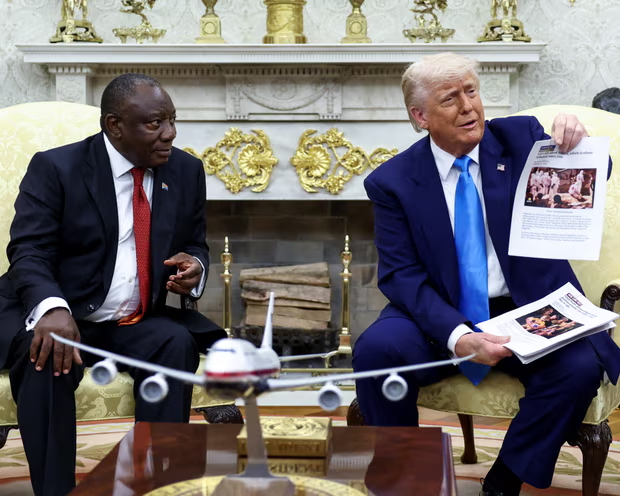
Trump, Ramaphosa and White Power

Gearóid Ó Loingsigh (reprinted intact from his substack and reformatted for Rebel Breeze)

(Reading time: 5 mins.)

Once more Trump has acted like the lunatic he is and ambushed the president of South Africa, Cyril Ramaphosa, stating that the country was undergoing a real genocide of whites.

Many have commented on the effrontery of Trump to talk of a fictitious genocide of whites in South Africa, whilst his main ally Israel is carrying out one in real time every day on the news shows.

Trump used images from the Democratic Republic of Congo, a country more than 4,500 kilometres away, to show that they were killing whites in South Africa.

Trump also lied about the land question in the country, accusing the government of stealing the whites’ lands when the reality is that the whites continue to be the owners of the greatest part of the land in the country.

It is worth saying that Ramaphosa defended himself partially, and only partially as behind the new legislation on the matter there is the hidden failure of the peace process when it comes to resolving the land question.

When the Apartheid regime was ended, the country was one of the most unequal on the planet and the whites were the owners of the greatest part of the agricultural lands. Around 60,000 whites were the owners of 86% of all the agricultural lands, some 82 million hectares.[1] 

The agrarian reform proposed by the ANC in its White Paper of 1997 was a market-driven reform, i.e. the voluntary sale and purchase with some help from the government without the government being a buyer.[2] Blacks could also ask for the restitution of lands stolen by racist laws since 1913.

A whole land bureaucracy was set up, not unlike what Colombia has, Land Claims Courts where all those who registered could make their case with three possible outcomes, the restitution of the land, the handover of alternative land or a financial compensation.

In 1992, the ANC had put forward a document in which they argued for the expropriation of lands and other non-land market mechanisms. But by 1997 they had accepted neoliberal discourse and adopted the land market as the cornerstone of their policy.[3]

Initially the ANC government had proposed handing over 30% of the agricultural lands held by whites to blacks within five years. But they kept postponing it.

By March 2011, they had handed over 6.27 million hectares, and of that 45% was not agrarian reform, properly speaking, but rather land restitution.[4] The government didn’t just fail regarding land, but on everything. Inequality rose since the fall of Apartheid.

The Gini[5] rose following the end of Apartheid in 1994 and now is situated in 0,67 making it the most unequal country on the planet in terms of income, where just 3,500 people own 15% of all the wealth of the country.[6] 

SA President Ramaphosa looks on while US President ambushes him publicly with alleged ‘evidence’ of persecution of white people in S. Africa (Photo cred: Kevin Lamarque Reuters)

There is also a high concentration of land. “Currently 72% of farms and agricultural holdings are owned by white individuals, who make up 7.3% of the population, while black Africans, constituting 81.4% of the population, own only 4% of the land.”[7]

The whites continue to be the owners of the land, the black middle class through Black Economic Empowerment programmes reached agreements with those whites and the companies in the agricultural sector to integrate themselves into the neoliberal economy.

This is the so-called ‘white capitalism’ and South Africa became a leading country in the agribusiness sector of the continent. In 2015, of the 10 largest agribusiness companies on the continent, eight were South African.[8]

Ramaphosa himself is an excellent example of the new South African businessmen, the former fighters against capitalism who now profit from the blood and sweat of those who were once the grassroots militants of the organisations they led.

Between 1994 and 1998 he acquired a portfolio of more than 40 million Rand[9] (some 8 million dollars at the time) and ended up as an extremely wealthy man (some 700 million dollars) thanks to his controversial investments and acquisitions in the mining sector.

Ramaphosa is also the owner of the McDonalds franchise in the country. The former leader of the National Union of Mineworkers became a magnate in the sector.

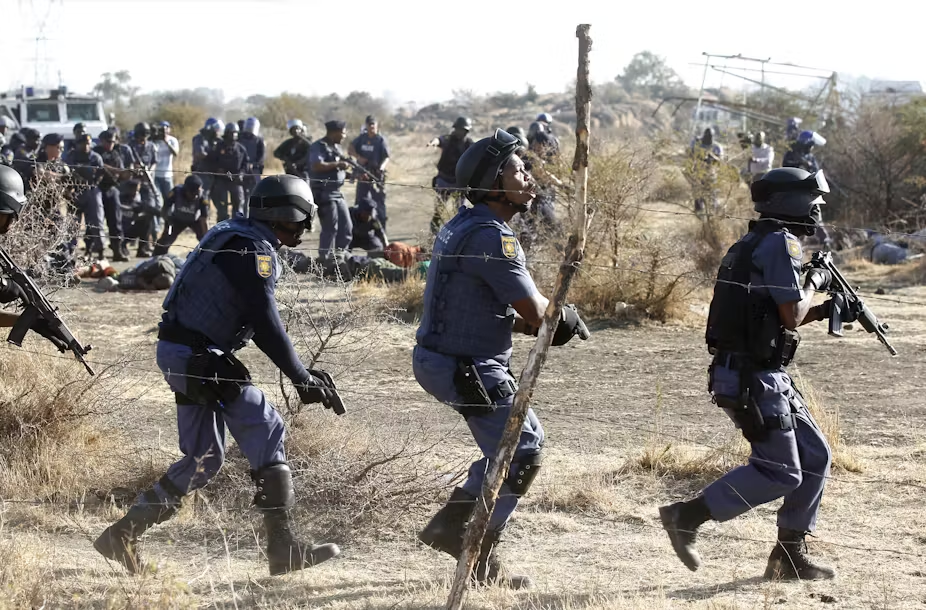
In 2013 the Police murdered 34 miners in the midst of a strike at Lonmin, one of the companies where he was a director, being the owner of 9.1% of the company. [10] 

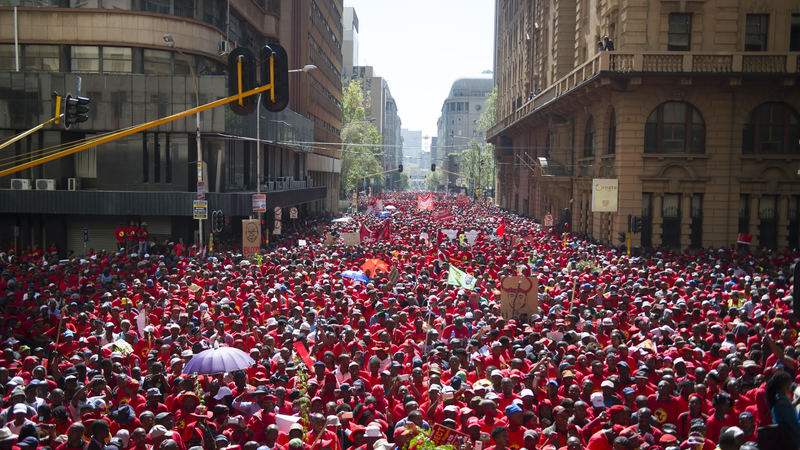
South African police move forward to kill more striking miners at Lonmin 2012 while in background other police stand over miners killed already(Photo cred: Sephiwe Lebeko/ Reuters)

And just like in the times of Apartheid, the Farlam Commission, those charged with investigating the Marikana Massacre found nobody guilty. Nobody! Blood is washed from the hands of a black capitalist just as easy from those of a white capitalist.

When he took over the presidency of the country, there hadn’t been any great advances made regarding agrarian reform there. The failure to meet the promises of the transition and the political programme of the ANC cost them electoral support.

So much so that they now govern the black masses with the support of a white party, the Democratic Alliance, a right-wing party that strongly opposes any expropriation of land without compensation and in practice is opposed to any great change in land policy.

It is in this context that Ramaphosa launched his new campaign and new land law. The ANC say they want to implement the Freedom Charter, but it is not so. Mandela himself had discounted that in his speech to Davos.[11] 

He didn’t explicitly refer to the document but he never again spoke of the nationalisation of resources such as mines and land.

Ramaphosa’s law proposes various measures that already exist in almost all capitalist countries, the expropriation of property with compensation for public purposes or where there is a public interest i.e. the compulsory purchase or as they say in the USA, the heart of capitalism, eminent domain.

These norms exist in almost the entire world. As is the case in many capitalist countries, it also includes elements to reduce the amount of compensation or not pay it.

It is another thing to believe that Ramaphosa aims to do what the ANC never wanted to since the first government. He does not want to fight with so-called white capitalism as he knows that so-called black capitalism is the same thing and one depends on the other.

What Ramaphosa is about is a public relations manoeuvre to strengthen a weakened and discredited ANC. There will almost certainly be more such initiatives. But the ghosts of Marikana tell us that this traitor has no intention of doing anything for the black masses.

Trump talks of a genocide that only exists in the sick mind of Elon Musk and of a land theft that Ramaphosa does not want. If he steals the whites’ lands, who will he sip cognac with then? White power is still in control of South Africa.

It dominates the economy in alliance with the not so new black bourgeoisie, the black apparatchiks that control the scaffolding of the state, and the growing presence of foreign capital.

We all recognise Trump as the enemy and idiot that he is. The problem is that sometimes we acknowledge those he attacks as friends when in reality they are the same enemies, except some are more intelligent, cultured and refined.

Ramaphosa when he was a trade union leader said “There is no such thing as the liberal bourgeois. They are all the same. They use fascist methods to destroy workers’ lives.”[12]

Workers’ blood is washed from the hands of all the capitalists, blacks, whites, Russians, Arabs or Yanks: Ramaphosa in Marikana or Trump everywhere. The whites in South Africa, the Elon Musks have no reason to fear their friend Ramaphosa, despite the stupidities from Trump.

End.

NB: For more articles by Gearóid see https://gearoidloingsigh.substack.com

NOTES

[1] Lahiff, E. & Li, G. (2012) Land Redistribution in South Africa: A Critical Review. WB.p.3 https://openknowledge.worldbank.org/server/api/core/bitstreams/28ccc35a-31cd-58ba8d0e-1b65b74b275c/content

[2] Ibíd., p.5

[3] Ibíd., p.8

[4] Ibíd., p.9

[5] The Gini is a measure of inequality where 0 = absolute equality and 1 = absolute inequality.

[6] Valodia, I (2023) South Africa can’t crack the inequality curse. Why and what can be done. https://actsa.org/the-facts-land-reform-in-south-africa/

[7] Actsa (19/02/2025) The Facts: Land Reform in South Africa. https://actsa.org/the-facts-land-reform-in-south-africa/

[8] See ACB (2015) Africa an El Dorado for South Africa’s Agribusiness Giants. https://safsc.org.za/wp-content/uploads/2015/09/SA-Agribusiness.pdf

[9] Bond, Patrick (2000) Elite Transition: From Apartheid to Neoliberalism in South Africa, London & South Africa, Pluto Press and UNP, End Note No. 7, Chapter 2 page 266.

[10] The documentary Miners Shot Down can be seen at https://www.youtube.com/watch

[11] See https://www.weforum.org/stories/2013/12/nelson-mandelas-address-to-davos-1992/

[12] Cited in Miners Shot Down.

PKK FINALLY SWALLOWS THE PACIFICATION PILL

Diarmuid Breatnach

(Reading time: 4 mins.)

The Kurdish group, the PKK announced on Monday that it has disbanded its armed organisation of the last nearly 50 years.1 The change was carried out on instruction or request of their leader Abdullah Ocalan who’s been in a Turkish jail since 1999.

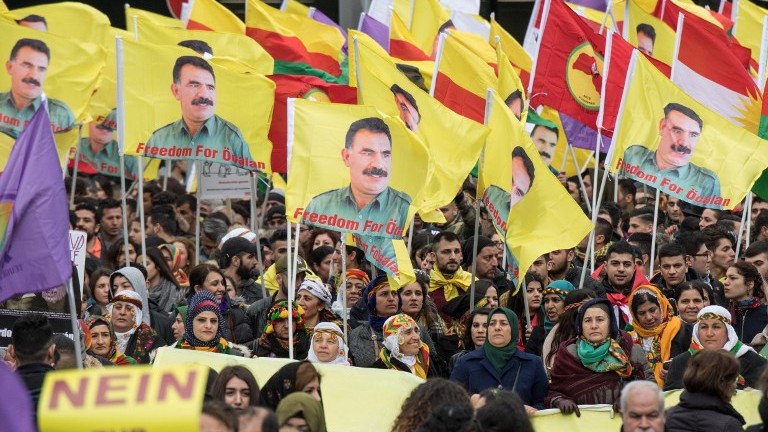
Supporters in Dusseldorf November last year defy German ban to demonstrate and call for release from Turkish jail of Abdullah Ocalan, leader of the PKK (Photo credit: AP)

The marxist-leninist PKK set up its armed organisation in 1978 to resist the Turkish state repression of the Kurdish independence movement. The Kurdish area is of huge strategic importance, encompassing parts of what are now Turkey, Iraq, Syria, Iran and Azerbaijan.

The population of Kurdistan is estimated at between 30 and 45 million, with up to another two million in its diaspora. The PKK waged armed struggle in Turkey until 1999 then again as the YPG and SDF in Syria, against the Assad regime and against ISIS.

PERSONAL CONNECTION

I was for a time in London myself active in solidarity with the Kurdish national liberation struggle and, as a result, part of a trade union delegation to Turkish Kurdistan around 1991/92, organised through a Kurdish community centre in North London.

The trade union activists participating were required to raise the money for the flights from their union organisations and I was successful in obtaining the necessary funds through the Lewisham Nalgo/ Unison local government branch and through the Nalgo/ Unison Irish Workers Group.2

Our delegation flew to Istanbul and from there to Batman province where the driver, supplied by the Petro-Is trade union took the three of us and our interpreter and photographer to many parts in the region, including to the border with Syria and seeing the oil being smuggled across the Iraq border.

Evidence of the ongoing war between the PKK and the Turkish State was plentiful, including Turkish gendarmerie checkpoints, bullet-riddled walls in towns and a shell hole in the wall of my bedroom in one hotel in which we stayed.

Much worse was the visit to an outlying village house burned by German flame-throwing tank of the Turkish Army and viewing the photos of the children immolated inside.

Turkish secret police visited our driver’s house while he was away, commented to staff of one hotel that we were not tourists (declaring ourselves a trade union delegation would have been asking for trouble) and on our last day kept driving past us and even followed us on to the plane.

Even then I was very concerned at what seemed to me like near deification of Ocalan. Years later, in Bilbao as part of a panel of speakers on national liberation struggles, off the platform the speakers on the Irish, Palestinian and Kurdish resistance discussed issues in the liberation movements.

The Palestinian and I became concerned by the almost violent agreement of the Kurd with everything that Ocalan did or said. We had to abandon all attempts to discuss and debate with him.

PACIFICATION PROCESSES

Pacification processes of various types have been around for centuries but a particular wave of them began to be deployed in the early 1990s, starting with South Africa and Palestine,3 then spreading to Ireland, the Basque Country and Colombia, each affected subject infecting in turn the next.

Typically the subject was told they had to disarm and disband their armed organisation, after which they would be accepted into the system and could organise politically for admission to the ruling political circles through the standard electoral process.

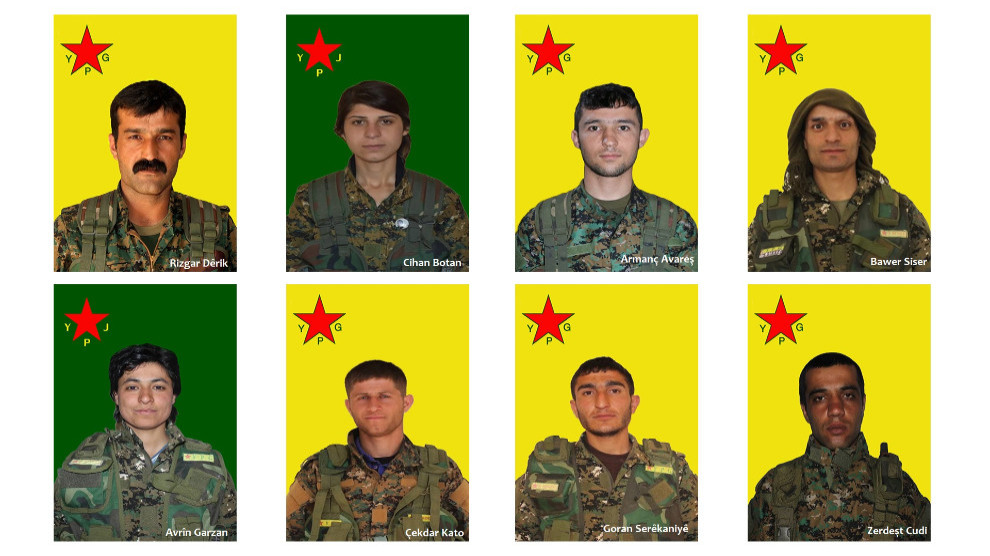
Portraits of eight martyrs of the YPG announced fallen in battle in Afrin against ISIS (note two are female) December 2019 (Source: YPG media)

Of course each subject would have to renounce even the idea of armed struggle or revolution. And would be required to control their own fighters and denounce their dissidents.

It is somewhat surprising that it has taken this long for imperialism to land the PKK fish since Ocalan swallowed the baited hook back in the late 1990s. The war in Syria I suppose extended their armed organisation’s life for a while beyond that which it would have had if confined to Turkey alone.

But their role in Syria in the YPG, whether it began as an independent Kurdish national liberation struggle or not, soon degenerated into leading a US/NATO proxy force, the SDF.4

This March the SDF agreed to integrate into the imperialist proxies’ army of ISIS types led by Ahmad al Shaara (i.e the ‘former’ ISIS leader Jolani), currently being embraced by imperialist leaders while his forces continue to carry out sectarian murders of Syrian Alawites and Druzes.

More recent reports have them, while agreeing to disarmament in Turkey, refusing it in Syria, which makes sense from a self-preservation stance alone, given the nature of the new state’s forces.

We can imagine the imperialist-driven virtual “Pacification Express” in the late 1990s and early 2000s, as it left South Africa and Oslo-Palestine, calling on Ireland and from there to the Basque Country and outward bound to Colombia. Turkish Kurdistan was one of the planned stops.

In not one of the areas of national liberation struggle passed through by the Pacification Express did the liberation organisation win that for which they had declared they were fighting, or indeed anything apart from in some cases the freeing of political prisoners.5

In S. Africa they did at least get ‘majority rule’, so that the leadership of the liberation organisations could form a corrupt imperialist-serving government.6 The Irish travelling on that Express got their prisoners freed but the Kurds and Basques on board did not receive even that.

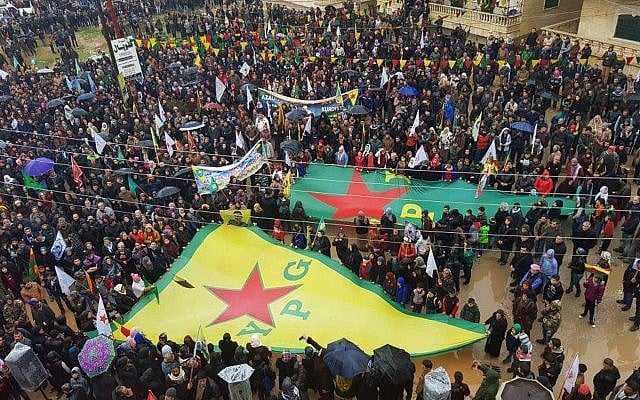
Supporters YPG and other militias and parties protest threats from Turkey in Afrin, Aleppo province, north Syria 18 Jan 2018 (Source: YPG Press Office/AP)

Whoever the leaders of the Kurds are now, they claim that they continue on the track to democracy and Kurdish national liberation.

Of course they do. The passengers on the Pacification Express always declare that sovereignty and self-determination are the train’s destinations, even if it shows no sign of heading there. And that some of the stations passed on the way are quite clearly on another line completely.

end.

Footnotes

1https://apnews.com/article/turkey-kurdish-militants-disarm-9f4347a04cba48ceb509d2e82023a19e

2This was one of the self-organised groups of NALGO (National Association of Local Government Officers), now subsumed into UNISON but which the union’s leadership refused to recognise and worked to undermine. I had been a founding member. The union leadership tried to get us to change our founding principle of self-determination for the whole of Ireland and when we refused, they worked against us.

3The ‘Oslo process’ which set up the Palestine Authority and the popular rejection of which led to the Second Intifada.

4Even though some anarchist groupings and at least one Irish socialist Republican group refused to see this and focused instead exclusively on the YPG’s anti-ISIS fighting and their federal administration of ‘liberated’ Rojava.

5But not in Turkey or in the Basque Country, nor of the ELN in Colombia.

6As Bishop Tutu, who supported the Process said of Mandela’s ANC: “They stopped the gravy train long enough to get on it.”

Sources

https://apnews.com/article/turkey-kurdish-militants-disarm-9f4347a04cba48ceb509d2e82023a19e

https://thekurdishproject.org/kurdish-ypg-to-lead-new-syrian-democratic-forces/

LEGACY OF MANDELA AND THE ANC – A BROKEN SOCIETY

News & Views No. 14   Diarmuid Breatnach

(Reading time: 6 mins.)

We need to be careful when elevating people from our ranks to the status of heroes – especially if they are alive and can renounce or betray the principles they originally fought for.1

And we have the right to be suspicious when those heroes are also acclaimed by the capitalists and imperialists, those who are certainly not our friends. But most of all, it is by their fruits that we can best evaluate people, whatever their past actions.

The society bequeathed after years of heroic struggle to the South African masses is broken. Housing and homelessness crisis,2 unemployment, poverty,3 prostitution, lack of medical care, inadequate sanitation and soaring crime, including violent crime – is not what the people fought for.

And this is occurring in a country rich in natural resources4 which are being extracted daily by imperialism, while the few on top — the earlier white settler bosses now joined by the corrupt black bourgeoisie – live in luxury.

(Image sourced: Research Gate)

CRIME & POLICING

Anton Koen, a former police officer who now runs a private security firm that specialises in tracking and recovering hijacked and stolen vehicles believes that “It’s not getting better, it is getting worse”, with the murder rate the highest it’s been in 20 years.

(Photo cred: AP)

In crime-ridden societies, the poor suffer the most and are of course also recruited into crime.

There were 27,494 killings in South Africa in the year to February 2023, compared with 16,213 in 2012-2013. South Africa’s homicide rate in 2022-2023 was 45 per 100,000 people, compared with a rate of 6.3 in the US and around one in most European countries.

Those who can afford it, hire private security, which is a booming business with South Africa’s security industry — one of the largest in the world, with more than 2.7 million registered private security officers registered in the country, according to the regulating agency, the PSIRA.5

People with money make up a very small percentage of South Africa, said Chad Thomas, an organised crime expert who has worked more than 30 years in police work and now in private security.6

That means that the vast majority of South Africans don’t really benefit from this security industry … If you live in a traditional township environment, or if you live in an informal settlement …7 security patrols in those areas are few and far between because they don’t have paying customers.”

Thomas, like many, ties the high levels of violent crime in South Africa to anger over the country’s deep problems of poverty.8

Private security companies are paid a monthly fee to patrol neighbourhoods and for providing armed response to their clients’ alarm systems. Tracking and car recovery can be part of the service, often resulting in getting involved in high-speed chases of car thieves and hijackers.

According to the PSIRA, the number of security businesses in South Africa grew by 43 per cent in the past decade, while the number of registered security officers has increased by 44 per cent. Meanwhile there are 150,000 police officers for the country’s 62 million people.

It is hardly surprising that the SA police force has difficulty in recruiting numbers. It is a force used to violently repress people9 and culpable in the worst massacre of working people in South Africa’s modern history, killing 40 striking miners over a couple of days.

That slaughter occurred in 2012 at the British-owned Lonmin platinum mine in Marikana, when miners wished create a new union and to leave the National Union of Mineworkers which, they said, was more in favour of their employers than the workers.10

Cyril Ramaphosa, the millionaire ex-President of the NUM was widely suspected of having organised the massacre and he’s now President of the ANC and of the South African Government. At the time, Jacob Zuma was President, now in the process of being tried for financial corruption.

But Mandela was still alive and at liberty when the massacre occurred and did not condemn the atrocity nor those responsible. Long-time anti-apartheid campaigner (and Mandela’s friend) Bishop Tutu once famously commented that “The ANC stopped the gravy train – long enough to get on it.”11

IMPORTANT

Is it important whether this person or that were truly the heroes they are reputed to have been? I think it is, not only because we tend to erect them as models for our behaviour but also because their lives and their choices present us with historical lessons.

The South African regime during the struggle was a white European settler state and like all of those, undemocratic and racist too. The masses rose up several times against it but people did not risk beatings, torture, imprisonment and death merely for the right to vote.

The struggles were so strong and the minority settler regime so emphatically opposed to reforms that its imperialist partners felt it vulnerable to revolution. They eventually convinced the regime to enfranchise the majority black population.

But what if the black masses went on kick out the imperialists?

The change had to be managed and the leadership of the ANC, the NUM and the Communist Party of South Africa proved willing to control their supporters. However, something else was needed, as in similar circumstances: a known face, a hero, to be the figurehead before the masses.

Representative of USA, chief imperialist country and Nelson Mandela after latter’s release.

Mandela proved to be that man, not only for his long imprisonment for guerrilla action but because he had been tested among the political prisoners on Roben Island and was judged the most suitable, so he had been separated from the other political prisoners to a new jail for grooming.

Mandela, after a huge publicity buildup around the world, was released in 1990 and began a series of negotiations with the settler minority’s leadership. In 1994, with universal suffrage, Mandela was easily elected head of the ANC and of the new government of South Africa.

Of the wave of pacification processes that swept around the world starting in the very early 90s with Al Fatah in Palestine, the South African process turned out to be the only one that delivered any of the objectives of what was promised12 — and that was the vote for everyone.

But it had the potential beyond that gain: of national liberation, the possession of all its natural resources and of a progressive social order, a beacon for the rest of Africa. It was important for imperialism to prevent all that and, with the help of the leaders of the ANC, NUM and CPSA, they did so.

The immediate result was a drop even further in the standard of living of the masses and an increase in the rapacious grip of imperialism on the natural resources, while municipal services declined further and crime at the bottom took off, matching corruption at the top.

The broken society there now is the cumulative result and should serve as a lesson about pacification processes, negotiations during struggle and our choices of heroes – or those chosen for us.

End.

FOOTNOTES

1As we in Ireland can testify, with the lionisation of Michael Collins, for example, for his role in the War of Independence (1919-1921) but who, a little later, acted on behalf of the Irish colonial bourgeoisie and their British masters to launch the Civil War (1922-1923) to prevent the establishment of a 32-County Republic.

2https://www.monitor.co.ug/uganda/news/fire-engulfs-illegal-housing-block-killing-73-in-south-africa-4353926

3 As of 2023, around 18.2 million people in South Africa are living in extreme poverty, with the poverty threshold at1.90 U.S. dollars daily (see Statista in Sources & References).

4See Sources & References

5The Private Security Industry Regulatory Agency.

6https://www.breakingnews.ie/world/private-security-firms-fill-void-in-crime-riddled-south-africa-1572546.html

7Ibid.

8Ibid.

9For examples see series of articles in https://www.saferspaces.org.za/understand/entry/police-brutality-in-south-africa

10It was notable that those popular organisations deeply implicated in pacification processes either reported with great restraint on the massacre or failed, like the Left-Nationalist Basque trade union LAB, to comment on it at all (to say nothing of sending a solidarity message to the striking workers or denouncing the State).

11https://www.independent.co.uk/news/world/anc-boards-the-gravy-train-john-carlin-in-johannesburg-on-the-underdogs-who-have-become-fat-cats-in-a-few-months-1379001.html

12For example Palestine, Ireland, the Basque Country, Turkish Kurdistan, Colombia, Sri Lanka …

SOURCES & REFERENCES

Crime and private security firms: https://www.breakingnews.ie/world/private-security-firms-fill-void-in-crime-riddled-south-africa-1572546.html

SA police: https://www.saferspaces.org.za/understand/entry/police-brutality-in-south-africa

SA Housing: https://rebelbreeze.com/2023/09/30/pacification-kills-too/

https://www.monitor.co.ug/uganda/news/fire-engulfs-illegal-housing-block-killing-73-in-south-africa-4353926

SA Poverty: https://www.statista.com/statistics/1263290/number-of-people-living-in-extreme-poverty-in-south-africa

ANC corruption: https://www.independent.co.uk/news/world/anc-boards-the-gravy-train-john-carlin-in-johannesburg-on-the-underdogs-who-have-become-fat-cats-in-a-few-months-1379001.html

PACIFICATION KILLS TOO

Diarmuid Breatnachpreviously published in the Pensive Quill

(Reading time main text: 6 mins.)

At the end of last month, in Johannesburg, South Africa, over 76 residents perished in a fire sweeping through one of a number of “illegal” buildings, home to some of the city’s poor who are desperate for somewhere to live.

How is this possible we may ask. Didn’t the South African people win their struggle after many years of sacrifice? Didn’t Mandela and the ANC lead them to victory in 1994?

The huge South African majority people fought a long and hard struggle against the domination and exploitation of a European settler minority and institutional racism. But they also fought against capitalist exploitation and imperialist plunder of their rich natural resources.

Some of the results of the Sharpeville Massacre, 1960 after South African police opened fire without warning at unarmed black people protesting the pass (apartheid) laws. In total, 69 people were killed and more than 180 people were injured, mostly shot in the back as they fled the violence. A later report would state over 700 bullets had been fired, all by police. (Photo sourced: Internet)

Despite the riches of those natural resources in gems, precious metals and minerals,1 most non-white Africans2 in South Africa lived in abject poverty with poor health care, scarce or non-existent infrastructures and services, including education and training.

In the decades leading up to the fall of the formal apartheid system, that struggle was led by the ‘triple alliance’ of the (banned) African National Congress,3 the National Union of Mineworkers (of S.A.) and the (banned) Communist Party of South Africa.

Township in South African photographed in 2018, over 20 years after enfranchisement and ANC government (Photo credit: Andrea Lindner/ Getty Images)

Their struggles defeated the apartheid system and in April 1994 all residents of South Africa were enfranchised. National elections brought 1990, was elected President of the country.

Yet shortly after that great change, it was noted that the living standards of the mass of people were even lower than before, that the settler capitalists continued to reap their profits and that imperialism had actually intensified their penetration of the South African economy.5

Today approximately 55.5 percent (30.3 million people) of the S.A population is living in poverty at the national upper poverty line (~ZAR 992) while a total of 13.8 million people (25 percent) are experiencing food poverty. Municipal services to the huge ‘townships’ are unreliable at best.

Almost one in every three of work-available people is unemployed and only 95% of the population have basic literacy, which means that one in 20 doesn’t have it.

It is in that context that we can begin to understand hundreds of people living in an “illegal” building without even a fire escape, obliged to take the risk of such accommodation, in a land that continues to be rich in great wealth which however, never comes near the mass of people.

PACIFICATION PROCESSES

In the 1990s a number of people began to promote processes to resolve a number of long-ongoing conflicts around the world, mostly where imperialism or colonial settlers were oppressing the people of a country. The promoters called them “peace processes”.

Palestine was the first of those in which a “peace process” was introduced and South Africa was next in 1994, followed by Ireland in 1998. As it took root in one country, former resistance activists went from there to other conflicts to encourage people there to embrace the process too.

In fact the progress of this process seemed like the US imperialist ‘dominoes’ theory, only in reverse: rather than ‘communism’ in one country influencing people in another to go the same way, capitulation in one country was used to infect the next.

Palestinian and South African delegates attended Sinn Féin congresses to promote their ‘peace process’ to the party’s membership; subsequently SF delegates in turn joined South African ones in selling the process to the Basque national liberation movement.6

Arnaldo Otegi (centre photo) foremost of the Basque movement’s ‘official leadership’ and EH Bildu party in 2019 – the banner behind asks for “one further step” in Castilian (Spanish) and “yes” in Euskera (Basque). (Photo cred: EFE)

Some movements declined to imbibe the process wine but those that drank it found their movements split, their leaderships increasingly accommodated to their people’s exploiters and nowhere at all were any of the movement’s principal objectives achieved.

Except, that is, in South Africa, where at least the people were enfranchised. But the right to vote is intended to help shape the polity for improvement and that has not happened in South Africa. The ANC, NUM and CPSA of the ‘triple alliance’ have become part of the system instead.

THE OPPOSITION BECAME THE SYSTEM’S GUARDIANS

Western imperialism recognised the vulnerability and isolation of the minority settler regime, convincing its leadership to concede mass enfranchisement rather than suffer revolution. And in order to prevent the mass going ‘too far’, they brought the resistance leaders into the deal.

Bishop Tutu7 once remarked that “The ANC stopped the gravy train just long enough to get on it”, which angered his friend, Nelson Mandela. But when forty striking miners were murdered by police of the ANC Government with NUM collusion in 2012, Mandela did not condemn them.

The kopje or hillock at Marikana, near the Lonmin mine, South Africa, where the striking miners were massacred by police of the ANC government in 2012. Over a decade later, plans for a memorial park have still not borne fruit. (Photo sourced: Internet)

This corruption did not grow overnight. Jacob Zuma,8 while President of the ANC, has been formally accused of rape, indicted a number of times and eventually convicted of financial corruption. Winnie, Mandela’s ex-wife led a clique accused of political corruption and murder.

Cyril Ramaphosa, now President, was a millionaire even during the apartheid regime while General Secretary of the National Union of Mineworkers and, because the striking mineworkers in 2012 were rejecting the NUM as corrupt, is widely believed to have organised the massacre.

There should have been many signs of this corruption in the ANC prior to entering government – and there were.

The ANC ran concentration camps notably in Angola, Zambia, Tanzania and Uganda where they punished and even killed “dissidents”.9 And in South Africa perhaps they had their own ‘Steak Knife’10 to organise “Pirelli necklacing”11 for alleged informers.

Mandela knew about the camps and the “necklacing” but did not condemn them, possibly out of mistaken solidarity or ‘the greater good’ theory, as acted upon by some of the solidarity movement abroad.

Ronnie Kasrills, a senior member of the Communist Party of SA and formerly on the ANC’s National Executive Council, who now criticises the pacification process, claims they were concentrating on the political process and took their eye off the economic one.

And no doubt many at home and abroad thought all this could be sorted out once the domination of the white settler regime was broken and African majority had the vote. But political plants grown in contaminated soil do not grow healthy fruit.

And so we come to 76 or more poverty-stricken dead and well over a hundred injured by fire in a building owned by the City, which is run by a black South-African administration that doesn’t care, in a state run by a corrupt black South African government in partnership with the settler class.

Plastic-shrouded bodies of some of the 76 fatal victims of the fire in the housing block in Johannesburg, South Africa. (Photo cred: Jerome Delay/AP )

Armed resistance campaigns, uprisings and revolutions kill but they have in their favour that they are striving for a better world. Pacification processes kill without any chance of achieving a substantial improvement.

Pacification processes murder dreams but kill physically too: in massacres and avoidable disasters but also by overwork, ill-health, work injury, despair, substance abuse, suicide, and the many ways in which the capitalist-imperialist system causes misery wherever it lives.

End.

FOOTNOTES

1South Africa holds the world’s largest reported reserves of gold, platinum group metals, chrome ore and manganese ore, and the second-largest reserves of zirconium, vanadium and titanium. In 2021, South Africa’s diamond production amounted to 9.7 million carats, an increase on the previous year’s 8.5 million carats. The country ranked fifth among the world’s largest diamond producers by volume.

2The racialcategories introduced by the Apartheid regime remain ingrained in South African society with South Africans officially continuing to classify themselves, and each other, as belonging to one of the four defined race groups (Blacks, Whites, Coloureds and Indians).

3Banned by the South African settler government from 1960 until early 1990; now a mass party in government.

4The ANC is still in government at the time of writing, without a break since 1994.

5See The Shock Doctrine – the rise of disaster capitalism by Naomi Klein (2007).

6Palestine faded as a promoter of the pacification process since it had failed spectacularly there, its mass rejection resulting in the resistance upsurge of the Second Intifada followed by the fall of Al Fatah and the Palestinian Authority from their leadership position and the huge turn to the Islamist Hamas by a society generally voting along political rather than religious lines.

The Spanish ruling class was interested only in crushing the Basque resistance and made little attempt to sweeten the surrender of the leadership (Arnaldo Otegi and company) who nevertheless capitulated. Other areas where the process landed or attempted to do so were Colombia, Sri Lanka, Turkey (Kurdish national liberation movement), India, Phillipines (both latter agrarian movements). Only in Colombia was it adopted by both the rulers and the resistance and proved a disaster for the latter.

7A Christian bishop and campaigner for most of his life against the rule of the settler minority.

8South African politician who served as the fourth President of South Africa from 2009 to 2018. Zuma was a former anti-apartheid activist, member of the ANC’s military wing Umkhonto we Sizwe, and president of the ANC from 2007 to 2017.

9See Sources.

10MI5 codename for senior Provisional IRA member Freddie Scappaticci who led the guerrilla organisation’s internal security department, which tortured and executed alleged informers.

11A car tyre, doused in flammable fuel, was placed over the terrified victim while still alive and set alight, often in front of a crowd.

SOURCES

https://www.theguardian.com/world/2023/sep/01/grief-and-anger-in-wake-of-deadly-johannesburg-blaze

https://www.breakingnews.ie/world/factbox-what-are-johannesburgs-hijacked-buildings-and-why-do-people-live-there-2-1521491.html

ANC concentration camps: https://www.amnesty.org/es/wp-content/uploads/2021/06/afr530271992en.pdf

ANNIVERSARIES AND ALTERNATIVES

News & Views No.9: Chile Coup – Twin Towers – the Legacy Bill

Diarmuid Breatnach (Reading time: 5 mins.)

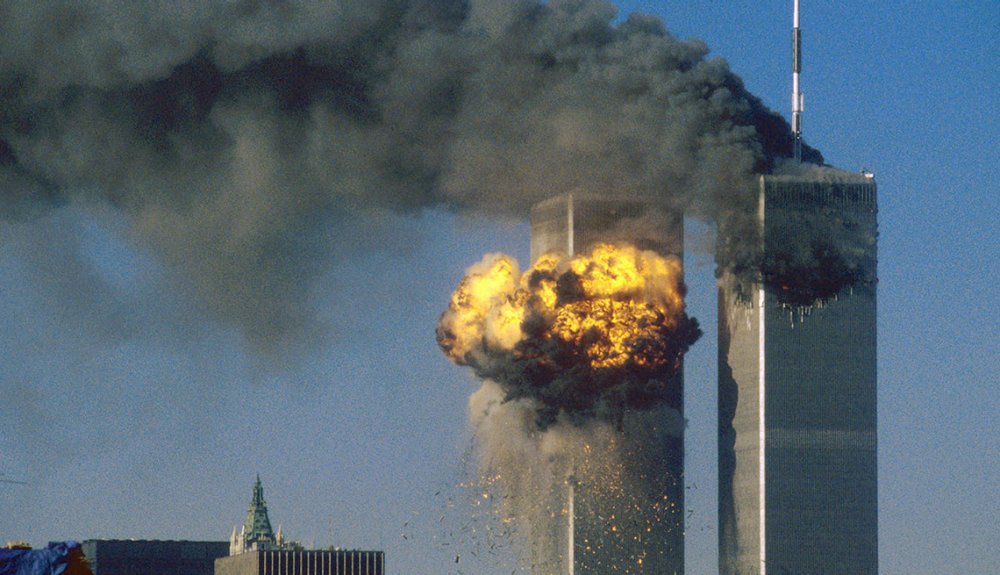
September 11th is the anniversary of the al Qaeda attack on the new World Trade Center in the USA known as “the Twin Towers” and also of the Pinochet Coup in Chile. The former caused the deaths of 2,996 people and the latter of over 40,000.

These are not happy anniversaries and US Imperialism bears a major portion of the blame for both events.

How so, one might ask? The coup in Chile, probably with CIA help, sure. But the Twin Towers? That was a Muslim jihadist attack AGAINST the USA! Surely we’re not expected to believe that stupid conspiracy theory that the USA ruling class actually staged the attack?

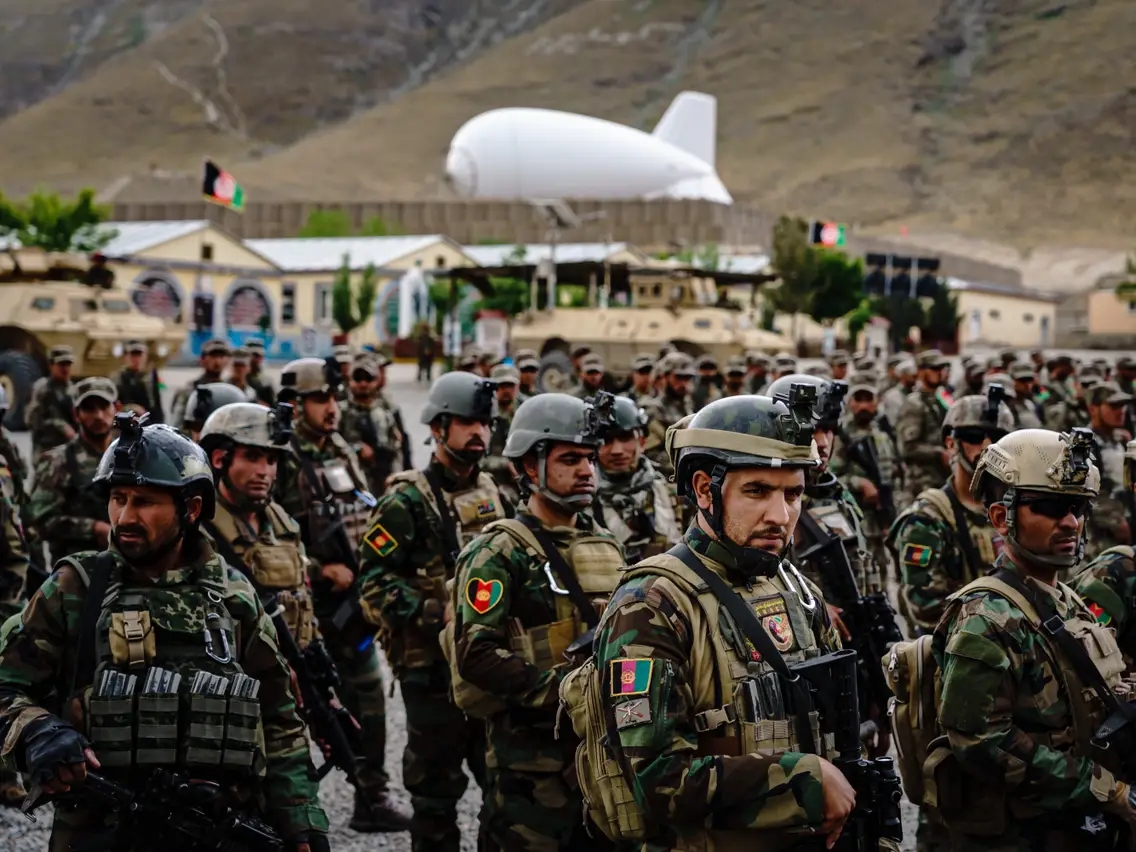
US proxy soldiers, Special forces Afghan National Army, 2021 (Photo sourced: Internet)
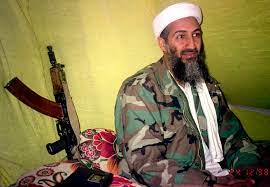
Osama Bin Laden (10 March 1957 – 2 May 2011), Saudi-born founder and first general emir of Al Qaeda from 1988 until his assassination. (Photo sourced: Internet)

That is truly a crazy conspiracy theory but the historical truth does indeed involve a conspiracy. In 1997 the government of Afghanistan was socialist which was worrying for the USA, so in partnership with Saudi elements, they funded and even founded Muslim jihadist groups there.

These groups were to be encouraged to overthrow the socialist regime and when the USSR sent troops to support the government, to defeat the Russians too. Which they did.

But forget about fantasy stories of traditional tribesmen with ancient muskets fighting a world power’s army – these were jihadists, fundamentalists, armed with modern automatic weapons and mobile missile launchers including SAMs (Surface to Air Missiles).

Forget too about Rambo-led simple hill people – since the US achieved the overthrow of the socialist regime and invaded Afghanistan alongside their British allies, those jihadist groups have been squabbling over their share of the spoils, often murderously.

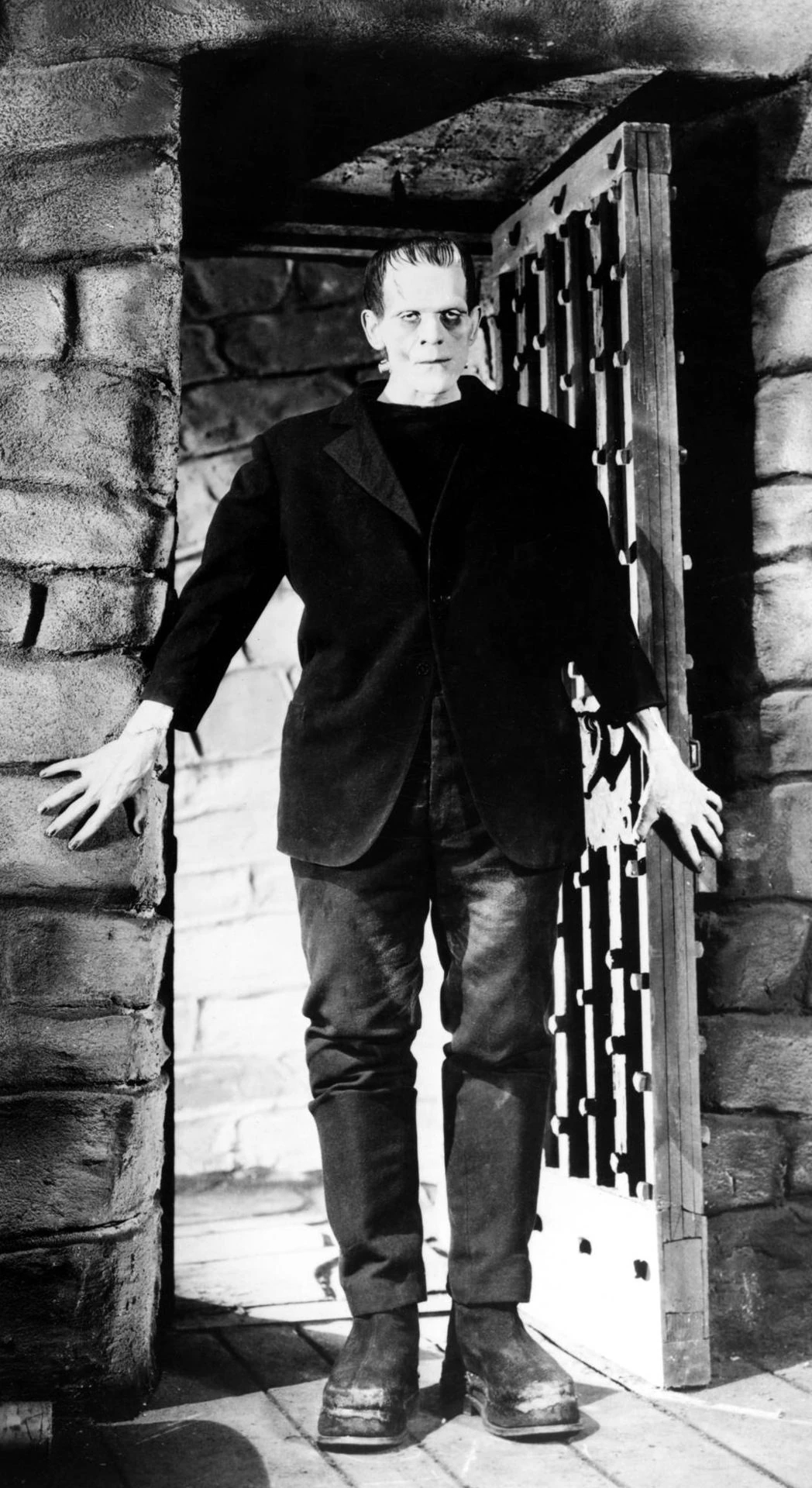
In fact, US imperialism is largely responsible for the world pestilence of not only jihadism of the Al Qaeda type, but the even more virulent Islamic State variety (which indicates Mary Wollstonecraft’s story of Frankenstein’s monster to be more prediction than fiction).

Explosion in one of the Twin Towers on 11th September 2001 in Al Qaeda attack. (Photo: Sean Adair/ Reuters)
Frankenstein’s monster in Mary Wollstonecraft’s famous story; he returns to attack his creator (Image sourced: Internet)

Although US Imperialism had created Al Qaeda and although Saddam Hussein’s regime in Iraq was totally opposed to the jihadist group (and vice versa), US politicians used the attack on the Twin Towers to ‘justify’ the US military invasion of Iraq.

“Sweet are the uses of adversity” indeed when manipulated by US Imperialism for domestic consumption and for world public opinion, also when assisted by British Imperialism’s Labour Government, in particular by lying-through-his-teeth Tony Blair.

The US-led campaign against Iraq resulted in about 1.5 million deaths through economic sanctions alone followed by over 300,000 civilians in the Western military campaign. These figures do not include deaths and injuries of Iraqi military and of the invading allies under the USA and UK.

Nor do those figures include the many deaths, military and civilian, in internal conflicts since the invasion of Iraq which continue to mount.

The deaths resulting from the coup in Chile were overwhelmingly of civilians as the coup was carried out by the Army with little opposition within the military and the civilian population were mostly unarmed.

Most of the deaths occurred in succeeding days and years as the regime rounded up communists, trade union militants and others suspected of having supported Allende’s party, to torture and execute them, including most famously the renowned musician and singer-songwriter Victor Jara.

The anniversaries of both the Pinochet coup and the Twin Towers have been commemorated in various parts of the world with, it appears, the coup being remembered in most of them, not only in Latin America but also in many countries in Europe where Chilean political exiles found refuge.

In the USA, of course, the attack on the Twin Towers was officially commemorated and probably communally too much more so than the coup in Chile.

Another imperialist-generated disaster, the anniversary of which falls only a couple of days after those two, is that of the Oslo Accords, signed on 13th September 1993 and often also known as a stage in “the Palestinian Peace Process”.

At the White House, supervised by Bill Clinton, elected chief of US Imperialism at the time, Yitzak Rabin for the Israeli Zionist state and Yasser Arafat, for the Palestine Liberation Organisation, signed an agreement, as a result of which the PLO would be permitted to run their own statelet.

Oslo Accords, 13 September 1993, Washington: Yasser Arafat of the PLO shakes hands with Yitzak Rabin of the Zionist State under the stewardship of (then) US President Bill Clinton, representing US Imperialism. (Photo: Gary Hershom/ Reuters)

Hailed as a great breakthrough by most media at the time, the PLO, dominated by Arafat’s Al Fatah, got to have limited self-government within the Zionist State, with the borders of any future Palestinian state undefined and no mention of the millions of Palestinian exiles around the world.

Although the increasing encroachment on Palestinian lands by Zionist settlers was temporarily halted, the land already taken and built upon remained in Zionist hands, that issue and others ‘to be discussed later’ but the Palestinians were to give up the armed resistance immediately.

The South African pacification process had begun earlier and, though enfranchisement of non-white South Africans was not to come until 1994, it was clearly on the way. The ANC promoted pacification processes to Al Fatah and both parties promoted them to Provisional Sinn Féin.1

The Palestinian ‘Process’ was controversial among their people from the start and grew more so as it became clear how little the Palestinian cause had gained and how much had been set aside, along with the growing official corruption and nepotism growing among the Al Fatah organisation.

Though the pacification process was widely rejected in Palestine and failed to install a widely-recognised ‘official’ collusive leadership, it did achieve the fragmentation of the Palestinian leadership and helped to ‘justify’ the demonisation of Hamas, winner of the 2006 elections.

ALTERNATIVES

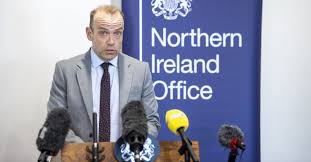
The Secretary of State for Northern Ireland (sic) is quoted in the media as saying that there is no alternative to the UK’s legacy legislation, which proposes to prevent recourse in law for any crimes committed by its soldiers, colonial police, proxies or Government Ministers.

Secretary of State for the Northern Ireland (sic) colony, Chris Heaton Harris (Photo cred: PA)

The legislation in question is titled The Troubles (Legacy and Reconciliation) Bill.

All political parties in Ireland on both sides of the British Border have vigorously opposed this legislation and THERE CLEARLY IS AN ALTERNATIVE, which is to abandon it. What the UK’s ‘colonial governor’ of the Six Counties means is: no alternative acceptable to the ruling class.

While we’re on alternatives, all liberation movements had and have the alternatives to embracing pacification processes, which is to maintain the path of resistance upon which they embarked until the day they win that for which their people and fighters have sacrificed their liberty and lives.

Allende and the communists in Chile had the alternative of arming the people and purging the Army but instead chose to put their faith in the ‘loyalty’ of Pinochet, ‘democracy’ and the opinion of the
Western powers.

The people armed cannot be harmed”, perhaps, rather than “The people united can never be defeated”.2 Allende’s error cost him his life but also the lives of hundreds of thousands of others.

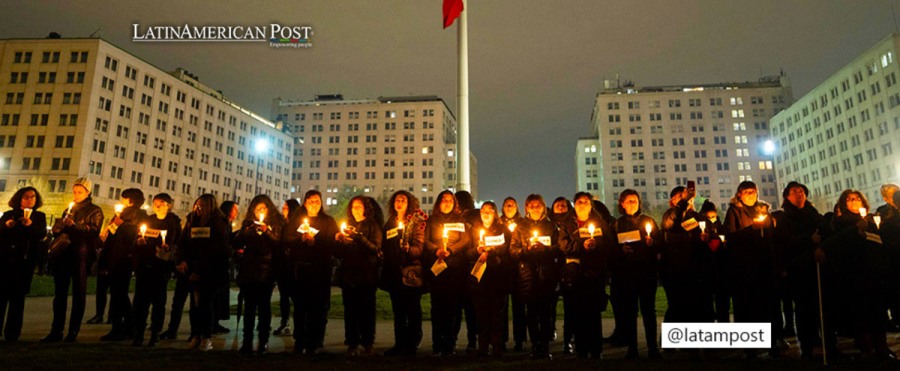
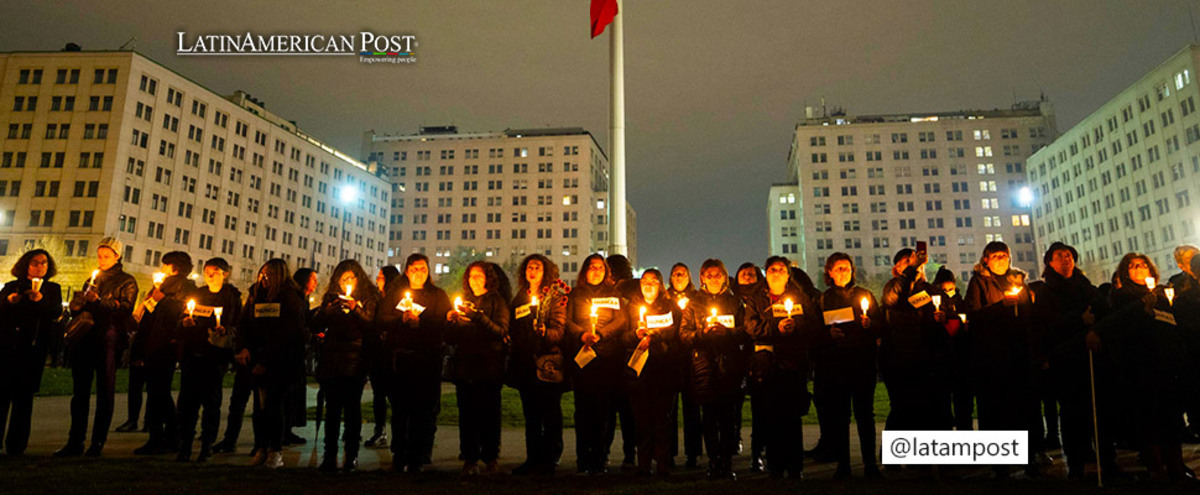
Women on 11th September hold a candlelit commemoration at La Moneda, Santiago, Chile for the victims – in particular of sexual violence – of the Pinochet coup and dictatorship. (Photo: Adriana Thomasa / EFE)

Imperialists have the alternative of respecting the right to self-determination of the peoples of the world and to cease from exploiting, oppressing and repressing them.

But if they did that, they wouldn’t be imperialists, would they? And since they cannot change their nature, they have to be overthrown.

End.

FOOTNOTES

1Provisional Sinn Féin signed up to the Irish Pacification Process in 1998 and they and the ANC then moved on to promote a pacification process to the leadership of the Basque movement for independence, which also finally signed up to it without even obtaining release of the political prisoners. By that time the Palestinian Process had shown its empty promise and the Second Intifada (2000-2005) demonstrated its rejection by most Palestinian youth and the elections to the 2006 Palestinian Legislative Council were won convincingly by Hamas.

2An alternative slogan to “El pueblo unido jamás será vencido” was even then being promoted by a smaller communist group: “El pueblo armado jamás será aplastado!”, i.e ‘The armed people will never be crushed’.

SOURCES

https://en.wikipedia.org/wiki/Oslo_Accords

https://www.breakingnews.ie/ireland/no-one-has-an-alternative-to-the-legacy-bill-says-heaton-harris-1525387.htm

The Queen’s Service To ….

Gearóid Ó Loingsigh

(Reading time: one minute)


Queen Elizabeth II / Sinn Fein president Mary Lou McDonald

Mary Lou McDonald, the current president of Sinn Féin, surprised a few, just a few, with her recent comments thanking the English queen, Elizabeth, for her service.  She stated that “Can I also extend to the British Queen a word of congratulations because 70 years is quite some record.  That is what you call a lifetime of service.”(1)

Why someone who describes herself as a republican would want to heap praise on a monarch and refer to the reign of the monarch as service is bewildering.  However, it is not that strange in the context of the Irish peace process.  It is part of the long road of Sinn Féin’s accommodation to the British state that was laid out in the Good Friday Agreement.  Sinn Féin at that time abandoned any pretence of having a critique of imperialism and capitalism.

The agreement signed basically stated that the British had no selfish interest in Ireland and the conflict was a communal one.  Putting it in blunt terms, two savage tribes agreed to settle their differences, the British state was not one of those savage agents in the conflict.(2)

Exactly what service has the English queen given and to whom?  As a monarch she has blessed every British military adventure since her coronation in 1953, including the savagery of the British repression of the Mau Mau rebellion in Kenya, various other colonial wars, not to mention her awarding of an OBE to Lt. Colonel Derek Wilford the man responsible for Bloody Sunday in Derry in 1972.  In 2019 she stood over her behaviour when she stated that the British government would “bring forward proposals to tackle vexatious claims that undermine our armed forces, and will continue to seek better ways of dealing with legacy issues that provide better outcomes for victims and survivors”.(3)  The massacre of Bloody Sunday was placed in the category of vexatious claims.

Part of the service that McDonald now lauds includes this and many more such incidents.  Though it is not unexpected.  It can only surprise those who pay no attention to the outcomes of peace processes around the world.  Yasser Arafat spent more time repressing Palestinians than he did fighting the Israelis after the Oslo Accords.  In South Africa, the former mining trade union leader Cyril Ramphosa became a mining magnate, whose company was involved in the massacre of 34 striking miners at Marikana in 2012.(4)  He and the ANC made their peace with white capitalists and obtained a share of the wealth, in Ramphosa’s case a very substantial amount which some estimates place around $780 million dollars.  In El Salvador, the FMLN eventually gained power, but did not implement a single thing they had ever fought for and their former commander Joaquín Villalobos is now a consultant to right wing forces on how to defeat left wing movements and contributes to the right-wing think tank The Inter-American Dialogue, which includes such illustrious figures as Violetta Chamorro from Nicaragua and former head of the World Bank, Robert Zoellick, to name just two unsavoury characters.(5)  In Colombia, the ink hadn’t even dried on the agreement and the FARC commander Timochenko declared that the Colombian armed forces would be allies of the FARC in building a new country.  The murder of just over 300 members of the FARC since the signing of the peace agreement has not caused him to change his evaluation of the Colombian armed forces, in fact he has doubled down on his position.

It is in the nature of the beast.  In every peace process that has happened, the former enemies of the state reconciled themselves to the regime and the system, without exception.  McDonald’s declarations are just a confirmation of that and also a sign that it is a bottomless pit and there is no level of political depravity that Sinn Féin will not sink to.

Notes

(1)  Belfast Telegraph (10/02/2022) Sinn Féin leader congratulates Queen on ‘lifetime of service’ https://www.belfasttelegraph.co.uk/news/northern-ireland/sinn-fein-leader-congratulates-queen-on-lifetime-of-service-41334673.html

(2)  The agreement can be consulted at https://www.dfa.ie/media/dfa/alldfawebsitemedia/ourrolesandpolicies/northernireland/good-friday-agreement.pdf

(3)  The Irish Post (20/12/2019) Anger as Queen’s speech appears to dismiss fight for justice for Bloody Sunday victim’s as ‘vexatious claims’ https://www.irishpost.com/news/anger-queens-speech-appears-dismiss-fight-justice-bloody-sunday-victims-vexatious-claims-175999

(4)  The Guardian (19/05/2015) Marikana massacre: the untold story of the strike leader who died for workers’ rights https://www.theguardian.com/world/2015/may/19/marikana-massacre-untold-story-strike-leader-died-workers-rights
 
(5) See https://www.thedialogue.org

A LIFE CELEBRATED – SOCIALIST, REPUBLICAN, TRADE UNION ACTIVIST

Diarmuid Breatnach

(Reading time: 10 minutes)

A packed function room at Club an Múinteoirí (Teachers’ Club) in Dublin last night heard speakers, including Arthur Scargill and the Cuban Ambassador, praise some of the highlights of the life of irish activist Des Bonass (died 26 September last year). The meeting was chaired by Colm Kinsella of Unite.

          Strangely, up to yesterday afternoon, many socialist, Republican and trade union activists seemed unaware of the event, organised by Bonass’ branch of the trade union Unite. I only learned of it myself when Arthur Scargill and Nell Myles stopped at our weekly Save Moore Street From Demolition campaign stall earlier in the day and explained that he was in Dublin in order to speak at an event that evening.

Section of capacity crowd at event
(Photo: Labhrain Ní Dhúgáin)

The event was scheduled to begin at 7.30pm but by that time there were less than a dozen people present, arousing fear in some quarters that the attendance would be poor. As time went on, the side room leading off the main room was closed and the chairs removed. Some more people arrived and then as if by magic by 8.30 the room was packed, with extra seating being made available for people who arrived even after that.

IRISH TRADE UNIONISTS AND CUBAN AMBASSADOR

          John Douglas (former General Secretary of the Irish Congress of Trade Unions, currently General Secretary of Mandate trade union) spoke of how he had come to know Des Bonass when Douglas was a member of the Amalgamated Transport & General Workers’ Union (now part of UNITE), a section catering for bar workers which at the time represented a great many in the trade. He related how the bar workers would come off late shift and go to a union meeting around midnight, a meeting that sometimes would not finish until five a.m! Bonass had asked Douglas for a space to address the union members in support of the British miners, after which he had come away with buckets overflowing with financial contributions from the barmen.

John Douglas of MANDATE speaking.
(Photo: Labhrain Ní Dhúgáin)

Douglas also related that Bonass was in support of women’s right to choose abortion at a time when that would not have received popular support in Ireland and went on to speak about the strike against TESCO and how Bonass had brought Scargill to a number of picket lines around the city, raising their morale and drawing media attention.

Des Derwin (Executive Member of Dublin Council of Trade Unions and Vice-Chair of SIPTU Dublin District Council) gave what seemed a comprehensive list of the activities of Des Bonass down through the years, including how he had actively supported the struggles in the H-Blocks in the Six Counties and of the Palestinian people, as well as the struggle of the Dunne’s Stores strikers. Unknown to many, perhaps, Bonass had been a founder of People Before Profit and the Unemployed Workers’ Movement.

Des Derwin of SIPTU and DCTU.
(Photo: Labhrain Ní Dhúgáin)

When the Irish Labour Party conference had voted to go into coalition government, Bonass and Matt Merrigan had walked out together, after they had seen Noel Browne leave the room. The media thought Bonass and Merrigan had led a protest walkout, whereas they said they had followed Noel Browne. When Brown appeared in the lobby, the reporters asked him why he had led the walkout, which he adamantly denied, saying he had only left the conference to go to the toilet!

Subsequently Bonass and Merrigan had founded the Irish branch of the Socialist Labour Party. The Dublin Council of Irish Trade Unions had been another of his areas of activity and Bonass had been President of the organisation; he had also been active in Unite the union.

Also a supporter of internationalist causes, Bonass had been against such as the Chilean coup, for Nicaragua and Cuba, against the South African Apartheid regime and the invasion of Iraq.

Cuban Ambassador speaking at event.
(Photo: Labhrain Ní Dhúgáin)

          Hugo René Milanés, Cuban Ambassador to Ireland, expressed his gratitude to Des Bonass for the latter’s support for Cuba and in particular “against the Yanqui blockade” and for working for socialism throughout his life.

SCARGILL, BRITISH TRADE UNIONIST

          Arthur Scargill, ex-President of National Union of Mineworkers (Britain) spoke about Des Bonass’ support for the NUM, particularly those of South Wales, when they were in the big strike of 1984-’85 and how Bonass had agreed to receive money from the NUM to keep it safe from the British State’s sequestration. At first, the money had been couriered by Nell Myles, an NUM official (who was present at the meeting) and delivered to the ATGWU office in Parnell Square; on one occasion she had been mugged on her way but the money stolen was her personal money and not the union funds, which were safely delivered. Six months later, Scargill himself came to Dublin and Des Bonass accompanied him to a Dublin branch of a bank with a holdall stuffed full of a lot more money but the alarmed branch manager referred them to the bank’s head office, where the money was safely stored.

Scargill speaking
(Photo: Labhrain Ní Dhúgáin)

Des Bonass brought Arthur Scargill around to many Dublin pickets during the TESCO strike organised by the MANDATE union, which had been welcomed by the strikers and which had lifted their spirits. He had been happy to attend, Scargill said and related a journalist asking him about his reaction to a bomb threat against TESCO. To laughter and applause from the meeting’s audience, Scargill related his response to the journalist, that neither he nor the TESCO strikers could have anything to with any such bomb inside as they would never cross a picket line! Des Bonass had also got Scargill a spot on the popular Gay Byrne show, where he had been confronted with a Margaret Thatcher impersonator.

Bonass had been a founder of the Irish branch of the Socialist Labour Party which Scargill had founded in Britain as founded by James Connolly.

Paying tribute to the moral and practical support of the Irish people for the NUM’s struggle, Scargill said that their support in ratio to union members in Ireland had been the highest of all and went on to reveal that he and Nell both had Irish ancestry on both parental sides, referring also to the history of oppression of Irish people by the British State. Scargill talked about the financial contributions but also how Irish families had taken in miner’s children for holiday breaks, as British trade unionists had wanted to take in Irish children during the 1913 Lockout.

Later on in his speech, Scargill declared himself a firm follower of the “11th Commandment: Thou shalt not cross a picket line!” (loud applause) and went on to talk about the determination of the Thatcher Government to break the NUM and its leadership. Thatcher and Government personnel had claimed at the time that they had not intervened in the strike, which was allegedly between the NUM and the National Coal Board but Scargill stated that was a lie and the truth had emerged in documentation over the years, available on the Internet to anyone who wished to check it. “Unjust laws have to be broken” he said also because “if we hadn’t done that, women would not have the vote; we would not have trade unions!” He paid tribute to the Levellers, the Tolpuddle Martyrs and the Suffragettes.

Scargill emphasised that the best way to celebrate the life of Des Bonass and to honour his memory is to continue the struggle for the principles that Des Bonass upheld, then finished his speech to a standing ovation from those present.

Scargill and myself after the formal part of the evening.
(Photo: Labhrain Ní Dhúgáin)

Colm Kinsella then welcomed the last speaker, Ciarán Bonass. Ciarán announced that he was the son of Des Bonass and talked about what the family had learned from his father as they had also supported him in his activism. Thanking all the speakers and all others present on his family’s behalf, his mother Eileen and sisters Mairéad and Deirdre, along with in-laws and grandchildren, he ended his contribution to loud applause from the attendance.

Colm Kinsella announced that their branch of Unite was now named “the Des Bonass Branch of Unite” in Des Bonass’ honour, thanked all the speakers and the attendance and invited people to partake of refreshments while listening to labour and other songs performed by Richie Brown (of Unite) and friends.

End.

Des Bonass at European Day of Action Against Cuts protest 2010 (Photo: Paula Geraghty in Indymedia)

‘PEACE’ PROCESS LESSON FROM THE PALESTINIANS

Diarmuid Breatnach


                        The ongoing slaughter by Israeli soldiers of Palestinians demonstrating at the border of the Israeli State for the right to return to their homeland has rightly received media attention and, after a motion condemning Israel in the UN Security Council was blocked by the USA, the General Assembly passed another by a huge majority. The shootings demonstrate the total disregard of the Zionist authorities for Palestinian life and also the degree to which, by refusing to condemn and by supplying finance and equipment, the USA and major European states stand in support of Israel and are therefore complicit in its murderous actions. But the whole history of the right of return of Palestinians raises another issue of international importance and provides a historical and political lesson applicable widely, far beyond Palestine or even the Middle East.

A Palestinian woman brandishes a key, symbol of the house her family left behind when forced out of Palestine. Ironically Sephardic Jewish families were forced out of medieval Spain and some still keep a key to their ancestral home.
(Photo from Internet)

Negotiations, Agreements and ….?

Back in 1993, the Palestinian Liberation Organisation was in secret negotiation with Israel in Oslo, with Norway in the ‘honest broker’ role (but a later Norwegian Foreign Office investigation concluded that the Norwegian participants had acted as “Israel’s errand boys” – see link). Later it was to be the USA playing the ‘facilitator’ role — yes, bizarre, given the USA’s major economic and strategic interests in the Middle East and its role in supporting Israel. But then, perhaps the PLO figured they’d best have both their enemies there at the same time, both tied to whatever agreement was hammered out.

What had brought the parties to the negotiation table was the First Intifada, a Palestinian uprising against Israeli occupation of Gaza and the West Bank. This uprising had begun on 9th December 1987 and had been characterised by repeated street fighting, barricades, refusal to work for the Israelis and strikes and boycotts, along with refusal to pay taxes. The Israeli state had replied with arrests and shootings, killing over 1,600 Palestinians as against 277 Israelis killed. Between 23,600–29,900 Palestinian children required medical treatment from Israeli Occupation Force beatings in the first two years (Wikipedia).

Palestinian youth throwing stones at Israeli military during First Intifada (Photo: Internet)


Palestinian women confront Israeli soldiers during First Intifada (Photo: Internet)

After signing the Oslo Accords in Washington, Yasser Arafat, Chairman of the PLO and Yitzak Rabin, Prime Minister of Israel, were photographed there shaking hands with US President Bill Clinton looking on approvingly, arms almost around them, like a big friendly uncle making peace between nephews. Yizhak Rabin, Shimon Perez and Arafat were jointly awarded the Nobel Peace Prize in 1994 (a prize already devalued ever since it had been awarded to notorious warmonger Kissinger).

Rabin, Clinton and Arafat, Washington, after signing of the Oslo Accords.
(Photo: Internet)

Much was made of the Oslo meeting and the Accords (including later meetings and agreements) in the international media with talk of coming peace in Palestine and a resolution to the conflict etc signposted and not too far ahead. These prediction proved false and hopes were dashed.

But anyone examining the situation cooly would not have been surprised. Leaving aside other issues such as whether a two-state solution was justifiable, or viable even then, or whether the legitimacy of Israel should ever have been agreed to, the right of return of Palestinian exiles had been set aside by the PLO in the final Oslo agreement, a postponement, along with a number of other big issues, such as illegal settlements, to be discussed later. The Palestinian diaspora is today estimated at 9.6 million people (see link).

Since the omissions were of issues fundamental to any solution even within the parameters of the dubious two-state solution, it would have been obvious to anyone who had their eyes open that the Oslo Accords were no solution nor even a step towards a solution. So why were they agreed by the PLO?

A belief in the Accords as a stepping-stone would not have been sustainable on its own (except for wishful-thinking liberals) and the partial withdrawal of Israeli armed forces insufficient, given that Israel controlled all borders (except the Gaza one with Egypt, in which that state colluded with Israel). In addition, the Israeli troops had the capacity to return whenever they wished (and did so many times).

The motivation has to have been status or money.

The PLO, although containing a number of Palestinian organisations at that time (but not Islamic Jihad or Hamas), was dominated by Al Fatah, a secular Palestinian national liberation organisation. Fatah had the prestige of long existence and of having withstood the Israeli armed assault at Karameh in Jordan in 1968 during which, at a huge cost, it had forced the Zionist army to retreat. The following year Fatah had reportedly racked up 2,432 guerrilla attacks on Israel too — for a population with the Zionist jackboot on its neck, that counted for a lot.

Concluding an agreement with the Israelis, who previously said they would not talk to the Palestinian resistance, might have seemed like a status-raising event to Fatah. And setting up the Palestinian Authority, which of course they would run, would definitely give them status in the eyes of many outside and even inside Palestine.

But running the PA, which would be in receipt of funds and in charge of their distribution, also managing employment, would also provide myriad opportunities for corruption and nepotism, unless the organisation were to be rigorously monitored either externally or internally. That monitoring did not happen and corruption among Fatah was rife. Only the people on the ground seemed to mind, the ones who wanted strong opposition to the Israeli occupation and whatever development could be brought about in the infrastructure and communities, along with the longer-term aims of a Palestinian state and the return of refugees and exiles. And who weren’t part of the corruption.

Failure of Agreements and Insurrection

In 2000, after the failure of the Camp David talks in the US and many failures in the Accords in the nine years of their existence, no-one seriously believed in the Oslo Accords any more and the Second Intifada began. An intifada had provided the reason to negotiate for the Israelis, however insincerely intended and now another intifada brought the negotiation period formally to a close.

As observed earlier, Fatah was the organisation to which the majority of Palestinians (certainly within Palestine) had given their support and it was a secular party (although for the first time the PLA declared the “state religion” to be Islam in 2003, where previously there had been no mention of religion whatsoever). We can assume that most Palestinians were happy to be represented by a secular organisation and perhaps even preferred it.

But in the 2005 municipal, most Palestinians voted for Hamas, a fundamentalist Moslem organisation, for the first time pushing Fatah into second place. And in the Presidential and Parliamentary elections of 2006, again. What brought about that change? Was it a sudden devotional conversion? No, it was that Al Fatah had become corrupt, was not seen to be fighting Zionism hard enough (some would have said was becoming collaborationist) and had given up on the right of refugees and exiles to return. Hamas, though not officially represented in the PLO, was running social programs, its activists seemed disciplined and it was resolutely opposing Israeli Zionism politically and militarily. And it insisted on the right of refugees and exiles to return.

Hamas won the 2006 Palestinian elections with a 3% lead over the incumbents. Unwilling to accept the popular will, Fatah staged an armed uprising against Hamas which, in the Gaza strip, Hamas decisively won (what the Wikipedia entry on Hamas calls a “takeover”!). For some reason, although Hamas was undoubtedly the winner electorally, they let Fatah hang on to power in the West Bank. And the US-led demonisation and isolation of Hamas in Gaza by the West began, along with a series of Israeli armed attacks from that year until 2014, including full-scale missile and air bombardments and infantry incursions, killing thousands of Palestinians including civilians, women and children and destroying much infrastructure.

Since then, the Gaza population is being squeezed with electricity supply reduced to four hours a day and hardly any fuel to run generators or transport allowed in past Egyptian and Israeli gates, its water supply contaminated by damaged sewage treatment plant, the inshore sea likewise contaminated and Palestinians fishing further out attacked by Israeli gunboats, factories bombed out ….

The message seems to be: “Get rid of Hamas, get back with Fatah and we’ll stop exterminating you.” But a delayed extermination is all it would be, as evidenced from the deeper penetration of Zionist colonist enclaves on to Palestinian land, the Zionist-only roads, the ongoing takeover of Jerusalem, the Israeli Wall, the continual theft of water and the harassment by settlers and Israeli Army of any populations of Palestinians living near to Israeli colonists.

The Processes outside of Palestine

Taking a trip back in time to 1993, we saw the Oslo Accords being hailed as a great step forward by the majority of commentators across the West. These coincided with the new interim constitution as a result of the negotiations in South Africa — so that then two major areas of conflict were being hailed as definitely on the way to a solution, to come sooner rather than later. “Peace process” became a buzz-word, firstly among the participants and some of the commentators, then in the agreed discourse of the rest of the media and politicians.

In Ireland, as the Provisionals’ leadership and the British looked at one another across the dance floor, the former wondered what they could get from the same kind of process but crucially, how to sell it to their rank and file. At the Sinn Féin Ard-Fheiseanna (annual congresses of the party), the ANC and Al Fatah (wearing their PLO hat) fraternal delegates were welcomed by hype from the SF leadership and enthusiastic reception from the floor of the hall. The ANC and Fatah of course talked up their parts of the Processes and no-one seemed to examine critically what either the South African blacks or the Palestinians were likely to get out of them.

Ramaphosa, Mandela & Zuma at Jo’burg Conference 2012. Zuma is now deposed from ANC for corruption and Ramaphosa is millionaire President of South Africa and ex-leader of the National Union of Mineworkers. (Photo: from Internet, by Walter Dhiadhia)

And the Pal-African partnership continued to attend congresses, to send fraternal messages to areas of ongoing anti-imperialist resistance, to sing their siren song with a Western chorus backing. The Provisionals joined the actors and took to the stage as they neared and finally accepted the Good Friday Agreement in 1998. But with the Palestinian conflict showing no sign of resolution (unless one considers a kind of genocide of Palestinians) or even a respite — and in particular after the 2006 elections victory by Hamas — the Palestinians were no longer quoted as a good example of the “peace process”. Various actors, including South Africans and Irish, went on to try to sell the “Process” to areas of stubborn anti-imperialist resistance: the southern Basque Country, Turkish Kurdistan, Columbia, Phillipines, Sri Lanka ….. But the Palestinians (or rather Fatah) had been dropped off the billing and bowed quietly out of the Traveling Peace Process Show. They had not even an illusion to portray any more.

Kurds demonstrating against Turkish dictatorship in Germany fly flags bearing image of Abdullah Ocalan. Some years ago he said he supports a peace process in Turkey but he needs to be freed from prison to lead it
(Photo: the Times in Israel).

However, the show must, as we are often reminded, go on. It failed to deliver in Kurdistan and the Basque Country, not because the leaders of the resistance movements were not amenable but because of the unwillingness to adapt of the Turkish and Spanish regimes respectively. However, the Basque armed organisation ETA threw in the towel a couple of years ago anyway, abandoning their fighters in the jails to seek their own individual ways out through begging forgiveness of the occupiers of their land and oppressors of their people. The Turkish and Syrian Kurds were drawn into partnership with the imperialist allies dominated by the US, in their war against ISIS but also for the overthrow of the Assad regime, though deep Kurdish contradictions continue with the Turkish regime, to which it looks like the US Coalition will abandon them and they may seek an accommodation of sorts with Assad.

The Colombian FARC and MIR swallowed the Processed bait and gave up the armed struggle for a promise of a political one but those of their leaders who are resolute are being hunted by the regime, the quasi-liberated areas terrorised by the Army and assassination squads, the resistance fragmenting and disorientated. The Tamil Tigers didn’t entertain the Peace Process Show but the Sri Lankan Army were able to surround their liberated areas and bombard them to defeat, murdering their leaders and raping, murdering and repressing their followers.

The Phillipines and India? The resistance groups in both these areas are led by a Maoist-type leadership and we wait to see.

And in Ireland, after two decades since the signing of the Good Friday Agreement, the colonial occupier has the leadership of Sinn Féin, the former resistance, in joint colonial government, the party’s southern arm seeking admittance to the Irish comprador capitalist club, the remaining anti-imperialist resistance fragmented and the country not one step nearer to unity and independence.

The Palestinian lesson for the world

All the issues which led to these conflicts and which the processes of pacification did not address – were never intended to address – will return again, to be struggled over anew, under new leaderships. In Palestine now, that is what has been happening. The Right of Return for exiles and refugees, put to one side by Fatah in the Oslo Accords nearly three decades ago, is being demanded again on the Israeli border, the protesters (along with the ‘collateral damage’ of journalists and paramedics) being bombarded by tear gas and shot down by Israeli snipers. The Palestinians, whose leadership nearly three decades ago were chosen by US imperialism to be among the first to accept the new round of historical pacification processes and to become complicit in being its missionaries, are teaching us the fallacy of the facile promises they were made at the time.

There is another irony here: while refusing the right of return to Palestinians who were themselves exiled or are children and grandchildren of exiles, i.e within living memory, the State of Israel offers “the right of return” (sic) to people who have never been there and cannot even prove that their ancestors were, providing only they can prove their Jewishness. And a further irony: Sephardic Jews, who were expelled by the Christian kingdoms in Spain and Portugal in the Middle Ages, were being offered a “right of return” by the Spanish Government in 2014 (see link).

Over time, the people in the other areas of anti-imperialist resistance around the world will regroup, gather strength and return to the resistance. The imperialists almost certainly know this. But they have bought themselves three decades of damage to their opposition and, since they need the people as producers and consumers, cannot eliminate the deep wells of resistance. And capitalism is not about enduring solutions – they work away at undermining the resistance on a temporary basis and as for the future, like Micawber in Dickens’ David Copperfield, believe that “something (else) will turn up”.

End.

LINKS (NB: I have deliberately chosen most background references regarding Palestine from Wikipedia, which is known to be heavily monitored by Zionist interests and also has inputs from friends of the Palestinians and therefore cannot be said to be completely favourable to either side):

Palestinian exiles and the right of return: https://en.wikipedia.org/wiki/Palestinian_diaspora

Account of the Oslo Accords: https://en.wikipedia.org/wiki/Oslo_Accords

The Oslo Accords negotiations and their legacy: https://interactive.aljazeera.com/aje/palestineremix/the-price-of-oslo.html#/14

The Palestine Liberation Organisation: https://en.wikipedia.org/wiki/Palestine_Liberation_Organization

The right of return to Palestine of Palestinians: https://en.wikipedia.org/wiki/Palestinian_right_of_return#UN_General_Assembly_Resolution_194

The right of return to Spain of Sephardic Jews: https://theconversation.com/spain-moves-to-right-a-522-year-wrong-but-still-overlooks-some-23526

Another Result from the South African Peace Process

This is what the South African Peace Process was about, apart from black people getting the vote: white capitalists continue, a few black capitalists climb up on the back of their people, corruption rife in politics and sellout of national resources intensifies.

Cyril Ramaphosa is the current President of South Africa and of the African National Congress and formerly of the National Union of Mineworkers.  He is at least a millionaire with a seat on several company boards including that of Lonmin, the workers of which were on strike at Marikana in 2012 and were massacred by South African police.

The following is a statement by General Secretary of the South African Federation of Trade Unions (700,000 members but most workers in the country are not unionised).  From Politics.Web (link to original posting below). 

SAFTU condemns NUM leaders’ summersault 

The South African Federation of Trade Unions condemns the sudden and opportunist summersault by the leaders of the National Union of Mineworkers (NUM), over the Independent Power Producer (IPP) agreement which was signed into law yesterday.

“The NUM views the signing of the IPP today by the communist turned capitalist Minister Jeff Radebe as an insult to the working class and the poor”. “The ANC led government is privatizing Eskom through the back door to satisfy their Davos handlers and white monopoly capital.”

They then make an even bigger about-turn when they say that “Workers of this country will not continue to vote and support an organization which is taking away jobs from the poor. We cannot perpetually campaign and vote for the so-called ‘New Dawn’ as narrated by Cyril Ramaphosa… The NUM demand that President Cyril Ramaphosa must stop this nonsensical IPPs and must reverse the decision. We are tired of supporting the organization which is indicating left but turning right.”

Unlike the NUM, SAFTU, and in particular its affiliate NUMSA, have been consistently opposing the IPP Agreement. NUMSA challenged it in court and argued strongly that while it does not oppose renewable energy or an energy mix, the IPP agreement will automatically result in the closure of five Eskom power stations in Mpumalanga, resulting in at least 30,000 jobs being lost.

They argued that this agreement was a move towards the privatization of the whole electricity generation sector and other state-owned enterprises. As NUMSA said: “These deals are being concluded for the benefit of crony capitalists with ties to the leadership of the governing ANC. They want to loot the state owned enterprise just like the Gupta’s were accused of doing.”

SAFTU Strike Demonstration in April (Photo from Delwyn Verasamy on Internet)

SAFTU saw the move as further evidence for its view, put forward long before Cyril Ramaphosa’s election, that an ANC government led by him would continue to pursue neoliberal policies in the interests of big business which would include handing over publicly owned enterprises like Eskom to capitalist sharks.

But until yesterday, the NUM was one of Ramaphosa’s biggest supporters. They championed his ascendancy and, given his narrow victory at the ANC national conference, may have swung enough votes to ensure his success. There was not a word then about a leader who was “indicating left but turning right” and being handled by Davos white-monopoly capitalists|

So how can they have just suddenly discovered what SAFTU has been saying for months and NUMSA for years about the ANC government’s sell-out to the interests of white monopoly capital

When NUMSA’s 2013 Special Congress withdrew its support for the ANC, the NUM were the spitting blood in condemning the very position which they themselves have now suddenly adopted. They were the most enthusiastic campaigners for NUMSA’s expulsion from COSATU and the dismissal of Zwelinzima Vavi for taking a similar political stance.

They cannot explain how they were able to support the ANC government throughout the years when it was presiding over the very same neoliberal policies like GEAR and the National Development Plan which they now denounce.

They have said nothing about Ramaphosa’s role in private business, particularly as a director of Lonmin, one of their members’ biggest and worst employers, and how he became a multi-billionaire and joined the ruling class whose interests he is now promoting.

They have also not mentioned the role of COSATU, whose leaders were also loyal supporters of Ramaphosa’s campaign. They have said nothing at all about the IPP deal, which presumably means they support it.

The NUM leadership are clearly coming under pressure from their own members, who have been enraged by the IPP deal. Many have already left to joint NUMSA, AMCU and other unions, and more would have followed if the NUM had said nothing about this. But the leaders have merely reacted with demagogic, opportunist and feigned anger, in a desperate bid to regain some credibility with their members.

SAFTU appeals to NUM rank-and-file members not to be fooled by this sudden switch by their leaders. Rather they should join SAFTU-affiliated unions which are serious about opposing Ramaphosa’s neoliberal policies, and have been consistently fighting for the socialist alternative and for independent, democratic, militant and worker-controlled unions.

In particular we urge all NUM members to join the general strike and day of mass protests on 25 April against the poverty national minimum wage, which was endorsed by COSATU, FEDUSA ad NACTU, against amendments to labour laws which will make it almost impossible for you to exercise your constitutional right to strike, and against the “white monopoly capital” which your leaders have suddenly discovered!

Statement issued by Zwelinzima Vavi, SAFTU General Secretary, 6 April 2018

http://www.politicsweb.co.za/politics/num-leaders-ipp-somersault-opportunistic–saftu