A DEBATE to discuss the above question at the Teachers’ Club, Dublin, was organised by the United Ireland Association with Tommy McKearney and Clare Daly being the debaters on June 16th.
Tommy McKearney (Photo: Wikipedia)
Tommy McKearney is a long-time Republican, formerly of the Provisional IRA, 1980
Clare Daly (Photo source: Internet)
Hunger-Striker and ex-Republican prisoner. He was, along with Anthony McIntyre, a founder of the Republican Writers’ Group which, while not advocating armed struggle, was critical of the Good Friday Agreement, of Provisional IRA and in particular of Sinn Féin. He is currently an Organiser for the Independent Workers’ Union.
Clare Daly is a long-time Socialist, a former trade union shop stewart and has been a Teachta Dála (member of the Irish parliament) since 2011, formerly as a member of the Socialist Party and now a Left Alliance TD. She has visited Republican prisoners and raised issues about their treatment in court and in jail. Daly was also arrested for trespass at Shannon Airport, along with fellow-TD and partner Mick Wallace, protesting against the use of the airport by US military flights and for transporting of political prisoners of the US military to jails in various parts of the world.
TOMMY MC KEARNEY
Tommy McKearney spoke first and stated that there was an issue of defining Republicanism and that sometimes what was meant was the anti-monarchic Republicanism of France or the United Stated but he was going to discuss it in terms of a specific Irish-based ideology, i.e Irish Republicanism.
Mentioning a number of Left-Irish Republicans such as Fintan Lawlor and Wolfe Tone’s famous quotation about relying on the “men of no property”, Tommy developed a line of reasoning that sought to say that there was not a huge difference between Irish Republicanism and socialism and drew attention to the fact that James Connolly had founded a party by the title of the Irish Socialist Republican Party.
Going on to talk about the objective of Irish Republicans, Tommy stated that not only is a republic desirable for Ireland – it is necessary. Only a Republic that is based upon socialist principles can resolve the economic and political problems facing Ireland today on both sides of the colonial Border.
Referring to the British election results in the Six Counties, Tommy commented on the 238,915 votes and seven seats for Sinn Féin – an increase of 14,670 votes – and the rise of almost 67,000 votes for the DUP with their ten seats. Sinn Féin had been pushing a peace process which was not about peace but about normalisation; their claim to intend to bridge the sectarian divide was empty and the voting lines were drawn up along sectarian lines at least as deeply as before.
Tommy also speculated that the amount of votes cast for Sinn Féin, on a platform of refusing to take their seats in Westminster showed, among other things, the amount of people in the Six Counties who did not care to be represented in a British Parliament and presumably would want representation in a united Irish Republic. He called for an alliance of Left Republicans and Irish socialists and recalled that James Connolly had founded, as well as the Labour Party, the Irish Socialist Republican Party.
CLARE DALY
Clare was next and she in turn highlighted the difficult issue of defining the Left – did it mean the parties that defined themselves as Left, did it include the Labour Party – some would say yes, others no. For Clare it is not issue of the names we give parties or activists but of what we stand for. Clare said she stands for a socialist country and in that sense for a Republic.
Addressing the question for debate, Clare owned that maybe socialists had neglected the national question — maybe they had been put off by images of balaclavas and guns — but it could equally be said that Republicans had for decades neglected social questions such as women’s reproductive rights, women’s rights in general, gay rights …. However, in more recent times, Republicans were seen actively supporting those rights.
Over recent years, Clare said, we had seen the gains our parents fought for in terms of trade union rights and local authority and state services lost or undermined.
Clare said she saw herself as a citizen of the world but as she lived in Ireland that she stood for a Republic that was organised along socialist lines and gave equal rights to all. The real question, Clare stated, is how we are to achieve that and pointed to the swing to the Left in Britain with Jeremy Corbyn’s party receiving a big increase in votes, despite media hostility and predictions of failure. The Conservative Party could only rule now with the support of the DUP’s 10 Mps. Clare said that opportunities of a Left Front existed in Ireland too as was seen by the Right to Water mass marches with broad political party and some major trade union support.
CONTRIBUTIONS FROM THE AUDIENCE, RESPONSES FROM THE PANEL
Included in contributions from the audience were the following:
Sinn Féin had seven MPs to the DUP’s 10 and should consider abandoning their abstentionism and go to Westminster to assist Corbyn in voting legislation
While the Labour Party in Britain had moved to the Left, Sinn Féin in Ireland had moved to the right
Good debate from two good speakers but also two who had put themselves out there for what they believed – Tommy McKearney in armed struggle in the past and hard prison struggle and Clare Daly in protesting US military use of Shannon Airport and also visiting Republican prisoners in jail, along with a few other Tds.
We need more debates like these and also to focus on Republicans with regard to where they stood with regard to socialism.
The Irish Left as a whole has divorced itself from Irish Republicanism, probably in fear of being associated with nationalism and/ or armed struggle. In doing so, it has walked away from continual violation of human rights, e.g of Republican prisoners in the jails and of civil rights, the right to political dissent of Republican activists on both sides of the Border.
The Irish Left has neglected to confront British Imperialism and left the Republicans to confront the various visits of the British Queen and the recent one of Prince Philip, when major roads were shut and even civilians impeded in going about their business or even going to their local shops or to visit their relatives’ graves in Glasnevin and a megaphone wrested by an undercover policeman backed up by a riot squad from the hands of a person about to speak to a protest demonstration.
Republicans are socialists and to pose the two as different categories was ridiculous.
There should be a broad Left front in Ireland including the trade unions and Sinn Féin.
Among the responses from the panel were that people were hung up on condemning Sinn Féin and should welcome them into a broad Left mass movement on the model of the Right to Water and Right to change campaigns (this from Tommy McKearney)
The socialists might not have done very well opposing British imperialism but had opposed US imperialism, which is one of the imperialist powers in operation in Ireland (this from Clare Daly) and a major one in the world.
COMMENT
The contributor who said that “Republicans are socialists” seemed unaware that historically at least this certainly was not so. Seán Mac Diarmada, the Irish Republican executed on the same day as the socialist James Connolly, had been on record as saying that no-one should support socialism. During the War of Independence, some IRA units took actions to support landless labourers and poor farmers but others took action to repress these in favour of big farmers.
The IRA had a ban on Communists through the 1930s probably up to the 1960s. Sean South, prominent Limerick IRA Volunteer killed in the Bessborough RUC Barracks attack in 1957, was a conservative Catholic, anti-Communist member of the Knights of Columbanus and of An Réalt (Irish-speaking section of the Legion of Mary).
The broad Left front being advocated by a number of people seems to be a reformist social-democratic one and, while there is nothing necessarily counter-revolutionary about fighting for reforms, clarity is needed about whether what they are advocating is a social-democratic program or fighting for some reforms while at the same time openly organising with a revolution in mind.
Clare Daly has certainly fought hard against US Imperialism but others on the Left much less so. The mobilisation against Hillary Clinton’s visit to Dublin was not great and gave up in the face of police opposition before they even reached City Hall and there was no mobilisation at all against Obama’s visit to Dublin in May 2011 and it remains to be seen how much there will be if he comes this year, as he has reportedly promised to do. But the question of oppposing British imperialism is a crucial one since a) it is the main imperialist-colonial power at work in Ireland and b) because it is the main prop of US Imperialism in Europe and in the UN.
There would seem to be fertile ground for debate on the historical and current differences between Irish Socialists and Irish Republicans, as well as for discussing possible joint action and one hopes for many more debates and discussions of this nature with a broad attendance.
It has been said by some people prominent in the broad Moore Street campaign that the Minister for Heritage has declared her support for the Report of her Consultative Group on Moore Street and its recommendations. A number of other campaigners have said this is not so and I am one of those (NB: there are a number of campaign groups in this struggle).
For saying that, I have been criticised as “rocking the boat” and “spreading inaccuracies” or even “generating conspiracy theories” and also personally verbally attacked in public and on social media by name and by inference. The reputation for integrity of a political and social activist is very important to her or to him and so these allegations are of course hurtful. But there is much more at stake than my feelings or even my reputation or that of a few other activists – there is indeed the struggle for the Moore Street historical quarter itself. For a successful conclusion of this long struggle, the direction taken is crucially important.
(For those who may be unfamiliar with the background or have lost track of some of the major developments, a very brief background is given in an Appendix below).
THE MINISTER’S CONSULTATIVE GROUP AND ITS REPORT
In June 2016, the Minister set up her Consultative Group on Moore Street to which she invited a range of political party representatives (and one Independent) elected to the Dáil, a number of Dublin City councillors and representatives of two campaigning groups. The list excluded the first campaign group to raise the Moore Street conservation issue along with the most active campaign groups of recent years and also included no historians.
Though it did not publicly call for them, the Consultative Group accepted submissions in writing and a number of campaigns and individuals made presentations in person (the 35 submissions are available on the Department’s website under Minister’s Consultative Group on Moore Street – see link at end).
Two members of SMSFD campaign presenting petition sheets with around 70,000 signatures to some members of the Minister’s Consultative Group at City Hall in March 2017.
On the 29th of March, the report of the Consultative Group was launched.
Should the Minister accept the Recommendations of the Report in full, then there are a number of recommendations which we should celebrate (and indeed some of us proposed many of them in submissions to the Consultative Group itself) and for which we should seek implementation. But there arealso some very harmful ones which we should repudiate.
However, if the Minister has not accepted the Recommendations, then nothing has been won by the Consultative Group, even on paper, despite the many submissions and delegations it has received and the meetings and discussions of its members. This would obviously be a distressing revelation to some of those who were part of that Group. And we can expect even less from the next one the Minister has set up, the Advisory Group.
But, let us return to the question: Did the Minister or did she not accept the Recommendations of the Report? Let us examine the available evidence.
THE MINISTER’S ACTUAL WORDS
On the 29th of March 2017, the following statement was issued by the Department of Arts, Heritage, Regional, Rural and Gaeltacht affairs:
‘The Moore Street Report – Securing History’ is presented to Minister Humphreys by the Moore Street Consultative Group
The Minister for Arts, Heritage, Regional, Rural and Gaeltacht Affairs, Heather Humphreys TD, has today (Wednesday) received a copy of the report compiled by the Moore Consultative Group, which she established last year. The Minister announced the establishment of the group in June 2016, as a means to make positive progress in relation to the future of Moore Street.
“I set up the Moore Street Consultative Group, which includes political representatives, relatives and other stakeholders, in a bid to bring together the range of views on Moore Street and seek a positive way forward. Since then, the Group, chaired by Gerry Kearney, has carried out a body of work which has resulted in the report they are publishing today.
“I want to take this opportunity to thank all of the members of the Group for their dedication and commitment in completing this work in such a short timeframe. The time and effort which went into this report is greatly appreciated.
“I welcome the fact that the report is seeking a way forward based on consensus. I believe that the recommendations in the Report can help find a way to breathe new life into the Moore Street area, while at the same time retaining its sense of history and enhancing its traditional street market.
“The Report signals the potential of a negotiated outcome, balancing the perspectives of the key stakeholders. I am fully supportive of this constructive approach and I want to see the work of the Group being built upon, so we can progress to the next stage. I will therefore be recommending to Government the establishment of a new Advisory Group as recommended in the Report to advance that process.”
(end quotation)
A little over a month later, on the 2nd May 2017, Éamonn Ó Cuív (Fianna Fáil) asked a question of the Minister in the Dáil and followed with a supplementary one:
National Monuments
43.Deputy Éamon Ó Cuív asked the Minister for Arts, Heritage, Regional, Rural and Gaeltacht Affairs if she has considered the report of a group (details supplied) issued in March 2017; her plans to implement the recommendations in the report; the progress made to date in doing so; and if she will make a statement on the matter. [20440/17]
Deputy Éamon Ó Cuív: As the Minister knows, the Moore Street report was published in March and a timeline was set out with the hope that a decision would be recommended in six weeks, as the matter has dragged on for years. Has the Minister brought this to the Cabinet and have we a decision? Will she set up the advisory group that has been recommended in the report so we can move to the next phase? I am afraid we will lose the good momentum built up in the past six months towards progressing the Moore Street project to a suitable resolution.
Deputy Heather Humphreys: I agree with the Deputy that good momentum has been built up and I put on record my sincere appreciation to the members of the group referred to by the Deputy for the report they recently presented to me. The group, which was independently chaired by a former departmental Secretary General, included local and Oireachtas political representatives, 1916 relatives, street traders and other stakeholders. It was set up in a bid to bring together the full range of views on the matter and it held its inaugural meeting in September 2016. In the mean time, it has reviewed numerous presentations and submissions from a range of interests, looked at a variety of official and other reports, interviewed relevant public officials and other experts and examined a large body of work from within its own membership, as the Deputy knows. This extensive programme of work has culminated in the series of recommendations contained in the report that was presented to me in the last few weeks and that is now being examined in my Department.
I welcome the fact the report is seeking a way forward based on consensus. Its recommendations can help breathe new life into the area while retaining its sense of history and tradition. In addition to its particular association with the 1916 Rising, there are other relevant aspects of the street and surrounding area that also need to be taken into account, including the range of State, public and private property holdings and ownership and, of course, the presence of the street traders themselves, who do so much to give the area its unique ambience and place in the life of our capital city. The report has looked carefully at all these elements and I am delighted that it signals the potential for a mutually successful outcome to be agreed between the relevant parties, balancing the perspectives of all the key stakeholders. I am fully supportive of this collaborative approach and I want to see the work already done being continued so we can progress to the next stage and see tangible results on the ground. Critical to this will be the establishment of the new advisory group that the report itself identifies as the most effective way to move forward with its recommendations. I will be proceeding with the setting up of this group as quickly as possible to build on the positive and constructive foundations set out in this report.
Deputy Éamon Ó Cuív: As happens so often, the Minister gave me much information that I already have, as I was part of all those discussions and on the forum referred to. As she pointed out, we had a very experienced chairman and in his work he was very diligent in advising us against things that could not be done. However, the report very clearly states that the establishment of the advisory oversight group should happen within six weeks. As the Minister knows, this was because a consensus was built through a huge amount of work. People believed they had put together a map to bring us forward. There are two questions that still have not been answered. When will the advisory group be set up or will it be set up? Has the Government considered this report and made any decision on the recommendations of the report? All of them must be implemented but some need very urgent attention, including, for example, those relating to street traders.
Deputy Heather Humphreys: The appointment of a chairman for the new advisory group is the next step in the process and I hope to see that person appointed, with the group beginning its work, as soon as possible. I am very much aware the chairman of the previous consultative group worked in a particularly effective way with all the parties and his efforts were key to the achievement of the agreed outcome to the group’s deliberations as set out in the report. The next stage is equally crucial and the new chairman will have just as vital a role to play. I am looking at possible candidates and hope to make the appointment as soon as possible. The report envisaged this process taking six weeks and we are still well within that timeframe. The new advisory group will be drawn from among the existing membership of the outgoing Moore Street consultative group. I understand it had 27 members and it is envisaged that the new body, while being equally representative across the same spectrum of interests, will be somewhat smaller.
THE REALITY
People reading the text of the Minister’s statements and replies will search in vain for anywhere she says that she actually accepts the Report and its Recommendations. In fact, one can see that while in politician-speak she talks around it, she studiously avoids saying that, confining herself to praise for the Group and its Chair and to the spirit of consensus. And well she might praise the consensus, because despite the public positions of many of the Consultative Group prior to their being chosen by the Minister and which some may still hold, and despite the calls from a number of campaigners and other stakeholders in their submissions, the Group did not call on the Minister to abandon her appeal against the High Court judgement (i.e that the Moore Street historic quarter is “a National 1916 Historical Monument” — more on this below).
Also, the Minister and the Report both accept the speculators as “stakeholders” and the Report calls for the future to be decided in negotiations between those “stakeholders” and the two elements who have all along been facilitating them: Dublin City Council’s Planning Department and the Department of Heritage!
Those who have been repeating the erroneous line that “the Minister has accepted the Report” argue that a) she set up the Group and/or b) she has proceeded to the second stage, setting up the Advisory Group and therefore must accept its Report. Or b) even that an Irish Times news report carried a headline saying that she supported it and that the Minister did not deny the headline!
The best that can be said for that reasoning is that those are their interpretations but her statements quoted above do not support those interpretations. Nor do they refute them, it is true. But surely if the Minister did actually support the Recommendations, she would have unequivocally and specifically said so?
DANGEROUS RECOMMENDATIONS AMID WELCOME ONES
As noted earlier, the Recommendations contain some positive elements, including keeping the “footprint” of the main remaining Moore Street 1916 quarter intact, i.e the block enclosed by Henry Place, Moore Street, O’Rahilly Parade and Moore Lane, along with the lanes themselves and the street. They also include a number of recommendations for long-overdue improvements to the hard lot of the Moore Street street traders (but not the small business shops), both in terms of provision of facilities and in terms of their trading license restrictions.
But to leave the future of the historic quarter to negotiations between the three historic villains of the saga, the property speculators, the Planning Department and the Department of Heritage, as laid out in the Main Recommendations, 7, 8, 9 and 12 (pp. 6-7)) and in Chapter 10, Conclusions and Recommendations (pp.36-37) 10.3 and 10.4 is surely not what we should be doing.
A number of times in the Report the State is claimed to be “the ultimate custodian of our history, culture and heritage”. Whatever one might think of the desirability of such a state of affairs, such an evaluation of the role of the State is patently untrue as even a glance over the history of this state will demonstrate. It is untrue about historical and archaeological sites, the Irish language, Irish traditional music, Irish dance and Gaelic games.
The State has failed to defend a great many sites of historical, archaeological and architectural importance from property speculators and other financial interests, was about to demolish houses in Moore Street and one of its Government Ministers is currently appealing a judgement that the whole Quarter is a “National Historical Monument”. The main Irish-language promotional and defence organisations were set up as voluntary bodies — though some now receive some low State funding — and most of the activity is by unpaid activists. Neither the Minister of the responsible department nor her Ministerial appointments to the Gaeltacht desk have been competent Irish speakers and some years ago the Ombudsman for the Irish Language resigned in protest at inaction and obstruction from within the state apparatus. The national Irish-language TV channel (TG4) and radio station (Radió na Gaeltachta) were won by people campaigning against the State, in which activists were fined and threatened with jail (one campaigner did go to jail to defend his right to motor insurance documentation in Irish). Likewise bodies promoting Irish traditional music and song were voluntary to begin with and although Comhaltas Ceoltóirí Éireann now receives State funding, most enthusiasts and practitioners, whether within or without Comhaltas, are doing so either in a voluntary or private professional capacity. That is also true of Irish traditional dancing, both social and performance. Gaelic Games are also largely a voluntary activity with minimal state support overall.
The “ultimate custodians of our history, culture and heritage” are the PEOPLE! And it is to the people that we should look to defend these aspects of our identity. It is they who must be represented in the decision-making and stewardship of this national historical monument, and all other bodies subservient to them. Setting up such a representative, inclusive and transparent management committee for the project will not be easy but is surely worth the effort, rather than handing it over to the main villains, whom campaigners have been fighting – on this site alone – for a decade-and-a-half!
THE MINISTER, THE LITIGANT AND COURT CASES
Without going into too much detail, an individual by the name of Colm Moore in 2015 initiated a High Court case against the Minister of Heritage on a number of issues, all to do with her plans and actions with regard to the Moore Street quarter. In January 2016, during an occupation by protesters of the site to prevent the Minister’s contractors from demolishing three houses in the terrace, Colm Moore obtained a temporary injunction against any demolition until judgement had been reached in his case.
The property speculator involved attached himself to the case as a respondent (i.e as a “defendant”). The Minister’s legal team and her Department’s officers defended all her actions, denied that the site was a battlefield (“all Dublin was a battlefield”) and denied the importance of any buildings except Nos.14-17 Moore Street (even of No.10, which was the site of the first transferred HQ of the GPO Garrison and of the 1916 Rising and of the emergency insurgent hospital dealing with nearly a score of wounded — including a rescued British soldier).
On March 18th 2016, the High Court Judge found against the Minister and speculator on all grounds and ruled that the whole quarter is a 1916 battlefield and a historic national monument. The Minister said that she was considering appealing, asked for more time, then more time again and finally confirmed that she would indeed appeal the judgement, with the support of the full Cabinet. Contrary to interpretations of her reasoning and to a reply Enda Kenny gave on her behalf to Gerry Adams TD (Sinn Féin) last year, she has entered an appeal against all parts of the judgement, 250 pages – far from the “clarification on some points of law” reason for the appeal which some people have claimed (and which a speaker was still claiming at a public meeting as recently as 22nd of May this year).
Some people have said that the Consultative Group’s Report, while nowhere suggesting the Minister should drop her appeal of the historic judgement, instead suggests the litigant, Colm Moore, should drop his defence of the case. I am one of those people. We have been called liars, troublemakers, conspiracy theorists and accused of making inaccurate statements.
Again, let us examine the actual text (extract from 10.1 New Beginnings (p.34):
In the event of consensus being secured on an agreed way forward for the development through dialogue by the Advisory/Oversight Group with the developer, and agreed to by the Applicant and the State, the Group is strongly of the view that payment of legal costs, incurred by the Applicant’s legal team, by the State is warranted and appropriate. The Group has reached this conclusion after considerable reflection and having regard to the widely acknowledged public interest which informed the taking of the case and the savings which would accrue to the State by settlement through such a process. (end quotation)
I agree that the section does not actually say Mr. Moore should drop the appeal but I do think that it is a nuanced call for him to do so and offers an inducement to him and more particularly to his legal team. To me, the subtext to this reads something like this:
“Listen lads, we know you put a lot of work into this and the legal team in particular have had to turn away some lucrative work while they concentrated on this case. And we know they haven’t yet received a penny for doing so. So, you settle the case on terms the State can agree with and we guarantee the legal team get paid and your litigant can walk away. Millions in the legal team’s bank accounts now or years in court with no guaranteed win – which is to be, lads?”
It is not only an inducement to settle but a possible seeking to cause a split between the litigant and his team. The litigant is taking the case presumably because of historical and possibly political (in the broad sense) motivation but one cannot expect that motivation of the legal team.
The latest news on the legal case is that Minister asked for time to consider skipping over the Appeal Court and taking it straight to the Supreme Court. Normally such an extension is for six weeks but the Minister has exceeded that and no limit was set – although clearly she will have to declare definitely at some point to which court she is taking her appeal. In the event of it being the Supreme Court, my information is that we could well see the end of 2019 before it reaches there. And meanwhile the buildings and laneways deteriorate and no substantial work of a construction nature can be undertaken to improve facilities for the market traders.
ROCKING THE BOAT
(Source image: Internet)
When a boat is being steered in a bad direction it is perfectly justifiable for those crew who become aware of this to rock the boat, to bring their concern home to the other members of the crew. Should this fail to yield a change of direction, it becomes time to inform the passengers. If danger appears, it is not a time for discreet nudges and whispers but for speaking clearly and loudly, that all may have an opportunity to bring the boat back on a safe and productive course.
End item
APPENDIX
VERY BRIEF BACKGROUND IN BULLET POINTS
Moore Street is the last remaining street of a centuries-old street market quarter (the rest is buried under the ILAC shopping centre).
On Friday of Easter week 1916, with the GPO in flames, the insurgent garrison evacuated, most of it through Henry Place eventually to Moore Street, some participants being killed along the way. On reaching Moore Street, they occupied a number of houses and in particular No.10, then tunneling through the walls throughout the night, to occupy the whole 16 houses of the terrace by Saturday.
On the Saturday, the decision was taken to surrender and instructions to that effect were sent out to the other garrisons. Among the 14 taken prisoner and later shot by firing squad in Dublin, six were from the Moore St/ GPO garrison, including five of the seven signatories of the 1916 Proclamation.
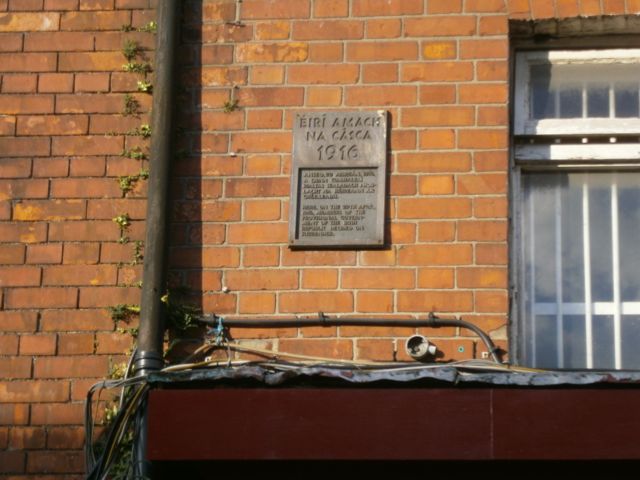
In 1966, the 50th anniversary of the Rising, the National Graves Association, a voluntary non-state-funded organisation, placed a plaque on No.16, the first formal mark of recognition of the events there.
Around 2001 a campaign was started to have a building in Moore Street as a national monument; this later expanded to cover the whole terrace Nos.10-25, back yards, and surrounding street and laneways.
In 2007 the State decreed Nos.14-17 to be of historical importance and in need of preservation; the Planning Department and Government between them approved the speculator’s plan for a huge shopping centre with the four buildings being a tiny museum inside the shopping mall campaigners; the 1916 Relatives campaign on Moore Street split, one James Connolly relative favouring the speculator’s plan and another against; the State offered the speculator €5 million for renovation work on the buildings.
In September 2014 the speculator proposed to hand over the four buildings to Dublin City Council in exchange for two the Council owns at the end of the terrace, which would have enabled him to demolish half the buildings in the terrace. The Save Moore Street From Demolition campaign group was formed specifically to defeat the land swap proposal (which had the support of the Chief and Deputy Chief Executives of Dublin City Council) and began a petition on Moore Street every Saturday. The proposal was defeated by majority vote of councillors in November 2014.
In July 2015 the State purchased Nos.14-17 from the speculator at a total price of €4 million. An individual, Colm Moore, took three cases against the Minister of Heritage with regard to Moore Street.
In January 2016 the State was about to demolish three buildings in the terrace. The SMSFD group convened two emergency demonstrations in the street. The site was occupied by protesters for five days and subsequently blockaded for five weeks by a new group that grew out of the occupation, the Save Moore Street 2016 campaign group.
On March 18th the High Court Judge ruled against the Minister and the speculator and ruled that the whole quarter, including streets and laneways, is a historic 1916 National Monument.
In July 2016, after much delay, the Minister put in an appeal against the High Court judgement – the appeal has still to be heard.
(previously published in the Irish Dissent blog https://irishdissent.wordpress.com. Photos chosen and inserted by Rebel Breeze by agreement with author)
On Friday, 2nd June, a protest was held at the so-called “Museum of Free Derry” in opposition to the its memorialization of British forces killed in Derry during the early 1970s. I refer to this institution as the “so-called Museum of Free Derry” because, with its commemoration of the British state’s highly paid, heavily armed and judicially-protected professional murderers – agents of state violence whose brutality peaked (but did not end) with the massacre of 14 Civil Rights demonstrators on January 31st, 1972 – it has distanced itself irrevocably from the concept and philosophy of liberation that Free Derry stands for in the popular imagination. As one protestor suggested, we should rename it “The Museum of Unfree Derry”; I would add that the title, “The Crown Forces Museum of Unfree Derry”, will reflect even more accurately the ideology that this institution serves and promotes.
The iconic Free Derry gable monument, replacing the original gable of the house in the barricaded Bogside in 1969 which bore the same announcement. One of the Bogside’s impressive murals is visible on the right of photo. (Photo source: Internet)
Free Derry was the part of Derry City, comprising the Bogside, Brandywell and Creggan districts, that had been liberated from police control following the decisive defeat of heavily-armed RUC, B-Special and Orange Order attackers by an unarmed popular insurgency, known as the Battle of the Bogside, that took place in August, 1969. Notwithstanding the efforts of Paddy Doherty to have barricades dismantled and the RUC redeployed in the Bogside, Free Derry persisted until the entire city was overrun by British troops during Operation Motorman in July, 1972. During this three-year period, Free Derry became recognized globally as a site of intense resistance to British political, military and police control.
Protest at the Free Derry Museum recently. (Photo source: Internet)
Last week’s protest was called because the museum, which many people regard as a Sinn Féin-controlled front organization, has installed an exhibit recording the names of British troops and police killed in Derry. This has outraged a broad spectrum of people who have confronted the issue because they recognize it as contributing to the wider, decades-long policy of “normalization”: the policy whereby the aberration that is the British presence in Ireland is represented as normal, even natural. A fundamental policy of modern imperialism, normalization (also referred to during the 1970s and 1980s as “Ulsterization”) was also the key strategy behind the 2003 Iraq invasion and occupation, where it became known as “Iraqi-isation”. (1)
POWER AND ITS DISCOURSES: FROM BURKE TO KITSON
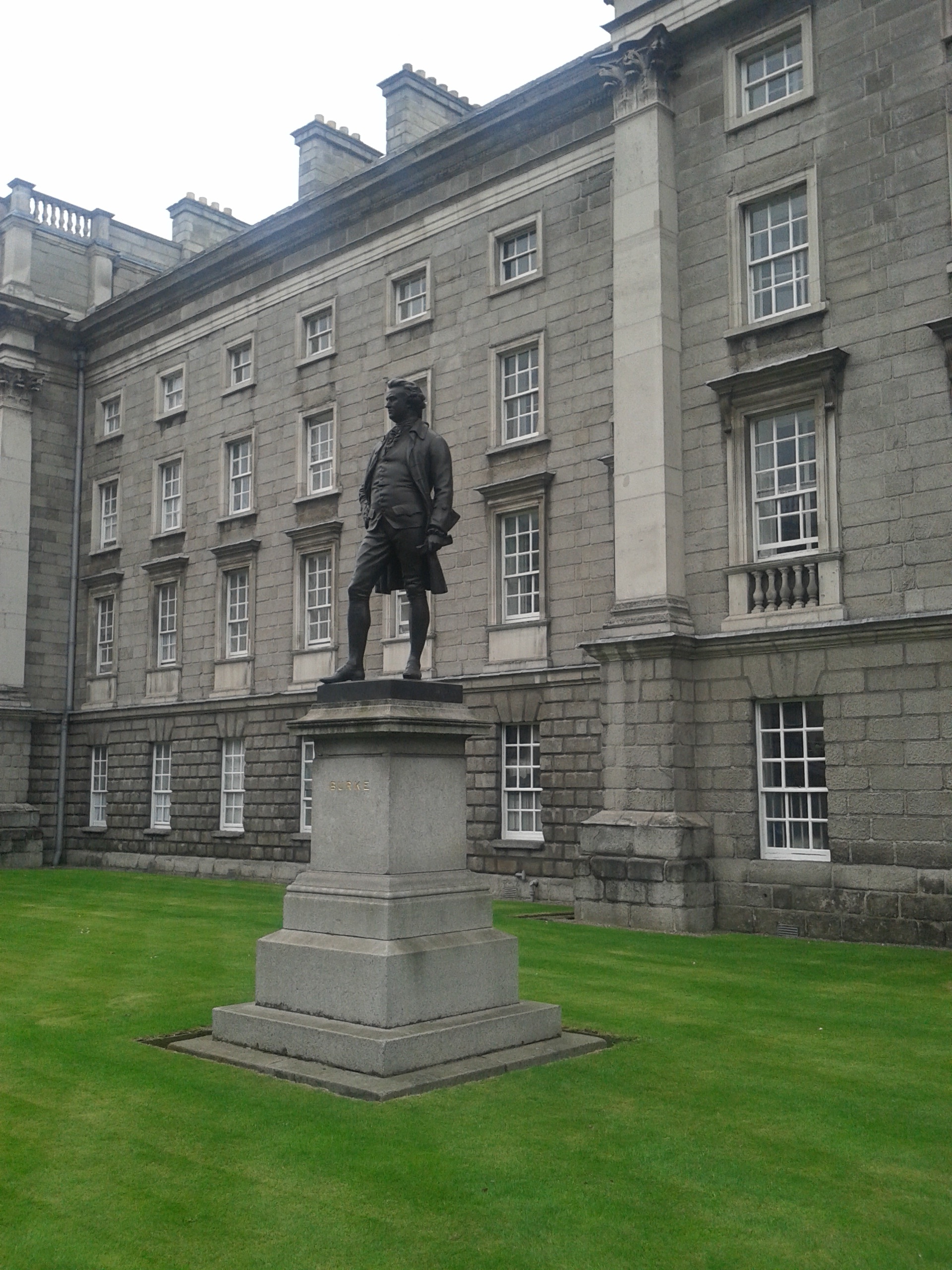
Burke monument in front of Trinity College, Dublin. (Photo: D.Breatnach)
These ideas and policies can be traced back to Edmund Burke’s conservative political theories, as outlined in his 1790 book, Reflections on the Revolution in France. Here, Burke described the authority of kings as “the natural order of things”, and claimed that the subjugation of people by imperial and monarchical authority was an organic, and therefore just, phenomenon. (2) In his earlier work, A Philosophical Enquiry into the Origin of Our Ideas of the Sublime and the Beautiful (1757), Burke also argued that the natural human response to displays of power should be one of surrender because power and terror, the basic currencies of political authority, were inseparable from one another.
While these ideas have influenced British imperialism and guided its coercionist policies since the late eighteenth century, they were very significantly modernized by the British army Brigadier, Frank Kitson. Having participated in and directed counter-insurgency efforts in Kenya, Malaya, Oman and Cyprus, Kitson updated the sublime object and function of imperial power by urging the state to facilitate its flow through every circuit of military, police and civilian organisation in a thoroughly integrated pattern of oppression and violence. The key to controlling entire populations, Kitson urged in his 1971 book, Low Intensity Operations, was to ensure that the interests served by state violence should become so normalized as to be obscure, untraceable, unidentifiable, even invisible.
Frank Kitson (now Brigadier) in 1971 (Photo source: Internet)
In doing so, he brought Burke’s theory of the invisibility of power into the modern imperialist age: “To make anything very terrible,” Burke advised, “obscurity seems in general to be necessary”, (3) and state violence is no exception to this very basic rule. Whereas, for Burke, power was best administered from the Olympian position of the aristocracy, Kitson, by 1971, saw the need to co-opt local organizations directly into its grid and to create compliant front-groups (he called these “pseudo-groups”) that were loyal to the deep state. As we have seen since the ceasefire of 1994, these state-funded front organizations have spawned very rapidly, although study of their boards and memberships reveals very familiar patterns and networks of interest.
2017: A NEW START FOR COUNTER-INSURGENCY
Kitson’s policy eventually succeeded with the total integration of Sinn Féin and its party militia into the British establishment, and this is most apparent (for those who look beyond the obscuring veil of Stormont power) in the fusion of their pro-British terror tactics with official policing. However, while this objective has been achieved, total control remains the final objective and, as every reader of Orwell knows, controlling the present depends very heavily on exercising dominion over the past: this is what every colonial power pursues through means of coercion, violence, manipulation and co-option. Through various fronts disguised as “community groups” controlled by Sinn Féin, which is itself controlled by MI5, this policy has been intensively pursued since the mid-1990s on political, economic and cultural fronts. Those who remember the various “peace groups” that emerged to serve British interests during the 1970s and 1980s, many of which were directed by the Officials and their political front, the Workers’ Party, will recognize an emerging pattern here.
The Crown Forces Museum of Unfree Derry is the latest addition to this long line of front organizations working in the service of British state power. Its inclusion of British military and police personnel in its exhibitions is a significant move towards normalizing the brutality and violence unleashed on the people of Derry from the late 1960s (and, indeed, since the inception of the state in 1922), and their present activity should be considered against this longer history of normalization.
The Museum of Free Derry (sic`). (Photo source: Internet)
Indeed, the museum’s spokesman, Robin Percival, has a long record of service to Sinn Féin front organizations since he first joined the party. Since then, he has been appointed to prominent roles within the Pat Finucane Centre, The Bogside Residents Group (from which he graduated onto the Parades Commission), the Bogside and Brandywell Health Forum, the Gasyard Centre, Cunamh and the Bloody Sunday Trust, as well as this museum. His close friend and colleague at the Pat Finucane Centre, Paul O’Connor, participates in Sinn Féin electoral videos, exposing that organization’s very close ties to the party. During last week’s protest, Percival took photographs of those who had come to voice their opposition to the memorial, and it can only be assumed that these images will be shared with his friends in Sinn Féin (these associations can be seen by checking the organizations’ boards and memberships on the Companies House website).
Robin Percival of the Museum speaking at an unintentionally somewhat ironically-named conference. (Source photo: Internet)
In a letter sent to the Pensive Quill website in 2014, Percival responded to criticism of the museum’s earlier but unsuccessful plan to build a garden that would commemorate crown forces personnel. He stated: “there never was a plan to construct a memorial garden to include British soldiers in the Bogside…. Nor are there any plans to construct a memorial to include British soldiers now or in the future. The focus of the Bloody Sunday Trust (which manages the museum) is about civilians killed by the state.” Percival publicly announced that he had “no plan to construct a memorial… to include British soldiers in the Bogside.” (4) However, things can change very rapidly in the world of colonial doublethink, and now he is defending the projection of the names of British personnel on his museum’s walls.
THE LONG LINE OF COOPERATORS
Frank Kitson argued that co-option and cooperation are the basic requirements of colonial political control. Percival is among a long line of cooperators, ranging from Paddy Doherty and Brendan Duddy to the present class of professional, managerial “community representatives” and mysteriously-appointed “spokespeople”. While these figures have, largely, been involved in the political and economic management of the people of Derry on behalf of Sinn Féin, Stormont and the British establishment in London, what is novel about this museum it is dedicated to controlling the present through its representation of the past.
The normalization policy outlined by Kitson and the principles that he first proposed in 1971 are very relevant today. The museum operates entirely into line with British policy and represents a watermark of what he termed “civil-military relations” – the conscious fusion of military and civilian interests through long-term “popular projects” serving the occupier’s “single effective policy” : “the necessity for close co-ordination between the civil and the operational effort is apparent to everyone”, wrote Kitson in 1971. It remains so today because it is through this “unity of effect” that oppression becomes normalized and authority internalized by the target population, and how a people’s sense of their own selfhood is softened and eroded. It is the latest manifestation of psychological operations (still abbreviated by militaries, police forces and governments as “psy-ops”): the use of psychological means to distort and undermine a population’s sense of its own place in the world and in history, and to subvert its own understanding of itself. (5)
IDENTIFYING THE OPPRESSOR
The museum has a single purpose: encouraging people to identify psychologically with the British army and police, and with the colonial violence that has repressed them for centuries. The British army’s infamous Bloody Sunday Massacre of January 1972 was key to the wider counter-insurgency policy that began in August, 1969, and its impact can still be felt in Derry, over four decades later. The Crown Forces Museum of Unfree Derry is dedicated to convincing the people that they should see something of themselves in the very murderers who shot down children, women and men during this period of particularly brutal state violence. It symbolizes a false and misleading ideology of reconciliation based on the assumption that we have much in common with these professional agents of colonial violence and the structures that they serve.
Last week’s demonstration registered popular refusal to conform to this ongoing process of normalization. The philosophy and practice of liberation that was practiced and displayed four decades ago by the people of Free Derry showed the world that refusal is a very powerful weapon. This protest articulated and renewed that refusal by addressing the still current problem of state violence and the ideological coercion that accompanies it, exposing its acceptance by organizations such as this museum, all of which, ultimately, act in the interests of the state.
Michael Bridge, who was wounded in the Bloody Sunday Massacre 1972, arguing during the protest with Colm Barton of the Museum. (Photo source: Internet)
The fundamental strategy of any empire is invasion, and this requires a considerable degree of integration on a number of levels, particularly within the cultural, political and psychological spheres. Imperialists occupy the physical territory of the countries that they invade with their military and police forces but they also work hard to colonize the minds of those whose lands they occupy with the relentless propaganda and distortions of the past that are circulated by their local agents. In Derry, however, this is being resisted because there are plenty of minds and imaginations that still remain free.
SOURCES:
1. See Paul Reynolds, “Rush to Iraqi-isation”, BBC News, 12th November, 2003 (http://news.bbc.co.uk/1/hi/world/middle_east/3263545.stm), accessed 8/6/1017. See also “Letter (declassified): Rycroft to Baker”, 3rd June, 2003, The Iraq Inquiry(http://www.iraqinquiry.org.uk/media/212061/2004-06-03-letter-rycroft-to-baker-iraq-prime-ministers-meeting-3-june.pdf), accessed 8/6/2017.
2. Edmund Burke, Reflections on the Revolution in France, The Works of Edmund Burke, Vol. 3 (London, John C. Nimmo: 1887), p.296.
3. Edmund Burke, A Philosophical Enquiry Into the Origin of Our Ideas of the Sublime and Beautiful, ibid, Vol. 1, pp.131-2.
4. Robin Percival, “No Plan to Construct a Memorial Garden to Include British Soldiers in the Bogside,” The Pensive Quill, Friday, 8th August, 2014 (http://thepensivequill.am/2014/08/no-plan-to-construct-memorial-garden-to.html, accessed 31st May, 2017).
5. Frank Kitson, Low Intensity Operations: Subversion, Insurgency and Peacekeeping (London: Faber and Faber, 1971, reprinted 1991), pp.51-3, 71.
It is time for plain speaking. Preserving a united front is not always a good thing. This I know will seem like a kind of heresy, maybe the talk of an individualist, a wrecker of some kind. Whether unity is a good thing or not depends on the cost – what is gained by it and what is lost. So allow me to give some examples from Irish history to illustrate my point.
At the end of the 19th Century the Irish Parliamentary Party, also known as the Irish Party or the Home Rule Party, had by far the widest support of Irish people seeking some degree of independence from British rule. The Irish Parliament, a minority parliament to which only Anglicans were admitted, had been abolished by fraud and bribery in 1880 and in 1881 Ireland formally became part of the United Kingdom, with its elected representatives taking seats in Westminster, where the Irish population was under-represented proportionally by MPs who were outnumbered and sure to be outvoted.
CRITICAL VOICES
There were other voices, of course, which did not support that party. Connolly castigated it often, partly because it contained capitalists and slum landlords and partly because they postured around commemorations of Irish nationalists and even Republicans of the past, without fighting for Irish independence in the present. The tiny Irish Socialist Republican Party which Connolly jointly founded was hostile to the Irish Party, as was the somewhat larger Irish Labour Party, which he also led in founding.
The small Sinn Féin, a nationalist dual-monarchy party, did not support the Irish Party, nor did the remains of the IRB, nor Ininí (modern spelling) na hÉireann. But the Irish Party was unquestionably dominant on the Irish political scene, not only in the elections for seats in Westminster but in many local authorities too. In fact, their only united opposition of any weight in Ireland was from the Unionists. The Irish Party called on all who supported any measure of Irish independence to support their party but others argued that the Irish Party would never lead them to independence, that it did not support the vote for women, that it was full of corruption and cronyism, and so on. History proved the critics right.
DISASTROUS AGREEMENTS
John Redmond addressing a mass meeting c.early 1916. (Image source: Internet)
When the Irish Volunteers was formed in 1913, at first the Irish Party (then under the leadership of John Redmond) took little interest and only a few of its supporters joined the organisation’s executive committee but many of its electoral support flocked to join the ranks. Redmond, taken aback by the numbers joining, demanded the doubling in numbers of the executive, with all the additional seats going to his nominees; the threat was that otherwise he would denounce the organisation. Since he already had some of his party on the committee, such a change would give him overall control of the organisation.
It would seem to us now that this was an undemocratic demand in addition made under a threat and should have been resisted. The IRB, who had members on the executive committee, agreed to resist Redmond’s move. This was a correct call for unity among the IRB and their allies in this instance but it was broken by leadin IRB member Bulmer Hobson and, with a number of others voting in favour. Redmond’s proposal gained a majority.
The consequences of this were proved disastrous when, during a Volunteer exercise in the first year of WWI, Redmond, without any consultation much less debate within the Executive, called publicly on the Irish Volunteers to join the British Army to fight in the War. A split followed in which the majority of the Volunteers took his lead and a smaller part kept the name of Irish Volunteers, while the others became the Irish National Volunteers and faded into the British Army.
Cartoon in the Irish Worker depicting Redmond as one of a shanghailing part delivering the Irish Volunteers to the British Army. (Image source: Internet)
In this case, Redmond called for unity with his leadership and with the British in the War, stating that the latter would reward Ireland afterwards by enacting the Home Rule Bill which was on the statute book. The IRB, the Irish Citizen Army, the Irish Volunteers, Na Fianna Éireann, Cumann na mBan and the Labour Party did not agree. There were elements of Sinn Féin, the Gaelic League, GAA and even the Ancient Order of Hibernians (normally a stronghold of support for Redmond) which did not agree either.
Redmond WW1 British Army Recruitment poster. (Image source: Internet)
The Irish Volunteers prepared for insurrection under the initiative of the IRB but with the reluctant leadership of Mac Neill who, after the British prevented the landing of German guns, cancelled the Rising and countermanded the mobilisation order. The Rising went ahead a day later with a much reduced force.
The political effect of the Rising and the reaction against its brutal suppression by the British led to the electoral wiping out of the Irish Party two years later in the British General Election of 1918 and the domination instead of Sinn Féin, a party reformed into a Republican Party and containing many disparate elements and basing itself on the 1916 insurrectionists. The call for unity with the Irish Party had been proven wrong.
The War of Independence began the following year, which brought the British to negotiations, after three years of State repression and terror and rural and guerrilla resistance war. The terms agreed by the Irish delegates in London were opposed by the majority of the Irish fighters but agreed by a majority of the TDs in the Dáil (elected representatives in the Irish Parliament). The Pro-Treaty forces called for unity with them, arguing that a partitioned Ireland as a Dominion of the British Commonwealth was a step towards an independent and united nation.
The Anti-Treaty side (also often referred to as “the Republican side”) disagreed and went to war over it, which in less than two years, they lost, again after a campaign of State terror and repression but this time, by an Irish State.
Free State soldiers bombarding Republican stronghold in the Four Courts with British cannon, 1922. The Republicans refused unity with the Free State government of a divided country under British dominion. (Image source: Internet)
Whether the Anti-Treaty decision to go to war at that point was correct or not, history has proven the Republicans correct in their prediction. The Free State was ruled by a conservative alliance of the Catholic Church and Irish capitalists, content to remain under British domination but with an Irish Parliament. The more nationalist Government of De Valera and his 1937 Bunreacht (Constitution) did not change matters much. Nearly one hundred years later, Ireland is still partitioned and still dominated by foreign capital, although British foreign capital has been joined by others.
History has proven that the call for unity with the Free State on the Treaty had been wrong.
MORE RECENT TIMES, AROUND MOORE STREET
Fast forward to 2007: The State declared four out of the sixteen houses in the main terrace to require preservation and some wanted campaigners to accept that and to work with the speculator on providing a shoebox museum in the planned shopping mall.
Some 1916 relatives accepted that and a split took place among the campaigners who were insisting that their goal was no less than the whole 16 houses, back yards, surrounding streets and laneways.
In 2015, after nine years of neglect by the property speculator who owned the buildings, the State bought the four houses and some encouraged us to accept that victory and to go no further. Until, that is, it emerged that the State intended to demolish three houses bracketing the four they had bought. The Save Moore Street From Demolition campaign called emergency rallies in Moore Street in January of 2016, during which the houses were occupied by protesters, preventing any demolition.
After five days of occupation, Colm Moore, an individual taking a case about Moore Street against the Minister of Heritage, went to the High Court and obtained an interim order forbidding any demolition until Moore’s case against the Minister had been heard and on that assurance the occupiers left. Subsequent evidence of use of heavy machinery and a refusal to allow campaigners or public representatives to inspect work resulted in protesters imposing a blockade of nearly six weeks on the site, preventing any building workers from entering the premises.
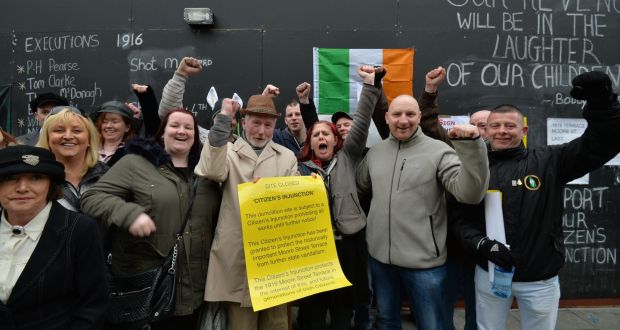
Some of the activist campaigners in Moore Street upon receiving the news from the High Court on March 18th. (Photo: Alan Betson, Irish Times)
And on March 18th the High Court judgement was delivered – that the whole quarter, backyards and surrounding streets and laneways is a battlefield, a National Historical 1916 Monument . But then the Minister of Heritage appealed the judgement, seeking to overturn it.
The Minister set up her hand-picked Advisory Group on Moore Street and eventually a Report was produced, apparently agreed by all within the Advisory Group (whether wholeheartedly or with reservations).
DISSENT AS A PUBLIC DUTY
When dissenting voices are kept quiet or stifled, what happens? The dominant voice – the one that is not silenced — carries the day ; it becomes the ‘official’ voice of the struggle. The media chooses which people and what voices to promote and the authorities recognise which voices to deal with. Those voices then become the ‘official’ voices and the path they point to is seen as the “correct” one. Those who raise a different voice, if they are loud enough or positioned strongly enough to be heard, are labelled the “disruptors”, “dissidents”, “wreckers”. But what if the dissenting voices are correct?
The Report of the Minister’s Advisory Group (from which she excluded the most active campaigning groups of recent years, the Save Moore Street From Demolition and Save Moore Street 2016 campaigns), in response to submissions made to it (including by the two campaign groups mentioned) contained some very positive Recommendations (although the Minister has not specifically said whether she accepts them) — but it also contained some very dangerous ones.
The Moore Street struggle has been fought against three main enemies: Property Speculators, DCC Planning Department and the Ministry of Heritage. And who does the Report say should decide the future of the Moore Street quarter? Those very three! And this is despite the public position taken by many of those before they entered the Minister’s Consultative Group that the Minister should accept the High Court judgement.
As for the newly-founded Minister’s Advisory Group being some kind of check on them, it has no statutory powers, it is a smaller group than was even the Consultative Group, the most active campaigners of recent years are again excluded and it is chaired by the former Chair of the Water Forum set up by the Government.
The Minister did not accept the High Court judgement of March 18th 2016 which declared the whole Moore Street quarter to be a battlefield and a Historic 1916 National Monument and she is fighting it in the courts. The Recommendations did not call on the Minister to drop her legal fight against that judgement but in somewhat nuanced language, they did encourage the litigant who won that judgement to give up his legal defence of it, the ‘sweetener’ being that he and his legal team would get their costs paid.
Should the Minister win her appeal, the giant shopping mall plan will be back on the table – Jim Keoghan of DCC’s Planning Department, before he retired, extended the planning permission for that horrible plan for another five years.
At recent public meeting of a political party about the future of Moore Street, (the first-ever by the party in question), a prominent Moore Street campaigner who was part of the Minister’s Advisory Group made a strong call for public unity among the campaigners, with differences to be discussed in private. The chairperson and both other speakers, all members of the political party, supported that call. The same individual repeated that call at a much larger event in Liberty Hall. It seemed a good call – but it wasn’t.
(Image source: Internet)
Effective unity has to agree on basic steps – like that which was entered into for insurrection in 1916, between the Irish Citizen Army, Irish Volunteers, Na Fianna Éireann, Cumann na mBan, Hibernian Rifles. Effective unity did not exist between those organisations and Redmond’s Irish Party, although the latter would have said that “We all want the same thing.” Tom Kettle, the Irish Party’s most brilliant activist, condemned those who took part in the Rising for allegedly damaging Ireland’s chances of achieving legislative autonomy. He put his faith in British gratitude to the Irish fighting for the Empire (and was killed on the Continent doing so). Effective unity in the Moore Street struggle cannot be on a vague promise that our aims are the same: we need to unite on the minimum basic demand that the Minister drop her appeal.
We’re on the one road
It may be the wrong road
But we’re together now who cares?
I care. We should care. We don’t want to be on the wrong road, to lose this battle.
When agreement is harmful, dissent is a duty. And when silence helps to conceal what is happening, dissent needs to be public.
THE MANCHESTER ATROCITY WAS ALLEGEDLY COMMITTED BY SALMAN ABEDI, A MEMBER OF A FUNDAMENTALIST ISLAMIST GROUP SHELTERED BY BRITISH INTELLIGENCE SERVICES. WHAT ARE THE CONNECTIONS BETWEEN MANCHESTER, LIBYA, IRAQ, SAUDI ARABIA? THEY ARE FAR FROM TENUOUS: ESSENTIALLY, THEY ARE BRITISH, US AND FRENCH IMPERIALISM, AS JOHN PILGER EXPLAINS (see link below).
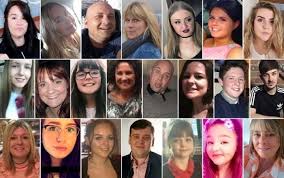
Images of some of the victims of the recent Manchester bombing (Source: Internet)
Comment
by Diarmuid Breatnach:
Irish anarchists and socialists should protest the visits of representatives of the US and British states (including the Royals) for this reason, since they seem unable to bring themselves to protest the occupation of a fifth of their country. Is not internationalist solidarity part of the creed of socialism? Do they not feel shame that the nearest imperialist power to them, its flag stained with the blood of millions and its hands dripping with fresh gore, can send its representatives to both parts of Ireland without any sign of socialist or anarchist protest?
Alleged photo of Salman Abedi, alleged Manchester bomber, from an unnamed source. Abedi was a member of an extreme Islamist group sheltered by British secret services, Pilger says. (Source: Internet)
Irish Republicans, when protesting the visits of British Royals for reasons the socialists disdain to do, should add these imperialist crimes to their reasons, as well as the collusion of their governments in this world order. Irish Republicans claim to be socialists too – is not internationalist solidarity part of the creed of socialism? They can demonstrate this in support of Palestine – why not embrace the rest of the Middle East? After all, whatever success the Republicans hope to have against British colonialism and imperialism, they are sure to meet resistance from US and French imperialism too.
A man stands next to flowers for the victims of Monday’s bombing at St Ann’s Square in central Manchester, England, Friday, May 26 2017. (AP Photo/Emilio Morenatti)
Social democrats who think that Jeremy Corbyn, even if successful in his campaign for election as Prime Minister of the UK, can put an end to this dirty work are deluding themselves and others. This is the British State at work, representing the British ruling class – its work continues whoever is elected to the British Parliament. Only a revolution overthrowing that State can possibly bring that to an end. Revolutionary socialists are often accused of being dreamers, impractical, Utopianists even …. but no-one can top social democrats for wishful thinking.
Hard-hitting report and analysis by journalist John Pilger of the connections between those powers and areas alluded to above: John Pilger article here
The Wikileaks/ Assange persecution saga should teach us important lessons. In the first place, chronologically, it should teach us the lengths to which allegedly democratic countries such as the United States will go to dominate weaker countries and attack movements of resistance, where the US feels its imperial interests are threatened, which is to say, where anyone may attempt to loosen its grip on markets, natural resources and strategic emplacements, or to prevent its grip from clawing further than it has already.
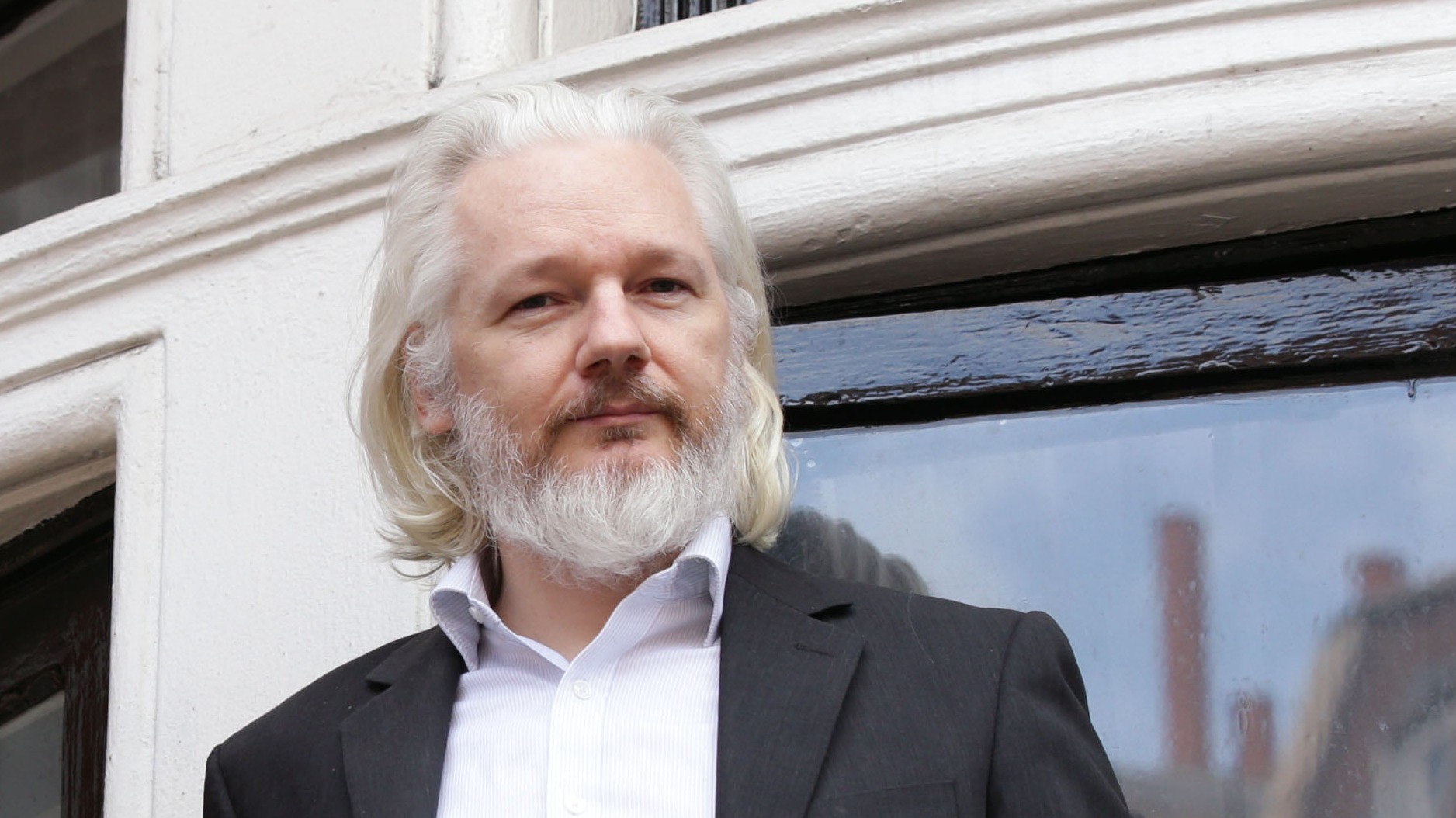
Julian Assange, photographed recently at the Uruguayan Embassy where he has been granted political asylum. (Photo source: Internet)
Wikileaks also exposed some of the extent to which the US will interfere in the internal or foreign policy matters of even its allies, including the European powers.
Possibly most instructive of all was the determination of the USA to hunt down the chief executive of Wikileaks, Julian Assange, flying in the face of US Constitutional principles and law, as well as international law, with statements confirming that determination even from Presidents and senior politicians and Government appointees, such as former US Secretary of State and the Democratic Party’s candidate for the US Presidency last year.1
In the course of hunting him down, the USA turned to Sweden, subverting the country’s laws and criminal investigative procedures, then to the UK government (which, as a junior partner in many of the US crimes exposed by Wikileaks, was probably only too keen to assist). Australia was brought to assist under threat and France turned away from Assange’s plight and his plea for asylum there. “No hiding place from the World Policeman,” seemed to be the message. Eventually, however, he did find refuge (if not a hiding place) from Uruguay, a tiny power on the world political, economic and political stage.
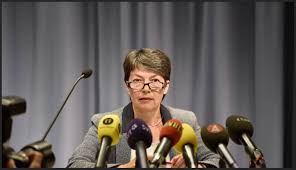
Swedish Prosecutor Marianne Ny, who commenced an investigation after another Prosecutor had already investigated and decided there was no case for Assange to answer (Photo source: Internet)
In the midst of this, how did the mass media perform, that which we are often assured is the guardian of democracy, even more than the vaunted parliament? Badly, in a word. Investigative journalism, intelligent evaluation, if they had been evident before, all went into the rubbish bin as print, radio and TV media joined in the lynch mob to a greater of lesser degree. The British newspaper The Guardian, which had been given exclusive first use on the Wikileaks stories, “the greatest scoop in 30 years”, according to its Editor, not only refused to assist him but allowed its pages to be occupied by witch hunters and made money out of publishing a book about the affair.2
“Anti-journalism”, is what Australian film-maker and renowned journalist (Britain’s Journalist of the Year Award-winner in 1967 and 1978), John Pilger called it.3
Assange learned some personal lessons too which should not be lost on us. Sometime lovers manipulated by police, Prosecutor and media; a close working colleague denouncing him and flinging unsubstantiated allegations against him (unsubstantiated but that did not prevent the media from publishing them).
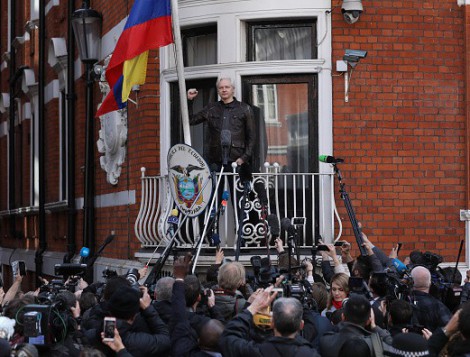
Julian Assange on the balcony of his asylum quarters, the Ecuadorian Embassy in London, after receiving news of the dropping of the Swedish ‘investigation’ of allegations of ‘rape’ against Assange and the voiding of the International Arrest Warrant. (Photo source: Internet)
LESSONS FOR US SPECIFICALLY
Suppose for a moment that one did not take to Assange’s character. Suppose one even objected to his work. Still, he was entitled to fair due process. That he did not receive it from so many is obvious. Did he receive it from us? That community of people who would lay claim to having an alternative view, to be opposed to the status quo and, most of all, to be for Justice?
Injustice meted out by those in power often needs collusion and the more independent of the power the colluders are, the more justified the witch-hunt is made to seem. The media whipped up a passionate hue and cry against Assange, who had not even been charged and had cooperated to all extents reasonable with the investigation of allegations against him.
That hysteria sought to drown Assange but also to catch in its flood any, no matter how puny or how mildly, called for justice and due process. The cry of the mob must be “Hang him!” and no dissenting voices must be heard.
The hysteria generated in some sectors, even among people who would normally insist on justice and who opposed the status quo, reached a very high pitch. For the crime of suggesting at the time on Facebook that the case against him seemed “dodgy” and that besides he was in any case entitled to due process, a person called me a “rape apologist” in public while people I had considered comrades (and had thought one even a friend) remained silent. Shortly after that, a clutch of FB friends (which I made FB ex-friends quickly) backed up the allegation.
That taught me a valuable lesson about comrades and solidarity but it pales beside the severity of the lesson Assange has been taught, the mark of which he may carry for the rest of his life. But the function of such a process goes far beyond the personal; it is intended to make dissent very uncomfortable and even painful. We may face the attacks of our declared enemies with courage or at least resolve and commitment but it is a different matter when we are attacked, politically and personally, by those we take to be broadly on our side against the oppressive powers.
Most people would say they are for justice. It is usually easy to say so. But unless we can stand up for it whether we like the victim or not, whether we approve of his work or not and, even in the midst of the hysteria calling for a hanging, we are prepared to cry instead for justice, our declarations are worth nothing.
There are many lessons in the saga for us to learn — but will we?
end
Footnotes
1 “Can’t we just drone this guy?” Hillary Clinton, quoted in the Pilger summary article.
The Report contains some very welcome elements which campaigners will appreciate, as well as being proud in bringing them about. But those elements are combined with some very dangerous ones, specifically in some of the recommendations at the end of the Report — and recommendations are the strongest part of any report. That combination of welcome and dangerous elements may or may not be specifically designed to split the forces campaigning for the conservation and appropriate development of the Moore Street Historic Quarter but it will almost certainly have that effect. This, taken together with the offending recommendations means that the Report in total is a dangerous and divisive document containing a number of significant recommendations which it seems to me we are duty bound to oppose.
Source: Internet
The positive elements in the Report are bound to engender a touch of euphoria about the Report among many close and distant supporters of the broad campaign to save the Moore Street historical quarter. Those who do not read on to the Recommendations or who do not think them through.
Consequently there is bound to be an element of criticism of those who do not support it as a whole – epithets such as “begrudgers” or “Utopians” are bound to come to minds and even be hurled.
The temptation is to “win something” after many years of campaigning. Another temptation is to see the positive and imagine it contains more than it actually does, while ignoring the looming negatives. Junctures like this test campaigners, sometimes even more than decisions about whether to risk fines and jail by breaking the law when that seems the only viable action left to halt an injustice or to remedy one. There have been many difficult junctures like this in Irish history.
Indeed a number of occasions of this sort have occurred before in this very campaign.
A HISTORY OF APPARENT CONCESSIONS TO SPLIT OR DISCREDIT CAMPAIGNERS WHILE FACILITATING SPECULATORS
1) When there were murmurs in Government circles that No.16 might be saved some people were very happy and, indeed, one campaign FB page had been named “Save 16 Moore Street”. Others objected and stated that this was insufficient historical recognition of what had gone on there.
2) Again, when the State accorded protective and preservation status to Nos.14-17 in 2007, there was a similar reaction of euphoria and congratulation from many people. This was resisted by some campaigners who pointed out that almost at the same time, the giant shopping mall plan had been agreed by the local authority (and later by the State), which would see the rest of the block and the laneways demolished and that the historic buildings were being allowed to deteriorate. The ‘nay-sayers’ were proved correct on this occasion.
3) It is worth recalling that around this time, the property speculator involved (at that time only Joe O’Reilly of Chartered Land), proposed to turn the four houses into a museum upstairs with a cafe and toilets downstairs and to incorporate the whole into the giant shopping mall. He had the shoebox museum plan promoted in a flashy video and he succeeded in splitting the campaigning 1916 relatives group, bringing four of them (including one of James Connolly grandsons) out in favour of his proposal (a fact that the State and the media have regularly used to counter the objectives of the broader campaign).
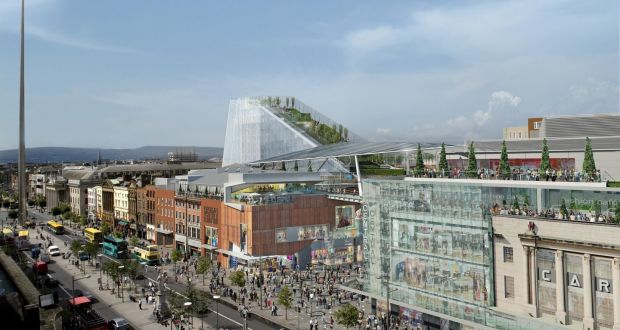
Speculators’ original plan for Shopping Centre from O’Connell Street to Moore St. — note the four houses to be “saved” in the centre left. (Image source: Internet)Artist’s Impression of Shopping Centre planned by Chartered Land, much of it agreed by DCC Planning Department (Image source: Internet)
4) In the summer of 2014, the speculator O’Reilly of Chartered Land, by this time being paid by NAMA to manage his debts, proposed to Dublin City Council to swap them two of the four protected houses for their two at the north end of the terrace, which was where the Council had their cleaning depot. The head of the Planning Department (also Deputy Chief Executive of the Council) Jim Keoghan and the Chief Executive Jim Keegan, unsurprisingly in view of their record, recommended the deal.
The early days of the weekly SMSFD stall in Moore St. — 4th October 2014 (Photo: D.Breatnach)SMSFD lobbying City Hall to prevent ‘land swap’ deal going ahead, stretching some petition sheets already signed in previous two months. Nov.2014 (Photo source: supporter)
At this time, even some supporters of the broad campaign stated that campaigners should take the deal because it put four houses of preservation status into public ownership. Thankfully they were outvoted, since with those end-of-terrace buildings in his possession, the speculator would have been free to begin to demolish houses all the way at least up to No.18 – at total of seven houses and approximately half the terrace.
But a new campaign was launched specifically to defeat this deal, bringing a sustained weekly presence on Moore Street into being, along with a petition of thousands of signatures. As opposition to the deal gathered force, the speculator offered first a third house in the deal and finally a fourth. However with the assistance of lobbying of elected Councillors, the ‘land swap’ proposal was defeated in a vote by a large majority, much to the publicly-expressed disgust of Heather Humphreys, Minister with State responsibility for Heritage.
5) Towards the end of 2015, the State purchased the four dilapidated buildings from the speculator, reportedly paying him four million euro and promoted the deal as a great historic one, announcing that they would have a 1916 museum on the site.
Again, there was euphoria, with campaigners being congratulated on their victory. However, at this time a substantial number of campaigners from different concerned groups pointed out that this did nothing to save the rest of the block, yards and laneways, that the street market was being steadily degraded and that the plan for the museum seemed to be exactly the same as that proposed by the speculator.
It was actually worse than was thought by many of those campaigners, for in January it emerged that the State planned the demolition of three buildings in the 1916 terrace under the guise of making the “museum buildings” safe. The SMSFD campaign group raised the alarm and brought two demonstrations on to the street, after one of which many people occupied the buildings until a High Court Judge ruled that there be no demolition until a case taken against the State (to which the property speculators joined themselves) be decided, a decision that was enforced by a five-week activist blockade of the site.
Later photo of SMSFD campaigners and table (Photo: D.Breatnach)
6) Once again, there had been concerned people who argued that campaigners should accept the deal, “work with the museum”, that now the houses were in public ownership but many of those were silenced when the State plans were revealed. However, the occupiers were targeted by a number of media, a couple of prominent historians and columnists attacked them, Heather Humphreys labelled them hooligans and wreckers. The activists were accused of preventing the State from opening the museum in time for the Easter Rising commemorations that year (despite the many months of work needed for a commemoration only months away). They were accused of denying 1916 relatives an appropriate monument.
But it was clear on whose side the majority of the public was and it wasn’t with the State or the speculator. This was underlined not only by tens of thousands of petition signatures but by the reaction of many to activists loudly denouncing Minister Humphreys when, as part of the State’s 1916 commemorations, she came to lay a wreath outside a boarded-up No.16 Moore Street. The public’s reaction for the most part varied from “what did she expect?” to “serves her right!” and, perhaps sensing this, even the media’s response was muted and restricted to factual reporting.
On March 18th High Court Judge Barrett delivered his judgement that not only the whole terrace was a “national 1916 historical monument” but the whole block, and the street and three laneways surrounding it. Again there were wild celebrations, shared in by all campaigners but some urged caution as the Minister could appeal the judgement. They were right – she did, the case to open at the end of the year (unless she takes it to the Supreme Court, which she declared she was considering.
Campaigners, including occupiers and blockaders of the buildings, celebrate the Battlefield judgement on March 18th 2016. (Photo: J.Betson, Irish Times)
7) When the Minister set up the Minister’s Consultative Group on Moore Street, despite the fact that she put into it the 1916 relatives supporting the speculators’ plan, despite the fact that she excluded the most active groups of campaigners in recent years, despite the fact that the main political parties were to be represented, concerned people and excluded campaigners were told to have faith in it and even told that it was “the only game in town”.
Having reviewed the history of proposed deals of the past, it is now time to examine the one being offered now.
THE RECOMMENDATIONS
Conclusion 1, commenting on the struggle to save the Moore Street quarter, states that “the background …. has been one of dispute, mistrust and litigation. It has been characterised by deeply held and divergent views, frustration and ultimately stalemate. This has seen Moore St and environs further decline and a failure to progress the National Monument or the wider development of the area.”
While this has elements of truth it also has large elements of obfuscation, of muddying the waters, appearing to apportion blame equally or to imply that no-one is to blame or even perhaps blaming the campaigners for the decline of the buildings. This is quite important because in what follows some of the major villains in this drama are not only being ‘cleaned up’ but it is proposed to give them continuing roles of control in decision-making on the conservation and appropriate development of the Moore Street quarter.
Let us recall once again that the Planning Department of Dublin City Council, backed up by the State, supported the planning applications of property speculators which would have entailed the destruction of the historic quarter and the running down of the street market. The Dept of Heritage took no action until 2007 when it gave protected status to four buildings and took no steps to ensure the speculator maintained the buildings.
Towards the end of 2015 the Department of Heritage planned the demolition of a number of buildings in the historical quarter, a disaster averted by citizens occupying buildings there for five days in January 2016. Subsequently a nearly six-weeks’ blockade was imposed by citizens to prevent damage and demolition, because the Minister prevented and forbade the entry of any independent conservation experts or public representatives, including the Lord Mayor and a number of TDs.
The actions of the campaigners were to preserve historic heritage and to seek transparency. The actions of DCC’s Planning Department and of the State were to facilitate the property speculators, to defeat the aims of the campaigners and to conceal what they intended doing — and were in fact doing — in a number of buildings.
These differences between the opposing forces are important to recognise not only in setting the record straight but in deciding which bodies should and should not be given responsibilities with regard to the Moore Street Quarter.
Conclusion 2 goes on to claim for the Consultative Group set up by the Minister, the centre stage for a resolution of the conflict, as though it were some impartial mediating body. Excluded from Consultative Group were the National Graves Association, the first campaign group to raise the issue of the historical conservation in Moore Street, along with the most active campaigning groups of recent years (the Save Moore Street From Demolition and the Save Moore Street 2016 groups), also excluding a number of individual campaigners and concerned historians and conservation experts. It is true that a number of those groups and individuals were permitted to make submissions to the Consultative Group but they were not permitted any say in its final recommendations.
The plaque placed on a house in Moore Street by the National Graves Association (no State or Council plaque had been put there ever). (Photo: D.Breatnach)
Conclusion 4 states that “the place of Moore St in the narrative of 1916 … is now better understood across a much wider range of interests than previously. The appreciation of the historic importance of the area and of the value attached to the dramatic events fought out there in the closing events of the week of 1916 is now more widely shared. The potential of the area to be developed as a place of cultural and historic importance therefore, alongside appropriate commercial development, offers, the Group believes, positive and substantive opportunity to move forward.”
But the Report has nothing to say about how this came about, which was by hard slogging and sacrifice by campaigners supported by ordinary people. And this happened in the teeth of opposition by the Department of Heritage and Dublin City Council officials and calumny and defamation by the Minister of Heritage of campaigners. Not only should this record be set straight but their history in this affair means that they should not be relied upon in controlling the development of the Quarter.
Conclusion 5 goes on to say that “In the event of consensus being secured on an agreed way forward for the development through dialogue by the Advisory/Oversight Group (see 17 below) with the developer, and agreed to by the Applicant and the State, the Group is strongly of the view that payment of legal costs, incurred by the Applicant’s legal team, by the State is warranted and appropriate. The Group has reached this conclusion after considerable reflection and having regard to the widely acknowledged public interest which informed the taking of the case and the savings which would accrue to the State by settlement through such a process.”
This is, in nuanced language, apart from seeking negotiation with a property speculator, a request to the person who took the case to not to defend it, with the inducement that the lawyers will get their fees and the litigant will not be out of pocket.
The State should of course bear the costs, both because of “the widely acknowledged public interest which informed the taking of the case” and because of the intransigence and obstructionism of the Minister of Heritage which led to the case being taken in the first place. And this should not be done as payment in some kind of sordid deal.
On the other hand, there is no mention whatsoever of the Minister dropping her appeal against the Moore Street Battlefield Quarter judgement that the whole quarter is a National 1916 Historical Monument. In fact the “settlement” envisaged is to give the Minister a clear run without the litigant who won that historic judgement defending it.
Recommendation 9 “supports the retention of Moore Street and adjacent lanes so as to broadly capture the sense of how it would have appeared in 1916 – this covers the street and lanes, key buildings, street paving and lighting. It recognises that this needs to be approached on a practical and authentic basis given that a number of structures in place actually postdate Independence. The preservation of the existing lines of the street and the lanes and the restoration of streetscapes are essential. “
All this seems good until we note words like “key buildings” and “structures in place …. postdate Independence”. Thus far the Minister has only conceded the historical importance of four buildings, Nos.14-17. And, although a number of buildings in the Quarter have been rebuilt since 1916, every single one contains the historical footprint of the 1916 occupation and resistance and every single one contains at least some structural feature of the original buildings.
And No.10, of which the Minister denies importance, was the first HQ of the Rising in Moore Street and field hospital of the evacuated GPO Garrison – and substantial parts of that building also remain intact.
Recommendation 10 actually concedes some of what I say above, albeit in timid language when it states that “… opportunities arise for the State to provide the centre point of historical focus and cultural celebration within 10 – 25 Moore St.”
Indeed, not only “opportunities exist” but the whole terrace should be maintained and developed as a “point of historical focus and cultural celebration”.But where is the recommendation that this actually be done?
Recommendation 15 states that “Critical to the renewal of the area is the regeneration of the Moore St market to its full potential. Particular recommendations in this regard are set out at Chapter 6.”
We should I think support nearly all of the recommendations in that section, i.e. all those that bring greater comfort, freedom from Market Inspector harassment and flexibility in regulations to the street traders. All the campaigners have stated that the market traders should have better conditions and that the market should be upgraded and one campaign group in particular, the Save Moore Street From Demolition campaign, perhaps because it is on that street at least every Saturday, has been very specific about including this in its demands since it was first formed.
Regrettably, the Report has nothing to say about the other independent businesses in the street. Moore Street has always contained shops and other business as well as stalls and it is regrettable that despite SMSFD’s submission commenting on this aspect, the Consultative Group had no representation from the independent shops and business and the Report has nothing at all to say about them, although small independent businesses are the key to regenerating an area by day and by night.
Indeed, other than the street traders, the only business interests mentioned in the report are those of the property speculators, who propose a giant shopping mall to be occupied by chain outlets.
Recommendation 16
The Report’s view of “essential” “well-grounded institutional arrangements for taking the process forward” recommends:
“Policy ownership in relation to the National Monument at No’s 14/17 remaining with the Minister for Arts & Heritage;
“Overall planning framework and designation of other buildings in the quarter should remain with Dublin City Council;
“The development and eventual management of State’s property in Moore St, transferring to the Office of Public Works;
“The next phase of development of the National Monument at No’s 14/17 taking place under OPW control and, where private contractors are involved, such contracting follows a transparent public tendering process that fully accords with good international practice as laid down by EU procurement requirements. In addition, engagement and briefing with the Advisory/Oversight Group (see below) as appropriate should be undertaken in respect of this process.
We emphatically should not agree with the first two sub-recommendations.
If the Department of Heritage and Dublin City Council Planning Department is to have a role it should be in supporting a People’s Consortium, composed of representatives of all the campaigning groups (not cherry-picked by the Minister) and other representatives.
While sub-recommendation 3 and most of 4 seem fair, one cannot agree with the role of the Advisory/Oversight Group as recommended by the Report (more on that later).
Recommendation 17
The Report states that “A critical part of the next phase of the process will involve securing consensus by the relevant players to a way forward” and that “this will require engagement with public bodies, developer interests, traders and voluntary groups.”
Why should the protection of our heritage be subject to protection of “developer interests”, i.e the interests of property speculators who are still at this moment in time trying to destroy that heritage and replace it with a shopping centre? The inclusion of those “interests” in deciding the future of our heritage and our national monuments should be rejected.
Recommendation 18
The Report recommends “that an Advisory/Oversight Group should be established” to steer the project and “will require engagement …. with the public bodies and the developer to seek to find agreement on the way forward.”
As stated earlier, there should be no role in seeking agreement with enemies of our heritage and facilitators of property speculators on the way forward for safeguarding our heritage and our national monument.
But further, the Advisory/ Oversight Group envisaged by the Report (“representatives from among the current membership of the Consultative Group, including appropriate Oireachtas and DCC representation”) is an unrepresentative group, continuing the exclusion of the most active campaigning groups of recent years and of the National Graves Association, the first campaign group to raise the issue of the historical conservation in Moore Street, along with the exclusion of a number of individual campaigners and concerned historians and conservation experts.
Recommendation 22 — The Role of the State
When the Report declares that the State is “the ultimate custodian of our history, culture and heritage”, it is perhaps stating an aspiration but it is demonstrably not stating a fact. The State, as represented by a number of governments during its existence, has done nothing to commemorate nor protect the significance of this historic quarter, save the purchase of four buildings after years of campaigning, and that around the same time it planned the demolition of a number of buildings in the Quarter; the State’s representatives publicly denied the historical importance of 12 buildings and even denied the area had been a battleground.
When Chartered Land’s (Joe O’Reilly) properties were taken over by NAMA, the State should have prevented the speculator from selling or otherwise passing on his stake to British-based property speculators Hammerson. They did not and so became complicit.
Looking beyond Moore Street around the country, it is the voluntary National Graves Association that has been responsible for most of the plaques commemorating the struggle for national independence (and a fair number of monuments) and the upkeep of graves of participants of that struggle, with a number of local authorities coming second and the State possibly a poor third.
Turning to our culture, the body that has done most to promote Gaelic Sports is the GAA, not the State. Comhaltas Ceoltóirí Éireann, smaller associations of musicians and individuals, not the State, have been the promoters and developers of traditional music. With regard to the Irish language, the State has overseen a drastic decline in the Gaeltacht areas, continuously fails to ensure the supply of even State services through Irish for Irish speakers and recently, has appointed a Minister for Heritage and two Ministers of State that were not competent in the use of the Irish language. Irish traditional dancing, whether exhibition and competition step-dancing, céilí, set-dancing and sean-nós have all been conserved and promoted by different organisations, none of them a State one (in fact, for a period, the State banned set-dancing in people’s homes).
The State has failed to protect and preserve a great many other areas of our heritage, including our natural resources.
So who then are “the ultimate custodians of our history, culture and heritage”? It is the PEOPLE!
However, one has to recognise the reality of the governance framework under which we live and the State should, for a change, represent the interests of the people in this case and ensure the Moore Street Historic Quarter is developed appropriately in consultation with campaigners, local independent traders and shopkeepers, workers and residents. And in doing so, the State can make some amends for its compliance and complicity of the past.
WHO SHOULD GUIDE POLICY AND PRACTICE ON THE FUTURE DEVELOPMENT OF THE QUARTER?
The body that discusses and guides policy on the future development of this historic quarter should be composed solely of a wide representation of those who have demonstrated a commitment to the defence of the historic status of the quarter, along with those who work there, in addition to any expert technical advisors they may think right to coopt.
IN CONCLUSION AND SUMMARY, although the Report contains much that is good and I believe campaigners should support those elements, due to a number of unhealthy recommendations which undermine what has been fought for so hard for so long and would leave important decision-making in the hands of the very proven enemies of the preservation, conservation and appropriate development of the Moore Street Quarter, those dangerous Conclusions and Recommendations of the Report should be rejected and I call on all genuine campaigners and supporters to reject them also.
In doing so, I would encourage all campaigners to remain firm in their determination, looking back on the long road traveled to reach this point and not to falter at this juncture, the fate of so many popular movements of the past.
We have been called ‘dreamers’ many times in the past but who could have foretold back in 2001, the gains steadily won over the years? ‘Dreamers’ is usually employed as a term of abuse, of ridicule and no doubt those critics consider themselves wise. To those we may reply in the words of one who spent his last two days of freedom in Moore Street in Easter Week 1916:
“Oh wise men, riddle me this – what if the dream come true?”
In this at least let us make that dream come true.
This is an interesting criticism of the Michael Collins historical biopic 1996. Written and directed by Neil Jordan, the film begins with the end of the Irish 1916 Rising, has the longest part focused on the War of Independence (1919-1921) and ends not long after the start of the Civil War (1922-1923). The film starred Liam Neeson as Michael Collins and included others such as Aidan Quinn playing Harry Boland, Alan Rickman as Eamon De Valera, Stephen Rea as Ned Broy, Julia Roberts as Kitty Kiernan, Gerald Mc Sorley as Cathal Brugha and Brendan Gleeson as Liam Tobin.
The video from Foras Teamhrach presents its criticism using clips from the film while commenting and also comparative clips from other films, which is a useful way of presenting a challenging view. Unfortunately neither the name of the author of the commentary nor of the commentator (possibly the one and same) appeared on the Youtube link, only the company name and the comments function was disabled (perhaps understandably).
Most of the points are well made but there are some omissions which might usefully be added to the criticism.
The GPO surrender scene
The video criticism points out that showing only the GPO makes the Rising look much smaller than it actually was; despite the countermanding order which reduced the forces in Dublin by perhaps as much as two-thirds, the Rising was fought by four major garrisons on the southern and three on the northern side of the Liffey, with other smaller outposts and individual actions. However, the narrator says nothing regarding the historical inaccuracy of portraying the surrender as occurring at the GPO.
In fact, the GPO had been abandoned on the Friday and the Surrender took place on the Saturday, following a decision made in the 1916 Terrace in Moore Street and around 350 insurgents there were the first to surrender following the order. This matters not just from a point of historical accuracy but because there is a struggle (now approaching two decades) to save this area from property speculators and State and Dublin Council Planning Department collusion.
Portrayal of De Valera
One does not have to be a supporter of De Valera’s philosophy and actions to rapidly come to the conclusion that his portrayal in Jordan’s film is so inaccurate as to seem to be someone else. Every person who took up arms in 1916 to fight the British Empire showed courage and those who continued to actively oppose the British occupation during the intense years of the War of Independence showed even more courage in doing so.
Collins, of a much more ebulient character than De Valera, according to witnesses, was more inclined to exhibitions of temper and shouting than was De Valera, whose manner was generally in accordance with his studious appearance – contrary to his behaviour in the Treaty discussion scene of the film. As to another aspect, when we review the record of his actions in preparation for the Rising through to the War of Independence and on through the Civil War and the early years under the Free State, De Valera cannot reasonably be accused of lacking courage. The shivering wreck as which he is portrayed during the Civil War in Jordan’s film runs counter to the historical record.
There is testimony from one or two participants that at a period during his command of Boland’s Mill, De Valera had something of a breakdown. This, if it occurred, could have been as a result of fear or instead of lack of sleep, or of being overwhelmed by responsibility or a number of causes and if this alleged episode is what inspired Jordan’s depiction it was certainly unfair to use it to characterise De Valera at other times. There are many criticisms that can fairly be thrown at De Valera but lack of courage is not one of them.
Portrayal of Cathal Brugha
And likewise with the portrayal of Cathal Brugha. Some of Brugha’s military and political history may help in evaluating the portrayal of this man in Jordan’s film.
One of fourteen children empoverished by the death of their Protestant father, Brugha joined the Gaelic League in 1899 and quickly became fluent, soon changing his name from Charles Burgess to Cathal Brugha. He and Kathleen Kingston, also an Irish language enthusiast, married in 1912 and had six children. Brugha joined the Irish Republican Brotherhood (IRB) and in 1913, the year they were formed, he became a lieutenant in the Irish Volunteers and led a group of Volunteers to land the arms smuggled into Howth by the Asgard in 1914.
In the Easter Rising of 1916 Brugha was second-in-command at the South Dublin Union under Commandant Éamonn Ceannt, scene of some of the fiercest fighting during the Rising. Overlooked in the evacuation on Thursday of Easter Week and, being badly wounded, he was unable to leave. Bleeding from 25 wounds (some of which had penetrated arteries) he continued to fire upon the enemy and when Eamonn Ceannt led a group to investigate who was still firing he discovered Brugha singing “God Save Ireland” surrounded by his own blood and with his pistol still in his hands.
Brugha was not expected to survive which may have saved him from the execution parties and he was discharged from hospital in August 1916 as “incurable”. However he recovered in 1917 though left suffering pain and with a permanent limp and preferred to cycle than walk.
Already in 1917 from his hospital bed, Brugha began to seek out Volunteers and Irish Citizen Army people who were willing to join the new armed resistance group and it seems that he, more than any other, should receive the main credit for the initial formation of that which became the IRA.
Brugha was so respected in the movement that he was elected speaker of Dáil Éireann at its first meeting on 21 January 1919 and it was he who read out the Declaration of Independence in Irish, which ratified ‘the establishment of the Irish Republic’. He was also appointed temporary President, a position in which he remained until de Valera tok his place.
Far from being a bloodthirsty zealot as he is portrayed in the film, Brugha reduced Collins’ ‘Bloody Sunday’ assassination list considerably since in his opinion, there was insufficient evidence against a number of people named on the list. Then again, at the outbreak of the Civil War, a reluctant Brugha only joined the fighting on the Republican (Anti-Treaty) side in order to relieve the pressure on the Four Courts garrison. Cathal Brugha led a detachment in occupying a number of buildings in O’Connell Street and later, having got his men safely away or surrendered, was shot and mortally wounded in debated circumstances by Free State troops (which were under the overall command of Collins).
Brugha had, according to some opinions, alienated a section of waverers at the Dáil debates on the Treaty, by a personal attack on Collins and the way his persona had been elevated (a common problem, the deification of leaders). This was no doubt a tactical mistake but there had been ongoing conflict between both men for some time. Although both had been members, Brugha had left the IRB after 1916 in the belief that their conflict with the Volunteer leadership had damaged the Rising. Collins’ rank in the organisation was supreme in Ireland and it seems that Collins used this at times to circumvent or undermine decisions of the Dáil, where Brugha outranked Collins and which the former believed to be the repository of democratic decision-making.
Collins as a guerrilla war leader
All Collins’ many talents and contributions to the War of Independence aside, his representation in the film as not only directing the whole armed struggle but also as teaching rural people how to wage a guerrilla war is a complete distortion of history that could only be undertaken by a propagandist for Collins.
It was Brugha who began to pull the scattered elements of the armed struggle together and laid the foundations for what became the IRA. It was Robinson, Breen, Tracey and Hogan who began the armed resistance of the War of Independence in Tipperary on 21 January 1919 in which two paramilitary policemen were killed. And they did so without permission from GHQ in Dublin.
As to rural guerrilla tactics, these were such as had been used for centuries or developed in the struggle and were certainly not taught by Dublin. What was taught by instructors sent by Dublin was weapon use and maintenance and personnel disposition for ambushes, moving in extended order through countryside and securing a line of retreat. One of the chief instructors in this kind of instruction was Ernie O’Malley and, in West Cork, the young Tom Barry used his British Army experience and other learning to do the same. The order to create Flying Columns might have come from Dublin but had been advocated already by fighters in Cork, Kerry and Tipperary and it was they and others who developed them in the field.
Collins’ special contribution was in organising intelligence, counter-intelligence and the assassination squad (which turned out to be a double-edged sword) and also, to an extent, supply of weapons. His contribution was notable but it did not lie in initial organising of guerrilla war, much less in rural guerrilla instruction.
The role of women in the struggle
Women are underrepresented in this narrative, as is usual in Irish history and Republican and nationalist narrative. Where women are shown, apart from the brief appearance of Markievicz at the non-existent GPO surrender (when instead she was at the College of Surgeons!), they are objects of romance (Kittie Kiernan) or auxilliaries working for Collins’ intelligence department.
There was a great opportunity lost there to show the women in action during the Rising in the many roles they undertook, including firing weapons, or in keeping the flame lit after the Rising and in particular in commemorating the Rising a year later, organising demonstrations, pickets, and funerals.
The Croke Park Bloody Sunday massacre scene
The film shows the ‘Tans or Auxies shooting down people with machine-gun on the GAA ground. As far as we have been able to establish it was the RIC who did it, although of course the other two were auxilliary forces of the RIC. Thankfully they did not fire with a machine-gun (the Army had one outside the grounds and an armoured car, it seems but did not open fire) or the carnage would have been a lot worse. When one examines the casualty list of those shot, just like more modern British massacres in Derry and Belfast, it is clear that the shooting was mostly disciplined, i.e hitting males of military age. Showing that kind of scenario would in the last analysis not only be more historically accurate but also more telling of the intent and cold-bloodedness.
And what of the three tortured and murdered in the Castle that day, Peadar Clancy, Dick McKee and Conor Clune? Yes, we know, one can’t show everything.
Go raibh maith agat to the individual who sent the video links to this blog.
We Irish are said to have long memories and to be unforgiving. The English, it has been said, can’t remember their history while we Irish can’t forget it.
Look around the former and current Empire and I think you’ll find it’s not just the Irish who remember and won’t let the English forget: the Scots, the Welsh, Australian Aborigines, Sub-Saharan Africans, West Africans like Kenya and Nigeria, the Tasmanians (ok, all wiped out but others remember for them), Jews and Palestinians, Arabs, French-Canadians, Indians, Bengalis and Pakistanis, Afghans, Iraqis, Kurds, Egyptians, Greeks, Cypriots, First People and American Indians (before the ‘settler regime’ took over), South African indigenous people, Afrikaners (who — whatever their own sins — saw at least a third of their women and children die in British concentration camps), ‘English’ Caribbean (slave) Islands like Barbados, Trinidad and Jamaica, Malaya, Singapore, Hong Kong, other parts of China in the Opium War …..
Royal Marine Commando holds up heads removed from the bodies of alleged communist resistance in MalayaArtist’s impression of 1841 Massacre of Australian Aborigines at Myall Creek (Image source: Internet)Photo presumably before British troops opened fire at the Jallian Wala Bagh (Amritsar) Massacre, India 1919. (Image source: Internet)
‘Very well, yes’ the British ruling class and their ‘educators’ and pundits admit when pushed hard enough – ‘there’s a lot of forgetting to be done, so best get on with it. After all, that’s all in the distant past.’
There’s a problem though with forgetting ill deeds of the distant past – it eases the doing of new ill-deeds and makes their denying easier: “We British are a civilised people and our soldiers wouldn’t do things like that, nor would our leaders let them.” History teaches us that they would, again and again and not only would their leaders let them, they’d order them to and then lie and cover up, occasionally offering up one or two minor actors as a sacrifice if public opinion persists clamorously (and even then not too many in case the lower ranks should rebel and spill the bloody beans).
There’s another problem with forgetting about ill-deeds of the past: it’s not all so distant and some of it is still going on. Part of Ireland is still occupied by the British, i.e it is a colonial possession. And the iniquities of its rule there led a substantial part of the population to rebel at the end of the 1960s, which the British and their colonial administration moved to repress, which in turn led to a war of nearly thirty years. One could (although it is rarely done) call it a colonial war. And that war caused the deaths of many: Irish guerrillas, British soldiers, armed colonial police, colonial paramilitaries, republican political activists, defence lawyers and uninvolved civilians. The toll included over sixty children.
And repression of Republican activists continues today on the streets in the Six Counties (‘Northern Ireland’ for the geographically ignorant) and with over 30 Republican political prisoners in jails of the colony.
Mr. James Brokenshire, Secretary of State for ‘Northern Ireland’ (a post that would perhaps in the past have been “British Governor for …..”), who took the post last July, wants some more public forgetting. And, as is common with colonial advocates of forgetting, he is not only “economical with the truth” (a phrase famed after use by a British politician trying to prevent some other truths entering the public arena)1 but goes for outright lies.
James Brokenshire, Secretary of State for Northern Ireland (sic). (Image source: Internet)
Writing in the Daily Telegraph, Mr Brokenshire was complaining about cases being pursued against British soldiers and colonial police who were stationed in the Six Counties. He said: “It is also clear the current focus is disproportionately on those who worked for the state – former members of the Armed Forces and the RUC.”
In addition, Mr. Brokenshire praised the “vast majority” of police and the armed forces who served “with great courage, professionalism and distinction”. He added: “We are in danger of seeing the past rewritten.”
No, Mr. Brokenshire, it is you and yours who are trying to see to the rewriting of the past but there is little danger that it will happen in the heads and hearts of your system’s victims, nor in those of many other victims and their descendants further afield — despite your historians, pundits, politicians, media and your domestic tools and allies.
Families of Ballymurphy Massacre victims reacted angrily and refuted some of Brokenshire’s lies: “25,000 people have been through the courts and there are only three soldiers among them. Of these three soldiers, they were given lenient sentences, released early and brought back into the army to finish off their service. …. the statistics show that pro-State forces and their agents are responsible for 41% of deaths not the 10% they keep putting out there ….”
Group of Ballymurphy Massacre campaigners. (Image source: Internet)
As proof of the disproportionately heavy burden of the investigations of 3,500 violent deaths falling upon British military services and colonial police, BBC News on line informed readers that London law firm Devonshire said it was representing between 10 and 15 former soldiers facing prosecution for a number of killings, including those on Bloody Sunday.
Presumably we are supposed to gasp in shock: “As many as fifteen!!” However, just to really shock us, the firm said there could be as many as 1,000 cases. It seems they may know more than Mr. Brokenshire, who claims the killings were mostly done by Republicans.
Barra McGrory QC, the director of public prosecutions for NI, recently told the BBC a number of cases had been coming to court due to inquests and referrals from the Attorney General for Northern Ireland.
He said: “We have taken decisions in three army cases recently, one was not to prosecute and in the other two prosecutions have been initiated.”
TARGETING AND KILLING UNARMED CIVILIANS
The Bloody Sunday killings by the British Army occurred in 1972 – cold-blooded executions of fourteen unarmed civilians on a protest demonstration. Around twenty were also injured, some by gunshot wound. In the colonial tradition of lies following murder, the first official British enquiry found that the dead were armed guerrillas and the soldiers only returning fire.
Lord Justice John Widgery — despite abundant eyewitness accounts to the contrary, his Tribunal in April 1972 found the unarmed victims had been IRA and that the soldiers had only fired in self-defence. “Nothing washes whiter than Widgery white” was a common piece of Irish graffiti at the time. (Image source: Internet)
The City Coroner, Hubert O’Neill, a retired British officer however found it to have been “sheer, unadulterated murder” in 1973. The British establishment nevertheless continued with their lies and found a way to deal with unwelcome coroners’ courts – they changed the law to prevent them apportioning blame and suspended many of the cases indefinitely.2
The Saville enquiry (1998-2004)3found that all but one of the victims was unarmed and the remaining dead man was recently cleared too. Saville’s findings included that two identified British soldiers had lied under oath (as many as that!) and, without explicitly blaming him, threw a cloud of doubt over the local leader of the Paras, Lieutenant Colonel Derek Wilford, accusing him of “deliberately disobeying” his superior officer, a Brigadier.4 No explanation was given as to how, if that were the case, he came to receive the Order of the British Empire decoration later that year “in recognition of distinguished service in Northern Ireland during the period 1st February 1972 to 30th April 1972” (i.e excluding the Bloody Sunday date by two days, true but for an officer who that same year had allegedly deliberately disobeyed a senior officer and caused the deaths of 14 civilians …..!).
Col. Derek Wilford OBE, photographed in Belgium where he now lives upon the publication of the Saville Report in 2010. (Photo: Daily Mail)
APOLOGIES, LIMITED BLAME AND NO CHARGES
Wilford’s senior officers all escaped blame, despite their decision to deploy the Parachute Regiment in Derry that day and their part in the coverup, including the wholesale hiding and destruction of evidence.5
When the Saville Enquiry Report was finally published in 2010 (six years after the conclusion of the Inquiry), then Prime Minister of Britain David Cameron apologised to the families of the victims but to date none of the soldiers who shot unarmed civilians has been charged with murder. Even worse, no British Army officer has been even charged with ordering murder and covering it up. Worst of all, no British Government Minister or official has been held responsible for the murders nor was the Widgery Tribunal, which first exonerated the Army and blamed the victims, condemned for a lying cover-up in the face of a mountain of evidence from civilian witnesses and a number of journalists. No media outlet has been charged with nor voluntarily admitted collusion in the cover up.
Mayor General Robert Ford (left of photo). He ordered the Paras into Derry despite their having killed eleven civilians 5 months earlier — but the Saville Inquiry exonerated him. (Image source: Internet)
Major General Robert Ford, in charge of land forces of the British Army at the time and in overall charge of their allocations in Derry that day, escaped any blame from the Saville Enquiry. Yet the allocation of the 1st Parachute Regiment to a Derry march against Internment had been his decision – only five months after they had shot and killed another eleven civilians over three days in another part of the Six Counties – the Ballymurphy suburb of Belfast.
The killings then too were of unarmed civilians protesting against internment (“Operation Demetrius”). As they would five months later, the soldiers, their commanding officers and politicians claimed they were “returning fire” from the IRA. A number of their victims had multiple wounds (one was shot fourteen times) and one received a second shot after being brought inside the Paras’ barracks, according to the victim before he died. As at Derry five months later, a number were shot while going to the aid of victims (including a priest, which makes the action of Fr. Daly — later Bishop — on Bloody Sunday in Derry even more heroic). One victim died of a heart attack after a soldier put a gun in his mouth and pulled the trigger – the gun had no round in the chamber but the victim didn’t know that. The inquests of the victims have still to be held, nearly half a century later.
Yes, one sees why Mr. Brokenshire wishes to have all this information buried with the victims, not to speak of other information that might yet emerge. And yet the 14 dead of Bloody Sunday in Derry and the 11 of the Ballymurphy Massacre are only some of the unarmed victims of the British Army and the RUC, not to mention the Loyalist death squads run by British occupation forces’ Intelligence units. There are the children and adults killed or maimed for life by plastic bullets fired at short range, sometimes without even being in the area of a disturbance; the children and adults killed by British or colonial forces’ gunfire; the captured Republican fighters executed on the ground or given no chance to surrender when ambushed; the joy-riding youths shot to death. Yes, Mr. Brokenshire has good reason to see all this swept under the carpet and one can understand why a number of British service personnel (supported by those in some foreign forces) would demonstrate in protest at their “persecution” as they did on April 14th in Belfast.
The investigations to which Mr. Brokenshire objects, by the way, are being conducted, not by any impartial organisation but by the Legacy branch of the Police Service of Northern Ireland. For the unaware, the PSNI is also a colonial police force, the progeny of the disbanded Royal Ulster Constabulary, containing many of that force and like its predecessor, sectarian and repressive of Republican activists. The RUC also contained the B-Specials, a kind of part-time official armed Loyalist militia, implicated in many killings and largely absorbed into the Ulster Regiment of the British Army. Officers of the full-time RUC are also implicated in many killings.6
A TIME TO FORGET
A criminal who has paid restitution and repented is entitled to get on with his or her life without being confronted with their crimes of the past. This is not what we have here – this is a criminal gang wanting us to forget while it carries on robbing, threatening, killing and destroying human lives.
Come the day when British Imperialism is dead, no longer even twitching, no pulse and no brainwaves, well then it might be time to forget. But maybe not – there might still be other imperialist and colonial powers around and as they learn from one another, so should their victims and resisters share their memories and experiences.
On that glorious day when such systems no longer trouble humanity, then, at last we can forget? I don’t think so, not even then. For what history teaches us about imperialism and colonialism and capitalism, it is teaching us about humanity, its economics and philosophies. As long as we exist, it will never be time to forget those lessons.
A chríoch.
FOOTNOTES
1Said by Sir Richard Armstrong in 1986 in the trial, the failed British attempt to prevent the publication in Australia of the “Spycatcher” memoirs of MI5 former Assistant Director Peter Wright and co-author Paul Greengrass. https://en.wikipedia.org/wiki/Spycatcher. However, the phrase was originally documented from the 18th Century liberal-conservative philosopher and orator Edmund Burke.
2Which is why some recent inquests on people killed by British and colonial forces are giving rise to criminal investigations so long after the actual deaths.
3Which many believe to be part of the Good Friday Agreement deal or at least given as a ‘sweetener’
4No investigation was apparently carried out into whether Wilford had been ever charged by the Army with “deliberately disobeying” a senior officer in an event which led to unarmed civilian deaths. In fact, Wilford had been awarded military decoration shortly afterwards. It seems that Wilford out of loyalty to the Paratroop Regiment and perhaps some other considerations, agreed to “carry the can” during the Enquiry. Wilford was always outspoken in defence of the soldiers under his command but later claimed that the Army had distanced itself from him, so that when he retired he was only one rank higher than that which he held at the time. He retired on full pension of that rank, however.
5“Over 1,000 army photographs and original army helicopter video footage were never made available (to the Enquiry — DB). Additionally, guns used on the day by the soldiers that could have been evidence in the inquiry were lost by the MoD. The MoD claimed that all the guns had been destroyed, but some were subsequently recovered in various locations (such as Sierra Leone and Beirut) despite the obstruction.” (Wikipedia)
6Although here the statistics are skewed by the few tried being made to resign just prior to being charged (presumably in exchange for gentler treatment by the courts or threat of worse) so that they did not appear as serving RUC officers when convicted.
Not Al Fatah, the Palestinian Authority or the PLO, according to this journalist, who concludes that today it is Hamas as shown by their elections. Israel, the West and Egypt tried to negate this decision by squeezing Gaza and bombarding it, where the IOF have no troops on the ground but failed so far. In the West Bank, Israel was able to subvert the elections through the arrest of Hamas representatives elected and through recognising unelected bodies such as the PA. Today Al Fatah is running a Prisoners’ hunger-strike.
D.Breatnach comments: Despite the Palestinians being a mostly secular one politically, they voted in Hamas because of the corruption and collusion of Al Fatah including its shameful agreement to the Oslo Accord 1 in 1993 as part of a whole swathe of “peace (sic) processes” which swept through South Africa and Ireland in the 1990s. Observers of the reality of Irish politics will find this article of interest and will surely see some parallels.
Dr. Khalil al Hayyah, representing Hamas at a press conference today on the question of talks with Al Fatah. (Photo source: Mohamed Asad, MEMO)
Motasem Al Dalloul, 13th February 2017.
The main Palestinian secular movement, Fatah, which dominates the Palestine Liberation Organisation (PLO) accused regional powers on Sunday evening of supporting its Islamic rival Hamas to carry out a coup against the umbrella body and the Palestinian Authority which it controls. The reason given is that such regional powers are trying to ease, or lift, the Israeli-led, internationally-backed, siege on the Gaza Strip.
In several official press releases, Fatah named Turkey and Qatar. They claimed that these two countries are planning to help Hamas and its supporters in the occupied Palestinian territories and diaspora to supersede the PLO and the PA.
According to Fatah spokespeople, Turkey is hosting a pro-Hamas conference for Palestinians in the diaspora, the preparations for which are going ahead without the PLO’s knowledge. However, a spokesman for the organising committee, Ziad Al-Aloul, has said several times that PLO members are among the organisers.
Fatah has also accused Turkey of supporting a military coup against the PA in the Gaza Strip, which has been under siege for more than ten years, simply because the government in Ankara sent its minister of energy and other officials to conduct a study on how they can help to solve the electricity crisis in the coastal enclave. The accusation is really unbelievable, not least because the Turkish delegation met with PA officials in the West Bank before entering the Gaza Strip. In fact, Turkey has been cooperating with the PA in the West Bank regarding a fuel grant for Gaza’s sole electricity plant.
Qatar stands accused by Fatah of the doing the same thing as Turkey, possibly because it is the only international state which has faithfully fulfilled its pledges made during the International Donor Conference held in Cairo in the wake of the 2014 Israeli military offensive on Gaza. The conference aimed to collect donations to rebuild the Gaza Strip.
Since the Cairo conference, Qatar has rebuilt thousands of homes destroyed by the Israelis during the offensive, and built thousands of new homes for the poor and homeless in Gaza. On Saturday, the latest batch of Qatari-built properties were handed over officially by a representative of the Gulf State. Mohamed Al-Emadi also announced a commitment to build a new hospital in the southern Gaza city of Rafah.
These are the Turkish and Qatari acts that Fatah, which dominates the PLO, apparently regards as illegitimate efforts to help Hamas to supersede the PLO and the PA. The movement has overlooked the simple fact that every single Turkish or Qatari donation for the Palestinians in Gaza is handed over to the beneficiaries either through the PA or directly from official Turkish and Qatari bodies working in the territory.
The latest remarks by Al-Emadi have complicated the situation even more for Fatah, the PLO and the PA, which are more or less considered to be the same body. He is the man responsible for the supervision of the reconstruction projects in Gaza. Qatari representative told the IsraeliWalla website that his country has offered to pay all of the costs needed to help solve the Gaza electricity crisis, but the leader of the PA, Fatah and the PLO, President Mahmoud Abbas, rejected Qatar’s offer. Fatah denied this and said that Al-Emadi and his government are working to support Hamas in Gaza; the movement cited the $100m grant for the new hospital in Rafah as “evidence”.
All of this leads me to wonder if the PLO and PA have any legitimacy any more. I am also wondering about Hamas’s role in the Gaza Strip.
Is the PLO the sole, legitimate representative of the Palestinian people as claimed by the UN and Arab League in 1974? The Palestinian people in the occupied Palestinian territories and the diaspora have never recognised the PLO as any such thing. The designation arose when the late Yasser Arafat went to the UN holding an olive branch in his hand. Both of these international bodies recognise Israel, which is a state built on about 78 per cent of historic Palestine; the Palestinians have been waiting for almost 70 years to fulfil their legal right to return to their land. In 1993, the Israeli occupation state also recognised the PLO as the sole, legitimate representative of the Palestinian people after signing the now notorious Oslo Accords.
Regarding Hamas, which swept Fatah — and thus the PLO and Ramallah-based PA — out of the Gaza Strip in 2007, having won the previous year’s elections, there has been no clear-cut evidence that it represents more than half of the Palestinians in occupied Palestine. Hamas refused to take part in the first Palestinian parliamentarian elections in 1996, when Fatah, its allies and a number of independent candidates won all the seats. However, in the following ten years, Hamas — whose roots in Gaza go back to the early 1970s and in the West Bank to the 1980s — won most of the elections for student councils and professional syndicates in both territories.
It became very clear that Hamas is the real and legitimate representative of the Palestinians in the territories in 2006, when the Islamic movement achieved an overwhelming victory in the municipal and parliamentary elections in both the West Bank and the Gaza Strip. Fatah, the PLO and the PA, as well as Israel, the UN and the Arab League, have always refused to recognise the subsequent Hamas-led Palestinian Authority which has been the de facto government in Gaza ever since.
Supported by Israel and backed by the most effective Arab states and the international community, Fatah, the PLO and the PA have tried to topple Hamas. They could do this in the West Bank, where Israel arrested most of the democratically-elected Hamas MPs and mayors, but in Gaza, where there is no Israeli existence on the ground, Hamas could sweep Fatah out and control the Palestinian institution.
Since then, the internal political division has been dominating the Palestinian political process. Hamas and Fatah have met together several times in various countries, but they have been unable to reconcile their differences. That is why, to all intents and purposes, the Gaza Strip controlled by Hamas has been under a strict Israeli, Egyptian and international siege supported tacitly by the Fatah, PLO and PA.
As a result, any national or international effort to facilitate a better life for the Palestinians in Gaza is considered to be “aggression” against Fatah, the PA and the PLO from their point of view. Such is the involvement of the secular Fatah in the stranglehold on Gaza that Qatar’s Al-Emadi, during his current visit to the Strip, said that the construction of a seaport and an airport under international observers are still proposed as solutions for the Gaza crisis should Israel, the world and Fatah agree.
According to the Assistant Professor of US and Middle East History at Syracuse University, Osama Khalil, in a four-year-old study, the PLO is a “shield and a cudgel against internal and external foes and competitors.” He added: “What remains of the PLO today — its name, its international status, and the few vestiges of its bureaucratic institutions, offices, and titles — have and continue to be used by a small, unelected, and unrepresentative clique to further their own agendas.”
It is fairly obvious to most reasonable people, therefore, that the PLO has little, if any, claim to be the “sole, legitimate representative” of the Palestinian people. Its leaders appear to be representing the interests of nobody but themselves.