“Smash Landlords and Vultures – Universal Social Housing Now!”

Diarmuid Breatnach

(Reading time: 4 mins.)

The Irish socialist Republican group Anti-Imperialist Action today issued a call to revolution centred around a need for universal social housing to resolve the chronic housing crisis in Ireland (and in particular in Dublin).

This housing crisis has at January’s count left nearly 15,300 living on the streets or in emergency accommodation1 with another unknown number in inappropriate accommodation such as sofa-surfing with friends and relatives or in IPAS centres for refugees.

Rampant property speculation has made a handful of bankers and speculators very rich and along with the social misery of thousands, facilitated the demolition of buildings of historical and architectural importance and their replacement by usually unsightly glass and concrete.2

Well, so what of AIA’s call? Different organisations make various calls at different times but do they have any effect? However, this one has some important distinctions, one of which is that this organisation actively practised its preaching when it called for the occupation of empty properties.

In May 2022 the AIA founded a sub-group called Revolutionary Housing League that occupied empty buildings in Dublin, refused to comply with court orders3 to evacuate or, in court, to agree to bail conditions that they would desist from further building occupations.
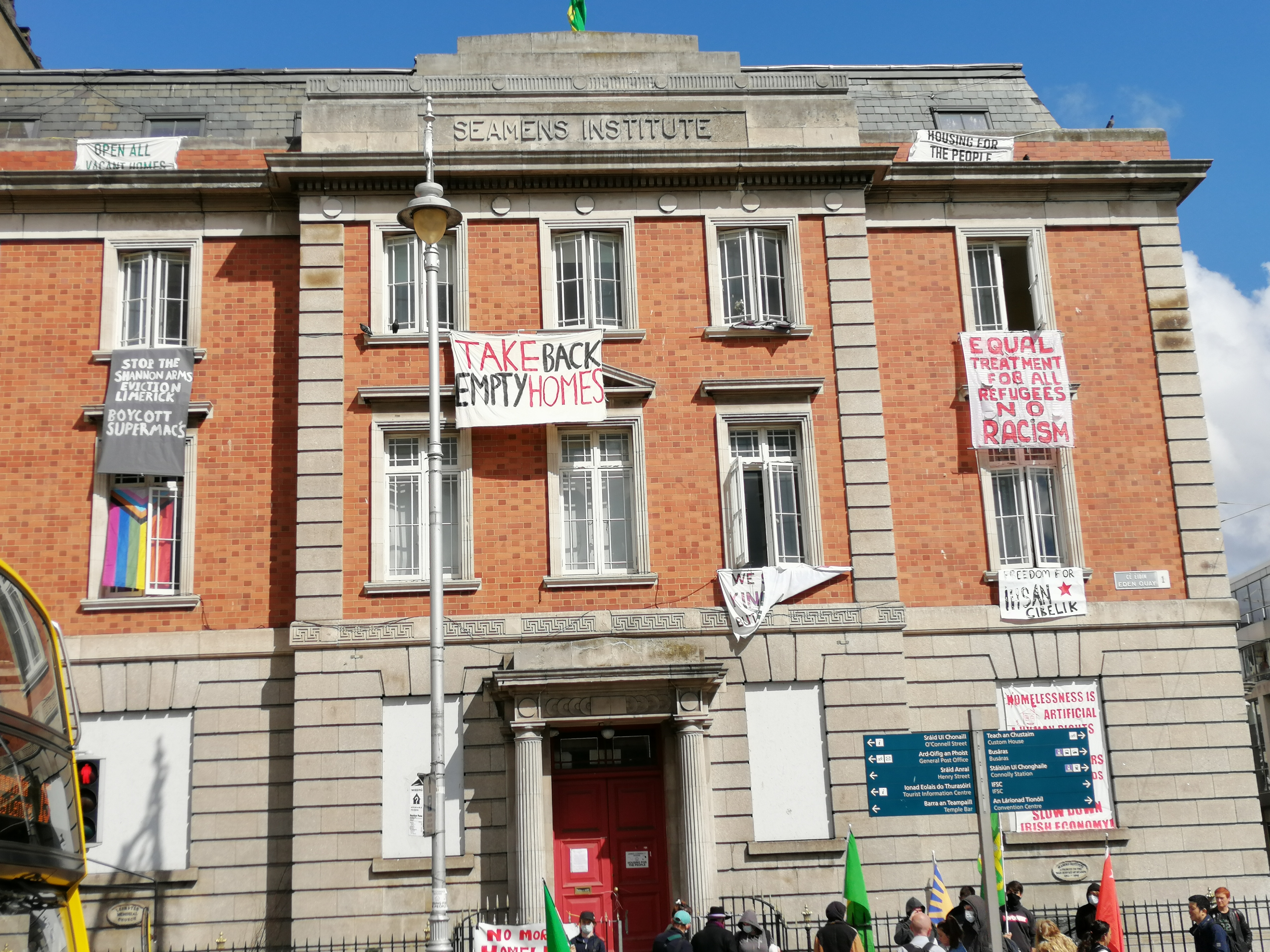
‘James Connolly House’ in occupation by the RHL in May/ June 2022. Photo: D.Breatnach)

The first building targeted on May 1st was a former Seamen’s Institute building on Eden Quay, renamed Connolly House, metres from O’Connell Bridge, empty for years since the Salvation Army, a religion-based charity NGO, had lost government funding for its youth homeless accommodation project.

On the morning of June 9th 2022 over a hundred Gardaí, with an armed unit on standby and a helicopter overhead, stormed the building4 and arrested the only occupants, two RHL supporters. In court later that day, they were bailed without making any promise not to re-occupy buildings.5

It seemed that the State was sensitive to the dangers of creating martyrs around the housing crisis.

Instead, RHL renewed its call for mass action across the country to occupy empty buildings. And went on to occupy other buildings, including Ionad Sean Heuston near the eponymous Bridge and another in Belvidere Road, eviction here also including massive police forces and helicopter.
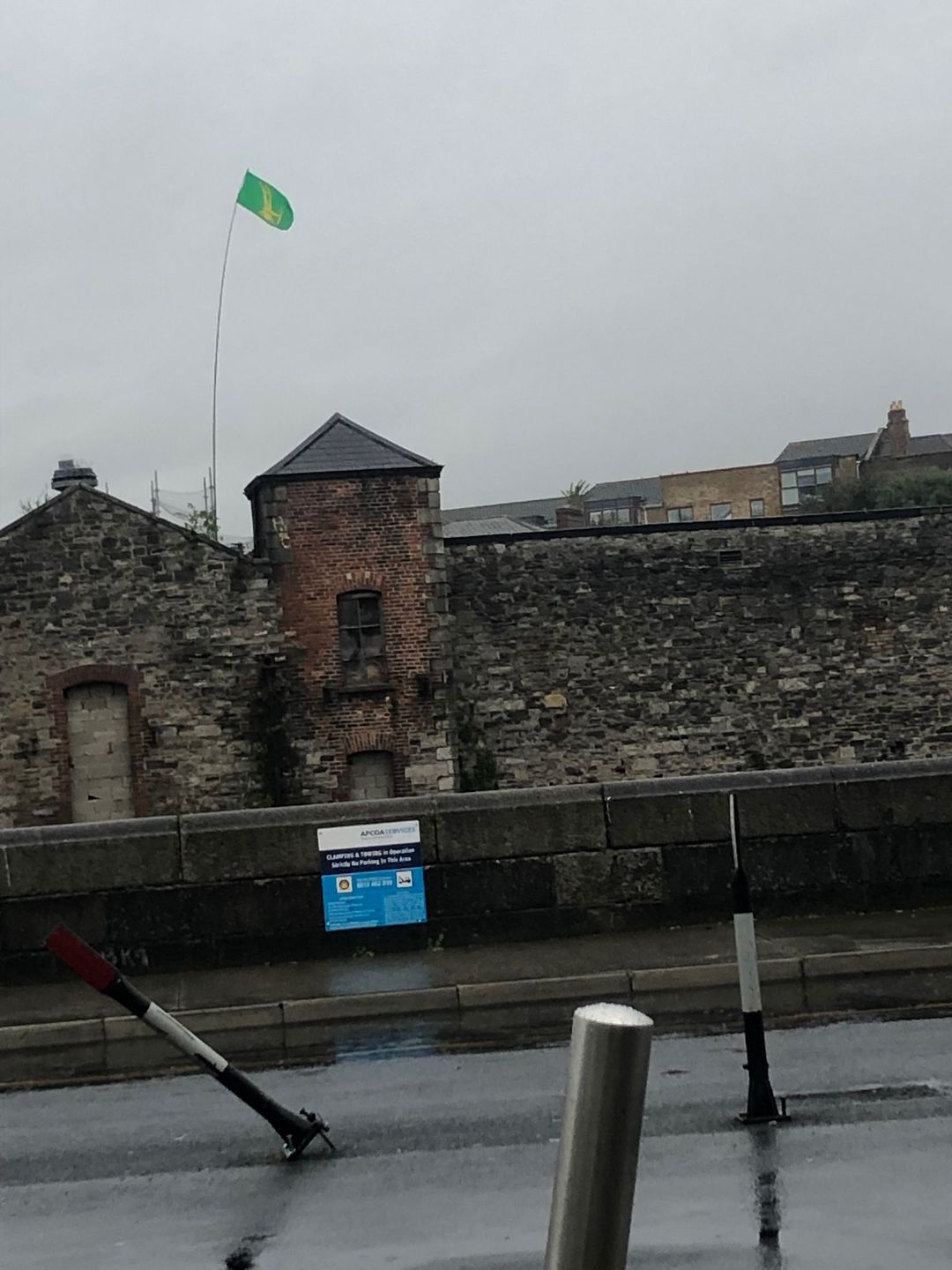
Seen from the north bank of the Liffey, the Starry Plough flag flying high over the ‘Ionad Sean Heuston’ occupied building. The Heuston train station is behind the photographer while the Bridge is out of frame to the right. (Photo: D.Breatnach)

Success for the RHA’s campaign depended on, if not a mass, at least a substantial take-up of its call to occupy empty buildings backed by civil disobedience to the courts. Neither happened and the AIA was far too small to carry the campaign on its own and so suspended it.

It is worth noting that though many organisations and individuals had agitated around housing, including the high-media-profile occupation of Apollo House in December 2016, backed by noted individuals,6 none had initiated the steps advocated by RHA/ AIA.

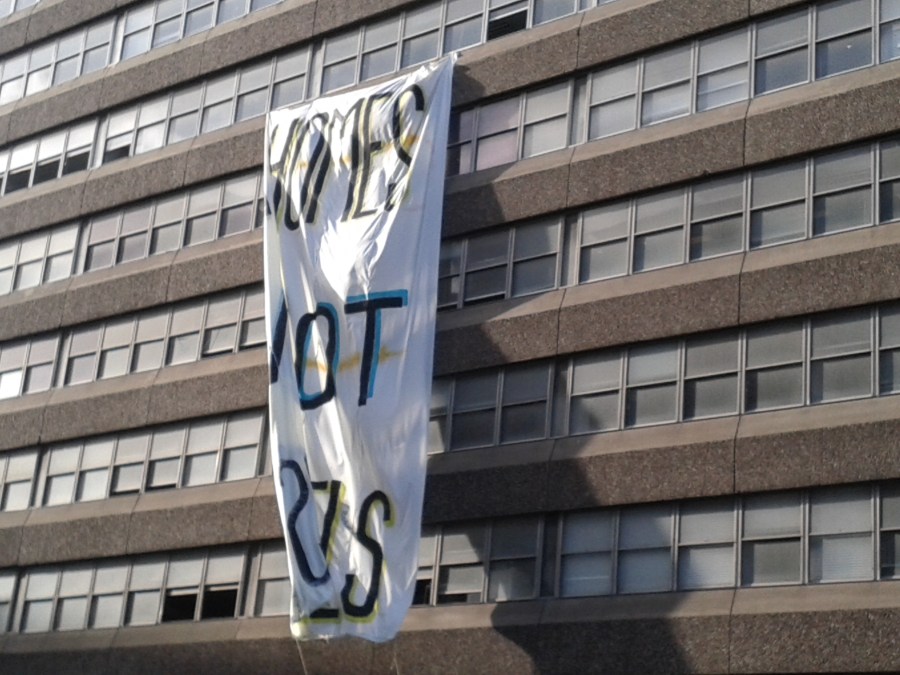
‘Homes Not Hostels’ banner on Tara Street side of occupied Apollo House in December 2016 or January 2017. The building was later demolished and numbers of homeless people continued to rise.
(Photo: D.Breatnach)

Amongst a general lack of social condition agitation among the post-GFA7 Irish Republican movement, only the socialist-Republican éirigí organisation had militantly taken up the housing struggle while calling for universal social housing — but it had not led a campaign of occupations.

The electoral left and some anarchists had occupied some empty buildings but had either left when threatened by the State or been evicted by security thugs backed up by Gardaí, without a follow-up of further occupations. Nor had they contextualised housing occupations as part of revolution.

So the record of AIA is stand-alone among the Republican and Socialist Left so far and therefore, one might speculate, failed to inspire a mass movement.

I am not ashamed to say that I supported AIA’s campaign although I did not take part myself in any of the occupations. However I did not view it as an immediate cause for revolution, nor do I now. The Irish gombeen8 State, I believe, can survive the supply of universal social housing.

The ‘rack-renting’ landlords, both big and small, cannot. But the Gombeen class, closely linked to the landlords and speculators will ditch them if they are confronted – not with the suffering of the masses, about which they care not, nor protests – but with the real alternative of social revolution.

The State has access to the means to fund such a campaign of new housing construction and of renovation/ repurposing of existing empty buildings9 by local municipal authorities.

In such a radical change of the Irish neo-colonial capitalist system, people would have more disposable income and purchasing would increase dramatically, stimulating production and expansion of goods and services and raising people’s living standards (and expectations).

Property speculation would be hugely reduced in scope but would continue – in hotels and office blocks, for example and big projects such as transport networks. And possibly in sale of land to State and local authorities for housing projects.

So, essentially a reformist project, not revolutionary at all, right? No, not at all necessarily. Reformist projects fought for with revolutionary intent and energy, teach the masses their potential when they unite in struggle. It also tests their leaders before their eyes, in their experience.

I see universal social housing therefore as a social necessity for the mass of people living on the streets, in hotel-rooms, sofa-surfing, in insecure and inappropriate housing, facing eviction from debt-mortgaged housing (the cost of which has already been paid several times over).

Universal social housing is a social necessity and an urgent one and it is an objective for which all true humanity in Ireland should strive. Revolutionaries should fight for it, pointing towards the evils of the capitalist system and the need for its replacement by a socialist system.

The struggle should be fought relying on the strength and capacity of the working people and will need to embody civil disobedience and sacrifice, while at the same the movement needs to safeguard capacity for other struggles such as against fascism, imperialism and colonialism.

In that context therefore, I think we should unreservedly support the call of the AIA’s statement today and the headline of this article.

End

FOOTNOTES

SOURCES

Anti-Imperialist Action statement on Telegram 19/08/2025

Homelessness statistics:https://www.focusireland.ie/press-release/homeless-figures-increase-to-a-record-high-of-15286-as-focus-Ireland-urge-government-to-prioritise-new-social-housing-for-vulnerable-families/

Empty property statistics: https://www.socialjustice.ie/article/vacancy-and-dereliction-ireland

APPENDIX

Text of Anti-Imperialist Action statement 19/08/2025:

Housing is a key part of the Republican struggle for National Liberation and Socialist Revolution in Ireland.

Housing is one of the key pressure points in the class struggle in Ireland today, due to the artificial housing crisis created by those in power, designed at driving up profits for landlords and imperialist housing vultures.

Since the days of Tone, Irish Republicans have recognised that land and housing are completely tied to the fight for freedom, and today it is by showing the Republican struggle will solve the land and housing issue once and for all, to the benefit of the working class, that Republicans can mobilise our class to join the fight.

There should be no doubt about the Republican position on housing. The 1916 Proclamation stated that ‘the ownership of Ireland by the People of Ireland’. The Democratic Programme placed public right above private property and stated, It shall be the first duty of the Government of the Republic to make provision … to secure that no child shall suffer hunger or cold from lack of food, clothing, or shelter’.

Landlords and foreign imperialist housing vultures have no place in the Republican vision of a Free Ireland, where homes would be provided by the Republic to all Citizens.

AIA advocates a system of Universal Social Housing as the Republican Housing System that guarantees all citizens a home, and rents based on ability to pay. This system is the death knell for landlords and vultures and it is why the garrison class resists it.

AIA has played a leading roll in the militant housing direct actions of recent years and will continue to do so.

If you want to fight the landlords and vultures and work to bring about the conditions for a Republican system of Universal Social Housing, then join AIA!

Raise the cry of the working class: Smash Landlords and Vultures – Universal Social Housing Now!

1https://www.focusireland.ie/press-release/homeless-figures-increase-to-a-record-high-of-15286-as-focus-Ireland-urge-government-to-prioritise-new-social-housing-for-vulnerable-families/

2Taking history tour groups around Dublin I often comment that Dublin has suffered three period of architectural devastation, all in the last century: 1) the British artillery bombardment during the 1916 Rising; 2) the Irish neo-colonial State’s bombardment during its Civil War; 3) the property speculators’ rampage from the 1970s onwards.
Pete St. John, in his song Dublin In the Rare Aul’ Times:

Fare thee well, sweet Anna Liffey,

I can no longer stay

And watch the new glass cages

Spring up along the quays …”

3In one of which I was wrongfully named myself since no evidence of my presence had been provided by the landlords to the court – merely an article by me describing the occupation of ‘Sean Heuston House’ reproducing some photographs taken inside. See https://rebelbreeze.com/2022/09/22/concert-in-occupied-building-murals-pickets-and-court-cases-the-revolutionary-housing-league-spreads-the-fight/

4https://www.facebook.com/JamesConnollyHouse/videos/2172514896242639

5I passed by this building recently which, three years later, appeared to be still empty.

6The occupiers eventually agreed to leave under a mixture of threat and promises and the building was demolished.

7The Good Friday Agreements of 1999, the Irish instalment of the imperialist pacification process, following South Africa’s and Palestine’s versions, later to visit Colombia and Turkish Kurdistan.

8From the Irish word gaimbín, first applied to the hustlers opportunistically buying up Irish land in the midst of the disaster of the Great Starvation (1845-1849) but now applied to the Irish comprador or foreign-dependent native capitalist class.

9https://www.socialjustice.ie/article/vacancy-and-dereliction-ireland

Don’t Change the System – Just the Parties in Government

Diarmuid Breatnach

(Reading time: 2 mins.)

I was relieved by my attendance at the Raise the Roof housing demonstration in Molesworth Street in Dublin City Centre. That was because I learned from speakers that just by voting in ‘a Left Government’ we could receive the housing we need.

Raise the Roof is a coalition of trade unions with its address at the Labour Party-orientated ICTU and a number of housing NGOs. The coalition also contains political parties: Sinn Féin; Labour Party; People Before Profit/ Solidarity; Social Democrats; Independents4Change.1

A view of the protest in Molesworth St. Leinster House is in the background across Kildare Street with access prevented by police barriers at the end of Molesworth St with a special gate to allow entry and exit for customers of the hotel on the corner. (Photo: D.Breatnach)

Previously I’d thought that either we’d need a revolution or a country-wide campaign of direct action occupying empty properties. This is because the housing crisis is deliberately constructed for the benefit of profits for big landlords, vulture funds and the banks that finance them.

And since they keep making massive profits out of the situation, they won’t want it to change as it would if, for example, were the State to seize empty properties2 for conversion to housing along with a massive public housing for rent construction campaign.

And if the profiteers don’t want that, naturally their (sorry, ‘our’) government will make sure not to do anything of the sort.

So it was great to learn that we won’t have to really fight and break the law, going to jail and all that. Phew! Just change the parties in the Government at the next election! Elect a Left Government!

Visual accidental irony comment in the same street. (Photo: D.Breatnach)

But… lately I have to admit I’ve been having doubts about this solution. First of all, there’s the question of numbers of TDs available to form this aspired-to government. There are overall 174 TDs in Leinster House (the Parliament of the Irish State) and a fragile majority requires 88.

The Sinn Féin party has 39 TDs and People Before Profit/ Rise/ Solidarity five in total, a combination of 44 still needing another 44 to reach the 88 minimum. FG and FF, formerly opposition parties but now in government have 86 votes between them and needed some extras to run the Government.

But I’ve got a much bigger doubt really, and that’s whether SF will stand up to the bankers and property magnates.

SF has for decades being setting out its stall that it is safe pair of hands to run the system, in other words that the profiteers have nothing to worry about. And to tell the truth, I believe them. Though some of their followers think SF is fooling the system, I think it’s the followers being fooled.

View of the Raise the Roof protest in Molesworth street. (Photo: D.Breatnach)

So … after further consideration, it really does look like a revolution will be required to end the housing crisis — or at least something so near as to make the managers of the system believe that unless they resolve the housing crisis, there will be a revolution. So I’m worried again.

Anyway, it was interesting seeing the amount of Tricolours in what was predominantly a left-wing rally of hundreds (despite a small contingent holding an Aontú banner) and there was some nice music with singers including Lisa O’Neill and Jimi Cullen (with his Homes for All composition).

I still left early, however.

End.

Footnotes

1https://www.raisetheroof.ie/about-raise-the-roof

2https://www.socialjustice.ie/article/vacancy-and-dereliction-ireland

CHANGING THE STARRY PLOUGH COLOUR AND SEAN O’CASEY

Diarmuid Breatnach

(Reading time: 5 mins.)

For many years the Starry Plough flag in Ireland, associated with socialist Irish Republicanism, was the form of the Ursa Mayor1 constellation in white or silver stars on a blue background, from the time of the Republican Congress (1934-’36).

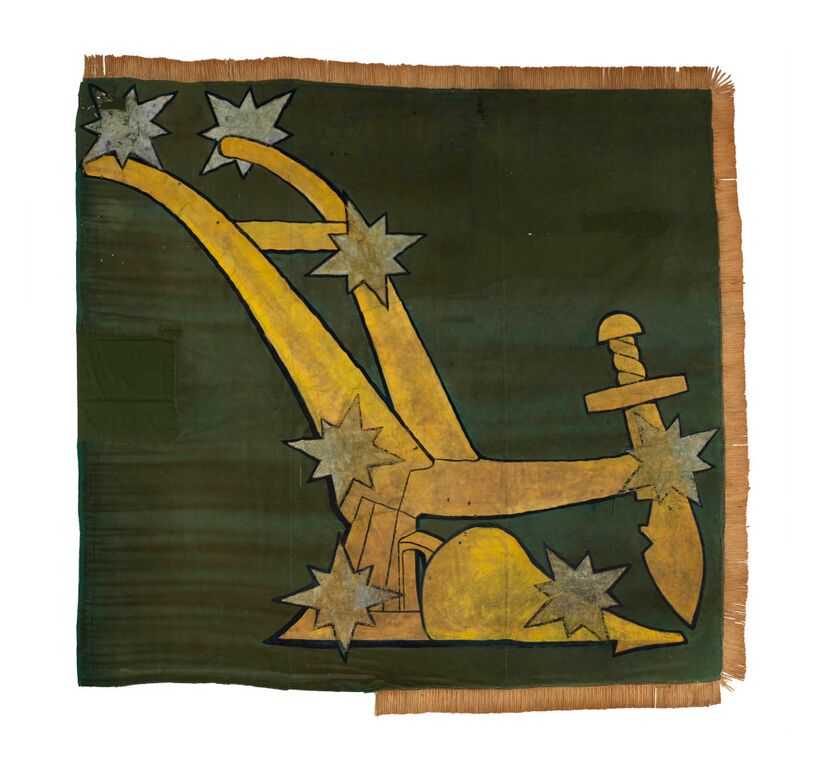
Somewhat later a different design including an actual plough following the stars and shape of Ursa Mayor on a green background began to be seen. But which was the original? And how, when and why did the other version come into existence?

It is not disputed that the Starry Plough was designed for the Irish Citizen Army, nor that it came to be designed in 1914, as the ICA was reorganising following the defeat of the Dublin workers in the 1913 Lockout. Whatever its colour, that was clearly the original.

It is beyond dispute that the Starry Plough was raised above Clery’s building, across the road from the GPO, during the 1916 Rising. It survived the burning of the building even though one witness spoke of a melted glass stream from its windows running across O’Connell (then Sackville) Street.

The flag disappeared thereafter. A British officer claimed to have taken it as a trophy. If there was more than one copy of that flag at the time, no-one has spoken of it.

When the Republican Congress was founded in 1934 the need for its own flag was felt. The Starry Plough of the ICA seemed appropriate and former members of the ICA were consulted as to the original design and colour and it appears that memories diverged on that issue.

Some remembered the background colour as green, some as blue. Prominent in the latter group was playwright Sean O’Casey, who had been Secretary of the ICA for a brief period in 1914 and presumably was present when the flag design was approved.

Whether or not, between April 1914 and April 1916, surely the flag had been paraded through the Dublin streets on a number of occasions and in any case it had flown over Clery’s in O’Connell Street for five or six days.

Nevertheless when the former members of the ICA were consulted in the 1930s there appeared to be uncertainty about the background colour – was it green or blue? Possibly the majority remembered it as blue or perhaps the opinion of O’Casey, who insisted on blue, was taken as the most valid.

In May 2022 former IRSP comrades of former leading IRSP activist Mick Plunkett stretch the blue Starry Plough version over the coffin containing the remains of the latter. During the 1970s-to the 2000 the blue version of the flag had been particularly associated with the IRSP.(Source photo: Seamus Costello Memorial Committee FB page).

So the flag of the Republican Congress was made a plain blue background with the shape of Ursa Mayor outlined in white or silver stars (and no actual plough design). That design was flown in Irish Republican colour parties from the 1960s at least and adopted too by the Irish Labour Party.2

A problem for the claim that the original was blue arose in the 1950s when an ex-British Army officer offered the Irish National Museum what he claimed to have been the Starry Plough which he said he had removed from the ruin of Clery’s. The background colour was green.

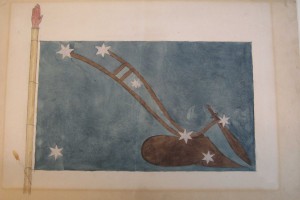
O’Casey was contacted by the NMI and insisted it could not be the original, maintaining that had been blue. To bear this out, he submitted a watercolour of what he claimed was Megahey’s (original artist) design work, in which the background was blue but did include a plough.3

The watercolour submitted by O’Casey which he claimed was the original design of the man who designed the flag, William Magahey. (Copied from article about the conservation of the original flag in History Ireland).

There was no way to prove the provenance of the watercolour. Nor was it impossible that a change of mind had led from a blue background on a design artwork to green on the produced flag. But O’Casey insisted that not only the artwork but the finished product had been blue.

Well then, why not investigate the artefact, the one claimed to be that which had been taken back to England by the British officer?

The original flag in the possession of the NMI back to front prior to conservation work. (Copied from article about the conservation of the original flag in History Ireland).

The NMI curator invited former members of the ICA only4 to view the artefact and although distressed at the state in which they saw it they confirmed that it matched their recollection. For the curator it seems that was the clincher and he then authorised its purchase in 1956.5

Around 2012 (the article does not give a date) an NMI curator charged with preserving the artefact set out to carry out modern method analysis of the material and its construction, paint and the more than 50 holes in it corresponding to .303 machine gun bullet impacts.6

The original Starry Plough flag in correct orientation (Photo sourced: NMI on line)

Former ICA members had remembered a golden edging on the flag, traces of which were indeed found on the green specimen. It all checked out. A clever hoax? Possibly, but for an eventual price of £150, a relatively small amount even back in 1954?

The ICA members viewing the artefact believed it was the original, the British Officer testified as to his having taken it and also produced an Irish Times account by himself dated 11 May 1916.7 The NMI tests all pointed to the conclusion that it was the original flag – and the background was green.

But O’Casey was adamant that it had been blue. And what about the blue watercolour, allegedly the artist’s design?

It’s possible that between the design outline and manufacture, a change in the desired background colour had taken place. But not only colour – the plough design on the watercolour is very different from that on what we must now conclude was the original flag.

We have no evidence to verify that the watercolour was the original designer’s. O’Casey might have painted it himself, from his mistaken memory, for example. Or is it possible that he falsified its origin in order to convince the NMI that the flag had been blue and not green?

Any such effort would not have been about an aesthetical judgement in favour of one colour over another but rather about removing the colour associated with nationalism.

O’Casey resigned from the ICA in a dispute8 about allying with nationalism but more tellingly, he disagreed after the fact with Connolly throwing himself and his forces into an uprising against colonialism9 – a nationalist rather than socialist uprising, as O’Casey would have seen it.

Connolly’s thesis was that the advance towards socialism was not possible in a colony such as Ireland without allying the socialist forces with the most progressive and revolutionary national bourgeois forces, i.e the IRB and the Irish Volunteers.10 O’Casey could not agree with that.

In Innisfallen Fare Thee Well (1949)11 he wrote: “The Easter Rising had pulled down a dark curtain of eternal separation between him and his best friends: and the few that had remained  alive and delightful, now lay deep, with convivial virtues, under the smoking rubblement of the Civil War.”

The symbolism of the original green, the colour of Irish Republicanism since the United Irishmen of the late 18th Century would have been anathema to the later O’Casey. Was he indulging in revisionist wishful thinking?

Or perhaps trying to ensure that in any future conflicts, the Irish Republican and Socialist trends would be kept firmly separate?

Two green Starry Ploughs on view among other flags carried by a section of marchers at the Bloody Sunday massacre commemoration March for Justice in Derry in January 2025. The one in centre of photo is a mass-produced reproduction whereas to the left one can see part of a quilted sewn individual one. (Photo: D.Breatnach)

There are others who strive to ensure the exact opposite, who as Connolly did, see in the combination of those two strands Ireland’s only chance for freedom from colonialism, neo-colonialism and an advance towards a socialist society.

For them, the original design and colours of the Starry Plough is their flag and its entire symbolism points the way forward.

End.

FOOTNOTES

1In the USA this constellation is commonly referred to as “the Big Dipper”.

2Rarely used by the Irish Labour Party nowadays. It was popular with the Irish Republican Socialist Party for decades but nowadays a version in white stars on a black panel on a red flag is flown by the organisation.

3https://historyireland.com/citizen-armys-starry-plough-flag/

4Ibid: O’Casey appears not to have been invited, which suggests that the accuracy of his stated recollection was doubted.

5Ibid.

6Ibid.

7The rebels, on taking possession of the Imperial Hotel in Sackville Street, hoisted their flag over the building, and there it remained intact on one of the ridges of the front wall while the entire contents of the premises were being consumed by fire. At great personal risk the flag was eventually brought down by second Lieutenant T.A. Williams of the 9th Reserve Cavalry, Kildare Barracks, assisted by Inspector Barrett, Dublin Metropolitan Police.’ https://historyireland.com/citizen-armys-starry-plough-flag/

8https://www.dib.ie/biography/ocasey-sean-a6553 O’Casey objected to the enrolment of Constance Markievicz in the Irish Citizen Army because she was also a member of Cumann na mBan, which had been set up as a female auxiliary organisation to the Irish Volunteers. O’Casey proposed that membership of the ICA precluded joint membership with any Irish nationalist organisation. Having had his motion defeated, O’Casey resigned from the ICA in July 2014.

9‘[Connolly’s] speeches and his writings had long indicated his new trend of thought, and his actions now proclaimed trumpet-tongued that the appeal of Caitlin Ní hUllacháin—“If anyone would give me help, he must give me himself, he must give me all”—was in his ears a louder cry than the appeal of the Internationale, which years of contemplative thought had almost written in letters of fire upon his broad and noble soul. Liberty Hall was now no longer the headquarters of the Irish Labour movement, but the centre of Irish National disaffection.’ https://historyireland.com/sean-ocaseys-battle-of-words-with-the-volunteers/

10And of course Cumann na mBan.

11The third volume of O’Casey’s autobiography, published in 1949.

SOURCES

Blue or Green?

https://siptu.medium.com/unfurling-of-the-starry-plough-61ef310f8afa

National Museum curator on provenance and tests: https://historyireland.com/citizen-armys-starry-plough-flag/

O’Casey’s separation from Connolly: https://historyireland.com/sean-ocaseys-battle-of-words-with-the-volunteers/

ENTITLEMENT, OPPORTUNITY & PROTECTION

Diarmuid Breatnach

(Reading time: 3 mins.)

The news about the sexual predations of Mohammed Al Fayed, owner of Harrods and Chelsea Football Club, was not news to many. His predilections, we learn now, were well-known in his circles. Yet only after his death are these stories made public.

Again and again we learn these stories of sexual predators, even paedophiles, whose predations come to the attention of the public only after their deaths. Entertainers such as Rolf Harris and Jimmy Saville, for example, who preyed on children.

Fayed wasn´t an entertainer but he was very rich and preyed on young women – in this world in which we live, some entertainers are often very rich too. With wealth comes protection, not just of the privately-hired variety but of the public kind also – the police force.

Their victims, at least the adult ones, knew that their words would count less with the police than would those of the rich. In the end, the police know instinctively who are their employers. The government ministers and senior police officers mix in the same circles as some of the rich.

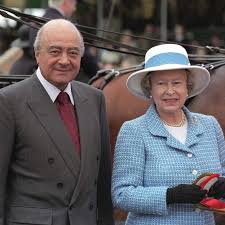
Mohamed Al-Fayed demonstrating his access to power and influence, posed next to the late British monarch, Queen Elizabeth. His son Dodi was friendly with Princess Diane and died in a car crash with her – at the time she was married to the former Prince Charles, now King of the UK. Jimmy Saville, paedophile, we may recall, was also close to the Royal Family as were the Epstein-Maxwell couple, who procured at least one underage female for Prince Andrew. (Photo sourced: Internet)

The victims are aware of how the vertical power structure in society is constructed. They know or are soon taught that the rich have not only direct protection but retribution for those who offend also. There are penalties beyond police harassment or lack of police response to complaints.

There is the jeopardising of employment for the employee, lacking of job reference, unfavourable comment in another employer´s ear … The employers also have a network of mutual interest.

HR managers of one company will wish to further their career progression through the capitalist network. Players know how the game is played.

WHY AND HOW

The predators do not do what they do merely because they like to – there are many temptations in people´s heads that are not acted upon, that remain in internal fantasy or perhaps acted out only with consensual partners.

The famous predators functioned out of a sense of entitlement – like their wealth which they felt they deserved,1 they believed also that they were entitled to do what they wanted to “lesser” beings because they themselves were famous and rich (like Harris and Saville) – or just rich, like Mayed.

Just as their wealth was the accumulation of the wealth created by the work of many others, with their sense of entitlement went also the reality of their ability to do what they wanted. They did it because they could.

Jeffrey Epstein and Ghislaine Maxwell were eventually arrested and went to jail, Epstein dying there. Far from being a vindication of the justice of the system, their victims were initially ignored by the police and even harassed – and Epstein died in mysterious circumstances before trial.

All around the world people are suffering these kinds of abuses to one degree or another, have done so for centuries and will continue to do so. Yes, even with the occasional exposure of this or that person.

For as long as the system of status, wealth and privilege exists. Which means at least for as long as the capitalist system exists – and even beyond that, perhaps.

So in organising to overthrow the capitalist system we must ensure that we do not replace a system of unquestionable authority and power with another.

Yes, well, that´s for the future, right? No. It starts now. In our treatment of one another. In how we conduct ourselves. In ensuring we do not claim a special entitlement or the right not to be be questioned.

And when we err, individually or organisationally, to act to correct and remedy the ill.2

End.

FOOTNOTES

1Let us remember here too that no-one can get rich by their own work, no matter how hard – it requires the work of many others to make one person wealthy.

2Let us not forget the one example among many: the past history of the ostensibly revolutionary socialist organisation of the former Workers Revolutionary Party. Its General Secretary Gerry Healy was accused of the sexual abuse of 26 young female activists in the organisation. A painfully honest description of the replication of systems of unquestioned privilege in the former Party and the process of the expulsion of Gerry Healy and of his defence (for example by famous film actors Corin and Vanessa Redgrave) can be found here: https://libcom.org/article/break-wrp-horses-mouth-simon-pirani

Wolfe Tone’s “Men of No Property”

Diarmuid Breatnach

(Reading time: 5 mins.)

Prominent among the many words quoted from Theobald Wolfe Tone, ‘the father of Irish Republicanism’, are that ‘Our Strength shall come from that great and respectable class, the men of no property’.

The interpretation of those words has led to some confusion between socialism and republicanism.

Wolfe Tone, as he is normally known historically, co-founded the Society of United Irishmen in 1791, which led a mass armed uprising in 1798 against British Rule in Ireland, as a speaker said at the Anti-Imperialist Action’s oration at their annual commemoration at Tone’s grave last month.1

Tone himself was arrested on a French ship captured by the British Navy and despite his French Army officer rank, tried on treason charges and sentenced to death upon the gallows … but died instead in prison of a wound to his throat.

Wolfe Tone Monument, Stephens Green, Dublin (Photo cred: National Built Heritage Service)

An important part of the leadership of the United Irishmen, most of the Leinster Directorate was arrested in Dublin but the Rising went ahead in other parts of Ireland, notably Antrim, Wexford and Wicklow, and another with French troop reinforcements, too few and too late, in Mayo.

The Rising was crushed, the leaders executed or exiled, along with many of their followers. A large body of Irish traditional and folk song, mostly in English and much of it composed in its centenary, commemorates the struggle and sacrifice of the United Irishmen.

The AIA speaker: “Tone’s most important belief was that we must ‘break the connection with England’ by any means necessary – one of the most important teachings for the Revolutionary Republican Movement today,” to work “for National Liberation by any means we decide necessary”.

No-one who has even the most cursory acquaintance with the historic figure of Wolfe Tone can deny that he was determined to break away from English colonial rule and, once he became convinced there was no peaceful way to do so, was determined to do it by force or arms.

Tone was also clear that the revolutionary struggle could only be successful,” continued the speaker, “if it was based on the masses of the Irish People, stating that, ‘Our Strength shall come from that great and respectable class, the men of no property’.

From that, the speaker went on to claim that “we learn from Tone that the fight for our Republic is a class struggle and that the driving force of that struggle will be the working class fighting for their own liberation.”

I do not believe that the writings or recorded words of Wolfe Tone justify that interpretation. Indeed, it would have been strange if they had; the 1798 Rising was what Marxists describe as a “bourgeois revolution”, i.e. one led by a section of the capitalist class in its own class interests.2

Such also were the Revolutions in England of 1649 and 1688, of the French in 1789 and the American in 1765-1783, the Italian of 1848, the Chinese of the early Kuo Min Tang and the Latin American revolutions against the Spanish Empire, along with the Mexican 1910-1920.

Yes, the capitalist class, which is always telling us to employ only constitutional means to get what we need or want, tries to conceal that they themselves came to power by revolution.

Colorised illustration by unknown artist of the storming of the Bastille in July 1789 (Source: Wikipedia)

The leadership of the United Irishmen was almost totally of the established Anglican church or of Protestant sects – “Protestant and Dissenter”, in Tone’s words. They were descendants of settlers from Britain and they were of bourgeois social strata.

This section of the bourgeoisie and petit-bourgeoisie were fed up with restraints imposed from England on developing the colony’s potential, on a taxation system they considered unfair, on corruption in the Irish Parliament and in management by the Monarch’s representative in Ireland.

Being only a very small minority of the Irish population3 they were aware that they needed the mass behind them in order to build an independent national economy, for which they tried to gain Catholics admission to the Irish Parliament, which at the time only admitted Anglicans as MPs.

When Henry Grattan, who had earlier led quite a rebellious Irish Parliament,4 failed in the attempt to make Parliament more representative, Tone and many others became convinced that only revolution could progress society in Ireland and from then on he strove to bring that about.
Grattan

Statue of Henry Grattan, failed reformer of the Irish Parliament, situated in Dame Street junction with Grafton Street and facing Trinity College. (Photo cred: Trip Advisor)

A revolution against England, a great European naval power, even with the help of revolutionary France, would require mass participation and support, as the AIA speaker remarked at the commemoration. So Tone aspired to the unity of “Catholic, Protestant and Dissenter.”

The section of the religions that most fell into the category of the “men of no property” were of course the Catholics, dispossessed of their lands and under Penal Laws of the Occupation. Without the support of the Catholic majority there was no chance of a successful revolution.

Tone may well have been a most democratic Republican in favour of all kinds of progressive social reform but nowhere in his writing does he advocate the overthrow of the bourgeoisie, seizure of private property and the setting up of a socialist system to be run by the working class.

united men

Reenactment of the United Irishmen in battle, depicting the “men (and women) of no property. (Photo sourced: Internet)

Theobald Wolfe Tone was a courageous democratic revolutionary, anti-colonial and a martyred patriot but was not nor could have been a socialist leader. That which he was, was the best of his time and among the best we had to offer and there is no need to try to make him something else.

The United Irishmen represented a section of the Irish bourgeoisie that was truly Republican and revolutionary. That section of society was mostly of settler descent since the mass of the native and Catholic population had been ground down and oppressed.

Thereafter most of the native Irish bourgeoisie developed as a subservient client class, “Castle Catholics” ag sodar i ndiaidh na n-uaisle,5 up to whatever “cute hoor”6 and gombeen7 tricks they could get up to but without a fraction of the spine necessary to fight for real independence.

A successful Irish national revolution does indeed need to be led by the Irish working class as demonstrated by what James Connolly – rather than Wolfe Tone – observed: “Only the Irish working class remain as the incorruptible inheritors of the fight for freedom in Ireland.”

The reason for that, as outlined by Connolly, is quite simple: the working class is the only social class of any size that has nothing to gain from compromise and betrayal of the revolution.

Some other key points laid down by Tone, continued the speaker, include that Republicanism is Anti Imperialist and it is Internationalist. Our struggle in Ireland is part of a wider international struggle of oppressed people against occupation, colonialism and imperialism.
Tone understood this when he looked to Revolutionary France to support the 1798 uprising.

This was well understood by Irish Republicans of Tone’s time who celebrated the fall of the Bastille in 1789 and the defeat of the English by the settlers in America. The United Irishmen also helped the creation of the United Englishmen and led two of the British Navy’s most serious mutinies.8

Today, continued the speaker, Republicans must fight our struggle while also supporting Liberation struggles around the world in the belief that every blow struck against imperialism brings our victory closer.

So from Palestine to the Philippines and from India to the Basque Country, and everywhere people take a stand against NATO, the Revolutionary Republican movement must raise our cries in solidarity.

End.

Footnotes

1The event was organised by Anti-Imperialist Action, a socialist republican organisation, with the oration being given on behalf of the organisation. A pilgrimage to Wolfe Tone’s grave in Bodenstown is a fixture on the calendars of most Irish Republican organisations.

2This should not be taken as a criticism since Marxists agree that many bourgeois revolutions were progressive in their time.

3Tiny, in the case of the Anglicans in particular; the Presbyterians were much more numerous.

41689-’91.

5Irish language: “Trotting after the nobles.”

6An admiring description in Ireland for one who manages to benefit by dubious means.

7Corruption of an Irish language term for the ‘carpet bagger’ types who benefited amidst the disaster of the Great Hunger in the mid 19 Century, snapping up land in particular at the lowest of prices.

8The Spithead and Nore naval mutinies, 1797.

Sources

ELECTORAL DYSFUNCTION ANXIETY

Diarmuid Breatnach

(Reading time: 5 mins.)

Like that similar-sounding ailment affecting some males, most of us are not rising, at least not to the expectations of the electoral commission. Furthermore the problem appears to be no respecter of gender.

The issue, according to the Independent Electoral Commission, is that not enough of us are voting in elections. Only 49% turned out to vote in the Irish local (municipal) and European Parliament elections which means that more than half of registered voting age didn’t bother.

Well, so what? Why is that is troubling the IEC? It seems that generally, the authorities like to see a good turnout because it appears to signify that people believe that they really have a democratic choice through the electoral system and are actually exercising it.

If they don’t believe that they have a choice – or if the appearance of choice is not matched by the reality they perceive, the people might turn to other methods of deciding how the country should be run. And that might result in an outcome unwelcome to the ruling elite.

THE TWEEDLES

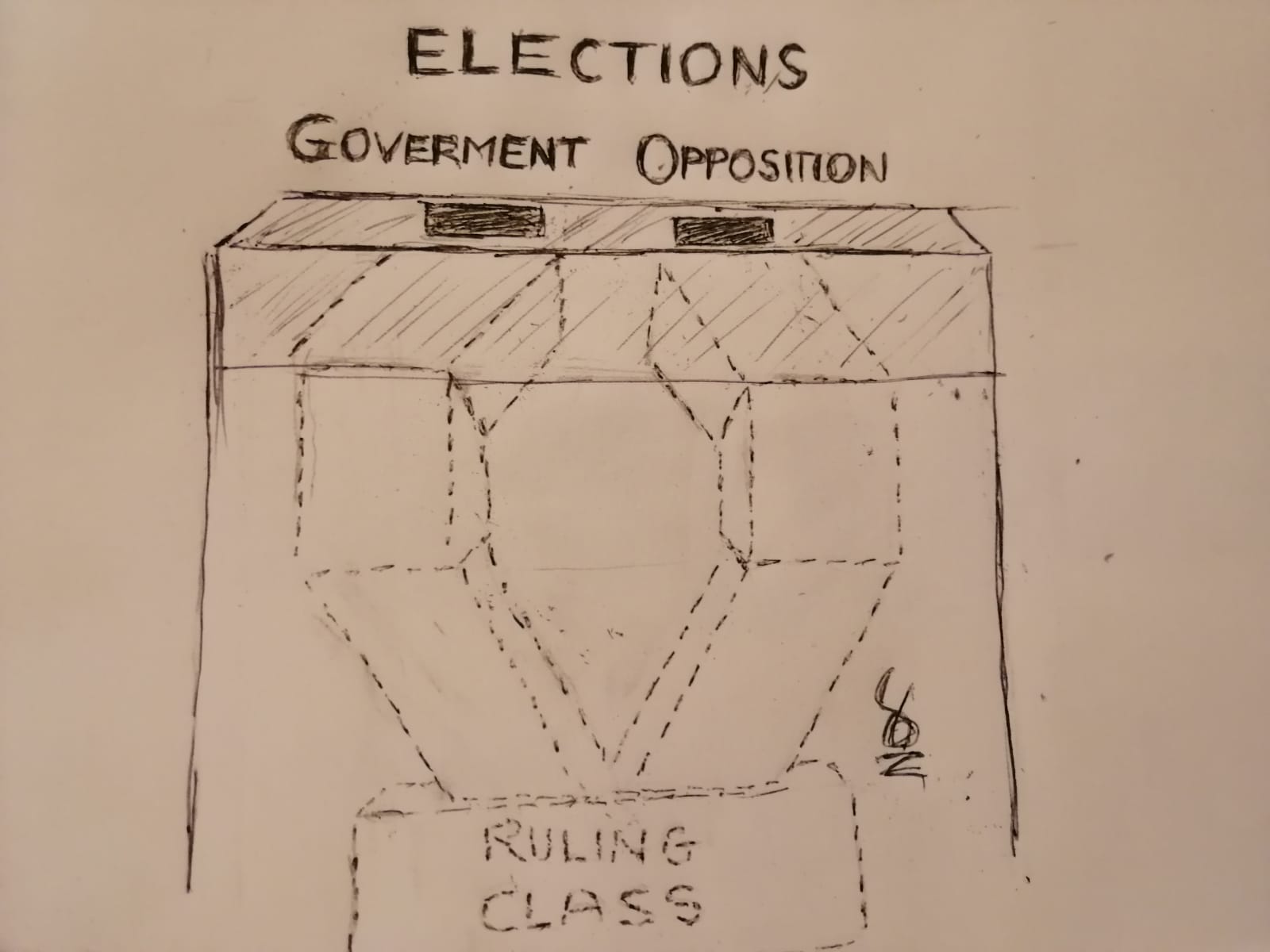
The Tweedledum and Tweedledee parties appear to give the electorate alternatives and though whichever party wins the capitalist system remains, it appears to give a choice – but a bet choosing between two horses of the same owner in a two-horse race.

Like both Tweedles in the folk nursery rhyme and in Lewis Carroll’s Alice Through the Looking Glass (1871), Tweedledum and Tweedledee are brothers and though they appear to be preparing for war with one another, they don’t actually fight, not in Western ‘democracies’.

Tweedledum and Tweedledee (or is it the other way around?). (Image sourced: Internet)

There are, after all, plenty of spoils to share between their masters. The creators of that wealth need to be controlled, fooled and, if necessary from time to time, repressed. “Red” social democrats and “Blue” conservatives have alternated to share power in the Western world for over a century.

In Ireland, the only European state which is a neo-colony and part of its land a direct colony, its national liberation unfinished, the Tweedles have been blue or green.

But for decades now the illusion of choice has been crumbling. There has not been a majority party government in Ireland since 1981, when Irish Republicans were elected during the hunger-strike campaign. All Irish governments since have been a coalition of one kind or another.

The Irish Labour Party, founded by Connolly and Larkin and far from their thinking for many a long year, has been in government a number of times but always in coalition – usually with the conservative Fine Gael, itself the product of a coalition that included the fascist Blueshirts.

Those years of government participation for Labour have thoroughly rubbed off the red paint of socialist opposition from the party. The Green Party, mixing a brand of concerns for the environment with those for society, has met a similar fate in coalitions.

Since 2020 the Irish state has had what is essentially a ‘national government’, a coalition of opposing parties normally only seen in times of war or under a fascist regime. The alleged political poles have joined in order to run the system for the Gombeen ruling class.

Though this gives stability for the Gombeen’s system their problem is that it has removed the illusion of choice. They might restore that illusion through the promotion of a third major party in opposition and the formerly revolutionary Sinn Féin has worked hard to fill that space.

In the 2019 General Election SF got the most representatives elected but insufficient to form a majority government, after which the Tweedles united, along with the Greens to make up the numbers to manage the State. But the Gombeens will hold SF in reserve, I’m thinking.

Harris of Fine Gael and Taoiseach (equivalent of Prime Minister) of the Coalition Government, commented on the closeness of his party and former Opposition party Fianna Fáil in votes, predicting “a Government of equals”1– but it’s not just in votes that they resemble one another.

Yes, I know I misspelled Government but I want to get this article out of the way. I’ll redo the cartoon sometime later and replace it.

RESULTS

I don’t think there is a great deal to be said about the actual results of the recent local and EU Parliamentary elections in Ireland but no doubt some commentators will be saying it anyway.

Of unwelcome interest is that five fascists of different groups got elected, three of them to Dublin City Council. The electoral Left lost some and gained some without big changes.

Independent socialists (and couple) Clare Daly and Mick Wallace both lost their EU seats but perhaps they and in particular Daly in Ireland would be more of an asset to the Left. Luke ‘Ming’ Flanagan in Midlands North West, another left Independent, kept his EU seat comparatively easily.

Sinn Féin had what was for them a disappointing run but had some new people elected to local councils and two seats in the EU Parliament, losing an existing one. Many of their enemies in the Republican ambit, often former comrades, rejoiced in their misfortunes.

Understandable though that may be one wonders how those who have some faith in the party at the moment are to be disabused of their illusions without having seen them in government. On the other hand their twists and turns on the road there may have disenchanted many already.

IT’S NOT A CHANGE OF PARTIES IN GOVERNMENT WE NEED

For most of my life I have been aware that it is not a change between political parties but between socio-political systems that is the issue. But I do vote sometimes in order to help keep a useful and decent voice in a parliament or a local authority.

An Irish community activist pensioner years ago in London, Co. Galway Teresa Burke, was a member of the British Labour Party. After a General Election, she asked me had I voted. I replied that I hadn’t; I’d not seen a candidate that stood anywhere close to that in which I believed.

“Well then, you must take responsibility for everything the Tories do if they get in!” Teresa remarked angrily.

“I’ll do that, Teresa,” I replied, “if you’ll take responsibility for everything Labour does in Ireland if they get in!”

Teresa’s lips twitched slightly. She knew as well as did I that the British Labour Party had sent the troops into the Irish colony to quell the struggle for civil rights in 1969 and supported the Tories in introducing internment in 1971 and massacres that year and in 1972.

In 1974 police under a Labour Government had killed the first anti-fascist on a demonstration,2 framed a score of Irish people in four separate cases for heavy jail sentences3 and had passed the fascist Prevention of Terrorism (sic) Act.

Whichever party is in government, the social-political-economic system is run by the capitalist class which it benefits and they will fight tooth and nail to maintain that system.

The alternative-party-within-the-system idea, so dear to social democrats, has failed time and time again. It betrayed its supporters by becoming like what it opposed, or consistently failed to get elected or was undermined, betrayed and destroyed, like Syriza in Greece, for example.

But in the unlikely event that route should ever show signs of being successful, for the ruling class there remains the military coup.4

end.

FOOTNOTES

1https://www.breakingnews.ie/ireland/election-results-raise-prospect-of-another-coalition-of-equals-varadkar-1638692.html

2Kevin Gately, son of Irish immigrants, a student at Leeds University, died from injuries received from a mounted police baton during an antifascist demonstration in Red Lion Square, London on 15th June 1974.

3The Guildford Four, Birmingham Six, Maguire Seven, Judith Ward.

4The serialised for TV A Very British Coup (1988) with Irish actor Ray McAnally from the Chris Mullins novel (1982) is well worth watching for this scenario.

SOURCES

https://www.thejournal.ie/irelands-voter-turnout-is-below-eu-averages-6299507-Feb2024/

https://www.thejournal.ie/readme/election-turnout-6409113-Jun2024/

https://en.wikipedia.org/wiki/Tweedledum_and_Tweedledee

https://www.breakingnews.ie/ireland/election-results-raise-prospect-of-another-coalition-of-equals-varadkar-1638692.html

IF WE DON’T SUPPORT THE RESISTANCE

Diarmuid Breatnach

(Reading time: 5 mins.)

In an anti-imperialist struggle, if we don’t support the Resistance, what are we doing?

Among the Left – and even among many liberals — the importance of internationalist solidarity is generally accepted as taken for granted. However, as with many principles, it is in its application that we find substantial disparity.

After the October 7th breakout from the Zionist siege of Gaza the leading elements of the western world rushed to condemn the Palestinian resistance led by the Hamas group. Atrocity propaganda created by the Zionists abounded.1

Hamas2 and Islamic Jihad3 had planned and carried out the breakout operation in which they knocked out the Zionist surveillance and automatic firing defences, damaged communications, went through and over the apartheid wall and overran the Golani Brigade4 forces.5

The Resistance killed many of the IOF6 and captured others. In addition, the Resistance captured a number of civilians in order to exchange them for the huge number of Palestinian political prisoners held by the Zionist authorities.

Some Left groups joined the anti-Resistance chorus immediately while others took a little longer but then did so too. In Ireland, for example, leading figures in People Before Profit and the Socialist Party condemned Hamas, seen as the leading Palestinian element in the operation.

So too did the leadership of the formerly revolutionary Irish Republican political party Sinn Féin.7

Of the Left Zionists in ‘Israel’ (in so far as they can be called ‘Left’), they too joined the chorus. The Israeli state’s presidency has had representation from the Labour Party without interruption from 1948 to 1977 and most of the settlement expansions took place under a Labour government.8

Saoirse Don Phalaistín solidarity group banner (bearing logo of the People’s Front for the Liberation of Palestine on right of photo) after Palestine solidarity march in Dublin 27 January 2024. Also visible in addition to the Palestinian national flag perhaps are two versions of the Starry Plough flag of the Irish Citizen Army, the Republican Congress version at extreme left and the original version above the banner. (Photo: D.Breatnach)

CIVILIANS

Some of the western ‘Left’ organisations stated that it was not the armed breakout of the Palestinians to which they objected but instead the killing of civilians. The liberals and media also made much of the issue of ‘civilians’ – to an extent never accorded to Palestinian civilians.

It is important to note that the adult civilians in the ‘Israeli’ state are, apart from tourists, settlers. They are colonising land from which the indigenous Palestinians have been ethnically cleansed. In addition military service is required of all ‘citizens’9 and a great many are armed anyway.

This is similar to what the Indigenous people of the Americas and Antipodes faced from European settlers from the 18th to the 20th Centuries or the Irish during the various plantations from the 17th Century onwards and the Land War during the 19th.

One baby was killed on October 7th quite likely by excessive heat in a burning building and another 13 children were killed, according to ‘Israeli’ social services. But by whom? By Palestinians or by indiscriminate Hellfire missiles from IOF helicopters and at least one tank firing into a building?10

Civilians may have been deliberately killed knowing they were civilians or by crossfire or by Israeli counterattack. Certainly there was at least one teenager taken captive, the daughter of the Irishman settler who infamously said he would rather his daughter were dead than captured by Hamas.

We’d like to know, of course, which case and how many. But in terms of solidarity principle, it’s beside the point: While we are not required by internationalist solidarity basic principles to approve of every one of its actions, we ARE required to be in solidarity with the Resistance.

A number of Palestinian armed resistance groups displaying unity in the struggle (Photo sourced: Iran News)

BUT, ISLAMIST…!

Many in western society are secular in their politics, many of agnostic or atheist position. So, that is our choice. Others belong quite strongly to one religious belief or another. What is different about Islamists (or fundamentalist Christians) is that they aspire to a society run in accordance with their religious beliefs.

We may not agree with that objective. We should not agree with the subordinate social and political status accorded to women in some religious cultures nor to the outlawing of LGBT sexuality. But even so, we should support the Resistance, Islamist or otherwise, in resisting repression.

Basque society was largely conservative Catholic while resisting Spanish State fascism up to the 1970s; Welsh mining society was often conservative Methodist in the struggles of the miners in the 1930s. The Irish Republican movement was permeated by Catholic symbolism and ideology.

We could have been, should have been capable of supporting the resistance in each of those cases while not supporting the religious conservative, reactionary or fundamentalist beliefs or conduct of participants or leaders in those struggles.

For revolutionaries, the general principles or internationalist solidarity are not of the kind from which one can pick and choose, while rejecting others. We are however entitled to accord ‘favoured status’ to an organisation the ideology and practice of which we most approve.

We may for example prefer a secular or even socialist resistance organisation (e.g the People’s Front for the Liberation of Palestine). We may carry its flags, promote its statements, share its social media postings. But we do so while also expressing solidarity with the Resistance as a whole.

That is reasonable and honourable. It is neither to participate in attempts to break up whatever unity exists among the organisations of the resistance.

During the 30 Years War in Ireland, there were those in Britain who participated in those activities – people who colluded for example with SF refusing to share a platform with the IRSP11 on Hunger Strike commemorations, threatening refusal to attend if their wishes were not acceded to.

No doubt that seemed justified to the Provisionals in their promotion of their organisation above any other choice but that activity split commemoration committees, disheartened activists and killed some solidarity events on the annual calendar.12

HOW BEST TO DO IT … AND IN PUBLIC

We often hear people ask a speaker from the resistance movement what we should do in solidarity. This is in general incorrect behaviour because we have our own revolutionary program and we best know our own circumstances and capabilities.

It is a different thing to ask what are the things that the resistance movement needs: medicines, weapons, representation, contacts, publicity etc. But we still have to decide how well to fit the effort of obtaining those within our capabilities or even whether the objective is worth the energy expanded.13

The Resistance can tell us what they need but the decision on which solidarity actions to take is ours. However whether to express solidarity is not a choice for revolutionaries – it is an obligation.

As revolutionaries we have a public position and part of that should be public solidarity with the Resistance. It is not unknown for some to claim to support a resistance organisation but to decline to do so publicly.

An African National Congress speaker in London years ago told me privately that they supported the Palestinian and Irish resistance but would not do so publicly as it might undermine support they were receiving from UK and other western bourgeois organisations.

I argued with him against this.14 Relating the discussion to a senior SF activist later I was astounded at the response that they would do the same if required.

Solidarity with the Resistance means also solidarity with those incarcerated during the struggle, the resistance in the jails. Again, though an organisation may think differently, we are not required to support the specific organisation to which the prisoners owe allegiance.

Nor does any Resistance organisation have the right to dictate to us whether we may or may not express solidarity with political prisoners who are aligned with that organisation. Over the years, the Ireland Anti-Internment Campaign has faced down attempted coercion along those lines.

So also did the Irish Political Status Committee in London. And both groups remained independent. Unfortunately the Troops Out Movement of the day was unable to do so and after a brief period of asserting independence, eventually succumbed to domination by Provisional Sinn Féin.15

Supporting political prisoners is an act of necessary solidarity with the resistance and also one of self-defence in the longer term but it does not necessarily mean expressing support with the actions or organisation of the prisoners before or indeed after they were jailed.

Banners and flags presumably at Celtic FC home stadium during the current episode of the Zionist genocidal war. (Photo sourced: Internet).

SUMMARY

We are entitled if we wish to prioritise support for a specific organisation or its program but not obliged to do so, nor to accept their advice on how to conduct our solidarity work. Nor is it required of us to condone every action of the Resistance in general.

But we are required to publicly support the Resistance in general and not to join in public condemnations. And that’s the minimum to do if we are going to claim being in solidarity with a struggle.

For any revolutionary struggle, internationalist solidarity is an important factor, in encouragement to the Resistance, in de-legitimising the repression and in practical terms of supplies to the resistance, also in hampering the repression through blockades, boycotts or industrial action.

If we don’t support the Resistance, how can we claim to be in solidarity with Palestinians? Charity is not the same as solidarity. Pity is not the same as support. Outrage at the crimes of the oppressor is not the same as solidarity with the Resistance.

Furthermore, why should we expect solidarity with our struggles, now and in the future, if we cannot express that solidarity with the struggles of others?

End.

POSTCRIPT

Some will have searched in vain for a reference from Lenin, Mao, Trotsky, Luxemburg – or Connolly or even a famous Irish Republican leader – to justify the principles I have discussed here. At the end of the day, people should stand by principles because they have been tried and tested and are aligned with revolutionary experience but should also test them on their own experience in struggle.

In presenting some credentials towards giving these principles some consideration I can only say that I have thought about them and sought to practise them over decades of activism in Britain and Ireland.

Among the areas of Resistance and of political prisoners which have claimed my activity have been Ireland, Palestine, S. and SW Africa, Vietnam, Housing struggle, US Indigenous and African American people, organised Workers, Anti-Fascism & Anti-Racism, Kurdistan, the Basque Country, Syria, Haiti, Western Sahara, Catalunya, the Donbas …

FOOTNOTES

1All since thoroughly debunked though still repeated on occasion: “‘Israeli’ babies beheaded, torn from a womb and stabbed, women raped, people and houses burned.” These fake atrocity stories were repeated in the western media and by some politicians, including Biden and helped create an atmosphere assisting genocide by the ‘Israeli’state.

2Hamas began as an Islamist community organisation which then became a political party and developed an armed wing (like most Palestinian political groups, in response to the armed Zionist State and its settlers). In 2006 the party won the Palestinian legislative elections but the defeated Fatah (widely acknowledged as corrupt) administration in Gaza refused to give way and, in a short conflict, the Fatah armed group was defeated by that of Hamas. They chose not to do the same in the West Bank, presumably to avoid civil war from which the ‘Israeli’ state would benefit but from that moment onwards the Zionist State blockaded Gaza and the organisation was labelled a “terrorist” group in the west and financial support went instead to the Fatah-run Palestinian Authority in the West Bank (which has refused to run new elections in two decades).

3Palestinian Islamic Jihad was formed in 1981. The armed wing of PIJ is Al-Quds Brigades (also known as “Saraya”), also formed in 1981, which is active in the West Bank and the Gaza Strip, with its main strongholds in the West Bank being the cities of Hebron and Jenin. In addition to this organisation and Hamas there exist a number of other resistance factions, some of which are secular, all working together as a broad armed resistance front with organisational autonomy but ofen in joint operations also.

4The Golani Brigade of the Gaza Division is the most highly decorated IOF Brigade, having taken part in all of the state’s major ethnic cleansing and genocidal operations. On October 7th hey were overrun in minutes and 72 killed with an unknown number captured (‘unknown’ because many, along with their Palestinian fighter captors were burned to death in their cars by ‘Israeli’ Apache helicopter Hellfire missiles).

5 The Palestinian operation went deep, passing Golani’s 3rd defensive line.

6‘Israeli’ Occupation Forces, aka the official but misnomer IDF (“Israeli Defence Forces”).

7The current iteration of Sinn Féin abandoned its revolutionary anti-colonial and anti-imperialist path in embracing the pacification process in1999. It stood down its armed wing, the IRA and largely dissolved it, also having their weapons decommissioned, since when it has participated in the administration of the colony and in recruitment of the colonial police force.

8Yet for years the Socialist Party have opposed boycotting the Zionist State, calling instead for unity with the “Israeli Left”.

9With the exception of most ‘Israeli’ Palestinians and all ultra-Orthodox ‘Israelis’ but for the latter is in the process of change https://www.aljazeera.com/news/2024/6/11/israels-knesset-advances-contentious-ultra-orthodox-conscription-law

10Documented by military and survivor sources on ‘Israeli’ media.

11The Irish Republican Socialist Party with an armed wing up to the 1990s, the Irish National Liberation Army, which contributed three Volunteers to the 10 martyrs who died on hunger strike in 1981.

12And what, in the end, did the Provisionals achieve with the supremacy gained?

13The Resistance organisation may ask us to arrange meeting for them to address our state’s parliament, or for interviews with the media … Or even to restrict our propaganda from solidarity to self-interest for people, as Sinn Féin did in England in the 1980s when they were promoting Time To Go: “Push the issue of the expenditure on troops, better spent on the health and social services.@

14If to do so incurred a legal penalty would have been a different situation, of course.

15And from that moment onwards became a less broad and less effective, eventually ceasing to exist as a solidarity organisation.

SOURCES

Including a discussion on the importance of solidarity with the Resistance: https://youtu.be/yj9hQaqeeio?si=z1oSOAYGX8z-Ney8

Ireland Anti-Internment Campaign: https://www.facebook.com/p/Ireland-Anti-Internment-Campaign-100063166633467/

The Influence of the Working Class on the 1916 Rising

Diarmuid Breatnach

(Reading time: 9 mins.)

The 1916 Rising is usually seen as a nationalist Rising of Irish Republicans with perhaps some socialist involvement. Even Connolly is often portrayed as a patriot only (see the song James Connolly the Irish Rebel) with socialist views.

Of the six organisations that participated actively in the 1916 Rising1 only one of them was specifically of the Irish working class. Perhaps that’s why the great influence of the working class on the Rising tends to be generally overlooked.

As is well-known, James Connolly is one of the Seven Signatories2 of that wonderful and progressive document, the 1916 Proclamation of Independence. However, Connolly only became part of the planning committee for the Rising a very short time before the scheduled date.3

That is true but we should ask ourselves why they included him at all. The Irish Volunteers had a nationwide organisation with the also nationwide Cumann na mBan as auxiliaries, whereas Connolly could perhaps mobilise a couple of hundred fighters.

(Photo sourced: Internet)

It is said he was brought on board because the IRB believed that his constant demand for a Rising during WWI and the military exercises of the Irish Citizen Army indicated that Connolly was likely to lead the ICA to rise on their own and would spoil their schedule.

How likely was he to do that? It’s true that as a socialist Connolly was horrified by the slaughter of war, where workers of one state are sent to kill and be killed by workers4 of another and perusal of his writings do show that he thought an uprising to sabotage war was desperately needed.

Would he have gone ahead alone with the roughly 250 men and women of the Irish Citizen Army, hoping perhaps to inspire a popular upsurge and to encourage the Irish Volunteers to join it, in spite of even their leaders?5 It’s hard to believe so but of course it’s possible.

However, from the moment the Republican planners of the Rising took Connolly on board, we can see a significant organisational shift towards the working class in Dublin and nowhere more so than around Liberty Hall, where the first flag for an uprising was hoisted and the Proclamation printed.

Liberty Hall was of course the headquarters of the Irish Transport & General Workers’ union,of which James Connolly was the leader at that time and also editor of its newspaper,The Irish Worker.

And for a person brought in to the planning so recently, how extraordinary that Connolly was given the rank of Commandant General! A responsibility he took seriously, sending couriers around the country and attempting to direct defence preparations around the various Dublin garrisons.

The first battle flag of the Rising

A week before the Rising Connolly and the Irish Citizen Army had an Irish Republican flag raised above Liberty Hall as a flag of war and the one chosen to do the raising was a girl of 16 years, Molly O’Reilly.6

The associated circumstances are worth retelling, if only to illustrate the difference between the Liberty Hall of then and today. Adults took classes in Irish language and cultural activities there while their children and those of union activists waited for their parents, took dancing classes or played.

In playing, Molly O’Reilly accidentally broke a window and in terror and shame, ran home.

When Connolly sent a message to her home that he wanted to see her, she went to Liberty Hall expecting a severe telling off. Instead he told her not to worry and what he was asking of her. She was proud to do it but so small she had to stand on a chair to pull the cord raising the flag.

Remnant of the flag raised on Liberty Hall (Image sourced: National Museum)
Commemoration ceremony “Women of 1916” with relatives of Molly O’Reilly in place of honour (note the uniforms are of Irish Volunteers rather than Irish Citizen Army).(Photo: D.Breatnach)

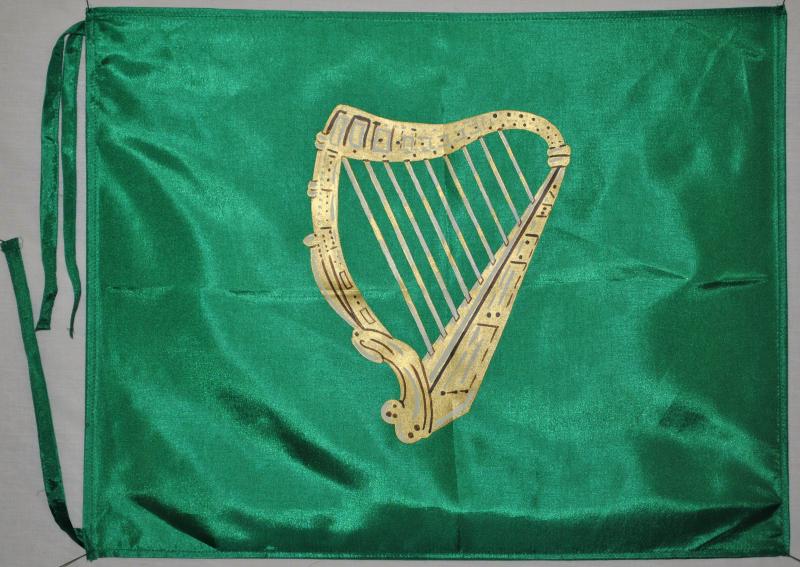
Of course we know that flag was not of the revolutionary workers but instead the harp on green which was that of the early Fenians and was very similar to that of the United Irishmen, the first revolutionary Irish Republican organisation.7

Those early Fenians were mostly composed of working class members and their 1867 proclamation to the world was largely proletarian in outlook. In Britain, the Fenians formed part of the First International Workingmen’s Association which was led by Marx and Engels.

Their flag was flown over at least one of the 1916 Rising garrisons, I believe at theJameson Distillery in Marrowbone Lane.

Similar flag to that hoisted over Liberty Hall (Photo sourced: Internet)

The other flags of the Rising included the Tricolour, presented to the Irish Republicans of the ‘Young Irelanders’ by women in revolutionary Paris in 1848, which was one of two flown on the roof of the GPO, the headquarters of the Rising.

Sharing the GPO roof with the Tricolour was the flag made only days before from domestic material and painted with the words “Irish Republic” in the house of Constance Markievicz, an officer in the Irish Citizen Army, shortly before the Rising.

The Irish Citizen Army’s own flag, the Starry Plough, flew over the Clery’s building facing the GPO. Sadly today most Irish people do not know that flag, though awareness of it and its background is growing among the indigenous Irish and the migrant community.

The design of the Starry Plough, flag of the ICA as it was in 1916 (Image sourced: Internet)

The first workers’ army in the world8

The Irish Citizen Army was formed as a workers’ militia during the great Lockout and strike of 1913-1914, to defend against the attacks of the police, the physical repressive front line of the capitalist class; the ICA’s flag was placed above Murphy’s Imperial Hotel in Clery’s.9

The Irish Citizen Army on exercises at their grounds near what is Fairview today (Photo sourced: Internet)

Though its constitution was more nationalist than socialist, the ICA was in its membership and purpose the first workers’ army in the world and when reorganised a few years later, represented also working class feminism, recruiting women, some of whom were officers commanding men.

Once the preparations for the Rising were in tatters with MacNeil’s countermanding order, where did organisers gather to discuss what to do? In Liberty Hall, the building of the Irish Transport and General Workers Union and it was there that the decision to rise on Monday instead was taken.

It is hard to overstate the importance of the fact that the decision to go ahead with insurrection was taken in the building which had become de facto the HQ of the revolutionary working class in Dublin, with an illegal flag of rebellion flying and where the Proclamation was to be printed.

The writing and text of the Proclamation

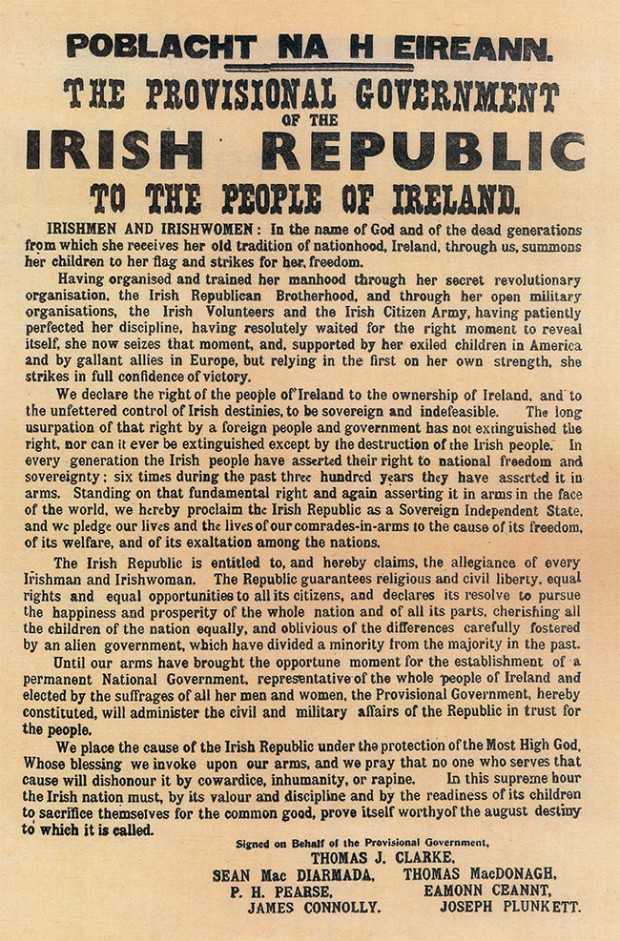
The wording of the Proclamation is thought largely composed by Pearse but influenced by Connolly, including its address to “Irish men and Irish women” and perhapsWe declare the right of the people of Ireland to the ownership of Ireland, and to the unfettered control of Irish destinies”.

Another section which could bear Connolly’s fingerprint reads: The Republic guarantees religious and civil liberty, equal rights and equal opportunities to all its citizens, and declares its resolve to pursue the happiness and prosperity of the whole nation and of all its parts, cherishing all the children of the nation equally.

(Image sourced: Internet)

But, whoever composed or influenced the Proclamation text, it was printed in Liberty Hall. An Irish Citizen Army member went to Stafford Street (Wolfe Tone St. today) to borrow the print type from a printer there to bring back to Liberty Hall, which was under daily 24-hour armed guard.

Having printed the Proclamation in Liberty Hall under armed guard and having decided there to rise on Easter Monday, where did the assault groups for Stephens Green, Castle and the GPO, including the Headquarters Battalion, meet on the morning of the Rising? …. Again, at Liberty Hall.

An early non-combatant casualty of the Rising was Ernest Kavanagh,10 who drew cartoons for the newspaper of the ITGWU, The Irish Worker. For some reason he went to Liberty Hall on Tuesday and was shot dead on the steps of the union building, presumably by a British Army sniper.

The working class in armed resistance

Once the Rising was in motion, the Irish Citizen Army had primary responsibility for two areas, the Stephens Green/ College of Surgeons garrison and the Dublin Castle/ City Hall garrison but also fought in other areas, for example on Annesley Bridge and in the GPO/ Moore Street area.

All who fought alongside them commented on their courage and discipline. After the surrender, many, along with Irish Volunteers were sentenced to death, most being commuted to life imprisonment. But two leaders of the Irish Citizen Army were shot by firing squad.

One of the areas from which the British forces were sniped at for days after the Rising was the docks area, then predominantly surrounded by working class residential areas.

A question we should ask ourselves is why the forces coming from Britain to suppress the Rising landed at Dún Laoghaire, from where they had to march nearly 12 km (approaching eight miles) to Dublin city centre, instead of at the excellent Dublin docks on the Liffey.

Hugo McGuinness, who specialises in history of the North Wall area, believes that the British expected Dublin to be in the hands of the working class resistance and that it was simply too dangerous to land British troops there, though gunboats could fire from the Liffey.

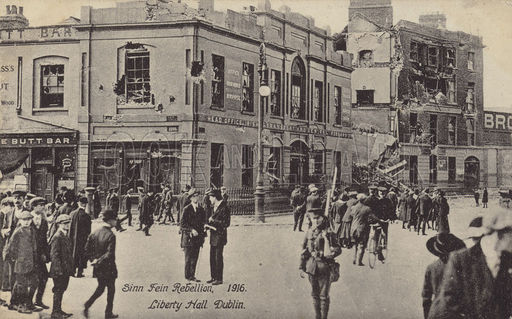
Certainly, the British believed Liberty Hall and buildings along Eden Quay were occupied as fighting posts by the Irish Citizen Army and they fired artillery at the union building from Tara Street, as photos of shell holes in that building and right through to the next testify.

Photo shell-damage Liberty Hall (first building with corner towards the camera, viewed northwards from Butt Bridge) as one of a set of commemorative postcards. (Photo sourced: Internet)
Another postcard with closeup of shelling damage to Liberty Hall and to the building next to it. Interestingly, in this one Liberty Hall is labeled “the Rebel Headquarters”. (Photo sourced: Internet)

Much is made in some historical accounts of the opposition to the Rising from sections of the Dublin population, during and immediately after the Rising. The city was the capital of a British colony, only just over a century earlier spoken of as “the second city of the British Empire”.

A substantial proportion of the wealthy and middle classes were Loyalist, including some Catholics; even ‘nationalist’ sections were committed to supporting the UK in WWI and John Redmond, leader of the ‘nationalist’ political party had openly recruited for the British Army.

Also, among the working class and the lumpen elements, many were depending on “Separation Allowances” with regard to males serving in the British Army. It is true that the insurgents in some places had to threaten, club or even shoot some civilians who tried to obstruct the Rising.11

These incidents during the Rising were not many but afterwards there were insults and other things thrown at prisoners being marched to imprisonment (or firing squad). The city was under martial law but even so a Canadian journalist reported the insurgents being cheered in working class areas.

There were also other individual witness accounts, such as a man on a tram saluting prisoners in Parnell Street until threatened by soldier escorts and a firefighter in the GPO doing likewise. A year later most of even the earlier hostility had changed to admiration and pride in the fighters.

Leadership of the working class

James Connolly wrote and said many things of importance but surely, with regard to the struggle for Irish national independence, the greatest of these was: “Only the Irish working class remains as the incorruptible inheritors of the fight for freedom in Ireland.”

By that he meant — and I agree — that all other social classes can gain something from selling out the interests and resources of Irish nationhood but that the working class can gain nothing from that.

The Irish working class staked their claim on the struggle for Irish independence in 1916 but have not succeeded in leading it and because of that, that struggle remains to be won.

Today and in other days, remembering that long struggle and the class whose leadership revolutionary socialists seek to represent and to uphold, we declare the need for that leadership over a broad front of all others who wish to struggle to advance.

In doing so, we declare that far from the working class having to wait for socialism, in the course of national struggle it must also shape its own demands around the economy, natural resources, infrastructure, social services, social questions, culture and, above all, to the fruits of its labour.

End.

FOOTNOTES

1Irish Republican Brotherhood, Irish Volunteers, Irish Citizen Army, Cumann na mBan, Na Fianna Éireann, Hibernian Rifles.

2All of which were executed by British firing squad, along with another seven in Dublin and yet another in Cork. The 16th execution was by hanging in London.

3(See Sources: Cooption of James Connolly etc) Connolly was a lifelong socialist and a revolutionary throughout his adult life, author, historian, journalist, song-writer, trade union organiser; active politically in Scotland, Ireland, New York and back in Ireland.

4The international socialist movement viewed the imperialists’ movement towards war with horror and in international conferences vowed to oppose it with all their might, including turning war resistance into revolution (“War against war”). However, once imperialist war was declared that resolve collapsed in most states, Russia, Germany and Ireland being notable exceptions and each saw a rising against war, in Ireland’s being the first.

5Joseph E.A. O’Connell (Jnr.) suggests a possible intention of goading of the State into attacking him and the ICA which might spark the general rising.

6(See Sources)

7The harp on the United Men’s flag was more ornate and was inscribed with the words “It is newly-strung and shall be heard”.

8https://www.connollybooks.org/product/irishcitizenarmy

9It was a good central location but more than that – the Hotel was one of the businesses of William Martin Murphy, chief organiser of the employers’ bloc to break the Irish Transport & General Workers’ Union.

10Kavanagh was a supporter of the workers, of votes for women and against participation in the imperialist war, contributing cartoons also to the Irish Citizen, Fianna and Irish Freedom publications, also to accompany poems of his sister, Maeve Cavanagh McDowell.

11I do not include in this the three members of the Dublin Metropolitan Police who were a force for the British occupation and also for the Dublin capitalists. The Irish Citizen Army in particular had good reason to settle accounts with them for attacks on them including inflicting mortal baton injuries on two workers during a charge on a union meeting on 30th September 1913 on Eden Quay and beating people and smashing up furniture in Corporation Street a little later.

SOURCES

Co-option of James Connolly to the Military Council planning the Rising: https://www.historyireland.com/connollys-kidnapping/

Raising the flag on Liberty Hall: https://microsites.museum.ie/1916objectstories/ObjectDetail/remains-of-irish-flag
Molly O’Reilly breaking a window incident: https://www.independent.ie/irish-news/ladies-day-for-1916-heroines/26528456.html

Printing of the Proclamation of Independence: https://libguides.ucc.ie/1916Proclamation
https://www.dublincity.ie/library/blog/printing-1916-proclamation-transcript

Decision taken to go ahead with the Rising on Easter Monday: https://www.irishtimes.com/culture/heritage/easter-rising-uneasy-calm-before-the-storm-1.2575638
https://www.nli.ie/1916/exhibition/en/content/risingsites/libertyhall/

“Only the Irish working class remains the incorruptible heirs …” (end second sentence from last): https://www.marxists.org/archive/connolly/1910/lih/foreword.htm

AN PHOBLACHT ABÚ CALLS FOR BROAD UNITY IN STRUGGLE

Diarmuid Breatnach

(Reading time: 4 mins.)

The first edition of the socialist republican weekly newspaper An Phoblacht Abú for 2024 has been available in hard copy from sellers now for several weeks; I am reviewing it here as I have done on occasion with another few issues during 2023.

APA is a hard-copy newspaper of usually 12 x A4 sides, produced monthly from I believe the last months of 2022, including articles on anti-imperialism, anti-fascism, recent Irish history, internationalist solidarity and sometimes on older history, culture and reports on events, selling at €2/£1 per issue.

Hard-copy revolutionary papers are important as a means of distribution to those who don’t wish – or are unlikely — to seek it online but more than that, they also provide the opportunity to make contact on a personal and organisational level with people with whom to discuss events.

Masthead image taken from the An Phoblacht Abú Facebook page.

However, back issues are also available electronically, I’m told, from the producers.

This particular issue reports on the Palestinian struggle and the solidarity movement in Ireland, featuring a report of an occupation of the Israeli Embassy on 19th December with a following picket and blockade of the gates to the building which hosts it for many hours.

Another page carries a report on Palestine solidarity actions across the country and a “Hands Off Iran & Iraq” item, also an obituary on the death of a recent comrade of the organisers. Separately there is a report and comment on the death of an Irishman in the conflict in Ukraine.

Political prisoners in Ireland and the Basque Country are also covered, the latter focussing on the ‘non-compliant’ Basque prisoners and their support network, in contrast to the colluding “official leadership” and the great majority of prisoners who have come under their influence.

An article comments on the upcoming Referendum on Article 41 of the Constitution of the Irish State, condemns the treatment of women historically by the Irish ruling class and, without recommending how to vote, calls for the destruction of the State.

Commemorations of historical events, including martyrs, are an important part of the culture of all peoples in struggle and APA reports on some. A statement on the escape from justice by natural death of war criminal Brigadier Kitson was widely shared in appreciation on social media.

NEW YEAR CALL FOR BROAD FRONT UNITY

Organisations traditionally issue New Year statements, perhaps reflecting on the past year but always looking to the coming year. The ISR NY Statement covered three pages and called attention to all the struggles discussed in the reports, along with some others.

The one theme in the Statement dominating all others was the call for united action in developing a broad anti-imperialism united front to work for unity “around common Republican principles” while at the same time maintaining “the autonomy and independence of different groups.”

In furtherance, ISR proposes that a “Broad Front Congress” be organised before the end of this year and called on those interested to contact them “to turn the demand of the Republican base into action.”

COMMENT

The importance of revolutionary newspapers is underlined historically by the preparations of the British Government prior to the General Strike of 1926, when they purchased all stocks of newsprint paper to deny them to revolutionaries and other strikers.

Governments today can close down social media transmission and reception over an area and even nation-wide.

The APA editorial is undoubtedly correct in its call for a broad front while stipulating independence of organisations within that front. A congress may further this aim but I wonder if it will, without some advance agreement on working principles (about which I have written previously).

I find it striking that in the New Year’s message which mentions working class communities, there is nothing about workplace organisation, or trade unionism, to give it another name. Working class people do not live in communities alone – they also work many hours outside them.

And in the most commonly-imagined scenario for revolution in western countries, revolution is preceded by a general strike. To organise and carry out such a strike and maintain it against external repression and internal undermining, requires leadership deep and wide within the movement.

How this is to be achieved is an issue, the resolution of which can only follow of course from recognition of its necessity. Across the Left and Socialist Republican movement I see no sign of this recognition.

The founding of this newspaper for socialist republicanism and its monthly production and distribution is a great achievement and to their credit for a young and still relatively small organisation.

Some typographical errors persist in APA which could be removed by greater editorial checking. The reproduction of images might be improved substantially too, space made for enlargement possibly by reduction in the area covered by print, increasing the visual attractiveness of the page.

However, APA is right to concentrate on the written word and the spread of themes, the reporting of actions and the reasoning behind them. A regular revolutionary newspaper has long been needed but missing and monthly production at least is needed for its effectiveness.

Fáilte uaimse roimh an nuachtán míosúil réabhlóideach seo, An Phoblacht Abú!

end.

Note: Back copies of An Phoblacht Abú are available electronically from isrmedia@protonmail.com

THE PRINCIPLES AND PRICE OF UNITY

Diarmuid Breatnach

(Reading time: 5 mins.)

We often hear people talk of the need for unity in progressive and revolutionary movements, which is understandable since the movements are often weakened by divisions – in other words, by disunity.

We may often hear the plaintive cry from someone that “we all want the same thing so why don’t we all just unite”? Clearly the issue is more complicated than it seems at first glance; there are factors working in favour of disunity also.

It is clear that calls for unity alone have not achieved it and much less often do we hear any serious attempt to define the conditions for unity, its principles and the obstacles to overcome, nor at times, the pitfalls in unity for the revolutionary movement, for there are those too. 1

And it does not necessarily mean that if our organisations call for the same thing that what all actually want is the same. We know from experience the widely different meanings that are routinely understood by “democracy”, for example – or even “republic”.

(Image sourced: Internet)

Starting with practice

It has long seemed to me that not only the real test of unity but also its best starting point is in action. That can be in a joint decision to take some specific action (such as a picket or an occupation) or a range of actions but also in joining in an action or actions organised by others.

Not only is action the real test of the expressed desire for action but in the course of action unexpected problems and opportunities arise, posing further questions at the time and for discussion and reflection afterwards.

Practice shines a light on both the conscious intentions and the unconscious reactions to events of activists and organisations.

It is sometimes suggested that what we need is a conference of all those who are in struggle for an objective (or range of objectives), where we can hammer out an agreed statement of aims. I believe that stage should arise after those interested have taken joint action, not before.

For one thing, those who are not really interested in action can attend such a conference and play a disruptive or distracting role in the proceedings. Secondly, those who make great statements of desire for commitment to unity can only be tested in practice, so why not begin with that?

(Image sourced: Internet)

Practical rules

There are certain rules in united action that hardly need discussion but should be understood.

Each component organisation should promote the action either publicly or within close circles as agreed and maintain the agreed confidentiality both before and after the agreed action.

  1. Arrival and departure should be at place and time as agreed.
  2. No distracting event should be planned by any of the component organisations to take place in the vicinity or near the date of the agreed joint action.
  3. The choice of speakers should be agreed beforehand and adhered to.
  4. It is good practice for the action to be reviewed afterwards not only internally but jointly by the participants also, as far as is practicable, to agree on the lessons to be drawn and to be applied.
  5. Publicity before and reports afterwards should list the participating organisations and also mention the presence of independent activists.
  6. Criticism of participating organisations or of individual comrades of such should be taken up with the responsible organisations concerned through private channels before any response is publicised and careful thought given to alternatives and possible consequences of criticism in public.
  7. Revolutionaries should remember and constantly remind themselves that no matter how militant and ideologically correct an organisation may be thought to be, it is not infallible. Furthermore, it does not come at a value above that of the revolutionary and progressive movement.
  8. Consequently, it is not necessarily or always true that what benefits the party or organisation benefits the movement, nor will the reverse always be the case.

Explanation of or expansion on the above:

  1. Late arrival may disrupt the action planned or leave those who arrive on time unnecessarily exposed. On the other hand arrival too early so as to appear in photos or video to be the only ones participating is disrespectful and harmful to unity.
  2. It is not unknown for an organisation to plan its own publicised activity to take place a day or two before that agreed jointly with another organisation, thereby weakening the joint action, a shortsighted promotion of an organisation above the cause of revolutionary unity.
  3. This is often a difficult area in planning joint events as each organisation often wants its own representative speaking or an organisation may want an independent speaker or indeed may have reasons against a nominated speaker. 2
  4. If we do not review the action afterwards we are removing the possibility of learning positive and negative lessons from it.3 On the other hand, if we do not review jointly, we may draw different and even contradictory lessons from the experience.
  5. Listing the participating organisations and the presence of independent activists shares credit, which is good for unity.
  6. Premature publication of criticism will be poison to a united front.
  7. When an organisation takes an incorrect position as is practically unavoidable at some point, or fails to take a correct position that the situation calls for, the existence of those who can criticise it internally and externally is essential for the progress of the revolutionary movement.
  8. However, taking the party or organisation’s health as a measure of that of the movement overall is more likely to benefit the organisation’s leaders than that of the movement, something demonstrated time and again in history.

Possible negative aspects of united fronts

We can take it as read that the courses considered have not only possible positive outcomes (which is why we take them) but also possible negative ones, of which we should be aware and take into consideration, for example with a “Plan B” or with flexibility to adapt to the emerging situation.

  1. A partner organisation may fail to uphold its agreed contribution
  2. Having to consult others outside after internal discussion may delay intended actions
  3. Our plans may be intentionally or unintentionally (through bad security measures) betrayed
  4. An action or statement of a partner organisation may cause us embarrassment
  5. We may be exposed to greater attack by actions not agreed upon taken by a partner organisation or by lack of those upon which we agreed
  6. A part of the united front may attack us publicly or even physically, as has occurred a number of times in history.4
The start of the Irish Civil War/ Counterrevolution: Free State soldiers bombarding Republican stronghold in the Four Courts with British cannon under the orders of Michael Collins, 1922. The Republicans refused unity with the Free State government of a divided country under British dominion. (Image source: Internet)

In Conclusion

The enemies of the people, capitalism, colonialism and imperialism being everywhere strong,5 we need united fronts in order to succeed in overthrowing them. It is important for us to be aware that broad fronts are temporary and that unity is relative, so that we are prepared for eventualities.

For the creation of a broad front there needs to be agreement not only on objectives but also on the practical components, the principles and rules of operation. There may be an overall revolutionary united front but also smaller united fronts on disparate issues.6

Participation in a broad front does not necessarily entail agreement with all the people who are part of that front. We may join in a broad front (for example anti-imperialism) with one organisation that we may not find in another broad front (for example in demand of public housing).

Each component organisation or independent activist of the broad front needs to be able and permitted to retain a certain independence as a matter of democracy but also of diversity of experience in struggle from which we can all learn.

End.

FOOTNOTE

1All trends of the radical and revolutionary Left and a number of Irish Republican sources have written on the question of the formation of the broad front but I have refrained from quoting or listing them since, apart from difficulties of selection, I do not think it appropriate to do so in an article aimed at all elements that may combine in broad fronts. I would advise the reader to do their own research and not to rely on one source or even one tendency.

2The latter was the case for example with Hunger Strike commemorations in London when some political trends wanted a speaker from the Provisionals, which refused to speak at the event if the IRSP also had a speaker scheduled. More than one big planned event collapsed or was not repeated on that issue. Also an independent speaker may outline a position publicly to which a participating organisation may take severe exception.

3This is one of the purposes of exercises, not just the familiarisation of personnel with the practice. In a team in which I worked, the introduction of unannounced fire drills, particularly with an observer following the staff and noting factors, revealed unforeseen serious problems which we were then able to plan to overcome.

4The Communist Party of China had an alliance with the Chinese national movement which broke down twice, the first time resulting in the Shanghai Massacre of between 5,000-10,000 communists and leftists on 12th April 1927. In 1921, after two years of the War of Independence, the alliance of various forces in the Irish national liberation movement fractured and the national bourgeoisie and Catholic Church hierarchy opted for neo-colonial government and partition of Ireland, which in turn in 1922 led to civil war between the new State, supported by the UK, and the Republican forces, which ended in defeat for the latter in 1923.

5Relatively speaking, of course and only so long as they do not face the mobilised masses, resolutely led.

6In Ireland for example these might be for public housing, national independence, against military blocs, for revolutionary history commemoration, promotion of the language, against LGBT discrimination, for trade union democracy and against State restrictions, for urban or rural community planning needs, internationalist solidarity (at the moment particularly with the Palestinians), etc.

SOURCES & FURTHER READING

Breakdown of broad fronts between the Chinese nationalists of the Kuomintang and the Chinese Communist Party: https://www.khanacademy.org/humanities/whp-1750/xcabef9ed3fc7da7b:unit-8-end-of-empire-and-cold-war/xcabef9ed3fc7da7b:8-2-end-of-empire/a/chinese-communist-revolution-beta:

https://en.wikipedia.org/wiki/Shanghai_massacre:

.