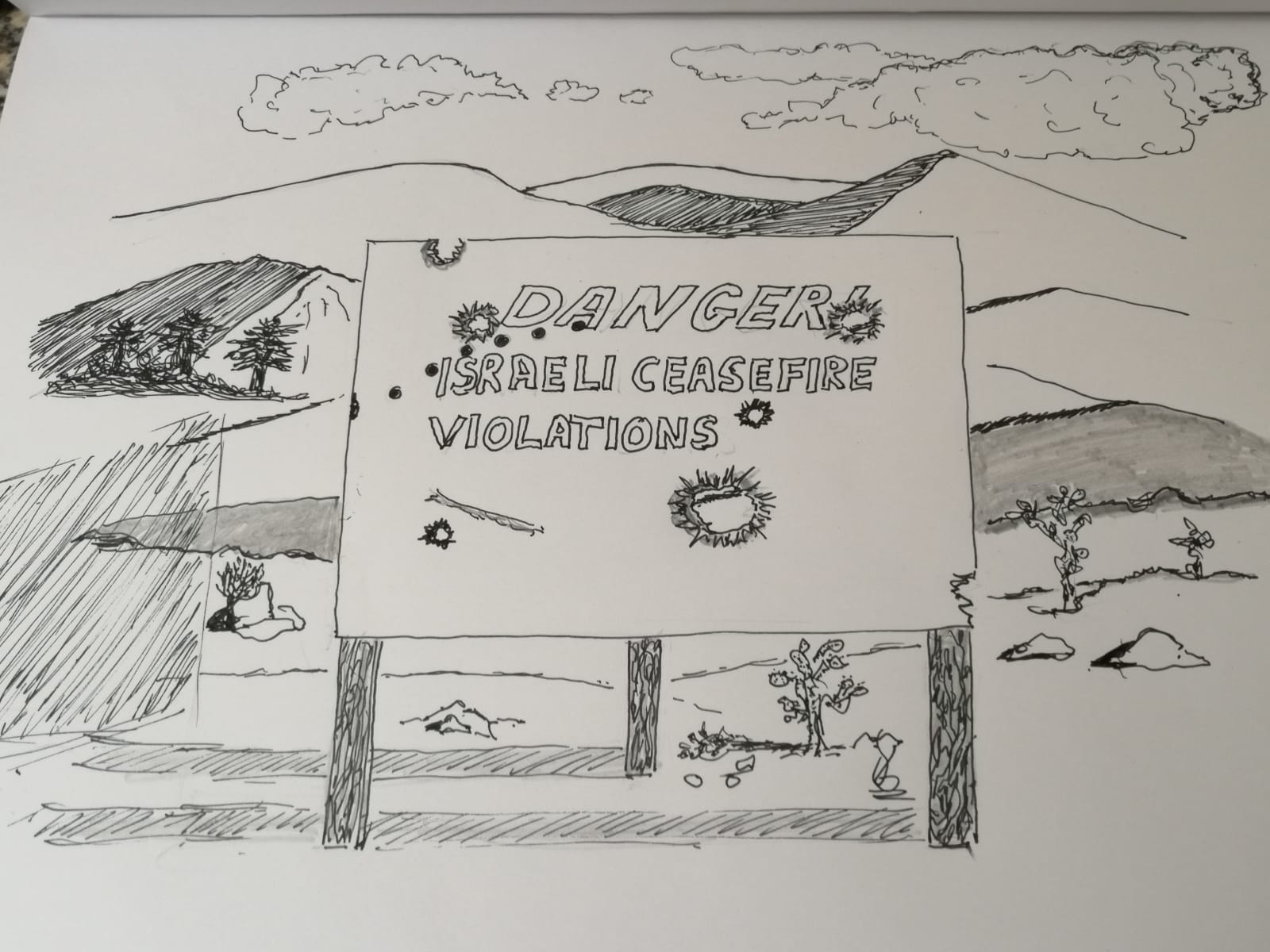
“HEZBOLLAH FIRES AT ISRAEL IN FIRST STRIKE SINCE THE CEASEFIRE” reads the headline so it tells us all we need to know.
Of course those horrible Islamic terrorists are violating the ceasefire with those poor Israelis, which the good old democratic USA and France worked so hard to broker.
Ach ní mar a shíltear a bhítear, or at least not as the media headline would have us believing.
Further down, in the text, it actually gives a much fairer and accurate report and it turns out that this was the first
warning shot by Hezbollah after over 50 violations by the ‘Israeli’ Occupation Forces, which neither the ceasefire arrangers nor UNIFIL have done anything to stop.
But if you’ve only read the headline, as many do, it’s the message that remains in your head.
Even though the main text is fairly accurate, an important additional piece of information is missing. A Zionist source admitted that they are not acting in accordance with the actual text but rather in accordance with a “side document” of an agreement they have with the USA.
They still claim that they’re not violating the negotiated ceasefire agreement, however, even though the document upon which they’re relying was not part of the official ceasefire agreement, was not agreed with the Lebanese side or even disclosed to them at the time of signing!
You’d have to wonder whether Baron Munchausen, Charles Ponzi and Richard Nixon would be relied upon so uncritically by the western mass media today as are the ‘Israeli’ Zionist spokespersons who have been exposed time and time again in lying accusations and denials.
I suppose the answer is that a) it would depend on whether the lies in question suited their purposes or b) how long they thought they could get away with it.
After the some might say overdue missile response by Hezbollah, an official ‘Israeli’ source was quoted as saying that their artillery firing at Lebanon had come to an end. Well – for how long? And the airstrikes, drone flying, destruction of buildings and facilities?
By the way, this admission of “the side document” by ‘Israeli’ sources is not the first known reference to its existence; it was reported referred to in ‘Israeli’ media as soon as the ceasefire agreement was signed.
Over 54 IOF violations of the ceasefire agreement at time of writing, including:
○ Airstrikes on 11 different locations
○ Artillery shelling of four different locations
○ Raids from drones on five different locations.
Since the ceasefire agreement the IOF have injured and killed a number of civilians in shelling etc and drone-murdered a state employee on a motorbike, wrecked dwellings and a mosque, also a football pitch … and also advanced to occupy locations they were never able to during the war itself.
The agreement should have stipulated total Israeli withdrawal within a week – three months was unreasonable and asking for trouble.
Clare Daly stood for election in the 2024 elections of the Irish State, in the Dublin Central parliamentary constituency, one with a tradition of independent representation going back to Maureen O’Sullivan and Tony Gregory before her.
Daly was standing as one of the loose Left coalition of Independents for Change in a heavy competition for the four-seat constituency.
Clare Daly has a track record as elected public representative and socialist political activist, also as a prominent Socialist Party activist, with which organisation she partedcompany in August 2012.
She was elected MEP for the Dublin constituency from July 2019 to July 2024, TD1 for Fingal from Feb. 2016-July 1999 and TD Dublin North Feb. 2011-2019; in recent years Daly has been better known outside Ireland due to her public interventions in the European Parliament.
Daly and her partner Wallace were both vilified by pro-imperialist liberals and ‘Left’ for publicly opposing US/NATO/ EU imperialist campaigns against Islamic regimes and the Russian Federation, being subjected to a host of unfounded allegations contrary to their actual record.
Tik Tok clips of Daly’s biting attacks on the EU’s complicity in the US-backed ‘Israeli’ genocide provided relief for many around the world from the Zionist sycophancy and insincere and ineffective concern for the victims of that daily genocide prevalent in the EU Parliament.
And who can forget Daly’s calling German politician and EU Commission President Ursula Van Der Leyen out as ‘Frau Genocide’ in the European Parliament in December last year!2
While an MEP, Daly also intervened in the discussion around the Irish Gombeen3 class’ attempt to push us towards NATO, further undermining a quite tattered Irish neutrality. And while a TD, she and her partner Mick Wallace TD were arrested protesting the foreign militarisation of Shannon.
To their credit both risked jail by refusing to pay the fines imposed but the Gombeen ruling class decided to restrict the damage of its exposure of collusion with US imperialism by also reducing the punishment of both to a few hours in captivity.
Daly has been one of the few TDs prepared to speak in public against the repression of Irish Republicans and to visit some of the consequent victims in jail.
In the EU Parliament, Daly also denounced the Spanish State’s police invasion of Barcelona and violence against voters there on 1st October 2017 during the referendum on Catalunya’s independence.
2024 Dublin Central election poster for Clare Daly.
In Ireland today
In her election flyer here Daly highlighted representation independent of political party for her electoral area, housing, health service, cost of living, Palestine, the endangered climate and Irish neutrality without any indication of how these issues might be effectively addressed.
Daly’s election flyer did not mention capitalism or imperialism, nor did she campaign on a platform of overthrowing the current neo-colonial and neo-liberal capitalist system in force, instead indicating her wish to “hold to account the people who’ve got us into this mess.”
“Holding to account” is something to which Daly is accustomed doing and does it well, eloquently, with passion and fluently, scarcely having to refer to her notes while doing so. But like ‘speaking truth to power’, it has little effect on those who are in control of the political-social system.
It can indeed have an effect on the victims of the system but we are left with the question of what to do about the situation. Refreshing as it may be to hear her again in Leinster House, neither voting Daly in — nor fifty Dalys — is going to change any of the conditions under which we suffer.
BY THE WAY,
in case anyone’s interested, I gave my first preference vote to Daly and hope she does get elected.
End.
1Teachta Dála, the title of a public representative elected to the parliament of the Irish State.
2Imperialist politician and proven plagiarist in her doctoral thesis.
3Vernacular term in Ireland for huckster, carpet-bagger-type capitalists, derived from the Irish language gaimbíneachas, profiteering, nowadays used to describe the neo-colonial Irish capitalist class.
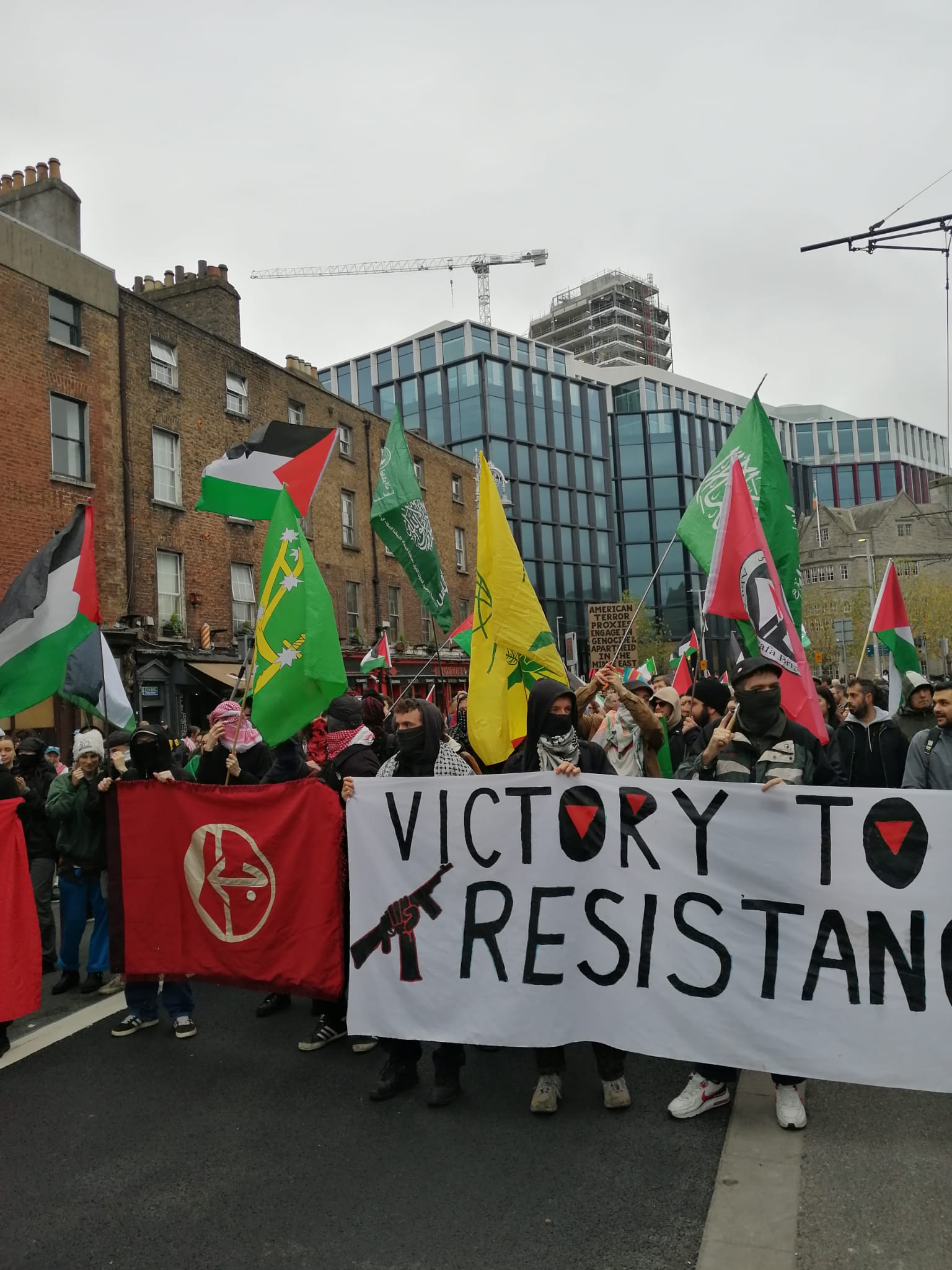
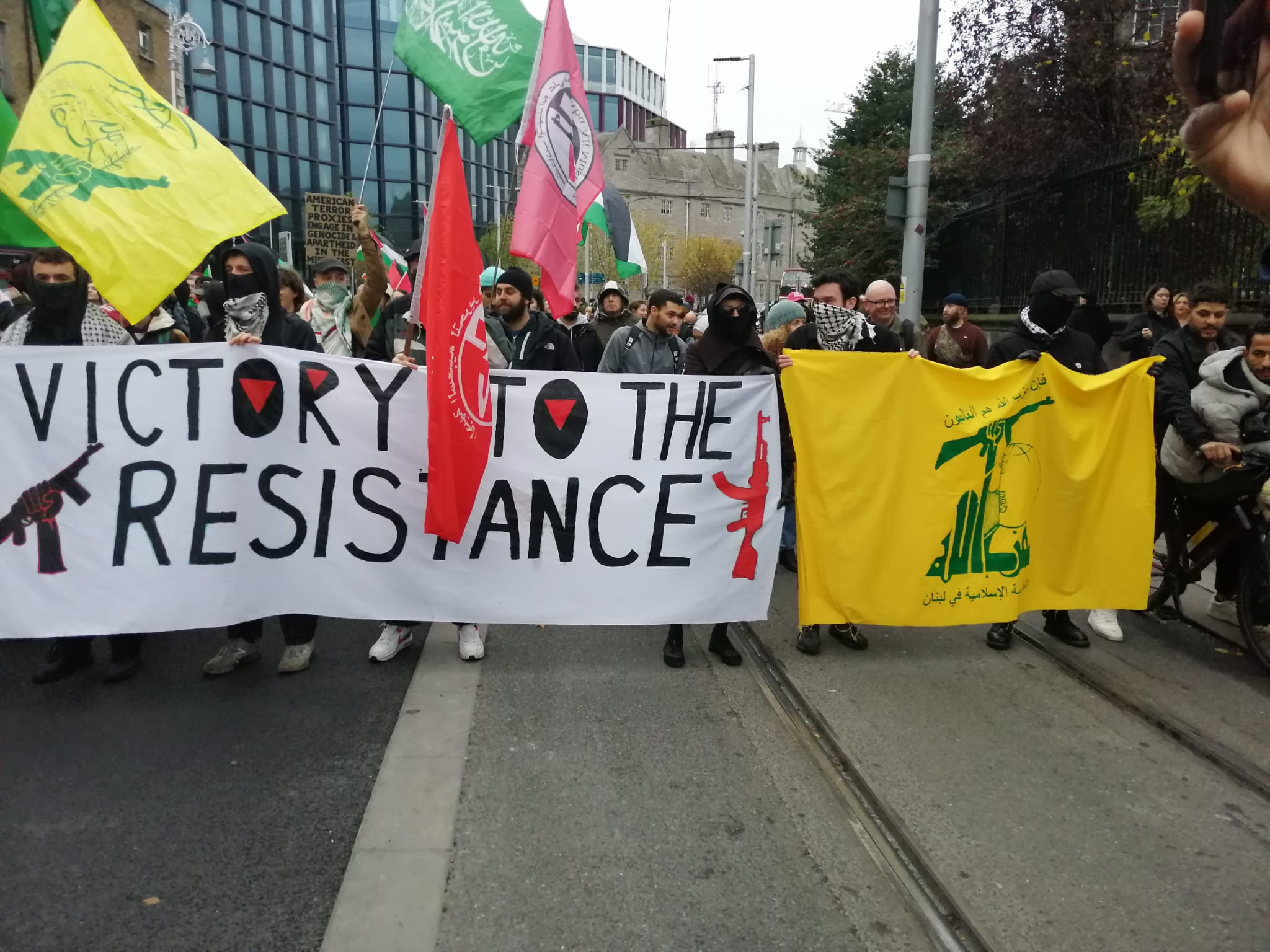
While thousands marched once again in Palestine solidarity in Dublin, a section of the demonstration marched as a bloc in specific solidarity with the Palestinian Resistance with banners, flags and slogans declaring their position.
The Ireland Palestine Solidarity Campaign with a number of branches has been for many years the major organiser of Palestinian solidarity events and had once again called for a national march in Dublin, again to Leinster House, home of the Irish Parliament.
Section of the front of the Palestinian Resistance Solidarity Bloc in Dublin on Saturday. In this photo may be seen the flags of three factions of the Palestinian Resistance and, left foreground, the flag of Irish revolutionary socialist Republicanism, the Starry Plough (Photo: R.Breeze)
This has become a pattern of the main IPSC street activity in Dublin, along with holding a rally on the central pedestrian reservation in Dublin’s O’Connell Street, with occasional marches to the Department of Foreign Affairs (though in the past it organised boycott pickets of ‘Israeli’ products).
The US Embassy seems to have become out of bounds for the IPSC. This is despite the clear responsibility of the USA for supplying most of the armament, political and financial backing for the genocide being carried out by the Zionist state against the Palestinians.
Some believe that the IPSC leadership is complying with the wishes of the Irish police, the Gardaí, not to have Palestine solidarity marches go to the US Embassy. The offices of the EU, Germany and the UK, major contributors to the genocide, have also been given in effect a waiver.
The national march called by the IPSC at its destination in Molesworth Street last Saturday. The photo is taken from the platform and PA lorry facing the crowd, with its back to Leinster House (of the Irish Parliament) which also has crowd barriers erected behind it. (Photo sourced: IPSC)
Neither the march last Saturday nor any organised before it by the IPSC was going to promote solidarity with the Resistance, despite their former chairperson having once said of them in public that they are ‘freedom fighters’. Of course, to the ‘Israelis’ and EU they are ‘terrorists’.
Section of the front of the Palestinian Resistance Solidarity Bloc in Dublin on Saturday (Photo: R.Breeze)
The IPSC has organised only one public meeting during this year’s genocide to highlight the terrible conditions of the thousands of Palestinian political prisoners in ‘Israeli’ jails and rarely mentions them, nor in solidarity with the Samidoun1 organisation being banned in USA and Canada.
In October last year, as this phase of the genocide began, the IPSC dithered over whether to call for the expulsion of the ‘Israeli’ Ambassador to Ireland, as did the Sinn Féin leadership until a near revolt of the party’s members forced them to return to their previous position. As did the IPSC.
Clearly the IPSC leadership is trying to keep itself somewhere around the ‘middle road’ in Palestinian solidarity, probably in order — as it sees it – to remain with influence among the ruling circles. However, the actual results among those circles do not bear testimony to their effectiveness.
NO CHANGE
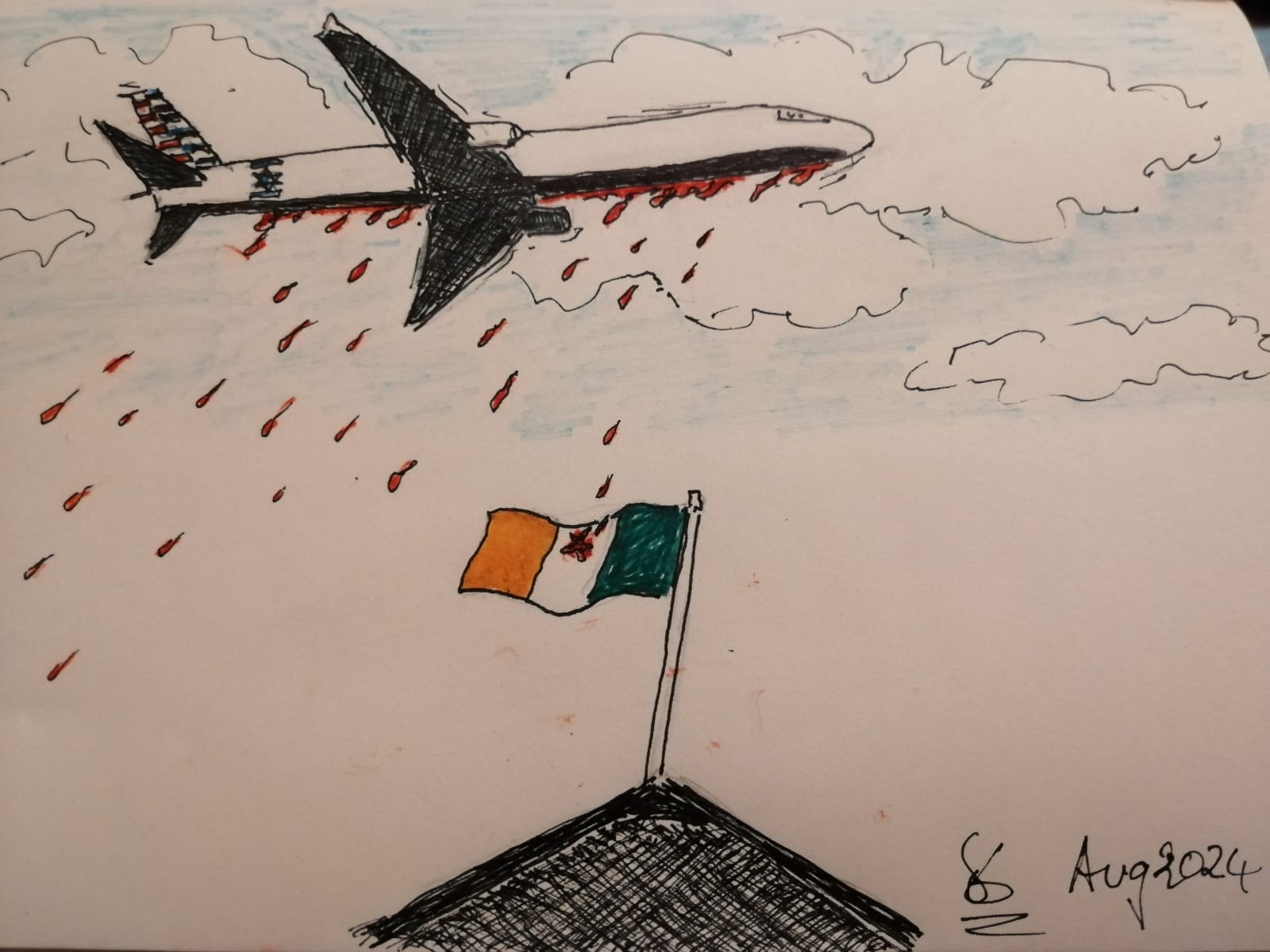
The Irish state continues to permit US military planes and personnel to violate the State’s nominal independence through Shannon International Airport, to permit Zionist armament overflights of its air space (similarly with the RAF) and to permit British Navy docking in Irish ports.
The relatively mild Occupied Territories Bill, long approved through Leinster House, remains not brought into force, blocked by the Coalition Government of Fianna Fáil, Fine Gael and the Green Party. It could not be clearer that the ruling class in Ireland do not feel under enough pressure.
This is despite a clear popular feeling among the public in Ireland of solidarity with Palestine and revulsion at their genocidal attacks by the Zionist state.
There is a long-established train of thought that maintains that solidarity with the Palestinians is not just calling for the genocide to stop – that alone is charity and that actual solidarity means solidarity with the people’s resistance and the political prisoners.
If the IPSC were to adopt that position they might find it easier to support more radical action to pressure the Irish state to break with the western powers’ consensus of support for the ‘Israeli’ state and consequently for its genocide against the Palestinians.
Perhaps that is one of the very reasons that the IPSC leadership will not take that stand and that its stewards have at times even tried to convince people to remove their flags supporting various Resistance factions.
Section of the front of the Palestinian Resistance Solidarity Bloc in Dublin on Saturday (Photo: R.Breeze)
On Saturday independent activists joined those of Saoirse Don Phalaistín, Anti-Imperialist Action Ireland and Queers For Palestine in forming a sizeable bloc on the march with banners, flags and call-and-answer slogans advertising its solidarity with the Resistance.
This seems a welcome trend likely to grow.
End.
FOOTNOTE
1Palestinian political prisoner support and advocacy organisation.
Yahya Sinwar, head of the Palestinian resistance organisation Hamas, was killed in action by an Israeli Occupation Force in what was for them a routine operation in Gaza on 16th October, his last moments captured on video and broadcast widely.
From that event alone there is much for us to learn about Hamas and the Palestinian Resistance in general as well as about Sinwar himself — but also about the IOF, the way it fights and the extent of its self-discipline.
For the bare details as publicly shared, Sinwar was in military outfit, in tac vest, armed with a pistol and automatic rifle and accompanied by two local Hamas commanders in the Tal as-Sultan, Rafah area of Gaza patrolled by the IOF, very close to the semi-permanent IOF front lines.1
One may assume Sinwar was on a reconnaissance operation.
Sinwar with Hamas comrades in 2021 (photo cred: John Michillo)
Something gave away their position to a passing patrol in an area where, as far as the IOF were concerned, nothing should be alive except themselves. Pursued, they split up, local commanders in one building and Sinwar into another so the patrol called a tank to fire into each.
The patrol attempted to enter the building into which the individual fighter had gone but two grenades beat them back, injuring one soldier,2 so they retreated and called for a tank to put another shell in the building.
Still wary in the aftermath, they sent a surveillance drone into the building and the image it captured was what was seen in the widely-circulated video: a Palestinian fighter, apparently unarmed, right hand mangled. As they watched, he threw a stick at the drone with his left hand but missed.
So the IOF patrol had another tank round fired into the building and they went on their way.3
The last image of Hamas chief Yahya Sinwar alive. Right arm mangled he stares at the IOF drone videoing him in house ruined by IOF bombing in Tal Al-Sultan, Rafah, before throwing a stick at it. Moments later the IOF call a tank to put a shell in the building, collapsing it on top of him.
But unusually,4 they came back. Perhaps someone thought they recognised Sinwar in the camera video? It was then they discovered that one of the three fighters they had killed was Yaha Sinwar, confirmed by test results matching his DNA records they had from his years in captivity.
According to ‘Israeli’ postmortem, although he’d been hit by shrapnel and his right hand was mangled, what killed Sinwar was a bullet to the brain – which raises other questions.5
Whatever he was doing at that time, it was clear that he was there as a commander and Resistance fighter, armed and dressed for combat in a highly dangerous area, regularly patrolled by the IOF and only a short distance from their secured front lines.
That alone spoke of courage but also his and his comrades’ resistance in the face of superior numbers declared their courage and determination. But Sinwar’s continuing to resist while badly wounded and his comrades dead, spoke of heroism.
Although only weeks from his 62nd birthday and after 22 years in a Zionist jail, Sinwar seems to have been quite fit. However, according to the results of a postmortem examination carried out by the IOF, Yahya Sinwar had not eaten in 72 hours prior to his death – a period of three days.6
The event was revealing in outlining how the IOF infantry is accustomed to fighting. They are fine with killing civilians but when confronted with armed resistance fighters, they hold for a short while if at all before retreating and calling up artillery or air strikes.
Their dead and wounded are picked up by helicopter and rushed to undamaged ‘Israeli’ hospitals, well equipped and staffed less than an hour away, a journey that is never fired upon by the Palestinian Resistance.
The contrast could not be starker, as the IOF fire on Palestinian paramedics and their vehicles, blockade Palestinian hospitals from receiving fuel and other essential supplies, even bombing and occupying them, kidnapping and killing medical personnel.
What people saw in the video of Sinwar’s last moments exposed Israeli lying propaganda about Sinwar, accusing him of living safe and well inside the tunnels and never emerging or, if he does, going about in a burka, disguised as a woman, also of intending to flee to Egypt with ‘hostages’.7
Iconic photo of Yahya Sinwar in May 2021, sitting in an armchair outside his home in Gaza, ruined by IOF bombardment. He went there directly after concluding an interview with words to the effect that he did not fear assassination by the IOF, that they knew who he was and the route he would take and if they wanted to kill him “Be my guest … I won’t bat an eyelid.”
The quick circulation of the video by the IOF exposed also the renowned indiscipline of their military and their total lack of comprehension of the mental and emotional processes of the people they have been occupying and oppressing for seven decades.
Their indiscipline is attested to by the thousands of videos on social media posted by the IOF during their genocidal operations as, contrary to orders, they film themselves blowing up buildings including a university, humiliating and brutalising prisoners, even on occasion raping them.
The IOF are renowned too for leaving graffiti inside occupied houses and for prancing around houses they have destroyed, often wearing the intimate underclothing of Palestinian women, whom they have at least turned into refugees and may have killed.
In those circumstances their release of the video before discussing it with their intelligence and propaganda department is not surprising but doing so underlines their failure to understand their enemy. They thought that killing Sinwar would undermine Palestinian morale.
They, colonialists and other oppressors in general fail to take account of the human will to resist and the potency of the memory and example of martyrs. This is an aspect we understand well in Ireland.
The Zionist intelligence services would surely have preferred not to have Sinwar’s last moments shared publicly and possibly would have liked the opportunity to lie about them.
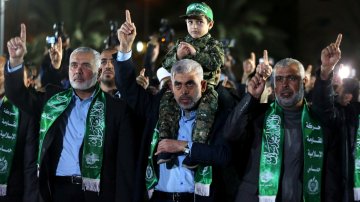
Yahya Sinwar gives the victory sign with both hands while speaking from a rally in Gaza.
Sinwar was clearly a remarkable individual, Palestinian Resistance fighter, thinker and leader but the IOF made him a martyr and in their arrogance showed his heroism not just to the Palestinians — nor to Arabs alone — but to the world.
Yahya Ibrahim Hassan Sinwar (Arabic: يحيى إبراهيم حسن السنوار, romanized: Yaḥyá Ibrāhīm Ḥasan al-Sinwār; 29 October 1962 – 16 October 2024) was a Palestinian resistance fighter, former political prisoner and subsequently politician who was killed in action.
Sinwar served as chairman of the Hamas Political Bureau from August 2024 and as the leader of Hamas in the Gaza Strip from February 2017, until his death in October 2024, succeeding Ismail Haniyeh (assassinated by Israeli strike while on a fraternal visit to Iran) in both roles.
He was born in the Khan Yunis refugee camp in Egypt-ruled Gaza in 1962 to a family who were refugees from Majdal (Hebrew: Ashkelon) during the 1948 Palestine War. He gained a bachelor’s degree in Arabic studies at the Islamic University of Gaza.8
Sinwar’s first arrest was in 1982 for ‘subversive activities’, serving several months in the Far’a prison where he met other Palestinian activists and dedicated himself to the Palestinian cause. Though arrested again in 1985, upon his release he continued his organising trajectory.
Israeli propaganda has claimed that during this period his work in internal security against Zionist agents and informers earned him the nickname “Butcher of Khan Younis” but no-one who knew him or seriously studied him even heard of that alleged nickname until after his death.9
Ismail Haniyeh, leader of the Hamas politburo, welcomes Sinwar with a kiss after the latter’s release from jail in the prisoner exchange of 21 October 2021 (Photo cred: Abed Rahim Khatib/ Flash 90)
Sentenced to four life sentences in 1989, Sinwar spent 22 years in prison until his release among 1,026 others in a 2011 prisoner exchange for Israeli soldier Gilad Shalit. According to John Elmer10 Sinwar wanted others released before him but the prisoners insisted he be one of those leaving.
The prisoners had elected Sinwar as their leader in the prison11 and he was known for encouraging prisoners to use their time productively and to study – in particular to study the enemy. He certainly practised what he preached, becoming fluent in Hebrew and studying IOF tactics.
And also, incredibly, in writing a political novel, The Thorn and the Carnation.12
Sinwar (centre photo) photographed carrying the son of Mazen Faqha, a Hamas leader who was shot dead by unidentified gunmen in Gaza at martyrs’ memorial 27 March 2017. Another photo of Sinwar shows him carrying the child and an automatic rifle; yet another, carrying an automatic rifle and a child who might be a girl, perhaps the child of another martyred fighter. The child and the gun may be seen as symbolising the future through resistance.
On 21 November 2011, a month after his release, Sinwar married Samar Muhammad Abu Zamar and the couple had three children. Sinwar’s wife received a master’s degree in theology from the Islamic University of Gaza. His brother Mohamed remains active in the resistance and is being sought by the IOF.
Re-elected as Hamas leader in 2021, Sinwar survived an ‘Israeli’ assassination attempt that same year.
3All of this is according to the Israeli Occupation Force.
4 According to Jon Elmer, blogger and weekly podcast military analyst for the Electronic Intifada, also in discussion with Justin Podur https://www.youtube.com/watch?v=Dj43mbQ3AiE (at 1.23.3), that was so unusual because the IOF don’t usually go back to carry out battle analyses for intelligence.
11This seems not unusual among political prisoners:Irish Republican prisoners also elected their OC in the British Occupation jails: Mairead Farrell had been O/C in Armagh Jail and, before he entered his fatal hunger strike, Bobby Sands had been O/Cof the H-Blocks.
Opinions seem divided on whether ‘Israel’s’ recent attack on Iran did much damage and whether Iran will retaliate. On the first, the Zionist Government and its allies claim great success while Iran claimed most missiles shot down and minimal damage.
One takes it for granted that all sides in a war will have an eye to useful propaganda. During the attack, while Zionist and western mass media were claiming numerous ‘Israeli’ strikes on Iran, allegedly real time videos of a quiet Tehran were being posted on line.
It must be said that no satellite photos of any real damage to Iranian installations have been posted on the internet and one of a military facility seeming to show a huge crater appeared later intact on the Internet with a claim that the earlier photo had merely shown a shadow.1
The Iranian authorities did admit to the deaths of four soldiers and a little minor damage, the latter quickly repaired, according to their updates. They also claimed to have shot down all but a few of the incoming missiles.
It seems that none of the manned Zionist aircraft entered Iranian airspace but a few approached the border from Iraq in order to launch their missiles from there, which raises another issue regarding the violation of Iraqi sovereignty by the US military.
According to Alastair Crooke, commentator on Middle East affairs, former British diplomat (then probably MI6 asset) on Judge Napolitano’s Youtube site,2 the first of three planned ‘Israeli’ attack waves encountered something unexpected in the Iranian air defence and the rest of the attack was aborted.
Narratives from each side would be tailored to suit their own propaganda needs but even some of the ‘Israeli’ media and other commentators were critical of the effectiveness of the attack, some saying Iran was hardly damaged while others said economic targets should have been included.
It also does seem that the Zionist attack was unusually restrained in restricting its targeting to military installations.
The speculation has been that the reason for that restraint was the US being quite firm with Netanyahu that the oil etc. installations were not to be hit as Iran’s retaliation would have engulfed not only the Zionist colony but wider western interests in the region and the world economy.
Whichever side is correct in its damage estimation may be relevant or may not. Iran has reiterated its right to defend itself but seemed not to be saying that it would definitely retaliate.
But on Wednesday Admiral Ali Fadavi, Commander-in-Chief of the Islamic Revolutionary Guard Corps of Iran was quoted in some media stating that his country’s military will retaliate, stating that such “is inevitable”, today backed by the Director of the Supreme Leader’s Office.
Michael Jansen, a correspondent on the Middle East in the Irish Times wrote that because Iran was allegedly hard hit in the ‘Israeli’ attack, it will not retaliate and claims that Iran’s previous retaliation was a flop. If that is Jansen’s main basis for her opinion, it is to my mind an unsafe foundation.
In the past I’ve had respect for Jansen’s analysis of the war in Syria and the positions of different factions but this time I think she is very wide of the mark. The previous Iranian retaliations swamped the Zionist air defence system3 with cheap drones but hit many targets with missiles.
It seems to me that Iran WILL retaliate and the only thing that might hold that off or at least moderate the strength of its attack would be if the ‘Israeli’ Government ties up a peace deal with the Palestinian Resistance, led by Hamas. And that looks extremely unlikely, for a number of reasons.
The Resistance is sticking to the terms that were announced by Biden back in May, which he claimed were the ‘Israeli’ Government’s and to which the Resistance agreed, only to see the talks sabotaged again and again by Netanyahu in proposing additions and deletions.
The basics of the Resistance position are:
Immediate end to the ‘Israeli’ attacks now and in future
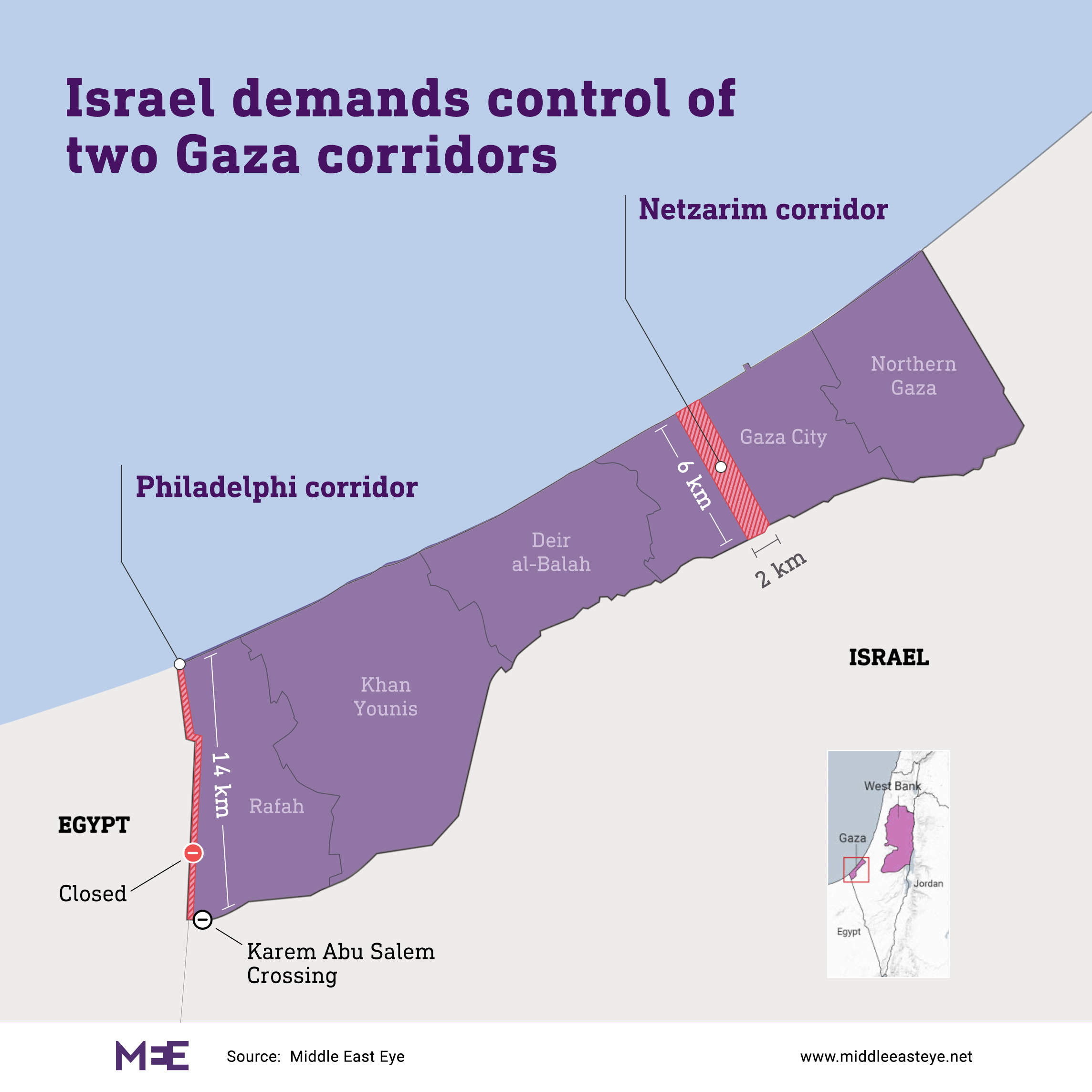
Total withdrawal of the IOF from Gaza (including the Nezarim Corridor and Rafah)
Total removal of all obstacles to arrival of humanitarian food, medicine etc. supplies
Return of all displaced from parts of Gaza as they wish
Exchange of prisoners (including bodies of dead Israelis and to include Palestinians nominated by the Resistance, without Israeli veto)
Reconstruction of infrastructures and buildings: housing, medical, educational, social, commercial
None of those terms except the exchange of prisoners has been agreed and even there, Netanyahu wanted to exclude some Palestinian prisoners from the exchange. Most fundamentally, he insists on the IOF staying in Gaza, in particular in the “Nezarim corridor”.
It is frequently commented that Netanyahu cannot afford personally to end the attacks in defeat as a postponed court case for alleged fraud and bribery awaits him and, without a victory in his belt, his political fascist friends would abandon him to be savaged by his enemies in the Zionist entity.
However, the continuing Zionist massacres of civilians and wide-scale urban destruction is intended in large part to force the Resistance to accept terms with which the Zionist state agrees, to gain in negotiations what it has been unable to win on the battlefield against the Resistance fighters.
No doubt there are some who think that the Resistance should abandon its demand about total IOF Gaza withdrawal, just to end the massacres. That kind of thinking results in a partial peace to which the enemy will return again and again with violence.
The Palestinian Resistance has clearly decided that they will tough this out in the sacrifice of their people, fighters and leaders in order to get a more stable position for the Palestinian nation, from which to go forward to self-determination – and peace, should that be obtainable.4
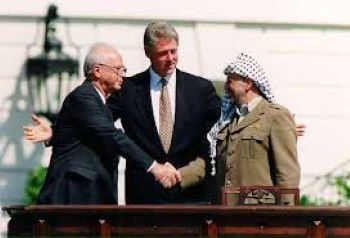
US Imperialism in the form of Bill Clinton supervises handshake between Yitzhak Rabin, Prime Minister of US proxy’Israel’ and Yasser Arafat, then leader of Fatah in control of the PLO at the conclusion of the Oslo pacification process. The Agreement spawned the Zionist-colluding and repressive Palestinian Authority but never gained the Palestinians anything. (Image sourced: Internet)
The last time the Resistance caved in to Zionist and imperialist demands was with the Oslo Accords in 1993, signed for the Fatah leadership by Yasser Arafat. Since then not only did the Palestinians not make any advances but additional Zionist settlements have grown apace.
And every few years have seen new genocidal attacks on the Palestinian people.
The Axis of Resistance considers the Zionist State to be a constant threat to the Arab states and indigenous people of the Middle East, in addition to the Islamic Republic of Iran. The history of the Zionist state’s wars with its neighbours and its backing by imperialism seems to bear that out.
Looked at soberly, the Palestinian Resistance has inflicted a huge defeat on the IOF and the Zionist military mystique on October 7th and, notwithstanding daily genocidal massacres, the Resistance has gone on for a year to deny the IOF a victory in Gaza or on the West Bank.
Hezbollah’s bombardments have cleared much of north Palestine of settlers in addition to hitting targets in central ‘Israel’ and they’ve also fought the IOF to a standstill on Lebanon’s borders. Missiles and drones of the Iraqi Resistance and the Yemeni State have also hit the Zionist State.
The balance of battlefield supremacy is tilting against Israel, thanks to the adaptability, courage and sacrifice of in particular the Palestinian people but now also the Lebanese — and world popular opinion is against the Zionist European settler project as never before.
Iranian drones, one launching, Iran 4 October 2023 (Photo cred: Reuters)
It is necessary to continue the process both to inflict an unmistakeable defeat on the Zionist State and to win substantial advances for the Palestinian people and, incidentally, for the people of the Middle East. These advances entail in addition setbacks for US and western imperialism.
It is important to hammer that nail home, lest it works itself loose before long. I think that at some point Iran will likely retaliate against the Zionist state for its own dignity and defence but also as part of the Axis of Resistance, striving to rid the area of an extremely dangerous infestation.
End.
FOOTNOTES
SOURCES
1The imperialists have Iran constantly under satellite surveillance and it beggars belief they would not have posted photos of significant damage were such to exist.
2Crooke claims that the first wave was to destroy the air defences but failed and encountered something which put all the rest of the attack in danger so they called the attack off and then claimed a victory. Crooke is speculating up to a point about the reasons but claims the facts about the attack are from ‘Israeli’ sources. https://www.youtube.com/watch?v=txkNk76E3SI
3Both ground-based, as with Iron Dome and David’s Sling but also airborne with US and European allied aircraft.
4A similar position was outlined with respect to Hezbollah by Sheikh Naim Qassem in his first speech on Wednesday since his election to the General Secretaryship of the organisation.
A number of years ago I read Ta-Nehisi Coates’ book We Were Eight Years in Power, which was a eulogy to the Obama era and people like himself who had done well out of that period in the US.
It was a terrible book, rightly slated by many and led to black academic and activist Cornel West describing him as the neoliberal wing of the black freedom struggle.[1] The book was so bad, I barely got half way through it and put it down never to pick it up again.
Cornel West (left) described Ta-Nehisi Coates (right) as the neo-liberal wing of the black freedom struggle.
I never thought I would read another of his books, though I have read some articles of his. Then came his new book The Message and the criticism from the Right on his comments on Palestine. So, I surrendered and read it. This time in its entirety.
It is an easy well-written read.
As with all his books, this is very much about him. His preferred pronouns are definitely I and My (yes, I know My is not a pronoun, but none of this pronoun nonsense obeys the rules of grammar in any case).
It deals with three trips he made and how he felt about them and the issues that arose. Given the CBS interview I fully expected to find some hard critique of the US, Israel and Apartheid, though that is not his style.
Instead, he relates stories about his experiences in Palestine, talking to Palestinians and also to Israeli settlers. That is it. The Israelis obviously do not come out well in the book. How could they?
Coates likens his experiences in Palestine to Jim Crow in the US and Apartheid in South Africa. They are the comments and observations on what he saw, and pretty much middle of the road.
He is no Norman Finkelstein with his searing condemnations of Israeli massacres and Apartheid. It says more about the US media that Coates’ interesting, but in no way extreme comments, have provoked such fury.
This part of the book, is partly a Mea Culpa for previous articles he had written in which he praises Israel, chief among them, apparently, is his essay published in The Atlantic, The Case for Reparations.
Ta-Nehisi Coates
In the essay, he liberally and uncritically quotes terrorists and murderers such as David Ben-Gurion and Menachem Begin.[2] He has much to apologise for in that essay.
The essay starts off with a biblical epigraph from the book of Deuteronomy and also an anonymous quote from 1861 “By our unpaid labor and suffering, we have earned the right to the soil, many times over and over, and now we are determined to have it.”
Except the land in question, that which Lincoln promised to give to freed slaves was land that had or would be stolen from native American Indians, who do not figure in his case for reparations, just like Palestinians didn’t exist for him.
It is a thoroughly vile, though well researched piece, that I have criticised previously in an essay entitled Reparations Without Talking About Capitalism[3] and won’t go into again here.
He now says that he is ashamed of some of the things he said in that essay, which he mentions in his book. He does not mention an earlier essay which leaves no doubt as to where his loyalty and politics lies: The Negro Sings of Zionism.[4]
In it he compares Zionism to Black Nationalism, Theodore Herzl, the founder of the Zionist movement to Huey Newton and even Malcolm X! This essay was written only months before Obama, his hero, came to power and was in the throes of his election campaign.
Obama was and, like Kamala Harris, still is an ardent supporter of Israeli atrocity. Coates was not going to challenge Obama on this point, ever.
And even now in the midst of the genocide in Gaza he has publicly called for people to vote for Kamala Harris, saying that sometimes the choices are bad.[5]
And further, he says a Kamala presidency which supports “apartheid and genocide” would be nightmare scenario “of being the first Black woman president and having 2,000-pound bombs with your name on them dropping on Gaza.”[6]
Except it is not. It is business as usual. The only nightmare is for the Palestinians, not for him or the rest of the liberals who will vote for Harris.
Under Obama, the US bombed at least six countries, Afghanistan, Iraq, Pakistan, Somalia, Syria, Yemen, where the Houthis are actually challenging both the US and Israel and of course Libya
where the toppling of Gaddafi led to the reintroduction of open-air slave markets where black Africans were once again for sale. Not a minor point you would think for a black identitarian.
In 2016 alone, Obama in his final year of his presidency dropped a staggering 26,171 bombs i.e. three bombs every hour, every day of the year.[7] Meanwhile Coates was waxing lyrical about how he and others like him had spent eight years in power.
He should own it! That was on Coates as well. He doesn’t get to wash his hands now.
Sometimes the choices are bad, he claims. But would he tolerate a white person voting for a racist politician on the grounds that they had good positions on other issues, such as abortion? I think not.
His arrogance leads him to think he and Harris deserve a pass on this now. He doesn’t, nobody does. Neither does the hypothetical white voter who wants to vote for some racist who has good positions on other issues.
The level of ignorance that Coates claims for himself is hard to fathom and even harder to believe. He claims to not be sure when exactly in his visit to Palestine he first heard the term Nakba.
He also states that “For as sure as my ancestors were born into a country where none of them was the equal of any white man, Israel was revealing itself to be a country where no Palestinian is ever the equal of any Jewish person anywhere.”
Revealing itself? Under which rock had Coates been hiding? Had he not heard of Operation Cast Lead?
It was launched in the same year he sang his hymn to Zionism. It resulted in around 1,500 Palestinian deaths, mainly civilians and the displacement of 100,000 people. Did he never hear of the Goldstone Report on that operation?
And the scandal when Goldstone was forced to recant? It was one of many such assaults on Gaza. All of this and other incursions have been well documented.
Writers write. Everyone knows that, it is their art, their trade. But more than write, they read. All writers read, even the bad ones have to read something occasionally. Coates’ ignorance is not credible.
When he researched his essays praising Zionism, did he not come across a single solitary article to give him some pause for thought? Any piece by Finkelstein, Ilán Pappé, Chomsky, anyone at all? His feigned ignorance is not plausible.
In his song to Zionism, Coates looked at the conflict through his identitarian eyes, and chose a side that he thought was closest to his own identity. His “repentance” is a similar process. He now sees the Palestinians through those eyes.
We have no idea how far he will go with this and when he will backtrack. Like many writers he can read the room and probably feels now is a good moment to be on the Palestinian side. But his repentance only goes so far.
If Harris wins the election, he will at some point write Another Eight Years in Power. Or if she loses, The Land of Milk and Honey We Were Deprived of.
He states early on his book that “we could never practice writing solely for the craft itself, but must necessarily believe our practice to be in service of that larger emancipatory mandate.” Like Gandhi said of British civilisation, it would be a good idea.
But what is that mandate? Abortion rights in the US, but genocide in Palestine?
He has little understanding or willingness to deal with issues of capitalism, imperialism, or his own role in it all. The book will through its anecdotes prove interesting to many and he has an easy-to-read style. You could read this book in one sitting.
Just don’t expect any deep analysis or understanding, there isn’t any. I have said nothing of the other two parts to the book, which almost deserve a critique of their own, though it would be more favourable than I have been thus far on his coverage of Palestine.
Borrow it, don’t buy it. Money is hard to come by, Coates is not short of a bob or two and there are better things to spend your money on.
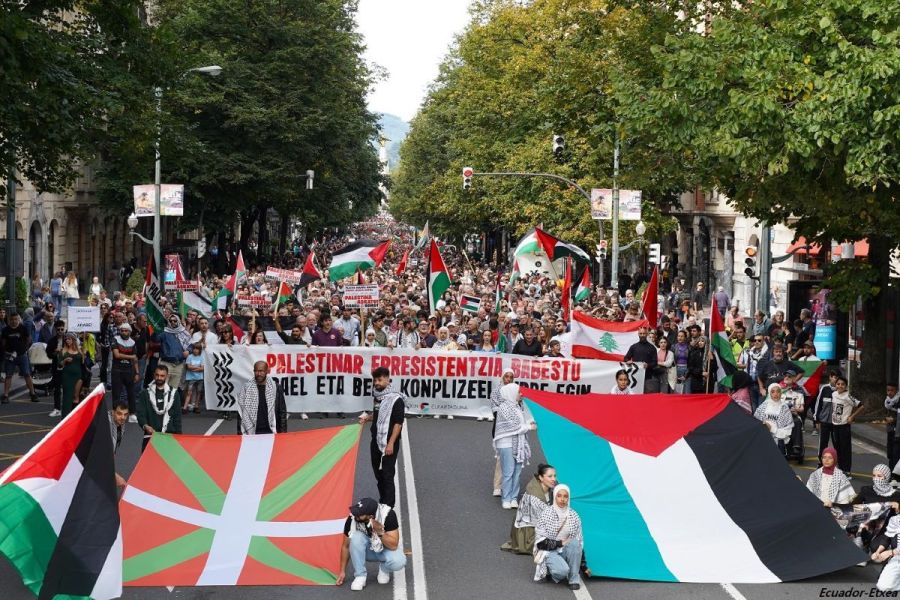
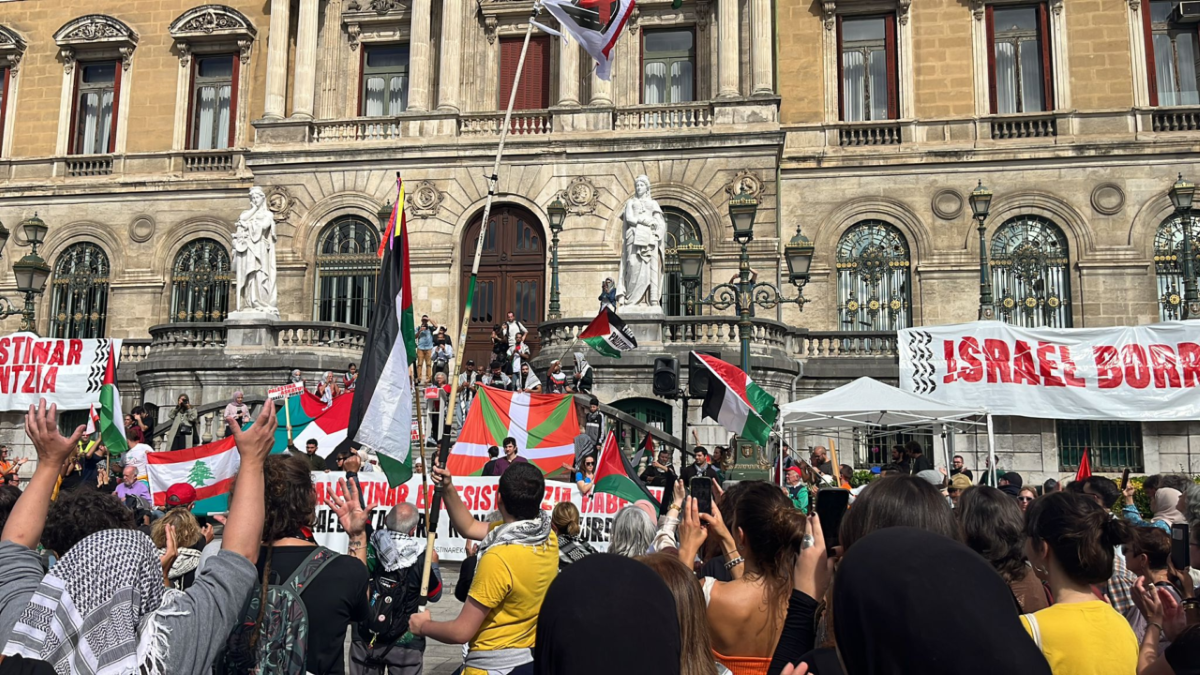
Thousands marched recently in two cities of the Basque Country, Bilbo and Iruña/ Pamplona,1 respectively the capitals of the Bizkaia and Nafarroa2 provinces, in solidarity with the Palestinian people and with their Resistance.
And almost immediately posters could be seen calling for the same on the 11th November, but in four Basque cities, including a city in one of the provinces on the French state’s side.3
“Well that’s great but sure we do that here every second week or so,” some might say. But they’d be wrong. The marches organised by the Ireland Palestine Solidarity Campaign, while calling for solidarity with the Palestinians and BDS4 of the ‘Israeli’ state and businesses, do not support the Resistance.
The rally stage at the end of the march in Bilbao, on the east bank of the Nervion river. Banner exalting the Resistance in the centre facing the crowd, banner to the left calling for solidarity with the Resistance and another to the right calling for struggle against ‘Israel’. (Photo cred: Resumen Latinamericano)
Nor do the marches organised by the main Palestine solidarity organisations in England or in Scotland. It might be pleaded that in the UK at least, people could be arrested for declaring support for a number of Palestinian resistance organisations that are on the EU “terrorist” list.5
The leadership of the Basque Patriotic Left6 does not support the resistance either, preferring to draw the Palestinians and Basques together as victims under a Gernika-Gaza initiative and even criticising the resistance along with the Zionists in a “both sides” kind of analysis.
But no law exists in these countries forbidding expression of “solidarity with the Palestinian Resistance.” The organisers of those campaign organisations don’t declare for the Resistance because a) they don’t support it or b) wish to remain tolerated by the upholders of the status quo.
View of section of the crowd, giving an idea of its size, the largest Palestine solidarity demonstration in the Basque Country since the present phase of Zionist genocide began on 8th October last year. (Photo cred: Resumen Latinamericano).
IT MATTERS
Well, ok, but does it really matter? Yes, it does and it matters a lot, for the Palestinians, for others struggling against imperialism elsewhere around the world – and for us. Not supporting the Resistance leaves open the question of, for example, the Palestinian Authority.
This Vichy-like organisation headed by a corrupt Quisling sends its security force to intimidate and beat up critics and demonstrators, to arrest them and also Resistance fighters (including invading hospitals to chase down the wounded) and removes defences against IOF invasion.
The PA, despite its widely-acknowledge corruption and the contempt in which it is held by broad Palestinian society, is formally recognised as the ‘representative of the Palestinian people’ by the western imperialists and by many social-democratic parties in Europe.
It is an offence against the Palestinian people and internationalist solidarity to accept the PA as any kind of representation of the heroic Palestinian people – or even to leave the question open. Furthermore, such a stance leaves the door open to all kinds of traitors and confusion.
In our own struggles, we need to be clear who are our enemies and friends. To accept treasonous agencies as representatives of struggling people contaminates our own attitudes in struggle, confuses and undermines our thinking, clouding our vision.
A woman holds high a placard calling to “Free Palestine” and to “Boycott Israel.” (Photo sourced: Internet)
BEING CLEAR AND MAKING IT CLEAR
We need to be clear – and to make it clear – that we support the Palestinian resistance in all its forms: popular, armed, trade unionist, cultural, artistic … and that we abhor collaboration and collusion with the enemy.
We can do that – and it has been done on occasion – by mobilising all who agree on a demo behind a banner celebrating the Palestinian Resistance. But how much better, if like the Basques today in Bilbao and in Iruña/ Pamplona, the whole demonstration marched behind that kind of slogan!
It might be thought that the demonstrations on 5th October would gather less than the safer Gernika-Gaza group of the official leadership of the Left Basque Patriotic movement (Otegi & co.) and other liberals but this was not the case in Bilbo anyway, on the biggest solidarity demonstration since October last year.
Advance posters for the solidarity march. (Photo sourced: Internet)
Two Palestinian Resistance factions, the Popular Front for the Liberation of Palestine and the Democratic Front for the Liberation of Palestine sent messages of thanks to the organisers and the demonstrators.
The demonstration and its theme were covered widely in Basque, Spanish, European and Latin American media, usually with photos.
Addressing the rally after the march in Bilbo on 5th October, a speaker listed the many crimes of the Zionist State and was loudly cheered when she said that only the abolition of that state could bring that career of genocidal crimes to an end.
The cheers grew louder still as she called for solidarity with the Palestinian resistance and all others fighting against imperialism and Zionism. And continued as she went on to call for a break with all states and political parties that support the Zionist State.7
The cheers might even have reached EH Bildu’s office and the leadership of the Gernika-Gaza group.
The march on its way to the rally across the river pauses on the way for photos.The long banner calls for “Support for the Palestinian Resistance” but also ” Oppose Israel and its accomplices.”(Photo cred: Boltxe)
End.
FOOTNOTES
1A number of places with Basque toponymics, under Spanish colonialism, were given Spanish names.
3There are seven provinces in the Basque Country, three on the French side of the Border (Iparralde, ‘the North Country’) and four on the Spanish side (Hegoalde, ‘the South Country’).
6That was the broad movement of legal and banned organisations of revolutionary Left and independentist outlook, the movement now reformist, much reduced and fragmented under the leadership of Arnaldo Otegi and the EH Bildu party.
7That clearly includes the conservative Basque Nationalist Party (PNV) and the social-democratic Spanish Socialist Workers Party (PSOE) currently in coalition government in the Basque Autonomous Regional Government.
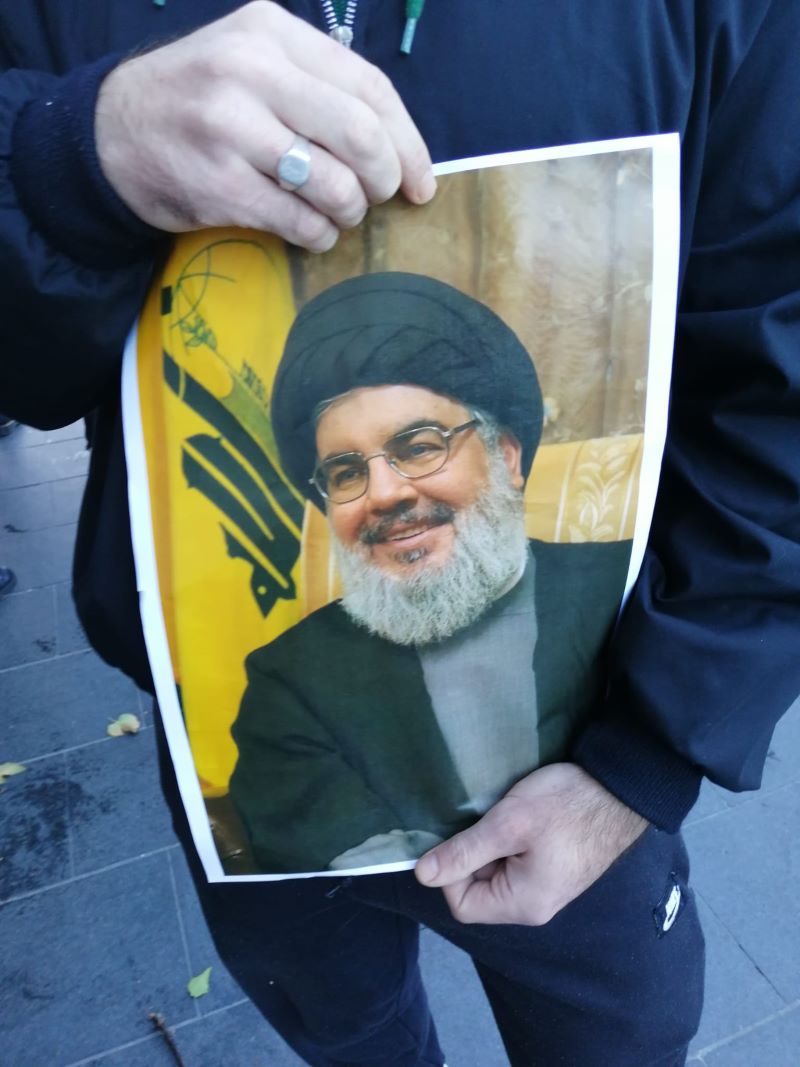
People with Palestinian flags including one containing a slogan in Irish, flags of Palestinian resistance factions and holding portraits of Ismail Haniyeh and Nasrallah rallied on Sunday evening outside Dublin’s General Post Office.
(Photo cred: Rebel Breeze)
The Action for Palestine organisation had advertised the solidarity and honouring event at short notice. Originally planned to take place on O’Connell Bridge, the storm conditions1 made that venue unsuitable and the GPO2 was chosen as an appropriate alternative.
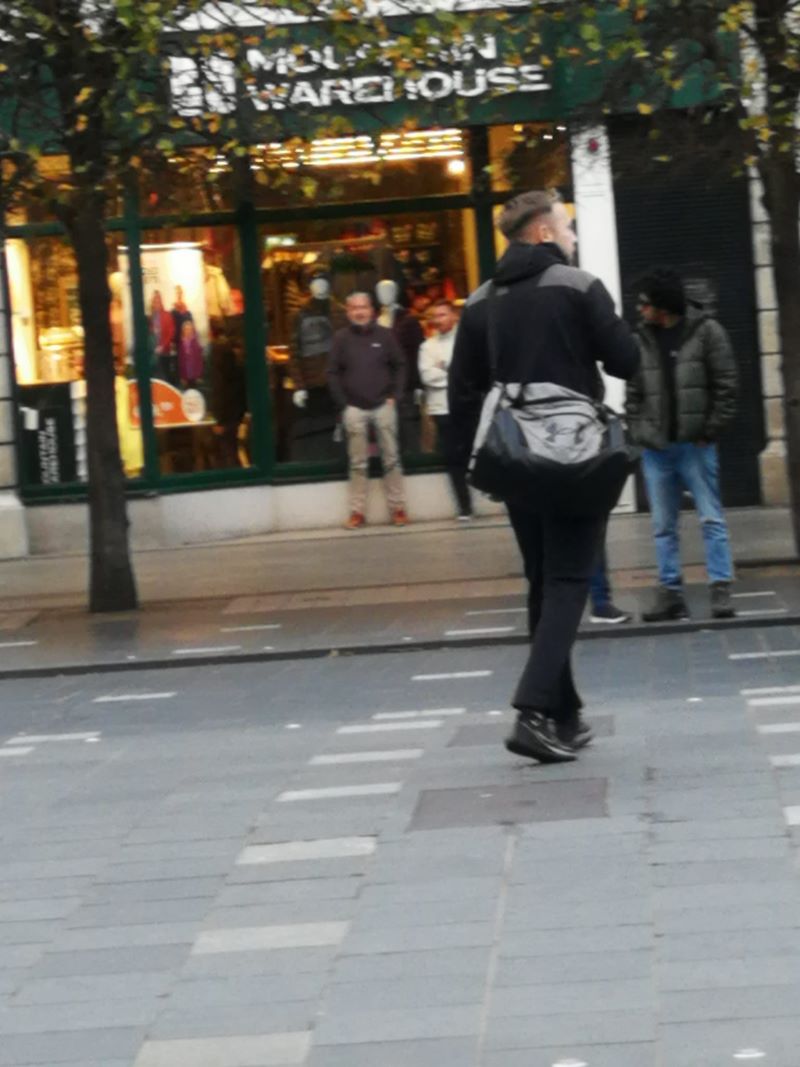
Calling and replying to solidarity chants, the crowd of Irish people and others from the Middle East also listened to four speakers, two Irish and two Palestinian, while two plain-clothes Special Branch Gardaí photographed them from east side of the street.
(Photo cred: Rebel Breeze)
One passing Zionist sympathiser insulted the gathering, giving rise to a wave of chants in solidarity with the Palestinian Resistance. On the other hand, many pedestrian passers-by congratulated demonstrators and some stopped to join or pressed horns on their vehicles.
The speakers referred to the horrors of the genocide being inflicted upon the Palestinian people in particular in North Gaza3 at this time by the IOF, the armed forces of the Zionist state, backed up and supplied by the USA and a number of European states.
(Photo cred: Rebel Breeze)
They spoke also to praise the resistance of all kinds of the Palestinian people, including armed resistance and at all levels up to leadership, who are assassinated and replaced, always under threat of death.
One speaker also spoke about the need to also support the resistance struggles and the prisoners as a result of resistance too. “It is not required of us that we agree with everything they say or do but it is required of us that we support the resistance”, he said.
Among the slogans chanted were Long live the Intifada! There is only one solution – intifada revolution! From the River to the Sea – Palestine will be free! Resistance is an obligation – in the face of occupation! Saoirse – don Phalaistín!
(Photo cred: Rebel Breeze)
From Ireland to Palestine – Occupation is a crime! From the Sea to the River – Palestine will live forever! In our thousands, in our millions – we are all Palestinians! Free, free Palestine! Netanyahu you can’t hide – you’re committing genocide! (Repeated also for Joe Biden).
A speaker also reminded the crowd of the long resistance to occupation of the Irish people, against Vikings and English occupation and the need to support the resistance of people around the world. “Resistance is everything”, he said and referred to the heroic resistance of the Palestinian people.
To conclude an organiser thanked all for their attendance at short notice and promised other actions in future, then encouraged those who wished to gather for a photo in front of the statue to “our hero in Irish myth, Cú Chullainn”,4 which stands in the central front window of the GPO building.5
Some gathered for a photo in front of the representation of the Irish mythological hero Cú Chulainn statue in the display window of the GPO. (Photo sourced: Action For Palestine)
While they were doing so, another reminded them that in the epic legend, Cú Chulainn’s enemies dared not approach him while he was alive and only finally did so when they saw a carrion crow or raven alight on his shoulder to reassure them that he was dead.
“Yahya Sinwar’s enemies did not face him while he was alive either. They fired a tank shell into the building where they believed the fighters were, retreating when grenades were tossed at them, firing another shell into the building and even then only dared send a spy drone in.
“When they saw on their monitor the badly-injured Sinwar throw a stick at the drone, they fired yet another shell into the building, finally killing him.”
End.
View of the Cú Chullainn statue in the GPO window on a working day (Photo cred: Cambridge University)Far distant from any kind of heroism or solidarity, two plainclothes members of the political police, the Special Branch of the Gardaí, surveilling the participants. (Photo cred: Rebel Breeze)
2Also a central location, i.e on Dublin’s main city centre street but also the HQ of the 1916 Rising against British rule.
3Some Palestinian commentators have called this phase the worst of all in the intensified genocide since October last year. Constant aerial strikes on buildings and tent encampments, shooting at people, besieging hospitals and blocking food or fuel from entering and constantly insisting that the people move out in ethnically cleansing.
4The hero is a central figure in the epic of the Táin Bó Cuailgne (The Cattle Raid of Cooley), along with back and after-stories, in the Ulster Cycle of Irish myths and legends. The sculpture, cast in bronze, is by Oliver Sheppard.
5The sculpture by Oliver Sheppard was later dedicated to the martyrs of the 1916 Rising.
Scores of people participated in a symbolic ‘funeral of Zionism’ on Monday evening (7th October) in Dublin’s city centre. In front of the James Connolly monument1 and near a mock coffin of ‘Zionism’, they listened to a song and short speeches.
This was followed by a march carrying the ‘coffin’ through city centre streets to O’Connell Bridge, where it was dumped in the Liffey river.
The ethnic composition of the mostly young mixed-gender crowd, by appearance and accent, seemed to be a mixture of Irish and Middle Eastern origin.
The chairperson of the event recalled that a year had passed since the heroic action from Gaza of October 7th and the events that followed, all being gathered there at the James Connolly memorial to hold a funeral for Zionism, the ideology of settler colonialism and genocide.
The first contribution was from a man introduced as Seán Óg with a song of his own composition, three verses rendered acapella in fine voice to the air of two well-known Irish patriotic ballads, Men of the West/ Fir an Iarthair and The Boys of Killmichael.2
The audience began to pick up and join in the chorus lines:
So here’s to the boys of Gaza, Jenin, Nablus and Hebron, Who fought ‘neath the brave flag of Palestine and sent the Settlers on.
Section of crowd at event listening to speeches, viewed facing north-eastwards. (Photo: R. Breeze)
Two speakers followed, pointing out the unanimity of imperialism nowadays in supporting Zionism as distinct from the 1950s and the importance of struggles such as that in Palestine to our own in Ireland, of internationalist solidarity and the need for that solidarity to be for the Resistance.
One speaker interspersed his words in English with some phrases in Irish and recalled the protest against the 1897 visit of the British Queen Victoria which saw James Connolly and Constance Markievicz leading a funeral cortège through the streets bearing a coffin for British Imperialism.
Though a ‘funeral’ for British Imperialism might’ve seemed only aspirational in 1897, the speaker said, signs of its decline were there to be seen for the educated, the intelligent and those who wished to see them — and before two decades elapsed it had received a major challenge.
(Photo: R. Breeze)
It survived that challenge of the First World War victorious but weakened and the embers of revolt were burning around its Empire. Before two decades after that funeral march, the torch of freedom had been lit in Dublin,3 the first uprising against world war of that century anywhere in the world.
The speaker went on to recall the subsequent War of Independence in Ireland three years later and remarked that had it not been for some Irish failures in unity and resolution that British Imperialism might have been given its mortal blow then in Ireland.
Subsequently British Imperialism survived by serving as a subject ally to US Imperialism. “Zionism is a rotten tree”, he said, “planted in Palestine by British Imperialism and nurtured by US Imperialism. Even so, Zionism is damaging its very fosterers and we welcome that.”
“Rotten trees don’t fall on their own,” the speaker continued. Trees that are rotten inside may seem healthy on the outside but when a strong storm comes along, they are knocked down. It is then we can easily see the rot inside them that we may not have noticed before.
Storms are now breaking out around the world, he said. We can and need to play our own part in those storms, “to knock down the rotten tree of Zionism and go on to demolish the whole rotten evil forest of imperialism.”
Section of crowd listening to speeches at the event, photo taken facing south-eastwards. (Photo: R. Breeze)
After applause some chants were led, among them: From Ireland to Palestine – Occupation is a crime! Saoirse don-Phalaistín! There is only one solution – Intifada revolution! From the river to the sea – Palestine will be free! Resistance is an obligation – in the face of Occupation!
The attendance then took to the street, carrying the coffin and flying Irish and national flags of Palestine along with those of factions of the Resistance, also Hezbollah’s and Lebanon’s, continuing the chants as they marched up lower Abbey Street,4 then turning left along O’Connell Street.
Along the way, some bystanders cheered and a man leaned out of a delivery van to shout encouragement with clenched fist in the air.
On O’Connell Bridge, after a few words, the ‘coffin’ containing ‘Zionism’ was pushed over the parapet into the river Liffey, to cheers, which then changed to cycling through the accustomed solidarity chants.
The ‘coffin’ is on the Bridge parapet (left of photo) and about to be dumped into the river Liffey. (Photo: R. Breeze)
There were three external interventions.
A known Irish Zionist who regularly tries to harass Palestinian solidarity participants appeared at the outset in attempted intimidation of an activist but was quickly discouraged from doing so. At the Bridge, a person under the influence of alcohol and shouting confusedly was calmed by activists.
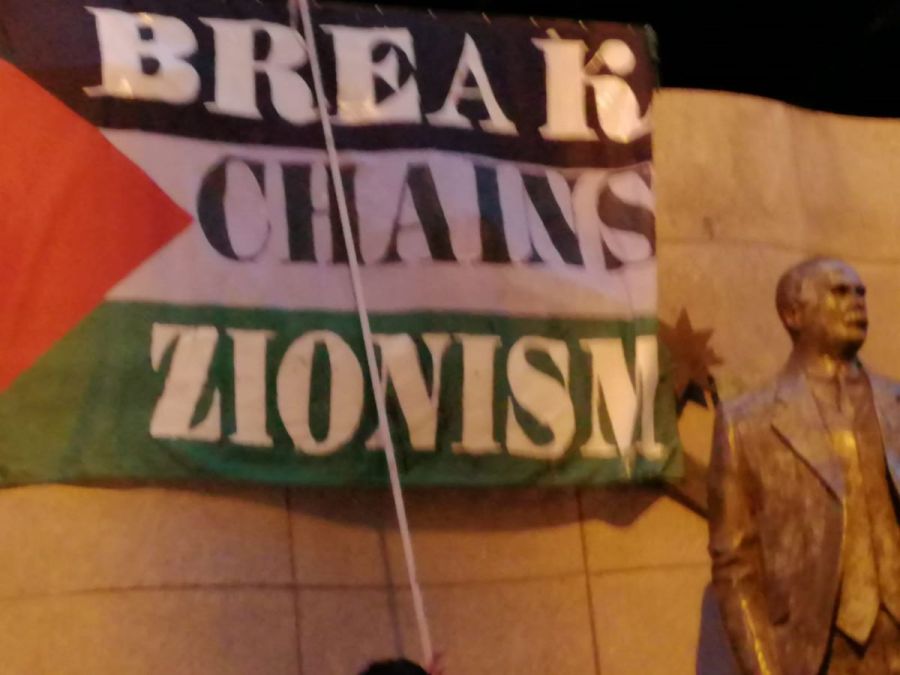
Break the Chains of Zionism banner next to James Connolly Monument (Photo: R. Breeze)
A Garda patrol car crew whose political undercover colleagues had clearly overlooked keeping informed drew up at the Bridge bemusedly during the chanting and, after attempting to gain some information as to events, left again – as did the participants soon afterwards.
The event was organised by Anti-Imperialist Action Ireland and Saoirse Don Phalaistín, the former’s Facebook page having been taken down by Meta while the event was being organised but the groups may be followed on Instagram and Twitter.
End.
Footnotes
1The location of this fine monument is in Beresford Place, across from the site of the original Liberty Hall, home of the Irish Transport and General Workers Union which Connolly led after Jim Larkin departed for the USA at the end of the 1913 Dublin Lockout. The site is now occupied a multi-storey building of SIPTU.
2The first is about the last major engagements of the 1798 Republican uprising, when a relatively small French force landed in Co. Mayo and was joined by Irish Republican insurgents; the second celebrates the IRA ambush of a column of the Auxiliary Regiment in West Cork, wiping it out almost to the last British terrorist.
4Until they reached O’Connell Street they were following in the footsteps of the GPO Garrison on Easter Monday, 1916 and passed by a number of historical political and artistic locations of 1848 and of the early 20th Century.
A number of demonstrations were held in Ireland to make it clear that Kier Starmer, Prime Minister of the UK and supporter of the Zionist state of ‘Israel’, has no céad míle fáilte in Ireland, or indeed any fáilte whatsoever for his Dublin visit.
After fourteen years of Conservative Party management of the UK, Starmer at the head of the Labour Party rode a change-seeking wave to win the General Election in July this year. But he soon revealed how little difference there is between the parties, including on Palestine.
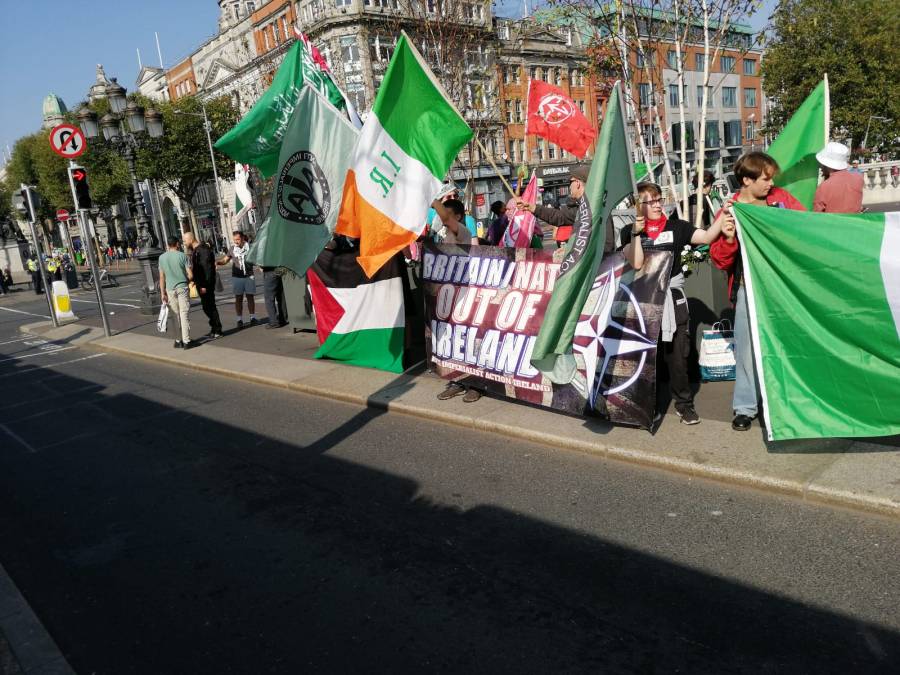
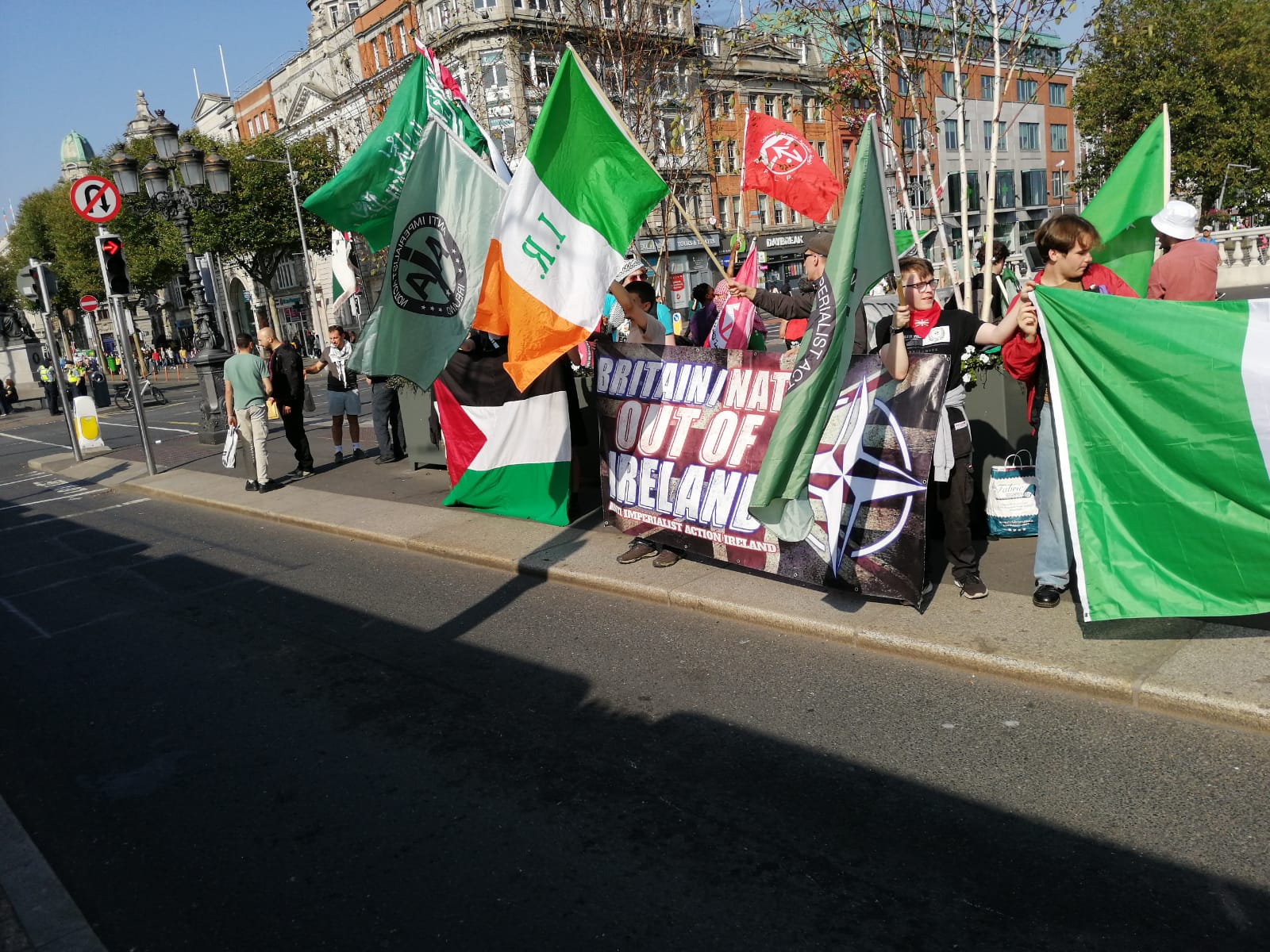
Mostly of the east-facing section on the Bridge (Photo: R.Breeze)
Although the Labour Party on the Zionist State, its Government continues to support that state politically and economically, also militarily with supply of weapons components and RAF missions.1
Very recently the UK Labour Government temporarily suspended 30 military items which may (may!) be implicated in genocide. The UK, holder of one of the five Permanent seats of the UN Security Council is complicit in the ongoing Zionist colonial settler genocide of Palestinians.
In fact, the UK is responsible for settling Zionist Jews in Palestine and then for allocating much of Palestinian land to the settler who, as European settler colonists do, expelled hundreds of thousands of Palestinians and continued extending their land-grabbing ever since.
West-facing section of protest (Photo: R.Breeze)
PROTEST ON O’CONNELL BRIDGE
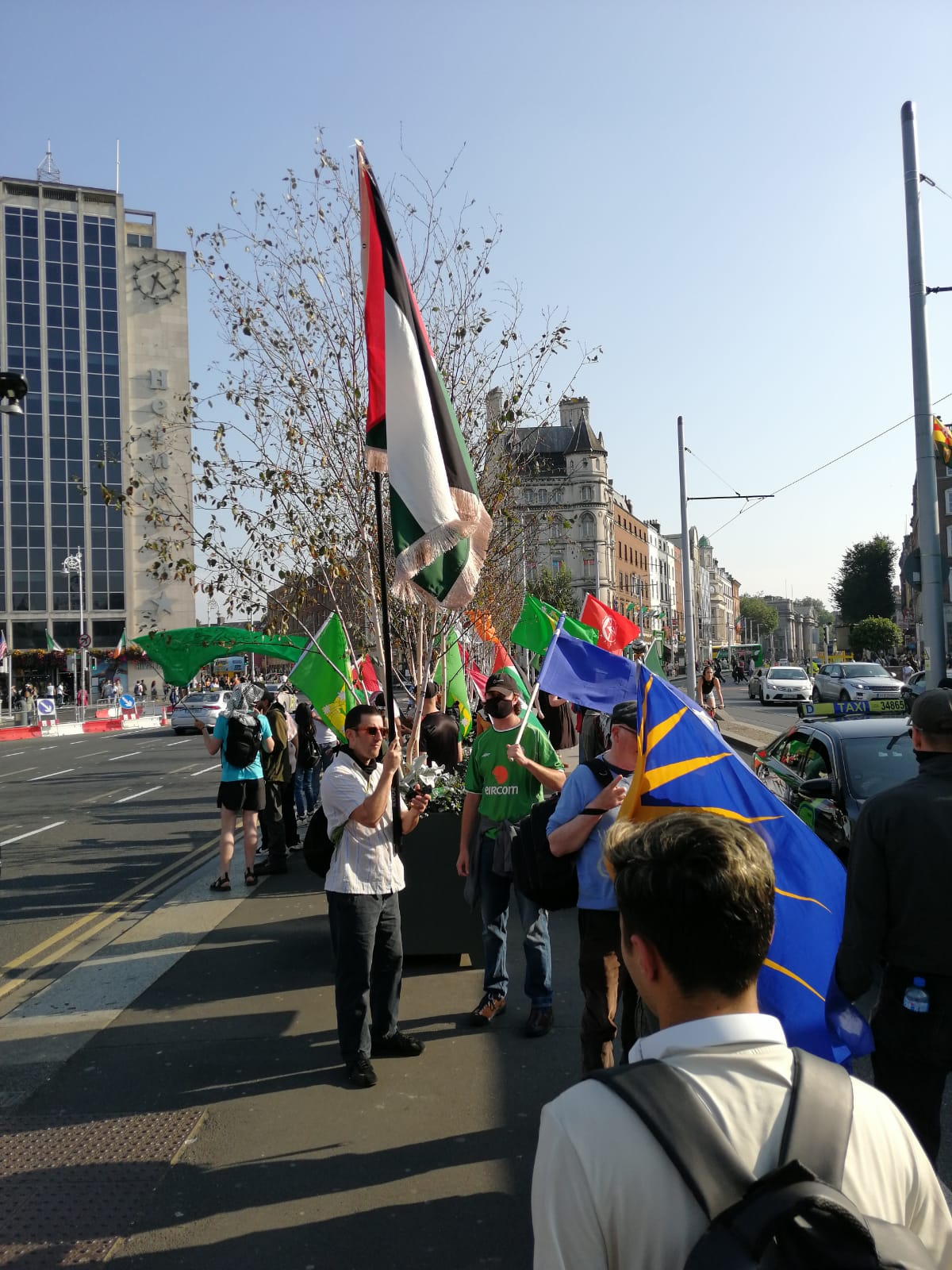
The Saoirse Don Phalaistín and Anti-Imperialist Action groups organised a protest against Starmer’s visit to take place on O’Connell Bridge at 3pm on Saturday and took up position on the central pedestrian reservation, with one section facing eastward and the other towards the West.
The Bridge spans the River Liffey and is in the heart of the city centre, crossed by north and southbound traffic and in view of westbound and eastbound traffic along the quays also.
There was a heavy presence of uniformed police in the vicinity, with five Special Branch nearby and a Public Order Unit van driving by a number of times as did other Garda vans. A prisoner transport van was also parked on the Bridge for a period but no attack was forthcoming.
Collection of banners and flags in west-facing section of protest. (Photo: R.Breeze)
RECORD OF THE LABOUR PARTY
One of the speakers at the O’Connell Bridge event reminded people of the history Labour Governments vis-a-vis Ireland, having sent the troops to the Six County colony to quell the struggle for civil rights there and also targeting the Irish in Britain with the Prevention of Terrorism Act.
This 1974 PTA, the speaker said, was later extended into the current Terrorism Act of repression in Britain. He reminded people too of the innocent Birmingham Six, Guildford Four, Maguire Seven and Judith Ward who were framed and jailed for long years under a Labour Government.
A speaker at the protest giving some reasons why Keith Starmer is not welcome in Ireland. (Video cred: Social Action Ireland)
The speaker could have also mentioned the Labour Party’s participation in the WWI War Cabinet which had sentenced and executed 16 Irish leaders after the 1916 Rising and its bipartisanship with the Conservatives on the partition of Ireland in 1921 and instigation of the Civil War in 1922.
SUPPORT AND OPPOSITION
The attitude expressed by protest passers-by on foot, bicycle or in motorised transport was nearly uniformly supportive. One exception was a fascist who called the protesters ‘traitors’ and attempted to take closeup photos before being blocked by a participant with a flag and seen off.
(Photo: R.Breeze)
Another was a big man who in a UStates accent seemed to shout something derogatory about Ireland and then claimed to be Irish (he might have been part of the diaspora there since the Irish tricolour colours appeared on the back of his top).
For much of the two hours of the event, slogans were shouted in support of Palestine, against the Zionist State, against Starmer, against British occupation of Ireland, for Intifada revolution, and for the solidarity action of Yemen at sea regarding Zionist-collusive shipping companies.
End.
Another view of west-facing section of protest with newly-made ornate Starry Plough flag. (Photo: R.Breeze)
FOOTNOTE
1There have been a number of reports of special units of the British army in Palestine and on British Intelligence personnel assisting the ‘Israeli’ Occupation Force.




















 rebelbreeze