PART ONE: THE THIRTY-YEARS’ WAR – DOOMED TO LOSE

(Reading time this section: less than 5 minutes)

Part of the series HOW TO WIN THE WAR — GETTING INTO POSITION

See also:

INTRODUCTION: https://rebelbreeze.wordpress.com/2019/08/07/how-to-win-the-war-getting-into-position/

PART TWO: COLLECTING THE FORCES FOR REVOLUTION https://rebelbreeze.wordpress.com/2019/08/07/part-2-collecting-the-forces-for-revolution/

PART THREE: THE ABSOLUTE NEED FOR UNITY – BUT HOW AND WHAT KIND? WITH WHOM?

PART FOUR: UNITY AGAINST REPRESSION

The national liberation war that began in 1969 in the Six Counties and ended in 1998 (though some armed incidents continue from time to time) began as a civil rights struggle and changed into a war of communal defence and of national liberation. The military part of the struggle for the most part took place in the occupied Six Counties. The political element of the struggle was waged all over Ireland (and abroad) but in the main consisted of support for the struggle in the Six occupied Counties.

Free Derry Corner Gas Mask Images
Derry Monument and Mural of the Civil Rights struggle which preceded the armed struggle in the Six Counties. (Image sourced: Internet)

Fought in that way, the struggle was bound to lose. It could never win. How could anyone imagine that they could win a struggle fought against a world power in one-sixth of the country, where even the population there was divided against them? What could they have been thinking?

To my mind, there are only two possible sane replies to that question, which is that they believed: 1) that the British ruling class would get worn down by struggle and leave and/ or 2) that the Irish ruling class would intervene in some way to assist the struggle and make continued British occupation untenable.

1) ‘The British ruling class would get worn down and leave’: This theory must have depended on British repression being condemned abroad and being unpopular at home but had to rest fundamentally on the British having no great stake in continuing its possession of its colony there.

Anyone who thought that (and there were many who did and still many who do, not just Irish Republicans) made a fundamental error. Time and again the British ruling class has shown its determination to hang on to what might be considered its first colony, even as its ruling class’ composition changed from feudal-colonialist to capitalist-imperialist and as the world changed around it.

Collusion State Murder Mural
Mural in nationalist area in the Six Counties (Image sourced: Internet)

Even when the British ruling class, weakened by WW1 and facing an Irish guerrilla war with the support of the vast majority of Irish people, with national liberation uprisings breaking out across its Empire and with its repression in Ireland increasingly unpopular at home, entered into negotiations with the Irish resistance, it held on to a foothold, the Six Counties.

Subsequently, it had that colony managed in a permanent state of emergency laws, with institutionalised sectarian discrimination at all official levels and outbreaks of pogroms in the street and workplace.

That became even more exposed during the civil rights struggle and the national liberation war that followed when the British State compromised whatever good international reputation its Armed Forces had, its judiciary, its legal establishment, its media and its very legal framework.

Even now, when many believe that the Good Friday Agreement means that a 50% plus one vote in favour in the Six Counties will be sufficient to end Partition, they do not realise that such a decision will have to also obtain a majority in the British Parliament and be endorsed by the British Monarch. They are also forgetting the broken promises that surrounded Partition in the first place.

When analysing what holding on to the Six Counties has cost the British State in terms of reputation, military and financial contributions, one can only rationally assume that continuing to hold on to that foothold is of great importance to the British State. One may speculate as to the reasons underlying that but the central fact cannot be denied.

2) that the Irish ruling class would intervene in some way to assist the struggle and make continued British occupation untenable:

There was some basis for this belief in that a section of Fianna Fáil, a party that had emerged from a split in Sinn Féin in the 1930s and had become one of the mainstream parties in the Irish state, had retained some traditional commitment to seeking a united Ireland. However it was a thin enough basis on which to depend in a national liberation struggle since that section had no majority within the party itself, to say nothing of the foreign-dependent nature of the Irish native capitalist class, the Gombeens, as a whole.

British Soldiers Helmeted Belfast 1969
British Army in Belfast 1969 (bayonets and guns pointed towards nationalist area). (Image sourced: Internet)

The question came to a trial of strength in the Arms Crisis of 1970, in which at least two Fianna Fáil Government Ministers were involved in secretly buying arms for the defence of nationalist areas in the Six Counties (since the IRA had insufficient weapons at the time) from rampaging Loyalist mobs and the Royal Ulster Constabulary (including the part-time B-Specials). The Ministers alleged that they had acted in the full knowledge of the rest of the Government. By the time the whole affair was over, two Ministers had been sacked and another two resigned in protest.

If it had not been clear before that the Gombeens, the native Irish capitalist class was no patriotic capitalist class but rather a neo-colonial one, it should have been clear after that. But the armed struggle in the Six Counties intensified, especially after the massacres of unarmed civilians carried out by British Paratroopers the following year, 1971 in Belfast and again in Derry in 1972. And the war lasted until 1998.

If, as had been demonstrated to be the case that the British ruling class were determined to hold on to the Six Counties and the Irish ruling class was not going to seriously challenge that possession, did the Republican movement have any other option than to fight on a war that they could not possibly win?

I am clear that they did.  

Clearly, in order to have a chance of success, the war had to be extended to the other five-fifths of the country, which is to say into the territory under the control of the Irish native capitalist class. This class had seized power after the War of Independence 1919-1921 and had beaten and suppressed its opposition during the Civil War (1922-1923) and after and furthermore was supported by a powerful ally, the Irish Catholic Church. Since the founding of the first Irish Republican organisation, the United Irishmen of the late 1790s, the Catholic Church hierarchy had opposed Irish Republicanism; it had condemned four Irish priests who participated in the uprising of 1798, excommunicated the Fenians, had at first condemned the 1916 Rising and the War of Independence only to latch on to it at the end along with the Gombeen class.

The general Irish

population likely would not have supported or sustained an armed struggle in the 1970s against the Gombeen class but that class could have been fought politically, through agitation and mobilisation, on many social, political and economic fronts. Without going into the specific details of each, these were:

  1. against the huge wastage of Irish youth through emigration

  2. to remedy the shortage of affordable housing (which in part contributed to the above)

  3. to end unemployment (also contributing hugely to emigration)

  4. to raise the level of wages and lower wage earners’ taxation

  5. for the right to divorce

  6. for equality for women in law

  7. for the right to contraception devices and medication for men and women

  8. against decriminalisation and for equal rights for gay and lesbians

  9. to halt the decline of the Irish language, in particular of the rural Irish-speaking areas

  10. to improve services for the rural areas

  11. to oppose the open-door policy for foreign multinationals to exploit Irish natural and human resources

  12. to secularise the education service

  13. and the health service.

  14. to remove the privileged status of the Catholic Church within the state.

The Republican movement in general, with some exceptions, declined to take on any of those struggles. They did not organise in the trade union movement, left the social struggles to others and most of all, declined to take on the Catholic Church on any issue except its opposition to the national liberation struggle. Even there, it was happy to publicly avail of the services of members of the Church clergy who supported them. Republicanism was, from its very beginning, as well as anti-monarchist, about separation of Church and State but it was difficult to see that in the Irish Republican movement, particularly after the War of Independence.
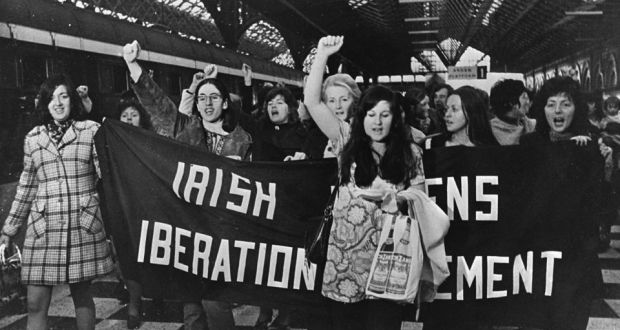
Irish Womens Liberation Connolly Station
Irish women photographed at Connolly Station 1971, about to board train to Belfast to purchase contraceptives to bring back to the Irish state, illegal at the time. There was no right to abortion either or divorce and a husband’s signed permission was necessary to take out a hire purchase agreement. (Image sourced: Internet)

A full half of those fourteen points above (nos. 5,6, 7, 8, 12, 13 and 14) would have meant taking on the Church head-on and no doubt the hierarchy would have hindered the struggle over most of the others too, due to its strong links with the State and its ruling class.

Because of its tactical and no doubt ideological refusal to take up those struggles, the Republican movement could do little more in the 26-County state than to agitate for solidarity with the beleaguered nationalist population inside the British colony.

Though this could be effective for a time it could become a mass movement, nor survive a long struggle, without any remedy being sought to the issues facing the population within the state.

The wonder is not that the majority leadership of the Republican Movement threw in the towel on the military struggle in 1998 but that they had waited so long to do it. Of course, they never admitted the true nature of what they were doing: abandoning the armed struggle and revolution in total and instead, using their negotiating position to advance themselves politically – not in the economic, social and political struggle envisioned above but rather in a political struggle to find themselves a place among the Gombeen political class in the Irish state and as accomplices in the governing of the colonial state.

Diarmuid Breatnach is a veteran independent revolutionary activist, currently particularly active in committees against repression, in some areas of internationalist solidarity and in defence of historical memory.
HOW TO WIN THE WAR – GETTING INTO POSITION

(Reading time: Introduction, one minute; Part One: 5 mins; Part Two 2 mins: Part Three: 3 mins; Part Four: 2 mins; Total: 13 mins.)

Diarmuid Breatnach

INTRODUCTION:

Although I often think about the big questions – and am generally guided by my philosophy on them, my mind and energy are usually too occupied with specific struggles to focus on them for long. Recently however I had the opportunity and the need to think about the war, the one we have yet to win.

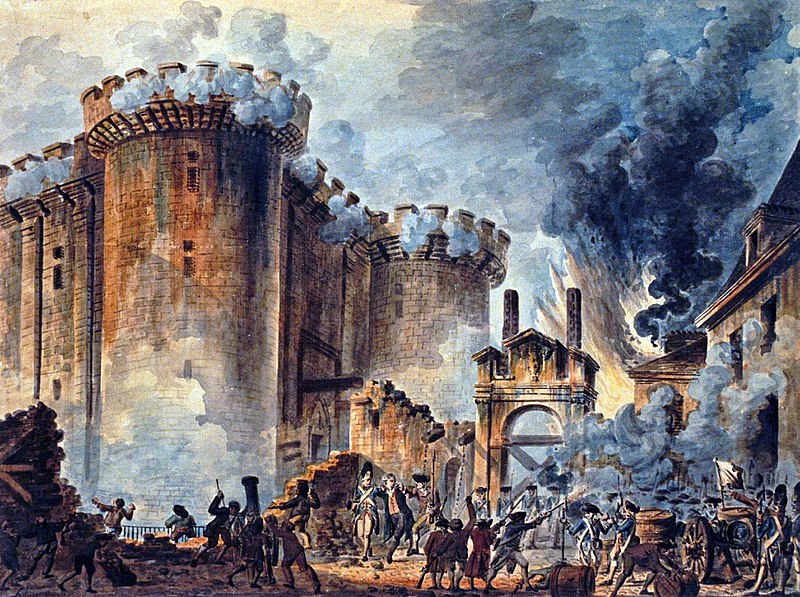
Storming Bastille Painting Jean-Pierre Houel
The Storming of the Bastille (translation), French Revolution, 1789 by Jean-Pierre Houel. (Image sourced: Internet)

But to which war am I referring? The Irish war of national liberation that has been flaring up for centuries, being lost each time before flaring up again? Or the class war, which has had a few sharp Irish episodes but has been, for the most part in Ireland, in abeyance? The answer is BOTH, though it may seem that my emphasis in the discussion, certainly in the early part, is on the national liberation war.

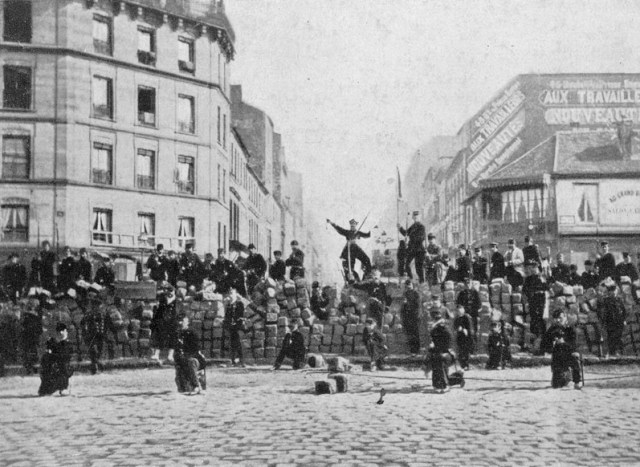
Communards Paris Barricade 1871
Communards at barricade, Paris Commune 1871. (Image source: Internet)

In order to imagine how we might win, it is helpful to examine past struggles and analyse what went wrong with them. Pessimists love to focus on those things I know – but in order to push us towards reformism or just surrender; my approach instead is from a revolutionary perspective.

Generally, Socialists analysing the class struggle don’t even ask themselves why we have not had a revolution yet.

From week to week, month to month, they tend to focus on this or that particular trade union or social struggle but without going into the big picture. It seems as though they can’t even imagine a socialist uprising in Ireland, it’s just too far away to think about, apparently. But if one can’t even imagine such a revolution, how could one consider the necessary steps to get there?

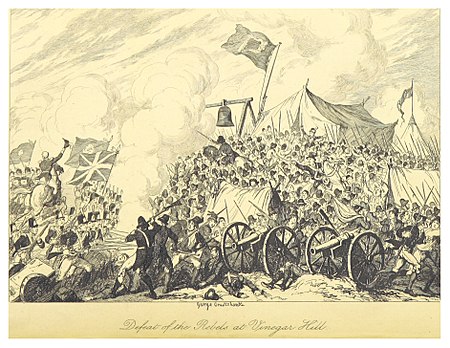
Defeat Rebels Vinegar Hill Drawing George Cruikshank
“Defeat of the Rebels at Vinegar Hill” by George Cruikshanks, i.e United Irishmen last major position in Wexdord overrun, 1798.

Irish Republicans on the other hand are often thinking in terms of revolutionary struggle, usually including armed struggle. However it seems to me that Irish Republicans don’t like analysing past failures of the movement but when they do, their verdicts tend to be that the leaders betrayed the struggle or that taking part in public elections corrupted the movement; or that infiltration, spies and informers was the problem. And some other reasons. The thing is, although all those things played a particular part, they are not the fundamental reason.

Sections to follow:

PART ONE: THE THIRTY-YEARS’ WAR – DOOMED TO LOSE 

PART TWO: COLLECTING THE FORCES FOR REVOLUTION 

PART THREE: THE ABSOLUTE NEED FOR UNITY – BUT HOW AND WHAT KIND? WITH WHOM?

PART FOUR: UNITY AGAINST REPRESSION

Diarmuid Breatnach is a veteran independent revolutionary activist, currently particularly active in committees against repression, in some areas of internationalist solidarity and in defence of historical memory.
PAST AND PRESENT BATTLES ON A DUBLIN STREET MARKET

Note: Text content reproduced by permission from Save Moore Street From Demolition, from their report on their Awareness Wk 255 3rd August 2019.  The area has been the scene of a struggle between mainly historical conservationists and property speculators since 2002, the latter aided, campaigners say, by the Irish Government and the City Managers.

Save Moore Street Awareness Wk 255 3rd August 2019

A more depleted street market than usual greeted the campaigners while setting up our weekly campaign stall. A number of stall-holders had taken the opportunity of the bank holiday weekend to take a break; with Sunday and bank holiday Monday trading forbidden by their licences, the prospect of a long weekend was clearly attractive. Of course, the 17 or so licenses still issued by Dublin City Council does not at all compare with the 75 of some decades past but then that was bound to be an effect of permitting the erection of two supermarkets bracketing the street. Even more, having a thriving street market is not in the interests of those who want to demolish the quarter and construct a “shopping mall” or chain-store shopping district.

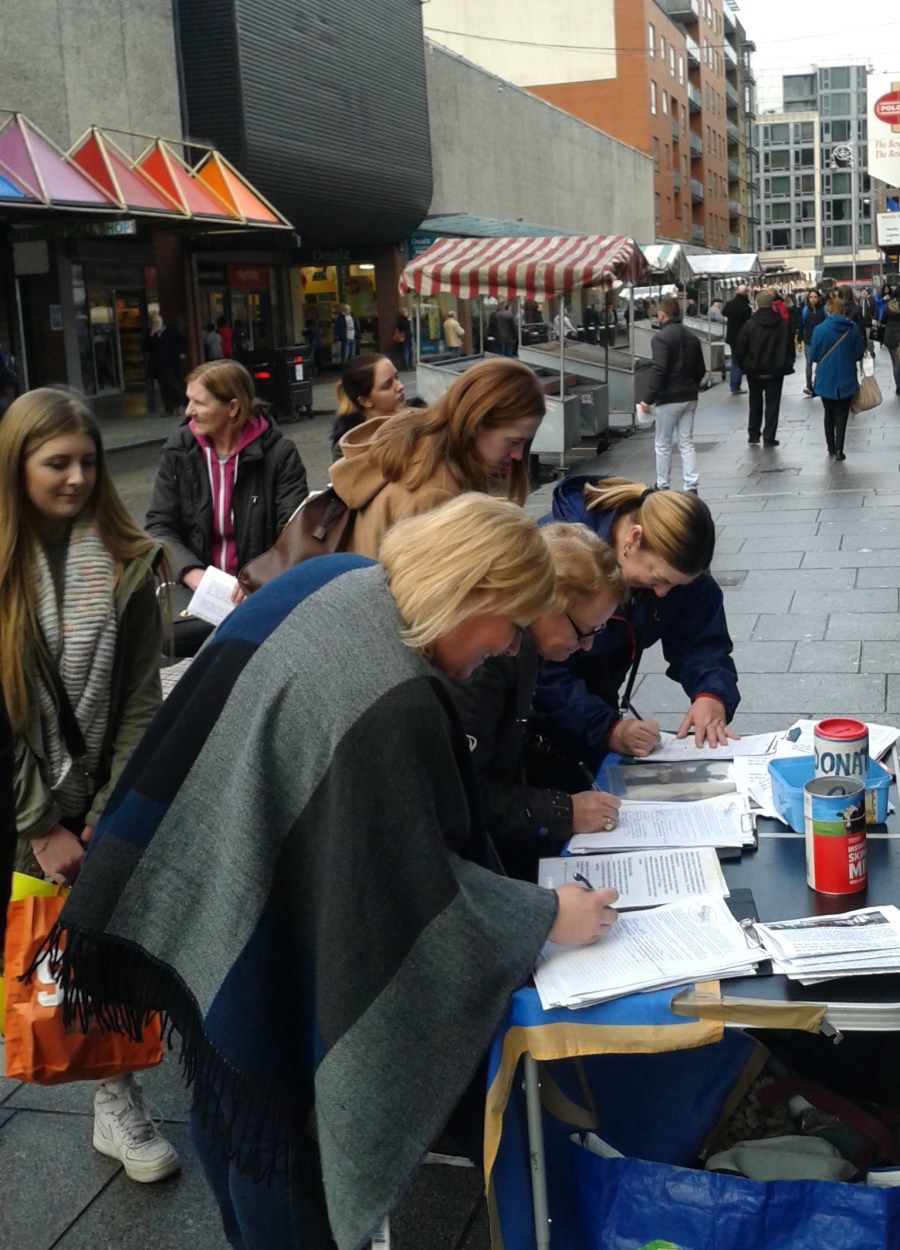
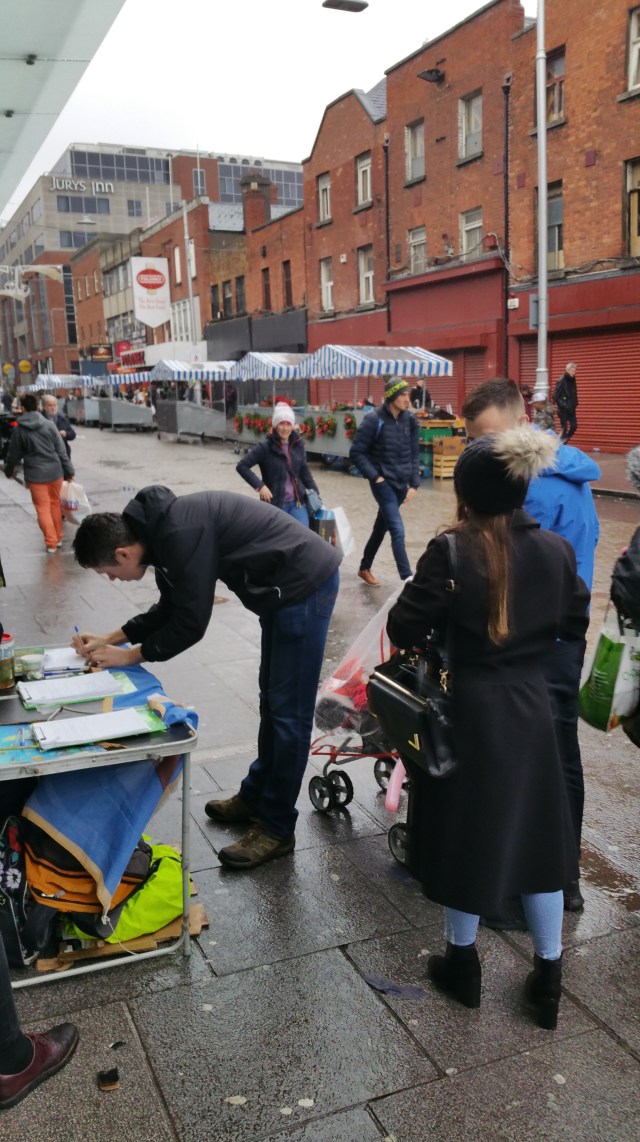
Young Family Signing
A young family signing the petition at the Save Moore Street From Demolition stall on a wet DecemberSaturday. Part of the ‘1916 Terrace’ which over 300 men and women occupied in 1916 can be seen across the road. (Photo source: SMSFD)

Our core team was depleted too, with Mary recovering from an injured knee and Mel on duties elsewhere; Bróna, Bart and Diarmuid set up this week.

Some long-time supporters stopped by to chat, including excellent photographer Errol, a man with extensive knowledge of wildlife, especially plants, who regularly drops by to distribute fresh fruit among us. As usual, people from different parts of Ireland, also migrants living here and visitors, signed the petition and talked about the importance of historical memory.

Postaer Dubalta Ar nOidhreacht & Nil Saoirse Gan Stair
(Photo source: SMSFD)

While putting two Irish-language posters together for a photograph for the Gaeilge Amháin Facebook page, on which understandably only Irish language is permitted, we hit upon the idea of placing the picture side of our leaflet upon it. It makes an attractive ensemble, don’t you think?

Meanwhile, news reaches us that the Minister’s Advisory Group on Moore Street has completed or is about to complete its report to the Minister, which basically backs the property speculator Hammerson’s ideas for the area. This is hardly surprising, sadly, considering how things go and have gone over the years but is a sad reflection on the management of this state. Apparently it was not all smooth sailing however, with disagreements about content and emphasis. One can see the sense, from the Minister’s point of view, of excluding our group from their list of approved stakeholders; less easy to understand, perhaps, is the acceptance by other members of her group of the exclusion of the most active Moore Street campaigning group in recent years.

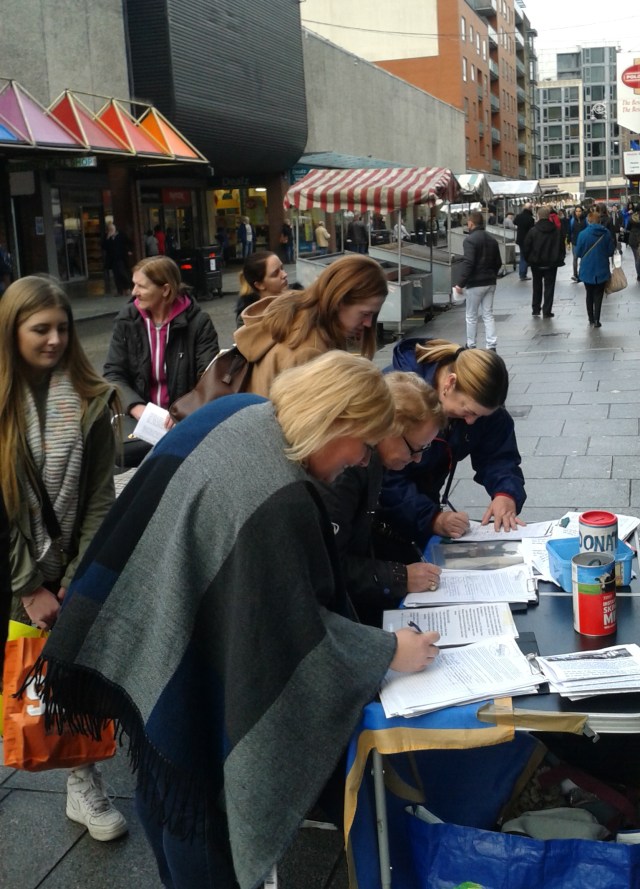
Crowd signing stall 6 Jan2016
A crowd signing the petition on 6th January 2016 (the following week the SMSFD called two demonstrations into the street and buildings were occupied to prevent their demolition). (Photo source: SMSFD)

PUB QUIZ

The prize (non-monetary) for naming four pubs in Moore Street’s past and their locations goes to Moore Street 1916 Battleground History Forum, a FB page supporting our campaign. Michael Shanley’s “pub with no name” was identified as “O’Neill’s” (probably not one of the current chain) by one of Troy’s Butcher’s team; it was diagonally across from them before being demolished to make way for the LIDL supermarket and underground shopping mall. Its corner was known for generations as “Dead Man’s Corner”, being near where the body of Volunteer commander O’Rahilly had lain with five bullets in his body, writing a goodbye note to his wife as he lay dying. The excellent monument now near the spot replaces the small plaque erected on the corner of the pub and reproduces not only The O’Rahilly’s words but also his very script, enlarged of course. But without any signage on Moore St. to indicate its presence, how many thousands must pass by unaware of its existence? Our campaigners have raised this with the Council but despite promises, no signage has yet been erected. After all, why call attention to the historical importance of an area when the City Managers support the property speculators wanting to demolish it?

ORahilly last letter plaque
O’Rahilly memorial plaque containing an enlarged facsimile reproduction of his dying letter to his wife. It is in a side street off Moore Street, unseen by thousands. (Photo source: D.Breatnach)

That pub was the same one to which Vol. Tom Cremin had tried to gain entry, without success in 1916. The 18-year old had volunteered to join the O’Rahilly’s fatal charge on the British barricade located at the Moore Street junction with Parnell Street, on the way shooting a British soldier at the Salmon Lane junction. Vol. Cremin made it as far as what is now O’Rahilly Parade but had been wounded in the foot and the butt of his rifle had also been shot off. Seeking shelter, he entered possibly No.24 or 23 where he fed the dog he found there with some food in the house, lay upon a bed and fell asleep. When he awoke the following day, Easter Saturday, the Surrender had taken place and British soldiers were searching the houses for hidden fighters (there were none) and weapons.

The British soldier Vol. Cremin had shot further back down Moore Street had been carried, under fire, into No.10 by one of the three Plunkett volunteers, George. A field hospital had been set up in that house (of insufficient importance to save, according to the lawyers of the Minister for Heritage) by Vol. Elizabeth O’Farrell and Vol. Julia Grenan, in which around another 18 wounded were being cared for. The British soldier survived the Rising. Which was more than did one of George’s brothers, Joseph Plunkett, who was shot by British firing squad some days after the surrender, along with another 15 Volunteers in Ireland (Casement was hanged in August in London). The Seven Signatories of the Proclamation of Independence were among the executed and four of those spent their last days of freedom in the Moore Street battleground, along with another executed, Willie Pearse.

But what matters all that when there is big money to be made! There is lot more than adding “a halfpence to the pence” in their “greasy tills” these days.

Beimíd thar n-ais ar an tSráid arís an Satharn seo chugainn.

End.

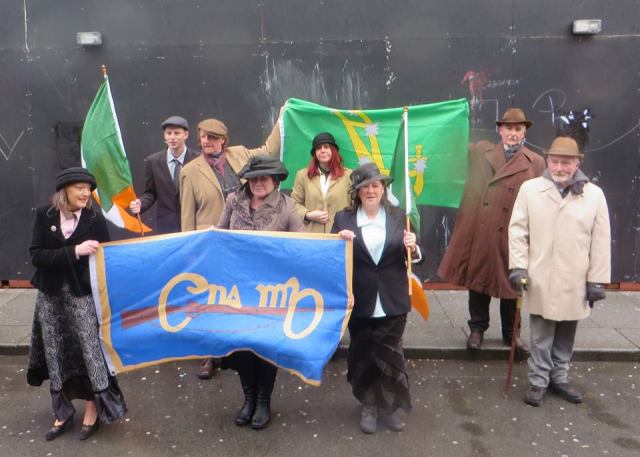
Costume men & women 3 flags M St
Some women and men supporters of the campaign in 1916 period costume on the street in February 1916, (Photo source: SMSFD)

From the slums of Dublin to the battlefields of Spain: Brigadista Bob Doyle (1915-2009)

The story of a working-class and poor Dubliner who fought fascism in the Spanish State and remained a life-long militant.

Admin's avatarthe irish revolution

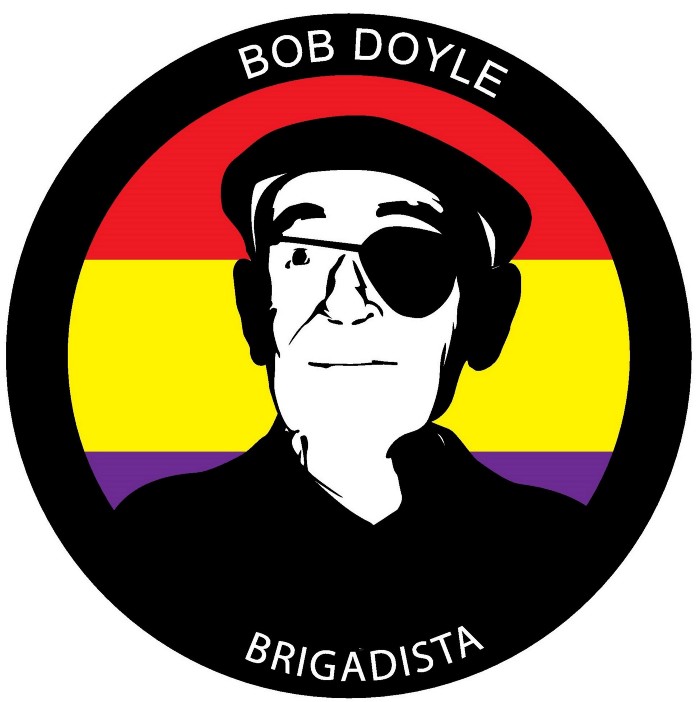
Brigadista Bob Doyle — Image designed by Nekane Orkaizagirre
Brigadista Bob Doyle — Image designed by Nekane Orkaizagirre

by Stewart Reddin

Robert (Bob) Andrew Doyle was born on 12th February 1916 at 15 Linenhall Street in Dublin’s northwest inner city. He was the second youngest of five siblings. Bob’s parents, Peter Doyle and Margaret Alldritt, were married in Dublin on 13th November 1904. Peter, aged 20 at the time, was employed as a seaman and lived on Upper Dorset Street with his three sisters. It appears that both his parents were deceased by 1901 as his eldest sister Anna, aged 20, is recorded in that year’s Census as head of the family.

Bob’s mother Margaret was 19 when she married and she lived in Kilmainham with her family. Alldritt is not a common surname in Ireland (in his biography, Brigadista, written in conjunction with Harry Owens, Bob’s mother’s family name is recorded as Aldridge, however the birth, marriage…

View original post 2,785 more words

“They or we must quit this island” – Fintan Lalor on the landlord class (June 1848)

Great words. More applicable today to the Gombeen or native Irish capitalist class than the landlords although some of the former are also the latter.

Admin's avatarthe irish revolution

From the republican newspaper The Irish Felon, June 24, 1848.  This appeared in the original as one paragraph, but I have broken it up into several paras to assist 21st century readers.

Although written 170 years ago as a condemnation of the main property-owning class in Ireland then (the landlords) it sounds very modern, like a condemnation of the main property-owning class in Ireland today (the capitalists).  It is not hard to see why Connolly – and Pearse – admired Lalor so much.  The article represents a step forward in republican political thinking from the time of Tone and Emmet, as over four decades of class development and conflict had taken place and Ireland was in the midst of the horrors of a massive famine created by the capitalist property system.

The bit about “strangers” is also apt as a description of the Dublin4 and WestBrit set of…

View original post 374 more words

IRISH GOVERNMENT FUNDS DOG-KILLING INDUSTRY

Diarmuid Breatnach

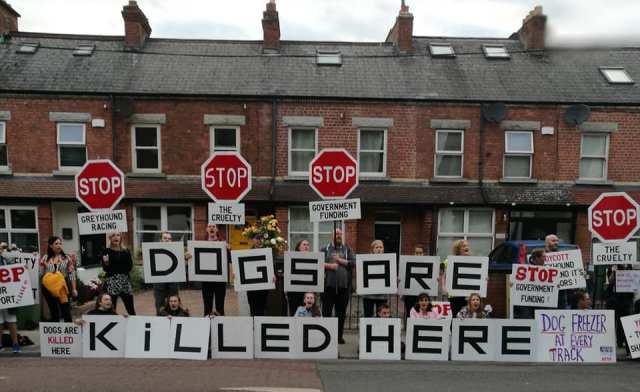
Dogs Are Killed Here Placard Letters
(Photo: G.Guilfoyle)

People attending Shelbourne Park Greyhound Stadium on Saturday last (20th July) were booed, a number of passing cars and vans blew their horns in support of protesters but one dog racing supporter assaulted a protester. The picketers quoted an RTÉ television documentary that the industry is killing large numbers of dogs annually; they want an end to Irish Government funding for the industry and dog racing banned.

dav
Section of the protesters on one side of the street outside Shelbourne Racing Stadium on Saturday 20th July.

          A quick trawl through Google reveals greyhound track or stadium protests at a number of venues in Ireland as well as Dublin, including Cork, Limerick and Newbridge and there are campaigns to ban greyhound racing in a number of other countries (although apparently dog racing only exists in another eight countries world-wide).

The protesters on Saturday chanted a number of slogans, including “You bet, they die!”, a reference to people betting on the outcome of the races and to the high death-toll of dogs bred for activity. Greyhound bitches are bred to what are considered successful dogs and breeders will choose pups to raise from the litters, killing the rest. Only some dogs are considered suitable for racing and after trial, some more will be killed (or perhaps sold abroad, which may even be worse). Finally, when their racing life is over, most will be killed also. The industry says it finds homes for old or worn-out greyhounds but there are not enough homes to take them all in.oznor

The Irish Government funds the industry to the tune 16M euro and campaigners say this is not justifiable to fund an industry killing dogs for profit-making. In addition, according to the RTÉ documentary 7,000 dogs are exported to Britain, effectively sustaining their industry – on Irish tax-payers’ money. Some of these dogs are transported from Ireland in unhygienic conditions, even by people who are banned from the greyhound industry in Britain for doping or keeping dogs in bad conditions, since their bans are only effective in Britain itself.

Doping of dogs has increased enormously in Ireland and Britain, according to people inside the industry but very few have been charged or the kennel breeders sanctioned by the industry’s regulating body. The RTÉ team found that 80% of animal doping chemicals seized over the years have come from greyhound kennels, but more than 50% seized in a three-year period came from one dog trainer, Mr. Gerry Holian in Athenry.

The film also showed dogs being badly treated abroad and produced evidence to show that restrictions on their export from Ireland and Britain are routinely evaded.

oznor
Line of protesters facing the entrance to the dog racing stadium last Saturday (another longer line on the opposite side). Two Gardaí of the Public Order Unit are visible too. (Photo: D.Breatnach)

VIOLENCE TOWARDS PROTESTERS

          Early during the protest last Saturday, a man physically attacked a woman protester outside the Shelbourne Stadium. Witnesses gave evidence to Gardaí who advised them to go to a Garda station and make a complaint, without explaining why they themselves would not act upon the reported crime. Some Public Order Unit Gardaí arrived soon afterwards and some of the protesters, including the assaulted woman, did go to the station and made a complaint.

Four days after the Dublin protest and the attack on a protester, the Irish Greyhound Board posted the following statement:

The IGB would request, and based on the strong advice from An Garda Siochana, that the greyhound community would not engage in any form of ‘counter protest’ at greyhound tracks and stadia as such activity is likely to enflame an already volatile situation and result in an unsafe environment for all. Such outcomes do not reflect well on anybody, including the greyhound community.

greyhounds-raced-to-death-dublin-bus.jpg
A Bus Átha Cliath public transport vehicle carries the message. (Photo source: Bart Hoppenbrouwers)

A SOCIAL AND CULTURAL ACTIVITY?

          Of course for many people attending dog racing, who will be unaware of the high death-toll endemic to the industry, it seems a harmless night out. Even many who do not attend dog racing will be unaware of the cost to the dogs. The RTÉ Investigates TV documentary Racing for Their Lives quoted figures from a commissioned report that 6,000 greyhounds are killed every year. That report was kept secret by the Irish Greyhound Board until the RTÉ Investigates team revealed they had a copy of the Report and then the IGP released sections of it. As the protests continue, even those who have not seen the program will become increasingly aware.

oznor
(Photo: D.Breatnach)
dav
(Photo: D.Breatnach)

In many working-class communities greyhound racing has been a participative activity for individuals owning one or two dogs, as outlined in “The Town I Love So Well”:

In the early morning the shirt-factory horn
Called women from Creggan, the Moor and the Bog
W
hile the man on the dole played the mother’s role,
F
ed the children and then trained the dogs.

This activity is not comparable in scale, turnover or treatment with the dog-racing industry of greyhound breeding and training establishments and racing stadia and, in any case, is much reduced as a passtime now.

There are 16 dog-racing stadia within the Irish state and two in the Six Counties.  Currently protests are organised outside Shelbourne Stadium for two evenings a week, Tuesdays and Saturdays, while protesters at other stadia have their own arrangements.

End.

view-far-both-sides.jpg
View facing north (the Stadium is to the left of photo, the entrance just by the visible column). (Photo: D.Breatnach)

REFERENCES AND LINKS

Petition to ask Irish food company GLANBIA, producer of the dog-food brand GAIN, to stop sponsoring Greyhound racing: https://www.change.org/p/jimtracy-glanbia-ie-tell-gain-pet-nutrition-to-stop-sponsoring-greyhound-racing/psf/promote_or_share

RTÉ Investigates program “Running For Their Lives”: https://www.youtube.com/watch?v=ZYTb2qBjlMM

Official and company reactions to the RTÉ documentary: https://www.irishtimes.com/news/ireland/irish-news/sponsors-horrified-by-rt%C3%A9-programme-on-greyhound-racing-1.3942232

SPANISH SECRET SERVICE AND TERROR CELL: INCOMPETENCE – OR SOMETHING ELSE?

Diarmuid Breatnach

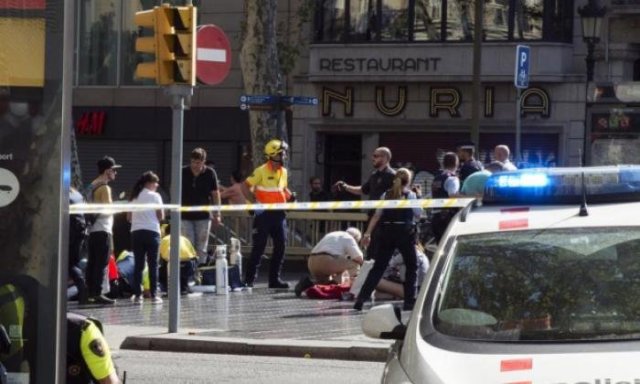
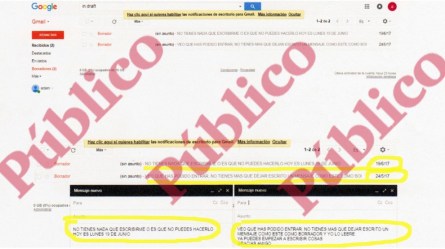
Recently the left-wing Spanish on-line newspaper, Publico, got a scoop on other media when it broke the story of the Spanish secret service and the terrorist1 cell in Catalonia, the one that carried out the killing spree in La Rambla in Barcelona in October 2017. Publico revealed that the head of the cell had been recruited as an informant while in jail on drug smuggling charges and that the secret service had helped him become an imam, a Muslim priest, in the province of Girona. Not only that but that they had the photos and mobile phone numbers of a number of the Ramblas terrorists and had been following them up to days before the attack.

Aftermath Rambla Attack
Aftermath of terrorist attack in the Rambla, Barcelona in 2017. (Photo image sourced: Internet)

So why had the whole lot not been apprehended? It’s a question many people are asking, along with the Catalonian and many foreign newspapers – but, strangely, only one of the main Madrid newspapers.

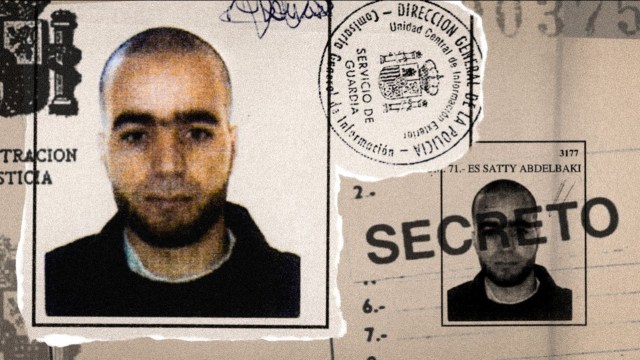
THE LEADER OF THE TERRORISTS WAS WORKING FOR THE SPANISH SECRET POLICE

          Abdelbaki Es Satty came to the Spanish State in 2002 and was around 44 years of age when he died in an explosion in Catalonia. According to Wikipedia,

Es Satty was implicated in the 2006 Operation Chacal, in which five Islamists were arrested for sending jihadis to fight in Iraq. From 2003 he had shared an apartment with Islamists connected to the Moroccan Islamic Combatant Group (GICM) and the 2003 Casablanca bombings.

In 2012, (he) completed a four-year prison sentence for drug trafficking in Castellón. While in prison, he is reported to have established a “special friendship” with Rachid Aglif, who was serving an 18-year sentence for his role in the 2004 Madrid train bombings.

He was convicted of drug smuggling in 2014 and was to be deported from Spain, but …… A successful asylum application in November 2014 facilitated him moving freely in the 26 EU countries of the Schengen area.

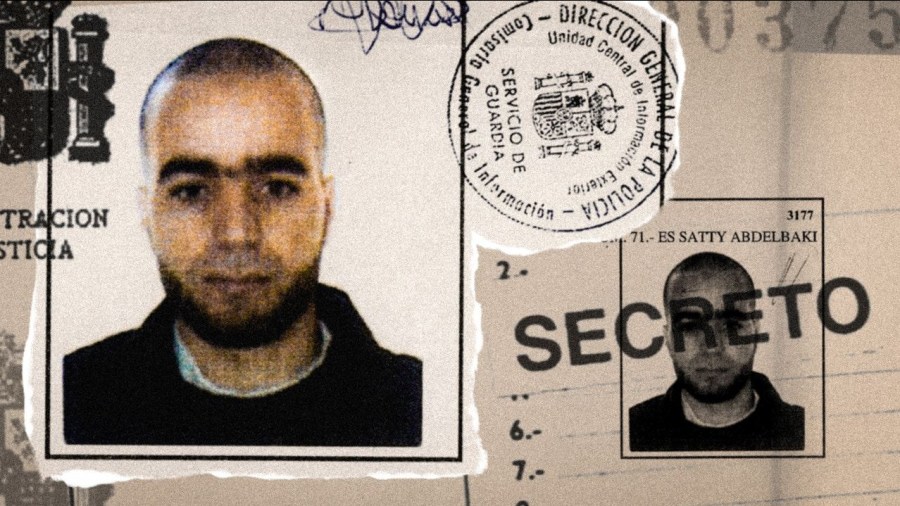
catalonia-bomber-leader-es-satty.jpg
Es Sattty, believed leader of the terror cell that carried out the attacks in Catalonia in 2017. He was an informant of the Spanish Secret Service (CNI). (Photo image sourced: Internet)

The suggestion in the Publico articles is that Es Satty was recruited by the Spanish secret service (CNI) while in jail and that they ensured that he was not deported, also that they assisted him in getting employed as an imam (a Muslim priest) at the mosque in Ripol in 2015, a post he suddenly resigned in June of 2017. Ripol is a town in the province of Girona, Catalonia.

Publico now reports that the CNI file on Es Satty has been “wiped”!

THE EVENTS

          On the evening of 16 October 2017, El Satys and another man were killed, presumably by a premature explosion while handling the material. There were over 120 gas canisters which appeared stored for a number of terrorist bombs. The explosion occurred in the town of Alcanar, the southernmost of Catalonia and almost on the border with the province of Valencia.

When other in the cell heard that El Satys had been killed and another with him while handling the explosives, it seems they decided on a ‘revenge’ spree to honour their ‘martyr’ and carried out the attacks on innocent civilians in Catalonia.

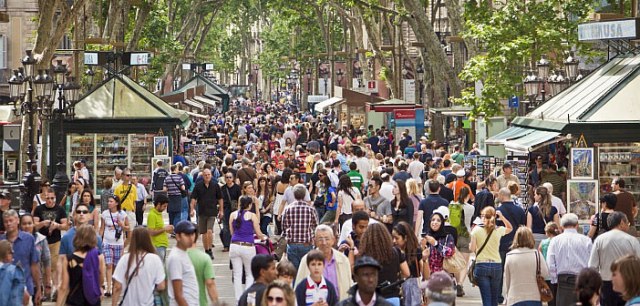
La Rambla is in Barcelona city centre, a medium-length wide street heading towards the port, with a tree-shaded pedestrian reservation down the middle, where stalls sell all kinds of ware and coffees, snacks etc. It is a favourite destination of tourists (and pickpockets).

Barcelona Rambla Packed
La Rambla, Barcelona, on a happier day.

On the late afternoon of 17 October, a member of the terrorist cell driving a van zigzagged down the Rambla, running down pedestrians and cyclists. During his escape from the scene, he hijacked a car and fatally stabbed the driver, bringing his total death-toll to 15 and injuring 131.

Later that evening, five men, apparently of the same cell, purchased knives and an axe and, at 1.00 am, drove into the Catalonian coastal town of Cambrils (not far from the popular tourist destination of Salou) and into a crowd of pedestrians, where they fatally stabbed a 63-year old woman and injured another six, before being shot by Catalan police. Four died at the scene and the fifth later of his injuries.

On 21st August, five days after the Alcanar explosion and four after the Barcelona massacre, the Rambla killer was fatally shot by the Mossos, the Catalan police, in Subirats, about 25 miles (40 Km) from Barcelona.

Initially, Catalan police believed the first violent event, the Alcanar explosion, had been caused by an accidental gas leakage but once they discovered the explosions and other events had occurred, connected them. Not only did the Spanish secret service, the CNI, fail to inform the Catalan police about the existence of this cell prior to the Alcanar explosion but it seems that at no time during the subsequent operations of the Catalan police did the CNI give them any information whatsoever.

Publico On Line Image
The on-line newspaper that broke the story. (Photo image sourced: Internet)

THE DIRTY WORLD OF STATE SECRET SERVICES

          Secret services penetrate cells and movements opposed to the status quo as a matter of course, whether they have an armed agenda or not. But when they do have such an agenda, typically they try to recruit some inside people for information, building up a wider and more detailed picture as time goes on. This takes time and meanwhile the informants’ ‘handlers’ will typically give their insider ‘asset’ money, protect him or her from prosecution, feed the informant’s fear or ego – or both.

As not-so-distant history shows with the British and US secret services (and probably all others around the world), these informants are permitted to break the law, even to kill, in order to keep up their cover. Yes and even to kill another, less-valued or more exposed informant, as the British had at least one informant do inside the Provisional IRA.

But it goes even further and informants or deep-cover agents also often act as agents provocateurs. They actually incite people around them to carry out armed actions. This can vary from encouraging them to attack where, unknown to the victims, the state forces are ready and waiting to kill them, as is believed happened at Loughgall, in occupied Co. Armagh in 1987. The informant can also be used to incite a group of political activists to carry out armed actions to facilitate the breaking up of the organisation2. Or to set off bombs that will, intentionally or not, kill uninvolved civilians, thereby losing insurgents popular support. Or that might set off inter-communal violence in an occupied country.

And religion-based organisations have long been recognised by secret services as useful opposition to leftist national liberation movements. Or against the USSR, for example, when the latter were invited into Afghanistan by the ruling circles. They may also be used to incite inter-communal violence in a country occupied by a foreign power or to help overthrow a ruling group which a foreign power wishes to replace with another more amenable to the power concerned — or in a country it wishes to invade.

The role of the Phalangist militias, Christian, in Lebanon is well-known, in their war against the growing power of the Muslim community. The CIA and Israel3 armed the Phalangists and encouraged them in their attacks Lebanese Muslims and on Palestinian refugee camps, not only against fighters but also massacres of the elderly, women and children. The CIA funded, supplied and even often trained Islamic fundamentalist jihadists4 and warlord bands in Afghanistan, Al Qhaeda among them, as they did also in Iraq. They did it in Syria too but ended up having to fight one such jihadist group, ISIS, which threatened to take the whole cake and the commanders of which were unpredictable in terms of future policy. But many of the war bands in the NATO-led Alliance fighting Assad and ISIS were themselves Jihadists too.
SUSPICIONS AND SILENCE

          There are many people within the Spanish state territory that distrust the State and Catalans, due in particular to their recent experiences, would figure prominently among them. When Publico broke the story about the CNI and their close connection to the terrorist cell, it was inevitable that speculation would take off and that it would not stop at the secret service’s ineptitude.

Some thought that the original intention had been to discredit the Mossos, who were later accused by some Spanish politicians of not cooperating fully with the Spanish police operations against Catalan independence campaigners. Presumably the explosions planned by the terrorist cell would leave the Catalan police looking useless.

Another theory went that explosions would be blamed in some way on the Catalan independence movement, which has until the present been remarkably peaceful in the face of Spanish police violence. In fact Aznar, the Spanish Prime Minister at the time of the Madrid train bombing by another cell, immediately blamed the bombing on the Basque armed group ETA. When it was proven to be an Islamist fundamentalist cell, his false claim contributed to his party losing the elections soon afterwards.

No doubt there were other theories speculated also and the response from Madrid did not help to quell them.

Many commentators have wondered at the Spanish state’s silence on the matter but even more so at the silence of all but one of the Madrid main newspaper. Surely this is a really big story? If the Government says that “it’s not a big issue (for them) to investigate”, would one not expect the Spanish media to be hounding them? That media silence is, really, the most puzzling aspect. One can readily see that the Government might not want to expose the ineptitude and dirty work of their State’s secret service … but the media?

The only answer that makes any sense is its Catalonia connection, that all locations in which the events occurred are in Catalonia. And that the independence movement for Catalonia is locked in a struggle with the Spanish unionist State. Therefore reporting on Spanish secret service ineptitude in Catalonia could well go to justify separatist wishes in Catalonia.

Or have the editors been made aware that this terrorist cell had an important role to play in that independentist conflict and asked to keep quiet? What if a campaign of terrorist massacres in Catalonia gave a plausible excuse for the Spanish State to impose emergency legislation on Catalonia, an excuse that would be thought convincing not only within the Spanish state but abroad also?5 Of course, if that was the gameplan, it did not work out for the Spanish State since the cell messed up and it was finished off by the Catalan police, the Mossos d’Escuadra.6

So, to answer the question in the title of this piece: in my opinion it is incompetence – and something else. But probably not the various “something elses” that are being most widely speculated.

However, the Spanish media silence tells us something about the Spanish state too. In what other European state would its media remain silent about its secret service penetrating a terrorist cell but then failing to prevent attacks on its citizens by members of that cell?

End.

FOOTNOTES

1The word “terrorist” is frequently applied in the mass media to a wide range of organisations employing armed, from small cells to popular movements, of a wide variety of ideological motivation ranging from fascist to communist or just national liberationist. There can even be paid terrorists, such as the Contras run by the CIA against the Sandinista-run Nicaragua. Even some animal liberation organisations have come under this term and, indeed individuals without an organisation backing them (such as the Australian who carried out the massacre in New Zealand last year). In addition, some states have been labelled “terrorist” by others. Therefore the term cannot have a precise definition and I use it here only to describe small or larger organisations that target uninvolved civilians in order to cause terror among a population and instability among the rulers.

2British secret services did this in a case in England where they got a member of the local Sinn Féin branch (the party had branches in Britain at the time) to incite them to raise funds for the cause by carrying out a bank robbery, during which the robbers were arrested. Then he incited breaking them out of jail and that group got arrested too. After that he feared he was exposed and confessed to, strangely enough Jazz musician George Melly and then to the National Council for Civil Liberties (now Liberty). Very shortly after that he was killed, whether by the IRA or by his handlers is unclear. Though a famous case at the time several Google searches have failed to turn it up for me.

3The French may well have done so too as many of the Lebanon Christians had their origins in former French colonisation.

4From Jihad, a term meaning “struggle”, usually used in religious contexts. It can mean a moral struggle in society, within oneself or against “the enemies of Islam”, when it is sometimes characterised as a religious war, which may be defensive, or offensive (as with the Christian Crusades). In the political sense, especially when used in the West, it can be either defensive (e.g repelling or overthrowing a non-Islamic invader) or aggressive (e.g invading territories under non-Islamic rulers or under a different Islamic sect, or overthrowing such) but is always military and that is the sense in which I am employing it here.

5After the Twin Towers and other bombings by Al Qhaeda, US legislators were able to introduce the Patriot Act 2001 which gave the US State wide powers violating many civil rights.

6Whose Chief is currently on trial in Madrid, accused of undermining Spanish police operations against Catalan independentism through lack of cooperation.

REFERENCES

https://www.irishtimes.com/news/world/europe/spanish-intelligence-knew-of-terror-cell-ahead-of-barcelona-attack-say-reports-1.3959554

https://en.wikipedia.org/wiki/Abdelbaki_Es_Satty

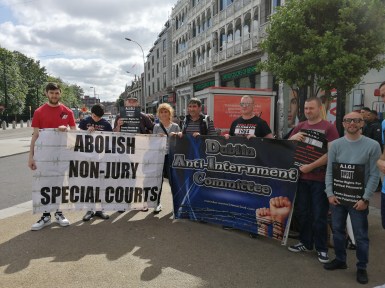
BASTILLE DAY ANTI-INTERNMENT PROTEST IN DUBLIN

Published by kind permission of Dublin Anti-Internment Committee from their Facebook page End Internment

INTERNATIONAL FLAVOUR ON IRISH ANTI-INTERNMENT PICKET

Clive Sulish

The Dublin Anti-Internment Committee was out again on Saturday 13 July (the day before Bastille Day, which marks the French Revolution, the taking of the Bastille prison in Paris in 1789 and the freeing of political prisoners by revolutionary forces).


The campaigners were out on their monthly picket to raise awareness that, as their leaflet headline says: INTERNMENT CONTINUES IN IRELAND BUT BY OTHER NAMES. When political activists (at the moment Irish Republicans) are arrested and refused bail, that is effectively internment without trial. When political ex-prisoners released under the Good Friday Agreement have their licenses revoked and are taken to jail without charge or hearing, that is also effectively internment.


The picketers lined up with their banners and some placards outside the St. Stephen’s Green Shopping Centre which is at the top of Grafton Street and facing the main entrance arch to the Stephen’s Green park. The official name of this monument is Fusiliers’ Arch as it carries the names of many of the Dublin Fusiliers who were killed in the Second Boer War fighting for the British; for the same reason it also widely known as Traitors’ Arch.

dav
Stephen’s Green Shopping Centre in backgroun
sdr
Basque couple joins the protest
sdr
Catalan supporter inlcuded in photo with west side of Stephen’s Green Park in the background
DB & DAIC Picket Stephens Green Grafton July 1919
DAIC supporter hands out leaflets to passers-by (part of Fusiliers’/ Traitors’ Arch in background)

Stephen’s Green also contains monuments to people who were political prisoners in their time: Ó Donnobháin Rosa, a Fenian who survived where many died as a result of the conditions of their long imprisonment; United Irishmen Emmet and Tone, both before execution and ICA officer Markievicz, who was an officer in the 1916 Rising Garrison here (and whose death sentence was commuted).

Just over a hundred years ago, this whole area was a battleground under the command of the Irish Citizen Army, the workers’ army created in 1913 to defend striking workers from the Dublin Metropolitan Police. Some of the structures here carry the marks of many bullet impacts.

The area chosen for the picket on Saturday is a very busy one with a constant flow of pedestrians shopping in Grafton Street and Stephen’s Green Centre, tourists and people relaxing walking through, going to and coming from the Green. Many leaflets were distributed.

The protester were joined today by the Abolish the Special Courts campaign and appropriately so, since many Republican activists are charged and taken before these courts where they may be denied bail and kept in jail until their trial so that in the unlikely event of their being found not guilty by these no-jury political courts a couple of years later, they will already have spent that time in jail anyway. The Special “Criminal” Courts are the Irish state’s equivalent of the Diplock Court in the Six County colony.

There was something of an international flavour to the picket on Saturday, with a Catalan comrade supporting the picket and distributing leaflets and briefly a Basque couple supporting it too.

The Dublin Anti-Internment Committee expects to be at another location in Dublin town in some weeks’ time and welcomes support from across the democratic spectrum.

End.

U.S. VETERANS STILL FIGHTING – BUT NOW AGAINST THE MACHINE

Clive Sulish

DUBLIN AUDIENCE AT AFRI PUBLIC MEETING CHARMED AND INSPIRED BY FORMER MEMBERS OF USA ARMED FORCES WHO ARE ON TRIAL FOR BREACH OF SHANNON AIRPORT SECURITY ZONE.

Veterans for Peace Members Ken Mayers and Tarak Kauff, US-based anti-war campaigners, last Wednesday evening clearly impressed members of a Dublin audience by their dedication. Both men are awaiting trial in Ireland for exposing U.S. war crimes and the violation of Irish neutrality at Shannon Airport and are at liberty only within the jurisdiction of the Irish State on a combined bail of €5,000.

          The bail was paid by anti-war campaigner Ed Horgan, a former army commandant and UN peace keeper and the sum is twice the amount of criminal damage they are accused of having caused to the airport’s perimeter fence, as well as unlawfully trespassing into a taxiway. They did so in order to inspect a US plane to ensure it was not carrying war material or personnel, in violation of Ireland’s Constitutional neutrality. Campaigners have long demanded that the Irish State itself carry out these inspections but despite evidence that the State’s neutrality is indeed being violated by US Planes landing at Shannon, successive Irish governments have insisted in taking USA Government denials on trust.

oznor
Tarak Kauff addressing the audience at the public meeting organised by Afri.

The public meeting was opened by Joe Murray, Coordinator of Afri and Emer Lynam, newly-elected Vice-Chairperson of Afri Ireland, introduced the speakers.

The elderly campaigners, in their “Veterans for Peace” sweatshirts, addressed the audience about the reasons for their actions and their commitment to opposing US militarism which they stated was a major cause of misery around the world, including to serving members of the military themselves (quoting a figure of 22 suicides per day), along with being a major cause of world pollution. Ken Mayers explained that the USA has 800 military bases around the world in addition to its 400 on its own territory, the infrastructure, fuel expenditure and waste of the total which he stated is a major cause of pollution. (This is presumably without even taking into account the use of nuclear-generated power and disposal of radioactive material, or depleted uranium projectiles, such as used in Iraq or the Agent Orange defoliant used in the Vietnam War.)

Both men belong to an organisation called Veterans for Peace which campaigns against the US militarisation of the economy, war, interference in the affairs of other states and for better treatment of veterans. Recently they also supported a campaign against concentration camps for migrants along the US-Mexico border.

13 DAYS IN JAIL THEN BAIL ON CONDITION THEY DON’T APPROACH ANY AIRPORTS

          Ken Mayers, 82 years of age and Tarak Kauff 77, spent 13 days on remand in Limerick jail, where their toilet did not flush unless they poured buckets of water into it. Other than that, they said they were treated well and the other prisoners treated them “like celebrities”.

The reason for their bail being refused during that period was Garda objections that they would flee the jurisdiction. Tarak Kauff exposed the illogicality of this fear to the Dublin audience, explaining that they had taken their action at Shannon knowing that they would be arrested and wanting to use the trial to expose what was going on at Shannon airport: “For us not to attend that trial, they would have to physically drag us away from there!”

ken-mayer-standing-speaking.jpg
Ken Mayer of US Veterans for Peace, addressing the public meeting

They were eventually granted bail on condition they remain within the Irish state and having to surrender their passports, due to Garda objections again that they might flee, also not to approach any airports. On July 10th the High Court turned down their appeal against these conditions, though the judge said that he might review that decision if the case were to be moved to the Dublin District Court, where the waiting list was much longer. The defendants and their solicitor, Michael Finucane, will be seeking to have the case heard outside Clare, where it is believed a fair trial relating to a Shannon protest is unlikely. A trial date is expected in September or October.

oznor

THEY POSTPONED MY HONEYMOON”

          Ed Horgan took the floor after Mayers and Kauff to speak about the one million total of children killed in the Middle East as a result of war and sanctions and urged action to prevent further loss of children’s lives.

Then Emer Lynam opened the meeting to questions.

In reply to questions from the audience about the cost to themselves, Ken Mayers revealed he was due to be on his honeymoon by now with his bride.

Ken Mayers was born in New York City and grew up on Long Island. From Princeton University he entered the US military as a Second Lieutenant in the US Marine Corps, rising to Major until he left the organisation in 1966 in disgust with US foreign policy. In Berkeley University, California he gained a PhD in political science where, according to the AFRI event page, he became a peace and justice activist, which he has been ever since and six years on the Veterans For Peace (USA) Board of Directors, five of them as national treasurer.

Tarak Kauff, ex-military too and also from New York, said that he missed his wife and daughter but both were supportive of what he was doing, being activists also (see short letter from his wife in Links and References). According to Afri’s FB page, he’s a former U.S. Army paratrooper (1959 – 1962), a member of Veterans For Peace, the managing editor of VFP’s quarterly newspaper Peace in Our Times and was a member of the VFP National Board of Directors for six years. He has organized and led delegations of veterans to Okinawa; Jeju Island, South Korea; Palestine; Ferguson, Missouri; Standing Rock …. and Ireland.

Asked what kept them going, they stated the importance to act against injustice. Kauff in particular declared that “to resist is human” and that he wished to be fully human. He said that no-one could tell another what he or she could do but one only had have the courage to ask oneself that question …. and then the courage to act upon the answer.

sdr
Section of audience at the public meeting

IRISH PEOPLE JUST COME UP AND SHAKE OUR HANDS, THANK US FOR WHAT WE ARE DOING”

          Both expressed gratitude and a degree of amazement at the warmth of their welcome and appreciation by members of the Irish public. Kauff gave an instance of the Lisdoonvarna pub where the management would not accept payment for their food and drinks. “People just come up to us and shake our hands and thank us for what we’re doing,” the veteran said, “and we don’t get that in the USA.”

Donations from the public fund them and, at the moment, they live in student accommodation at Limerick University, rent free – though they will need to find alternative accommodation in September.

oznor


oznor
Emer Lynam, Vice-Chairperson Afri.

Asked about popular feeling in the USA, Ken Mayer explained that the US public are exposed to a systematic system of propaganda and misinformation. However their anti-war organisation is very wide with many members and that there were optimistic signs with popular protest about the treatment of migrants along the US-Mexican border and fuel pipeline resistance in New York State and in Standing Rock. However, a little later, Tarak Kauff said that the outlook was not promising but that not resisting was no choice — even if he knew the world was going to end next week, he would feel he had to resist in order to fulfill his human potential.

Earlier in their presentations, Kauff alluded to Ireland’s historic struggle to overthrow its powerful oppressor and called people to oppose the most powerful enemy in the world today – the US State. He said that a stance taken by the Irish Government today would have a strong progressive ripple-effect around the world.

RESISTANCE IN MUSIC AND SONG

          Music for the evening was provided by veteran campaigner John Maguire who sang a song he had composed back at the first demonstration at Shannon airport, with a chorus that the audience soon got the hang of and joined in.

oznor
Musical accompaniment on the evening, l-r: Paul O’Toole, Nimal Blake, RoJ (Roger Whelan).

RoJ performed a song also of his own composition, accompanied by Paul O’Toole on guitar and Nimal Blake on cajón. Later, O’Toole also sang a song of his own, about the child who lost both his arms to US imperialist ‘smart-targeted’ bombing, then going on to sing one of Dylan’s numbers. Both RoJ and O’Toole are long-time professional performers and have produced CDs of their material.

All performers were warmly applauded.

The evening was a fund-raiser and it could be seen that the collection bucket, although covered, was stuffed with notes. Ken and Tarak also have a Fund Me appeal and Afri is also receiving some donations for them through the Internet.

End.

mde
A line up of activists, military veterans and musicians

LINKS AND REFERENCES:

Event notification by Afri: https://www.facebook.com/events/344492786248155/

https://www.irishtimes.com/news/crime-and-law/surprisingly-humane-elderly-us-veterans-arrested-at-shannon-describe-their-prison-stay-1.3843401

http://www.stopthesewars.org/kenandtarak/

Letter to the Broadsheet by Ellen Davidson, wife of Tarak Kauff: https://www.broadsheet.ie/2019/04/03/story-of-why/

Summary of events and explanation by Ken Mayers: http://claredaly.ie/us-veterans-for-peace-forced-to-remain-in-ireland-pending-trial/

US Veterans for Peace: https://www.veteransforpeace.org/

Suicides in US Military: https://en.wikipedia.org/wiki/United_States_military_veteran_suicide

mde
The huge banner “US War Machine Out of Shannon” (sadly, out of focus)

MAJOR SPANISH UNION “BETRAYED WORKERS”

(Reading time text: 2 minutes; comment: 4)

(Translation from article in Castillian by Diarmuid Breatnach)

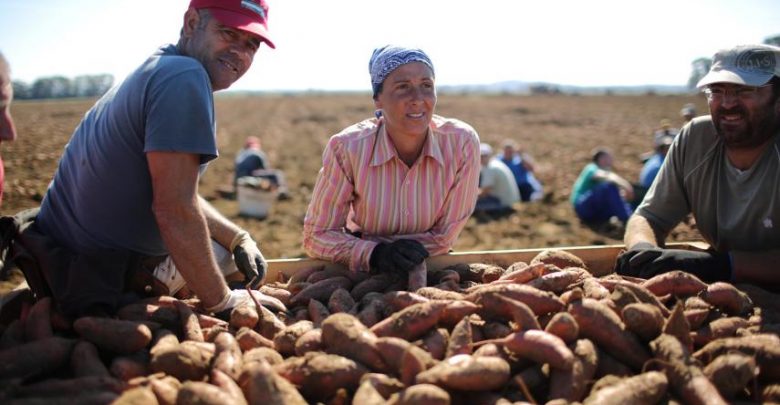
The Andalusian Union of Workers (SAT) has accused CCOO (Comisiones Obreras, major Spanish trade union – Translator) of “betraying” agricultural workers with the signing of an agreement with the Asaja employers — the signing took place last Thursday in Seville — where hard-won rights have been surrendered, including the 15-minute sandwich break. Accordingly, it will propose a common front to all trade unions to promote the fight for an (alternative) Andalusian agreement.

Migrant workers in a sweet potato plantation in Jerez, Andalusia.
(Source photo: Juan Carlos Toro, La Voz del Sur)

The SAT “cannot endorse an agreement where you give up the 15 minutes sandwich break, a workers’ victory from a long time back, which has been respected for generations, even during the Franco regime. An achievement that the employer, Asaja, has always wanted to eliminate and has succeeded now thanks to the betrayal of bureaucrats who never got their hands dirty or set foot on the field in their life”.

To this, adds the union, “you cannot endorse a de facto wage loss since the Pyrrhic rise of 1.25% per year does not compensate for the loss of the 15-minute sandwich break, which amounts to 3.8%. In other words, in reality, what CCOO has signed is a salary reduction of two and a half points” (per cent). “This is an outrage and a complete betrayal. There is no other name for it. We would like to say something very different, but above all our duty is to the workers who have been sold and betrayed once more”, they added.

The situation in the Andalusian countryside and the province of Seville, in particular, where some 120,000 people work in the sector, is very precarious. The economic crisis has hit the countryside and its workers hard. The working conditions implemented in the Andalusian countryside, according to the SAT, “seem from other times, thankfully now past.” Breach of agreements is the rule, piece-work predominates, which sometimes means that after a long day of work you only take 20 euros home, well below the salary established in the agreements.

Map showing Andalucia region (in red), Spanish State (in cream) also Canaries and part of coast of North Africa.
(Source image: Internet)

There are situations, they add, where fraud is evident by not declaring the workers employed. A fraud that can make a millionaire, since it can mean millions of undeclared euros that put health, pensions and our social protection system at risk. In addition to situations of genuine exploitation of workers — which in many cases border on pure slavery — there continues to be a significant reduction in income to Social Security, as well as a smaller amount of peonages that subsequently give the right to recognition of the subsidy and other benefits (? — Trans).

The reality that is being imposed not only affects labour rights, it is also “strategic suicide”. “The reality,” explains SAT, “is that with these mafia practices they are dropping the market price, so the product loses added value and undermines the market. The final result is to depreciate the product having a direct impact on the living conditions of day-labourers and on the economy of the towns. There have been innumerable complaints filed in the Labour Inspectorate, some of which have led to criminal proceedings being taken for crimes against the rights of workers.”

Accordingly, an Andalusian agreement that puts in place a minimum is necessary and urgent: six hours of work (sandwich break included); 60 euros for the normal working day; 84 on Sundays and holidays; effective ban on piece-work; wage of 69 euros for work with machinery; 96, on Sundays and holidays; on rainy days (when work is not possible) 50% will be paid for showing up at work, and the full wage from two hours of work; 0.27 euros mileage.

It is fundamental, they state in concluding their communiqué, to establish “a common front to fight for an Andalusian agreement with these minimums. It is also necessary and urgent to change the system of union elections in the field, a measure approved in the Congress of Deputies, and grant voting rights to non-permanent workers who represent more than 95% of the workforce in the Andalusian countryside.”

COMMENT:

Diarmuid Breatnach

The CCOO, Comisiones Obreras is one of the two mega-unions in the Spanish State, the other being the UGT. The CCOO was controlled by the Communist Party of Spain (PCE) and the UGT by the social-democratic PSOE; both parties and their affiliated unions were outlawed during Franco’s time. When the Transition to “democracy” was being engineered after Franco’s death, it was considered necessary to legalise the PSOE in order to have a two-party system and therefore necessary to legalise the UGT. However, it was the other way around for the CCOO and the CP. The Comisiones Obreras were by far the largest and most militant trade union and, though illegal, had built up a substantial following among the workers of the Spanish State. To effect as smooth a Transition as possible, it was crucial to legalise the CCOO and therefore to bring the Communist Party on board. Both political parties agreed to a deal, including recognising a monarchy with a King chosen by Franco and publicly supporting a forced union of all nations within the state by a new constitution.

The southern Basque Country and Galicia have a majority of unions of their own nation but everywhere else within the state, the CCOO and the UGT have the majority of workers as members and the majority of elected representatives. Although the CP’s control of CCOO has slipped over the years, the UGT is still strongly associated with the PSOE. There are also some independent trade unions, like the SAT above and also some others based on specific work locations.

SAT has a history of militancy, fighting for its mainly agricultural work force in which, as it states above, the vast majority are migrant workers. The union also campaigns for efficient and socialised use of Andalusian land, much of which is owned by banks and left empty; in addition its spokesperson was arrested last year for “insulting the Monarchy”. It is worth remembering that Andalusia was in medieval times the famed Moorish caliphate of Al Andalus, in many ways the jewel of the Iberian peninsula.

When Franco’s troops were ferried to Andalusia from the Canaries by German Nazi transport, largely without armed opposition in 1936, they butchered 55,000 republicans, socialists, communists, communists, trade unionists and anti-fascists.

As soon as the “Transition” went through after the death of Franco, the PSOE was voted into power in the Andalusian regional government, where it has held the absolute majority ever since – until the regional elections this year. Years of corruption and complacency saw its voting base diminish and, though it still holds the most seats, a right-wing coalition of the Partido Popular, Ciudadanos and Vox, all of which can trace their origins to Franco, has taken over. Many observers think is therefore all the stranger that the CCOO should bring in this agreement at this time.

End.

LINKS AND REFERENCES:

Source article in Castillian: https://www.lavozdelsur.es/no-habra-15-minutos-de-bocadillo-para-los-jornaleros-del-campo-andaluz/?fbclid=IwAR1EwH5Uox-Qb87XNjZBvS1nlJ-YD21EbGHAQKqCPRkvFgEgZZOu_nI05bM

Arrest of SAT spokesperson in November 2018:

https://rebelbreeze.wordpress.com/2018/11/15/union-spokesperson-arrested-for-insulting-the-monarch/

Right-wing coalition takes over Andalusia:

https://rebelbreeze.wordpress.com/2018/12/14/gains-for-the-hard-right-in-andalusia-reason-to-panic/

Number of Andalusians murdered by Franco’s military-fascist forces:

https://rebelbreeze.wordpress.com/2019/07/12/5131/