“A March Travelling into the Future … a Beacon of Resistance”

Diarmuid Breatnach

(Reading time main text: 6 mins.)

Thousands of marchers with flags, banners and three marching bands retraced the route of the anti-internment march in 1972 that ended in the infamous Derry Bloody Sunday1, a massacre of unarmed civilians by the British Parachute Regiment.

The nearest Sunday to the date of the original march, which this year fell on February 2nd has been chosen annually for the commemorative march over the 53 years since the massacre. People travel from different parts of Ireland and indeed from beyond in order to attend.
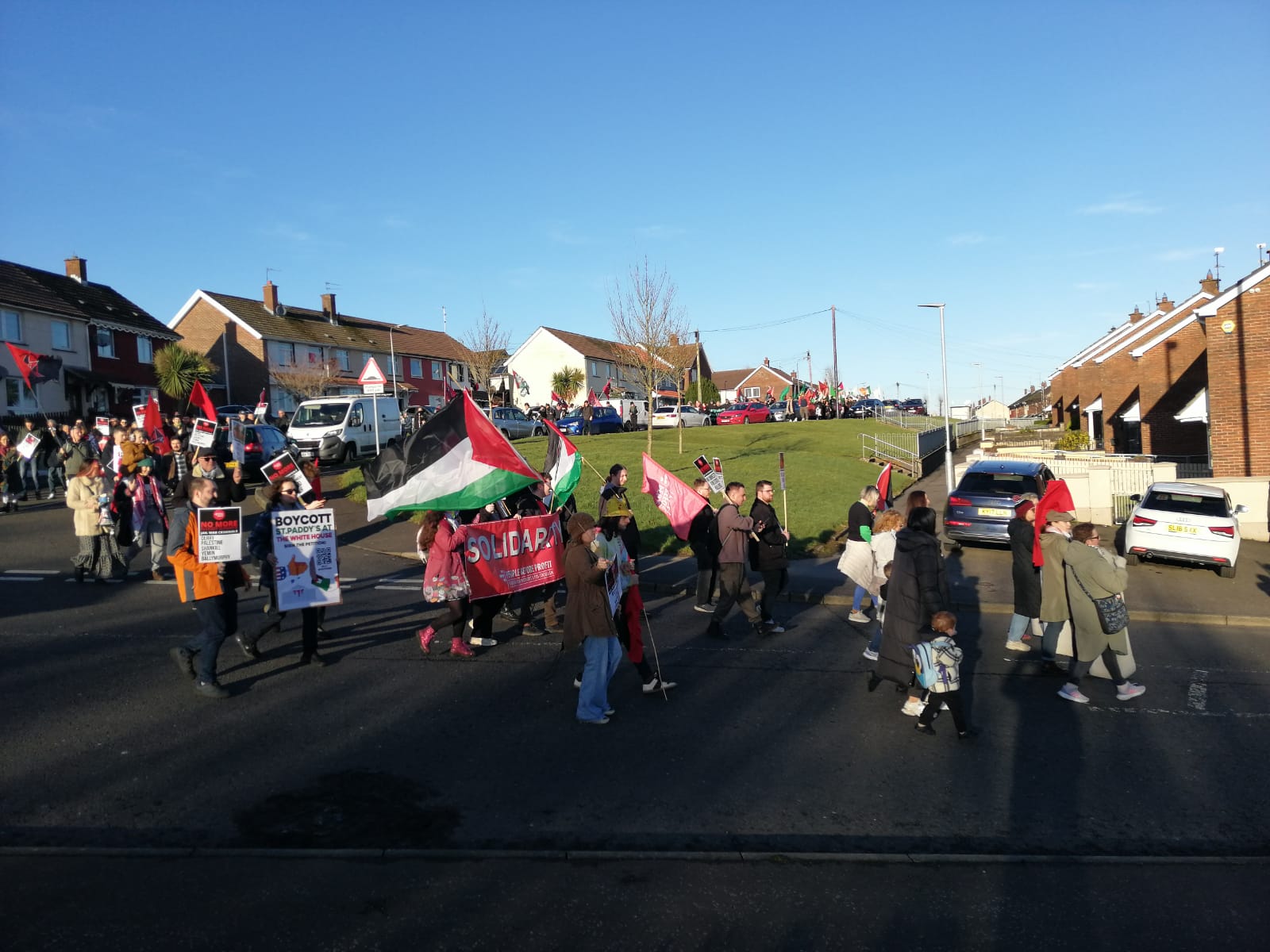
Section of the march coming down from the Creggan. (Photo: D.Breatnach)
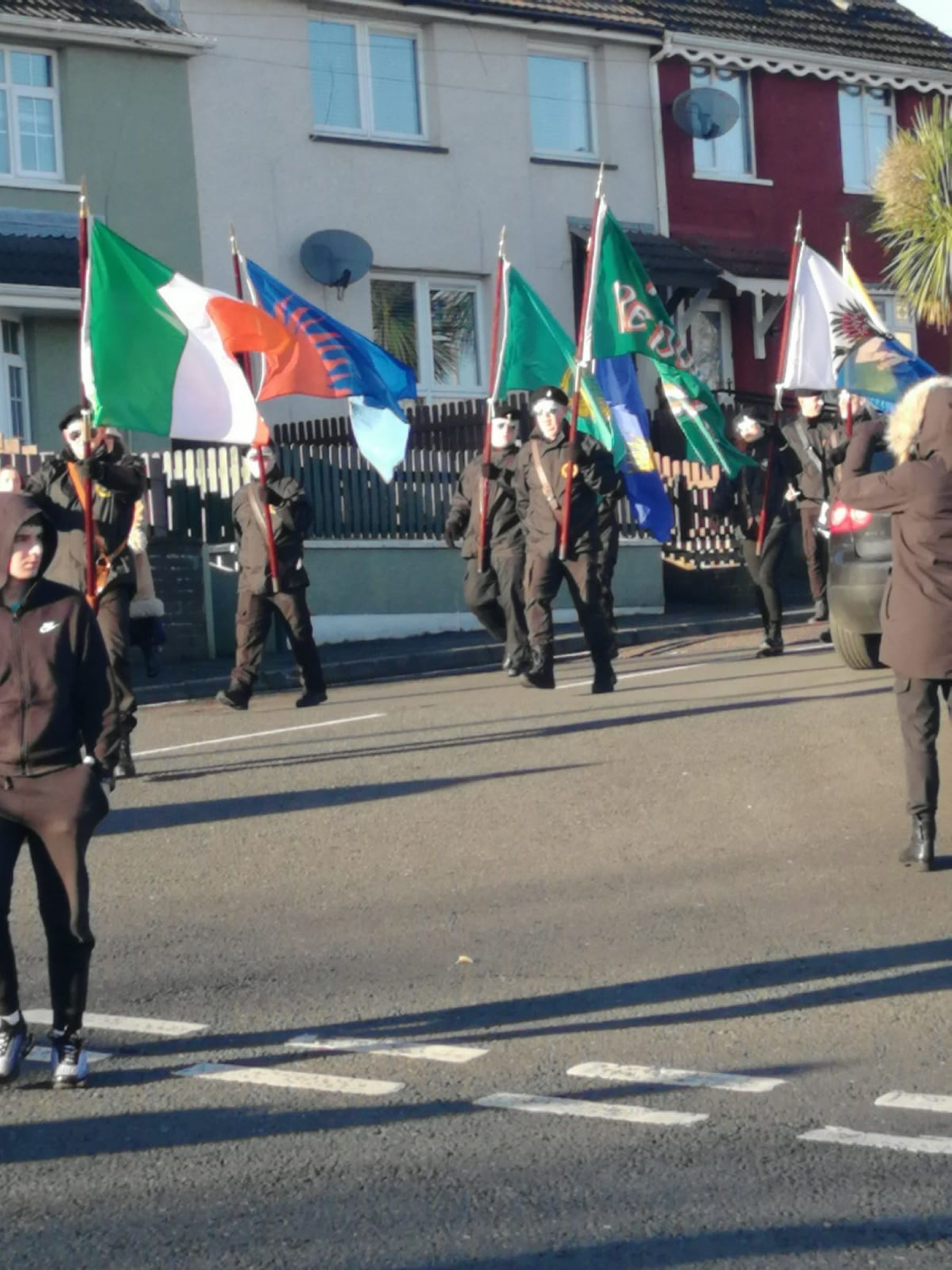
The colour party (bearing the flags) traditionally precedes the marching band. (Photo: D.Breatnach)

Derry is not well served by public transport from other parts of Ireland and there is no train station there.

There is a bus service from Dublin from the Translink company of the occupied colony but one would need to catch it at seven in the morning and then hang around in Derry for 3.5 hours waiting for the march to start. For this reason, many travel to Derry by car.

Equally, many others who would attend were the public transport available, stay home but an estimated over 7,000 participated in this year’s march. The theme this year was Palestine, once again as was last year’s too.

The day of the massacre

The original march was a protest against the introduction in August 1971 of internment without trial in the occupied colony. Almost immediately afterward the Parachute Regiment had massacred 11 people protesting against it in Ballymurphy, Belfast.2
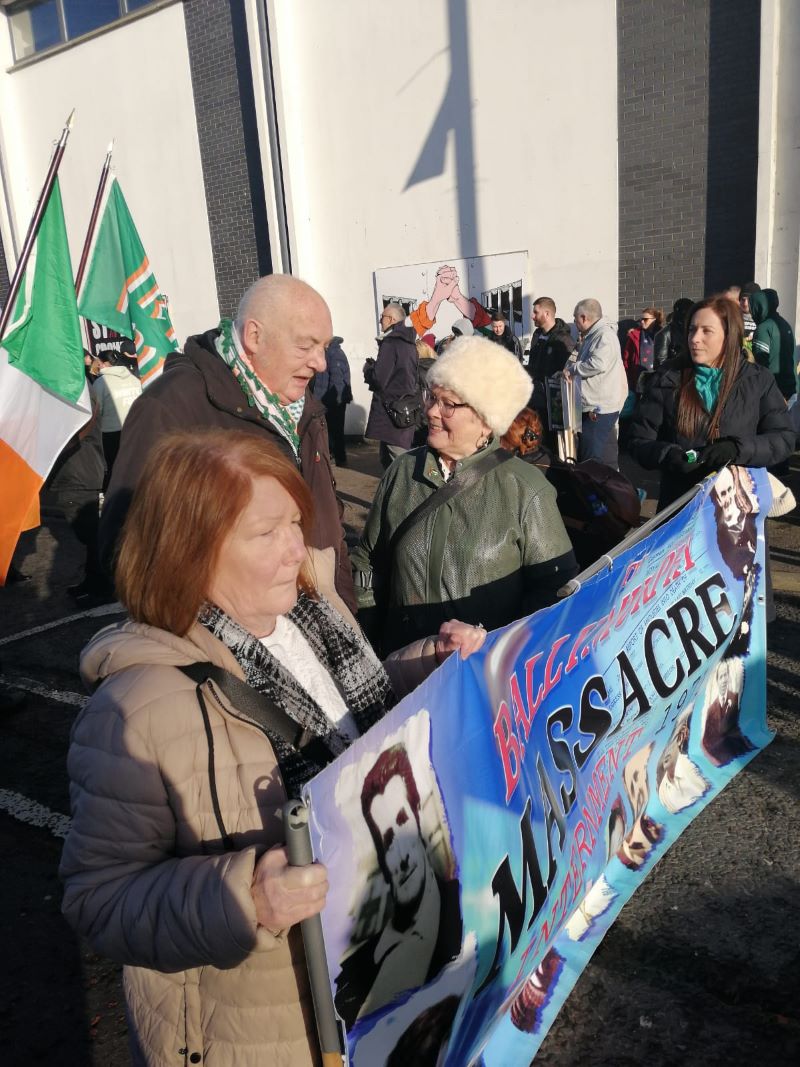
Ballymurphy campaign banner in the Creggan awaiting start of march with Kate Nash centre. (Photo: D.Breatnach)

The 1972 march, along with many others, had been banned by the sectarian colonial administration. The Civil Rights campaigners knew that their legitimate demands3 were being obstructed by use of the Special Powers4 of the statelet and that they could win nothing if they were to acquiesce.

After the previous massacres it took considerable courage to march that day but perhaps they thought that with an advertised march, in daylight, with many film cameras covering, the Paras were unlikely to open fire. In any case, they decided to risk it.

At 4.10pm the first shots were fired by the Paras5 without warning and by around 20 minutes later they had killed 13 men and youths and wounded another 13, one of whom would die weeks later. According to the Saville Inquiry in 2010, they had fired over 100 rounds.

Not one of their targets was armed.

To justify the slaughter, the British Army claimed that they were fired upon and returned fire, killing IRA fighters. The British Government, in particular through Home Affairs Minister Reginald Maudling, repeated the lies as did the British media.

Bernadette (then) Devlin6 MP, a survivor, was prevented from speaking in the Westminster Parliament and she walked up to Maudling and slapped his face. In Dublin a general strike took place with schools closing and a huge crowd burned the British Embassy down.

In London, a giant march reached Trafalgar Square as its end was still leaving Hyde Park. In Whitehall the police prevented them from laying the symbolic coffins outside No.10 and in the scuffles the ‘coffins’ were eventually thrown at the police or knocked to the ground.

And a number of construction sites in Britain went on strike also.

The judicial response varied wildly. Coroner Hubert O’Neill, an ex-British Army major, presiding on the inquests in 1973, called it “Sheer unadulterated murder” whereas Lord Chief Justice Widgery in the ‘inquiry’ he led ignored all the local evidence and accepted the British Army’s lies.7

The last Bloody Sunday march”

Provisional Sinn Féin organised and managed the annual march for many years but in January 2011 Martin McGuinness announced that year’s march would be the last, because of the UK’s Prime Minister David Cameron’s public apology to the relatives of the 14 killed in Derry.

The apology followed quickly on the verdict of the Saville Inquiry8 which totally refuted the statements at the time by representatives of the Army and of the Political and Judicial establishments: the victims had been unarmed and the Army had not been “returning fire”.
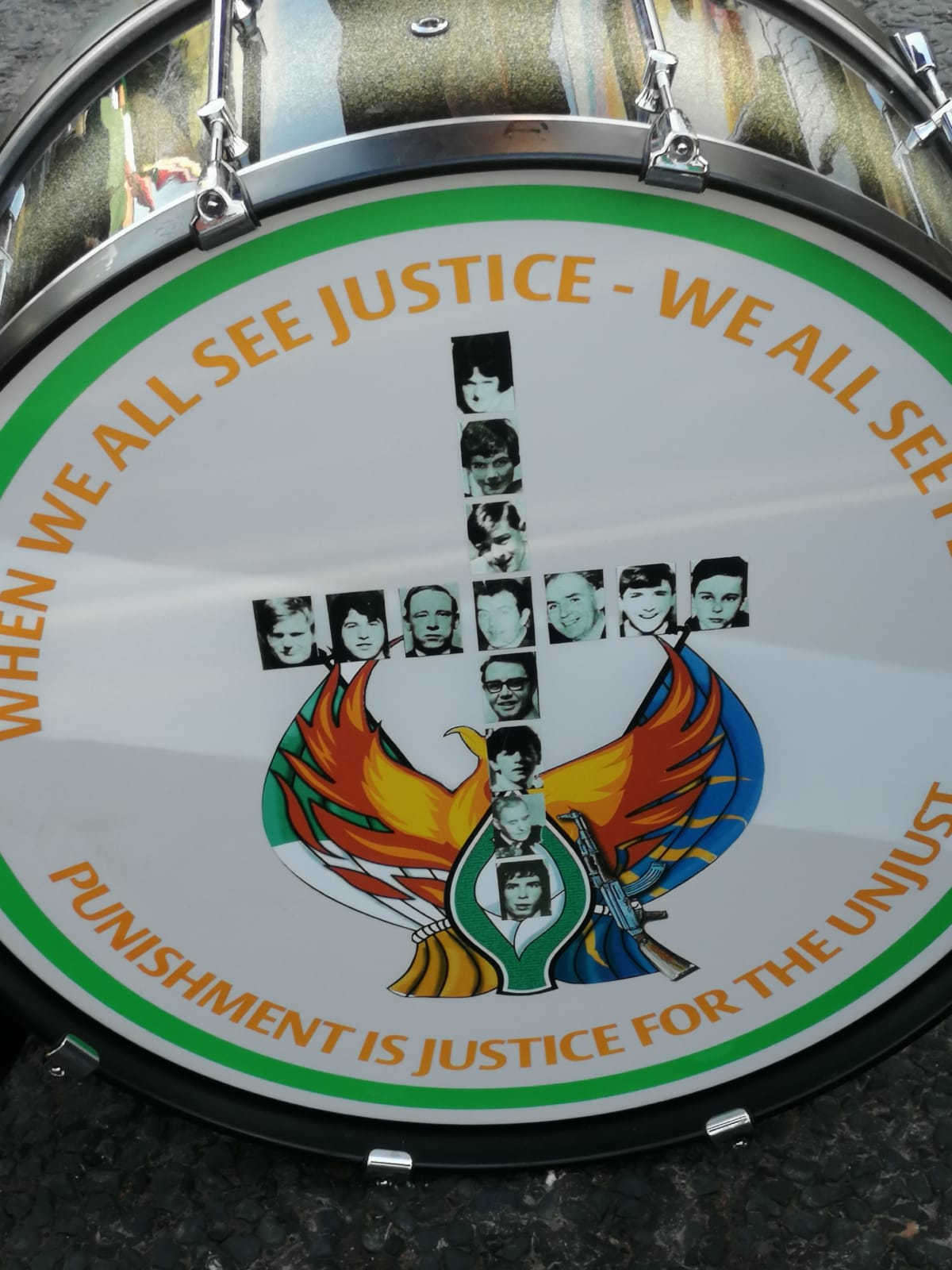
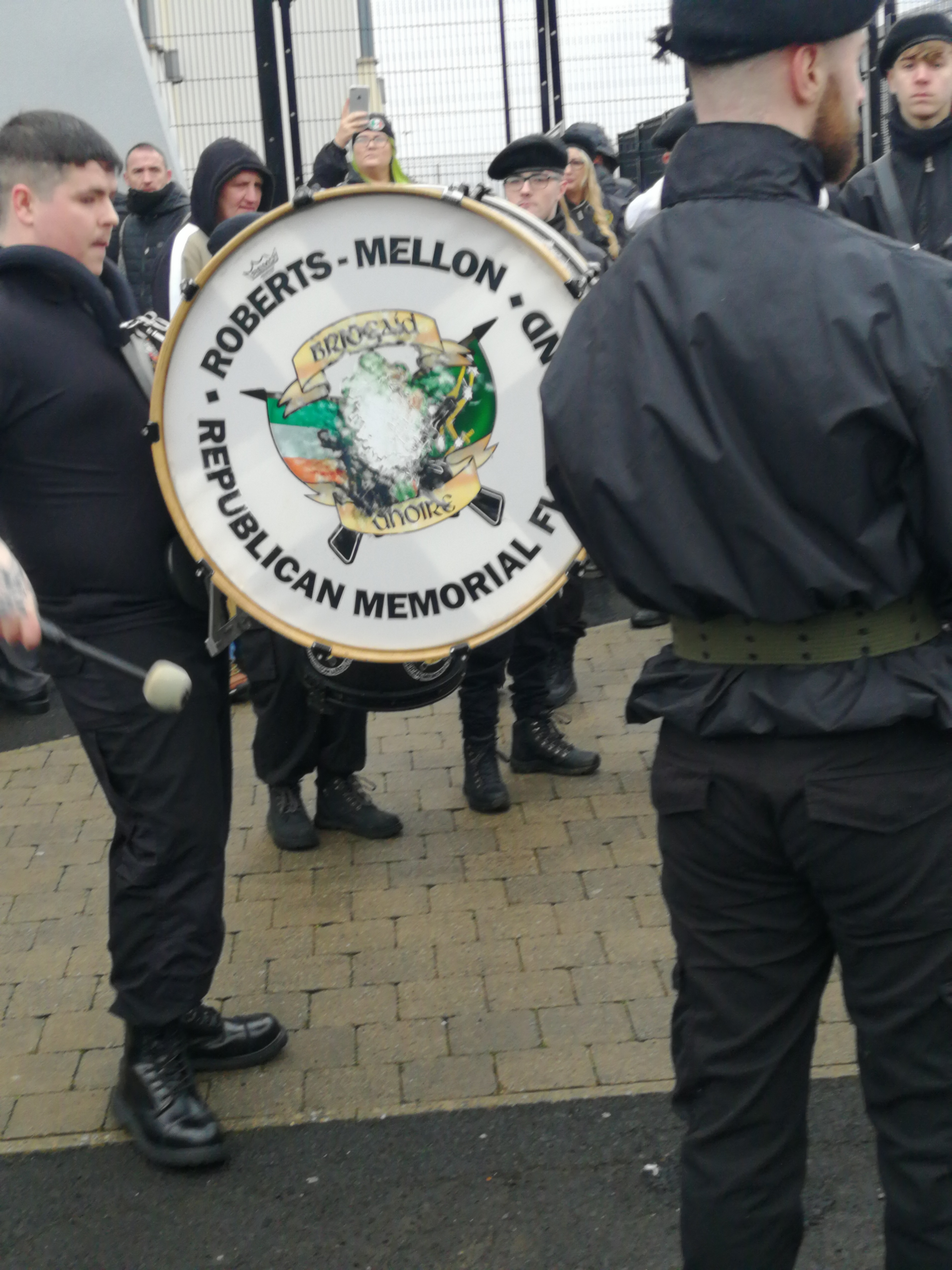
One side of one of the marching band drums (Photo: D.Breatnach)
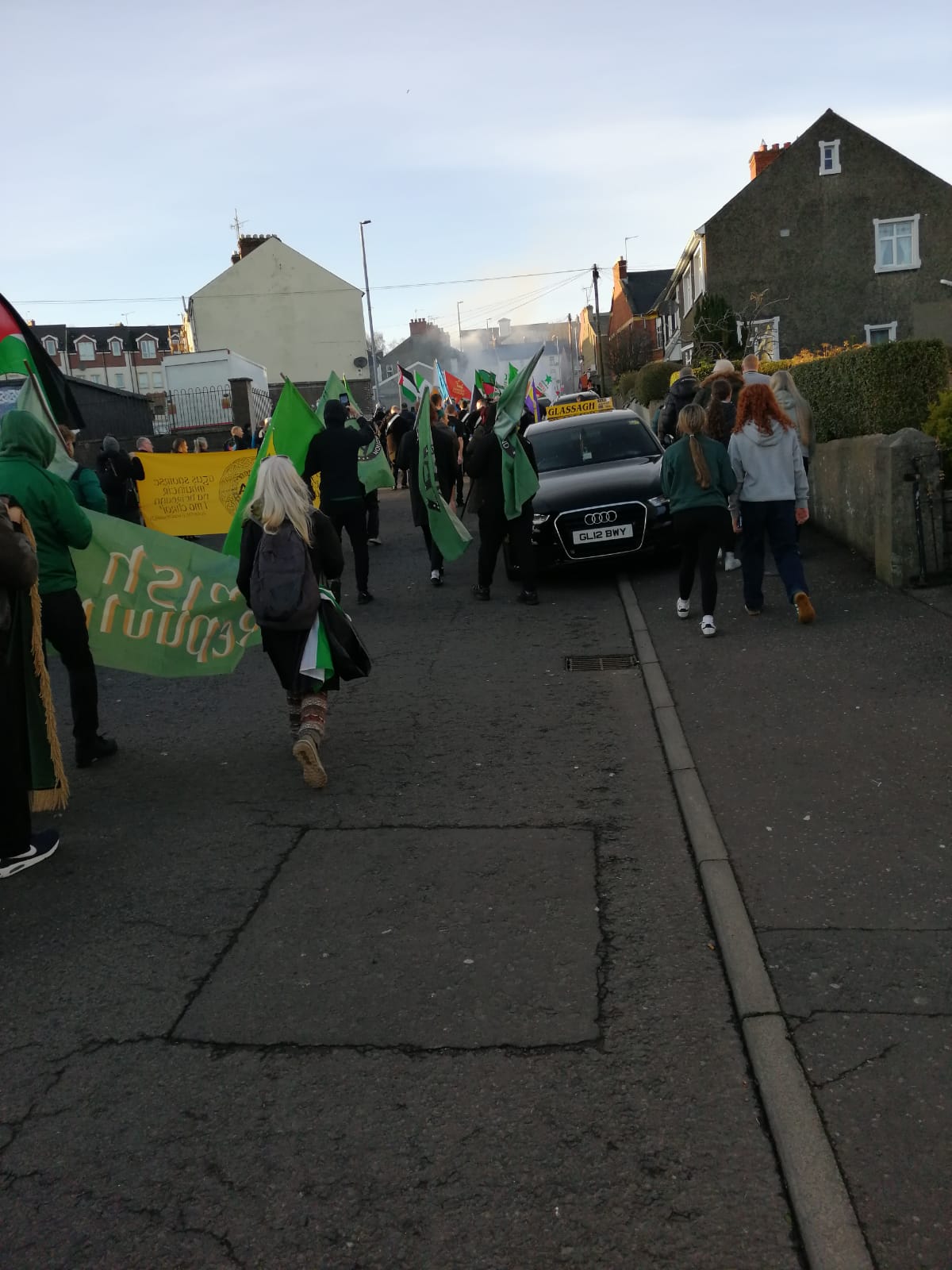
Section of the march about half-way along its length. (Photo: D.Breatnach)

Despite the UK State’s acknowledgement that they had no excuse for the massacre, not one of those who planned, organised or carried out the atrocity had been charged, never mind convicted, nor had those who conspired to cover up the facts. To this day, only a low-level soldier has faced charges.

Nor had there been government admissions of wrongdoing in the other massacres by the Paras intended to crush the resistance to the repressive internment measure, at Ballymurphy and Springhill.

A number of relatives and survivors of the original march declined to have the annual march cancelled, among them Kate Nash and Bernadette McAlliskey. Kate Nash’s brother William was shot dead on Bloody Sunday and her father, William, was wounded trying to save his son.

Bernadette McAlliskey was a survivor of the massacre and also survived nearly a decade later an assassination attempt in her home, being struck by nine bullets of a Loyalist murder gang. Despite opposition by and denunciation from SF, volunteers have kept the march going every year.

Each year different themes have also been incorporated into the Bloody Sunday March for Justice, including ones in Ireland, such as the framed Craigavon Two prisoners but also ones from beyond, e.g. the resistance of the Broadwater Farm housing estate in London to Metropolitan Police attack.

Section of the march in Creggan waiting to start, showing the Palestinian national flag and the Irish Tricolour in close proximity. (Photo: D.Breatnach)
Big drums of one of the marching bands getting a workout in the Creggan while waiting for the march to start. ‘Saoirse go deo’ = Freedom for ever. (Photo: D.Breatnach)

Since 2011 Sinn Féin have boycotted the march but also sought to mobilise public opinion against it, claiming that relatives of the victims didn’t want the march to continue. The truth is that some hadn’t wanted it even when SF were running it, some didn’t afterwards but some did.

Such an atrocity has of course huge personal impact on relatives of victims but its impact is also much wider on a society and beyond, historically and politically. That historical memory ‘belongs’ to the people of Derry but also to the people of the world (as do others such as Sharpeville SA).

Those in power in society are aware of that and the media outside of Derry gives little or no coverage to the annual march while promoting other events there of lesser numbers and significance.

The ‘Derry Peoples Museum’ ignores the march in its Bloody Sunday commemorative program.

This year’s march

Sunday just past was one of sunshine and little wind, as it was on the day of the Derry massacre. But regular marchers remember other Bloody Sunday commemoration days of pouring non-stop rain, of squalls, of snow and sleet, of wet clothes, socks and freezing fingers and toes.

The march starts in the afternoon at the Creggan (An Chreagáin) and winds down to just below the Derry Walls, then up a long slope again before eventually ending down at Free Derry Corner9, the destination of the original march, where speakers address the crowd from a sheltered stage.

Marchers underway, led by people carrying 14 crosses to represent the unarmed civilians murdered by the Paras on that day 53 years before. (Photo: D.Breatnach)
The band members are itching to go up in the Creggan. (Photo: D.Breatnach)

The sides of residential blocks in this area are also painted in giant murals to represent scenes from the civil rights and armed resistance period while nearby stands a monument to the martyrs of Bloody Sunday 1972 but also another to the 10 H-Blocks’ martyrs of the Hungers Strikes of 1981.

In this area, one needs to be blind not to be at least peripherally aware of the icons of proud struggle and of loss, of sacrifice.

Eamon McCann and Farah Koutteineh addressed the rally at the end of the march. McCann, a journalist and member of the People Before Profit political party is a survivor of the massacre. He is an early supporter of the Bloody Sunday March for Justice at which he has spoken on occasion.

Farah Koutteineh is a Palestinian journalist who was herself the news when in December 2023 she and a few other Palestinians were ejected from a Sinn Féin-organised meeting in Belfast being addressed by the Palestinian Ambassador as a representative of the Palestinian Authority.

Koutteineh had been denouncing the Palestine Authority’s collusion with Israel when she and the other Palestinians were hustled out to applause from many of the attendance. Not surprisingly from the Derry platform on Sunday she too drew applause in criticising SF’s position on Palestine.10

Speaking to this reporter after the march, Kate Nash said: “There is no chance the march will be ended. It will go forward into the future, a beacon of resistance against the injustices and crimes of states around the world.

“There are millions of us … people come from around the world to commemorate this massacre with us.”

end.

Series of images from the march (Photoa by D.Breatnach)
Footnotes:

1There have been a number of Bloody Sundays in the history of Ireland under colonialism and therefore the location and year are often incorporated into the name for clarity as to which is being discussed.

2There was substantial State interference with inquests during the period of the 30-years’ war in the Six Counties (and in some cases in the Irish state also), in order to avoid inquest juries finding the state armed forces culpable of homicide unjustified in law. The original inquest in 1972 on the Ballymurphy massacre recorded an ‘open verdict’ but a 2021 reopened inquest found the British Army killings “unjustifiable”. Even after the Derry massacre, in July of that year, the Paras again killed five unarmed people and injured two in the Springhill area of Belfast and again an ‘open verdict’ was recorded into the fatalities which included three teenagers and a priest.

3The demands were all of rights that were in existence in the rest of the UK, including an ending to discrimination in allocation of housing and employment and general enfranchisement.

4The Special Powers (Northern Ireland) Act 1922 gave legal powers to the authorities similar to martial law. Allegedly temporary, as is often the case the Act kept getting renewed until made permanent and its repeal was one of the demands of the Civil Rights campaign. The Act was finally repealed in 1973.

5There was a unit of other British Army soldiers stationed on the Derry Walls with special rifles and there has been speculation that some of the shots might have been fired by them but this has never been confirmed to date.

6Now McAlliskey then Devlin, she had been a candidate for the People’s Democracy party of the time, the youngest MP elected.

7And that was the ‘official record’ until the Saville verdict 38 years later. A clever contemporary lampooning of Widgery and playing on a soap powder advert, with excellent alliteration, had it that “Nothing washes whiter than Widgery White!”

8Although the Saville Inquiry delivered its verdict in June 2010, it had been set up in 1998, taking an inordinately long time (and a bonanza in legal fees for judge, barristers, lawyers and clerks) to reach a verdict already obvious to all the nationalist people of the Six Counties, most of the Irish people and probably millions around the world. The date of its setting up so near to that of the Good Friday Agreement suggests that its creation (and eventual verdict) was part of the ‘sweeteners’ of the Pacification Process and the Good Friday Agreement.

9A reconstruction of the iconic gable end of a small local authority house in the Bogside area of Derry which had been painted in 1967, during the Civil Rights resistance period, with giant letters proclaiming: YOU ARE NOW ENTERING FREE DERRY. The house was demolished during redevelopment of the area but the gable end was reconstructed as a monument to the resistance of the people of the city.

10Sinn Féin support the corrupt and collaborationist Palestine Authority and its backing political party Fatah and also celebrated St. Patrick’s Day with (then) President Joe Biden while the US was supplying the Zionist genocide with weapons, money and political backing.

1There have been a number of Bloody Sundays in the history of Ireland under colonialism and therefore the location and year are often incorporated into the name for clarity as to which is being discussed.

2There was substantial State interference with inquests during the period of the 30-years’ war in the Six Counties (and in some cases in the Irish state also), in order to avoid inquest juries finding the state armed forces culpable of homicide unjustified in law. The original inquest in 1972 on the Ballymurphy massacre recorded an ‘open verdict’ but a 2021 reopened inquest found the British Army killings “unjustifiable”. Even after the Derry massacre, in July of that year, the Paras again killed five unarmed people and injured two in the Springhill area of Belfast and again an ‘open verdict’ was recorded into the fatalities which included three teenagers and a priest.

3The demands were all of rights that were in existence in the rest of the UK, including an ending to discrimination in allocation of housing and employment and general enfranchisement.

4The Special Powers (Northern Ireland) Act 1922 gave legal powers to the authorities similar to martial law. Allegedly temporary, as is often the case the Act kept getting renewed until made permanent and its repeal was one of the demands of the Civil Rights campaign. The Act was finally repealed in 1973.

5There was a unit of other British Army soldiers stationed on the Derry Walls with special rifles and there has been speculation that some of the shots might have been fired by them but this has never been confirmed to date.

6Now McAlliskey then Devlin, she had been a candidate for the People’s Democracy party of the time, the youngest MP elected.

7And that was the ‘official record’ until the Saville verdict 38 years later. A clever contemporary lampooning of Widgery and playing on a soap powder advert, with excellent alliteration, had it that “Nothing washes whiter than Widgery White!”

8Although the Saville Inquiry delivered its verdict in June 2010, it had been set up in 1998, taking an inordinately long time (and a bonanza in legal fees for judge, barristers, lawyers and clerks) to reach a verdict already obvious to all the nationalist people of the Six Counties, most of the Irish people and probably millions around the world. The date of its setting up so near to that of the Good Friday Agreement suggests that its creation (and eventual verdict) was part of the ‘sweeteners’ of the Pacification Process and the Good Friday Agreement.

9A reconstruction of the iconic gable end of a small local authority house in the Bogside area of Derry which had been painted in 1967, during the Civil Rights resistance period, with giant letters proclaiming: YOU ARE NOW ENTERING FREE DERRY. The house was demolished during redevelopment of the area but the gable end was reconstructed as a monument to the resistance of the people of the city.

10Sinn Féin support the corrupt and collaborationist Palestine Authority and its backing political party Fatah and also celebrated St. Patrick’s Day with (then) President Joe Biden while the US was supplying the Zionist genocide with weapons, money and political backing.

Useful links:

6,000 March to Commemorate Derry’s Bloody Sunday and in Solidarity with Palestine

Diarmuid Breatnach

(Reading time: 7 mins.)

Led by four Republican marching bands and containing a number of organisations, around 6,000 people supported the annual march in Derry on Sunday commemorating the 1972 massacre by the British Parachute Regiment in the city.

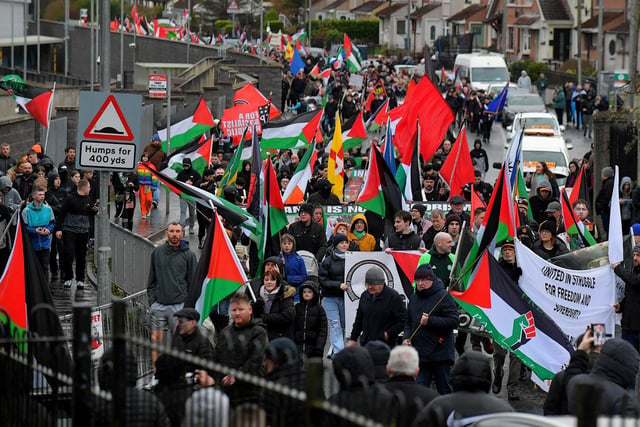
This year a special focus on solidarity with Palestine had been called for by the organisers of the Bloody Sunday massacre commemoration and Palestinian flags mixed with ones of Irish Republican organisations decorated the march route.

The march begins at the Creggan Heights, overlooking Derry, a steep walk up from the Bogside, the city’s centre near the river and winds its way down (with a great view of the Foyle river and surrounding area) but then up Westland Street again and along Marlborough Terrace.

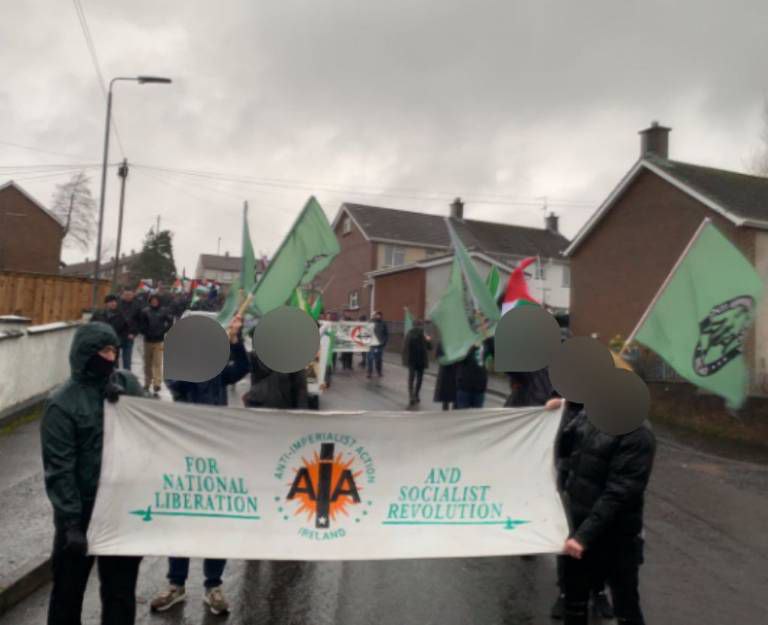
Rear banner of the AIA contingent on the Bloody Sunday commemoration march Sunday. (Photo source: AIA)

For a number of years this commemoration has taken place in heavy rain and high winds, or snow, or sleet but it was dry this year – until the march started! However after a short period of strong gusts driving rain it stopped for the rest of the march.

Down Creggan Road to the Bogside once more and past the Bloody Sunday and H-Block memorials to the rally at Free Derry Corner where Kate Nash, one of the main organisers of the march for years and a sister of one of those murdered in the massacre, welcomed the marchers.

The Bloody Sunday 52nd commemoration march makes it way along Lone Moor Road towards the Brandywell on Sunday afternoon. (Photo: George Sweeney via Derry News.)

RALLY AND SPEAKERS

Nash condemned the punitive EU/ UK/ USA cutting of funds to the UNRWA organisation carrying out relief and educational work in Gaza following an Israeli State intelligence allegation1 and also called for no Irish politicians to attend the annual US Presidential St. Patrick’s Day event.2

Kate Nash’s brother Willie was murdered by the Parachute Regiment during the massacre and her father was wounded by fire while trying to reach his fallen son. Kate called for a minute’s silence for the dead and wounded that day but also for those in Gaza, in particular the children.

Kate Nash also mentioned the Noah Donohoe case as being close to everyone’s heart.

The names of the dead and wounded by the Parachute Regiment were read out by Damian Donaghy,3 son of Damian Donaghy one of the survivors on that day. Paddy Nash performed the civil rights anthem “We Shall Overcome” which was popular among marchers of the time.

Section of the rally to the right as facing Free Derry Corner with a mural based on an iconic photograph from the massacre. (Photo: D.Breatnach)

Kate Nash introduced Huda Ammori, a Manchester-based Palestinian activist and one of the Elbit Eight,4 who said she felt at home in Derry because of the people’s solidarity with Palestine.5 The State in Britain failed to convict all but one of any charges arising out of direct action against the arms company.

Ammori drew parallels between the Irish and Palestinian struggles against colonialism and stated that her grandfather had been assassinated for rising up against the British colonisation of Palestine in 1936, when it was a British “Mandate”.

Mural on a wall in the Bogside, Derry; the words “don Phalaistín” are obscured by a vehicle. (Photo: D.Breatnach)

AIA Short Video with Music Bloody Sunday Derry 2024 AIA Video.MP4 (viewable on FaceBook)

“The British signed away the land of Palestine in 1917,” Amori told the rally, “they colonised our lands and then they armed and trained the Zionist militia to commit a Nakba, to displace over 750,000 Palestinians in 1948, over half the indigenous population.”

Huda Ammori said weapons were used on Palestinians in Gaza and then marketed as ‘battle-tested’. She also praised those who had taken direct action in Derry against arms firms (e.g Raytheon).

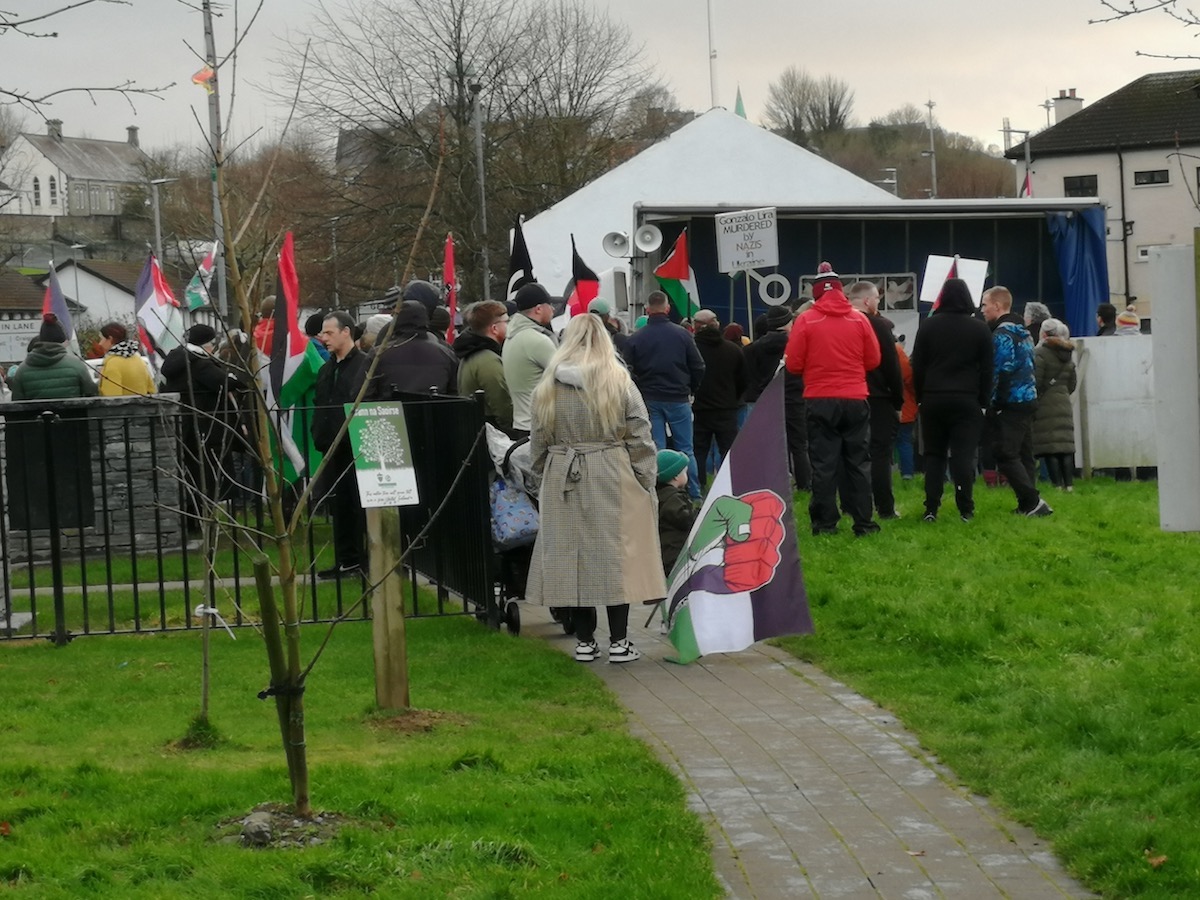
Section of crowd gathering in front of the stage for the rally. (Photo: D.Breatnach)

Geraldine Doherty, niece of Gerard Donaghy, youngest of the Bloody Sunday victims, also spoke from the platform, saying it was ‘sad’ but ‘heartwarming’ to see so many people attending the march.

“More than half a century since British troops committed this massacre on these streets, innocent children like my murdered uncle Gerard and hundreds of others as well are still being denied justice”, she said and denounced the British State attempting to prevent the trial of legacy cases being tried.

Doherty spoke of the remaining “trauma for Derry and for Ireland” from which many families have never recovered, with long-term post-traumatic damage such as depression, addiction and divided families.

“But while the people of Derry were battered and imprisoned, we were never broken,” she said to cheers from the rally participants. “Derry has rediscovered its … voice and we are using that voice to oppose the murder of children and women and men, and we stand with the people of Palestine.”

Section of crowd to the left of the stage at the rally. (Photo: D.Breatnach)

ON THE MARCH

Over the years since I returned to Ireland, I have marched in that commemoration many times, either as an individual or as a member of a solidarity committee and this year was glad to be welcomed as part of the Socialist Republican contingent, with Anti-Imperialist Action.

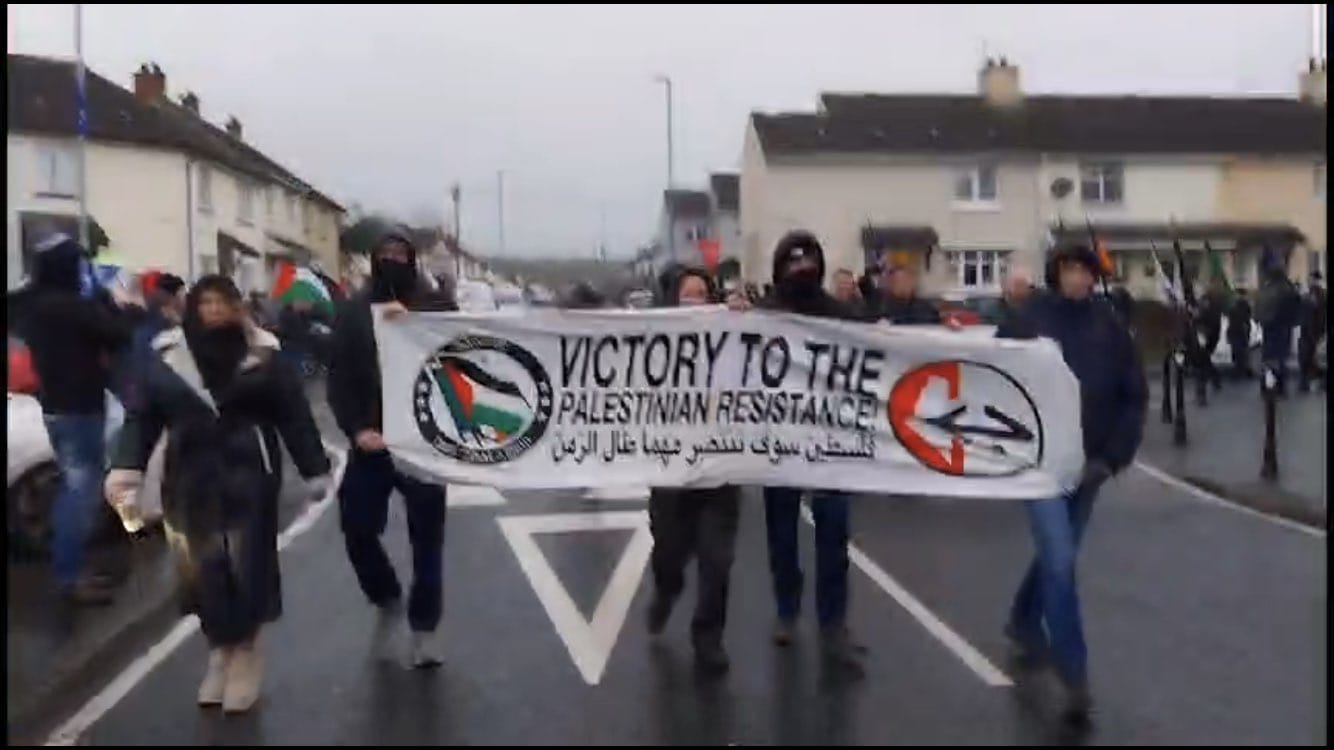
The bloc carried two banners: the one at the front was a new one in which the AIA called for anti-imperialist revolution and socialism, while at the rear the banner celebrated the Palestinian resistance. In between the banners marchers carried flags and placards.

New banner of the AIA in the organisation’s contingent on the march on Sunday. (Photo: D.Breatnach)

In the bloc men and women marched with a flags of the AIA, the Starry Plough, Palestine and Cumann na mBan. From the contingent on many occasions could be heard slogans of solidarity with Palestine and some equally applicable to that nation’s resistance or to Ireland’s.

In the face of occupation – Resistance is an obligation!” and “No justice – No peace!” were in the latter category while “From the River to the Sea – Palestine will be free!”, “Free, free – Palestine!” and “Saoirse don – Phalaistín!” were specifically supporting the Palestinian struggle.

Most Republican organisations and some Irish socialist organisations attend the annual event, along with campaign groups and on occasion solidarity groups from abroad or Irish ones in solidarity with struggles abroad. Sinn Féin no longer attends but some supporters would as individuals.

Giant Palestinian flag displayed below the Derry Walls above the rally below. (Photo: D.Breatnach)

THE MARCH ROUTE AND HISTORY

The Bloody Sunday march covers the same route as the anti-internment march in January 1972 when the British Paratroopers murdered 14 unarmed marchers and injured so many others. Preceded by the Ballymurphy Massacre in August 1971, it was followed by another in Springhill in July ‘72.

The British military claimed that the Derry victims had been armed and fired first and an inquiry tribunal headed by Lord Justice Widgery exonerated the Army and blamed the victims although the Derry Coroner, an ex-British Army officer had called it “sheer unadulterated murder”.

In 1998, presumably as part of the Good Friday Agreement deal, the British State began a new inquiry which however did not deliver a published verdict until 2010,6 stopping short of accusing the Army of murder but exonerating all the victims except one about which it was equivocal.

At that point, Sinn Féin’s Martin McGuinness said that the march should not be continued; however not one British soldier had even been charged, to say nothing of the commanders and Government Ministers who had either given the orders or arranged the cover-up – or both.

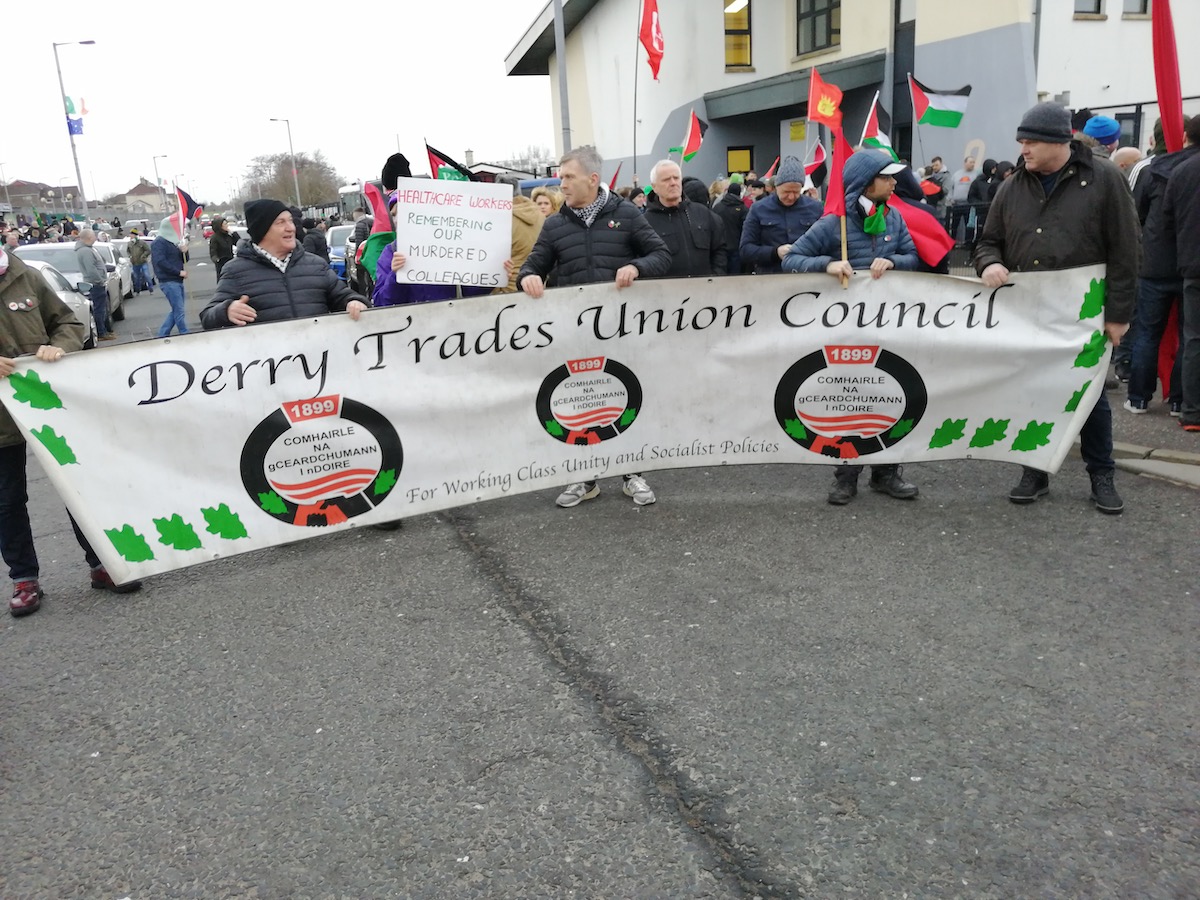
Banner of the organisation combining representation of trade unions in Derry. (Photo: D.Breatnach)

A small group of veterans of the original march and relatives, Kate Nash prominent among them, however decided to keep the march going and have done so every year, often in the face of accusations and disparaging remarks from supporters of Sinn Féin and others.

In 2022, the Massacre’s 50th anniversary, 20,000 marched in it while the Bloody Sunday Trust, an institution and museum supported by the colonial state and Sinn Féin, organised a small “memorial walk” and indoors event in the Guild Hall – the only one reported by the mass media.7

An independent group, badly needed since the Coiste na nIarchimí is controlled by the Provisionals. (Photo: D.Breatnach)
Display below Derry Walls created by the Saoradh Irish Republican organisation, according to their social media. (Photo: D.Breatnach)

Although veterans of the massacre and of the annual commemoration often meet one another only once a year at the commemoration, some having come from abroad, there are always new young people to be seen among them and hundreds come out to watch the march.

The march is an important commemoration of a massacre by British colonialism which still holds the colony of the Six Counties, a reminder no doubt inconvenient to unionists, neo-colonialists and those who have left the struggle, either through lack of will or for personal advancement.

In its championing and giving voice to other conflicts too, the commemoration march and other related events during the week are a strong expression of internationalist solidarity.

Wreath of the Bloody Sunday Commemoration Committee among others at the Bloody Sunday Monument. (Photo source: Bloody Sunday Commemoration Committee)

End.

FOOTNOTES

1The Israeli state intelligence agency reported that 12 out of 13,000 employees of UNRWA in Gaza had been implicated in the 7th October Palestinian raid following which at least some, possibly all, were sacked by UNRWA, apparently without any hearing or appeal process. The US, UK, Germany, Italy followed this up by suspending all funding to the relief organisation catering for 2 million people in dire circumstances. 

2Traditionally, leading politicians of the main Irish political parties, both mainstream and Sinn Féin, have sent representatives to celebrate St. Patrick’s Day with US Presidents, many of whom are of Irish descent. This year a campaign has arisen calling on them not to do so but spokespersons of Fine Gael, Fianna Fáil and Sinn Féin have insisted they will attend, which the SDLP has declared it will not. 

3Not to be confused with the family of Gerard V. Donaghy (20 February 1954 – 30 January 1972), sometimes transcribed as Gerald Donaghey, a native of the Bogside, Derry who was murdered by members of the 1st Battalion, Parachute Regiment on Bloody Sunday.

4Eight activists of British-based Palestine Action, a direct action organisation, who as a result of their actions against the Israeli-based military technology company Elbit in Britain, were charged with a total of 12 charges which included criminal damage, burglary and encouraging criminal damage. The trial, which commenced on November 13th, related to a series of actions taken during the first 6 months of Palestine Action’s existence from July 2020 to January 2021. In December last year, one activist was convicted on one charge by 10-2 majority, two were completely cleared and jury failed to reach a majority verdict on the rest of the charges on six remaining activists.

5That would be true of the majority ‘nationalist’ population of the city but not so much of the unionist minority, where support for Israel is more dominant, due in part to susceptibility to British propaganda and also simply out of sectarian hostility to anything favoured by the ‘nationalist’ community.

6At a cost of nearly £200m (€227.7m), half of which went in legal fees, a lawyer’s bonanza, to arrive at a decision that just about everyone in Ireland knew and many abroad knew already and which established no safeguards against a similar massacre being carried out by British military in future.

7Browser searches throw up report after media report, including Al Jazeera’s, of “hundreds” attending the early event, without a mention of the many THOUSANDS who marched later in the day.

SOURCES

https://www.derryjournal.com/news/people/when-im-in-derry-i-feel-like-i-am-home-palestinian-activist-tells-bloody-sunday-rally-4496030

Elbit Eight trial and verdict: https://www.palestineaction.org/elbit-eight-verdicts/

The Saville Bloody Sunday Inquiry: https://en.wikipedia.org/wiki/Bloody_Sunday_Inquiry

Cost of: https://www.irishexaminer.com/news/arid-30477561.html

BRITISH STATE MURDER OF IRISH CIVILIANS COMMEMORATED IN DERRY

Clive Sulish

(Reading time main text: 6mins.)

Thousands of people gathered on Sunday 29th January in Derry City’s Creggan area and marched through rain and gusts of strong wind in the annual Bloody Sunday March for Justice to Free Derry Corner.

The march commemorates the Derry Bloody Sunday Massacre of the last Sunday in January 1972, when the Parachute Regiment opened fire on unarmed Civil Rights marchers, killing 14 and injuring a great many, claiming the soldiers had only returned fire on paramilitaries.

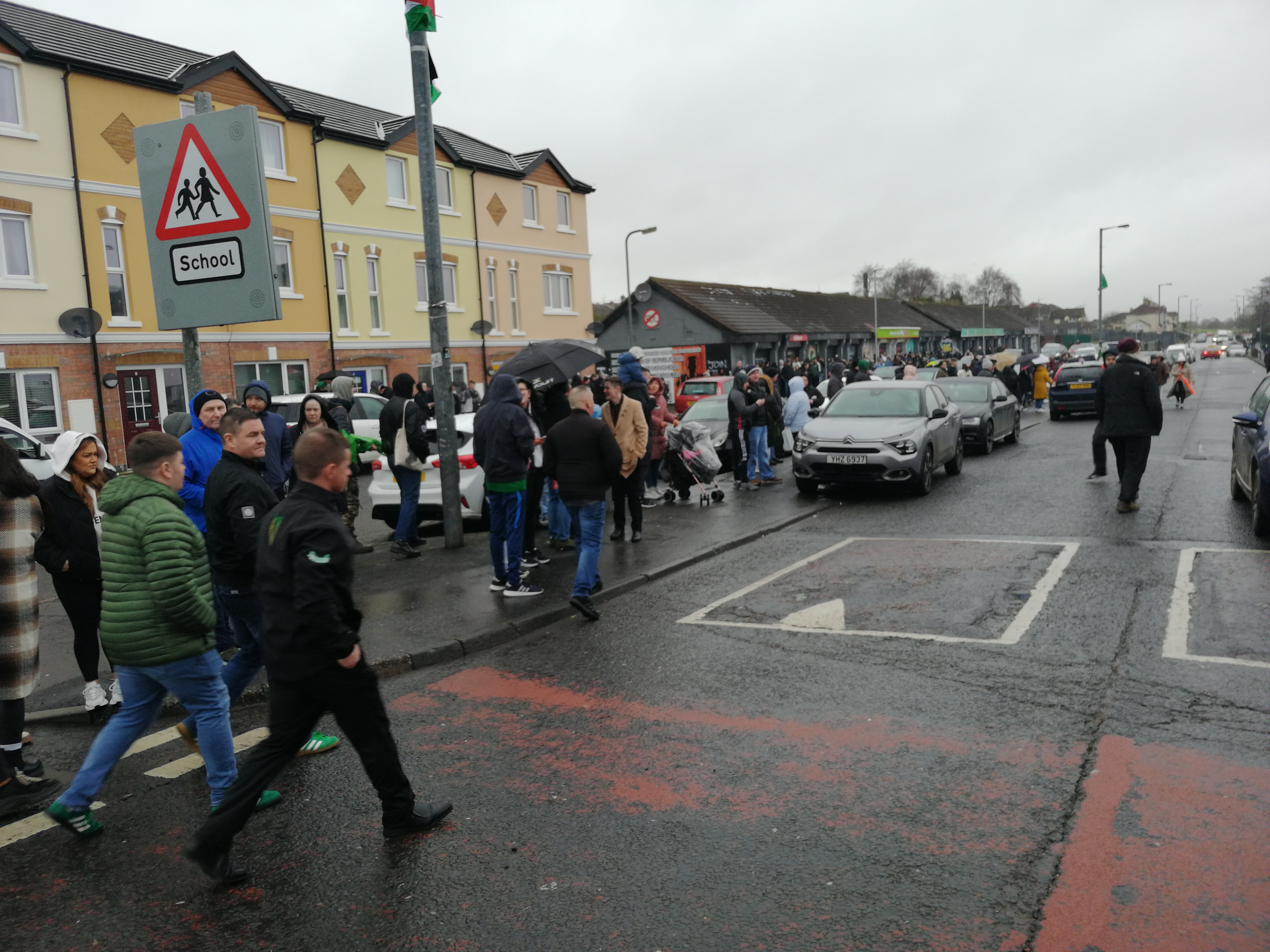
By the Creggan shops, people still arriving, others waiting to march (Photo: D.Breatnach
Other side of the road. (Photo: D.Breatnach)

British Governments for decades stood by those claims, refuted by many hundreds of witnesses to the actual shootings and though the city’s coroner called it “sheer unadulterated murder”, the inquiry under Lord Chief Justice Widgery declared in favour of the Paras’ version.

The 1972 march organised by the Northern Ireland Civil Rights Association had been protesting the introduction of internment without trial in August 19711 and the Paras had already killed 11 unarmed protesting people that month in the Ballymurphy housing estate, Belfast.2

Among the scheduled speakers and organisers in Derry in 1972 had been leading activists of the time, Bernadette Devlin (now McAlliskey) of People’s Democracy3 and Eamon McCann of the Socialist Worker’s Party (now People Before Profit).

The Commemoration this year

Participating organisations this year included Anti-Imperialist Action Ireland, Communist Party Ireland, Éirigí, Irish Republican Socialist Party, Irish Republican Welfare Association, Lasair Dhearg, People Before Profit, Republican Network for Unity, Saoradh, 1916 Societies.

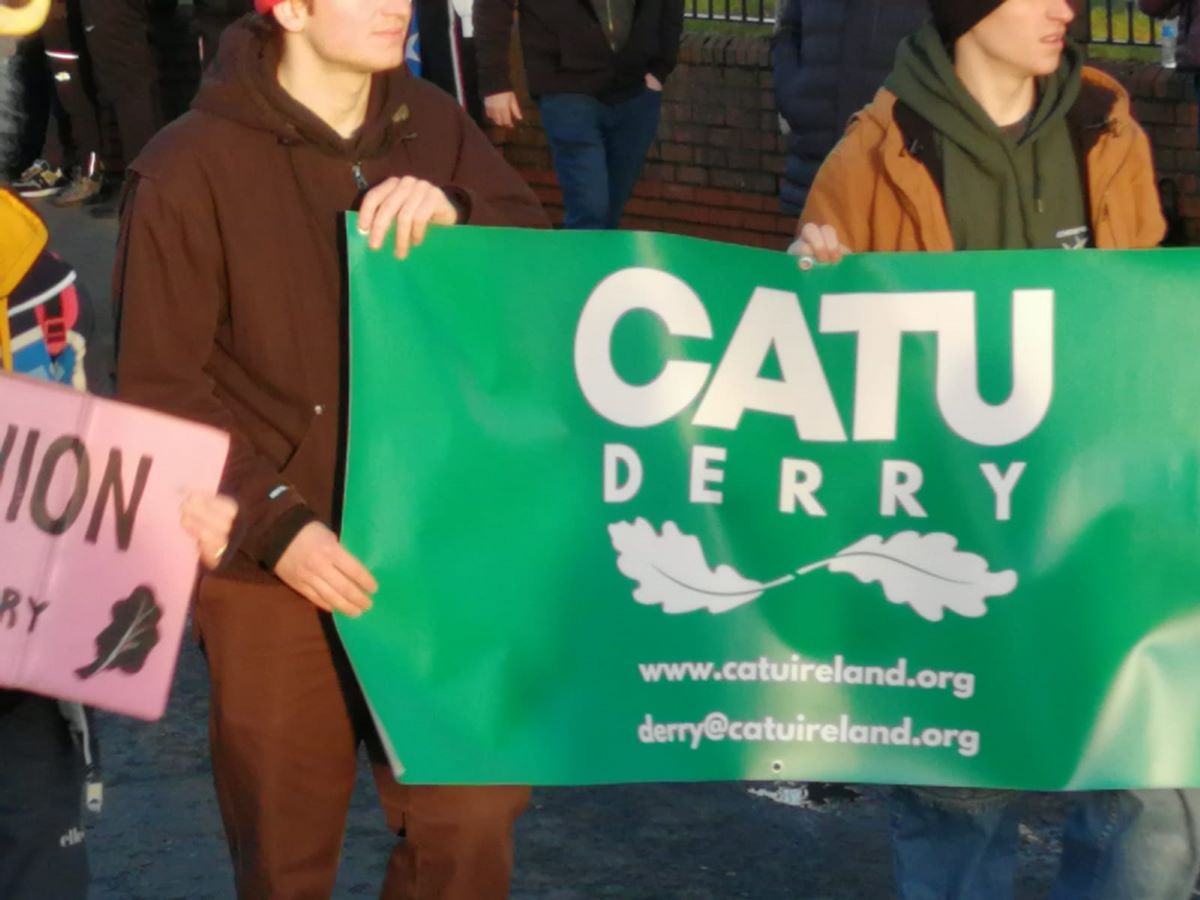
Also marching were an IWW/ Anarchist contingent and a number of campaign groups: Ireland Anti-Internment Campaign, Ballymurphy Justice, Justice for the Craigavon Two, Justice for Manus Deery, with a number of environmental groups were represented also.

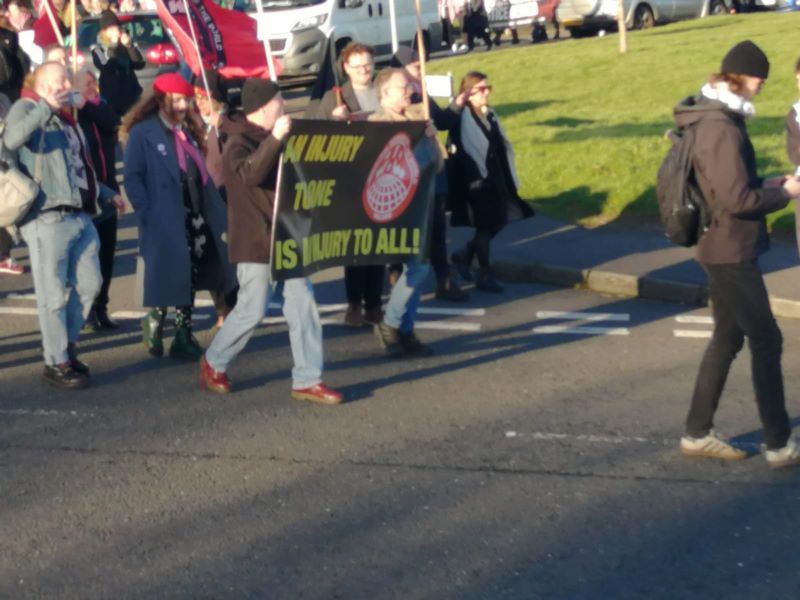
Derry Trades Council and IWW seemed to have the only trade union banner present or flags present.

A broad domestic and internationalist solidarity sweep was evidenced by the poster for the event with the slogan: “An injury to one is an injury to all” and also by the banner of the Derry branch of the Ireland Palestine Solidarity Campaign.

Poster for the 2023 march (Sourced: Internet)

Public support from Britain came with a banner of the Fight Racism/Fight Imperialism periodical and leaflets from Republican Socialist Platform4 were distributed among the marchers also.

Some years can reveal the misfortunes of particular organisations with a much smaller contingent than previously due to drop outs, defections and splits. Equally it has not been unknown for an organisation to draft in people to inflate its numbers specifically for the annual march.

The annual march takes the twisting route of the original one in 1972, covering much of the Derry nationalist housing areas.

Marchers rally at the Creggan heights and march down to the bottom of the hill, then along and up another steep hill, turning right at its top, along and then right down again and, at the bottom, turning right and along to the Free Derry Corner5 monument where speakers address the crowd.

Kate Nash chaired the rally there and Liam Wray, relative of murdered James Ray spoke as did also Ria, niece of John Paul Wooton who, with Brendan, are the Craigavon Two, framed for the killing of a colonial policeman.

The numbers this year were a huge drop from the previous year’s but 2022 was the 50th anniversary of the massacre and the participants are estimated to have numbered well over 10,000, including maybe 10 marching Republican Flute Bands6 from Ireland and Scotland.

Nevertheless the mass media’s coverage of last year’s march varied from minimal to nil.7

Probably4,000 actually marched this year, but perhaps nearly another 1,000 gathered on the roadsides to watch the marchers, greet people they know and so on. Many children are brought by their parents to watch while their older siblings gather and sometimes accompany marchers too.

The day had begun sunny and crisp but by march time the weather had deteriorated to constant rain and gusts of wind and, as the march reached the Lecky Road, to a heavy downpour. It was bad but veteran marchers have experienced worse in previous years, including snow and sleet.

Waiting to begin the march (Photo: D.Breatnach)

Three Derry-based Republican Flute Bands formed part of the march: James Connolly RFB, Kevin Lynch RFB and Tommy Roberts Stevie Mellon RFB, along with the Banna Cuimhneachán Thomáis Uí Chléirigh (Thomas Clarke Memorial RF Band) from Dungannon.

Although in recent years members wear more weather-appropriate uniforms, they still do an amazing job marching and playing in bad and sometimes atrocious weather.

A Deal with the Devil

The Sinn Féin political party, once prominent among the march organisers and speakers at the rally, sought to end the annual march in 2011 and have not supported the event since.8 This was after the British Government publicly apologised for the massacre that same year.

Part of the process leading to that Governmental apology was the setting up of the Saville Tribunal in London in 1998, although it took unexpectedly long to deliver its verdict.9 The Good Friday Agreement was also concluded in 1998, giving the Tribunal the appearance of a concession.

Indeed, the whole has the marks of a deal with the Provisional IRA’s leadership, with the British side saying: “You give up the armed struggle and control your people. We’ll make it easier for you by releasing your prisoners on licence10 and admitting we were wrong in Derry in 1972.

Whether ceasing the annual commemoration was part of the deal or whether that was Sinn Féin’s own leadership’s decision is difficult to guess. It may have suited SF to scale a colonial reminder event down or simply to scratch one big annual event from their organisational calendar.

On the other hand, it has lost Sinn Féin all control of an important historical commemorative event on the Irish Republican calendar and their abstention again at the 50th anniversary march was a massive exposure of their collaborationist position.

The Bloody Sunday Trust also boycotts the march, in the sense that it does not promote it nor record its annual march or other events opposed by Sinn Féin. It does organise and promote its own events during every anniversary but that seems to be as a counter to the march organisers.

The BST of course receives funding and employs a Director and staff for its museum. Nobody pays Kate Nash or other members of the Bloody Sunday Commemoration committee; they rely on public donations and sale of items such as commemorative T-shirts to fund the march11.

A number of relatives of the murdered and injured civilians continue to support the march and are counterered among its organisers, for example Kate Nash, sister of murdered William murdered on Bloody Sunday and daughter of Alex Nash seriously injured by the troops the same day.

The Derry Trades Council and two of the original organisers and speakers support the continuation of the commemorative march as do most Irish Republican and Socialist organisations.

In formation ready to march. Note the presence of female members in the prestigious and ceremonial colour (flags) party, more commonly seen in recent years. (Photo: D.Breatnach)

Derrylondon12 and annual commemorations

Most Irish people call the city “Derry13” from the ancient monastic settlement located there, “Doire Cholmcille”14 but most Unionists and the British officially call it “Londonderry”. Many think the latter do that to annoy but there is a historical basis for it.

Large parcels of land in the city and surrounds were the payoff to the City of London for bankrolling Cromwell and the English Parliament’s campaign in Ireland to crush support for King Charles and the resistance of the Irish clans and Norman-Irish magnates.

Commemoration of the crimes of the oppressor forms an important part of the resistance of the oppressed around the world. Such events say “Our oppressors committed this atrocity here and we remember, will always remember and constantly deny them any legitimacy in occupation.”

If that is so, what gives any liberation organisation the right to call an end to such commemorations? Yet that is what the formerly liberation Sinn Féin did in 2011 after a British Prime Minister apologised in public for the massacre (but as some kind of serious ‘error’).

Some of the guilty – poster for the 2020 march. (Image sourced: Internet)

Not a single Minister or civil servant who organised the Derry or Ballymurphy massacres, nor judge who condoned them, nor officers who ordered them, nor soldiers who carried them out have been even tried, never mind convicted or jailed in the thirteen years elapsed since that ‘apology’.

Derry’s Bloody Sunday will continue to be commemorated at least until British colonialism has left Ireland and probably as long as imperialism continues to exist.

Remembering is part of resistance; commemoration makes it collective.

End.

A plethora of flags in what seems to be the Anarchist and IWW section. (Photo: D.Breatnach)

Head of the march reaches the bottom from Creggan and turns into the Bogside (Photo: George Sweeney in Derry Journal)

FOOTNOTES

1Abandoned on 5 December 1975. During this time a total of 1,981 people were interned for a period without trial, many of them physically assaulted, some grossly beaten and a small number tortured (the “hooded men” whose campaign for justice is yet another example of courage and determination against British State lies, prevarication and delays). 1,874 were from an Irish nationalist background, while 107 were from a unionist background.

2A similar British Army story, “returning fire” and again witnesses’ accounts ignored. The British State has yet to admit the gross inaccuracy of the official account.

3The party grew out of the Civil Rights movement of which it represented a more radical section. It ceased to exist after a few years.

4Previously unknown in Ireland, the RSP claims members in Derry and Belfast and the leaflet states it is part of the Radical Independence Campaign in Scotland.

5The monument in the shape of a gable end of a two-storey house mimics its original inspiration on the blank gable end of a row of houses in 1968 when John Caker Casey or Liam Hillen painted upon it YOU ARE NOW ENTERING FREE DERRY. The Bogside enclave had been barricaded in 1968 to deny the sectarian and brutal colonial police entry and continued to exist as an area from which the police were barred and British troops, even after the official removal of the barricades, entered only in force and at their peril for years afterwards.

6Typically flute players, side and bass drums, led by a colour (flags) party, all in the band uniform.

7Instead the media concentrated on the presence of a small group of Irish Government Minister and politicians of main parties at an earlier event at the monument to the massacre and a cultural event in the Guildhall.

8No doubt some of SF’s supporters in Derry and many more of its voters ignore the party ban and attend nevertheless.

9An almost unbelievable 8 years after a delay of two years before hearings began and £400 million in costs (mostly in fees to law practitioners) even through years when no hearings were being conducted.

10Release on licence meant they could be returned to jail to complete their original sentence at the discretion of the Minister of State for Northern Ireland, without a hearing or entitlement to know the specific reason for that decision. At first only the Provisional’s prisoners signed up to it but were followed by those with allegiance to other Republican groups, along with Loyalist paramilitaries. As they were leaving the jails, a new crop was entering due to new or alleged acts of resistance, rising to 70 between jails in both states and never falling much below 50.

11See Useful Links and References at end.

12Popular Irish balladeer Christy Moore, on a British tour in the 1980s, greeted his London audience by calling the city “Derrylondon” to wild cheering. Shortly afterwards an Irish activist produced Christmas cards displaying London sights in snow, titled “Christmas greetings from Derrylondon”.

13Derry City FC is also the name of the local soccer club which enjoys cross-community support.

14Colmcille’s (“Dove of the Church”, real name possibly Crimthann of the Cenel Connail) Oakwood”.

USEFUL LINKS & REFERENCES

Bloody Sunday Campaign for Justice: (10) Bloody Sunday March | Facebook

Bloody Sunday (1972) – Wikipedia

T-Shirts, free delivery, all proceeds to fund March: Bloody Sunday Derry Campaign (teemill.com)

Craigavon Two Campaign: https://www.facebook.com/mrsmcconville

Justice for Manus Deery: https://www.facebook.com/profile.php?