As news reaches us of wars in various parts of the world it behoves us to try, not only to discern who did what when to whom but to see whether there is an overall pattern behind them. A religious explanation might be that there is much evil loose in the world but that analysis will advance us little.
The fact is that there are powerful imperialist powers ‘loose in the world’ and they are either directly causing these wars or exacerbating them, not because the men and women dominating these powers are evil as such but because they strive to control resources, markets and strategic areas. This striving brings these powers into conflict not only with the interests of millions of people in the respective areas but also into competition with other imperialist powers – and this competition has led to two World Wars and many smaller ones in the last century alone.
In the first of those on a World scale, 1914-1919, Britain (or the UK, if one prefers) went to war with Germany. The Austro-Hungarian Empire lined up with Germany as did the Ottoman Empire. Russia, France, the USA and other powers lined up with Britain. And many other states and colonies and territories got pulled into the conflict.
The British Empire in 1916 excluding territories of influence, for example Latin Amarica, where it was then dominant. Source internet
WHAT WAS THE WAR ABOUT?
It was about many things – and not exactly the same things for each participating state – but basically it was about who would have the lion’s share of the resources of the less-developed world, in particular Africa and who would control the markets for selling those resources and also the industrial goods produced in the “home countries”. And, in order to control those things, which power would control strategic areas in the world – which included ports for navies and forts along certain overland trade routes and coasts.
What brings other countries and territories in?
Smaller players join with great powers for a share of the spoils or have been bound to them by treaties – perhaps they were themselves brought to heel in earlier times by the power to which they are now joined. Colonies and “dependent” territories contributed huge numbers of people on both sides, either recruited in preference to poverty, by war-excitement or by misleading propaganda that their sacrifice would buy their freedom or greater autonomy after the war.
Germany was defeated eventually and the French and British imposed a punitive surrender condition on them, allowing them to plunder Germany’s industrial Ruhr Valley. This injured national pride so much that Hitler was able to use it to whip up an aggressive German nationalism which facilitated another war, 1939-1945.
THE SECOND WORLD WAR
This war also pulled in allies, colonies and other territories. But what was the war actually about? Essentially the same things: which power would control the markets for selling those resources and also the industrial goods produced in the “home countries”. And, in order to control those things, which power would control strategic areas in the world.
The German industrial and financial ruling class, which supported Hitler, was not going for war out of injured pride – they wanted to control the oilfields and land to the east and Middle East and to knock out their main competitors in world domination – once again, the British and French but also now the USA, which had been a much smaller player in WWI. By now Holland and Belgium were mostly small fry and Imperial Russia had, along with a number of other countries, become the USSR. Fascist Italy and Imperial Japan were prominent players with their own objectives but joined with Nazi Germany.
Map on which one can see the encirclement of Russia: Turkey in NATO, Ukraine is hostile to Russia, Georgia tried to break away, Afghanistan is occupied, Pakistan is hostile, Syria is embattled, Iran awaits. (source Internet)
WAR IN THE MIDDLE EAST TODAY
Nowadays, the USA strides the world as almost unchallenged superpower, supported enthusiastically by a reduced UK and with varying degrees of enthusiasm by its other allies in the EU and elsewhere across the world. Only one challenger on the world power level exists, which is Russia, now a capitalist country, certainly with colonial and no doubt with imperialist ambitions.
The USA (with the assistance of its allies) seeks to surround Russia with regimes allied to itself. Not so long ago, this was impossible in the Middle East, where a number of strong regimes were opposed to US domination: Iraq, Libya, Syria and Iran. The US and allies have succeeded in knocking out the first two of these and the third is fighting to defend itself from multi-pronged attacks. If Syria falls, Iran will be next and then, from the Middle East, Russia will be totally blocked. So of course, Russia decides not to wait for that to happen and gives military aid to the Syrian regime.
THE FUTURE?
The struggle for world domination is being played out in other areas of the world too, of course but this is the most intense area at the moment and the Israeli Zionist v. Palestinian struggle also plays a part in it.
It is difficult to look too far ahead in order to predict the various local and overall world outcomes. However, from the history of empires in general it seems inevitable that at some point the power of the USA must wane.
There are a number of contradictions besetting the USA but one of its potentially most disastrous is its external debt. In the typical pattern of imperialist capitalism, the financial capital of the USA has merged inextricably with industrial and military capital, leading to the description of “the US military-financial-industrial complex”. That in itself does not perhaps make the USA too vulnerable but its borrowing abroad to sustain this complex does: according to a number of sources on the Internet the foreign debt of the USA is nearly 18 trillion dollars: $17,910,859,000,000.
Well, we may think, the USA is an enormous country with huge resources and controlling huge amounts of resources around the world. Yes, it is – but that debt keeps growing. And the interest payments on it are huge – so huge that each year they are not repaid in total and are added to the debt.
Of course, if creditors were to call in the debts and the US financial system collapsed, the creditors would end up with very little in terms of repayment. That leaves the USA safe for the moment but each year it becomes more vulnerable. 32.5% of the total foreign debt is held by China and that huge country may at some time in the future find it in its interest to bring the USA down or to use that finance to pressure greater penetration into US markets (above the current level which US manufacturers are already complaining about). At the moment, President Trump is talking about getting the USA’s foreign creditors to accept lower interest repayments. He may or may not get his way but for the US, it is a bad sign.
USA national debt 2016 (source Internet)
The domestic debt of the US is over $12 trillion and 47% of that is foreign-owned too.
The USA’s economy is in many ways a military one. It needs wars – not just to fight itself but by its proxies. Since WW2 alone, it has been involved in 24 offensive military conflicts, from Korea to Syria. Without wars, how can the USA justify its military expenditure? And without that expenditure, what happens to the military-financial-industrial complex?
For the continuing extraction of resources, the USA needs compliant regimes – compliant with US needs, that is. Inevitably this results in support for dictators or regimes who are massively corrupt and who get armed to the teeth by the USA and repress their own populations, resulting in poverty, torture and violation of human rights. It also results in resistance, in popular movements which at times turn to armed struggle. Overall, the US, which seeks stability for its extraction of natural resources, creates massive INstability in the world.
THE MEANING FOR US
So what does all this mean to us? Firstly, that we should oppose imperialism. The question of “how” is a different one but the objective is unavoidable. Secondly, that to talk of achieving “peace” without eliminating imperialism is at best an indulgence in wishful thinking, at worst a cruel duping of people. Any kind of “peace” deal without the removal of imperialism is at best a temporary one only.
Peace with imperialism (sourced on Internet)
As for “peace processes” in areas of strong popular resistance, where ironically we often see major representative of imperialism enthusiastically engaged, since they never remove the central reasons behind the conflict, those processes merely buy a short-term stability for imperialism and capitalism to continue, more or less as before. For that reason, “pacification” is a much more correct term than “peace process”. The effect of pacification processes on the imperialist, colonialist and capitalist systems is often undramatic, not so the scale of their detrimental effect on the movements of popular resistance – but that’s another topic.
Diarmuid Breatnach — part of Submission to the Minister’s Moore Street Consultative Group
I have had input to a number of submissions to the Minister’s Moore Street Consultative Group and recently sent in my own personal one. The submission is divided into sections and this is the one dealing with the market (the others will be published at intervals).
DUBLIN’S HISTORIC STREET MARKET
Historically, the Moore Street quarter deserves preserving in its own right and should have been so. Instead, it has been both neglected and preyed upon. But so has the street market.
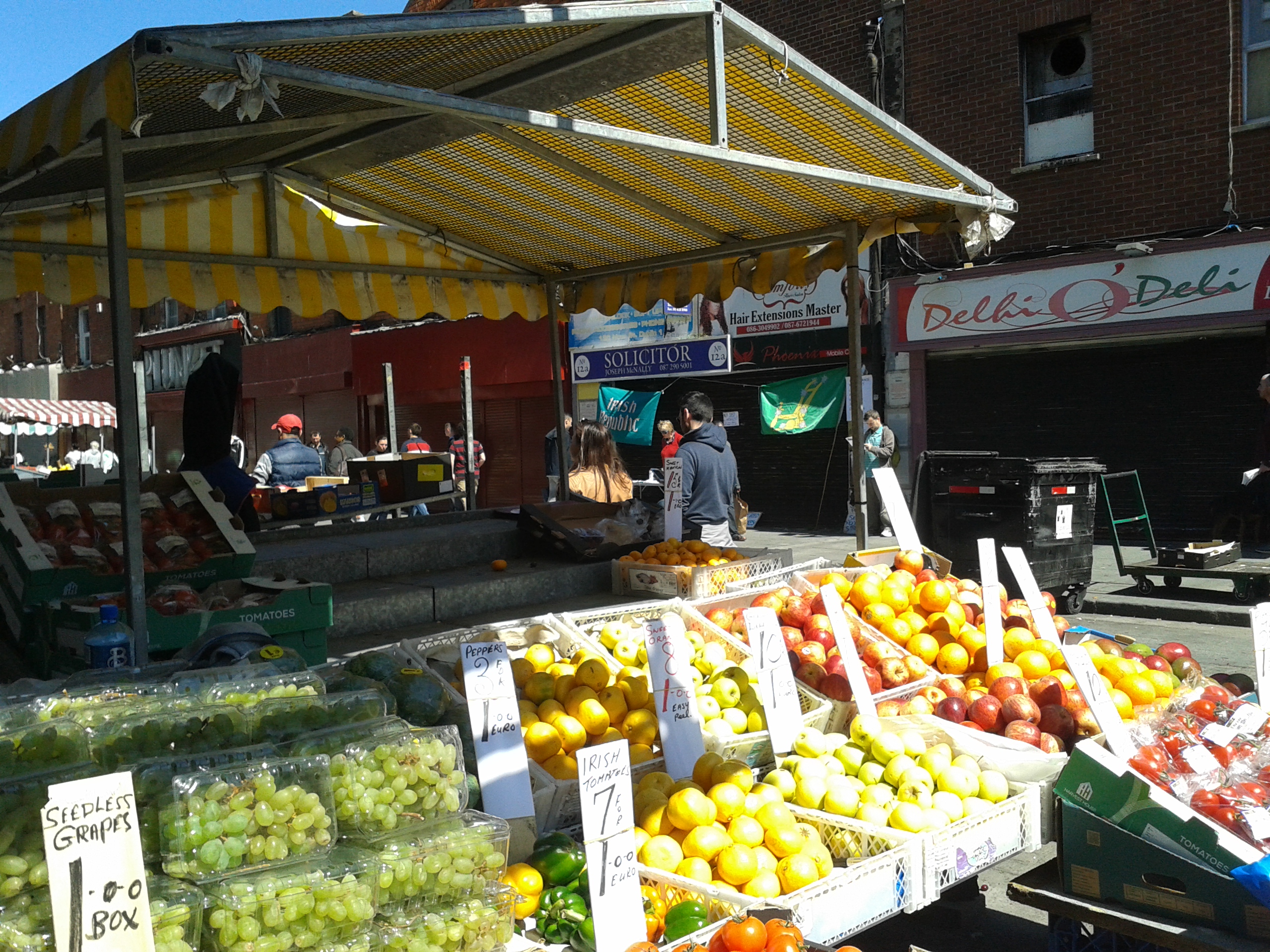
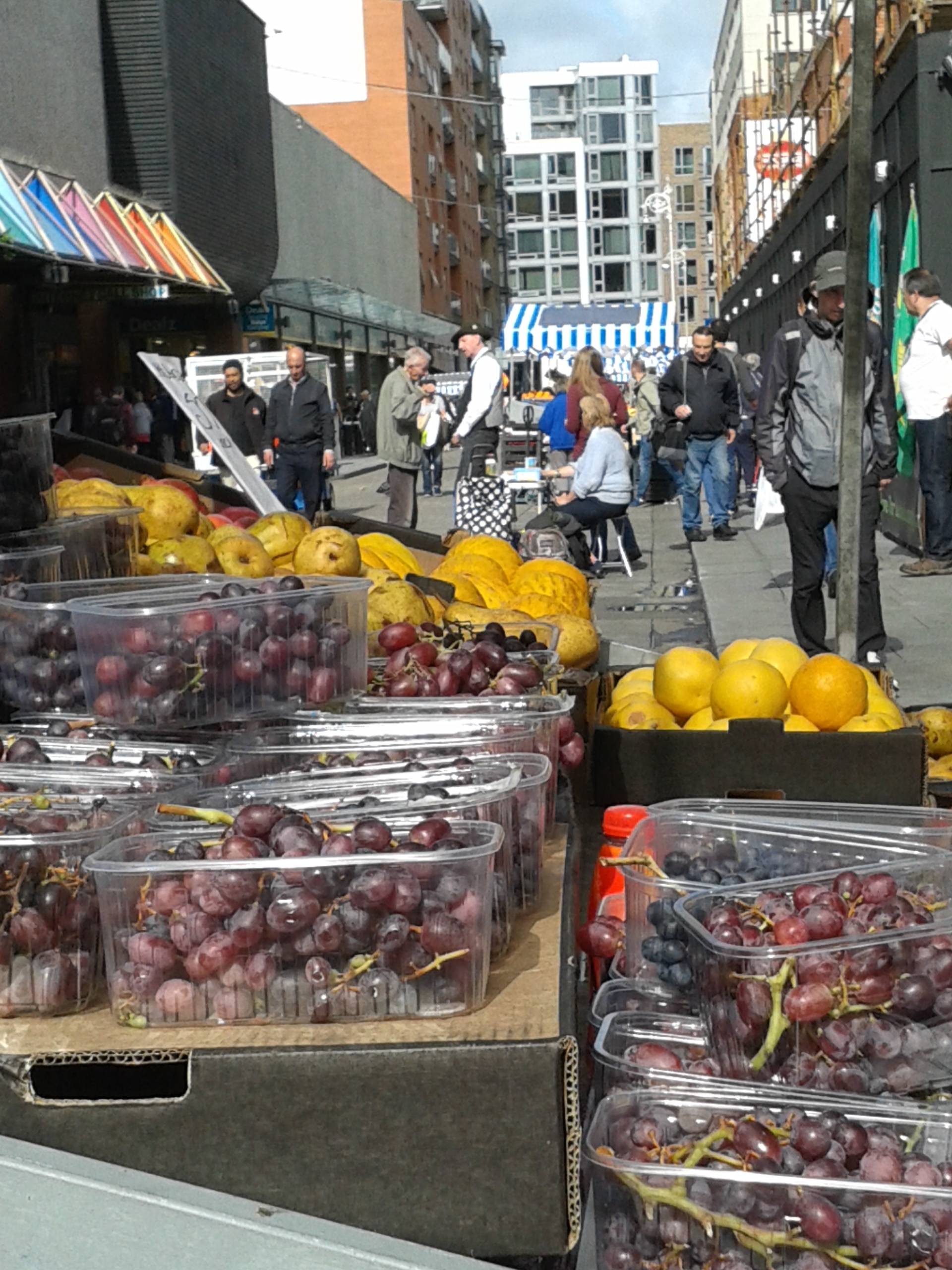
View across fruit stall showing hoarding on the right (In August, before hoarding also erected on the left) and SMSFD campaign stall in the distance. (source: D.Breatnach)Moore Street, perhaps 1960s or 1970s, from perhaps the roof or upper floor of the GPO building (Source: Internet)
As the only traditional food street market of antiquity remaining in Dublin, considering also its iconic status to not only Dubliners but migrants through the centuries and to visitors from the countryside, the street market should also have been saved. Such features in cities abroad are promoted for tourists, and indeed both Fáilte Ireland and Tourism Ireland do promote the market to visitors to Dublin. One can see the bemusement of the faces on many as they wander through in groups and imagine their thoughts (or overhear their expression):
“This is the famous street market? Are we sure we haven’t taken a wrong turning?”
It is easy to understand their confusion. Had they come a half-century ago, before the ILAC was built, they would have seen a bustling street, with stalls and shops both sides of the road along its length, and some businesses in side streets. Two decades ago, they would have found no difficulty in imagining the market’s former glory, for much of it remained still. Even a decade ago, perhaps, enough remained to imagine it.
People signing the Save Moore Street From Demolition campaign petition in Moore Street with the new hoarding for the ILAC’s latest extension in the background. (Photo: D.Breatnach)
But now? With shops closed and ugly hoardings squeezing the street? With big business shops pushing out in Moore Street? With independent shopkeepers offered only one-year leases at a time and pushed out willy-nilly? With only 15 street trading licences in operation and only some of those on the street at any one time?
The street market is not beyond saving and I will devote some space to that issue but first let us examine how it has come to this, for overcoming those causes is part of the solution.
THE GUILTY
In a Rogues’ Gallery of those guilty for bringing about this state of affairs, first in line must stand the Planning Department of Dublin City Council, which has made the decisions about what could be built and what demolished.
I know not how much money was placed into how many brown envelopes nor the names of all those who received them (though I have a fair idea of the identities of some of the recipients), nor what other favours were dispensed. But what is clear is that there was massive favour given to big business and speculators, the legendary Gombeen Men, and massive disfavour to street traders, small independent businesses, workers and working class residents. This of course has happened in many other areas of Dublin City and County and indeed elsewhere in Ireland. But one of the most concentrated areas of abuse has been the Moore Street area. And it continues to suffer that abuse.
Part view of LIDL supermarket and junction of O’Rahilly Parade and Moore St. Most of the market stalls begin from just past the dark blue hoarding at the right of photo. (source: Trip Advisor)
Who, wanting to conserve a street market, would allow a giant supermarket chain outlet at one end of the street and another next door, in a city centre already abundantly served (if that is the word) by supermarkets? Who, wanting to conserve such a street market, would grant planning permission to huge shopping centre buildings to cover the entire area on each side of that remaining street market? Who, in good stewardship of our city centre, would grant a huge extension on a bad planning permission when the original one of a decade was running out with no work of any significance having been done on it to that point? And what public servants would so callously and nonchalantly ignore the wishes expressed by its citizens and, indeed of late, by the majority of their elected representatives?
Roques map of the Moore Street quarter showing the streets lost under the present ILAC (source: Internet)
Since no other motivations are apparent, one is entitled to assume either idiocy or rapacious greed; since the men involved on both sides of those arrangements are not idiots in the normal sense, that leaves an intelligent observer with only one alternative. And ask most ordinary people in Dublin and they will freely name the alternative, the real motivation.
One of the Asian exotic fruit and vegetable shops in the street (one was evicted recently to make way for the ILAC extension). (source: D.Breatnach)
Next into that rogues’ gallery must step the Department of Dublin City Council responsible for Street Trading – it is they that issue the street trading licenses to the street traders, lay down conditions and enforce restrictions, and in conjunction with other departments, provide their facilities.
Yes, well – facilities? One covered stall, open on all sides. No heating. No lighting other than the dim amount in the street. No water supply near to stalls. No toilets or changing rooms for the traders. Year after year, despite promises to the contrary, these disgraceful conditions continue. Some of the current traders are the fourth generation of their family in such work but is it any wonder that few stall-holders believe their children or grandchildren will follow them into the work?
As if that were not enough, around the time the Moore Street campaign was heating up further, when Chartered Land was gearing up to make its ‘land-swap’ offer, a deal promoted by the head of the Planning Department and lauded by Minister for Heritage Heather Humphreys, Dublin City Council put not one but two permanent Market Inspectors on the street (at that time I think there were only 16 street licenses in operation there). Previously, one inspector would tour the market perhaps once or twice a day, for an hour at most.
What was the practical need for bumping up to this relatively high level of inspection? These inspectors have no powers other than instructing the shops and traders about street and pavement regulations and fining them for non-compliance. They do not attend to any other matters. They do not even claim to monitor the quality of the produce sold in the street.
There is no reasonable answer to this question, unless the purpose is to harass the small shopkeepers and traders further, in the way that unscrupulous landlords harass their tenants when they want to get rid of them but find it difficult to do so legally.
I do not accuse the individual inspectors of having that intention – only those who conceived of the idea and put them on that street. But employ two men on a street which they can clearly see often contains only ten stalls, tell them they have to enforce the street trading rules or their jobs will be in jeopardy — and what will they do? Urged by employment insecurity and sheer boredom, they will go up and down the street, criticising traders and even shopkeepers for extending some inches outside their allotted space (though there are many empty metres to each side and their neighbours are not complaining), or for continuing to sell some minutes after official closing time, threatening and even fining those trying to make a living with legitimate businesses and stalls on that street.
One might almost suspect that between speculators, big chain businesses and certain Dublin City Council officials, there is a conspiracy to run the street market into the ground, in order to make the whole a rasa tabula, a board wiped clean, upon which powerful financial interests can write their plans. Or an eyesore that few will bother to defend. And I say that such a conspiracy exists. Generally in this world, what looks like, feels like and smells like is indeed the substance one suspects.
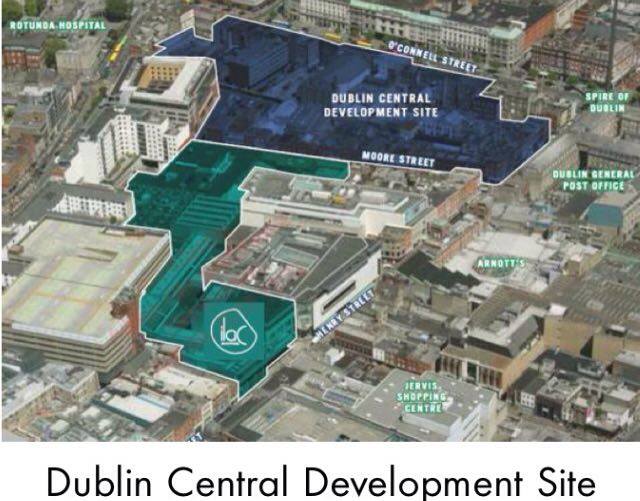
Drawing showing how the proposed shopping centre (dark blue) and the current ILAC light green are taking over the quarter and squeezing the Moore St. market. (source: Internet)
The Moore Street Market should be cherished, nurtured and supported. Perhaps it is too late to do anything about those already in existence around it but no more supermarkets should be permitted in its near proximity.
The street traders should be given decent working conditions of shelter, heating and light and free from unnecessary official interference (not to say harassment). Small independent businesses should be encouraged in the street and in its surroundings (more on this later). The objective should be to promote a healthy, vigorous, colourful street food market on the spot where such has stood for centuries, with attractive working and earning-a-living conditions for those who work and shop there.
CONCRETE RECOMMENDATIONS
I am not a street trader but I have sold and promoted items publicly on many occasions and I also know something of the conditions in Moore Street, which I attend at least once week and usually a number of other days too.
When the weather is fine it is pleasant to have an open-air market but when it rains, snows or cold winds blow, shelter is desirable. The only way to be able to benefit from good weather and shelter from the bad is to provide a removable cover over the whole. I am sure that our present level of technology can provide a retractable, transparent roof.
Because the winds can be biting and also to conserve heat in winter, I suggest that sliding doors at each end to of the market should be provided – these can be left open or partially drawn as required.
Each stall should have adequate lighting and heating at hand (or foot!). A water supply should be available nearby no more than a few feet distance from every stall.
Toilets should be provided for traders.
There should be more flexibility in what the traders can sell, without losing the focus on a food market. During the 1916 Centenary year, traders were prevented by market inspectors from selling simple 1916 memorabilia – scarves, copies of the proclamation, flags etc. Such a prohibition in Moore Street was particularly ironic and unfortunate.
The refuse collected in the street should be verifiably recycled, the vegetable and fruit refuse in particular making excellent compost for city gardeners (and perhaps for a garden in the quarter itself).
The market traders do not work on Sundays and this seems an excellent opportunity to provide a farmers’ market in the street and lanes, bringing more value to the area.
The part of Moore Street largely omitted from the Barrett judgement, i.e from the Henry Place/ Moore St. junction to Henry Street, should be included in the overall plan
All of the above should be done in consultation with representation from workers, traders, small shopkeepers, shoppers of Moore Street and with local residents and the process should be transparent and publicly accountable
Some of the few surviving fruit stalls on Moore Street, half-way down the main stall street, east side, looking northwards; standing by, Angela, one of the long-time street traders. (source: D.Breatnach)
Flower stalls at the north end of Moore Street (source: D.Breatnach)
Yes we do – or at least most of us do. There are a few who do not.
Some people think that those few who do not want change are our rulers, the big capitalists — but they are mistaken. The capitalist class forced change to overthrow the feudal system, which was hampering their growth and the development of industry and commerce. And capitalists know that change is inevitable, so it is better to go with it than to try to stop it. That is why they set up courses such as those called “Change Management” — if change is inevitable, then manage it, the thinking goes. Manage it so that it comes out to capitalist advantage, naturally.
(Source Internet, using “change management” as search words)
Change Management courses, particularly those dealing with personnel, emphasise managing change as smoothly as possible, making it non-traumatic. In that way, it is assumed, there will be less reaction against the change, less opposition.
But in fact, sometimes capitalism wants the exact opposite – it wants change to be as traumatic as possible. These are the situations described under the title “Shock Doctrine” by economic/ environmental activist and theorist Naomi Klein (2007). This has two mechanisms: in the first, the shocking change taking place disarms people from the psychological ability to organise resistance; in the second, the speed of the shock (or shocks) of the economic and political manoeuvres of the capitalists moves faster than the opposition can organise, achieving their goals before opposition can coordinate an effective resistance.
Klein has described how huge natural disasters such as earthquake (Haiti), tsunami (Thailand, Indonesia) and flood (New Orleans, USA) are used to force foreign or native private takeovers of sectors of the national economy while the people and the regime in power are reeling under the impact of the disaster.
Political and economic disasters are also used in this model, such as the military coup in Chile and the collapse of the USSR (in the case of Poland), the economic collapse in Bolivia, the invasion of Iraq, the financial collapse of the “Tiger economies” of SE Asia. Even a potentially beneficial change of great magnitude may be used, such as the collapse of white minority rule in South Africa, during which the black majority won formal equality and citizenship but lost control of most of the economy (and lost a lot more which I do not intend to discuss here).
There is in fact a military precursor to this which has been called, in the context of US military strategy, “Shock and Awe”. This doctrine was described by its authors, Harlan K. Ullman and James P. Wade (1996), as “attempting to impose this overwhelming level of Shock and Awe against an adversary on an immediate or sufficiently timely basis to paralyze its will to carry on … [to] seize control of the environment and paralyze or so overload an adversary’s perceptions and understanding of events that the enemy would be incapable of resistance at the tactical and strategic levels”.
Of course there were many elements of this in the Blitzkrieg of the Nazi German army in its invasions of other countries and even the medieval invasions by the Huns and of the Mongols. Cromwell employed elements of it in Ireland in his army’s massacres at Wexford and Drogheda.
Aside from needing change to overcome feudalism, managing change to its advantage and use of shock doctrine to facilitate changes it wants, the capitalist system itself promotes change as part of its system. Small capitalists combine and form conglomerates, in which big capitalists come to power and, in turn, eat up smaller capitalists in order to dominate their sphere of economic activity. We have seen the growth of supermarkets and the decline of small shops, the rise of chain stores killing independent clothes shops, chain cafes and eateries driving indpendent cafes and restaurants out of business.
Capitalists also promote inventions and discoveries so as to increase their wealth but also in order to stay in front of the competition – a capitalist concern that stays at its original level will be taken over or driven out of business by its competitors. Our grandparents hardly knew about the possibility of mobile phones and computers, let alone small hand-held audio-visual connections to the Internet; our children today play with visual electronic games, films and music before they learn to talk. To be sure, monopolies also suppress inventions but they can only do so to an extent as some capitalist somewhere will break the embargo or consensus (if the discovery can be used to make sufficient profits making the attempt worth the risk).
OK, but we want change too and, we think, what we want is not the capitalist kind of change we’ve been talking about until now, although innovations and discoveries should continue and in fact accelerate – but for the benefit of the people, not the capitalists. Technological advances and innovations that do not make big profits may nevertheless be very valuable to us for all kinds of reasons.
So, yes, we want change. But what kind of change? Change to what? Change how? There a vast panorama opens.
We want to eliminate homelessness; have an efficient universally affordable health service; not to have to struggle for a decent standard of living in food, housing and small luxuries; to enjoy universal and affordable access to education at all levels; not to harm the environment; to have the positive aspects of our cultural inheritance, including history, valued and promoted. We want equal rights and respect between people regardless of race or ethnicity, gender, sexuality, ability … and freedom of choice.
In 1930s Germany, people wanted those things too, except that a lot of people were convinced that the contents of the last sentence above were harmful and not what they wanted. But there were many, many people who did want those contents too. The issue was in doubt for awhile.
In the 1928 elections the Nazi Party achieved just 12 seats (2.6% of the vote) in the Reichstag (German Parliament) and in three areas the Nazi Party failed to gain even 1% of the vote. In the Presidential elections of March 1929, the Nazi candidate Erich Ludendorff gained only 1.1% of votes cast, and was the only candidate to poll fewer than a million votes.
We know that elections are not everything – but still.
Five years later, the Nazis were in power — but even after the Communist Party was declared illegal their candidates polled a million votes.
The people definitely wanted change and the established ‘democratic’ parties were unable or unwilling to deliver it. The change the people ended up with was not probably what most had imagined and for some time it spelt disaster for Germany – and unbelievable suffering for large parts of the rest of the world … and also for millions of German citizens.
To look closer to home, people wanted change here too and from 1917 onwards they showed that electorally by voting for the newly-reorganised Sinn Féin party. From 1919 a significant section of the populace took to arms to pursue change and had the active or tacit support of a huge part of the population. But in 1921 the movement and the people split about what kind of change they wanted. A civil war followed with a heavy level of brutality against civilians and combatants, particularly by the State side, which won the contest — and we ended up with the State we now have.
Bombardment of Republican-held Four Courts in Dublin by Free State forces from the bottom of Winetavern Street (with British artillery on loan) starts the Civil War on 28 June 1922 (Source image: Internet)
It is well to be fairly clear about the change we want and what we do not want. There was no such general clarity in the ranks of those fighting for change from 1916 to 1921. It turned out that many who were fighting for change were fighting for different things.
Differences must have come up over the years of struggle and we know from some evidence that they did. We also must assume from the political nature of prominent people in the struggle that there were differences. Even within the IRB itself, only one of the organisations involved, there were differences that surfaced in attitude to the 1913 Lockout, the control of the Volunteers in 1914 and the Treaty of 1922.
Of course, we need maximum unity against the principal enemy. But that is unity in action only. If we put unity in thought, principles or political or social program first, as some organisations have and some others claim to do, we end up with small organisations unable to effectively counter the resistance of the ruling class to the change we want and, in the end, unable to overcome that resistance. On the other hand, if we sacrifice everything to unity against the enemy, we leave ourselves hostages to events in the future and to what kind of society will emerge from the struggle.
Somewhere between those two is where we need to be, preserving the freedom to discuss, explore and proclaim differences of opinion and social program, while avoiding unnecessary squabbles and maintaining unity in action. It is a difficult balance to strike but it needs to be done. In the midst of fighting the common enemy and striving for unity in action against it, we must fight for that freedom also inside the resistance movement, the freedom to discuss, explore and yes, also to criticise.
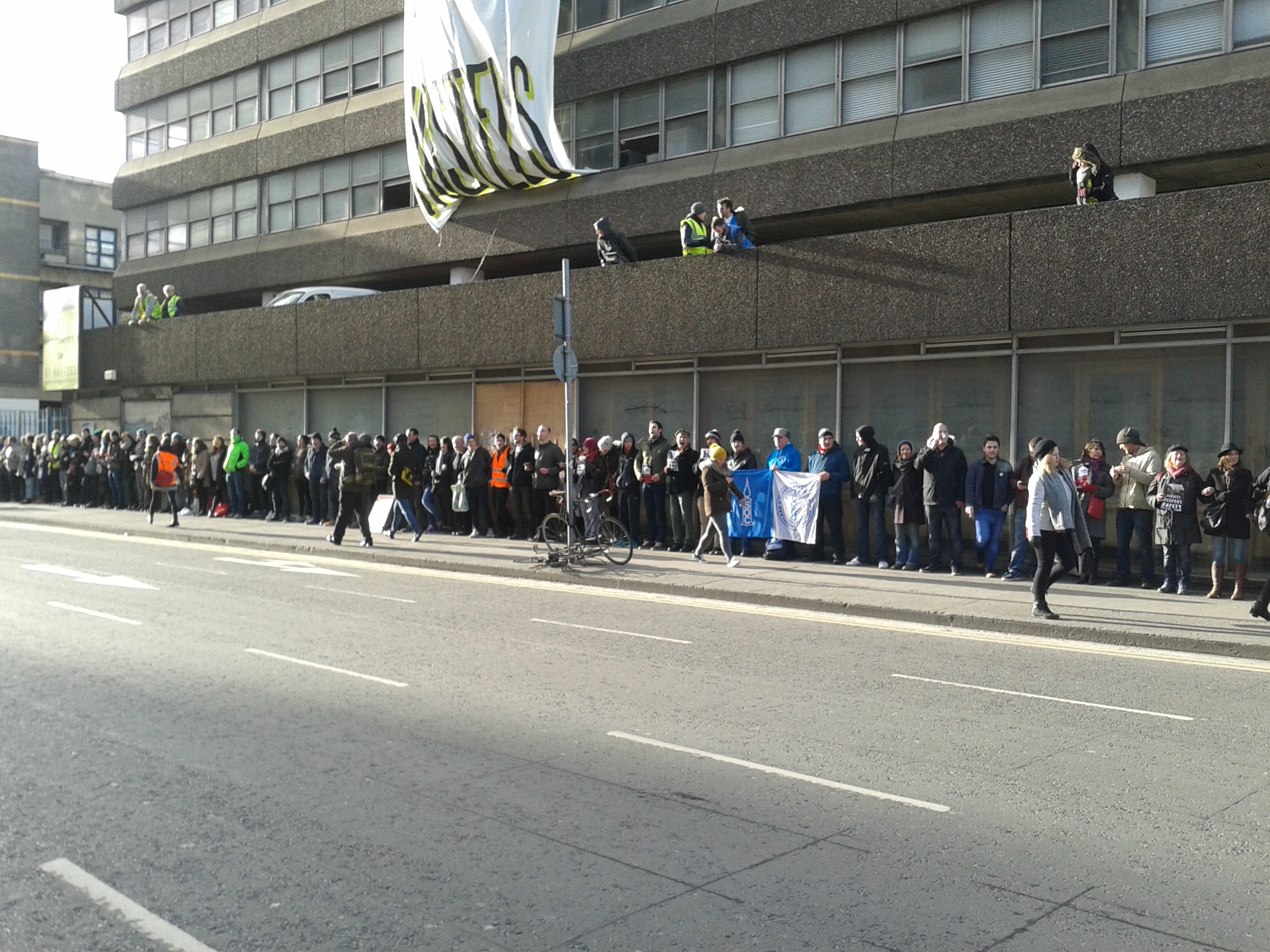
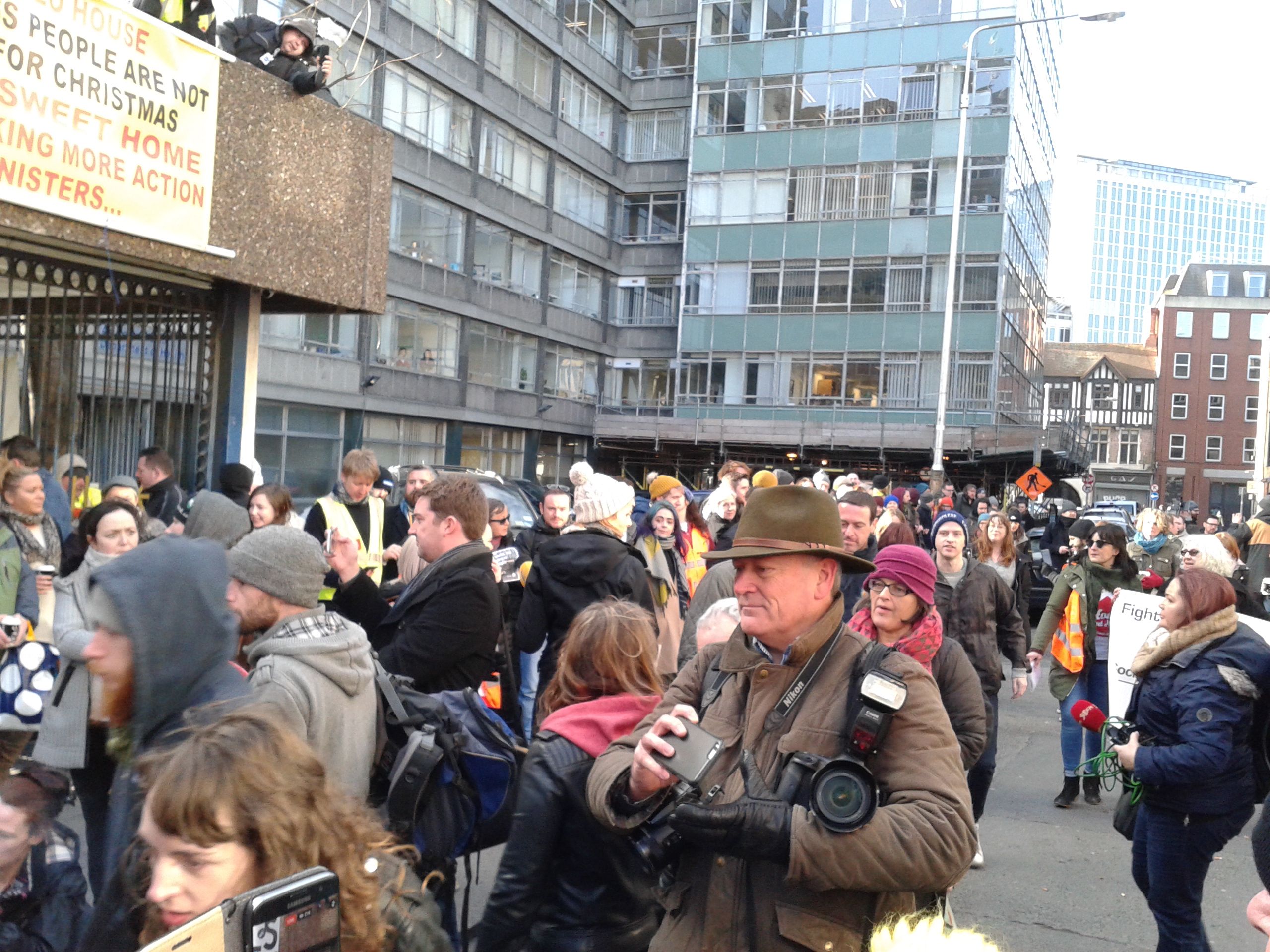
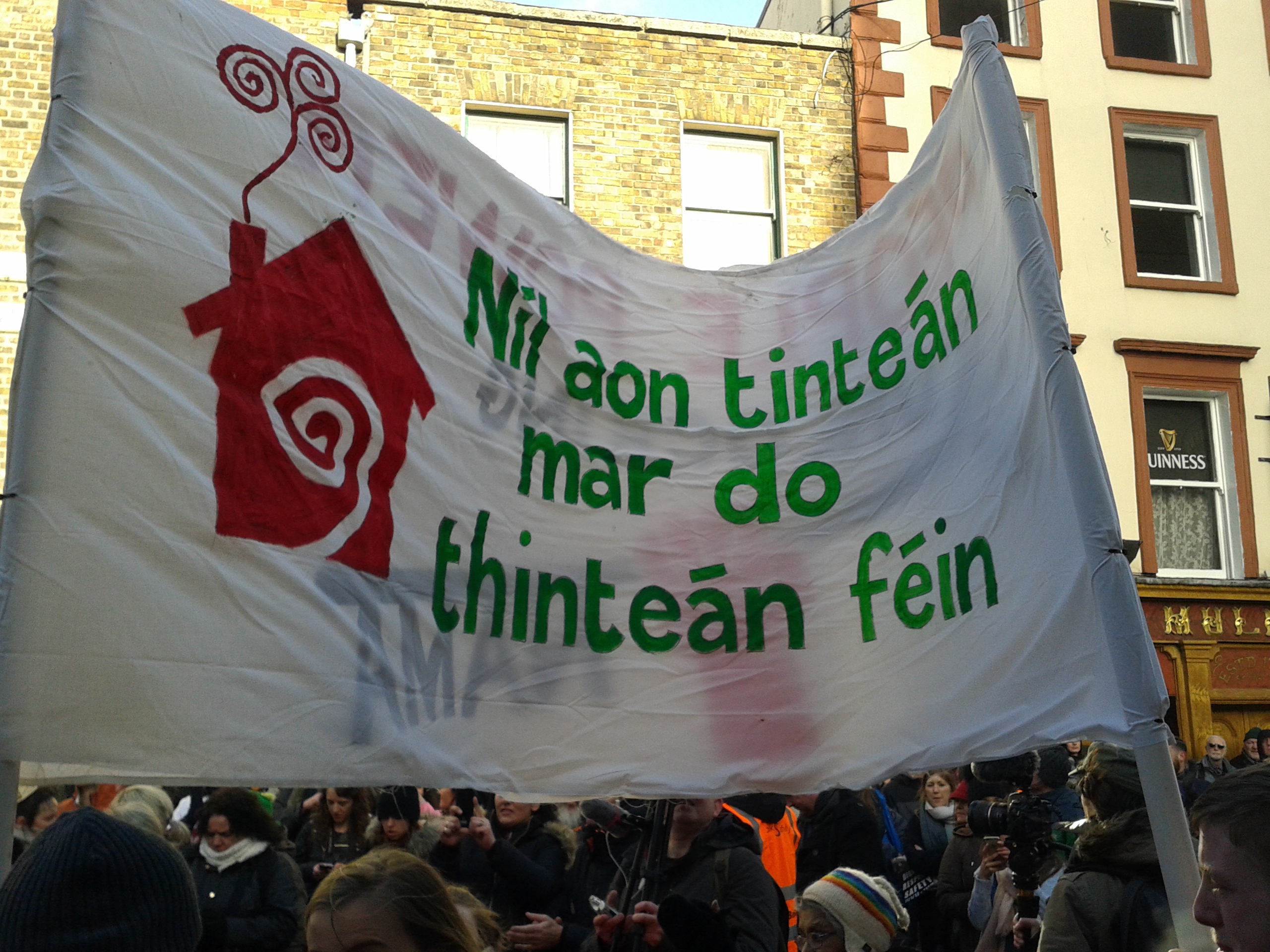
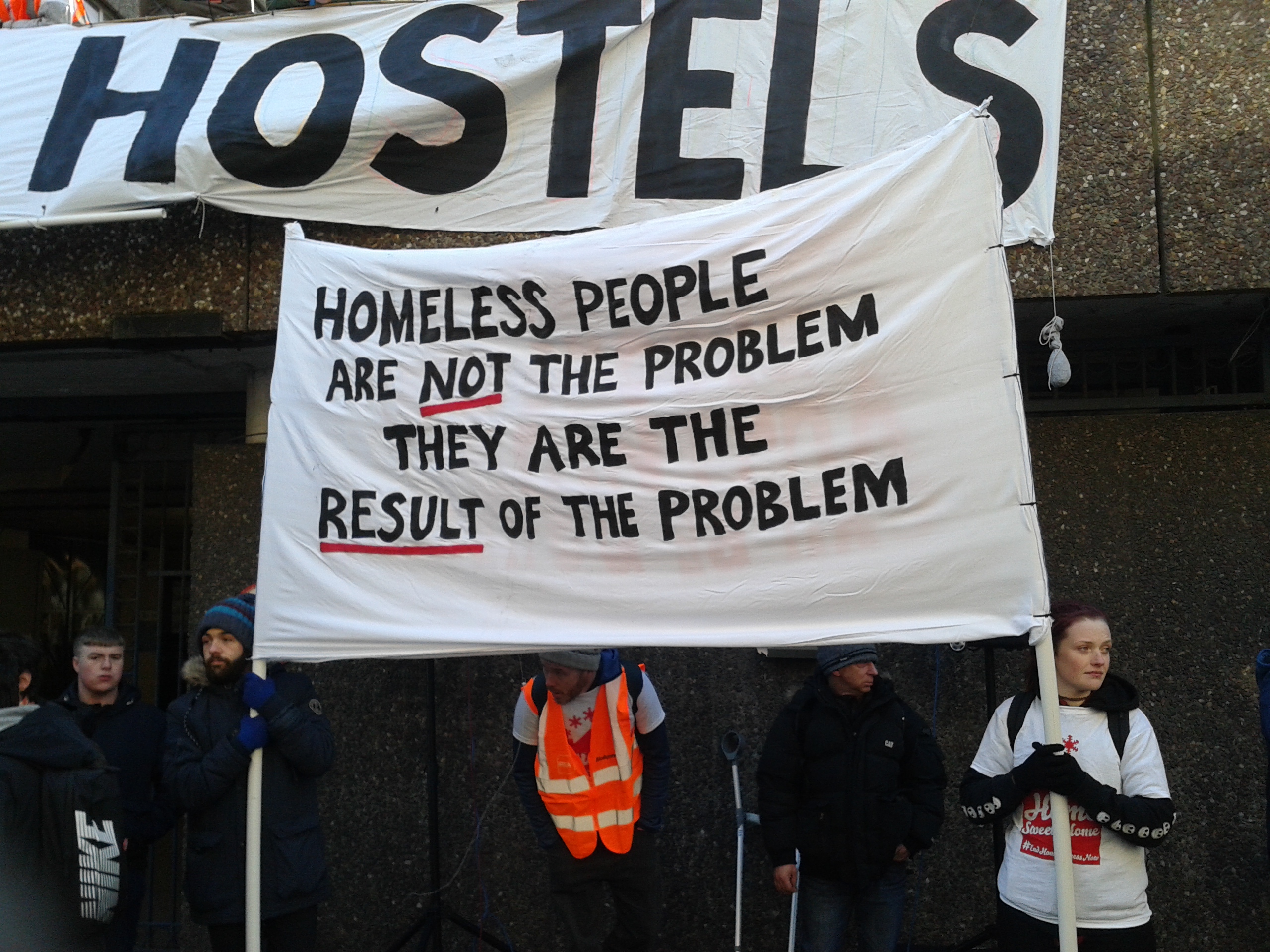
HUNDREDS ATTENDED AT APOLLO HOUSE in bitter cold from late morning today to indicate their support for the homeless people and housing activists in occupation of the building. At the same time, a court refused to extend the
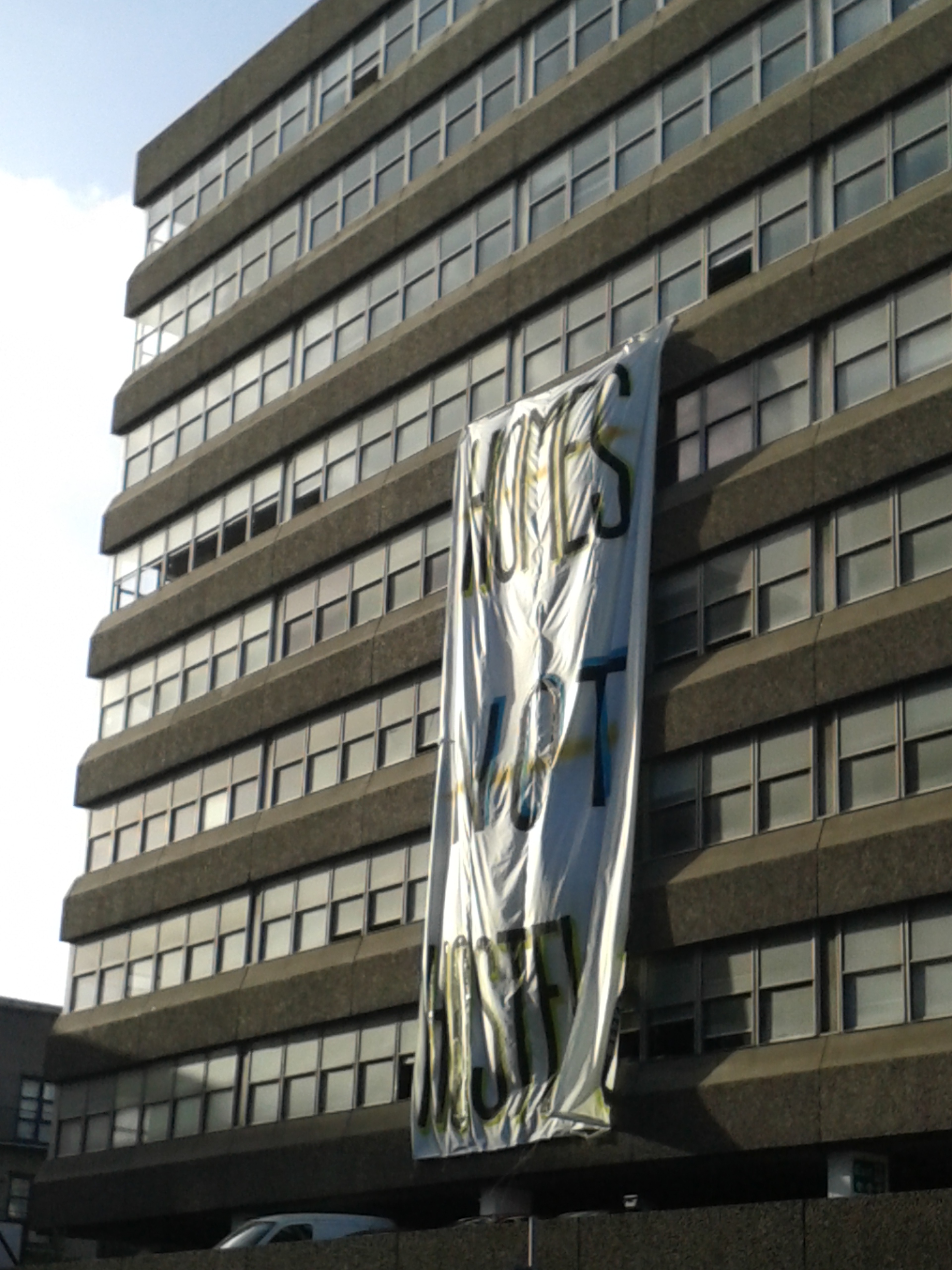
Closer view of “Homes Not Hostels” banner on Tara Street side of occupied Apollo House (Photo: D.Breatnach)
deadline by which it has ordered the occupiers to leave.
Banner suspended from the Tara Street side of Apollo House (Photo: D.Breatnach)
While they were there, representatives were attending court seeking an extension on the deadline given by a court order to leave the building by noon today.
Housing activist Rosie Leonard told the crowd that the alternative accommodation some Apollo House homeless people had been offered was totally unsuitable and that some were houses for people with addiction issues and that there were even bloodstains on the walls. They had asked for an extension as the State had not provided alternative accommodation but this had been refused.
In response, people cried “Shame!” and “We shall not be moved!”
Supporters linking arms around Apollo House from Townsend St, through Tara St to Poolbeg St. (Photo: D.Breatnach)
People were asked to link arms symbolically around the building, which many did and the line extended from Townsend Street/ Tara St. and the full length of Poolbeg Street.
PEOPLE QUEUE TO SIGN UP TO ACTIVELY SUPPORT
Shortly afterwards, announcements were made asking people willing to support the continued occupation to give their names to organisers and queues of people formed giving their names and phone numbers to put on a list.
People linked arms symbolically protecting Apollo House occupiers from Townsend St, through Tara St and here seen to western end of Poolbeg St. (Photo: D.Breatnach)
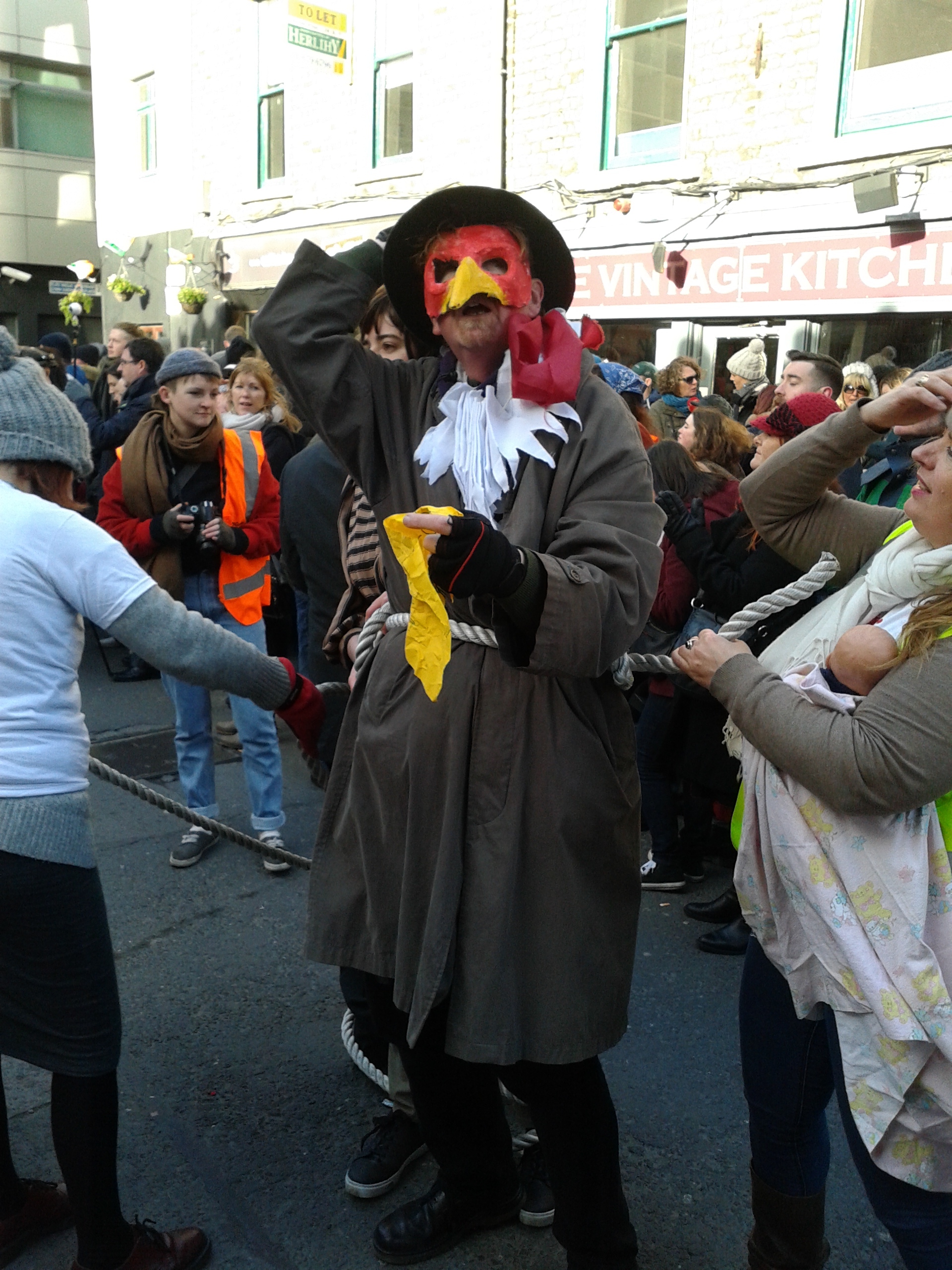
Speakers addressed the crowd at intervals and musicians, singers and percussionists also performed for the crowd. A group including a Vulture Capitalist, Banker and Woman & Child being evicted also performed for the crowd.
Chants included: What do we want? Homes not hostels!
Also: Is a doorway a bed?
No! Is a mattress a bed?
No!
Since December 15th, the Home Sweet Home coalition of activists and homeless people has been occupying this building which state agency NAMA had repossessed from a property developer with unrepayable debts. The group is calling for NAMA to use the properties it has taken control of to house the homeless.
Rosie Leonard relaying court decision to cries of “Shame1” and chants of “We shall not be moved!”Percussionist, Guitarist, Acitivist (Photo: D.Breatnach)Vulture Capitalist (Photo: D.Breatnach) (Photo: D.Breatnach) (Photo: D.Breatnach)
A generation is passing. Actually they have been passing for some time, the generation of the fighting years of the late 1960s, the 1970s, the 1980s and even the 1990s.
They campaigned variously for social housing; civil rights north and south; for human rights; against Church domination; against Unionist sectarianism; for free access to contraception; for right to divorce; for an end to censorship; for national self-determination; for Gaeltacht civil rights; for Irish language rights and Irish on TV; in support of political prisoners; the rights of women; for Irish Traveller rights; protection of heritage and environment; solidarity with many struggles around the world, including Cuba, Vietnam, Rhodesia, South Africa, Chile, the Black Panthers; against drug dealers; for freedom to choose lifestyle; decriminalisation of gay and lesbian life; for community projects in deprived areas including youthwork and, let’s not forget, organised, fought in and supported strikes.
That generation fought many battles, some of which they won and some which built bases for later battles and their story is told only in bits and pieces here and there. They organised, marched, sat in, occupied, wrote, made placards, painted slogans, put up posters and some fired guns; they were watched, raided, beaten, fined, jailed, calumnied, sacked, expelled, kept unemployed, derided from pulpit, press and judge’s bench, some were shot, and not just they but their families made to suffer too.
I am not referring to people of any specific age but of all those who were any age from young to old and active during those years. The causes of death have been many, from simple old age and life lived out to the death penalty.
But the death penalty was not in force in Ireland in the 1960s, you may think? Actually it was, it wasn’t abolished until 1990 in this state. But you’d be kind of correct as in practice no formal execution has been carried out by this state since 1954.
So, then what am I talking about? Maybe referring to the ‘United Kingdom’, since six counties of Ireland are included in that state? Yes, and no. The death sentence still exists in the UK only for “Arson in Her Majesty’s shipyards” but it was abolished in Britain for the crime of murder in 1965 and, in fact, no-one had been formally executed there from the year before. If the judicial death penalty had still been in force, the people in charge of that state might’ve been been spared the embarrassment of seeing nearly a score of Irish people they had wrongly convicted in 1974 walk free decades later as judges eventually had to find them ‘Not Guilty’.
A bit late for Giuseppe Conlon, against whom there had not even been a shred of doubtful evidence, but never mind. But had they all died in prison or been executed, people might not have worked so hard to see their convictions in court overturned – people among whom Joe Kelly, who died this week and who was cremated on Saturday, stands tall.
But the death penalty was not removed from the judges’ arsenal in that bastion of reaction, Six Counties state, until 1973, when the 30 Years’ War had entered its early years (somebody from the British state clearly had to sit down with the Unionist bigots and explain, although of course they sympathised with their loyal brethren, how bad it would be for Britain and the Queen if they started sentencing and executing IRA and INLA fighters).
There are more ways to skin a cat …. yes, and to kill too. The orange and SAS and MRF death squads killed more against whom there was not even a court conviction. And some of the Republicans killed one another too. And twelve died on hunger strike, one each in 1974 and in ’76 and ten in 1981. Actually, considering the brutality of force-feeding, it’s surprising there weren’t more deaths – Marian and Dolours Price were force-fed 167 times over 203 days in 1973 and it was the publicity around their case and the deaths of Gaughan and Stagg that ended the practice of force-feeding, ensuring that the Hunger Strikers of 1980 and ’81 at least did not have to endure that experience.
But there are more ways to kill …. Many of that generation of fighters died from ‘natural’ causes but died early – cancers, heart attacks, liver damage, despair ….. ah, yes, that brings to mind suicide, of which some also died. But despair also can drive you to drink, even more easily if it has been part of your experience of socialising and alcohol is one of the top killers in the world. And some died of drugs …. or drugs and alcohol …. or infections from unsafe drug injection …. But most who died early did so in summary from the wear and tear of struggle, of prison, of separation, of relationship breakdowns, of betrayal, despair.
Not all died, even those who are not among the fighters today. Some walked away from the struggle and though I can’t imagine being in their shoes, I do not begrudge them. So long as they didn’t betray any on their way out or make a living out of spitting on their former comrades and causes afterwards. But some, a very few, did exactly that and you can read what they have to say quite often in their articles or hear them quoted in the newspapers or on TV or radio.
Some found other ways to betray and did it in secret, feeding information to their handlers and some even diverting attention from themselves by accusing others, some innocent and some of a lesser grade of betrayal than that of the accusers. We know of some of them but may never learn about them all.
Joe Kelly
Poster displayed at memorial in Teacher’s Club (photo accessed from a Facebook posting)
A few have survived and are still around, fighting the struggle, whether in organisations or as independents. Joe Kelly was one in both categories, in a sense. I knew him but did not know him well and met him only in the last decade, after I had returned from decades living and working in London. I am given to understand that he had passed through a number of political organisations, including Fianna Fáil and the Labour Party. A strange CV, one might think, for a radical left-wing social and political activist. The last political group with which I had associated Joe was People Before Profit, on a local level, around Phibsboro. Joe invited me to attend a quiz they were running and I did so mainly to return a favour – he had attended, to contribute to the singing at my invitation, an evening of the Clé Club where I had been “Fear a’Tí” for that night. I was amazed to win a Blackberry at the quiz (sorry, Joe, I still haven’t gotten around to learning and using it!). Last I heard, he wasn’t with the PBP.
Somebody told me years back that he had been a central organiser of a solidarity event in Dublin for the Birmingham Six in which lights had been floated down the Liffey. Of course I was impressed – on a political/ human rights level but also for the poetic vision involved. I have found little about that event since and Joe, who I found a modest man, didn’t give me much in response to my pressing. A couple of searches on the Internet yielded me only a passing reference to the River Parade, of 1990, a year before the Birmingham Six were finally cleared in court and released. Likely I have not been asking the right people or looking in the right corners.
I met Joe by arrangement for a coffee a couple of times, while I tried to get him into something I was doing and he tried to get me into something he was working at – neither of us succeeding in our efforts to recruit the other. Since Joe was working for awhile in the community sector I also approached him to explore possibilities for me when, despite a long track record in the fields of working in homeless shelters and addiction as well as other community activism I was out of work, but he wasn’t able to help me.
And of course I bumped into him on demonstrations, as in those in solidarity with Palestine or against the Water Tax or against the Lisbon Treaty. For awhile we were active together in the Dublin branch of the Ireland Palestine Solidarity Committee and I believe he left like me after witnessing some nasty in-fighting years ago, though we both often turned up to protest pickets and demonstrations and public meetings called by the organisation. We would also meet at events in solidarity with the Cuban people.
I heard him described at his funeral service, by someone who should know, as a Republican. Certainly Joe was very proud of his father and uncle who had both fought in the 1916 Rising, the first in the GPO and the second in Bolands’ Mill and proudly displayed his father’s medal at a public event in the Teachers’ Club in Dublin.
Joe Kelly displaying and talking about his father’s 1916 service medal at a 1916 commemoration event (photo: D.Breatnach)
However, he was among the number that I invited but failed to get to events over the last decade to highlight the plight of Irish Republicans being hounded by the State and imprisoned without trial. That did puzzle me, for I knew Joe to have a track record of fighting for human rights. And this was shown not only in his campaigning for the Birmingham Six.
Joe fought for the rights of divorce and choice of abortion, as well for the right to freedom from partner abuse, in particular through the movement for women’s refuges, what many people still refer to as “battered wives hostels”. He was active in the campaign for the right to gay marriage, so amazingly successful in Ireland. And Joe was also active in campaigns against racism towards migrants.
“Conas atú tú?” or “Dia dhuit”, Joe would invariably greet me whenever we met. I would not call him exactly fluent but he could understand and speak Irish. I suppose I assumed he had some affection for the language and was also paying me, a known native speaker, the courtesy of addressing me in Irish and speaking awhile in the language. At his funeral service, I learned it went further than that. I heard his grandchildren say that he frequently spoke to them in Irish and when they did not understand him, would translate what the words meant. Some people in the audience chuckled to hear this. I felt sad and somewhat angry too, that a question so important to our cultural identity, an aspect so threatened today, should be treated so apparently lightly by some and that the only words to be spoken at his funeral service in Irish were those in the final sentence spoken by his brother, Jim, in his eulogy: “Slán leat, Joe”. In the booklet produced for the occasion and freely available at Club na Múinteoirí, there was however one dedication in Irish (and I have since learned that one of the speeches at the Teacher’s Club was in Irish) and I note that both grandchildren who spoke bear Irish-language names.
Paying respects and memorial service
On Saturday, laid out in the lovely Room 2 in the Teacher’s Club (sin Club na Múinteoirí, Joe) in Dublin’s Parnell Square, a venue often used for social, cultural and political events, in a closed wicker basket coffin, Joe received his visitors. And they were MANY. Feminists, Palestine solidarity activists, Cuba solidarity activists, community activists, independent political activists and a sprinkling of activists in various parties all attended and many contributed their memories or words dedicated to him while he was laid out there. (I took many photos here and some at Mount Jerome but somehow seem to have lost them all).
Attending first another funeral (of another singer) that morning in Howth, then travelling into Dublin to take part in the Moore Street Awareness weekly table, I had to miss some of that. I spelled a comrade while he attended to pay his respects, then attended later while he took over back at the table.
Room No. 2 was still packed but so was the whole bar lounge area. I had missed all the eulogies and reminiscences and even singing – “The Foggy Dew” I was told. Had anyone sung “The Parting Glass”, I asked. No, apparently not. So then to ask his sister if it would be alright to do it, then the MC, his long-time collaborator, comrade and friend, Brendan Young. It would be welcome, I was told. And Fergus Russell (also his second funeral that day) and I did three verses together, using a mic so it might carry through to the lounge and, though we took turns at fluffing a line, not too badly. It is a great song for such occasions and each verse was particularly appropriate to Joe.1
A little later, the Internationale was sung by all (copies of the words of a verse and the chorus distributed beforehand), the wicker coffin (I must have one of those when my time comes!) was lifted on to shoulders by family and friends and brought through the respectful lines while Joe’s daughter sang The Night They Brought Old Dixie Down.2
Then the hearse came out and led the cortege to Mount Jerome cemetery. I didn’t know the protocol regarding cycling in a funeral cortege but followed anyway, managing to get temporarily lost on the way and arriving just as the hearse arrived at the cemetery. Again, the chapel was packed.
The ceremony was non-religious and officiated by Therese Caherty, ex-partner and friend. In turn Therese herself, his brother, his bereaved current partner, relatives and his comrade and friend Brendan Young all gave their moving eulogies and often funny anecdotes. Brendan emphasised that for Joe, the process of the conduct of a struggle was as important as the end to be reached, which I knew to be true from our time together in the Dublin IPSC and I’d be in agreement with Joe on that.
There were, despite the many I did see during those events, some faces I did not see in the congregation or at the Club na Múinteoirí before the service or later, when many returned to the Club to free sandwiches and soup laid on by the management there. It was their loss.
I never saw him dance but am told he loved it and taught his grandchildren not only to sing but to dance too. I did know he’d learned to tango. He’s left this dance floor now and gone on to another and whatever “one steps and two steps and the divil knows what new steps”3 they are dancing there, I’m sure Joe is learning them and probably teaching a few of his own.
Slán leat, Joe – árdaigh iad!
A chríoch.
FOOTNOTES
1 “Of all the money that e’er I had, I spent it in good company
And all the harm that e’er I’ve done, alas, it was to none but me
And all I’ve done for want of wit to memory now I can’t recall
So fill to me the parting glass, good night and joy be with you all
“If I had money enough to spend and leisure time to sit awhile
There is a fair maid in this town, that sorely has my heart beguiled
Her rosy cheeks and ruby lips I own, she has my heart enthralled
So fill to me the parting glass, good night and joy be with you all
“Of all the comrades that e’er I’ve had, they are sorry for my going away
And all the sweethearts that e’er I’ve had,
they would wish me one more day to stay
But since it falls unto my lot that I should rise and you should not
I’ll gently rise and I’ll softly call good night and joy be with you all”
2 This song of nostalgia for the American Confederacy has a haunting melody but its ideology is often ignored by those who sing it.
One often hears it said that we need more unity, that “unity is strength” and on the other side the despairing wail (and sometimes facile sneer) that “the Left (or Republicans) are too disunited to do anything”. But rarely does one see the question analysed. Unity with whom? On what basis? For how long? Can unity actually contribute to weakness instead of strength?
I have five siblings and at times we quarreled among ourselves, especially the older ones. I remember my mother telling me about a father (or it might have been a mother), who asked his five sons (who presumably also quarreled) to bring him ten sticks as long as their hands and as thick as their thumbs. Of they went, probably quarreling about where would be the best place to get them, who should be in charge, what kind of wood etc……. But eventually, they arrived and produced the ten sticks.
The father handed one stick to each son and then asked them to snap it in two. Puzzled, each one tried and, of course, succeeded easily. Then the father picked up the remaining five sticks and tied them together in a bundle. He handed the bundle over to his youngest son and asked him to snap the bundle in two. The youngest son tried until sweat broke out on his brow but was unable to break them.
“Hand the bundle over to your brother,” said the father, indicating the next youngest of the brothers. The son shamefacedly handed over the bundle. But he cheered up when he saw that brother couldn’t break it either. And so it went, the bundle passing up the line until it came to the eldest and though he sweated and strained, he also failed.
“Do you see,” asked the father, “how easy it was to break any one of you on your own? And how impossible when you were all together?”
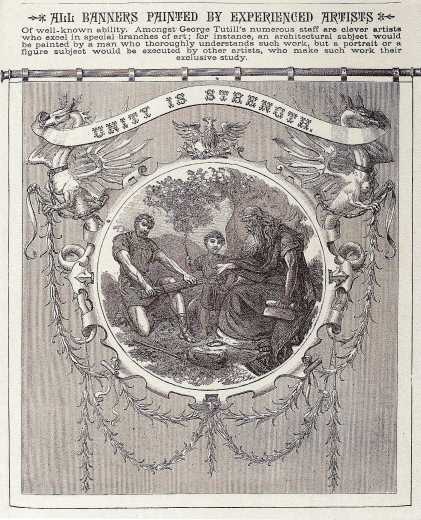
My mother had adapted an old European story attributed to a Greek slave called Aesop in the 4th or 5th century BCE but we didn’t know that then. As we grew older the story seemed to reflect a truism, one that had been incorporated into movements of resistance including defensive ones such as trade unions.1
The bundle of sticks motif on advertisement by union banner artists, with the motto “Unity Is Strength” (Source: Internet)
But of course, we also saw movements and organisations grow and split. I witnessed a lot of such activity (and participated in some of it) while working in London and some of my siblings passed through Sinn Féin, Official Sinn Féin and the IRSP and another passed through Sinn Féin and Provisional Sinn Féin (as did my father before he left that and joined Republican Sinn Féin).
And always the wailing cry all around – if only we were all united! The call for unity seems so intuitive, so basic that one rarely gets to hear any of the harmful effects of unity. But is that because there are no harmful effects? On the contrary!
IRELAND AND CHINA
The nationalist Irish Volunteers organisation was formed in 1913, ostensibly in response to the formation of the Ulster Volunteers the previous year with a declared aim of preventing Home Rule (a kind of national autonomy similar to that of the Dominion territories then) which had been promised to the nationalists (broadly-speaking, the vast majority of the Irish population). The Irish Republican Brotherhood, the moving force behind the foundation of the Irish Volunteers, had plans to use it in insurrection against Britain.
The nationalist Irish Parliamentary Party, the preferred conservative, constitutionalist and even pro-Empire party of the Catholic Irish bourgeoisie, at first ignored the movement. But when it grew to 100,000 members amid enormous enthusiasm, the IPP became worried it might oppose them politically and John Redmond, the party leader, demanded an additional 25 places for nominees of theirs on the Volunteers’ 25-member executive, even though it already contained some supporters of theirs. The IRB, who despised Redmond as a collaborator with British rule, held a meeting among themselves and agreed to vote against accepting that pressure. Most of them did vote against but some changed their mind and, along with some non-IRB nationalists on the executive voted in favour, so that the Redmonites were admitted on to the organisation’s controlling body.
At that time, the IPP was the largest Irish nationalist party and no other party came even close in winning the votes of Catholic men eligible to vote. It is easy to see what the majority on the executive must’ve thought when they voted to accept them: “We’ll be stronger after this, more united; the Catholic Church and the Catholic media will be friendly towards us and encourage even more recruitment. Britain will have to give us Home Rule and we can have an argument later about what kind of politics we want for Ireland when we have our own Dáil” (Parliament). On the other hand, they might have thought that unity with Redmond and his IPP would be far better than being opposed by them.
IRB men Thomas Clarke and Seán Mac Diarmada and others were furious – they foresaw a time in the future when Redmond and his IPP would use their positions, along with allies they had made on the Executive, to try to sabotage the project of Irish independence, upon which the IRB had set its mind and heart. Such an event came to pass after the outbreak of the First World War when John Redmond made his speech on 20th September 1914, on the occasion of reviewing a Volunteer troop at Woodenbridge, Co. Wicklow, encouraging the Volunteers to enlist in the British Army.
That call, and the resistance to it from within the movement and its executive body, led to a split which reduced the Irish Volunteers from the 170,000 membership which it had reached to a force of 12,300, the majority siding with Redmond and many going on to the war slaughter on the Continent.
The IRB continued to organise in secret among the remaining Volunteers but a number of the Volunteers’ founding executive had always been non-IRB, such as Eoin Mac Neill and The O’Rahilly, and that continued to be the case. When they learned at the last moment that the IRB nucleus planned to proceed with an uprising on Easter Sunday 1916 and calling out the Volunteers to join, Eoin Mac Neill and The O’Rahilly2 did everything they could to halt it. They succeeded only in sabotaging it sufficiently that only about on third of the Volunteers mobilised, and they mostly in Dublin, on Easter Monday instead.
The above lines in these examples are not typed to suggest that thousands of Irish would not have gone to join the British Army in 1914 or even that the whole of the Irish Volunteers would have taken part in the Rising were it not for a) Redmond’s split and b) the cancellation by Mac Neill. I reproduce them only to show that unity can have harmful effects too.
After the 1916 Rising, the survivors of Cumann na mBan, Irish Volunteers, Fianna Éireann and some from the Irish Citizen Army reformed their military organisation which in time came to be called the Irish Republican Army and fought the War of Independence from 1919-1921 against the British. The IRA and the party that had grown around them, Sinn Féin, was also a coalition of people of different ideologies and, when the British offered a partial compromise of a partitioned Dominion status “independence”, the movement split again, out of which emerged the State and its vicious Civil War, with the execution of 83 Republicans by the new State and many unofficial murders carried out by its security forces.
L-R: Chiang Kai Shek, Mao Zedong, photographed in 1945 during short-lived repetition of Chinese Nationalist-Communist alliance against Japanese invasion (photo: Jack Wilkes, Internet)
Let us go a bit further in geography though not so far in time to the unity between the Communist Party of China and the Kuomintang of Chiang Kai Check, a national bourgeois party, against feudal warlords and the plunder of their country by foreign imperialists. The First United Front, also known as the KMT–CPC Alliance, was formed in 1923. Together, they formed the National Revolutionary Army and set out in 1926 on the Northern Expedition. The alliance fell apart due to factors and incidents we need not go into but the result was an anti-communist purge of Communists and the Shanghai massacre of 1927, in which between 300 and 400 were purged and 5,000 communist and trade union militants disappeared. It took the Communist Party two decades to recover their strength and begin to build their influence.
Again, recounting this history is not necessarily in order to prove that the Communists were wrong in their attempt at unity but merely to show the disastrous effect of the way in which events turned out for them and how vulnerable they were because of that unity at that time. In the 1940s, on the other hand, another unity worked out better for the Communist-led patriotic forces, though Chiang Kai Shek had to be forced into that alliance.
“THE PEOPLE, UNITED, CAN NEVER BE …”
In Chile in the early 1970s, a left-wing democratic anti-imperialist movement grew. It had many different components: nationalistic and/ or social democratic petit-bourgeoisie; revolutionary communists; revolutionary socialists of other types; masses of supporters of unclear ideology but focused on social justice and opportunity to make more of their lives and the lives of their children. Its party was the Popular Unity party and the leader of this coalition was Salvador Allende, essentially a social-democrat, who was elected President.
The United States ruling class, the major imperialist power in the area, not only seriously disliked many of the policies of the new Chilean regime but also feared that the ideas might catch on in other parts of the world or, even worse, that people outside Chile in Latin America would gain hope and confidence from what was going on in Chile and attempt the same in their own countries. The problem was that the Chilean people had voted by majority for the Allende option. Well, not so much of a problem for the USA – they had disposed of democratically-elected governments in the under-developed world before. Obviously a coup was what was needed – and the CIA began to work for one.
The CIA or even 50 CIAs cannot overthrow a government – to do so they need an army of some sort. It might be by US military invasion, as they did in Nicaragua in 1912, Haiti in 1915, or Dominican Republic in 1916. Or it might be by invasion of a neighbouring region, as they did by supporting and instigating the invasion of Guatemala from Honduras in 1954 or of Iran by Iraq in 1980. The Iraq-Iran war lasted eight years but the Iranian government did not fall and Iraq was defeated. Or it might be by a “rebel” army, such as the infamous Bay of Pigs US-funded invasion of Cuba in 1961 or the Contras, funded and trained by the USA, against the Sandinista Nicaraguan Government from 1979 to the early 1990s. Or it might be the army of the very State they want to subvert — and so it was in Chile in 1973.
Now, how was it that Allende didn’t see that coming? Was he stupid? Far from it – Allende knew the history of the USA in Latin America and he knew that the commanders of Chile’s Army, Navy, Air Force and Police, and most if not all of the higher ranks of the three services too, were right-wing in ideology, some downright fascist in outlook.
Allende’s options were to try and deal with the senior military ranks and hope they would remain loyal, or to dismiss them and appoint others more trustworthy, from lower ranks. But dismissing them might precipitate the very thing he was trying to avoid – a right-wing military coup. However, that threat could be met by arming the workers.
On the other hand, arming the workers might provoke the military and police.
Both options were risky. To a revolutionary, I would think, relying on the loyalty of the military was the riskiest while the second, much less so. But Allende was a social-democrat, not a revolutionary. He chose to hope thatthe military would not revolt and when the coup came, it was not just he who paid with his life but thousands of his followers and others on the Left. They didn’t have enough arms with which to resist for long and arrest, torture and death awaited them. The toll of the coup was over 3,000 dead or missing, thousands of prisoners tortured, and 200,000 Chileans forced into exile.
Poster bearing the alternative slogan, sourced on Internet. It was produced by the Ad Hoc Committee to Establish Solidarity With Resistance in Chile, on the occasion of the Speaking and Fund Raising Tour Across Canada by a Representative of the People’s Front of Chile.
Before the coup, a slogan that had become popular in Allende’s Chile declared: “El pueblo, unido, jamás sera vencido”. It has been changed by socialists abroad to “The workers, united, will never be defeated”, as though saying “workers” instead of “people” made the slogan more revolutionary. But a large swathe of the people in Chile were united, and even more united were the workers — they had marched and voted for the Allende option and were eagerly awaiting the benefits of a different regime. And still they were defeated – by a much smaller but much better armed and much more ruthless enemy.
A different slogan came into being after the coup (and perhaps it had been around earlier too but got drowned out by the other): “El pueblo, armado, jamás sera aplastado” (the armed people will never be crushed). People may argue that is simplistic and they may be right – but it contains a lot more truth and sophistication than the slogan it replaced.
IRELAND TODAY
We are constantly being urged today in Ireland towards “unity of the Left” and “unity of Irish Republicans” and, before we nod our heads in reflex action and shake them in despair, it would be worthwhile to look at this proposition a little more closely.
Firstly, what is the unity for? As a minimum it can only be, if we are to consider it a serious proposition, to strengthen our resistance and to defeat austerity measures and state repression.
Then, who are we to unite with? “The Left” means different things to different people and that too needs some exploring. For example, is the Labour Party to be included? Some would say “yes”, including many trade union leaders and activists.
Yet the Labour Party is part of a Government that is heaping austerity upon working people and of a State that is using its police, courts and jails to repress resistance. How can we unite with that? And if the Party is not the same as its members in the Government, why doesn’t the Party denounce and disown those Ministers? No, this cannot be – we cannot have unity with those who work with our enemies.
Others would include Sinn Féin in the list of groups with which we should join for “unity of the Left”. But in what way can Sinn Féin be seriously considered to be part of the Left? In the Six Counties, it is part of a Government of a colonial state and has imposed austerity on the working people there. It has also colluded in State repression of Republicans. SF is mounting no serious opposition to any austerity measure either side of the Border although it often makes the appropriate noises. It does not support the necessary and appropriate action of civil disobedience, never mind organise it. Its mantra is “Vote for us and we’ll see everything is made ok”. That is not a suitable partner in any “unity of the Left”.
Excluding Sinn Féin and the Labour Party removes the largest party and the most TDs from the proposed “united Left” and that is one reason some do not wish to exclude them. However it would be dangerously stupid to try to build unity with these and, even if temporarily successful in some imagined scenario of the future, both elements would desert and even betray us at a crucial moment when we would be preparing a campaign of serious disobedience, to say nothing of revolution.
PRINCIPLES AND TACTICS OF UNITY
Who does that leave? Well, tiny parties and even smaller groups of independent TDs and local authority Councillors, a wide variety of independent activists and a number of campaigns of varying size. Well, better small than rotten at the core, right? And there are millions of others out there yet for us to draw support from in future!
But having unity across that broad mass of individuals and organisations? How? Shall we draw up a constitution and get everyone to agree? They never will and we’ll waste valuable time on the project. Is it all hopeless then?
Not at all. What we need is agreement upon a few fundamentals – the bare necessities, as in the title of Terry Gilkison’s lyrics in the 1967 Disney film “Jungle Book”. Let’s imagine we have come together to discuss cultivating a field. We dropped the Labour Party from our work force because they had been sowing fields with weedkiller. We dropped Sinn Féin because they had sowed a part of the field with weedkiller and were arguing that we didn’t need to clear stones and weeds or dig in the rest of it.
That’s not to say that we won’t have any problems with any of those left but let’s see, eh?
So all the remainder agree that the field needs cultivating, that stones and weeds need removing and digging needs doing. There might be some who don’t (or won’t) agree on what crops to sow and when but at the moment we have the maximum unity, admittedly on paper, for the minimum tasks required.
It might be that on the first day some turn up at the appointed time, 8am and others straggle in at 9, 10, 11 …. OK, it’s early days yet. But those who didn’t turn up at all? They are on notice of dismissal. That is fair – we all agreed that this work needed doing and they are not contributing to it at all.
Now, it turns out that some got tired or bored at noon and left the job, while others worked on to 8pm. Some of those who worked until later are those who turned up later so, although not in the way we expected and agreed, they have put in their hours (and twice that of some who turned up at 8am and were gone by noon). We don’t expect people to work 12 hour shifts every day but we will set a minimum – a realistic one according to our numbers and our people.
Probably, when we started we set up a committee to administer and organise the work – organise tools, meals, accommodation, allocate work to different areas, organise delivery of fertilizer …. And later, decisions will need to be made about what seeds to sow and seasonal work priorities but we can make those at a democratic assembly. And assemblies can elect the members of the administration too – but as individuals, not as the slates of parties or coalitions.
As the year progresses, more will join the work and some will leave or be expelled – but the decision will be made on the basis of the minimum necessary work for the minimum task. If the project succeeds or is seen to be doing well, others will become interested and some of those will join. And they will see who works well and who does not, whom they feel they can trust and who not. And they will also learn to organise, propose solutions or questions, join in collective decision-making.
We may lose the small political parties along the way and some will wail at the loss. But what we have noticed about the parties up to now is that on the whole they put the Party first and the struggle (which also means the people) second. Of course not all ego-trippers, glory-hunters, niche-seekers and petty dictators are in political parties and we’ll have to deal with those individuals too, and their cliques. And not everyone in a party is a party hack. But the work decides (or it doesn’t and we learn from our mistakes) and the decisions are democratic, by popular vote of people involved in the work.
When the work required for the day or week is done or in quiet seasons we should run courses on agriculture. There will be different schools of agricultural thought – OK, fine, let each set up a school, or run workshops, print manuals, newsletters, run FB pages, etc, etc.
It seems to me that is a practical unity, one that can work. We can and I think need to tolerate differences of opinion. But anyone found spreading weedkiller on crop-ground – well, that needs dealing with very firmly. And those who don’t want to dig, remove stones, pull weeds? Their choice — but they won’t be in our workforce or eat from our field.
So, the principles developed in the example were:
The maximum unity on the minimum task
Unity in practice more than in words
Equal rights for all who contribute (and no special rights for anyone)
Freedom of speech and press (subject to the basic safeguards) for all who contribute
Open to all who join on the same basis
Democratic decision-making
It seems to me that kind of unity will indeed be strength. Unity on other bases? Disaster waiting to happen, early or late.
FOOTNOTES
1 In doing a snap piece of research for this article I note that the Nottinghamshire Miners’ Association had the fable represented on their banner – ironically or perhaps of necessity, considering the fractured history of the miners in that area. It was also on a Durham trade union banner, according to Wikipedia.
2The O’Rahilly, seeing the Rising going ahead despite his efforts, joined it and presented his car for use in a barricade. On the Friday of Easter Week, he was mortally wounded leading a charge against rifles and a machine-gun behind a British Army barricade at the Parnell Street end of Moore Street. He died in a nearby laneway which now bears the name O’Rahilly Parade and where there is a monument to him, including a copy of his farewell letter to his wife in his own words script.
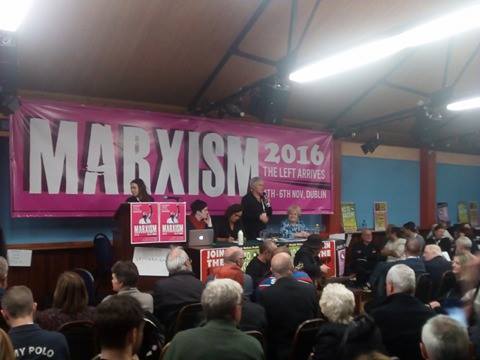
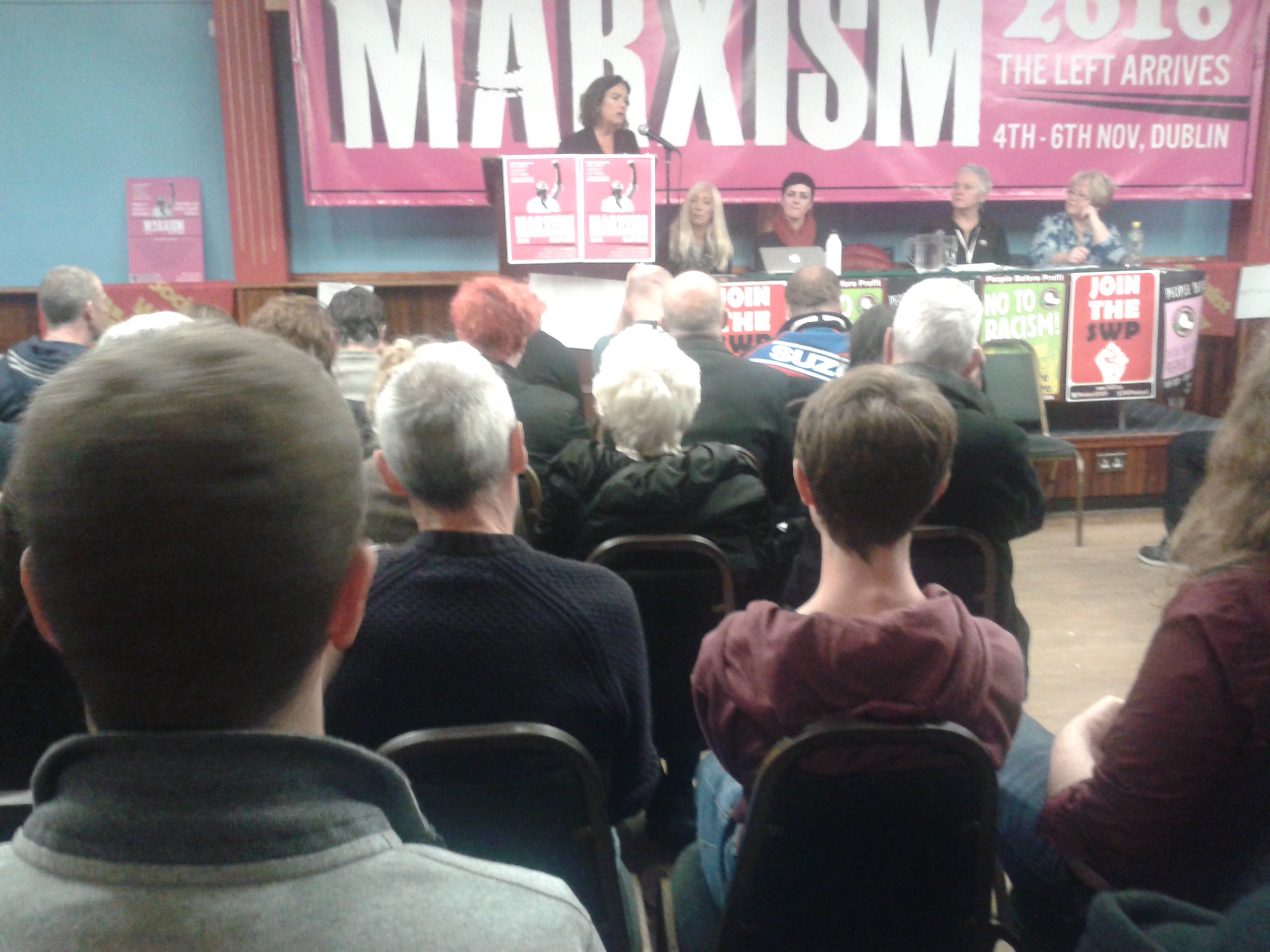
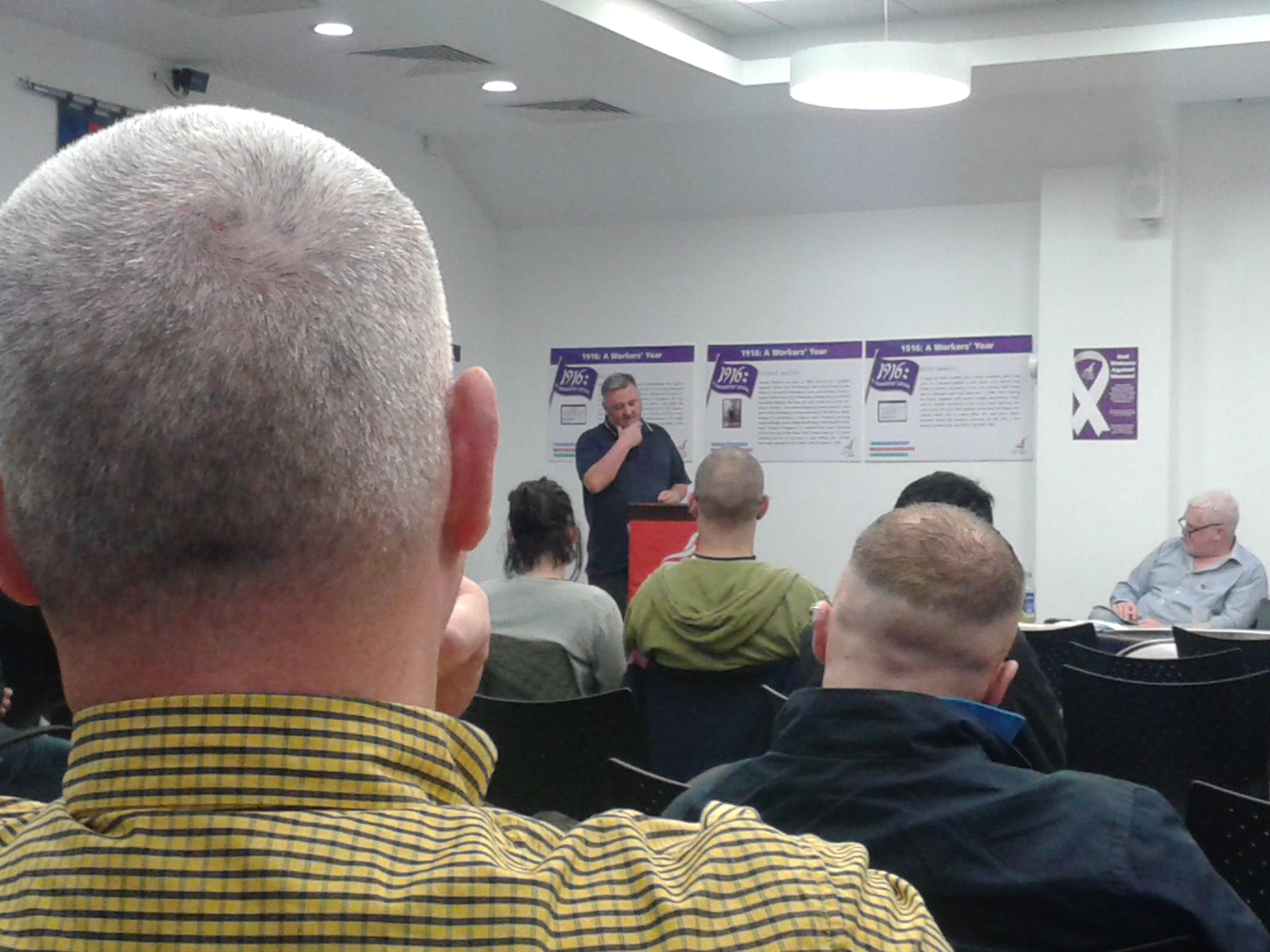
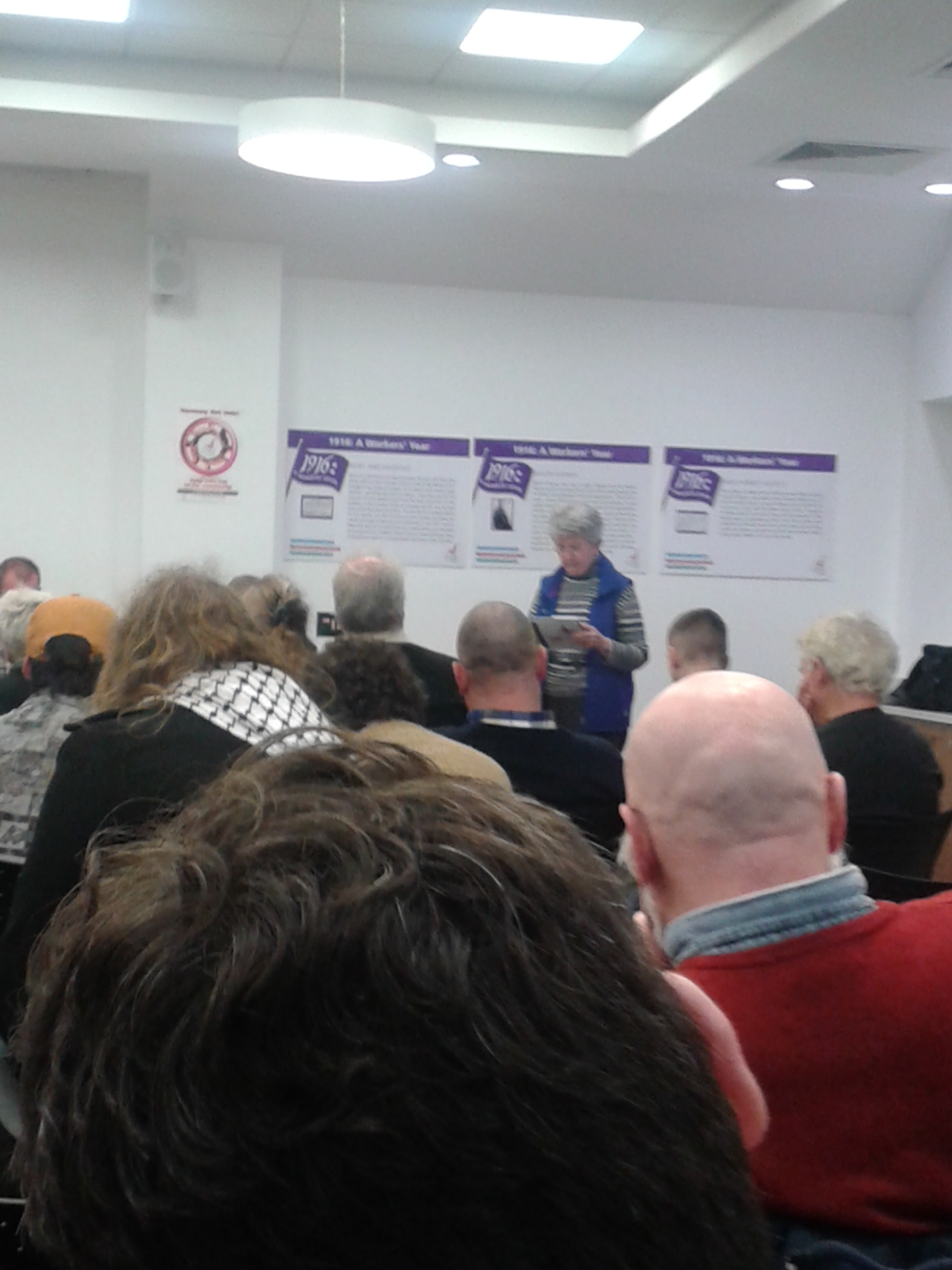
The Sunday November 6th meeting of Marxism 20161 on the theme “When Governments Lie” hosted as speakers four women campaigners and Eamon McCann, a male campaigner, addressing the packed downstairs hall of the Club na Múinteoirí. A number of cancellations of speakers had taken place, including Gareth Pierce who sent a message which was read out to the meeting.
Brid Smith of the SWP (centre photo) chairing the meeting When Governments Lie public meeting at Marxism 2016 weekend (Photo: I.O’Kelly)
On the podium, taking turns to speak, were Sheila Coleman of the Hilsborough Justice Campaign, Kate Nash of the Bloody Sunday Justice Campaign, Joanne Donnelly of the Justice for the Craigavon Two Campaign, and Antoinette Keegan of the Justice for Stardust/ 48 Never Came Home Campaign (summary of these campaigns below).
After being introduced by Bríd Smith, chairing the event, Joe Black with guitar, accompanied wonderfully by a musician on bazouki (if I can get his name will insert it here), launched the evening with Black’s powerful song about Giuseppe Conlon, father of Gerry Conlon of the Guildford Four. The Guildford Four were wrongly convicted in 1975 of IRA bombings and served fourteen years before they were cleared. Giuseppe Conlon, who went to England to clear his son, was also jailed, as were his relatives the Maguire family. The Maguire1 Seven were cleared in 1991 but by that time Giuseppe had died in prison, an event that, along with his own imprisonment, devastated his son and affected him for his remaining years until he died in 2004 at the age of only sixty years.
All of the speakers emphasised that the State’s officials lied with regard to their respective cases and concealed evidence and most speakers also accused the media of complicity. In the cases of Bloody Sunday, the Craigavon Two and Hillsborough, the British state was placed in the dock by the speakers while the Stardust fire cover-up was laid at the feet of the Irish state.
Most of the speakers also warned people in similar circumstances to beware of establishment party politicians who try to flatter campaigners and decide which are the “reasonable” ones to deal with, always at the price of reducing the objectives being sought. The speakers for the Bloody Sunday and Hillsborough campaigns in particular warned against this element, Kate Nash singling out Sinn Féin as the party that acted that way with regard to Bloody Sunday (Kate Nash’s brother was killed that day and her father shot and injured) and how they tried to bring the campaign to an end with an apology from the then British Prime Minister, while no senior officer or government official was held to account and while one of the unarmed dead remained accused of carrying a nail bomb.
Sheila Coleman of the Hillsborough Justice Campaign addressing When Governments Lie public meeting at Marxism 2016 weekend (Photo D.Breatnach)
Eamon McCann, who was on the march in Derry on Bloody Sunday 1972, finished the evening with one of the rants for which he is famous, going beyond his allocated time by a fair bit and despite the Chairperson’s frequent reminders. McCann located the similarities of the cases within the class system – most of those injustices represented were about repression of working class communities, or ignoring the damage done to them and the lies were told to protect the system and its supporters – big businessmen, politicians, the police, the Army.
The meeting ended to sustained applause but without any opportunity to ask questions or to make contributions, to the regret certainly of a number of Republicans and campaigners against what they consider to be ongoing internment without trial. All however seemed agreed that the talks had been interesting and educating in at least some aspect of the issues and events covered.
WHY SO LONG?
It is good that this meeting about State injustice and lies was held by an Irish socialist organisation. It is the duty of socialist organisations to point out the injustice of the State even when the victims are not socialists – or not socialists in the way that socialist organisations think they should be. Prominent socialists Karl Marx and Frederick Engels were not Fenians but they campaigned for the release of Fenian prisoners being held in English jails (where, by the way, it said that one third of them died and one third went insane).
It is said that we learn more from our mistakes than we do from our successes and certainly, if we are to bring about a revolution and the society we want, we must learn from our failures. And in that spirit, I must ask: why has it taken so long for Irish socialist organisations, particularly in Dublin, to wake up to the repression being exercised against Irish Republicans?
Five years ago Marian Price, a former Republican prisoner released under licence as part of the Good Friday Agreement, had her licence revoked and was taken to Maghaberry jail, kept for months without charge or bail, eventually charged and kept in jail without bail, sick, until her mental and physical health was broken. In Dublin the socialist organisations sent a couple of representatives to one demonstration for her freedom and never attended a picket about her case afterwards.
After the Marian Price campaign ended with her release in 2013 on “compassionate (sic) grounds”, some of those involved in Dublin launched a campaign against “internment by other names”, a process by which ex-prisoners released on licence are returned to jail without even a trial in the no-jury courts of the Six Counties2 and other Republican political activists are harassed and arrested and refused bail on spurious charges which eventually collapse after the accused have been held for months or years in jail3.
I must ask again: why has it taken so long for Irish socialist organisations, particularly in Dublin where the major part of their organisation is located and most of their activities organised, to wake up to the repression being exercised against Irish Republicans?
Is it perhaps because the socialists feared to be painted with the nationalist brush? But did they not fear being daubed with complicity with imperialism instead? It is a strange kind of socialist organisation that can’t make common cause with Republicans against the tyranny of the colonial statelet and capitalist State! In that failure, it misses the opportunity to unite forces against its enemies’ state and also to disseminate its ideas among Republican activists. One might also remark that a failure of people who are prepared at times to unite with social democrats for reforms, to unite with Irish Republicans against a capitalist state is a strange indication of revolutionary socialism!
Or is it purely because they didn’t care – it wasn’t happening to them – that Irish socialist organisations haven’tt campaigned against State repression of Irish Republicans, or even protested in solidarity with them? If so, they will by the seed of their inactivity one day certainly reap a harvest of repression for themselves too. Solidarity against State attacks is not only a noble thing with a long tradition; it is a necessity for revolutionaries.
So now that this “Marxism” weekend is over, when its organisers are taking a deserved rest, or writing it up for the British and Irish version of their newspaper, or compiling their recruitment slips to see how many new members or at least mailing list contacts they have gained – will they do anything different?
Will we see the highlighting, from time to time, of the almost everyday harassment of Irish Republicans in the leaflets and newspaper of the SWP and PBP? Will their TDs in the Dáil raise these issues where they might get some bourgeois media coverage? Are we going to see PBP and SWP militants on the regular pickets organised by the Anti-Internment Group of Ireland anywhere and, in particular on those called by the Dublin Anti-Internment Committee?
We can hope, I suppose.
Diarmuid Breatnach
APPENDIX: THE CAMPAIGNS
Hillsborough Justice Campaign seeks vindication that the original disaster was due to crowd mismanagement by the South Yorkshire Police and that some of the subsequent deaths were also due to their mismanagement of some still-breathing victims and lack of coordination of the emergency services. The disaster took place at Hillsborough football stadium in Sheffield, England, UK, on 15 April 1989, during the 1988–89 FA Cup semi-final game between Liverpool and Nottingham Forest. With 96 fatalities and 766 injured it is the worst disaster in British sporting history. Originally, the Liverpool football fans were blamed for the disaster but subsequently it became clear that the blame lay elsewhere.
Bloody Sunday Justice Campaign seeks a proper accounting of the deaths of 14 and injury of at least 14 after British troops opened fire on unarmed people demonstrating in Derry on 30th January 1972 against Internment. Originally, the British Army and Government claimed that they had shot “terrorists” in “returning fire” after being first fired on and a British enquiry backed them on this and claimed to have evidence that some of the dead had been handling weapons.
Founded in 2012, a campaign to overturn the clearly unjust convictions in May 2012 of John Paul Wooton and Brendan McConville for the killing of a member of the British colonial police force, the PSNI, in March 2009.
The forensic evidence was contradictory and in a number of cases even pointed to the innocence of the accused, electronic surveillance equipment had been interfered with by the British Army; the State produced no witnesses to the incident and only one who placed one of the accused at the scene – this witness came forward a year after the arrests of the two, his account of his movements that evening were not supported by his wife; a close family relative called him a habitual liar and then this family member was arrested and subjected to intimidation by the colonial police after he had given a statement to the accused’s legal team..
In the early hours of 14 February 48 young people died in a fire at a disco at the Stardust nightclub in Artane, Dublin and 214 were injured.
The campaign seeks to shift the blame from alleged “arsonists” to a fault in the premises wiring and other factors within the responsibility of the club’s management and owners, including blocked emergency exits. The allegation is that there has been a cover-up connived at by the Irish Government to exonerate businessmen friends, who to add insult to injury, received substantial financial compensation for the loss of the building. An ongoing controversy over inquiry findings and ignoring of important pieces of evidence have lent increasing credence to the version of the campaigners.
1This is organised annually in Dublin, Ireland by the Socialist Workers’ Party
2A prominent example in the past has been Martin Corey of Republican Sinn Féin; a current example is Tony Taylor
3For example Stephen Murney of the éirigí political party and the independent activist Colin Duffy and members of his family
SATURDAY NOVEMBER 12th AN ANTI-FASCIST ACTION CONFERENCE WAS HELD IN DUBLIN CITY CENTRE, TITLED “THEY SHALL NOT PASS – 80 YEARS OF FIGHTING FASCISM”
The speakers were Dr.Brian Hanley, Dr.Mark Hayes and Ciaran Crossey, with the event chaired by Helen Keane.
Poster for the event which used as its main image a section of the Battle of Cable Street mural.
I missed the beginning of the conference and unfortunately the whole of Ciaran Crossey’s presentation, arriving near the start of Brian Hanley’s to a packed conference room.
Brian Hanley gave a comprehensive history of the main components of the development of fascism in Ireland in the 26 Counties until the collapse of its impetus at the end of the 1930s. Hanley’s talk built on his Pamphlet: Ireland’s shame: the Blueshirts, the Christian Front and the far right in Ireland, (Belfast, 2016) by adding a review of Ailtirí na hAiséirghe, the minor but energetic organisation formed in 1942 under the leadership of Gearóid Ó Cuinneagáin, which aimed for an anti-semitic Catholic and corporatist state.
Hanley packed all that into 45 minutes with apparently occasional deviations from his notes, full of interesting observations. Locating the thrust towards fascism in the strongly Catholic and anti-communist atmosphere of the 1930s in Ireland (with elements of anti-semitism), it was surprising to hear excerpts from speeches and right-wing periodicals of the period referring to the Fianna Fáil Government as “communist” and “under orders from Moscow”. It was interesting too to hear brief accounts of pitched battles between fascists and Republicans around the country during the height of the Blueshirt era, how much of a social base and energy the latter gave to the Fine Gael party and to accounts of the Soldiers’ Song (the Irish National Anthem) being attended to with the fascist salute (which led to violence in one cinema at least). Another interesting if somewhat disappointing snippet was that the AT&G, a trade union with HQ in Britain, was the one that most prominently took a stand against Franco in the 1930s while many Irish union leaderships took the opposite side.
The Chair announced a short break immediately after Hanley’s contribution which sadly resulted in no questions on Hanley’s contribution when the conference reconvened with perhaps 80% of the earlier attendance.
The post-break session began with a talk by Mark Hayes, well-known in Britain in particular as a veteran anti-fascist activist and organiser.
Hayes began by seeking to establish a description of fascism and then went on to dissect and disprove a number of reasons given by commentators for its incidence – religion, psychology of the masses of certain countries, psychology of fascist leaders, the middle class — but concluded that fascism occurs when the ruling class of a country is ready to implement it and able to do so. During the 1930s and ’40s, the ruling classes of a number of European countries opted for fascism while others did not. Britain for example had leaders who admired fascism, including Churchill (and Hayes quoted some of the latter’s public statements) but could not tolerate a Europe under the control of one country, which explained, Hayes said, why Britain went to war with Hitler and Mussolini.
Some individuals apart, the profile of fascists and supporters was “depressingly normal”, Hayes maintained which demonstrates that a successful rise of fascism is potentially possible anywhere. There is no firewall between capitalist democracies and fascism and commentators who maintain that “it couldn’t happen here” or that its time has run out, as one prominent commentator claims, are sadly mistaken.
The growth of fascism is assisted by the capitalist State with increasing attacks on civil freedoms and on the rights of workers. Hayes saw this as being particularly initiated in Britain under the Prime Ministership of Margaret Thatcher and her Government, with attacks on the legal rights of trade unions and the use of massed ranks of police. He drew attention to the “prevent” strategy in Britain today as a state-introduced oppressive and repressive measure.
Mark Hayes during his presentation. (Photo: D.Breatnach)
Questions & Contributions
At the end of Hayes’ presentation the Chairperson Helen Keane opened up the floor to questions.
There were four contributions from the floor, only one of which was a question: it was about the content of the Prevent Strategy which Hayes’ had mentioned earlier. Hayes replied that managers of colleges in “the UK” now have a legal obligation to identify and report to the authorities anyone exhibiting “extremism” which is turning them into part of the police force, which was an aspect of fascist rule in society. “Extremism” is problematically identified as being in opposition to “British values” which are formulated as “moderation, fair play”, etc but those alleged values completely ignore the history of Britain’s colonial conquest and imperialism.
A contributor addressed the liberal dismay at the election of Trump, criticised the alleged feminist politics of Hilary Clinton with regard to the USA’s war policies and their effects on women elsewhere in the world; finally he expressed his belief in the necessity to stand by Russia and Syria.
Anothercontribution framed as a question but in reality more of a comment was made in relation to the history of the growth of state fascism in Britain, which the contributor ascribed to the Prevention of Terrorism Act, introduced by a Labour Government a year before Thatcher’s Conservative Party gained a majority. That year, 1974 was also the year of the killing by police of the first known anti-fascist martyr in modern times in Britain, Kevin Gately in Red Lion Square in London.
The contributor went on to express the view that although AFA had made a huge and the principal contribution to the defeat of modern fascism in Britain, the policy of “No Free Speech for Fascists” had been put forward by the Communist Party of England (Marxist-Leninist) in the very early 1970s1 before the formation of AFA2, a policy which no other political party on the Left would support at the time. That policy had been popularised through the action of the Afro-Asian Student Society, which had close links with the CPE (m-l) and which was influential in bringing about the “no platform for fascists” policy in the National Union of Students in Britain in 1974.
A section of the attendance after the break in the conference. (Photo: D.Breatnach)
Hayes agreed that of course there had been earlier organisations and also stated that the actions of the Labour Government in Ireland had been fascist but felt that in Britain, Thatcher had brought about the definitive introduction of State fascism and that “in 30 minutes it’s not possible to cover every detail.”
The issue of the attitude towards “our only native ethnic minority”, the Irish Travellers, was raised by another contributor, attacking the endemic wrongs in the treatment of this group within the country and defending their need to be recognised as an ethnic minority.
The event ended with a reading by Máirín Ní Fháinnín of the translation into English of a short poem by Flor Cernuda, who after a period of post-war imprisonment in a concentration camp, worked for many years for the underground resistance against Franco’s regime. The poem’s title is Las Brigadas Internacionales.
CONCLUSION
The conference was full of interesting information and the speakers I heard were of good quality in presentation, in knowledge of history and in analysis. There was undoubtedly a lack of discussion, which was a pity. In addition I was surprised that the Dublin anti-fascists’ victory in denying Pegida their Irish launch was not mentioned – small-scale though the battle was, Dublin was as far as I’m aware the only city in a European state which Pegida had targeted to launch their party and had failed to do so, being driven out of the city centre by vigorous action.
Máirín Ní Fháinnín reading Flor Cernuda’s poem. (Photo: D.Breatnach)