
HERE LIES IRISH HERITAGE

Diarmuid Breatnach


Diarmuid Breatnach
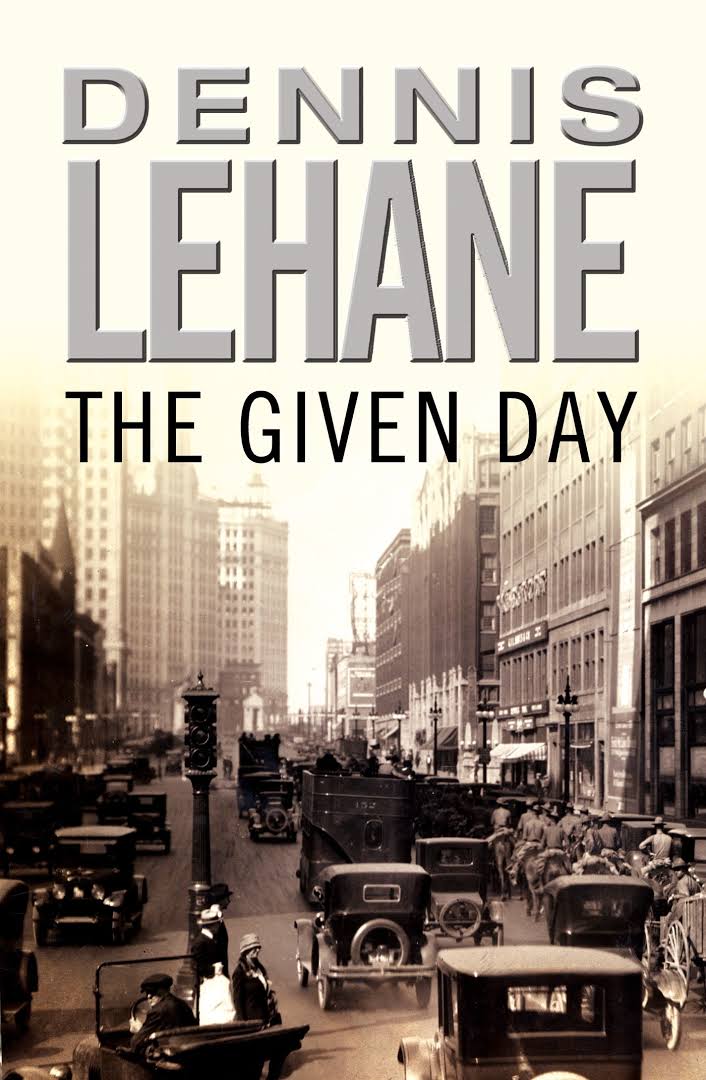
The first of these was with an elderly couple outside Kilmainham Gaol Museum. The man had “Boston” displayed on his T-shirt and I started talking about Dennis Lehane’s novel “The Given Day”, which is set in Boston and which I had just finished reading. They had read it, really liked it and told me it was the first of a trilogy to which I responded that I would certainly be looking for the follow-ups.
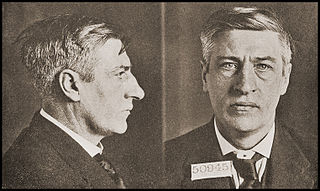
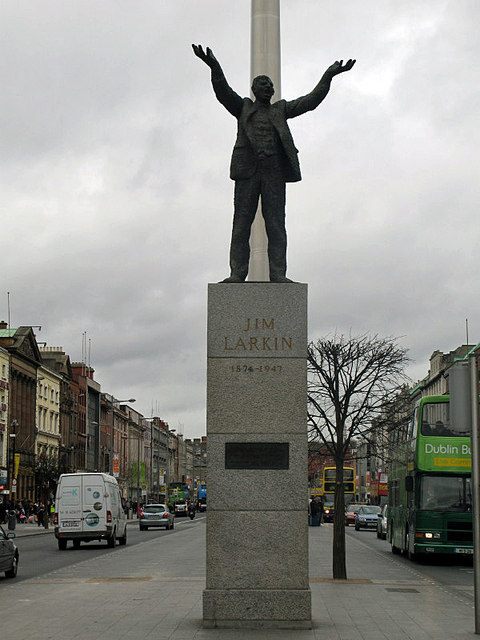
I talked about Lehane’s slant towards the cops as opposed to the revolutionaries and how of course my slant would be the other way but that in any case Lehane had not done his research on Larkin, who figures in the novel with other revolutionaries and radicals. Lehane refers to Larkin’s “gin-breath” but Big Jim was well known as a teetotaler, which I explained to them.
Then I talked a bit about the Irish Citizen Army that Larkin had founded with James Connolly and others, how they grew up out of the 1913 Lockout/ Strike and that Larkin had served time in Sing Sing prison later as a punishment for his revolutionary oratory in the USA.
I didn’t get the feeling that I and the two Bostonians were in agreement with my revolutionary sympathies but certainly did when it came to the workers fighting the Lockout in 1913. We parted amicably as they went off to enjoy some more of their holiday.
Encounter No.2 took place in Cornucopia, into which I had dropped for a cup of coffee.
I took my ‘Americano’ to a vacant table. The one next to me became vacant for awhile and was then occupied by an elderly lady who left her handbag open next to me. I advised her that was an unwise thing to do in Dublin and she remarked. in US accent upon the Leonard Peltier badge that I had been unconsciously wearing all day, so we talked about his case for awhile. She didn’t seem sympathetic to the FBI and expressed horror at the treatment of Peltier, now approaching his 40th year in prison for an act of which he was unjustly convicted.
The lady asked me for advice about literary events in Dublin and as she was, sadly, leaving the day before Culture Night, all I could suggest was a visit to Books Upstairs, where someone might be able to advise her. After I jotted down the address and a rough map for her, I left.
It was my intention to attend later that evening the Song Central session, on their first night back after their summer break. Song Central is a monthly gathering of singers and listeners upstairs in Chaplin’s pub, across from the Screen cinema. But I needed to eat first and so headed for a burrito in Pablo Picante, a small place serving Mexican food in Temple Bar (well, at the western end of Fleet Street).
Sitting eating my burrito and facing out into the street, I noticed passers-by pointing at the window and laughing. I could have become paranoid except it was clear that they were pointing to an image painted on the window further to my left. Then a late 30s or early 40s couple who in their style looked kind of to the Left maybe laughed at the image and took photos. The female whipped out a lipstick and wrote something over the painting, then had the man take a photo of her next to what she had written.
Curiosity had me now and after they wandered off, I went outside and saw that the painting on the window was a caricature of US Presidential candidate Donald Trump and underneath it the artist had written in big letters “DIABLO”. Of course, that would be because Trump wants to build a wall along the border with Mexico due to the negative impact he accuses Mexican migrants of having on the US, which Trump wants to “make great again”. And he has also impugned a US Judge’s ability to rule impartially on his case, due to the judge’s Mexican heritage.

The woman had scrawled something along the lines of “He’s not, we love him” with a heart sign on a part of the painting – clearly far from being Lefties!
I went back inside, got a serviette, came outside and rubbed off her comment, then back inside to continue my assault on the burrito.
Not long after, I was not a little surprised to see the woman and the man standing outside again. She noticed the removal of her comment and commenced to write again. I went to the counter to tell the staff what was going on and returned to find the woman inside, leaning on my jacket on the window shelf and working on rubbing out the painting from the inside!
My challenge on what did she think she was doing elicited the response that Donald Trump was going to be (or might be?) their next President and that the painting was disrespectful. I stood between her and the painting, telling her that we have free speech in this country (which is not strictly true but as the nearest weapon I could reach ….) and just kept repeating it. Then the guy came in and told me I had “no idea”. He kept repeating that and I kept repeating the “free speech” stuff, alert in case he took his case into the physical arena (and he looked fit, too). I also wondered what I would do if instead, it was the woman who attacked me. But they left soon afterwards.
Soon after, a member of staff (Mexican, presumably) went outside and rubbed off her comment, returning with a wry smile.
At the Song Central session later that evening, post-burrito and post Trumpettes, the theme happened to be about the USA, songs from there or about travelling there etc, it being the anniversary of the “9/11” attack on the Twin Towers. If I’d remembered about the theme, I’d have learned the Allende song recorded by Moving Hearts, or brushed up on the lyrics of “Hey Ronnie Reagan” by Christie Moore. Because “9/11” ( in 1973) is also the anniversary of the CIA-instigated military coup in Chile, which over time claimed the lives of 32,000 people.
Interestingly, most of the song contributions during the night that referred to the USA (and most of them did, though people are not obliged to follow the theme), were critical of the US state, whether because of its endemic racism towards blacks and Latinos or its genocide towards the First People, or because of its wars. One song I felt pretty sure would be sung – and it was — was about the firemen on 9/11 running up the stairs of the doomed building while occupants ran down – a powerful song about the heroism of a section of public service emergency workers.
Luckily I could remember some US song material and sang “The Ludlow Massacre” and “How Can I Keep From Singing”, both composed in the US: one written by a revolutionary and the other adapted in the US by a progressive singer.
I had set out that day without remembering the significance of the date for the USA and yet throughout the day had a significant level of engagement with people from the US and, at the end of the day, with the terrible event itself.
End.
Postscript:
On Tuesday, while taking a photo of the Trump caricature in the window to accompany this piece, another US couple began to talk to me. The man opened with: “The man IS a devil” (referring to Trump).
I remarked that Trump was not going to get elected but his role would be to make Clinton look good, then she could carry on bombing and invading countries if she got elected, no problem.
The woman told me they didn’t like Clinton either. They were from Boston and the man and his father before him had been union organisers. He was complained about the weakness of the unions nowadays.
We talked about cops breaking strikes in the USA in the 1930s and how the cops themselves went on strike in Boston during that period. He talked about what the cops are like nowadays against pickets and demonstrations, militarised ….

Diarmuid Breatnach
I am talking to people with expertise in the area of conservation of buildings of historical and/ or architectural value. They know what should be done to conserve the historic buildings in the Moore Street quarter and they feel certain that it will not be done. They feel impotent – they have the expertise, they care about conservation but they fear the combined powers of the State and big property speculators such as Hammerson, who plan to build a huge shopping centre over the whole Moore Street quarter. They will advise but if they go “too far”, they feel their professional lives will be seriously impaired. Perhaps they fear even more than that – who knows?
In 2007, just before Nos.14-17 Moore Street were made a national monument, TG4 in the their Iniúchadh Oidhreacht na Cásca program broadcast a remarkably in-depth exposure of the battle between Chartered Land and another firm of property speculators for control of the quarter and how Joe O’Reilly of Chartered Land, coming from behind, had been given an incredible advantage over his competitors with a preferential deal with the Planning Department of Dublin City Council. This took place among more than a whiff of corruption and of complaints by elected Councillors who were excluded from a secret meeting and at another, threatened with financial penalties. Joe O’Reilly of Chartered Land (and also joint owner with Irish Life of the ILAC shopping centre) gobbled up most of Moore Street and only a fierce campaign in the autumn of 2014 prevented the Planning Department getting authorisation to swap him two Council properties in the Street, thereby clearing the way for him to begin demolition of the terrace.
Another of the experts intervenes. “These timbers they are going to rip out are the ones that heard the discussion around whether to surrender or to go on fighting,” she says. I am a little surprised at such poetic imagery from a person whose work is in bricks and mortar, plaster, timbers and slates – but there is no denying the passion and there is more to come.
“Those timbers heard the chatter of British machine guns, the crack of their rifles, screams in the street, the occasional crack of a Volunteers’ rifle, perhaps an occasional groan from the wounded Connolly. They heard Elizabeth O’Farrell volunteering to go out under a white flag although civilians had already been shot down under such a flag. They heard the discussions upon her return, the painful decision to surrender, Pearse’s decision to go out with O’Farrell, Seán Mac Lochlainn’s orders to march out in military order ….”
Can damaged timbers and bricks be conserved? I ask. “Oh yes, they do it in England on historic buildings, even genuine Tudor ones. All kinds of damaged timbers can be conserved. But if at all possible you do it in place, in situ – removing timbers causes further damage.”
And bricks? And slates? “Well,” breaks in another, “you’d photograph everything carefully in advance or as you uncovered sections. Anything to be temporarily removed would be numbered, slates or bricks. Then the supporting timbers or brickwork is slowly treated, then everything put back in the same order.”
What about missing or broken bricks or slates? “Broken bricks can sometimes be repaired but otherwise you’d source bricks from the same brickyard. Or if the brickyard is no longer in business, you’d look for other buildings of the same bricks being demolished and buy the material. The same with slates.” I think of the descriptions by campaigners occupying the buildings of how they found timbers just thrown into a set-aside room, and all kinds of objects left leaning against plasterwork that was probably in need of conservation.
A woman shows me on her Ipad a section on restoration procedures on the website of Historic England, a body sponsored by the British Department of Media, Culture and Sports. I quickly record three paragraphs (I will look up the rest later).
“A conservative approach is fundamental to good conservation – so retaining as much of the significant historic fabric and keeping changes to a minimum are of key importance when carrying out repair work to historic buildings.
“The unnecessary replacement of historic fabric, no matter how carefully the work is carried out, can in most situations have an adverse effect on character and significance.
“The detailed design of repairs should be preceded by a survey of the building’s structure and an investigation of the nature and condition of its materials and the causes and processes of decay.”
I remark that doesn’t seem to be what is going to happen to Nos.14-17 Moore Street. They nod – they agree.
“It’s just a building site to them,” says one. “What they have already done in defacing a national monument is criminal – but who will prosecute them?”
“They put more holes in the front of those buildings than British soldiers did in 1916,” says another man angrily. “Then they just ripped out their Hilti bolts and filled up the holes with an epoxy resin, instead of pointing material.”
This is a reference to the drilling of holes for the erection of a banner without planning permission, across Nos. 14-17 Moore Street, officially a national monument since 2007. Judge Barrett agreed it was illegal in the case taken by Colm Moore, the nominee of some 1916 fighters’ relatives. Although she is appealing that and other decisions of Barrett’s, the Minister had it taken down recently — but again using questionable methods.
“No wonder Humphreys doesn’t want independent inspection and monitoring”, says another, a reference to the Minister of Heritage’s consistent refusal to allow any independent conservation experts in, or indeed the Lord Mayor of last year, or a number of TDs and Councillors, always under the guise of “Health & Safety requirements” that no-one not of the workforce should enter. Yet when they had their media exercise after the Government’s purchase late last year, RTÉ camera crews were in there as was Caitriona Crowe of Trinity College, praising the purchase of the buildings and the Department’s alleged intentions. It later emerged that the demolition of three adjoining buildings was part of that plan but a five-day occupation of the building by concerned citizens put a stop to that, before an injunction was granted by Judge Barret preventing further demolition until the case taken against the State had been decided.
While the rest of the buildings in the quarter and the streets themselves, uncared for and subject to constant assault of weather and with broken drainpipes, heavy traffic and so on accelerate in deterioration, and the Minister’s appeal against the Barret Judgement will not even open until December next year, an assault is imminent on the roof and parapets of four of the buildings of the historic 1916 terrace, those with the best-preserved original frontages and among those with the highest specific historic importance within that terrace. If this were a case of some greedy or careless private owner or company, a complaint could be made to the National Monuments Service. Many such cases have ended in heavy fines for the perpetrators.
But Terry Allen, the Principal Officer of that very Service baldly said in his evidence to Judge Barrett that Moore Street was not a 1916 battlefield. His office comes under the Department of Arts, Heritage, Regional, Rural and Gaeltacht Affairs, of which Minister Heather Humphreys is the boss. And the Government’s Cabinet stands behind her, if not actually pushing her forward. We tend to look to the State to protect national monuments from people damaging them. But who can protect them from the State itself?
End.
NB: These conversations happened but not with all of the people present at the one time. I have put them together for the sake of a condensed narrative and for the protection of identities.
Principles of Repair for Historic Buildings from Historic England website:
The Facebook pages of the following campaigns:
Save Moore Street From Demolition
Save Moore Street 2016
Save Moore Street Dublin
The TG4 program Iniúchadh Oidhreacht na Cásca https://www.youtube.com/watch?v=Cx0Kah7dE80
And some of the Easter Rising Stories series of videos by Marcus Howard on Youtube
Description of Terry Allen’s responsibilities as Prinicpal Officer at the National Monuments Service http://whodoeswhat.gov.ie/branch/ahg/Monuments/terry-allen/641/
Diarmuid Breatnach

During the week, the IHN set up a campaign table outside the hotel, staffed by volunteers on a rota and some additional helpers; they began to collect signatures to a petition demanding Dublin City Council take over the hotel and for NAMA not to evict the families. They distributed leaflets (the IHN also have an on-line petition on their FB page) and by mid-week, had collected 1,000 signatures to the petition.
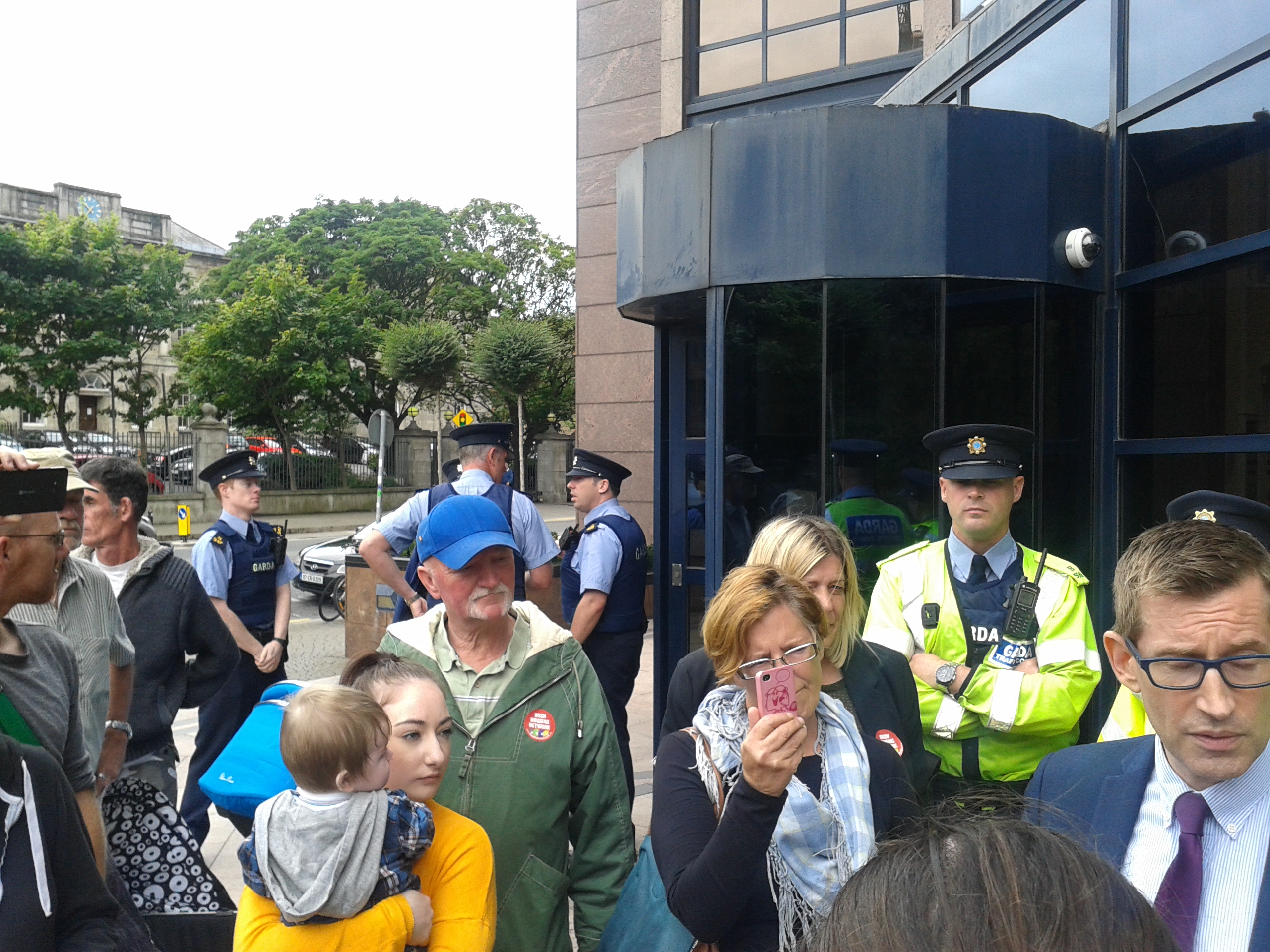
On Wednesday 27th, the families and supporters went to NAMA’s Head Office in Treasury Buildings, Grand Canal Street, D2 and from outside, asked to see the head of the state agency. Treasury Buildings management locked their building and called the police, who arrive in one squad car, then another, and then more of them on foot.
After talking to the police, NAMA offered to see one of the families only, accompanied by a supporter. The families discussed this and rejected it but offered the concession of two families plus supporter. The senior Garda officer seemed to be trying to persuade the families’ representative to accept the NAMA offer but they stood firm. After rejecting that offer, NAMA PR spokesperson Martin Whelan came out to speak to the families and their supporters from the steps of the building. One of the campaigners speculated that this was the first occasion ever for NAMA to explain their actions to the public.

Whelan’s position was, in essence, that NAMA had no choice but to put the properties it received on the market and to sell them on. He rejected the accusation of one of the campaigners that NAMA “takes over properties and sells them at knock-down prices to vulture capitalists,” maintaining that all properties are sold at their market value.
With regard to the demand that the building be put under management as a homeless hostel by Dublin City Council, Whelan would say only that they had received no offer from the Council. That would be a decision for the Receiver, he said, in a statement that many saw as an exercise in passing the parcel.
To those who quoted him some lines from NAMA’s founding charter that its purpose was, in part “… to address the compelling need ….. to contribute to the social and economic development of the State …”, Whelan had nothing to say apart from repeating what he had said previously.
The families and campaigners presented Whelan with 1,000 signatures on petitions and indicated they would return with more and began to leave, the police also leaving as they did so.

However, the families and their supporters were not finished yet and headed off for the
Receivers’ office which, at Marine House, Clanwilliam Place, took some finding. Eventually located overlooking the canal in a very quiet section of the city, they entered and ascended to the 5th floor, to the business address of Crowe Howarth, a member company of the Swiss firm Crow Howarth International. The families and supporters asked to see the person in charge, Aiden Murphy, a partner in the Crow Howarth, who was allegedly outside the building and due back in ten minutes but who appeared from inside after keeping them waiting nearly an hour. Then he wanted to meet them in the lobby, which they refused and insisted on the respect of a meeting in a private office space, which Murphy eventually granted.
According to reports of that meeting, Murphy was civil to the families and assured them he would not be asking for their eviction prior to the court hearing on receivership of Lynam’s Hotel.
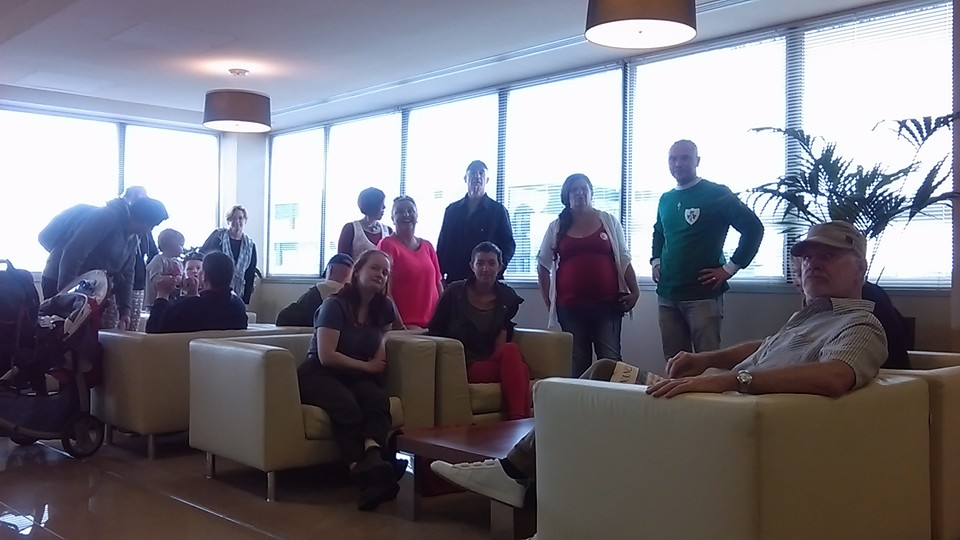
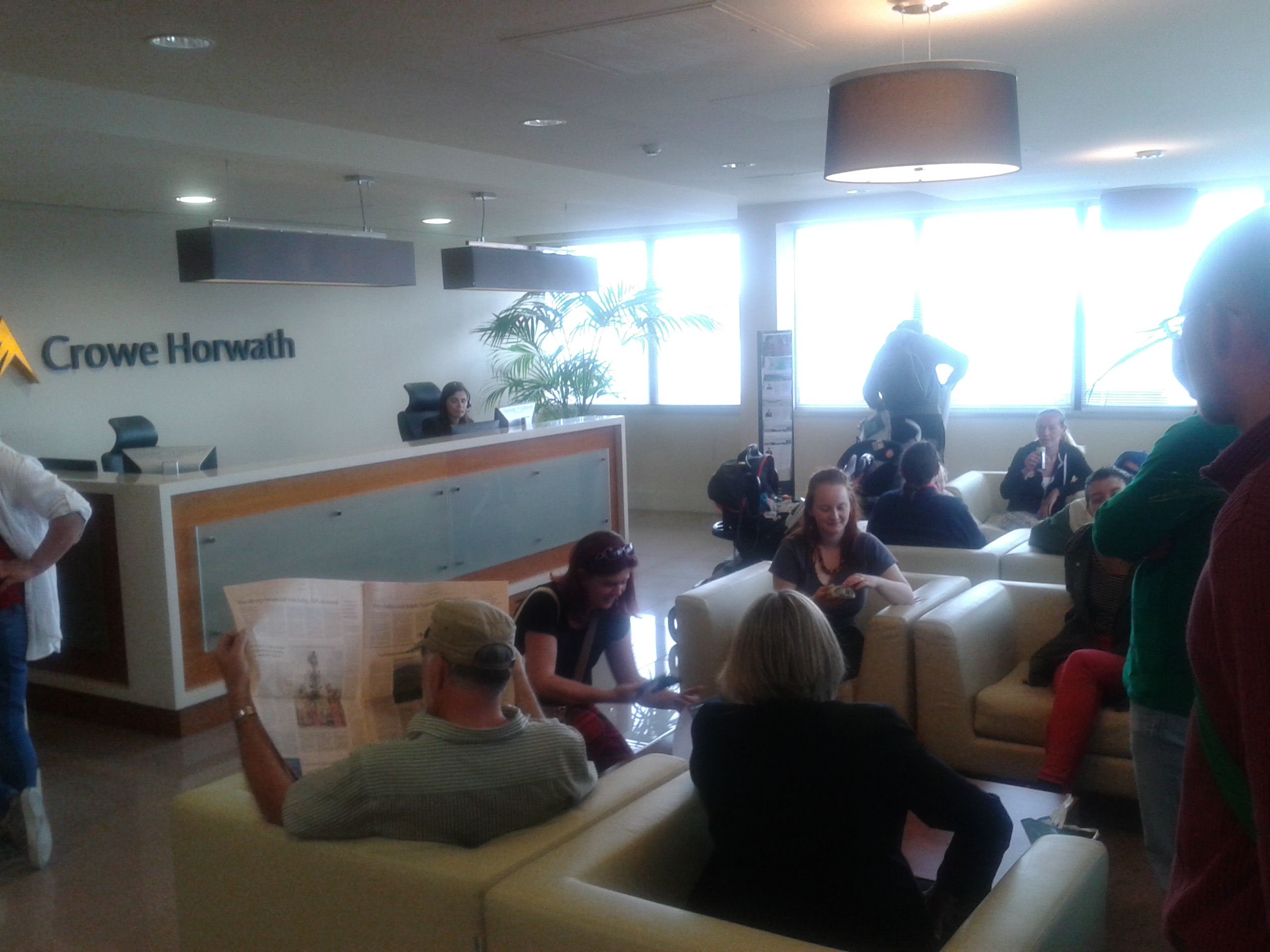
He was due to meet the families the next day but, apparently worried about meeting demonstrators, arranged a meeting with them in the Gresham Hotel instead (no doubt chargeable to the public). His reticence for meeting possible demonstrators was somewhat different to his previous arrival as reported by sources. with a takeover workforce, bullying staff, changing locks and issuing orders.
In advance of the court hearing, hotel management seemed to be moving to place the families as a buffer between themselves and the Receiver and were reported to have asked the families for a letter stating that the accommodation offered by DCC was unsuitable. Judge Gilligan asked Dublin City Council to appear in court to answer whether they had alternative accommodation available.
On Friday 29th, DCC duly presented themselves at the High Court and assured Judge Gilligan that they had indeed alternative accommodation ready for the families. Judge Gilligan did not ask the DCC spokesperson to detail the type of accommodation they were offering nor its location and Crow Howarth made no move to do so either. The families themselves were not permitted to have a letter detailing their conditions and the type of “alternative accommodation” available (see Appendix) read out in court.

The outcome pf the case was that Lynam’s Hotel was wound up, ordered to cease trading beyond August 1st and the building is to be sold (if it is not, as rumoured, already sold) on behalf of the State to some unknown capitalist. The families will presumably be placed somewhere in the kind of conditions about which their letter complains, affecting not only the parents but the children now and into the future, perhaps for the rest of their lives.
And the housing crisis continues without any State agency or Dublin City Council making serious efforts to address it; according to the Irish Housing Network there are over 8,000 families homeless within the state and the total is growing daily. This is in the centenary year of the 1916 Rising when that inspirational document was printed in Liberty Hall, signed in Henry Street (around the corner from Lynam’s Hotel by seven who would be shot later by firing squad) and read out and posted on Easter Monday outside the GPO in the same street as the Hotel, declaring that
“The Republic guarantees equal rights and equal opportunities to all its citizens, and declares its resolve to pursue the happiness and prosperity of the whole nation and of all its parts, cherishing all of the children of the nation equally …..”
end
To help support these and other homeless families contact https://www.facebook.com/irishhousingnetwork
Dear Judge Gilligan,
We the Lynams families would like to thank you for your consideration of our situation in this High Court decision. We are choosing to remain anonymous due to fear of being targeted as we are under threat to take offers that are not suitable or find ourselves with no accommodation what so ever.
We appreciate that you realise that we are extremely vulnerable at this time and are being used as pawns in the political maneuvers of the Hotel management, DCC, the Receivers and NAMA.
As a group we would like to highlight the situation in Emergency Accommodation we are currently finding ourselves in.
We are HOMELESS, yes we are lucky to have a roof over our heads but we are without a fixed abode. We are under the control of the whims of Hotel Management and the DCC.
The accommodation we can usually find ourselves in is one double sized room for one family, two rooms if you have a larger family not necessarily in the same building. Imagine if you will having to live your whole life within the confines of this room where there is:
No drinking water. No fridges to store milk for young babies. No cooking facilities. No laundry facilities to wash your own or your children’s clothes. No area for the children to play, do homework or socialise with others.
We have been offered Alternative Accommodation which is below the standard that we currently experience at Lynams and is still not suitable for our families needs. In fact there is no minimum standard for Emergency Accommodation.
Families that enter Emergency Accommodation initially start off their journey in shock with a loss of home, structure, security. Children sit in their school uniforms waiting for the hotel restaurant to open in order to grab a quick breakfast before they start their long journey to the only anchor they know which is the school they were enrolled in, before they became homeless. Families cling to this anchor, in order to enable their children to have some degree of normalcy in their lives.
Those children who do not have a home and proof of residence do not have any chance of enrolling in school, getting a doctor‘s appointment, being referred to services or getting counseling.
Children spend their days trying to be quiet around adults that are stressed trying to find new accommodation for that night. Forbidden to associate with other children as per rules in certain establishments. They are hungry, as they wait for their parents to source food, often eating whatever food is left over from breakfast until they share one takeaway meal between the family. There is no money is left by the end of the week as it has been spent on transport. These children are disorientated, with some families ending up in hotels in Bray, Aughrim & Brittas Bay trying to get to school in north Dublin. These children lose any hope of being in a normal home, they cling to already anxious parents.
The average families moves every 5 days unless they are lucky to get a hotel/guesthouse that takes on DCC customers as permanent until placed, the length of time that takes can be upwards of 2 years. There is one family that was in Lynams for 7 months, and were informed by DCC with 4 days notice to move, they have been in hotels in several different counties in the space of 3 weeks since they moved.
We ask you to consider that this is our home, we are powerless to fight the combined forces of DCC, NAMA and the Receivers and the pressure they are putting on us. On July 22nd Management in Lynams continued to accommodate us when DCC failed us.
We ask you to consider that we are not just names on a list, we are real people, we have real lives, we have jobs, our children are being directly affected by the decision being made here today.
Even though we have no hope of a good outcome for our families we can only hope that you find it in your heart to consider all these issues of how the system for homeless families has failed us all and will continue to fail unless properly addressed.
Thank you for taking the time to read this letter.
The Lynam families
To help support these and other homeless families contact https://www.facebook.com/irishhousingnetwork/?fref=ts
Diarmuid Breatnach
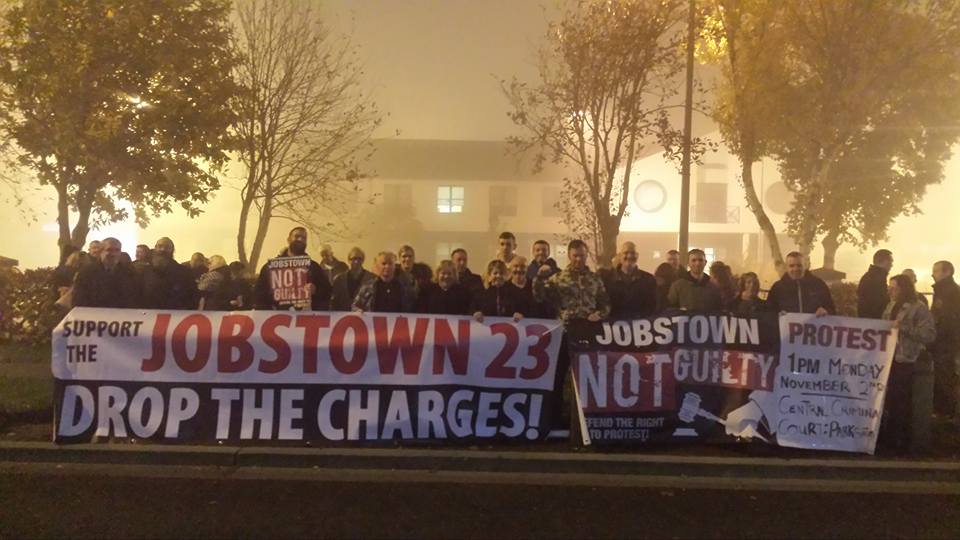
(Photo from Jobstown Not Guilty FB page)
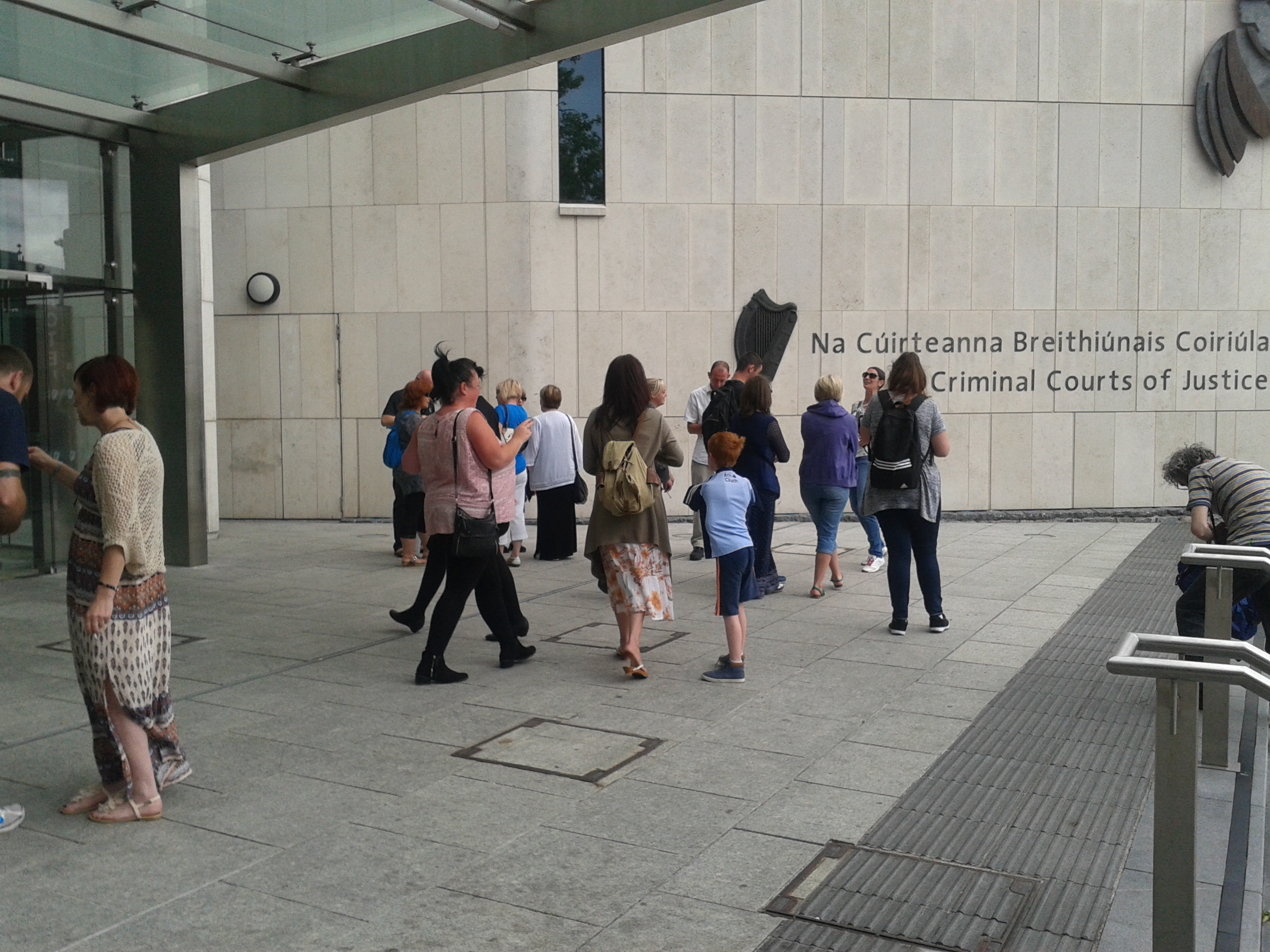
The Jobstown Eighteen, with the exception of a few, including Paul Murphy TD who had been excused appearance for a number of reasons, appeared before Judge Melanie Greally in the CCJ building on Wednesday 21st July, their ninth court appearance since the Jobstown protest on 15th November 2014. Jobstown is a recent kind of suburb of Tallaght, itself a fairly recent population centre to the southwest of Dublin City. A few juveniles charged in connection with the protest are being dealt with separately in the Children’s Court and one was recently sentenced to six months imprisonment.
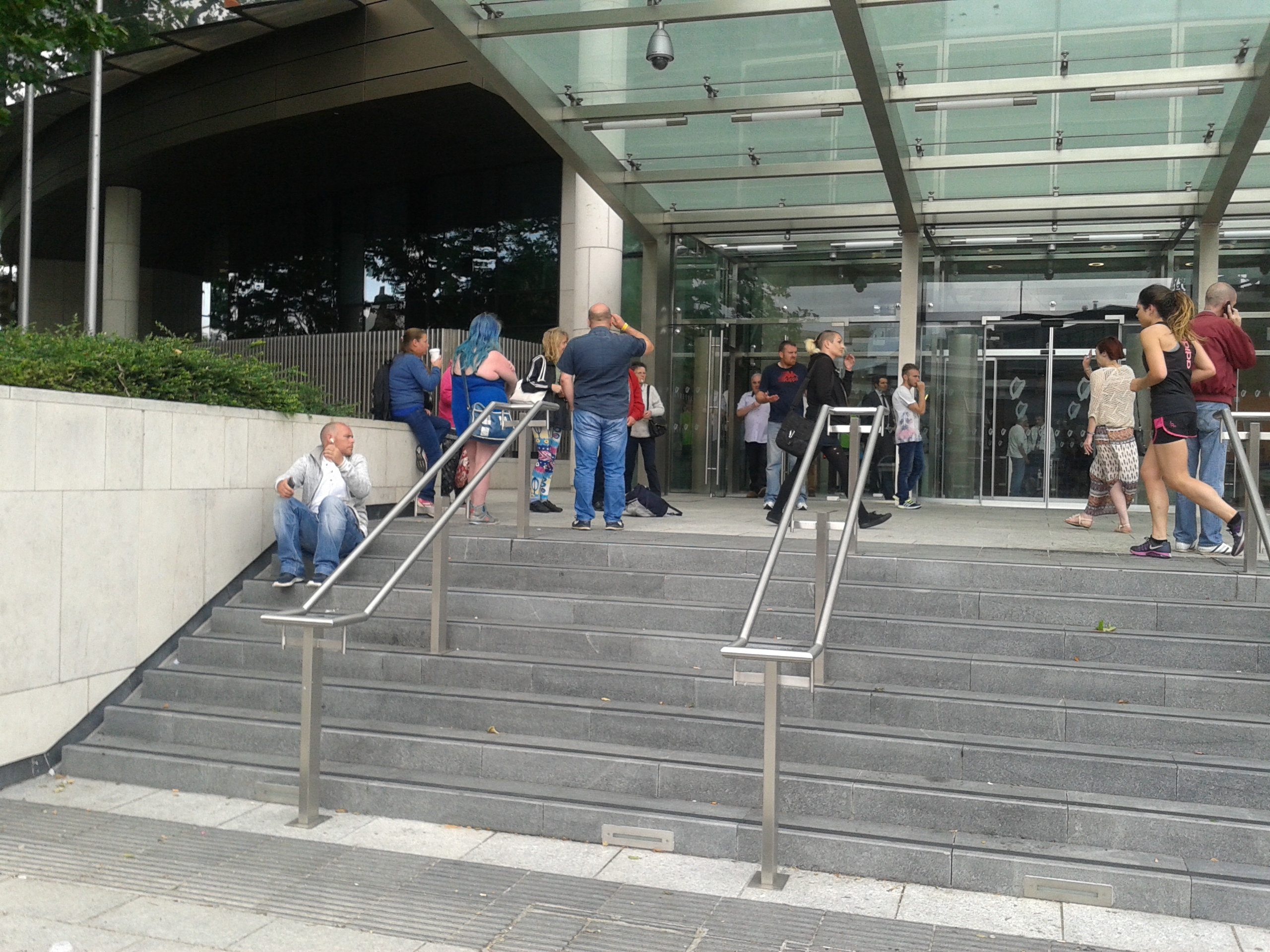
Most of the morning was spent by arguments of the battery of defence lawyers against the State’s prosecutor, Mr. McGillicuddy, on the issue of separate trials. The State contends that those on separate charges have to be tried separately but that such a simple division alone would mean eleven on trial at once and that would be too many, according to the State, for the jurors to be able to follow the evidence and decide on the guilt or otherwise of each defendant. The numbers had to be broken down into three or four groups, the State contended.
The defence lawyers argued that some Prosecution witnesses would, in such a process, be called to testify in a number of separate trials and would become too used to their evidence as the element of surprise was removed. Mr Peadar Ó Maolain BL stated that “Prosecution witnesses will be very polished at this stage.”
Another defence argument was that those in last group would not face trial until possibly four years after the original incident. The whole morning was spent with these types of arguments and some lawyers also opposed the putting of their client into a particular group.
The State also made it clear that it sought to try four of the defendants — Paul Murphy, Tommy Kelly, Mick Murphy, Declan Kane — in one separate group, alleging that they had been “in organising mode”, a clear attempt to put some in a leadership category with, presumably, heavier punishment for them should they be convicted.
Before the submissions began, Judge Greally told the packed courtroom that at the last hearing in May “persons were observed recording these proceedings” on mobile “smart phones”. She said that anybody seen doing this from now on would, at the least, be removed from the courtroom and would be in danger of being found in contempt of court. She did not explain why she objected to recording proceedings nor whether it was only video or including only audio recording to which she was objecting.
At midday Judge Greally said that she would allocate people to the groups and ordered those charged to return to court on October 3rd when presumably they will be committed for the different trials and a jury sworn in. Bail was continued under existing conditions.
These charges are in themselves repressive, seeking to free representatives of the Government and others from serious inconvenience in cases where the population feels that they have been acting unjustly and mobilises to show their dissatisfaction. Joan Burton was one of the most disliked Ministers of an unpopular government, partly for her abrasive manner but much more so for her policy of cuts to funding for social provision. She was also disliked for a controversial exchange in the Dáil when she seemed to be suggesting both that violent behaviour of police on demonstrations and anti-water charge pickets should not be videoed and that ordinary people having Ipads or phone cameras capable of filming those videos was a luxury that would not or should not be within the purchasing range of those protesting.
In addition, the maximum punishments possible on conviction of those charges are ten years and life imprisonment.
If the State succeeds in gaining convictions in these trials, even if the sentencing were fairly lenient within what is possible, it will be a serious setback for the right to protest effectively, to cause disruption to the schedules of Government Ministers and to confront them with strong demonstrations of the people’s anger at the measures being inflicted on the people by the policies of said Ministers.
It is therefore important for people to demonstrate their support for those charged in a number of ways but in particular by attending the trials and other public demonstrations of support.
The charge of “false imprisonment” is akin to kidnapping and has in the past been applied to cases where a person does not permit another to leave a building or an area, usually also preventing them communicating with others. Minister Burton’s car was surrounded by Gardaí as well as demonstrators, she had mobile phones to hand, had changed vehicles during the incident and never attempted to leave the vehicle at the end.
“False Imprisonment”, under the provisions of the Non-Fatal Offences Against the Person Act, 1997, can result upon conviction ‘on indictment’, i.e. which is what the court is doing here, to imprisonment for life.
The charge of “violent disorder” is similar to “riot” and came into Irish law as part of the Public Order Act of 1994; its provisions and explanation are identical to the British Public Order Act 1886 and it carries a maximum jail sentence of ten years.
End
Violent Disorder
“Where—
(a) three or more persons who are present together at any place (whether that place is a public place or a private place or both) use or threaten to use unlawful violence, and
(b) the conduct of those persons, taken together, is such as would cause a person of reasonable firmness present at that place to fear for his or another person’s safety,
then, each of the persons using or threatening to use unlawful violence shall be guilty of the offence of violent disorder.
(2) For the purposes of this section—
(a) it shall be immaterial whether or not the three or more persons use or threaten to use unlawful violence simultaneously;
(b) no person of reasonable firmness need actually be, or be likely to be, present at that place.
(3) A person shall not be convicted of the offence of violent disorder unless the person intends to use or threaten to use violence or is aware that his conduct may be violent or threaten violence.
(4) A person guilty of an offence of violent disorder shall be liable on conviction on indictment to a fine or to imprisonment for a term not exceeding 10 years or to both.”
Diarmuid Breatnach

The families however have decided that they are not going to leave and Irish Housing Network has organised support for them. Volunteers were outside on Wednesday as one of the parents had been told that day to leave with her child, which she was refusing to do. She was then given an extension until Friday but on Thursday, another family were told to move and they too were holding out with supporters nearby. Towards the end of the day that family too was given an extension.
Some of the families in question attended the Dáil late on Thursday afternoon, where Thomas Pringle, Independent TD, asked a question regarding the situation of a junior Government Minister for Housing. Clare Daly TD reportedly had been trying to get a question asked since Monday. Presumably this question has as part of its purpose to draw media attention to the issue and to put pressure on the landlord not to evict the families.
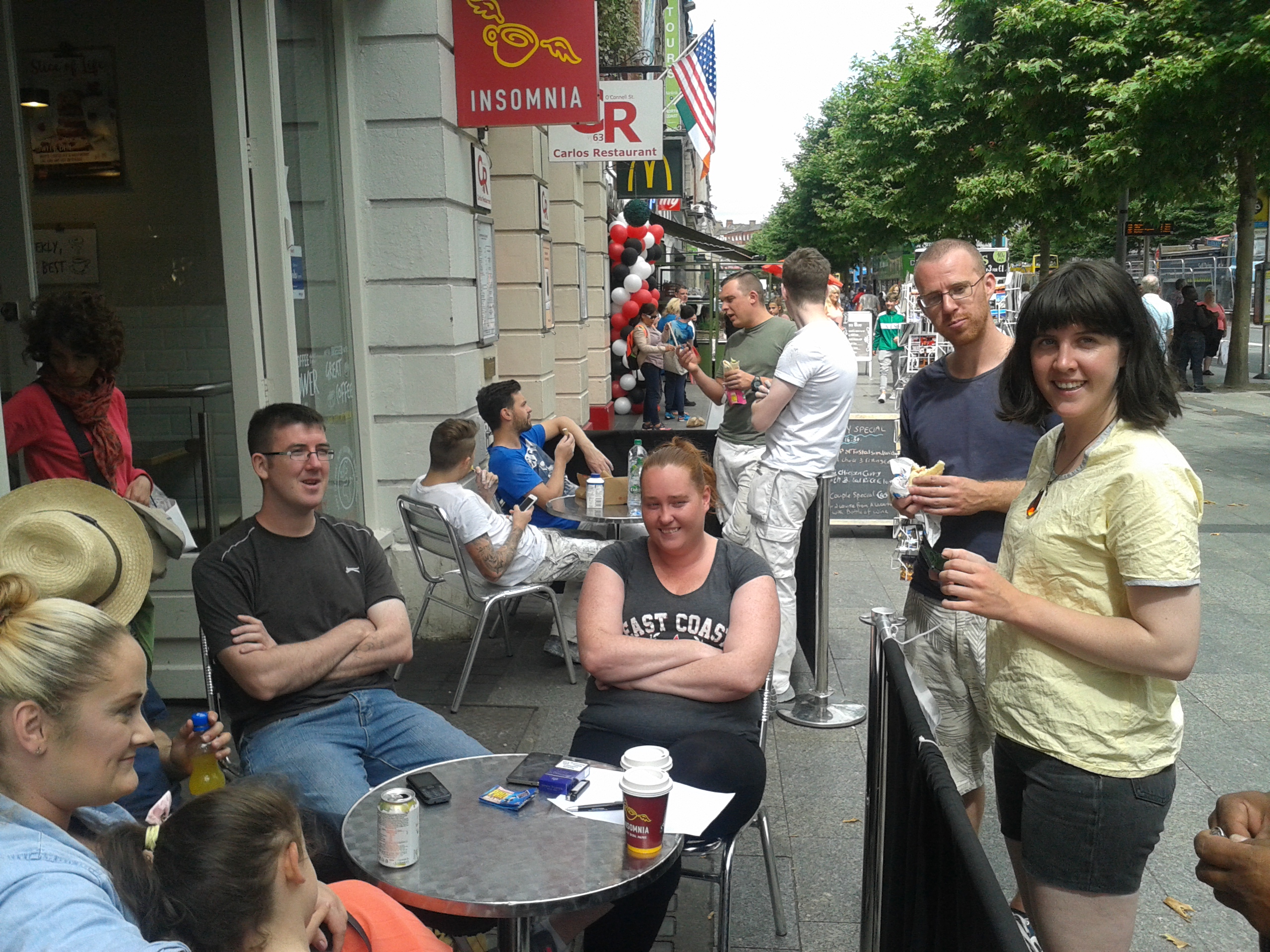
NAMA was set up allegedly to recoup money from speculators who had overextended their credit and could not clear their debts. The idea presented to the public was that, as the Government had bailed out with public money the banks who had lent out to speculators sums far in excess of what was commercially justifiable, the State would take the properties and sell them, putting the money gained back into the public purse. What has in fact been happening is that NAMA has been selling these properties off to vulture speculators, who are snapping them up at prices well below their market value. One of these vulture speculators is Hammerson, a British-based property speculator company, which is rumoured to be looking to buy the hotel. Hammerson also has bought Chartered Land’s (Joe Reilly) property empire and with it, planning permission to demolish all but four buildings of the Moore Street quarter and to build a huge shopping centre over the historic battleground and national monument.
Many acknowledge that there is a housing crisis currently in Ireland and in particular in Dublin. The Irish State that was created in 1922 has been since its inception in support of capitalists, including speculators, but against workers and lower-middle class people. Nevertheless in the past local authorities did build some social housing to rent but these days, Dublin City Council does not want the role of managing housing and has sold off most of its stock and not built any new houses for decades.
One of the people who fought against the State we have inherited was killed by Free State soldiers in O’Connell Street and a small plaque commemorates him on the corner of the building there now. Cathal Brugha had been wounded 25 times in the Easter Rising and beat the odds to survive, though he walked with a limp thereafter. In 1919 he organised the IRA from the Volunteers and Irish Citizen Army who were willing to join. In 1921 he voted against the Treaty and in 1922 led a force of IRA against the new Free State in order to ease the pressure on the Republican forces who were being shelled at the Four Courts. He was shot down in the street this month, 94 years ago, across the street from Lynam’s Hotel.

On Friday 22nd, the IHN called a public protest outside the hotel. Although at short notice and called for 1pm, therefore during office hours, up to 30 people supported the protest. The event attracted considerable media and public attention.
Irish Housing Network is set to continue to support the families in resisting eviction and volunteers may wish to get in touch with the organisation to help maintain a support rota for the families https://www.facebook.com/irishhousingnetwork/.

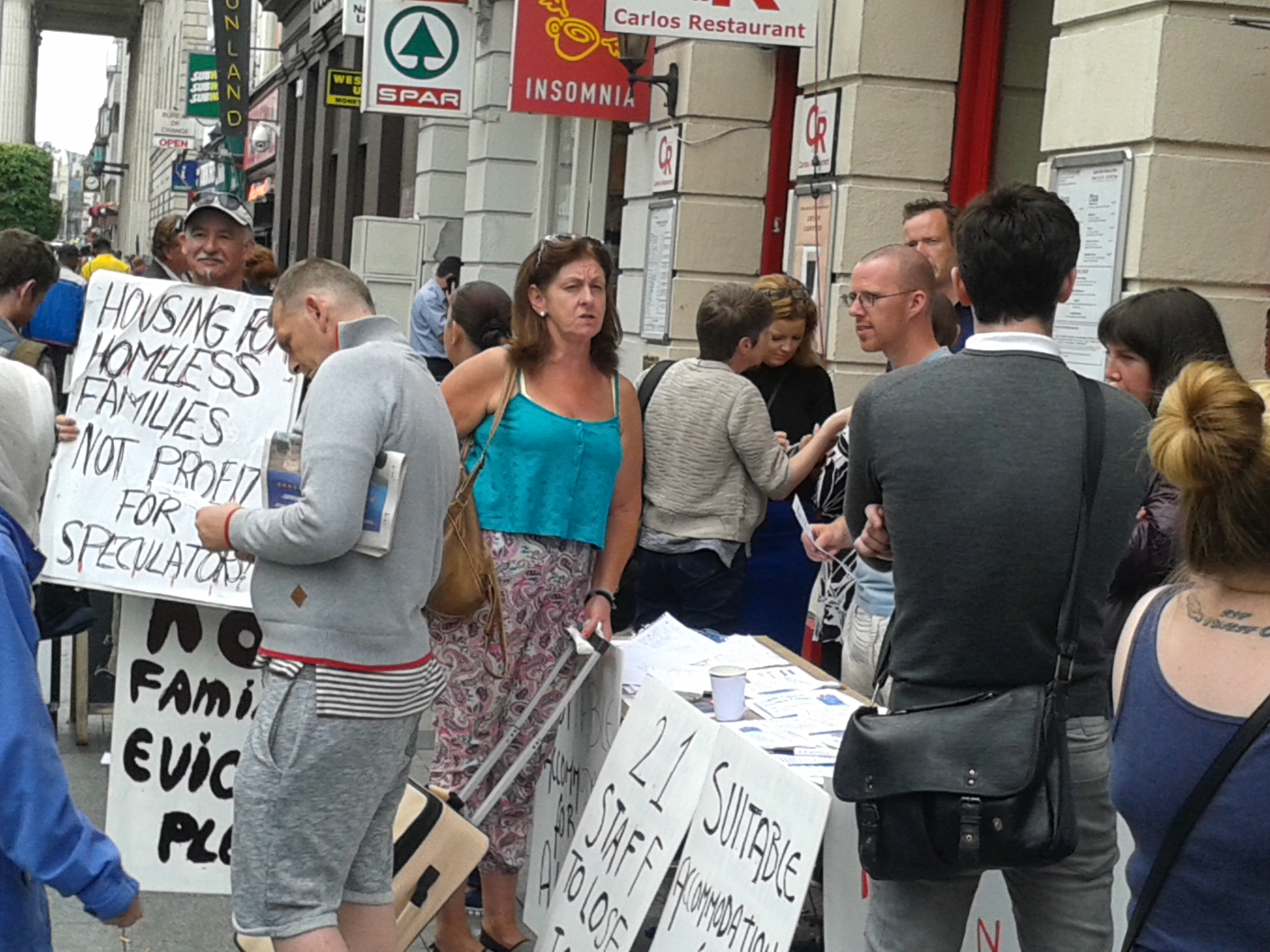
from Save Moore Street 2016 campaign
https://www.facebook.com/SaveMooreStreet2016/photos/?tab=album&album_id=1260539983971351
The Save Moore Street 2016 campaigners and supporters gathered well over an hour before the advertised time outside Liberty Hall where their wardrobe department was busy outfitting people while a steward organised people for photo shoots, leafleting and kept the crowd informed.
By the time the march set off from Liberty Hall it had gathered many, quite a few in period costume and some others joined it along the way. Many had come already dressed in period costume or were decked out by the wardrobe department of the Save Moore Street 2016 campaign and a solid group of them marched behind the new campaign banner.

Others marched behind the original Save Moore Street (from demolition) 2016 banner while others carried banners of some organisations supporting the march: the Cabra 1916 Society, O’Hanrahan Car1ow 1916 Society, Dublin Says No, Munster Anti-Internment Committee, Republican Sinn Féin, Dublin IRSP …..
Led by two people with megaphones and, at times, spontaneously, they shouted: “Save Moore Street from demolition!”
With reference to the Chartered Land and now Hammerson’s huge shopping centre plan for the area, the marchers shouted:
“Do we need another shopping centre? No! Do we need our heritage? Yes! Do we need our street market? Yes!” Also, “What do we want? Hammerson out! When do we want it? Now!”
Other slogans included: “Our history! Our heritage! Our street! Our Rising!”
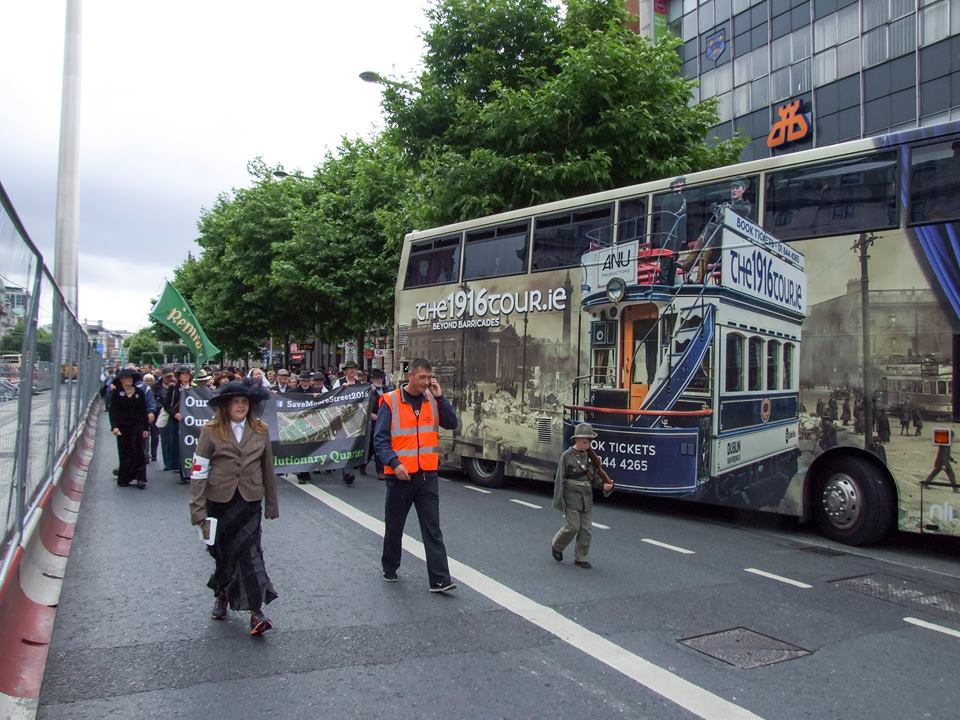
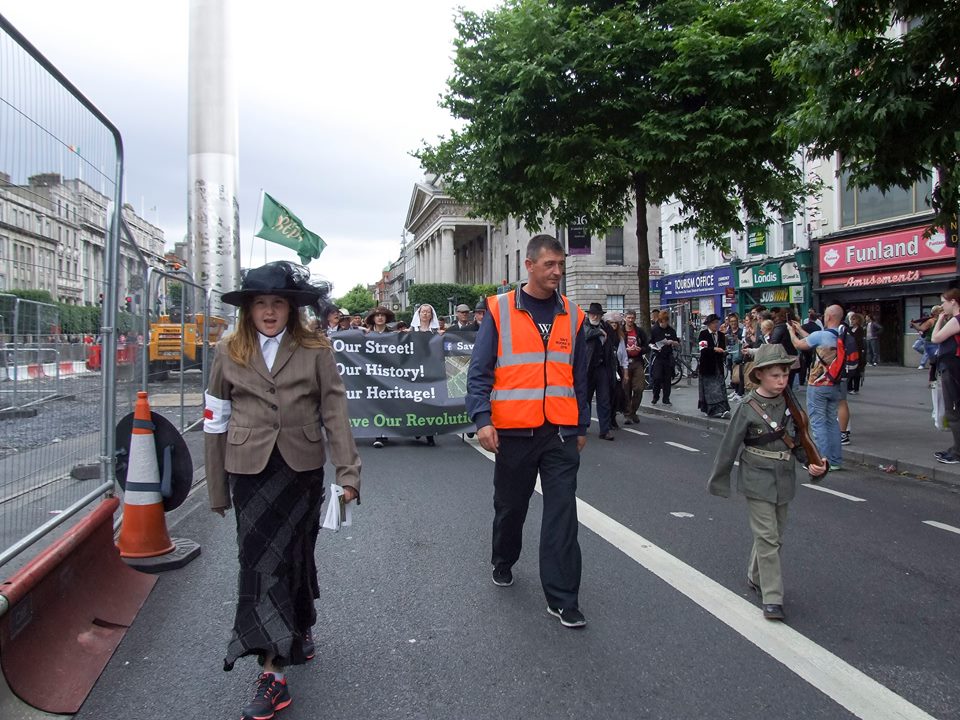 Up Lower Abbey Street the marchers went, in the footsteps of the GPO Garrison on that Easter Monday morning, past Wynne’s Hotel where Cumann na mBan had been formed in 1913, past the former Hibernia Bank on the corner of Abbey and O’Connell Street, where Volunteers fought and where Irish Volunteer Captain Thomas Weafer, from Enniscorthy was killed and his body consumed by the flames caused along the street by British shelling.
Turning into O’Connell Street, the marchers passed the location of Bloody Sunday 1913 when, after Jim Larkin defied a court ban to speak, the Dublin Metropolitan Police ran riot beating Lockout strikers and onlookers down to the ground with their truncheons.
COUNCILLORS, TDs, PROMINENT CAMPAIGNERS, ARTISTS AND HISTORIANS MARCHING
A number of elected representatives supported the march: seen in the crowd were Dublin City Councillors Cieran Perry, Pat Dunne, Anthony Conaghy and former Mayor Críona Ní Dhálaigh, also TDs Joan Collins and Maureen O’Sullivan.
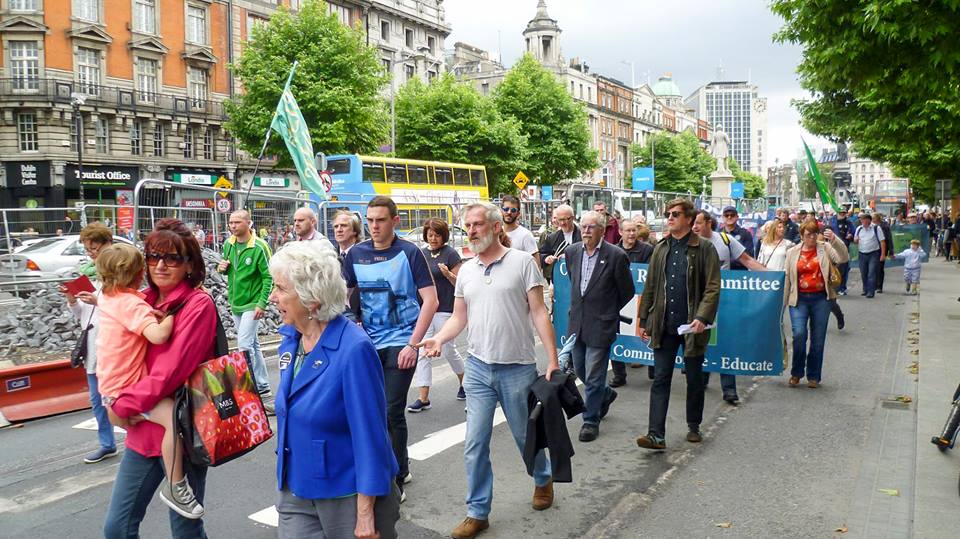
Among the artistic and dramatic sector whose participation was noted were artist and activist Robert Ballagh, drama director Frank Allen (who also organised the first Arms Around Moore Street event in 2009 — and has the T-shirt to prove it!), Brendan O’Neill — also an actor and long-time campaigner — and actor Ger O’Leary.
Relatives of prominent fighters in 1916 also participated and Jim Connolly Heron, great-grandson of James Connolly and among the earliest campaigners for Moore Street and Donna Cooney, great-grandniece of Elizabeth O’Farrell, who went out into the killing zone to organise the surrender, were both noted marching. Patrick Cooney, also of the specific 1916 relatives’ group that brought the legal challenge to the High Court marched along too and spoke from the platform at the rally. Gabriel Brady, grand-nephew of the printer of the 1916 Proclamation, Christopher Brady, was there too, as was Eoin Mac Lochlainn, a relative of the Pearse brothers and a relative of Seán Mac Diarmada was also present and in fact helped carry one of the SMS2016 banners.
A number of historians walked among the marchers, including Ruan O’Donnell, Dónal Fallon, Ray Bateson, Hugo McGuinness, along with local history activists such as Joe Mooney (of East Wall History Group) and Terry Fagan (of North Dublin Inner City Folklore Project). Ciarán Murphy, joint blogger and joint author with Dónal Fallon of the Come Here To Me publication marched along too. From the non-history world of academia, Paul Horan, lecturer of Trinity College (and who wrote the letter published in the Irish Independent on July 2nd denouncing the Minister of Heritage appealing the Barrett High Court judgement that the whole Moore Street quarter is a national monument) marched in period costume too.
THE SURRENDER ROUTE
Passing the General Post Office, the marchers continued along the route of the GPO/ Moore Street Garrison as they surrendered on the Saturday of Easter Week, up to the Gresham, where they laid down their weapons and on to the Rotunda, in the garden of which many had been kept for two days without food or water, while detectives of G Division from Dublin Castle came down to identify prisoners for execution. On the way the marchers passed the Parnell Monument, where British officers had displayed the battle-damaged “Irish Republic” flag upside down as a trophy for a photographer.
On this Saturday in 2016, volunteers (some in costume) accompanied the marchers along the route, handing out leaflets, which were eagerly taken by onlookers, while others – all in costume — collected donations along the way, distributing stickers in exchange. Well in excess of five hundred leaflets were distributed in the period of the short march.
SILENCE IN MOORE STREET

Turning into and a little along Moore Street, the marchers were called to stop for a minute’s silence out of respect for the Irish Volunteers, Citizen Army and civilians who had been shot down in that street by British Army guns, for the six who had been shot by firing squad after they surrendered and for those who had risked their lives in an uprising against the biggest empire the world has ever seen.
All sound in the street died: marchers, street traders, bystanders, shoppers — all stood silent in a street which would otherwise be filled with the noise of a street market and busy shopping thoroughfare on a Saturday afternoon.
At the conclusion of the minute’s silence, the march recommenced, calling its demands with renewed vigour, out into Henry Street, right to O’Connell Street to form up for the rally by the stage in front of the GPO.
SPEAKERS AND PERFORMERS
The rapper Temper-Mental MissElayneous (Elaine Harrington) from Finglas was the first on the stage and performed her “Fakes and Manners” and “Buachaillí Dána” raps but continuous problems with the sound amplification at this stage of the rally meant much of what she was saying could not reach the audience (fortunately this was amended later).

Niamh McDonald, chairing the rally, welcomed the crowd and said that the campaign to save the Moore Street quarter was at a crossroads; developments had brought Irish property developers and the State into opposition to the appropriate conservation of the quarter but also now foreign vulture capitalists. “Save Moore Street 2016 will do what it takes to defend this historic quarter” she said, reiterating three basic demands of the campaign:
That a full independent expert assessment be carried out of the battlefield area
that all construction or remedial work be accessible to expert independent monitoring and
that the whole process by transparent to the public.
It was time for the campaign now to take the fight to the speculators and the next in a series of monthly events would be a demonstration against Hammerson themselves, McDonald told the rally.

The first speaker was then announced, historian and author Ruan O’Donnell, who reminded the rally that the Government of the time had been prepared to demolish Kilmainham Jail. The site had languished until volunteers took up the work of restoring it as a museum and now it is so successful that one has to queue to gain access to it.

O’Donnell castigated the attitude and thinking of successive Irish governments and pointed out that the GPO and Moore Street are sites of crucial importance in the struggle of the Irish people for nationhood.
O’Donnell’s speech, as did McDonald’s, received cheering and applause a number of times during their course as well as at the end.
Dónal Fallon, also author and historian, then stepped up to address the rally and also denounced the Gombeen state that had followed the struggle for independence, in which property speculators grew fat while the people suffer in a housing crisis.

He reminded the rally of the struggle to save the Viking archaelogical site at Wood Quay and how, with Dublin City Council building over it, the writer and author of Strumpet City, James Plunkett, had said that Dublin had “shamed itself before the world.” Fallon said that Dublin needs to redeem itself and will do so in the struggle to save the Moore Street quarter.
Patrick Cooney (of the relatives’ group that took the High Court challenge against the Minister of Heritage) was then introduced and spoke of the recent Appeal Court appearance where the Minister’s team had been castigated by a Judge who insisted they had to specify against which part of Judge Barrett’s judgement they were appealing – her Department could not take a blanket position and say that they were against it all (SMS2016 comment: indeed, part of the judgement was that the banner erected on Nos.14-17 had been erected illegally, and the Minister has already stated that work would commence to remove it and to fill in the holes the builders put into the face of those buildings in order to fix the banner there). Cooney welcomed the announcement that the appeal would not be heard until December 2017, saying that this would give time for more pressure and perhaps a change of government.
Cooney also spoke of the long struggle to have the importance of the site acknowledged and to save it from property speculators and in passing also paid tribute to those who had occupied the building in January of this year.

Last to speak was Seán Doyle, speaking on behalf of the Save Moore Street 2016 campaign. Seán questioned whether we were worthy of the inheritance which had been bestowed upon us.
Referring to speculators and their facilitators, Doyle concluded by saying that “men in suits can be more dangerous than men in armour”.
All those speeches were enthusiastically applauded.
By this time the technical problems of the sound amplification had been overcome with the assistance of a member of the audience and Paul O’Toole stepped up to the microphone. He recalled that the best stage he had ever performed upon had been a couple of pallets drawn up in front of No.16 Moore Street in order to play at a rallying event there.

He then sang and played “The Foggy Dew” and “The Cry of the Morning”, followed by his own composition “We Will Not Lie Down”. The event could not end without Temper-Mental MissElayneous being given an opportunity to perform with the sound amplification in full working order and she launched into her “Fakes and Manners” rap.
The crowd having applauded the performers, everyone was thanked for contributing to the event, banners were rolled up and costumes packed back into cases. Some people stood around chatting while the lorry that had provided the stage pulled out into the traffic, one of the organisers gave a radio interview to Newstalk and MissElayneous, on a roll now, performed for a small audience and video camera with the GPO as a background.
Across the road, outside the GPO, to which it relocated after some of its activists went to participate in the march, having earlier completed its 94th Saturday on Moore Street through which it has collected more than 50,000 signatures in support of Moore Street, the Save Moore Street From Demolition campaign table was also wrapping up.
And, despite threatening sky and pessimistic forecasts – it hadn’t rained once.
end
Clive Sulish

A Chairde,
gabhaim buíochas libh as éisteacht a thabhairt dom agus buíochas freisin as cead cainte ag an ócáid seo ón Anti-Internment Group of Ireland.
A chairde, Níl saoirse gan stair. That is a saying in Irish which means “There is no freedom without history.” This is true in the sense that every struggle for freedom has a history but also in the sense that we cannot win freedom if we don’t know our history.
History is not dead; it is a living thing. We here today are all part of history, in our small way, part of the history of the struggle against the reintroduction of internment in our country, in particular in the Six Counties but creeping into the Twenty-Six as well.
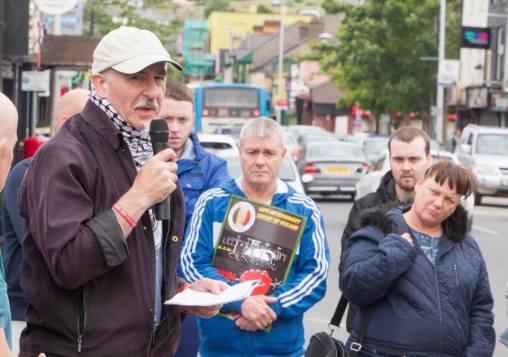
History is not just about battles, although battles form an important part of the historical record. But more, history itself is a battleground! And there are historians who take their sides in that battle: some celebrate our struggles and relate the story of our heroes, while others lie about and twist our history, cast our heroes and martyrs as villains or even try to hide our history completely.
NÍL SAOIRSE GAN STAIR. Those who control the history of a people will find it much easier to control the people too.
On the Friday of Easter Week, as the GPO was in flames and the roof about to fall in, four evacuations from the GPO took place. There were two evacuations of Cumann na mBan, one of them taking the wounded under fire to Jervis Street Hospital. Then another two evacuations, one for a charge on the British barricade at the end of Moore Street, all of which were shot down, dead, dying or wounded. Another evacuation of more than 200 men and women occupied a terrace of houses, tunneling through the walls, from house to house and it was from there that they eventually surrendered on the Saturday.
For some reason that history was kept from us. As depicted in the Michael Collins film, where the GPO garrison is shown coming out from the GPO with their hands up, we thought that’s how it was. But it didn’t happen like that. The Moore Street history was kept from from us.
Decades later, in the 1970s, as property speculators crawled over Dublin and ripped it apart for their own constructions, a strong financial reason was created to conceal the Moore Street history. Then after 16 years of campaigning, the State finally granted a concession and nominated just four buildings as a National Monument. But their plan involved pulling down neighbouring buildings. This would then have facilitated the property speculator’s plan to demolish the rest and to build a huge shopping centre over and around those four houses, all the way from O’Connell Street down to Moore Street and all the way from Parnell Street down to Henry Street. Into that shopping centre, the four houses would be a shoebox museum, with a cafe inside and perhaps a Mac Donald’s on one side and a Starbucks on the other.
But they were stopped. They were stopped by men and women who occupied those buildings, and who blockaded it for six weeks.
Then there came that decision of a High Court judge, that the whole quarter was a historic battleground. Not just four buildings, not just a terrace, but other houses too, the streets and back lanes. He declared the whole to be a National Monument.
So of course there were great celebrations among the campaigners. But what happened next? The Minister of Heritage, which had been her title, announced she was going to appeal the decision. And the speculators asked for a seven-year extension on their planning permission, which it seems Dublin City Council will grant them.
NÍL SAOIRSE GAN STAIR. We are all a part of history. We need to know it. We need to defend it. Not for the past – or at least, not only for the past. But for our present. And for our future. The future of our children and of generations to come. A future free from colonialism. Free from speculators. Free from vulture capitalists.
As an aspect of that resistance, that defence of our history, we will be marching next week on Saturday in Dublin. There are leaflets here beside me on the table for you to take, not just advertising the event but also explaining the situation.
We would hope that you would all stand and march with us, shoulder to shoulder, in Dublin next week, in defence of our history against State and speculators, in defense of our heritage, our past and our future.
Go raibh maith agaibh.

