SPEECH BY SAVE MOORE STREET FROM DEMOLITION REPRESENTATIVE AT RALLY AFTER MARCH 30th JANUARY 2016

Diarmuid Breatnach

Go raibh maith agat a Chathaoirligh agus a Choiste Eagraithe as an gcuireadh chun cainte ar son feachtas Shábhála Ó Leagaint Shráid an Mhúraigh. Go raibh maith agaibh freisin, a lucht tacaíochta, as a bheith i láthair agus as bhur néachtanna go dtí seo.

Thank you Chair and Organising Committee for the invitation to speak on behalf of the Save Moore Street From Demolition Group and to supporters of the campaign here today and for their deeds in the past.

The Save Moore Street From Demolition group began in September 2014, founded by a handful of people who had supported other Moore Street campaigners over the years and at times helped with organising events. Our call to do something different was the emergency looming when Chartered Land offered to hand over the houses of the national monument, No.14-17, to Dublin City Council in exchange for the ones owned by them, No.s 24-25. We knew that once O’Reilly got those two, he would have demolished them …. along with the rest of the 1916 Terrace all the way up and including No.18.

Brendan Viv man
Moore Street, November 2014, Vivienne Lee at the weekly campaign table while people sign the petition. Brendan O’Neill, an early supporter, signing.

The Council’s Chief Executive, Owen Keegan, was completely in favour but he had a problem: since this involved disposal of Council assets, the deal could not be agreed by officials but would have to be voted for by a majority of Councillors. So it was put to them and he recommended acceptance. And the SMSFD group was born to fight that.

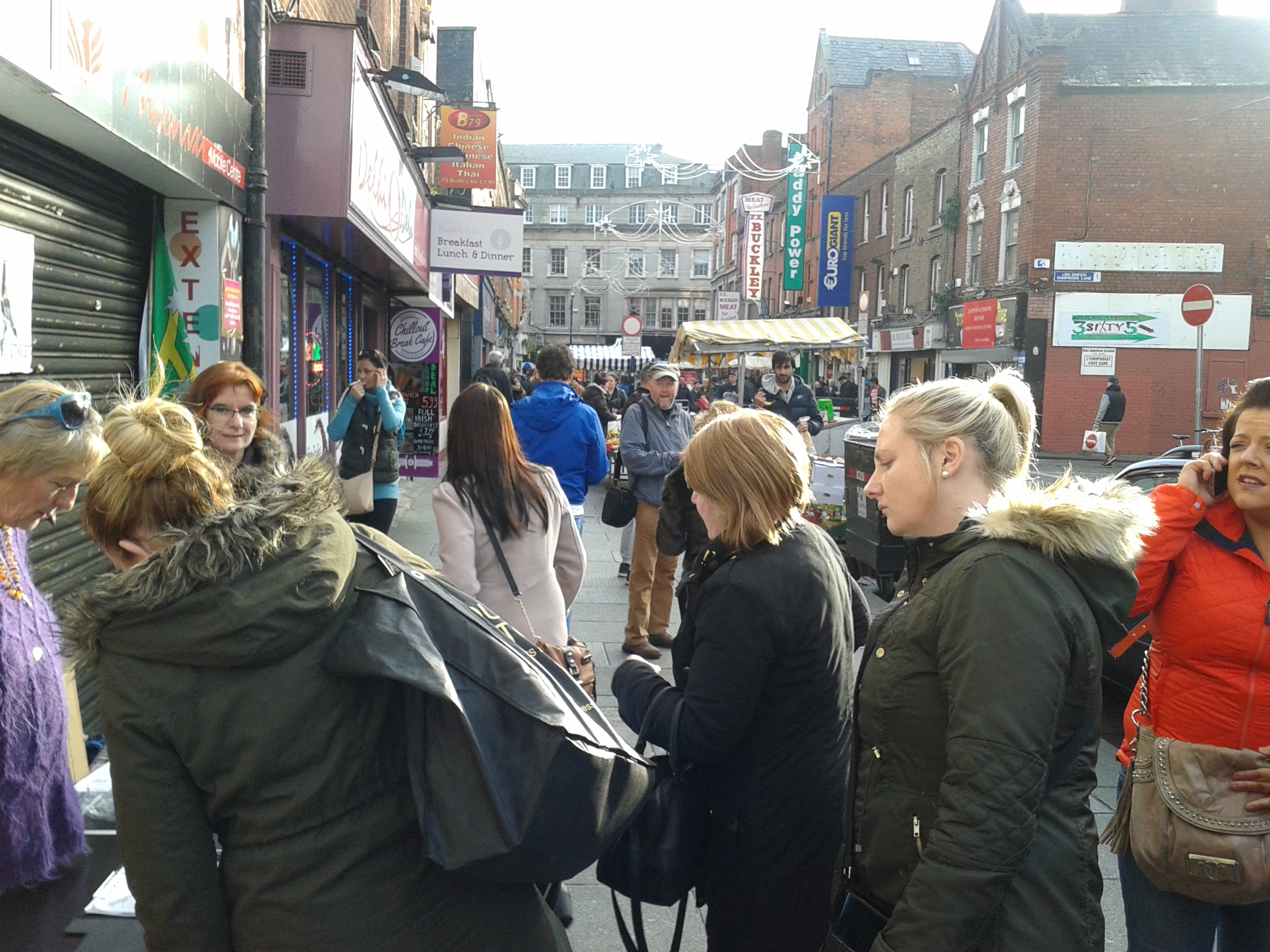
We put up a table with a petition every Saturday in Moore Street. We lobbied Councillors on line and at Council meetings. We gave out leaflets in Moore St. We set up FB pages and kept them lively every week, slowly building up our support. Down in Moore Street, we interacted with the street traders, small shops and of course with passers-by.

Number of people signing the petition at the Moore Street stall in its early days
Number of people signing the petition at the Moore Street stall in its early days, Robbie Lawlor at the table.


I’d be lying if I said there were not times when we were tempted to stop. Maybe times when only three of us were there and when one of that three was off sick or away, or even two. But others did come by to help us from time to time.

And when we gave the emergency call about the planned demolition of the buildings, when we called the emergency demonstrations for two consecutive days in the street, the response was immediate. And it was active. The people who occupied those buildings saved them from being demolished.

And the campaign that we have now built together will hopefully ensure that the 1916 Terrace will be saved for the benefit of generations to come, both in Ireland and around the world.

TERRACE AND SITE

The experts employed by the State and the speculators tell us that one building or another in the terrace is not a 1916 building.  But the fact is that there has never been an independent survey of the site.  Can we trust experts employed by speculators who care nothing for history or heritage, whose only concern is making lots of money?  Can we trust experts employed by a State that has cared little throughout its history for heritage, culture or history but has been focused instead throughout on serving the Gombeens in our country and vultures from abroad?

I think we cannot. But regardless of what any expert may say, whether independent or not, no-one can deny that terrace is the site of the GPO garrison. The whole terrace. Sixteen houses. Not four.

Moore Stret December 2014, the weekly campaign stall in its early days -- Brónagh Ní Loing, Diarmuid Breatnach at table with Mel Mac Giobúin talking to an interested passer-by
Moore Stret December 2014, the weekly campaign stall in fourth month — Bróna Ní Loing, Diarmuid Breatnach at table with Mel Mac Giobúin talking to an interested passer-by

Sixteen – something of an important and recurring number in connection with the Rising. The year was 1916. The number of executions was sixteen. And there are sixteen houses.

That whole site is a historic site and by any rational, historically-minded appraisal, not only deserves preservation, but cries out for it. Cries out for preservation, Brothers and Sisters, in the midst of this historic quarter, this small area in the heart of Dublin, with its last remaining street of a whole market area, centuries old, now buried under the ILAC. A small historic quarter with artifacts, points of importance, buildings and sites of importance going back to the Land War, the 1913 Lockout, the 1916 Rising, the War of Independence, the Civil War ….

BRICKS AND MORTAR

“It is just bricks and mortar,” some of our critics have said. “History is about people, not buildings.” Of course, history is about people. And not just leaders, but the mass of people who, in the midst of their daily struggles to live, to work, to raise families, dare to dream. And where do dreams happen? In the imagination.

And has psychology not taught us the importance of symbols? This building behind me has a symbolism of great potency. The faces of the our martyrs, our flags, the pictures of the starving people of the Great Hunger, the words of speeches and proclamations which we read in little symbols of written words, plaques and monuments …. the very letters on paper, also symbols to convey meaning …. even our spoken words ….

All these symbols give shape and expression to our dreams. Not only the dreams which we experience in our sleep but the great dreams of humanity, the waking and sleeping dream, of freedom, peace, in which to pursue our interests, in which to seek happiness.

SPECULATORS

These our dreams, our human dreams of progress for mankind, are not shared by all.  They are not shared by Joe O’Brien of Chartered Land.

They are not shared by the board of directors of Irish Life, who buried the rest of the centuries-old market under their architecturally-hideous ILAC shopping centre. And who seek to build further out into Moore Street and upwards and have been granted permission by Dublin City Council Planning Department to do so.

And so we must conclude, must we not, that our dreams are not shared by such senior officials in Dublin City Council as Owen Keegan and others running the Planning Department.

No. They do not share our dreams for the future, nor our respect for what was valuable in our past.

December 2014, crowd signing the petition in Moore Street, Brónagh at the table
December 2014, crowd signing the petition in Moore Street, Bróna at the table

An Bord Pleanála has approved the massive shopping centre plan to construct an architectural horror from O’Connell Street across to Moore Street, and from O’Rahilly Parade down to Henry Street, in the course of which they will destroy the 1916 Terrace and enclose a shoebox museum … next to a MacDonalds, perhaps, or a Starbucks …. Constructing a cathedral to Mammon, to the gods of chain stores and eatery franchises ….. So we must conclude that An Bord Pleanála does not share our dreams either.

Lobby of Dublin City Councillors against the 'Land Swap" in Moore Street, 4th October 2014
Lobby of Dublin City Councillors at City Hall 4th October 2014against the ‘Land Swap” in Moore Street, — picket organised by Save Moore Street From Demolition campaign. Signed petition sheets sellotaped together stretched — 2nd and 3rd participants from left are Paddy Cooney and Proinsias Ó Rathaile, of the Save Moore Street campaign.

But does an Bord Pleanála act independently? No it does not, as we well know and as been shown in many planning controversies in the past. It follows the dictates, nods and winks of its political masters, the political class and its nominees in the Dáil. And these do not belong to one political party only, but to several.

And Minister Heather Humphreys, their representative with special responsibility in this case, patently does not share our dreams nor our respect for heritage.

The board of directors of the giant property company Hammerson do not share our dreams either. They dream of big ugly buildings and giant car parks where chain stores and restaurants and franchise eateries can market their goods, depriving shops and goods of any individual regional or national character, making one city’s commercial centre look like any other, from Dublin to Dupont, from Cork to Caracas.

But behind all this array of servile public departments and officials and political representatives, aiding and abetting the clutch of home-grown speculators and foreign vultures, there are the final villains, the whole Irish class of neo-colonial, money-grabbing, huckstering, fumbling-in-a-greasy-til, greedy, incompetent, philistine shower that climbed up upon our backs in 1921 – the Irish gombeen class.

CAPITALIST CLASS

When we have viewed with dismay how little our native ruling class cares for our land, our history, our natural resources, or very PEOPLE ….. some among us have said: “But how can they treat with such disrespect the history and artifacts of the men and women who gave them independence?  Their own ancestors?”  But such commentators are mistaken, brothers and sisters.

The heroes of 1916 are not the political ancestors of the gombeen class – they are ours! A few who fought in 1916 and later became part of the gombeen class from the 1920s onwards, true …. but when they did so, they disowned their forebears.

WE have not disowned the heroes of 1913, nor of 1916, nor of struggles afterwards.

There has not been an independently-minded capitalist class in Ireland since the late 17th Century – and they were nearly all Protestants, of one sect or another. They sought national unity and independence and when they were denied it, rose in rebellion for political, economic and cultural independence in 1798 …. and again in 1803 … But they were defeated and their survivors changed their ideas or left the country.

This class of native capitalists that we have now in the 26 Co.s, mostly of Catholic religious background, grew up under foreign domination. They learned early on to doff the cap to the foreign master, ape him in clothes and manners, speak his language and carry out little deals behind his back.

They learned to be ‘cute hoors’ but they never learned to fight and risk life and limb for a principle. They scramble to get to the top of the dung-heap and crow from there. Or they push and jostle one another to get their snouts in the trough.

They never stood up on their two legs, with back straight and head up, and flew the flag of freedom. They could never stand straight on a gallows and cry “God Save Ireland!” before they were hung, or stand defiantly in front of a prison wall to receive the bullets of their executioners. They never faced the batons of the Dublin Metropolitan Police or the rifles and bayonets of the Royal Irish Constabulary.

And this is why James Connolly, who spent his last days in the building behind me and later in Moore Street, before he was taken away and they made sure to shoot him dead even when they realised that they were going too politically far with the executions …. And by the way the newspaper of Irish Catholic nationalist gombeen man William Martin Murphy, the Irish Independent, called for his execution …..
this is why James Connolly said:
“Only the working class remain as the incorruptible inheritors of the fight for Irish freedom.”

Connolly saw the foreign-dependent and internally corrupt nature of the native capitalist class even before they seized power over his body and the bodies of others who had fought for independence and a just society. And by the way, nor did they stop there – they added hundreds more bodies to ensure they kept the power they had grabbed. And out of our every generation, sent thousands of our youth into exile, rather than build a country that would keep them at home, give them work, housing.

THE CENTENARY & IDEALS

As I come to the end of what I have to say here, early in the centenary year of the 1916 Rising, and I thank you for your patience, I reflect that it appears to be a law of life that for everything we gain, there is a price to be paid.  We have learned that many, oh so many times throughout our history, have we not?

What we are asking for — no demanding — from our rulers, in the case of the campaign for the Moore Street historical quarter, is not much in the grand scheme of their plunder and exploitation.

It is in their power to give it and to pay the political price do so, without bringing down their house of cards.

But if they will not grant it, what then? Well, then we must fight for it. And we too must be ready to pay the price. And I think it is clear that there are many here, and not only here, prepared to pay that price.

And I can do no better than to quote the words of another one who spent his last few days in this building behind me and in the Moore Street 1916 Terrace, who also had some valuable words to say to us. Pádraig Mac Piarais, in his poem The Rebel:


“
And I say to my people’s masters:

Beware,

Beware of the thing that is coming,

beware of the risen people, 


Who shall take what ye would not give. 


Did ye think to conquer the people, 


Or that Law is stronger than Lfe and than men’s desire to be free?

We will try it out with you,

Ye that have harried and held, 


Ye that have bullied and bribed,

tyrants,

hypocrites,

liars!”

End.

Diarmuid Breatnach, who gave the speech, earlier at the march, as it came down through Moore Street into Henry Street, heading for the GPO and the rally. Behind Diarmuid is the entrance to Henry Place, evacuation route of the GPO Garrison in 1916.
Diarmuid Breatnach, who gave the speech, earlier at the march, as it came down through Moore Street into Henry Street, heading for the GPO and the rally. Behind Diarmuid is the entrance to Henry Place, evacuation route of the GPO Garrison in 1916. (Photo: Save Moore Street 2016)

Two Water Meter Protesters Charged and Remanded in Custody

D. Breatnach

From Irish Collonic News:

Two Water-Privatisation protester activists were charged this week with criminal activities — refused bail as being a danger to the public, they were sent to Mountjoy Jail.

Sean Doyle head crop
Sean Doyle, one of the protesters charged and refused bail

The two, Eamon McGrath and Sean Doyle, both resident at addresses in Wicklow, were part of a group picketing the land of Mr. ‘Rowdy’ Nolan, who is renting his Rathcoole land out to GM Sierra to use as a local depot for the installation of Irish Water meters in the Wicklow area.  Both men are suffering from medical conditions and are reported to be pensioners.

Eamonn McGrath, one of the protesters charged and refused bail

On Monday 9th May, Mr. Nolan was incensed to find some protesters picketing outside his Rathcoole property and that some GM Sierra contractors were not driving through them. In order to demonstrate how things should be done, he backed his four-wheel drive vehicle into one of the protesters, Eamon McGrath, and left him limping away.

According to videos and photos taken at the scene, Mr. Nolan then quickly got out of his vehicle and approached a woman who was videoing him, and appeared to knock her and her phone camera to the ground. Not wasting a second, Mr. Nolan then turned on one of the demonstrators — Mr. Doyle — and seizing him around the head and neck, proceeded to bang his head against the rear of his vehicle.

A number of other protesters then intervened to restrain Mr. Rowdy Nolan, as did a number of Gardaí.

Subsequently, Messrs. McGrath and Doyle were arrested by Gardaí and charged under the BLIPP legislation (“Behaviour Likely to Interfere with Profits and Privatisation”) with “Failing sufficiently quickly to get out of the way of a reversing vehicle” (Mr. McGrath) and “Malicious damage with head to a vehicle” (Mr. Doyle).  They were refused bail and kept overnight in police cells.

Mr. 'Rowdy' Nolan leaving his car after backing into Mr. McGrath and just before his foray into the protesters.
Mr. ‘Rowdy’ Nolan leaving his car after backing into Mr. McGrath and just before his foray into the protesters.

The following day both men were taken to court by Gardaí, where Mr. Doyle had the effrontery to claim that he was not guilty and to make use of the opportunity to make derogatory statements about bankers, property speculators, the Government and to cast aspersions on their management of the country and to suggest it is all being done for the benefit of the rich.

The judge presiding considered the two to be too dangerous to release into the community and remanded them in custody in Mountjoy Jail until Thursday morning, when they were due to appear at Bray Magistrate’s Court.

Protesters claimed that the proceedings at Bray Magistrates’ were barred to members of the public which led to some controversy outside.  Speaking from behind a line of Public Order Unit Gardaí, a Court official, who declined to be named, addressed some people who had been refused admittance: “There is no barring of members of the public”, he said.  “It’s just that after we admitted the 25 members of the Gardaí, there was no room left for anyone else.”  Challenged to deny that refusal of admittance was abusing the civil rights of the accused and of the public, a Garda was heard to say: “You lot and your bloody civil rights!  Where do you think yez are?”  Another Court official responded: “We can’t be letting every Tom, Dick and Harry into court buildings.  We have work to be getting on with.”  A woman in the crowd was heard to respond: “Forget about Tom, Dick and Harry, it’s Joseph and Mary Public you should be letting in!”  The court official did not deign to reply.

Ms. Eva Blushyrt, Secretary of the lobbying group SLOBB (Speculators, Land Owners, Businessmen and Bankers), which has been supporting Mr. Nolan, said that it was outrageous that “decent, business people” are being “harried just for making profits any way they can.” Ms. Blushyrt added that “perhaps it is time to consider bringing back hanging for such dangerous enemies of the status quo”. In the meantime she called for “stiff, exemplary prison sentences” for both men.

Another member of SLOBB, who has interests in a central area of north Dublin inner city, alleged that both arrested men had also been campaigning for the preservation of a number of historical buildings there and blocking the development of a badly-needed quarter-mile square shopping mall in the city centre.

Mr. Nolan, with the backing of SLOBB’s legal representation, is reported to be considering legal action against the Gardaí for alleged assault. “They laid hands upon him,” said a representative of SLOBB, “and technically that’s an assault.” Mr. Nolan is said to be furious with the Gardaí and one of his SLOBB supporters was heard to say that “If the Gardaí can’t put manners on the mob with their truncheons, then at least they shouldn’t interfere when members of the public like him do so.”

One of Mr. Nolan’s neighbours commented about him that “He’s just a gentle giant.”  She appeared puzzled as to how he gained the nickname “Rowdy”.

Supporters of the men stated that a number of protests would take place at different locations at 6pm on Thursday evening.  A number of left-wing Councillors and 13 TDs, including a number representing Wicklow constituencies, have signed a statement calling for the release of Messrs. McGrath and Doyle. Ms. Blushyrt became quite angry when informed of this development and called for the public representatives’ disbarment from their elected positions for what she alleged was “blatant interference in the legal system and in its time-honoured role of defending the status quo”.

DEAR MINISTER

Heather Humhpreys, Minister for Arts, Heritage and the Gaeltacht
Heather Humhpreys, Minister for Arts, Heritage and the Gaeltacht (now of Arts, Regional Development & Rural Affairs)

Diarmuid Breatnach


Dear Minister Humphreys,

In response to your request that we sort out letters from the public supportive of your work addressed to you or to this Department and forward them to you, I attach them in Appendix below. I apologise for the delay but we have had to deal with quite a volume of correspondence in order to find letters of that nature.

With regard to your request that we categorise and enumerate the letters of a critical nature from the public, that has been easier in some respects but due to volume has unfortunately taken longer; nevertheless here follows the relevant report up to midday yesterday:

Letters disapproving by category and amount:

  • Criticising your plan on Moore Street (to save four buildings and demolish some others): 73
  • Questioning your appointment as Minister for a Department with responsibilities for the Gaeltacht: 9
  • Questioning your appointment of McHugh (non-Irish-speaker) as Minister for the Gaeltacht: 11
  • Questioning your fitness to be a Minister for Heritage: 67
  • Questioning your fitness to be a Minister for Arts: 8
  • Raising two or more of above issues in the same letter: 51
  • Total number of critical letters: 103 (There were in addition a score of critical letters which, while containing comments of a highly personal nature, were difficult to ascribe to a specific category within the ‘critical’ band although they were certainly critical).

May I respectfully enquire whether there has been any progress with the recruitment of additional clerical support, even if on a temporary basis?

Sincerely,

Ima Clarke

Secretarial and Statistical Support,
Department of Arts, Heritage & Gaeltacht.

Appendix
Letters approving
of Ministerial Action

Dear Heather,

Don’t let history stand in the way of more shopping centres.
We support you!

Mary Browne-Envelop.

Dear Heather,
History, who needs it! Money makes the world go around – we must grab it while we can.

Phyllis Stein.

Dear Heather,

You should bring out the Army and shoot these campaigners down like our forefathers did in 1922.

Hugh Javarice.


Dear Minister,

It’s not 1916 we should be commemorating but 1922. By God, we showed those Republicans then, didn’t we?

Eva Blushyrt.


Dear Heather,

Please don’t listen to the mob. We agree with you: shopping centres – the more the merrier – are more important than heritage.

Charles Gombeenson.


Dear Minister,

Please continue clearing history to make way for more shopping centres.

Cecilia Showneen.


Dear Heather,

Hold the line! Who runs this country, property speculators and bankers or the common mob?!

Rowena Fumblytill.

FROM LOCKOUT TO REVOLUTION — PERFORMANCE OF EAST WALL PEG DRAMA & VARIETY GROUP

“From the Lockout to Revolution”, performance of the East Wall PEG Drama & Variety Group at City Hall on April 9th 2016. This was part of a program of events organised in conjunction with the Cabra 1916 Rising Committee and Dublin City Council.


At the outset of the Easter Rising, City Hall was occupied by a detachment of the Irish Citizen Army and was the location of fierce fighting until the insurgents were forced to surrender.  Their commanding officer and another three fighters were killed there.

( Video produced and edited by Eoin McDonnell )

East Wall PEG Drama & Variety Group performers: Rebecca Dillon, Mary Colmey, Monica Horan, Paul Horan, Colm Meehan, Séamus Murphy, Tréasa Woods, with Diarmuid Breatnach.

OH HEATHER!

Oh Heather, it was so brave of you to go down to Moore Street to lay a wreath there on Easter Monday — so courageous! Bearding the lion in its den, so to speak. I do admire your courage, I really do … but was it wise, dear?

Heather Humhpreys, Minister for Arts, Heritage and the Gaeltacht

You must have known that Moore Street campaign mob would see that as a challenge – in fact, a red rag to a bull, if I can use another animal metaphor, for that is what they are, animals! Hooting and whistling! But you must have known they would do that. Surely some other Government representative could have gone. Why, oh why did you go there, Heather? Did I not invite you to have lunch out of town with me this weekend, my treat?

Well, maybe you expected that mob to act up and thought they would lose public sympathy? As I was saying to you before, times have changed. A couple of years ago that might have worked but the way that fickle public are these days … Of course, some did condemn them – but have you seen the numbers of people who were queuing up to congratulate them? No, don’t ask – I won’t tell you, it would only depress you. Citizens? Don’t make me laugh!

Or maybe you wanted to draw them out and let the uniformed Gardaí deal with them, or perhaps some of them in plain clothes, looking like outraged members of the public, give them the hiding they deserve? Not a bad plan, except for those mobile phone video cameras and IPads everyone seems to have (Joan Burton was right to suggest the mob shouldn’t have them). But our police tussling with demonstrators about Moore Street in that same street when you seem to have lost the case in court, and no government yet in place? Too much to ask of the Gardaí, darling, much too much. In another place, yes of course, like Rossport, out of sight …. Or even in this place, in a previous time ….

Oh, Heather, don’t be so stubborn! Come away down country or let’s even slip across to England somewhere and have a lovely long weekend. Oh I know what you’ll say.: “Everyone’s afraid to be out of town while back-room dealing is going on to decide who’s going to be in the next government and who’s getting what job” … Yes, I know you are a politician. At least promise me we’ll slip away soon. Yes?

Speaking of “slipping”: Are things slipping away from us? Is it all going to go to the mob? All we’ve built up and salted away over the years? Surely not …. but …. all this talk of “the Republic”! And “the words of the Proclamation”! … I can’t wait for this year to be over. But will things get back to normal afterwards? And there’s that nasty guerrilla war centenary coming in just another three years!

We just might need a little coup, darling. I was thinking that when I was watching all those soldiers and tanks going by our seats …. and all the Gardaí road blocks with military police around town too, keeping the mob out. Sometimes a coup is just what the mob needs, to pull them into line. “Setting boundaries” I think they call it nowadays.

Your friend always,

Phyllis Stein

FACING THE PAST AND THE FUTURE

Diarmuid Breatnach


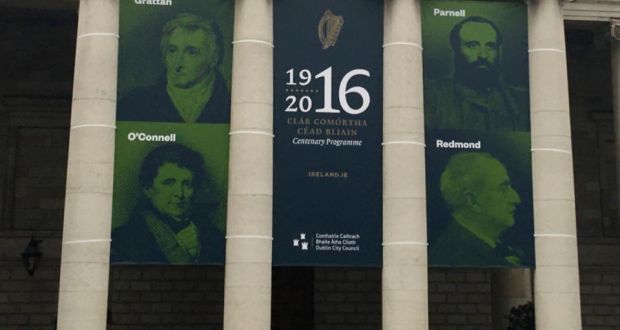
Many people, Irish, migrant and tourist, are questioning the decision to erect banners on the Bank of Ireland building, former site of the Irish Parliament, displaying the heads of four politicians, three of whom were dead long before 1916.  These were prepared by Dublin City Libraries, a department of Dublin City Council, at the behest of the office of the Taoiseach (the Irish Prime Minister) and as part of the commemoration of the 1916 Rising.

The heads of four prominent Irish people who were against revolution
The heads of four prominent Irish politicians who were against revolution (image from Internet)

The images of Grattan, O’Connell, Parnell & Redmond constitute a coherent collection, deliberately chosen — each represented a parliamentary approach and so are in direct opposition to the revolutionary approach in 1916 of the IRB, the Irish Volunteers, Irish Citizen Army, Cumann na mBan and Fianna and, in practice in Dublin, of the Hibernian Rifles.

Furthermore, each of the four politicians in their own time had a revolutionary opposition within the movement — Grattan had the United Irishmen, O’Connell the Young Irelanders, Parnell the Fenians though he flirted pretty heavily with the revolutionaries and vice versa for a while.  And of course Redmond …. had the Irish Citizen Army, the IRB, Irish Volunteers, Cumann na mBan and Fianna!

While some may be puzzled by the choice of images and others annoyed by them, the message of the Taoiseach’s office and of the State is very clear: “Follow the parliamentary path and not the revolutionary one.”  The subsidiary message could have been: “If you are forced into revolution, give over complete power as soon as possible to the capitalist class”. In that case, they could have put the pictures of Collins, Griffiths, Mulcahy and Higgins up, followed perhaps by De Valera’s.

Interestingly, each of those four displayed by Dublin City Council —  except Redmond — used the threat of revolution to try to get what he wanted: Grattan, to get a united Irish bourgeoisie and civil rights for Catholics, in order to win greater autonomy for the Irish capitalists; O’Connell, in order to win greater power for the Irish Catholic capitalist class and greater autonomy from England; Parnell, in order to win tenant rights and win back an Irish parliament.  Instead, Redmond tried to appeal to the colonialists’ gratitude.

Even more interestingly, EACH of the four FAILED SPECTACULARLY.  While this can be said about the 1916 Rising leaders also, the revolutionary struggle initiated by the Rising which began three years later had in another three years won more concessions than had all the many preceding decades of parliamentary effort.

In feeling the need to post their message so crassly and clumsily, the Irish bourgeoisie have revealed also their fear.  They are not ignorant of history and therefore know that commemorations are not only about the past — they very often play a role in shaping the future.  Prior to the 1916 Rising, commemorations of the centenary of the 1798 and 1803 Risings played a part in building a revolutionary patriotic atmosphere and working associations, while O’Donovan Rosa’s funeral procession in Dublin and Pearse’s famous oration at the grave of the Fenian preceded the Easter Rising by less than a year.

As throughout Ireland, all 32 Counties, the Centenary has awakened a feverish interest, the Gombeen State, which since the 1980s has been trying to downplay the whole unfortunate Easter Rising business and now finds itself obliged to somehow manage the centenary commemorations, is deeply troubled that revolutionary patriotism has been awoken too.  That too many people are comparing the various visions of the insurgents of 1916 with the reality which the gombeenmen and compliant politicians delivered us ….. and wondering whether they might not be able to make a similar vision come true, in another bid, 100 years after the previous attempt.

ends

http://www.irishtimes.com/news/ireland/irish-news/dublin-city-council-defends-college-green-1916-banner-1.2571822/


DEAR HEATHER HUMPHREYS

Dear Heather,

I hope this finds you well — although how you could be, with the mob besetting you on all sides, is anyone’s guess. As if you wouldn’t have enough problems already with the economy! Who’d be a politician these days and especially in the year that’s in it? Well, yes, I do know that you get paid for your trouble. But what does the mob expect for their paltry €157,540 per annum? Sure one could never run a decent-sized house with servants and cars and kids going to university on that kind of money (not to mention the holidays you’d need, just to take a break from the mob).

Heather Humhpreys, Minister for Arts, Heritage and the Gaeltacht
Heather Humphreys, Minister for Arts, Heritage and the Gaeltacht

The truth is, Heather, that the mob have had it in for you from the beginning – they never gave you a chance. First it was that you are not an Irish-speaker. Well! Who needs to be able to speak that dead language anyway (well, nearly dead, and the sooner the better)! Well, yes, ok, the Irish-speaking areas are part of your special responsibility, it’s called “the Department of Arts, Heritage and Gaeltacht”, it is true, but everyone knows that the “Gaeltacht” just got added on to your Department’s responsibilities because it had to be put somewhere.

However, I do think it was unwise of you, if you don’t me saying this to you as a friend, to put that McHugh in the Gaeltacht job as Minister of State. I know he’s doing his best but darling it’s simply excruciating to listen to him stumbling over his koopla fukal (no, I’m not being rude) in public speeches. Surely there must a Blueshirt somewhere who can speak decent Irish?

Thankfully, with the Arts budget cut so thoroughly by this Government and the previous one, you didn’t have too much to worry about there. But Heritage? Oh dear! You’d think for that, one would just have to stick some cement on crumbling castles and pay some staff to look after some cromlechs or something, wouldn’t you? Or pay for the upkeep of some of those lovely Georgian or Victorian big houses (like the one you sorted out for Enda in his Mayo constituency – no, no, I don’t blame you one bit. Always look out for the boss, I say, if you want him to look after you.)

But a row of dilapidated houses in the city centre next to an untidy and smelly street market! Heritage! God give me strength – and you too, Heather, poor darling. That mob, Heather – fifteen years, going on for sixteen, they’ve been banging away about that. What a pity that Joe O’Reilly (bit of a boor really, but still ….) fell on hard times and couldn’t proceed with the demolition of that whole sorry terrace years ago and save you all this heartache!

Nothing is enough for that mob, nothing! Give them an inch and they’ll be screaming for a mile. First it was a clamour for Joe O’Reilly to put back the State’s 1916 50th anniversary plaque that had fallen off the front of No.16 Moore Street and ended up in his Chartered Land office. Honestly, the hullabaloo! Then it was one house the mob wanted made a monument, then it was four. Then the whole terrace — they’ll want the whole country next!

And just when you were going to have some of the houses demolished, that mob, the worst of them, occupied the buildings and stopped the demolition. What are we coming to? If it were me, Heather, I’ll tell you now, I’d have sent our own SWAT team in right away. You have to be tough with that kind of element, Heather, like your party was back in 1922 and ’23 — and sometimes you’re too soft. Yes, you know you are. Oh, sure, some liberals and Republicans would have kicked up a fuss but those vandals in occupation would have been dead or in jail and the terrace a demolished pile within hours. Let them try and get up a campaign over a pile of rubble!

I wonder whether it was wise to call yourself “a proud Irish republican”, when you were appointed, Heather. You had the job, after all, so why say things like that? It’s not as though your FG colleagues would be expecting it of you and it was, as they say, giving a hostage to fortune. Was it perhaps because you felt a bit insecure, as the only Presbyterian in the Government? Oh, Heather – you should know by now that there’s only one religion in Government, and it’s above even Christianity, never mind its various sects.

I despise the mob as much as you do, Heather but I think you could have thrown them a couple of bones a bit earlier. Buying the four houses from O’Reilly (a million each? Not bad, not bad at all for inner-city run down properties!) at the end of 2015 was obviously going to be too little, too late, with Easter 2016 just around the corner. That might have worked a few years ago but not now. You’d have been better off hanging tough, as our masters across the pond say, and giving them nothing except the back of your hand. Now they’ve got the bit between their teeth, collecting thousands of signatures, marching, picketing, blockading …. and even talking about what kind of a Republic they should have.

Heaven forbid they should ever get the Republic they want for if they do, I’ll be transferring whatever assets I can liquidate and getting out of the country as fast as I can.

But I digress …. What about the elections? Nobody expects the Government to survive, so no point worrying about that. Who will take their place? Well, remember when your party and Labour ousted Fianna Fáil? Election promises aside, it was business as usual afterwards, wasn’t it? It’ll probably be the same this time. Well, let’s hope so, anyway.

And your own Dáil seat? Is it safe? I do worry about that. We must have lunch soon and have a good gossip. The Radisson perhaps? Or better still a trip to Blarney, my treat? Anyway, one wouldn’t want to be around Dublin, of all places, at Easter …. with the year that’s in it.

That’s all for now, best wishes,

Phyllis Stein

THE FIGHT FOR THE MOORE STREET HISTORICAL QUARTER IS A SOCIALIST STRUGGLE

Diarmuid Breatnach 

The struggle for the preservation of Moore Street that is currently in the news (but has been going on for fifteen years) is one not only for nationalists and Republicans, but for socialists too. And for socialists of revolutionary ideology as well as for radical social democrats. But currently these sectors, apart from individuals independent of political party (and one or two belonging to parties), are keeping away from the issue. In this they are seriously mistaken and are doing the working class in Ireland and indeed internationally a disservice.

Aerial view of Moore Street in the days when the speculators and supermarkets had only just begun to reduce it (Photo from Internet)

BACKGROUND TO MOORE STREET STRUGGLE

For those who may not be aware of the historical background, roughly 300 men and women of the GPO garrison in 1916, having to evacuate the burning building, made their way to Moore Street and occupied the terrace from the junction with Henry Place to what is now O’Rahilly Parade, entering at No.10 and tunneling through up to No.25 at the end of the terrace. On the following day, the decision was taken to surrender. Despite its historical status, nothing was done by the State to protect the ‘1916 Terrace’ for decades, although a small commemorative plaque was put on No.16 in 1966, when a number of such plaques were erected at sites throughout the city.

Fifteen years ago a campaign was started, by the National Graves Association and mostly by descendants of people who participated in the 1916 Rising, to have an appropriate historical monument on the site. In 2007 the State named buildings No.14-17 as a ‘National Monument’ but would take no steps regarding the other twelve buildings in the Terrace. By that time the four buildings belonged to a property speculator who allowed them to deteriorate but compliance with maintenance and upkeep obligations to a national monument were not enforced by the State. Also, shortly afterwards, the speculator put in a planning application for a huge shopping centre entailing the demolition of 12 houses of the Terrace and the State approved it.

Paul O'Toole, who played a number of sets at an "Arms Around Moore Street event in June 2015, including singing some songs of his own composition. The event was organised by Save Moore Street From Demolition group.
Paul O’Toole, who played a number of sets at an “Arms Around Moore Street event in June 2015, including singing some songs of his own composition. The event was organised by Save Moore Street From Demolition group.

Other threats emerged later, such as planning applications to extend the ILAC centre further into Moore Street and to build a tall budget hotel at the Moore Lane/ O’Rahilly Parade intersection; these were approved by Dublin City Council’s Planning Department although the majority of the Councillors have voted to preserve the 1916 Terrace and indeed the Historical Quarter.

Donna Cooney, great-grandniece of Elizabeth O'Farrell, speaking on behalf of the 1916 Relatives' Assocation
Donna Cooney, great grandniece of Elizabeth O’Farrell, speaking on behalf of the 1916 Relatives’ Association, at an “Arms Around Moore Street, event in June 2015. To her left is Mel Mac Giobúin, one of the principal organisers of the SMSFD group.

At the end of 2015 the State bought the four houses of the ‘national monument’ from the speculator, paying him €1 million each for them and proposed to knock down houses either side of it. As soon as the intention to proceed with imminent demolitions became clear, emergency demonstrations were called in the street by a newer group, Save Moore Street From Demolition (founded in September 2014). A five-day occupation of the buildings ensued, ending only on foot of an order of the Court that no demolition take place while a High Court challenge to the Dept. of Heritage was awaited.

Section of the January march to save Moore Street, organised by the Save Moore Street 2016 umbrella group
Section of the January march to save Moore Street, organised by the Save Moore Street 2016 umbrella group. In photo foreground, two of the principal organisers of the SMSFD group, (L-R) Mel Mac Giobúin and Diarmuid Breatnach. (Also in shot, Dave Swift, supporter of the campaign, in Irish Citizen Army uniform).   (Photo source: Donal Higgins)

A number of protest actions have taken place since then including a street concert and a march from Liberty Hall to Moore Street ending in a rally at the GPO.   The struggle continues at the time of writing with further events planned and the SMSFD group have joined with others, including people who occupied the buildings, to form the ‘Save Moore Street 2016’ group. It is a broad group containing activists from a number of Republican organisations and independents of community action, socialist and Republican background.

In a separate development, a High Court challenge against the process undertaken by the State to buy the properties and demolish others on either side opened on February 9th and has been adjourned a number of times since, apparently due to the State not having got its papers together.

NATIONAL HISTORY

Socialists may argue that the cause lying behind the struggle is one of preservation of Republican or even nationalist history. I would argue that is only partly true – but what if it were so? Who actually makes history? It is the masses of people that make history, even if individuals among all classes at certain times are thrust – or throw themselves – upon the stage. In that sense, ALL history of progressive social history belongs to the working class.

Furthermore, the underlying historical reason for which many are seeking to preserve the 1916 Terrace and, indeed, the Moore Street historical quarter, is because it related to a struggle against colonialism, against an immense colonial empire. Are socialists to say that they take no interest in anti-colonial struggles and their history? Or is it that they do, so long as they be in some other part of the world? And if the latter be their position, what possible political justification could they offer for it?

STREET MARKET – SOCIAL HISTORY

In the development of this city, Dublin, street traders have played a part – as indeed they have in the development of probably every city in the world. Working people and small-time entrepreneurs, working hard from dawn to dusk in all weathers to feed themselves and their families, a link between town and country or between coast and inner city. They brought fresh food to the city dwellers of all classes and brought colour to what was often a drab environment, colour to the eye and to the ear also.

Moore Street is the last remaining street of a traditional street market centuries old, the rest of which now lies buried under the ILAC centre and which even now threatens to extend further into Moore Street, squeezing the market street still further. This street market and its history as well as being physically threatened by the proposed extension of the ILAC, squeezed commercially by Dunne’s and Lidl, is threatened also by a planned budget hotel building of many floors and of course the giant shopping centre plan of Chartered Land/ Hammerson. Have the socialist groups nothing to say about this or, if they are against this monopoly capitalist assault, why do they distain to take their place in the ranks of the resistance?

AGAINST WORLD WAR

Some of the Volunteers undoubtedly planned the Rising to take place during the first imperialist World War purely on the basis of the maxim that ‘England’s difficulty is Ireland’s opportunity’.  But others, including the revolutionary socialist leader James Connolly, also clearly wanted a rising against the slaughter of workers in a war between imperialists.  Connolly wrote a number of articles denouncing this slaughter which socialists of his time had pledged themselves to fight but which few had actually done, when it came to the crunch.  However, that position remains the correct one for the working class: in a situation where your masters wish to send you out to fight your class brothers abroad, turn your guns on your masters instead.  The 1916 Rising stands as an example of this, the first of the 20th Century and world history would have to wait until the following year for another example in Europe.

WORKERS’ HISTORY

All the Irish socialist groups, as far as I’m aware, right across the spectrum from Anarchist to Communist, hold the memory of James Connolly and of the Irish Citizen Army in high esteem. And so do the radical social democrats.

James Connolly led the Irish Citizen Army into alliance with the Irish Volunteers, Cumann na mBan and na Fianna. The ICA, a trade union-based militia, had been formed to defend demonstrating and picketing workers against the attacks of the Dublin Metropolitan Police in 1913. When the ICA went out in the 1916 Rising, Ireland was the first country in the world that century for a workers’ armed unit to fight in its own uniforms and under its own leaders.

Irish Citizen Army on parade at the Irish Transport & General Workers' Union building and grounds in Fairview, Dublin
Irish Citizen Army on parade at the Irish Transport & General Workers’ Union building and grounds in Fairview, Dublin. (Photo source: Internet)

The ICA were allocated the Stephens Green and Dublin Castle areas but also had members in the GPO garrison. So when the GPO garrison retreated from the burning building, ICA members were part of that retreat. At least one died on that journey, struck down in Henry Place by British Army bullets at the intersection with what is now Moore Lane.

When the GPO garrison took possession of the 16 houses of the Terrace in Moore Street, tunneling from house to house, the ICA were part of that. And when the decision to surrender was taken, the ICA laid down their arms with the rest.

The 1916 Rising and the occupation of the Moore Street terrace and backyards is part of the ICA’s history and is therefore part of the history of the Irish working class and, indeed, of the international working class. If the socialist groups don’t wish to celebrate that episode in the history of the class, why? If, on the other hand, they do celebrate it, why then do they not join the struggle to have the place of their last stand preserved from demolition and to have the ICA’s place in history marked by a fitting monument?

The lack of engagement of most of the revolutionary and radical left with the Moore Street struggle has also meant no noticeable pressure within the trade unions, where the left have some influence, to even declare verbally for the preservation of the 1916 Terrace. To date, only one section of one trade union, the Construction Section of SIPTU, has declared in favour of saving the Terrace.

WOMEN

The struggle for gender equality is an important part of the struggle for the emancipation of the working class, i.e. for socialism: women represent slightly over one-half of the human race and this is true also for the working class. In addition, the oppression of one part of the class serves as a wedge into the solidarity of the class as a whole.

In 1916 women served as auxiliaries in Cumann na mBan and as equals in the Irish Citizen Army. That year was the first in the World in which women participated in an insurrection in a unit of their own, wearing a uniform of their own and under their own female officers, as was the case with Cumann na mBan. It was also the first time in the 20th Century in which women had formal equality with men in an armed workers’ organisation, as they did in the Irish Citizen Army.

Constance Markievicz, ICA officer, fighting in the Stephen's Green area. She poses here with a gun prior to the Rising to underline her position that women can and should take part in armed revolutionary struggle, on a par with the men.
Constance Markievicz, ICA officer, fighting in the Stephen’s Green area. She poses here with a gun prior to the Rising to underline her position that women can and should take part in armed revolutionary struggle, on a par with the men. (Photo source: Internet)

The Proclamation was the first insurrectionary call to arms to address itself specifically to women alongside men (“Irish men and Irish women …”, it begins) and had been signed in secret a little earlier by the seven male signatories (or by most of them) in the alternative cafe and agricultural product cooperative run by Jenny Wyse Power at No.21 Henry Street.

1916 CUMANN na mBAN & ICA 1917
Women of Cumann na mBan and ICA who participated in the 1916 Rising in a group photo a year later (photo sourced Internet)


         CAPITALISM & THE STATE

The campaign for the saving and appropriate renovation of the 1916 Terrace first of all confronted the capitalist property speculator Joe Reilly and his Chartered Land company, while it lobbied the State to take over the Terrace.

When in 2007 the State declared four houses in the Terrace to be a ‘national monument’, the campaign continued confronting the speculator but now calling, without success, on the State to oblige Mr. O’Reilly to comply with his maintenance obligations to a national monument. When the State granted, with some changes, planning permission for the speculator’s giant shopping centre, the campaign moved into confrontation with the State, a confrontation which intensified after the State purchased the four buildings and prepared to demolish the buildings on either side.

The whole saga was an object demonstration of the function of the State in facilitating capitalist property speculation and furthermore, of the neo-colonial nature of a capitalist class unable to consider saving such a national historical treasure even with the support of the vast majority of the population.

In such a struggle, with people with democratic objectives on one side and, on the other, rapacious property speculators and a capitalist State facilitating those speculators, where does the duty of socialists lie? It is clear on which side they should stand if they should stand on the issue at all. And they should take a stand on it – how can the development of that struggle do anything but strengthen the democratic movement in general, including the movement for socialism, and harm its opponents, the State and capitalism in Ireland? And surely in the course of that struggle, with socialists side by side with Republicans, alliances would be formed which could be built upon for more ambitious projects later?

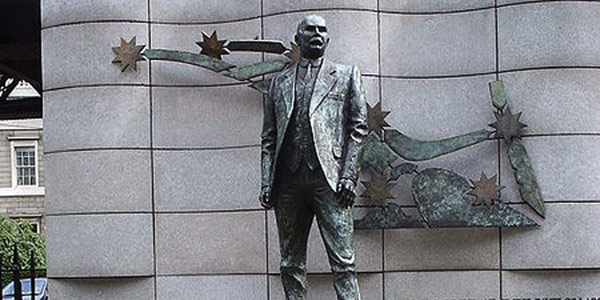
Monument in Dublin to James Connolly, revolutionary sociailist writer, historian, theorist, union organiser, publisher -- his last location of freedom was the Moore Street 1916 Terrace, before he was shot by British firing squad
Monument in Dublin to James Connolly, revolutionary sociailist writer, historian, theorist, union organiser, publisher — his last location of freedom was the Moore Street 1916 Terrace, before he was shot by British firing squad (Photo source: Internet)

IN CONCLUSION:

For all the reasons given above, its social history, its anti-colonial history, the history of the common people as well as that of intellectuals, the history of the working class to assert its independence and dominance of the movement for liberation, the history of women’s struggles, and the current struggle of people against property speculator capital and State, the place of socialists, revolutionary and radical, is right there with the Moore Street 1916 Terrace campaigners. But where are they?

With the exception of a few honourable exceptions, they are notable by their absence. Yet, they will wonder at times why the mass of people do not follow them; why, for the most part, they regard them and their organisations as an irrelevance.

End.

PEGIDA PLANNED LAUNCH ENDS IN SINKING — survivors take to lifeboats

Diarmuid Breatnach

Saturday was the day selected by Pegida for their Irish launch, which they had planned to do at the Dublin GPO at 3pm on Saturday (6th February). Anti-Racist Network Ireland called a demonstration for the same location from 1.30pm but from around noon bands of antifascists were on the street hunting fascists and met them at various locations with painful results for the fascists.

Section of anti-racist rally on central reservation O'Connell Street, looking southward. (Photo from ENAR Ireland FB page).
Section of anti-racist rally on central reservation O’Connell Street, looking southward. The GPO building is to the right out of frame. (Photo from ENAR Ireland) FB page).

BACKGROUND

Founded in Dresden, in eastern Germany in October 2014, Pegida (Patriotic Europeans against the Islamisation of the West) is a broad European network of loosely linked groups opposed to what they claim is the “Islamisation of Europe”. Although Dresden remains its stronghold, the organisation has spread to a number of European countries.

In January last year, marches in German cities reportedly attracted up to 25,000 people at their peak, before numbers began to drop severely, rising again however in October as politicians and media stoked fears of a massive influx of migrants and refugees arriving in Europe from war-torn countries (countries, incidentally, where some European powers have played a major role in instigating or directly carrying out those wars).

Pegida claims to be not fascist and ‘solely’ against Muslims as has been the case with so many fascist organisations in the past – they have been ‘only‘ against communism, or against Jews, or against blacks etc. The organisation has been frequently associated with general anti-immigration diatribes and in January last year derogatory descriptions of immigrants by its German leader, Lutz Bachman, in a closed Facebook discussion, were made public. He stepped down from the leadership after those revelations and the circulation of images appearing to show him posing as Adolf Hitler. The following month however he was reinstated with claims that the images were faked.

In Ireland the Blueshirts, popular name for the Army Comrades Association, mobilised and recruited in the 1930s. They were in part a response to the election of the new Fianna Fáil party, a split from Sinn Féin, in a popular national reaction to the hounding of socialists and republicans by the victors of the Civil War, 1922-1923. The Blueshirts presented themselves as Irish nationalists (even Republicans) with their targets being Communists, Jews and the IRA. Meanwhile elsewhere in Europe, fascist groups were organising, variously declaring their targets to be Jews, Communists, Socialists, Anarchists, trade unionists, Roma and Sinti, immigrants, gays and homosexuals and various religious groups.

The Blueshirts were fought on the streets by Republicans, Communists and some social democrats and, when they threatened a coup, their activities were banned by the De Valera government. It seemed that the majority of the Irish capitalist class had decided that Fianna Fáil were a safe pair of hands and would manage the country better and, besides Britain might go to war with some countries where fascists were in power.  The Blueshirts lost active members after that and with other right-wing organisations, formed the Fine Gael political party which became the principal mainstream opposition party from then on, occasionally going into Government in coalition with other parties. 

Blueshirts marching, 1930s (Photo sourced from Internet)


PRELUDE TO DEMONSTRATIONS AND ANTI-FASCIST ACTION

Saturday was chosen as “a day of action” for the groups that fall under the Pegida banner, with a number of anti-immigration and anti-Islam demonstrations planned to take place across Europe. The Irish far right anti-immigration organisation Identity Ireland supported Pegida on their Facebook discussions and claimed that Saturday would see the launch of the Irish branch of their organisation. According to a report by the Russian news agency RT, Identity Ireland’s leader addressed a Pegida rally in Dresden last month.

The ARN called for a large peaceful demonstration and even encouraged people to bring their children, advertising it as “a family affair”. Some debate between them and antifascists took place on the Internet and in person on what are the effective methods of resistance to fascism to employ. One of the anti-racist event organisers, Bulgarian Mariya Ivancheva, sociologist and anthropologist based at UCD, was reported in The Journal as calling for a “nice rally to celebrate diversity”. “When Pegida are there we are ready to face them but not to confront them,” she went on to say.

Anti-fascists referred to history to verify their case that fascism has always ultimately had to be stopped by physical force and that being the case, application of that approach at an early juncture was most effective and meant less suffering for working people, ethnic minorities and other targeted groups. The response of ARN to these antifascists was that the latter were not welcome on their rally.

Barricade against a Blackshirt march at Cable Street, East London, 1936. The attack was spearheaded by the police but the antifascists were successful.
Barricade against a Blackshirt march at Cable Street, East London, 1936. The attack was spearheaded by the police but the antifascists were successful. (Photo from Internet)

Many Republicans and Socialists were also angered by reports that the ARN had applied for police permission to hold their rally. Unlike in Britain or in the Six Counties, this is not required by law in the Irish state and the police are required to facilitate with traffic restrictions the right to march or rally on the streets or pavement. The antifascists’ disapproval was based on what was perceived as giving the police more power than they already had and which they often abuse. One veteran of demonstrations in Britain recalled that permission had once not been required in London either but liberals, social democrats and officials of the Communist Party of Great Britain had made it a practice to ask the police in order to cultivate good relations with them. In time, prior police permission became a requirement which at times was withheld or granted with conditions on times and changes of route.

However, subsequent to the publication of this report, I ascertained that ARN  had not asked permission of the police, one of them pointing out that such is not required.  The misunderstanding may have arisen from one person stating that he had informed the police that the event would be taking place.  This of course is quite some distance from asking permission.

The antifascists, composed of Irish Republicans from virtually all organisations and independents, along with a few socialist and anarchist independent activists, organised their own mobile forces.

ON THE DAY

The anti-racist rally at the GPO was attended by a couple of thousand, from the Spire almost to the Jim Larkin monument and covering the road from the GPO to the central pedestrian reservation. O’Connell Street was closed by the authorities to all northbound traffic and stewards were having difficulty in preventing the rally spilling into the southbound lanes. It was addressed by speakers from People Before Profit, the Anti-Austerity Alliance, Sinn Féin and a number of other speakers, including migrants.

Small section of crowd on east pavement, O'Connell St, with Misneach organisation flags visible (Photo D. Breatnach)
Small section of crowd on east pavement, O’Connell St, with Misneach organisation flags visible
(Photo D. Breatnach)

Clashes occurred at the pre-arranged Dublin meeting points of fascists on the Luas line with the handful of Irish fascists being attacked and some, including their leader Peter O’Loughlin and member Ian Noel Peeke being reportedly hospitalised. Clashes broke out again in the city centre at a number of points; one of the latter being at Earl Street North. It seems that some Pegida supporters had gathered at the junction with O’Connell Street and were watching the demonstration opposing them across the road and some were filming it.  There were reports of some of them abusing women supporters of the antiracist rally who were near the junction with North Earl Street. The Rabble independent media group reported them shouting anti-communist insults at them (see their video link at end of article). In any case, although generally free of visible insignia and carrying no banners, they began to attract an antifascist crowd, scuffles quickly broke out and the fascists ran down North Earl Street and Talbot Street. A couple of the Pegida supporters ducked into a nearby ‘poundshop’ apparently for safety but they were followed and received a pounding.

Police stormed the shop and evicted the antifascists, lashing out at almost anyone close by, as can be seen in the Irish Times video (see link at end of article). RTÉ has lodged a complaint about one of their camera operators being deliberately struck by a police baton. The riot police with batons drawn then set up cordons with barking German Shepherd dogs behind them and cleared North Earl Street of all pedestrians, allowing no others to enter from either direction.

North Earl St. after incident (facing westward). (Photo D. Breatnach)


This cordon was maintained until a few more Pegida supporters were permitted to escape through Malborough and Talbot Streets. All of the fascists in this area at least were identified by a number of sources as being of East European background, both by their accents and appearance. Some posts on fascist sites later on seemed to confirm this (see AFA Ireland statement link at end). Earlier reports gathered by antifascist intelligence had indicated that Pegida supporters from fascist Polish organisations were planning to support the Pegida launch.

 North Earl St. facing westward, Police and their vans (Photo D. Breatnach)
North Earl St. facing westward, Police and their vans (Photo D. Breatnach)


Subsequently, word reached antifascist patrols that 5-7 other Pegida supporters had gathered in a pub in Cathedral Street, again off O’Connell Street and scores of anti-fascists raced to arrive outside the pub almost at the same time as police. Another struggle with police took place outside the pub with riot police using their batons to jab and occasionally lash out, though with a degree more restraint than they had earlier at North Earl Street (perhaps due to an initial complaint from RTÉ having reached their senior officers by then). Police continued to violently push protesters and to jab with truncheons and one demonstrator showed a badly swollen and blue hand.

A standoff took place here for some time until the Pegida supporters appeared to be getting bussed out in police vans which sparked a rush of 50 or more antifascists southward down O’Connell Street. Riot police on foot and in vans followed them and at the intersection with Lower Abbey Street, drew up two cordons, one facing eastward down Lower Abbey Street and the other facing the Liffey, while crowds of antifascist gathered on the eastern pavements and Lower Abbey Street and mostly spectators gathered on the central pedestrian reservation. More police arrived and drew plastic shields out of their vans while a number of dogs were in evidence barking, one jumping up and straining on the leash towards antifascists.

Many spectators, natives and others, expressed bemusement and asked people near them what was occurring, evidence of the low level of advance news coverage by the mainstream media. Alternative, liberal, socialist and Republican media and independent sites on the other hand had given extensive coverage and encouraged people to attend the anti-racist demonstration or the antifascist action. Some among the crowd who were ‘in the know’ explained the events to one or two in their immediate vicinity. The overall atmosphere in the crowd seemed opposed to the fascists with mixed attitudes to the police and antifascists. These crowds offered fertile ground for being publicly addressed by word of mouth or leaflets but none seemed available to fulfill that role.

After some time in apparently purposeless deployment, given that nothing was moving, the Gardaí simply returned most of their forces and riot shields to their vans and most drove off. This seemed to indicate that the police maneouvre had been in the manner of a decoy while the fascists were spirited away quietly from the vacated vicinity of the pub. The Rabble video seems to confirm this.

Melee in Cathedral Street (photo from Internet)
Melee in Cathedral Street as riot police force antifascists away from pub where fascists are in hiding (photo from Internet)
Riot Squad police in Cathedral Street facing off antifascists. (Photo D.Breatnach)
Riot Squad police in Cathedral Street facing off antifascists.
(Photo D.Breatnach)
Standoff Abbey St. junction O'Connell St, facing westward (Photo D.Breatmach)
Standoff Abbey St. junction O’Connell St, facing westward (Photo D.Breatmach).
Many spectators -- view northwards along O'Connell St. from the William O'Brien monument (Photo D.Breatmach)
Many spectators — view northwards along O’Connell St. from the William O’Brien monument (Photo D.Breatmach)

SUMMARY ANALYSIS

The State, probably in anticipation of antifascist action, mobilised and deployed considerable forces. Garda vans moved through the city centre, sometimes in convoys, in addition to police on foot, mounted on horse and bicycle (though the horse police were often discreetly out of site in several locations around the demonstration area). Riot police waited in vans while other vans were stacked with plastic riot shields (which in the end were not needed, if a missile was thrown at the police it was a rare one).

In line with the general history of the relationship between capitalist states, their police forces and fascist movements, the police showed their determination to protect the fascists moving around the city centre. The eagerness of officers at times caused them some problems, including one of them striking a cameraman from the national broadcasting network, RTÉ, with a baton. On another occasion, a riot police officer can be heard calling “Hold the line!” at a time when the video shows the line is not under pressure – the only danger to the police line at that point is seen to be from over-eager officers breaking away to pursue and attack demonstrators.

A number of demonstrators and some spectators suffered bruises from police batons as well being violently shoved by police. In one video a police officer is briefly visible striking at a person lying on the ground – a visual echo of that famous photograph of Bloody Sunday during the 1913 Lockout, when the Dublin Metropolitan Police had run riot less than 100 yards away. In other footage police are seen shoving a man, apparently disorientated (perhaps by a blow to the head) to the ground at least three times although he is no threat to them and is not even resisting.

A feature of the antifascist active resistance was the unity in action across the Irish Republican spectrum, a feature that has been growing in solidarity work around Republican prisoners, in resistance to some features of repression and in the defence of the historical heritage represented by the struggle to save the 1916 Terrace in Moore Street. On this occasion however the unity in action included some SF activists. A sprinkling of independent socialists and anarchists were also among them. Some activists of the socialist, anarchist and communist organisations left the rally to join the antifascists blockading the fascists and their police protectors at Cathedral Street. There were a number of reports of football youth ‘casuals’, supporters of four Dublin soccer clubs, also cooperating in hunting for fascists. At least two of these were observed taking ‘selfies’ of themselves against a riot police background!

It is not known how many arrests were made nor what their outcome has been. Fascists were filmed being handcuffed as they were being put in police vans to take them to safety but it is unlikely they were charged. A number of fascists were reportedly hospitalised where no doubt their medical care teams will include a number of migrant background and perhaps even of Muslim religion.

The police and the Government will be considering their response but the ritual condemnations by their mouthpieces of antifascist force can be expected, as well as attempts to isolate the antifascists as some kind of hooligan or sinister element. The capitalist class will not be impressed with Pegida or Identity Ireland’s performance and, if considering building up a fascist movement in the future, will probably look elsewhere.

Both the ARN and the antifascists were pleased with the outcome of their respective efforts but liberal elements can be expected to condemn the antifascists for what the former perceive as marring the message of their demonstration. The ARN statement (see link at end of article) did so in fact albeit in muted tones, “regretting skirmishes”. In a parallel to some Jewish leaders in 1930s Europe during the rise of fascism, a Muslim religious leader was quoted criticising violent actions “by a minority” and called for defeating them by “dialogue”.

The fascists will be licking their wounds and trying to put a brave face on their defeat, also condemning the antifascists for using “undemocratic violence” or words to that effect. All fascist movements in history have been extremely violent while often, while in their growth period, presenting themselves in public as peaceful and condemning the violence of their opponents. This is a fact that liberal elements usually fail to appreciate, while other elements among the middle class are ultimately content to see their order being maintained, whether by the State or by fascists.

Whatever spin the fascists, the State, mass media or liberals may put on it, the fact remains that the fascists have been prevented from staging a publicity coup that would have raised the morale of their few recruits and encouraged more to join them. Fascist movements throughout history have required such morale-boosters and encouragement for potential recruits and, incidentally, intimidation of their opposition. What happened on Saturday in Dublin has been the reverse – the fascists and potential recruits have been intimidated and discouraged. Over 200 indicated intention to attend on the Pegida “Irish launch” Facebook event but reports on the ground in the city centre indicate a total of perhaps 30 fascists being chased around the city in small groups. The 170 or so, whether Irish or from elsewhere interested in supporting islamophobia, racism and fascism won’t be in a hurry to enlist now.

But should a new attempt be made to launch a mass fascist movement in Ireland, on whatever divisive basis, the antifascists are likely to turn out in even greater numbers.

End.

Video and text links:

Irish Times video showing part of incident at North Earl Street which shows a number of unprovoked assaults by Gardaí on individuals, both by violent pushing and by baton blows. http://www.irishtimes.com/news/ireland/irish-news/scuffles-break-out-at-launch-of-anti-immigration-group-in-dublin-1.2525530

Collage of video clips taken by independent film maker, including scenes of baton-swinging police: https://www.youtube.com/watch?v=uHkQnkaqaoU

Great footage taken by filmer from Rabble alternative media organisation of a number of dramatic events including fascists’s faces: http://www.rabble.ie/2016/02/07/pathetic-pegida/

Short panoramic video clip of the AR demo https://www.youtube.com/watch?v=fJNQW0pSYpY

Independent long video footage of confrontation on Cathedral Street posted on Youtube: https://www.youtube.com/watch?v=_REls3JkxzQ#t=129

AFA statement and some other material on their site: https://www.facebook.com/afaireland/posts/1018094948250821:0

Irish Republican Left Action Against Fascism statement: https://www.facebook.com/permalink.php?story_fbid=913561958751080&id=912549568852319

ENAR Ireland photos and Anti-Racism Network statement: https://www.facebook.com/enar.ireland/posts/954399354642123

Rogues’ Gallery of fascists’ faces album: https://www.facebook.com/libertypics/media_set?set=a.10207283509858914.1073741835.1019818043&type=3&uploaded=1&hc_location=ufi

LIST OF ORGANISATIONS SUPPORTING THE ENAR RALLY:

“Supporting organisations (in alphabetical order):

Anti Austerity Alliance, Akidwa Ireland, Africa Centre Dublin Ireland, Anti Racism Network Ireland, Attac Ireland, Autistic Rights Together, Communist Party of Ireland, Conference of Religious in Ireland, Dialogue & Diversity, Dublin Calais Refugee Solidarity, Dublin City Centre Citizens Information Service, Doras Luimni, EDeNn, ENAR Ireland, Fighting for Humanity – Homelessness, Galway Anti Racism Network, Gaza Action Ireland, Gluaiseacht for Global Justice, Green Party of Ireland, Ireland Says Welcome, Ireland Palestine Solidarity Campaign (IPSC), Irish Anti-War Movement, Irish Housing Network, Irish Refugee Council, Irish Missionary Union, Irish Traveller Movement, Migrant Rights Centre Ireland, National Traveller Womens Forum, Shannonwatch, Show Racism the Red Card – Ireland, SARI – Sport Against Racism Ireland, SIPTU, Sinn Féin , The Platform, Pavee Point, People Before Profit, United Against Racism, The Workers Party, Workers Solidarity Movement, You Are Not Alone.” (From their statement published on European Network Against Racism Ireland’s site)