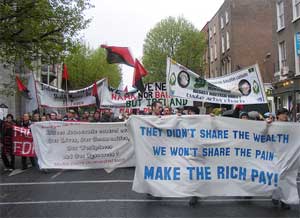
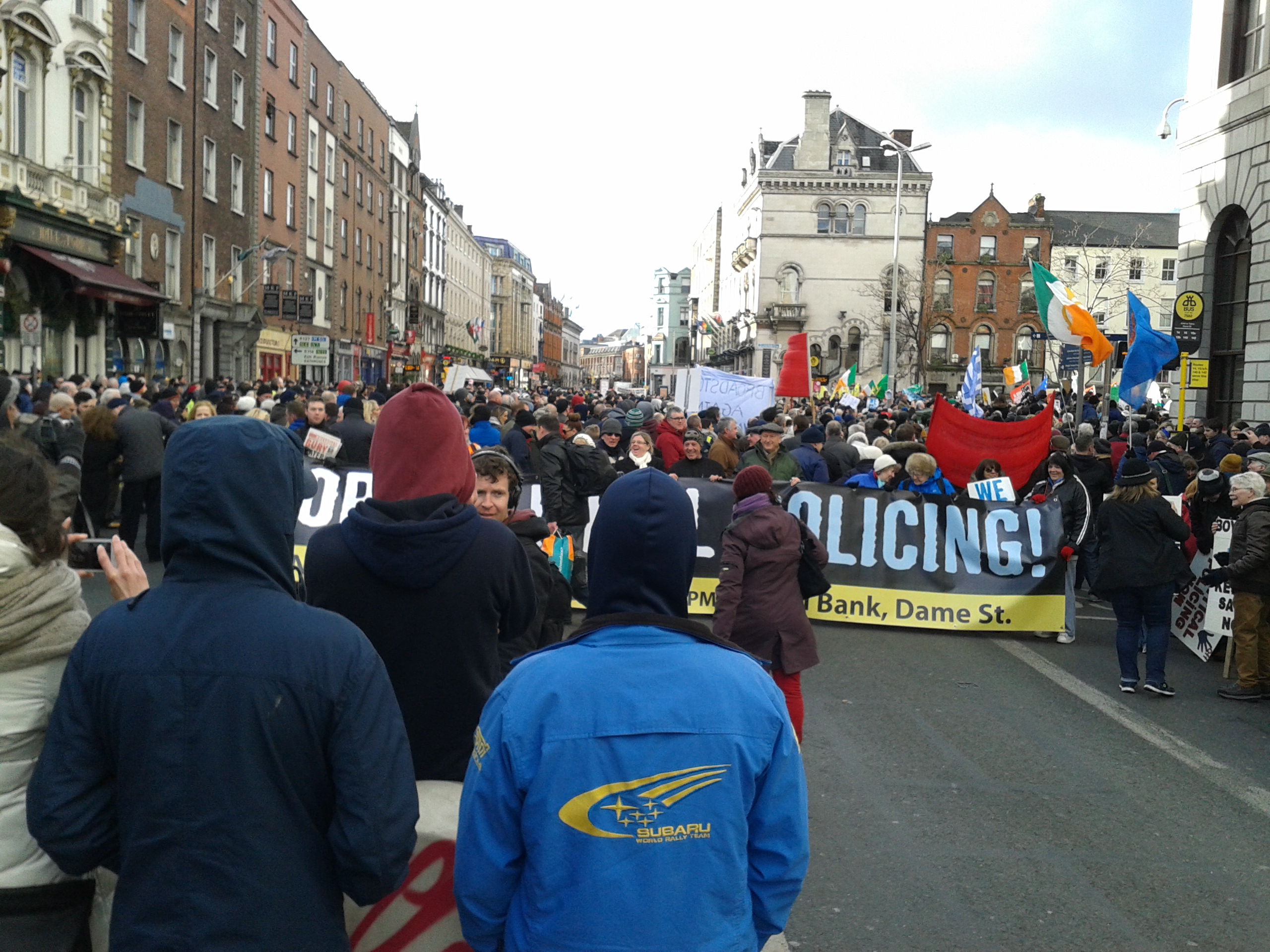
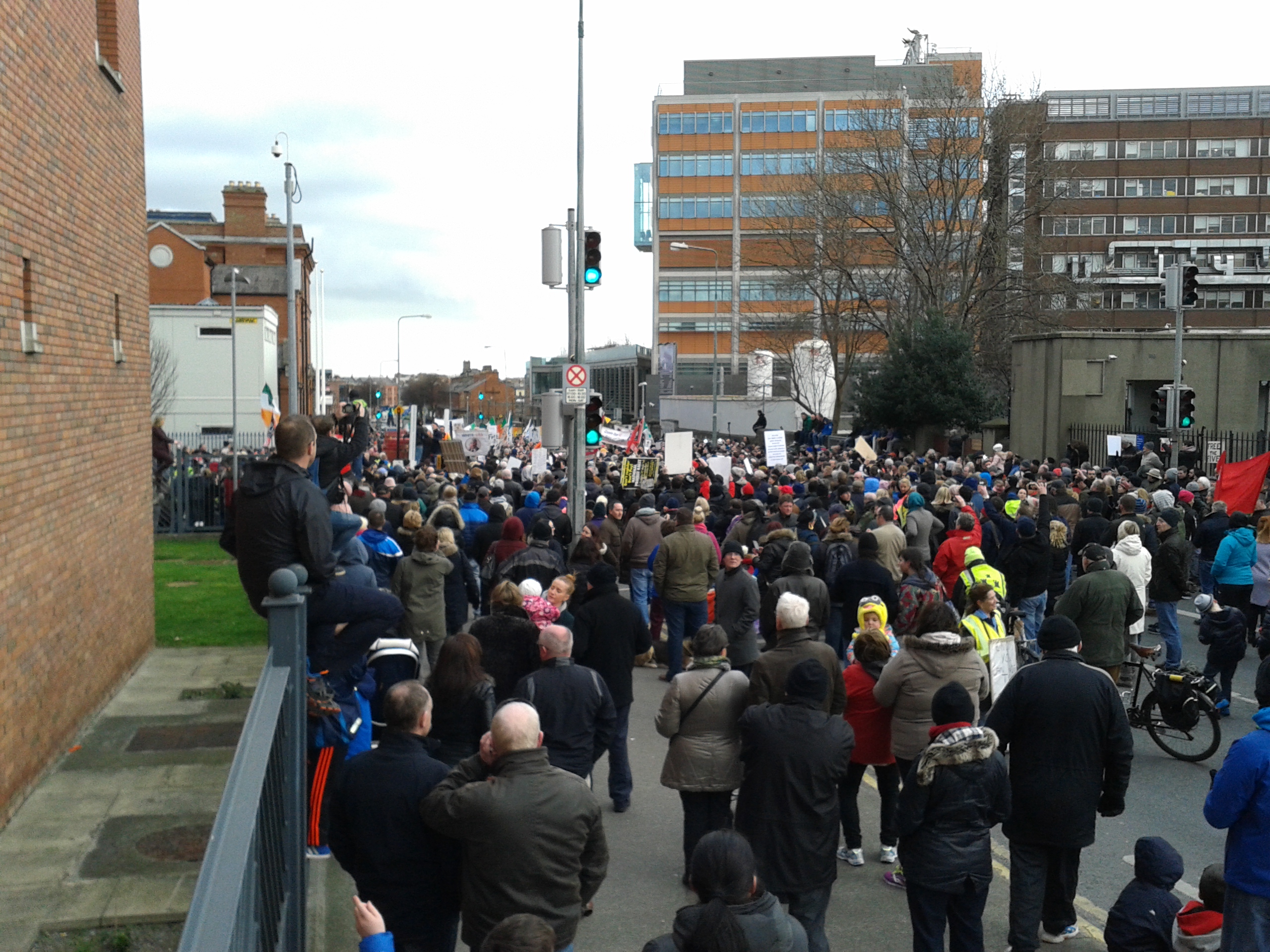
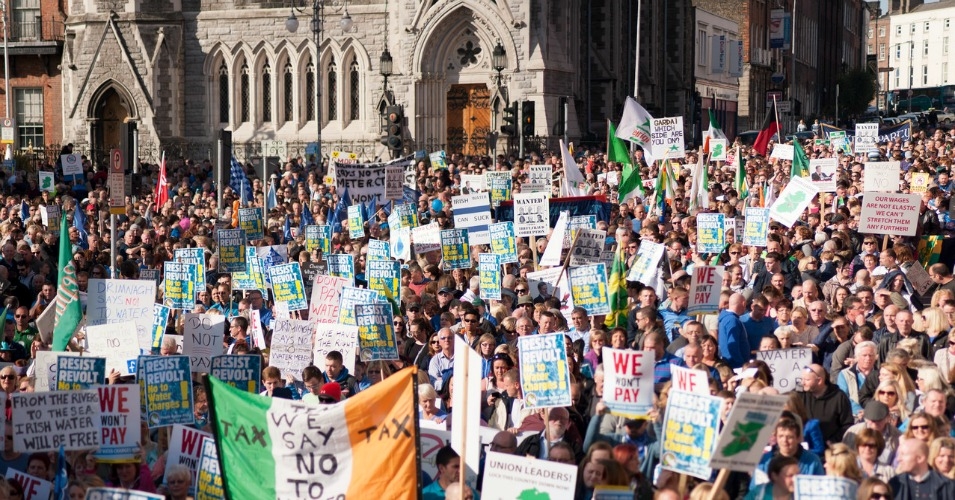
Start of the march in Dame Street after rally in Central Plaza
On Saturday 21 February, at two days’ notice, somewhere between eight and ten thousand people gathered in Dublin in solidarity with those water tax protesters jailed by the State and those recently arrested. They marched to Mountjoy Prison and packed the road outside it and in front of the local Garda (police station).
The march gets going in Dame Street. Photo shows only the front of the march.
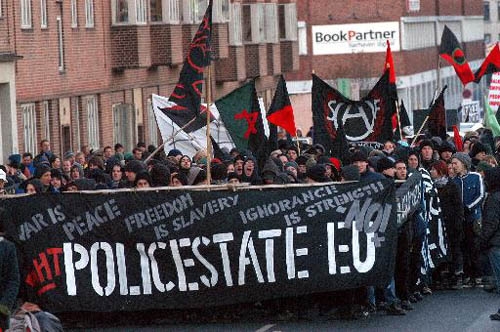
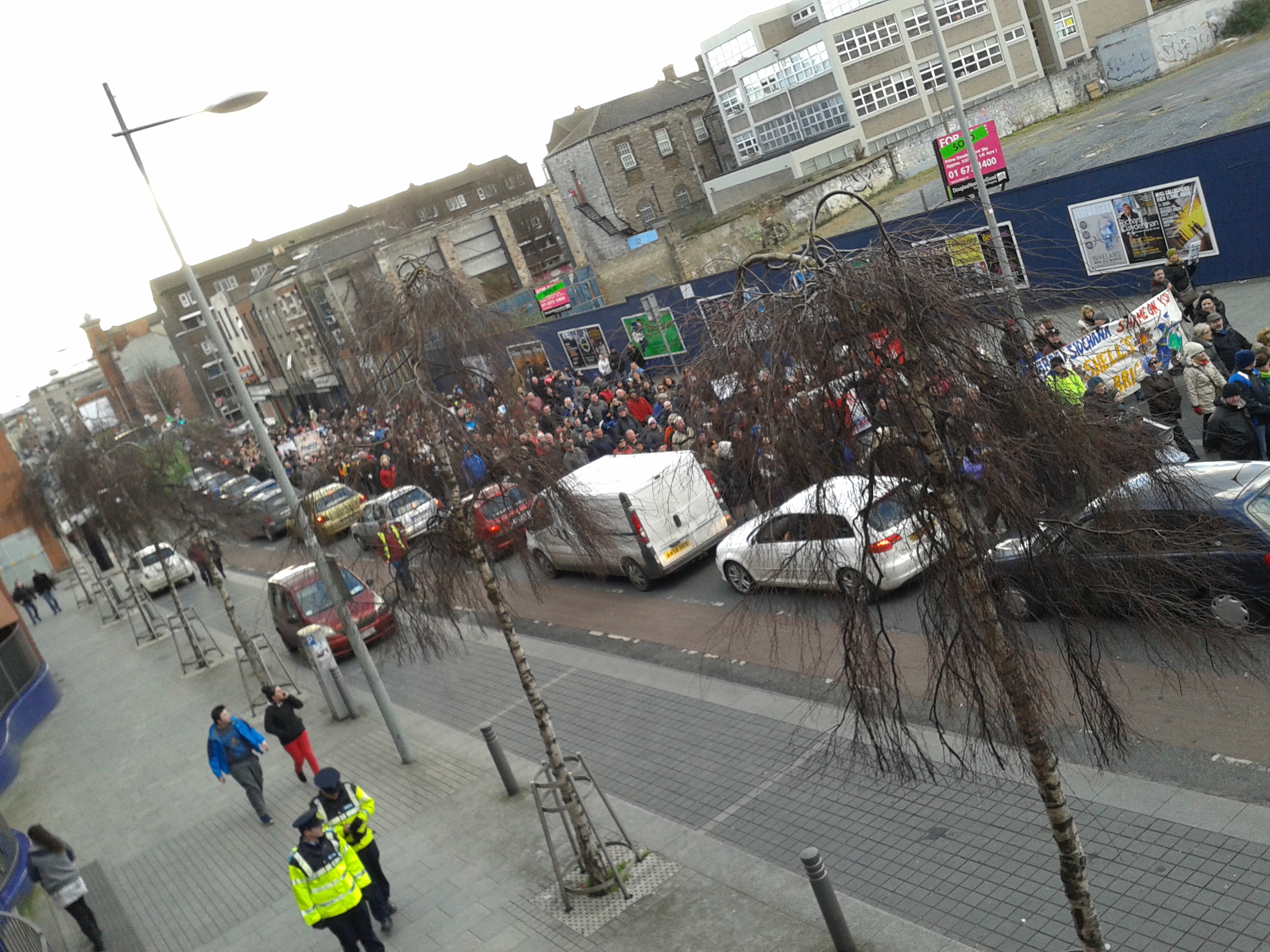
Parnell Square West from Granby Place. The front of the march has turned into Dorset Street and is marching there but the end has yet to come around the corner into the square from Parnell Street
The crowd were addressed by relatives and friends of the jailed, anti-Water Tax campaigners as well as by Paul Murphy, Joan Collins and Clare Daly (both TDs of the United Left) and Dessie Ellis (TD of Sinn Fein).
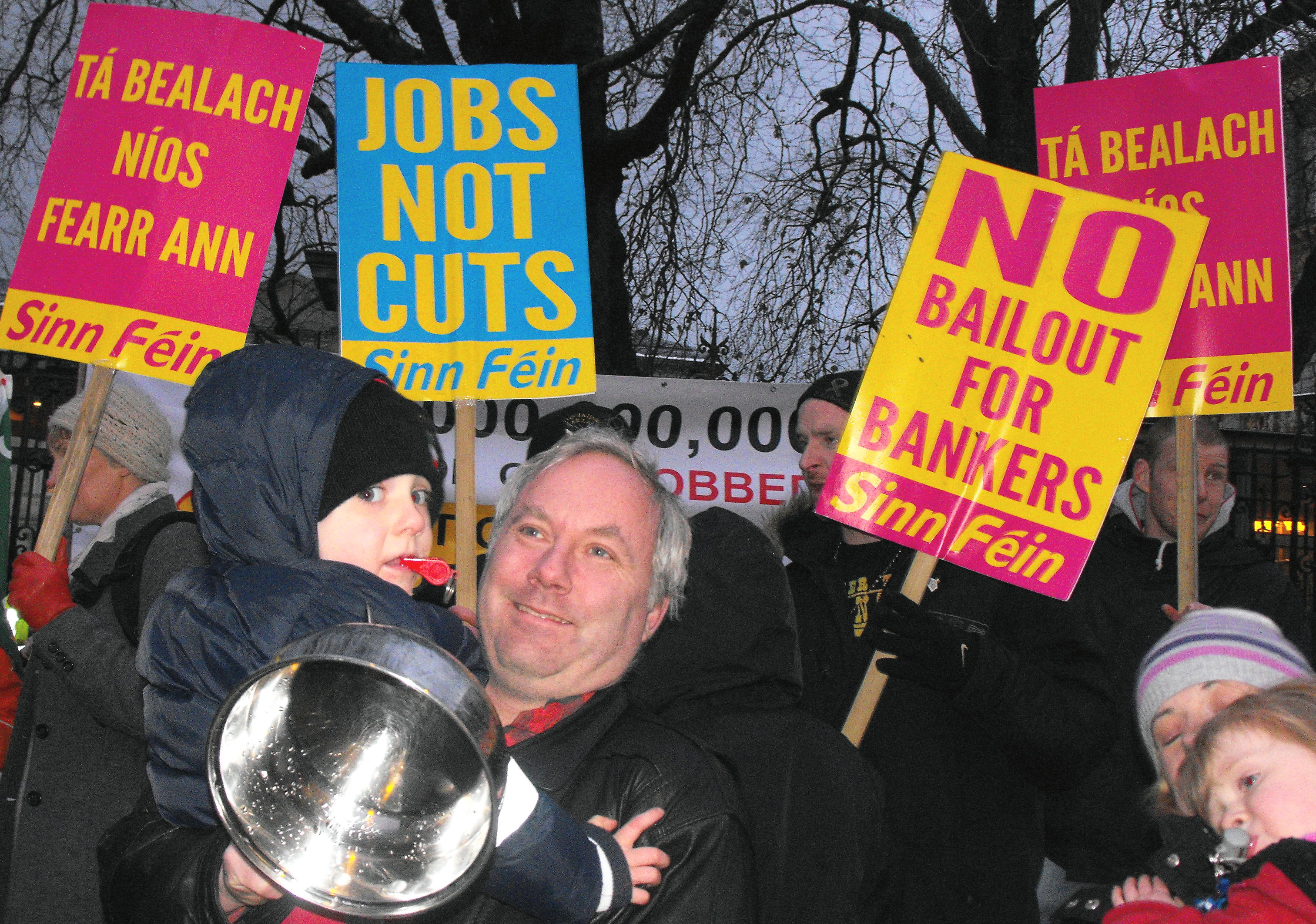
All of the speakers denounced the politicians and the State for the jailing of the protesters while the bankers and politicians who created the crisis and colluded in the bank bailout went free. Most speakers called on the crowd not to pay the water tax and to build resistance on the streets. Dessie Ellis, in keeping with his party’s position, did not call for non-payment, though he did call for “unity of the Left”. The march was notable for the absence of SF banners and placards — apparerently they were having their own protest at Leinster House.
One of the protesters made an emotional appeal on behalf of two of the five who received jail sentences, who have gone on hunger strike, and on behalf of another, Derek Byrne, also on hunger strike, but who has declared his intention of refusing to take fluids from Monday if he is not released. (NB: Since posting that paragraph it has emerged that the demand of all three hunger-strikers is a return to Mountjoy [they had been separated and sent off to a prison facility near Clondalkin] and an end to 23-hour lockup in their cells. These are basic human rights.)
Large sections of the crowd seemed taken aback by this information and unsure how to react.
Paul Murphy pointed out that this use of the police to attack people protesting injustice has been a feature of the State since its creation and mentioned the threats of jail to striking workers, the jailing of the Rossport Five and of Margaretta D’Arcy. Clare Daly asked the Gardaí which side they were on, that of the polticians and bankers or of the people, saying that if they chose the former it is they who would become isolated, not the protesters. Joan Collins, Murphy and Daly all pointed to the need to create a socialist society. They also, along with most other speakers, called for a build up and huge turn out of support for the demonstration scheduled for March. Many speakers declared that the increased repression is a sign of the Government’s or the system’s weakness, not of their strength and called on the movement not to falter now.
Robert Ballagh, who also spoke, called for the release of the five and pointed out that the class of people who rule and profit out of this society are not those who find themselves in jails.
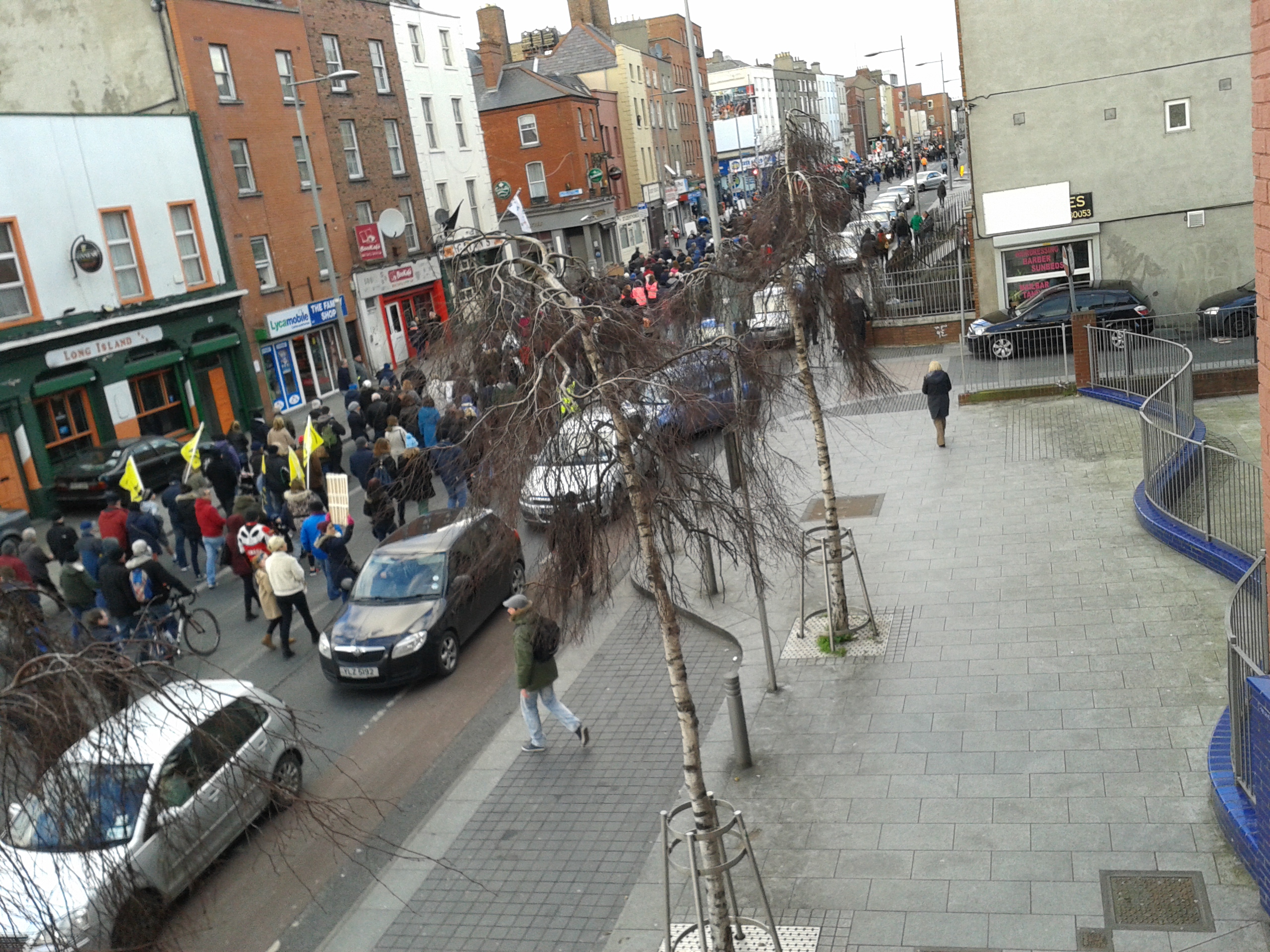
Section of the march in Dorset Street, looking west (another section is behind the camera — see next photo — but a large section of the march has yet to come around the corner from Parnell Square.)
The same road, photo taken a few seconds later but looking east.
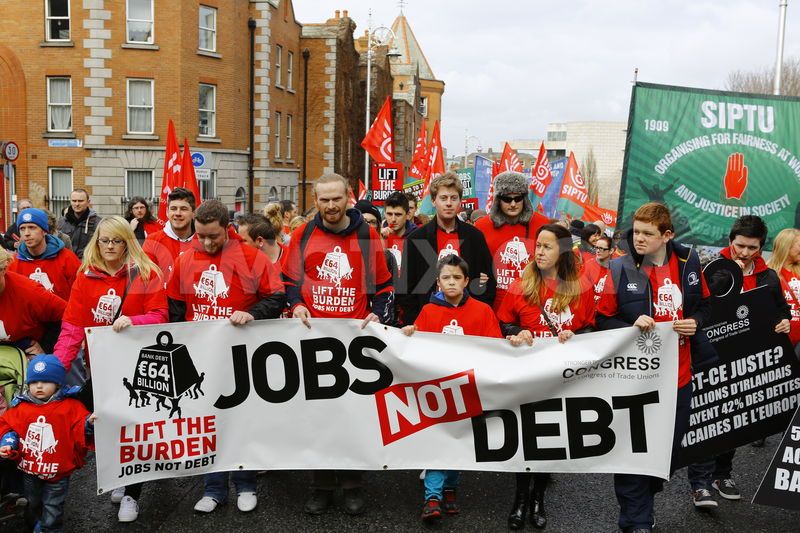
The mood of the crowd in general was of good-humoured determination. The composition seemed to cross social groupings, ages and genders and a number had brought their children along. Some had come from other parts of the country.
Crowd outside Mountjoy. some have left and many are still further down the north Circular Road (the Mater Hospital is to the right of photo).
CATHERINE BYRNE, DUBLIN TD, SAID “WE SHOULD TAKE BACK OUR FLAG”. MAYBE SHE’S RIGHT ….
Dublin South-Central TD Catherine Byrne was warmly applauded when she said that they should ”take back our flag” from people who have been using it in protests against water charges and other issues. She made the statement at the Fine Gael political party’s two-day conference in Castlebar, Co. Mayo, held under strict security.
Arts Minister Heather Humphreys supported that view and told delegates in a secret session on the 1916 commemorations (a session which exposed divisions in the party): ”Some have used our flag to portray a different message – it’s time to reclaim our flag.”
“What should I do?” The anguish reached out to me; I felt it empathically. The cry of a person who is prepared to act and wants to change things for the better, to resist what is wrong around us on so many fronts – and that’s the problem.
There so many issues: the Water Tax, the persecution of Republican activists including framing and jailing them, the harassment and torture of Republican prisoners, the threat of fracking, privatisation of resources and services, cuts in services, cuts in salaries, high cost of private accommodation and low social housing provision causing homelessness, the decline of the Irish language and of the Gaeltacht …. and others. And that’s without mentioning international solidarity – and not because I don’t consider that essential, either.
Of course, we can put all these problems down to capitalism and, in the case of repression of Republicans (and with regard to international solidarity), to imperialism …. so let’s just overthrow those systems and then we can sort out those problems! But that leads to the question of “How” which in turn brings one back again to that anguished question, or to its variant “Which problem should I prioritise?”
Indeed, it is a question that cuts to the heart of the matter. For the issues call to us to act and since we can’t be everywhere at once we have to make choices. It is a question as old as class society and speeches are always being made recommending this choice or that while books have been written attempting to answer it. Lenin wrote a series of articles in the revolutionary newspaper Iskra (“Spark”) and published later as a booklet under a title that echoes that very cry above: What Is to Be Done? It had a subtitle too: “Burning questions of our movement” (by which he meant the socialist movement in Russia at the time).
Whether we choose to believe that work was absolutely correct, partly correct or completely wrong is in some ways irrelevant, for it was written for the movement in Russia in 1902 and published in 1905. I happen to think that it contains many useful ideas, although I am aware that there is a view that it has been mistranslated but, even so, in many ways, all that is beside the point. The fact is that today we have no blueprint and nothing more than perhaps the equivalent of a trouble-shooting manual: “for this problem, try this; if that doesn’t work, try that; while doing so beware of that other.” And that manual is cobbled together from older and more recent history of struggles, of analyses of the capitalist system and of how it behaves.
Scary, surely, to go up against a system that has ruled for around four centuries, that has spread across the world, that controls education, mass media, the State with its police, judges, prison and armed forces – and all without us having a blueprint. Well, if it’s any consolation, the capitalists don’t have a blueprint either … or if they do, they keep having to ignore it and react to events which they have not been able to predict, as well as to the extent of resistance for which they were unprepared. And they clearly make mistakes. Still, 400 years is a long time … a long time for them to learn tactics and strategy and to get comfortable in control and a long time to make us think that we can’t defeat them.
We can defeat them, of course and the indications from history and the internal workings of capitalism — and of its offshoot imperialism — are that we will. But what to do to make that happen? Yes, back to that question. And to the one that logically follows it: which issue to prioritise? For none of us is capable of being everywhere at once and even stretching over a few issues at a time begins to tear at our fabric.
The Marxist-Leninist approach argues for the creation of a revolutionary party that will make decisions on prioritisation and allocate resources to those struggles it chooses as it does so. Of course, the party will make mistakes from time to time and it will learn from those, getting better as it goes along. That’s the theory anyway. In application, or in alleged application, the results have not vindicated the theory – not in the long run, or even in the medium-term. Sure, we have been at it for less than 200 years: the first time workers captured a city was in 1871 and the first successful overthrow of the State was in Russia in 1917, very nearly a century ago. Much less time to learn, to make mistakes and to correct them but still ….
Of course, the alternative method of organising has even less to recommend it on results: amorphous, disparate collectives have not ever successfully overthrown a State and even their success in capturing a city (Barcelona, 1936) is debatable.
So, what is to be done? How to decide which struggle to prioritise? This is not a question I think can be answered by pointing and saying “That one and no other” or even, except at rare junctures, “That one and no other for the moment”. Individuals, collectives and parties will need to choose from the selection as a painter chooses from a palette: “this colour now, then that, no, scrub that one, now mix this with that, no, a bit more light …” and so on, always working towards the desired result which, although in the head, is also taking place on the canvas and making its own demands as it does so.
The truth is that all of those issues I mentioned in passing at the start of this piece, all of those, need addressing. All of them need people to fight in them. That is because they are all part of the same problem and also because we can’t just allow a cancer to grow unchecked in one part of the body while we address the tumours in another. Some individuals and perhaps even collectives are better suited to fight on some issues than on others: for example, a factory shop committee is probably not best placed to lead the struggle against fracking in a rural area, while a rural environmental collective is probably not in the best position to lead the struggle against the Water Tax. Individuals will need to pick and choose according to their own situation, their locality, their own knowledge.
And that would be fine, if the resistance movement as a whole were integrated enough to make creative use of that disparity – for particular struggles to be able to call for temporary additional resources and to be heard by the whole resistance movement, so that it could try to allocate those resources to one or other sector as seemed appropriate. But the resistance movement is far from integrated – it is fragmented and, even worse, it suffers from something akin to schizophrenia.
There a number of ways to imagine schizophrenia and the most popular is to see it as the development of two or more personalities in the one individual. But another is to see it as a disintegration of the personality – where the various aspects in our minds break free and appear as distinct personalities in themselves. The voices that speak in our heads to say things like “You shouldn’t have done that” or “Please make that happen” break free and seem to become different personalities. At times they conflict with one another while the central core personality tries to make sense of what is going on. Something like that, anyway. It is in that sense that I think the resistance movement in Ireland suffers from schizophrenia.
The splitting off of aspects of the revolutionary movement in Ireland has been towards two major poles of attraction: the Socialist one and the Republican. Of course there are some elements who incorporate both to one degree or another but I think examining them as distant poles of attraction is useful and much closer to their concrete manifestation within the revolutionary movement. In order to examine them as opposite poles I think it is also useful to imagine a stereotype individual inhabiting each pole. Let us then imagine a stereotypical Irish Republican and a stereotypical Irish Socialist.
The Irish Republican is probably working class or maybe lower middle class; he may or may not have done well at secondary education but in any case he is unlikely to have gone to university. He sees himself in a tradition of resistance to British Colonialism and Imperialism stretching back at least to the United Irishmen and perhaps even back to the Norman conquest which began in 1169. His priority is the removal of the British from Ireland. He experiences “political policing” (of which some socialists are now complaining) practically from the moment he becomes publicly active – he has had his name and address taken by Special Branch and/or RUC/PSNI and they have opened a file on him. The Republican’s recent predecessors have been jailed (as are some of his contemporaries now), beaten or even shot dead; they were engaged in armed struggle against the colonial and imperial armed forces in the Six Counties for 30 years and perhaps he looks forward to take the gun up again some day, to strike back at the colonial overlord. He will turn out on demonstrations and pickets against repression of Republican activists, in support of Republican prisoners, including framed ones. He will almost certainly attend mass demonstrations against the Water Tax and may participate in local direct action against it. The Republican’s idealogues are Wolf Tone, Patrick Pearse and Bobby Sands.
The Irish socialist is probably medium or lower middle class and has finished secondary education; she has almost certainly gone on to university. She sees herself as belonging to a tradition of only a couple of centuries, with an Irish tradition going back to the early part of the 20th Century, in particular to the 1913 Lockout and the Limerick Soviet of 1919. She may or may not give a high place in her history to the Irish Citizen Army in the 1916 Rising. Her priority is the defeat of the capitalist class, probably in Ireland first but will turn out in demonstrations against racism, gender discrimination and homophobia in Ireland. The Irish Socialist aspires to a general strike giving rise to a revolutionary take over of the State; in the interim she may or may not think electing left-wing TDs or trade union officials an important activity. She probably can’t conceive of taking up a gun. The Irish Socialist has never had her name taken by the Special Branch or been framed by the RUC/PSNI and may never even have been detained by the police, though she has probably been pushed around by them. She will almost certainly attend mass demonstrations against the Water Tax and may participate in local direct action against this Tax. Her idealogues are Karl Marx, Lenin, possibly Trotsky and James Connolly.
Granted these are stereotypes but they are not so far from reality as to be unhelpful in describing in turn many and perhaps most Irish Republicans and Socialists and therefore in identifying one of the principal fracture lines in the Irish movement of resistance.
If the Republican and the Socialist parts of the Irish resistance movement were to be combined, or at the very least to work on a more collaborative basis, the “What should I do?” question would be easier to answer. It would be simpler to be on a picket for prisoners one week and resisting water meters the next, even if one’s main sphere of activity were among Republicans. The socialist could attend a picket against cuts one week and one for the human rights of Republican prisoners on another, even if her main sphere of activity was among Socialists. But that is not the situation that exists at the moment and, though a number of attempts have been made to combine the two trends in one organisation, they have not met with any great success to date.
So, I have not yet answered the question, have I? Am I saying that what we should be doing is creating some kind of synthesis or at least a collaborative alliance between the the socialist and republican parts of the resistance movement? Well, yes, certainly. But also, and as a contribution to that, as individuals we should try and spread our activity between the areas of greatest concern of each of those sections of the resistance movement. We should, I think, take some time to support resistance to the water tax, demonstrations against cuts etc. in their own right but also find some time to support resistance to British colonialism and its repression of Republican political activists. “If we are not part of the solution, then we are part of the problem” may be a glib truism but it is particularly applicable in this case.
So, how will we find the time to spread ourselves around? How do we ever? We balance and juggle priorities between our politically active and our social lives, with employment thrown in when we have a job. Or upskilling or studying. And possibly cultural or sporting or other activities. But how to choose, how to prioritise? Each of us has to make those decisions herself and himself. Not a very helpful answer? Well, I did state earlier on that there wasn’t a blueprint, so I couldn’t have one myself, could I? This however I feel fairly confident in predicting: if we don’t find a way to support both those parts of the resistance movement to some degree, it will always be fractured. And while it is so, it cannot be successful in either ridding Ireland of our capitalist classes or in finally throwing off the colonial yoke.
British colonial police in Ireland, Auxilliaries and RIC in Dublin raid during War of Independence 1920 or 1921.Drawing depicting Cromwellian troops massacre at Drogheda 1649
A little bit rough in places but think I should get it out now and hopefully get people singing it ASAP. I am surprised no-one seems to have used this tune, The Sea Around Us, and the mention of “water”, already. Thanks to Ruairi O’Broin at the February session of Song Central for suggesting the “bank guarantee” line in the chorus, much better than what I had there originally.
Amended a little again since I wrote the above but still not sat down and really consistently worked at it. Amended yet again slightly in 2020.
THEY’RE STEALING OUR WATER
Diarmuid Breatnach (To the air of “The Sea Around Us”, also known as “The sea, Oh the sea”)
Chorus:
The sea, oh the sea, a ghrá gheal mo chroí,
‘though long it may roll between England and me,
We’ve still got our gombeens* with a bank guarantee
and they’re trying to steal our own water!
(The chorus can go in after each verse, or each second, as people prefer).
1.
The Norse came to Ireland right outa’ the blue,
took us as slaves and plundered and slew;
But their days were all numbered from Clontarf they knew
— they never troubled us much for the after.
2.
Then the English came over our patience to try,
our land for to steal and our culture deny
And they took all that we had … I tell you no lie —
but at least they left us our water!
3.
‘Twas many a hard battle with the English we fought,
as used be our wont and indeed so we ought;
but as time went by, it all came to naught
and they put poor aul’ Éire in a halter.
4.
But we rose up once more and again and again —
we had stalwart youth and women and men;
We fought them in city and mountain and glen
and forced them their plans for to alter.
5.
Then those who at our struggle took fright
stepped in and took over the fruits of our fight;
The Gombeens and Church turned our dawn into night
and in a wink we were back under the halter!
6.
The parasites live off our sweat and our blood —
they’d tax the very air that we breathe if they could;
But our media says to resist is not good …
and compliance would get us much further.
7.
Our resources are for the people to share in —
is linne ar fad é, uisce na hÉireann;
and it’s now the baton and prison we’re darin’ —
they’ll not steal from our sons and our daughters!
8.
The people are standing firm and steady —
they know that we’ve paid for the water already!
Our banners unfurled and more things ready:
You can be sure this time we won’t falter!
February 2015.
Denis O’Brien, a billionaire widely believed to have plans to buy Irish Water if/when it becomes privatised. He is a major shareholder in Sierra Construction, the company installing water meters and also in Independent Newspapers. The Moriarty Tribunal found that he had benefited from information from the Irish Minister for telecommunications whom O’Brien had paid €50,000 through circuitous channels. The information had assisted him in bidding for the mobile phone contract, which he later sold at a personal profit of €317 a few years later.Brian Cowen, former Taoiseach (equivalent to Prime Minister) in the Fianna Fáil-Green Party coalition Government 2011, which began the bank bailout.Joan Burton (Labour), Minister for Social Protection in the Labour-Fine Gael coalition Government at time of writing
Enda Kenny (Fine Gael), Taoiseach (equivalent to Prime Minister) in the Labour-Fine Gael coalition Government at time of writing
!
* “Gombeen”, from the Irish “Gaimbíneach” is a profiteer, a venal person, a moneylender, a capitalist.
Tribute by David Rovics in 2015, the anniversary year of the execution of Joel Haglund, alias Josef Hilstrom a.k.a. Joe Hill)
David Rovics is a socialist troubadour from and in the USA of many years’ standing and has composed many songs about many issues. He also regularly tours and this year plans to go on a tour of Joe Hill’s homeland to celebrate this worker organizer, singer, song and other text writer and martyr. You can look him up on
davidrovics.com
(The punctuation arrangement below is mine — there was none in the text I received).
1.
Joel Haglund came from Sweden
Which was very far from Eden:
By the time he left most of his family died;
His sisters and his mother,
His father and his brothers
So with one remaining sibling at his side,
He got a notion
To sail across the ocean
Where he heard the streets were paved with gold;
Not long after his arrival
As he toiled for survival
He realized the bill of goods that he’d been sold.
(This is reprinted with minimal editing from a section of a much longer piece of mine published in English and in Spanish a year ago https://rebelbreeze.wordpress.com/2014/01/30/how-can-a-people-defeat-a-stronger-invader-or-occupying-power-2/)
Diarmuid Breatnach
The War of Independence 1919-1921 and retreat from stated objectives
Three years later (after the 1916 Rising), the nationalist revolutionaries returned to the armed struggle, this time without a workers’ militia or an effective socialist leadership as allies, and began a political struggle which was combined a little later with a rural guerilla war which soon spread into some urban areas (particularly the cities of Dublin and Cork). The political struggle mobilised thousands and also resulted in the majority of those elected in Ireland during the General Election (in the United Kingdom, of which Ireland was part) being of their party.
The struggle in Ireland and the British response to it was generating much interest and critical comment around the world and even in political and intellectual and artistic circles within Britain itself. In addition, many nationalist and socialist revolutionaries around the world were drawing inspiration from that fierce anti-colonial struggle so near to England, within the United Kingdom itself.
The dismantling by the nationalist forces, by threats and by armed action, of much of the control network of the colonial police force, which consequently dismantled much of their counter-insurgency intelligence service, led the British to set up two new special armed police forces to counter the Irish insurgency. Both these forces gained a very bad reputation not only among the nationalists but also among many British loyalists. The special paramilitary police forces resorted more and more to torture, murder and arson but nevertheless, in some areas of Ireland such as Dublin, Kerry and Cork, they had to be reinforced by British soldiers as they were largely not able to deal effectively with the insurgents, who were growing more resolute, experienced and confident with each passing week.
However, two-and-a-half years after the beginning of the guerrilla war, a majority of the Irish political leadership of the nationalist revolutionary movement settled for the partition of their country with Irish independence for one part of it within the British Commonwealth.
Much discussion has taken part around the events that led to this development. We are told that British Prime Minister Lloyd George blackmailed the negotiating delegation with threats of “immediate and terrible war” if they did not agree to the terms. The delegation were forced to answer without being allowed to consult their comrades at home. Some say that the President of the nationalist political party, De Valera, sent an allegedly inexperienced politically Michael Collins to the negotiations, knowing that he would end up accepting a bad deal from which De Valera could then distance himself. Michael Collins, in charge of supplying the guerrillas with arms, stated afterwards that he had only a few rounds of ammunition left to supply each fighter and that the IRA, the guerrilla army, could not fight the war Lloyd George threatened. He also said that the deal would be a stepping stone towards the full independence of a united Ireland in the near future. None of those reasons appear convincing to me.
How could the leadership of a movement at the height of their successes cave in like that? Of course, the British were threatening a worse war, but they had made threats before and the Irish had met them without fear. If the IRA were truly in a difficult situation with regard to ammunition (and I’m not sure that there is any evidence for that apart from Collins’ own statement), that would be a valid reason for a reduction in their military operations, not for accepting a deal far short of what they had fought for. The IRA was, after all, a volunteer guerrilla army, much of it of a part-time nature. It could be withdrawn from offensive operations and most of the fighters could melt back into the population or, if necessary, go “on the run”.
If the military supply situation of the Irish nationalists was indeed dire in the face of the superior arms and military experience of Britain, was that the only factor to be taken into account? An army needs more than arms and experience in order to wage war – there are other factors which affect its ability and effectiveness.
The precariousness of the British situation
In 1919, at the end of the War, the British, although on the victorious side, were in a precarious position. During the war itself there had been a serious mutiny in the army (during which NCOs and officers had been killed by privates) and as the soldiers were demobbed into civilian life and into their old social conditions there was widespread dissatisfaction. Industrial strikes had been forbidden during the War (although some had taken place nonetheless) and a virtual strike movement was now under way.
In 1918 and again in 1919, police went on strike in Britain. Also during 1919, the railway workers went on strike and so did others in a wave that had been building up since the previous year. In 1918 strikes had already cost 6 million working days. This increased to nearly 35 million in 1919, with a daily average of 100,000 workers on strike. Glasgow in 1921 saw a strike with a picket of 60,000 and pitched battles with the police. The local unit of the British Army was detained in barracks by its officers and units from further away were sent in with machine guns, a howitzer and tanks.
Workers pass an overturned tram in London during the 1926 British General Strike. In much of the country no transport operated unless authorised by the local trade union council or under police and army escort.
4.2 The Army Mutinies of January/February 1919
4.3 The Val de Lievre Mutiny
4.4 Three Royal Air Force Mutinies January 1919
4.5 Mutiny in the Royal Marines – Russia,
February to June 1919
4.6 Naval Mutinies of 1919
4.7 Demobilization Riots 1918/1919
4.8 The Kinmel Park Camp Riots 1919
4.9 No “Land Fit For Heroes” – the Ex-servicemen’s Riot in Luton
4 4.10 Ongoing Unrest – Mid-1919 to Year’s End
The British Government feared their police force would be insufficient against the British workers and was concerned about the reliability of their army if used in this way. There had already been demonstrations, riots and mutinies in the armed forces about delays in demobilisation (and also in being used against the Russian Bolshevik Revolution).
Elsewhere in the British Empire things were unstable too. The Arabs were outraged at Britain’s reneging on their promise to give them their freedom in exchange for fighting the Turks and rebellions were breaking out which would continue over the next few years. The British were also facing unrest in Palestine as they began to settle Jewish immigrants who were buying up Arab land there. An uprising took place in Mesopotamia (Iraq) against the British in 1918 and again in 1919. The Third Afghan War took place in 1919; Ghandi and his followers began their campaign of civil disobedience in 1920 while in 1921 the Malabar region of India rose up in armed revolt against British rule. Secret communiques (but now accessible) between such as Winston Churchill, Lloyd George and the Chief of Staff of the British armed forces reveal concerns about the reliability of their soldiers in the future against insurrections and industrial action in Britain and even whether, as servicemen demanded demobilisation, they would have enough soldiers left for the tasks facing them throughout the Empire.
The Irish nationalist revolutionaries in 1921were in a very strong position to continue their struggle until they had won independence and quite possibly even to be the catalyst for socialist revolution in Britain and the death of the British Empire. But they backed down and gave the Empire the breathing space it needed to deal with the various hotspots of rebellion elsewhere and to prepare for the showdown with British militant trade unionists that came with the General Strike of 1926. Instead, the Treatyites turned their guns on their erstwhile comrades in the vicious Civil War that broke out in 1922. The new state executed IRA prisoners (often without recourse to a trial) and repression continued even after it had defeated the IRA in the Civil War.
If the revolutionary Irish nationalist leaders were not aware of all the problems confronting the British Empire, they were certainly aware of many of them. The 1920 hunger strike and death of McSwiney, Lord Mayor of Cork, had caught international attention and Indian nationalists had made contact with the McSwiney family. The presence of large Irish working class communities in Britain, from London to GlaSgow, provided ample opportunity for keeping abreast of industrial disputes, even if the Irish nationalists did not care to open links with British militant trade unionists. Sylvia Pankhurst, member of the famous English suffragette family and a revolutionary communist, had letters published in The Irish Worker, newspaper of the IT&GWU. The presence of large numbers of Irish still in the British Army was another source of ready information.
Anti-Treaty cartoon, 1921, depicts Ireland being coerced by Michael Collins, representing the Free State Army, along with the Catholic Church, in the service of British Imperialism
The revolutionary Irish nationalist leaders were mostly of petite bourgeois background and had no programme of the expropriation of the large landowners and industrialists. They did not seek to represent the interests of the Irish workers—indeed at times sections of them demonstrated a hostility to workers, preventing landless Irish rural poor seizing large estates and to divide them among themselves. Historically the petite bourgeoisie has shown itself incapable of sustaining a revolution in its own class interests and in Ireland it was inevitable that the Irish nationalists would come to follow the interests of the Irish national bourgeoisie. The Irish socialists were too few and weak to offer another pole of attraction to the petite bourgeoisie. The Irish national bourgeoisie had not been a revolutionary class since their defeat in 1798 and were not to be so now. Originally, along with the Catholic Church with which they shared many interests in common, they had declined to support the revolutionary nationalists but decided to join with them when they saw an opportunity to improve their position and also what appeared to be an imminent defeat of the British.
In the face of the evident possibilities it is difficult to avoid the conclusion that the section of revolutionary Irish nationalists who opted for the deal offered by Lloyd George did so because they preferred it to the alternatives. They preferred to settle for a slice rather than fight for the whole cake. And the Irish bourgeoisie would do well out of the deal, even if the majority of the population did not. The words of James Connolly that the working class were “the incorruptible heirs” of Ireland’s fight had a corollary – that the Irish bourgeoisie would always compromise the struggle. It is also possible that the alternative the nationalists feared was not so much “immediate and terrible war” but rather a possible Irish social revolution in which they would lose their privileges.
Start of the Irish Civil War 1922: Irish Free State bombardment, with cannon on loan from the British Army, of the Republican HQ at the Four Courts, Dublin.
Another serious challenge to the Empire from Irish nationalist revolutionaries would not take place until nearly fifty years later, and it would be largely confined to the colony of the Six Counties.
The month of January is the start of the year, according to the calendar most of us use but, for the Celts and some other peoples, it was the last month of winter, which had begun in November, after the feast of Samhain.
I am notified of many birthdays in January from among my Facebook friends. That would seem to indicate a higher rate of conception at the end of March/ early April and onwards but a quick search on the internet did not supply me comparative figures. However, in our climate, new food begins to be available inland in January as salmon arrive to spawn and with sheep lactating from February. Onwards from there, plants begin to grow again and birds lay eggs, animals give birth and so on. The pregnant mother needs a ready supply of food to sustain a viable pregnancy.
Though January may be a month of births, from what I see of history it is also a month of deaths … early, unnatural deaths …. of executions, in fact. These particular executions to which I refer took place in Ireland and in the United States of America and they were carried out by the respective states of those countries.
Executions by the Irish Free State
This week saw the anniversary of five such executions, on the 15th January 1923 — executions by the Free State of IRA Volunteers. Four of these were in Roscrea and the fifth was in Carlow:Vol.F. Burke; Vol.Patrick Russell; Vol.Martin Shea; Vol.Patrick MacNamara; Vol.James Lillis.
They were not the first executions by the Free State: eight had been executed the previous November and thirteen in December. The killing for the new year of 1923 had begun with five in Dublin on the 8th January and another three in Dundalk.
The Mountjoy Four reprisal executions by the Irish Free State on 8th December 1922 of one IRA Volunteer from each province.
Nor were those executed on the 15th January to be the last for that month: on the 20th another eleven stood against a wall to be shot by soldiers of the Irish state; on the 22nd, another three; on the 25th, two more; and another four on the 26th before the month’s toll of 34 had been reached. As we progress through the year, each month will contain the anniversary of an executed volunteer and in all but one, multiple executions.
Apart from those who died while fighting, seventy-seven Volunteers and two other supporters of the struggle were officially executed by the Irish Free State between November 1922 and 29th December 1923. In addition there were many (106-155) murdered without being acknowledged by Free State forces — shot (sometimes after torture) and their bodies dumped in streets, on mountains, in quarries .…1
Soiidarity demonstration outside Mountjoy Jail, probably organized by Cumann na mBan, perhaps in protest at Mountjoy executions December 1922
These deeds and others led to the composition of a number of songs, among the best of which are in my opinionMartyrs of ’22 (sung to the air of The Foggy Dew) and Take It Down from the Mast. The latter was written in 1923 by James Ryan, containing two verses about the Six Counties which one doesn’t normally hear sung. Dominic Behan in the 1950s added a verse of his own about the four executions by the State in reprisal for the assassination of TD Sean Hales, when the State deliberately shot one Volunteer from each province, each of whom had been in custody when the assassination took place: Rory O’Connor, Liam Mellows, Richard Barrett, Joseph McKelvey, Dominic Behan recorded the latter in the 1950s: https://www.youtube.com/watch?v=-b2EL8Jytao
This was the bloody baptism of the new state, a neo-colony state of twenty-six counties on a partitioned island, with six counties remaining a British colony.
MARTYRS OF ’22
1
When they heard the call of a cause laid low, They sprang to their guns again; And the pride of all was the first to fall — The glory of our fighting men. In the days to come when with pipe and drum, You’ll follow in the ways they knew, When their praise you’ll sing, let the echoes ring To the memory of Cathal Brugha.
2
Brave Liam Lynch on the mountainside Felll a victim to the foe And Danny Lacey for Ireland died in the Glen of Aherlow Neil Boyle and Quinn from the North came down To stand with the faithful and true And we’ll sing their praise in the freedom days ‘Mong the heroes of ’22.
3
Some fell in the proud red rush of war And some by the treacherous blow, Like the martyrs four in Dublin Town, And their comrades at Dromboe: And a hundred more in barrack squares and by lonely roadsides too: Without fear they died and we speak with pride of the martyrs of ’22.
Executions of “Molly Maguires”
Wednesday, 14th January, was the anniversary of the executions of James McDonnell and Charles Sharp at Mauch Chunk jail, Pennsylvania. Both had been accused of being “Molly Maguires”, a resistance group of workers, mostly miners, in the Pennsylvania region. Today, the 16th, is the anniversary of the execution of another “Molly”, Martin Bergin; 20 were executed over two years. And many more had been murdered in their homes or ambushed — many others had been beaten; these activities were carried out by “vigilantes” hired by the coal-mine owners and by Iron & Coal Guards, also employed by them.
The exact origin of the name Molly Maguires is uncertain but they were among a number of agrarian resistance organizations of previous years in Ireland; according to accounts, they gathered at night wearing women’s smocks over their clothes to attack landlords and their agents. Since these smocks tended to be white in colour, Whiteboys or Buachaillí Bána was another name for them.
Molly Maguires tribute statue by Zenos Frudrakis in Molly Maguires Memorial Park, Mahanoy City, Pennsylvania, USA
Somewhat Ironically, the state of Pennsylvania was itself named after a man with connections to Ireland: William Penn’s father, the original William, had commanded a ship in the Royal Navy during the suppression of the Irish uprising in 1641, for which he had been given estates in Ireland by Cromwell.
His son, William went to live on the Irish estates for a while and was suppressing Irish resistance there in 1666. Not lot long afterwards he became a Quaker in Cork.
In 1681 the younger Penn’s efforts to combine a number of Quaker settlements in what is now the eastern United States were successful when he was granted a charter by King Charles II to develop the colony. The governance principles he outlined there are credited with influencing the later Constitution of the United States. Charles II added the name “Penn” to William’s chosen name of “Sylvania” for the colony, in honour of the senior Penn’s naval service (he had by then become an Admiral).
Less than two hundred years later, Pennsylvania was one of the United States of America and the anthracite coal discovered there was being mined by US capitalists. The mine owners squeezed their workers as hard as they could and regularly replaced them with workers who were emigrating in mass to the United States in the mid-19th Century.
According to James D. Horan and Howard Swiggett, who wrote The Pinkerton Story sympathetically about the detective agency, about 22,000 coal miners worked in Schuylkill County, Pennsylvania, at this time and 5,500 of these (a quarter) were children between the ages of seven and sixteen years. According to Richard M. Boyer and Herbert M. Morais in Labor’s Untold Story, the children earned between one and three dollars a week separating slate from the coal. Miners who were to injured or too old to work at the coal face were put to picking out slate at the “breakers”, crushing machines for breaking the coal into manageable sizes. In that way, many of the elderly miners finished their mining days as they had begun in their youth. The life of the miners was a “bitter, terrible struggle” (Horan and Swiggett).
Workers who were illiterate and immigrants without English were unable to read safety notices, such as they were. In addition immigrants faced discrimination and Irish Catholics, who began to arrive in large numbers in the United States after the Great Hunger of 1845-1849 faced particular discrimination although (or because) most spoke English (as a second language to Irish, in many cases). The mine-owners often employed Englishmen and Welsh as supervisors and police which also led to divisions along ethnic lines.
As well as wages being low and working conditions terrible, with deaths and serious injuries at work in their hundreds every year, the mine-owners cut corners by failing to ensure good pit props and refused to install safety features such as ventilating or pumping systems or emergency exits. Boyer and Morais quote statistics of 566 miners killed and 1,655 seriously injured over a seven-year period (Labor, the Untold Story).
In 1869 a fire at the Avondale Mine in Luzerne County, Pennsylvania, cost the lives of 110 miners. There had been no emergency exit for the men’s escape. It is a measure of the influence of the mine and iron capitalists that the jury at the inquest into the deaths did not apportion blame to the mine-owner, although it did add a rider recommending the instalation of emergency exits in all mines.
Earlier at the scene, as the bodies were being recovered from the mine, a man had mounted a wagon to address the thousands of miners who had arrived from surrounding communities: “Men, if you must die with your boots on, die for your families, your homes, your country, but do not longer consent to die, like rats in a trap, for those who have no more interest in you than in the pick you dig with.”
The speaker was John Siney, a leader of the Workingmen’s Benevolent Association, a trade union that had been organizing among the miners for some time; his words were a call to unionize and thousands did so there and then and over the following days.
Trade union organisers in the USA throughout the 19th Century (and later) were routinely subject to harassment, threats and often much worse and the workers at times responded in kind. Shooting and stabbing incidents were far from unknown, with fifty unexplained murders in Schuykill County between 1863 and 1867. The mine-owners had the Coal and Iron Police force and were known to hire additional “vigilantes” to intimidate and punish trade union organisers. They also hired the Pinkerton Detective Agency to gather intelligence on union organisers and on the Molly Maguires.
The employers watched concerned as the WBA trade union grew to 30,000 strong with around 85% membership among the coal miners of the area, including nearly all the Irish. The “Great Panic” of 1873 changed the situation. A stock crash due to over-expansion was followed by a decrease in the money supply and staggering levels of unemployment followed. As is often the case, the capitalists maintained their life-styles while claiming inability to pay living wages to their workers. As is often the case too, they used the opportunity of high unemployment to force worse wages and conditions upon the workers.
One of those capitalists owned two-thirds of the mines in the southeastern Pennsylvania area; he was Franklin B. Gowen, owner of the Reading & Philadelphia Railroad and of the Reading & Philadelphia Coal & Iron Company. Gowen was determined to break the WBA and formed his own union of employers, the Anthracite Board of Trade; in December 1874 they announced a 20% cut in wages for their workers. On 1st January 1875 the WBA brought their members out on strike.
The history of the coal mines of Pennsylvania and their terrible conditions and mortality in the 19th Century, the extreme exploitation of the mine-owners’ systems and their use of prejudiced and corrupt courts, media and vigilantes to have their way, is a long one. The history of the workers’ resistance is also a long one and the “Molly Maguires” were a part of it. Their own history is also dogged by controversy, with some even doubting the existence of the Mollies, claiming that the secret society was an invention of the employers to create panic and to associate the unionized workers with violence in the minds of the public. The brief notes following are part of a narrative accepted by some historians but not by others.
In order to defend themselves, the miners developed two types of organisation which, in many areas where the workers were Irish, existed side by side. One was the Workingmen’s Benevolent Association, a trade union the methods of which were those of industrial action, demonstrations and attempts to use the legal system in order to improve working conditions and gain better remuneration for the workers.The leaders of the WBA condemned violence used by workers as well, of course, as denouncing the employers’ violence.
The other was the Molly Maguires, a secret oath-bound society which organized under the cover of the Ancient Order of Hibernians. The AOH in turn was a self-help or fraternal organization for Catholics of Irish origin, mostly in the Irish diaspora, particularly in the USA, where early Catholic Irish migrants had encountered much hostility and discrimination from the WASP establishment and from “nativist” groups. In keeping with the history of their namesakes, the Molly Maguires of the USA were prepared to use violence in response to the violence of their employers.
In March1875, Edward Coyle, a leading member of the union and of the Ancient Order of Hibernians, was murdered, as was another member of the AOH; a miners’ meeting was attacked and a mine-owner fired into a group of miners (Boyer and Morais).
Reprisals by the Mollies followed as attacks on their members and the miners in general escalated. These attacks were carried out by State police, the Coal and Iron Police of the mine-owners and in particular by the “Vigilantes”, also hired by the mine-owners.
The information supplied by the Pinkerton Agents in their daily reports, although often only initial speculations from surveillance, were used to target individuals who were then often murdered2. One of the Pinkerton agents, James McParlan3from Co. Armagh, who hadpenetrated the Mollies under cover of the alias “James McKenna”, was reportedly furious that his reports were being used to target people for the “Vigilantes”, including people he considered innocent. His job as he saw it was to gather information which would stand up in court to convict the leading Mollies, sentence them to death and break the organisation. Although his employer tried to pacify him in fact Alan Pinkerton himself had urged the mine-owners to employ “vigilantes”.
John “Black Jack” Kehoe, allegedly one of the leaders of the Molly Maguires
The mine-owners pursued a dual strategy of violence against Mollies and other leaders and members of the WBA, while also preparing legal charges against trade union officials and collecting evidence to have the Mollies tried for murder. The courts collaborated, as did the mass media. Much of the clergy were not found wanting either and denounced the union leaders to their congregations.
The state militia and the Coal and Iron Police patrolled the district, maintaining an intimidatory presence during the strike. On May 12th John Siney, a leader of the WBA was arrested at a demonstration against the importation of strike-breakers. Siney had opposed the strike and advocated seeking arbitration. Another 27 union officials were arrested on conspiracy charges. Judge Owes’ words while sentencing two of them are indicative of the side on which the legal system was, at least in Pennsylvania in 1875:
“I find you, Joyce, to be President of the Union and you, Maloney, to be Secretary and therefore I sentence you to one year’s imprisonment.”
Stories appeared in the media of strikes as far away as Jersey City in Illinois and in the Ohio mine-fields, all allegedly inspired by the Mollies. Much of the anti-union propaganda in the media was directly provided by Gowen who planted stories therein of murder and arson by the secret society.
With the workers starving and deaths among children and the infirm, surrounded by armed representatives of the employers and the state militia (also friendly to the employers), their leaders arrested, the union nearly collapsed and the strike was broken, miners going back to work on a 20% cut in their wages. The strike had lasted six months but the Mollies fought on and McPartland noted increased support for them, including among union members who had earlier declined to support their methods.
When the Mollies were brought to trial in a number of different court cases of irregular conduct, Gowen had himself appointed as Chief Prosecutor by the State. One of the accused, Kerrigan, turned state’s evidence and his and McPartland’s evidence helped send 10 Molly Maguires to their deaths:Michael Doyle, Edward Kelly, Alex Campbell, McGeehan, Carroll, Duffy, James Boyle, James Roarity, Tom Munley, McAllister.
Execution of Molly Maguire 1877 (French soure: I have been unable to find the name of the victim or the exact date of his execution)
In that area and in many other major industrial areas across the United States throughout the rest of that century and well into the next, employers continued to use spies and “vigilantes”, company police, local law enforcement agencies, state militia, labour-hostile press, fixed juries and biased judges to break workers’ defence organisations, often martyring their leaders and supporters.
A number of books have been published about the Molly Maguires and their story of has been dramatised in the film of the name (1970), starring Sean Connery as Jack Kehoe and Richard Harris as McPartland. The Mollies have also been celebrated in a number of songs, among which the lyrics of the Dubliner’s version is probably the worst and those of The Sons of Molly Maguire are the best I have heard (see Youtube recording link below end of article).
Molly Maguire tribute banner ITGWU (Cork branch)
In June 2013 the East Wall History Group organized a talk on the Mollies by US Irish author John Kearns at the Sean O’Casey Centre in Dublin’s North Wall area (video of the talk and audio of a radio interview with the author are accessible from this link:http://eastwallforall.ie/?p=1505).
In 1979, on a petition by one of John “Black Jack” Kehoe’s descendants and after an official investigation, Governor of Pennsylvania Milton Shapp posthumously pardoned Kehoe, who had proclaimed his innocence until his death (as had Alex Campbell). Shapp praised Kehoe and the others executed as “martyrs to labor” and heroes in a struggle for fair treatment for workers and the building of their trade union.
End
The Sons of Molly Maguire:
Footnotes:
1 I gratefully acknowledge the listing of that wonderful voluntary and non-party organisation, the Irish National Graves Association, which has done such important work to document and honour those who have fallen in the struggle for freedom of the people of our land http://www.nga.ie/Civil%20War-77_Executions.php
2 In what one may see as a strange coincidence, among the Mollie victims of Vigilante violence were cousins of Pat O’Donnell, with whom he had stayed for some time. Pat O’Donnell shot dead Carey in 1883 because he had turned state evidence against the Invincibles (see https://rebelbreeze.wordpress.com/2014/12/17/pat-odonnell-patriot-or-murderer/).
3 Also sometimes referred to as “McParlan”. In addition some researchers have expressed the opinion that there in fact two McParlands, brothers, working for Pinkerton against the Molly Maguires.
The final resting place of Patsy o’Connor at Plot UE 18 St.. Paul’s Glasnevin.
The following story and research is by local Dublin historian Jason Walsh-McLean. Thanks to Jason for sending in this excellent account of the life and death of Patsy O’Connor and his own journey in uncovering the remarkable tale of this brave Fianna scout. We have featured Patsy before on this page a number of times. Here is his story:
It was during the Lockout centenary year of 2013 that I finally got around to reading Pádraig Yeates’ seminal work on the subject Lockout – Dublin 1913. It had been purchased as a birthday present for me some years previously by my Mother. Being a bit of a “trivia buff” when it comes to these things, I noticed upon completing the book that there was no mention of Patsy O’Connor of Na Fianna Éireann, whose name…
Reading Salvage The Bones, a well-written novel by Jesmyn Ward, all but the last chapters of which are set in Louisiana during days of the impending hurricane Katrina in 2005, I started thinking about looters.
“Looters” is the name usually given to those who sometimes operate in areas in the wake of a disaster, stealing items, occasionally also killing and/ or raping. They are generally reviled in discourses, characterized as savage opportunists taking advantage of misery and breakdown of law and order to prey on the weak and defenceless.
Alleged looters sit handcuffed under police guard in Oklahoma after storm May 2013. Nearby, neighbours whose homes were destroyed and who accused the men of looting.
Although “looting” is also used to describe many of the activities of advancing victorious troops on ground won in war (and on occasion too, activities of retreating troops), those troops themselves are never called “looters”.
Yet plunder of treasure and goods was in fact one of the main reasons for invading forays or war for centuries: the Irish word “creacht” (from which, according to one theory, the colloquial Hiberno-English word “crack” —as in “the crack was great” — is derived) means, among some other meanings, loot taken from the victims of a raid – in their case, usually from another clan and the loot or “booty” often cattle, the main measure of wealth for centuries in Ireland.
Many Native American tribes raided others for horses and women (and sometimes male slaves). Groups among the Vikings, Saxons and Celts frequently sailed to other lands from which they took away slaves (probably the main booty and external trade goods for the Vikings, who made Dublin one of their slave markets). The hordes of the Mongols, the Vandals, Huns and Goths all raided and looted. They were mainly non-Christian hordes of course and what could one expect of the like?
The Christian Crusades were fought for control over the eastern spice and silk caravan routes and for land but loot was the main prize for the individual soldiers and officers. The first city attacked by the Crusaders was Damascus, a mostly Christian city. Charlemagne, that great soldier of Christendom, invaded Arab Spain in 778 ostensibly to aid three rebellious Arab chiefs against their Arab overlord, the Caliph of Cordova (Córdoba), during which he would also strike a blow against the Muslims; however he took one of his allies hostage (the Arab Governor of Barcelona) and only gave him up to another, the Governor of Zaragoza, a city Charlemagne besieged for a while, for a huge ransom of treasure. Departing then, Charlemagne took what he considered his quickest and safest route with his loot into the lands of his Frankish kingdom and went over the Pyrenees.
But some of his forces had already been near there when they sacked the Basque city of Iruña (Pamplona); in revenge the Basques (possibly aided by Asturians and Occitanians) mauled Charlemagne’s rearguard and killed most of the nobles with them. One of these was Hroudland, military governor of the land bordering Brittany, who was later romanticised as the great warrior Roland who died fighting the Muslims of Spain who threatened the Christian Europe. Unfortunately for this story, the fact is that the Basques, Asturians and Occitanians were …. yes, Christians. They just happened to have good relations with Muslim Spain (the reverse of what they were to have later with its Christian rulers).
The Shooters
Modern warfare is also fought for loot but not usually by the soldiers in the army. Soldiers in modern armies are paid, as indeed they were in older times but looting is not usually encouraged. Their officers will no doubt turn a blind eye to a trophy, such as a Nazi luger or bayonet or some item of Saddam’s Iraqi Army equipment, but cart or jeep loads of such items would not be tolerated and even less so personal possessions of people in invaded countries.
The Nazi armed forces, despite their apparently rigid “morality”, were a famous exception, with senior officers looting famous paintings, sculptures, gold and diamonds and corruption extending downwards to concentration camp guards. The US and especially the ARVN (the South Vietnamese government forces) invading Cambodia and Laos in 1970 and 1971 respectively were well documented sending back lorry-loads of loot. And the war-band Kurds of Barzani and Talabani, the so-called “peshmergas”, in 2003 swept into Iraqi towns and looted whatever they could — even from hospitals — as the USA invaded. But these are exceptions among modern armies.
So modern wars are not usually fought for loot then, one might think – but one would be wrong. Modern wars were and are certainly fought for loot – rubber, oil, gas, coal, metals and minerals, wood, crops, water, markets – as well as for land, strategic bases and tactical supremacy. The main difference, apart from the loot being of a grander scale in modern warfare, is that it is not the soldiers who will be collecting the loot, nor even the officers, but the capitalists and politicians (often interchangeable terms) who ordered the war. In so far as senior officers may share in the loot, it will not be through their military rank as such but as members of the ruling elite from which they are often drawn or to which they have gained accession.
But these are not called “looters” either, except maybe by people in the occupied or invaded countries and they of course are biased, aren’t they? And maybe by some socialists and communists – but that’s the kind of propaganda statements you might expect from them, right? In fact, the soldiers in modern armies are often required to shoot looters!
A protester shouts at the National Guard standing on duty outside the Ferguson Police Department after the grand jury verdict in the Michael Brown shooting in Ferguson, Missouri, November 26, 2014. (photo: REUTERS/Jim Young)
In the USA, the soldiers shooting looters have usually been the National Guard, or State Troopers. But the police are armed there and they have also shot looters. When it comes to such a situation in Britain, it will probably be the British Army doing the shooting. If it were to occur in the Irish state, it would perhaps be firstly the Armed Response Unit of the Gardaí, who have a number of kills under their belts already (none of them in riot, looting or shootout situations, by the way) but in any large-scale looting scare, it would be the Irish Army. It is doubtful if the FCA would be trusted to do the shooting but they might be called out as guards on some centres and to staff roadblocks.
Shooting looters might be a bit extreme, especially in countries without a death penalty, but extreme situations require extreme responses, citizens might say. We need someone to stop looters breaking into our homes, stealing our money, laptops and television and maybe killing and raping us into the bargain.
The Looters
Let’s take a look at the looters, for a minute or two. They generally fall into one of two groups: the ones who are opportunistically stealing whatever is easily available without violence to person, on the one hand and those who are prepared to fight, to hurt and possibly even to kill, on the other. Sprinkled across both groups, there are two main motivations: 1) to take food, drink or smaller luxuries such as today would be TVs, Ipads and laptops or 2) to steal large amounts of money, valuable jewelry etc.
In the aftermath of Hurricane Katrina, people who were starving and dehyrating and therefore searching destroyed buildings for food and bottled water and soft drink cans were shot by police and National Guardsmen. In Haiti, after the 2010 earthquake, rioting and looting were reported in the western media but strangely, one might think, given the level of poverty of most of the Haitian population, it turned out that actually there had been very little. What there had been were demonstrations of protest against the authorities’ slow response and against opportunists appropriating freshwater sources and selling the water. However, the reports justified the first practical response of Haiti’s strongest neighbour and main backer of its political regime – the sending of US Marines to the island. They of course could shoot looters … and perhaps demonstrators too if they got too numerous and ambitious.
Hurricane Katrina victims in New Orleans signaling for help
In the wake of a national disaster, the hardest hit are usually those further down the economic scale. The poorer one is, the less possible it would be to get far away from the disaster area and yet be able to eat, drink, wash etc. The less likely too that one’s living quarters are going to be well-built to withstand hurricane, earthquake, flood; the less likely that one has access to alternative power sources, alternative transport, food and water stocks, medicine ….1
So where will people who are without shelter, warmth, food and drink go to find these things? If the emergency relief is sufficient and very quick, most of the disaster victims will go to relief camps and centres. If it is not, or in areas for which such emergency response is difficult to reach, the people are thrown on their own resources. There will be some communal mutual aid but let us not forget we have been discussing areas of poor people – most will have little beyond what they need for themselves and their own families. So what about shops, houses of the rich and those perceived as being better off ….? Of course, their owners will be in no danger if the armed police or troops turn up to shoot the cold, the hungry, the dehydrated, the ill.
But what about those marauding opportunists, the looters who mainly want money, jewelry, expensive electronic equipment, cars …..? And murderers and rapists? We won’t shed a tear to see them shot down as the wild dogs that they are. Nasty predators on the victims of disasters! And they are, no doubt about it. One of those comes through your door or window, don’t think twice about shooting him if you’re lucky enough to have a gun or stabbing him if you don’t. Although it might be difficult to differentiate them from the ones who just want a blanket, or clean drinking water, or some food …. Anyway, luckily, those violent predatory looters tend to exist in small numbers and their victims are likely to be numbered in dozens or at most in hundreds ….
There are people who actually make money – and lots of it – from disasters. These are speculators who flock to disaster areas but they are not called “looters” — they are instead referred to as “entrepreneurs”, “niche investors” or, at worst, as “disaster capitalists”. These are often already organised into corporations and, according to Naomi Klein, one of their major chroniclers (read “Shock Doctrine”), they are organised and waiting for natural disasters and major political changes, anything that leaves most of the population in shock, to move in, privatize state services and property, impose legal and political changes allowing them to make quick profits and strip whatever assets can so be stripped.
Milton Friedman, Professor Emeritus at University of Chicago, credited with the creation of the “Chicago School” of neo-conservative economists which legitmized disaster capitalism
They flocked to Haiti in 2010 as they had to Chile after the coup there in 1973, to the Soviet Bloc as it collapsed from 1989 onwards, to South Africa as apartheid was abolished in the early 1990s, to Indonesia and surrounding lands in the wake of the Java Earthquake and Tsunami of 2006. They are also circling Ireland in its current financial institutions collapse. They are new only in their level of reach and organisation – they flocked to the former Confederacy as it lost the American Civil War in 1885 but in those days they were known as “Carpetbaggers”.
These capitalists add to the disaster death toll by application of their doctrine of “the more and greater shocks the better”, by their dismantling of the safety nets of state health, welfare and education services, by their destruction of native industry and agricultures (except wherever it suits their plans to continue exploiting them), by the greater impoverishment of populations.
The looter who terrorized some people in your neighbourhood and killed a few who resisted will almost certainly be gone within the year. The disaster capitalist may well be gone in the same time or even sooner but he will have caused the deaths of hundreds or thousands in the short term and misery for millions for years to come.
We should shoot him first, surely? If you plan to do that, go well-armed, for standing guard for him and his kind are the Shooters: the police and the army.
Ends
Footnotes:
1 In 2004, I was taking advantage of a really cheap flight and hotel deal to a quiet resort in Trinidad & Tobago. During my short stay, Hurricane Ivan, classified in that area as Category 3 (winds 50-58 knots or 111-129 mph or 178-208 km/h) struck the island. It knocked down trees, downed power lines, caused flooding and landslides. In my hotel, the guests had to make do with a repeat menu served by low lighting and later sandwiches and bottled water delivered to rooms. We experienced a short break in power before the auxilliary generator came on. Television reception was terrible – not worth watching except for trying to make sense of the hurricane diagrams on CNN.
Outside the hotel, a number of poorer people’s houses were destroyed by falling trees, landslides and flooding but I think that thankfully, only one person was actually killed on the island (elsewhere, from the Windward Islands to Latin America, Cuba [where it reached Category 5] and southern and eastern United States, it killed 191 people directly and caused indirectly the deaths of another 32, according to Wikipedia).
As the temperatures climbed back again after the hurricane, power was not restored to many houses and small businesses for days, during which refrigerated and frozen food was destroyed. Most of those houses were without air-conditioning too but then most of them had never had it anyway.