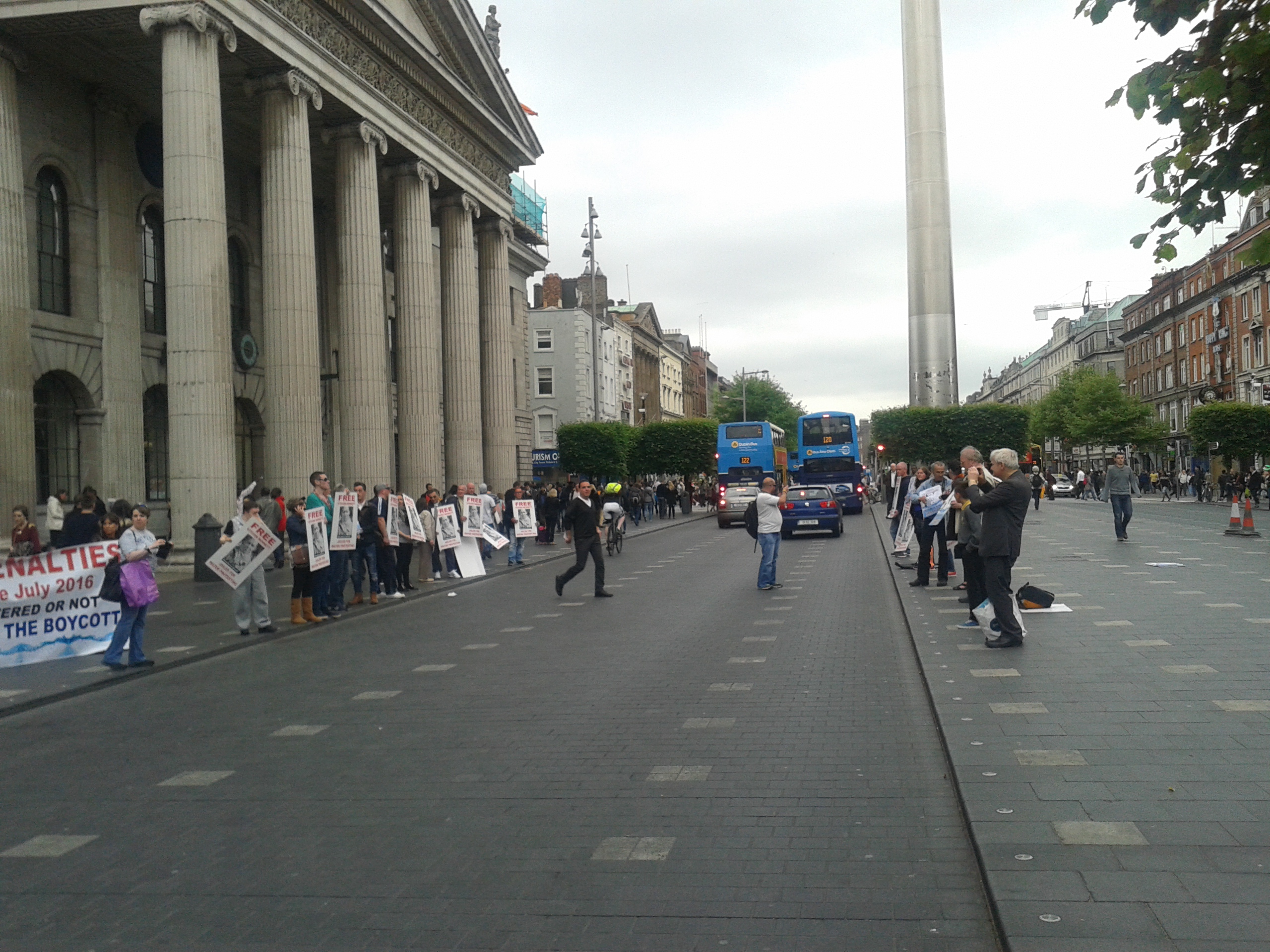
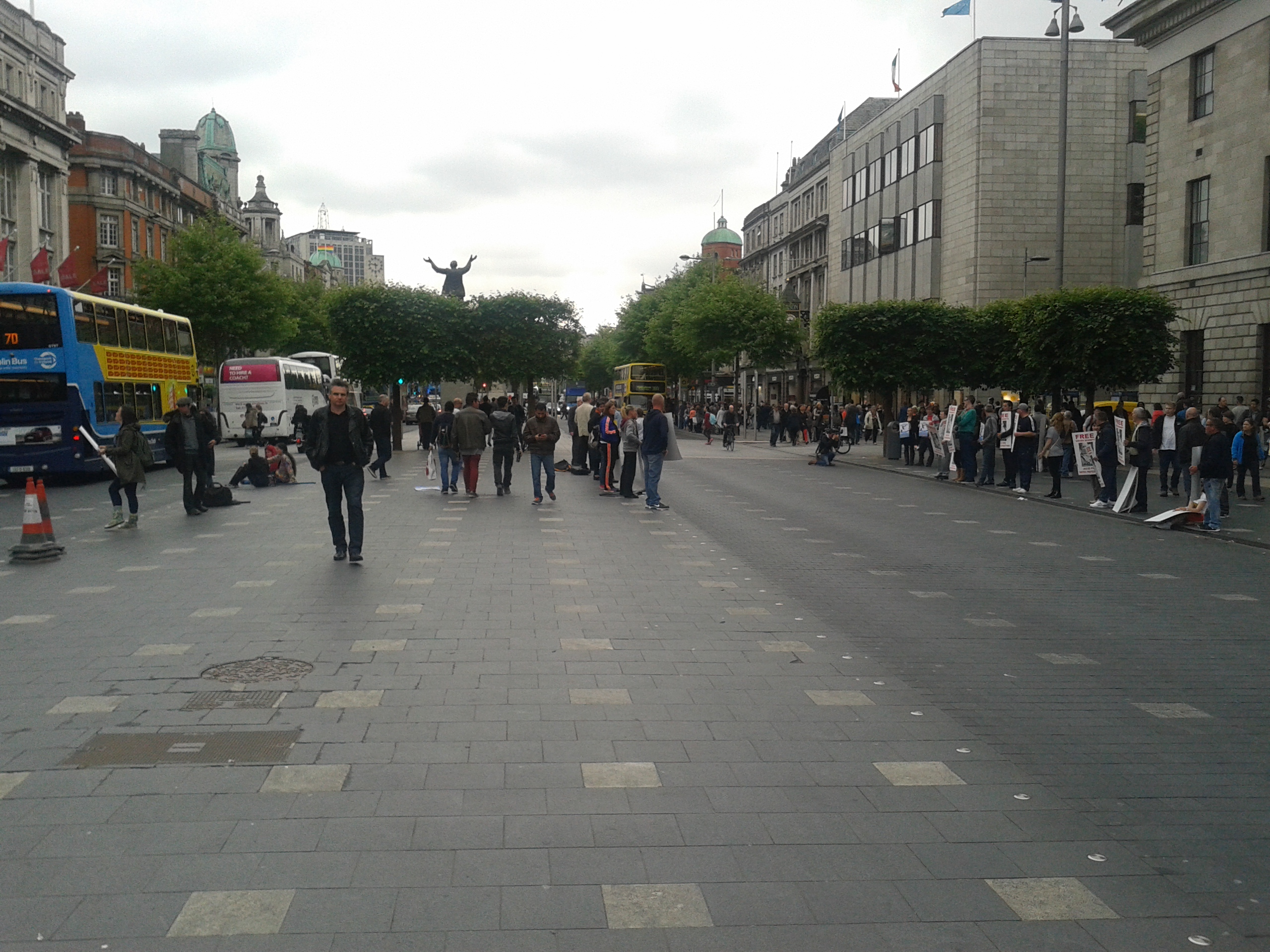
A few hundred people turned out to “welcome” the Irish Government Ministers and supporting TDs (elected members) back to the Dáil after the summer recess of the Irish parliament. The protesters were not allowed within fifty yards of the main gates, with lines of Gardaí, the Irish national police force, standing behind the special new double barriers which they now employ here. Kildare Street, the address of the Dáil, was closed by Gardaí to pedestrian and motor traffic and public transport buses using that street as part of their regular routes had to be re-routed.
There was a special focus among many of the protesters on the housing crisis in Dublin with a number of organisations working with or campaigning for the homeless present and a number of placards drawing attention to the issue.
Some protesters had met at 4pm at the GPO in Dublin’s O’Connell Street and had marched to the Dáil from there, while others had arrived at the Dáil itself from 5pm onwards. There were others demonstrating too in Merrion Street, on the other side of the Dáil complex.
Around the other side, in Merrion Street, I met some protesters coming away from the protest there and stopped to talk to them. They informed me that it was ending there and I returned along Nasseau Street to Molesworth Street.
Among others, schoolchildren lean on the barrier which facing the Dáil, the Irish Parlia
When I started up Dawson Street I saw a small march coming down towards me. These were clearly the remainder of those who had been in Merrion Street earlier. Among this section were young mothers and some of their children had notes attached to their chests, for example “I am five and I am homeless”. I joined this group for the short walk remaining in Dawson Street and into Molesworth Street.
Speeches were still going on there and it seemed a musician or singer would have made a nice change – or even a comedian, or a juggler. After a short while the speeches ended and the crowd began to disperse, at which point I approached the women I had been told were homeless and spoke to one. Shortly after, I left to buy a cup of coffee and start an article about that homeless woman and her children.
Diarmuid Breatnach (published originally in Dublin Political History Tours)
(Miren de bajo para la versión en castellano).
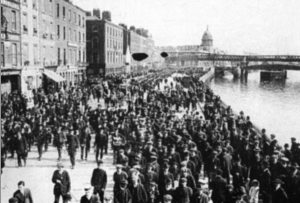
The 31st of August 1913 was one of several ‘Bloody Sundays’ in Irish history and it took place in O’Connell Street (then Sackville Street).
A rally had been called to hear the leader of the IT&GWU) speak. The rally had been prohibited by a judge but the leader, Jim Larkin, burning the prohibition order in front of a big demonstration of workers on the evening of the 29th, promised to attend and address the public.
On the day in O’Connell Street, the Dublin police with their batons attacked the crowd, including many curious bystanders and passers by, wounding many by which at least one died later from his injuries.
One could say that on that street on the 31st, or in the nearby Eden Quay on the night of the 30th, when the police batoned to death two workers, was born the workers’ militia, the Irish Citizen Army, in a desire that very soon would be made flesh.
La carga policial contra los manifestantes y transeúntes en la Calle O’Connell en el 31 Agosto 1913/ DMP attack on demonstrators and passers-by on 31st August 1913 in Dublin’s O’Connell Street
THE EMPLOYERS’ LOCKOUT
Bloody Sunday Dublin occurred during the employers’ Lockout of 1913. Under Jim Larkin’s leadership, the Liverpudlian of the Irish diaspora, the young ITGWU was going from strength to strength and increasing in membership, with successful strikes and representation in Dublin firms. But in July 1913, one of Dublin’s foremost businessmen, William Martin Murphy, called 200 businessmen to a meeting, where they resolved to break the trade union.
Murphy was an Irish nationalist, of the political line that wished for autonomy within the British Empire; among his businesses were the Dublin tram company, the Imperial Hotel in O’Connell Street and the national daily newspaper “The Irish Independent”.
The employers decided to present all their workers with a declaration to sign that the workers would not be part of the ITGWU, nor would they support them in any action; in the case of refusal to sign, they would be sacked.
The members of the ITGWU would have to reject the document or leave the union, which nearly none of them were willing to do.
Nor could the other unions accept that condition, despite any differences they may have had with Larkin, with his ideology and his tactics, because at some point in the future the employers could use the same tactic against their own members.
The Dublin (and Wexford) workers rejected the ultimatum and on the 26th began a tram strike, which was followed by the Lockout and mixed with other strikes — a struggle that lasted for eight months.
Dublin had remarkable poverty, with infectious diseases such as tuberculosis and others, including the sexually-transmitted ones, the city being a merchant port and also having many British Army barracks. The percentage of infantile mortality was higher than that in Calcutta. Workers’ housing was in terrible condition, often with entire families living in one room, in houses sometimes of 12 rooms, each one full of people, with one or two toilets in the outside yard.
In those conditions, 2,000 Dublin workers confronted their employers, the latter aided by their Metropolitan Police, the Irish colonial police and the British Army. As well as the workers, many small traders suffered, those selling in the street or from little shops.
On that Monday, the 31st of September 1913, some trade unionists and curious people congregated in Dublin’s main street, then called Sackville Street, in front of and around the main door of the big Clery’s shop. In the floors above the shop, was the Imperial Hotel, with a restaurant.
The main part of the union went that day to their grounds in Fairview, to avoid presenting the opportunity for another confrontation with the Dublin Municipal Police. Others in the leadership had argued that the police should not be given the opportunity and that there would be many other confrontations during the Lockout. But Larkin swore that he would attend and that a judge should not be permitted to ban a workers’ rally. There were many police but nothing was happening and Larkin did not appear. After a while, a horse-drawn carriage drove up and an elderly church minister alighted, assisted by a woman, and entered the shop. They took the lift to the restaurant floor. A little later Larkin appeared at the restaurant open window, in church minister’s clothing, spoke a few words to the crowd and ran inside. Those in the street were very excited and when the police took Larkin out under arrest, they cheered him, urged on by Constance Markievicz. The police drew their batons and attacked the crowd — any man not wearing a police uniform.
THE UNION’S ARMY
The Irish Citizen Army was founded for the union on the 6th November 1913 by Larkin, Connolly and others with Seán Ó Cathasaigh/ O’Casey, playwright and author, including the first history of the organisation.
The Citizen Army at Croydon House, at the ITGWU’s grounds in Fairview/ El Ejercito Ciudadano en su parte del parque en Fairview.
As distinct from the Irish Volunteers, women could enter the ICA, within which they had equal rights.
Funeral of James Byrne, who died as a result of his imprisonment during the 1913 Lockout/ Procesión funébre de James Byrne, fallecido por razón de su encarcelamiento durante el Cierre de 1913, pasando por el muelle sur Eden’s Quay, partiendo de la Salla de la Libertad.
It was reorganised in 1914 as the union was recovering from its defeat during the Lockout, and 200 fought alongside the Volunteers in the 1916 Easter Rising, after which two of its leaders, Michael Mallin and James Connolly, were executed. Among the nearly 100 death sentences there were others of the ICA, including Markievicz, but their death sentences were commuted (14 were executed in Dublin, one in Cork and one was hanged in London).
The main fighting locations of the ICA in 1916 were in Stephen’s Green and in the Royal College of Surgeons, in City Hall and, with Volunteers in the GPO and in the terrace in Moore Street, the street market.
The Imperial Hotel on the other side of the street from the GPO was occupied too by the ICA and on top of it they attached their new flag, the “Starry Plough/ Plough and Stars”, the design in gold colour on a green background, the
The flag of the ICA, flown over Murphy’s Imperial Hotel in 1916
constellation of Ursa Mayor, which the Irish perceived in the form of a plough, an instrument of work. And there the flag still flew after the Rising, having survived the bombardment and the fire which together destroyed the building and all others up to the GPO, on both sides of the street. Then a British officer happened to notice the flag and ordered a soldier to climb up and take it down — we know not where it went.
TODAY
Today, after various amalgamations, the once-noble ITGWU has become SIPTU, the largest trade union in Ireland but one which does not fight. The skyscraper containing its offices, Liberty hall, occupies the spot of the original Liberty Hall, prior to its destruction by British bombardment in 1916.
The Irish newspaper the “Irish Independent” continues to exist, known as quite right-wing in its editorial line. Murphy’s trams came to an end during the 1950 decade and those in Dublin today have nothing to do with Murphy.
The Imperial Hotel no longer exists and, until very recently, Clery had taken over the whole building, but they sacked their workers and closed the building, saying that they were losing money.
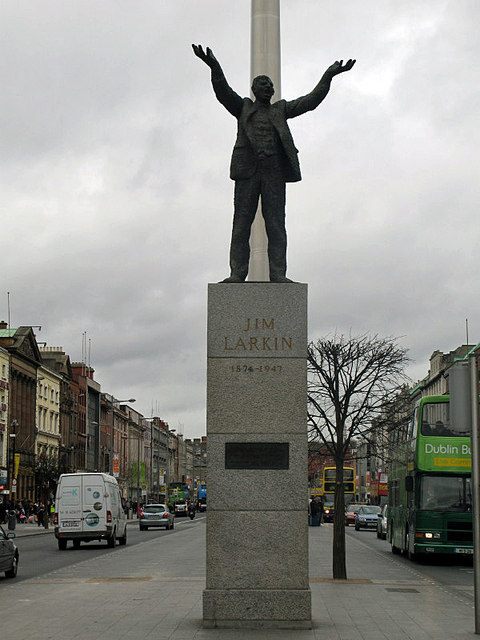
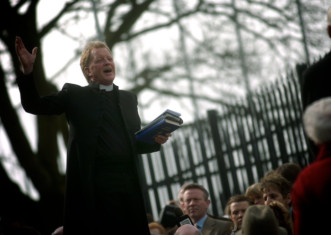
In front of the building, in the pedestrianised central reservation, stands the monument as a representation of Jim Larkin. The form of the statue, with its hands in the air, is from a photo taken of Larkin during the Lockout, as he addressed another rally in the same street. It is said that in those moments, he was finishing a quotation which he used during that struggle (but which had also been written previously by James Connolly in 1897, and which something similar had been written by the liberal monarchist Étienne de La Boétie [1530–1563] and later by the French republican revolutionary Camille Desmoulins [1760–1794]): “The great appear great because we are on our knees – LET US ARISE!”
The Jim Larkin monument in O’Connell Street today/ El monumento de Jim Larkin in la Calle O’Connell hoy en día
EL 31 DE AGOSTO EN El 1913 FUE UNO DE LOS DOMINGOS SANGRIENTOS DE IRLANDA Y OCURRIÓ EN LA CALLE PRINCIPAL DE DUBLÍN.
Hubo una concentración para escuchar al líder del sindicato de Trabajadores de Transporte y de General de Irlanda (IT&GWU) hablar. La manifestación fue prohibida por juez pero el líder, Jim Larkin, quemando el documento de prohibición en frente de manifestación grande la noche del 29, prometió que iba a asistir y hablar al publico.
El día 31 en la Calle O’Connell, la policía de Dublin con sus porras atacaron la concentración y a muchos otros curiosos o pasando por casualidad, hiriendo a muchos por lo cual murió uno por lo menos mas tarde de sus heridas.
Se puede decir que en esa calle en el 31, o en la cerca muelle, Eden Quay, la noche del 30, cuando mataron a porras dos trabajadores, se dio luz a la milicia sindical, el Ejercito Ciudadano de Irlanda, en deseo que poco mas tarde estaría fundado en actualidad.
EL CIERRE PATRONAL
El Domingo Sangriento ocurrió durante el Cierre Patronal de Dublín en el 1913. Bajo el liderazgo de Jim Larkin, el Liverpoolés de diáspora Irlandesa, el joven sindicato ITGWU fue yendo de fuerza a fuerza y aumentando en miembros, con éxitos en sus huelgas y reconocido en muchas de las empresas de Dublín. Pero en Julio del 1913, uno de los principales empresarios de Dublín, William Martin Murphy, llamó a 200 de los empresarios a mitin y resolvieron romper el sindicato.
Murphy era nacionalista Irlandés, de la linea de pedir autonomía pero adentro del Imperio británico; entre sus empresas le pertenecía la linea de tranvías de Dublín, el Hotel Imperial en la Calle O’Connell y el periódico diario nacional The Irish Independent.
Resolvieron los empresarios presentar a todos sus trabajadores una declaración para firmar que no serían parte del sindicato ITGWU ni les darían ningún apoyo en cualquiera acción; en caso de negar firmar, se les despedirían.
Los miembros del ITGWU tendrían que rechazar el documento o salir del sindicato, lo cual casi lo total no estuvieron dispuestos hacer.
Los otros sindicatos, pese a cualquiera diferencias tuvieron con Larkin, con sus pensamientos y sus tácticas, tampoco podían acceder a esa condición por que mas tarde se podría usar la misma táctica en contra de sus miembros también.
Los trabajadores de Dublín (y de Wexford) rechazaron el ultimátum y empezaron el 26 de Agosto una huelga de los tranvías, seguido por el Cierre Patronal, mixta con otras huelgas, una lucha que duró ocho meses en total.
Dublín tuvo una pobreza impresionante, con infecciones de tuberculosis y otras, incluido las transmitidas por el sexo, siendo puerto mercantil y teniendo muchos cuarteles del ejercito británico. El porcentaje de la mortalidad infantil era mas de la de la ciudad de Calcuta. Las viviendas de los trabajadores estaban en terribles condiciones, con a menudo familias grandes enteras viviendo en una habitación, en casas a veces de 12 habitaciones, cada uno llena de gente, con una o dos servicios en el patio exterior.
En esas condiciones 2,000 trabajadores de Dublín se enfrentaron al patronal de Dublín, con su policía metropolitana, la policía colonial de Irlanda y el ejercito británico. Además de los trabajadores, muchos pequeños empresarios, vendiendo en la calle o en tiendas pequeños, sufrieron.
Ese Domingo, del 31o de Setiembre 1913, algunos sindicalistas y gente curiosa se congregaron en la calle principal de Dublín, entonces nombrado Sackville Street, en frente y al rededor de la puerta principal de la gran tienda de Clery. En las plantas después de la primera, estaba el Hotel Imperial, con un restaurante.
La mayor parte del sindicato se fueron ese día a una parte de parque que les pertenecía por la costa, para evitar otra enfrentamiento con la Policía Metropolitana de Dublín. Habían argumentado otros de la dirección del sindicato que no se debe dar les la oportunidad a la policía y que habría muchos otros enfrentamientos durante el Cierre. Pero Larkin juró que lo iba a asistir y que no se podía permitir a un juez prohibir manifestaciones obreras.
Había mucha policía pero nada pasaba y Larkin no aparecía. Después de un rato, un coche de caballos llegó y un viejo sacerdote salió, apoyado por una mujer, y entraron en la tienda de Clery. Subieron en el ascensor hacía el restaurante. Poco después, Larkin apareció en la ventana abierta del restaurante, en el traje del cura y habló unas palabras, antes de correr adentro. Los de abajo en la calle muy entusiasmados y cuando la policía salieron agarrando le a Larkin, la multitud le dieron vítores, alentados por Constance Markievicz. La Policía Municipal sacaron sus porras y atacaron a la multitud – a cualquier hombre que no llevaba uniforme policial.
EL EJERCITO DEL SINDICATO
El Ejercito Ciudadano de Irlanda (Irish Citizen Army) fue fundado para el sindicato en el 6 de Noviembre del 1913 por Larkin, Connolly y otros con Seán Ó Cathasaigh/ O’Casey, escritor de obras para teatro y algunas otras, incluso la primera historia de la organización. A lo contrario de Los Voluntarios, el ICA permitía entrada a mujeres, donde tenían derechos iguales.
Fue reorganizada en 1914 cuando el sindicato se fue recobrando de la derrota del Cierre Patronal, y 200 lucharon con los Voluntarios en el Alzamiento de Pascuas de 1916, después de lo cual dos de sus líderes, Michael Mallin y James Connolly, fueron ejecutados. Entre los casi 100 condenas de muerte, habían otros del ICA, incluso Constance Markievicz, pero sus condenas de muerte fueron conmutadas (se les ejecutaron a 14 en Dublín y a uno en Cork, y a otro le ahorcaron en Londres).
Los lugares principales de lucha del ICA en 1916 fueron en el Stephen’s Green y en el Collegio Real de Cirujanos (Royal College of Surgeons), en el Ayuntamiento y, con Voluntarios, en la Principal Oficina de Correos (GPO) y en la manzana del Moore Street, el mercado callejero.
El Hotel Imperial al otro lado de la calle del GPO lo ocuparon también el ICA, y encima colocaron su nueva bandera, el Arado de Estrellas (“Starry Plough/ Plough and Stars”), el diseño en color oro sobre fondo verde, la formación celeste del Ursa Mayor, que lo veían los Irlandeses en forma del arado, una herramienta de trabajo. Y ahí ondeó la bandera después del Alzamiento, habiendo sobrevivido el bombardeo británico y el fuego que destruyeron el edificio y la calle entera hacía el GPO, en ambos lados. Entonces un oficial británico se dio cuenta de la bandera y le mandó a soldado hir a recoger la – no se sabe donde terminó.
HOY EN DÍA
Hoy en día, después de varias fusiones, el noble ITGWU se ha convertido en el SIPTU, el sindicato mas grande de Irlanda y parecido en su falta de lucha a Comisiones Obreras del Estado Español. El rasca cielos de sus oficinas, La Sala de la Liberta (Liberty Hall), ocupa el mismo lugar que ocupó la antigua Liberty Hall, antes de su destrucción por bombardeo británico en 1916.
El periódico Irish Independent sigue existiendo, conocido por ser bastante de derechas en su linea editorial. Los tranvías de Murphy terminaron en la década del 1950 y los de hoy en Dublín no tienen nada que ver con los de antes.
El Hotel Imperial ya no existe y, hasta hace muy poco, la empresa Clery lo tenía todo el edificio, pero despidieron a sus trabajadores y cerraron el edificio, diciendo que perdían dinero.
En frente del edificio, en la reserva peatonal del centro de la calle, está el monumento representando a Jim Larkin. La forma de la estatua, con las manos en el aire, lo tiene de foto que le hicieron durante el Cierre Patronal, cuando habló en otro manifestación en la misma calle. Dicen que en ese momento, estaba terminando una frase famosa que usó durante esa lucha (pero que también lo escribió Connolly antes en 1897, y que lo había escrito algo parecido primero el monárquico reformista Étienne de La Boétie [1530–1563] y luego el revolucionario republicano francés Camille Desmoulins [1760–1794]): “Los grandes aparecen grande por que estamos de rodillas – levantamanos!”
Any hope that the Irish capitalist ruling class and their current government had that people had given up — or even had just got tired of marching — were dashed on Sunday 29th August 2015.
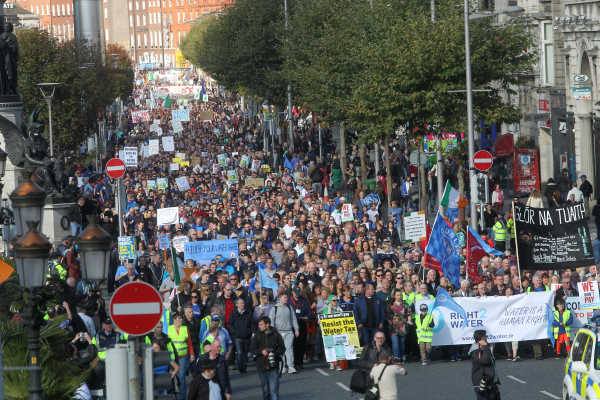
Hundreds of thousands gathered again from far and near; banners were on display from the West, South, North-East and North-West, Midlands, and of course many parts of Dublin and the East coast.
The main march columns started off from two train stations: Connolly Station, to the east of the city and Heuston, to the west. The latter contingent crossed the river at the station then marched eastward towards the city centre along the southern quays while the other marched westward along the northern quays and then crossed the river to the north side further upriver (Essex Bridge) and turned towards the city centre. Both columns had contingents and individuals joining them en route while others went straight towards O’Connell Street, they were greeted by a musical performance from the main stage by Don Baker and other musicians, also a performance by a rapper.
Aerial shot of rally in O’Connell Street (photo: Communities Against the Water Charge)
STATE REPRESSION
State repression was focused on at times: the Jobstown 23 banner got strong applause from bystanders at various points along the route, another banner denounced Garda violence including pepper-spraying and a number of speakers spoke about Garda repression, including one who talked about the Special Branch opening files on anti-water tax resisters.
This banner got strong applause from bystanders at various points along the route
As usual on large demonstrations of this kind, the Gardai refrained from violence or bullying and in fact were in very low profile, in stark contrast to their behaviour and numbers when dealing with smaller numbers in local resistance to water tax and the installation of water meters.
ELECTIONS, TRADE UNIONS
Among the speakers there was of course much mention of elections and getting rid of the current capiltalist government and also statements about the fight for the Republic in history, compared bleakly to the situation in Ireland today with unemployement, emigration, cuts to services, homelessness, privatisation. John Douglas, Gen. Secretary of Mandate and President of Mandate covered many of those issues, including the Dunne’s Stores dispute and the sudden closure of Clery’s in a rousing speech. However, those two are cases in point illustrating the weakness of the Irish trade union movement today: Mandate had one day’s strike in Dunnes’ many weeks ago and have won no gains as yet, while Clery’s managed to sack their workers without the union leading even a sit-in to hold the building and stock as a bargaining chip
Belfast Trades Council banner on the demonstration — they also had a speaker on the platform
A new presence on this demonstration was Belfast Trade Council, who were made very welcome and who had a speaker on the platform. He said that there was no EU directive to tax the water and that in the Six Counties they had defeated the water tax. He was not long speaking when the heavens opened and rain poured down on demonstrators and bystanders alike.
SUMMARY
What today showed is a strong will to resist across the country and across a great age spread, but with noticeably lower numbers across the teenage and young adult band, as well as a relatively weak leadership of the movement.
It remains to be seen whether RTÉ and newspapers will give a reasonable estimate of the numbers and coverage or instead do the usual of quoting ridiculously low figures or remain vague about them while giving minimal space to what was a large event, with participation from around the nation, as part of the biggest civil disobedience campaign in the history of this State.
End
Video of unaccompanied rapper Stephen Murphy at rally
At the Mayo v. Dublin GAA football game in Croke Park the following day, on Hill 16 (Photo from Right to Water FB page)
(Postcript: In their on-line report, RTÉ showed a photo of a packed O’Connell St. and said the organisers were claiming around 80,000. Also, at the Dublin GAA football match of Mayo v. Dublin the following day in Croke Park, attended by Enda Kenny, whose seat is in that county, Dublin supporters unfurled a giant banner of Right to Water).
The historic ruins of Hasankeyf, which may have been settled more than two thousand years BCE, are threatened by a Turkish dam along with the homes of Kurdish, Armenian and Arab people. A number of archaeologists and historians believe that the fortified town was referred to in inscriptions on the Mari tablets (1,800-1,750 BCE). The rocky outcrop also contains many human-made caves.
Some of the caves at the Hasankeyf site
As well as being the site of an ancient town, it is also an urban and outer settled district located along the Tigris River in the Batman Province in southeastern Turkey, with a recent combined population approaching 70,000.
The project that threatens to submerge much of Hasankeyf is the Isilu Dam being built by Turkey. Despite the foundation stone being laid as late as 2006, in 1971it was already being actively considered as one of the sites for a number of dam projects for hydro-electric generation and number of other purposes. A study by an international team between 1980 and 1982 recommended the building of the Isilu dam despite the 1981 declaration by the Turkish Government itself of Hasankeyf as a natural conservation area.
Opposition to the dam
The project had run into funding difficulties over the years. Due to international protests on environmental, archaeological and human rights grounds, and also protests within Turkey and from inside Hasankeyf, a number of international funders backed off. The British Government refused $236 million in funding in 2000 and in 2009, a consortium of Austrian, Swiss and German credit agencies withdrew their offer of $610 million.
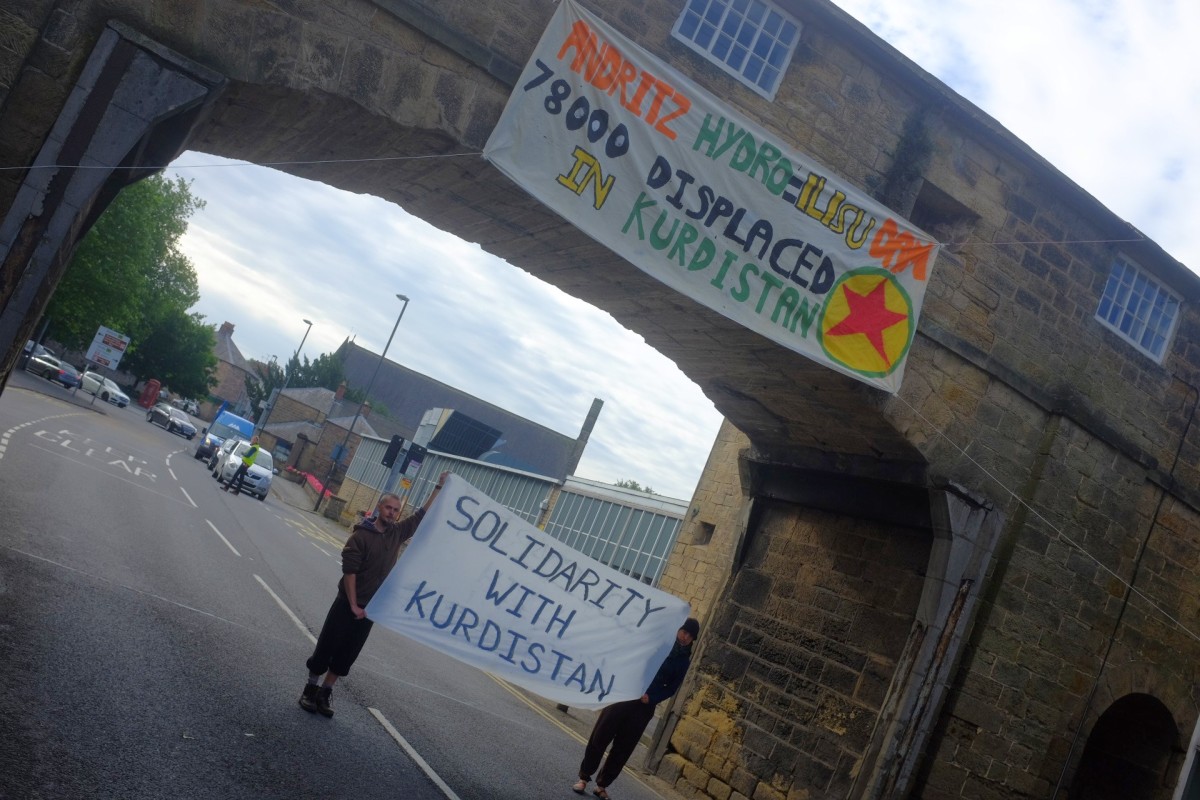
Solidarity picket outside the Andritz company plant in England
The consortium had suspended the loan in 2008 and had given the Turkish Government 6 months to comply with international standards, which they had failed to do. However in July 2010 the Austrian firm Andritz Hydro announced it was lifting its suspension and would provide the six huge turbines specified for the power plant.
Excavations for the main body of the dam began in May 2011 and the Turkish Government projected that all works would be completed this year. A 250m (820ft) permanent steel-girder bridge with concrete supports has been constructed just downstream of the dam andconstruction of new villages is currently underway. The diversion of the Tigris River began during August 2012. According to Government figures, by April 2014 the project was 60% completed while 73% of the Hasankeyf population had been resettled.
Protests continue within the area, peaceful and not. According to the Government, in January 2015 Kurdistan Workers’ Party (PKK) threatened the lives of workers and anti-Government sources confirmed that a number of workers left the site. On 3 February 2015 a convoy of supplies for the dam was attacked, injuring three persons and several days later a worker was killed in his home, according to the Government by suspected PKK militants. Peaceful protests have included pickets and demonstrations (see photos) and some of these have also taken place abroad, including recent ones in England (see photos).
Locals, probably mostly if not all Kurds, protest at the Hasankeyf site
The completion of the Ilısu Dam will cause the flooding of the ancient city of Hasankeyfand about 185 villages and hamlets will be fully or partially affected by flooding, according to the Kurdish Human Rights Project. From 55,000–65,000 people will be forcibly resettled, says the KHRP, while even the Turkish Government estimates 40,000. According to a statement released on the 24th August by a solidarity group protesting outside the Austrian Andritz company’s facility in England, the completed project will reduce water flow to Syria by 40% and Iraq by 80% and the dam also provides the facility for political control of those areas through further restriction of water supplies.
Turkey is a member ofNATO and extremely important strategically to the the military alliance, as well as having some significant natural resources. However its regularly-renewed applications to join the EU have always been turned down because of its human rights record, both in the course of recent wars with its ethnic Kurds as well as with regard to protest movements among ethnic Turks. Recently Turkey came in for adverse international publicity again as it was seen to be blocking Kurds trying to get through the Turkish border with Syria in order to defend areas under attack by ISIS (Islamic State), while Turkey has also been accused of more directly assisting ISIS in its attacks. Although the state has Moslem fundamentalist political parties which occasionally come into government, Turkey itself has been secular since it became a republic in 1922.
NB: This article was written about the 11th October 2014 demonstration but arrived too late to use. Normally that would mean it just getting binned or at best getting mined for useful bits to put in a future article. However, the decision is to use this now in the run-up to the forthcoming demonstration at the end of this month against the water tax.
The size of the turnout for the anti-water charges demonstration in Dublin on Saturday 11th of October must have been something of a shock for the Irish ruling class and for their current government, the Fine Gael-Labour coalition. The implementation of water charges forms an important part of their programme to make the ordinary people pay for the crisis caused by financial and property speculators. Other parts of this programme that people have been experiencing to date over the last few years (and including the Fianna Fáil government preceding this one) have been bailing out the banks and their bondholders, financed first through the Household Charge and, after that was defeated by massive resistance, the Household Charge taxed through the Revenue Department; then the pension levy on public service workers; followed by the extensive cuts in social spending at the same time as implementing the “Social Charge”.
Marchers heading southward after leaving the Garden of Remembrance/ Parnell Square area (RTÉ tried to play down the figures to 30,000
The ruling class and their government are of course well aware that the water charge is unpopular among the vast majority of the population – supporters of the tax have failed to convince the people that it is anything but another way of “paying the bankers”. But the unpopularity of a measure is no guarantee whatsoever of wide-scale mobilisation against it and the Government was probably expecting the resistance to meter installation to remain local, marginal and uncoordinated. Clearly this was one case where “Ní mar a shíltear a bhítear”.
But the size of the demonstration surprised not only the ruling class and their government but also anti-water charge campaigners themselves. “I thought we’d be doing well to get 15,000” said one long-time community activist and “If we got 50,000, we thought it would be brilliant” according to an activist from one of the political groups active on this issue. A realistic estimate of the attendance at the demonstration on Saturday puts it at between 100,000 (as quoted by an unnamed Garda source to an Irish Times reporter) and 150,000. The march from the Garden of Remembrance heading across the river before turning again towards the GPO took over one-and-a-half hours to pass a fixed spot in O’Connell Street while another large number reportedly marched from another direction also toward the GPO.
So how was it that so many mobilised?
Any attempt to answer the first question must be speculative but there are a number of indications other than the widescale unpopularity of the water charge and any measure seen as “bailing out the bankers”. One of these is the highly-publicised police repression of local protests against meter installations in a number of Dublin areas, where the population is overwhelmingly working-class and lower-middle class. These protests and the police repression, completely ignored by the national mass media, however received widescale publicity through social media, with videos posted on Youtube, Facebook and Twitter. And the people sharing and sometimes posting these reports and images were for the most part not political or even community or trade union activists. Another source tapped was that of past mobilisations against the Household and Property Taxes. Much of the mobilisation took place in small to medium-sized communities where for the most part, unusually but according to my sources, the activists promoted the resistance and the demonstration rather than their own political party or organisation.
“Apart from a few political activists, only the middle-class mobilise through Facebook”, said long-time political activist to us about a year ago. “Who cares how many ‘Likes” on Facebook an event or campaign gets – it doesn’t mean anything!” said another. Rebel Breeze would have agreed with them too, knowing that the way to mobilise working class people was mostly through personal contact, door-to-door and workplace leafleting. But it seems that is no longer true and that working people, who previously used Facebook only socially, have now begun to use it politically too.
An aerial view down towards the rally after the march at GPO/ O’Connell St
Why did it surprise even the campaigners?
So much for how such a large number came to protest. But how is it that the campaigners themselves were taken by surprise? Of course there may have been unexpected mobilisations in some areas where campaigners had not been active but the main reason for their surprise is almost certainly their lack of coordination. Their are a number of Left organisation and “dissident” Republican organisations campaigning against the water charges, along with a large number of independent activists of a mainly political or community background. In some areas Sinn Féin activist have been out too, although the party does not advocate non-payment or prevention of meter installation.
In a united campaign where all the activists worked towards a united mass resistance, sharing information, the numbers would not have caught them so much by surprise. Of course, their expectations might have been exceeded but each group would have been aware of the actions in other groups’ areas along with the massive rise in Facebook hits, “Likes” and “Shares” to postings of resistance and police repression. Such a united campaign against the water charge does not yet exist. A previous attempt to float such a united campaign on the Household and Water Charges foundered on a number of rocks – political party opportunism, social democratic illusions and the failure of the traditional Left to engage with the independent activist constituency and the “dissident” Republican movement probably being the main ones.
There are a number of attempts to portray the active resistance to the Water Charge as spontaneous but it is likely that where there have been no campaigners active locally, the people have responded to what they have seen elsewhere, both through anger and encouragement. On the other hand, any attempt by any group or individual to take the credit for the growing resistance or for the mass attendance at the demonstration would have to be laughable.
The “passive Irish” jibe refuted once again
Rebel Breeze has long been tired of the wailing often heard to the effect that “the Irish are not like the Greeks”, or that the Irish are passive, accept all kinds of shit without resistance, etc. etc. With the history of class and national struggle of the people of this island it is extraordinary that such an notion ever gained wide acceptance among commentators – but it did. The Irish working class has generally responded militantly and enthusiastically when they have been called to battle by what they consider a credible leadership. In Ireland, that leadership was the trade union movement and no other. In 1913 a fighting trade union was forged in Ireland and, when the employers tried to break it, the workers of Dublin (mostly) fought that attempt for up to eight months, in a city of wide-spread poverty and with most charity services discriminating against strikers and their families. In that struggle, the workers faced also the hostility of the media and state (not much has changed there) and of the main churches. Although defeated in that struggle, the union did not break and came back years later stronger than ever.
Deprived of revolutionary and militant leadership, the movement nevertheless maintained a fighting front for workers through decades of high unemployment and emigration. But in the mid-1980s the trade union leadership opted for what they called “social partnership”, an arrangement in which employers, trade union leadership and the State (which is also a huge employer) sat down and agreed the salary levels for the next period. This had a disastrous impact on the trade union movement. “Use it or lose it” is a general physiological rule about muscle : the trade union leadership became unused to strike action and, when strikes did occur, to instructing members of unions not directly involved to pass the pickets. Recruitment fell dramatically and, when in 2010 the employers and State no longer saw any point in negotiating with the trade union leadership, as they believed the leadership to be no longer capable of resistance, the latter lacked the spirit and confidence to take them on. After a demonstration called by ICTU with a threat of a general strike days away, which received a massive response from trade union members, the leadership instead opted for more negotiations, in which they agree to the pension levy on public servant workers and industrial peace in the private sector: Croke Park I (June 2010). So the workers no longer have a leadership they consider credible and the revolutionary and radical socialist organisations are too small to be thought credible and also have not generally built bases within the trade union movement from which to offer a leadership for struggle.
Nevertheless, the working people of Ireland turned out in huge numbers once again on Saturday to protest an unjust tax which is being used for an unjustifiable purpose. The class is still there, it never lost its fighting spirit – what it needs is a viable leadership. It remains to be seen whether this will be built and whether it can lead a broad militant movement against this tax and other attacks on the working class, without repeating the errors of the recent ‘broad movements’.
A Derry schoolboy has been subjected to emotional blackmail and pressure by his school to sign a “peace scroll” and, arising out of an altercation over his refusal in which it was alleged he was being “sectarian”, was sentenced to two after-school detentions. Why is he being treated in this way, what is this “peace scroll” about and who is promoting it?
According to Pauline Mellon, writing about it in her blog, a boy in her Derry community in September last year was pressured by a teacher in his school to sign a “Peace scroll” with which a Reverend David Latimer is trying to create a world record with the number of signatures. “The child was told by a teacher that he would be ‘the only child in the North not to have signed’ and was further questioned as to whether his refusal was sectarian in nature.” Not surprisingly, the child reacted to this suggestion and used a word for which the school seeks to discipline him.
“The school has a policy (on “abusive language”) which makes no provision for contributing factors,” says Pauline Mellon. However, although the school Board is sticking to the letter of their policy in this regard, they seem not quite so rigorous in upholding their own procedures in other respects.
“When the parents questioned the School Principal over his decision to impose two detentions and what circumstances if any he had taken into consideration, the Principal immediately cut off communication with them and escalated the issue to stage 4 of the school’s complaints procedure. Stage 4 of the school’s complaints procedure requires a written submission to the Chair of the school board from parents.”
Although the parents at this stage had made no such written submission, a sub-committee of the School Board declared that they had investigated the complaint (from whom?!) and upheld the Principal’s decision.The sub-committee had decided to use as “a written submission” some letters written by the parents to the Principal after he refused meet them, thereby violating the parents’ rights to prepare their own submission if they wished to go to Stage 4 of the Complaints Procedure and, indeed, violating the terms of the Procedure itself.
As if to underline their casual attitude to their own procedures, the School Board wrote to the parents to outline their “findings” without even using the school’s headed paper. When this was pointed out to them, the Board apologised for sending the decision on plain paper and said it would not happen again. However, there was a much more significant breach of their procedures, in that the sub-committee had kept no minutes of their meeting, about which the parents have learned only recently. Then when the parents did actually submit a level 4 submission, it was totally ignored.
As Pauline Mellon observed, the Chairman of the Board was in breach of his duties according to “Department of Education guidelines which state that the chairperson has responsibility for all meetings and must ensure that minutes of ALL meetings are retained.”
One can imagine the impact of a comparable chain of events on any individual, let alone a child studying for his GCEs. The parents took him to a counsellor, after which they wished to discuss the counsellors’ report with the boy’s form teacher. The Board prevented this meeting, confusing the counsellors’ report with the parents’ “ongoing issues with the Board”.
Nine months after the first incident in this chain of events, the Board invited the parents to meet with them. The parents brought along an observer and the Board refused to allow the meeting to go ahead with the observer present and when the parents protested, they were escorted off the premises, witnessed by an Independent local authority councillor. The Board in this case is the authority and has the power and the school is also their territory. There are a number of people on the Board. In summary, they held the advantages of power, territory and numbers – yet they refused to allow two parents to be accompanied by an observer to support them (and at a later date to bear witness to what went on, should that become necessary). One must wonder what they had to fear in allowing this one additional person …. and why.
The School Board has a Parent’s Representative on it – the parents of the child sought a meeting with this person, not once but a number of times, but the person concerned has so far failed to meet with them. This is indeed extraordinary – how can anybodfy discharge their duties as a Parents’ Representative to the Board if they refuse to meet with parents who are in dispute with the Board?
There is a body which governs Catholic schools, of which the school in question is one – the Catholic Council for Maintained Schools (CCMS). This is an organisation of the Catholic Church but receives public funding through the Northern Ireland Executive. The parents took the issue to that Council. The CCMS admitted that headed paper should have been used in writing to the parents and commented that the school’s Board had not fulfilled their role; they also noted the parents’ attempt to discuss their child’s counsellor’s report with his form teacher but would not comment on whether the refusal would be normal practice. All in all, the CCMS considered that the Board’s actions of using a letter to the Principal as a submission and refusing the parents the right to submit their own Level 4 submission were “reasonable” and “in accordance with School policy”.
Presumably in their deliberations, the CCMS had discovered that the Board’s sub-committee had failed to keep any minutes but left the parents to discover this through other means at a later date. At a later complaint to the CCMS, the Council refused to acknowledge the failure of the School Board’s Chairperson in ensuring minutes were kept, as laid out in the Department of Education’s guidelines. Finally, the CCMS denied that any breach of the child’s rights took place.
The Chairperson of the CCMS is Bishop John McAreavey, who according to Pauline Mellon, has not even had the decency to acknowledge or respond to two separate letters the parents of the child in question sent to him. This was in contrast to the Bishop of Derry, Rev. McKeown who replied to the parents after they wrote to him. “Bishop McKeown who has knowledge in these matters agreed with the parents that a common sense approach should have been taken and expressed concern that such a small matter had used up so much time and energy.”
Pauline Mellon takes a similar line in concluding her article: “… a matter that should have never made it outside of the school assembly hall from the outset has exposed the School Board in question as being ineffective, unprofessional, non-transparent and unaccountable. It has exposed CCMS, a group acting under the wing of the Catholic Church, as not having learned from previous incidents when the Church has closed ranks and has attempted to silence people.”
As to the Rev. Latimer himself, the promoter of the “Scroll” signatures, although he promised the parents to look into the matter, they have heard nothing from him since.
Who is the Rev. David Latimer?
According to the Department of Education of Northern Ireland, Rev. Latimer is “a visionary”, for which term they offer no explanation apart from his Guinness Book of Records bid for “most signatures on a scroll” and his promotion of it in the schools. http://www.welbni.org/index.cfm/go/news/date/0/key/922:1 Indeed, it is amazing that 84 schools have signed up to the project, as the article says on their website – even more so if none of those saw any wording to endorse and to which to encourage their children to subscribe (see further below).
The Rev. David Latimer, photographed in church
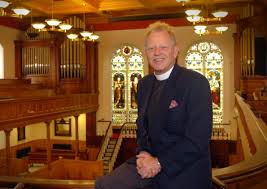
David Latimer was a systems analyst with the Northern Ireland Electricity Board and married before he decided to become a cleric. He did so in 1988 and is now Minister of two churches, the First Presbyterian in Derry’s Magazine Street and the Monreagh Presbyterian, established in 1644 across what is now the British Border in Donegal.
In 2011, David Latimer was invited to address Sinn Féin’s Ard-Fheis and did so. On that occasion he said, referring to Martin McGuinness, that they had “… been journeying together for the last five years and during that time we have become very firm friends, able to easily relax in each other’s company.”
Rev. Latimer went on to say that “The seeds of division and enmity that have long characterised Catholic and Protestant relations were neither sown in 1968 or 1921 but during the 1609 Settlement of Ulster. Mistrust and bad feelings resulting from the colonisation of Ireland by Protestant settlers were followed by centuries of political and social segregation. Partitioning Ireland did little to ease sectarian mistrust and separateness between Protestants and Catholics left in the 6 counties as each community continued to be defined by its particular religious affiliation with little mixture between the two groups.”
The impression given there is of some peaceful colony of Protestants arriving in Ireland around 1609 which led to “bad feelings” and “mistrust”. No mention of the seizure of land from the Irish and their expulsion to the hills or abroad. No mention of the suppression of the religious faith of the majority and the imposition of that of the minority, centuries of discrimination, theft of land, genocide. One can see that this might quite rationally give rise to “bad feelings” and “mistrust”. No mention of the actual promotion by the British of sectarianism and the creation of the Orange order, with the intention of breaking up the unity between “Protestant, Catholic and Dissenter” of the United Irishmen at the end of the 18th Century.
It was again reasons of “little mixture between the two groups” which Rev. Latimer went on to blame for the recent 30 Years War:
“Little wonder this part of Ireland descended into a spiral of communal disorder and violence that was to last for decades. Victims of differences, extending back across trackless centuries that have isolated us from one another it is, with the benefit of historical hindsight, not surprising that our two communities should view each other with suspicion and regard one another as ‘the enemy.’”
Dr David Latimer, First Derry Presbyterian Church, conducts a redediication ceremony on the City’s fortifications, “Derry’s Walls”. Photo: Stephen Latimer
Did the Catholics and Protestants go to war with one another in the late 1960s or at any time during the 30 Years War? No, what happened was that Catholics demanded civil and human rights of which they had been denied in that British colony-statelet since 1921; the state forces tried to suppress their peaceful campaign with batons, tear gas and bullets; right wing and sectarian forces among the Loyalists were mobilised and burned Catholics out of their homes and murdered some. The British Army were sent in to support the “Northern Ireland” sectarian police and the IRA came into limited action to counter them, after which hundreds of “nationalists” were interned without trial, followed by escalation of IRA action, the Paratroopers’ massacres in Derry and in Ballymurphy, and so on.
In fact, Latimer’s false account of history has been the standard British ruling class’ version to justify their war in Ireland for foreign consumption and to the British population throughout those years: the reasonable British with the thankless task of keeping the two tribes apart.
I found the content of the Latimer’s speech on SF’s website without an account of the audience’s reaction but according to the Irish Echo, an Australian on-line newspaper, it “received a rapturous reception from the republican audience”.
Reverend David Latimer and the British Army
Pauline Mellon says that according to the parents, “the child based his decision not to sign the scroll on Rev Latimer’s service in the British Army and with him being stationed in Afghanistan. The child also raised concerns over what he views as Reverend Latimer’s “selective” approach to local human rights issues.”
Surely the boy is mistaken? At least about him having served with the British Army? Well, actually no. In June 2008 Rev. Latimer gave an interview to the Derry Journal to explain why he felt justified in going with the British Army to Afghanistan although he had to “wrestle with his conscience”. Presumably he is an accomplished conscience-wrestler by now since he also admitted to having participated in other British Army missions for more than 20 years.
“It would be against my nature to be part of something that is creating destruction or generating pain or grief within any community”, he was quoted as saying. “The only way I can reassure myself in being part of this is that I am involved with a unit that is going out to provide resources to people who have no choice but to be there because they are under orders.”
Who are they “who have no choice …. because they are under orders”? Ah, yes, the soldiers, pilots and drone technicians who have invaded another country, killing those who resist and generally intimidating the population. Leaving aside the spurious question of “choice”, does one help justice by administering spiritual comfort to an invading army? To whom does one have a greater moral duty? The answer is clear I think and if one lacks the courage to stand up for the population the least one could do is not to offer comfort to their invaders.
Put perhaps Rev. Latimer intends to be some kind of Camillo Torres, preaching for the poor and castigating the wrongdoer? No, of course not. Well then, perhaps subtly undermining Army propaganda? He invites us to think so: “In the quieter times, I will be around for people who will have questions about what they are doing there and about God. I might not have all the answers but I am there to give a view different to the Army view.”
In what way his view might be different to that of the Army he once again fails to explain, or to inform us whether his views were also different on the other more than twenty occasions in which he served with the British Army previously. Surely if he were intending to undermine Army propaganda, he’d hardly be telling us and the Army in a newspaper interview!
He tells us the hospital he’ll be working in over there will be treating Afghanis as well as British servicemen. Hopefully, they will be treating Afghani victims of torture in British and US Army prisons as well as children given a beating in the barracks. He won’t be trying to convert the Muslims to Christianity, he tells us. And I think we can believe that, since abusing people’s religion, their culture, customs, raiding their houses and generally intimidating them is hardly likely to incline them towards one’s religion.
Going on to discuss the possible dangers he would face, Rev. Latimer informs the readers of the Derry Journal that “We know the (military) base is likely to be attacked and we will undergo training in how to deal with chemical, biological and nuclear attacks.” He need not worry, the Afghans don’t have any of those weapons. However, he should exercise caution should he ever have cause to pass through the special arms stores of the British or US military, who do indeed have precisely those weapons and, furthermore, have used most of them in warfare at some point.
“I will receive some weapons training, although this will be limited on how to disable a gun and make it safe.” Useful, just in case any member of the Afghani resistance accidentally drops a gun …. perhaps when calling on the Reverend to make enquiries about the philosophy of the Christian religion.
“Peace” and “Peace” Treaties and Agreements
The vast majority of people would say that Peace is a good thing; despite that, “peace” remains a problematic concept and not one upon everyone can agree. And “peace” is also frequently being promoted in some part of the world by some of the most warlike states with the most horrifying armaments. For those in power, the invoking of the word “Peace” can be a powerful way of invalidating resistance, silencing dissent and of justifying the status quo which has been achieved through vanquishing the enemy in battle or by the recruitment of collaborators in the enemy’s leadership.
During WWI, the British and the French concluded the secret Asia Minor Agreement (also known as the Sykes-Picot Agreement), with the endorsement of Imperial Russia; the Agreement divided the Arab world between the French and the British should they succeed in beating the Ottoman Empire. To the shock and embarrassment of the imperialists, the Bolsheviks published the terms when they took power in 1917. Although this Agreement was intended to bring “peace” between the competing British, French and Russians, it has been in part the source of many wars with others, as well as coups and uprisings in the Middle East since then.
“Peace” does not mean the same to all: many of the British and French public during WWI would have said that “peace” meant defeating the Germans and Turks, conversely many Germans and Turks would have thought the direct opposite. The Russians mostly wanted an end to the War so “Peace” was one of the most popular of the Bolsheviks’ slogans for their October Revolution, after which they pulled Russian troops out of the War; it was one of the reasons so many soldiers and sailors sided with them.
The end of the First World War brought “peace” and “peace treaties”; among these was the Treaty of Versailles between Britain and France on one side and Germany on the other. In effect, the principal victors screwed Germany for war reparations, occupying the industrial Ruhr Valley. Many historians agree that the Versailles Treaty was a contributory factor to the later rise of the National Socialist Party (the “Nazis”) in Germany and also to the Second World War.
After WWII, the “peace” treaties divided the world largely between the USA, the British, the French and the USSR. Some aspects of that division led to two big wars — the Korean and Vietnam Wars – and a host of smaller ones. The USA has fought 20 military engagements since WWII; the British have fought 28 and the French have been directly involved in 15 military actions or wars (these figures do not of course include the wars and coups fought by the many proxies of these powers). Furthermore, not one of those wars was fought on the territories of those states and, in most cases, took place far from them.
To look for a moment further than the three world powers above, Sri Lanka had a war going on inside it since 1983 and had peace talks a number of times. The origin of the war was the communal differences and inequalities promoted by the British when they ruled Ceylon as a colony and continued by the Sinhalese majority Government afterwards. In 2008, the ruling Sinhalese Government decided on all-out war and, abandoning the mutually-agreed ceasefire, surrounded the Tamil Tigers’ “liberated areas” with a ring of steel through which no-one could pass. They then subjected the areas to indiscriminate continuous shelling and air bombardment before sending in their troops, wiping out most of the opposing guerrillas but also thousands of civilians. According to UN estimates, 6,500 civilians were killed and another 14,000 injured between mid-January 2009. The Times, the British daily, estimates the death toll for the final four months of the war (from mid-January to mid-May) at 20,000.
There’s peace in Sri Lanka now, all right — the peace of the grave.
Sri Lanka’s “peace” is similar to the one that followed the 1798 Rebellion in Ireland – that was “peace” after a defeat of the Irish Republican forces by bloody suppression and rabid sectarianism. Of course that “peace” was temporary only (as Sri Lanka’s will no doubt prove to be too) and was followed by other brief uprisings in 1803, 1848, 1867, the Land War 1879-’82, 1916 Rising, the War of Independence 1919-1921, the Civil War 1922-’23, the IRA campaign during WWII …. The partition of Ireland as part of the 1921 Agreement was supposed to bring peace to both parts of the country but again it proved to be a temporary one.
Despite the sectarian riots burning Catholics out of their homes and the wave of terror and repression by the Six Counties statelet in the early 1920s, conflict broke out again with the IRA’s Border Campaign of 1956-’62. In 1967 the Civil Rights campaign in the Six Counties began; the repression with which it was met by State and Loyalists caused the uprising of the Catholic ghettoes of Derry and Belfast afterwards. Then more repression, more resistance, then troops, then 30 years of war with the British Army and colonial police against the Republican guerrilla forces. The Good Friday Agreement claims to be bringing peace but history – and the ongoing repression of dissent by the statelet’s forces — indicates otherwise.
One of the reasons that peace is not necessarily brought by treaties and agreements is that they are themselves intended as temporary measures: by both parties, as in agreements between competing imperialist and colonialist powers, or by one of the parties, for example by the US Government in the case of the Native American Indians. Or they are violated by succeeding governments, as in the case of William of Orange’s promises in the Treaty of Limerick. Or they don’t deal comprehensively with the underlying causes of conflict, as with treaties and agreements between Britain and Ireland in general.
In fact, when a colonial or imperialist power seeks an agreement or treaty with a people or a weaker nation, what it is seeking is not usually peace but pacification – it wants an absence of conflict, or of resistance, so that it can continue extracting the benefits which it was doing before the people began to resist.
Or sometimes, the stronger power wants merely to delay things, to “buy time” until it is expects to be in a better position (and its opponent perhaps in a weaker one) than that which it was at the time. In 1925 the British Government intervened in a conflict between the mine-owners and the miners in Britain, paying a subsidy for nine months to prevent the miners’ pay from dropping. During that period, the Government laid in stocks of coal and bought up newsprint to prepare for a big battle with the miners’ union in particular. In 1926 they took on the British trade union movement and succeeded in forcing the TUC to call it off the General Strike within nine days of its beginning, leaving the miners to fight on alone for eight months until they were defeated.
So what kind of “peace” is being promoted by the Reverend Latimer? Some detailed plan, or some wishy-washy generalisation? That is not an easy question to answer. It is known to be an attempt to get into the Guinness Book of Records by having the most schoolchildren sign it which many have done, including in Donegal and Derry. Is it just a publicity stunt, where people sign up to some vague notion of “peace” which can mean one thing to one person and something completely different to another? What is the context for this “scroll”? “Peace” between whom and on what terms? Or is there a political agenda, as there was in the campaign around the Good Friday Agreement?
The Scroll’s FB page does not explain and the parents have not managed to find out; in addition a number of Google searches of mine failed to turn it up either. What is known about its origins, perhaps the only thing apart from it aiming at a world record, is that it is being energetically promoted by Rev. David Latimer. And as we have seen, he goes on British Army missions and his role in all this is far from clear.
Schools in our society
Coming back to where we began, the pressure and attempted intimidation of a schoolboy is wrong and should not have been inflicted on this boy (and on who knows on how many others). It should not have been but it was and, when the parents objected, the agents of that blackmail, intimidation and repression should have backed down. And if they refused to back down, the managing agents, the School Board should have upheld the parents’ objections. And if they did not, the Catholic Council for Maintained Schools should have done so. All of them failed to do what was right.
As adults, we tend to see schools as neutral institutions, some with good standards, some not so good, with a continuum of teachers ranging from great to abysmal. Schools however do play a role in socialising children to accept authority and discipline outside the home and also into accepting ideas dominant in the society in which the school is located. Seen in that light, we should perhaps be less shocked at this treatment of a boy and his parents.
However this Guinness Book of Records project is not even part of the school’s official program nor of the State’s curriculum and it was the boy’s resistance to the undue pressure brought to bear on him that sparked the verbal response for which he is now being ‘disciplined’ and which he and his parents are resisting.
If the school were an institution dedicated to real learning, it would encourage questioning, even though its teachers and managers might find that uncomfortable at times. It would value courage and principle and instead of persecuting this boy, would encourage him and value his principled stand, his courage and his persistence. But instead it does the opposite and because the boy’s parents do value their child’s principles and courage and want to support him, they also find themselves in conflict with the school.
Such small-scale battles go on constantly everywhere in our society, in institutes of education, in workplaces, in other organisations and associations, in communities. People fight those battles, often on their own or in little groups, or they fail to resist; whichever they do will affect their individual character and their social and political attitudes thereafter, one way or the other. Drawing on those lessons can lead to understanding more general truths about society and can also help to develop the strength of character to withstand psychological and other bullying and pressure at other times in life. Fair play to the boy for his principles and the courage to stand up for them against authority figures and fair play too to his parents who are supporting him.
COURT HEARS OF INTIMIDATION OF FAMILIES OF ACTIVISTS BY GARDAÍ AND SHELL SECURITY MEN WEARING BALACLAVAS
By Pat Cannon
I was present in Castlebar court house for most of the ten-days of the trial of Gerry Bourke and Liam Heffernan who are Shell To Sea supporters and activists. I witnessed at firsthand how tax-payers’ money can be wasted at will by the agents of the state i.e. Gárdaí (the Irish police), State solicitors, the Dept. Of Public Prosecution, the Judge, court officials, State barristers and other hangers-on.
Numbers involved:
( 1 ) Judge ( 1 ) courtroom user ( 2 ) Stenographers ( 1 ) Prison officer; ( 1 ) Gárda on video evidence ( 2 ) State Solicitors ( 1 ) Senior Counsel for the State ( 1 ) Junior Counsel for the State; ( 2 ) Solicitors for the Defence ( 2 ) Senior Counsel for the Defense ( 2 ) Junior Counsel for the Defence; ( 12 ) Jurors ( 12 ) witnesses at least. Also the secretarial staff of all parties, including the DPP Office staff working on the case, also the cleaners and the other Court staff.
First of all if the State and the oil companies had initially negotiated with the locals, probably there would have been no need for these quiet citizens to have to rise up in protest against this project. A much safer and easier route for the pipe line would have been found as the locals have an extensive knowledge of this area. If the state (and its Government) had negotiated a reasonable deal with oil companies then there would be much less protestors. If proper health and safety regulations backed up by staff and equipment were in place from the start, people would feel much safer and secure in their homes. BUT NO! THE SHARKS DON’T NEGOTIATE — there is no room for compromise in a shark’s make-up.
SHARKS
Right from the start, the Government, the oil companies, the Environmental Protection Agency, County Council, media, Judiciary, Gárdaí and every other arm of the State treated the local people with disregard, contempt and as a complete irrelevance. As far as all the above-mentioned were concerned there was big money to be had and no small fry was going to get in the way. THERE WAS BLOOD IN THE WATER AND THE SHARKS WERE IN FOR THE KILL.
Thankfully there were 2,500 years of tradition and history still alive and well in this area, there was a quiet shy population but of people with a strong backbone that were well hardened into hardship, neglect and resistance to outside dictatorship and who were not going to be bullied or pushed about by anybody.
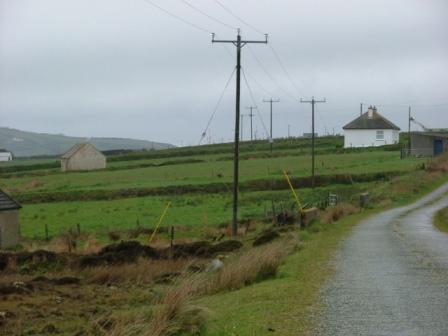
The rural area chosen by Shell for the pipe-laying (planned to run between shed on the left of photo and house on the right)
It was this stern backbone that caused a middle-aged primary school Principal teacher and her two daughters, backed up by less than a half-dozen other locals to take a stand and start protesting against the potential desecration of this EU Environmentally Protected Area and their local pristine environment. Of course they were ignored, the media never mentioned them; the oil company’s employees and officials looked the other way and probably had a good laugh as they passed, the Council and all the other arms of the State treated them as non-entities. As far as all these groups were concerned the local people were of no significance.
However, the time came when these officials had to get into closer proximity with the local people; they had to enter the local people’s land and they thought they could do this without permission, by bullying and using threats but soon discovered how mistaken they were. They learned that they were not just dealing with a few individuals or a few head cases but instead that there was a whole community in this locality and that this community was close-knit and resolute in their opposition to outside intimidation and coercion.
With little or no advance warning the oil companies’ employees entered the farmland of six local farmers without the owners’ consent and proceeded to dig trial holes, knock down boundary fences and block access to and from the land in question. Naturally enough the farmers contacted their legal advocates and very quickly they were in court for the first time in their lives.
Of course the Courts and Judiciary are also an arm of the State and are also commercial enterprises just like the oil companyies and they ruled in favour of the foreign multi-national companies. After all small local marshland farmers can’t afford to give big financial enticements to Court judges, politicians and Government officials but on the other hand the oil company will be very generous as has transpired since.
JAILING OF THE ROSSPORT FIVE
The six farmers, five men and one woman were found in “contempt of court” and the five men were jailed until they “purged their contempt”. This lead to an outcry all over the country and hundreds of thousands of people came to the assistance of what became known as “the Rossport Five”. Ninety-four days later the Courts had to capitulate and release all of the five innocent men.
However the scene was set for what would become a marathon David and Goliath battle between a small close-knit indigenous rural Irish community and three foreign multinational oil companies, one of which had a larger turnover than that of the whole Irish State even though the latter was experiencing an unprecedented economic boom.
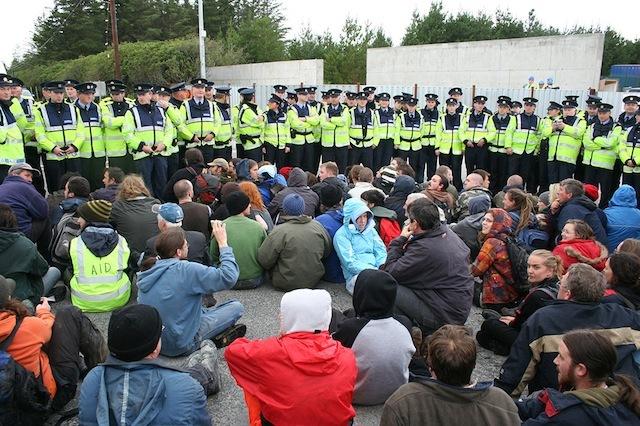
Gardai defending Shell confront protesters
Thirteen years after the middle-aged school teacher and a handful of supporters stood outside the local council offices in protest the struggle is still going on and the oil companies and Irish Government are still trying to bully their way through the Irish people.
However, the Government’s economic boom has disappeared and the people now realize that if they still had their oil and gas that was fraudulently misappropriated by the Irish Government and the oil companies, we would have NO EVICTIONS, NO CENTENARIANS ON HOSPITAL TROLLIES, NO EMIGRATION, NO UNEMPLOYMENT AND NO STEALTH TAXES.
IN THE COURT RECENTLY
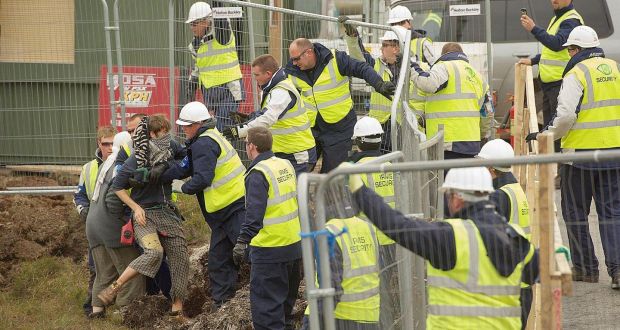
So in these last two weeks I witnessed the State trying to criminalise two more supporters of the struggle; we saw video evidence showing that the men had to use considerable force to gain entry to Shell’s site and when confronted by Shell’s private army (security force) the protestors had to stand firm and use a variety of tactics to get past them. We heard State witness after State witness tell lie after lie or refuse to answer or evade answering questions when they were put in the witness box, then the Defence were not allowed show their video evidence and some of their witness were not allowed on the stand.
Shell security team manhandle a protester.
I heard how Shell’s private army drive around the villages at night in two jeeps with blacked-out windows and shine their lights through the windows of activists’ homes, whilst if anybody comes out of the houses then four men wearing balaclavas step out of each jeep in an act of intimidation. We heard how the Gárdaí constantly drive past the people’s homes very slowly and then turn around a mile or two up the road just to drive past again five minutes later and hjow each time they pass, they stare into activists’ homes.
I heard how the Gárdaí punched, pushed, kicked and beat with steel batons men, women and children, how many activists spent long terms in prison on trumped-up charges while Shell plied the Gárdaí with over €35,000 worth of alcohol. I also heard how a Gárda made derogatory remarks of a sexual nature about a protestor’s wife to the protestor and how five Gárda were unwittingly recorded on a female prisoner’s video camera planning how they would interrogate her when they got her to the Garda station by threatening to rape her and laughing at the different ways they would word the threat. ALL of them got away with ALL these misconduct events.
Gardai caught on camera in action at Rossport
I heard how while car tyre contains on average 2 bars of air pressure per square inch, that this gas pipe had 345 bars of highly inflammable gas pressure per square inch, that the seas and sea bed are highly vulnerable to currents (the second most volatile currents in the World).
I also heard the accused man’s wife state how for 13 years while she was rearing her family she could think of nothing from once she got up in the morning till she fell asleep at night but this dangerous gas pipe line that would be practically going by their front door and over which she had to take her children to school every day.
In a statement to the Court, one of the Rossport 5 gave evidence that Michael D. Higgins (now Uachtarán of the Irish state) had been on the protest and had addressed the other protesters, also participated had the father of the State Solicitor prosecuting this case. He also said that Enda Kenny had visited the Five in prison and had told them that life was “very cheap in Ireland now” and that “you can get a man in Dublin to do a ‘hit’ on someone for €500.”
Protesters against Shell in Dublin
In his summing–up the Defence counsel stated that the State agencies had rubbished themselves in the eyes of the world in their dealing with the situation, that the terms that our oil was given away were the second best in the world for the oil companies, that they stated that there were no emergency plan in place if an accident or act of terror did happen and that the protestors had rendered a magnificent service to their fellow citizens at much expense and hardship to themselves by standing up for what is right and correct.
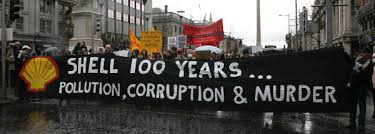
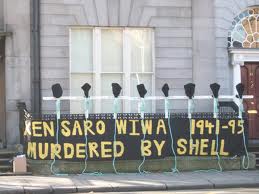
Protest at Shell HQ in Leeson St, Dublin in solidarity with Ogoni people in Nigeria and people at Rossport. The Nigerian Government, to protect Shell’s profits although the company was causing great environmental damage, hanged the nine leaders of the peaceful environmental movement
The Jury of eight women and four men was out for just about one hour when they returned with a unanimous verdict of “NOT GUILTY of violent disorder” on both Liam Heffernan and Gerry Bourke. A further malicious charge of “criminal damage” was dropped by the State because despite there having been 28 cameras on site and up to 30 security men and later a number of Gárdaí, there was no evidence to support the charge.
Just more waste of tax-payers’ money. I have reckoned the tab that the tax-payer will pick up will be in the region of €150,000 and Shell won’t be paying a penny of it.
The 28th of June was not a normal Sunday in Moore Street. On a normal Sunday, Moore Street is not a busy street, although it is not quiet either. The stallholders are on a day off to come back on Monday but a number of small shops are open as are the supermarkets and the ILAC shopping centre, one of which doors opens up on to Moore Street. But on this Sunday, crowds packed a part of the street for the event organised by the Save Moore Street from Demolition group.
Part of the crowd lining up around the 1916 Terrace in Moore StreetPaul O’Toole, who played a number of sets, including singing some songs of his own composition
As a crowd had gathered already by 1.30pm, a half an hour early, singer-musician Paul O’Toole responded to his performing instincts and started playing a set of compositions of his own and of others. A song against the Water Charges opened his set, to be followed by another of his own, We Shall Not Lie Down.
Meanwhile the Save Moore Street from Demolition (non-political party) group, had set up their stall as they had done the previous day there and on another 41 Saturday afternoons in Moore Street. The folding table, covered in a Cumann na mBan flag donated by a diaspora supporter, was staffed by Bróna Uí Loing, a relation of 1916 veterans and of Fenians involved in the famous Manchester prison van escape, and Vivienne Lee, another early activist in the campaign. On the table was a petition to save the street and leaflets were being handed out by helpers. Nearby, some Irish tricolours, the Starry Plough and the Irish Republic flag fluttered and a number of placards indicated the concerns of the campaign: “NÍL SAOIRSE GAN STAIR (“There is no freedom without history”) stated one, while another said “NO TO SPECULATORS”.
MOORE STREET IN HISTORY
Moore Street is the sole remaining street of a market quarter going back hundreds of years comprising three parallel streets with many lane-ways in between, all the rest of which are now buried underneath the ILAC shopping centre and a Dunne’s Stores; people lived in those streets and laneways and clothes and shoes, meat and fish, fruit and vegetables and furniture were sold there.
But in 1916, Moore Street, its back yards and its surrounding streets were host to history of a different kind: in the last days of the 1916 Rising, the GPO roof burning and the ceiling unsafe, around 300 Irish Citizen Army and Irish Volunteers evacuated the building and made their way through a side door, across a Henry Street made hazardous by flying bullets, and into Henry Place. It was probably here that the English revolutionary socialist, Weekes (also variously Weeks, Wicks) who had joined the Rising, fell dead.
The insurgents’ evacuation group included three women: Elizabeth O’Farrell, her life-long friend Julia Grennan and Winifred Carney, James Connolly’s secretary who, on leaving Liberty Hall on Easter Monday, had packed a Webley pistol along with her typewriter. All three had refused to leave as the other Cumann na mBan women made their own earlier hazardous way helping the wounded fighters to Jervis Street hospital.
As the evacuees made their way hurriedly through the Henry Place laneway, they encountered a storm of machine-gun and rifle fire at the intersection of the lane and another, now named Moore Lane. The fire was coming from a British Army barricade at the top, in what is now Parnell Street. Here Michael Mulvihill fell, mortally wounded; he was also fresh over from England but originally from Kerry. Volunteers broke into a yard and dragged a car out, placing it across the gap and taking a breath, they ran across, mostly one by one. Connolly was being carried on a makeshift stretcher, his ankle shattered earlier by a ricocheting bullet in Williams Lane, ironically just next to Independent House, owned by leader of Dublin “nationalist” capitalists, William Martin Murphy and also ironically, across the road from the former office of the Irish Socialist Republican Party, founded by Connolly in 1896, sixteen years earlier.
Shortly before the evacuating group were making their way across that murderous gap, Michael The O’Rahilly had led a dozen fighters who had volunteered for the task in a charge at another British barricade and machine-gun a the top of Moore Street, also in what is now Parnell Street. Since the GPO was being evacuated, there was no covering fire from the top of that building and the fire coming down the street must have been terrific. None made it as far as the barricade. The O’Rahilly was apparently unharmed and got quite close; he sheltered in a doorway on the west side of the street and then ran across to a lane on the other side. A burst of machine-gun fire caught him and in the laneway, now named O’Rahilly Parade, he died, after having penned a note to his wife. The note is reproduced now on a bronze plaque in that street.
The other group, having made it through Henry Lane and prevented from further progress by the firing of that same machine-gun, broke into the first house of a Moore St. Terrace on the north side of the terrace and began to tunnel northwards from house to house, occupying in time the whole terrace by the time their leaders gave up their plan of breakout and, in an attempt to save further loss of civilian life, surrendered themselves and all the garrisons of the Rising on both sides of the Liffey on Saturday of Easter Week.
The surrender party of Pearse and O’Flaherty met General Lowe in what is now Parnell Street (exactly where is disputed but from the photo of the event it would appear to be outside of where In Cahoots café is now). The GPO/ Moore Street garrison marched up O’Connell Street and surrendered their arms outside the Gresham Hotel and were kept prisoner in the garden of the Rotunda, the building where the first public meeting to found the Irish Volunteers had been held in 1913. A British soldier posed later for a photo with the Irish Republic flag held upside down in front of the Parnell Monument and at some point a whole group of British officers posed for another photo, also holding the flag upside-down to signify the defeat of the rebels.
From that tunneled-through terrace in Moore Street, six were among the 14 shot by firing squad, including five of the signatories of the Proclamation: Tom Clarke (whose tobacconist shop was where the Centra shop is now, across from the Parnell Monument), Patrick Pearse, James Connolly, Seán Mac Diarmada and Joseph Plunkett. Another, William Pearse, was also executed.
MOORE STREET ON THE 28th JUNE 2015
Jumping forward to June 28th 2015, while Paul O’Toole was playing and singing to keep the audience interested, shouted slogans from the Henry Street end of Moore Street announced the arrival of the Dublin Says No weekly march, come to support the campaign.
Paul O’Toole’s place was taken later by Kev and Dwayne, who played and sang a set of Dublin and 1916 ballads, to be followed by a performance of two of his pieces by John Cummins, Poetician, champion of the Slam Poetry competition. His piece on Moore Street was particularly well received.
John Cummins, poetician, performing his Moore Street pieceKev and Dwaine, who also provided entertainment with a set of Dublin and 1916 songs
Diarmuid Breatnach of the Save Moore Street from Demolition group, who had been MCing the entertainment part of the event, then called on the crowd to line up on the street and stretch arms in a symbolic act of: “Love for Moore Street and our heritage and resistance to the plans of property speculators to destroy it”. Paul O’Toole came back on and played as the crowd eventually stretched around all four sides of the “1916 terrace”, areas where in 1916 bullets flew and people died as a relatively small group of women and men took on the British Empire. Cries could be heard of “Save Moore Street, save it all, Save the Terrace and the stalls!”
When the ‘Arms Around’ exercise had been completed, photographed and filmed, Breatnach called the participants to gather back around to the Moor Street terrace and introduced Mel Mac Giobúin, to speak on behalf of the SMSFD group and to MC the final part of the event.
Mel thanked the crowd for encircling the 1916 terrace in defence of “ ‘me jewel and darlin’ Dublin’ as Éamon Mac Thomáis would say”. Mel explained that the small group of which he was part had run an information and petition stall “every Saturday for over 40 weeks in Moore Street, in rain, cold and now sunshine” and paid tribute to all those who had campaigned over the years. He spoke of the support of ordinary people who shop in the street, who come up to the stall not only to sign the petition but to tell us their memories of shopping or working in Moore Street, of relatives who were involved in the 1916 Rising and/ or in the War of Independence.
The line stretching around from Moore St, to the corner of Moore Lane with Henry Place, then (out of frame) up Moore Lane to O’Rahilly Parade and back into Moore St.Mel Mac Giobúin, speaking on behalf of the Save Moore Street from Demolition group
Enumerating some of the advances that had been made over the years, Mel denounced the Chartered Land giant “shopping mall” proposal and the NAMA process through which property speculator Joe O’Reilly was now going and Moore Street along with him. (Joe O’Reilly was, at €12.8 billion, top of the list of NAMA debtors not long ago but is now at No.6 of the Top Ten. He is still in business and being paid €120,000 annually by the State to manage his debts; also was recently involved in bidding for another big property site — DB). Dublin City Council had received a large number of submissions, Mel said, and was now beginning to think that another shopping mall might not be the best idea for Moore Street.
Bróna Uí Loing and Vivienne Lee, members of the campaigning group with the campaign table displaying petition and leaflets
“We should continue to recognise the important significance of the 1916 Rising and the long tradition of the street market” Mel said and, in concluding, he thanked the crowd but asked them to be ready to be called out again in defence of the Moore Street historic quarter.
Next to speak was Donna Cooney, representing the 1916 Relatives Association, who spoke of the Cumann na mBan women in Moore Street in 1916, one of them being her great grand-aunt, Elizabeth O’Farrell. Donna recounted how O’Farrell had tripped in Moore Lane during the evacuation but had been caught and saved by Sean McGarry. On entering No.10, the first thing O’Farrell remembered seeing was Connolly on a stretcher and went to tend to him (she was a nurse by profession).
Donna spoke of the perilous journey O’Farrell had to take twice in the negotiations with General Lowe and then later, more danger in the unhappy task of taking the surrender instructions from Pearse and Connolly to insurgent strongholds in various parts of Dublin. “The Government needs to do much more”, said Donna, referring to Government plans to commemorate the centenary of the Rising in 2016 and was warmly applauded by the crowd.
Donna Cooney, great-grandniece of Elizabeth O’Farrell, speaking on behalf of the 1916 Relatives’ Assocation
Proinnsias Ó Rathaille, called up next by Mel, is also a 1916 hero’s relative – his grandfather was The O’Rahilly, who died in the lane that now bears his name. Proinnsias spoke briefly of the international importance of the 1916 Rising, which had given such inspiration and encouragement for their own revolutions to nations around the world, particularly those under the British Empire. Turning to the importance of the Irish diaspora to the struggles, Proinnsias singled out Maeve O’Leary who continues to promote the cause from Australia where her home is now and who had recently returned to her native Dublin for a short while (and worked with the Save Moore Street from Demolition group — DB).
Proinnsias concluded by reading the moving poem written by Yeats to the memory of The O’Rahilly to great applause.
Proinnsias Ó Raithille, grandson of The O’Rahilly and a campaigner for Moore Street
The final speaker introduced by Mel was Jim Connolly Heron, great-grandson of James Connolly, a long-time campaigner for the appropriate preservation of Moore Street. Jim spoke about how the Chartered Land plan to destroy Moore Street had been agreed by a Minister in the current government and how a land-swap deal, which would have facilitated the destruction of much of the 1916 terrace, had been voted down by elected councillors of a number of political parties and independents.
Jim Connolly Heron, great grandson of James Connolly and a long-time campaigner about Moore St.
Jim went on to speak of the NAMA sell-off of assets due for the following day, when among other properties, Chartered Land’s stake in the ILAC and Moore Street was to be sold off to the highest bidder. “Moore Street is not for sale”, he said, to cheers. Jim went on to speak of “the golden generation” who had risen in 1916 and the need to honour their memory and to commemorate the event properly and how conserving the historic Moore Street quarter, the only surviving 1916 battle-site, is very important part of that. Jim concluded to loud cheering and applause by saying that “Moore Street will not be sold on our watch!”
Paul O’Toole then played and sang again his “We Will Not Lie Down”, with the crowd joining in on the chorus, after which he accompanied Diarmuid Breatnach singing “Amhrán na bhFiann”, the first verse solo and everyone joining in on the chorus.
And so the third Arms Around Moore Street event in six years (along with other types of campaign events) came to a close. Next Saturday, the Save Moore Street from Demolition information and petition table will be there again, for people to sign, to read, to share their memories, their anger, their hope that the market, the terrace, the quarter are saved. In the meantime, people will sign the petition on line and post supportive comments on the SMSFD Facebook pages and others. It is not just their past – it is their future too.
End
Section of the crowd of supporters in Moore Street
“In conclusion, it seems clear that both states in Ireland, the Irish one and the British colonial one, are employing refusal of bail and restrictive bail conditions in order to harass and intimidate political activists and to seriously disrupt their work.”
In excess of 50 Demonstrators formed three lines in Dublin’s O’Connell Street on Friday (19th June) to protest the continued incarceration of Steven Bennet, a political activist arrested while peacefully resisting the installation of water meters. Bennet was arrested on two consecutive nights – in the York Road area of Dun Laoghaire and in Bray – and on each occasion he was kept in custody overnight despite the Gardai knowing his address and where he could be contacted and despite the suggested charges not being particularly serious. Brought to court then, he was offered bail if he could provide a €1,000 surety, would submit to a nightly curfew between the hours of 10pm and 8.00am, would sign at a police station daily and would refrain from participation in political activity. A previous High Court ruling that his bail conditions should not interfere with his political activism was thereby changed by the same Court. Stating that these conditions were unreasonable, he refused and has been in jail now for nearly four weeks.
Protesters in Dublin outside GPO demand freeing of Steven Bennet (view northward excluding some on west side of central island)
The Irish Government has imposed a Water Tax on the population of the state although they pay for the maintenance of the public water system already through their taxes (and bizarrely, it was recently revealed, through their Motor Tax also). The Water Tax is extremely unpopular in Ireland and has given rise to huge national demonstrations as well as to local resistance and to the most widescale movement of civil disobedience since the resistance to the Household Tax a few years ago. Most people believe these new taxes are a means of funding the banking bailout and also that the public water service is being prepared for privatisation (a likely benificiary being Denis O’Brien, part-owner of the company currently installing the meters and among the 200 top world billionaires).
Banner and demonstrators protesting jailing of Steven Bennet (photo Vivienne)
Some of the local resistance involves blocking the road to the water meter trucks or, more usually, walking slowly in front of them to slow down their work. People have also interposed their bodies between the meter installation crews and the spot where they intend to drill into the pavement in order to install the meters.
(photo Vivienne)
We should ask ourselves and interrogate the State about why it wishes to impose these restrictions on an arrested political activist. Keeping someone in custody is a serious step in any democratic system. If they have not been convicted, the step is even more serious. Let us not forget that the legal system claims that any accused is presumed innocent until that changes by being found guilty in court. Keeping an innocent person in jail is supposed to be an extreme step, justified only by one or both of the following circumstances:
The accused is thought to be
a serious risk of flight from the jurisdiction before trial
a risk of interfering with witnesses expected to testify against him/her at trial
The “seriousness of the crime” is sometimes raised but that seems related to the “risk of flight”, i.e that the accused might contemplate fleeing the jurisdiction because of the likely seriousness of the punishment if s/he were to be convicted.
As observed earlier, the default position should be that bail is granted.
(photo Vivienne)
Conditions of bail
Conditions of bail are usually that the accused reside at an address supplied to the court – this relates to the defendant being found if required by the State. The accused may be released in his or her “own recognizance”, i.e without any sum being set.
Where sums of money are required to be placed as a surety for bail, these seem again to be related to “risk of flight” — in other words, the accused is thought less likely to flee if it will cost money to the accused or to the person guaranteeing the bail.
The justification for requiring a person to report at a police station every day at a certain time also seems also to have been conceived with regard to risk of flight – it is hard to see what other justification there could be for this. But in fact this makes no sense, since one can present at a police station at eight or nine pm (a frequent time given) but yet be out of the jurisdiction by midnight (in the case no curfew) or by 12 noon when there is a curfew imposed. One supposes it does permit the police to issue a warrant for arrest should the accused fail to sign in at 8pm or 9pm the next evening but that can hardly be a great advantage.
A curfew is sometimes imposed and it is difficult to see the justification for that either, unless it too is related to fear of the accused absconding from the jurisdiction but the same reservations apply to that as to the signing on at the police station requirement.
When these conditions and restrictions are imposed on political activists on charges which normally attract only fines if the accused were found guilty and only very short prison terms in worst case scenarios, what can the justification be? As a rule the accused is still politically active, highly visible to the police and without a history of absconding from the jurisdiction (in fact, often a history of the exact opposite, as in Bennet’s case). The witnesses against the activist are normally the Gardaí, who are supposed to be impervious to “interference” and even when they are others, there is usually no allegation of a fear that the accused is going to intimidate them).
It seems clear that the real reason for these restrictions and conditions are
to disrupt the life of the accused and thereby make him/ her pay a price whether or not s/he is later convicted in court
to disrupt the political life of the accused (interfering with organising, traveling, etc.)
to make it difficult for the accused to get bail (in the case of financial sureties), in which case
to make the accused suffer imprisonment for a period (through refusal of bail or through setting difficult and unreasonable conditions) even though perhaps not convicted later or, if convicted, not receiving a custodial sentence
to discourage others from following in the footsteps of the accused.
Increasingly, particularly in the case of Irish Republicans in the Six Counties, another requirement imposed has been to wear an electronic “tag” or bracelet which may not be removed until the State orders that done. This is usually explained as merely an enforcement of the above conditions but is a physical reminder, every minute of every day, a demeaning intrusion into one’s life.
Three lines of protesters in front of GPO, Dublin’s O’Connell Street (view southward), seeking freeing of Steven Bennet (Jim Larkin statue just visible in the background).
Also in the Six Counties, Irish Republicans on bail are being banned from use of the Internet, from having a mobile phone or, in the case where they are permitted one, being required to supply to the State the phone numbers dialed. Yet another condition has been not to reside within one’s own home town. Very common has been the requirement not to be in the company of others “convicted of terrorism” (if so, have they not served their time?) or merely “suspected of terrorism” (how would one know? The State will tell you!). In the Six Counties in particular, with its history of 30 years of war and subsequent political dissent from the Good Friday Agreement, not associating with anyone who has at some time been convicted of “terrorism” or is currently “suspected” of it, must be seriously difficult.
Apart from the restrictions on one’s personal freedom imposed by the above conditions, these are a massive interference with the facilities of a political organiser and there seems not even a pretence of any other justification for them. They are therefore unwarranted abuses of people’s civil liberties.
In conclusion, it seems clear that both states in Ireland, the Irish one and the British colonial one, are employing refusal of bail and restrictive bail conditions in order to harass and intimidate political activists and to seriously disrupt their work.
Accept the conditions?
Steven Bennet is currently refusing to accept the unreasonable restrictions being required of him in order to avail of bail. In the past, particularly in the Six Counties, others have done so too. One example there was Stephen Murney, of the Éirigi republican party, who was expected to agree to curfew, daily signing at a police station, electronic bracelet, not to reside in his home town of Newry or to approach within five miles of it and not to attend any political events. He refused to accept those conditions for 14 months and eventually was released on bail without the conditions shortly before his trial – at which he was found “not guilty”, which was no surprise since the charges were completely spurious. But Murney had already spent 14 months in jail.
Irish Republican Stephen Murney happy to be out on bail as his trial collapsed — but he had still done 14 months in custody before that.
In recent months, there seems to be a trend of people accepting the conditions in order to receive bail; this includes Republicans in the Six Counties and other water-meter protesters in Dun Laoghaire (on whom a variety of restrictions are being reported). Such acceptance represents in the short term a small victory for the State and in the longer term a significant defeat for civil liberties and the political opposition to the states.
One can hardly blame the activists who have accepted these conditions. The liberal civil liberties sector is silent on what is happening, as is largely the case with the organised Irish Left. When it seems that continued opposition to the bail restrictions can achieve no political objective due to lack of wide-scale protest, and one may be facing long months or even years in prison awaiting trial as a result of refusal, there seems little reason to continue the refusal to accept these restrictions.
Of course, these attacks are taking place on what the Left and liberal civil liberties sectors may see as the “fringes” — the Republicans and some unorthodox anti-water-meter protesters. Have we not learned the lessons of history? The attacks of fascism and the repressive State nearly always start at the “fringes”, from which they move in towards the core. Our silence on this now is in reality an assent to the State — “Go ahead if you like,” is the message the State is receiving, “we’re not going to do anything”. Unless the State goes for the core, of course. But will there be anyone left to mount a decent resistance when we finally decide we should?
Rebel Breeze: This piece was received months ago but somehow got overlooked for which we apologise. Events since then make the points in this short document perhaps even more relevant.
Red Roja describes itself as “a revolutionary marxist organisation active within the Spanish state”. It states that it is “an autonomous organisation independent of any other party or organisation and also economically and politically independent of the State or of any other power, being anticapitalist, of the class, feminist, radically democratic, internationalist, anti-fascist and ecologist.”
(Translation D.Breatnach from http://redroja.net/index.php/que-es-red-roja/quienes-somos)
In Spain, ‘The people should rule — that would be Dignity’
The following is a statement of the organization Red Network in Spain to the Dignity marches of March 21, a year after a similar march brought 1.5 million people to Madrid to protest austerity measures.
On March 22, 2014, more than a million people from all over the Spanish state
marched in Madrid for ‘Dignity’ against austerity
We once again demand that those who caused the crisis be made to pay for it.
An unpayable debt is crushing us, we who suffer every day from unbearable job insecurity, dismantling and privatization of health and education, increasing retirement age, the disappearance of aid for dependents, and our millions of unemployed people who are worth less than nothing to those in power. … The austerity measures and cuts are only being used to pay for a debt created to rescue the gang of bankers, big business people and their servants in the National Assembly, who are playing chess with our lives. Besides using our suffering to line their pockets, they expect us to hang our heads and die in silence. That we refuse to do.
Regarding this, we are nowhere near satisfied with hearing only about “restructuring” or “audits” of that debt. We cannot stop at half-measures when our lives are at stake, when there can be no doubt that this debt is responsible for the criminal foreclosures, the endless unemployment and for the disappearance of even the modest steps taken against domestic violence that condemns many women to terror, suffering and death. It is not a technical problem to say, “NO DEBT PAYMENT.” It is a punch that the people can throw to demand control of their own lives.
In these times, it is understandable that there are illusions that an election can bring “victory,” that we can “throw out the PP” [the rightist Popular Party] or “get rid of the wealthy strata.” But more is needed. No one involved in the new electoral initiatives is speaking about the national and European laws that impose the payment of that illegitimate and criminal debt before anything else. Good will is not enough; neither is honesty. Proof of this is the victory of Syriza in Greece, which has not pushed back by even one step the measures the Troika [the European Commission, the International Monetary Fund and the European Central Bank] had taken against the Greek people. It has become clear who rules Greece: It’s the EU dictatorship. Democracy is an illusion.
Moreover, even this demonstration, though necessary, is insufficient. It is not enough to come together to demand “Bread, Work and Housing” (things that would only be possible after we refuse to pay the debt), or to have a great demonstration of dignity. As seen in Greece and as we see every day in our streets, bankers and big business are not going to give up lining their pockets out of good will.
We need to unite, to organize neighborhoods, towns, businesses and schools, and strike a blow together, all at one time. Only through the unification of our struggles, only if the people who are working and suffering get organized, can we bring about policies that work in our own favor.
The vote is not enough. The people need to organize. The people need to rule.


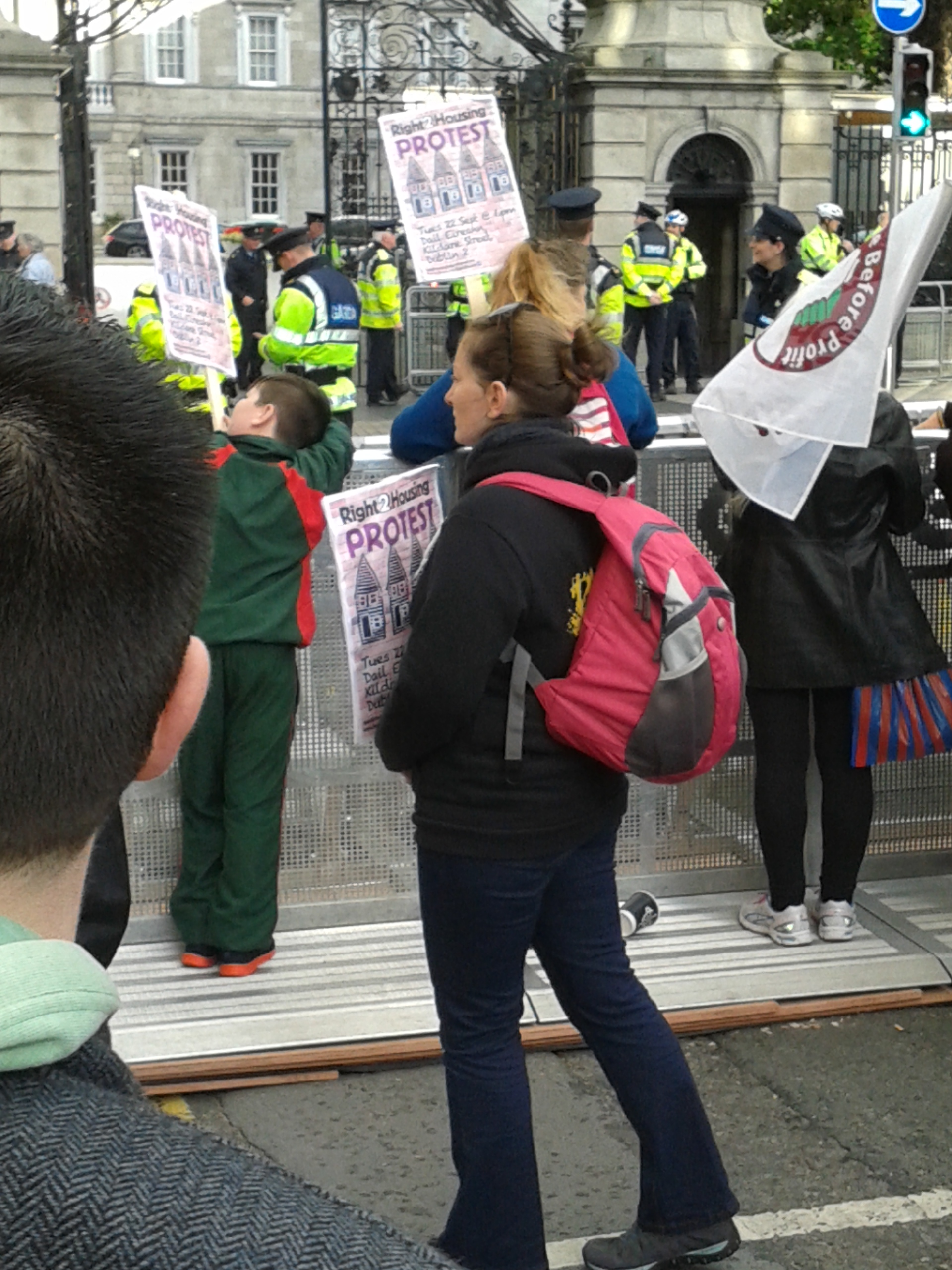
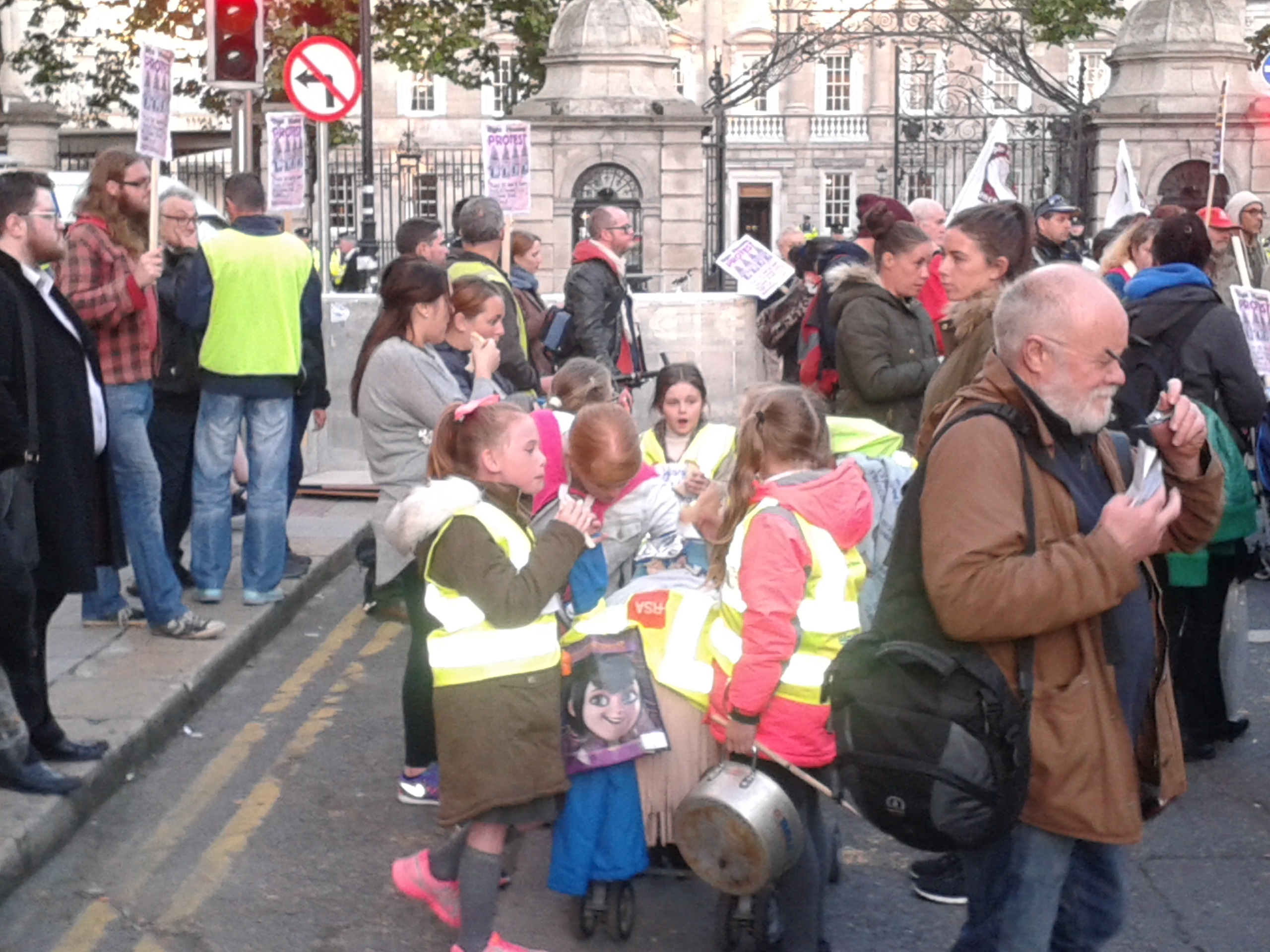

 There were many police but nothing was happening and Larkin did not appear. After a while, a horse-drawn carriage drove up and an elderly church minister alighted, assisted by a woman, and entered the shop. They took the lift to the restaurant floor. A little later Larkin appeared at the restaurant open window, in church minister’s clothing, spoke a few words to the crowd and ran inside. Those in the street were very excited and when the police took Larkin out under arrest, they cheered him, urged on by Constance Markievicz. The police drew their batons and attacked the crowd — any man not wearing a police uniform.