Twenty-three activists arrested at three different Dublin events between Monday and today (Friday). Three women reported being strip-searched. Six activists were pepper-sprayed into the eyes.
Oppression leads to resistance; the system responds with repression. But repression can also lead to resistance.
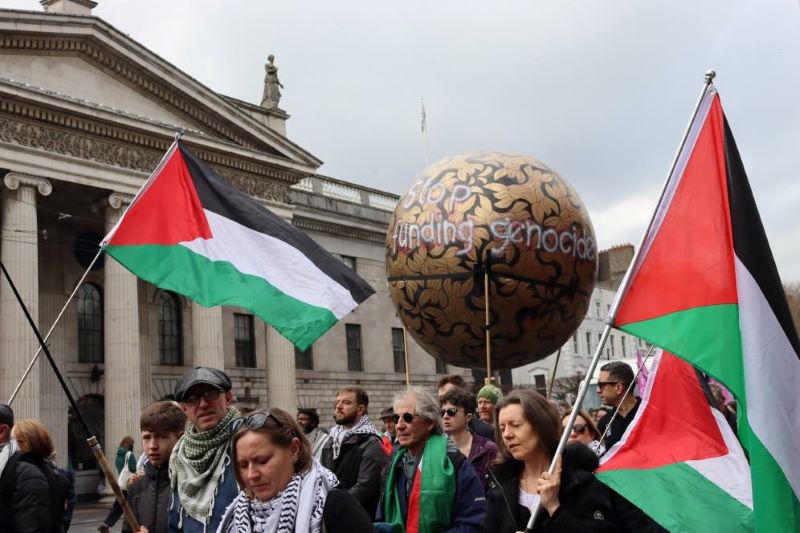
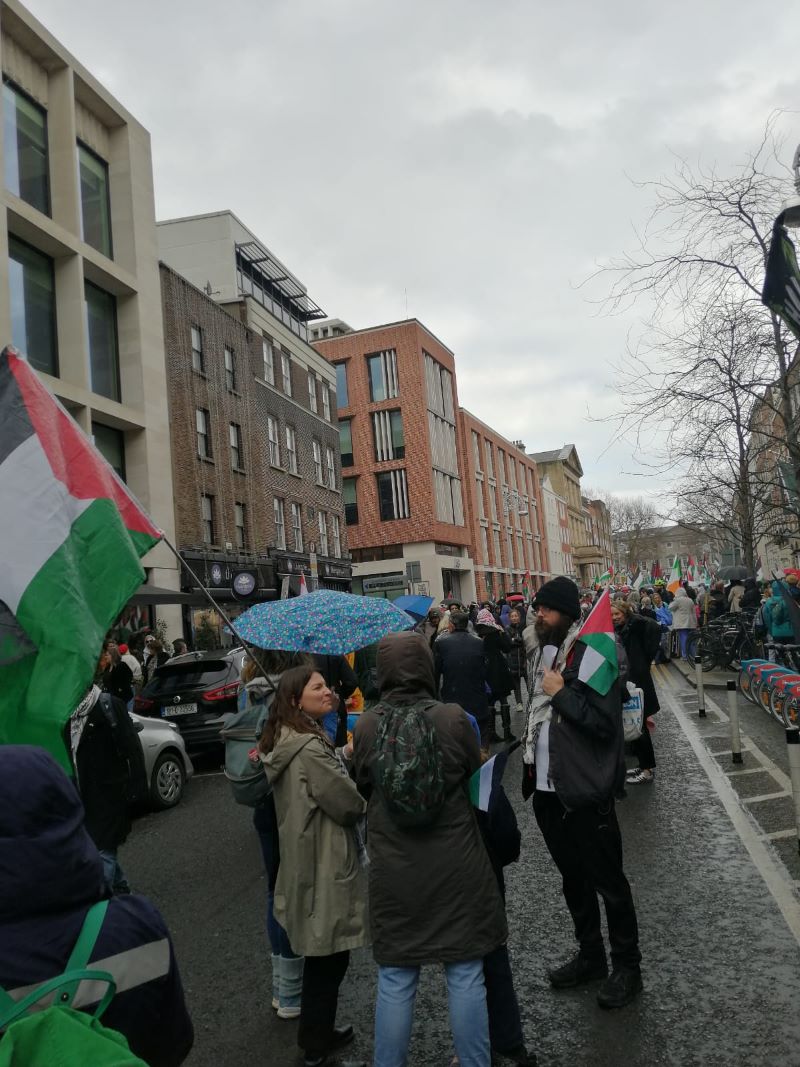
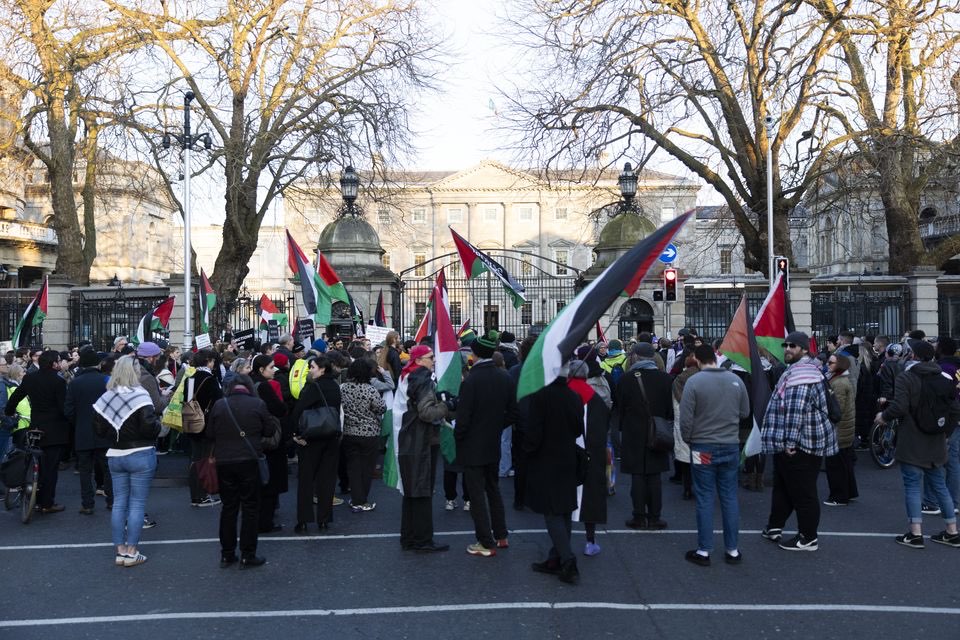
Dublin city centre on Saturday witnessed another giant Palestine solidarity march with a breakaway group; also a picket against internment of Irish Republicans; fascist provocations and Gárda repression resulting in the arrest of a demonstrator.
The national demonstration march had been called by the Ireland Palestine Solidarity Campaign as part of a solidarity and protest pattern that included fortnightly Dublin marches last year but is now generally monthly and at times with other events in addition.
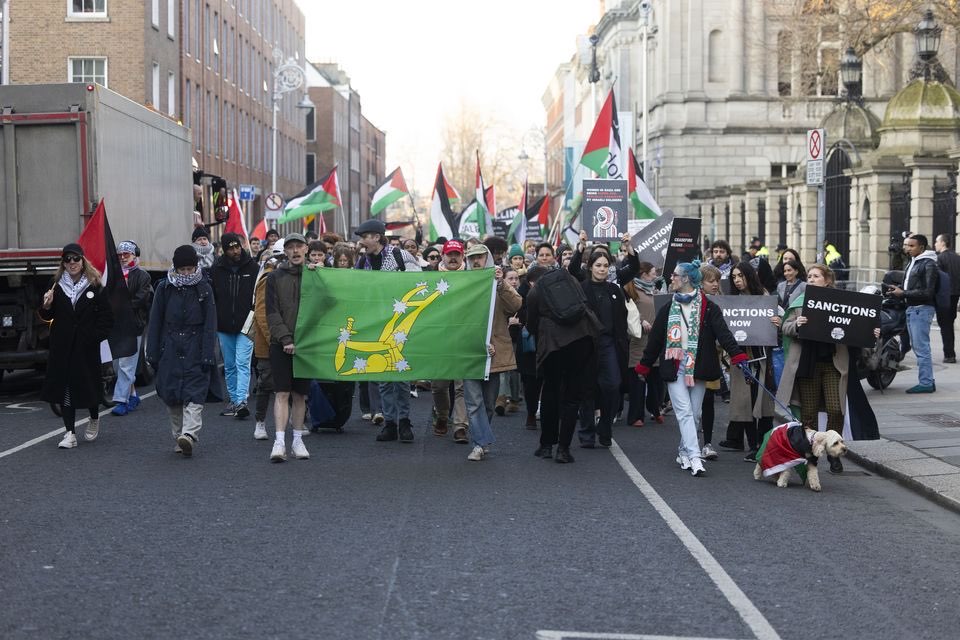
One of the banners just having crossed O’Connell Bridge on the IPSC-organised march (Sourced: IPSC Facebook)
Numbers on these marches in a city of only around 1.5 million population are impressive, though they draw on some participation from outside Dublin but there also regular local pickets and demonstrations of much smaller numbers at locations of high visibility or of specific significance.1
The march set off from the Garden of Remembrance in the north city centre proceeding towards Leinster House, seat of the parliament of the Irish State, near O’Connell Bridge passing a picket with an anti-Internment banner organised by the Anti-Imperialism Action organisation.
Anti Imperialist Action displaying a banner against extradition to the passing Palestine solidarity march. (Photo sourced: Anti Imperialism Action Leinster FB page)
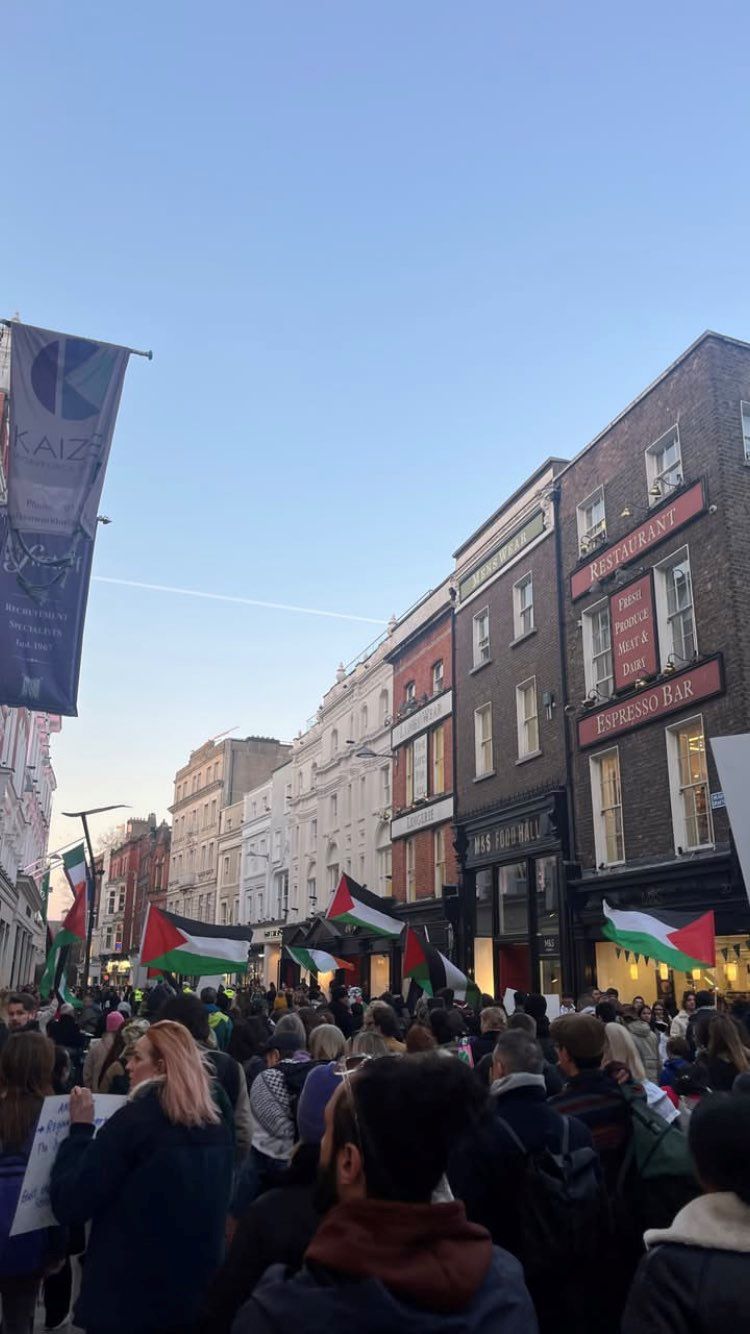
As the march reached the non-pedestrianised stretch of Grafton Street a half-dozen fascists made their presence felt on the sidelines by throwing insults at a section of the marchers, who responded with louder From Ireland to Palestine – Occupation is a crime! and antifascist slogans.
Not just the Irish state but fascists and other far-Right elements in Ireland have a real problem with Palestine solidarity, claiming that’s because the protesters should be marching for Ireland. However those elements for the most part have zero track record in marching for Irish independence.
No, for them ‘Irish nationalism’ consists of demonstrating against immigration and burning buildings intended – or which they believe intended – for housing refugees. Clearly as fascists and far-Right what they detest about marches such as these is internationalist solidarity itself.
Placard calling for what is surely the minimum we have the right to expect from the Irish Government, followed by some of the placards of Mothers Against Genocide. (Photo sourced: IPSC FB page)
Incongruously for those who want only internal causes upheld, the fascists of the Loyalist variety in the occupied Six Counties uphold the Zionist state of ‘Israel’ and those inside the Irish state, as was seen in Dublin on Saturday too, laud and uphold as an example Donald Trump!
Mock Icon of Irish Central Bank carried against processing Israeli Bonds (Source photo: IPSC FB page).
Very shortly after the verbal exchange with the fascists, a section of the march diverted to walk up the pedestrianised section of Grafton Street. A couple of Gardaí, reinforced by the fascists, attempted to prevent this but the marchers flowed around the obstruction to continue up the street.
On Wednesday evening, some of those present had marched down that very street on their way to occupy O’Connell Bridge, bringing traffic in both directions to a halt for half an hour.3
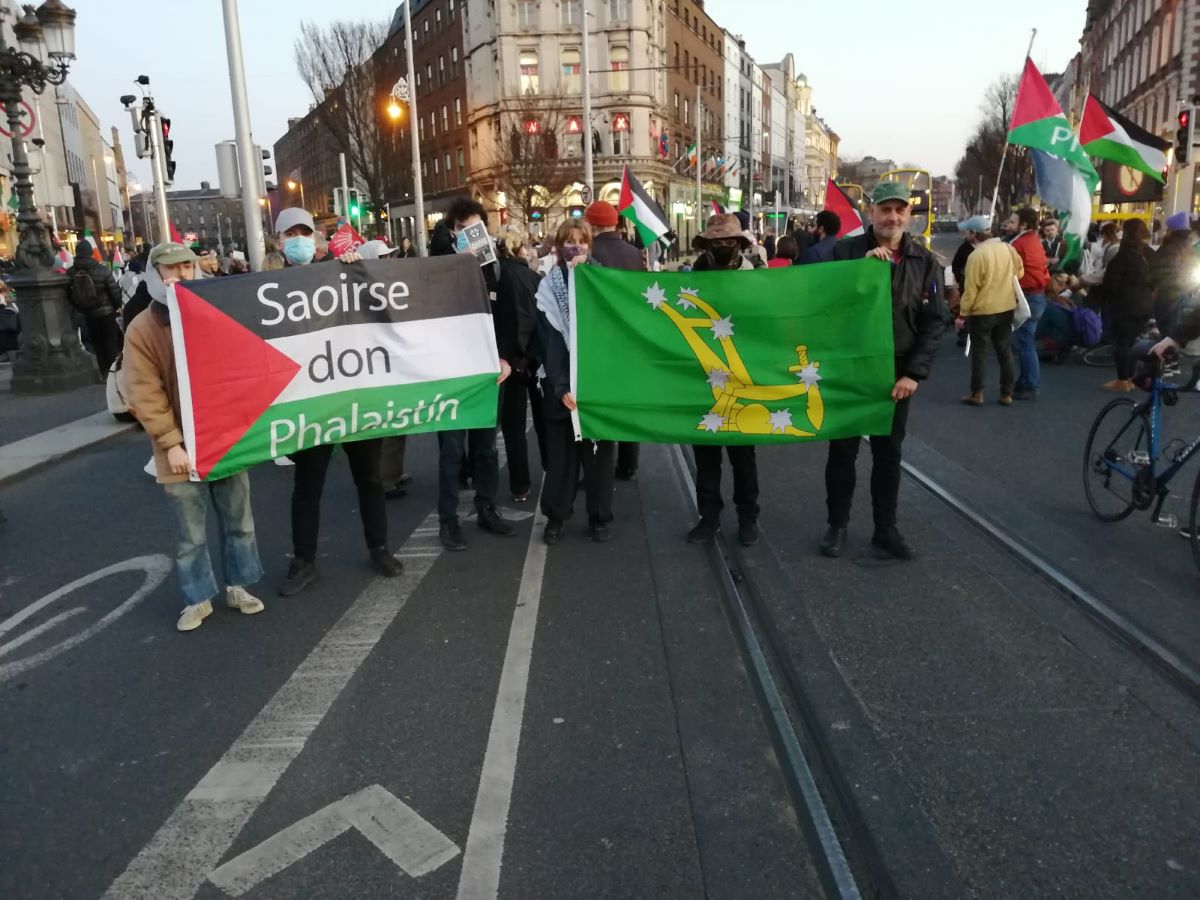
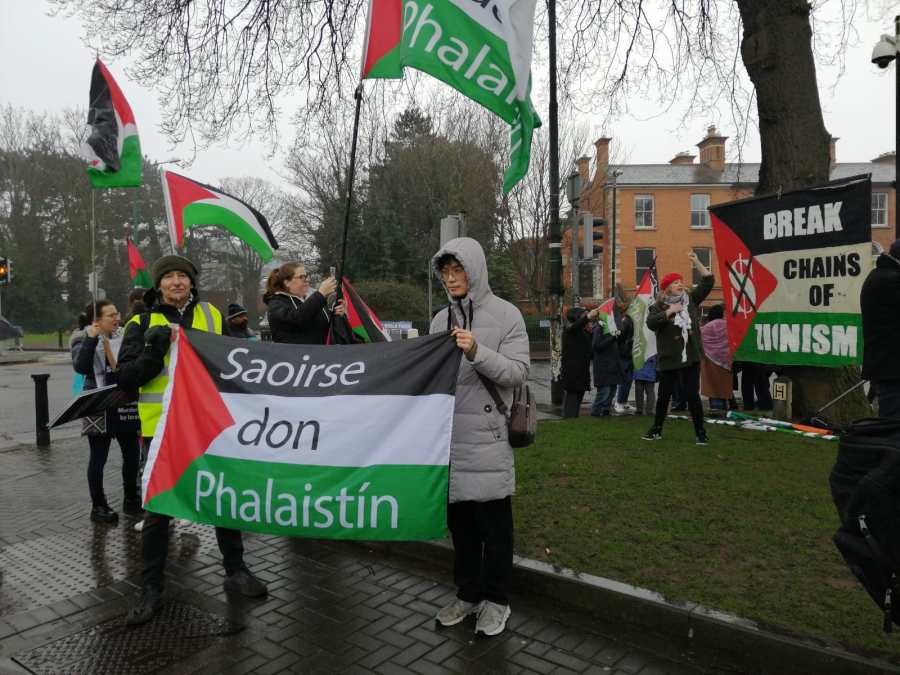
Further along the pedestrianised street the breakaway, including Ireland Action for Palestine and Saoirse Don Phalaistín groups, joined with another section of marchers who had earlier broken away from the IPSC march, this one led by the Mothers Against Genocide banner.
The shouted slogans from what were broadly two differing sections tended to merge with regard to calls to stop the bombing, opposition to genocide and broad support for Palestine but differed in that one section was also calling for support for the Palestinian Resistance and resistance generally.4
Content of slogans from the groups differed less markedly in calling for Irish Government intervention in support of Palestine, with the ‘Mothers’ mostly demanding the enactment of the Occupied Territories Bill5 and others condemning Government collusion in Shannon Airport.
The whole breakaway mass marched along South Stephens Green and turned north into Dawson Street, to pause inside the junction with Molesworth Street, where the tail of the main march, was already beginning to reduce although speakers and artists were performing on the IPSC platform.
Molesworth Street facing Dawson Street after the breakaway sections arrived and before the later incidents. (Source: R. Breeze)View of the IPSC-organised march at its destination, the Garda barriers in Molesworth Street across the road from the entrance to Leinster House. (Photo: R. Breeze)
On Dawson Street, across from the junction, the fascists had installed themselves, including a man in a red ‘Trump’ hat waving a “Make America great again” flag.
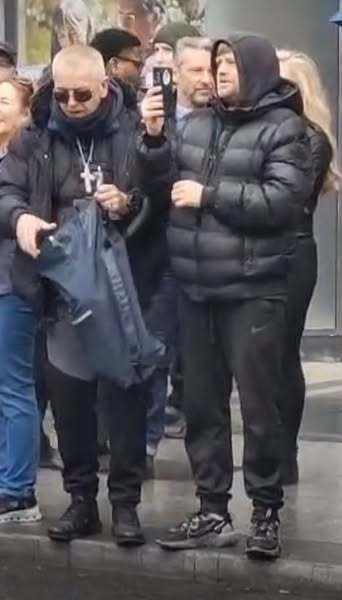
Two known fascists from the group trying to harass Palestine solidarity marches from Grafton Street to Dawson Street. (Photo sourced: AFAhttps://www.facebook.com/afaireland)
The Palestine solidarity protesters here – some distance from the diminishing main march crowd,6 with some IPSC stewards standing watching nearby, responded to the fascists’ jeers and Trump fan with jeers of their own, slogans and some bursts of song.7
According to a report form Anti-Fascist Action observers nearby and posted later that day, a senior Garda officer approached one of the fascists and had a quiet word with them, after which the fascists packed their banner and went away quietly smiling while the Public Order Unit arrived.
Soldiers of the master race (ehem) packing up after notification from their friend in the Gardaí that the POU would soon be deployed against some of the Palestine solidarity demonstrators. (Photo sourced: AFA Ireland)
These then began to aggressively push the demonstrators back towards Molesworth Street and as a demonstrator remarked it was the POU that were now blocking Dawson Street to traffic.
Soon the Gardaí seemed to decide to arrest one of the Palestine solidarity demonstrators and charged into the crowd, shoving, knocking down and even punching people who resisted strongly or just held on to the intended victim as long as they were able to.
A woman struck back at a POU man who had seized her by the throat but even so it took the intervention of one of his unit to get him to release his hold. The marks of his hand on her throat could be seen afterwards. Interestingly a press report later stated the Gardaí denied there was any incident.
Eventually the Gardaí succeeded in their intent and the protester was taken away to chants of Let him go! Numbers of the main march were dwindling greatly by this point but so were those of the breakaway section and people there were concerned to support their arrested comrade.
One of three police stations was the likely destination: Store Street, Pearse Street or Kevin Street. It was established that he was held at the latter station and was later released, given a few days to decide, under the Public Order Act whether to accept a caution or to be charged and face trial.
More confrontations of various sorts are likely as the Zionist genocide in Palestine ratchets even higher and frustration mounts at the Irish Government’s persistent refusal to end their collusion with the Zionist state and with its main supplier, US imperialism.
2Breakaway actions by groups often take place when they seek another target to that of the march organisers or to spread the visual and auditory impact of the demonstration or to break the ‘normalisation’ pattern, as when protesters feel the IPSC leadership is organising set marches of minimum disruption, on routes agreed with the Gardaí (which is not legal requirement in the Irish state).
4There is only one solution – Intifada revolution! From Ireland to Palestine – Occupation is a crime!
5 Agreed years ago in the Irish Parliament before but prevented from enactment by successive coalition Governments.
6As soon as the IPSC march arrives numbers always begin to leave, either to commence return home journeys or because they feel they are not going to hear anything new and their contribution was to be part of a visible mass, which they have now done.
7The Irish-language Gráinne Mhaol and English-language Come Out Ye Black n’ Tans.
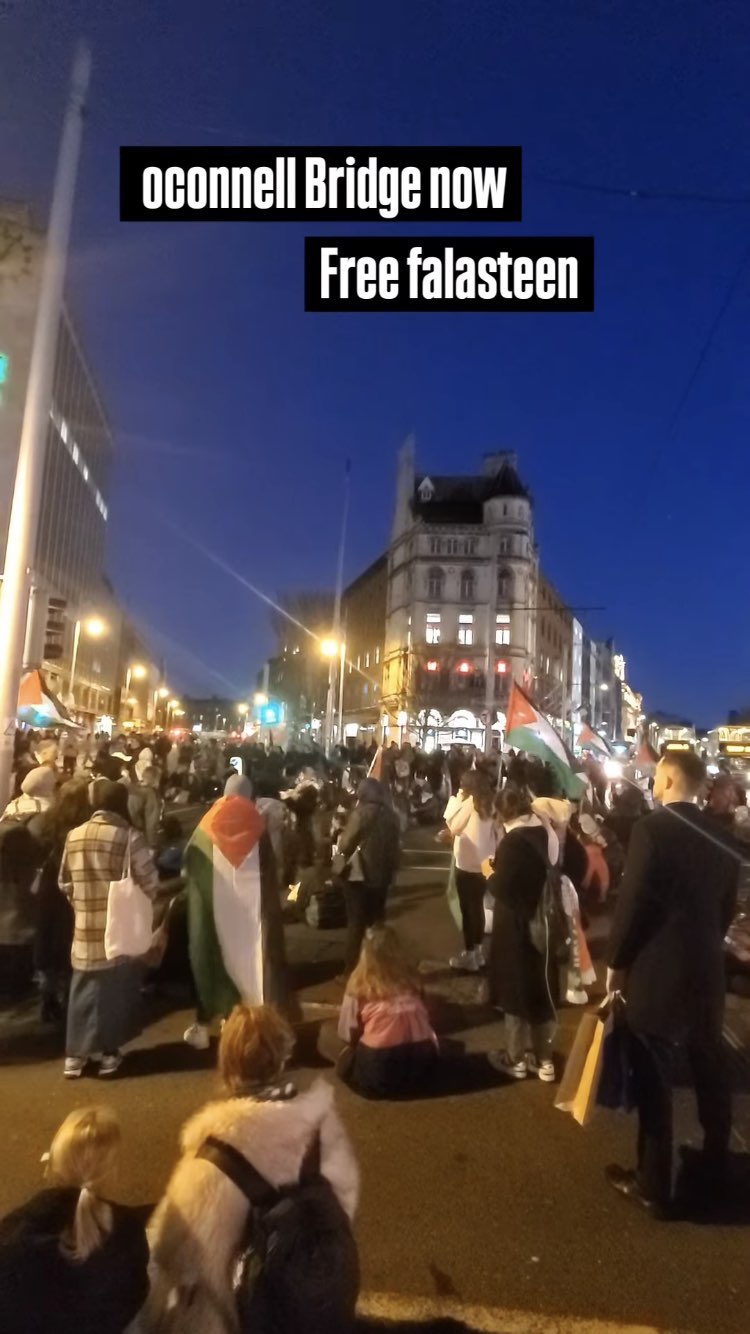
Evening traffic in Dublin’s southside city centre came to a halt as Palestine solidarity demonstrators, frustrated by the collusion of the Irish Government with the Zionist genocidal massacres, marched from Leinster House to block O’Connell Bridge.
The early evening protest for Wednesday at Leinster House was called by Collective Action for Palestine. It is not certain whether this is an actual organisation or a flag of convenience for a collection of solidarity groups and certainly many of those present were identifiable from different groups.
An early view of the Wednesday evening rally outside Leinster House (see in the background), home of the Irish Parliament. (Photo source: Journal)
This included, from their banners, Mothers Against Genocide and Irish Jews Against Genocide but among the hundreds present, activists of other organisations such as Action for Palestine Ireland, Saoirse don Phalaistín, Anti-Imperialist Action Ireland and Social Rights Ireland were in evidence.
The People Before Profit party, which would usually mobilise strongly for marches called by the IPSC, did not have a noticeable present, which may reflect a lack of contact with the organisers of yesterday’s event or a lesser ability to mobilise quickly.
Irish Republican organisations were also not noticeably present, with the exception of the AIA mentioned earlier.
The protesters’ rage and frustration was lit by images of dead and injured Palestinian children in the return to genocidal bombing of Gaza by the ‘Israeli’ armed forces, once again violating their ceasefire agreement, along with besieging and ethnic cleansing of cities of the West Bank.
The previous night Zionist state bombing had killed 414 Palestinians, including 174 children, and hospitalised over 550 more.
The marchers called for action from the Government, such as imposing sanctions on Israel in general and enacting the rather mild Occupied Territories Bill, approved by both Houses of the Oireachtas (Irish parliament) but seven years since, still sitting in a drawer; awaiting enactment.
Those calls have been repeated week after week, month after month in the final months of 2003 and throughout last year but only words of concern from Government ministers resulted, followed by friendship visitsto the very supplier of the Zionists’ weapons of genocide.
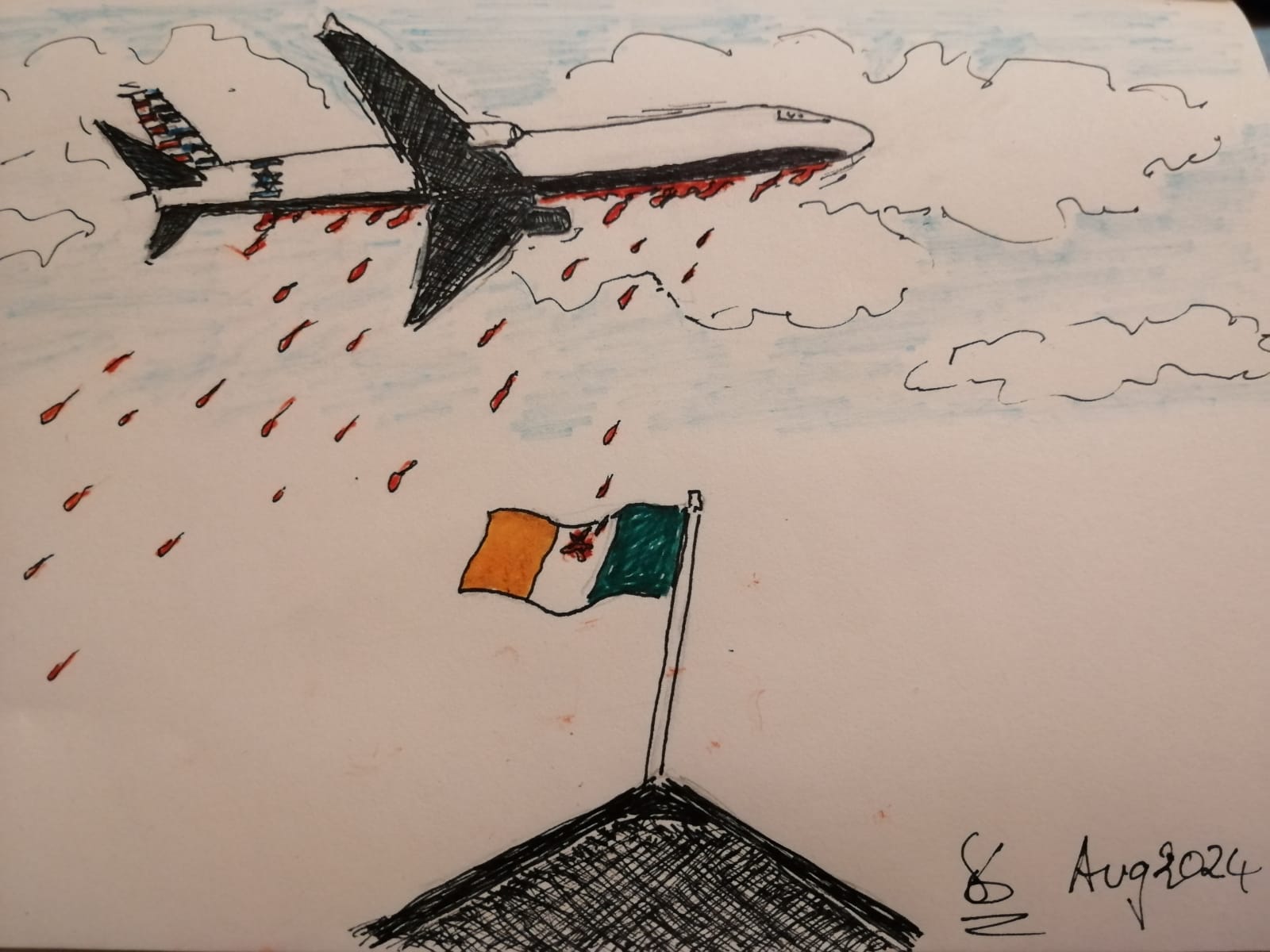
Successive governments of the ruling class of the ‘neutral’ Irish State have actively colluded too in genocide through refusing to bar Irish airspace to Zionist military supply flights1 or to monitor and prevent US military flights through Shannon airport.
Still as true today, unfortunately, as it was in August last year.
MARCH AROUND SOUTHSIDE CITY CENTRE
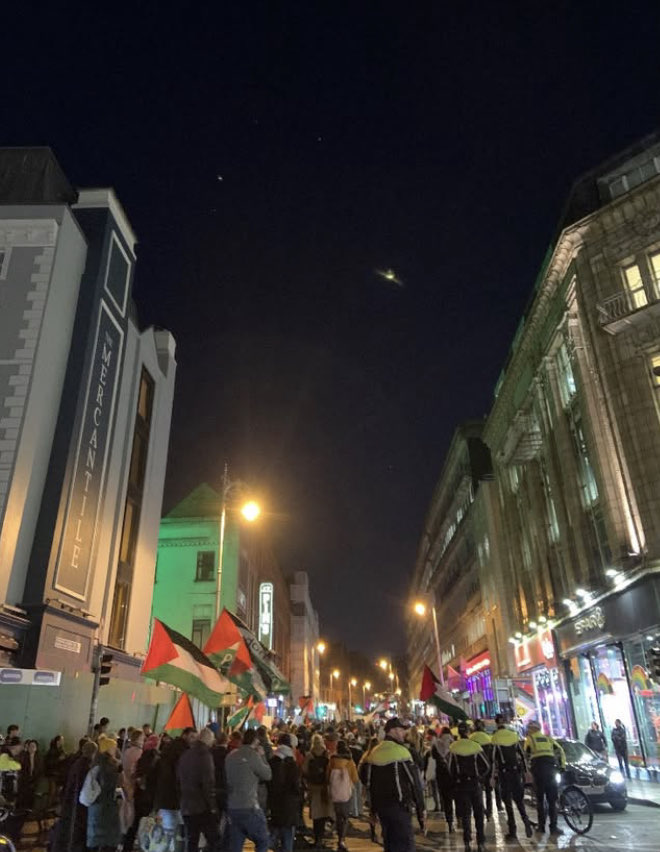
From outside Leinster house the protesters proceeded southwards up Kildare Street, turning right to flank Stephens’ Green, where they paused to chant more slogans and display banners and placards to stopped Luas trams before then turning northward into Grafton Street.
The solidarity protest rally becomes a march, proceeding southward up Kildare Street. (Source photo: Irish Independent)
In that pedestrianised shopping street the march stopped near one of the many buskers regularly performing there, apparently Italian who launched into an amplified rendition of a celebrated song from the Italian antifascist tradition, Bella Ciao, with many of the marchers joining in.
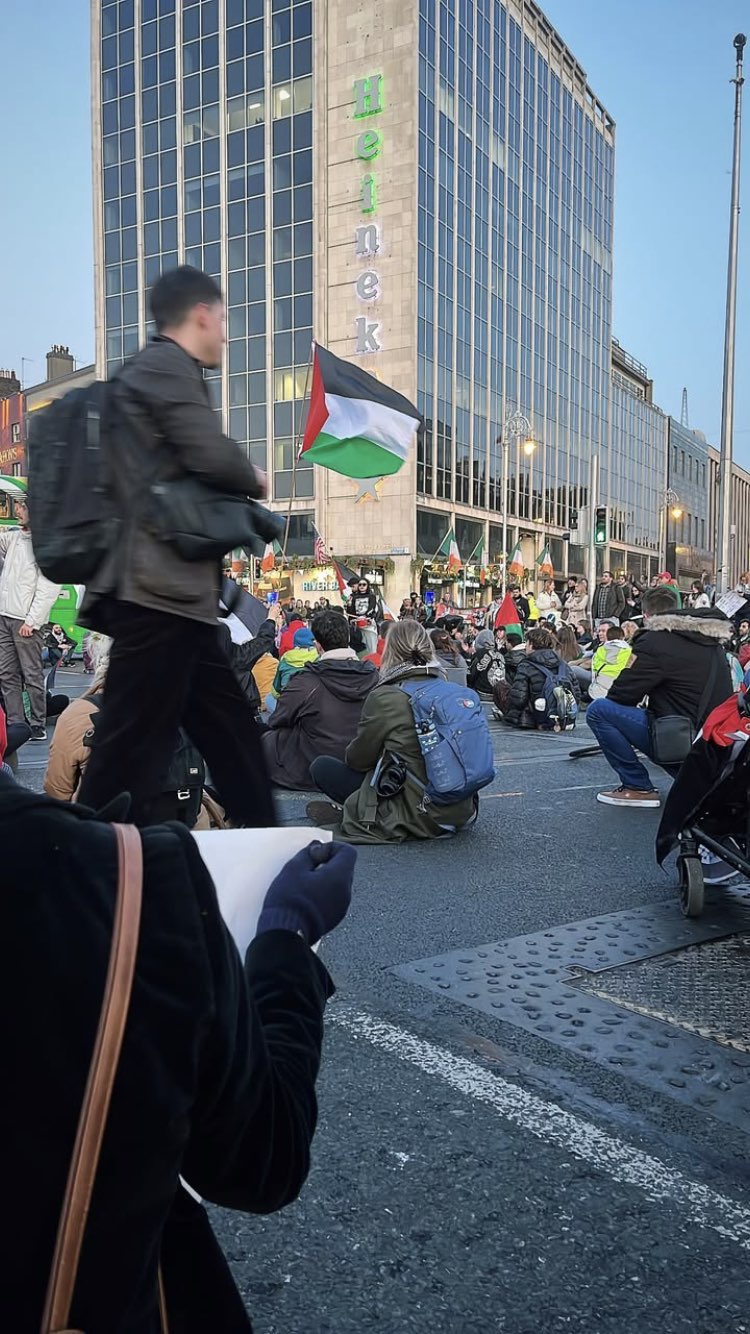
The northward march continued with stops up Westmoreland Street, where the clientele of a pub came out to cheer and applaud the marchers. Then on to the southern end of O’Connell Bridge, occupying both southward and northward-bound lanes with traffic blocked in both directions.
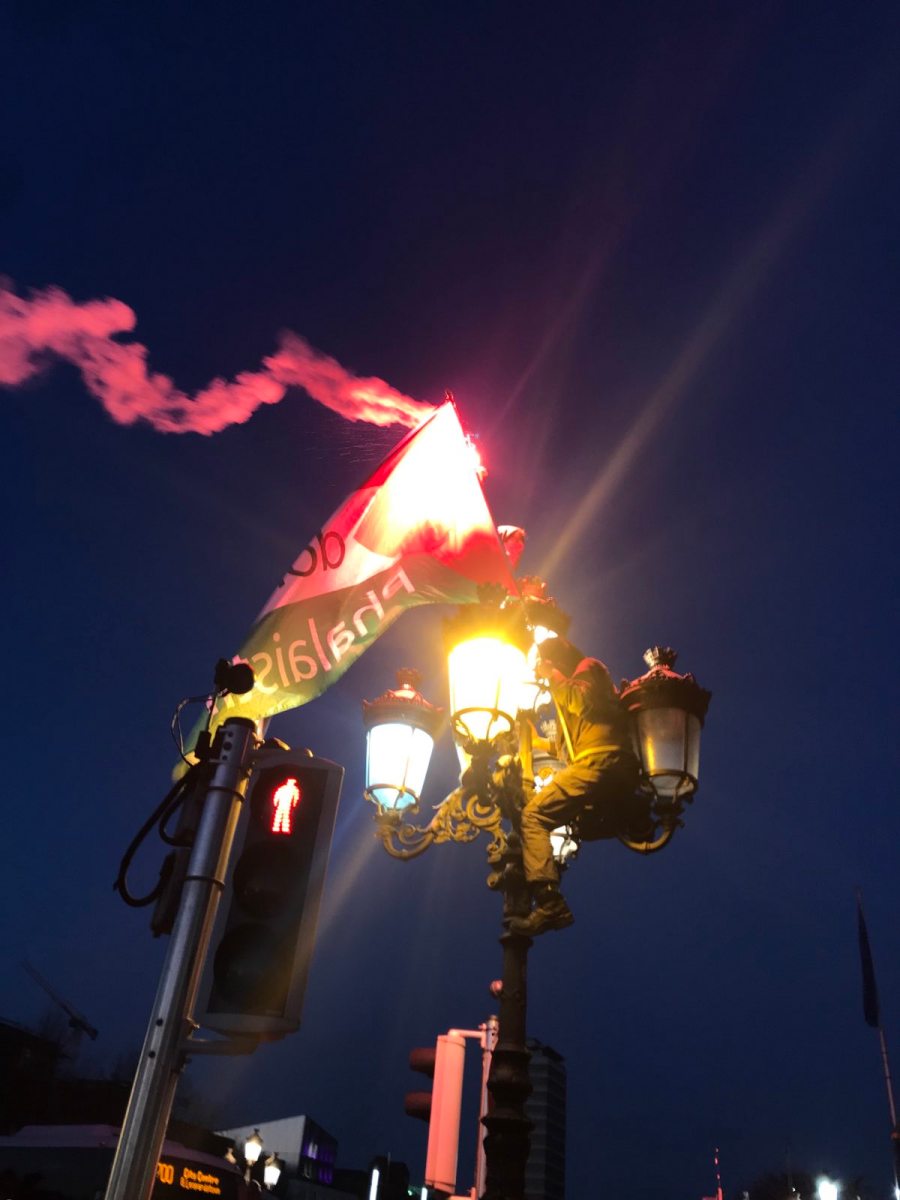
Indeed the traffic was soon backed up southward around Stephens Green and to the north, up to Dorset Street. On the Bridge, flares were lit and the crowd heard speeches of protest interspersed with solidarity slogans. Many passers-by expressed support, some stopping to participate.
A protester lights a flare as the march proceeds northward along Grafton Street. (Photo source: Participant)
What was most unusual indeed was that during the half hour or so that the marchers remained there, no angry beeping of horns nor shouts of impatience were heard from drivers of private cars or from passengers in public transport buses.
The crowd left, marching west along Dame Street, northward at Georges Street South and Aungier Street, then left to march along Stephens Green North, pausing outside the HQ of the Department of Foreign Affairs, where the Gardaí scuffled with some protesters.
Section of the protest on O’Connell Bridge. (Photo source: Participant)
The protesters then returned to Kildare Street to the seat of the Irish Parliament, Leinster House where they concluded the evening’s event.
A couple of hundred protesters had achieved, one might argue, more than many thousands on regular national marches of the Ireland Palestine Solidarity Campaign, in terms of public exposure and paralysis of city traffic in several directions, therefore putting pressure on the Irish Government.
Section of the march in Grafton Street. (Photo source: Participant)Grafton Street:Gardaí wondering where the marchers are heading and what going to do. (Photo source: Participant)
As a tactic this has much to recommend it. My opinion is that one has to time the length of remaining in each location just right to maximise the disruption while reducing the impact on people at each spot to a tolerable degree.
The movement needs to further awake people and to shake the elite but it also needs to minimise the impatience of people returning home from a day’s work or indeed travelling to begin their night shifts, or hurrying to meet others by arrangement.
They are not the enemy nor do we wish to make them so.
A narrower view of the temporary occupation of O’Connell Bridge. (Photo source: Participant)
I would also criticise the reciting of an amplified prayer on O’Connell Bridge. The solidarity movement is secular and no section of it has the right to impose prayer upon all or to represent the whole as religious –whether Muslim, Christian, Jewish, Hindu or any other.
SLOGANS
All or most of the slogans one hears on Palestine solidarity demonstrations in Dublin (and endorsed by the Ireland Palestine Solidarity Campaign) were shouted but so were others in addition such as There is only one solution – Intifada Revolution! And No peace on stolen land!
A group of Anti-Imperialist Action photographed during the O’Connell Bridge occupation. (Photo source: Participant)
Others included Resistance is an obligation – in the face of occupation! From Ireland to Palestine – Occupation is a crime! Brick by brick, wall by wall – The colonies will fall! It’s hard to imagine the IPSC leadership, whatever they might think privately, endorsing those slogans in public.
Although the last slogan might not be seen as specifically referring to Ireland, there was also one in the Irish language which is now common among native Irish and many of migrant background, Saoirse don Phalaistín! And the unequivocal From Ireland to Palestine – Occupation is a crime!
Ceasefire now! resurfaced from time time and though a good call when the Resistance is calling for it, can be problematic when they are not, as with the end objective being liberation, do we have the right to call on the Resistance to cease fighting, even if the Occupation ceases temporarily?
Another problematic call for example is Mícheál Martin, do your job! because in fact members of the Irish Government are doing exactly their job, which is to manage the contradiction between the peoples’ wishes and the needs of the neo-colonial Gombeen ruling class in favour of the latter.
Sanctions Now! is a call with very wide support across revolutionary and non-revolutionary sectors – the division is more around whether periodic marches to Leinster House for example is likely to achieve that or whether more radical action is necessary to pressure the elite to enact them.
The march pauses along Stephens Green North (the Green is out of sight to right of photo). (Photo source: Participant)
The demands of the Government, i.e representing the ruling class, are not revolutionary or even huge: to apply sanctions (economic, cultural and political) against the genocidal entity and to cease permitting Irish airports and neutral Irish airspace to be used in supporting genocide.
The genocidal entity cannot hurt the Irish state much directly. Of course, its main backer, the United States, is another matter. But then, if principle is not enough, the Irish elite could calculate that during the current split between the EU and the USA might be the best moment to take that step.
Demonstrators scale an ornamental lamppost during the O’Connell Bridge occupation, erecting a Palestine national flag bearing the legend “Saoirse Don Phalaistín” (‘Freedom for Palestine’). (Photo source: Participant)
A night of resistance and other songs on Friday night in Peadar Browne’s Dublin pub raised funds to assist in fighting state repression of Palestine solidarity activists in Ireland, as Palestine solidarity activists face persecution across the Western world.
The evening’s performance consisted of a mix of political and other songs, a number of which were original material. However it was the political material that most drew interest, ranging from international struggles to the rich Irish Republican tradition.
Olive and Fynn in performance at the fund-raising event (Photo: R.Breeze)
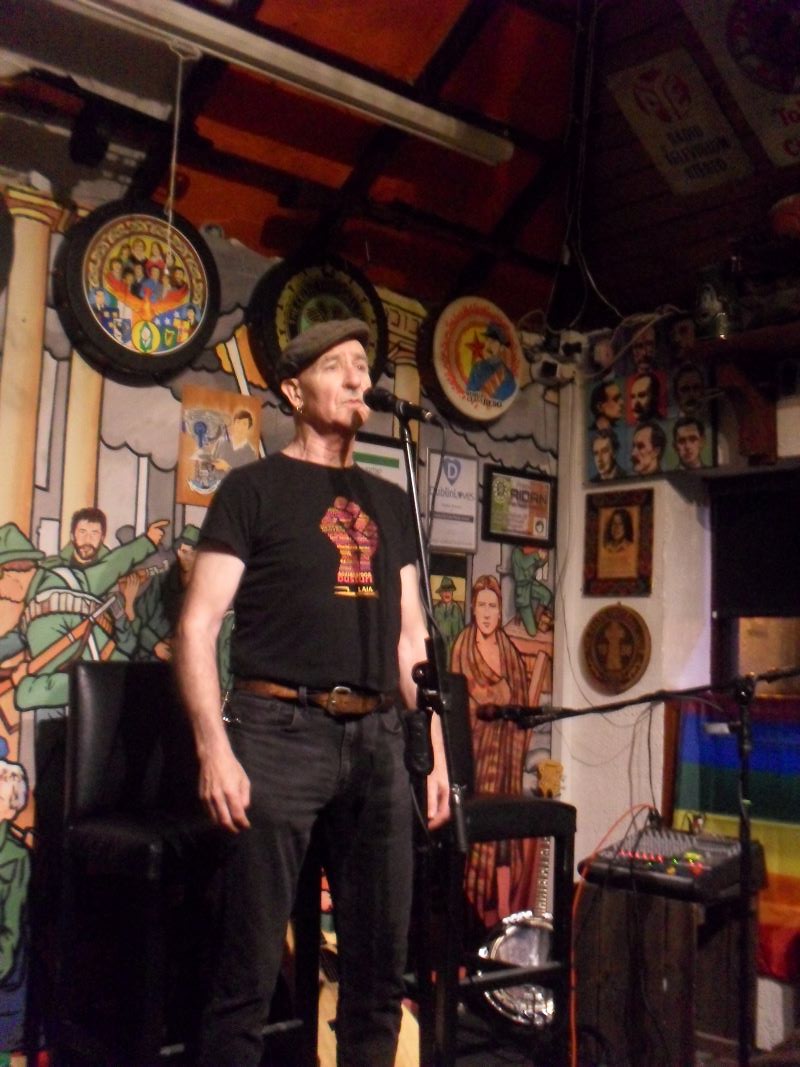
To begin the event Diarmuid Breatnach explained the need to support Palestine solidarity activists against the repression of the Irish authorities, hence the fundraising event and announced that in addition to performing he would be standing in for the event’s MC who had been unable to attend.
Breatnach began his set combining two songs from the German antifascist tradition, three verses of Peat Bog Soldiers and three from the Hans Beimler ballad.1 Then from the Spanish Anti-Fascist War he sang Ay Carmela!, the air of which he said was from an anti-French occupation folk song.
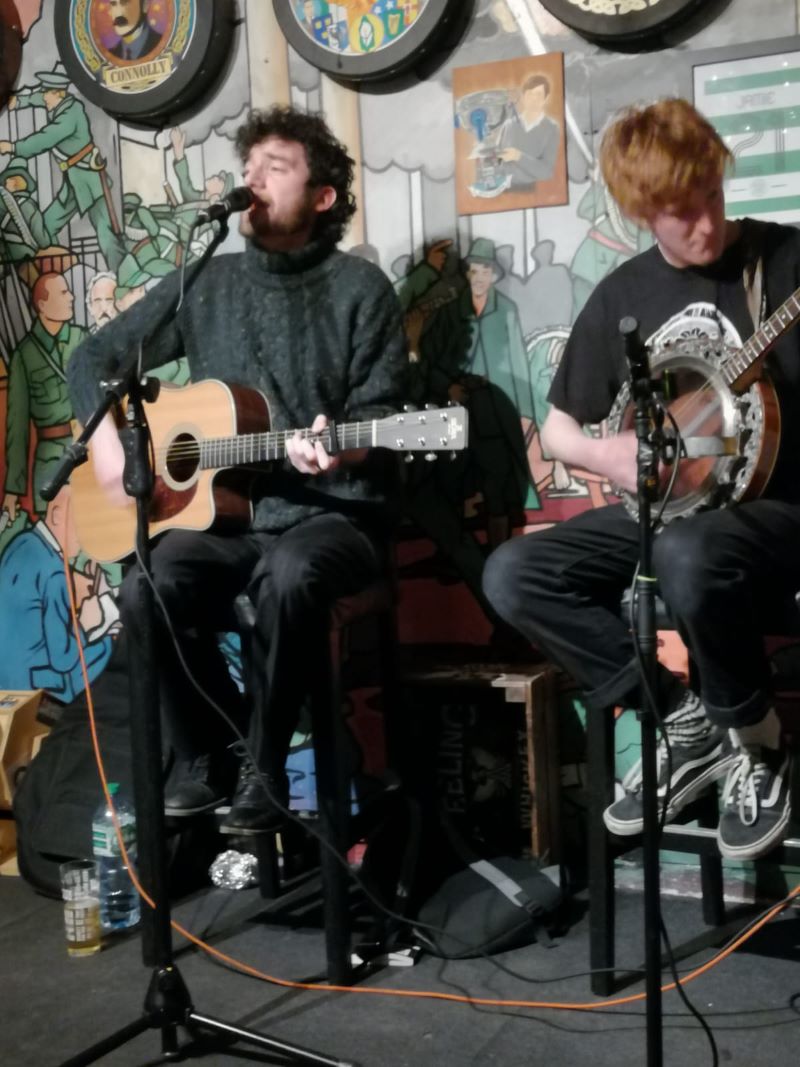
Next the MC announced a performance by two performers, half of the four-strong Croí Óg ballad band. During their performance with voice, guitar and banjo there was an incident from a couple of unruly elements nearby who had substantial drink taken and had been very loud throughout.
Two members of the Croí Óg band performing at the fundraising event (Photo: R.Breeze)
A man who had been refused permission to sing solo began shouting that the songs were not Republican, ironically interrupting Grand Old Country, a song about the Fenian tradition. It became clear that what he wished was to perform the Grace ballad, which he began to sing loudly.
A male confronted the interrupter; the latter’s friend, a big elderly Glaswegian protested; others took to the floor … but the incident wound down, the interrupters and audience resuming their seats. However, the putative Grace singer threw threats at his earlier confronter across the room.
The big Glaswegian then crossed the room to confront the audience member, a female audience member intervened, he brushed her aside and the audience section erupted, only the quick arrival of the pub’s landlady preventing a fight … And the musicians resumed their performance.
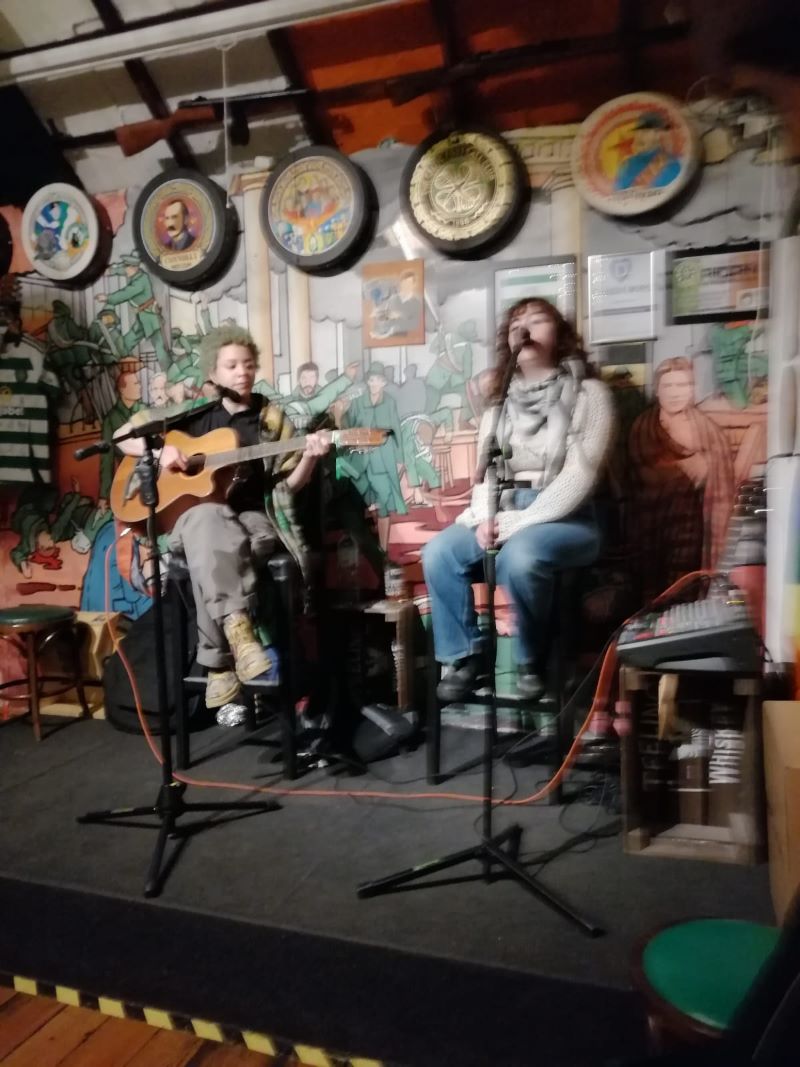
Among the songs performed by Croí Óg were Crossmaglen and British Soldier Go on Home. The MC called for appreciation applause for them, made some barbed comments about the recent anti-social behaviour and welcomed the song-and-guitar duo Olive and Fyn to the stage.
Sage Against the Machine performing at the fundraiser event (Photo: R.Breeze)
The duo performed their own material in lovely harmonies, mostly non-political, also including their ironically titled Save the Landlord! After they had left the stage to applause Breatnach got up on stage again to announce a short break and to remind the audience to contribute to the funds.
His additional comment: “Remember when someone sang in a Dublin pub and everyone went quiet? Remember those days? Remember?” was followed by loud applause throughout the pub.
Breatnach restarted the second half, singing a capella again two songs celebrating Irish women’s resistance,2 ending with songs in Irish including the ballad of Rodaí Mac Corlaí. After concluding he introduced Sage Against the Machine to take to the stage, singing solo with guitar.
Sage’s material was mostly original, sung in English but went on to Masters of War in a spirited concluding verse, followed by Gallo Rojo, Gallo Negro3 in Spanish from the anti-fascist tradition in Spain. The MC then presented Eoin Ó Loingsigh, also with voice and guitar.
Eoghan Ó Loingsigh performing at the event (Photo: R.Breeze)
Although no further incidents occurred, the volume of ‘conversation’ between a number of people not far from the stage was high. Loingsigh’s material included Only Our Rivers Run Free, Viva La Quince Brigada4and a satirical song contrasting the fates of the rich and the poor after death.
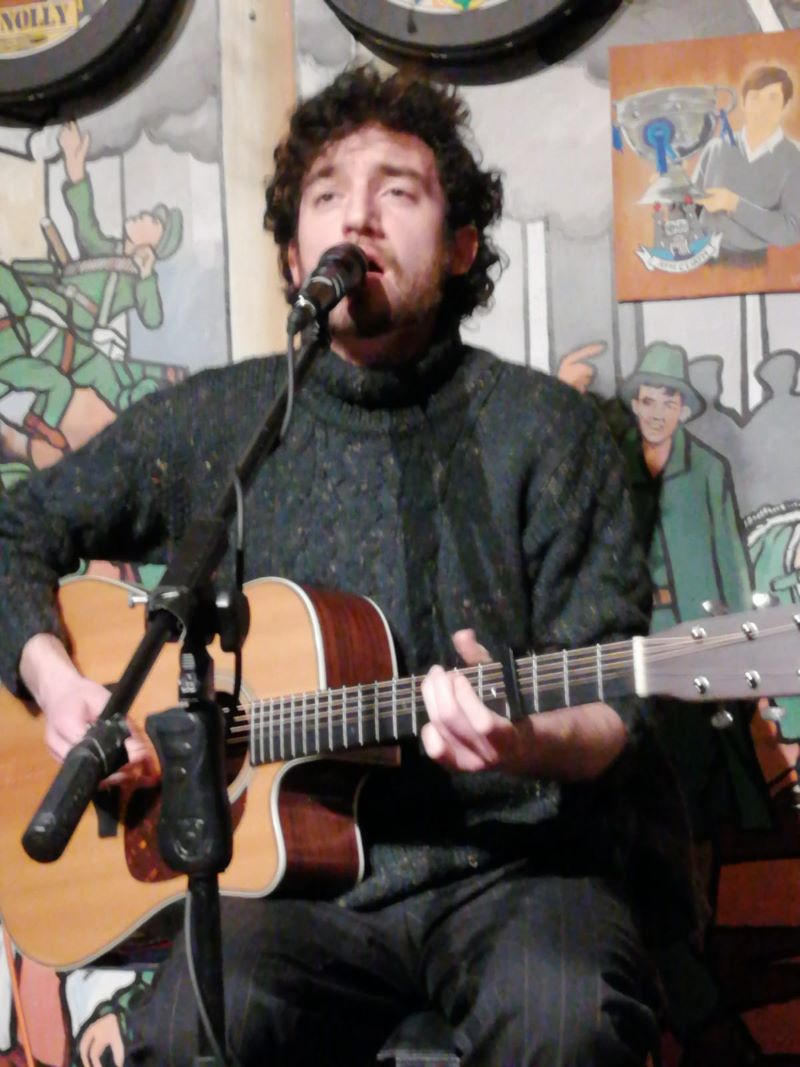
The evening’s scheduled performances concluded with Seán Óg, also solo with voice and guitar, his selection including Ho Chi Minh, republican ballads Boys of the Old Brigade, The Patriot Game, Boolavogue and his own composition Boys of Gaza to air and structure of The Boys of Kilmichael.5
Breatnach thanked the attendance for their support, restating the context of the event and asked for another round of applause for all the performers, who gave their time and creativity for free, then called for people to stand for the Irish national anthem6 which he led with the first verse in Irish.
Diarmuid Breatnach in performance at the fundraiser event (Photo: R.Breeze)
At the concluding line of “seo libh, canaig …” the audience exploded to complete the words “Amhrán na bhFiann!” followed by launching into the chorus, also in Irish.
The event had been organised by two broad Palestine solidarity organisations, Saoirse Don Phalaistín and Palestine Action Ireland and among the attendance were a number of their activists, including some victims of state repression.
Most of the charges to date have been under the Public Order Act but also some around ‘criminal damage’ and the potential is there for more serious charges and possible jail sentences, as have been the case in some other European administrations.
In addition to actions of their own, including occupying and picketing the Israeli Embassy, Axa Insurance and picketing the Palestine Authority, Saoirse don Phalaistín and Palestine Solidarity Action organised Resistance Blocs to participate in mass demonstrations organised by the IPSC.
Seán Óg performing at the fundraiser event (Photo: R.Breeze)
Peadar Browns pub has become increasingly known as an Irish Republican tavern on the south side of Dublin city. Its small stage area is decorated with Republican artwork on the walls and on many of the bodhráns7 hanging there, along with some Glasgow Celtic celebratory material.
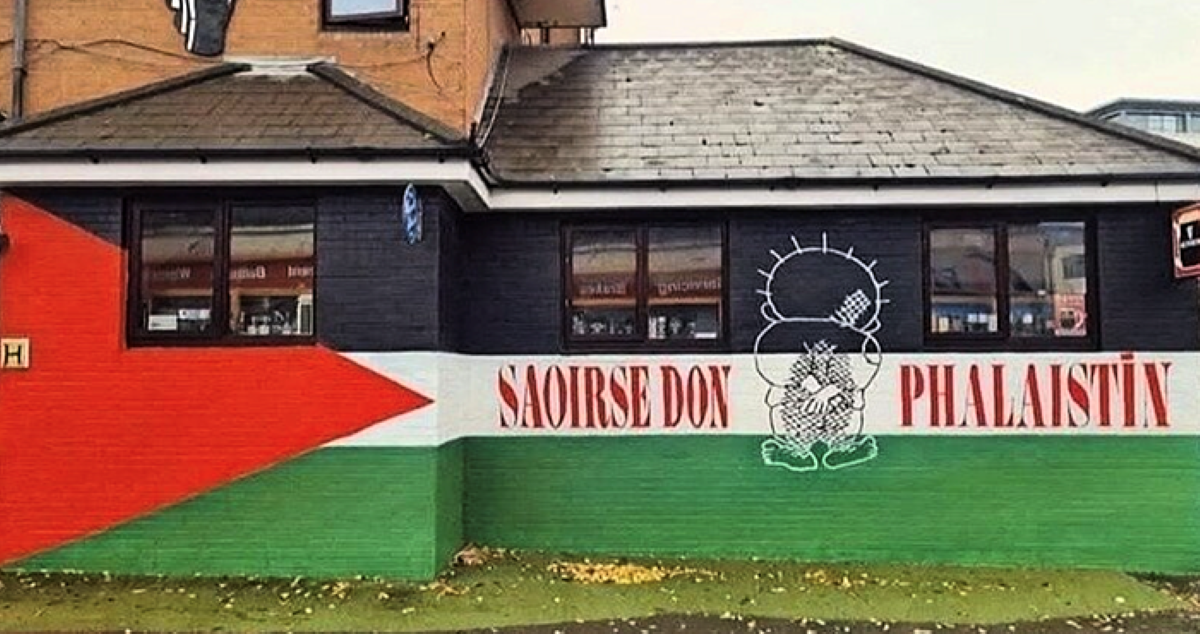
The side of the pub, on a minor street, carries a large mural representation of the Palestinian national flag, along with the slogan SAOIRSE DON PHALAISTÍN. However Dublin City Council have directed that it must be removed, to the anger of a great many people.
Mural on the side of the Peadar Brown pub (Photo sourced: Internet)
Historically cultural events of this type have a function other than to raise defence funds and to promote the cause: they are also occasions for replication of the cultural face of resistance and for expression of new cultural compositions but additionally for the creation of a community of resistance.
4About the Irish who went to fight against fascism in 1930s Spain.
5Also known as The Kilmichael Ambush, celebrating a famous event in West Cork during the War of Independence (1919-1921). However, the air of both songs is that of an older ballad about the 1798 Rising called Men of the West.
6The lyrics were originally written in English and later translated to Irish in which language it most usually sung today.
7A shallow one-sided Irish drum, same shape as a tambourine but much larger, played with a wooden striker on the outside with variation in tension achieved by hand pressure on the inside.
The CCJ (Criminal Courts of Justice) in Parkgate Street, Dublin, are seeing an increase in political cases in recent weeks with activists in housing and Palestine solidarity as well as Irish Republicans fighting extradition to the British colony.
Eoghan Ó Loingsigh, who made the mistake of asking a Garda for his badge number while they were carrying out an eviction, appeared there in February only to see his case thrown forward to June.
Picket anti-extradition display by Anti-Imperialism Action outside Heuston Station in February. (Photo: R.Breeze)
Another housing activist’s charge of attempting to break into an empty property was dismissed. The property in question, empty for a number of years is leased to the Salvation Army and three years ago two RHL1 activists were evicted from it by 100 Gardaí (some armed) with helicopter support.
Jack Brazil, a Palestine solidarity activist whom the Gardaí are trying, believe it or not, to tie into the racist and criminal riots of November last year, had yet another appearance in court without trial as he’s still trying for CCTV footage from Gardaí to support his alibi for the night.
At least the remaining bail restriction on Brazil was lifted: at the outset he had to sign on at Mountjoy Garda station once every week, observe a curfew of 12am-6am and not to loiter at any point in the Dublin city centre (D1 and D2). His case is now remanded to 26 March.
Jack Brazil (in the suit) and other Palestine solidarity activists outside the CCJ after Brazil’s most recent appearance there. (Photo: R.Breeze)
Jim Deneghan had a number of court appearances fighting extradition to the Six Counties on foot of charges alleging an act during the 30 Years War there – fifty years ago. He was unsuccessful and it appears that the only avenue open to him now would be to challenge it in the High Court.
Should they even grant him leave to do that which is not always the case.
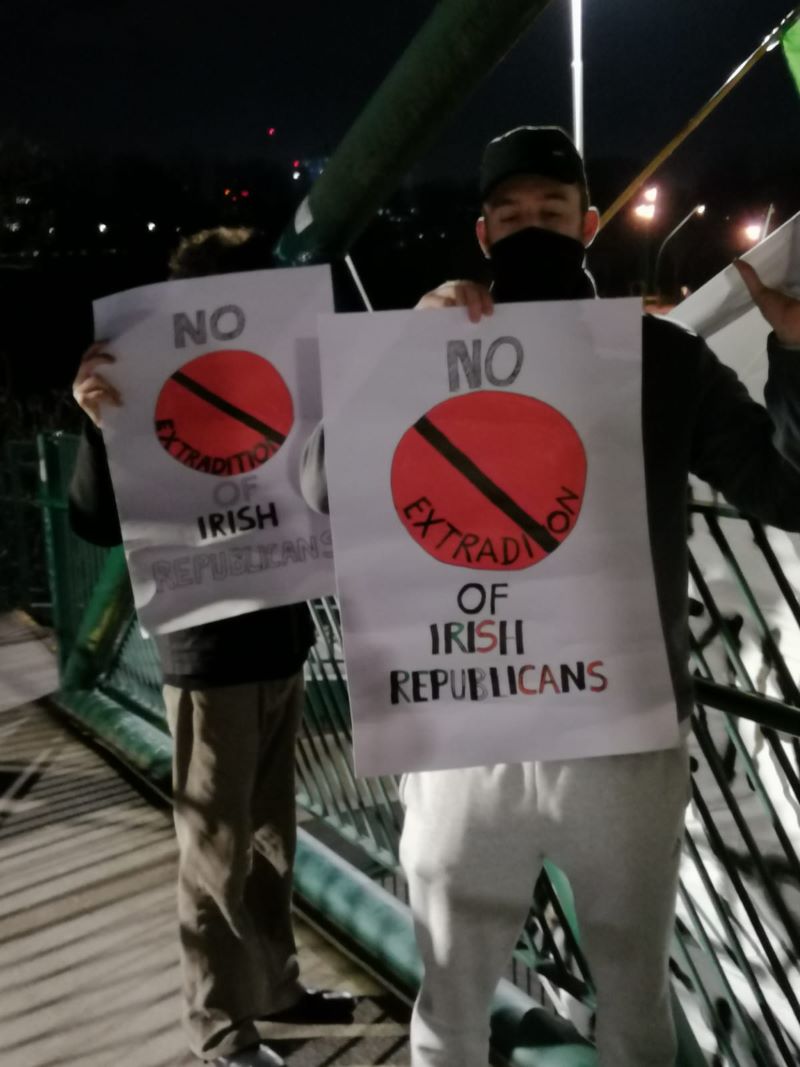
Some of the AIA-organised anti-extradition banner drop on the Fairview pedestrian bridge hold up placards against extradition. (Photo: R.Breeze)
Another extradition case has been dealt with in the Special Criminal Court, which is located within the same building as the CCJ, distinguished from other courts by the glass-enclosed reception ‘box’ through which one must pass to gain entry, first satisfying ‘security’ provisions.2
Sean Walsh has been fighting extradition to the UK’s Irish colony, the Six Counties on a charge of membership of an armed Republican organisation, which is deemed illegal on both sides of the British Border. He is in custody in Portlaoise awaiting a decision from the ECHR in Brussels.
Independent Dublin Republicans organised solidarity pickets outside the court on the mornings of Denneghan’s appearances, while Anti-Imperialist Action held a picket against extradition outside the nearby Heuston Train Station and a more recent banner drop on the Fairview Pedestrian Bridge.
Picket organised by Independent Dublin Republicans outside court where extradition of Jim Deneghan (Centre, next to State Harp) was being decided in February. (Photo sourced: IDR Facebook page)
The CCJ courts, in particular those on the ground floor are extremely busy with what seems at times like industrial-scale processing of setting further dates for court appearances, granting or refusing bail, requiring ‘discovery’ and other documentation from the Gardaí and some sentencing.
The human subjects of these proceedings are mostly from what might be termed the under-class of Dublin with some migrants added for good measure. Most face charges of possession of drugs, anti-social behaviour, threatening behaviour, theft and breach of bail conditions.
A huge amount of court, lawyer and Garda time is taken up with processing people accused under these charges. On the other hand the processes also interfere hugely with the normal lives of those charged and in addition, in the case of political activists, disrupt some of their legal activity.
And can cost them loss of pay and even threaten their employment. Which might be deliberate on the part of the system or if not, at least something those who manage it will not regret.
Banner drop by AIA from Fairview pedestrian footbridge. (Photo: R.Breeze)
The sheer number of that social group being processed through the courts daily is an indication of something really wrong with Irish society and which worsens even through generations, while the major reaction of the State is to maintain the social conditions and repress its victims.
By and large the middle class only come into contact with that element of society when they are prosecuting or defending them in court, or professionally dealing with them in hospital or social services environments.
It is also where many of those who are trying to change the prevailing social and economic conditions, i.e political activists, will first rub shoulders with that group while next to them on court seating benches. Unless the political repression goes a step further and they meet in jail.
End.
1Revolutionary Housing League which had renamed the building, on Eden Quay, ‘James Connolly House’.
2The non-jury SCC was established under an Amendment to the Offences Against the State Act, pushed through Leinster House by Fianna Fáil amidst collapse of its opposition during a panic caused by (British Intelligence) terrorist bombing of Dublin in 1972 killing two and maiming many. The scene of many unjust decisions, its most famous was the conviction of the innocent ‘Sallins Four’ when the SCC was based at Green Street, appropriately enough the scene of many injustices under the British occupation, including the death sentence on Robert Emmet after his famous speech. The existence of the SCC is opposed by Amnesty International and Irish civil rights organisations and, until a few years ago, by the majority political party in Ireland, Sinn Féin, which no longer opposes it.
Many who supported Saturday’s march of the Ireland Palestine Solidarity Campaign advertised as going to protest at the US Embassy found themselves led to a rally in a residential street bordering the Embassy and far from the main road.
The IPSC march had gathered at the Department of Foreign Affairs on Stephens Green and proceeded from there to Ballsbridge, the last section passing through quiet residential streets to hold the rally in Elgin Road, some distance from and hardly visible from the main road.
Section of the IPSC march on Saturday (Photo cred: IPSC)
Before the arrival of the IPSC march a handful of people gathered near the main road, displaying Palestine national colours to acclamation from passing motorists. As the IPSC march arrived nearby some others with flags, banner and placards joined them near the front entrance of the Embassy.
From that position one could see the IPSC rally taking place quite some distance down the quiet street, distant enough that speeches could not be heard, though chants from the crowd were audible.
Earlier in the day the Palestinian resistance had released three of their prisoners in good health while the Palestinian prisoners of ‘Israel’ were beaten and insulted as they were leaving and made to wear special demeaning clothes (which they burned). Four had to be rushed to hospital after release.
Long before Trump’s proposal of ethnically cleansing Gaza of Palestinians, it is important to understand that Israel’s genocide could not have been sustained for more than a week without funding and munitions supply by the USA, which also supported them politically.
In the sixteen-plus months of the current phase of Israeli genocide, the IPSC has led a march to the ‘Israeli’ Embassy only a few times and to the US Embassy exactly twice, each time to the side road (though the stage of the first one was closer to the Embassy’s main entrance than was today’s).
The front of the IPSC march at its destination at the rally on Saturday. (Photo cred: IPSC).The IPSC rally in the distance, taken from in front of the US Embassy main entrance. (Credit photo: Rebel Breeze)
A police officer approached the early demonstrators near the Embassy main entrance to encourage them to move down to the location of the IPSC rally but they politely declined. One of the IPSC’s committee members also wandered by to see who these mavericks could be.
A Zionist passing by claimed the demonstrators should be ashamed but they told him it was he who should feel shame, supporting genocide. Anger soared when he called for killing more Palestinians – including children– until some began to suspect he was provoking an assault leading to arrest.
Certainly he felt safe enough with Gardaí close by.
As the group consolidated a woman began to lead call-and-answer chants which were taken up: Saoirse – don Phalaistín! Resistance is an obligation- in the face of occupation! 1, 2, 3, 4 – Occupation no more! 5, 6, 7, 8 – Israel is a terrorist state! Free, free – Palestine!
Section of those who chose to stand near the US Embassy main entrance (out of shot to the right of photo) and in full view of passing traffic on the main road (just out of view to left of photo). (Photo credit: Rebel Breeze)
Also From the river to the sea – Palestine will be free! From Ireland to Palestine – Occupation is a crime! Car horns of passing motorists joined in, beeping in solidarity.
It began to rain heavily and the protesters endured it for a while before heading for shelter.
One of a number of Palestine struggle supporters appeared in court again on Wednesday and, though the case was postponed for hearing until 26 February, was successful in having one of the conditions of his bail, his daily curfew, removed.
Jack Brasil raises a clenched fist outside the Dublin Court on Wednesday. (Photo: D.Breatnach)
Palestine struggle supporters sat in Dublin’s Central Criminal Court with Jack Brasil, New Zealander of Irish descent, through many other case applications until his own was dealt with, before accompanying him out of the intimidating building.
Another of the bail-related restrictions, that Brasil not present stationary in the Dublin 1 or 2 areas (i.e in the Dublin City centre) remains, at least for the moment. This restriction has also been imposed on a number of other Palestine solidarity activists in a clear restriction of their civil rights.
As in many other Western states, Palestine solidarity activists have been charged with offences under Ireland’s criminal code but, when released on bail, remain under restrictions for months at a time after their arrest, interfering with their normal routines.
It also hampers or even prevents their participation in solidarity activities.
Palestine struggle supporters outside the Dublin court on Wednesday after Jack Brasil had the curfew removed from the conditions of bail. (Photo: D.Breatnach)
To date it seems that none of the Irish civil rights NGOs have challenged the State on the wide-scale use of those undemocratic bail restrictions from participation in lawful solidarity protests on people who are, even according to the criminal code, innocent, unless convicted in a court of law.
During the 2014-2015 mass-popular protests against the imposition of a third water tax in preparation for the privatisation of water supply in the Irish state, similar restrictions were imposed on protesters. Two however refused to accept the conditions and were jailed.
Protests outside Mountjoy Jail followed and, under the threat of hunger strike by the detained, they were released and the restrictions removed. It may be that this option will need to be explored by Palestine supporters if charged in Ireland in the future.
Years ago we did not have the USA import of ‘trick or treat’ – but we did have Halloween. In fact, the UStaters got their Halloween originally from – us. Yes, us.
And it was based on the ancient Gaelic feast of Samhain (which is also the name of the month in Irish).
“Happy Halloween” as a wish would seem an oxymoron since it is a feast of the dead or at least for the dead and to propitiate pagan gods. It is recorded in Ireland as far back as the 9th Century, one of the four great feast days of the Gaelic year.
While the festival is often described as Celtic, a number of neolithic passage graves in Ireland and in Britain, predating the arrival of the Celts, are aligned to face sunrise at the time of Samhain.
In the Celtic world it seems to have been a particularly Gaelic festival, being also our name for November, with strong survivals in Ireland, parts of Scotland and Manx, though there are also some echoes of customs in Wales and Brittany.
However, some researchers believe that the word Samhain is related to the month of Samon, in an ancient calendar of the Gauls, the main body of Continental Celts.
No ancient feast of Samhain could have involved pumpkins, unless it was something thought up by a deviant among St. Brendan’s followers when they got to America in the mid-6th Century. Of which there are a number of sound reasons for believing they did.
But no plant we know of came back from that voyage.
Some varieties of pumpkin squash (Photo cred: The Garden Museum)
Pumpkins of course and many other squashes come from Turtle Island/ America, where they were cultivated by the indigenous people as an important source of food or dried to make containers, utensils and even musical instruments — and they taught the settlers how to cultivate them.
Pumpkin pie is a traditional USA settler culture dish, particularly in the annual Thanksgiving feast, where the arrival of the original English settlers is celebrated along with their survival (thanks to help from the Indigenous, against whom they later committed genocide in gratitude).
Although most people in the US will not be conscious of this aspect of the Thanksgiving celebration there is a pushback against it gathering in the US of late, as there is also in many parts of the world against the celebration of the ‘discovery’ of America for European colonisation by Columbus.
IN DUBLIN, IRELAND
The traditional Irish Halloween cake is the báirín (boyreen) breac, the báirín being Irish for a cake, according to Dineen’s Dictionary and breac meaning piebald or speckled (i.e. from the dried fruit), becoming mispronounced as ‘barmbrack’.
Quite when it became traditional Halloween fare I’m not sure but the basic ingredients would have been available centuries ago – except for the tea, which came from China originally and only became widespread in Ireland through our colonisers in the early 1800s.
Now of course, we’re marbh le tae agus marbh gan é (‘killed by tea but dead without it’) and still pronounce our name for the beverage in Irish as apparently they did in English in Shakespeare’s time. Many cultures call it ‘chai’ from which the English soldiers in India brought back ‘char’.
This one was apparently made with whiskey which is not the original. The one produced by a number of baker companies was round and more yellow inside.
Anyway, to get back to the báirín breac, it was soaking the dried fruits in tea that gave a yellow tint to the dough when it was baked. We children all looked forward to eating the báirín when we got back home after going from door to door collecting donations of apples or nuts or sweets.
Taste apart, it had a ring hidden in it and, though we had no interest in the prospect of marriage symbolism, we each wanted to be the lucky one to get the slice with the ring. Our Da cut up the slices carefully so we couldn’t tell which had the ring and we had to eat them in sequence.
Earlier on the Halloween evening we had been out in costumes knocking from door to door and of course, other children had knocked on our door too. Many of those would have been known to us but it was surprisingly difficult to identify them, even if only face-painted and without a mask.
It was for us a kind of thrill to knock at a neighbour’s door in costume and be unrecognised. All the houses except a very few welcomed callers at Halloween and kept a supply of fresh fruit, nuts and sweets on hand for the callers.
“Any apples or nuts?” we called as they opened the door or, later “Help the Halloween party?” None of that imported “trick or treat” nonsense!
Three types of nuts that were available and traditionally eaten in Ireland on Halloween at least from the 1950s: hazel nuts, walnuts and Brazil nuts (this one not so commonly seen more recently, apparently due to bad harvests attributed to El Nino). Also available would have been almonds, peanuts, and pieces of broken coconut.
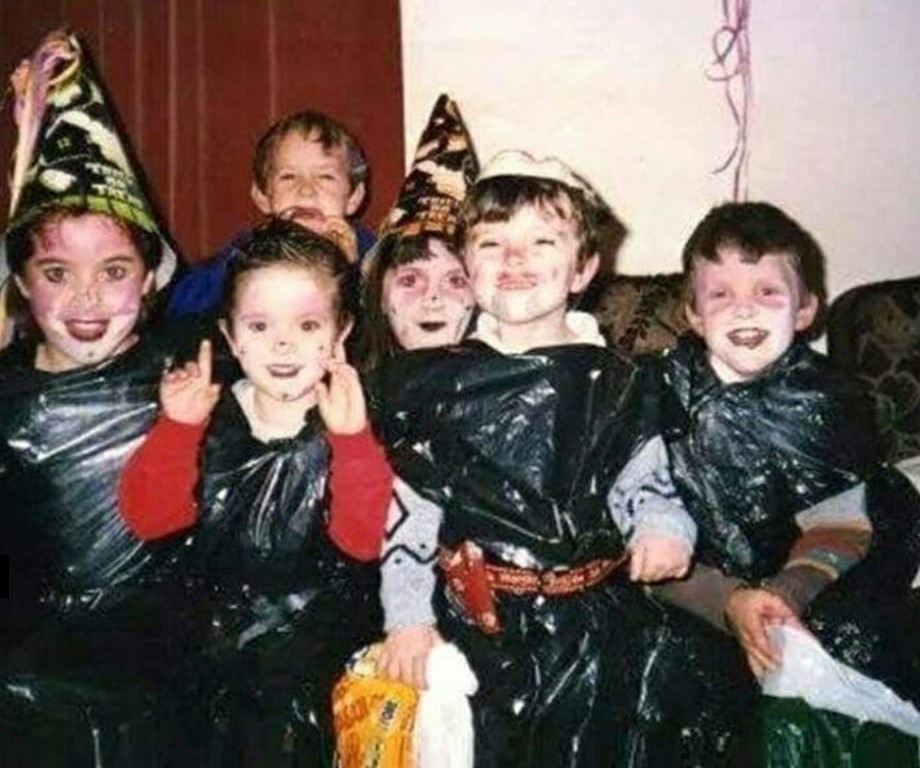
In an amusing piece about that contrast between earlier days and now, a social mores commentator in song at the monthly 1916 Performing Arts Club commented on how pleased he was to see children at his door in costumes made from ‘traditional’ black bin-liners.
Until they spoiled it all by chanting “trick or treat”. “Get outa the garden!” was his response.
Kids still go out (usually escorted by adults now) from door to door at Halloween in Ireland, often with elaborate costumes and chanting the UStater-borrowed “trick or treat”.
A gaggle of kids in what was for many in areas of Dublin a ‘traditional’ Halloween costume but some of course were more elaborate. (Photo sourced: Hill Sixteen FB page)
In clubs or pubs the festival seems to have been taken over by late teens and young (and not-so-young) adults in costumes depicting horror and death and, for mostly women it must be said, also sexual allure.
And strange though it might seem, the festival was originally primarily for adults and was an occasion of blessing of kine, divination and at least in recorded history, of “mummers” and “guising” going door to door, performing and begging for donations.
‘BARMBRACK’ IN LONDON
In SE London, I was for some years involved in organising an annual Irish Children’s Halloween Party as part of the annual activities of the Lewisham branch of the Irish in Britain Representation Group.
The event was primarily for the benefit of children of the Irish diaspora but children of any other background were welcome to attend.
A local shop selling fresh fruit and vegetables was approached for a donation of fruit and nuts to which they agreed and of course were thanked publicly by word and in print. The local print media were invited to take photos.
The program for the day included street games (but indoors), Halloween activities including apple-bobbing, face-painting and food that would have been traditional for Irish Halloween parties.
Funds raised by the branch through the year bought Irish brand biscuits, Cidona and red lemonade from a shop supplying Irish food items in South London and of course included the ‘barmbrack’.
The children on the day were largely from Irish, Caribbean or mixed background.
As I doled out slices of ‘barmbrack’ to children sitting at the long table, recommending it as traditionally Irish, one Caribbean-seeming child turned to the other and began: “It’s like …” “bun-and-cheese!” finished the other.
This turned out to be a traditional Jamaican food at the other end of the year, at Easter, two slices of a spiced moist ‘brack’ (the “bun”) with a slice of cheese between. They are not as fond of butter in the Caribbean as are the Irish (not many people are) and so that is absent.
One day I decided to try a slice of buttered (of course) ‘barmbrack’ with a slice of cheese on top. The sweetness and slightly spicy taste of the ‘brack’ contrasted with the tart taste of the cheese. And do you know? It’s not at all bad.
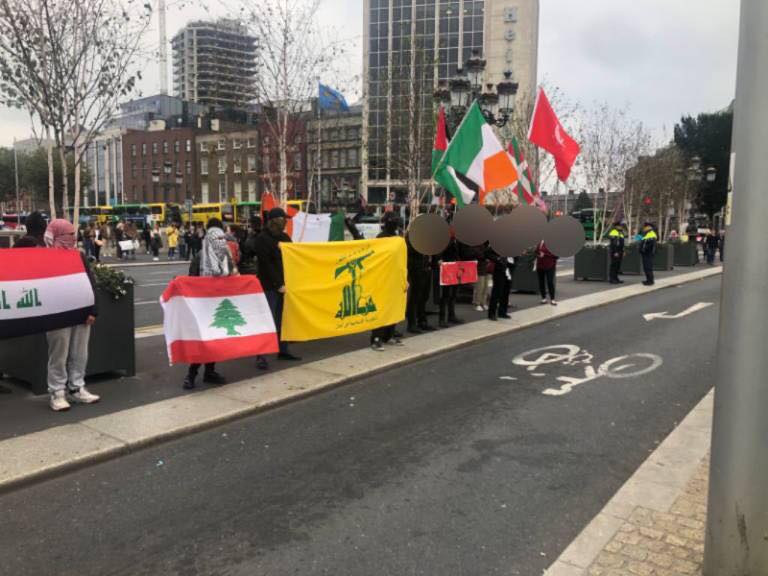
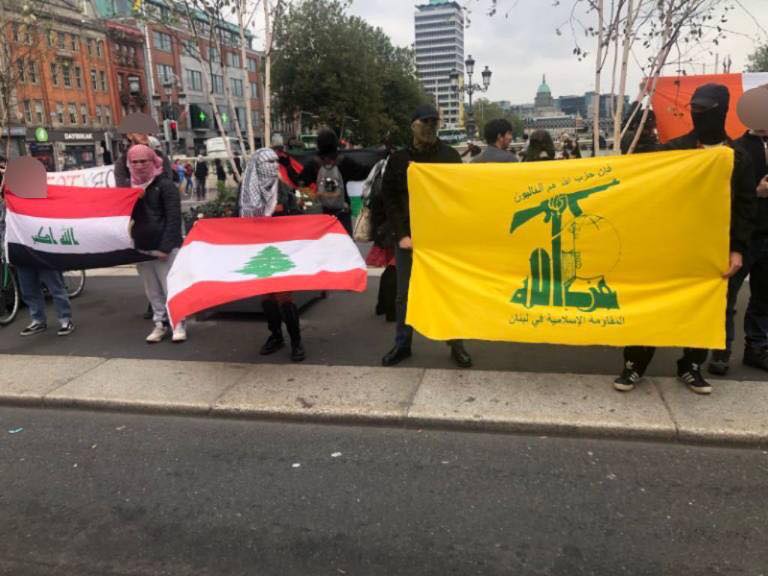
On Friday September 20, Anti-Imperialist Action Ireland and Saoirse Don Phalaistín held an emergency solidarity demonstration with Hezbollah and the Lebanese people on O’Connell Bridge in Dublin.
(Photo sourced: AIA social media page)
Although called at short notice, there was a great turn out, demonstrating the support of Irish Revolutionaries for the Anti Zionist Resistance.
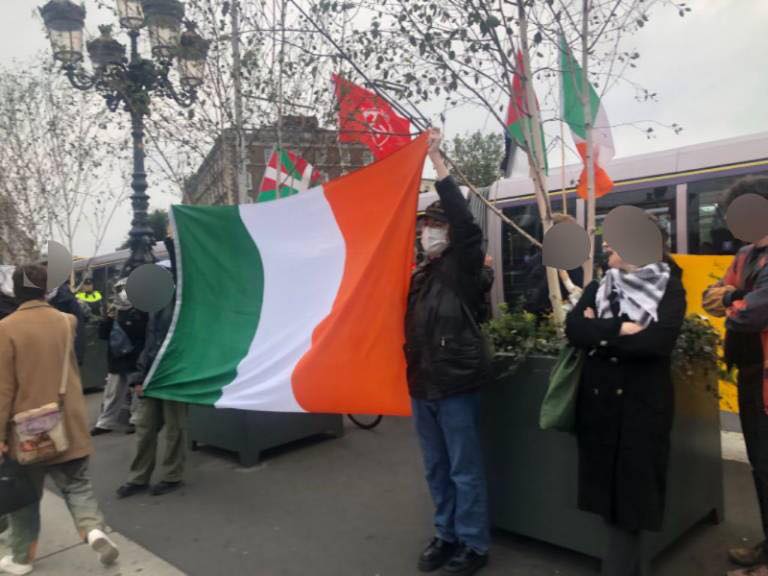
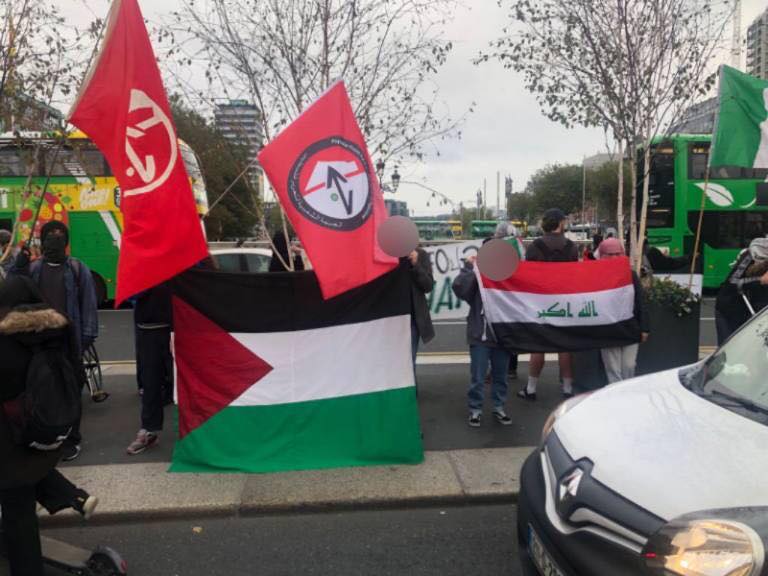
A large Hezbollah flag was the centrepiece of the demonstration and flew proudly beside Irish Republican flags including the Tricolour and Green Starry Plough of the Irish Citizen Army, Palestine, Lebanese, Iraqi and Basque national flags and the flags of the Popular Front for the Liberation of Palestine.
Chants at the demonstration included From Ireland to Palestine – Occupation is a crime! and Hands off Lebanon!. As it was culture night, two singers gave renditions of ‘We only want the earth’ by James Connolly and ‘Go on Home British and Zionist Soldiers’, a twist on the Republican classic linking the fights for Freedom in Ireland and Palestine.
(Photo sourced: AIA social media page)
The demonstration was monitored by the special branch who took photos of the participants but their presence could not stop the solidarity action with Hezbollah and the Lebanese People.
Irish Republicans will always stand with our international anti imperialist comrades in the fight against Imperialism and Zionism. AIA and SDP will continue to organise events and actions to increase our solidarity with the Anti Zionist Resistance.
(Photo sourced: AIA social media page)
Additional comment – Clive Sulish: The event was also filmed by a well-known Irish Zionist who regularly tries to intimidate Palestine solidarity activists and also tries to get the Gardaí to arrest those carrying flags of Palestinian resistance organisations.
O’Connell Bridge crosses the Liffey river dividing the north from the south Dublin city centres and is directly passed by north and southbound traffic but also closely by west and eastbound traffic along the quays.
There were many expressions of appreciation from passersby on foot, in vehicles or on bicycle. End.
(Photo sourced: AIA social media page)(Photo sourced: AIA social media page)
A number of demonstrations were held in Ireland to make it clear that Kier Starmer, Prime Minister of the UK and supporter of the Zionist state of ‘Israel’, has no céad míle fáilte in Ireland, or indeed any fáilte whatsoever for his Dublin visit.
After fourteen years of Conservative Party management of the UK, Starmer at the head of the Labour Party rode a change-seeking wave to win the General Election in July this year. But he soon revealed how little difference there is between the parties, including on Palestine.
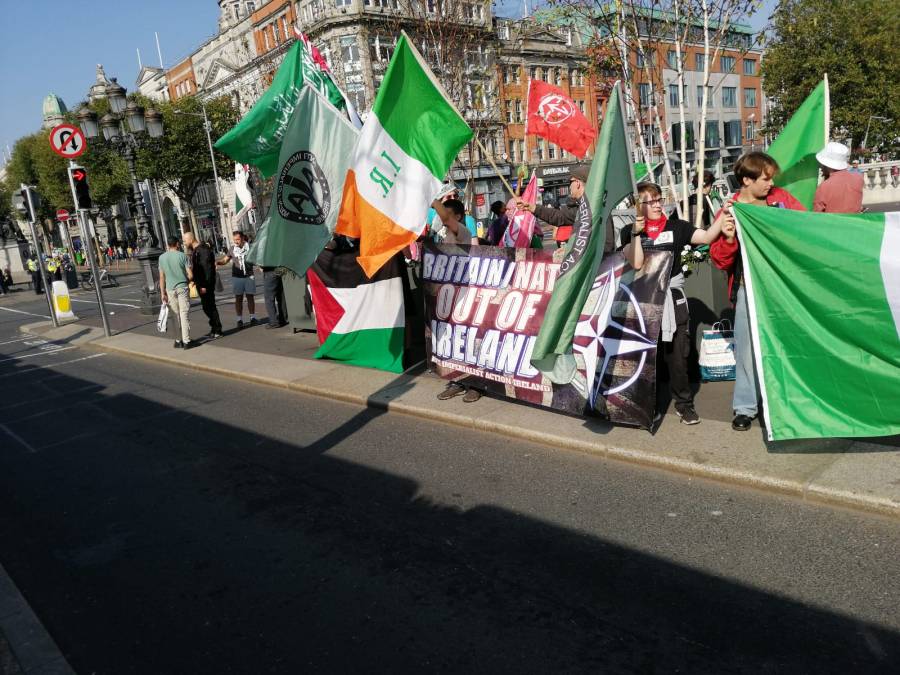
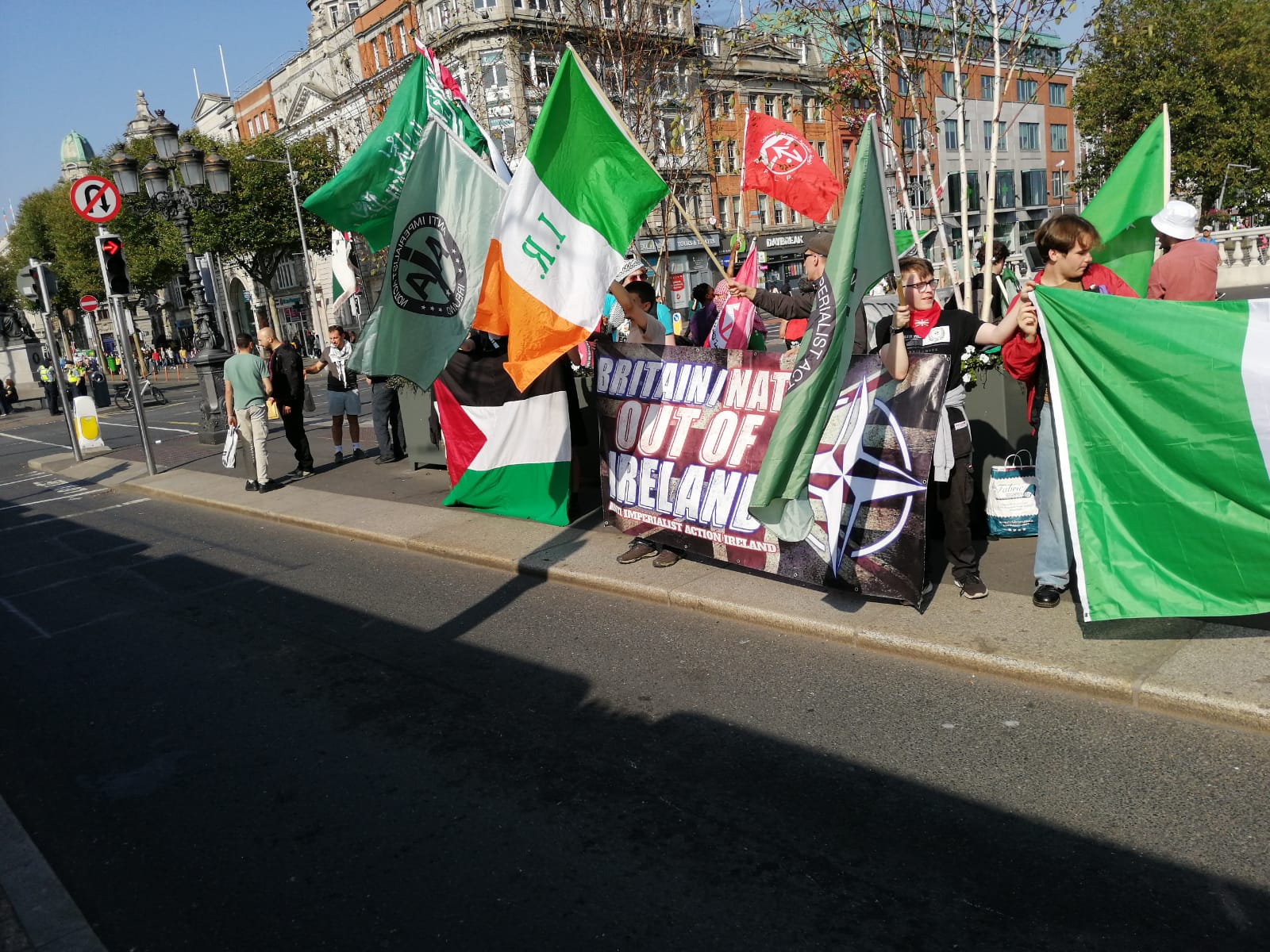
Mostly of the east-facing section on the Bridge (Photo: R.Breeze)
Although the Labour Party on the Zionist State, its Government continues to support that state politically and economically, also militarily with supply of weapons components and RAF missions.1
Very recently the UK Labour Government temporarily suspended 30 military items which may (may!) be implicated in genocide. The UK, holder of one of the five Permanent seats of the UN Security Council is complicit in the ongoing Zionist colonial settler genocide of Palestinians.
In fact, the UK is responsible for settling Zionist Jews in Palestine and then for allocating much of Palestinian land to the settler who, as European settler colonists do, expelled hundreds of thousands of Palestinians and continued extending their land-grabbing ever since.
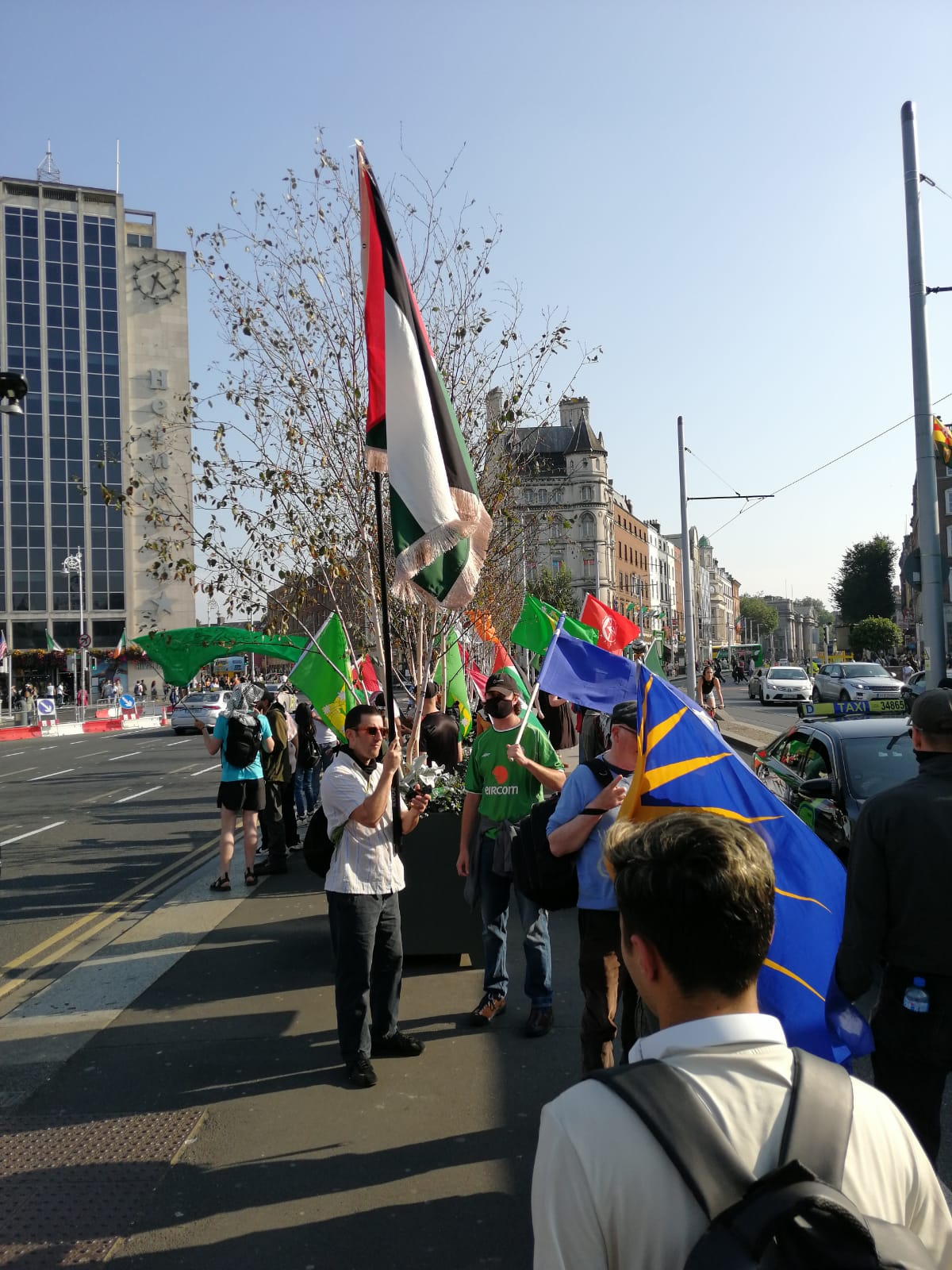
West-facing section of protest (Photo: R.Breeze)
PROTEST ON O’CONNELL BRIDGE
The Saoirse Don Phalaistín and Anti-Imperialist Action groups organised a protest against Starmer’s visit to take place on O’Connell Bridge at 3pm on Saturday and took up position on the central pedestrian reservation, with one section facing eastward and the other towards the West.
The Bridge spans the River Liffey and is in the heart of the city centre, crossed by north and southbound traffic and in view of westbound and eastbound traffic along the quays also.
There was a heavy presence of uniformed police in the vicinity, with five Special Branch nearby and a Public Order Unit van driving by a number of times as did other Garda vans. A prisoner transport van was also parked on the Bridge for a period but no attack was forthcoming.
Collection of banners and flags in west-facing section of protest. (Photo: R.Breeze)
RECORD OF THE LABOUR PARTY
One of the speakers at the O’Connell Bridge event reminded people of the history Labour Governments vis-a-vis Ireland, having sent the troops to the Six County colony to quell the struggle for civil rights there and also targeting the Irish in Britain with the Prevention of Terrorism Act.
This 1974 PTA, the speaker said, was later extended into the current Terrorism Act of repression in Britain. He reminded people too of the innocent Birmingham Six, Guildford Four, Maguire Seven and Judith Ward who were framed and jailed for long years under a Labour Government.
A speaker at the protest giving some reasons why Keith Starmer is not welcome in Ireland. (Video cred: Social Action Ireland)
The speaker could have also mentioned the Labour Party’s participation in the WWI War Cabinet which had sentenced and executed 16 Irish leaders after the 1916 Rising and its bipartisanship with the Conservatives on the partition of Ireland in 1921 and instigation of the Civil War in 1922.
SUPPORT AND OPPOSITION
The attitude expressed by protest passers-by on foot, bicycle or in motorised transport was nearly uniformly supportive. One exception was a fascist who called the protesters ‘traitors’ and attempted to take closeup photos before being blocked by a participant with a flag and seen off.
(Photo: R.Breeze)
Another was a big man who in a UStates accent seemed to shout something derogatory about Ireland and then claimed to be Irish (he might have been part of the diaspora there since the Irish tricolour colours appeared on the back of his top).
For much of the two hours of the event, slogans were shouted in support of Palestine, against the Zionist State, against Starmer, against British occupation of Ireland, for Intifada revolution, and for the solidarity action of Yemen at sea regarding Zionist-collusive shipping companies.
End.
Another view of west-facing section of protest with newly-made ornate Starry Plough flag. (Photo: R.Breeze)
FOOTNOTE
1There have been a number of reports of special units of the British army in Palestine and on British Intelligence personnel assisting the ‘Israeli’ Occupation Force.




















 rebelbreeze