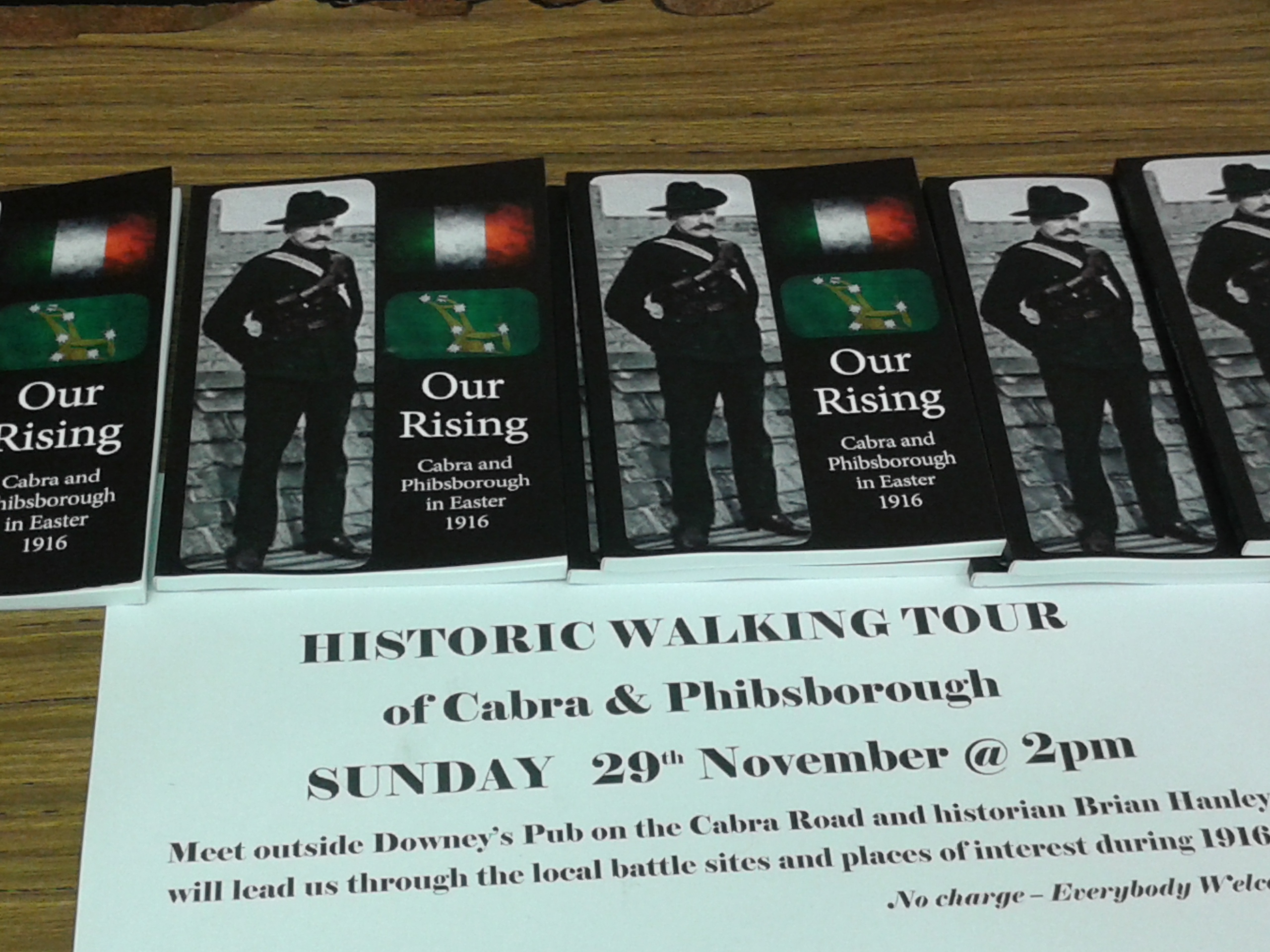
Around a hundred people attended the Cabra 1916 Rising Committee’s exhibition and launch on Saturday (7/11/2015) of their publication Our Rising – Cabra and Phibsborough in Easter 1916.
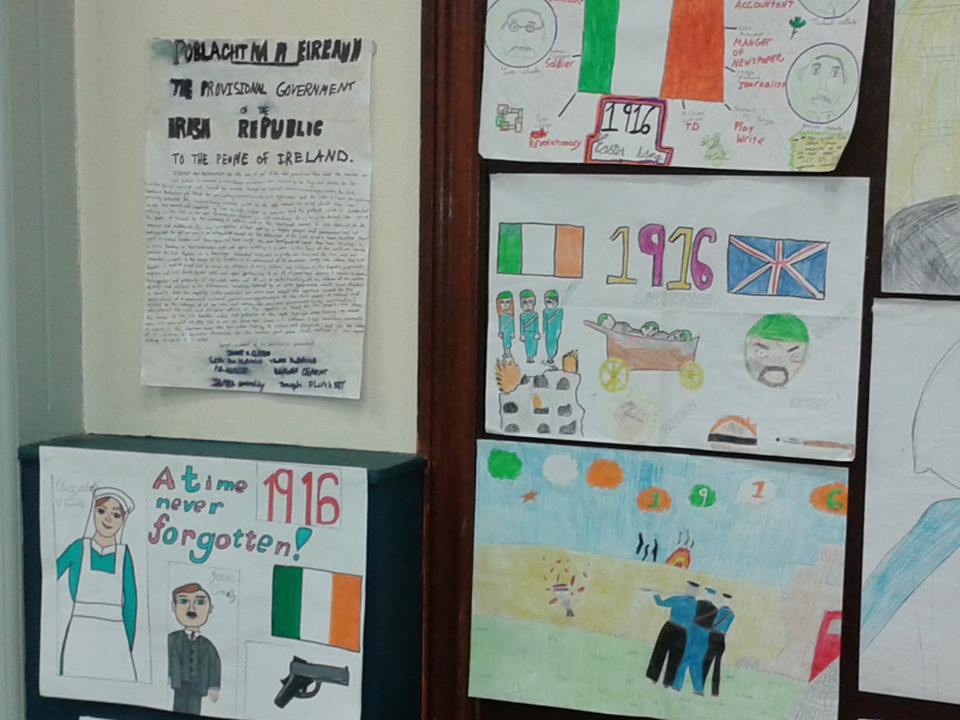
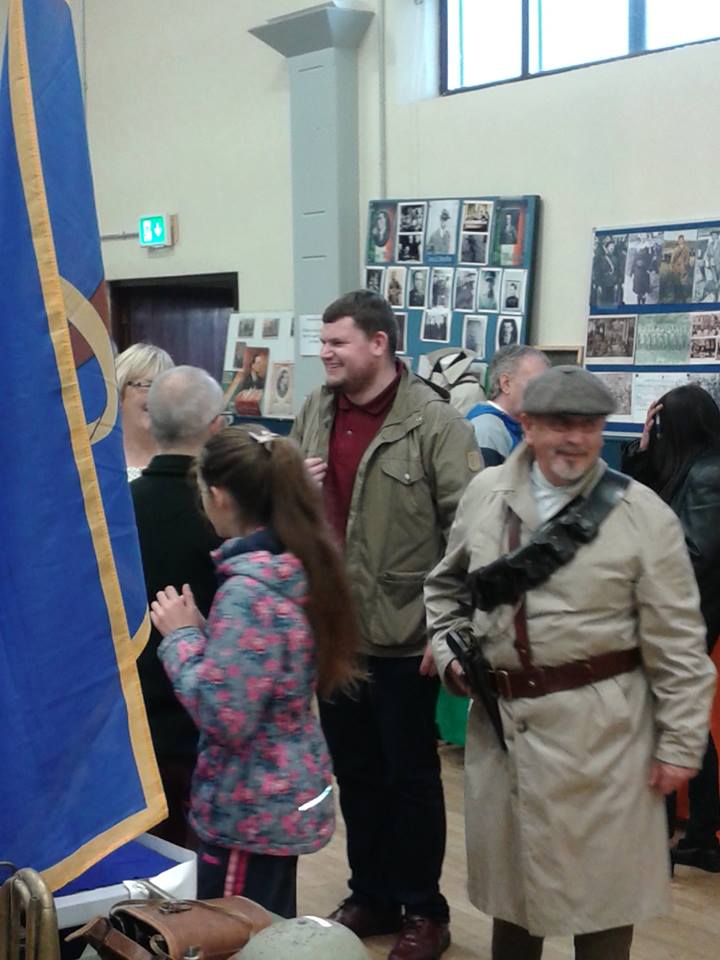
The event took place in the Cabra area itself, in the parish hall of Christ the King church. To accompany the launch, the Irish Volunteers group put on a very interesting display of artifacts from the period, including uniforms and weapons, and provided some personnel also dressed in Irish Volunteer uniforms and IRA typical clothing of the War of Independence period. Along the walls there were many period photos and a wonderful display of schoolchildren’s art on the subject of the 1916 Rising.
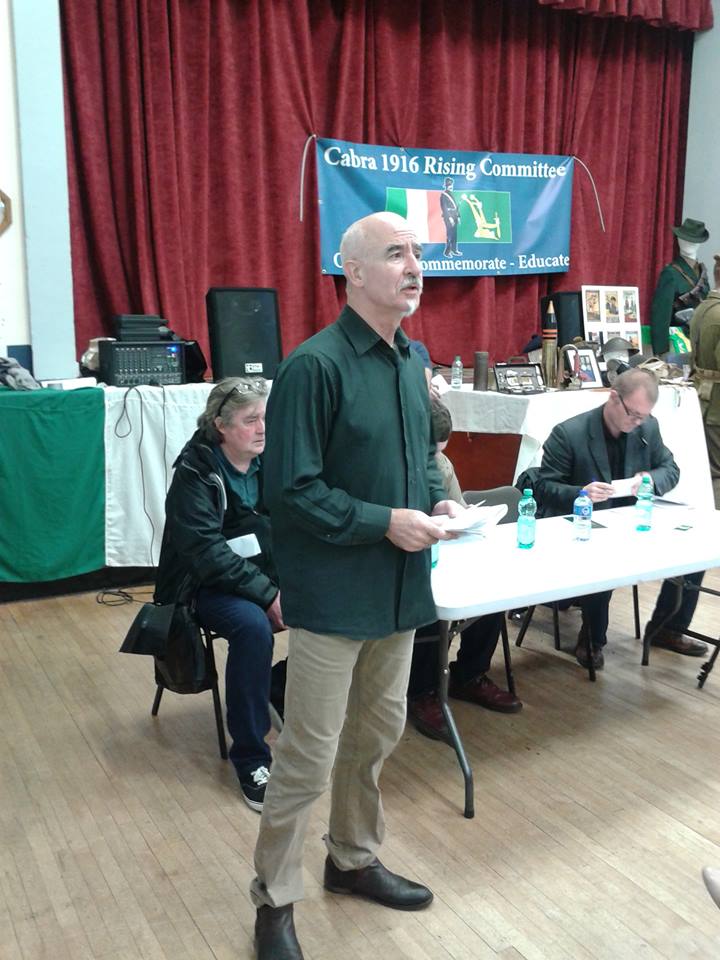
A shot of the attendance at the start of the formal part of the launch (Photo D.Breatnach)Diarmuid Breatnach introducing songs about to sing: “Sergeant William Bailey” by Peadar Kearney (with two additional verses by Breatnach) and “Where Is Our James Connolly?” by Patrick Galvin. (Photo A.Perry)
After some time allowed for people to gather, the MC Éamonn O’Hara called people to order and after they had sat down, gave a brief background to the work of the Cabra 1916 Rising Committee, then outlined the formal part of the book launch to follow. First he introduced singer Diarmuid Breatnach.
Breatnach took the floor and explained that the songs he was going to sing were from or related to the period. “During these years of commemorations,” he said, “we are told that we should remember the First World War. Some people disagree with that but I think it is right; we should remember the War but — not in the way most of those people mean. We should instead remember that hundreds of thousands were sent to murder their class brothers in other lands, sent to their deaths and millions more to injury and tragedy, for the profits of a few.”
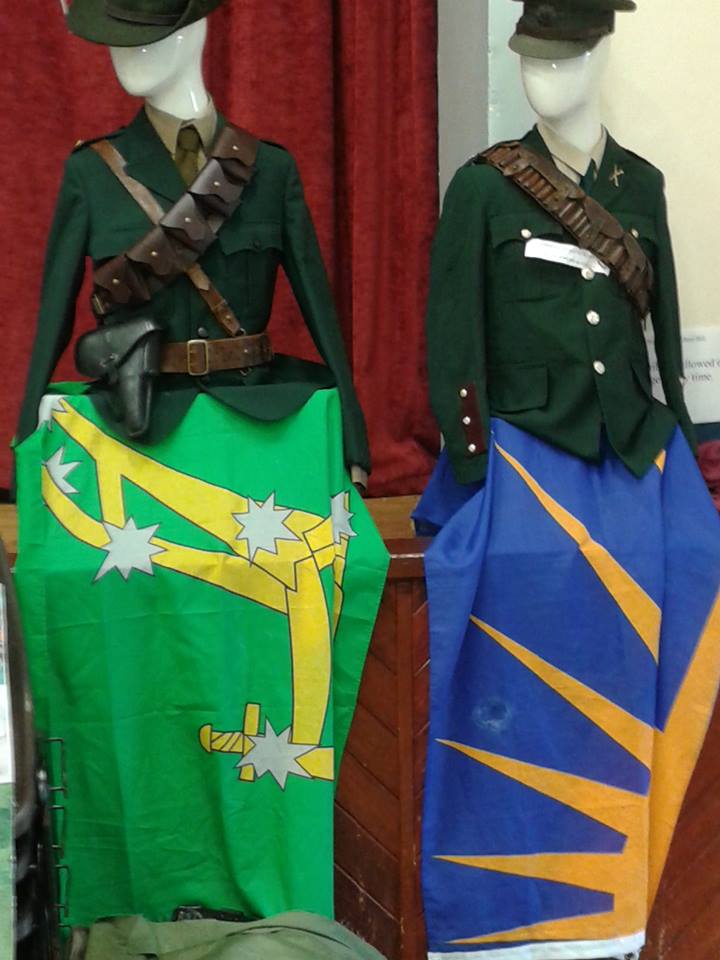
Some of the uniforms and flags displayed by Irish Volunteers.org. (Photo D. Breatnach)
“Also, when we are told that we should commemorate the First World War, they don’t mean that we should remember those brave few who dared speak out publicly against the war, who held anti-recruitment rallies or who picketed army recruitment meetings and shouted slogans there. And who paid the price of imprisonment and sometimes even death for doing so.” And yet, Breatnach went on to elaborate, those things too are part of the history of war and to his mind the most important part, since among all the wars of the past and the present, it is that trend that holds out a hope for the future.
Breatnach related that Peadar Kearney was born not far from Phibsborough – in Dorset Street, around the corner from Inisfallen Parade, where Sean O’Casey was reared. When Kearney taught night classes in Irish, O’Casey was one of his pupils.
Among the songs that Kearney wrote was a three-verse song mocking a British Army recruiting sergeant, who apparently had a pitch at Dunphy’s Corner. According to a local historian, that was outside what is now Doyle’s pub, at the Phibsboro crossroads. Breatnach said that he had added two verses of his own composition to that song.
“Of course, the 1916 Rising is a part of the history of the First World War too,” Breatnach continued, “and not only because it took place during that War. For the IRB, undoubtedly, it was a case of ‘England’s difficulty is Ireland’s opportunity’. But for some others, including Connolly, as he made clear a number of times in writing, the Rising was necessary to interrupt the War, to stop the bloodshed of class brother killing class brother across Europe.”
Some of the wonderful children’s artistic impressions of the Rising on display at the launch. (Photo D. Breatnach)
Breatnach pointed out that the Rising in Ireland was one of the most significant internationally against that imperialist war and that it was not until February the following year in Russia that there would be another of such historical importance, to be followed later by the October socialist revolution.
Of the two better-knowns songs about James Connolly, Breatnach said one makes no mention of socialism, the Citizen Army or trade unions and that in his opinion “Where Is Our James Connolly?” is truer to Connolly’s ideology. It was written by Patrick Galvin who was, among other things a writer, playwright, screen writer and singer. Galvin died only four years ago.
Breatnach then went on to perform “Sergeant William Bailey”, followed by “Where Is Our James Connolly?” to audience applause.
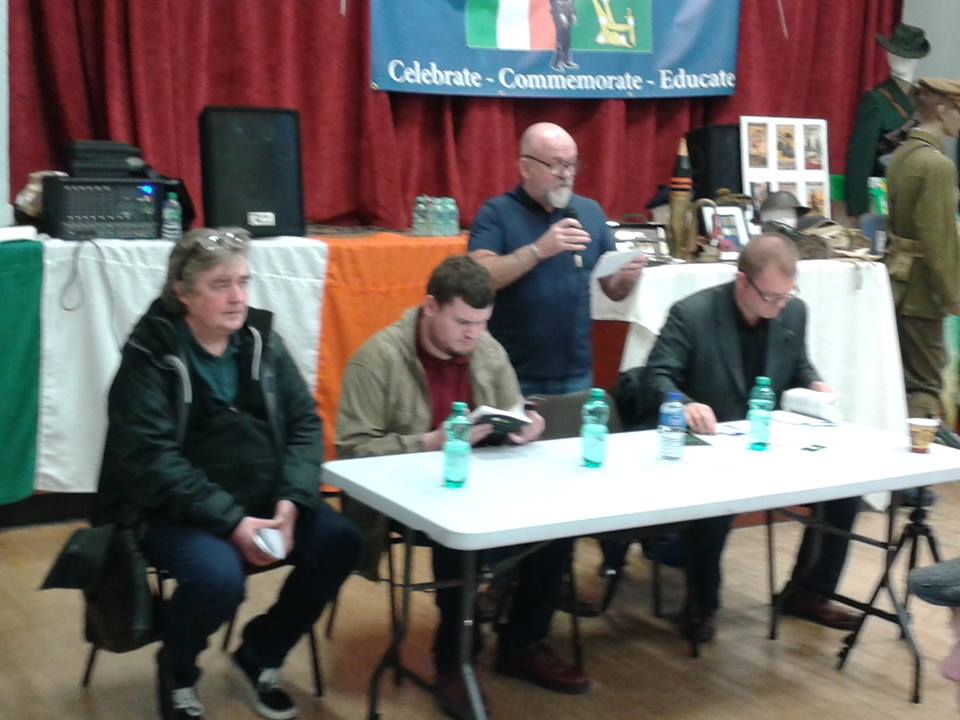
The panel of historians at the launch (seated L-R): Hugo McGuinness, Donal Fallon, Brian Hanley. Eamonn O’Hara (standing) was MC. (Photo D. Breatnach)
O’Hara then introduced one of the authors of “Our Rising”, historian Brian Hanley. “Phibsborough was an area with strong revolutionary connections,” pointed out Hanley and went on to list some of the many participants and even leaders of the 1916 Rising and later who lived in the area, including Michael O’Hanrahan, who was one of the executed sixteen.
Hanley said that although it was right of course that those who were executed for their part in the Rising should have a special place in our memories and be written about by historians, it was unfortunate that many other important participants were neglected. Nearly 100 were sentenced to death but most had their sentences commuted. Had they been executed instead, Hanley pointed out, we would have had many biographies of them, their upbringing and domestic arrangements examined, their words pored over ….. instead, we know next to nothing about them except that they participated and what their role was.
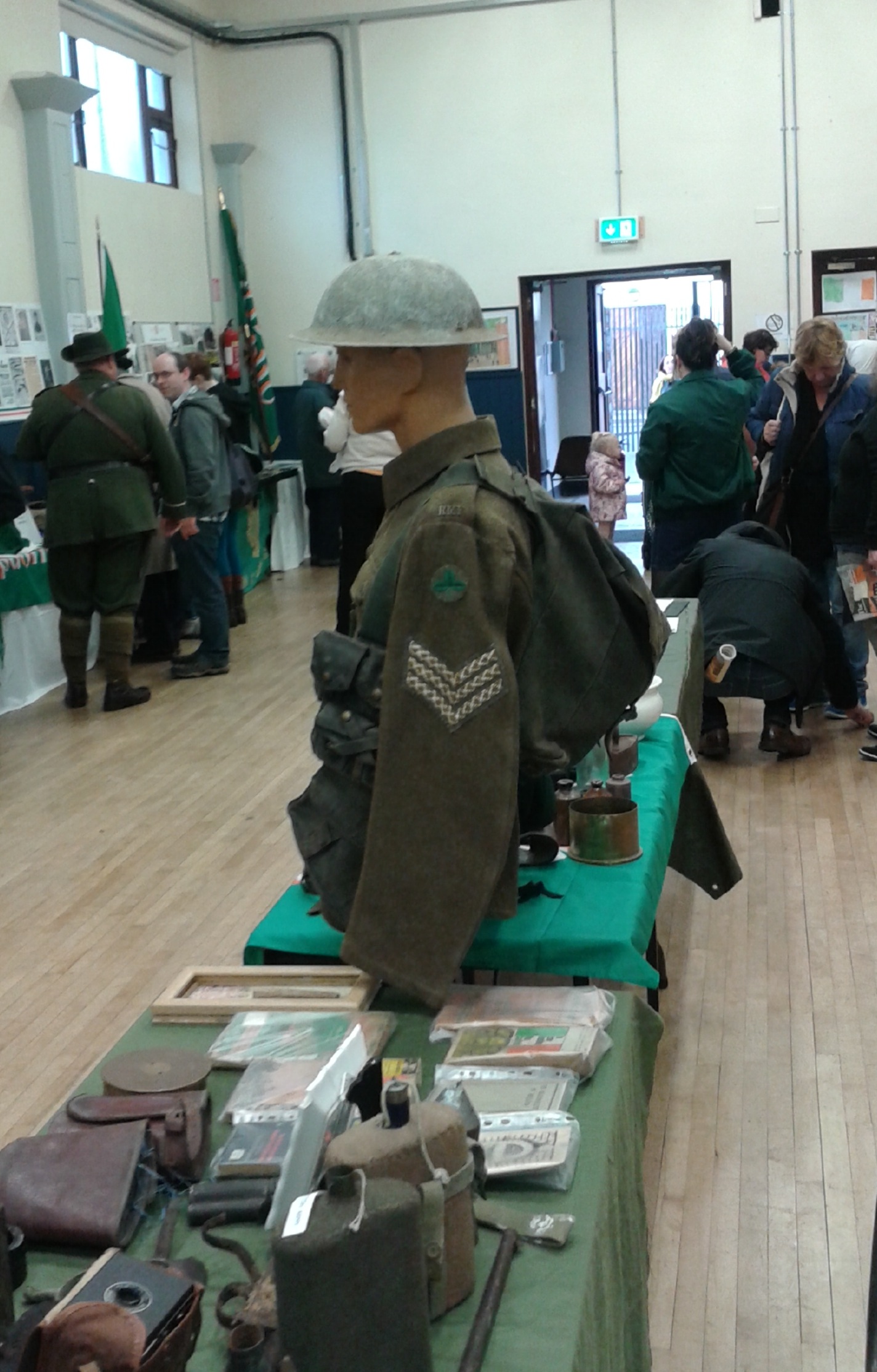
Memorabilia of the British Army were there too — and a reminder that initially It was mostly Irish units fighting to suppress the Rising. (Photo D. Breatnach)
The British Army unit responsible for the suppression of insurgent activities and securing of the area was the Royal Dublin Fusiliers; this was in line with the reality of the British Army, Hanley went on to say, an organisation the main purpose of which was to suppress resistance to the British Empire in places like India, Afghanistan and Ireland. The Fusiliers killed three people in the Phibsborough area, two civilians and a Fianna scout.
Pointing out that most of those men and women who went out to fight in 1916 were not poets or dreamers, Hanley refuted the myth of blood sacrifice. Most of those people were ordinary enough, with all the hopes, excitement and fears of ordinary people, Hanley opined: “They went out with high hopes that they were going to win.”
Thanking various bodies that had supported the project, Hanley went on to point out that the book should not be considered all that had to be said on the subject and, while thanking those local people who had contributed stories and information, encouraged any others who had further information or stories, including corrections of what they had written, to get in touch with the society.
Some more of the wonderful children’s artistic impressions of the Rising on display at the launch. (Photo D. Breatnach)
Hanley’s presentation was followed by that of another historian, Dónal Fallon, co-author of Our Rising. “The commemoration of the 1916 Rising is much too important to leave to the Irish Government”, said Fallon, who admitted to being a newcomer to the area, in the community of which he was glad to live. Local history and community groups had a vital part to play in commemorating the important events of this centenary decade, he said, pointing out that we had already had the centenary of the Lockout, next year would be the centenary of the Rising, to be followed by centenaries of the War of Independence and the Civil War, which might be uncomfortable for some people but should not be shirked for all that. Last of the panel to speak was historian Hugo McGuinness who said he was delighted to have contributed the Cathleen Seery-Redmond piece to the book. He laid stress on the importance of local history and people’s stories as the human element of history. McGuinness recalled that when Connolly and some others were planning a commemorative event, a female member of the committee proposed that it would be wonderful to see Connolly in uniform; Hugo commented that he found little stories like that added human charm to the big narrative of historic events. McGuinness strongly recommended people buy a copy.
“Uniform” more typical of IRA man in the War of Independence 1919-1921 or Civil War. But even in 1916, some Volunteers could not afford a uniform. Co-author Donal Fallon centre background. (Photo D. Breatnach)
All the speakers were accorded warm applause. O’Hara thanked the speakers and asked whether there were any questions or comments. There were a few only and, announcing a historical walk to take place on the 29th, for which flyers had been placed on seats, the MC thanked the Irish Volunteers.org group for their display, thanked the audience for their attendance and concluded the formal part of the event. People remained to buy copies of the book and have them signed by the authors, or conversed or wandered among the exhibition for about an hour afterwards.
I WAS INVITED TO SING A COUPLE OF SONGS AT THE LAUNCH OF “OUR RISING – CABRA AND PHIBSBOROUGH IN 1916″. Of course I was honoured to accept; the songs I chose to sing were “Sergeant William Bailey” and “Where Is Our James Connolly?” I chose them as important to the events around the Irish Volunteers and hoped they would be considered appropriate to the book launch event also.
These years are the centenaries of many things in our history and it is right that we should remember them. Among those things we are told that we should remember the First World War. I think the people who say that are right – we should, but not in the way most of those people mean. We should remember that in a dispute about what markets of the world should be dominated by which World powers and which resources they should have a monopoly on stealing, they sent millions to their deaths and millions more to injury and tragedy. And of course, the capitalists, the class that controlled those Powers were not among those dead and injured millions.
When those people tell us that we should commemorate the First World War and collect songs and memorabilia they don’t mean that we should sing songs against the War, collect anti-War leaflets and honour those brave few who dared speak out publicly against the war stampede of their countries. And who paid the price for doing so. And yet those things too are the history of the War and to my mind the parts of that history that, among all the wars of the past and the present, hold out a hope for the future.
Peadar Kearney, author of “The Soldiers’ Song”, “Sgt. William Bailey” and many other songs
Peadar Kearney was an Irish Republican of a Dublin skilled working class background born not far from Phibsborough – in Dorset Street, around the corner from Inisfallen Parade, where Sean O’Casey was reared. When Kearney taught night classes in Irish, O’Casey would be one of his pupils.
Kearney wrote many songs that are still sung today, the most famous of which is the Soldiers’ Song, on which he cooperated with Patrick Heeney, from Railway Street, off Gardiner Street. When the Irish Volunteers was formed in 1913, Kearney was a co-founder and his song was one of a number sung by other Volunteers during the 1916 Rising, in which Kearney also fought.
Peadar Kearney also wrote a three-verse song mocking a recruiting sergeant for the British Army, who apparently had a pitch at Dunphy’s Corner. According to a local historian, that was outside what is now Doyle’s pub, at the Phibsboro crossroads. I added two verses to that song, in order to give Sergeant William Bailey a bit of a background story.
Of course, the 1916 Rising is a part of the history of the First World War too – and not only because it took place during that War. For some, undoubtedly, it was a case of “England’s difficulty is Ireland’s opportunity”. But for some others, including Connolly, as he made clear a number of times in writing, the Rising was necessary to interrupt the War, to stop the bloodshed of class brother killing class brother across Europe.
James Connolly, a revolutionary socialist, wanted revolution against world war
Connolly was a revolutionary socialist. At the end of the 19th and very early 20th Centuries, the standard position of the international socialist movement had been against imperialist or colonialist war. In 1912, on November 24–25, the congress of world socialist parties at Basel in Switzerland, including revolutionaries and reformists, had come out clearly against imperialist war. Their manifesto was unanimously adopted at the congress. In the context of the situation created by the war in the Balkans that had begun in October 1912 and the increasing threat of world war, the Basel Manifesto called called for an unrelenting struggle against war and those responsible for it, the ruling classes of the capitalist countries. It stated that that war, if it began, “would create an economic and political crisis,” which should be utilized to “hasten the downfall of the rule of capital.”
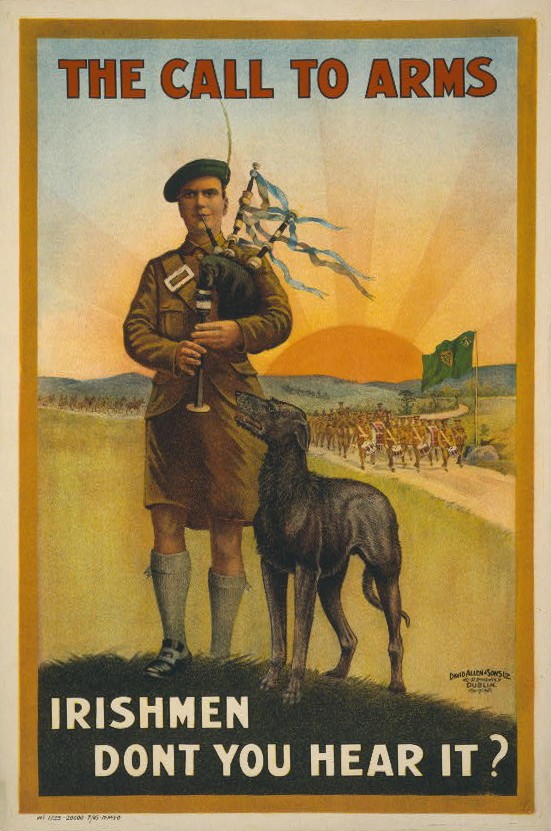
British Army recruitment poster aimed at Irish men
As we know, the leadership of those parties that we now call the social democrats abandoned this position completely and championed their own ruling classes two years later as WWI broke out, cheering the workers of their countries on into uniform, to kill and be killed. There were some uprisings against the capitalists and against war but the first of any significance — and indeed of great significance — was the 1916 Rising in Ireland. The next revolutionary blow to war would not be until be a year later, with revolution in the Russian Empire.
Of the two better-knowns songs about James Connolly, the song “Where Is Our James Connolly?” is I think the best and truer to Connolly’s ideology. It was written by Patrick Galvin who was, among other things a writer, playwright, screen writer and singer. Galvin died only four years ago. Christy Moore remembers learning the song around 1970 which is probably not long after it was written – or at least published.
Patrick Galvin, author of “Where Is Our James Connolly?”
Diarmuid Breatnach (published originally in Dublin Political History Tours)
(Miren de bajo para la versión en castellano).
The 31st of August 1913 was one of several ‘Bloody Sundays’ in Irish history and it took place in O’Connell Street (then Sackville Street).
A rally had been called to hear the leader of the IT&GWU) speak. The rally had been prohibited by a judge but the leader, Jim Larkin, burning the prohibition order in front of a big demonstration of workers on the evening of the 29th, promised to attend and address the public.
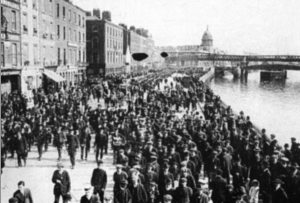
On the day in O’Connell Street, the Dublin police with their batons attacked the crowd, including many curious bystanders and passers by, wounding many by which at least one died later from his injuries.
One could say that on that street on the 31st, or in the nearby Eden Quay on the night of the 30th, when the police batoned to death two workers, was born the workers’ militia, the Irish Citizen Army, in a desire that very soon would be made flesh.
La carga policial contra los manifestantes y transeúntes en la Calle O’Connell en el 31 Agosto 1913/ DMP attack on demonstrators and passers-by on 31st August 1913 in Dublin’s O’Connell Street
THE EMPLOYERS’ LOCKOUT
Bloody Sunday Dublin occurred during the employers’ Lockout of 1913. Under Jim Larkin’s leadership, the Liverpudlian of the Irish diaspora, the young ITGWU was going from strength to strength and increasing in membership, with successful strikes and representation in Dublin firms. But in July 1913, one of Dublin’s foremost businessmen, William Martin Murphy, called 200 businessmen to a meeting, where they resolved to break the trade union.
Murphy was an Irish nationalist, of the political line that wished for autonomy within the British Empire; among his businesses were the Dublin tram company, the Imperial Hotel in O’Connell Street and the national daily newspaper “The Irish Independent”.
The employers decided to present all their workers with a declaration to sign that the workers would not be part of the ITGWU, nor would they support them in any action; in the case of refusal to sign, they would be sacked.
The members of the ITGWU would have to reject the document or leave the union, which nearly none of them were willing to do.
Nor could the other unions accept that condition, despite any differences they may have had with Larkin, with his ideology and his tactics, because at some point in the future the employers could use the same tactic against their own members.
The Dublin (and Wexford) workers rejected the ultimatum and on the 26th began a tram strike, which was followed by the Lockout and mixed with other strikes — a struggle that lasted for eight months.
Dublin had remarkable poverty, with infectious diseases such as tuberculosis and others, including the sexually-transmitted ones, the city being a merchant port and also having many British Army barracks. The percentage of infantile mortality was higher than that in Calcutta. Workers’ housing was in terrible condition, often with entire families living in one room, in houses sometimes of 12 rooms, each one full of people, with one or two toilets in the outside yard.
In those conditions, 2,000 Dublin workers confronted their employers, the latter aided by their Metropolitan Police, the Irish colonial police and the British Army. As well as the workers, many small traders suffered, those selling in the street or from little shops.
On that Monday, the 31st of September 1913, some trade unionists and curious people congregated in Dublin’s main street, then called Sackville Street, in front of and around the main door of the big Clery’s shop. In the floors above the shop, was the Imperial Hotel, with a restaurant.
The main part of the union went that day to their grounds in Fairview, to avoid presenting the opportunity for another confrontation with the Dublin Municipal Police. Others in the leadership had argued that the police should not be given the opportunity and that there would be many other confrontations during the Lockout. But Larkin swore that he would attend and that a judge should not be permitted to ban a workers’ rally. There were many police but nothing was happening and Larkin did not appear. After a while, a horse-drawn carriage drove up and an elderly church minister alighted, assisted by a woman, and entered the shop. They took the lift to the restaurant floor. A little later Larkin appeared at the restaurant open window, in church minister’s clothing, spoke a few words to the crowd and ran inside. Those in the street were very excited and when the police took Larkin out under arrest, they cheered him, urged on by Constance Markievicz. The police drew their batons and attacked the crowd — any man not wearing a police uniform.
THE UNION’S ARMY
The Irish Citizen Army was founded for the union on the 6th November 1913 by Larkin, Connolly and others with Seán Ó Cathasaigh/ O’Casey, playwright and author, including the first history of the organisation.
The Citizen Army at Croydon House, at the ITGWU’s grounds in Fairview/ El Ejercito Ciudadano en su parte del parque en Fairview.
As distinct from the Irish Volunteers, women could enter the ICA, within which they had equal rights.
Funeral of James Byrne, who died as a result of his imprisonment during the 1913 Lockout/ Procesión funébre de James Byrne, fallecido por razón de su encarcelamiento durante el Cierre de 1913, pasando por el muelle sur Eden’s Quay, partiendo de la Salla de la Libertad.
It was reorganised in 1914 as the union was recovering from its defeat during the Lockout, and 200 fought alongside the Volunteers in the 1916 Easter Rising, after which two of its leaders, Michael Mallin and James Connolly, were executed. Among the nearly 100 death sentences there were others of the ICA, including Markievicz, but their death sentences were commuted (14 were executed in Dublin, one in Cork and one was hanged in London).
The main fighting locations of the ICA in 1916 were in Stephen’s Green and in the Royal College of Surgeons, in City Hall and, with Volunteers in the GPO and in the terrace in Moore Street, the street market.
The Imperial Hotel on the other side of the street from the GPO was occupied too by the ICA and on top of it they attached their new flag, the “Starry Plough/ Plough and Stars”, the design in gold colour on a green background, the
The flag of the ICA, flown over Murphy’s Imperial Hotel in 1916
constellation of Ursa Mayor, which the Irish perceived in the form of a plough, an instrument of work. And there the flag still flew after the Rising, having survived the bombardment and the fire which together destroyed the building and all others up to the GPO, on both sides of the street. Then a British officer happened to notice the flag and ordered a soldier to climb up and take it down — we know not where it went.
TODAY
Today, after various amalgamations, the once-noble ITGWU has become SIPTU, the largest trade union in Ireland but one which does not fight. The skyscraper containing its offices, Liberty hall, occupies the spot of the original Liberty Hall, prior to its destruction by British bombardment in 1916.
The Irish newspaper the “Irish Independent” continues to exist, known as quite right-wing in its editorial line. Murphy’s trams came to an end during the 1950 decade and those in Dublin today have nothing to do with Murphy.
The Imperial Hotel no longer exists and, until very recently, Clery had taken over the whole building, but they sacked their workers and closed the building, saying that they were losing money.
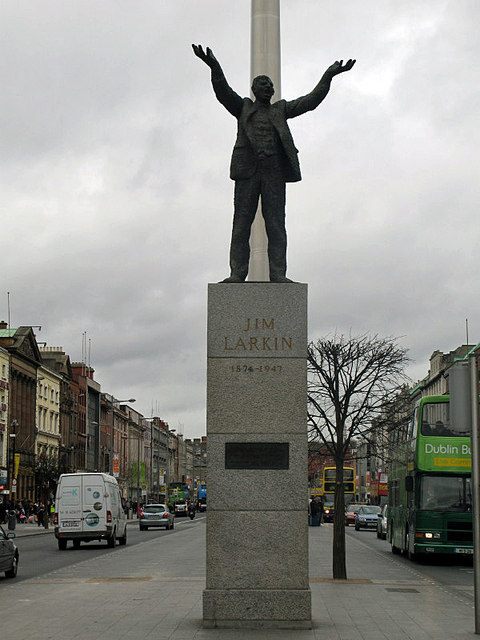
In front of the building, in the pedestrianised central reservation, stands the monument as a representation of Jim Larkin. The form of the statue, with its hands in the air, is from a photo taken of Larkin during the Lockout, as he addressed another rally in the same street. It is said that in those moments, he was finishing a quotation which he used during that struggle (but which had also been written previously by James Connolly in 1897, and which something similar had been written by the liberal monarchist Étienne de La Boétie [1530–1563] and later by the French republican revolutionary Camille Desmoulins [1760–1794]): “The great appear great because we are on our knees – LET US ARISE!”
The Jim Larkin monument in O’Connell Street today/ El monumento de Jim Larkin in la Calle O’Connell hoy en día
EL 31 DE AGOSTO EN El 1913 FUE UNO DE LOS DOMINGOS SANGRIENTOS DE IRLANDA Y OCURRIÓ EN LA CALLE PRINCIPAL DE DUBLÍN.
Hubo una concentración para escuchar al líder del sindicato de Trabajadores de Transporte y de General de Irlanda (IT&GWU) hablar. La manifestación fue prohibida por juez pero el líder, Jim Larkin, quemando el documento de prohibición en frente de manifestación grande la noche del 29, prometió que iba a asistir y hablar al publico.
El día 31 en la Calle O’Connell, la policía de Dublin con sus porras atacaron la concentración y a muchos otros curiosos o pasando por casualidad, hiriendo a muchos por lo cual murió uno por lo menos mas tarde de sus heridas.
Se puede decir que en esa calle en el 31, o en la cerca muelle, Eden Quay, la noche del 30, cuando mataron a porras dos trabajadores, se dio luz a la milicia sindical, el Ejercito Ciudadano de Irlanda, en deseo que poco mas tarde estaría fundado en actualidad.
EL CIERRE PATRONAL
El Domingo Sangriento ocurrió durante el Cierre Patronal de Dublín en el 1913. Bajo el liderazgo de Jim Larkin, el Liverpoolés de diáspora Irlandesa, el joven sindicato ITGWU fue yendo de fuerza a fuerza y aumentando en miembros, con éxitos en sus huelgas y reconocido en muchas de las empresas de Dublín. Pero en Julio del 1913, uno de los principales empresarios de Dublín, William Martin Murphy, llamó a 200 de los empresarios a mitin y resolvieron romper el sindicato.
Murphy era nacionalista Irlandés, de la linea de pedir autonomía pero adentro del Imperio británico; entre sus empresas le pertenecía la linea de tranvías de Dublín, el Hotel Imperial en la Calle O’Connell y el periódico diario nacional The Irish Independent.
Resolvieron los empresarios presentar a todos sus trabajadores una declaración para firmar que no serían parte del sindicato ITGWU ni les darían ningún apoyo en cualquiera acción; en caso de negar firmar, se les despedirían.
Los miembros del ITGWU tendrían que rechazar el documento o salir del sindicato, lo cual casi lo total no estuvieron dispuestos hacer.
Los otros sindicatos, pese a cualquiera diferencias tuvieron con Larkin, con sus pensamientos y sus tácticas, tampoco podían acceder a esa condición por que mas tarde se podría usar la misma táctica en contra de sus miembros también.
Los trabajadores de Dublín (y de Wexford) rechazaron el ultimátum y empezaron el 26 de Agosto una huelga de los tranvías, seguido por el Cierre Patronal, mixta con otras huelgas, una lucha que duró ocho meses en total.
Dublín tuvo una pobreza impresionante, con infecciones de tuberculosis y otras, incluido las transmitidas por el sexo, siendo puerto mercantil y teniendo muchos cuarteles del ejercito británico. El porcentaje de la mortalidad infantil era mas de la de la ciudad de Calcuta. Las viviendas de los trabajadores estaban en terribles condiciones, con a menudo familias grandes enteras viviendo en una habitación, en casas a veces de 12 habitaciones, cada uno llena de gente, con una o dos servicios en el patio exterior.
En esas condiciones 2,000 trabajadores de Dublín se enfrentaron al patronal de Dublín, con su policía metropolitana, la policía colonial de Irlanda y el ejercito británico. Además de los trabajadores, muchos pequeños empresarios, vendiendo en la calle o en tiendas pequeños, sufrieron.
Ese Domingo, del 31o de Setiembre 1913, algunos sindicalistas y gente curiosa se congregaron en la calle principal de Dublín, entonces nombrado Sackville Street, en frente y al rededor de la puerta principal de la gran tienda de Clery. En las plantas después de la primera, estaba el Hotel Imperial, con un restaurante.
La mayor parte del sindicato se fueron ese día a una parte de parque que les pertenecía por la costa, para evitar otra enfrentamiento con la Policía Metropolitana de Dublín. Habían argumentado otros de la dirección del sindicato que no se debe dar les la oportunidad a la policía y que habría muchos otros enfrentamientos durante el Cierre. Pero Larkin juró que lo iba a asistir y que no se podía permitir a un juez prohibir manifestaciones obreras.
Había mucha policía pero nada pasaba y Larkin no aparecía. Después de un rato, un coche de caballos llegó y un viejo sacerdote salió, apoyado por una mujer, y entraron en la tienda de Clery. Subieron en el ascensor hacía el restaurante. Poco después, Larkin apareció en la ventana abierta del restaurante, en el traje del cura y habló unas palabras, antes de correr adentro. Los de abajo en la calle muy entusiasmados y cuando la policía salieron agarrando le a Larkin, la multitud le dieron vítores, alentados por Constance Markievicz. La Policía Municipal sacaron sus porras y atacaron a la multitud – a cualquier hombre que no llevaba uniforme policial.
EL EJERCITO DEL SINDICATO
El Ejercito Ciudadano de Irlanda (Irish Citizen Army) fue fundado para el sindicato en el 6 de Noviembre del 1913 por Larkin, Connolly y otros con Seán Ó Cathasaigh/ O’Casey, escritor de obras para teatro y algunas otras, incluso la primera historia de la organización. A lo contrario de Los Voluntarios, el ICA permitía entrada a mujeres, donde tenían derechos iguales.
Fue reorganizada en 1914 cuando el sindicato se fue recobrando de la derrota del Cierre Patronal, y 200 lucharon con los Voluntarios en el Alzamiento de Pascuas de 1916, después de lo cual dos de sus líderes, Michael Mallin y James Connolly, fueron ejecutados. Entre los casi 100 condenas de muerte, habían otros del ICA, incluso Constance Markievicz, pero sus condenas de muerte fueron conmutadas (se les ejecutaron a 14 en Dublín y a uno en Cork, y a otro le ahorcaron en Londres).
Los lugares principales de lucha del ICA en 1916 fueron en el Stephen’s Green y en el Collegio Real de Cirujanos (Royal College of Surgeons), en el Ayuntamiento y, con Voluntarios, en la Principal Oficina de Correos (GPO) y en la manzana del Moore Street, el mercado callejero.
El Hotel Imperial al otro lado de la calle del GPO lo ocuparon también el ICA, y encima colocaron su nueva bandera, el Arado de Estrellas (“Starry Plough/ Plough and Stars”), el diseño en color oro sobre fondo verde, la formación celeste del Ursa Mayor, que lo veían los Irlandeses en forma del arado, una herramienta de trabajo. Y ahí ondeó la bandera después del Alzamiento, habiendo sobrevivido el bombardeo británico y el fuego que destruyeron el edificio y la calle entera hacía el GPO, en ambos lados. Entonces un oficial británico se dio cuenta de la bandera y le mandó a soldado hir a recoger la – no se sabe donde terminó.
HOY EN DÍA
Hoy en día, después de varias fusiones, el noble ITGWU se ha convertido en el SIPTU, el sindicato mas grande de Irlanda y parecido en su falta de lucha a Comisiones Obreras del Estado Español. El rasca cielos de sus oficinas, La Sala de la Liberta (Liberty Hall), ocupa el mismo lugar que ocupó la antigua Liberty Hall, antes de su destrucción por bombardeo británico en 1916.
El periódico Irish Independent sigue existiendo, conocido por ser bastante de derechas en su linea editorial. Los tranvías de Murphy terminaron en la década del 1950 y los de hoy en Dublín no tienen nada que ver con los de antes.
El Hotel Imperial ya no existe y, hasta hace muy poco, la empresa Clery lo tenía todo el edificio, pero despidieron a sus trabajadores y cerraron el edificio, diciendo que perdían dinero.
En frente del edificio, en la reserva peatonal del centro de la calle, está el monumento representando a Jim Larkin. La forma de la estatua, con las manos en el aire, lo tiene de foto que le hicieron durante el Cierre Patronal, cuando habló en otro manifestación en la misma calle. Dicen que en ese momento, estaba terminando una frase famosa que usó durante esa lucha (pero que también lo escribió Connolly antes en 1897, y que lo había escrito algo parecido primero el monárquico reformista Étienne de La Boétie [1530–1563] y luego el revolucionario republicano francés Camille Desmoulins [1760–1794]): “Los grandes aparecen grande por que estamos de rodillas – levantamanos!”
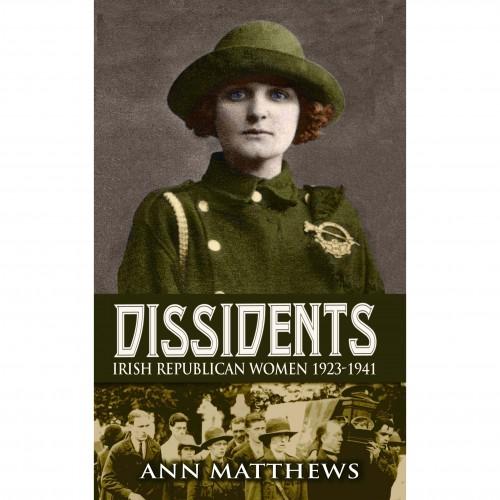
The role of women has been often ignored and undervalued in the body of Irish historical writing. Whatever the reasons for this state of affairs, a tendency in more recent writing has been, at least to a degree, to attempt to rectify this. In the decades since Margaret Ward’s Unmanageable Revolutionaries (Brandon, Ireland, 1983), this rectification has been slowly gathering pace. Dissidents – Irish Republican women 1923-1941, by Anne Matthews (Mercier, 2012), is a contribution to this movement in historical writing; it is essentially the history of an Irish women’s political movement, Cumann na mBan, during the years outlined. A previous work of hers, “Renegades”, deals with Irish Republican women from 1901 to 1922.
Although Dissidents deals with the period 1923-1941, Cumann na mBan was founded on 2nd April 1914 as an auxiliary to the all-male Irish Volunteers’ organisation, which had been founded in 1913. In 1914 the Volunteers split after John Redmond, leader of the Irish Parliamentary Party (in Westminster) and the main open Irish political party in Ireland, committed the Irish Volunteers to fight in the British Army in WW1. The smaller section of the split went on to participate in the 1916 Uprising and more coherently later in the War of Independence (1919-1921). Redmond’s party and “constitutional” Irish nationalism was all but wiped out in the British General Elections of 1918, at which time the whole of Ireland was still under British rule and Redmond’s nationalist opponents, then amalgamated under the name of the reformed Sinn Féin, gained the vast majority of parliamentary seats in Ireland.
Today it is common to define the ideology of both both Cumann na mBan and the Irish Volunteers as “Irish Republican” and, although they quickly became so, and the impulse in the formation of the Volunteers in 1913 was of the secret Republican organisation the IRB (Irish Republican Brotherhood), both organisations at first could be more accurately described as broadly nationalist. Both organisations contained prominently in their midst people whose ideology conformed to that of Irish Republicanism as well as those whose thinking did not, people who expressed a strong interest in equality for women as well as those who were against it, people with at least a sympathy for socialist ideas and those who condemned any such tendencies – and of course variations in between.
In the period specifically chosen by Matthews, 1923-1941, the Irish Volunteers had morphed into the political party Sinn Féin and the armed organisation the IRA (Irish Republican Army) and become Irish Republican in ideology, as had Cumann na mBan. They had in fact been that way since 1919, although the period 1921-’23 was to expose some deep fracture lines which found expression in the Civil War (1922-1923) and later again with the founding of Fianna Fáil and its eventual management of the Irish State (the 26 Counties).
In order to compile her history, Matthews has consulted minutes of committee meetings of Cumann na mBan in its various incarnations (she identifies four periods, or versions of the organisation), personal recollections of participants recorded in writings, interviews, comments quoted by contemporaries, newspaper reports and articles, the Republican movement’s own publications, as well as records of prisons and police under both British and subsequently Free State rule. And she has used some of this material to reproduce and also compile lists such as the numbers and names of women convicted and jailed, the women who went on hunger-strike and the length of time on that protest. The lists also include figures on the decline of Cumann branches between 1934 and 1936, as well as a list of “women in organisations listed as dangerous by the Free State CID in 1934”. These lists are a particularly valuable contribution and will be of great use to many writing on the political movements of the period in Ireland.
Looking at some of those lists alone, one is struck by the sheer extent to which the contribution of women activists to the struggle for Irish independence, and the price they had to pay, has been overlooked. In 1930 twenty-nine women were in organisations listed as “dangerous” by the Free State detective branch of the police – twelve of these were in senior positions of Cumann na mBan, three in directing positions in Saor Éire, three for Comhairle na Poblachta, three also for Sinn Féin, one for the Prisoners’ Defence Organisation, two for Women Prisoners’ Defence League and one for the Anti-Imperialist League. The rest were rank-and-file members of those organisations and one was in Friends of Soviet Russia.
The Free State interned 645 women during the Civil War (as against over16,000 men). In her Introduction, Matthews points out that “There were twenty-four strikes in the three (women’s) prisons during the period from November 1922 to November 1923, in which 219 women took part.” According to the table drawn up by Matthews, one woman was on hunger strike for 35 days, another for 34, seven for 31, many for different amounts of days but the vast majority into double figures. Furthermore, some of them were on hunger strike more than once.
Matthews also provides a list of the occupations of 79 women activists jailed in the North Dublin Union, which were surveyed in August 1923: the highest number for a single occupation were the 19 listed as “at home”, while the next were 11 whose occupations were given as “packer in Jacob’s” (the biscuit factory in Dublin); 10 had been engaged in “printing”; eight were “shop assistants” while 15 were variously listed as “typist” or “clerk”. This list shows quite a variety of social background among what one presumes to be fairly politically-active women which the Free State considered its enemies.
Republican women acting as couriers or delivering weapons made many journeys by bicycle, often at night without lights in order to avoid Free State patrols, “often round trips of up to forty miles” Matthew tells us (p.32).
BIAS
As has been pointed out by a number of commentators, history writing involves a degree of bias. This bias is exercised not only in explicit judgements but in inferences made, choice of phrasing and so on. Choices are made in what sources to use and what prominence to give them as well as in the opposite, which sources to disregard.
If the Fall of Lucifer and his angel followers were a historical event, for example, we would expect Lucifer’s version to be very different from the Judaeo-Christian story with its sympathy for the Archangel Michael (a great example of history being written by the victors). There might be yet other versions, for example by the Seraphim and Cherubim, one of which might be in partial sympathy with the Fallen side and the other which might be against both sides of the conflict.
Whereas in the ancient past history writing was blatantly partial, in the past century historians have generally claimed to be impartial dispassionate observers recording what they discover. But every one of those writers had views influenced by class, ethnicity, gender, position in or out of power groups, status, upbringing and personal experience. And those views influenced their historical judgements, quite likely their choice of sources and possibly their choice of audience. Written records could only be left by literate people and yet for most of history the majority of people have been illiterate. A more recent trend in history writing is to recognise the inevitability of bias and for the historian to declare which is his or hers.
One should beware of historians who don’t declare their bias at the outset. That will not be a problem with Anne Matthews because although she does not formally introduce her bias to her readers, it very soon becomes clear. Or maybe that is not quite accurate, for in order to have a bias against a group one must presumably also have a bias in favour of another. It is difficult indeed in the pages of this book to find any group for which Matthews has any sympathy or, even more important for a historian, empathy.
To express a bias is expected, as I commented earlier. But unless one is engaged in pure propaganda or character assassination (or glorification), one should present the evidence in favour as well as that against and, in weighing one against the other, make a judgement. When Matthews has anything favourable to say about her subjects it seems to be an accident which will soon be remedied a little later – just keep reading!
A particularly clear and nasty example of this bias is in Matthews’ treatment of Constance Markievicz whom she calls a “self-proclaimed heroine” (p.28) but does not tell us when and where Markievicz allegedly “proclaimed” herself to be a “heroine”. Matthews also inferred that Markievicz was a given to warlike statements but a coward who ran away to Scotland. Whatever the reason for her departure in 1922, one wonders how, no matter how much she may dislike the person, someone could call Markievicz, who prominently took up arms and fought for a week against the British Empire, a coward.
In the Matthews view of the organisation, Cumann na mBan was a largely ineffective body, doctrinaire and full of in-fighting. The leadership and many prominent activists were aristocratic or upper middle class, used to the privileges afforded by their class. The working and lower-middle class members accepted the leadership’s decisions or just deserted.
Some of those things may be true and there might even be some truth in all of them — but where is the counter-argument before coming to judge? One doesn’t find it in Matthews, except by an inference that one can make from the lists I mentioned earlier and other information.
If a woman came from a higher social class and was used to having servants do her cleaning, do those facts diminish in the least her courage in facing bullets in insurrection, the threat of the firing squad, the pangs on hunger-strike and the risk of permanent damage to health, the risk of physical beatings and unhealthy prison conditions? Or on the contrary, in some ways, are those risks and sacrifices not all the more remarkable for one from such a background as that? And if an upper-class mother can pay a nanny to look after her children while she herself in in jail, does that take away from her courage and fortitude? A working-class mother without those resources (though she might be able to avail of extended family) of course has even more obstacles to surmount and deserves our greater praise but that is no reason to disparage the sacrifice or commitment of a woman of a higher class.
And if infighting and bad policy choices were a significant feature of the organisation, were there not others to weigh against them on the scales of judgement? What of transporting, hiding and distributing weapons? Of carrying secret correspondence and intelligence? Or of continuing to feed the flame of resistance while men were in prison, organising pickets and demonstrations, outside jails etc? What of creating the enduring 1916 emblem and Republican commemoration emblem, the Easter Lilly? Or of organising Republican commemorations year after year, as well as funerals of fighters in the midst of repression? Or the work of supporting prisoners and their dependents? Matthews records these and often the difficulties entailed but without a word of approval to balance the censorious words used in her criticisms. Nor do we see an attempt to understand the choices these women made or the constraints upon them, much less see anything to admire; we are shown few lessons to learn from, unless it is something like “don’t be these people or anything like them”.
In Dissidents, Anne Matthews has made a contribution to the story of Republican women but its judgement is clearly skewed and the work suffers as a result. Matthews could have recorded all the negative information that she did but also the points to throw in the balance – had she done so, her book would have been a much better return on her investment in historical research and writing as well as a better reward for the reader.
99 YEARS AGO ON 26th APRIL, THE BLOODIEST BATTLE OF THE EASTER RISING WAS FOUGHT IN A DUBLIN SUBURB
At a little past 6amon 26th April 1916, the SS Tynwald and SS Patriotic, two British troop-ships, had berthed in Dun Laoghaire harbour. The harbour and town had been renamed Kingstown by Unionist elements when King George IV came to visit the new port under construction in 1821. Although the town returned to its former name in 1920, it was known as “Kingstown” by most people in 1916, whatever their allegiance.
The troopships had been requested by General Maxwell, who had been given the responsibility for suppression of the Easter Rising, which was now in its third day. Several British thousand troops from the 59th Midland division began to disembark on a bright sunny morning. Hundreds of civilians went down to see them despite the early hour. Many in that town, especially around the seafront and some of the big houses, would have been sympathetic to the British – but by no means all and no doubt some eyes were noting the arrivals in order to report to the insurgents.
Around 9am, disembarkation completed, the soldiers were formed up and inspected, equipment checked and the Sherwood Foresters set off marching towards Dublin city centre, seven miles away, to be followed by Nottingham and Derby regiments around 10.30hrs. Their forces appear to have split up, with two Battalions marching to the city along the coast road and another two heading inland.
To reach the city centre from Dun Laoghaire, the most direct route is to proceed northward along the coast to Mount Merrion. Once there, the coast road goes through the railway level crossing to the right and continues along the seafront, into Ringsend and then along what is now Pearse Street to Trinity College. The British officers did not lead their men in that direction, perhaps because they had received intelligence of the Boland’s Mill strongpoint along their route. There would be no going past that without first taking it, which might prove a lengthy and difficult battle.
But one could avoid that by not turning right at Mount Merrion and instead continuing on what has become the main road, through Ballsbridge and Northumberland Road, across the Grand Union Canal at Mount Street Bridge, past the fashionable Merrion Square and into Nasseau Street and the city centre. That seemed the obvious choice, not just because of the Jacob’s garrison but also because at Mount Street Bridge was located Beggars’ Bush Barracks, one of the many such of the British Army in Dublin city.
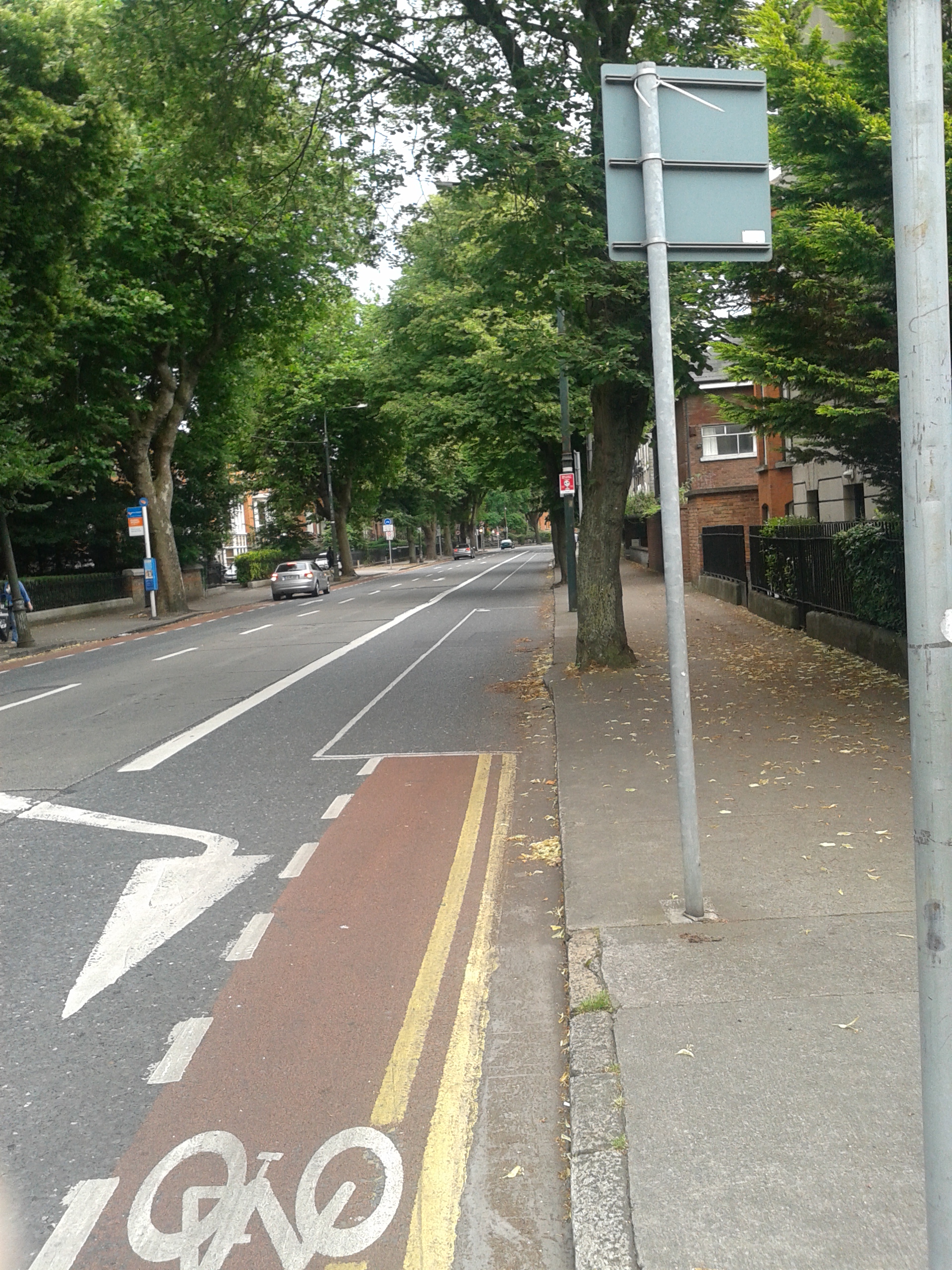
Northumberland Road looking southwards. The Irish insurgents first saw the British troops coming up this road. The Parochial Hall and Schoolhouse are to the left but out of the photo. The canal is behind the photographer. (Photo D.Breatnach)
Before the British troops arrived in the area, a female courier, probably Cumann na mBan, had brought news of the troops landed in Dún Laoghaire and that they were heading towards them to the insurgents waiting in the Mount Street Bridge area.
At around noon a burst of fire hit the forward sections of the British troops marching in from Dun Laoghaire. When fired upon, in order to find effective cover, it is important to know from where the firing is coming but the soldiers were unsure. No. 25 Northumberland Road, a house at the junction with Haddington Road, seemed to some to be the source of the firing but by how many was unknown.
Screams from wounded men filled the air in the quiet suburban upper-middle class and largely Loyalist residential street.
Soldiers began to maneouver to outflank No.25 Northumberland Road and a detachment reached Baggot Street Bridge, further west, which was apparently undefended. From there it is a straight road into Stephens Green and the southside city centre. The rest of the soldiers were not led by their officers in that direction, a decision which was to cost them dearly. Instead, shortly after being fired upon, at least two British platoonsattacked 25 Northumberland Road but were driven back in disarray by fire from the building’s upper floors; yet as they turned they were also shot down in droves.
Perhaps under cover of that assault, at around 1pm some of the 2/7th Battalion Sherwood Foresters got past the corner house and made their way on to Percy Place, which runs along the south side of the canal between Mount Street and Baggot Street bridges. Now they came under fire from in front and from their left. They huddled for cover along the Canal.
The fire from the left of the British at this point was coming at long distance from the towers of Jacob’s Factory in Bishop Street, one of the insurgent strongpoints. A defensive line with insufficient mobilised insurgent numbers to hold it for very long stretched from Jacob’s down to the railway connecting Dublin and Dun Laoghaire and to Boland’s Mill beside it, overlooking the south bank of the Liffey. Roughly in the middle of this chain or defensive line were the Irish Volunteers in the Mount Street Bridge area, an outpost of the Boland’s Mill garrison. The total strength of the insurgent force defending that area had been 17 Volunteers but two had been sent home, being thought too young.
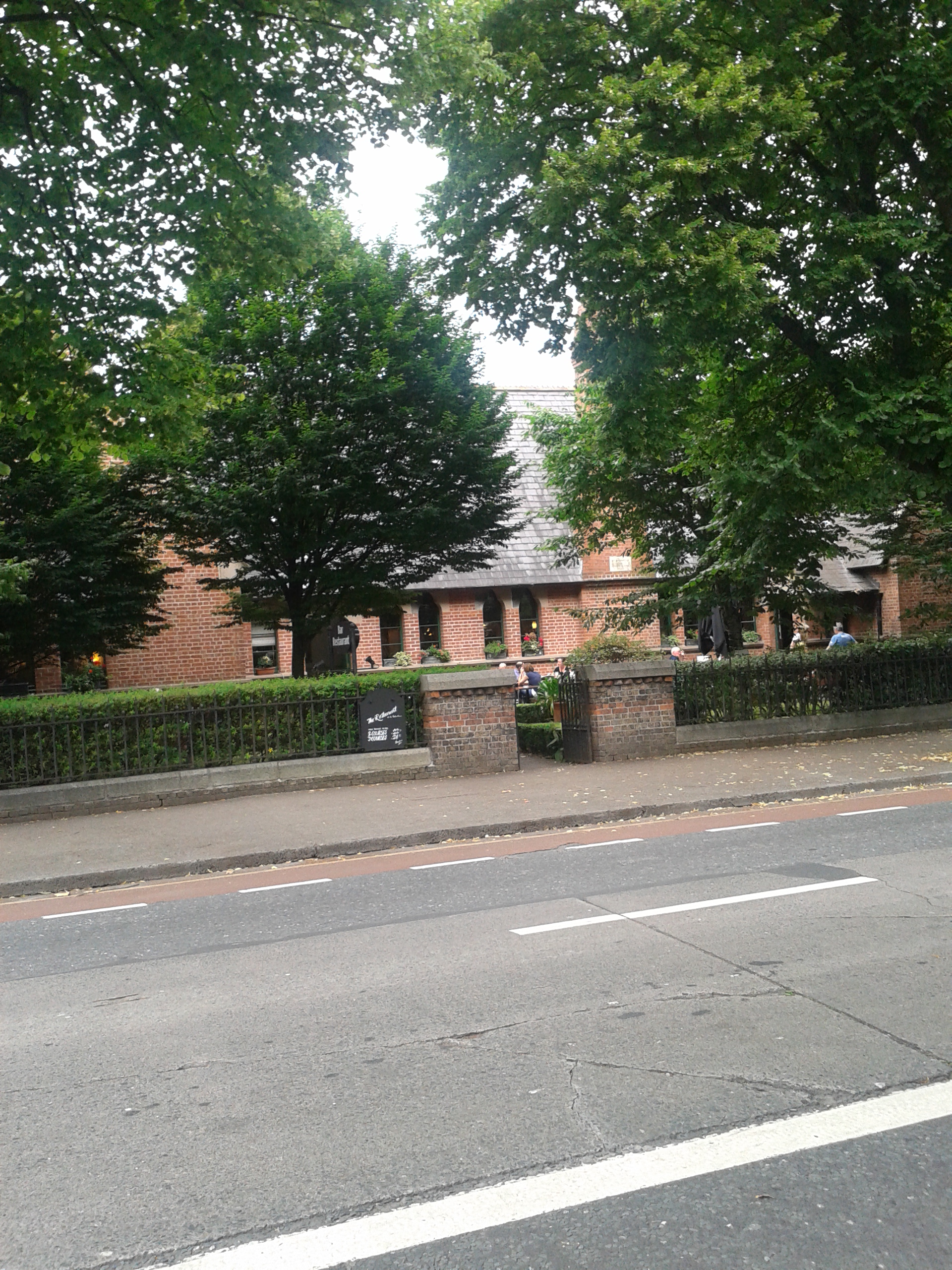
New Clanwilliam House, Mount Street, north side of the Royal Canal, looking eastward. The Bridge and Canal are to the right but out of shot. (Photo D.Breatnach)The Schoolhouse, Northumberland Road, today (a snack-cafe nowadays). The Bridge is to the right; the British troops were advancing along the road from the right.
Incredible as it seemed to the British when they learned of it later, there were only two Volunteers in No.25 Northumberland Road: 27 year-old Volunteer Lieutenant Michael Malone, a carpenter by trade,and Section Commander James Grace. In the Schoolhouse on the right-hand side just before the Bridge, there were two Volunteers. Next to that building was the Parochial Hall,held by four men: P.J. Doyle in command, Joe Clarke, William Christian and J. McGrath.Clanwilliam House, across the canal on the right-hand corner with the junction with Mount Street Lower, was occupied by seven Volunteers; the frontal fire hitting the British wascoming from there.
The British were scattered around gardens and behind the granite steps leading up the to front doors of the elegant houses in the street. Their officers called them out and they launched an attack on the Schoolhouse in Northumberland Road. As they charged up the road they came under fire from across the Canal from Clanwilliam House; about a dozen reached the Schoolhouse but they left many bodies behind. And they were still coming under fire from across the Canal too.
The officers now attempted to outflank Mount Street Bridge and Northumberland Road by advancing along Shelbourne Road to the east but were stopped as they came under fire from Volunteers along the railway line and from positions in and around Horan’s Shop nearby.
The column advancing from Dun Laoghaire had set up a temporary HQ in Ballsbridge Town Hall. Incredibly, the officers there, receiving regular dispatches reporting their troops being slaughtered around Mount Street Bridge and, presumably, knowing that other troops had found Baggot Street Bridge undefended, continued to press for an advance across the killing field.
But at least the officers on the battlefield for the time being seem to have had enough of death-or-glory charges, which were bringing plenty of death and no glory. The soldiers are now crawling along the road but whenever any are visible, which is often, they are being fired at. Clanwilliam House is wreathed in smoke.
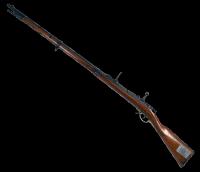
The Mauser Mark 71
The weapon the Volunteers were using was almost certainly the Mauser Model 71, the weapon of most Volunteers and Irish Citizen Army during the Rising; 1,500 had been been delivered in two landings in July 1914, first at Howth, north Dublin and then at Kilcoole, Wicklow. It had been the first cartridge rifle adopted by the Prussian Army in 1872 which by 1914had gone on to another more advanced model, presumably the reason that the rifle was being sold cheaply. The Model 71 fired a larger bullet than the British Army standard-issue Lee Enfield .303 but did not have a magazine, each cartridge having to be ejected and anew one inserted before firing again; its rate of fire was only four or five rounds a minute. The Lee Enfield took a ten-bullet magazine and the British Army were trained to fire fifteen rounds a minute. Despite this, the occupants in Clanwillian House and in No.25 in particular were able to lay down a tremendous rate of fire. Their guns grew so hot they burned to the touch and they had to cool them with wet rags. Down below, British officers blew their whistles and soldiers carried out more charges, only to be cut down by the Volunteers’ rifle fire.
During the late afternoon, a nurse ran on to the road and began treating the wounded British soldiers. The Volunteers agreed to a ceasefire as doctors and nurses from Sir Patrick Dunne’s hospital nearby went into Northumberland Road. But after a while the British attempted to use the ceasefire to advance their positions and the Volunteers ended it. Those wounded still to be tended lay where they were. This had been very different situation to what was to be seen in other areas of Dublin during the Rising, when British troops refused to allow wounded to be taken out unless the insurgents surrendered and when they accused Nurse Elizabeth Farrell of being a spy and tore her Red Cross bib–front off her.
The British got a machine gun up to the bell-tower of the church on Haddington Road so that they could fire over the roofs of the houses at Clanwilliam House, the bullets knocking chips off the outer walls and zipping through windows. They were also being backed by rifle snipers.
British soldiers recommenced attacking No.25, now with hand grenades as well as rifle fire. Finally they got close enough to blow the door in with explosives but incredibly were fired upon from inside as they tried to gain entry, injuring a number of them. Theyhurled grenades in and after they exploded, dashed in again. Coming down the stairs to meet them was Volunteer Lieutenant Michael Malone, his pipe in his mouth and was shot dead.
Section Commander James Grace had been downstairsusing a cooker as cover from bullets and shrapnel and such was the bomb damage to the room that the British assumed anyone in there had to be dead. There was still plenty of fighting to do – they had not even crossed the Canal yet.
If they believed that two men alone had held out against repeated assaults for four hours and had inflicted such damage upon them, they must have been very fearful leaving No.25. But perhaps they thought there had been others who must have escaped in the last minutes. James Grace did escape to get out of the area after lying low for some hours; however he was arrested some days later.
With No.25 taken, the Sherwood Foresters are soon able to take the Parochial Hall but they find it empty.The garrison of four Volunteers had run out of rifle ammunition and evacuated into Percy Place, where British troops, who were now all around the area, captured them.
An officer takes Volunteer Joe Clarke‘s loaded pistol off him, puts him with his back to a door and fires at him. Missing Joe, the bullet goes through the door to where a doctor is attending to injured British soldiers. He storms out in rage, berating the officer and Joe Clarke’s life is saved (he continued active in the IRA and in Republican politics nearly until his death in 1976 at the age of 94).
British soldiers are occupying nearby houses for cover and for firing positions and they are also crouched behind the low wall along Percy Place. They are still being hit. Now, they attack the Schoolhouse from its front, running across enfilading fire from Clanwilliam House to their left as they attack and from other positions to their front. When they enter, they find the Schoolhouse unoccupied by any Volunteer, alive or dead. However, their storm of bullets during the attack has riddled the bodies of its caretaker and his wife.
The cost to the British has been enormous but they have at last taken the southern side of the Canal around Mount Street Bridge. Across it, waiting for them, is Clanwilliam House. And to the east, their right-hand side, snipers at Boland’s Mill and nearby positions are also firing at them.
Now the officers order forward their reserves who had been sheltering in St Mary’s Road. The soldiers charge for the Bridge, answering to their discipline and their officers as they and many like them will do across the WWI battlefields of Europe, Greece, Turkey and Russia for another three years. It is partly against this slaughter that James Connolly led the men and women of the Irish Citizen Army out this week. One of the ICA’s detachments is not far away, under the command of Michael Malin and Constance Markievicz, in the College of Surgeons on the side of Stephens Green and they have already taken casualties.
Despite the covering fire from the Vickers Machine Gun firing incendiary bullets from St Mary’s Church, this charge too is driven back, their casualties adding to the pile of khaki-clad bodies and wounded on Northumberland Road, the Canal banks and the Bridge.
Around 8pm,the British are finally across Mount Street Bridge. An officer was in the charge, one of their few unwounded, and is at Clanwilliam House’s outer walls. Firing continues from the windows of this last insurgent bastion and from the east, a hail of Mauser death is still hitting the Bridge and the northern side of the Canal.
The British are now close enough to throwgrenades but one, thrown by a British NCO, bounced back from a second floor window and exploded next to his head, killing him. The British begin to make their way into the now-burning Clanwilliam House but are forced to retreat by the flames, leaving the fire to consume the bodies of the presumed dead Volunteers inside. They will not know now how many there were. In fact,there were only seven Volunteers, three are dead and the remaining four have escaped out the back.
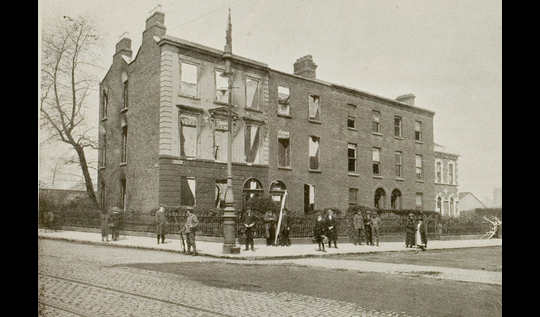
Clanwilliam House after the RisingThe four survivors of the Clanwilliam House garrison.
Ninety-nine years ago in the Battle of Mount Street Bridge, despite having only single-shot rifles and some pistols, the Volunteers held off two British Battalions, numbering approximately1,600 between them, for five hours. Approximately 234 men (including 18 officers)of the British Army had become casualties at the hands of fifteen insurgents.
Mount Street Battle Monument on the BridgePart of the memorial on the south side of the canal. (Photo D.Breatnach)
CATHERINE BYRNE, DUBLIN TD, SAID “WE SHOULD TAKE BACK OUR FLAG”. MAYBE SHE’S RIGHT ….
Dublin South-Central TD Catherine Byrne was warmly applauded when she said that they should ”take back our flag” from people who have been using it in protests against water charges and other issues. She made the statement at the Fine Gael political party’s two-day conference in Castlebar, Co. Mayo, held under strict security.
Arts Minister Heather Humphreys supported that view and told delegates in a secret session on the 1916 commemorations (a session which exposed divisions in the party): ”Some have used our flag to portray a different message – it’s time to reclaim our flag.”
Your Most Exalted Majesty, Queen of the United Kingdom of Britain and Northern Ireland, Commander-in-Chief of the UK Armed Forces, Head of the Church of England, Queen of the Commonwealth.
We trust this letter finds your Highness well, as we do also with regard to Your Highness’ large family and of course your trusted corgis.
I am tasked with writing to yourselves in order to make some embarrassing admissions and to ask your Royal forgiveness.
No doubt your family carries the memory of an uprising in Dublin in 1916? Yes, of course one’s family does, as your Highness says. Well …. the embarrassing thing is this ……. it’s so difficult to say but no amount of dressing up is going to make it better so I’d best just come out with it: that was us. Yes, it’s true.
Not just us, of course. There were a load of Reds in green uniforms too, Connolly and Markievicz’s lot. And of course our female auxiliaries, and the youth group. But most of that rebellious band was us, the Irish Volunteers. I can’t adequately express to your Highness how ashamed we are of it all now. Your government of the time was quite right to authorise the courts-martial of hundreds of us and to sentence so many to death. Your magnanimity is truly astounding that only fifteen were shot by firing squads and that Casement fellow hanged.
But were we grateful? Not a bit of it! Does your Highness know that some people still go on about that Red and trade union agitator, James Connolly, being shot in a chair? What would they have your Army do? Shoot him standing up? Sure he had a shattered ankle and gangrene in his leg! One can’t please some people – damned if one does something and damned if one doesn’t. If the Army hadn’t kindly lent him a chair, those same people would be saying that the British wouldn’t even give him a chair to sit on while they shot him.
And how did we repay your Highness’ kindness and magnanimity in only executing sixteen? And in releasing about a thousand after only a year on dieting rations? By campaigning for independence almost immediately afterwards and starting a guerrilla war just three years after that Rising! A guerrilla war that went on for no less than three years. Your Majesty, we burn with shame just thinking of it now!
Our boys chased your loyal police force out of the countryside, shot down your intelligence officers in the streets of Dublin, ambushed your soldiers from behind stone walls and bushes ….. but still your Highness did not give up on us. Some people still go on and on about the two groups of RIC Auxiliaries and the things they did, referring to them by the disrespectful nicknames of “Black and Tans” (after a pack of hunting dogs) and “Auxies”. They exaggerate the number of murders, tortures, arson and theft carried out by them. Of course, your Highness, we realise now, though it’s taken a century for us to come to that realisation, that sending us that group of police auxiliaries was a most moderate response by yourself. But we were too blind to see that then and shot at them as well!
And that fellow Barry and his Flying Column of West Cork hooligans, wiped out a whole column of them. Your Highness will no doubt find it hard to believe this, but some troublemaker even went so far as to compose a song in praise of that cowardly ambush! Oh yes, indeed! And some people still sing it today – in fact they sing songs about a lot of regrettable things we did, even going back as far as when we fought against your Royal ancestors Henry and Elizabeth 1st! Truly I don’t know how your Highness keeps her patience.
Then we went on and declared a kind of independence for most of the country but …. some of us weren’t even satisfied with that! It was good of you to have your Army lend Collins a few cannon and armoured cars to deal with those troublemakers.
And then some time later, even after those generous loans, some of us declared a Republic and pulled the country (four fifths of it, at any rate), out of the Commonwealth. Left the great family of nations that your Highness leads! Words fail me ….well almost, but I must carry on, painful though it is to do so. A full confession must be made – nothing less will do. And then, perhaps …. forgiveness.
Of course your government held on to six counties …. You were still caring for us, even after all our ingratitude! It was like hanging on to something left behind by someone who stormed off in an argument – giving them an excuse to come back for it, so there can be a reconciliation. How incredibly generous and far-sighted of your Majesty to leave that door open all that time!
Fifty years after that shameful Rising, it was celebrated here with great pomp and cheering, even going so far as to rename railway stations that had perfectly good British names, giving them the names of rebel leaders instead. Then just a few years later, some of our people up North started making a fuss about civil rights and rose up against your loyal police force, forcing your government to send in your own Army. And was that enough for the trouble-makers? Of course not – didn’t they start a war with your soldiers and police that lasted three decades!
No doubt your Majesty will have noted that some of those troublemakers have changed their ways completely and are in your Northern Ireland government now. They’ve been helping to pass on the necessary austerity measures in your government’s budgets, campaigning for the acceptance of the police force and for no protests against yourself. Indeed, their Martin McGuinness has shaken your hand and rest assured were it not considered highly inappropriate and lacking in decorum, he would have been glad to kiss your cheek, as he did with Hillary Clinton when she visited. Or both cheeks, in your Majesty’s case! Your Majesty can see, I hope, that we can be reformed.
Our crimes are so many, your Highness; and we have been so, so ungrateful. But we were hoping, after you’d heard our confession, our humble apologies, after your Highness had seen how desperately sorry we are, that you’d forgive us. And if it’s not too much to hope for, that you’d take us back into the United Kingdom. Reunite us with those six counties, and so into the Commonwealth. Is there even a tiniest chance? Please tell us what we have to do and we’ll do it, no matter how demeaning. Please?






 There were many police but nothing was happening and Larkin did not appear. After a while, a horse-drawn carriage drove up and an elderly church minister alighted, assisted by a woman, and entered the shop. They took the lift to the restaurant floor. A little later Larkin appeared at the restaurant open window, in church minister’s clothing, spoke a few words to the crowd and ran inside. Those in the street were very excited and when the police took Larkin out under arrest, they cheered him, urged on by Constance Markievicz. The police drew their batons and attacked the crowd — any man not wearing a police uniform.



 rebelbreeze