In London in 1847 (i.e the worst year of the Great Hunger — Editor Rebel Breeze), though images of the suffering and starvation in Ireland appeared in newspapers, few upper class British people were moved to help. One exception to this indifference was a Polish count who became a naturalized British subject, Paul (Pawel) Strzelecki. A new exhibit at the Royal Irish Academy in Dublin: A Forgotten Polish Hero in the Great Irish Famine, Paul Strzelecki’s struggle to save thousands, honours this selfless Pole who helped feed at least 200,000 starving people in the west of Ireland. Created by Nikola Skowska-Moroney at the Polish Embassy in Dublin, the exhibition will be part of a nationwide tour at various venues throughout the country.
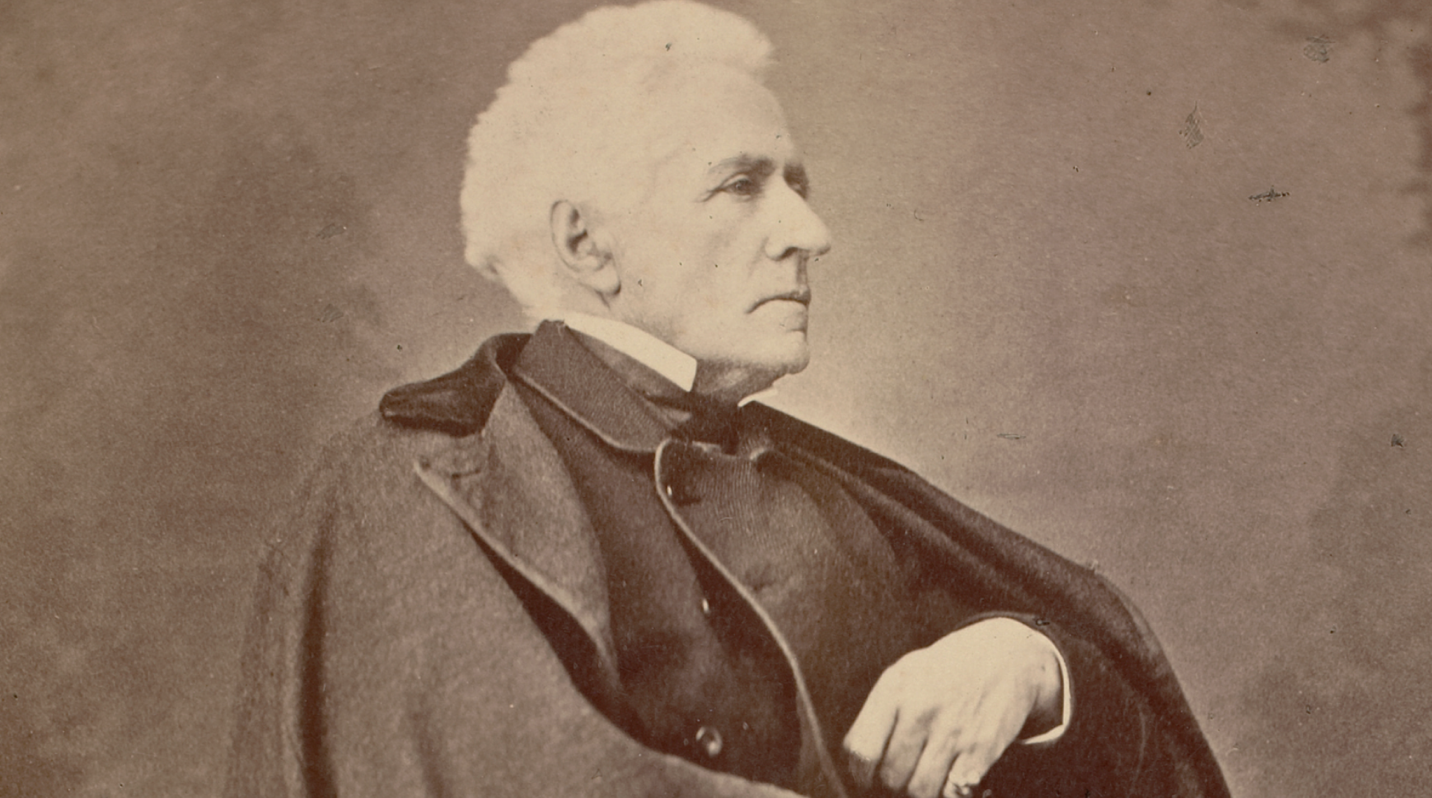
An older Paul Strzelecki
Strzelecki was not only a great humanitarian, but also a fascinating character in his own right. Born into a minor aristocratic family, he served in the Prussian army and had his heart broken when the family of the young woman he had fallen in love with refused his offer of marriage on account of his modest means. Crushed, he decided to leave Poland and traveled the world, visiting Africa, North and South America before traveling to Polynesia and Australia. He became a self-taught scholar in geography, geology and anthropology and corresponded with Charles Darwin. In Australia, he climbed the continent’s highest peak, naming it for the great Polish revolutionary Tadeusz Kosciuszko and explored Tasmania. He became a British subject in 1845 and published his Physical Description of New South Wales and Van Diemen’s Land, for which he received the Founder’s medal of the Royal Geographical Society.
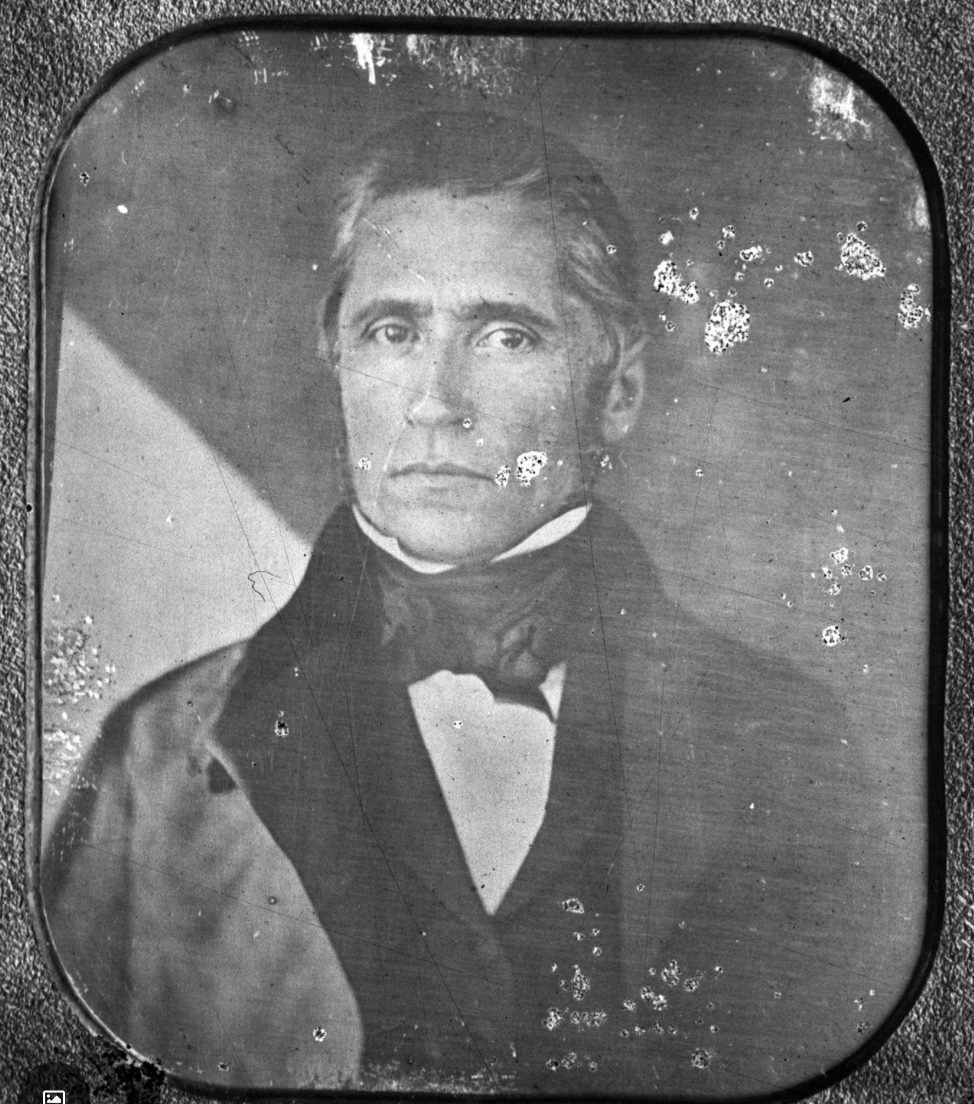
Paul Strzelecki
In 1845, he returned to London where he became friendly with Samuel John Lloyd, an associate of the powerful banker Baron Lionel de Rothschild. The two bankers, moved by the suffering of the Irish, founded the British Relief Association, which collected money for famine relief. Strzelecki volunteered to go to Ireland as an unpaid agent of the B.R.A. Traveling across the famine stricken land, Strzelecki was shocked by the suffering and death he saw around him. In Co. Mayo, Strzelecki organized soup kitchens and gave cash to relief committees. He focused much of his relief work on children. Strzelecki decided to stay in Ireland because, unlike others, he correctly predicted that famine would return to Ireland the following year. The B.R.A. named Strzelecki as agent for all of Ireland and he helped the hungry until the organization’s funds were depleted. He then returned to London where he pled for further funds and explained that humanitarianism must take precedence over every other consideration. In 1849, he again returned to Ireland where he tried to feed the hungry.
Strzelecki also helped many Irish families to emigrate to Australia and the United States. His efforts were recognized by the Crown and he was knighted in 1849. For many years Strzelecki’s heroism was forgotten, but the Polish Embassy in Ireland has sponsored the exhibition to remind Ireland of this great Polish humanitarian. Hopefully, Strzelecki’s story will resonate both with the Irish and with the many Polish people who now call Ireland home and bond the two groups closer together.
End.
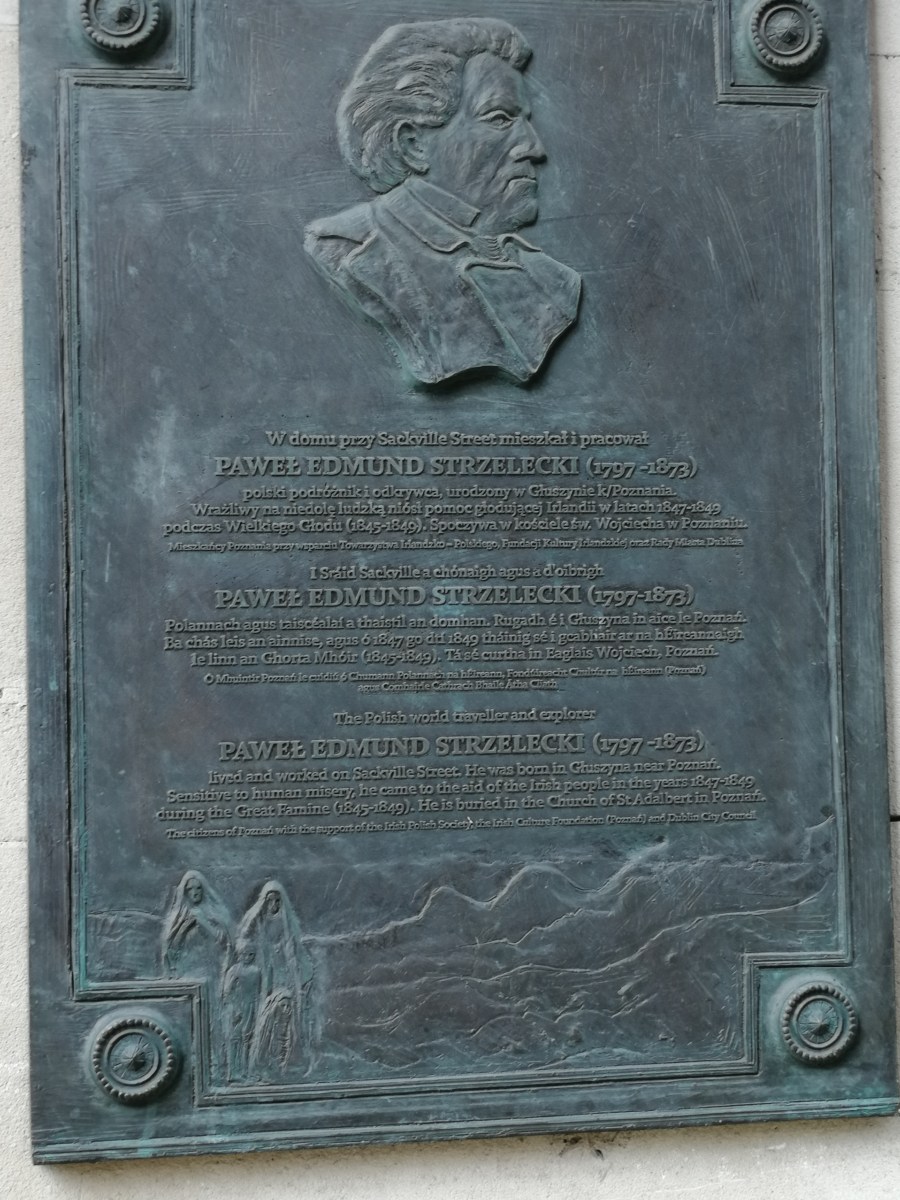
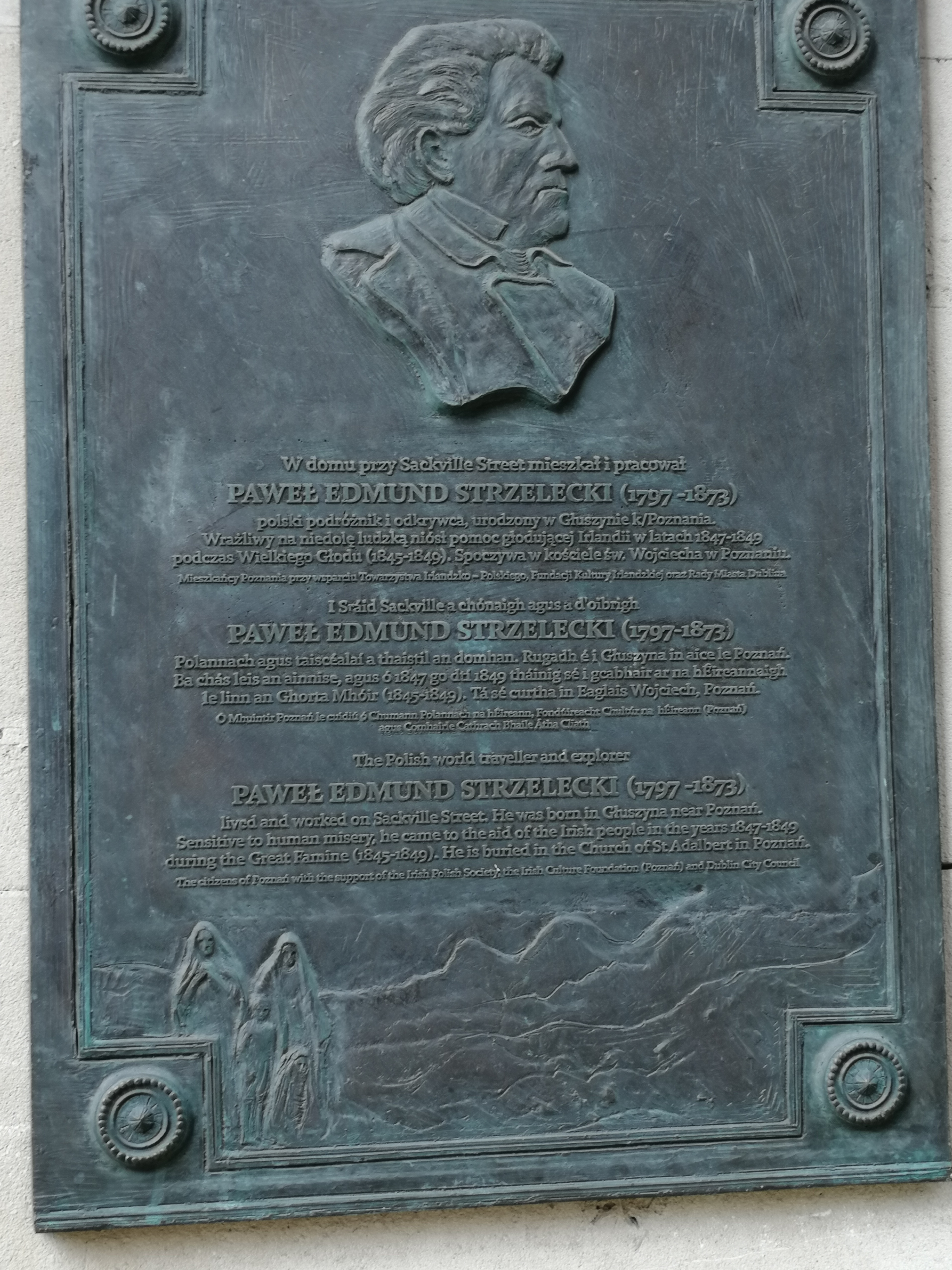
Postscript from Editor Rebel Breeze: There is a plaque in Dublin commemorating this man on the side of the Clery’s building in Sackville Place, at the corner with O’Connell Street. Do our readers know of any other such plaques or monuments to him, for example in Mayo?
Plaque Sackville Place Polish Count Paul Strzelecki (Photo: D.Breatnach)
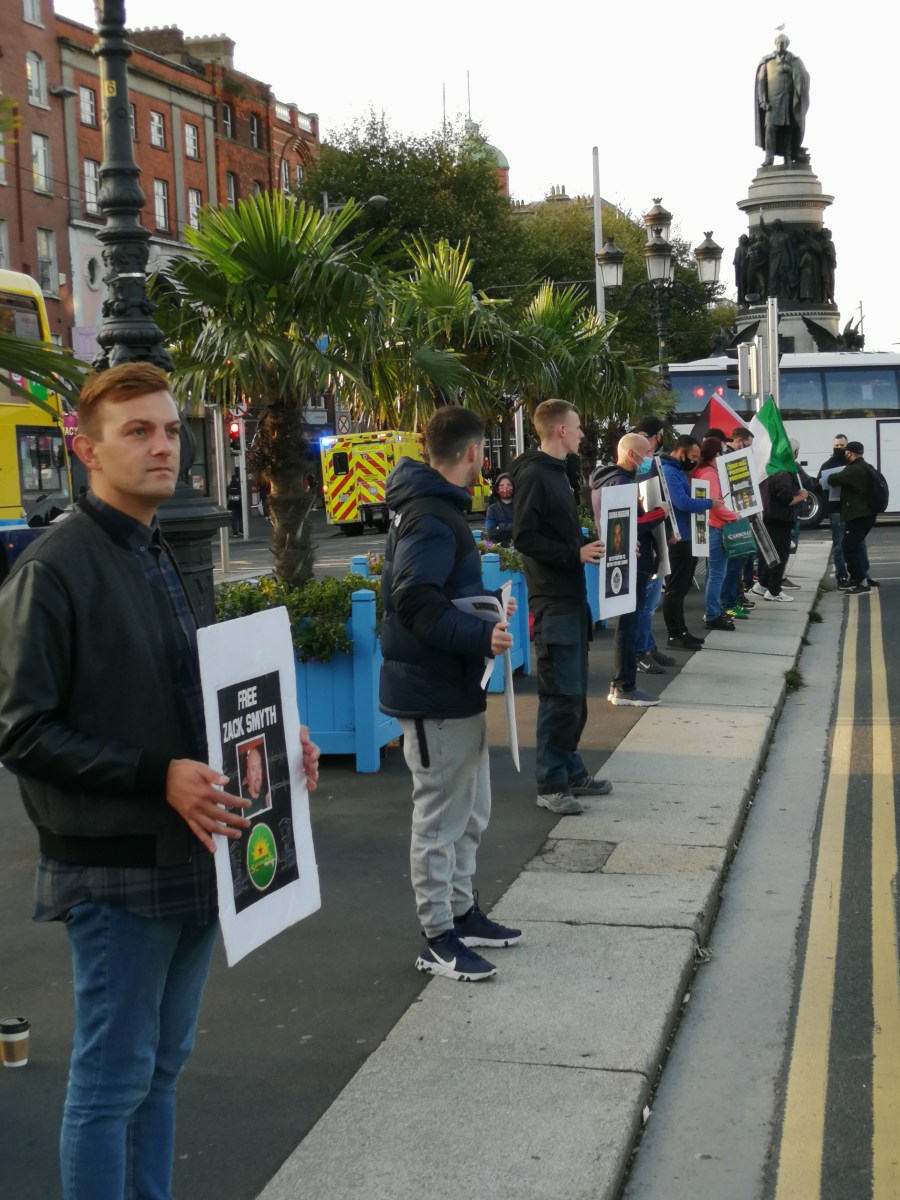
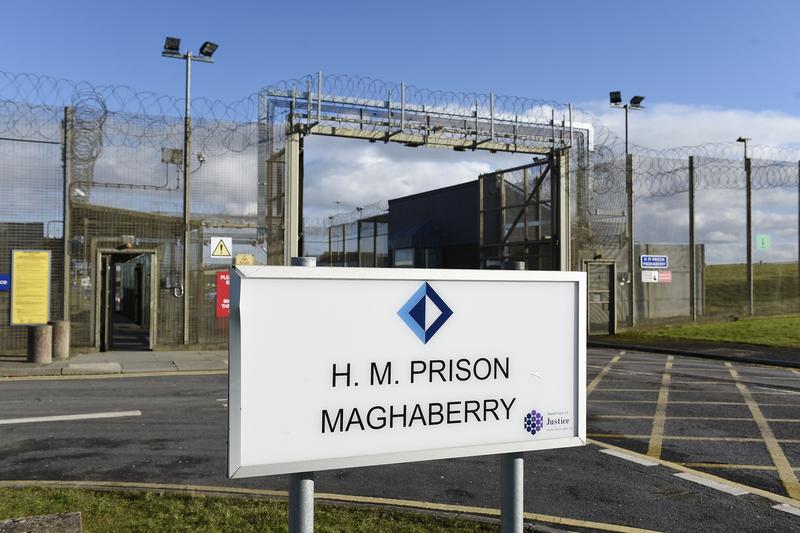
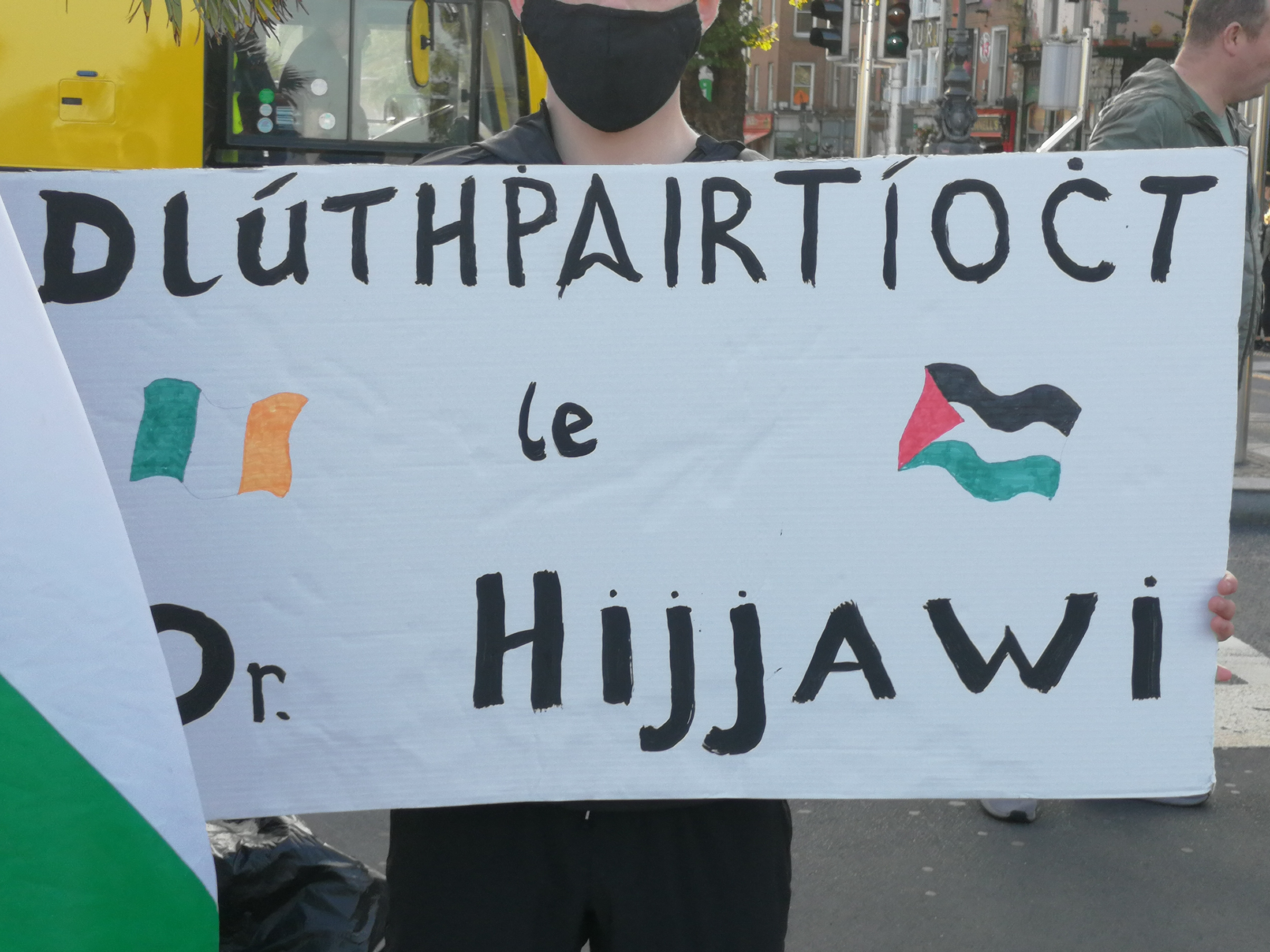
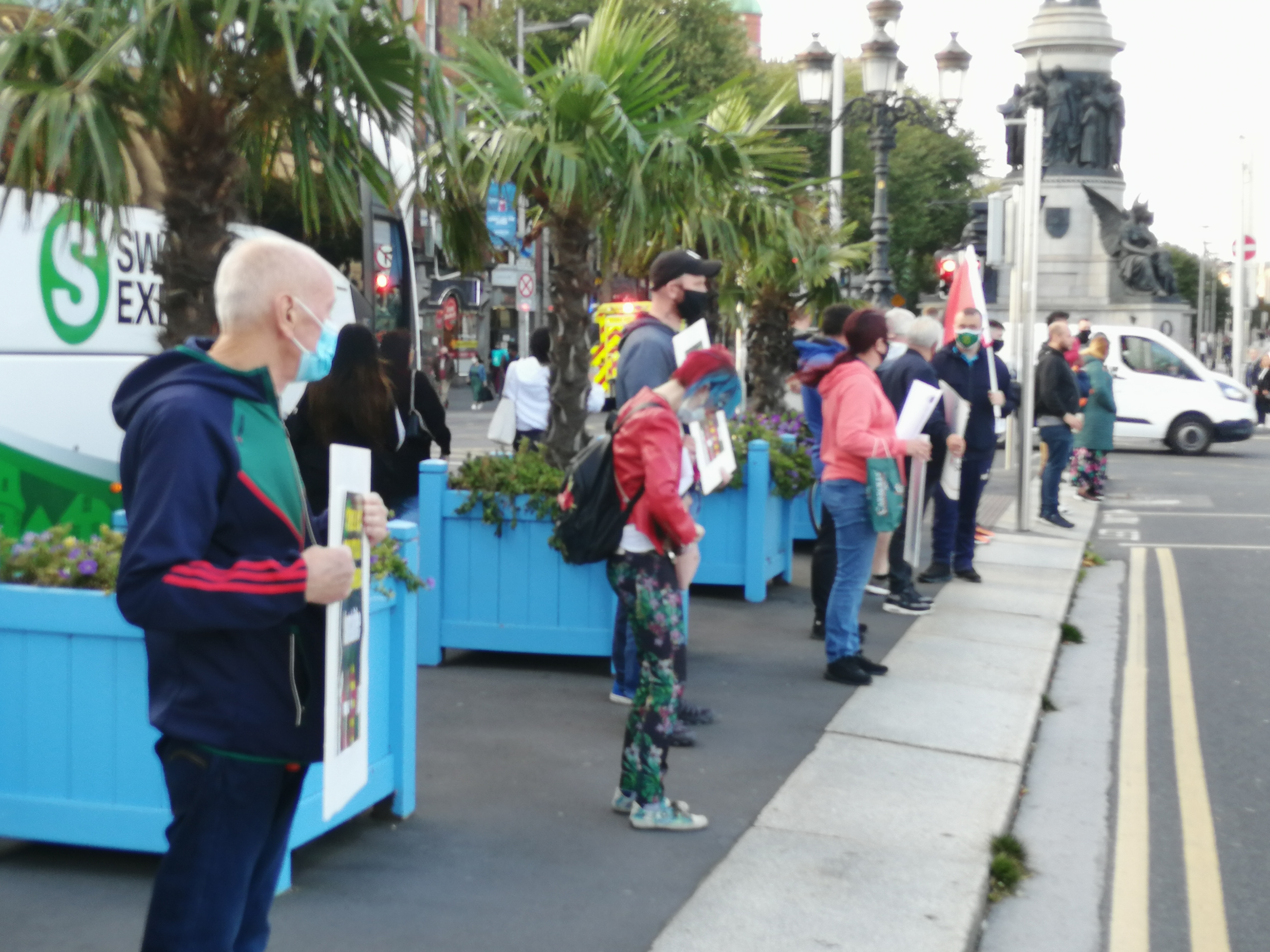
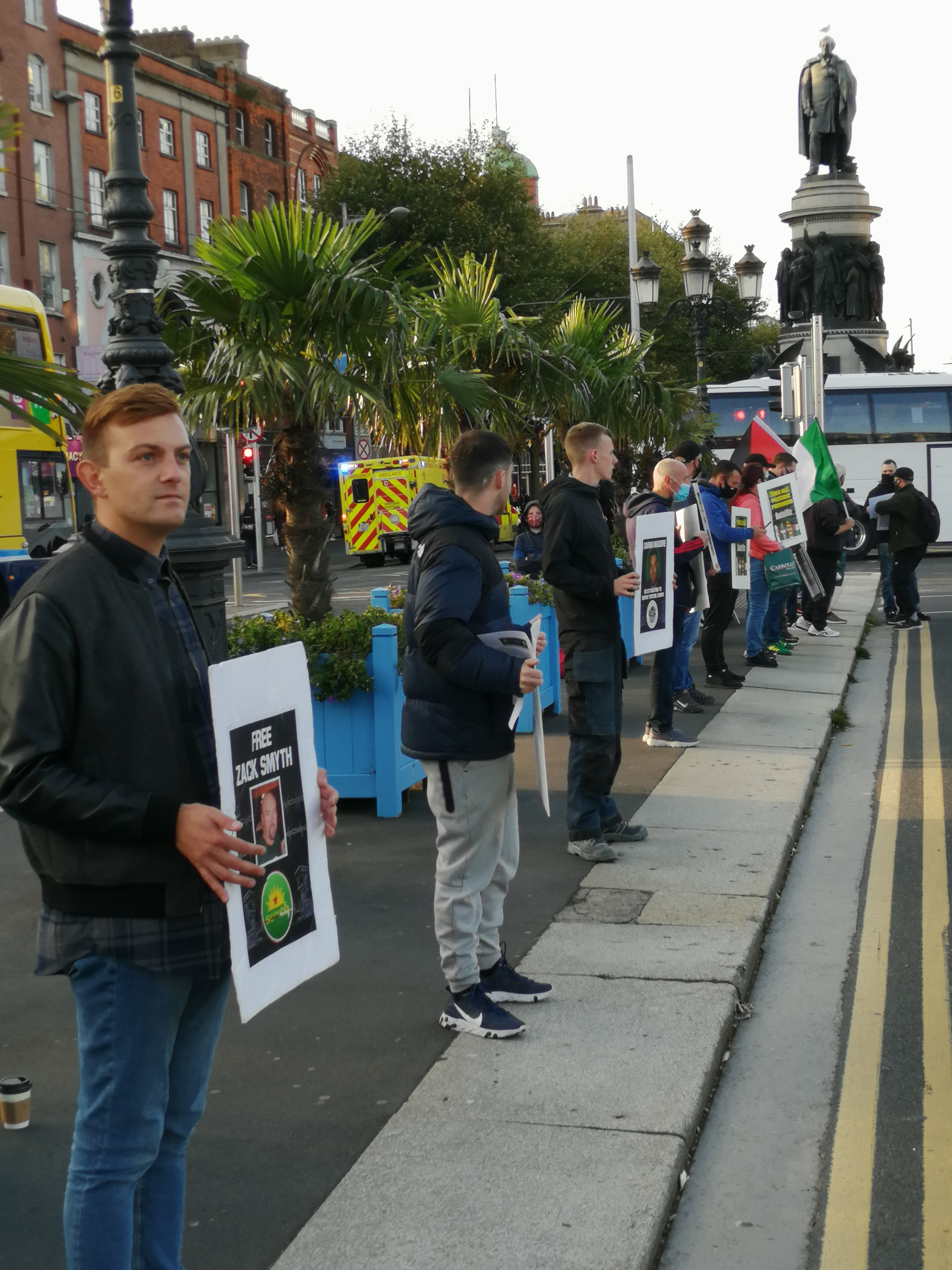
Around 30 Irish Republican prisoners in Roe House, a wing of Maghaberry Prison in Co. Antrim (occupied Six Counties) and in Portlaoise Jail in the Irish state announced a two-week hunger strike on Wednesday 16th in solidarity with Dr. Issam Hiijawi, a Palestinian, who is also on hunger strike within Maghaberry jail. Over 30 attended a solidarity picket this evening in Dublin, which was harassed by Garda Special Branch.
(Source photo: Internet)
A number of Irish Republicans in the Six Counties were arrested some weeks ago in what was admitted to be an operation fed by MI5 intelligence and which involved entrapment with a British agent named in a number of reports as Dennis McFadden. Dr. Issam Hiijawi, a Palestinian, was arrested along with them.
All the arrested were remanded in custody and went through solitary confinement in a different block to the usual one for Republican prisoners, allegedly for Covid19 quarantine but have been back in Roe House for some time. Dr. Issam Hiijawi had been waiting for an MRI scan due to his medical condition but, after finally being taken to an outside hospital for the scan, was returned to solitary confinement once again upon his return to the prison. This is in Foyle House, which the prisoners describe as “filthy and dilapidated” and point out that Dr. Hiijawi could easily have been quarantined in Roe House, in communication with other political prisoners but was not permitted to do so. The prison guards who accompanied him to the hospital are under no restrictions. Vindictive harassment and oppression and not health requirements appear to be the real motivation here and Dr. Hiijawi went on hunger strike.
The Irish Republican prisoners of Maghaberry Jail, Roe House and Portlaoise Jail landings E3 and E4 said in a statement that Dr. Hiijawi has been subjected to “concerted, petty targeting ……. since entering Maghaberry” and took their action in solidarity with him. The IRPWA called on “the Maghaberry regime to step back from confrontation and apply common sense by transferring Issam to Roe House ….”
Banner in Irish on the Dublin picket (Source photo: D.Breatnach)
DUBLIN PICKET HARASSED BY POLITICAL POLICE
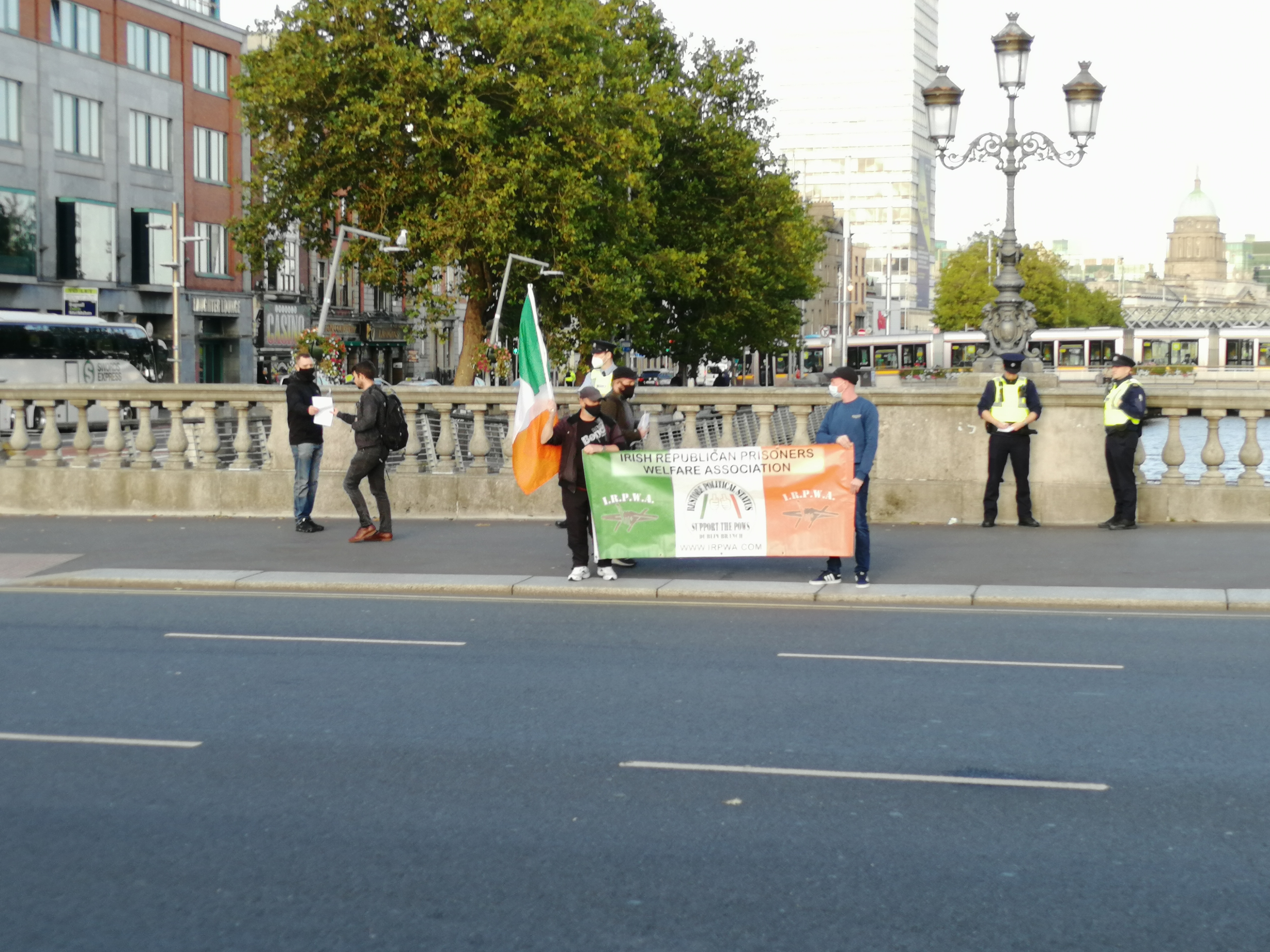
Over 30 Irish Republicans and independent socialists responded to a short-notice call by Saoradh and the Irish Republican Prisoners’ Welfare Association to assemble in Dublin to highlight the hunger-strike. The picket was held on O’Connell Bridge and received some support from passing vehicle drivers and pedestrians, with others interested in reading the leaflet being distributed or hearing the reason for the picket.
A small section of the picket on the other side of the road. (Source photo: D.Breatnach)
A section of the picket (Source photo: D.Breatnach)
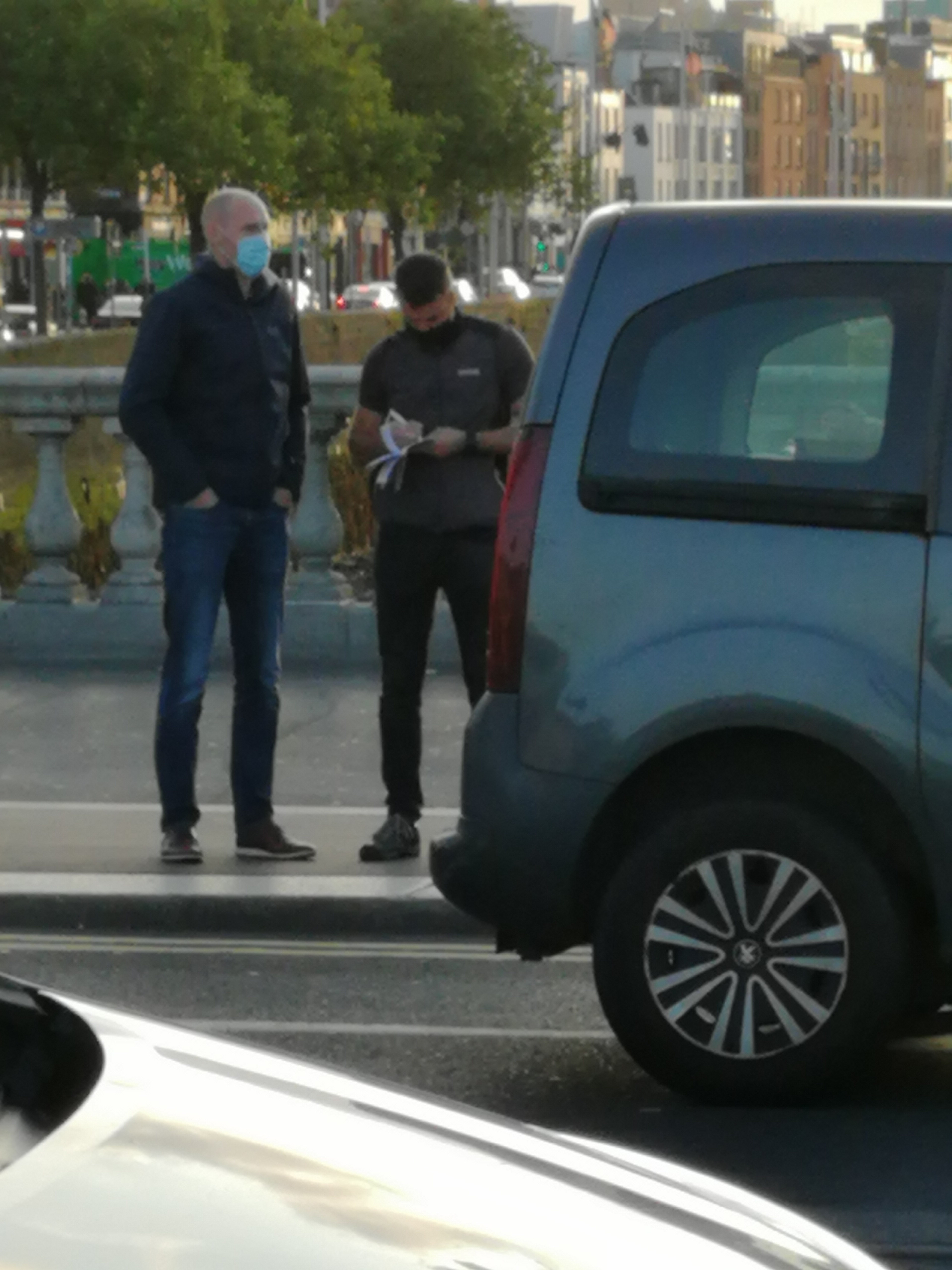
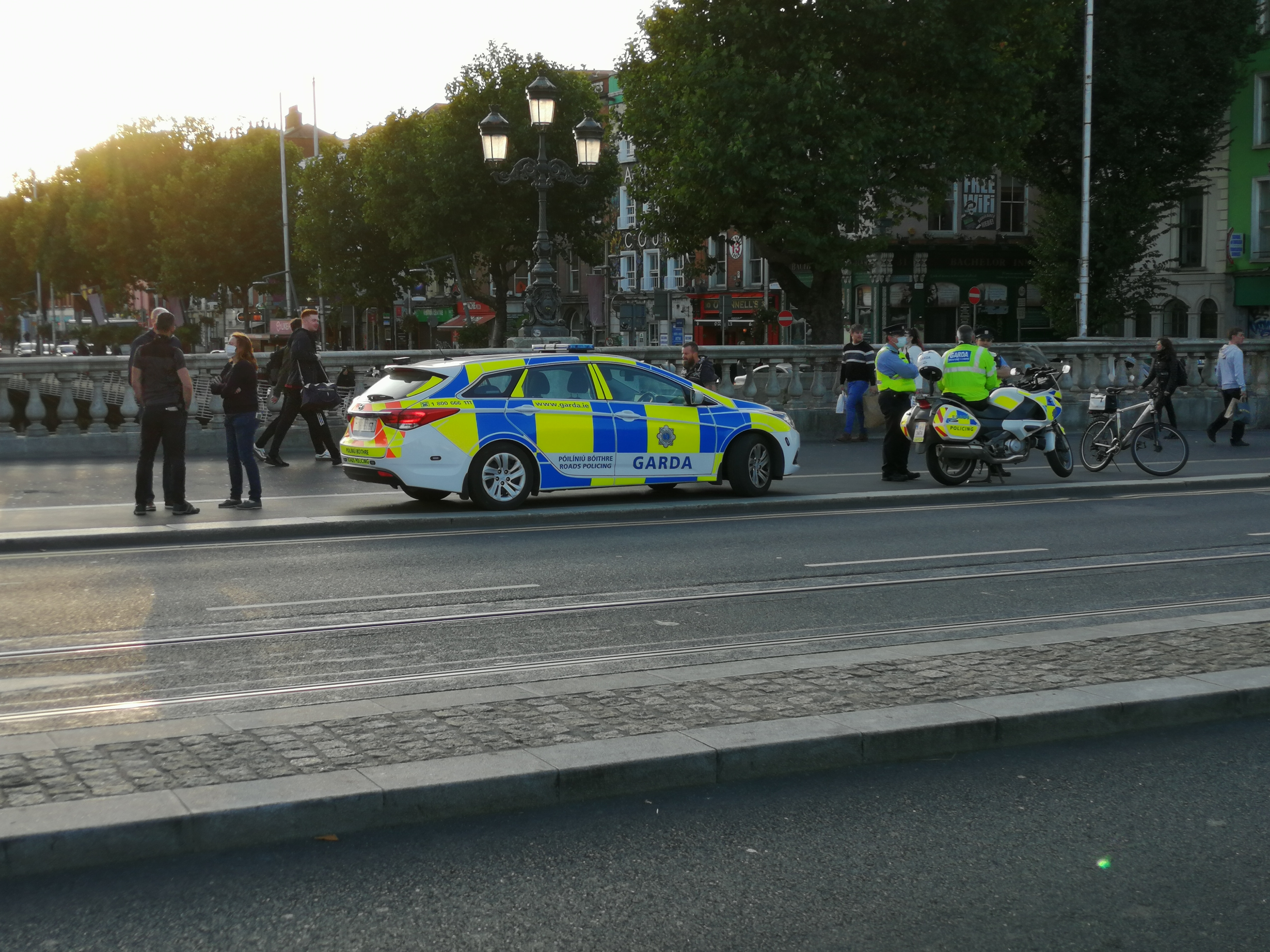
There were a number of uniformed Gardaí hanging around on both sides of the Bridge, including some in plainclothes, i.e the specifically political section known as “the Special Branch”. It was not long before two of the latter force began to accost picketers, demanding their names and addresses under threat of arrest if they refused, under the Offences Against the State Act. This Act is supposed to be used by the police to prevent a crime being committed but these Branchmen were using it to build up profiles on peaceful and legal political activists and also as an act of intimidation.
Two Special Branch officers who had been harassing the pickets. (Source photo: D.Breatnach)
Some of the Gardai in the vicinity of the picket, including three Special Branch officers. (Source photo: Internet)
Picket looking northward towards O’Connell St. (Source photo: D.Breatnach)
Some passers-by took notice when one of the picketers began to shout out to them explaining what was happening but the Branchmen just ignored him and carried on filling their notebooks.
The Dublin protest was the first on this issue but others are planned in various towns and cities in Ireland, in particular in the occupied Six Counties.
An antifascist and anti-racist march in Dublin on Saturday 12th September ended without any major incident. However a handful of counter-protesters who attended a negationist protest outside Leinster House were assaulted by a mob of fascists, a woman being struck on the head with a blunt object causing an injury requiring hospital treatment. Photographs and some video footage shocked many as the Gardaí were seen to take no action against the assailants and instead, to usher the counter-protesters further away from the fascists, with a woman bleeding copiously from her head.
Left: Ms Izzy Kamikaze being pushed by Gardai down Kildare Street after being struck on the head with a club by a fascist. Right: Closeup (Photos sourced: Internet)
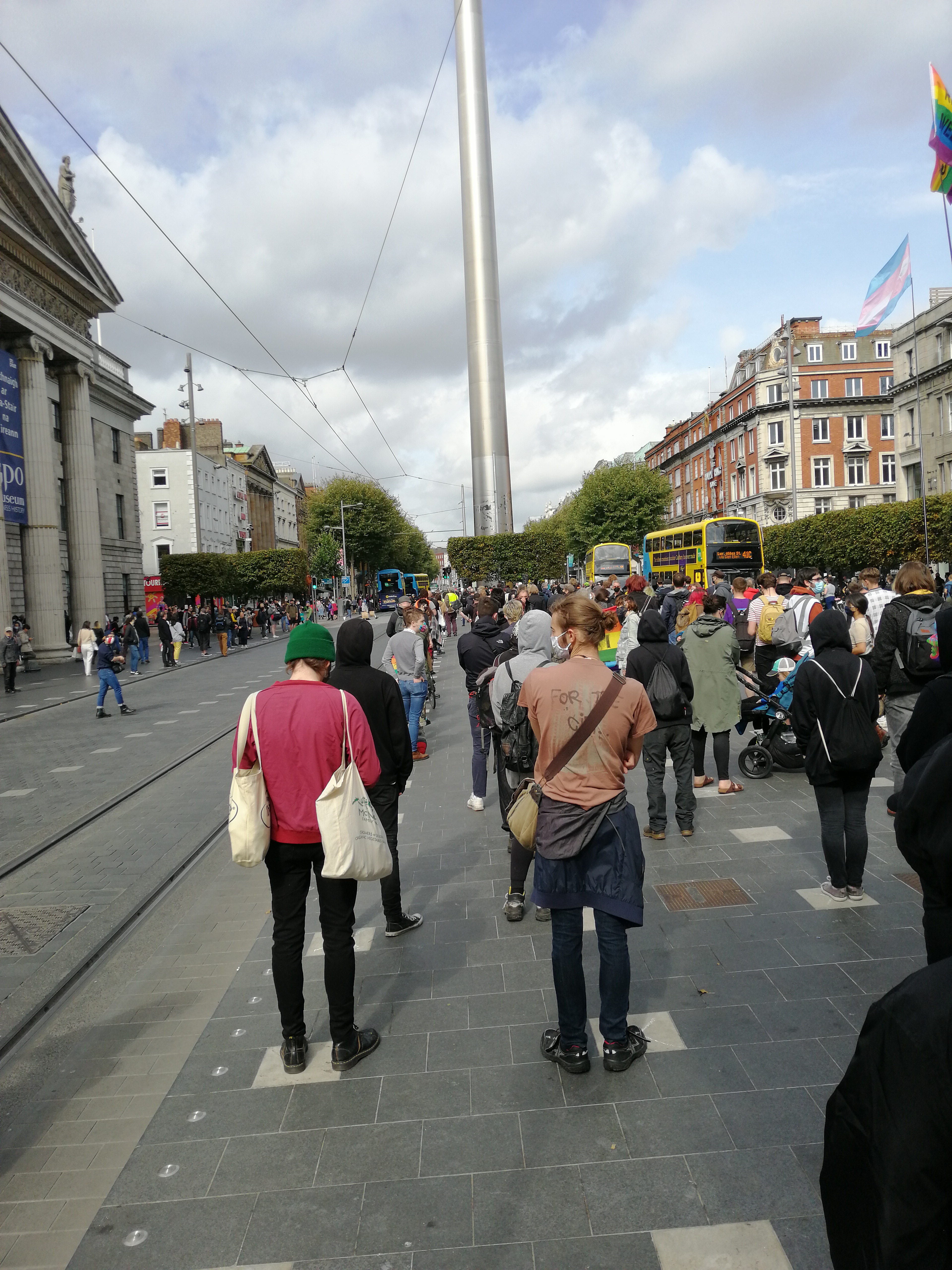
View of the antifascist rally northward (Photo: D.Breatnach)
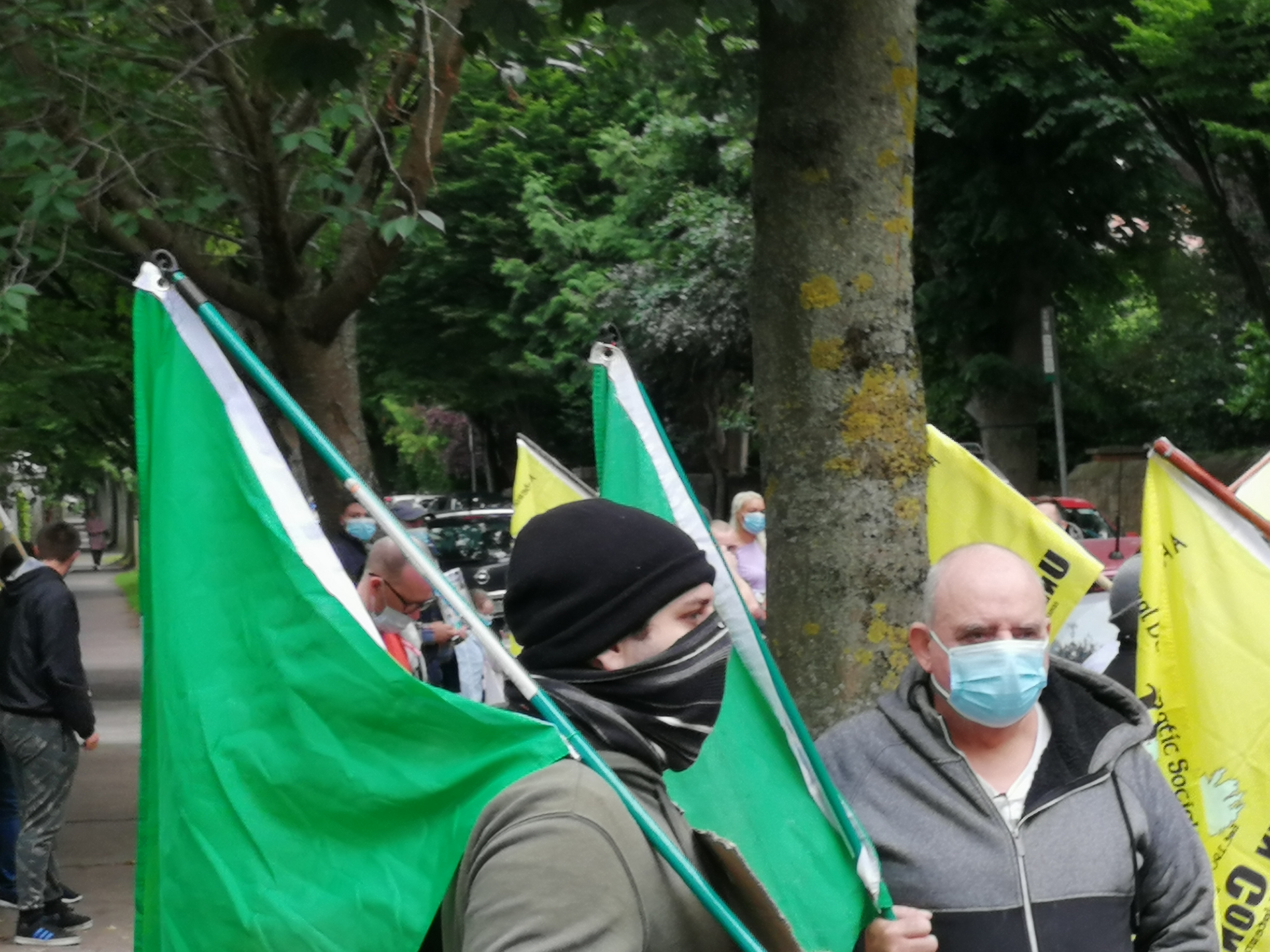
The Irish Yellow Vests, led by notorious islamophobe Glen Miller and the fascist Catholic fundamentalist and racist organisation Síol na hÉireann, led by Niall McConnell, cooperated in staging a rally and march from Custom House Quay to Government Buildings in Merrion Street. Custom House Quay was the scene of another IYV-organised event on 22nd August when a counter-protest of men and women was attacked by mob of masked and often gloved men (supporting an anti-mask rally!), many armed with clubs and metal bars. On that occasion too the Gardaí had arrested none of the attackers but pushed and shoved the counter-protesters away, threatening them with uplifted batons. On that occasion too a counter-protester had required hospital treatment, having been knocked unconscious.
The anti-fascist demonstration on O’Connell Street was called by the United Against Racism organisation and the People Before Profit/ Anti-Austerity Alliance and, since it had received threats of attack from fascists, it was supported too by independent antifascist activists from Anarchist, Republican and Socialist backgrounds.
(Photo: D.Breatnach)
(Photo: D.Breatnach)
A number of speakers addressed the rally though the sound did not carry very well towards the rear of the rally but also many were distracted by keeping an eye out for fascists. One IYV activist approached the rally to photograph participants and soon got into an altercation with them, whereupon Gardaí arrived and removed him to the side of the road. Another brandished a placard, which was promptly seized by antifascists and torn. Some fascists were seen passing by, presumably on their way to Custom House Quay or Leinster House – one was observed carrying a thick length of wood with the Irish Tricolour attached to it — but did not engage with the antifascists.
A view southward of the anti-fascist rally (Photo: D.Breatnach)
The “Refugees Welcome” flag accompanies the Irish Tricolour and Transgender flags with the GPO and its Tricolour in the background. The Proclamation read out in front of that building in 1916 included the words: “The Republic guarantees civil and religious freedom to all ….” (Photo: D.Breatnach)
Across on the other side of the road, at the corner with Princes Street, two or three older people had set up a couple of banners protesting about ill-treatment of the elderly in nursing homes — an entirely justified cause for protest however it is known to have been adopted by the Far-Right in Ireland. A very high proportion of Covid19 deaths in Ireland were in nursing homes and linked to Covid19 infection through lack of effective controls, which is a strange issue for the Far-Right to embrace since they variously claim that Covid19 is a hoax or that it is not at all a serious virus.
LED BY FAKE PATRIOTS BUT REAL FASCISTS
The rally on Merchants Quay, organised by the Irish Yellow Vest seemed somewhat larger than the one in O’Connell Street but a number were brought in from other parts of the country. Their promotional video showed the crowd being addressed in an energetic style by a man with a North American accent. His message was to refuse to wear masks, using exceptions permitted in the legislation, not to be afraid and to remain united. At one point he seemed to be arguing for anti-racism, which was somewhat bizarre while standing next to him was the mc of the event, Glen Miller, notorious racist and islamophobe.
After a little, the crowd formed up behind the colour party of Síol na hÉireann, a tiny fascist, racist and fundamentalist Catholic party from Donegal led by Niall McConnell. Apparently without any sense of irony, the party flew the Irish Tricolour, the “Irish Republic” flag and the golden Harp on a green field flag, with “Erin go bragh” (sic) of the Fenians.
The Tricolour signifies cooperation between Irish of different religions which, as we will see, is something McConnell will have no truck with; in addition the original pattern was sewn by French revolutionary women and presented to Thomas Meagher in 1848. Meagher was a member of the “Young Irelanders”, composed of Irish nationalists of both Protestant and Catholic religious backgrounds and he himself led a Union Army brigade in the American Civil War.
The Harp on a green field was modelled on the flag of the United Irishmen who rose against the British in 1798 and 1803 – nearly every one of their leaders was Protestant. The Fenians were a mixture of religious backgrounds (and perhaps none) and were excommunicated by the Irish Catholic hierarchy. The Fenians in England were accepted into the First Socialist International, led by Marx and Engels.
The “Irish Republic” flag was prepared in the home of Constance Markievicz for display in the 1916 Rising; she was a Socialist Republican and fought in the Rising as an officer in the Irish Citizen Army, the first working class army in the world.
March organised by Far-Right in D’Olier Street Saturday. (Photo sourced: Internet)
COLOUR PARTY LEADER REVEALS HIS TRUE COLOURS
Approaching the four Gardaí standing by a couple of unsecured crowd barriers at the end of the Quay, a little farce was played out in which the Gardaí seemed unwilling to move and then were “forced” to do so by the crowd. Those who have participated in protests over the years and seen the Gardaí in action and their barriers, when they truly wished to stop a march, would laugh to see the video recorded by the Far-Right of the event.
At a junction the procession stopped for people to catch up (some participants even complaining at Miller’s exhortation to give consideration to the elderly and children) and were addressed by a number of speakers. The man with the North American accent was in action again in revivalist style and Ben Gilroy, Miller’s lieutenant, also spoke. In a video during the week, Gilroy had minimised the Covid19 deaths by stating that all but 100 of them had been of people with underlying health issues. Given that according to the HSE over 30% of Irish people suffer from underlying conditions of ill-health, it was a shockingly uncaring statement to make in support of the negationist cause.
Here Niall McConnell spoke too, announcing himself as the leader of “Síol na hÉireann, a hard-line Catholic Irish nationalist party”, having the effrontery to quote, completely out of context James Connolly, revolutionary socialist and Republican. McConnell insisted that Ireland is for the Irish and, attacking the EU, hinted at the “Replacement” conspiracy theory, in which the EU is allegedly trying to replace Irish people with migrants. He also accused it of spreading “LGBT ideology”. “Ireland is a Catholic country”, he insisted and, in total contradiction to at least 220 years of recent history, ascribed the Catholic faith to the motivation of our ancestors in fighting for freedom. Then he got down on his knees and recited The Lord’s Prayer in Irish!
It was noticeable that only a small number followed him on to their knees and also that a number of his statements drew uncertain responses. Following his speech, Lorraine Eglinton of the Irish Yellow Vests spoke, stressing the need for unity, which might be taken as an implied criticism of McConnell for introducing religion and race into the equation or perhaps just for stating his beliefs so baldly at a shared event.
FASCIST ATTACK ON WOMAN COUNTER-PROTESTER
While the major part of the Irish Yellow Vests march went to rally outside Government Buildings in Merrion Street, a smaller group of maybe 40 or 50 people went to protest a block away outside Leinster House, seat of the Irish state’s Parliament. This was apparently a split in the Far Right.
If this split was trying to attract less fascist and racist people what followed was truly bizarre. A couple of people who attended in a counter-protest but at some remove were approached by Far-Right supporters who appeared to argue with them, which is recorded on video. This soon attracted a mob, some masked (!) and one of which can be seen grasping a length of wood attached to an Irish Tricolour. They begin to push the couple of counter-protesters roughly and then one of them strikes the woman on the head, opening a wound with much blood running down her face and knocking her to the ground. She regains her feet and continues to stand as Gardaí move in and gently usher the fascists back, making no attempt to arrest any of them and soon pushing the counter-protesters down the road.
The woman received hospital treatment later, being released the following morning. In a press release following the event the Gardaí reported that no arrests or serious incidents had occurred! When they were contacted by journalists and shown video taken at the scene they changed their story to say that “some demonstrators had to be separated” and ultimately changing it again to say that “they are investigating the incident” and “had not received a complaint”. Are the Gardaí saying that although they witness an assault, or at least the immediate aftermath of one, they can take no action unless they receive a complaint?
Ms Izzy Kamikaze, an LGBT campaigner and writer, who had received the head injury, said that she intended to make a complaint, not just about the assault but also about the behaviour of the Gardaí. Some photos have appeared on social media allegedly identifying two of the attackers by name and as members of the fascist National Party. According to media journalists, the Gardaí have video camera footage tracing one of the assailants also which would be no surprise as the area around Leinster House is one of the most highly covered by CCTV video cameras in Dublin.
A PATTERN OF GARDA COLLUSION
This is not the first occasion in recent times that the Gardaí have been accused of collusion with fascist violence. On July 11th a small counter-protest to the large homophobic rally outside Leinster House was physically attacked and their banners ripped without Garda interference for a period and, when they did intervene, arrested none of the assailants. On two different occasions fascists within the QAnon negationists outside the GPO attacked a peaceful counter-protester without being arrested by the Gardaí. However when, following these attacks, antifascists surged into the Qanon crowd, the Gardaí quickly intervened and arrested at least one of the antifascists. On August 22nd at Custom House Quay a mob of over 50 men, many of them masked and gloved (supporting an anti-masking rally!) and carrying wooden clubs and metal bars, attacked a peaceful smaller counter-protest and knocked one antifascist unconscious. A few Gardaí then gently shooed the fascists back while more, including the Public Order Unit, began to scream at the antifascists to get back, threatening them with raised batons and pushing them violently, knocking some over and preventing them from even assisting their unconscious comrade. Those scenes too were recorded on video and shared on social media, both by fascists glorying in their actions and by antifascists exposing the fascist violence and Garda collusion.
A Parliamentary Question about Garda behaviour to the Minister for Justice from Independents for Change TD Catherine Connolly was refused, she being told that this is an area within the competence of the Garda Commissioner.
“Whaaa ?” You wake up suddenly, wondering what was that noise. Your partner sits up beside you. The bedside clock says it’s 5 a.m While you’re still wondering what it was, there’s another crash. Your front door? “The children!” you think, jumping out of bed to protect them, as you hear men bursting into your house, running up the stairs ….. Too late, they’re in the doorway of your bedroom, shouting at you, at your partner, pointing guns at you … you can hear one of the children screaming ….
On Tuesday this week, 18th August, members of the Garda Armed Response Unit raided the homes of Irish Republicans in Dublin, Cork, Laois and Kerry, smashing through the front doors of their houses, frightening children ….
They took away laptops, phones, paperwork (including children’s school work and test results). In helpless rage or frightened, their victims could only watch ……. they were outnumbered and the invaders of their homes were armed.
Much more than an information-gathering exercise, this was a brutal act of State terror, to intimidate Republican activists, terrify their partners and children.
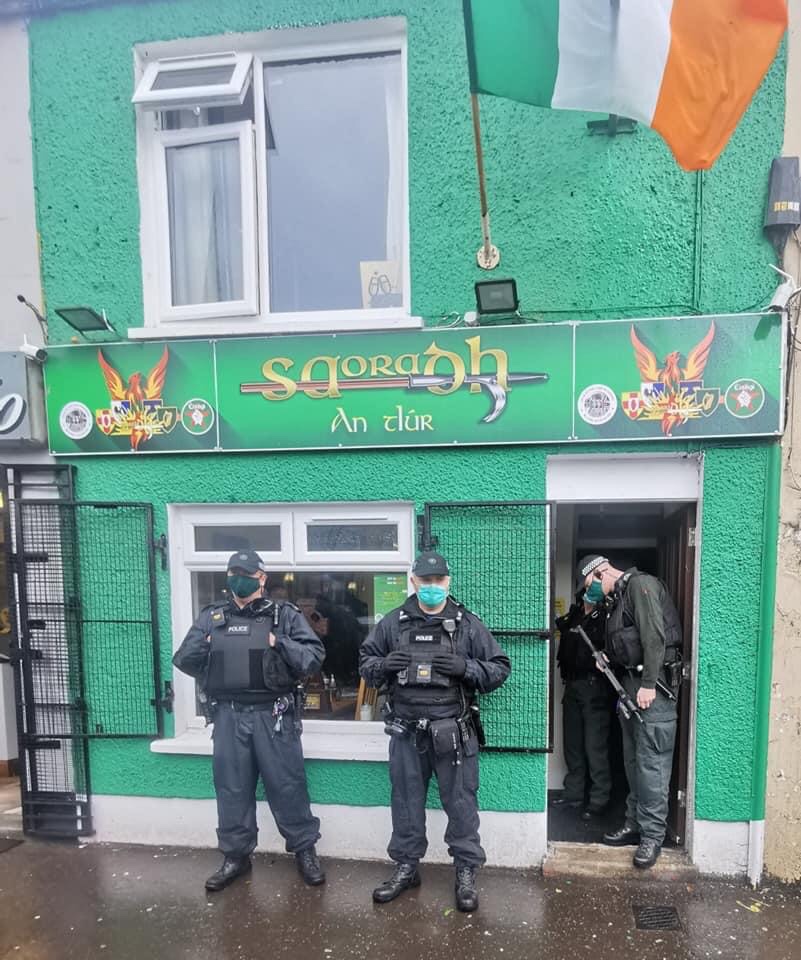
On the other side of the British Border, the counterparts of the Gardaí, the PSNI, armed British colonial police, raided Republican centres in Belfast, Derry, Dungannon and Lurgan, turning the places upside down, confiscating electronic equipment and documents. On Tuesday 18th, they also detained people, holding seven men and two women without charge and, according to a legal firm acting for some of the victims, were intending to hold them for further five days without charge.
PSNI, mostly in their ‘normal’ uniform at one of the scenes of raids (Photo source: Saoradh)
The activists subjected to the early morning raids by the Garda Armed Response Unit are all supporters of the socialist Republican organisation Saoradh and it was their centres that were raided by the PSNI. For months members have had their cars stopped by the PSNI and searched as they went about their lives. The raiding parties claimed to be searching for evidence of involvement in “the New IRA” (a previously unheard of organisation).
SHAMEFUL REPORTING AND FELON-SETTING
The media reporting on this was a shameful exercise in parroting the line of the States involved, giving the victims no voice to tie the “New IRA” (sic) in with the killing of Lyra McKee, which has never been proven and going further to call it “murder” (i.e intentional homicide) which has not been proven either (and was most likely unintentional – an organisation calling itself the “IRA” did claim the shooting and stated the killing was accidental).
Irish newspapers quoted Sinn Féin fears of bomb attacks on them by the organisation on the basis of information they allegedly received from the PSNI, which is dubious reporting at best (hearsay second-hand from an unverifiable source) and absolutely shameful felon-setting collaboration from Provisional Sinn Féin. BBC reporting to its credit did not report the PSF-PSNI allegations, nor call the killing of Lyra McKee “murder”, though it did link “the New IRA” to her killing and also prejudged the detained (who have not even been charged), calling them the “New IRA nine”; interestingly, the report gave MI5 as the source for the intelligence upon which the raids were allegedly based.
Felon-setting: Gerry Kelly and Michelle O’Neill, Vice-President SF, who publicly alleged ‘dissident’ bomb threat against them on the basis of unverified PSNI statement. (Photo source: Internet)
The linking of the raids both sides of the Border on the proclaimed basis of information from the British secret service, MI5, raises questions not only about democratic rights and the powers of the states in question but even about the alleged independence of the Irish State. It intensifies the speculation that was rife when Drew Harris was appointed Garda Commissioner, having come straight from the PSNI, with allegations that he was an MI5 asset.
SOLIDARITY?
What should be our response to these raids, as Irish Republicans, as Socialists or as just plain Democratic people? Clearly it should be solidarity with the victims and condemnation of the attacks by the states. Of whatever the states may or may not suspect the organisation, according to the alleged democratic system, they are supposed to charge them or leave them alone. We are not supposed to tolerate the states deciding they don’t like an organisation or consider it “dangerous” and on that basis set out to harass and intimidate them and terrorise their families. States where that can happen are not democratic and we are all vulnerable to those assumptions of secret services and the actions of police forces. Gárdaí acting in this manner led to the unjust jailing of the IRSP Three, the false confession forced out of Joanna Hayes and her family, the harassment of the McBrearties, etc. In Britain it led to the jailing of a score of innocent Irish people in five different cases in the 1970s (including the Birmingham Six) under the Prevention of Terrorism Act and, in fact, the successor of that Act is now the Terrorism Act in the UK, the one under which nine Republicans are detained currently in the British colony.
PSNI, the British colonial police, next to a Saoradh centre. (Photo source: Saoradh)
It is not too difficult to proclaim one’s solidarity with struggles far from home, particularly when they gather a lot of international support. It is a different matter to stand in solidarity with the victims of the State at home. It is also more of a test when one may not agree with the ideology or some of the actions of those persecuted by the State. But if we do not stand in solidarity with victims of the State, we are telling it, in effect, that it may continue acting in the way it is doing, until the early morning we wake to our own doors being battered down, our own partner and children being terrorised and ourselves sitting in cells without daylight being deprived of sleep and interrogated without access to solicitor, family or our own doctor.
end.
British colonial police, the PSNI, raiding a Republican centre, some with guns unlimbered. (Photo source: Saoradh)
On 26th July 1914 there was unusual crowding on the East Pier of the fishing harbour of Howth, Dublin and great excitement which grew as the sail of yacht was spotted making for the harbour. Among those gathered on the pier were members of the Irish Volunteers and of Na Fianna Éireann, the Irish Republican youth organisation. As the yacht, the Asgard, maneouvered to pull into position along the pier, mooring ropes thrown were quickly made fast. Then an amazing number of Mauser rifles and ammunition began to be unloaded into eager hands.
Unloading rifles at Howth, 1914, Erskine and Molly Childers in foreground. Erskine was English but would later join the IRA and was executed by the Free State regime in 1922. (Source photo: Internet).
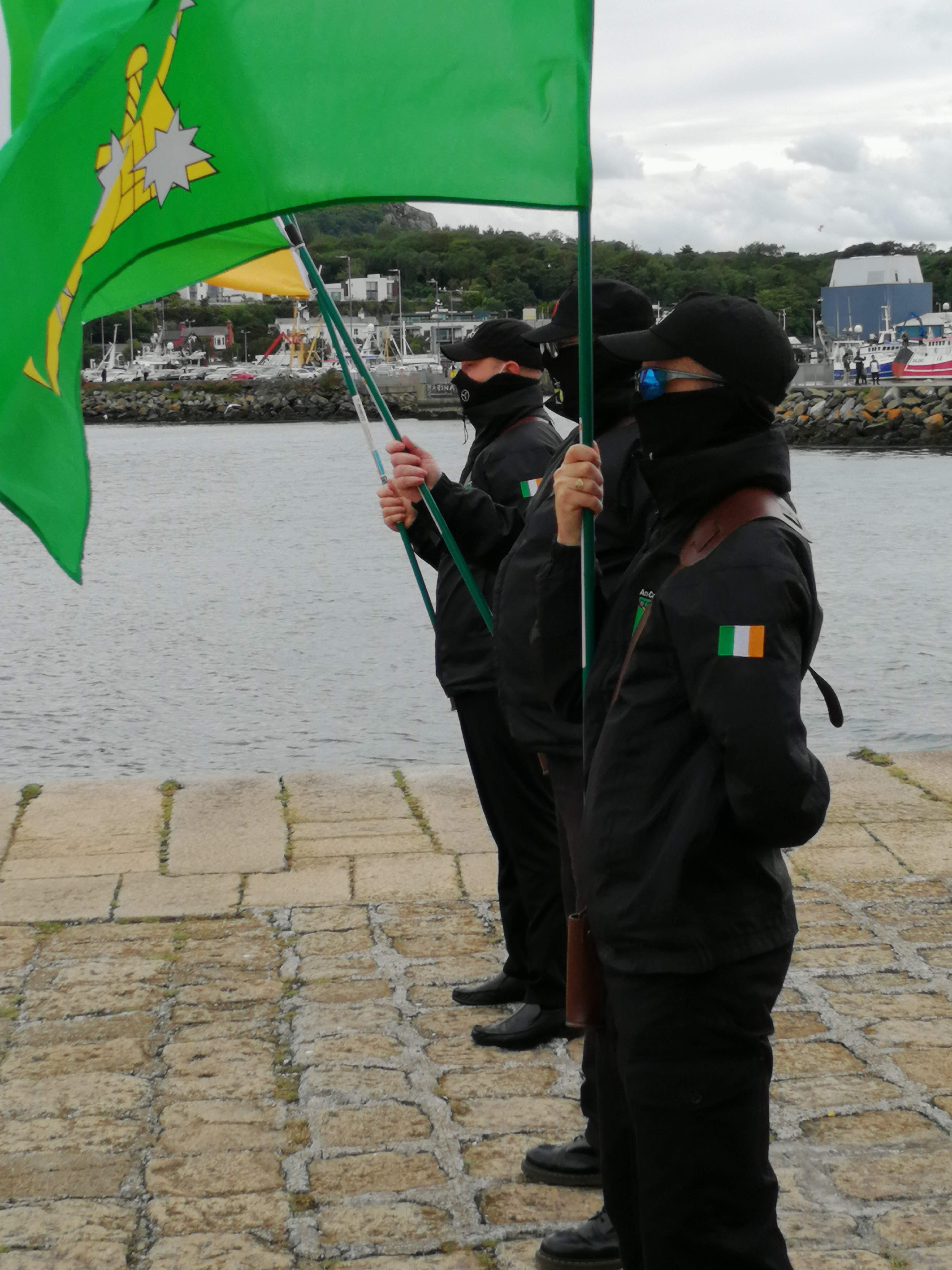
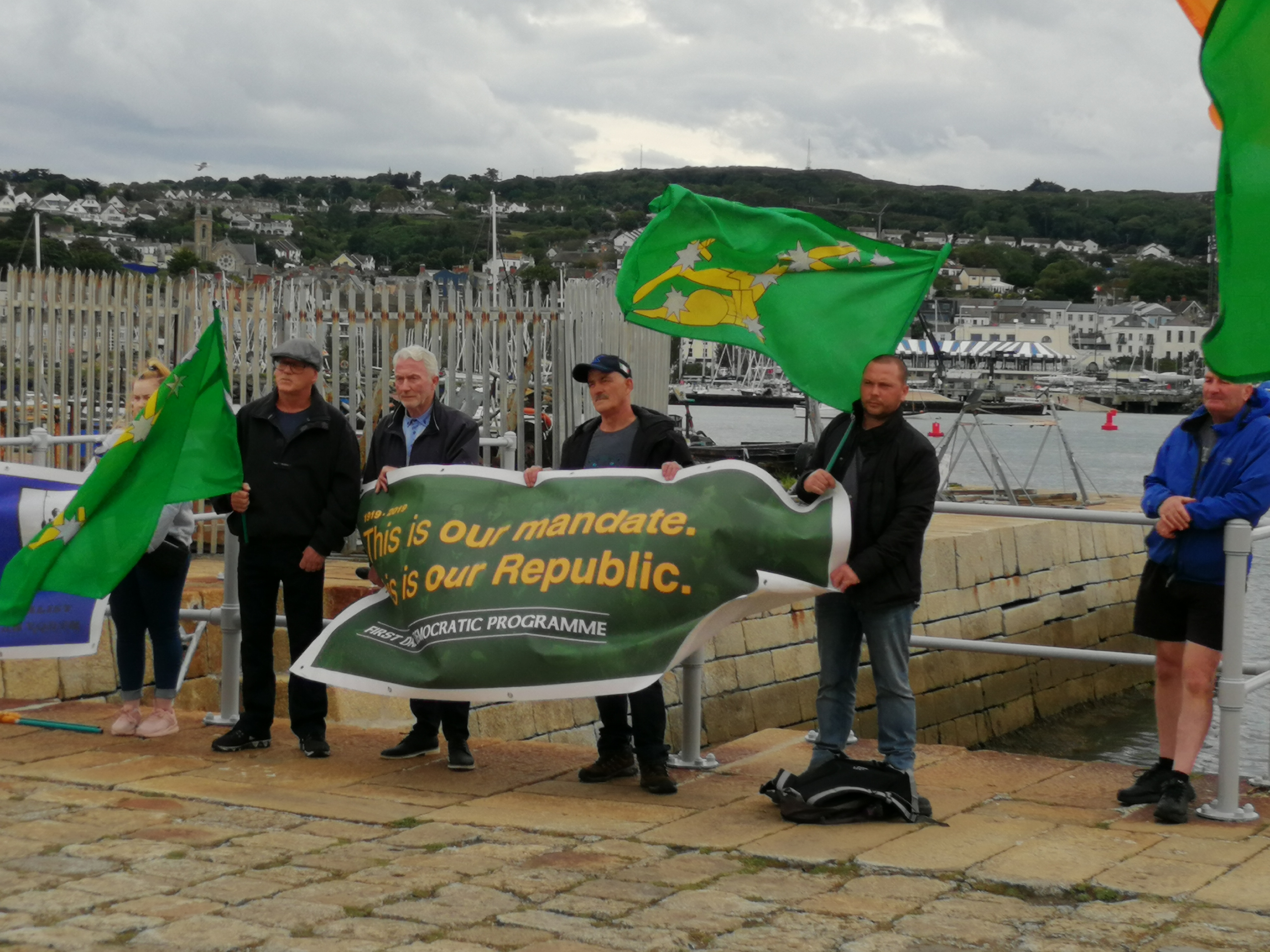
On Sunday 26th July this year the annual commemoration of the historic event was organised by the Anti-Imperialist Action group to take place in Howth. A group of people formed up at the start of the pier and proceeded along to the end, where the commemorative plaque is and where the ceremony was to be held. A small colour party preceded the procession, followed by a banner against the extradition of Liam Campbell, in turn followed by another banner stating: “This Is Our Mandate, This Is Our Republic” (from the Democratic Programme of the First Dáil, 1919), with the rest of the procession following behind.
Attendees or onlookers? (Photo source: Rebel Breeze)
Part of the attendance at the event. (Photo source: Rebel Breeze)
The idea of arming the Irish Volunteers to counter the arming of the Ulster Volunteers, who had declared their aim to prevent the limited autonomy of Home Rule being given to Ireland by the British Government, had been discussed in 1914 by a group that could best be described as Anglo-Irish, middle class and including even an aristocrat – nearly all of Protestant background. The eventual sailing of the gun-laden yacht from off the Belgian coast to Dublin was accomplished by a crew of the Asgard assembled for the purpose: Erskine and Molly Childers, Molly Spring-Rice, Conor O’Brien and two seamen from Gola in Donegal: Patrick McGinley and Charles Duggan. Apart from the Captain, Erskine Childers, they all had some Irish in their backgrounds but only Conor O’Brien and the Donegal men were of indigenous stock, with only the latter two native Irish speakers.
The rifles were successfully landed and were used effectively during the 1916 Rising, though only single-shot against the five-shot magazines of the British Army’s Lee-Enfield rifles, of which the Volunteers had only a few (and no machine-guns at all).
THE COMMEMORATION
When the commemorative procession reached the pier head, the attendance fanned out in a square with an open end facing Margaret McKearney, who was to chair the event. The colour party stood to to one side, the flags bearing the designs of the Irish Citzen Army and Na Fianna Éireann, along with the Tricolour, fluttering in the gentle sea-breeze.
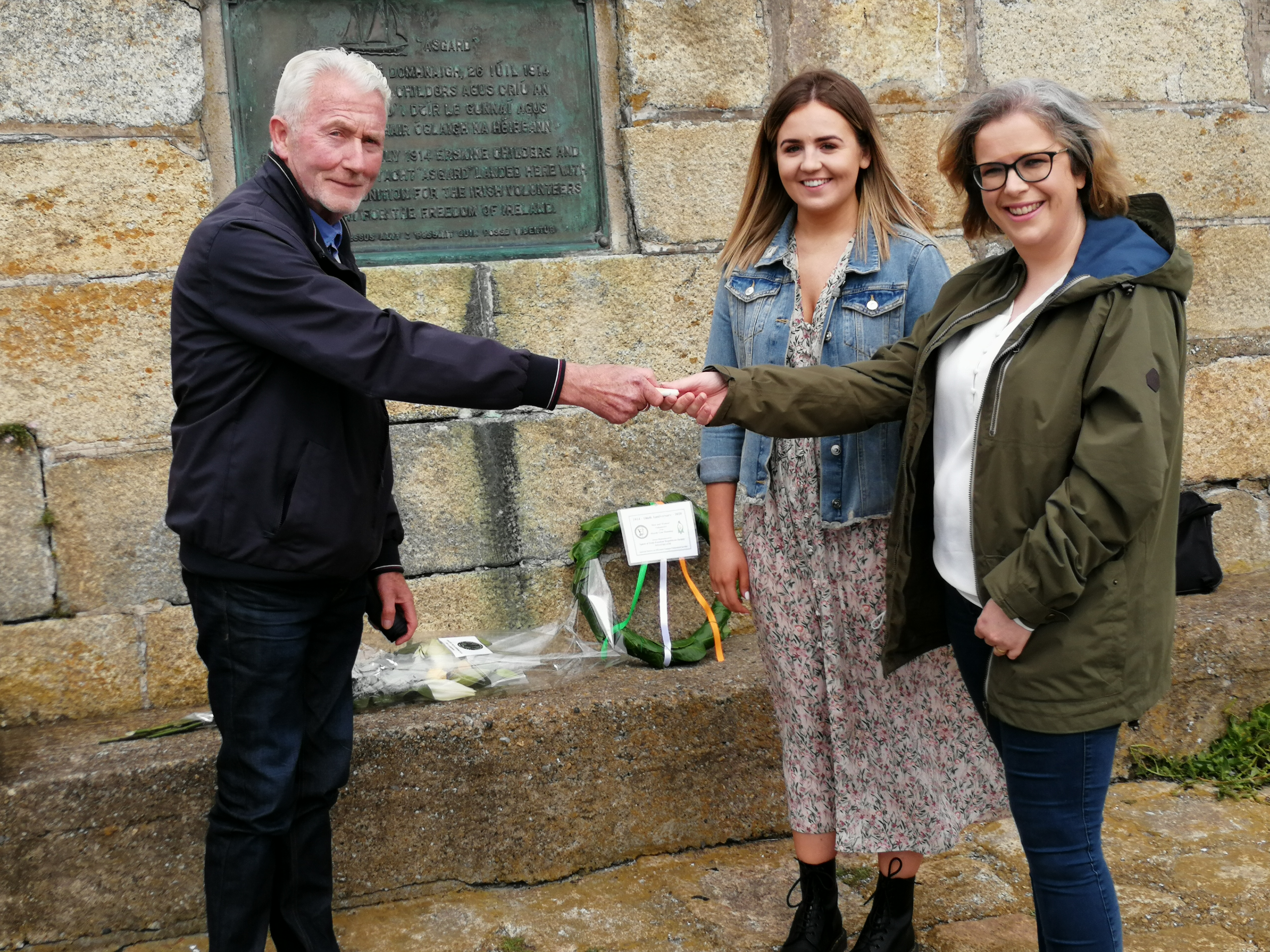
McKearney called for a minute’s silence in remembrance and honour of all those who had given their lives in the struggle for Irish independence, during which the colour party performed the presentation, lowering and raising of the flags. Floral wreaths on behalf of Anti-Imperialist Action and Spirit of Freedom Westmeath were then laid underneath the commemorative plaque to the historic landing of the weapons.
Laying of wreaths by AIAI and by Spirit of Freedom Westmeath. In foreground, Margaret McKearney, chairing the event. (Photo source: Rebel Breeze)
McKearney, a life-long Republican from a Republican family in East Tyrone, had once been described by Scotland Yard as “possibly the most dangerous woman terrorist in Britain” but had legally defeated extradition attempts to extradite her from the Irish state in 1975. Two of her brothers had been killed on active service and another murdered by Loyalists during the three-decades war in the Six Counties; another brother had barely survived 53 days of the 1980 hunger strike upon its termination.
Recounting the events of the obtaining of the rifles and ammunition and their landing at Howth in 1914, McKearney went on to tell of the failure of the colonial Dublin Metropolitan police and British Army to confiscate the weapons and how at Bachelors’ Walk, the King’s Own Scottish Borders opened fire on a crowd mocking their failure and bayoneted at least one, killing four and injuring 38.
The guns had been used in the 1916 Rising, McKearney related and went on to refer to the long struggle for Irish independence since, still uncompleted, with the Good Friday Agreement seeking to draw a line under it and preserve the status quo.
Side view of the colour party with Howth harbour in the background. (Photo source: Rebel Breeze)
Referring to the growing danger of fascism in Ireland and in the world, McKearney pointed out that as the financial losses incurred during the Covid19 epidemic mounted, the ruling class in Ireland and its government would be seeking to break the resistance of the people in order to impose austerity upon them and it was then that they might well turn to the fascists.
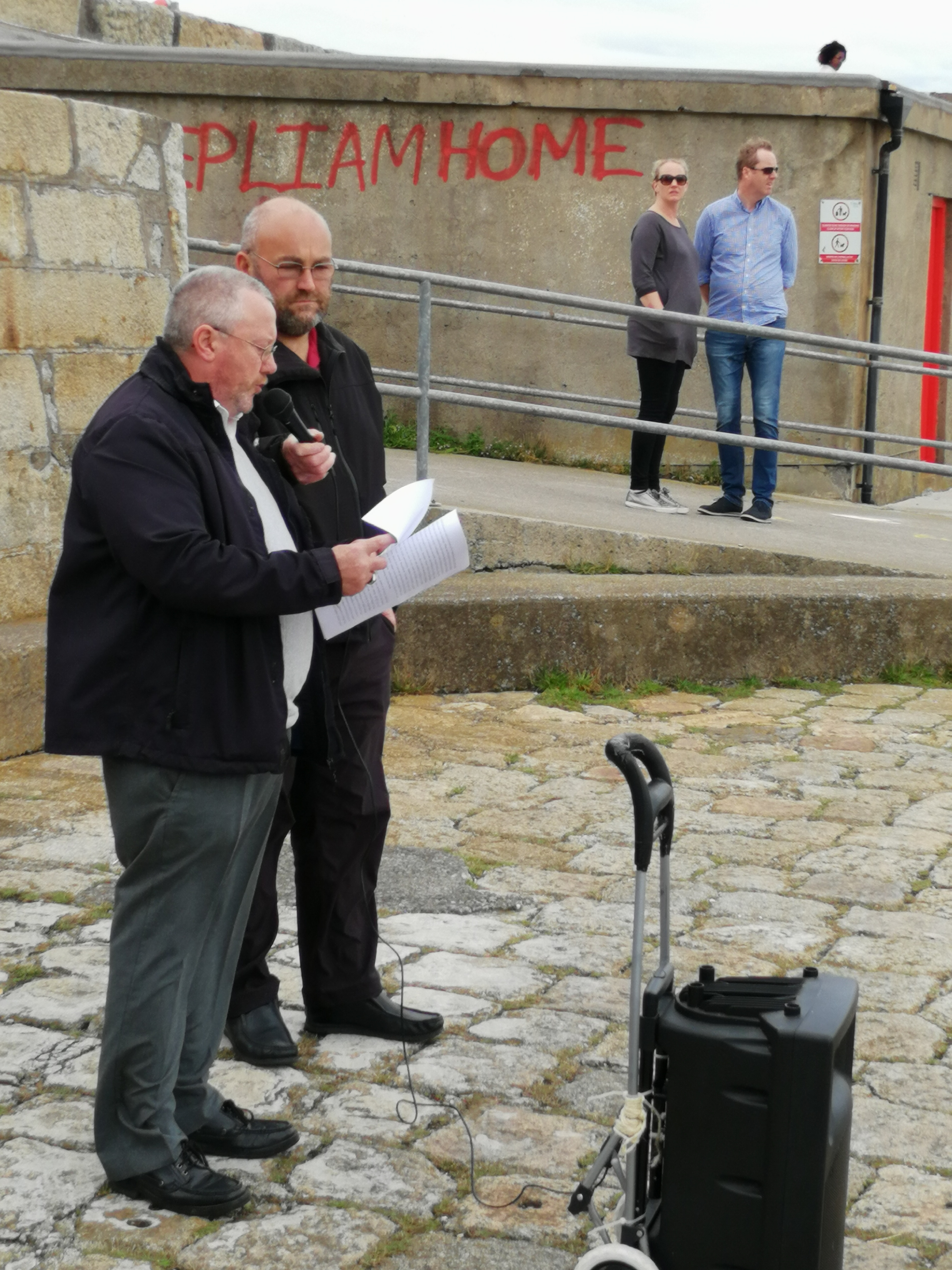
The chair then introduced historian Peter Rogers of the Spirit of Freedom who delivered a lengthy speech on the nature of Irish Republicanism and the struggle for independence. Rogers referred to Good Friday Agreement as having failed to resolve the situation with even Francis Molloy (a Provisional Sinn Féin TD, i.e member of the Irish Parliament) remarking that they “had been sold a pup”. The speaker concluded saying that Sinn Féin must be given time to fail in the Dáil when the option of a united Ireland would be more easily embraced.
Peter Rogers of Spirit of Freedom Westmeath giving an oration. (Photo source: Rebel Breeze)
A speaker from Macra – Irish Republican Youth was then called forward and delivered a short statement.
Diarmuid Breatnach, representing the Anti-Internment Group of Ireland, was next to speak. Pointing out that internment without trial of Republican activists was continuing albeit under other forms, Breatnach related how Irish Republicans were being charged and refused bail prior to being brought before non-jury special courts on both sides of the British Border. In the unlikely event of their being found not guilty subsequently, they had nevertheless spent two years in jail. Also the practice of rearresting without trial or even charge of Republican prisoners released on licence constituted a form of internment, Breatnach said.
Going on to speak of the historic Howth event, the speaker remarked upon the varied nature of those who had planned and carried out the operation, including a number who would not have satisfied the criteria for “Irishness” of the current crop of Irish racists and fascists of the Far-Right in Ireland. Yet some involved in the gun-running had made that contribution before leaving the struggle, while most had gone on to fight in the 1916 Rising, joined there also by the workers’s Irish Citizen Army. Many had gone on the fight in the War of Independence and while some had sided with the Free State in the split and Civil War in 1922, most of the fighters had remained on the Republican side.
Diarmuid Breatnach, who spoke on behalf of Anti-Internment Group of Ireland and also sang Amhrán na bhFiann at the end. (Photo source: AIAI)
The lesson he drew from that, Breatnach continued, was that the fight for freedom had to be extended in as broad an alliance as possible but also remaining aware that some of that alliance would be temporary and to prepare accordingly.
The speaker commented on the historical importance of possession of weapons when facing an armed enemy and concluded by saying that though the time for weapons might not be now, the lesson of history is that such a time would come in the future.
McKearney thanked the organisers, attendance and all the speakers for their contributions and announced the handing over of a donation from Anti-Imperialist Action to the Loughgall Memorial Martyrs’ fund.
Donation from AIAI to the Loughgall Martyrs’ Memorial fund against the background of the plaque commemorating the landing of the rifles. (Photo source: Rebel Breeze).
The event then concluded with the singing of a verse and chorus of Amhrán na bhFiann, the Irish national anthem, sung in Irish by Breatnach.
HISTORICAL POSTSCRIPT: THE ASGARD TODAY
The boat was built in Norway by an acclaimed Scottish migrant boat-builder and sold in 1904 to the Erskine Childers and his USA bride, Molly (Mary Alden Osgood), with the interior built to the specifications of Erskine and Molly. Childers, though English and had volunteered for the British armed forces during WWI, nevertheless took up the cause of Irish independence, joining the IRA in the War of Independence and continuing on the Republican side. He was captured by the Free State forces and executed by the State in 1922 (his son Erskine Hamilton Childers was elected the 4th President of the State in 1973).
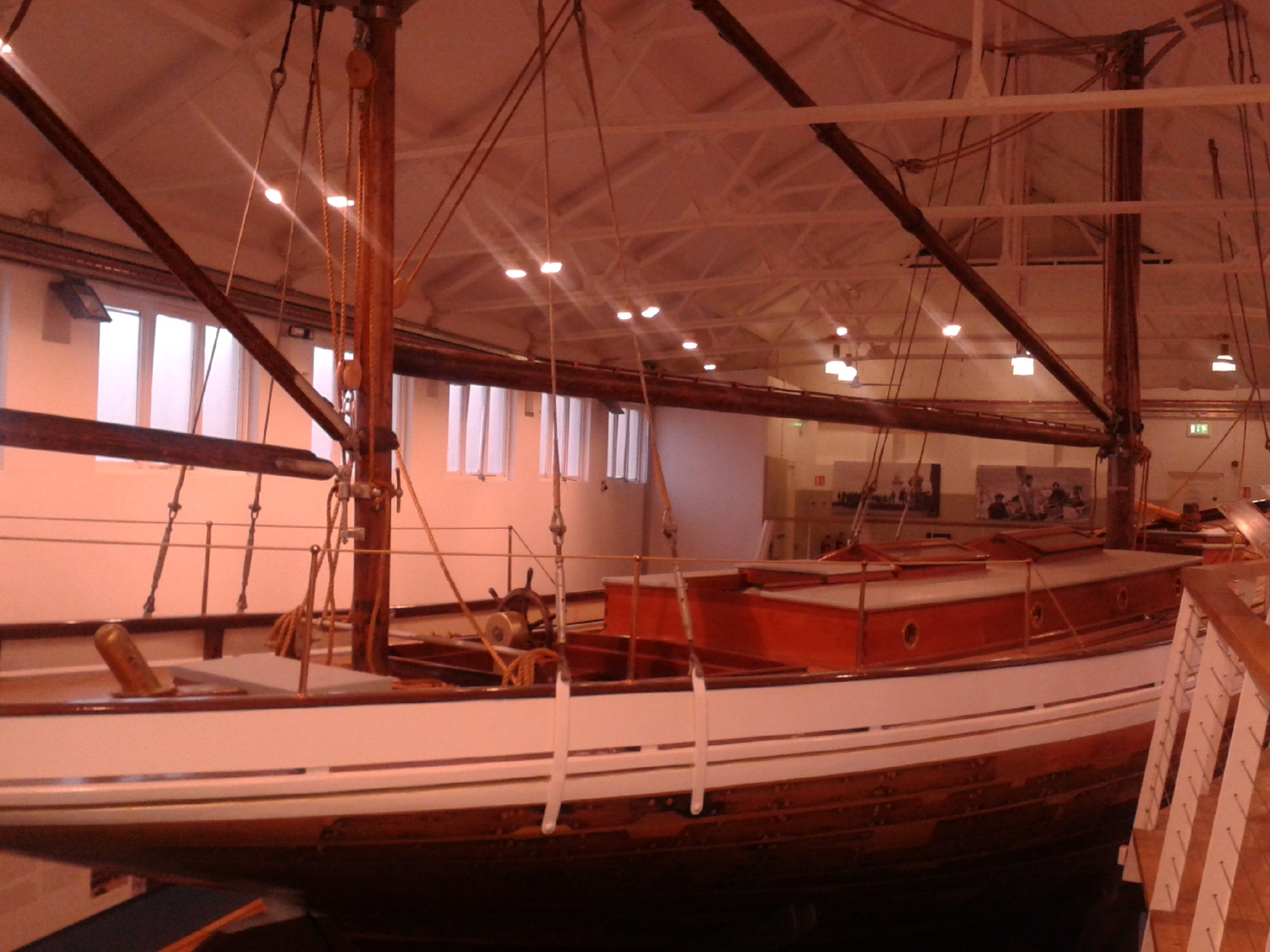
The Asgard in its separate Exhibition in Collins Barracks. (Photo source: Rebel Breeze)
Part of the deck of the Asgard in its separate exhibition in Collins Barracks. (Photo source: Rebel Breeze)
The Asgard was sold and in 1961 Journalist Liam Mac Gabhann discovered the vessel in the River Truro, Cornwall and wrote about it. After lobbying, the Irish State purchased and overhauled the ship and sailed back to Howth in 1961, where the original event was re-enacted with surviving members of the Irish Volunteers. The Irish Navy used her as a sail training vessel but in 1974 the Yacht was dry-docked in what was in essence a large shed in Kilmainham, partly open to the elements, until new restoration work began in 2007. In 2012 the yacht was moved to the National Museum complex at Collins Barracks, where it has resided since in a separate and permanent exhibiton, along with memorabilia and related information and photographs. In normal times the National Museum is open six days a week and entry is free to both the Asgard exhibition and the general Museum exhibitions.
Anti-Imperialist Action Ireland banner and Starry Plough flags at the event. (Photo source: Rebel Breeze)
The Far-Right, including racists like Gemma O’Doherty and fascists like Niall McConnell, have called for a protest against the hire of Croke Park for a celebration of the Muslim festival of Eid on Friday. These clowns posing as “patriots” who strut around waving the Tricolour and “Irish Republic” flags seem to have forgotten the words of the 1916 Proclamation of Independence (if indeed they ever bothered to read it): “The Republic guarantees religious and civil liberty, equal rights and equal opportunities to all …”.
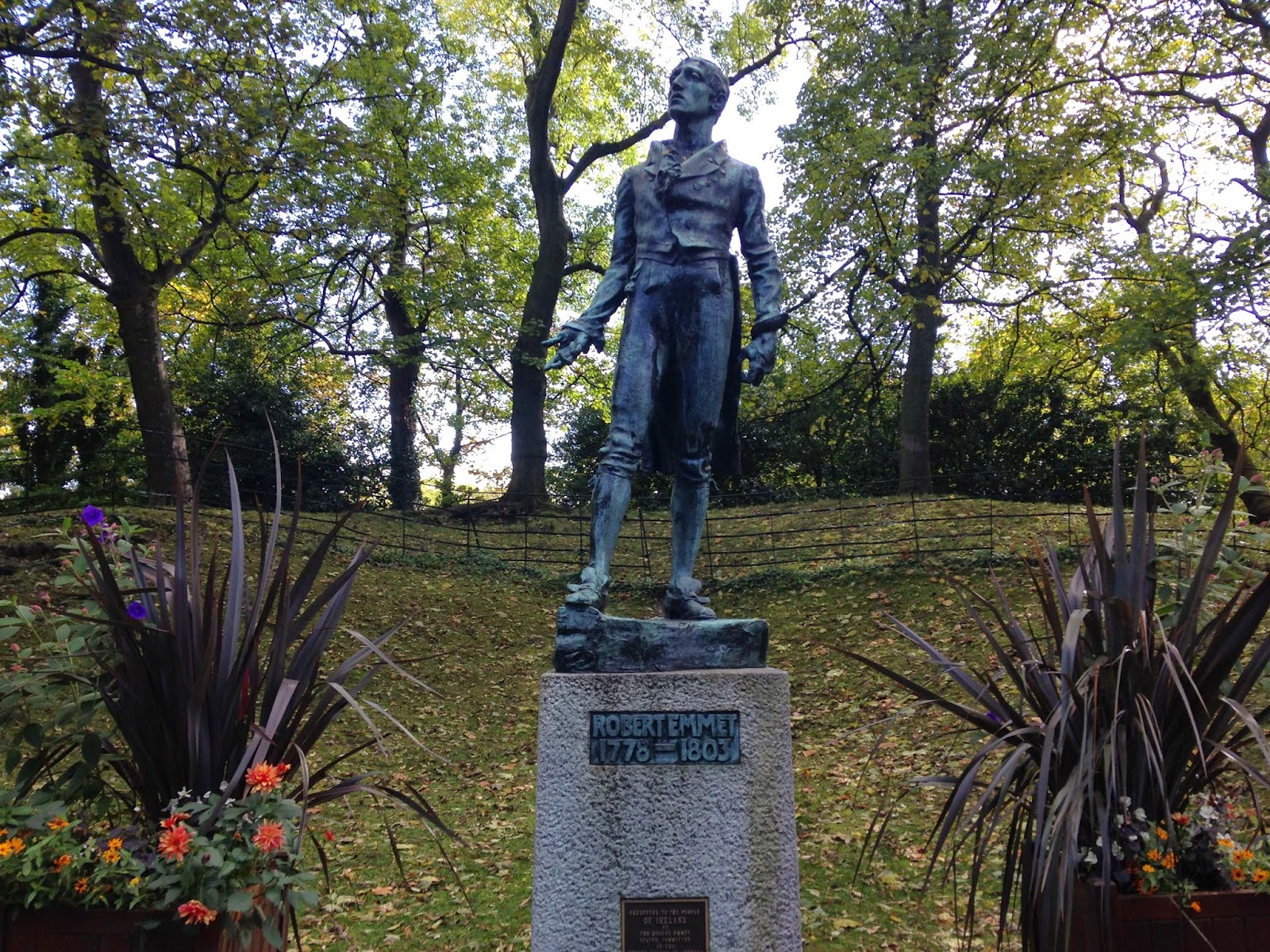
Monument Robert Emmett in Stephens Green (copy of another in Washington DC). Emmett gave his life not only for an independent ireland but for a republic, with separation of Church and State. (Photo source: D.Breatnach)
SEPARATION OF CHURCH AND STATE – A FUNDAMENTAL REPUBLICAN PRINCIPLE
A fundamental principle of republicanism is the separation of church and state – it is as fundamental as the elimination of monarchic rule. It is what the Anglicans Wolfe Tone, Edward Fitzgerald and Robert Emmet believed in, along with the Presbyterians Anne and Henry Joy McCracken – and what they died for, along with independence from England. Anne Devlin and Michael Dwyer were typical of the Catholics who supported the republican ideal. No government should be telling its people what religion they must or must not follow — nor indeed that they have to be religious at all.
A far-Right Lineup for meeting at the EU Parliament: Irish “patriot” Niall McConnell at the far right of photo (and in politics) with, among others, fascist Nick Griffin of the British National Party (fourth from left). (Photo source: Internet)
Gemma O’Doherty is calling for “a Christian prayer circle” at Croke Park at 9am as a protest against the muslim celebration. Christian prayers for intolerance, racism and fascism? These “patriots” think they have the right to decide which religion is acceptable and which not. That they dislike Muslim religion is their privilege but what is outrageous is that they think they have the right to dictate to people what their religion should be. These are the same people, let us not forget, who have been so stridently shouting about the “right to free speech”!
They say that they are doing this to “prevent Sharia law in Ireland”. Apart from the fact that the only religious domination we’ve had in Ireland has been various forms of Christianity, what kind of paranoia makes them think that there are enough Moslems in Ireland to get a Sharia party elected, even if Moslems wanted that, which many of them don’t? Not all Moslems are supporters of Sharia law any more than all Christians are fundamentalists — or all Catholics support the right of religious orders and clerics to abuse people over which they have control.
It was the Christian Pope Adrian IV in the 12th Century who, with the Laudabiliter document ‘authorised’ the invasion of Ireland by King Henry II of England. From the 15th Century we had Protestantism forced on us by the English Crown by the sword and plantation. In the second half of the 18th Century, Irish Republicanism sought to separate Church and State and to unite Catholic, Protestant (i.e the dominant Anglicans) and Dissenter (i.e Presbyterians, Methodists, Unitarians, Quakers). They failed but gradually Presbyterians and then Catholics won their rights (although Catholics continued to suffer discrimination in the Six Counties). In the 1930s the Blueshirts in the 26 Counties scapegoated Jews in order to divert the people from their real enemies and to build a fascist state, until they were beaten off the streets by Irish Republicans and socialists.
None of that religious persecution or strife was inflicted on us by Muslims.
Gemma O’Doherty supporters demonstrating for “free speech” outside the Dept. of Justice in November. (Photo source: D.Breatnach)
TELLING US HOW TO LIVE OUR LIVES
In the 26 Counties from 1921 we had a Catholic State and the Church dominated public and secular life, dictating laws and social rules about marriage, birth control, sex and sexuality, dance and socialisation, controlling also the education, welfare and health system. That would have been unhealthy enough but they abused their trust, not only physically, mentally and sexually abusing children, adolescents and adults, and exporting orphans abroad – but denying the victims and covering up for the abusers.
They told us what books and newspapers we could read, what films we could watch and what political parties we must not support. This is the kind of “free speech” sought by the fascists.
A fascist tweeter called Rionach has threatened to burn Croke Park down with the Muslims inside it!
All democratic forces need to oppose these reactionary gatherings, whatever the cover story under which they are calling them but under which the fascists are trying to organise their future stormtroopers. Already there have been a number of attacks on antifascist individuals and small groups.
If you disagree with what this collection of the bad, mad and sad are doing, with what they want to do to our country, you know where to be early on Friday morning. Bailligí le chéile!
End.
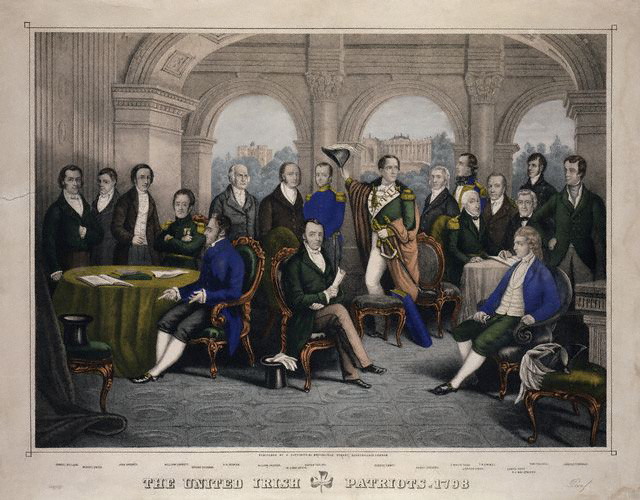
Prominent members of the United Irishmen, by unknown artist, print, 1798 or after (Image sourced on Internet)
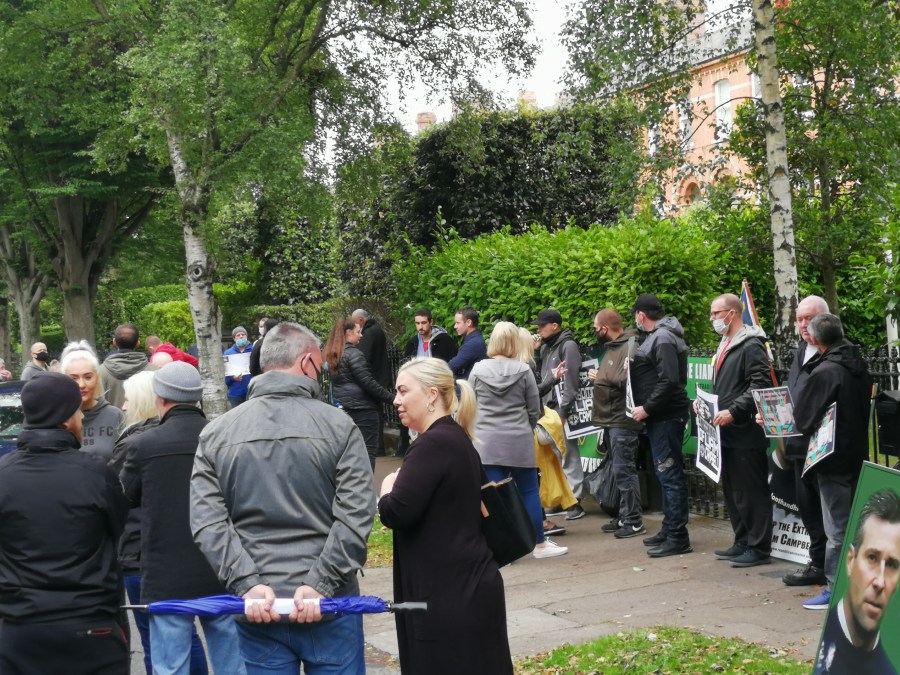
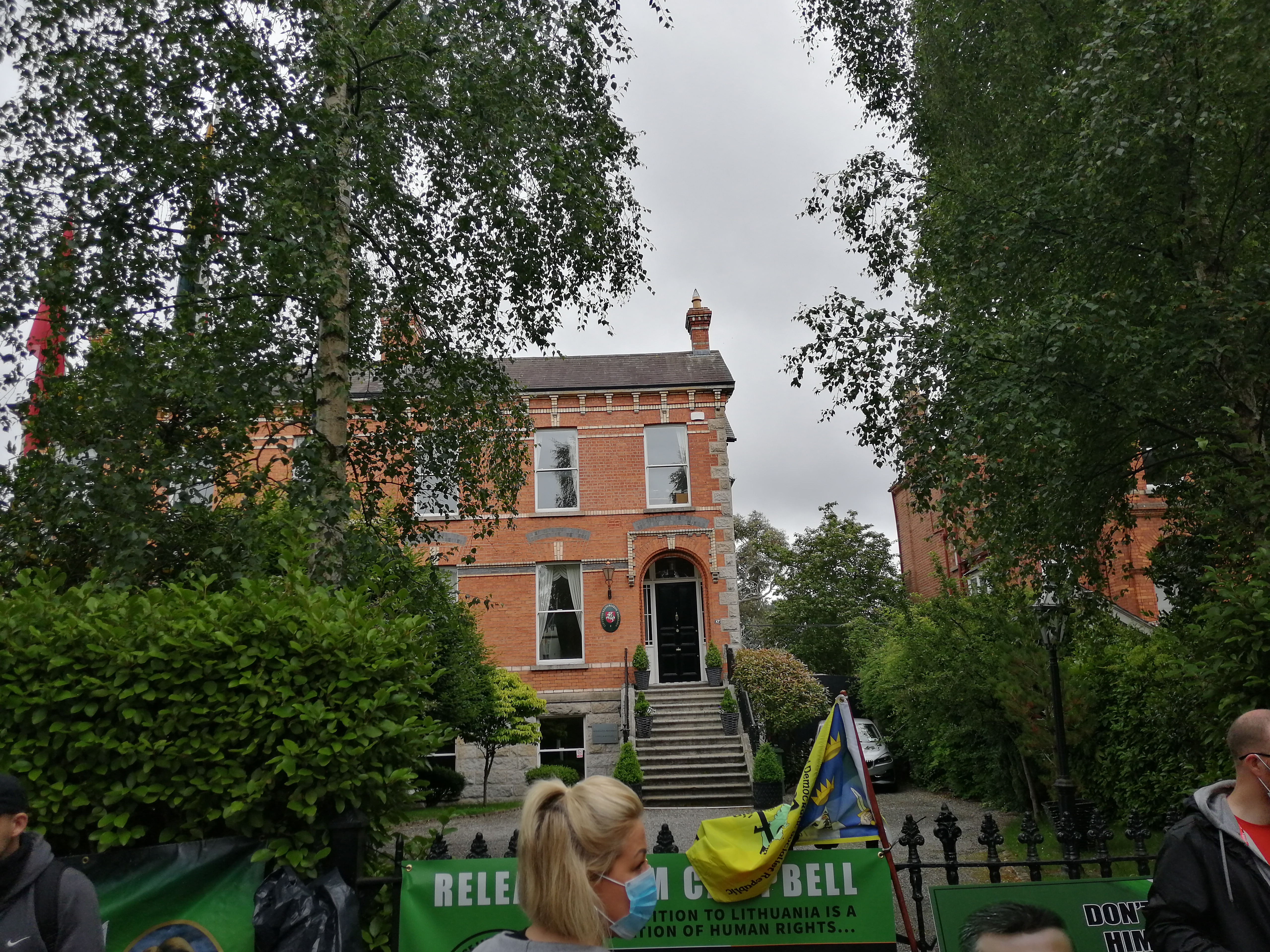
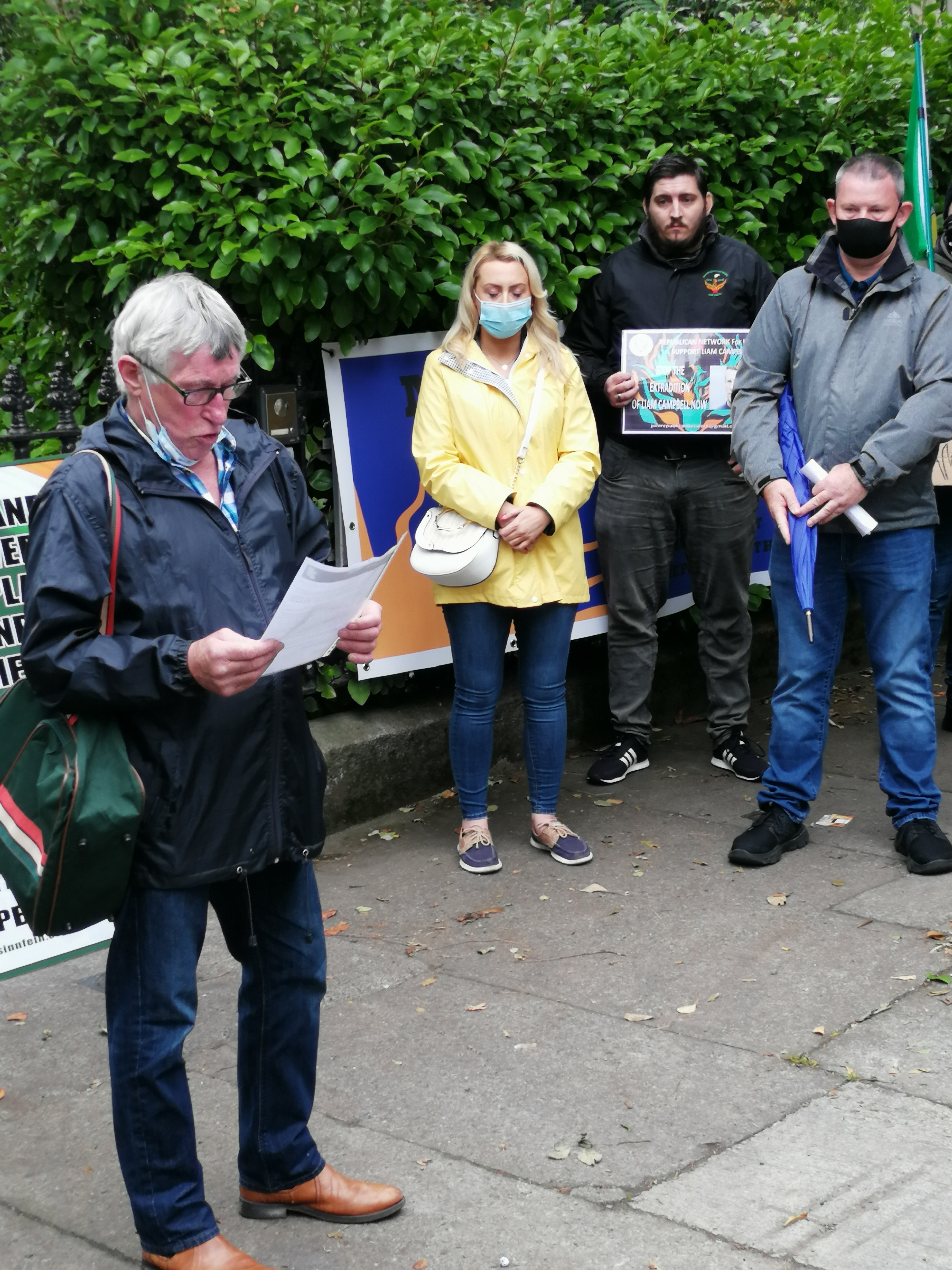
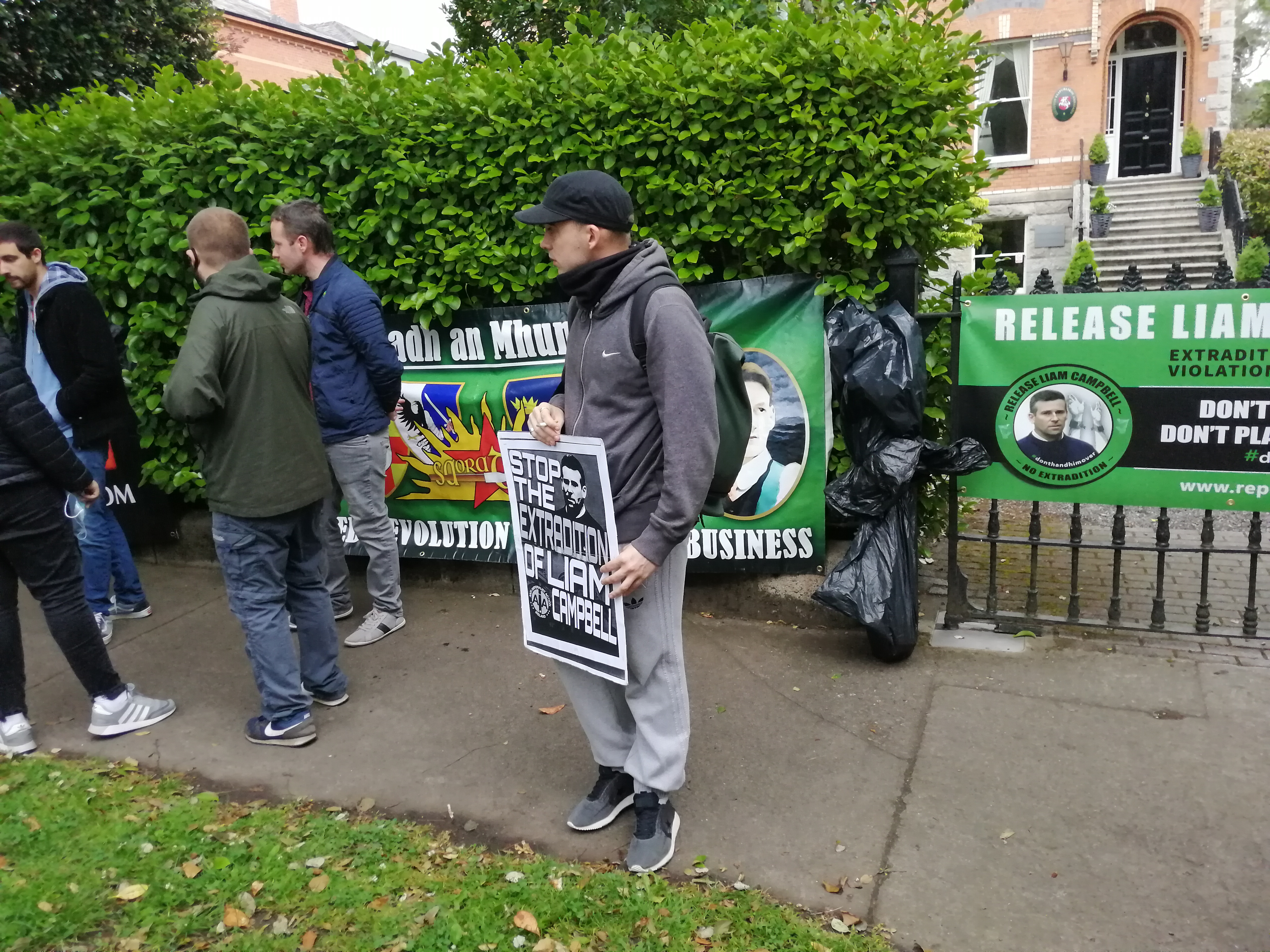
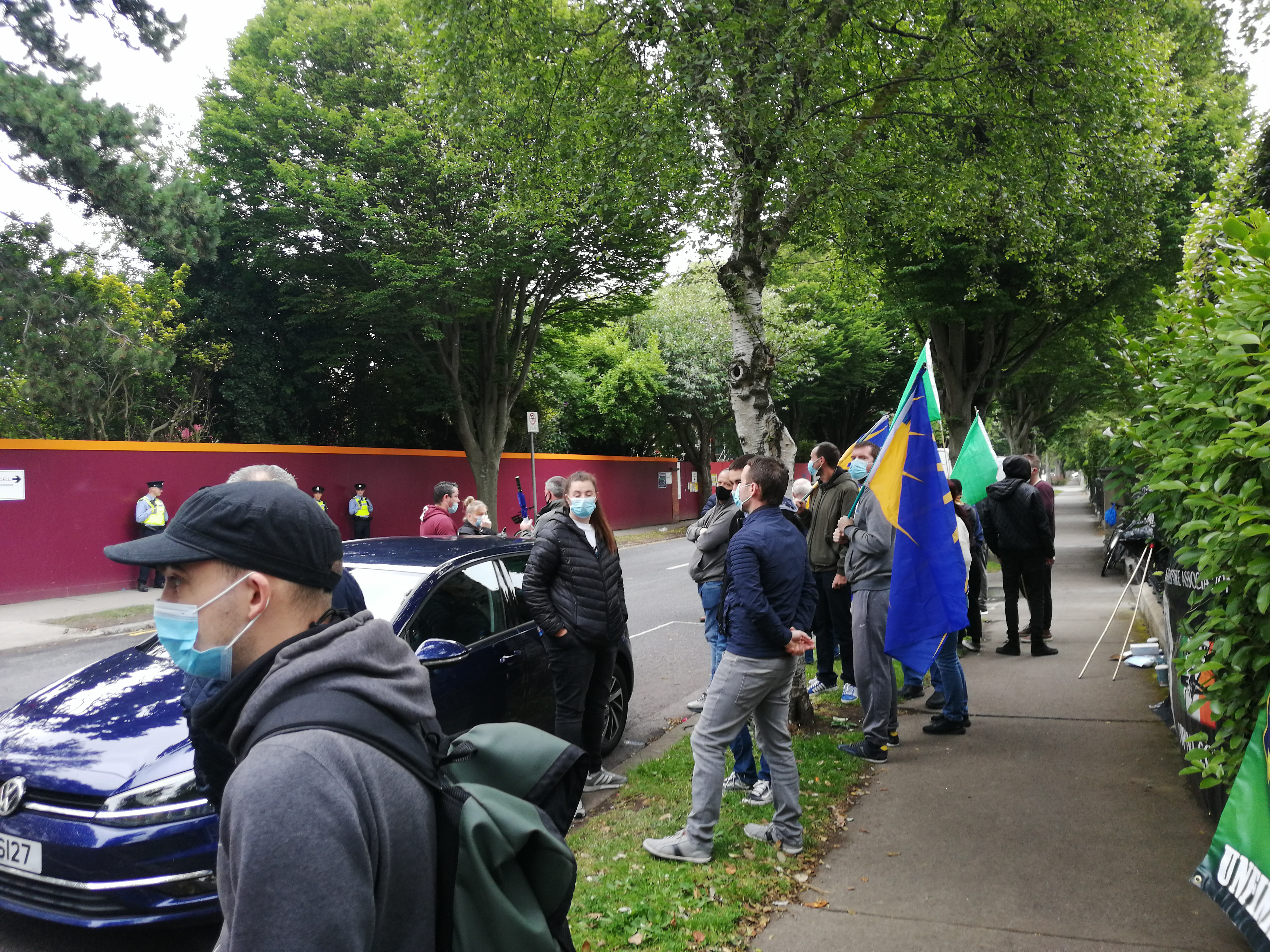
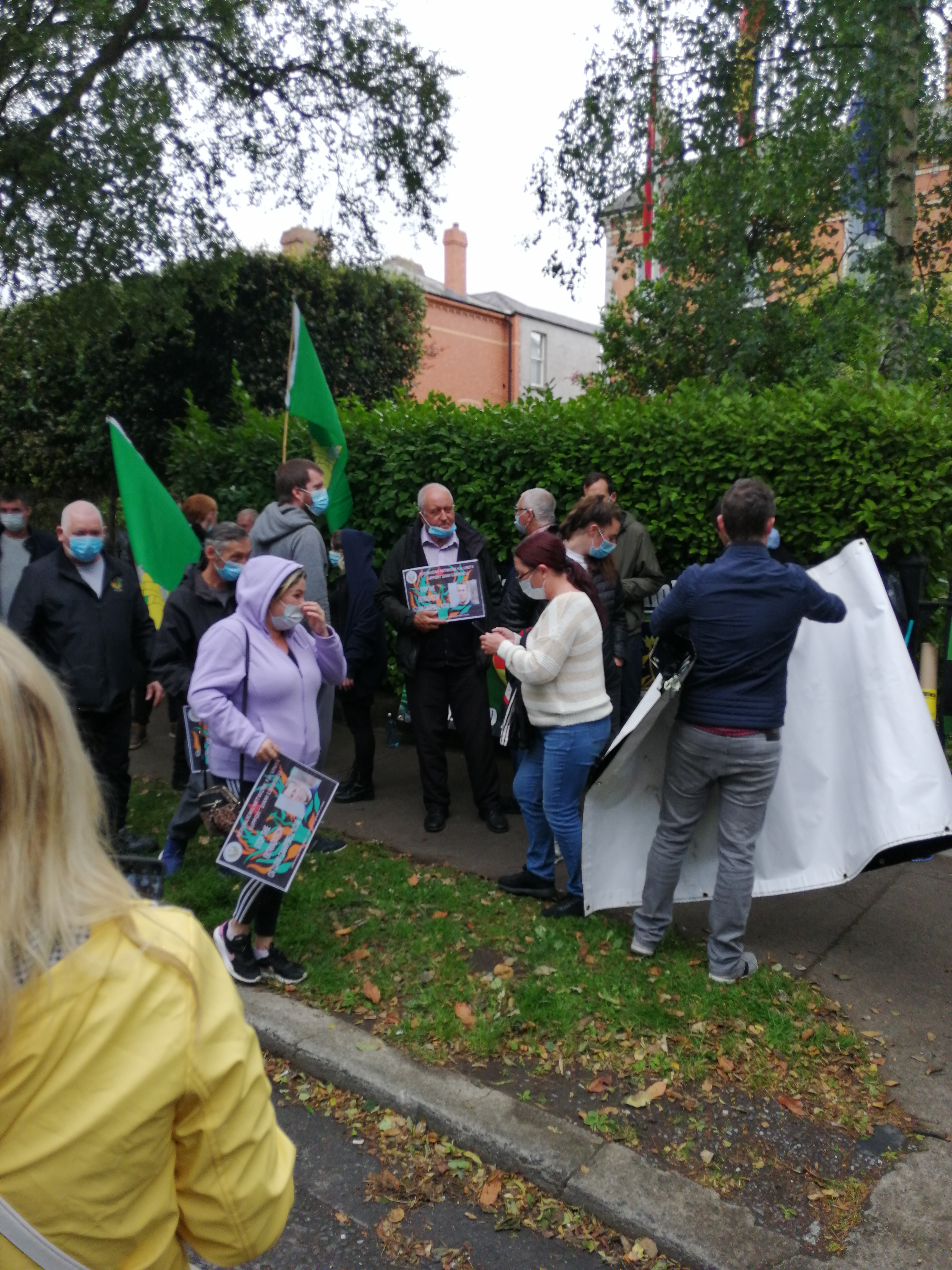
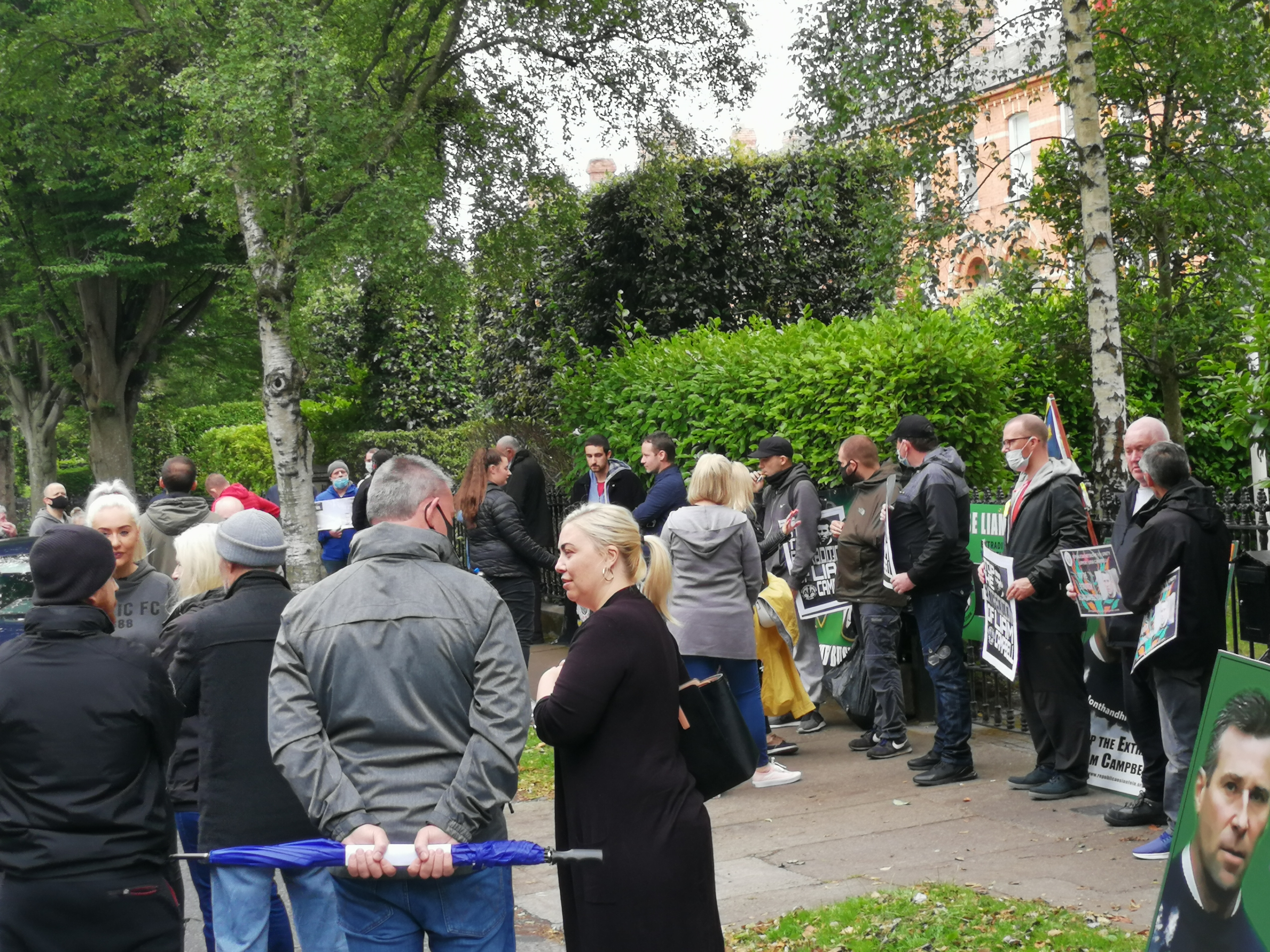
The occasional driver or occupants of a car passing through the quiet leafy and very expensive area of Dublin 4 might have been very surprised to see a large gathering outside one of the houses in Ailsbury Road with a number of flags and placards in evidence. Then again perhaps not, for this area is sometimes known as “Embassy Land” and embassies often attract protests when people object to the actions of the states they represent. The protest was outside the Lithuanian Embassy and just a few doors westward is the French Embassy.
Lithuanian Embassy building. (Photo: C.Sulish)
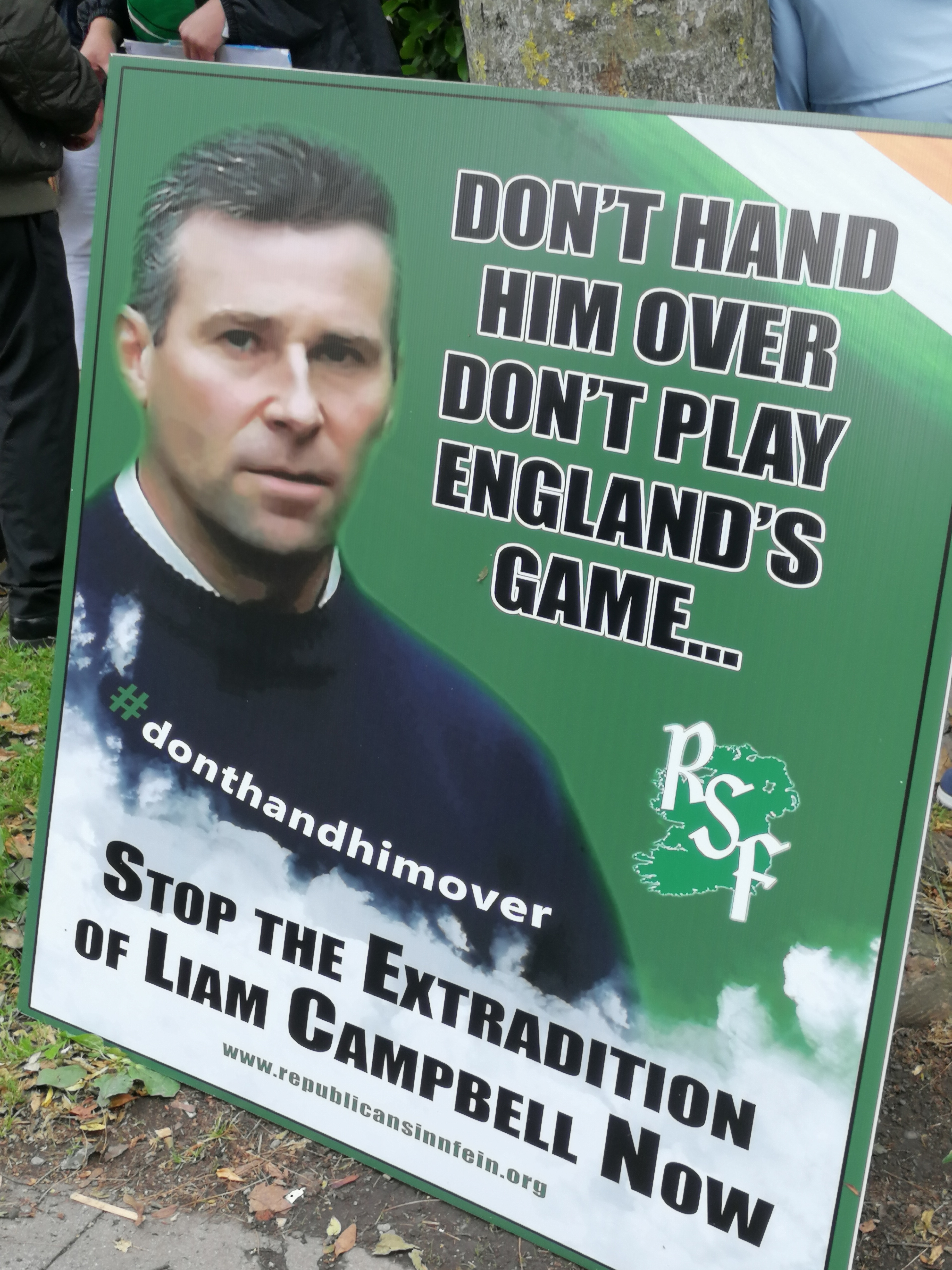
The targeting of the Lithuanian Embassy on Saturday 4th July was because the State of Lithuania has issued a European Extradition Warrant for Liam Campbell, a long-time Irish Republican activist and the protest had been jointly convened by Anti-Imperialist Action and the Anti-Internment Group of Ireland at the request of Liam Campbell’s family. Last month the Irish State’s High Court opened the way to the extradition, Justice Aileen Donnelly waving aside all objections about the state of the justice system within Lithuania and accepting only the terrible conditions in Lukiskes remand jail in Vilnius as an impediment but considering this removed with news of the closing of that jail. Thus ended a 12-year legal battle, with only the formality of producing Liam Campbell in court on the 13th to hear the judgement remaining, after which he will have one week to seek leave to appeal the order.
Chairing the event for the Anti-Imperialist Action group (he had a recent cycling accident). (Photo: C.Sulish)
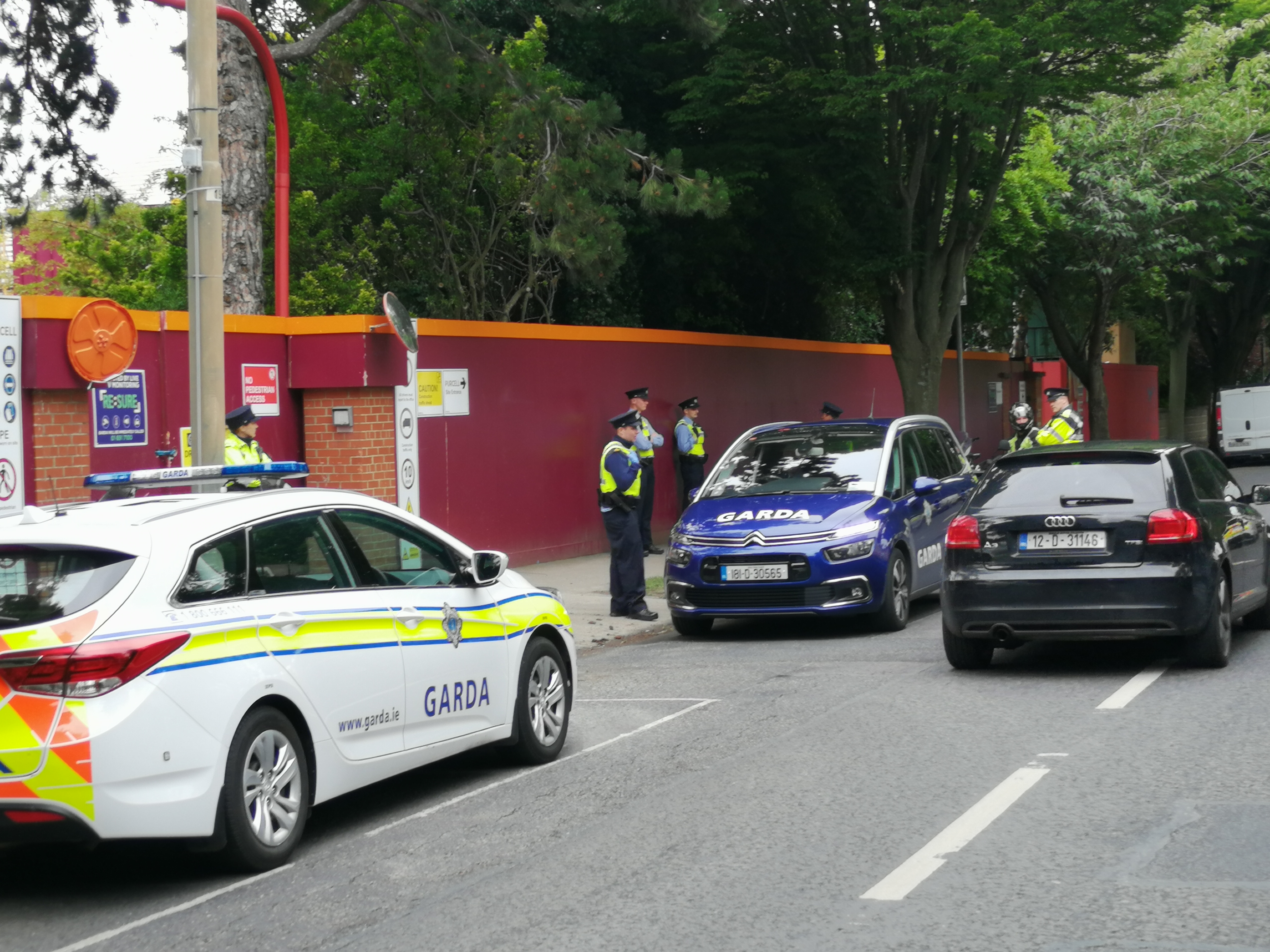
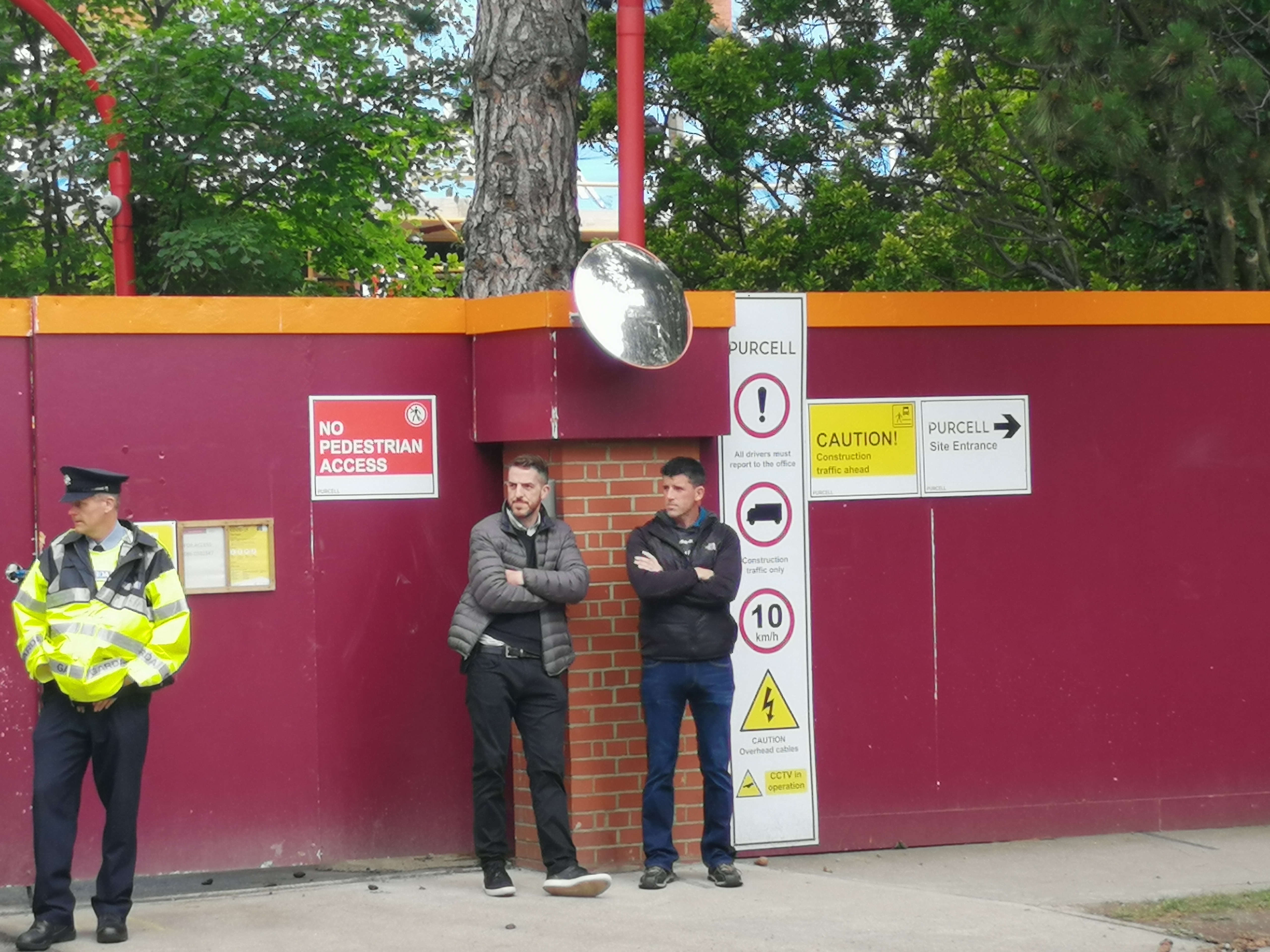
On the footpath opposite the Lithuanian Embassy, a number of Gardaí in uniform were in attendance, along with two men in plainclothes, clearly members of the Irish secret political police, known colloquially by their former name, the Special Branch.
Some of the Gardaí at the event. (Photo: C.Sulish)
Two members of the Garda Special Detective Unit, otherwise known as “the Special Branch”. (Photo: C.Sulish)
Outside the Embassy itself, the representative of AIA chairing the event thanked the large crowd for attending to oppose the extradition of an Irish Republican and introduced Diarmuid Breatnach to speak on behalf of the Anti-Internment Group. Speaking first in Irish and then repeating some of what he had said in English, Breatnach pointed out that Michael Campbell, Liam’s brother, had been held in Lithuania for four years on charges of which he had then been cleared. Subsequently, after he had returned home, another warrant had been issued for his arrest and he had been tried in absentia, with his legal representation excluded from the trial. Pointing out that no-one should be extradited to an administration so careless of justice and even of basic legal procedures, Breatnach concluded by calling: “No extradition for Liam Campbell!”
REPEATED CALLS FOR UNITY
Cáit Trainor, an independent Republican from Armagh was introduced next and she pointed out that a state was seeking the extradition of a man who had never even been in its territory and so could not have committed any crimes there. Referring as Breatnach had done to the previous treatment of Michael Campbell, Trainor outlined the lack of justice in Lithuania but also how the Irish state was facilitating this process by holding Liam Campbell in jail awaiting judgement on the European Warrant.
Trainor pointed out that this is a political persecution “because Liam Campbell is a well-known unrepentant Irish Republican” and, praising the unity shown in the diversity of political allegiances in evidence among the attendance, declared that this is not a party political issue and that the campaign is an independent one. She stated that this case was setting a terrible precedent and that all Republican activists were in danger of it being used against them in future. “It is not just a political issue,” Trainor continued, “but one of basic human rights”, adding that it should be of concern to all who care about those rights, whether they are Republicans or not.
Closeup section of the crowd at the event. (Photo: C.Sulish)
The Chair then called Diarmuid Mac Dubhghlais from Dublin to say a few words on behalf of Republican Sinn Féin. Beginning with a few words in Irish, the speaker continued with a short speech in English, reiterating the necessity of unity and the human rights aspect of the issue beyond the political targeting.
Liam Scullion from Belfast, called by the Chair, spoke briefly on behalf of RNU along similar lines, as did Mick Finlay, a former prisoner from Dublin, speaking after him on behalf of the Saoradh organisation. Finlay also pointed to the extradition procedures to the colonial administration of the Six Counties against two of their members, Ciarán Maguire currently in Portlaoise jail and Seán Farrell, arrested in Scotland and taken straight to Maghaberry Jail.
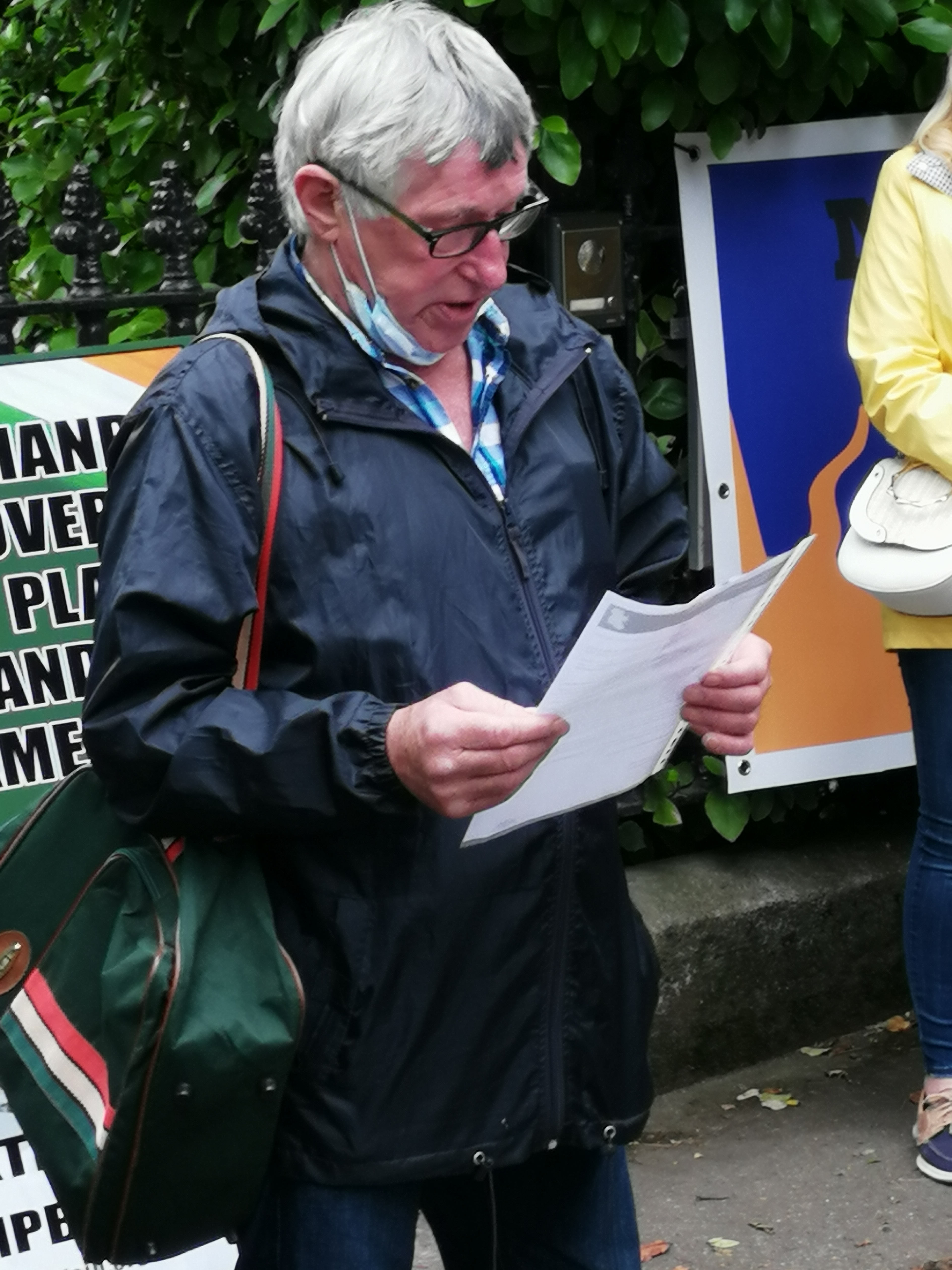
Pat Campbell reading family’s statement (Cáit Trainor, Liam Scullion and Michael Campbell in the background). (Photo: C.Sulish)
FOUR YEARS IN SOLITARY CONFINEMENT WITHOUT A TRIAL
The Chair then asked was there any other group represented there who had not been called and wished to speak. Nobody spoke up and after a pause the Chair called on Pat Campbell, a brother of Liam, to read a statement on behalf of the family. Before reading, Pat Campbell thanked all those present for their support, on his own behalf and that of the family.
The speaker reminded his audience that the Lithuanian episode of the persecution of Liam Campbell stretched asfar back as January 2009 when hehad been arrested and issued with his first extradition warrant. Four months later, whilst on bail, he was wrongfully re-arrested by the British, who processed a second extradition warrant by the Lithuanian State, in May 2009.
Some of the banners and placards at the event. (Photo: C.Sulish)
Liam had then been held in solitary confinement in Belfast‘s Maghaberry Prison for four years1, during which time he had never been convicted of any crime, nor even questioned! Liam won his case in the High Court in March 2013; it was appealed by the British State in the supreme Court in London, who ruled in August 2013 that there was no case to answer.
However a third extradition warrant was issued by the Lithuanian state, also in August 2013 and kept quiet for three years before being sent on to Dublin. In December 2016, Liam Campbell was arrested for a third time which began his most recent struggle against extradition.
Section of the crowd, looking eastward. (Photo: C.Sulish)
Pointing to the state of the prison regime in Lithuania, Pat Campbell spoke of reports from the Committee for the Prevention of Torture “which detail to us the extreme prisoner-on-prisoner gang violence (foreign prisoners in particular are targeted), accounts of sexual assault, inhumane treatment and intimidation perpetrated by ‘special intervention units‘, notorious within the Lithuanian prison regime of today.”
Proceeding to speak of the standard of the legal system and human rights in Lithuania, the speaker said: “In May 2018 a European Court delivered a damning guilty verdict against the Lithuanian state, otherwise known as “Camp Violet” by CIA military, for their involvement in operating “black sites” used as torture chambers; and a litany of successive abuses which resulted in hefty convictions from the European courts and testament to their ingrained flagrant denial of fair trial rights and failure to safeguard the right of citizens”.
(Photo: C.Sulish)
“Lithuania,” said Pat Campbell just before concluding, “we call you out on your state’s abuse of process that would prevent repatriation to Ireland for Liam Campbell, in your denial of rights as set out in the United nations declaration on human rights act (UDHR) in the charter of fundamental rights (1998). They are not rights for good behaviour but alienable entitlements to all people.”
The contributions of all the speakers were applauded but before conclusion of the formal part of the event, Áine Daly from Crossmaglen stepped forward “to thank the Anti-Internment group and the Anti Imperialist Action who organised this event at very short notice” and also noted the presence of John McCluskey, who had stepped down as Independent councillor for Fermanagh earlier this year.
Protesters packing up, also showing (centre) John McClusky, recently councillor in Fermanagh who travelled down to attend. (Photo: C.Sulish)
Shortly afterwards people began to disperse without any actions from the Gardaí.
The event and the statements combined to create an impressive show of unity in a badly fractured Irish Republican movement and time will tell whether this unity can be maintained in the face of State repression, where it is badly needed. Aside from the Republican organisations represented, the organisers of the event are known as independent of any political party and there were independent individual activists there too, not just Republicans but some Anarchists as well.
End.
General shot of part of the crowd looking eastward. (Photo: C.Sulish)
FOOTNOTES
1Human rights organisations have quoted psychologists’ evidence that solitary confinement should be a last resort and that in any case longer than three weeks in isolation is likely to prove injurious to the prisoner’s mental health.
After repeated claims from from a woman speaking through a loudhailer that their right-wing rally at the GPO was “peaceful” and would “not respond to your violence” (this addressed to their peaceful opponents on the other side of the road!), right-wingers crossed the road a number of times to insult and threaten their opponents, eventually assaulting one well-known Republican who defended himself vigorously. Gardaí separated assailant and victim but declined to take any action against the fascist.
BACKGROUND, BUILD-UP AND ATTACK
The above took place on Saturday 4th July. Earlier, at 1pm, the Ireland Palestine Solidarity Campaign had hosted at the Spire a very well-attended rally in solidarity with Palestine and against the recently-announced plans of Israel to annex the Palestinian West Bank.
Section of Palestine solidarity rally (Photo: D.Breatnach)
View of crowd supporting Palestine southward (Photo: D.Breatnach)
View of the Palestine supporters northwards towards the Spire (Photo: D.Breatnach)
Many of the Palestine supporters were still on the pedestrian reservation when the far-Rightists arrived to set up their weekly protest against social distancing, with claims that Covid19 is not real (or, a variation, that it is exaggerated) and that the restrictions are being used to bring in a “New World Order”.
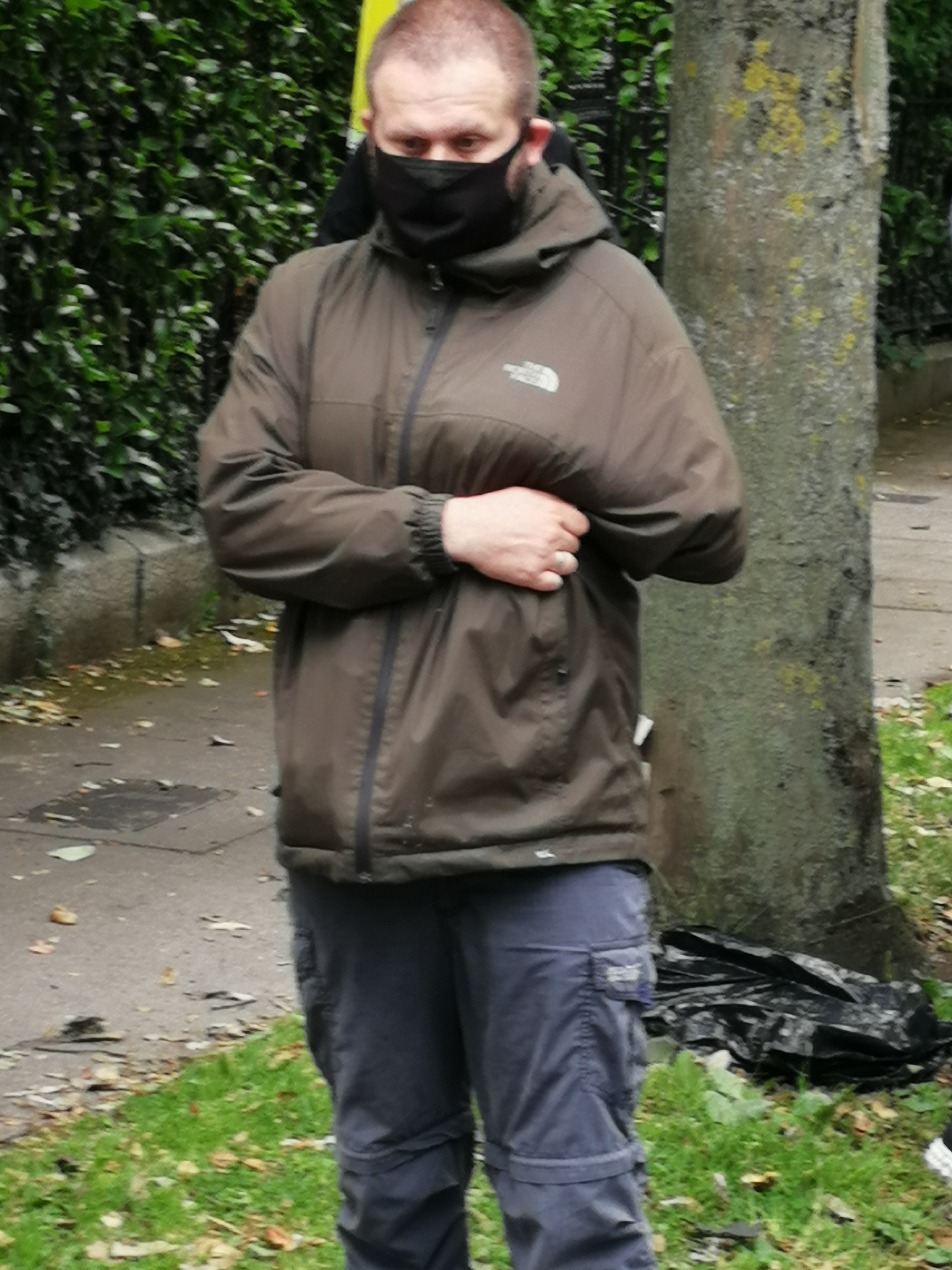
As the Far-Right were setting up, two members of the Special Detective Unit (in the past called the “Special Branch” as they remain known by many, along with less kind names) were seen chatting to them. These political Gardaí in plainclothes were easily identified since some who had attended the earlier demonstration at the Lithuanian Embassy against the threatened extradition of Liam Campbell (see separate report by Clive Sulish on Rebel Breeze) had seen them there, standing near the uniformed Gardaí, watching the protesters. The nature of the conversation of these undercover political police with the Far-Rightists is not known but appeared cordial and certainly they were not asking them for their names and addresses as they had done recently to people protesting in solidarity with political prisoners.
Soon jeers and cat-calls were crossing the street in each direction. The Right-wingers had a loudspeaker advantage for awhile but then one appeared among their opponents too. Even before that, the speaker for the Far-Rightists was accusing their opponents, not one of whom had crossed the road towards them, of being “violent” and claiming that the Rightists were peaceful and were “not going to respond to the violence” of the other side.
It was not long however before some of the Far-Right militants were crossing the road to throw insults and threats at their opponents at closer quarters who of course responded verbally. Gardaí then arrived and gently asked the Far-Rightists to return to the GPO side and one of the Rightists, pointing at the their opponents, who were still on the pedestrian reservation, actually demanded of the cops “Why don’t youse tell them to go back?”
GPO distance: Early arrivals of the Far-Right group portraying themselves as “patriots” (Photo: D.Breatnach)
This went on a number of times with the Gardaí intervening less and less. At one point I had one unmasked ginger-haired thug a few inches from my face photographing me, repeatedly calling me a “scumbag” and a “terrorist” (interesting) but when he told me I was destroying his country (!) I couldn’t resist asking “How am I destroying the country?” He declined to reply to my repeated question, moving on to express his aggression to someone else.
At this point I had become distracted by one of their supporters who was trying to have a conversation with me. I obliged and it was quite revealing on the disparate nature of many of the elements in these right-wing rallies. She told me that she was not racist and was bisexual and not right-wing and her friend (also present) was half-German, so why were we calling them racists and fascists? I was engaging her on some of the things that have been said by some of the group she was with and pointing out some individuals I had seen in support of Gemma Doherty, explaining to her that if she attends rallies of those people, she is going to be subjected to calls against fascists and racists.
Shortly I became aware of a disturbance behind me which, on turning I could see was a fight that was moving towards the east side of O’Connell St. (southbound traffic) where both ended up fighting fiercely on the ground. Before I could see who they were, five or six Gardaí then intervened and separated them, at which point I could identify both combatants: one was a Republican whom I had seen a little earlier sitting on the base of the flagpole in the middle of the pedestrian reservation (apparently where he was when attacked) and his assailant was the very one who had earlier been venting aggression at me and trying to provoke me into physical retaliation.
Once they had separated them the Gardaí were treating this matter as one of equal blame on both sides and saying things like “Don’t be silly now” whereas it was clearly the case that a fascist had crossed the road with aggressive intent and had then taken that further into physical aggression.
Later, when I remonstrated with some of the Gardaí that if we had crossed the road and behaved in that way, they would have at least pulled us out, “Go over there if you want,” said one of them, “I can’t stop you.” I pointed out to him that an antifascist who had approached Gemma Doherty supporters at the Dept. of Justice some months earlier had been threatened by a Garda Sergeant with arrest under the Public Order Act. (On that occasion too, the Gardaí had allowed the Far-Rightists to walk among the counter-protesters).
It seems from recent cases that the line the Gardaí are following is that if it looks like being a serious all-out fight they will police it hard and keep the two sides apart but, if smaller scattered fights break out they will break them up without arrests, especially if Republicans are being attacked and possibly, in future, use these occasions to arrest antifascists who defend themselves or respond to provocation.
It is historically true that police forces in capitalist states favour fascist movements, a fact seen throughout Europe. In London, in the Battle of Cable Street in 1936, fought to prevent a march of the fascist “Blackshirts” through a largely Jewish East End, the main confrontation was between the antifascists on the barricades and the escort for the 2,000-3,000 fascists: 7,000 Metropolitan Police, along with the whole of the London mounted police force.
“WE ARE NOT RACISTS AND WE ARE FOR THE PALESTINIANS”
The above was one of the claims of the speaker of the Far-Rightists, made repeatedly. This is a new development in their rhetoric and they claimed to have some Polish and also a Palestinian among their number. This last at least appeared to be true and a big man of Middle-Eastern appearance was among them and was seen later chatting to some Gardaí. A man I know informed me that this man is a Palestinian but a member of the Muslim Brotherhood (right-wing Islamic fundamentalist group).
Gemma Doherty has posted much racist material (and outright lies), as has Justin Barrett of the National Party, both of them objecting to the election of Councillor Hazel Chu as Lord Mayor, Barrett going so far as to say that he would remove Ms.Chu’s nationality if he were in power, even though she was born in the Mater Hospital and raised and educated in Dublin.
The Far-Right, which is a mixed bag in any case, were happy to use O’Doherty’s notoriety to push their movement further but perhaps they are finding her a bit of a liability now and are remodeling themselves as some kind of inclusive alternative movement for civil freedoms etc. They are still promoting their opposition to the idea of legislation against “hate speech” discussed by the previous Government and demanding their right to “free speech”. This actually does hearken back to O’Doherty’s campaign against Google, who closed down her Youtube channels because of alleged racist abuse.
If they are going to drop the racist rhetoric and claim multi-culturalism, presumably they will have to abandon the “Replacement” conspiracy theory, whereby the EU allegedly has a plan to replace all the Irish with migrants! However the challenge with which their militants first approached their opponents on Sunday of “Are you Irish?”, just as they did at the O’Doherty rallies, hardly exudes multi-culturalism.
The other elements of Far-Right rhetoric and propaganda remain, however: that they are “Patriots” (sic – hence the strutting around with the Tricolour and “Irish Republic” flags); they are Christians (“walking in the steps of God” according to their speaker that day); that their opponents areall in an organisation called “Antifa” and funded by the millionaire Soros (also according to their speaker); and that governments are assisting in a coming to power of a “New World Order”.
CANNOT BE TOLERATED
It is not acceptable that Republicans or any kind of antifascist can be attacked on our streets and it must not be tolerated. Apart from anything else fascists will use incidents like that to promote themselves as some kind of “warriors” to build up their fascist thug forces while at the same time part of their movement will be playing the victim and proclaiming their “peacefulness”, as was amply demonstrated today. This is exactly the dual road of the advance of fascism historically.
The drop-down poster displays their paranoid vista. The woman to the right was their speaker, proclaiming their “peaceful demonstration” a little before participants in their rally crossed the road to insult, provoke, threaten and ultimately assault a Republican. (Photo: D.Breatnach)
There is something wrong with our organisation in the broad sense too, it seems to me, if our opponents, at least some of whom wish us harm, can walk among our ranks with impunity. In some places today they were blocked and one youth was even pursued until he returned to his group but in many places they just walked in and it was one of those who assaulted the Republican today.
On another issue, as I have pointed out in the past, these confrontations may tend to have the Far-Right appear as patriotic to onlookers, since it is they who are waving the Tricolour and “Irish Republic” flags and some wearing green tops too. For the sake of educating the public, the antifascists need to fly their flags too, whether these be tricolours as well and/or Starry Ploughs, Red, Red-and-Black or Black flags, including those with the Antifascist symbol, or that of the LGBT movement or indeed others. Placards countering the fascist and racist propaganda and exposing fake patriotism should also be visible.
The most crucial thing is that the Far-Right movement with its fascist core be not permitted to appear a viable option for the Irish ruling class to choose. We have had some successes, for example in preventing Pegida launching in Dublin in 2016 and some confrontations with the Far-Right – but it is clear that there remains a deal of work to be done.
Dublin has a Lord Mayor of Chinese descent. According to some, this is some kind of disaster. Apparently to them, she is a migrant (though born, bred and educated in Ireland) and even an advance scout for a takeover by Chinese Communists (because, of course, all Chinese are communists, even those from Hong Kong – but wait, didn’t Gemma O’Doherty also tweet approvingly that some Chinese Hong Kong businessman wants to have the Communist Party of China declared a terrorist organisation?).
Hazel Chu. wearing chain of mayoral office, poses for photo with her daughter and husband. (Photo source: Internet)
Speaking after her election (on 43 votes against the nine for the other candidate, according to RTÉ), Ms Chu said she wanted the Dublin Agreement parties who had backed her election) to tackle the housing and homeless crisis which has seemed like “filling a hole in a sinking ship”.
Her other priorities are making Dublin a liveable city, fighting discrimination and protecting the vulnerable. In her speech, she said she wondered if her mother – who had worked washing dishes in a restaurant off O’Connell Street – dreamed that her daughter would one day become Lord Mayor.
Since being elected a public representative on to Dublin City Council in 2019, on the highest first-preference count of any Irish local authority councillor (perhaps Pembroke constituency is a Chinese Communist base?), also receiving the highest percentage vote of any first-time candidate, Hazel Chu has reportedly been subject to racist harassment, vilification and even threats, both on social media and by telephone calls to her home. Not because of her views or her political party – purely because her parents are Chinese who met and settled in Dublin in the 1970s.
When Hazel Chu was nominated for the position and before her election, racist and right-wing conspiracy theorist Gemma O’Doherty recorded herself on video attacking her and claiming that Chu is a supporter of pedophilia (because she allegedly supported the closure by Google of O’Doherty’s Youtube channels) and in Gemma-World apparently a Chairperson of the Green Party can also be “a hard-core Communist”.
After Chu’s election, O’Doherty tweeted, above a highly dubious “news” item claiming that a property developer plans to build a new city in Ireland for Hong Kong refugees (!): It’s fitting Dublin now has a Chinese Mayor when millions more are to be planted in our home in the coming years. You wanted Communism. You’ve got it. Don’t say we didn’t warn you! But the Reds know it will only make the patriot movement grow and grow.
O’Doherty has become notorious not only for her anti-immigrant rhetoric but also for claiming that the the whole Covid19 pandemic was fake and part of a plan to put in place a New World Order (apparently the existing Order is not bad enough) and that the EU has a plan to replace Irish people with migrants. One of her heroes is Donald Trump and her opponents she claims are all “Reds” who are “funded by Soros”, as is the Black Lives Matter movement, “Antifa” etc. Along with the Right in the USA she defends the statues of racists and conquistadors (even though the latter were armed immigrants and definitely dangerous to the locals!).
Hazel Chu studied and qualified as a barrister in Ireland. (Photo source: Internet)
Justin Barrett, founder of the National Party (sic) and former member of far-Right organisation Youth Defence has said that if he were to get into power he would strip Hazel Chu of her citizenship. It is hardly surprising to see a proposal straight out of Nazi Germany coming from this former campaigner against divorce and abortion and for a “Catholic Ireland” that would ban muslims from entering the country because apparently muslims are a serious threat to our lives and Irish liberty (Henry VIII, Elizabeth I, Oliver Cromwell, William of Orange, Lord Castlereagh, King George III and Lloyd George must’ve all been muslims!). Barrett is on record as being an admirer of the anti-semitic Fr. Denis Fahey and writer Hilaire Beloc (a French immigrant to Britain!).
Dublin City Hall, seen looking eastward. (Photo source: Wikipedia)
BEYOND THE CRAZY PARANOIA – FASCISM
Beyond the craziness, the paranoia and ludicrous theories of conspiracy (as distinct from the real conspiracies in the world), what we have here is virulent racism and lurking in among those sad and mad people and raving racists …. are the handful of organised fascists. Those who dare not at the moment come out and declare their wish to have a corporate state in Ireland, one to outlaw oppositional organisations and demonstrations and suppress the resistance of the working class. A REAL conspiracy. A kind of State that becomes increasingly attractive to the capitalist ruling class as it finds itself in difficulty to keep up its profit levels and feels it needs to squeeze the working people harder. A REAL possibility.
Which is why we need to take these matters seriously. Such organisations as Anti-Corruption Ireland (sic), Yellow Vests Ireland and the National Party are the means by which the fascists mobilise a stream in which they can swim – and collect others to swim with them.
They must not be given an inch.
That the ruling Gombeen class would turn to them if they looked like a viable option is entirely possible if viewed historically. The State was set up by that ruling class in a vicious Civil War in which it not only repressed its opposition and the population but executed 80 Republicans with barely a court martial, shot prisoners and exploded them on landmines, kidnapped and murdered activists.
A large part of the opposition to that State at the time became coopted by the ruling class and that process has come into full development with the current Fianna Fáil/ Fine Gael coalition Government. And we can already see the straws in the wind in the behavior of the Gardaí, who appear in and out of uniform to harass peaceful Republican pickets and Debenham’s worker picketers while on the other hand, weekly demonstrations of the far-Right, violating in every way pandemic precautions, remain untouched by those same Gardaí.
The far-Right in Ireland have been trying for some time to present themselves as “patriots”, flying the Irish Tricolour, playing the Soldiers’ Song, etc. They do not have a history of promoting the Irish language or fighting for the rights of Irish speakers, nor of campaigning against English colonialism in the Six Counties, nor for Reunification of the country. Nor have they a track record of even defending areas of historical importance from rapacious Gombeen and foreign property speculators. They were not active in the struggle against British Petroleum in the Erris area nor in preventing the selloff of Irish forestry. So what actually is this “patriotism” of theirs? Nothing. Nothing but racism.
It is not even enough apparently for these racists that a person be born in Ireland – they have to be “ethnically Irish”. Would that be like the Pearse brothers, shot by British firing squads, whose father was English? Like Constance Markievicz, founder of the Na Fianna and officer in the 1916 Rising, one of the Gore-Booth planter family? Like Thomas Davis, Young Irelander author of A Nation Once Again and other songs, whose father was Welsh? Like Theobald Wolfe Tone, founder of the United Irishmen, a descendant of planters? Like Erskine Childers, fourth President of Ireland and son of an Englishman who died for Ireland, executed by this very State?
And while we are about discussing things “ethnically Irish”, should these “patriots” not return that flag they keep waving, the Tricolour, to the descendants of the Parisian revolutionary women who first presented it to Thomas Meagher in 1848?
end.
Coat of Arms of Lord Mayorality of Dublin. (Photo source: Internet)
Some young take to the water, others to the air …..
The last weeks of May and first half of June saw the young of many species take to air or water. On my walks in the Drumcondra area of Dublin where I live, although Glasnevin Cemetery and the Botanic Gardens were unreasonably closed (the Botanic is now open but on restricted hours, again unreasonably), the banks of the Tolka river in Griffith Park and the banks of the Royal Canal were open to the public.
A pair of mute swans (ealaí) nested on the stretch of Royal Canal east of Cross Guns Bridge but quite near to it. Well, the female, the pen, at least did, while the cob (male) was usually swimming nearby. So how did the pen feed during the long hatching period? Unlike some bird species, this male does not feed the broody female. Well, the male may take a turn, spelling her to go off and feed herself and difficult to know when that happens, as both genders look so much alike. Fumbling with my phone once I failed to catch a photo of the large grey eggs beneath the shifting body of the sitting bird – three, an East Asian woman told me, using her fingers. Later, I saw both parents with just one cygnet – whether some of the eggs were infertile or two of its siblings died I don’t know.
Mute Swan cygnet in ‘duvet’ on land (Photo: D.Breatnach)
Mute Swan parents and lone cygnet, Royal Canal, Glasnevin. (Photo: D.Breatnach)
Predators can take cygnets but the parents are very good at protecting them and eggs in the nest will not be left untended until the cygnets are hatched – and then it’s straight into the water. When not swimming itself, the cygnet climbs on to a swimming parent’s back and sits there surrounded by a natural feather duvet. From then on, the nest is not needed except perhaps in stormy weather.
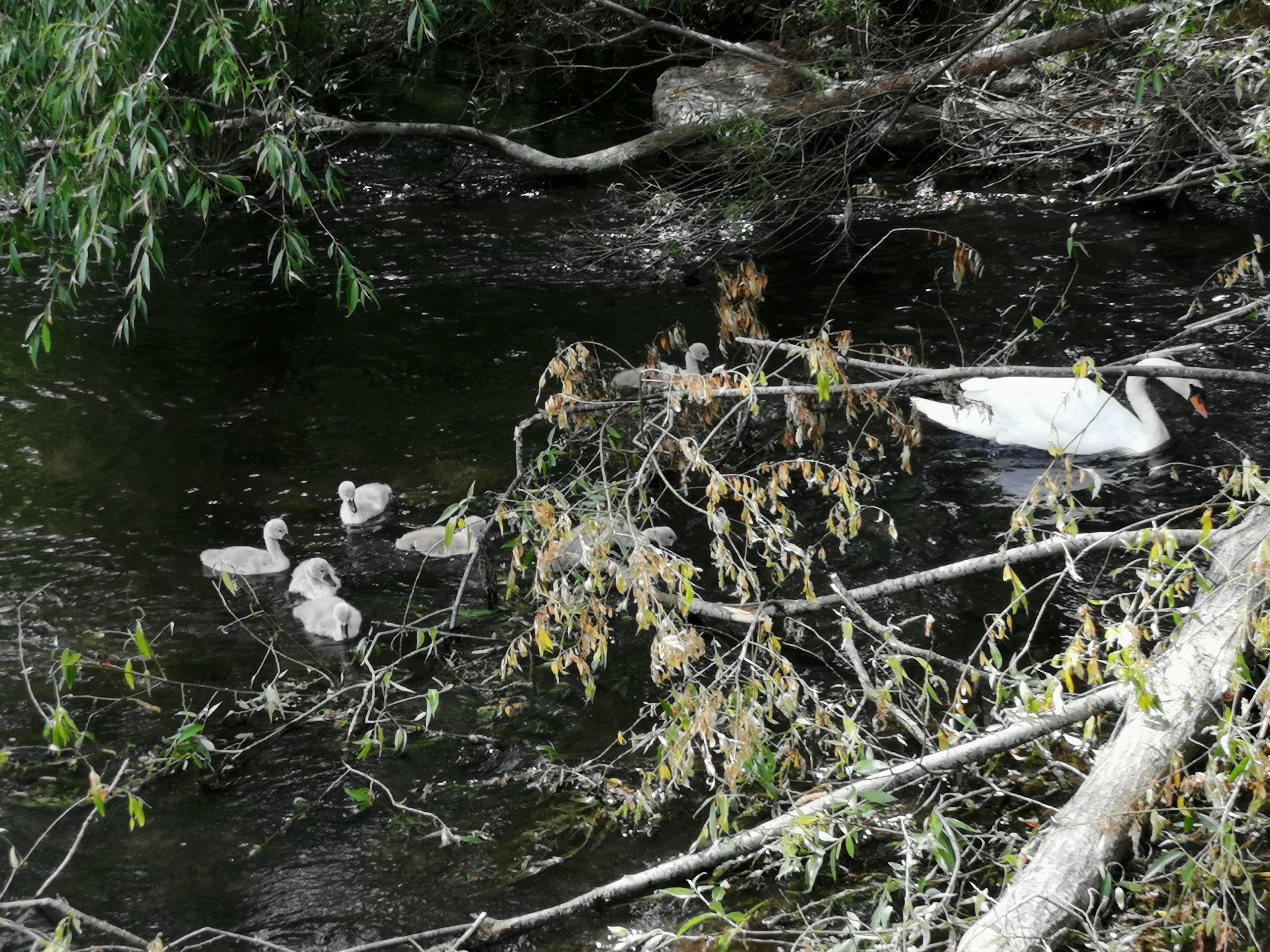
A few days later I was fortunate to see another pair of mute swans on the Tolka in Griffith Park, these with no less than seven cygnets! Their parents took them upstream, the cygnets swimming easily, even under the branches of a fallen tree-trunk. Until they came to a mini-weir which the parents simply walked over but their offspring were too small to do that. However, they maintained position for quite a while swimming against the mini-waterfall, their parents seemingly unable to understand why their young could not follow them and, eventually, having to turn back to them. Many mammals, confronted with a similar problem, would simply pick its young in its mouth and carry them over the obstacle and then go back for the rest. A small crowd of Homo Sapiens mammals gathered to watch the proceedings with interest and delight.
Some of the mute swan brood following their parent upriver on the Tolka. (Photo: D.Breatnach)
Can we go under this obstacle? (Photo: D.Breatnach
Yes, we CAN go under that obstacle! (Photo: D.Breatnach)
Why aren’t you coming? (Photo: D.Breatnach)
Also out with their young were mallards (Lachain), the ducks and drakes (bardaill). Some had hatched their young as far back as April but most seemed to be doing so at this time period and then it’s straight into the water. I remember witnessing the unpleasant scene of a duck with a clutch of tiny ducklings on the Tolka being harassed by a couple of drakes, one in particular trying to mate with her, she quacking that she wanted no part of it. Contrary to comment by some writers, rape is not unknown in the animal world and though in most species it is rare, mallard drakes are known for it.
Delightful it was however on another day to see a newly-hatched clutch of ducklings zooming around on the water, in their fluffy chocolate brown-and-yellow down looking like aquatic bumblebees, both parents close by.
Duck and very young ducklings, Tolka, Griffith Park. (Photo: D.Breatnach)
Walking past the high waterside vegetation of the canal one day I heard a kind of cheeping which I guessed to be the chicks of a moorhen (Cearc Uisce). These waterfowl are very shy and careful too not to reveal their nest locations which are constructed in waterside vegetation only inches above the water level and sometimes actually afloat on a kind of raft. Though egg-laying is in March-April and they will not fledge until about 50 days later, we should be seeing the chicks with their parents already. So where are they?
Moorhen, Royal Canal, Phibsboro, not hanging around to be photographed. (Photo: D.Breatnach)
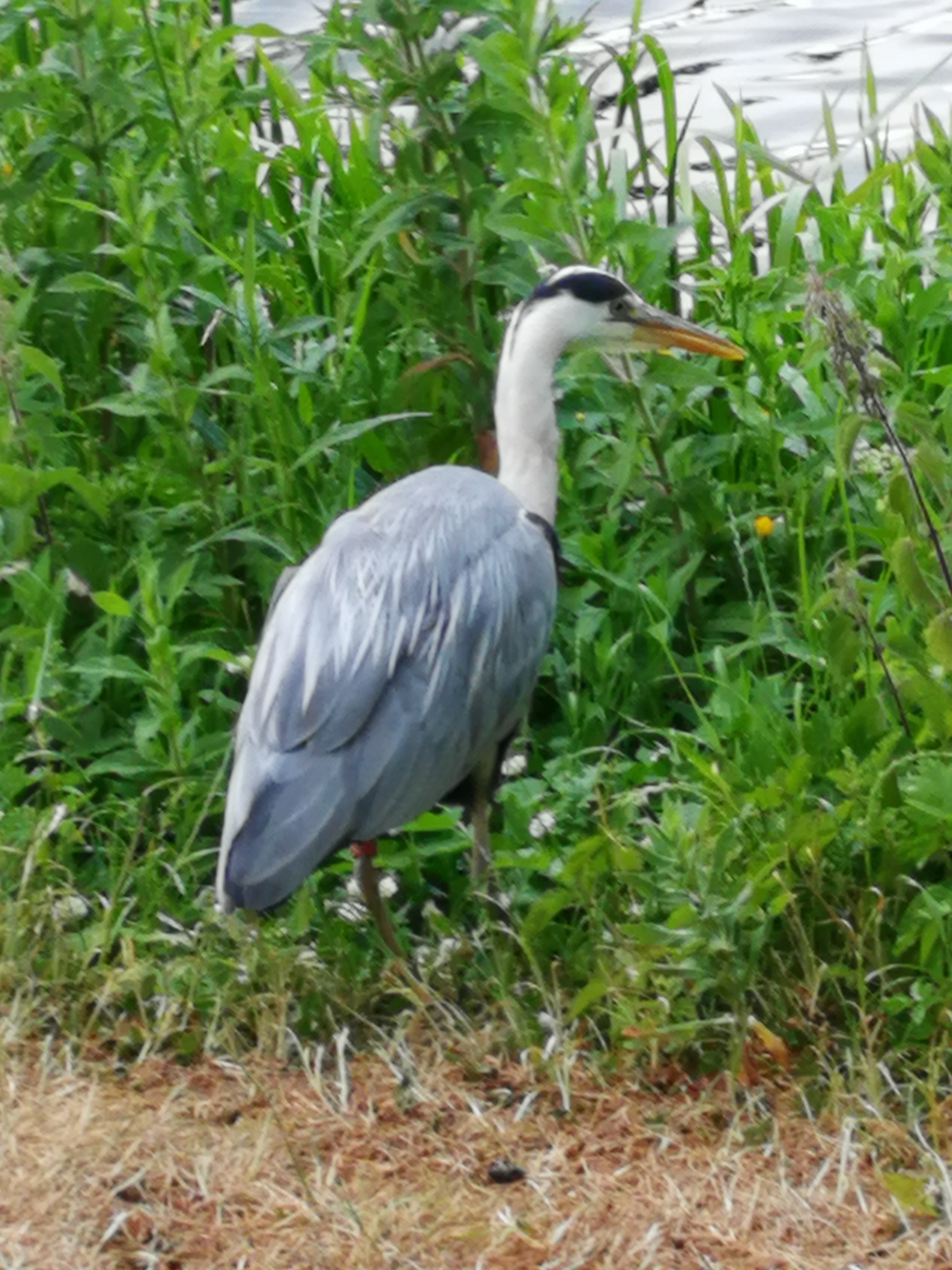
Grey herons (Corr Ghlas) fish the Tolka and the Royal but their nests are nowhere there. They prefer to nest in trees, somewhat incongrously for birds with such long legs. I have never seen their nests in Ireland myself, though I read that a colony is to be found in St. Anne’s Park, in County Dublin. Grey herons take turns on the nest and also in feeding their young – which require a lot of fish and frogs. They would take a duckling or cygnet too, given the chance …. Which is why herons often get mobbed by other birds. In Drumcondra I watched one on house rooftop being dived at by seagulls, no angels themselves but they have nests of their own in higher rooftops nearby.
Grey Heron, Royal Canal, Glasnevin. (Photo: D.Breatnach)
And one day, a Little Egret (Éigrit Beag) spent a little while looking for fish in the Tolka before departing. It’s a relatively new settler in Ireland but no longer rare along the east coast.
Not so much “taking to the water” as already in it are the tiny young of the three-spined stickleback (Garmachán), hatched out in underwater nests cared for only by the male. I have seen shoals of the fry of larger fish in the Tolka too, once heading downriver through the Botanic Gardens; what species they were I don’t know but a large stock of brown trout (Breac Donn/ Rua) lives in the river. Many sprats are at this moment concentrated in different parts of the Tolka.
However, on a number of occasions large numbers of fish have been killed by pollutants in the water. A few years ago it was reported that salmon (Bradán) had been seen making their way upriver and this year I saw some myself in the Tolka. These spawn in freshwater and after a few years their young make their way to the sea, the survivors returning years later to spawn in the river again. If the young are killed before making it into the sea obviously they won’t coming back to spawn in a few years’ time so a fishkill incident in one week can wipe out a species in the river for a number of years. I photographed the sprats of some species of fish a few weeks ago in the Tolka and again this week while walking through Griffith Park (I, not the fish).
Sprats, young of some fish species, Tolka, Griffith Park, 25 June 2020. Difficult to photograph with mobile phone even through not much more than a foot of water. (Photo: D.Breatnach)
Among the young taking to the air now are those of the magpie (Snag Breac) and the distinctive and irritating high-pitched calls of the juveniles can be heard just about everywhere, usually from above in the trees. The call is “feed me” and is designed to be difficult to ignore. However, they need to learn not only to fly but to find their own food, so the parents will feed them only on occasion. This corvid is apparently an invader recorded arriving in Wexford in 1676, over two decades after that other invader, Oliver Cromwell. It has settled in well but is recognised as a predator by songbirds and sometimes attacked by them; on the other hand the magpies themselves will gang up on seagulls, hooded crows and cats, when they will give a frequent rattling kind of call.
The juveniles who are calling to be fed were in the egg for 20 days and fledging for nearly a month, which means the eggs were laid in April. The nests are large, a mass of twigs and can be seen in trees all over Dublin.
Some of the cottonwood seed-carrying medium on the banks of the Tolka, Griffith Park, end of May. (Photo: D.Breatnach)
Bullrushes, Royal Canal, Drumcondra, shedding some cotton but not where the main cotton fall is coming from. (Photo: D.Breatnach)
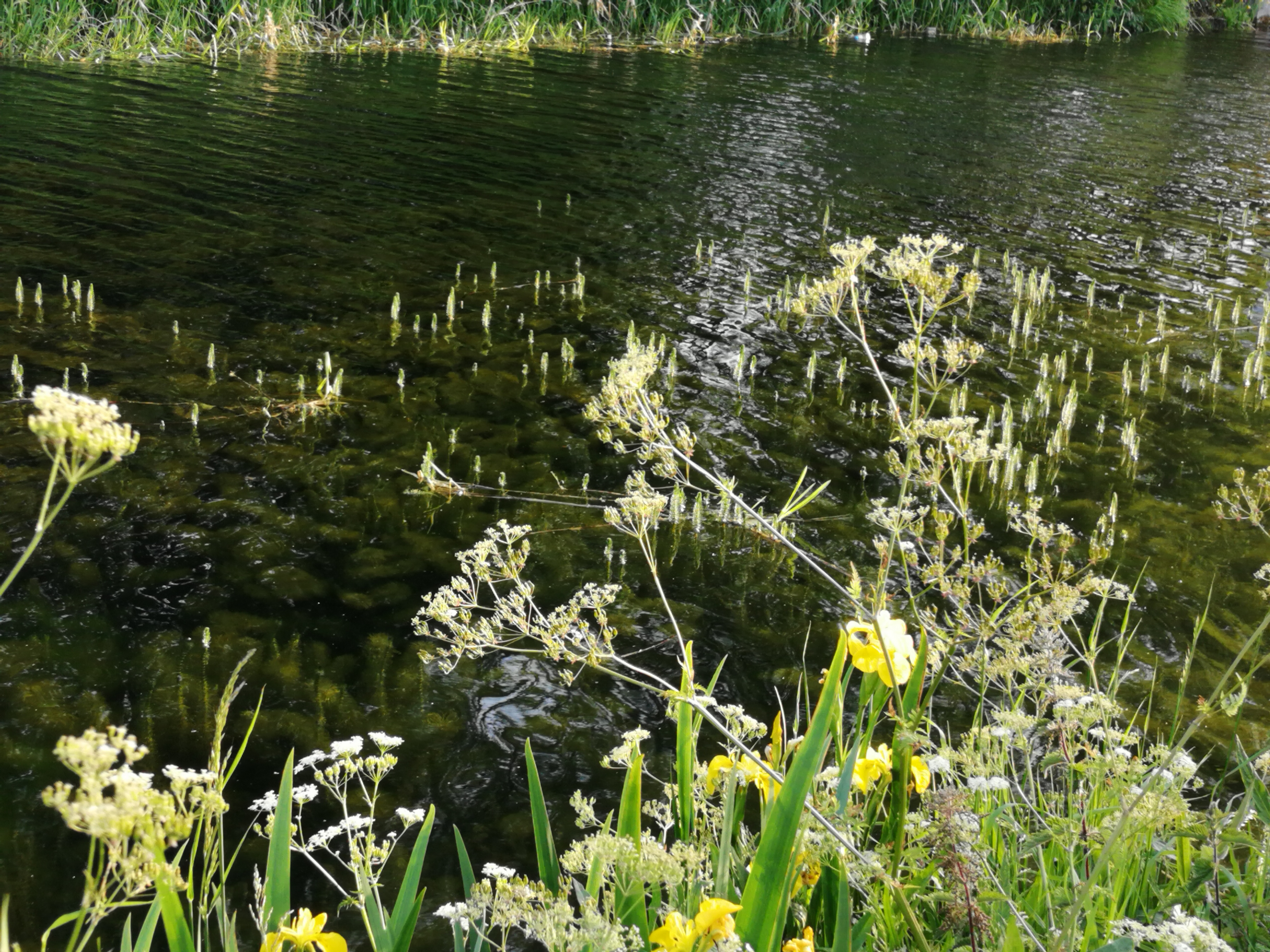
Bedstraw, perhaps, flowers mostly gone to seed. Royal Canal, Drumcondra; Yellow Flag Iris nearby. (Photo: D.Breatnach)
The young of plants have taken to air too and along the banks of both the Royal Canal and the Tolka the flowers have died and are turning to see-capsules or to pods, while other species are bursting into flower.
Some days the ground was covered in drifts of a kind of cotton and I assumed this was seed-carrying material. But from what? Along the Royal I might suspect the bullrush or reed-mace, with tattered tufts of cotton around the mace “head” …. or perhaps the pussy willow … but surely not in these quantities? However, in Griffith Park clumps of it were drifting across my path and I remembered reading about “cottonwood trees” in stories set in the “Wild West”. Yes, three species of cottonwood are part of the larger poplar family and have been around for 55 million years in North America, Eurasia and Asia and although not native they do grow in Ireland. And poplar-type trees have been planted along stretches of the Royal but in particular in Griffith Park, recognisable by their somewhat rounded leaves and the compact upright growth of their branches, so perhaps they are the source of the cotton? Their name in Irish is Poibleog Mheiriceá Thuaidh, translating as “North American Poplar”; that’s a bit of a long one and if they become more popular (forgive the pun) we might have to start calling them ‘Crann Chadáis’ (Cotton Tree).
But it wasn’t them either. The culprit was, after all, the willow (Sail) tree; but not the pussy or weeping willow, but the giant willows.