PLAIN-CLOTHES POLICE OFFICER SHOT DOWN IN DUBLIN STREET


Diarmuid Breatnach

He’s up there if you want him …. on the footpath.”

On 14th April 1920, a man in plainclothes was shot by another, also in plain clothes, in Camden Street, Portobello, on the south side of the city and not far from the centre. A passing motorist rushed the gunshot victim to the nearby Meath Hospital but he died there.

The victim was Det. Constable Harry Kells of the Dublin Metropolitan Police, a man of 41 years of age who lived in No. 7 Pleasant Street, i.e very close to where he was shot. He was married without children.

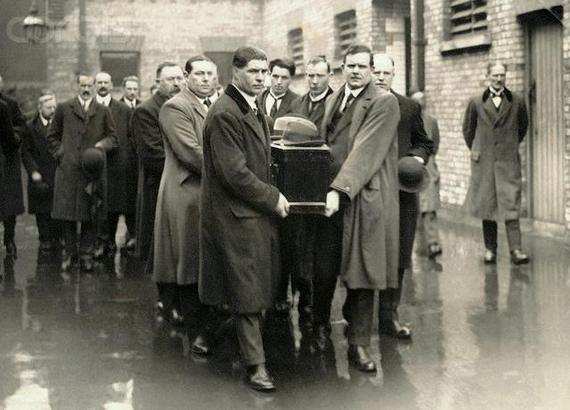
Funeral party of DMP colleagues of Det. Constable Kells, with the coffin holding his remains.
(Source: irishconstabulary.com)

Many reports say that Kells was a member of the DMP “G” Division, which were known as “the political police” (apparently both within the DMP and outside). However, “McRIC” in the irishconstabulary forum states that this is inaccurate and that the man, although recently promoted to plain clothes work, was rather in “B” Division and investigating a number of burglaries in the city.

From a number of investigations carried out it seems that this question may never be resolved but it is highly likely that Kells was at least in the process of being transferred to “G” Division. However, the reason for his killing is almost certainly much more specific. It seems that Kells had been reviewing identity parades in Mountjoy Jail in attempts to find the killers of British intelligence agent Alan Bell, who had been assassinated on the 27th March. While engaged in this work, he had been identified by Peadar Clancy1, Vice-Commandant of the Dublin Brigade of the IRA, who sent a note about him to Michael Collins, who put the execution order on Kells.

It is worth noting that Republican prisoners in Mountjopy had also been taking part in a hunger-strike at that time in protest at removal of political status while detained without trial. Ironically, 90 prisoners were released on the very day Kells was killed.

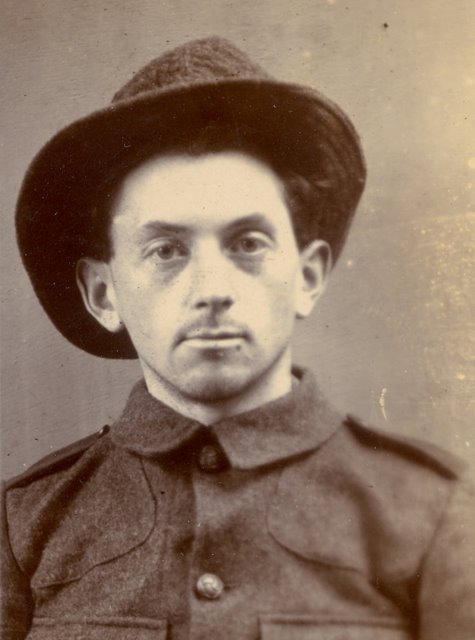
Peadar Clancy, who got the word out to Collins about Kells working Identification parades in Mountjoy Jail, Dublin. (Image source: Wikpedia)


THE LARGEST RAID EVER CARRIED OUT BY BRITISH TROOPS IN DUBLIN

“Aul Decency”, posting on Dublin Forum.ie on 31st March 2012, drawing on April reports in the Irish Times and New York Times, says that the incident “was the cause of the largest raid ever carried out by British Troops in Dublin.”

According to “Aul Decency”: “Two of those sought in connection with Kells’ killing were Sinn Féin members Michael and William Kavanagh who lived at 5 Pleasant St., who had previously been “fingered” by Kells, and it was thought they would seek refuge among friends in the neighbourhood. The troops swarmed over Camden St from Cuffe street and into Portobello and the homes of the local Jews2. Over 100 people were arrested that day but Kells’ killer was not among them.”

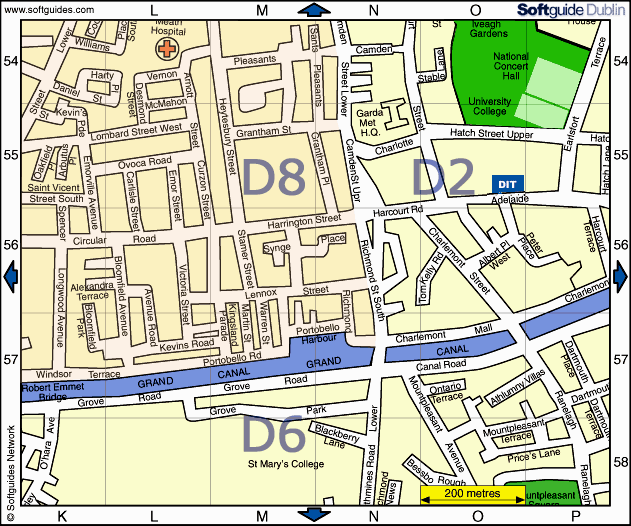
Portobello area map today,  Camden Street is a longish one right between the D8 and D2 legends.   Pleasant St. is off Camden St. to the left, near the top of the image. (Source: Internet)


This “fingering” had in fact been carried out after the 1916 Rising when Kells reported that the brothers had been seeing changing into Volunteer uniforms in the house, information which had resulted in at least one of the brothers ending up in Frongoch concentration camp that year and losing his job.

It is enough perhaps to know that Kells was killed by Republicans and the probable reason but we can go a bit further, drawing on The Squad by T. Ryle Dwyer (quoted in irishconstabulary.com) where Paddy Daly of the Squad is quoted about the operation to kill the police officer:

On our way we picked up Hugo MacNeill, a nephew of Eoin MacNeill3 the initial President of the Irish Volunteers. He was not a member of the Squad but he asked to come along.

We divided up into patrols of two4, MacNeill was with Joe Leonard. ODaly said he heard a couple of shots, and saw MacNeill sauntering down Pleasant St. as if nothing had happened.

What was the shooting about? O’Daly asked.

Kells is up there if you want him, MacNeill replied.

Where?O’Daly asked.

On the footpath‘, replied MacNeill.

Det. Constable was the third police officer to be killed in Dublin so far in 1920 in a war between the British occupation forces and the IRA, in which not only police officers but intelligence agents and British soldiers on one side were killed and, on the other, Volunteers, active Republicans, sympathisers and uninvolved civilians. Of course the war was going on in many other parts of Ireland but it is often forgotten that among those areas subject to martial-type law were Dublin County and City, where had been the HQ of the British occupation since 1171: Dublin Castle.


SOURCES:


http://www.dublinforum.net/forum/showthread.php?t=2110&page=3

http://irishconstabulary.com/topic/1477#.WO6mGEvb-_s

https://en.wikipedia.org/wiki/Timeline_of_the_Irish_War_of_Independence

http://www.irishmedals.org/r-i-c-d-m-p-k-i-a-.html

1Peadar Clancy was one of two Volunteers and one civilian who were tortured by RIC Auxiliaries in Dublin Castle and killed on November 21, 1920 (Bloody Sunday).

2Portobello had a Jewish quarter at that time. Some of the residents are reputed to have been active in the resistance movement and a number had been on strike or locked out in 1913.

3He who had on Easter Saturday 1916 issued the cancellation order for the Rising.

4According to testimonies by Squad members, working in two groups of two was standard procedure. Typically each pair would take one side of the road. Once the assassination was carried out, the two who had not done the killing would cover the escape of the two who had.

AN EASTER STORY


Diarmuid Breatnach

There are many different kinds of Easter stories – religious ones, or about Easter parades and processions, ones about family reunions, Easter egg hunts, even holidays …. this isn’t one of those.

The man, let’s call him Jeremiah or Jerry for short, stood outside the pub on a Sunday afternoon and struggled to quell the apprehension threatening to flood his mind and body. It had to be done. He turned to his companion, who seemed to view everything through laughing eyes and was no different now. Brian had three teenage kids with him, two of his own and a friend of one of them. Hardly ideal, but Brian had turned up with them a little while ago and there was no-one to leave them with. Well, they’d be all right – Jerry would be the target and, after him, Brian. They wouldn’t touch the kids.

Best give me the bag, Brian,” he said and, receiving it, checked inside. The stuff was there. Of course. Jerry folded the bag and stuck it under his jumper, under his coat.

He was focused on the tasks ahead but the trail that led them here had started days earlier. And, in some ways, years before that.

He squared his shoulders, turned and entered the pub. Brian and the kids followed.

**** **** ****

He had been at work on Friday afternoon when the call came from the Manager of the Irish Community Centre. Of course, he asked the staff to put it through to his office.

Do you know your event is in the newspapers?”

Something in the Manager’s voice alerts him that he is not being congratulated on the publicity.

The Easter Rising commemoration?”

Yes. It’s in the Evening Standard.”

Well, that answered the second question he had in mind.

No, I didn’t know. What are they saying?”

He knows what the British media are like and he’s got a sinking feeling.

It transpires that an Irish Republican organisation had put the event on their website, which had been noted by an Englishman who lost his son in the Omagh bombing of 1998. There are many questions to be answered about that bombing, both within the Republican and the State side, but for many years, not unnaturally, the father had been focused on the Republican group allegedly connected to the Real IRA, who had placed the bomb. In addition to his son, the bomb had killed 28 other people, the second-highest death toll for any day during the war in Ireland, the highest being the Dublin-Monaghan bombing of 1974, with a toll of 34. Jerry was aware that the 1974 bombings did not attract anything like the same media attention and understood the reason – they had been carried out by Loyalists under British Intelligence Service direction.

But what had all this to do with the Irish in Britain Representation Group in South London, and their Easter Rising Commemoration? Or with the Irish Community Centre? Well, the grieving father had noted the posting by the Irish organisation, noted the venue and rang, demanding that the event be cancelled.

I told him the commemoration is an annual event organised by an Irish community organisation and that there’s never been any trouble at it. I told him it has nothing to do with that Republican organisation …. it doesn’t, does it?”

No, it’s just us, the local Irish in Britain Representation Group branch. But surely any organisation is entitled to advertise the event?” replies Jerry.

Jerry is noting doubt in the Centre Manager’s voice responding to him. He is on the receiving end of huge pressure, working in his office, alone.

He wanted me to cancel the booking and I said I couldn’t do that,” said the Manager.

The grieving father had got on to the local authority, who replied that the event was the business of the Irish Centre. The father then contacted the media, who rang the local authority again and this time, instead of sticking to their original line and weathering what would be a short-lived storm, and without phoning the Centre Manger, their spokesperson condemned the event and stated they would be asking hard questions of the Centre, which they part-funded.

Jerry reads all this again when he slips out to get a newspaper. He feels for the beleaguered Centre Manager but can do nothing. It’s too late to contact the newspapers because the story is published. The event is to be held that evening. It has been advertised in the local area and in the Irish Post, the main newspaper at the time for the Irish diaspora in Britain. And in any case, one cannot – should not – give in to intimidation, coercion. The community had mostly caved under the Prevention of Terrorism Act in 1974 and had not really rallied again until the Hunger Strikes of 1981. The event must go on.

Jerry heads home, thinking about additional security needed on the door for the event, composing replies to the local authority, a letter in the newspaper ….

The IBRG Ard-Choiste, its governing body, had withdrawn its support of the Time To Go coalition in Britain some years earlier because of undemocratic maneuvering by some left Labour politicians, along with the sidelining of specific Irish community concerns. They had not been alone: Stop the Strip Searches Campaign and the Troops Out Movement had pulled out also, leaving the tiny Labour Committee on Ireland, the Socialist Workers Party and Communist Party of Great Britain to be supported by only the Wolfe Tone Association (SF support group in London) and the Connolly Association (linked to the CPGB) among the Irish campaigners .

Later, in 1998, the IBRG had been divided on the Good Friday Agreement. It was not the issue of continuing or ceasing the armed actions of the IRA that had been the source of the division, rather the acceptance of colonial rule, albeit claimed to be for tactical reasons only. A majority within the IBRG came out against the Agreement and that was in accordance with Jerry’s position too.

Although he supports none of the Republican groups opposing Sinn Féin, he has heard whispers in the Irish community at various times associating him with this or that group. This might well be feeding doubts in the Centre Manager’s mind.

Jerry is in a more difficult position than might seem. He is not only Secretary of the local IBRG branch that has organised the event and is affiliated to the Community Centre, but also the Chairperson of the Irish Centre’s Management Committee itself. The Management Committee is the Centre Manager’s employer and has a duty of care to him. And after nearly a decade of campaigning for the provision of the Centre and the meagre funding it receives, no-one on the Committee would want to antagonise the local authority.

But it was the IBRG branch itself and in particular the Irish Pensioners’ Association which was then a part of it, which had won the provision for the community in the end. And Jerry had been part of the campaign, elected as Chairperson of the Steering Group in the years while renovations of the building and available funding were discussed, elected Chairperson for the first six months after the Centre opened and at the Annual General Meeting for every year afterwards. In fact, recently Jerry had been trying unsuccessfully to step down, to ease a replacement into his position.

On the train from London Bridge on the last leg of his journey home, Jerry reflects ruefully that this controversy might cause his stepping down, which was hardly the way he had anticipated his leaving. No stepping back slowly, supporting someone new in position and easing himself out. No – thrown out instead! That would of course imply he had done something wrong, which he hadn’t and that the IBRG had been wrong to commemorate the Rising, which they hadn’t either. Ironically, if moves were made now to replace him, he’d have to fight them.

**** **** ****

Before he arrives at the Irish Community Centre, Jerry looks carefully around the mostly residential street. Nothing seems threatening but can one be sure? He is carrying the IBRG’s branch’s banner, wrapped up in black bin liners, which makes him a visible target if someone’s searching. On the other hand, one of the poles of the banner is loose within the bundle, in case of need ….

He drops the Centre’s keys in his nervousness and enters, disabling the alarm and turning quickly to retrieve the keys and lock the door. Then, into the hall, to begin arranging some of the material ….

He is anxious for some of the IBRG members to arrive but jumps when the doorbell rings. Checking through the fish-eye spyhole, he is surprised to see one of the Irish Pensioners, who lives locally.

Opening the door and ushering her in, he locks the door behind her, saying apologetically “There’s only myself here so far.”

Are others coming?” she asks – she has read the newspaper and unerringly touches Jerry’s main fear at the moment.

I’m sure they are, Ellie. What are you doing here so early?’

I thought you might need some help.”

Jerry is touched straight through to his heart but has to refuse. He can’t have her here if there’s an attack with no-one else but himself to defend her.

Oh no, Ellie that’s very kind of you. But I kind of know what I have to do and explaining it to others will just take longer and make me flustered. You know how it is. Thanks a lot. Besides the others will be here soon. Come back when we’re open …..” he trails off guiltilly.

Still, she goes and he heaves a sigh of relief, at the same time feeling shame.

But there’s work to be done.

A scattering of volunteers arrives over the next half hour. The reception table is set up in the lobby, to sell tickets and distribute leaflets. Hidden behind, are the lengths of wood in case of attack by one of the British fascist groups. Up goes the green-white-&-orange bunting, portraits of the executed 1916 leaders, enlarged copies of the 1916 Proclamation. At the back of the stage, facing the hall, the large artwork Jerry made a few years ago of green, white and orange flames bursting from the date 1916. And the IBRG branch banner.

The stage is ready for the band, a group called The Mc ____ Brothers, who play Irish ballads, including Republican material. Water jug and glasses for the speakers. Tables and chairs rearranged on the hall floor (the part-time Caretaker had laid them out but Jerry always prefers a more “club” arrangement, of smaller tables spaced apart surrounded by some chairs).

By the time the opening hour arrives, Jerry is sweating but it is the sweat of work, not of fear or apprehension. The hall looks good. People are starting to arrive. Maybe he can relax now. Maybe. Brian is on the door with others close by.

The event is a bring-your-own-alcohol one and Jerry and others in the lobby spend some time directing people to the nearest off-licence, so that people are coming in, going out, coming in, sitting in the hall …. Jerry is scanning their faces, looking for possible sources of trouble.

An hour later and the band has not arrived. Pol phones them but gets no reply. Phones their manager but no reply either. Another hour later, the reality dawns on the organisers. The band will not be coming. They have seen the newspaper and decided to look after their safety. But they haven’t even bothered to tell them.

The organisers confer, after which Jerry mounts the stage, calls for attention and begins to speak.

A Chairde Gael agus a chairde ó thíortha eile, go raibh míle maith agaibh for coming here tonight to commemorate the 1916 Easter Rising with us. This is a hugely important event in Irish history and indeed in the history of the world and the local branch of the IBRG has been not just commemorating but publicly celebrating this historic event every year for some time now.

But we are very sorry to say that we have some bad news for you now. Some of you will know that very recently pressure was put on us to cancel this event but that we refused to do so. Pressure was put on the Irish Centre to cancel the event which they also and rightly refused to do.

That the British media would attack us is no surprise, they have been doing that for years. But that the local authority’s spokesperson should bow down to them and, without consulting with us, imply that we are doing something wrong here, that the Centre should not have taken our booking, is something else.

And worst of all, that an Irish band, which makes a living playing Irish ballads, should allow themselves to be scared off and not even have the decency to ring us – well, I don’t really have the words to tell you what I think about that.

So, a chairde, we offer you your money back and no questions and our sincere apologies. However, those of you who wish to remain are welcome to do so and we’ll make our own entertainment with a few songs …. we have a guitar player here …. another man plays a whistle …. But please, you are entitled to your money back and those who wish to please go to the table in the lobby now.”

As though he had been primed to do so (but Jerry knew he had not), a middle-aged Irishman at a table nearer the stage jumps up and shouts: “NO! We will not ask for our money back! We’re not going to be chased out by no British newspapers!”

A round of applause from the audience and a few cheers greet his outburst. And just like that, the evening is saved.

The guitarist plays some numbers and sings. Jerry gives an abbreviated oration and sings a few ballads. The whistle player plays some tunes. People sing along to songs. They drink, chat and buy raffle tickets. One of the raffle prizes is auctioned by the winner, a local publican Jerry had been surprised to see in the audience. The money goes into the takings. At the end of the evening, as they finally cajole the last of the audience out of the Centre (still with a wary eye on the street) and finish cleaning and tidying up, they count the takings. Financially, it has been their most successful evening ever, especially since they didn’t have to pay a band.

But the band ….. their action and lack of notification have left a sour taste in the mouths of the organisers. And during the evening, they learned that the Mc___ Brothers are booked to play at an Irish pub, on Sunday afternoon, just two days away. And only a five minutes’ drive from the Irish Centre.

**** **** ****

A council of war decides that the bar will be visited, Jerry will mount the stage (“you’re our best speaker”) and present the band with white feathers, symbolising cowardice. Some can’t be there. One or two think it will be dangerous. Brian, Pol and Jerry think it’s a good plan — so then they just need some white feathers. How hard can it be to get some?

Visits to duck pond parks yield none. The quaysides along the Thames show no seagull feathers. Brian drives to the coast and walks some beaches – and finds a couple of wispy ones. In desperation on Sunday morning, they burst open a pillow and drag out a handful of feathers. They are small, not at all like the large ones they had envisaged presenting to the band but they are white and they are feathers. Into the plastic bag they go and then Brian is driving Jerry and the kids to the pub. Brian has remarkable personal resources and has been through some very serious situations so this might be small potatoes to him …. but Jerry’s guts are churning.

Some faces in the pub turn to look at them as they enter. Jerry has been here before only once but a number of the clientele are known to him from other pubs and events. And he is probably known to more of them, as Chairperson of the Irish Centre. A few catch his eye and he nods at them, keeping his face impassive.

Do they know that the band playing here let down the audience two days ago? Of course they do …. or at least many would. This is the Irish community in SE London. Besides, the Manager of this bar, Kate, until recently worked for the publican who auctioned the raffle prize at the event on Friday night. At least one of them was there that night too.  Are they wondering what Jerry intends to do?

The band, which Brian has taken to calling the “McChicken Brothers”, is already playing on stage. Jerry had meant to get here before they got on but the feather search had been a delay. To get in front of them now might be resented by the audience and anyway, the band’s control of the microphones could drown out what needs to be said. Jerry goes to the bar, orders pints for himself and Brian and soft drinks for the kids, stitches a smile on his face and chats to Brian. And they wait.

Eventually the band takes a break and Jerry waits tensely for the indication that they are returning for the second half of their gig. When he sees them coming he nods to Brian, whose job is to fend off anyone attacking him before he has finished.

Just as the band reach the low stage but have yet to mount it, Jerry jumps up on it and begins to speak in a loud voice.

Ladies and gentlemen, your attention for a moment please!” EVERYBODY turns to look.

These musicians here were booked to play at an Easter Rising commemoration at the Irish Community Centre on Friday. They didn’t turn up. They left the audience (ok, bump up the figures a little!, he thinks) — 200 people – and the organisers stranded. And they didn’t even have the decency to tell us they weren’t coming. They ran scared, my friends, from lies in the British press.”

Jerry has the plastic bag in his hand and now dips into it, withdrawing a handfull of fluffy little white feathers.

Shame on you!” he says, facing the band members. “And this is what we think of you!”

So saying, he tries to throw the bunch of feathers at them but they erupt in a cloud between them, some clinging to Jerry’s hands. No matter, it is done. He steps off the stage and heads for the door, hoping to make it before anyone tries to stop him, before Brian has to get into physical stuff.

Surprisingly, someone shouted “Hear, hear!” and there had been a scattered round of applause.

Outside, they head for Brian’s car. A man comes running out and Brian steps forward to confront him, Jerry getting ready too, the kids behind him. Kate, the Manager, comes running out too and grabs the man. She says some things to him and he goes back in reluctantly, Jerry thinking the man doesn’t know how lucky he is that he didn’t tangle with Brian. Then Kate comes up to Jerry, shaking with anger, her face white.

You had NO right, NO right to do that in my pub!” she says.

We couldn’t let them get away with that, Kate,” Jerry replies.

Anywhere else. Not in my pub,” she says again.

The adrenaline is now seeping away and Jerry knows that his leg will start to shake soon. He feels a little sorry for Kate but needs to get away.

Sorry, Kate, that’s where they were,” Jerry replies and turns to go.

Don’t ever come in my pub again,” she calls out at his back.

**** **** ****

Many things were probably said in the local Irish community about the IBRG branch before and after that incident but probably that action contributed to an estimation that whatever you might think of them, they stood up for themselves and didn’t back down. That and their annual Children’s Irish Hallowe’en Party, their weekly Children’s Irish Art and History Group, their participation in the South London St. Patrick’s Day Parade and their occasional dramatic productions earned the small group a kind of respect in the local Irish community, a community often quite conservative in social outlook, often insular, often riven by jealousies and back-biting.

One night two weeks after the 1916 commemoration, there was a crude arson attempt on the Centre – a bottle with accelerant leaned against the front door and set alight. It burned a hole in the door and set off the fire alarms. Jerry, as a keyholder, got a call to attend from Ellie. The police were already there and Jerry dealt with them politely. Any enemies? they asked. Jerry wondered whether he should give them a list.

My guess is some British far-right group”, he replied, very glad that back in the Steering Group days, he had insisted on all the windows being covered with wire mesh panels, thinking of possible rock or even petrol bomb attack.

The police suggested they look through a list of recent attendance at the Centre. Jerry politely refused. Security provisions were made at the Centre.  Nothing came of whatever investigations the police carried out and Jerry was not surprised.

Media attention went away and the local authority didn’t take the matter further. Jerry wrote a letter to the Irish Post, denouncing the pressure applied against the IBRG and the Irish Centre and which might even have encouraged the arson attack. He did so under an assumed name because, as Chairperson, he wished not to implicate the Centre in his denunciation of the craven action of the local authority spokesperson. The beleaguered Centre Manager did not see it that way, assuming that Jerry was trying to have his say while avoiding responsibility.

When, a number of years later, in a heavy round of cuts in expenditure, the Centre’s main funding, the Manager’s and caretakers’ salaries were targeted in the local authority’s budget, Jerry led the Management Committee in a campaign of resistance. They picketed Council meetings and drew up lists of elected Councillors to lobby. Irish musicians and children in Irish dancing school costumes were brought to perform in front of the Council offices, leading to photographs in the local press. The Pensioners’ Association, amicably separated some years earlier from the IBRG branch, played a prominent part once more. Some local English people came forward to support the Centre’s case. Jerry prepared a submission for the IBRG branch and spoke to it at a Council meeting. Eventually, their meagre funding, the removal of which would have meant the closing of the Centre except for sporadic events, was saved.

Jerry didn’t go back to that bar where he had confronted the “McChicken Brothers” for about a year after that incident. When he did, he wondered whether he’d be served. He was — but it was another two years before Kate spoke to him again.

End.

AN SEAMRÓG — THE THREE-LEAVED PLANT

Diarmuid Breatnach


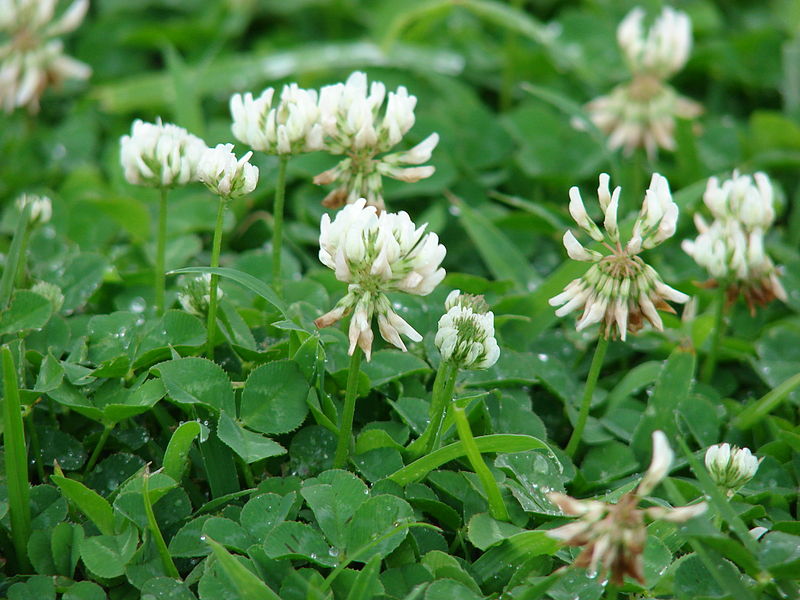
The Shamrock, contrary to expectations, cannot be said to be a specific plant. It is of course a kind of clover but which one? People writing about it frequently state that it is generally accepted that the most likely candidates are the species Trifolium dubium (variously called Lesser Trefoil, Suckling Clover, Little Hop Clover and Lesser Hop Trefoil; Irish: Seamair bhuí), with yellow flowers or the white-flowered Trifolium repens (White Clover; Irish: Seamair bhán).  But which one?  Well, excuse the pun but take your pick.

Trifolium dubium, the lesser clover, an seamair bhuí, top of the candidate list for the “shamrock” title.
(Photo: Internet)


Generally accepted by whom? One supposes by botanists and Irish folklorists but those sites rarely supply a reference. However, amateur botanist and zoologist Nathaniel Colgan (1851-1919) asked people from around Ireland send him specimens of what they believed to be an Irish shamrock and identified the five most common plant species, of which the two most common were the yellow clover followed by the white. A hundred years later, Dr Charles Nelson repeated the experiment in 1988 and found that yellow clover was still the most commonly chosen. According to Wikipeida, yellow clover is also the species cultivated for sale in Ireland on Saint Patrick’s Day and is the one nominated by the Department of Agriculture as the “official” shamrock of Ireland.

The word “shamrock” is an Anglic corruption of the Irish seamróg, itself a contraction of seamair óg, meaning a sprig of young clover. The Irish shamrock is usually the species Trifolium dubium (lesser clover; Irish: seamair bhuí), with yellow flowers or the white-flowered Trifolium repens (white clover; Irish: seamair bhán).

A trawl through the internet looking for images of shamrock plants throws up a bewildering multiplicity of images of trefoil plants, the only thing they have in common being that they are (mostly) green. It soon becomes apparent that many of the images are taken from a different genus, that of oxalis, usually the one named wood-sorrel (Oxalis acetosella) in English-speaking Europe1.

People today should know better. Edmund Spenser, an anti-Irish colonist and commentator on Irish culture, also poet and ancestor of the late Princess Diana, reported the Irish eating shamrock and so have some other colonial observers but almost certainly what they observed was the Irish eating the wood-sorrel – in Ireland it has some common names associated with eating. Spenser and other colonists can be blamed for many things but not that confusion – they were not botanists and did not have access to the Internet. Also, seamsóg, the Irish name for wood-sorrel, does sound a bit like seamróg, especially if one is not listening carefully. The confusion can be continued in English, where the common sorrel (Rumex acetosa) is a completely different plant and a common enough culinary one.

Many species of the genus oxalis close their leave sand flowers at night – a handy trick which the trifolii do not have; indeed, try as they may, trifolii could not possibly close their flowers since each one is in the form of a cluster, while those of oxalis tend to be trumpet-shaped.

Wood Sorrel — defintely not the shamrock, despite numerous claims since Edmund Spenser, the Elizabethan poet.
(Photo: Internet)

The wood-sorrel grows typically in woods which are shady but not too dark and is characterised, as with many other oxalis, by an acidic taste in the stems. As children in the area in which I grew up in south Co. Dublin we chewed the stems of a cultivated species with large green leaves and pink flowers, commonly grown in window-boxes and gardens and known to us by the name of “Sour Sallies”.

The shamrock (both varieties of trifulium) grows best in meadows receiving a fair amount of sunlight, in among grasses. It belongs to the clovers, a different family completely from oxalis, belonging in turn to a very large group of plants as different in appearance from one another as peas and beans on the one hand and furze (also known as gorse) on the other (but many bearing fruit pods). They are the legume group, plants that concentrate nitrogen in nodules around their roots, making many of them good crops with which to precede plants that require a lot of nitrogen, such as the cabbage family or cereals.

The expression “in the clover” as an idiom for being successful or having a good time alludes to the alleged fondness of grazing animals for the plants but this is much more likely to be the white clover, Trifolium repens (Irish: seamair bhán) than dubium, as the former grows bigger and thicker. Clovers are important plants not only for grazing animals and nitrogen-fixing but also for bee-keepers, being rich in nectar and pollen.

End


FURTHER READING

https://en.wikipedia.org/wiki/Trifolium_repens

https://en.wikipedia.org/wiki/Trifolium_dubium

http://slowfoodireland.com/food/foraging/wild-sorrels/

https://en.wikipedia.org/wiki/Oxalis

https://en.wikipedia.org/wiki/Nathaniel_Colgan


FOOTNOTES

1 In North America, Oxalis montana is also called “common wood sorrel”.

RIVAL MANDARINS FIGHTING IN DUBLIN

Cycling through Griffith Park off the Mobhi Road, after a walk in the nearby Botanic Gardens, a flurry of wings and a flash of colours attracted my attention.  Three birds came down with a splash into the Tolka.

Rival males and female on a rock in the Tolka.
(Photo: D.Breatnach)

You don’t need to be any kind of expert to identify the Mandarin Duck, especially the males and that’s what two of those birds were.  The dowdier third one was the female.

I have often noted two male mallard ducks peacefully accompanying one female and wondered whether they had a menage-a-trois going or what the arrangement was.  But there was nothing like that going on with the Mandarins as the males made clear quite quickly.  After briefly circling around one another they were quickly into fisticuffs (or beak-and-wing-cuffs), scuffle-splashing, clucking insult or challenge, until the rival to the established male would take to the wing either for a break or to get next to the female.  In the latter case, the male would take to the air also, in pursuit.

The female?  She swam demurely apart waiting for the victor.

The female Mandarin Duck in the Tolka.
(Photo: D.Breatnach)

There was clearly one established male who for the moment was the dominant one but the rival kept coming back while I was watching and they were still at it when I left.  The established one has the psychological dominance factor on his side, which is a strong advantage but it is by no means a guarantee of success.  The rival might wear him down.  Or the established one might become injured.  Being a male and keeping one’s bird is not easy.

Rivals circling briefly in mid-water prior to another scuffle on the river.
(Photo: D.Breatnach)

According to Charles Darwin, genders of many species but many birds in particular have become colour-differentiated through part of the evolutionary process described as sexual selection (The Descent of Man and Selection in Relation to Sex, 1871).  This has reached amazing and one might say even bizarre though beautiful extremes with such birds as the peacock and the bird of paradise.

Darwin’s ideas make more sense than other explanations being proposed but it is nevertheless hard to credit that a female’s appreciation of colour, shape and behaviour would so impress upon the male the need to flaunt gaudy colour and shape in direct contravention of the need to survive predators by NOT calling such attention to himself.  Still, there is no other viable contender explanation around (as distinct from the Mandarin contender, who may still be biding his time or pressing his suit, which if the established male has anything to say about it, is all he is going to press).

Established male with female on rock and the rival that won’t give up. (Photo: D.Breatnach)

Aix galericulata is the Latin species name and the only other species in the Aix genus is the North American Wood duck.  A chromosome in the Mandarin makes hybridisation between the two impossible.

Mandarin Ducks originate in East Asia but have been kept in Europe in aviaries and in ponds and lakes.  Stephens Green used to have some, along with many other kinds of wildfowl, until the OPW allowed the Herring Gulls to take over to the extent that they have.  I have not seen them do it but would not be in the least surprised if the gulls ate the chicks of many of the waterfowl species until they died out or took off somewhere else.

However, there have been feral Mandarin populations in Ireland for some time, notably in Co. Down and in Wexford and pairs may be establishing themselves in other places, including in the Glasnevin/ Drumcondra area, based around the Tolka (and perhaps the Royal Canal).

The Mandarin is a perching duck and this kind have feet capable of grasping a branch.  They build their nests in hollows in trees which is good for the safety of the nesting female and the eggs.  But what of the chicks or ducklings?  As we know, ducklings take to the water long before they can fly.  So what can these ducklings in tree hollows, many feet from the ground, do?  They simply jump.  A veritable leap into the unknown.

When they hit the ground, which at first sight seems to ensure they have broken practically every bone in their little bodies or a least concussed themselves and messed up their insides, they bounce a little, get up and waddle to their mother.  Yes, she called them out, which is why they came.

One needs to see the process to believe and I have included some Youtube links.  It would seem at first that they need soft leaf litter or water in which to land but one of the links I have posted shows Mandarin ducklings jumping from a nestbox on to bare stone — and getting up, apparently unhurt.  It is difficult to understand, even with accounting for the relationship of weight to surviving a fall.  We probably know that we can drop lots of insect species on to the ground and they don’t get hurt but the principle goes farther — apparently a mouse can survive a fall from a great height (unless a hawk gets it on the way down, or a cat is waiting below); conversely a fall of four foot on to its feet can kill an elephant (so it is said — I have not actually tried this with elephants but I have inadvertently confirmed the mouse theory).

Often invasive species should not be welcomed as they upset the natural ecological balance.  The grey squirrel in the nearby Botanic Gardens, originally from the USA, may be cute but it is helping to wipe out the native red species.  And that’s just one of the invasive species of animal and plant that are causing problems in Ireland (see https://rebelbreeze.wordpress.com/2014/07/01/the-scent-of-intruders/).  On the other hand, the widely-distributed Red Valerian (also with white and pink varieties) does not seem to be causing any problems and it is difficult to see how the Mandarin can become a serious problem either.  But of course, one does not know for sure.  It can be stated that the populations so far established in Britain and in Ireland do not seem to have caused any ecological problems.  And it is true that we don’t have many dense woods in Ireland anywhere (thanks to certain human invaders in our history), least of all close to slow-flowing water, although some species have shown remarkable adaptability, witness in these climes the rat, fox, pigeon, herring gull and, of course, homo sapiens.

One of the curious things about the Mandarin is the name we have for it.  Apparently, it is a Portuguese word for the Chinese government bureaucrats in existence when the Portuguese first began to trade with them (before they and other Europeans decided to invade China and confiscate areas, in particular ports and islands).  How they became associated with the duck was not revealed in my short internet search.

However, in China and in Korea the mandarin duck is associated with fertility, good fortune and constancy in monogamy, so that it is often presented as a wedding gift, either as living pairs or symbolically in an ornament.  It is not currently considered an extermination-threatened species.

End.

Video links (second one is of merganser ducklings and is even more impressive):

https://rebelbreeze.wordpress.com/wp-admin/post-new.php

Other information sources:

Mandarin duck unlikely invader | Irish Examiner

21 Facts on Mandarin Duck – Tweetapedia – Living with Bird

https://en.wikipedia.org/wiki/Mandarin_duck

The History Beat

Diarmuid Breatnach

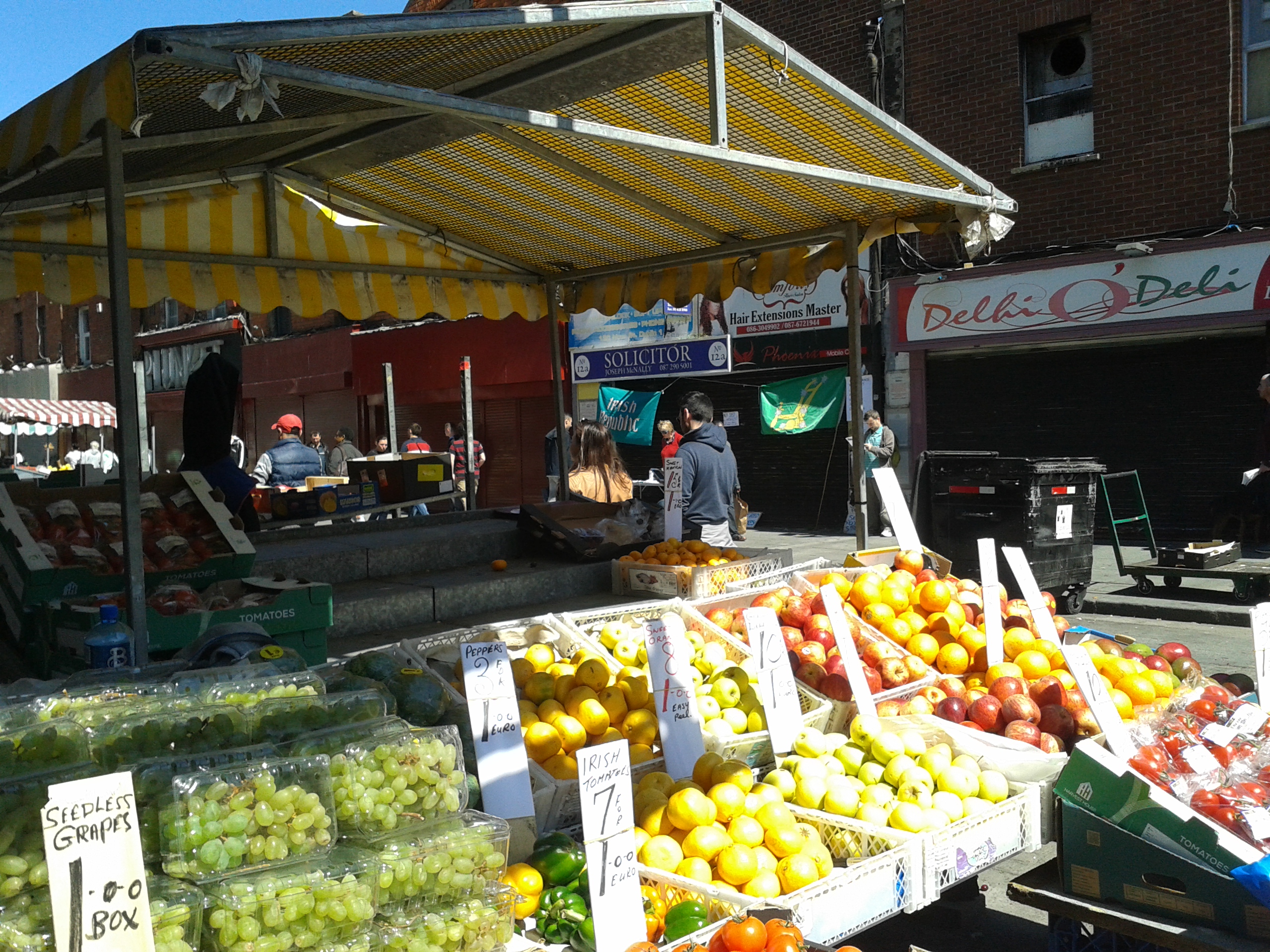
View of the campaign table through fruit stall on a sunny Saturday in Moore St in June 2015 (Photo D.Breatnach)


Here we are on famed Moore Street

in close touch with market beat,

in the air and beneath our feet,

defending heritage and history

knowing that it’s no mystery —

no accident or just a mistake —

why they want our history to take

to offer on the altar of the speculator,

Gombeen and foreign vulture taker.


A people without history is easier to rule

without that memory, easier to fool;

without a past, having no future

our masters hope we’ll be safely neutered

to be consumers dumbly tutored.


But history trembles beneath our feet

here we hear it and also feel it

we speak to the foolish and the wise

denouncing speculators and their allies

refuting Government Minister lies

our voice joining street traders’ cries.


Lemons and leeks here for selling

History stories here for telling

You never know who you’ll be meeting

Old friend or new to be greeting.


This whole area was a battleground;

A knot of people gather to sign the petition in Moore Street (photo: D.Breatnach)
A knot of people gather to sign the petition in Moore Street on a colder day in 2017 (photo: D.Breatnach)

it is again, the speculators found:

through city streets protests wound,

people stood and linked arms around,

occupied also against demolition,

blockaded five weeks of attrition;

and here on Saturday some of us meet

to set up our table on the street

a part of the Saturday market beat

in dry or wet or sun or sleet.


Diarmuid Breatnach, Feabhra 2017.

I ONCE KNEW A CAT

Diarmuid Breatnach

I once knew a cat but, what is more to the point, the cat knew me.

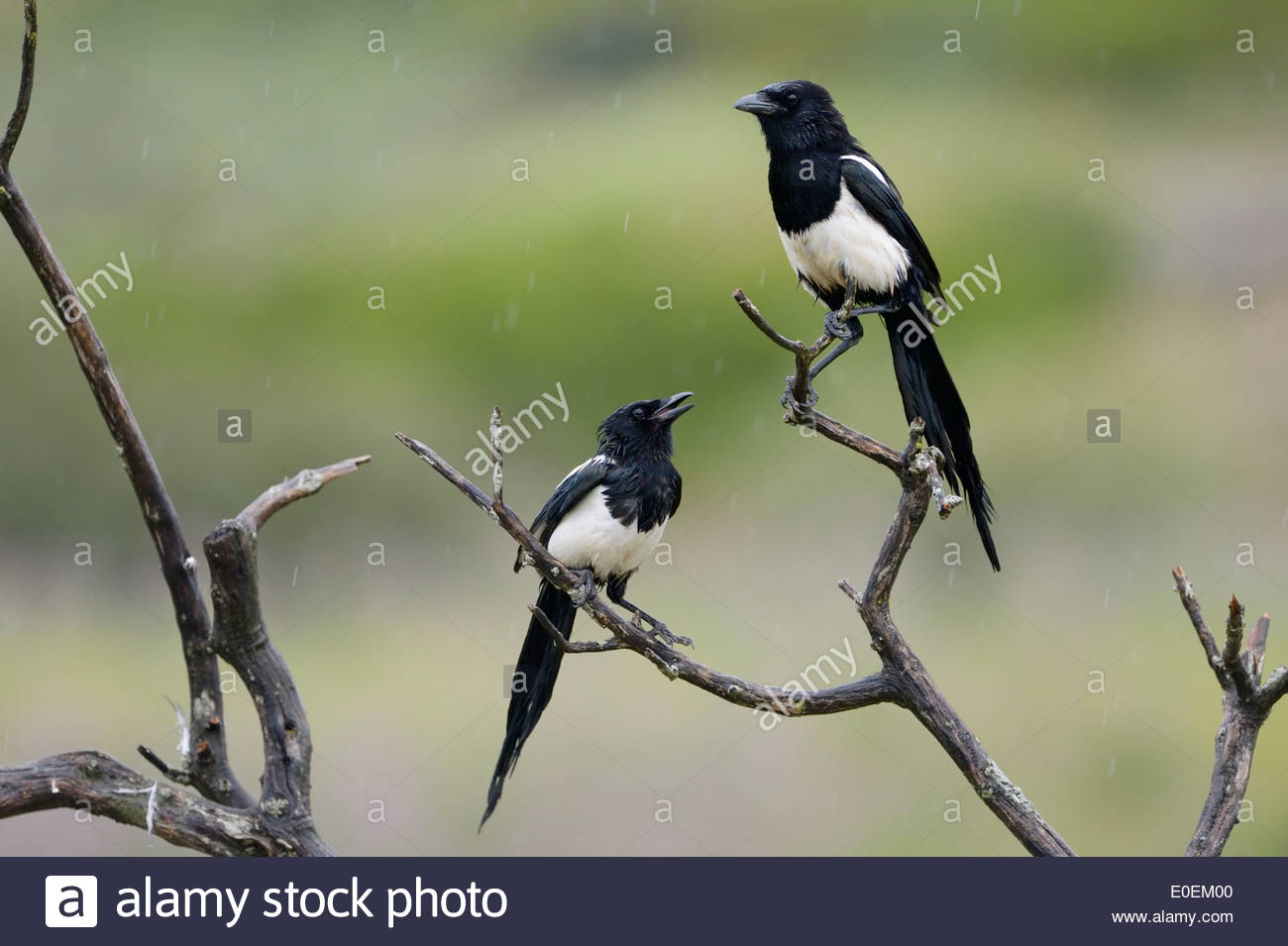
pair-magpies-tree-branches
A pair of European Magpies on branches

I knew the cat not well, but as a kind of nearby resident I had helped a little once and made friendly overtures to. He or she (I suspect she and will refer to it so from now on) first came into contact with me when a racket of magpies not far from my home attracted my attention. I found magpies harassing a marmalade (orange tabby) cat in a tree and the cat seemed trapped there.

Since there was no nest in the tree for the magpies to be protecting, I chased them off some distance with the aid of shouts and stones, then tried to persuade the cat to come down but she just looked at me – afraid of me too, I thought. Some days later, I came across a marmalade cat outside some nearby houses and called to her and, when she came, stroked her and then went on my way. She made as if to follow me but then gave up.

A few weeks later, I was coming up the road when I saw a marmalade cat about 50 yards away and wondered if it was her. She however looked up, saw me and hurried over, then began rubbing her body against my leg.

So how did she recognise me? Cats have very good hearing but I very much doubt she could identify my footsteps on a concrete footpath amidst all the traffic noise from so far away. Cats also have a good sense of smell but I don’t think it’s good over distance. They are not good at recognising human faces, according to tests. So, she probably recognised my shape and gait (like those recognition software programmes the secret services have developed and with which they monitor a lot of CCTV coverage — reassuring, huh? Not so much!).

(Photo source: Internet)

It is true I have a somewhat identifiable gait, so I am told – a swagger learned as protective colouring in my teens but about which I am nearly always unconscious and when I am, try to control. Once doing that in New Cross in SE London, a black youth I knew from my work in a local youth club shouted from across the street: “Walk like a white man!” Apparently my attempt to control the Dublin swagger was resulting in the kind of walk adopted by many Afro-Caribbean youth.

But, back to the cat. Anyway, it was an amazing feat of recognition of an individual of a different species and of minimal acquaintance and I think she would have recognised me no matter how subdued my usual type of walk. I wonder how many individuals considered friendly or otherwise a cat can identify by sight at a distance – just how big is their database?

Another time I came upon this cat, she was stretched out on a warm sunny pavement but being persecuted by a pair of magpies (probably the same ones as before). The cat saw me and so did the magpies but I stopped at a distance to observe what was happening.

One magpie distracted her attention by strutting up and down in front of her head, but out of reach of swipe or sudden rush, while the other waited its chance and pecked at the cat’s tail. She lay there suffering this persecution, only twitching her tail from time to time in a futile attempt to keep it away from the bird or perhaps out of tension.

“But why don’t you move, Cat?” I asked her, half in amusement and half in sympathy.

She looked at me and seemed to say:

“Why should I? This is MY pavement and I am harming no-one! I am not going to let two BIRDS chase me off!”

“Well, you could spring at them …”

“What’s the point? They keep just out of range and I’d miss, giving them a reason to mock me.”

The Magpies, in turn, might have been saying:

“This has nothing to do with you, Mister. This is a Cat, ancestral predator on birds and fair game for us at any time. Keep out of it!”

“Yeah, we remember you butting in before!”

And magpies probably can identify human faces – at least tests with their close relatives, crows and jackdaws, show that they can. And magpies are the only bird so far shown able to identify themselves in a mirror.

I did keep out of it. I had things to do and left them to it – the cat after all had the option to leave and even were I to chase them off, the birds would only fly a little distance and then come back. I’ve seen magpies do this “torment-the-cat” thing before. And cats will kill a magpie, if they can.

The cat’s refusal to move or to make a lunge she knew the birds would easily evade, the provocative tormenting by the magpies and the way they worked in unison, all seemed to me so very human, even allowing for anthropomorphism.

But thinking about it later, I came to a different conclusion: it is not the animal behaviour that is human-like – it is OUR behaviour that is animal-like! After all, are we not descended from a common ancestor, albeit nearly 300 million years ago?

In total, I saw that Marmalade Miss maybe four or five times and then no more. Perhaps her owner(s) moved – I hope so and that she was not killed by traffic.

I had nothing I could gain from the cat, other than a kind of feeling of kinship perhaps. Other than a stroke now and again, she had nothing to gain from me. It was an uncomplicated friendship and not, like with some dogs, a dependency by either of us. I know she is gone but years later, as I pass near that street, sometimes still look out for her.


end.  

HUNDREDS ATTEND MIDDAY WEEKDAY RALLY TO SUPPORT APOLLO HOUSE OCCUPATION

Diarmuid Breatnach


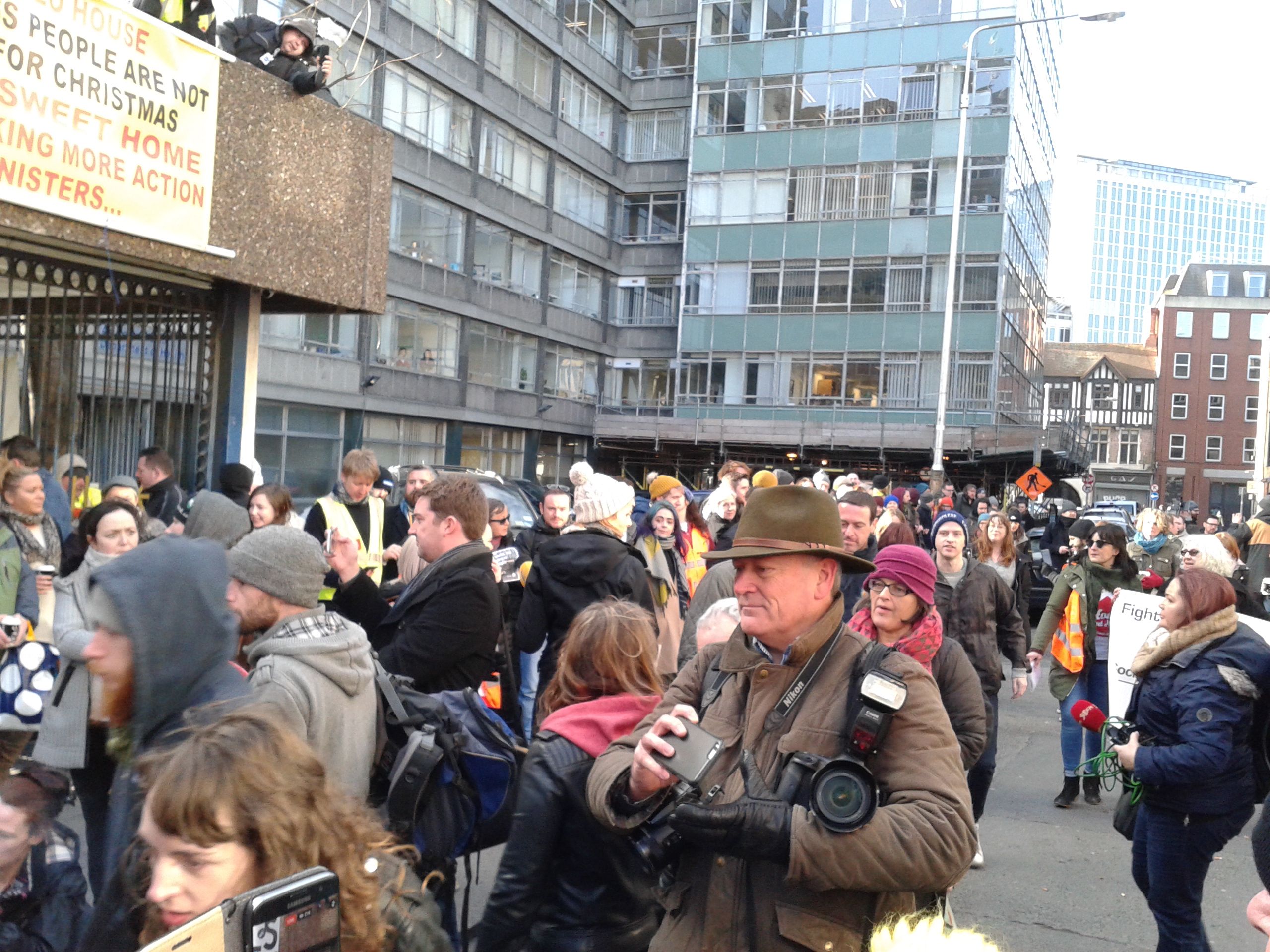
HUNDREDS ATTENDED AT APOLLO HOUSE in bitter cold from late morning today to indicate their support for the homeless people and housing activists in occupation of the building.  At the same time, a court refused to extend the

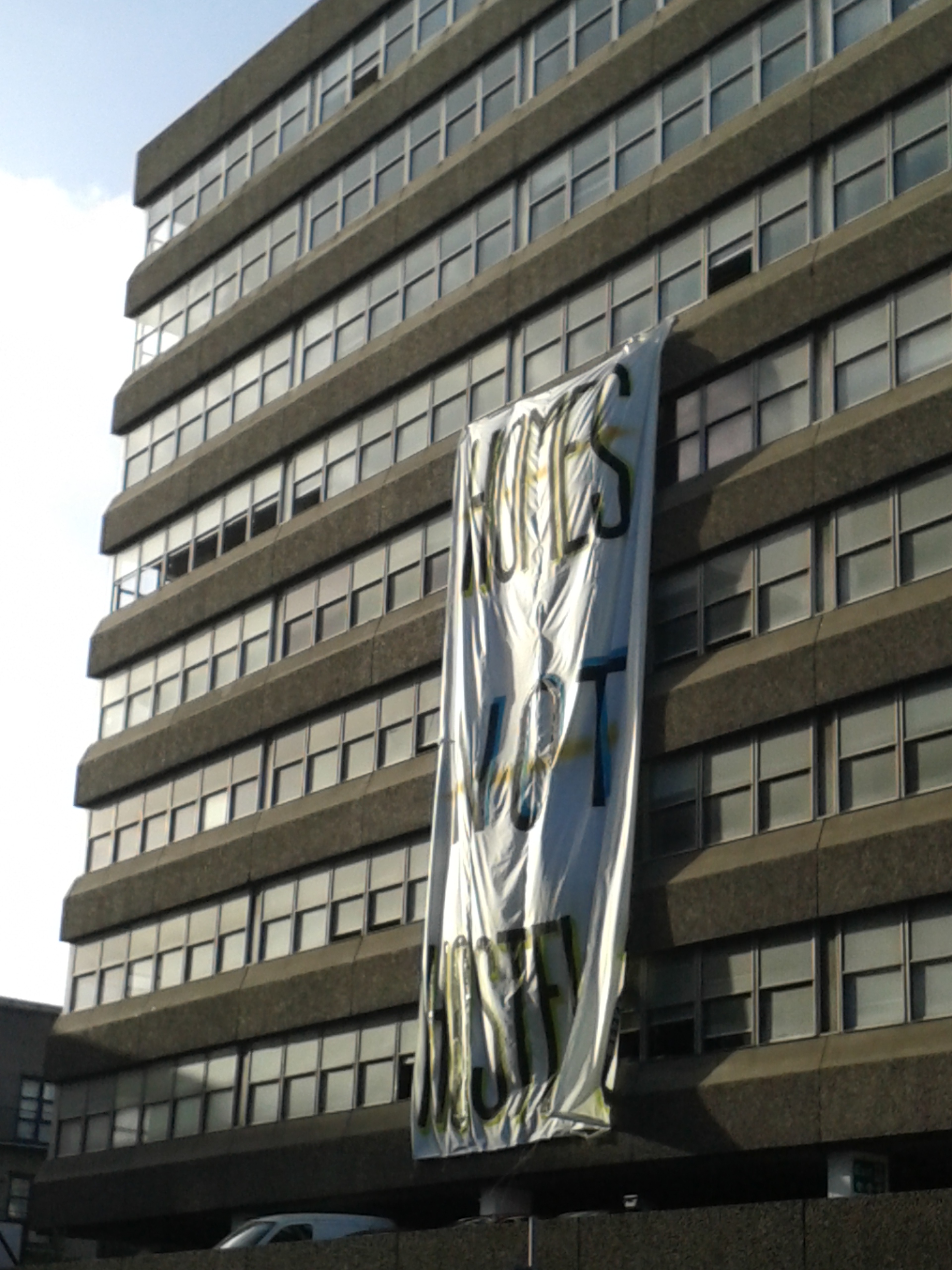
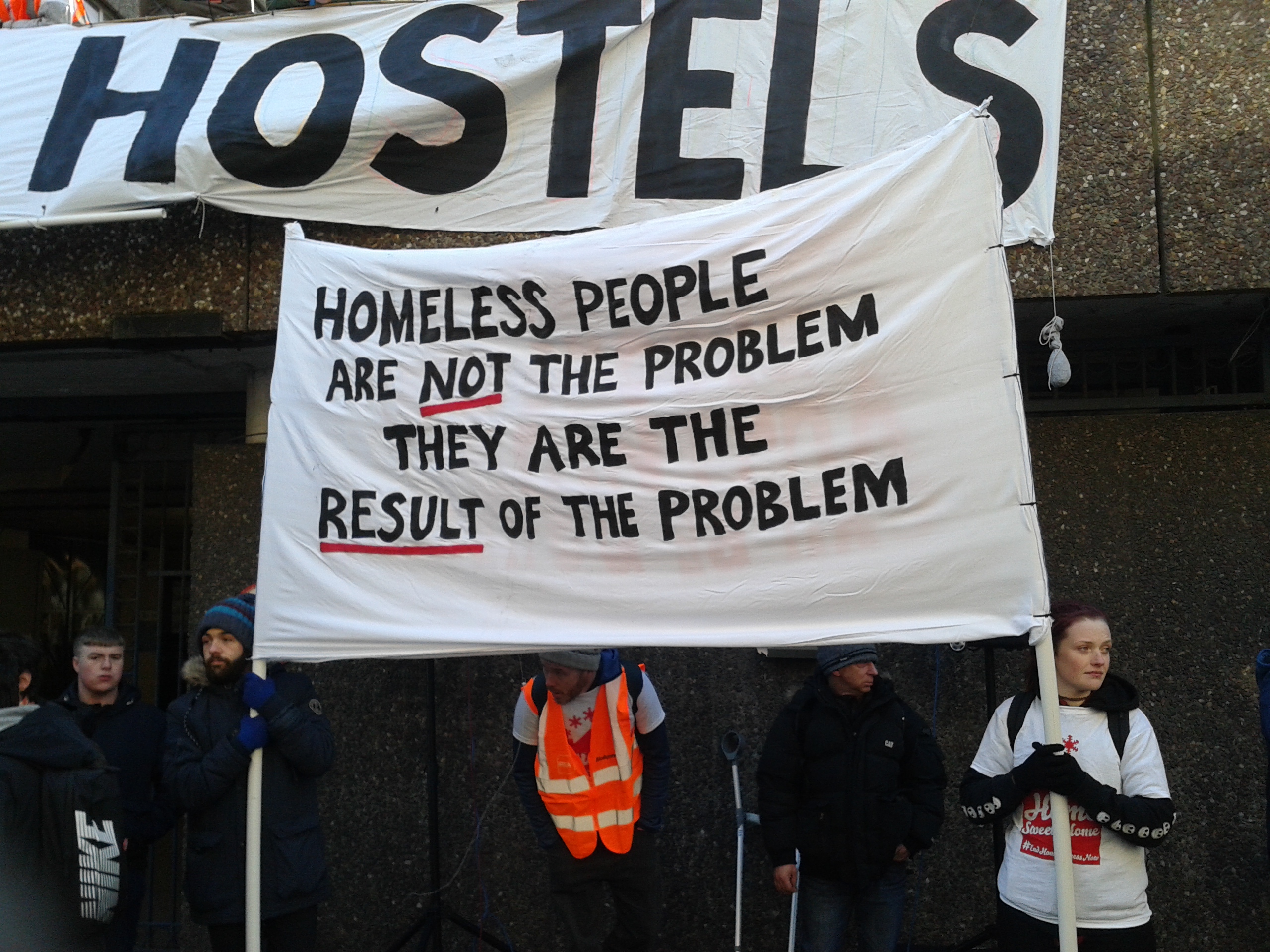
 Closer view of banner on Tara Street side of occupied Apollo House (Photo: D.Breatnach)
Closer view of “Homes Not Hostels” banner on Tara Street side of occupied Apollo House (Photo: D.Breatnach)

deadline by which it has ordered the occupiers to leave.

Banner suspended from the Tara Street side of Apollo House (Photo: D.Breatnach)

While they were there, representatives were attending court seeking an extension on the deadline given by a court order to leave the building by noon today.

Housing activist Rosie Leonard told the crowd that the alternative accommodation some Apollo House homeless people had been offered was totally unsuitable and that some were houses for people with addiction issues and that there were even bloodstains on the walls. They had asked for an extension as the State had not provided alternative accommodation but this had been refused.

In response, people cried “Shame!” and “We shall not be moved!”

Supporters linking arms around Apollo House from Townsend St, through Tara St to Poolbeg St. (Photo: D.Breatnach)
Supporters linking arms around Apollo House from Townsend St, through Tara St to Poolbeg St.
(Photo: D.Breatnach)

People were asked to link arms symbolically around the building, which many did and the line extended from Townsend Street/ Tara St. and the full length of Poolbeg Street.

PEOPLE QUEUE TO SIGN UP TO ACTIVELY SUPPORT

Shortly afterwards, announcements were made asking people willing to support the continued occupation to give their names to organisers and queues of people formed giving their names and phone numbers to put on a list.

People linked arms symbolically protecting Apollo House occupiers from Townsend St, through Tara St and here seen to western end of Poolbeg St. (Photo: D.Breatnach)
People linked arms symbolically protecting Apollo House occupiers from Townsend St, through Tara St and here seen to western end of Poolbeg St.
(Photo: D.Breatnach)

Speakers addressed the crowd at intervals and musicians, singers and percussionists also performed for the crowd. A group including a Vulture Capitalist, Banker and Woman & Child being evicted also performed for the crowd.

Chants included:
What do we want?
Homes not hostels!

Also: Is a doorway a bed?

No!
Is a mattress a bed?

No!

Since December 15th, the Home Sweet Home coalition of activists and homeless people has been occupying this building which state agency NAMA had repossessed from a property developer with unrepayable debts. The group is calling for NAMA to use the properties it has taken control of to house the homeless.

Rosie Leonard relaying court decision to cries of "Shame1" and chants of "We shall not be moved!"
Rosie Leonard relaying court decision to cries of “Shame1” and chants of “We shall not be moved!”
Percussionist, Guitarist, Acitivist (Photo: D.Breatnach)
Percussionist, Guitarist, Acitivist
(Photo: D.Breatnach)
Vulture Capitalist (Photo: D.Breatnach)
Vulture Capitalist
(Photo: D.Breatnach)
 (Photo: D.Breatnach)

(Photo: D.Breatnach)
 (Photo: D.Breatnach)

(Photo: D.Breatnach)

THE SCREAM ON A DECEMBER NIGHT


Diarmuid Breatnach


A high-pitched but hoarse scream cuts through the night. Again and again it is heard, then is silent. A frightening sound, perhaps of a person being attacked …. But no, it is a vixen, a female red fox (Vulpes vulpes). Why is she screaming? Is she in pain?  Not exactly — she is informing dog-foxes in the area that she is ready to mate and where they can find her.

Vixen screaming (sourced on Internet)


But this is December and, according to Internet site after site dealing with foxes in Britain and in Ireland, she is at least a month early1. Perhaps she is a rare exception, this vixen in the Drumcondra area but it seems to me more likely that the sites have it wrong: either urban foxes breed earlier or the breeding pattern of foxes is changing. Actually, a combination of both is likely.

A vixen breeding in January would give birth to her cubs just over 50 days later, when in rural areas the earth is warming up in the Spring and when lambs are born, hares are boxing, eggs are being laid, greens are growing and being eaten by rabbits – in other words, food is becoming available for the vixen. Obviously vixens breeding in February or March will have yet more food available in April or May but may also find greater competition, in food and for a mate.

Say this rural vixen conceived on 1st January, then she would give birth on or around 22nd February. She will need feeding just before that and probably up to 24th March, a task falling to the dog fox and to unmated young females who may be part of the community. The cubs need the warmth of the mother’s body for up to three weeks after birth and she cannot leave the den. One month after giving birth the mother vixen may go hunting while the “aunts” look after the cubs, who are now venturing out of the den or “earth” (but staying very close to it).

The food brought to the young is carried inside the hunters’ bellies and regurgitated for the young to consume along with their mother’s milk which they will suckle until six weeks of age. After weaning, the cubs will eat solid food but cannot yet hunt for it themselves until perhaps mid-late Summer and, if males, will leave to establish their own territories in the Autumn.2 Males become sexually mature at one year of age.

A vixen breeding in December in an Irish rural area might have difficulty receiving enough sustenance in January or even early February, especially in decades past when winters were usually harder. However, with changing seasonal weather patterns tending to warmer winters – and in urban areas where a lot of food tends to be available for scavenging all year round – these problems are substantially reduced and so breeding in December should present little difficulties. So the thinking goes among the vixens in Drumcondra, anyway and, I suspect, in many other Irish and British urban areas.

The male or ‘dog’ fox can be heard sometimes too in a staccato bark, normally three (but occasionally four) rapid barks: bak, bak, bak!


THE URBAN FOX

The urban fox is a relatively new phenomenon in Ireland3, as far as we know, although in Bristol, for example, they have been recorded since the 1930s. Up to fairly recently, a number of experts maintained that the fox populations of city and countryside had little contact with one another. But in January 2014 “it was reported that “Fleet”, a relatively tame urban fox tracked as part of a wider study by the University of Brighton in partnership with the BBC’s Winterwatch, had travelled 195 miles in 21 days from his neighbourhood in Hove, at the western edge of East Sussex, across rural countryside as far as Rye, at the eastern edge of the county. He was still continuing his journey when the GPS collar stopped transmitting, due to suspected water damage.”4


and the Country Foxes

Decades before I heard of this I often fancifully imagined a conversation between a fox, now settled in the “big city”, and his country relations when he returned on a visit. After the initial customary welcoming, sniffing, licking etc are over, the conversation might go like this:

So, Darkie, tell us, what is life like in the big city?”

Ah, it was scary at first, with cars and buses and lorries going all day. You wouldn’t believe the noise.”

(Sympathetic whine from the audience).

But I’m used to it now, Redthree, I have to say. And the food! You could not imagine!”

Good, is it?”

Lovely, Whitepatch, absolutely delicious.”

(Sounds of salivating all around).

Chicken, beef, lamb, fish, potatoes, bread, rice, vegetables, fruit – just left out there to be eaten!”

Ah, you’re havin’ us on, Darkie. We might be “Culchies” but we’re not stupid! You expect us to believe the humans feed you like they do their dogs, do you?”

No, of course not, Greymuzzle. Well, actually a few do leave out food on purpose for us but no, this is mostly food that humans are throwing away. We find it in plastic bags and metal containers.”

They throw away food?”

They do and huge amounts of it too. Then big lorries come and take away what we have not eaten ourselves.”

Where do they take it?”

I am not sure. I’ve never troubled to find out because, to be honest, I have all the food I need nearby.”

(Silence while country foxes imagine a huge mountain of food somewhere).

Er …. Darkie, so you never hunt now?”

Oh, yes, some – the city rats and mice eat the discarded food too and they grow plump and big. Yes, I catch and eat them too.”

Well now, what about all the humans?”

What about them, Lighteyes? They don’t bother us.”

Don’t the humans have guns in the city?”

Some of them do, Lighteyes. But they don’t shoot foxes with them.”

Really? What do they shoot with their guns then?”

Other humans, Lighteyes, just other humans.”

(Noises of amazement and disbelief)


THE INNER CITY FOX

The Internet sites all agree that foxes are more likely in suburbia than in the inner city but I think they ignore some important features of the inner city which foxes can frequent in relative safety and around which they are likely to find sufficient food: railroad lines and their banks, canal and river banks, parks, allotments, cemeteries and derelict sites. One can’t get much closer to Dublin’s inner city than Parnell Square, yet I have seen foxes in a laneway off there and also squeezing through the railings to enter the Garden of Remembrance. They have been photographed near the Irish Parliament, the Dáil (though some people might say that’s less surprising with the number of scavengers nearby :). I’d be surprised if they are not to be found along the banks of the Dodder, the Liffey, the Tolka and both canals, also along the railway lines and in Glasnevin and other cemeteries.

Fox in Leinster House car park in the winter of 2013 (Source: Sasko Lazarov via Photocall Ireland, reproduced in Journal.ie)
Fox in Leinster House (Irish Parliament building) car park in the winter of 2013 (Source: Sasko Lazarov via Photocall Ireland, reproduced in Journal.ie)


According to one Internet site5, the urban fox population in Dublin may be growing too big for its own health, as the ready availability of food allows unhealthy individuals to exist, diseased and covered in mange infestation (mites that denude patches of fur). I would need to explore this argument before I could accept it.

I am familiar with the overpopulation argument in the case of grazing animals or rodents, where too many individuals consume the available resources and the whole population suffers – a fate usually occurring when natural predators are not present to thin out the weaker individuals and thereby unconsciously preserve the general population in a healthier state.

But how would this work with regard to Dublin foxes? It seems unlikely that the food available is being reduced yet and if and when it is, one presumes healthier foxes will outcompete their sicker species members. Also, sick and undernourished foxes are less likely to come into oestrous and should they do so and conceive, to be able to raise their young. It seems to me most likely that what is occurring is that foxes that would normally have been winnowed out in the struggle of survival are now able to sustain themselves, which might be distressing to see but which will not necessarily have any effect on the healthy population.6 And will healthy individuals necessarily succumb to mange infection from infested individuals? And if they do now, might they not in time learn to chase infected individuals away?

Theories of overpopulation and scare stories about foxes attacking babies, cats and so on seem prompted by the intention to cull foxes, as Boris Johnson, Mayor of London, proposed. Johnson seems unwilling to learn from history, as “there was a large and expensive effort to reduce the number of urban foxes across the UK in the 1970s, but the population subsequently bounced right back.”7 The average litter now may be four cubs but vixens have been known to bear up to a dozen and with a low population-to-high-food-sources ratio, are likely to bear a greater number of cubs. And a recent National Health Service survey in the UK indicated that nearly 60% of all stings and bites admitted to emergency rooms were inflicted by dogs8 but anyone suggesting a cull of urban dogs would probably find a gathering bearing pitchforks and burning torches outside their home.

Boris Johnson, Mayor of London, was proposing a cull of London foxes (source photo: Internet)

There have been claims that foxes kill and eat lambs, cats, other domestic pets and poultry. Most experts have concluded that if indeed a fox killed a lamb, such incidents are very rare. A ewe is capable of protecting a lamb from a fox, an animal not much larger than a cat. However, foxes have been found to eat the afterbirths of lambs and would of course eat a stillborn lamb or one that died soon after birth, after which its mother would leave and the opportunist would move in; such incidents may have convinced some people in rural areas that the fox was the cause of the lamb’s death.

The Foxwatch study program in Bristol city filmed a number of confrontations between urban foxes and cats and found that in all cases, it was the fox that backed down. This makes sense, for a predator does not usually take on another predator of similar size except in defence of its young, its own life or, at times, its kill.

Yes of course foxes will kill poultry if they can get at them and are often accused in such situations of going on a killing spree. Foxes do kill and gather more food than they need at times and, like many other animals, hide it for recovery later, marking the spot with their scent. But when a fox breaks into a poultry pen and kills its inhabitants, it usually has to leave with what it can carry and will not be permitted to return for the rest. The answer for humans is to build secure pens into which to bring the poultry at night – and that applies also to rabbits kept as pets or for the table, etc. — or keep a dog outside, unleashed.

Scare stories and unscientific suggestions to one side, wild animal populations living alongside humans frequently do need management. All species of bats are protected in Ireland and Britain and should you find them in your attic you are not permitted to remove them but must instead notify the appropriate authorities. Some people have suggested that the red fox should be granted protected species status but it is difficult to see the rationale for this, since it is on the species of “least concern” list of the International Union for the Conservation of Nature. Pigeons receive no protection and, though often fed by people who consider them cute or pretty, do have a negative effect on our urban environment and, in the case of seagulls, who are protected, may be responsible for the disappearance of the many species of ducks that once were common in Stephens’ Green. Rats and mice are not deliberately fed or considered cute by most people (though I have kept both myself and found the individuals tame and harmless and, in the case of rats, quite intelligent) and humanity wages war upon them with traps and poison.

Do urban foxes require management? Zoologist Dave Wall9, who has studied Dublin’s urban foxes for some years, thinks not. In his opinion, the fox population in Dublin has remained constant since the 1980s. According to statistics regularly quoted but never referenced that I can find, Dublin fox families occupy on average 1.04 Km². 10 Given a rough and probably low estimate of six individuals per fox family (a mated pair and two unmated females and two cubs) and a Dublin City area of 115 km² would give us a fox population of 663 in the city. That might seem a lot, until one hears that London holds an estimated 10,000.

Given statistics of that sort, and information that the average litter is of four cubs, one may wonder why most urban dwellers see them but rarely and also why urban foxes are not a massively growing population. There are a number of controlling influences, ranging from the need to establish territory and fight to hold it, which may cost in injuries or even death, to deaths by traffic, the most common cause of fox death according to Internet sites (although how often do we see a dead fox on the road?). A common non-captive life-span of from two to four years and a fertility “window” of only three days for a vixen would be population-controlling factors and yet the allegedly stable population is puzzling, to me at least.

The rural fox tends to inhabit, widening when necessary, burrows already excavated by rabbits and badgers. In urban areas, the fox may have to excavate its own – under buildings and sheds and into railroad banks, for example – but will also use and expand other holes and gaps.

Many urban human dwellers, probably most, never see urban foxes, although they are becoming increasingly visible. They are active mostly at dusk and shortly before dawn and are mostly likely to be seen by people who rise very early for work, or who work at night or who are returning from late night socialising on foot, by bicycle or on foot.

In the Lewisham area of South-East London where I lived for some decades, I regularly saw them on the roads while cycling home from a late music session or a friend’s house. Lewisham would be considered midway between being city and suburban in nature and contained parks, cemeteries, allotments, streams or rivers and railway lines, houses with gardens but also high-rise blocks of local authority housing and very busy roads. I once passed about three yards near to an adult fox on the housing estate I lived on for awhile between Grove Park and Eltham (also in SE London). On my allotment in Catford, if I worked until dusk (which I did often enough when I managed to find the time), they would come out and play and dig for food less than ten yards away from me. And I frequently found trainers (running shoes) and balls they had taken from outside local houses and gardens, discarded on my allotment.

A number of theories have been forwarded for the penetration of urban areas by the fox, including the shameful wiping out of rabbit populations by state-inflicted plagues of myxomatosis but the real reasons are probably the same as those of the pigeon, rat and mouse – availability of food and home provided by humans and the adaptability of the species themselves.


THE MOST WIDESPREAD CARNIVORE ON EARTH

Indeed, the red fox has proved an adaptable animal – much like ourselves. She is an omnivore, as are we and can take her prey from animals as large as a goose to those as small as beetles or earthworms, also frequently eating wild fruit, especially in the Autumn. Studies in the former Soviet Union found that up to 300 animal and a few dozen plant species were known to be consumed by her11. Mice and rats are frequently on her menu and her ancestors are thought to have developed as specialist rodent hunters in Eurasia five million years ago but her kind is now the most widespread carnivore on Earth, with 46 recognised subspecies.

The fox has binocular vision which is particularly effective at night, excellent hearing over distance, including the ability to detect the squeaking of mice at about 100 metres (330 ft) and capable of locating sounds to within one degree at 700–3,000 Hz, though less accurately at higher frequencies12, compensated for by an ability to hear at very low frequencies, including a rustle in grass or leaves and the burrowing of rodents underground. It has evolved many tactics for hunting, including tracking, ambush, stalking, leaping, pouncing and digging.

The fox can also run at a speed of 42 km/ hour, climb some trees, leap high and swim well. Considering the latter, its absence from many islands near to mainlands may come as a surprise but I think that is easy to explain through eradication by human agency.

The red fox is to be found everywhere in Europe (where she is thought to have reached 400,000 years ago) and in North America, Canada, China, Japan and Indochina. Sadly, in the mid-19th Century her species was introduced to Australia by European settlers (at first for sport and later perhaps to control the rabbit, also introduced there by Europeans), where a population of 7.2 million red foxes now is wreaking damage among rarer indigenous wildlife and is considered responsible for the extinction of a number of species. It is classified as the most harmful invasive species in Australia and eradication and population control measures are adopted against it there, as are also against feral domestic cats and dogs, also imported by Europeans.

The dingo is regarded as a controlling agent on red fox population growth in Australia though not totally effective due to the fox’s habit of burrowing; this is interesting for a number of reasons: firstly, the dingo (Canis lupus dingo) is itself a wild dog most likely imported from Asia by Aborigine settlers somewhere between 4,500 and 10,000 years ago and secondly, the red fox in Ireland and Britain does not tend to excavate its own burrows but rather to enlarge existing ones and then generally only for mating and rearing cubs. The Red Fox is currently absent from Iceland, Greenland, South America and sub-Saharan Africa.

The fox has been hunted by humans primarily for its fur, especially in winter when it is thicker and from foxes in the far north its silkiness is considered very valuable.

Reynard (one of the names traditionally given to the fox) has also been hunted for sport, usually by the aristocracy or country gentry, on horseback with hounds, an activity which gave rise to one of Oscar Wilde’s many memorable phrases: The English country gentleman galloping after a fox – the unspeakable in pursuit of the inedible.” Of course, it was not only the English who did this but also the Anglo-Irish Ascendancy (from which Wilde’s father himself came) and the upwardly-climbing Irish who aped them, ag sodar i ndiaidh na nuaisle.13 There have been numerous attempts to get fox-hunting banned and direct action such as protests and sabotage of hunts but it is still legal in Ireland and in Britain, though substantially reduced from a century ago.

Gamekeepers have also hunted the fox in order to keep it from killing ground-nesting birds such as wild pheasants, grouse and partridge, so that the landowner and his friends could shoot these birds down later14. Finally, the farmer has taken his toll, sending specially-bred dogs such as cairn terriers down earths to kill a hiding fox and in particular the cubs. The farmer wishes to protect his poultry but avoid the cost of building secure pens and so hunts foxes down; he could let his dogs roam his poultry area which would keep foxes away but dogs do often go chasing sheep too, which will also represent a loss to the farmer, either because the sheep are his or because his neighbours will claim compensation from him.


AN MAIDRÍN RUA and tradition

In Ireland, the fox was known as Sionnach, Madagh Rua (“red dog”) or Maidrín Rua (“little red dog”) and has given its name to a number of places, eg Cnoc an tSionnaigh (Fox Hill, Co. Mayo; another as a street name in Co. Laois); Oileán an tSionnaigh (Fox Island, Co. Galway); Carraig an tSionnaigh (Foxrock, Co. Dublin); possibly Léim an Mhadaigh, (Limavady, Co. Derry) and Lag an Mhadaigh (Legamaddy, Co. Down); possibly Ráth Sionnaigh (Rashenny, Co. Donegal), etc.15

Fox is also a family name and the Irish language version of it is Mac an tSionnaigh (literally “Fox’s son”).  The Maidrín Rua or Sionnach features in a number of songs in Irish and in English and here is one from the Irish language tradition of song but in a non-traditional choral arrangement: https://www.youtube.com/watch?v=6bJyqbPxTwU.

Widely represented in folklore from China to Ireland, the fox is also mentioned in the Old Testament Bible and in Greek stories such as the fables of Aesop as well as among the Indigenous people of the Northern Americas. He is never stupid but his intelligence or cunning is also often portrayed as devious, tricky and even malicious. On the other hand, let us not forget that the anti-feudal Mexican hero created by USA writer Johnston McCulley (February 2, 1883 – November 23, 1958), who fights for the downtrodden and indigenous people and mocks the Mexican aristocracy and large landowners, always escaping them, used the nom-de-guerre of “El Zorro”, the fox.

There is a sexual connection too in the representation for the fox: for example in English a “foxy lady” is one with a high level of sexual attraction and in Castillian (Spanish) a “zorra” (vixen) is a pejorative term for a woman trading in sexual favours or “of low morals”16. Have we come around in a circle to where we began, to the vixen’s scream? I think so, but loaded now with a patriarchal outlook. Men can openly want and enjoy sex, of course, that is natural – but a woman? Surely not … or, if she does, she must be bad!


End.


Internet Sources:

http://www.thejournal.ie/fox-urban-dublin-1537602-Jun2014/

http://www.newforestexplorersguide.co.uk/wildlife/mammals/foxes/family-life.html

http://www.wildlifemanagement.ie/dublins-urban-foxes/

http://www.irishtimes.com/life-and-style/people/our-confused-relationship-with-foxes-cull-them-feed-them-hunt-them-kill-them-1.1251806

http://www.newsfour.ie/2013/04/city-fox-controversy/

http://www.noticenature.ie/files/enfo/factsheet/en/WL33%20Foxes.pdf

http://www.conserveireland.com/mammals/red_fox.php

https://en.wikipedia.org/wiki/Red_fox

https://books.google.ie/books?id=GjK93IUdAX4C&pg=PA96&lpg=PA96&dq=fox+can+hear+low+frequencies&source=bl&ots=BdWCosvgXg&sig=z76bvVOGnUjEQMnGTf4w44mqTyU&hl=en&sa=X&ved=0ahUKEwjN-dOm7v7QAhXoKsAKHQtsCGcQ6AEILTAD#v=onepage&q=fox%20can%20hear%20low%20frequencies&f=false


Footnotes:

1This is one of the very few sites to state that breeding may start in December http://www.newforestexplorersguide.co.uk/wildlife/mammals/foxes/family-life.html and Wikipedia also gave December as the start of the mating season and also as the month when the dog-fox’s testes are heaviest.

2Young females may remain another season and help care for the next litter of cubs.

3Although one article, without giving a reference, stated that foxes have been in Dublin since Victorian times.

6Other feature which makes this claim suspect are a number of scare items in the article: a) the sensationalist reference to the alleged danger to a baby from a fox in a bedroom and a link to the article reporting this event. Such an event, supposing it occurred, must be on a level of likelihood way below the danger to babies from, for example, pet cats and dogs. Also b) the reference to the danger of contracting roundworm (Toxocara canis), which can cause toxocariasis in children, while not however mentioning how low that risk is and that infection for children is most likely to be encountered from dogs and cats.

9Dave Wall B.A. is a postgraduate researcher in zoology at UCD. He has studied otters, marine mammals and Alpine badgers as well as studying Dublin’s urban foxes for the past few years. He is a Director of the Irish Whale and Dolphin Group.

12Ibid

13“Trotting after the nobles”, a derogatory phrase in Irish.

14Gamekeepers in Ireland and Britain also shot, poisoned or trapped badgers, otters, pine martens, stoats, escaped mink, eagles, hawks, buzzards, crows and magpies and often hung their carcasses in near their lodges to display their diligence in their tasks

16Often the condemnation of “low morals” is applied to a sexually active female but not to a sexually active male.

IRISH LANGUAGE CAMPAIGNERS CALL FOR URGENT ACTION — “10 years remaining for Irish as a living language in the Gaeltacht”

(English-language version below)

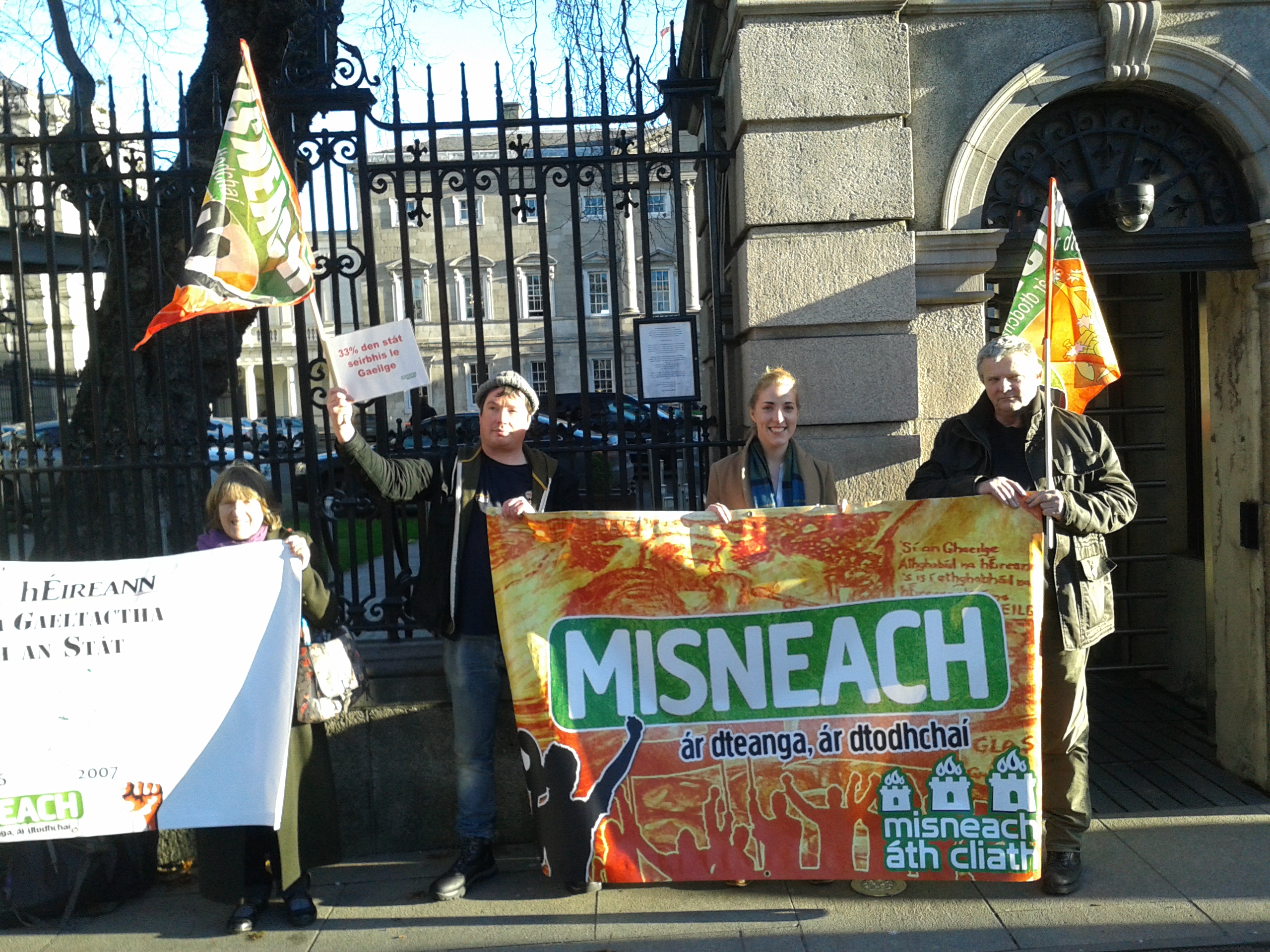
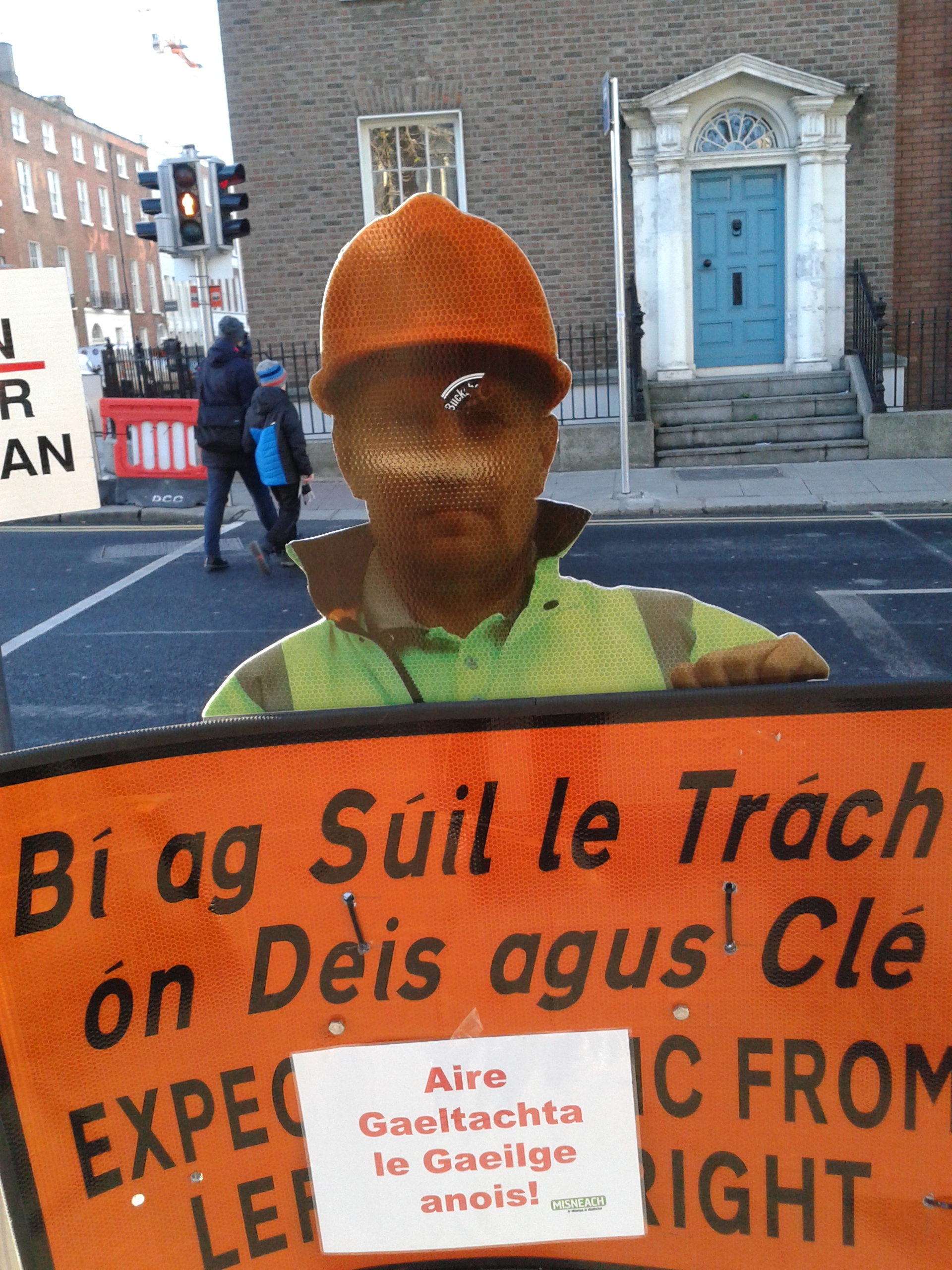
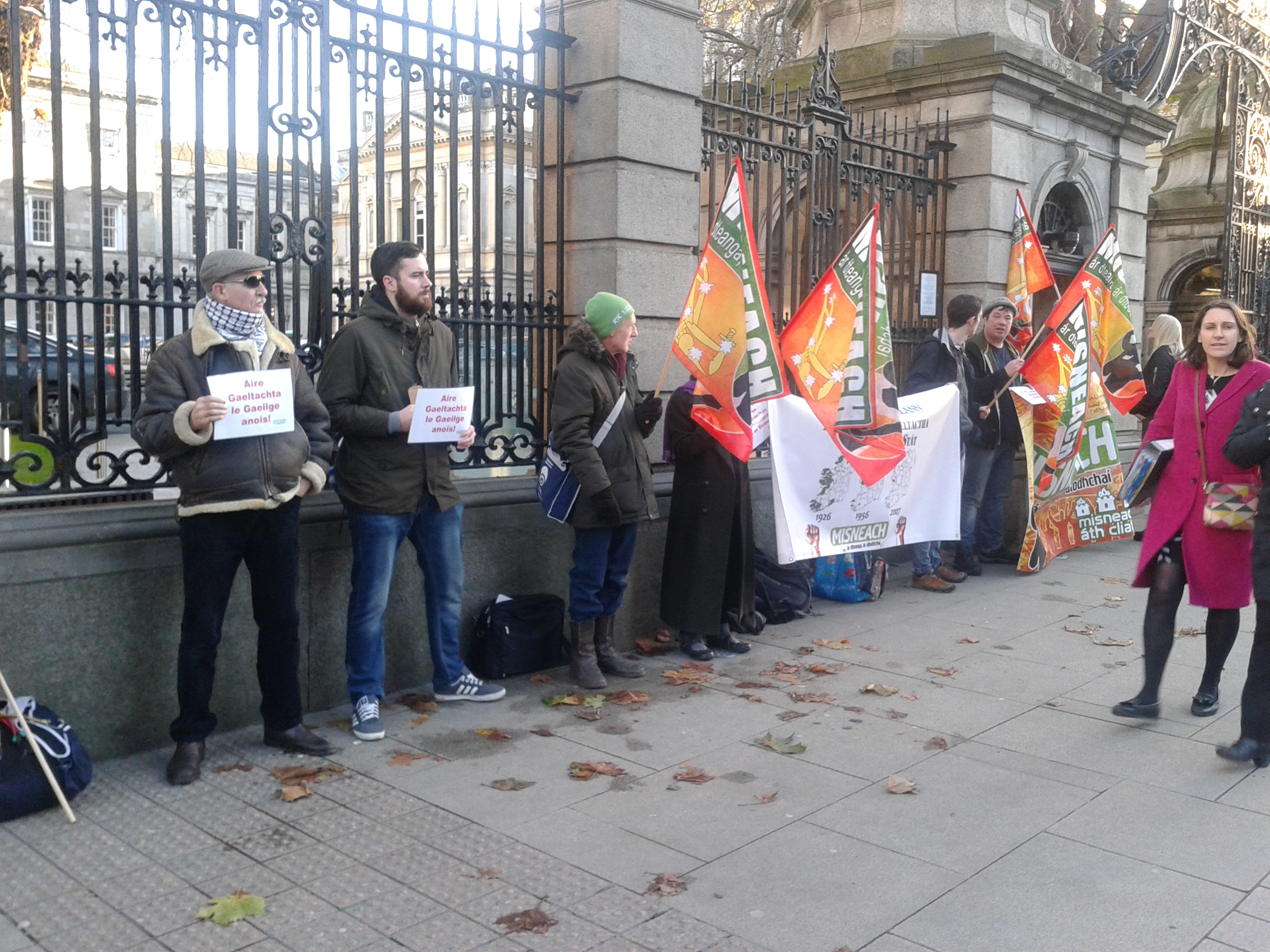
De réir ráiteas a d’eisigh craobh BÁC den dream Misneach inné (15/12/2016) d’éirigh go maith le hagóid Misneach  ar son Cearta Teanga lasmuigh de Theach Laighean. Bhailigh daoine i rith am lóin chun seasamh i gcoinne cur i gcéill na hairí Humphreys agus Kyne. Bhí neart tacaíochta don agóid ó dhaoine a d’imigh thar bráid, cuid mhaith acu a d’iarr leithscéil nach raibh mórán Gaeilge acu féin agus cúpla daoine ó thíortha i gcéin ina measc.


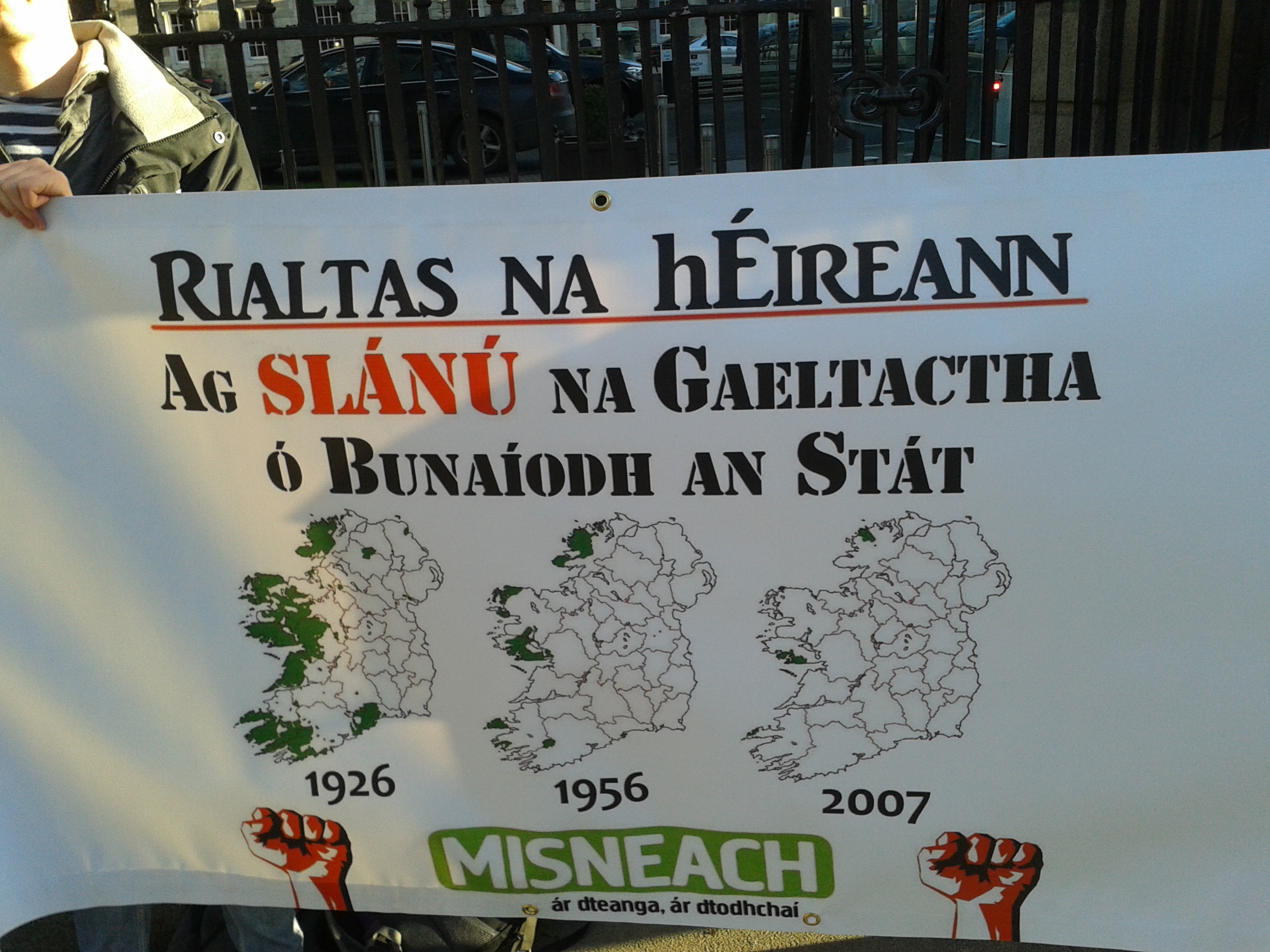
Map on Misneach banner illustrates the decline of areas where Irish is a living community language under the Irish state's administration. (Photo D.Breatnach)
Map on Misneach banner illustrates the decline of areas where Irish is a living community language under the Irish state’s administration. (Photo D.Breatnach)

D’ardaigh urlabhraí Misneach, Kerron Ó Luain, ceist an buiséad a pléadh i measc an chomhchoiste inniu:

Gheall Sean Kyne go dtabharfaí 1,000,000 euro breise don Ghaeilge ar Adhmhaidin ar RnaG níos luaithe. Is ardú 1% atá i gceist le sin. Ach, is méid suarach é 1% nuair a smaoinítear go gearradh 75% de bhuiséad Údarás na Gaeltachta agus 35% ó bhuiséad Foras na Gaeilge ó 2008.

D’fhógair an tAire McHugh i rith 2015 go mbeadh 1,000,000 euro breise do bhuiséad caipitil na Gaeilge chomh maith. Tá sé soiléir gur cleas atá sna fógraí seo. Gearrtar na deicheannaí de mhilliún ó bhuiséad ach, ar an láimh eile, fógraítear “airgead breise” de mhéid an-bheag amhail is gur dul chun cinn é. Is cleas é leis an bpobal Gaeilge a cheannach agus faraor tá an cuma ar an scéal go n-oibríonn an chleasaíocht seo.’

Chríochnaigh Ó Luain:

Arís tá Misneach ag glaoch ar na ceanneagraíochtaí Gaeilge gníomhú agus Lá Mór eile a eagrú. Tá sé feicthe ón ngluaiseacht a d’fhás i gcoinne príobháidiú a dhéanamh ar ár n-uisce, gurb é an t-aon chineáil cumhacht a dtugann na polaiteoirí aird ar bith air ná cumhacht na sluaite amuigh ar na sráideannaí.

Section of protest demonstration outside the Dáil (Photo D.Breatnach)

Má leantar ar aghaidh mar atá agus an pobal Gaeilge ina dtost caithfear milliúin euro chugainn anseo is ansiúd i mbealach soiniciúil ach ní dhéanfar aon dul chun cinn i ndáiríre. Agus gan ach 10 mbliain fágthaí ag an nGaeilge mar theanga pobal laethúil sa Ghaeltacht tá gníomh raidiciúil de dhíth láithreach.’

———————————————————————-

According to a statement of the Dublin branch of the Misneach organisation yesterday (15/12/2106),  a successful demonstration for Language Rights was held outside Leinster House. People gathered during lunchtime to highlight the hypocrisy of the government ministers charged with overseeing the language, Heather Humphreys and Sean Kyne. There was plenty of support from passers-by, including people who apologised for their own lack of Irish and a few people from abroad.

Spokesperson for Misneach, Kerron Ó Luain, alluded to the budget being discussed by the committee today:

Tongue-in cheek use of road traffic sign (Photo D.Breatnach)
Tongue-in cheek use of road traffic sign
(Photo D.Breatnach)

Sean Kyne apparently promised an additional million euro for the Irish language on RnaG’s Adhmhaidin programme this morning. That amounts to a 1% rise. Realistically, 1% is a pitiful amount when it is considered that 75% has been cut from the budget of Údarás na Gaeltachta agus 35% from that of Foras na Gaeilge since 2008.

Then Minister for the Gaeltacht, Joe McHugh, made a similar announcement in 2015 when he said that one million additional euros would go to the capital budget for the Irish language. It is patently obvious to all that this is a cynical ploy. Tens of millions are cut from the budget only for grand announcements of “additional funding” of pitiful amounts to be made afterwards as if this were progress. It is a ploy being adopted to buy off the Irish language community, and unfortunately it appears to be working.’

Ó Luain finished:

Misneach is once more calling on the chief Irish language organisations to mobilise towards another Lá Mór. It is evident from the movement which opposed the privatisation of our water that the only type of power politicians pay any heed to is the power of the people marching on the streets.

If the situation persists and the Irish language community remains silent, and accepting of token gestures of one million euro here and there, then no real progress will be made. With only 10 years left for Irish as a living community language in the Gaeltacht now is the time for radical action.’

(Photo D.Breatnach)
(Photo D.Breatnach)
Section of protest after some people had left (Photo D.Breatnach)

Joe Kelly — and a generation passing

A generation is passing. Actually they have been passing for some time, the generation of the fighting years of the late 1960s, the 1970s, the 1980s and even the 1990s.

They campaigned variously for social housing; civil rights north and south; for human rights; against Church domination; against Unionist sectarianism; for free access to contraception; for right to divorce; for an end to censorship; for national self-determination; for Gaeltacht civil rights; for Irish language rights and Irish on TV; in support of political prisoners; the rights of women; for Irish Traveller rights; protection of heritage and environment; solidarity with many struggles around the world, including Cuba, Vietnam, Rhodesia, South Africa, Chile, the Black Panthers; against drug dealers; for freedom to choose lifestyle; decriminalisation of gay and lesbian life; for community projects in deprived areas including youthwork and, let’s not forget, organised, fought in and supported strikes.


That generation fought many battles, some of which they won and some which built bases for later battles and their story is told only in bits and pieces here and there. They organised, marched, sat in, occupied, wrote, made placards, painted slogans, put up posters and some fired guns; they were watched, raided, beaten, fined, jailed, calumnied, sacked, expelled, kept unemployed, derided from pulpit, press and judge’s bench, some were shot, and not just they but their families made to suffer too.

I am not referring to people of any specific age but of all those who were any age from young to old and active during those years. The causes of death have been many, from simple old age and life lived out to the death penalty.

But the death penalty was not in force in Ireland in the 1960s, you may think? Actually it was, it wasn’t abolished until 1990 in this state. But you’d be kind of correct as in practice no formal execution has been carried out by this state since 1954.

So, then what am I talking about? Maybe referring to the ‘United Kingdom’, since six counties of Ireland are included in that state? Yes, and no. The death sentence still exists in the UK only for “Arson in Her Majesty’s shipyards” but it was abolished in Britain for the crime of murder in 1965 and, in fact, no-one had been formally executed there from the year before. If the judicial death penalty had still been in force, the people in charge of that state might’ve been been spared the embarrassment of seeing nearly a score of Irish people they had wrongly convicted in 1974 walk free decades later as judges eventually had to find them ‘Not Guilty’.

A bit late for Giuseppe Conlon, against whom there had not even been a shred of doubtful evidence, but never mind. But had they all died in prison or been executed, people might not have worked so hard to see their convictions in court overturned – people among whom Joe Kelly, who died this week and who was cremated on Saturday, stands tall.

But the death penalty was not removed from the judges’ arsenal in that bastion of reaction, Six Counties state, until 1973, when the 30 Years’ War had entered its early years (somebody from the British state clearly had to sit down with the Unionist bigots and explain, although of course they sympathised with their loyal brethren, how bad it would be for Britain and the Queen if they started sentencing and executing IRA and INLA fighters).

There are more ways to skin a cat …. yes, and to kill too. The orange and SAS and MRF death squads killed more against whom there was not even a court conviction. And some of the Republicans killed one another too. And twelve died on hunger strike, one each in 1974 and in ’76 and ten in 1981. Actually, considering the brutality of force-feeding, it’s surprising there weren’t more deaths – Marian and Dolours Price were force-fed 167 times over 203 days in 1973 and it was the publicity around their case and the deaths of Gaughan and Stagg that ended the practice of force-feeding, ensuring that the Hunger Strikers of 1980 and ’81 at least did not have to endure that experience.

But there are more ways to kill …. Many of that generation of fighters died from ‘natural’ causes but died early – cancers, heart attacks, liver damage, despair ….. ah, yes, that brings to mind suicide, of which some also died. But despair also can drive you to drink, even more easily if it has been part of your experience of socialising and alcohol is one of the top killers in the world. And some died of drugs …. or drugs and alcohol …. or infections from unsafe drug injection …. But most who died early did so in summary from the wear and tear of struggle, of prison, of separation, of relationship breakdowns, of betrayal, despair.

Not all died, even those who are not among the fighters today. Some walked away from the struggle and though I can’t imagine being in their shoes, I do not begrudge them. So long as they didn’t betray any on their way out or make a living out of spitting on their former comrades and causes afterwards. But some, a very few, did exactly that and you can read what they have to say quite often in their articles or hear them quoted in the newspapers or on TV or radio.

Some found other ways to betray and did it in secret, feeding information to their handlers and some even diverting attention from themselves by accusing others, some innocent and some of a lesser grade of betrayal than that of the accusers. We know of some of them but may never learn about them all.

Joe Kelly

Poster displayed at memorial in Teacher's Club (photo accessed from a Facebook posting)
Poster displayed at memorial in Teacher’s Club (photo accessed from a Facebook posting)

A few have survived and are still around, fighting the struggle, whether in organisations or as independents. Joe Kelly was one in both categories, in a sense. I knew him but did not know him well and met him only in the last decade, after I had returned from decades living and working in London. I am given to understand that he had passed through a number of political organisations, including Fianna Fáil and the Labour Party. A strange CV, one might think, for a radical left-wing social and political activist. The last political group with which I had associated Joe was People Before Profit, on a local level, around Phibsboro. Joe invited me to attend a quiz they were running and I did so mainly to return a favour – he had attended, to contribute to the singing at my invitation, an evening of the Clé Club where I had been “Fear a’Tí” for that night. I was amazed to win a Blackberry at the quiz (sorry, Joe, I still haven’t gotten around to learning and using it!). Last I heard, he wasn’t with the PBP.

Somebody told me years back that he had been a central organiser of a solidarity event in Dublin for the Birmingham Six in which lights had been floated down the Liffey. Of course I was impressed – on a political/ human rights level but also for the poetic vision involved. I have found little about that event since and Joe, who I found a modest man, didn’t give me much in response to my pressing. A couple of searches on the Internet yielded me only a passing reference to the River Parade, of 1990, a year before the Birmingham Six were finally cleared in court and released. Likely I have not been asking the right people or looking in the right corners.

I met Joe by arrangement for a coffee a couple of times, while I tried to get him into something I was doing and he tried to get me into something he was working at – neither of us succeeding in our efforts to recruit the other. Since Joe was working for awhile in the community sector I also approached him to explore possibilities for me when, despite a long track record in the fields of working in homeless shelters and addiction as well as other community activism I was out of work, but he wasn’t able to help me.

And of course I bumped into him on demonstrations, as in those in solidarity with Palestine or against the Water Tax or against the Lisbon Treaty. For awhile we were active together in the Dublin branch of the Ireland Palestine Solidarity Committee and I believe he left like me after witnessing some nasty in-fighting years ago, though we both often turned up to protest pickets and demonstrations and public meetings called by the organisation. We would also meet at events in solidarity with the Cuban people.

I heard him described at his funeral service, by someone who should know, as a Republican. Certainly Joe was very proud of his father and uncle who had both fought in the 1916 Rising, the first in the GPO and the second in Bolands’ Mill and proudly displayed his father’s medal at a public event in the Teachers’ Club in Dublin.

Joe Kelly displaying his father's 1916 service medal at a 1916 commemoration event (photo: D.Breatnach)
Joe Kelly displaying and talking about his father’s 1916 service medal at a 1916 commemoration event (photo: D.Breatnach)

However, he was among the number that I invited but failed to get to events over the last decade to highlight the plight of Irish Republicans being hounded by the State and imprisoned without trial. That did puzzle me, for I knew Joe to have a track record of fighting for human rights. And this was shown not only in his campaigning for the Birmingham Six.

Joe fought for the rights of divorce and choice of abortion, as well for the right to freedom from partner abuse, in particular through the movement for women’s refuges, what many people still refer to as “battered wives hostels”. He was active in the campaign for the right to gay marriage, so amazingly successful in Ireland. And Joe was also active in campaigns against racism towards migrants.

“Conas atú tú?” or “Dia dhuit”, Joe would invariably greet me whenever we met. I would not call him exactly fluent but he could understand and speak Irish. I suppose I assumed he had some affection for the language and was also paying me, a known native speaker, the courtesy of addressing me in Irish and speaking awhile in the language. At his funeral service, I learned it went further than that. I heard his grandchildren say that he frequently spoke to them in Irish and when they did not understand him, would translate what the words meant. Some people in the audience chuckled to hear this. I felt sad and somewhat angry too, that a question so important to our cultural identity, an aspect so threatened today, should be treated so apparently lightly by some and that the only words to be spoken at his funeral service in Irish were those in the final sentence spoken by his brother, Jim, in his eulogy: “Slán leat, Joe”. In the booklet produced for the occasion and freely available at Club na Múinteoirí, there was however one dedication in Irish (and I have since learned that one of the speeches at the Teacher’s Club was in Irish) and I note that both grandchildren who spoke bear Irish-language names.

Paying respects and memorial service

On Saturday, laid out in the lovely Room 2 in the Teacher’s Club (sin Club na Múinteoirí, Joe) in Dublin’s Parnell Square, a venue often used for social, cultural and political events, in a closed wicker basket coffin, Joe received his visitors. And they were MANY. Feminists, Palestine solidarity activists, Cuba solidarity activists, community activists, independent political activists and a sprinkling of activists in various parties all attended and many contributed their memories or words dedicated to him while he was laid out there.  (I took many photos here and some at Mount Jerome but somehow seem to have lost them all).joe-kelly-speaking-at-event

Attending first another funeral (of another singer) that morning in Howth, then travelling into Dublin to take part in the Moore Street Awareness weekly table, I had to miss some of that. I spelled a comrade while he attended to pay his respects, then attended later while he took over back at the table.

Room No. 2 was still packed but so was the whole bar lounge area. I had missed all the eulogies and reminiscences and even singing – “The Foggy Dew” I was told. Had anyone sung “The Parting Glass”, I asked. No, apparently not. So then to ask his sister if it would be alright to do it, then the MC, his long-time collaborator, comrade and friend, Brendan Young. It would be welcome, I was told. And Fergus Russell (also his second funeral that day) and I did three verses together, using a mic so it might carry through to the lounge and, though we took turns at fluffing a line, not too badly. It is a great song for such occasions and each verse was particularly appropriate to Joe.1

A little later, the Internationale was sung by all (copies of the words of a verse and the chorus distributed beforehand), the wicker coffin (I must have one of those when my time comes!) was lifted on to shoulders by family and friends and brought through the respectful lines while Joe’s daughter sang The Night They Brought Old Dixie Down.2

Then the hearse came out and led the cortege to Mount Jerome cemetery. I didn’t know the protocol regarding cycling in a funeral cortege but followed anyway, managing to get temporarily lost on the way and arriving just as the hearse arrived at the cemetery. Again, the chapel was packed.

The ceremony was non-religious and officiated by Therese Caherty, ex-partner and friend. In turn Therese herself, his brother, his bereaved current partner, relatives and his comrade and friend Brendan Young all gave their moving eulogies and often funny anecdotes. Brendan emphasised that for Joe, the process of the conduct of a struggle was as important as the end to be reached, which I knew to be true from our time together in the Dublin IPSC and I’d be in agreement with Joe on that.

There were, despite the many I did see during those events, some faces I did not see in the congregation or at the Club na Múinteoirí before the service or later, when many returned to the Club to free sandwiches and soup laid on by the management there. It was their loss.

I never saw him dance but am told he loved it and taught his grandchildren not only to sing but to dance too. I did know he’d learned to tango. He’s left this dance floor now and gone on to another and whateverone steps and two steps and the divil knows what new steps”they are dancing there, I’m sure Joe is learning them and probably teaching a few of his own.

Slán leat, Joe – árdaigh iad!

A chríoch.

FOOTNOTES

1  “Of all the money that e’er I had, I spent it in good company


And all the harm that e’er I’ve done, alas, it was to none but me


And all I’ve done for want of wit to memory now I can’t recall


So fill to me the parting glass, good night and joy be with you all

“If I had money enough to spend and leisure time to sit awhile


There is a fair maid in this town, that sorely has my heart beguiled


Her rosy cheeks and ruby lips I own, she has my heart enthralled


So fill to me the parting glass, good night and joy be with you all

“Of all the comrades that e’er I’ve had, they are sorry for my going away


And all the sweethearts that e’er I’ve had,

they would wish me one more day to stay


But since it falls unto my lot that I should rise and you should not


I’ll gently rise and I’ll softly call good night and joy be with you all”

2  This song of nostalgia for the American Confederacy has a haunting melody but its ideology is often ignored by those who sing it.

3  Line from The Charladies’ Ball