A SECTARIAN WAR OF SYMBOLS

Diarmuid Breatnach

ln the Six Counties, the British colony in Ireland, the sectarian lines are drawn. The Good Friday Agreement did nothing to eliminate them, contrary to the praises of many and perhaps even the wishes of some who supported it. The majority section of the population has a badge of professed faith to identify it, Protestantism, while the other has its own badge, Catholicism. But each section also has other symbols of its own.

          Politically, each section has a number of divisions within it but each has its majority representation: the Democratic Unionist Party for the Protestants and Sinn Féin for the Catholics. Both of these parties have overcome others to rise to prominence over their respective sections – the DUP deposed the Ulster Unionist Party and Sinn Féin overtook the Social Democratic and Labour Party. Both Sinn Féin and the DUP display the symbols of their respective sections and employ them to sectarian electoral advantage.

Apart from professed religion as a signifier, each section also has its own visible symbols: the Tricolour and Harp for the Catholics, the Union Jack and Crown for the Protestants. And to this has now been added language: Irish for the Catholics and Ulster Scots/ English for the Protestants.

The Irish Tricolour, a flag of the Irish Republican movement and official flag of the Irish State.
(Image sourced on Internet)
Flag of the United Kingdom, colloquially known as the “Union Jack” (it has other less neutral names too).
(Image sourced on Internet)

There are other symbols too but they are of minor importance, for example for the Catholics flying the Palestinian flag in solidarity with Palestinians and, just because they must oppose anything the Fenians do, the Israeli flag for the Protestants. Soon we may see the Catholics adopt the Catalan Estelada flags and the Protestants, the flag of the Spanish State. But would Unionist Protestants fly the flag of a Catholic country? Yes, it’s quite possible – they already fly one of a Jewish state.

Coat Arms UK (black & white), itself a symbol of UK authority and power, displaying a number of other symbols within it, including the Irish Harp within the shield. Note the symbolic Crown above all. (Image sourced on Internet)
United Irishmen Harp Motif
(Image sourced on Internet)

The opposing sections are in this discussion described as “Catholic” and “Protestant”, as though religion were really the issue – however it is not. Some commentators like to speak in term of “nationalists and unionists”, with the more extreme wing of the latter described as “Loyalists”. That particular sub-group of Unionism is more likely to refer to Catholics as “Taigues” or “Fenians”.

There are religious differences in doctrine and in temporal supremacy between both religions: Catholics believe in the immaculate conception of Mary, the mother of the Christ figure and Protestants do not, though she is seen as a saint in their churches also. Perhaps more relevantly, for Catholics the Pope is, notionally at least, the supreme temporal religious authority while for Anglican Protestants, it is the ruling British Monarch (other British-based Protestant sects acknowledge only their own vicars, their reading of the Christian Bible or their own consciences). Currently, that monarch is Queen Elizabeth II Windsor and lest she be considered just some kind of figurehead, albeit with untold (literally!) riches quite apart from public funds allocation and properties, it is well to remember that she is also Commander-in-Chief of the British Armed Forces.

Back in the day, the Pontiff (the Pope) also controlled a fair share of armed force and also brokered deals between the monarchs of different kingdoms. And in that respect, we’ll shortly come to some great ironies with regards to the Six Counties but first there are other matters to deal with.

RELIGION AS A QUESTION OF STATE POWER

Henry VIII of England disestablished the power of the Pontiff in English-ruled domains and made himself head of the Church, which of course required a split in the Christian Church, and the whole process has since become known as the English Reformation. That happened in the 16th Century; Henry’s daughter Elizabeth I continued this policy in the 17th Century and also extended the power of England and the territories under its domain. Of course, none of this was done by those monarchs alone; powerful feudal and commercial interests were involved also. Being Head of the Church of England allowed Henry to dissolve monasteries and confiscate their lands, filling the coffers of the Crown and of the faithful – faithful to the Crown.

Unfortunately for Ireland, a large part of the country was in the possession of England at this time, though not without resistance. And the original “English” colonists, the Gall-Ghael (“foreign Gael” in Irish), the Normans who had invaded from a colonised Wales with their mercenaries, wanted to stick to their earlier religion, continuing to acknowledge the Pontiff as their spiritual leader. They held their lands through conquest of arms under English monarchs (though the first had been a French Norman) but their loyalty to the British Crown was somewhat shaky. In 1366, nearly two centuries after their conquest of the Irish lands they held, the English Normans called them “the degenerate English” and accused them of having become “more Irish than the Irish themselves”.1

And what of “the Irish themselves”? They too were of the old faith, although their earlier Celtic Christian Church had been more than a little lax in its application of Roman doctrine, especially in laws and mores around marriage, justice and the status of women. The Roman Church was feudal and Irish society still ran along clan lines.

An uneasy alliance was formed between the Gael and the Gall-Ghael which emerged first for the English king Charles I against Cromwell, in the middle of the 17th Century and later again near the end of that century for King James II against King William III (of Orange). On each occasion the Irish alliance lost.

BATTLE, SECTARIAN LINES AND IRONIES

          And here we come to ironies. William of Orange was a Protestant and the victory of his forces at the Battle of the Boyne is considered by Unionists a victory of Protestant forces over Catholic. Actually, there were some Catholics among William’s force and some Protestants among the opposing James II forces but that is not the irony. Nor is the fact that William of Orange was a homosexual and that Rev. Ian Paisley, who founded the Democratic Unionist Party and led it until his death in 2014, led a campaign against decriminalisation of homosexuality under the slogan “Save Ulster from Sodomy!”

No, the irony is even greater than those two facts and it is this: William’s armed forces were part-financed by the Vatican, in other words through the Pontiff himself. Although in Ireland the conflict took on the shape of Catholics fighting for freedom to practice their religion (and even Gael and Gall-Ghael holding on to their respective powers), against Protestants forcing their religion and colonial power on others, it was part of a European-wide conflict known to historians as The Nine-Years War. A coalition of forces composed of Austria, the Holy Roman Empire, the Dutch Republic, Spain, England and Savoy, styling itself the League of Augsburg, drew up to oppose Louis XIV of France. And James found himself on the side of France and against his own Parliament.

The Pontiff, as leader of the Holy Roman Empire, was very much a member of the League of Habsburg as was the Kingdom of Spain and Savoy – all under Catholic rule. When news of William’s defeat of James’ forces at the Battle of the Boyne on 1st July 1690 reached the Vatican, a Te Deum mass of praise was celebrated there and similar demonstrations of praise were practiced in the Spanish Kingdom also. That war in Ireland had fundamentally little to do with religion in reality but everything to do with English state and colonial power and European power struggles.

And of course this is not only an irony for the Protestants, who annually celebrate the Boyne victory on the 12th of July in their most sectarian and anti-Catholic manner, but for the Catholics too, who see James as defending their Catholic faith, of which the Pope was the spiritual leader. Nor is that the only irony in connection with Ireland and the Vatican: it was a Pope, Adrian IV, who issued a Papal Bull (something like a warrant) in 1155 legitimising invasion and conquest of Ireland by Henry II of England. Pope Adrian IV, aka Nicholas Breakspear, was the only English Pontiff ever, true but he was a Pope and he must have had substantial support in Rome to issue such a document.

RELIGION

          One of the characteristics of republicanism in the late 18th Century, apart from the abolition of the monarchy, was the separation of Church and State. Freedom of conscience and worship were important principles in the French and American revolutions. The United Irishmen also adhered to those principles with an even greater motivation, which was that the majority of the Irish population was excluded from participation in government, military and civil profession by a religious bar.

The Unitedmen were defeated, crushed. Their Protestant (Anglican) and Dissenter (Presbyterian) leaders and supporters were executed or exiled2 and the remnants for the most part became dominated by sectarian anti-Catholicism. And Irish nationalism, including republicanism, came to contain a strong Catholic bias (notwithstanding the continuing presence of Protestants and true Republicans in the movement).

Despite the fact that the Irish (and English) Catholic Church hierarchy has been publicly and energetically hostile to Irish Republicanism from the 1780s onwards, the majority of the Irish Republican movement of the early 20th Century observed the practices of the Catholic faith and never broke from its religious allegiance nor sought to overcome the dominance of the Church in society. As a result the Republican movement was unable, had it wanted to, to tackle many of the social injustices in the Irish State’s education, health, intellectual, literary, art, gender and sexuality policies and legislation, where the Church held sway.

Liberty of conscience and worship remains an important civil right, a democratic demand. People are entitled to practice their concept of religion or to abstain from it and their choices in this regard should not influence people’s participation in society as a whole. The Catholic Church is losing its power in the Twenty-Six Counties and that is reflected too in the Six. The Presbyterian churches are likewise losing influence. However, faith congregation membership continues to be a communal marker and to be used by the DUP and SF to hold their respective voting blocs together.

If separation of Church and State is an important principle of Republicanism then Republicans should actively campaign for that end. No school that bases its intake of pupils on the practice or belief of any religion should receive State support. But in the unlikely event that Sinn Féin should embark on a campaign to apply that principle, they would find themselves losing their voting block, for that is how their block is identified in the Six Counties: as Catholics, baptised in Catholic church, attending Catholic services to some degree or other and being educated in Catholic Schools.

The Unionists are of course just as careful to look after their own sectarian voting block and at least as sectarian. But they don’t claim to be Republicans.

THE ESSENCE OF THE SYMBOLS

          Symbols of course do not merely stand for what they are themselves but, in being a symbol, for something else also. A sculpture or drawing of a lion may represent the animal but when used as a symbol, frequently stands for monarchy and power: for examples, the lion on the coat of arms of the United Kingdom and the lions at base of Nelson’s Column in Trafalgar Square, London. And symbols can also change their symbolic meaning and come to mean something else than was originally intended. The cross symbolised martyrdom for early Christians, later came to symbolise Christianity itself, later still the Holy Roman Empire and the Crusades, the Spanish Inquisition …. For the Ku Klux Klan in the southern states of the USA, the burning cross symbolises the power of their organisation and white anglo-saxon ethnic supremacy.

The Irish Tricolour flag was presented to Thomas Francis Meagher of the Young Irelanders by women revolutionaries in Paris in 1848, the Year of Revolutions in Europe (but not really in Ireland, where the fight had been knocked out of the remaining survivors of the Great Hunger 1845-1849). Reputedly the flag’s colours signified peace (White) between the traditions of the Gael (Green) and the descendants of those who had fought for William (Orange). The Unionists see it, however, firstly as a symbol of rebellion against the Crown (not without reason, given its historical use) and secondly as a flag of a Catholic Ireland.

The Harp is an Irish symbol of some antiquity and was reputedly flown on standards in ancient medieval times in Ireland. The Norman and English invaders appropriated it firstly as symbol of a conquered Ireland and incorporated it into their colonial standards and flags. Revolutionary republican grandchildren and great-grandchildren of Cromwellian settlers then appropriated the harp as the symbol of the republican United Irishmen, with the motto “It is newly strung and shall be heard”. After the defeat of the Unitedmen (whose leaders were nearly all Protestant), the Harp became a rather suspect symbol for Unionists, mostly Protestants and besides, it is the official symbol of the Irish State (the only state in the world with a musical instrument as its national symbol). However, it remains within the arms of the United Kingdom, representing the Six Counties colony still in British/ English possession.

“Easter Lilly” design, traditionally produced as a paper ‘flag’ and worn pinned to clothing with a straight pin. More recently also produced in enameled metal. (Image sourced on Internet)

The “Easter Lilly” emblem is a symbolic representation of a white lilly with an orange centre, with a green leaf as a background. It was developed by Irish women Republicans in the second decade of the 20th Century to commemorate those who died fighting for Irish national freedom, in particular during the 1916 Easter Rising. For decades it was produced as a simple paper representation for the Irish Republican movement and sold on streets or pubs in the lead-up to Easter Monday, when the Rising would be commemorated. In more recent times it has been worn for up to a week each side of Easter Monday and it has also been produced as a metal badge or pin, which some Republicans wear all year around.

The flag of the United Kingdom, commonly known as the “Union Jack”, embodying a design composed of the symbols of the Crosses of Saints George, Andrew and Patrick, represents the union of the nations through their respective patron saints3: Scotland and Ireland under the rule of England and its Royal Family. It was a forced, not a voluntary union and is therefore a reactionary symbol but Unionists in the Six Counties view it as a symbol of the union with England which they wish to maintain.

Paper “Remembrance Poppy” produced for the British Royal Legion (Image sourced on Internet)

The Crown represents the English Royal Family and UK State power. Since it is the same State that imposes its rule on the other nations of Ireland and the British Isles, it is fundamentally a reactionary symbol, also representing the reactionary institution of monarchy.

The Poppy, a cloth representation of the red flower, is worn by many British people in the lead up to Armistice Day, November 11th and sometimes for days afterwards. Many British people apparently believe that the purpose of this symbol is to commemorate the dead in wars or to support veterans and their families. In fact as research has shown, the primary purpose of commemorating ‘Remembrance Day’ and the Poppy is to gather public support behind the Armed Forces of the UK. Unionists seemingly see wearing it as proof of their political allegiance to Britain, England or the Crown – or all three.4

In the most recent history of the Six Counties, the symbols listed above have been those of the respective communities, with the added fact that Crown and Union Jack have also been symbols of the colonial statelet itself.

Recently two other symbols have been promoted, also with sectarian allegiances: Irish and Ulster Scots. Neither of these two languages is spoken by the majority of either community, for whom English (with some words specific to Ulster) is the majority language.

THE IRISH, ENGLISH AND ULSTER SCOTS LANGUAGES

          Irish or an Ghaeilge, one of the languages of the Goidelic branch of the Celtic languages group, was the language of the people living in Ireland before it was invaded by England and remained the majority language in Ireland until the end of the19th Century. It continues as a community language5 in all provinces of Ireland including Ulster but there in parts of Co. Donegal, the northernmost county of Ireland (and not part of the Six Counties despite the statelet being called “Northern Ireland”).

Irish died out as a community language in the Six Counties from its last refuge, the Sperrin Mountains, sometime in the early decades of the 20th Century (the 1911 Census recorded a majority of Irish speakers in that region but also, interestingly, in the Protestant Sandy Row area of Belfast City). However, some Irish speakers survived and others learned the language so that it continued to exist in the colony after the partition of Ireland in 1921. During the recent 30 years’ war, Irish enjoyed a resurgence and to some extent became a badge of resistance to colonial rule.

English is, more than most, a language composed of a number of different languages. Given that it sounds like and is classified as a Germanic language, it is surprising that its major component is of French language origin with the minor component based on Saxon German. English developed in what became England over a period including the defeat of the Romanised Celtic tribes of the area by the Saxons and Angles and the subsequent conquering of the Saxons themselves by the French-speaking Normans.

A century after their victorious invasion of England, the Normans invaded Ireland. In most of the area they conquered in Ireland, the Normans soon came to adopt many local customs, including the speaking of Irish so that less than two centuries later, their England-based colleagues referred to them as “the degenerate English” who had become “more Irish than the Irish themselves.”6

Although the invaders failed to enforce the Statutes of Kilkenny, over the following centuries they managed through eviction of natives and plantation of colonists, as well as the exclusively official use of English and legal repression of the Irish language, to make Irish a minority language and to reduce it, as a community language, to a number of reservations in certain parts of the country.

Ulster Scots is a dialect of Scots, in turn a dialect of German spoken by Saxon colonisers of the Scottish Lowlands (the reason the dialect became known as “Lallands”). The Scottish colonists of Irish lands given to them by James I, Oliver Cromwell and English bankers brought the language into Ulster where it developed into “Ulster Scots”. That too gave way to English over time except in some pockets, without any serious effort to revive its fortunes. Until, that is, agitation began in recent times for rights for Irish speakers and for the teaching of Irish, when some Unionists, seeking an “Ulster”7 “Protestant” equivalent with which to oppose any benefits for Irish, began agitation for the preservation and teaching of Ulster Scots.

However, the real competitor with Irish for dominance in the Six Counties (as also in the Twenty-Six, the Irish State) is of course English.

PARITY OF ESTEEM”

          “Parity of esteem” is a concept that was put forward by Sinn Féin within the atmosphere of the Good Friday Agreement.

To many people at the time, including myself, it seemed like something between “soft” Republicanism and a token demand, something to represent to the party’s following that it was doing something for them in the Six Counties. Sinn Féin would have claimed it was much more than that – and it was.

When some critics of SF or of the Peace (sic) Process claimed that sectarianism was being institutionalised, was being “copper-fastened”, I wondered how that was. Obviously, people in Catholic areas would vote Sinn Féin but how was that any different other than how they would have voted previously, viz. Nationalist or SDLP?

But in the past, except for the brief “power-sharing” agreement8 which the Loyalists had so effectively sunk, no political representative on a Catholic voting base had even come close to carving up the Six Counties on a community proportional basis. Now Sinn Féin have done so – not just in local authorities but in the government of the statelet itself (present difficulties excepted). That is what SF has achieved, after some years of civil rights agitation, Catholic communal resistance to repression and nearly three decades of armed struggle – a sharing out of the spoils of office. Power-sharing. Parity of esteem. A sectarian carving out of areas of influence.

And every power-base must have its symbols. Recently the Irish Language has become one such. Obviously the Irish language is entitled to support and its speakers have civil language rights. Clearly the sectarian opposition of Unionist politicians to concessions in this direction is fundamentally wrong. Of course a Language Act is needed so that Irish speakers can use it to push for their rights where the institutions oppose and block them. But that is not why SF has come so late into this struggle. It’s another symbol of their ethnic power-base and another stick with which to beat the Unionists.
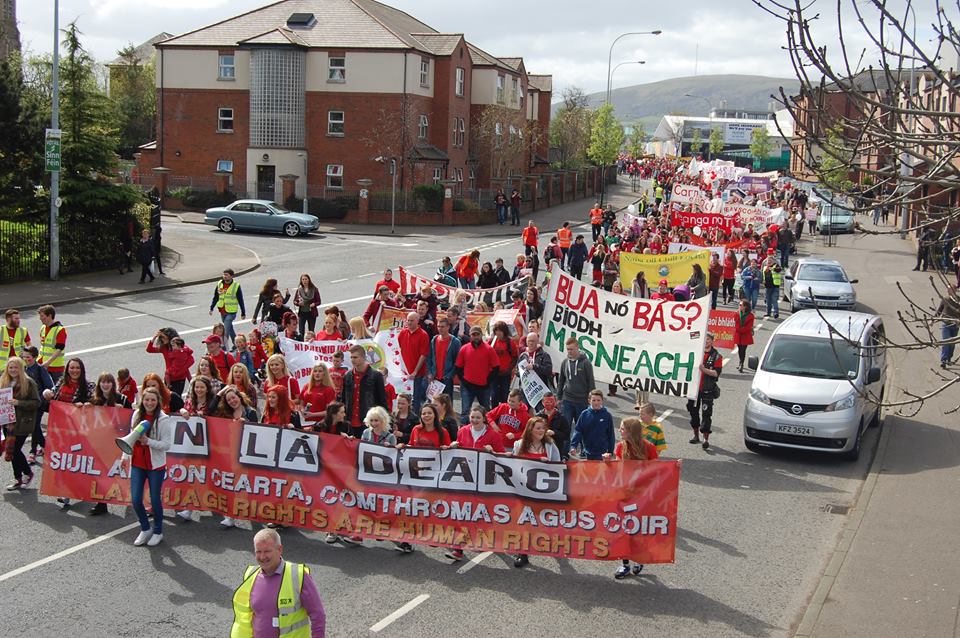
A view of a section of the “Dearg le Fearg” protest demonstration in Belfast in 2014, demanding State recognition of and facilities for the conservation and dissemination of the Irish language. (Image sourced on Internet)

And of course there are Irish language speakers and campaigners who are Sinn Féin members. They made clear you knew that during the huge demonstration in favour of Irish language rights, the Dearg le Fearg9 demonstration of 2014 in Belfast, when they were the only political party displaying a banner in violation of an understanding that no political party would do so.

But what does Sinn Féin do in order to forward the language among its own members and activists? Are its public speakers obliged to be competent Irish speakers? Are its Ard-Choiste (Executive Committee) meetings conducted through Irish? Its cumann (branch) meetings? Its Ard Fheis (annual congress)?10 No, none of those. Is the party even running an Irish language instruction program to overcome this deficit at some point in the future? No.

Apart from some enthusiasts among its activists and a vague nationalist emotional attachment, Sinn Féin as a party is not really interested in the language. In the Six Counties, it is interested in a sectarian carve-up which will keep it at the power table and the Irish language has now become useful for that. Just as, in the Twenty-Six Counties state, it is interested in coming to power in a different kind of power-sharing.

THE EASTER LILLY AND THE “REMEMBRANCE” POPPY

          And the latest symbol to be sullied by joining this war of symbols is the Easter Lilly. In times past the Easter Lilly, commemorating in particular the dead who fell fighting for freedom in the 1916 Rising, was worn by many in the Twenty-Six Counties state who were not Republicans. In the latter decades of the last century, few wore it apart from Republicans and, in the Six Counties, it was asking for trouble from the colonial police or Loyalists (often the same thing) to display it. The Flags and Emblems (Display) Act (1954-1987) there empowered any police officer to decide it was likely to lead to “a breach of the peace” and to remove it by force; conviction of a breach of the Act was punishable by a fine of up to £500 (sum equal to about £15,300 in 2017) or up to five years in prison.11

The Act, the repeal of which was one of the demands of the Civil Rights movement of the late 1960s, was finally repealed in 1987 but of course, any signifier identifying a person as a Republican or even a Catholic in the Six Counties is at the very least an invitation to less favourable treatment by the authorities and at worse to harassment and assault by Loyalists or colonial armed forces personnel.

It is of course right that people should have the right to wear the Easter Lilly but to pose it as an equal right to wearing the Remembrance (sic) Poppy is to devalue the Lilly, to putting an anti-imperialist and Irish Republican history emblem on the same level as an imperialist military-glorifying one. But that is exactly what Sinn Féin is now doing12. And Leo Varadkar, Taoiseach (Prime Minister) of the Irish state, recently publicly agreed with that notion.13

And is that not the same project as those of the “Museum of Free Derry”14 and of the Glasnevin Cemetery Trust15, one on each side of the Border, commemorating dead British colonial force members side-by-side with their victims and those who fought against them? As though they are of the same worth to commemorate? As though the objectives of each were (are) of equal value?

What more effective way to undermine the power of an anti-imperialist and anti-colonialist symbol than to equate it with its opposite?

THE IMPORTANCE OF SYMBOLS

          I once heard an organiser of a British-based left-wing party, himself of Irish parents, declaim against Irish political commemorations in London as “only of symbolic importance”. How little he understood of human beings to say that! Outside of urgent situations, natural surroundings and chemical reactions, symbols are the only things that convey meaning to human beings.

This page is covered in printed symbols, which we have learned to decipher into words which, in turn are symbols to convey meaning by association. If I write the letters h,o,u,s,e joined together, or say “house”, a symbol in sound, the listeners construct the shape of a house inside their heads, based on the culture and structures to which they have been exposed in their lives, to understand what I mean. If I write or say instead “tent”, they will visualise something else. If I write or say “party” the listener may struggle between visualising a festive occasion or a political party but should I have preceded that word with another, “house”, confusion disappears and the only question is whether the listener’s experience or understanding of a “house party” is the same as mine.

A nod of the head is a symbolic gesture which in most cultures signifies some level of agreement, a shake of the head its opposite. We understand symbolic hand gestures, shrugs, grimaces, smiles, winks, the lift of an eyebrow, bodily posture. Shapes of body or posture can convey sexual availability and induce arousal, or convey threat and give rise to fear. Symbols haunt our dreams, according to Jung and Freud, communications from our subconscious. Symbols are crucial to conveying and understanding meaning.

WHAT IS RIGHT AND WHAT IS NOT

          It is right and proper that people should uphold the symbols of anti-imperialist and anti-colonial historical resistance, including the Irish Tricolour (although more appropriate to my thinking is the Starry Plough of the Irish Citizen Army16). Another symbol of that resistance, the Easter Lilly, is equally valid. It is right and proper that people should

“The Starry Plough”, design of the flag of the Irish Citizen Army, first produced 1914. (Image sourced on Internet)

value the cultural and political history embodied in the symbol of the Irish Harp. It is a matter of great cultural world importance that the Irish language survive and flourish. These are important symbols and, in the case of the language, an important thing in itself. These are not things to be equated with symbols of oppression, colonialism and imperialism.

The Union Jack, the Crown and the Poppy deserve to be shunned by all progressive people, because of the values they symbolise and the continuing effect of those things today. The English language, on the other hand, is worthy of a place in a bilingual Irish society.

Let Republicans and others promote the wearing of the Easter Lilly and the display of flags of historic Republican resistance. Let them never place them in the same context or on equal status with the symbols of imperialism and colonialism. Let many promote the use of the Irish language and rights for its speakers but let it not be used as a crude political weapon, much less to further the prospects of a party which actively colludes with and shares in colonial rule by an invader and has done nothing in reality to promote the language even among its own ranks.

End.

FOOTNOTES

1  The Statutes of Kilkenny sought to halt this “degeneracy” with 35 Acts forbidding the “intermarriage between the native Irish and the native English, the English fostering of Irish children, the English adoption of Irish children and use of Irish names and dress.[7] Those English colonists who did not know how to speak English were required to learn the language (on pain of losing their land and belongings), along with many other English customs. The Irish pastimes of “hockie” and “coiting” were to be dropped and pursuits such as archery and lancing to be taken up, so that the English colonists would be more able to defend against Irish aggression, using English military tactics.[8]

“Other statutes required that the English in Ireland be governed by English common law, instead of the Irish March law or Brehon law[9] and ensured the separation of the Irish and English churches by requiring that “no Irishman of the nations of the Irish be admitted into any cathedral or collegiate church … amongst the English of the land”.[10]

“………. Statute XV, which forbade Irish minstrels or storytellers to come to English areas, guarding against “the Irish agents who come amongst the English, spy out the secrets, plans, and policies of the English, whereby great evils have often resulted”.[11] https://en.wikipedia.org/wiki/Statutes_of_Kilkenny

2  e.g William Orr, Edward Crosbie, Wolfe Tone, Edward Fitzgerald, Edward Hayes, Henry Joy McCracken, Henry Munroe, William Aylmer, Thomas Addis Emmet, Bagenal Harvey, Joseph Holt, Napper Tandy, Robert Emmet ….

3  Ireland has in fact three patron Christian saints: Patrick, Bridget and Columcille.

5  By use of the term “community language” here I mean a language used by a community settled on an area, as distinct from say a community of people separated by distance but united by use of a language, or a language used by a few families separated from one another by a majority not speaking that language.

6 The Statutes of Kilkenny

7 A misnomer constantly repeated not only by Unionists but also by British public commentators: the province of Ulster has nine counties, of which three are in the Irish state and six in the British statelet.

8  The Sunningdale Agreement of 1973, which proposed power-sharing between Protestant and Catholic communities in the shape of the Northern Ireland Assembly and Executive, was overthrown by the Loyalist action of the Ulster Workers’ Council (and Ulster Army Council) strike of 1974, including armed intimidation of Catholic areas, with British Army troops and RUC police standing by (or in the latter case openly colluding) .

9  Literally “Red with Anger”, a campaign of demonstrations organised both sides of the Border, against administrations of both states, by Irish language campaigners and speakers. Connradh na Gaeilge (the Gaelic League, an organisation part-funded by the Irish state) took part in organising this but it was only one of many much more grass-roots organisations across the country involved. It had been agreed that political party representatives would not be speakers (this was violated in some instances) and that political party banners would not be displayed (violated by Sinn Féin on the Belfast demonstration).

10  This is very different from comparable movements for national independence in Catalunya and the Basque Country, where their own national languages dominate their political discourse, despite repression (until the 1980s) and lack of state support.

THE SPECTRE OF THE BROWNIE

Diarmuid Breatnach


                  We knew about gays but we didn’t call them that. That was in our primary school days. Our mammies or das or others had warned us boys about them. We were never to accept sweets from strangers. They were men, older, probably shabby, hanging around in public toilets (when we had public toilets in streets). They would try to see your mickey, try to touch it (they were only interested in boys, which went to show how totally deviant they were).  They’d give you sweets or even money.  Just for that?  It was enough!  We thought no further but when we had to use those public urinals, kept as far away as we could from any men (a habit we continued into adulthood) and tried to cover our mickies with our hands and sometimes got some of the urine on them as a result.

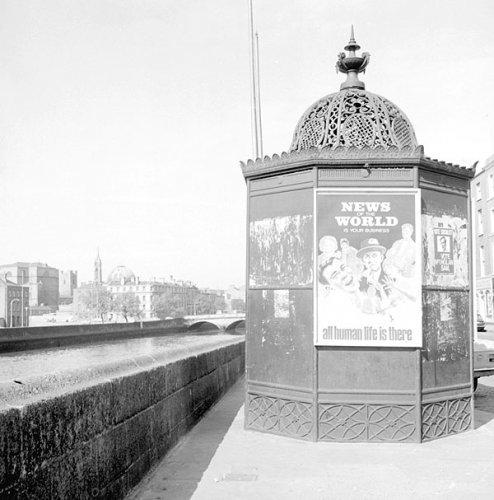
Old-style urinal formerly on Ormonde Quay, Dublin, photographed in 1969. One of the types of places where the “Brownies” supposedly lurked.
(Image source: Internet)
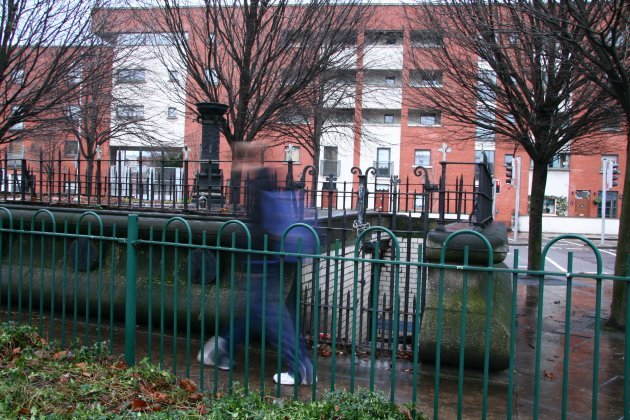
Locked underground toilet in Kevin Street, Dublin, one of many such now all closed or demolished.
(Image source: Aoife Barry, the Journal)

We didn’t call them “gays” then but there were other names in our vernacular dictionaries: brownies, dirty men, homos ….. They were always predators and always male. Girls didn’t have to worry, apparently – those dirty men would not be tempted at all. It was the normal men girls had to worry about.

Was there such a thing as female homos? But if they wanted to play with your mickies that would be normal wouldn’t it? And nice even if sinful. Ah, chance would be a fine thing! But girls or women doing it with one another? How? And sure, what for?

Did we know any homos? Well, we were kind of getting to hear about poor Oscar Wilde. He would have been our fifth national Nobel prizewinner for literature and the fourth from our capital city. If not for …. well …. Poor man, he was misguided. And duped. But a lovely writer.

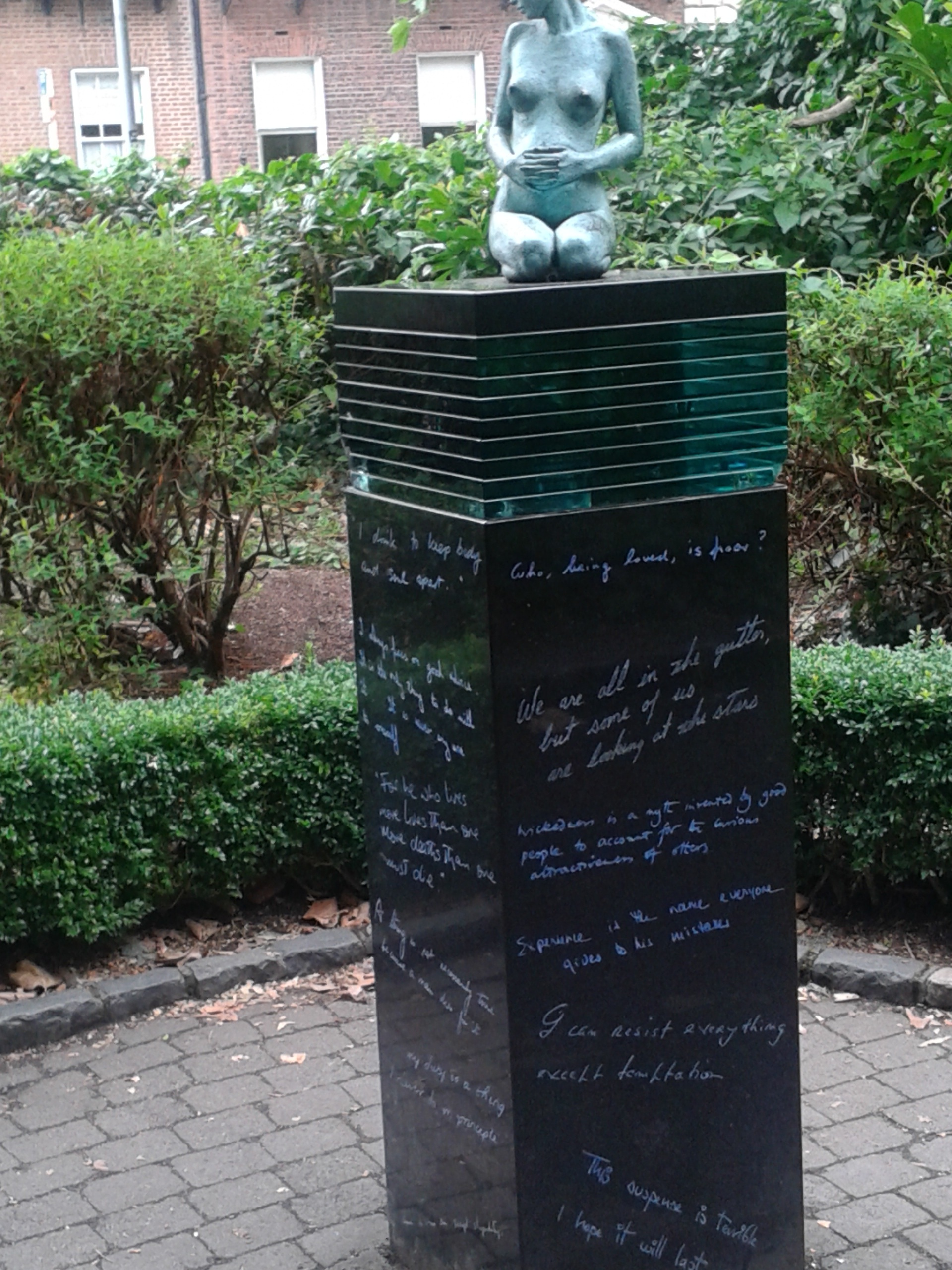
Oscar Wilde quotations, part of his monument in Merrion Square, Dublin. (Image source: D.Breatnach)
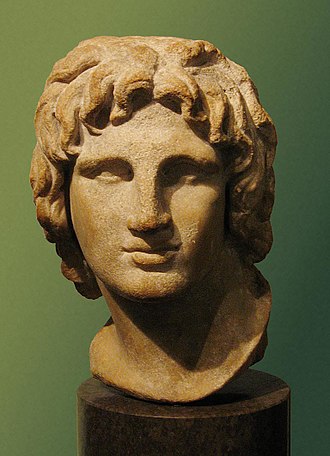
Head sculpture of a youthful Alexander the Great, from the Hellenistic period. (Image source: Internet)

Our elders, well a great many of them, knew that many famous men had been homosexual – but they didn’t tell us. We knew quite a bit about the military exploits of Alexander, the Macedonian but nobody told us he was homosexual. If we’d known, we’d have asked ourselves whether he went to conquer the world in order to hang around public toilets in foreign lands, waiting to touch boy’s mickies. William of Orange was a homo too but then we had enough reason to hate him already. Wait – William …. Willy …. willies ….. nah, coincidence!

There was another William they might have known about, King William Rufus (1087 – 1110), son of William the Conqueror, openly homosexual. And probably assassinated by order of his brother, King Henry II, not for being gay but to get the kingdom. Well, what would you expect of the English! OK, Norman-English. Whatever.

Mícheál Mac Liamóir as Iago in Orson Well’s production of Shakespeare’s “Othello”. (Image source: Internet)

They surely knew, educated adults and anyone around the theatre, that Mícheál Mac Liamóir was “a practicing homosexual”. An Englishman who became Irish, including a fluent speaker and writer in the Irish language, he lived with his lover Hilton Edwards in Harcourt Terrace. Edwards was another Englishman converted to Ireland. But sure they were English, so our elders only sniffed and turned a blind eye, grateful for the culture of the Abbey and Gate theatres, the formation of An Taidhbhearc and fame on English language stage and screen.

We knew Roger Casement could not be homosexual (even though he was a Protestant) because he was an Irish patriot. The English would do anything to tarnish his reputation and they had forged “the black diaries” to say disgusting things about him1, before they hanged him, not for homosexuality but for “treason” to the Crown. That’s the English Crown, of course. The one on top of the Arms of the Union, with the Lion and the Unicorn below, and below them the shield bearing the Thistle of Scotland, the Rose of England and the Harp of Ireland. You can see the design on the front page of the London Times, or on the roofs of the Bank of Ireland and Customs House buildings in Dublin.

Roger Casement, projected by British espionage service as a homosexual in order to undermine the campaign for clemency on charge of treason.
(Image sourced: Internet)

But did we know any homosexuals personally? Perhaps some did. There was a lad at school who liked to knit and listen to opera and whose manner was quite feminine. Probably he was/ is, we thought years later but at the time he was just a boy who was like a girl. There was another one, son of a famous actor, a bit of a bully with a gang around him. He turned out to be gay but I at least never suspected.  Then there was a certain barber who seemed quite effeminate but would do his best to cut your hair to any fashionable style which you required.

As we came into our teens, our vision broadened a little and we came upon more sinister knowledge. There were now rumours of homosexual Christian Brothers and priests. Seeing as these two groups, along with the Jesuits, directly controlled most of secondary education in the Irish state, nearly all of us Catholics were going to pass into their hands at some point. Hopefully their educational hands only. They didn’t have to hang around public toilets. They’d have us for six or seven hours a day, five days a week. Not to speak of the residential schools (too many people didn’t).

We knew in general and we knew of specific instances, by rumour or by experience. We resolved not to be victims ourselves and the strong succeeded. The weak? Well ….. Sauve qu’il peut, as they say (or I think they do) in France.

And we didn’t talk of it to our elders. Why? Well ….. hard to say. Would they have believed us? Did we have proof? Would it only have showed how dirty our minds were?

In my teens, a youth selling newspapers in Dún Laoghaire told me of a brawny sailor who one evening wanted to entice him into an alley away from company in order “not to embarrass the girls”. So, homosexuality was not confined to the creepy men hanging around toilets, or to the effeminate and arty, or to the clergy and Catholic brotherhoods. Burly sailors? Dear God!

And now a disturbing but exciting knowledge also came to us. We learned that there were indeed homosexual women – they were called ‘Lesbians’. And almost unbelievably, if you managed to get hold of a copy of the Kinsey Reports (or reviews of them), lesbianism appeared to be even more common than male homosexuality! Disturbing in a number of ways …. women preferring to have sex with women than with men? For some of us, it was difficult enough already to get physically intimate with a girl without some of them preferring other women! Then, a second thought, disturbing in a different way: imagine seeing them together … doing it! Double female nakedness!

As we grew older, we came to know gay men personally. Of course we did. Some of us, the better ones, acknowledged them our equals, did not avoid the subject nor deny them our company. Some of us, while accepting their company, avoided any mention of their preferences; we treated them as heterosexuals, knowing they were not. And some of us avoided them or worse, inflicted violence on them. We found out that some indeed did hang out around toilets but not to feel the mickies of little boys but to make assignations with adult males. Where else could they meet? It was illegal and religiously prohibited too.

Then came gay liberation agitation in the 1970s. Decriminalisation in 1993. And finally, equal rights to wed in 2015. Incredibly almost, that same Ireland of our childhood voted by majority in every county but one in the Irish State of the Twenty-Six Counties, that gays should have the right to marry people of their own gender.  In May 2015, Ireland became the first state to legalise on a national level same-sex marriage by popular vote.  The New York Times hailed the victory as putting Ireland at “the vanguard of social change”.

A badge in the Irish language calling for a vote in favour of the right to same-sex marriage in the Irish state referendum of 2015.
(Image source: D.Breatnach)

We have come a long way, in that respect at least.  But oh, the victims of intolerance strewn along each side of the route of our progress!

Generations in Ireland will grow now, hopefully, without the spectre of the Brownie.

End

Footnotes:

Roger Casement (1864-1916) was an Irish patriot and Protestant, also a poet and an enthusiast for Irish culture. In 1916, in preparation for the Easter Rising in Ireland, he came in a German submarine to assist in the unloading of German armament, including 20,000 rifles. The German boat, disguised as a Norwegian, was discovered and its captain scuttled it outside of Cork. The IRA Volunteers who went to meet the boat and Casement at its rearranged landing place, of which they had just learned, drowned as their car went off the road into the sea.

Casement was apprehended after landing. He was tried for treason in wartime and a substantial campaign arose to save his life. He had earned fame and a knighthood (CMG) a decade earlier through exposing ill-treatment of indigenous people in the African Congo under Belgian Royal control and in Putamayo in Perú by rubber-exploitation commercial interests.

Extracts from the “Black Diaries” were circulated by the British espionage service to undermine popular support for clemency for Casement. Those Diaries (as opposed to his other diaries of his travels abroad)gave details of his  allegedly sexual interludes with men abroad and the extracts circulated substantially undermined the campaign for clemency. Casement was hanged in Pentonville Prison on 3rd August 1916, the last of the 1916 executions, the only one not by firing squad or to take place in Ireland.

The authenticity of the “Black Diaries” continues to be the subject of controversy. Although Wikipedia notes that a handwriting expert concluded by comparison with his other diaries that the entries were genuinely Casement’s, he is the only handwriting expert to have been permitted to examine the original, nor have samples been subjected to modern forensic testing. And the British espionage service did have a reputation for forging documents.

PARALLEL UNIVERSES …. AND FLIES

Diarmuid Breatnach


I knew there was a parallel universe long before I heard about the theory.

No, I don’t mean the parallel universe where lots of people live, particularly middle-class, where justice and democracy and the rule of an objective and impartial law governs. In that universe, oppressive powers who have plundered the earth and committed so many crimes to enrich themselves will meekly give all that up once you show them how many people disapprove of what they’re doing. They won’t repress you instead, with baton, plastic bullet and gas, jail, guns, helicopters, drones …. Sometimes, in my more idle moments, I wish I lived in that same universe instead of this one.

But it’s not the one I mean here.  The parallel universe I mean is another one where there is oxygen and what is necessary for carbon-based life forms to breathe and live — but it is not this one. And I didn’t find out about it through carrying out complicated mathematical computations – me, maths? Are you joking? All the same, I did use a scientific method: observation. And I have to thank flies for the discovery.

Have you ever tried to catch a fly, or to swat it with your hand? There’s the fly, lazily buzzing, wheeling around in the air. You prepare yourself. Fast, so fast, you grab and you know you got it, open your hand– and it’s empty!

Where did the fly go? Into a parallel universe. It’ll come back soon, when the danger is past for the moment. Conditions must not be that great in that parallel universe (unlike the one where those liberal middle-class people live) so the flies never stay there long. Maybe there’s a giant frog or toad there, its tongue flicking out right and left, catching flies that stay there too long.

OK, a different scenario. You see a fly on the table and move your hand evvverrrr so-o-o-o slowwwllly towards it. You must get close enough so it doesn’t have time to avoid your swat.

The fly does that strange thing, kind of like stiffening, apparently getting ready to jump and fly. It has seen you, you think. But you don’t give up. You slow down, almost stop. Maybe it will forget or won’t think your hand is dangerous.

The fly is now cleaning its face with its front legs.

“Good,” you think, “It’s not alarmed any more.” It doesn’t occur to you that the fly was not cleaning its face before and is only doing so now. You don’t suspect that the fly is thinking: “Oho! Fancy your chances? Come on then Big Thing. See, I’m just relaxed here, cleaning my face.”

Swat! Your hand has streaked out. The plate rattled and the mug jumped, spilling some coffee on the table-top. But nothing flew out from under your hand. You got him for sure!

You remove your hand and …. no dead fly! No bloody smear. Incredible! How did it do that? In that instant before your hand, ever so fast, came down to crush it, the fly simply shifted to another universe. It will be back soon, circling nonchalantly and may even return to the table, walking innocently on it and waiting for you to try again.

And not only is there a parallel universe but parallel universes! And I have reached this conclusion too, without even a pass in mathematics in the Irish State’s former Intermediate Examination (abandoned in 1991) or much study of physics. Again, achieved through observation. Sometimes, particularly when I am tired, I have observed a rapid movement of some small object across my line of vision. It is there for a moment only, originating ‘out of nowhere’ and disappearing again a few feet away. I propose that this is a fly, originating in another universe, flying across this one and, presumably, heading for yet another. No doubt fleeing from a swatting hand or other pursuer in another universe. Sometimes I can even hear what sounds like it might be fly laughter.

Why observable mostly when the eye is tired? Because the brain at this time is less receptive to the normal distractions and so therefore is the eye, making observation of other less normal phenomena more likely. Of course, this theory has not been proven, despite my efforts to catch this fly. It has not proved possible to predict the day or time when this “fly-through” might occur and also, being often tired at the time, my reactions tend to be slow. But one day ….

Of course, theoretical science has now caught up with my observations and a number of reputable scientists have been discussing related theories for decades (though also dismissed by other reputable scientists). Those supporting the theoretical concept even speak of a “multiverse”, i.e of a universe consisting of many – and some propose infinite — variables of the universe currently observable to us. Interestingly to a Dubliner such as myself, the term “multiverse” was first recorded in scientific discourse in a 1953 Trinity College Dublin lecture by Erwin Shrodinger (1887-1961), an Austrian Nobel Prize-winner in physics (and achiever of an even greater distinction, managing to live successfully with not one but two unslaved members of the opposite gender).  According to Wikipedia ‘he said that, when his Nobel prize-winning equations seemed to describe several different histories, these were “not alternatives, but all really happen simultaneously”. That is the earliest known reference to the multiverse.’

In one of those parallel universes there might be a version or iteration of myself who did not fuck up so many times, who is more disciplined and productive in the use of his free time and ….. well, that’s enough to think about. This other iteration might even like heavy metal music, be good at maths, like eating flatfish and not get into trouble with authorities.

The arguments in favour and against the existence of a multiverse have been equally convincing or unconvincing logically.

Against: We live in the universe that we do because that one provides the conditions for the existence of life. If it didn’t, we wouldn’t be here. Therefore it is the only universe capable of sustaining life and the only one in existence.

For: There is no logical reason why other universes capable of giving rise to life and therefore populated, could not exist, but with some different conditions to ours. All possible permutations. Or indeed that some would not consist of completely different life-forms, not even carbon-based. Life keeps turning up in situations previously thought impossible even here on Earth and we have long known about anaerobic bacteria.

Against: Such speculation is fruitless. We have not observed any effect or trace of these other universes.

For: However, there are some factors in quantum theory which do not explain what we can observe of this universe. And lack of proof does not rule out the possibility of the existence of something.

Against: That is true so far about quantum theory. But unless it can be proven or disproven, it is not worthy of scientific theory. We might as well fund investigation into the existence of God.

For: Aha, funding! That’s why you don’t want it studied – it might reduce the funding available for your work.

Against: How dare you!

And so on and on. And on.

And now, if you‘ll excuse me ….. There’s a fly nearby on the table …..


End.


Links:

https://en.wikipedia.org/wiki/Multiverse

PUBLIC HOUSING FOR ALL — CAMPAIGN LAUNCHED IN DUBLIN

Diarmuid Breatnach

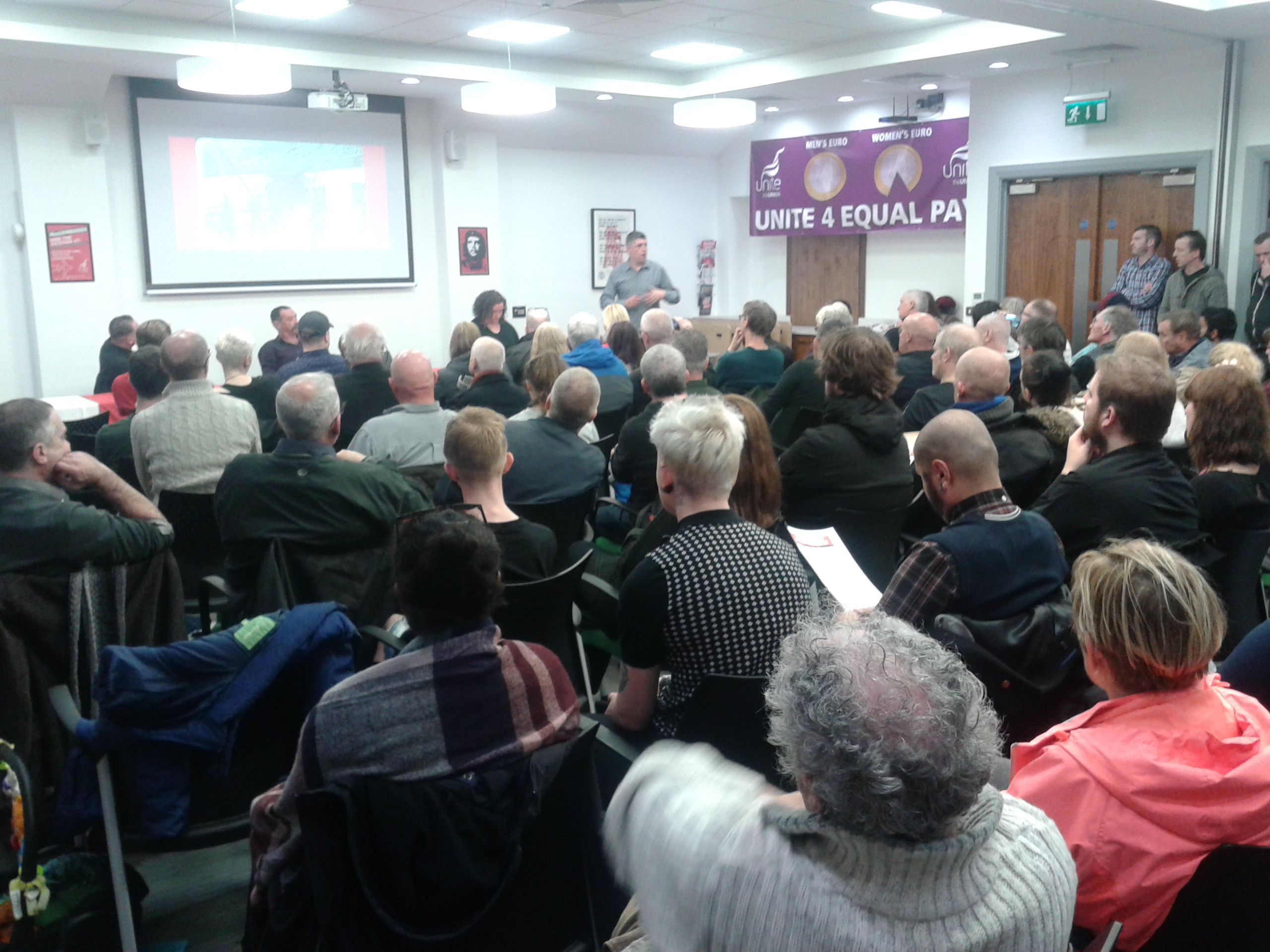
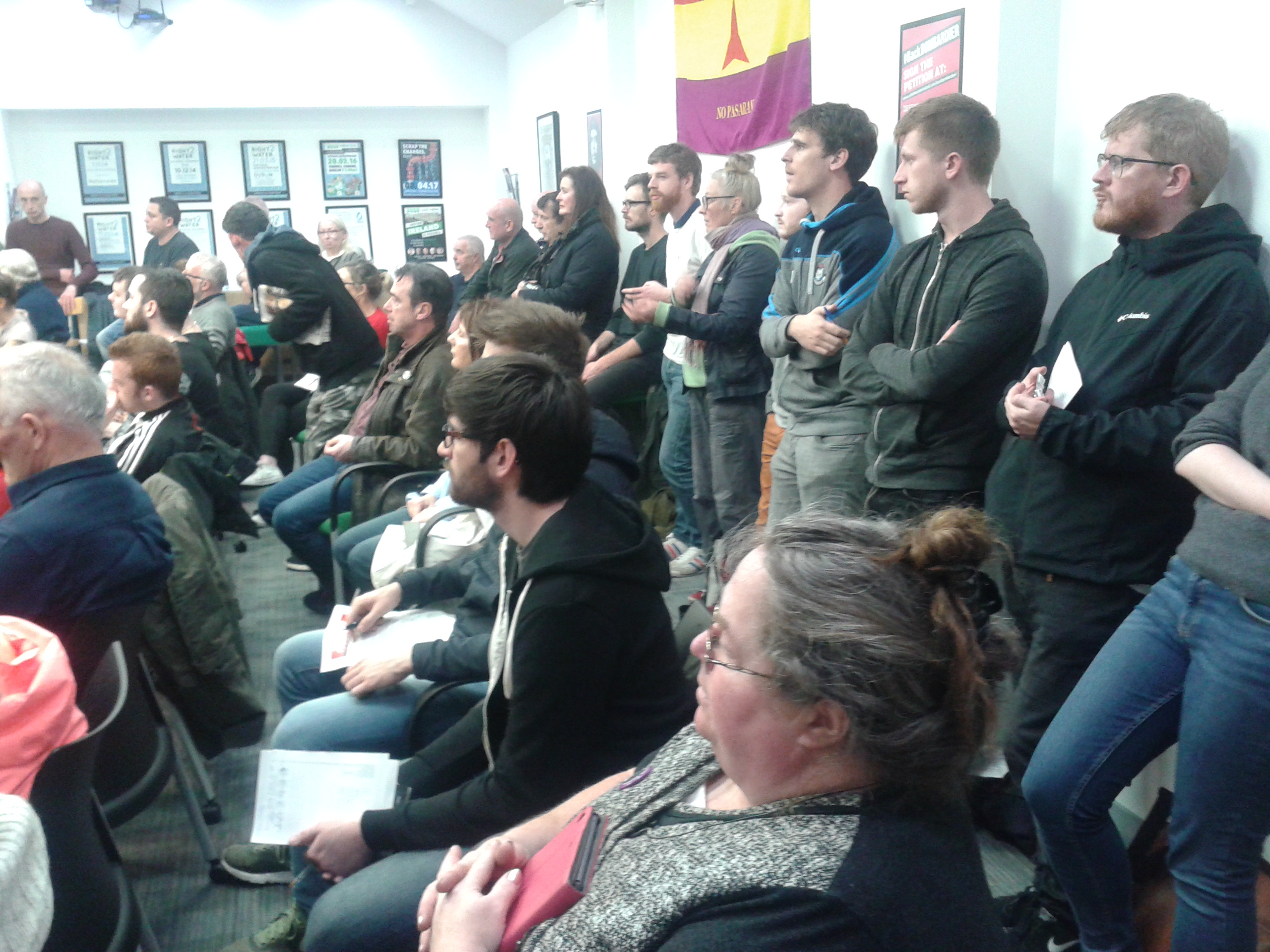
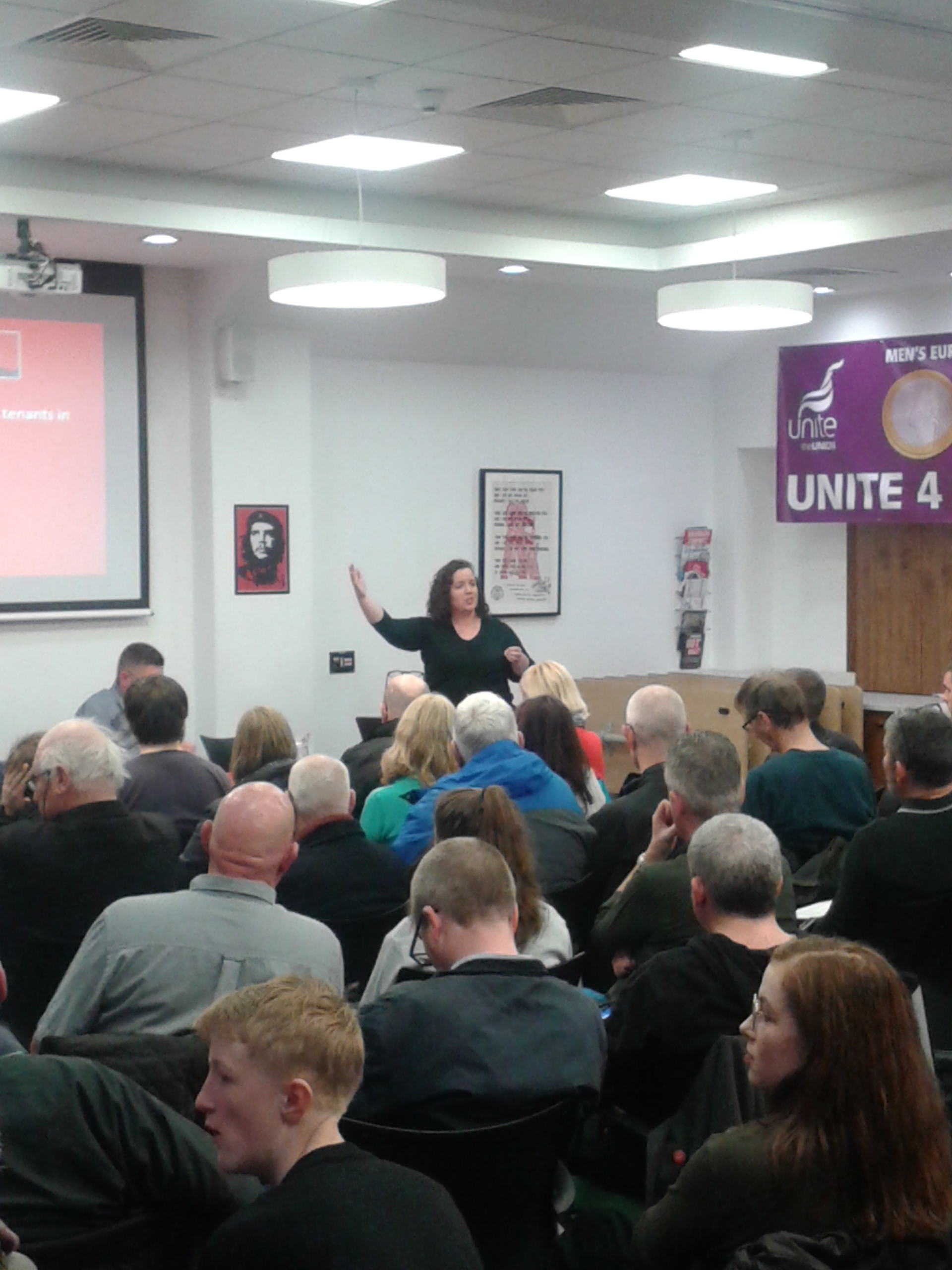
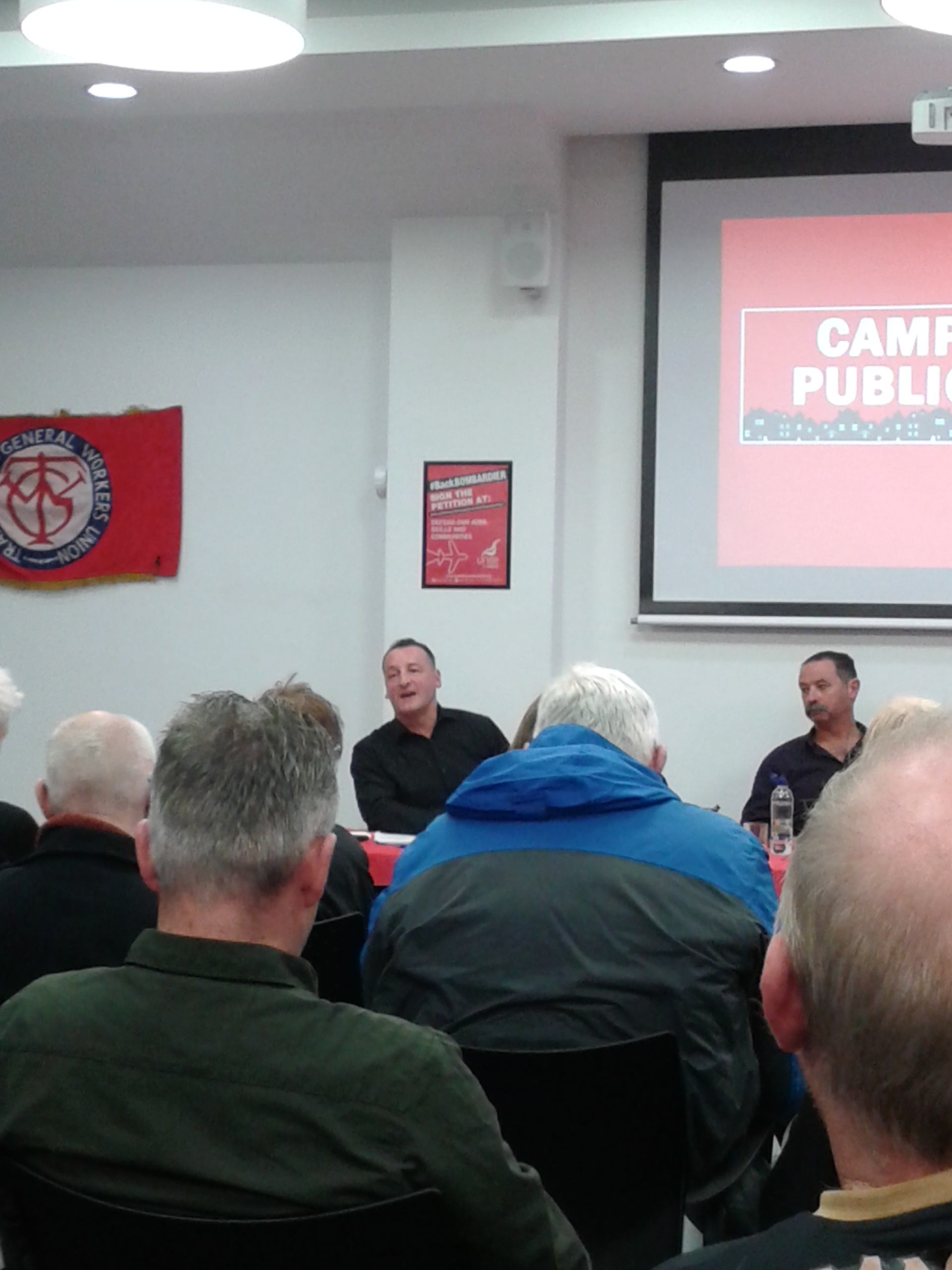
The Campaign for Public Housing was launched Saturday (28th October) at a large packed meeting room in the Unite trade union building in Dublin.

Section of crowded room at campaign launch meeting in Unite trade union hall.
(Photo: D.Breatnach)

The demands of the campaign were announced as both long-term (in the form of a new system of universal public housing) and short-term (in dealing with the reality of the current housing crisis), as follows:

  • A new system of Universally Accessible Public Housing, based upon a cost rental model where the collective rent of tenants would fund the construction and procurement of large volumes of new public housing.

  • A tenants Bill of Rights to protect tenants in the private rental sector. This bill would control rents and provide real security of tenure.

  • A complete Ban on Economic Evictions by banks and private landlords.

  • A referendum to insert an unambiguous and legally enforceable Right to Public Housing into the constitution.

Standing room only remaining at campaign launch meeting in Unite trade union hall.
(Photo: D.Breatnach)

The political forces represented at the public meeting table were Éirigí (Brian Leeson), the Workers’ Party (Éilís Ryan), the Communist Party (chairing the meeting) and an individual who might be described as an independent left Republican activist (Cieran Perry). Both Perry and Ryan serve as elected councillors on Dublin City Council.

The Éirigí organisation is considerably reduced from the numbers of activists it had when it was first formed, largely by “dissidents” who left the Sinn Féin party soon after the Good Friday Agreement. The Workers’ Party is very small, having arrived at its current space through a series of splits from the original Sinn Féin (which became Official Sinn Féin after their dissidents formed the Provisionals back in 1970). The Communist Party of Ireland is also very small but owns a Dublin bookshop which also operates as a small theatre and meeting place for broader left anti-imperialist events.

At first glance, the political composition of the table may strike the observer as unimpressive in representation of numbers. However, such active forces have impacted significantly on the Irish political scene over the years and these in particular bring a wealth of political experience to the table. In addition, the audience contained a broad spectrum of left trade union and community activists, republicans, anarchists, socialists and participants who became active in recent campaigns.

According to a press statement released by the Campaign for Public Housing on 26th October, its supporters includes:
Peter McVerry (in a personal capacity, it was said at the launch)
Inner City Helping Homeless
Éirigí
The Workers’ Party
The Communist Party of Ireland
North Dublin Bay Housing Crisis Community
Cllr. Cieran Perry
D8HAC Altogether Now
Dundrum Housing Action
1916 Societies
Catherine Connolly TD
Clare Daly TD
Mick Wallace TD
(and Joan Collins TD, it was announced at the campaign launch).

THE STATE FUNDING SPECULATORS TO BUY MORE PROPERTY

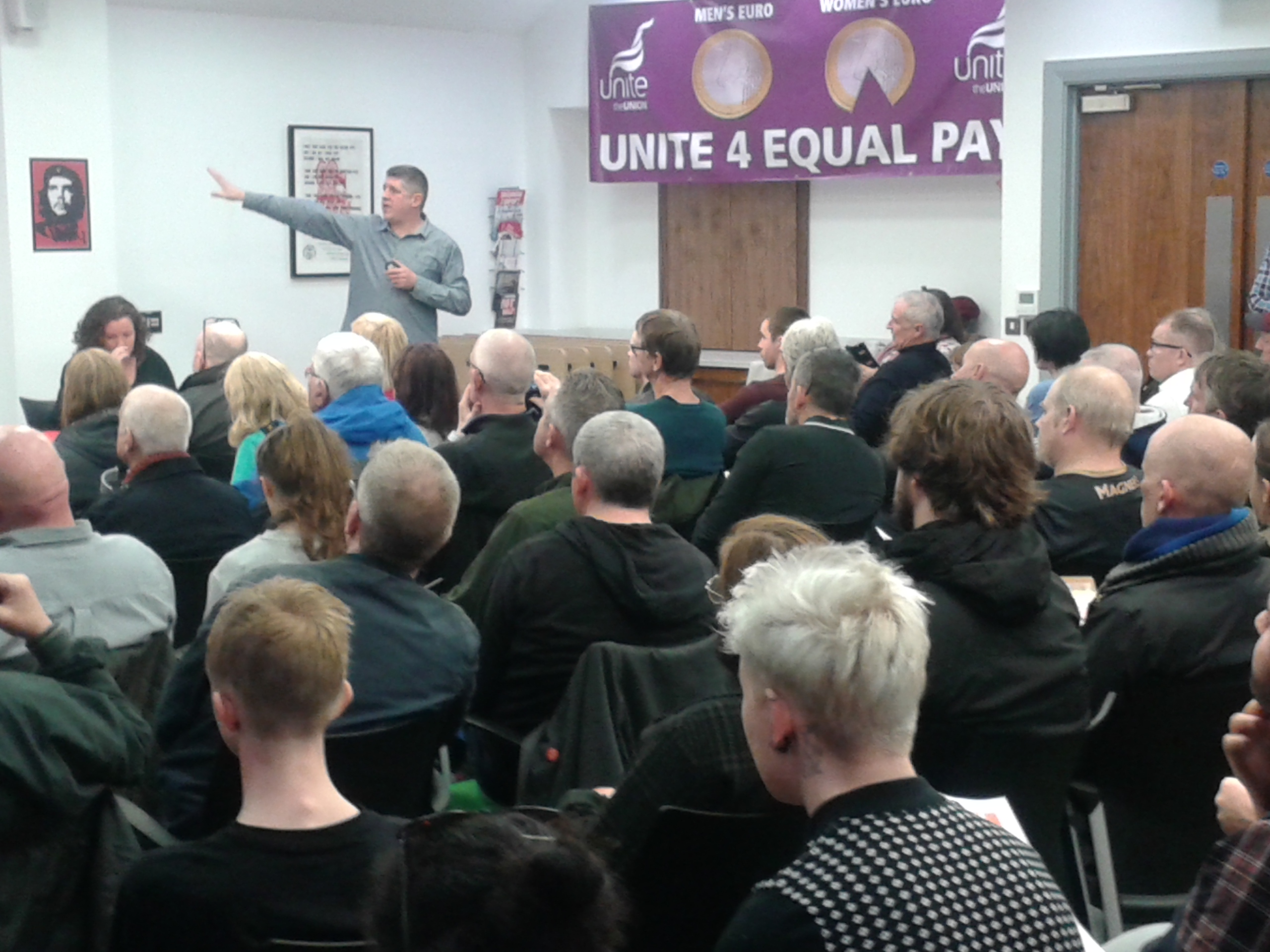
Speaking while using an electronic visual presentation on a large screen at the campaign public launch meeting, Leeson presented figures drawn from statistics produced by property and housing agencies and government departments to illustrate a history of public housing in the Irish State since its creation. Though hardly impressive in the numbers of public dwellings built, the figures showed a significant initiative in that direction under the early Fianna Fáil government years, when De Valera was at its head.

Brian Leeson during his presentation,
(Photo: D.Breatnach)

Throughout the 1950s and 1960s the ratio of public housing to private housing built was around one to one. In those years, private landlords notwithstanding, private housing was usually occupied by the owner. From the 1980s onwards, the ratio shifted to 10-1 in favour of private dwellings and huge numbers of these were no longer lived in by their owners and the ratio is much higher now. In effect, dwellings had become a commodity in which large-scale speculation was taking place, driving the rents and mortgages higher and higher, forcing people into debt for life or evictions and also into high-rent and unsuitable accommodation.

The figures also showed a state funding of the private property sector to the tune of eight billions (€8,000,000,000) – funds which the banks and other property speculators used to purchase more land and property, intensifying the housing crisis.

PUBLIC — NOT SOCIAL — HOUSING

Ryan concentrated her presentation on the need to call for public housing as a rational and necessary response, as one might consider for example public education or health service. Only public housing can solve the housing crisis, she maintained and so it is not only of moral importance but of urgent practical need. Turning to the cost of house building, Ryan pointed to the industry’s figures seen in the earlier presentation, showing that good-quality houses can be built much cheaper even under existing conditions. She was at pains to outline the differences between social and public housing: social housing is often aimed at low-income families and may be provided through a range of private or semi-private schemes. Public housing is state-funded with the rents going back to the state to reinvest in further housing provision and should be mixed in order to avoid ghettoisation.

Éilis Ryan during her presentation. (Photo: D.Breatnach)

Referring to the importance that Irish people tend to give to the state’s Constitution, Ryan stated that part of the objectives of the campaign was to insert a clause that guaranteed every person a good quality, affordable-according-to-income housing unit for life.

STOP THE SALE OF PUBLIC LAND!

“We have very little power as Councillors,” said Perry “but one thing we do have power on is the veto on selling public land.” He went on to speak of how Dublin City Council had sold Council land to private developers despite his and some other Councillors’ efforts. However, social and political pressure had forced the ratio of public housing on the Devanney Gardens site up to 30% despite the wishes of some political parties but that still meant that 70% went to private speculators.

Cieran Perry during his presentation.
(Photo: D.Breatnach)

Perry called for support for a demonstration outside City Hall on Monday November 6th at 5.30 pm in support of a motion put forward by himself and some other councillors to prevent the sale of any Council land.

Currently Dublin City Council own 120 hectares of land – enough to build 12,000 good quality homes. “There are 20,000 people on Dublin’s housing waiting lists, and many more average income households who will never be able to afford private rent or mortgage. So why are we allowing private developers to make money off our land?”

Turning to the question of the campaign itself, Perry promised it would be democratic, transparent and not become dominated by any political party or personality and urged all to become involved, to leave their contact details on the clipboard sheets at the door and to encourage others to come on board.

QUESTIONS

The questions and contributions were overwhelmingly of an intelligent kind and included areas such as hidden homelessness by emigration, housing waiting lists and disqualification; the privatisation of education and health services despite their public appearance; the need for the campaign to include direct action; the relationship between this campaign and other housing campaigns in Ireland; the need for quality monitoring by other than the contractor if the Council is to be the builder; the shortage of building workers at the moment; changes in the court systems to facilitate evictions; the involvement in a number of evictions of a firm led by an ex-British soldier using Loyalist ex-paramilitaries; the expected opposition from the EU to bans on the sale of public land; the hidden homelessness of one partner in a relationship breakup, etc.

Those leaving the meeting seemed fairly happy with the launch though inevitably some discussion took place on what tactics the campaign might employ and whether the organisation would degenerate into electoralism, or whether it would be manipulated for politically sectional interest. Political and community activists in Dublin have a long history and such discussion would be normal among all but the most naive. But the overall mood perceived by this reporter was decidedly positive.

End

LINKS:

Contact campaign: https://www.facebook.com/CampaignForPublicHousing/

campaign4publichousing@gmail.com

Picket City Hall to demand no selling of public land: https://www.facebook.com/events/2562340743904927/?acontext=%7B%22ref%22%3A%223%22%2C%22ref_newsfeed_story_type%22%3A%22regular%22%2C%22action_history%22%3A%22null%22%7D

TODAY THE FRENCH LANDED TO HELP THE IRISH THROW OFF THE ENGLISH YOKE.

Diarmuid Breatnach

On the 22nd of August 1798, almost 1,100 troops under the command of General Humbert landed at Cill Chuimín Strand, Bádh Cill Ala (Killala Bay), Co. Mayo.

Painting said to be depicting French landing at Kilalla
 The events are covered in six songs that I know of: Na Franncaigh Bhána; An Spailpín Fánach (Mayo version); Mise ‘gus Tusa agus Hielan Aindí; The West’s Awake by Thomas Davis; Men of the West and its Irish translation, Fir an Iarthair.

 Some of the songs, especially the traditional ones from this area, are in Irish, which was the commonly-spoken language of the area (unlike parts of Dublin, Wexford and Antrim, where most of the songs from the period were in English).

The French troops on this occasion — unlike the numbers sent by Napoleon in 1796 but which failed to land at Bantry Bay due to stormy conditions — were insufficient to change the overall insurrectionary situation and though they and the Irish fought bravely, the Rising in the West failed.  Most of the French who surrendered were treated as prisoners of war but the Irish who rose were butchered or taken prisoner and hanged.  Matthew Tone and Bartholomew Teeling, both Irish but holding commissions as officers in the French Army, were taken to Dublin, tried and hung.  Their bodies are reputed to lie in Croppies’ Acre.

Portrait of General Jean Joseph Amable Humbert

Nevertheless the Rising is remembered with pride and General Humbert’s memory held in affection.  Sixteen years later he fought the English again at the Battle of New Orleans, taking place between December 14, 1814 and January 18, 1815, this time as a private soldier in the American Army — and successfully.  He had settled in New Orleans already and remained there after the war, working as a schoolteacher until his final days.

There is a French military former officer character in Mel Gibson’s film The Patriot (2000), Major Jean Villeneuve (played by Tcheky Karyo).  A film commentary on line says his character was suggested by the Marquis de Lafayette, of the French military and Baron Von Steubon, a Prussian mercenary (http://www.patriotresource.com/thepatriot/characters/villeneuve.html.).

But might the character not have been suggested by Humbert?  Anyone who knew his story would be eager to put him in the film, one would think.  In the film, he fights in his French officer’s uniform at the final battle (unnamed but probably based that on at Cowpens); Humbert, though he fought at the rank of private, also fought in his Napoleonic Officer’s Army uniform at the Battle of New Orleans.

Still photo from the film, with Tchéky Karyo to the right in the role of the French Major Villeneuve. His character could have been based in part on that of Jean Joseph Amable Humbert.

Robert Roda of New Hampshire is listed as the writer of the screenplay.  New Hampshire is not known as an Irish-American stronghold and Roda does not sound like an Irish name.  But then, it is not only Irish and French people who are interested in Irish and French history.


End


Derry’s New Secret Police Force

Republished with kind permission from the Irish Dissent blog https://irishdissent.wordpress.com/


In the second such attack to have occurred in Derry within the past two months, a teenage boy was beaten up last week in the city by a gang of masked men armed with iron bars and a gun (in the previous one, a teenager suffered two broken legs and a broken arm).

One of the instruments of the “secret police” — an iron bar

Nobody knows who did this, or why these two attacks took place, of course. That’s because this is how secret policing works – it occurs very discreetly, almost invisibly, insidiously reminding us that, below the surface of society and always after night falls, a secret police force is active. Violent secret policing can be so clandestine that, when it does take place, it can feel at first almost as if it hasn’t happened, unless, of course, you are one of the people on the receiving end of it. Although it feels unreal to many among the wider community, its repeated occurrence burrows into the public mind where its corruption, though often overlooked, is impossible to conceal.

This secret police force is so obscure that nobody knows who or what is behind it, other than someone’s profound desire to control people. In the absence of identifiable organisational responsibility (those involved are so secretive that nobody knows who they are) we could also describe this very Secret Police Force as Sinn Féin Mark 2. Indeed, they resemble Sinn Féin’s party militia so much that the people of Derry could be forgiven for thinking that those who are behind these attacks might have been, at some stage, apostates who were driven from that organisation. In any case, the new Secret Police have assumed all the characteristics of their old role models.


Old Tactics in New Clothing
Derry’s secret policing structures aren’t new or unique. They have been seen before, and resemble very closely what might be termed “the McGuinness pattern”. Organised and directed by people who want to establish themselves as unofficial figures of authority in the city, they operate according to a very familiar design. This has always served those who believe that they should be revered but ultimately feared by their own as far, at least, as limb-smashing can be interpreted as the good work of defending the community from its wayward youth. So, once again, we are being confronted with the work of false radicals and mock liberators. They know that beating people up with iron bars appeals to a very special kind of imagination, and this is where the secrecy of Derry’s Secret Police might be of benefit to everyone. Who would want to know whether a friend, neighbour or even a relative was involved in this kind of policing? This type of best-kept secret is best kept, well… very secret, indeed.

Another of the instruments of the “secret police” — a pickaxe handle

Despite what the Secret Police want you to think, they are not a manifestation of what happens “in the absence of acceptable policing” because that lazy, self-serving cliché died of exhaustion a very long time ago when it was last uttered by Sinn Féin. Anyone capable of independent thought knows that there are always alternatives to battering young people with iron bars unless, that is, they are the very rare kind of person who is addicted to doing, ordering or beholding it (a dependency for which all kinds of medical and psychiatric treatments are available). The simple fact is that broken teenage limbs are not the organic products of a supposedly measured or reasonable process that concludes with community-sanctioned violence. This brutality, along with the desire for authority and validation that it represents, is an artificial imposition that follows a logic that is as brutal for the entire community as it is for the young person who has been accused of, somehow, “offending”. The entire process is deliberately engineered to appear vague and its indeterminate quality is intended to cultivate a collective response along the lines of “Well, he must have done something”.


The Silent Terror
We can assume that an allegation of some kind of offence has been levelled by the Secret Police during its thoroughly concealed process of judgment – even secret tribunals, after all, have to justify their existences to themselves. The accusation circulates only within this bubble, away from public scrutiny where, undisclosed, the infraction is proven by faceless judges before a Secret Police squad is mobilised, armed, and then deployed. The “offending” young person is beaten up and in the subsequent public discussion about the mystery (“What did he get it for, anyway?”) the perceived problem evaporates, like reason under a dictatorship. Nobody says anything; everybody moves along like they’re told to and supposed to because there’s nothing to see here, nothing at all. So, the reality principle sinks while the self-perpetuating myth of the enforcer, so reliant upon the damnation and isolation of broken-limbed teenagers, endures.

With its methodically-planned politics of erasure and dedicated to the erosion of truth, this organised and highly structured violence is reinforced by the ripple-effect that it causes across the wider community.  All of this benefits those who direct it and carry it out in a number of ways. Firstly, it reinforces the perception that those in command of the Derry Secret Police have of themselves as a source of authority: “people will fear us now”, they think, “we’ll have more respect”, “all we’ll ever have to do is glare at somebody and they’ll get the message”, and so on. Secondly, the people who carry these attacks out on their behalf have, in their own turn, become blooded. Assimilated within the circuitry of this local, unofficial and unspoken power and embedded in it, they now have status, belonging, a role and a meaning greater than anything that they have ever experienced or amounted to before. In their own eyes and, they believe, in the view of the broader community, they will finally matter. Imbued with this new sense of purpose and superiority, they’ll genuinely feel important and, from this moment onward, they’ll exist under the impression that they, too, are now to be feared.


Political Fear and the Closure of Consciousness
No group has claimed these attacks, and none will, because silence is the currency of terror. Fear travels along the ruined and collapsed channels of reason because it depends upon the closure of imagination. Once thinking is checked, it transmits rapidly from one consciousness to the next via these now-quiet paths. In doing so, it seals mouths and closes minds, extinguishes thought and tightens its grip over the popular imagination where it is internalised, amplified and projected further inward with ever greater intensity following each attack. In this way, fear reproduces itself, by generating wider acceptance of organised thuggery and condemns entire communities to long-running cycles of quiet, uncommunicated dread. At the back of the mind of every parent will be the final, awful question: “Could this happen to my child?”

Questions now need to be asked about those who benefit from secret policing, and answers should be demanded as to which local hierarchies and dynasties are being served and facilitated by the Secret Police. The people of Derry have a right to demand what qualifies someone for a role in this clandestine force, to know who gets to make secret policing decisions and on what authority these decisions are being taken. Given that this organisation operates according to a programme of its own, people also have the right to know who writes the rules of secret policing and why. We have the right to know what gets said when secret policing matters are discussed: who, for example, discusses whom during these meetings? We have the right to know what qualifies anything or anyone for inclusion in these secret discussions, and we have the right to know what will happen if the Secret Police come up with more secret “offenses” that they believe will need to be policed with even more severity.

The deepest wounds caused by secret policing and its unofficial violence are always inflicted on the psyche of a people. The worst damage of all is caused by the silences that inhibit thought, restrict free speech and threaten to crush open criticism. If allowed to take hold, these restrictions will dominate the material, political and cultural prospects of the people of Derry, along with their psychological wellbeing.  If they are not resisted another generation will be forced to endure the authority of cabals and militias, while the prospects of young people will be permanently hindered by the shadow of this unofficial violence.


THE MOORE STREET HISTORIC QUARTER – REALITY AND WISHFUL THINKING.

Diarmuid Breatnach

It has been said by some people prominent in the broad Moore Street campaign that the Minister for Heritage has declared her support for the Report of her Consultative Group on Moore Street and its recommendations. A number of other campaigners have said this is not so and I am one of those (NB: there are a number of campaign groups in this struggle). 

For saying that, I have been criticised as “rocking the boat” and “spreading inaccuracies” or even “generating conspiracy theories” and also personally verbally attacked in public and on social media by name and by inference. The reputation for integrity of a political and social activist is very important to her or to him and so these allegations are of course hurtful. But there is much more at stake than my feelings or even my reputation or that of a few other activists – there is indeed the struggle for the Moore Street historical quarter itself. For a successful conclusion of this long struggle, the direction taken is crucially important.

(For those who may be unfamiliar with the background or have lost track of some of the major developments, a very brief background is given in an Appendix below).

THE MINISTER’S CONSULTATIVE GROUP AND ITS REPORT

In June 2016, the Minister set up her Consultative Group on Moore Street to which she invited a range of political party representatives (and one Independent) elected to the Dáil, a number of Dublin City councillors and representatives of two campaigning groups. The list excluded the first campaign group to raise the Moore Street conservation issue along with the most active campaign groups of recent years and also included no historians.

Though it did not publicly call for them, the Consultative Group accepted submissions in writing and a number of campaigns and individuals made presentations in person (the 35 submissions are available on the Department’s website under Minister’s Consultative Group on Moore Street – see link at end).

Two members of SMSFD campaign presenting petition sheets with around 70,000 signatures to some members of the Minister’s Consultative Group at City Hall in March 2017.

On the 29th of March, the report of the Consultative Group was launched.

Should the Minister accept the Recommendations of the Report in full, then there are a number of recommendations which we should celebrate (and indeed some of us proposed many of them in submissions to the Consultative Group itself) and for which we should seek implementation. But there are also some very harmful ones which we should repudiate.

However, if the Minister has not accepted the Recommendations, then nothing has been won by the Consultative Group, even on paper, despite the many submissions and delegations it has received and the meetings and discussions of its members. This would obviously be a distressing revelation to some of those who were part of that Group. And we can expect even less from the next one the Minister has set up, the Advisory Group.

But, let us return to the question: Did the Minister or did she not accept the Recommendations of the Report? Let us examine the available evidence.

THE MINISTER’S ACTUAL WORDS

On the 29th of March 2017, the following statement was issued by the Department of Arts, Heritage, Regional, Rural and Gaeltacht affairs:

The Moore Street Report – Securing History’ is presented to Minister Humphreys by the Moore Street Consultative Group

The Minister for Arts, Heritage, Regional, Rural and Gaeltacht Affairs, Heather Humphreys TD, has today (Wednesday) received a copy of the report compiled by the Moore Consultative Group, which she established last year. The Minister announced the establishment of the group in June 2016, as a means to make positive progress in relation to the future of Moore Street.

I set up the Moore Street Consultative Group, which includes political representatives, relatives and other stakeholders, in a bid to bring together the range of views on Moore Street and seek a positive way forward. Since then, the Group, chaired by Gerry Kearney, has carried out a body of work which has resulted in the report they are publishing today.

I want to take this opportunity to thank all of the members of the Group for their dedication and commitment in completing this work in such a short timeframe. The time and effort which went into this report is greatly appreciated.

I welcome the fact that the report is seeking a way forward based on consensus. I believe that the recommendations in the Report can help find a way to breathe new life into the Moore Street area, while at the same time retaining its sense of history and enhancing its traditional street market.

The Report signals the potential of a negotiated outcome, balancing the perspectives of the key stakeholders. I am fully supportive of this constructive approach and I want to see the work of the Group being built upon, so we can progress to the next stage.  I will therefore be recommending to Government the establishment of a new Advisory Group as recommended in the Report to advance that process.”

(end quotation)

A little over a month later, on the 2nd May 2017, Éamonn Ó Cuív (Fianna Fáil) asked a question of the Minister in the Dáil and followed with a supplementary one:

National Monuments

 43. Deputy Éamon Ó Cuív   asked the Minister for Arts, Heritage, Regional, Rural and Gaeltacht Affairs   if she has considered the report of a group (details supplied) issued in March 2017; her plans to implement the recommendations in the report; the progress made to date in doing so; and if she will make a statement on the matter. [20440/17]

Deputy Éamon Ó Cuív:   As the Minister knows, the Moore Street report was published in March and a timeline was set out with the hope that a decision would be recommended in six weeks, as the matter has dragged on for years. Has the Minister brought this to the Cabinet and have we a decision? Will she set up the advisory group that has been recommended in the report so we can move to the next phase? I am afraid we will lose the good momentum built up in the past six months towards progressing the Moore Street project to a suitable resolution.

Deputy Heather Humphreys:   I agree with the Deputy that good momentum has been built up and I put on record my sincere appreciation to the members of the group referred to by the Deputy for the report they recently presented to me. The group, which was independently chaired by a former departmental Secretary General, included local and Oireachtas political representatives, 1916 relatives, street traders and other stakeholders. It was set up in a bid to bring together the full range of views on the matter and it held its inaugural meeting in September 2016. In the mean time, it has reviewed numerous presentations and submissions from a range of interests, looked at a variety of official and other reports, interviewed relevant public officials and other experts and examined a large body of work from within its own membership, as the Deputy knows. This extensive programme of work has culminated in the series of recommendations contained in the report that was presented to me in the last few weeks and that is now being examined in my Department.

I welcome the fact the report is seeking a way forward based on consensus. Its recommendations can help breathe new life into the area while retaining its sense of history and tradition. In addition to its particular association with the 1916 Rising, there are other relevant aspects of the street and surrounding area that also need to be taken into account, including the range of State, public and private property holdings and ownership and, of course, the presence of the street traders themselves, who do so much to give the area its unique ambience and place in the life of our capital city. The report has looked carefully at all these elements and I am delighted that it signals the potential for a mutually successful outcome to be agreed between the relevant parties, balancing the perspectives of all the key stakeholders. I am fully supportive of this collaborative approach and I want to see the work already done being continued so we can progress to the next stage and see tangible results on the ground. Critical to this will be the establishment of the new advisory group that the report itself identifies as the most effective way to move forward with its recommendations. I will be proceeding with the setting up of this group as quickly as possible to build on the positive and constructive foundations set out in this report.

Deputy Éamon Ó Cuív:   As happens so often, the Minister gave me much information that I already have, as I was part of all those discussions and on the forum referred to. As she pointed out, we had a very experienced chairman and in his work he was very diligent in advising us against things that could not be done. However, the report very clearly states that the establishment of the advisory oversight group should happen within six weeks. As the Minister knows, this was because a consensus was built through a huge amount of work. People believed they had put together a map to bring us forward. There are two questions that still have not been answered. When will the advisory group be set up or will it be set up? Has the Government considered this report and made any decision on the recommendations of the report? All of them must be implemented but some need very urgent attention, including, for example, those relating to street traders.

Deputy Heather Humphreys:   The appointment of a chairman for the new advisory group is the next step in the process and I hope to see that person appointed, with the group beginning its work, as soon as possible. I am very much aware the chairman of the previous consultative group worked in a particularly effective way with all the parties and his efforts were key to the achievement of the agreed outcome to the group’s deliberations as set out in the report. The next stage is equally crucial and the new chairman will have just as vital a role to play. I am looking at possible candidates and hope to make the appointment as soon as possible. The report envisaged this process taking six weeks and we are still well within that timeframe. The new advisory group will be drawn from among the existing membership of the outgoing Moore Street consultative group. I understand it had 27 members and it is envisaged that the new body, while being equally representative across the same spectrum of interests, will be somewhat smaller.


THE REALITY

People reading the text of the Minister’s statements and replies will search in vain for anywhere she says that she actually accepts the Report and its Recommendations. In fact, one can see that while in politician-speak she talks around it, she studiously avoids saying that, confining herself to praise for the Group and its Chair and to the spirit of consensus. And well she might praise the consensus, because despite the public positions of many of the Consultative Group prior to their being chosen by the Minister and which some may still hold, and despite the calls from a number of campaigners and other stakeholders in their submissions, the Group did not call on the Minister to abandon her appeal against the High Court judgement (i.e that the Moore Street historic quarter is “a National 1916 Historical Monument” — more on this below).

Also, the Minister and the Report both accept the speculators as “stakeholders” and the Report calls for the future to be decided in negotiations between those “stakeholders” and the two elements who have all along been facilitating them: Dublin City Council’s Planning Department and the Department of Heritage!

Those who have been repeating the erroneous line that “the Minister has accepted the Report” argue that a) she set up the Group and/or b) she has proceeded to the second stage, setting up the Advisory Group and therefore must accept its Report. Or b) even that an Irish Times news report carried a headline saying that she supported it and that the Minister did not deny the headline!

The best that can be said for that reasoning is that those are their interpretations but her statements quoted above do not support those interpretations. Nor do they refute them, it is true. But surely if the Minister did actually support the Recommendations, she would have unequivocally and specifically said so?

DANGEROUS RECOMMENDATIONS AMID WELCOME ONES

As noted earlier, the Recommendations contain some positive elements, including keeping the “footprint” of the main remaining Moore Street 1916 quarter intact, i.e the block enclosed by Henry Place, Moore Street, O’Rahilly Parade and Moore Lane, along with the lanes themselves and the street. They also include a number of recommendations for long-overdue improvements to the hard lot of the Moore Street street traders (but not the small business shops), both in terms of provision of facilities and in terms of their trading license restrictions.

But to leave the future of the historic quarter to negotiations between the three historic villains of the saga, the property speculators, the Planning Department and the Department of Heritage, as laid out in the Main Recommendations, 7, 8, 9 and 12 (pp. 6-7)) and in Chapter 10, Conclusions and Recommendations (pp.36-37) 10.3 and 10.4 is surely not what we should be doing.

A number of times in the Report the State is claimed to be “the ultimate custodian of our history, culture and heritage”. Whatever one might think of the desirability of such a state of affairs, such an evaluation of the role of the State is patently untrue as even a glance over the history of this state will demonstrate. It is untrue about historical and archaeological sites, the Irish language, Irish traditional music, Irish dance and Gaelic games.

The State has failed to defend a great many sites of historical, archaeological and architectural importance from property speculators and other financial interests, was about to demolish houses in Moore Street and one of its Government Ministers is currently appealing a judgement that the whole Quarter is a “National Historical Monument”. The main Irish-language promotional and defence organisations were set up as voluntary bodies though some now receive some low State funding and most of the activity is by unpaid activists.  Neither the Minister of the responsible department nor her Ministerial appointments to the Gaeltacht desk have been competent Irish speakers and some years ago the Ombudsman for the Irish Language resigned in protest at inaction and obstruction from within the state apparatus. The national Irish-language TV channel (TG4) and radio station (Radió na Gaeltachta) were won by people campaigning against the State, in which activists were fined and threatened with jail (one campaigner did go to jail to defend his right to motor insurance documentation in Irish). Likewise bodies promoting Irish traditional music and song were voluntary to begin with and although Comhaltas Ceoltóirí Éireann now receives State funding, most enthusiasts and practitioners, whether within or without Comhaltas, are doing so either in a voluntary or private professional capacity. That is also true of Irish traditional dancing, both social and performance.  Gaelic Games are also largely a voluntary activity with minimal state support overall.

The “ultimate custodians of our history, culture and heritage” are the PEOPLE! And it is to the people that we should look to defend these aspects of our identity. It is they who must be represented in the decision-making and stewardship of this national historical monument, and all other bodies subservient to them. Setting up such a representative, inclusive and transparent management committee for the project will not be easy but is surely worth the effort, rather than handing it over to the main villains, whom campaigners have been fighting – on this site alone – for a decade-and-a-half!

THE MINISTER, THE LITIGANT AND COURT CASES

Without going into too much detail, an individual by the name of Colm Moore in 2015 initiated a High Court case against the Minister of Heritage on a number of issues, all to do with her plans and actions with regard to the Moore Street quarter. In January 2016, during an occupation by protesters of the site to prevent the Minister’s contractors from demolishing three houses in the terrace, Colm Moore obtained a temporary injunction against any demolition until judgement had been reached in his case.

The property speculator involved attached himself to the case as a respondent (i.e as a “defendant”). The Minister’s legal team and her Department’s officers defended all her actions, denied that the site was a battlefield (“all Dublin was a battlefield”) and denied the importance of any buildings except Nos.14-17 Moore Street (even of No.10, which was the site of the first transferred HQ of the GPO Garrison and of the 1916 Rising and of the emergency insurgent hospital dealing with nearly a score of wounded including a rescued British soldier).

On March 18th 2016, the High Court Judge found against the Minister and speculator on all grounds and ruled that the whole quarter is a 1916 battlefield and a historic national monument. The Minister said that she was considering appealing, asked for more time, then more time again and finally confirmed that she would indeed appeal the judgement, with the support of the full Cabinet. Contrary to interpretations of her reasoning and to a reply Enda Kenny gave on her behalf to Gerry Adams TD (Sinn Féin) last year, she has entered an appeal against all parts of the judgement, 250 pages – far from the “clarification on some points of law” reason for the appeal which some people have claimed (and which a speaker was still claiming at a public meeting as recently as 22nd of May this year).

Some people have said that the Consultative Group’s Report, while nowhere suggesting the Minister should drop her appeal of the historic judgement, instead suggests the litigant, Colm Moore, should drop his defence of the case. I am one of those people. We have been called liars, troublemakers, conspiracy theorists and accused of making inaccurate statements.

Again, let us examine the actual text (extract from 10.1 New Beginnings (p.34):

In the event of consensus being secured on an agreed way forward for the development through dialogue by the Advisory/Oversight Group with the developer, and agreed to by the Applicant and the State, the Group is strongly of the view that payment of legal costs, incurred by the Applicant’s legal team, by the State is warranted and appropriate. The Group has reached this conclusion after considerable reflection and having regard to the widely acknowledged public interest which informed the taking of the case and the savings which would accrue to the State by settlement through such a process. (end quotation)

I agree that the section does not actually say Mr. Moore should drop the appeal but I do think that it is a nuanced call for him to do so and offers an inducement to him and more particularly to his legal team. To me, the subtext to this reads something like this:

Listen lads, we know you put a lot of work into this and the legal team in particular have had to turn away some lucrative work while they concentrated on this case. And we know they haven’t yet received a penny for doing so. So, you settle the case on terms the State can agree with and we guarantee the legal team get paid and your litigant can walk away. Millions in the legal team’s bank accounts now or years in court with no guaranteed win – which is to be, lads?”

It is not only an inducement to settle but a possible seeking to cause a split between the litigant and his team. The litigant is taking the case presumably because of historical and possibly political (in the broad sense) motivation but one cannot expect that motivation of the legal team.

The latest news on the legal case is that Minister asked for time to consider skipping over the Appeal Court and taking it straight to the Supreme Court. Normally such an extension is for six weeks but the Minister has exceeded that and no limit was set – although clearly she will have to declare definitely at some point to which court she is taking her appeal. In the event of it being the Supreme Court, my information is that we could well see the end of 2019 before it reaches there. And meanwhile the buildings and laneways deteriorate and no substantial work of a construction nature can be undertaken to improve facilities for the market traders.

ROCKING THE BOAT

(Source image: Internet)

When a boat is being steered in a bad direction it is perfectly justifiable for those crew who become aware of this to rock the boat, to bring their concern home to the other members of the crew. Should this fail to yield a change of direction, it becomes time to inform the passengers. If danger appears, it is not a time for discreet nudges and whispers but for speaking clearly and loudly, that all may have an opportunity to bring the boat back on a safe and productive course.


End item

APPENDIX

VERY BRIEF BACKGROUND IN BULLET POINTS

  • Moore Street is the last remaining street of a centuries-old street market quarter (the rest is buried under the ILAC shopping centre).

  • On Friday of Easter week 1916, with the GPO in flames, the insurgent garrison evacuated, most of it through Henry Place eventually to Moore Street, some participants being killed along the way. On reaching Moore Street, they occupied a number of houses and in particular No.10, then tunneling through the walls throughout the night, to occupy the whole 16 houses of the terrace by Saturday.

  • On the Saturday, the decision was taken to surrender and instructions to that effect were sent out to the other garrisons. Among the 14 taken prisoner and later shot by firing squad in Dublin, six were from the Moore St/ GPO garrison, including five of the seven signatories of the 1916 Proclamation.

  • In 1966, the 50th anniversary of the Rising, the National Graves Association, a voluntary non-state-funded organisation, placed a plaque on No.16, the first formal mark of recognition of the events there.

  • Around 2001 a campaign was started to have a building in Moore Street as a national monument; this later expanded to cover the whole terrace Nos.10-25, back yards, and surrounding street and laneways.

  • In 2007 the State decreed Nos.14-17 to be of historical importance and in need of preservation; the Planning Department and Government between them approved the speculator’s plan for a huge shopping centre with the four buildings being a tiny museum inside the shopping mall campaigners; the 1916 Relatives campaign on Moore Street split, one James Connolly relative favouring the speculator’s plan and another against; the State offered the speculator €5 million for renovation work on the buildings.

  • In September 2014 the speculator proposed to hand over the four buildings to Dublin City Council in exchange for two the Council owns at the end of the terrace, which would have enabled him to demolish half the buildings in the terrace. The Save Moore Street From Demolition campaign group was formed specifically to defeat the land swap proposal (which had the support of the Chief and Deputy Chief Executives of Dublin City Council) and began a petition on Moore Street every Saturday. The proposal was defeated by majority vote of councillors in November 2014.

  • In July 2015 the State purchased Nos.14-17 from the speculator at a total price of €4 million. An individual, Colm Moore, took three cases against the Minister of Heritage with regard to Moore Street.

  • In January 2016 the State was about to demolish three buildings in the terrace. The SMSFD group convened two emergency demonstrations in the street. The site was occupied by protesters for five days and subsequently blockaded for five weeks by a new group that grew out of the occupation, the Save Moore Street 2016 campaign group.

  • On March 18th the High Court Judge ruled against the Minister and the speculator and ruled that the whole quarter, including streets and laneways, is a historic 1916 National Monument.

  • In July 2016, after much delay, the Minister put in an appeal against the High Court judgement – the appeal has still to be heard.

Links:

Minister’s Consultative Group Report: http://www.ahrrga.gov.ie/app/uploads/2017/03/moore-st-report-final-version-1.pdf

Save Moore Street From Demolition FB pages: https://www.facebook.com/save.moore.st.from.demolition/

https://www.facebook.com/groups/757869557584223/

Save Moore Street 2016 FB page: https://www.facebook.com/SaveMooreStreet2016/

More Than Just a Museum

by Déaglan Ó Donnghaile

(previously published in the Irish Dissent blog https://irishdissent.wordpress.com.  Photos chosen and inserted by Rebel Breeze by agreement with author)


On Friday, 2nd June, a protest was held at the so-called “Museum of Free Derry” in opposition to the its memorialization of British forces killed in Derry during the early 1970s. I refer to this institution as the “so-called Museum of Free Derry” because, with its commemoration of the British state’s highly paid, heavily armed and judicially-protected professional murderers – agents of state violence whose brutality peaked (but did not end) with the massacre of 14 Civil Rights demonstrators on January 31st, 1972 – it has distanced itself irrevocably from the concept and philosophy of liberation that Free Derry stands for in the popular imagination. As one protestor suggested, we should rename it “The Museum of Unfree Derry”; I would add that the title, “The Crown Forces Museum of Unfree Derry”, will reflect even more accurately the ideology that this institution serves and promotes.

The iconic Free Derry gable monument, replacing the original gable of the house in the barricaded Bogside in 1969 which bore the same announcement. One of the Bogside’s impressive murals is visible on the right of photo. (Photo source: Internet)

Free Derry was the part of Derry City, comprising the Bogside, Brandywell and Creggan districts, that had been liberated from police control following the decisive defeat of heavily-armed RUC, B-Special and Orange Order attackers by an unarmed popular insurgency, known as the Battle of the Bogside, that took place in August, 1969. Notwithstanding the efforts of Paddy Doherty to have barricades dismantled and the RUC redeployed in the Bogside, Free Derry persisted until the entire city was overrun by British troops during Operation Motorman in July, 1972. During this three-year period, Free Derry became recognized globally as a site of intense resistance to British political, military and police control.

Protest at the Free Derry Museum recently.
(Photo source: Internet)

Last week’s protest was called because the museum, which many people regard as a Sinn Féin-controlled front organization, has installed an exhibit recording the names of British troops and police killed in Derry. This has outraged a broad spectrum of people who have confronted the issue because they recognize it as contributing to the wider, decades-long policy of “normalization”: the policy whereby the aberration that is the British presence in Ireland is represented as normal, even natural. A fundamental policy of modern imperialism, normalization (also referred to during the 1970s and 1980s as “Ulsterization”) was also the key strategy behind the 2003 Iraq invasion and occupation, where it became known as “Iraqi-isation”. (1)


POWER AND ITS DISCOURSES: FROM BURKE TO KITSON

Burke monument in front of Trinity College, Dublin.
(Photo: D.Breatnach)

These ideas and policies can be traced back to Edmund Burke’s conservative political theories, as outlined in his 1790 book, Reflections on the Revolution in France. Here, Burke described the authority of kings as “the natural order of things”, and claimed that the subjugation of people by imperial and monarchical authority was an organic, and therefore just, phenomenon. (2)  In his earlier work, A Philosophical Enquiry into the Origin of Our Ideas of the Sublime and the Beautiful (1757), Burke also argued that the natural human response to displays of power should be one of surrender because power and terror, the basic currencies of political authority, were inseparable from one another.

While these ideas have influenced British imperialism and guided its coercionist policies since the late eighteenth century, they were very significantly modernized by the British army Brigadier, Frank Kitson. Having participated in and directed counter-insurgency efforts in Kenya, Malaya, Oman and Cyprus, Kitson updated the sublime object and function of imperial power by urging the state to facilitate its flow through every circuit of military, police and civilian organisation in a thoroughly integrated pattern of oppression and violence.  The key to controlling entire populations, Kitson urged in his 1971 book, Low Intensity Operations, was to ensure that the interests served by state violence should become so normalized as to be obscure, untraceable, unidentifiable, even invisible.

Frank Kitson (now Brigadier) in 1971 (Photo source: Internet)

In doing so, he brought Burke’s theory of the invisibility of power into the modern imperialist age: “To make anything very terrible,” Burke advised, “obscurity seems in general to be necessary”, (3) and state violence is no exception to this very basic rule. Whereas, for Burke, power was best administered from the Olympian position of the aristocracy, Kitson, by 1971, saw the need to co-opt local organizations directly into its grid and to create compliant front-groups (he called these “pseudo-groups”) that were loyal to the deep state. As we have seen since the ceasefire of 1994, these state-funded front organizations have spawned very rapidly, although study of their boards and memberships reveals very familiar patterns and networks of interest.

2017: A NEW START FOR COUNTER-INSURGENCY

Kitson’s policy eventually succeeded with the total integration of Sinn Féin and its party militia into the British establishment, and this is most apparent (for those who look beyond the obscuring veil of Stormont power) in the fusion of their pro-British terror tactics with official policing. However, while this objective has been achieved, total control remains the final objective and, as every reader of Orwell knows, controlling the present depends very heavily on exercising dominion over the past: this is what every colonial power pursues through means of coercion, violence, manipulation and co-option. Through various fronts disguised as “community groups” controlled by Sinn Féin, which is itself controlled by MI5, this policy has been intensively pursued since the mid-1990s on political, economic and cultural fronts. Those who remember the various “peace groups” that emerged to serve British interests during the 1970s and 1980s, many of which were directed by the Officials and their political front, the Workers’ Party, will recognize an emerging pattern here.

The Crown Forces Museum of Unfree Derry is the latest addition to this long line of front organizations working in the service of British state power. Its inclusion of British military and police personnel in its exhibitions is a significant move towards normalizing the brutality and violence unleashed on the people of Derry from the late 1960s (and, indeed, since the inception of the state in 1922), and their present activity should be considered against this longer history of normalization.

The Museum of Free Derry (sic`).
(Photo source: Internet)

Indeed, the museum’s spokesman, Robin Percival, has a long record of service to Sinn Féin front organizations since he first joined the party. Since then, he has been appointed to prominent roles within the Pat Finucane Centre, The Bogside Residents Group (from which he graduated onto the Parades Commission), the Bogside and Brandywell Health Forum, the Gasyard Centre, Cunamh and the Bloody Sunday Trust, as well as this museum. His close friend and colleague at the Pat Finucane Centre, Paul O’Connor, participates in Sinn Féin electoral videos, exposing that organization’s very close ties to the party. During last week’s protest, Percival took photographs of those who had come to voice their opposition to the memorial, and it can only be assumed that these images will be shared with his friends in Sinn Féin (these associations can be seen by checking the organizations’ boards and memberships on the Companies House website).

Robin Percival Poisonous Legacies
Robin Percival of the Museum speaking at an unintentionally somewhat ironically-named conference. (Source photo: Internet)

In a letter sent to the Pensive Quill website in 2014, Percival responded to criticism of the museum’s earlier but unsuccessful plan to build a garden that would commemorate crown forces personnel. He stated: “there never was a plan to construct a memorial garden to include British soldiers in the Bogside…. Nor are there any plans to construct a memorial to include British soldiers now or in the future. The focus of the Bloody Sunday Trust (which manages the museum) is about civilians killed by the state.” Percival publicly announced that he had “no plan to construct a memorial… to include British soldiers in the Bogside.” (4)  However, things can change very rapidly in the world of colonial doublethink, and now he is defending the projection of the names of British personnel on his museum’s walls.


THE LONG LINE OF COOPERATORS

Frank Kitson argued that co-option and cooperation are the basic requirements of colonial political control. Percival is among a long line of cooperators, ranging from Paddy Doherty and Brendan Duddy to the present class of professional, managerial “community representatives” and mysteriously-appointed “spokespeople”. While these figures have, largely, been involved in the political and economic management of the people of Derry on behalf of Sinn Féin, Stormont and the British establishment in London, what is novel about this museum it is dedicated to controlling the present through its representation of the past.

The normalization policy outlined by Kitson and the principles that he first proposed in 1971 are very relevant today. The museum operates entirely into line with British policy and represents a watermark of what he termed “civil-military relations” – the conscious fusion of military and civilian interests through long-term “popular projects” serving the occupier’s “single effective policy” : “the necessity for close co-ordination between the civil and the operational effort is apparent to everyone”, wrote Kitson in 1971. It remains so today because it is through this “unity of effect” that oppression becomes normalized and authority internalized by the target population, and how a people’s sense of their own selfhood is softened and eroded. It is the latest manifestation of psychological operations (still abbreviated by militaries, police forces and governments as “psy-ops”): the use of psychological means to distort and undermine a population’s sense of its own place in the world and in history, and to subvert its own understanding of itself. (5)


IDENTIFYING THE OPPRESSOR

The museum has a single purpose: encouraging people to identify psychologically with the British army and police, and with the colonial violence that has repressed them for centuries. The British army’s infamous Bloody Sunday Massacre of January 1972 was key to the wider counter-insurgency policy that began in August, 1969, and its impact can still be felt in Derry, over four decades later. The Crown Forces Museum of Unfree Derry is dedicated to convincing the people that they should see something of themselves in the very murderers who shot down children, women and men during this period of particularly brutal state violence. It symbolizes a false and misleading ideology of reconciliation based on the assumption that we have much in common with these professional agents of colonial violence and the structures that they serve.

Last week’s demonstration registered popular refusal to conform to this ongoing process of normalization. The philosophy and practice of liberation that was practiced and displayed four decades ago by the people of Free Derry showed the world that refusal is a very powerful weapon. This protest articulated and renewed that refusal by addressing the still current problem of state violence and the ideological coercion that accompanies it, exposing its acceptance by organizations such as this museum, all of which, ultimately, act in the interests of the state.

Michael Bridge, who was wounded in the Bloody Sunday Massacre 1972, arguing during the protest with Colm Barton of the Museum.
(Photo source: Internet)

The fundamental strategy of any empire is invasion, and this requires a considerable degree of integration on a number of levels, particularly within the cultural, political and psychological spheres. Imperialists occupy the physical territory of the countries that they invade with their military and police forces but they also work hard to colonize the minds of those whose lands they occupy with the relentless propaganda and distortions of the past that are circulated by their local agents. In Derry, however, this is being resisted because there are plenty of minds and imaginations that still remain free.


SOURCES:

1. See Paul Reynolds, “Rush to Iraqi-isation”, BBC News, 12th November, 2003 (http://news.bbc.co.uk/1/hi/world/middle_east/3263545.stm), accessed 8/6/1017. See also “Letter (declassified): Rycroft to Baker”, 3rd June, 2003, The Iraq Inquiry(http://www.iraqinquiry.org.uk/media/212061/2004-06-03-letter-rycroft-to-baker-iraq-prime-ministers-meeting-3-june.pdf), accessed 8/6/2017.
2. Edmund Burke, Reflections on the Revolution in FranceThe Works of Edmund Burke, Vol. 3 (London, John C. Nimmo: 1887), p.296.
3. Edmund Burke, A Philosophical Enquiry Into the Origin of Our Ideas of the Sublime and Beautiful, ibid, Vol. 1, pp.131-2.
4. Robin Percival, “No Plan to Construct a Memorial Garden to Include British Soldiers in the Bogside,” The Pensive Quill, Friday, 8th August, 2014 (http://thepensivequill.am/2014/08/no-plan-to-construct-memorial-garden-to.html, accessed 31st May, 2017).
5. Frank Kitson, Low Intensity Operations: Subversion, Insurgency and Peacekeeping (London: Faber and Faber, 1971, reprinted 1991), pp.51-3, 71.

TWO DEATHS, FOUR FUNERALS AND THREE BURIALS

Diarmuid Breatnach


IRA Volunteer Michael Gaughan was killed in Parkhurst Jail on the Isle of Wight this month in 1974. He was killed on the 3rd June that year by force-feeding while on hunger strike. An honour guard of Provisional IRA had presided over his body’s removal by ferry to the mainland and from there to London, where the first of his three funeral processions was to take place.

Volunteer Michael Gaughan, the image most often associated with him.
(Photo source: Internet)

Also on hunger-strike with Gaughan although in different jails in Britain were other Provisional IRA prisoners: Gerry Kelly, Paul Holmes, Hugh Feeney and fellow Mayoman Frank Stagg. They were acting in support of the struggle of Volunteers Dolours and Marion Price1 to obtain political status and to be transferred to a jail in Ireland. The prisoners’ demands were as follows:

  • The right to political status
  • The right to wear their own clothes
  • A guarantee that they would not be returned to solitary confinement
  • The right to educational facilities and not engage in penal labour
  • The setting of a reasonable date for a transfer to an Irish prison2

At the time I was a young and fairly inexperienced activist supporting an English-based Marxist-Leninist group.3


LONDON

Vol. Gaughan’s funeral procession in Kilburn, London.
(Photo source: Internet)

On the 7th a funeral procession was being organised by Provisional Sinn Féın in an area of strong Irish diaspora settlement in North-West London. I took a bus from my South-East London home by a part of the canal near Peckham (now filled in) to the Elephant & Castle and changed on to the London Underground metro system to travel to Kilburn, from where I walked up to the Cricklewood area. There in the forecourt of the Crown pub was where I had been told the funeral procession would gather and where I would also meet my comrades of the organisation.

After a little, preparations were being made for departure. A priest was to lead the procession, which I strongly disliked but obviously had no say in the arrangements. A lone piper would follow, a traditional feature of mourning where Irish resistance is involved. The coffin would be carried for a period on the shoulders of volunteers, before being transferred to the hearse and a senior comrade of my organisation approached me.

Another view of the funeral procession of Vol. Gaughan through Kilburn, London.
(Photo source: Internet)

Some representatives of British Left organisations are going to carry the coffin,” he said. “We’ve been asked if we’d like to take part. What do you think?”

He was asking me, I presumed, because I was the only Irish supporter of the organisation present, although it had an excellent record of supporting Irish resistance and prisoners and several of its comrades had gone to jail as a result.

He seemed not keen on the idea and I got the impression that he felt as I did that it was tokenism, distasteful posturing by the British Left. Tariq Ali (now a journalist but then a member of the now-defunct Trotskyist organisation in Britain, the International Marxist Group) was one of those hefting the coffin. I agreed with my comrade and said we should not (a decision I now regret) and so we didn’t. No organisation on the British Left at that time, in terms of commitment and actions in proportion to its size, deserved the honour more than our organisation.

From the forecourt of the Crown a long parade escorted Gaughan’s coffin from Cricklewood in West London along the main road to the Church of the Sacred Heart of Jesus in Quex Road church in Kilburn. It was a very Irish area then with nearly every pub being of mainly Irish clientele and it contained a dance hall where Irish bands played. Every shop and pub along the way was closed for the funeral and crowds lined the route. The atmosphere was very solemn with the laments being played by the piper very audible.


DUBLIN

Michael Gaughan’s funeral procession approaching O’Connell Bridge, Dublin city centre.
(Photo source: Internet)
Another view of the Michael Gaughan funeral, Dublin

On the 8th of June 1974, the body of IRA Volunteer Michael Gaughan arrived in Dublin, where it was met by mourners and an IRA guard of honour. The body was brought to the Adam and Eve’s Franciscan church on Merchant’s Quay, where thousands filed past as it lay in state (no doubt under the watchful eyes of the Garda Special Branch).

Vol Gaughan lying in state with IRA honour guard in Dublin.
(Photo source: Internet)


MAYO

On the following day, the 9th of June 1974, Michael Gaughan’s funeral took place in Ballina, County Mayo. The funeral mass was held at St. Muiredach’s Cathedral, Ballina, procession then to Leigue Cemetery, Ballina. He was given a full republican burial and laid to rest in the Republican plot (where Frank Stagg, also killed by force-feeding, would join him after being reburied in November 1976 – see further below). Vol. Gaughan’s coffin was draped in the same Tricolour that had been used for Terence McSwiney’s funeral 54 years earlier (the same flag would later be used in the funeral of James McDade, IRA member killed in a premature explosion in Coventry). Gaughan’s funeral was attended by over 50,000 people, larger than the funeral of former Irish president Éamon de Valera.


FRANK STAGG

Frank Stagg, the image most frequently used.
(Image source: Internet)

It was no doubt to avoid scenes such as this that the Irish state took certain steps when two years later, on 12th February 1976, a comrade of Gaughan’s, Vol. Frank Stagg, also from Mayo, was also killed in Wakefield Prison, Yorkshire, by force-feeding while on hunger-strike. Although much of this this took place during the IRA truce of 1975-January 1976, the British authorities refused to grant any of the demands. The Wikipedia entry says that “Stagg died on 12 February 1976 after 62 days on hunger strike” which, though not untrue is a lie by omission.4

The repatriation of the body of Frank Stagg at Shannon Airport from Wakefield Prison in Britain where he died on hunger strike on 12 February 1976.

The Irish Government had the flight carrying his coffin diverted from Dublin where a large crowd awaited it, to Shannon airport.

On arrival at Shannon, the Gardaí snatched the coffin and drove it straight to Ballina, Mayo under armed guard, to a cemetery near Stagg’s family home, where it was placed in a prepared grave into which wet concrete was then poured, six feet deep, instead of soil. And the site remained under guard until the concrete had set and for some time after.

Sean, one of Frank Stagg’s brothers, being assaulted at Shannon Airport by Gardai (Photo source: Internet)

Although those proceedings would have been in complete opposition to the wishes of the deceased, the State had obtained agreement for them from Frank Stagg’s widow and one of his brothers, the Labour Party’s Emmet Stagg. It was opposed by another two of Frank Stagg’s brothers and of course by the dead Volunteer’s comrades.

The first burial of Vol. Frank Stagg, managed by the State, contrary to his wishes of the deceased. One of his brothers, Emmet, who colluded in that operation, is on the back left, lowering the coffin. (Photo source: Internet)

In November of that year, a number of those comrades dug down near the grave, tunneled under the concrete, removed the coffin and re-interred it in the Republican plot, near to Michael Gaughan’s grave, where it rests today.

A simple but plaintive song about Michael Gaughan survives in not uncommon use: Take Me Home to Mayo. There are a number of versions on Youtube; this one contains relevant images and film footage: https://www.youtube.com/watch?v=14-kuxsHjPg

National Graves Association memorial in the Republican Plot, Leigue cemetery, Ballina, to which the names of Vol.s Stagg and Gaughan were added. The NGA is a nationwide non-State-funded organisation caring for the graves and erecting memorials to Ireland’s patriot dead. (Photo source: Internet)


end

FOOTNOTES

1Although Gerry Kelly is a current Sinn Féin MLA, both the Price Sisters denounced the Good Friday Agreement and Sinn Féin; Marian was effectively interned for a period because of her politics and has not been active politically due to ill-health since her release in May 2013.  On January 23rd of that year she was escorted from jail to attend the funeral of her sister, Dolours.  Of the surviving hunger strikers of 1975-’76, Paul Holmes was the only other one to attend that funeral.

2The British promised to concede the demands after Gaughan’s death – they had already conceded them to Loyalist prisoners – but reneged on the promise. The Price Sisters did eventually win repatriation to jail in the Six Counties, Ireland. The struggle on the issue of repatriation, which the British authorities conceded to British prisoners in Irish jails but not generally in reverse, carried on for many years. It is UN and generally human rights policy that prisoners should serve their sentences in jails close to their family networks.

3I had previously been an unaffiliated Anarchist activist, then came to support the English Communist Movement (M-L), which later became the Communist Party of England (M-L), which I left some years later. It has since gone through a number of bigger changes and evolved into the current Revolutionary Communist Party of Britain (M-L), a much-changed organisation from the days referred to in this article.

4This is an important omission because the death of Vol. Stagg at the State’s hands after Gaughan’s brought about a change in policy of the British Medical Association, which afterwards recommended to its members that people in sound state of mind embarking on a hunger strike should not be forcibly fed even if they were heading for death. In consequence, the British State no longer has a policy of force-feeding prisoners on hunger-strike, since such would have to be supervised by medical personnel.

UNITY UNDER WRONG PRINCIPLES?

Diarmuid Breatnach


We’re on the one road


Sharing the one load


We’re on the road to God knows where
…..”

(song by Francis O’Donovan)

It is time for plain speaking. Preserving a united front is not always a good thing. This I know will seem like a kind of heresy, maybe the talk of an individualist, a wrecker of some kind. Whether unity is a good thing or not depends on the cost – what is gained by it and what is lost. So allow me to give some examples from Irish history to illustrate my point.

At the end of the 19th Century the Irish Parliamentary Party, also known as the Irish Party or the Home Rule Party, had by far the widest support of Irish people seeking some degree of independence from British rule. The Irish Parliament, a minority parliament to which only Anglicans were admitted, had been abolished by fraud and bribery in 1880 and in 1881 Ireland formally became part of the United Kingdom, with its elected representatives taking seats in Westminster, where the Irish population was under-represented proportionally by MPs who were outnumbered and sure to be outvoted.

CRITICAL VOICES

There were other voices, of course, which did not support that party. Connolly castigated it often, partly because it contained capitalists and slum landlords and partly because they postured around commemorations of Irish nationalists and even Republicans of the past, without fighting for Irish independence in the present. The tiny Irish Socialist Republican Party which Connolly jointly founded was hostile to the Irish Party, as was the somewhat larger Irish Labour Party, which he also led in founding.

The small Sinn Féin, a nationalist dual-monarchy party, did not support the Irish Party, nor did the remains of the IRB, nor Ininí (modern spelling) na hÉireann. But the Irish Party was unquestionably dominant on the Irish political scene, not only in the elections for seats in Westminster but in many local authorities too. In fact, their only united opposition of any weight in Ireland was from the Unionists. The Irish Party called on all who supported any measure of Irish independence to support their party but others argued that the Irish Party would never lead them to independence, that it did not support the vote for women, that it was full of corruption and cronyism, and so on. History proved the critics right.

DISASTROUS AGREEMENTS

John Redmond addressing a mass meeting c.early 1916.
(Image source: Internet)

When the Irish Volunteers was formed in 1913, at first the Irish Party (then under the leadership of John Redmond) took little interest and only a few of its supporters joined the organisation’s executive committee but many of its electoral support flocked to join the ranks. Redmond, taken aback by the numbers joining, demanded the doubling in numbers of the executive, with all the additional seats going to his nominees; the threat was that otherwise he would denounce the organisation. Since he already had some of his party on the committee, such a change would give him overall control of the organisation.

It would seem to us now that this was an undemocratic demand in addition made under a threat and should have been resisted. The IRB, who had members on the executive committee, agreed to resist Redmond’s move. This was a correct call for unity among the IRB and their allies in this instance but it was broken by leadin IRB member Bulmer Hobson and, with a number of others voting in favour. Redmond’s proposal gained a majority.

The consequences of this were proved disastrous when, during a Volunteer exercise in the first year of WWI, Redmond, without any consultation much less debate within the Executive, called publicly on the Irish Volunteers to join the British Army to fight in the War. A split followed in which the majority of the Volunteers took his lead and a smaller part kept the name of Irish Volunteers, while the others became the Irish National Volunteers and faded into the British Army.

Cartoon in the Irish Worker depicting Redmond as one of a shanghailing part delivering the Irish Volunteers to the British Army.
(Image source: Internet)

In this case, Redmond called for unity with his leadership and with the British in the War, stating that the latter would reward Ireland afterwards by enacting the Home Rule Bill which was on the statute book. The IRB, the Irish Citizen Army, the Irish Volunteers, Na Fianna Éireann, Cumann na mBan and the Labour Party did not agree. There were elements of Sinn Féin, the Gaelic League, GAA and even the Ancient Order of Hibernians (normally a stronghold of support for Redmond) which did not agree either.

Redmond WW1 British Army Recruitment poster.
(Image source: Internet)

The Irish Volunteers prepared for insurrection under the initiative of the IRB but with the reluctant leadership of Mac Neill who, after the British prevented the landing of German guns, cancelled the Rising and countermanded the mobilisation order. The Rising went ahead a day later with a much reduced force.

The political effect of the Rising and the reaction against its brutal suppression by the British led to the electoral wiping out of the Irish Party two years later in the British General Election of 1918 and the domination instead of Sinn Féin, a party reformed into a Republican Party and containing many disparate elements and basing itself on the 1916 insurrectionists. The call for unity with the Irish Party had been proven wrong.

The War of Independence began the following year, which brought the British to negotiations, after three years of State repression and terror and rural and guerrilla resistance war. The terms agreed by the Irish delegates in London were opposed by the majority of the Irish fighters but agreed by a majority of the TDs in the Dáil (elected representatives in the Irish Parliament). The Pro-Treaty forces called for unity with them, arguing that a partitioned Ireland as a Dominion of the British Commonwealth was a step towards an independent and united nation.

The Anti-Treaty side (also often referred to as “the Republican side”) disagreed and went to war over it, which in less than two years, they lost, again after a campaign of State terror and repression but this time, by an Irish State.

Free State soldiers bombarding Republican stronghold in the Four Courts with British cannon, 1922. The Republicans refused unity with the Free State government of a divided country under British dominion.
(Image source: Internet)

Whether the Anti-Treaty decision to go to war at that point was correct or not, history has proven the Republicans correct in their prediction. The Free State was ruled by a conservative alliance of the Catholic Church and Irish capitalists, content to remain under British domination but with an Irish Parliament. The more nationalist Government of De Valera and his 1937 Bunreacht (Constitution) did not change matters much. Nearly one hundred years later, Ireland is still partitioned and still dominated by foreign capital, although British foreign capital has been joined by others.

History has proven that the call for unity with the Free State on the Treaty had been wrong.

MORE RECENT TIMES, AROUND MOORE STREET

Fast forward to 2007: The State declared four out of the sixteen houses in the main terrace to require preservation and some wanted campaigners to accept that and to work with the speculator on providing a shoebox museum in the planned shopping mall.

Some 1916 relatives accepted that and a split took place among the campaigners who were insisting that their goal was no less than the whole 16 houses, back yards, surrounding streets and laneways.

In 2015, after nine years of neglect by the property speculator who owned the buildings, the State bought the four houses and some encouraged us to accept that victory and to go no further. Until, that is, it emerged that the State intended to demolish three houses bracketing the four they had bought. The Save Moore Street From Demolition campaign called emergency rallies in Moore Street in January of 2016, during which the houses were occupied by protesters, preventing any demolition.

After five days of occupation, Colm Moore, an individual taking a case about Moore Street against the Minister of Heritage, went to the High Court and obtained an interim order forbidding any demolition until Moore’s case against the Minister had been heard and on that assurance the occupiers left. Subsequent evidence of use of heavy machinery and a refusal to allow campaigners or public representatives to inspect work resulted in protesters imposing a blockade of nearly six weeks on the site, preventing any building workers from entering the premises.

Some of the activist campaigners in Moore Street upon receiving the news from the High Court on March 18th.
(Photo: Alan Betson, Irish Times)

And on March 18th the High Court judgement was delivered – that the whole quarter, backyards and surrounding streets and laneways is a battlefield, a National Historical 1916 Monument . But then the Minister of Heritage appealed the judgement, seeking to overturn it.

The Minister set up her hand-picked Advisory Group on Moore Street and eventually a Report was produced, apparently agreed by all within the Advisory Group (whether wholeheartedly or with reservations).

DISSENT AS A PUBLIC DUTY

When dissenting voices are kept quiet or stifled, what happens? The dominant voice – the one that is not silenced — carries the day ; it becomes the ‘official’ voice of the struggle. The media chooses which people and what voices to promote and the authorities recognise which voices to deal with. Those voices then become the ‘official’ voices and the path they point to is seen as the “correct” one. Those who raise a different voice, if they are loud enough or positioned strongly enough to be heard, are labelled the “disruptors”, “dissidents”, “wreckers”. But what if the dissenting voices are correct?

The Report of the Minister’s Advisory Group (from which she excluded the most active campaigning groups of recent years, the Save Moore Street From Demolition and Save Moore Street 2016 campaigns), in response to submissions made to it (including by the two campaign groups mentioned) contained some very positive Recommendations (although the Minister has not specifically said whether she accepts them) — but it also contained some very dangerous ones.

The Moore Street struggle has been fought against three main enemies: Property Speculators, DCC Planning Department and the Ministry of Heritage. And who does the Report say should decide the future of the Moore Street quarter? Those very three! And this is despite the public position taken by many of those before they entered the Minister’s Consultative Group that the Minister should accept the High Court judgement.

As for the newly-founded Minister’s Advisory Group being some kind of check on them, it has no statutory powers, it is a smaller group than was even the Consultative Group, the most active campaigners of recent years are again excluded and it is chaired by the former Chair of the Water Forum set up by the Government.

The Minister did not accept the High Court judgement of March 18th 2016 which declared the whole Moore Street quarter to be a battlefield and a Historic 1916 National Monument and she is fighting it in the courts. The Recommendations did not call on the Minister to drop her legal fight against that judgement but in somewhat nuanced language, they did encourage the litigant who won that judgement to give up his legal defence of it, the ‘sweetener’ being that he and his legal team would get their costs paid.

Should the Minister win her appeal, the giant shopping mall plan will be back on the table – Jim Keoghan of DCC’s Planning Department, before he retired, extended the planning permission for that horrible plan for another five years.

At recent public meeting of a political party about the future of Moore Street, (the first-ever by the party in question), a prominent Moore Street campaigner who was part of the Minister’s Advisory Group made a strong call for public unity among the campaigners, with differences to be discussed in private. The chairperson and both other speakers, all members of the political party, supported that call. The same individual repeated that call at a much larger event in Liberty Hall. It seemed a good call – but it wasn’t.

(Image source: Internet)

Effective unity has to agree on basic steps – like that which was entered into for insurrection in 1916, between the Irish Citizen Army, Irish Volunteers, Na Fianna Éireann, Cumann na mBan, Hibernian Rifles. Effective unity did not exist between those organisations and Redmond’s Irish Party, although the latter would have said that “We all want the same thing.” Tom Kettle, the Irish Party’s most brilliant activist, condemned those who took part in the Rising for allegedly damaging Ireland’s chances of achieving legislative autonomy. He put his faith in British gratitude to the Irish fighting for the Empire (and was killed on the Continent doing so). Effective unity in the Moore Street struggle cannot be on a vague promise that our aims are the same: we need to unite on the minimum basic demand that the Minister drop her appeal.

We’re on the one road


It may be the wrong road


But we’re together now who cares?

I care. We should care. We don’t want to be on the wrong road, to lose this battle.

When agreement is harmful, dissent is a duty. And when silence helps to conceal what is happening, dissent needs to be public.

End.


Links:

The Report of the Minister or Heritage’s Advisory Group on Moore Street: http://www.ahrrga.gov.ie/heritage/moore-street-consultative-group/report-to-minister-on-moore-street/ (written submissions received by the Advisory Group are also listed on this site).

Another article on historical issues in united fronts: https://rebelbreeze.wordpress.com/2016/11/23/unity-is-it-a-good-thing/