(click on the link above to find the whole article)
“During this past week, near Strokestown, County Roscommon, a usually tranquil corner of rural Ireland, events have unfolded that exhibit undeniable echoes of the Land War of 1879-82. On 11December, three siblings in their fifties and sixties were brutally evicted from their homestead and family farm by private security goons backed by An Garda Síochána (the ‘Guardians of Peace’, aka the police) at the behest of KBC Bank, or by a receiver acting on behalf of the bank.”
The area in 1879: “Evictions of tenant farmers by bailiffs, agents, and sheriffs, with the backing of the Royal Irish Constabulary, were commonplace during this period. As were organized blockades, rent strikes, social ostracism, and other forms of civil disobedience to resist them.”
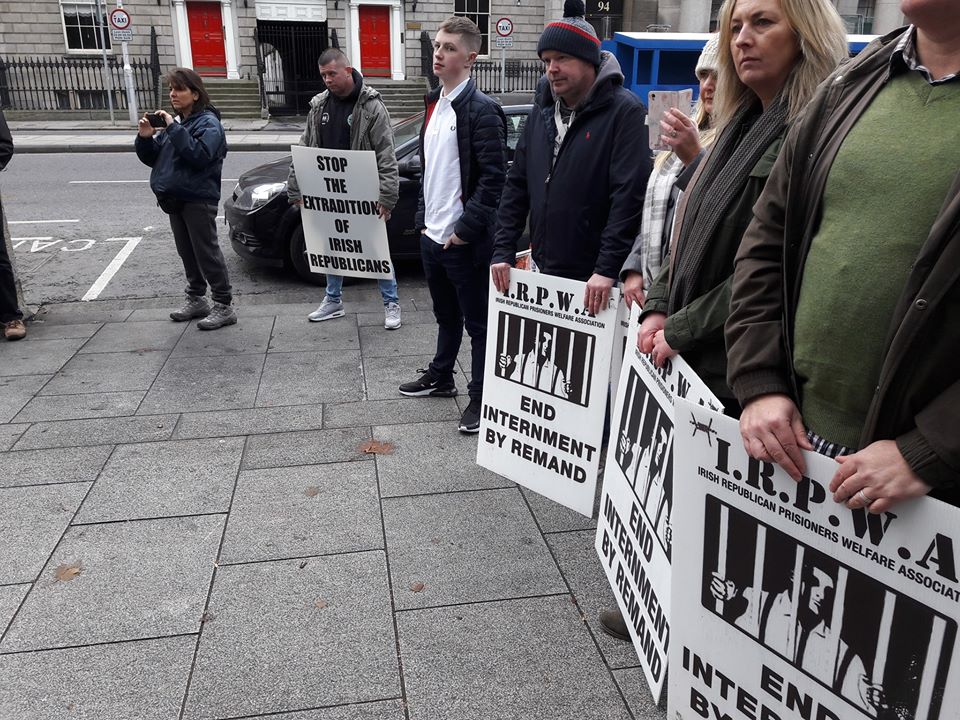
Tens of protesters against undemocratic state repression through internment and special courts gathered at the Wolfe Tone Monument in Dublin’s Stephen Green on Saturday before proceeding through the park to the Irish state’s Department of Justice building at 94 Stephen’s Green.
The sun shone weakly through at times on bare branches of deciduous trees and their autumn leaves, along with the dark green of the evergreen foliage of holly tree and invasive bay cherry.
Wolfe Tone Monument by Edward Delaney (d.2009) at an entrance to Stephen’s Green (image sourced: Internet)
The Wolfe Tone Monument stands in the approximate location of the Irish Citizen Army’s trenches in 1916, fired on by British soldiers with machine guns who had occupied the Shelbourne Hotel opposite, killing one of the Volunteers below. The statue had been blown up by British Loyalists in the 1970s and some of the surviving remnant had been added to in order to rebuild the statue (a fact generally not known or conveniently forgotten).
As is invariably the experience of Irish Republicans, they were under surveillance by some Gardaí in plain clothes and also from a marked police car. Some of the participants were also harassed by them and required to supply their names and addresses.
One of the placards held by protesters across the road from the Department of Justice. (Source image: Abolish the Special Courts campaign FB page)
The event, jointly organised by two fairly recent organisations on the Irish Republican scene, the Abolish the Special Courts campaign and the Irish Socialist Republicans organisation, was supported mostly by Irish Republicans, some independents and some belonging to a number of Irish Republican organisations other than the organisers: activists from the Irish Republican Prisoner and Welfare Association, Saoradh and the Dublin Anti-Internment Committee were also in attendance.
View of a section of the protesters in front of the Department of Justice with Stephen’s Green in the background (Source image: Abolish the Special Courts campaign FB page)
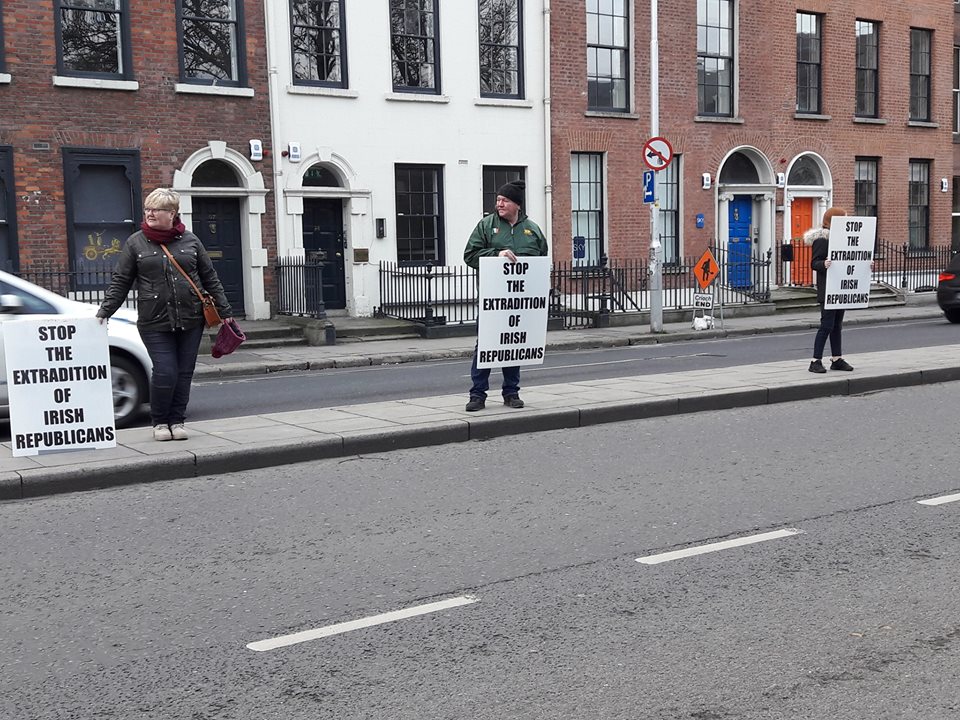
With their banners and placards the protesters stood on the median strip in the road opposite the Department of Justice, passing pedestrians and drivers slowing down to read the texts displayed, some drivers tooting their horns in support. Some, apparently visitors, took photos or video footage.
Later, supporters of the protest crossed the road to the pavement outside the Green to hear speakers. Ger Devereux of the Abolish the Special Courts thanked people for attending and introduced Brian Kenna from Saoradh to speak.
“NOT CONVICTED FOR ANY CRIME BUT FOR BEING …. IRISH REPUBLICANS”
Kenna gave a detailed and comprehensive account of how the Offences Against the State Act has facilitated the imprisoning of Irish Republicans not for any crime they have committed but for being just who they are – Irish Republicans. Observing that half those Republicans in jail in the Irish state are serving time on conviction of allegedly “being a member of an illegal organisation”, the speaker emphasised that the only ‘evidence’ necessary for the Department of Public Prosecutions to secure such a conviction under the Offences Against the State Act is the word of a Garda at the rank of Superintendent or above, along with some vague additional ‘evidence’ that could mean lots of different things.
Brian Kenna speaking to protesters on behalf of Saoradh organisation, across the road from the Department of Justice. (Source image: Abolish the Special Courts campaign FB page)
Brian Kenna warned that not only scheduled offences1 can be tried in the Special Criminal Courts as of now but should the DPP wish it, also other minor offences such as allegedly criminal damage or against public order and he believed that except for the existence of a few factors, including the presence of an MP among the accused, the Jobstown water-protesters would have been tried in the Special Courts, where convictions are the almost automatic result. Kenna called on all people to stand up against these undemocratic laws.
Devereaux then introduced Mandy Duffy, national Chairperson of the Irish Republican Prisoners Welfare Association.
One section of the protesters listening to speakers, Mandy Duffy, Chairperson of the IRPWA in the foreground. (Source image: Abolish the Special Courts campaign FB page)
“HUMILIATION, VIOLENCE AND ISOLATION”
Mandy Duffy spoke about the conditions under which Irish Republicans are being held in a number of prisons in Ireland on both sides of the Border. In Maghaberry in particular, which Duffy said was much more modern than Portlaoise (in the Irish state), Republican prisoners are guarded by a prison staff recruited from among Loyalists2, who hate Irish Republicans and are determined not only to keep them in jail but to make them suffer while they are there.
Duffy focused on the practice of continually strip-searching prisoners every time they are taken from the prison or returned as one of humiliation and of violence when the prisoner is non-compliant.3 The speaker also referred to unreasonable and additional punishments such as keeping prisoners in isolation.
A banner and two placards in front of the Department of Justice. (Source image: Abolish the Special Courts campaign FB page)
Mandy Duffy concluded by calling for solidarity with Irish Republican prisoners and in thanking those present for giving her their attention.
Devereux then called on Diarmuid Breatnach to speak on behalf of the Dublin Anti-Internment Committee.
“WE STAND TOGETHER OR WE GO TO JAIL SEPARATELY”
Diarmuid Breatnach addressing the protesters across from the Department of Justice, on behalf of the Dublin Anti-Internment Committee. (Image source: Abolish the Special Courts campaign FB page)
Diarmuid Breatnach began in Irish by thanking the organisers for the invitation to speak which he then repeated in English. Breatnach said that their Committee held pickets around Dublin mostly on a monthly basis and did so in order to raise awareness on the ground, among the public, that internment without trial continues in Ireland long after it was allegedly terminated by the British in the mid-1970s. He also reminded the protesters that people had resisted internment and protested it in Ireland and in many places around the world, including in Britain. In the Six Counties the Ballymurphy Massacre had been inflicted on people protesting internment in 1971 and again in 1972, the Bloody Sunday Massacre in Derry.
Stating that internment is essentially jailing people without a trial, Diarmuid Breatnach stated that returning a former Republican prisoner who is at liberty under licence to jail without any trial, as has happened for example to Tony Taylor, is effectively internment, albeit of a different kind. Refusing a Republican bail for no good reason when on a charge awaiting trial, which might take up to two years, is also internment of a different kind, the speaker said, stating that the only justifiable reasons for opposing bail are supposed to be a likelihood of the offence being repeated or the charged person absconding, for both of which credible evidence should be produced. Breatnach also drew attention to the recent decision of the European Court of Human Rights which castigated Turkey for their two years of preventive detention (or refusal of bail) of a Kurdish Member of the Turkish Parliament while awaiting trial, on the principle that the period of detention was unreasonably long and was being done deliberately for political reasons.
A small section of protesters across the road from the Department of Justice. (Source image: Abolish the Special Courts campaign FB page)
The speaker also referred to the unreasonable bail conditions when bail was granted, which included non-attendance at political demonstrations, pickets and meetings which, he said, made it clear what the whole intention of the repression was about.
Breatnach reiterated what an earlier speaker had said about the potential of these forms of repression being used against a wider section of opposition to the State and referred to recent arrests of Republicans who had allegedly mobilised against the launch of the fascist group Pegida in 2012. The speaker urged unity across the board against State repression because they either stood together now or later would “go to jail separately”.
Devereaux thanked the participants and encouraged them to keep in touch with the Abolish the Special Courts campaign and the street meeting broke up into informal groups as people began to collect placards, banners, etc getting ready to disperse.
End.
Another small section of the protesters with the Department of Justice in the background. (Source image: Abolish the Special Courts campaign FB page)
2The term “Loyalist” in an Irish context and especially in the occupied Six Counties means “British Loyalists” usually understood not only as those who support the Union with England but as those who do militantly and with bigoted hatred of Catholics (in particular Irish Catholics or people from that community who might well be atheists).
3There is a graphic and accurate depiction of this practice employed on non-compliant Irish Republicans on the “Dirty Protest” in the Steve McQueen film “Hunger” (2008). In the film, the prisoners were nearly naked already but in more ‘normal’ prison conditions, the practice also involved removing the prisoner’s clothes – by force if he or she is non-compliant.
Recently someone objected to my use of the word “militant” to describe a movement with which I am in solidarity, saying that the word implied “violent”. My initial reaction was that I disagreed.
I understand “militant” to mean “determined, assertive, courageous, not awed by confrontation” and that one could even be a “militant pacifist”.
But I decided to look up some dictionary definitions online. The first two or three did indeed include violence as a possibility but not necessarily integral. Another two came closer to my way of thinking: “aggressively active (as in a cause) : COMBATIVE “(Miriam-Webster).
“You use militant to describe people who believe in something very strongly and are active in trying to bring about political or social change, often in extreme ways that other people find unacceptable. Militant mineworkers in the Ukraine have voted for a one-day stoppage next month. …one of the most active militant groups.“ Collins Dictionary.
The meaning of words shifts from language to language, culture to culture and across time. One of the most obvious and startling examples of this is the word “gay”, up to the 1970s probably understood in English by most people as meaning “happy, light-hearted” etc but now, the first interpretation in the English-speaking world would be “homosexual” (in a non-pejorative way).
“Tramp” was a verb in the 19th Century to the extent that a famous marching song of the Union Army in the American Civil War was known as “Tramp, tramp, tramp”1. By the 20th Century its use as a verb was in decline but it was becoming better known as a noun, the meaning of which was understood variously as “vagrant” or even “beggar”.
And one could fill volumes with similar examples, I am sure.
“MILITANT”
But returning to “militant”, was I the only one who understood its meaning in the way that I had? Well, apparently not, as Wikipedia showed, for example in descriptions of “militant trade unionists” and even a political organisation within the British Labour Party before its expulsion, calling its group “Militant Labour” and its newspaper “Militant”, probably drawing a parallel with those very same trade unionists2.
It would not take much pondering to guess that “militant” had some relation to “military” and apparently the word does indeed have such an origin, from Latin “miles”, ‘a soldier‘.3 But over the years, as with many other words, its meaning has changed.
But apparently, violence is again becoming associated with the word, more so than in the second half of the 20th Century. How did this happen? I am not sure but it appears to have been a spin-off from the more recent imperialist wars of, in particular, the United States. It seems that organisations resisting USA control or dominance in the Middle East, most of which were Muslim in religion, began to be termed “militant” in US and western reporting. Why this became so seems hard to fathom – it was not a word that these organisations applied to themselves — but it has had that spinoff effect on the word “militant”, so that “militant trade unionists” and “militant feminists”, for example, are now likely to be associated with violence, i.e the use of physical force.
How loaded and partisan usage of the word can become is well illustrated in the definition supplied by the Oxford living Dictionary: Favouring confrontational or violent methods in support of a political or social cause. ‘the army are in conflict with militant groups’.
The example given is very interesting. Conflict requires, one supposes, at least two parties and both sides are listed in that quoted phrase. But the impression given is one where “the army” is an authoritative, legitimate force which is being opposed by groups that are none of those things. One almost feels that the source of “the conflict” is the “militant groups” (especially with the current loading of ‘violence’ into definition of the word “militant”).
The ‘army’ is an armed organisation at the very least latently violent (training with deadly weapons) and in this context, almost certainly practicing violence by invasion. Yet it is portrayed as somehow neutral and the opposition as violent. This is further accentuated when the army and armed police are termed “security forces”. How could one be against security? Don’t we all want to be secure? Obviously quite a lot of people don’t want whatever ‘security‘ is being offered by these military and militarised forces and the question of “security for whom?” is hardly ever explored in such discourse, leaving us with the impression that the good guys are the army and police, deserving of our support, while whoever opposes them must be bad and we should line up against them.
As the meaning of words shifts, we have to decide whether to stick with the meaning we had and insist on its primacy, or to adapt and move with it. Up until the 1960s it was generally considered ill-mannered among white and black people to refer to people of noticeable African descent as “black” or as “negro” and Martin Luther King’s campaigning organisation was called the National Association for the Advancement of Coloured People. Back earlier, in the 18th and early 20th centuries, “negro” would have been acceptable to most. Nowadays, “coloured” or “negro” would generally be considered either offensive or ignorant and “black” is the word, unless one is to use the Africa-derived word, e.g Afro-American, Afro-Caribbean, etc.
And in a strange reversal, whether in self-mockery or appropriation, many Afro-Americans began in the 1970s and 80s describing themselves with the word “nigger”, a word long associated with racism4.
“DISSIDENTS”
Leaving those examples and dealing with Ireland, a number of organisations advocating Irish independence and unity and denying the legitimacy of the administrations of either side of the partition Border, would happily term themselves and one another “Irish Republicans”. That term came first to exclude the supporters of the Irish Free State, who waged a Civil War against those who would not accept the British terms, including Partition, of the 1921 Treaty. Not much over a decade later, it excluded also the Fianna Fáil party, which had split from Sinn Féin, got elected into government and at different times interned Republicans without trial, executed some and passed emergency-type legislation against them.
Subsequent splits in later years were still all described, along with various versions of the Sinn Féin party, as “Irish Republicans”. After the Good Friday Agreement was endorsed by what had been Provisional Sinn Féin and they subsequently became part of the administration of the British colony of the Six Counties, all those Irish Republicans who did not agree with them on that came to be called “dissidents” in the media and in much political discourse.
Those who are called “dissidents” however did not, for the most part, agree with the term. As far as they are concerned, they are sticking to the “official line” or at least the original one and it is the Provisional Sinn Féin (which now terms itself just ‘Sinn Féin‘) which has diverged from the line and furthermore, departed from the ranks of Irish Republicans.
Let’s do a trawl for definitions similar to what I did with “militant” but this time for “dissident”.
Wiktionary: “A person who formally opposes the current political structure, the political group in power, the policies of the political group in power, or current laws.
“(Christianity) One who disagrees or dissents; one who separates from the established religion.”
Mirriam-Webster: “disagreeing especially with an established religious or political system, organization, or belief
“dissident elements in the armed forces”.
Collins: “people who disagree with and criticize their government, especially because it is undemocratic.
“Dissident people disagree with or criticize their government or a powerful organization they belong to”
Oxford: “A person who opposes official policy, especially that of an authoritarian state.
“‘a dissident who had been jailed by a military regime’”.
And one I hadn’t used before, but which caught my eye, Vocabulary.com: “If you are a dissident, you are a person who is rebelling against a government. Dissidents can do their work peacefully or with violence.
“Dissidentis closely related to the word, dissent, which means objecting. People who are dissidents show their dissent5. Catholic priests who advocate allowing women into the priesthood could be called dissidents, as could the Puritans who left England to live in colonial America. As an adjective, a dissident member of a group is one who disagrees with the majority of members.”
Since it is not a religious movement, “one who separates from the established religion” would seem non-applicable (though when one sees how many Republicans cling to certain practices like non-recognition of the court trying them, or refusal to stand in elections, it is tempting to think of those prohibitions as religious dogma rather than tactics for particular times and place).
Most Irish Republicans would consider themselves as in opposition to the “established (political) order” of the country, i.e Ireland partitioned, with one part run by an anti-Republican Irish ruling class and the other by a colonial ruling class. They would consider the relevant governments as “authoritarian” and “undemocratic”, certainly in their treatment of Irish Republicans by harassment, intimidation, detention, subjecting them to special emergency-type legislation, non-jury courts and prison.
In that sense of “dissident”6, the Sinn Party in its various encarnations has until recentlyalways been a party of dissidents, first against a foreign monarchy subjecting Ireland without an Irish king (the party founded by Arthur Griffiths), then to a Republican party campaigning against British rule (the coalition that was the reformed post-Rising party 1918-1921), after that a party against the Irish Free State Government and the colonial administration of the Six Counties, subsequently a Republican socialist party opposing the same forces, then after a split, a Republican party with similar objectives but supporting an armed resistance to the the British occupation. To that can be added the existence of the Republican Sinn Féin party from a split and at least one other group of similar construction for a time but with more socialist emphasis.
Clearly (formerly Provisional) Sinn Féin can no longer legitimately describe itself as dissident, should it want to, as it is now party to that repressive colonial government to which it was previously vehemently opposed and also now straining to become part of a coalition in government of the Irish state.
Many people who left the SF party did so precisely because they opposed those policies and actions7 and on most terms could legitimately claim to be “dissidents” – if they wished to. Not just dissidents recently within the party but dissidents against the State and British colonialism.
Clearly then descriptions such as “rebelling against a government” and “disagree with and criticize their government, especially because it is undemocratic” are not going to be the problem and “formally opposes the current political structure, the political group in power, the policies of the political group in power, or current laws” seems just tailor-made for Irish Republicans.
The objection to the appellation of “dissident” then must surely be based on either a misunderstanding of the meaning of the word or a concept of some kind of historical Irish Republican authority. If the latter, then the SF party can been seen as having gone against that authority and those Irish Republicans not following the SF path as being the true and loyal followers, faithful to that historical authority. This would be an entirely understandable attitude – but is it helpful? Aren’t the most important things theaims that Irish Republicans have and how they conduct themselves in working towards them, rather than whether they are called “dissidents” or not? After all, there is nothing fundamentally pejorative in the term.
There is no doubt that “dissidents” is a handy catch-all term to describe Republicans who belong to a number of political groups or who are independent activists (the latter of which Ireland and especially Dublin has a great many) but is it conferring some kind of implicit legitimacy on the collaborationist and now constitutionalist Sinn Féin party? And if so, legitimacy in the eyes of whom? Remember how one time there was an “Official Sinn Féin” (and IRA) and the “Provisional Sinn Féin (and IRA) who split from them? It was the latter that went on to gain dominance in the Republican movement while the “Official” organisation split again and shrank to a tiny remnant.
If I were to count myself among the ranks of Irish Republicans8, would I object to the term of “dissident”? I don’t think so.
1Coincidentally, the word “gay” is employed in its older sense in the lyrics of the song. A lot of interesting information is contained in the Wikipedia page on this song (see link in Sources and References).
2This was an organisation run by the entryist British Trotskyist organisation which later became the Socialist Party (like its great rival, the Socialist Workers Party, it too has an offshoot in Ireland).
3Through Latin into French and from there into English. However, the word may have been of an older root, possibly Celtic: “ ‘Míle’, word in Irish, meaning ‘a warrior, a champion, a hero’” given p.23 in How the Irish Invented Slang, Daniel Cassidy (2007).
4The term is not accepted equally among black people: I recall a black workmate of mine telling me that he had punched another black man who had referred to him as “nigger”.
5Actually, as Wiktionary tells us, it means more correctly “not in agreement” and comes from the Latin word for “to sit apart”
6Lest it be thought that I dissent from this opinion, let me put on record that this is one of the things about which I entirely agree with Irish Republicans. I suspect however that this definition is generally only used by media and mainstream commentators to describe regimes other than the ‘western democracies’.
7Some people had left that party already by that time, some because they perceived its direction and some because they objected to procedures within the party, especially those they considered undemocratic. Others left over time due to decisions to contest elections in the Irish state or to take their seats in the parliaments if elected, or because of rapprochement with the colonial police, over alleged harassment, party promotions or personal reasons.
8“Irish Republican” is a specific political designation and does not describe me, although I am Irish and I do aspire to a Republic of social equality. I am a revolutionary and a socialist as well as being anti-imperialism; I am many other things as well but that will do as a basic platform on which to seek others of like mind. In the course of struggles I do of course join in a front of one or the other of those tendencies but always with an eye to the full objective. Or so I try, at least.
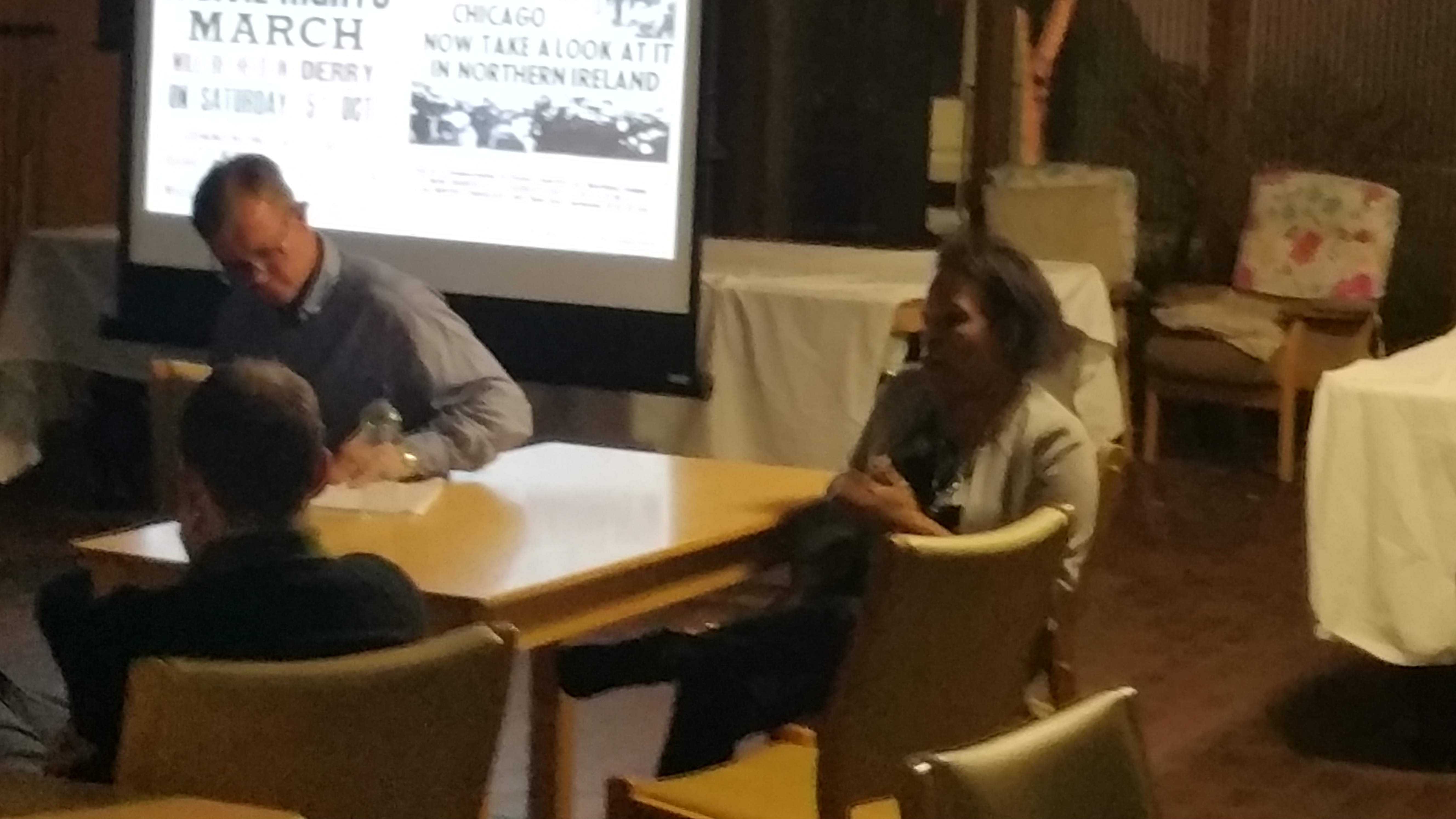
Two very interesting talks were given last night as part of a series of history talks at the Sean O’Casey Community Centre in East Wall, Dublin. The theme was black civil rights in the USA and Catholic civil rights in the Six Counties of Ireland (‘Northern Ireland’ according to some).
Joe Mooney of the East Wall History Society introduced the speakers and chaired the question-and-answer session afterwards.
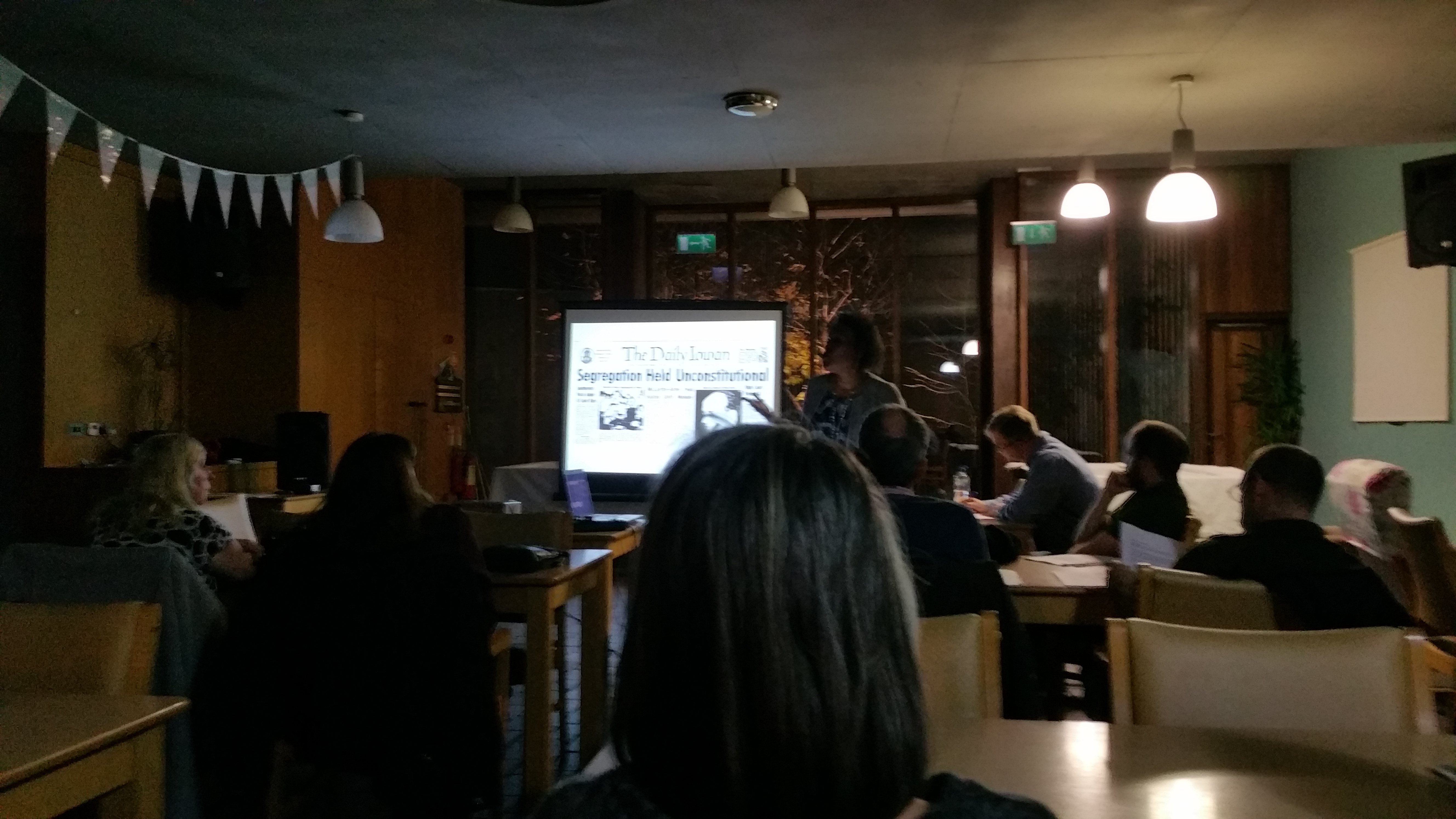
The session opened at 8pm and Cecilia Hartsell had a lot of ground to cover. She spoke on the history of the Civil Rights movement of blacks in the USA, going through the history of seminal events, illustrated with Powerpoint slides and recordings of two White House phone calls between President JF Kennedy and Ross Barnett, Governor of Mississippi and key figure trying to prevent the historic enrollment of James Meredith, a black man, into the University of Mississippi.
Cecilia Hartsell delivering her talk on the black civil rights movement in the USA
Recalling that in the first two years of his term, JF Kennedy had little to say about black civil rights but was focusing on other issues,Cecilia Hartsell somewhat undermined the (incorrect) image we tend to have in Ireland of Kennedy as an ardent civil rights fighter. In fact he was enforcing Federal legislation on equality and trying to go slowly, while the black campaigners were pushing the agenda along and white racist reaction was holding the USA up to international ridicule and opprobrium during the Cold War with the Soviet Union.
When Brian Hanley took the floor for his talk he fairly zipped along, which he does very well. Hanley undermined some myths or wrong impressions too. Early organisers of the civil rights marches and other events such as the Dungannon house occupation were Irish Republicans; Loyalists had killed four people before the first Civil Rights march. The rhetoric of SDLP and Labour Party notables was much more militant in the early years and Fine Gael was agitating more about issues of discrimination in the Six Counties than was Fianna Fáil, the party in government. And FF had been pushing a referendum to do away with the proportional representation electoral system at the same time that the PR system was among the demands of civil rights campaigners in the Six Counties.
Brian Hanley delivering his talk on the civil rights movement in the Six Counties.
In the session for questions, answers and contributions later, Hanley pointed out that the Southern Democratic Party was the pro-slavery party historically and, after the Civil War, anti-integration and civil rights, whereas the Republican Party was anti-slavery (debunking another false image we tend to have in Ireland).
Both historians made the point that a hundred years is not as long as some might think (this is especially true in ‘historical memory’). The 1940s, when some historians would say, as Hartsell told us, is the date from which to date the renewed fight for black equality in the USA, as surviving black soldiers returned from WWII, was only 80 years from when Federal troops were withdrawn from the former Confederate states. The partitioning of Ireland had been carried out less than 50 years before the Civil Rights protests broke out in the Six Counties, Hanley reminded his audience and many Catholics still lived who remembered vividly the fierce repression that had accompanied it.
It also emerged that albeit there were many similarities, there were also profound differences between the two movements. The black campaigners in the USA were saying that they were citizens of the USA State and demanding the same rights as other citizens, they often marched with the Stars and Stripes flag and even called for the intervention of US troops to defend their rights. The Catholics marching for civil rights in the Six Counties mostly saw themselves as Irish citizens and would never march with the Union Jack. Some did call for the intervention of British troops but many did not; it was mostly Irish troops they hoped would intervene.
The importance of the presence of news photographers at events and their covering in newspaper reports and on television broadcasts was an important factor in both struggles.
USA soldiers facing unarmed marchers for black civil rights. (Source: Internet).
Cecilia Hartsell did not feel that the Black Power movement could have survived Southern racist repression in the 1940s, ’50s and early ’60s and most of the big gains on desegregation of education, public transport, eateries and voter registration and effective right to vote in the Southern States were won during those years with peaceful marches and pickets and legislation (which however were met by much racist violence, including a number of murders). By the time the Black Power movement was coming on to the political stage, so was the Vietnam War and huge changes were taking place in the US, including many mass violent struggles on race and other issues.
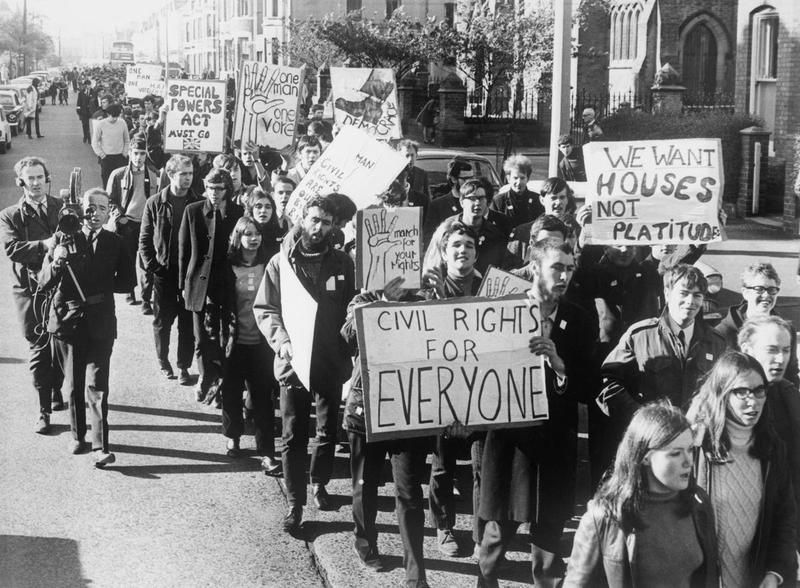
Section of march for civil rights in the Six Counties (Source: Internet).
TERMINOLOGY AND DEEPER MEANING
Wikipedia: “Though often used in history books to refer to the seven states that originally formed the Confederacy, the term “Deep South” did not come into general usage until long after the Civil War ended. Up until that time, “Lower South” was the primary designation for those states. When “Deep South” first began to gain mainstream currency in print in the middle of the 20th century, it applied to the states and areas of Georgia, southern Alabama, Florida, Mississippi, north Louisiana, and East Texas, all historic areas of cotton plantations and slavery. This was the part of the South many considered the “most Southern”.”
“Later, the general definition expanded to include all of South Carolina, Georgia, Alabama, Mississippi, and Louisiana, and often taking in bordering areas of East Texas and North Florida. In its broadest application today, the Deep South is considered to be “an area roughly coextensive with the old cotton belt from eastern North Carolina through South Carolina west into East Texas, with extensions north and south along the Mississippi”.
“Lower South” probably originally referred to its location on the typical north-orientated map of the USA. But I speculate that “Deep” has another meaning – a deeper psychological one, in fact. It suggests that this is a place difficult to understand for people not from there, which means most people. Different rules apply there, we might believe.
I speculate further that after the initial first years of the Civil Rights movement in the Six Counties, that area and the people living in it came to be seen as “different” too. Of course, it was different in that it was a colony (as had the whole country been only 50 years earlier) and that it was run along blatantly sectarian lines, the Catholics a minority there, unlike in the rest of Ireland. And of course, people in a different environment respond differently. But they were still people and the substantial Catholic minority were so clearly oppressed in a statelet into which the Irish ruling class had delivered them. For many people in the 26 Counties it became easier to think of them as somehow foreign in a foreign kind of land, hence my description as “Deep North”.
Cecilia Hartsell and Brian Hanley during the question-and-answer session.
THE SPEAKERS (as posted by EWHG)
Cecelia Hartsell is a researcher of American history. She has been a contributor to the RTE History Show and Radio Kerry on topics in U.S. history and frequently gives U.S. history talks for the Dublin Festival of History and in the Dublin Public Libraries. Cecelia has a Masters degree in U.S. history from Fordham University and a Masters degree in History from UCD.
Brian Hanley is an historian and author. He is currently a Research Fellow at the School of Classics, History and Archaeology, University of Edinburgh . He has lectured at a number of major Irish universities and was Historian in Residence at Dublin City Library and Archives . His books include “A Documentary History of the IRA, 1916-2005” (Dublin, Gill and MacMillan, 2010) with his most recent being “The impact of the Troubles on the Republic of Ireland, 1968-79: boiling volcano?” (Manchester University Press, 2018).
NEXT HISTORY TALK
There will be another talk in the series next week when Dr. Mary Muldowney will present a talk on “The 1918 Election – the Woman Who Stood for a Worker’s Republic.”
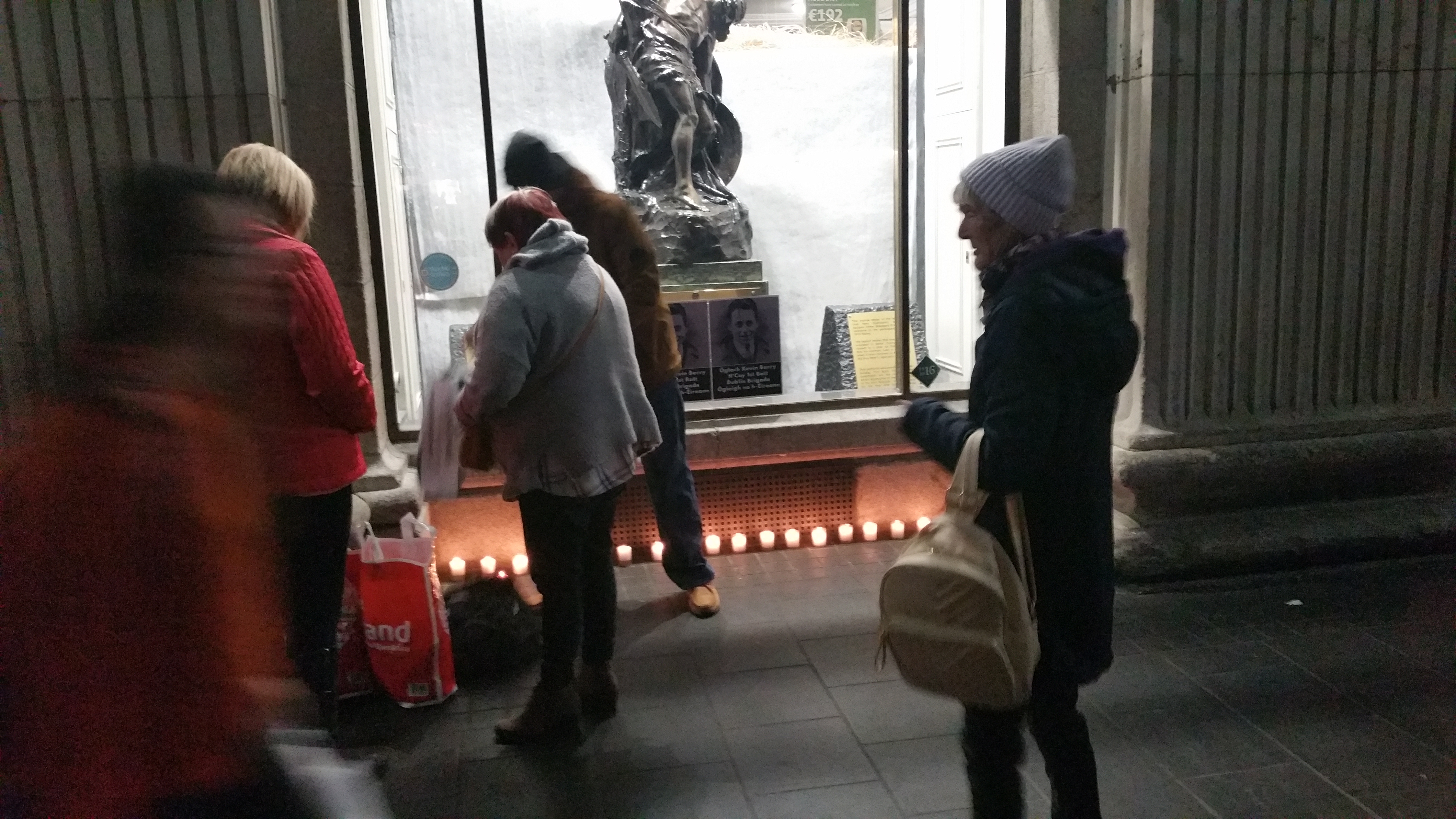
Socialists and Socialist Republicans gathered outside the General Post Office in Dublin on Thursday (Nov 1st) to honour the memory of Volunteer Kevin Barry on the 98th anniversary of his execution. Copies of his portrait were on display with candles lit and the ballad honouring his memory was sung.
Display of images of Kevin Barry and lit candles outside the GPO at the event. (Photo: D.Breatnach)
The event was organised by the Irish Socialist Republicans organisation. Asked about the reason for the commemoration and speaking on behalf of the organisation, Pádraig Drummond said “It is important to honour people in our history who have played an important role, who have displayed characteristics worthy of emulation such as resolution, courage and loyalty. People like Kevin Barry are more worthy of interest for the youth of today than clothing brands or pop idols.”`
Gathering to beign the vigil outside the GPO (Photo: D.Breatnach)
Some members of the public stopped in passing to listen to the song or to engage picketers in conversation.
People carrying out the vigil (Photo: D.Breatnach)
At the time of Kevin Barry’s execution the whole of Ireland was under a centuries-old British occupation and the defeat of the Easter Rising was three years in the past, most of its leaders executed and prisoners released. The first World War had ended. But the Irish Volunteers had reorganised and the War of Independence had begun in January of 1919. The ICA had seen a partial reorganisation and Cumann na mBan had never disbanded and, though it had suffered a few notable resignations, had experienced no split. The UK General Election of December 1918 had delivered a huge majority in Ireland to the newly-organised nationalist-republican coalition of Sinn Féin and in January of 2019 the successful SF delegates set up the Dáil, the first independent Irish Parliament, in defiance of the rule that all delegates elected in a UK election attended the Westminster Parliament in London.
On the same day in a separate development, the War of Irish Independence had begun. To wage war against the British occupation, the Irish Volunteers needed arms so some of its operations were carried out in order to seize arms from the occupiers. Kevin Barry joined the IRA at 15 in Dublin and not much later the IRB and had been on a number of successful raids to seize weapons.
Kevin Barry portrait graffiti of some years on wall in Dublin city centre. (Photo: D.Breatnach)
On 20thSeptember 1920 his unit was to ambush a British unit collecting bread from a bakery and relieve them of their weapons. Collecting breadrations from Patrick Monk’s Bakeryat 79-80, Upper Church Street, near the corner of North King Street, Dublin.
Barry was a medical student and had an examination scheduled for that day which he expected to attend after the operation. Having attended mass that morning, he joined the unit in nearby Bolton Street and when the British Army lorry arrived the volunteers, armed with pistols, ordered the soldiers in the back to drop their rifles, which they did. However a shot rang out, possibly from the front of the lorry and the volunteers opened fire but Barry’s gun jammed twice and he jumped under the truck, being left behind when his comrades retreated. He was discovered and arrested. All five of the British soldiers in the rear of the lorry had been hit and one, 15 years of age, was dead – another two died later.
Kevin Barry attested that he had been beaten up when captured and tortured for information later in Army custody. On 20th October he was tried by military tribunal under the provisions of the Restoration of Order Act of August that year. Brigadier-General Onslow presided on the tribunal and Barry had legal representation who, after Barry announced he would not recognise the court, withdrew. The sentence of the court, given to the Volunteer in his Mountjoy Prison cell that evening, was death by hanging. The sentence became publicly known on the 28th and a fierce campaign began to save his life, not only in Ireland. Terence McSwiney, author, playwright, Lord Mayor of Cork and IRA Volunteer, had died after a hunger strike of 74 days on 25th October and public opinion, especially in Ireland, was highly excited. Nonetheless, Kevin Barry was hanged on November 1st 1920, eighteen years of age. According the priest who accompanied him the gallows, who was not a republican, he went calmly to his death.
On 14 October 2001, the remains of Barry’s body and others were given an Irish state funeral and moved from Mountjoy Prison to be re-interred at Glasnevin Cemetery in Dublin. A stained glass window in his honour was unveiled in 1934 at the Earlsford Terrace address of University College Dublin and was later moved to their new address in the Belfield Camput and restored in 2007.
The Ballad of Kevin Barry, which was sung at the commemoration by Diarmuid Breatnach, was composed around the time of the Volunteer’s execution and has been very popular in Ireland and among the Irish diaspora abroad. The author is unknown despite efforts by his family and others to trace him or her but there were some indications that it had been composed in Glasgow. The song has been recorded by many performers, including non-Irish singers Paul Robeson and Leonard Cohen.
From Eoin O’Donnel’s filming and editing via Joe Mooney of East Wall History Group, a recording of Diarmuid Breatnach singing Christy Moore’s wonderful song Viva La Quinze Brigada (also known as Viva la Quinta Brigada which, however, is also the title of another song from the same conflict but in Castillian or Spanish language). The Fifteenth Brigade of the Spanish Republican Army was also the Fifth International Brigade, the mostly English-speaking one. It contained volunteers from English-speaking USA, Canada, Australia, Scotland, Wales, England and ireland but due to high Irish emigration, all those countries also contained Irish diaspora and they were to be found in the contingents from those countries.
The video also contains photos of the commemoration of Jack Nalty, resident of East Wall’s, the last Irishman to die in action during the Iberian Anti-Fascist War (usually known as the “Spanish Civil War”). The day-long event on 28th September (anniversary of his death) included songs and poems, a march led by a lone piper, unveiling of a plaque, booklet launch and showing of two films. It was a celebration in particular of Jack Nalty’s life but more generally of the Irish who, against the position of their Government, the Church of the majority, the dominant media and even, for those in the IRA, against their own organisation’s orders, went to fight against a fascist military uprising against the elected Republican Government of the Spanish state.
It was also a celebration of antifascist resistance around the world and of the principle and practice of internationalist solidarity.
A plaque to the fallen of the Irish volunteers of the International Brigade (containing many names but by no means all of the Irish who fell there). The plaque is on the wall of the Theatre side of Liberty Hall, HQ of SIPTU, Dublin. (Photo D.Breatnach).
Liam Herrick, Executive Director of the Irish Council for Civil Liberties and Mallachy Steenson, Irish Republican and practicing lawyer, on Friday 7th June addressed a Dublin meeting on The Right to Protest, convened by the Dublin Anti-Internment Committee.
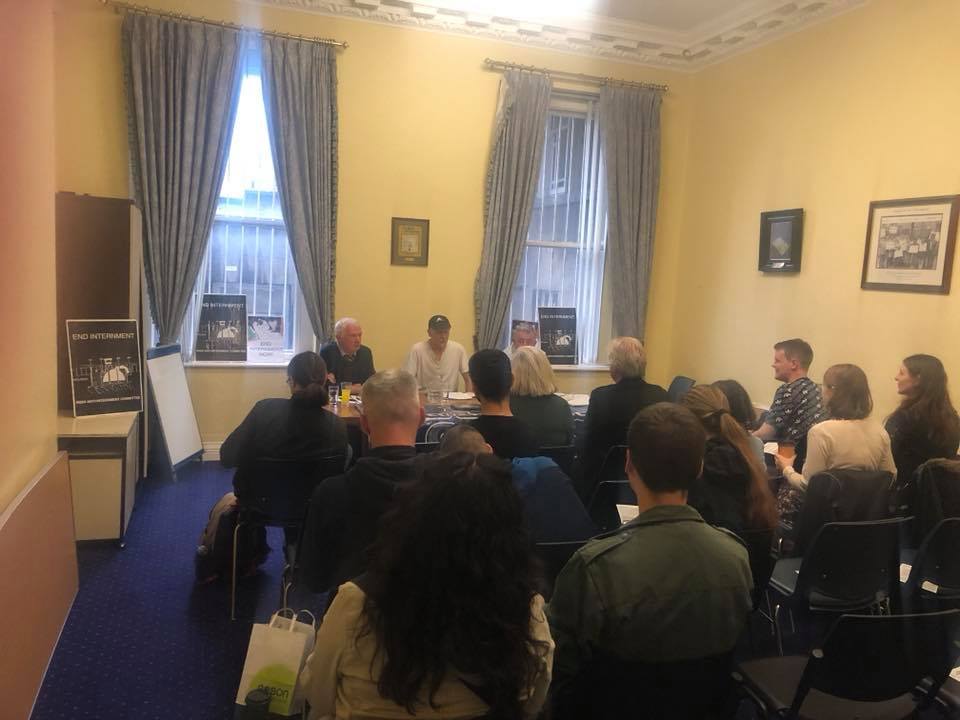
Section of audience and panel at Right to Protest meeting (Photo source: Dublin Anti-Internment Committee)
CHAIR’S INTRODUCTION:
The origins of the Anti-Internment Committee and the Right to Protest
Opening the meeting and speaking for the organisers, the Dublin Anti-Internment Committee, Diarmuid Breatnach welcomed the attendance, introduced the Committee and related how it had grown out of a previous committee, to have Marion Prices released from prison, which had been partially successful (she was released pending trial but her health was destroyed). She and a number of other former Republican prisoners who had been released under license under the Good Friday Agreement, such as Martin Corey and more recently Tony Taylor, had their licenses revoked and were brought to jail without a trial or the right to challenge whatever evidence the Secretary of State for Northern Ireland claimed to have against them. Some considered this a form of internment by some and the Anti-Internment Committee had been set up in June 2013.
Breatnach emphasised that the Dublin Committee had always been and remained — attempts at takeover and accusation notwithstanding — independent of any other organisation and committed to reaching decisions in a democratic manner and conducting themselves in a principled manner towards other organisations. The Committee organises the annual Anti-Internment rally in Newry and holds more-or-less monthly pickets in different parts of Dublin, which anyone is welcome to support, he told the audience.
Chair of meeting Diarmuid Breatnach speaking at Right to Protest meeting (Photo source: Dublin Anti-Internment Committee)
Although the Dublin Anti-Internment Committee updates a list of Republican prisoners in jail and also raises issues about the human rights of Republican prisoners such as right to education and art work, appropriate medical treatment, release from solitary confinement and on occasion about miscarriages of justice such as the Craigavon Two, nine years in jail now – nevertheless the true focus of the Committee is on issues of internment.
Introducing other areas of repression by the states on both sides of the Border which the Committee considers to be types of internment, Breatnach outlined the practice of refusing bail to the accused or of making bail conditional on the individuals removing themselves from all political activity. When the accused justifiably refused to accept these conditions, they were jailed, only perhaps to be found not guilty two or three years later, as had been the case with Stephen Murney. But still having effectively served a jail sentence.
“The right to protest is everywhere under attack” stated Breatnach and declared that maintaining that right was necessary for the winning and maintaining of a wide group of basic social and political rights, from practicing one’s sexuality or religion, or indeed criticising the Church, to forming a trade union, going on strike and marching against unjust laws or measures. Breatnach bemoaned the apparent inability of a number of Republican groups to unite in defence of this right and of Socialists in uniting with them even on this most basic of levels. “We can either stand together or fall separately” he said.
Internment is used by states against political opponents, said Breatnach, recalling that the British had used it in Ireland after the 1916 Rising, the new Irish state had used it during the Civil War and again during WWII under De Valera; the British in the Six Counties between 1971 and 1975.
Internment is a means of “removing unwanted members of the public”, Breatnach said, quoting the words of anti-insurgency specialist Brigadier Frank Kitson, who had been present during the repression of the Malayan resistance and also an operational Commander in Ireland from 1970-1972, years which Breatnach reminded his listeners were those covering the introduction of internment and the massacres of civilians in Ballymurphy and Derry.
Referring to the infamous “Heavy Gang” of the Gárda Síochána whose brutal methods had extracted false confessions on the Sallins Mail Train robbery from socialist republicans in the 1970s and from the family in the Kerry Babies case, Breatnach recalled the formation of the Irish Council for Civil Liberties at that time and that it had been a campaiging organisation unafraid to challenge the State on its repressive actions. Sadly over the years the organisation had fallen away from that path, he said and he was particularly glad to welcome Liam Herrick of the ICCL to speak at the meeting and in the hope that the organisation was returning to its roots.
LIAM HERRICK, ICCL: The Right to Protest and the work of the ICCL.
Liam Herrick, Executive Officer of the ICCL, speaking
After the applause, Liam Herrick thanked the Committee for having invited him to speak. He wished to list some of the efforts in which the Irish Council of Liberties was engaged and also to hear from the audience some of the problems they were encountering.
Briefly covering the early years of his organisation, Herrick related that it had been formed as a response to police repression, mostly of Republicans but also of some Socialists, and in particular due to the activities of the Gárda unit known as the “Heavy Gang”, by academics, activists and lawyers. It had taken up early cases of the ill-treatment of detainees, the use of the Offences Against the State Act, repression of protesters of the Ronald Reagan visit including the case of Petra Breatnach in 1984 and Water protests in the mid-1990s, also in the street-traders’ protests in which Tony Gregory was prominent.
The issue of the right to protest and State repression had come up again a number of times including in 2002 against the Anti-War Movement with the use of the OAS Act and in particular with the Reclaim the Streets protest in 2002, in which video recording of police actions had revealed the extent of police brutality without any arrests. Similar problems had been encountered by protesters at the 2004 EU Council meeting in Dublin, and water canons had even been imported by the State from the UK and widescale repression and had come up again at the Corrib Shell protests.
The ICCL had in 2014 published “Know Your Rights” booklet. And had called for a root and branch review of procedures for dealing with protests, noting that there existed a major gap in rights and policing process and has published a publication by the title of “Take Back the Streets” and has made submissions to the EU and the UN on how states should not just tolerate but manage and create conditions to facilitate the right to protest. The ICCL is part of a network which includes the ACLU in the US.
“If Notifications to the authorities are required should be minimal and reasonable”, Herrick said and gave the contrary example of African Jews who wished to protest against Israeli measures but were charged a 25,000 dollars as a cost of the application for permission.
Police should have a chain of command to deal with protests and be trained not only in weapons and control movements as they are at present but also in de-escalation, in engagement with protesters. Their internal Garda policies should be available to public access but are not.
Herrick said journalists should be facilitated in having access and only just employees of big media organisations but alternative media and individual bloggers whose coverage is often essential to understanding the incidents at an event (in the Reclaim the Streets event such sources were the only source on the Garda violence). There should be restrictions on the use of force as is law and police in Northern Ireland, whatever people might think about practice on the ground, Liam Herrick said. The PSNI every 6 months have to submit a report to the Policing Board which details incidents o the use of force. In the Irish state Gárdaí don’t have to make any report on the use of force which is remarkable in the European context – the use of pepper-spray would seem to be increasing here but no records are available..
Surveillance is an issue and of course can intimidate and have “a chilling effect on protest”, Herrick said. In England face recognition technology is being used which apart from questions about its accuracy, is intrusive. Also trapping of mobile phone activity in the vicinity of a protest. Data collection is an issue and there should be no database on protesters maintained; covert agents have been used and in some cases become personally involved with those they were surveilling – a recording procedure is needed. There needs to be an independent complaint process as the existing process in Ireland has been shown to be inadequate.
At the moment the ICCL is involved in discussions on Gárda reform and the following Friday would be producing a document on Human Rights Policing which people are welcome to read. The international perception is that the law and policy of the PSNI is good, without making any comment on their practice on the ground. The Gardaí should publish a report on their handling of protests every year including statistics (despite the problems on drink-driving statistics) on arrests and the use of non-lethal weapons.
The Gardaí in Ireland have a national security function and there needs to be a discussion on this – in many other countries a separate body is responsible for this. But no legal body is overseeing the operation of the Gardaí on national security or the powers they exercise.
Liam Herrick concluded to applause and Breatnach told the audience that questions could be asked of him and of the next speaker after the conclusion of the latter, then introducing Mallachy Steenson to welcoming applause.
MALLACHY STEENSON: Republicans and the Right to Protest
Mallachy Steenson speaking Section of audience and panel at Right to Protest meeting (Photo source: Dublin Anti-Internment Committee)
Mallachy quoted the right to protest under Article 41 of the Constitution of the State under which document however Republicans would not support.
Moving on to suppression of protests Steenson referred to the most frequently used being the Public Order Act, justification which depends on the subjective view of a cop and is therefore virtually unchallengeable. The result is usually a fine but the use of the Offences Against the State Act is much more serious. In the 1950s there were many arrests of Republicans under the section which prohibits a demonstration within a certain distance of the Dáil and Section 30 was widely used.
Steenson pointed out that almost any gathering of Republicans consitutes some kind of protest due to the basic opposition to the State of Republicans. Funerals are usually protests too, partly in solidarity with the family, partly with movement but also of making a stand and, in the case of the ten dead 1981 Hunger Strikers, in solidarity with their Five Demands.
Steenson believes that most of the protests that occur in the state will be allowed because the they don’t threaten the state from the “trendy liberal side”. For example the housing protests including activist occupations are permitted but when a house was occupied in Charlemont Street and in preparation for moving in a family three years earlier, armed police removed the occupiers.
“The State takes a different view of Republicans” Steenson declared. Referring to the 2016 Sinn Féin Easter 1916 commemorations, Steenson wondered whether they remember their history because the 76th anniversary of the Rising commemoration (1992) was banned and people on the platform arrested. The 66th anniversary commemoration had been beaten off the street in Dublin and people arrested for “membership”, including his own father and others.
“What we have is mostly controlled dissent”, Steenson said. “People remember the Birmingham Six” but are not aware that their campaigners here had their homes raided by police, their jobs visited by the Special Branch, threatened and often lost their jobs.
“What has happened in Ireland is a privatisation of dissent,” Steenson said. “They are funded by the State and he who pays the piper calls the tune.”
The only ones who could really carry out a successful protest in Ireland were the farmers who here, as in France, had no hesitation to block roads and motorways and dump slurry at the Dáil, Steenson declared. The only other really effective protest that hurts the State is the withdrawal of labour as in a general strike – which should have happened when the banks were bailed out — but the trade union movement in Ireland works hand in glove with the State.
“Republicans are well-used to surveillance” Steenson went on to say with a reference to “the new MI5 Garda Commissioner” who declared upon coming into office that the biggest threat to the State is the armed ‘dissident’ Republicans, which Steenson commented were no real threat to anyone except themselves.
“The State is built on the defeat of the Republic,” said Steenson and therefore naturally Republicans are its enemy. Referring to the water protests and their suggested victory, Steenson opined that the success was only due to Fianna Fáil changing sides and he believed that the USC (Universal Social Charge) should be the main object of protest which takes much more out of people’s pockets.
In 1972 the British Embassy in Dublin had been burned in protest at the Bloody Sunday massacre in Derry. Steenson declared that too was managed by the State, having a national Day of Mourning, allowing people to blow off their anger at the sacrifice of a building and listed other protests he believed had been managed or controlled by the State, including the medical cards for the elderly.
People should be able to go to protest without asking the State, Mallachy believed and asked what is a valid protest, referring to gathering protest against the expected visit of Trump while that of Clinton in Dublin passed quietly by without protest. “What is it about Trump?” asked Steenson. “If it’s about killing people, Clinton killed many more. If it’s about treatment of women, well we all know Clinton’s record on that.”
The real problem impacting on most working people is drugs, Steenson said, and the gangs involved in it. Families Against Drugs had been a big campaign but some of the activists were in it to get funding. “People should separate their political activism and their job,” Steenson declared. “We need to move away from having paid groups organise protests”, Mallachy said. “Most protests now are during the week,” he added, “because activists don’t want to interfere with their weekends.”
“We need to look at what is an issue and what is effective”, he said and talked about empty houses and the way housing protesters in the 1960s and ’70s not only occupied them but moved homeless families into them.
“During WWII we didn’t intern Germans or English here”, Steenson commented, “we interned Republicans.”
“Protests will be allowed as long as they don’t threaten the State”, Steenson said, coming to a conclusion and the only ones organising protests that threaten the State are Republicans. He posed the question whether democracy is any use to working people, because it had not brought them much.complained too about police being masked and said that in a normal society you would not have that, nor armed police everyday on the streets. He commented also on the degree of video surveillance used by the State which could track people from leaving the door of the building all the way home.
“Gardaí are there to protect the State, not to protect the citizen, whatever combination of political parties are in government,” he told his audience. “To them and to the State, Republicans are the enemy. That’s just the way it is.”
CONTRIBUTIONS AND QUESTIONS FROM THE AUDIENCE
After the applause following Steenson’s talk, Breatnach opened up the meeting to contribution or questions from the audience, asking them to keep them brief and telling them he was going to take questions in groups and the speakers could choose to which to reply.
Side view of section of the audience (Photo source: Dublin Anti-Internment Committee)
An audience members spoke about the level of repression from Lurgan RUC/PSNI and how eight people had been charged and their bail conditions were not to associate with one another but two of them live near one another.
A contribution declared that Drew Harris being appointed as Garda Commissioner was equivalent to a railroad to jail and related a case of an elderly woman being persecuted in Rossport.
Another directed a question specifically at Liam Herricks about treatment of people in some of the rural courts where protesters were being very badly treated.
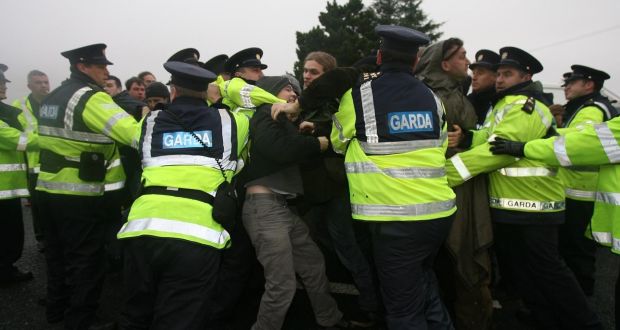
Gardaí attacking protesters
An Ireland Palestine Solidarity Committee activist said that usually they don’t get much trouble from the Gárdaí but more often from the private sectors, from private security personnel when they protest at a business as part of the solidarity campaign. And the Bank of Ireland had closed their account, which caused the organisation considerable difficulty. He wondered whether this was the State’s influence under pressure from the Israelis or others, or instead the banking company under pressure from the same sources or from financial sources. Or whether it was part of the general “de-risking” measures people talked about. The Cuba support group had suffered a similar problem.
Relating his contribution to issues of surveillance, one person described a car journey from an event for about two hours across Dublin, after which he stopped at a fast food takeaway facility. He had felt followed earlier on and when the Garda came in behind him in the takeaway with the usual harassment, he confronted the officer and asked him how had followed him all that way. The Gárda pointed to cameras above on street poles and said: “We don’t have to follow you, they do.”
Another person related how “membership of an illegal organisation” is being frequently used to jail Republicans under the OAS on the word, without the need to display any proof, of a Gárda senior officer.
He thought he had heard of one case where it had been used against a gang member and wanted to know were there any others that the speakers knew of?
Neither had heard of any and Mallachy commented that next year the OAS will be 40 years old. Liam Herrick referred to a piece of research carried out by Nuala Ní Fhaoláin at the UN.
A Polish and a Catalan separately expressed their solidarity with Irish people struggling against repression, briefly alluding to their own struggles and the Polish person mentioning the recent arrest and jailing of a comrade of his in Turkey.
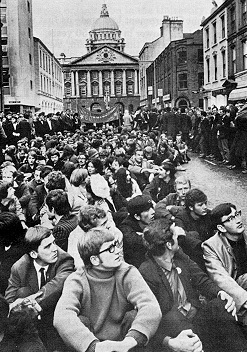
Queens University Belfast students sit-down protest when prevented from marching, 1968.
As there were no further questions or contributions, Breatnach thanked people for their attendance, the speakers for the talks and audience members for their contribution and asked for contribution towards the rent of the room. “This is not the beginning of a broad campaign to defend human rights or if it leads to it, it will not by our Committee leading it,” said Breatnach, adding that no doubt they would be happy to contribute to such a campaign. Urging people present to keep in touch with internment issues through the End Internment Facebook page he stressed once again the need to unite across ideological divisions against State repression.
End.
POSTSCRIPT:
A number of public meetings in Dublin about similar issues followed the one above in quick succession, no doubt coincidentally:
A meeting as part of the Anarchist Bookfair on Saturday 15th September on “State Violence and Cover-ups: Community Responses” heard from a speaker on police infiltration of campaigning groups; from Anne Cadwaller of the Pat Finucane Centre (also author of the “Lethal Allies” exposure) about colonial police and British Army collusion with Loyalist murder gangs; and from Hilary Darcy about what might be considered legitimate reforms to be pursued by revolutionaries.
A public meeting in Abolishthe Special Criminal Courts campaign was held on 17th September and heard from international and Irish speakers.
The Justice Delayed Is Justice Denied group held a public meeting on 19th September, raising issues pertaining to the Ballymurphy and Derry Massacres, the Miami Showband Massacre and the Stardust Fire (report: https://rebelbreeze.wordpress.com/2018/09/24/justice-delayed/ )
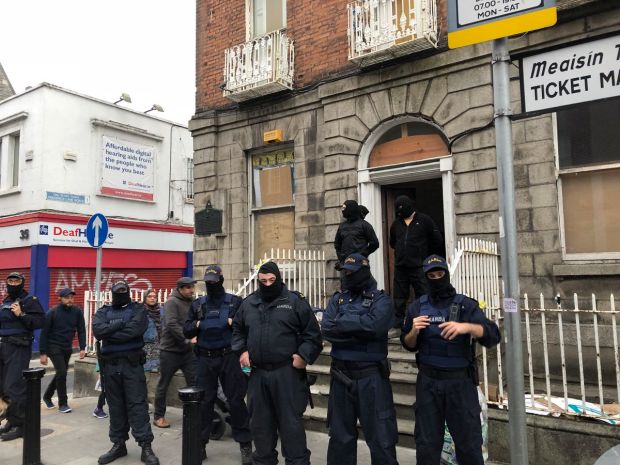
Masked Police, Police with machine guns.
In addition five days after the Right to Protest meeting, masked Gardaí brandishing batons and pepper-spray cannisters assisted a masked “security team” in evicting housing campaigners carrying out a symbolic occupation of an empty building, drawing protest statements from Liam Herrick on behalf of the ICCL to be followed, most unusually, by Colm O’Gorman on behalf of Amnesty International. Five or six housing protesters were detained and at least one was injured..
A few days after that, Gardaí turned up with machine guns and a battering ram to a house where a couple were in dispute with their landlord, leaving when supporters of the couple arrived.
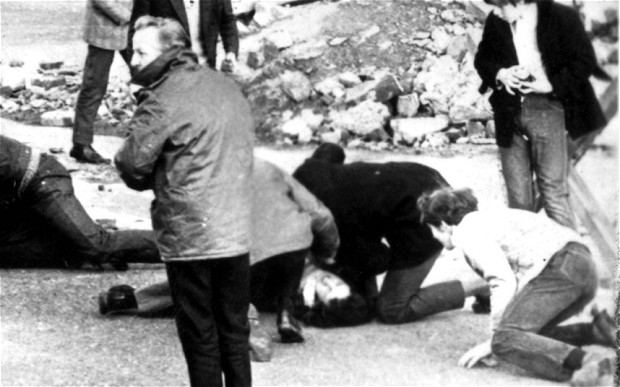
Masked Gardaí and masked “security guards” at eviction of peaceful housing protesters soon after the Right to Protest meeting. (Photo source: Irish Times)1963 Alabama, 17-year-old black civil rights protester attacked by police and police dog. (Photo source: Internet)1972, Derry, part of Bloody Sunday Massacre (Photo source: Internet)Lone man confronting Chines Army tanks on their way to suppress protest in Tienamen Square, 1989Massed Marikana Strikers at Lonmin Mine, South Africa, 2012– 40 were shot dead by police. (Photo source: Internet)
On the 80th Anniversary of his death in the Anti-Fascist War in ‘Spain’, the East Wall History Group organised a remembrance of a local man from that dockland Irish area who was the last Irishman to die fighting in the war against Franco and Spanish Fascism. The event was attended by relatives of that Irish antifascist fighter and of another, by a cross-section of Left and Irish Republicans, including historians and by a number of elected representatives from the Dublin City Council and the Dáil (Irish Parliament).
Crowd assembling outside school before event. (Photo: D.Breatnach)
Jack Naltywas the last Irish and one of the last International Brigaders to fight and die in that war. The rest of the Brigaders, those not held as prisoners by Franco’s forces, were withdrawn soon afterwards as the indigenous anti-fascist forces fought on, losing against the Spanish military coupists with their German Nazi and Italian fascist allies.
Those commemorating Jack Nalty met at the St. Joseph’s Co-Educational School on the East Wall Road at 1pm on Sunday (23rd September) and included a cross-section of members of organisations and independent activists, socialists, republicans, communists and anarchists and other members of the local community. At the front entrance of the School a number of relatives of Jack Nalty held a banner along with a son of an Irish International Brigader and the crowd was addressed by Joe Mooney, of the East Wall History Group.
Joe Mooney speaking at start of event, relatives of International Brigaders beside him holding the banner in the colours of the Spanish Republic (Photo: D.Breatnach)
Mooney told the crowd that John Nalty came to the area at the age of six from Galway and on 31st August 1908 entered the East Wall National School on the Wharf Road. Just over thirty years later, 23rd September 1938, he would die on a Spanish battlefield, shot down in a hail of fascist bullets as he engaged in one last heroic act.
“A member of the IRA during the War of Independence, Jack was a Republican, Socialist and trade unionist”, Mooney said, “representing 600 oil workers in Dublin Port. But in 1936 when the Spanish Civil War — or Anti-Fascist War as it should more accurately be called1 – began, he volunteered for the International Brigades to join the fight against European fascism. He was badly wounded and came back to Ireland, but would again go into action and was killed at the Battle of the Ebro. Having being among the first Irish volunteers to travel to Spain, he would die on their last day as they were preparing to withdraw from combat.
Nalty’s unit had been called to retreat when it was realisted that two machine-gunners had been left behind and he went back to collect them. On their retreat they were fired at and Jack Nalty was killed.
Section of crowd lined up in front of house where Jack Nalty had lived (Photo: D.Breatnach)
Mooney also asked those present to remember not only Jack Nalty but the ‘comradeship of heroes’ from Dublin’s Docklands and North Inner City – Dinny Coady, Tommy Wood and others.
The crowd then set off in a march led by a piper to East Road to unveil a memorial plaque. Across the road from Jack Nalty’s former house, the crowd paused to hear Diarmuid Breatnach sing a few verses of Christy Moore’s tribute to the Irish “Brigadistas”: “Viva La Quinze Brigada”.2
UNVEILING THE PLAQUE
Joe Mooney unveiling the plaque not far from Jack Nalty’s former house (Photo: D.Breatnach)The plaque (text difficult to read in photograph) (Photo: D.Breatnach)
The plaque could not be attached to Jack Nalty’s house and was affixed a little further down the road. Joe Mooney siad a few words there and introduced James Nugent who gave a speech he had prepared and the plaque was unveiled. Nugent concluded by saying that “the history of the past helps us to understand the present and to create the future.”
Kate Nugent read a message from the daughters of Steve Nugent (sadly died 2017) who researched the story of his uncle Jack and Mary Murphy read a short post from Vicky Booth (granddaughter of Syd Booth, who was with Jack when he died).
(Photo: D.Breatnach)Piper plays lament by plaque (Photo: D.Breatnach)
Harry Owens gave a short tribute speech on behalf of Friends of the International Brigades and Manus O’Riordan, son of Irish communist and International Brigade Volunteer, sang the chorus ofAmhrán na bhFiann (“The Soldiers’ Song”, Irish national anthem) and the Internationale.
Section of crowd a location of the plaque (Photo: D.Breatnach)At the unveiling ceremony (Photo: D.Breatnach)Also at the unveiling ceremony (Photo: D.Breatnach)
Joe Mooney acknowledged the presence of elected representatives Mary Lou McDonald, Sean Crowe and Cieran Perry and asked people to march to the nearby Sean O’Casey Centre to see the art exhibition and see two short films.
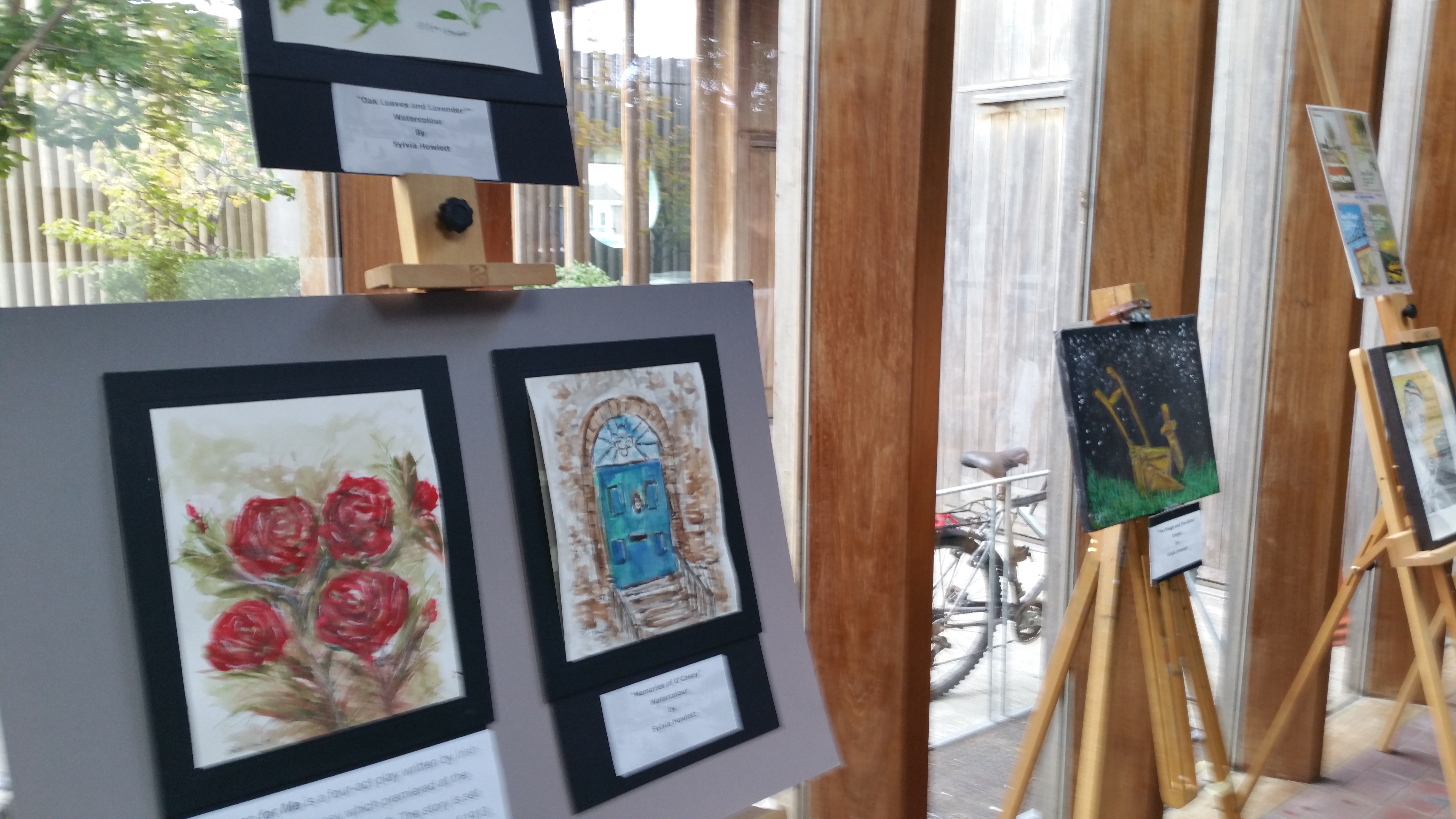
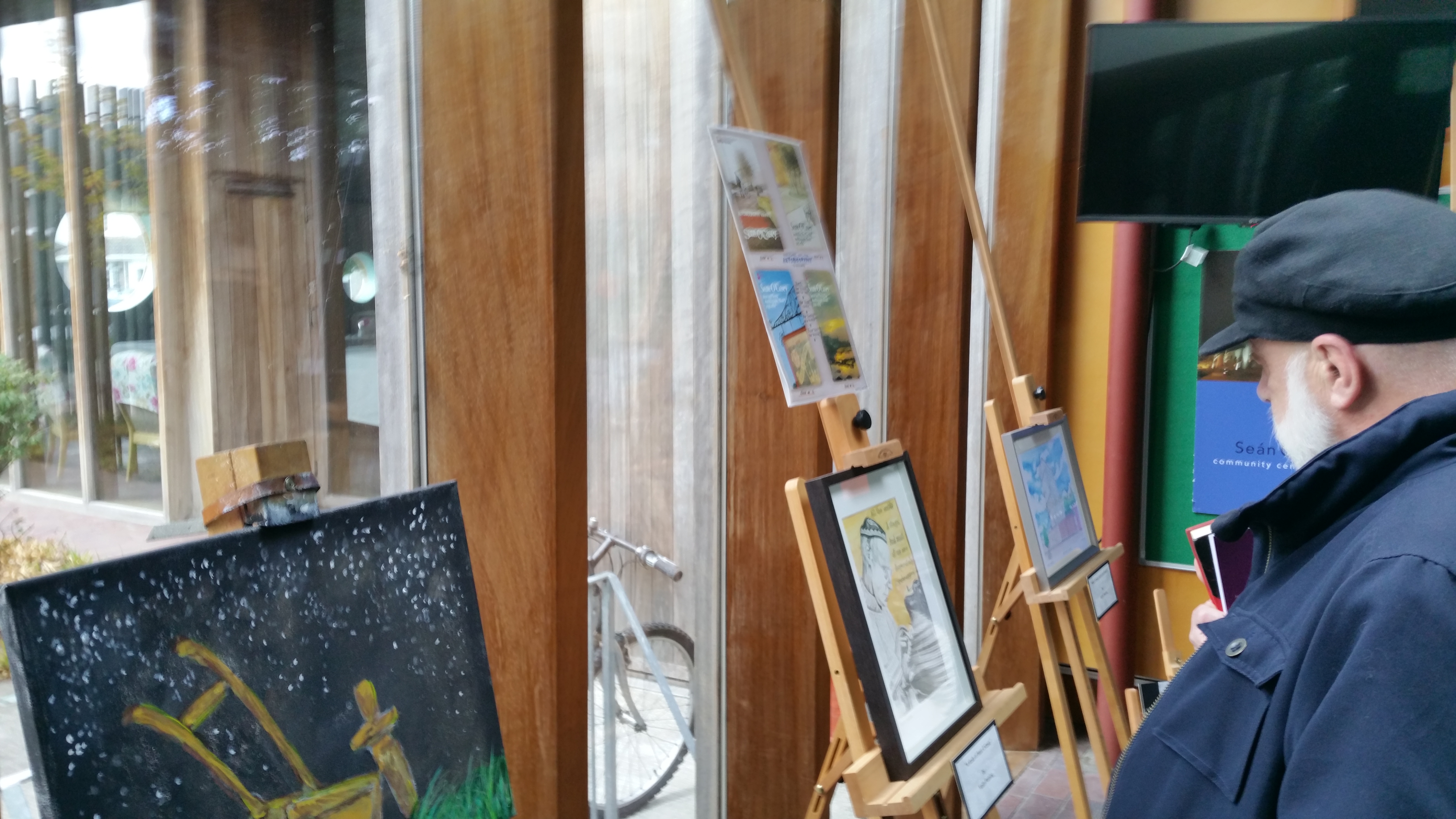
Marching from the plaque site, heading for the SO’C Centre (Photo: D.Breatnach)(Photo: D.Breatnach)Section of the attendance relaxing at the Sean O’Casey Centre between the plaque event and the films to be shown, also examining the art exhibition [see photos at end of post]
Back at the Sean O’Casey Community Centre, two short films were shown. One was a school project film in which a descendant of Jack Nalty interviews the latter’s nephew about his famous uncle. The second was dramatic film in which a Spanish trumpet player joins the fight against the fascist military uprising by Franco and other generals and features also actors playing two Irish International Brigaders, O’Connor and Charlie Donnelly3. When the former trumpet player is shot he sees into the future ….
Eddie O’Neill talked about the pulling out of the International Brigades in October 1938 in a bid to have the “non-interventionist” Western democracies put pressure on Nazi Germany and Fascist Italy to have them withdraw too, which did not happen. They marched through Barcelona on 17th October and were addressed in an emotional rally by La Pasionara4 and Eddie asked Nerea Fernández Cordero to read an English translation.
Nerea on stage just after reading translation of La Pasionara’s farewell to the Brigaders (Photo: D.Breatnach)Eddie O’Neill at the SO’C Centre with concluding speech: “We can’t afford to forget.” (Photo: D.Breatnach)
Nerea told the audience that she is from Extremadura (a province of the Spanish state next to the Border with Portugal) and her grandfather, Antonio Fernández had fought against Franco, been captured, escaped to the mountains but was in time recaptured. Upon his release he had married Nerea’s grandmother and lived a peaceful life. Nerea said that she was proud of her grandfather and those who fought Franco and that “ we know La Pasionara’s speech in Spanish by memory.”
Reading of translation of La Pasionara’s speech to English from Youtube:
At the event the newly published pamphlet “In Pursuit of an Ideal – from East Wall to the Ebro” about Jack Nalty wasmade available for the first time and copies are available from the organisers.
Eddie O’Neill recalled being in the Spanish state with a group from Friends of the International Brigades to commemorate those who fought against Franco during that war and afterwards searching for an appropriate pub in which to socialise. They found a pub with a Guinness sign and went there which however turned out to be one of the most fascist pubs in the area but undeterred, they continued to celebrate the memory of the antifascist fighters there. A lone man in suit and tie asked people as they passed him to use the toilet why they were commemorating people who had died so long ago but when they explained he said he could not understand English.
“We can’t afford to forget,” O’Neill told his audience, “least of all when the forces of fascism are gathering again.”
To conclude the event O’Neill called on Diarmuid Breatnach who sang the whole of Christy Moore’s “Viva La Quinze Brigada”, calling on the audience to join him in the chorus, remembering those who fought and gave their lives in the struggle against fascism.
Eddie O’Neill close at right of photo at unveiling ceremony (Photo: D.Breatnach)
AN ANNUAL EVENT?
The organisers are reputedly considering making this an annual event – it is to be hoped that they do so.
Another section of the crowd at the plaque unveiling. (Photo: D.Breatnach)Also at the plaque unveiling ceremony (Photo: D.Breatnach)
POSTCRIPT: JACK NALTY – ATHLETE COMPETING FOR IRELAND
In publicity prior to the event, the East Wall History group posted the following:
“In addition to his political and trade union activity, Jack Nalty was also a busy athlete, a regular competitor and medal winner with the Dublin Harriers. In 1931 he represented his country at the International Cross Country Championship, held at Baldoyle. Fellow competitor Tim Smyth became the first Irishman to win this competition.
“(The full Irish Group for the event held on 22nd March 1931 is listed as: Frank Mills, J. Behan, John Nalty, J.C. McIntyre, John Timmins, T. King, T. O’Reilly, Thomas Kinsella, Tim Smythe).
“This British Pathe footage shows the runners in action. Somewhere in the group is John (Jack) Nalty, East Wall resident, Republican and hero of the International Brigades. (The Pathe footage is viewable on post on the East Wall History Group event — CS)
“Ironically, the same year as the competition the future leader of Irish Fascism, General Eoin O’Duffy had become the President of the National Athletic and Cycling Association (NACA) , and apparently was an admirer of Jack Nalty as an athlete!”
(Photo: D.Breatnach)
FOOTNOTES
1Basques in the provinces of Bizkaia, Guipuzkoa and Alava say it was not a civil war there, i.e between different sections of Basque society — the fascist forces came from outside. In the fourth southern Basque province of Nafarroa, where the Carlists took control, they wiped out around 2,000 antifascists but it was hardly a war. The Catalans also say that the fascist forces invaded them and that it was not a civil war but an antifascist one. In some other places in the Spanish state many also say that the presence of Nazi German and Fascist Italian military in such numbers invalidated the term “civil war”.
2Also known as “Viva La Quinta Brigada”, which is however also the title of a different song from the Anti-Fascist War. Both titles are correct for this song since the Irish were in the Fifth of the International Brigades but when added to the ten indigenous Brigades (Spanish, Basque, Catalan etc), that became the Fifteenth. Wikipedia quotes authors to report an estimate that “during the entire war, between 32,000 and 35,000 members served in the International Brigades, including 15,000 who died in combat; however, there were never more than 20,000 brigade members present on the front line at one time.”
3Charlie Donnelly was a poet and member of the Republican Congress. He went to Spain to fight against Franco, where he died in February of 1937 at the Battle of Jarama. He is also one of those 19 names mentioned in Christy Moore’s song (“Viva La Quinta Brigada” or “Viva La Quinze Brigada”).
4Isidora Dolores Ibárruri Gómez(9 December 1895 – 12 November 1989), born and brought up in the Basque Country to a Basque mother and Spanish father, founder-member of the Spanish Communist Party and known for her political writing and speeches. She wrote an article when quite young under the pen-name “La Pasionara” (the Passion Flower) and was known by that nickname throughout her life.
Dublin City Councillors at their meeting on Thursday (13th September) voted by huge majority not to sell the former Magdalene Laundry building in Seán McDermott Street in the city centre. Deputy City Manager Brendan Kenny had earlier announced the possibility of the Council selling the building at an expected price of €14.5 million to a Japanese company that planned and hotel and supermarket on the site.
A campaign group called Separate Church & State had lobbied for the building to become a memorial to the suffering of the inmates of the Magdalene Laundries. The group called people to support an event outside City Hall to coincide with a motion being put forward to prevent the sale of the building. A range of people attended, seeming mostly Left social and political activists independent of any party and a sprinkling of People Before Profit activists.
The motion was propose by Gary Gannon, a Councilor of a very small political party (with only one member on the Council), the Social Democrats. However the motion was supported by the overwhelming majority of a Independent councillors (i.e of no party) and those belonging to a number of other parties and was passed with 37 voting in favour, eight against and two abstentions.
Campaigners and supporters in front of Dublin City Hall from across the street (Photo: D.Breatnach)
The successful motion called on the Council not to sell the building and land and that instead those who suffered abuse there should be commemorated with a memorial. Other than preventing the sale, exactly how the memorialising might be put into effect remains to be outlined and agreed. There is talk of the State taking it over but whether by donation of the Council or sale has not been clarified. There are very few memorials to the Magdalene Laundry victims and all but one of them are small.
The Sean McDermott building appears to have been the last of the Magdalene Laundries in Ireland and was closed in 1996. It is also the last of those buildings in the possession of Dublin City Council.
(Photo: D.Breatnach)
The significance of the victory is greater than that of elected representatives versus unelected City Managers, the former being more responsive to public pressure than to the demands of high-ranking officials who seem happy to hand over much of the city centre to property speculators, shopping centres, hotels and large student accommodation complexes.
The terms in which the issue was raised are an attack on the legacy of the Catholic Church’s grip on secular society and its relationship with the State. The campaigners clearly see the Council vote as a victory, though a moral one, against that legacy. And they are planning to press ahead with the offensive in the terms indicated by the title of their campaign, indicating further targets such as the national health and education services, along with legislation to follow on the national referendum’s rejection of Amendment 8 of the Constitution outlawing abortion.
The Magdalene Laundries – some brief background
The Magdalene Laundries were a major institution of the Irish Catholic Church from the 18th to the late 20th Century. There were some Protestant parallels too in the Six Counties (“Northern Ireland”) run by the Anglican and Presbyterian churches but the vast majority of the Irish population were of the Catholic faith. The Laundries took in and accommodated women who were considered “fallen women” which at first meant sex workers but later included unmarried women who had a child or children or even women whose behaviour was considered immoral or flirtatious (or even whose beauty attracted male attention) and they were put to work in the laundries for no pay. Ostensibly at first a charitable initiative, their title drew on the New Testament story of Mary Magdalene who, from being a “morally loose” woman, after meeting him became one of the most ardent supporters of Testament’s Jesus.
But if the name was associated with the alleged mercy and lack of judgementalism of the Christ, it also implied moral sin and judgement. In the extremely conservative Catholic Church that it became after the Great Hunger, the main element was likely to be punishment and, when allied to an also socially reactionary political class, the Laundries became an institution of social control of the Catholic Church in Ireland and of the new Irish State.
The Magdalene laundries soon became known to their inmates as places of hard work and ill-treatment, mostly of a psychological nature but also physical. If women left them without permission, they were pursued by the police and brought back. Continuous escapes could lead to jail sentences.
(Photo: D.Breatnach)
During their time in operation an estimated 30,000 Irish women were kept in these institutions in Ireland, approximately 11,000 after the State was created in 1922.
The horrors of these “charitable institutions” began to be revealed to the public during the last decade of the 20th Century, notably in 1993 after a mass grave of 155 corpses was uncovered in the north Dublin convent grounds which housed one of the laundries and the last Laundry was finally closed down in 1996. The Church never accepted any financial responsibility for reparations.
The Irish State set aside a sum of up to €58 million (about half of which has been paid out – see Links) but the religious institutes concerned, the Sisters of Mercy, Sisters of Our Lady of Charity of the Good Shepherd and Sisters of Charity refused demands from the Irish Government, the UN Committee on the Rights of the Child and the UN Committee against Torture, along with other groups in Irish society, to contribute to the compensation fund for the the surviving victims, an estimated 600 of whom were still alive in March 2014 (see Wikipedia in Links).
(Photo: D.Breatnach)
The Taoiseach (Prime Minister) of the Irish State apologised publicly and emotionally in the Dáil (Parliament) in February 2013 but the State never accepted any legal responsibility, its representatives saying that they did not control the Church. When they were reminded that the victims had washed not only clothes and vestments of priests and nuns but had also done laundry service for such state institutions as Aer Lingus, the Irish Army, the Gárdai, the State’s representatives declared that the Laundries were like any other contractor in that regard and that the State could could not accept responsibility for how contractors treated their “employees”. But it is known that State courts sent a number of women to the Magdalene Laundries. And it was the State that allowed the Catholic Church to dominate social care, health care and education, areas which are usually considered the responsibility of the State.
The general story of the Laundries is fairly well-known in Ireland now through media coverage and the testimonies of victims and even abroad in some countries through the 1992 Peter Mullan film Magdalene Sisters (see Links) and a number of documentaries for TV. Mary Coughlan sang a fierce attack on them too the same year as the film, composed by J.Mulhern (see Links for a Youtube video).
View of the protesters outside the meeting (some were inside) looking eastward. (Photo: D.Breatnach)
There are very few monuments to the suffering of the victims of the Magdalene Laundries and they are all of a small size except the statue in Ennis which aroused some local controversy.
The monument at Forster Street, Ennis, Co. Clare, dedicated to the Magdalen women and a subject of some controversy. (Photo: Mike Shaughnessy)
Despite the duration of their existence and numbers involved and the international coverage, the Pope claimed when tackled by some survivors on his recent visit to Dublin that he had no knowledge of the existence of the institutions.
Sale of Council buildings and land – the legal position and some background
Due to a legislative change some years ago, Dublin Council Executives such as the City Manager and Senior Planning Officer can make major decisions without consulting elected Councillors and even against their expressed wishes. In this way, for example, the planning permission for the Shopping Centre Plan over the Moore Street Battleground and Market quarter was firstly agreed and secondly, even after the High Court judgement that it is a national monument, was renewed in 2016 by the Chief Planning officer of the time, Jim Keogan.
Many feel and have felt since such decisions that this is an unhealthy state of affairs, with no democratic controls and leaving key officials open to suspicion of bribery from developers influencing their decisions.
Fortunately however when it comes to the disposal of Council assets, the Councillors must agree by majority. This prevented the “land swap” proposed in 2014 by Joe O’Reilly of buildings in Moore Street, which if successful would have enabled his company to demolish half the 1916 Terrace: responding to campaigners and interested elected Councillors, the Council voted the proposal down against senior officials’ recommendations in November of that year.
Thank you so much for visiting our island (well, the independent part). It was a wonderful experience and its effect upon us, the faithful, was at one and the same time energising and calming. And for sure we needed that, needed it so badly.
These past few years have seen this state sinking into greater and greater godliness, between different lifestyles on the one hand and the terrible revelations of what went on in some of the religious charitable institutions on the other.
Pope Francis (Photo sourced: Internet)
Years ago we lost the battle on condoms and the Pill but our Church survived that. And to be honest, if some of the priesthood were going to engage in immorality then it would have been better if they had indeed used condoms, God help me for saying that – but certainly in the case of a certain Galway bishop it would have been useful …. for the Greater Good, of course.
But then legal divorce, and we survived that too. It seemed hardly had we managed to coexist with those travesties than we had marriage between homosexuals legislation, now flaunting their sinful ways not only publicly – but legally married! And now, worst of all by far, abortion legalised! Well, up to three months of pregnancy but we all know, the faithful and the sinful, that once that door is wedged open ….!
Of course the abuse in the institutions run by religious orders was shocking, both in its content and extent. But people want to throw the baby out with the dirty bathwater! Or the dirty laundry water, perhaps. And knowing what people are like and the enemies the Church had and has, of course it was necessary to cover it up. The first duty of any institution is to survive and therefore to protect itself. Why do people find that so hard to understand? Have we not seen political parties and governments doing the same for years? Why do people find it so strange?
So anyway, we badly needed some comforting, some reassurance and it was wonderful that in our hour of need, Your Holiness came. How wonderful to see the gold-and-white Papal Colours fluttering on flagpoles, on bunting festooned! To see so many youngsters bussed in to Dublin from other parts of Ireland, their faces aglow with the excitement (and not just because of a day out in other adolescent company, or in the excitement of youth overnight “camps”, as the cynics have commented). So what if they were somewhat incoherent or illogical when interviewed about their reasons for attendance! The brilliance of the Holy See is enough to bring incoherence to anyone!
And I understand, Your Holiness, understand perfectly why it was necessary to say Your Holiness had not known about the Magdalene Laundries. How could the mass of ordinary people be expected to understand the balancing act of the Holy See, between Perfect Good and Necessary Evil? To balance things in favour of the Greater Good? What a field day the media vultures would have had if Your Holiness had tried to explain the intricacies to them! And the unbelieving hyenas too would have gathered to the feast on our dying bodies, to crunch the bones of our faith.
Sure where else would the Irish priests, bishops and nuns have had their laundry done? Not to mention Áras an Uachtaráin, Guinness, Clery’s, the Gaity Theatre, Dr. Steevens’ Hospital, the Bank of Ireland, the Departments of Defence, Agriculture and Fisheries, CIÉ, Clontarf Golf Club and several leading hotels! In the end there was altogether too much dirty laundry washed in public really.
A Magdalene Laundry (Photo sourced: Internet)
Considering that the story involved the whole Irish church and was publicly recorded going as far as the US, and a film about it went right around the world, I thought it was very brave of Your Holiness to deny all knowledge. Only by the grace of God surely could Your Holiness have kept a straight face. I could not have managed it for a second myself but sure I am but a humble sinner.
Of course Your Holiness’ visit did not take place in the same society as we had in 1979, when your predecessor-but-one His Holiness John Paul the 2nd visited Ireland. One in ten boys born in 1980 were named John Paul in his honour. All the same, we can look forward to a crop of baby boys named Francis this year and next, though it’s unlikely to be anything like one in ten this time. We’d be lucky to reach one in thirty, if you’ll forgive my gloominess.
Still, even Francis — and we’ve had a crop of them over the years anyway, named after the two Saints of that name and maybe even after Frank Sinatra or – God help us – Frank Zappa! Yes, believe it or not, some parents were capable of doing that in the Sixties, Seventies and even the Eighties.
I was going to say, even Francis would be a mile more likely than your Holiness’ original names. I don’t imagine that many male Irish children born this year will be baptised “Jorge Mario”. I shudder to think of the damage done to that first name in Ireland. Horhay, would be the best attempt, I’d guess but for sure there would be Horjays, Georgeays and Georgies. Your Holiness doubts this? Your Holiness has yet to hear mothers calling a “Sor-tchah” in for their tea, instead of the actual centuries-old Irish name, “Sorcha”. Or to hear of a male or female child being proudly introduced as “Sheersheh” instead of “Saoirse”, which means “freedom” — but not the freedom to mangle Irish words, God help us!
Without wishing to be in the least insulting to Your Holiness but with a name like Mario ….. well, not many Irish or migrants are going to want to sound as though their children are Italian – except of course in the Irish-Italian community. Then also, how many would want their child’s name to remind people of a popular 1980s video game, perhaps imagining all kinds of things about the parents, what they were doing when the mother conceived, etc …. And Princess Toadstool! I ask you! Pagan erotic symbolism for sure!
Forgive me, Holy Father, I have digressed.
Anyway, I hope the visit did not tire Your Holiness out too much and hope the ten thousand or so oppositional marchers did not even impinge on Your Holiness’ consciousness. To us however that showing was worrying – a couple of decades ago, only a score would have dared and they would not even have been allowed on the street!
There are signs that soon we will face a battle over the Church’s control of the primary and secondary educational institutions in Ireland. The Godless have the bit between their teeth now and it seems they will shy at no obstacle. Sorry, that’s a riding metaphor; does Your Holiness ride?
It seems we are in danger of losing the gain for which the Holy Mother Church has been striving since the mid-1800s, and which even that Protestant fornicator Parnell championed for us. If we lost control of the schools, Catholic baptisms and marriage ceremonies would cease to be required to get on the premium enrollment lists. Then religious sacraments would be confined to the truly religious and Holy Communion and Confirmation would slowly disappear out of the schools. Losing Education would mean losing most of the population of this state and already the Godless are circling. I shudder to think of it.
Poster with principles of Education Bill being promoted in Ireland (Photo sourced: Internet)
Would it be wrong of us to pray for a religious spectacle, Holy Father? Some kind of miraculous apparition, such as with the young wans at Lourdes or at Fatima? It does seem as though only a miracle might save the Church here in the long run.