INIGO CABACAS KILLED BY POLICE – RELATIVES AND FRIENDS WAITING THREE YEARS WITHOUT JUSTICE

INIGO CABACAS KILLED BY RUBBER BULLET FIRED BY BASQUE POLICE IN 2012 — STILL NO JUSTICE FOR FAMILY OR FRIENDS

Diarmuid Breatnach

Most Basques and especially supporters of their most popular football team, Athletic Bilbao1, were very happy in the early evening of 5th April 2012 . 

Inigo Cabacas Gaztelugatxe
Inigo Cabacas, photographed with the Basque hermitage Gaztalugatxe, on the Biscay coast, in the background.

Their team had beaten a football giant in the UEFA cup twice and another premier European team once. The fans were expecting Athletic to win or at least draw again that evening, in which case Athletic Bilbao were through to the second leg of the quarter-finals. They had no idea that the evening would end with a police riot squad firing rubber bullets into a festive crowd, causing the death of a young fan.

The high expectations of that evening in Bilbao were the result of a run of wins for the Athletic team. On March 8th 2012, Athletic Bilbao beat Manchester United 3-2 on their own ground, at Old Trafford.

One needs to know a few population statistics to understand what an achievement that was. Manchester United is a football team on the world stage, based in a city with a population of 2.55 million – that is not far from the population figure for the entire Basque Country. In addition, Manchester United’s players are drawn from around the world; Athletic recruits only Basque players from a total population of the Basque Country of less than 3 million.

A week after their win in the northern England city, on March 13th, Athletic faced Manchester United again, this time on the Basque team’s home ground, San Mames, in Bilbao. Manchester Utd. were beaten 2-1 and it seemed that the Basque lions2 were unstoppable.

These wins created a huge interest in the next game, which was with FC Schalke 04 on March 29th at the German team’s home ground. Schalke plays in the top tier of the German football league and have won many championships including one UEFA League. With around 130,000 members, Schalke 04 is the third-largest sports club in the world in terms of membership, behind their compatriot rival FC Bayern Munich and Portuguese club SL Benfica.

Athletic Bilbao is not a sports conglomerate – it is a football club which is owned by its 40,000 members (remember, this is a small country – that’s nearly 1.5% of the whole population! It’s also around 11% of the population of their home base, Bilbao). The management board is elected by the membership.

At Schalke 04’s home ground on March 29th, the Bilbaino team beat them 2-4. The interest was therefore at fever-pitch for Athletic’s return match with the German team at Athletic’s home ground, San Mames on 5th April. The result was a 2-2 draw but Athletic were ahead 6-4 on aggregate and the fans were delighted. Bilbao was, as they say, buzzing.

After matches, young fans especially go to different pubs around town. Inigo Cabacas and many others went to an Herriko Taberna (a “Peoples’ Tavern”, i.e. one managed by the Abertzale [Basque pro-Independence] Left) which is located in an small “square” with planters, connected by alley with Licenciado Poza street. This small “square” is off the María Díaz de Haro street near the stadium; it runs parallell with the San Mames street itself, an area of bars well-known as a destination for fans after a game at the stadium.

The Herriko is too small to accommodate all those who gathered there but that was no problem for the area outside took the overspill. Early in the evening a few people were seen scuffling there and the rest of the crowd around them told them to knock it off, this was a time for celebration, etc. The scuffle ended and the festivities continued.

Some time later, a van load of police arrived. These were the Ertzaintza, a Basque Police force of 7,500 created in 1982 which has had numerous clashes with Basque strike pickets and with the Abertzale (pro-Independence) Left. Supporters of the Abertzale Left and many others refer to the Ertzaintza as “zipayos” (i.e. “sepoys”, local soldiers recruited by colonial occupiers). The Ertzaintza are responsible to the Basque Autonomous Region Government (CAV), a semi-autonomous entity covering three of the four southern Basque provinces.
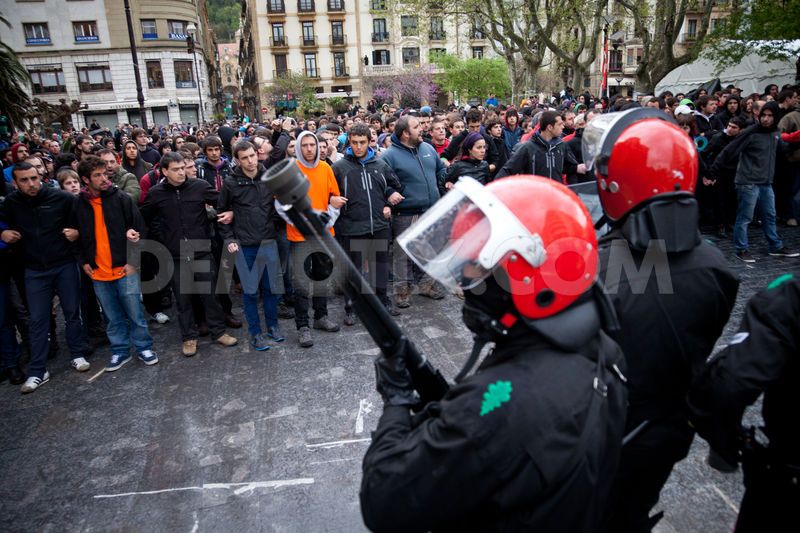
Basque Police, the Ertzainta, face youth Solidarity Wall with a Basque comrade the police have come to arrest in Donosti/San Sebastian some years ago.
Basque Police, the Ertzaintza, face a youth Solidarity Wall built to defend Basque comrades the police have come to arrest in Donosti/San Sebastian some years ago.

Some of the youth perceive the arrival of the masked and helmeted police as a provocation and begin to throw bottles at the van.

The police officer in charge of those in the van asks for reinforcements and these are sent. The police emerge from their vans and begin to fire rubber bullets3 at the crowd at quite close range (the “square” is less than 45 metres at its furthest from the street) and everyone scatters except for a small group who are throwing bottles at the police but even they eventually dive for cover. People are sheltering in doorways, huddled up against the walls on each side of the “square”. Some are inside the pub wondering what is going on. A local shop-manager has raised the shutter over his doorway and people crowd in there. Some people are sheltering behind the wooden planters that are in a line down the centre of the narrow square.

After some time three young men walk towards the police with their hands in the air, asking them to stop firing rubber bullets; the police strike them with batons. Meanwhile it comes to the attention of some in the crowd nearby that a person is lying on the ground, apparently unconscious with blood coming from his ear and the rear of his head. People go to his aid and one of his friends recognises Inigo Cabacas. He gets his mobile phone and rushes towards the police telling them that someone has been seriously injured and to call an ambulance. A police officer tells him to drop the mobile. Inigo’s friend repeats his urgent request and the police officer tells him again to drop the mobile and hits him with a truncheon. The man drops his mobile and retreats from the police.  

The police advance into the area and reach the injured man who has some people around him; a women is rendering first aid.  A policeman tells her to move away.  She tells him the man needs and ambulance and that she is applying pressure to stop the bleeding.  He says he wants to see for himself and pulls at her arm but after awhile desists and goes away.

Eventually an ambulance arrives and takes Inigo Cabacas, still unconscious, to hospital, where he lies in a coma.

(video of the scene of the incident and interviews with friends and witnesses with English subtitles)

The news runs through a city, a shock in the midst of its celebrations and soon afterwards throughout the Basque Country. The first official reaction is given by the Interior Minister of the Basque Autonomous Regional Government, who declares to the press that the Ertzaintza acted properly and in line with their procedures, although he regrets the unfortunate death of they young man. He also repeats the first line of defence given by the Ertzaintza, that they were called to help someone injured in a fight and that the crowd was preventing the ambulance in attendance from rendering assistance to the injured.

When eye-witnesses give their version and the reporters of some newpapers begin to gather information, it becomes clear that the Minister could not possibly have investigated the incident in the time available. Furthermore, it emerges that no ambulance attended until after the incident with the police and that it appears that no call for one had been made earlier. Furthermore, according to the woman who attended to Inigo at the scene, the ambulance paramedic told her, when she complained at their delay in arriving, that the police had delayed their entrance. Under a storm of criticism from civil society and from the Abertzale Left party, EH Bildu, the Minister promises a full investigation.

Inigo Cabacas dies after three days without having recovered consciousness.

Some time later, a recording of the police communications on the night is made available by GARA, a pro-Independence Basque daily newspaper. The following becomes clear from the recording:

  • The Controller at Ertzaintza HQ calls a police van leader and directs him to attend the Herriko, saying that a fight has occurred there and that someone is injured.

  • The van leader reports that they have arrived and that some are throwing bottles at them, that they require reinforcements.  No mention of ambulance.

  • The Controller confirms reinforcements are being sent.

  • Reinforcements arrive. One of the van leaders now reports that nothing is happening, everything is ok.

  • The Controller replies that he wants the police to go in and take possession of the area and make any arrests necessary. He emphasises that he wants to be understood clearly, that they are to “go into the Herriko with everything we have”, to take control of the area “and then everything will be ok.”

  • The van leader replies that the order is understood and soon shots are heard (the firing of rubber bullets).

The family employs a solicitor. A judge is appointed to carry out the investigation but is required to do so along with her other duties. Immediately, the police investigation ceases (according to the family’s lawyer, ithe file contains just three pages), using the excuse of the judicial investigation.

A number of legal applications are made, e.g. for all the police at the incident to be obliged to make a statement, for all police who fired a rubber bullet gun to be identified, for the Controller to be obliged to make a statement, but all are refused by a judge, giving a number of reasons4. Little is established over the following three years, except that three police voluntarily admit to having fired rubber bullets and the identity of the Controller on the evening becomes widely known. There is widespread outrage when the senior officer on duty the day of Inigo’s death is appointed Chief of the Ertzaintza. At a recent press conference, the Cabacas family’s lawyer, Jone Goirizelaia, announced that they had possibly identified the officer who had fired the fatal shot.

It emerged during the campaign by supporters of the Cabacas family that no recognised procedure was followed by the police with regard to the incident: debriefing statements were not taken from each of the police participants, guns were not examined to identify which had been fired, no inventory was taken of the number of rubber bullets fired. No attempt was made to contact witnesses after the event to gain a picture of what had occurred. Indeed, some witnesses who approached the police station to give statements were told to go away (see video link posted earlier in this article). It further appears that the Ertzaintza have been issued with no specific operational instructions with regard to the firing of rubber bullets.

According to some sources, the rubber bullets should only be fired at knee-height and at no less than 50 metres from the target. The “square” is, according to locals, less than 45 metres at its furthest from the street and therefore the police from the moment they began firing, were in serious breach of the minimum distance requirements. In addition, the Ertzaintza have frequently been seen aiming their rubber bullet guns at protesters’ faces from as little as a metre or two and also firing from the shoulder with the muzzle parallel to the ground, i.e. directed at head or chest-height of the target. Also, the rubber-coated steel balls bounce uncontrollably.

Rubber bullets against Palestinians

Rubber bullets are regularly fired by the Israeli army at Palestinians. A Palestinian source reports: “Israeli professor Michael Krausz and colleagues at the Rambam Medical Centre in Haifa analysed the medical records of 595 casualties admitted to hospital during the October 2000 protests by Palestinians living inside Israel (typically described as “Israeli Arabs” by the media). Of those, 152 were found to have been injured by rubber-coated metal bullets. Injuries were distributed randomly across their bodies but were most common on the patients’ arms and legs, and on their head, neck and face.

“The doctors said their findings dismissed the theory that “rubber bullets” were safe. Rubber-coated metal bullets with some of their rubber coating removed, revealing their hard steel core. Fired at speeds of what must be several hundred feet a second, these are munitions that cause enough damage that their manufacturers feel compelled to describe them as only ‘less lethal’.

“Writing in the Lancet, they said firing the bullets at civilians made it ‘impossible to avoid severe injuries to vulnerable body regions such as the head, neck and upper torso, leading to substantial mortality, morbidity and disability.’ They added: ‘We reported a substantial number of severe injuries and fatalities inflicted by use of rubber bullets ….. This type of ammunition should therefore not be considered a safe method of crowd control. “The study, ‘Blunt and penetrating injuries caused by rubber bullets during the Israeli-Arab conflict in October, 2000: a retrospective study’ (The Lancet, Volume 359, Issue 9320, Page 1795), also highlighted previous research which suggested that even plastic bullets may not be safe and may cause more severe head injuries.” (Sourced at http://electronicintifada.net/content/misleading-terminology-rubber-bullets/4000)

Rubber bullets against the Irish

Seventeen people were killed in the Six Counties (“Northern Ireland”) by rubber and plastic bullets fired by British soldiers (11) and colonial police (6) during the 30 Years War. A number of people were also blinded. http://cain.ulst.ac.uk/issues/violence/rubberplasticbullet.htm

It emerged in 2013 during a compensation case taken by a Derry man blinded in 1972 that the authorities knew that the missiles were potentially lethal even before they issued them. (http://www.theguardian.com/uk/2013/jun/11/mod-rubber-bullets-lethal-records) It is clear also from a wealth of evidence that the missiles were regularly fired by soldiers and police not only at close range but also aimed at chest or head. In addition, a deadly ‘game’ was played by some British soldiers. Knowing that rubber and plastic bullets were collected by children as mementoes and objects to sell to tourists, soldiers would fire some into an open area and wait for children to run forward to collect them, then see if they could hit the children with subsequent rounds.

Rubber bullets in the Spanish state

The Spanish state continues to allow its police forces to carry and to fire rubber-coated metal bullets, in particular at protesting Basques and Catalans (see video link at bottom below article). Recently, the EU expressed concern at Spanish police firing at migrants attempting to swim into the Spanish state from Morocco, an occasion when 11 of the migrants drowned. But no international protest criticises them for firing potentially lethal missiles at their own citizens. Police in the Spanish state enjoy impunity and none more so than in the Basque and Catalan countries as well as with regard to African migrants. This week, a motion was put to the Basque Parliament to ban the use of rubber bullets in the area under its control (CAV). Instead a proposal was accepted to “restrict” the use of the missiles to “situations of grave danger” to the police, and to “definitely seek a replacement” for them. The Spanish right-wing PP, the liberal Spanish unionist UPyD, along with the PNV (Basque Nationalists), currently in power, voted for it, along with the Basque version of the Spanish social-democrats, the PSE. The only party to vote against the amendment was EH Bildu, party of the Abertzale (pro-Independence) Left; they had proposed the original motion, seeking a total ban and the removal of the missiles.

Parent and friends of Inigo Cabacas confront spokesperson of the Basque Nationalist Party after attempt to ban rubber bullets fails

Among those in the public gallery at the discussion were the parents of Inigo Cabacas. Afterwards, in the corridor outside, they confronted the spokesperson of the PNV, Joseba Egibar. During the exchange, another PNV parliamentarian, Luke Uribe-Etxebarria, tried to prevent its filming by the Basque TV station ETB. That attempt will be the subject of a complaint to the President of the Parliament by EH Bildu; they view it as particularly serious since Uribe-Etxebarria is also on the management board of the TV station and the filming was taking place in areas open to the public.

“I’m never coming to this Parliament again …. I feel cheated,” said Manuel Cabacas, father of the deceased, speaking about the majority decision. “My son is dead …. I only wanted to ensure that it would never happen to anyone else ….”

On the third anniversary of the killing of Inigo “Pitu” Cabacas, among many commemorative vents in the Basque Country, 10 minutes’ silence was observed in the San Mames stadium. Alongside Inigo Cabacas; many are also remembering Aitor Zabaleta, fan of the Real Sociedad team, murdered in Madrid in 1998 by fascist ultras of Club Atletico Madrid.  Many Basques around the world will be conscious of the three years that have passed since Inigo’s killing without anyone being even charged in connection with his death or any noticeable change, whether in Basque police behaviour, procedure or their use of rubber-coated steel projectiles.  A change of political control of the Basque Regional Government from the social-democratice party of Patxi Lopez to the Basque Nationalist Party . (PNV) of Urkullu has had no effect.

It is true that for ordinary people, in capitalist society, the wheels of justice move very slowly; in this case it is hard to see that they are moving at all.

End.

NB: DUBLIN: A group of Basques plan to hold a commemorative event on Tuesday 28th April, on the day of a Basque derby, Bilbao Athletic v. Real Sociedad. They plan to hold a protest picket at the O’Connell Monument in Dublin’s O’Connell Street at 7pm for a short while and afterwards to go to watch the Basque derby (kick-off at 9pm) at the Living Room bar, Cathal Brugha St. Some Dublin-based Irish people have undertaken to support the Basques by participation in both events.  Poster for event: https://www.facebook.com/photo.php?fbid=10153291310864390&set=gm.1624681737767253&type=1&theater

Short but shocking Guardian video of Catalan police using rubber bullets and the testimonies of victims who have lost an eye to the missiles:

http://www.theguardian.com/world/2014/apr/30/catalonia-police-banned-rubber-bullets

Footnotes

1 Based in Bilbao, it is the most popular and most successful (two things that often go together) but not the only football team; there are also Real Sociedad, based in Donosti/San Sebastian and Osasuna, based in Iruña/ Pamplona.

2  A roaring lion is the emblem of the team, arising from the legend of St. Mames, to whom the local church is dedicated and which gives its name to the area, street and stadium. English-language football commentators persisted in calling the team “the Spanish lions” or “the Spanish cavaliers” (??!), in total ignorance, one hopes, of quite how insulting that would be perceived by the players and their fans. The Basque Country is not even politico-geographically Spain, it is divided between the Spanish and French states. And Bilbao Athletic is most certainly not, nor has it ever been, a Spanish team. When the Spanish King attends finals or semi-finals between Barcelona and Athletic in, yes, a Spanish football league, and the Spanish national anthem is played, the stadium fills with howls of derision, hoots and whistles from the supporters of both teams.

3  These are about the size of a tennis ball, perhaps a little smaller, of steel and coated in rubber.

4  E.g., the Controller could not be held responsible for the shooting by the police; individual police would have to be accused of firing the fatal shot if they were to be obliged to make a statement …
JE NE SUIS PAS CHARLIE (I AM NOT CHARLIE)

By José Antonio Gutiérrez Dantón / Friday 9 January 2015 (translated from the original in Castillian)


To begin with, let me make it clear from the outset that I consider the attack on the satirical magazine Charlie Hebdo to be an atrocity and that I do not believe that it is justifiable under any circumstances to make a military target of a journalist, no matter what our opinion on the quality of his journalism may be. The same is valid in France, as it is in Colombia or in Palestine.

Also, nor do I identify with any fundamentalism, whether it be Christian, Jewish or Muslim, nor indeed with Frenchified mock-secularism either, which makes a goddess of the “République”.

I present these necessary explanations since no matter how much the high priests of politics insist that we live under an “exemplary democracy” with “great liberties”, we all know that Big Brother is watching us and that any speech outside the script is severely punished. But I believe that to condemn the attack on Charlie Hebdo is not the same as celebrating a magazine that is, fundamentally, a monument to intolerance, racism and colonial arrogance.

I cannot view with equanimity the constant symbolic aggression that has as its counterpart a physical and real aggression, which is the bombing and military occupation of countries belonging to this cultural horizon. Nor can I happily these cartoons and their offensive texts with a light heart, when Arabs are one of the most marginalized, impoverished and exploited sectors of French society which has historically been brutally treated.

I do not forget that in the early 1960s, in the Paris Metro, the police massacred 200 Algerians by clubbing, just because the latter were demanding an end to the French occupation of their country, which had already led to a total of a million dead “uncivilized” Arabs.

This is not about innocent cartoons drawn by free thinkers but rather about messages produced by mass media (yes, though in an alternative posture, Chalie Hebdo is part of the mass media), loaded with hatred and stereotypes reinforcing a discourse that considers the Arabs as barbarians to be contained, uprooted, controlled, represed, oppressed and exterminated. These are messages the implicit purpose of which is to justify the invasions of Middle Eastern countries as well as the many interventions and bombings orchestrated in the West in defence of the new imperial map. The Spanish film actor Willy Toledo controversially commented, no more than was obvious, that “The West kills every day. Silently.” And that is what Charlie and his black humour hides under the cover of satire.

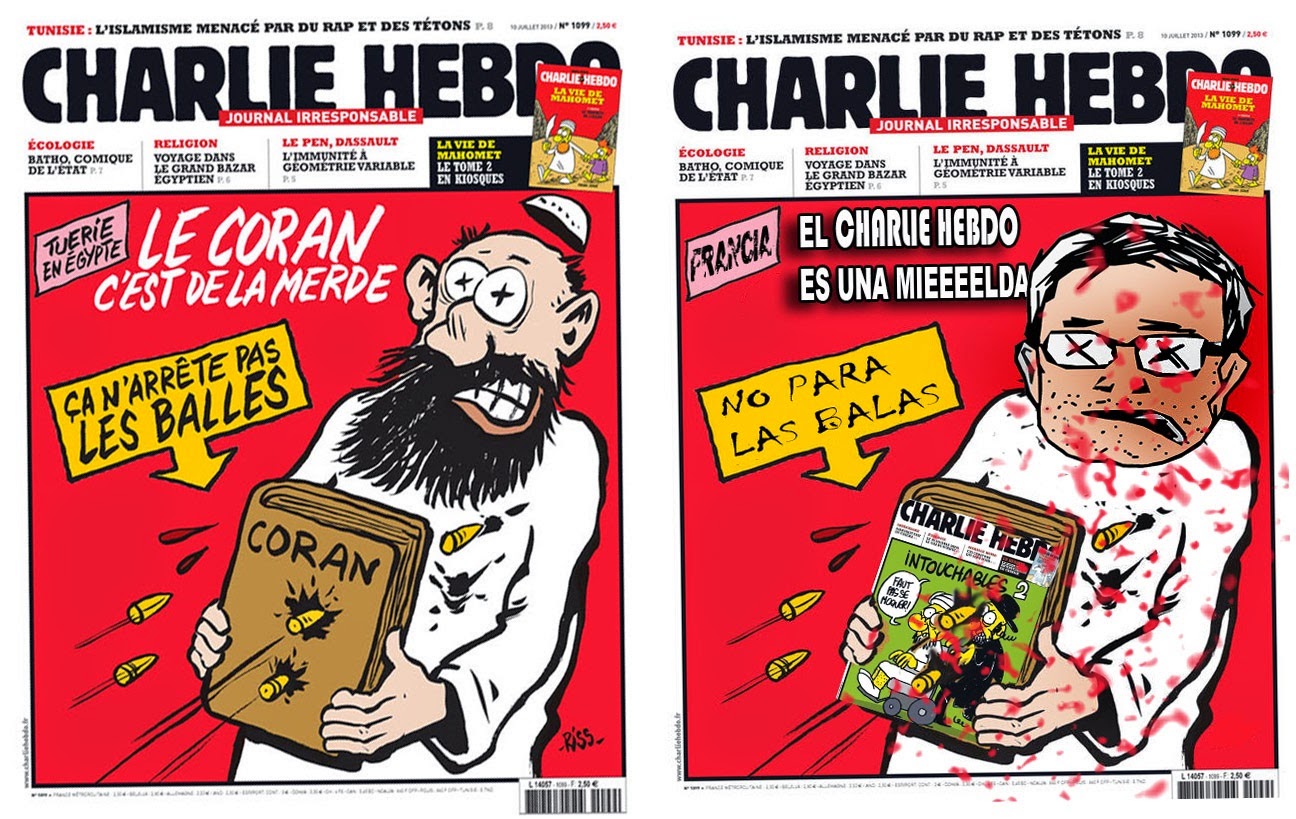
I do not forget the front cover of Charlie Hebdo issue N°1099, in which it trivialized the massacre of more than a thousand Egyptians by a brutal military dictatorship which has the approval of the USA and of France, carrying a cartoon with a text declaring “Slaughter in Egypt. The Koran is shit: it doesnt stop bullets.” The cartoon showed a Muslim man riddled with bullets that had passed through a copy of the Koran, with which he had been trying to protect himself. Perhaps some find this funny. In their time too, the English colonists in Tierra del Fuego, Argentinia, thought it funny to have photographs of themselves taken, with wide smiles and rifle in hand, a foot on the corpses of the still-warm and bleeding bodies of the native people they had hunted.

Charlie Hebdo cartoon referring to the attack on Egyptian protesters in which 1,000 were killed.
Charlie Hebdo cartoon referring to the attack on Egyptian protesters in which 1,000 were killed.  Juxtaposed, an imaginary cartoon treating the attack on Charlie Hepdo in a similar manner.

Rather than funny, that cartoon to me seems violent and colonialist, an abuse of the fictitious and manipulated western freedom of the press. How would people react if I were to design a magazine cover bearing the following text: “Slaughter in Paris. Charlie Hebdo is shit: it doesn’t stop bullets” and made a cartoon of the deceased and gunned-down Jean Cabut holding a copy of the magazine in his hands? Clearly that would be outrageous: the life of a Frenchman is sacred. The life of an Egyptian (or Palestinian, Iraqi, a Syrian, etc.) is “humoristic” material. For that reason I am not Charlie, because for me, the life of each one of those Egyptians pestered is as sacred as is any of those caricaturists assassinated today.

We already know what to expect now: there will be speeches defending press freedom from countries which in 1999 gave their blessing to the NATO bombing of the Serbian public TV station in Belgrade, calling it “the Ministry of Lies”; countries that remained silent while Israel bombed the Al-Manar TV station in Beirut in 2006; those that respond with silence to the murders of Colombian and Palestinian critical journalists.

After the beautiful pro-freedom rhetoric will come the liberticide action: more McCarthyism, disguised colonial “anti-terrorism”, more colonial interventions, more restrictions of those “democratic guarantees” threatened with extinction and, of course, more racism.

Europe is consumed in a spiral of xenophobic hatred, islamophobia, anti-semitism (in fact, the Palestinians are Semitic) and this atmosphere has reached unbearable levels. The Muslims are already the Jews of 21st Century Europe and neo-Nazi parties are becoming respectable again, 80 years later, thanks to this detestable feeling.

Because of all this, in spite of the feelings of repulsion engendered in me by the Paris attack, Je ne suis pas Charlie.

Note on author:
José Antonio Gutiérrez D. is a libertarian political activist living in Ireland, where he participates in the movements of solidarity with Latin America and with Colombia, a contributor to the CEPA (Colombia) magazine and to El Ciudadano (Chile), and also to the international web page  www.anarkismo.net.  He is author of  “Problemas e Possibilidades do Anarquismo” (in Portuguese, Faisca ed., 2011) and coordinator of the book “Orígenes Libertarios del Primero de Mayo en América Latina” (Quimantú ed. 2010). 

MASS MEDIA MANIPULATION – REPORTING ON THE ISRAEL-PALESTINE CONFLICT

Diarmuid Breatnach


Palestinian supporters and other critics of Israel’s bombardment of Gaza have long complained about the western mass media’s reporting of the conflict in Palestine. The complaints have outlined reporting slanted in the Israeli state’s favour and/or specifically against the Palestinians and their representatives.

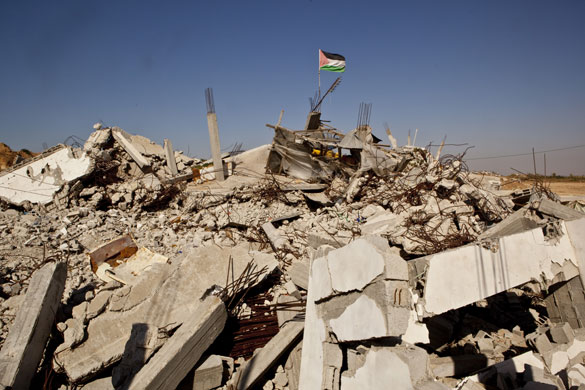
Palestinian flag flies over the rubble of a Gaza neighbourhood after Israeli bombardment 2014 (photo Antonio Olmos)

Umberto Ecco once defined language as a system of communication through which one could tell lies. There is no doubt but that our mass media uses language. Their editors and reporters herd us as sheep are herded by trained dogs, sometimes with barks and snaps of teeth but more usually through nudges and subtle changes of posture. They direct us to the pen where we are wanted or, at the very least, away from freedom.

In order to demonstrate the techniques used I have taken an example of reporting on the conflict and analysed it. The piece chosen is far from being one of the worst pro-Israeli or anti-Palestinian pieces of journalism – it is actually quite mild and even points out the statistical imbalance in the killing of civilians by Israel’s armed forces on the one hand and by Palestinian guerrillas on the other hand. The report is by the Irish on-line newspaper The Journal and was put up by them in the middle of August 2014.

 The piece opens by saying that “Palestinian negotiators have been considering an Egyptian proposal to end the month-long Israel-Hamas war as the latest 72-hour ceasefire in the Gaza Strip is due to expire.”  

This first of all says that the conflict is a war which also implies some kind of equal balance in fighting forces and also a share in blame. But it is not a war between any two sides; if it can be called a war at all, it is a war by Israel only. Israel is the fourth-largest military power in the world, with an army, navy and air force equipped with some of the latest armament and surveillance equipment. The Palestinians have a number of guerrilla groups, operating as infantry and no air or naval force at all. Their “artillery” are low-level rockets and mortars which cause very little damage to Israeli civilians and even less to the Israeli armed forces (except at close quarters, if Israeli soldiers invade territory held by the guerrillas). Israel’s armament causes huge damage to Palestinian infrastructure, huge loss of civilian life and does cause some damage to the guerilla groups.

The phrasing also suggests that Hamas is the only opponent of Israel on the Palestinian side. However, Israel has been in conflict with the Palestinians since the very day it came into existence and long before Hamas appeared on the scene. Even today, there are a number of Palestinian political and military organisations that are opposed to Israel and its actions and all together they represent the whole of Palestinian society inside the occupied territories, inside the 1948 borders of the state of Israel and in the refugee camps and settlements. In the sense that one could say that there is a war going on, it is Israel waging war against the Palestinian people.

The very next paragraph in the Journal’s piece says that “Since the truce, which will expire at midnight, went into effect on Sunday, Israel has halted military operations in the coastal territory and Gaza militants have stopped firing rockets.”

We see presented here that on the one side we have “Israel” and on the other, “Gaza militants”. As in bourgeois media reporting “militants” usually has a negative connotation, this is already tending to turn the reader against the Palestinians in Gaza. On the other hand, we have “Israel” which we can interpret either as “a legitimate state” or as the Biblical “promised land of the Jews”. And that is being opposed by “militants” in Gaza. The phrasing legitimises the status of one side while de-legitimising the other.

We are also told that Israel has halted “military operations”, two words that hardly convey the sustained bombardment of Gaza’s civilian houses, schools, mosques, civil administration facilities, power plant, water treatment plant, factories, hospitals and emergency vehicles in recent weeks. It does not bring to mind the slaughter of over 2,000 Palestinians, the vast majority of them civilians and including 430 children. Not to mention the 9,567 wounded, including 2,878 children and hundreds of injured jamming the remaining ill-equipped hospital treatment centres.

Israeli "military operations" -- Shuja'iyya neighborhood of east Gaza City during a 12-hour ceasefire on July 26 2014.
Shuja’iyya neighborhood of east Gaza City during a 12-hour ceasefire on July 26 2014.

The paragraphs states that in return for the cessation of “military operations” by the Israelis, the Palestinians have “stopped firing rockets”. Actually, if this report had just gone into a little detail, how pitiful by comparison with Israeli deadly ordnance would be the Palestinian rockets! Nevertheless, it is the rockets that are recently used as propaganda excuses by Israelis (before them it was something else) to justify the unjustifiable, the terrorising and collective punishment of a largely civilian population. So it is very rare indeed that western media reports omit any mention of the rockets.

The ceasefire was meant to give the two sides time to negotiate a more sustainable truce and a roadmap for the coastal territory.”

Again, “two sides” gives the impression of some kind of equal antagonists in balance. The “roadmap” may be a vague reference to some future deal but may also be a reference to something that was much bandied about in Clinton’s time as President of the USA. This “roadmap” was supposed to lead to a two-state solution and, apart from the fact that it completely supported the supposed right of the European settlers who created the state of Israel to steal Palestinian land, has now been rendered completely inoperable.  This is due to the continuing Israeli Zionist greed for land and building of illegal settlements throughout much of what was imagined as being part of the Palestinian state. And besides, the “roadmap” did not apply to the Palestinian refugees, who were given no right to return to their land. But it is useful for zionist-friendly propaganda purposes to pretend that this “roadmpap” ‘solution’ still exists and is viable.

A member of the Palestinian delegation to Egyptian-brokered talks in Cairo said today that his team was considering an Egyptian proposal, which was tabled yesterday. Egyptian mediators have been ferrying between the Palestinians and their Israeli counterparts in an attempt overcome the differences between the sides.”

While it is true that Egypt has been “brokering talks”, that state is hardly an innocent bystander. Egypt has kept the Rafah Crossing, the only official exit point from Gaza not entirely controlled by Israel, closed or constricted. Egypt has also worked to destroy the tunnels which the people of Gaza used to smuggle in those items of daily life and, no doubt the arms they need, which Egypt is preventing from getting through the Rafah Crossing. The Egyptian state could nullify much of the Israeli blockade of Gaza, merely by opening their crossing into Gaza for normal traffic 24 hours a day.

The Egyptian armed forces, the real power in that country, are clients of the USA – another power which is hardly innocent but which on occasion tries to present itself as impartial in the conflict, despite its massive funding of the state of Israel. But those are not facts that the western media wish to disclose about the USA, Egypt or the conflict in Palestine.  

Another thing, notice that while Egypt is “brokering”, it is “ferrying” between the Palestinian and Israeli negotiators.  Clearly the antagonists are not face-to-face.  If we think about that at all, as readers we are left with a feeling that maybe each side hates the other so much that they can’t bear to be in the same room.  Or we might even think that Hamas, since it doesn’t recognise the right of Israel to exist, might not deign to speak to them directly.  But actually, the reverse is true — as throughout most of its history, Israel is refusing to speak to the Palestinians directly. But no point telling the readers about that, is there? Who knows what they might come to think of such an attitude and behaviour of the Israeli state?

The Egyptian proposal calls for easing parts of the Israeli blockade of Gaza, bringing some relief to the territory, according to Palestinian officials in the talks. But it leaves the key areas of disagreement, including Hamas’ demand for a full lifting of the blockade and Israeli calls for Hamas to disarm, to later negotiations.”

This is a bald enough statement which seems neutral but notice the unchallenged call for Hamas to disarm. From a state that is granted legitimacy to an insurgent force often painted as illegitimate, such a call seems reasonable. It has been and continues to be the basis for “peace (i.e. pacification) processes” throughout the world. But is there a call for Israel to disarm? Of course not. Yet it is the most heavily-armed power in the Middle East, the only one in possession of a nuclear arsenal and the one which has most often attacked its neighbours (not to mention the Palestinians).  And the piece above leaves us to draw the conclusion that the lifting of the Israeli blockade may require Hamas disarming — a fair exchange. And a reasonable reason, if Hamas does not comply, for Israel to continue its blockade on the whole population of Gaza.

The Palestinian negotiator said he had some reservations about the proposal and would try to improve it. “We would like to see more cross-border freedom, and also to have the question of a Gaza seaport and airport discussed,” he said.

Note no reason is given for the Palestinian wishes – they seem trivial almost and no reason not to agree to a truce. “Cross-border freedom” might seem like being free to go on shopping trips or holidays abroad. “Gaza seaport and airport” likewise may facilitate daytrips and holidays, or tourist traffic or imports of luxuries. Maybe even exports of craftwork, or olives from remaining trees not destroyed by Israel. Such phrases and word do not give us a picture of over 1,816,300 people locked into a piece of land of 5,046 square kilometres (13,069 square miles), under permanent hostile control and sporadic bombardment and invasion, short of clean water and with other water polluted, destroyed infrastructure, destroyed hospitals, schools, mosques and churches, ruined industries and agriculture, infrequent power supply for lighting and heating, hardly any transport, a polluted coast and Israeli attacks on fishermen.

During the existence of the USSR and its satellite states, the western media regularly attacked them for their restrictions on most of their citizens’ travel beyond their borders. They never did then — nor do they now – inform their readers of the much stricter Israeli control on travel by Palestinians, not only beyond Israel’s 1948 borders but also beyond the borders of Palestine occupied by Israel in the years since. In fact, even travel within the occupied territories is extremely difficult for Palestinians.

The next four sentences of the Journal’s piece are unproblematic enough as far as reporting goes although it could have commented on why lifting the blockade on Gaza might have been of such concern to Hamas and to the people of Gaza:

An Israeli government spokesman had no comment on the negotiations.

In recorded remarks broadcast on Hamas radio, Ismail Haniyeh, the top Hamas leader in the region, said that “achieving a permanent truce can come only through lifting the blockade on Gaza”.

Amid the ceasefire, an Associated Press video journalist and a freelance Palestinian translator working with him were killed today when ordnance left over from the war exploded as they covered a story about the conflict’s aftermath.

Italian national Simone Camilli, 35, and Ali Shehda Abu Afash, 36, died when an unexploded missile believed to have been dropped in an Israeli airstrike blew up as Gazan police engineers worked to neutralise it in the northern Gaza town of Beit Lahiya.

However, the report could have gone on to tell us that the explosion also killed the four Gaza police engineers trying to neutralise the explosives and that another four people, including AP photographer Hatem Moussa, were badly injured.  Unimportant details?  News that might make us think worse of the Israeli armed forces?  Or sympathise with courageous Palestinian police and at-risk civilians? 

But it is not long before the more suspect reporting reemerges:

The war began on July 8 with Israel’s air campaign against Gaza’s Hamas rulers, whom Israel blamed for the kidnapping and murder in June of three Israeli teenagers in the West Bank. Nine days later, Israel sent in ground troops to destroy Hamas’ underground cross-border tunnels constructed for attacks inside Israel.

Here Hamas are presented as “rulers”, as distinct and opposed to – once again – the state of Israel, conferring legitimacy on one party to the conflict, the aggressor, while subtly suggesting that the other antagonist is anything but legitimate and perhaps even despotic.

But the paragraph goes beyond that and suggests that Israel has a legitimate claim that Hamas kidnapped and murdered three Israeli teenagers. The three were in fact kidnapped and murdered and, although Israel wrongly accused Hamas of responsibility, its intelligence organisation Shin Bet later admitted that it no longer believed that. It may have been some other smaller Palestinian group or even individual members that carried it out but it was not the Hamas organisation nor its leadership. But this paragraph leaves us with the impression that Hamas’ culpability was a reasonable supposition by Israel and a reasonable cause of it going to war against Gaza.

The paragraph goes on to accept Israel’s public rationale for the bombardment and invasion, viz. “to destroy Hamas cross-border tunnels for attacks inside Israel”. Israel first quoted the deaths of the three teenagers as their reason for attack and now it is the “Hamas tunnels”. So if the stated reasons change, doesn’t that suggest that they are suspect, not to be relied on, with maybe the real reason unspoken? No comment from the media.  Where are the tunnels?  Which “border” are they crossing (putting aside for the moment the fact that Israel has never defined its borders)?  Where are they attacking “inside Israel”?  When was the most recent Hamas attack “inside Israel”?  If this is a reference to the paltry rockets Hamas has fired, Israel has never claimed that these were fired at it from “inside Israel”.  If it is not a reference to the rockets, then to what?  We are not told but instead left with a feeling that Israel’s concerns could somehow be legitimate.

The fighting has so far killed more than 1,900 Palestinians, the majority of them civilians, Palestinian and UN officials say. On the Israeli side, 67 people have died, all but three of them soldiers.

This is an unadorned statement of the shocking facts and we could not fault this paragraph.

But how about the very next sentence?

The latest outbreak of fighting is the third between Israel and Palestinian militants in Gaza since Hamas took over control of the densely-populated territory in 2007.”

Here we have a repeat of that formulation which we saw earlier: the conflict, we are being asked to see, is between the ‘legitimate’ state of Israel on the one hand and “Palestinian militants” on the other.  And it is “fighting” between the two sides, rather than the truth: the attack of Israel’s military force upon the population of Gaza and the Palestinian guerrilla forces’ attempts to reply with their meagre resources.

Also, we are told that “Hamas took over control” of Gaza in 2007. In an invasion, perhaps? A coup d’etat? The fact, uncomfortable for the western media, is that it was in a democratic general election while Israel and western agents poured out anti-Hamas propaganda. And Hamas won not just in Gaza, incidentally – but in the West Bank too, although others are currently in power there. Are we told that Israeli political parties in government “took over control” of Israel? Of course not.

Continuing, the report states thatHamas has been consistently pushing for an end of an Israeli Gaza blockade, which Israel says is necessary to prevent the group from gaining access to weapons and munitions it deploys against Israelis.”

In this sentence, we learn that Hamas wants an end to Israel’s blockade but not why. We are not told that it is so that they can have sufficient fuel for heating and transport, food, medicine, clean water, industrial and building materials, teaching and learning materials, spare parts, etc, etc. Nor are we told that Gaza could then actually export products and gain some self-sufficiency. Nor are we told that Israel is illegally holding monies, such as tax revenues, that belong to Gaza. But we ARE told why Israel wants the blockade — “to prevent the group from gaining access to weapons and munitions it deploys against Israelis.” Well, there you are – that’s only reasonable, surely? !!

end.


BERNADETTE McALLISKEY SPEAKING AT TRINITY COLLEGE

Diarmuid Breatnach

The auditorium in Trinity College on Friday 20th June was nearly empty at the advertised starting time for the lecture on “The Legacy of Power, Conflict and Resistance”. The start was delayed and more people came in but, by the time the speaker and the theme was introduced, the hall was still not full. That was surprising, because the speaker was Bernadette Mc Alliskey (nee Devlin), who had been at 18 years of age one of the leaders of the Civil Rights movement in the Six Counties (“Northern Ireland”), at 21 years of age elected MP for Mid-Ulster in 1969 and still, 45 years later, holding the record for the youngest woman ever elected to the British Parliament.

Bernadette Devlin circa 1968 or 1969.  She was elected MP on a People's Democracy ticket in 1969 but later classified herself as an "independent socialist".
Bernadette Devlin early 1969. She was elected MP on a People’s Democracy ticket in 1969 but later classified herself as an “independent socialist”.

The same year as her election, Bernadette went to the USA to gather support for the Civil Rights movement in a trip being used by others, rumouredly, to gather funds for arms. She shocked the conservative part of Irish USA, Ancient Order of Hibernians and Democratic Party political allies, by some of her statements and actions regarding blacks and chicanos and in visiting a Black Panthers project. Bernadette returned home to serve a short prison sentence after conviction for “incitement to riot” arising from her role in the defence of Derry against police (RUC and B-Specials) and Loyalist attack.

In 1972, during her five-year tenure as a Member of Parliament, enraged by his comments about the murder a few days previously of 13 unarmed protesters (a 14th died later of his wounds) by the Parachute Regiment in Derry, she stormed up to the then British Home Secretary and, in front of a full House of Commons, slapped him in the face. Bernadette had been there in Derry that terrible day – she was to have addressed the anti-internment march upon which the Paras opened fire.


The Tyrone woman was also a founder-member of the Irish Republican Socialist Party in 1974, which she left after failing to bring the armed organisation, the Irish National Liberation Army, under party control.  She continued to be a Left-Republican political activist, in particular campaigning against the treatment of Republicans on arrest and subsequently as prisoners in jail, in the H-Blocks Campaign.  She learned to speak Irish.  In January 1981, she and her husband Michael McAlliskey were the victims of an assassination attempt by a squad of the “Ulster Freedom Fighters” (a cover name for the Ulster Defence Association, which was not banned until 1992).  They both survived, though Bernadette had been shot seven times.


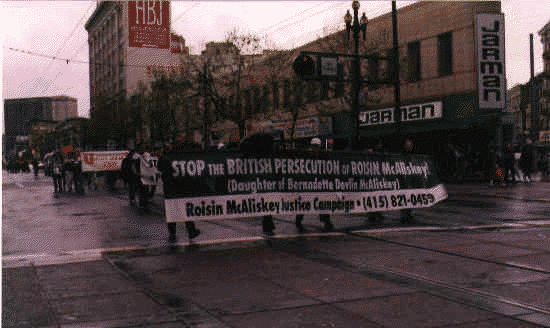
In 1996, while four months pregnant, Bernadette’s daughter was arrested on a German extradition warrant, charging her with being part of a Provisional IRA mortar attack on a British Army base in Osnabruck, Germany. Although taken to England, where a judge agreed to her extradition to Germany, a long and vigorous campaign fought by Roisín’s mother and her supporters eventually defeated the extradition and Roisín gave birth to a healthy daughter.

Recent portrait of Bernadette (Devlin) McAlliskey by Francis McKee
Bernadette's daughter was arrested twice on the same charge but vigorous campaigning impeded her extradition.  Photo shows banner resisting the earlier attempt.
Bernadette’s daughter was arrested twice on the same charge but vigorous campaigning impeded her extradition. Photo shows banner resisting the earlier attempt.


In 1998 and for some years after, Bernadette was an outspoken critic of Sinn Féin and of their direction in the “Peace Process”, which she saw as the party coming to accept British colonialism and Irish capitalism. In 2003 she was banned by the USA and deported, widely interpreted as being due to her speaking against the Good Friday Agreement, but continued her campaigning. However in 2007, another extradition warrant was issued for her daughter Roisín on the same charges as before and the young
woman became emotionally ill. The whole trauma was seen by many as a warning to Bernadette to cease criticising the “new dispensation” and subsequently she was seen to fade from the ranks of public critics of the GFA, Sinn Féin and of the treatment of Republican prisoners.

Bernadette remained active through working with migrants in a not-for-profit organisation in Dungannon. In recent years she has returned, on occasion, to the issues upon which she was so outspoken previously, for example standing surety for Marian Price’s bail to attend her sister Dolores’ funeral and speaking at the ceremony herself. Bernadette also spoke at the Bloody Sunday Commemoration/ March for Justice in January this year in Derry.

With a c.v. of that sort, one would reasonably expect a packed auditorium.

Bernadette Mc Alliskey on the platform upon which she had earlier spoken in February 2014 at a rally following the annual Bloody Sunday Commemoration/ March for Justice.

Bernadette has walked the walk and thought the thought too but she can also talk the talk. With one A4 sheet in front of her, she spoke for over an hour, hardly ever glancing at her notes. Her talk was as part of Trinity College’s MPhil Alumni Conference on ‘Power, Conflict, Resistance’ organised by the Department of Sociology for its Mphil course in “Race, Ethnicity and Conflict”.

Bernadette McAlliskey began her talk with the theme of fear of conflict, developing the thesis that this fear is inculcated in us from childhood, as conflict arises out of challenging power and hierarchy. She traced this further back to religious indoctrination where dogma is to be accepted without question and finds its reflection in all aspects of life but particularly in the political.

Talking about Tom Paine, who expounded the theory that human beings, each independently, are responsible for themselves, she stated that this is fundamental to citizenship. Some aspects of this self-responsibility are delegated to institutions when we live in large groups but any decisions made for us without our consent are “an usurpation”. Tom Paine was an English Republican, author of, among other works Common Sense (1776) and The Rights of Man (1791). He had to flee England because of disseminating his ideas, which were considered revolutionary in his time.


Much of Bernadette’s talk was given over to this theme, to the lack of consideration of women even by such as Tom Paine, and also to the racism spread by colonialism, which the Christian hierarchies condoned and even encouraged.

When she finished to sustained applause and took questions, there were two from people identifying themselves as Travellers, another from a person from an NGO working with migrants, another regarding anti-Irish racism in English colonial ideology and the continuing power of the Catholic Church in the education system.

One question seemed to throw her and she admitted that she found it difficult to answer. Ronit Lentin, Jewish author, political sociologist and critic of Israeli Zionism asked Bernadette was it not true that racism in the Six Counties came mostly from within Loyalism, allied to anti-Catholic sectarianism. Bernadette struggled in replying, at one point denying it and pointing to anti-Traveller discrimination in the ‘nationalist’ areas but following this up by observing that Travellers would only camp in or near ‘nationalist areas’ (presumably because the hostility in a ‘unionist area’ would be worse).

Bernadette then went on to recall the recent anti-Muslim remarks made by a prominent Belfast evangelist preacher, James McConnell, and how the First Minister of Stormont, Peter Robinson, had defended the evangelist’s right to free speech. Asked for his own opinion of Muslims, the First Minister had replied that he also distrusted them “if they are fully devoted to Sharia law” but would trust them to go to the shop for his groceries and to bring him back the correct change. All the examples Bernadette drew on, apart from the generalised one about Travellers in ‘nationalist’ areas, were in fact from the Unionist sector.

The final question was from an SWP activist who pointed out that the State does not admit to its institutional racism and often takes no action on racist attacks or denies that the motive for the attack was racism. The activist asked Bernadette how she thought racism can be dealt with in this context. She replied that the legal structures are there and should be used and persisted with.

It seemed a strange response from one who would have described herself in the past as a revolutionary. Earlier in her talk she herself had quoted the black Caribbean lesbian, Audre Lorde, who said that the instruments of the State could not be used to dismantle it (actually I.V. Lenin had made the same point in The State and Revolution in 1917, nor was he the first to do so). A revolutionary’s answer to that question would presumably have been that while the structures should be used in order to expose them that ultimately the capitalist State’s power is the enemy of unity among the people; disunity rather than unity among the people is in the interest of the system. Mobilisation of the people against racism and directing them towards the source of their ills, the capitalist system, and building solidarity in action, is the only realistic way forward. Perhaps Bernadette felt constrained by the academic environment in which she was speaking but that is not the answer she gave.

End.

Interesting retrospective piece on McAlliskey’s visit to the USA in 1969: http://www.historyireland.com/20th-century-contemporary-history/fidel-castro-in-a-miniskirt-bernadette-devlins-first-us-tour/

Interview with McAlliskey at a Scottish conference on radical independence https://www.youtube.com/watch?v=H4LdcnxMb9Q