Narrated by Roger Waters of the Pink Floyd band, a useful documented discussion on how the population of the USA, the main political and financial supporter of the Israeli Zionist State, is conned into supporting Israel.
NB: “The US mind” is the subject, not “the American mind” — there is no reference to Latin American or Canadian thinking on the issue.
The film exposes the use of the US media combined with Israeli propaganda, pressure on politicians and media figures and demonisation of opponents.
Interestingly, at least one prominent commentator argues that the USA agrees with Israeli policy largely because it agrees with its own — but doesn’t tell us what that US policy is, much less explain it. Perhaps that’s beyond the film’s scope or the film is aimed at liberal opinion and exposing naked imperialism would be going too far — but in places, the narrative does hint at it.
Interestingly too that line of argument undermines the narrative that the Israel lobby (incorrectly termed “the Jewish lobby”) is the dominant factor is US policy towards Israel. A USA Jew also points out that most of his co-religionists in the US do not agree with the hard, right-wing, neo-liberal politics of the Israeli leaders.
Worryingly, in reference to a strand of fundamentalist Christianity in the US which supports Israeli policy, a commentator tells us that one in three US citizens believes that the Bible is factual.
But very encouragingly, the film argues that Israel is at last — finally — losing its propaganda grip on US youth in the colleges and in black communities.
Worth watching to understand the history of US public support for Israel but also to learn how untruthful propaganda works with regard to words.
The Catalan Parlament went ahead recently with its house management work, electing a Speaker and Deputy Speaker and four Secretaries (see fly-on-the-wall report below).
After that, they had 10 days to elect a President of the Government. The choice of the Independists seems to be unanimously for Carles Puigdemont, the previous Government’s President; however, the Spanish State wants to arrest him (as it has done with other independist parliamentarians, without granting bail and threatened to others, including the previous Speaker of the Parlament, which is one reason why Puigdemont has been living in Brussels in recent months). The President of the Catalan Parlament, Roger Torrent, despite a threat by the Spanish State to arrest him also, announced that Puigdemont was the only choice for President of the Government. Naturally the Spanish unionists in the Parlament objected vociferously but the independists have the majority.
Roger Torrent, the newly-elected Speaker of the Catalan Parlament (Photo source: Internet)
Could Puigdemont be sworn in as President by proxy? This was a question to which contrary replies were given. The Spanish State said not but a number of others said it was a possibility. The Spanish State is not preventing the jailed Catalan politicians from having proxies vote on their behalves and presumably, even if they jail Puigdemont, though it would disrupt the Parlament considerably, he would still be able to vote through a proxy. The Spanish National Court in Madrid seems to have had this in mind when it rejected an application by the state’s Attorney General to renew the European Warrant for the arrest of Puigdemont when he arrived in Denmark. Puigdemont was there to take part in a debate organised by the University of Copenhagen titled “Catalonia and Europe at a Crossroads for Democracy? Debate with Carles Puigdemont.”
In a statement which clearly revealed the political nature of the Spanish Court, Judge Pablo Llarena declared Mr Puigdemont was seeking to “provoke” his own detention in order to “force the context” in which he could delegate his vote, and therefore he refused to renew the EAW which the state had withdrawn on 5th December (apparently on advice that the Belgian court was not going to grant it — the “crimes” with which the Spanish court charged Puigdemont a) do not have criminal status in Brussels or b) are not those covered by the convention on the EAWs).
Puigdemont has asked the Spanish State whether it is going to arrest him if he returns to Catalunya in order to be inaugurated as President of the Parlament. Torrent has asked for dialogue to discuss the matter with the Spanish Prime Minister, Rajoy, who has refused. Rajoy’s party, the Partido Popular, lost heavily in the recent elections in Catalunya and had only one member elected to the Parlament (it also has only one elected town mayor in the whole of Catalunya). The Spanish Government has also threatened to continue its direct rule under Article 155, which it imposed after the Catalan Government declared for independence, on foot of the referendum on October 1st.
Carles Puigdemont in Copenhagen in the company of young local supporters (Photo source: Internet)
ELECTIONS OF HOUSE COMMITTEE POSITIONS IN CATALAN PARLAMENT
The Catalan Parlament pressed ahead with some necessary internal work on 17th January. They needed to elect the President del Parlament (not of the Government – this position is like the Ceann Comhairle in the Dáil or the Speaker in Westminster), a Vice-President and four Secretaries. As they were doing this in the public eye, Alan King, of the FB page Support Catalonia, translated and posted as it was happening. The summary below is taken from that commentary with his permission and our thanks.
Voting is taking place for the “speaker” (president del Parlament – not the same as the President of the Goverment). The name of each MP is called out and they walk up and hand over their ballot at the front of the chamber. Loud applause accompanies the names of those who are imprisoned or in exile. Those who are political prisoners have delegated their votes except for Carles Puigdemont, who has refused to do so.
The seats in the chamber have been decorated with large yellow ribbons. (This is to remember the members of the Parlament jailed by the Spanish State while awaiting trial for carrying out the wishes of their electorate and defying the Spanish Government; also for a leader of a Catalan independist organisation).
The new candidate for speaker is Roger Torrent, who will be the youngest person to occupy the position. Voting has ended and the names on each ballot are being read out.Hundreds of people are standing outside, surrounded by many Catalan flags, to follow the proceedings live from the street.
The candidate of the independence parties, Roger Torrent, was born in 1979. Here is a piece about him (in Catalan):
The “now you see me now you don’t” Podemos group decided to abstain in the vote. As a result, with the votes counted, no candidate has the absolute majority which means that now there will be a second vote, which is taking place. In this second round a simple majority will suffice.
The Podemos group which represents a Spanish so-called “left” movement go under the name of “Catalunya En Comú” (Catalonia in Common). They suffered heavy losses in the latest elections and only have eight Mps.
The people outside are chanting: “PUIGDEMONT! FREEDOM!”
Loud applause in the chamber as Puigdemont’s name is called out as the second round of voting continues.
Comment from another observer at this point: “I’ve been watching live reporting on the Al-Jazeera TV news programme. Nothing on BBC ….”
The count for the first round of votes was:
Torrent (the independence candidate): 65 Espejo (the unionist candidate): 56
Abstentions; 9
The voting is over for the second round and the ballots are now being counted.
Roger Torrent is 38 years old and a member of the Esquerra Republicana (Republican Left) party. He is described as a perfectionist and a good communicator.
Torrent has replaced Carme Forcadell as speaker of the Catalan Parliament. Forcadell announced she wanted to step down on account of the many legal issues she must face because of persecution by the Spanish courts.
One of Torrent’s well-known quotes: “We will build the Republic without asking permission” (Farem República sense demanar permís).
The session now continues with the election of the Deputy Speaker (vice-president de la Mesa). There are two candidates again, put forward by Junts Per Si and Ciudadanos respectively.
The election of Deputy Speakers has concluded. The First Deputy Speaker will be Costa (the independence candidate), while Espejo (Ciudadanos’ unionist candidate) will be the Second Deputy.
Finally, votes are now being counted for the four secretaries of the Mesa del Parlament. It is expected that there will be one secretary each proposed by Junts Per Catalunya, Esquerra Republicana and the unionist parties Ciudadanos and PSC.
It has been pointed out that the presence of more men than women in the Mesa fails to reflect the fact that women are in the majority in the parliament as a whole.
Roger Torrent is beginning his first speech as Speaker of the Catalan Parliament.
Torrent promises to try to win the confidence of all the members of parliament.
He is going on to draw attention to the intolerable situation with political prisoners and cabinet members in Brussels who cannot return to their country.
It is his job to represent the voices of all the elected members of parliament including those who cannot be present today.
There is an unprecedented situation where the Catalan institutions are under attack, and the first task must be to stop that.He calls on everyone to join forces to retrieve the institutions and put them at the service of the whole country.
The polls are the maximum expression of the will of the people and must be respected.The country’s civil and social rights depend on it.
Social progress is one of parliament’s essential goals.
It is their responsibility to forge agreements and understandings even among groups who don’t see eye to eye.He has worked for that as Mayor and will now do it in his new position.
But he demands one thing: respect. For the institutions, for each other, and for will of the people.
Democracy and coexistence are the two basic principles.
Catalonia is a diverse country and that diversity is reflected in the composition of parliament.
He has referred to his two female predecessors and says that he personally espouses the feminist vision, which is still unachieved in Catalan society and its institutions, but which he promises to do his best to advance.
After his speech, all stand for the Catalan national anthem, Els Segadors.
The anthem is followed by shouts of “Visca Catalunya” (Long live Catalunya!) and “Lliure!” (Free!), and of “Llibertat!” (freedom).
The session is over. The President of the Government remains to be elected, which needs to be done tend days from now.
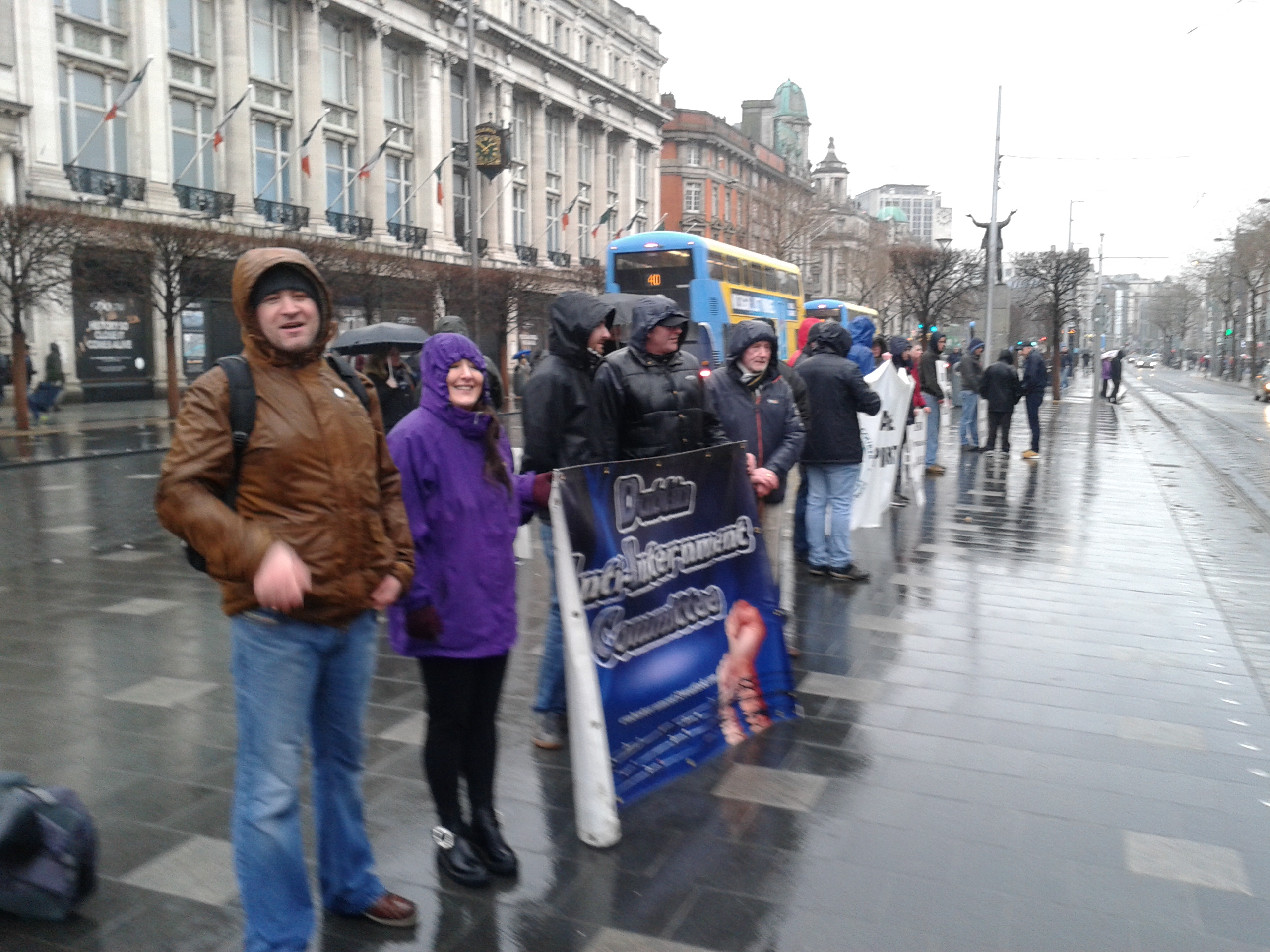
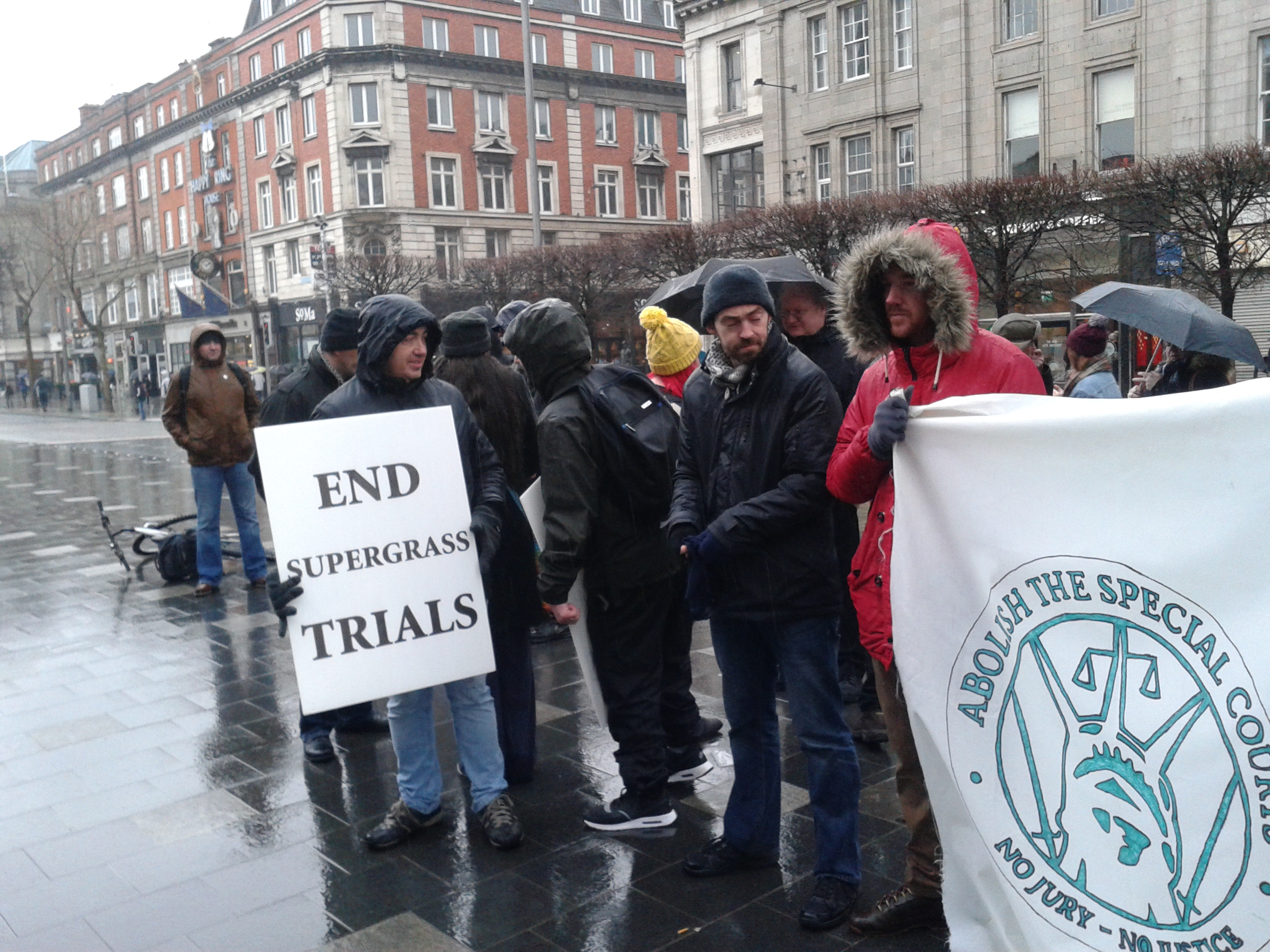
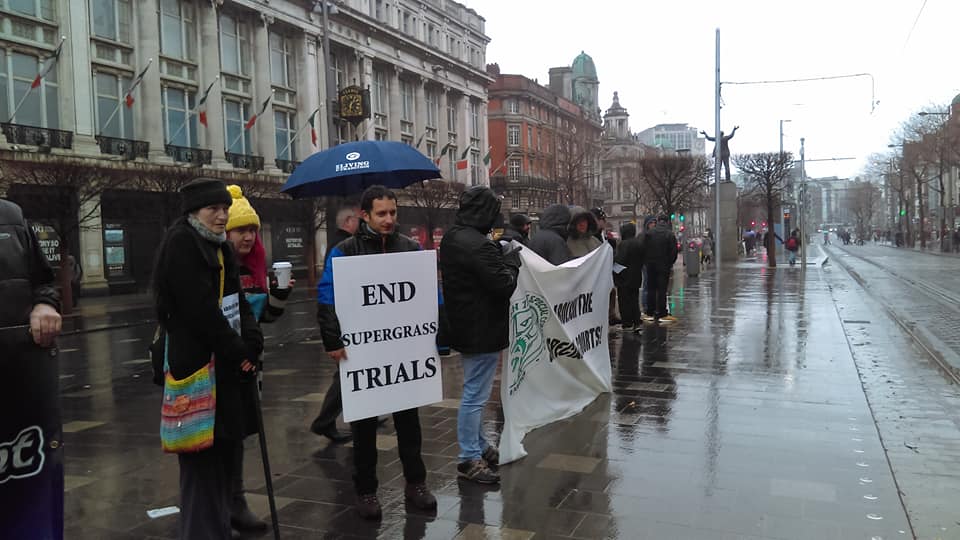
On a wet and cold Saturday, up to two score protesters gathered on the pedestrian reservation in O’Connell Street to denounce the Special Criminal Courts and their operation.
A section of the picket line in O’Connell Street – the Clery’s building is in the background with the Jim Larkin monument in the distance. (Photo: D.Breatnach)
They lined up opposite the iconic General Post Office, site of the HQ of the Easter Rising in 1916 and still bearing the marks of British Army bullet and shrapnel strikes. As traffic and shoppers hurried by or stopped to stare, the protesters were observed by members of the Garda Special Branch, the political section of the police force of the Irish state, one of whom ducked behind one of the GPO’s columns as someone pointed a camera in his direction (to cause some mirth among the picketers).
(Photo: D.Breatnach)
Among the picketers on the 20th January 2017 were members of different Irish Republican groups and campaigns as well as a number of independent activists of Republican, Socialist and Anarchist backgrounds.
After standing for a while displaying placards and banners, the protesters gathered around to hear Sean Doyle, who had been presented as the campaign’s spokesperson.
A section of the picketers (Photo: D.Breatnach)
Remarking that the Special Courts are “a travesty in law”, Doyle added that one should “never equate law with justice.” Doyle accused the Courts of being “a political tool to deny due process”. He encouraged those present to ask themselves whether Maurice McCabe or John Wilso (both Gardaí who fell foul of the force) would nowadays trust uncontested evidence. Doyle went on to say, in reference to administrations both sides of the Border, that “Political special courts are structured to deny your civil and human rights and must be abolished.”
Special courts of the Israeli Zionist regime, or US military-occupied areas were also condemned by the speaker, who called for “cooperation and sharing of information across the world” because “injustice knows no borders.”
Sean Doyle speaking (Photo: D.Breatnach)
After Doyle’s short speech had been applauded, Ger Devereaux thanked everyone for attending and informed them that the campaign against the Special Courts would continue with pickets and meetings and asked people to spread the word to help the campaign to grow and to achieve success.
Ger Devereaux addressing the crowd (Photo: D.Breatnach)
HISTORY AND COMMENT
The operation of the law in what are called “democratic” societies is supposed to be that a person suspected of committing a crime is accused and brought to trial, where the evidence is presented against him and should he choose to do so, he or his representation defend him. A jury drawn at random then considers the evidence, decides the verdict and, should that be of “guilty”, the judge pronounces sentence, within the parameters of the maximum and minimum set by law. That’s the theory, anyway.
We all know that there are flaws in that system, even without considering the laws under which the operate and the real power and wealth in society, as well as the power of the media, prejudices among jury members, lying witnesses, faulty expert testimony, etc. Nevertheless, the system is an advance on what existed before and provides some protection to the accused. At times the jury arrives at a verdict which is manifestly contrary to that desired by the forces of the State, i.e on the side of democracy and justice and against repression. A quite recent example was the finding of “not guilty” for the Jobstown protesters last year after a politically-orchestrated attempt by State, politicans and media to find them “guilty”. Another example, further back, was the exoneration of the five anti-war activists in 2006 for their actions against US warplanes in “neutral” Shannon airport.
The State has decided upon a way to overcome this problem, which is to do away with juries completely and, with the Special Courts, it has achieved this: these courts have no juries and, furthermore, a majority verdict of two out of three judges is sufficient for conviction. This would be of concern enough were it not for the fact that the Government appoints all of those judges.
A view of the GPO building across the road from the picket. The leg of a Special Branch officer may be seen as he ducks behind a column on the right.
The first of these courts was set up in 1939 under De Valera, as part of the Offences Against the State Act but fell into general disuse after the 2nd World War, to be briefly brought back during the IRA’s Border Campaign of the 1950s, when hundreds were interned. The Special Court was resuscitated in 1972 (as was the Amendment to the Offences Against the State Act – more about this below), again by a Fianna Fáil government under Jack Lynch.
A second Special Court was created by Minister for Justice Frances Fitzgerald, in the FG-Labour coalition Government, ironically on the centenary year and month of the Easter Rising. The justification was quite baldly that it was difficult for the State to achieve verdicts of guilty in some cases through the use of a jury. Of course the State declares that the difficulty arises in that the members of a jury may be intimidated by criminals or “terrorists”. But might it not equally be that the accused are not guilty at all? Or that the State has not bothered with the niceties of the democratic system and carried out its investigation? And if the jury system is to be judged ineffective in one kind of case, why not in others?
Originally, the target of the Special Courts was clearly political activists. When the atmosphere allowing political persecution by the State dissipated somewhat, it was claimed that the target was gangsters. However, for long years the victims continued to be political activists – exclusively of the Irish Republican brand. With an occasional suspect of the gangster type occasionally brought before the Special Courts however a stream of Irish Republicans find themselves facing them.
FAMOUS CASES
Among the famous convictions of the Special Courts were the sentencing to death in 1976 of the Anarchist couple Noel and Marie Murray for alleged murder of a Garda, the sentences being quashed on appeal after a campaign and reduced to life instead.
In 1978, then IRSP members Osgur Breatnach, Brian McNally and Nicky Kelly were all sentenced to long terms in jail. Their sentences were overturned in 1980 (and 1984 for Kelly) and years later they received compensation, reportedly in six figures.
Nicky Kelly & Osgur Breatnach at press conference after their convictions in the Special Criminal Court had been overturned (Photo: An Phoblacht)
A few more big convictions of political activists followed which were not overturned on appeal until in 2001, Colm Murphy was convicted of conspiracy to cause the Omagh bombing but in 2005 his conviction was quashed after revelations that the judges had acted improperly and that Garda witnesses for the Prosecution had falsified their notes. He was finally cleared by the SCC in 2010.
In 2003, Michael McKevitt was convicted by the Special Court of allegedly “directing terrorism” and “membership of ….. the Real IRA” in a judgement which has been criticised by a number of people unconnected to him.
There were no ‘gangland’ cases before the SCC until 1977/’78 and the Guerin murder trials, when one man was convicted on the evidence of a gang member turned State’s witnesses, a case about which many questions remain today. A big gap followed in ‘gangland’ cases until the years 2013, 2014 and 2016, with one case in each of those years..
Throughout all these years a steady stream of convictions and jailing of Irish Republicans for the lesser charges of “membership of an illegal organisation” have been processed through the Special Courts.
BRITISH TERRORISM
The same year that the Special Criminal Courts were introduced, i.e 1972, was when the Amendment to the Offences Against the State Act was brought into law. This provision permits conviction with the only evidence being the word of a Garda officer of the rank of Chief Superintendent or higher. Although historically judges have been reluctant to convict on this alone the quality of what other evidence they require has been slipping lower in recent years. Irish Republicans are now being convicted, for example of membership of an illegal organisation, on the word of a senior Garda who says that he has reason to believe that they are such, supported by spurious “evidence”. In one case this “evidence” consisted of a piece of paper allegedly from a prisoner the man had been visiting which discussed some recent events and in another, that Gardaí had “seen him turn down a dark lane”.
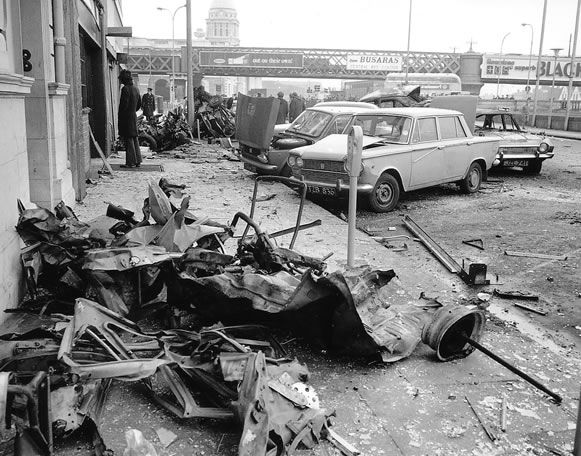
The irony is that the resuscitation of the Special Courts and the introduction of the Amendment to the OAS Act were voted in after a terrorist bomb planted by British agents. The Jack Lynch Fianna Fáil Government seemed to be heading for a defeat in the Dáil on their proposal, with Fine Gael. Labour TDs and others set to vote against. During the debate, on 1st December 1972, two car bombs exploded in Dublin, one Eden Quay and another on Burgh Quay, killing two CIE workers and wounding 131. In the succeeding panic, the opposition to the measure collapsed and it was was passed. Wikipedia: “It is believed that the 26 November and 1 December bombings were executed to influence the outcome of the voting.”
One of two Dublin bombs by British agents in December 1972 which helped introduce additional anti-Republican legislation (Photo source: Indymedia)
Both sides of the Border, Irish Republicans are now being convicted and sent to jail by non-jury courts, by the Diplock Courts of the Six Counties colonial administration one side and by the Special Courts of the Irish State on the other. Ironically, in Britain itself there are no non-jury criminal courts.
WHO PROTESTS?
Given the patently undemocratic nature of the courts and the clearly political use by the State, what has the reaction of the civil and human rights sector been? In earlier days, it has been criticised by the Irish Council for Civil Liberties, Amnesty International and the UN Commission on Human Rights. In recent years, these critics, especially the Irish ones, have tended towards silence on the matter. The non-Republican Irish organised Left has likewise remained silent, as it tends to do with all persecution of Irish Republicans.
However, history has shown us that once the State succeeds in repression against one sector, it moves on to another it finds threatening or an inconvenience. It is therefore in the interests of all democratic and Left sections of society to unite against these undemocratic and repressive courts and to campaign for their total abolition.
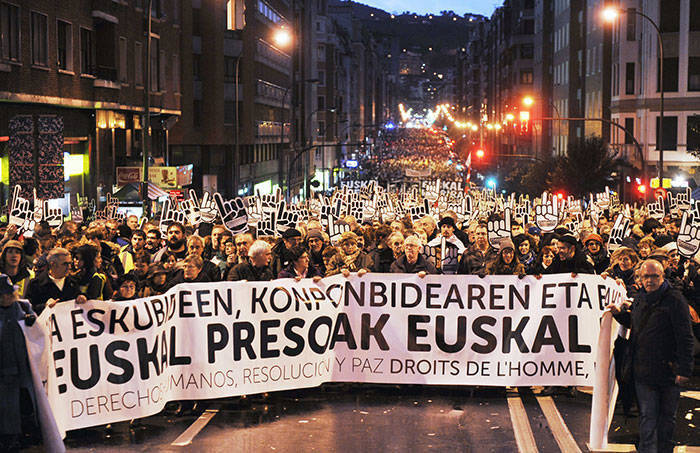
The annual January march in solidarity with political prisoners, taking place in continuous rain on Saturday 13th January, packed the streets of the Basque city of Bilbao (Bilbo) with estimates of numbers in attendance varying from 95,000 (GARA) to 100,000 (DEIA).
Numbers on this march are always high (especially taking the total population of the Basque Country of less than three million into account) but may have been boosted somewhat this year by a) the ongoing resistance to Spanish state repression in Catalunya and b) news that the French state is at last moving away from its policy of dispersing its political prisoners far from their home country.
Saturday’s march was organised by Sare, a broad front set up a few years ago and was supported by EH Bildu (political party of the Abertzale Left) along with the Basque majority trade unions ELA and LAB. The political parties PP, PSE and Podemos-Euskadi did not support it, although the latter’s General Secretary Lander Martínez attended in a personal capacity. The Basque Nationalist Party PNV did not support it either (although members may well have done).
Also in attendance were Joan Tardà of the Catalan party ERC; Xabier Sánchez, brother of the jailed President of ANC, Jordi Sánchez; and the writer Kirmen Uribe.
Arnaldo Otegi for the EH Bildu party said the Spanish State should learn from the action of the French one; LAB’s General Secretary Garbiñe Aranburu declared that this year needs to be decisive in the Spanish state with regard to political prisoners and called for new alliances to achieve this. Adolfo Muñoz, Gen. Sec. of the largest trade union in the southern Basque Country, ELA, credited civil society with having achieved the change in French State policy, achieving the transfer of Basque political prisoners to jails near their homes, without waiting for the Spanish state to do likewise.
The banner at the head of the march stated “Elkarrekin aurrera egiteko prest gaude” (We are ready to advance together; human rights, resolution, peace)while, according to media report, throughout the march the following slogans were heard: “Euskal presoak etxera!” (Basque prisoners to home!) and “Presoak kalera, amnistía osoa!” (Prisoners to be free, total amnesty!).
At the end of the march, Sare’s manifesto calling for an end to the dispersal was read out by ETB (Basque TV channel) presenter Kike Amonarriz and Beatriz Talegón, ex-leader of the youth wing of the Spanish social-democratic unionist party the PSOE.
COMMENT:
The great attendance in pouring rain is encouraging and once again the Basques show their high level of concern for their political prisoners, bringing at least 3% of their population out on a solidarity demonstration.
The reported (and audible on the video) slogans of “Euskal presoak etxera” (Basque prisoners to home) and “Presoak kalera, amnistía osoa” (Prisoners to be free, total amnesty) being shouted are interesting, given that the Abertzale Left leadership and organisations such as Sare have dropped such demands in recent years, concentrating instead on calling for an end to the dispersal policy and for the release of seriously-ill prisoners. The slogans mentioned above have been raised by the Amnistia Ta Askatasuna (ATA) organisation, whose supporters are highly critical of the changes in policy of the Abertzale Left leadership for some years now but presumably made their presence felt on the demonstration.
Despite the permanent ceasefire declaration of ETA a number of years ago and changes in the policies of the Abertzale Left leadership, the Spanish state has not given an inch, which leaves the leadership with no gains to show, not even the end of the dispersal policy. This policy, contravening human rights and the EU’s own conventions, sees prisoners located as far from the Basque Country as southern Spain, a drive of around nine hoursthere and the same back, on motorways that have already claimed the lives of a number of prisoners’ friends and relatives and injured an average of one a month.
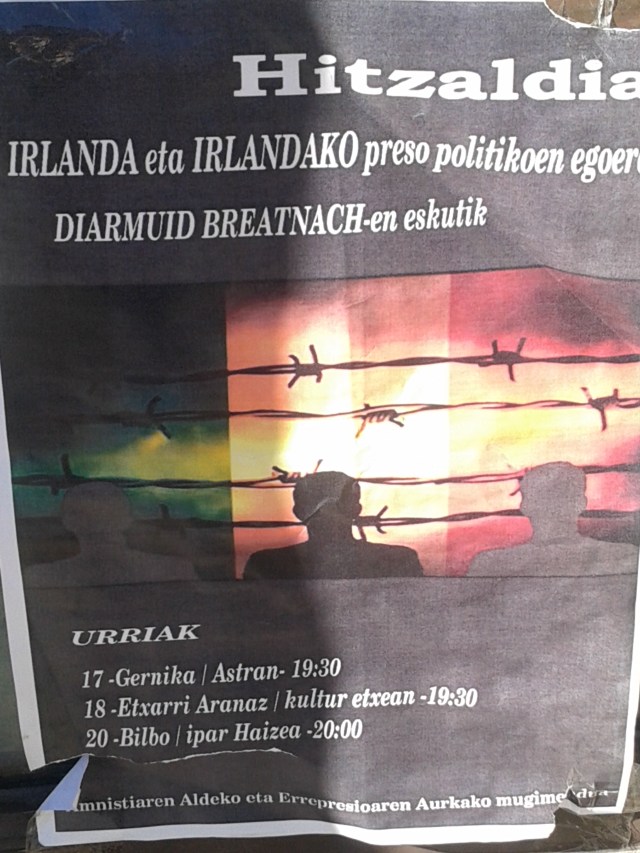
This Autumn I made myself available to give talks in the southern Basque Country (i.e. in the Spanish state) on the situation of Irish political prisoners and a series was arranged for mid-October for nearly two weeks.
As well as having private conversations, I gave a total of five public talks to audiences ranging in size from ten to over forty. The composition of the audiences varied from youths to older middle-aged; in some places the latter predominated and in some, the former.
All the meetings I spoke at were arranged by an organisation called Amnistia Ta Askatasuna which calls for total amnesty for Basque political prisoners. This was also a demand of the whole movement and of the leadership of the Abertzale Left until fairly recently and the Gestoras pro-Amnistia organisation had been created under the Abertzale Left umbrella but then banned by the Spanish State. But the Abertzale Left’s leadership have now dropped this demand from public discourse, saying the conditions are not ripe for it and concentrating instead on the end of the dispersal. (More about this and the Basque prisoner situation later).
Poster on a wall advertising three talks in the southern Basque Country before the remaining two were confirmed. October 2017. (Photo: D.Breatnach)
I had not intended to confine my talks to those organised by ATA but it was they who organised the talks on dates that were offered, with the exception of one from an independent source that unfortunately clashed with one I had already accepted elsewhere.
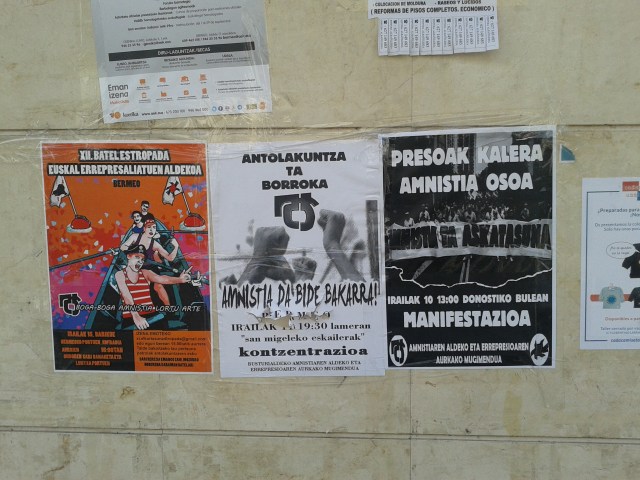
ATA posters share with other advertising on a wall in the southern Basque Country, October 2017 (Photo: D.Breatnach)
THE TALKS
The types of venues for the talks were community cultural centres (two), occupied buildings (two) and one local (a space for which the users’ association paid rent and used for their activities). Geographically, the talks were held in Gernika and two in Bilbao (Bizkaia province), Etxarri (Nafarroa) and Ibarra (Guipuzkoa province). There were none in Alava province (although earlier this year I gave interviews to Hala Bedi pirate radio there, in Gastheiz/ Vitoria). On this occasion also I gave a video interview to a rapper who also makes videos for Hala Bedi, though he is located in Bizkaia.
From conversations and discussion it became clear that all the older people in the audiences were veterans of the Basque struggle over decades and a number were ex-prisoners. Some had relatives in jail. The youths had come to political activity or thinking in recent years.
Talk in cultural centre in Ibarra, Guipuzkoa, southern Basque Country, October 2017. (Photo: ATA)
For the content of the talks I briefly reviewed the more distant history of political prisoners in Ireland, moving on then to the Good Friday Agreement and the release of
Torn poster advertising the talk in Ibarra, Guipuzkoa province, southern Basque Country, October 2017. (Photo: D.Breatnach)
most Irish Republican prisoners in the Six Counties under its terms. The re-arrest and jailing without charge of a number of these ex-prisoners was part of the talk, in which the specific examples given were of Marian Price, Martin Corey and Tony Taylor. I also dealt with the procedure of arrest on ridiculous charges and refusal of bail, or granting it under undemocratic and restrictive conditions, for which I used Stephen Murney as an example. These were all members of different organisations or none. Conviction on charges which the evidence does not support is also a category I mentioned, giving the Craigavon Two as an example there. Arrest on possession of arms charges is also a feature on both sides of the Border.
With regard to the 26 Counties, i.e the Irish state, I discussed the Special Court, Membership-of-an-illegal-organisation charges and charges of obtaining arms or having assisted terrorism. I mentioned the planned second Special Court in particular in the context of the State’s failure to convict most of the Jobstown protesters on charges that included “false imprisonment” (i.e kidnapping).
While noting that splits had occurred before in the Republican movement – the Provisionals themselves having emerged from such a split in 1970 – I noted that since the GFA, splits had multiplied and listed a number of the resulting organisations, including those that had existed already at that time.
Listing the number of Irish political prisoners (at the latest count then 79) and reminding the audience that the Irish had extended solidarity to Basque political prisoners, I asked the Basques for solidarity towards our political prisoners too. And I did so not only as a moral issue of internationalist solidarity but also in recognition that internationalist solidarity is one of the first casualties (i.e aspects to drop or weaken) by those who are seeking to surrender the struggle or even to become collaborators.
Talk in cultural centre in Etxarri, Nafarroa province, southern Basque Country, October 2017. (Photo: ATA)
QUESTIONS
I timed the talks to give sufficient space for – and encouraged — questions and comments, even critical ones.
It was interesting that the same questions tended to come up again and again:
Did the different Republican organisations cooperate with one another inside and outside the jails?
What were the conditions in the prisons like for the prisoners?
How are political prisoners in ill-health being treated?
Is there a dispersal issue with regard to political prisoners?
Did the population support the prisoners?
What were the conditions for their release under the Good Friday Agreement?
Did INLA prisoners sign the GFA release agreement?
Are there armed actions continuing in Ireland?
Are the youth involved in solidarity actions and campaigns?
What was the attitude of Sinn Féin towards the political prisoners?
Are prisoners “on the run” still in danger of arrest and imprisonment?
In one meeting, one of the smaller audiences and containing only youth, I was asked about the role of women in the national liberation struggle in Ireland today.
Talk in the occupied former Astra factory building, Gernika, Bizkaia province, southern Basque Country, October 2017. (Photo: ATA)
Some of the questions asked reflect the situation of the Basque political prisoners and also of the censored and inaccurate information about Ireland that reaches them, including through the Abertzale Left‘s (the “official” umbrella organisation) daily newspaper, GARA. At a number of times in the past spokespersons of the Abertzale Left’s organisations had claimed that there were no longer Irish political prisoners, a claim repeated in GARA. More recently, the tendency is to ignore their existence or to represent them as very few, without a program other than return to armed struggle and without a support base (i.e Sinn Féin’s line).
The new direction of the Abertzale Left’s leadership, which included a “permanent truce” and disarmament of their armed organisation ETA (formally declared in January 2011) was said at the time to have been agreed by the Basque political prisoners in their organisation EPPK. There have been persistent claims by friends and relatives of some prisoners and by some prisoners released in the last couple of years that they had not even been consulted.
A number of people to whom I spoke claimed that the prisoners’ collective no longer really exists, with prisoners left to act individually; some others said this was true to an extent but not completely. Certainly one feels a general air of disillusionment and uncertainty – and also of anger. And it is true that a small number of prisoners have formally denounced the leadership and left the collective.
Grafitti in Ondarroa, Bizkaia province, southern Basque Country, October 2017. (Photo: D.Breatnach)
From figures collected in 2003, up to 30,000 Basque activists out of a total population of less than three million) had been arrested, 8,170 were accused of being members of ETA and roughly half of those convicted and imprisoned. The prisoners’ relatives and friends’ organisation Etxerat (also under the Abertzale Left’s umbrella) in its July-September report of this year (2017) recognises 315 Basque political prisoners, of which 310 are dispersed through 61 prisons, with only two in 2 prisons in the Basque Country.
In 39 prisons in the Spanish state, 239 Basque political prisoners are being kept and 68 in twenty prisons of the French state. There are 212 (68.85%) Basque political prisoners in prisons at distances of between 600 and 1,100 km of the Basque Country; from a distance of 400 to 590 km from their country there are 67 (21.75 %) and between 100 and 390 km of home another 29 (9.40 %).
The strain on relatives and friends is considerable, road accidents are frequenton their journeys to visit prisonersand a number have been killed.
Twenty-one prisoners (21) are diagnosed as being seriously or terminally ill and according to the states’ own penal codes should have been released on parole to home or hospital but instead of reducing the number of sick prisoners the total is climbing (almost doubled in recent years). I accompanied ATA comrades to the port town of Ondarroa to participate in a demonstration organised by a broad platform calling for the release of terminally-ill Basque political prisoner Ibon Iparragirre.
Section of rally after demonstration in Ondarroa, Bizkaia, in solidarity with local seriously-ill prisoner Ibon Iparragirre, October 2017. (Photo: D.Breatnach)Stage of the rally after demonstration in Ondarroa, Bizkaia, in solidarity with local seriously-ill prisoner Ibon Iparragirre, October 2017. (Photo: D.Breatnach)
The Spanish state has rejected all the “peace process” (sic) overtures of the Abertzale Left leadership and says that ETA should just disappear and prisoners wishing to be pardoned and released must repent their previous actions, apologise to their “victims” and give information on their previous activities and comrades. It also says that all still at liberty and wanted for past illegal activities will continue to be pursued.
COMMENTS AND CONTRIBUTIONS
These too tended to be of a kind to come up again and again throughout the tour:
The situation in Ireland with regard to the liberation movement and prisoners is like that in the Basque Country or that which the latter will face as time goes on
The prisoners’ cause is being deserted by the Abertzale Left leadership
Their media and leadership had lied to the movement about the situation in Ireland
The leadership is only interested in penetrating the institutions and is neglecting the politics of the street
Otaegi and Adams are alike and McGuinness was a traitor when he asked people to inform on paramilitaries
The Abertzale Left did not of course comment on the talks – why would they? However, in Ibarra, I saw posters for the meeting torn down in areas where other political ones remained and according to my hosts, this was the work of the “oficialistas” (i.e followers of the leadership’s line) in the town. It was notable too that with a few exceptions, a number of people within the Abertzale Left but whom I know to be very critical of the change of direction, did not attend the talks held in their areas. Since some had previously attended a meeting at which I spoke a year ago and engaged in discussion critical of the Abertzale leadership, I took it that these either disapproved of the ATA organisers or did not wish, for whatever reason, to be seen attending a meeting held by the organisation.
At all the talks I was received with friendliness and courtesy and after some I had a meal in company in a txoko (Basque building — or part of one — owned or rented by a gastronomic association) or the home of my hosts for the evening. Although I invited criticisms with genuine interest in hearing them, none were voiced publicly, whether of the content of my talk or of the Irish people generally — although there were some questions as to why the people “in the south” had not supported more widely the “struggle in the north”. I explained that what they call “the north” is one-fifth or the country and also divided in its population; in addition the Republican movement had left the social and economic concerns of the people in the other four-fifths largely unaddressed and in fact had opposed some social reforms in earlier times. People in the 26 Counties had given a lot of support but without mobilising them on their own concerns and specific conditions this was likely to be a minority activity and to decline over time.
CATALUNYA: SOUTHERN BASQUE ATTITUDE TO THE STRUGGLE THERE
Inevitably, the struggle in Catalunya came into the discourse at some point – after all, I had arrived in Euskal Herria just under two weeks after the Referendum.
The Catalan national flags, the esteladas (both versions) were in evidence across the Basque Country as were some solidarity banners and posters. The two solidarity demonstrations I witnessed (and in which I participated but for a while – each having been called for the same evening as my talk locally) in Nafarroa and in Bizkaia appeared to have been called by the “official” movement and were fairly small and quiet. The largest, of over fifty people, did not even have a flag, placard or banner, which was puzzling.
Large image on the wall of the youth local in Errekalde, Bilbao, where they hosted one of the talks, October 2017. (Photo: D.Breatnach)
It was reported to me that some time back, the Abertzale Left had been close to the militant CUP (Catalan left-wing and independist popular movement) but now were moving closer to the Eskerra Republicana, often perceived as being less militant and closer to the Catalan bourgeoisie. Among the critics of the Abertzale Left leadership and others there seemed to be a doubt that the Catalan leadership was serious; however, both the “officials” and the “dissidents” had sent people to help the Catalans in their referendum.
After the Spanish police violence on October 1st there was a feeling that the Catalans were enduring what the Basques had endured for decades so why the great shock now? When two leaders of the Catalan movement were arrested and jailed without bail and called “political prisoners”, of course the Basques pointed to their own hundreds of political prisoners (and also to two Catalans who were ETA prisoners). The failure to declare a Republic on the promised day seemed to bear out those with a more cynical view but actions since then and the application of the repressive Article 155 of the Spanish Constitution are bound to raise feelings of respect and solidarity across the Basque national liberation movement, whether “official” or “dissident”.
IN CONCLUSION
It is clear that there is interest in the Irish situation and of that of the prisoners in at least some sections of the broad Basque national liberation movement. It is also clear that there is a substantial discomfort with the direction of the Abertzale Left’s leadership since 2011 (and for some since even earlier). Frustration is also evident as is a great concern for the political prisoners and a worry that they are being left without leadership, to come to their own arrangements with the Spanish state or to endure many more years in jail or die there (as Kepa De Hoyo did in August and as Ibon Iparragirre faces now).
This level of concern, disquiet and even distrust is not currently reflected in great numbers attending pickets or demonstrations organised by ATA, as numbers attending the talks showed in some areas but as the talks also showed, there is a network of support for ATA across the southern Basque Country. It was clear that a greater lead-up would have resulted in talks being hosted in further areas, including the province of Alava which was not included on this occasion. The general composition of the movement represented by ATA is healthy in its spread across generations, comprised of veterans (including ex-prisoners) and youth new to the struggle.
The pedestrian bridge at Ondarroa, scene of one of the “human walls” organised some years ago by Basque youth in resistance to the arrests of activists. Supporters placed the activist whom police were seeking in the middle and then packed the bridge with supporters, causing the police hours of work to carry out the arrest. I was told that the official leadership had ordered the cessation of these events. October 2017. (Photo: D.Breatnach)
From a personal point of view it was an interesting if somewhat hectic and stressful period but also one that increased my understanding of the reality.
From a political perspective I hope it helped build some links for solidarity between the struggles in each of the two nations and an awareness that pacification processes are not an alternative but only another face of repression. For the struggles in which so many have sacrificed so much to succeed, we need to raise our awareness of these processes. In these processes political prisoners, often seen by their populations as heroes and people to be cherished, are used by the repressive power as hostages and often too as bargaining counters, the temptation always there for some of those in struggle to use them in kind.
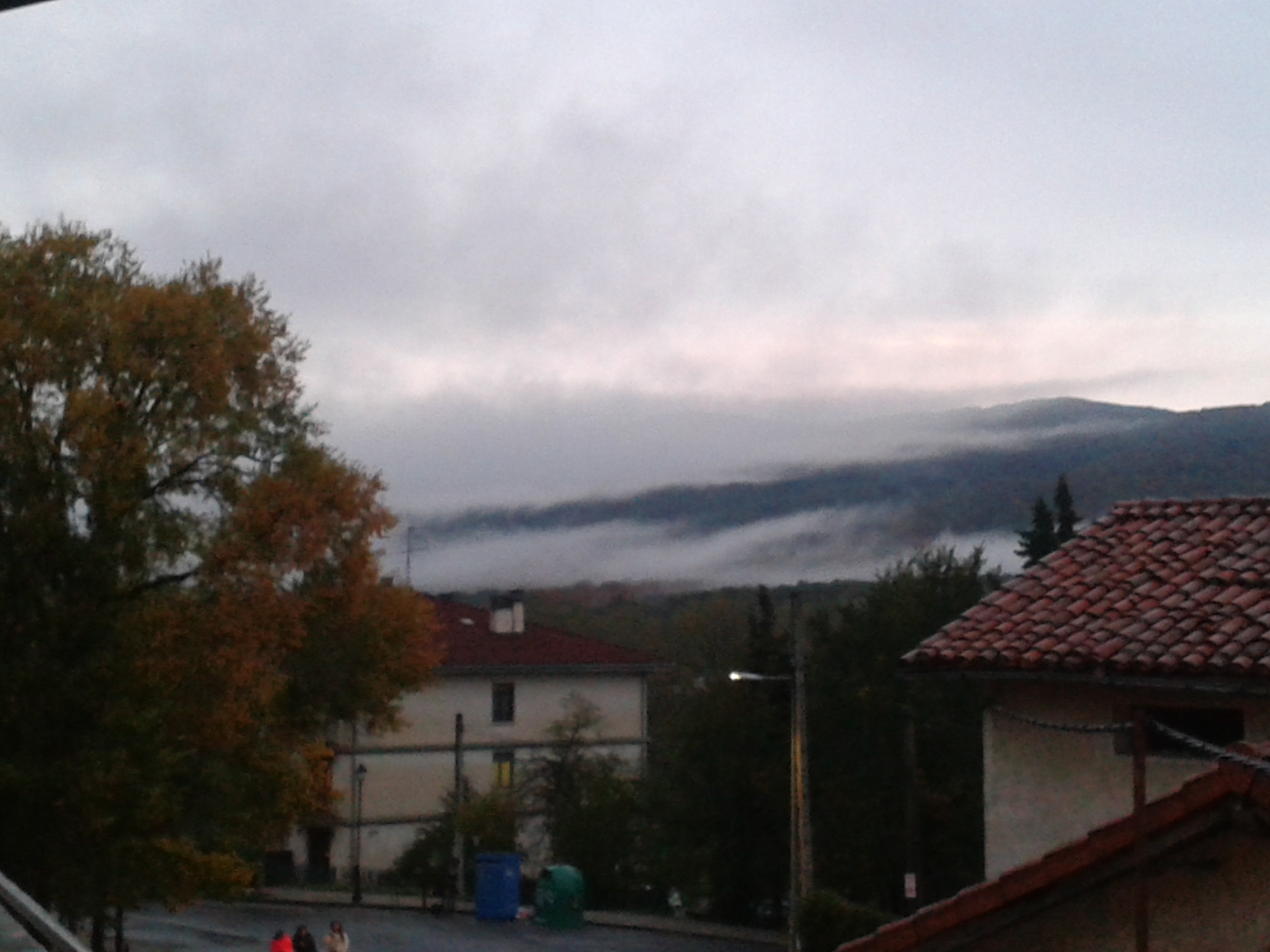
From Axpe de Busturia train station, Bizkaia, October 2017. (Photo: D.Breatnach)Morning view of misty mountains from a host’s house in Etxarri, Nafarroa province, October 2017. (Photo: D.Breatnach)Bermeo Harbour and some of the town from heights above, October 2017. Near the big building at 9 o’clock on the photo was the location of a Franco prison for Resistance women — I was told that Basque nuns locally brought food to the jail for them every day. (Photo: D.Breatnach)Part of the Bay of Bizkaia (Biscay), October 2017, from the site of a Basque Gudari artillery battery during the Anti-Fascist War. (Photo: D.Breatnach)
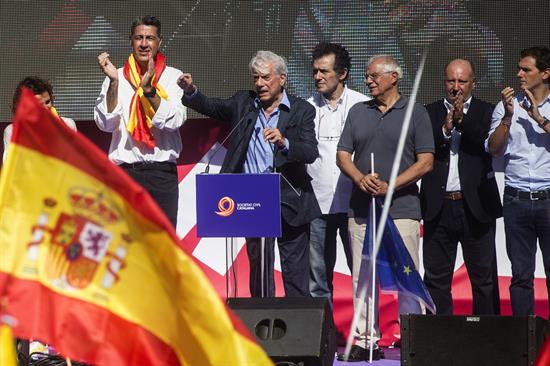
Mario Vargas Llhosa was in Barcelona on Sunday as part of a number of people speaking at a pro-Spanish union rally which received coaches from various parts of the Spanish state. HE DENOUNCED NATIONALISM (Democratic, Catalan) WHILE SURROUNDED BY SPANISH NATIONALISTS AND FASCISTS AND THEIR SYMBOLS (the Spanish unionists were demanding that Spain remain united, insulted Catalan officials, waved Spanish unionist flags and called for a Catalan-elected President to be jailed; Spanish fascists openly displayed fascist Franco-era flags and symbols and gave the fascist salute).
Nobel Literature Prize-winner Mario Vargas Llhosa addressing Spanish unionists and fascists bussed into Barcelona for rally against Catalan independence and self-determination (Photo source: Internet)
TALKING ABOUT THE IMPORTANCE OF DEMOCRACY WHILE DEFENDING AN UNDEMOCRATIC AUTHORITARIAN SYSTEM REPRESSING AND DISRUPTING A PLEBISCITE (State police violence leading to nearly 900 civilians injured; ballot boxes and ballot forms seized; elected officials arrested and/ or threatened with jail).
TALKING ABOUT THE IMPORTANCE OF THE RULE OF LAW WHILE IGNORING ILLEGAL ASSAULTS BY STATE POLICE RESULTING IN NEARLY 900 INJURIES (without a single State police officer being even charged or senior officers even reprimanded).
A NOBEL PRIZE WINNER IN LITERATURE IS UNABLE TO DETECT AN IMPORTANT ELEMENT IN WORLD LITERATURE — IRONY (Llhosa was awarded the Nobel Prize for Literature in 2010 for his work examining the corruption of political power and struggle against it — in Latin America).
Yes, it has its own language (Catalan), its own national anthem and its own national cultural customs. Furthermore it has been independent a number of times in its history, as a Republic. And its official autonomous status in the Spanish state even includes the word “national”. Catalan is an official language in Catalunya (along with Castillian — Spanish) and most people there speak Catalan daily.
The Esteladas flying in a Catalan demonstration for Independence. (Photo source: Internet)
DO NATIONS HAVE THE RIGHT TO SELF-DETERMINATION?
Yes, according to most legal authorities and most people’s sense of right and wrong. It is recognised in the UN Charter of Human Rights.
IS THERE A LIMIT ON THE RIGHT OF A NATION TO SELF-DETERMINATION – i.e CASES IN WHICH THE RIGHT DOES NOT EXIST OR CAN JUSTIFIABLY BE OVERRULED?
Perhaps. For example, if a nation were somehow to determine to wipe out an ethnic minority, the right to decide to do so and to carry it out can be overidden by the more basic right of the targeted ethnic minority to exist. If one considered South Africa as a nation, it had minority racial government ruling over a majority disenfranchised black population and one could not endorse their right to continue in that way since they were negating the rights of the majority of their state’s population to self-determination.
CAN CATALUNYA’S CASE BE ONE OF THE JUSTIFIABLE EXCEPTIONS THAT WOULD NOT ENTITLE IT TO SELF-DETERMINATION?
Not at all. The only claim against her right to self-determination (other than the Spanish state’s claim that it violates the Spanish state’s constitution) is that it is one of the richest regions of the Spanish state and a large one. If that were considered a viable argument against Catalunya’s right, it would mean that no nation which has good natural resources or a successful economy has the right to self-determination and must stay within a union to benefit its invader and coloniser state.
HAS CATALUNYA’S RIGHT TO SELF-DETERMINATION BEEN VIOLATED BY THE SPANISH STATE?
Cartoon comment on October 1st referendum by DB
Unquestionably Yes. She has been prevented a number of times by Spanish court legal judgements and by threats of the use of force from carrying out a referendum on the question of independence as a republic. Her attempt to carry out the referendum in spite of all threats was met this month with actual violence (nearly 900 injured people), police invasion of Catalan Government offices and polling booths, seizure of ballot boxes and ballot papers and in a number of areas, aggression against and disrespect for Catalans and their culture.
Furthermore many measures sought by the Catalan Parlament on grounds of increasing rights of migrants, protecting the environment and animal rights, restriction of the legal rights of the banks, have been declared illegal by the Spanish national courts, thereby violating the rights of Catalans to determine for themselves how they shall manage these matters.
WAS THE OCTOBER 2017 CATALAN INDEPENDENCE REFERENDUM ILLEGAL?
Here we have to ask – by whose law? The Catalan Parlament approved the holding of the referendum by majority. The Government approved and organised it.
According to the constitution of the Spanish State, no part of the State’s territory is permitted to enact independence without the permission of the Spanish Parliament. The Catalans will always be outnumbered in the Spanish Parliament (a similar situation to members elected in Ireland to the Westminster Parliament in Britain from 1801 to 1921; or Scottish MPs from 1707 to the present; Wales was annexed by England 1535 – 1542). They can never expect to gain a majority vote in their favour at Westminster.
By the Constitution a declaration of independence (though not perhaps a referendum on a wish) is illegal. But when has an occupying state given the right of secession to nations and peoples it occupies?
WAS THE SPANISH CONSTITUTION OF 1977 (WHICH THE SPANISH STATE CLAIMS MAKES CATALUNYA REFERENDUM ILLEGAL) APPROVED BY MAJORITY?
In most of the Spanish state, it was.
But does that mean that it overrules the right to self-determination of a nation currently within the Spanish state? No, clearly that cannot be.
Also, that Constitution was rejected in the Basque region of Euskadi but the Spanish state nevertheless refused it too the right to referendum on the question of Basque independence.
In addition, the Constitution was proposed three years after the death of a dictator who had crushed Catalan (and Basque) resistance in 1939, repressed the Catalan (and Basque) language and civil rights for 36 years, with fascists still in power managing the transition to the new form of the State and with the collusion of the leaderships of some crucial former resistance organisations of the people, i.e the Communist Party and the social-democratic Socialist Workers Party, along with their respective trade unions.
Self-determination must mean the right to enter into a union or to remain outside it but it must also mean the right to leave a union, nullifying any previous agreements.
The Constitution is constructed so that it places many hurdles in the way of any nation seeking to leave the union even in the unlikely event of getting a majority to vote with it in the Spanish Parliament. “Title X of the Constitution establishes that the approval of a new constitution or the approval of any constitutional amendment affecting the Preliminary Title, or Section I of Chapter II of Title I (on Fundamental Rights and Public Liberties) or Title II (on the Crown), the so-called “protected provisions”, are subject to a special process that requires (1) that two-thirds of each House approve the amendment, (2) that elections are called immediately thereafter, (3) that two-thirds of each new House approves the amendment, and (4) that the amendment is approved by the people (i.e the people of the whole Spanish state – DB) in a referendum.” (Wikipedia)
WAS THE RECENT CATALAN REFERENDUM A FAULTLESS TEST OF THE WILL OF THE PEOPLE OF CATALUNYA?
Clearly not – not because participation was limited to 48% of the Catalan population but because the Spanish Government had declared in advance that it would not respect the decision and would prevent the referendum taking place. Also because voters were prevented by Spanish police from entering a number of polling stations and because Spanish police seized many ballots and ballot boxes.
But should the Spanish state be permitted therefore to claim therefore that the votes which were registered and counted are of no avail? Are we to endorse a view that an occupying or colonising state can nullify any nation’s vote for self-determination simply by banning the election or referendum and by disrupting the process? Clearly not.
The Irish uprising in 1798 and in 1803 was not the result of a referendum, nor was that of 1916 nor the War of Independence 1919-1921. Clearly, if we are to uphold the right to self-determination of nations we must support the right of the occupied or colonised nations and to decide their own means of breaking away.
ARE THERE CATALANS WHO WANT TO REMAIN WITHIN THE SPANISH STATE?
Clearly there are. As many as there are who wish to break with it? The evidence suggests not. Very recently the media claimed a hundred thousand rallied in Catalunya against independence. But around a million gathered there last month to support the right to hold the referendum, with most of them clearly for independence. Clearly, even if everyone attending a rally against Catalan independence were actual Catalans and had not been bussed in, they are outvoted by those Catalan residents who demonstrated despite threats and who voted despite police violent repression. And if the Spanish state thought the vote would go in favour of remaining in the union, why did they forbid the referendum and disrupt the process?
When the Irish financial bubble, expanded far beyond capacity, finally burst and the private banks that had caused the crisis were bailed out with public money, the Irish people did not immediately rise up. The big trade unions made some noises, called hundreds of thousands to march, then collapsed. The smaller unions, for the most part, caved in afterwards.
It was not long before the Irish people began to be jeered and insulted – and for the most part, by some people who were themselves Irish. They seemed unaware of a thousand years of militant resistance to foreign occupation and many workers’ battles over decades. The frustration, if that was the cause of their insults (not to say contempt), was understandable. Less so, I pointed out at the time, was their dismissal of the only force that could possibly save us – the Irish people.
“The people?” they jeered. “You mean the SHEEPLE!”
They pointed to massive demonstrations and riots in Greece and in France and to none in Ireland. I commented that all their insults could possibly achieve would be to discourage the Irish people further. The limitations under which the Irish people laboured needed to be understood. There was no large revolutionary party in Ireland to provide leadership. There was not even a militant radical social-democratic party or reformist Communist Party. There were no militant trade unions to provide organisation. These things existed in Greece and in France.
Our trade unions had twenty years of “social partnership” – i.e they had during that time negotiated agreements nearly always without industrial action in joint committees where the unions, the employers and the State each had representatives. Their fighting muscle had atrophied to the extent it no longer existed. Notwithstanding all their faults, the Greek and French unions had not similarly wasted away their muscle. Our trade union leaderships had settled for a comfortable life, highly paid, building up their memberships and safeguarding their officers and structures, or trying to, neglecting the purpose for which those unions had been created. They were captains of ships in dry dock, shining and varnished, but riddled with worm holes and sails safely furled – they would never take to sea and be tested in any storm.
As time went by, we saw no significant reforms in the French situation as austerity bit there. There was much excitement in Left social-democratic and Trotskyist quarters as the Greeks elected a social-democratic party with a radical program of resistance to austerity measures. The Greeks had been driven to a much worse economic situation than had the Irish – during the winter, many schools had to close as heating could not be supplied. But then the radical Greek party and new Government collapsed under pressure from the EU’s financial commissars.
The people in the Spanish state were marching in their hundreds of thousands under a new party that was not really a party, they said. But it turned out if one did some digging, that it was not such a new party/ non-party after all, as its leadership came from the old reformist Communist Party-Trotskyist alliance, Izquierda Unida. But still …. huge marches and then huge electoral gains (for what was now without question a political party – Podemos).
But the Spanish ruling class, although unable to receive a governing mandate for a single political party, carried on with its austerity program. Evictions continued as did a great many suicides of those evicted or about to be evicted.
IRELAND (THE 26 COUNTIES)
Meanwhile, what about the “Irish Sheeple”? What were they doing?
They too began to march, in small numbers at first, then larger until they choked the capital city’s centre. The media under-reported them, lied about numbers, stopped doing aerial photos that would show the full extent of the masses in protest.
First in line of the resistance movement was the Household Charge. The campaign slogan proposed by independent protesters and small parties and political organisations was “Don’t register, don’t pay.” Despite that tactic, the most effective to defeat the Charge, not being supported by the alternative party with the highest number of elected representatives in the Dáil (Irish Parliament), i.e Sinn Féin and despite no trade union mobilising against it, the ruling class had to concede defeat. But they changed the tax to the Household Charge and made it collectable from people’s salaries at source, changing the law in order to do so.
A section of a Water Charge protest march on the south quays of the Liffey while another section marches on the north quays in August 2015 (Photo: D.Breatnach)
The Water Charge was next. The people already paid for water supply maintenance through ordinary taxation and, it later emerged, through the diversion of Motor Tax to pay for the water! Nevertheless, a new charge was levied and again, the campaigners asked the people: “Don’t register, don’t pay!” Again, this tactic was not supported by the same alternative political party or the unions, although they all declared that they were, of course, against the Water Charge.
Despite police harassment, violence and arrests, people in local areas began to block the work-gangs installing the water meters. Some arrested activists refused to obey a court injunction intended to paralyse their activities and were sent to jail. A large protest demonstration marched to their jail and they were released. Many trials collapsed and activists, though hampered by many court attendances, walked free. Some others paid their fines and continued their resistance.
March against the Water Charge finishing for rally at Dublin’s Stephens Green in September 2016 (Photo: D.Breatnach)
Police attacks on water charge and anti-austerity protesters multiplied and pickets, particularly of women, protested outside Garda stations.
Hundreds of people began to march, then thousands. As the numbers grew, the reformists of political party and trade union climbed on board and the numbers continued to rise to hundreds of thousands. The media were exposed as they grossly underplayed the numbers.
MOORE STREET
Meanwhile, another struggle had been shaping up, between heritage conservationists campaigning to save a valuable piece of the City Centre of huge historical importance from property speculators. Firstly the State was obliged to declare four houses in Moore Street as of historical preservation status (while however the Planning Department of the local authority gave planning permission for a huge “shopping mall” of a number of acres around those houses). Subsequently campaigners prevented the Planning Department from carrying out a land-swap of Council land to facilitate the Speculator.
Then the State had to buy four houses in the historic terrace; at the same time their plans to demolish three other houses in the same terrace were prevented by their occupation by protesters for five days and a subsequent blockade of demolition workers of almost six weeks.
The blockade ended when a case taken by a concerned individual to the High Court resulted in a judgement that the whole quarter is a historical 1916 monument (against which judgement the Minister of Heritage is currently appealing, scheduled for hearing December 2017).
Moore St. historical conservation campaigners in the street itself celebrate High Court judgement shortly after receiving the news on March 18th 2016 after which they ceased the blockade. (Photo: J.Betson)
During the 1916 State commemorations, the Minister of Heritage’s hypocritical laying of a wreath in Moore Street was met with vociferous denunciation by campaigners on the spot, without any of the protesters being arrested.
JOBSTOWN
Two years before that Moore Street event, a mass protest for had prevented two hoursthe Minister for Social Protection’s car from leaving a working class area where she had gone to attend a ceremony.
Some supporters of those charged for protesting in Jobstown in show of solidarity outside the Court where they were being tried in March this year. (Photo: D.Breatnach)
“Enough!” cried the ruling class and they argued about what to do, their more revanchist section winning the argument. They were going for maximum legal attack, to teach those protesters a lesson and frighten all others in future.
The offensive against the resistance was planned. Early morning raids, to increase disruption and fear. Mass arrests, including of a juvenile. This latter might have looked like a mistake, as it was obvious he’d attract sympathy — but actually it was cleverly thought out. They put his trial on first – in the Juvenile Court where the judge can get away with more, where access to media was restricted to one representative each of print and audio media and where no members of the public were permitted entry. And they found him guilty, of course they did. They avoided much of sympathy outcry by giving the youth a non-custodial sentence but – and this was the crucial thing – they had found him guilty of “false imprisonment”. They now had a precedent for the eighteen or so awaiting trial in the adult court.
The media mostly colluded, of course in their news coverage of events, trial and in comment.
The trial process began with an attempt to eliminate from the jury those who disagreed with the Water Charge (i.e most ordinary people) and people from the area where the incident had taken place. Then the Minister herself, in the witness box for four days, regularly failing to answer the questions of the Defence lawyers but using the opportunity instead to attack the defendants, without attempt by the Judge to direct her to answer the question and confine herself to doing so. After all, it’s the Prosecution lawyers’ job to draw out the unfavourable comments.
That was followed by two similar days with the Minister’s secretary, who had been in the car with her at Jobstown.
Then police officers, lying through their teeth. This is of course a regular occurrence in the courts but unfortunately for them, they were contradicted by video and audio recording. Somehow, not only one but several Gardaí heard one of the defendants say something which the recording showed he had not.
Finally, all were found not guilty. The next group were to be tried similarly on charges of false imprisonment but also with use of violence. But how could the State find them guilty of kidnapping on the same evidence that a jury had rejected in the case of the first group? Would even the violence charges stick? The ruling class took a decision to cut their losses, avoid a possible second defeat and decided to drop the charges against them too and against another group scheduled for later still.
POLICE CORRUPTION AND COVER-UPS
Meanwhile, independently of all but perhaps distantly affected by the people’s resistance and the anger at the behaviour of the police, two whistle-blowers emerged from among the Gardaí to accuse them of allowing powerful people to escape drunk-driving charges. Then it emerged that people charged with driving offences had been automatically convicted without the option to defend themselves in court. That was followed by revelations that the Gardaí had claimed to have stopped hundreds of drivers for drink-driving tests which they had not in fact done – and the false numbers grew to thousands. And then Gardaí senior officers tried to discredit one of the whistle-blowers by implying he was a paedophile and even enlisting the involvement of a child-protection agency.
Before the conclusion of the Jobstown trials, general elections had been held. The ruling class in the Irish State has not managed to have an overall majority for a single one of its political parties since 1981 — and this election was no exception. However, one of the parties of the ruling class (its favourite actually, since shortly after the creation of the State) now felt the pressure of the people and made non-implementation of the Water Charge a condition of not bringing the minority Government down, to which the parties in governing coalition were obliged to agree.
THREE FORCED TO RESIGN: Alan Shatter, then Minister for Justice, congratulating Nóirín O’Sullivan on her appointment as Deputy Garda Commissioner while Commissioner Martin Callinan looks on. As a result of exposure of alleged attempts to silence Garda whistleblowers and alleged covering up Garda corruption and misdeeds, Shatter and Callinan had to resign in 2014 and O’Sullivan recently. (PIC: MAXWELLS NO REPRO FEE)
As a result of all this (and a number of other less-highly publicised corruption and wrongdoing by Gardaí cases), eventually Allan Shatter, Minister for Justice and Garda Commissioner Martin Callinan, the highest-ranking officer in the Gardaí had to resign. Less than three years later, the new Commissioner, similarly implicated but now also in a scandal regarding officers’ financial corruption, had to resign as well.
SHEEPLE?
In this period, during which Irish people had been compared to sheep, cursed and denounced by some from the “Left” and compared unfavourably with protesters in Greece, France and Spain (despite the people of those three states having failed to succeed to any significant degree), the Irish people have
Totally defeated the Household Tax and obliged the ruling class to change the law and substitute another Tax collectable from income
Paralysed the Water Tax (Charge)
Exposed the mass media
Halted the Government and Dublin City Council’s Planning Department plans to give a historical memory area in the City Centre, prime “development” land, to speculators
Prevented the Government demolition of historic buildings in that area by campaigning, occupation of buildings and a blockade, without a single protester being arrested
Helped obtain a historic judgement from the High Court that the whole quarter is a historical 1916 Monument
Vociferously denounced the Minister of Heritage while she was laying a 1916 wreath at Easter in Moore Street, without a single protester being arrested or prevented from the denunciation
Held up the Minister of Social Protection’s car in mass protest for two hours
Exposed the police in violence and in corruption
Defeated plansto deal a major blow to the right to protest by conviction on kidnapping charges
Caused the resignation of a Minister of Justice and two Garda Commissioners inside a period of three years
And all this was achieved by the Irish people without the organisation or leadership of a mass revolutionary or radical political party or a mass militant trade union.
An old, old debate or discussion has broken out of late. It has been inspired or regenerated by the inability of the main political parties of the ruling class to achieve a ruling majority in the Dáil, even in coalition. Another factor has been the growth of Sinn Féin seats to a number sufficient to attract another party into getting them into a coalition government. And another General Election cannot be far off.
The debate or discussion is sparked by questions something like this:
Should a coalition of revolutionary socialists and radical social-democrats put together a joint slate to present themselves and agreed policies to the electorate?
And a different question (but not completely different in the minds of some of that potential slate above, I suspect):
Should a party that presents itself to some supporters as revolutionary, to some others as radical, participate in a coalition with one of the traditional ruling class parties to form a government?
Against either of those possibilities, groups of anarchists and non-Sinn Féin Republicans, in rare agreement, declare that no such initiatives should be supported; the anarchists, because they do not believe in bourgeois elections or parliaments and the republicans, because this is not a Republic which they can legitimise by taking part in their state elections. Some revolutionary socialists and others of varying hues argue that the system will corrupt those who take part in their institutions and provide a long list of those to whom that has happened historically (and both anarchists and republicans can nod their heads in agreement at the list).
Social democrats and some others argue that an election provides an opportunity to put in to power a different administration, one which has the actual power to change things. They argue that it is their duty to take advantage of that opportunity and accept its challenges; they charge their critics with being dreamers who prefer to hold on to their ideological purity for some distant day rather than to address the real situation in the here and now.
TAKE PART IN GOVERNMENT?
There is room for some fruitful debate and discussion around some of these positions but one thing seems clear to me: it can never be permissible for revolutionaries, under any excuse whatsoever, to be part of a government to run the country for the capitalist ruling class. The capitalist ruling class is our enemy and we are irreconcilably hostile to it and must remain so. We work for the day when we can overthrow that class and put the workers in charge and no honeyed words of exception or self-deception can change that fact.
Undermine it from within? Use their institutions against them from the inside? Throughout history, all those who have attempted that (or who pretended to for their own careerism) have shown that far from subverting the system, it was they who were or became subverted.
Yes, it is a philosophical truth that just because something happened before is no guarantee that it will happen again. Even if it happened every time in the past. Although jumping from the tenth floor of a building on to hard ground has killed hundreds over time, it is philosophically possible that someone could survive it now – even unharmed. But it is not a scientific nor a historical probability. One is entitled to try it with one’s own life but not with the lives of others.
Those who formed Fianna Fáil crossed over that line not long after they split from Sinn Féin: not only that but the party soon became, despite its Republican and nationalist roots and rhetoric of being for a 32-County Republic, the preferredpolitical party of the Irish foreign-dependent capitalist class in the 26 Counties and virtually unknown in the Six.
A Fianna Fáil election poster, possibly 1950s or ’60s. Source: irishelectionliterature.com
The Sinn Féin we know today (Provisional Sinn Féin, as they no longer like to be called), the largest survivor of a number of large and smaller organisational splits since the days of the creation of Fianna Fáil, also crossed over that line. In a sense, they did so in an even worse (or more obvious) way than had Fianna Fáil – Sinn Féin participated in a colonial government, the administration of an armed foreign aggressor.
Old FF election poste: “There’s a better way” (source: internet)
That party is heading for entry into a capitalist coalition government in the 26 Counties, if only it can find a partner willing to accept it for the dance. Based on its history in government in the Six Counties and some other measures, the SF party leadership strives to prove to the Irish capitalist class that it can be trusted to manage the system, alone or in partnership with one of the main capitalist parties.
There’s a better way with SF too, apparently. A much more recent Sinn Féin election poster. (source: internet)
The President of the party has said that “Sinn Féin doesn’t have a problem with capitalism”. The party’s leadership refused to support the “Don’t register, don’t pay” slogan of the early campaigns against the Household Tax and later against the Water Charge (the first was defeated by popular resistance following those slogans and the second is on hold, due to a number of factors ultimately arising out of popular resistance). Dublin local authority councillors of the party voted to hand over public land on a prime Dublin site to private property speculators. The party’s leadership has shown itself publicly welcoming to every imperialist or zionist representative to visit them, including the mass-murdering political leadership of the USA and the British monarch and Commander of the Armed Forces which is enforcing the occupation of one fifth of the country.
But it is not only necessary for SF’s leadership to convince the Irish ruling class (and its foreign partners) – in order to get elected, it has to also convince its own following and thousands outside of that. So some anti-imperialist and left posturing is necessary. Of course it is opposed to the Water Charge and was also opposed to the Household Tax, it tells people – it was just that it couldn’t ask people to risk going to jail and losing their homes by taking part in civil disobedience. And it does put some of its followers out on the street in demonstrations against the Water Charge.
In defence of the vote of Dublin City councillors, it declares that through the deal, it got funding for a percentage of public housing on the site – wasn’t that good? Perhaps, but better than a 100% public building program of its own on its own land, using the many construction workers currently idle? Hardly. And once public land is gone, it is gone for ever (well, forever short of the kind of revolution that SF declares to be unrealistic).
So Left words for its potential voting public, soothing words to its long-suffering membership and acts of collaboration and collusion (and signals of more of the same) to the ruling class. And for the collaborationist careerists jumping into the party.
A SLATE OF REVOLUTIONARY AND RADICAL LEFT CANDIDATES
A revolutionary coalition with SF, even if it were to agree to such a thing, would be for any movement of resistance to cut its own throat. But what of the other parties, groupings and independent political activists?
In my opinion, it might well be worth supporting an attempt to create such a coalition, presenting a list of revolutionary or even radically progressive demands.
“But isn’t that reformist and in contradiction to the revolutionary vision?” If it were reformist, i.e with only the intention of reforming, I would say yes, it is in clear contradiction to our vision. If it were to suspend popular organisation and mobilisation and to put its faith in the outcome of the elections, I would be against it.
Workers’ and soldiers’ barricade, Paris Commune 1871. Revolutionaries took part in elections prior to the establishment under arms of the Commune, the first time in history a city was taken and put under workers’ rule. (Photo source: internet)
But the intention here should be to form a revolutionary and/or radical ParliamentaryOpposition, putting forward radical reforms which would, if achieved, make living conditions and resistance much easier for the working people and extortion and repression much more difficult for the ruling class. And meanwhile revolutionaries should never cease in their revolutionary propaganda that only the overthrow of the ruling class can bring about deep and permanent changes for the benefit of the working class.
Tom Stokes, a commentator on political affairs and media reporting for many years, in August 2015 published a list of policies or demands upon which such a slate could be based, upon which they could campaign (https://theirishrepublic.wordpress.com/2015/08/22/broad-left-policy-platform-essential-now/). Although the manifesto did not gather much publicly-expressed support at the time, it seemed to me then and seems still to be a worthwhile initiative and one to consider for any builders of a putative Left electoral slate.
A POSSIBLE LEFT SLATE MANIFESTO
This is the list which Stokes published, without any claim to it being definitive. However, a list of demands for a Slate of candidates to agree to cannot be exhaustive – there will have to give and take, as he acknowledged. The important thing from a revolutionary point of view should be that it points the way forward to resolving the economic problems facing the working class and the majority of the people in general and to the radical improvement of their rights. Further on, I give my own thoughts on this manifesto. 1 Adequate, affordable, secure housing as a right, where necessary through public provision.
2 A single-tier publicly funded, secular and excellent education system with no provision from the exchequer for private fee-paying schools with exclusive enrollment policies. Religious instruction outside school-hours. Ending the university-controlled points system for third-level entry. Free third-level or vocational education/training subject to contractual obligation to work within the state for any three of first five years post-graduation with debt-related penalties for non-compliance.
3 The right of all children to adequate housing, nourishment and provision of health and care according to need, guaranteed by the state.
4 The right of workers to employment, or to further education or training as required, including those who wish re-enter the labour ‘market’.
5 A living wage, the ending of oppressive zero-hour contracts, workers’ right-to-organise and right-to-negotiate guaranteed by the state.
6 Full equality for women including pay-rates, personal autonomy and dignity including reproductive rights. Repeal of the Eighth Amendment. Provision of supports for mothers and carers commensurate with their contribution to society for that work.
7 State ownership of essential services, natural resources & physical infrastructure. Constitutional provision for public ownership of water and protection of Mother Earth.
8 Empowerment of communities, starting with disadvantaged communities – rural and urban. State support for community initiatives to achieve personal and community empowerment.
9 Strong laws against public and private corruption with strict sanctions. Ending political appointments to judiciary. Curbing legal costs for citizens. Equal access to civil courts regardless of means. Refocusing criminal justice system and penal system. Taking politics out of policing in favour of civic obligations.
10 Realigning taxation system to shift burden towards wealthiest. Ending tax-exile status, tax loopholes and tax-havens. Enforcing Corporation Tax.
11 Properly codifying the state’s position on neutrality, opposition to war, concentration on international and intra-national conflict-resolution and peace-keeping. Adherence to international codes on prevention of torture, refugees, humanitarian obligations, etc.
12 Proper commitment to reunify the people of the island through concerted, direct, rational dialogue with the objective of creating a fully representative all-Ireland parliament based on equality, respect and civil and religious freedoms.
13 Greater local and regional democratic control as appropriate. Making government fully accountable to parliament and the people. Creation of a democratically elected upper house to speed legislation and as a counter to excessive power of parliament. Installing a publicly accessible online register of lobbyists and a publicly accessible tendering system for state acquisitions, both updated daily.
14 Regulation of media in terms of ownership and the public’s right to essential information, fairly and accurately delivered. Active fostering of ideological diversity in media in the public interest. Insistence on journalistic ethics in the public interest. Higher values of Public Service Broadcasting a requirement for state media.
15 A commitment to expedite a widespread public consultation process towards creating a new constitution for a genuine republic.
Let us examine these demands now.
1. Decent, affordable housing is an obvious necessity so as not to have people sleeping on the streets, families in unsuitable accommodation, people at the mercy of landlords and others slaving to pay the monthly rent or mortgage. And public provision is the obvious way to provide this.
2. The right to secular education as a norm is a basic democratic right and should have been a Republican demand from the outset. No church should be permitted to exercise any control over admission to — or content of — education; any religious group that wishes its children to be instructed in its religion should pay for that themselves and provide it outside of school hours. And unless we have free third-level education only those already more privileged will be able to avail of it or will plunge themselves into debt in order to do so.
(I am unsure about the inflicting penalties for not working within the State after graduation – if we provide a decent economic and social environment it seems to me that most people would want to stay or to return after they had left and we should avoid coercion where possible).
3. Children are our future and must be accorded full legal and social protection – the contrary to what our State has done for decades. How can we disagree with that?
4 &5. It seems to me that we can combine these under the right of workers to employment and training and organisation. Further, workers must be permitted to exercise their latent power in order to ensure those things are provided. We need the acknowledgement and legalisation not only of the right to strike in defence of the demands of one’s own workplace but in support of others. This would remove a gag and chain on the working class at present which prevents trade unionists, at threat of the sequestration of all or part of their funds, from supporting action by workers who are in weaker positions. If the Left Slate were to achieve this alone, even though it could all be nullified later, it would be a great step forward. Were they not to succeed in achieving it, their raising it as an objective on their platform would be a strong indication of the direction for workers to take.
6. Full equality for women under the law must be a central demand of any democratic platform. The right to abortion is a recognised right in all liberal and socialist societies with the exception of Muslim states, the USA and the 26 Counties. I myself am in support of that right but it remains a divisive issue among the largest alternative movement in this state, the Republican movement and is opposed by many others. This issue should be discussed in any Left electoral slate. Nevertheless, Amendment 8 to the Constitution has no right there and should be removed.
7. One would think that demanding State ownership of all Ireland’s natural resources would be unopposed within a Left Coalition slate. I am not convinced that would be so. And since I do not expect socialism to arrive through a parliamentary majority, I would settle for some specified areas: oil, gas, water infrastructure, sea, rivers and lakes. And public transport, water infrastructure, roads and telecommunications infrastructure.
The abolition of the Water Charge would be popular and is obviously a necessity on a number of levels, not least the democratic one that maintenance of a drinkable water supply has already been paid for in two different taxes. A change in the Constitution that would put our water services beyond privatisation would also be a great relief and a step forward.
8. No-one considering a Left Electoral Slate organisation is going to argue with “empowerment ….. of disadvantaged communities” — the difficulties will arise over how to interpret that demand, what will be the specific targets and timeframes, the amount of financial investment.
9. This is an extremely wide-ranging point. Clearly the judiciary should be separate from other forms of administration or political interests. Clearly too, those who hold posts of public responsibility should suffer strong sanctions should they behave corruptly while in office. And obviously, given a democratic society’s reliance on law to manage their affairs, taking cases should not be the prerogative of the rich, which means reducing the cost of such procedures drastically, including appeals. And it seems to me that most people would support such changes, though they would be frantically opposed by special interest groups.
10. Realigning the tax burden to fall upon the rich and closing tax loopholes (more like tax flood gates!) for the rich, ending exile tax status etc all seem commendable and fair to the people, the majority of the population, who bear the actual burden of a number of taxes. And the Left Slate could push those objectives on to whatever government gets elected, as popular demands which the bourgeois parties (and their compromisers) could not concede. But careful! The revolutionaries inside the Left Slate should make it clear that they are not for fairer taxes on the rich and working people, but instead for the expropriation of the rich, whose stolen wealth is to returned to the working class. We do not intend to become part of any government inside a capitalist society, for reasons I shall go into a little further on.
11. There is no question but that the position of the Left Slate should be for a real neutrality on the part of the State, making it increasingly difficult for the ruling class to indulge any dreams of returning to a British Commonwealth or to joining NATO. Such alliances have dire consequences not only for millions of people abroad but also ultimately at home – one consequence alone would be to facilitate foreign military intervention in the 26-County state in the event of an insurrection or even the election of a Left-leaning government. Alliances of that sort always include a “mutual assistance” clause and we can be sure that the “mutual assistance” envisaged is one between the capitalist ruling classes of the various states.
Prevention of torture should be a human rights requirement of every nation and state but, on the contrary, it is ensured in practice by none. Those who complain of their followers being tortured have been shown time and time again to be willing to inflict it themselves – always for the “highest” of reasons. There is no reason to believe therefore that no participants among the Left Slate will at some point, finding conditions favouring such a practice, indulge in it themselves. But the Slate should in any case incorporate it into its program. And thereby also, it might be said, strive to build some protection for its own members and supporters from such practices by the Gardaí and prison guards.
In the field of human rights and under the principles of internationalist solidarity, it is clear too that a Left Slate should advocate and push for a humane regime for the processing of refugees and migrant workers and their integration into the population.
12. This seems like a progressive demand but actually I do not support it. This is something perhaps for a revolutionary government and such can only come about after the overthrow of capitalism.
But I do think that the Left Slate should advocate the reunification of the island and religious freedom. Understanding the composition of the Irish Left, inclusion of reunification in the Manifesto is bound to run into difficulties from some quarters – revolutionaries, not just Republicans, will have to consider whether to compromise to some extent on this demand for an agreed Left Slate manifesto (while retaining their own political demands outside of that) and, if so, how to do so.
13. The creation of a register of political lobbyists is not actually a revolutionary demand but I think revolutionaries should support it. Such a register will help to expose the lines of communication and mutual assistance of capitalist political parties and the capitalists themselves. The same goes for tendering for State and local authority projects. But I do not support the rest of those demands. They seem to me to envisage a Left Government, trying to make the system better and, at the same time, stabilising it. This is not what revolutionaries are about. Besides which it seems to me that the creation of another parliamentary tier is counter-democratic and would tend to increased bureaucracy.
14. I understand the motivation for this but find it difficult to envisage how it might be achieves. Anti-monopoly legislation might for a while hamper media monopolisation but the experience of other countries shows that ultimately, it will not be successful. Enforcing a system of right of reply (as distinct from a voluntary one adopted by the media) for those who feel they have been misrepresented in the media is one possibility. Another might be enforcing the right of publication of a counter-report when substantiation can be provided on, for example, the numbers reported as attending a demonstration or the events during a confrontation between police and demonstrators.
But definitely, the Left Slate should push for the lifting of State restrictions on community radio and television, with the aim of facilitating a diversity of such broadcasting, including news reporting, political commentary, cultural performance and discussion, etc.
15. I do not oppose this point nor do I endorse it. A new Constitution worth having, in my view, is a revolutionary one and as such, can only be properly conceived of by a population that has passed through a revolutionary process and been, in the course of that, revolutionised and empowered.
SHOULD REVOLUTIONARIES SUPPORT THE FORMATION OF A LEFT SLATE?
“OK, so let us imagine that a credible Left Slate is agreed and presents itself for election. Should revolutionaries ask people to vote for it?”
I think so. But it should also be clear that organisation and mobilisation in struggle and resistance should not diminish one iota but, on the contrary, intensify. And revolutionaries should clearly tell the public that only the complete overthrow of the ruling class can usher in lasting change – and that the working class should prepare themselves for that struggle. But also that, whatever members of that coalition slate may say or do, the revolutionaries will never participate in any administration of the old system, i.e no national government prior to the overthrow of the capitalist system and the expropriation of the capitalist class.
“Perhaps revolutionaries should then just ignore the Left slate and concentrate exclusively on revolutionary work – organising and supporting campaigns of resistance, ideological and historical education?”
I strongly disagree. Campaigning for such a slate would bring revolutionary ideology to thousands of working people who are currently unreachable by the revolutionaries. And many people will want to know what revolutionaries think of the Left Slate and of its policies.
And anyway, just because we are revolutionaries, does that mean we are against reforms? Not at all – in our history as revolutionaries, we have been some of the most resolute campaigners for reforms and defenders of them when they have been won! However we are not reformists – the kind of people who believe in a radical or steady improvement in life by reforms but leaving the capitalist system in place.
But we are for reforms that strengthen the working class, the movement of resistance. For examples: the right of workers to combine and strike; the shorter working week and safety legislation; the abolition of child labour; universal education; the right to vote for all adults regardless of gender or property; equal rights regardless of sexuality; abolition of slavery; abolition of racist laws and regulations; the right to oppose invasion; separation of Church and State; the right to protest and campaign politically; the right to freedom of speech and of the press; universal free health care; free or cheap childcare; low-rental housing. These were all rights that we fought for and many were hard-won.
“OK, so revolutionaries could organise electoral support work for the Left Slate – but surely not participate in the actual Slate? Revolutionaries should not present any candidates, of course.”
But why not? We are not against elections in all cases. We elect people to responsible positions in our organisations, decide policies by vote at congresses, decide tactical and strategic aims by voting too. What we are against is not voting but bourgeois elections, where no real change is offered, where we are encouraged to put our faith in some representatives of the existing system and to leave things in their hands for a number of years with little control over what they say or do. Revolutionaries can make it clear that is not what we are about as well as making it clear what we are about, what we intend to do if elected – and if elected, stick to that.
Revolutionary representatives within the Dáil (the Irish Parliament), elected as part of a Left Slate, can work among the other successful candidates of the Slate to strengthen adherence to the list of demands and to combat drift away from them or towards other concessions to the ruling class.
And if we are part of the discussion on the Manifesto and the Slate, we can also participate in the fight to agree that Manifesto in the first place because it is certain that will not be an easy struggle. But let us never forget that the role of the Left in any Parliament should be to support the struggles of the working people outside – not the other way around.
NO TO A LEFT GOVERNMENT
As revolutionaries, we are for the overthrow of the system, the expropriation of the rich, the empowerment of the working people. There will be arguments and discussions about how best to achieve those aims and that’s fine. Let the people, participating in those discussions, decide, experiment, make mistakes, revise. But that can only really take place in practice when the people hold revolutionary power, i.e after the overthrow of the capitalist system.
(Photo source: internet)
Should a situation exist where a Left Government be elected, or looks likely to be elected, the social democracts and liberals will quickly call for slowing down, for less struggle, to let them get under way. At this point the capitalist class must be weak, perhaps divided among themselves on how to respond, perhaps unsure of the reliability of their repressive forces, the police and army. Or perhaps, though weakened, the ruling class is merely biding its time, organising a coup or some other event. Or, very likely, instead or in addition to the above, they are working with elements inside the Left Government or Party to seduce them, to arrange compromises, etc.
This is the point at which revolutionaries, far from resting and wait-and-see, far from facilitating a Government that is trying to stabilise the system in its hour of difficulty, should instead intensify their mobilisations, their actions, and organise the people more militantly and more daringly, pushing for more rapid enactments of popular demands. Should the ruling class be paralysed or indecisive, they should be shocked further and further, exactly as their disaster capitalists have done to national systems, as described by Naomi Klein in Shock Doctrine (2007).
We can hardly be free do all that from inside a Left Government.
Of course those in the Left Government will plead with us and with the people to give them more time; they will tell the people their great plans, perhaps plead their difficulties. They will accuse the revolutionaries of being disrupters, wreckers, saboteurs …. They may send their police to arrest us.
It will not be the first time in our history to be accused of such things. And in a sense, they will be right — we do intend to wreck the system and we do intend to wreck their project of stabilising it. We intend to overthrow it all and to bring in socialism, the organisation of society and its productive forces and resources by and for the benefit of the people. And that’s the wheel we’ll keep pushing and rolling.
End
Iinks:
Old election posters: https://irishelectionliterature.com/tag/old-fianna-fail-election-poster/