“IT WAS FUN WHILE IT LASTED”

Diarmuid Breatnach

The indicator climbed the temperature gauges and the ice caps melted. The seas rose and in many of the more developed societies, the rich and better-off had to relocate from scenic coast sites further inland, having to move again as the seas moved higher still but some, the more cautious and far-seeing among them (not a trait in great supply among their kind), transferred to mountains.

Melting Artic ice threatens the Polar Bear but also raises sea level around the world.
(Photo source: Internet)

The prices of property rose and the construction industry had another boom, which was great for those who had directorships or investments in construction companies or materials. Or in banks, which gave out interest loans like they would be out of fashion the following year (which they well might, some said with a laugh – but a hollow one).

Far away from the Artic, a flooded village, probably in the Indian Subcontinent.
(Photo source: Internet)

In the less-developed parts of the world, all the fishing communities had to move further inland and fishing was harder, with lines and nets getting entangled or shredded on the branches of trees and shrubs that were now submerged. Besides, the waters were polluted with flooded sewers, drains, latrines, dumps ….. and plastic.

Some of the nuclear power stations had been built near coasts and they were flooded. Some had exploded, causing unimaginable disaster. Well, what used to be unimaginable. Vast areas of sea, including all that lived in them, from algae and plankton to the great whales, suffered radioactive contamination.

Wind and wave turbines were swamped too and wrecked by storms. Oh, the storms! The changing climate brought great heat to formerly temperate and cold climes while those that had been hotter grew sometimes cold, sometimes even hotter. Those changes created cyclones, hurricanes, great storms that destroyed so many constructions of all types.

Overall, the greatest impact of all this on the human population of the planet was a huge loss of generated energy. Oil and gas fields began to run out and remaining extraction installations to cease working as they were wrecked by storms, flooded or destroyed by climate protesters.

Power station polluting the air. But without power ….!
(Photo source: Internet)

Electrical energy became scarce. Entertainment companies, which would normally have done well in times of disaster, went bust since fewer people could receive their programs. The Internet was taken over by governments for civil defence. All kinds of sophisticated equipment could no longer work. Radio replaced TV in most homes and mobile phones went out of fashion. Bicycles soon outsold cars.

Human-powered friction generators of many types began to be produced. Batteries of all kinds were in great demand, especially the rechargeable ones. Solar panels reached astronomical prices on the black market, the only place they were available. People were killed over them: sometimes as gangs fought for control over a diminishing supply, sometimes as someone was sold a dud and went looking for the seller for a refund.

Now, a strange thing happened – they began to run out of oil-based material. Hard plastic was still around but leak-proof and waterproof polythene bags were hard to find. So too with oil-based material used in clothing, such as acrylic. Bark could be used for clothing but there weren’t enough trees to keep up with the demand. There was less wool and leather as the sheep and cattle herds diminished. After awhile, that was less of a problem as there were less humans to clothe anyway.

(Photo source: Internet)

Employees of State companies and departments considered essential – by their employers – lived in walled communities protected by watchtowers and armed guards. And the rich lived in there too. Being rich meant a lot less than it did in the good old days but still a lot more than most people had now: meals every day, hot and potable cold water in good supply, good shelter, access to waste disposal, available medical supplies and recreational drugs including alcohol, armed protection and transport for self and small family circle. Security workers of all kinds became highly valued and former gang members formed themselves into security companies. Some police departments became private security firms and so also did some military. Although they didn’t talk about it most of the time, the rich lived in fear that their security compounds, walled villages and high-rise fortresses would be overrun. Or that their security services would stage a takeover, which is why they generally employed two companies at the same time and kept them in competition with one another.

Another fear was that there would be no replenishing of their huge stocks of food and goods when they were all used up, which was going to happen someday. Not enough production was still going on and what there was tended to be exchanged in barter, rather than coin or scrip.

Dainfern, northern suburbs of Johannesburg, South Africa, has a four-metre electrified fence with cameras and vibration sensors protecting more than 1,200 houses. Photograph: Jeffrey Barbee

The poor lived in fear too and not just of starvation or of getting sick without access to medical services but of gangs taking what little they had left or of abductions of self or of family members to supply services of all kinds to gang members. Of wars between gangs. Of being in the wrong gang area when a rival gang staged a takeover.

Huge sections of the human population were wiped out, through loss of essential services, starvation, exposure, dehydration, fire, heat, cold, drowning, epidemics, resource wars with other states or internally. Along with them went pets that did not succeed in becoming feral and cattle, sheep and horses. The pigs went feral pretty successfully, overall as did some chickens. Many, many specialised species or in fragile ecosystems became extinct. Over time, some new species began to evolve.

It is said, though the story might be apocryphal (a word perhaps suitable for an apocalypse), that in one of the compounds of the rich overrun by a gang or insurrectionary group, depending on which version one hears, a former petroleum magnate put on trial was asked why he and his kind had not stopped destroying the climate, even after it became clear to even the most stupid politicians (which can reach a very high level of stupidity) what they were doing to the world.

It is said he related the fable of the frog and the scorpion.

In case you don’t know the story, it goes like this: A scorpion wants to cross a river but knows he can’t swim well enough to do that, so he goes in search of a frog. When he finds him – the frog of course keeping his distance – he asks him to take him on his back across the river. The frog replies that as soon as lets him on his back, the scorpion will sting him and the frog is not ready to die yet.

The scorpion pleads with the frog, who sees that the scorpion really means it. And it would be very handy for a frog to have a dangerous animal like a scorpion in his debt. So he agrees.

The frog hops down to the shallow water and the scorpion gets on the frog’s back. The frog tenses in fear but nothing happens. The frog starts to swim, feeling more and more relaxed. Halfway across the river, the scorpion stings the frog. As the poison courses through his body, the frog speaks to the scorpion: “Why did you do that? Not only did you break your promise and kill me but you will die now too, you will drown.”

“I know,” says the scorpion. “I just couldn’t help it. It’s in my nature.”

It is also said that in another compound overrun by hostile forces, as a couple of drug company executives were being taken out to be shot for crimes against humanity, including climate destruction, one of them turned to the other with a smile.

“Cheer up”, she said, “It was fun while it lasted.”

end.

COLOUR, NOT CLUTTER – Grafton Street flower sellers

Diarmuid Breatnach

(Reading time: 4 minutes)


We bring colour to Grafton Street, not ‘clutter’!” was the response of street traders in Grafton Street to a request from multinational property company Hines to Dublin City Council to remove the street trading stalls away from Grafton Street, to which Hines allege they bring “clutter”. The street traders also pointed out that they and their predecessors had been on that street much longer than Hines.

Catherine Claffey, a Grafton Street flower seller, from whom I took the “Colour, not ‘clutter'” quotation. (Photo: D.Breatnach)

          Although the request to Dublin City Council had been made in August, it only hit the news earlier this week and brought a swift response of outrage from the street traders, some public representatives and ordinary members of the public. Broadcaster Joe Duffy joined the chorus and also referred to the difficulties experienced by the street traders on Moore Street with an unhelpful DCC Management.

Hines PR people soon found themselves removing their feet from their mouths and eating not only their words in public but very humble pie.

Dublin architecture, history and soul is under constant attack by property speculators, both native and foreign, to whom everything is a potential ‘development site’ and a possible source of profit – and without the production of a single commodity.

Victoria Dempsey, Grafton Street flower-seller, hugs a friend.
(Photo: D.Breatnach)

GRAFTON STREET THEN AND NOW

          Dublin’s Grafton Street was a premier Dublin residential street as the upper classes deserted the north for the south side of Liffey river in the late 18th and early 19th Centuries. Perhaps that was the spur for the street becoming known for prostitution in the period.  According to Wikipedia: “In the 1870s, 1,500 prostitutes were reputed to work in the street.”

When the O’Connell Bridge (then the Carlisle Bridge) was completed in 1795 (just in time to hang United Irishmen from it), it led not only to the doubling of the length of Drogheda Street, which then became Sackville Street but also to much traffic backwards and forwards across the river to both sides of the city centre. Grafton Street soon became a premier shopping street with many Irish-based companies selling fresh, preserved and tinned food, higher end male and female clothing, jewelry and ‘exotic’ imports such as coffee through Bewley’s Oriental Café (1927). This state of affairs persisted into the late 1960s but in the decades since then however, the profile of the street has changed to feature mostly British high street outlets and a Mac Donalds fast food place.

For two centuries there have been street traders selling a variety of products on the street, of which the flower-sellers, newspaper stand and a hat and jewelry stall are all that remains.

The street was very narrow to accommodate both pedestrian and vehicle traffic both sides of the street and pedestrianisation of Grafton Street began in 1971, however at an extremely pedestrian rate (pun intended), not being completed until 1983 and it was paved the following year, repaved in 1988 and then partially again more recently. The pedestrianisation facilitated performance by buskers (street musicians) and music and song of high quality may be heard any day in different genres from Irish traditional to world rock and classical. Perhaps they would have been the next to be accused of “clutter”?

Flower Sellers, Grafton Street by Norman Teeling.
(Image sourced: Internet)

The Dice Man (Thom McGinty 1952–1995) regularly carried out his performances there too. Dublin world-famous musician Phil Lynott (1949-1986) had a statue commemorating him placed in Harry Street, just off the north end of Grafton Street in 2005 while the statue of fictional sea-food street trader Molly Malone was moved from the north end of Grafton Street to a less crowded space in Suffolk Street in 2014.

The street features in much of Irish literature and some song but also in images: two are particularly striking: IRA men walking up a wet Grafton Street during the Civil War and Flower Sellers, Grafton Street by impressionist Irish artist (and musician) Norman Teeling (b. 1944). It was also the scene of the shooting dead by the IRA of a G-man, the political plain-clothes branch of the Dublin Metropolitan Police, in 1921.

Famous photograph of the IRA proceeding up a rainy Grafton Street in June 1922.

WE BRING COLOUR TO THE STREET, NOT ‘CLUTTER’

          Talking briefly to some street traders there on Wednesday about the threat to move them, one of them remarked: “We bring colour to Grafton Street, not ‘clutter’” and reiterated their declaration that they and their predecessors had been on that street long before Hines.

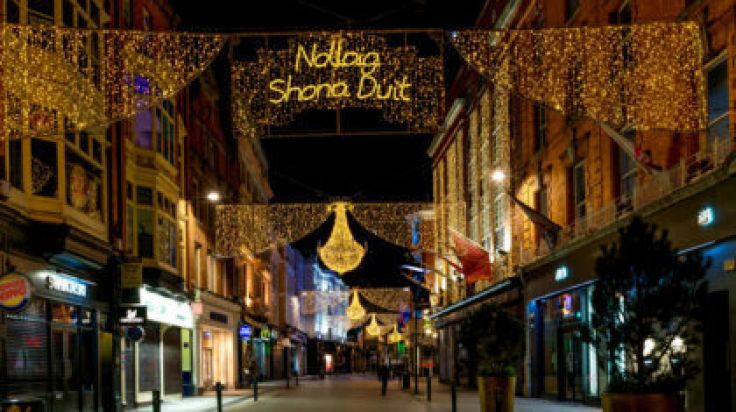
Another controversial recent initiative in Moore Street has been the changing of the traditional Irish-language Christmas lighting decoration and the ‘renaming’ of the street to “the Grafton Quarter”. Irish language comment on the new design? “Tá sé gránna!” Indeed. Sometimes it seems as though the poor property magnates can’t put a foot right.

Perhaps Hines had ideas of greater expansion, changing the street into a “quarter” which, as some Dublin City Councillors have pointed out, does not exist.

All that aside, doing away with Irish language Christmas lighting and wanting to get rid of flower-sellers doesn’t accord very well with Point Four of Hines’ own Guiding Principles: “Hines is committed to fostering an inclusive culture where diversity is respected and valued.” 

Another comment in Irish?  “Seafóid!”

end/ a chríoch

Irish language Christmas illumination now removed.
(Photo sourced: Internet)
The new Christmas lighting (Source image: extra.ie)

REFERENCES

https://www.98fm.com/news/grafton-street-flower-sellers-not-moving-927575?fbclid=IwAR0SX4Nn2Ujr1bOQjN9ao2tHt3lOz5C9nFTpqu4RvLX9C-PHKYF09I4rjxE

https://www.98fm.com/news/grafton-street-flower-sellers-not-moving-927575?fbclid=IwAR0SX4Nn2Ujr1bOQjN9ao2tHt3lOz5C9nFTpqu4RvLX9C-PHKYF09I4rjxE

https://www.hines.com/about

https://en.wikipedia.org/wiki/Grafton_Street

https://www.normanteeling.com/

https://www.irishtimes.com/news/consumer/pressure-increases-to-remove-grafton-quarter-christmas-lights-1.4083339


“YOU BET – THEY DIE!”

Clive Sulish

(Reading time: 8 mins.)

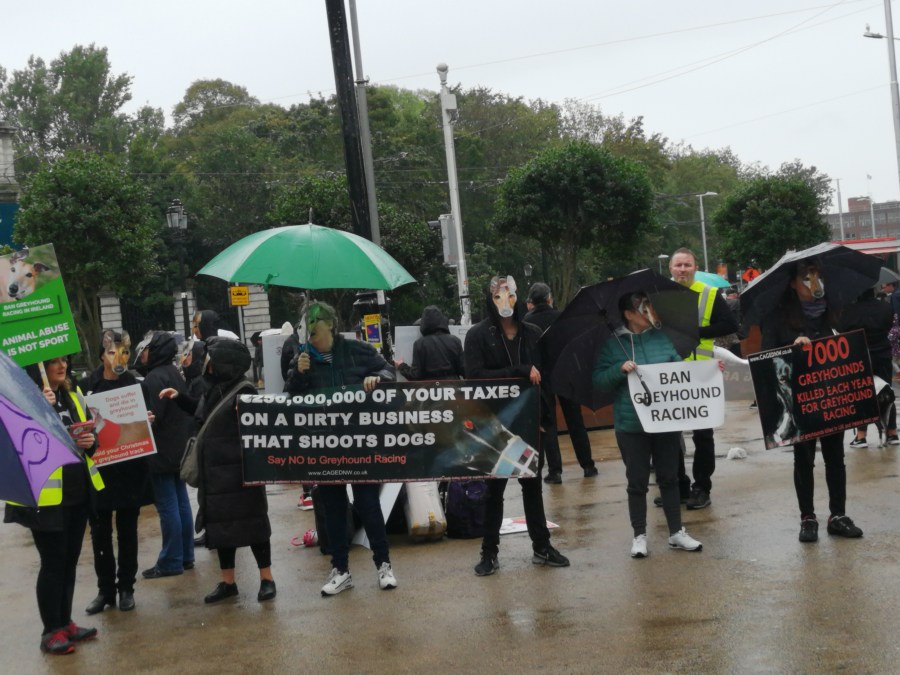
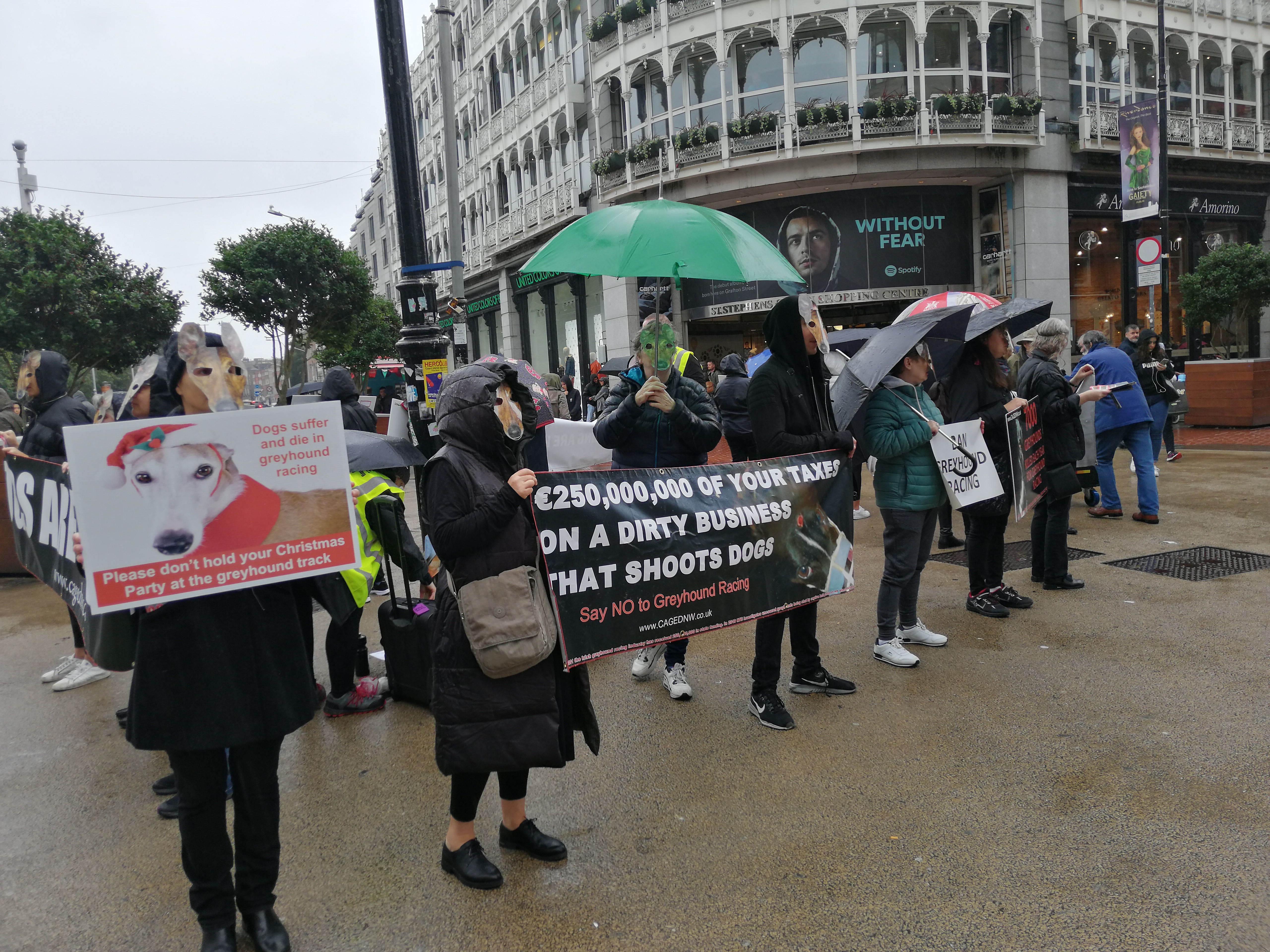
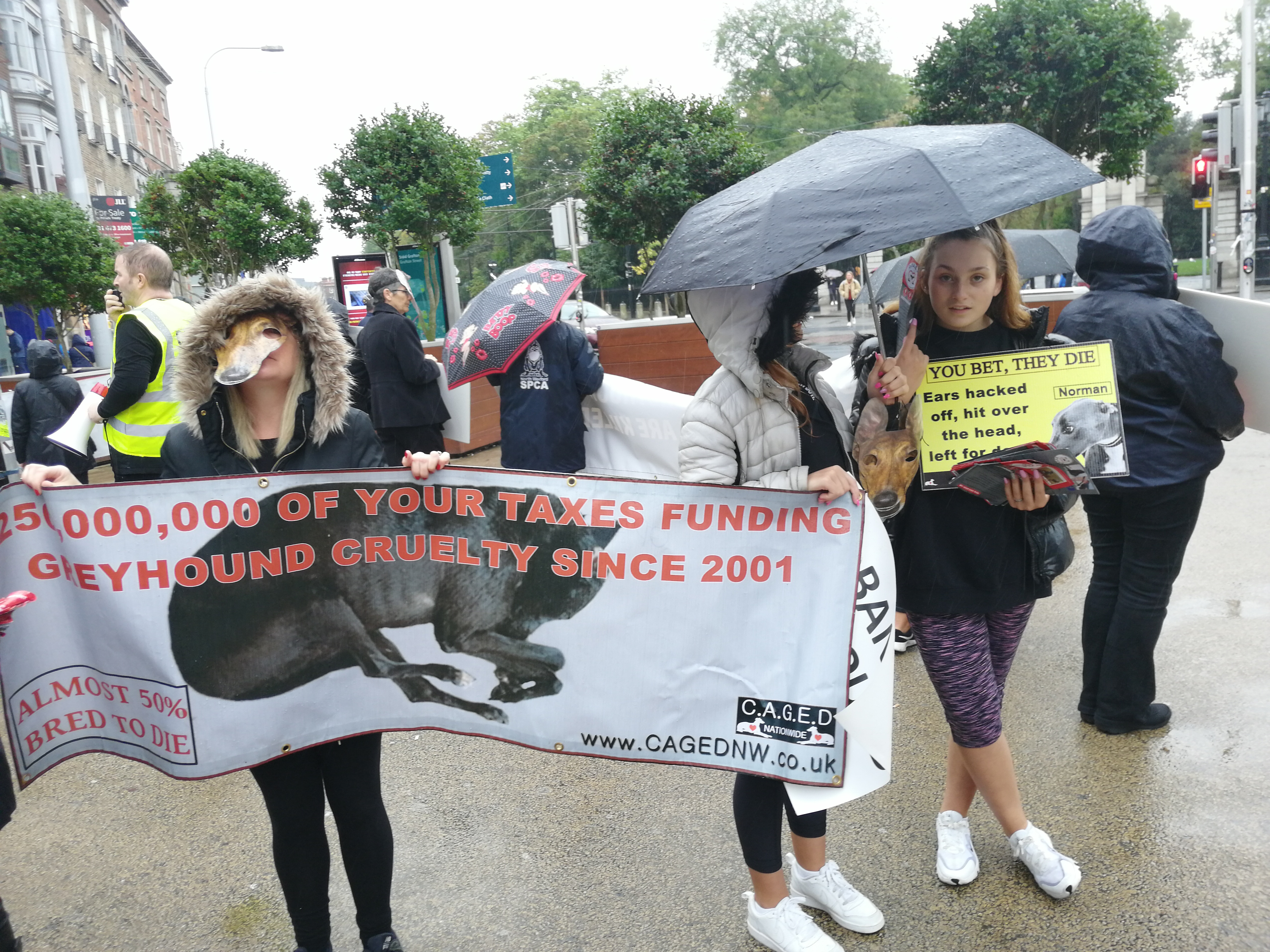
The sight of more than a score of people standing in the rain at the top of Dublin’s Grafton Street drew a lot of attention. And it wasn’t just the dog masks that most of them were wearing. This wasn’t near enough to Hallowe’en, nor was it a carnivale, nor a masque as such: the message projected had nothing of the freedom and joy of carnivale, none of the sexual play and mystery of masque and was darker than the usual one of Hallowe’en. The grim message was on the banners, in the leaflets, in the slogans and the amplified speech.

One of the banners of protesters on Saturday at the top of Grafton St. (Photo: C.Sulish

“You bet – they die” was one of the slogans chanted, illustrating the grim reality of commercial greyhound racing. This slogan was developed for protests outside greyhound racing stadia, notably at Shelbourne Park, near the south Dublin docklands (and, incidentally, not far from the Aviva Rugby Stadium).

Public perception

          The reactions of passers-by seemed to vary between amusement, interest, support, surprise and even shock. People who tend to view animal welfare protesters as cranks who are likely to be middle-class might be somewhat amused or dismissive and it is no doubt to counter this perceived image that the group organising this event is called “Ordinary People Against Greyhound Exploitation”. The support likely came from those who had watched the RTÉ documentary in June, while other reactions might have been from Irish people as yet unaware of the treatment of greyhounds by the industry or by visitors to Ireland who are not only ignorant of the issues but even of the existence of the industry itself.

One onlooker seemed to be demonstrating to his companion the pole lassoo dragging of a dog and then shooting it with a pistol, probably recounting a secretly-filmed incident featured in the RTÉ film. Popular opposition to the greyhound racing industry has been gathering since the screening of the exposure program by the “RTÉ Investigates” team of the Irish television company in the last week of June. The revelations were a shock to people who understood the dogs racing to be a harmless spectator sport with not even a live hare being pursued, a relatively cheap night out (providing the betting was not too heavy) or gambling based on a mixture of luck and previous form knowledge, or even just the communal sport of a few rural people who owned a few hunting dogs.

View of a section of the protesters, viewer facing south. (Photo: C.Sulish)

The industry breeds many dogs in order to ensure a constant supply of fast-running animals and flow of profits and, as a result, bitches are put to breed litter after litter. Pups showing any disabilities will be “culled” and, as the survivors grow, those not considered fast enough will face the same fate. Later, as age begins to take its toll, they will be killed also except for some that might get a few more years as stud or breeder. Campaigners claim that over 6,000 dogs are killed annually and some animal welfare organisations believe the figure may be as high as 10,000. It is the commercial drive that brings these results and the support of the betting public that sustains it – but not that alone, since the Irish State supports the industry with an annual grant of 16.8 million euro.  This fact was also highlighted by campaigners in voice and leaflet, while pointing out other better uses for the funding, including relieving the homeless and housing crisis.

Few countries outside of Ireland an Britain have greyhound racing stadia but campaigners claim – and the RTÉ program revealed – that many Irish dogs are sent abroad in inhumane conditions, some at least of which will end up for human consumption.

Section of protesters facing south (Stephens Green Shopping Centre in background). (Photo: C.Sulish)

The campaigners call for the greyhound racing stadia to be closed and, in Dublin particular, the Shelbourne Park stadium, outside of which are held regular demonstrations. They call also for sponsorship by commercial enterprises to cease, a call heeded by a number of companies fearful of a negative commercial impact upon their reputations. This drive was clearly successful when, audibly fearful of a negative impact on the tourism industry, Irish Minister for Tourism Shane Ross called for a suspension of State support in advertising which was followed by Bord Fáilte and Tourism Ireland’s1 removal of greyhound racing from their promotions for visitors to Ireland.

Tourism and Greyhound Racing

     The tourist industry is of course vulnerable to the image of the country abroad, which is why campaigners for democratic rights often strive to alter precisely that image, in order to exert pressure on the ruling regimes. Tourists, as they concentrate on sun, sea and possibly Turkish or Iberian food, may be able to set aside images of Spanish police bashing Catalan voters or Turkish police jailing Kurdish campaigners. Ireland has little sun to sell and though plenty of sea, without the sun it can be too cold for most to bathe. What Ireland has for most tourists is an ambience of welcome, of traditional and folk culture and scenery – but the ill-treatment and slaughter of dogs in an Irish industry could quite possibly offset those positive points.

Ross might indeed have been, as he said he was, “shocked” by the revelations but it was clearly the financial rather than principled humanitarian objectives which forced his hand. Martin Ferris, Sinn Féin TD for Kerry, wasn’t motivated by humanitarian principles either when he confronted Ross in the Dáil (see Links below). Although his SF Dáil position is as Spokesperson for Marine and Fisheries, in his intervention he was clearly representing rural support for greyhound racing including, no doubt, commercial dog breeding and racing interests. He claimed the industry was being tarred with the brush of “the actions of a few individuals” and that he was speaking up for “the small boys and girls” (well done for getting that gender equality in, Ferris!) of the rural industry.

“A few individuals” may have been caught red-handed and exposed but the issues are clearly endemic to the industry, the governing board of which suppressed a critical report which it had itself commissioned. Ferris’ public support for that industry and criticism of the Minister’s actions in this case may win him some votes in some parts of Kerry but will hardly be a help to Sinn Féin, increasingly seeking to project itself in the Irish state as a social-democratic party leaning slightly to the Left.

Section of younger protesters facing west. (Photo: C.Sulish)

And the employment figures which Ferris quoted arising from the greyhound racing industry might well be offset by possible negative impact on the Kerry tourism economy.

The dogs in the streets will be talking about what he said ….

end.

FOOTNOTES:

1Bord Fáilte promotes tourism in throughout the Irish state, i.e the Twenty-Six Counties, while Tourism Ireland promotes the same but throughout “the island of Ireland”, i.e including the Six Counties. Tourism NI cooperates with the latter organisation, particularly with regard to tourism in the Six Counties and maintains an information office in Dublin city centre. The first two above are in receipt of funding from the Irish State while the third is funded by the British State.

View of section of protesters facing northwards, down Grafton St.
(Photo: C.Sulish)

LINKS FOR REFERENCES AND FURTHER INFORMATION:

Ordinary People Against Greyhound Exploitation: https://www.facebook.com/OrdinaryPeopleAgainstGreyhoundExploitation/

Irish Greyhound Board: https://www.igb.ie/

RTÉ documentary “Running for their Lives” (contains disturbing images): https://rebelbreeze.wordpress.com/wp-admin/post-new.php

Sponsors “horrified” by RTÉ exposure of greyhound racing industry: https://www.irishtimes.com/news/ireland/irish-news/sponsors-horrified-by-rt%C3%A9-programme-on-greyhound-racing-1.3942232

Irish Tourism Minister suspends promotion of greyhound racing; Sinn Fein TD objects: https://www.irishtimes.com/news/politics/oireachtas/greyhound-racing-promotion-stopped-due-to-disgusting-behaviour-in-sector-ross-1.4039470

“MY IRELAND” – OUR LAND?

(Reading time text: 15 mins maximum)

Film review by Diarmuid Breatnach

Around 60 people viewed the film “My Land” on Sunday morning (23/ 06/ 2019) in the Irish Film Institute in Dublin, scheduled at the decidedly un-prime time of 11.30 am on a Sunday morning. “In this revealing documentary, Anthony Monaghan, an Irish filmmaker now living in the United States, takes a hard look at economic migration, mass evictions, and the growing homeless crisis that plague Ireland today. In search of answers, he travels the nation and interviews Irish people from all walks of life” (the description on the FB page for the event).

One of a number of versions of title photos for the film
(Photo source: advertisement for the film)

          The film opens focused on heavily-built man in shorts with a broad somewhat weathered face, wearing a straw stetson-type hat, brim turned up both sides and overall looking quite like a middle-aged man of the American Indigenous people. The rhythms of his speech and accent soon however reveal a mixture of western Irish and USA. The man parks his construction company pickup truck, gets out and we watch him walk on to a bridge, to look down upon a river, possibly the Missouri, where he stands looking for awhile before turning to the camera and beginning to speak.

Monaghan photo?

DEVASTATION OF RURAL AREAS

          Anthony Monaghan is from Erris, County Mayo and went to work in England when he was 15 years of age as many others around his age did too, especially in that area with an absence of industries and therefore of employment. Later, he emigrated to the USA. Later still, he returned and took out a mortgage on a house but, as we learn later, the bank took it from him and he has now returned to Missouri USA, where he decided to make the documentary.

We hear the sound-track of Lovely Blacksod Bay, a song about the ‘return’ of the son of an emigrant to Mayo.

View of Termon, Blacksod Bay. The English version of the place-name comes from the irish original “An Tearmann”, meaning “the sanctuary” (several place-names of this kind in Ireland).
(Photo: Internet).

Interspersed with beautiful scenery shots, interviewees talk about the problems of the Belmullet area, principally of lack of employment and consequent emigration. Included among those interviewed are Rose Conway-Walsh, Sinn Féin Senator from Bellmullet, Mayo, whose grown-up children had to move away. Another a former male emigrant who returned to the area in the early 1980s now sees his children moved away to work in England, his grandchildren there, returning twice a year, which brings excitement as they arrive and sadness as they leave. Another ‘returned’ migrant, a writer, came to the area from the Irish diaspora in London, brought as a child by his parents. He too had to emigrate for a while – now, back again, he expects his daughters to leave also.

As we accompany Monaghan to the local graveyard overlooking the sea, he points to the name of a brother on a headstone, a sibling who did not return alive from emigration.

The film shifts to a young woman, possibly Irish-UStater, accompanying herself on auto-harp while singing Noreen Bawn (Nóirín Bán), a sentimental song about tragedy in emigration.

John McGuinness, TD for Kilkenny-Carlow area, is also interviewed as is a FG member of the legal profession. Peter McVerry, of an NGO working with the homeless, also speaks, as does a local businessman.

The talk is of the devastation suffered by rural communities by unemployment and emigration, then the cutbacks on services to the areas, the closing of post offices, the isolation and vulnerability of the elderly, the long journeys to medical services ….

At a harbour, Monaghan talks to a man who fishes from a boat for a living, who says that kind of livelihood is gone, with big boats competing with the smaller ones. He sees no future for the younger generation making a living from the sea as he has done.

DUBLIN AND HOMELESSNESS

A homeless couple sleeping rough

          The film shots switch to Dublin streets and homeless people sleeping rough or begging. Among the interviewed now are the same people as before but more are added, including actor-author and former homeless person Glen Gannon and radio broadcaster Marion Shanley who, with three children, had faced eviction from her home. Tony Walsh, former homeless man and organiser of a food-serving service to homeless and other persons in need was also interviewed, as was bankrupt property developer Tom Hardy, author of “Waiting for the Sheriff”. Along with those was a young Dubliner, currently homeless.

A number of people, including the young Dublin homeless man, point out the profits that are being made by landlords. Tom Hardy reels off statistics in the profits being made there and also by the vulture funds in “buying” mortgage debts from banks at knockdown prices which the banks would not offer their debtors. A woman talks about the horror of having to raise one’s children in the hotel rooms in which homeless services place them, where they are cramped and cannot cook food. She talks about what this is doing to the children and wonders psychological problems are in store for them in future. “Why don’t the Government declare a housing emergency?” she almost wails. Clearly it is a housing emergency but as Gannon points out, they won’t declare it. It is not in their interests to do so. And according to the woman quoted earlier, a tsunami of evictions is on the way.

McVerry commented that there is a section of the population in Ireland who are doing quite well and who have no stake in any radical change in society. A number of the interviewees made reference to the wealth of the country, including several who said it was the fifth wealthiest state in the EU. I failed to find confirmation of that particular statistic and istead found a wide variety of rankings. Of course, the wealth of a state is not necessarily reflected in its people or, to be more exact, among the majority. While the problems of lack of affordable decent housing and employment, along with emigration cause suffering among a large section of people, revealed in rising rates of suicide, the number of wealthy are rising fast, with 83,000 people in Ireland whose income exceeds more than one million dollars per year (see References at end of review). It’s hard to believe that the misery of the struggling does not have some relationship to the soaring wealth of a tiny minority.

“Homes not hostels” banner on the side of Apollo House, a protest occupation of some weeks in December 2016 which attracted much support and media attention. But the homeless crisis has got much worse since.
(Photo: D.Breatnach)

SOLUTIONS

          All the interviewees, to one degree or another, placed the blame for the situation on the Government. Most of them also blamed the banks and the vulture funds. Some pointed to vested interests of TDs who are rental landlords while other went as far as to allege corruption and in effect an integrated system of banks-landlords-vulture funds-district courts-TDs- Government.

Some of the interviewees alleged that the Irish are too accepting, too meek. One who did so was a Ginley (or McGinley), who said that the Irish had fought for the British and for the USA but had never fought for themselves. He seemed either ignorant or dismissive of the long Irish history of resistance and also of the fact that not only the Irish who fought in the British and US armies were not “fighting for themselves” but neither were the British and US working people alongside them!

Marion Shanley was one who upheld the Irish history of resistance and pointed out that in war, to which she hoped it would not come, incidents of suicide tended to almost disappear.

Given the size of the problems and the combination of political and financial interests, it was going to be interesting to see what solutions were advocated.

Anthony Monaghan wished to see some kind of combination of workers and business people to sort out the problems and hoped “the fighting Irish” would come to the fore.

TD McGuinness stated it was important for the politicians to come closer to the people and asked for greater leniency from the district courts in house repossession cases. Senator Conway-Walsh also wanted to see greater leniency from the courts but tighter legislation against vulture funds too. The homeless young Dubliner put forward the radical solution of having members of the Government spend a week in the conditions of homeless people.

Only Glen Gannon baldly put forward the clear solution, the only one possible, given the interlinking of financial and political interests: Revolution.

DANGERS

          There is a vacuum of leadership, as a couple of interviewees remarked.

During his interview, the man I remembered as Ginley (or McGinley), referred to Ben Gilroy as a champion “of our own”, an electoral candidate who had been failed by the electorate and whose “vote was derisory” in the recent elections. However Gilroy (who was present at the screening, as were a number of interviewees), had in the past posted an islamophobic rant on social media and had shared leadership of the recently-defunct Irish Yellow Vests with a racist, anti-emigration, anti-gay and lesbian islamophobe.

This points to a possible danger, not only that we might continue to be driven downwards but that in desperation, we might turn to fascism and racism, as other people have done in difficult times. And in precisely those kinds of times, the ruling capitalist class has not usually been shy of finding their champions to push those kinds of ‘solutions’, splitting the working class and diverting attention from the real problems.

And one form of fascism has been indeed to seek the unity of workers and businessmen sought by Monaghan (though that should not of course be taken as a suggestion that he is himself a fascist). In such “unities” there is no question of which sector will be in command.

In a film about the Ireland of today, it was interesting to see no images or hear any reference to immigration other than that of the Irish diaspora. It could have been that the makers wanted to keep the narrative simple …. or there could have been another reason for it.

Anthony Monaghan said at one point that although he knew that was not possible, he’d like to go back 20 years. At the turn of the century, i.e twenty years ago, the false Irish economy bubble was about to burst.

SPIRITUALITY IN RESISTANCE

          In one scene, the camera follows Anthony Monaghan going down into a holy well (St. Dervla’s) near his original home and blessing himself with some of the water there. Remarking that although he does not condone the scandals that have come out of the church in recent decades, he regrets the Irish turning away from the Catholic faith, which he feels sustained us in years past and bound us together.

One of Monaghan’s interviewees points out that the worst thing about the scandals in the Church was not the abuses themselves but the cynical covering them up by those in authority, exposing more people still to abuse and suffering.

Talking about Catholicism as a binding agent of the Irish while almost in the next breath about our martyrs and heroes of the past, ignores a very important part of that very history of resistance which Monaghan upholds. The Catholic Church, from the moment Penal Laws began to be lifted, worked might and main against that Irish resistance. Its leadership condemned the United Irishmen (in particular the few priests who joined them), the Land League actions, the Fenians and the IRA in nearly every period and in all of its manifestations. In addition, the founders of the United Irishmen were Protestants, as were nearly all the prominent people of the Young Irelanders; Protestants were to be found too among the founders of the Volunteers, the Fianna, Ininí na hÉireann and the Irish Citizen Army.

In fact, history was sorely missing in all the analyses, since no-one pointed out that the State had been set up in a counterrevolution, an alliance of Catholic Church and Gombeen capitalist class under the old master’s tutelage. There seemed to be no acknowledgement that the Irish state is a neo-colony, run by a Gombeen capitalist and political class, its natural resources to be plundered by foreign multinationals, its services to be sold to the same, its own natural industries to be run down.

Human beings do have a spiritual sense, whatever anyone may say against that – but that is not necessarily about religion, contrary though that statement may seem. A sense of who we are as Irish people, as workers, as human beings, as part of life on earth, can be both practical and spiritual. It can be conveyed in language, song, poetry, visual art …. and in a knowledge of living history.

In that respect, it was strange that in a film about Ireland made by a man from Erris, by the Belmullet Peninsula and a large part of which figures in the narrative and images, there were only five words in Irish to be heard. For Béal Muirthead is a Gaeltacht, an Irish-speaking area, though shrinking under pressure from English-speaking monoglots.

Pub in Erris with name (“Harbourside”) in Irish
(Photo sourced: Internet)

IN CONCLUSION,

it was an interesting film from the point of view of presenting the issues and gathering some opinions about them.

But as well as who were interviewed, it was interesting to note who were not. No active revolutionaries — socialist, communist, republican …. no activists in recent or current movements of resistance. And no reference to the mass mobilisations against the water charges and the local battles resisting meter installation. Nor of the demonstrations protesting homelessness. Not even a mention of the titanic (or biblical Davidian) struggle in Rossport, Mayo, against Shell BP.

The last song I remember hearing on the film’s soundtrack was James Connolly, not the song about the revolutionary socialist and trade union organiser he was (see below) but instead one which portrays him as an “Irish rebel” out of context, without mention of class or of the Irish Citizen Army, of which he was the leader.

End.

REFERENCES AND SOURCES:

Trailer for film: https://www.youtube.com/watch?v=vP1lcSvBbtQ&feature=share

Lyrics and air Lovely Blacksod Bay song: https://www.itma.ie/inishowen/song/lovely-blacksod-bay-song-cornelius-mceleney-singing-in-english

Recording of Noreen Bawn: https://www.youtube.com/watch?v=_0n3VwC9Kr4

Recording of James Connolly, the Irish Rebel: https://www.youtube.com/watch?v=wEmy8nif7J8

Recording of Where Is Our James Connolly?: https://www.youtube.com/watch?v=6tqGknooC9g

Irish economic and financial status: http://www.oecdbetterlifeindex.org/countries/ireland/

https://www.independent.ie/business/irish/ireland-scores-well-on-growth-and-gdp-but-inequality-soars-36518158.html

Millionaires in Ireland: https://www.thejournal.ie/wealth-report-ireland-3264492-Mar2017/

BLESSINGS, CURSES, OATHS, THE FENIANS AND POPE PIUS IX

Diarmuid Breatnach

(Reading time: under 10 minutes)

This is an article about grammar, religion and politics. While the last two are often discussed in the same conversation, grammar is usually absent as a subject. But it has its place here.


SWEARING AND CURSING

          “Don’t curse!” or “Don’t swear!” a parent or an elder might have said to us when we were children or teenagers. And particularly when we were teenagers we did exactly what we had been told not to, certainly the boys, in a mistaken sign of manhood. As a verse in the English folk song The Shoals of Herring has it, in fact:

Well you’re up on deck, you’re a fisherman,

You can swear and show a manly bearing,

Take a turn on deck with the other fellows

As you hunt the bonny shoals of herring.”

A related admonition was against “taking the Lord’s name in vain”, which was a prohibition of blasphemy, the misuse of Yahweh’s name, taken from Exodus 20.7: “Thou shalt not take the name of the Lord they God in vain; for the Lord will not hold him guiltless that takes his name in vain.” 1

So most of us grew up thinking that swearing and cursing were the same thing and more or less careful about which company in which to use those words – or not. But we were mistaken, cursing and swearing are not the same thing at all.

We are familiar with swearing in some formal settings, such as courts of law, for example: “I swear by almighty God that the evidence I give shall be the truth, the whole truth ….”2 and also with swearing for entry into some organisations (frequently the armed forces).

Bejaysus”, common in Dublin, is from “by Jesus” and “bedad” is probably a disguised “by God”. The Cockney’s “Blimey” was originally “May God blind me” (e.g “if I am not telling the truth”).

The use of “Bloody” in informal society was often a swearing upon the “blood of Christ” or, strangely sometimes, the blood of “Mary”, the mother of Christ in the religions of “the Book” (Bible, Talmud or Koran). Of course “bloody” could be used pejoratively in the sense of “blood-stained”3, in which case it was not swearing but might still raise objections in some quarters of society, or descriptive of a massacre as in “Bloody Sunday”4.

In fact, swearing is to call a divine Power to witness the truth of what we are saying (in courts of law, for example) and that we intend to carry out the expectations of the organisation (e.g in the armed forces). In swearing, we utter an “oath”. Nowadays, most people who are not highly religious probably attach little importance to the form of words, though some institutions persevere with them. But in older times and not even so long ago, most people viewed an oath as a very important thing.

To break an oath of allegiance in some countries and in some periods incurred severe penalties, including death. “Oath-breaker” was an epithet that might be attached to the name of an “outlaw”, one who had broken his oath of service to a Saxon, Norman or English Lord in the Middle Ages.

The required Oath of Allegiance to the British Crown, simultaneously to the Head of the Anglican Church, prevented many Catholics for centuries from entry into many professions and from being elected as a public representative. And the British Crown was itself particularly worried for centuries by alternative “oath-bound societies” that were seeking united workers’ actions, such as agrarian defence organisations and trade unions, or equality and improvement in social conditions, for example political organisations. Laws were passed against the dispensing and swearing of such oaths.

Representation of the three witches in Shakespeare’s “Macbeth”. throwing a curse.
(Image sourced: Internet)

Cursing, although it may sometimes “take the Lord’s name in vain”, is something else completely. We know in Ireland of the “Curse of Cromwell” but more frequent probably was Mallacht na bPréacháin “the Curse of the crows”, which wished upon the victim a childless land, to be inherited only by the crows. Scread mhaidne was another ill-wish to lay upon someone, that he or she may die in agony, screaming into the morning. Ná feice tú Dia sounded less terrifying but might have been more frightening for a very religious person: “May you (never) see God!”.

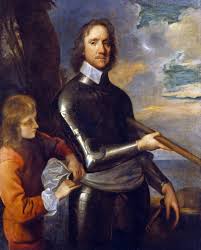
Painting of Oliver Cromwell, an English Republican whose name became part of a curse in Ireland (including for Irish Republicans!).
(Image sourced: Internet)


Damn” and “Goddamn” are abbreviations of “May God damn …” (“you, her, it, them” etc) and to utter them in many circles in the USA is considered evidence of bad rearing. They are curses which are also oaths, in calling upon the Devine being to add power to the curse.

Typically, curses and oath-curses use the subjunctive in grammar and, although seemingly strange, this connects them to blessings and greetings. Go raibh maith agat (may you have good”) is the Irish for “thank you” and Go mba hé duit (“may it be [the same] for you”) is the reply to the Irish greetings Sé do bheatha or Móra duit. Slán abhaile (“Safe home”) is an abbreviation of Go dtéigh tú slán etc (“May you go safely home”). All of these are in the subjunctive form of speech.  Vaya con Dios (“May you go with God”) is a castillian-language (Spanish) farewell wish we might come across in tales set in the south-west USA or in Latin America; that is also in the subjunctive. In fact “farewell” was “fare thee well” and probably originally, “May thee fare well”. Instead of the “Go to Hell” or “I hope you break your neck” one might hear today, centuries ago one would have heard “May you go to Hell” or “May you break your neck”.

This constant use of the subjunctive to wish well or ill upon others suggests to me that it was widely believed, at some stage in society, at least in most European societies, that one could make something happen by using a certain form of words. That form was the subjunctive; however, according to many who study language, the subjunctive is disappearing in European language and remains most in use preserved in everyday greetings and well-wishes – and the occasional curse.

It seems to me that the reason for this gradual disappearance is that we no longer believe we can make things happen by the way that we say them. We may wish them – and show the object person that we wish them – but we can’t make them happen. Nor can we expect a thing to happen with anything like a confidence that invoking a God will bring the wish, for good or ill, to fruition.

FENIANS

          Earlier in this discussion I touched on oath-bound societies and the apprehension with which they were often regarded by those in power. Well, the Fenians were such an organisation. Formed on St. Patrick’s Day 1858, in Ireland as the Irish Republican Brotherhood and in the USA as the Irish Fenian Brotherhood, it was a popular movement until the Irish Civil War (1919-1922). Because of their revolutionary credentials and democratic program, they were accepted into the International Workingmen’s Association (the First Socialist International 1864-1889). As a true Republican organisation, they sought the separation of Church and State5 and in that, apparently incurred the wrath of Pope Pius IX (Giovanni Maria Mastai-Feretti, ruled from 1846 to his death in 1878). He excommunicated the Fenians.

Pope Pius IX
(Photo source: Internet)

Although a significant number of Fenians (particularly in the leadership) were of Protestant background (Presbyterian, Anglican, Methodist, Unitarian), most of the Fenians had been brought up in the religious faith of the majority in Ireland, Catholicism. Not only would excommunication be painful to Catholic Fenians but could also lead to their being shunned by other Catholics who might otherwise have supported them. In the end this did not occur to anything like the extent that would have pleased the Catholic Church hierarchy or the British rulers of Ireland, as Irish Catholics have historically shown an ability to set to one side the teachings of the Church when they appear in contradiction to their struggle for national self-determination.

But obviously the public excommunication did the movement some harm and hurt many Fenians who were also strongly Catholic, such as John O’Mahony, co-founder in the USA, who left the Fenians as he approached his death so that he might be administered the last rites of the Church6.

John O’Mayony, c.1867, a Catholic Fenian, excommunicated by Pius IX (Source photo: Internet)

SCHOOL SOPHISTRY

          In an Irish secondary school run by the Christian Brothers, we were taught that the opposition of the Catholic Church to the Fenians (and presumably to the subsequent Republican military organisations), rather than being due to their struggle for Irish independence, was the secret organisation’s dispensing and repetition of an oath of allegiance. Perhaps we were too ill-informed (I know that I was) to bring up the question of oaths given in other circumstances, such as in giving evidence in court or in military service, circumstances with which the Church appeared to have no problem.

Had one of us done so, our Christian Brother teachers might have replied that what was wrong was “taking the Lord’s name in vain” and explained that “in vain” did not, in the English at the time of translation of Bible texts, mean only “for no important purpose” but also “for no good purpose” and that would of course have included “for an evil purpose”.

Had we questioned what the “evil purpose” might have been in the case of the Fenians, we would have put our teachers in some difficulty.

What for example in the two versions of the Fenian Oath recorded, might be considered “evil”?

I, A.B., do solemnly swear, in the presence of Almighty God, that I will do my utmost, at every risk, while life lasts, to make Ireland an independent democratic republic; that I will yield implicit obedience, in all things not contrary to the law of God, to the commands of my superior officers; and that I shall preserve inviolable secrecy regarding all the transactions of this secret society that may be confided to me. So help me God! Amen.”

I, A.B., in the presence of Almighty God, do solemnly swear allegiance to the Irish Republic, now virtually established; and that I will do my very utmost, at every risk, while life lasts, to defend its independence and integrity; and, finally, that I will yield implicit obedience in all things, not contrary to the laws of God, to the commands of my superior officers. So help me God! Amen.

Would a Christian brother have admitted opposition, not only by himself but by the Catholic Church, the dogma of which he was explaining, to the establishment of an “Irish Republic”, or even to “an independent democratic republic”? And if not, what then? The use of armed force, i.e violence? Since when has the Catholic Church hierarchy been against violence in or of itself? Did it not support some side in most inter-European wars and Spanish, French and Portuguese colonial wars? In fact, did the Catholic hierarchy not itself initiate some wars and did the Vatican not have its own army, as pointed out by Fr. Sean McManus in the USA7?

If the objection were not to “a democratic Republic”, against which Pius IX was definitely set, in that he opposed the separation of Church and State, then surely the only honest reply could have been: “The Catholic Church hierarchy in Ireland made a deal first with the British occupation that if they gave Catholics equal rights and let us build up our power here, we would not support their overthrow. Since then we made a similar deal with the Irish State and its rulers. And we intend to honour that deal.”

End.

FOOTNOTES:

2In the courts of many countries one is now permitted to use the words “I affirm that the evidence I shall give …” and one may sometimes be asked by the presiding judge whether one is an atheist, or agnostic – presumably as otherwise the failure to “swear by Almighty God” might be regarded as suspect.

3“Bloody Queen Mary” was an example, Mary Tudor, Mary I Queen of England (1560-1558; ruled ’53-’58), who had nearly 300 Protestants burned at the stake for “heresy”. )

4In Irish history, three are generally recognised: Dublin 1913, Dublin 1920 and Derry 1972.

5Not all organisations dubbing themselves “Republican” do in fact uphold this principle and in fact it could be said that the Irish Republican movement from the early 20th Century until its end did not generally do so, in that it rarely confronted the Church on its social policies or interference in lay matters, except when the Church condemned Republican actions. Also a great many Republican commemorations included the officiating of a member of the Catholic clergy.

6See the Irish Echo article in Links & References.

7Ibid.


LINKS AND REFERENCES

https://www.google.com/search?q=Dictionary#dobs=excommunication

https://www.irishecho.com/2011/02/unholy-row-brews-over-anti-fenian-pope-pius-ix-2/

https://en.wikipedia.org/wiki/Syllabus_of_Errors

https://en.wikipedia.org/wiki/List_of_people_excommunicated_by_the_Catholic_Church

https://www.encyclopedia.com/international/encyclopedias-almanacs-transcripts-and-maps/two-fenian-oaths

THE FIRST AND LAST WORDS

View Post

Diarmuid Breatnach

(Reading time: 5 mins)

The Basques have a saying in their language which means “The first and last words in Euskera” (Basque language: “Lehen eta azken hitzak euskeraz”). The Irish would do well to adopt the slogan or dictum for their own: “Na céad focail agus na focail deiridh i nGaeilge”.

The Basques developed their slogan (the word is from the Irish, slua-ghairm: to call the crowd/ multitude/ troop) in their movement to conserve their native language and spread it among those who had lost it. The Basque homeland (certainly once larger than it is now) is today situated on the north-west of the Spanish state and the south-west of the French one. Their language is considered an older arrival than all other languages extant upon the continent, to be not of Indo-European origin and so not of the same family group as any of the nearby Romance languages: Galician, Asturian, Castillian, Languedoc (Occitan), French, Catalan.

Within the territories they control, Spanish and French state administrations have dominated and suppressed all the languages other than respectively Castillian and French; they have done so through official disregard, censure, shaming, even physical punishment and jail. But the Basques have struggled to keep their language alive and to spread it among those who have lost it. And they have been much more successful at doing so than we Irish have at doing the same thing with an Ghaeilge. The Catalans have done even better yet, certainly in Catalunya itself1.

So, why the slogan of “first and last words in Euskera” and what happens in-between? Is it intended like the “cúpla focal” (“couple of words”) of Irish politicians (and increasingly, not even that many), a kind of mini-lip-service? Not at all, its intention is restorative towards the language and is a practical measure which anyone can adopt — indeed we in Ireland should embrace it for our own language.

Dia dhuit

When we meet someone, we greet them and, in Ireland, the majority of us do so in English. Having done so, the rest of the conversation is likely to continue in English too. Taking our leave of them, naturally, we tend to do so in English also.

The impression on anyone within hearing of this exchange and so many like it is that Irish does not exist or, if it does, hardly anyone in Ireland knows it or, if they do, don’t use it in their daily life. Not far from the truth, one might comment. Indeed but the reality is that a lot more know the language (or some of it at least) than one might think.

Let’s return to that interaction touched upon earlier, when one person meets another. It could be a customer in a bar, restaurant or shop. One of them says “Hello”, the other replies likewise and from there onwards the verbal communication is all in English. Or another scenario, a friend or acquaintance of one, introduces another in English and both who are strangers proceed in English also.

Introductions (Source photo: Internet)

Perhaps the customer and the shop assistant, waiter or bartender in the first example were fluent Irish-speakers or at least competent – none knows this about the other and they continue in the dominant language, English; each may return home later without having spoken a word of Irish that day. The strangers being introduced to one another by a mutual acquaintance, perhaps at work on in a social setting, may have a similar experience.

THE FIRST WORDS

Suppose that instead the customer or person being introduced had greeted in Irish? The recipient of the greeting now has the choice, assuming some knowledge of the language, to respond likewise. Should this occur, they can now proceed to the limits of their knowledge of the language or of the situation in which they find themselves. Other factors govern the choice being made but we can discuss those later.

What of the impression on those others within hearing? They might be surprised or even astonished, impressed or embarrassed; however everyone is reminded that Irish exists, that it is a medium of verbal communication and that some people in Ireland use it, even outside the shrinking Irish-language reserves.

Gloine, le do thoill (Source photo: Internet)

Of course, that was perhaps only two people heard speaking it in a whole month or even a year. But what if more people did the same? Why, some of those who overhear might even adopt the same habit, na céad focail in nGaeilge! Gradually at first and then suddenly, everybody would seem to be greeting in Irish! Why, it might even be worth learning a little oneself! At least enough to reply and take the conversation a sentence or two forward ….

In addition, sometimes the experience flushes out other Irish speakers too. On the top deck of a bus heading into the city centre one day, I could hear some young lads at the back of the bus (where else!) speaking in Irish. I could tell that they were not fluent but one at least was doing reasonably well. As they passed me to get off in Sráid Uí Chonaill, I remarked in Irish to them that it was great to hear the language being spoken in public. While they stumbled over a reply to me, the man across the aisle from me addressed them also, in fluent Ulster Irish. What an experience that must have been for the young lads but certainly for us, two Irish speakers a few feet away from one another and totally unaware, until that moment, of the other’s existence.

On another occasion at a demonstration in Dublin, I and another holding a banner between us were conversing in Irish – loudly as of necessity. Ahead of us, another group began to call back in Irish too. Spreagann Gaeilge Gaeilge, commented the comrade on the other end of our banner (“Irish [language] inspires Irish”).

AND THE LAST WORDS

What about the last words being in Irish – just a courtesy or a whim of some kind? Well, imagine one greeted the stranger, shop assistant, waiter or bartender in Irish and the reply came in English (which at the moment would probably be the case)? Thereafter the conversation flows in English but, as the Irish speaker is leaving, she says “Slán”. By now, the other has recovered a little from being somewhat wrong-footed by being addressed in Irish and furthermore, since the customer is leaving, is not worried about exposing what he considers to be his shamefully little knowledge of the language, so he replies also in Irish, “Slán”.

Slán!

Of course, that situation was not momentous for the survival of the language but neither was it totally negative. The Irish speaker draws a little comfort from it. The other feels perhaps a little pride, is maybe even encouraged to respond in Irish should he see that person again or if some other addresses him in Irish. How hard can that be? He’d do it in Greek in Crete, in Spanish in Torremolinos or in Cancun, even though all he has is a few phrases from the tourist guidebook.

SHAME

Of course, it is not the same. In the first place, the linguistic environment in Greece is Greek, in Torremolinos and Cancun, Spanish. Even migrant workers there will have learned the language. Not everyone around one in Ireland is speaking Irish in public, in fact, in most places, almost no-one is.

Secondly, there is no expectation of the English-speaker to be fluent in Greek or in Spanish. No expectation that the Irish person can speak Irish either, one might think. But actually, there kind of is. Inside the head of every Irish person there is the knowledge that this is their language and a feeling, buried deeply or lightly, that perhaps they should be able to speak it.

This feeling or knowledge can manifest itself in a reluctance to expose one’s limited knowledge of Irish to the perverse but understandable extent of refusing to speak it at all. Or of responding aggressively. Those are possible outcomes but so are more positive ones.

A person who has very little Irish may think: “But if I reply ‘Dia’s Muire dhuit’ and she lets loose with a flood of Irish, I won’t know what she’s saying and I’ll be mortified! Better to say nothing at all and not be so ashamed.” Of course, that is one choice. But it is not the only possible one. He could, instead, after she spoke to him some sentences in Irish he did not understand, reply in a sentence learned off by heart: “Gabh mo leithscéil ach níl ach cúpla focal agam” (“Excuse me, I have but a few words”). She might in turn reply: “Go raibh maith agat, úsáid a bhfuil agat” (“Thanks, use what you have”).

And why should the initiative be only with the person fluent in Irish? The person who knows only a few words is just as capable of making greetings and farewells in Irish — in fact I would go further and say that the language needs them to do that, to make that the norm.

In those kinds of exchanges, there will be a positive outcome for each participant. Not a huge step forward for the language in general but for anyone overhearing, a reminder that the Irish language does exist and perhaps that in this case, a person who did not seem know it well, still chose to learn a few words and use them. All of that goes to the credit side of the ledger in the psychological struggle for the maintenance and restoration of Irish.

IMPOLITE

An issue that is often raised with regard to speaking in Irish in the company of non-speakers, is one of politeness. It is generally considered rude to speak in a language that other people in the company do not understand. Strangely enough, people tend to think that more about people speaking Irish in Ireland than they do about people speaking French, German or Spanish among themselves here.

The issue must be faced. Neither of those languages is in any danger but Irish is – and in serious danger. Despite the growth of nurseries, primary and some secondary schools teaching through Irish, the actual daily use of the language is in decline. And the Gaeltachtanna — those areas where the language of the home has always been Irish – are shrinking at an alarming rate.

We need to find social strategies for linguistically-mixed company, whether it be occasional translation for the non-Irish speakers, or the tolerance of the latter – or conversing parts in Irish and parts in English. For the sake of the language we cannot allow the rules of politeness to deprive us of every social occasion to speak in the language other than some tiny domains hidden away somewhere, small groups of us meeting like conspirators in places where we are unlikely to meet anyone we know.

Another issue often raised is related to foreigners, whether they be migrants or visitors. I would say that the same rules apply. Most of those have their own language as well and speak it among themselves, in public too. And they must surely wonder why we don’t speak our own. The children of migrants are learning Irish at school and many are competent, some fluent in it. Some of their parents know a few words too: a Nepalese in a bar serves me through Irish and a Pakistani in a shop thanks me or tells me I am welcome, in Irish also.

SMALL STEPS

In the public library, you may wish to greet in Irish and hand the returned books towards them saying: “Isteach”; the likelihood of you being misunderstood is minimal. Then, with the books you are borrowing, “Amach”. In the Post Office, you can ask for “Stampa i gcóir Sasana, le do thoill” or “Stampa i gcóir na hEorpa”. To the question “Payment by cash or card?” when you present your utility bill, you may wish to show notes and reply “Le h-airgead” or, displaying your card, “Le cárta”. “Do you want a bag?” “Níl, go raibh maith agat”, with a shake of the head. Leaving the bus or the taxi, you could say: “Go raibh maith agat, slán”. Sometimes, you will hear a reply in Irish and it will probably lift your heart a little. And the world around you will hear a little too …. and wonder.

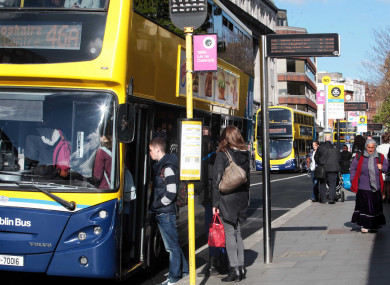
“Dia duit/ Sé do bheatha” — Passengers getting on a bus in Dublin (Photo credit: Leah Farrell, Rolling News)

None of that on its own, of course, will save the Irish language. But I think it will help. And now, on the crest of a small wave, might be a good time to do it: when the number and percentage of students attending all-Irish language schools is at an all-time high; when a survey of third-level students, whatever their feelings about how it was taught, show a majority supporting the retention of Irish as a compulsory subject on the curriculum. However, studies in the 1980s revealed a pattern of fall-off in Irish competency outside the Gaeltachts as the years went by; they need an environment encouraging the regular use of the language – use it or lose it.

The pro-independence political parties in the southern Basque Country make their public speeches either totally in Euskera or bilingually, in Euskera and Castillian. It is the same with the majority Basque trade unions. Also with the feminist and environmental movements, those against repression, against animal abuse, etc. In their public discourse, all organisations and parties in Catalunya that are not specifically Spanish-unionist (and even some of those), use Catalan first in public and Castillian secondly, if at all.

None of Ireland’s political parties (mainstream or oppositional), trade unions or campaigns (other than those specifically for the language) does anything much to promote the Irish language and some are hostile to it. That means it is up to us as individuals – everything we do for it can help at least a little.

So, as the Basques say, the first and last words in the language.

Do ye likewise; go out and multiply.

End.

FOOTNOTES:

1Catalan is spoken elsewhere than in Catalunya, for example in the Paisos Catalans (“Catalan Countries”) such as Valencia and the Balearic Islands, where it is not as strong as it is currently in Catalunya, also in part of Sardinia.

SOURCES AND REFERENCES:

Statistics on Irish-immersion education as of 2018: https://en.wikipedia.org/wiki/Gaelscoil

2019: https://www.irishtimes.com/news/education/number-of-primary-school-pupils-taught-through-irish-at-record-level-1.4011570

Plans to double number of Gaelscoileanna in the state: https://www.irishtimes.com/news/education/plan-to-double-number-of-pupils-in-irish-speaking-schools-1.4127379

Majority second-level students support retention of compulsory Irish on curriculum (but will they use it outside school?): https://www.breakingnews.ie/ireland/majority-of-third-level-students-support-irish-remaining-a-compulsory-subject-1096298.html

On a day like today — in Moore Street

Diarmuid Breatnach

(Posted on 31st January, a very cold day in Dublin with hailstones and some rain).

Photo of section of Moore Street facing northwards (the 16 buildings of ‘the 1916 Terrace’ to the right) taken on a considerably warmer day. Most of the apparent brightness is an effect of the reflection from the wet street.  (Photo: D.Breatnach)


ON A DAY LIKE TODAY, it would be instructive to spend some time around Moore Street. In waterproof and warm clothes, wearing two pairs of socks, the street traders were out there today, under the scantiest of shelters over their stalls but having to step outside to serve customers. Their fingers frozen but some not wearing gloves because of the difficulty of tying knots in bags and handling change with fingers in gloves.

All braved the elements until two o’clock, at which point the flower-sellers gave up but the rest were still there, including the fish-sellers. By five o’clock there were still seven stalls in operation when the hailstones started and a couple gave up then but the others kept going.

The lighting was pretty dim too.

This is how Dublin City Council managers treat the oldest outdoor fresh food market in Dublin, a tourist attraction promoted by the city’s tourist information, the last remaining street market of what was a whole souk now buried under the ILAC shopping centre — a big-chain preserve also facilitated by Dublin City Council with broken promises to street traders.

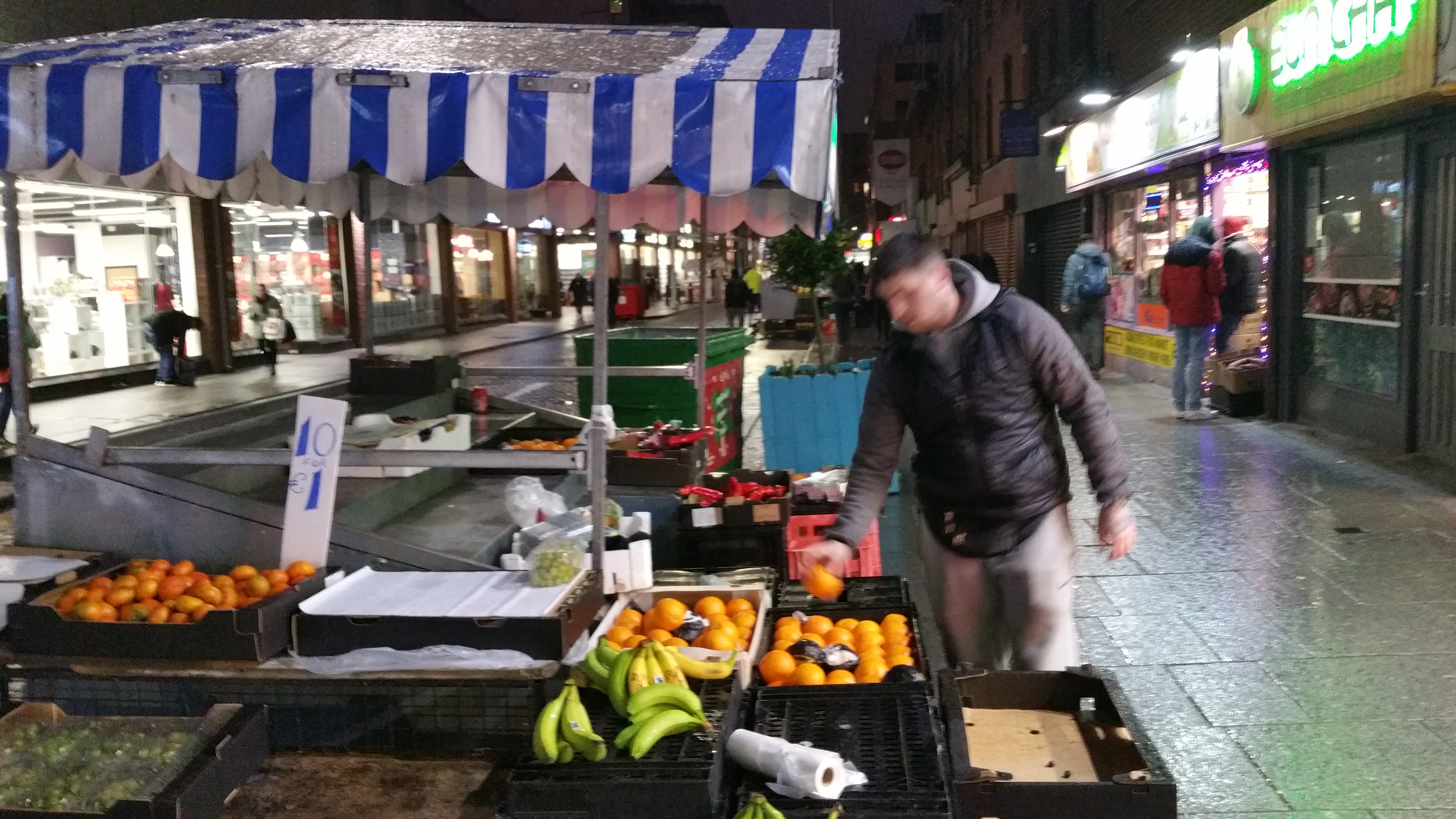
Photo of fruit stall at the intersection of Moore Street and Henry Place (start of the 16 buildings of ‘the 1916 Terrace’) taken on a considerably warmer day. Most of the lighting is from the nearby Asian buffet restaurant.
(Photo: D. Breatnach)

And Hammerson property speculators, who now own half the ILAC shopping centre, still hold the planning permission for the construction of a giant ‘shopping mall’ from Moore St. to O’Connell St., on the 1916 Battlefield, which should be a National and International Monument.

end.

Another view of the street on the same day as the other photos, looking deceptively bright from the reflection of surrounding lights from the wet cobbles. (Photo: D. Breatnach)

(I had posted this on Facebook ‘off the top of my head’, as they say but a lot of people liked it so posting it here too).


A BASQUE SELECTION

Diarmuid Breatnach

October 12th: The old town was heaving, full of people, mostly but not all on the younger end of the adult spectrum, standing, sitting, mostly in groups, talking, laughing, drinking, eating …. Some kind of festival? Not really …. a football match. Ah, that explains the shirts in football team colours. There’s the red stripes on white colours of Athletic Bilbao (and this isn’t Bilbao, not even Biskaia province), there’s the blue-on-white Real Sociedad colours (and this isn’t Donosti/ San Sebastian, or even the Guipuzkoa province). But wait a minute – there’s a lot of Deportivo Alaves shirts too (also blue-and-white) …. well, this is Vitoria/ Gastheiz, capital city of the the Alava province.

But there’s some red shirts too – CA Osasuna, from Naffaroa, the fourth province of the Southern (i.e within the Spanish state) Basque Country1. Over there’s a few CD (Club Deportivo) Vitoria, and a couple of women (not surprisingly — it’s an all-female team playing in the women’s league) wearing SD (Sociedad Deportiva) Lagunak yellow shirts. They can’t all be playing today, can they?

In a way, they are.

This occasion is a friendly match between Venezuela and the Basque Country (i.e not part of any official competition as otherwise it would be forbidden by FIFA, the international regulatory body for soccer)y and it is promoted by Euskadiko Futbol Federarkundea, the Basque Football Federation. FIFA, although it recognises Scotland, Wales and ‘Northern Ireland’ as having ‘national teams’, does not recognise either the Basque Country or Catalonia as having them. Where is the logic in that? Well, since FIFA only recognised Palestine with the creation of the Palestine Authority controlled by Israel and agreed by the Western powers2, one can hardly avoid coming to the conclusion that FIFA decides its policies on what area or nation can have their own selection and participate in FIFA championships in accordance with the relevant occupying state – no matter how right or wrong that decision might be.

Many shirts being worn here are green and bear the words Euskal Selekzioa (Basque Selection), the campaign for which in football is the cutting edge of the broader campaign for Basque national teams in many other sports, including surfing. It is of course not just about sport but is also political.

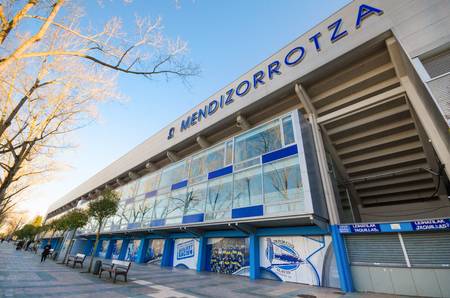
The Basque-Venezuelan game was to be played in Alaves’ Mendizorrotza stadium in Vitoria-Gasteiz and my friends talked casually about attending, though no hard arrangements seemed to have been made. I didn’t press the matter.

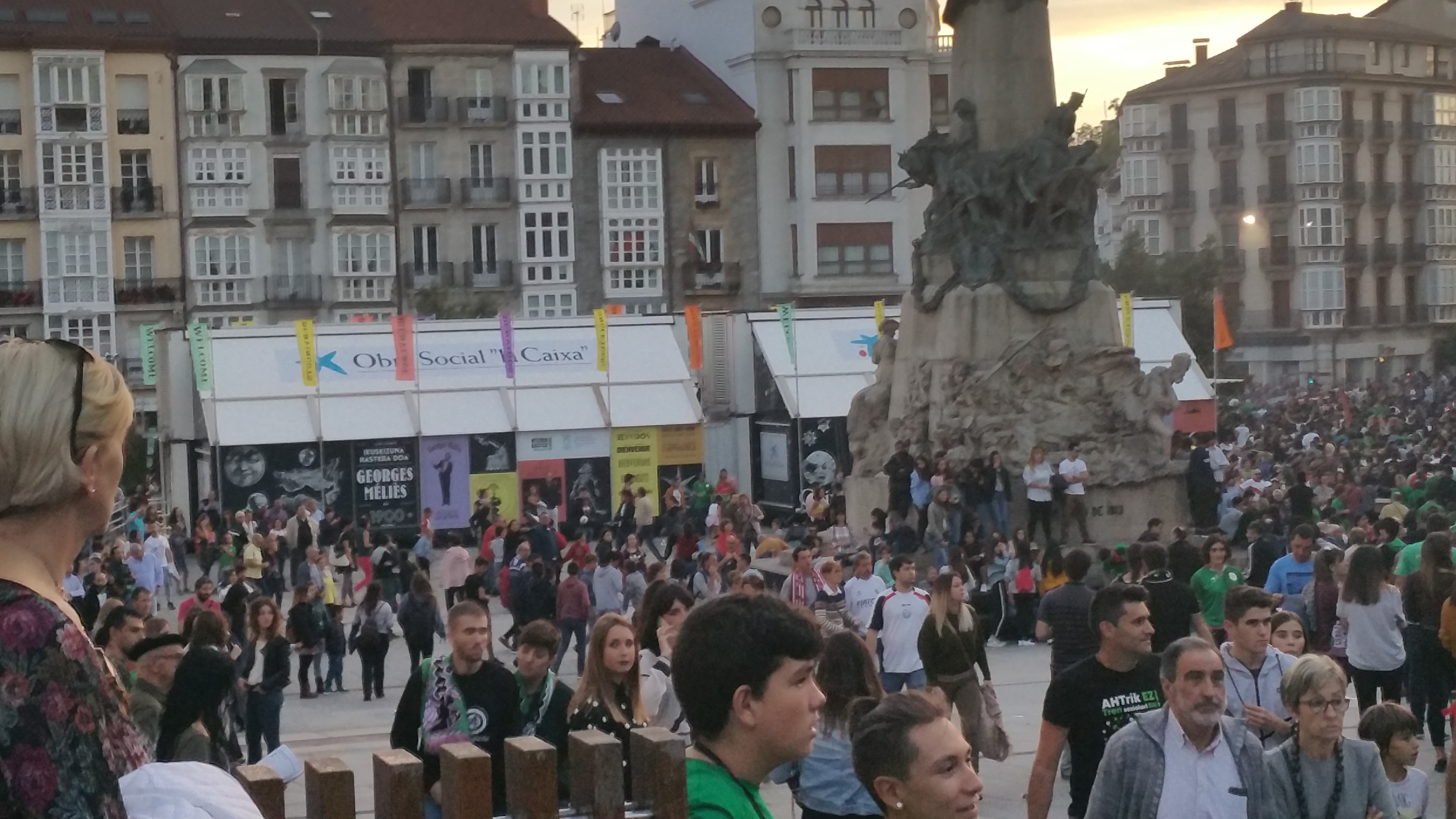
View of left of the crowd in the large square in the old town, showing a part of the monument.
(Photo: D.Breatnach)

Venezuela is rated 32nd in world soccer by FIFA, which is actually quite high and only two points behind the Ireland team, currently at 30th. So the opposing team is a big deal. The whole of the Basque Country, including Nafarroa and the parts held by the French State, is only around three million and they will play only players born in the Basque Country, unlike Ireland which features players from its diaspora. Ireland has had high emigration but so has the Basque Country, particularly to Latin America, the USA and Canada. Venezuela, by the way, has a population of nearly 32 million.

View of centre of the crowd in the large square.
(Photo: D.Breatnach)

In 2016, their last international, the Basque country beat Tunisia 3-1 in Bilbao and before that have beaten Peru 6-0 and Bolivia 6-1. They lost 1-0 to Wales in 2006 but beat Uruguay 2-1 in 2003.

View of section of the crowd on the balcony overlooking the large square in the old town.
(Photo: D.Breatnach)

The main square of the lower old town, the Casco Viejo3, was full of people, some chanting and red flares burning with an occasional firework going off. The ikurrina, the Basque flag, waving in many places, draped over balconies etc. The square is called alternatively Plaza de la Virgen Blanca or simply La Plaza Vieja. We met up with an ex-prisoner (political) who was complaining about the impressive monument in the main square which commemorates the Battle of Vitoria, fought on June 21, 1813, between the retreating French forces of Jose Bonaparte and the English forces under the Duke of Wellington. The English won the battle. I gathered the ex-prisoner’s objection was not so much that it commemorated the defeat of the French but rather that it celebrated the ‘independence’ of the Spanish monarchy, which had done the Basques no favours since the battle and much to the contrary. We drank lager here in plastic containers and street cleaners were already out sweeping up discarded and cracked containers.

Another view of the crowd, this one more to the right of the large square in the old town.
(Photo: D.Breatnach)

The captain of the Basque team, Aritz Aduriz, is the Spainish team’s oldest goalscorer, which might seem an irony but if he wants to play international world football, he has to play for a team recognised by FIFA. His home team is Athletic Bilbao, and his team-mates Inaki Williams and Inigo Martinez were also lined up to play, as was Real Sociedad’s Asier Illarramendi. And all of those have in the past played for the Spanish ‘national’ team.

Some political demonstrators moving through the crowd. The small flag held up is of the political prisoners’ relatives organisation Etxerat, the design showing the outline of the Basque country with two arrows indicating movement inwards from the French and Spanish states, i.e calling for the ending of the dispersal of prisoners throughout the states, far from their homes. (Photo: D.Breatnach)

Walking through the upper old town, we mingled and stopped here and there for a small serving of lager serving (zurito) or wine (txupito). The ex-prisoner got talking about language, philosophy, politics, religion, ancient civilization. I lasted longer than the others in discussion and debate with him4 but his intensity was wearing me down a little in the end. He apologised for that but then had another appointment and took off. By this time we had eaten and were relaxing in the high part of the Casco, on a slope down from the level of the fortress. Attending the game seemed somehow to have disappeared off the agenda and a little later we headed down through areas mostly quiet now to the parked car and drove off.
View of stairs leading from the large square to the upper part of the old town.
(Photo: D.Breatnach)

A crowd of 53,000 however attended the stadium to watch the game and who knows how many others saw it televised. It had been a friendly match in official status and in fact, with one yellow card earned, no reds and no injuries. The goals scored by the Venezuelans might have been the most elegant but Euskal Herria, the Basque Country, were the victors, the score of 4-2 in their favour, with Aduriz having been one of the scorers.

View of Gastheiz/ Vitoria’s football stadium
(Photo source: Internet)

End.

FURTHER INFORMATION

List extant Basque soccer clubs (each one also a link to its own history): https://en.wikipedia.org/wiki/Category:Football_clubs_in_the_Basque_Country

Ditto list of defunct Basque soccer clubs: https://en.wikipedia.org/wiki/Category:Defunct_football_clubs_in_the_Basque_Country

CA Osasuna, not listed in Wikipedia as a Basque club, presumably due to divisions fostered between Nafarroa and the other three southern Basque Country provinces: https://en.wikipedia.org/wiki/CA_Osasuna

Basque selection information: https://en.wikipedia.org/wiki/Basque_Country_national_football_team

Article about Basque and Catalan national selections:

http://theinsideleft.com/basque-catalonia-national-football-teams-catalan-barcelona-athletic-bilbao/

Match highlights (commentary in Euskera; Basque Country in green shirts, Venezuela in maroon) https://www.ngolos.com/videos/2018-10-12-basquecountry-venezuela

Background on Basque soccer in an international context, including some of them playing for “la Roja”, the Spanish State’s “national” team: https://www.bbc.com/sport/football/45834955

FOOTNOTES

1There are divisions fostered between Nafarroa (Navarra/ Navarre) and the other three southern Basque provinces of Bizkaia, Guipuzkoa and Alava. Nafarroa has its own ‘autonomous’ regional government in the post-Franco arrangement, while the other three are jointly in the other ‘autonomous’ region of Euskadi. Iruña/ Pamplona, capital city of Naffaroa, was the seat of the medieval kingdom of Nafarroa (Navarra), the royal family of which once laid claim to the monarchies of both the French and Spanish kingdoms (the latter being a source of three wars, the Carlist Wars). During the emergency caused by the military coup-insurrection of Generals Franco, Mola and others against the democratically-elected Republican Government of the Spanish state, the Catholic ultra-conservative Carlists seceded Nafarroa and massacred three thousand dissidents (Republicans, Basque Nationalists, Leftists) and fought on the fascist side.

After the “Civil War”, the Partido Popular (extremely right-wing main Spanish party) controlled Nafarroa but was recently ousted by Nafarroa Bai, a coalition of pro-independence Basque parties. The Basque Nationalist Party (PNV) has been the main power in the other three southern Basque provinces.

At one time Euskera was the main language of the whole of the current Basque Country (southern and northern, i.e in the French state), was banned under Franco and is now the majority first and second-level educational medium in Euskadi, where it is given at least nominal equal status in civic administration with Castillian/ Spanish. This is not the case in Nafarroa, which has three different linguistic-rights zones: Castillian, Castillian-Euskera and Euskera. ñ

2Palestine has yet to qualify for the World Cup in soccer. With Israeli restrictions on travel in and out of the territory for Palestinians, along with internal restrictions and repression, the odds are stacked against them ever qualifying, unless they field a team raised exclusively from their huge diaspora, including the refugee population.

3All the southern Basque main cities and many towns have these and their name is always the same, even though it is in Castillian. Typically they have narrow streets winding through four-to-eight-storey houses in which shop windows mix with bars and apartment entrances, often with balconies overhead. They are usually the most lively areas of the city with many places serving coffee, beer, wine and pintxos (good Basque ready-prepared food) and sometimes restaurants, often in the rear or upstairs room of a tavern.

4In Castillian, which I sometimes feel guilty about – I only know a few words in Euskera. Sometimes I encourage the company to speak “euskeraz”, i.e in Basque, leaving me out for a while.

SEX AND THE NOVEL DETECTIVE

Diarmuid Breatnach

Most modern criminal detectives have sex – I know this from reading, thankfully not from personal experience.


          The older set, Holmes, Inspector Maigret, Nero Wolfe, Miss Marple – they didn’t. Holmes was into a barely-concealed opium habit and Wolfe had an obsession with orchids; Poirot was obsessive-compulsive and probably fetish-obsessed with his patent-leather shoes. Miss Marple, who first appeared in a novel published in 1930, reflected her times even when the times passed her (Nemesis was published as late as 1971) and as to a suggestion of sex: “Good God! What kind of a degenerate are you? A woman detective having sex? And a pensioner?”

In modern times we might reflect that “of course there was her live-in maid … and that succession of young women she trained as maids ….”

Not only did they not have sex on paper, they were all single except for Maigret, so there was an absence of potential sexual activity to distract one. Maigret of course was French so like many middle-class men of his time would have had not only a wife but a mistress too but …. we don’t talk about that.

Yet sex is one of the most basic driving instincts – it governs procreation of species and, working in tandem with natural selection, rules on evolution of all species. How come it was left out?

The characters reflect their times and their class, of course, as well as what was expected of their class, sometimes with a little added taste of the unexpected – but not in sex. Yes, we know that DH Lawrence’s sexually-explicity (and trans-class) Lady Chatterly’s Lover was published two years before Agatha Christie Miss Marple’s first appearance in a novel, in Murder at the Vicarage (1930) – but Lawrence was published in Italy. Sniff! — those Continentals! A year later Chatterly was published again in France and – interestingly – in Australia. But all that publishing was done privately. In 1960, when an unexpurgated edition was finally published in the “United Kingdom”1, Penguin, the publishers, were subjected to a famous obscenity trial but, when they won, sold three million copies. It was still banned in the Irish State, of course but we weren’t alone – the USA, Canada, Australia, India and Japan all banned it too.

Romantic and gothic novels of the time didn’t have sex either, except in the mention of a child born out of wedlock, though the suggestion of or even history of rape was there at times. Sexual feelings of the heroine (and sometimes of the hero) were conveyed through descriptions of a blushing cheek, longing looks, palpitating heart and breast (but no mention of nipples!), feeling faint in the head …. all above-board and more importantly, all above the waist (though still allowing the reader’s imagination to eroticise, of course).

The most important point to grasp here I think is that something being published does not necessarily reflect the dominant social mores – it is its acceptance by society and its popularity that tells us most. There has always been material around that transgressed socially-dominant sexual standards but those standards were still dominant – and the material may even have worked as a pressure-release valve, as for example with the huge numbers of sex-workers, female and male, that walked the streets or entertained in special houses in sexually-repressed Victorian Britain, particularly in London.

The 1960s brought about a huge jump in tolerance of explicit sexuality, partly fueled by a decade of expanding consumerism and a push for more of the same and partly by the rise of the youth and student movement and its challenge to hierarchical values and control.

THE NEW DETECTIVES

          But for decades already, the new criminal detectives had arrived – or at least their advance skirmishers. One of the most influential, beating the later pack of the 1960s by a good three decades, Dashiel Hammett was hugely influential with the creation of what became known as the “hard-boiled” genre of detective stories and also in the “talking detective” style, in which the central character is also the narrator.

Hammett, a left-wing activist who got blacklisted as well as a popular crime fiction writer, had been employed by the Pinkerton Detective Agency2 and wrote many published stories but only five novels, all between 1929 and 1934 (even though he lived to 1961): Red Harvest, The Dain Curse, The Maltese Falcon, The Glass Key and the The Thin Man3.

Paperback cover for a Dashiel Hammmett novel, Red Harvest (pub. 1952), this one showing the dangerous gun-toting males (detectives? gangsters?) but also typically the heterosexual male erotic object of the female, dressed in bodily-revealing attire.
(Source: Internet)

Raymond Chandler, who acknowledged his debt to Hammett, had The Big Sleep published in 1939, based on a couple of short stories (he’d been writing those for decades). He banged them out pretty regularly after that: Farewell My Lovely (1940), The High Window (1941), The Lady in the Lake (1942); then a break until The Little Sister (1949), another gap until The Long Goodbye (1953) and Playback in 1958, a year before he died.4 at the age of 71.

Cover for Raymond Chandller’s paperback novel, The Big Sleep (pub. 1939), this one showing only part of the presumed detective, the ‘femme fatale’ prominently portrayed, holding a gun but dressed in bodily-revealing attire and ‘already’ in bed.
(Source: Internet)

The gap in the 1940s is easily explained by the film scripts for Double Indemnity along with And Now Tomorrow (both 1944), The Unseen (1945), The Blue Dahlia (1946). Strangers On A Train was produced in 1951.

James M. Cain (1892-1977) published The Postman Always Rings Twice in 1934 and, as well as short stories, another fourteen novels during his lifetime. Among those was Double Indemnity which, like Postman etc, was made into a film.

Mickey Spillane published his first novel, I, the Jury in 1947 and went on to publish another twelve before he died in 20065.

Cover for a Mickey Spillane novel, Kiss Me Deadly (pub. 1952), this one showing the iconic ‘femme fatale’, holding a gun but dressed in bodily-revealing attire.
(Source: Internet)

The new private detectives novels between the 1920s and the 1960s introduced detectives who had or were tempted by hetero sex but, however graphically the allure might be described, the sex was never described in detail. These novels also featured the femme fatale, the attractive and sexy woman who was also dangerous – capable of murder and treacherous. The detective was more likely to have the sex-interest woman jailed or even killed, or walk out on her, than claim her as the prize. And yes, the detectives in this genre were all male.

These novels featured violence – not just the violence to the homicide victim but regular knockouts with a pistol butt across the head, graphic physical fights with fists and feet (and even teeth!), shootouts … the detective characters not only suffered violence but engaged in it too (particularly Mickey Spillane’s Mike Hammer).

During the 1940s and ’50s the novels were paperbacks, low-priced, produced on cheap paper to a size that could fit into a man’s jacket or coat pocket (and some handbags or, in the USA, “purses”). This form of private detective and some other kind of publishing came to be called “pulp fiction”, from cheap magazines of short stories, i.e destined to be turned back into paper pulp soon after reading).6

The covers (or “jackets”) of “pulp fiction” novels were often lurid, portraying violence and heterosexual sex. Women dressed in revealing deshabille, often with seductive expression and posture, tended to share the cover with a “hunky” type of man, with a gun visible in the hand of either. Sometimes a dead body, male or female, lay on the ground too.

This kind of writing was baptised “Noir”, i.e “black”, mainly reflecting the dark sides of the detective’s character and especially of his clients and of surrounding society, cynical, corrupt, characters often morally-flawed, doomed, dogged by ill-luck and bad choices.7 Production in film of that writing came to be called “film noir”, the content reflected in low-light shots in black & white filming, which later transferred (with some difficulty) even to colour film. But still, the sex was never graphic in the writing and was more pruriently hinted at than witnessed by the reader.

Film ‘Noir’: Still photo from opening sequence of the film production (1941) of Chandler’s novel The Maltese Falcon. Typically, the ‘hard-boiled’ private detective is in his pokey office and the heterosexual male’s ‘sex interest’ has already arrived to ask for his help.  (Image sourced: Internet)

The writing could be elegant in descriptions and it could also be tight; dialogue was very important, with the detective and his adversaries dueling in verbal repartee, which the detective usually won in the verbal category but for which he often paid physically.

Of course, some cities in the United States had seen a lot of violence in reality, in particular during the ill-fated years of alcohol Prohibition (1920-1933) and the attendant rise of crime syndicates seeded in the working class immigrant communities of Irish, Jews, Italians, Sicilians …. Reading about such events as arrests, trials and mobster shoot-outs in newspaper reports provided also an audience for the material in the form of short stories, novels and later films. That audience grew during the succeeding decades and is still a wide one today, with a diversification of sub-genres and detectives in countries other than the USA or Britain, usually also in translation from their native languages.

But … back to sex and the detective. As the years rolled on past the 1960s towards the end of that millennium, the sexual activity of the private detectives became not only implicit but often explicit (with the possible exception of the Nordic detective novels). And we now had some female protagonists too: police detectives, uniformed police officers, private detectives and forensic pathologists. And if none of the main characters were ever gay, lesbian, transgender or transvestite, such characters did appear, usually treated more gently than in the past and at times actual second-line “good guy” actors in the stories.

It appeared that all previous sexual taboos in the detective story – all legal ones at any rate – had been broken.

Well, not all. Not masturbation.

Not even modern private detectives masturbate. Which is truly remarkable, when one considers, according to all research, how common that activity is in the non-detective population.

End.

REFERENCES & SOURCES:


For dates of authors’ birth and deaths, also of bibliography, Wikipedia entries on the authors.

Also: https://en.wikipedia.org/wiki/Pulp_magazine

Other:

Particularly for the footnote on Rebel Frontier: https://subjectguides.library.american.edu/dashiellhammett

FOOTNOTES

1I somehow doubt it would have got far in the Six Counties (“Northern Ireland”)

2 See Rebel frontier [electronic resource (video)] : organized labor vs. the Anaconda Copper Company / Network Ireland Television. New York, N.Y. : Films Media Group, [2006], c2004.1 streaming video file (66 min.) : Martin Sheen – impersonating the voice of author Dashiell Hammett – narrates this compelling docudrama on immigrant labor and anti-war politics in 1917. As a young employee of the Pinkerton Detective Agency, Hammett spied for the Anaconda Copper Mining Company in Butte, Montana, during the height of labour struggles there. AU STREAMING MEDIA http://digital.films.com/PortalViewVideo.aspx?xtid=35494.

3 The Maltese Falcon, The Glass Key and the The Thin Man were made into films.

4All based on earlier short stories, except the last, which was based on an unpublished screenplay.

5A number of others, based on previously-unpublished material or short stories, were published posthumously.

6Even after the pulp fiction heyday ended in the 1950s, paperback novels are still being produced in roughly the same size, albeit with somewhat better quality paper pages and covers.

7“Noir” also came to be a literary descriptive term and is often used to describe a certain kind of writing today.

Dublin Taxi Drivers give Special Needs Children a special Day Out

Diarmuid Breatnach


Motorbike cops zoom up to junctions at noon in Dublin today, lights flashing and hold traffic up to clear the way for what is coming.  But who or what is it that is coming?  “Must be some nasty capitalist diplomatic representative from abroad”, we think.  “Or maybe one of our own Gombeen Government politicians,” we add as an afterthought.  And usually we’d be right — but not this time.

(All photos source: D.Breatnach).

It’s the annual Taxi-Drivers’ Day Out for Special Needs Children.

A quick search failed to find anything on Google about it other than a post from a Journal.ie report dated last year.  From that I learned that this is an annual event, first organised in those far-off days of unfunded un-NGO-organised community events — 1960 to be precise.

The report from last year quoted a figure of 400 taxi-drivers signed up for the day but the organiser was appealing for more drivers still.  The report stated that the previous year (2016), 1,000 children had been taken on the day out.

The following three paragraphs are from the Journal’s pre-event report last year.

‘On the day, children are picked up from hospitals, care homes or private homes by their own personal taxi driver for the day. From there, they are taken to Parnell Square where all taxis gather for a speech by the Lord Mayor and some music from the Garda Band and DJs.

‘The taxis are then escorted through the city by gardaí to the racecourse where they are treated to music, games, face-painting and finger food.

‘“Our aim is to treat the special needs children of the city to a fun day out and put smiles on faces. That’s exactly what you get when they arrive in Parnell Square and they’re meeting and greeting the mascots and characters,” Matthews (the organiser) said.


These photos were taken from outside Liberty Hall, where I was awaiting a group in order to start a history tour.

PS: Good to see the cops were not masked, wielding batons and pepper-spray canisters or carrying machine-guns and battering-ram.

End.

Link: http://www.thejournal.ie/dublin-taxi-drivers-special-childrens-outing-3519742-Jul2017/