Important Call for a United Resistance Front

Diarmuid Breatnach

(Reading time article: 3 mins.)

Earlier this month there was an oration delivered at the grave of Wolfe Tone1 which contained some important elements which deserve inspection and discussion.

The path to rebuild our struggle is the development of an Anti Imperialist Broad Front – said the speaker. – A United Front of Revolutionary republicans, working in cooperation to advance our common republican objectives and to achieve a common republican programme.

Looking around us at the parties and groups in the socialist and republican spectrum, the ostensibly revolutionary varieties, we see that for many of them, building up their own organisation takes precedence over anything else, including revolution – for them the revolution IS their party.

Speaker giving oration at Wolfe Tone’s grave in front of the monument, faced by colour party. (Photo: RSM)

The call given in this oration runs counter to that kind of thinking. “But we’ve heard all that about ‘unity’ before,” a reader might say. Yes we have and often “unity” meant only “unity” around that particular party or, even more often, around this or that leadership.

There is nothing of that to be found in this address “recognising and respectful of the autonomy and independence of the groups and independents involved”. “Hmmm,” the reader might say “but is it a genuine intention?” Given our experience, it’s a valid and important question.

The most dependable test is in the practice. The speaker of the oration at its annual Wolfe Town Commemoration2 was representing the Socialist Republican Movement organisation (more often manifested publicy in recent years in the form of the Anti-Imperialist Action broad group3)

As an independent revolutionary activist for many years I have often participated in AIA’s actions and at times they have supported actions of which I had been part of organising. I have found that their practice matches their words and there is no truer test.

The speaker followed with practical suggestions for the implementation of the broad front: Trust and co-operation must be developed … through activism and the development of National Republican Campaigns that can be taken up by all Republican groups and independents …

There are many campaigns that could be developed from support for POWs to opposing internment and extradition, environmental campaigns such as (overcoming) the unacceptable situation at Lough Neagh, to campaigns that oppose the British and NATO presence in Ireland.

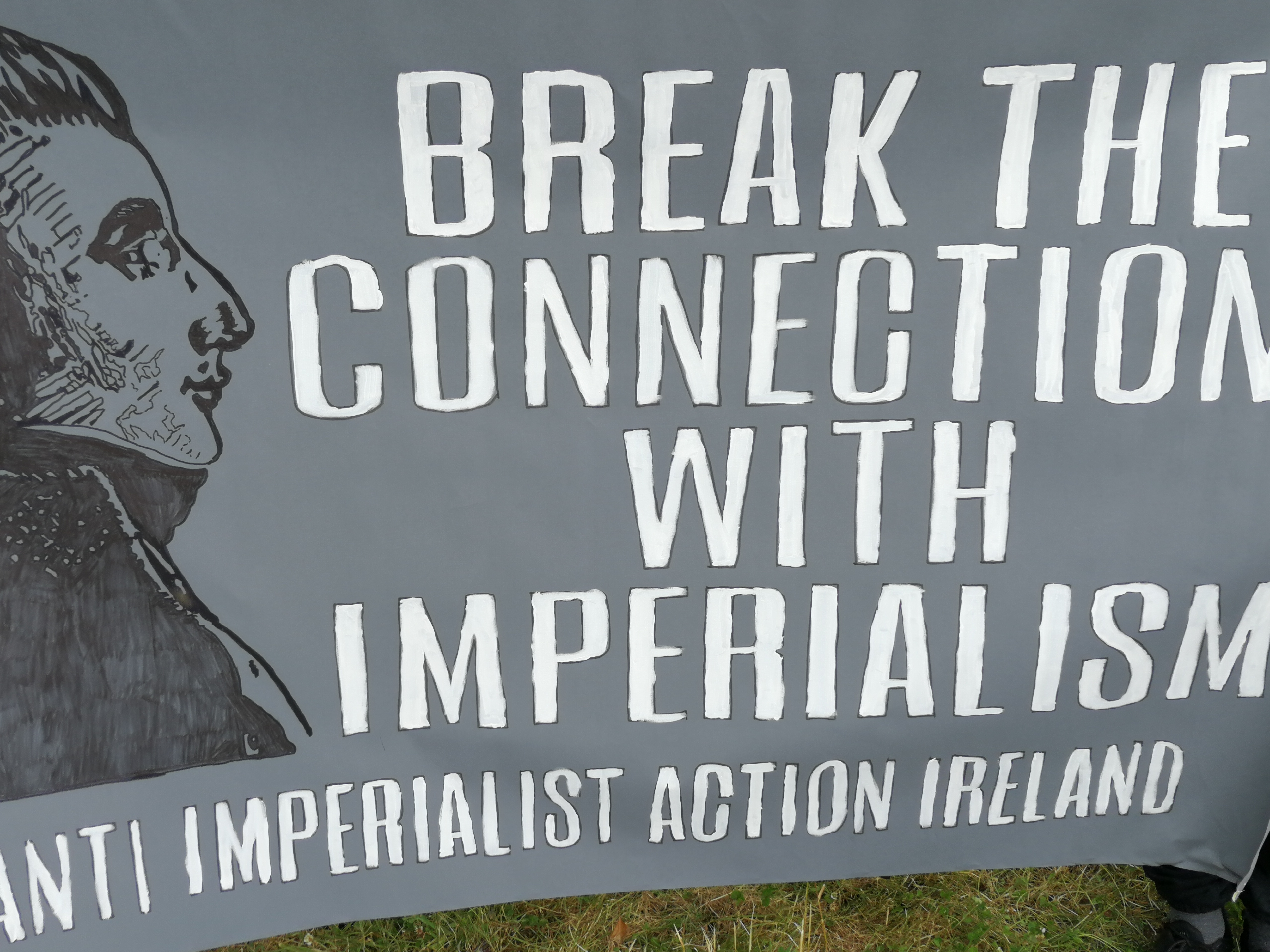
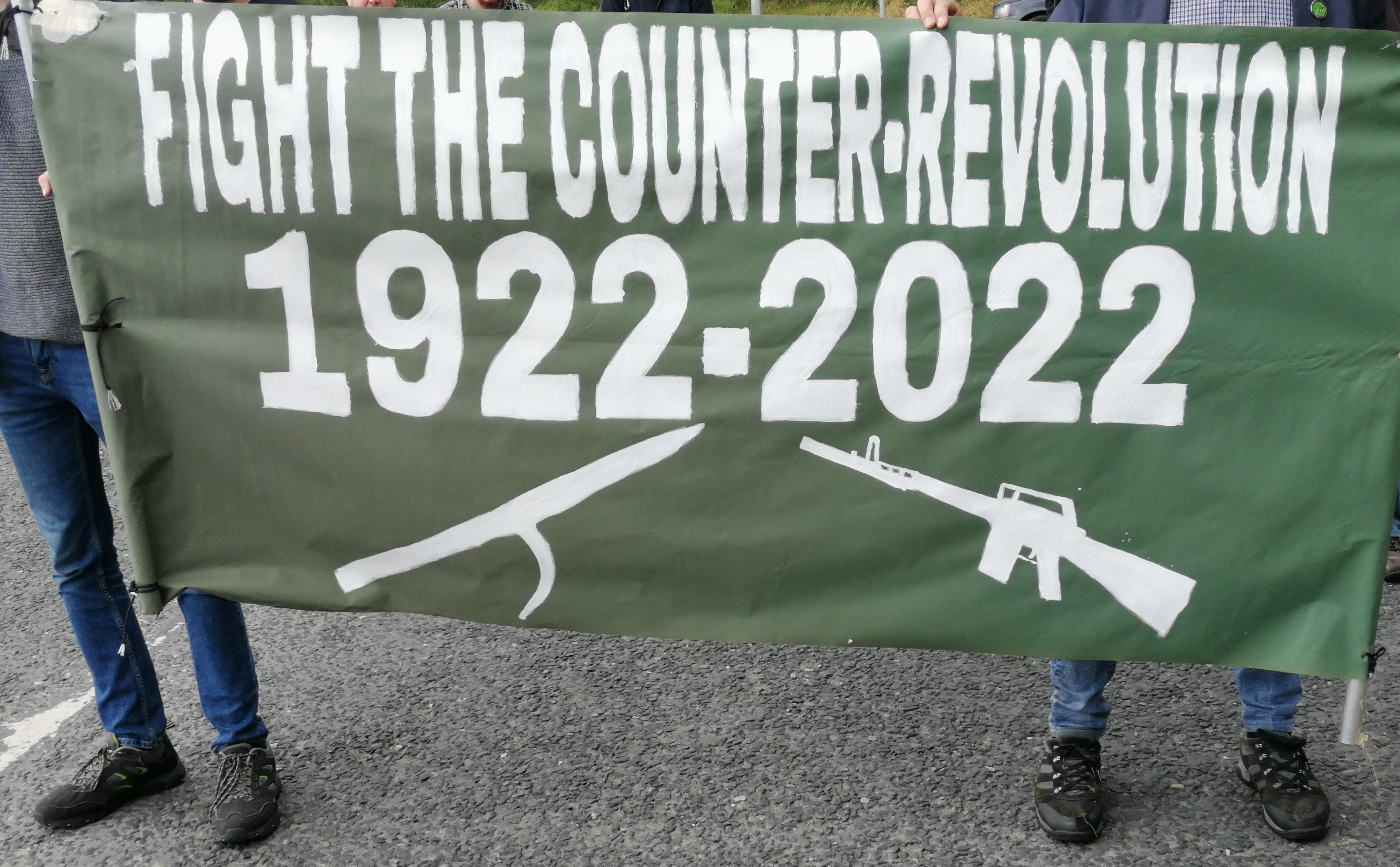
One of the banners in the crowd at the event in Bodenstown. (Photo: RSM)

Such a Republican Broad Front would be a fitting tribute to our Patriot Dead, the speaker added, to martyrs like Cathal Brugha,4 who gave his all in fighting for the sovereign, Independent Irish Republic and gave his life on this day in 1922 as a hero in the war in defence of the Republic.

In many of the pleas for unity of the fragmented resistance in Ireland, individuals have called for a conference to form a united front, others called for a unity document of principles around which to unite while in at least one case, two distinct organisations merged.

I have for years spoken out against such endeavours and advocated as a first step unity in practice. If organisations and individuals are not capable of that step, what kind of unity can they achieve around discussion of documents? Unity in practice also helps to break down distrust.

The speaker at the Wolfe Tone commemoration takes the same line, presumably speaking for the SRM when he does so and one supposes that this will continue to be the approach of the AIA in campaigns such as against internment, in solidarity with political prisoners5 or with Palestine.6

The above piece discussed two elements of the oration given by the SRM earlier this month which I believe to be of great revolutionary importance and in need of application in Ireland, one in advocating a principle and the other in suggesting avenues for practical application.

Later I will be taking a look at some other elements in that talk (the text of which, as published by the SRM, I attach as an appendix).

Beirimís bua.

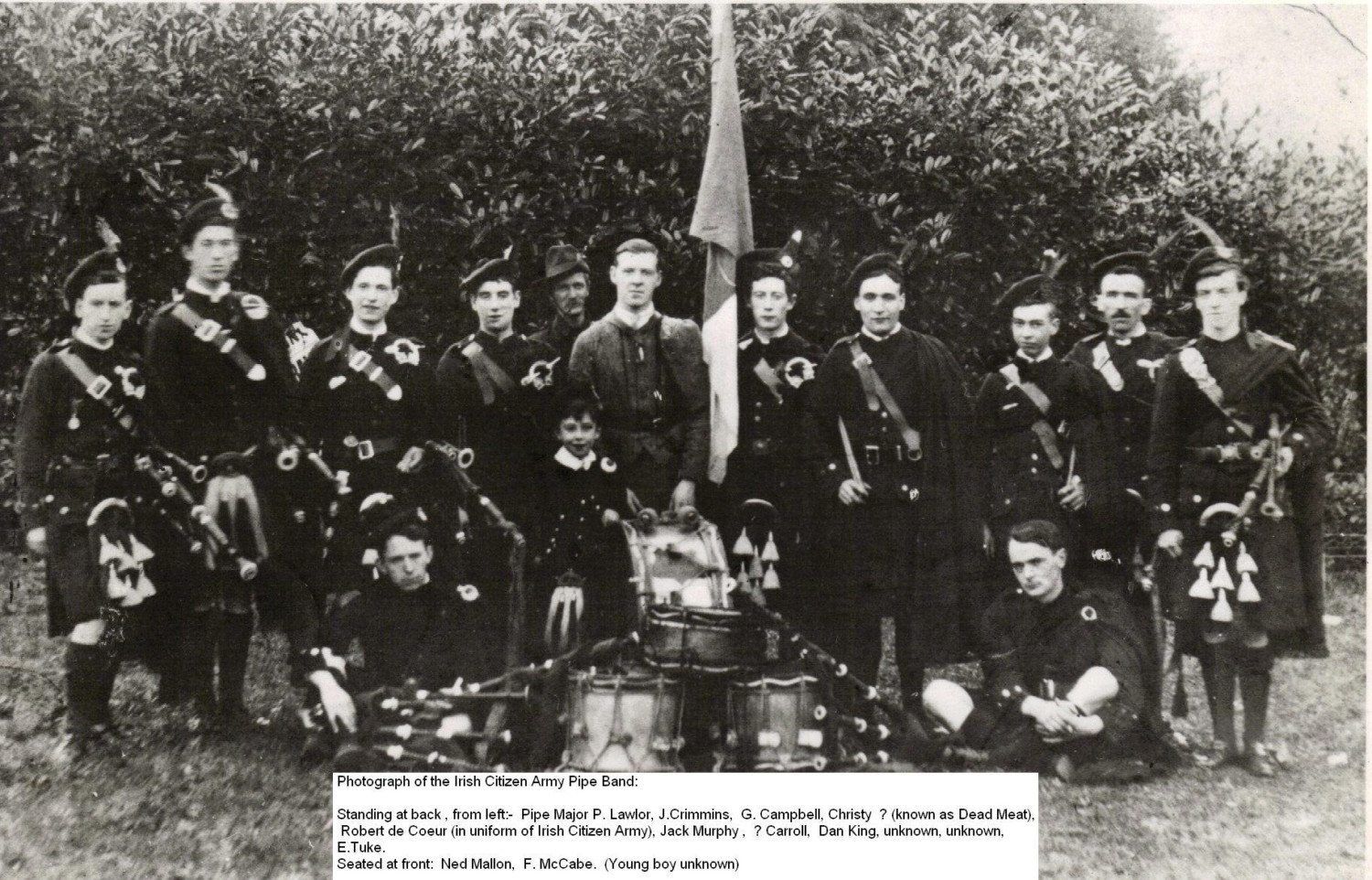
(Image sourced: Internet)

End.

FOOTNOTES

1Wolfe Tone, born into settler stock and of the Establishment Anglican congregation, was a leading figure in the formation of the revolutionary republican organisation The Society of United Irishmen, seeking “to unite Catholic, Protestant (i.e Anglican) and Dissenter” (i.e the other sects, Presbyterian, Methodist, Unitarian, Quaker etc.) to “break the connection with England. In 1798, the year of the Unitedmen uprising, the first of many Irish Republican uprisings and campaigns, Tone was captured by the British Navy on a French warship and, despite his French officer rank, tried and sentenced to death.

Tone died in jail some months before his brother Matthew was taken prisoner during the surrender at Ballinamuck (Baile na Muc) in Co. Longford of another French expedition to Ireland, late and too small, at the tail end of the Rising that year. Also ignoring his officer POW status, he was hanged in Dublin and his body reputedly thrown into the mass grave at Croppies’ Acre in Dublin city.

2Since even earlier than Thomas Davis’ (1814-1845) song In Bodenstown Churchyard, Irish Republican organisations and individuals have been making the pilgrimage to that grave in County Meath, at times with thousands in attendance.

3Also for an intense time as the Revolutionary Housing League in its attempt to spark a movement of occupation of empty properties to overcome the widely-acknowledged housing crisis in Ireland.

4Cathal Brugha (nee Burgess), son of a mixed Catholic-Protestant marriage, was a leading figure in Irish nationalist movement and in Republican rebellion in the last decades of the 19th and early decades of the 20th Centuries, learned Irish as a member of the Gaelic League, member of the Irish Republican Brotherhood (which he later left, considering it undemocratic), officer in the Irish Volunteer, 2nd in command in the South Dublin Union in 1916 served as Minister for Defence in the revolutionary government from 1919 to 1922, Ceann Comhairle of Dáil Éireann in January 1919 and its first president from January 1to April 1919, Chief of Staff of the IRAfrom 1917 to 1918. He served as a TD (electe parliamentary representative) from 1918 to 1922. He was mortally wounded by Irish Government troops in the early days of the Irish Civil War.

5Both on their own and for example in support of the Ireland Anti-Internment Campaign.

6Both on their own and for example as part of the Saoirse Don Phalaistín broad front.

APPENDIX

The following is the text of the main oration of which some sections are discussed in the preceding article and more to be discussed anon. It was delivered at the annual Wolfe Tone Commemoration at Bodenstown, organised by the Revolutionary Irish Socialist Republican Movement on Sunday July 7, 2024 and published on its Telegram page.

A Chairde is a chomrádaithe,

Táimid anseo i relig bodenstown ag uaimh ár n-athair, Wolfe Tone agus táimid ag rá go bhfuil an gluaisteacht a bhunaigh sé fós beo, agus tá sé ag fás arís.

Wolfe Tone is the father of Irish Republicanism. We come here each year not just for commemoration, but like Pearse, Connolly, Mellows and Costello before us, we come because we believe that the ideas and the vision that Tone put forward of a free independent Ireland is as relevant today as they were in the 1790s and because we believe that by remaining true to the teachings of Wolfe Tone we can build a revolutionary movement that will successfully free our country. Maybe not today, but our freedom is inevitable.

Tone’s most important belief was that we must ‘break the connection with England’ by any means necessary. It is for this reason that he established revolutionary military-political organisation the United Irishmen in 1791 and led a mass armed uprising in 1798 against British Rule in Ireland.

Tone was also clear that the revolutionary struggle could only be successful if it was based on the masses of the Irish People, stating that, ‘Our Strength shall come from that great and respectable class, the men of no property’.

And in these two simple quotes from Wolfe Tone, we have two of the most important teachings for the Revolutionary Republican Movement today. Firstly, that Republicans must work as a priority for National Liberation by any means we decide necessary.

That we must break the connection with England and defeat all forms of Imperialism in Ireland to establish a sovereign, Independent, Irish Republic.

And secondly, we learn from Tone that the fight for our Republic is a class struggle and that the driving force of that struggle will be the working class fighting for their own liberation.

These are two key teachings that when deviated from lead to compromise and the selling out of our revolution.

It is the duty of all of us here today and of all Republicans across Ireland, to ensure that the struggle for national liberation is kept at the fore of our revolutionary republican objectives and that we work tirelessly to achieve it and to ensure that our movement remains centred on and driven by the working class.

Some other key points laid down by Tone include that Republicanism is Anti Imperialist and it is Internationalist. Our struggle in Ireland is part of a wider international struggle of oppressed people against occupation, colonialism and imperialism.

Tone understood this when he looked to Revolutionary France to support the 1798 uprising. Today, Republicans must fight our struggle while also supporting Liberation struggles around the world in the belief that every blow struck against imperialism brings our victory closer.

So from Palestine to the Philippines and from India to the Basque Country, and everywhere people take a stand against NATO, the Revolutionary Republican movement must raise our cries in solidarity. The tide of revolution is rising in the world and there is much to be optimistic about.

But as revolutionaries we also have to be realistic. Since the time of Wolfe Tone the tide of revolutionary Republicanism has ebbed and flowed.

After the days of Tone and Emmet and the final defeat of the United Irishmen in 1805, Republicanism was reduced to an ember, spoken about in quiet corners until the birth of Young Ireland and the uprisings of 1848 and 1849 when revolutionaries such as Thomas Davis, Fintan Lalor, James Stephens and John O’Mahony would carry forward the vision of Tone, take up the hard work of rebuilding the Republican Movement and become the spark that would renew the Revolutionary fire, giving birth to Fenianism and the struggle that has carried us until today.

And today, we are 26 years on from the surrender of 1998, a surrender that had a devastating effect on the movement. Later this month it will be 19 years since the Provisionals ended their armed campaign.

These two great betrayals have led to the situation where the movement is fractured and split.

The revolutionary forces, though active, are scattered and there is mistrust between Republicans, whether in different groups or independents across Ireland, and this mistrust and division is exploited by our enemies.

It is a situation that all Republicans want to reverse and one of the revolutionary priorities in this phase of our struggle to overcome.

Comrades, like the revolutionary republicans after the defeat of the United Irishmen and Young Ireland, we find ourselves with the hard and gruelling task of rebuilding and reasserting the revolutionary republican struggle.

And the path to rebuild our struggle is the development of an Anti Imperialist Broad Front. A United Front of Revolutionary republicans, recognising and respectful of the autonomy and independence of the groups and independents involved, working in cooperation to advance our common republican objectives and to achieve a common republican programme. This is what our enemies most fear.

But again, this will not just happen overnight.

Trust and co-operation must be developed and we assert that this will be best achieved through activism and the development of National Republican Campaigns that can be taken up by all Republican groups and independents in a unity of purpose, that shows the real and forgotten strength of the Republican Movement.

There are many campaigns that could be developed from support for POWs to opposing internment and extradition, environmental campaigns such as the unacceptable situation at Lough Neagh, to campaigns that oppose the British and NATO presence in Ireland.

Such a Republican Broad Front would be a fitting tribute to our Patriot Dead, to martyrs like Cathal Brugha, who gave his all in fighting for the sovereign, Independent Irish Republic and gave his life on this day in 1922 as a hero in the war in defence of the Republic.

Over the last seven years we have put down a solid foundation as a movement. We have reasserted Irish Socialist Republicanism as the driving force of Revolution in Ireland.

We have recruited a new generation of republicans not damaged by the 1998 surrender who are now working with more experienced republicans to drive the struggle on.

While we can be happy with these achievements, the Republic needs more from each and every one of us and we all need to ask what we as individuals can do to carry the struggle forward.

Now is the time to move to the next phase of development in our revolutionary struggle, unsurprisingly by taking it back to Tone. Now is the time to strengthen and embed ourselves in the people of no property and to engage in systematic Republican Community work across the country.

In doing so, we would do well to return to Seamus Costello and the oration that he delivered from this spot in 1966, signalling the rise of Socialist Republicanism within the Movement. Costello outlined how it was the duty of all republicans to be active in our community.

How we should be involved in community groups, trade unions, tenants and residents associations, sporting, cultural and educational organisations and how we must take and assert our revolutionary republican position within them.

This is a task for all revolutionary republicans. Look at the groups in your area and see which ones your involvement in would advance the strengthening of Socialist Republicanism in your community.

Where no such groups exist, establish them. Where help is needed reach out to us as we have experienced comrades who excel in this area that would be happy to help in this work.

To conclude the comrades, this is a brief outline of our tasks in the time ahead.

While these plans will be deepened with discussion and debate within the movement, no one should leave this graveyard thinking there is no work for them to do, and the responsibility is on you to come forward and volunteer instead of waiting for others to come and ask you.

Our work is to free Ireland and our people by any means necessary to establish the 32 county All Ireland Socialist Republic, sovereign, independent, Gaelic and free, and we will not be stopped.

Redouble your efforts comrades, onwards to the Republic of 1916.

Beir Bua,

Tiocfaidh Ár Lá
SOCIALIST REPUBLICANS HONOUR “THE FATHER OF IRISH REPUBLICANISM”

Clive Sulish

(Reading time: 5 mins)

A broad group of socialist Republicans gathered at the grave of Theobald Wolfe Tone on Sunday 2nd July to honour his memory and to reiterate their commitment to an independent and socialist Ireland outside of imperialist military alliances.

Wolfe Tone’s grave in the Bodenstown Church graveyard has been a place of pilgrimage for Irish Republicans at least since the days of Thomas Davis1 of the Young Irelanders of the 1840s, who wrote of his own visit to the grave and composed the song “In Bodenstown’s Churchyard”.

The late 1960s saw huge numbers of people in attendance at annual commemorations there near the village of Sallins, Co. Kildare, including not only Sinn Féin2, who led them, but many political and social organisations, GAA clubs, along with many non-aligned people.

Over the years, the voluntary and unfunded National Graves Association has improved the site comprehensively and sensitively, leaving the ruins of the Protestant church as they are but building a stage attached to one side, fronted with plaques and commemorative flag stones.

Commemorations currently are usually organised around a Sunday near the date of the patriot leader’s birthday on 20th June but have to be managed between different groups wishing to hold their own commemorations.

Speeches, songs and Garda harassment

The Annual Wolfe Tone commemoration organised by the Wolfe Tone Commemoration Committee took place over the weekend with members of a number of groups and Independent Republicans in attendance.

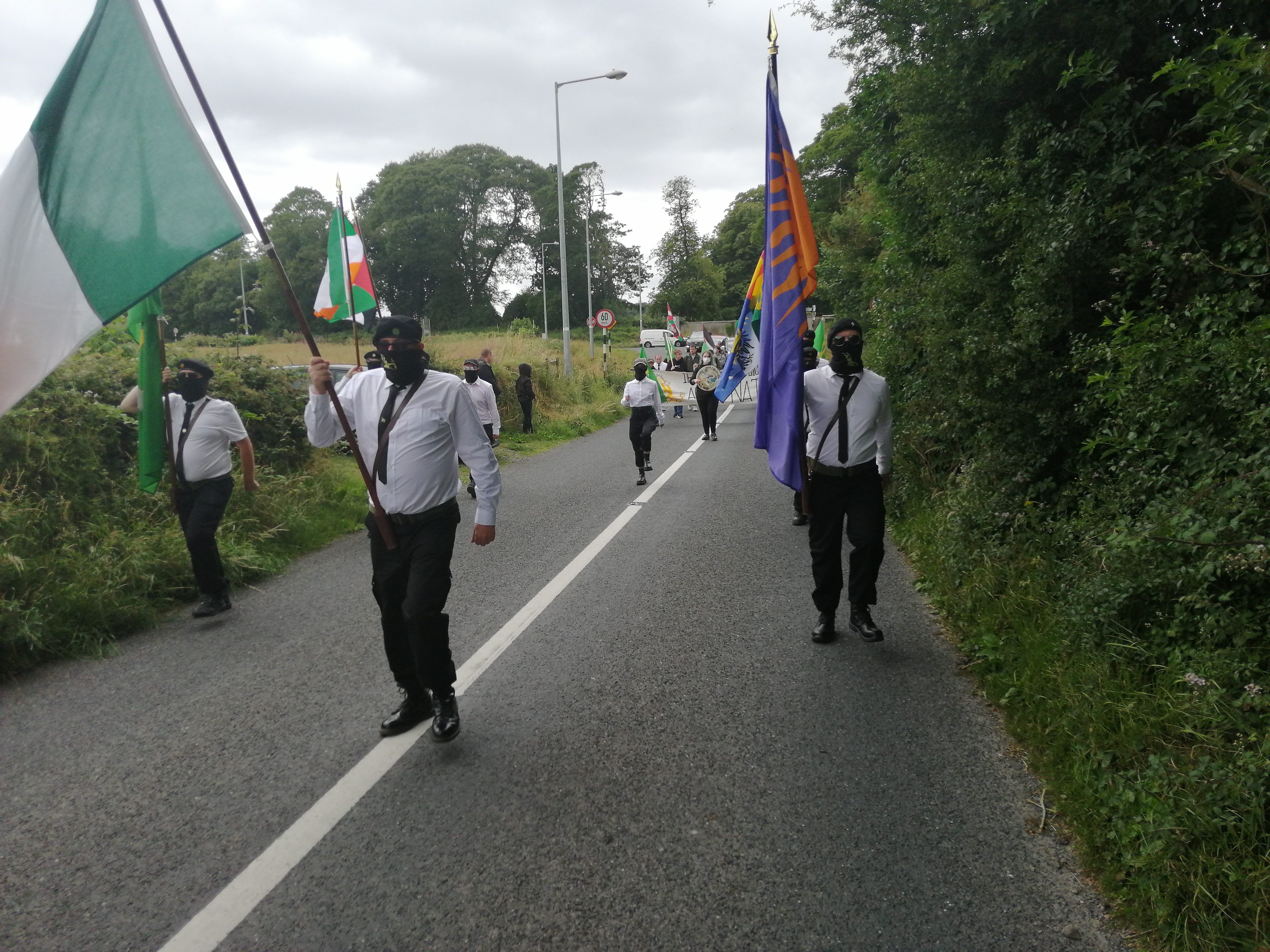
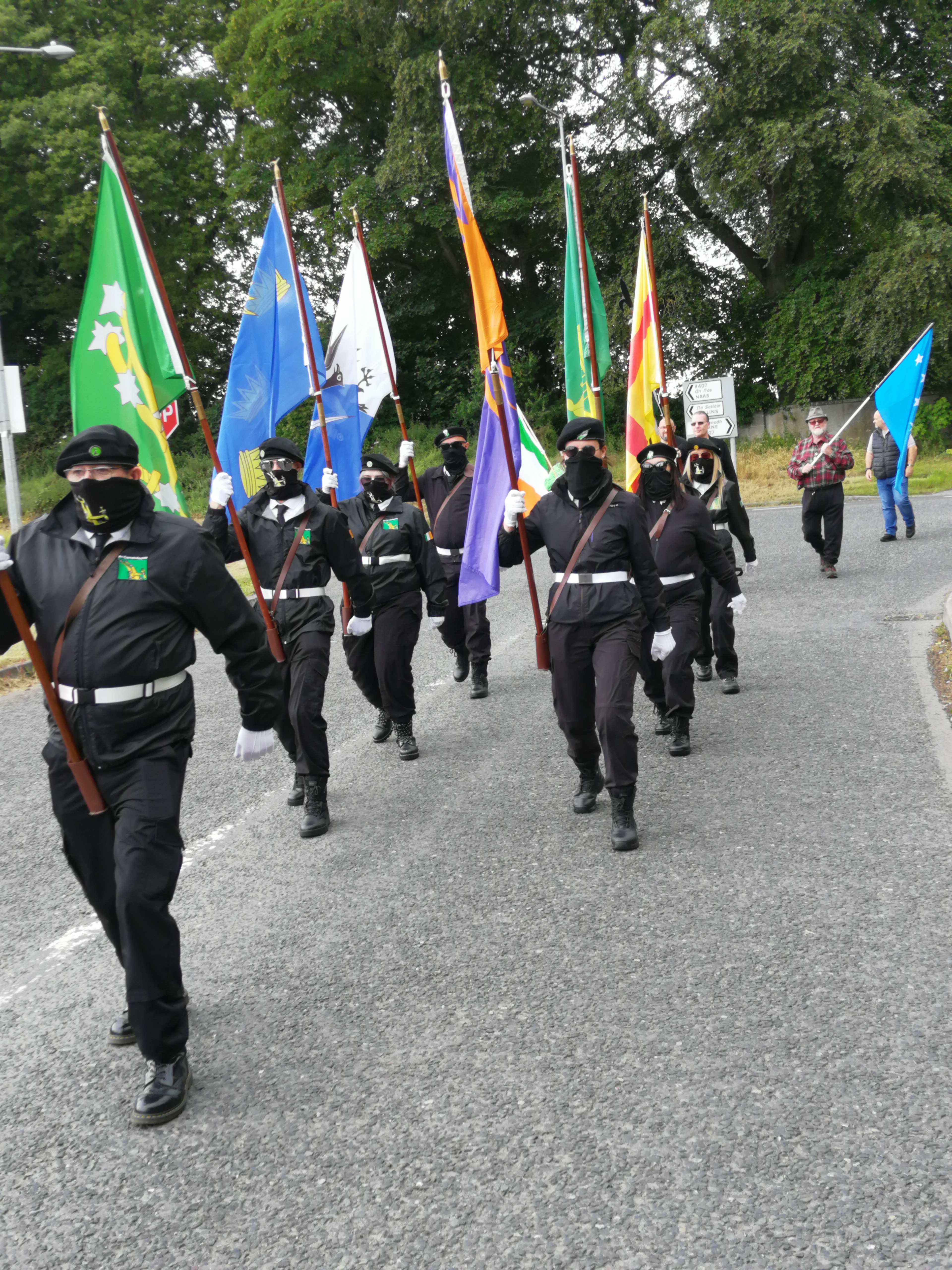
A Socialist Republican Colour party led the march up from the bottom of the road, turning in to the graveyard through a side gate and taking up positions in front and to one side of the monument, at ordú scíthe (parade rest) position but with flags held high.

Colour party in front of Wolfe Tone monument, Bodenstown Churchyard (Photo: Rebel Breeze)

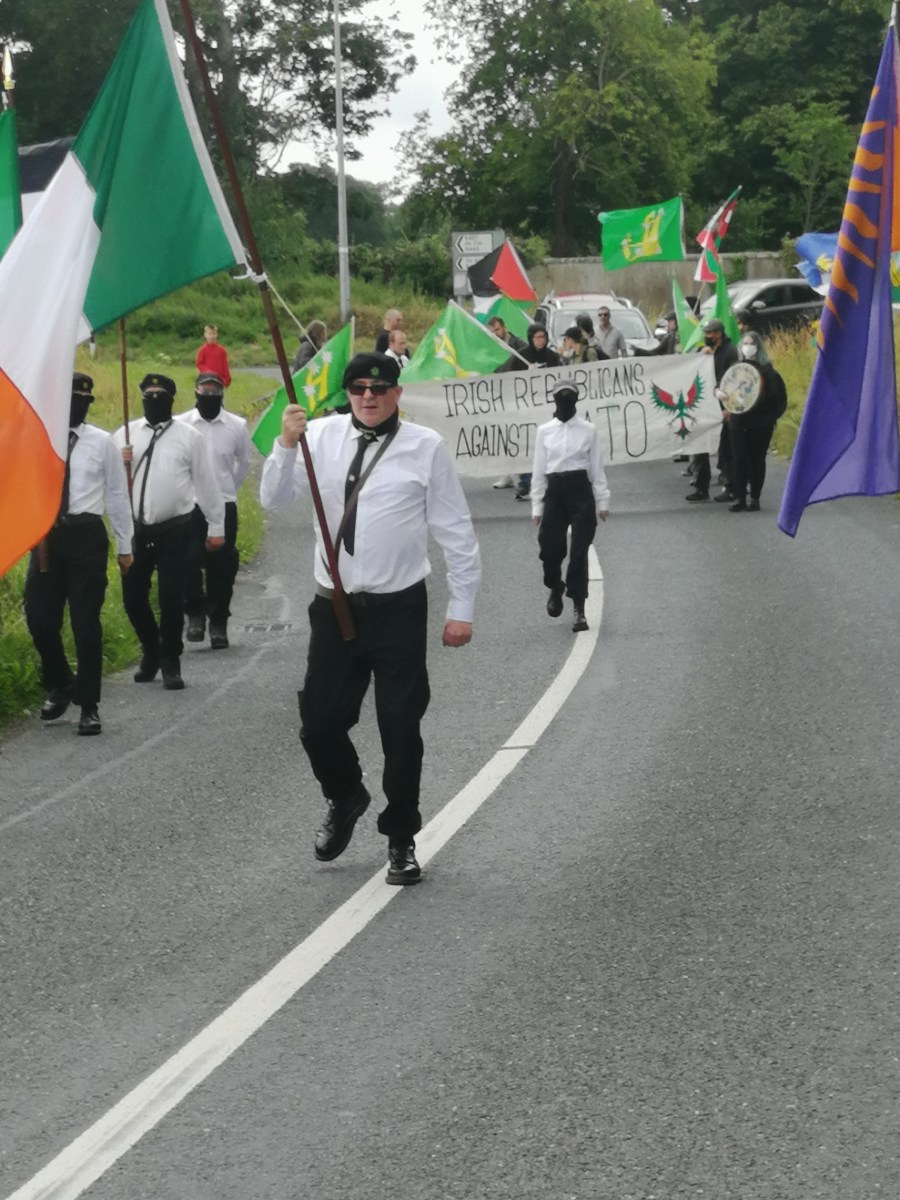
Behind the colour party followed a crowd carrying banners bearing the legends “Irish Republicans against NATO”, “We serve Neither King nor Kaiser but Ireland” and an assortment of flags including green-and-gold Starry Ploughs, Irish Tricolour, Palestinian and Basque national flags.

The event was chaired by a young Socialist Republican who spoke about the importance of the event before introducing a representative of a midland Republican commemoration group who read a short message of solidarity.

This was followed by a socialist republican accompanying himself on guitar singing The Three Flowers.3

The main oration was delivered by veteran Independent East Tyrone Republican Margaret McKearney who linked the past with the present, including the current housing crisis, the British occupation and the Irish State’s push to join PESCO and NATO military alliances.

Musician performing The Three Flowers at the Wolfe Tone monument (Photo: Rebel Breeze)
Veteran Republican from Tyrone delivering the oration at the commemoration event (Photo: Rebel Breeze)

There was a clear message at the event that the push towards NATO will be energetically resisted at every turn by the people of Ireland.

Wreaths were laid and a minute’s silence was observed, while the colour party lowered the flags in memory of all those who paid the ultimate sacrifice in the ongoing struggle for Irish Freedom. The event was brought to a close with the musician playing and singing Amhrán na bhFiann.

A handful of Gardaí4 in uniform and in plainclothes (Special Branch, the political police) were parked outside the graveyard watching people arriving and leaving but at that point having no direct interaction with those attending the event.

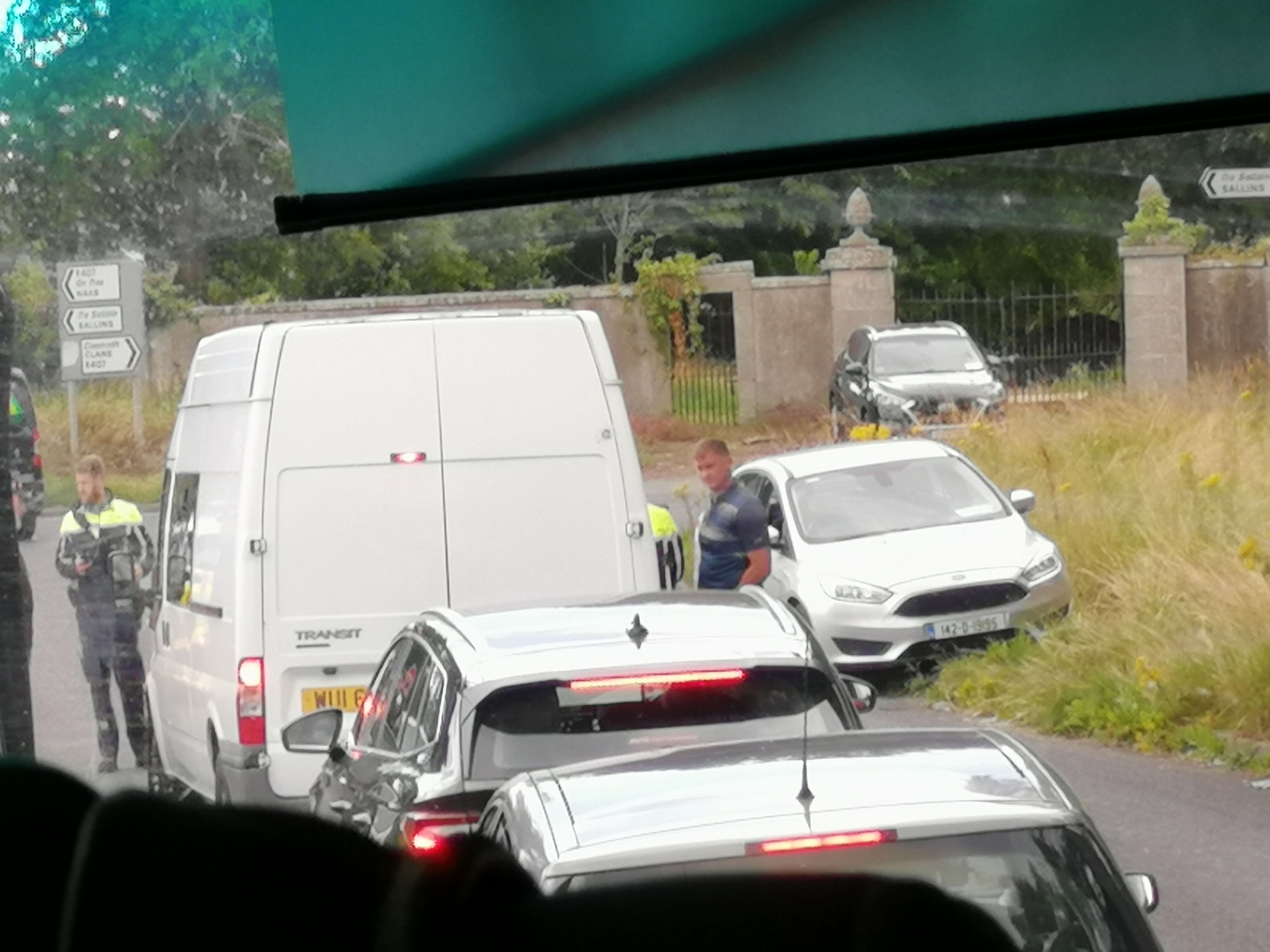
Part of long tail-back cause by Garda checkpoint very near to Bodenstown Churchyard after the commemoration event (Photo: Rebel Breeze)
Gardaí in uniform and Special Branch in plain clothes harassing and attempting to intimidate people who had attended the commemoration event (Photo: Rebel Breeze)

However, once the event concluded, the Gardaí set up a checkpoint at the bottom of the road and began to harass and attempt to intimidate drivers of vehicles, stopping them, asking for identification, where they were from etc, causing a long tailback.

This is part of the regular harassment of Irish Republicans by police on both sides of the British Border.

The Father of Irish Republicanism”

Theobald Wolfe Tone (1763-1798) was formally a member of the Church of Ireland5 congregation (Anglican), in his time the dominant religious group in England-occupied Ireland but also one of the smallest.

No-one could be elected to the Irish Parliament unless of that congregation.

In the early 19th Century a section of the Irish bourgeoisie, nearly all Anglican or of the other Protestant churches, “dissenters”, wished to develop the Irish economy free of interference, control, patronage and bribery associated with being an English colony.

Many of them understood the need for a strong base in the population, for which they recognised the need to include representation for the majority population in the country, the Catholics, along with the most populous of the Protestants, the Presbyterians.6

When the liberal but pro-English Crown Henry Grattan brought the issue to a vote in the Westminster Parliament, his motion failed due to many MPs’ sectarianism or vested interests, a situation which continued for decades afterwards.7

That seemed to point to revolution as the only logical way forward.

Theobald Wolfe Tone was one of the founders of the Society of United Irishmen in October 1971, the first broad Republican organisation in Ireland, which soon developed a comprehensive revolutionary agenda, for Irish independence and a Republic based on universal male suffrage.8

In order to accomplish a successful uprising, they invited assistance from Republican France and planned a simultaneous uprising across Ireland, with particular concentration on Antrim (largely Presbyterian and Anglican), Wexford and Wicklow, Midlands and Mayo (largely Catholic).

Colour party leading a march towards the Wolfe Tone monument (Photo: Rebel Breeze)

Spies and informers working for the English occupation betrayed some of their plans and most of the Leinster Directorate of the United Irishmen, including Wolfe Tone, were arrested, a disaster for uprising plans in Dublin but also for overall leadership in Leinster.

The 1798 Rising had initial great success in the south-east, particularly in Wexford but was quickly and bloodily suppressed in the Midlands and in Antrim. Mayo rose when a too-small detachment of French soldiers arrived under Humbert in Kilalla but they were outnumbered and beaten.

Tone was was unapologetic at his trial, was sentenced to death by hanging but appears to have attempted to take his own life while awaiting execution, surviving for a few days in great pain before dying on 19th November 1798 as British and Orange loyalist repression swept the country9.

Wolfe Tone Monument by Edward Delaney (d.2009) at S.E entrance to Stephen’s Green, Dublin city centre (image sourced: Internet)

Many leaders of the United Irishmen are honoured in song, writing and in commemorative events to this day but Theobald Wolfe Tone is still the most widely remembered of them all.

End.

The Colour Party and some of the participants line up for a group photo by the monument (Photo: AIA)

FOOTNOTES

1Thomas Davis (1814-1845), journalist, author of the song A Nation Once Again and other works, also co-founder of The Nation newspaper.

2Prior to its split resulting in Provisional Sinn Féin and the later split resulting in the Irish Republican Socialist Party.

3Composed by Norman G. Reddin, a Republican ballad honouring the memory of three United Irish leaders, Robert Emmet, Michael Dwyer and Wolfe Tone. Both Tone and Emmet were sentenced to execution, the latter carried out in 1803 on Thomas Street in Dublin. Dwyer was transported to exile in Australia where he was later accused of planning an uprising in New South Wales for which he was twice imprisoned and tried but exonerated, became Police Chief in Liverpool, Sydney in 1813 but was imprisoned again in 1825 for alleged non-payment of a £100 debt, contracted dysentery, was released again and died very soon afterwards.

4Police force of the Irish State.

5A branch of the Church of England, the state religion of the UK of which their Monarch is the titular head (in addition to being the commander-in-chief of the Armed Forces).

6“Catholic, Protestant and Dissenter”, as Wolfe Tone famously called the alliance.

7In May 1808 Grattan proposed emancipation in the House of Commons, with certain qualifications, but his motion was defeated by 281 votes to 128. In June 1812 the Commons accepted, by 225 votes to 106, a motion in favour of considering Catholic claims. An emancipation Bill, introduced in February 1813, received a second reading but was lost in committee by a narrow margin. Frustration at this lack of progress led to the formation of the Catholic Association in 1823 (of which Wolfe Tone was an active member). Parliament passed an Act to restrict the Association’s activities two years later.

8Very few radical or revolutionary individuals, not to mention movements of the 18th (or even much of the 19th or early 20th) Centuries proposed universal female suffrage, one reason why the 1916 Proclamation of Irish Independence is such a remarkable document, beginning its address with the words “Irishmen and Irish women”.

9Which many, in particular Protestants, fled the country to escape, some settling in the United States and in Canada. The great Catholic emigration from Ireland did not occur until the Great Hunger of the mid-19th Century and later.

USEFUL LINKS

https://www.parliament.uk/about/living-heritage/evolutionofparliament/legislativescrutiny/parliamentandireland/overview/catholic-emancipation/

FOUNDING OF FIRST WORKERS’ ARMY IN THE WORLD COMMEMORATED IN DUBLIN

Clive Sulish

(Reading time: 8 mins.)

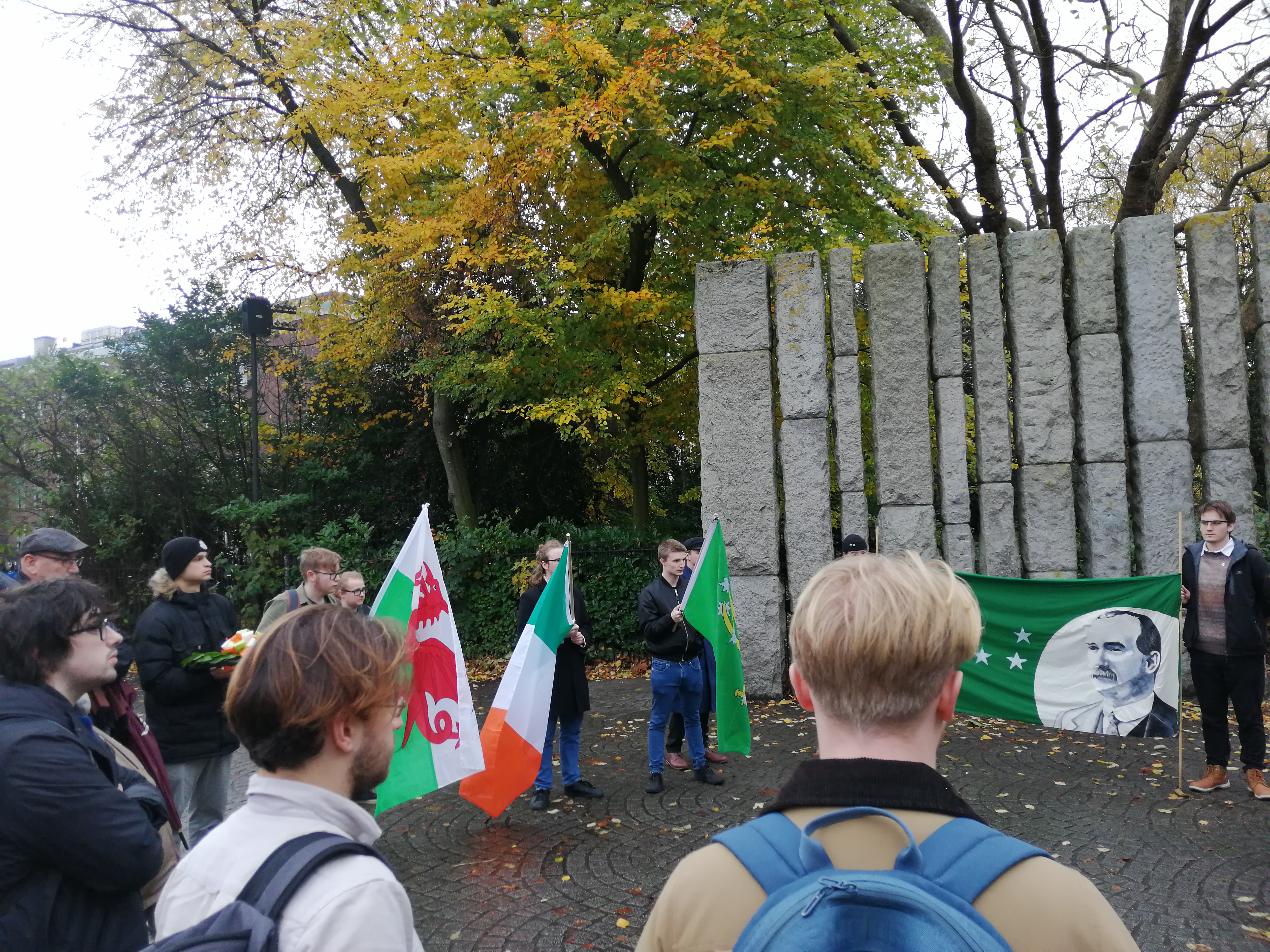
The founding of the Irish Citizen Army, the first workers’ army in the world1, was commemorated in Dublin at the site of Wolfe Tone monument in Stephens Greeen, in song and speech on 23rd November 2022.

Organised by the Connolly Youth Movement, the other participating organisations represented were the Irish Communist Party, Independent Workers Union, Lasair Dhearg2 and Welsh Socialist Republican Solidarity (Ireland) – the Irish branch of the Welsh Underground Network.

In addition, a number of independent activists were also present.

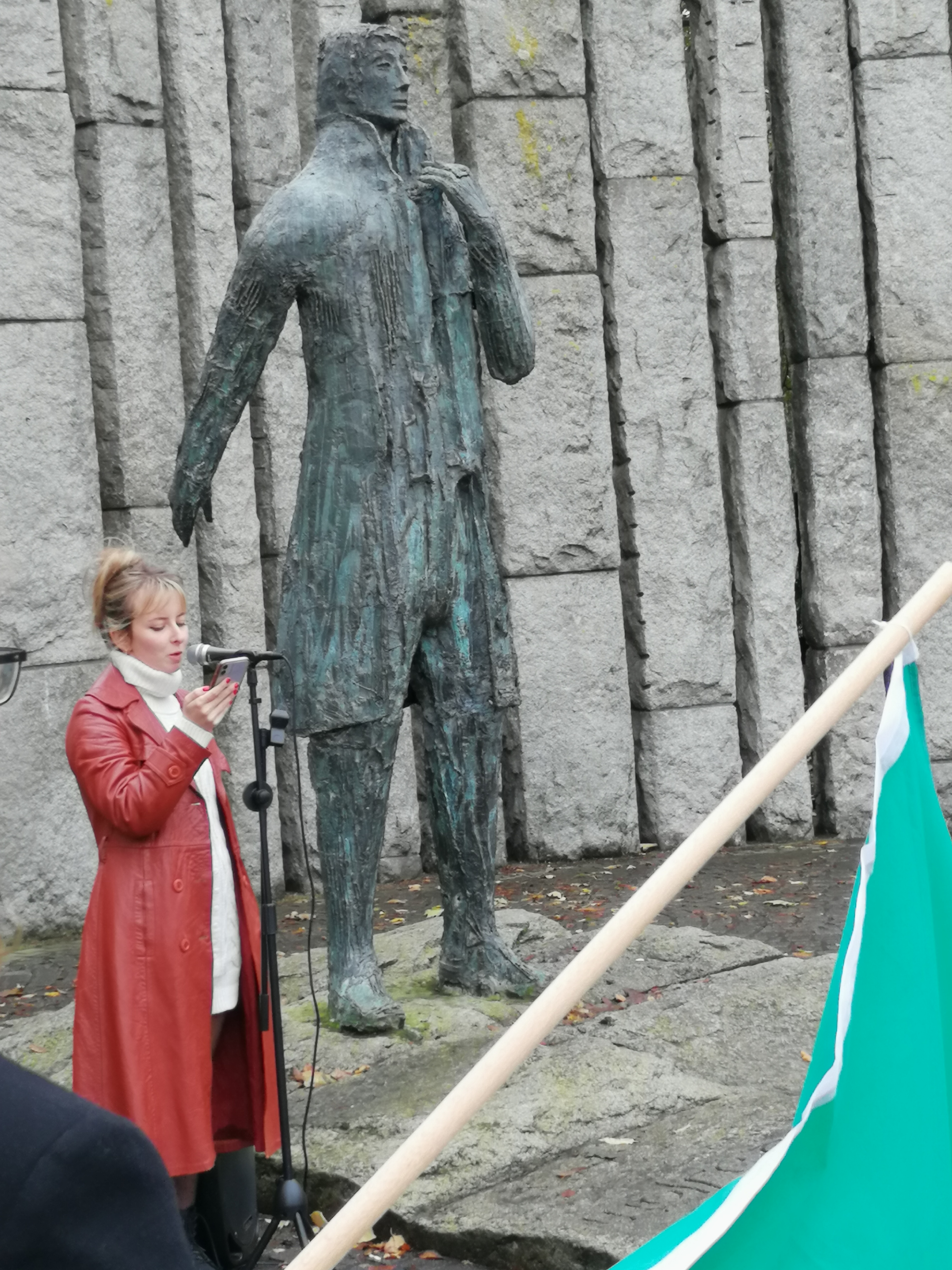
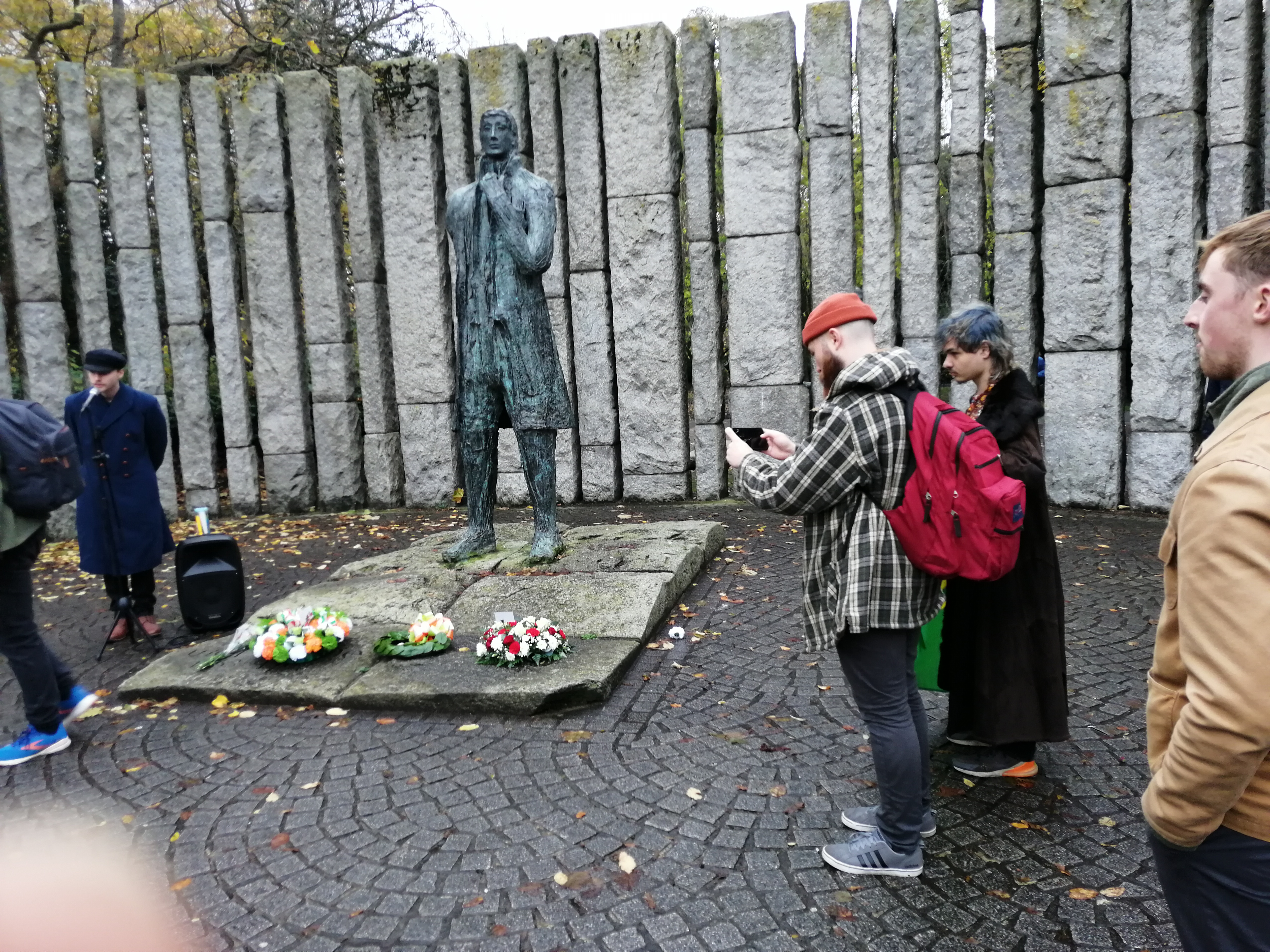
CYM speaker beside the Wolf Tone Monument (by Edward Delaney) which was blown up by Loyalists in 1969; it was recast and the surviving head incorporated. (Photo: Rebel Breeze)

THE IRISH CITIZEN ARMY

The Irish Citizen Army was founded on 23rd November 1913 on a call from Jim Larkin and James Connolly, both leading the Irish Transport and General Workers’ Union in its titanic struggle against the federation of Dublin Employers’ plan to break and disperse the union.

The call for the formation of the ICA arose due to the attacks of the Dublin Metropolitan Police on the workers and their supporters; already in August 1913 the DMP had killed two workers by truncheon blows and injured many, including a youth who would die later as a result.

The ICA’s initial organiser was the writer and dramatist Seán O’Casey, later succeeded by Boer War veteran Jack White.3 In addition to requiring its recruits to be union members, the ICA enrolled women as well as men and some of the former were officers commanding both genders4.

While the ITGWU was defeated in the eight months of the Lockout, it was not smashed and came back stronger in a relatively short period. The ICA faded away then but was reorganised over following years and approximately 120 took part as a unit in the 1916 Rising, alongside other units.5

SPEECHES AND SONG

A small crowd had gathered at the advertised location, the Wolfe Tone Monument in Stephen’s Green and the chairperson of the event called people to order.

Diarmuid Breatnach, an independent activist, was asked to sing one of Connolly’s compositions, ironically titled Be Moderate, often referred to instead by its refrain, “We only Want the Earth”.

An older man with a Dublin accent, Breatnach told his audience that Connolly published the lyrics in New York in 1907, going on to sing the five verses to the air of Thomas Davis’ A Nation Once Again6, using the chorus part to repeat the refrain that “ … we only want the Earth!”7

A representative of the Independent Workers’ Union, a young man with an Ulster accent, spoke about the need for workers to have a trade union and for that union not to align itself with employers or with the State.

In order to truly represent the interests of the workers, the union needs to be independent, he maintained and also democratic in its decision-making.

In conclusion, the speaker said that the IWU is the union that is needed and called on people present to join it and to support it.

“MAKE THE VISION A REALITY”

Amy Margaret, a young woman, also with an Ulster accent, delivered a speech on behalf of the organisers of the event, the Connolly Youth Movement.

“The Citizen Army was a direct response to the brutality carried out by the RIC and Dublin Metropolitan Police during the Dublin Lockout” she said; “the police killed two workers, injured hundreds more with baton charges, and frequently ransacked the tenements where strikers lived.”

“The Citizen Army fought back with some succes” she continued “and as one pointed out, a hurley has a longer reach than a baton. It was in the Citizen Army that the working-class stood up to the RIC and employers,” she continued.

“The same RIC that torched farmer’s homes during the Land war, the same employers who often owned the slums where workers lived; it was here at Stephen’s Green (and elsewhere in the city) that the Citizen Army stood up to the British Empire, alongside comrades in the Irish Volunteers.”

She told her audience that when, during a dockers’ strike in 1915, scabs were imported and police harassed picketers, Connolly sent a squad of the ICA with fixed bayonets to the scene, resulting in the dispute’s resolution with “a considerable increase in wages to the dockers concerned”.

“The Citizen Army was not simply workers armed with guns,” the speaker said, “but also armed with culture” and referred to weekly concerts in Liberty Hall (the ITGWU’s HQ) and to the dramatic acting history of Seán Connolly and whistle-playing of Michael Malin, both 1916 martyrs

“What the ICA stood and fought for in their own words, “… is but one ideal – an Ireland ruled and owned by Irish men and women, sovereign and independent, from the centre to the sea.”

“Connolly was clear however that such a Republic would have no place for the “rack-renting, slum-owning landlord” or the “profit-grinding capitalist”, but should rather be a “beacon-light to the oppressed of every land”.

“The most fitting tribute for the ICA then is to make that Republic a reality. To do so we must learn from the past and their examples. We can learn from them to never be cowed by the odds against us, we can learn from their comradeship to each other.

We can learn from how they combined political, economic and cultural methods to advance the cause of a worker’s republic. But more importantly we must be able to learn from their shortcomings.

After the Rising and the loss of its leadership the ICA began to devolve into a social club and whilst some members played an important role during the Tan War, the ICA was not the revolutionary workers’ army it once was.

Therefore we must build a truly mass movement – not just a committed core of activists, and we must build a movement not reliant upon key personalities so that it can function no matter what.

We all know that things must change in Ireland, and so we reaffirm the principle that the Citizen Army stood by; only the Irish working class is capable of waging the revolutionary struggle necessary to change things; not capitalists and landlords.

Helena Molony of the ICA, said, “We saw a vision of Ireland, free, pure and happy. We did not realise that vision. But we saw it.”

As the socialist-republican youth of today, we commit ourselves to make that vision a reality and to build a Republic that the men and women of the Citizen Army would gladly call their own.”

Some of the gathering at the Wolfe Tone Monument (out of shot to the right) to commemorate the creation of Irish Citizen Army (Photo: Rebel Breeze)


MARKIEVICZ: “RESOLUTION, COURAGE AND COMMITMENT

Breatnach was called back to the microphone and talked about the lessons to be learned from Constance Markievicz, co-founder of Na Fianna Éireann, the Irish Citizen Army and of Cumann na mBan, born in Britain “as were a number of our national and class heroes”, he said.

“Constance was born into a settler landlord family, the Gore-Booths”, he told the audience and her experience of witnessing deprivation, along with her sister Eva, during the Great Hunger, had a strong effect on both, inclining them to social reform and they became also suffragettes.

The speaker said that in that latter aspect and as a poet Eva became well-known particularly in England but Constance was better known as a revolutionary and for her allegiance to the working class and to the Irish nation.

He reminded his listeners that Markievicz was artistic and apt to strike poses; O’Casey, founder of the ICA had been hostile to her and co-founder of Cumann na mBan and wife of Tom Clarke of the IRB, Kathleen Clarke, had found her irritating.

Breatnach said that Markievicz was 3rd in 1916 garrison command at Stephen Green and had been accused not only shooting dead there a member of the DMP but of exulting in it; however according to witness accounts she had not even been present when the officer was killed.8

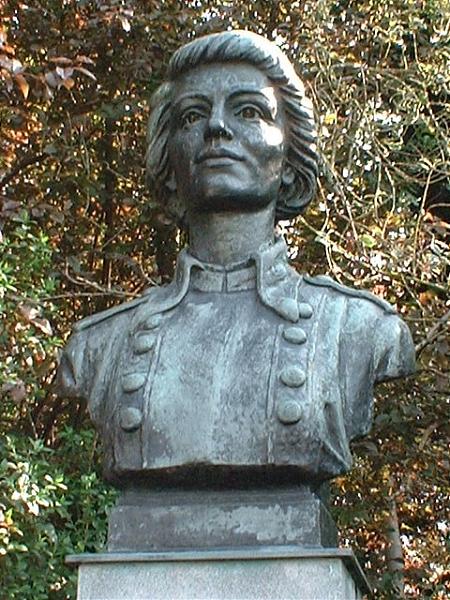
Bust of Volunteer Markievicz in Stephen’s Green (Photo: Rebel Breeze).

A British officer at her court-martial after the surrender of the 1916 Rising had claimed that she begged for her life at the court-martial but the official British records published later gave the lie to that and her own account that she demanded equal treatment with the executed leaders rings true.

“Her life as an example,” Breatnach continued, “teaches us not to judge people only by their background or indeed by their idiosyncrasies but primarily by their resolution, courage and commitment, all of which Constance Markievicz had by the bucket-load.”

The speaker also reminded those present that the very Wolfe Tone monument beside which he stood had been blown up in a number of British Loyalist bombings of the city during the 1970s, a number of which would soon be commemorated on the December anniversary of one of them.

The Irish State had prosecuted not a single one of the perpetrators, not even for the Dublin and Monaghan bombings, with the highest death toll9 of any one day during the recent 30 Years War. Instead, they had used the 1972 bombing to pass emergency legislation to attack Irish Republicans!10

Speaking briefly as a historical memory conservation activist, primarily active in the campaign to save the Moore Street market and 1916 battleground from speculators, Breatnach remarked that it was fortunate that the area behind him was a public park.

Otherwise it would all have been a prime target for property speculators. People sometimes express surprise that Irish governments do so little to protect areas of insurrectionary history. He stated however that this was natural since it was not their history but that of the struggling people.

“The history of the Irish ruling class is of a foreign-dependent one”, Breatnach stated, “rather than that of a national bourgeoisie willing to fight for independence. The last time Ireland had such a bourgeoisie was in 1798, mostly led by descendants of settlers and planters.”

“This is why Connolly pointed out that the Irish working class are the true inheritors of the Irish struggle for freedom. National independence and socialism are two different objectives but interdependent in Ireland and for the struggles to succeed they must be led by the working class.”

CONCLUDING

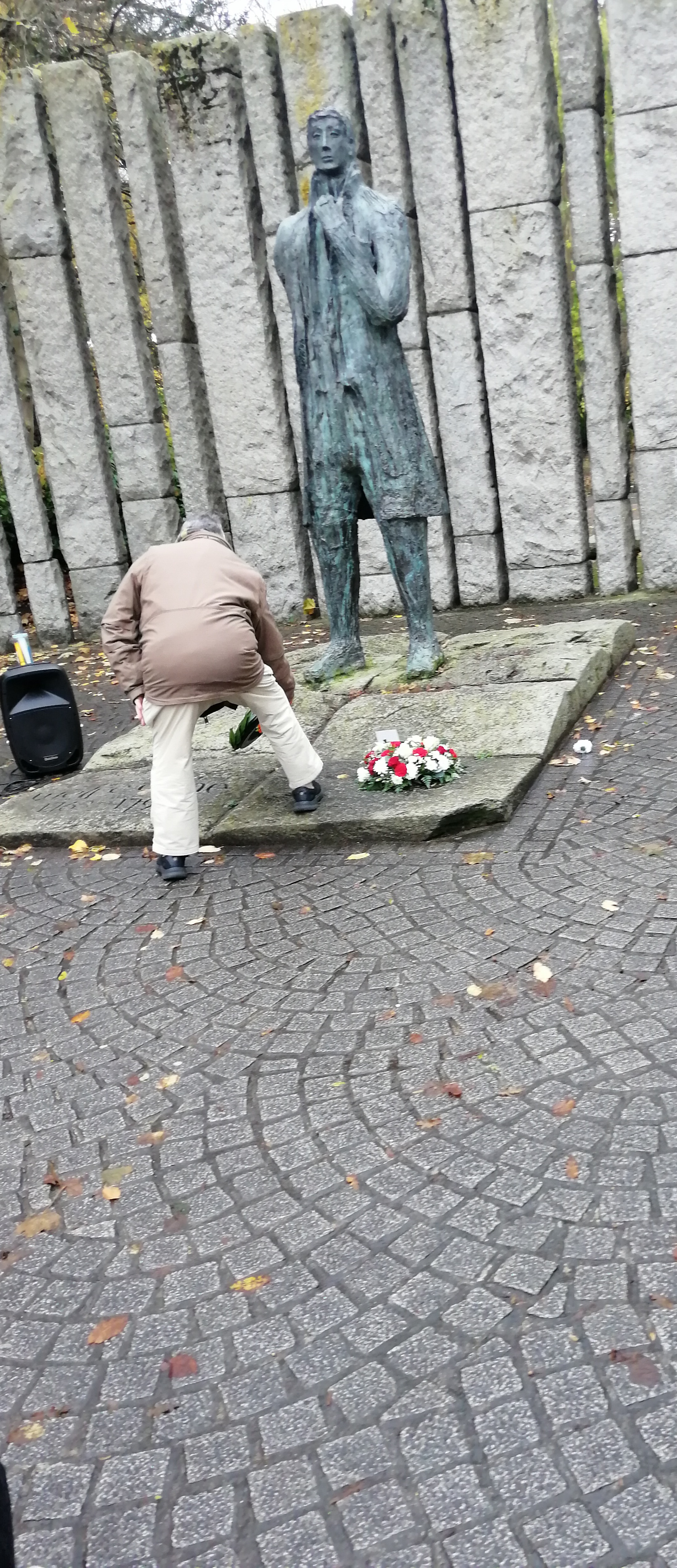
Wreaths were laid on behalf of a number of organisations, including Lasair Dhearg and the chairperson thanked all for their attendance, leaving people to their various ways into the mild autumn-like afternoon.

End.

(Cropped photo: Rebel Breeze)

(Photo: Rebel Breeze)

FOOTNOTES

SOURCES

1Clearly not the first army composed of workers, since these are the members of most armies; nor the first to fight for the workers, as did some for the Paris Commune in 18th March-28th May1871. However, the ICA was founded specifically for the defence of workers, the first in the world to be so, though its constitution was largely Irish nationalist.

2Socialist and anti-fascist Irish Republican organisation mostly represented in Belfast. The name means “Red Flame”.

3A number of Irish were veterans of the Boer War, the British against Dutch colonists in South Africa, most like White were on the British side but some fought for the Boers, to the extent of forming an Irish Brigade for the purpose. Later, a number from both groups ended up fighting alongside one another in the 1916 Rising (and no doubt against others who remained in the British Army).

4This too was a ‘first’ to the credit of the ICA.

5The Irish Volunteers, Cumann na mBan, Na Fianna Éireann, the Hibernian Rifles and of course the Irish Republican Brotherhood, the chief architects of the Rising, its members fighting as members of other units, chiefly the Volunteers and the Fianna (the membership of both those organisations was exclusively male though its couriers were often female but Tom Clarke’s wife, Kathleen Clarke, was the IRB’s liaison from Dublin with the sister organisation in the USA.

6James Connolly (1868-1916) did not prescribe any air for the lyrics and they have been sung to several. A Nation Once Again was composed by leading member of the Young Irelanders, Thomas Davis (1814–1845) and published in 1844, for many years considered a candidate for Irish national anthem.

7“For our demands most moderate are: we only want the Earth!”

8Breatnach also said that least two and probably three members of the DMP were killed during the Rising, each one in an area under the control of the ICA, who no doubt remembered well the force’s actions during the 1913 Lockout.

91974: 33 male and female civilians and a full-term unborn baby.

10The Amendment to the Offences Against the State Act, including the introduction of the no-jury Special Courts, essentially for trying Irish Republicans with a much lower quality of evidence required to convict, including the unsupported word of a senior Garda officer.

“WOLFE TONE IS COMING BACK!” — BODENSTOWN 2022

Clive Sulish

(Reading time: mins.)

The “father of Irish Republicanism”, Theobald Wolfe Tone was honoured on Sunday afternoon at the Irish patriot’s final resting place, in Bodenstown churchyard in Co. Kildare, a place of annual pilgrimage for Irish Republicans. Irish Socialist Republicans and Anti-Imperialist Action Ireland convened the event including speakers, musicians, singers and colour party, in which the speeches drew on the past to comment on the present and on the future.

Colour Party flags against those permanently maintained there at the monument by the NGA. (Photo: Rebel Breeze)

WOLFE TONE AND THE RISINGS OF 1798

Theobald Wolfe Tone and others sought the extension of political participation from the Anglicans in Ireland to the Dissenters, i.e non-Anglican Protestants in addition to the Catholics. When efforts in this direction failed1 towards the end of the 18th Century he and others formed the United Irishmen. This was a secret revolutionary organisation, with a democratic, non-sectarian ideology, seeking assistance from republican France to rise against English control of Ireland.

One of the banners carried on the march and at the rally (Photo: Rebel Breeze)

The English authorities occupying Ireland harried the Republican communities (including hanging some individuals), pushing them into uprising in 1798 when they were in some disarray, particularly after the arrest of most of the Leinster Directorate of the United Irishmen in Bridge Street, Dublin. The French ship in which Tone was being brought back to Ireland was captured by an English naval vessel and though Tone was in French Army uniform he was recognised, tried and sentenced to public hanging but apparently cheated the hangman by cutting his own throat, though he died slowly and painfully.

The initial engagements in Wexford and Antrim were successful for the insurgents but Wexford was soon left as the only area in which they had control of most of the county. A small French invasion force arrived too late in Mayo and though again initially successful, the combined French-Irish force was soon surrounded and defeated.

Tone’s body was brought to the small churchyard in Bodenstown and buried there; Young Irelanders leader Thomas Davis later wrote about his own pilgrimage there and composed the “In Bodenstown Churyard” song; since then the annual pilgrimage there has become an important point on the Irish Republican calendar and, at the high point of support for the Republican movement in the latter half of the last century, attended by thousands.

THE BODENSTOWN EVENT

Colour party leads off on the march to the Churchyard (Photo: Rebel Breeze)
One of the banners at the event (Photo: Rebel Breeze)

SPEAKERS

The rally was preceded by a small march led by a colour party to approach the cemetery, where it was joined by others to march into the cemetery. Opening the event, the MC welcomed everyone in Irish before continuing to speak in English, putting the event in its context of history since the late 18th Century onwards up to the present, referencing recent activity of supporters of the ISR, AIAI and the Revolutionary Housing League before going on to introduce the next speaker.

(Photo: Rebel Breeze)
Peter Rogers speaking seen from a distance (Photo: Rebel Breeze)

Irish historian Peter Rogers recounted briskly a list of prominent Republican speakers who had taken part in Wolfe Tone commemorations down through the decades (some later martyred). Rogers spoke about the importance of the tradition and its relevance today as in the past and also spoke of his own participation as a young man at such commemorations in the past. Among those who had spoken at the monument, Rogers mentioned James Connolly, Patrick Pearse and Liam Mellows.

Seán Doyle, member of the Irish Socialist Republicans/ AIAI and a housing activist spoke about what the capitalist system is doing to the people in Ireland, particularly in the housing crisis, with deaths on the streets while houses lie empty, along with long-time harm being suffered by the victims in physical and mental health, including suicides.

Sean Doyle speaking at the event (Photo: Rebel Breeze)

Doyle stated that any system of law or property that justifies that kind of situation must be done away with, that the health of society over-trumps the property rights of the few and encouraged those who agreed with that to join the Revolutionary Housing League.

The MC noted the importance of internationalism in Irish Republican history including that of the United Irishmen2 and noted the presence of Basque and Palestinian flags before calling forward a recent supporter of the ISR/ AIAI activities from Turkey.

The man was not easy to understand but the gist seemed to be the different ways in which resistance expressed itself apart from armed resistance. The Turkish speaker listed among those the celebration of historical memory, the retention of language, the combatting of fear.

The final speaker was a housing activist and urban geographer who has been doing some research into past housing struggles in Ireland, particularly alluding to past actions in Dublin which CATU (Community Action Tenants’ Union) is researching currently. Republicans had taken part in these and initiated many of them but he felt they did not get the credit they deserved. The speaker mentioned also the 1970s tenant rent strike movement in against Dublin City Council, which is hardly ever mentioned, in effect a mass movement. The speaker maintained that we need to understand the different categories of empty houses so that we can understand the causes and address them but ultimately the cause is the capitalist system. The speaker called for resistance and support for CATU and for such initiatives as James Connolly House.3

Urban geographer speaking on housing within the Irish capitalist system (Photo: Rebel Breeze)

CULTURAL PART OF THE PROGRAM

Music and lyrics are an important part of the Irish Republican tradition, the MC commented, before calling up singers to perform at intervals between speakers. Seán Óg accompanied himself on guitar singing the Irish Republican ballads Tone Is Coming Back Again and Soldiers of ‘22. The latter song was one of a number of references by speakers to the counterrevolution of 1922-1924, more usually referred to as the Civil War. The MC commented that the Tone Is Coming Back4 song is rarely heard these days and Soldiers of ‘225 not often enough.

Diarmuid Breatnach preceded his singing of The Plane Crash at Los Gatos (sometimes known as Deportees) by saying that the victims of imperialism are often civilian refugees fleeing repression, or migrants fleeing famine or simple poverty (as we Irish had done), these most vulnerable sections of society then being targeted by racists and fascists. Mexican seasonal labourers hired to bring in the fruit harvests are often hunted if they remain in the USA. In 1948 a USA plane delivering deported labourers to Mexico crashed with everyone on board killed. However the radio news only gave the names of the USA citizen crew and Woody Guthrie composed the song about the incident. Breatnach also mentioned the deaths of trafficked Latin American migrants more recently in the USA and those killed in Morocco while trying to get into the nearby Spanish colony, numbers similar to some recent deaths in the war in Ukraine which become front page news while the migrant deaths may not reach anywhere near there.

Coiste na mBan of the AIAI banner at the event (Photo: Rebel Breeze)

The MC, drawing the event to a close, commented that more people had attended the event this year than last but more were still needed to mobilise. He gave his thanks to the colour party, also larger this year and including people who were new to the role, commenting that five counties were represented there. Some of them are women and the MC mentioned as a progressive development the formation of Coiste na mBan (Women’s Committee) within the Anti-Imperialist Action Ireland organisation.

The event concluded with thanks to all present from the MC, also to the National Graves Association6 and the singing of Amhrán bhFiann.

Section of the rally in Bodenstown Churchyard seen from behind (Photo: Rebel Breeze)

End.

FOOTNOTES

1The English Crown was opposed and rallied opposition to the move among the MPs but self-interest also played a part, in that some landowners feared that power given to the pre-settler indigenous might result in their lands being repossessed.

2The United Irishman had strong links with Republicans in France and in the USA but also with the United Englishmen and United Scotsmen in which the Irish diaspora was active. Irish Republicans had also had links with the movement for liberation from Spanish rule in Latin America in the mid-19th Century and with the Basques and Catalans in the early 20th.

3James Connolly House was the revolutionary re-naming title of a building leased by the Salvation Army on Eden Quay, Dublin, left empty for nearly two years in the midst of a homelessness crisis. Earlier this year it was occupied by activists of the ISR-related Revolutionary Workers’ Union for some weeks before a court-authorised eviction of over 80 gardaí to remove two activists a couple of weeks earlier.

4A song which was part of the ’98 Cantata written in celebration of the hundredth anniversary of the Rising. The cycle contained ten songs and was revived again in 1948 on the 150th anniversary. Thomas Francis Mullan was born near Ardmore, Co. Derry in 1860. He taught in Derry and later became headmaster of Faughanvale PES. He collaborated with a Derry music teacher, Edward Conaghan, in the writing of a ’98 Cantata devised to commemorate the centenary of the Rising. He died in 1937.

5Some online sources claim the author is unknown while others give Brian Ó hUigínn as the author, which seems likely.

6The NGA is a voluntary organisation independent of any political party and of the State, from which it seeks no funding; it is the major organisation caring for graves and memorials of the struggle for Irish freedom and has the responsibility of caring for the Tone memorial, which it has renovated in the past to facilitate commemoration events.

USEFUL LINKS

Revolutionary Housing League: https://www.facebook.com/groups/1062927280980792

Rent strike Dublin Council tenants: https://dublininquirer.com/2022/06/22/fifty-years-on-a-tenants-union-is-putting-together-a-history-of-the-1972-rent-strike