POR UNA REPÚBLICA SOCIALISTA, CONTRA EL ESTADO NEOCOLON, INGLATERRA Y LA OTAN

por Diarmuid Breatnach

(Tiempo de lectura del texto principal: 6 min.)

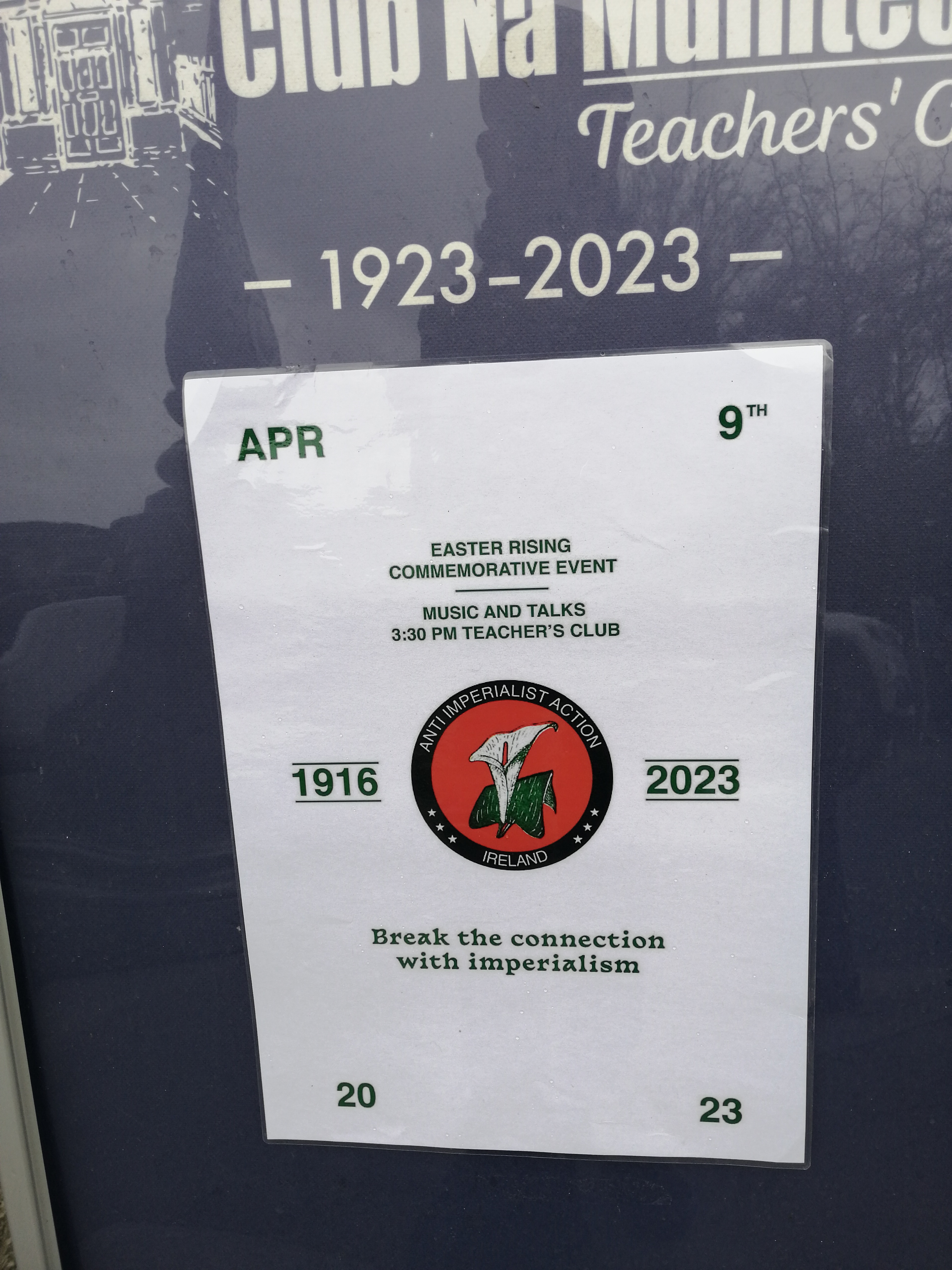
El domingo 9 Abril, gente asistiendo a la Conmemoración del Alzamiento de 1916 organizada por Acción Anti-Imperialista fueron acosados por la policía mientras encabezaban una marcha hacia el complot republicano del Ejército Ciudadano Irlandés en el cementerio dublinés de Glasnevin.

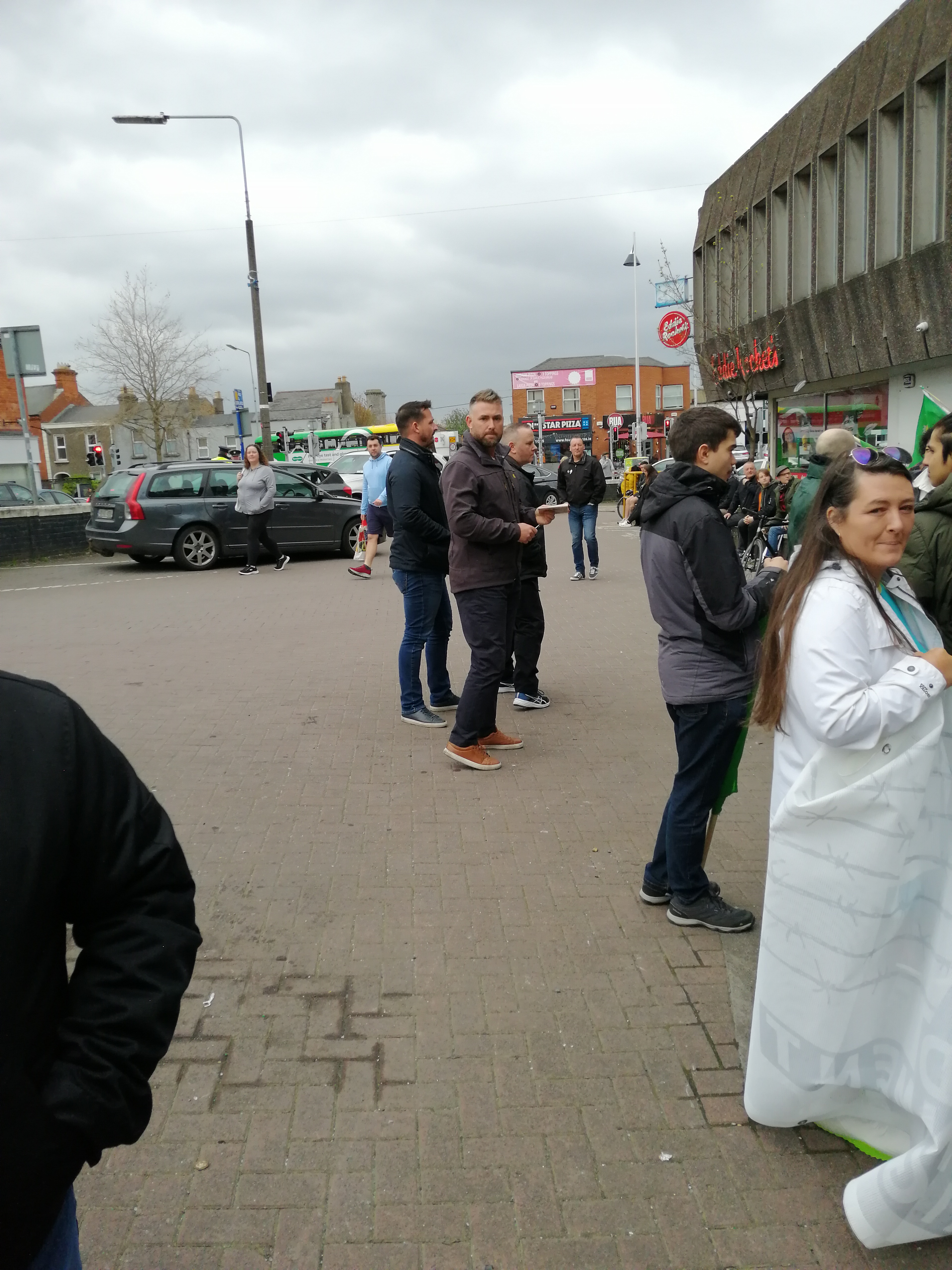
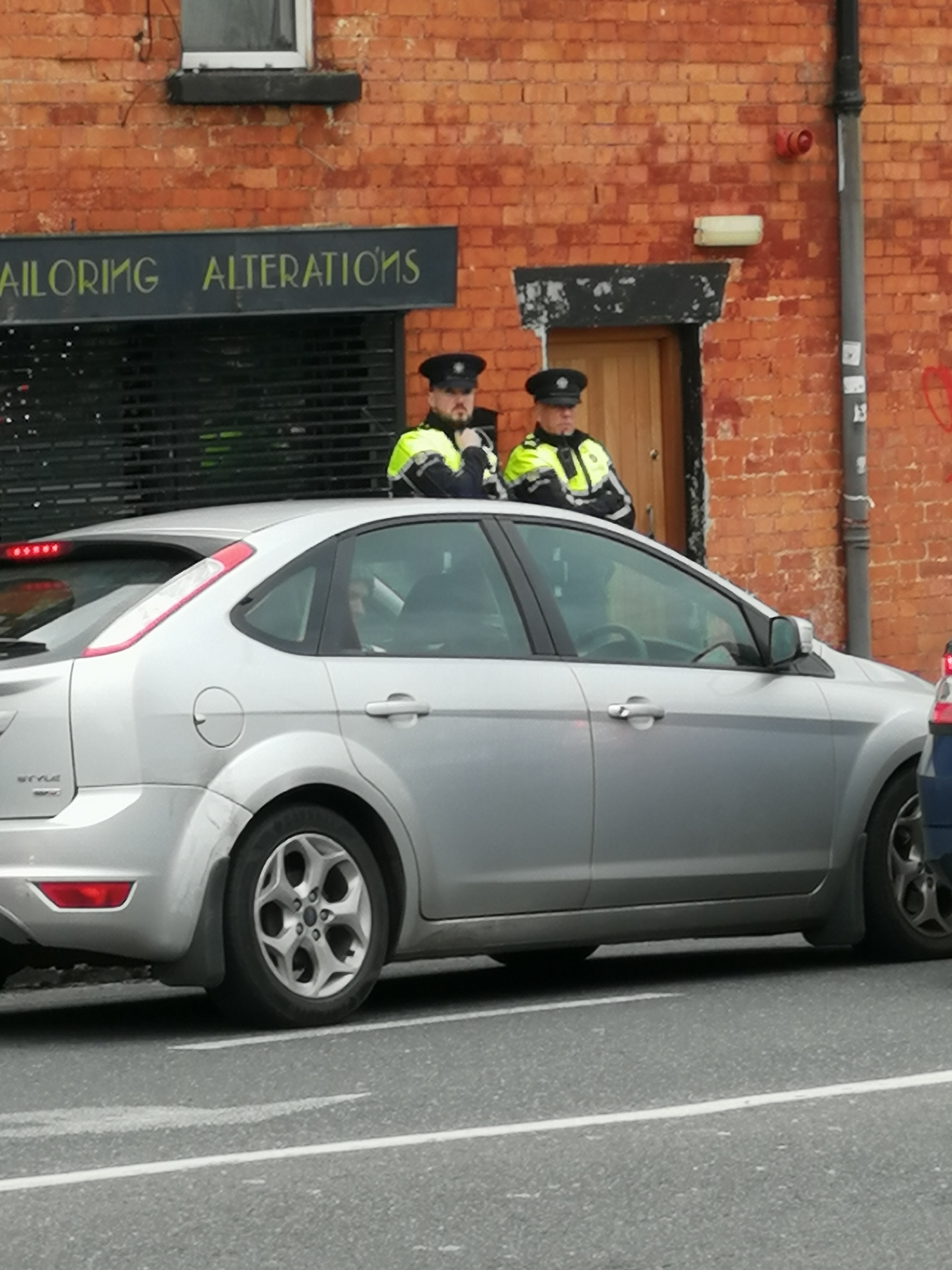
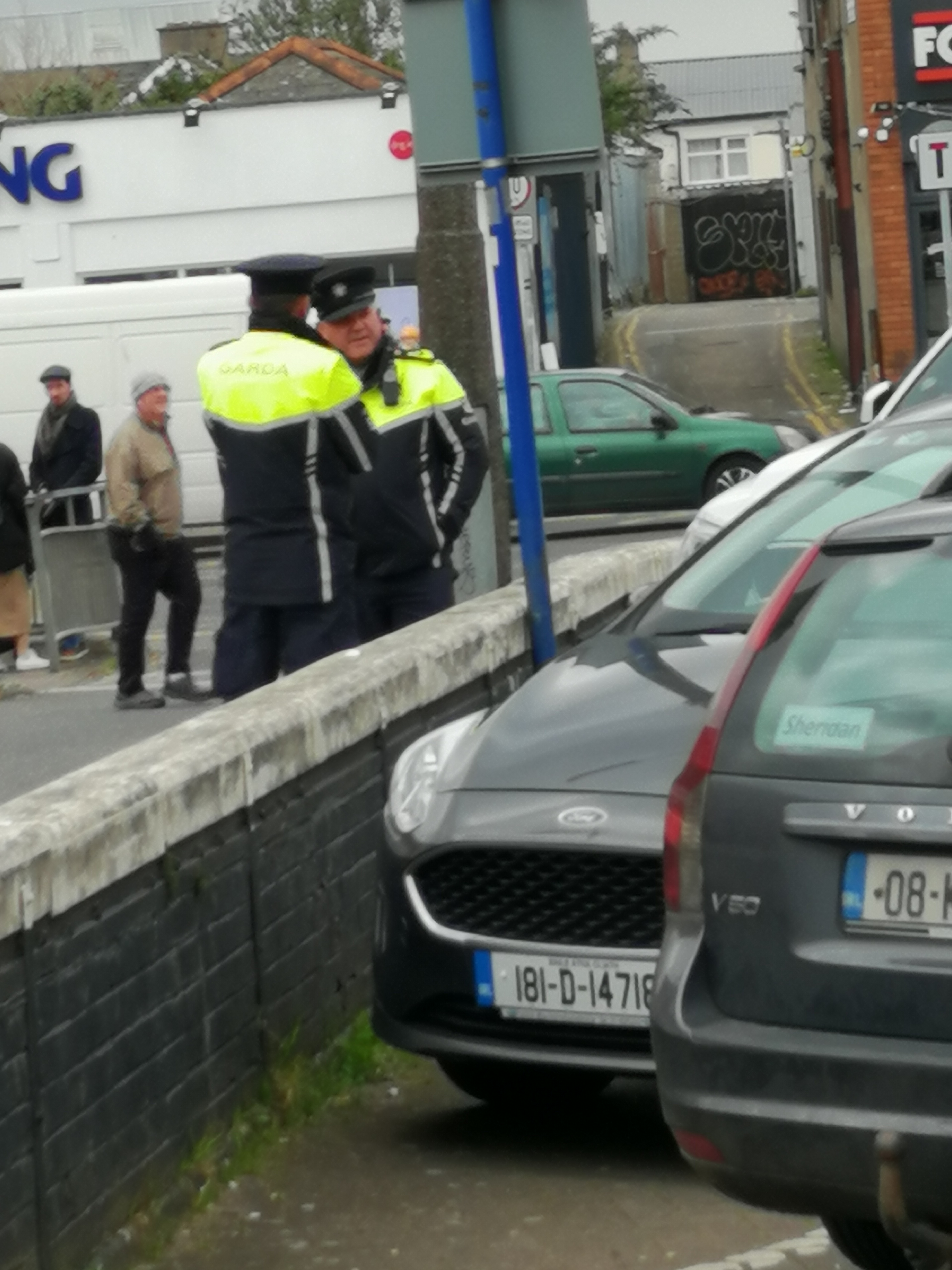
Seis policías políticos vestidos de paisano caminaron entre los asistentes junto a las tiendas de Phibsborough identificando los participantes, la mayoría de los cuales eran bastante jóvenes. Cerca también se encontraban cuatro uniformados de la Garda y una camioneta de la Unidad de Orden Público estacionada en la entrada del cementerio.

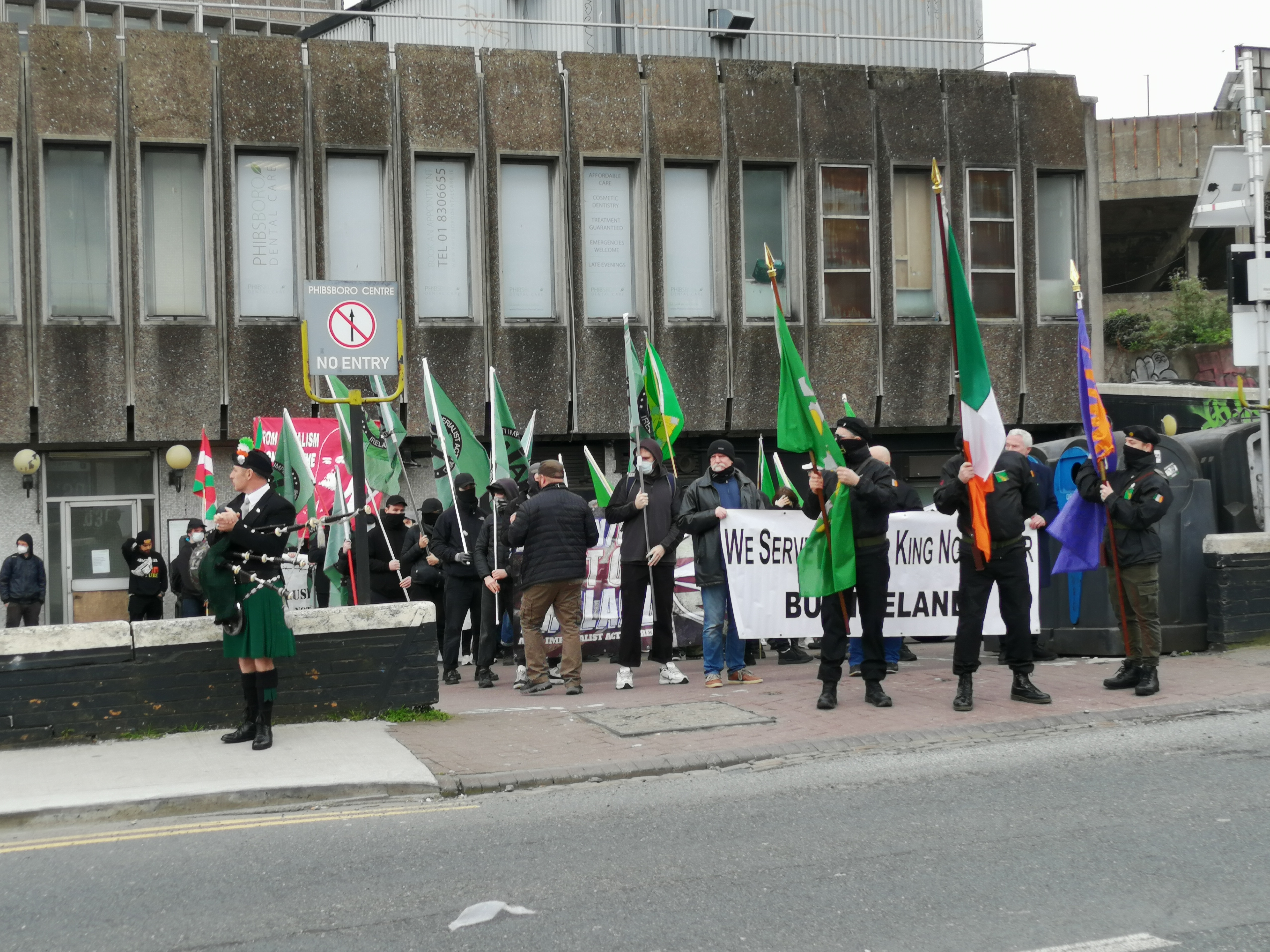
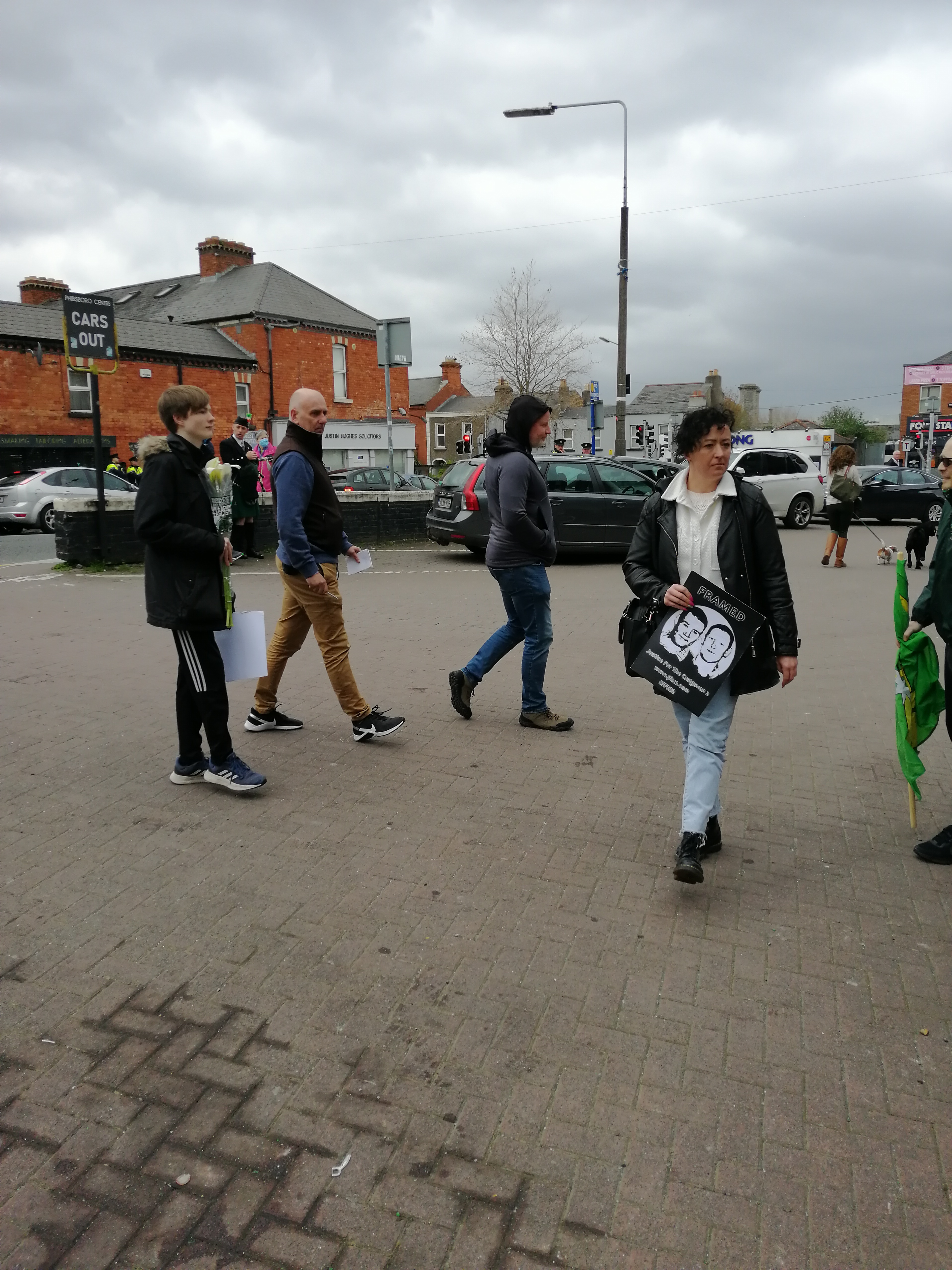
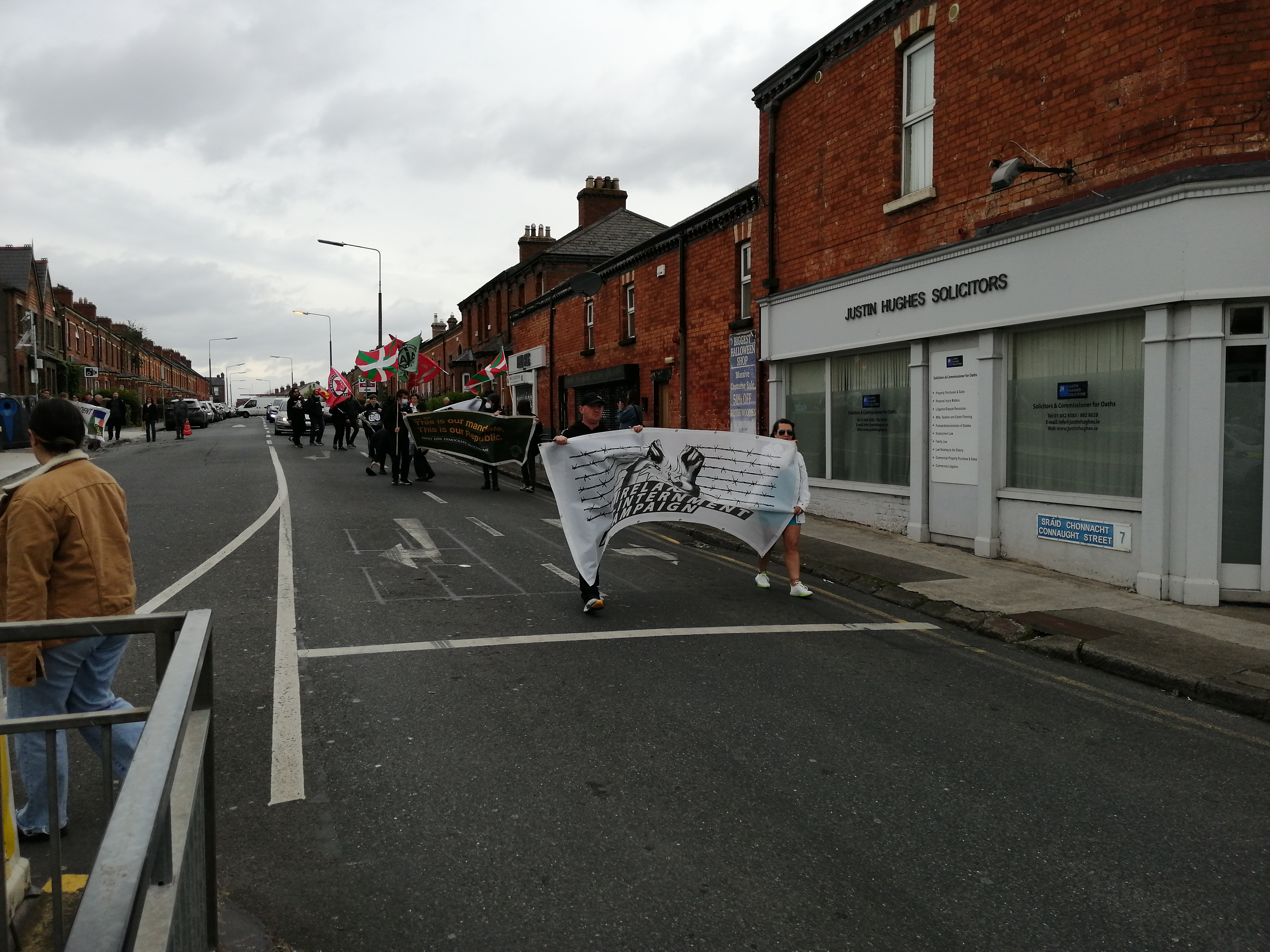
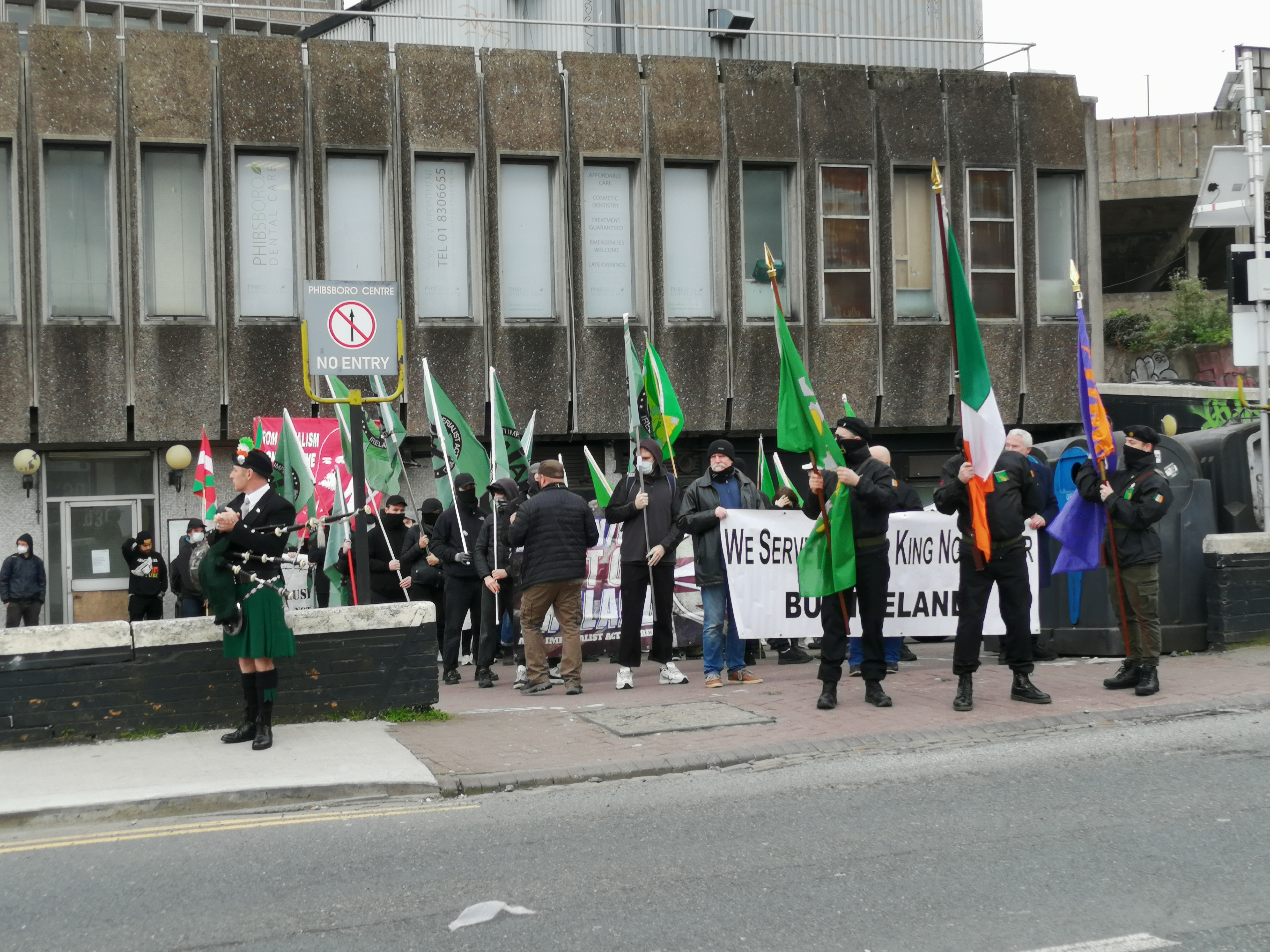
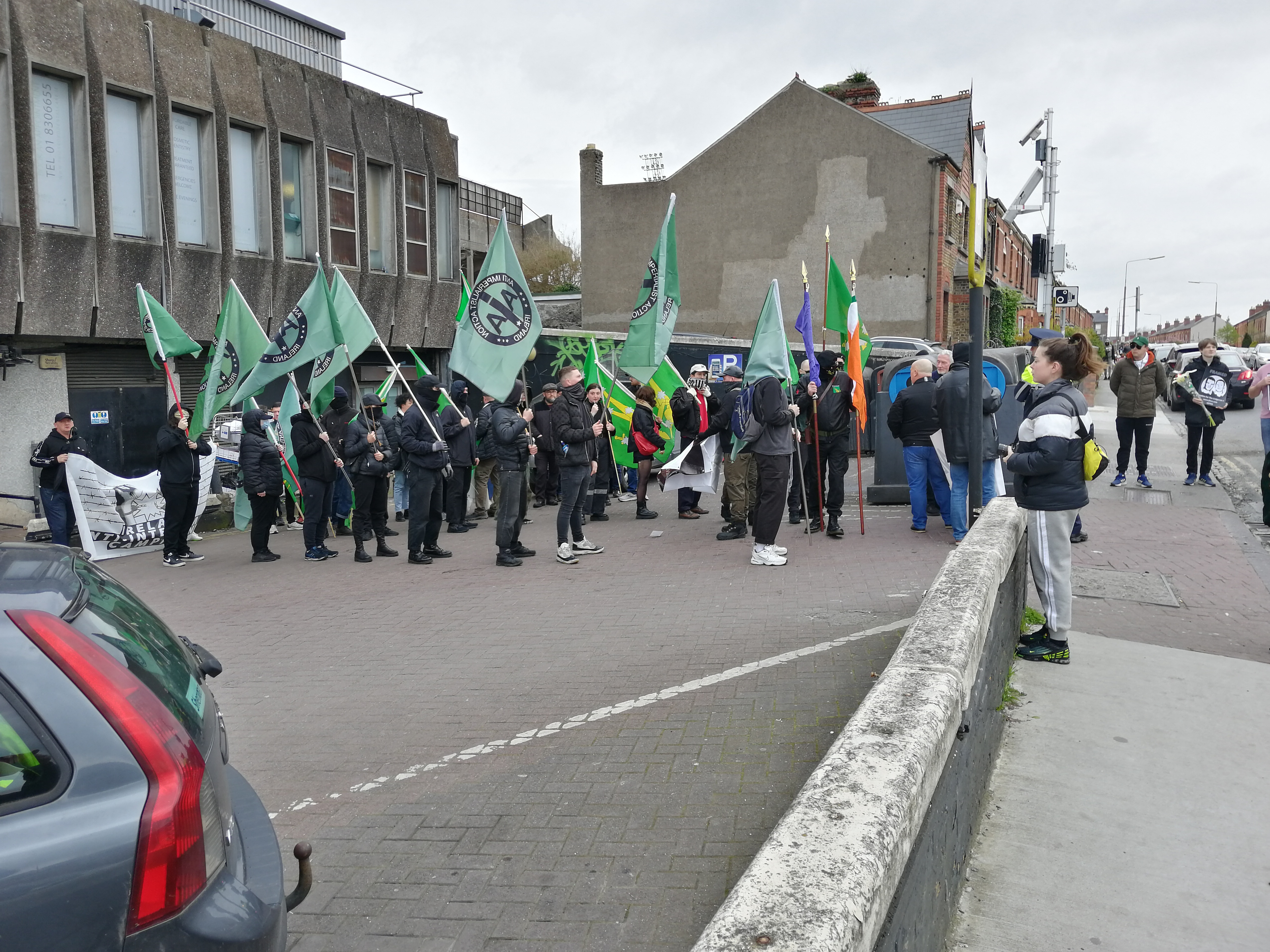
El desfile se prepara a partir. (Foto: D.Breatnach)
Centro y a la derecha de la foto, cuatro de la policia politica preparando a hostigar a los asistentes. (Foto: D.Breatnach)
Centro de la foto: dos de la policia politica de paisano — el calvo hacia chistes mientras hostigaba a los asistentes. (Foto: D.Breatnach)

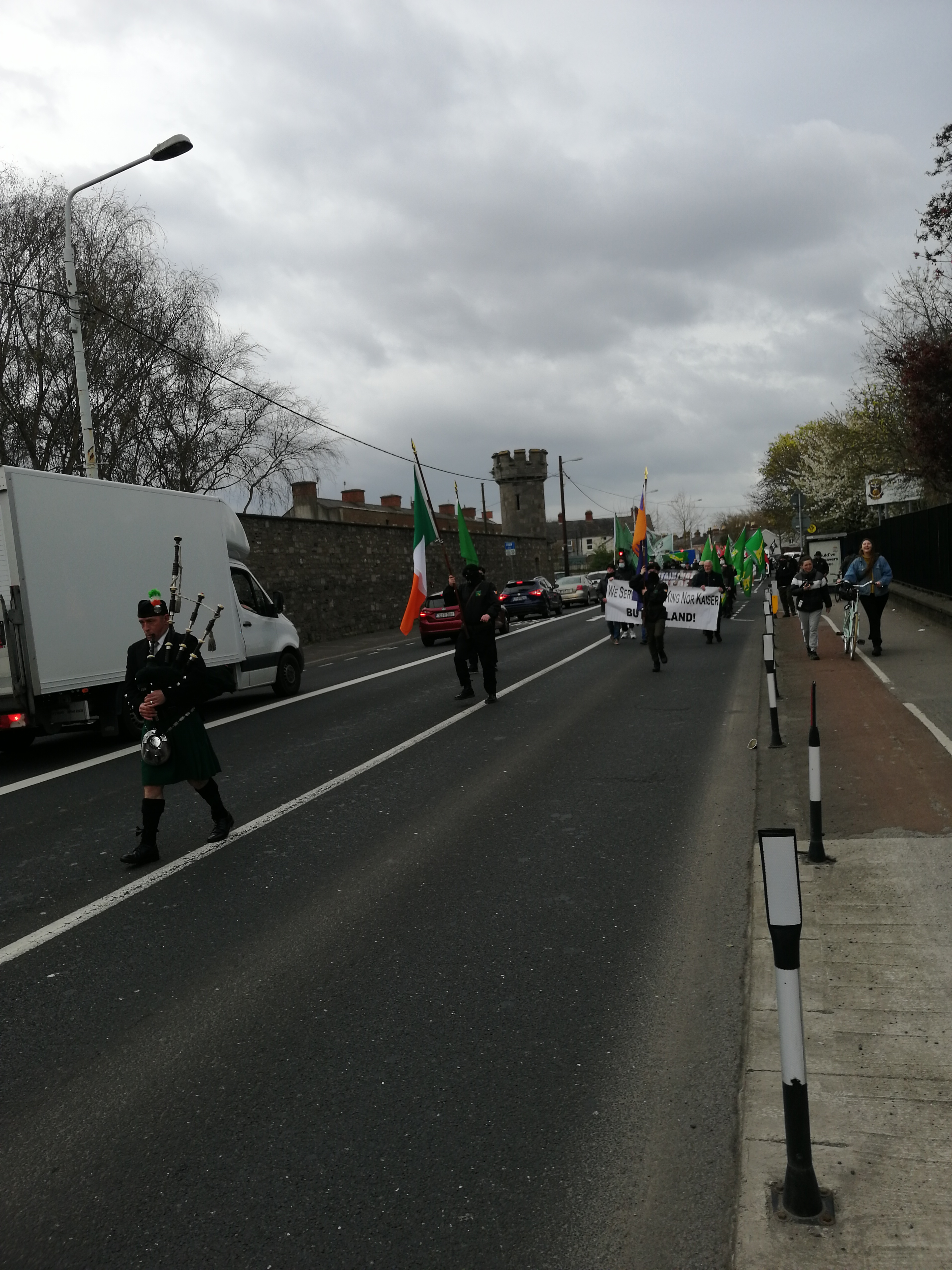
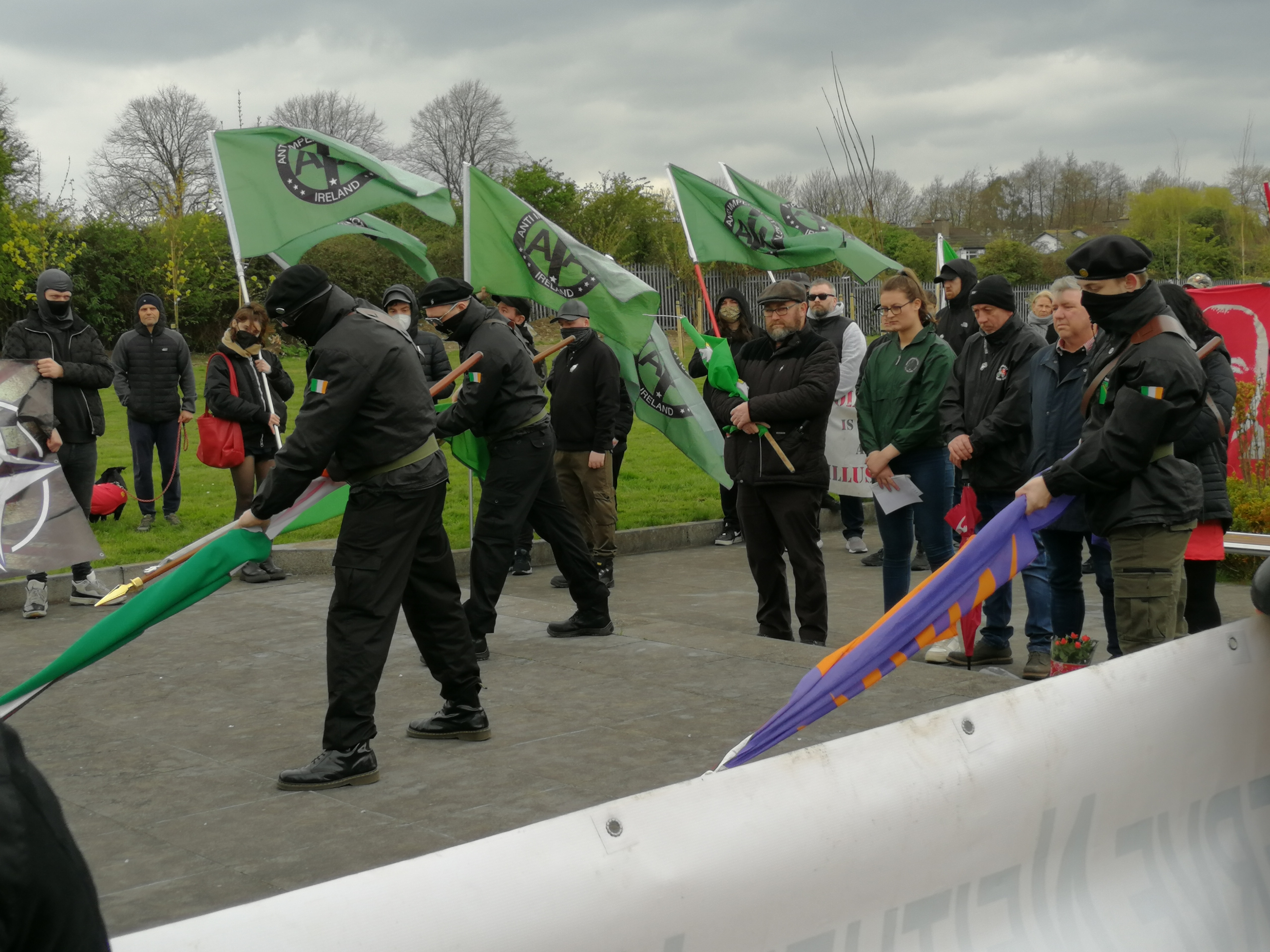
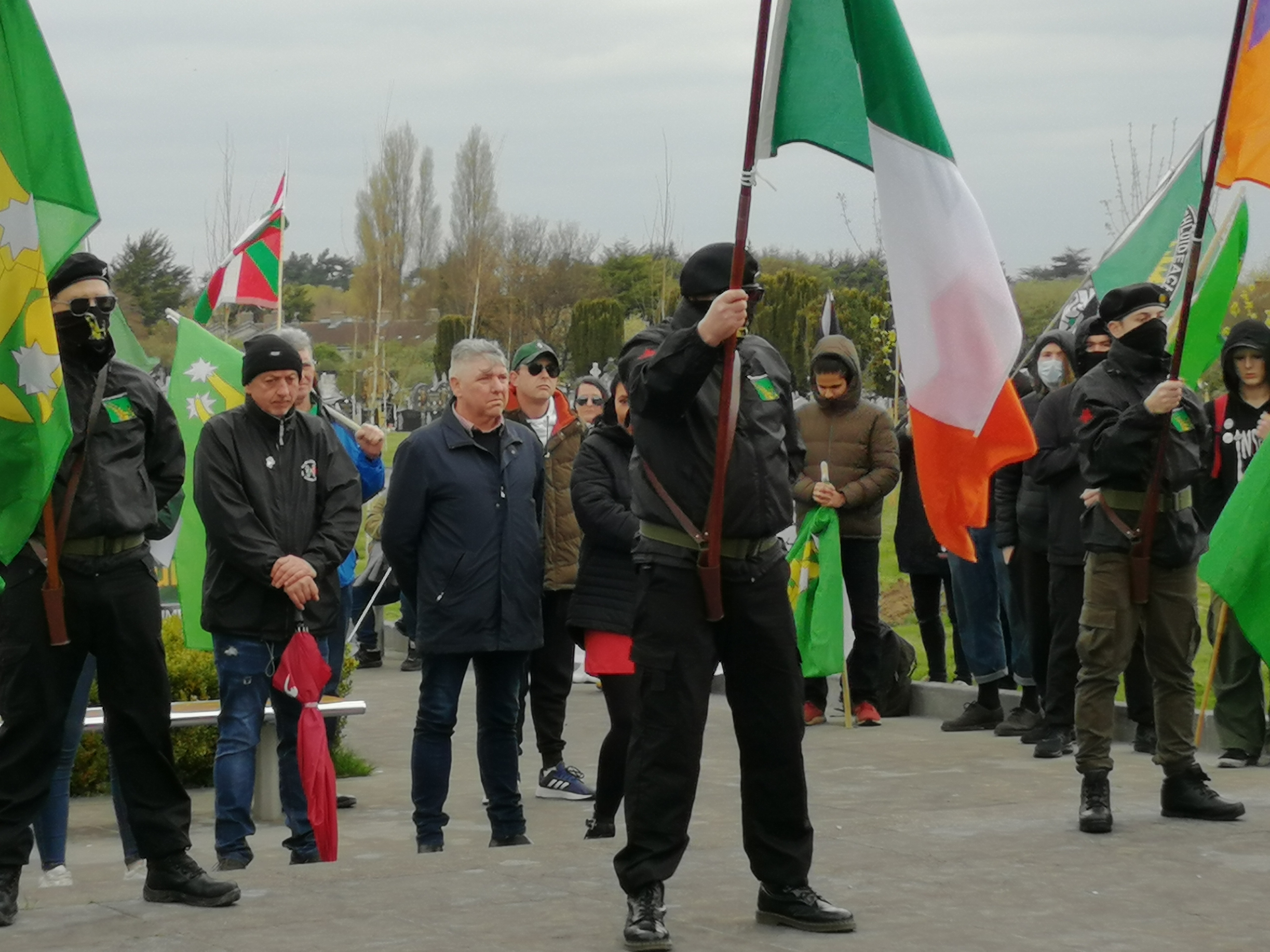
Los participantes no se dejaron intimidar y emprendieron su marcha, encabezados por un gaitero solitario que tocaba aires de marcha irlandeses, seguido de un ‘colour party’ con diferentes pancartas intercaladas entre los manifestantes, entre las que ondeaban muchas banderas.

Los organizadores se enteraron de que la policía había impedido que el carruaje que transportaba a los miembros de una Banda de Flauta Republicana de escocés que encabezaría el desfile tomara el ferry a Irlanda.

(Foto: D.Breatnach)
(Foto: D.Breatnach)
(Foto: D.Breatnach)

Antecedentes históricos

En 1916, una amplia alianza de los Voluntarios Irlandeses, el Ejército de Ciudadanos Irlandeses, Cumann na mBan, na Fianna Éireann e Hibernian Rifles(1) participó en un Alzamiento organizado por la Hermandad Republicana Irlandesa contra el dominio británico en Irlanda y contra la guerra mundial.

Debido a una serie de circunstancias desafortunadas, el líder de los Voluntarios canceló el Levantamiento que, sin embargo, se llevó a cabo un día más tarde de lo planeado y se limitó en su mayor parte a Dublín, donde luchó una semana por un tercio de los números en el plan original.

El ejército británico de ocupación bombardeó el centro de la ciudad desde una cañonera en el río Liffey y también desde la artillería en tierra. Las explosiones y los incendios resultantes destruyeron gran parte del centro de la ciudad, incluida la Oficina General de Correos en la calle principal, que había sido el cuartel general de la insurrección.(2)

Después de una semana con el centro de la ciudad, incluido la OGC, en llamas, la guarnición rebelde evacuó hacia Moore Street, donde al día siguiente, rodeados y superados en número, se tomó la decisión de rendirse.(3)

Un tribunal militar británico condenó a muerte a casi un centenar de prisioneros. Todas menos quince de esas sentencias fueron conmutadas por largos períodos de cárcel.

Pero los siete firmantes de la Proclamación de 1916 (4) y otros siete fueron fusilados por un pelotón de fusilamiento británico en Dublín, un decimoquinto en Cork y, después del juicio, meses después, un decimosexto fue ahorcado en la cárcel de Pentonville, Londres.

En la Pascua de 1917, las mujeres socialistas y republicanas irlandesas conmemoraron el levantamiento de 1916.

Desde entonces, los republicanos irlandeses y a veces los socialistas en Irlanda y en muchas partes de la diáspora han conmemorado el levantamiento, ya sea legalmente5 o no, en la cárcel o en libertad.

La Guerra de la Independencia comenzó en 1919 con la participación de muchos de los sobrevivientes del Alzamiento6.

El desfile del domingo – memoria histórica local marcada

En Cross Guns Bridge sobre el Royal Canal, el desfile se detuvo y se encendieron bengalas en memoria de los eventos allí en 1916.

El lunes de Pascua de 1916, un pequeño grupo de voluntarios irlandeses había andado desde Maynooth a lo largo de la orilla del canal para unirse al levantamiento en Dublín encontró vigilando el puente a dos voluntarios irlandeses que les aconsejaron que esperaran hasta el día siguiente para ir al centro de la ciudad.

El grupo de Maynooth pasó la noche en Glasnevin y al día siguiente entró en la Ofecina General de Correos (que servia de cuartel general del Alzamiento), pasando por el puente Cross Guns vacío en el camino. De regreso a Phibsborough, la artillería británica voló una barricada y mató a Seán Healy, miembro del grupo juvenil na Fianna en el Cruce del North Circular Road.

Más tarde, la unidad Dublin Fusiliers del ejército británico bloqueó el puente, impidiendo que la gente lo cruzara en cualquier dirección. Mataron a tiros a un lugareño sordo que no respondió a su desafío porque no lo escuchó.

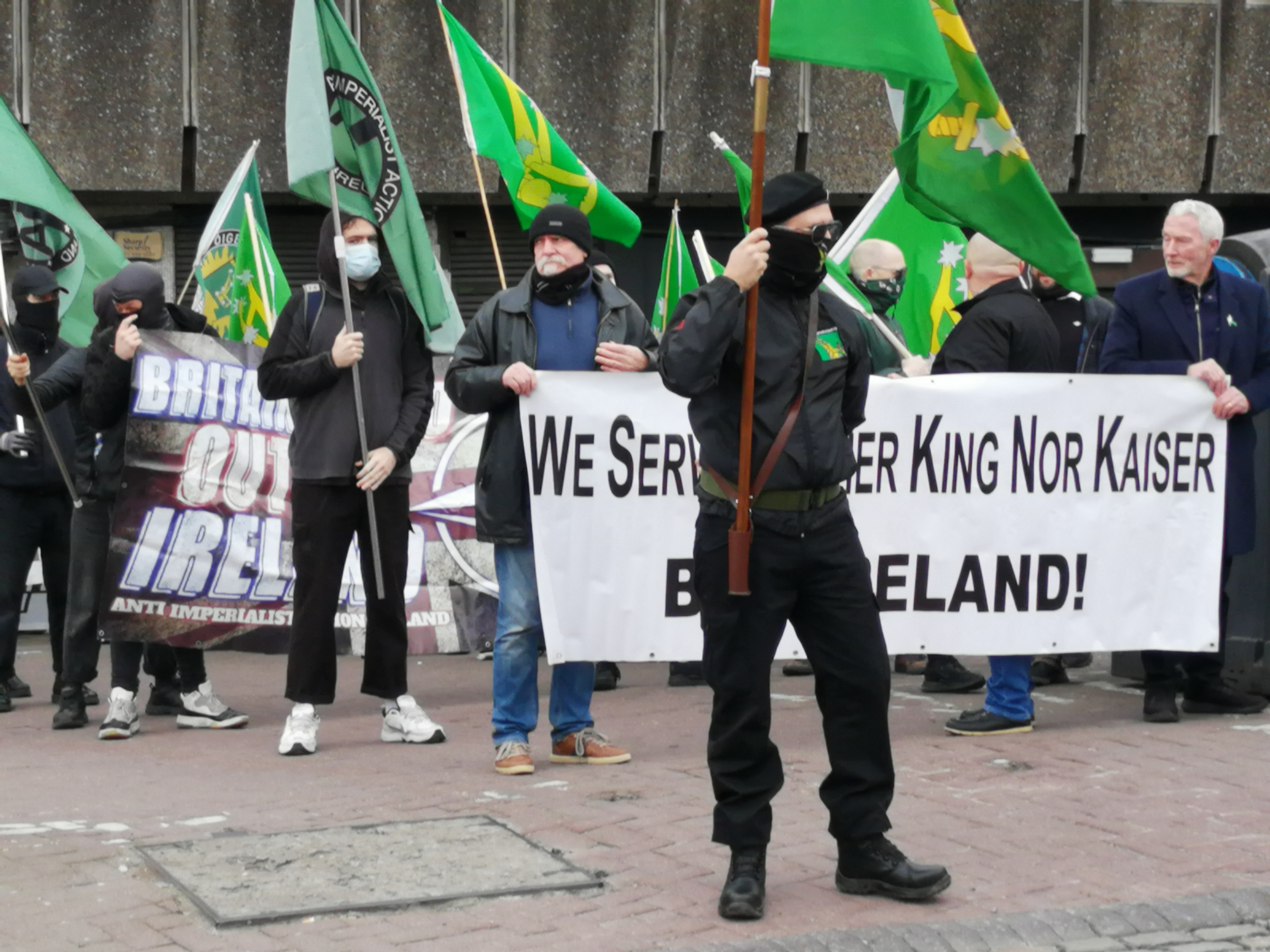
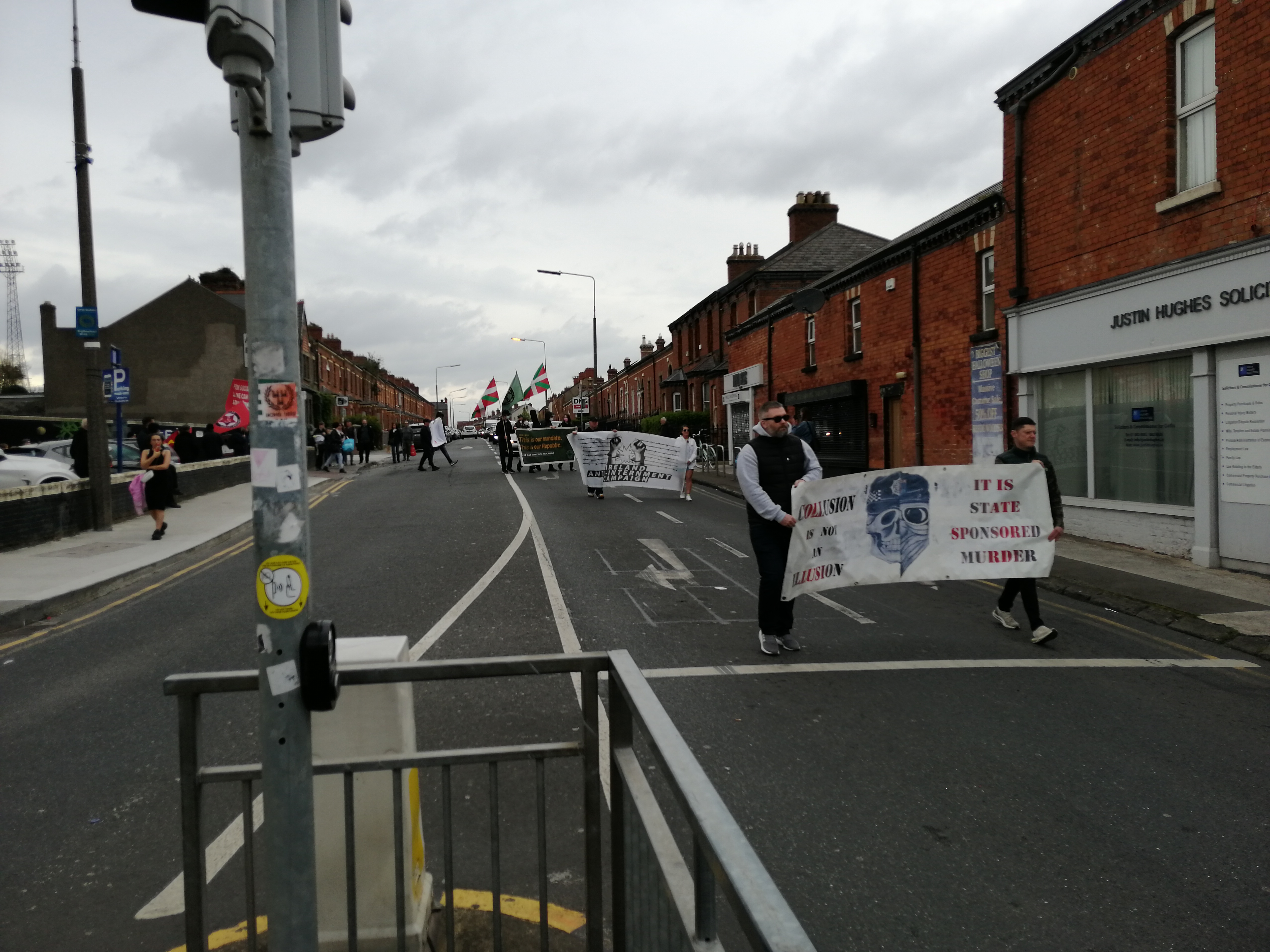
“No servimos ni al rey ni al káiser, pero a Irlanda” declaró una pancarta que se llevó el domingo pasado, “Gran Bretaña/OTAN fuera de Irlanda” otra, “Este Es Nuestro Mandato(7), Nuestra República” y “La colusión no es una ilusión, es un asesinato patrocinado por el estado” fueron otras dos.

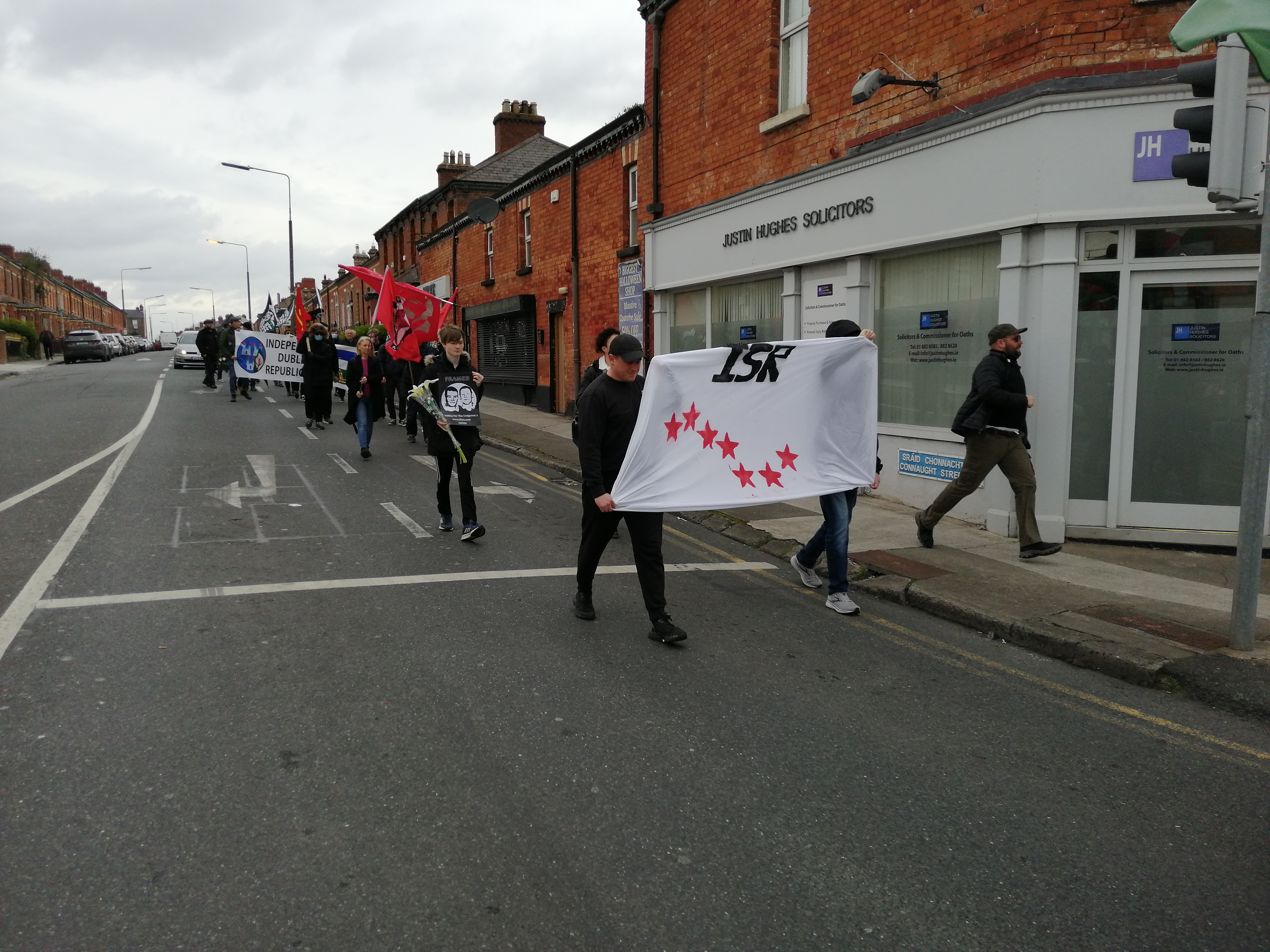
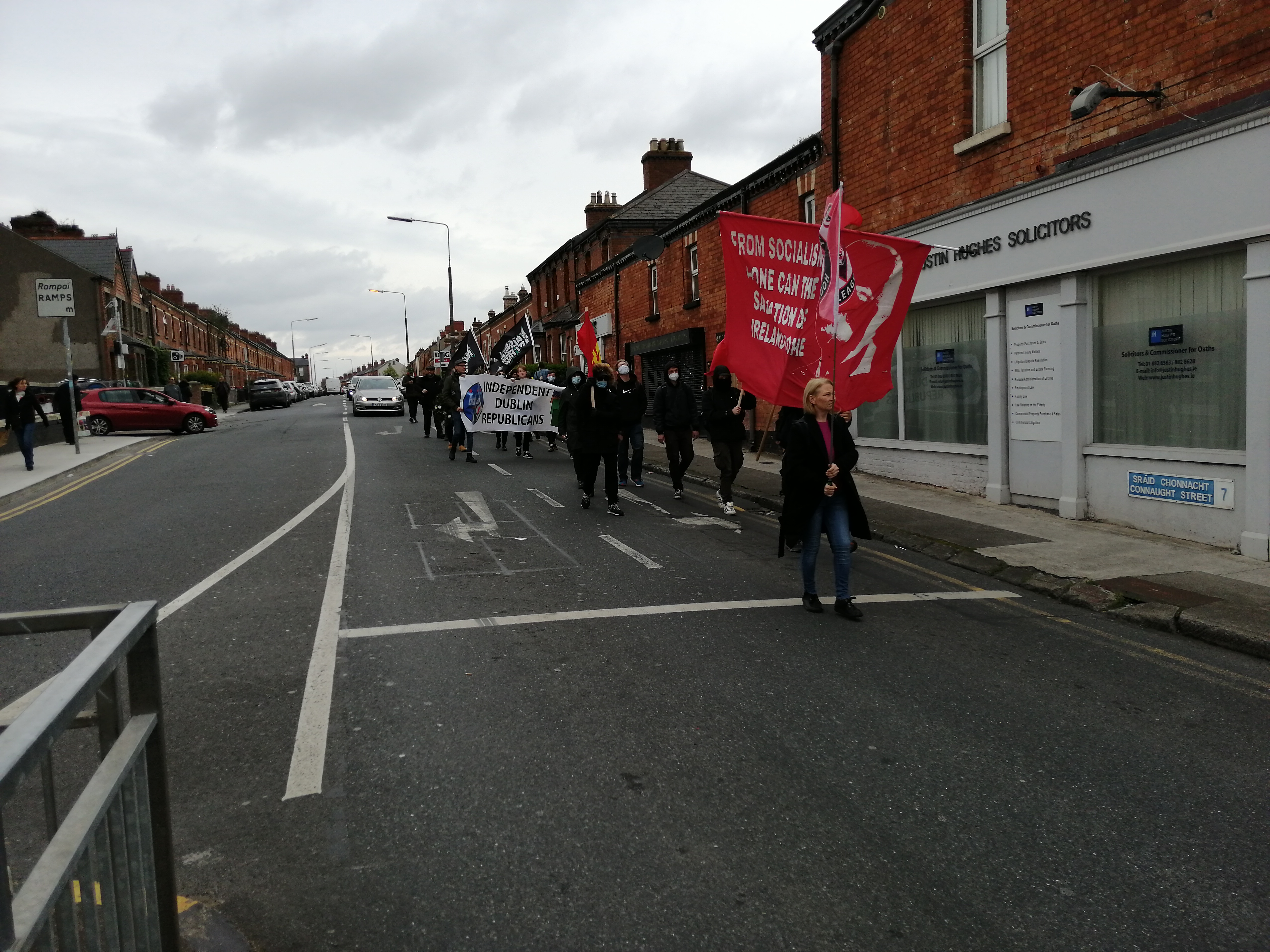
Una gran pancarta también declaraba junto a la imagen de James Connolly que “solo el socialismo puede ser la solución para Irlanda”. Algunas organizaciones también llevaron sus propias pancartas, como las de los Republicanos Independientes de Dublín, la Campaña contra la Internación de Irlanda y los Republicanos Socialistas Irlandeses.

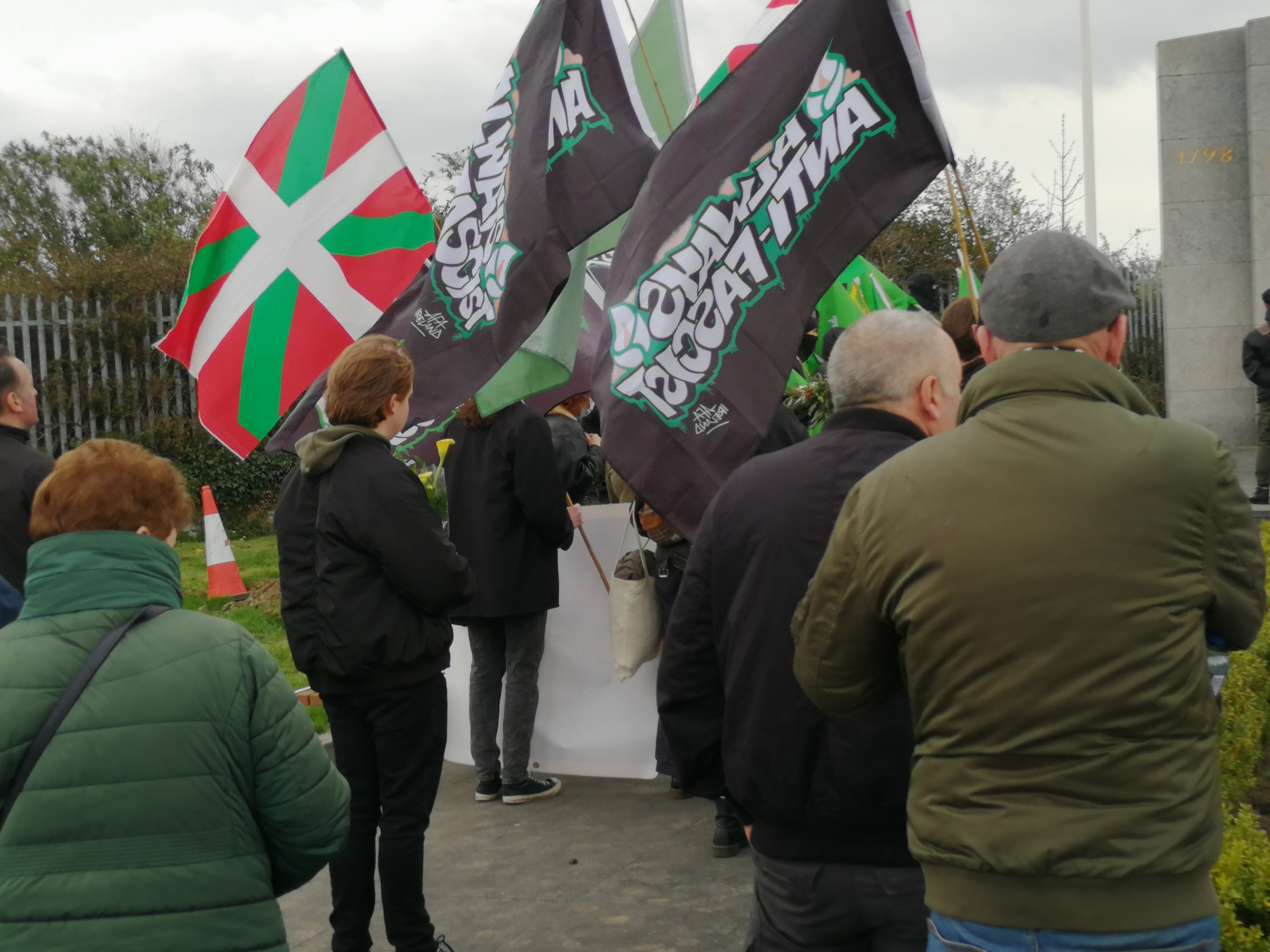
Las banderas que ondeaban incluían las que llevaban el logo del grupo organizador Acción Anti-imperialista y otras con el lema “Siempre Antifascistas”, Arados Estrellados verde y dorado, un par de Ikurrinak (banderas vascas) y otras dos de Roja con el Martillo & Hoz en amarillo.

(Foto: D.Breatnach)
Republicanos Socialistas de Irlanda (Foto: D.Breatnach)
(Foto: D.Breatnach)
Campana Anti-Internacion de Irlanda (Foto: D.Breatnach)
(Foto: D.Breatnach)

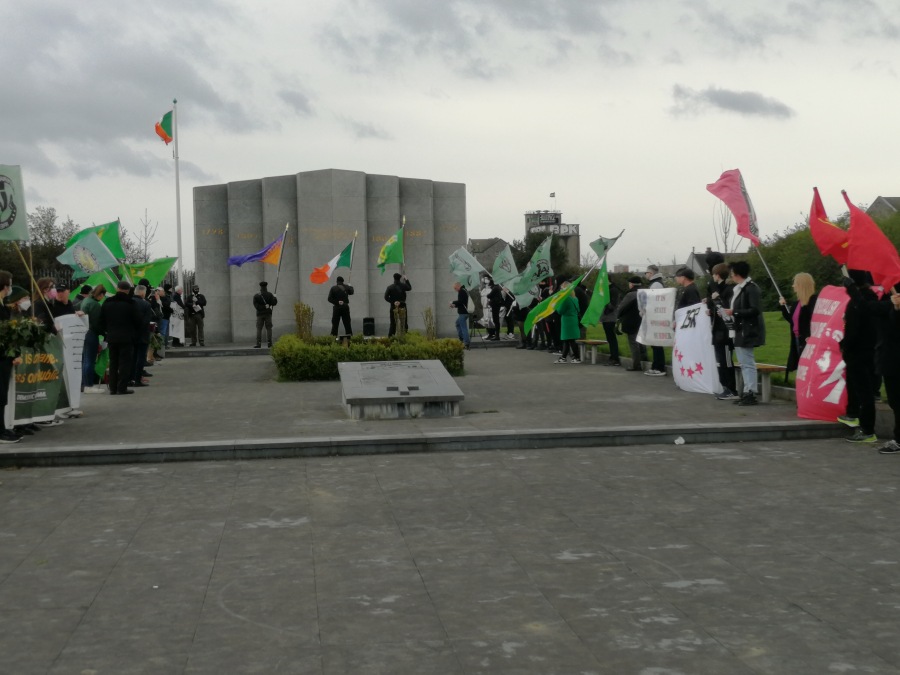
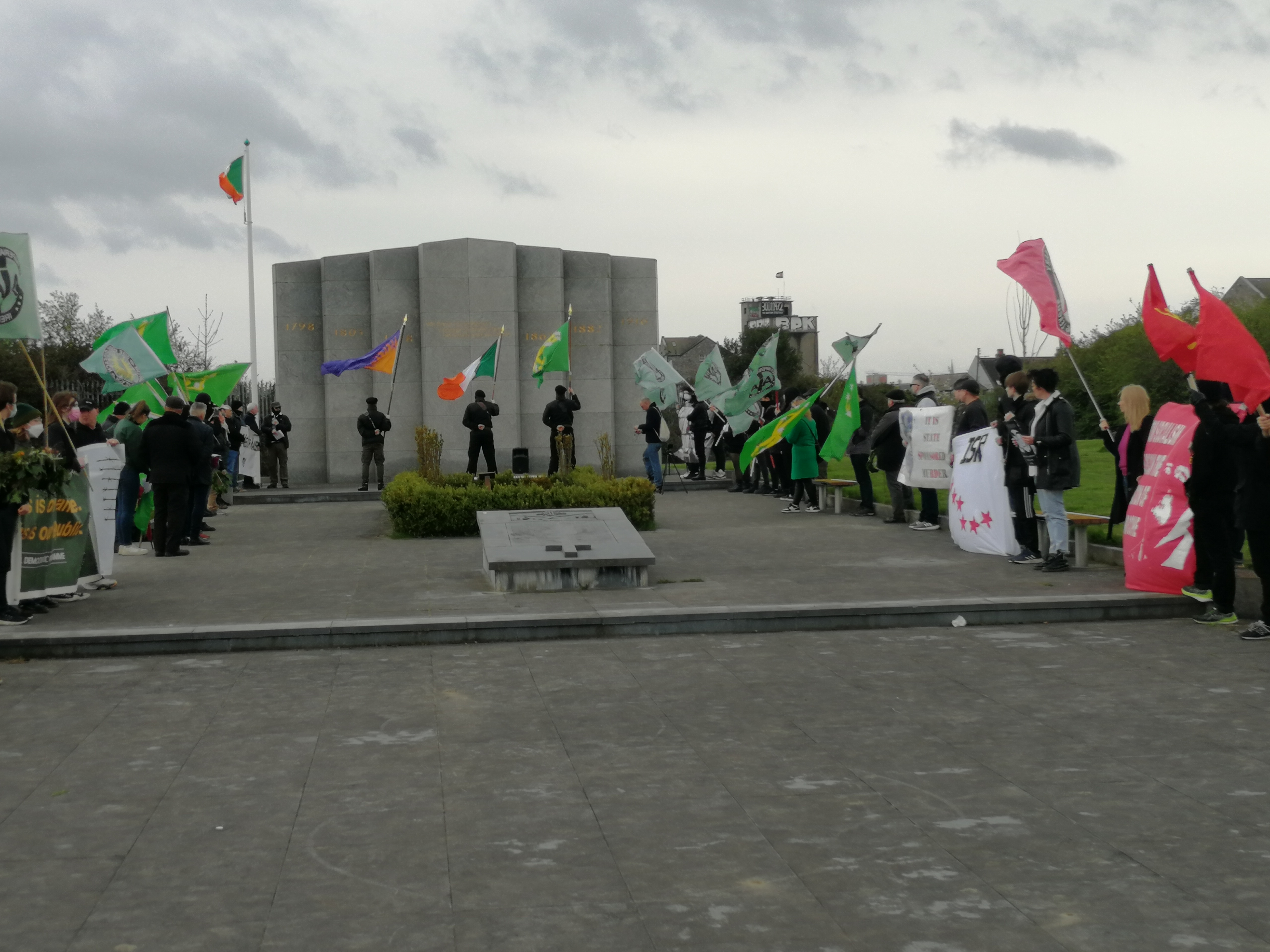
En el Monumento: discursos y cantos

El cementerio de Glasnevin (Reilig Ghlas Naíonn) cubre más de 120 acres en el norte de la ciudad de Dublín y está dividido en dos partes, cada una con parcelas republicanas separadas por Cabra Road y contiene las tumbas de personas entre famosas y comunes.

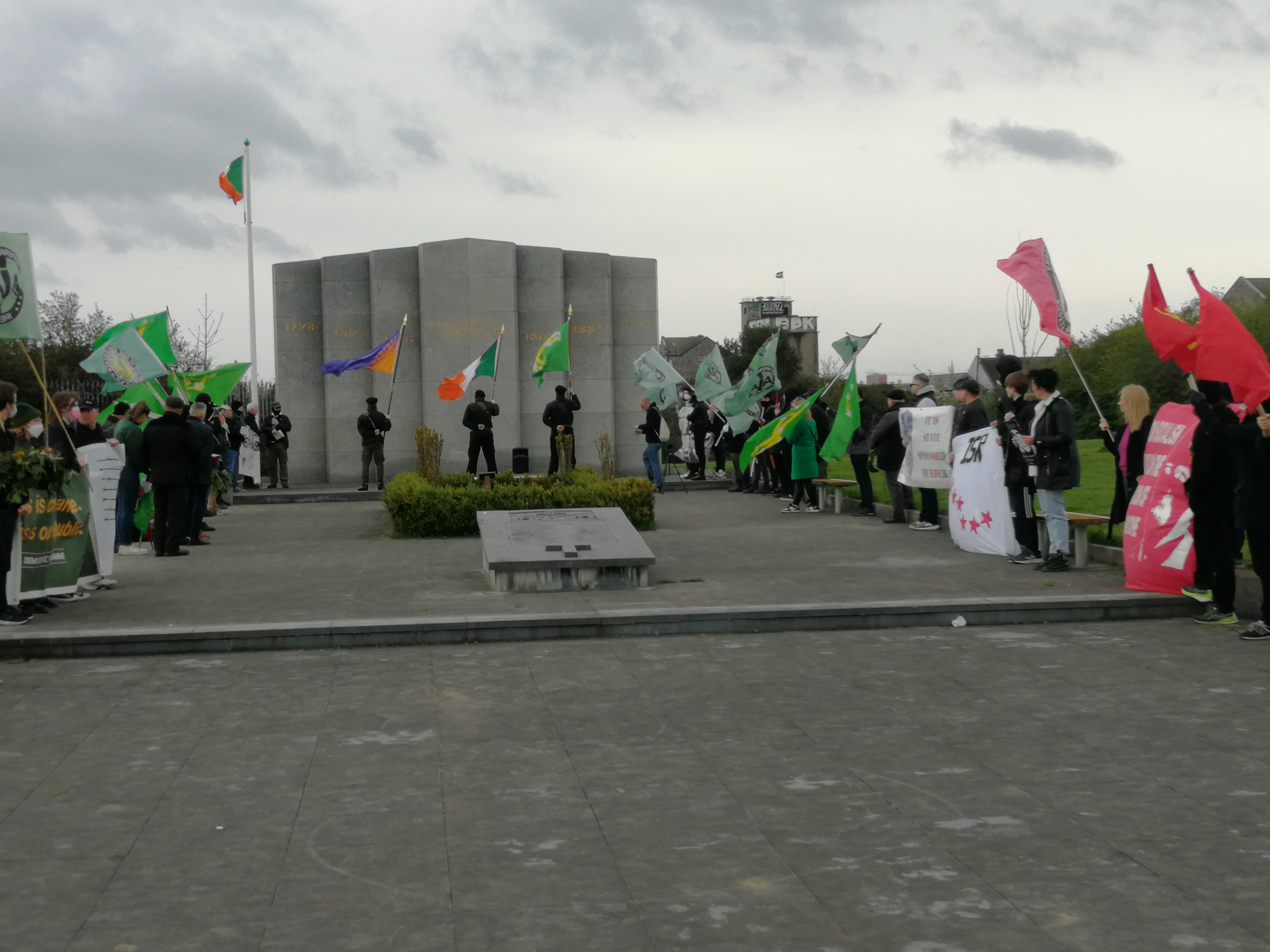
Por el lado norte también se encuentra el acceso a los Jardines Botánicos, ambos en la margen sur del río Tolka. El imponente Monumento a numerosos alzamientos republicanos y complot al Ejército Ciudadano Irlandés está en el lado sur, cruzando el puente peatonal sobre la vía del tren.

(Foto: D.Breatnach)

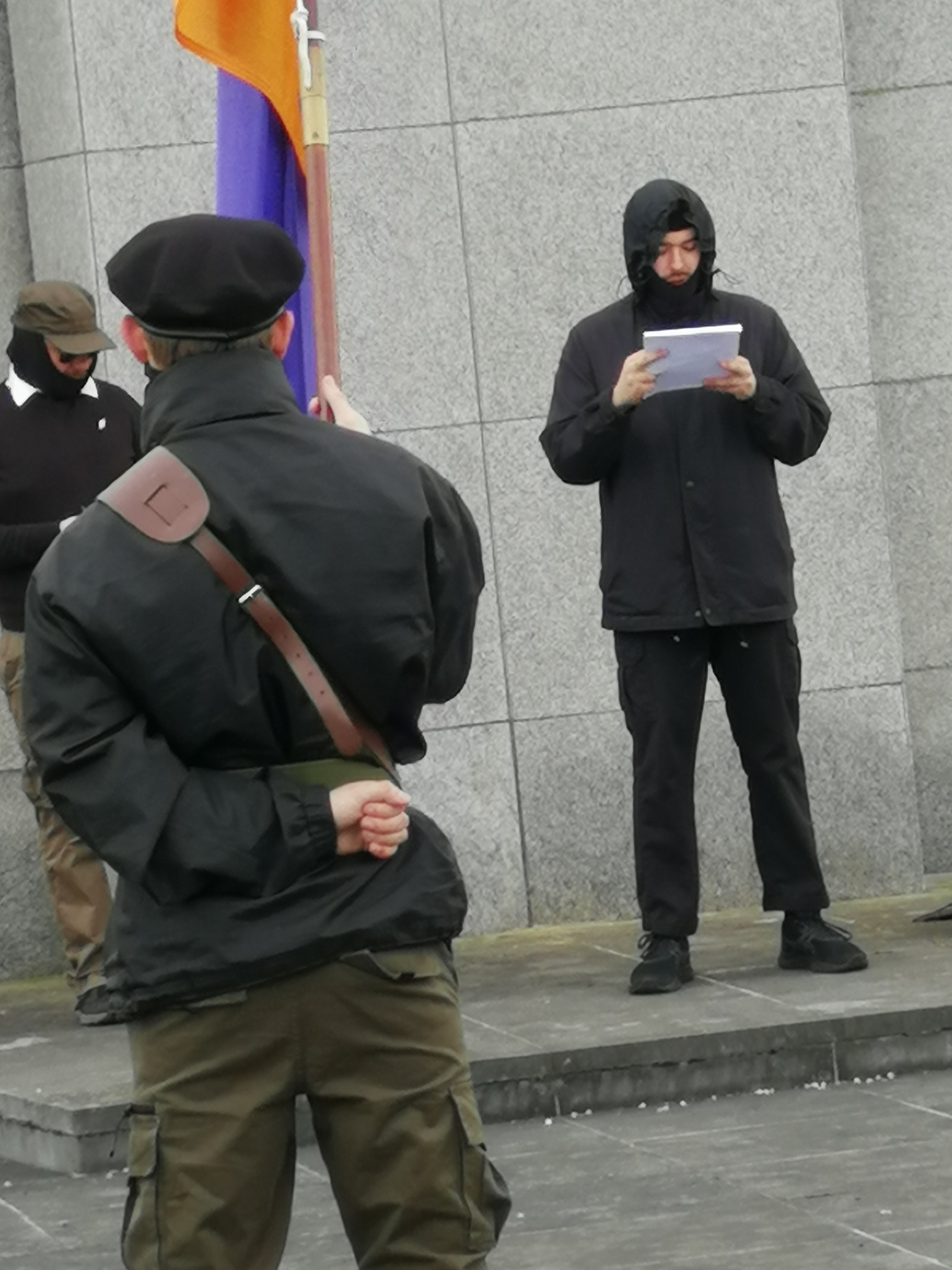
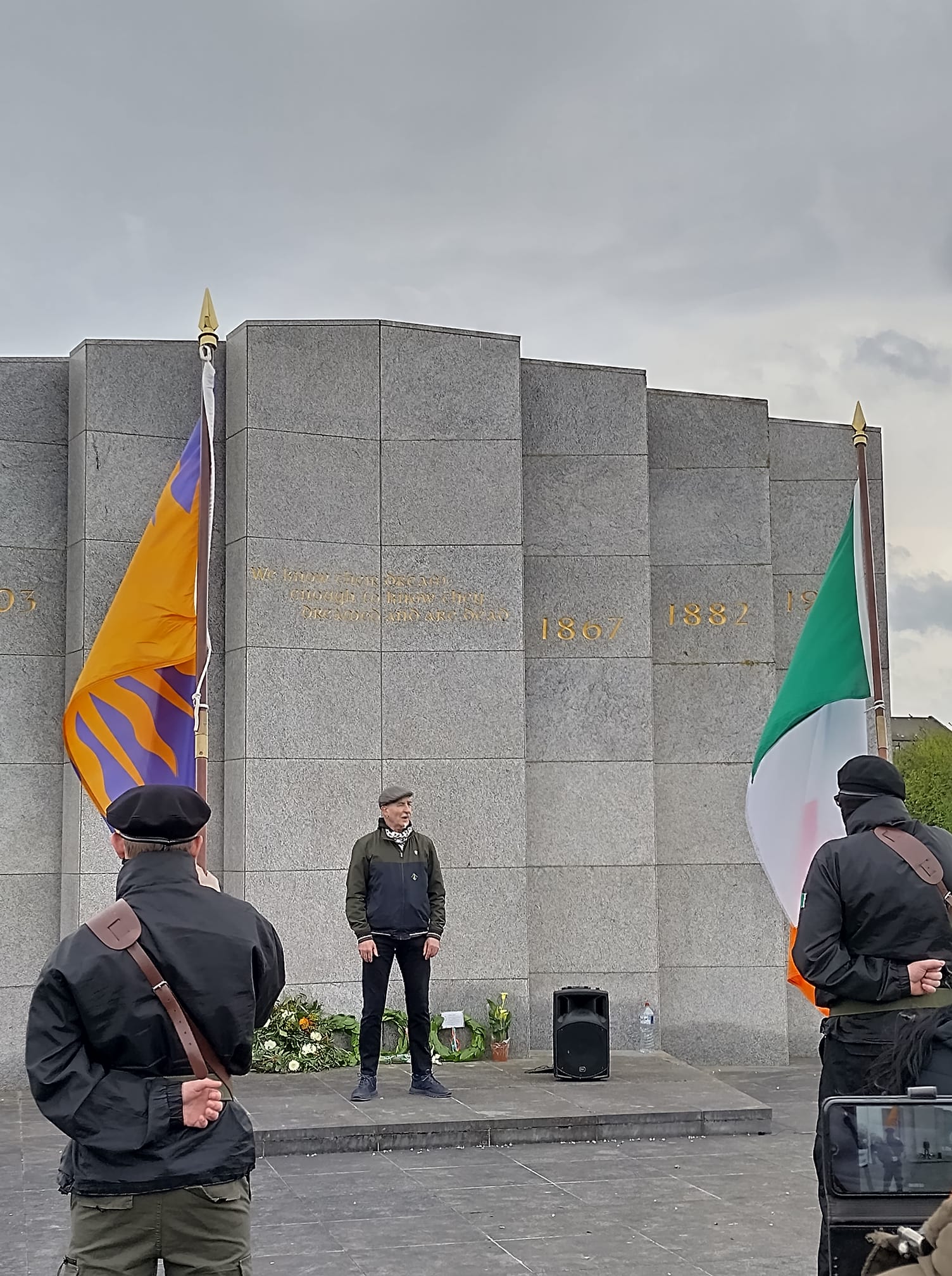
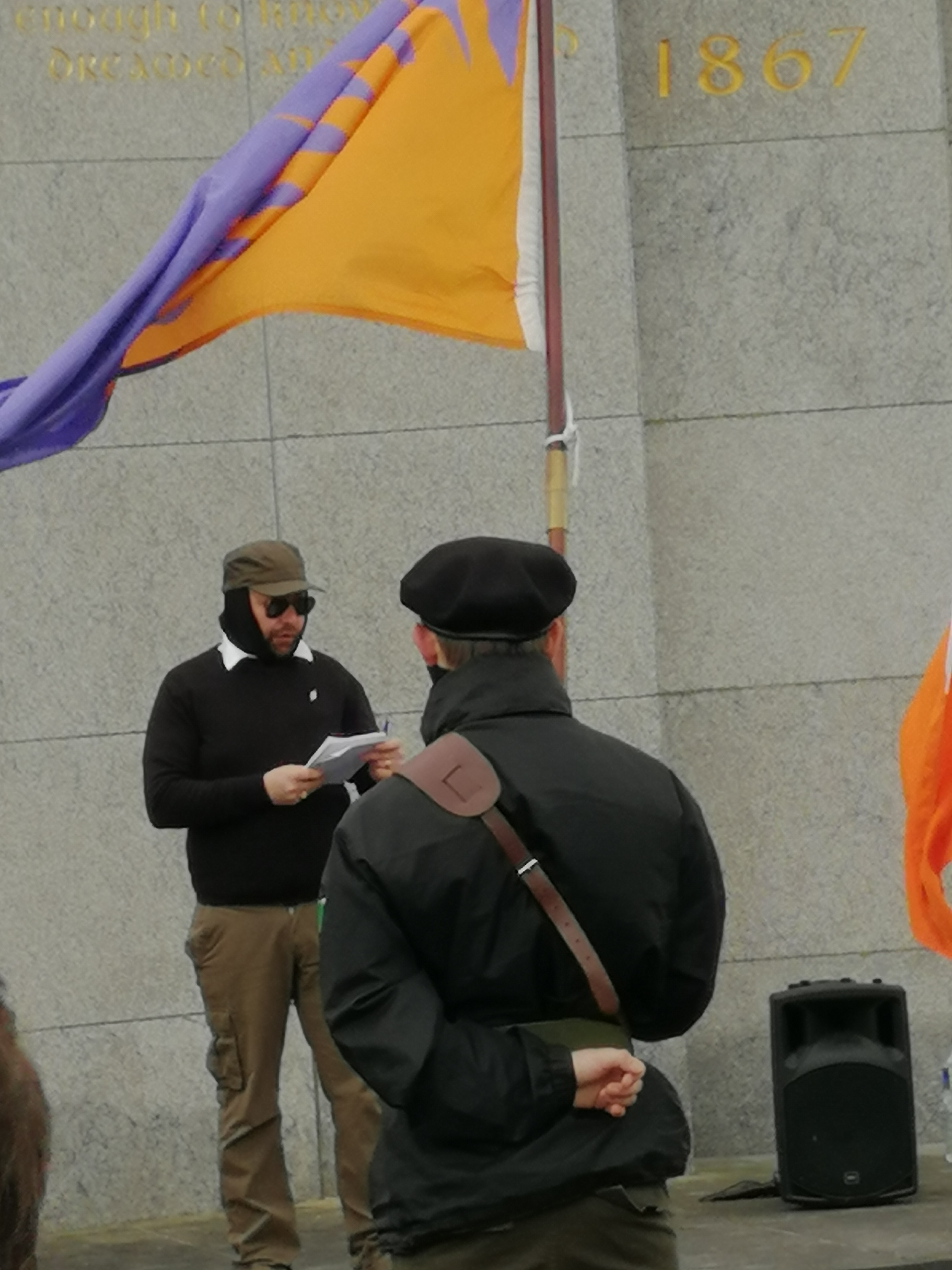
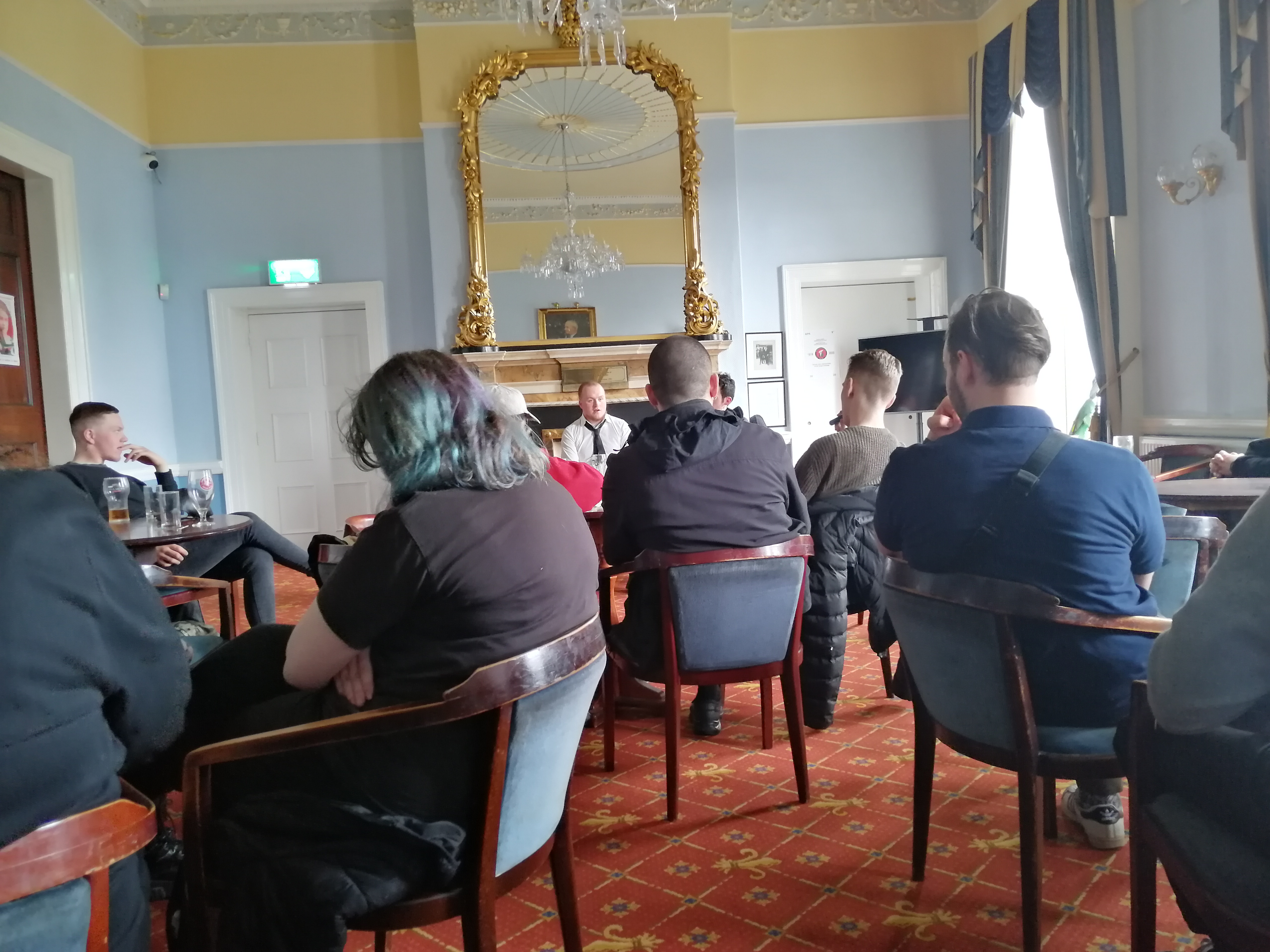
Un hombre presidió el evento de la Acción Anti-imperialista y habló brevemente, presentando a las personas para las lecturas (todas de James Connolly) y para los discursos. Las presentaciones de estos se dividieron equitativamente entre hombres y mujeres, siendo tres de ellos de jóvenes.

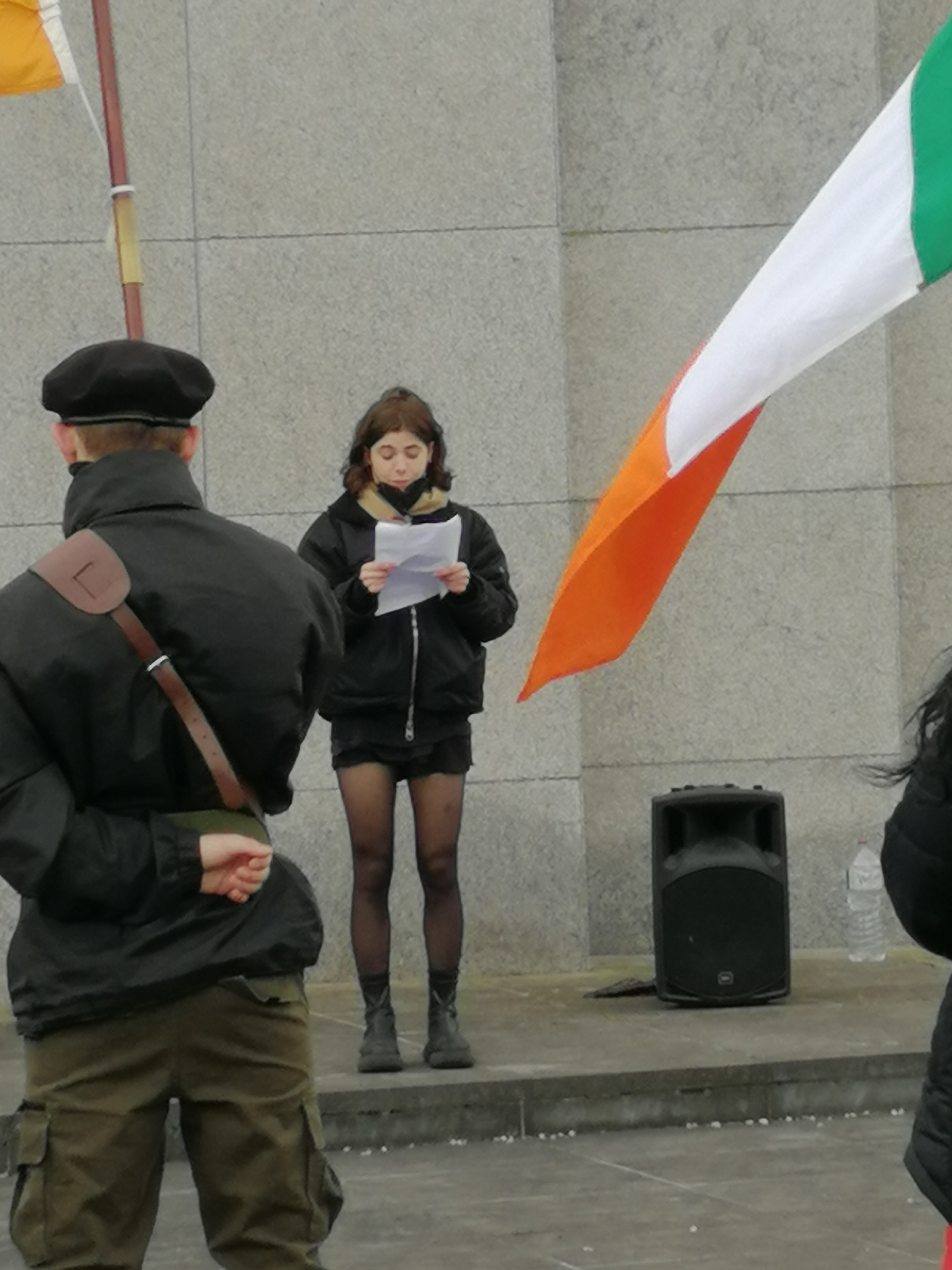
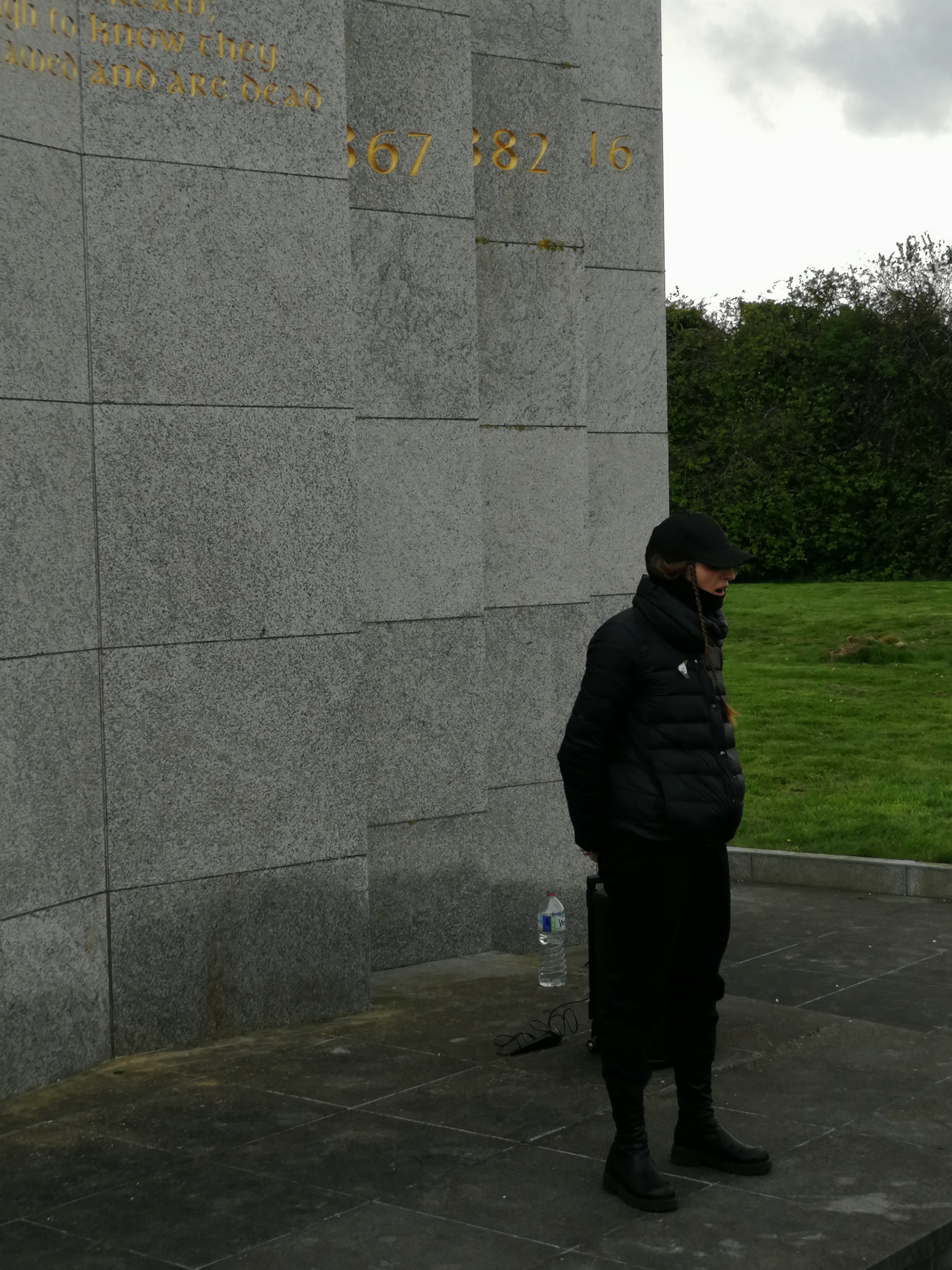
Se cantaron tres canciones: una mujer cantó The Foggy Dew (de Charles O’Neill) y Erin Go Bragh (de Peadar Kearney), mientras que un hombre cantó Where Is Our James Connolly? de Patrick Galvin. Dos mujeres leyeron piezas de James Connolly y otra leyó la Proclamación de 1916.
Un lector (Foto: D.Breatnach)
Una lectora (Foto: D.Breatnach)
Una cantante (Foto: D.Breatnach)
Uno de los cantantes.

Las palabras del presidente y de los oradores fueron diferentes pero hubo temas comunes: defender el espíritu histórico de resistencia irlandés, la importancia de la clase trabajadora en la historia y el objetivo de una República socialista que abarque a toda la nación irlandesa.

Estas palabras se equilibraron con la denuncia del imperialismo estadounidense y británico y la ocupación colonial/OTAN de los Seis Condados por parte de este último; el régimen cliente irlandés; los tribunales especiales sin jurado(8) de ambas administraciones en Irlanda y la represión por parte de las fuerzas policiales y el ejército de ocupación.

También se denunciaron aquellos partidos políticos que habían abandonado la lucha por la República y en su lugar habían pasado a formar parte de las administraciones coloniales y neo-coloniales o, en este último caso, que estaban en vías de serlo.(9)

Representantes de organizaciones nombradas colocaron tributos florales y luego otros se adelantaron para colocar tributos florales también.

El presidente agradeció la asistencia de todos, nombró a las organizaciones por nombre y advirtió a todos que se mantuvieran juntos mientras se marchaban, debido a la presencia amenazante de Gardaí y, en particular, de la Unidad de Orden Público. En el evento, los celebrantes salieron del cementerio y se dispersaron sin incidentes.

Pero esa noche los domicilios de algunos sufrieron redadas policiales y algunos detenidos bajo ley represiva del Estado para quedar dos dias en comisaria y liberados sin, por ahora, carga.

Fin.

Banderas de Euskal Herria cerca de las anti-fascistas de Irlanda (Foto: D.Breatnach)
El colour party baja las banderas en homenaje a los caidos en la lucha (Foto: D.Breatnach)
El colour party levanta las banderas de nuevo en simbolismo de que la lucha continua, el pueblo de pie. (Foto: D.Breatnach)

NOTAS AL PIE

1Una pequeña unidad, un brazo armado de una escisión de la versión estadounidense más socialmente conservadora de la Antigua Orden de los Hibernianos, su participación en el Alzamiento fue notable.

2Las fotos de gran parte de la destrucción están disponibles en Internet y se puede acceder a ellas mediante un navegador de búsqueda.

3La terraza que ocuparon sigue en pie y es objeto de una lucha de memoria histórica y conservación contra los planes especuladores inmobiliarios aprobados por oficiales del Municipio y los partidos políticos del Gobierno (ver smsfd.ie).

4Un documento notable, cuyo texto está disponible en muchas publicaciones en Internet.

5 Las mujeres irlandesas lo conmemoraron en público en contravención de la legislación marcial británica de la Primera Guerra Mundial en 1917 y 1918 y durante décadas la conmemoración pública del Levantamiento de 1916 (e incluso el vuelo del Tricolor Irlandés) estuvo prohibida en la colonia británica de los Seis Condados con ataques policiales colones ante cualquier intento de hacerlo.

6 A veces llamada incorrectamente “la Guerra Tan” (referencia a una fuerza auxiliar especial de la policía colonial que se conoció como “Black n’ Tans”), la guerra vio el nacimiento del IRA y duró desde 1919-1921. Una propuesta de “paz” británica abrió profundas divisiones en la coalición nacionalista y fue seguida por una Guerra Civil de 1922-1923, en la que el gobierno pro-Tratado y sus fuerzas armadas fueron armados y abastecidos por los británicos para derrotar a los republicanos en una campaña de represión. Y con encarcelamientos, acciones militares, secuestros y torturas, asesinatos de presos, asesinatos y más de 80 ejecuciones formales.

7 También se muestra texto referente al Programa Democrático del Primer Dáil de 1919.

8 El tribunal Diplock en la colonia y los Tribunales Penales Especiales en el Estado Irlandés, tribunales especiales políticos en todo menos en el nombre, con un nivel de prueba bajo y una tasa de condena anormalmente alta y denegación de fianza mientras se espera el juicio.

9 Referencias a 1) la década de 1930 se escindió del partido Sinn Féin, el partido político Fianna Fáil que se convirtió en el partido gubernamental preferido de la burguesía gobernante irlandesa dependiente del exterior y 2) al partido Sinn Féin Provisional que respaldó el plan de pacificación británico en 1998 y emprendió el camino de convertirse en un partido del nacionalismo reformista en la colonia y en este momento se encamina hacia un gobierno de coalición neocolonial (y neoliberal capitalista).

GAELSCOIL PUPILS PROTEST “THE CHAOS” IN IRISH LANGUAGE TEACHING

Diarmuid Breatnach

(Reading time main text: 6 mins.)

Hundreds of primary and secondary school students demonstrated on 29th April outside the Irish Parliament, to protest the decisions on the Irish language curriculum and lack of State support for education through the Irish language.

Teenagers and younger, many in their school uniforms, led by a few organisers, shouted slogans and some carried placards and banners. There was a sprinkling of a few older adults in their midst also, some long-time campaigners for the Irish language in society.

Primary and secondary school pupils attended from at least six colleges, all Gaelscoileanna, i.e those where instruction in all subjects (except English) is through Irish. Led in by an adult and spontaneously, they chanted slogans such as: Tír gan teanga, tír gan anam!

Confirmed in attendance were pupils from schools in three counties: Coláiste Íosagáin and Coláiste Eoin, from South Co. Dublin; Coláiste na Mara (Co. Wicklow); Coláiste Rachrann (North Dublin), Coláiste Chill Dara (Co. Kildare).

Julian de Spáinn, General Secretary of Conradh na Gaeilge (Gaelic League), a state-funded organisation for the promotion of the Irish language, speaking in Irish, said that the education system is “broken in relation to the Irish language.”

“A comprehensive policy needs to be developed for Irish within the education system from pre-school to third level”, De Spáinn stated. Irish within the education system has been surrounded by controversy in recent years from teachers, parents, students and language organisations.

Concretely, De Spáinn called for the immediate establishment of a working committee “composed of people who understand Irish within the education system and that have experience of it.” He said that the specifications and syllabus for the Junior and Senior Cycles are “nonsensical”.

He went on to claim that more than 90% of those teaching the Senior Cycle are unhappy with it and went on to criticise Minister Foley’s decision to move Paper 1 of the Irish exam for the Leaving Certificate to the fifth year (although its implementation has now been delayed).

In addition to criticising the lack of Gaelscoileanna throughout the state, De Spáinn stated that the exemptions from Irish language study are “out of control” and that pupils with special needs were not receiving the necessary service that they may be facilitated in studying Irish at school.

(Photo: D.Breatnach)

Shane Ó Coinn, Chairperson of An Gréasán do Mhúinteoirí Gaeilge, the website for teachers of Irish, stated that Irish in the education system was suffering, for which the main cause is that the Education Department had ignored the opinions of teachers and of pupils.

“It is clear from the results of SEALBHÚ”, he continued, “that an oral examination in the third year is urgently needed, the marks for which should account for 40% of the total.”

Gráinne Ní Ailín, officer of the Irish Union of Post-Primary Students, said that an integrated approach of the education authorities was missing and that a proposal from one agency was conflicting with another.

“On the one hand, the Education Minister is intent on moving Paper 1 of Irish to the fifth year, while the state agency, the National Council for Curriculum and Measurement is working on changing the entire curriculum specifications for the Leaving Certificate.”

“It is not possible to carry out both actions simultaneously,” Ní Ailín said and recommended taking a step back and putting together a comprehensive plan.

Pictiúr: Leon Farrell / Photocall Ireland

Status of the Language in the Irish State

Many may be surprised to know that Irish is not only an official language in the Irish state but, according to the Constitution, the language of first status. Nevertheless, Irish-speakers have become a minority in the state and the Irish-speaking areas are all shrinking.

Despite the official position of the State and which Governments and civil servants are obliged to support nominally, many people report a lack of services through Irish at all levels of State and in public services, with even official public notices in Irish often garbled or even incorrect1.

In the 1960s and ‘70s it was only through campaigns including civil disobedience and supporters being fined or even jailed that the State provided an Irish-language radio station and a TV channel and legislation obliged State departments to provide services through Irish on request.

When the Irish state joined the EU (formerly EEC) it did not request that Irish be an official language of the organisation but it became so on 31st December 2021 — and may well reveal a large gap in availability of translators.

The Gaelscoil (school teaching through Irish) movement may be said to be the only visible success for the language within the territory of the Irish state but, as the protests and many other factors reveal, it has struggled against the State system of which it is a part.

In 2020-’21 academic year, there were 152 Gaelscoileanna outside the Gaeltachtaí (Irish-speaking areas), with at least one or two in each county and catering for 7% of all children at that level outside the Gaeltachtaí in the Irish state.2

Out of 700 post-primary education facilities in the Irish state outside the Gaeltachtaí only 29 are Gaelcholáistí, or 2.8% of the total. Ten of those are in Co. Dublin, four in Co. Cork and some other counties have one or at most two.

But twelve counties out of the 26 in the Irish state do not have even one Gaelcholáiste (post-primary level), i.e. approaching half of the counties in the state.3 In a tragic irony, this includes Co. Clare, from which the Irish-speaking Aran Islands are believed to have been colonised4.

In addition there are some units and streams teaching through Irish in other schools and colleges but of course outside of the classroom, even within the school, the dominant environment is an English-language one.

Twenty-eight Gaelcholáistí, representing 18% of total Gaelscoileanna are DEIS, i.e addressing educational disadvantage integratedly. Although 31% of Gaelcholáistí are of Catholic ethos, 69% are multi-nominational or non-denominational.

However, outside the Gaeltachtaí, even with fully-immersive Gaelscoileanna, how is daily use of the language in society to be promoted when the pupils find themselves surrounded by exclusively English language in their lives outside the school gates?

The Irish Language in the Colony

The British colony in Ireland (incorrectly named “Northern Ireland”) from its creation in May 1921 was hostile to the Irish language, as indeed it was to all expressions of ethnic Irish culture. Unionist MPs openly mocked the Irish language even inside their parliament.

Nevertheless following substantial pressure, its parliament passed the Identity and Language (Northern Ireland) Act 2022, giving the language a legal status within the colonial statelet5.

However, as we have seen even in the Irish state, legal status is not necessarily followed by appropriate implementation and unionists have thrown up obstacles against even the erection of bilingual street names within the colony.

(Photo: Leon Farrell/ Photocall Ireland)

Comment

The Irish language has been a part of all movements for national independence of Ireland. The occupier sought to ban its use among its colonisers and degraded its importance and use in all legal, educational and religious spheres.

Though the Irish state formally defended and promoted Irish, it presided over huge emigration for most of its existence. This combined with lack of development of the rural Irish-speaking areas encouraged a drift away from Irish for those whose language it had been at home.

Despite the activity of earnest individuals no major political party in practice moves itself energetically to promote the language. It is not required of their members or even representatives and none run any major language acquisition program – even for their own members6.

The same is true of all Irish Left and Republican political parties and organisations at this time.

Most advances have been won by political activism and the work of volunteers, across a number of parties and none. The movement continues to call on the State to put its money where its mouth is, as the saying goes, or the equivalent in Irish, to commit “beart de réir a bhriathair.7

Footnotes

1The State used incompetent translation for its Irish language version of its video on the 100th anniversary of the 1916 Rising. The whole video was withdrawn after wide-scale criticism of even the general content in English. Notices urging people to remain safe from Covid, when translated to Irish urged them instead to be saved!

2https://www.gov.ie/pdf/?file=https://assets.gov.ie/238364/41130d3c-23fa-4dc4-a8a5-12b58a00fc84.pdf#page=null

3Ibid.

4There are a number of indicators for this instead of from Conamara but one is the pronunciation of the lenited M followed by a broad vowel, which would sound like a W in Conamara but a V in the Aran Islands. This Clare dialect can be seen in place-names extending into Co. Galway, for example Cinn Mhara pronounced Kinvara (it would be pronounced Kinwara in Conamara).

5Even then, to placate Unionist opposition, it had to share equal space with the promotion of Ulster Scots dialect, widely known to be spoken in actuality by less than tens of people.

6This is true even of Sinn Féin, the political party most in support of the Irish language. Their activity in its support within the Irish state comes nowhere near matching the same within the Six County colony, suggesting that for them the Irish language is principally a useful stick with which to beat their Unionist opposition.

7 “Action in accordance with their words.”

Sources

Na céadta ag Teach Laighean ag éileamh go dtabharfaí aghaidh ar chás na Gaeilge sa chóras oideachais – Tuairisc.ie

‘The State invests in something that’s then lost at secondary school’: The challenges for Gaelscoileanna (thejournal.ie)

What are Gaelscoileanna? | Gaelscoil | Teaching Wiki (twinkl.ie)

Statistics : Gaelscoileanna – Irish Medium Education

https://www.gov.ie/pdf/?file=https%3A%2F%2Fassets.gov.ie%2F238364%2F41130d3c-23fa-4dc4-a8a5-12b58a00fc84.pdf&fbclid=IwAR3WpEBw3fV_tBQEQvuA6Kyzw90M_z9-Cn0PtlqWlqwCWOr_F98ziZbIX6w#page=null

https://en.wikipedia.org/wiki/Identity_and_Language_(Northern_Ireland)_Act_2022#:~:text

FOR A SOCIALIST REPUBLIC, AGAINST THE FREE STATE, ENGLAND AND NATO

Diarmuid Breatnach

(Reading time main text: 6 mins.)

On Sunday participants in a 1916 Rising Commemoration organised by the Irish organisation Anti-Imperialist Action were harassed by police as they gathered to march to the Irish Citizen Army Republican plot in Glasnevin Cemetery.

Six political police in plain clothes walked among those gathered beside Phibsborough shops demanding names and addresses of the participants, most of whom were fairly young. Four uniformed Gardaí also stood nearby and a Public Order Unit van parked at the cemetery entrance.

The participants declined to be intimidated and set off on their march, led by a lone piper playing Irish marching airs, followed by a colour party with different banners interspersed among the marchers, among which fluttered many flags.

Organisers had learned that the coach carrying members of the Republican Flute Band from Scotland that was to lead the parade had been prevented by police there from taking the ferry to Ireland.

Centre photo: Four of the six plainclothes political police violating the civil rights of the peaceful people commemorating the Easter Rising. (Photo: D.Breatnach)
Centre photo, another two plainclothes political police. The bald man joked while he harassed people. (Photo: D.Breatnach)
(Photo: D.Breatnach)

Historical background

In 1916 a broad alliance the Irish Volunteers, Irish Citizen Army, Cumann na mBan, na Fianna Éireann and Hibernian Rifles1 took part in a Rising organised by the Irish Republican Brotherhood against British rule in Ireland and against world war.

Due to a number of unfortunate circumstances, the leader of the Volunteers cancelled the Rising which however went ahead a day later than planned and was for the most part confined to Dublin, where a third of the numbers in the original plan took part and fought for a week.

The occupying British Army shelled the city centre from a gunship in the river Liffey and also from artillery on land. Explosions and resulting fires destroyed much of the city centre including the General Post Office in the main street, which had been the headquarters of the insurrection.2

After a week with the city centre including the GPO in flames, the rebel garrison evacuated to Moore Street where the following day, surrounded and vastly outnumbered, the decision was taken to surrender.3 A British military court passed death sentences on nearly a hundred prisoners.

All but fifteen of those sentences were commuted to long jail periods but the seven Signatories of the 1916 Proclamation4 and another seven were shot by British firing squad in Dublin, a fifteenth in Cork and after trial months later a sixteenth was hanged in Pentonville Jail, London.

At Easter 1917 Irish Republican and Socialist women commemorated the 1916 Rising; ever since then Irish Republicans and sometimes Socialists in Ireland and in many parts of the diaspora have commemorated the Rising, whether legally5 or otherwise, in jail or at liberty.

The War of Independence began in 1919 with many of the Rising’s survivors participating6.

(Photo: D.Breatnach)

The Parade on Sunday – local and national historical memory marked

At Cross Guns Bridge over the Royal Canal the parade halted and flares were lit in memory of events there in 1916.

Marching along the Cabra Road, the wall and a watchtower of the north side of Glasnevin Cemetery on the left of photo. (Photo: D.Breatnach)

On Easter Monday 1916 a small group of Irish Volunteers had marched from Maynooth along the canal bank to join the Rising in Dublin and found guarding the bridge two Irish Volunteers who advised them to wait until the following day to go into the city centre.

The Maynooth group spent the night in Glasnevin and the following day marched into the GPO, passing an empty Cross Guns Bridge on the way. Back towards Phibsborough, British artillery had blown a barricade and killed Seán Healy, a Fianna member at the Nth. Circular Road crossroads.

Later, the Dublin Fusiliers unit of the British Army blockaded the bridge, preventing people from crossing it in either direction. They shot dead a deaf local man who failed to heed their challenge because he did not hear it.

We Serve Neither King nor Kaiser but Ireland declared one banner carried last Sunday, Britain/NATO Out of Ireland another, This Is Our Mandate7, Our Republic and Collusion Is No Illusion, It Is State-Sponsored Murder were another two.

A large banner also declared alongside the image of James Connolly that Only Socialism Can Be the Solution for Ireland. Some organisations also carried their own banners, such as those of Dublin Independent Republicans, Ireland Anti-Internment Campaign and Irish Socialist Republicans.

Flags fluttering included those bearing the logo of the organising group Anti-Imperialist Action and others bearing the slogan “Always Anti-Fascist”, green-and-gold Starry Ploughs, a couple of Ikurrinak (Basque flags) and another two of Red with Hammer & Sickle in yellow.

Basque and antifascist flags (Photo: D.Breatnach)

At the Monument: speeches and songs

At the monument (Photo: D.Breatnach)

Glasnevin Cemetery (Reilig Ghlas Naíonn) covers over 120 acres in North Dublin city and is in two parts, each with Republican Plots separated by the Cabra Road and contains the graves of both famous and ordinary people.

On the north side there is also access to the Botanic Gardens, both on the south banks of the Tolka river. The imposing Monument to numerous Republican uprisings and the Irish Citizen Army Republican plot is on the south side, across the pedestrian bridge over the railway line.

(Photo: D.Breatnach)

A man chaired the event for Anti-Imperialist Action and spoke briefly, introducing people for readings (all of which were from James Connolly) and for orations. The presentations of these were evenly divided between men and women, three of those being of young people.

Three songs were sung: a woman sang The Foggy Dew (by Charles O’Neill) and Erin Go Bragh (by Peadar Kearney), while a man sang Patrick Galvin’s Where Is Our James Connolly? Two women read out pieces by James Connolly and another read out the 1916 Proclamation.

Person chairing the event (Photo: D.Breatnach)

The words of the chairperson and of those giving orations were different but there were common themes: upholding the historic Irish spirit of resistance, the importance of the working class in history and the objective of a socialist Republic encompassing the whole of the Irish nation.

These words were balanced by denunciation of US and British imperialism and the colonial/ NATO occupation of the Six Counties by the latter; the Irish client regime; the special no-jury courts8 of both administrations in Ireland and repression by police forces and occupation army.

One of the singers (Photo: D.Breatnach)
One of the readers (Photo: D.Breatnach)

Also denounced were those political parties that had abandoned the struggle for the Republic and instead had become part of the colonial and neo-colonial administrations or, in the latter case, were on their way to becoming so.9

Floral tributes were laid by representatives of a number of announced organisations and then others came forward to lay floral tributes also. The colour party lowered flags for a minute’s silence in homage and salute before slowly raising them again and the piper played Amhrán na bhFiann.

The other singer
Lowering of the colour party flags in homage to the fallen in the struggle (Photo: D.Breatnach)
Colour party raises flags again in symbolism of the struggle continuing (Photo: D.Breatnach)

The chairperson thanked all for attendance, listing organisations by name and cautioning all to stay close together as they left, due to the threatening presence of Gardaí and in particular the Public Order Unit. In the event, the celebrants exited the cemetery and dispersed without incident.

End.

(Photo: D.Breatnach)

FOOTNOTES

1A small unit, an armed wing of a split from the more socially conservative USA version of the Ancient Order of Hibernians, their participation in the Rising was notable.

2Photos of much of the destruction are available on the Internet and accessible by search browser.

3The terrace they occupied still stands and is the object of a historical memory and conservation struggle against property speculator plans approved by the municipal city managers and Government political parties (see smsfd.ie).

4A remarkable document, the text of which is available from many postings on the Internet.

5Irish women commemorated it in public in contravention of British WWI martial legislation in 1917 and 1918 and for decades the public commemoration of the 1916 Rising (and even the flying of the Irish Tricolour) was forbidden in the British colony of the Six Counties with attendant colonial police attacks on any attempt to do so.

6Sometimes inaccurately called “the Tan War” (reference to a special colonial police auxiliary force that became known as the “Black n’ Tans”), the war saw the birth of the IRA and lasted from 1919-1921. A British “peace” proposal opened deep divisions in the nationalist coalition and was followed by a Civil War 1922-1923, in which the pro-Treaty government and armed forces were armed and supplied by the British to defeat the Republicans in a campaign of repression and jailing, military actions, kidnapping and torture, murder of prisoners, assassinations and over 80 formal executions.

7Also displaying text referring to the First Dáil’s Democratic Program of 1919.

8The Diplock court in the colony and the Special Criminal Courts in the Irish State, political special courts in all but name, with low proof bar and abnormally high conviction rate and refusal of bail while awaiting trial.

9References to 1) the 1930s split from the Sinn Féin party, the Fianna Fáil political party that became a preferred Government party of the foreign-dependent Irish ruling bourgeoisie and 2) to the Provisional Sinn Féin party who endorsed the British pacification plan in 1998 and embarked on the road to becoming a party of reformist nationalism in the colony and is heading for neo-colonial (and neo liberal capitalist) coalition government at the moment.

(Photo: D.Breatnach)

ABDUCTION OR EVACUATION? PROPAGANDA WAR AMIDST BULLETS AND MISSILES

Diarmuid Breatnach

(Reading time main text: 4 mins.)

Currently the International Court of Justice1 has accused Premier Vladimir Putin and the Russian Commissioner for Children’s Rights of responsibility for the “forced abduction” of Ukrainian children and their adoption by Russian couples.

The charge implies ethnic cleansing and forced assimilation taking place during war and therefore would be classed a war crime. The Russian side denies the charge saying that instead what has taken place has been voluntary evacuation of families and evacuation of children from orphanages.

The western mass media (wsm) confines itself to repeating the charge and accusatory statements from western politicians, mostly from countries that are part of the NATO military alliance and briefly stating that the Russian leadership denies the charge. Is anyone actually investigating?

Well, Associated Press, a western media agency, says it has and that Russia is guilty. In that case, let’s see the evidence. And we’d have to wonder why a spokesperson for United Nations Childrens Fund (UNICEF) states that it has seen no evidence of Russian abduction of children.

The wsm has only informed us of UNICEF’s position recently in the course of reporting an informal UN Security Council meeting where Maria Lvova-Belova not only denied the charges of abduction but gave actual hard figures on whole family and orphanage children evacuation2.

Ms Lvova-Belova, said that since February 24th, 2022, Russia has taken in more than five million Ukrainians, including 700,000 children — all with parents, relatives or legal guardians except for 2,000 from orphanages in the eastern Donbas.3

To date, she said, about 1,300 children have been returned to their orphanages, 400 were sent to Russian orphanages and 358 were placed in foster homes4.

Lvova-Belova speaking at the informal UN Security Council meeting (Photo sourced: Internet)

Ms Lvova-Belova said her office has met with representatives of UNICEF, Refugees International and the International Committee of the Red Cross and “provide all available information about the situation of children” and are “coordinating with the Red Cross on reunification,” she said.5

The NATO countries declined to send their ambassadors to the meeting while chief NATO state representatives present, e.g. of the USA and UK, walked out of the meeting without listening, accusing Russia of using the situation for propaganda purposes.

Well maybe, UK and USA representatives, but everyone has been issuing propaganda in this war! Anyway why not answer the Russian case with your own counter-evidence? If you actually have a viable case that stands up to scrutiny?

Some war-time children’s evacuation examples

The war damage inflicted in the Donbas region by both sides in this war since 2022 — and by the Ukrainian state alone since 2014 – would make concern for children’s lives a natural motivation for relatives anxious to get their children to somewhere safe.

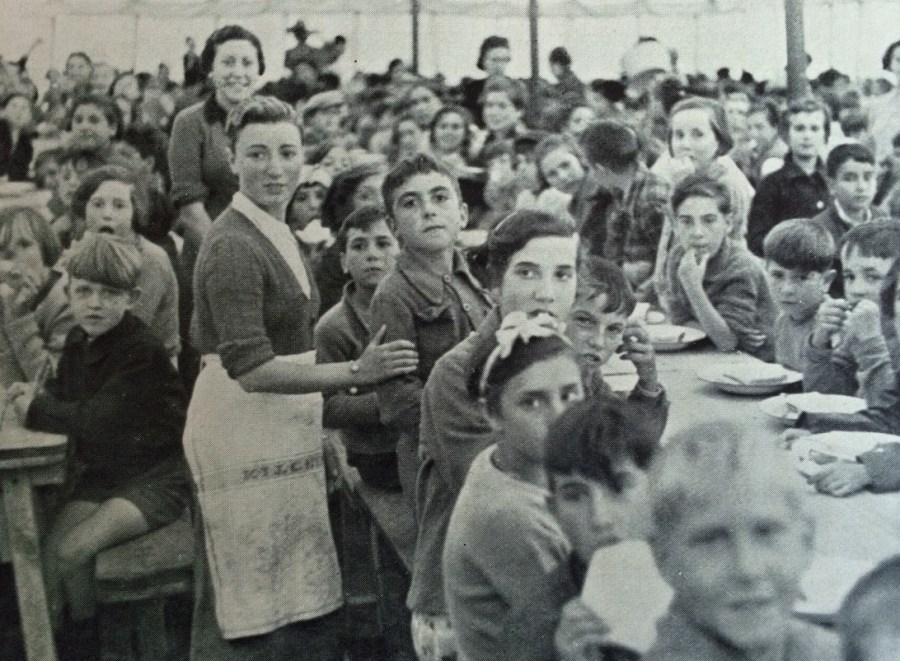
During the anti-fascist war in Spain, sympathetic families in Britain took in children from the Republican side for their safety from the advancing Spanish military-fascist forces and allied German Nazi and Italian Fascist military.

Later, as defeat loomed for the Spanish Republic, families with children fled to many countries (a few even to Ireland) and yes, to the Soviet Union. In fact a Basque descendant of that evacuation has passed a year in Polish jail accused of spying for Russia without presentation of any evidence.6

Basque and Spanish children, refugees from Spanish Anti-Fascist War (Photo sourced: Internet)

During WW2, children from British cities were sent to homes in rural areas for their safety. Whatever the issues around how they were treated in their new or temporary homes, nobody speaks of “abduction” of Basque, Spanish or British children7.

Well, actually, some children were abducted in Spain, from their murdered Republican parents or from working class women who were told their baby had died in childbirth. The fascist State and the Catholic church presented these children for adoption to rich and loyal childless couples.8

One of the reasons for abduction of children in those cases was to satisfy the needs of childless couples loyal to the regime and required the massive collusion of a number of health and social care agencies, all of which were exposed later. Does this seem a likely risk for Russia to take?

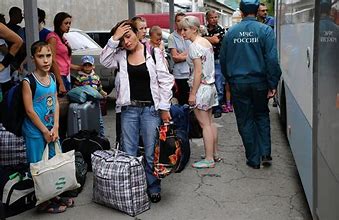
Ukrainian families with children evacuating to Russia (Photo crdt: Wall Street Journal)

Well what about the other objective, social engineering, of creating fascist children, or for example “Germanisation” but in this case “Russification”?

Hardly, the children are from the Donbas region, an area already largely Russian in language and culture and, since attacks of the Ukrainian forces on it since 2014, already hostile to the Kyiv regime and mostly sympathetic to Russia.

The Ukrainian State leadership, one of the main accusers of Russia’s alleged abduction of children, frequently issues population figures of towns and cities in the Ukraine War zone, comparing pre-war with current figures, showing a huge drop between both sets.

Presumably the fall in numbers of inhabitants in towns under their control could not have been carried out by Russia. So are we to accuse the Kiyv regime of the “abduction” an “ethnic cleansing” of thousands of Ukrainians, its own citizens? Or more reasonably, of their evacuation?

Returning to the question of actual evidence, an issue of apparent little importance to the wsm and NATO country states, surely an international agency responsible for children would be expected to have a reasonable handle on this?

Or is UNICEF to come under the accusation regularly thrown at those of us who don’t swallow everything NATO says, i.e. of being “putinistas?

The Target of the Propaganda

It’s worth considering who the targets in this propaganda war might be and the reasons therein. The state intelligence agencies of NATO countries presumably have a fair idea of which are truths and which are lies. So the target is not the heads of states.

THE MAIN TARGET OF THE PROPAGANDA IS US, i.e. the ordinary people in the western world, whether in NATO (which most are) or not. The objective being that we should support our governments in backing US/NATO’s confrontation with Russia.

And that if it should come to world war, which seems increasingly likely, that we support our governments and suffer the consequences, including dying in millions to support their objectives. Without rebelling.

End.

FOOTNOTES

1The western mass media makes a point of telling us that Russia does not recognise the authority of the ICC but rarely adds that nor does the Ukrainian regime. And nor does the USA!

2An interesting exercise to evaluate wsm bias is to put “Russia denies abduction of children” in a mainstream search engine and see how many hits one gets for UNICEF’s statement.

3UNICEF: No Evidence on Russia’s Abduction of Ukrainian Children | News | teleSUR English

4As above

5As above

6Pablo Gonzalez, a journalist working for Spanish media, was born in Russia, grandson of such a refugee. He was covering the Ukraine war when detained by their state intelligence service and advised to leave the country; meanwhile Spanish state security visited and interviewed his family, his mother and friends. He left Ukraine but went to Poland and was arrested by their state intelligence service as he was accompanying other journalists crossing back into Ukraine. To this date well over a year later Gonzalez has had no evidence of spying presented against him. Unlike a journalist detained in Russia whose case elicited public concern from western politicians within days, none of them have mentioned the case of Pablo Gonzalez.

7Evacuation of children in the Spanish Civil War – Wikipedia

8See Sources: The same thing occurred under the fascist Pinochet dictatorship of Chile, war in El Salvador and by the Nazis in Poland during WW2.

SOURCES

UNICEF says no evidence Russian abduction of children: UNICEF: No Evidence on Russia’s Abduction of Ukrainian Children | News | teleSUR English

Russian charged with war crimes says Ukrainian children can go home (breakingnews.ie)

Abduction and relocation of children by fascist regimes:

Thousands Of Children Stolen During Franco Rule : NPR

Kidnapping of children by Nazi Germany – Wikipedia

‘I knew in my heart she was alive’: Families in El Salvador are finally reunited with children abducted during the country’s civil war | The Independent | The Independent

Stolen at Birth, Chilean Adoptees Uncover Their Past – The New York Times (nytimes.com)

THEFT OF PALESTINIAN LAND COMMEMORATED IN DUBLIN CITY CENTRE

Diarmuid Breatnach

(Reading time main text: 2 mins.)

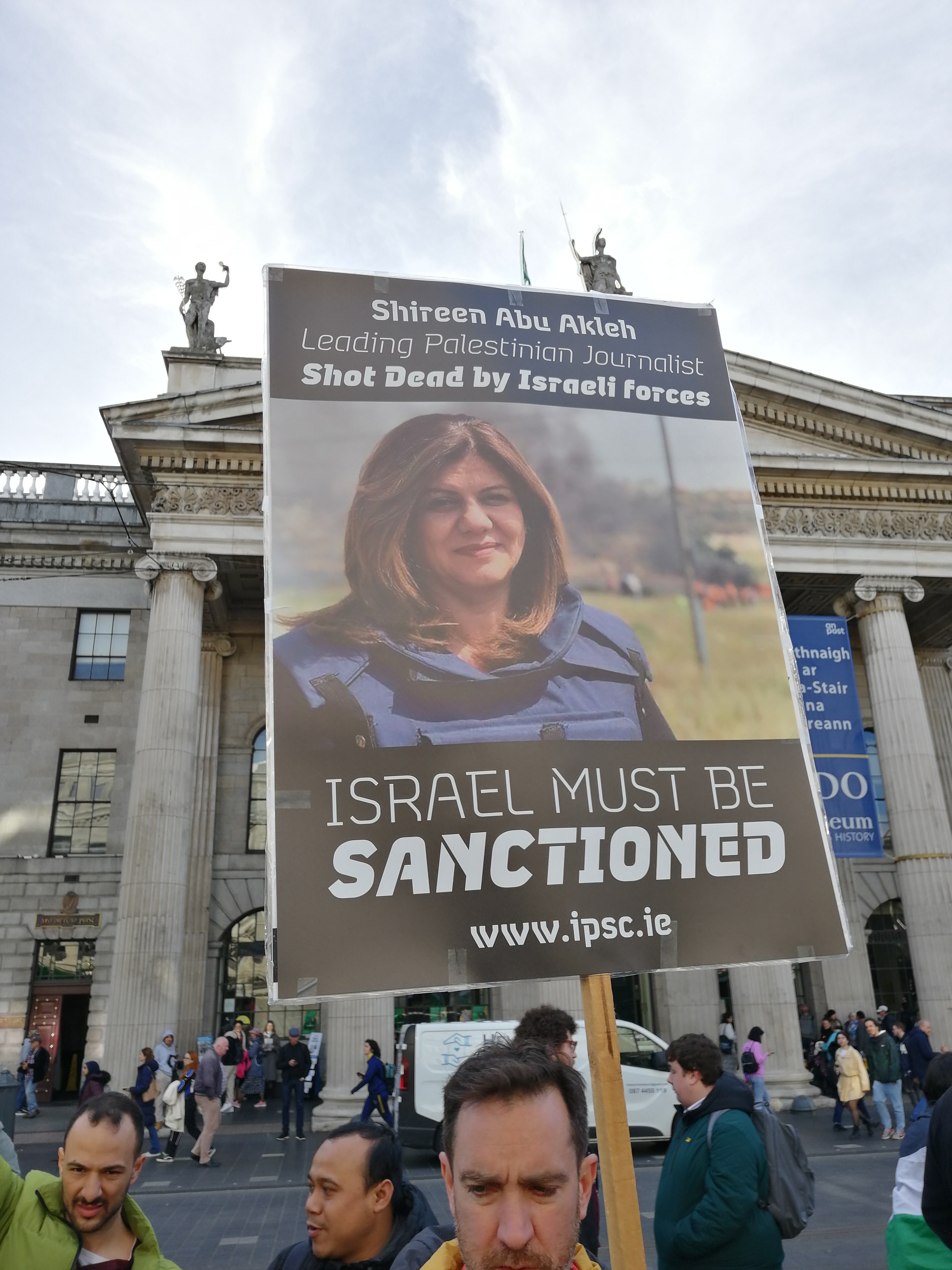
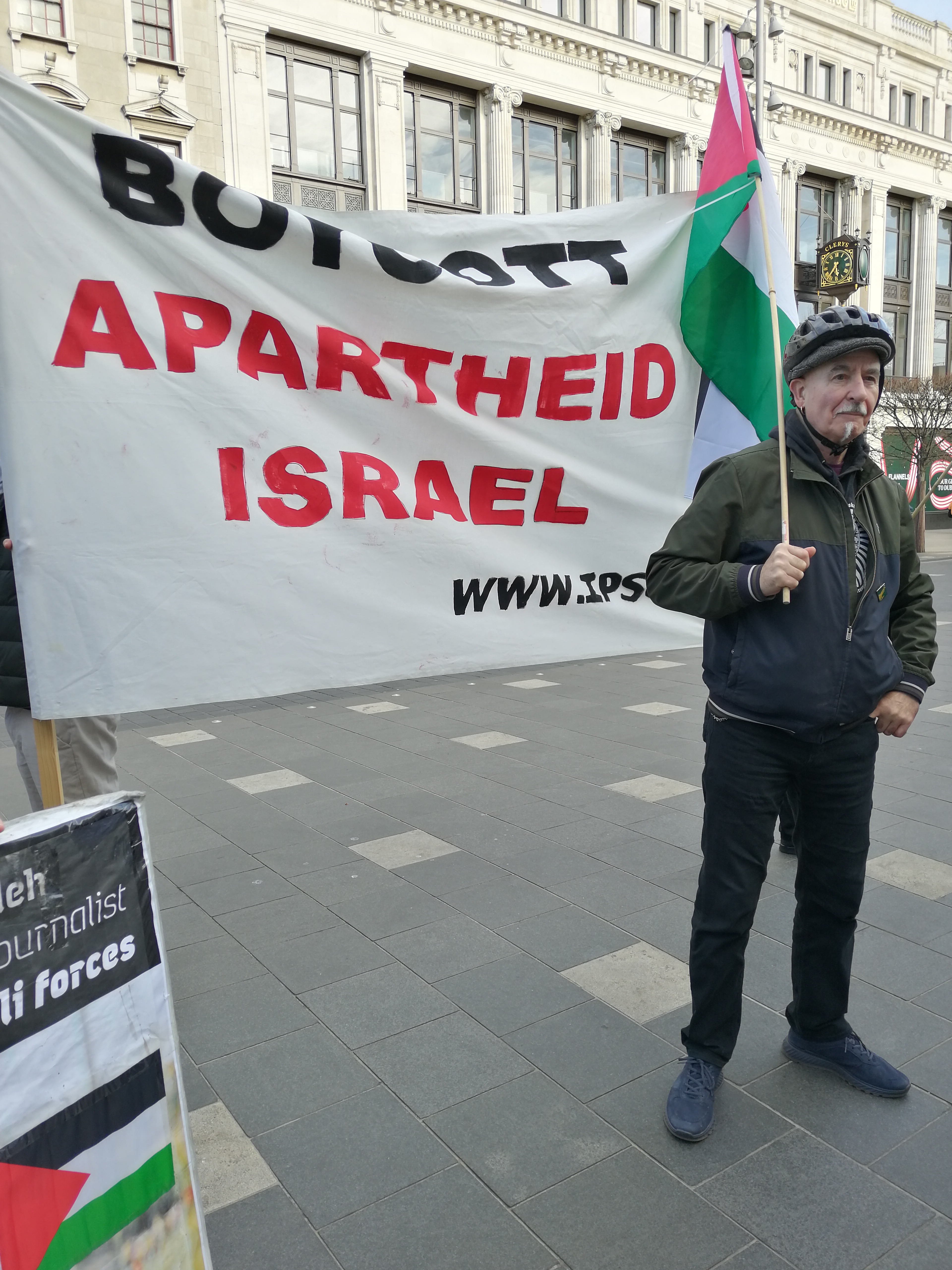
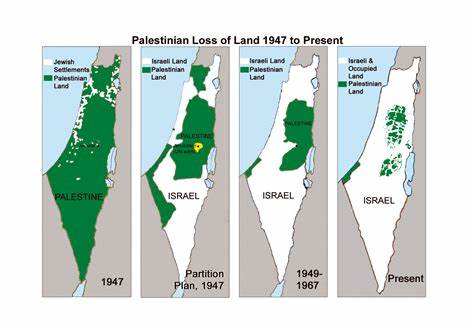
Palestinian flags waved as people gathered on the pedestrian reservation in Dublin’s main thoroughfare, O’Connell Street, to mark Palestinian Land Day March 30th, anniversary of the 1976 confiscation of Palestinian land by the Israeli Zionist State.

Naturally, the event also addresses the continual threat to additional Palestinian land by Zionist settler occupation, Israeli judicial and army demolition of Palestinian housing and intimidation, harassment and terrorism against Palestinians in Jerusalem.

Palestine supporters gathering for Land Day (Photo: D.Breatnach)

The Dublin event was organised by the Ireland Palestine Solidarity Campaign, a broad organisation that receives broad support not only across the Irish Left and Republican spectrum but also from a great many non-aligned Irish people and even many among voters for mainstream political parties.

This support was emphasised by frequent drivers in passing traffic, both public, taxis and entirely private, blowing their horns in approval of the rally. The population of the Irish state has gone from being in general support of the Israeli State to being generally hostile to its behaviour.1

Zionists tend to depict anti-Israeli Zionism as being anti-Jewish and therefore, according to them, “anti-semitic”2. Quite apart from the wide inapplicability of the term and some isolated historical examples dredged up3, it fails to account for the change in public attitudes over recent decades.

The iconic GPO in the background (Photo: D.Breatnach)

It has been years of viewing even media-sanitised coverage of massacres of Palestinians by the Israeli armed forces with international impunity that has radically altered the opinion of the public in Ireland, in all probability drawing on their own historical experience of foreign occupation.

An elderly Irishman voicing anti-Jewish views did in fact approach the rally but was confronted by other Irish people who emphasised that they were against the Zionist state and not against Jews, soon causing the first man to depart unhappily.

The continual occupation of Palestinian land by Zionist settlers has invalidated even the “two-state solution” (sic) beloved of liberals, making it a practical impossibility, undermining the main ‘concession’ of the supposed solution of the USA-mediated “Palestinian peace process” of 1991.

(Photo: D.Breatnach)

The refusal of the Israeli authorities to permit the return of Palestinian exiles while welcoming Jewish settlers, most of whom had no even ancestral connection to Palestine, means that the future for Palestinians in the Israeli state can be at best as an oppressed minority.4

(Photo: D.Breatnach)

Other Palestine news

Even as preparations for the Dublin rally took place, Israeli police shot dead a Palestinian they claimed had tried to wrest a gun from them at the Al Haq Mosque but whom Palestinian eye-witnesses said had merely been protesting the police harassment of a woman.

Since the rally, another two Palestinians have been killed in an by Israeli armed forces raid on Nablus. This brings the total number of Palestinians killed by Israeli forces this year alone to over 90, with a high proportion of them children.

Mass protests and even mini-riots by Israeli Jews are currently expressing opposition to the current government’s plans to ‘reform’ the judiciary, to bring it under the greater control of the Executive.

While Israeli Jews are deeply divided on this question the vast majority are agreed on the need to suppress Palestinians, to enforce apartheid and to keep the State as ‘Jewish’ one.

Meanwhile an April 1st Fool’s Day hoax depicting an executive of the sports shoe manufacturer company Puma declaring a boycott of the Zionist state was widely shared on the Twitter social media to overwhelmingly welcoming comment.

Exposure of the hoax received mixed responses, with wide condemnation from pro-Israeli and even some pro-Palestinian sources but others claiming it helped to widely publicise the manufacturer Puma’s close links to the Zionist State and that would enhance its boycott by many.

End.

(Image accessed: Internet)

Footnotes

1Dublin City has had Jewish municipal Councillors and the sixth President of Israel, Chaim Herzog (Hebrew: חיים הרצוג‎; 17 September 1918 – 17 April 1997) was an Irish-born Israeli politician, general, lawyer and author who served as the 6th President of Israel  between 1983 and 1993. He was born in Belfast and raised primarily in Dublin; his father was Ireland’s Chief rabbi Yitzhak HaLevi Herzog, who immigrated to the British protectorate of Palestine in 1935 and served in the Haganah Zionist paramilitary group, later the Israeli Army where he reached the rank of Major-General. As recently as 1967 the prevailing Irish public opinion seemed sympathetic to the Israeli State and the fictional propaganda and wildly inaccurate historical Hollywood films Exodus (1960) and Cast a Giant Shadow (1966) were widely viewed sympathetically in Ireland.

2The term originally included hatred or fear of all Semitic people, including Arabs and Jews but has come to be understood as exclusively meaning a racist attitudes towards Jews. By no means all Jews are Zionist though Zionists have worked long and hard to make both descriptions interchangeable with a great deal of success among the world Jewish population with possible unfortunate consequences for Jewish populations outside Israel. However many Jews have criticised the behaviour of the Zionist State towards Palestinians, earning the hatred of the Zionists, who cannot label them as anti-semitic and therefore call them “self-hating Jews”.

3And even outright lies and unlikely conspiracy attitudes, such as that Irish authorities are feeding anti-Semitism into the Irish population (see Ireland most hostile country in Europe’ (ynetnews.com) )

4A substantial Israeli Zionist body of opinion favours the total expulsion of Palestinians from the territory ruled by the State.

Sources & Further Information

Land Day – Wikipedia

Ireland most hostile country in Europe’ (ynetnews.com)

European countries with most antisemitic attitudes have fewest attacks – poll | The Times of Israel

Israeli police kill man at Jerusalem’s holiest site (breakingnews.ie)

Israeli forces kill two Palestinians in occupied West Bank raid | Israel-Palestine conflict News | Al Jazeera

April Fool’s gone wrong: No, Puma did not sever ties with Israel – Doha News | Qatar

Puma’s sponsorship of Israeli teams highlights the double standard in international football (theconversation.com)

Ireland Palestine Solidarity Campaign website (also has a Facebook page): Home – Ireland Palestine Solidarity Campaign (ipsc.ie)

Republican Fighter Killed by the Irish State Commemorated in Talbot Street, Dublin

Diarmuid Breatnach

(Reading time: 5 mins.)

An event was held on a busy Saturday afternoon in Dublin’s city centre to commemorate IRA volunteer Patrick O’Brien, killed by soldiers of the Irish State.

The event included bagpipe airs, a colour party, speeches and a resistance song.

A colour party with Irish Tricolour and the flags of the four provinces, led by a lone piper marched into and a short distance westward up Talbot Street towards where a crowd waited beside a memorial sign that had been erected shortly earlier. The colour party took up station on the opposite side of the road.

Led by a piper playing Irish airs, the colour party (i.e carrying the flags – the Irish Tricolour and those of the four provinces of Ireland) approaches as the start of the commemoration. (Photo: D.Breatnach)

Among the airs being played on the short march were Thomas Moore’s Let Erin Remember and The Wearing of the Green or The Rising of the Moon, the same traditional air to both different songs referring to the 1798 Rising.

THE SHORT LIFE OF A LOYAL REPUBLICAN

Framed portrait photo of Vol. Patrick O’Brien on display at the commemoration (Photo: D.Breatnach)

Gina Nicoletti, chairing the event, recounted to the crowd a short history of Volunteer Patrick O’Brien who was born on 17 August 1898 in the townland of Woodlands near Castledermot in County Kildare to a local agricultural working couple.

The O’Brien family had 16 children, all of whom survived and ten of whom lived with Patrick and his parents in a three-room house at the time of the 1911 Census.

An obituary published in a Republican newspaper on the anniversary of his death suggests that Patrick moved to Dublin in 1915, joining the Irish Volunteers in December of that year aged 17. He took part in the 1916 Easter Rising under the command of Edward Daly.

Evading capture in 1916 and returning home, O’Brien joined the local Irish Volunteers company in Castledermot but returned to Dublin in May 1917 and became attached to E Company, 3 Battalion, Dublin Brigade, Irish Volunteers, which was based on the south side of the city.

Sean Óg sings The Foggy Dew while accompanying himself on guitar and centre of photo is Gina Nicoletti, who chaired the event. (Photo: D.Breatnach)

An active IRA member during the War of Independence, Vol. O’Brien took the anti-Treaty side in the IRA split in March 1922.

In a response to a renewal of executions of IRA men by the Free State government, Liam Lynch (IRA Chief of Staff) issued the ‘Amusements Order’ on 13 March 1923 banning all cinema, theatre and sports events “at a time of national mourning” with action threatened against non-compliance.

At midnight on 23 March 1923, Patrick took part in an operation to blow up the Carleton Picture House, O’Connell Street (then near the Parnell Monument opposite the Savoy Cinema). The cinema had closed an hour before a landmine at the front entrance shattered the glass of several windows.

There were no injuries but newspaper articles reported that the sound of the explosion was heard several miles away. Accounts of what happened afterwards were gathered from one of the IRA unit, Volunteer Joseph Doody in his pension application.

The unit unexpectedly encountered Free State soldiers coming from the Parnell Monument who opened fire on them and another patrol was approaching from the southern end of O’Connell Street and the unit retreated through Findlater Place and out to Marlborough Street.

In the running firefight in Talbot Street, O’Brien was hit by at least four bullets (three in his left leg and one in his right leg). He fell wounded on the pavement between Speidel’s pork butchers and the Masterpiece Picture Palace at 99 Talbot Street and died about 30 minutes after arrival at hospital.

The colour party lowers the flags in honour of a martyr as the piper plays a lament (Photo: D.Breatnach)

Patrick O’Brien was 24 and his death certificate listed his occupation as an employee of a railway company. His address was 28 Cadogan Road, Fairview which is a cul de sac of Victorian redbrick houses close to Annesley Bridge and opposite the Sean Russell statue.

Only three weeks before Patrick’s death, the Free State CID1 had raided no. 43 Cadogan Road and captured the press used to print the Sinn Féin2 paper An Phoblacht along with eight people who were on site. A number of prominent IRA families lived in the vicinity, including the Brughas.

Patrick O’Brien was buried in the Republican Plot, Glasnevin Cemetery and a volley was fired over his grave, presumably following the funeral in the cover of darkness as the IRA could not have risked such a public display during the burial, in a time of martial law.

The colour party raise the flags again in symbolism of the struggle carrying on after honouring a martyr (Photo: D.Breatnach)

Despite the hard repression by the Irish State on combatants, their relatives and friends, O’Brien’s family were proud of Patrick as displayed in an anniversary notice placed in The Nationalist & Leinster Times.

The Irish Independent reported on 27 March 1923 that at the inquest of Patrick’s death, his brother James told those present:

“[My brother] … belonged to the IRA since 1915 being then about 15 years of age. He had never changed his principles since then. He always intended to die as he did … rather than change his principles as he swore allegiance to the Republic in 1916.”

FLORAL WREATH, SONG AND SPEECH

A representative of Anti-Imperialist Action was called upon and stepped forward to attach a green, white and orange floral wreath to the pole beneath the commemorative sign.

The plaque/ placard commemorating Vol. Patrick O’Brien attached in Talbot Street by Independent Republicans with the floral wreath from Anti-Imperialist Action attached below it (Photo: D.Breatnach)

Seán Óg accompanied himself on guitar singing The Foggy Dew, a popular Republican ballad about the 1916 Rising composed by Fr. Charles O’Neill.

Dublin City Councillor Cieran Perry gave a fairly short speech stressing the importance of these acts of remembrance upholding traditions of resistance in the Dublin working class, also denouncing the fake patriots who stir up racist divisions and hostility in the community.

Perry’s speech also listed some of the crimes of the Irish state, facts underlined when Joe Mooney read out the list of 70 IRA Volunteers formally executed by the Irish state along with those killed in battle or after they surrendered, or were abducted, tortured and murdered in Dublin 1922-’23.

Cnclr. Cieran Perry speaking at the commemoration. (Photo: D.Breatnach)

TRAFFIC AND PEOPLE

Traffic was light along the narrow Talbot Street during the event and slowed down to ease past the crowd that had spilled from the pedestrian pavement into the street. A few minutes’ eastward of the spot is the plaque commemorating the killing of Sean Treacy by the British in November 1920.

There was a substantial number of people in support of the event on both pavements of the one-way street but others gathered too, whether out of curiosity or in sympathy. Some of those present consisted of visitors from other countries, whether as students, tourists or workers.

The crowd grew and spilled on to Talbot Street. [The plaque to Vol. Sean Treacy killed by British soldiers in 1920 is high on the front of a building just beyond the tree on the right of photo] (Photo: D.Breatnach).

Not for the first time I thought that having leaflets to distribute summarising the event and the reason for it would be useful. I spent a little time explaining some aspects of the event and its history to a couple of visitors from Sweden who seemed very interested.

The uniformed Gardaí kept away from the event, though no doubt the plain-clothed political Special Branch had a few of their own in the vicinity to collect faces and try to match names.

THE ORGANISERS: INDEPENDENT REPUBLICANS

The commemorative event was organised by a group by the name Independent Republicans which has been doing great work in conserving and promoting historical memory associated with events such as the 1916 Rising, the War of Independence and the Civil War.

The Irish Free State came to power as an instrument of British imperialism which clothed, armed and otherwise supplied the state’s National (sic) Army. Independent Republicans have collected the names of 70 Irish Republicans killed in Dublin by that Army.

The group has also devoted time and effort to researching the backgrounds and circumstances of death of many on that list, a substantial undertaking for which we owe them a great debt. Their erection of ‘plaque’ signs around the city at the spot where the fighters fell is also great work.

The commemorative plaque/ placard to Vol. Patrick O’Brien’s memory being erected shortly before the start of the event (Photo: D.Breatnach)

On Easter Saturday (8 April) Independent Republicans will be holding a 1916 Rising commemoration in Dublin city centre, details below.

Anti-Imperialist Action will be holding theirs on Easter Sunday (9 April), details below.

End.

FOOTNOTES:

1Criminal Investigation Department, based at Oriel House, where police detectives and some soldiers of the Free State organised operations against Republicans including raids, assassinations, abductions and torture.

2This is not the party of the same name today. Sinn Féin began as a dual-monarchy Irish nationalist party, adopting Republicanism later in 1918. Those who later supported the anti-Republican status of the country and partition by England left the party and another large number left to join the Fianna Fáil party upon the latter’s founding. Briefly in the 1960s the party espoused socialism but split at the end of the decade and Sinn Féin under the Provisionals briefly adopted socialism again during the 1970s. The party of that name today is neither socialist nor even Republican.

SOURCES & FURTHER INFORMATION

https://sammcgrathdublin.medium.com/dublin-poster-campaignto-remember-republicans-killed-in-civil-war-baa3651bba83

Broad Cospito Solidarity Picket at Dublin Italian Embassy

Ireland Anti-Internment Campaign

(Reading time: 3 mins.)

A picket outside the Italian Embassy in Dublin on Thursday (23rd) was part of a day of action across Europe in solidarity with an Anarchist prisoner on hunger strike since October in a struggle for more humane prison conditions.

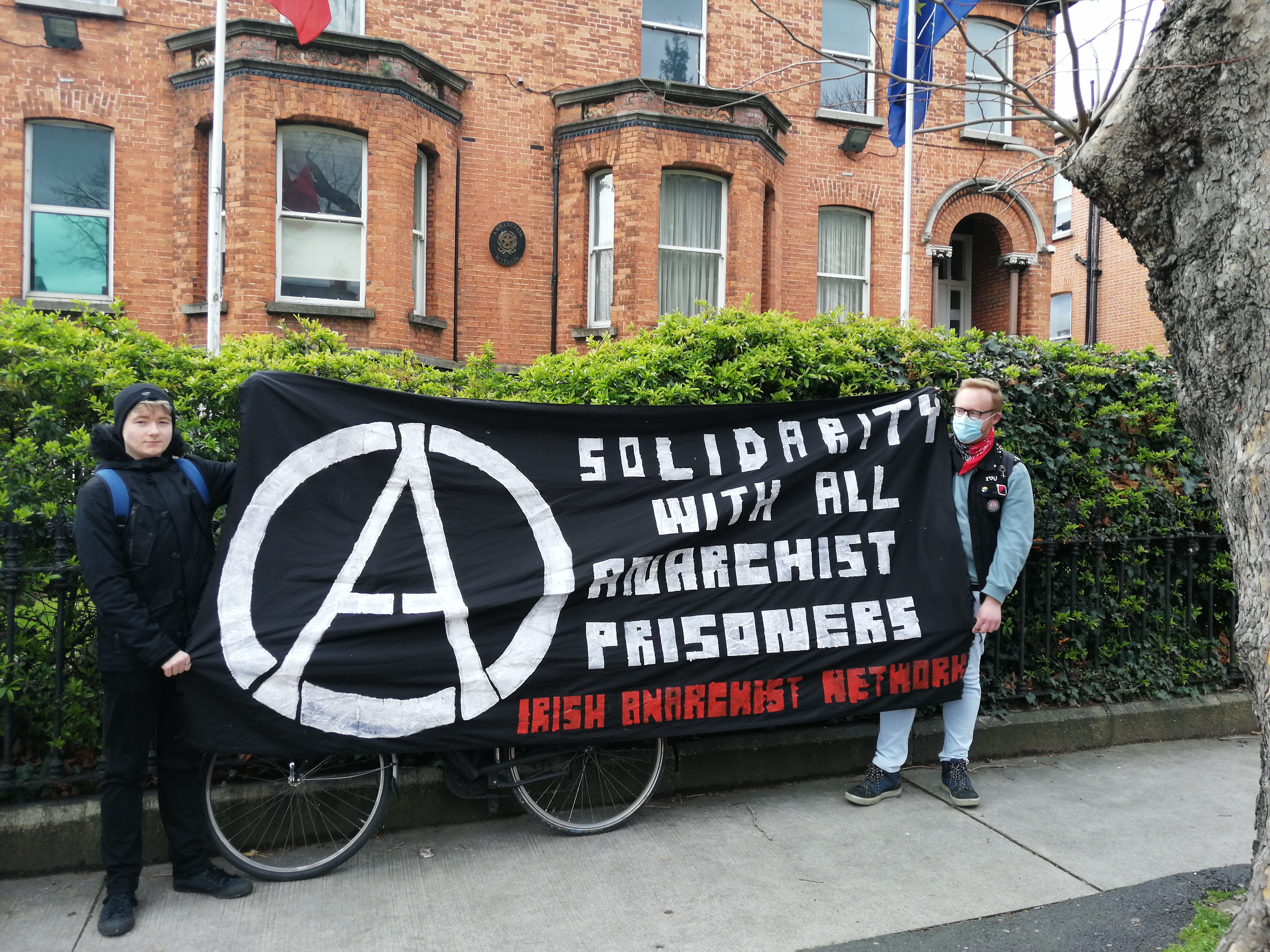
The picket, organised at short notice, included Irish Republicans, Anarchists and revolutionary Socialists. Banners and placards indicated the presence of Saoradh, Irish Anarchist Network and Ireland Anti-Internment Campaign.

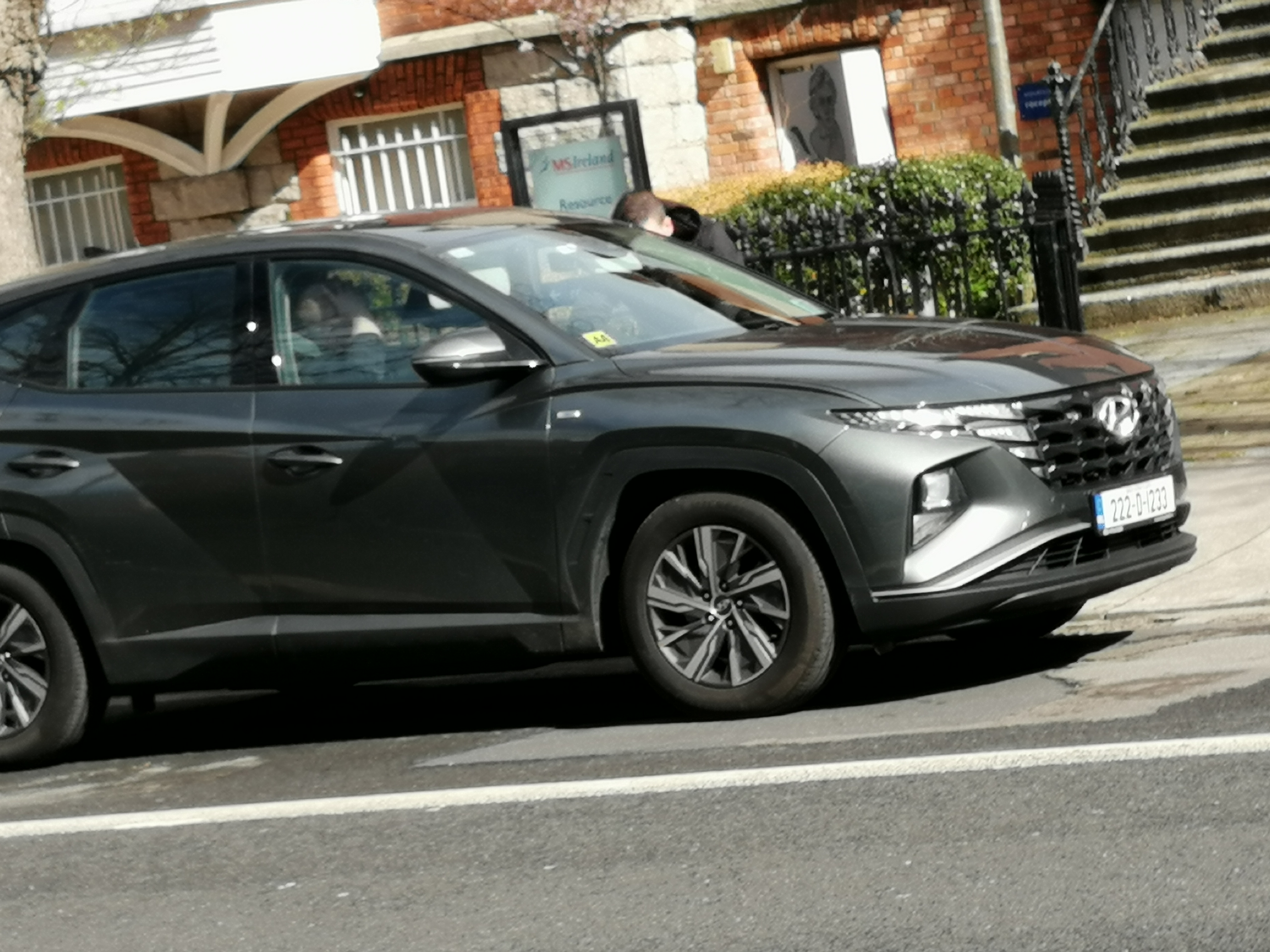
At one point five uniformed Gardaí stood near the Embassy’s gate while three plain-clothes Special Branch (i.e. political police) watched from a car across the road. The police numbers may have been due to a request from the Embassy in the midst of attacks on some Italian Embassies in Europe.

Despite the presence of Gardaí, Embassy staff appeared nervous, meeting one visitor at the gate to check her reason for attendance after speaking to her on her mobile phone, rather than first allowing her to enter the garden and approach the main entrance.

Some of the uniformed Gardaí attending the solidarity picket and some of the protesters. (Photo: IAIC)
Three Special Branch Gardaí (political police) parked across from the picketers, surveilling them (Photo: IAIC)

THE HARSHEST ITALIAN PRISON CONDITIONS

Alfredo Cospito is an Italian political prisoner kept under the harshest Italian prison conditions, “41-bis”, which include solitary confinement for most of the day, family visit once a month through glass, no reading matter sent from outside and no phone calls in either direction or lawyer privacy.

According to information on the Internet, these inhumane conditions were developed for Mafiosa leaders, in order to prevent them running their organisations from inside jail and also to pressure them into breaking ranks and informing on their colleagues.

Whatever we may say about that, what can be the intention of subjecting a political prisoner to those conditions, except to break him or to destabilise him mentally? EU recommended rules on prisoner management don’t recommend more than three weeks in solitary confinement.

Lawyers for political prisoner Nadia Lioce, who has been living under the 41-bis regime for two decades, have said due to limited hours permitted contact, she has effectively only interacted with people for a total of 15 hours in the space of a year.

Italian media reported Lioce’s lawyers as saying she is now so “psychologically isolated” that, when her mother and sister visit, she is unable to speak to them for more than a few minutes.

Some of the picketers, the Italian Embassy in the background (Photo: IAIC)

Amnesty International and the European Court of Human Rights have both criticised several aspects of the 41-bis, and in 2007 a US court refused to extradite a convicted Mafia drug trafficker on the grounds that the 41-bis regime he would face in Italy would have “constituted torture”.

The Anti-Imperialist Front gave a call for an international solidarity day of action which found an active response in many countries.

Alfredo Cospito’s case is up for review by the Italian prison system this month and pickets and other actions have been organised around Europe to exert pressure on the Italian penal authorities to release Cospito into house arrest in his sister’s home.

The picket displayed not only internationalist solidarity but exemplary broad unity of disparate political forces in solidarity with an Anarchist political prisoner. Hopefully this unity will continue to be built upon as time goes on, for the unfolding struggles of class and nation demand it.

Hopefully the international actions will cause the Italian authorities to relax the inhumane conditions of Alfredo Cospito’s incarceration but now Italian authorities are claiming that Cospito is somehow coordinating violent actions from within his extreme isolation.

Another two of the picketers (Photo: IAIC)

A side trip into history

The Italian Embassy is in Northumberland Road, on the south side of the Grand Canal (near the Israeli and US Embassies).

As they were leaving, some of the picketers took time to look at a plaque and monument to the Mount Street Bridge Battle between Irish Volunteers and British soldiers in 1916. Four Volunteers were killed and between 26 and 30 Sherwood Foresters, with 134 more wounded.

Mount Street Battle Monument, on the Bridge over the Grand Canal itself. The English explanation is on the reverse. (Photo: IAIC)

A number of Volunteers were captured but a number got away also. Two of the buildings from which the Volunteers fought remain, bearing the marks of bullet strikes. The third, Clanwilliam House was set on fire by the British and was replaced by a 1960s-type office building later.

End.

(Photo: IAIC)

Sources

Alfredo Cospito: Hunger-striking Italian anarchist moved amid protests – BBC News

FS_Prisoners_health_ENG (coe.int)

PATRICIO Y EL COLOR DE LA REBELIÓN

Diarmuid Breatnach

(Tiempo de lectura: 6 min.)

Mucha gente sabe que el 17 de marzo es el Día de San Patricio, una fiesta nacional en Irlanda y un día festivo en algunos otros lugares del mundo donde la diáspora irlandesa ha tenido un impacto (1. ¿Pero por qué? ¿Y por qué el trébol y el color verde?

Al cristiano San Patricio, un esclavo galés fugitivo de los irlandeses que regresó como misionero cristiano a Irlanda, se le atribuye el papel principal en la conversión de los irlandeses de sus religiones paganas al cristianismo. Como tal, es venerado por las iglesias católica y protestante.

A diferencia de muchos lugares de Europa, la conversión parece haber sido en gran parte pacífica, sin evidencia del fuego y la espada con los que se impuso en muchas otras tierras. Quizás debido a esto, los monjes irlandeses registraron gran parte de la rica mitología y leyendas de la Irlanda pagana.

Pero no existe razón histórica cualquiera para asociar a Patrick con el trébol. La afirmación de que lo usó para demostrar el tres en uno de la Trinidad cristiana es una fábula y las copias de su Confessio, ampliamente aceptada como la auténtica autobiografía de Patrick, no lo mencionan.

La referencia a esta fábula no se registra hasta siglos después, pero un argumento mucho más convincente en contra de su veracidad es que los paganos tenían muchas trinidades deístas y los irlandeses no fueron una excepción, entre los cuales la diosa Mór-Righean2 en la saga Táin3 es la mejor recordada.

De hecho, parece que hay pocas razones para creer que los druidas preferían el trébol y la búsqueda en Internet hace años no arrojó ninguna referencia hasta que más recientemente apareció una sola referencia que no proporcionó la fuente de su afirmación.

Entonces, no hay una razón auténtica para el trébol, pero ¿qué pasa con el color verde? Resulta que la asociación de los irlandeses con el color verde también es históricamente reciente, y el azul tiene una asociación anterior. Incluso hoy, solo una de las cuatro provincias, Leinster, tiene verde en su bandera.

Una bandera similar a la de Leinster, un arpa dorada sobre un fondo verde, fue ondeada por primera vez e introducida por Eoghan Rua Ó Néill a la Confederación Católica, la alianza de irlandeses y colonos normandos contra Cromwell y el Parlamento inglés en 1642.

Siguieron varias versiones de Arpa y Corona en banderas, pero la primera organización republicana irlandesa de masas, los Irlandeses Unidos, volvieron a colocar el Arpa sin la Corona sobre un fondo verde para su bandera, con el lema “está recién encordada y se escuchará” al lado del arpa.

El emblema de los Irlandeses Unidos; el arpa fue reproducida dorada sobre fondo verde para la bandera. (Imagen de origen: Internet)

John Sheils, presbiteriano de Drogheda e Irlandés Unido, en su canción The Rights of Man de estilo aisling compuesta en algún momento antes del levantamiento de 1798, reunió los íconos de una Irlanda femenina, el arpa, el color verde, San Patricio y el trébol juntos en su llamado a la unidad contra Inglaterra.

Aludiendo a “la planta de tres hojas”, Sheils hace que San Patricio declame que

es tres en uno,
para probar su unidad
en esa comunidad
que aguanta impunemente
a los Derechos de la Humanidad
.”
(Traducido del inglés por DB)

El “tres en uno” es una referencia obvia a la unidad de “católicos, protestantes y disidentes4” buscada por los Irlandeses Unidos y vocalizada por Wolfe Tone entre otros líderes. Sin embargo, no hay evidencia de un uso a gran escala por parte de los ‘Unidos del trébol para significar esa unidad.

Y el verde puede haberse inspirado en el color que Camille Desmoulins pidió a los parisinos que usaran en sus sombreros como señal de revolución dos días antes de la toma de la Bastilla en 1789, aunque pronto eligieron el azul para emular la Revolución Americana.

El fracaso de los levantamientos de los Irlandeses Unidos en 1798 y 1803 fue seguido por una severa represión, lo que refleja el temor de la Corona y sus leales colonos de perder su colonia irlandesa. El débil Parlamento irlandés fue abolido por sobornos e Irlanda se convirtió en parte formal del Reino Unido.

Como festividad cristiana, el Día de San Patricio podría haber parecido un día de fiesta inocuo, aceptable para el gobernante y los gobernados, por lo tanto, seguro para celebrar y usar el trébol como algo inocuo.

Llevando el Verde

Me parece probable que en una atmósfera de represión a gran escala, las personas que simpatizan con los republicanos irlandeses podrían optar por vestirse de verde en público al menos un día al año, en forma de trébol en “St. Día de San Patricio.”

La canción The Wearing of the Green hace referencia a la represión que siguió al levantamiento de los Irlandeses Unidos de 1798 con la letra “Están ahorcando a hombres y mujeres por llevar el verde” y “La ley prohíbe que el trébol crezca en suelo irlandés“. (6) (Traducido del inglés por DB)

La Hermandad Republicana Irlandesa, formada el día de San Patricio de 1856 simultáneamente en Nueva York, EE. UU. y en Dublín, Irlanda, adoptó el arpa dorada sobre un fondo verde para su bandera, aunque también usaron el Sunburst, que se cree que es el símbolo de los legendarios guerreros Fianna.

(Imagen procedente de: Historia de Irlanda)

La formación de la IRB, o “los fenianos”, como se les conoció tanto por amigos como por enemigos, se produjo en una época de gran emigración irlandesa, entonces mayoritariamente católica en religión y superando con creces la de la mayoría protestantes y disidentes de finales del siglo XVIII a los EEUU y a Canadá.

Oleadas de emigrantes irlandeses siguieron a quienes lograron salir de Irlanda durante la Gran Hambre de 1845-1848. Cada vez que iban a un país o colonia de habla inglesa, los irlandeses católicos sufrían discriminación por parte de los protestantes anglosajones blancos (WASPs) que se habían establecido allí antes que ellos.

Los irlandeses que formaron un batallón para luchar contra la segunda guerra expansionista de Estados Unidos contra México (1846-48) pueden haber enarbolado la bandera verde y el arpa; ciertamente llamaron a su unidad el Batallón de San Patricio y eran conocidos por los latinoamericanos como “Los San Patricios”.

En el Extranjero

El Día de San Patricio se convirtió en uno de celebración de la identidad irlandesa, más étnica que religiosa, una forma incluso de hacer alarde de esa identidad frente a sus detractores y perseguidores. Los irlandeses que luchaban en gran número en el Ejército de la Unión lo celebraron durante la actual Guerra Civil Estadounidense (1861-65).

En su primera invasión de Canadá en 1866, los veteranos de la Guerra Civil Estadounidense organizados por una rama de los fenianos ondearon una bandera verde con un arpa y, se dice, con las letras “IRA” en ella, el primer uso de este acrónimo en historia.

Pintura representando la Battalla de Ridgeway, la invasión Feniana de Canadá, 1866: observe la bandera irlandesa (Imagen obtenida: Internet).

Después de la guerra, los irlandeses en los EE. UU. celebraron el Día de San Patricio en desfiles masivos con sus veteranos del Ejército de la Unión en sus uniformes de regimiento, arrojando su identidad y su contribución a los EE. UU. frente a sus perseguidores, no solo los intelectuales WASP sino también los nativista “Know Nothings”7.

Los convictos irlandeses en Australia celebraron la fiesta en 1795 y, desde que fueron sentenciados en 1798 y 1803 los Irlandeses Unidos y fueron enviados allí encadenados, probablemente celebrados a menudo después por ellos, así como por los presos políticos posteriores, los Jóven Irlandeses en 1848 y los Fenianos en 1867.

La diáspora irlandesa en Australia, que fue calumniada debido a la oposición de muchos a luchar por el Imperio Británico en la 1a Guerra Mundial, marchó en un desfile el Día de San Patricio en 1921 con veteranos de la Primera Guerra Mundial en uniforme al frente,10 pidiendo la autodeterminación de Irlanda.

Como activista de la comunidad irlandesa en Gran Bretaña, nunca hubo dudas sobre dónde estaría yo el 17 de marzo: celebraría el día de la fiesta con la comunidad en el evento que habíamos organizado, ya sea un desfile o una recepción.

Durante una época de bombardeos del IRA y represión generalizada de la comunidad irlandesa11, hubo algunos llamamientos para abandonar los desfiles de San Patricio, pero otros y yo sentimos que era más importante que nunca celebrarlos en público en un momento en que la comunidad estaba bajo ataque y lo hizimos.

James Connolly debe haber experimentado la celebración del Día de San Patricio en su comunidad de la diáspora irlandesa en Edimburgo, más tarde como inmigrante en Irlanda, nuevamente como inmigrante en Nueva York y nuevamente como inmigrante en Irlanda.

Monumento a James Connolly, Beresford Place, Dublín. (Foto obtenida: Internet)

En marzo de 1916, un mes antes de su conjunto liderazgo del Alzamiento por el que sería fusilado por un pelotón de fusilamiento británico, escribió apoyando la celebración por parte de los irlandeses del Día de San Patricio.

… la mente irlandesa, incapaz debido a la servidumbre o esclavitud de la raza irlandesa de dar cuerpo y existencia material a sus pensamientos más nobles, crea un emblema para tipificar esa concepción espiritual por la cual la raza irlandesa trabajó en vano.

Si esa concepción espiritual de la religión, de la libertad, de la nacionalidad existe o no existió en ninguna parte excepto en la mente irlandesa, es sin embargo una realidad histórica tan grande como si estuviera incorporada en un libro de estatutos, o tuviera una existencia material garantizada por todas las páginas de la historia.”

Por lo tanto, honramos el Día de San Patricio (y su leyenda aliada del trébol) porque en él vemos la concepción espiritual de la identidad separada de la raza irlandesa: un ideal de unidad en la diversidad, de diversidad que no entra en conflicto con la unidad“.(12)
(Traducido del inglés por DB)

No pidió, y ciertamente habría repudiado, la celebración del día de la fiesta por parte de una unidad del ejército británico con ramitas de trébol o por políticos irlandeses neo-colones que lo celebraran con líderes del imperialismo estadounidense.

Al comentar sobre el viaje inverso de ese tipo cuando el presidente estadounidense Reagan llegó a Irlanda (en medio de una represión de la oposición anti imperialista a gran escala por parte del Estado irlandés), el bardo irlandés de la canción folklórica Christy Moore cantó en Hey Ronnie Regan:

Estarás llevando el verde
Abajo en Ballyporeen,
El ‘pueblo de la patata pequeña’;
Pon tus brazos alrededor de Garrett
Y cuelga tu zanahoria
Pero nunca lograrás que me une a la OTAN.

(Traducido del inglés por DB)

El poeta anglo irlandés y premio Nobel de Literatura WB Yeats escribió en una reflexión sobre el levantamiento de 1916:

Ahora y en el tiempo de ser,
Dondequiera que se use verde,
son cambiados, cambiados por completo:
Nace una belleza terrible.

(Traducido del inglés por DB)

Debería ser “terrible” solo para los enemigos de la libertad y la autodeterminación irlandesas, para los imperialistas, los colonizadores y sus partidarios fascistas y racistas, pero verdaderamente hermoso para todos los demás.

Al despedirnos, volvemos nuevamente a las palabras de John Sheils de la década de 1790 que puso en boca de Irlanda, la diosa Gráinne (traducido del inglés por DB):

Que cada comunidad
detesta la desunión;
en amor y unidad
camina de mano;
Y crée a la vieja Gráinne
Que esa orgullosa Britannia
Nunca más les robará
de los Derechos de la Humanidad.

Trifolium dubium, el Trebol Menor o Amarillo, an Seamair Bhuí, candidato más seguro de lista de treboles de ser el “shamrock” tradicional. (Photo: Internet)

Fin.

Notas al pie:

1Terranova en Canadá y la isla caribeña de Monserrat. También es el más celebrado de todos los días festivos nacionales por todo el mundo.

2Suele traducirse en inglés como la “Morrigan”, una trinidad compuesta por tres hermanas, a veces Badb, Macha (número de lugares que llevan su nombre, incluido Ard Mhacha [Armagh]) y Nemain, otras veces Badb, Macha y Anand. A veces se las representaba como hermanas de otra tríada, Banba, Éiriu (de donde se deriva el nombre del país Éire) y Fódla. Las tríadas pueden ser tres aspectos de la única Diosa en cada caso.

3Táin Bó Cuailgne/ The Cattle Raid of Cooley, parte del Ciclo Ulster Cycle de cuentos, protagonizada por el legendario guerrero Sétanta o Cú Chulainn.

4Católicos (la gran mayoría de los irlandeses), Anglicanos (la pequeña minoría pero el grupo religioso reinante) y las otras Sectas protestantes, en particular los presbiterianos, que tenían muchos más seguidores que los anglicanos.

5 Los Irlandeses Unidos fueron muy influenciados por la Revolución Francesa, por supuesto.

6 La versión más conocida es la del dramaturgo Dion Boucicault, adaptada para su obra de 1864 Arragh na Pogue, o La Boda en Wicklow, ambientada en el condado de Wicklow durante la rebelión de 1798 (Wikipedia)

7 Bandas ‘nativistas’ de los primeros colonos estadounidenses que se movilizaron violentamente contra los irlandeses y los afroamericanos; cuando fueron juzgados en la corte, afirmaron “no saber nada”.

8https://www.nma.gov.au/exhibitions/not-just-ned/about/about/st-patricks-day

9Tal fue la oposición popular que los británicos temieron imponer el servicio militar obligatorio y, en cambio, celebraron un referéndum en el que se votó por no tener servicio militar obligatorio. Un segundo referéndum fracasó nuevamente, aunque por una mayoría más pequeña. Sin embargo, muchos voluntarios australianos de procedencia murieron luchando por el Imperio Británico.

10 Por supuesto, tal identificación con el ‘nuevo país’ de asentamiento puede ser problemática en sí misma, particularmente si ese país es o se vuelve imperialista, como de hecho ha sido el caso con los EE.UU y con Australia).

11Especialmente a partir de 1974 hasta el resurgimiento de la comunidad en apoyo de los Huelgistas de Hambre en 1981.

12Subrayado por mí, seguramente un mensaje apropiado para estos tiempos.

Fuentes:

How the harp became the symbol of Ireland | EPIC Museum (epicchq.com)

https://en.wikipedia.org/wiki/The_Wearing_of_the_Green

(84) Judy Garland- Wearing of the Green(1940) – YouTube

https://www.marxists.org/archive/connolly/1916/03/natlfest.htm

PATRICK AND THE COLOUR OF REBELLION

Diarmuid Breatnach

(Reading time: 6 mins.)

Many people know that March 17th is St. Patrick’s Day, a national holiday in Ireland and a public holiday in some other places in the world where the Irish diaspora has had an impact1. But why? And why the shamrock and the colour green?

The Christian Saint Patrick, an escaped Welsh slave of the Irish returned as Christian missionary to Ireland is credited with the main role in the conversion of the Irish from their pagan religions to Christianity. As such, he is revered by the Catholic and many Protestant churches.

Unlike many places in Europe, the conversion seems to have been largely peaceful with no evidence of the fire and sword by which it was imposed on many other lands. Perhaps because of this, Irish monks recorded much of the rich mythology and legends of pagan Ireland.

But there is absolutely no historical reason to associate Patrick with the shamrock. The claim that he used it to demonstrate the three-in-one of the Christian Trinity is a fable and copies of his Confessio, widely accepted as Patrick’s authentic autobiography, do not mention it.

Reference to this fable is not recorded until centuries later but a much more convincing argument against its veracity is that pagans had many deistic trinities and the Irish were no exception, among which the Mór-Righean goddess2 in the Táin saga3 is the best remembered.

In fact, there seems little reason to believe that the druids favoured the shamrock either and searching the internet years ago threw up no references at all until more recently one reference only surfaced that gave no source for its claim.

So, no authentic reason for the shamrock – but what about the colour green? It turns out that the association of the Irish with the colour green is historically recent also, with blue having an earlier association. Even today only one of the four provinces, Leinster, has green on its flag.

A similar flag to the Leinster one, a golden harp on a green background was first flown and introduced by Eoghan Rua Ó Néill to the Catholic Confederacy, the Irish and Norman settler alliance against Cromwell and the English Parliament in 1642.

A number of versions of Harp and Crown on flags followed but the first mass Irish Republican organisation, the United Irishmen brought the Harp without the Crown back on to a green background for their flag, with the motto “it is newly strung and shall be heard” next to the harp.

The United Irish emblem; the harp was reproduced in gold on a green background for the flag. (Image sourced: Internet)

John Sheils, a Drogheda Presbyterian and United Irishman, in his aisling-style song The Rights of Man composed sometime before the 1798 Rising, brought the icons of a female Ireland, the Harp, colour Green, St. Patrick and the shamrock together in his call for unity against England.

Alluding to “the three-leaved plant” Sheils has St.Patrick declaim that
“it is three in one,
to prove its unity
in that community
that holds with impunity
to the Rights of Man.”

The “three in one” is an obvious reference to the unity of “Catholic, Protestant and Dissenter4” sought by the United Irishmen and vocalised by Wolfe Tone among other leaders. However, there is no evidence of wide-scale use by the Unitedmen of the shamrock to signify that unity.

And the green may have been inspired by the colour which Camille Desmoulins called on Parisians to wear in their hats as a sign of revolution two days before the storming of the Bastille in 17895, though they soon chose blue in emulation of the American Revolution.

The failure of the United Irish risings in 1798 and 1803 was followed by severe repression, reflecting the fear of the Crown and its loyal settlers of losing its Irish colony. The weak Irish Parliament was abolished by bribery and Ireland became a formal part of the United Kingdom.

The Wearing of the Green

As a Christian festival, St. Patrick’s Day might have seemed an innocuous feast day, acceptable to ruler and ruled, therefore safe to celebrate and wearing the shamrock as something innocuous.

It seems likely to me that in an atmosphere of wide-scale repression, people of Irish Republican sympathies might well choose to wear green in public at least one day a year, that being in the form of the shamrock on “St. Patrick’s Day.”

The song The Wearing of the Green references the repression following the United Irish uprising of 1798 with the lyrics “they’re hanging men and women for the wearing of the green” and “the shamrock is by law forbade to grow on Irish ground.”6

The Irish Republican Brotherhood, formed on St. Patrick’s Day 1856 simultaneously in New York, USA and in Dublin, Ireland, adopted the golden Harp on a Green background for their flag, though they also used the Sunburst, believed symbol of the legendary Fianna warriors.

(Image sourced: History Ireland)

The formation of the IRB, or “the Fenians” as they became known by both friend and foe, occurred in a time of huge Irish emigration, then overwhelmingly Catholic in religion and surpassing by far that of the mostly Protestant and Dissenters of the late 18th Century to the USA and Canada.

Waves of Irish emigrants followed those who managed to leave Ireland during the Great Hunger of 1845-1848. Whenever they went to an English-speaking country or colony, the Catholic Irish suffered discrimination from the White Anglo-Saxon Protestants settled there before them.

The Irish who formed a battalion to fight the USA’s second expansionist war against Mexico (1846-48) may have flown the green flag and harp; certainly they named their unit the St. Patrick’s Battalion and were known by Latin Americans as “Los San Patricios“.


St. Patrick’s Day in Exile

St. Patrick’s Day became one of celebrating Irish identity, more ethnic than religious, a way even of flaunting that identity in the face of their detractors and persecutors. The Irish fighting in huge numbers in the Union Army celebrated it during the actual American Civil War (1861-65).

In their first invasion of Canada in 1866, American Civil War veterans organised by a branch of the Fenians flew a green flag with a harp and, it is said, with the letters “IRA” on it, the first such use of the acronym in history.

Painting depicting the Battle of Ridgeway, Fenian invasion of Canada, 1866 – note the Irish flag (Image sourced: Internet).

After the War, the Irish in the US celebrated St. Patrick’s Day in mass parades with their Union Army veterans in their regimental uniforms, flinging their identity and their contribution to the USA in the face of their persecutors, not only the highbrow WASPs but the nativist “Know Nothings”.7

Irish convicts in Australia celebrated the feast day in 17958 and, since sentenced 1798 and 1803 United Irish were sent there in chains, likely celebrated often afterwards by them, as well as by subsequent political prisoners, Young Irelanders in 1848 and Fenians in 1867.

The Irish diaspora in Australia, who were maligned due to the opposition of many to fighting for the British Empire in WW19, marched in parade on St. Patrick’s Day in 1921 with WW1 veterans in uniform at the front,10 calling for self-determination for Ireland.

As an Irish community activist in Britain, there was never any question as to where I would be on March 17th – I’d be celebrating the feast day with the community in the event we’d organised, whether a parade or a reception.

During a time of IRA bombings and widespread repression of the Irish community11 in Britain there were some calls to abandon St. Patrick’s parades but I and others felt it more important than ever to hold them in public at a time when the community was under attack and we did so.

James Connolly must have experienced celebrating St. Patrick’s Day in his Irish diaspora community in Edinburgh, later as an immigrant to Ireland, again as an immigrant to New York and back again as an immigrant once more to Ireland.

James Connolly Monument, Beresford Place, Dublin. (Photo sourced: Internet)

In March 1916, a month before his joint leadership of the Rising for which he would be shot by British firing squad, Connolly wrote supporting the celebration by the Irish of St. Patrick’s Day.

… the Irish mind, unable because of the serfdom or bondage of the Irish race to give body and material existence to its noblest thoughts, creates an emblem to typify that spiritual conception for which the Irish race laboured in vain.

If that spiritual conception of religion, of freedom, of nationality exists or existed nowhere save in the Irish mind, it is nevertheless as much a great historical reality as if it were embodied in a statute book, or had a material existence vouched for by all the pages of history.

Therefore we honour St. Patrick’s Day (and its allied legend of the shamrock) because in it we see the spiritual conception of the separate identity of the Irish race – an ideal of unity in diversity, of diversity not conflicting with unity.12

He did not call for – and would have certainly repudiated — the celebrating of the feast day by a British Army unit wearing sprigs of shamrock or by Irish Gombeen politicians celebrating it with leaders of US imperialism.

Commenting on the reverse journey of that kind when President Reagan came to Ireland (amidst widescale Irish State repression of opposition) in 1984, Irish bard of folksong Christy Moore sang in Hey Ronnie Regan:

You’ll be wearing the greeen
Down in Ballyporeen
The ‘town of the little potato’;
Put your arms around Garrett
And dangle your carrot
But you’ll never get me to join NATO.

The Anglo-Irish poet and Nobel Literature Laureate WB Yeats wrote about the colour green in reflection on the 1916 Rising:
Now and in time to be,
Wherever green is worn,
Are changed, changed utterly:   
A terrible beauty is born.

It should be “terrible” only to the enemies of Irish freedom and self-determination, to imperialists, colonisers and their fascist and racist supporters but truly beautiful to all others.

In parting, let us come again to John Sheils’ 1790s words which he put in Ireland’s, Gráinne’s mouth:

Let each community
detest disunity;
in love and unity
walk hand in hand;
And believe old Gráinne
That proud Britannia
No more shall rob ye
of the Rights of Man.

End.

Trifolium dubium, the Lesser or Yellow Clover, an Seamair Bhuí, top of the candidate list for the “shamrock” title. (Photo sourced: Internet)

Footnotes:

1Newfoundland in Canada and the Caribbean island of Monserrat. It is also the most widely-celebrated of all national feast days across the world.

2Usually rendered in English as “the Morrigan”, a trinity composed of three sisters, sometimes Badb, Macha (number of places named after her, including Ard Mhacha [Armagh]) and Nemain, at other times as Badb, Macha and Anand. They were sometimes represented as sisters of another triad, Banba, Éiriu (from which the name of the country Éire is derived) and Fódla. The triads may be three aspects of the one Goddess in each case.

3Táin Bó Cuailgne/ The Cattle Raid of Cooley, a part of the Ulster Cycle of stories, featuring the legendary warrior Sétanta or Cú Chulainn.

4Catholic (the vast majority of the Irish), Anglican (the tiny minority but reigning religious group) and the other protestant sects, in particular the Presbyterians, which had a much larger following than the Anglicans.

5The Unitedmen were greatly influenced by the French Revolution, of course.

6 The best-known version is by dramatist Dion Boucicault, adapted for his 1864 play Arragh na Pogue, or the Wicklow Wedding, set in Co. Wicklow during the 1798 rebellion (Wikipedia)

7‘Nativist’ gangs of earlier USA settlers that mobilised violently against the Irish and African Americans; when tried in court they claimed to ‘know nothing’.

8https://www.nma.gov.au/exhibitions/not-just-ned/about/about/st-patricks-day

9Such was the popular opposition that the British feared to impose conscription and instead held a referendum which voted not to have conscription. A second referendum failed again though by a smaller majority. Nevertheless many Australian volunteers were killed fighting for the British Empire.

10Of course such identification with the ‘new country’ of settlement may in itself be problematic, particularly should that country be or become imperialist, as has indeed been the case with the USA and with Australia (in subservient partnership with the UK and with the USA).

11Particularly from 1974 onwards until the community’s resurgence in support of the Hunger Strikers in 1981.

12Underlining mine, surely an appropriate message for these times.

Sources:

How the harp became the symbol of Ireland | EPIC Museum (epicchq.com)

https://en.wikipedia.org/wiki/The_Wearing_of_the_Green

(84) Judy Garland- Wearing of the Green(1940) – YouTube

https://www.marxists.org/archive/connolly/1916/03/natlfest.htm

AN PHOBLACHT ABÚ – NEW SOCIALIST REPUBLICAN NEWSPAPER

Diarmuid Breatnach

(Reading time: 2 mins.)

A new socialist Irish Republican hardcopy newspaper has appeared in Ireland in recent months. January and February 2023’s editions, believed to be nos. 3 & 4 are reviewed here.

HARD-COPY NEWSPAPERS

While today, at least in the developed world, the production of Internet media is of great importance for the revolutionary movement as much as it is for the capitalist system, the hard-copy newspaper disseminated by hand still has an important role.

Hardcopy newspaper distribution entails contact in the real world with real people, answers given to questions asked and challenges made, contacts made between the potential organisers and potential activist supporters, can go from hand to hand and be left for a random reader.

Online media has no equivalent to this.

Lenin observed that the revolutionary newspaper is an organiser, not only in its calls to action but in the necessary tasks of production and distribution. Ireland has very few revolutionary newspapers and not even one weekly one, to say nothing of daily editions.

An Phoblacht Abú is produced and distributed by Irish Republican Socialists, whose activist manifestations have been seen in the Revolutionary Housing League’s occupation of empty buildings and its calls for a general emulation of such actions.

Another manifestation has been the activities of Anti-Imperialist Action, notably in protest pickets against imperialism and neo-colonialism, antifascist actions and anti-spiking campaigns, also in commemorations of Republican martyrs, often supported by sticker and leaflet campaigns.

An Phoblacht Abú Front January 2023, front page.

CONTENT, FORM AND PRICE

Both issues reviewed contained 16 sides of A4 pages, composed of two A3 sheets folded in half, one inside the other. They sold at 2 euros per issue – less than one-third the price of most pints in Dublin and much longer to consume!

In general the articles are well-written and with few typographical errors. The editions reviewed here covered national and international news and the overall line in the content is of revolutionary overthrow of the ruling class and eschewing electoralism.

With regard to coverage of national issues, anti-fascism, anti-racism, building a broad front, opposition to NATO and the British occupation of the Six Counties and the neo-colonial and neo-liberal ruling class of the Twenty-Six Counties have figured prominently.

Apart from such regular themes, January’s issue documented the struggle against student fees and treachery of the student union executive in Maynooth and reported a joint Republican Prisoners’ solidarity picket in Dublin along with the release of a known Loyalist sectarian murderer.

Commemorations of Irish Republicans murdered by the Free State during the Irish Civil War/ Counter Revolution (1922-1923) figured in both issues.

In foreign news coverage, actions of peoples’ guerrilla forces in the Philippines and India, for which one would search the main dailies in vain, are covered in both issues and, in January’s, Scottish independence and John McLean and Israeli expulsion of Palestinian campaigner Salah Hamouri.

The environmental struggle in Germany figured in February’s issue.

Regarding economic questions, the rise in “cost of living” and housing crisis attacks on working people were addressed in short articles. Wider pieces on action were included on class struggle and community representation and action in the February edition.

LOOKING AHEAD

The appearance of An Phoblacht Abú is welcome and it is hoped can be sustained. Hopefully further issues will deal with questions of culture and the Irish language, the war in Ukraine (on which the Left seems deeply divided), historical-cultural conservation, trade union organisation and education of the people.

AVAILABLEat 2 euro per copy (back issues sometimes free) from sellers and supporters or from irsmedia@protonmail.com

End.