I write to express my admiration for your work and my sympathies with regard to the criticisms with which you are currently being bombarded. I hope you will forgive my ignorance of much of the work you have been doing in the area of Heritage, which is not really where my strengths lie. But I love the way you talk, the way you shoot down those critics, especially those TDs who ask those nasty questions. And I’m sure you had something to do with removing Westport House from the NAMA sell-off, even if it is in Enda’s constituency. Such a fine example of our colonial architectural heritage!
Heather Humhpreys, Minister for Arts, Heritage and the Gaeltacht
But as we know, Minister, that wouldn’t be the kind of thing that would be appreciated by your critics. They’d rather you devoted your talents to a shabby row of Dublin houses of dubious architectural importance in a grubby street market. A street which they say is “pre-Famine” — as if that were something to boast about! Laid down earlier than Sackville Street (now O’Connell Street) they say …. Sure why would we want to keep a street that old …. or remember that embarrassing episode in our history either, when we lost a third of our population to over-reliance on one crop! We learned from that, though, didn’t we? Sure we grow hardly any crops at all now and get them all in from abroad. And we live in cities now — who wants to be getting up at 6 a.m. in all kinds of weather and plodding through muck? If people like growing things that much, get a house with a garden, I say. And a gardener to do the donkey work.
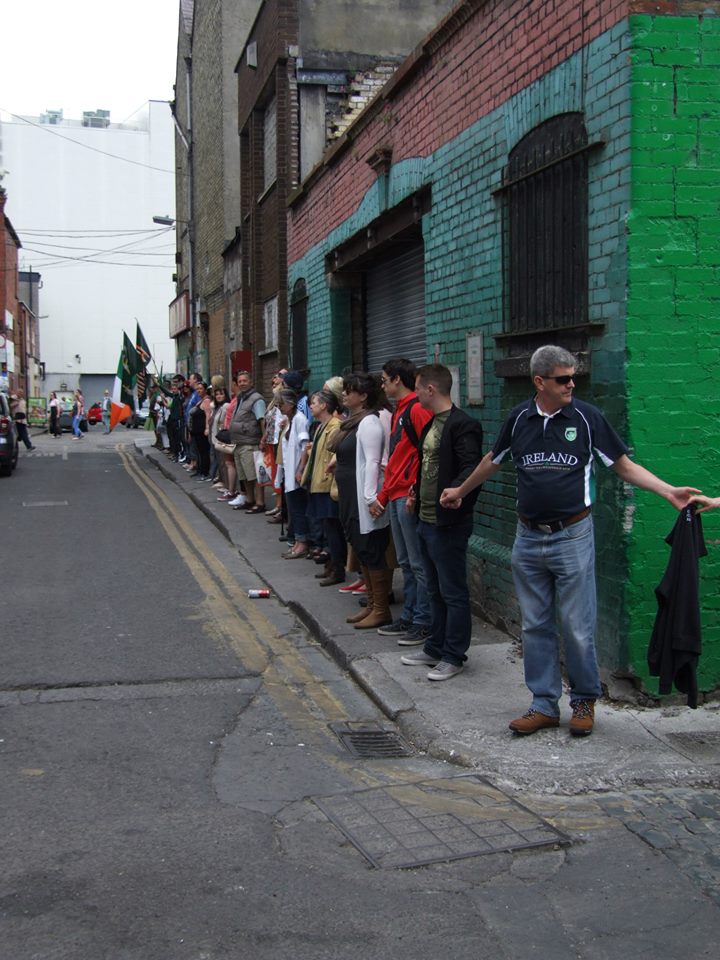
Supporters at the symbolic Arms Around Moore Street event organised by the Save Moore Street From Demolition campaign in June this year. This is the corner of Moore Lane and Henry Place, across which Volunteers had to run under machine-gun and rifle fire from Parnell Street (at the end of Moore Lane, to the right of the photo) and at least one Volunteer died here.
But I’m digressing, Minister, my apologies. Apparently the reason they want to save that shabby terrace, that “pre-Famine street” — and the backyards and surrounding lane-ways, if you please! — is for HISTORICAL reasons. Historical! Sure have we not had enough of history – Brehon Laws, Golden Age, Clontarf, Normans, 800 years of British occupation, blah, blah, blah! Weren’t we sick of it at school?
I’ve never liked Labour too much (somehow even the word sounds sweaty) but I have to admire their Education Ministry’s efforts to remove history as a subject from the compulsory school curriculum. I’m sure they’re doing it for their own reasons – after all, wasn’t their party founded by that communist James Connolly? Sorry, revealing my own knowledge of history there, ha, ha! But whatever their reasons, they are on the right track. Who wants to know where we are coming from? It’s where we ARE and where we are GOING TO, that matters!
But some people just can’t let it go, can they? They trail history around like something unpleasant stuck to a shoe. So what if 300 of the GPO garrison occupied that terrace in 1916? The Rising, if you ask me, was a big mistake and I know plenty of people agree with me, even if most don’t have the courage to say so. Wouldn’t we be much better off if we’d stayed in the UK? And kept the Sterling currency? And as for the War of Independence …. don’t get me started!
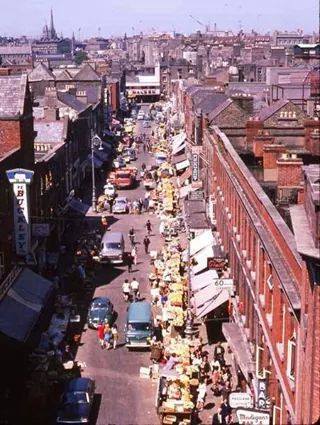
Aerial view Moore Street, looking northwards, 1960s, before the building of the ILAC and the running down of the street market.
And then there’s all that communist-sounding stuff about treating “all the children of the nation equally” — what kind of rubbish is that? Some are born to big houses with swimming pools and some are born to flats, or even rooms. That’s just the way of life. And some will claw their way up to get to own big houses and if they are a bit uncouth, well that can’t be helped, they still deserve where they get to. And their children at least will be taught how to fit into their new station. That’s democracy! But everyone equal? Please!
Sorry, back to the Moore Street controversy. OK, after the mob pressured the Government, four houses in the street were made a national monument. But was that enough for the mob? Oh, no, not at all — eight years later the State had to buy the four houses to satisfy them. Thankfully the specul ….. sorry, the developer, got back a good return on his investment – four million, wasn’t it? That’s the kind of thing that makes one proud to be Irish – buying run-down buildings and letting them run down more, then selling them for a million each. That’s your entrepreneur! If only we had more like that, to lift this country up!
I must say I really liked that developer’s plan to build a big shopping centre from O’Connell Street into the ILAC, knocking those old houses in Moore Street down (although I know he had to leave those “national monument” four houses still standing in the plans). I do hope whoever has bought the debt off NAMA and now owns those houses will carry on with that plan. Actually, I’d like the whole of O’Connell Street under glass if it were possible. Wouldn’t it be great to do your shopping from the north end of the street to the south and from left to right, without ever having to come out into the weather? Of course, not much shopping there now, with Clery’s closed …. still ….
And then they’re going on about the market ….. traditional street market …. blah, blah. What’s wrong with getting your veg and fruit from the supermarket? Or getting them to deliver it your house, come to that? “Traditional street market” my ar….. excuse me, I got carried away there. Those street markets are all very well for your Continentals, your Africans, Asians, Latin Americans and so on. Or for us to go wandering around in when we’re abroad on holiday, maybe. But back home? It’s the nice clean supermarkets for me any day.
Well now, if the mob insists on saving the street market, here’s an idea: why not provide a showcase stall or barrow, stacked with clean vegetables and polished fruit, right in the middle of the new shopping centre. After all, that’s heritage, isn’t it? And aren’t yourself the Minister for Heritage?
I WAS INVITED TO SING A COUPLE OF SONGS AT THE LAUNCH OF “OUR RISING – CABRA AND PHIBSBOROUGH IN 1916″. Of course I was honoured to accept; the songs I chose to sing were “Sergeant William Bailey” and “Where Is Our James Connolly?” I chose them as important to the events around the Irish Volunteers and hoped they would be considered appropriate to the book launch event also.
These years are the centenaries of many things in our history and it is right that we should remember them. Among those things we are told that we should remember the First World War. I think the people who say that are right – we should, but not in the way most of those people mean. We should remember that in a dispute about what markets of the world should be dominated by which World powers and which resources they should have a monopoly on stealing, they sent millions to their deaths and millions more to injury and tragedy. And of course, the capitalists, the class that controlled those Powers were not among those dead and injured millions.
When those people tell us that we should commemorate the First World War and collect songs and memorabilia they don’t mean that we should sing songs against the War, collect anti-War leaflets and honour those brave few who dared speak out publicly against the war stampede of their countries. And who paid the price for doing so. And yet those things too are the history of the War and to my mind the parts of that history that, among all the wars of the past and the present, hold out a hope for the future.
Peadar Kearney, author of “The Soldiers’ Song”, “Sgt. William Bailey” and many other songs
Peadar Kearney was an Irish Republican of a Dublin skilled working class background born not far from Phibsborough – in Dorset Street, around the corner from Inisfallen Parade, where Sean O’Casey was reared. When Kearney taught night classes in Irish, O’Casey would be one of his pupils.
Kearney wrote many songs that are still sung today, the most famous of which is the Soldiers’ Song, on which he cooperated with Patrick Heeney, from Railway Street, off Gardiner Street. When the Irish Volunteers was formed in 1913, Kearney was a co-founder and his song was one of a number sung by other Volunteers during the 1916 Rising, in which Kearney also fought.
Peadar Kearney also wrote a three-verse song mocking a recruiting sergeant for the British Army, who apparently had a pitch at Dunphy’s Corner. According to a local historian, that was outside what is now Doyle’s pub, at the Phibsboro crossroads. I added two verses to that song, in order to give Sergeant William Bailey a bit of a background story.
Of course, the 1916 Rising is a part of the history of the First World War too – and not only because it took place during that War. For some, undoubtedly, it was a case of “England’s difficulty is Ireland’s opportunity”. But for some others, including Connolly, as he made clear a number of times in writing, the Rising was necessary to interrupt the War, to stop the bloodshed of class brother killing class brother across Europe.
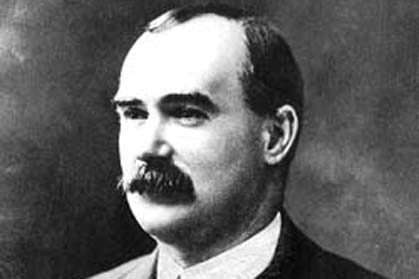
James Connolly, a revolutionary socialist, wanted revolution against world war
Connolly was a revolutionary socialist. At the end of the 19th and very early 20th Centuries, the standard position of the international socialist movement had been against imperialist or colonialist war. In 1912, on November 24–25, the congress of world socialist parties at Basel in Switzerland, including revolutionaries and reformists, had come out clearly against imperialist war. Their manifesto was unanimously adopted at the congress. In the context of the situation created by the war in the Balkans that had begun in October 1912 and the increasing threat of world war, the Basel Manifesto called called for an unrelenting struggle against war and those responsible for it, the ruling classes of the capitalist countries. It stated that that war, if it began, “would create an economic and political crisis,” which should be utilized to “hasten the downfall of the rule of capital.”
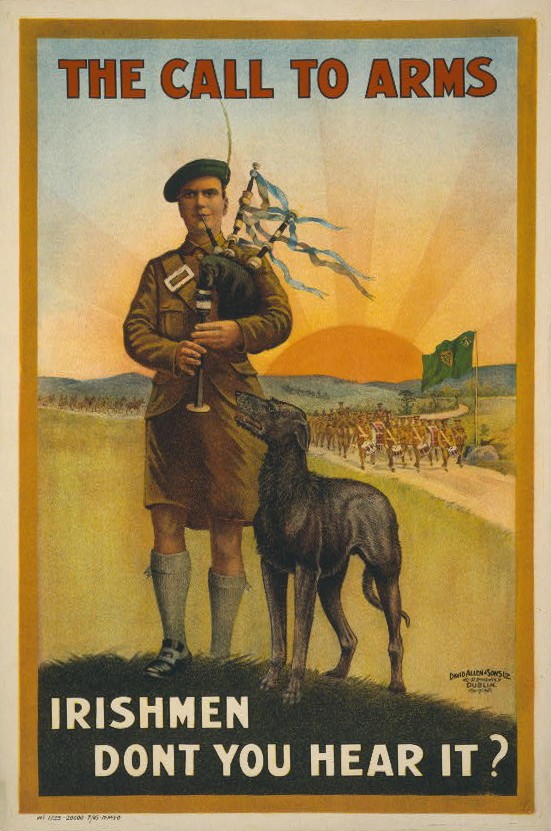
British Army recruitment poster aimed at Irish men
As we know, the leadership of those parties that we now call the social democrats abandoned this position completely and championed their own ruling classes two years later as WWI broke out, cheering the workers of their countries on into uniform, to kill and be killed. There were some uprisings against the capitalists and against war but the first of any significance — and indeed of great significance — was the 1916 Rising in Ireland. The next revolutionary blow to war would not be until be a year later, with revolution in the Russian Empire.
Of the two better-knowns songs about James Connolly, the song “Where Is Our James Connolly?” is I think the best and truer to Connolly’s ideology. It was written by Patrick Galvin who was, among other things a writer, playwright, screen writer and singer. Galvin died only four years ago. Christy Moore remembers learning the song around 1970 which is probably not long after it was written – or at least published.
Patrick Galvin, author of “Where Is Our James Connolly?”
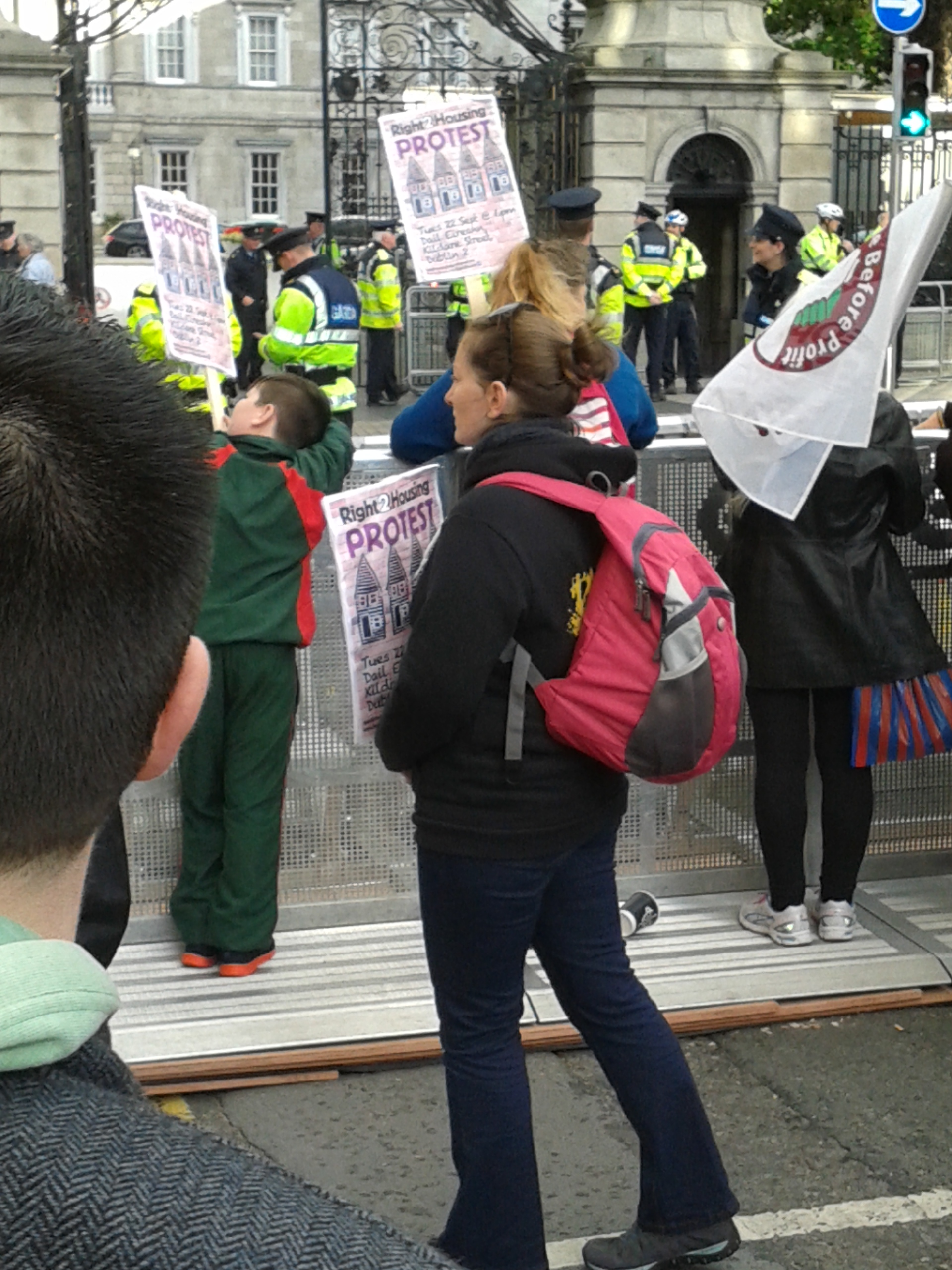
A few hundred people turned out to “welcome” the Irish Government Ministers and supporting TDs (elected members) back to the Dáil after the summer recess of the Irish parliament. The protesters were not allowed within fifty yards of the main gates, with lines of Gardaí, the Irish national police force, standing behind the special new double barriers which they now employ here. Kildare Street, the address of the Dáil, was closed by Gardaí to pedestrian and motor traffic and public transport buses using that street as part of their regular routes had to be re-routed.
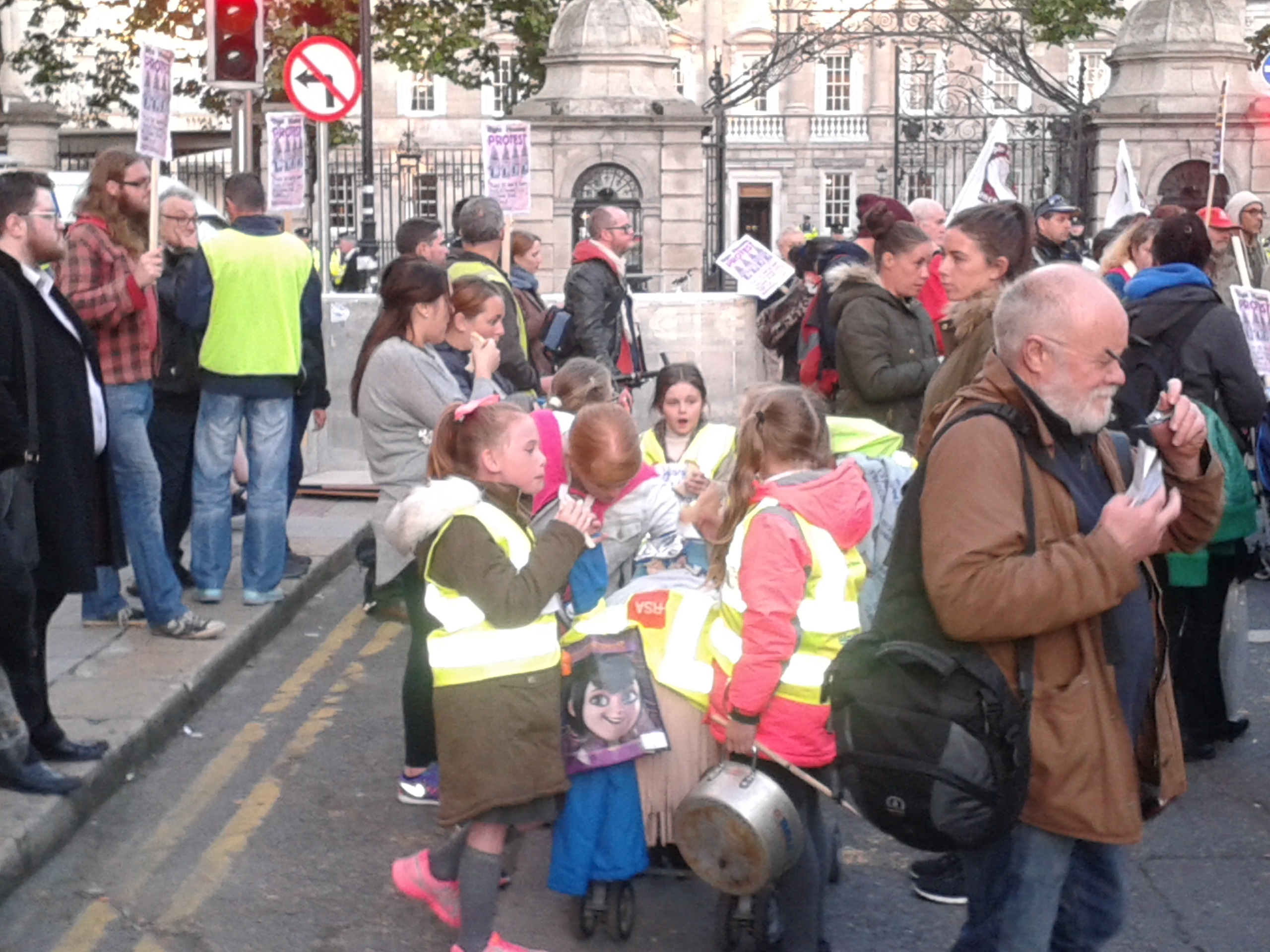
There was a special focus among many of the protesters on the housing crisis in Dublin with a number of organisations working with or campaigning for the homeless present and a number of placards drawing attention to the issue.
Some protesters had met at 4pm at the GPO in Dublin’s O’Connell Street and had marched to the Dáil from there, while others had arrived at the Dáil itself from 5pm onwards. There were others demonstrating too in Merrion Street, on the other side of the Dáil complex.
Around the other side, in Merrion Street, I met some protesters coming away from the protest there and stopped to talk to them. They informed me that it was ending there and I returned along Nasseau Street to Molesworth Street.
Among others, schoolchildren lean on the barrier which facing the Dáil, the Irish Parlia
When I started up Dawson Street I saw a small march coming down towards me. These were clearly the remainder of those who had been in Merrion Street earlier. Among this section were young mothers and some of their children had notes attached to their chests, for example “I am five and I am homeless”. I joined this group for the short walk remaining in Dawson Street and into Molesworth Street.
Speeches were still going on there and it seemed a musician or singer would have made a nice change – or even a comedian, or a juggler. After a short while the speeches ended and the crowd began to disperse, at which point I approached the women I had been told were homeless and spoke to one. Shortly after, I left to buy a cup of coffee and start an article about that homeless woman and her children.
NB: This article was written about the 11th October 2014 demonstration but arrived too late to use. Normally that would mean it just getting binned or at best getting mined for useful bits to put in a future article. However, the decision is to use this now in the run-up to the forthcoming demonstration at the end of this month against the water tax.
The size of the turnout for the anti-water charges demonstration in Dublin on Saturday 11th of October must have been something of a shock for the Irish ruling class and for their current government, the Fine Gael-Labour coalition. The implementation of water charges forms an important part of their programme to make the ordinary people pay for the crisis caused by financial and property speculators. Other parts of this programme that people have been experiencing to date over the last few years (and including the Fianna Fáil government preceding this one) have been bailing out the banks and their bondholders, financed first through the Household Charge and, after that was defeated by massive resistance, the Household Charge taxed through the Revenue Department; then the pension levy on public service workers; followed by the extensive cuts in social spending at the same time as implementing the “Social Charge”.
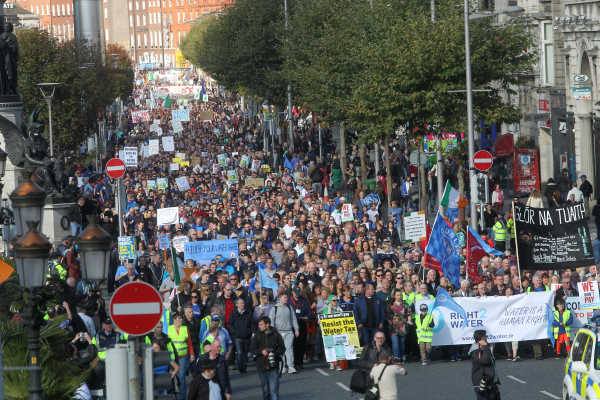
Marchers heading southward after leaving the Garden of Remembrance/ Parnell Square area (RTÉ tried to play down the figures to 30,000
The ruling class and their government are of course well aware that the water charge is unpopular among the vast majority of the population – supporters of the tax have failed to convince the people that it is anything but another way of “paying the bankers”. But the unpopularity of a measure is no guarantee whatsoever of wide-scale mobilisation against it and the Government was probably expecting the resistance to meter installation to remain local, marginal and uncoordinated. Clearly this was one case where “Ní mar a shíltear a bhítear”.
But the size of the demonstration surprised not only the ruling class and their government but also anti-water charge campaigners themselves. “I thought we’d be doing well to get 15,000” said one long-time community activist and “If we got 50,000, we thought it would be brilliant” according to an activist from one of the political groups active on this issue. A realistic estimate of the attendance at the demonstration on Saturday puts it at between 100,000 (as quoted by an unnamed Garda source to an Irish Times reporter) and 150,000. The march from the Garden of Remembrance heading across the river before turning again towards the GPO took over one-and-a-half hours to pass a fixed spot in O’Connell Street while another large number reportedly marched from another direction also toward the GPO.
So how was it that so many mobilised?
Any attempt to answer the first question must be speculative but there are a number of indications other than the widescale unpopularity of the water charge and any measure seen as “bailing out the bankers”. One of these is the highly-publicised police repression of local protests against meter installations in a number of Dublin areas, where the population is overwhelmingly working-class and lower-middle class. These protests and the police repression, completely ignored by the national mass media, however received widescale publicity through social media, with videos posted on Youtube, Facebook and Twitter. And the people sharing and sometimes posting these reports and images were for the most part not political or even community or trade union activists. Another source tapped was that of past mobilisations against the Household and Property Taxes. Much of the mobilisation took place in small to medium-sized communities where for the most part, unusually but according to my sources, the activists promoted the resistance and the demonstration rather than their own political party or organisation.
“Apart from a few political activists, only the middle-class mobilise through Facebook”, said long-time political activist to us about a year ago. “Who cares how many ‘Likes” on Facebook an event or campaign gets – it doesn’t mean anything!” said another. Rebel Breeze would have agreed with them too, knowing that the way to mobilise working class people was mostly through personal contact, door-to-door and workplace leafleting. But it seems that is no longer true and that working people, who previously used Facebook only socially, have now begun to use it politically too.
An aerial view down towards the rally after the march at GPO/ O’Connell St
Why did it surprise even the campaigners?
So much for how such a large number came to protest. But how is it that the campaigners themselves were taken by surprise? Of course there may have been unexpected mobilisations in some areas where campaigners had not been active but the main reason for their surprise is almost certainly their lack of coordination. Their are a number of Left organisation and “dissident” Republican organisations campaigning against the water charges, along with a large number of independent activists of a mainly political or community background. In some areas Sinn Féin activist have been out too, although the party does not advocate non-payment or prevention of meter installation.
In a united campaign where all the activists worked towards a united mass resistance, sharing information, the numbers would not have caught them so much by surprise. Of course, their expectations might have been exceeded but each group would have been aware of the actions in other groups’ areas along with the massive rise in Facebook hits, “Likes” and “Shares” to postings of resistance and police repression. Such a united campaign against the water charge does not yet exist. A previous attempt to float such a united campaign on the Household and Water Charges foundered on a number of rocks – political party opportunism, social democratic illusions and the failure of the traditional Left to engage with the independent activist constituency and the “dissident” Republican movement probably being the main ones.
There are a number of attempts to portray the active resistance to the Water Charge as spontaneous but it is likely that where there have been no campaigners active locally, the people have responded to what they have seen elsewhere, both through anger and encouragement. On the other hand, any attempt by any group or individual to take the credit for the growing resistance or for the mass attendance at the demonstration would have to be laughable.
The “passive Irish” jibe refuted once again
Rebel Breeze has long been tired of the wailing often heard to the effect that “the Irish are not like the Greeks”, or that the Irish are passive, accept all kinds of shit without resistance, etc. etc. With the history of class and national struggle of the people of this island it is extraordinary that such an notion ever gained wide acceptance among commentators – but it did. The Irish working class has generally responded militantly and enthusiastically when they have been called to battle by what they consider a credible leadership. In Ireland, that leadership was the trade union movement and no other. In 1913 a fighting trade union was forged in Ireland and, when the employers tried to break it, the workers of Dublin (mostly) fought that attempt for up to eight months, in a city of wide-spread poverty and with most charity services discriminating against strikers and their families. In that struggle, the workers faced also the hostility of the media and state (not much has changed there) and of the main churches. Although defeated in that struggle, the union did not break and came back years later stronger than ever.
Deprived of revolutionary and militant leadership, the movement nevertheless maintained a fighting front for workers through decades of high unemployment and emigration. But in the mid-1980s the trade union leadership opted for what they called “social partnership”, an arrangement in which employers, trade union leadership and the State (which is also a huge employer) sat down and agreed the salary levels for the next period. This had a disastrous impact on the trade union movement. “Use it or lose it” is a general physiological rule about muscle : the trade union leadership became unused to strike action and, when strikes did occur, to instructing members of unions not directly involved to pass the pickets. Recruitment fell dramatically and, when in 2010 the employers and State no longer saw any point in negotiating with the trade union leadership, as they believed the leadership to be no longer capable of resistance, the latter lacked the spirit and confidence to take them on. After a demonstration called by ICTU with a threat of a general strike days away, which received a massive response from trade union members, the leadership instead opted for more negotiations, in which they agree to the pension levy on public servant workers and industrial peace in the private sector: Croke Park I (June 2010). So the workers no longer have a leadership they consider credible and the revolutionary and radical socialist organisations are too small to be thought credible and also have not generally built bases within the trade union movement from which to offer a leadership for struggle.
Nevertheless, the working people of Ireland turned out in huge numbers once again on Saturday to protest an unjust tax which is being used for an unjustifiable purpose. The class is still there, it never lost its fighting spirit – what it needs is a viable leadership. It remains to be seen whether this will be built and whether it can lead a broad militant movement against this tax and other attacks on the working class, without repeating the errors of the recent ‘broad movements’.
COURT HEARS OF INTIMIDATION OF FAMILIES OF ACTIVISTS BY GARDAÍ AND SHELL SECURITY MEN WEARING BALACLAVAS
By Pat Cannon
I was present in Castlebar court house for most of the ten-days of the trial of Gerry Bourke and Liam Heffernan who are Shell To Sea supporters and activists. I witnessed at firsthand how tax-payers’ money can be wasted at will by the agents of the state i.e. Gárdaí (the Irish police), State solicitors, the Dept. Of Public Prosecution, the Judge, court officials, State barristers and other hangers-on.
Numbers involved:
( 1 ) Judge ( 1 ) courtroom user ( 2 ) Stenographers ( 1 ) Prison officer; ( 1 ) Gárda on video evidence ( 2 ) State Solicitors ( 1 ) Senior Counsel for the State ( 1 ) Junior Counsel for the State; ( 2 ) Solicitors for the Defence ( 2 ) Senior Counsel for the Defense ( 2 ) Junior Counsel for the Defence; ( 12 ) Jurors ( 12 ) witnesses at least. Also the secretarial staff of all parties, including the DPP Office staff working on the case, also the cleaners and the other Court staff.
First of all if the State and the oil companies had initially negotiated with the locals, probably there would have been no need for these quiet citizens to have to rise up in protest against this project. A much safer and easier route for the pipe line would have been found as the locals have an extensive knowledge of this area. If the state (and its Government) had negotiated a reasonable deal with oil companies then there would be much less protestors. If proper health and safety regulations backed up by staff and equipment were in place from the start, people would feel much safer and secure in their homes. BUT NO! THE SHARKS DON’T NEGOTIATE — there is no room for compromise in a shark’s make-up.
SHARKS
Right from the start, the Government, the oil companies, the Environmental Protection Agency, County Council, media, Judiciary, Gárdaí and every other arm of the State treated the local people with disregard, contempt and as a complete irrelevance. As far as all the above-mentioned were concerned there was big money to be had and no small fry was going to get in the way. THERE WAS BLOOD IN THE WATER AND THE SHARKS WERE IN FOR THE KILL.
Thankfully there were 2,500 years of tradition and history still alive and well in this area, there was a quiet shy population but of people with a strong backbone that were well hardened into hardship, neglect and resistance to outside dictatorship and who were not going to be bullied or pushed about by anybody.
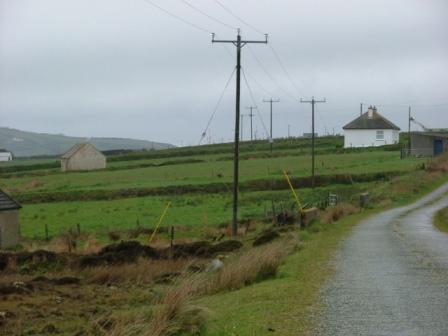
The rural area chosen by Shell for the pipe-laying (planned to run between shed on the left of photo and house on the right)
It was this stern backbone that caused a middle-aged primary school Principal teacher and her two daughters, backed up by less than a half-dozen other locals to take a stand and start protesting against the potential desecration of this EU Environmentally Protected Area and their local pristine environment. Of course they were ignored, the media never mentioned them; the oil company’s employees and officials looked the other way and probably had a good laugh as they passed, the Council and all the other arms of the State treated them as non-entities. As far as all these groups were concerned the local people were of no significance.
However, the time came when these officials had to get into closer proximity with the local people; they had to enter the local people’s land and they thought they could do this without permission, by bullying and using threats but soon discovered how mistaken they were. They learned that they were not just dealing with a few individuals or a few head cases but instead that there was a whole community in this locality and that this community was close-knit and resolute in their opposition to outside intimidation and coercion.
With little or no advance warning the oil companies’ employees entered the farmland of six local farmers without the owners’ consent and proceeded to dig trial holes, knock down boundary fences and block access to and from the land in question. Naturally enough the farmers contacted their legal advocates and very quickly they were in court for the first time in their lives.
Of course the Courts and Judiciary are also an arm of the State and are also commercial enterprises just like the oil companyies and they ruled in favour of the foreign multi-national companies. After all small local marshland farmers can’t afford to give big financial enticements to Court judges, politicians and Government officials but on the other hand the oil company will be very generous as has transpired since.
JAILING OF THE ROSSPORT FIVE
The six farmers, five men and one woman were found in “contempt of court” and the five men were jailed until they “purged their contempt”. This lead to an outcry all over the country and hundreds of thousands of people came to the assistance of what became known as “the Rossport Five”. Ninety-four days later the Courts had to capitulate and release all of the five innocent men.
However the scene was set for what would become a marathon David and Goliath battle between a small close-knit indigenous rural Irish community and three foreign multinational oil companies, one of which had a larger turnover than that of the whole Irish State even though the latter was experiencing an unprecedented economic boom.
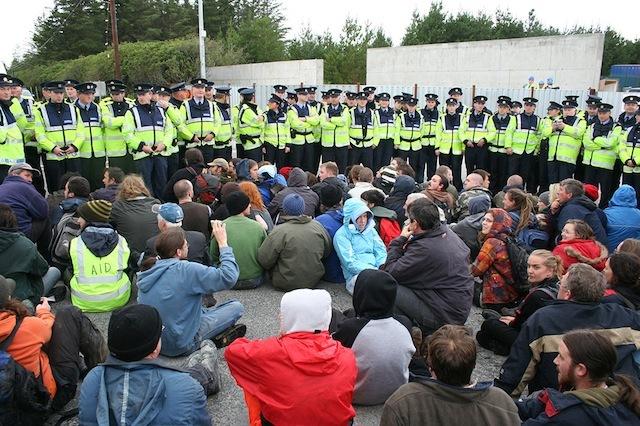
Gardai defending Shell confront protesters
Thirteen years after the middle-aged school teacher and a handful of supporters stood outside the local council offices in protest the struggle is still going on and the oil companies and Irish Government are still trying to bully their way through the Irish people.
However, the Government’s economic boom has disappeared and the people now realize that if they still had their oil and gas that was fraudulently misappropriated by the Irish Government and the oil companies, we would have NO EVICTIONS, NO CENTENARIANS ON HOSPITAL TROLLIES, NO EMIGRATION, NO UNEMPLOYMENT AND NO STEALTH TAXES.
IN THE COURT RECENTLY
So in these last two weeks I witnessed the State trying to criminalise two more supporters of the struggle; we saw video evidence showing that the men had to use considerable force to gain entry to Shell’s site and when confronted by Shell’s private army (security force) the protestors had to stand firm and use a variety of tactics to get past them. We heard State witness after State witness tell lie after lie or refuse to answer or evade answering questions when they were put in the witness box, then the Defence were not allowed show their video evidence and some of their witness were not allowed on the stand.
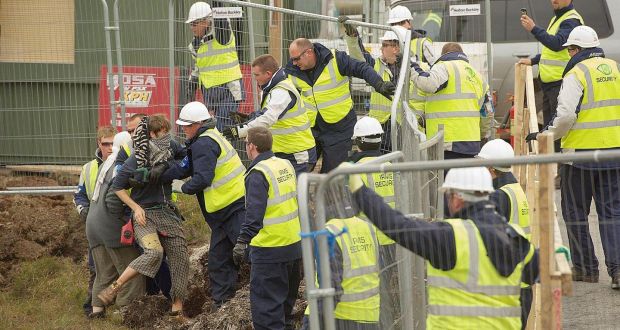
Shell security team manhandle a protester.
I heard how Shell’s private army drive around the villages at night in two jeeps with blacked-out windows and shine their lights through the windows of activists’ homes, whilst if anybody comes out of the houses then four men wearing balaclavas step out of each jeep in an act of intimidation. We heard how the Gárdaí constantly drive past the people’s homes very slowly and then turn around a mile or two up the road just to drive past again five minutes later and hjow each time they pass, they stare into activists’ homes.
I heard how the Gárdaí punched, pushed, kicked and beat with steel batons men, women and children, how many activists spent long terms in prison on trumped-up charges while Shell plied the Gárdaí with over €35,000 worth of alcohol. I also heard how a Gárda made derogatory remarks of a sexual nature about a protestor’s wife to the protestor and how five Gárda were unwittingly recorded on a female prisoner’s video camera planning how they would interrogate her when they got her to the Garda station by threatening to rape her and laughing at the different ways they would word the threat. ALL of them got away with ALL these misconduct events.
Gardai caught on camera in action at Rossport
I heard how while car tyre contains on average 2 bars of air pressure per square inch, that this gas pipe had 345 bars of highly inflammable gas pressure per square inch, that the seas and sea bed are highly vulnerable to currents (the second most volatile currents in the World).
I also heard the accused man’s wife state how for 13 years while she was rearing her family she could think of nothing from once she got up in the morning till she fell asleep at night but this dangerous gas pipe line that would be practically going by their front door and over which she had to take her children to school every day.
In a statement to the Court, one of the Rossport 5 gave evidence that Michael D. Higgins (now Uachtarán of the Irish state) had been on the protest and had addressed the other protesters, also participated had the father of the State Solicitor prosecuting this case. He also said that Enda Kenny had visited the Five in prison and had told them that life was “very cheap in Ireland now” and that “you can get a man in Dublin to do a ‘hit’ on someone for €500.”
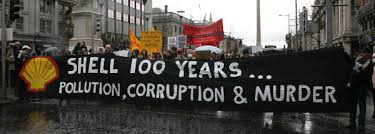
Protesters against Shell in Dublin
In his summing–up the Defence counsel stated that the State agencies had rubbished themselves in the eyes of the world in their dealing with the situation, that the terms that our oil was given away were the second best in the world for the oil companies, that they stated that there were no emergency plan in place if an accident or act of terror did happen and that the protestors had rendered a magnificent service to their fellow citizens at much expense and hardship to themselves by standing up for what is right and correct.
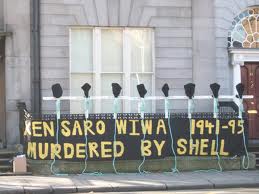
Protest at Shell HQ in Leeson St, Dublin in solidarity with Ogoni people in Nigeria and people at Rossport. The Nigerian Government, to protect Shell’s profits although the company was causing great environmental damage, hanged the nine leaders of the peaceful environmental movement
The Jury of eight women and four men was out for just about one hour when they returned with a unanimous verdict of “NOT GUILTY of violent disorder” on both Liam Heffernan and Gerry Bourke. A further malicious charge of “criminal damage” was dropped by the State because despite there having been 28 cameras on site and up to 30 security men and later a number of Gárdaí, there was no evidence to support the charge.
Just more waste of tax-payers’ money. I have reckoned the tab that the tax-payer will pick up will be in the region of €150,000 and Shell won’t be paying a penny of it.
“In conclusion, it seems clear that both states in Ireland, the Irish one and the British colonial one, are employing refusal of bail and restrictive bail conditions in order to harass and intimidate political activists and to seriously disrupt their work.”
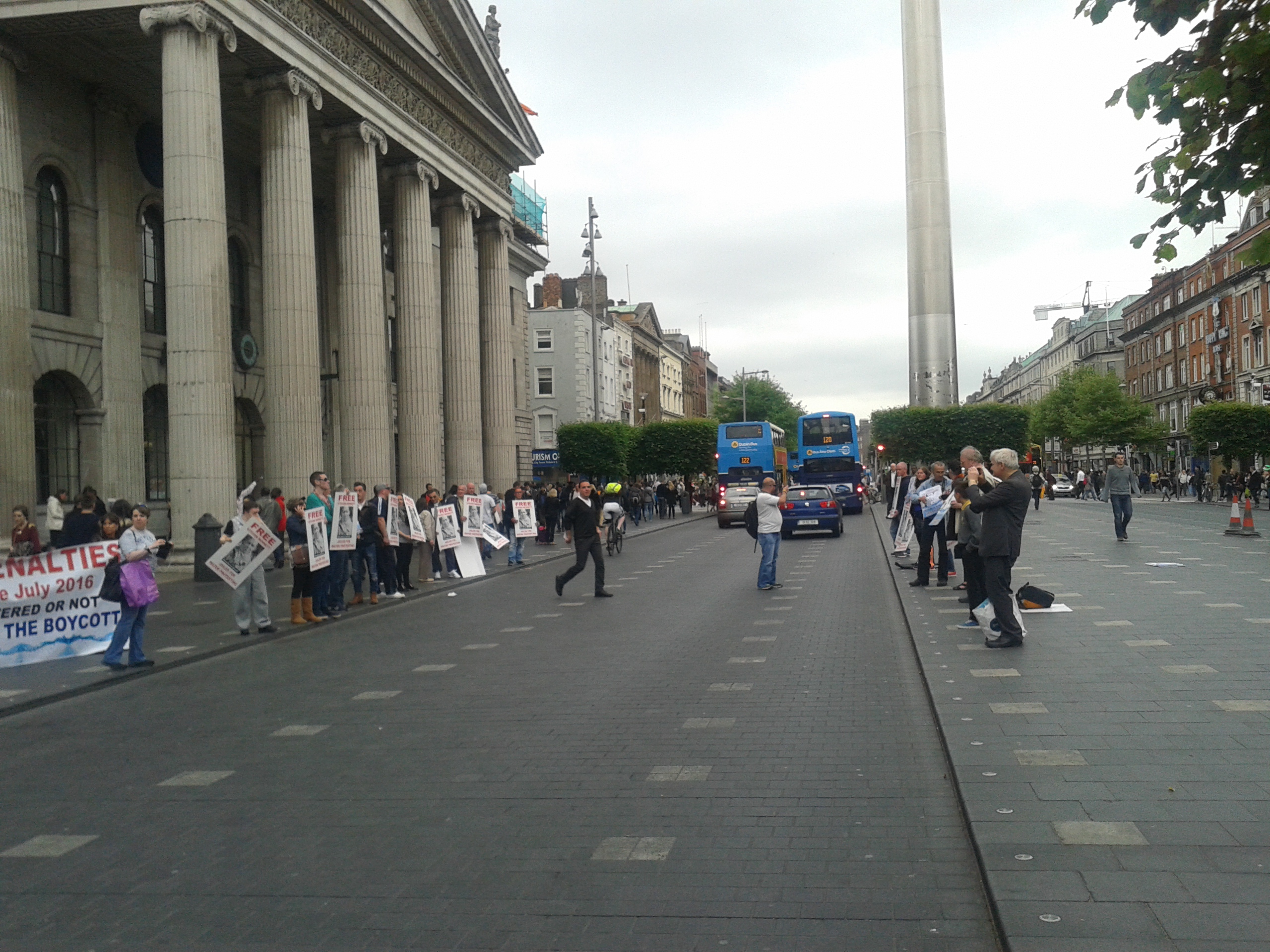
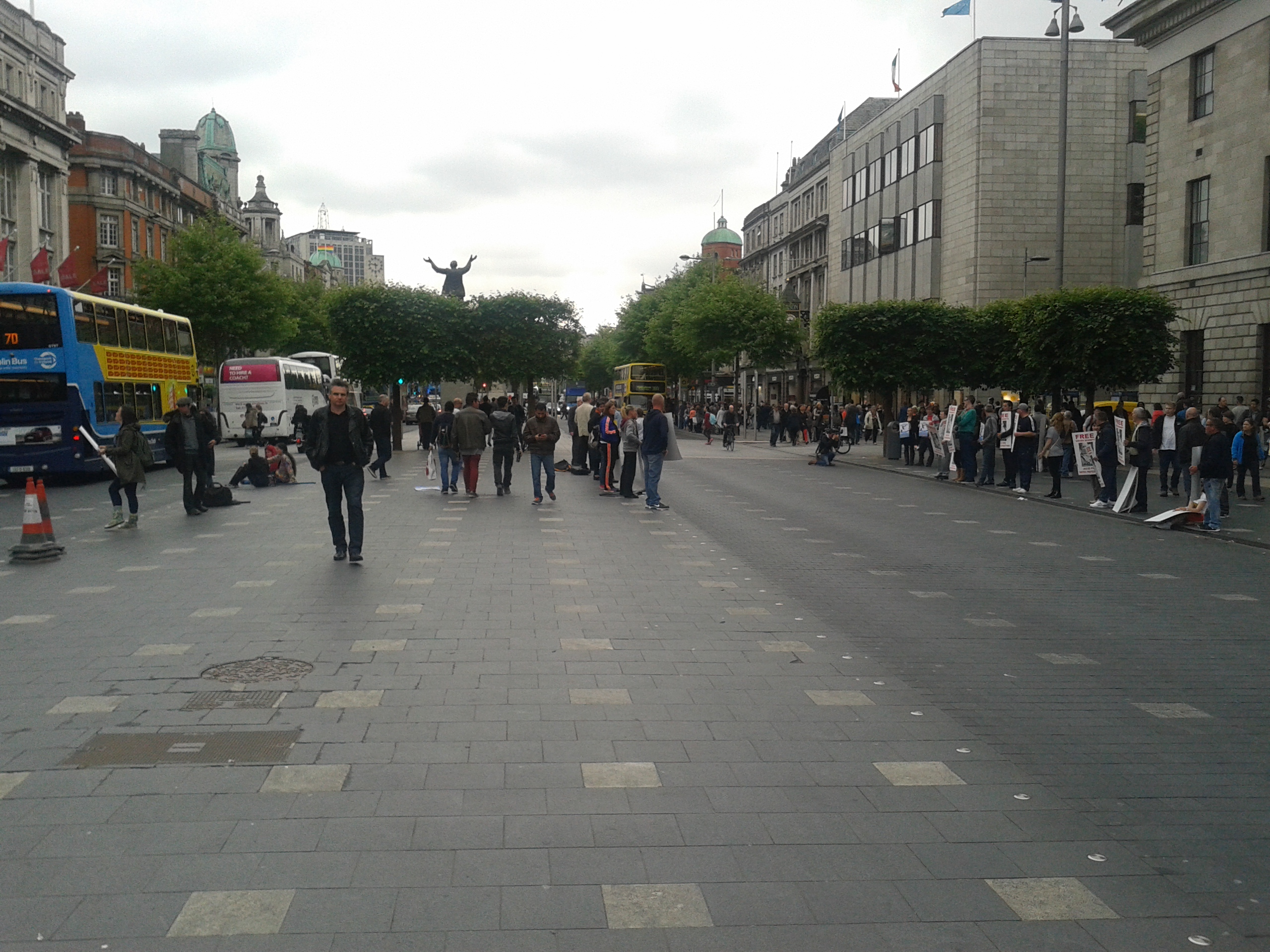
In excess of 50 Demonstrators formed three lines in Dublin’s O’Connell Street on Friday (19th June) to protest the continued incarceration of Steven Bennet, a political activist arrested while peacefully resisting the installation of water meters. Bennet was arrested on two consecutive nights – in the York Road area of Dun Laoghaire and in Bray – and on each occasion he was kept in custody overnight despite the Gardai knowing his address and where he could be contacted and despite the suggested charges not being particularly serious. Brought to court then, he was offered bail if he could provide a €1,000 surety, would submit to a nightly curfew between the hours of 10pm and 8.00am, would sign at a police station daily and would refrain from participation in political activity. A previous High Court ruling that his bail conditions should not interfere with his political activism was thereby changed by the same Court. Stating that these conditions were unreasonable, he refused and has been in jail now for nearly four weeks.
Protesters in Dublin outside GPO demand freeing of Steven Bennet (view northward excluding some on west side of central island)
The Irish Government has imposed a Water Tax on the population of the state although they pay for the maintenance of the public water system already through their taxes (and bizarrely, it was recently revealed, through their Motor Tax also). The Water Tax is extremely unpopular in Ireland and has given rise to huge national demonstrations as well as to local resistance and to the most widescale movement of civil disobedience since the resistance to the Household Tax a few years ago. Most people believe these new taxes are a means of funding the banking bailout and also that the public water service is being prepared for privatisation (a likely benificiary being Denis O’Brien, part-owner of the company currently installing the meters and among the 200 top world billionaires).
Banner and demonstrators protesting jailing of Steven Bennet (photo Vivienne)
Some of the local resistance involves blocking the road to the water meter trucks or, more usually, walking slowly in front of them to slow down their work. People have also interposed their bodies between the meter installation crews and the spot where they intend to drill into the pavement in order to install the meters.
(photo Vivienne)
We should ask ourselves and interrogate the State about why it wishes to impose these restrictions on an arrested political activist. Keeping someone in custody is a serious step in any democratic system. If they have not been convicted, the step is even more serious. Let us not forget that the legal system claims that any accused is presumed innocent until that changes by being found guilty in court. Keeping an innocent person in jail is supposed to be an extreme step, justified only by one or both of the following circumstances:
The accused is thought to be
a serious risk of flight from the jurisdiction before trial
a risk of interfering with witnesses expected to testify against him/her at trial
The “seriousness of the crime” is sometimes raised but that seems related to the “risk of flight”, i.e that the accused might contemplate fleeing the jurisdiction because of the likely seriousness of the punishment if s/he were to be convicted.
As observed earlier, the default position should be that bail is granted.
(photo Vivienne)
Conditions of bail
Conditions of bail are usually that the accused reside at an address supplied to the court – this relates to the defendant being found if required by the State. The accused may be released in his or her “own recognizance”, i.e without any sum being set.
Where sums of money are required to be placed as a surety for bail, these seem again to be related to “risk of flight” — in other words, the accused is thought less likely to flee if it will cost money to the accused or to the person guaranteeing the bail.
The justification for requiring a person to report at a police station every day at a certain time also seems also to have been conceived with regard to risk of flight – it is hard to see what other justification there could be for this. But in fact this makes no sense, since one can present at a police station at eight or nine pm (a frequent time given) but yet be out of the jurisdiction by midnight (in the case no curfew) or by 12 noon when there is a curfew imposed. One supposes it does permit the police to issue a warrant for arrest should the accused fail to sign in at 8pm or 9pm the next evening but that can hardly be a great advantage.
A curfew is sometimes imposed and it is difficult to see the justification for that either, unless it too is related to fear of the accused absconding from the jurisdiction but the same reservations apply to that as to the signing on at the police station requirement.
When these conditions and restrictions are imposed on political activists on charges which normally attract only fines if the accused were found guilty and only very short prison terms in worst case scenarios, what can the justification be? As a rule the accused is still politically active, highly visible to the police and without a history of absconding from the jurisdiction (in fact, often a history of the exact opposite, as in Bennet’s case). The witnesses against the activist are normally the Gardaí, who are supposed to be impervious to “interference” and even when they are others, there is usually no allegation of a fear that the accused is going to intimidate them).
It seems clear that the real reason for these restrictions and conditions are
to disrupt the life of the accused and thereby make him/ her pay a price whether or not s/he is later convicted in court
to disrupt the political life of the accused (interfering with organising, traveling, etc.)
to make it difficult for the accused to get bail (in the case of financial sureties), in which case
to make the accused suffer imprisonment for a period (through refusal of bail or through setting difficult and unreasonable conditions) even though perhaps not convicted later or, if convicted, not receiving a custodial sentence
to discourage others from following in the footsteps of the accused.
Increasingly, particularly in the case of Irish Republicans in the Six Counties, another requirement imposed has been to wear an electronic “tag” or bracelet which may not be removed until the State orders that done. This is usually explained as merely an enforcement of the above conditions but is a physical reminder, every minute of every day, a demeaning intrusion into one’s life.
Three lines of protesters in front of GPO, Dublin’s O’Connell Street (view southward), seeking freeing of Steven Bennet (Jim Larkin statue just visible in the background).
Also in the Six Counties, Irish Republicans on bail are being banned from use of the Internet, from having a mobile phone or, in the case where they are permitted one, being required to supply to the State the phone numbers dialed. Yet another condition has been not to reside within one’s own home town. Very common has been the requirement not to be in the company of others “convicted of terrorism” (if so, have they not served their time?) or merely “suspected of terrorism” (how would one know? The State will tell you!). In the Six Counties in particular, with its history of 30 years of war and subsequent political dissent from the Good Friday Agreement, not associating with anyone who has at some time been convicted of “terrorism” or is currently “suspected” of it, must be seriously difficult.
Apart from the restrictions on one’s personal freedom imposed by the above conditions, these are a massive interference with the facilities of a political organiser and there seems not even a pretence of any other justification for them. They are therefore unwarranted abuses of people’s civil liberties.
In conclusion, it seems clear that both states in Ireland, the Irish one and the British colonial one, are employing refusal of bail and restrictive bail conditions in order to harass and intimidate political activists and to seriously disrupt their work.
Accept the conditions?
Steven Bennet is currently refusing to accept the unreasonable restrictions being required of him in order to avail of bail. In the past, particularly in the Six Counties, others have done so too. One example there was Stephen Murney, of the Éirigi republican party, who was expected to agree to curfew, daily signing at a police station, electronic bracelet, not to reside in his home town of Newry or to approach within five miles of it and not to attend any political events. He refused to accept those conditions for 14 months and eventually was released on bail without the conditions shortly before his trial – at which he was found “not guilty”, which was no surprise since the charges were completely spurious. But Murney had already spent 14 months in jail.
Irish Republican Stephen Murney happy to be out on bail as his trial collapsed — but he had still done 14 months in custody before that.
In recent months, there seems to be a trend of people accepting the conditions in order to receive bail; this includes Republicans in the Six Counties and other water-meter protesters in Dun Laoghaire (on whom a variety of restrictions are being reported). Such acceptance represents in the short term a small victory for the State and in the longer term a significant defeat for civil liberties and the political opposition to the states.
One can hardly blame the activists who have accepted these conditions. The liberal civil liberties sector is silent on what is happening, as is largely the case with the organised Irish Left. When it seems that continued opposition to the bail restrictions can achieve no political objective due to lack of wide-scale protest, and one may be facing long months or even years in prison awaiting trial as a result of refusal, there seems little reason to continue the refusal to accept these restrictions.
Of course, these attacks are taking place on what the Left and liberal civil liberties sectors may see as the “fringes” — the Republicans and some unorthodox anti-water-meter protesters. Have we not learned the lessons of history? The attacks of fascism and the repressive State nearly always start at the “fringes”, from which they move in towards the core. Our silence on this now is in reality an assent to the State — “Go ahead if you like,” is the message the State is receiving, “we’re not going to do anything”. Unless the State goes for the core, of course. But will there be anyone left to mount a decent resistance when we finally decide we should?
Rebel Breeze: This piece was received months ago but somehow got overlooked for which we apologise. Events since then make the points in this short document perhaps even more relevant.
Red Roja describes itself as “a revolutionary marxist organisation active within the Spanish state”. It states that it is “an autonomous organisation independent of any other party or organisation and also economically and politically independent of the State or of any other power, being anticapitalist, of the class, feminist, radically democratic, internationalist, anti-fascist and ecologist.”
(Translation D.Breatnach from http://redroja.net/index.php/que-es-red-roja/quienes-somos)
In Spain, ‘The people should rule — that would be Dignity’
The following is a statement of the organization Red Network in Spain to the Dignity marches of March 21, a year after a similar march brought 1.5 million people to Madrid to protest austerity measures.
On March 22, 2014, more than a million people from all over the Spanish state
marched in Madrid for ‘Dignity’ against austerity
We once again demand that those who caused the crisis be made to pay for it.
An unpayable debt is crushing us, we who suffer every day from unbearable job insecurity, dismantling and privatization of health and education, increasing retirement age, the disappearance of aid for dependents, and our millions of unemployed people who are worth less than nothing to those in power. … The austerity measures and cuts are only being used to pay for a debt created to rescue the gang of bankers, big business people and their servants in the National Assembly, who are playing chess with our lives. Besides using our suffering to line their pockets, they expect us to hang our heads and die in silence. That we refuse to do.
Regarding this, we are nowhere near satisfied with hearing only about “restructuring” or “audits” of that debt. We cannot stop at half-measures when our lives are at stake, when there can be no doubt that this debt is responsible for the criminal foreclosures, the endless unemployment and for the disappearance of even the modest steps taken against domestic violence that condemns many women to terror, suffering and death. It is not a technical problem to say, “NO DEBT PAYMENT.” It is a punch that the people can throw to demand control of their own lives.
In these times, it is understandable that there are illusions that an election can bring “victory,” that we can “throw out the PP” [the rightist Popular Party] or “get rid of the wealthy strata.” But more is needed. No one involved in the new electoral initiatives is speaking about the national and European laws that impose the payment of that illegitimate and criminal debt before anything else. Good will is not enough; neither is honesty. Proof of this is the victory of Syriza in Greece, which has not pushed back by even one step the measures the Troika [the European Commission, the International Monetary Fund and the European Central Bank] had taken against the Greek people. It has become clear who rules Greece: It’s the EU dictatorship. Democracy is an illusion.
Moreover, even this demonstration, though necessary, is insufficient. It is not enough to come together to demand “Bread, Work and Housing” (things that would only be possible after we refuse to pay the debt), or to have a great demonstration of dignity. As seen in Greece and as we see every day in our streets, bankers and big business are not going to give up lining their pockets out of good will.
We need to unite, to organize neighborhoods, towns, businesses and schools, and strike a blow together, all at one time. Only through the unification of our struggles, only if the people who are working and suffering get organized, can we bring about policies that work in our own favor.
The vote is not enough. The people need to organize. The people need to rule.
Politics is about the present and the future, obviously … but it is also about the past.
Different political interests interpret and/or represent the past in different ways, emphasising or understating different events or aspects or even ignoring or suppressing them entirely. There is choice exercised in whom (and even what particular pronouncement) to quote and upon what other material to rely. And by “political interests” I mean not only groups, formal (such as political parties) or informal, but also individuals. Each individual is political in some way, having opinions about some aspects of questions that are political or at least partly-political. For example, one often hears individuals say today that they have no interest in politics, yet express strong opinions of one kind or another about the right to gay and lesbian marriage, the influence of the Catholic Church, and how the country is being run by Governments.
So when an individual writes a history book, there are going to be political interpretations, although not all writers admit to their political position, their prejudices or leanings, in advance or even in the course of their writing. One historian who does so is Padraig Yeates, author of a number of historical books: Lockout –Dublin 1913 (a work unlikely to be ever equalled on the subject of the title), A City In Wartime — 1914-1919, A City in Turmoil – 1919-1921and his latest, A City in Civil War – Dublin 1921-’24. The latter was launched on Tuesday of this week, 12th May and therefore much too early for people for who did not receive an earlier copy to review it. So it is not on the book that I am commenting here but rather on the speeches during the launch, which were laden with overtly political references to the past and to the present. If a review is what you wanted, this would be an appropriate moment to stop reading and exit – and no hard feelings.
The launch had originally been intended to take place at the new address at 17 D’Olier Street, D2, of Books Upstairs. However the interest indicated in attending was so great that Padraig Yeates, realising that the venue was going to be too small, went searching for a larger one. Having regard to how short a time he then had to find one and with his SIPTU connections, Liberty Hall would have been an obvious choice. Whether he had earlier been asked to speak at the launch I do not know but, having approached Jack O’Connor personally to obtain the use of Liberty Hall, in the latter’s role of President of SIPTU, the owners of that much-underused theatre building, it was inevitable too that O’Connor would be asked to speak and act as the MC for the event.
O’Connor’s introduction was perhaps of medium length as these things go. He talked about the author’s work in trade unions, as a journalist and as an author of books about history. O’Connor’s speech however contained much political comment. Speaking of the period of the Civil War (1919-1923), he said it had “formed what we have become as a people”. That is a statement which is of dubious accuracy or, at very least, is open to a number of conflicting interpretations. The Civil War, in which the colonialism-compromising Irish capitalist class defeated the anti-colonial elements of the nationalist or republican movement, formed what the State has become – not the people. The distinction between State and People is an essential one in our history and no less so in Ireland today.
Talking about the State that had been created in 1921 (and not mentioning once the creation of the other statelet, the Six Counties) and referring to the fact that alone among European nations, our population had not risen during most of the 20th Century and remained lower than it had been up to nearly the mid-Nineteenth, a state of affairs due to constant emigration, O’Connor laid the blame on the 26-County State and in passing, on the capitalist class which it served. He was undoubtedly correct in blaming the State for its failure to create an economic and social environment which would stop or slow down the rate of emigration – but he did not explain why it was in the interests of the capitalists ruling the state to do so. Nor did he refer to the cause of the original drastic reduction in Ireland’s population and the start of a tradition of emigration – the Great Hunger 1845-’49.
The Great Hunger memorial on Dublin’s Custom House Quay. The Great Hunger and its immediate aftermath initiated mass Irish emigration.
Even allowing for the fact that O’Connor wished to focus on the responsibility of the 26-County State, the Great Hunger was surely worthy of some mention in the context of Irish population decline. Just a little eastward along the docks from Liberty Hall is the memorial to that start of mass Irish emigration. It was the colonial oppression of the Irish people which had created the conditions in which the organism Phytophthora infestans could create such devastation, such that in much less than a decade, Ireland lost between 20% and 25% of its population, due to death by starvation and attendant disease and due also to emigration (not forgetting that many people emigrating died prematurely too, on the journey, upon reaching their destination and subsequently). Phytophthora devastated potato crops in the USA in 1843 and spread throughout Europe thereafter, without however causing such a human disaster as it did in Ireland. In Mitchell’s famous words: “The Almighty, indeed, sent the potato blight, but the English created the famine.” And that is what makes that period of population decline uncomfortable for some historical commentators.
Indeed, O’Connor did not mention British colonialism once, nor Partition, nor imperialism. And nor did either of the other two speakers, nor the author. I remarked on this to an Irish Republican present, to which he responded with a rhetorical question: “Did you expect them to?” Well, yes, perhaps naively, I did. While not expecting an Irish Republican analysis from Padraig Yeates and perhaps not either from anyone he would consider appropriate to speak at the launch of one of his books, dammit, we are talking about history. The presence of Norman/English/British Colonialism for 800 years prior to the creation of the Irish Free State, and its influence on that state’s creation and on subsequent events in Ireland, is worthy of at least a mention in launching a book about the Civil War. Not to mention its continuing occupation of one-fifth of the nation’s territory.
Colonialism and Imperialism and, in particular, the Irish experience of the British variant, were not so much ‘the elephant in the room‘ at the launch as a veritable herd of pachyderms. They overshadowed us at the launch and crowded around us, we could hear them breathing and smell their urine and excreta – but no-one mentioned them. The date of the launch was the anniversary of the execution of James Connolly 99 years ago, a man whom the Labour Party claims as its founder (correctly historically, if not politically), a former General Secretary of the ITGWU, forerunner of SIPTU and the HQ building of which, Liberty Hall, was a forerunner too of the very building in which the launch was taking place. His name and the anniversary was referred to once, though not by O’Connor, without a mention of Sean Mac Diarmada, executed in the same place on the same day. And most significantly of all, no mention of who had Connolly shot and under which authority.
That circumspection, that avoidance, meant that a leader of Dublin capitalists, William Martin Murphy, could not be mentioned with regard to Connolly’s death either — i.e. his post-Rising editorial in the Irish Independent calling for the execution of the insurgents’ leaders. But of course he did get a mention, or at least the class alliance he led in 1913 did, in a bid to smash the ITGWU, then under the leadership of Larkin and Connolly. This struggle, according to O’Connor and, it must be said also to Padraig Yeates, was the real defining struggle of the early years of the 20th Century, not the 1916 Rising, the War of Independence nor yet the Irish Civil War. It was in 1913 that “the wrong side won”.
One-eyed as that historical vision must be, we have to question whether it is even partially correct. The Lockout was a great defeat for the ITGWU and for the leading elements in the Irish workers’ movement. But the Lockout did not break the trade union and, in fact, it later began to grow in membership and in branches. Other trade unions also survived and some expanded. So in what manner was 1913 decisive in ensuring that “the wrong side won” in later years? The Irish trade union movement was still able to organise a general strike against conscription in April 1918 and the class to organise a wave of occupations of workplaces in April 1919.
True, the Irish working class had lost one of its foremost theoreticians and propagandists by then, in the person of James Connolly. And who was it who had him shot? Not Murphy (though he’d have had no hesitation in doing so) nor the rest of the Irish capitalist class. In fact, worried about the longer-term outcome, the political representatives of the Irish ‘nationalist‘ capitalist class for so long, the Irish Parliamentary Party, right at the outset and throughout, desperately called for the executions to halt. General Maxwell, with the support of British Prime Minister Asquith, ordered and confirmed the executions of Connolly and Mallin of the Irish Citizen Army and British Army personnel pulled the triggers; in essence it was British colonialism that executed them, along with the other fourteen.
For the leaders of the Labour Party and of some of the trade unions, and for some authors, Padraig Yeates among them, the participation of Connolly and the Irish Citizen Army in the Rising was an aberration. For these social democrats, the struggle should have been against the Irish capitalist class only (and preferably by an unarmed working class). It is an inconvenient fact that Ireland was under colonial occupation of a state that had strangled much of the nation’s economic potential (and therefore of the growth of the working class) in support of the interests of the British capitalist class. It is an inconvenient fact that the Irish capitalist class had been divided into Unionist and Nationalist sections, the former being descendants of planter landowners and entrepreneurs whose interests were completely bound up in Union with Britain. It is an inconvenient fact that the British and the Unionists had suppressed the last truly independent expression of the Irish bourgeoisie, the United Irishmen and, in order to do so effectively, had created and enhanced sectarian divisions among the urban and rural working and middle classes. It is also an inconvenient fact that the British cultivated a client “nationalist” capitalist class in Ireland and that the police and military forces used to back up Murphy’s coalition in 1913 were under British colonial control.
To my mind, a good comprehensive analysis of the decline inprominence of the Irish working class on the political stage from its high point in early 1913 and even in 1916, has yet to be written. One can see a number of factors that must have played a part and the killing of Connolly was one. But something else happened between 1913 and 1916 which had a negative impact on the working class, not just in Ireland but throughout the World. In July 1914, WW1 started and in rising against British colonialism in Ireland, Connolly also intended to strike a blow against this slaughter. As the Lockout struggle drew to its close at the end of 1913 and early 1914, many union members had been replaced in their jobs and many would find it hard to regain employment, due to their support for the workers and their resistance to the campaign to break the ITGWU. It is hard to avoid the conclusion that many joined the British Army or went to work in war industries in Britain. Although the Irish capitalist class supported the British in that War (up to most of 1917 at any rate) it was imperialism which had begun the war and British Imperialism which recruited Irish workers into its armed forces and industries.
Reaching back in history but to different parts of Europe, Padraig Yeates, in his short and often amusing launch speech, cracked that “for years many people thought Karl Kautsky’s first name was ‘Renegade’ ” — a reference to the title of one of Lenin’s pamphlets: The Proletarian Revolution and the Renegade Kautsky. Yeates apparently admires Kautsky and quoted him on Ireland. But Kautsky advocated no uprisings against imperialism or colonialism in the belief that “super-imperialism” (also called “Hyper Imperialism”) would regulate itself peacefully, letting socialists get on with the task of evolving socialism. Two World Wars since then and current developments have negated Kautsky’s theory but more to the point, to advocate his theory as a guiding principle at the time he did was a major ideological threat to proletarian revolution and to the evolving anti-colonial struggles of the world and therefore he was a renegade to any variant of genuine socialism and socialist struggle.
This is relevant in analysing the position of the trade union leaders and the Irish Labour Party today. They are social democrats and their central thesis is that it is possible to reform capitalism, by pressure on and by involvement in the State. They deny what Lenin and others across the revolutionary socialist spectrum declare, that the state serves the ruling class and cannot be coopted or taken over but for socialism to succeed, must be overthrown.
It is the social-democratic analysis that underpinned decades of the trade union leaders’ social partnership with the employers and the State, decades that left them totally unprepared, even if they had been willing, to declare even one day’s general strike against the successive attacks on their members, the rest of the Irish working class and indeed the lower middle class too since 2011. Indeed Padraig Yeates, speaking at a discussion on trade unions at the Anarchist Bookfair a year or two ago, conceded that social partnership had “gone too far”. Can Jack or any other collaborationist trade union leader blame that on the transitory defeat of the 1913 Lockout? They may try to but it is clear to most people that the blame does not lie there.
Two other speakers addressed the audience at the launch, Katherine O’Donnell and Caitriona Crowe. Catriona Crowe is Head of Special Projects at the National Archives of Ireland and, among other responsibilities, is Manager of the Irish Census Online Project, an Editor of Documents on Irish Foreign Policy, Vice-President of the Irish Labour History Society. She is also Chairperson of the SAOL Project, a rehabilitation initiative for women with addiction problems, based in the North Inner City. It was her, I think, who made the only mention of “Blueshirts” and her also that mentioned the anniversary of James Connolly. Although her speech was overlong in my opinion for a book launch in which she had already been preceded by two longish speeches, strangely I can remember very little of what she had to say.
Katherine O’Donnell’s contribution however made a considerable impression upon me. She declared herself early in the speech to be lesbian and a campaigner for gay and lesbian rights and is Director of the Women’s Studies Centre at the School of Social Justice at UCD. O’Donnell began by praising Padraig Yeates’ work, of which she declared herself “a fan”. In a speech which at times had me (and sometimes others too) laughing out loud, she discussed the contrast in the fields of historical representation between some historians and those who construct historical stories through the use of imagination as well as data; she denounced the social conservatism of the state, including the parameters of the upcoming referendum on same-sex marriage, the legal status of marriage in general and the climate of fear of prosecution engendered by the shameful capitulation of RTE to the Iona Institute on the accusation of “homophobia” (she did not mention them specifically but everyone knew to what she was referring).
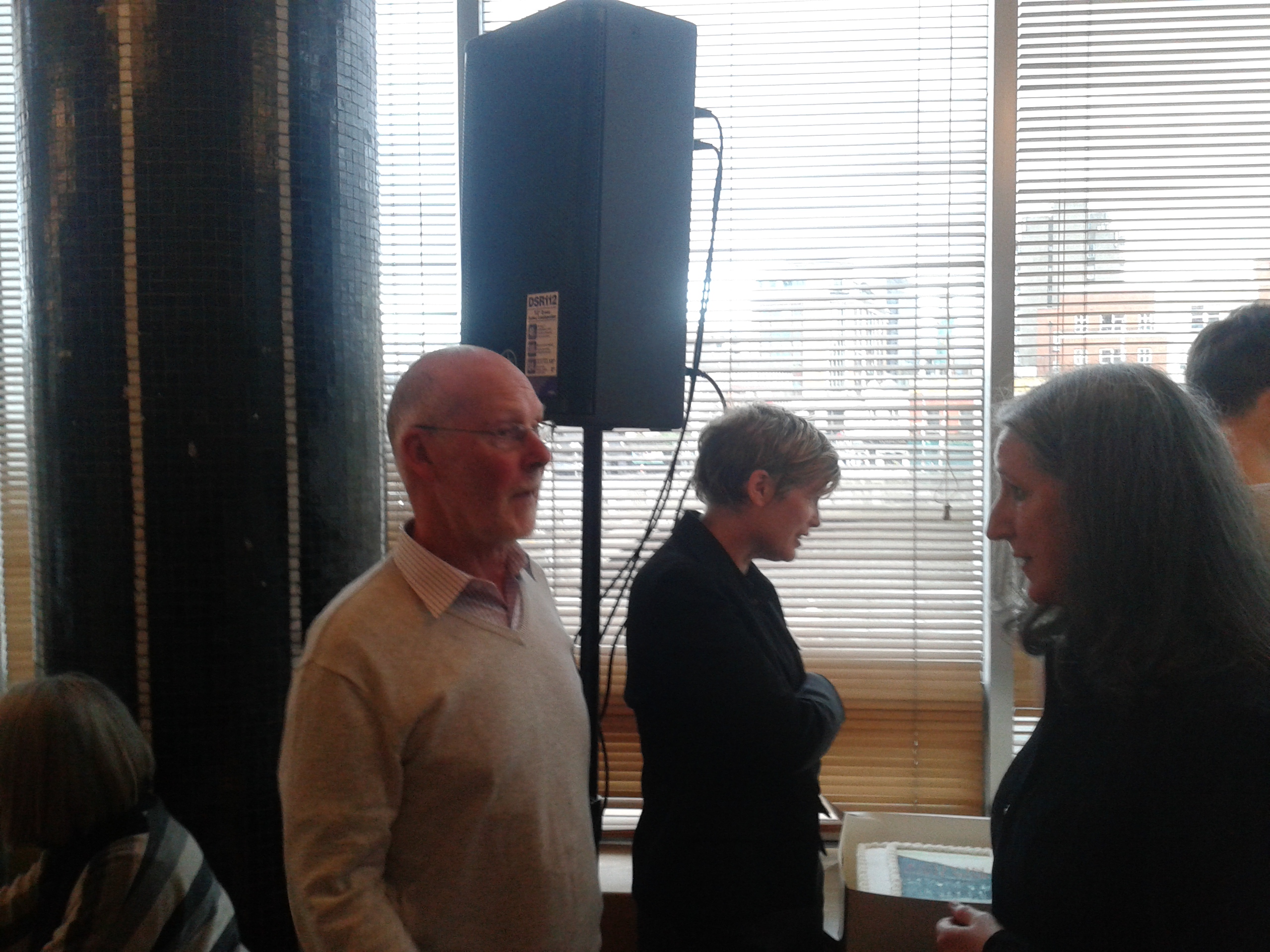
After the launch speeches — (L-R) Padraig Yeates, Katherine O’Donnell, Caitriona Crowe.
Jack O’Connor, between speeches, made a reference to a giant banner hanging off Liberty Hall which had the word “NO” displayed prominently, saying that they had received congratulatory calls from people who thought it was against same-sex marriage. The banner was however against privatisation of bus services. The current banner on Liberty Hall says “YES” to the proposal in the forthcoming referendum and he said that now busmen were calling them up complaining …. to laughter, O’Connor commented that “it’s hard to the right thing, sometimes”. Presumablywhat he meant was that it is hard to know what the right thing to do is, or perhaps to please everybody.
It is indeed hard to please everybody but I’d have to say that it is not hard to know that the purpose of and‘the right thing to do’ for a trade union, is to fight effectively and with commitment for its members and for the working class in general. And that is precisely the responsibility which has been abrogated by Jack
In the background to this photograph of a Reclaim the Streets demonstration in 2002 is Liberty Hall, draped in a hug “Vote Labour” banner. SIPTU has maintained that position through a number of coalition governments in which Labour has participated and that have attacked the living standards and rights of workers.
O’Connor personally, along with other leaders of most of the trade unions, including the biggest ones for many years, SIPTU and IMPACT. And also by the Irish Congress of Trade Unions. That is why Jack O’Connor gets booed now if he ever dares stand on a public platform related to trade union struggle, a treatment received also by David Beggs before he retired from the Presidency of ICTU.
Back in 2011, another giant banner hung from Liberty Hall – that time it urged us to VOTE LABOUR, as did leaders of other trade unions. Stretching magnanimity, we might give the trade union leaders the benefit of the doubt and say they had forgotten that the Labour Party had only ever been in Government in coalition, most often with the right-wing Blueshirt Fine Gael party and that its most recent spell sharing power had given us one of the most repressive governments in the history of the State. Let us imagine for a moment that these social-democratic union leaders had forgotten all that. But, after February 2011, as Labour and Fine Gael went into coalition and both reneged on their election promises, as the Coalition government began to attack the working class and the lower middle class, what is their excuse then? When did they denounce the Labour Party to their members, publicly disaffiliating from the party? No, never, and the fact that those disgusting connections continue was underlined by the presence at the book launch of a Labour Party junior Government Minister and the late arrival of noneother than Joan Burton, Minister for Social Constriction …. er, sorry, Protection.
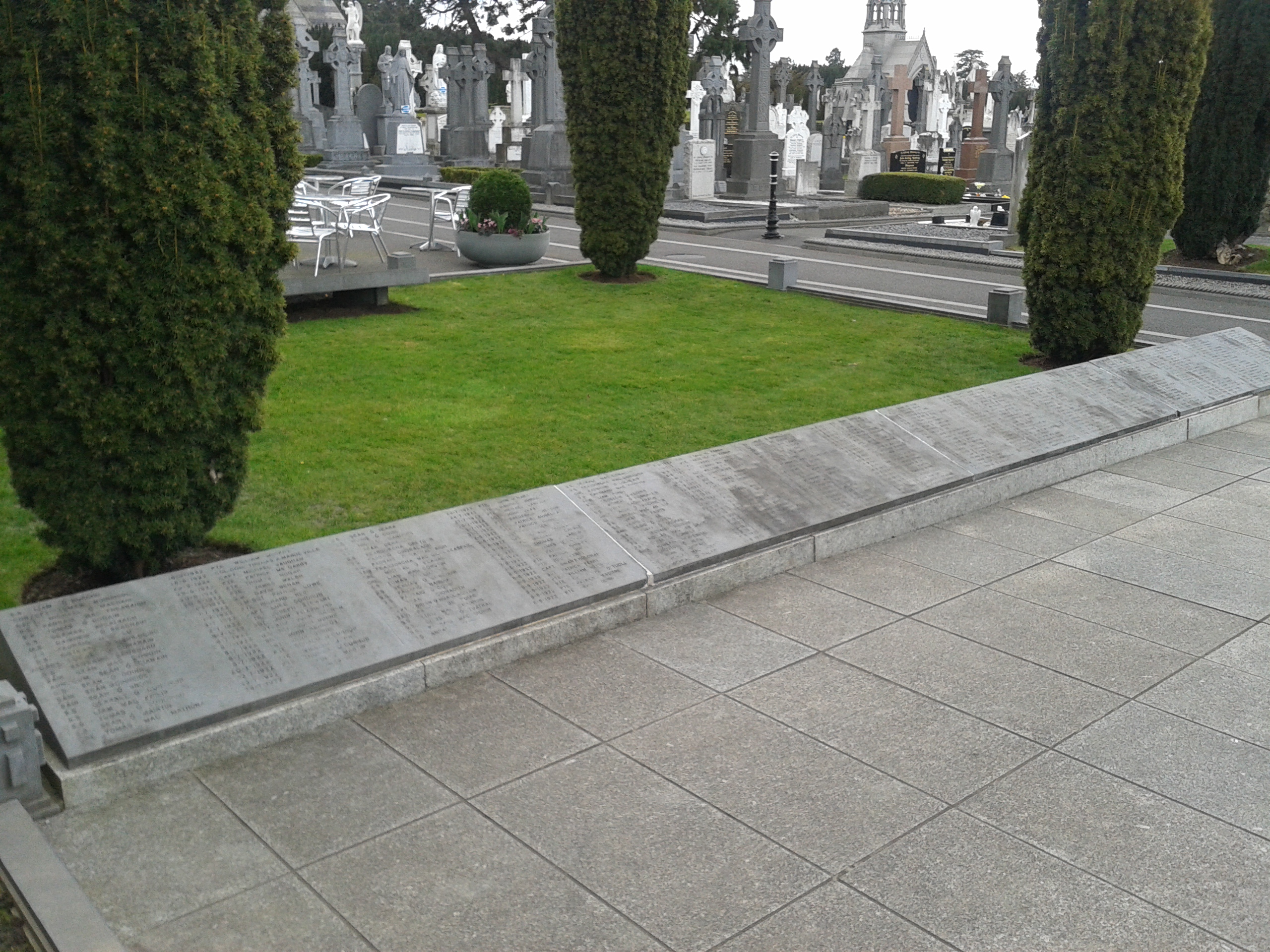
Plaques in Glasnevin’s Republican Plot recording the names of 77 of the 81 Irish Volunteers officially executed by the Free State between November 1922 and May 1923. Their police and military killed about another 150 without judicial procedure.
Considering that the book being launched was about the Civil War, it is really extraordinary that no speaker mentioned the repression by the Free State during and after that war. I am certain that Padraig Yeates has not glossed over that, he is much too honest and too good a historian to do so. But that only one speaker at the launch (Catriona Crowe) should mention the sinister Oriel House and none the at least 25 murders its occupants organised, nor the 125 other murders by Irish Free State soldiers and police, nor the 81 state executions between November 1922 and January 1923, sets one wondering at just how much self-hypnosis sections of our political and academic classes are capable.
From time to time people are asked to join a political bloc of some type. Should one join or not?
A political bloc is an arrangement of temporary unity, of as little as some hours of duration, for example on a demonstration, or of weeks, perhaps in a campaign to get an agreed list (i.e. “a slate”) of candidates elected or to vote a particular amendment to a resolution being proposed.
Blocs may be of longer duration, as for example with the Bolshevik bloc in the lead-up to the Russian socialist revolution. This last example is illustrative of the nature of blocs, which are generally not only for something but also against, or at least different to something else. There was a whole mass of political factions against Kerensky’s government in 1917 but the Bolshevik leadership sought to create a bloc not only against Kerensky and his followers’ maneuverings but also different to that of the Mensheviks and the Socialist Revolutionaries. What the Bolsheviks were for, apart from the slogan “All power to the Soviets” (the workers’, soldiers’ and sailors’ councils and assemblies), was a revolution as soon as possible, the overthrow of the capitalist-monarchist State and the creation of a socialist one (as well as pulling the Russian Army out of World War One).
Although the facts of the successful overthrow of the state and withdrawal from the War are not usually questioned by historians or political theorists, the fate of that state is. And the bloc itself had a very mixed history after the Revolution.
But what essentially is the purpose of blocs? Are they composed of like-minded people who don’t want to belong to a political party-type organisation, or perhaps of people of a variety of party political allegiances, but who want to join for the moment to promote a general idea? Or are they attempts by one group to create hegemony, to bring people of different perceptions together in temporary action, with the intention of building a more permanent organisation? Or perhaps crudely an attempt by one (or two) organisations to recruit members to their own organisations? I have over the years participated in blocs and it seems to me that different blocs have at different times been each one of those things. So I ask myself, is that ok? As political activists, should we consider blocs a legitimate type of temporary political organisation? Is each of those purposes outlined above of equal value?
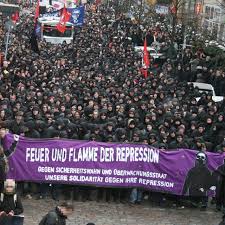
A Black Bloc against repression in Germany — location and year uncertain
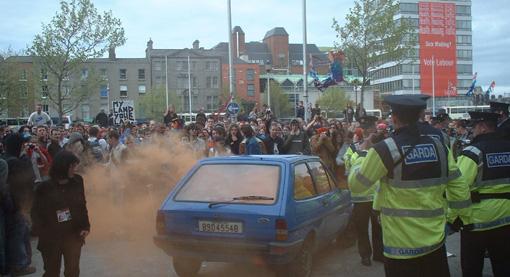
Around this time of year in 2010, early on in the protests against austerity, although then called “Right to Work”, back in the last year of the Fianna Fáil/ Green Party coalition government, there was a bloc formed for participating in demonstrations against the bank bailouts and consequent cuts in social spending and wages being imposed or proposed by that Coalition Government. Called the “Anti-Capitalist Bloc”, it seemed composed in the main of the anarchist WSM and what would often be described as “dissident Republicans”, chief among which at the time was the Éirigí organisation. There was a fair sprinkling of non-aligned activists (i.e. not belonging to any party or particular organisation) whose politics could be described variously as socialist republican, anarchist or communist.
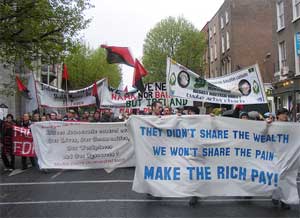
Anti-Capitalist Bloc in Dawson Street, Dublin, marching to join anti-austerity demonstration at Dáíl in 2010
This bloc gathered at a different rallying point to the rest of the Right to Work march but marched to meet it at the Dáil. In that role, it survived I think three demonstrations. The first one was attacked by police after the demonstrators refused to be prevented from marching to join the other demonstration.
What was the purpose of this bloc, at least in the eyes of its organisers? I have no documentation to hand but as I recall, it was to say something like: “the problem is not this or that economic measure or this or that party or government; the problem is capitalism itself.” It seemed to be implying that therefore we needed a revolution. I would and did agree with such a statement and with its implication. Not only did I agree with it
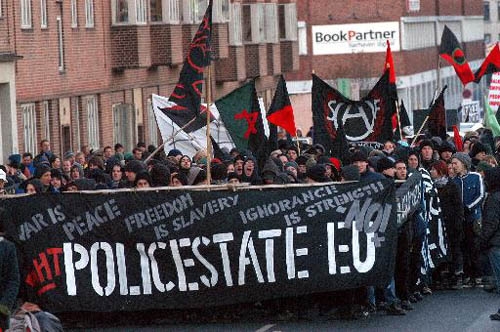
Black Bloc against the EU, possibly a section of the “March for an Alternative” in London in March 2011.
but it seems to me a crucial point to make, if we are to end our vulnerability to the vagaries of the capitalist system’s fortunes and to its particular rapacity at various times.
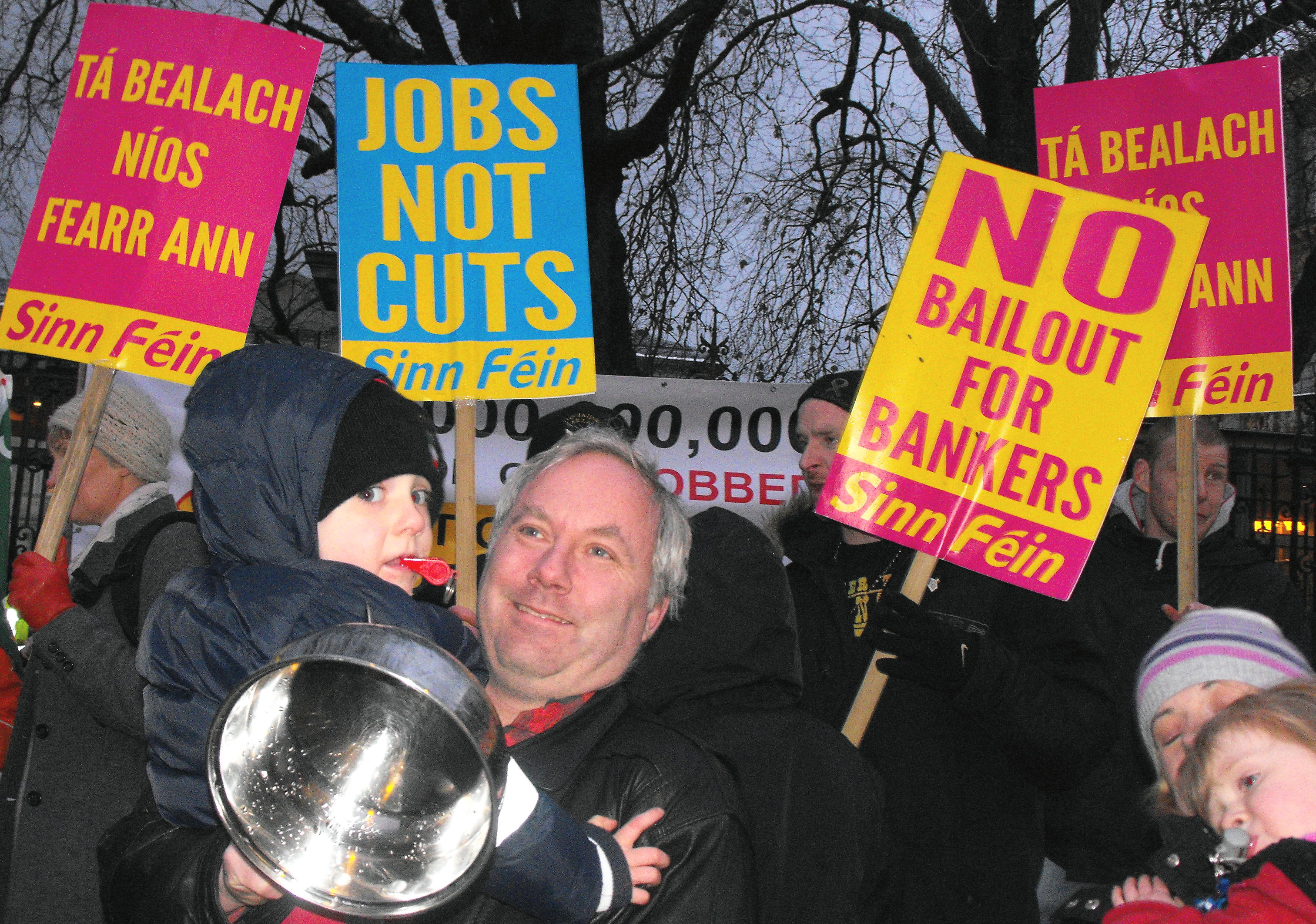
This was a message clearly different from that of some sections of opposition to the Government: SIPTU and the ICTU were saying that there was a fairer way of sharing the burden, which was about what Sinn Féin was saying with “Tá bealach níos fearr/There is a better way”.
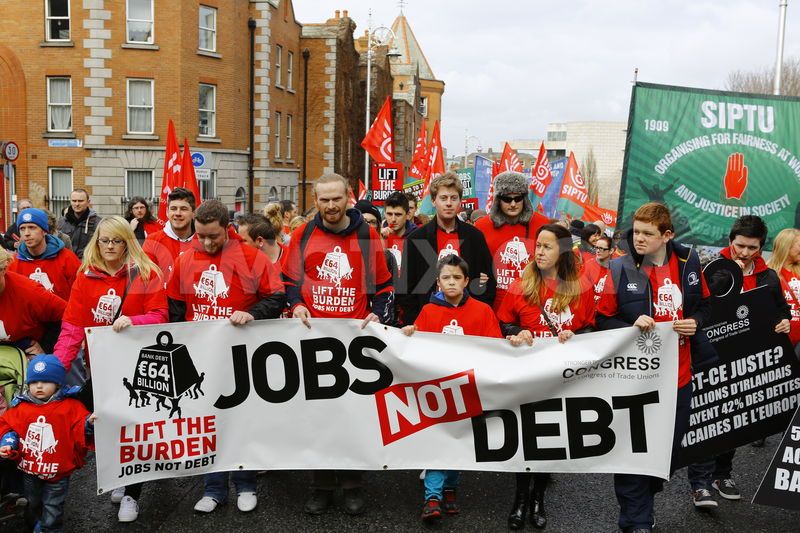
Reformist trade union slogan on anti-austerity march in 2010
But could those participants in the bloc not have presented that point of view while still joining the other demonstration at its rallying point and marching with it? Perhaps – by each person being given specific placards, for example, agreeing a joint leaflet or by having speakers to represent their point of view. But all of those present difficulties – the production of an agreed placard slogan to say nothing of the difficulties of agreeing a leaflet. And a speaker might not be permitted by the organisers of the rest of the demonstration or their message would get lost among the others being put forward, even if the speech itself could be agreed by the bloc in advance. All the bloc participants could dress in a similar colour (like the “Black Bloc” on some demonstrations overseas in the past). But a separate bloc, marching behind a banner with a slogan with which each bloc participant could agree, was surely the least complicated way to deliver that message – and very visible. The police who attacked it certainly must have thought so.
Sinn Féin demonstration at the Dail in 2010 — all totally reformist slogans apart from possibly the “Don’t Pay the Bankers” slogan
There is another factor in such a way of organising a bloc – it permits a visible assessment of its size, of the identities of its participants (unless they go masked, as many of the Black Blocs abroad did). Of course this has a down side also in that the state’s political police can take notes on the participants for the purpose of their files. But it has a positive effect too in terms of future progressive and revolutionary action. A mailing list can be compiled for calling to future events, individuals can be introduced to other like-minded individuals, organisations can get to cooperate – all factors militating against the fragmentation of the radical and revolutionary sector.
Some people on the other part of the march accused the Anti-Capitalist Bloc of being politically sectarian. Perhaps some even thought them elitist. These are of course dangers. But was it or was it not an important statement to make, that the problem was not the governing party but the system, and that a revolution was necessary? And if it was an important point to make, was such an eye-catching way of making it not justified?
Let’s consider what happened in the months and years afterwards and where we are now. In the face of a wide-scale howl of protest at the bank deals of the Government, their economic measures, and recent individual politician scandals, Fianna Fáil were deserted by their Green Party coalition partners. FF dumped their leader and elected a new one for their party and for the Government. It was all too little, too late and they were obliged to agree to a general election, the result of which was that FF’s number of TDs (elected representatives) was cut by nearly 80%, the greatest electoral defeat suffered by either of the main political parties in the history of the state. And the Green Party was wiped out as an electoral force, almost disappearing entirely off the political map.
The electoral verdict otherwise was mixed. The main rival of FF, Fine Gael, got the most votes with the social democratic Labour getting the next largest amount. Sinn Féin jumped from four to fourteen, a Trotskyist party and a different Trotskyist led-alliance got four between them for the first time, twenty Independents were elected, most of them left-wing. But whether socialist, republican, conservative or social-democratic, all candidates had been elected on platforms of opposition to the deals the previous government had made with the banks and with the EEC’s banking regulators.
Despite that, Fine Gael and Labour formed a coalition government and proceeded — in fact — to endorse what their predecessors had done and furthermore, to intensify a regime of austerity on working people, introducing three new taxes and supporting legislation to squeeze the people still further. The message of the Anti-Capitalist Bloc was vindicated.
Would the whole demonstration marching under a banner of “Overthrow Capitalism” have significantly changed that electoral result? Extremely unlikely. But it would have posed the question to the participants and to observers. It would have effected subsequent campaigns of resistance to austerity measures and additional taxes. And it would have built a much wider consensus eight or nine years later that the overthrow of capitalism was the only solution with perhaps a growing consensus that such an outcome was possible.
Because here we are now nine years after those three appearances of the Anti-Capitalist Bloc and once again it seems a general election is looming. Once again, we see other political parties pushing forward to be elected on programs without any perspective of overthrowing capitalism. Political alliances based on continuing the system are being mooted. On social media one sees calls for for kicking out Fine Gael or Labour or both, rather than capitalism. On demonstrations against the Water Tax we hear slogans against Enda Kenny, leader of Fine Gael, or against the Labour Party – but few against the capitalist system. Sinn Fein seek to cut down Labour as they court the social democratic vote which, in the past, they have largely ignored (for example, they have little history in the trade union movement). The Trotskyist groups will also attack Labour, also going for the social-democratic vote as they have traditionally done.
Most people feel that the Government will fall soon but when they pose alternatives they are doing so within the framework of capitalism. That means that same class that commanded the deal with the banks and with the EU will remain in power. Their representatives in government will change but the class will remain. And if they remain, their exploitation remains. Not only that but in the present economic climate, their austerity program will remain too – perhaps with some tweaks here and there but austerity still.
A determined campaign of political leadership over the past nine years giving a clear direction of the need to overthrow capitalism could have us in a very different political position now.
So, the next time we get a call to join a bloc for a demonstration, should we rush to it? Well, not necessarily. Let us question what the bloc is for and what it aims to do. Is the bloc in question a tactic, for example like the Black Bloc, where we identify a revolutionary opposition by colour and also, by masking, make it harder for the State to identify us? There may well be a time and place for such. Or is it to declare a revolutionary principle such as “capitalism is the problem; revolution is necessary’? Or “Non-Payment of the Water Charge is what is required”? Then it seems to me that the answer is that yes, we should.
But if it is to draw some particular lines of political affiliation, for example to say that although the participants may belong to separate organisations or none, “we are all communists” or “we are all republicans” or “we are all anarchists”, then I fail to see how that helps the popular resistance movement proceed forward at all, to say nothing of revolution. If that is the purpose of a bloc, it is fine for the followers of that particular ideology but they would be best fulfilling it by holding public meetings and conferences.
On the street, we need to be motivating observers for participation in resistance, and motivating participants for unity in effective actions, for revolution. Motivation has an emotional component but also an ideological one and in that regard the message has to be to overthrow capitalism. At the moment it is that idea that needs to gain hegemony rather than any particular political party or organisation.
Start of the march in Dame Street after rally in Central Plaza
On Saturday 21 February, at two days’ notice, somewhere between eight and ten thousand people gathered in Dublin in solidarity with those water tax protesters jailed by the State and those recently arrested. They marched to Mountjoy Prison and packed the road outside it and in front of the local Garda (police station).
The march gets going in Dame Street. Photo shows only the front of the march.
Parnell Square West from Granby Place. The front of the march has turned into Dorset Street and is marching there but the end has yet to come around the corner into the square from Parnell Street
The crowd were addressed by relatives and friends of the jailed, anti-Water Tax campaigners as well as by Paul Murphy, Joan Collins and Clare Daly (both TDs of the United Left) and Dessie Ellis (TD of Sinn Fein).
All of the speakers denounced the politicians and the State for the jailing of the protesters while the bankers and politicians who created the crisis and colluded in the bank bailout went free. Most speakers called on the crowd not to pay the water tax and to build resistance on the streets. Dessie Ellis, in keeping with his party’s position, did not call for non-payment, though he did call for “unity of the Left”. The march was notable for the absence of SF banners and placards — apparerently they were having their own protest at Leinster House.
One of the protesters made an emotional appeal on behalf of two of the five who received jail sentences, who have gone on hunger strike, and on behalf of another, Derek Byrne, also on hunger strike, but who has declared his intention of refusing to take fluids from Monday if he is not released. (NB: Since posting that paragraph it has emerged that the demand of all three hunger-strikers is a return to Mountjoy [they had been separated and sent off to a prison facility near Clondalkin] and an end to 23-hour lockup in their cells. These are basic human rights.)
Large sections of the crowd seemed taken aback by this information and unsure how to react.
Paul Murphy pointed out that this use of the police to attack people protesting injustice has been a feature of the State since its creation and mentioned the threats of jail to striking workers, the jailing of the Rossport Five and of Margaretta D’Arcy. Clare Daly asked the Gardaí which side they were on, that of the polticians and bankers or of the people, saying that if they chose the former it is they who would become isolated, not the protesters. Joan Collins, Murphy and Daly all pointed to the need to create a socialist society. They also, along with most other speakers, called for a build up and huge turn out of support for the demonstration scheduled for March. Many speakers declared that the increased repression is a sign of the Government’s or the system’s weakness, not of their strength and called on the movement not to falter now.
Robert Ballagh, who also spoke, called for the release of the five and pointed out that the class of people who rule and profit out of this society are not those who find themselves in jails.
Section of the march in Dorset Street, looking west (another section is behind the camera — see next photo — but a large section of the march has yet to come around the corner from Parnell Square.)
The same road, photo taken a few seconds later but looking east.
The mood of the crowd in general was of good-humoured determination. The composition seemed to cross social groupings, ages and genders and a number had brought their children along. Some had come from other parts of the country.
Crowd outside Mountjoy. some have left and many are still further down the north Circular Road (the Mater Hospital is to the right of photo).