COPS, COMMISSIONER AND REPRESSION

Diarmuid Breatnach

(Reading time main text: 9 mins.)

Currently the Garda Representative Association is in a public struggle with the body’s most senior officer and nearly 99% in a high-participation poll of GRA members voted as having no confidence in Drew Harris, the Commissioner.1

The real issue for the GRA (Garda Representative Association) is that they enjoyed the rosters adopted by the Garda Síochána during the Covid pandemic and don’t want to abandon them. Of course not. Four days off after four days on shift must be nice and would we all had that.

But for that, the Gardaí would be required to work 12-hour shifts on their four days on and they are not complaining about that all – they are clamouring to do it. The workers’ movement fought hard for the 8-hours day and in in 1886 Anarchists in Chicago were martyred in that struggle.2

Not so long ago in the West, 12-hours was a usual shift for a worker though for six days (“seventy hours was his weekly chore”).3 There is a well-known close association of fatigue with harmful incidents (as remarked upon by James Connolly)4 — and also with shoddy work.

Most Gardaí working 12-hour shifts will adapt themselves to the long hours by taking care to stretch themselves as little as possible but always being available for short energetic work, i.e evictions, intimidating industrial pickets, batoning protest marches and conducting raids.5

Minister McEntee & Commissioner Drew Harris speaking recently (Photo cred: Niall Carson/ PA)

Justice Minister Helen McEntee says that she will not interfere in the dispute though at the same time expressed support for Harris and mildly criticised the threatened strike action by the GRA. Naturally the ruling class does not want to alienate their first line of physical defence.

But Sinn Fein TD Pearse Doherty last Thursday attacked the Government and Fine Gael in particular over what he called a “hands off” approach to the dispute by the Justice Minister. According to SF the Gardaí are a service valued and needed by communities.

This benevolent SF attitude to the Gardaí even extends to “specialist groups”.

Doherty and his party leaders now choose to forget that Irish Republicans, including thousands of their own supporters when it was a Republican party, have been spied upon, harassed, threatened, raided, beaten up, framed and perjured against in order to see them jailed.

Sinn Féin’s attitude to the Gardaí is a clear illustration of its change from revolutionary opposition to accommodation with the Gombeen capitalist system — and when in government they will use the Gardaí against any resistance to the system as currently they are using the PSNI.

GARDAI – A LONG REACTIONARY HISTORY

The Gardaí, as the first line of physical defence of the Irish Gombeen class has a long anti-working class, anti-Republican and anti-Left history. The intelligence branch CID worked with the National (sic) Army in identifying Republicans to kidnap, torture and murder.6

ANTI-REPUBLICAN

After the defeat of the Irish Republican Movement by the State forces armed and equipped by British imperialism, the Irish neo-colonial state used the Gardaí to harass Republicans.

Eoin O’Duffy, the second Garda Commissioner (1922-1933) of the Irish State, hounded Irish Republicans and socialists during the Civil War and after, one of the causes of political emigration from Ireland and in 1932 (still in his post) founded the Irish fascist Blueshirt organisation.7

Eoin O’Duffy reviewing his fascist “Blueshirts” in the 1930s – he founded them while still the second Garda Commissioner of the Irish State (1922-1933). (Photo sourced: Internet)

O’Duffy and his Blueshirts attempted to prepare a coup against the De Valera government of Fianna Fáil and after partial suppression by the government, went on to combine with another two reactionary political organisations to form the Fine Gael Party in 1933.8

Ned Broy, appointed third Garda Commissioner (1933-1938) created the Special Branch9 (nicknamed “Broy’s Harriers”10 after a Bray dog hunting pack) to repress the fascist movement. However, he filled the unit with ex-military who had been anti-Republican during the Civil War.

Subsequently, “Broy’s Harriers” also carried out repression against the Republican movement opposed to De Valera and Fianna Fáil.

In the long line of Garda Commissioners that followed, all have presided over repression of the Irish Republican and Left movements, as well as against Travellers and LGBT11 people and even in persecution of people providing contraception prevention.

Some Commissioners have resigned or retired in controversy: Patrick McLaughlin (1978-1983), retired in the wire-tapping scandal and Patrick Callinan (2010-2014`), over the phone-tapping GSOC and penalty points corruption scandal.

Noirin O’Sullivan (2014-’17) during the breath-testing corruption and persecution of Garda whistleblower controversy, resigned the post and disturbingly, walked into a job as Director of Strategic Partnerships for Europe at the International Association of Chiefs of Police.

Then Garda Commissioner Martin Callinan speaks privately to then Deputy Commissioner Noirin O’Sullivan; she succeed him when he resigned in controversy, herself resigning in a separate controversy not long afterwards (Photo cred: Eamonn Farrell in The Journal)

Republican prisoner solidarity pickets are frequently harassed and subject to attempted intimidation and individual activists are followed, stopped and questioned etc.

The no-jury political Special Criminal Court regularly jails Republicans on charges of “membership of an illegal organisation”, sending people to jail largely on the word of a Garda officer at the rank of Superintendent and above, who never reveal their alleged sources.

In 1976, the Irish State tried to smash the Irish Republican Socialist Party by pinning the Sallins Mail Train Robbery on them, though they knew the robbery wasn’t theirs. Forty homes were raided and false confessions beaten out of victims by the special Garda “Heavy Gang” unit.12

Three innocent activists were sentenced to 12 years in jail as a result and some of the special unit went on to frame others with false confessions also, including Joanna Hayes and family in the “Kerry Babies” case, as outlined in the Crimes and Confessions RTÉ series.

The last time the Gardai took unofficial industrial action by phoning in ‘sick’ was during the “blue flu” of 1998, when however their Special Branch remained very active indeed.

Foiling an attempted robbery by a Real IRA unit, the Special Branch Gardaí shot and killed Volunteer Ronan McLoughlin in the back while he was driving away from them. Despite the victim posing no threat to anyone when he was killed, the Gardaí were judged ‘innocent’.13

ANTI-PROGRESSIVE, ANTI-WORKING CLASS

The long-overdue second inquest into the fatalities of the 1981 Stardust Fire is underway as this piece is being written and in 1983, Garda Special Branch raided the launch of Christy Moore’s vinyl LP An Ordinary Man to seize the record after Stardust owners objected to a song in it.14

Over the years of the State the Gardaí have attacked protests and demonstrations, including with particular infamy those of the 1981 Hunger Strikes solidarity march15 and Regain the Streets in 200216 in Dublin and the Corrib Pipeline protests17 against British Petroleum in Mayo.

Gardaí also harassed and assaulted some of the since-famous Dunne’s Stores anti-apartheid strikers and again the more recent Debenhams sacked workers’ pickets.18

Video online of Gardaí using Covid restrictions to harass picketing sacked Debenhams workers. Later they used violence to remove picketers so Debenhams, defaulting on redundancy payments owed to workers, could remove stock from their closed stores.

The Gardaí have on numerous occasions displayed their tolerance of fascists, even to the extent of tolerating abuse from them and flagrant violation of Covid19 regulations.19 Conversely Gardaí have threatened and attacked antifascist counter demonstrators on many occasions.

In February 2016 a mass mobilisation of anti-fascists and anti-racists prevented the fascist islamophobic organisation Pegida from launching itself in Dublin. Gardaí attacked the antifascists and batoned an RTÉ cameraman in the face.

Gardaí threatening antifascists after the latter had been attacked by armed fascists on Custom House Quay and Gardaí had then attacked the antifascists, pushing and shoving them on to Butt Bridge. (Photo: Rebel Breeze)

On a number of occasions outside the GPO, Gardaí witnessed fascist assaults on opponents without even taking names of perpetrators but on 22nd August 2020 they went much further in showing their true colours as armed fascist thugs attacked a counter protest on Custom House Quay.

The Gardaí briefly separated the combatants and then the Public Order Unit attacked the unarmed antifascists, threatening them with raised batons and pushing and shoving them away on to Butt Bridge. Later they lied to the media, pretending that no serious violence had occurred.20

Three weeks later, on 12th September, an LGBT activist and a couple of friends were observing a rally of the fascist National Party when they were mobbed, threatened and shoved and one was struck on the head with a wooden club which had a Tricolour wrapped around it.

The Gardaí again lied to the media and said there had been no violent incidents. However video of the attack and of a Garda confronting the victim with blood streaming from her head and waving her away, circulated widely and the Gardaí had to change their story.

Ms Izzy Kamikaze being pushed by Gardaí down Kildare Street after being struck on the head with a club by a fascist (Photo sourced: Internet )

It took the victim to swear out a formal complaint and a month’s delay before the specific wooden club assailant was charged. Last year he pleaded guilty and was sentenced to three years prison.21

In the face of criticisms about their failure to prevent random violent assaults in Dublin’s city centre this year, the Gardaí claimed that they did not have enough personnel to prevent them. However it seems they can always find huge numbers to repress people’s resistance.

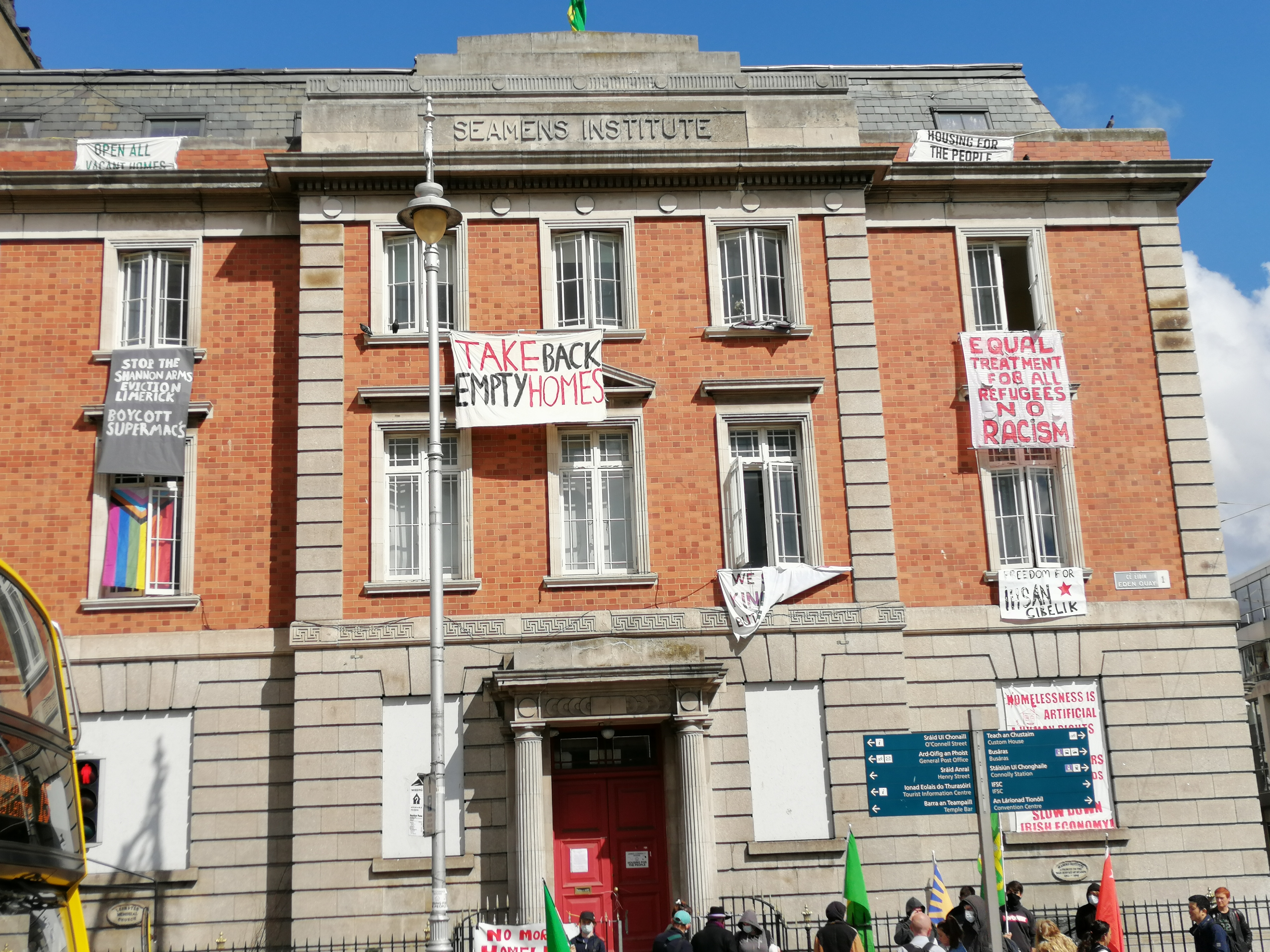
Early in June 2022, 100 Gardaí, including an armed unit and a helicopter, took part in the eviction of two activists of the Revolutionary Housing League, who had taken over for the homeless a large empty property on Eden Quay, Dublin. (That building remains empty at the time of writing).22

Garda vehicles in their eviction operation against a building occupied by the Revolutionary Housing League in Berkely Road 11 July this year (Source: RHL)

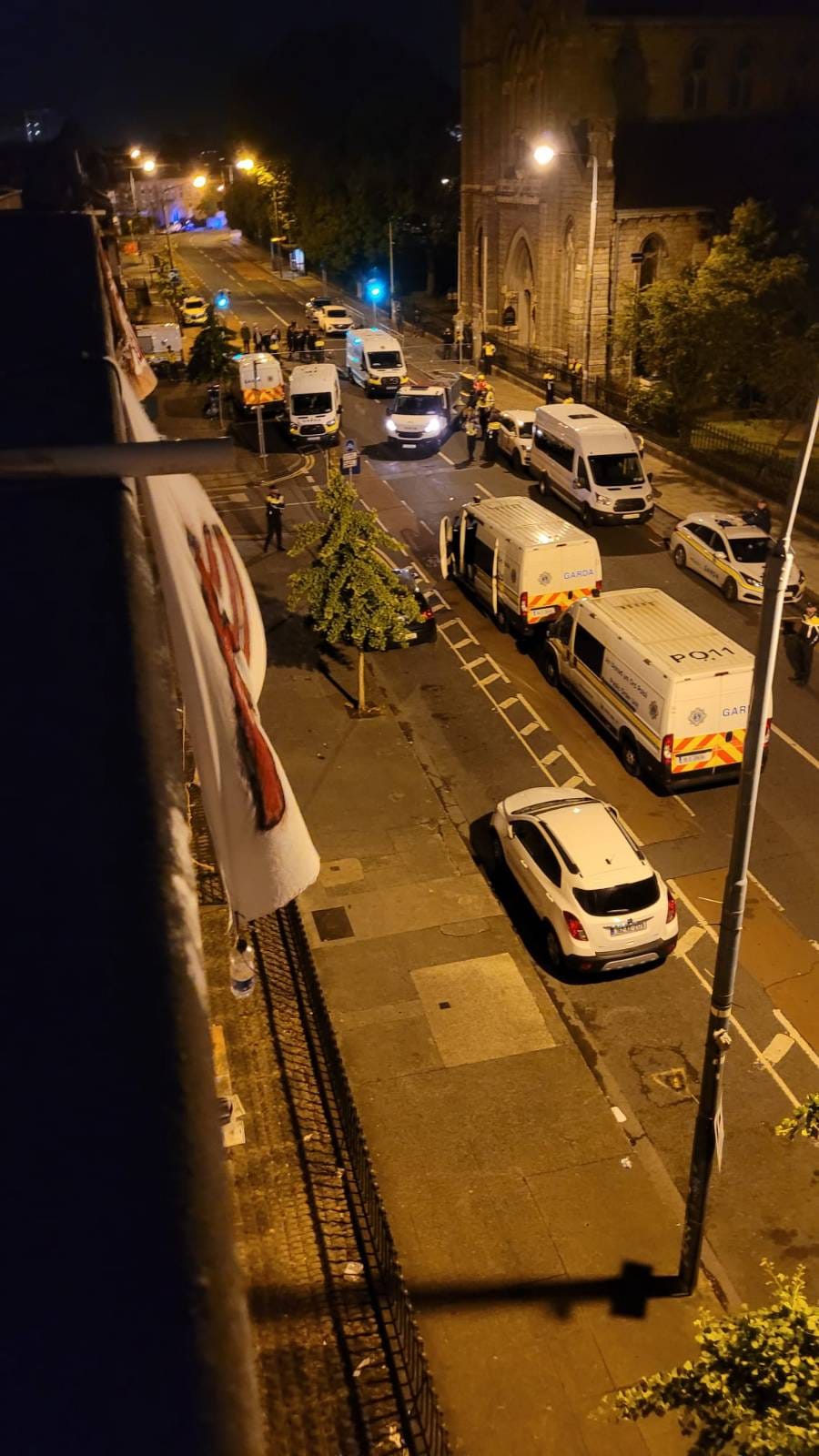
In early July this year, a similarly large number of Gardaí with a helicopter in attendance blocked two ends of Berkely Road in Dublin in order to evict four RHA activists holding a three-storey empty building in which they had recently housed some homeless people.23

Gardaí have acted against a number of housing campaign actions, in one documented case sending an armed response unit. While acting against housing activists, they have at the same time permitted illegal evictions without intervening (except against protesting housing activists).24

On yet others, masked Gardaí have colluded with masked thugs to evict housing activists.25

Masked Gardaí working with masked private thugs in carrying out an eviction in Dublin 2018. (Photo sourced: Internet)

Although Gardaí were nearly invisible on the huge anti-extra-water-tax demonstrations, they were present and active on many of the smaller and more local anti-water-privatisation protests opposing the water meter installations for Denis O’Brien’s Uisce Éireann, assaulting and arresting people.

During the long decades of church sexual predation and other abuse by members of (mostly) Catholic Church institutions, complaints to the Gardaí were routinely ignored. Indeed, the Gardaí often seized escaped victims in order to return them to the institutions.26

It is old news that the Gardaí have abused their power against members of the public but less known is that members have done so for sexual advantage or in the course of their personal domestic relationships. Of course this is not surprising since abuse of power reaches everywhere.27

Terence Wheelock’s28 relatives and their supporters are not the only ones accusing the Gardaí of having killed someone in their custody and Vicky Conway (recently deceased) quoted the figure of an annual average of 15 deaths around Garda custody from 2017 to 2021.29

Corruption in the Gardaí has come to light a number of times, including most recently the false reporting of drink-driving checks and the failure to charge a number of people who were actually found to be driving “under the influence”.

In the course of the above a number of whistleblowers within the Gardaí were intimidated, harassed and in one case an attempt was made to frame a prominent one for abuse of a child.30

CURRENT STRUGGLE BETWEEN THE GRA AND THE COMMISSIONER

Irish Republicans have long held a particular enmity towards Drew Harris, given his previous employment as Assistant Commissioner of the colonial gendarmerie in the Six Counties.31 They regularly refer to him as of MI5, the British Intelligence department operating in the UK.

This is understandable and, in fact, it is less natural that other sections of the Irish polity seem to have had no issue with Harris’ provenance. But in fact, the State’s own senior Gardaí have long been in service, and not always indirectly, to British imperialism, witness Edmund Garvey.32

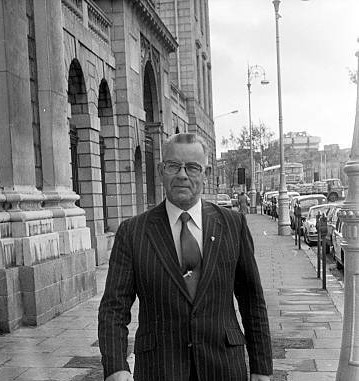
Former Garda Commisioner Edmund Garvey outside the Four Courts 11/10/1978. (Part of the Independent Newspapers Ireland/NLI Collection). (Photo by Independent News and Media/Getty Images)

The revolutionary Left, socialist republican or just socialist, have no reason to side with the Garda Representative Association in their campaign for a different roster or against Drew Harris. Nor of course do we owe Harris any support either.

Unlike Sinn Féin, our position should be opposition to all of the State’s repressive institutions.

Chief among those institutions and regularly confronting us in repression or exercising its power against working class communities is the Gardaí Síochána, with its long anti-working class, anti-democratic, anti-Republican and anti-Socialist reactionary history.

End.

FOOTNOTES

1https://www.irishtimes.com/crime-law/2023/09/13/huge-majority-of-rank-and-file-gardai-vote-no-confidence-in-garda-commissioner/

2And in that struggle, as is usually the case, the police defended the established capitalist authority and attacked the workers https://en.wikipedia.org/wiki/Haymarket_affair

3The Larkin Ballad about the 1913 Lockout.

4Competent investigators, for instance, have found that the greatest number of accidents occur at two specific periods of the working day – viz., in the early morning and just before stopping work at evening. In the early morning when the worker is still drowsy from being aroused too early from his slumbers, and has not had time to settle down properly to his routine of watchfulness and alertness, or, as the homely saying has it, “whilst the sleep is still in his bones”, the toll of accidents is always a heavy one.

After 9 a.m. they become less frequent and continue so until an hour after dinner. Then they commence again and go on increasing in frequency as the workers get tired and exhausted, until they rise to the highest number in the hour or half-hour immediately before ceasing work. How often do we hear the exclamation apropos of some accident involving the death of a worker: “He had only just started”, or “he had only ten minutes to go before stopping for the day”? And yet the significance of the fact is lost on most.

https://www.marxists.org/archive/connolly/1915/rcoi/index.htm (Chapter V – Belfast and its Problems)

5Especially on Irish Republican homes

6Their centre of operations during the Civil War and for some time afterwards was Oriel House, in Dublin.

7In 1936 the Blueshirts also recruited volunteers for Franco’s fascist-military coup against the elected Popular Front government in Spain.

8https://en.wikipedia.org/wiki/Fine_Gael#:~:text=Fine%20Gael%20was%20founded%20on,the%20legacy%20of%20Michael%20Collins.

9Now known as the Special Detective Unit; however the “Special Branch” name had a history in Britain, where Scotland Yard formed its Special Irish Branch in 1833 to spy on the Fenian movement among the huge Irish diaspora in the cities of Victorian Britain – and several of its members were Irish. Police services in a number of British present and ex-colonies have also carried on the “Special Branch” name, as far apart as the Six Counties colony and the British Bahamas.

10https://en.wikipedia.org/wiki/Eamon_Broy

11The latter until homosexuality was de-criminalised.

12https://sallinsinquirynow.ie/

13And McLoughlin’s inquest was delayed for decades.

14 The LP included Moore’s They Never Came Home which alleged that fire exits were chained shut, a matter with which the current inquest is dealing and about which I do not wish to say more at this point. The following account discussing the banning does not mention the Branch raid but I know of it from people who were present: https://theblackpoolsentinel.com/2021/01/11/christy-moore-and-the-stardust-tragedy/

15The marchers were frustrated that they were being prevented from even reaching the British Embassy in Merrion Road, attempted to push through and a battle ensued. Many were injured on both sides but the police baton-charged the whole crowd and even threatened journalists, though most subsequent media reports were either supportive of the Gardaí or blaming both sides; this brief report and photo being the exception: https://www.reportdigital.co.uk/reportage-photo-garda-baton-charging-national-h-blocks-committee-protest—18-jul-image00138214.html

16https://www.rte.ie/archives/category/society/2017/0425/870082-reclaim-the-streets-protest/

17https://www.theguardian.com/world/2013/aug/10/shell-pipeline-protests-county-mayo
https://www.irishexaminer.com/news/arid-30317773.html

18Indeed in one afternoon, uniformed Gardaí hassled the Dunne Stores picketers in Henry Street under Covid19 pandemic regulations, although all were masked and maintaining social distancing, while around the corner the far-Right were demonstrating mask-less and packed together, without the least interference from the Gardaí. A 100 yards or so down the road, the plain-clothes Special Branch (SDU), the political police, were harassing an anti-internment and political prisoner solidarity picket.

19Occasionally Garda patience snapped and one can see the incredulity in the reaction of the Far-Rightists on those occasions, as they had become so used to doing nearly anything they wanted.

20https://rebelbreeze.com/2020/08/31/there-will-be-another-day/

21https://the-beacon.ie/2021/06/21/national-party-member-pleads-guilty-to-assault-on-lgbtqia-activist-izzy-kamikaze/

22https://rebelbreeze.com/2023/07/14/helicopter-and-massive-gardai-numbers-for-what/

23https://www.dublinlive.ie/news/dublin-news/four-arrested-after-building-occupied-27305837

24https://www.irishlegal.com/articles/watchdog-raises-concerns-over-garda-conduct-at-eviction

25https://www.dublinlive.ie/news/dublin-news/garda-chief-under-pressure-after-15145154

26https://en.wikipedia.org/wiki/Garda_whistleblower_scandal

27https://www.newstalk.com/news/domestic-and-sexual-violent-complaints-against-gardai-on-the-rise-gsoc-1473416#:~

28https://rebelbreeze.com/2023/08/26/protesting-death-of-youth-at-hands-of-garda/

29https://www.irishtimes.com/crime-law/2022/07/15/at-least-228-fatalities-in-or-following-garda-custody-over-past-15-years-figures-show/

30https://www.irishexaminer.com/news/arid-30799234.html

31Previously the Royal Ulster Constabulary (and RIC before that), the PSNI is the armed colonial (and sectarian) police force of the UK State.

32Ned Garvey was ‘outed’ as a British Intelligence ‘asset’ (code name ‘Badger’) by disaffected MI6 handler Fred Holroyd. Garvey denied he was an agent for the British but the Barron Report found that that Holroyd had visited Garvey in his office in 1975 and that he had not made his superiors aware of this. The incoming FF government in 1978 sacked Garvey as having no confidence in him but as a result of not following disciplinary procedures Garvey was able to sue the State and retain his pension. While Garvey was Assistant to Patrick Malone, Garda Commissioner during the British Intelligence/ Loyalist Dublin and Monaghan Bombing in 1974 bomb remains were sent to the Six Counties for forensic analysis. No-one was ever even arrested for the bombing, never mind convicted and the widely-suspected British proxy Glennane Gang went on to murder many more, mostly civilians (see Cadwaller, Lethal Allies).

SOURCES

https://www.irishtimes.com/crime-law/2023/09/13/huge-majority-of-rank-and-file-gardai-vote-no-confidence-in-garda-commissioner/#:~

Helen McEntee and GRA: https://www.breakingnews.ie/ireland/mcentee-will-not-direct-gardai-on-when-to-work-amid-roster-dispute-1533439.html

Sinn Féin want McEntee proactive on Garda dispute: https://www.breakingnews.ie/ireland/sinn-fein-condemns-governments-hands-off-approach-on-policing-1532379.html

https://www.breakingnews.ie/ireland/six-gardai-suspended-from-the-force-for-over-four-years-1533424.html

https://www.garda.ie/en/about-us/our-history/garda-commissioners-since-1922/

Eoin O’Duffy: https://en.wikipedia.org/wiki/Eoin_O%27Duffy

Ned Broy and “Broy’s Harriers”: https://en.wikipedia.org/wiki/Eamon_Broy

https://en.wikipedia.org/wiki/Garda_whistleblower_scandal

https://www.newstalk.com/news/domestic-and-sexual-violent-complaints-against-gardai-on-the-rise-gsoc-1473416#:~

Gardaí and the Far-Right and Fascists: https://rebelbreeze.com/2020/08/31/there-will-be-another-day/
https://the-beacon.ie/2021/06/21/national-party-member-pleads-guilty-to-assault-on-lgbtqia-activist-izzy-kamikaze/

Gardaí supporting evictions, attacking housing activists: https://www.irishlegal.com/articles/watchdog-raises-concerns-over-garda-conduct-at-eviction
https://www.dublinlive.ie/news/dublin-news/garda-chief-under-pressure-after-15145154
https://www.irishlegal.com/articles/watchdog-raises-concerns-over-garda-conduct-at-eviction
https://rebelbreeze.com/2023/07/14/helicopter-and-massive-gardai-numbers-for-what/

Garda violence at Reclaim the Streets protest: https://www.rte.ie/archives/category/society/2017/0425/870082-reclaim-the-streets-protest/

Garda violence and corruption at Corrib Pipeline struggle: https://www.irishexaminer.com/news/arid-30317773.html
https://www.theguardian.com/world/2013/aug/10/shell-pipeline-protests-county-mayo

PACIFICATION KILLS TOO

Diarmuid Breatnachpreviously published in the Pensive Quill

(Reading time main text: 6 mins.)

At the end of last month, in Johannesburg, South Africa, over 76 residents perished in a fire sweeping through one of a number of “illegal” buildings, home to some of the city’s poor who are desperate for somewhere to live.

How is this possible we may ask. Didn’t the South African people win their struggle after many years of sacrifice? Didn’t Mandela and the ANC lead them to victory in 1994?

The huge South African majority people fought a long and hard struggle against the domination and exploitation of a European settler minority and institutional racism. But they also fought against capitalist exploitation and imperialist plunder of their rich natural resources.

Some of the results of the Sharpeville Massacre, 1960 after South African police opened fire without warning at unarmed black people protesting the pass (apartheid) laws. In total, 69 people were killed and more than 180 people were injured, mostly shot in the back as they fled the violence. A later report would state over 700 bullets had been fired, all by police. (Photo sourced: Internet)

Despite the riches of those natural resources in gems, precious metals and minerals,1 most non-white Africans2 in South Africa lived in abject poverty with poor health care, scarce or non-existent infrastructures and services, including education and training.

In the decades leading up to the fall of the formal apartheid system, that struggle was led by the ‘triple alliance’ of the (banned) African National Congress,3 the National Union of Mineworkers (of S.A.) and the (banned) Communist Party of South Africa.

Township in South African photographed in 2018, over 20 years after enfranchisement and ANC government (Photo credit: Andrea Lindner/ Getty Images)

Their struggles defeated the apartheid system and in April 1994 all residents of South Africa were enfranchised. National elections brought 1990, was elected President of the country.

Yet shortly after that great change, it was noted that the living standards of the mass of people were even lower than before, that the settler capitalists continued to reap their profits and that imperialism had actually intensified their penetration of the South African economy.5

Today approximately 55.5 percent (30.3 million people) of the S.A population is living in poverty at the national upper poverty line (~ZAR 992) while a total of 13.8 million people (25 percent) are experiencing food poverty. Municipal services to the huge ‘townships’ are unreliable at best.

Almost one in every three of work-available people is unemployed and only 95% of the population have basic literacy, which means that one in 20 doesn’t have it.

It is in that context that we can begin to understand hundreds of people living in an “illegal” building without even a fire escape, obliged to take the risk of such accommodation, in a land that continues to be rich in great wealth which however, never comes near the mass of people.

PACIFICATION PROCESSES

In the 1990s a number of people began to promote processes to resolve a number of long-ongoing conflicts around the world, mostly where imperialism or colonial settlers were oppressing the people of a country. The promoters called them “peace processes”.

Palestine was the first of those in which a “peace process” was introduced and South Africa was next in 1994, followed by Ireland in 1998. As it took root in one country, former resistance activists went from there to other conflicts to encourage people there to embrace the process too.

In fact the progress of this process seemed like the US imperialist ‘dominoes’ theory, only in reverse: rather than ‘communism’ in one country influencing people in another to go the same way, capitulation in one country was used to infect the next.

Palestinian and South African delegates attended Sinn Féin congresses to promote their ‘peace process’ to the party’s membership; subsequently SF delegates in turn joined South African ones in selling the process to the Basque national liberation movement.6

Arnaldo Otegi (centre photo) foremost of the Basque movement’s ‘official leadership’ and EH Bildu party in 2019 – the banner behind asks for “one further step” in Castilian (Spanish) and “yes” in Euskera (Basque). (Photo cred: EFE)

Some movements declined to imbibe the process wine but those that drank it found their movements split, their leaderships increasingly accommodated to their people’s exploiters and nowhere at all were any of the movement’s principal objectives achieved.

Except, that is, in South Africa, where at least the people were enfranchised. But the right to vote is intended to help shape the polity for improvement and that has not happened in South Africa. The ANC, NUM and CPSA of the ‘triple alliance’ have become part of the system instead.

THE OPPOSITION BECAME THE SYSTEM’S GUARDIANS

Western imperialism recognised the vulnerability and isolation of the minority settler regime, convincing its leadership to concede mass enfranchisement rather than suffer revolution. And in order to prevent the mass going ‘too far’, they brought the resistance leaders into the deal.

Bishop Tutu7 once remarked that “The ANC stopped the gravy train just long enough to get on it”, which angered his friend, Nelson Mandela. But when forty striking miners were murdered by police of the ANC Government with NUM collusion in 2012, Mandela did not condemn them.

The kopje or hillock at Marikana, near the Lonmin mine, South Africa, where the striking miners were massacred by police of the ANC government in 2012. Over a decade later, plans for a memorial park have still not borne fruit. (Photo sourced: Internet)

This corruption did not grow overnight. Jacob Zuma,8 while President of the ANC, has been formally accused of rape, indicted a number of times and eventually convicted of financial corruption. Winnie, Mandela’s ex-wife led a clique accused of political corruption and murder.

Cyril Ramaphosa, now President, was a millionaire even during the apartheid regime while General Secretary of the National Union of Mineworkers and, because the striking mineworkers in 2012 were rejecting the NUM as corrupt, is widely believed to have organised the massacre.

There should have been many signs of this corruption in the ANC prior to entering government – and there were.

The ANC ran concentration camps notably in Angola, Zambia, Tanzania and Uganda where they punished and even killed “dissidents”.9 And in South Africa perhaps they had their own ‘Steak Knife’10 to organise “Pirelli necklacing”11 for alleged informers.

Mandela knew about the camps and the “necklacing” but did not condemn them, possibly out of mistaken solidarity or ‘the greater good’ theory, as acted upon by some of the solidarity movement abroad.

Ronnie Kasrills, a senior member of the Communist Party of SA and formerly on the ANC’s National Executive Council, who now criticises the pacification process, claims they were concentrating on the political process and took their eye off the economic one.

And no doubt many at home and abroad thought all this could be sorted out once the domination of the white settler regime was broken and African majority had the vote. But political plants grown in contaminated soil do not grow healthy fruit.

And so we come to 76 or more poverty-stricken dead and well over a hundred injured by fire in a building owned by the City, which is run by a black South-African administration that doesn’t care, in a state run by a corrupt black South African government in partnership with the settler class.

Plastic-shrouded bodies of some of the 76 fatal victims of the fire in the housing block in Johannesburg, South Africa. (Photo cred: Jerome Delay/AP )

Armed resistance campaigns, uprisings and revolutions kill but they have in their favour that they are striving for a better world. Pacification processes kill without any chance of achieving a substantial improvement.

Pacification processes murder dreams but kill physically too: in massacres and avoidable disasters but also by overwork, ill-health, work injury, despair, substance abuse, suicide, and the many ways in which the capitalist-imperialist system causes misery wherever it lives.

End.

FOOTNOTES

1South Africa holds the world’s largest reported reserves of gold, platinum group metals, chrome ore and manganese ore, and the second-largest reserves of zirconium, vanadium and titanium. In 2021, South Africa’s diamond production amounted to 9.7 million carats, an increase on the previous year’s 8.5 million carats. The country ranked fifth among the world’s largest diamond producers by volume.

2The racialcategories introduced by the Apartheid regime remain ingrained in South African society with South Africans officially continuing to classify themselves, and each other, as belonging to one of the four defined race groups (Blacks, Whites, Coloureds and Indians).

3Banned by the South African settler government from 1960 until early 1990; now a mass party in government.

4The ANC is still in government at the time of writing, without a break since 1994.

5See The Shock Doctrine – the rise of disaster capitalism by Naomi Klein (2007).

6Palestine faded as a promoter of the pacification process since it had failed spectacularly there, its mass rejection resulting in the resistance upsurge of the Second Intifada followed by the fall of Al Fatah and the Palestinian Authority from their leadership position and the huge turn to the Islamist Hamas by a society generally voting along political rather than religious lines.

The Spanish ruling class was interested only in crushing the Basque resistance and made little attempt to sweeten the surrender of the leadership (Arnaldo Otegi and company) who nevertheless capitulated. Other areas where the process landed or attempted to do so were Colombia, Sri Lanka, Turkey (Kurdish national liberation movement), India, Phillipines (both latter agrarian movements). Only in Colombia was it adopted by both the rulers and the resistance and proved a disaster for the latter.

7A Christian bishop and campaigner for most of his life against the rule of the settler minority.

8South African politician who served as the fourth President of South Africa from 2009 to 2018. Zuma was a former anti-apartheid activist, member of the ANC’s military wing Umkhonto we Sizwe, and president of the ANC from 2007 to 2017.

9See Sources.

10MI5 codename for senior Provisional IRA member Freddie Scappaticci who led the guerrilla organisation’s internal security department, which tortured and executed alleged informers.

11A car tyre, doused in flammable fuel, was placed over the terrified victim while still alive and set alight, often in front of a crowd.

SOURCES

https://www.theguardian.com/world/2023/sep/01/grief-and-anger-in-wake-of-deadly-johannesburg-blaze

https://www.breakingnews.ie/world/factbox-what-are-johannesburgs-hijacked-buildings-and-why-do-people-live-there-2-1521491.html

ANC concentration camps: https://www.amnesty.org/es/wp-content/uploads/2021/06/afr530271992en.pdf

SWISS GOVERNMENT PLANS MASS SLAUGHTER OF WOLVES

Diarmuid Breatnach

(Reading time main text: 4 mins.)

The imagination’s land of the Red Cross, cheese, cuckoo clocks and chocolates plans the massacre of 70% of its wolf packs.1

In reality of course Switzerland is a very regulated country, with a rich financial/ industrial economy and is a major arms producer.

However in 2020 Swiss voters made their desire to protect endangered species clear, when 52% of voters rejected a hunting law that would have made it easier to kill endangered species such as wolves.2

Despite the vote, the Swiss parliament passed a new law in December 2022 that allows the wolf population to be ‘regulated’. Then, just days ago, the government proposed a regulation that will wipe out 19 of the 31 wolf packs remaining in Switzerland!

Eurasian Grey Wolf in snow (Photo sourced: Internet)

WOLF MYTH & REALITY

Childhood and adult fiction is replete with horror stories about wolves (to say nothing of werewolves) attacking humans but, when set against reality, these seem like propaganda. The reality is that it’s not to humans that wolves are generally a danger but to their livestock.

Wolves (Canis lupus) are highly intelligent pack canines and, apart from having donated the dog (Canis lupus famialaris) as a worker and companion for humans, is well aware of its survival boundaries with Earth’s very apex predator – humans (Homo sapiens).

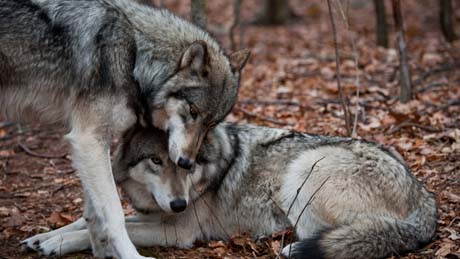
Wolf fondling another; pack members are very affectionate to one another while the alphas maintain boundaries. (Photo source: Internet)

Wolves prey substantially on rodents but must also, for pack survival, prey on larger mammals such as deer, mountain goats and boar. When these are in poor supply or other prey is temptingly easy, such as cattle and sheep, they will take those too.

The traditional human fear of wolves is therefore not one based on self-preservation but on economic priorities. And in the moralistic story of “The Boy Who Cried ‘Wolf’” it is not the human villagers that are attacked by the wolf pack but the community’s sheep.

However, if humans are to continue consuming a diet that will include meat, they will of course need to protect their livestock from wolves and have being doing so even before history was written.

Traditionally the main agent in that protection has been, ironically perhaps, the wolves’ own descendant, the dog – or more specifically, several livestock guardian breeds of dog.

Known livestock guardian dog (LDG) breeds include the Aidi (Atlas Mountain Dog), Carpathian Shepherd, Estrela, Greek Shepherd, Komondor, several breeds of Mastiff and Sardinian Shepherd; a known extinct breed is the Alpine Mastiff (before 5th century BC to 19th century AD).3

Mastín (Mastiff) amidst sheep it guards near Lagunas de Somoza (León, Spain). (Photo sourced: Internet)

Livestock guardian dogs are socialised to the livestock and to their immediate human ‘family’ and will not tolerate the close approach of any potential predator (which often includes even other humans). The primary role is to protect the herd, warn of danger and if necessary, attack.

Where employed in the past, LGDs have been highly effective in protecting their charges, in most cases not even having to fight predators but rather intimidating them. If they have to fight, they are bred for fearlessness and tenacity and their throats also protected by a “wolf-collar”.

Anatolian or Kangol Livestock Guard Dog, with sheep herd it is protecting, Eastern Turkey. (Photo sourced: Internet)

Predators, however courageous, also have strong survival instincts which warn against danger to life or limb (the latter, for a predator in the wild, often in time equalling the first). Unless absolutely desperate they will move on to safer although more difficult-to-catch prey.

For a good LGD however, there is no backing down possible, it is in defence of its own (as a wolf pack might defend its pups). The herder, when present with a firearm, is mainly an additional protection, as well as an alpha member of the dog’s ‘pack’ to obey and protect.

In contemporary times, LGDs have proved effective throughout the world, even in the experimental reintroduction of wolves to the USA.4 So why are they not being more widely employed and, instead, the remaining large predators being exterminated?

Central Asian breed of Livestock Guardian Dog beside its owner (Photo sourced: Internet)

It is no doubt more profitable for big livestock famers to have huge herds roaming freely and when they run out of edible pasture, to move the herd by herding dogs, mechanised herding vehicles or even helicopters. But is it all-around better? And are huge herds environmentally viable?

Apart from other considerations, wolves have been shown to have an environmentally positive effect in a balance between predator, prey and the environment, including vegetation and even water courses, for example in the famous case of the reintroduction of wolves to Yellowstone.5

Deer are pretty to look at but eat young trees and cause damage to reachable branches, while wild goats will eat almost anything, right down to the roots. Wild boar can also be very destructive and, being omnivorous like humans, even prey on ground-nesting birds.

Eurasian Grey Wolf in woodland (Photo sourced: Internet)

All of those invade agricultural crop lands to eat, in the course of which they also trample other crops; wild boar6 are now invading villages and suburbs in a number of towns and cities, overturning large refuse containers for their edible contents.

Female wild boar with litter of piglets in German urban area (Photo cred: Florian Mollers)

Wolves and other predators keep those species down to numbers in better balance with the environment but also of less bother to human settlements. Wolf packs on the other hand do not grow in size beyond the food supply that is fairly safely available.

The human race has made a huge impact on the environment which is sustainable up to a point beyond which, however, we are rapidly passing. We live in a sustainable balance with the environment — or we perish. Perhaps “let the wolf live” can be part of the lesson we need.

End.

FOOTNOTES

1https://theswisstimes.ch/rssfeed/criticism-of-planned-wolf-culling-by-environmental-groups-in-graubunden/

2Including the European Brown Bear, European Lynx and Eagles.

3https://en.wikipedia.org/wiki/Livestock_guardian_dog

4“After the reintroduction of wolves, that were eliminated in the United States in the 1930s, American farmers were losing about a million sheep annually to wolf attacks. 76 farmers took part in the Coppingers program, which introduced European livestock guardian dogs into the US sheep breeding (in their project they used Anatolian Shepherd Dogs). In all farms, where, in the absence of dogs, up to two hundred attacks of wolves per year happened, not a single sheep was lost under the protection of LGDs. At the same time, none of the predators protected by law got killed: the dogs simply did not allow them to approach the herd.” – https://en.wikipedia.org/wiki/Livestock_guardian_dog

5https://www.yellowstonepark.com/things-to-do/wildlife/wolf-reintroduction-changes-ecosystem/

6A wild boar is much more likely to attack a human than is a wolf in Ireland, where the Wolfehound breed was famous, it was a boar that mortally gored Diarmuid of the legendary Fianna after his return from exile. Wild boar also carry diseases that can infect domestic pigs and humans.

SOURCES

Planned Swiss wolf massacre: https://theswisstimes.ch/rssfeed/criticism-of-planned-wolf-culling-by-environmental-groups-in-graubunden/
https://euro.dayfr.com/local/792716.html

Switzerland as arms exporter: https://www.swissinfo.ch/eng/politics/switzerland-contributes-to-global-arms-trade-boom/46565762
https://www.swissinfo.ch/eng/culture/arms-trade–swiss-neutrality-as-business-strategy/48457830
https://www.bloomberg.com/news/articles/2023-03-07/swiss-arms-exports-jump-29-as-industry-laments-neutrality#xj4y7vzkg

Livestock guardian dogs: https://en.wikipedia.org/wiki/Livestock_guardian_dog

Boars as a problem in urban areas: https://www.nationalgeographic.com/animals/article/wild-boars-are-wreaking-havoc-in-europe-spurring-creative-solutions
https://www.nationalgeographic.com/animals/article/hong-kong-urban-dwelling-wild-boars

The Yellowstone Park wolf introduction experiment: https://www.yellowstonepark.com/things-to-do/wildlife/wolf-reintroduction-changes-ecosystem/

PROTESTING DEATH OF YOUTH AT HANDS OF GARDAÍ

Diarmuid Breatnach

(Reading time: 9 mins.)

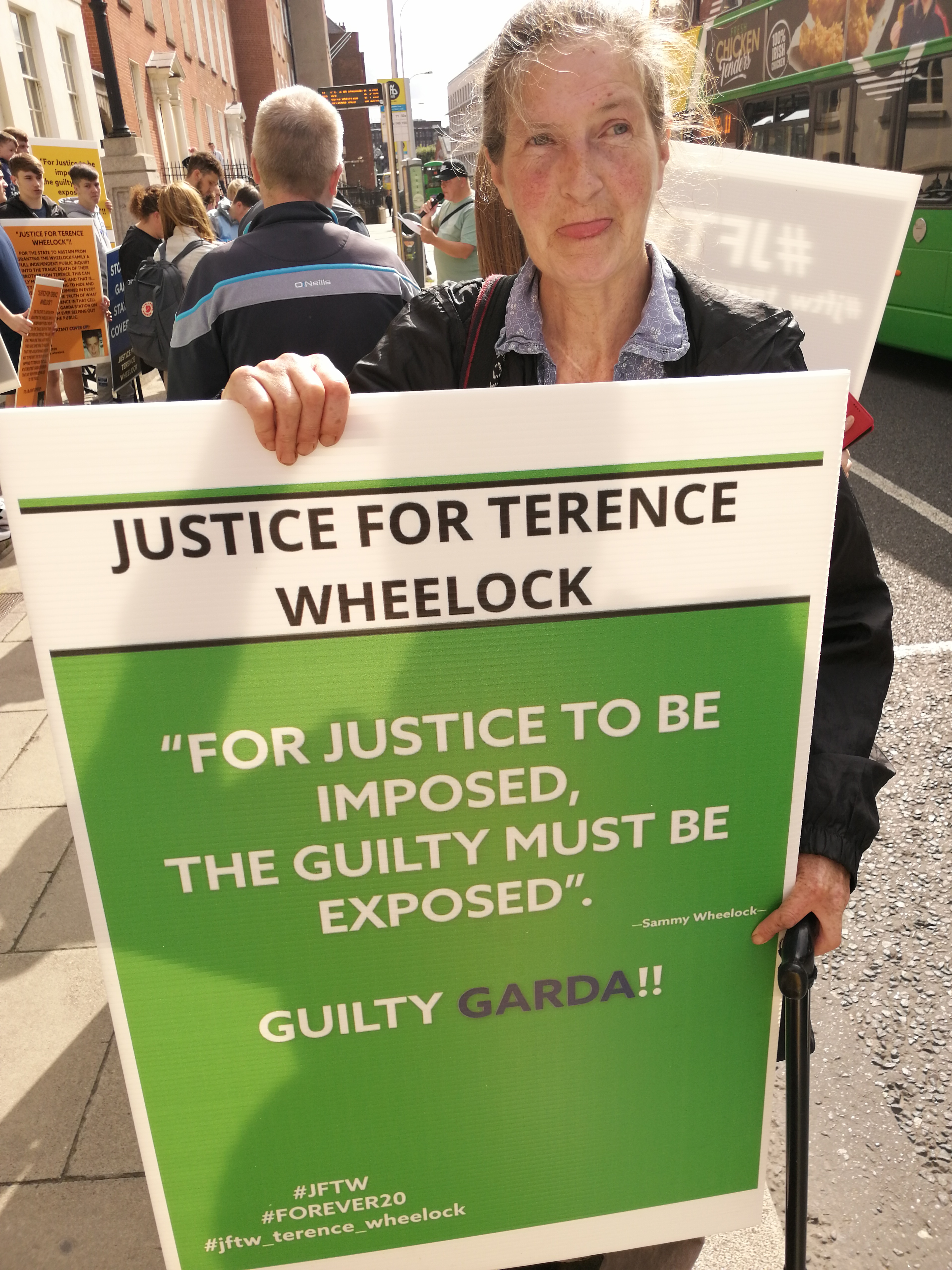
Friends and relations of Terence Wheelock and supporters of the campaign for justice for his family rallied outside the GPO Thursday afternoon before marching to Leinster House and on to the Department of Justice.

Terence Wheelock was 20 years of age when he was arrested by Gardaí following a car stealing by others in Dublin and taken to Store Street Garda Station. Subsequently he was removed to hospital in a coma from which he never recovered, dying three months later.

People gathering outside the GPO for the rally and march (Photo: D.Breatnach)
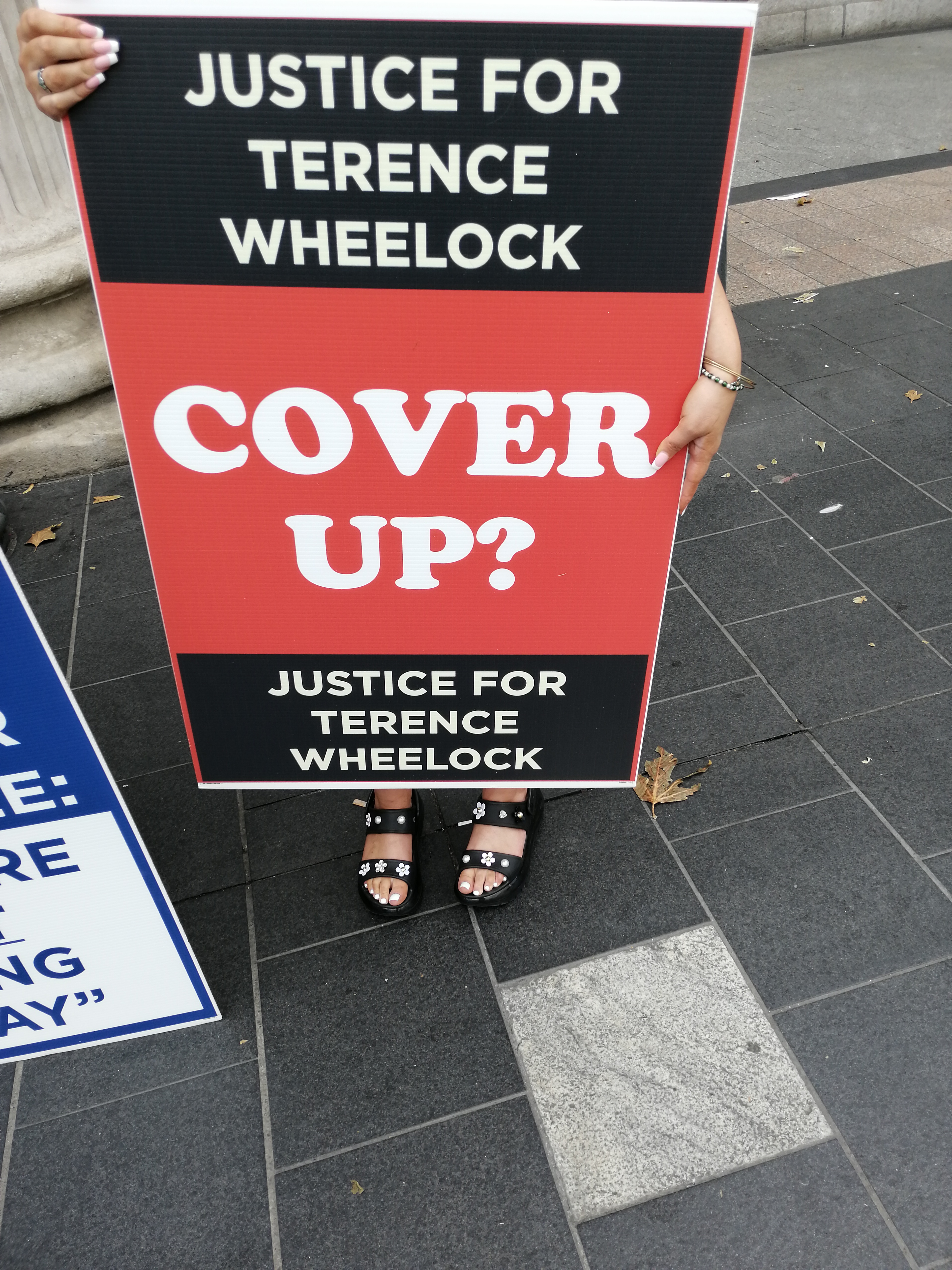
Supporter of the campaign holds a placard (Photo: D. Breatnach)
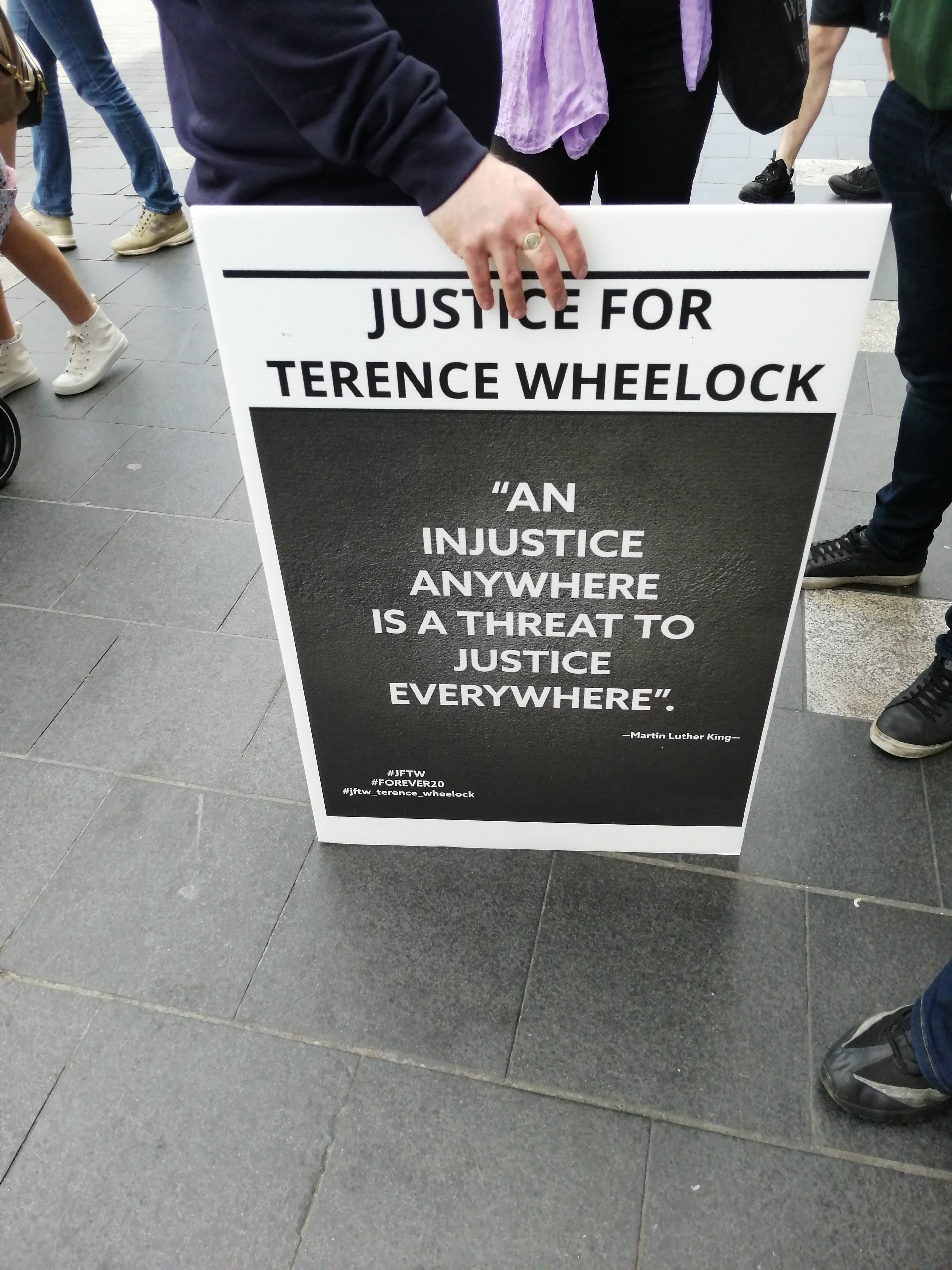
(Photo: D.Breatnach)

The cause of the coma? A severe beating. Not that it should be relevant but he had nothing to do with the car stealing and has been officially cleared of involvement. On the day of his arrest, Terrence was on his way to buy a paintbrush to decorate his room and stopped to talk to some youths he knew.

Though this occurred 18 years ago the family has not ceased seeking acknowledgement of the Garda crimes and are now insisting on an independent official enquiry.

(Photo: D.Breatnach)

MARCH THROUGH CITY CENTRE & THREE RALLIES

Wheelock family supporters, including people from Terence’s north inner city area, socialists, socialist republicans, anarchists and independent activists gathered at the advertised rally point outside the iconic building of the General Post Office on Dublin city centre’s main street.

James O’Toole of Rebel Telly briefly addressed the march supporters outside the GPO before the march set off, speaking about antisocial behaviour in the city and its connection to deprivation of working class areas, a fact admitted by the Gardaí in a report, a copy of which he held aloft.

James O’Toole addressing the rally outside the GPO (Photo: D.Breatnach)

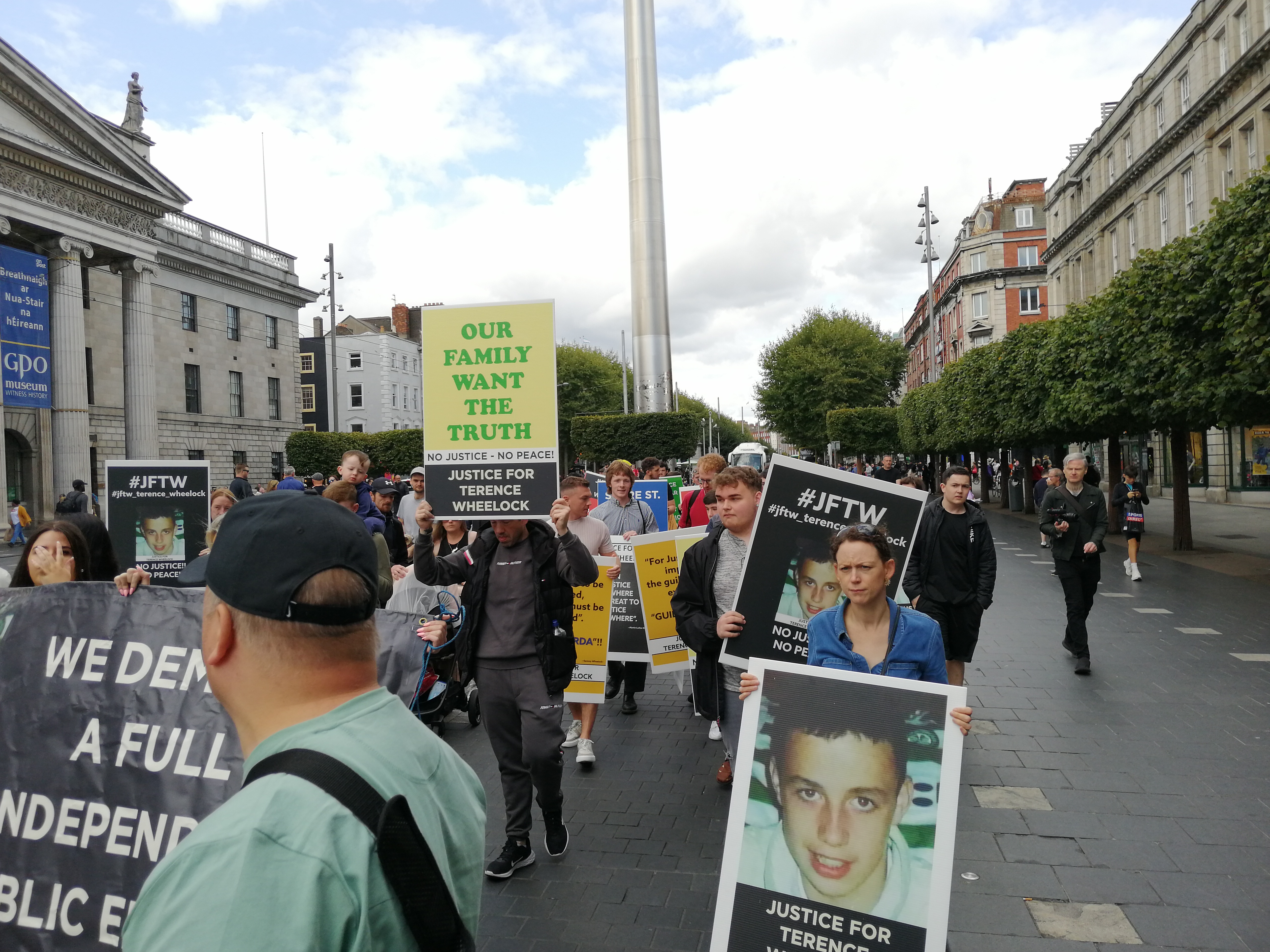
Large printed placards were provided with a variety of texts – one also carrying Terence’s image – and most participants carried one for a group photo and again as they crossed O’Connell Street to march southwards to Leinster House, seat of the Irish Parliament.

Many tourists and shoppers watched with interest, read the placards and listened to the chants of call and reply led by Sammy Wheelock, older brother of Terence: “Say his name!” “Terence Wheelock!” “For justice to be imposed, the guilty must be exposed!” “Guilty:” “Garda!”

“What do we want?” “Justice!” “When do we want it?” “Now!” “No justice!” “No peace!” “Say his name!” “Terence Wheelock!” The driver of an occasional passing car or taxi blew its horn in solidarity as the march crossed O’Connell Bridge and swung around Trinity College.

The march after leaving the GPO (Photo: D.Breatnach)

Outside Leinster House the marchers stopped for a second rally which was addressed by Sammy Wheelock and the slogans were repeated there too. Senator Marie Sherlock addressed the crowd also, promising her support for the campaign.

Cllr Madeleine Johansson, one of a group who recently fought a successful holding action against a mass eviction at Tathony House, also spoke at the rally outside the Dept. of Justice and quoted James Connolly as having stated that ‘an injury to one is an injury to all’.

Sammy Wheelock then led the crowd on again chanting slogans in a march up Kildare Street, left at the Shelbourne Hotel and right again, along the buildings facing Stephens Green to the Department of Justice building, where another rally took place.

Supporters of the campaign being addressed by Sammy Wheelock in front of Leinster House. (Photo: D.Breatnach)

GARDA HARASSMENT OF THE FAMILY

Larry Wheelock, another brother of Terence’s, had been the driver of the campaign but died in January last year. Outside the Department of Justice building Sammy read a letter from his widowed mother Esther, who felt unable in recent years to attend the protests.

“When this whole ordeal first happened it left a hole in my heart so big that for me it’s like a window … or a door that won’t close because as his mother I refuse to let it go, our family refuses … my son was stolen from me at such a young age …” Mrs. Wheelock had written.

(Photo: D.Breatnach)

For a long time during the campaign for justice, as Sammy told the rally outside the Dept. of Justice Thursday afternoon, the Gardaí harassed the family home by passing at night in vehicles blowing their horns and riding police horses on to the road outside their house.

In addition the Gardaí also stood in the family’s garden and shone lights on to the windows, raided the house and struck their pregnant sister in the stomach, knocking her to the ground, also stopping and searching Trevor’s brothers in the street.

The Gardaí also drove slowly in their vehicles past Trevor’s younger siblings, laughing as they made ‘hanging’ gestures at them through the windows. Despite the harassment and intimidation of the family, they “are not going away”, Sammy said.

Garda vehicles and personnel present while rally held outside the Dept. of Justice (Photo: D.Breatnach)

The initial ‘independent’ Garda investigation into Terence’s death, Sammy told his listeners, was headed by an officer who had spent 15 years of his career stationed at Store Street Garda station and it was no great surprise that he found that Gardaí had committed no wrong in the case.

Due to Terence’s case being in the public eye in 2006 when the Garda Síochána Ombudsman Commission (GSOC) was set up, it was the first case to be examined by them, Sammy Wheelock told the rally but once again the Gardaí were exonerated.

The Wheelock family believe such investigations, Sammy told the rally, are a case of “friends investigating friends”.

Announcing he was going to deliver a letter to Minister for Justice McEntee, Terence’s brother read its content out to the participants before mounting the steps to deliver the letter by hand to the Department of Justice, stepping inside for a period.

Sammy Wheelock delivering letter addressed to Minister for Justice McEntee to the Dept. of Justice (Photo: D.Breatnach)

Shortly thereafter, Sammy Wheelock once again thanked the participants for their solidarity on that day and in the past and assured them that the campaign for an independent public enquiry would continue.

(Photo: D.Breatnach)

DEATHS IN GARDA CUSTODY

There were 34 fatal incidents in 2001 in which people died either in or shortly after Garda custody, official figures show; this represents almost three per month. The statistics also reveal a steady increase in such deaths over the years.

The Garda Síochána Ombudsman Commission (GSOC) compiles a database of what are known as Section 102 referrals, which involve situations where the conduct of a member of the Gardaí may have resulted in the death of, or serious harm to, a person.

However, GSOC has not separated referrals for deaths from those of serious harm, meaning the number of people who have died in garda custody is not available.

Vicky Conway, Associate Professor at DCU School of Law and Government, who sadly died prematurely last year, attempted to compile the data on deaths in custody and expressed concern last year that this information is not readily available and broken down into categories.

Three youths from the area hold placards on the steps of the Dept. of Justice (Photo: D.Breatnach)

COMMENT:

The fatal treatment of Terence Wheelock by the Gardaí 18 years ago may or may not be an extreme case but the discriminatory treatment of working-class people is a pattern, of which violence often forms a part, followed by official collusion by ensuring impunity for the Gardaí.

The treatment of the family in their long campaign is a disgrace. It is said also that Terrence’s parents were told that he was in St. James’ hospital, which gave the Gardaí time to get to him first in the Mater and remove his clothes, which have never been produced for forensic tests.

It is of course of great importance to support campaigns to hold the repressive forces of the State to account, as pointed out by Conor Reddy (People Before Profit) to the rally at the Department of Justice building across from Stephens Green.

The message that revolutionaries give in such campaigns is of great importance in reflecting and strengthening the spirit of resistance of the working people, that it may serve them beyond overcoming individual injustices towards achieving justice for the class as a whole.

The reference at the rally outside the GPO by O’Toole to antisocial behaviour in the city, though a live subject at the moment, was inappropriate for the occasion since it could be understood to indicate that Terence had been engaged in such when he was arrested, which was not the case.

Conor Reddy addressing rally outside the Dept. of Justice (Photo: D.Breatnach)

Marie Sherlock, a Labour Party Senator, addressing the rally outside Leinster House, of course put forward the liberal positions of “Garda accountability” and the equivalent of the “few rotten apples in the barrel” analysis of the police force of the Irish State.

While the support of a senator in Leinster House is to be welcomed, revolutionaries have to ensure that social democrats are not permitted to steer campaigns towards unhealthy compromise and that the liberals’ view of the State is countered by the more realistic revolutionary one.

The Gardaí were founded to be a first-line repressive force of the Gombeen Irish State, replacing the repressive police forces of the British occupation, the Dublin Metropolitan Police Force, the Royal Irish Constabulary, Black and Tans and Auxiliary Division.

Their second Commissioner appointed , Eoin Duffy, was the founder of the Blueshirt Nazis in 1932 and the force has amply demonstrated its anti-working class and anti-Irish Republican bias repeatedly since; if the “apple” analogy is to be used, we’d have to say that the orchard itself is rotten!

The death of a teenager is a devastating experience for any family but the importance of this case goes far beyond that of one family as was pointed out by a number of speakers and as is clear from some of the statistics quoted earlier.

(Photo: D.Breatnach)

Garda violence towards sections of the community followed by impunity cannot be tolerated and must be combatted. In that respect it is sad to note the low number of Irish Republicans in the campaign, though they tend to be the chief political target of Garda repression.

End.

(Photo: D.Breatnach)

References & Further information:

https://www.facebook.com/justicefor.terencewheelock

https://www.hotpress.com/film-tv/trailer-released-for-spicebags-first-documentary-the-death-of-terence-wheelock-22971565

https://www.irishexaminer.com/news/courtandcrime/arid-40919204.html

https://www.irishexaminer.com/news/arid-40872935.html

One Year of Petro

Gearóid Ó Loingsigh

(07/07/2023) (Reading time: 8 mins.)

The Petro government has reached the end of its first year in which it promised a lot, came through on some things and changed a lot of other things, particularly its position on certain issues.

Before taking a look at it, it should be pointed out that the Historic Pact (PH) is not the first left-wing government in Colombia. The country is still waiting for that. It is a remould of liberalism in the style of Ernesto Samper.

Even so, it is worth looking at its proposals and what it did in this year, as unlike Samper, it did give a lot of hope to the people.

It is generally accepted that Petro would not have been elected President if it were not for the big popular revolt that began on April 28th 2021, an uprising that cost the life of over 80 youths.

We don’t know the exact number of dead and disappeared and less still of the number of young women who were raped and sexually abused by the Police as part of the repression. Even the number of political prisoners is a matter of dispute.

Not due to the absence of the number of people detained but because the amongst Prosecutor’s Office, the press and sections of the PH there are those who seek to divest the detained youths of any political motivations.

They simply paint them as criminals and vandals, the last of these words having been covered in glory during those protests.1

The heroic ‘vandals’: Demonstrators clash with riot police during a protest against a tax reform bill launched by Colombian President Ivan Duque, in Bogota, on April 28, 2021. (Photo cred: Juan Barreto/ AFP). (Photo choice and caption by Rebel Breeze)

So, it comes as no surprise that Petro, like Boric in Chile, did not free the political prisoners from the revolt. He made a few lukewarm attempts to get a handful of them out, but a long way from all of them.

They are still in prison, despite his electoral victory being thanks to their struggle and actions that led them to prison.

It is perhaps the most symbolic transgression as it says sacrifice yourselves but don’t expect anything from me, not even when I owe you everything. Petro has defended himself by saying that it is not his decision to free or imprison anyone.

Recently he stated:

There are still many youths in prison and I get blamed, as if it were up to me to imprison or free them. State bodies and people inside them have decided that these youths should not be freed.

Not because they are terrorists, who would think protesting is terrorism? If not a dictator or Fascist. No, but because they want to punish the youths who rebel.2

Some may feel that he is right in a technical sense, i.e. that it is the Prosecution and the judges who imprison them. But that is to ignore reality.

He himself denigrated them when he referred to them as ‘vandals’ during the protests and since taking office, neither Petro nor the PH have been the visible heads of any initiative to free the prisoners. They washed their hands of the issue.

He didn’t even disband the specialised riot squad, the ESMAD. Unlike other proposals he didn’t even try to.

He changed its name and promised a couple of human rights courses for its members, as if the problem was their lack of attendance at a course or two given by some NGO and not a deep-rooted problem. The ESMAD is a unit that murdered many youths.

It is a body whose name is synonymous with violence, torture, sexual abuse and murder. A name change won’t wash away the blood.

the promise to put an end to the ESMD was just lip service during the presidential campaign. It wasn’t carried out and the government will fail to carry through on its commitment to the youths who brought the president to power, through the existence of a repressive violent force like this one.

The temptations to infiltrate the marches in order to justify confrontations with the kids will continue to be part of the landscape.3

Petro gives his voters a clenched fist on his inauguration as President in August last year but many remain in jail and the rest get little or nothing. (Photo sourced: Internet) (Photo choice and caption by Rebel Breeze)

In economic terms the government promised a lot during the campaign, but once in power, it quickly softened its proposals and in some other cases they didn’t get a majority of votes in Congress.

The lack of votes in Congress is not a simple one of not coming through, nor is it due to betrayals by the PH nor manoeuvres by other forces that Petro can’t control.

The PH is a coalition of sectors of the right with sectors of what passes for social democracy in Colombia. It was not inevitable, but rather Petro actively advocated that it be like that.

It is worth recalling that at first, he wasn’t going to choose Francia Márquez as his vice-president but rather a right winger like Roy Barreras.

However there are economic aspects that are under his control, but for the moment they remain as just proposals, rather than real policies that have gone through Congress. On the land question, Petro proposes monocultures and agribusiness.

This was clearly to be seen in the proposal to buy three million hectares from the cattle ranchers.

Petro’s vision of the countryside is one of it being at the service of big money and the promotion of cash crops, despite some references to the production of foodstuffs for internal consumption and the so-called bio-economy.

Something similar can be seen with his proposals for clean energy. He spoke a great deal about it during the electoral campaign and some of his proposals, or outlines as they stand, look good.

That Colombia no longer depend on oil and coal is not a bad idea and that it be replaced with alternative energy sources such as solar and wind power looks good, until we actually examine the details.

One of his first stumbles, in that sense, was with the Indigenous people, as La Guajira is a poor area that has suffered the consequences of coal mining.

He did not take them into account and they reminded him that what is proposed for their territory should have their support, though legally it is not quite the case, and that it should also benefit them.

He partially rectified the case, but the big question is, if he wants an energy transition why does he have to seek out French and other foreign capital to finance it. Does he want to hand over the wind and solar power as they are still doing with oil and coal?

It would seem so. According to Petro:

We need investments that help us carry this out: we would have a matrix of foreign investment centred on the construction of clean energies in South America, with a guaranteed market, if we have direct link to the United States and by sea with the rest of the world.4

If you substitute oil and coal for clean energy, you begin to see the problem: the resources of Colombia in the service of big money and the countries of the North.

If we are to have a real change and energy transition, we must end the idea of Northern energy consumption regardless of where it comes from as sustainable and that countries such as Colombia must supply energy for a planet-destroying consumption model.

Neither have there been great advances on the issue of peace. He did reactivate the dialogue with the ELN, but stumbled with something that is still an integral part of his policy, the so-called Total Peace.

In his proposal he compared the insurgent group, the ELN to the drug gangs and paramilitary groups such as the Clan de Golfo. It was not a mistake, Petro really does see the ELN as a criminal gang.

He made it clear in his speech to the military and he reaffirmed it when he named the blood thirsty Mafia boss and former Murderer-in-Chief of the paramilitaries, Salvatore Mancuso as a Peace Promoter.

With that he placed the ELN leadership on the same plane as the paramilitaries. And they have implicitly accepted it for the moment.

In Petro’s discourse Colombia is a violent country and there is no way to understand it and peace has to be made with everyone as they are all the same, the insurgency and the narcos. Not even Santos was that creative in delegitimising the guerrillas.

Mancuso took on his role and once again spoke of the land they had stolen, the disappeared etc. He has been telling us for two decades now that tomorrow he will reveal all, but tomorrow never comes.

When Uribe invited Mancuso to the Congress of the Republic, Petro had a different attitude.

His response was blunt and he described Uribe as a president that was captured by the paramilitaries and that Mancuso manipulated the Congress stating that “if under this flag of peace, dirtied by cocaine what is essentially being proposed is an alliance with genocidal drug traffickers and political leaders… then we are not contributing to any sort of peace.”5

And we end the year with a scandal. I have on many occasions compared Petro and the PH to Samper and the Liberal Party of the 90s. But not in my most fertile delirium could I imagine that Petro and his son would give us another Process 8000.

Samper managed to reinvent himself as a statesman and human rights defender, despite his government’s dreadful record, following the outcry over drug money in his election campaign. He has publicly supported Petro and the PH.

Now he can advise them on how to deny what is as plain as day. Illicit funds went into the PH’s campaign as has happened with all election campaigns.

Petro finds himself in the eye of the storm due to the manoeuvres of his son in asking for and receiving money. His ambassador in Caracas has boasted about obtaining 15,000 million pesos [3.3 million euros] that were not reported to the authorities.

Those on the “left” who gave Petro unconditional support defend him, saying that it all happened behind his back.

The only thing left to say about that is, a little bit of respect for Samper please! He established his copyright, authorship of that expression in relation to dirty money. They will have to come up with another one.

For the moment Petro says, I didn’t raise him, which is true. But his son is the beneficiary of a type of political nepotism. As was the case with Samper, the only doubt is whether Petro knew or not.

That a government which is supposedly progressive has found itself entangled in such a storm is revealing of a government in which politics is a family business.

Something similar happened to the FARC commander Iván Márquez with his nephew who turned out to be a DEA informant.

On the drugs issue it is clear that the discourse and reality do not match at any point. Petro went to the UN to announce a new drugs policy. He put forward various aims for his government and criticised the war on drugs.6

It seems like a bad joke that the said policy has not yet been published. What we have seen is that the fumigations continue, the Yanks smile on and occasionally there is talk of going after the big fish, without saying who they are.

We know that he is not talking about the banks, and less still of the European companies that supply the precursor chemicals. The big fish will turn out to be middle ranking thugs in the cities of Colombia, at best.

So, it has been a year that wasn’t that different to others. Yes, there were changes, some proposal or other that was half interesting, but even the right wing does that occasionally.

The vote of confidence cast in the ballot box is still waiting to see the promised changes. But we increasingly see a government without a clear aim and reinventing old policies as new ones, with the same results as before.

End.

FOOTNOTES

1 See Ó Loingsigh’s article Long Live the Vandals – R.B.

2 Infobae (06/08/2023) Petro se defendió por los casos de los presos del Paro Nacional: “Como si yo encarcelara o pudiera liberar”. Juan Camilo Rodríguez Parrado.
https://www.infobae.com/colombia/2023/08/03/petro-se-defendio-por-los-casos-de-los-presos-del-paro-nacional-como-si-yo-encarcelara-o-pudiera-liberar/

3 Pares (11/10/2023) Cambio de aviso: gobierno Petro echa para atrás desmonte del Esmad. Miguel Ángel Rubio Ospina. https://www.pares.com.co/post/cambio-de-aviso-gobierno-petro-echa-para-atrás-desmonte-del-esmad

4 Portafolio (18/01/2023) El plan que propone Petro para lograr inversión en energías limpias. https://www.portafolio.co/economia/gobierno/gustavo-petro-su-propuesta-para-lograr-inversion-en-energias-limpias-577102

5 See https://www.youtube.com/watch?v=Wg3av8Oeujk

6 See https://www.youtube.com/watch?v=J35_vqekWcc

Monument for National Army soldiers killed in Civil War unveiled in Dublin

News & Views No. 6 (Reading time: 4 mins.)

Original Breaking News article: DAVID YOUNG, PA (with commentary in italics by Diarmuid Breatnach)

The rededication of a memorial to the National Army soldiers killed in the Civil War enables their memory to be rehabilitated, a ceremony in Dublin has heard.

Defence Forces Chief of Staff Lieutenant General Sean Clancy paid tribute to the some 810 soldiers killed serving on the Free State side in the 1922-2023 conflict as he addressed the event at Glasnevin Cemetery on Sunday.

Descendants of some of those who died, representative of all four provinces, were invited guests at the ceremony, among them relatives of Michael Collins, the commander in chief of the National Army who under direction by Churchill, gave the orders that began the Irish Civil War and who was killed in 1922.

Taoiseach Leo Varadkar and Tánaiste Micheál Martin, the leaders of Fine Gael and Fianna Fáil, the two main parties forged from the divisions of the Civil War, also attended the rededication of the National Army Monument.

Sinn Féin TD Matt Carthy also attended the military commemoration, as did Dublin Lord Mayor Daithí de Róiste.

This neatly brought together political parties of the neo-colonial and neo-liberal Irish State with opposing histories: Varadkar to represent the pro-British and fascist neo-colonial origins of Fine Gael; Mícheál Martin and De Róiste representing Fianna Fáil, the allegedly Republican but in reality Irish Gombeen split from the previous iteration of Sinn Féin; Carthy for the current neo-colonial, neo-liberal and colonial servant Sinn Féin.

Taoiseach Varadkar (Fine Gael) and Tánaiste Martin (Fianna Fáil) unveiling monument to soldiers of the ‘Free State’ killed in the Civil War 1922-1923. (Photo cred: Brian Lawless/ PA)
Matt Carthy TD, who represented his party Sinn Féin at the unveiling and dedication of the monument to soldiers of the Free State killed in the Civil War 1922-1923. (Photo sourced: Internet)

Prior to the ceremony, there was no monument in the country specifically dedicated to the soldiers of the National Army who fought against the anti-Treaty side in the Civil War.

Weeks after the war ended, on August 3rd, 1923, the Oireachtas passed legislation that led to the creation of the modern-day Defence Forces, Óglaigh na hÉireann. That is, the defence forces of the neo-colonial ruling class who created the Irish state.

The rededication event for the forgotten fallen of the National Army, which had already robbed the Irish language version name of the IRA, adopted the name Óglaigh na hÉireann during the Civil War, took place on the Sunday prior to the centenary of that date.

“It is appropriate then, in the spirit of real inclusiveness, of ethical remembering, and with a full desire to deal with some of the more uncomfortable aspects of our shared history, that we remember some of 810 uniformed members of Óglaigh na hÉireann who gave their lives in the service of the State during the tragic and critical period at the foundation of our democracy,” Lt Gen Clancy told the ceremony.

It is necessary, in order to bury any idea of achieving the Republic declared at the start of the 1916 Rising, that we honour some of the 810 men we recruited to bury that Republic in 1922, kitted out in uniforms, armed and transported by our ancient enemy. We wish to pass over quickly over not only the kidnappings, torture, murders, killing of disarmed prisoners and even sexual assaults by this fine body of men – the precursors to the current army of the Irish State – but also their terrorising of major part of the country with raids on homes and internment of men and women. Although this fine body of men were fighting to establish a neo-colony not even covering the whole of Ireland, we make no apology for calling them what they clearly were not, Óglaigh na hÉireann, i.e “Warriors of Ireland”.

The monument in Glasnevin to soldiers of the Free State killed during the Civil Warapart from the Free State Army having appropriated the name in Irish of the IRA, the legend claims they “died for their country”, a clearly inaccurate statement since at best they were fighting for the government and state of the 26 Counties, which excludes the UK colony of the Six Counties (‘Northern Ireland’ sic). (Photo cred: PA)

“For far too long there has been no memorial of any kind, nor any complete listing of the National Army war dead.” Understandably.

“Indeed, this year represents perhaps the last real opportunity to rectify that.”

As we prepare to commit this armed force to NATO at some point in the future and to PESCO in the nearer future, it is important to take a further step in legitimising this armed force of the neo-colonial state.

The remains of some 180 of the 810 soldiers who died serving in the National Army are buried at the plot in Glasnevin Cemetery. Uncomfortably close to graves of many of their victims.

“Sources at the archives show that the average soldier buried here was in his early 20s, was unmarried and from a working-class background,” said Lt Gen Clancy. In other words, the typical recruitment profile of lower-rank soldiers in capitalist and imperialist armies.

“Many had previously served in the IRA during the War of Independence, some even in the 1916 rising, many others had served in the British Army, underlying yet again how complex is the weave of Irish history.”

Actually, “many” is a questionable though vague estimate of the numbers who had “served in the IRA during the War of Independence”, though some had, including some of the most vicious, such as Major-General Paddy Daly, torturer and murderer.

The chief of staff highlighted the “poignant example” of two young Belfast-born Dublin-raised brothers – Frederick (18) and Gerald McKenna (16) – who were buried in Glasnevin after being killed together in action in Cork in August 1922 only a month after joining the National Army.

Aye, two men born in Belfast, a city which the Free State was fighting to ensure remained a direct colony of the United Kingdom.

“Whatever the often very legitimate reasons our forebears may have had for forgetting in the intervening 100 years, I think it’s appropriate now that I as the 32nd Chief of Staff of Oglaigh na h Eireann should finally take this opportunity to rehabilitate their memory,” said Lt Gen Clancy.

Especially as I try to establish a legitimate background to the armed force of an illegitimate State preparing to enter foreign imperialist wars and suppression of legitimate uprisings.

After all, we have great experience in all that, as the history behind this monument shows.

End.

Source: https://www.breakingnews.ie/ireland/memory-of-fallen-national-army-soldiers-rehabilitated-as-monument-unveiled-1508928.html

LEARNING FROM AND CORRECTING OUR MISTAKES

Diarmuid Breatnach

(Reading time: 6 mins.)

In all areas of endeavour and no less in revolutionary work it is essential to review our actions (and those of others) periodically in order that we may draw lessons to improve the success of future activity.

Irish history provides an abundance of material to revise.

The most recent period worthy of intensive review in my opinion is the three-decade war, mostly in the Six Counties but also having repercussions within the territory of the Irish State, in Britain and even further abroad.

An article in the July issue of An Phoblacht Abú1, monthly hard-copy newspaper of the Anti-Imperialist Action organisation, discusses the psychological and organisational problems arising from the way that three-decade struggle came to an end and its effects on the resistance movement.

That period in Ireland commenced with a struggle for democratic civil rights, not one of the demands of which were for more than was already well established in the rest of the ‘UK’. But it soon changed into a guerrilla war with huge numbers of political prisoners and jail struggles.

The movement experienced a number of splits and changes of leadership but for most of of the time it was led by the Provisional organisation’s leadership although changes took place inside its own leadership too.

Ruairí Ó Brádaigh, President Provisional Sinn Féin 1970-1983, speaking at GPO rally 1976. He led an unwinnable war. (Photo cred: Pat Langan/ Irish Times)
Some of the Provisional IRA leadership following the 1970s split: Martin McGuinness, Dáithí Ó Conaill, Sean Mac Stiofáin, IRA press conference 1972, Derry. (Photo cred: Larry Doherty)

The period ended with that leadership not only abandoning armed struggle but being coopted with its structures into joint management of the colonial occupation and preparing for joint management of the neo-colonial Irish state, a number of smaller splits in the movement a much disillusion.

The An Phoblacht Abú article concentrates on building or rebuilding trust in leadership through measures such as clear communication, discussion, organisational restructuring, collective solidarity, open discussion, transparent communication and education.

The article does not say this but in my opinion one of the basic educational needs is to acknowledge that in the circumstances, what happened was inevitable (and to consider how different circumstances might be constructed in future).

UNWINNABLE

It is essential in my view to acknowledge that the struggle, as it was waged, was bound to lose. Yes, unwinnable: an unassisted armed struggle against a world imperialist power fought primarily in one-fifth of our territory where the population is deeply divided – how could we think otherwise?

Clearly, the Provisional leadership did think otherwise. Assuming they were not insane or very stupid, on what could their belief have been based?

I can see only two rational possibilities:

1) They believed the British had no essential need to retain the 6-Co. Colony and would abandon it if put under enough pressure, or

2) that the Irish ruling class, through its government, would step in and join the struggle.

If they believed the first, their analysis was not historically-based. Since its invasion and occupation of Ireland in the mid-12th Century, the British ruling class has repeatedly gone to enormous efforts to suppress Irish self-determination.

When they had the opportunity to leave in 1921 they had cultivated a client bourgeoisie, then instigated a civil war and partitioned the land, leaving themselves a firm foothold in the country.

Their initial response to a call for simple civil rights in the late 1960s was violent suppression on the streets, abolition of habeas corpus and introduction of internment without trial – and army massacres.

If the previous lessons of history were not clear to the movement’s leadership, then those events up to 1972 should have made them crystal clear.

If the Republican leadership believed the Irish ruling class would step up, they failed to draw the lessons of history since at least 1921 and to understand the neo-colonial nature of the Gombeen class, amply illustrated in the preceding 50 years of the Irish State.

As embarked upon and fought, the war could not be won but a struggle was potentially winnable.

However, to have a chance of winning, the struggle would have to be over the whole 32 Counties. And to engage the maximum number of people, it would have to take up the social, cultural, economic and political deficits across the Irish state and across the colony.

The social rights of women and LBG2 people were widely-acknowledged deficit areas, yet the Republican movement did not seriously address them. Of course, doing so would have put the Movement in direct opposition to the Catholic Church hierarchy and its followers.

Why should that be a problem? Hadn’t the Hierarchy been pro-British occupation since the late 1800s3 and anti-Republican since the 1790s? Wasn’t it one of the cornerstones of the neo-colonial Irish State, its social prop and social control mechanism?

Yes but the problem was that some of the leadership themselves were in that ideological ambit and were in any case afraid to disaffect many of their followers. A natural fear, of course. Yet only in that way could the struggle go forward across the Irish state’s territory.

It was left to campaigners mostly outside the Republican Movement, including social democrats and liberals, to fight for the rights to contraception, divorce, equality for women, LGB rights. And later, to take on the huge institutional abuses of the Catholic Church in Ireland.

Those issues affected directly well over half the population of the Irish state and the the leadership lacked the interest or the courage4 to take part in their struggles, never mind lead them, which it left to mostly non-revolutionary leaderships.

There were many other issues that affected people in the 32 Counties which a revolutionary leadership could take up and, I would argue, should have taken up.

The latter includes emigration, rights of the Irish diaspora (particularly in Britain), foreign penetration of the Irish economy, foreign land ownership, housing shortage, industrial struggles, academic freedom, Irish language rights, Church control of education and the health service …

Some of those issues were taken up for a while by the movement in parts of the 26 Cos. prior to the split in the Republican Movement but were progressively dropped as the armed struggle in the 6 Cos. took off.

When years later the Provisional leadership got interested in social democratic reformism, they found they could hardly make any headway in the unions against the Labour Party and the remains of the Workers’ Party – because of the Provos’ earlier overwhelming neglect of that area of struggle.

SUMMARY

The struggle in the Six Counties could not be won precisely because it was primarily confined to that area and also one in which a powerful enemy had seduced a huge section of the population.

When the leadership acknowledged the unwinnability of the struggle as being waged, instead of changing their methods and aims of struggle to take in the whole 32 Cos, they decided on capitulation and getting the most possible out of it for themselves.

A change in the top leadership of Sinn Féin and the IRA: Gerry Adams and Martin McGuinness photographed in 1987. They recognised they could not win and set about managing abandoning it while getting something out of the system for the leadership. (Photo: PA)

The leadership of the Republican movement was unwilling to widen the struggle because they believed that it was unnecessary to do so and/ or they were unwilling to overcome their own ideological indoctrination and/or lacked the courage to confront prejudices among their following.

Some of the social struggles have now been won or hugely progressed but without the leadership of the Republican Movement, in fact by leaderships of mostly reformist trends.

Due to leaving the industrial struggle to social democrats, the trade union movement has degenerated hugely and is in a poor state to take on any substantial economic or rights struggle, to say nothing of a revolutionary one.

The surviving Republican movement seems unwilling to acknowledge those historical facts and its failure thus far in leadership. Admission of the facts is necessary in order to commence to repair the movement and to prepare for a struggle with a prospect of success.

End.

FOOTNOTES

1Page 9, entitled COMRADESHIP – GUARD AGAINST BETRAYAL; I intend to review the July issue of the newspaper separately some time soon.

2I have omitted the T from LGB because it is only comparatively recently that the transexual issue has gained wide acknowledgement, whereas the Gay, Lesbian and even Bi-Sexual issue were widely known about at the time under discussion.

3The Irish (settler) Parliament passed an act giving middle-class and higher Catholics the right to vote in 1793.

4Though no-one could fault their physical courage

Getting mileage out of parliamentary representatives

News & Views 5 Diarmuid Breatnach (Reading time: 2 mins.)

‘What about that Niall Collins fella?’

‘Wha’ – the Junior Minister for Education and his travel distance claims?’

‘Yeah. I mean, according to The Ditch he would’a hav’ta driven more than twice as much as the average taxi driver in Ireland, which averages at 30,352 kilometres a year. Collins claimed 73,807 kilometres.’

‘With a head for figures like that, he should be Minister for Finance!’

‘Heh, heh. But maybe he was moonlighting as a taxi super-driver on top of his parliamentary travelling.’

‘Could be. Those poor TDs only get €107,376 a year to live on.’

‘Apart from expenses. Like tax-deductible driving expenses.’

‘Exactly!’

‘Well, it does certainly look like he’s been taking the country for a ride.’

‘Ha, ha, ha. And ye can’t fault his drive!’

‘I think they’ll soon be calling him ‘Miles’ Collins.’

(Maybe we’ve got enough mileage out of that now).

https://www.ontheditch.com/high-mileage-club-niall-collins/

HELICOPTER AND MASSIVE GARDAÍ NUMBERS – FOR WHAT?

Diarmuid Breatnach

(Reading time: 4 mins.)

Late Tuesday night and early hours of Wednesday morning an operation with large numbers of Gardaí and their helicopter circling overhead disturbed residents in the north Dublin city centre area of Berkeley Road and surroundings.

It looked like drug bust, hostage rescue situation or siege, but it was none of those things, instead being an eviction of four housing activists.1

Supporters of the occupation by the RHL gathered at short notice by Berkeley Road during the Garda operation but were roughly pushed far back by Gardaí from the building under attack (Photo: RHL)

The building had been “acquisitioned” by the Revolutionary Housing League which for a couple of years has been occupying buildings lying empty around Dublin in order to house homeless people and to inspire people to take over empty buildings to end the homeless crisis.

One of those buildings was the red-brick building on Eden Quay and corner of Marlborough Street; it had been operated by the Salvation Army as a night shelter for homeless young people but left empty for years after losing funding.

Supporters in front of James Connolly House occupation over a year ago. (Photo: Rebel Breeze)

On 1st May 2022, RHL2 activists ‘acquisitioned’ the building, renamed it James Connolly House and repaired a leak in the roof. In the early morning of 9th June 2022, an estimated 100 Gardaí (some reportedly armed) stormed the building with a Garda helicopter circling overhead.

Two RHL activists performing overnight security on the building were arrested and brought to court, where they declined to be bound over or to give an undertaking that they would not return to the building.

The Salvation Army said that they were renovating the building in order to house Ukrainian refugees. Not only was there no evidence of that in the building when it was occupied but it is empty still, over a year after that eviction3.

Garda evictions have taken place around other acquisitions of empty properties and RHL activists have on each occasion refused to commit to an undertaking not to occupy other properties.

Rather, the RHL has called for empty buildings to be occupied around the country.

The eviction this week

The massive Garda operation this week, including road-blocks, to evict RHL occupants of the Berkeley Road house. (Photo: RHL)

After the eviction in Berkeley Road, four RHL activists were taken to Court where they followed the previous pattern of refusing to be bound over or to promise not to occupy other buildings. Nevertheless they were released with a threat of jail-time if they re-occupied.

The lessee of the building, advertising as Cabhrú and formerly Catholic Housing Aid Society (Chas), has faced allegations of improper use of that building and another, Fr. Scully House on nearby Gardiner Street, some of which were borne out in an investigation by Charities Regulator.4

Supporters of the RHL occupiers outside the High Court (Photo: RHL)

The housing crisis

The numbers of homeless people in the the Irish state passed 12,000 for the first time in May this year and over 4,000 of those are children,5 nor do those figures include people defaulting on their mortgage loans, sleeping on the street or ‘sofa-surfing’ with friends and relations.

According to figures published in April this year, there are over 100,000 empty homes within the Irish state, not counting holiday homes (the Berkeley Road one was empty for three years).

Housing the homeless on the face of it can be accomplished without the revolutionary overthrow of the State and its Gombeen6 ruling class. All that is necessary is a public housing program financed by the State, which it could easily accomplish.

However, the stubborn clinging of the Gombeens to keeping a wide high-return market for property speculators, bank funders and big landlords, year after year as the housing crisis worsens, seems to indicate that a revolutionary remedy is necessary.

This week the Taoiseach,7 Varadkar, inferred that a contributory cause of the housing crisis was that homeless people had turned down alternative accommodation, a nonsensical claim since one person’s declined accommodation could just be offered to the next.

Addressing him in the Leinster House parliament, Sinn Féin TD8 Pearse Doherty9 took him to task for inferring that the homeless were to blame for their situation, in response to which Varadkar denied accusing the homeless and ungraciously amended his statement to “some homeless people”.

He went on to say that homelessness has a number of causes but neglected to name the principal one, viz. that the State does not supply funds to municipal authorities to provide public housing, leaving property speculators, banks and big landlords free to exploit the housing ‘scarcity’.

According to media reports, Doherty neglected to take this opportunity to point out the real cause of the problem and the solution, which confirms the doubts of those who say that his party is “Fianna Fáil Mark II”,10 with no intention to fundamentally alter the economic system in the state.11

Revolutionary Housing League flag on top of the occupied building during the massive Garda operation (Photo: RHL)

In conclusion

The housing crisis shows no sign of being resolved and the ruling class have ridden high-profile ‘shaming’ token occupations such as that of Apollo House in January 2017 without changing anything. RHL occupations do seem to show a way forward if they are widely emulated.

Heavy Garda operations on the one hand and comparatively light treatment by the courts on the other seems to indicate a determination not to tolerate this kind of direct action on homelessness while at the same time moderated by a fear of creating housing action martyrs.

Meanwhile the numbers of homeless grows by the month without any other credible solution in sight.

End.

FOOTNOTES

1This is the police force that has been described by its chief, Commissioner Drew Harris (formerly Asst. Commissioner of the colonial gendarmerie PSNI and therefore also MI5), as his “gang” but which seems unable to prevent serious assaults in the city centre, even in its main street.

2Originally Revolutionary Housing Union, later became RHL.

3And over 30 months after it first became empty.

4Some of those included a friend of the charity’s Chief Exeutive being accommodated in the building allegedly providing only for the elderly, rooms being let to short-stay students without proper guarantees or rights and one of the houses being used as a business address.

5https://www.irishmirror.ie/news/irish-news/politics/homelessness-figures-april-2023-12000-30085446

6From the Irish “gaimbín”, describing opportunist middlemen, now applied to the foreign-dependent native Irish capitalist class.

7Prime Minister of the Irish state.

8Teachta Dála, member of the Irish Parliament, equivalent to “MP”.

9Deputy leader of the party in the Irish parliament. Holly Cairns, leader of the Social Democrats also attacked Varadkar on the statement.

10Fianna Fáil is one of the two main government parties; originally a split from Sinn Féin led by De Valera, it has been in government more than any other party in the Irish state.

11A number of SF party leaders including its current president have publicly stated that big business has nothing to fear from their party.

SOURCES

Charities Regulator report: https://www.charitiesregulator.ie/en/information-for-the-public/our-news/2021/july/charities-regulator-publishes-inspectors-report-into-the-affairs-of-cabhru-housing-association-services

Irish Times articles regarding concerns over the years: https://www.irishtimes.com/tags/cabhru-housing-association/

Video about the RHL: https://www.youtube.com/watch?v=rSL453gVHAg

https://www.irishmirror.ie/news/irish-news/politics/homelessness-figures-april-2023-12000-30085446

Taoiseach Varadkar and his controversial remark about the homeless: https://www.independent.ie/irish-news/taoiseach-refuses-to-apologise-for-saying-plenty-of-people-on-housing-list-refuse-offers-of-accommodation/a1546284704.html

BUILDING BRICS

Diarmuid Breatnach

(Reading time: 5 mins.)

For decades the US Dollar has dominated financial transactions across the world – backed not only by the USA’s industrial and agricultural output but by its imperialist domination of many economies and its military power.

But perhaps no longer, for now there is a serious competitor in the field, one with the acronym BRICS, from the first letter of the states that created it (in order of no significance): Brazil, Russia, India, China, South Africa.

Apart from the backing of powerful economies with more applying to join, this currency standard is based on the price of precious and semi-precious metals. The UK’s Sterling (and the Irish state’s, for a while) was based on silver but the Dollar has for many years been backed by … debt.

A currency is based on the assumption that every unit will be payable and backed by a unit (e.g. gold) of the declared value. But if the value unit markers of the US Dollar, in coins, notes, cheques and credit transfers were to be presented to the US Treasury, it could never pay them.1

In fact, it could not even pay a significant percentage of them and has been running a national defaulting on debt currency for many years, this year once again deciding to continue doing so to the tune of  $31.5 trillion.

But is it really “redeemable” if all are presented? (Image sourced: Internet)

The USA has been able to continue doing this to date because so many of the world’s economies have been dominated by US Imperialism or in alliance with it; they fear that calling in the debt would lead to the collapse of the USA system and to their own interlinked financial structures.

BRICS consists of a financial alliance of economies of which their leaders for one reason or another feel in their interests to end the world dominance of the Dollar.

Previously, South Africa’s Foreign Minister Naledi Pandor said that there are 12 countries interested in joining the initiative.

Of the 12, she mentioned seven countries specifically, namely Saudi Arabia, United Arab Emirates, Egypt, Algeria, Argentina, Mexico and Nigeria. In March this year Russia announced its support for Algeria’s bid to join BRICS.

In April the expansion of that list interested in joining to 19 states was announced with formal applications from Algeria, Argentina, Bahrain, Egypt, Indonesia, Iran, Saudi Arabia and United Arab Emirates.

And with expressions of interest from Afghanistan, Bangladesh, Belarus, Kazakhstan, Mexico, Nicaragua, Nigeria, Pakistan, Senegal, Sudan, Syria, Thailand, Tunisia, Turkey, Uruguay, Venezuela and Zimbabwe.

(Image sourced: Internet)

COMMUNICATIONS, COMMON CURRENCY & LENDING BANK

Plans for an optical fibre submarine communications cable between BRIC members – partly motivated to avoid US National Security Agency spying on telecommunications in and out of the USA – have not advanced far since first discussed in 2012 but have not been abandoned.

Likewise, discussions of a common currency have not come to fruition yet either. However that may be more imminent.

As challengers to Western-led international currency, BRICS “in the order of the scale of GDP, now collectively outweigh not only the reigning hegemon, the United States, but the entire G-7 weight class put together” (former White House senior advisor Joseph W. Sullivan).2

The same commentator believes that such a common currency has a much greater chance of stability than the Eurozone, because of the geographic diversity of its members, which enables a broader range of goods and services.

(Image sourced: Internet)

The biggest attraction for applicants to join is probably access to loans from the New Development Bank to members for infrastructure projects, which is the NDB’s main advertised purpose. Heretofore, the IMF and the World Bank have been the main external lenders.

Both the latter institutions have imposed harmful changes on borrowing economies, often driving them further and deeper into debt and into greater dependency on western imperialism. Those lending institutions have also supported corrupt and oppressive regimes.

The NDB has authorised lending up to $34 billion annually, with South Africa the HQ for the African continent with a starting capital of $50 billion ($10 billion from each of the five founders) and so far has 53 projects underway worth around $15 billion total.

Should the NDB prove its ability to issue loans to nationally-desired projects without the penurious and destructive conditions currently attached to IMF and World Bank funding, many, many regimes in the underdeveloped world are likely to apply to BRICS for membership.

And should client regimes currently dependent on western imperialism refuse to jump across to BRICS, they may well face coups from more nationally-ambitious sections of their elites or insurrections from below.

IS BRICS A GOOD OR A BAD THING?

Some anti-imperialists, including some socialists, have been celebrating the creation of BRICS, some even proclaiming it as the financial reflection of a new anti-imperialist order.

Of the five founding economies, only one claims to be socialist. Capitalist economies, we know, tend to develop into imperialist ones, sometimes but not always invading the countries of other economies but always exporting surplus capital there to exploit labour and natural resources.

So some or all of the capitalist economies in BRICS currently are likely to become imperialist also.

That apart, having much or even all of the world’s economies divided between two blocs may give weak economies opportunities they would not otherwise have or at least a choice and perhaps the opportunity to bargain for the conditions of their relationship to world finance.

In other words, a return in many fundamental ways to the division of the world before the collapse of the Soviet Union.

A breakthrough the current financial structure to a new one?

THREAT OF WAR?

But does this bring the threat of world war, arms race, etc, as seemed to be always present between the USA and the USSR?

Possibly but the threat of world war is already very much with us, as US/NATO uses the Ukrainian regime as a proxy in its decades-long threatening encirclement of Russia, and also in its posture (not unrelated) towards Iran and the USA’s world competitor China.

The working class in countries that are part of BRICS will still be exploited and will need to overthrow their respective national ruling classes if they are to end that exploitation and also save the environment from destruction.

Imperialism always means war whether direct or by proxy, small or large, against competing economies or people resisting domination and exploitation. Since the end of WW2 alone the USA has been involved in 201 military interventions in 51 regions.3

In the same period, the UK has carried out 28 military interventions in Asia, Africa, Middle East, Caribbean and Europe4 and France 32 in similar regions.5 Competition for world resources between Germany and the UK and with France led to WW1 and again to WW26.

BRICS has been created anyway, whatever our opinion and is set to grow significantly, causing some big changes in the world as a result. In the short term this development is likely to be to the advantage of the smaller economies and even nations struggling for independence.

End.

FOOTNOTES

  1. https://en.wikipedia.org/wiki/National_debt_of_the_United_States

2. Writing for American magazine Foreign Policy

3. https://tribune.com.pk/story/2345663/us-initiated-81-global-armed-conflicts-from-1945-to-2001

4. https://www.historyguy.com/british_wars_1945present.htm

5. https://www.historyguy.com/french_wars_1945-present.html

6. Other states were of course involved, including the imperial competition for the Pacific and Asia between the USA/ UK and Japan in WW2 with the SE Asian peoples, in particular communist-led Chinese fighting Japanese imperialism and of course in Europe the mighty contribution and sacrifice of the USSR against the fascist powers. But the initiation of both world wars was competition and contention between Germany, France and the UK.

SOURCES

https://en.wikipedia.org/wiki/BRICS

https://en.wikipedia.org/wiki/National_debt_of_the_United_States

https://www.bbc.com/news/world-africa-65784030

https://tribune.com.pk/story/2345663/us-initiated-81-global-armed-conflicts-from-1945-to-2001

https://www.historyguy.com/british_wars_1945present.htm

https://www.historyguy.com/french_wars_1945-present.html