BBC, Kneecap and the long history of censorship

Gearóid Ó Loingsigh June 2015

(Reformatted entire for publishing in Rebel Breeze from article of same title in his Substack)

(Reading time: 8 mins.)

Kneecap’s music is not really my thing. I am perhaps too old, or maybe my musical tastes are more conservative. But I do love their politics and their stance on Palestine.

I don’t think much of Hezbollah, but I do think waving their flag is not a criminal offence.

The BBC think otherwise as evidenced by their decision to not broadcast Kneecaps’s performance at the Glastonbury festival. The only reason for this was their support for Palestine. There was no other reason.

Though, it didn’t work out well for the BBC as Bob Vylan who was broadcast live got the crowd to chant Death to the IDF!, one of the noblest of chants ever to be heard at Glastonbury.

But there is a long history to the BBC and other British media censoring musicians. The BBC in its statement said:

Whilst the BBC doesn’t ban artists, our plans ensure that our programming meets our editorial guidelines.

We don’t always livestream every act from the main stages and look to make an on-demand version of Kneecap’s performance available on our digital platforms, alongside more than 90 other sets.[1]

In other words, the BBC does ban artists.

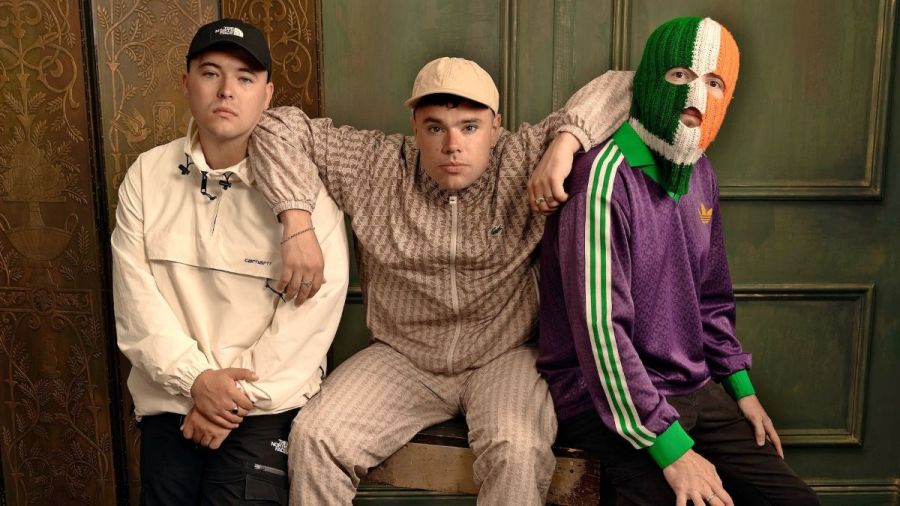
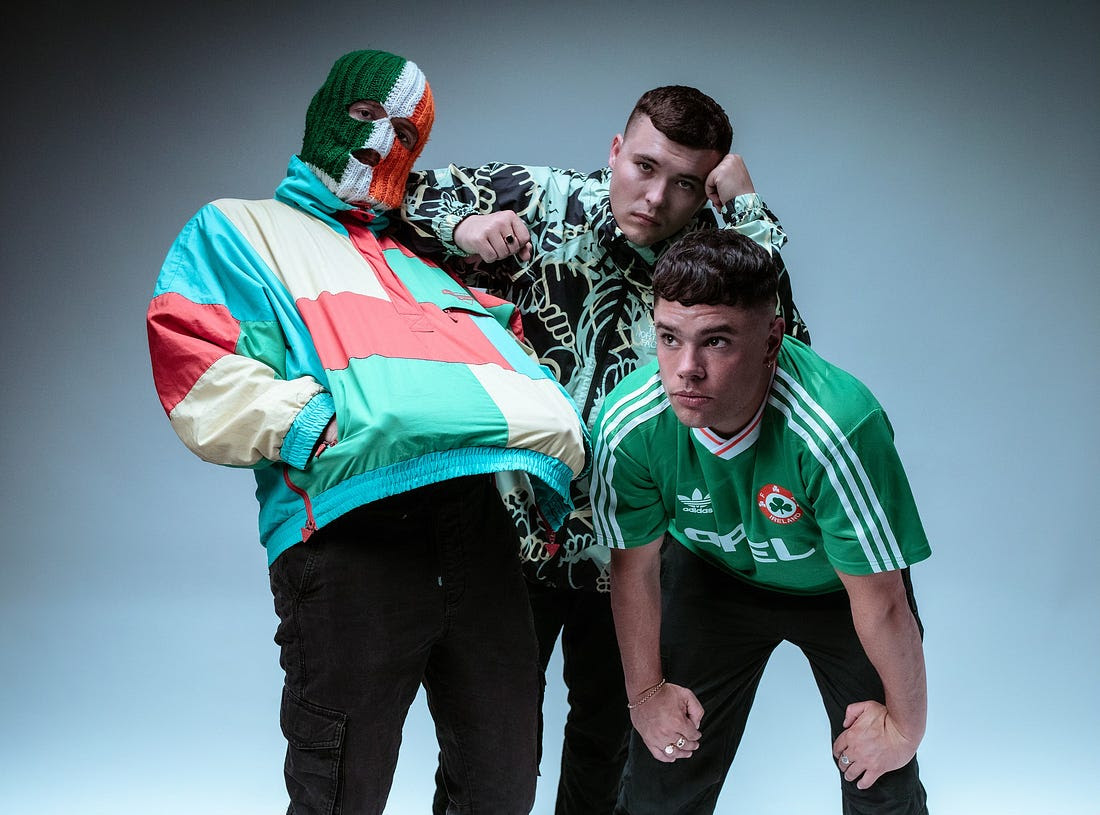
The rapper trio under the band name of Kneecap (Image sourced: on line)

It is not like this is the first time they have banned some of them. Following the Bloody Sunday massacre by the British Army in Derry in 1972, Paul McCartney, penned a song titled Give Ireland Back to the Irish.[2] It was the debut single of Wings.

It was instantly banned in Britain by the BBC but managed to get to No. 16 in the British charts nonetheless and got to No. 1 in Ireland.

They banned songs that mentioned sex, even Shirley Bassie’s Burn My Candle[3] and they banned songs that were considered more political such as The Sex Pistols’ Anarchy in the UK,[4] a song that wasn’t really political at all.

Not surprisingly they banned the then relatively unknown Heaven 17’s debut (We Don’t Need This) Fascist Groove Thang,[5] over concerns it might upset the then recently-elected US president Ronald Reagan.

This was a man whose government through the CIA went on to support deaths squads in Latin America and set up cocaine smuggling networks to finance them through his loyal servant Oliver North.[6] Reagan of course is referred to in the song.

Democrats are out of power
Across that great wide ocean
Reagan’s president elect
Fascist god in motion

That wasn’t the last of it either. The BBC went on to ban a song by The Police, Invisible Sun[7] because of a possible slight on the British Army contained in the lyrics and of course the official video to the song.

I don’t want to spend the rest of my life
Looking at the barrel of an Armalite
I don’t want to spend the rest of my days
Keeping out of trouble like the soldiers say

I don’t want to spend my time in hell
Looking at the walls of a prison cell
I don’t ever want to play the part
Of a statistic on a government chart

The BBC would, during the 1st Gulf War ban a total of 67 songs for the duration of the war, amongst them songs by such establishment figures as Elton John whose song Act of War [8] recorded in 1985 with Millie Jackson was put on the list.

As was Pat Benatar’s Love is a Battlefield,[9] recorded even earlier in 1983. It takes little to upset the BBC it would seem.

The former Irish Taoiseach (Prime Minister) Leo Varadkar criticised Keir Starmer’s call for Kneecap to be not allowed play at Glastonbury stating that

It’s not great for politicians to get into deciding which artists should be allowed to perform where or not.

To me, that’s illiberalism. Part of the whole point of art and music and literature is to be inappropriate, is to be challenging, is often to be anti-establishment,” he said.

We’ve had a situation now for quite some time in Ireland and in Europe and Britain, where politicians didn’t get into the space of saying who should be allowed to perform, who shouldn’t, what books you should be allowed to read, and I hope we don’t slip back into doing that under the guise of national security and anti-terrorism when it isn’t really about that.[10]

Varadkar tut tuts the BBC and Starmer. Sounds great, except his party and the Irish state in general does not have a great record in the matter.

The state broadcaster took an insidious approach to censorship with songs rarely being banned outright. Rather they were just not simply played on the radio station. Hint hint, nudge nudge. A very Irish way of doing things.

The Irish group The Wolfe Tones released many songs over the years about the conflict in the north of Ireland and got little to no airtime. Such was the situation that they even recorded a song about it, called Radio Toor I Li Ay (sometimes called They Don’t Play Our Songs on the Radio[11].

The lyrics are pertinent to Kneecap and Starmer and sum up exactly what the Establishment are about.

You don’t play our songs on radio
You say they’re too political!
Who controls the mind, where’s the mind’s control?
For the music on the airwaves
Follows empty minds, those empty heads
Play songs of sex and drugs instead
Don’t tell them how it really is

Won’t MI5 look after you, control your thoughts
Feed information to your hearts and minds
To save you all from thinkin’, thinkin’, thinkin’, thinkin’

It is a fact that RTE didn’t give them much airtime and still don’t. So much so that in 2024, Derek Warfield the lead singer with the group said it was time to end the ban on them.[12] It still hasn’t happened, nor will it.

In fact, the Irish women’s football team got into trouble for singing one of their songs, Celtic Melody,[13] and were excoriated by British sports journalists, who are not renowned for their knowledge of music, politics, history or much else aside from who ran how fast and where.

Not exactly intellectual heavyweights. Nonetheless these idiots led to the Irish women’s team being eventually fined €20,000 for singing the song.[14]

The Irish singer Christy Moore found himself on the wrong end of state repression in Ireland on many occasions and his songs, like those of The Wolfe Tones were not banned per se, but they never received much airplay.

Except those that were considered to be humorous and non-political, such as Don’t Forget Your Shovel.[15] 

But other songs of his were censored on the radio without the need for an official ban, such as Ninety Miles From Dublin,[16] which was about the IRA and INLA prisoners on the Blanket and Dirty Protests in the H-Blocks of Long Kesh.

Likewise, other songs he recorded about the prisoners and later on about the Hunger Strikers equally received no airplay. There was one brief exception to this.

Patsy O’ Hara (INLA) died on hunger strike on May 21st 1981 after 61 days. His mother Peggy O’Hara was initially adamant that she would not let her son die and that when he lapsed into a coma she would intervene and give the doctors the order to break his strike with an intravenous drip.

However, in her last conversation with her son, he said to her that he was sorry they had not won and asked her to let the fight go on, before lapsing back into unconsciousness. Christy Moore wrote a song about that exchange called The Time Has Come.[17] 

It was well received and got airplay and praise. Then someone informed the ignorant and arrogant mandarins at RTE what the song was about and suddenly it got no more airplay. Listening to the song, it is obvious what it is about.

The gentle clasp that holds my hand
Must loosen and let go
Please help me through the door
Though instinct tells you no

Our vow it is eternal
And will bring you dreadful pain
But if our demands aren’t recognized
Don’t call me back again

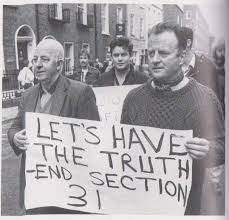
Ironically Christy Moore would record another song that got no airplay. It was called Section 31,[18] a reference to the article of the Broadcasting Authority Act (1960) that gave the minister power to ban interviews with members of Sinn Féin and proscribed organisations such as the IRA.

But in effect it led to RTE’s scant reporting of or carrying out of few interviews that were critical of state policy on the conflict. The song explained exactly why some issues are censored.

Who are they to decide what we should hear?
Who are they to decide what we should see?
What do they think we can’t comprehend here?
What do they fear that our reaction might be, might be?

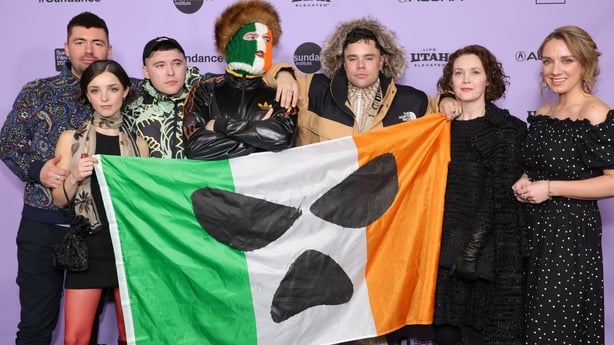
The Kneecap trio with friends at the Sundance Festival in January. (Photo sourced: RTÉ)

It is always about silencing the opposition and preventing a reaction to their repression and in this case genocide.

So back to Kneecap. They stand in a long line of artists who have put their money where their mouths are. They stand side by side with giants from other musical genres such as Woody Guthrie and Pete Seeger who were repressed by the McCarthyite wave in the US in the 1950s.

The BBC for its part continues to be the propaganda arm of the British Empire, or what is left of it, covering up, lying about or justifying murder, massacre, torture and plunder from India to Kenya, Ireland and now Palestine.

Woody Guthrie had the words This Machine Kills Fascists carved into his guitar, a slogan that might earn him a jail sentence nowadays.

It was meant more in the sense that his music was part of the struggle against fascism, carrying political messages to workers, Dustbowl refugees and migrants.

It didn’t literally kill anyone, though in his song Ludlow Massacre,[19] Guthrie celebrated the workers taking up arms to kill the scab thugs that came to shoot them.

Scabs at the behest of the Colorado Fuel and Iron Company, owned by the infamous Rockefeller family murdered 26 people, mainly the wives and children of the striking miners.

However, the massacre was just one large incident, the Baldwin-Felts Detective Agency had harried and harassed the striking miners, murdering them in ones and twos.

The detective agencies celebrated in comics and films were what would later become known in Latin America and elsewhere as death squads. The miners fought back and Guthrie celebrated this in his song. Resistance, including armed resistance was legitimate.

The state soldiers jumped us in a wire fence corners,
They did not know we had these guns,
And the Red-neck Miners mowed down these troopers,
You should have seen those poor boys run.

The press, at the time, described the striking miners as savages.

Any similarity to the current media onslaught on Palestine is not a coincidence, it shows the class interests of the media moguls and the western states. Working class people, foreign resistance movements will always be savages to the media.

And the use of armed masked thugs by the state is not new either. Before ICE, there were the detective agencies. Most of the dead at Ludlow were migrant workers. The final death toll according to Howard Zinn’s People’s History of the US was sixty six men women and children.

Kneecap have contributed to the fight against fascism and Bob Vylan’s chant Death to the IDF! should be on everyone’s lips. There is no reforming the IDF, just like there was no reforming Hitler’s SS. Only the complete destruction of the IDF will bring any change.

Can their music, like Guthrie’s be said to kill fascists? I don’t know, time will tell, but from the reception they got at Glastonbury it is looking good.[20] What I do know is Keir Starmer and Trump finance fascists.

Starmer like a fascist wants to ban Palestine Action. The BBC covers up for fascists, praises them and censors those who stand up to fascists. I know who is on the right side of history.

End.

NB: For more articles by Gearóid see https://gearoidloingsigh.substack.com

NOTES

[1] The Guardian (28/06/2025) Kneecap’s Glastonbury set Will not be broadcast live, BBC confirms. https://www.theguardian.com/music/2025/jun/28/kneecap-glastonbury-set-will-not-be-broadcast-live-bbc-confirms

[2] See Wings: Wild Life – Give Ireland Back To The Irish

[3] See

[4] See https://www.youtube.com/watch?v=q31WY0Aobro&list=RDq31WY0Aobro&start_radio=1

[5] See https://www.youtube.com/watch?v=lV5dbcOmw6I&list=RDlV5dbcOmw6I&start_radio=1

[6] Jacobin (12/11/2021) What We Really Know About the CIA and Crack. Daniel Finn. https://jacobin.com/2021/11/what-we-really-know-about-the-cia-and-crack

[7] See https://www.youtube.com/watch?v=1VuDjJ9KIxM&list=RD1VuDjJ9KIxM&start_radio=1

[8] See https://www.youtube.com/watch?v=vKbuDkueGek&list=RDvKbuDkueGek&start_radio=1

[9] See https://www.youtube.com/watch?v=IGVZOLV9SPo&list=RDIGVZOLV9SPo&start_radio=1

[10] The Journal (27/06/2025) Varadkar on Kneecap row: Terrorism is bombs and guns, not music. https://www.thejournal.ie/varadkar-on-kneecap-row-terrorism-is-bombs-and-guns-not-music-6745000-Jun2025/

[11] See https://www.youtube.com/watch?v=jtsxQaXdflU&list=RDjtsxQaXdflU&start_radio=1

[12] Newstalk (11/09/2024) ‘Systemic ban’ on The Wolfe Tones should be lifted – Warfield. Jack Quann. https://www.newstalk.com/news/systemic-ban-on-the-wolfe-tones-should-be-lifted-warfield-1764007

[13] See https://www.youtube.com/watch?v=rgWeD7tHhaE

[14] Sky News (08/12/2022) Ireland women footballers fined €20,000 for singing song referencing IRA in World Cup celebration. https://news.sky.com/story/ireland-women-footballers-fined-20-000-for-singing-song-referencing-ira-in-world-cup-celebration-12764012

[15] See https://www.youtube.com/watch?v=rV9c0OnekvM&list=RDrV9c0OnekvM&start_radio=

[16] See https://www.youtube.com/watch?v=Q98EcxrOr6w&list=RDQ98EcxrOr6w&start_radio=1

[17] See https://www.youtube.com/watch?v=6E7wJsDx2qg&list=RD6E7wJsDx2qg&start_radio=1

[18] See https://www.youtube.com/watch?v=m19Pc-b7EBc

[19] See https://www.youtube.com/watch?v=XDd64suDz1A&list=RDXDd64suDz1A&start_radio=1

[20] See https://www.instagram.com/reel/DLdeW1sI2A-/?igsh=YnJqeDd0bm1obzdi

TO BE LIKE BONO OR KNEECAP?

Gearóid Ó Loingsigh

NB: Edited by Rebel Breeze for formatting purposes

(Reading time: 6 mins.)

Kneecap, the Belfast Irish language rap group, have found themselves at the centre of what is an artificially contrived furore dreamt up by people with little sense of real moral outrage.

The basics of the story are well known. They finished off their act at the Coachella event projecting pro-Palestinian statements. Given the band’s history and well-known politics, it could hardly have come as a surprise. Perhaps it was more that the fans welcomed it that upset some.

They were denounced by the non-entity known as Sharon Osbourne, a reality star famous for being the wife of Black Sabbath lead singer Ozzy Osbourne and also the mother of another reality star, her daughter Kelly Osbourne.

Kelly to her credit did carve out a brief musical career on the back of her reality tv exposure.

Sharon as part of the wider Zionist attempt to silence all those who criticise the genocide called for their visas to be cancelled, which in effect happened following the decision by their promoter and sponsor to drop them.

She also called for them to be more like Bono. Kneecap responded with a humorously devastating comeback that they would rather be Rangers fans than emulate Bono.

Bono still has some credibility in certain parts, mainly where they haven’t a clue about the man’s actual politics and obviously amongst the clueless, witless, gutless glitterati like Sharon Osbourne. But what would it mean to be like Bono?

Is he actually some sort of reasonable counterweight to Kneecap?

Well, first of all, in relation to Palestine, Bono is a Zionist, so even before the genocide began, he, unlike them, was already on the wrong side of history. Not for the first time, mind you. Bono has a habit of cropping up where he is not wanted like an ugly cold sore (my apologies to the virus).

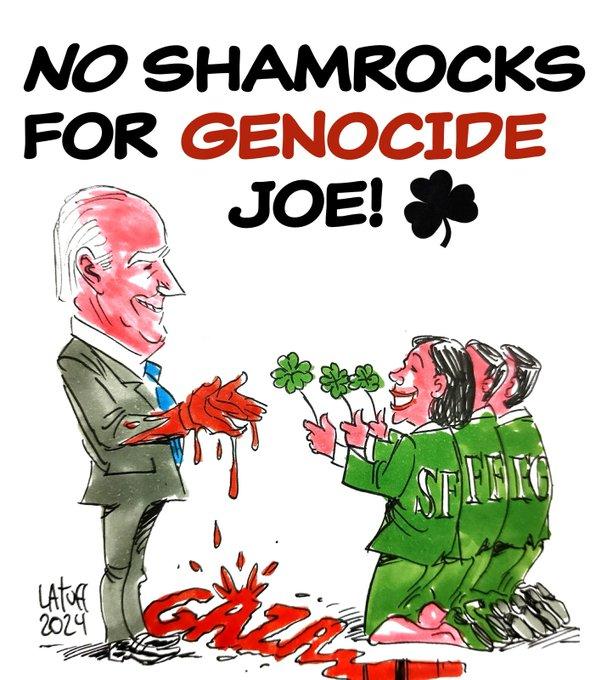
He has, as Harry Browne, the author of The Frontman: Bono in the name of powerpointed out dedicated a lifetime to the service of imperialism and was rewarded with a Presidential Medal of Freedom from Genocide Joe.[1] 

I am sure it will go well on his mantle piece alongside his KBE (Knight Commander of the Most Excellent Order of the British Empire), for which he was fulsome in his praise of Her Majesty’s Ambassador, as he put it, and grinned like a cheshire cat during the ceremony.[2] 

The claims made by Blair and others about Bono’s achievements were exaggerated, of course. But he is, if nothing, an equal opportunities imperialist and will get around to doing his bit for the others.

The idea that Kneecap would prostrate themselves before the British king is laughable and they wouldn’t be the first artists to reject one, were the Brits ever to mistakenly consider them for it.

The late black poet Benjamin Zephaniah was offered the lesser award of OBE (Order of the British Empire) by the same Tony Blair. He turned it down stating:

I get angry when I hear that word “empire”; it reminds me of slavery, it reminds of thousands of years of brutality, it reminds me of how my foremothers were raped and my forefathers brutalised…

Benjamin Zephaniah OBE – no way Mr Blair, no way Mrs Queen. I am profoundly anti-empire…

If they want to give me one of these empire things, why can’t they give me one for my work in animal rights? Why can’t they give me one for my struggle against racism? What about giving me one for all the letters I write to innocent people in prisons who have been framed? I may just consider accepting some kind of award for my services on behalf of the millions of people who have stood up against the war in Iraq. It’s such hard work – much harder than writing poems.[3]

He also referred to his brother’s death in police custody and to Lizzie II as Mrs Queen, not Her Majesty. A display of dignity.

He pointed out that those who accept such awards, the Queen’s Shilling, though he didn’t use that archaic military expression for those who enlist in the British armed forces to put down uppity types in the colonies, always sell out.

However, calling Bono a sell-out, presumes he was ever anything other than a fan of empire. He tied his mast to the pro-British politics of the Irish chattering classes in the 1980s.

His song Sunday Bloody Sunday was always introduced with the line This is not a rebel song, lest someone think Bono actually had something interesting to say.

The song is quite vacuous though clear in saying he “won’t join the battle cry,” i.e. denounce those who had massacred 14 people on the streets of Derry. The British army is not mentioned once in the song.

You wouldn’t know who had done what, but you know not to point the finger “Cause tonight we can be as one”. John Lennon on the other hand, shortly after the massacre did not hold back.

Is there any one among you
Dare to blame it on the kids?
Not a soldier boy was bleeding
When they nailed the coffin lids!
[4]

Bono couldn’t bring himself to condemn the British army for a televised massacre, so it comes as no surprise that he has little to say about a live-streamed genocide.

He hobknobbed with neoliberals such as Jeffrey Sachs, various presidents of the World Bank, promoted pharmaceutical companies in Africa and of course was on the side of Bush in the Iraq War, at least in practice and helped whitewash the reputations of many of those involved.

He hedged his bets a bit on Iraq, not wanting to seem too hawkish, saying the war was justified but the US should get UN backing for it. He then went on to endorse Clinton and Blair time and again. Jim Kerr from the Scottish band Simple Minds put it succinctly at the time.

How can Bono, having graced concert stages for over two decades, draped in the white flag of peace and screaming ‘No More War’ [sic] at the top of his lungs contemplate praising and back slapping Tony Blair? … I can’t believe that anyone could fail to identify that no matter what gesture Blair may make towards African debt relief, his slippery hands are currently dripping in the fresh warm blood of Iraqi men, women and children.[5]

Bono of course, could and did, and wined and dined with such hawks as Senator McCain. There were no depths to which he would not plummet, which brings us to Palestine.

Shortly after October 7th he endorsed the Zionist genocide by changing the lyrics of his song about Martin Luther King, Pride (In the name of love)[6]to “Early morning, Oct 7, the sun is rising in the desert sky… Stars of David, they took your life but they could not take your pride.[7] 

As part of the introduction to the reworked song he state “our prayers have always been for peace and for non-violence… But our hearts and our anger, you know where that’s pointed.” Not at the Zionist occupiers was the answer. Roger Waters lambasted him for it.[8]

Not only that, he was criticised by Irish singer Mary Coughlan for his links to Israeli companies.[9] He did not fly out to Gaza as he had done in Ukraine, nor did he have much to say.

When he eventually did mention Gaza, he was always careful to lay the blame on Hamas for starting it all, ignoring history since the Nakba in 1948.

A good example of that is his piece in The Atlantic after receiving his Medal of Freedom from Genocide Joe.[10] An exercise in saying nothing, whilst attempting to sound profound, something Ireland’s most famous poisonous dwarf never pulls off.

Kneecap on the other hand have been clear from the word go about their support for the Palestinian cause. It didn’t take a genocide for them to take note. They have consistently been on the side of the oppressed, in this case the Palestinians, against the oppressor the Zionists.

So, Sharon Osbourne should probably stick to what she knows best, which is precious little.

As for Bono, as Harry Browne points out, perhaps nothing sums him up quite so succinctly as a piece of graffiti in Dublin that appeared following the scandal when they moved one of their companies to the Netherlands for tax purposes, “Bono is a poxbottle”.

We need more like Kneecap who stand with the oppressed, and a lot less of Bono and the likes who can’t condemn the powerful ever.

At best you can expect some “We are all guilty type” of fudge, which was the preferred slogan of the Irish trade union bureaucracy when the British or their proxies in the UVF or UDA ever did anything, coming as no surprise that they have also done next to nothing on Palestine other than issue the occasional banal statements.

I fully expect them to turn up with Bono somewhere to chastise Kneecap.

End.

NB: For more articles by Gearóid see https://gearoidloingsigh.substack.com

NOTES

[1] Rebel News (07/01/2025) This Song is not a Rebel Song. Harry Browne. https://rebelnews.ie/2025/01/07/bono-this-song-is-not-a-rebel-song/

[2] U2 (29/03/2007) A Knighthood for Bonohttps://www.u2.com/news/title/a_knighthood_for_bono_2110/

[3] The Guardian (27/11/2023) ‘Me? I thought, OBE me? Up yours, I thought’. Benjamin Zephaniah. https://www.theguardian.com/books/2003/nov/27/poetry.monarchy

[4] See https://link.sbstck.com/redirect/de82dedc-5090-458f-9212-e894fa53ed21

[5] Browne, H. (2013) Bono The Frontman: In the name of power. London. Verso. Para 8.116

[6] See https://link.sbstck.com/redirect/9b7d1452-8d25-4992-8f18-9e29589b6ce4

[8] The Independent (21/02/2024) Roger Waters brands Bono ‘disgusting’ over Israel speech. Kevin E G Perry. https://www.independent.co.uk/arts-entertainment/music/news/roger-waters-bono-israel-gaza-b2498979.html

[9] The Sunday World (13/05/2024) Mary Coughlan ‘lost all respect’ for Bono over alleged links to Israeli companies. Eugene Masterson. https://www.sundayworld.com/showbiz/irish-showbiz/mary-coughlan-lost-all-respect-for-bono-over-alleged-links-to-israeli-companies/a2101784646.html

[10] The Atlantic (04/01/2025) The Gorgeous Unglamorous Work of Freedom. Bono. https://www.theatlantic.com/ideas/archive/2025/01/the-gorgeous-unglamorous-work-of-freedom/681212/

[7] See https://www.youtube.com/watch?v=P6sD5Lnh4YY

[8] The Independent (21/02/2024) Roger Waters brands Bono ‘disgusting’ over Israel speech. Kevin E G Perry. https://www.independent.co.uk/arts-entertainment/music/news/roger-waters-bono-israel-gaza-b2498979.html

[9] The Sunday World (13/05/2024) Mary Coughlan ‘lost all respect’ for Bono over alleged links to Israeli companies. Eugene Masterson. https://www.sundayworld.com/showbiz/irish-showbiz/mary-coughlan-lost-all-respect-for-bono-over-alleged-links-to-israeli-companies/a2101784646.html

[10] The Atlantic (04/01/2025) The Gorgeous Unglamorous Work of Freedom. Bono. https://www.theatlantic.com/ideas/archive/2025/01/the-gorgeous-unglamorous-work-of-freedom/681212/

“A March Travelling into the Future … a Beacon of Resistance”

Diarmuid Breatnach

(Reading time main text: 6 mins.)

Thousands of marchers with flags, banners and three marching bands retraced the route of the anti-internment march in 1972 that ended in the infamous Derry Bloody Sunday1, a massacre of unarmed civilians by the British Parachute Regiment.

The nearest Sunday to the date of the original march, which this year fell on February 2nd has been chosen annually for the commemorative march over the 53 years since the massacre. People travel from different parts of Ireland and indeed from beyond in order to attend.

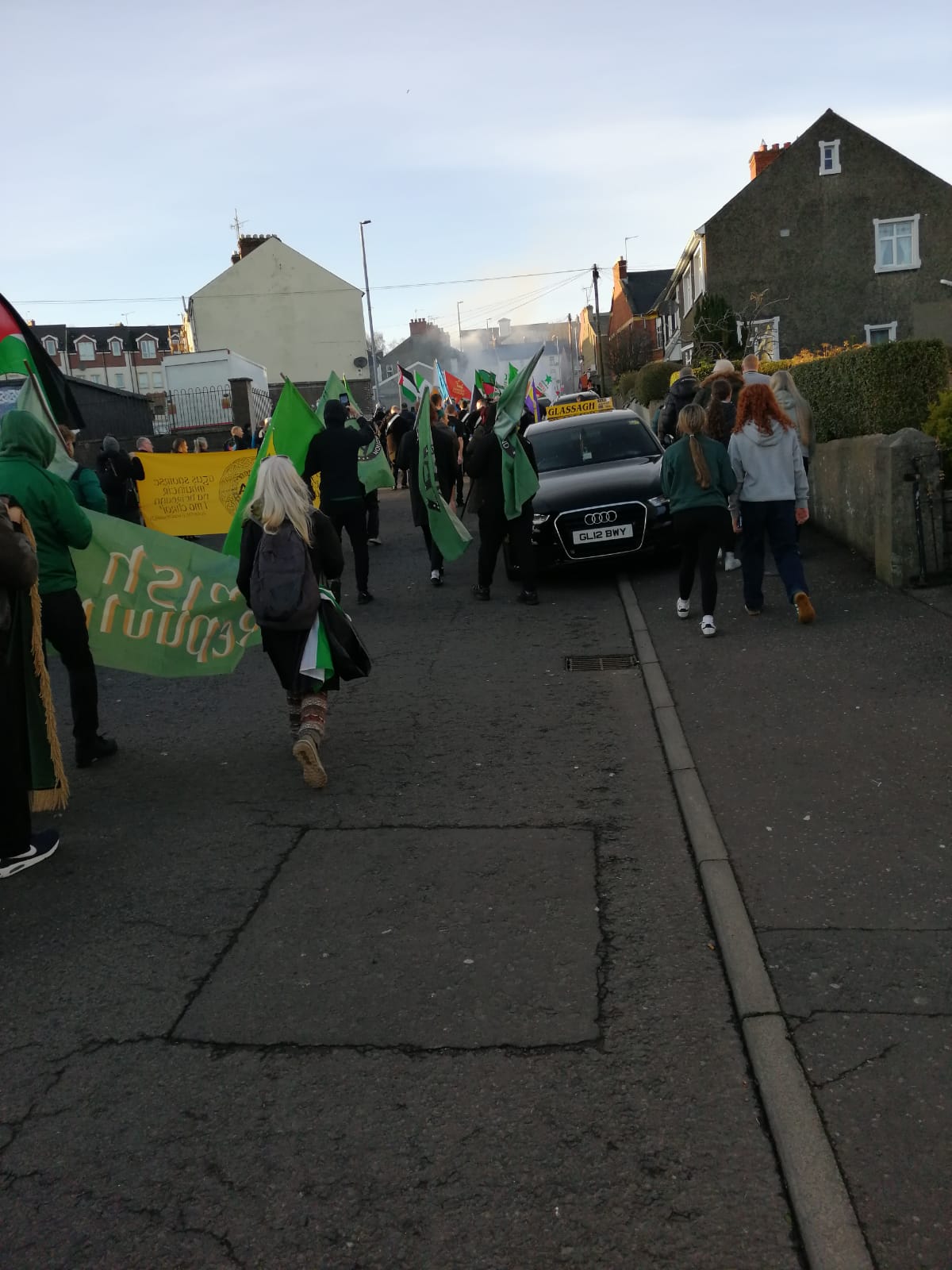
Section of the march coming down from the Creggan. (Photo: D.Breatnach)
The colour party (bearing the flags) traditionally precedes the marching band. (Photo: D.Breatnach)

Derry is not well served by public transport from other parts of Ireland and there is no train station there.

There is a bus service from Dublin from the Translink company of the occupied colony but one would need to catch it at seven in the morning and then hang around in Derry for 3.5 hours waiting for the march to start. For this reason, many travel to Derry by car.

Equally, many others who would attend were the public transport available, stay home but an estimated over 7,000 participated in this year’s march. The theme this year was Palestine, once again as was last year’s too.

The day of the massacre

The original march was a protest against the introduction in August 1971 of internment without trial in the occupied colony. Almost immediately afterward the Parachute Regiment had massacred 11 people protesting against it in Ballymurphy, Belfast.2

Ballymurphy campaign banner in the Creggan awaiting start of march with Kate Nash centre. (Photo: D.Breatnach)

The 1972 march, along with many others, had been banned by the sectarian colonial administration. The Civil Rights campaigners knew that their legitimate demands3 were being obstructed by use of the Special Powers4 of the statelet and that they could win nothing if they were to acquiesce.

After the previous massacres it took considerable courage to march that day but perhaps they thought that with an advertised march, in daylight, with many film cameras covering, the Paras were unlikely to open fire. In any case, they decided to risk it.

At 4.10pm the first shots were fired by the Paras5 without warning and by around 20 minutes later they had killed 13 men and youths and wounded another 13, one of whom would die weeks later. According to the Saville Inquiry in 2010, they had fired over 100 rounds.

Not one of their targets was armed.

To justify the slaughter, the British Army claimed that they were fired upon and returned fire, killing IRA fighters. The British Government, in particular through Home Affairs Minister Reginald Maudling, repeated the lies as did the British media.

Bernadette (then) Devlin6 MP, a survivor, was prevented from speaking in the Westminster Parliament and she walked up to Maudling and slapped his face. In Dublin a general strike took place with schools closing and a huge crowd burned the British Embassy down.

In London, a giant march reached Trafalgar Square as its end was still leaving Hyde Park. In Whitehall the police prevented them from laying the symbolic coffins outside No.10 and in the scuffles the ‘coffins’ were eventually thrown at the police or knocked to the ground.

And a number of construction sites in Britain went on strike also.

The judicial response varied wildly. Coroner Hubert O’Neill, an ex-British Army major, presiding on the inquests in 1973, called it “Sheer unadulterated murder” whereas Lord Chief Justice Widgery in the ‘inquiry’ he led ignored all the local evidence and accepted the British Army’s lies.7

The last Bloody Sunday march”

Provisional Sinn Féin organised and managed the annual march for many years but in January 2011 Martin McGuinness announced that year’s march would be the last, because of the UK’s Prime Minister David Cameron’s public apology to the relatives of the 14 killed in Derry.

The apology followed quickly on the verdict of the Saville Inquiry8 which totally refuted the statements at the time by representatives of the Army and of the Political and Judicial establishments: the victims had been unarmed and the Army had not been “returning fire”.

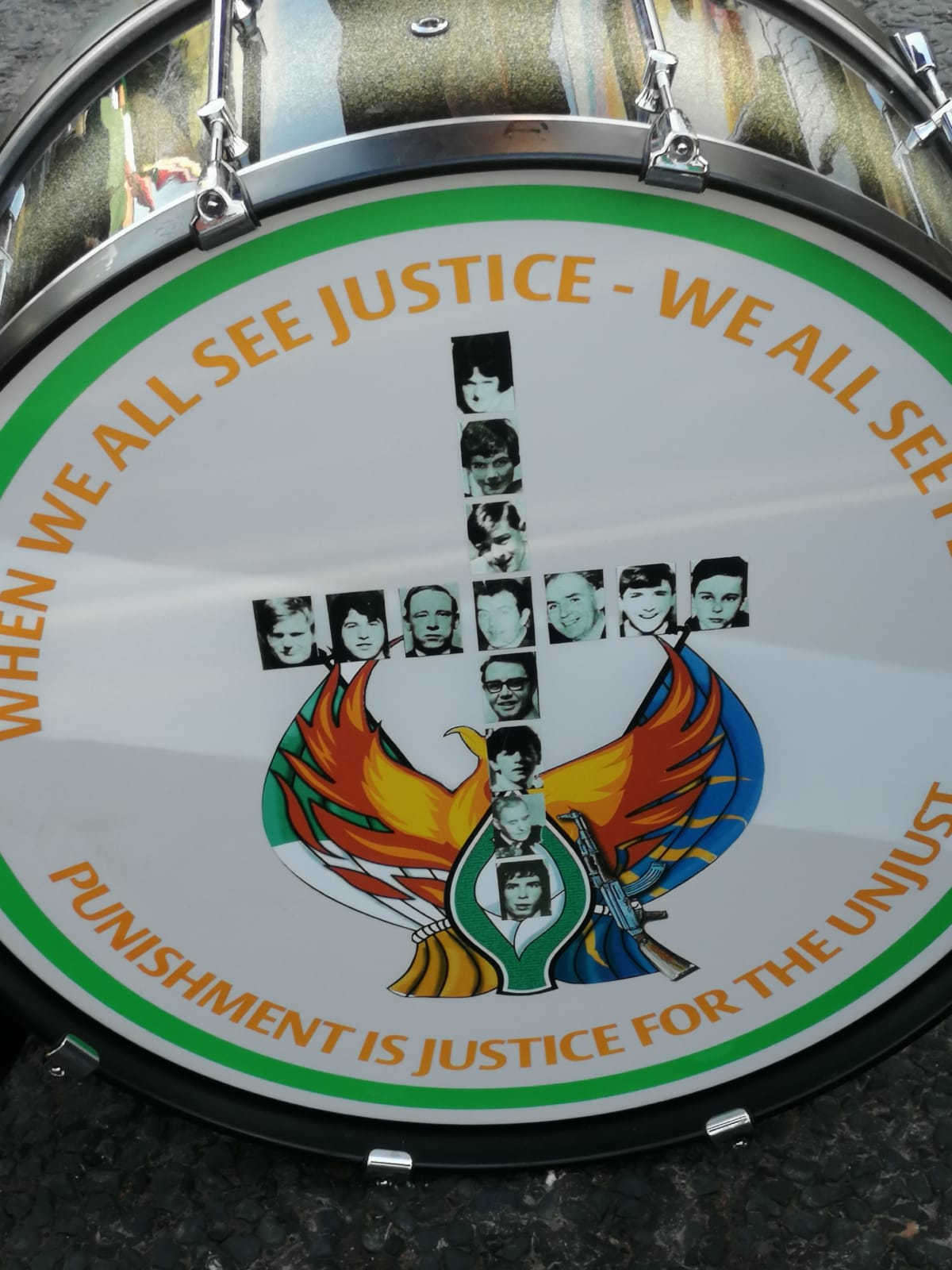
One side of one of the marching band drums (Photo: D.Breatnach)
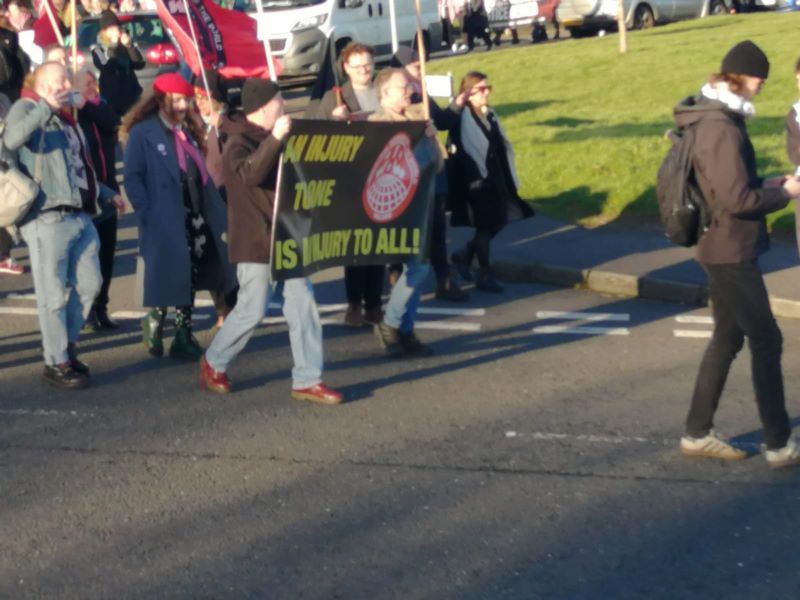
Section of the march about half-way along its length. (Photo: D.Breatnach)

Despite the UK State’s acknowledgement that they had no excuse for the massacre, not one of those who planned, organised or carried out the atrocity had been charged, never mind convicted, nor had those who conspired to cover up the facts. To this day, only a low-level soldier has faced charges.

Nor had there been government admissions of wrongdoing in the other massacres by the Paras intended to crush the resistance to the repressive internment measure, at Ballymurphy and Springhill.

A number of relatives and survivors of the original march declined to have the annual march cancelled, among them Kate Nash and Bernadette McAlliskey. Kate Nash’s brother William was shot dead on Bloody Sunday and her father, William, was wounded trying to save his son.

Bernadette McAlliskey was a survivor of the massacre and also survived nearly a decade later an assassination attempt in her home, being struck by nine bullets of a Loyalist murder gang. Despite opposition by and denunciation from SF, volunteers have kept the march going every year.

Each year different themes have also been incorporated into the Bloody Sunday March for Justice, including ones in Ireland, such as the framed Craigavon Two prisoners but also ones from beyond, e.g. the resistance of the Broadwater Farm housing estate in London to Metropolitan Police attack.

Section of the march in Creggan waiting to start, showing the Palestinian national flag and the Irish Tricolour in close proximity. (Photo: D.Breatnach)
Big drums of one of the marching bands getting a workout in the Creggan while waiting for the march to start. ‘Saoirse go deo’ = Freedom for ever. (Photo: D.Breatnach)

Since 2011 Sinn Féin have boycotted the march but also sought to mobilise public opinion against it, claiming that relatives of the victims didn’t want the march to continue. The truth is that some hadn’t wanted it even when SF were running it, some didn’t afterwards but some did.

Such an atrocity has of course huge personal impact on relatives of victims but its impact is also much wider on a society and beyond, historically and politically. That historical memory ‘belongs’ to the people of Derry but also to the people of the world (as do others such as Sharpeville SA).

Those in power in society are aware of that and the media outside of Derry gives little or no coverage to the annual march while promoting other events there of lesser numbers and significance.

The ‘Derry Peoples Museum’ ignores the march in its Bloody Sunday commemorative program.

This year’s march

Sunday just past was one of sunshine and little wind, as it was on the day of the Derry massacre. But regular marchers remember other Bloody Sunday commemoration days of pouring non-stop rain, of squalls, of snow and sleet, of wet clothes, socks and freezing fingers and toes.

The march starts in the afternoon at the Creggan (An Chreagáin) and winds down to just below the Derry Walls, then up a long slope again before eventually ending down at Free Derry Corner9, the destination of the original march, where speakers address the crowd from a sheltered stage.

Marchers underway, led by people carrying 14 crosses to represent the unarmed civilians murdered by the Paras on that day 53 years before. (Photo: D.Breatnach)
The band members are itching to go up in the Creggan. (Photo: D.Breatnach)

The sides of residential blocks in this area are also painted in giant murals to represent scenes from the civil rights and armed resistance period while nearby stands a monument to the martyrs of Bloody Sunday 1972 but also another to the 10 H-Blocks’ martyrs of the Hungers Strikes of 1981.

In this area, one needs to be blind not to be at least peripherally aware of the icons of proud struggle and of loss, of sacrifice.

Eamon McCann and Farah Koutteineh addressed the rally at the end of the march. McCann, a journalist and member of the People Before Profit political party is a survivor of the massacre. He is an early supporter of the Bloody Sunday March for Justice at which he has spoken on occasion.

Farah Koutteineh is a Palestinian journalist who was herself the news when in December 2023 she and a few other Palestinians were ejected from a Sinn Féin-organised meeting in Belfast being addressed by the Palestinian Ambassador as a representative of the Palestinian Authority.

Koutteineh had been denouncing the Palestine Authority’s collusion with Israel when she and the other Palestinians were hustled out to applause from many of the attendance. Not surprisingly from the Derry platform on Sunday she too drew applause in criticising SF’s position on Palestine.10

Speaking to this reporter after the march, Kate Nash said: “There is no chance the march will be ended. It will go forward into the future, a beacon of resistance against the injustices and crimes of states around the world.

“There are millions of us … people come from around the world to commemorate this massacre with us.”

end.

Series of images from the march (Photoa by D.Breatnach)

Footnotes:

1There have been a number of Bloody Sundays in the history of Ireland under colonialism and therefore the location and year are often incorporated into the name for clarity as to which is being discussed.

2There was substantial State interference with inquests during the period of the 30-years’ war in the Six Counties (and in some cases in the Irish state also), in order to avoid inquest juries finding the state armed forces culpable of homicide unjustified in law. The original inquest in 1972 on the Ballymurphy massacre recorded an ‘open verdict’ but a 2021 reopened inquest found the British Army killings “unjustifiable”. Even after the Derry massacre, in July of that year, the Paras again killed five unarmed people and injured two in the Springhill area of Belfast and again an ‘open verdict’ was recorded into the fatalities which included three teenagers and a priest.

3The demands were all of rights that were in existence in the rest of the UK, including an ending to discrimination in allocation of housing and employment and general enfranchisement.

4The Special Powers (Northern Ireland) Act 1922 gave legal powers to the authorities similar to martial law. Allegedly temporary, as is often the case the Act kept getting renewed until made permanent and its repeal was one of the demands of the Civil Rights campaign. The Act was finally repealed in 1973.

5There was a unit of other British Army soldiers stationed on the Derry Walls with special rifles and there has been speculation that some of the shots might have been fired by them but this has never been confirmed to date.

6Now McAlliskey then Devlin, she had been a candidate for the People’s Democracy party of the time, the youngest MP elected.

7And that was the ‘official record’ until the Saville verdict 38 years later. A clever contemporary lampooning of Widgery and playing on a soap powder advert, with excellent alliteration, had it that “Nothing washes whiter than Widgery White!”

8Although the Saville Inquiry delivered its verdict in June 2010, it had been set up in 1998, taking an inordinately long time (and a bonanza in legal fees for judge, barristers, lawyers and clerks) to reach a verdict already obvious to all the nationalist people of the Six Counties, most of the Irish people and probably millions around the world. The date of its setting up so near to that of the Good Friday Agreement suggests that its creation (and eventual verdict) was part of the ‘sweeteners’ of the Pacification Process and the Good Friday Agreement.

9A reconstruction of the iconic gable end of a small local authority house in the Bogside area of Derry which had been painted in 1967, during the Civil Rights resistance period, with giant letters proclaiming: YOU ARE NOW ENTERING FREE DERRY. The house was demolished during redevelopment of the area but the gable end was reconstructed as a monument to the resistance of the people of the city.

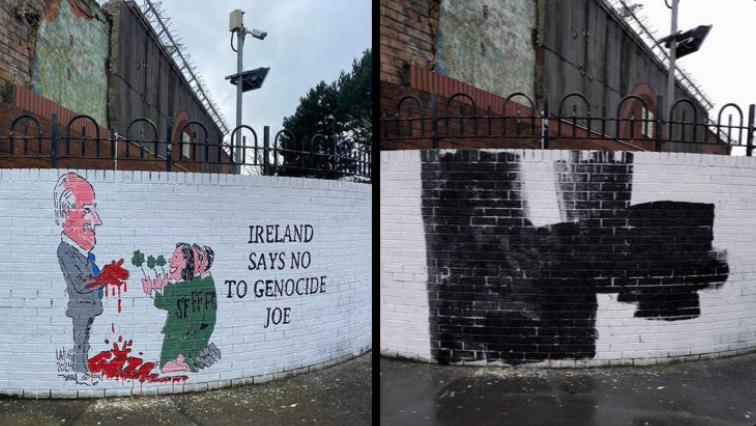
10Sinn Féin support the corrupt and collaborationist Palestine Authority and its backing political party Fatah and also celebrated St. Patrick’s Day with (then) President Joe Biden while the US was supplying the Zionist genocide with weapons, money and political backing.

1There have been a number of Bloody Sundays in the history of Ireland under colonialism and therefore the location and year are often incorporated into the name for clarity as to which is being discussed.

2There was substantial State interference with inquests during the period of the 30-years’ war in the Six Counties (and in some cases in the Irish state also), in order to avoid inquest juries finding the state armed forces culpable of homicide unjustified in law. The original inquest in 1972 on the Ballymurphy massacre recorded an ‘open verdict’ but a 2021 reopened inquest found the British Army killings “unjustifiable”. Even after the Derry massacre, in July of that year, the Paras again killed five unarmed people and injured two in the Springhill area of Belfast and again an ‘open verdict’ was recorded into the fatalities which included three teenagers and a priest.

3The demands were all of rights that were in existence in the rest of the UK, including an ending to discrimination in allocation of housing and employment and general enfranchisement.

4The Special Powers (Northern Ireland) Act 1922 gave legal powers to the authorities similar to martial law. Allegedly temporary, as is often the case the Act kept getting renewed until made permanent and its repeal was one of the demands of the Civil Rights campaign. The Act was finally repealed in 1973.

5There was a unit of other British Army soldiers stationed on the Derry Walls with special rifles and there has been speculation that some of the shots might have been fired by them but this has never been confirmed to date.

6Now McAlliskey then Devlin, she had been a candidate for the People’s Democracy party of the time, the youngest MP elected.

7And that was the ‘official record’ until the Saville verdict 38 years later. A clever contemporary lampooning of Widgery and playing on a soap powder advert, with excellent alliteration, had it that “Nothing washes whiter than Widgery White!”

8Although the Saville Inquiry delivered its verdict in June 2010, it had been set up in 1998, taking an inordinately long time (and a bonanza in legal fees for judge, barristers, lawyers and clerks) to reach a verdict already obvious to all the nationalist people of the Six Counties, most of the Irish people and probably millions around the world. The date of its setting up so near to that of the Good Friday Agreement suggests that its creation (and eventual verdict) was part of the ‘sweeteners’ of the Pacification Process and the Good Friday Agreement.

9A reconstruction of the iconic gable end of a small local authority house in the Bogside area of Derry which had been painted in 1967, during the Civil Rights resistance period, with giant letters proclaiming: YOU ARE NOW ENTERING FREE DERRY. The house was demolished during redevelopment of the area but the gable end was reconstructed as a monument to the resistance of the people of the city.

10Sinn Féin support the corrupt and collaborationist Palestine Authority and its backing political party Fatah and also celebrated St. Patrick’s Day with (then) President Joe Biden while the US was supplying the Zionist genocide with weapons, money and political backing.

Useful links:

Swiss Zionist Censors Arrest Palestinian Journalist

Diarmuid Breatnach

(Reading time: 2 mins.)

Swiss police have arrested and detained Palestinian journalist and Executive Director of the popular Electronic Intifada website. According to reports he was interrogated for an hour at the airport after his arrival and released but arrested a day later.

Abunimah was due to give a series of talks in Switzerland and that fact, in addition to his journalistic work in writing for and organising weekly podcasts from the Electronic Intifada website give the context for his arrest which is simply pro-Zionist and pro-imperialist censorship.

The EI (Electronic Intifada) carries articles from its reporters inside Gaza and the weekly podcasts on YouTube provide analysis and discussion, along with interviews with commentators, writers and activists. Military expert Jon Elmer gives a roundup covering actions of the Resistance.

On a personal note, the weekly EI podcasts on Wednesday (now Thursday) evenings on YouTube became not only compulsory watching for me but also emotional therapy in the midst of the Zionist genocide in Gaza.

Ali Abunimah (Image cred: Al Jazeera screengrab)

Abunimah is a US citizen of Palestinian descent, fluent in Arabic, English and conversant with Hebrew. Founded in 2001, the EI website associate editors are Maureen Clare Murphy, Nora Barrows-Friedman, Michael Brown, David Cronin, Tamara Nassar and Asa Winstanley.

The site’s editors are no strangers to attempted and actual repression: Germany banned Abunimah from entering last year, while UK police raided Asa Winstanley’s home and confiscated his computer equipment, which they are still holding weeks later but without charging him.1

Palestinian solidarity activists in Switzerland have protested Abunimah’s detetion.

The UN Special Rapporteur on freedom of opinion and expression, Irene Khan, called Abunimah’s arrest “shocking news” and urged his release while Francesca Albanese, UN Special Rapporteur on human rights in the occupied territories bemoaned the European “toxic … climate” for free speech.

When free speech in one area of discourse is attacked, freedom of speech on all subjects is endangered so even those who are not very supportive of Palestine should protest Abunimah’s arrest in this blatant act of censorship and repression.

End.

Footnotes:

1 Winstanley is a member of the weekly broadcasting team as well as an author of articles on the site.

Sources:

https://www.aljazeera.com/news/2025/1/27/un-experts-slam-palestinian-journalist-ali-abunimahs-arrest-in-switzerland

https://electronicintifada.net/content/eis-ali-abunimah-arrested-switzerland/50333

AWARD-WINNING DOCU-DRAMA LIFTS THE LID ON IRISH STATE CENSORSHIP

Clive Sulish

(Reading time: 5 mins.)

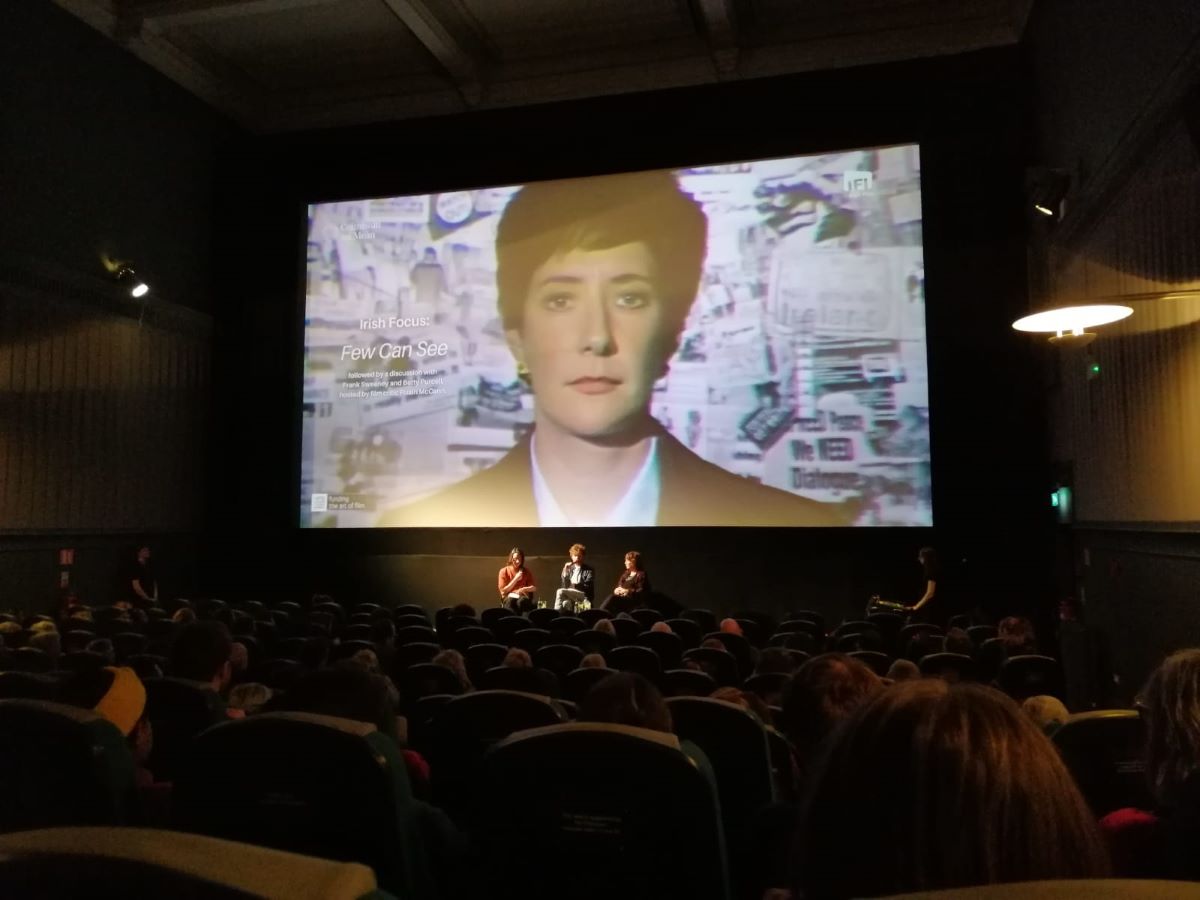
FEW CAN SEE – Censoring the Conflict was screened last week (Wednesday 4th night) in the Irish Film Institute to a moderately-sized audience, followed by questions of film-maker Frank Sweeney and Betty Purcell by​​​​​​ Ruairí McCann from Belfast.

Sweeney took a look at state censorship during the three decades’ war in Ireland which was effected through the introduction of Section 31 of the Broadcasting Act, the sacking of the entire RTÉ Board of Directors and the jailing of a journalist.

Henceforth, self-censorship was the rule.

Specifically, the State ban applied during this period in refusals to interview any member of the IRA (Provisional or Official) and was later extended to Provisional Sinn Féin. It was enforced within RTÉ by management including members of the Workers’ Party1 who also led one of the unions.

Docudrama Few Can See focused on the application of the ban to spokespersons of people in the occupied Six Counties and of a number of campaigning groups: Gays Against the H-Blocks; Concerned Parents Against Drugs; the Gateaux bakery strike in Finglas (factory closed 1990).

Gay rights activists in Cork also campaigned against the H-Blocs and were subjected to censorship under Section 31. (Photo sourced: ICCL website)

Frank Sweeney said he had been intrigued by Betty Purcell’s memoir of her time producing programs for RTÉ and her battles with censorship there2. Conducting interviews with people about their experiences of being censored, he then worked the material into a script.

The format was of a 1980s studio with a program presenter in the style of the times and smoking, intercut with grunge-style footage, electronic interference noise and visuals, then narrowing to interviews with actors playing the parts of victims of the ban at the time.

If the intention was to show how ridiculous it could be to apply a political ban aimed at alleged terrorists instead to community struggles against oppression and the heroin epidemic, the struggle of gays around legality and health and a bakery strike, it succeeded.

The ‘RTE presenter’ in the docudrama screening (Photo: R.Breeze)

However, the issues of whose interests the State was representing in that period of heavy censorship and why it felt threatened were not teased out. Nor why it was able do what it did.

Had those issues been addressed we might have observed a vulnerable neo-colonial ruling class during a high point of struggle against the very colonial and neo-colonial nature of the state and the colony of its imperial neighbour, which also imposed censorship on broadcasting at home.

An aspect of such censorship which might not occur to one but which was discussed in the documentary is the effect of censorship not only on struggles of the time but also on the lack of available footage for archives in the future, leaving history the poorer in material.

Few Can See film has been screening around the world this year and has won some awards including the  Tiger Short Award at International Film Festival Rotterdam and is due in Barcelona next year, hopefully to be screened in Ireland again, followed by a fuller discussion.

Film maker Frank Sweeney (centre) speaking during post-screening discussion at the IFI with Ruairí McCann (left) and Purcell (almost out of shot, right). (Photo: R.Breeze)

In addition to exposing the State-led censorship of the past, Sinn Féin might benefit from the film as those who were being gagged were either members or were thought to be supporters of the party. However, SF has its own history of censoring critics both within the party and outside.

And as one member of the audience was heard to remark: “It’ll be the dissidents, not SF that will be getting censored now.” True, though no longer enforced by the State, rather voluntarily by program makers, editors and by the reporters themselves, as with the genocide in Palestine.

Indeed both Sweeney, Purcell and a member of the audience alluded to ongoing censorship around that subject. But it is not only suppression of the truth which is the problem but also the obligatory insertion of the false narrative that everything began on 7th October with the Palestinian raid.

BACKGROUND: THE BROADCASTING BAN MECHANISM

Section 31 of the Broadcasting Authority Act 1960 empowered the Minister for Posts and Telegraphs to issue a ministerial order to the government-appointed RTÉ Authority not to broadcast any material specified in the written order.

The first order under the section was issued in 1971 by Fianna Fáil Minister for posts and Telegraphs Gerry Collins. It instructed RTÉ not to broadcast

any matter that could be calculated to promote the aims or activities of any organisation which engages in, promotes, encourages or advocates the attaining of any particular objectives by violent means.

Collins refused clarification when RTÉ asked for advice on what this legal instruction meant in practice and RTÉ interpreted the Order politically to mean that spokespersons for the Provisional and Official IRA could no longer appear on air.

The following year, the government sacked the RTÉ Authority for not sufficiently disciplining broadcasters the government accused of breaching the Order.

RTÉ’s reporter Kevin O’Kelly had referred to an interview that he conducted with the then Provisional IRA Chief of Staff, Seán Mac Stíofáin, on the Radio Éireann This Week programme. The recorded interview was not itself broadcast, nor was Mac Stiofáin’s voice heard.

Premiere balladeer Christy Moore (right) marching with Provisional Sinn Féins Joe Cahill (Photo sourced: Internet)

Mac Stiofáin was arrested after the O’Kelly interview and charged with membership of the IRA, an organisation listed as illegal by the State.

Soon afterwards O’Kelly was jailed for ‘contempt’ at the non-jury Special Criminal Court because he refused to identify a voice on a tape seized by the Gardaí as that of Mac Stiofáin. However Mac Stiofáin was convicted anyway in the “sentencing tribunal” of the SCC.

O’Kelly appealed to the Supreme Court and a fine was substituted as a means of purging O’Kelly’s alleged contempt. O’Kelly declined to pay the fine but it was said to have been paid anonymously and O’Kelly was released.

In 1976, when Conor Cruise O’Brien  (Labour) Minister for Posts and Telegraphs amended Section 31 of the Broadcasting Act, he also issued a new Section 31 Order. This censored spokespersons for specific organisations, including the legal Sinn Féin political party, rather than specified content.

That prevented RTÉ from interviewing Sinn Féin spokespersons under any circumstances, even if the subject was unrelated to the IRA campaign in Northern Ireland conflict.

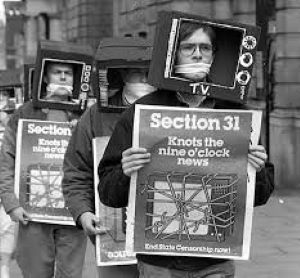
Visually impacting and clever punning in placard parade protest against Section 31. (Photo sourced: Internet)

Bizarrely even a call-in show on radio about gardening was interrupted once because a caller was a member of Sinn Féin. 

The changes undermined the relatively liberal interpretations by RTÉ of its censorship responsibilities under the original 1971 Order and encouraged a process of self-censorship and illiberal interpretation.

However in 1976 O’Brien attempted to extend the censorship to newspaper coverage of the conflict, targeting in particular The Irish Press, revealing his thinking in an interview with Washington Post reporter Bernard Nossiter, naming as a possible target Press Editor, Tim Pat Coogan.

Nossiter immediately alerted Coogan, who then published the Nossiter-O’Brien interview in the Irish Press (as did The Irish Times).

Due to public opposition the proposed provisions were amended to remove the perceived threat to newspapers.

But Fine Gael and Labour were not to be left out as the 1973-77 Fine Gael/ Labour Coalition Government also tried to prosecute the Irish Press for its coverage of the maltreatment (not to say torture) of republican prisoners by the Garda ‘Heavy Gang’, with the paper winning the case.

SOURCES

https://en.wikipedia.org/wiki/Censorship_in_the_Republic_of_Ireland

https://www.imdb.com/title/tt34242057/

1The Workers’ Party grew out of Official Sinn Féin which was declining after the split which led to the creation of Provisional Sinn Féin in 1970 and later another split, resulting in the 1974 creation of the Irish Republican Socialist Party. The WP was extremely hostile to the IRSP and PSF, in particular the latter.

2Inside RTÉ – a memoir, Betty Purcell, New Island Books (2014).

RTE’s Biased Coverage of Palestine and Sinn Féin’s Call for a Review

Gearóid Ó Loingsigh (25 November 2024)

(Reading time: 8 mins.)

NB: Edited by RB from original article for formatting purposes

Sinn Féin has said that it would ask for a review of the national broadcaster RTE’s biased coverage of Palestine and other international conflicts.  They were criticised by almost all and sundry for doing so. 

They were accused of censorship and their own use of lawsuits to silence critics was raised once again.[1] 

The National Union of Journalists (NUJ) came out with guns blazing, claiming it would be in breach “of the principles of the European Media Freedom Act and would set a dangerous precedent in terms of direct and indirect State interference in the remit of the existing regulatory body.”[2]

The NUJ has rarely challenged what it sees as state or private interference in the media before and less still at RTE.  RTE’s board is made up of cronies and business interests, people whose interest is served by limited coverage of financial and other issues. 

Many of them come from the financial sector.  Six of the eleven board members are appointed by the Minister for Communications, so there is already government interference in RTE.

The NUJ itself would not come out well of such a review, if the review were honest. For decades it implemented Section 31 of the Broadcasting Act, censoring Sinn Féin, even when the party was standing in elections.

A brave RTE journalist Jenny McGeever was sacked because she broadcast one sentence from Martin McGuinness, “If that is ok with the Police, that is ok with us”, in reference to arrangements for the transport of three IRA volunteers’ bodies back to Belfast.[3] 

It was an innocuous statement.  The NUJ did next to nothing to defend her.  They did not defend her just as they meekly accepted the sacking of the RTE Authority in 1972.  Colum Kenny commenting on his time at RTE remarked that:

During my years at RTÉ, I became for a period what is known as ‘The Father’, or chairman, of the Programmes Chapel of the National Union of Journalists. I found no great appetite among its members, or indeed among the membership of another union representing many producers, for industrial action aimed at drawing public attention to the existence of the gagging Order known as Section 31.[4]

In other words, neither the union nor the members did anything about it.  They either agreed with it or decided the truth was not that important, not as important as their careers. 

The union will not look well, if coverage on Palestine is looked at, nor will it come out shining if coverage of Ukraine is also included, as on this issue, the union itself intervened directly in helping to shape a narrative at odds with reality.

It is as clear as day that on Palestine, Irish coverage has been very biased, in terms of who it gave interviews to, the issues it refers to and the kid gloves that apologists for genocide such as the Israeli Ambassador have been treated with. 

It is clear even in the language used.  The word ‘genocide’ is never used in reporting, unless quoting someone and even then, sparingly.  It is referred to as ‘the war’, ‘the conflict’ etc. 

It has mainly used the term when reporting on the case taken to the International Court of Justice and gave a succinct but incorrectly limited definition of what genocide is. 

It stated “In short, genocide is the intentional destruction of a people in whole or in part.”[5]  The definition is actually a lot broader than that and Gaza fits the bill on various counts.[6]

When reporting on the murder of civilians in Palestine, it never uses such terms.  It says ‘killed’ and the casualty figures are always referred to as “According to the Hamas-run Ministry of Health”. 

The message is clear, that these figures come from an organisation that is considered to be a terrorist group and therefore the figures are not reliable.  But it is actually the elected government. 

The last time there was an election in Palestine, Hamas won, both in Gaza and in the West Bank, though it only assumed power in Gaza with the Vichy Palestine Authority appointed by Mahmoud Abbas undemocratically taking control of the West Bank. 

So, of course the Ministry of Health is run by the elected government.  This language is never used in relation to Israel, we are never told “according to the Likud-run Ministry of Defence”.  In fact, such caveats are almost never used, not even when quoting the most vile dictatorships in the world.

  At best, they state “according to an official government communiqué”, which is technically correct and does not have the same moral =laden judgement contained within it.

In Lebanon, they engage in a similar sleight of hand, referring to attacks on “Hezbollah strongholds”, which is the type of language they hope will give some justification to the bombings.  But what are Hezbollah strongholds?  They are areas in which the organisation has mass support.

You would be hard pressed to find in the media, in general, and RTE in particular any significant explanation of what Hezbollah is. 

Many viewers hearing about strongholds being bombed would not know and are never informed that what this means is areas in which the organisation has a support base, which is also electoral. 

We know which areas are Hezbollah strongholds because they are the areas where people voted for them.  It is an electoral and military force, increasing its number of parliamentary seats in the 2022 elections from 13 to 15, though its allies in parliament lost seats. 

But the point is, it is a force with a huge popular base.

Likewise, when Israel told Irish UN soldiers to leave, the President of Ireland described it as a threat — but the media was more hesitant. 

When Israel then used UN compounds as shields in their attacks, the resulting damage was described as damage caused by the exchange of fire between the two.  You would never guess that one of the sides deliberately used them as protective shields.

In terms of RTE bias and coverage, whilst it has reported on Palestine over the years, once October 7th happened, the official discourse emanating from RTE and most other media outlets was that history began on October 7th. 

No attempt was made to look at the history of the region, nor the context of Israeli aggression and crimes against humanity prior to October 7th.  Previous Israeli attacks and crimes were rarely if ever mentioned. 

It made one attempt at explaining what Hezbollah was in an article published on its site.[7] 

The article recognises that it has political support, but constantly refers to the fact that it is designated as a terrorist organisation by the US and that other bastion of democracy, Saudi Arabia, whose leaders have never been elected. 

Saudi Arabia, despite having a nominal parliament is led by a bunch of royal head-chopping kleptocrats.  Though RTE quotes them favourably as a source of analysis on the nature of Hezbollah. 

The organisation is according to RTE nothing more than a group that “…has risen from a shadowy faction to a heavily armed force with major sway over the Lebanese state. The United States, some Western governments and others deem it a terrorist organisation.”

The headline on the piece reduces Hezbollah to just being a group that supports Hamas. And that was about it from RTE on the nature of the organisation.

Likewise in Ukraine, though RTE had reported on the country previously, once again history started on a particular date, this time February 22nd 2022. 

They ignored the 2014 Maidan Coup, the breaking of the Minsk Accords by Ukraine, the repression of non-Ukrainian cultures, which included not just Russians but also gypsies and others. 

The promotion of WWII fascist Stepan Bandera, the fascist nature of the Azov Battalion were all ignored to favour a simplistic account.  Previous acts such as the burning to death of trade unionists in Odessa by fascists in 2014 were never mentioned again. 

RTE presenters even questioned why NATO wasn’t pushing for all-out war with Russia, and they included in that the possibility of going to the brink of nuclear war. 

The Irish Times has recently doubled down on this, basically resurrecting the “Russia will invade and attack everyone scenario” so common when the war began.

It argued in a piece written by Kier Gillespie from the right-wing think tank Chatham House that Ireland should abandon its “neutrality” and Europe should get ready for all-out war with Russia.[8]  Incidentally, a sentiment echoed to some degree by the “pro NATO left” in the Irish parliament.

The NUJ for its part, whose members push the narrative on Palestine and Ukraine were not content with the complicity of its members in a particular narrative but organised a protest to skew the debate altogether. 

Shortly after the war started the NUJ organised a protest at the Russian Embassy to protest the lack of press freedom and attacks on journalists by the Russian state.  The Russian state has a dreadful record on the matter, but so does Ukraine. 

Moreover, in its attempt to portray the Russians as the only threat to freedom of the press the NUJ invited ambassadors from other countries to join in with it at the protest. 

Fine, except with one exception, those ambassadors represented countries with a poor record in the matter, such as Georgia, Poland and Ukraine coming in 89th, 66th and 106th respectively in Reporters Without Borders Press Freedom Index for the year 2022. 

By doing this the NUJ set a narrative that the only threat to press freedom was Putin and whitewashed a number of regimes with dubious records themselves. 

Whilst it has condemned the deaths of journalists in Gaza it did not protest at the Israeli Embassy but held a vigil instead at an art gallery.[9]  You couldn’t make such cowardice up.

So, an investigation of bias in the coverage of conflicts would be welcome.  Neither Sinn Féin, RTE, nor the NUJ would come out of it well.  But the problem is political. 

The reason why RTE does that, is that it gets away with it because there is no challenge to its bias. Sinn Féin and the Irish left represented by such stalwarts of mediocrity like People Before Profit, applauded and egged on the push for war and bias about Ukraine.

They now find the media supporting those same reactionary forces (NATO, US, EU) in their assault on Palestine.  The penny has almost dropped for them, but not quite.  RTE was biased on Ukraine and they agreed with it, now it is biased on Palestine and it is too late. 

But RTE and the Irish media in general represent the interests of the Irish state and so it should come as no surprise that it is biased. 

This does not mean we should accept it lying down, but you can’t call for bias on one issue in favour of a NATO proxy (Ukraine) and against bias in favour of another proxy, Israel.  The two are linked.

In the case of Palestine, the NUJ is passive, passing resolutions and issuing communiqués. 

As with the Irish censorship law Section 31, the union is content to not take any industrial action on the issue and let its members lie, downplay the seriousness of it all, treat the Israelis with kid gloves and use language that deliberately distorts what is happening. 

Their role in echoing Their Master’s Voice should be exposed, though Sinn Féin is not the best -placed organisation to do so, given its prioritising of its relations with Washington and its own attempts to censor Palestinians in Ireland who did not follow the Palestine Authority line.

NB: For more articles by Gearóid see https://gearoidloingsigh.substack.com


[1] Irish Examiner (19/11/2024) LIVE: Election 2024 — Sinn Féin promises ‘peer review’ of RTÉ’s Gaza coverage if elected. Paul Hosford and Cianan Brennan. https://www.irishexaminer.com/news/politics/arid-41519792.html

[2] RTE (20/11/2024) McDonald defends Sinn Féin plan to review RTÉ’s Gaza coverage.  Tommy Meskill. https://www.rte.ie/news/election-24/2024/1120/1481906-ireland-politics/

[3] Sunday Business Post (20/04/2003) How RTE censored its censorship. Niall Meehan.  Archived at CAIN https://cain.ulster.ac.uk/othelem/media/meehan/meehan03.htm

[4] Colum Kenny (2005 ) Chapter 5 Censorship, Not ‘Self-Censorship’ https://doras.dcu.ie/24076/1/Kenny,%20Colum.pdf

[5] RTE (11/01/2024) Explained: Ireland’s position on the genocide case against Israel. Juliette Gash. https://www.rte.ie/news/2024/0111/1425974-genocide-case/

[6] See Genocide Convention https://ihl-databases.icrc.org/en/ihl-treaties/genocide-conv-1948/article-2?activeTab=undefined

[7] RTE (31/10/2023) What is Hezbollah, the group backing Hamas against Israel? https://www.rte.ie/news/world/2023/1031/1413861-hezbollah-lebanon/

[8] Irish Times (23/11/2024) If Russia is indeed planning an attack against a Nato state, distance and neutrality will provide no defence.  Keir Gillespie.  https://www.irishtimes.com/opinion/2024/11/23/if-russia-is-indeed-planning-an-attack-against-a-nato-state-distance-and-neutrality-will-provide-no-defence/?fbclid=IwY2xjawGxRsdleHRuA2FlbQIxMQABHVXgrcEEXPDpG2Am4EF_a_67yPZPmEio-r1l3dlQxOftB3W7EWIxEl8S_w_aem_LGtv72o-qvSLNNgSLdrWrw

[9] NUJ (30/04/2024) Dublin vigil for slain journalists. https://www.nuj.org.uk/resource/dublin-vigil-for-slain-journalists.html

SOLIDARITY BRIDGES

Diarmuid Breatnach

(Reading time: 3 mins.)

In the western world we observe the manifestation of solidarity with Palestine in giant marches and in college solidarity encampments and building occupations. But there are many other manifestations to be seen every week and on specific occasions.

These other smaller actions take place of special occasions or on a regular weekly, monthly or even daily basis. The Bridges of Solidarity event was organised as a specific one-off but others are organised weekly, for example in Dublin where one of them, by coincidence is also on a bridge.

These solidarity events are seen by passing people away from the routes of the big marches and locations of encampments and allow those people at minimums to express their approval and, for a few seconds at least, to be part of that solidarity expression.

This contributes to the popular public opinion. Smaller or special events sometimes also pull in people who might not normally participate in marches for a variety of reasons.

The Solidarity Bridges protest day was set for Friday 31st May and Palestine solidarity flags were waved and banners hung from bridges over motorways and rivers across the nation, disregarding the foreign-imposed border.

In Dublin, motorway and main road bridges, over river and stream showed the Palestinian colours and were greeted every few seconds by motor horns sounding in support.

One of the Bridges of Solidarity with Palestine events that took place across different parts of Ireland on 31 May 2024, this one on the Dublin Fairview pedestrian bridge across the road.

On the “RTÉ Bridge”1 the numbers were small with Palestinian flags and a drop banner bearing the message “RTÉ LIES”. However the horns of passing traffic blowing in approval sounded every ten seconds or so, sometimes individually and sometimes in a chorus, accompanied by thumbs up.

Irish and Arabic recorded resistance music sounded out from an amplifier. On the UCD Bridge, chanted slogans replaced recorded music with a couple of songs too, sung accapella; the numbers here were boosted with students from the ongoing solidarity encampment there.

A huge “Ireland Stands With Palestine” banner figuring the watermelon slice2 hung off the southern side of the bridge with flags and a text banner facing north.

According to media reports and its FB on 28th June, the IPSC called for those bridge protests but none of the Dublin ones were listed and today there were no photos of any such events on its FB page; however its website lists nineteen such protests for next Friday 7th June.

Every Thursday evening in Dublin a solidarity picket takes place from six to seven o’clock in four areas in prominent locations passed by much motorised traffic: Annesley Bridge Fairview/ East Wall (alternating between them weekly); Ballymun; Cabra and Donnycarney.

One of weekly Palestine solidarity picket every Thursday in four Dublin city areas – this one on Annesley Bridge, Fairview, 30 May 2024.

The Ireland Palestine Solidarity Committee does not for some unexplained reason promote these events. In its weekly list of activities for participants around the country, it does not list the Thursday events.

The IPSC is long-established and the main organisation promoting Palestine solidarity across Ireland but this kind of censorship, for that is what it amounts to, is harmful to that solidarity. These initiatives are not even radical3 nor organised by people hostile to Palestinian solidarity in any way.

Bernadette McAlliskey joined the weekly protest on Annesley Bridge on 22nd May.

Of course in themselves these actions do not stop the genocide but nor do big marches, while the college encampments may force some limited divestments and academic boycotts. But all together form part of the political ambience of the country upon which yet other actions may be based.

End.

FOOTNOTES

1So called because of its proximity to the headquarters of Radio Teilifís Éireann, the national broadcasting service.

2The Palestinian Flag is forbidden in “Israel” and wherever else they exercise control in Palestine and, because the colours of the watermelon slice are those of their flag, the Palestinians have used it as a “legal” substitute (green and white in the rind, red in the flesh and black in the seeds). An interested 6th Year student cycling past asking the reason for the design had it explained to him and told participants, whom he thanked, that he’ll be taking Politics as a subject in university.

3 Not that there is anything wrong with radical protests and in fact they are needed but one might think that the IPSC was not supporting certain types of protest because it was concerned that they might be perceived as being too radical.

SOURCES

https://www.facebook.com/IrelandPSC/

ipsc.ie

https://www.irishnews.com/news/northern-ireland/bridgils-for-palestine-to-take-place-throughout-ireland-7EA3NUQXINAIFMZTXGQSY3TXLA/

MONSTER DUBLIN MARCH IN PALESTINE SOLIDARITY

Diarmuid Breatnach

(Reading time: 6 mins.)

A huge Palestine solidarity march proceeded from the north Dublin city centre on Saturday 20th, passing down O’Connell Street, over the Bridge, around by Trinity College and on towards Leinster House, the parliament of the Irish State.

Detained by an earlier activity I hurried to join it, catching up with it near the Larkin Monument. From there I could see sections of the march across the river and another section wending around Trinity College in the distance, its leaders out of sight.

(Photo: D.Breatnach)

“Over a thousand”, reported our “newspaper of record”, the Irish Times. In other words, less than 2,000. Really?!

The march was organised by the Ireland Palestine Solidarity organisation, the main Irish nationwide Palestine solidarity organisation, sponsored by a multitude of organisations and was supported in marching by many organisations and individuals, the latter being the capacity or most participants.

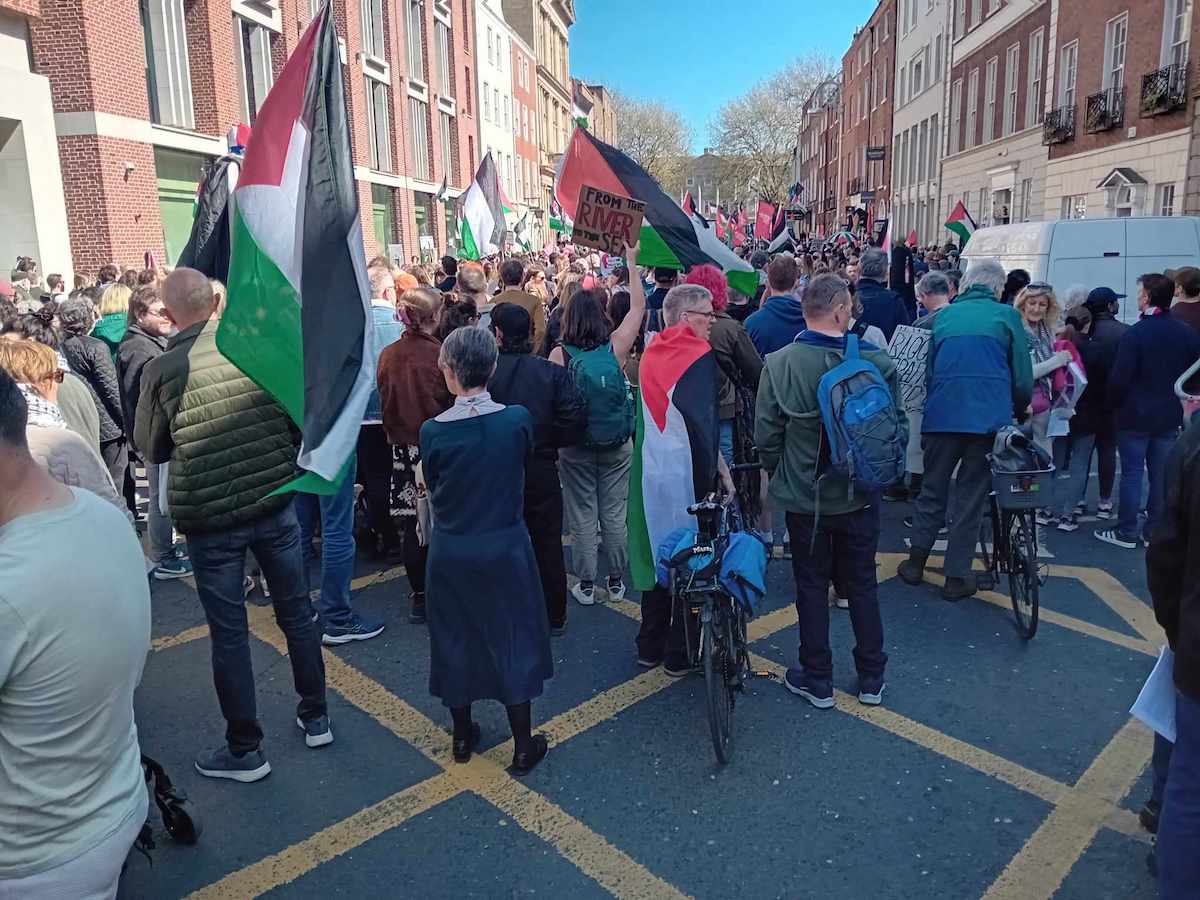
The usual slogans could be heard as I hurried past marchers, such as “Free, Free – Palestine” and including the one that Suella Braverman tried to ban when she was a Minister in the UK Government: “From the river to the sea – Palestine will be free!”

I paused by the Thomas Moore monument waiting to meet up with friends in order to march with them. One group passed calling out that what is occurring in Palestine is “Not a conflict, not a war”. I understand them to mean it is genocide instead but I can’t agree with them.

It IS a conflict, the old one of the European colonial settler against the indigenous people, fought for centuries on all the continents of the world except in Antartica. And the zionist State IS waging a war, a genocidal war against the Palestinian people.

(Photo: D.Breatnach)

Another group went by with a chant leader calling out a list of categories of victims of the zionist genocide such as medical workers, journalists, ambulance crews, refugees etc, to which the group replied “Not a target”. Perhaps they meant “not a legitimate target” but targets they certainly are.

I was flying the Palestinian flag but also the Starry Plough, flag of the risen Irish working class in 1913 and 1916, the only one I saw on the march and which was how my friends found me. A woman I mistook for a visitor asked to take my photo, to which I agreed.

Near the rear of the march one could hear the usual call-and-response slogans drifting back towards us but people in our section marched silently or chatted with one another. Then a voice called out: “From the river to the sea!” and the reply was instantaneous: “PALESTINE WILL BE FREE!”

Chanting takes energy but also seems to supply it and from then our section joined in with gusto: “In our thousands, in our millions – We are all Palestinians!” “In our millions and our billions – We are all Palestinians!” “In our TRILLIONS and our billions – We are all Palestinians!”

“Netanyahu, what do you say? How many kids have you killed today?” “Joe Biden, what do you say? How many kids have you killed today?” “EU, you can’t hide – You’re supporting genocide!” “Irish Government, you can’t hide – You’re supporting genocide!”

“Saoirse – Don Phalaistín!” was the only slogan1 in Irish. There was no doubt about what people wanted for the Israeli Ambassador or the zionist Embassy, which was “Out, out, out!”

(Photo: D.Breatnach)

As we turned from Dawson into Molesworth Street, the rest of the march was packed ahead of us all the way up to the presumed police barriers at Kildare Street, across from the main gate of Leinster House. Here the IPSC stewards were urging us to move in still closer ahead.

What was the reason? Apparently the Gardaí wanted us past the intersections with South Frederick Street and with Molesworth Place. But for what purpose? Those were southward traffic only streets which should have been blocked anyway and Dawson Street was open in both directions.

(Photo: D.Breatnach)
Molesworth Street from the Junction with Molesworth Place, already packed and with more arriving, yet we were expected to pack in closer and have barriers moved up against us! (Photo: D.Breatnach)

Then a private company began to erect barriers across the north-eastern section of Molesworth street which looked to me like kettling, a view which seemed born out as the barriers were moved once more further eastward with instructions to keep moving – with which I declined to cooperate.

This whole exercise seemed to me of dubious traffic easement validity and more about getting people used to obeying order and to being kettled by police if required by them. In the Irish state we do not have to gain police permission for a march or approval for its route.

There’s nothing fundamentally wrong with the IPSC leaders informing the police of their march routes for traffic easement. But our rights have to be protected and not easily surrendered, much less for no visible valid reason. It is not good for stewards to automatically comply with police wishes.

I have seen (and resisted) Garda attempts to push demonstrators from the front of the GPO into the pedestrian reservation in the middle of O’Connell Street, while they told people that “It’s what your organisers (IPSC) want.”

Declining to be kettled.

The police of a state are not neutral forces for the public good and have drawn and used their batons through the decades against people protesting partition of their nation, imperialist war, water privatisation, growth of fascist and racist attacks, against imperialism and colonialism …

Not to mention torturing and framing people to have them jailed.

CHRISTY MOORE AND REPRESSION

In the distance, we could hear that Ireland’s chief living balladeer, Christy Moore, had got on stage and was speaking, then singing, though I could make out only snatches of the lyrics. Moore gained fame both as a member of Moving Hearts band and Planxty but also as a solo performer.

Moore had been litigated against for his song about the young 48 Stardust Fire victims but was vindicated during the week by a long-delayed second inquest into the deaths.2 On the other hand he’s received no apology for the police raid on his H-Block album launch back in 1972.3

Pro-Palestinian demonstrators are facing repression throughout the western world, in some places much worse than others. The German State is behaving like Nazis in banning demonstrations and raiding a conference, apparently in twisted expiation of its sins under the Adolf Hitler regime.

This impacted also on an Irish language group in Berlin during the week while they attempted to have a small gathering speaking and singing in Irish in a park in front of the German Parliament. The police told them that only German and English languages were permitted in that area.4

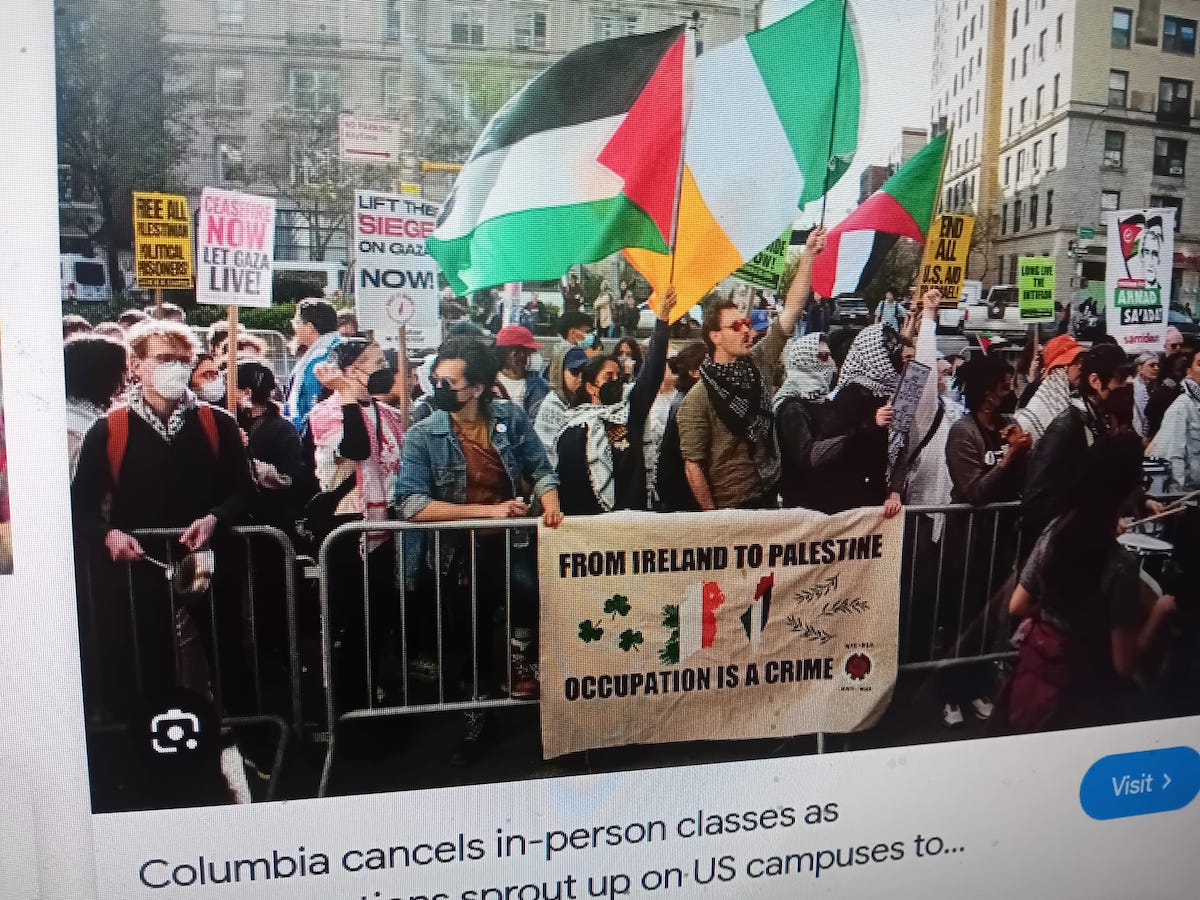
The Irish Tricolour has been seen on many London demonstrations in solidarity with the Palestinians, on its own or flying below the Palestinian flag inscribed with “Saoirse don Phalaistín”. The Tricolour turned up too as university students and staff faced down the New York Police.

Columbia University, New York, Monday.
St. Patrick’s Day, New York, March 2024.
London, November 2023.
London, clearly.

In Palestine itself new horrors are being revealed with the recovery of bodies in mass graves in the areas of destroyed Gaza hospitals recently occupied by the Israeli military. Their remains testify to their being patients and medical staff in addition to refugees.5

A totally new horror are the Israeli killer drones emitting the wailing of a baby or a woman’s cry for help, waiting to gun down would-be rescuers. Palestinians in Gaza have been accustomed to responding to those cries in reality for months and often enough shot or bombed as they did so.6

This however is a new depth for the zionist military.

Under danger of Israeli bombardment, digging bodies out of a mass grave at the destroyed Nasser Hospital site April 2024. (Photo cred: Ramadan Abed/Reuters)

During the week also the independent investigation commissioned by the UN has found no basis to the Israeli claim that many staff of its aid agency for Palestinians, UNWRA, were members of Hamas or Islamic Jihad, much less involved in the October 7th Palestinian resistance operation.7

That investigation result has UNRWA vindicated of the false Israeli claims but also commended on its procedures to comply with the impartiality requirements of the UN and of its funders, many of which however now stand condemned for withdrawal of their funding from starving people.

But UNRWA chiefs should share the condemnation for appearing to give the accusations credibility in firing some of their Palestinian staff, not to mention sacking appallingly and reducing to poverty a number without hearing or appeal, on the basis of unsubstantiated accusations.

And from a source known for lying for decades and long hostile to the UNWRA organisation. True to type, the Israeli government has rejected the findings, despite having provided no verification of its accusations to date.

Few official actors of states or of the UN come out well in evaluation over the last six months of this daily broadcast genocide.

End.

FOOTNOTES

1Interestingly the word “slogan” is itself from the Irish language, or at least Scottish Gaedhlig, meaning a “call to/from the multitude/ troop”.

2https://dublinpeople.com/news/northsideeast/articles/2016/02/02/the-story-of-christy-moore-and-the-stardust-song/

3In the Brazen Head pub, Dublin, June 1972.

4https://www.independent.ie/irish-news/berlin-police-ban-irish-protesters-from-speaking-or-singing-in-irish-at-pro-palestine-ciorcal-comhra-near-reichstag/a234500393.html

5https://www.aljazeera.com/news/2024/4/23/as-more-bodies-found-un-human-rights-chief-horrified-by-gaza-mass-graves

6https://www.thenational.scot/news/24261522.israeli-drones-playing-sounds-babies-crying-opening-fire/

7https://www.thenational.scot/politics/24157684.owen-jones-scotlands-stance-unrwa-vindicated/

SOURCES

https://www.independent.ie/irish-news/berlin-police-ban-irish-protesters-from-speaking-or-singing-in-irish-at-pro-palestine-ciorcal-comhra-near-reichstag/a234500393.html

https://www.aljazeera.com/news/2024/4/23/as-more-bodies-found-un-human-rights-chief-horrified-by-gaza-mass-graves

https://www.thenational.scot/news/24261522.israeli-drones-playing-sounds-babies-crying-opening-fire

https://www.thenational.scot/politics/24157684.owen-jones-scotlands-stance-unrwa-vindicated

Erasing Murals and Erasing Gaza

Gearóid Ó Loingsigh 13 March 2024

(Reading time: 2 mins.)

       
         Original Latuff cartoon.                              West Belfast mural.                                  Mural blacked out.

Once upon a time, Belfast was famed for its murals, so much so that even now a part of the tourist industry depends on a plastic paddy tour of the current murals on display in nationalist areas of Belfast.

It was the 1981 hunger strike and its aftermath that saw an explosion in political murals in nationalist areas.  As the 1980s went on, the technical and artistic quality of them improved dramatically and the politics they sought to represent expanded. 

Some of them were very militaristic, others much more political in content.  On international issues, murals sprang up on South Africa, Palestine and figures from revolutionary struggles around the world were to be found on gable ends all over the city and indeed in other cities throughout the North. 

Nelson Mandela, Steve Biko, Camilo Torres, Che amongst others looked down at the wandering revolutionary tourists who would come over in August.  The message was clear: Ireland was part of an international struggle against imperialism.(1)

After the peace process the quality continued to improve, but the politics went for a walk.  Twee Celtic murals abounded, young girls dancing a jig displaced images of women holding an armalite aloft for International Women’s Day. 

about Imperialism were softened, when not blunted entirely or removed.  So, it comes as no surprise to see what has happened to recent murals.

Sinn Féin supporters recently unveiled murals in solidarity with Palestine.  They are of good quality and try to capture the suffering of the Palestinians through the images and poignant quotes. 

However, they say nothing about who is causing the suffering: the US and Israel, though there are silhouette ghostly like images of soldiers standing over dead children. 

There was once a mural on the White Rock Road which pictured a US Indian superimposed over a US flag saying Your struggle, Our struggle.  No references are to be made now to the US role in exterminating a people.  That is strictly Verboten.

However, someone decided to reproduce a cartoon from the artist Carlos Latuff in mural form in Belfast.  It depicts Joe Biden, standing with bloodied hands in front of Mary Lou, who is clearly identifiable in the image, and the leaders of FG and FF, who can be identified from the initials FG and FF on their backs.

The British Army and the RUC used to deface republican murals, not any more.  Very quickly, Sinn Féin, officially or unofficially (no pun intended, though it is apt) painted over the mural.  It was quickly restored by others, who the artist Latuff described as real republicans.(2)

Sinn Féin are clearly uncomfortable about the issue in the run up their fest in Washington with Biden and not only are they content to throw Palestinians out of public meetings, they will now supress any public artistic attempts to draw people’s attention to the Slaughter Soirée they will have in the White House.

Many Palestinian voices such as the Electronic Intifada have called on Sinn Féin not to go to Washington, the calls in Ireland have been much more muted and tamer on the issue.  However, it is a clear issue, what is colloquially called a no-brainer. 

You don’t have to think very deeply to understand that Sinn Féin shouldn’t go to Washington DC, that they should tell Genocide Joe they don’t want to meet him.  They will go and they will say nothing about Palestine. 

Their erasure of a mural criticising them, tells you everything you need to know about their real attitude to Palestine.

Whatever you say, say nothing used to be a catchphrase about loose talk and informers, now it means never to mention Joe Biden and the Palestinians in the same breath, unless you are green washing genocide. 

Meanwhile Sinn Féin does its part, emulating the British army and vandalising political murals.

Notes

(1)  A selection of images can be seen on Bill Rolston’s website.  Rolston has chronicled and photographed murals going right back to the 1970s.  See https://billrolston.weebly.com

(2) See https://x.com/LatuffCartoons/status/1767239594083324017?s=20


Return to top of page

DUBLIN PROTEST AGAINST NATO’S ACTIVITIES IN UKRAINE

Diarmuid Breatnach

(Reading time: 4 mins.)

I learned that the Truth and Neutrality Alliance would be organising a protest on Sunday afternoon (18th) in Dublin’s O’Connell Street and attended in order to take some photos, talk to some people and report on it.

The small gathering with a banner and placards on the central pedestrian reservation in Dublin’ main street opposite the iconic General Post Office building1 included apparently Irish and East European people. They were addressed by a number of speakers.

Separately nearby was a small number of floral tributes dedicated to Alexei Navalny, right-wing anti- immigration Russian political activist and opponent of the Putin regime about whose recent death in Russian jail the Biden regime had made critical statements.

(Photo: D.Breatnach)

SPEAKERS

The first speaker, who appeared to be one of the organisers, denounced the “massive censorship” about the conflict in Ukraine and said we live “in a world of lies” and that “anyone who tells the truth is accused of being a Russian agent”.

He went on to draw parallels between anti-Russian propaganda and that which had been against Syria also. “The end of the war in Ukraine is now in sight”, he said and looked forward to a democracy with full rights for all including Russian-speakers.

The speaker said that one cannot (legally, publicly) be a communist in the Ukrainian state and talked about radio stations being closed down by the Kiyv regime.

In preparation for the end of the war he said that the regime is planning sabotage groups, training terrorists to act in the post-war Donbas as they are doing currently in Russia.

He ended with a reference to “the Banderites” (a reference to followers of the memory of WWII Nazi collaborator Stepan Bandera) and the antifascist slogan from the defence of Madrid during the Spanish Antifascist/ Civil War: “No pasaran!”

(Photo: D.Breatnach)

Bill O’Brien spoke on behalf the Truth and Neutrality Alliance which, he said, had been founded two years previously. “The Russian intervention was necessary”, he said, to act against the carrying out “of atrocities like some in Gaza.”

He went on to refer to “proxy wars such as those in Gaza, Ukraine and Yemen which are financed by NATO” and referred to the Minsk Agreements to which the Ukrainian Government had signed but “had been told by Britain not to honour”, he said.

The Minsk Agreement had been signed twice, O’Brien said and if adhered to, “the war would be over.” He said that “we need to push for the implementation of the Minsk Agreements.”

(Photo: D.Breatnach)

The speaker felt that despite the use of Cold War propaganda, the war would soon be over since the Ukrainian Army was “mainly mercenaries” and currently recruiting women and 60-year-old men.

A third speaker with an Irish accent said that he had been in the Crimea until two weeks previously and that “no-one wants to return to Ukrainian rule. NATO will never get their hands on any of it”, he said.

The Crimea was invaded by Russia in February 2014 and later annexed after a referendum in which the vast majority voted for inclusion into the Russian Federation. Though condemned by NATO allies, the result was no surprise, partly because 60% of the residents were of Russian ethnicity.

(Photo: D.Breatnach)

The official result from the Autonomous Republic of Crimea was a 97% percent vote for integration of the region into the Russian Federation, with an 83% voter turnout and from Sevastopol where there was also a 97% vote for integration with Russia, with an 89% voter turnout.

Crimea and the Donbas region had been under threat or actual attack since the 2006 overthrow of the Ukrainian Government of Yanukovych in what many have described as a US proxy coup. As the war continued, Russia returned to invasion of other parts of Ukraine in February 2012.

The war continues in the Donbas and the Zelensky regime has sworn to retake the Crimea which does not look possible.

One of the people in attendance displays a satirical poster of Zelensky. (Photo: D.Breatnach)

CONVERSATIONS

I interviewed one person from the Ukraine/Russian region who was willing to talk and who asked me first whether I would report truthfully, to which I replied that I would. (But wouldn’t most reporters claim that they were being truthful?).

Larisa Keller told me that although born in Georgia she has lived in other countries during her life and now in Ireland for 14 years. Ms. Keller has grandchildren and wants an environmentally-sound and peaceful world for them in which to grow.

(Photo: D.Breatnach)

“Dismantle NATO is the solution”, she said and “Weapons kill everything in nature” and “new types of weapons” are worse, she indicated, arguing for a ban on the development of weapons. But isn’t Russia also a state with a military, I asked – how does she feel about that?

“At this moment Russia is defending itself,” Ms. Keller said and she herself is supportive of “activities against the pressure of fascism”.

In conclusion, she had this to say: “Tell the world that they should recognise that we live in one world and we should appreciate our ability to stay there; it’s important that we support one another”.

One of the placards displayed at the event (Photo: D.Breatnach)

A young man with an Irish accent in attendance approached and told me that he had an East European girlfriend. He told me also that priests from his Russian Orthodox Church have been killed while pastoring with troops in the Donbas,2 that they are targeted “because they are morale-boosters”.

The young man told me he had friends among the Chechens also.

End.

FURTHER INFORMATION:

Truth and Neutrality Alliance: https://rebelbreeze.com/2024/02/25/thinking-of-sinn-fein-trying-not-to-think-of-palestine/

1Many protests and other events take place in this vicinity, not only due to its central location but also because the building was occupied by the leadership of the 1916 Rising against British occupation for five days.

2The area in the east of Ukraine that is predominantly Russian-speaking where the war is taking place and was besieged by Ukrainian troops, often fascist-led, from 2014 onwards (i.e 8 years before the Russian invasion).