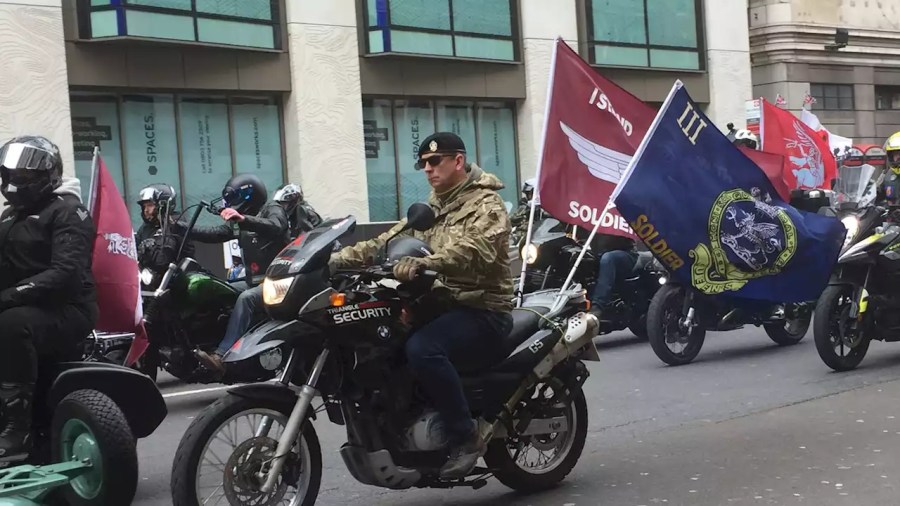
From the window of the government building I worked in, I noticed a gathering of men. Mostly dressed in motorcycle leathers, many of them very overweight, and bearded, the crowd grew to perhaps 70 or 80. Some of the men were wearing maroon berets. They were a comedic spectacle: imagine a few score of Ken Maginnis-types in motorcycle leathers. They lined up in military formation, their physical condition making this pretence pathetic rather than sinister, and unfurled a very small banner which read “WE SUPPORT SOLDIER F.”
I couldn’t help thinking of protests against the injustices visited upon the Guilford Four and the Birmingham Six, protests held in England. How society seems to have changed, and not for the better.
Douglas Murray, a neo-conservative thinker and writer much respected and admired by many on the right, had this to say about Soldier F in his peerless account of the Bloody Sunday Inquiry: Soldier F — who fired 13 rounds on the day — whose performance in 1972 and 2003 was most disturbing. It always seemed to me that if anyone was deserving of prosecution, then it was him.
Murray also had this to say about the killers of 14 civilians on Bloody Sunday: “The soldiers of 1 Para weren’t just unapologetic killers, but unrelenting liars.”
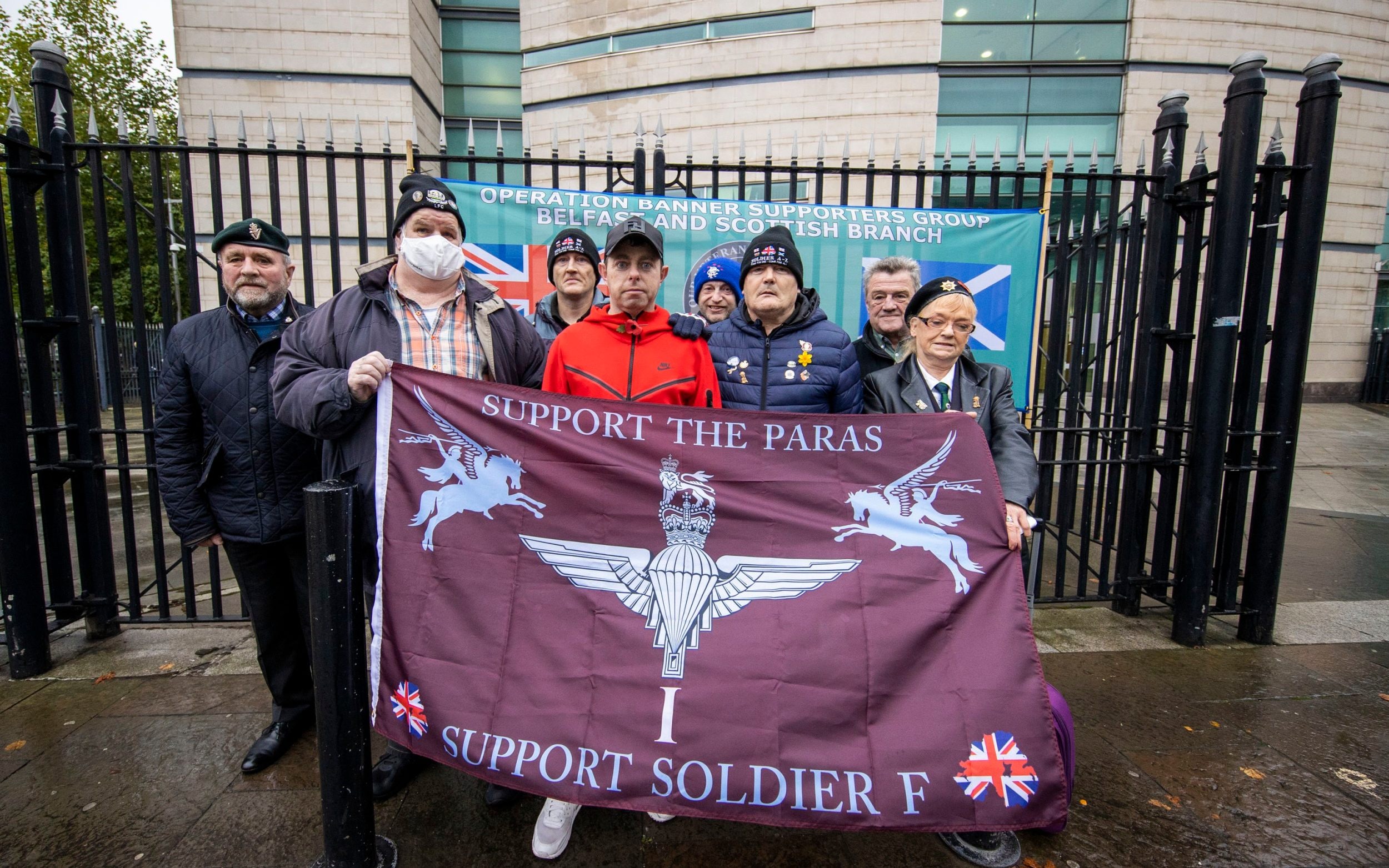
“Support the Paras (Parachute Regiment) and Soldier F” — i.e any British soldier who has murdered people from the Nationalist community. (Image sourced: Internet)
Recently, former British solider Dennis Hutchings faced trial for the killing of John Pat Cunningham. Hutchings received much support, including high profile political support, from those who objected to his prosecution. The circumstances of John Pat’s death could scarcely be more upsetting:
A Benburb doctor said the victim, who was his patient, had been born with an incomplete development of mind, and had been declared a person requiring special care. The doctor said that about a year earlier, near the scene of the shooting, he had come across soldiers pushing John Cunningham into a Saracen armoured car. He spoke to the soldiers who said he had been hiding in the bushes and acting suspiciously. The doctor said he had told the young man’s mother about the incident and advised her to keep a special watch on her son’s movements, in view of his apprehension towards soldiers and their uniforms.
Dennis Hutchings is alleged to have shot John Pat in the back as he ran away from an army patrol. There is simply no way that John Pat was a threat to them. British and Unionist politicians were outraged over a prosecution taking place. They were silent when the prosecution of Soldier F, a perjurer, multiple-killer, and perhaps the single greatest recruiting sergeant the PIRA ever had, fell apart.
From tragedy to farce, we can now look at the case of Donald MacNaughton, who was tried and acquitted of attempted murder in 1974. The case against him fell apart because of “inconsistencies” with the victim’s evidence, and the evidence of MacNaughton and his comrades “fitted together and was not mutually contradictory .” MacNaughton was a member of the Parachute Regiment, whose soldiers colluded with each other to lie to several British Government Inquiries, and indeed to British Army investigators. The farce in this case, I think, demonstrates something of the self-degradation of those on the English right: MacNaughton became a Brexit Party campaigner, and is widely believed to have thrown yogurt over himself to gain media attention.
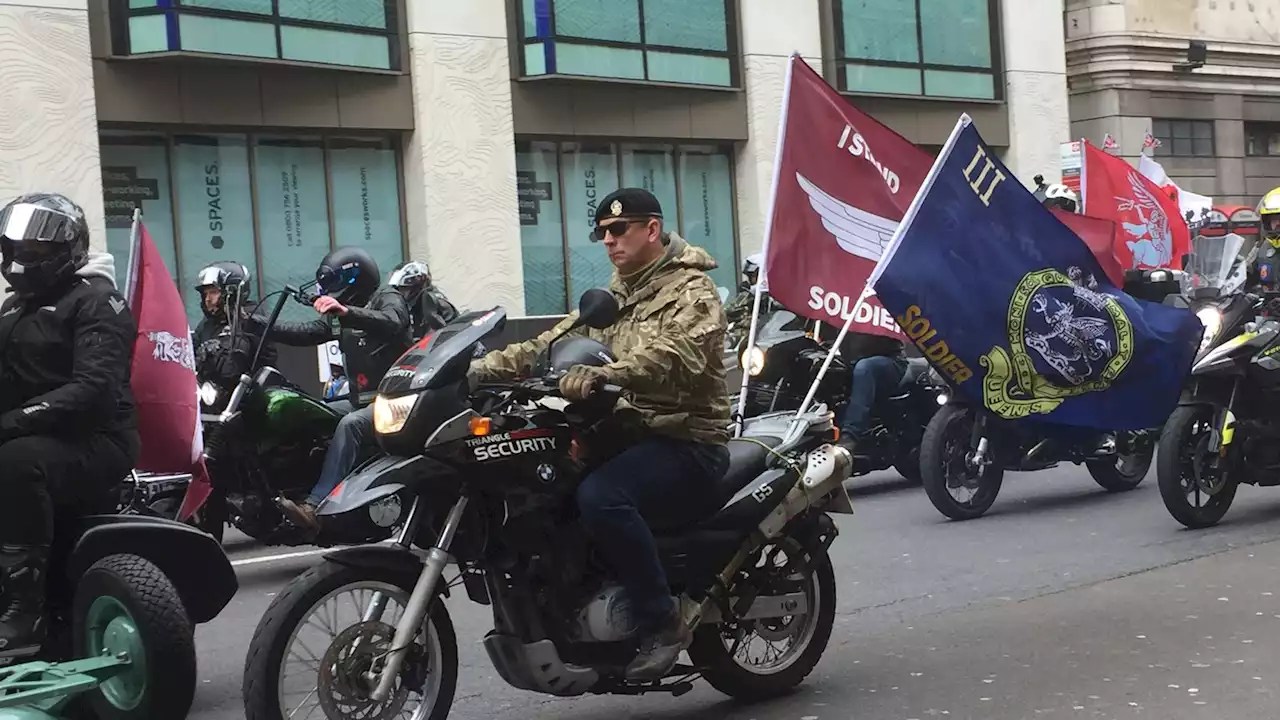
Motorbike rally in Belfast in support of Soldier F, who admitted to firing 13 bullets during the 1972 massacre of unarmed protestors in Derry. (Image sourced: Internet)
Hutchings died before his trial, and will be given full military honours at his funeral. Soldier F was promoted and decorated several times in his military career. Just as their killings of Irish citizens did not unduly affect their lives for decades, was there any serious attempt at prosecuting them to the full extent of the law?
But their prosecution is not really the point. The level of support for them is.
What does it say about sections of society, and politicians, if they can support those suspected of murder, so long as it was committed by a uniformed killer, regardless of the status of the victim?
⏩ Brandon Sullivan is a middle aged, middle management, centre-left Belfast man. Would prefer people focused on the actual bad guys.
DRHE threaten to clamp down on food tables feeding the homeless
Diarmuid Mac Dubhghlais
(Reading time: mins.)
Rebel Breeze editorial introduction: Through its agency Dublin Regional Homeless Executive, Dublin City Council recently threatened to close down the charity services delivering food and bottled water to homeless and hungry people. On the back of scandal about the alleged sexual predation of the deceased founder of the Inner City Homeless organisation, the Council issued a press statement which implied the threat, supported also by indications of Garda cooperation. Diarmuid Mac Dubhghlais, founder and organiser of the Éire Nua Food Initiative, one of the many charity services engaged in the work, has responded in a detailed article, reprinted here with the author’s permission.
THE 26-County State released figures on September 24 showing that there are currently 8,212 people accessing emergency accommodation in the State, a total of 6,023 adults and 2,189 children who are homeless.
A homeless person’s bed outdoors, cardboard as insulation underneath sleeping bag, this one located under the arch of the GPO (the building that was the HQ of the 1916 Rising). (Photo: Éire Nua Initiative)
These figures of homelessness have long been disputed by many others who work within the homeless sector as the State refuses to count those who are couch-surfing, or otherwise sharing accommodation with friends/family. The vast majority of the nation’s homeless are in the capital with 4,220 people accessing accommodation. 953 families are homeless in Ireland, according to the report.
Homelessness charities have warned that more families face losing their homes in the coming months due to private rental market constricts and evictions rise. This has already been borne out with reports of new faces showing up at the many soup runs/food tables that are in the city centre. Pat Doyle, CEO of Peter McVerry Trust, said “Any increase is disappointing because it means more people impacted by homelessness. However, we are now at the busiest time of year for social housing delivery and we would hope that the number of people getting access to housing will significantly increase in the coming months.”
Dublin Simon CEO Sam McGuiness cited the toll on the physical and mental health of people trapped in long-term homelessness. He said: “This population is desperate to exit homelessness and yet they are spending longer than ever before in emergency accommodation. This group deserves far better lives than the ones they are currently living. We see first-hand the toll this is taking in the increased demands for our treatment services, counselling services and the increase in crisis counselling interventions. Outcomes for people in emergency accommodation will not improve until they have a secure home of their own. Until this happens there is scant hope of a better future for this vulnerable group.”
“MANY CHILDREN NOW SPEND THEIR FORMATIVE YEARS IN HOMELESSNESS”
Éire Nua food initiative founder Diarmuid Mac Dubhghlais pointed out at a homelessness protest that many children now spend their formative years in homelessness and have no real idea of what it is like to have a traditional “Sunday dinner” or their own bedroom/play area. This will severely impact their personalities far into the future.
A report published on September 14 by the Irish Human Rights and Equality Commission and the Economic and Social Research Institute (ESRI) found that lone parents and their children account for 53% of all homeless families. The report said that lone parents and their children are much more likely to experience poor housing than other household types. The report also highlights the disadvantages experienced by young people, migrants, people with disabilities and Travellers in the Irish housing system. Researchers looked at six dimensions of housing adequacy – accessibility, affordability, security of tenure, cultural adequacy, quality, and location. They found that less than 25% of lone parents reported home-ownership, compared with 70% of the total population. Lone parents had higher rates of affordability issues (19%) when compared to the general population (5%) and were particularly vulnerable to housing quality problems such as damp and lack of central heating (32% compared to 22%).
Ethnic minority groups had a significantly higher risk of over-crowding, the research found. Over 35% of Asian/Asian Irish people, 39% of Travellers and over 40% of Black/Black Irish people live in over-crowded accommodation, compared to 6% of the total population. Almost half of all migrants in Ireland live in the private rental sector, compared to 9% of those born in Ireland. Migrants, specifically those from Eastern Europe (28%) and non-EU countries (27%), are more likely to live in over-crowded conditions.
One of the queues for free food and water at a charity food table outside the GPO building. (Photo: Éire Nua Initiative)
The research found that almost one third of persons living with a disability experience housing quality issues, compared to 21% of those without a disability. Researchers said there remains a real risk that levels of homelessness will worsen after the pandemic restrictions are lifted and they raised concern about rents increasing faster than mean earnings in Dublin and elsewhere. In 2020, mean monthly rent in Ireland was estimated to be 31% of mean monthly earnings. “Adequate housing allows people to not only survive but thrive and achieve their full potential, whilst leading to a more just, inclusive and sustainable society.”
Meanwhile, the Dublin Regional Homeless Executive (DRHE) said on September 28 that it is to seek greater regulation of organisations providing services for homeless people in the capital as soon as possible in the wake of the Inner City Helping Homeless (ICHH) controversy. Dublin City Council’s deputy chief executive Brendan Kenny, who has responsibility for the Dublin Regional Homeless Executive (DRHE) in his role, said that due to the high number of informal homeless organisations set up in recent years there is “currently no vetting, no controls, on many people who are actually interacting directly with homeless people”. Kenny said he doesn’t want “over-regulation” to lead to certain groups disbanding but added: “At the moment there’s nothing and that’s not good enough.”
In a statement, the DRHE said it is “strongly of the view that greater regulation, vetting, and scrutiny is required for organisations/charities that set themselves up as service providers for homeless persons, including the provision of on-street food services”. “Several such organisations not funded by the DRHE have come into existence in recent years and the DRHE and our partner agencies will be endeavouring in the coming months to bring the necessary expanded scrutiny and regulation to all such organisations.”
Garda Commissioner Drew Harris said there will be a review of Garda vetting procedures for the homelessness sector. Kenny said a report commissioned by Dublin City Council into the impact of unvetted charities is near completion and will provide further insight on the matter. It has been pointed out several times over the past four months that the DRHE, DCC and others have long tried to close the soup runs/food tables in the city centre and many now fear that what has been revealed through the ICHH debacle will be used to close many of these down. The DRHE are ignoring the fact that it is their rules and the oversight bodies recognised by them that has let the homeless down, not the food tables. Much of the work done by the food tables is done in the open and in full public view.
The issues highlighted through the ongoing ICHH investigation show it is what went on behind closed doors that is the problem. Those in oversight positions didn’t do their jobs; people were put in positions of authority without relevant qualifications. The DRHE, DCC and the police should look to how they can improve safety within their “regulated” organisations before seeking to regulate the volunteers who serve a need without any remuneration.
Many of the volunteers at food tables would have difficulty meeting the requirements of police vetting as some would be former addicts, and many others have no desire to become registered charities.
Again, it was pointed out by Diarmuid that many of these “regulated” charities will have high overheads such as transport insurance, maintenance and fuel costs. Some will have CEO wages and petty cash expenses to cover before any donations can be spent on the service user, whereas the Éire Nua food initiative and some others do not seek cash donations. All is done voluntarily and any costs are borne by the volunteers themselves. He cited that many registered charities are little more than businesses operating within the homelessness sector.
Diarmuid has been quoted in the past citing that “there are now many businesses making huge money out of those who are in homelessness” and “that the volunteer ethos that surround many food tables is not to be found within some charities”.
“IMPROVE THE STANDARD OF REGISTERED ACCOMMODATION, NOT SHUT DOWN THE VOLUNTARY ORGANISATIONS”
Kenny said the large number of pop-up soup runs mean some people are less likely to engage with the larger charities funded by the DRHE and in turn, less likely to engage with their support services. The DRHE views sleeping in a homeless hostel, rather than on the street, as a “much safer” option. However, he acknowledged that some homeless people don’t want to stay in a hostel, for a variety of reasons.
“We fully understand that but we’re strongly of the view that a hostel bed is absolutely safer and more hygienic than sleeping in a sleeping bag on the side or a street or in a tent. We know there are some people that just won’t go to a hostel – it may be that they have mental health issues. “We are also aware that some people would prefer to stay in a tent in order to stay involved in drugs and be taking drugs because they may not be able to do it in the hostel.” Kenny added that while hostels provide shelter and food, they “wouldn’t be the nicest place to sleep” but are still “far safer” than being on the street.
He totally ignores the many testimonies from residents, former residents and former workers within these hostels of the theft of personal property, the numerous assaults on residents by other residents, the bullying of residents by some staff members, low hygiene standards, open drug and alcohol abuse and the arbitrary nature operating within some hostels where a resident can be denied access on the whim of staff.
It is incumbent of the State, DRHE and the various councils to bring the standard of these types of accommodation up to a better standard and NOT try to shut those organisations who look after the many who fear staying within State accommodation.
Kenny also noted that sometimes tourists or those who are not homeless queue up to get food from the soup runs. He said fights also break out sometimes. “We’ve come across situations of tourists maybe going up to a food van and getting food, and maybe other people that are not in need of services. And the reality is that anybody that’s sleeping in a hostel, food is provided for them so there is not a shortage of food in the hostel services.
“[Soup runs] do attract a lot of people. I know there are times when large numbers of vulnerable people congregate and you end up with disputes and fights as well.”
Éire Nua free food service workers with table, outside the GPO. (Photo: Éire Nua Initiative)
On the issue of tourists queuing for food, he may well be right, but as the Éire Nua group has pointed out, “we feed the homeless AND hungry, we will not discriminate or question anyone who stands waiting for some food”.
Also pointed out by many residents of various hostels is the small proportions of meals given; while enough to sustain it is often not enough to keep that empty stomach feeling at bay. And for the five to six years that Diarmuid has volunteered alone, with the Éire Nua group or on another soup run, he or other volunteers have never had to call the police. On the few occasions where trouble has occurred, it is often rectified within seconds as the majority of people awaiting food know that: (1) the volunteers are their friends and out there to help them and (2) causing disruption to the smooth running of the tables can result in being denied food. The final word to Kenny from the Éire Nua food initiative: “Let the DRHE look to itself and those under its umbrella before looking to those outside their group; let them ensure the regulations in force within are enforced. Do not blame those who volunteer out of the goodness of their hearts for the sins of those who worked for them.”
End.
EDITORIAL COMMENT:
It may be that the primary concerns of the Dublin municipal authorities and the Gardaí are to remove the visible signs of poverty and homelessness, rather than protection of the vulnerable among these. DCC Brendan Kenny’s comments in mid-August against the proliferation of homeless people living in tents may be seen as a concern that the charity food services constitute an unwelcome reflection on the performance of the Irish State and the municipal authorities of its capital city, visible not only to the city’s inhabitants — at all levels of society — but also to its visitors.
Political Statement against the new banning attempt: the Ministry of the Interior initiatates a procedure in the Spanish National Court for the “extinction” of Izquierda Castellana
The Central Contentious-Administrative Court No. 6 of the Spanish National Court has notified us on August 5th of the motion put forward by the Ministry of the Interior through the State Lawyers in which the “extinction” of Izquierda Castellana is sought, that is, its disappearance as a legal political organization.
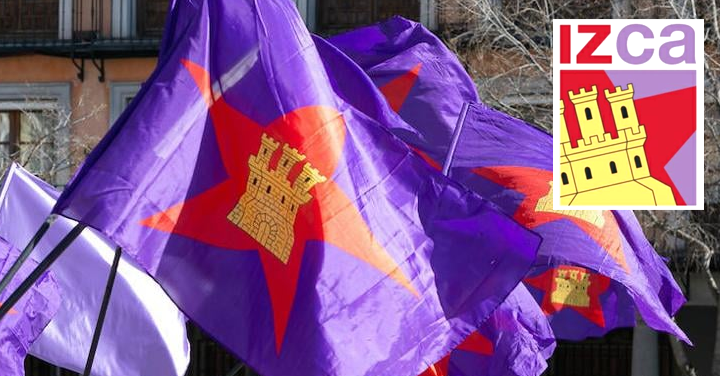
Demonstration of Izquierda Castellana with their logo on banner declaring “Spanish State Prison of Peoples”.
On this occasion, the Ministry of the Interior resorts to administrative tricks, arguing that IzCa’s statutes do not comply with the changes introduced through the legislative reform of Organic Law 3/2015, of March 30, on the control of the financial-economic activity of Political Parties.
It is paradoxical that a political organization that, as is the case with Izquierda Castellana, never in its entire history requested or received any financial subsidy, is intended to be outlawed based on these kinds of reasons, especially when most of the political parties that ostensibly breach the legal regulations on such matters are not even warned of such a possibility.
In our opinion, the attempted extinction / banning of IzCa sponsored by the Ministry of the Interior has a political motivation: the intention of making disappear an organization whose essential activity is the denunciation of all the corrupt, antisocial, antidemocratic and antipatriotic activities of the current Regime of the 2nd Bourbon Restoration; and whose ultimate aim inevitably passes through the establishment of a democratic, republican and social rights system.
IzCa, as we pointed out, has not received or requested a single euro from the public treasury. Our activity is based solely and exclusively on our resources, especially on our human resources, that is, on the militants and activists who support us every day in one way or another. IzCa does not have as such – nor does it claim – representation in the institutions of this post-Franco regime. We do not despise this sphere of action, but it seems to us that the most important and useful thing in this historical moment is to promote the movement and popular organization in the various sectors, and we focus on this and we also believe with some success; that is what the Regime and its successive governments have not forgiven us.
IzCa has suffered permanent harassment from the constituted power since our founding; numerous media-police operations have been plotted against our organization. In 2008 there was already an attempt to ban IzCa, which was finally archived without action in the National Court itself. Last December the trial against our comrade Luis Ocampo was held – Doris Benegas was also on trial – with regard to the events that occurred in the Republican demonstration in Madrid in October 2014. In that trial, a year and a half in prison was requested by the Prosecution. Finally, our comrade was acquitted; in its judgment, the Madrid Provincial Court Court recorded that his version of events was fully credible.
IzCa has been denouncing the repressive policy towards the popular movement and at the same time favourable to the extreme Right that has been carried out by the Ministry of the Interior and very especially by the Government Delegation in Madrid, intensified repression since the beginning of the Covid-19 pandemic. We accurately forecast the overwhelming defeat of the institutional Left in Madrid in the last regional elections on May 4; and we predict – we believe that without the slightest possibility of error – the defeat of the institutional Left in the next general elections if it continues on the current path. If you try to make activist organizations disappear, those that with more dedication and commitment defend the interests of the working classes, you are facilitating the path of access to the government by the Right. If the interests of the peoples of the Spanish State are subordinated to those of imperialism – certainly in a phase of full decline – one of the most significant expressions of which is the scheduled holding of the next NATO summit in Madrid in 2022, it is refusing to build its own project in solidarity with the peoples of the world and, once again, facilitating the advance of the right wing, militarism and warmongering.
We are going to fight against our outlawing at the National High Court and before all judicial bodies, including European ones, where it is necessary. In the National Court, that special court of which we do not recognize any democratic legitimacy, nor for the entire institutional framework of the ’78 Regime,starting with its Head of State, just as “exemplary” in its general terms as the rest of its institutions and whose legality is based on Franco’s legality. But above all, we will continue to fight in the streets.
Study and reflect; organize and mobilize; build popular power. That’s the only way.
Izquierda Castellana, August 6, 2021
COMMENT:
The Izquierda Castellana is a revolutionary socialist organisation basing itself on the territory of Castille (a central area of the Spanish state including Madrid) and claiming its right to self-determination, drawing its historical inspiration from the revolt of the Comuneros in the 1520s. The party or organisation seeks social justice internally, self-determination for its own territory and supports the struggles for self-determination of others (for example, the Basques and Catalans), is opposed to imperialism abroad and military alliances such as NATO. IzCa is anti-racist and anti-fascist and has suffered repression.
The potential for revolution in the Spanish State is not in the Basque Country and Catalonia alone, nor only in other areas such as Galiza and Asturies but in the heartland of the State also, in Madrid and in other parts of Castille. It seems clear that the struggles for independence of the Basque Country and Catalonia as in the past will be met with heavy Spanish repression and the only possibility for success in such circumstances would a situation in which the State was met with uprisings in other parts also. I have long advocated the building of the type of alliances that could make that possible.
(Reading time main text: 5 mins; total includingbackround: 7 mins.)
Last Thursday (7th October) the former home of the Pearse family saw the launch of a plan for Moore Street as an alternative to the current Hammerson plan. The latter, a large property development company based in England, currently has a planning application in to Dublin City Council awaiting a decision. Moore Street is a centuries-old iconic street market in the heart of Dublin city but was also a battleground during the 1916 Rising, as the insurgents’ headquarters garrison in the General Post Office building evacuated the building, set aflame by British shelling and strove to relocate to continue the insurrection to the north-west of the city.
The former home of Patrick Pearse, Commander-in-Chief of the 1916 insurrection and of his brother William, both executed by British firing squads, now a building held in trust with facilities for meetings and a small theatre, was the location chosen by the Moore Street Preservation Trust to launch their alternative plan.
A packed room of people sweltered in their Covid19 face-masks as they listened to a number of speakers on behalf of the Moore Street Preservation Trust, formed earlier this year along with a guest spot for Mary Lou Mac Donald, President of the Sinn Féin political party, prior to the unveiling of the scale model.
A section of the crowd at the launch inside the room, while others crowded the doorway and corridor beyond.
Mícheál Mac Donncha, a Dublin City councillor for the Sinn Féin party and Secretary of the Trust, chaired the event and, after an introduction to the subject of the meeting, announced Patrick Cooney who spoke for the Trust on their history, aspects of the long campaign and the alternative plan. Cooney outlined what the Trust considers the importance historically of the “Moore Street battleground” and remarked that their plan was the only alternative to the Hammerson plan, which he said is supported by no-one else.
In traversing aspects of the conservation struggle, Cooney referred to the High Court case taken against the Minister of Heritage and the property developer (which was then Joe O’Reilly’s Chartered Land) and the momentous judgement that the whole Moore Street area was a national historical monument. The capacity of the Judge to make that decision was overturned in a later appeal by the Minister of Heritage’s legal team.
Patrick Cooney also paid tribute to the week-long occupation of the buildings by others in January of 2016, which had prevented the demolition of three buildings in the sixteen-building terrace in Moore Street. He said that his group could not be identified with the occupation since they were part of the High Court case ongoing at the time but named two Irish Republicans (of a group opposed to the Good Friday Agreement) who had acted as their link with the occupation body, leaving a possible impression that his group had been involved in some way from behind the scenes in the occupation of the buildings.
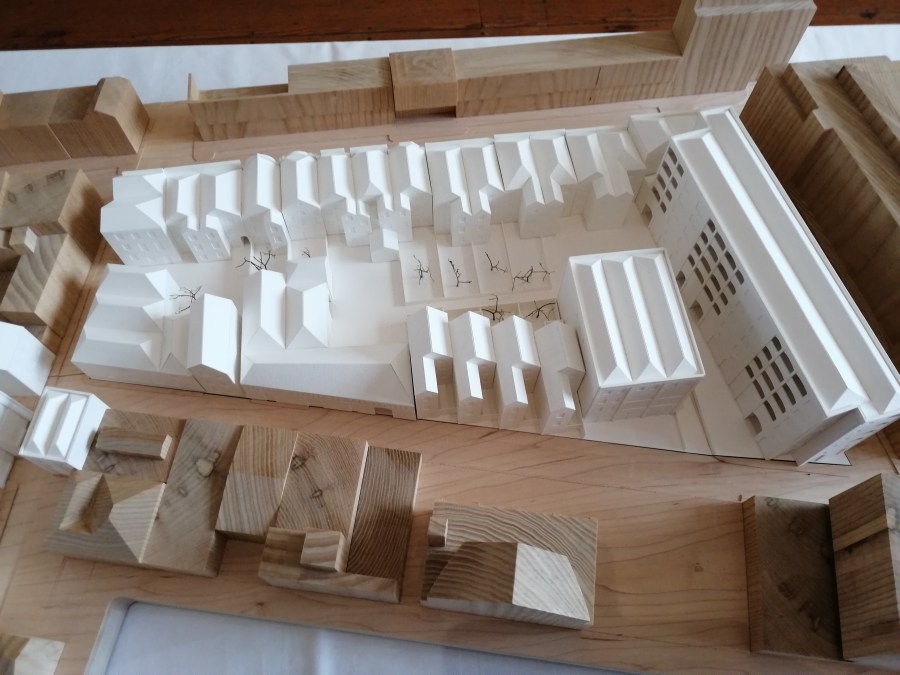
Closer view of the model, viewed from the east and looking westward — Moore Lane is represented at bottom, O’Rahilly Parade at far right and Moore Street at top of image.
Cooney also mentioned the Bill moved by Sinn Féin TD (parliamentary representative) Aengus Ó Snodaigh, currently awaiting debate in the Dáil (Irish parliament) and how it mirrored to a large degree that put forward formerly by a TD of the Irish political party Fianna Fáil, currently in coalition Government, which had not been proceeded with. Cooney paid tribute to the political party Sinn Féin as “the only political party to support” the Moore Street conservation struggle (which may have come as a surprise to Peadar Ó Tóibín, TD of the Aontú political party, who was present in the audience).
Mac Donncha thanked Cooney for his contribution and introduced Jim Connolly Heron, a great-grandson of James Connolly, one of the executed leaders of the 1916 Rising who talked about the historical importance of the site and the importance of its preservation. Connolly Heron talked about historical buildings in Dublin that had been demolished. He said their plan represented an opportunity for the State to atone for the “lamentable failure to save Wood Quay” and commented that “On that occasion the voice of the people was silenced; the loss to the city was immeasurable and we can ill afford another Wood Quay.”
Then Connolly Heron, with Proinnsias Ó Rathaille, grandson of The O’Rahilly, removed the Starry Plough flag of the Irish Citizen Army to unveil the architect’ scale model to loud applause and the clicking of phones and cameras.
A portion of the attendance then removed to the small theatre where Seán Antóin Ó Muirí, for the architects, took the audience through a slide show of drawings and maps while discussing their relevance to the Preservation Trust’s plan.
Outside the building, a large group of teenage Danish students, on a walking history tour conducted by Lorcán Collins of 1916 Rising Tours, had gathered, where they were addressed by Lorcán and also by Aengus Ó Snodaigh TD and, very briefly by Diarmuid Breatnach of the SMSFD group who, at Lorcán’s request, sang them the “Grace” ballad (in which Joseph Plunkett addresses Grace Gifford, his bride of only hours before he is to be executed by British firing squad).
THE ALTERNATIVE PLAN
The Alternative Plan as outlined by the architect involves a number of ideas that have been put forward over the years: refacing some of the buildings to match the pre-1916 facing surviving on some of the buildings, using appropriate matching construction materials, uncovering the cobblestones, etc. The two-story elevation has been promoted previously as have awning-covered ground-level shopfronts but the north end of the terrace at four storeys is a departure perhaps from previous plans other than the Hammerson and O’Reilly plans, as is perhaps the opening up of some spaces around the “back” of the terrace (accessed through Moore Lane). The plan foresees a unitary unbroken terrace which all campaigning groups have proposed.
Architect’s drawing imagining an arch leading to an internal courtyard from Moore Lane to the back of the museum in Moore Street.
Unlike some plans and visions previously mooted, the Alternative Plan as explained does not propose excluding chain stores, nor propose pubs and bakery among the businesses; street stalls were mentioned only in passing with no discussion of the range of hot and cold food or other merchandise that might be on sale. The housing units proposed do not specify local authority rental. Unlike a number of previous plans there was no mention of the benefits of linking the development of a Moore Street cultural quarter to a number of other nearby amenities and cultural quarters nor to that of rejuvenating the north city centre by day and by night.
The history component does not seem to vary much from the Hammerson/ O’Reilly one, being concentrated on the four buildings which the State has named “the historical monument”, a title also used by Trust. In the unbroken terrace proposed (and frequently demanded by campaigners) of course the Alternative Plan departs significantly from the Hammerson one but strangely this contrast was not alluded to in either the verbal or visual presentations.
In the overall presentation of a slideshow and scale model perhaps the most significant contribution of this plan is to present some of the possibilities in a manner more easily grasped and form easier for many no doubt to visualise. It is this that has been missing in past plans and proposals.
HAMMERSON AND DUBLIN CITY COUNCIL
On the west side of Moore Street is the ILAC shopping centre, built with DCC planning permission in 1977 on what was a patchwork of streets and laneways, many of them containing shops and stalls selling various new and second-hand merchandise. A university study group concluded that, apart from the construction companies, the ILAC had benefitted the big stores of Debenhams and Dunnes and that the compensation paid out to most stall-holders and small shops had been inadequate to relocate within the City Centre and workers had been made redundant. The ILAC is half-owned by Irish Life and the other half passed from O’Reilly to Hammerson.
In the early years of this century a consortium of property developers were applying for planning permission to carry out plans in the area from the northwest side of O’Connell Street to Moore Street but Dublin City Council Planning Manager froze the plans and in a very strange deal later handed it all over to Joe O’Reilly. The whole murky story (including city councillors being legally threatened to keep silent by the then Planning Manager Jim Keogan) was covered in a two-part program, Iniúchadh na Cásca, by the Irish language television channel TG4 before O’Reilly got his giant “shopping mall” planning permission (the program was re-broadcast in 2016).
Jim Keogan took early retirement from DCC and is now employed by McCutcheon Halley, a Cork-based planning consultancy company while the most recent Ireland Director for Hammerson is Mark Owen, straight from his previous employment as the Head of Asset Management & Recovery for NAMA.
The architects’ scale model, showing the quarter from a north-facing perspective (i.e from Henry Street). The street to the left is Moore Street and at the right, Moore Lane. Further to the right would be O’Connell Street, not shown here. The Henry Place lane is shown from the nearest part of the model.
INTERNAL CAMPAIGN CONTROVERSIES
Patrick Cooney in his presentation of their Alternative Plan referred to a split in the original conservation committee and in fact over the years there have been a number of controversies and conflicts among campaign groups. The remaining part of the committee containing Mr. Cooney and Mr. Connolly Heron also experienced a number of acrimonious departures. Due to internal difficulties the 1916 Relatives Association, to which both also belonged did not have a meeting for over a year and when it did so eventually, there were loud internal arguments and clashes between Mr. Connolly Heron and others, leading to a number of departures, including Marcus Howard of Easter Rising Stories, producer of many historical documentaries and filmed interviews, including a number on Moore Street.
In that atmosphere, Brian O’Neill was seen by many as a stable and quiet choice for Chair of the 1916 Relatives Association and was duly elected. Shortly afterwards Barry Lyons, a long-time campaigner was expelled from the Association as was also long-time campaigner Donna Cooney, grand-niece of Elizabeth O’Farrell and a DCC Councillor. Neither seems to have been given a formal hearing or allowed an appeal. Although formerly the 1916 Relatives’ Association opposed the developers’ plans, Brian O’Neill now represents the Association on the Minister’s Advisory Group on Moore Street and is on record supporting the Hammerson plan.
Clashes between different campaign groups and individuals have taken place on occasion inside the Lord Mayor’s Forum on Moore Street, including one between members of the Connolly Heron-Cooney group and Colm Moore, another campaigner for many years and the individual who took the High Court case against the Minister of Heritage.
The Ministers’ Consultative Group on Moore Street and its later iteration as the Minister’s Advisory Group, although it has a seat for Jim Connolly Heron, rejected the membership applications of the most active groups in the broad campaign, those who were involved in the 2016 Occupation and the six-week Blockade: the Save Moore Street From Demolition and the Save Moore Street 2016 groups. The SMSFD group has a stall on the street every Saturday, stated to have been since the founding of the group in September 2014, at 368 weeks to date and claims 380,000 signatures to its petition to save the area.
The Connolly Heron and Cooney group do not acknowledge the SMSFD group in public and on one occasion during the Blockade Mr. Cooney posted that the only campaign group they recognised outside of their own was the Save Moore Street 2016 one. However, among all the invitations that were sent out to attend the unveiling last Thursday, neither they nor the SMSFD groups received one – and nor did Colm Moore, the man who took the famous High Court case.
After the formal representation last week but while still inside the Pearse home building, Patrick Cooney was heard to clash with a prominent campaigner and City Councillor in the presence of a radio reporter. Immediately outside, Proinnsias Ó Rathaille verbally abused a member of the SMSFD group (who had learned of the event through the media) in the hearing of many people, including Danish teenagers on a walking history tour.
LOOKING AHEAD
At time of writing it is important to realise that the only plan with Planning Permission is the original O’Reilly one which Hammerson acquired. The latter have submitted their changed plan for a shopping district and new roads which is currently under review by the Planning Department who have asked for some minor changes and gave them six months to produce them. Many objections were registered (and paid for), even by the Housing Department and the feeling is that the vast sweep of popular opinion is against the Hammerson plan – however that is far from being a guarantee against its acceptance by DCC’s Planning Department. And, as NAMA failed to seize them from Joe O’Reilly, their largest debtor at the time and allowed him to transfer them, all the buildings but two (owned by Dublin City Council) are owned by Hammerson.
Should Hammerson receive approval from DCC’s Planning Department, on previous history a not unlikely event, campaigners are sure to appeal the decision to An Bord Pleanála but that avenue too holds little hope for conservationists, given the record of that body’s decisions in Dublin. In the event of an unwelcome decision there, the High Court remains the only recourse in law (for which leave has to be sought to take the case). Protests on the street are of course likely.
Given Hammerson’s financial difficulties in recent years, even if granted planning permission they may not be able to proceed with their plan immediately and despite Hammerson’s denials the suspicion of many is that they will sell the area on – but for that, they need the new Planning Permission attached first and the current one runs out next year.
End.
BACKGROUND TO A LONG CAMPAIGN
In 1916 Moore Street and surrounding streets and laneways became a battleground, as the Irish insurgent force evacuating its erstwhile HQ in the GPO ran into encircling forces of the British Army. A detachment of the GPO garrison proceeding up Moore Street ran into British rifle and machine gun fire, killing three including its leader, The O’Rahilly and wounding others. The main part of the evacuation forces also suffered casualties but occupied No.10 Moore Street and tunnelled through the 16-building terrace to the laneway at the end, where an assault group was being mobilised to attack the British Army barricade at the Moore Street/ Parnell Street junction. The decision to surrender, taken by the leadership, cancelled the assault. Along with William Pearse, five of the Seven Signatories of the 1916 Proclamation spent their last hours of freedom in Moore Street, not long after to be shot by British firing squads: Thomas Clarke, Patrick Pearse, James Connolly, Sean McDermott and Joseph Plunkett.
Prior to 1966 there was nothing in Moore Street to inform people of what happened there although in that year, amidst the 50th anniversary commemorations of the 1916 Rising, a small plaque was placed at first floor level on No.16 Moore Street, believed to have housed the last HQ of the 1916 Rising. That plaque was noted missing in 2002 – it turned up in a property speculator’s office – and fears of demolition plan for the buildings gave rise to a campaign to save it. A meeting was organised by the National Graves Association and a committee formed, hardly a single one of which is currently active in the campaign today for a number of reasons (Patrick Cooney alluded to one of them, a split when some sided with the property developer of the time but there have been many others).
The 50th anniversary of the 1916 Rising plaque in Moore Street, the only fixture to say anything of the sort that happened there.
The campaign extended its demand for the conservation of the whole terrace, backyards etc and in 2006 the State finally conceded a historical importance worth conserving in Moore Street by declaring Nos.14-17 a National Monument, though these still belonged to O’Reilly. In 2008, O’Reilly applied for planning permission for a huge “shopping mall” from O’Connell Street to Moore Street, with a “ski slope” on top and carpark underneath, entailing the demolition of all but Nos.14-17 and the renovation of these as a small museum. DCC’s Planning Department approved the plan but it was appealed to An Bord Pleanála which, against the advice of its own Inspector, rejected the appeal. With the removal of the “ski slope” top and the underground carpark, the giant “shopping mall” was approved but O’Reilly’s demolition plans faced a problem in that two buildings at the end of the terrace belonged to Dublin City Council and four in the middle are protected structures.
In 2009 and 2012 dramatist Frank Allen organised human chain “Arms Around Moore Street” events which gained some media attention.
The campaign gained prominence again when in September 2014 O’Reilly offered Dublin City Council the dilapidated Nos. 14-17 in exchange for Nos. 24-25, where the Council had a waste management depot, a “land-swap” favoured by the City Managers and the Minister of Heritage. A branch of the campaign set up a stall on the street and began to collect signatures to a conservation petition and to disseminate campaign leaflets. In November the majority of DCC councillors voted to reject the deal.
The campaign group with a weekly Saturday stall on the street, now called Save Moore Street From Demolition and separate from the other which had mainly concentrated on lobbying, organised the first public meeting about the campaign in November 2014, inviting as speakers Jim Connolly Heron and Donna Cooney (there had been some conflicts between the two). But in January 2016 the group noted hoardings going up around Nos.12-18 with plans for the demolition of three buildings. They called two emergency meetings during the week on the street and supporters, a mix of people including water protesters and Irish Republicans, occupied the buildings, an act which became headline news.
While the Minister of Heritage made ready to obtain an injunction against the occupiers, instead Colm Moore, who had registered a case with the High Court against the State plans, obtained an injunction against any demolition until the case should be decided and the occupiers left the buildings after one week. However, subsequently alarmed by sounds of heavy machinery inside the buildings, campaigners asked to inspect the works but were refused, as was also a delegation of politicians led by the Lord Mayor.
A new defence coalition called Save Moore Street 2016 had been formed of those who had occupied the buildings and including representatives of the weekly stall group, SMSFD and these now installed a blockade on the buildings from 6.30am to 4pm Monday to Friday. No building workers were admitted to the buildings until the decision of the High Court, on 18th March 2016, that the whole terrace and its surrounding area is a national historical monument.
In the meantime the SMSFD group separately and, in particular the SMS2016 coalition, had organised marches, history walking tours, street concerts and street theatre events in period costume, including mock “heritage funerals” and a reenactment of the 1916 surrender.
Towards the end of 2016, also the 100th anniversary of the 1916 Rising, the Minister of Heritage set up her Advisory Group on Moore Street and the 1916 Relatives’ Association, formed earlier that year, were invited to participate, as was the separate Jim Connolly Heron/ Paddy Cooney etc group, along with representatives of the political parties in the Dáil. Not invited were the National Graves Association, the Save Moore Street From Demolition or the Save Moore Street 2016 activist groups — the applications of the latter two were rejected, though they were permitted to make a submission.
By this time, O’Reilly had been permitted by the responsible officer at NAMA to transfer his Moore Street and Dundrum portfolio to Hammerson.
The Lord Mayor’s Forum on Moore Street, where all concerned have had representation, has met regularly some years but not on others. The 1916 Relatives Association has seen internal changes and ended with its Chairperson supporting the Hammerson plan. The Jim Connolly Heron/ Paddy Cooney group has gone through a number of name changes, shedding some individuals and gaining others, before the current group presenting the Alternative Plan.
Immediately outside the Pearse’s house, a group Danish teenage students, having arrived as part of a history walking tour conducted by Lorcán Collins (in cap, far right of photo, seen from the back) is addressed by Aengus Ó Snodaigh TD (mostly out of shot).
Most tourists in Wroclaw, Poland sadly, never make it to Nadodrze, a gritty area of often run-down, gray and battered tenements far from the city’s glorious market square and the sleek, new glass buildings that have sprung up around it. Although investment poured into other areas of the city, transforming them into trendy magnets for real estate speculators, Nadodrze has been largely overlooked and had retained much of its grim East Block appearance.
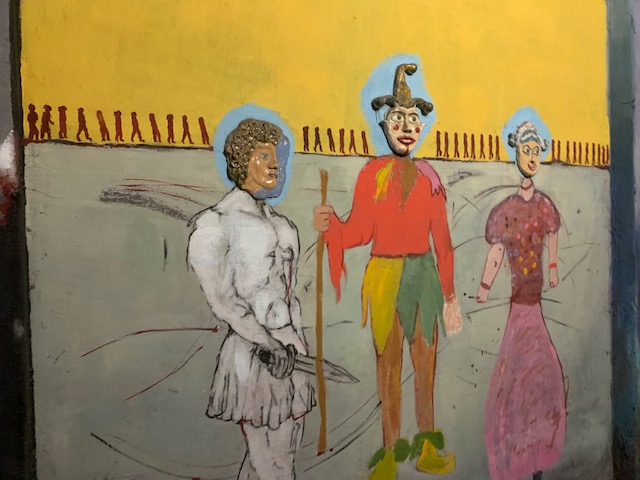
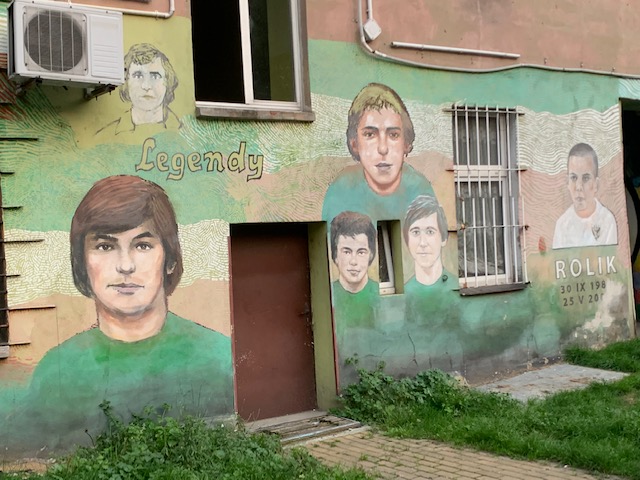
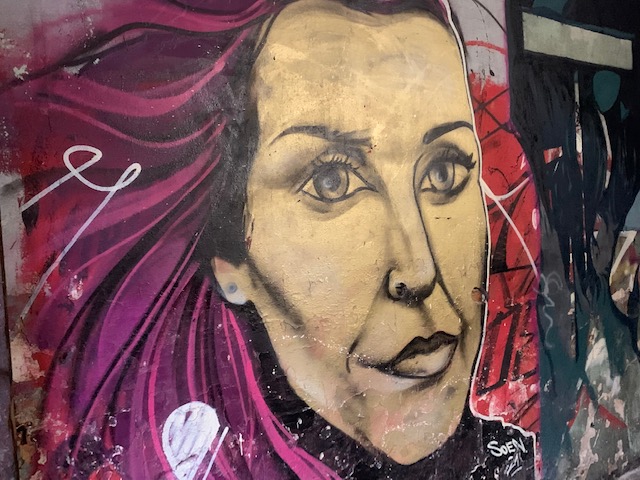
Walking into Nadodrze today, most outsiders would never guess that the walls of the area’s battered nineteenth century tenements hide an amazing collection of brightly colored paintings that transform the inner courtyards behind the walls into places of rich imagination, bold design and skilled creation, evidence of the great talent of local working-class people and the Roma community who helped create them.
(Photo credit: Geoff Cobb)
(Photo credit: Geoff Cobb)
These colorful inner-courtyards are the conception of Wroclaw artist Mariusz Mikołajek, who in 2014, along with other local artists, formed the Center for Cultural Backyard Animation (OKAP)with the goal of transforming the drab inner-courtyards into a bright space all the residents could take pride in. Creating the art was a real community endeavor and the participants included everyone in the area, seniors, children and untrained adults, who all took part in the project. They set up classes first for children and then for adults. Everyone was allowed to discover his or her own painting or sculptural abilities. The locals embraced the project, pouring large amounts of time and effort into its completion. The design of colourful courtyards in Nadodrze eventually covered many other other courtyards in the once-gloomy area.
The art decorating the inner courtyards is referred to as un-murals because the art there is often three dimensional. Ceramic figures, household items and other materials often protrude out from the walls. There is also an astonishing variety of scenes and images on the walls, adding to the wonder of seeing these fantastic creations.
(Photo credit: Geoff Cobb)
The link below is for a virtual tour of one of the courtyards.
The colorful courtyards have helped the area to revitalize and the once forgotten area has now become a magnet for artists, Bohemians and students. Local residents speak with great pride about the artwork they have created. Nadodrze serves as a model for the transformative power of art to build a community.
Thank you so much for taking the time to explain to me how I am being manipulated and why I should not wear a mask. It is true as you said that fearful people are controlled more easily and what is more fearful than an invisible danger, an alleged virus?
But the thing is always of course: controlled by whom and what for?
When you explained that I was going to be controlled by Jews that was worrying but the lizards who were going to control me (as well or instead of?) were really scary. Then the Chinese Communists, with one of the permanent seats on the UN Security Council taking over those of the other four powers – that was terrifying. And then controlling the whole EU!
It’s amazing that the secret manipulators have managed to frighten or fool nearly every doctor, nurse and medical expert in the world – must be millions of them — into supporting the hoax and masking and vaccines. Thank God we have a handful of medical people spilling the beans. Still, it’s all quite terrifying.
And the plan to replace all white people through contraception, abortion, LGBT rights is frightening too – well, I’m white of course and I don’t want to be replaced. I’ve already been replaced by a machine at the checkout desk where I worked, which was easily done since most people during the pandemic – sorry, the hoax – preferred to use the machines and pay by bank card. Of course the bosses took advantage of the situation to replace some of us but nobody warned us about that.
Like you advised, I have refused to have the vaccine because I don’t want nanobots injected into me so They can control me and see where I go and what I do – even when I’m in the toilet or the shower. I can’t understand how all those controlled people are still managing to hold protests – like about housing, or people killed by police, or for the Palestinians. It’s very confusing so you’ll have to explain that to me again.
I told Brigid (remember, next door but one) about all the antifascists being pedophiles and she said does that mean all the people who fought against Hitler and Mussolini were pedophiles too? Then she said some disrespectful things like if you’re really concerned about pedophilia how come yous are always defending the Catholic Church? When I told her about Hillary Clinton running a pedophile ring from above a pizza restaurant, Brigid just burst out laughing so hard she said she’d have to go to the toilet. When she came back, she asked if John Kennedy and Bill Clinton couldn’t even keep their affairs secret from the public, how would Hillary Clinton manage to run a whole pedophile ring and keep it quiet? I didn’t know what to say and felt quite stupid. I wish you’d been there to answer her.
Brigid’s nephew has been wearing a mask in public since the authorities advised it. He got 99% in one of his exams and mostly around 90s, so I was wondering about that Dolores Cahill saying our children would end up stupid through inhaling carbon dioxide. Then I was wondering whether Brigid was lying or being manipulated. Or her brother, the boy’s father, was. Or the school, faking the results. Or the Government forcing the school to fake the results and fool the father and the son.
So anyway I’m confused and frightened. Tell me what to do, please.
(Changed headline andtranslated from article in Publico.es by D.Breatnach)
(Reading time main text: 7 mins.)
Franco’s repression in Fregenal de la Sierra executed more than 80. Now, a second excavation seeks to recover the bodies of those who did not come to light in 2012, when the skeletons of 43 victims were recovered. The remains found indicate cruelty towards women, disrespecting them even after they were shot.
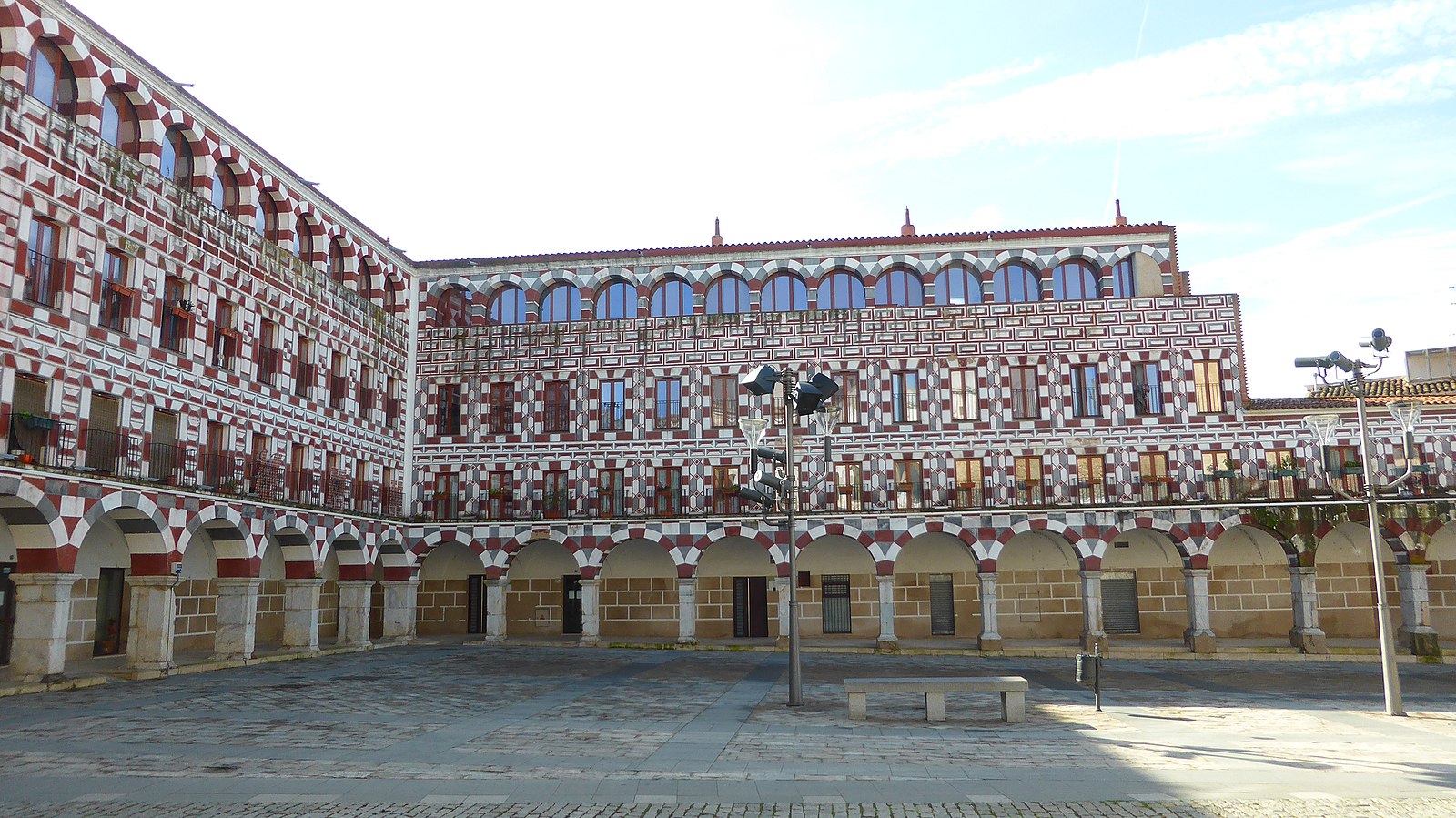
Central plaza Badajoz, probably influenced by its Moorish heritage — what the tourists are advised to see of Badajoz. (Photo credit: Stephen Colebourne via Wikipedia)
When they gave her the jacket of her son, who had just been shot, she lost her speech. She was like this for two and a half years, in silence, until she died. The father, a lifelong labourer, said on his deathbed that he bequeathed his little house to his five children. “You only have four,” one of the witnesses told him. “Until they give me the body of my son, I still have five,” replied the man. They were the mother and father of Juan Serrano García, shot in September 1936 in Fregenal de la Sierra (Badajoz1), when the rebels tricked him into returning: “They said that all those who had not committed crimes of blood, would be free of reprisals,” adds Andrés Serrano, representative of the Association of relatives of the executed from the town and Juan’s nephew.
His body was found in 2012 in a mass grave in the town’s cemetery along with 42 other bodies, although many more are still waiting in the ground. At that time, there were seven graves opened. Now, five more are uncovered to try to account for the more than 80 murdered by Franco’s troops of which there is a record. Among the bodies there is an unusually high percentage of women for the situation, points out Laura Muñoz-Encinar, archaeologist and forensic anthropologist at the Institute of Heritage Sciences (Incipit), attached to the Higher Centre for Scientific Research (CSIC), and who is participating in the exhumation.
The forced and almost physical silence of Juan’s mother testifies to the decades and decades of internal repression of the thousands of victims of the Franco regime. So much so, that Serrano learned about the story of his uncle obliquely from his mother, the political one of the family. She did not tell him directly: “An anthropologist friend wanted to interview her for a job, so I took the opportunity and told him to ask her about what happened in the Civil War. I hid in a room next to the terrace, where they were and thus I was able to hear first-hand and for the first time in my life about the execution of my uncle, the hardships my grandparents went through and the stigmatization my family suffered for being, for everyone else, ‘reds’ “, related the historical memorialist at 68 years of age.
Massacre by the fascist-military in the Bullring in Badajoz 1936, artist unknown (image sourced on Internet)
They were in a hurry to kill them
The case of Juan, a militant in the UGT2 and of socialist sympathies, assassinated at the age of 21, is just one more. In Fregenal, more than eight dozen people who were related to politics and social struggle during the Republican period were executed. Located in Badajoz, many townspeople joined “The Column of 8,000”, coming from the north of Huelva, to flee from the fascist barbarism between the air raids. The troops took Fregenal on September 18 and three days later Juan returned to the town together with another comrade. They thought that nothing would happen to them, because they had not committed any blood-crime.
“They arrived at 10:30 in the morning and at 11:15 they were both arrested. They were taken to jail, and no matter how hard my grandparents tried to intervene with some powerful people from the town to save him from being shot, on September 22 he was murdered”, relates Serrano. The same thing happened a few meters away, in those days, in the town square: “They shot about four people in the center of town; it was an exemplary shooting. They wanted to increase the fear that there was already,” he says.
That same September 22nd, Juan’s parents had already guessed the worst. They knew that their son had been detained and that the Francoists had no mercy. Their suspicions were confirmed when, a few hours later and for greater confirmation, they were given the jacket that their son had been wearing. According to Serrano, the rebel soldiers also told them that they should stop searching, that they already knew where he was, and not to bother people, referring to the people to which they had gone to ask for compassion for their young son.
The first exhumation: 43 bodies
More than 70 years later, the team to which Laura Muñoz-Encinar, the archaeologist belongs, arrived. It was 2010 and they couldn’t start the excavation for two years. After the surveys and a research project approved by the Ministry of the Presidency, they excavated seven mass graves. “There were men and women. They were from young to very advanced ages. Among the seven women we found, one of them had a full-term fetus of between 7 and 9 months,” explains the Incipit scientist.
A bullet found in the mass graves excavation in Fregenal de la Sierra this year. (Photo credit: Laura Muñoz-Encinar)
The change of central government in 20113 meant the cancellation of the funding allocation related to the investigation of what happened during the Civil War and the Dictatorship, so they had to wait nine long years until they were able to return to the town. Muñoz-Encinar explains that “During this time almost all the children of the victims, of which there were many, have died. There is only one daughter living, María Lobo Villa. The Francoists executed her mother, three uncles and a grandfather. Now, mainly, grandchildren and great-nephews and great-nieces remain. “
In that excavation they found the body of a woman buried between two men, something recurring according to the expert. Once again, and as always, they got the worst of it. This is demonstrated by what happened to Antonia Regalado Carballar, known as “La chata carrera” (“the flat racer”?-DB). A 22-year-old political activist, this woman transgressed the traditional roles of the patriarchal culture of the time. “They detained her and took her to the cemetery. There they physically and psychologically abused her, and several of them raped her. After killing her, said the undertaker, they put her in the ditch between the bodies of two men,” Muñoz-Encinar explains further. Serrano adds what the rebels who were there said, as the gravedigger recalled, “As men tempt you, there you have men for your whole life.” They haven’t found her body yet.
This type of symbolism, highly contemptuous for all victims and sexualized in the case of women, is not an isolated event. “In the current excavation we have already found a body face down. In a Judeo-Christian culture like ours, the placement of the bodies responds to a ritual of elevating the soul to heaven, that is why the bodies are placed face up and with the limbs stretched , and not doing it like that is a post-mortem humiliation”, the archaeologist explained.
Killed without trial years after the War
She herself points out that all the remains already found and those they are still looking for were civilian victims of extrajudicial repression, executed on the basis of the war party in force from 1936 to 1948. That is that, almost ten years after the end of the war, it was still possible to execute civilians without the need to bring them through a judicial procedure. That is what happened in Fregenal de la Sierra in 1946 to a party of guerrillas4. This is how Muñoz-Encinar relates it: “We know that they were fighting in the mountains, that they were pursued, until one night they entered a brothel. There they were betrayed and, after a scuffle, they were arrested. They were murdered, their bodies were exhibited in the street entrance to the cemetery and then put in a grave.” Also victims of extrajudicial repression years after the Civil War ended, the team of experts does not know if their bodies will be in the five graves they are currently studying and in which they have already found three bodies.
Human remains uncovered in 2012 excavations in Fregenal de la Sierra, Badajoz. (Photo credit: Laura Muñoz-Encinar)
End report.
COMMENT:
By Diarmuid Breatnach
The Spanish state territory holds more mass graves than any country in the world with the exception of Cambodia. Most of their occupants were killed during the Spanish Antifascist struggle with or without a military court hearing outside of conflict zones, that is to say, either in the rear areas of the fascist-military forces, i.e areas already safely conquered. In some of the areas, there had been little or no military resistance whatsoever but that did not halt the arrests and executions. And after the conclusive defeat of the Republic, the executions continued. Many victims, perhaps even the majority, had never even fired a gun in defence of the Republic but were considered enemies of the fascist State through their support for the Republic, their political ideology, social attitude or sexual orientation.
Photograph taken of massacred bodies in Badajoz before they were burned and buried (Photo sourced: Internet)
The punishment was not always a death sentence but people died also in prison due to massive overcrowding, disease, inadequate food or clean drinking water, water for washing or inadequate medical care.
Despite the frequent assertion that the 1936 military-fascist uprising against the elected Republican Government was to “restore Christian values” and was supported by most of the Spanish Catholic Church hierarchy, rape of women and girls was frequent, whether they were afterwards shot or not. This was widely attested in evidence by victims, witnesses and even some war reporters.
Those who survived or did not go to jail faced constant harassment, confiscation and theft of land, animals and produce; fines and public humiliation, in particular the women who were force-fed laxatives and then paraded in nightclothes or underclothes through the neighbourhood, sometimes to the doors of the Catholic church, unable to control their bowels as they walked.
Babies were also taken from murdered supporters of the Republic and later from working class women (who were told their baby had been stillborn) and given to childless fascist couples. Children of the “Reds5” were taunted at school and insulted by teachers.
After its sharpest form abated the repression nevertheless continued throughout the nearly four decades of the Dictatorship and it was extremely dangerous to even speak of disinterring the mass graves and reburying the victims in dignity, not to speak of honouring them as antifascist martyrs. Even after the death of Franco and the Transition to an alleged democracy, many kept silent to protect their families. Schools suppressed the history6. Murderers and torturers were not prosecuted. Thieves kept what they had taken. The ruling class consisted for the most part of supporters of the fascist-military uprising and their descendants and they thronged the civil service, military, police, judiciary, church hierarchy, media (State and private), the education system – along with many businesses and a number of political parties.
More recently, the work of generations of those keeping the historical memory alive, investigating, speaking, marking areas, even disinterring on their own initiatives, is bearing fruit. The Law of Historical Memory, passed through the Spanish Parliament under a social-democratic Government in 2007 helped for a little while but then fell into disuse under the PP Government, though it was not abolished.
Its renovation in 2020 by the PSOE-Unidas Podemos coalition has spurred more excavation bu the Law and its renovation had been preceded by the work over decades by volunteers of historical memory associations in many different parts of the State, such as the Basque Country, Catalonia, Asturias, Galicia, Andalucia and Madrid. The associations have been assisted by forensic experts working voluntarily. This work has helped create the political-social-cultural atmosphere in which in October 2019 the long-promised removal of the remains of the Dictator General Franco and the leader of the fascist Falange, Primo Rivera, took place from their fascist mausoleum in the Valle de Los Caidos7 (“Valley of the Fallen”, a fascist monument constructed with prisoner labour and a shrine for Spanish fascists).
Nevertheless the renovated Historical Memory Law, or its program posted by the Government, has been criticised by relatives and other historical memory activists, because it rules out any reparations. They are bitter that most of the known torturers, murderers and rapists died natural deaths without having faced even a trial and their accusers8 and that not only do their families hang on to their ill-gotten gains but that the State does not acknowledge its duty to the victims. The State itself, or one of its departments, is also engaged in a judicial-political struggle to recover from organisations and families some properties, including national monuments and one of them of UNESCO World Heritage status. Some local authorities face prosecution and reductions in allocation of central funds because they are holding on to commemorative signs exalting Franco or someone of his supporters.
Of course, the fascists and most varieties of the Right in the Spanish polity are angry at these events and link them to the struggle for Catalan independence as fatal to the Spanish State; they demonstrate and threaten a coup or some kind of repercussion, retired Army senior officers sign declarations and some rattle their sabres in public, the spokesperson of the Franco Foundation reminds the current King Felipe that it is entirely due to Franco that his father became monarch (which is true and Juan Carlos also swore allegiance to that regime, an oath which he never recanted).
Even some liberals are uneasy, feeling that “it’s reopening old wounds”, to which the relatives of the victims and others reply: “the wounds have never closed.”
2Unión General de Trabajadores, a general workers’ union allied to the social-democratic PSOE party. The union was outlawed by Franco and many of its supporters suffered imprisonment or even execution or murder without trial. It is one of the largest unions in the Spanish state today and the PSOE is one of the traditional parties of government.
3In that year’s General Election the right-wing Partido Popular won a landslide victory against the PSOE and the political climate changed considerably. Both the PP and the PSOE support the unionist and monarchist Spanish Constitution but the PP contains a harder Right, including supporters of the Franco regime and memory and outright fascists, some of which have split off at times to form the right-wing Ciudadanos and fascist Vox parties.
4Guerrilla struggle persisted in parts of the Spanish state after the defeat of the Republic, in some cases for decades.
5To sustain the fiction that they were fighting against “Communism”, (no doubt believed by many), those leading the fascist-military uprising constantly referred to their enemies as “Reds”. Some of course were but the Republic was also supported by Basque, Catalan and Galician nationalists, democrats, social-democrats, revolutionary socialists, anarchists, libertarians and anarcho-syndicalists. The foreign press mostly referred to them as Republicans (sometimes as “Government supporters”) and the fascist-military side as Nationalists (sometimes as “rebels”). Communists, revolutionary socialists and anarchists predominated among the foreign volunteers who joined the Republican forces through the International Brigades and other routes (for example, Orwell, a member of the Independent Labour Party, fought with the mostly Trotskyist POUM) but they also included socialist Republicans from Ireland for example along with simply dedicated antifascists.
6Indeed, writing a review of the city history this very year, the author skips from 1921 to the 1970s, missing out the entire Antifascist War and the Massare of Badajoz, in an article featuring photos of the bullring where much of the massacre took place! https://www.hoy.es/opinion/peldanos-historia-20210110005509-ntvo.html
7An event covered in detail on Spanish TV in the style of a state funeral.
8Notable exceptions were Melitón Manzanas, Commander of the Political-Social Brigade of the Guardia Civil, a notorious torturer and Nazi collaborator, assassinated by the Basque armed group ETA in San Sebastian/ Donosti in 1968 and Admiral Carrero Blanco, Franco’s nominated successor, also assassinated by ETA in Madrid in 1973. Manzanas was awarded posthumously the Medal of Civic Merit by the Aznar Government in 1998 as “a victim of terrorism”.
In Henry Street on Saturday I stopped to contribute to a fund-raising event for a child to have an operation in the United States. I was partly motivated by remembering when a granddaughter of mine, Caitlin Rose, needed to go to the US also for a special operation. I remembered too how generous people had been to my fund-raising for that objective. I had no idea when I stopped in Henry Street that the girl, Sienna, was heading for the same surgeon who had operated on my granddaughter Caitlin Rose some years ago.
Dublin Fire Brigade truck parked at Henry Street/ Liffey Street junction for the fund-raising event. (Photo: D.Breatnach)
Sienna in June (Source photo: Sienna’s family)
Men from Dublin Fire Brigade were doing the fund-raising, their fire truck carrying big posters advertising the campaign. One of them told me that he does a number of charity fund-raisers a year, always in Henry Street, where he finds the response of the people supportive. They don’t get time off from work for this activity and he would be heading into his Blanchardstown Fire Station that evening for a 12-hour shift.
One of the Dublin Fire Brigade firefighters fund-raising in Dublin’s Henry Street for Sienna’s operation on Saturday 11th (Photo: D.Breatnach)
Another of the firefighters taking part in the fund-raising for Sienna on Saturday in Henry Street. (Photo: D.Breatnach)
As I stopped to take some photos, I noticed a woman wearing a fire-fighter jacket and went to talk to her, asking how many women were now in the Dublin Fire Brigade. But she wasn’t a firefighter — she was the girl’s mother and only wearing the jacket on loan for the occasion. Chatting to her I discovered that her daughter Sienna is heading to Louisville, USA, to be operated on by Dr. Park, just as was my granddaughter some years ago. When Dr. Park first pioneered it, the operation was a startling new one and, though it is now available through the NHS (Caitlin Rose lives in London) and the HSE, for some reason the recovery time is much slower than under Dr. Park’s treatment.
In the most crude and simplified explanation, in SDR operation the surgeon opens the patient’s back to test which of the sensory nerves are pulling limbs taught and — cuts them! It sounds scary and crazy even but when one sees the results ….!
Dr. Park, a US-based surgeon from Korea, perfected this operation which he carries out in Louisville, Kentucky. Of course, lots of other work is required, including physiotherapy, exercising and often, orthopaedic surgery to correct bone deformity, etc. On 15th November 2018, Dr. Park performed his 4,000th SDR operation.
Lesley Ann, Sienna’s mother, taking part in the fund-raising in Henry Street on Saturday (Photo: D.Breatnach)
The cost of the operation, for the flights and the accommodation for the parents while the child is in treatment, time off work – all this is piles up frighteningly high. My daughter, my son-in-law and my son all organised fund-raising events and I was lucky that singers and musicians here supported two fund-raising events I organised, with support from Club na Múinteoirí here in Dublin — and that so many bought tickets. Before the operation, Caitlin Rose could barely walk; now she can even run and dance a bit, ride a bike, etc, and go to school on her own.
I hope at least as much for Sienna.
And that the same operation at the same level of effectiveness be available to all people in Ireland without having to fundraise or leave the country to access it.
(Reading time comment: 2 mins; and article: 5 minutes)
People who’ve been following the witch-hunts in the British Labour Party — or even just generally aware of them — have seen left-wingers like Jeremy Corbyn, the party’s elected leader, actually expelled. Though Corbett has now been allowed back in with his electoral wings clipped, others have been expelled, including left-wing film-maker Ken Loach. It is witch-hunting, a type of McCarthyist hounding in which victims must prove themselves innocent of anti-semitism, which turns out to be impossible. This is because the Zionists and their supporters have succeeded in making any attack on Israel or Zionism, a political target, correspond to anti-semitism, a religious-racist view. That is all wrong certainly but it is not the job of socialists nor of anti-imperialists to “save” or “democratise” the British Labour Party.
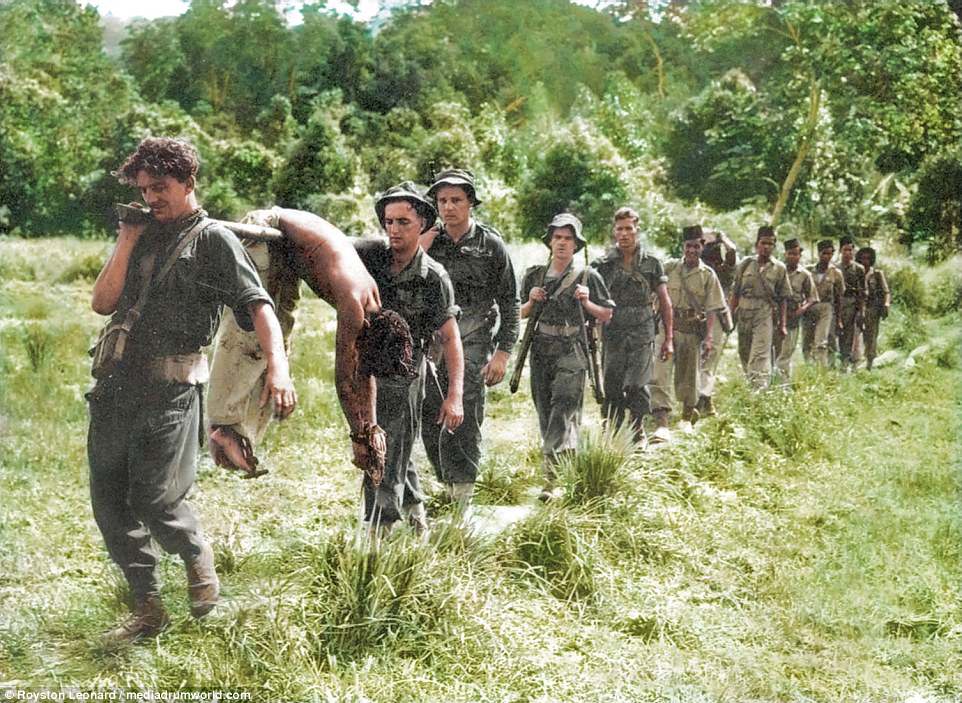
British troops suppressing anti-colonial struggle in Malaya 1948-1960, (then a part of what is now Malaysia), carrying a bloodied Malayan prisoner (Photo sourced: Daily Mail)
Lenin famously once advised British socialists to support the Labour Party “as a rope supports a hanging man”. He was saying that as Labour had never yet been in sole government, it was bound to carry the idealised hopes of many working people — therefore give them the opportunity to see it in action. Whether Lenin was correct in his advice to help get Labour into government or not (and not all revolutionary socialists agreed with him), Labour was in the coalition War Government in 1915-1918 and subsequently in the periods 1924, 1929, 1945-1950, 1964-1970, 1974-1977, 1997-2010. It has had plenty of opportunities to show its real nature and has done so.
However, over the years, radical social democrats and various Trotskyist trends, along with the old Communist Party of Great Britain, have sought to support the Labour Party, not by pulling the rope, kicking the chair or unlocking the scaffold trapdoor, but by desperately getting underneath the body and propping it up. General elections were replete with slogans from the Left exhorting us to elect Labour “under a socialist program”, “under Left pressure” and “with socialist demands” or even “internal democracy” (to give the entrists room to move).
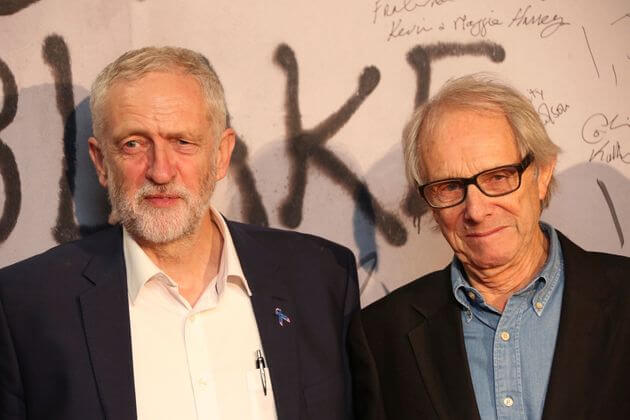
Ken Loach (right) and Jeremy Corbyn at premier of the film “I, Daniel Blake in 2016. (Photo credit: Joel Ryan, AP via Getty Images).
Such demands and manoeuvrings are in complete contradiction to history or a basic socialist class analysis. Lenin was certainly correct when he analysed the Labour Party as fundamentally capitalist and imperialist and the party has obligingly gone on to vindicate that analysis both in and out of government. But how could it be otherwise? It is a capitalist imperialist class that runs the UK and a party truly representing the working class will not be permitted to take over except if the ruling class is overthrown in revolution.
And such attempts will be met with whatever force the ruling class has at its disposal. In the Hebrew-Christian creation myth, the originators of humanity are driven from Paradise by an angel with a flaming sword and apparently never try to get back in (not in this life anyway). It will certainly take a flaming sword to drive capitalism from its Paradise of exploitation of labour power but in fact its predicament then is worse than Adam and Eve’s — for to be barred from entry forevermeans its very extinction as a class.
This is all Basic Socialist Theory 101 and proven time and again by Modern Class History 101. And yet, people on the Left who can quote volumes of Marx, Lenin, Trotsky and even sometimes Bakunin, have somehow come out of those 101 courses with an entirely different understanding. And so time and time again, the hunt for the Left Messiah to lead the Labour Party and within, the gatherings of radical Leftists cliques, conspiring like the Christians in the Catacombs beneath Rome.
British troops and detainees in Kenya; the record of tortures inflicted on many is truly horrific. Although the Conservatives were in government throughout the period, it was never seriously challenged by the Labour Party on the actions of the troops. (Photo sourced: Internet)
Just a moment’s review will show that at its first opportunity, Labour participated in management of the imperialist WWI which, by the way, included the murder of surrendered Irish insurgent leaders in 1916. The review will also reveal the agreement in the partition of Ireland in 1921, undermining of the 1926 UK General Strike, complicity in the anti-liberation wars in Persia (now Iraq), Egypt, Greece, Korea, Malaya, Cyprus, Kenya, Aden (now Yemen), Oman …. and participation in joint invasion or attacks on Libya, Iraq, Syria, Afghanistan. Not to mention being the party actually in Government when in 1969 it sent the troops in to quell the large oppressed Catholic minority in the Six Counties seeking civil rights.
Well, actually yes, let us mention it because that and its collusion with the Conservative government’s introduction of internment without trial in 1971 and subsequent massacres of protesters that year and in 1972 ratcheted up a cycle of violence that lasted three decades, with huge loss of human life among civilians, liberation fighters and its own soldiery and Loyalist auxiliaries.
The first anti-fascist fighter killed in Britain by police, by the way, Kevin Gately, was killed by mounted police in 1974 — under a Labour Government.
Those who really want an end to capitalism and imperialism — and the attendant racism — in Britain need to find a solution that does not involve electing a “Left Labour Government” or anything of that kind. We can argue and discuss what that solution might involve but one thing we should insist upon is that a “Left Labour Government” is not one of the options on the table for discussion.
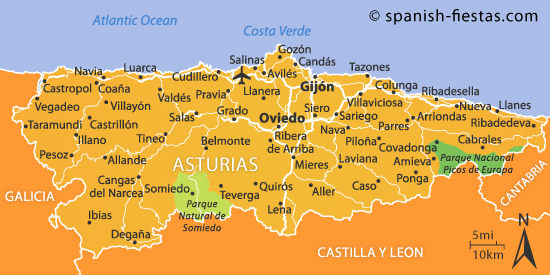
Fascist supporters of bullfighting in Asturias thought they were having fun by naming two bulls due to be killed “Feminist” and “Nigerian” respectively. But their racist and sexist joke-jibes backfired on them in Gijón (Xixón), cultural centre and largest city of Asturias, the celtic nation in the north of the Spanish state.
Map of Asturias.
Bullfighting is generally supported by a traditionalist conservative constituency in Spain, including fascists, who often project it as integral to their image of Spain. On the other hand, the practice is opposed by large sections of the Left and those who want independence for their nations from Spain, such as Catalonia (banned some years ago) and three southern provinces of the Basque Country (where it was suspended for years but limited fights permitted again recently).
BULLFIGHTING IS ENDED IN GIJÓN
Translation by D.Breatnach from Publico.es report
The El Bibio de Gijón bullring will no longer host the traditional Begoña bullfighting fair, as the City Council will not renew the licence of the bullring because it considers that bulls cannot be used to “deploy an ideology contrary to the human rights”.
“The bullfighting festival is over,” said the mayor of Gijón, Ana González, in statements to journalists, after stating that what happened in the last running of the fair this year, where two of the bulls from Daniel Ruiz’s cattle ranch were named “Feminist” and “Nigerian”, has caused great discontent among feminist and animalist associations and has precipitated a decision that was already in the pipeline.
“A city that believes in the equality of women and men, that believes in integration, in doors open to all cannot allow this type of thing,” said the Councilor before stating that “several lines have been crossed”.
Bullfight in Las Ventas (Photo credit: EFE)
González explained that the idea was to end the licence of the El Bibio bullring and later put an end to it, as contemplated in the resolutions of the PSOE congresses but these events have advanced the decision. For this reason, the Consistory will not grant a third extension of the concession signed in 2016 nor will it issue a new call, despite the fact that the payment of the successful bidder represents 50,000 euros per year for the city council.
“The bullfighting fair is over because it seems that too many things were hidden,” explained the Councilor, who argued that if the world of bullfighting is what was seen in the last run of the fair “it does not contribute much to a city like Gijón “.
“The Mayor indicated that in recent years the bullfighting was “clearly challenged” and that there were more and more voices calling for an end to the bullfighting fair in Gijón, a demand that has now been met.
“The names given to these two bulls which were fought by Morante de la Puebla last Sunday, August 15, in Gijón, generated controversy on social networks and have aroused complaints from feminist and animalist associations.”