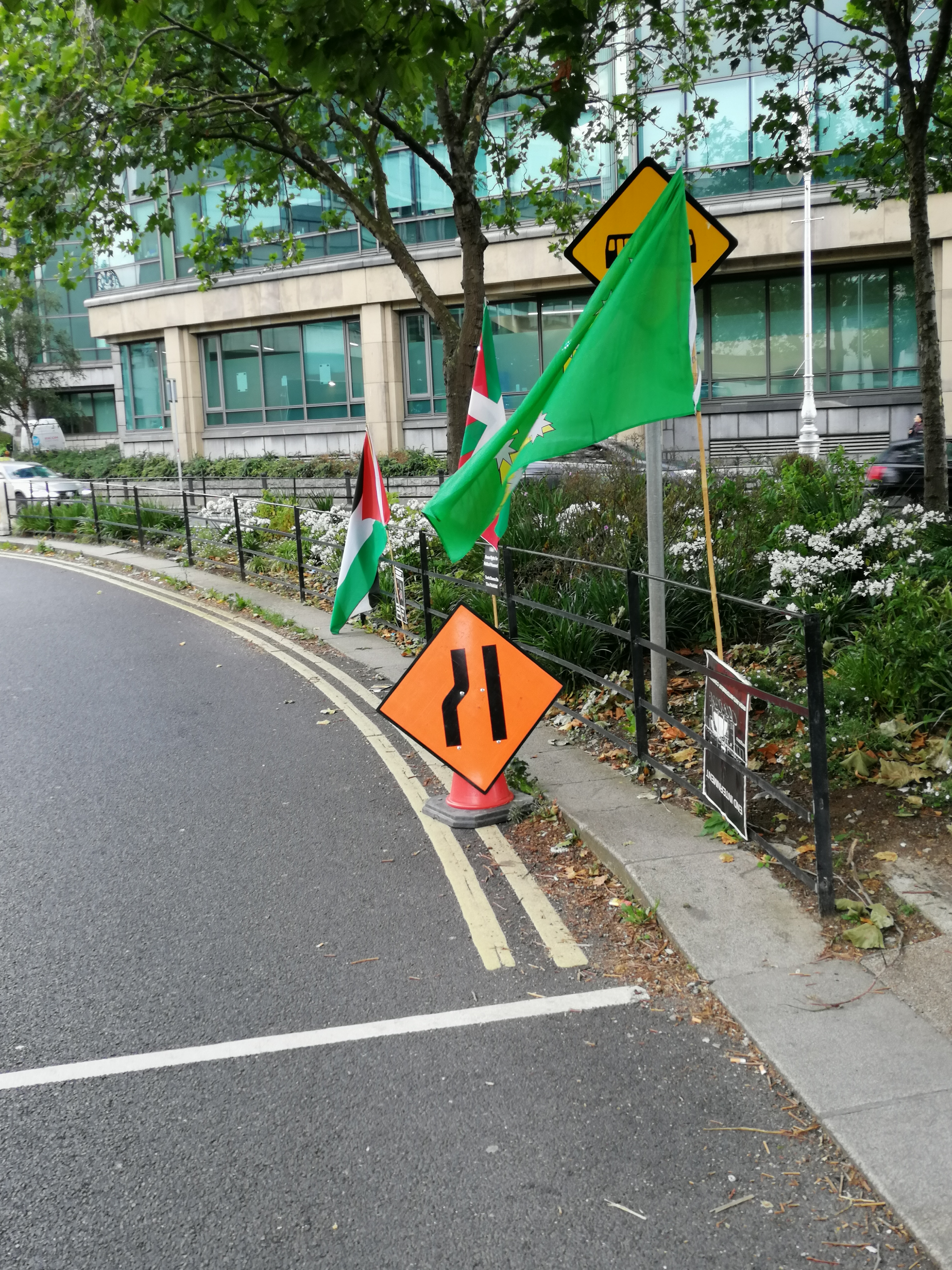
Socialist republicans and communists gathered on a traffic island in Dublin’s city centre to mark the International Day of the Prisoner. They flew flags to represent prisoners in Ireland (‘Starry Plough’), the Basque Country and Palestine.
They also displayed a number of placards.
(Photo: IAIC).
The choice of location, apart from being passed by road traffic in three directions, was because of the presence there of the Universal Links on Human Rights memorial sculpture with an eternal flame, commissioned by the Amnesty International organisation.
A plaque near the sculpture bears the following words: “The candle burns not for us but for all those whom we failed to rescue from prison. Who were tortured. Who were kidnapped. Who disappeared. That is what the candle is for.”
Plaque in the ground on the approach to the sculpture. (Photo: IAIC).
Somewhat ironically, one of the placards carried the words: “Amnesty International, do Irish Republican prisoners not have human rights too?” Irish Republicans have long complained that the organisation in question does not raise any issues with regard to Irish political prisoners.
Some have indicated as a possible reason or part-reason the location of the head office of Amnesty International being based in London, capital city of the occupying power. Its interventions on Ireland even during three decades of war in the colony have been very few indeed.
Other placards displayed referred to political prisoners from the liberation wars in India and in the Philippines, the innocent Craigavon Two still in jail and ongoing internment through refusal of bail to Republicansappearing before the no-jury special courts in both administrations.
Some leaflets were distributed about ongoing internment in Ireland through long remands in custody of Republican activists. Between convicted and awaiting trial there are close to 50 political prisoners in jails in Ireland between both administrations.
The Universal Links sculpture by Tony O’Malley (welding by Jim O’Connor) commissioned by Amnesty International. (Photo: IAIC)
The Zionist Israeli state holds 5,000 political prisoners (almost all Palestinian), of which over 1,132 are not even charged (‘administrative detention’). There are 33 female Palestinian political prisoners and 160 child prisoners. Philippines has 803 political prisoners.
The Spanish and French states hold between them around 170 Basque political prisoners.
The event to mark International Day of the Prisoner was organised by the Ireland Anti-Internment Campaign and a spokesperson gave a short explanation on video of the reason for the event with the human rights sculpture in the background.
End.
Some of the flags displayed (Photo: IAIC).Passer-by in conversation with a leafleter. (Photo: IAIC). (Photo: IAIC).
A heart-breaking story with courage and a heart-warming ending.
Report by Luciana Bertoia from Pagina 12 published through arrangement with Publico.es Translation by D.Breatnach
The last time Julio Santucho saw his wife, Cristina Navajas, was on June 14, 1976. Appointed as head of international policy for the Revolutionary Workers’ Party (Partido Revolucionario de los Trabajadores), he had to leave Argentina for six months.
They had been married for almost five years then and had two children: Camilo, three years old, and Miguel, who had not yet turned one. The three accompanied him to the Retiro terminal, where he took a bus to Sao Paulo and then arrived in Rome.
In the terminal, Cristina had Miguel in her arms and Camilo by the hand. When saying goodbye to him, she insisted on a promise:
– I only ask you one thing. If something happens to me, you have to take the boys with you. They shouldn’t stay with your mom, with my mom, or with other comrades. They have to stay with you.
– But, Cris, we’ve been living in hiding for a long time, and nothing has ever happened to us.
“Now it’s different,” she cut him off.
One day before a month had passed since Julio’s departure, Cristina was kidnapped by the Dictatorship. She was in the apartment at 735 Warnes Avenue, where her sister-in-law Manuela Santucho lived.
Another comrade from the PRT-ERP, Alicia D’Ambra, also lived with them. All three were kidnapped that day. The oppressors left Cristina’s two sons, Camilo and Miguel, and Manuela’s son, Diego, in the apartment.
Cristina managed to ask a neighbour to call her mother, Nélida Navajas. When the phone rang, Nélida had to ask where the boys were. For security reasons, she did not know their address.
When she arrived, she heard the screams of the two youngest, Miguel and Diego, from the street. Camilo was asleep.
Nélida found her daughter’s bag on the ground. Inside was a series of letters that she had written to Julio, waiting to receive an address to to which to send them. She had started writing the last one on Saturday, July 10, but had finished it the next day:
“Miguel is much better, he hardly coughs anymore, but he is more of a bandit and wilder every day. Cami is calmer and doesn’t give me work, the only thing is that he is getting clingy to me. He asked again which house we are going to, which house is this, etc.
Now the one who is not well is me, I do not know if I am pregnant,” she told her husband.
Julio found out about the kidnappings the next day, when he called to greet his brother-in-law on his birthday.
Refugee from Argentinian Dictatorship accompanied by a son as he attends a press conference about his reunion with another son, abducted by the regime, 43 years ago. (Photo: Enrique Garcia Medina/ EFE)
That day he spoke ten times with his mother-in-law. He would not hesitate to return to Buenos Aires to collect his children, but the PRT sent two comrades who, pretending to be a couple , took the children out and abroad to their father.
Forty-six years later, Julio managed to meet his third child, the baby that Cristina had while she was kidnapped in the Pozo de Banfield, after having gone through Coordinación Federal and Orletti Automotive (places of detention of the fascist regime – Trans.).
He is the 133rd grandchild found by the Grandmothers of the Plaza de Mayo (group of women who began the campaign to trace those made missing by the fascist regime – Trans.)
In an interview with Página 12, Julio Santucho relates how he was reunited with his youngest son, now a 47-year-old adult.
How was the search?
The main heroine in this story is Cristina, who for eight or nine months was pregnant in the most inhumane conditions: mistreatment, torture, bad food. She put up with all of this with willpower and finally gave birth to our son.
My son began to question his (new family – Trans.) relationship based on references from those close to the family. A sister who lived with him for 20 years told him “these are not your parents.”
From the way he was treated by the appropriator who raised him, he came to realise that he was not his father.
In 2019, he began to search, although stopped during the pandemic and then resumed. He had a birth certificate from another province. Finally this year he managed to have his DNA tested.
We searched but we had no approximation or probability of discovering my son. It was an exceptional case: he was born in the Pozo de Banfield, but police doctor Jorge Bergés did not sign the certificate. He surprised us.
What is it like to meet a son who is 46 years old?
It is good. The bad thing is that they took 46 years from us. It is a victory for the human rights organizations that have fought for this and it is a defeat for the dictatorship. They wanted to steal my son but I, later than ever, got him back.
My mother-in-law, Nélida Navajas, joined the Abuelas (Grandmothers’ group – Trans.) to look for her grandson. Abuelas is an irreplaceable institution, it is an enormous benefit to society because it is precisely the place where people who have doubts can recover their identity.
In July 1976, you lost much of your family and now, another July but 47 years later, you have your son back.
You strike a chord. On July 13, Cristina, Manuela and Alicia were kidnapped. She was a comrade that I also knew because she worked in the party schools.
On the 19th, six days later, they killed my brother “Roby” (Mario Roberto Santucho, leader of the PRT-ERP), and later my brother Carlos.
It was a tragic week for the family. We are not better-off than others. All the 30,000 disappeared were brave, generous and devoted themselves to a fight for the well-being of society and humanity.
What could he know about Cristina during her captivity?
There are testimonies like that of Adriana Calvo. The Santuchos were visited by all the mothers that were in the Pozo de Banfield. Adriana asked to spend a day with them.
She had her baby in her arms and so as not to worry her Cristina did not tell her that she had had a child and that it had been taken from her.
Adriana, afterwards, spoke at the trial of Cristina’s tremendous generosity in not telling her anything so she wouldn’t worry about her because they could take the baby away from her. Do you realise how far thinking about the welfare of others went?
They were screwed. But they told her: “We are Santucho, we don’t have any possibility of leaving, but they are going to release you.”
And then there is that scene that Adriana recounts: when the officers arrived, all the women made a human wall – led by Manuela, Cristina and Alicia – and the men had to leave without being able to take their baby from her.
They were in a concentration camp. They knew they could shoot them all at that moment.
And now how is the reunion going?
Some ask me about the appropriator of my son, all I say is that I hope that Justice intervenes. For now, this is all like walking on clouds. We talk to my son every day, we see each other often. Now we have the commitment to make a video call to my granddaughters. Let’s go little by little.
Joy is infinite. Besides, we have time. I am 78 years old. My father died at 89. I have a brother in Santiago del Estero who is 101, another who is 96. If they don’t kill us Santucho, we live a long time. So I look forward to enjoying my son for a few more years.
End.
ADDITIONAL NOTESby D. Breatnach
The Argentinian dictatorship lasted from 1976 to 1983 and apart from banning dissenting newspapers and organisations, detained, tortured and killed thousands.
But not only that, very young children and babies were abducted and given to couples who supported the regime to raise as their own. This was also done by other dictatorships, including the Spanish Franco regime of four decades.
In a time when a week-old military coup in Niger is threatened with invasion by France and by some western-allied African states, it is well to remember how other military dictatorships have been viewed by western states.
The lack of democratic elections and opposition parties did not matter to the western states who in fact fully supported the Argentinian and many other coups and dictatorships.
The military dictatorship of Argentina only became a problem to the UK’s ruling class when Argentina’s military invaded the British colony of the Malvinas/ Falkland Islands in 1982, the same year that the USA stopped supporting the junta for the first time.
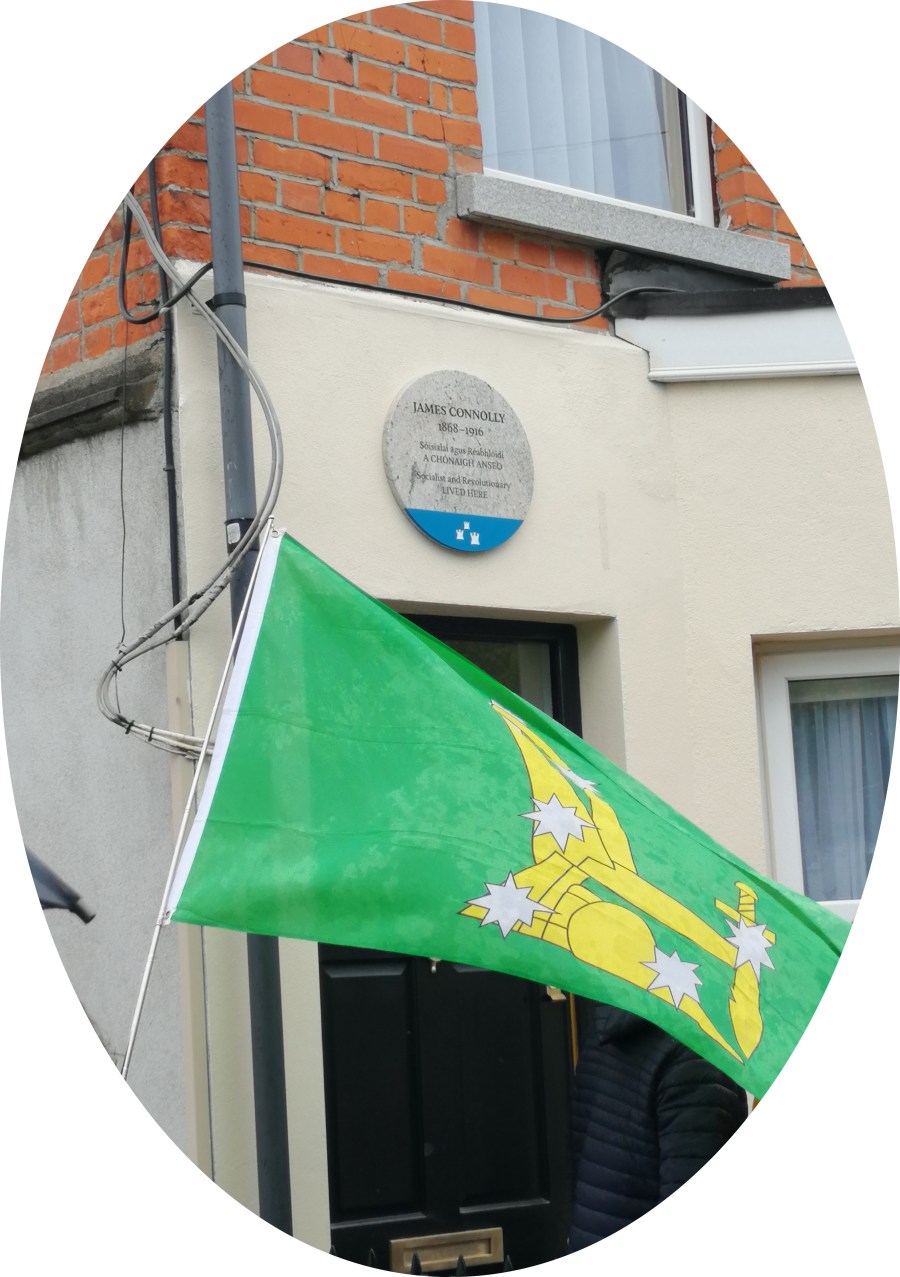
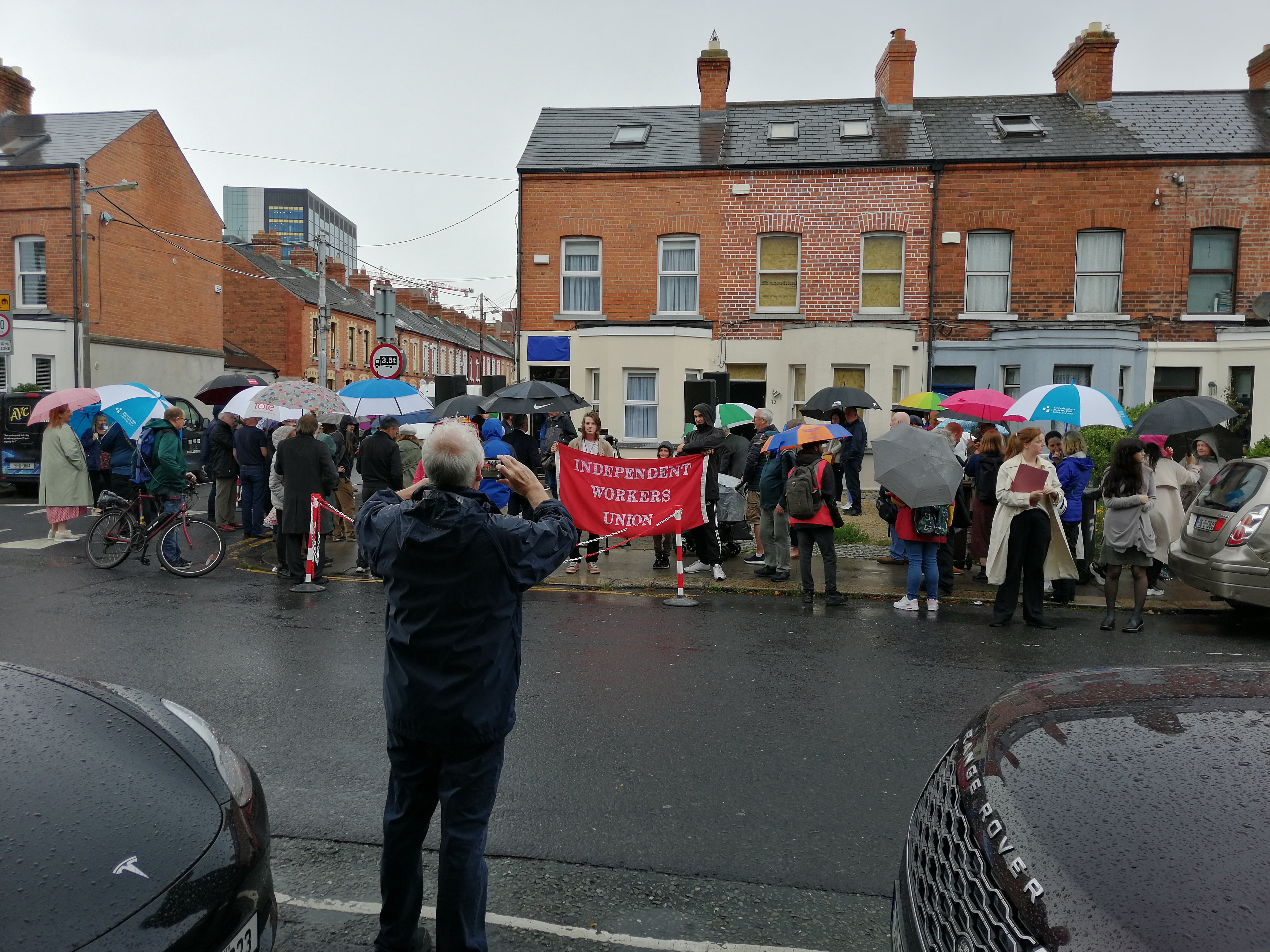
A new plaque commemorating James Connolly was unveiled on the morning of 31st July on 70 South Lotts, the house to which he returned from New York with his wife Lillie and children in 1910 and lived there until May 1911.
(Photo: D.Breatnach)
Connolly was born and reared in Edinburgh, left school at 10 and worked with his older brother John for the local authority as a carter, lied about his age and name to join the British Army, in which he first saw Ireland and where he met Lillie Reynolds; they were married soon afterwards.
Like his brother, Connolly became a militant socialist and trade unionist and returned to Ireland at the request of socialists to form the Irish Socialist Republican Party, the first socialist party in Ireland but left for the USA when the party failed to recruit significant numbers.
The ISRP’s office was in Middle Abbey Street, across the road from the premises of the Irish Independent, owned by Irish nationalist William Martin Murphy who was to become an arch-enemy from the Lockout and strikes of 1913 onwards1.
Connolly was a historian and journalist as well as a socialist, trade union organiser and a revolutionary. A report in Breaking News on the unveiling infers that he reluctantly committed to the Rising with the Volunteers; in fact, he had been pushing them to rise for months!
Unveiling speeches
The event started late and in rain. Dáithí De Róiste2, Dublin’s current Lord Mayor, opened the proceedings and commented that the plaque on the house was a reminder that Connolly lived a life in some ways like many ordinary Dubliners, living in a Dublin house and walking city streets.
Dublin Mayor Dáithí De Róiste speaking at the event. (Photo: D.Breatnach)Historian Conor McCabe, who did the research for the plaque, speaking outside No.70. (Photo: D.Breatnach)
Historian Dr Conor McCabe, of Queen’s University Belfast, proposed the plaque as his research established the background that Connolly was living at the address around the time that his most famous work, Labour In Irish History, was first published in book form.
In deference to those in attendance standing in the persistent rain, Conor McCabe kept his speech very short. This was not the case with every speaker.
Joe Cunningham, General Secretary of Siptu3, an amalgamation with other unions of Jim Larkin’s ITGWU which Connolly had led for six years, commented in his speech that it was Connolly who ensured that the interests of working people were incorporated in the 1916 Proclamation4.
Also that, at the ceremony of raising an Irish flag over Liberty Hall5 in April 1916, had declared that “The cause of labour is the cause of Ireland, the cause of Ireland is the cause of labour.”6
Section of crowd in front of No.70 waiting for event to begin. (Photo: D.Breatnach)
Dublin City Council Commemorations & Naming Committee was responsible for the placing of the plaque, in consultation with the house occupants and its chairman, Councillor Mícheál Mac Donncha7 welcomed suggestions from the public for commemoration of people and events.
Sinn Féin Councillor Mac Donncha also commented that James Connolly was a personal hero of his.
Jim Connolly Heron, great-grandson of James Connolly, was called to say a few words and invited family members present to join him in front of the house while he spoke and commented also on the importance of commemorative plaques in protecting historical sites.
He did so in reference to the plaque on a house in Moore Street that had disappeared and come to light in a property developer’s office, raising concerns that had led to the long Moore Street conservation struggle.8
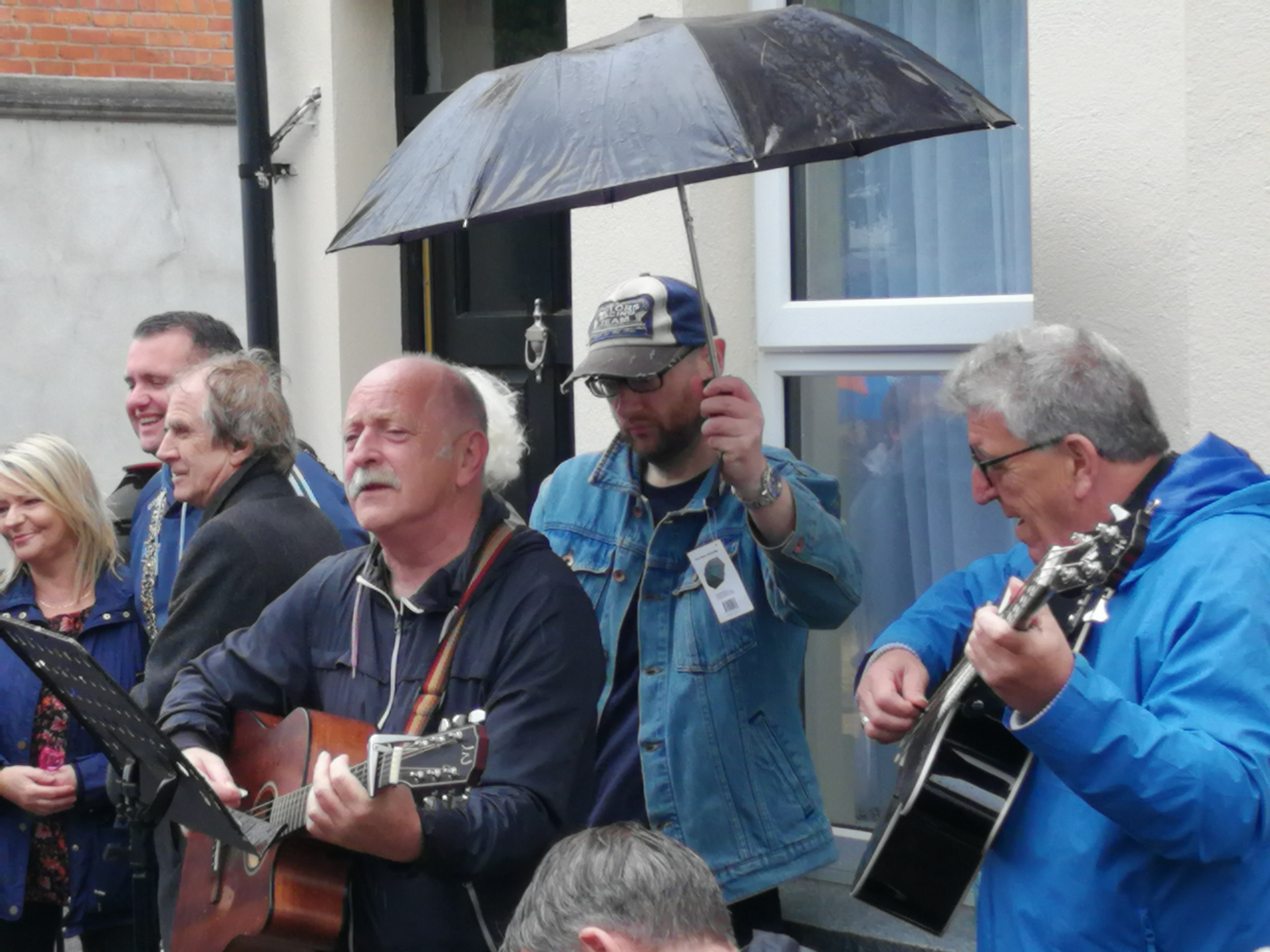
Music and song for the event was performed by The Pullovers ballad group but the amplification system had been removed by then which was a pity as it was needed for the music.
Ballads were performed at the event by The Pullovers band. (Photo: D.Breatnach)
The 1913 Lockout
James Connolly and family returned to Dublin when Jim Larkin9 offered Connolly a post in the young breakaway Irish Transport and General Workers’ Trade Union, which he took up in 1910. Three years later the union was in a fight for its life.
It is sometimes wrongly claimed that the 1913 Lockout was an attempt by employers in Dublin to prevent workers from joining a trade union but there were other unions operating in Dublin during the period and they were accepted by most of the employers.
Apart from the ITGWU recruiting large numbers of ‘unskilled’10 manual workers, it pursued its objectives militantly, using sympathetic solidarity action by other workers to increase the effectiveness of the workers who were in industrial dispute with their employer.
In August 1913 a combination of around 200 employers presented their workforce with a declaration to sign which committed them to having nothing to do with the ITGWU. En masse, the workers refused to sign, were locked out while others struck work and were locked out too.
Right from the beginning the Dublin Metropolitan Police11 attacked the workers on behalf of the employers and in a baton charge on Eden Quay on 30th August fatally wounded two workers, also beating strikers and onlookers the following day in O’Connell Street (‘Bloody Sunday 1913’)12.
As a direct response, Connolly and Larkin set up the Irish Citizen Army as militant response to police attacks, dedicated also to Irish independence and their flag was the gold Starry Plough on a green background,13 which they flew over the Clery’s building in 1916.14
The only Starry Plough flag unfurled at the event, brought by a member of the attendance. (Photo: D.Breatnach)
Comment
The only Starry Plough to be seen at the event was one unfurled during the event independently of the organisers and speakers.
Many who claim to admire Connolly or even to follow his teachings do so on occasion in words but never in action and if Connolly were alive and acting as he did when he was, most of the speakers at the unveiling event would call, if not for his shooting, certainly for his jailing.
SIPTU is much larger than the ITGWU was but it and other unions are much less effective; as a result of the lack of active resistance by the leadership, union membership in Ireland is at an all-time low in modern times. Nor would Connolly have ever agreed to the partition of Ireland.
The Irish Labour Party, which Connolly and Larkin formed in order to give the working class a voice in municipal affairs, has been in coalition government a few times, always capitalist and most often with the right-wing Fine Gael, when they have joined in attacks on the working class.
Joan Burton, while Tánaiste15 of the Labour-Fine Gael coalition government in 2014, complained about working class people being able to afford video-phones and tried to get people jailed for organising an effective protest against her in Jobstown.16 She too attended the unveiling today.
Joan Burton, who attended the event. (Photo: D.Breatnach)
Fianna Fáil is a party of the Gombeen client class and has been in government more often than any other, whereas Sinn Féin in its current incarnation is seeking to replace it with more of the same.
It is a tribute to the memory of James Connolly held so dearly among the working people that these types, so far from Connolly in their reality, are obliged to pay public homage to the man and to his principles while their daily practice is in opposition to all that he stood for.
End.
FOOTNOTES
1An editorial in his newspaper, The Irish Independent (still one of two main newspapers of the state), after a number of British executions of a number of 1916 leaders, called for continued executions of leaders prior to the execution of Connolly and Mac Diarmada, the last of the 14 to be executed in Dublin (Kent was shot in Cork and Casement hanged in London).
3The largest union in Ireland, owner of the current Liberty Hall which stands on the ground of the original union building.
4There is no record that this is the case but it is a natural and widely-held assumption. It is a fact that the Proclamation was printed in Liberty Hall.
5Cunningham said it was “the Irish flag” which most would think a reference to the Tricolour. However that flag had not yet been accepted by the majority as the primary flag of the nation, which really occurred after the 1916 Rising. The flag raised instead by teenager Molly O’Reilly at Connolly’s request had the golden harp on a green background, the essential flag of Irish Republicans from the 1790s until the 1916 Rising.
6This was not a random statement by Connolly but rather a strategic one; on an earlier occasion he had observed that of all social classes in Ireland, the working class remained “the incorruptible inheritors of the fight for Irish freedom”. Connolly wrote that in his foreword to his work Labour in Irish History, clearly indicating that only the working class could be trusted to lead the national struggle through to successful conclusion.
7A prominent member of one of the groups campaigning for Moore Street Battlefield conservation, the Save Moore Street Trust, of which Mac Donncha is Secretary.
8That occurred at the beginning of this century and the struggle has been ongoing since.
9Like Connolly, also a migrant and member of the Irish diaspora but from Liverpool. He founded the Irish Transport & General Workers’ Union after his departure from the British-based National Union of Dock Labourers, for which for a time he had been chief organiser in Ireland. Most of the NUDL’s members in Ireland left to join the ITGWU but in Belfast there was a division along sectarian lines.
10This is the general appelation for work not requiring long periods of training. However, anybody who has been employed in work of this category soon learns that such work requires skill to achieve the objectives set, to pace oneself and to guard against injury. This is the reason those recruiting for such ‘unskilled’ work prefer ‘experienced workers’, a code for ‘skilled’.
11A police force of the period for Dublin City, most of its members being without firearms, unlike the armed all-Ireland colonial gendarmerie of the Royal Irish Constabulary (of which the Police Service of Northern Ireland is a descendant body). DMP minimum height requirements were 5ft 9” in a city where many working people were of low stature; this disparity gave substantial momentum to the swing of a truncheon.
12The event wrongly named as leading to the death of two workers, whose deaths were caused by the previous day’s police attack on Eden Quay, just by Liberty Hall. However, a previously healthy Fianna Éireann boy, Patsy O’Connor, who was clubbed in the O’Connell Street police riot while he administered first aid to a victim, suffered frequent headaches thereafter and died in 1915 at the age of 18.
13The design has seven stars in the Ursa Mayor configuration, with the design of a plough following the stars and a sword as the ploughshare. There is also a plainer version flown by the Republican Congress of the 1930s, the outline of the Ursa Mayor constellation in white or silver stars alone on a blue background.
14The flag survived the shell explosions and raging fires along the southern half of O’Connell Street and is currently in the Military History Museum, Collins Barracks, Dublin, along with a number of other flags flown by the insurgents during the Rising.
15Title of the Deputy Prime Minister in the Irish government.
16A number of activists from different organisations, including Paul Murphy TD (member of the Irish parliament) were arrested in raids some time later and among the charges was “kidnapping” Burton. The untruthfulness of a number of witnesses for the Prosecution including a senior Garda officer were exposed (ironically by video taken by protesters) and the jury acquitted all the defendants of all charges.
Opposition leader Elly Schlein accused the prime minister of “historical revisionism” over her ambiguous language.
08/03/2023 PUBLICO / EFE (Translated by D.Breatnach)
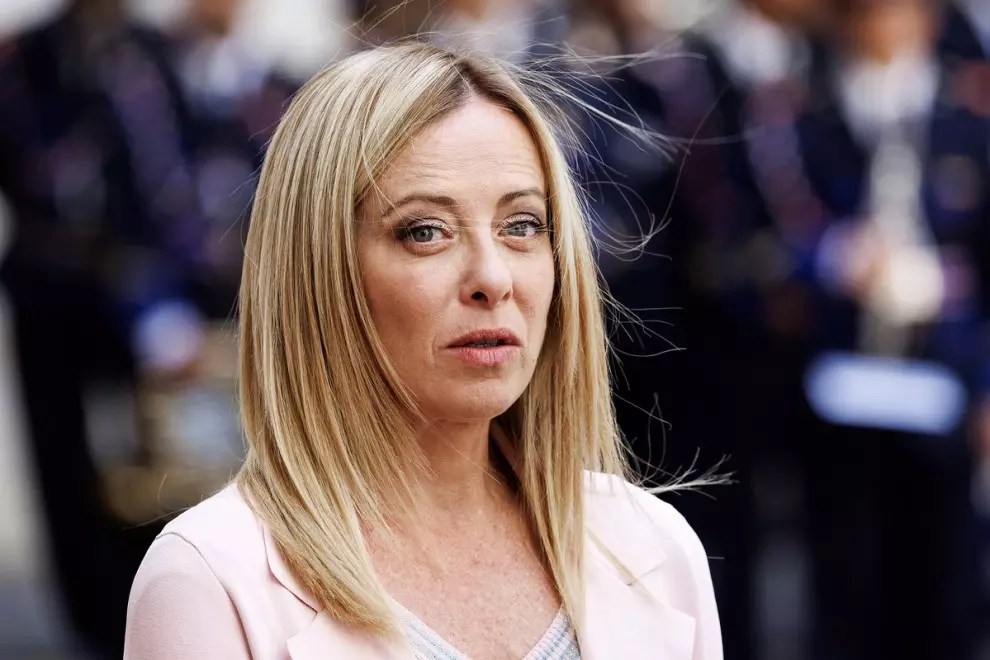
Italian Prime Minister Giorgia Meloni completely avoided using the word ‘neofascist’ in her message marking the 43rd anniversary of the Bologna Massacre, a terrorist attack by a far-Right organization that killed 85 people.
Meloni did not go to Bologna to participate in the commemoration.
“43 years have passed but, in the heart and conscience of the nation, the violence of that terrible explosion still resonates with all its force,” said the leader of the Executive and the ultra-right party Brothers of Italy.
Giorgia Meloni, the Prime Minister of Italy. (Photo: Fabio Frustaci / EFE)
In her message, she asked to “get to the truth about the massacres that marked Italy in the postwar period,” an ambiguous phrase that makes no direct reference to the far-right groups that carried out the massacre on 2nd August 1980.
The absence of specific terms in Meloni’s speech to refer to the attack has prompted opposition leader Elly Schlein, a progressive, to accuse Meloni of promoting “historical revisionism.”
“We are here in Bologna together with the families of the victims of the massacre to reiterate that we do not accept any further attempts to rewrite history. The judicial evidence already makes it clear that it was a neo-fascist massacre and also with subversive intent,” Schlein said.
In the message shared by the president, Sergio Mattarella, to commemorate the date, he did refer to “the neo-fascist matrix of the massacre.” Likewise, he recalled that in the subsequent trials “ignoble deviations, in which secret associations and treasonous agents of the state apparatus participated,” came to light.
Meloni has ruled out any anti-democratic nuance of her formation, but she maintains as a symbol of the Brothers of Italy the so-called “tricolor flame”, emblem of the youth organisation of the old and post-fascist Italian Social Movement (MSI) in which she was a member of her youth.
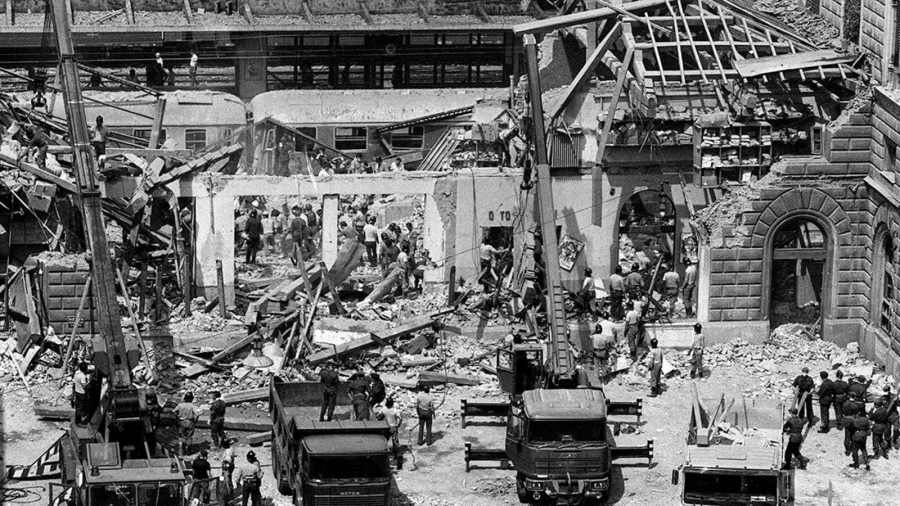
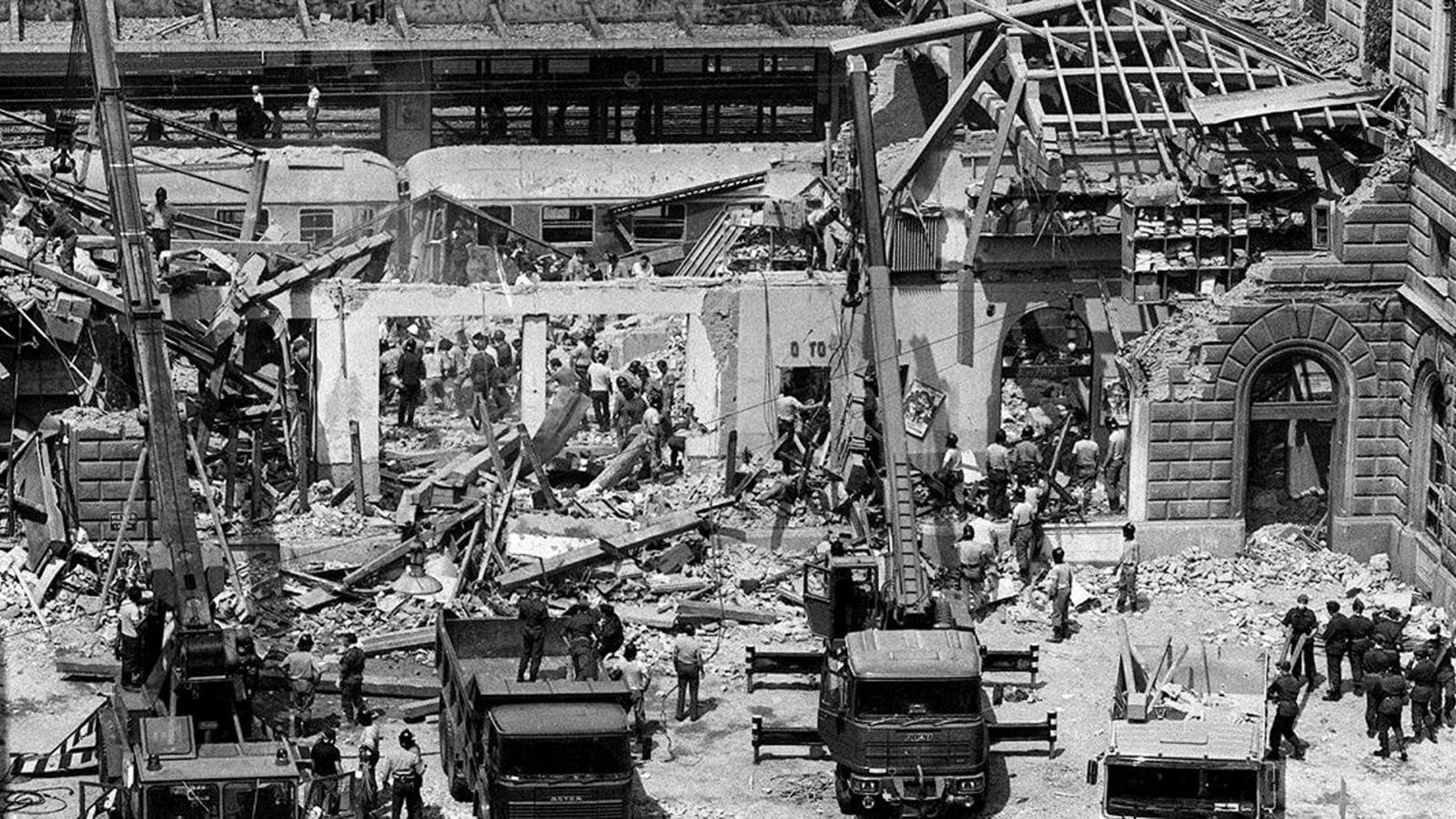
The Bologna Train Station, Italy, following the fascist explosion on 2nd August 1980 (Photo sourced: Internet)
The Bologna Massacre
The Bologna massacre was the most serious terrorist attack in Italy after World War II, in which 85 people died and more than 200 were injured and extreme right-wing militants belonging to the organization Armed Revolucionary Nuclei were convicted for it.
Comment by D.Breatnach: However, parts of the Italian State were implicated in the bombing and/or coverup too, with elements in the Italian police, judiciary and secret service but also with suspicions of CIA/NATO involvement. It seemed that the purpose of that bombing and others in the period was to create fear and confusion in which the State could return to fascism.
Original Breaking News article: DAVID YOUNG, PA (with commentary in italics by Diarmuid Breatnach)
The rededication of a memorial to the National Army soldiers killed in the Civil War enables their memory to be rehabilitated, a ceremony in Dublin has heard.
Defence Forces Chief of Staff Lieutenant General Sean Clancy paid tribute to the some 810 soldiers killed serving on the Free State side in the 1922-2023 conflict as he addressed the event at Glasnevin Cemetery on Sunday.
Descendants of some of those who died, representative of all four provinces, were invited guests at the ceremony, among them relatives of Michael Collins, the commander in chief of the National Army who under direction by Churchill, gave the orders that began the Irish Civil War and who was killed in 1922.
Taoiseach Leo Varadkar and Tánaiste Micheál Martin, the leaders of Fine Gael and Fianna Fáil, the two main parties forged from the divisions of the Civil War, also attended the rededication of the National Army Monument.
Sinn Féin TD Matt Carthy also attended the military commemoration, as did Dublin Lord Mayor Daithí de Róiste.
This neatly brought together political parties of the neo-colonial and neo-liberal Irish State with opposing histories: Varadkar to represent the pro-British and fascist neo-colonial origins of Fine Gael; Mícheál Martin and De Róiste representing Fianna Fáil, the allegedly Republican but in reality Irish Gombeen split from the previous iteration of Sinn Féin; Carthy for the current neo-colonial, neo-liberal and colonial servant Sinn Féin.
Taoiseach Varadkar (Fine Gael) and Tánaiste Martin (Fianna Fáil) unveiling monument to soldiers of the ‘Free State’ killed in the Civil War 1922-1923. (Photo cred: Brian Lawless/ PA)Matt Carthy TD, who represented his party Sinn Féin at the unveiling and dedication of the monument to soldiers of the Free State killed in the Civil War 1922-1923. (Photo sourced: Internet)
Prior to the ceremony, there was no monument in the country specifically dedicated to the soldiers of the National Army who fought against the anti-Treaty side in the Civil War.
Weeks after the war ended, on August 3rd, 1923, the Oireachtas passed legislation that led to the creation of the modern-day Defence Forces, Óglaigh na hÉireann. That is, the defence forces of the neo-colonial ruling class who created the Irish state.
The rededication event for the forgotten fallen of the National Army, which had already robbed the Irish language version name of the IRA, adopted the name Óglaigh na hÉireann during the Civil War, took place on the Sunday prior to the centenary of that date.
“It is appropriate then, in the spirit of real inclusiveness, of ethical remembering, and with a full desire to deal with some of the more uncomfortable aspects of our shared history, that we remember some of 810 uniformed members of Óglaigh na hÉireann who gave their lives in the service of the State during the tragic and critical period at the foundation of our democracy,” Lt Gen Clancy told the ceremony.
It is necessary, in order to bury any idea of achieving the Republic declared at the start of the 1916 Rising, that we honour some of the 810 men we recruited to bury that Republic in 1922, kitted out in uniforms, armed and transported by our ancient enemy. We wish to pass over quickly over not only the kidnappings, torture, murders, killing of disarmed prisoners and even sexual assaults by this fine body of men – the precursors to the current army of the Irish State – but also their terrorising of major part of the country with raids on homes and internment of men and women. Although this fine body of men were fighting to establish a neo-colony not even covering the whole of Ireland, we make no apology for calling them what they clearly were not, Óglaigh na hÉireann, i.e “Warriors of Ireland”.
The monument in Glasnevin to soldiers of the Free State killed during the Civil War – apart from the Free State Army having appropriated the name in Irish of the IRA, the legend claims they “died for their country”, a clearly inaccurate statement since at best they were fighting for the government and state of the 26 Counties, which excludes the UK colony of the Six Counties (‘Northern Ireland’ sic). (Photo cred: PA)
“For far too long there has been no memorial of any kind, nor any complete listing of the National Army war dead.” Understandably.
“Indeed, this year represents perhaps the last real opportunity to rectify that.”
As we prepare to commit this armed force to NATO at some point in the future and to PESCO in the nearer future, it is important to take a further step in legitimising this armed force of the neo-colonial state.
The remains of some 180 of the 810 soldiers who died serving in the National Army are buried at the plot in Glasnevin Cemetery. Uncomfortably close to graves of many of their victims.
“Sources at the archives show that the average soldier buried here was in his early 20s, was unmarried and from a working-class background,” said Lt Gen Clancy. In other words, the typical recruitment profile of lower-rank soldiers in capitalist and imperialist armies.
“Many had previously served in the IRA during the War of Independence, some even in the 1916 rising, many others had served in the British Army, underlying yet again how complex is the weave of Irish history.”
Actually, “many” is a questionable though vague estimate of the numbers who had “served in the IRA during the War of Independence”, though some had, including some of the most vicious, such as Major-General Paddy Daly, torturer and murderer.
The chief of staff highlighted the “poignant example” of two young Belfast-born Dublin-raised brothers – Frederick (18) and Gerald McKenna (16) – who were buried in Glasnevin after being killed together in action in Cork in August 1922 only a month after joining the National Army.
Aye, two men born in Belfast, a city which the Free State was fighting to ensure remained a direct colony of the United Kingdom.
“Whatever the often very legitimate reasons our forebears may have had for forgetting in the intervening 100 years, I think it’s appropriate now that I as the 32nd Chief of Staff of Oglaigh na h Eireann should finally take this opportunity to rehabilitate their memory,” said Lt Gen Clancy.
Especially as I try to establish a legitimate background to the armed force of an illegitimate State preparing to enter foreign imperialist wars and suppression of legitimate uprisings.
After all, we have great experience in all that, as the history behind this monument shows.
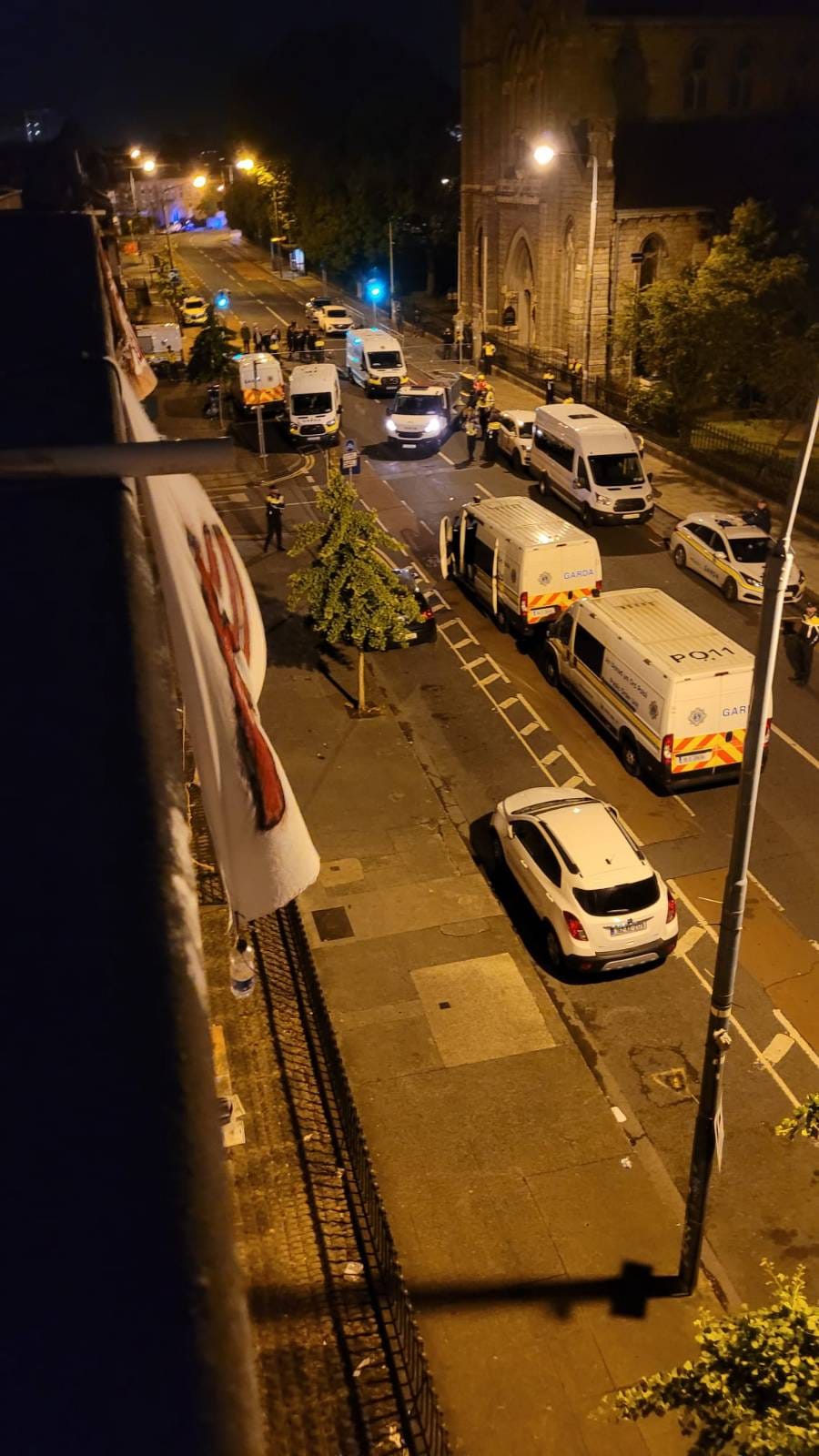
Late Tuesday night and early hours of Wednesday morning an operation with large numbers of Gardaí and their helicopter circling overhead disturbed residents in the north Dublin city centre area of Berkeley Road and surroundings.
It looked like drug bust, hostage rescue situation or siege, but it was none of those things, instead being an eviction of four housing activists.1
Supporters of the occupation by the RHL gathered at short notice by Berkeley Road during the Garda operation but were roughly pushed far back by Gardaí from the building under attack (Photo: RHL)
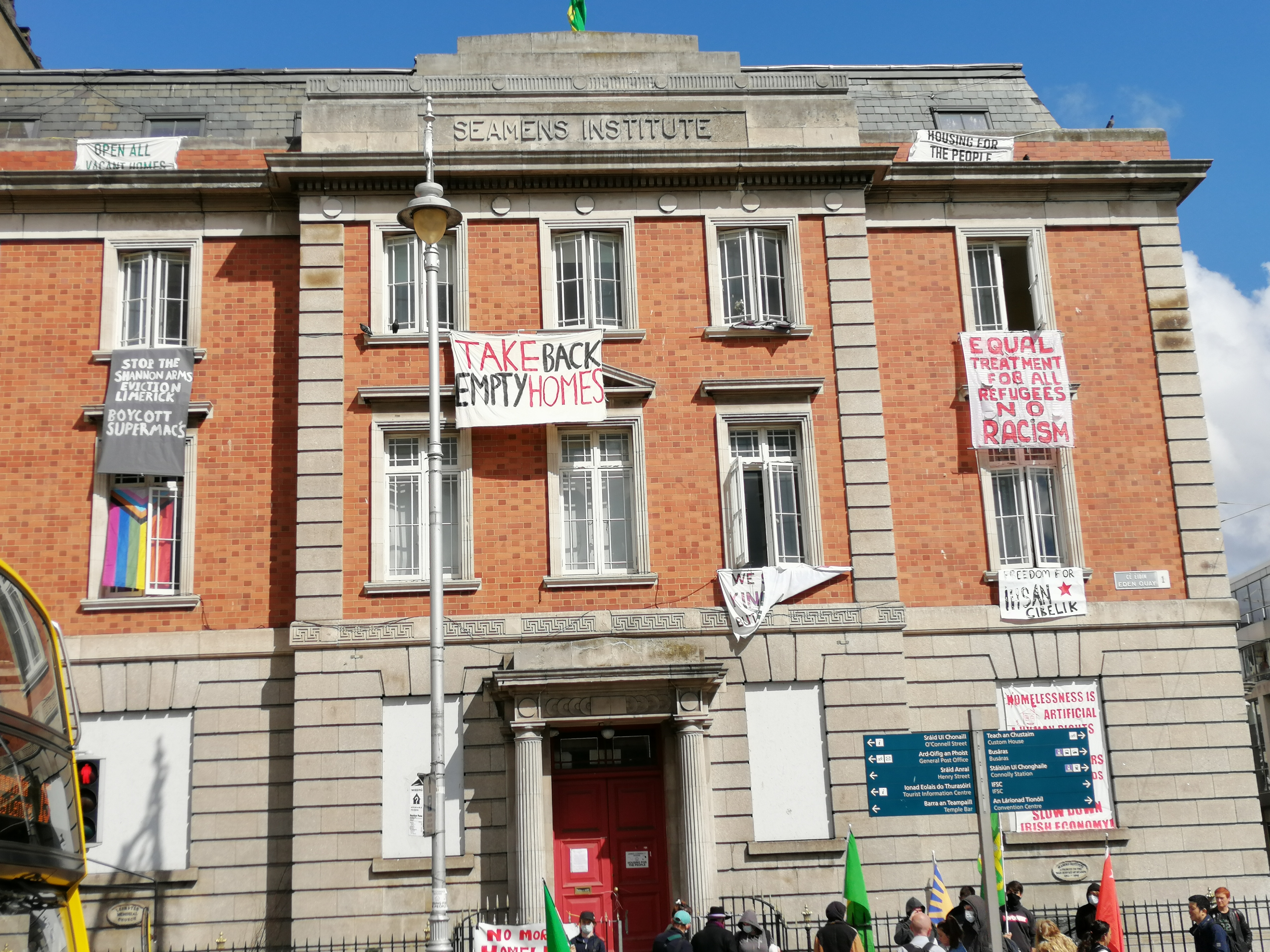
The building had been “acquisitioned” by the Revolutionary Housing League which for a couple of years has been occupying buildings lying empty around Dublin in order to house homeless people and to inspire people to take over empty buildings to end the homeless crisis.
One of those buildings was the red-brick building on Eden Quay and corner of Marlborough Street; it had been operated by the Salvation Army as a night shelter for homeless young people but left empty for years after losing funding.
Supporters in front of James Connolly House occupation over a year ago. (Photo: Rebel Breeze)
On 1st May 2022, RHL2 activists ‘acquisitioned’ the building, renamed it James Connolly House and repaired a leak in the roof. In the early morning of 9th June 2022, an estimated 100 Gardaí (some reportedly armed) stormed the building with a Garda helicopter circling overhead.
Two RHL activists performing overnight security on the building were arrested and brought to court, where they declined to be bound over or to give an undertaking that they would not return to the building.
The Salvation Army said that they were renovating the building in order to house Ukrainian refugees. Not only was there no evidence of that in the building when it was occupied but it is empty still, over a year after that eviction3.
Garda evictions have taken place around other acquisitions of empty properties and RHL activists have on each occasion refused to commit to an undertaking not to occupy other properties.
Rather, the RHL has called for empty buildings to be occupied around the country.
The eviction this week
The massive Garda operation this week, including road-blocks, to evict RHL occupants of the Berkeley Road house. (Photo: RHL)
After the eviction in Berkeley Road, four RHL activists were taken to Court where they followed the previous pattern of refusing to be bound over or to promise not to occupy other buildings. Nevertheless they were released with a threat of jail-time if they re-occupied.
The lessee of the building, advertising as Cabhrú and formerly Catholic Housing Aid Society (Chas), has faced allegations of improper use of that building and another, Fr. Scully House on nearby Gardiner Street, some of which were borne out in an investigation by Charities Regulator.4
Supporters of the RHL occupiers outside the High Court (Photo: RHL)
The housing crisis
The numbers of homeless people in the the Irish state passed 12,000 for the first time in May this year and over 4,000 of those are children,5 nor do those figures include people defaulting on their mortgage loans, sleeping on the street or ‘sofa-surfing’ with friends and relations.
According to figures published in April this year, there are over 100,000 empty homes within the Irish state, not counting holiday homes (the Berkeley Road one was empty for three years).
Housing the homeless on the face of it can be accomplished without the revolutionary overthrow of the State and its Gombeen6 ruling class. All that is necessary is a public housing program financed by the State, which it could easily accomplish.
However, the stubborn clinging of the Gombeens to keeping a wide high-return market for property speculators, bank funders and big landlords, year after year as the housing crisis worsens, seems to indicate that a revolutionary remedy is necessary.
This week the Taoiseach,7 Varadkar, inferred that a contributory cause of the housing crisis was that homeless people had turned down alternative accommodation, a nonsensical claim since one person’s declined accommodation could just be offered to the next.
Addressing him in the Leinster House parliament, Sinn Féin TD8 Pearse Doherty9 took him to task for inferring that the homeless were to blame for their situation, in response to which Varadkar denied accusing the homeless and ungraciously amended his statement to “some homeless people”.
He went on to say that homelessness has a number of causes but neglected to name the principal one, viz. that the State does not supply funds to municipal authorities to provide public housing, leaving property speculators, banks and big landlords free to exploit the housing ‘scarcity’.
According to media reports, Doherty neglected to take this opportunity to point out the real cause of the problem and the solution, which confirms the doubts of those who say that his party is “Fianna Fáil Mark II”,10 with no intention to fundamentally alter the economic system in the state.11
Revolutionary Housing League flag on top of the occupied building during the massive Garda operation (Photo: RHL)
In conclusion
The housing crisis shows no sign of being resolved and the ruling class have ridden high-profile ‘shaming’ token occupations such as that of Apollo House in January 2017 without changing anything. RHL occupations do seem to show a way forward if they are widely emulated.
Heavy Garda operations on the one hand and comparatively light treatment by the courts on the other seems to indicate a determination not to tolerate this kind of direct action on homelessness while at the same time moderated by a fear of creating housing action martyrs.
Meanwhile the numbers of homeless grows by the month without any other credible solution in sight.
End.
FOOTNOTES
1This is the police force that has been described by its chief, Commissioner Drew Harris (formerly Asst. Commissioner of the colonial gendarmerie PSNI and therefore also MI5), as his “gang” but which seems unable to prevent serious assaults in the city centre, even in its main street.
2Originally Revolutionary Housing Union, later became RHL.
4Some of those included a friend of the charity’s Chief Exeutive being accommodated in the building allegedly providing only for the elderly, rooms being let to short-stay students without proper guarantees or rights and one of the houses being used as a business address.
8Teachta Dála, member of the Irish Parliament, equivalent to “MP”.
9Deputy leader of the party in the Irish parliament. Holly Cairns, leader of the Social Democrats also attacked Varadkar on the statement.
10Fianna Fáil is one of the two main government parties; originally a split from Sinn Féin led by De Valera, it has been in government more than any other party in the Irish state.
11A number of SF party leaders including its current president have publicly stated that big business has nothing to fear from their party.
A broad group of socialist Republicans gathered at the grave of Theobald Wolfe Tone on Sunday 2nd July to honour his memory and to reiterate their commitment to an independent and socialist Ireland outside of imperialist military alliances.
Wolfe Tone’s grave in the Bodenstown Church graveyard has been a place of pilgrimage for Irish Republicans at least since the days of Thomas Davis1 of the Young Irelanders of the 1840s, who wrote of his own visit to the grave and composed the song “In Bodenstown’s Churchyard”.
The late 1960s saw huge numbers of people in attendance at annual commemorations there near the village of Sallins, Co. Kildare, including not only Sinn Féin2, who led them, but many political and social organisations, GAA clubs, along with many non-aligned people.
Over the years, the voluntary and unfunded National Graves Association has improved the site comprehensively and sensitively, leaving the ruins of the Protestant church as they are but building a stage attached to one side, fronted with plaques and commemorative flag stones.
Commemorations currently are usually organised around a Sunday near the date of the patriot leader’s birthday on 20th June but have to be managed between different groups wishing to hold their own commemorations.
Speeches, songs and Garda harassment
The Annual Wolfe Tone commemoration organised by the Wolfe Tone Commemoration Committee took place over the weekend with members of a number of groups and Independent Republicans in attendance.
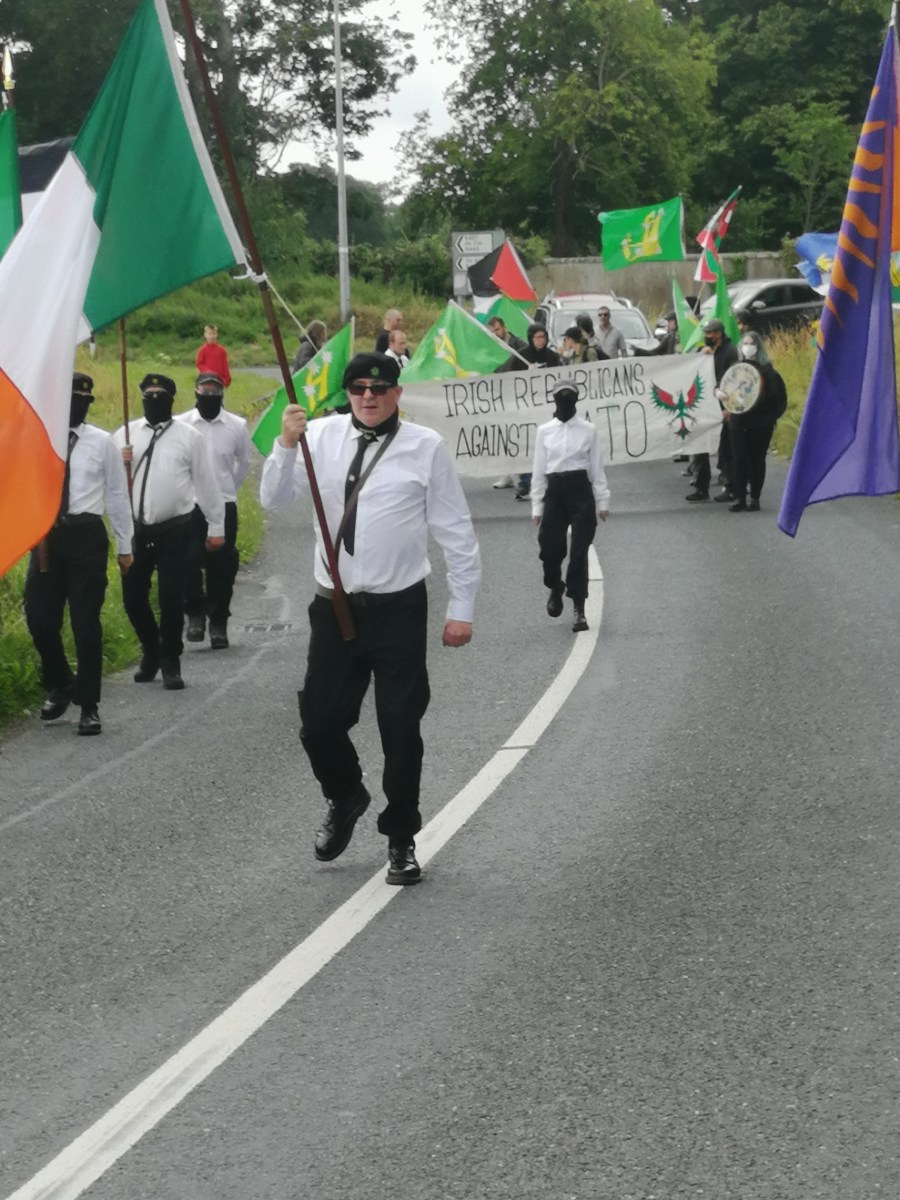
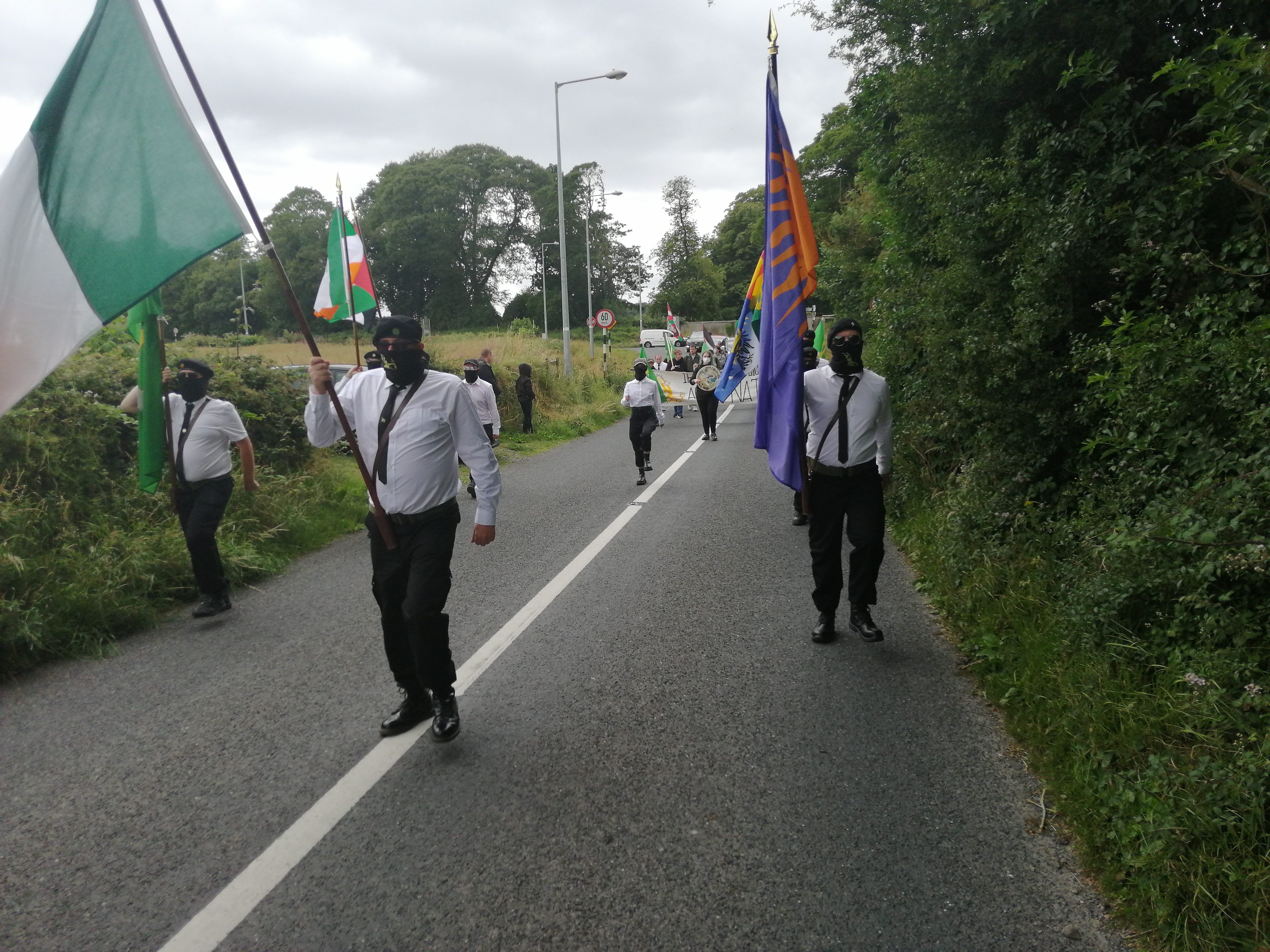
A Socialist Republican Colour party led the march up from the bottom of the road, turning in to the graveyard through a side gate and taking up positions in front and to one side of the monument, at ordú scíthe (parade rest) position but with flags held high.
Colour party in front of Wolfe Tone monument, Bodenstown Churchyard (Photo: Rebel Breeze)
Behind the colour party followed a crowd carrying banners bearing the legends “Irish Republicans against NATO”, “We serve Neither King nor Kaiser but Ireland” and an assortment of flags including green-and-gold Starry Ploughs, Irish Tricolour, Palestinian and Basque national flags.
The event was chaired by a young Socialist Republican who spoke about the importance of the event before introducing a representative of a midland Republican commemoration group who read a short message of solidarity.
This was followed by a socialist republican accompanying himself on guitar singing The Three Flowers.3
The main oration was delivered by veteran Independent East Tyrone Republican Margaret McKearney who linked the past with the present, including the current housing crisis, the British occupation and the Irish State’s push to join PESCO and NATO military alliances.
Musician performing The Three Flowersat the Wolfe Tone monument (Photo: Rebel Breeze)Veteran Republican from Tyrone delivering the oration at the commemoration event (Photo: Rebel Breeze)
There was a clear message at the event that the push towards NATO will be energetically resisted at every turn by the people of Ireland.
Wreaths were laid and a minute’s silence was observed, while the colour party lowered the flags in memory of all those who paid the ultimate sacrifice in the ongoing struggle for Irish Freedom. The event was brought to a close with the musician playing and singing Amhrán na bhFiann.
A handful of Gardaí4 in uniform and in plainclothes (Special Branch, the political police) were parked outside the graveyard watching people arriving and leaving but at that point having no direct interaction with those attending the event.
Part of long tail-back cause by Garda checkpoint very near to Bodenstown Churchyard after the commemoration event (Photo: Rebel Breeze)Gardaí in uniform and Special Branch in plain clothes harassing and attempting to intimidate people who had attended the commemoration event (Photo: Rebel Breeze)
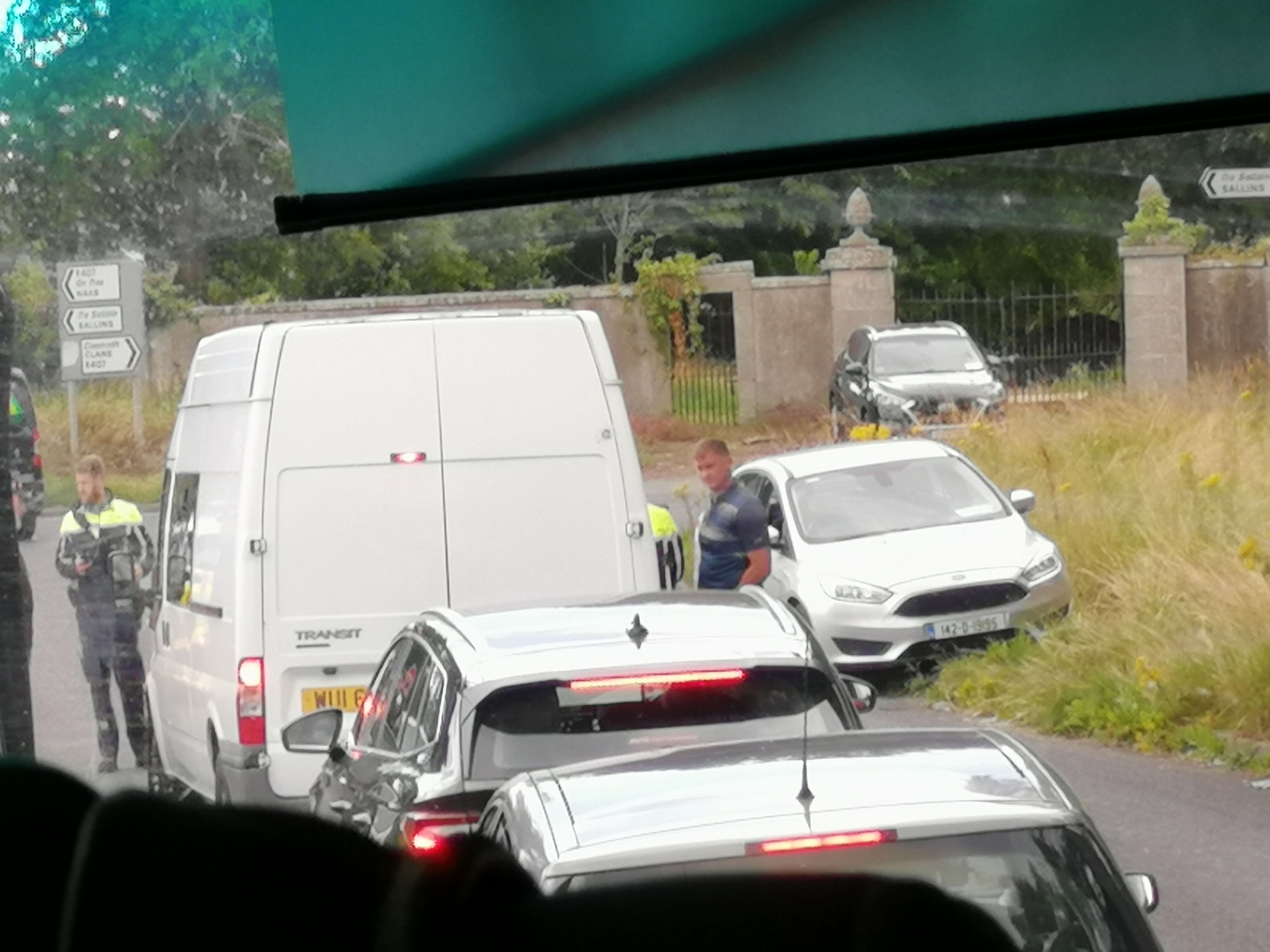
However, once the event concluded, the Gardaí set up a checkpoint at the bottom of the road and began to harass and attempt to intimidate drivers of vehicles, stopping them, asking for identification, where they were from etc, causing a long tailback.
This is part of the regular harassment of Irish Republicans by police on both sides of the British Border.
“The Father of Irish Republicanism”
Theobald Wolfe Tone (1763-1798) was formally a member of the Church of Ireland5 congregation (Anglican), in his time the dominant religious group in England-occupied Ireland but also one of the smallest.
No-one could be elected to the Irish Parliament unless of that congregation.
In the early 19th Century a section of the Irish bourgeoisie, nearly all Anglican or of the other Protestant churches, “dissenters”, wished to develop the Irish economy free of interference, control, patronage and bribery associated with being an English colony.
Many of them understood the need for a strong base in the population, for which they recognised the need to include representation for the majority population in the country, the Catholics, along with the most populous of the Protestants, the Presbyterians.6
When the liberal but pro-English Crown Henry Grattan brought the issue to a vote in the Westminster Parliament, his motion failed due to many MPs’ sectarianism or vested interests, a situation which continued for decades afterwards.7
That seemed to point to revolution as the only logical way forward.
Theobald Wolfe Tone was one of the founders of the Society of United Irishmen in October 1971, the first broad Republican organisation in Ireland, which soon developed a comprehensive revolutionary agenda, for Irish independence and a Republic based on universal male suffrage.8
In order to accomplish a successful uprising, they invited assistance from Republican France and planned a simultaneous uprising across Ireland, with particular concentration on Antrim (largely Presbyterian and Anglican), Wexford and Wicklow, Midlands and Mayo (largely Catholic).
Colour party leading a march towards the Wolfe Tone monument (Photo: Rebel Breeze)
Spies and informers working for the English occupation betrayed some of their plans and most of the Leinster Directorate of the United Irishmen, including Wolfe Tone, were arrested, a disaster for uprising plans in Dublin but also for overall leadership in Leinster.
The 1798 Rising had initial great success in the south-east, particularly in Wexford but was quickly and bloodily suppressed in the Midlands and in Antrim. Mayo rose when a too-small detachment of French soldiers arrived under Humbert in Kilalla but they were outnumbered and beaten.
Tone was was unapologetic at his trial, was sentenced to death by hanging but appears to have attempted to take his own life while awaiting execution, surviving for a few days in great pain before dying on 19th November 1798 as British and Orange loyalist repression swept the country9.
Wolfe Tone Monument by Edward Delaney (d.2009) at S.E entrance to Stephen’s Green, Dublin city centre (image sourced: Internet)
Many leaders of the United Irishmen are honoured in song, writing and in commemorative events to this day but Theobald Wolfe Tone is still the most widely remembered of them all.
End.
The Colour Party and some of the participants line up for a group photo by the monument (Photo: AIA)
FOOTNOTES
1Thomas Davis (1814-1845), journalist, author of the song A Nation Once Again and other works, also co-founder of The Nation newspaper.
2Prior to its split resulting in Provisional Sinn Féin and the later split resulting in the Irish Republican Socialist Party.
3Composed by Norman G. Reddin, a Republican ballad honouring the memory of three United Irish leaders, Robert Emmet, Michael Dwyer and Wolfe Tone. Both Tone and Emmet were sentenced to execution, the latter carried out in 1803 on Thomas Street in Dublin. Dwyer was transported to exile in Australia where he was later accused of planning an uprising in New South Wales for which he was twice imprisoned and tried but exonerated, became Police Chief in Liverpool, Sydney in 1813 but was imprisoned again in 1825 for alleged non-payment of a £100 debt, contracted dysentery, was released again and died very soon afterwards.
5A branch of the Church of England, the state religion of the UK of which their Monarch is the titular head (in addition to being the commander-in-chief of the Armed Forces).
6“Catholic, Protestant and Dissenter”, as Wolfe Tone famously called the alliance.
7In May 1808 Grattan proposed emancipation in the House of Commons, with certain qualifications, but his motion was defeated by 281 votes to 128. In June 1812 the Commons accepted, by 225 votes to 106, a motion in favour of considering Catholic claims. An emancipation Bill, introduced in February 1813, received a second reading but was lost in committee by a narrow margin. Frustration at this lack of progress led to the formation of the Catholic Association in 1823 (of which Wolfe Tone was an active member). Parliament passed an Act to restrict the Association’s activities two years later.
8Very few radical or revolutionary individuals, not to mention movements of the 18th (or even much of the 19th or early 20th) Centuries proposed universal female suffrage, one reason why the 1916 Proclamation of Irish Independence is such a remarkable document, beginning its address with the words “Irishmen and Irish women”.
9Which many, in particular Protestants, fled the country to escape, some settling in the United States and in Canada. The great Catholic emigration from Ireland did not occur until the Great Hunger of the mid-19th Century and later.
A packed public meeting in Dublin city centre on Saturday listened to and applauded prominent people speaking against the Irish State becoming part of military alliances, whether PESCO1 (“NATO by stealth”2) or NATO itself.
The high-profile panel of speakers chaired by Irish MEP Clare Daly featured fellow MEP Mick Wallace, Sevim Dagdalen (MP Die Linke), Medea Benjamin (founder of Code Pink) and Anne Wright (ex-US Army Major and opponent of the US-Iraq War).
Celebrated anti-imperialist rapper Lowkey was also a speaker as was Yanis Varoufakis (ex-Syrza)3 who addressed the meeting by recorded video from abroad and applauded the Irish for their long resistance to colonialism and urged them to be proud of their state’s neutrality.
Yanis Varoufakis’ recorded speech video screened at the Neutrality Who Cares meeting on Saturday (Photo: Rebel Breeze)
BACKGROUND
There is a constitutional impediment to the Irish state’s participating in a war partnership with another state and during WW2 the state’s official position was neutrality.
However, it was always a pro-Allied neutrality with British downed airmen allowed to cross over into UK territory and US servicemen often crossing the UK border to visit the ‘south’, while German downed airmen were interned for the duration of the War.
The impediment is not absolute and is usually referred to as the ‘Triple Lock’, listing the three conditions which would enable to government to send more than 12 troops overseas:
In recent years some politicians and public commentators have floated the idea that the Irish state could rejoin the British Commonwealth and, since the war in the Ukraine, a discourse has arisen that the State needs to join an external military alliance in order to protect itself from Russia.
Sevim Dagdalen, Die Linke party MP, speaking at the Neutrality Who Cares meeting on Saturday (Photo: Rebel Breeze)
The Irish Times/Ipsos poll in April, amid criticisms of not following best practice in its design and even accusations of trying to steer respondents towards favouring joining some external military alliance, delivered two thirds clearly against the Irish state doing any such thing.
Russophobic propaganda has speculated on the activities of Russian trawlers in the Irish Sea. This is entirely a whipped-up alarm and discussion without the slightest foundation in fact since Russia has never presented the slightest threat, militarily or politically, to the Irish people.
On the other hand, Britain has invaded and occupied Ireland for over 800 years and is still in possession of one-fifth of its territory and has substantial economic and financial interests in the country as, more recently, have the USA and European Union states.
The UK’s Royal Navy frequently enters Irish national waters and the State has regularly permitted its ships, along with warships of other NATO countries, to dock in Irish harbours. And also the Royal Air Force, it has recently emerged, to patrol Irish territorial air space.
As part of this false alarm and discourse, the Irish Government5 recently founded the Consultative Forum on International Security Policy which was scheduled to meet last week in Cork and Galway, then for two days in Dublin Castle.
The President of the State, Michael D. Higgins, in an unusual intervention during an interview with the Examiner expressed concern at what he perceived as the “drift towards NATO” and criticised the composition of the speakers and chairperson of this organisation as being pro-NATO.
Michael D commented on “the admirals, the generals, the air force, the rest of it” and described its chair Louise Richardson, as a person “with a very large DBE – Dame of the British Empire”.
President Higgins apologised later for what he said was “a throway remark” about Richardson but did not withdraw his remarks about the overall composition of the Forum which has indeed been criticised by others, including Richard Boyd Barrett TD6 and Senator Frances Black.
THE DUBLIN MEETING
Varoufakis referred to Ireland as though the nation had won its independence, as was the case with every speaker that followed (with the exception of Lowkey).
A member of the audience was heard to remark ironically to another that he was grateful he had attended as heretofore he hadn’t been aware of Ireland’s ‘independence’.
Lowkey, the British-based rapper, tore the illusion of Irish state neutrality to tatters by recounting the use of Irish airports not only for US Army flights under Air America through Shannon, but also airlines run by the CIA and others using other airports in Irish state territory.
Lowkey, anti-imperialist rapper from London, speaking at the meeting in Dublin. (Photo: Rebel Breeze)
The rapper exposed the ‘neutrality’ of the Irish government in training soldiers going to fight in Ukraine and also in its continued support for the Israeli State and was cheered when he declared that, as an Iraqi, he was proud that his country had “kicked the ass of the British”.
In a masterful exercise in research-backed criticism, Lowkey went on to strip the pretence of independence and impartiality from the Government-founded “Consultative Forum”, exposing the imperialist and even NATO background of the main panel members and its chairperson.
All the members of the Neutrality Who Cares panel were effective speakers and made useful points although it was curious to hear one of them denouncing “Russian fascists” without commenting on the fascist units in the Ukrainian regime’s national army.
Medea Benjamin, founder of Code Pink, speaking at the Neutrality Who Cares meeting on Saturday (Photo: Rebel Breeze)
It was Lowkey who drove the sharpest and longest nails into the verbal crucifixion of the Irish Government’s drive towards NATO and who brought the loudest cheers from his mostly Irish audience.
Even celebrated speaker Daly did not come very close, though she too exposed the propaganda of the Government and pro-NATO cheerleaders. The MEP debunked the excuse of protecting underground communication cables, pointing out that 25% of them are out of action regularly.
The Irish MEP also lampooned the idea of any underwater cable being protected by NATO, considering where the responsibility for the blowing up of the Nord Stream gas pipeline lies!7
Finally she warned the audience to be on the look out for an attempt to remove the Triple Lock under some kind of excuse as a first step to permit the Government to enter a military alliance.
Clare Daly MEP speaking at the Neutrality Who Cares meeting on Saturday (Photo: Rebel Breeze)
A PART OF IRELAND ALREADY IN NATO
It was left to a youth member of the audience in the Q&A section, reading a statement on behalf of the Anti-Imperialist Action organisation, to point out that a part of Ireland is already in NATO, viz. the Six Counties, occupied by Britain and a part of the United Kingdom.
The youth called for a broad front to unite around opposition to becoming part of an external military alliance and imperialism (see full statement in appendix). Small flyers advocating the same course of action had been distributed inside the meeting earlier.
The People Before Profit party also distributed leaflets against joining NATO to people attending the meeting.
Indeed, it is hard to see why the presence of NATO in a part of Ireland should be so markedly missing from the panel’s speeches. Since it cannot have been accidental we must ponder what the rationale for its omission could have been.
Do those on the panel agree with the colonial occupation of a part of Ireland? That seems hard to believe, at least of some of them. Or perhaps they believe its discussion would be a distraction from the neutrality issue and if so, how can that be?
Or is it that they seek the support of sections of Irish society who are comfortable with the continued occupation and partition of Ireland? If so, they are seeking to build the movement against Irish membership of NATO in terms they think acceptable to timid sections of the middle class.
When resolute action becomes necessary or when reaction starts to bite, those sections will fade out of the anti-NATO movement. For practical as well as for ideological reasons, the campaign must appeal to the working class on an unashamedly anti-colonial and anti-imperialist basis.
Protest banner at Government’s Forum for International Security meeting in Cork while Tánaiste (Deputy Prime Minister, on far left of photo) was speaking (Photo sourced: Internet)
Wherever the Government’s Forum has gone, it has encountered public opposition. It was picketed at its Cork and Galway venues, while inside the former, an anti-NATO banner was unfolded and many in the audience denounced the Government’s direction.
Even after the protesters had been hustled out, another stood up to denounce the chairperson’s speech before he too was manhandled away.
In Dublin Castle, venue for the Forum on Monday and Tuesday with a long history as administrative centre of British occupation, people against NATO, war or militarism and for Irish independence displayed banners and placards of protest and flew national flags.
Protesters inside a Dublin Castle courtyard against the Government Forum on International Security held inside the complex this week. (Source photo: Anti-Imperialist Action)
AIA Tweet featuring National TV broadcaster RTÉ quoting Irish Government leaders’ ridiculous comments on the display of Irish Republican flags by protestors outside main pedestrian entrance to Dublin Castle in the city centre.
IN CONCLUSION
The general mass media silence on the Neutrality Who Cares meeting in Dublin and in downplaying the protests against the Forum at all its locations is part of the Irish Gombeen class drive to join NATO, despite the well-known opposition of the wide Irish population.
It is not forgotten that when tens of thousands thronged Dublin streets marching against triple water service taxation and privatisation, how the mass media reported participation merely by “several thousand” or even “hundreds”.
Nevertheless the comments of the President of the State and remarks by some journalists in the mass media do reveal that even in their own sections, the Gombeens do not have it all their own way. In the general population, however, the mood is clearly for non-militarisation of Ireland.
If the anti-NATO movement remains active and militant and adopts a generally broad anti-imperialist stance, going to most sections of society but especially to the working class, the Gombeens’ drive towards participation in PESCO and NATO will be decisively defeated.
End.
FOOTNOTES
1Permanent Structured Cooperation is the strange name of this proposed European Union-wide military alliance.
3Syriza is a Left social-democratic coalition party that was elected to government in Greece in 2015 on a promise to implement necessary social and economic reforms in the teeth of EU and other imperialist resistance. However, once the EU and the ECB began to tighten the screws, the resistance of the party’s leadership disintegrated. Varoufakis had been appointed finance minister and to give him his due, he tried to rally his cabinet colleagues around a program of non-compliance with EU diktats but was unsuccessful. Although it remains the main social-democratic opposition in Greece, the party has continued to slide in popularity in elections since.
4Irish UN peacekeeping forces exceeding 12 personnel have been sent overseas with those three conditions satisfied to many conflicts around the world, most notably Lebanon, where they have suffered some casualties and to the Congo, where they suffered many.
5The Irish Government is a coalition of two traditional main oppositional parties, Fianna Fáile and Fine Gael, with the Green Party. The Labour Party does not have a noticeably different position on external military alliance and Sinn Féin recently dropped their decades-long opposition to Irish membership of NATO and the EU.
6Barrett is a Teachta Dála (member of the Irish parliament) and member of the People Before Profit left-wing political party. Frances Black, with a successful career in singing, is an independent Senator in the same parliament who has sponsored a Bill to ban products from the illegal Israeli settlements. The Control of Economic Activity (Occupied Territories) Bill 2018 was passed in full by the Senate in 2018, and passed its first vote in Dáil Éireann in early 2019. It was then sent for detailed scrutiny in the Oireachtas Select Committee on Foreign & Affairs and Trade. This review took place over several months, hearing from expert testimony and input, and in December 2019 the Committee also voted in favour of the bill. Since then the Government is delaying bringing it forward.
7Although direct proof is not yet available, circumstantial evidence points towards US armed forces’ responsibility and journalist Seymour Hersh (Pullitzer Prize winner for exposing the US military massacre in Mai Lai, Viet Nam and its subsequent attempted cover-up) has confirmed the US military’s responsibility on the basis of inside knowledge from his contacts.
APPENDIX
Text of statement read out during Q&A period of Neutrality – Who Cares public meeting in Dublin 24 June 2023:
Anti Imperialist Action Ireland hold the revolutionary position that Britain, NATO and any other imperialist power is not welcome in Ireland. Anti-Imperialist Action have been active in opposing all forms of imperialism in Ireland and have been to the fore in opposition to NATO.
NATO is a great threat to Ireland and the Irish People, and in realisation of that, we urge and call on everyone here to vocally oppose the presence of NATO in Ireland whether you be an anti-war activist, a Socialist Republican, an anti-Fascist, a trade unionist, or just against the presence of a foreign power in Ireland, get behind this position and ensure that your sons and daughters aren’t sent off to be slaughtered in illegal wars of conquest.
While all the focus has been about the push towards NATO for the 26 Counties we cannot forget that the Six Counties are already occupied by NATO by virtue of Britain’s illegal occupation. Only a militant broad front of progressive forces all across the 32 counties can make a firm stand against NATO’s presence in Ireland. Everyone has a part to play in such a broad front which Anti-Imperialist Action and others are working hard to establish.
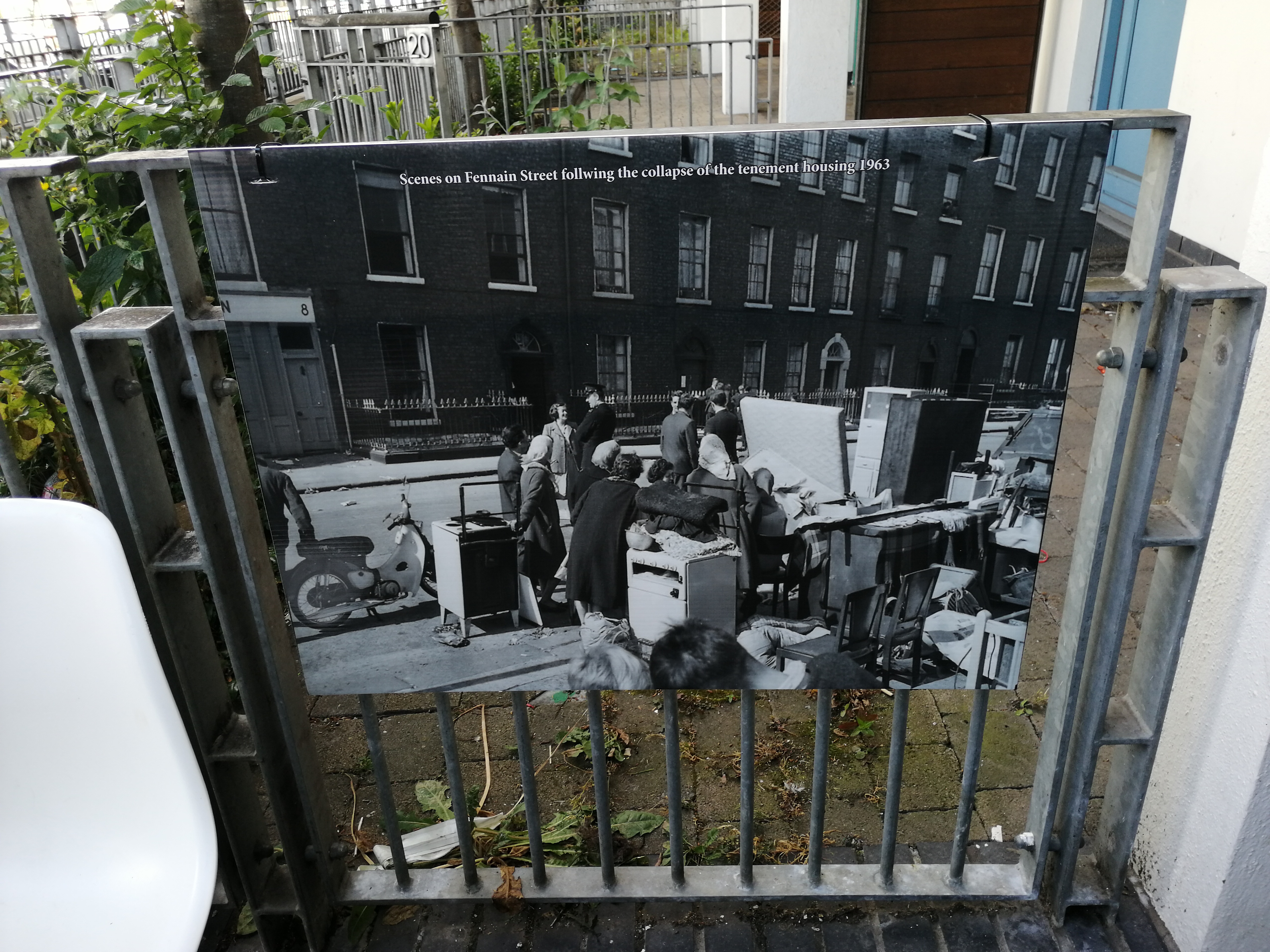
The collapse of multi-occupation buildings in Dublin’s Fenian Street killed two girls. A day from the anniversary of the tragedy sixty years later, local residents in a working-class block of flats organised a moving and informative commemoration.
On 12th June 1963, Marion Vardy and Linda Byrne, returning from a shop were killed when the buildings collapsed.
After another two people were killed in a Bolton Street collapse, a galvanised Dublin City Council inspection condemned many other buildings in the city and 155 families were rehoused immediately, though some in Army barracks.
And a number had to camp out for some days in the street. But it was not the first fatal building collapse in Dublin. On 2nd September 1913 (with the epic Lockout struggle only days old), two adjacent buildings had collapsed in Church Street, killing seven people.1
All the buildings in question were privately-owned with working class people paying rent to the owners. Emergency inspections by Dublin City Council inspectors in 1963 resulted in the condemning of 156 Dublin buildings as too dangerous for residence.
For years, other buildings in the Dublin inner city could be seen braced on a side by a massive timber frame.
Organisers’ panel photographed by D.BreatnachOrganisers’ panel photographed by D.Breatnach
COMMEMORATIVE EVENT
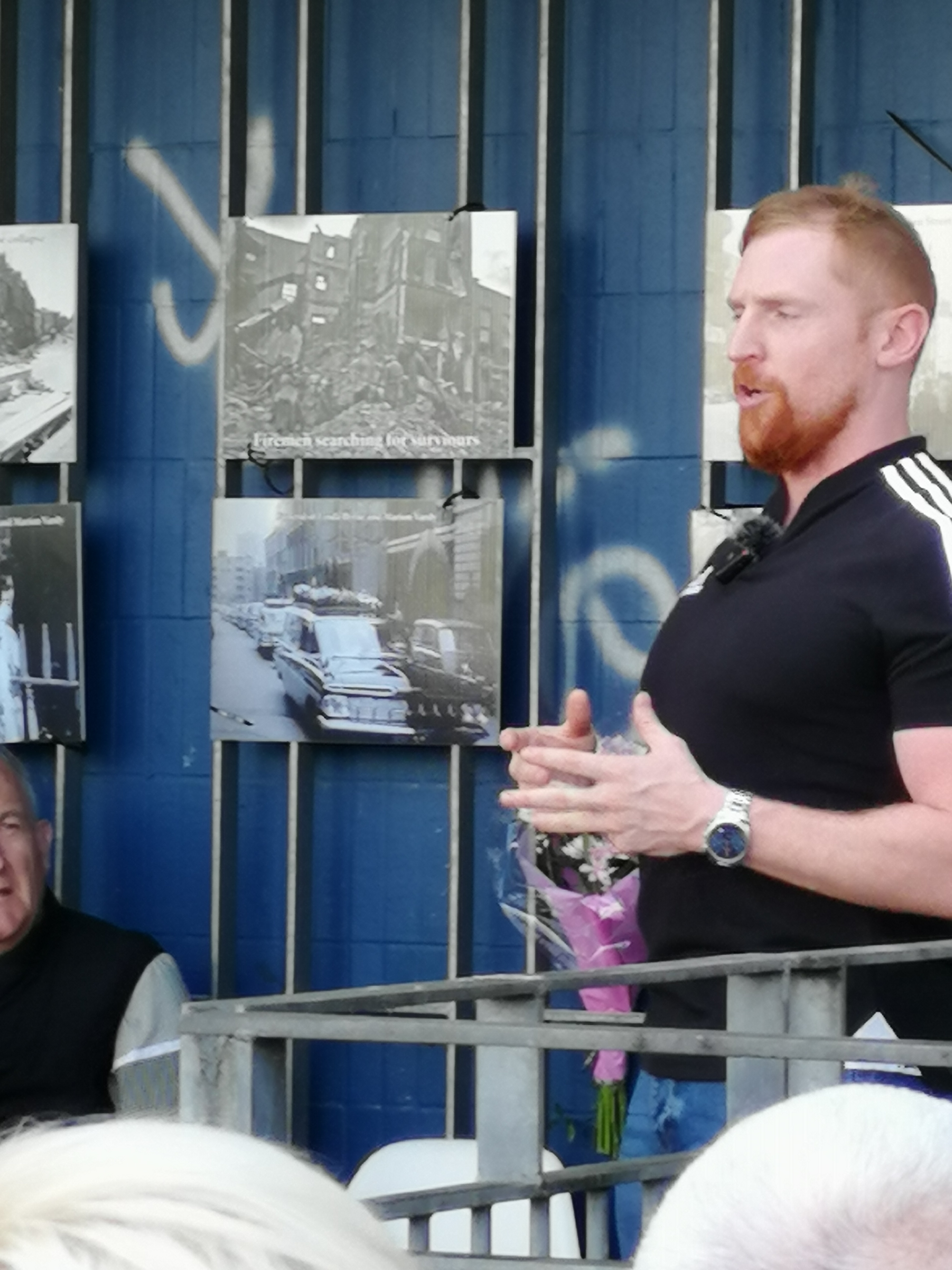
A display of panels describing the tragedy and panels of photos had been erected around the entrance to St.Andrew’s Court block of flats in Fenian Street, where a crowd had gathered for the well-organised commemoration.
Paul McKeown chaired the event speaking eloquently when he could be heard (there was no public address facility) about the actual tragedy and the context of housing provision for working class people in the inner city.
Paul McKeown, who chaired the event, speaking. (Photo: D.Breatnach)
As a Catholic priest had performed the religion’s Last Rites over the bodies of the girls in 1963, McKeown invited a priest to recite some prayers at the event, which he duly did, after which the MC introduced a representative from the Henrietta Street Tenement Experience.2
The Henrietta Street speaker provided interesting snapshots of what past life was like for working people of the inner city in terms of occupation, accommodation and schooling. Some women sewed shirts in a factory while others sold items in street markets, such as Moore Street.3
Speaker from the Henrietta Street Tenement Museum. (Photo: D.Breatnach)
The floors in the poorest homes had no covering and toilets were very few, their use often shared by a great many residents. Although virtually all children would end schooling at the age of 14, the eldest boy often left years earlier to work, as a newsboy or shop messenger, for example.
Labouring on the nearby docks and carting would be the main employment for the men. No doubt emigration, almost a constant in Irish history, played a part too. Rats and mice were endemic in the buildings.
Though alternative and eventually new housing was found for all, it was to Dublin’s outlying areas, breaking up communities and their ways of life, separating them from services used, employment, etc. Many felt isolated and took the long journey to return to the city centre for social contact.
Organisers’ panel photographed by D.Breatnach
ATTACK ON NEARBY REFUGEES
The local flats overlook the location in Sandwith Street that in May had seen an attack by fascists on refugees who had been living in tents because the nearby International Protection Office, a State body, had failed to allocate them accommodation while processing their applications.
A few locals might have joined in and certainly some had attended the crowd but the fascists were imported (as indeed were the refugees and subsequently their antifascist defenders). Some locals at least resented the way they were being portrayed in some social media subsequently.
Refreshments, some of which were provided by Dublin City Council, were served by residents in the inner courtyard after the speeches. (Photo: D.Breatnach)
“We’ve had generations of Travellers4 in the flats and migrant people too,” commented one. “We’re more ethnically diverse than Dalkey,” he added. “Middle class people don’t talk to us, they talk down at us,” was another comment.
They claim that they have been neglected for generations by all the government parties but also by small left-wing parties, also by people who were quick to criticise them and to see them in negative stereotypes. “Nobody talks about class prejudice”, commented McKeown.
The inner city working class population has been moved out of much of the city and this area, which was previously seen as the least valuable real estate in Dublin, as McKeown observes, is now attracting property speculators for gentrification.
Some of the residents and others in attendance in the inner courtyard after the speeches. (Photo: D.Breatnach)
McKeown feels his people are not wanted in the area and he’s probably right. It’s not just that they are not the typical users of the wine bars and coffee bars of gentrified areas but that their current location would take in big rents after construction of hotels and upper-market flats.
Past the site of the attack on the refugees there is a new block of apartments, two bedrooms for 3,000 euro a month, one bedroom for 2,000. An empty bloc across the road which people say was well-maintained, remains empty since Dublin City Council moved the residents out 5 years ago.
The local residents say that they have been promised that a new block of apartments will be built on the latter site and that all the units will go for “social housing”, presumably meaning for affordable rent.5They want that to be true but are not sure whether they should trust the authorities.
After the speeches of the commemoration people were invited to partake of food and music in the inside square of the flats which contains minimal playground facilities.
Shay Connolly (centre) and friends performing at the event (Photo: D.Breatnach)
The music was provided by a trio including Shay Connolly playing ballads with the food served by local residents, in a relaxed atmosphere. The area at the back of the flats had become a sun-trap and while some soaked it up, I and some others eventually fled the heat.
PAST, PRESENT AND FUTURE
The commemoration of historical events can be of great importance. The event in 1963 forms part not only of an older story but also of the present, which is the lack of decent housing provision for the population of Ireland, in particular for those living in the inner cities.
Some of the residents and others in attendance in the inner courtyard after the speeches. (Photo: D.Breatnach)
Working and lower middle class people were wanted in the inner city to work its industries and its shipping port and to service the houses of higher social classes. As industry and port declined and the higher social classes moved out, the need for their work declined.
When their poor areas are seen instead as development prize areas, there is even less demand for the people who have lived in these areas for generations.
One can see this as the inexorable play of impersonal market forces or as the operation of finance and rentier capitalism in a capitalist economy and more, a Gombeen capitalist state where everything is done for the foreign capitalists and as little as possible for the working classes.
From the latter viewpoint, voting different political parties in to government will make no essential difference; what is needed is a fundamental change in the economy which can only be brought about by an organised, conscious and militant working class seizing their rightful inheritance.
End.
Organisers’ panel photographed by D.BreatnachOrganisers’ panel photographed by D.Breatnach
FOOTNOTES
1 I recall reading that a number of Dublin City Councillors, including Nationalist ones, were slum landlords.
2 It is open for visits from Wednesdays through to the weekend, I am told.
3 The market and area are subject to a long war between property speculators and conservationists (see smsfd.ie)
4 An Irish indigenous nomadic ethnic group of at least five centuries existence, much discriminated against.
5 “Social housing” is often understood as provision for people unemployed and on state welfare provision. Perhaps “Public housing on affordable rent” is a better description, housing both people working and those on benefits, the rents adjusted to means. This was widely built in the middle of the last century but none has been built in Dublin for decades, all governments insisting that the “private sector” (i.e big landlords, property speculators and vulture funds) can solve the problem while the housing crisis intensifies year after year.
The Irish State recently commemorated the end of the Irish Civil War but what it was really doing was celebrating its victory over the democratic national liberation forces.
The Irish national bourgeoisie, the Gombeen ruling class, armed and supplied by British Imperialism and colonialism, in 1922 launched a war against the forces that had brought the British Occupiers to the negotiation table.
In that short war or counterrevolution, the Irish State formally executed over 80 Irish Republican Volunteers – many more than had the British during the War of Independence 1919-1921. It also shot dead and blew up surrendered Volunteers and kidnapped, tortured and murdered others.
The Irish government of the day put the financial cost of the Civil War at 50 million sterling which today would be near to 3 billion euro.
A curtain of repression settled over Ireland, in the Irish state and in the colony in the Six Counties (in particular from the RIC re-baptised as RUC and the State-armed Loyalists of the B-Specials). Many Republicans were in jail and if not, could not find work and so emigrated.
The political party allegedly representing the Republicans, Fianna Fáil, led by a former leader of the forces attacked by the State, joined the Gombeen system and became in fact the preferred party of the Irish ruling class.
Though the Republican forces recovered and returned to the struggle in the 1930s (with the Communists against the fascist Blackshirts), again in the 1940s and onwards, they never again came close to winning control over the State.
What the Irish State has given us since its inception, even after the Civil War, has been generations of underdevelopment; unemployment and emigration; a huge decline in the Irish-speaking areas; inequality and social repression of women and LGBT people.
The latter was due to Catholic Church domination in every sphere of life, resulting in institutional physical, mental and sexual abuse, along with censorship in printed, audio and visual media and in banning of contraception.
The ruling class of the Irish State, the Gombeens, tolerated the foreign occupation and control of more than one-fifth of the island’s land mass and abandoned the large Catholic minority in the colony to discrimination and pogroms.
It tolerated also institutional and media racism against the Irish diaspora in Britain, the repressive legislation of the Prevention of Terrorism Act and the jailing for long sentences of a score of innocent Irish people in five different cases in the 1970s.
The Irish State tolerated Loyalist/ British Intelligence bombing inside its territory, failed to protect its citizens from terrorist bombing in the 1970s and covered up its complicity, for example with regard to the Dublin and Monaghan Bombings.
In addition, it used a Loyalist bombing to disarm the opposition to repressive legislation, not against Loyalists but against Irish Republicans, sending Republican activists to jail on the unsupported word of a senior police officer.
More recently this Irish State that we inherited has given us a housing crisis while it makes the territory a rich hunting ground for property speculators, bankers, landlords and vulture funds and also sells off/ gives away our natural resources, public transport and other infrastructures.
The selling-off includes our health service which is also in crisis while the private companies chop off parts of it and sell service back to the State at a profit. And a country that was able to feed 8.5 million prior to 1845 (and export foodstuffs) cannot now feed 5 million without huge imports.
They have given us nothing to celebrate but as always, there is a choice. We can bemoan the situation or we can “take back the nation they’ve sold” (Soldiers of Twenty-Two). And that cannot be done through electing any party or parties into the system.