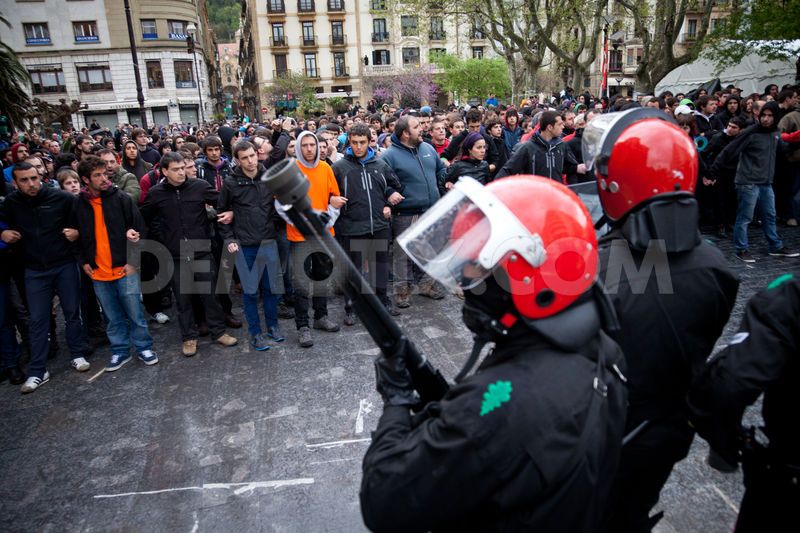
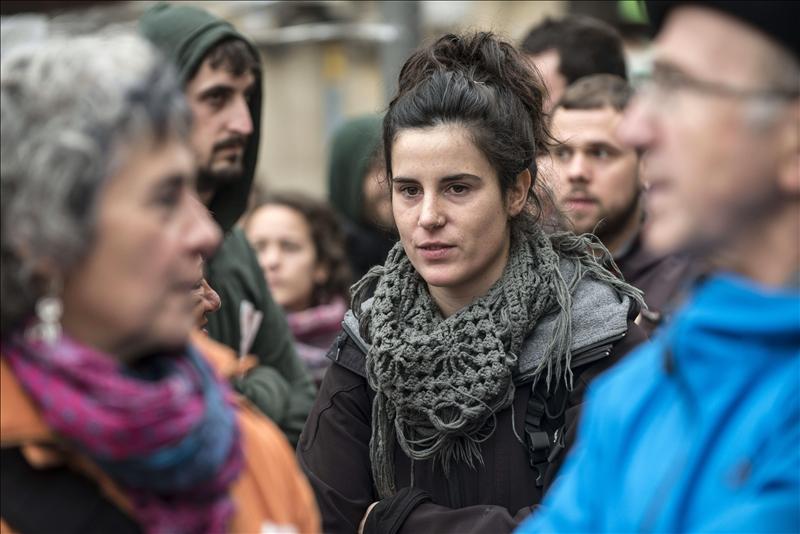
Xabat Moran, Bergoi Madernaz, Marina Sagastizabal, Aiala Zaldibar and Igarki Robles, five of the seven Basque youth sentenced to six years by the Audiencia Nacional (special Spanish Court) last Spring, have been freed this Wednesday.
Translation of press report NAIZ|from MADRID|2015/11/04|5 IRUZKINel juicio. (J. DANAE/ARGAZKI PRESS) and comment from https://www.facebook.com/dublinbasque/posts/1063431863690750
Xabat Moran, Bergoi Madernaz, Marina Sagastizabal, Igarki Robles and Aiala Zaldibar were sentenced to six years together with Ibon Esteban y Ainhoa Villaverde.
During the afternoon it emerged that the five would be freed, hours after the Supreme Court made held a public hearing in which the State Prosecutor left the possibility of reducing the sentences in the hands of the Tribunal, while the Defence asked for the accused to be cleared of all charges.
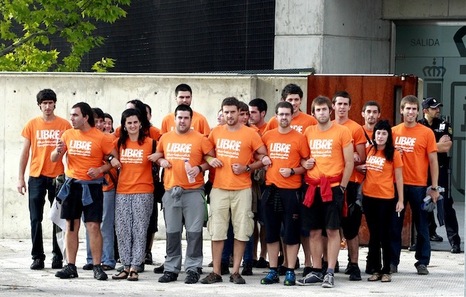
Most of the 28 youth accused of membership of SEGI outside the Court on the first day of their Madrid trial
The five have left prison and began the journey home.
The exact content of the Supreme Court’s decision is not yet known and whether this will affect the situation of Ibon Esteban and Ainhoa Villaverde is not yet known.
Twenty-eight youth were accused of membership of SEGI, the Basque Abertzale Left youth group and tried in the same trial, of which the Prosecutor withdrew charges against twelve. Later, others were discharged due to lack of evidence and in the end seven were sentenced to six years.
Villaverde, Moran, Sagastizabal and Madernaz were detained by the Ertzaintza (Basque police) before their sentences were announced, while Esteban, Robles y Zaldibar became fugitives, only to reappear in the “Human Wall” in Gastheiz/ Vitoria, where they were arrested.
End item.
Comment:
While friends and relatives will of course celebrate the decision, one commentator said: “The point for the Spanish state is to close down all legal political outlets in terms of campaigning around human, civil and political rights in the Basque Country. That leaves only the armed struggle, with which in recent decades ETA (Homeland and Freedom) has been clearly unsuccessful.”
A finding of guilt against these political activists needs to be seen in the context of the jailing of a number of political prisoners’ lawyers not so long ago and the currently ongoing trial of five political activists of Askapena, the organisation with responsibility for coordinating international solidarity work from and for the Basque Country.
For four years now ETA has been on the “permanent ceasefire” it announced at the time, yet Basque political activists continue to be charged with “assisting terrorism” or “glorifying” it.
“Human wall” in Navarra (Nafarroa), October 2013
Another point to bear in mind is that when the 28 youth, including those against whom the State later withdrew charge or the Court found “not guilty”, were originally arrested in October 2014, it was in a heavy military-style operation, they were taken from the Basque Country to Madrid, held incommunicado and a number were tortured. Then when bailed, they had to return to Madrid later to face trial, they and their supporters having to pay for travel and accommodation. The Spanish state does not have a record of paying compensation to those it has wrongfully accused or even imprisoned, not to speak of tortured, except on occasion under orders from the European Court of Human Justice in Strasbourg.
The “Human Wall” was a tactic developed and employed mostly by Basque Youth as a civil disobedience tactic, beginning in 2013 and lasting until 2014. Typically, the person wanted by the authorities appeared in the middle of a large crowd of supporters who linked arms. The police (in all those cases, the Ertzaintza) were obliged, in order to detain the fugitives, to spend a number of hours breaking up the “human wall” in order to obtain their objective and hand the fugitive over to the Guardia Civil, all the time being denounced by those forming part of the ‘wall’ and protesters standing by, the whole event being filmed and photographed, reaching an international audience. Variations on the “Wall” were practiced in Donosti/ San Sebastian, Gastheiz/ Vitoria, Pasaia, Navarra and Gernika. http://www.naiz.eus/eu/actualidad/noticia/20151104/queda-en-libertad-xabat-moran-uno-de-los-siete-condenados-por-la-an
The French Government deny rumours of a relaxation in their policy of dispersal. The Spanish Government confirms it is business as before for Basque political prisoners.
On 3rd September French diplomatic sources refuted interpretations in some media that it had changed its position with regard to Basque political prisoners. The media interpretations had been built upon a statement by the Abertzale (Basque Patriotic) Left party Sortu, that it had met on July 8th with the French Minister of Justice. The diplomatic sources downplayed the significance of the meeting and denied bringing Basque political prisoners closer to the Basque Country. Etxerat, the organisation for relatives and friends of the prisoners, confirmed that there had been no move to moderate the dispersal.
The day previous to the release of information from French diplomatic sources, on Wednesday, French Justice Minister Christiane Taubira had met with her Spanish counterpart, Rafael Catala. The following day, Taubira said her Government’s approach is to analyse requests for transfer based on the length of the sentence and relocation near their family. Meanwhile, the Spanish Minister of Justice and the Interior reiterated his Government’s position that any individual prisoners’ transfer to a jail in the Basque Country required the prisoners to renounce their organisation and to accept responsibility for the damage caused by their action.
The French approach contrasts with the requirements of the Spanish Government, although Catalá reiterated yesterday that both states were acting in a “coordinated” manner and that the French Government “has not moved its policy by one iota .”
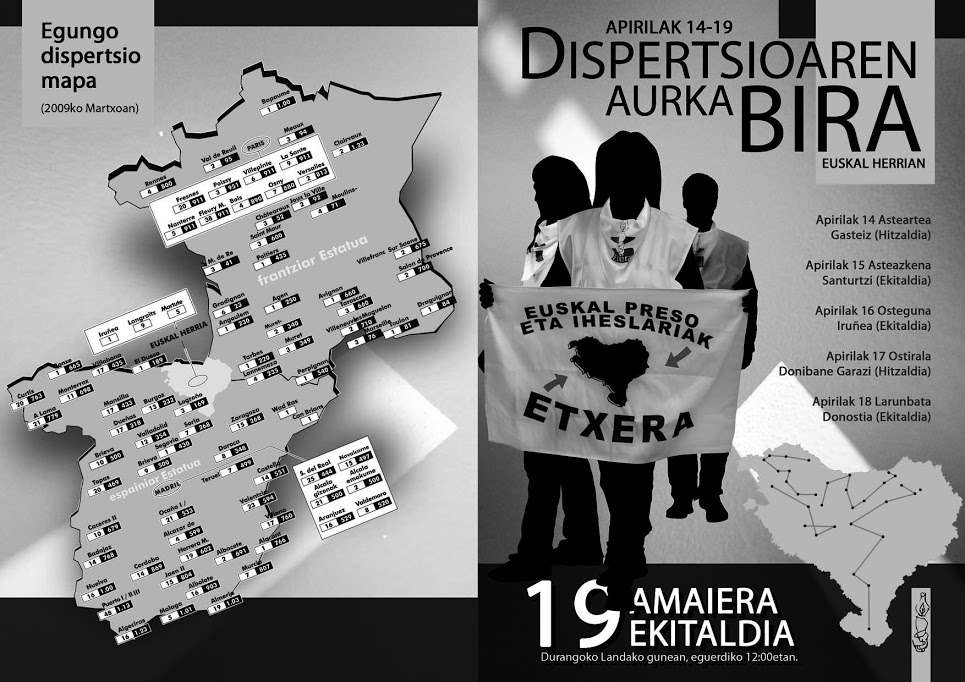
According to Etxerat on Thursday, of the nearly 100 Basque political prisoners in French prisons, only two are in Mont de Marsans prison (152 kilometers from the Basque city of Donosti), while six prisoners are in Lannemezen (231 kilometers). The rest are serving out their sentences at a greater distance from home, the vast majority at more than 600 kilometers. Although the support organisation viewed the French Minister’s statement positively, it was also at pains to disabuse people of any belief in a change in the French dispersal of prisoners and stated that any prisoners brought nearer were merely as a result of movement to which the relatives and friends have become accustomed, “bringing them close” before “bringing them far away again.”
Map of the dispersal of Basque political prisoners across both states and Etxerat flag in a poster calling for a protest and solidarity demonstration some years ago
The organisation of relatives and friends of Basque political prisoners stated that neither they nor any prisoners’ relatives participated in any meeting with the French Ministry of Justice – any meeting was with several members of Sortu only.
Spokespersons for the party of the Patriotic Left, Sortu, indicated that at their July meeting the French Ministry had been represented by Alain Christnach, Taubira’s Chief of Staff. Meanwhile the French, through diplomatic sources, asked observers not to “over-interpret” this meeting and indicated that participation in the meeting does not mean accepting Sortu’s proposals.
Another issue discussed by the Spanish and French Ministers was the possible transfer of prisoners under the law of mutual recognition of penal sentences in the EU, in force since January. This legislation provides the possibility for prisoners serving sentences in any EU Member state to be transferred to a Spanish prison; however, most Basque prisoners are unlikely to avail of this provision due to harder treatment in the Spanish prison system and the fact that dispersal throughout the state continues.
In a different aspect of the same legislation, the MEP of the Basque Nationalist Party (PNV), Izaskun Bilbao, asked the European Commission whether it will take Spain before the European Court of Justice for failure to take account of sentences served in French prisons by Basque political prisoners. This is because of the fact that the Spanish state often waits until a prisoner has served his sentence in France before extraditing him on a Spanish charge to face a further sentence in Spanish prisons.
Policy of dispersal of political prisoners — an abuse of human rights
There are many issues raised with regard to Basque political prisoners but the most universal one is the simple fact of dispersal. Relatives and friends face journeys of hundreds or even thousands of kilometers to visit their loved ones and the same distance back again. Many of these journeys are impossible without overnight stays. The expense drains financial resources while the long journeys themselves drain energy and, for elderly or unwell relatives, are an impossibility. An average of one serious accident a month occurs on these journeys for Basque political prisoners’ visitors and twelve have died in crashes over the years. Nor is it unknown for the relatives to be harassed by police on their journey or attacked by Spanish civilian fascists. As Etxerat has stated in its monthly reports and in a number of other statements: “The sentence was supposed to be on the prisoner but in actual fact was served on us as well, although we have been accused of nothing.”
It is a well-established principle of human rights that prisoners should, as far as possible, serve their sentences in a prison close to their families and relatives. This is in recognition of the rights of families as well as the desirability of easing the reintegration of prisoners as much as possible into society. The principle is covered in a number of United Nations policy paragraphs and also within the EU’s model rules for prisoners adopted in 2006 (https://wcd.coe.int/ViewDoc.jsp?id=955747).
Since both the French and Spanish states’ policy of dispersal appears to be in clear violation of the prisoners’ and relatives’ human rights and indeed of the EU’s own model rules for prisoners, some observers find it somewhat perplexing that the relatives’ organisation does not take a case against the states to the Court of Human Rights in Strasbourg. Granted, Strasbourg’s controversial decision on the Spanish State’s banning of the Herri Batasuna political party did not go in the Basques’ favour and the Court, albeit instructing the Spanish state to pay compensation to Basques for not investigating their claims of torture, continues to show a reluctance to find the Spanish State guilty of actual torture. But the dispersal of prisoners is an observable and undeniable fact and, furthermore, one which has been confirmed in public statements by Government ministers of both states.
End item
(Main source on the various statements: Deia, 4th September 2015)
INIGO CABACAS KILLED BY RUBBER BULLET FIRED BY BASQUE POLICE IN 2012 — STILL NO JUSTICE FOR FAMILY OR FRIENDS
Diarmuid Breatnach
Most Basques and especially supporters of their most popular football team, Athletic Bilbao1, were very happy in the early evening of 5th April 2012 .
Inigo Cabacas, photographed with the Basque hermitage Gaztalugatxe, on the Biscay coast, in the background.
Their team had beaten a football giant in the UEFA cup twice and another premier European team once. The fans were expecting Athletic to win or at least draw again that evening, in which case Athletic Bilbao were through to the second leg of the quarter-finals. They had no idea that the evening would end with a police riot squad firing rubber bullets into a festive crowd, causing the death of a young fan.
The high expectations of that evening in Bilbao were the result of a run of wins for the Athletic team. On March 8th 2012, Athletic Bilbao beat Manchester United 3-2 on their own ground, at Old Trafford.
One needs to know a few population statistics to understand what an achievement that was. Manchester United is a football team on the world stage, based in a city with a population of 2.55 million – that is not far from the population figure for the entire Basque Country. In addition, Manchester United’s players are drawn from around the world; Athletic recruits only Basque players from a total population of the Basque Country of less than 3 million.
A week after their win in the northern England city, on March 13th, Athletic faced Manchester United again, this time on the Basque team’s home ground, San Mames, in Bilbao. Manchester Utd. were beaten 2-1 and it seemed that the Basque lions2 were unstoppable.
These wins created a huge interest in the next game, which was with FC Schalke 04 on March 29th at the German team’s home ground. Schalke plays in the top tier of the German football league and have won many championships including one UEFA League. With around 130,000 members, Schalke 04 is the third-largest sports club in the world in terms of membership, behind their compatriot rival FC Bayern Munich and Portuguese club SL Benfica.
Athletic Bilbao is not a sports conglomerate – it is a football club which is owned by its 40,000 members (remember, this is a small country – that’s nearly 1.5% of the whole population! It’s also around 11% of the population of their home base, Bilbao). The management board is elected by the membership.
At Schalke 04’s home ground on March 29th, the Bilbaino team beat them 2-4. The interest was therefore at fever-pitch for Athletic’s return match with the German team at Athletic’s home ground, San Mames on 5th April. The result was a 2-2 draw but Athletic were ahead 6-4 on aggregate and the fans were delighted. Bilbao was, as they say, buzzing.
After matches, young fans especially go to different pubs around town. Inigo Cabacas and many others went to an Herriko Taberna (a “Peoples’ Tavern”, i.e. one managed by the Abertzale [Basque pro-Independence] Left) which is located in an small “square” with planters, connected by alley with Licenciado Poza street. This small “square” is off the María Díaz de Haro street near the stadium; it runs parallell with the San Mames street itself, an area of bars well-known as a destination for fans after a game at the stadium.
The Herriko is too small to accommodate all those who gathered there but that was no problem for the area outside took the overspill. Early in the evening a few people were seen scuffling there and the rest of the crowd around them told them to knock it off, this was a time for celebration, etc. The scuffle ended and the festivities continued.
Some time later, a van load of police arrived. These were the Ertzaintza, a Basque Police force of 7,500 created in 1982 which has had numerous clashes with Basque strike pickets and with the Abertzale (pro-Independence) Left. Supporters of the Abertzale Left and many others refer to the Ertzaintza as “zipayos” (i.e. “sepoys”, local soldiers recruited by colonial occupiers). The Ertzaintza are responsible to the Basque Autonomous Region Government (CAV), a semi-autonomous entity covering three of the four southern Basque provinces.
Basque Police, the Ertzaintza, face a youth Solidarity Wall built to defend Basque comrades the police have come to arrest in Donosti/San Sebastian some years ago.
Some of the youth perceive the arrival of the masked and helmeted police as a provocation and begin to throw bottles at the van.
The police officer in charge of those in the van asks for reinforcements and these are sent. The police emerge from their vans and begin to fire rubber bullets3 at the crowd at quite close range (the “square” is less than 45 metres at its furthest from the street) and everyone scatters except for a small group who are throwing bottles at the police but even they eventually dive for cover. People are sheltering in doorways, huddled up against the walls on each side of the “square”. Some are inside the pub wondering what is going on. A local shop-manager has raised the shutter over his doorway and people crowd in there. Some people are sheltering behind the wooden planters that are in a line down the centre of the narrow square.
After some time three young men walk towards the police with their hands in the air, asking them to stop firing rubber bullets; the police strike them with batons. Meanwhile it comes to the attention of some in the crowd nearby that a person is lying on the ground, apparently unconscious with blood coming from his ear and the rear of his head. People go to his aid and one of his friends recognises Inigo Cabacas. He gets his mobile phone and rushes towards the police telling them that someone has been seriously injured and to call an ambulance. A police officer tells him to drop the mobile. Inigo’s friend repeats his urgent request and the police officer tells him again to drop the mobile and hits him with a truncheon. The man drops his mobile and retreats from the police.
The police advance into the area and reach the injured man who has some people around him; a women is rendering first aid. A policeman tells her to move away. She tells him the man needs and ambulance and that she is applying pressure to stop the bleeding. He says he wants to see for himself and pulls at her arm but after awhile desists and goes away.
Eventually an ambulance arrives and takes Inigo Cabacas, still unconscious, to hospital, where he lies in a coma.
(video of the scene of the incident and interviews with friends and witnesses with English subtitles)
The news runs through a city, a shock in the midst of its celebrations and soon afterwards throughout the Basque Country. The first official reaction is given by the Interior Minister of the Basque Autonomous Regional Government, who declares to the press that the Ertzaintza acted properly and in line with their procedures, although he regrets the unfortunate death of they young man. He also repeats the first line of defence given by the Ertzaintza, that they were called to help someone injured in a fight and that the crowd was preventing the ambulance in attendance from rendering assistance to the injured.
When eye-witnesses give their version and the reporters of some newpapers begin to gather information, it becomes clear that the Minister could not possibly have investigated the incident in the time available. Furthermore, it emerges that no ambulance attended until after the incident with the police and that it appears that no call for one had been made earlier. Furthermore, according to the woman who attended to Inigo at the scene, the ambulance paramedic told her, when she complained at their delay in arriving, that the police had delayed their entrance. Under a storm of criticism from civil society and from the Abertzale Left party, EH Bildu, the Minister promises a full investigation.
Inigo Cabacas dies after three days without having recovered consciousness.
Some time later, a recording of the police communications on the night is made available by GARA, a pro-Independence Basque daily newspaper. The following becomes clear from the recording:
The Controller at Ertzaintza HQ calls a police van leader and directs him to attend the Herriko, saying that a fight has occurred there and that someone is injured.
The van leader reports that they have arrived and that some are throwing bottles at them, that they require reinforcements. No mention of ambulance.
The Controller confirms reinforcements are being sent.
Reinforcements arrive. One of the van leaders now reports that nothing is happening, everything is ok.
The Controller replies that he wants the police to go in and take possession of the area and make any arrests necessary. He emphasises that he wants to be understood clearly, that they are to “go into the Herriko with everything we have”, to take control of the area “and then everything will be ok.”
The van leader replies that the order is understood and soon shots are heard (the firing of rubber bullets).
The family employs a solicitor. A judge is appointed to carry out the investigation but is required to do so along with her other duties. Immediately, the police investigation ceases (according to the family’s lawyer, ithe file contains just three pages), using the excuse of the judicial investigation.
A number of legal applications are made, e.g. for all the police at the incident to be obliged to make a statement, for all police who fired a rubber bullet gun to be identified, for the Controller to be obliged to make a statement, but all are refused by a judge, giving a number of reasons4. Little is established over the following three years, except that threepolice voluntarily admit to having fired rubber bullets and the identity of the Controller on the evening becomes widely known. There is widespread outrage when the senior officer on duty the day of Inigo’s death is appointed Chief of the Ertzaintza.At a recent press conference, the Cabacas family’s lawyer, Jone Goirizelaia, announced that they had possibly identified the officer who had fired the fatal shot.
It emerged during the campaign by supporters of the Cabacas family that no recognised procedure was followed by the police with regard to the incident: debriefing statements were not taken from each of the police participants, guns were not examined to identify which had been fired, no inventory was taken of the number of rubber bullets fired. No attempt was made to contact witnesses after the event to gain a picture of what had occurred. Indeed, some witnesses who approached the police station to give statements were told to go away (see video link posted earlier in this article). It further appears that the Ertzaintza have been issued with no specific operational instructions with regard to the firing of rubber bullets.
According to some sources, the rubber bullets should only be fired at knee-height and at no less than 50 metres from the target. The “square” is, according to locals, less than 45 metres at its furthest from the street and therefore the police from the moment they began firing, were in serious breach of the minimum distance requirements. In addition, the Ertzaintza have frequently been seen aiming their rubber bullet guns at protesters’ faces from as little as a metre or two and also firing from the shoulder with the muzzle parallel to the ground, i.e. directed at head or chest-height of the target. Also, the rubber-coated steel balls bounce uncontrollably.
Rubber bullets against Palestinians
Rubber bullets are regularly fired by the Israeli army at Palestinians. A Palestinian source reports: “Israeli professor Michael Krausz and colleagues at the Rambam Medical Centre in Haifa analysed the medical records of 595 casualties admitted to hospital during the October 2000 protests by Palestinians living inside Israel (typically described as “Israeli Arabs” by the media). Of those, 152 were found to have been injured by rubber-coated metal bullets. Injuries were distributed randomly across their bodies but were most common on the patients’ arms and legs, and on their head, neck and face.
“The doctors said their findings dismissed the theory that “rubber bullets” were safe. Rubber-coated metal bullets with some of their rubber coating removed, revealing their hard steel core. Fired at speeds of what must be several hundred feet a second, these are munitions that cause enough damage that their manufacturers feel compelled to describe them as only ‘less lethal’.
“Writing in the Lancet, they said firing the bullets at civilians made it ‘impossible to avoid severe injuries to vulnerable body regions such as the head, neck and upper torso, leading to substantial mortality, morbidity and disability.’ They added: ‘We reported a substantial number of severe injuries and fatalities inflicted by use of rubber bullets ….. This type of ammunition should therefore not be considered a safe method of crowd control. “The study, ‘Blunt and penetrating injuries caused by rubber bullets during the Israeli-Arab conflict in October, 2000: a retrospective study’ (The Lancet, Volume 359, Issue 9320, Page 1795), also highlighted previous research which suggested that even plastic bullets may not be safe and may cause more severe head injuries.” (Sourced at http://electronicintifada.net/content/misleading-terminology-rubber-bullets/4000)
Rubber bullets against the Irish
Seventeen people were killed in the Six Counties (“Northern Ireland”) by rubber and plastic bullets fired by British soldiers (11) and colonial police (6) during the 30 Years War. A number of people were also blinded. http://cain.ulst.ac.uk/issues/violence/rubberplasticbullet.htm
It emerged in 2013 during a compensation case taken by a Derry man blinded in 1972 that the authorities knew that the missiles were potentially lethal even before they issued them. (http://www.theguardian.com/uk/2013/jun/11/mod-rubber-bullets-lethal-records) It is clear also from a wealth of evidence that the missiles were regularly fired by soldiers and police not only at close range but also aimed at chest or head. In addition, a deadly ‘game’ was played by some British soldiers. Knowing that rubber and plastic bullets were collected by children as mementoes and objects to sell to tourists, soldiers would fire some into an open area and wait for children to run forward to collect them, then see if they could hit the children with subsequent rounds.
Rubber bullets in the Spanish state
The Spanish state continues to allow its police forces to carry and to fire rubber-coated metal bullets, in particular at protesting Basques and Catalans (see video link at bottom below article). Recently, the EU expressed concern at Spanish police firing at migrants attempting to swim into the Spanish state from Morocco, an occasion when 11 of the migrants drowned. But no international protest criticises them for firing potentially lethal missiles at their own citizens. Police in the Spanish state enjoy impunity and none more so than in the Basque and Catalan countries as well as with regard to African migrants.This week, a motion was put to the Basque Parliament to ban the use of rubber bullets in the area under its control (CAV). Instead a proposal was accepted to “restrict” the use of the missiles to “situations of grave danger” to the police, and to “definitely seek a replacement” for them. The Spanish right-wing PP, the liberal Spanish unionist UPyD, along with the PNV (Basque Nationalists), currently in power, voted for it, along with the Basque version of the Spanish social-democrats, the PSE. The only party to vote against the amendment was EH Bildu, party of the Abertzale (pro-Independence) Left; they had proposed the original motion, seeking a total ban and the removal of the missiles.
Parent and friends of Inigo Cabacas confront spokesperson of the Basque Nationalist Party after attempt to ban rubber bullets fails
Among those in the public gallery at the discussion were the parents of Inigo Cabacas. Afterwards, in the corridor outside, they confronted the spokesperson of the PNV, Joseba Egibar. During the exchange, another PNV parliamentarian, Luke Uribe-Etxebarria, tried to prevent its filming by the Basque TV station ETB. That attempt will be the subject of a complaint to the President of the Parliament by EH Bildu; they view it as particularly serious since Uribe-Etxebarria is also on the management board of the TV station and the filming was taking place in areas open to the public.
“I’m never coming to this Parliament again …. I feel cheated,” said Manuel Cabacas, father of the deceased, speaking about the majority decision. “My son is dead …. I only wanted to ensure that it would never happen to anyone else ….”
On the third anniversary of the killing of Inigo “Pitu” Cabacas, among many commemorative vents in the Basque Country, 10 minutes’ silence was observed in the San Mames stadium. Alongside Inigo Cabacas; many are also remembering Aitor Zabaleta, fan of the Real Sociedad team, murdered in Madrid in 1998 by fascist ultras of Club Atletico Madrid. Many Basques around the world will be conscious of the three years that have passed since Inigo’s killing without anyone being even charged in connection with his death or any noticeable change, whether in Basque police behaviour, procedure or their use of rubber-coated steel projectiles. A change of political control of the Basque Regional Government from the social-democratice party of Patxi Lopez to the Basque Nationalist Party .(PNV) of Urkullu has had no effect.
It is true that for ordinary people, in capitalist society, the wheels of justice move very slowly; in this case it is hard to see that they are moving at all.
End.
NB:DUBLIN: A group of Basques plan to hold a commemorative event on Tuesday 28th April, on the day of a Basque derby, Bilbao Athletic v. Real Sociedad. They plan to hold a protest picket at the O’Connell Monument in Dublin’s O’Connell Street at 7pm for a short while and afterwards to go to watch the Basque derby (kick-off at 9pm) at the Living Room bar, Cathal Brugha St. Some Dublin-based Irish people have undertaken to support the Basques by participation in both events. Poster for event: https://www.facebook.com/photo.php?fbid=10153291310864390&set=gm.1624681737767253&type=1&theater
Short but shocking Guardian video of Catalan police using rubber bullets and the testimonies of victims who have lost an eye to the missiles:
1 Based in Bilbao, it is the most popular and most successful (two things that often go together) but not the only football team; there are also Real Sociedad, based in Donosti/San Sebastian and Osasuna, based in Iruña/ Pamplona.
2 A roaring lion is the emblem of the team, arising from the legend of St. Mames, to whom the local church is dedicated and which gives its name to the area, street and stadium. English-language football commentators persisted in calling the team “the Spanish lions” or “the Spanish cavaliers” (??!), in total ignorance, one hopes, of quite how insulting that would be perceived by the players and their fans. The Basque Country is not even politico-geographically Spain, it is divided between the Spanish and French states. And Bilbao Athletic is most certainly not, nor has it ever been, a Spanish team. When the Spanish King attends finals or semi-finals between Barcelona and Athletic in, yes, a Spanish football league, and the Spanish national anthem is played, the stadium fills with howls of derision, hoots and whistles from the supporters of both teams.
3 These are about the size of a tennis ball, perhaps a little smaller, of steel and coated in rubber.
4 E.g., the Controller could not be held responsible for the shooting by the police; individual police would have to be accused of firing the fatal shot if they were to be obliged to make a statement …
In the third week of the month of December two daring ambushes took place, one in Ireland and one in Spain. Both were carried out by national liberation organisations and both were very daring, aimed at extremely high-level military and state targets who were well-protected in cities controlled by the occupying state. The ambushes were one day on the calendar apart but 64 years separated them; the date of the Dublin one was December 19th 1919 and the the other took place on December 20th 1973 in Madrid.
BACKGROUND TO THE IRISH ASSASSINATION ATTEMPT
The target of the Irish ambush was Field Marshal John French. No-one resident in Ireland could rank higher in the British Empire; the British Queen and state’s representative in Ireland, French had been appointed Lord Lieutenant and Supreme Commander of the British Army in Ireland in 1918. Of course, it was not the first time that the Irish resistance had set its sights so high – in 1882 in Phoenix Park in Dublin, the Republican group The Invincibles had assassinated the Chief Secretary for Ireland, at that time the Queen’s representative, along with Thomas Burke, the Permanent Undersecretary and the Queen’s most senior civil servant in Ireland.
Field Marshal John French had previously held the positions of Commander-in-Chief of the British Home Forces and, at the start of the First World War, Commander-in-Chief of the British Expeditionary Force in France. Under General Maxwell, he oversaw the suppression of the 1916 Rising and subsequent executions. Had the British government imposed conscription in Ireland in 1918, as threatened, he would have been in charge of seeing it through and had in fact pressed for the measure to be introduced. In the event, the opposition to conscription in Ireland was so widescale, including from the Irish Catholic Church, usually so loyal to the British, that an insurrection was feared if they went ahead with it.
John French was from a Norman-English family settled in Wexford in the fourteenth century with large property in Roscommon and, though his family had gone to live in England in the eighteenth century and he himself was born in Kent, French always regarded himself as “Irish”. John’s father had been a Royal Navy Commander and John himself pursued a military career, first in the Royal Navy and later in the Army. His record in the Navy was below expectations, as was his initial Army career. However, he made his name on a number of military engagements in the Second Boer War and Second Morocco Crisis and with the help of some allies who had political and military clout, was appointed Chief of the Imperial Military Staff in 1912. He resigned his position over the Curragh ‘Mutiny’ incident in 1914 but was given command of the British Expeditionary Force in France and in Belgium during the First World War. He was later forced to resign over his handling of this command, particularly in regard to his difficult relations with high-level French officers, but was given command of the defence of Britain.
In May 1918, French was appointed Lord Lieutenant and Supreme Commander of the British Army in Ireland. The political situation in Ireland was unstable as the republican (or “advanced nationalist”) opposition was gaining ground against the old nationalist opposition. The latter had been embarrassed by the British failure to implement Home Rule, which was on the statute books but not enacted, while the former varied from those demanding Home Rule immediately to those who wanted complete national independence. The formerly Irish monarchist party Sinn Féin had been coopted by the Irish Republican Brotherhood after the 1916 Rising and it became a republican/nationalist hegemonising political force while at the same time being a coalition of different political viewpoints. Outside of this, Labour also had some sway, particularly in some areas and was also opposed to the Nationalist party; Sinn Féin and Labour Councillors cooperated with one another on many occasions. In the British General Elections of December 1918, in Ireland, the newly-changed Sinn Féin nearly wiped the Nationalist party off the electoral map and decided to set up their own parliament, or Dáil, in Ireland and not to attend the British Parliament in Westminster.
The Royal Irish Constabulary, the armed colonial police force in Ireland since 1822, was the subject of a boycott campaign and physical attacks on its members.
The Irish Republican Army, reorganised after the Rising, was in training in many areas. Some of its foremost soldiers and leaders, men like Dan Breen, Sean Treacey, Sean Hogan and Séamus Robinson were of the opinion that only through a liberation war could Ireland be freed from British rule; they were therefore eager for that war to start.
There was no indication that this was the dominant opinion among the elected representatives of Sinn Féin, the TDs (Teachtaí Dála) and, indeed, many were of the opinion that the British could be pressured into a negotiated settlement, without the need for any armed struggle. One of the latter was Arthur Griffiths himself, founder of the party.
On the same day as the setting up of the Dáil and its declaration of independence from Britain, 21st January 1919, Breen, Treacey, Hogan, Robinson and five other less famous IRA volunteers ambushed a Royal Irish Constabulary escort for a consignment of gelignite in Tipperary, during which they shot dead both of the police escort and took their weapons as well as the explosives. The shooting dead of the RIC in the Soloheadbeg Ambush was a calculated act and Dan Breen later wrote:
“ …we took the action deliberately, having thought over the matter and talked it over between us. Treacy had stated to me that the only way of starting a war was to kill someone, and we wanted to start a war, so we intended to kill some of the police whom we looked upon as the foremost and most important branch of the enemy forces … The only regret that we had following the ambush was that there were only two policemen in it, instead of the six we had expected.”
Nevertheless, they had begun the War of Independence, which was to last three years.
A number of times during 1919, the armed struggle advocates in the IRA carried out military operations through which they sought to provoke a response from the British that would launch the national liberation war and sweep the Dáil into going on a war footing too. Tens of RIC were killed along with a few British soldiers. The British responded by imposing martial law on particular areas and carrying out raids and arrests. The IRA however were moving towards a full war footing with the British and, in many areas, were already there.
As 1919 moved on the British outlawed Irish political and cultural organisations: the Dáil, Sinn Féin, Conradh na Gaeilge and other nationalist organisations and publications had been banned, along with the Freeman’s Journal and some other weeklies. In addition, cattle fairs and other gatherings had been forbidden and all car licences apart from those for lorries had to be applied for to the police, a requirement which had occasioned a chauffeurs’ strike. However, neither Sinn Féin nor the Dáil considered itself at war yet.
The planned ambush on Ashtown Road on 19th December 1921 was intended to change that irrevocably for the target was none other than Field Marshal John French, Lord Lieutenant and Supreme Commander of the British Army in Ireland.
THE ASHTOWN ROAD AMBUSH
According to some sources, the IRA had set out to kill French on 12 separate occasions but each time something had intervened. One of those occasions was on November 11th 1919. Expecting him to pass in minutes on Grattan Bridge on his way to a banquet at Trinity College, Seán Hogan had pulled and thrown away the pins on two grenades and was holding down the timers with his fingers. French did not show and Hogan had to walk all the way to a safe house with his fingers holding down the timers on the grenades in his pockets. Luckily they had spare pins in the house.
Lord John French and General Macready, probably 1920
In December, French had gone down to his family country estate at Frenchpark, Co. Roscommon, to host a reception there and was expected back in a couple of days. His movements were being monitored and the day he would set off by train for Dublin was reported to the ambush squad. He was expected to get out at Ashtown train station, the last one before the Broadstone terminus, and go from there with military escort to the Lord Lieutenant’s Residence (nowadays the US Ambassador’s) in Phoenix Park. An IRA party of 11, including Breen, Treacey, Robinson and Hogan set out to ambush the convoy and assassinate Lord Lieutenant French. The ambush party was already in place at Kelly’s pub (now called the Halfway House) on the Ashdown road as ‘chance customers’ when word reached them that French had alighted from the train. A Royal Irish Constabulary officer who had accosted them earlier had been knocked unconscious and dumped to one side. The information received was that French would be in the second car in the convoy.
A hay cart had been placed half-way across the road. As the first car and outrider passed it, the IRA Volunteers pushed the cart the rest of the way and engaged the second car with grenades, Mills bombs, rifles and pistols. However, French was in the first car and got away unhurt and the soldiers in the third car in the convoy arrived and began firing with machine guns and rifles at the Volunteers, along with the soldiers in the second car returning fire.
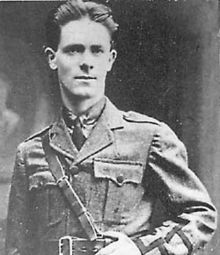
Martin Savage, a Volunteer who had met Breen and Hogan by chance the previous day and begged to be allowed to participate, was fatally wounded and his body had to be left near the scene. Several RIC and British soldiers were wounded with perhaps a fatality and the convoy withdrew towards Phoenix Park. The Volunteers knew that reinforcements would be sent soon so they dispersed to safe houses. Breen had been shot in the leg but managed to get away by bicycle.
Volunteer Martin Savage
The next morning, the Irish Independent published an article which described the attackers as “assassins” and included other such terms as “criminal folly”, “outrage” and “murder.” Taking these terms as an insult to their dead comrade, on Sunday, at 9pm, between twenty and thirty Volunteers under Peadar Clancy entered the offices of the Independent and began to dismantle and smash the machinery.
REACTION OF THE DÁIL AND SOME OTHER REPUBLICANS
Many of the Dáil TDs were shocked by the assassination attempt and among Irish Republicans who severely criticised the IRA within the movement was Charlotte Despard.
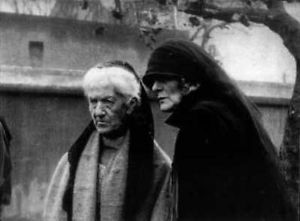
Charlotte Despard and Maud Gonne at prisoners’ solidarity protest outside Mountjoy Jail
This might have been expected since she was sister to Field Marshal French, except that Charlotte had developed Republican sympathies and had settled in Dublin after the War. She had a background in social welfare and socialist political activity in Britain, including active membership in the Social Democratic Federation, the Independent Labour Party and the sufragette Women’s Social and Political Union and was a fierce critic of her brother. During the Irish War of Independence, Charlotte Despard, together with Maud Gonne, formed the Women’s Prisoners’ Defence League which organised support for republican prisoners. Later, as a member of Cumann na mBan, she was to oppose the Anglo-Irish Treaty and to be imprisoned by the Free State Government during the Civil War.
REACTION OF THE BRITISH
The British military and police, under orders from French, of course replied to the assassination attempt with intensified repression and harassment of the civilian population in an attempt to drive a wedge between them and the IRA. The ambush and attempt on the life of the Lord Lieutenant and Supreme Commander of the British Army in Ireland no doubt helped Churchill, Secretary of War and Minister of the Air, push his idea of special counter-insurgency forces to act as auxillary police in Ireland, i.e. forces of state terrorism, who were to become known as the “Black and Tans” (abbreviated to “Tans”). Recruitment began that very month in London and the first recruits were in the field in January 1920. In July, the Auxillary Division of the RIC was set up, a much more efficient terror force composed almost entirely of British ex-soldiers of former NCO and officer rank.
With the “Tans” and the “Auxies” in the field, along with the crumbling RIC and the British Army, a full guerrilla war raged in many counties and cities of Ireland from 1920 to 1921, with torture and shooting or imprisonment of prisoners by the British, along with the burning of non-combatants’ homes and cooperatives. The IRA were carrying out ambushes and assassinations of RIC and their special auxiliary forces, British soldiers and Irish spies. Ironically 1921 was the year the Dáil finally declared war on the British and also the year of the Truce, negotiations and the controversial signing of the Treaty by the Dáil’s delegation in London, in which they accepted Dominion status for a partitioned Ireland.
Dominic Behan wrote a song about the ambush. It has been sung in different versions and with some verses added and omitted. Dominic Behan’s version is on here on 30.23 mins: Wolfhound did their own version here which, on the whole, I prefer, though a little too drawn out and finishing on a climax (which traditional songs never do, anywhere in the world, apparently) .
BACKGROUND TO THE MADRID AMBUSH
Like John French, Don Luis Carrero Blanco, 1st Duke of Carrero Blanco, Spanish Grandee, was a military career man. He entered the Spanish naval academy in 1918, at the age of 14 and participated in the colonial Rif War of 1924-1926. When General Franco and the other Generals led the military uprising against the Popular Front Government in 1936, Carrero Blanco was behind the Republican line and took refuge in the Mexican and later French embassies before working his way across the front to reach the fascist side in June 1937 and serving in their navy.
Admiral Luis Blanco Carerro, Gen. Franco’s chosen successor
After the victory of the fascist forces in April 1939 and the instalation of General Franco as Dictator, Carerro Blanco became one of his closest collaborators; he was made vice-admiral (1963) and admiral (1966); he held the post of Vice-President of the state council from 1967 to 1973 and commanded the Navy. On 8th June 1973 Franco named Carerro Blanco Prime Minister of Spain.
Carrero Blanco was very much a supporter of the Spanish military-fascist dictatorship of Franco, a monarchist (Franco had himself installed Juan Carlos de Borbón, the present monarch, as King of Spain) and close to the secretive Opus Dei organisation of Catholic technocrats. Opus Dei, although in favour of authoritarian control of society, was opposed to the fascist Falange and favoured liberalisation of some laws and the penetration of foreign capital, particularly from the US and Europe, to which the Falange were opposed.
It is said that Carrero also opposed the state entering into World War II on the Axis side, for which the Falange were pushing. In the event, neither the Spanish state nor Portugal, both under fascist dictatorships, entered the War and as a result were the only two European fascist regimes which were not overthrown by invasion of one or various of the Allied forces or by popular resistance around the end of the War.
In the 1970s the Spanish ruling class was under pressure to relax its fascist grip and bring in the trappings of capitalist democracy: legalised opposition parties, legalised trade unions, a “free” press, etc. But Spain was ruled by a coalition of various interests, including the fascist Falange, the military caste, Spanish aristocracy, arriviste capitalists, Catholic Church hierarchy …. And they faced not only demands for democracy but also for socialism, including from the rank-and-file of the Communist Party of Spain and of the social-democratic party, the PSOE. Other groups specific to regions or nations within the Spanish state also had demands for democracy and socialism. The Basque Nationalist Party (PNV) and ETA had been raising demands for regional autonomy or independence and a similar desire was evident in Catalonia.
But most of the Spanish ruling class feared the breakup of the Spanish state and also feared socialism. Many opposed even social-democracy, from those who feared being held to account for their crimes against humanity during the Civil War to those afraid of a moral ‘loosening’ and loss of social control by the Church. But they were also increasingly aware that the military-fascist lid could not be kept on the pot forever – the pressure was building up and something would have to give. However, as Franco went into his old age and illness the Spanish ruling class also feared what would happen after his death. He had been such a central figure of authority, his face even on coinage and stamps, and a unifying force either through fear or loyalty. Although Carrero Blanco was not favourable towards the Falange they trusted him to keep the state going essentially the way it was and so Franco nominating the Admiral as his successor calmed a lot of fears.
ENTER ETA
Euskadi Ta Askatasuna, ETA, had been formed in the Basque Country in 1959 from socialist and Basque patriotic youth. A youth section of the Basque Nationalist Party, tired of the timidity and lack of action of the parent organisation, had been part of its forming and had accepted the socialist orientation of others graduating from the group EKIN. The young ETA organisation was subjected to the repression usual in the Spanish state after the Civil War and particularly harsh wherever the breakup of the State was threatened – and this was particularly so in the Basque Country. ETA’s supporters were watched and arrests and torture were a constant danger.
The ETA symbol: the axe for armed resistance and the snake for wisdom (“bietan jarrai” = both always/ continuously)
In the late 1960s some ETA members began to carry arms. On 7th June 1968, ETA member Txabi Etxebarrieta faced a routine road check by the Guardia Civil. Txabi was armed and determined not to be arrested and tortured — he shot a Guardia Civil member dead and fled on foot; he was chased and himself shot dead. The next ETA armed action that year was however a planned operation. Chief of secret police Melitón Manzanas had a long record of torture inflicted on detainees and of hunting Jews escaping Occupied Europe over the French border and returning them to the Nazis. ETA killed him and from then on ETA was on a guerilla war footing.
In the summer of 1973, a group of Basques pretending to be sculptors rented a flat in Madrid to carry out Operación Ogro (Operation Ogre). Over five months they dug a tunnel under the street outside and filled it with 80 kgs of explosives which had been stolen from a government depot.
On December 20th, 1973, Carrero Blanco was being driven from attending mass to his home in Madrid and accompanied by his bodyguard. As it travelled down the road, a bomb exploded in a tunnel under it with such force that the vehicle was blown right over the roofs of nearby buildings and landed on a balcony on the other side. Both driver and bodyguard were killed immediately and Carrero Blanco died shortly after. One epitaph of macabre humour was that Carerro Blanco had lived a very complete life: he had been born on earth, had lived at sea and died in the air.
In an interview explaining their rationale for Operación Ogro, the ETA operation group said:
“The execution in itself had an order and some clear objectives. From the beginning of 1951 Carrero Blanco practically occupied the government headquarters in the regime. Carrero Blanco symbolized better than anyone else the figure of “pure Francoism” and without totally linking himself to any of the Francoist tendencies, he covertly attempted to push Opus Dei into power. A man without scruples conscientiously mounted his own State within the State: he created a network of informers within the Ministries, in the Army, in the Falange, and also in Opus Dei. His police managed to put themselves into all the Francoist apparatus. Thus he made himself the key element of the system and a fundamental piece of the oligarchy’s political game. On the other hand, he came to be irreplaceable for his experience and capacity to manoeuvre and because nobody managed as he did to maintain the internal equilibrium of Francoism.”
—Julen Agirre, Operation Ogro: The Execution of Admiral Luis Carrero Blanco (1975)
There was little criticism of the assassination from the Spanish opposition in exile or underground in the Spanish state. The Spanish ruling class of course condemned the action but it was thrown into disarray. In the confusion, the “modernising” and “liberalising” elements were able to take the initiative.
Left to right: General Franco and his protege, King Juan Carlos de Borbón (who in June 2014 abdicated in favour of his son, Felipe)
Less than three months after Carrero Blanco’s assassination his successor, the new prime minister Carlos Arias Navarro, in his first speech to the Cortes (Parliament) on 12 February 1974, promised liberalizing reforms including the right to form political associations. He faced opposition from hardliners within the regime but the transition had begun (how much of a “transition” is another issue).
The assassination of Carrero Blanco was an action taken by ETA perhaps primarily for the Basque struggle for independence and socialism but it had a deep effect across the whole Spanish state. It hastened the “Transition” and turned out to be a Christmas present to the Spanish social democratic and reformist opposition. Later years were to witness how badly they were to repay the Basque resistance.
Diarmuid Breatnach (translation of material from Naiz and writing of article)
Julia Lanas Zamakola, 94 years of age, went shopping as usual in Gernika on Monday 15th December 2014 but ended up in hospital after the Ertzaintza, the Basque Police, raided the market to arrest a Basque political activist.
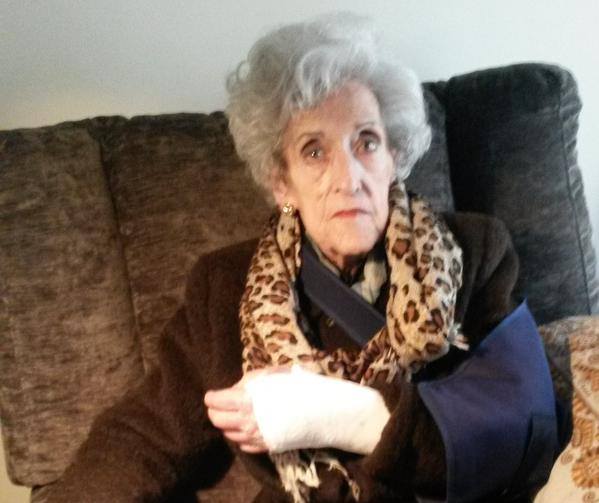
Julia Lanas, 94 years of age, struck and knocked to the ground by Basque police in raid to arrest a Basque activist in Gernika
Jone Amezaga, a young female activist of the Basque pro-Independence Left movement, had been sentenced to 18 months’ jail for allegedly hanging a banner which the State Prosecutor said “glorified terrorism”. Jone denied doing it and said the Ertzaintza, the Basque police, had framed her and declined to present herself to the authorities.
Many things are considered by the Spanish state to be “glorifying terrorism”, including putting up photographs of Basque political prisoners in a public place, bar, café or social centre.
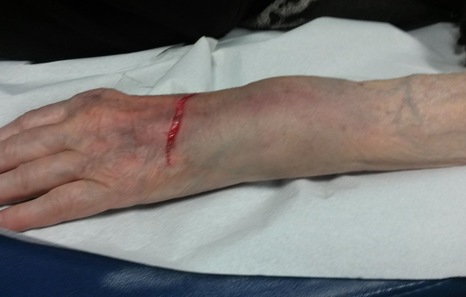
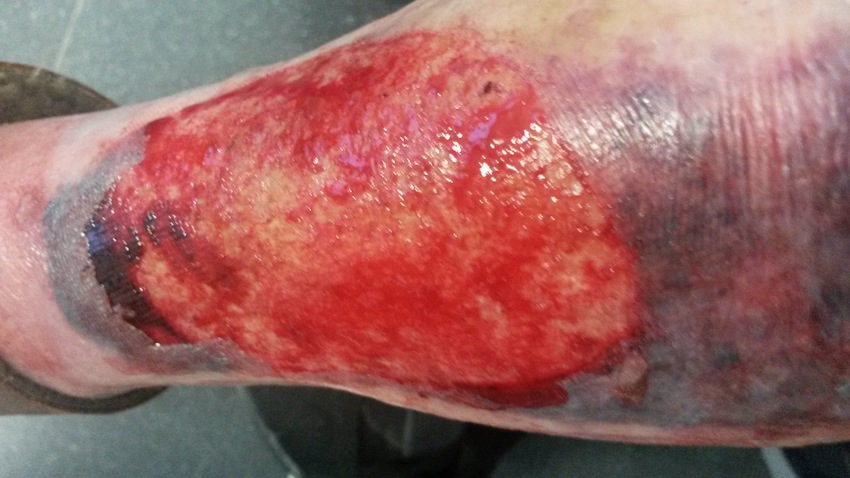
Elderly pensioner Julia Lanas said she had been pushed to the ground by the police during the raid. “My wrist was broken. It was an invasion, of terror. …. The Ertzaintza does not belong to the Basque (Autonomous) Government, they are nothing less than managers for imperial Spain.” “It reminded me of the Civil War,” she said and went on to say that she had survived the dictatorship (Franco’s) and the war and had relatives imprisoned and tortured.
Julia Lanas was given first aid by people in the crowd and then taken by ambulance to the Gernika hospital but they had to leave there because it was full. “There was a lot of solidarity” said Julia Lanas, referring to the crowd in support of Jone Amezaga and to the help she herself received. The 94 year-old woman was treated by the paramedics who then took her home and her son took her to hospital in Bilbao the following day. “The injury was from a telescopic baton,” she said.
94-year-old Basque woman Julia Lanas’ broken wrist and arm injury after police raid in GernikaJulia Lanas’ injured leg after Basque police raid in Gernika
After a sustained tussle between uniformed and plain-clothes police and Jone Amezgaga, the Basque activist was taken prisoner by the Ertzaintza, some of whom used their batons on the crowd. Having secured their prisoner, the uniformed Ertzaintza then retreated backwards through the market, followed by the hostile crowd, until they gained the entrance, near to their vehicles and there stopped and faced their opposition.
Jone and her supporters had been expecting the police raid. In 2008 the Abertzale Left, the mass collective of organisations of the Basque pro-Independence Left, announced that they would henceforth use only peaceful methods in pursuit of their goal of self-determination, and the armed organization ETA subsequently declared their “permanent ceasefire”. The Spanish state’s response was to continue its repression of the movement.
The youth section of the Abertzale Left sought to find an appropriate method of resistance and developed the “human wall”. Some of the youth movement activists who had been sentenced by the State, instead of surrendering to the authorities or going “on the run”, presented themselves in public places, surrounded by supporters. The police – always the Basque police except in Nafarroa but sometimes backed by the Guardia Civil – then were obliged to spend a long time pulling people out of the “human wall” before reaching their quarry.
The first of these “human wall” resistance acts was at Donostia/ San Sebastian in April in 2013 when 500 mostly youth surrounded the six youths convicted of membership of SEGI, the Abertzale Left youth organization. SEGI is classed as a “terrorist organization” by the Spanish state and by the EU despite not a single conviction, even in Spanish courts, of an act of violence by the youth organization. The Donosti human wall was followed by another a month later on the bridge at the port of Ondarroa, when hundreds sat, arms linked, between Urtza Alkorta and the Ertzaintza. In October 2013 in Iruňa/ Pamplona, the Policía Nacional of the Spanish state had to dismantle another human wall of resistance to get at Luis Goňi, another youth convicted of SEGI membership. Last year there were two, one in Loiola (Azpeitia) for five youths and the one in Gernika. These “human walls” have now been constructed in three of the four southern Basque provinces (see video links below): Bizkaia, Gipuzkoa, Nafarroa – only Álava has yet to have one. Jone Amezaga’s arrest was the fifth occasion of the use of the “human wall” in the Basque Country and the second in the province of Bizkaia.
Amezaga, who refutes the charge and the police “evidence’ of “glorification of terrorism”, has been refused permission to remain at liberty while her appeal is being considered. Also it has been the custom of the Spanish state, in cases where the sentence is less than two years, for the convicted not to be taken to jail. The state declined to apply this custom in Amezaga’s case.
Jone Amezaga surrounded by supporters in Gernika prior to police raid
That Monday morning of the 15th December in Gernika, the town containing the ancient meeting place of the Basque chiefs and victim of the infamous bombing by Franco’s German bombers during the Civil War, the stalls were set out for the weekly market as usual. However, a number of events of a political nature also took place and the town was draped in the orange colours of LIBRE (“free” in Spanish), an organization created in 2013 to expose and resist Spanish state repression. Around noon, Jone made her appearance, no doubt marked by undercover police and soon afterwards the police raid took place.
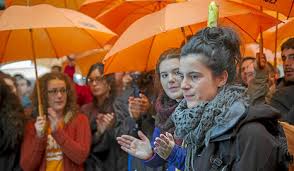
Jone Amezaga surrounded by supporters with orange (LIBRE’s colour) umbrellas prior to police raid in Gernika
It was plain-clothed police who led the assault, a number of individuals, some seen in the video dressed in black-and-white tops and one in a green top. There is no evidence of their identifying themselves by display of their police cards, for example, but it is clear that Jone’s supporters are in no doubt as to who they are. The Ertzaintza, masked and helmeted, in their red-and-black uniforms soon join the fray and eventually Jone is taken into custody. The crowd chants partly in Castillian and partly in Basque: “Jone libre!” (Free Jone!); “Guard dogs of the System!” “Hired killers!” “Abuse of power!”
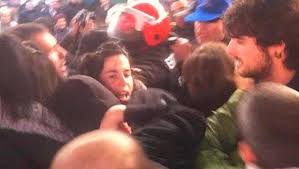
Jone Amezaga’s face in the midst of the battle as supporters try to block the police arrest, 15 Dec 2014
While awaiting her appeal hearing, a wait which can take many months, Jone may be kept in any of the many prisons across the Spanish state (or across the French state, for those arrested there) throughout which political prisoners, most of which are Basque, are dispersed. She may also be transferred without warning to yet another jail. All this places an enormous strain on the visiting relatives and friends of such individuals — a financial, organizational, emotional and physical strain. And of course there are those who through infirmity are unable for journeys of thousands of kilometres. A number of serious traffic accidents occur on those journeys every year and to date twelve Basque prisoners’ relatives and friends thave lost their lives in those accidents..
Reflexiones en leer el Editorial GARA Marzo 25 2012 (reflexiones republicadas por mi en enero del 2015 sin me parece necesitar cambiar nada). Como se atreve uno que ni siquiera vive en Euskal Herria, a pronunciar sobre las tácticas y estrategias de procesos revolucionarios en ese país? Pues me atrevo por saber algo de la historia del país, de su circunstancias actuales y por querer mucho que los sacrificios de su pueblo tengan éxito. Y me atrevo por saber algo de la historia del capitalismo y del colonialismo y de la clase obrera en general. Y me atrevo por que la logica no se confina a un país ni a otro, si no a todo el mundo.
En Marzo 2012 se anticipaba una huelga general en Euskal Herria como parte de huelga general en el Estado Español. En GARA apareció un artículo que me parecía importante. Y yo, un “scotus” con algo de sangre de los “vascones”, comenté sobre ello, pero con poquísimas avenidas de publicar en Euskal Herria.
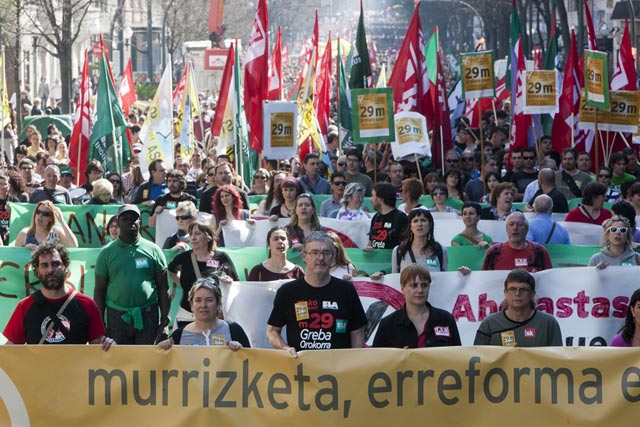
La mayoría sindical vasca, los sindicatos ELA y LAB con algunos otros en manifestación de huelga en el 29 Marzo 2012.
Gara, Marzo 25 2012:
“……….. Así las cosas, lo peor que le puede ocurrir a una huelga general es que se convierta en un objetivo en sí misma, incluso en un ritual periódico, y no en una herramienta de transformación efectiva de la actual situación. Por ello, resulta importante que el 29M sea un día de fuerte respuesta en Euskal Herria, pero es imprescindible que sea sobre todo el primer día de la construcción de una poderosa alternativa de cambio real.” (GARA)
De acuerdo
“El atasco mental que evidencia la izquierda a nivel planetario demuestra que no es fácil articularla, pero sería exigible al menos que la huelga general del jueves dé paso a una agenda sobre la que empezar a construir otro futuro. O, más bien, a dos agendas: una inmediata, de resistencia frente a la sucesión de ataques que se viene produciendo y que sirva al menos para paliar los daños irreversibles que provoca,“ (GARA)
De acuerdo
“y otra a medio-largo plazo, que tenga como horizonte el logro de la soberanía vasca, único antídoto efectivo dado que de Madrid y París no se puede esperar otra cosa que no sea ruina, desigualdad, especulación y desmovilización.” (GARA)
¿QUE? ¿Que una nación, en liberarse de la dominación de un estado, solamente con eso se garantiza el escape de los efectos del capitalismo? ¡Des de luego que no, señores! Solamente el socialismo nos puede liberar de tal efectos y aún es posible que tampoco con eso se libre si nos quedamos adentro de un mundo mayoritariamente capitalista.
“Una sociedad con derechos y deberes
“Estas dos agendas deberían ir en paralelo y alimentarse mutuamente. Argumentar que nada se puede hacer hasta que Euskal Herria sea soberana y renunciar a las capacidades de las que ya dispone en todos los ámbitos sería como caminar mirando solo al horizonte para acabar tropezando en la primera piedra. Del mismo modo, apuntar con la mirada solo al suelo y perder la referencia de objetivos finales también lleva a perder el rumbo…” (GARA)
De acuerdo.
Pero ahora quiero hablar del “agenda a medio-largo plazo”, lo cual, si somos socialistas o comunistas revolucionarios (y tratando de Euskal Herria), debe de tratar de hacer preparaciones para tomar el poder para la clase obrera en esa nación. De eso no habla GARA nada.
Cuando se desea una ruptura revolucionaria con la lucha de la clase obrera de un pueblo, se suele pensar en la huelga general de un día solamente como un etapa, lo mismo que lo a dicho el editorial de GARA. Da carácter popular y obrera a la resistencia, moviliza a las masas, la clase y el pueblo siente su poder, se fortalecen los militantes y el pueblo en lucha contra la represión, se aprenden lecciones de organizar, de movilizar, de lucha….
¿Pero que sería la segunda etapa? Pues de movilizar todavía mas gente y de llegar a un enfrentamiento mas fuerte con el estado y con la clase capitalista… ¿Por qué? Por que el objetivo es tomar el poder – un acto revolucionario, no una transición a algún nuevo capitalismo nacional.
Dependiendo de los acontecimientos, en esa situación ante-revolucionaria, se podría ver algunos de una variedad de tácticas, incluso a todos. Huelgas generales de tres días, de semana o más largo todavía, manifestaciones, desobediencia civil, barricadas, kale borroka, responder a la represión con devolver la agresión en contra de los agentes de la misma. Y en cuando se pueda, pasar a la insurrección.
Bueno, el liderazgo de la IA ya ha dicho que no se puede tener lucha armada. Entonces será difícil imaginar como se va a pasar a la insurrección, pero no difícil imaginar como las fuerzas de la represión van a responder y, si esos sean los únicos que tengan las armas, como va a terminar el asunto.
Pero armada la insurrección o no, está claro que ninguno de los dos estados, el francés ni el español, van a sentarse en sus manos y hacer nada. Claro que no – lo van a tratar de impedir, a luchar con dientes y garras.
¿Sería la clase obrera y el pueblo Vasco capaz de resistir la represión militar de esos estados, con sus soldados y policía, sus tanques, sus aviones? En lucha directa, el uno en contra del otro, no, que va. Y los estados serían capaces de bombardear las ciudades para aplastar la revolución – lo verían mejor eso que perder una zona de sus estados y de explotación, y además con la reconstrucción después, algunos capitalistas van a tener un bonanza.
Pues, si es así, el movimiento revolucionario tiene que mantenerse preparado a que llega un tiempo en que el estado no sería capaz de usar las fuerzas armadas. Solamente hay dos situaciones en que eso sucedería: invasión de otro país al estado o guerra civil. Si las situaciones dentro de los estados español y francés fueran tan graves que no eran capaces de enviar sus fuerzas armadas a aplastar la gente en Euskal Herria, entonces si que sería capaz de tener éxito la revolución Vasca, con ellos haciendo frente a las fuerzas represivas locales que no se rindieron.
La lógica de este planteamiento es no solamente que hay que hacer preparaciones para ir mas allá de la huelga general a la insurrección, si no que se debe de ayudar al proceso de resistencia en el resto de los estados, en todos lugares pero especialmente en el centro del Estado Español – en Castilla!









 rebelbreeze