Far from the declared aim to “close down this kip” in an online call for a rally against Peadar Brown’s pub in Dublin, not a single far-Right supporter of the call made even a token appearance at the appointed hour Saturday afternoon.
This was no huge surprise; these elements tend mostly to attack small groups of people or torch empty building and surely quickly came to the conclusion that neither of those things would they be facing in the case of Peadar Browne’s. No indeed. A full building of many people.
The on-line event poster for the far-Right rally was followed by a number of posts and comments vilifying the pub’s management for allegedly banning a customer over his racist remarks but went further to attack the pub’s history and general political ambience too.
Recently-elected fascist member of Dublin City Council Gavin Pepper had himself videoed outside the pub on Friday night after it was closed, issuing veiled threats.
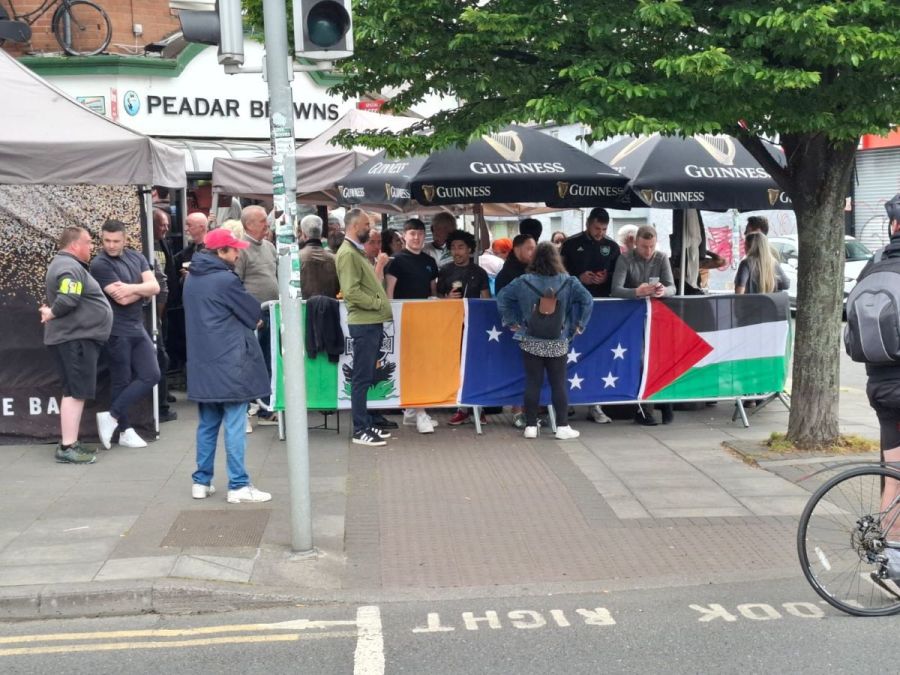
Closer view of section of the crowd last Saturday outside the front of the pub. (Photo: R.Breeze)
Peadar Browne’s pub has built up a reputation over years as one of socialist Irish Republican outlook, with both external appearance in flags and mural along with the interior decorations unashamedly declaring the broad sympathies of both owners and clientele.
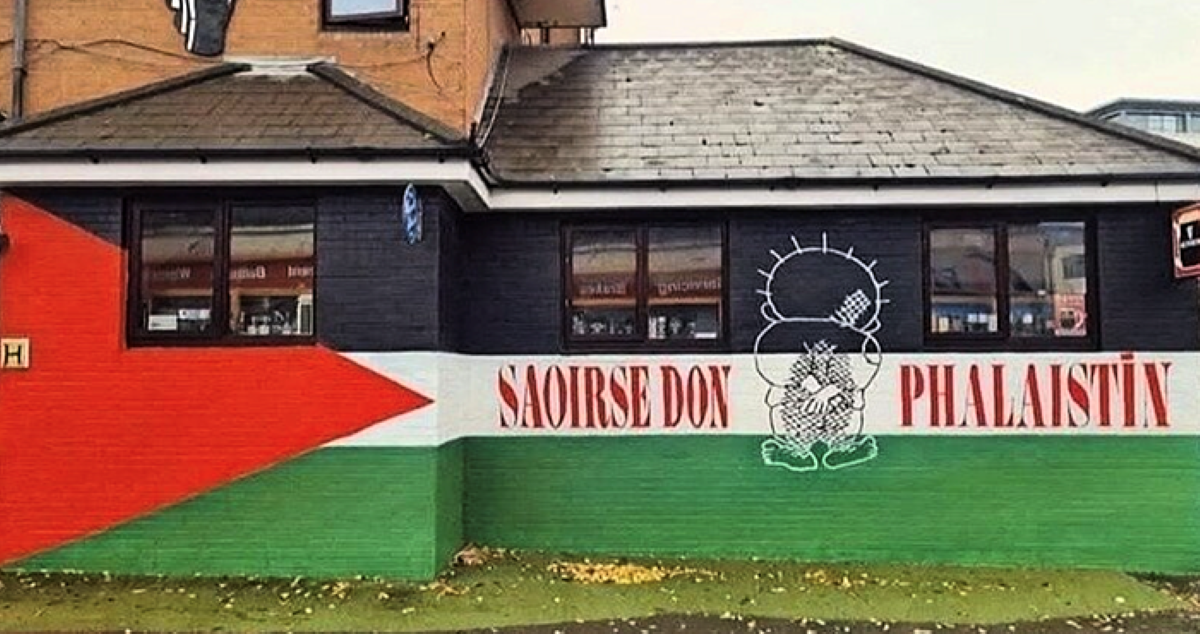
The venue has seen a number of events in keeping with that perspective held there, ranging from concerts to fund-raising events of various kinds, in addition to public and private meetings. The large mural of a Palestinian flag on the pub’s side also declares their internationalist sympathies.
Section of last Saturday’s crowd outside Peadar Brown’s, this one at the side of the pub. (Photo: R.Breeze)
For some time Saturday before the 3pm appointed for the rally, defenders were arriving, including Irish Republicans and Irish socialists of various organisations and none, Palestine supporters Irish and other, along with activists more specifically antifascist.
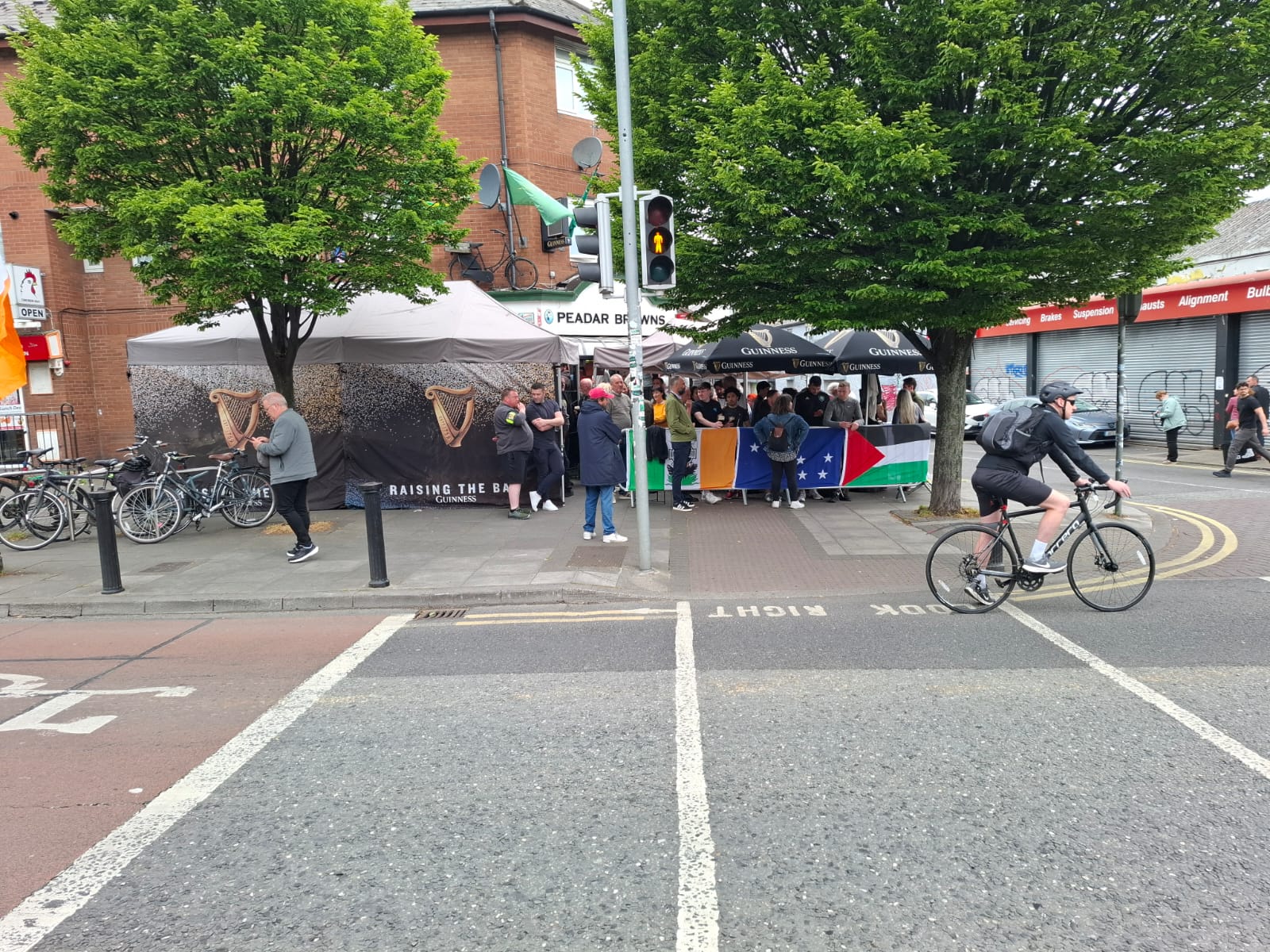
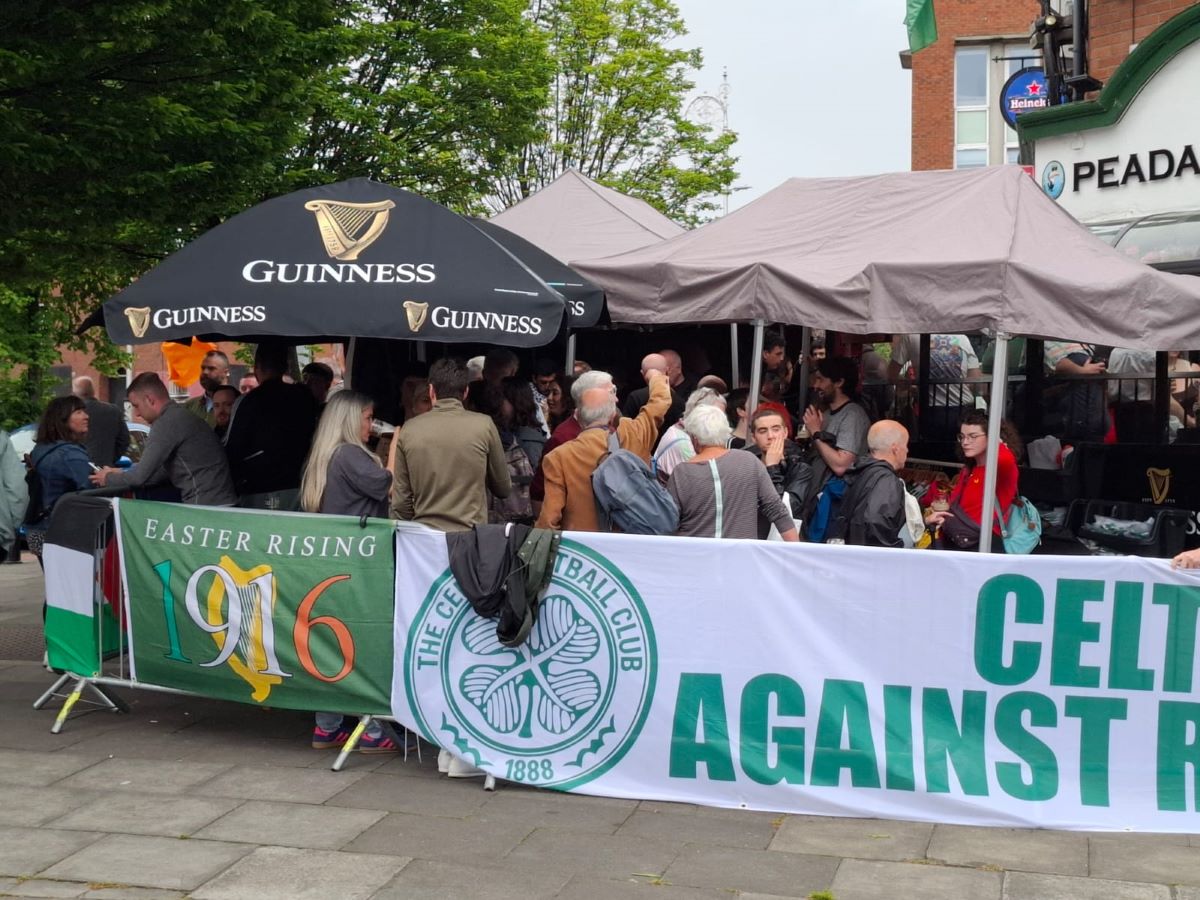
Soon both the inside and external areas of the pub were full, with extra banners and flags lining the external area facing the road. Occasionally the driver of a passing vehicle tooted its horn in solidarity, sometimes with extended clenched fist and encouraging roar from the passenger’s side.
Section of last Saturday’s crowd outside Peadar Brown’s, viewed from the middle of the road outside. (Photo: R.Breeze)
Near to the rally’s appointed hour it began to rain and continued for a while but the pub’s external area had been canopied over so few had to move – unless it were to use the toilet or refresh their glasses.
Conversations slowed on occasion as people checked their timepieces, looked outwards, shrugged and resumed talking. By 4pm most of those who hadn’t left decided they’d be staying, already in their evening weekend socialising venue, or at least for the first stage of the evening.
Section of last Saturday’s crowd outside Peadar Brown’s, this one at the top side of the pub. (Photo: R.Breeze)
In fairness, the absence of any uniformed Gardaí on the ground to protect the far-Right had been an indication that they were not expected to appear.
In Conclusion, drawing up The Balance:
The pub had one of its fullest Saturday afternoons and boosted its reputation among many who knew of it only vaguely, while online calls for a boycott were taken by many as recommendations for “a pub with no racists”. Fascists and racists in turn suffered a hit to their morale.
Some of the defenders on Saturday at the lower side with the mural behind them. (Photo: R.Breeze)
Socialists, communists, Irish Republicans and independent antifascists stood together in defence of a pub with an Irish Republican socialist ambience and strong pro-Palestine presence against a threat from far-Right and fascist elements.
Liberals, social democrats and former Republicans, usually prominent on anti-racist marches? Not so much.
NB: Edited by Rebel Breeze for formatting purposes
(Reading time: 6 mins.)
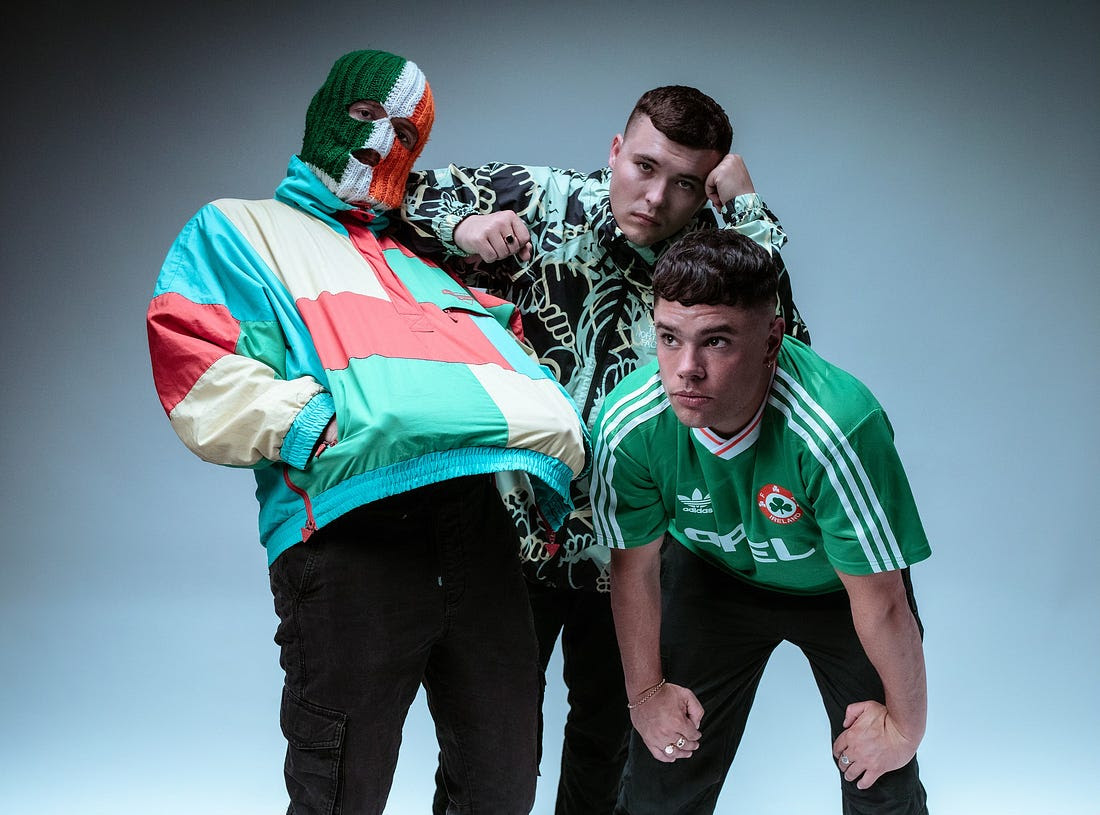
Kneecap, the Belfast Irish language rap group, have found themselves at the centre of what is an artificially contrived furore dreamt up by people with little sense of real moral outrage.
The basics of the story are well known. They finished off their act at the Coachella event projecting pro-Palestinian statements. Given the band’s history and well-known politics, it could hardly have come as a surprise. Perhaps it was more that the fans welcomed it that upset some.
They were denounced by the non-entity known as Sharon Osbourne, a reality star famous for being the wife of Black Sabbath lead singer Ozzy Osbourne and also the mother of another reality star, her daughter Kelly Osbourne.
Kelly to her credit did carve out a brief musical career on the back of her reality tv exposure.
Sharon as part of the wider Zionist attempt to silence all those who criticise the genocide called for their visas to be cancelled, which in effect happened following the decision by their promoter and sponsor to drop them.
She also called for them to be more like Bono. Kneecap responded with a humorously devastating comeback that they would rather be Rangers fans than emulate Bono.
Bono still has some credibility in certain parts, mainly where they haven’t a clue about the man’s actual politics and obviously amongst the clueless, witless, gutless glitterati like Sharon Osbourne. But what would it mean to be like Bono?
Is he actually some sort of reasonable counterweight to Kneecap?
Well, first of all, in relation to Palestine, Bono is a Zionist, so even before the genocide began, he, unlike them, was already on the wrong side of history. Not for the first time, mind you. Bono has a habit of cropping up where he is not wanted like an ugly cold sore (my apologies to the virus).
He has, as Harry Browne, the author of The Frontman: Bono in the name of power, pointed out dedicated a lifetime to the service of imperialism and was rewarded with a Presidential Medal of Freedom from Genocide Joe.[1]
I am sure it will go well on his mantle piece alongside his KBE (Knight Commander of the Most Excellent Order of the British Empire), for which he was fulsome in his praise of Her Majesty’s Ambassador, as he put it, and grinned like a cheshire cat during the ceremony.[2]
The claims made by Blair and others about Bono’s achievements were exaggerated, of course. But he is, if nothing, an equal opportunities imperialist and will get around to doing his bit for the others.
The idea that Kneecap would prostrate themselves before the British king is laughable and they wouldn’t be the first artists to reject one, were the Brits ever to mistakenly consider them for it.
The late black poet Benjamin Zephaniah was offered the lesser award of OBE (Order of the British Empire) by the same Tony Blair. He turned it down stating:
I get angry when I hear that word “empire”; it reminds me of slavery, it reminds of thousands of years of brutality, it reminds me of how my foremothers were raped and my forefathers brutalised…
Benjamin Zephaniah OBE – no way Mr Blair, no way Mrs Queen. I am profoundly anti-empire…
If they want to give me one of these empire things, why can’t they give me one for my work in animal rights? Why can’t they give me one for my struggle against racism? What about giving me one for all the letters I write to innocent people in prisons who have been framed? I may just consider accepting some kind of award for my services on behalf of the millions of people who have stood up against the war in Iraq. It’s such hard work – much harder than writing poems.[3]
He also referred to his brother’s death in police custody and to Lizzie II as Mrs Queen, not Her Majesty. A display of dignity.
He pointed out that those who accept such awards, the Queen’s Shilling, though he didn’t use that archaic military expression for those who enlist in the British armed forces to put down uppity types in the colonies, always sell out.
However, calling Bono a sell-out, presumes he was ever anything other than a fan of empire. He tied his mast to the pro-British politics of the Irish chattering classes in the 1980s.
His song Sunday Bloody Sunday was always introduced with the line This is not a rebel song, lest someone think Bono actually had something interesting to say.
The song is quite vacuous though clear in saying he “won’t join the battle cry,” i.e. denounce those who had massacred 14 people on the streets of Derry. The British army is not mentioned once in the song.
You wouldn’t know who had done what, but you know not to point the finger “Cause tonight we can be as one”. John Lennon on the other hand, shortly after the massacre did not hold back.
Is there any one among you Dare to blame it on the kids? Not a soldier boy was bleeding When they nailed the coffin lids![4]
Bono couldn’t bring himself to condemn the British army for a televised massacre, so it comes as no surprise that he has little to say about a live-streamed genocide.
He hobknobbed with neoliberals such as Jeffrey Sachs, various presidents of the World Bank, promoted pharmaceutical companies in Africa and of course was on the side of Bush in the Iraq War, at least in practice and helped whitewash the reputations of many of those involved.
He hedged his bets a bit on Iraq, not wanting to seem too hawkish, saying the war was justified but the US should get UN backing for it. He then went on to endorse Clinton and Blair time and again. Jim Kerr from the Scottish band Simple Minds put it succinctly at the time.
How can Bono, having graced concert stages for over two decades, draped in the white flag of peace and screaming ‘No More War’ [sic] at the top of his lungs contemplate praising and back slapping Tony Blair? … I can’t believe that anyone could fail to identify that no matter what gesture Blair may make towards African debt relief, his slippery hands are currently dripping in the fresh warm blood of Iraqi men, women and children.[5]
Bono of course, could and did, and wined and dined with such hawks as Senator McCain. There were no depths to which he would not plummet, which brings us to Palestine.
Shortly after October 7th he endorsed the Zionist genocide by changing the lyrics of his song about Martin Luther King, Pride (In the name of love)[6]to “Early morning, Oct 7, the sun is rising in the desert sky… Stars of David, they took your life but they could not take your pride.”[7]
As part of the introduction to the reworked song he state “our prayers have always been for peace and for non-violence… But our hearts and our anger, you know where that’s pointed.” Not at the Zionist occupiers was the answer. Roger Waters lambasted him for it.[8]
Not only that, he was criticised by Irish singer Mary Coughlan for his links to Israeli companies.[9] He did not fly out to Gaza as he had done in Ukraine, nor did he have much to say.
When he eventually did mention Gaza, he was always careful to lay the blame on Hamas for starting it all, ignoring history since the Nakba in 1948.
A good example of that is his piece in The Atlantic after receiving his Medal of Freedom from Genocide Joe.[10] An exercise in saying nothing, whilst attempting to sound profound, something Ireland’s most famous poisonous dwarf never pulls off.
Kneecap on the other hand have been clear from the word go about their support for the Palestinian cause. It didn’t take a genocide for them to take note. They have consistently been on the side of the oppressed, in this case the Palestinians, against the oppressor the Zionists.
So, Sharon Osbourne should probably stick to what she knows best, which is precious little.
As for Bono, as Harry Browne points out, perhaps nothing sums him up quite so succinctly as a piece of graffiti in Dublin that appeared following the scandal when they moved one of their companies to the Netherlands for tax purposes, “Bono is a poxbottle”.
We need more like Kneecap who stand with the oppressed, and a lot less of Bono and the likes who can’t condemn the powerful ever.
At best you can expect some “We are all guilty type” of fudge, which was the preferred slogan of the Irish trade union bureaucracy when the British or their proxies in the UVF or UDA ever did anything, coming as no surprise that they have also done next to nothing on Palestine other than issue the occasional banal statements.
I fully expect them to turn up with Bono somewhere to chastise Kneecap.
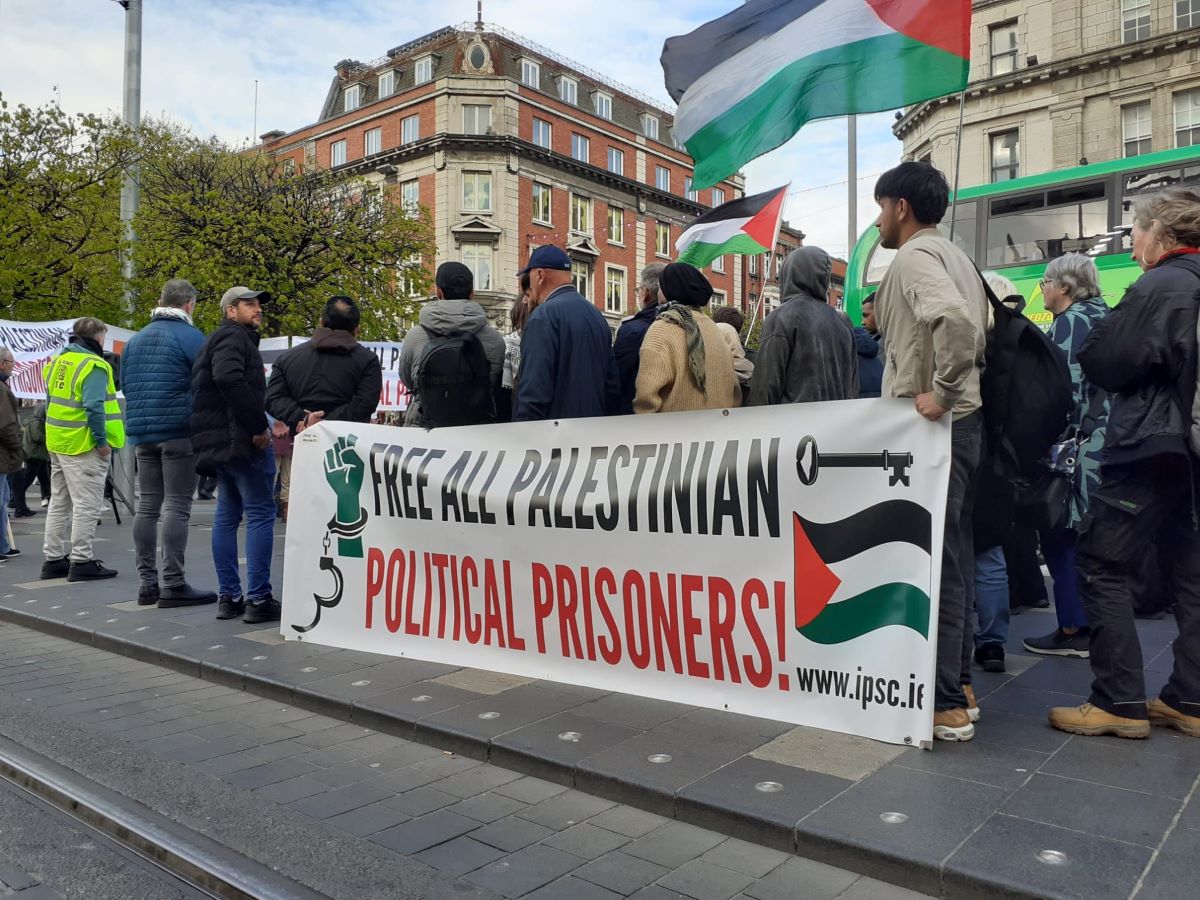
April 17th is the annual Palestinian political Prisoners’ Day and it was marked in O’Connell Street, the main street of Dublin’s city centre, by an event with speeches, banners and chants organised by the Ireland Palestine Solidarity Campaign.
Palestine national flags fluttered about the crowd being addressed by a number of speakers with occasional toots of solidarity from passing traffic – a common occurrence at Palestine solidarity events in most of Ireland.
View of eastward of section of the crowd at the event (Photo sourced: IPSC)
Dáithí Doolan was one of the speakers and though saying some progressive things about solidarity with Palestine and the terrible situation in which the occupiers have them, soon revealed the political poverty and lack of solidarity with resistance of his Sinn Féin party.
Doolan reminded his audience of when there were political prisoners in Ireland, as though this was no longer the case, presumably because the prisoners now are not of his party. Nor did he mention the current attempts to extradite Irish Republicans to British administrations.
The SF speaker went on to extol the South African process, perhaps not caring about the betrayal of the struggle and sacrifice of the masses there, the deepening grip of imperialism on the rich natural resources, the corruption and repression of the ANC regime and the massacre at Marikana.1
If Doolan thought about it he must have hoped that his audience did not remember that the South African process had a twin, the Palestinian one at Oslo which sabotaged the Palestinian struggle and brought into being the corrupt Palestinian Authority2, the Israeli proxy in the West Bank.
Sinn Féin has achieved a somewhat similar position in the Six Counties colony and has been working hard to reach a corresponding role in the Irish state. And why not, when it endorses the “Two State solution” giving the Palestinians 20% of their land under Zionist eyes and guns.
The very least, Doolan said, that the Irish Government could do to help the Palestinians, would be to enact the Occupied Territories Bill but he proposed nothing further, not even the ban on US military flights through Shannon Airport or on Israeli arms flights through Irish airspace.
Darragh Adelaide from the People Before Profit party spoke too about Palestine and solidarity but also about the Palestine refugees that have had to sleep in tents on Irish streets and the attacks on them both by the authorities and by fascists and other racists.
Palestinian prisoner conditions
A woman gave a detailed list of statistics relating to Palestinian political prisoners but also went through the tortures and terrible conditions in which they are kept. She concluded reminding her audience that each prisoner is a human being, a parent, a child, a sibling and not a number.
View of the crowd southward from behind a speaker (Photo sourced: IPSC)
In a year and a half, more than 15,800 Palestinians have been arrested, including 500 women, 1200 children, and thousands of detainees who were placed under arbitrary administrative detention. 64 Palestinians have died in prison since October 2024, including a child.3
The prison administration’s special units have carried out violent raids on prisoners’ cells, administering severe beatings, torture, and ill-treatment.4
Prisoners have suffered power and water cuts, and all of their belongings—including clothes, electrical appliances, and hygiene items—have been confiscated.5
They have been placed under complete isolation, family visits have been completely banned, and the International Committee of the Red Cross has been prevented from visiting them inside prisons.
Additionally, a policy of starvation has been implemented against thousands of prisoners, who are being provided with only two extremely poor-quality and quantity meals a day.6
The MC of the event led chants in which he called out Palestinian political prisoners! and the audience responded with Free them all! Similarly with Free the children prisoners — Free them all! and Free the women prisoners! — Free them all!
Symbolising the Palestinian political prisoners (Photo sourced: IPSC)
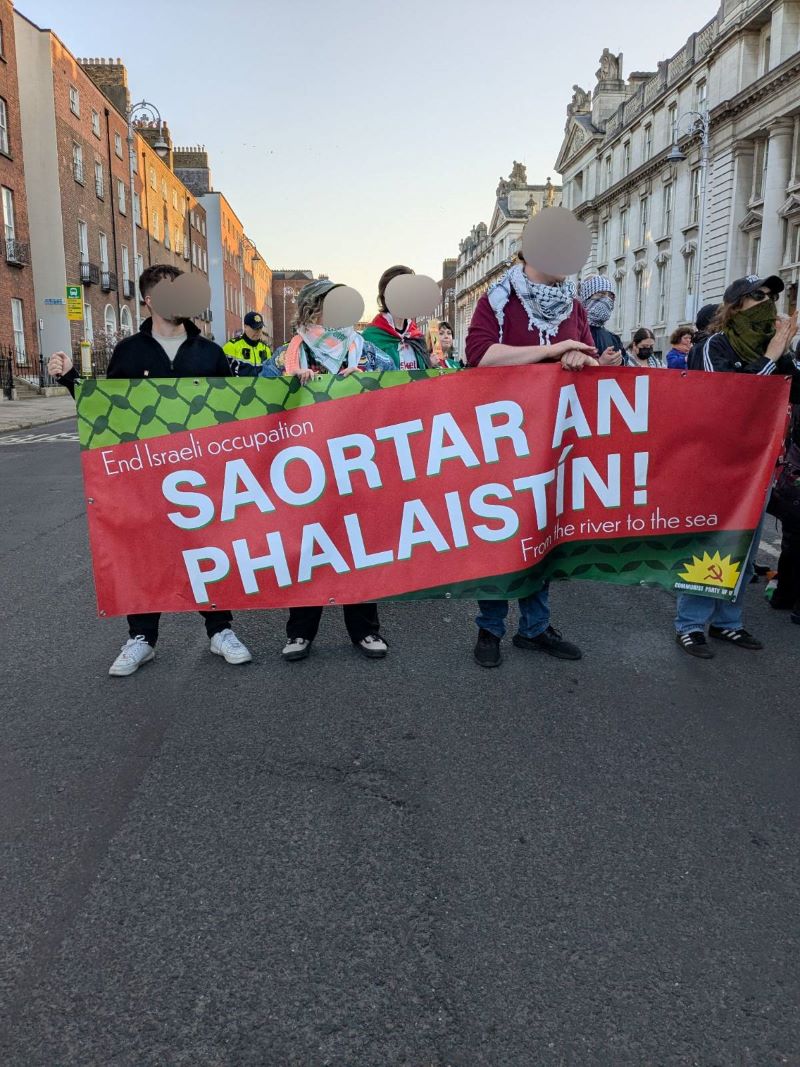
He also referred to the woman arrested outside the Irish Embassy in Berlin for speaking in Irish and, in defiance, led the audience in a chant in Irish expressing solidarity with the Palestinian people: Saoirse don Phalaistín! (Freedom for Palestine!)7
What was notable in its total absence from all the speeches was any call to step beyond the marches and similar measures which have been supported by thousands in Ireland over more than 18 months but which have not succeeded in moving the Government even to enforcing its formal neutrality.
This is replicated in most solidarity events across the state, leaving those few who take action to increase greater pressure on the ruling class to face the repression of the Irish State, as with 23 men and women in three different events over a four-day period in Dublin recently.8
Political prisoners from the armed resistance
The Joe McDonnell Ballad9 would have been most appropriately performed at this event, in particular the chorus line: You dare to call me a terrorist, while you look down your guns … But the IPSC would hardly endorse the singing of that song nor wish to be associated with it in public.
There were two large prisoners’ solidarity banners of the IPSC at this event but it is remarkable how rarely one sees them on the IPSC’s national marches. The problem with the prisoners for liberal organisations is that some of them, at least, have been armed fighters of the Resistance.
This, combined with ignorance perhaps, accounts for the comparatively low numbers at this event. However, it has to be said that known revolutionary organisations were also visibly absent.
View south-westwards with the iconic GPO (General Post Office) building in the background. (Photo sourced: IPSC)
Doolan’s party was a problem for liberals when many of the political prisoners here had been armed Irish Republican resistance fighters; it’s still a problem for them today — but also for Doolan and his party now that the current Irish political prisoners are no longer associated with them.
If solidarity does not embrace resistance then it’s charity, not solidarity. And if resistance is to be embraced then it should be so for all its expressions, artistic, cultural, mass mobilisations, strikes, boycotts … and armed. Including solidarity with those who, because of resistance, end up in jails.
Free them all!
End.
NOTES
1Culminating on 16th August 2012 (while Mandela still lived) the police of the ANC Government carried out a massacre of over 40 striking miners over a period of three days. The massacre was to suppress a strike in a platinum mine of the Canadian Lonmin company, repressing also a breakaway union from theANC-allied National Union of Mineworkers. The massacre is widely believed to have been organised by Cyril Ramaphosa, then a millionaire and vice-President of the ANC Government and recent leader of the NUM, now President of South Africa.
2Which also beats and incarcerates Palestinians resisting the Occupation (exact figures are difficult to obtain) and has murdered some.
7This slogan has now become well known in Ireland in voice but also in writing, appearing on flags, banners and placards. It represents a partial success for those of us who have tried to insert a measure of the Irish language into Palestine solidarity, in the belief that it is important for the Irish language to be present in progressive movements.
9By Brian Warfield of the Wolfe Tones band in honour of Volunteer Joe McDonnell of the Provisional IRA who died on hunger strike in 1981; the song also names other hunger strike martyrs of the Provisionals Vols. Bobby Sands, Francis Hughes, McCreesh but adds Vol. Patsy O’Hara of the Irish National Liberation Army. In total, seven of the Provisionals and three of INLA died on hunger strike in 1981.
Hundreds gathered Wednesday night near the rear entrance of Leinster House, home of the parliament of the Irish state, in a demonstration organised by Mothers Against Genocide to protest the police attacks on demonstrators of the previous week.
Background
Over four days the previous week the Gardaí, police force of the Irish State, had attacked demonstrators in a number of different locations in Dublin. On Monday the MAGS group at the front entrance of Leinster House was attacked as they neared the end of their overnight vigil there.
The women were calling for Government action to match the will of the Irish population by preventing military supplies sent to Israel through Irish airspace and airports, to end processing Israeli bonds through Irish banks and to institute sanctions against the Zionist Occupation.
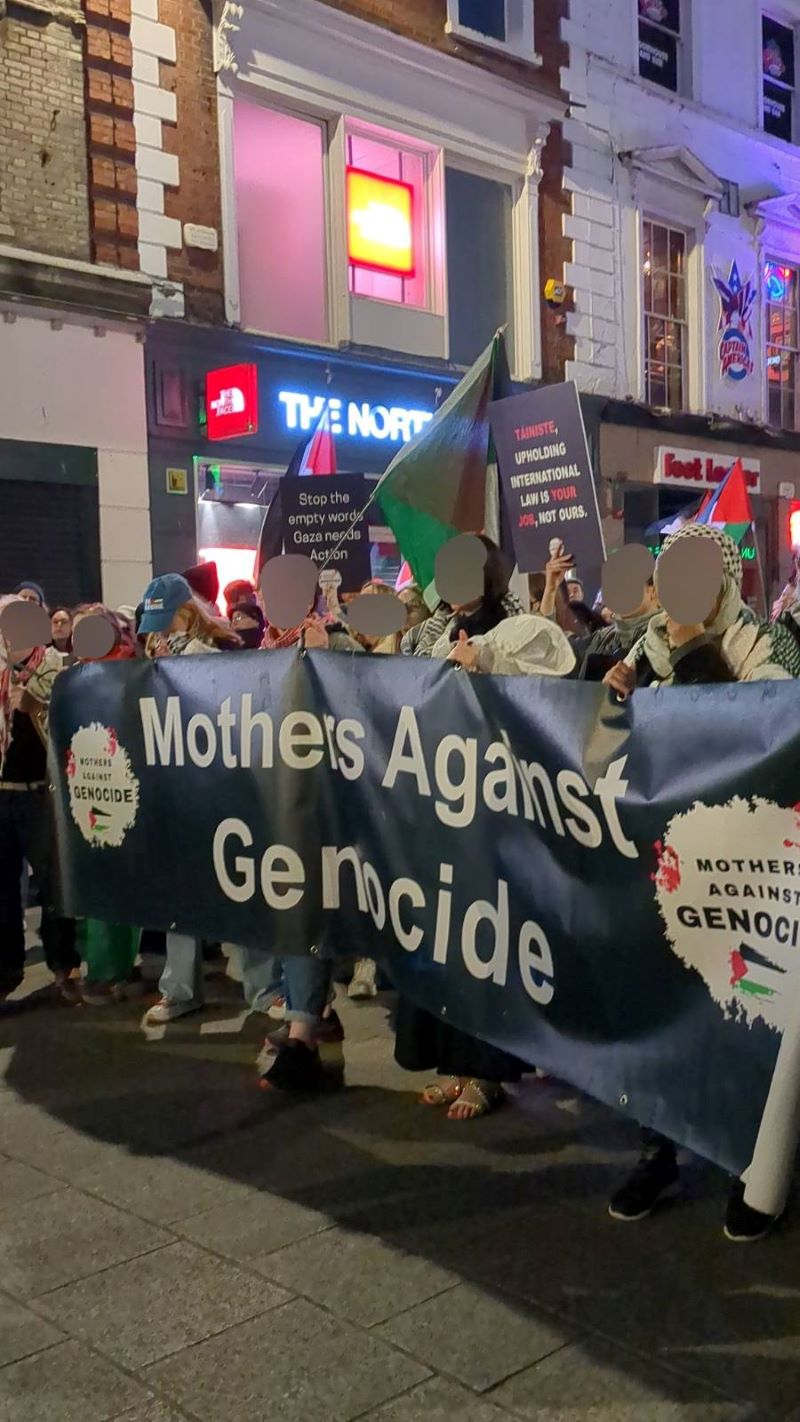
MAGS banner in Grafton Street later in the evening. (Source: Participant)
Eleven women and three men were arrested and taken to different Garda stations where a number of women were strip-searched, including one in an apparent cavity search; three men were charged under the Public Order Act and women pressured to accept an official caution.
Two days later, at a protest organised by the Boycott, Divestment and Sanctions (BDS) Society of the Dublin City University against the official opening visit of the Taoiseach (‘Prime Minister’) to a University building, Gardaí arrested a student for knocking on the window of the building.
On Friday, Gardaí attacked six protesters engaged in a protest at the front entrance to the Belgian Embassy in Dublin, where NATO is represented. The Anti-Imperialist Action protest was against the Irish elite’s attempt to slide the State into membership of the military alliance.
Those protesters were pepper-sprayed into their eyes, forced to the ground, handcuffed and treated so violently that the ankle of one man was broken; the breast of one woman was also grabbed. Two more picketing outside were also arrested, all again distributed around different police stations.
On public order charges, six also on trespass, all eight were brought to a special late court sitting that early evening where a crowd of supporters gathered.
All were bailed on a range of bizarre bail conditions including banned from protesting at Government buildings and a requirement to give 12 hours notice to the Gardaí with details before attending an embassy protest.
Wednesday night’s Leinster House protest
The mood of the crowd of over 500 last night in Merrion Street was militant, being addressed by a woman on behalf of the Mothers group. The crowd was joined by a group flying Starry Plough1 and Palestinian flags, bearing a banner of the AIA and a hand-painted one against NATO.
View of the rally in Merrion Street before the march. (Source: AIA)
The speaker introduced Aileen Malone, mother of Dara Quigley, a well-known blogger some years ago who appeared naked in public while suffering a mental ill health episode. One of the Gardaí dealing with the incident took a video of her and circulated it widely on social media.
Following that public shaming, Dara had taken her own life. Her mother pointed out that the offending Garda, instead of being dismissed, had been allowed to resign and keep his pension. She also condemned the Garda treatment of the women while extolling their courage in resistance.
Another speaker, introduced as representing Jews for Palestine Ireland spoke against the Irish State adopting the IHRA’s definition of antisemitism, the function of which, he stated is to protect the state of Israel against any criticism including regarding its genocide against Palestinians.2
He regretted the diversion from Palestine solidarity entailed in this focus, pointing out that genuine anti-Semitism is to be found among the far-Right while anti-racists and anti-fascists in Palestine solidarity, far from being anti-Semitic are on the contrary active against that variant of racism.
One of the banners at the rally in Merrion Street. (Source: Participant)
A woman from Mothers Against Genocide in Belfast spoke about the history of Irish resistance to colonialism and solidarity with Palestine which had no relation to the Irish Government, vehemently insisting also that being anti-genocide and for human rights is far from anti-Semitism.
Ruth Coppinger, Socialist Party TD, had signalled she wished to speak and was invited to so. She commented on Wednesday’s session in Leinster House when the Garda attack was defended by Mícheál Martin in respect of the right of access to Leinster House.3
A member of the Mothers in Dublin read a solidarity poem she had written and introduced the Resistance Choir, who sang Gonna Let No-one Turn Me Around, a lively song from the US Civil Rights4 movement of the 1960s,followed by slower lament about the Zionist slaughter in Gaza.
The energy in the crowd was dissipating by this point, almost an hour having elapsed and at last the direction to march was given. But where to? It was unclear. Earlier indications had been that one of the Garda stations would be the destination but now the Dept. of Justice was being mentioned.
The slogans shouted were those usually heard at Palestine solidarity events, with calls supporting the Intifada increasingly popular, and even one to Globalise the Intifada! US Warplanes out of Shannon! was another and NATO out of Ireland! was also heard.
Very appropriately also: One, we are the people! Two, We won’t be silenced! Three, Stop the bombing now, now, now, now!
Some banners during the march, seen here on the east side of Stephens Green. (Source: AIA)
The march proceeded, chanting, up Merrion Street, then into Merrion Row, turning left at the Huguenot Cemetery, then along the east side of Stephen’s Green, stopping briefly at the Dept. of Foreign Affairs building, then along the south side to the Dept. of Justice building.
But soon it was on the march again, perhaps heading for the Kevin Street Garda station … But no, along the west side of the Green now, past the Unitarian church where Edward Fitzgerald was married to his French revolutionary wife and then on again down through Grafton Street.
A meeting here was addressed mainly by one speaker, for some reason the crowd repeating his sentences. Not one speaker had yet referred to the attack on the anti-NATO protesters on Friday, much less their bizarre and repressive bail conditions. But perhaps we were heading for the GPO?
No, left and into Dawson Street, up to the Green again, then down Kildare Street to the front of Leinster House. There at last the crowd was addressed on behalf of the Anti-Imperialist Action group regarding the Garda attack on the anti-NATO protesters at the Belgian Embassy.
His talk was interrupted by cries of ‘Shame’ directed at the Gardaí and State. The speaker continued, referencing the resistance history of Irish Republicans and concluded by calling for unity of the Left against repression of any aspect of the Resistance, a call vigorously applauded.
To conclude the evening’s events a display concerning victims of Garda violence was presented, this including the case of Terence Wheelock, a working-class youth who died in Store Street Garda Station as a result of their violence, a crime then covered up by the State.
In Retrospect
It was important and a good act of resistance to organise an emergency protest5 this week and the eventual attendance of around 700 at such short notice was excellent. It is essential to meet repression of resistance with more resistance.
It was noticeable how low the numbers of Gardaí were and although uniformed and a number of plainclothes Special Detective Unit members followed the marchers, at no point did they attempt to stop the marchers or even to line up in numbers to protect the Government offices.
Most of the speakers at the commencing, intermediate and final rallies were clear that the Irish State had made a conscious decision to crack down on solidarity actions the previous week, using physical and sexual violence against activists, and of the need to continue solidarity and resistance.
The commencing rally was however too long and dissipated some of the energy. The lament as the last song just before that march, though no doubt appropriate in some contexts, continued that dissipation.
Coppinger, as a leading member of the Socialist Party was inappropriate as a speaker at the event. The party in the past has opposed boycotts against Israel and South Africa on the spurious grounds that it harms the oppressed people and works against solidarity between progressive settlers.
The Socialist Party also supports the Two-State proposal which would concede 80% of Palestine to the Zionist settlers. Coppinger personally and her party have also publicly condemned the Palestinian Resistance breakout operation of 7th October 2023.
The marching seemingly for ever, at times to symbolic but empty Government buildings was not helpful and most of the people already detest the Government. A good destination would have been at least one of the Garda stations where activists had been held the previous week.
Marching from and to an essentially closed Leinster House and Government buildings runs the risk of replicating the routine marches every month or so of the Ireland Palestine Solidarity Campaign.
The value of the Mothers has been their departure from that increasingly sterile practice and continuing in that vein would be a useful contribution to the solidarity movement and resistance in general.
Unity against repression is a historically-proven necessity and, as called for at the final rally last night, increasing unity between newer and longer-lived elements of the Resistance is also needed.
End.
An excellent riposte in the poster slogan/ meeting title. The design is based on the poster against strip-searching Republican women in the 1970s, design by Oisín Breatnach. (Source: Mid-Ulster IPSC)
1Flag of the Irish Citizen Army, first produced in 1914, the design is based on the Ursa Mayor constellation, including a plough in gold colour, with a sword instead of the ploughshare, all on a green background. A later version of the Republican Congress represents only the stars of the constellation in white on a blue background. The green and gold version was the one flown by the AIA.
3This was a spurious defence by the Taoiseach: a) It was before 7am and the Mothers were leaving at 7.30am; b) the pedestrian entrance was not blocked; c) the gates at the rear of the building were not blocked.
4But, like many of those songs, based on an earlier Christian song.
5There had also been an emergency protest outside Leinster House on last week’s Wednesday morning, Kildare Street being blocked for an hour without Garda action.
In the space of four days, Dublin has seen 23 activists in peaceful protests arrested and assaulted by Gardaí as the activists protested the slide of the Irish Gombeen1 ruling class towards NATO and their complicity in the Genocide in Palestine.
Mothers’ Day protest against genocide – 14 arrests
The Mothers Against Genocide group organised a vigil for Sunday night of Mothers’ Day outside Leinster House, seat of the Irish parliament and Government. The intention was to hold the event that evening but for some to remain there overnight, leaving at 7.30am.
At the gates of Leinster House, Kildare Street entrance. (Photo: D.Breatnach)
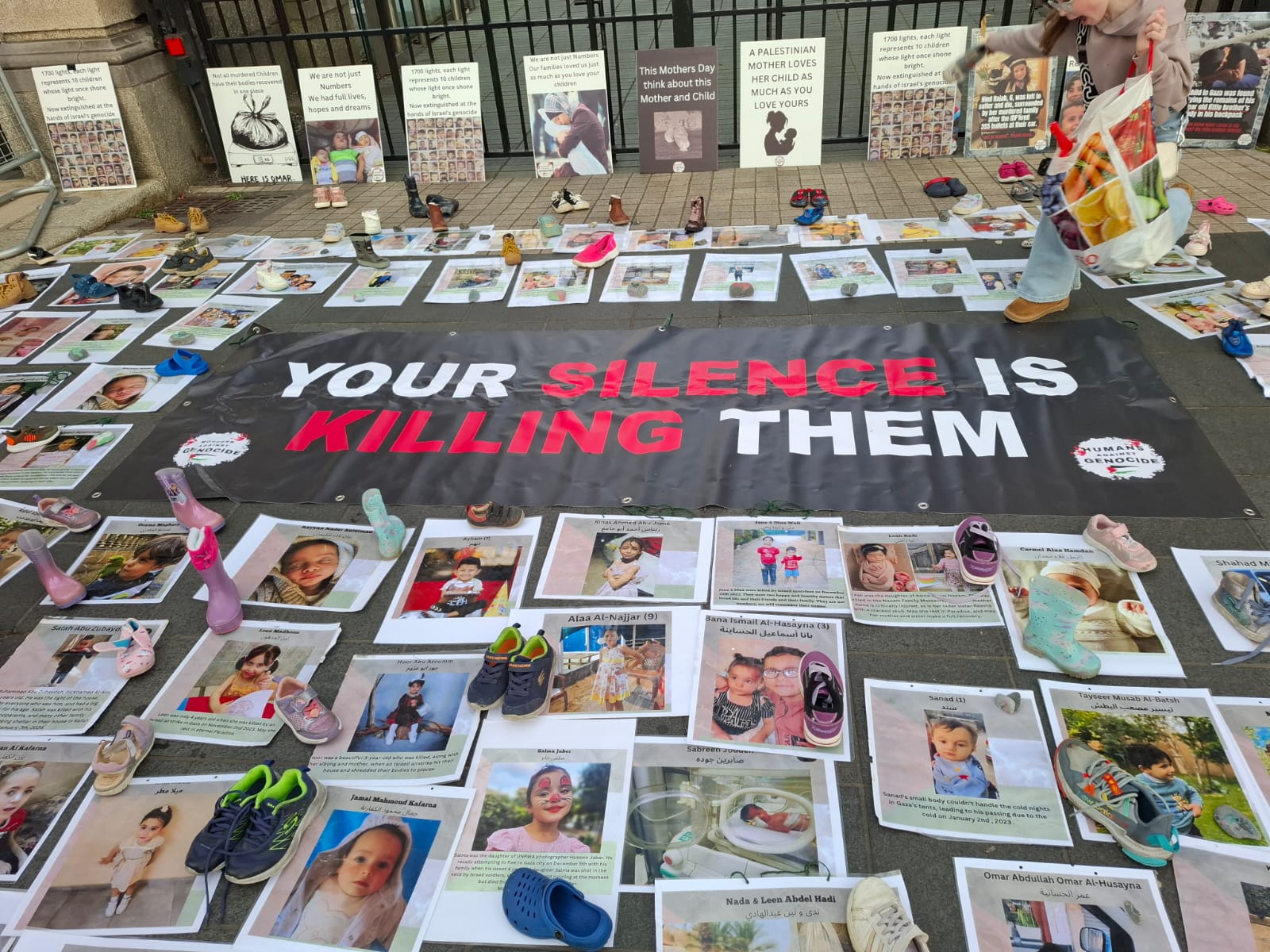
Plasticised printed photos of murdered Palestinian children were laid out on the ground with children’s shoes, toys etc spread around symbolically against the main gates with battery-powered ‘candles’ lit among them. Nearby a refreshment stall was set up.
By the advertised starting time of 7pm many had arrived and more kept coming, a very large crowd by nearly 8pm when there were some speeches, a few songs and a poem performed by different people, then a projection was being arranged after 9pm at which point I left.
Crowd at the event as dusk falls, approximately 8pm. (Photo: D.Breatnach)
The event was dignified, without even chanting. Policing was very sparse and low-key.
Despite the organisers’ commitment to leave at 7.30am and apparent agreement from the Gardaí present not to interfere with that arrangement, at around 6.00am more Gardaí2 arrived and demanded the clearing of the gates by removal of the icons to the murdered children.
In protest, some of the participants lined themselves up in front of the gates. The Gardaí approached the women, trampling over the photos and symbolic children’s items and began to remove the women, some of them quite violently, resulting in their arrests and those of three men also.
Banner of the organisers at Leinster House wall, Kildare Street. (Photo: D.Breatnach)
The 14 arrested were taken to different Garda stations where some women were strip-searched, an invasive psychological weapon used extensively by the British Occupation against Irish Republican women during the 30 Years War and still used by them against male Irish Republican prisoners.
All the women were obliged to choose right there and then between accepting a caution under the Public Order Act or to be charged and, under pressure, the women all seem to have been cautioned.
The three men were charged under the Public Order Act and will be obliged to attend the court to be processed. On Tuesday in Leinster House a number of TDs (elected parliamentary representatives) protested the treatment of the arrested. The Gardaí denied having carried out strip-searching.3
The Irish Council for Civil Liberties issued a brief statement to their network in response to the events, outlining the right to protest according to the Irish State’s Constitution:
We’ve heard from a lot of people who are worried by the Garda response this week to a peaceful vigil by Mothers Against Genocide. The fallout from this response along with potential new policing and public order laws and with the prospect of increased surveillance through facial recognition technology, risk undermining this fundamental democratic freedom. Today, as threats grow to restrict protest rights, defending this fundamental democratic freedom is crucial.
Protest isn’t the problem – it’s the solution:
You can protest – The Irish Constitution and European law protect peaceful assembly
You can film – Documenting interactions with Gardaí is allowed
You can’t be moved on without reason – Gardaí must give you a reason when asking you to move
The Irish Constitution guarantees your right to freedom of assembly, subject to public order. However, recent commitments in the Programme for Government have raised alarm.We continue to highlight how measures – including the expansion of police powers, banning face coverings at protest and the introduction of facial recognition technology into Irish policing – endanger our rights and freedoms.
The display outside the gates of Leinster House, Kildare Street entrance. (Photo: D.Breatnach)
On Wednesday morning a protest, composed mostly but not completely of women, at the treatment of people on Monday morning blocked the street outside Leinster House for a period of at least an hour4 without action by the Gardaí.
Protest at complicity of Irish Government in Dublin City University – another arrest
On Thursday evening Tánaiste (equiv. ‘Prime Minister’) Mícheál Martin’s visit to publicly open a building at the Dublin University Campus, accompanied by a heavy Garda presence was met with a protest organised by the Boycott, Divestment & Sanctions campaign branch of the University.
One of the students in the protest was arrested apparently for knocking on the window to convey the anger outside to those inside, Gardaí claiming at the time that he was damaging the window. The activist was released on bail amidst a crowd gathering in his support at the Garda station.5
Protest against NATO in the Irish State – 8 arrests
On Friday, a protest against attempts to push Ireland into joining the NATO military alliance was held at the latter’s representative facility in Dublin, the Belgian Embassy. Gardaí were very quick to respond and indeed had accosted and assaulted two of the participants a little earlier.
Protesters and Gardai in doorway of Belgian Embassy just before the attack of the latter on the former. (Photo source: Anti-Imperialist Action)
Six protesters lined up against the Embassy entrance at the Anti-Imperialist Action event were pepper-sprayed into their eyes and brutally assaulted, as were another two outside. As with those arrested on Monday morning, they were held in three different police stations in the city.
One of protesters, face down on the ground with his arms handcuffed behind his back, had his legs forced up behind, breaking his ankle.
(Photo source: Anti-Imperialist Action)
Supporters arrived to picket the police stations. After a few hours the arrested were taken to court, where supporters congregated also as the detained were processed for a late sitting of a judge. The charges were of criminal trespass or Public Order Act violation, both together for some.
In court they had legal representation and all were bailed in their own recognisance of 500 euro, which seemed fairly routine but the bail conditions were anything but. They were required to give 12 or 24 hours’ notice to the Gardaí of attending an embassy protest, supplying the details of the event!
The conditions for some included a ban on attending any state’s embassy in Dublin or demonstrating at any Irish Government building, while another is required to give notice – also of 12 hours — if crossing into the State from the Six Counties.
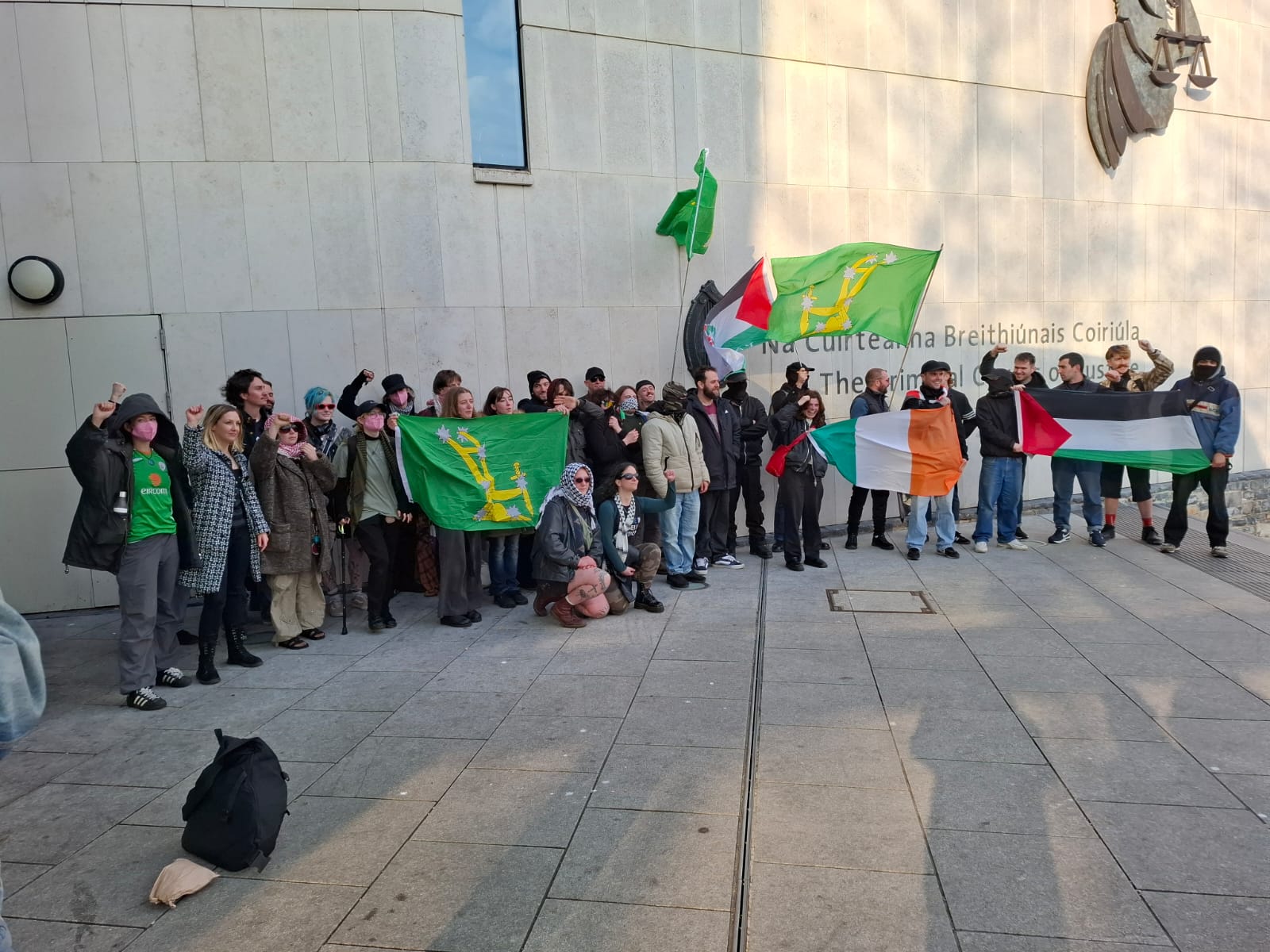
Facing a prospect of being locked up for the weekend otherwise, they did not decline the conditions for the moment and were released to meet a crowd of supporters outside the court in the early evening. As they lined up for a photo, all sang part of the Irish language Gráinne Mhaol song by Patrick Pearse.
The arrested and supporters outside the court after the former were released on bail. (Photo: D. Breatnach)
Repression of Palestine solidarity throughout the Western World
Throughout the Western world the response to the genocide being carried out in Gaza has had similar features: The complicity of the ruling classes, solidarity with the Palestinians of sections of the masses and the consequent repression by the ruling elites.
Within the territory of the Irish State the response of the masses has been marked in active solidarity with and public sympathy for the Palestinians, with little repressive action by the Irish State despite the proven collusion of the Irish ruling class.
The indications from this week are that the latter situation is changing and repression is being ramped up. This in turn indicates that the neo-colonial Irish ruling class feels threatened by action in Palestinian solidarity, other than routine marches through Dublin every month or so.
It is removing the liberal gloves and revealing the underlying sharp claws of a class that gained a state created in collusion with the British occupation to divide the country and to repress and control the insurrectionary forces upon the backs of which that neo-colonial class rode to power.
During the Civil War,6 the Irish state executed many more revolutionary fighters than had the British during the War of Independence7 and has executed a number since. Huge numbers have been imprisoned over years and it has colluded in covering for the bombers of its own capital city.
Where there is oppression, history teaches us, there will also arise resistance but that in turn usually results in more repression. Resistance rises to meet that repression and the movement must organise to educate, organise and unite that resistance, going forward until the masses achieve victory.
1A term somewhat equivalent to ‘carpetbagger’ describing opportunists amassing wealth through taking advantage of people’s misfortunes. Its origins are in the Irish language Gaimbín, applied to such Irish capitalist financiers during and in the wake of the Great Hunger of the mid-19th Century, now used to describe the neo-colonial capitalist Irish bourgeoisie.
2 The (mostly) unarmed police force of the Gombeen Irish ruling class.
A packed picket yesterday evening protested plans of the Irish Government to sidestep the “Triple Lock” in the Irish State’s Constitutionin order to proceed to committing the State’s armed forces to a western imperialist military alliance.
Contrary to the belief of many, the Irish State is not constitutionally bound to neutrality but there is a constitutional defence against a Government making an executive decision to send its armed forces into a foreign conflict and it is this that is known as the “Triple Lock”.1
As things stand at present, in order to send more than 12 Irish armed forces on a military mission abroad (e.g. as peacekeepers), the conflict response would need to be approved
not only by the Irish Government but
also by the Oireachtas (the Irish Parliament)
and by the United Nations.
However legislation of the Cabinet is being drafted to change the number from 12 to 50 which many see as the thin edge of a wedge to gradually widen the gap through which the Armed Forces can be employed in conflicts abroad alongside imperialist forces of NATO or the EU.
I joined the protest yesterday evening for a little over an hour. Most of the participants were packed behind banners on the southern side of the main gates of Leinster House so that photos don’t perhaps give a true impression of the numbers.
The main and very long banner bore the slogan We serve neither King nor Kaiser, recalling the words on a banner displayed on the Irish Transport and General Workers’ HQ, Liberty Hall, in 19142. More problematic were the United Nation flags waved by a few, some also wearing blue berets.3
In addition there were a number of Palestinian flags and, indeed, the politicisation and drive to activity of the Palestine solidarity movement does seem to be having a spill over into other issues in Ireland. Surprising perhaps was the number of flags of the Social Democrats party.
Another banner called for “Peace keepers, not military groups”. “Peace-keeping” in UN deployment can often mean stabilising the imperialist status quo in regions and the inaction of the UN leadership in response to the genocide in Palestine by some of its members has been shocking.
On the northern side of the gates there were two protesters in hospital scrubs, displaying a Palestine national flag and a large placard bearing the image of Dr. Abu Safiya, Director of Kamala Adwan Hospital in Gaza who was taken from there on 27 and January and disappeared for a time.
Dr. Abu Safiya was later traced to the notorious Sde Teiman Detention Centre in Israeli custody, then Ofer Prison where his lawyer finally gained access to him and reported recently that the Doctor has a number of broken ribs and was being refused treatment for his heart condition.4
On 25th March Dr. Abu Safiya’s sentence of six months administrative detention, effectively internment without trial, was confirmed by an Israeli Court on the basis of alleged documentation that, as is the rule in such cases, neither Dr. Abu Safiy nor his lawyer were permitted to see.5
On 25th October Dr. Abu Safiya’s 15-year-old son Ibrahim was killed by an Israeli drone strike on the hospital’s entrance.
One can only imagine the furore to which such a case would give rise if the detaining authority were one of which the Western Powers did not approve: A Doctor? Head of a Hospital arrested? Broke his ribs? Sent him to jail without a trial or allowed to see the evidence?Murdered his son?!
Vigil in hospital scrubs presumably for Dr. Abu Safiya’s safety and release. Also numbers of Gardaí in response to the main demonstration. (Photo: D.Breatnach)
No doubt many who would have joined the health workers in solidarity protest were in the other group protesting an attempt to have the Irish state join imperialist war ventures.
JOINING NATO
The crowd were kept lively with songs, speeches and a series of caller-and-response chants of which I can only recall the following:
Caller: From Letterkenny to Killarney — Crowd: We don’t want your EU army! Caller: From Dublin, Cork or Donegal — Crowd: No to NATO, No to War!
Caller: You can’t fool us with your lies — Crowd: We won’t send our kids to die!
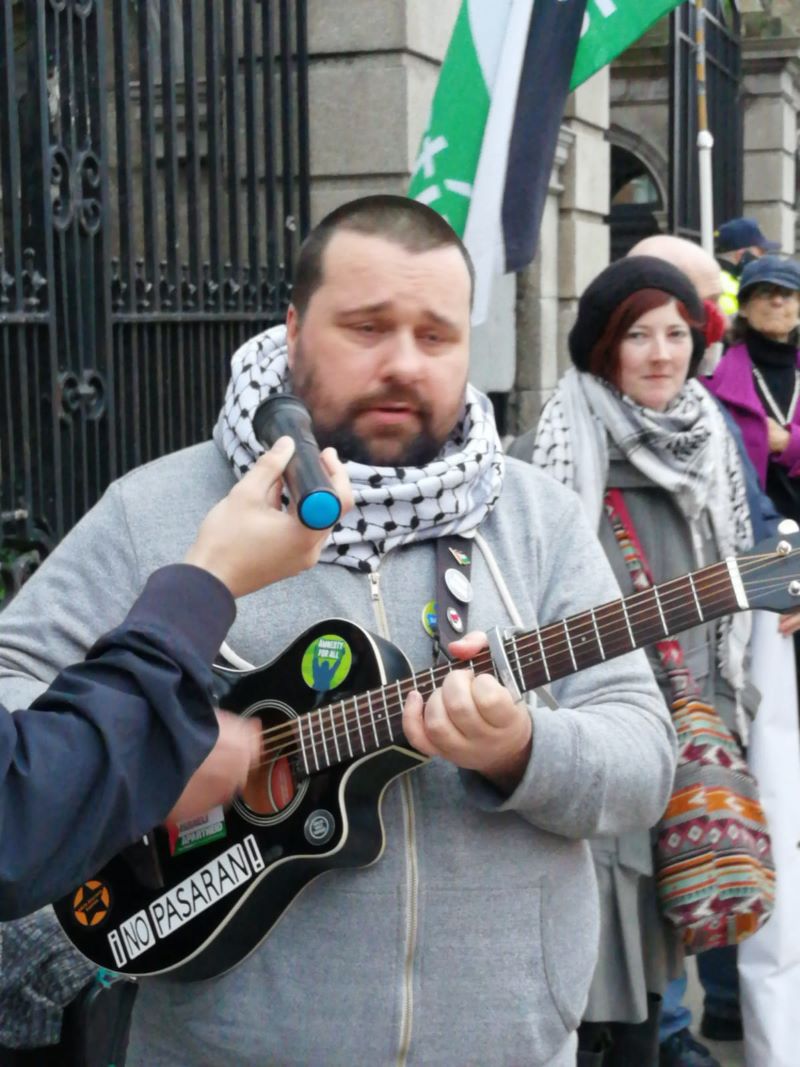
TD6 Paul Murphy of the People Before Profit – Solidarity party addressed the crowd at one point. Among the songs performed by Jimi Cullen were You Fascists Bound to Lose and his own We Are All Palestinians and I sang Pearse’s verses of Gráinne Mhaol, the crowd joining the chorus.
Jimi Cullen performing his We Are All Palestinians; in the background Fae Clarke who also sang. (Photo: D.Breatnach)
The Government, some other politicians and the media have for some time been building up a propaganda picture depicting Ireland as vulnerable to invasion by the Russian Federation and this has intensified with the USA’s Trump Administration’s comments about its contribution to NATO.
Even the blowing up of the Russian Nord Stream gas pipeline to Germany7 – clearly an action that most benefited the USA, which also had the most opportunity and means to achieve — was used by the media to whip up fears of Russian (!) attacks on subsea cables to and from Ireland.
The war in the Ukraine was also used not only to drum up support for the US/NATO proxy Kyiv regime but to whip up fear of the Russian Federation and to suggest that rather than defending itself against US/NATO encirclement, the aim was to gradually invade all of western Europe.
The presence of a Russian Trawler in the Irish sea was also used in this regard with the assumption that it was spying on Ireland. If indeed spying, why could it not have been on the UK? Anyway, we are being intensely spied upon daily by at least the UK and USA as it is.
The irony of seeking to join the Irish State with NATO, of which the UK is a prominent member, seems to have escaped the intelligence of the Irish elite: a state which has been at war with the Irish people for 800 years and is currently in armed occupation of one-sixth of its territory.
The only Starry Plough flag I observed, here held by myself. ((Photo taken by a participant)
Indeed it may occasionally occur to some that Ireland could easily be thought of as Ironyland as on-line Irish-based media The Ditch not long ago revealed that the Irish Government secretly agreed to have the UK’s Royal Air Force patrol Irish skies for the State’s protection.
The Government refused to confirm or deny this even to an FOI request by a Senator Craughwell, who sought and was granted leave on 18 March to challenge that refusal in the High Court, despite an Irish Government defence that boiled down to: We don’t have to tell if we don’t want to.
More will come to light on this as time goes on and perhaps also about another Ditch revelation, i.e about arms for the genocidal Zionist state being flown through Irish airspace. And of course there is the open secret scandal of US military flights being refuelled at Shannon International Airport.
Another view of a section of the protest showing how closely they were packed. (Photo: D.Breatnach)
EU INSTEAD OF NATO?
The softer option to NATO might seem to join some European joint military organisation but the EU is dominated by imperialist states such as Germany — which is second supplier in quantity of arms to ‘Israeli’ Zionism’s genocide in Palestine — and France has colonies in parts of the world.
In addition, France, Spain, Italy and the UK contain other conquered nations which have at various times agitated for greater or total independence and it is standard practice since Imperial Roman times to send troops from different areas to quell unrest in regions.
Irish troops in an EU joint force could be sent to put down uprisings in Catalonia, the Basque Country or Sardinia, while Spanish, French or Italian troops might be deployed on our streets in protests upon which Irish soldiers might be reluctant to fire.
Or all could be happily deployed together against the oppressed people of the Middle East, Africa or Asia, in all of which most EU states, if not all, have economic, political and strategic stakes.
This struggle against the incorporation of the Irish State into western imperialist armed forces has been going on for years, alternating between greater and lesser periods of intensity but it may that for reasons in the international arena it is once again entering an intense phase.
At last week’s Wednesday evening’s protest there were less than 20 participating throughout; last night there were a couple of hundred present, some at quite short notice. The organisers announced tthat they intend these protests to take place daily for the near future.
End.
View northward close along the protest. (Photo: D.Breatnach)
While Article 29.4.9° does not explicitly mention a referendum, the constitutional framework as a whole ensures that the government cannot join a common defence system without the consent of the Irish people, as expressed through a referendum.
2The Irish Citizen Army was photographed in 1914 drawn up in front of Liberty Hall beneath the banner reading: We serve neither King nor Kaiser but Ireland.
3The United Nations is a profoundly undemocratic and imperialist-dominated institution. Its only enforceable decisions are those made by five Permanent Members of the Security Council: the UK, France, United States, Russian Federation and China, each of which can nullify a decision by use of its veto. Its failure to act to prevent the genocide in Palestine, in which two of its members, the UK and USA are directly assisting, has been a disappointment to many.
4On 11 February 2025, Abu Safiya was allowed to meet his lawyer in Ofer Prison, located in the occupied West Bank. During their meeting, he reported being subjected to various forms of torture and abuse, including being forcibly stripped, tightly shackled, and forced to sit on sharp gravel for hours. He also endured violent physical assaults, such as beatings with batons and electric shock sticks. Abu Safiya described being held in solitary confinement for 25 days, during which he was subjected to nearly constant interrogation for 10 days. Despite multiple requests for medical care, Israeli authorities denied him treatment for his heart condition.[12][13]
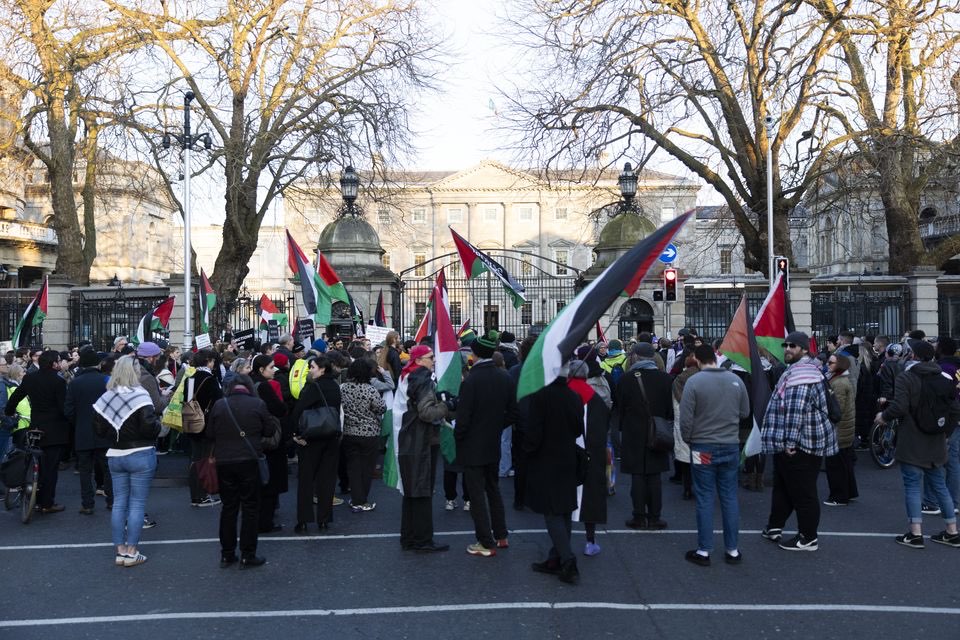
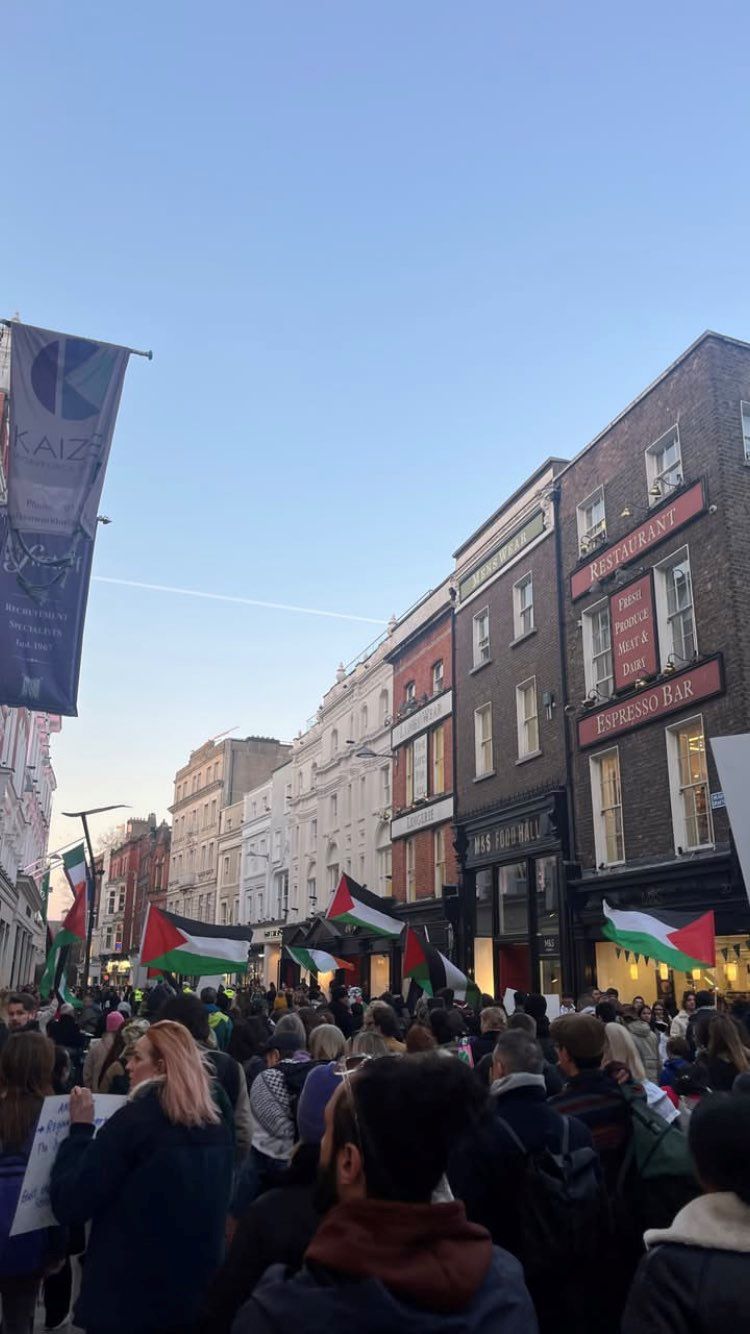
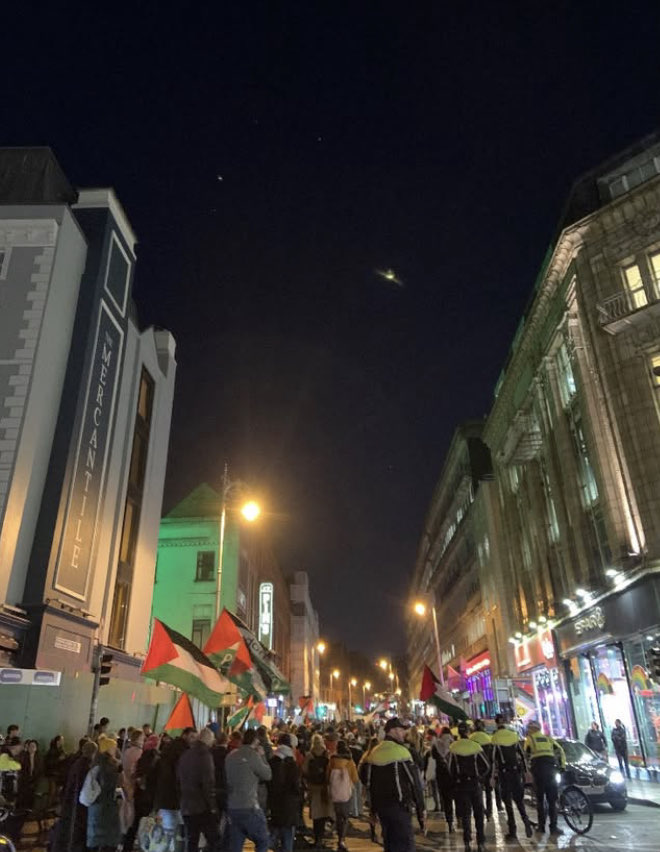
Dublin city centre on Saturday witnessed another giant Palestine solidarity march with a breakaway group; also a picket against internment of Irish Republicans; fascist provocations and Gárda repression resulting in the arrest of a demonstrator.
The national demonstration march had been called by the Ireland Palestine Solidarity Campaign as part of a solidarity and protest pattern that included fortnightly Dublin marches last year but is now generally monthly and at times with other events in addition.
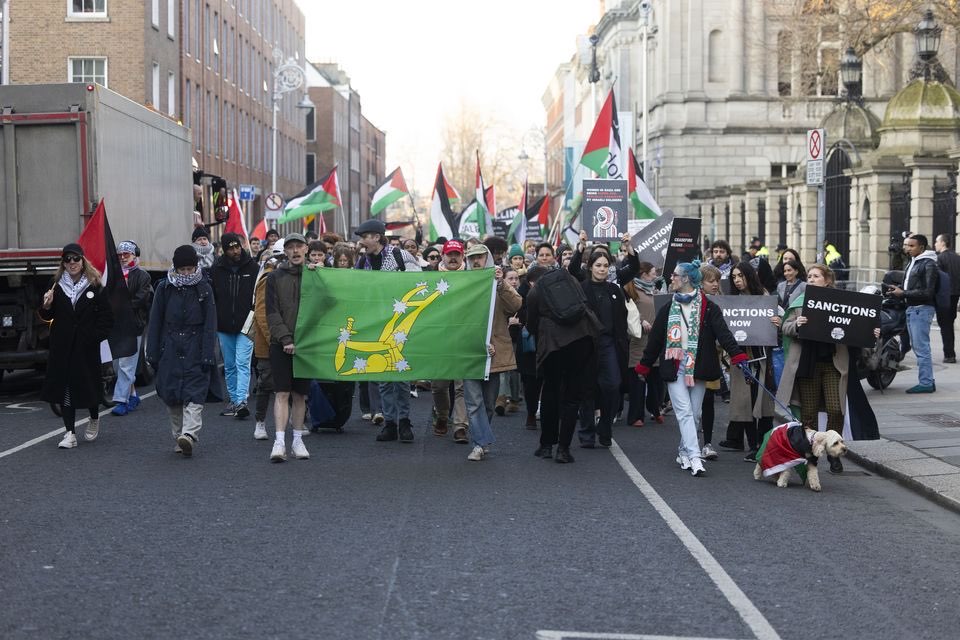
One of the banners just having crossed O’Connell Bridge on the IPSC-organised march (Sourced: IPSC Facebook)
Numbers on these marches in a city of only around 1.5 million population are impressive, though they draw on some participation from outside Dublin but there also regular local pickets and demonstrations of much smaller numbers at locations of high visibility or of specific significance.1
The march set off from the Garden of Remembrance in the north city centre proceeding towards Leinster House, seat of the parliament of the Irish State, near O’Connell Bridge passing a picket with an anti-Internment banner organised by the Anti-Imperialism Action organisation.
Anti Imperialist Action displaying a banner against extradition to the passing Palestine solidarity march. (Photo sourced: Anti Imperialism Action Leinster FB page)
As the march reached the non-pedestrianised stretch of Grafton Street a half-dozen fascists made their presence felt on the sidelines by throwing insults at a section of the marchers, who responded with louder From Ireland to Palestine – Occupation is a crime! and antifascist slogans.
Not just the Irish state but fascists and other far-Right elements in Ireland have a real problem with Palestine solidarity, claiming that’s because the protesters should be marching for Ireland. However those elements for the most part have zero track record in marching for Irish independence.
No, for them ‘Irish nationalism’ consists of demonstrating against immigration and burning buildings intended – or which they believe intended – for housing refugees. Clearly as fascists and far-Right what they detest about marches such as these is internationalist solidarity itself.
Placard calling for what is surely the minimum we have the right to expect from the Irish Government, followed by some of the placards of Mothers Against Genocide. (Photo sourced: IPSC FB page)
Incongruously for those who want only internal causes upheld, the fascists of the Loyalist variety in the occupied Six Counties uphold the Zionist state of ‘Israel’ and those inside the Irish state, as was seen in Dublin on Saturday too, laud and uphold as an example Donald Trump!
Mock Icon of Irish Central Bank carried against processing Israeli Bonds (Source photo: IPSC FB page).
Very shortly after the verbal exchange with the fascists, a section of the march diverted to walk up the pedestrianised section of Grafton Street. A couple of Gardaí, reinforced by the fascists, attempted to prevent this but the marchers flowed around the obstruction to continue up the street.
On Wednesday evening, some of those present had marched down that very street on their way to occupy O’Connell Bridge, bringing traffic in both directions to a halt for half an hour.3
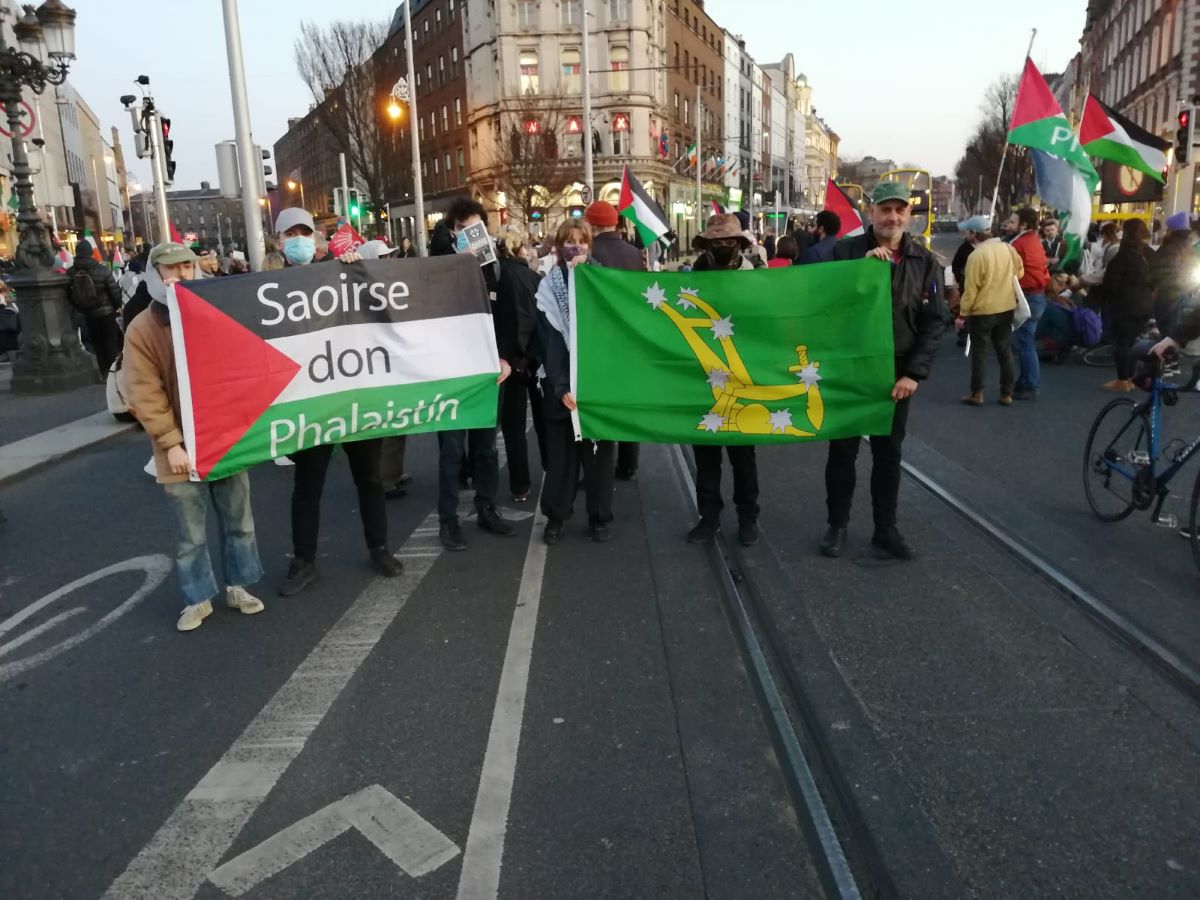
Further along the pedestrianised street the breakaway, including Ireland Action for Palestine and Saoirse Don Phalaistín groups, joined with another section of marchers who had earlier broken away from the IPSC march, this one led by the Mothers Against Genocide banner.
The shouted slogans from what were broadly two differing sections tended to merge with regard to calls to stop the bombing, opposition to genocide and broad support for Palestine but differed in that one section was also calling for support for the Palestinian Resistance and resistance generally.4
Content of slogans from the groups differed less markedly in calling for Irish Government intervention in support of Palestine, with the ‘Mothers’ mostly demanding the enactment of the Occupied Territories Bill5 and others condemning Government collusion in Shannon Airport.
The whole breakaway mass marched along South Stephens Green and turned north into Dawson Street, to pause inside the junction with Molesworth Street, where the tail of the main march, was already beginning to reduce although speakers and artists were performing on the IPSC platform.
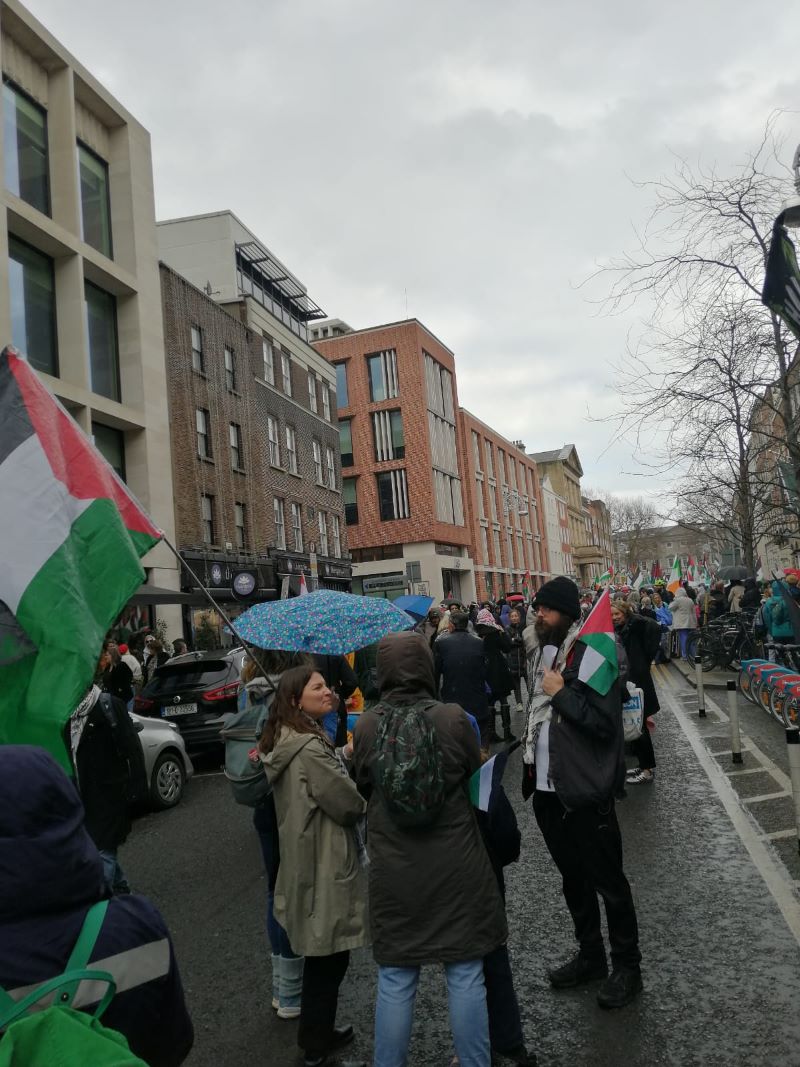
Molesworth Street facing Dawson Street after the breakaway sections arrived and before the later incidents. (Source: R. Breeze)View of the IPSC-organised march at its destination, the Garda barriers in Molesworth Street across the road from the entrance to Leinster House. (Photo: R. Breeze)
On Dawson Street, across from the junction, the fascists had installed themselves, including a man in a red ‘Trump’ hat waving a “Make America great again” flag.
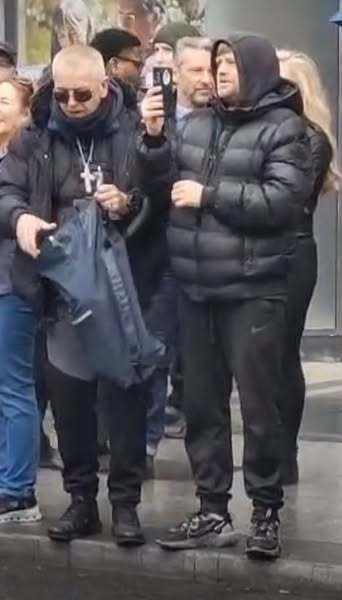
Two known fascists from the group trying to harass Palestine solidarity marches from Grafton Street to Dawson Street. (Photo sourced: AFAhttps://www.facebook.com/afaireland)
The Palestine solidarity protesters here – some distance from the diminishing main march crowd,6 with some IPSC stewards standing watching nearby, responded to the fascists’ jeers and Trump fan with jeers of their own, slogans and some bursts of song.7
According to a report form Anti-Fascist Action observers nearby and posted later that day, a senior Garda officer approached one of the fascists and had a quiet word with them, after which the fascists packed their banner and went away quietly smiling while the Public Order Unit arrived.
Soldiers of the master race (ehem) packing up after notification from their friend in the Gardaí that the POU would soon be deployed against some of the Palestine solidarity demonstrators. (Photo sourced: AFA Ireland)
These then began to aggressively push the demonstrators back towards Molesworth Street and as a demonstrator remarked it was the POU that were now blocking Dawson Street to traffic.
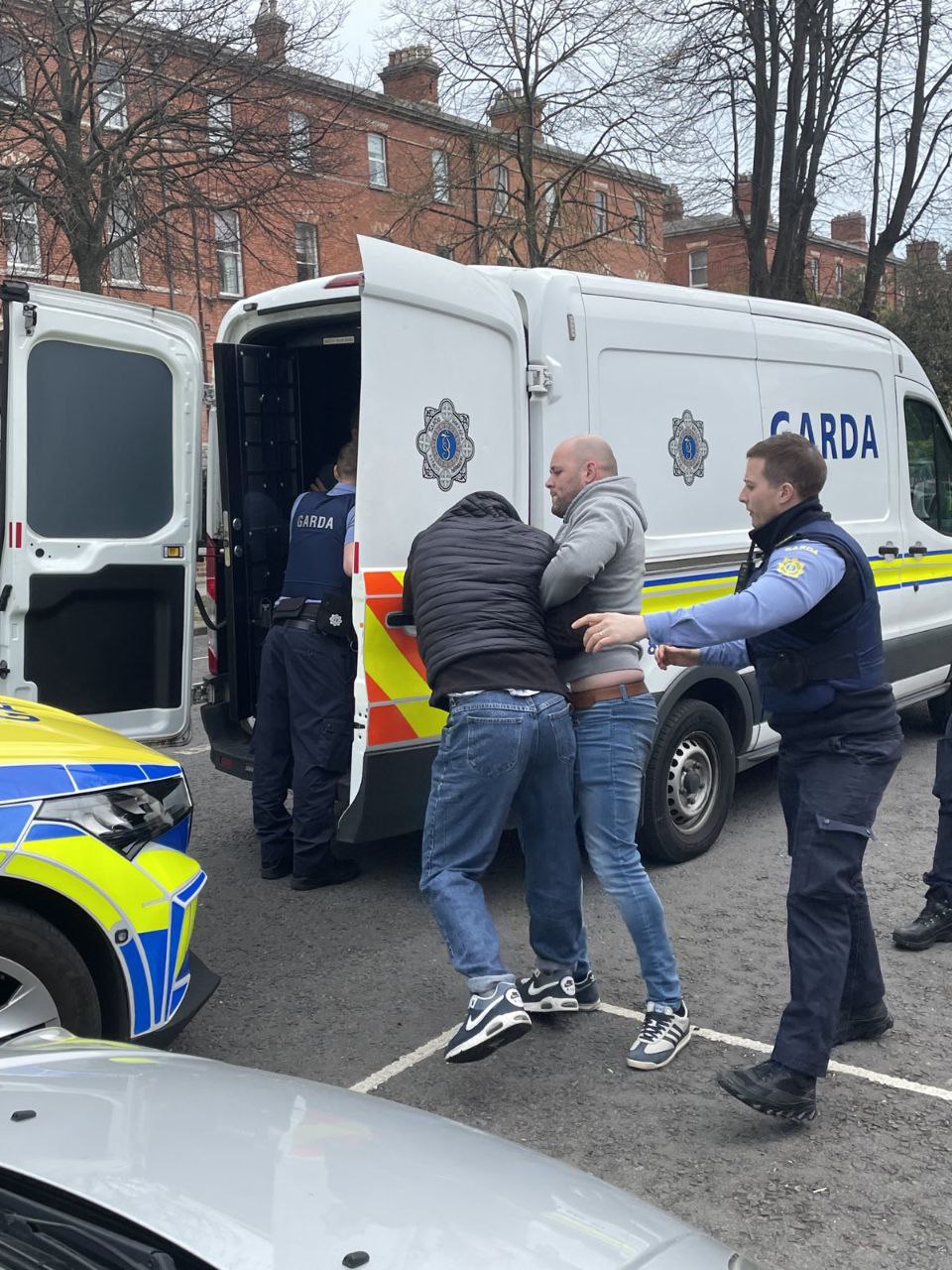
Soon the Gardaí seemed to decide to arrest one of the Palestine solidarity demonstrators and charged into the crowd, shoving, knocking down and even punching people who resisted strongly or just held on to the intended victim as long as they were able to.
A woman struck back at a POU man who had seized her by the throat but even so it took the intervention of one of his unit to get him to release his hold. The marks of his hand on her throat could be seen afterwards. Interestingly a press report later stated the Gardaí denied there was any incident.
Eventually the Gardaí succeeded in their intent and the protester was taken away to chants of Let him go! Numbers of the main march were dwindling greatly by this point but so were those of the breakaway section and people there were concerned to support their arrested comrade.
One of three police stations was the likely destination: Store Street, Pearse Street or Kevin Street. It was established that he was held at the latter station and was later released, given a few days to decide, under the Public Order Act whether to accept a caution or to be charged and face trial.
More confrontations of various sorts are likely as the Zionist genocide in Palestine ratchets even higher and frustration mounts at the Irish Government’s persistent refusal to end their collusion with the Zionist state and with its main supplier, US imperialism.
2Breakaway actions by groups often take place when they seek another target to that of the march organisers or to spread the visual and auditory impact of the demonstration or to break the ‘normalisation’ pattern, as when protesters feel the IPSC leadership is organising set marches of minimum disruption, on routes agreed with the Gardaí (which is not legal requirement in the Irish state).
4There is only one solution – Intifada revolution! From Ireland to Palestine – Occupation is a crime!
5 Agreed years ago in the Irish Parliament before but prevented from enactment by successive coalition Governments.
6As soon as the IPSC march arrives numbers always begin to leave, either to commence return home journeys or because they feel they are not going to hear anything new and their contribution was to be part of a visible mass, which they have now done.
7The Irish-language Gráinne Mhaol and English-language Come Out Ye Black n’ Tans.
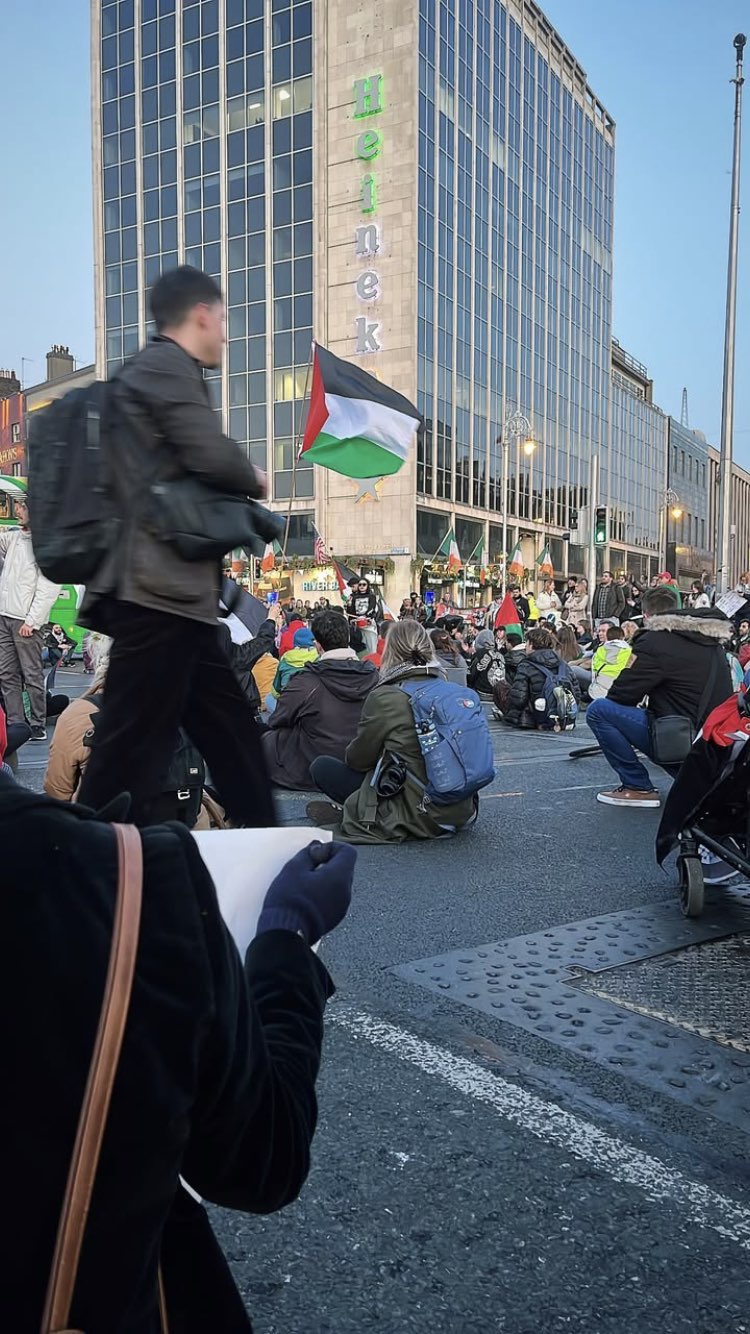
Evening traffic in Dublin’s southside city centre came to a halt as Palestine solidarity demonstrators, frustrated by the collusion of the Irish Government with the Zionist genocidal massacres, marched from Leinster House to block O’Connell Bridge.
The early evening protest for Wednesday at Leinster House was called by Collective Action for Palestine. It is not certain whether this is an actual organisation or a flag of convenience for a collection of solidarity groups and certainly many of those present were identifiable from different groups.
An early view of the Wednesday evening rally outside Leinster House (see in the background), home of the Irish Parliament. (Photo source: Journal)
This included, from their banners, Mothers Against Genocide and Irish Jews Against Genocide but among the hundreds present, activists of other organisations such as Action for Palestine Ireland, Saoirse don Phalaistín, Anti-Imperialist Action Ireland and Social Rights Ireland were in evidence.
The People Before Profit party, which would usually mobilise strongly for marches called by the IPSC, did not have a noticeable present, which may reflect a lack of contact with the organisers of yesterday’s event or a lesser ability to mobilise quickly.
Irish Republican organisations were also not noticeably present, with the exception of the AIA mentioned earlier.
The protesters’ rage and frustration was lit by images of dead and injured Palestinian children in the return to genocidal bombing of Gaza by the ‘Israeli’ armed forces, once again violating their ceasefire agreement, along with besieging and ethnic cleansing of cities of the West Bank.
The previous night Zionist state bombing had killed 414 Palestinians, including 174 children, and hospitalised over 550 more.
The marchers called for action from the Government, such as imposing sanctions on Israel in general and enacting the rather mild Occupied Territories Bill, approved by both Houses of the Oireachtas (Irish parliament) but seven years since, still sitting in a drawer; awaiting enactment.
Those calls have been repeated week after week, month after month in the final months of 2003 and throughout last year but only words of concern from Government ministers resulted, followed by friendship visitsto the very supplier of the Zionists’ weapons of genocide.
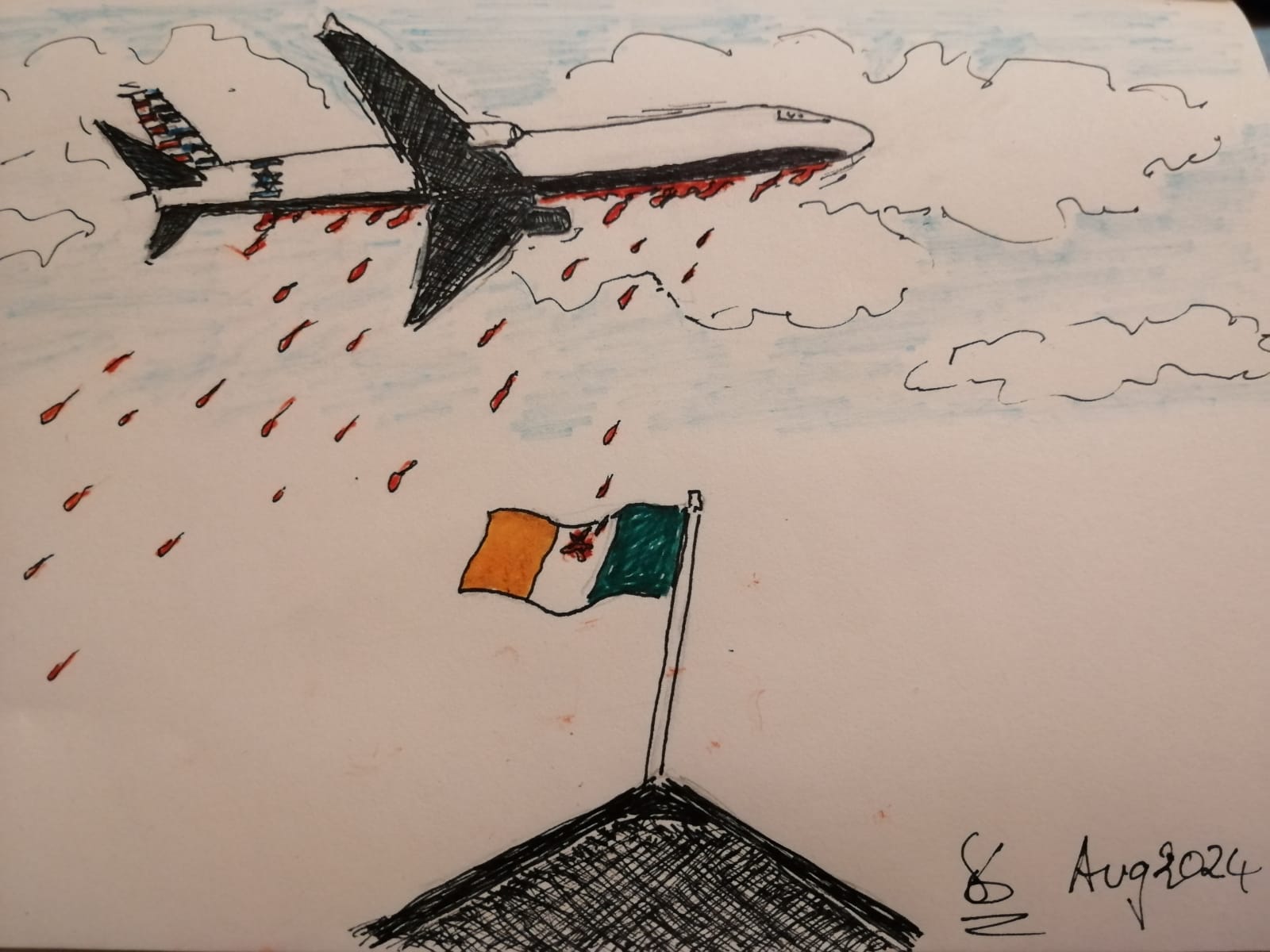
Successive governments of the ruling class of the ‘neutral’ Irish State have actively colluded too in genocide through refusing to bar Irish airspace to Zionist military supply flights1 or to monitor and prevent US military flights through Shannon airport.
Still as true today, unfortunately, as it was in August last year.
MARCH AROUND SOUTHSIDE CITY CENTRE
From outside Leinster house the protesters proceeded southwards up Kildare Street, turning right to flank Stephens’ Green, where they paused to chant more slogans and display banners and placards to stopped Luas trams before then turning northward into Grafton Street.
The solidarity protest rally becomes a march, proceeding southward up Kildare Street. (Source photo: Irish Independent)
In that pedestrianised shopping street the march stopped near one of the many buskers regularly performing there, apparently Italian who launched into an amplified rendition of a celebrated song from the Italian antifascist tradition, Bella Ciao, with many of the marchers joining in.
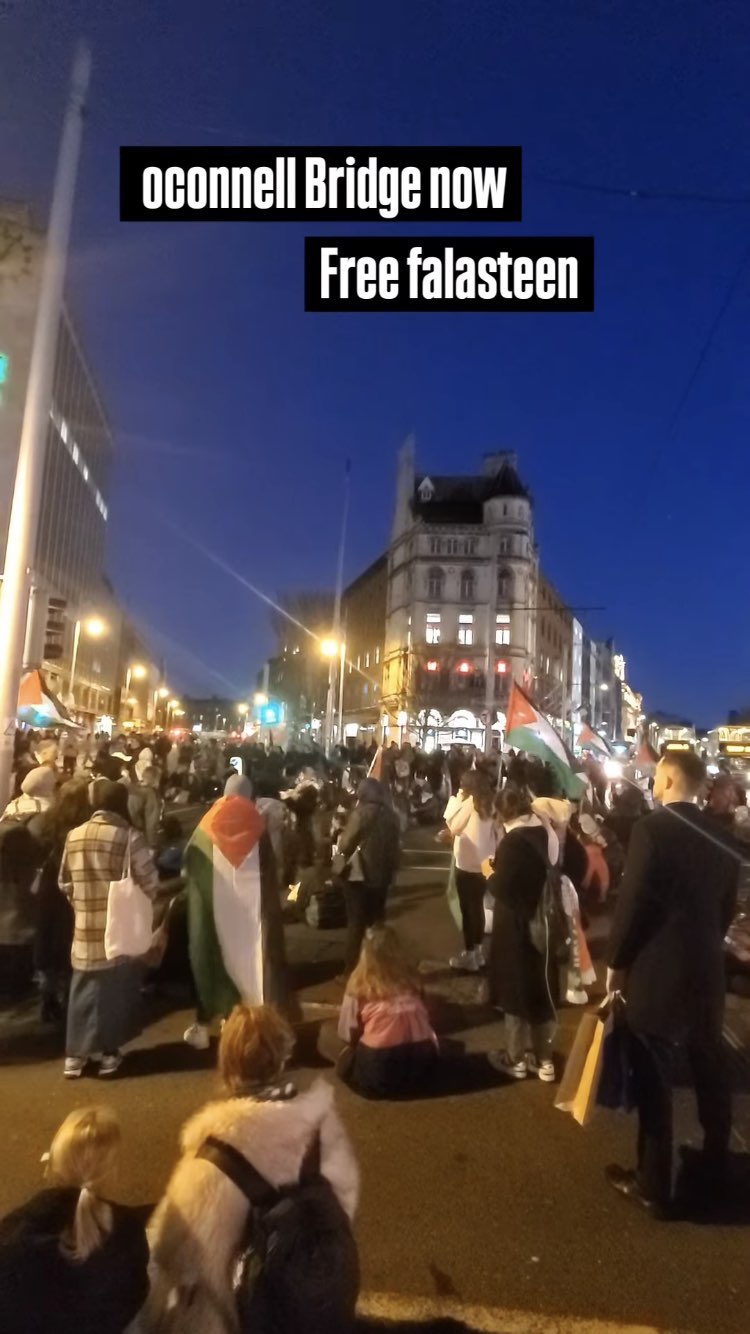
The northward march continued with stops up Westmoreland Street, where the clientele of a pub came out to cheer and applaud the marchers. Then on to the southern end of O’Connell Bridge, occupying both southward and northward-bound lanes with traffic blocked in both directions.
Indeed the traffic was soon backed up southward around Stephens Green and to the north, up to Dorset Street. On the Bridge, flares were lit and the crowd heard speeches of protest interspersed with solidarity slogans. Many passers-by expressed support, some stopping to participate.
A protester lights a flare as the march proceeds northward along Grafton Street. (Photo source: Participant)
What was most unusual indeed was that during the half hour or so that the marchers remained there, no angry beeping of horns nor shouts of impatience were heard from drivers of private cars or from passengers in public transport buses.
The crowd left, marching west along Dame Street, northward at Georges Street South and Aungier Street, then left to march along Stephens Green North, pausing outside the HQ of the Department of Foreign Affairs, where the Gardaí scuffled with some protesters.
Section of the protest on O’Connell Bridge. (Photo source: Participant)
The protesters then returned to Kildare Street to the seat of the Irish Parliament, Leinster House where they concluded the evening’s event.
A couple of hundred protesters had achieved, one might argue, more than many thousands on regular national marches of the Ireland Palestine Solidarity Campaign, in terms of public exposure and paralysis of city traffic in several directions, therefore putting pressure on the Irish Government.
Section of the march in Grafton Street. (Photo source: Participant)Grafton Street:Gardaí wondering where the marchers are heading and what going to do. (Photo source: Participant)
As a tactic this has much to recommend it. My opinion is that one has to time the length of remaining in each location just right to maximise the disruption while reducing the impact on people at each spot to a tolerable degree.
The movement needs to further awake people and to shake the elite but it also needs to minimise the impatience of people returning home from a day’s work or indeed travelling to begin their night shifts, or hurrying to meet others by arrangement.
They are not the enemy nor do we wish to make them so.
A narrower view of the temporary occupation of O’Connell Bridge. (Photo source: Participant)
I would also criticise the reciting of an amplified prayer on O’Connell Bridge. The solidarity movement is secular and no section of it has the right to impose prayer upon all or to represent the whole as religious –whether Muslim, Christian, Jewish, Hindu or any other.
SLOGANS
All or most of the slogans one hears on Palestine solidarity demonstrations in Dublin (and endorsed by the Ireland Palestine Solidarity Campaign) were shouted but so were others in addition such as There is only one solution – Intifada Revolution! And No peace on stolen land!
A group of Anti-Imperialist Action photographed during the O’Connell Bridge occupation. (Photo source: Participant)
Others included Resistance is an obligation – in the face of occupation! From Ireland to Palestine – Occupation is a crime! Brick by brick, wall by wall – The colonies will fall! It’s hard to imagine the IPSC leadership, whatever they might think privately, endorsing those slogans in public.
Although the last slogan might not be seen as specifically referring to Ireland, there was also one in the Irish language which is now common among native Irish and many of migrant background, Saoirse don Phalaistín! And the unequivocal From Ireland to Palestine – Occupation is a crime!
Ceasefire now! resurfaced from time time and though a good call when the Resistance is calling for it, can be problematic when they are not, as with the end objective being liberation, do we have the right to call on the Resistance to cease fighting, even if the Occupation ceases temporarily?
Another problematic call for example is Mícheál Martin, do your job! because in fact members of the Irish Government are doing exactly their job, which is to manage the contradiction between the peoples’ wishes and the needs of the neo-colonial Gombeen ruling class in favour of the latter.
Sanctions Now! is a call with very wide support across revolutionary and non-revolutionary sectors – the division is more around whether periodic marches to Leinster House for example is likely to achieve that or whether more radical action is necessary to pressure the elite to enact them.
The march pauses along Stephens Green North (the Green is out of sight to right of photo). (Photo source: Participant)
The demands of the Government, i.e representing the ruling class, are not revolutionary or even huge: to apply sanctions (economic, cultural and political) against the genocidal entity and to cease permitting Irish airports and neutral Irish airspace to be used in supporting genocide.
The genocidal entity cannot hurt the Irish state much directly. Of course, its main backer, the United States, is another matter. But then, if principle is not enough, the Irish elite could calculate that during the current split between the EU and the USA might be the best moment to take that step.
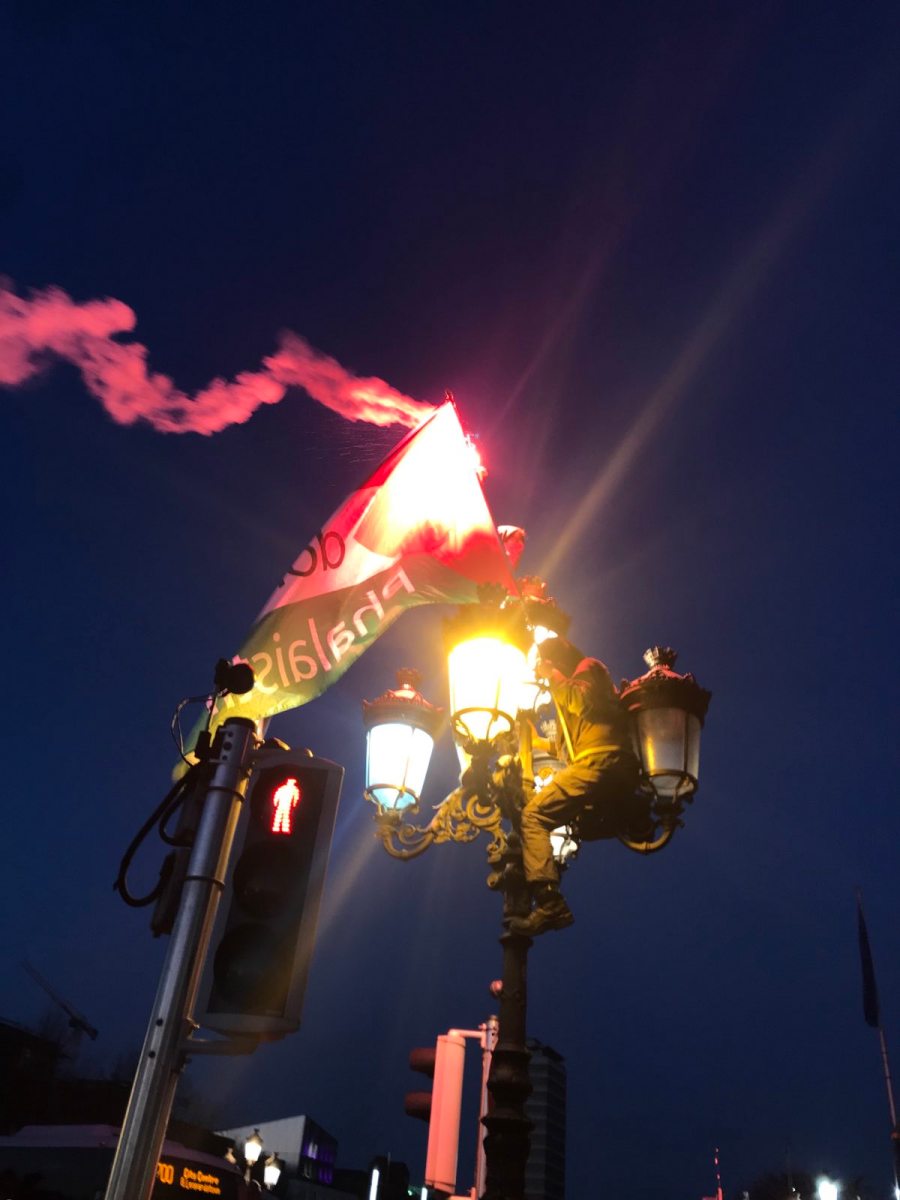
Demonstrators scale an ornamental lamppost during the O’Connell Bridge occupation, erecting a Palestine national flag bearing the legend “Saoirse Don Phalaistín” (‘Freedom for Palestine’). (Photo source: Participant)
A night of resistance and other songs on Friday night in Peadar Browne’s Dublin pub raised funds to assist in fighting state repression of Palestine solidarity activists in Ireland, as Palestine solidarity activists face persecution across the Western world.
The evening’s performance consisted of a mix of political and other songs, a number of which were original material. However it was the political material that most drew interest, ranging from international struggles to the rich Irish Republican tradition.
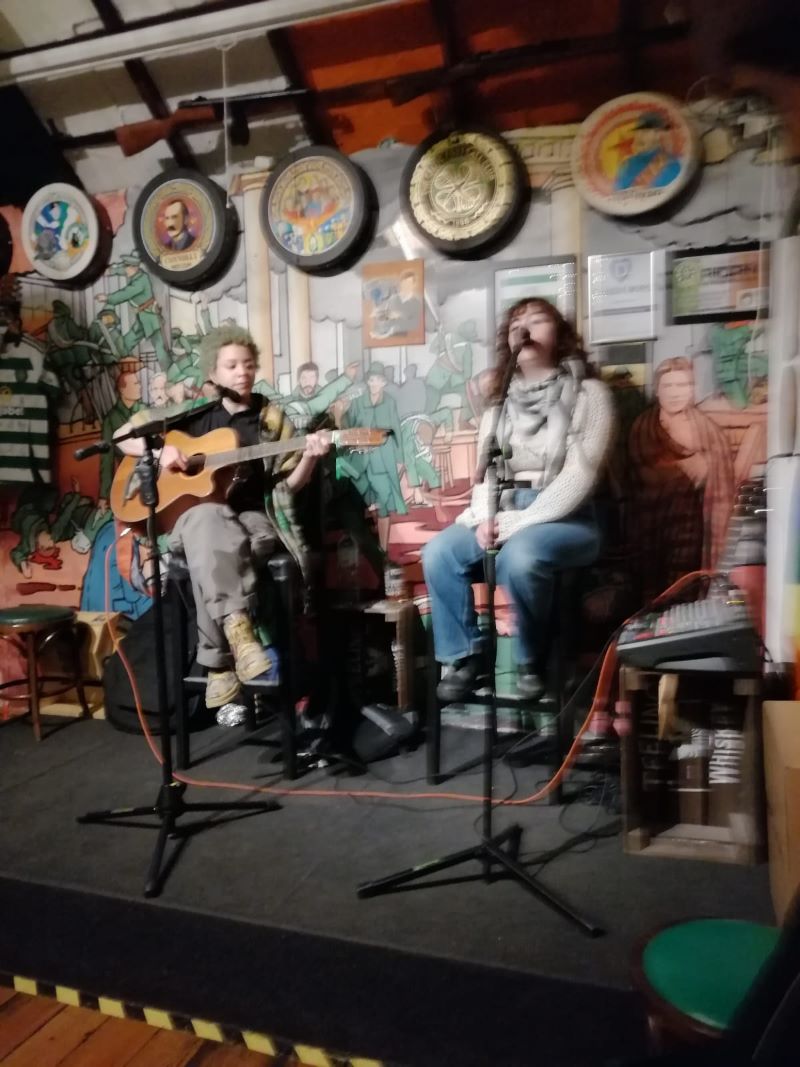
Olive and Fynn in performance at the fund-raising event (Photo: R.Breeze)
To begin the event Diarmuid Breatnach explained the need to support Palestine solidarity activists against the repression of the Irish authorities, hence the fundraising event and announced that in addition to performing he would be standing in for the event’s MC who had been unable to attend.
Breatnach began his set combining two songs from the German antifascist tradition, three verses of Peat Bog Soldiers and three from the Hans Beimler ballad.1 Then from the Spanish Anti-Fascist War he sang Ay Carmela!, the air of which he said was from an anti-French occupation folk song.
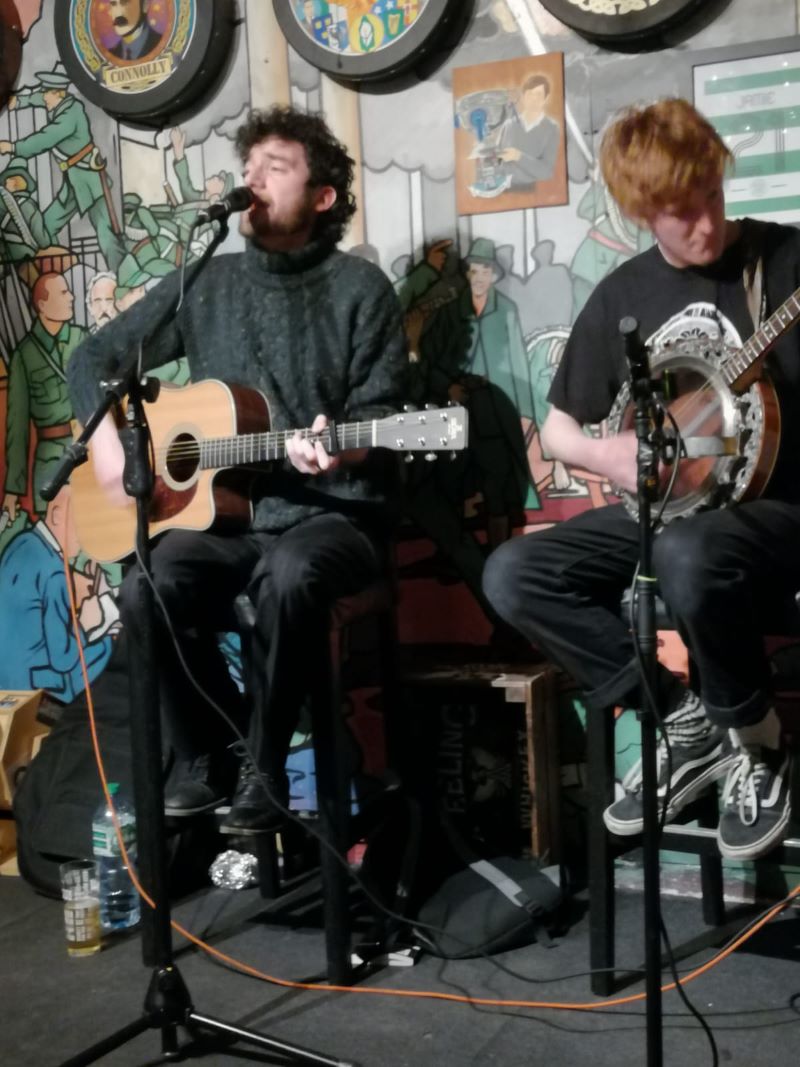
Next the MC announced a performance by two performers, half of the four-strong Croí Óg ballad band. During their performance with voice, guitar and banjo there was an incident from a couple of unruly elements nearby who had substantial drink taken and had been very loud throughout.
Two members of the Croí Óg band performing at the fundraising event (Photo: R.Breeze)
A man who had been refused permission to sing solo began shouting that the songs were not Republican, ironically interrupting Grand Old Country, a song about the Fenian tradition. It became clear that what he wished was to perform the Grace ballad, which he began to sing loudly.
A male confronted the interrupter; the latter’s friend, a big elderly Glaswegian protested; others took to the floor … but the incident wound down, the interrupters and audience resuming their seats. However, the putative Grace singer threw threats at his earlier confronter across the room.
The big Glaswegian then crossed the room to confront the audience member, a female audience member intervened, he brushed her aside and the audience section erupted, only the quick arrival of the pub’s landlady preventing a fight … And the musicians resumed their performance.
Among the songs performed by Croí Óg were Crossmaglen and British Soldier Go on Home. The MC called for appreciation applause for them, made some barbed comments about the recent anti-social behaviour and welcomed the song-and-guitar duo Olive and Fyn to the stage.
Sage Against the Machine performing at the fundraiser event (Photo: R.Breeze)
The duo performed their own material in lovely harmonies, mostly non-political, also including their ironically titled Save the Landlord! After they had left the stage to applause Breatnach got up on stage again to announce a short break and to remind the audience to contribute to the funds.
His additional comment: “Remember when someone sang in a Dublin pub and everyone went quiet? Remember those days? Remember?” was followed by loud applause throughout the pub.
Breatnach restarted the second half, singing a capella again two songs celebrating Irish women’s resistance,2 ending with songs in Irish including the ballad of Rodaí Mac Corlaí. After concluding he introduced Sage Against the Machine to take to the stage, singing solo with guitar.
Sage’s material was mostly original, sung in English but went on to Masters of War in a spirited concluding verse, followed by Gallo Rojo, Gallo Negro3 in Spanish from the anti-fascist tradition in Spain. The MC then presented Eoin Ó Loingsigh, also with voice and guitar.
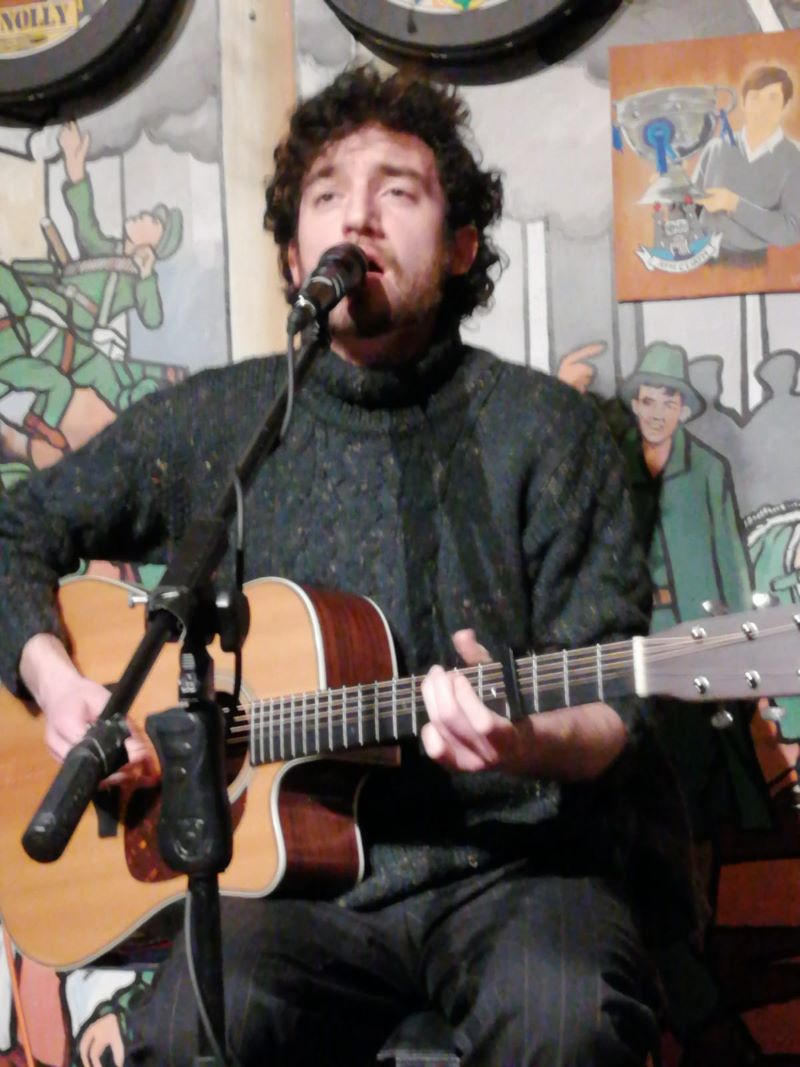
Eoghan Ó Loingsigh performing at the event (Photo: R.Breeze)
Although no further incidents occurred, the volume of ‘conversation’ between a number of people not far from the stage was high. Loingsigh’s material included Only Our Rivers Run Free, Viva La Quince Brigada4and a satirical song contrasting the fates of the rich and the poor after death.
The evening’s scheduled performances concluded with Seán Óg, also solo with voice and guitar, his selection including Ho Chi Minh, republican ballads Boys of the Old Brigade, The Patriot Game, Boolavogue and his own composition Boys of Gaza to air and structure of The Boys of Kilmichael.5
Breatnach thanked the attendance for their support, restating the context of the event and asked for another round of applause for all the performers, who gave their time and creativity for free, then called for people to stand for the Irish national anthem6 which he led with the first verse in Irish.
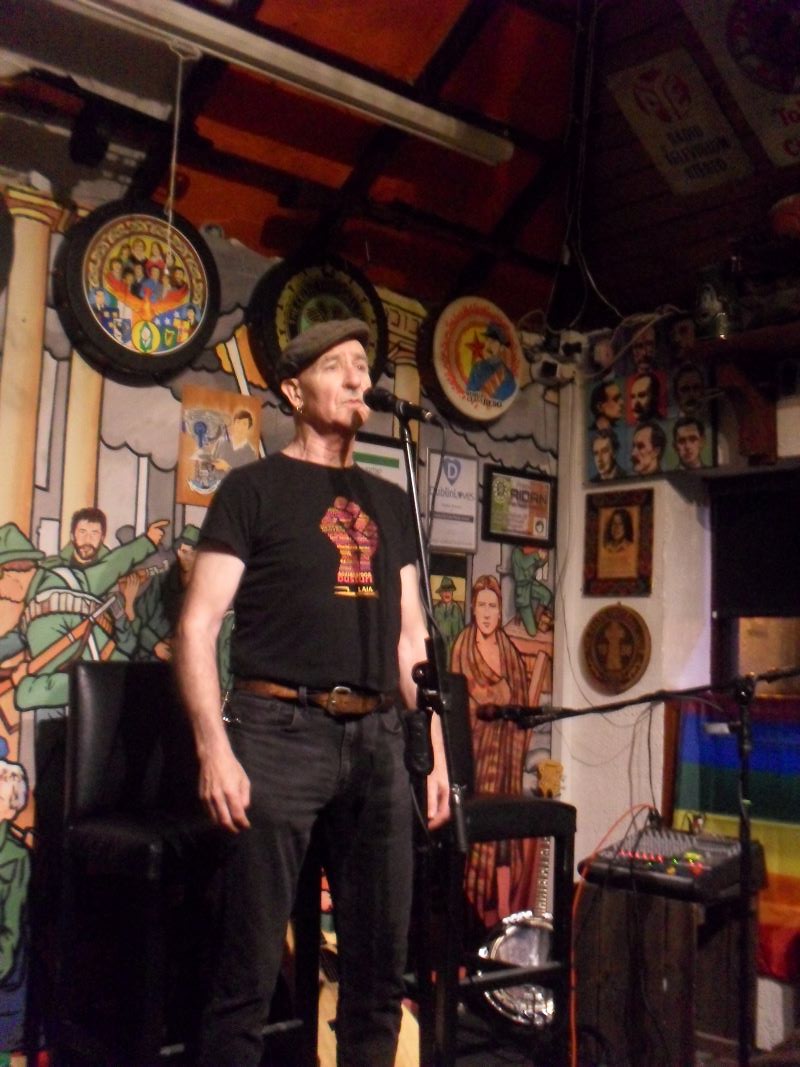
Diarmuid Breatnach in performance at the fundraiser event (Photo: R.Breeze)
At the concluding line of “seo libh, canaig …” the audience exploded to complete the words “Amhrán na bhFiann!” followed by launching into the chorus, also in Irish.
The event had been organised by two broad Palestine solidarity organisations, Saoirse Don Phalaistín and Palestine Action Ireland and among the attendance were a number of their activists, including some victims of state repression.
Most of the charges to date have been under the Public Order Act but also some around ‘criminal damage’ and the potential is there for more serious charges and possible jail sentences, as have been the case in some other European administrations.
In addition to actions of their own, including occupying and picketing the Israeli Embassy, Axa Insurance and picketing the Palestine Authority, Saoirse don Phalaistín and Palestine Solidarity Action organised Resistance Blocs to participate in mass demonstrations organised by the IPSC.
Seán Óg performing at the fundraiser event (Photo: R.Breeze)
Peadar Browns pub has become increasingly known as an Irish Republican tavern on the south side of Dublin city. Its small stage area is decorated with Republican artwork on the walls and on many of the bodhráns7 hanging there, along with some Glasgow Celtic celebratory material.
The side of the pub, on a minor street, carries a large mural representation of the Palestinian national flag, along with the slogan SAOIRSE DON PHALAISTÍN. However Dublin City Council have directed that it must be removed, to the anger of a great many people.
Mural on the side of the Peadar Brown pub (Photo sourced: Internet)
Historically cultural events of this type have a function other than to raise defence funds and to promote the cause: they are also occasions for replication of the cultural face of resistance and for expression of new cultural compositions but additionally for the creation of a community of resistance.
4About the Irish who went to fight against fascism in 1930s Spain.
5Also known as The Kilmichael Ambush, celebrating a famous event in West Cork during the War of Independence (1919-1921). However, the air of both songs is that of an older ballad about the 1798 Rising called Men of the West.
6The lyrics were originally written in English and later translated to Irish in which language it most usually sung today.
7A shallow one-sided Irish drum, same shape as a tambourine but much larger, played with a wooden striker on the outside with variation in tension achieved by hand pressure on the inside.
The CCJ (Criminal Courts of Justice) in Parkgate Street, Dublin, are seeing an increase in political cases in recent weeks with activists in housing and Palestine solidarity as well as Irish Republicans fighting extradition to the British colony.
Eoghan Ó Loingsigh, who made the mistake of asking a Garda for his badge number while they were carrying out an eviction, appeared there in February only to see his case thrown forward to June.
Picket anti-extradition display by Anti-Imperialism Action outside Heuston Station in February. (Photo: R.Breeze)
Another housing activist’s charge of attempting to break into an empty property was dismissed. The property in question, empty for a number of years is leased to the Salvation Army and three years ago two RHL1 activists were evicted from it by 100 Gardaí (some armed) with helicopter support.
Jack Brazil, a Palestine solidarity activist whom the Gardaí are trying, believe it or not, to tie into the racist and criminal riots of November last year, had yet another appearance in court without trial as he’s still trying for CCTV footage from Gardaí to support his alibi for the night.
At least the remaining bail restriction on Brazil was lifted: at the outset he had to sign on at Mountjoy Garda station once every week, observe a curfew of 12am-6am and not to loiter at any point in the Dublin city centre (D1 and D2). His case is now remanded to 26 March.
Jack Brazil (in the suit) and other Palestine solidarity activists outside the CCJ after Brazil’s most recent appearance there. (Photo: R.Breeze)
Jim Deneghan had a number of court appearances fighting extradition to the Six Counties on foot of charges alleging an act during the 30 Years War there – fifty years ago. He was unsuccessful and it appears that the only avenue open to him now would be to challenge it in the High Court.
Should they even grant him leave to do that which is not always the case.
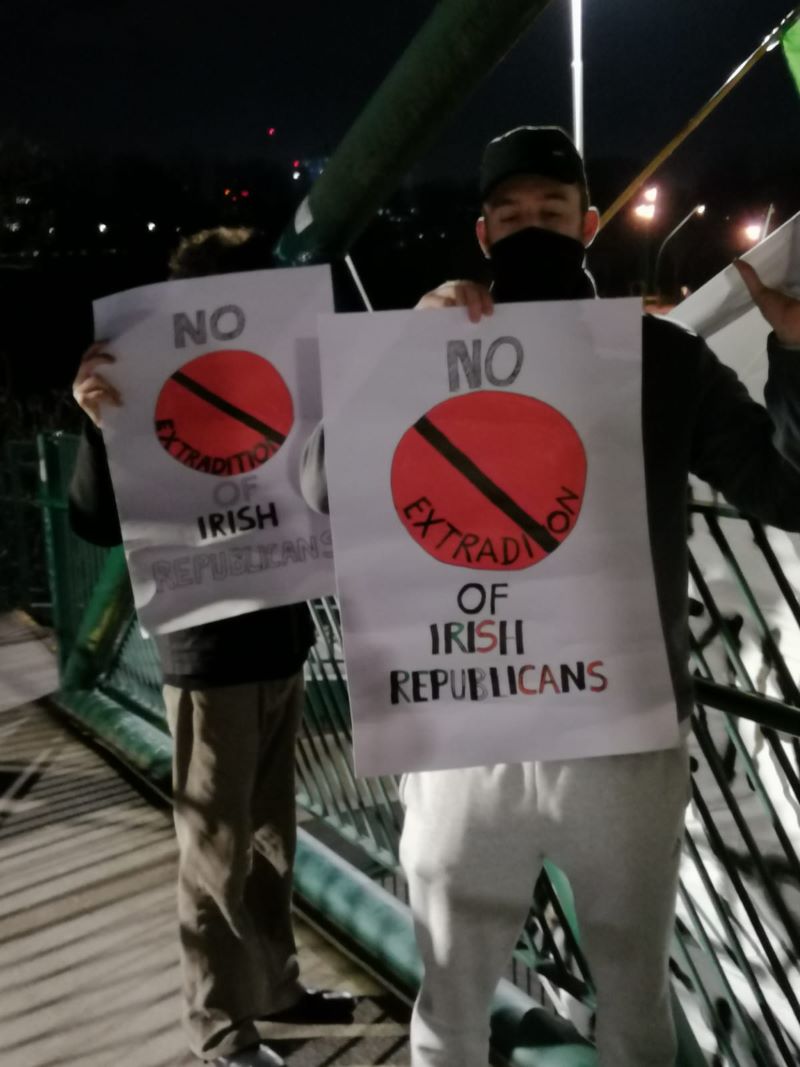
Some of the AIA-organised anti-extradition banner drop on the Fairview pedestrian bridge hold up placards against extradition. (Photo: R.Breeze)
Another extradition case has been dealt with in the Special Criminal Court, which is located within the same building as the CCJ, distinguished from other courts by the glass-enclosed reception ‘box’ through which one must pass to gain entry, first satisfying ‘security’ provisions.2
Sean Walsh has been fighting extradition to the UK’s Irish colony, the Six Counties on a charge of membership of an armed Republican organisation, which is deemed illegal on both sides of the British Border. He is in custody in Portlaoise awaiting a decision from the ECHR in Brussels.
Independent Dublin Republicans organised solidarity pickets outside the court on the mornings of Denneghan’s appearances, while Anti-Imperialist Action held a picket against extradition outside the nearby Heuston Train Station and a more recent banner drop on the Fairview Pedestrian Bridge.
Picket organised by Independent Dublin Republicans outside court where extradition of Jim Deneghan (Centre, next to State Harp) was being decided in February. (Photo sourced: IDR Facebook page)
The CCJ courts, in particular those on the ground floor are extremely busy with what seems at times like industrial-scale processing of setting further dates for court appearances, granting or refusing bail, requiring ‘discovery’ and other documentation from the Gardaí and some sentencing.
The human subjects of these proceedings are mostly from what might be termed the under-class of Dublin with some migrants added for good measure. Most face charges of possession of drugs, anti-social behaviour, threatening behaviour, theft and breach of bail conditions.
A huge amount of court, lawyer and Garda time is taken up with processing people accused under these charges. On the other hand the processes also interfere hugely with the normal lives of those charged and in addition, in the case of political activists, disrupt some of their legal activity.
And can cost them loss of pay and even threaten their employment. Which might be deliberate on the part of the system or if not, at least something those who manage it will not regret.
Banner drop by AIA from Fairview pedestrian footbridge. (Photo: R.Breeze)
The sheer number of that social group being processed through the courts daily is an indication of something really wrong with Irish society and which worsens even through generations, while the major reaction of the State is to maintain the social conditions and repress its victims.
By and large the middle class only come into contact with that element of society when they are prosecuting or defending them in court, or professionally dealing with them in hospital or social services environments.
It is also where many of those who are trying to change the prevailing social and economic conditions, i.e political activists, will first rub shoulders with that group while next to them on court seating benches. Unless the political repression goes a step further and they meet in jail.
End.
1Revolutionary Housing League which had renamed the building, on Eden Quay, ‘James Connolly House’.
2The non-jury SCC was established under an Amendment to the Offences Against the State Act, pushed through Leinster House by Fianna Fáil amidst collapse of its opposition during a panic caused by (British Intelligence) terrorist bombing of Dublin in 1972 killing two and maiming many. The scene of many unjust decisions, its most famous was the conviction of the innocent ‘Sallins Four’ when the SCC was based at Green Street, appropriately enough the scene of many injustices under the British occupation, including the death sentence on Robert Emmet after his famous speech. The existence of the SCC is opposed by Amnesty International and Irish civil rights organisations and, until a few years ago, by the majority political party in Ireland, Sinn Féin, which no longer opposes it.