When I asked the guy filling shelves in the supermarket where the milk powder was I had no idea what was to come.
Picking up on his accent as he showed me, I asked him where he was from.
“Poland,” he replied, so naturally I thanked him in one of the few words or phrases I know in Polish. He responded in Polish too, then asked me where I was from.
“Here”, I replied.
“Dublin’”, he replied, “wha? ah Jayzus. How’re ya doin’, Bud? Allrih?” And there followed a stream of Dublinese: words, accent and even gestures.
This of course, is our third language here in the capital city – not the native one relinquished by so many, not the colonisers’ appropriated by so many, though a version of it, moulded, turned, somewhat UStaterised, slanged, missing endings ….
He had me laughing, of course and as I paid for my purchases I mentioned it to the cashier, who told me the guy works part-time on nightclub security, so he picks up plenty of it on the door. We both agreed he does it very well.
I went off smiling — another small but interesting experience in our capital city.
Yes, indeed, we have been. Let us look back over the campaign of misinformation about conflict in Ireland for it has much to teach us about the mass media, about human credulity. We don’t need to go back over 800 years – just to the recent the 30-Year War.
In 1968 a civil rights campaign1 took off in the British Six-County colony in Ireland to include a number of marches and sit-ins, which was regularly met with violence from Loyalist2 mobs and the State. As part of the campaign, in 1969 a march from Belfast to Dublin was organised under the slogan “Civil Rights – North and South”. One of that march’s stops was in Lurgan, Co. Armagh, where the marchers sat at a crossroads and were instantly attacked by the armed British colonial police (then the RUC3, now the PSNI).
Some of the marchers had come from Britain to support the campaign and after being attacked in Lurgan, they bought an English newspaper to see whether the incident had been reported. An occurrence in the town had been reported alright but not what had occurred – the report told their readers that a fight between Catholics and Protestants had been broken up by the RUC, keeping the two sides apart. “There wasn’t a Protestant in sight,” commented a marcher angrily, “except those in RUC uniform …. or unless he was one of us4.”
Later that year, in August, the RUC killed four civilians, including a child, in the Divis Flats area of Belfast by firing at the area with a machine-gun mounted on an armoured car. Their claim they were returning fire from the area was widely refuted by local people but repeated in the media. The incident was not investigated until decades later when the claims of family and local witnesses were vindicated in an Ombudsman’s report.
The representation of the RUC as a force for peace between two groups in a sectarian conflict was to be a repeated media disinformation line through the ongoing conflict, as the struggle became an armed one — although to a large degree the honest broker ‘peacemaker’ cloak shifted from the colonial police on to the British Army.
British troops were sent in to the colony (by a Labour Government, in case we had illusions) in August 1969 and were initially greeted by many people in the ‘nationalist’5 community as saviours, sent to keep the sectarian RUC and Loyalist mobs (often enough amounting to the same thing) away from them. Most politicians and the media represented them as peace-keepers. For most nationalists the illusions did not last long as the Army turned their guns on them.
Although no British soldier had been killed in the Six Counties by the IRA as yet6, on 3rd July 1970 the British Army invaded the staunchly nationalist area of the Lower Falls and forced their way into homes, saying they were searching for arms. Local youths mobilised and attacked the soldiers with stones and petrol bombs7. The soldiers responded by pumping CS gas into the area and soon gun-battles between the IRA and the British Army broke out.
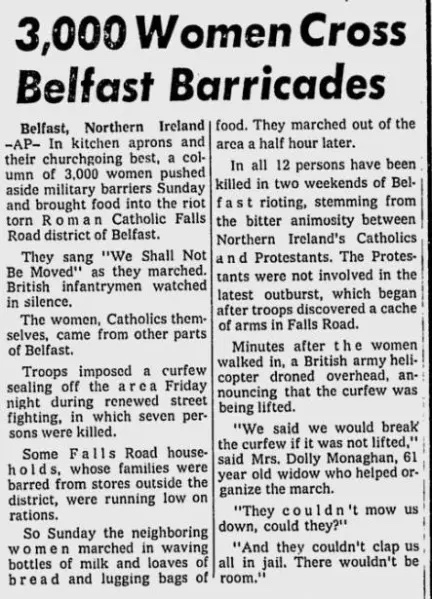
‘After four hours of continuous clashes, the British commander sealed off the area, which comprised 3,000 homes, and imposed a curfew which would last for 36 hours. Thousands of British troops moved into the curfew zone and carried out house-to-house searches for weapons, while coming under intermittent attack from the IRA and rioters. The searches caused much destruction, and a large amount of CS gas was fired into the area. Many residents complained of suffering abuse at the hands of the soldiers. On 5 July, the curfew was brought to an end when thousands of women and children from Anderstonstown8 marched into the curfew zone with food and other supplies for the locals.
‘During the operation, four civilians were killed by the British Army, at least 78 people were wounded and 337 were arrested. Eighteen soldiers were also wounded. Large quantities of weapons and ammunition were (allegedly – DB) captured. The British Army admitted afterwards that some of its soldiers had been involved in looting.’9
Mural on the Falls Road depicting Andersonstown women breaking the British cordon, Falls Curfew, 1970 (Source photo: Wikipedia)Cutting of unknown newspaper report displaying misrepresentation of the struggle, despite being friendly towards the women who broke the British Army siege of the Falls Road, July 1970. (Source photo: Step Back Ireland)
At the time, most of the media reported the clashes as unruly elements irrationally attacking the Army who were there to protect them and were only doing their job. However, the opinion of the nationalist community, though ignored by the media had undergone a huge shift and the first serving British soldier (of many to follow) was killed by the IRA the following year.10
Later in 1970, during riots in Derry, the Army shot two men from the nationalist area, Seamus Cusack and Desmond Beattie, claiming afterwards that they were armed, a claim local people denied. There was no investigation by the authorities, obliging the constitutionalist SDLP11 to withdraw from the colony’s parliament in protest.
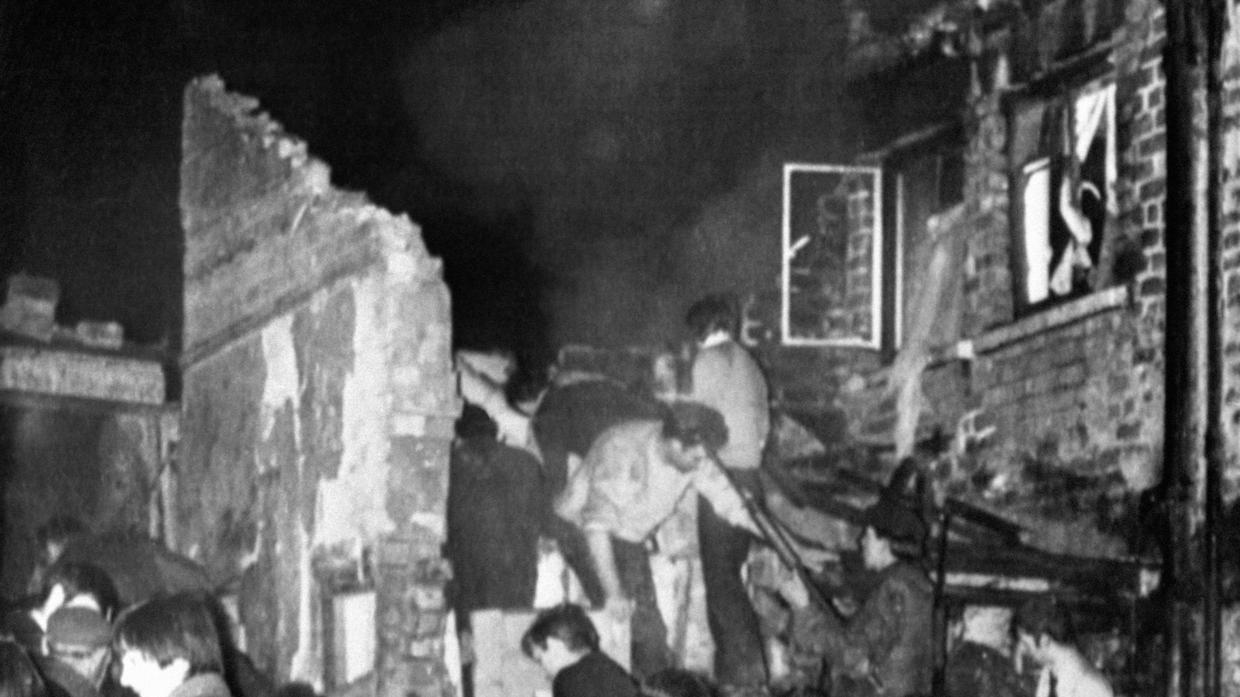
On 4th December 1971, an explosion in the Catholic-owned McGurk’s Bar in Belfast killed 15 people and injured 16. Due to the bar’s ownership and location, the most logical attribution would be to Loyalists or British forces. It would be hard to pin it on the IRA – unless it could be said to have been an accidental explosion of an IRA bomb during storage or transportation. That was what the “security forces” came up with, which of course was repeated by the media. An alternative media theory was that in some manner it was a result of a feud between the Official and Provisional IRA. In order to construct that theory, the denials of the IRA had to be discounted12, despite the organisations’ track record of taking public responsibility for its actions.
The explosion had occurred in the pub’s doorway, which would have thrown doubt on the “IRA bomb in transit” story but somehow, the RUC’s forensic examination did not determine that. But even worse, the evidence of an eyewitness had to be dismissed.
‘On 6 December, however, the RUC took a witness statement from an 8-year-old boy. He said that a car had stopped outside the pub with four men inside and “a wee Union Jack stuck in the back window”. He said one left a package in the Great George’s Street doorway and ran back to the car, which sped off just moments before the package exploded. A man and a woman backed up his story, although they did not witness as much as the boy.’13
‘In March 1976 the RUC received intelligence that linked UVF member Robert Campbell and four others to the McGurk’s bombing. Campbell was arrested on 27 July 1977 and held at Castlereagh RUC base. He was interviewed seven times during 27 and 28 July. He admitted his part in the bombing but refused to name the others.Campbell’s story matches that given by the young boy witness.’14
On 29 July 1977, Campbell was charged with the 15 murders and 17 attempted murders and in September 1978 pleaded guilty to all charges (he also had a separate conviction for the murder of a Protestant delivery driver in 1976). He eventually served fifteen years in prison, being released on 9th September 1993.15
Local people searching in the rubble of McGurk’s Bar after the bombing by Loyalists killing 15 but which was blamed on the Republican armed organisations. (Photo credit: AP)
Despite the 1978 convictions and even Campbell’s confessions, the “own goal bomb” theory of responsibility lingered and relatives sought for years to have the case properly investigated, some also alleging that the RUC had colluded in helping the killers get away out of the area and in the false atrributions later, possibly even with the intention of setting the two IRA organisations at one another’s throats.
In what has become a depressingly familiar story, the relatives campaigned on in the face of police inaction and media disinterest for years, during which many of the directly-affected died through natural causes, to receive partial vindication at last in an Ombudsman’s report which laid the blame squarely on a Loyalist gang and castigated the RUC for a biased and inadequate investigation. The report was published in February 2011– it had taken the campaigners only 40 years16.
The introduction of internment without trial in August 1971 was, according to the media, a necessary measure to deal with political violence from all sides. Not one Loyalist was arrested that year, or the next and it was not until 1973 that a single Loyalist had been interned, the total by December 1975, when the measure was ended, having been 107 against 1,874 from the Nationalist community.17
The Paratroop Regiment, British Army shocktroops, were sent into the colony that year too18. Between 9th and 11th August in the Belfast area of Ballymurphy, the Paratroopers caused the deaths of 10 men and a woman and wounded many19. The Paratroopers claimed they had been shot at and were returning fire and that all their targets had been “terrorists”20. The media repeated these lies and, if reporters interviewed wounded and other witnesses, their accounts were not published. There was no investigation and, as with the deaths of many victims of RUC and British Army, there was no inquest concluded until decades later (2021 for these victims21).
The nationalist community called a demonstration in Derry for 30th January the following year to protest the massacres and against the introduction of internment. The Paratroopers were there again and they and other British Army soldiers shot down unarmed demonstrators, causing the deaths of 14 and injuring at least another 15. The Army claimed they had been returning fire from Irish Republicans and had shot only gunmen and bombers and on the whole, the media parroted their claims.
The British put their top judge, Lord Chief Justice Widgery, to hold an inquiry and in April that year his verdict upheld the Army’s version and also blamed the organisers of the march. The media of course promoted that verdict too. It was not until the extraordinarilyy long and hugely expensive Bloody Sunday Inquiry set up 1998 22 produced the Saville Report in 2010 that the British officially (and then of course also the media) accepted what all of Derry and much of Ireland already knew, that the Paras had opened fire in a non-threatening situation and selectively targeted and killed unarmed civilians23.
British soldiers shot another five unarmed people dead in the Springhill area of Belfast on July 9th, yet again as in Ballymurphy the previous year, including a priest administering the last rites but this time their tally was also an thirteen-year-old girl24. The original ‘official’ account of the shootings— that those shot were ‘gunmen’ — was almost immediately discredited, and was changed shortly after; the claim then became that those murdered were simply caught in the crossfire. Again the media covered the Army story without investigation or challenge.
In 1988 on Sunday 6th March British SAS soldiers shot dead three unarmed IRA volunteers in Gibraltar. When it was revealed that the three had been unarmed, firstly the media claimed that they had been about to trigger an explosion but some time later the British found the explosives in a car in a Spanish carpark across the border without any electronic link to the dead volunteers. When the British claimed that the Volunteers had made threatening moves, eyewitnessed testified that not only had they been unarmed when shot but had been extra-judicially executed as they lay on the ground with their hands up in surrender position. One of the eye-witnesses was Gibraltar resident Carmen Proetta, who then became a target for British media slurs, even going to the extent of suggesting that she was a sex-worker.
On Monday 7 March all eleven British national daily newspapers reported the story that a bomb had been found. Many gave detailed information about the size (mostly 500 pounds), purpose and type of the bomb as well as how it was defused. The Daily Mail suggested that the bomb might have a ‘video timing device’, while Today and the Independent mentioned ‘remote control’. The Daily Mirror told us that ‘a controlIed explosion failed to set off the bomb’ whilst the Daily Mail added ‘RAF disposal men defused it later’.25
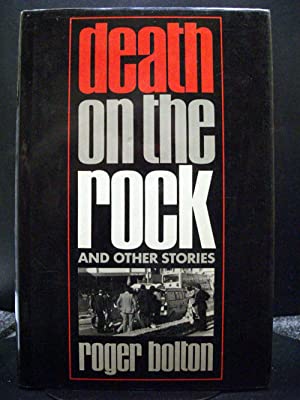
On 28 April 1988, almost two months after the Gibraltar shootings, the ITV television channel defied British Government pressure and threats of legal action to broadcast “Death on the Rock” an episode of its current affairs series This Week, produced by Thames Television, based on investigations of three journalists and many interviews. This led to a ferocious media attack on the documentary, its programers and the IBA, the governing watchdog authority.
Documentary program maker Roger Bolton’s account of his hounding by government and media about an accurate documentary of the 1988 SAS murders of three unarmed IRA Volunteers in Gibraltar. (Image sourced: Internet).
‘Over the following weeks, newspapers repeatedly printed stories about the documentary’s witnesses, in particular Carmen Proetta, who gave an account of seeing McCann and Farrell shot without warning by soldiers who arrived in a Gibraltar Police car. Proetta subsequently sued several newspapers for libel and won substantial damages. The Sunday Times conducted its own investigation and reported that “Death on the Rock” had misrepresented the views of its witnesses; those involved later complained to other newspapers that The Sunday Times had distorted their comments.’26
A great number of situations arose during the 30 Years War in the British colony that were either unreported or misrepresented by the mass media, including “confessions” obtained through torture, RUC and British Army collusion with Loyalist murder gangs, inhumane treatment of political prisoners, Army shooting of unarmed civilians, extra-judicial executions of Republican Volunteers and blackmailing individuals for information or to carry out agent-provocateur actions.
WITHIN THE IRISH STATE
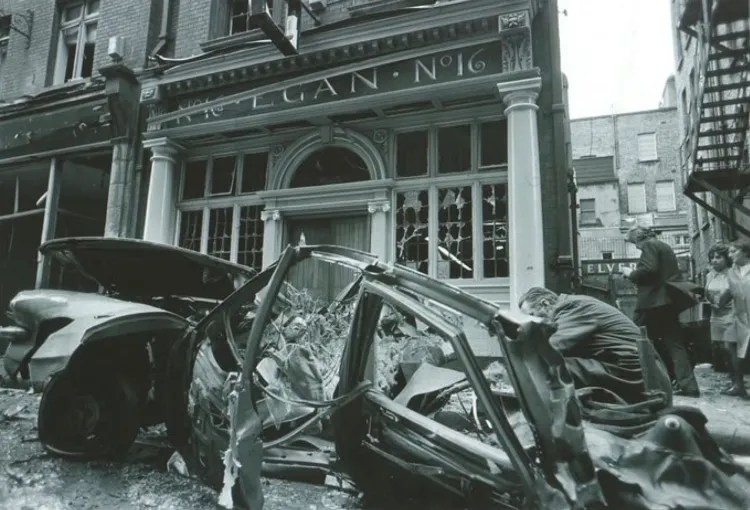
In 1969 the grave of Wolfe Tone in Bodenstown was blown up by Loyalists27 and between 1971 and 1974 there was a series of bombings in Dublin by Loyalists and British Intelligence. The bombing campaign began by aiming at symbolic structures and went on to target civilians which cost the lives of 36 civilians (and a full-term unborn child) and injured around 490, presumably to pressurise the Irish Government into increased repression of Republican paramilitaries.
In January 1971 the O’Connell Tower in Glasnevin Cemetery was damaged (not repaired finally until 2019, 47 years later)28, presumably as an attack on a prominent Irish Catholic29 icon. But in February 1971 the Wolfe Tone30 monument in Stephen’s Green was also blown up, like the blowing up of the grave, an attack on Irish Republicanism and its rebellious Protestant origins31. Bombings now aimed at civilians in Dublin followed and between 26 November 1972 and 20 January 1973, there were four paramilitary bombings in the centre of Dublin, claiming the lives of three public transport workers and injuring 185.
The first suspicion of responsibility for those bombings should naturally have fallen on the Loyalists and perhaps, by extension, on a British intelligence agency. It didn’t though; in the media and political circles, it was projected on to the IRA.
That could not have made logical sense, since such explosions could only have harmed the IRA among the Irish population. However there was another specific reason why it made even less sense, (if possible): in 1972 Leinster House32 was about to debate repressive legislation that would set up special no-jury courts to convict Republicans with the word of a police officer (at the rank of Superintendent or above) sufficient to convict of “membership of an illegal organisation”, with an automatic two-year jail sentence. The proposed legislation was being put forward by Fianna Fáil but Fine Gael and the Labour Party were mustering to vote against it and if they did, the new legislation would fall.
Scene of 1973 bombing in Sackville Place, Dublin city centre. The bombing the previous year was irrationally blamed on the IRA and the panic was used to collapse the opposition to proposed undemocratic repressive legislation, which was passed and is with us to this day. (Photo sourced: Stair na hÉireann Facebookpage)
In the midst of the horror about the bombing, the opposition crumbled and the bill went through, against protests of many human and civil rights agencies33; it became law, has sent many people to jail on dubious ‘evidence’ and is in force to this day.
The illogical focus on the IRA as the source of the 1972 and ‘73 bombings and the consequent failure to investigate them and follow up on the likely perpetrators had a horrific result in 1974: three bombs in Dublin city centre and one in Monaghan town centre killed 34 and injured around 30034, the highest number of people killed in any one day during the 30 Years War (often conveniently forgotten by the media, as for example in this report https://www.belfasttelegraph.co.uk/news/northern-ireland/army-knew-mcgurks-bar-bomb-was-placed-in-doorway-solicitor-says-35516460.html.)
Not only that, but the failure to energetically investigate the 1974 bombing meant that some of the Loyalist perpetrators were free to murder many civilians in the following years – some of the bombers were members of the infamous Glennane Gang, a Loyalist-RUC-British Intelligence group of killers responsible for up to 120 murders of civilians35.
WITHIN BRITAIN
The events in Ireland were of course being felt by the Irish diaspora in England too. Marches, pickets and public meetings protesting the RUC’s repression of marches for civil rights were held in many British cities, as they were against sending the British Army into the Six Counties, introduction of internment without trial and shooting protesters dead. Some groups on the British Left were also attending these events and occasionally organising their own. Irish solidarity was becoming a major issue for anti-imperialist solidarity in Britain and abroad, in addition to being in a sense a major domestic issue in Britain too.
The IRA began to extend Britain’s war to their homeland in a bombing campaign in 1971, at first targeting property. However, in 1974 bombs in two pubs in Birmingham killed 21 people which was difficult to understand but according to an alleged perpetrator, the warning intended by the bombers was frustrated through out-of-order public telephone boxes. The Guildford and Woolwich bombs, aimed at pubs frequented by British soldiers, killed five soldiers and two civilians overall and injured 101 people.
The horror and outrage resulting from that carnage gave the British State the environment in which they could launch a wholesale clampdown on the Irish diaspora. The Prevention of Terrorism Act was rushed through the Westminster Parliament in 1974, specifically targeting the Irish community. The Act empowered the police to raid homes, to hold suspects without access to a solicitor for up to five days and longer on special application and to summarily deport Irish people from Britain – even to their own colony. It also empowered the police to stop and question Irish people without warrant or having to show cause and thousands were stopped and questioned at ports and airports as they travelled from Ireland to Britain or vice versa, sometimes missing their flights or boat as a result. People were questioned on the street too and on Irish solidarity demonstrations.
In that atmosphere, of which the media was the main facilitator in British society, it was fairly easy for the State to frame nearly a score of innocent people on bombing charges and to sentence them to many years in jail on the flimsiest of “evidence”, later to refuse their right to appeal, later still, granting that right but denying the justice of their cases.
Judith Ward was arrested in February 1974, sentenced to life imprisonment plus 30 years in October 1974 and her conviction overturned in May 1992.
The Birmingham Six were arrested in November 1974, sentenced to jail for life in August 1975, their convictions finally overturned in March 1991.
The Guildford Four were arrested in December 1974, sentenced to imprisonment for life in October 1975, their convictions finally overturned in October 1989.
Giuseppe Conlon and the Maguire Six were arrested in December 1974, sentenced to 4, 51, 12 and 14 years in 1976, their convictions overturned in 1991. By that time Vincent and Patrick had already served their sentences and Giuseppe Conlon, father of Gerry Conlon of the Guildford Four, had died in jail.
1Patrick Maguire was only 14 at the time and Vincent only 17.
The innocent Birmingham Six at their appearance in court after being beaten up by prison warders as they arrived at the jail falsely charged with the bombings in Birmingham. The mass media played a major role in their being found guilty and in frustrating campaigns to free them which only succeeded 17 years later. (Image sourced: Internet)
The UK media in particular played a huge part in setting the atmosphere in which these unjust convictions could take place and in making the struggle of the innocent for justice difficult. Even after their acquittal, some of the media insinuated that they had been guilty and had got free through some kind of legal loopholes.
Could the media have known differently? Yes, certainly, not one of the cases would stand up to reasonable inspection. The Guildford Four were hippies living in a squat, the Birmingham Six were escorting the body of a deceased IRA man to Ireland when the bombs exploded, the Maguires were a Tory-voting woman with teenage children, Giuseppe was only in London to help his son after the latter’s arrest and Judith Ward was mentally ill, homeless and penniless37. Their ‘confessions’, obtained through torture and intimidation38, were admitted as evidence against them, although they all retracted them and declared how they had been obtained. The forensic evidence was faulty and besides recording a false positive and even though the defence team had a forensic expert to refute it during their trial, the Prosecution’s expert was the one accepted.
The February 1977 confession by an IRA unit to the Woolwich and Guildford bombing after their capture in the Balcome Street siege was not accepted, although they were able to give details of the bombing. So tortured and retracted ‘confessions’ were acceptable whereas one voluntarily given was not.
Apart from the logical doubts that should have arisen in even a light examination of the cases, the media also had access to detailed refutation of the case against the Birmingham Six. Although much has been made recently of the investigation of the case by Chris Mullin, the publication of his book Error of Judgment: The Truth About the Birmingham Pub Bombings (1985), the research for which went into the earlier 1984 ITV World in Action documentary, a detailed challenge to the convictions had been published much earlier. Only two years after the arrest of the Birmingham Six, Fathers Murray and Faul had published The Birmingham Framework39, which they had sent to British politicians and media agents. In 1982 the Irish in Britain Representation Group40 also publicly called for the freeing of the framed prisoners and continued to do so for every year thereafter. Other organisations such as the Troops Out Movement41 called for their release also and trade union branches began to support such calls.
Exposure of the case against the Birmingham Six published by Frs. Murray and Faul as early as one year after the convictions of the innocent men. (Source image: Internet)
It suited the State that the British public think the prisoners guilty and the British media played their part in that purpose. In a way, it also suited the State if the Irish community knew the prisoners were innocent since, if even the innocent could be jailed so easily, how could any Irish person be safe except by keeping his or her head down low? Irish solidarity activities declined in occurrence and in numbers attending. With few exceptions, the Irish community in Britain was cowed from 1974 until the Hunger Strikes of 1981 brought them out on the streets again, the terror broken by the spirit of solidarity and outrage.
WHY?
The above examples are only a selection of situations in Ireland during the period under discussion about which we and the world were misinformed or censored. Throughout the 30 Years’ War so many accusations against the British armed forces, including their armed colonial police, have been ignored or recorded disbelievingly by the media – in particular the British section but within the Irish state also – and repeated by media services abroad, to be picked up by other media …. and so on, and on. And likewise with accusations against British intelligence services and their domestic police force.
Why then are the current claims of the Ukrainian government published through the mass media being accepted without question on every count? Why is everything the Russian government says discounted or ignored without checking? Why are we not concerned at banning of alternative media and censorship of commentators who are not repeating the party line? Why are we not outraged at the agreed delivery of Julian Assange by the UK to the USA on charges of “spying” because he exposed their lies and murderous activities in Iraq and Afghanistan? Given our own experience over 30 years of the UK media’s dismal record of reporting on the conflict in Ireland – and its equally dismal repetition in the western media – why are we now believing without critical examination the western media reporting on the war in the Ukraine?
End.
FOOTNOTES
1The civil rights campaign in the Six Counties was in pursuance of equal rights for the Catholic minority with the Protestant majority there, in the electoral franchise, in housing and employment, along with the repeal of the repressive Special Powers Act.
2‘Loyalists’ is a term describing militants – always of Protestant community background – in various organisations — who insist on remaining within the UK. The first armed actions in the 30 Years War were by Loyalists.
3Although the Royal Ulster Constabulary was created in 1922, when Ireland was partitioned, it was in effect a continuation of the Royal Irish Constabulary, the British occupation’s gendarmerie (nation-wide semi-military police force, such as exists in Spain, Turkey, Italy, France, etc) in existence throughout all of Ireland since 1822. Although the personnel of the RIC had been mostly Catholic in background (usually with Protestant senior officers), the RUC was determinedly Protestant from the start, both in its full-time and part-time membership. However, a minority of the civil rights campaigners were also from Protestant backgrounds.
4As part of the control structures in the Six Counties, the authorities had recruited only non-Catholics into the colonial police force, which helped unionist politicians and media represent an attack on the police as a sectarian attack. Though a few Catholics have been recruited since the 1990s and Sinn Féin has been supporting recruitment drives in nationalist areas, the PSNI personnel remain overwhelmingly of Protestant background.
5A convenient term used to describe the large minority community, mostly of Catholic background, mostly of the original population but with some earlier intermarriage into the majority community, which is of mostly colonist/ settler origin.
6Ironically, the first serving British soldier killed in the Six Counties was killed by indescriminate firing by the RUC into the nationalist area of Divis Flats in Belfast. Trooper Hugh McCabe of the Queen’s Royal Irish Hussars was home on leave, staying with his family when the RUC opened fire with machine-gun on the nationalist area (this was one of the incidents that led to the barricading of “no go” areas excluding the RUC and later also the British Army). Three others were also killed by RUC bullets, including a nine-year-old boy. It took over 50 years for the families to get an acknowledgement and apology after an Ombudsman’s report. https://www.theguardian.com/uk-news/2021/may/06/ruc-erred-at-troubles-dawn-by-firing-on-flats-from-armoured-cars#:~:text=Patrick%20Rooney%2C%20nine%2C%20Hugh%20McCabe,the%20Divis%20and%20Ardoyne%20areas.
7People had learned to make those in defence against RUC and Loyalist attacks during the earlier Civil Rights period.
8A large Belfast nationalist area separated from the Falls area by unionist areas and the city centre.
11The Social and Democratic Labour Party, advocating reform through legal and constitutional methods.
12Two days after the explosion, on December 6th, both the Official and Provisional IRAs issued statements condemning the bombing and denying any involvement. Local people also denied any association between the pub and either of the armed organisations.
18Despite some time searching online I have not come across the exact date they were there by May 1971 and it may be that they had been sent there as part of plan that included the introduction of internment without trial later that year.
20The fact that one fatal victim was a mother of eight children and another, a local priest, should have alerted media to the fact that the Paras were likely lying and local people likely telling the truth.
22Likely initiated as as a payoff to the Provisionals for buying into the Peace/ Pacification Process, the other being the early release on licence of their members in jail, the inquiry lasted twelve years and cost £195 million.
23No senior Army officer or senior politician of the time has even been charged for those murders. One lower-ranking soldier was eventually charged but in July 2021, the Public Prosecution Service decided it would no longer prosecute him either.
29Daniel O’Connell, a constitutional Irish nationalist politician and Catholic, campaigned for the repeal of the anti-Catholic Penal Laws in which he was largely successful in 1869 and unsuccessfully for repeal of the Act of Union, which had transferred the internal legislation of Ireland through its Parliament to Westminster instead in 1801.
30Theobald ‘Wolfe’ Tone was an Anglican campaigner for reform of anti-Catholic legislation (only Anglicans could be elected to the Irish Parliament) who became a revolutionary Irish Republican when those attempts failed. He was a founder of the revolutionary republican United Irishmen organisation. He was captured by the British after surrender of the French naval ship on which he was travelling on 12th October 1978. Although an officer in the Army of France he was tried for treason and sentenced to be executed; on 19th September 1798 he died in prison of wounds, apparently self-inflicted to deny the State his public execution.
40The IBRG was formed late in 1981 as an independent community organisation, among the issues it took up were those of anti-Irish racism, access to resources for the community, an end to strip-searching of prisoners, freedom for the framed prisoners and British withdrawal from Ireland.
41The Troops Out Movement was founded in 1973 as a broad organisation to mobilise the British public for withdrawal of British troops from Ireland; with branches in many parts of Britain, it organised marches, pickets, public meetings and published pamphlets. The relevant Wikipedia incorrectly claims it was “an Irish Republican organisation” — though it naturally did contain Irish Republicans, it also contained British revolutionary left and social-democratic elements. Though maintaining its independence for decades, it did towards the end of the 1990s become closely linked to Provisional Sinn Féin.
On 9th April, the Dublin Anti-Internment Committee held another of its regular awareness-rising events in the city, this time on on the northside, at the junction of the busy shopping Henry Street and Liffey Street.
Section of the anti-internment picket in Dublin last week (Photo: Rebel Breeze)
Supporters lined up with the Anti-Internment Committee of Ireland banner and placards. In addition to the Starry Plough of the Irish working class, the Palestinian and the Basque flags were flown in symbols of solidarity and also as a demonstration that political prisoners are held in many countries around the world.
Going on for 200 of the AIGI’s leaflets were distributed, explaining that Irish Republicans continue to be held in custody without trial through the practice of refusal of bail and through revocation of licence. This practice by administrations on both sides of the British Border are anti-democratic suppression of the right to hold political opinions and to organise in their furtherance.
Plainclothes political policeman (in blue top, far left of photo) stood a little distance away facing the picketers but they were not intimidated (Photo: Rebel Breeze)
Recordings of relevant songs were played on a portable PA, such as The Roll of Honour, Viva la Quinze Brigada and Something Inside So Strong. Throughout the period of the event, two Special Branch (plainclothes political police) kept up an obvious surveillance which however did not deter the picketers.
The Anti-Internment Committee of Ireland is an independent broad and democratic committee, endeavouring to hold regular awareness-raising events and all democratic people are welcome to attend its public events, always advertised in advance on its Facebook page.
Queen Elizabeth II / Sinn Fein president Mary Lou McDonald
Mary Lou McDonald, the current president of Sinn Féin, surprised a few, just a few, with her recent comments thanking the English queen, Elizabeth, for her service. She stated that “Can I also extend to the British Queen a word of congratulations because 70 years is quite some record. That is what you call a lifetime of service.”(1)
Why someone who describes herself as a republican would want to heap praise on a monarch and refer to the reign of the monarch as service is bewildering. However, it is not that strange in the context of the Irish peace process. It is part of the long road of Sinn Féin’s accommodation to the British state that was laid out in the Good Friday Agreement. Sinn Féin at that time abandoned any pretence of having a critique of imperialism and capitalism.
The agreement signed basically stated that the British had no selfish interest in Ireland and the conflict was a communal one. Putting it in blunt terms, two savage tribes agreed to settle their differences, the British state was not one of those savage agents in the conflict.(2)
Exactly what service has the English queen given and to whom? As a monarch she has blessed every British military adventure since her coronation in 1953, including the savagery of the British repression of the Mau Mau rebellion in Kenya, various other colonial wars, not to mention her awarding of an OBE to Lt. Colonel Derek Wilford the man responsible for Bloody Sunday in Derry in 1972. In 2019 she stood over her behaviour when she stated that the British government would “bring forward proposals to tackle vexatious claims that undermine our armed forces, and will continue to seek better ways of dealing with legacy issues that provide better outcomes for victims and survivors”.(3) The massacre of Bloody Sunday was placed in the category of vexatious claims.
Part of the service that McDonald now lauds includes this and many more such incidents. Though it is not unexpected. It can only surprise those who pay no attention to the outcomes of peace processes around the world. Yasser Arafat spent more time repressing Palestinians than he did fighting the Israelis after the Oslo Accords. In South Africa, the former mining trade union leader Cyril Ramphosa became a mining magnate, whose company was involved in the massacre of 34 striking miners at Marikana in 2012.(4) He and the ANC made their peace with white capitalists and obtained a share of the wealth, in Ramphosa’s case a very substantial amount which some estimates place around $780 million dollars. In El Salvador, the FMLN eventually gained power, but did not implement a single thing they had ever fought for and their former commander Joaquín Villalobos is now a consultant to right wing forces on how to defeat left wing movements and contributes to the right-wing think tank The Inter-American Dialogue, which includes such illustrious figures as Violetta Chamorro from Nicaragua and former head of the World Bank, Robert Zoellick, to name just two unsavoury characters.(5) In Colombia, the ink hadn’t even dried on the agreement and the FARC commander Timochenko declared that the Colombian armed forces would be allies of the FARC in building a new country. The murder of just over 300 members of the FARC since the signing of the peace agreement has not caused him to change his evaluation of the Colombian armed forces, in fact he has doubled down on his position.
It is in the nature of the beast. In every peace process that has happened, the former enemies of the state reconciled themselves to the regime and the system, without exception. McDonald’s declarations are just a confirmation of that and also a sign that it is a bottomless pit and there is no level of political depravity that Sinn Féin will not sink to.
Between 400 and 500 people gathered in Moore Street on Saturday 22nd January 2022 to hear a number of speakers declare their complete opposition to the plans of the Hammerson property group, most of which had been approved by the chief officer of Dublin City Council’s Planning Department, in the face of a great many formal and informal objections and against even decisions of the elected councillors. Musicians also played and sang a number of songs at the event.
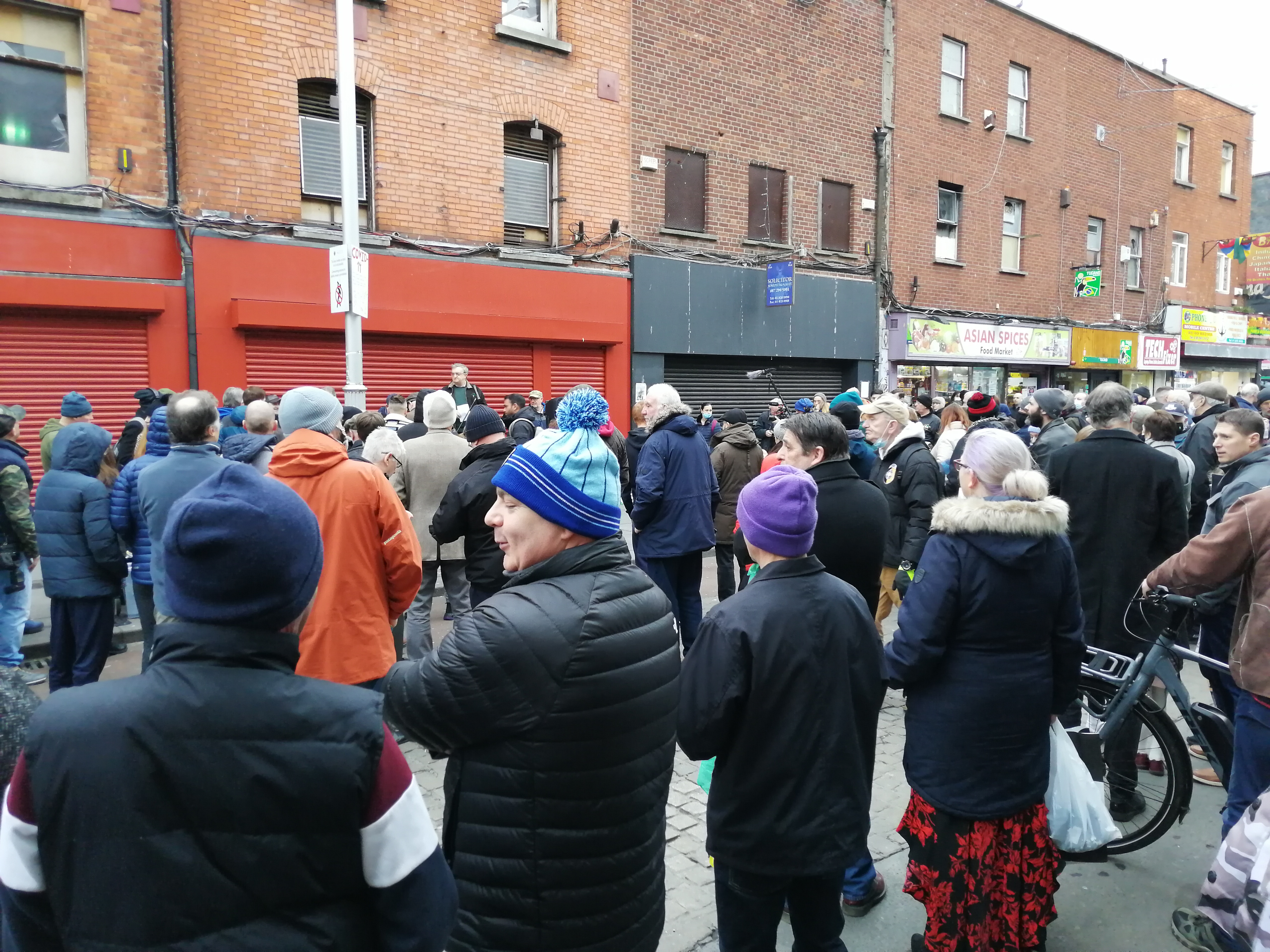
Section of the crowd at the rally. (Photo: Rebel Breeze)
SPEAKERS AND SPEECHES
Chaired by the Secretary of the Moore Street Preservation Trust, Mícheál Mac Donncha (Sinn Féin Councillor), the crowd listened to a range of speakers: dramatist and campaigner for decades Frank Allen, 1916 relatives Brendan Mulvihill and Donna Cooney (latter a long-time campaigner and also Green Party Councillor), Diarmuid Breatnach for the Save Moore Street From Demolition campaign group (with a campaign stall every Saturday), Carolyn Alright (fourth-generation street trader), Stephen Troy (2nd generation local butcher) and Aengus Ó Snodaigh (Sinn Féin TD [member of the Irish Parliament]).
Micheál Mac Donncha, Secretary of the Moore Street Preservation Trust (also SF Dublin Councillor) chairing the event. (Photo: Rebel Breeze)
Each speech was different but of course sharing such themes as the struggle for Irish independence, historical memory and conservation but also closely linked to issues very much of the day: lack of justice in economic and social policy, lack of democracy in decision-making, reference to the housing crisis, property speculators, vulture funds, the banks ….. A number also made reference to the recent deaths of two homeless people in the vicinity.
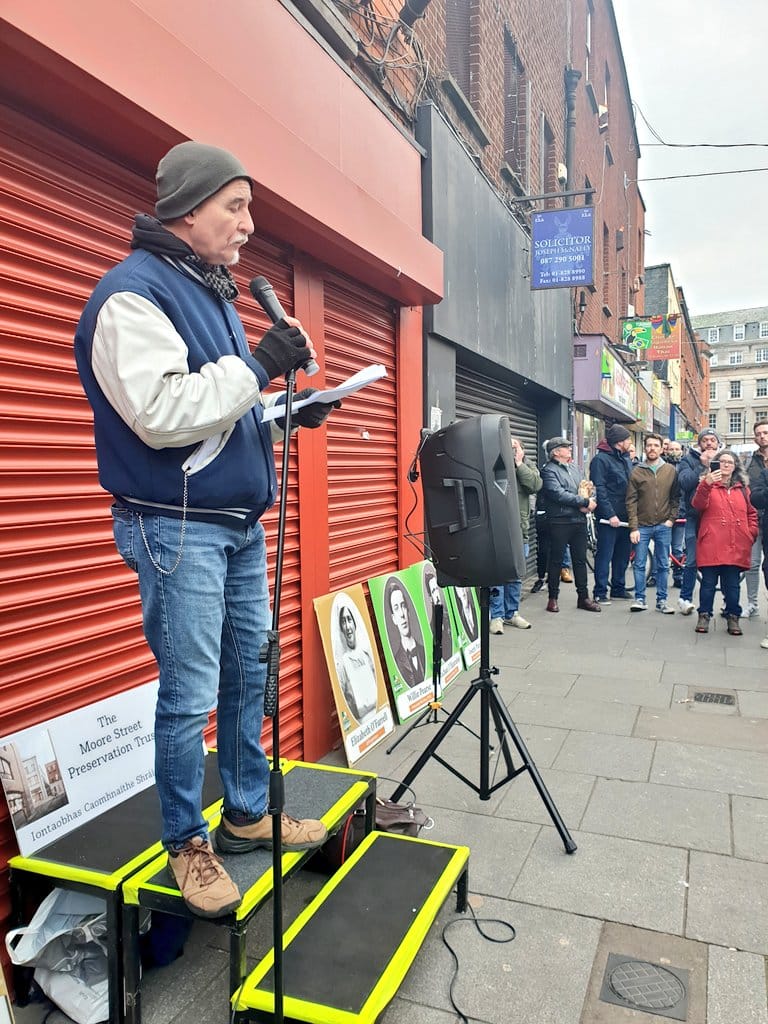
Diarmuid Breatnach, of the Save Moore Street From Demolition campaign group, speaking at the rally (Photo sourced: Internet).Independent businessman in Moore Street Stephen Troy speaking during the rally (Photo: Rebel Breeze)
There were some additional points made, for example Frank Allen called on people to tell the Fianna Fáil party they’d never get a vote in Dublin again if they didn’t act to save the area from demolition; Donna Cooney pointed out that demolition of buildings had a much worse effect on the environment than restoration; Diarmuid Breatnach stated that the area was of international historical importance and merited world heritage status; Stephen Troy spoke about the disaster for small businesses next to a 15-year building site; Caroline Alright pleaded for the future of the street to be taken out of the hands of the developers and Ó Snodaigh expected a more supportive attitude from the next Government (widely predicted to be a coalition with Sinn Féin as the larger partner).
Pat Waters, performing at the rally. (Photo: Rebel Breeze)
Donna Cooney, long-time campaigner for Moore Street and relative of Volunteer Elizabeth O’Farrell (see her portrait next to Donna) speaking at the rally. (Photo: Rebel Breeze)
Live music for the event was provided by Pat Waters, performing his own compositions, including a song about the O’Rahilly who was fatally wounded in 1916 in Moore Street leading a charge against a British Army barricade; also two musicians from the Cobblestone Pub, including the son of the owner, Tom Mulligan who performed Pete St. John’s Dublin in the Rare Aul’ Times.
Musicians of the Cobblestone performing (note Frank Allen in left background, who was a passionate speaker at the event). (Photo: Rebel Breeze)
There was speculation in some quarters as to why the rally had been called at such short notice; with prominent members of the Moore Street Preservation Trust absent1 and having an incorrect Irish name of the street2 on the event poster and promotional merchandise did seem to indicate a rushed event.
For some too, the Trust is being increasingly seen as closely linked to Sinn Féin, which for some is a positive factor but for others is not. The closeness has been evident on a number of occasions: a SF public meeting some years ago at which Jim Connolly Heron, prominent member of the Trust was the only speaker representing campaigners and more recently the promotion of the Trust’s Alternative Moore Street plan by SF, including the party President, Mary Lou Mac Donald, speaking at its launch a few months ago. At the rally on Saturday, the speaker for the Save Moore Street From Demolition campaign group made a point of saying that their group is independent of any political party.
Aengus Ó Snodaigh, SF TD and sponsor of Bill on Moore Street in the Dáil, speaking at the rally (Photo: Rebel Breeze)
However, the Bill to make the area a cultural quarter, currently proceeding with glacial slowness through the Dáil (Irish Parliament) is sponsored by a Sinn Féin TD, Aengus Ó Snodaigh, who spoke at the rally. Others counter by pointing out that Darragh O’Brien, a Minister of a party now in Government, Fianna Fáil, had sponsored a very similar bill back in 2015; however, with that party now the leading member of the current coalition Government, their leaders have welcomed the speculator’s plan for Moore Street.
A view of the crowd at the very start of the rally (Photo: Rebel Breeze)
GOVERNMENT
The Government department most concerned with the Moore Street issues is the Department of Heritage, part of the Department of Housing, Local Government and Heritage3. When Heather Humphries was the Minister responsible for Heritage she championed the bid of property speculator Joe O’Reilly to get control of Nos. 24-25 (owned by DCC) at the end of the central Moore Street terrace in exchange for the four buildings the State had declared a National Monument (Nos.14-17).
When Dublin City councillors voted not to allow that “land-swap”, against the recommendation of the City Managers, she castigated them publicly. She also instructed her legal team to appeal the High Court Judgement of March 2016 that the whole area is a National Historical Monument and in February was successful in having the judgement set aside.4 When Humphries attended Moore Street during the Easter 2016 events she was picketed and booed when she spoke. However, the current Minister for Housing, Local Government and Heritage Darragh O’Brien actually put in a submission against the proposed demolition of a building at the south end of Moore Street; however the Planning Department of Dublin City Council approved it.
Section of the crowd in front of the rally (Photo: Rebel Breeze)
As Minister 1n 2016, Humphries set up a Consultative Group on Moore Street on which all the Dáil political parties had a seat, along with a couple of councillors. From the campaigners, only the Jim Connolly Heron group had representation on it. The Minister’s group (latterly “Advisory”) has been in operation from 2016 until late last year but seems to have achieved nothing. The Hammerson Plan was welcomed by its Chairperson and by some of its members, including Brian O’Neill, Chairperson of the 1916 Relatives Association which seems a volte-face of that organisation, which had the conservation of the Moore Street battlefield as a central point of the Association’s constitution. However, the Hammerson plan was strongly opposed by others in the Minister’s Group, including Jim Connolly Heron. Outside the Minister’s Group, the opposition is even more widescale.
Street traders and independent businessman in Moore Street chatting at the rally. Photo: Rebel Breeze)
THE FUTURE
The planning permission given to Hammerson will be appealed to An Bord Pleanála but the Bord has a bad reputation with conservation campaigners, who see it as generally favouring the property developers5. Scheduling the appeal would take at least two months and possibly much longer. Should the campaigners not succeed at that stage, a legal challenge is also a possibility. Alongside the exploring of these options, street activities such as the rally on Saturday are likely. In 2016 conservation campaigners occupied the buildings for six days, blockaded them for six weeks, organised marches, rallies, pickets, re-enactments, concerts, history tours and public meetings.
Moore Street might be in for a hot summer. Or, given how long some processes have taken to date, even a hot Autumn.
2 The name they used was Sráid Uí Mhórdha, which is also the one on DCC’s street nameplate. However, it has been widely accepted in recent years that the correct name in Irish is Sráid an Mhúraigh, which is the one recorded in the State’s database for place-names, logainm.ie and furthermore is the version used in Sinn Féin’s own Bill currently proceeding through the Dáil.
4 The Appeal Court verdict did not discuss whether it was or was not but instead declared that a High Court Judge was not empowered to declare a National Monument.
5 In fact, the Bord approved the O’Reilly plan for a giant “shopping mall” in the area (forerunner to the current Hammerson Plan) even though the Bord’s own officer recommended rejecting it.
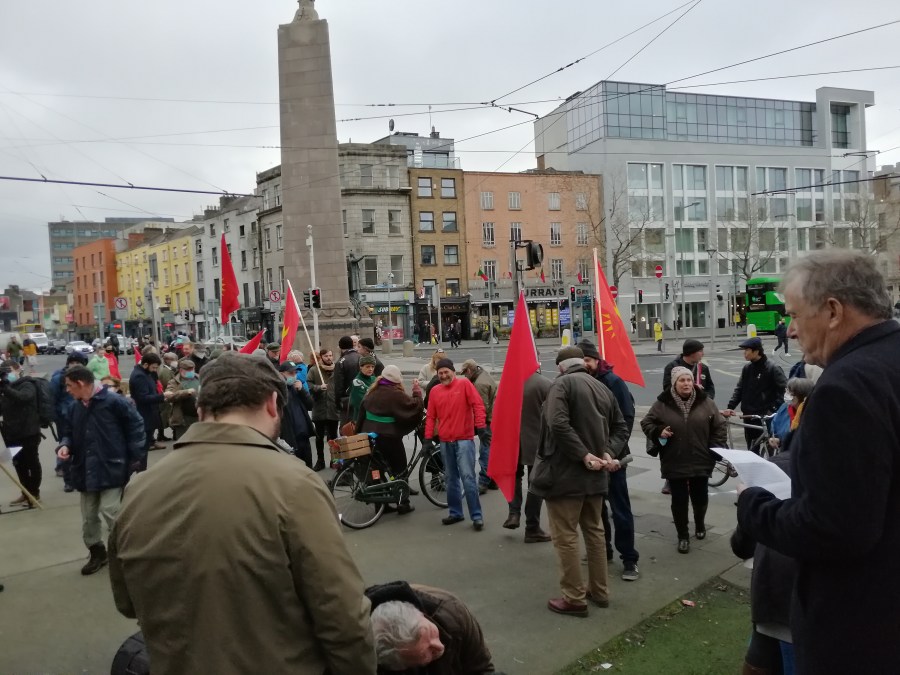
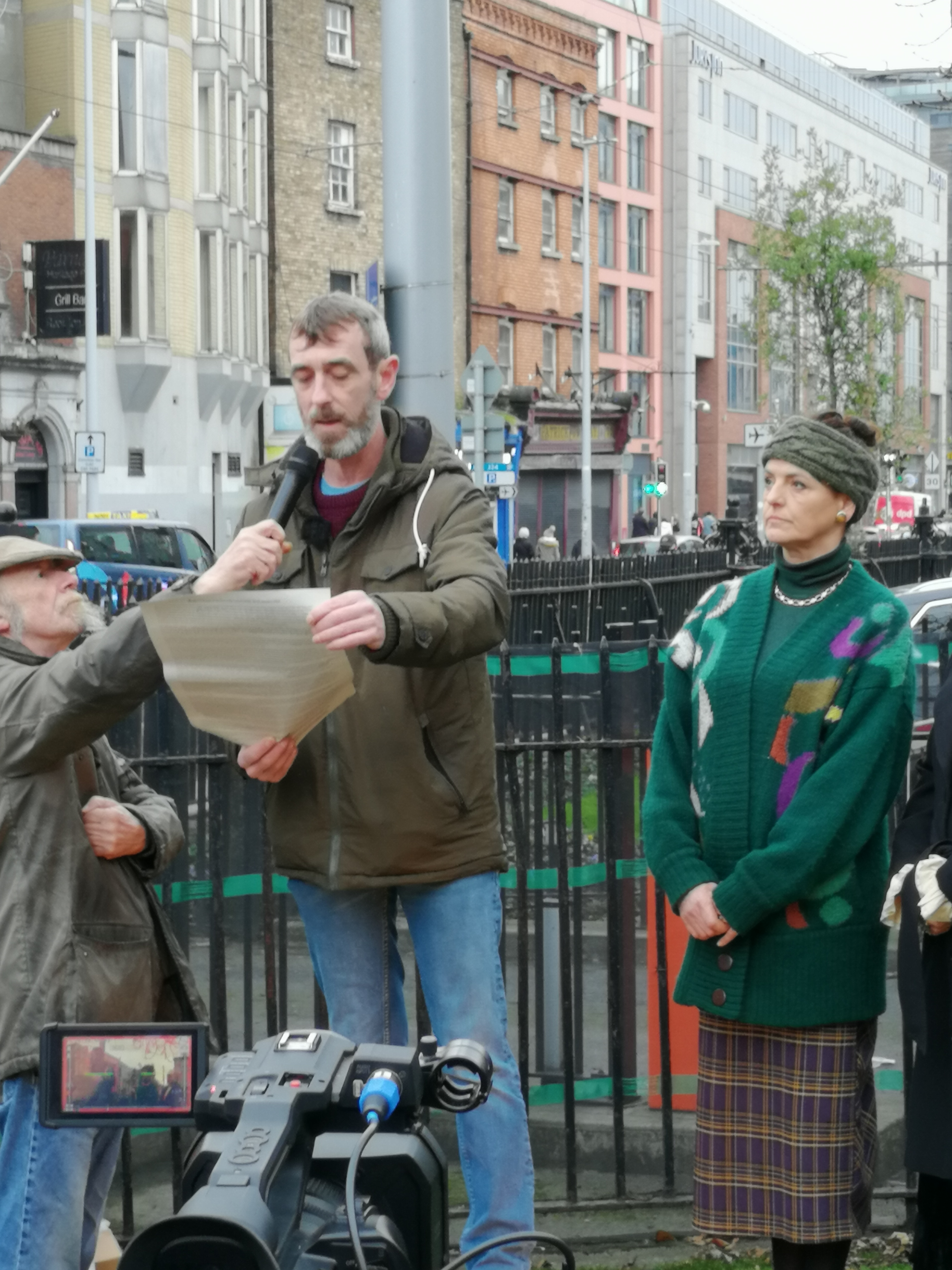
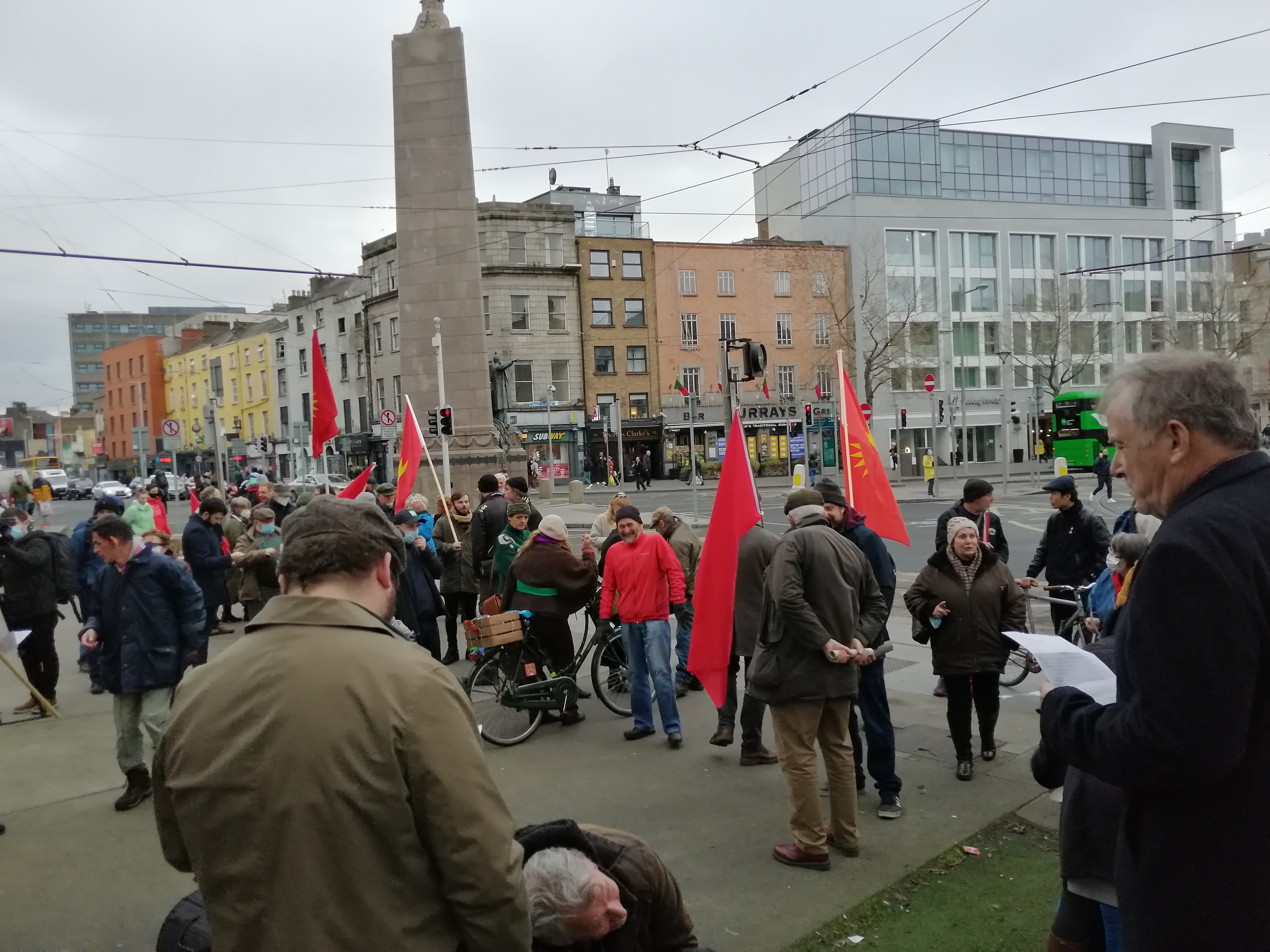
On Saturday 22nd January 2022 an event was held to commemorate the centenary year of the occupation of the Rotunda building in Dublin by 150 unemployed workers led by Liam Ó Flaithearta, a Republican and Communist and writer from Inis Mór (off the Galway Coast). The occupation took place two days after the formation of the Free State and was attacked by an anti-communist crowd while after a number of days the occupiers were forced out by the police force of the new state of the dismembered nation1. The event last week was organised by the Liam and Tom O’Flaherty Society.
The event began with a gathering at 1.30pm in North Great George’s Street, where the Manifesto had been printed in 1922.2 People then proceeded to the nearby Rotunda, site of the occupation in 1922.3
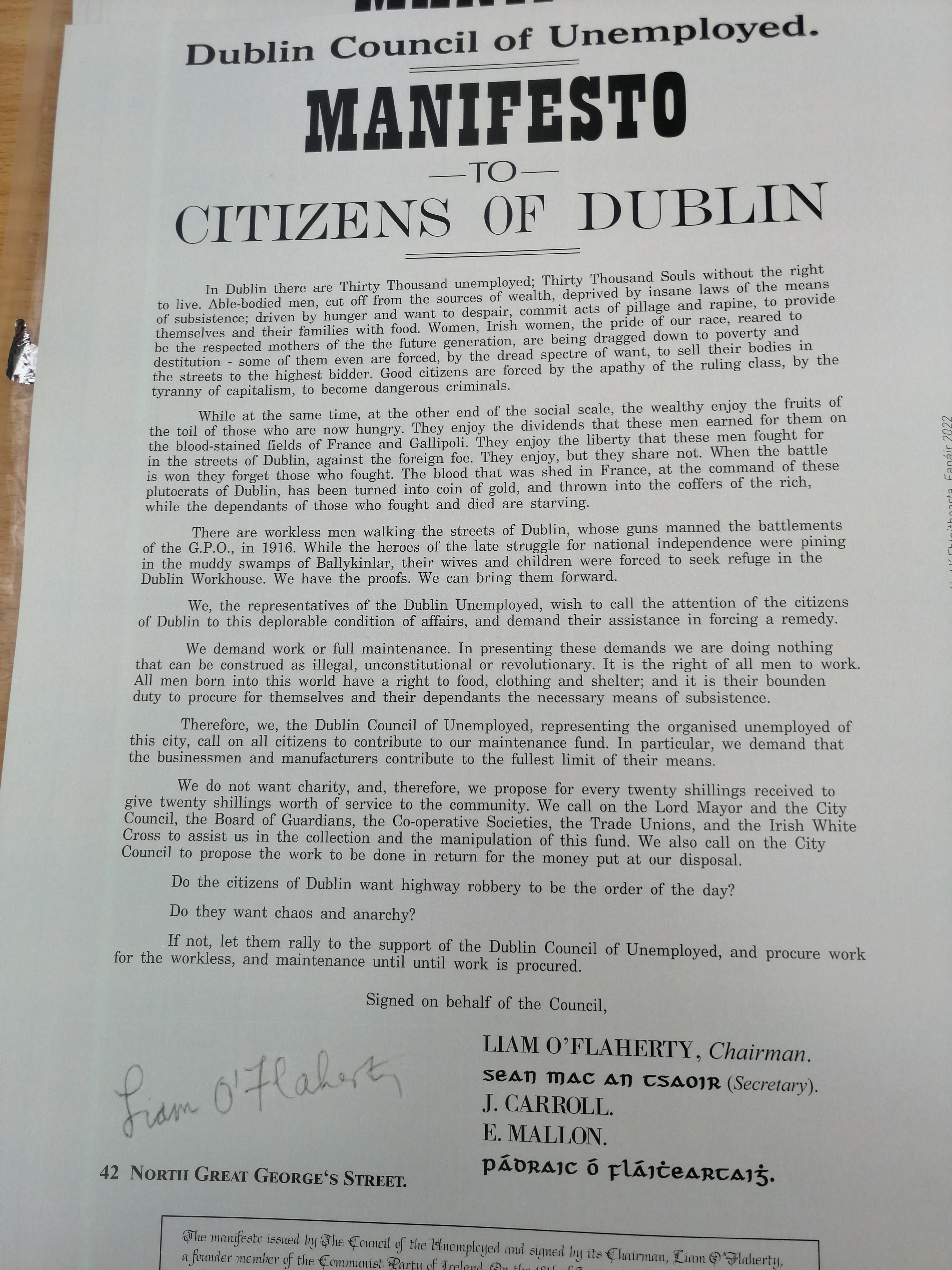
Copy of the manifesto available at the event (Photo: D.Breatnach)
Seosamh Ó Cuaig (Photo: D.Breatnach)
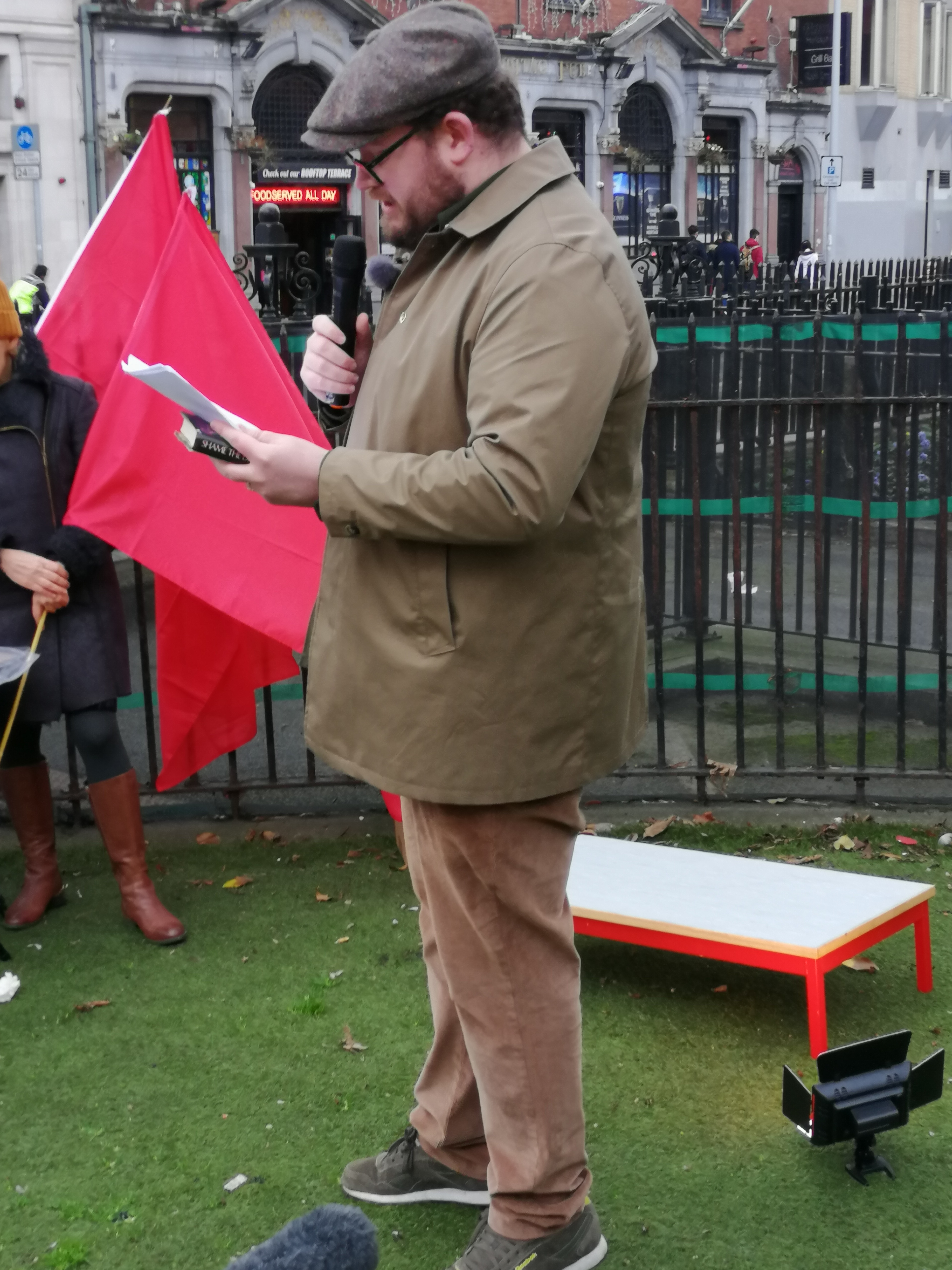
Seosamh Ó Cuaig from Cill Chiaráin, Carna, Conamara, opened the proceedings as Chairperson, ag cur fáilte roimh dhaoine i nGaeilge agus i mBéarla, briefly introducing the historical occasion and recounting how some companies, including Boland’s, had supplied bread, sugar and tea to the occupiers, before he introduced published historian and blogger Donal Fallon.
Fallon not only recounted the events of that occupation 100 years ago but also placed it in context of a number of other factors: the unemployment then in the State (30,000 in Dublin) and to follow through into the 1930s, the upsurge in workers’ occupations and local soviets, the reactionary nature of the government of the new state and of the hierarchy of the Catholic Church at the time, which was very supportive of the new regime and extremely hostile to any kind of socialism, along with the cultivation of a reactionary social and political attitude among sections of the population.
Donal Fallon speaking at the event (Photo: D.Breatnach)
Fallon also commented on the censorship and otherwise neglect of Liam Ó Flaithearta as an accomplished modern Irish writer and hoped for his writing to become more popularised now.
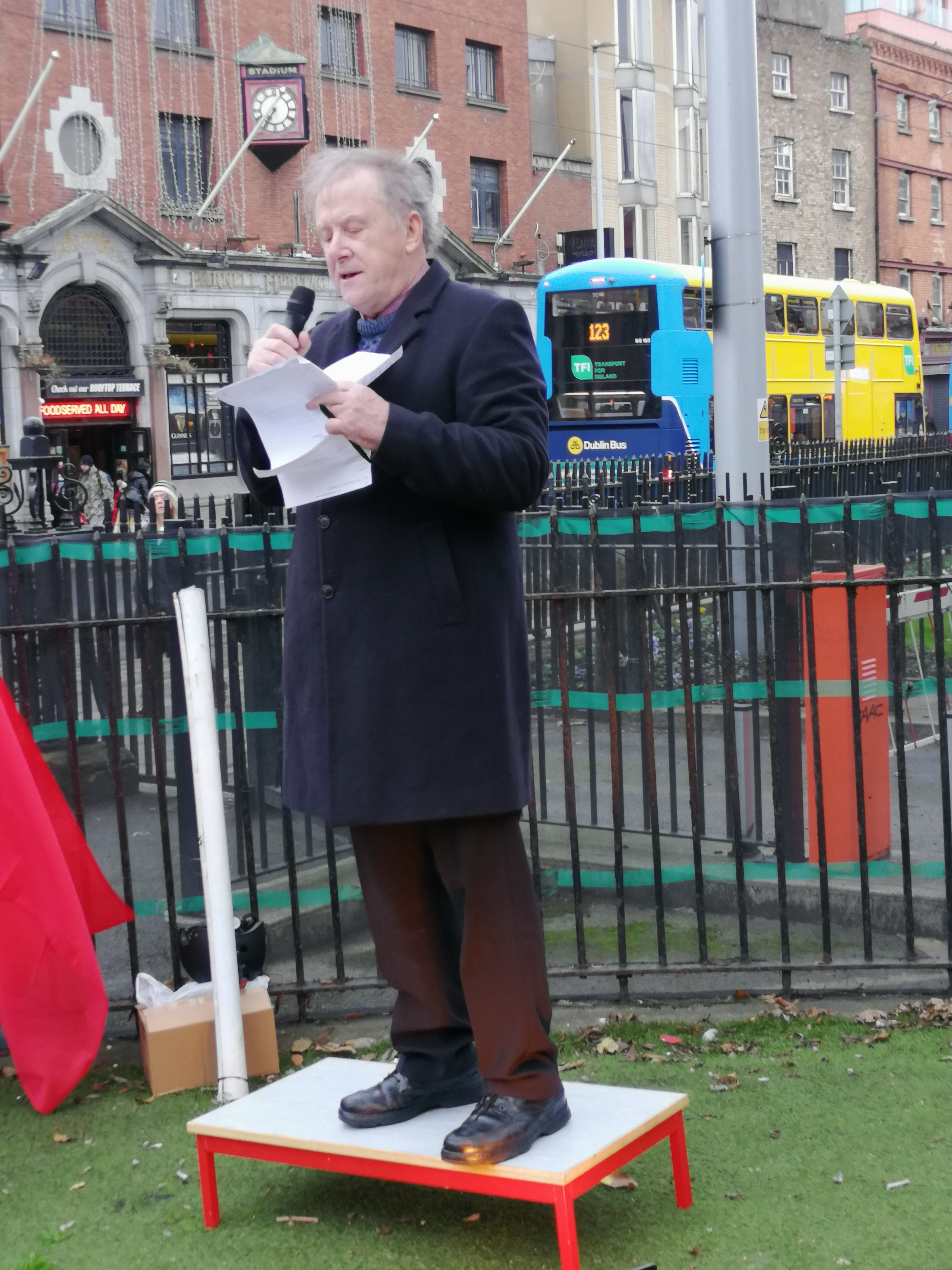
Alan O’Brien reading O’Flaherty’s Manifesto (Photo: D.Breatnach)
Alan O’Brien, Dublin poet and dramatist, was welcomed on to the stage to read the Manifesto which had been issued at the time, copies of which were available at a nearby stall. One of the aspects of that document was a call for Dublin City Council to set up public works to provide paid employment for those out of work in exchange for services to the community.
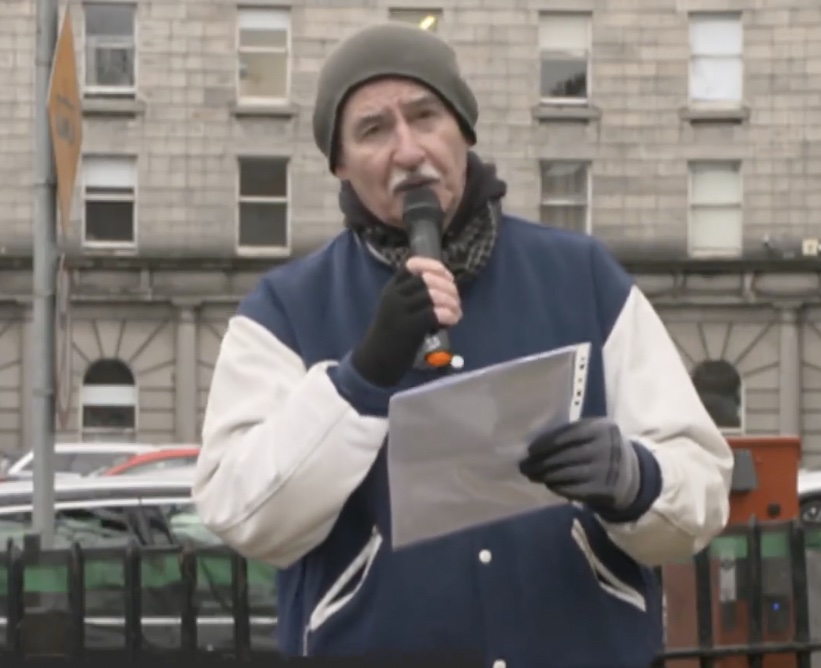
Diarmuid Breatnach, singer and blogger was invited to the stage to sing “The Red Flag” because it had been sung there during the occupation. No doubt those in the Government, Church hierarchy and generally among reactionary people at that time would have been horrified by the lyrics and would have asserted that they were foreign to Irish culture and thinking. However, as Breatnach explained, the lyrics had been composed by an Irishman (see Appendix 1), Jim Connell from Meath. Connell wrote the lyrics to the air of The White Cockade and was appalled to hear it sung to the air of Oh Tannebaum, a Christmas carol. Breatnach had never heard it sung to the White Cockade air but had been practicing it for days and hoped he would be faithful to the original air.
Diarmuid Breatnach singing The Red Flag to the air of The White Cockade
Called by the Chairperson to sing a follow-up song, Breatnach sang most of the verses of “Be Moderate”, satirical lyrics published by James Connolly in 1907 in New York. There had been no air published for the song and it has been sung to a number of airs but he would sing it to the air of A Nation Once Again, which provides a chorus:
We only want the Earth, we only want the Earth, And our demands most moderate are – We only want the Earth!
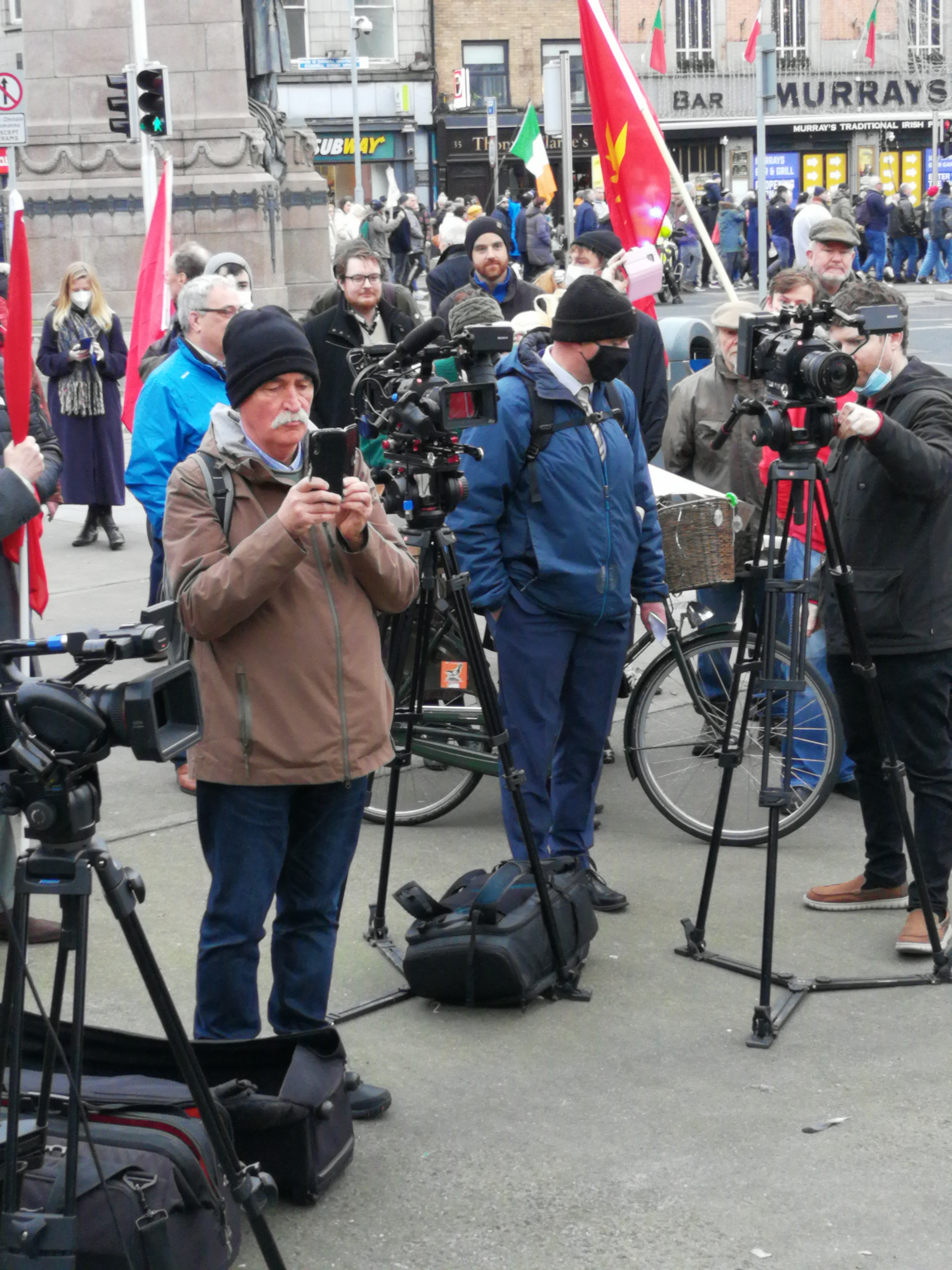
The event was later reported by RTÉ briefly in English on the Six O’Clock News and also by video on TG4’s Nuacht in Irish including interviews with Fallon an a number of participants.
End main report.
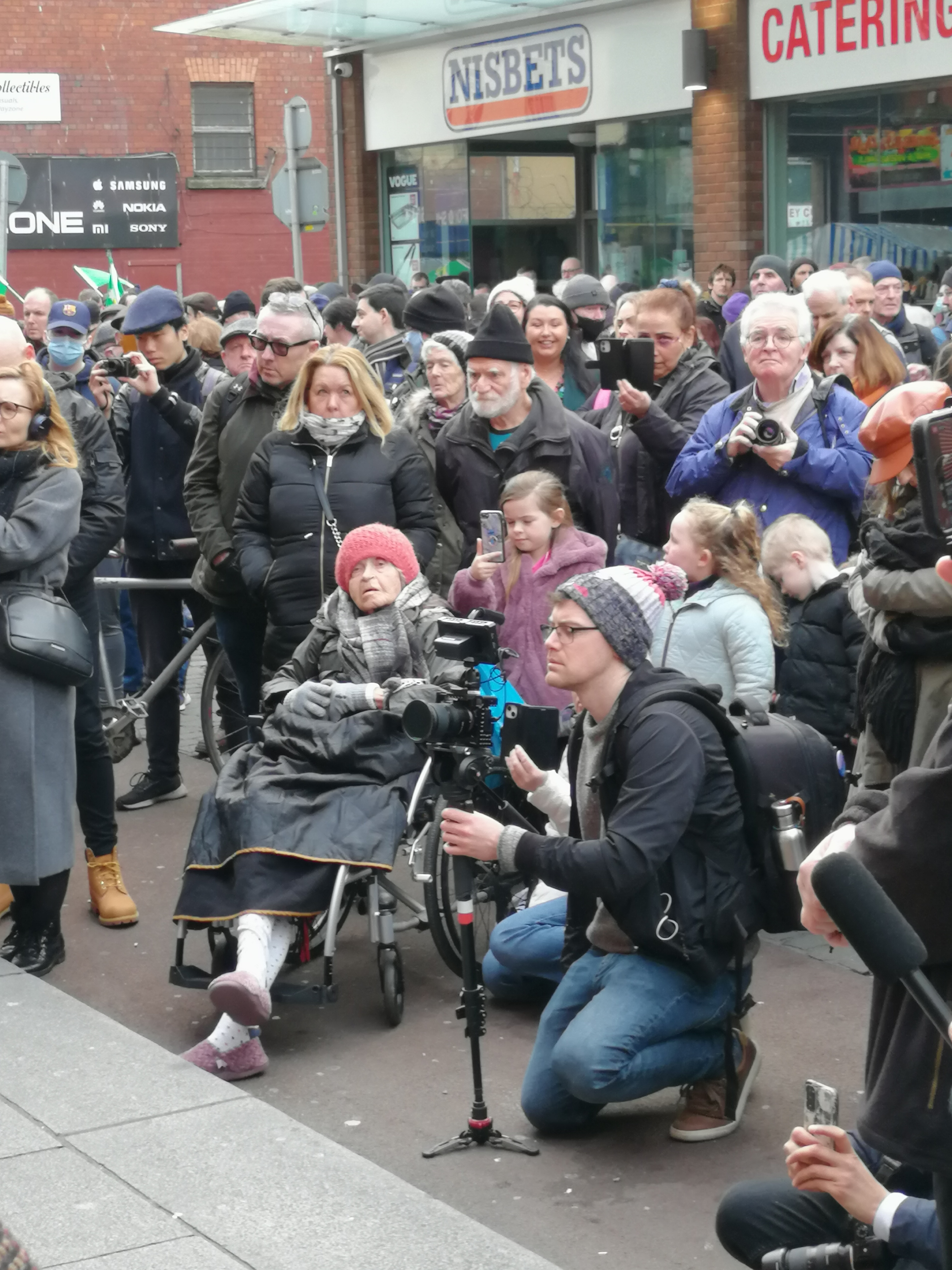
Early arrivals at the event with the plinth of Parnell monument in background centre left (Photo: D.Breatnach) Section of the crowd and media filmers at event (anti-vaccine etc march in background) (Photo: D.Breatnach)
APPENDIX 1:
THE RED FLAG: AUTHOR, LYRICS AND AIR
After the Rotunda occupation was terminated, Liam Ó Flaithearta emigrated to London, which is where the Red Flag lyrics had been composed twenty-three years earlier. The lyrics were composed by Meath man Jim Connell in London in 1889 to the air of the Scottish Jacobite march TheWhite Cockade — he was reported livid when he learned that it was being sung to the air of Oh Tannebaum, protesting: “Ye ruined me poem!”
Jim Connell was a Socialist Republican (he had taken the Fenian oath), activist and journalist who emigrated to England in 1875 after being blacklisted in Dublin for his efforts in unionising the docks in which he worked. Apparently he began to write the song lyrics on his way home from a demonstration in London city centre, on the train from Charing Cross to Honor Oak in SE London, where he lived and completed it in the house of a fellow Irishman and neighbour, Nicholas Donovan.
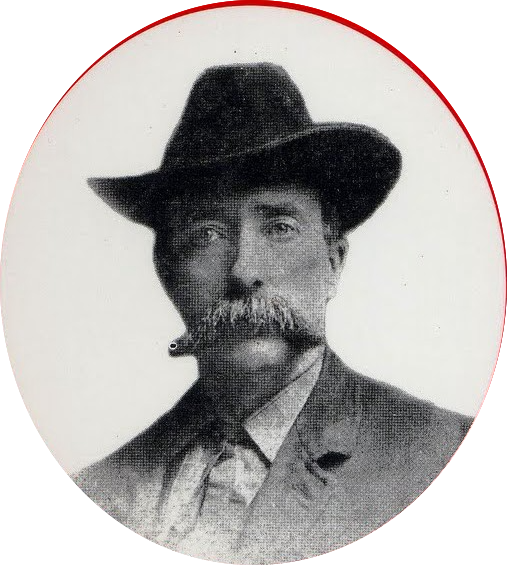
Photo of Jim Connell, author of The Red Flag (Photo: D.Breatnach)
The lyrics have been sung by revolutionary and social-democratic (the latter less so now) activists all over the English-speaking world but also in some other languages in the years since.
Not mentioned in the Wikipedia entry on Jim Connell is the fact that he also wrote a book, apparently a best-seller in his time, called something like “The Poacher’s Handbook“. I’ve been looking for that book for years without success (DCC Library could find no reference to it).
UNVEILING PLAQUE ON JIM CONNELL’S HOME
Today there is a plaque on the two-storey house where Connell lived until his death in 1929, having been awarded the Red Star Medal by Lenin in 1922.
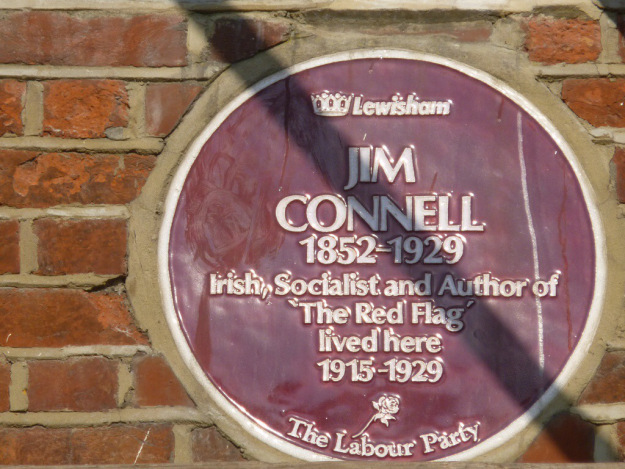
Plaque on house in which Jim Connell lived in SE London when he wrote the lyrics (Photo: D.Breatnach, sorry about the shadow)
In the late 1980s a history archivist with the London Borough of Lewisham contacted the Lewisham branch of the Irish in Britain Representation Group, of which I was Secretary, to consult us about the erection of a history plaque on the house and the wording to use4. We attempted to have the words “Irish Republican” added to “Socialist” after his name on the plaque and were successful with “Irish” but not with “Republican”.
There was a handful at the unveiling at midday on a weekday, including a representative of the local Council, a couple from the Greater London Council including its Irish section, a trumpeter (who played the Oh Tannebaum air) and Gordon Brown (then just an MP). I believe this was 1989, the centenary of the song being written.
Brown’s speech did not mention Ireland once but as he finished, I jumped up on a nearby garden wall and while thanking those in attendance said that it was sad to see the country of Jim Connell’s birth omitted along with his views on Irish independence, particularly at a time when British troops were fighting to suppress a struggle for that independence.
This was during the age before mobile phones and I have no photos, sadly. So no big deal but the next edition of the Irish Post, a weekly paper for the Irish community in Britain, carried a report on the ceremony and my intervention. It was written by the columnist Dolan, who was the alter ego of the Editor, Brendan Mac Alua (long dead now) and a supporter of much of the IBRG’s activities.
I lived in Catford then, five minutes by bicycle from the site of the house and have photographed the plaque.
FENIAN CONNECTION BETWEEN LYRICS ACROSS TWO DECADES
The words and sentiment “Let cowards flinch or traitors sneer” in the Red Flag mirror some in a song celebrating Irish political prisoners, The Felons of Our Land: “While traitors shame and foes defame” and “Let cowards mock and tyrants frown”. Arthur Forrester wrote that song 20 years before Connell’s and it would be surprising indeed had Connell not consciously or unconsciously borrowed the construction and sentiment.
Arthur Forrester was himself of great interest as were his poet sisters, both raised by their Irish nationalist mother, also very interesting person and poet in her own right, in Manchester, known to Michael Davitt. Arthur was a Fenian and did time in prison for it5. He was also for a period proof-reader for the Irish Times! Frank McNally wrote an article about the song but I don’t have access to anything except the first few lines.
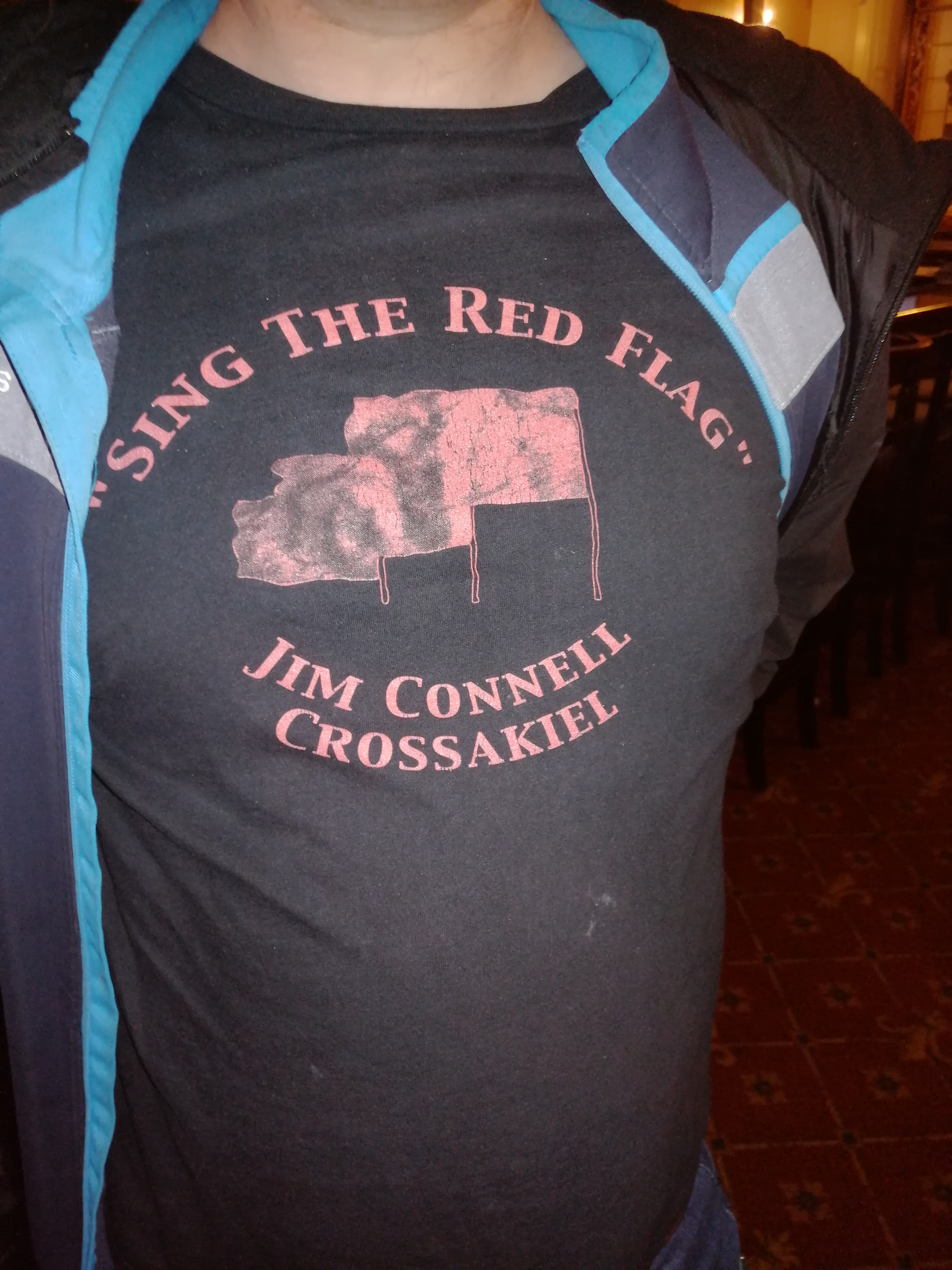
T-shirt worn by one of those in attendance (Photo: D.Breatnach)
APPENDIX 2:
Lyrics of The Red Flag:
The People's Flag is deepest red,It shrouded oft our martyred dead,And ere their limbs grew stiff and cold,Their hearts' blood dyed its every fold.Chorus:Then raise the scarlet standard high.Beneath its shade we'll live and die,Though cowards flinch and traitors sneer,We'll keep the red flag flying here.Look round, the Frenchman loves its blaze,The sturdy German chants its praise,In Moscow's vaults its hymns were sung,
Chicago swells the surging throng.(chorus)It waved above our infant might,When all ahead seemed dark as night;It witnessed many a deed and vow,We must not change its colour now.(chorus)It well recalls the triumphs past,It gives the hope of peace at last;The banner bright, the symbol plain,Of human right and human gain.(chorus)It suits today the weak and base,Whose minds are fixed on pelf and placeTo cringe before the rich man's frown,And haul the sacred emblem down.(chorus)With head uncovered swear we allTo bear it onward till we fall;Come dungeons dark or gallows grim,This song shall be our parting hymn.
FOOTNOTES
1Not long afterwards, the new Free State’s National Army, under the orders of Michael Collins, attacked a protest occupation by Irish Republicans of the Four Courts which began the Civil War of the State against the IRA, lasting until 1923 with over 80 executions of Republicans by the State along with many kidnappings and assassinations (such as Harry Boland’s and of course others killed in battle (excluding the shooting of surrendered prisoners, which the National Army also did on occasion). Some were even murdered AFTER the war had ended, for example Noel Lemass, his body left in the Dublin mountains.
2Possibly this was the same location which had housed the James Connolly College (raided by the Auxiliaries in 1921).
3Also the location of the first public meeting to launch the Irish Volunteers in 1913 and where much of the GPO garrison and others were briefly kept prisoner after the surrender in nearby Moore Street in 1916. And just beside it the Parnell Monument, across the street the location of the founding of the Irish Ladies Land League (where members were arrested) and diagonally in SE direction, Tom Clarke’s tobacconist and newsagent shop (occupied by the British Army during the Rising).
4The Lewisham branch of the IBRG had been founded in 1986 and founded the Lewisham Irish Centre in 1992, I think. It was a very active branch in campaigning, community and political work, ceasing to exist around 2002. The IBRG itself was founded in 1981 and was active on many issues, including anti-Irish racism, representation for the diaspora, release of the framed Irish prisoners, British withdrawal from Ireland, against anti-Traveller racism, plastic bullets and strip-searches. It was also for equality in general, being against all racism, gender discrimination and homophobia and one year shared a march with the Broadwater Farm campaign.
5 Despite the Irish diaspora having given the working class in Britain its anthem (The Red Flag), its classic novel (TheRagged-Trousered Philanthropists) and, among many social and trade union activists and leaders, two leaders of the first genuine mass workers’ movement in Britain (the Chartists — O’Brien and O’Connor), and having fought against the Blackshirts at the Battle of Cable Street, there is no BA in Irish Studies alone available in British Universities. The Irish diaspora is also the first migrant community in Britain and for centuries the largest, has made significant contribution to the arts and a huge one to rock, punk and pop music. It would seem that the British ruling class does not want its population to know in any depth about the Irish.
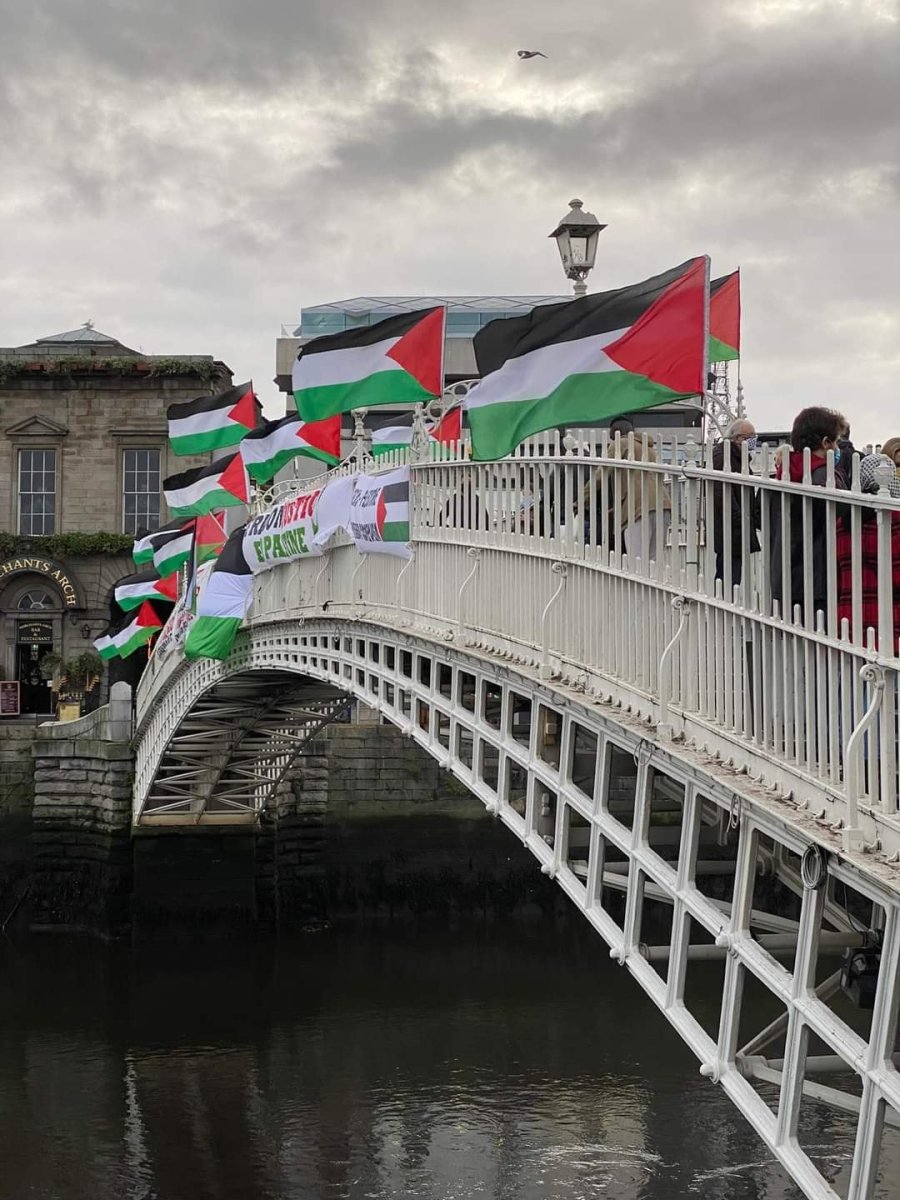
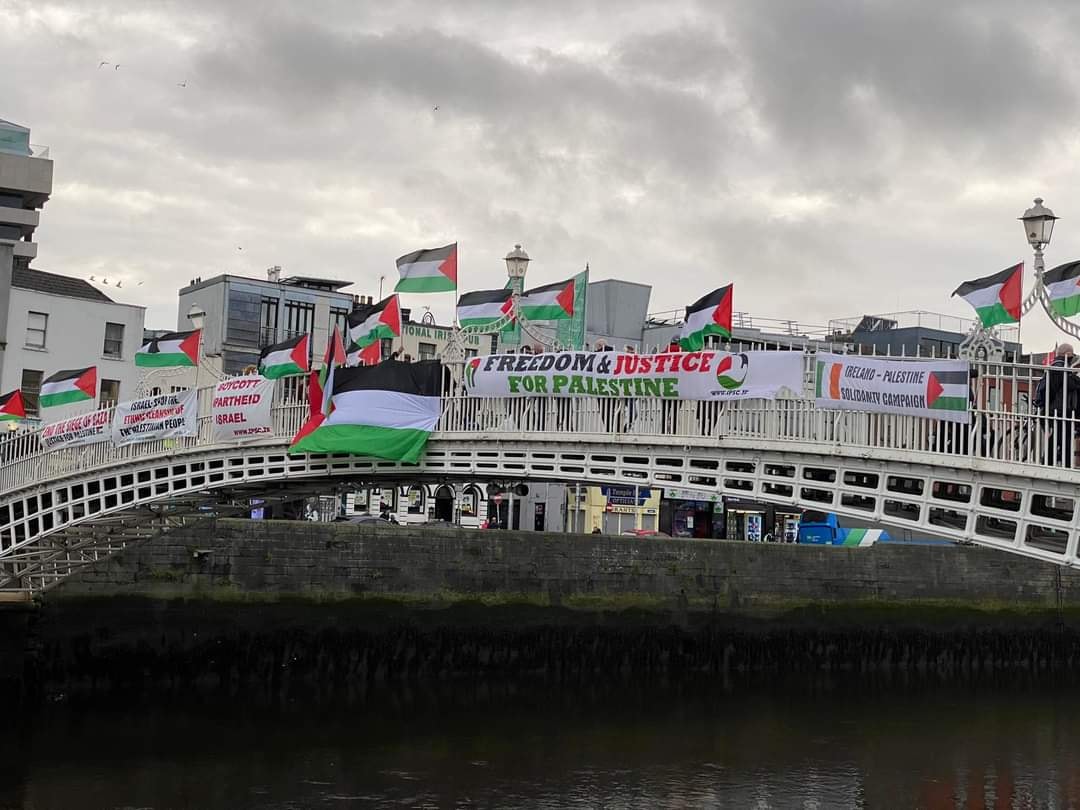
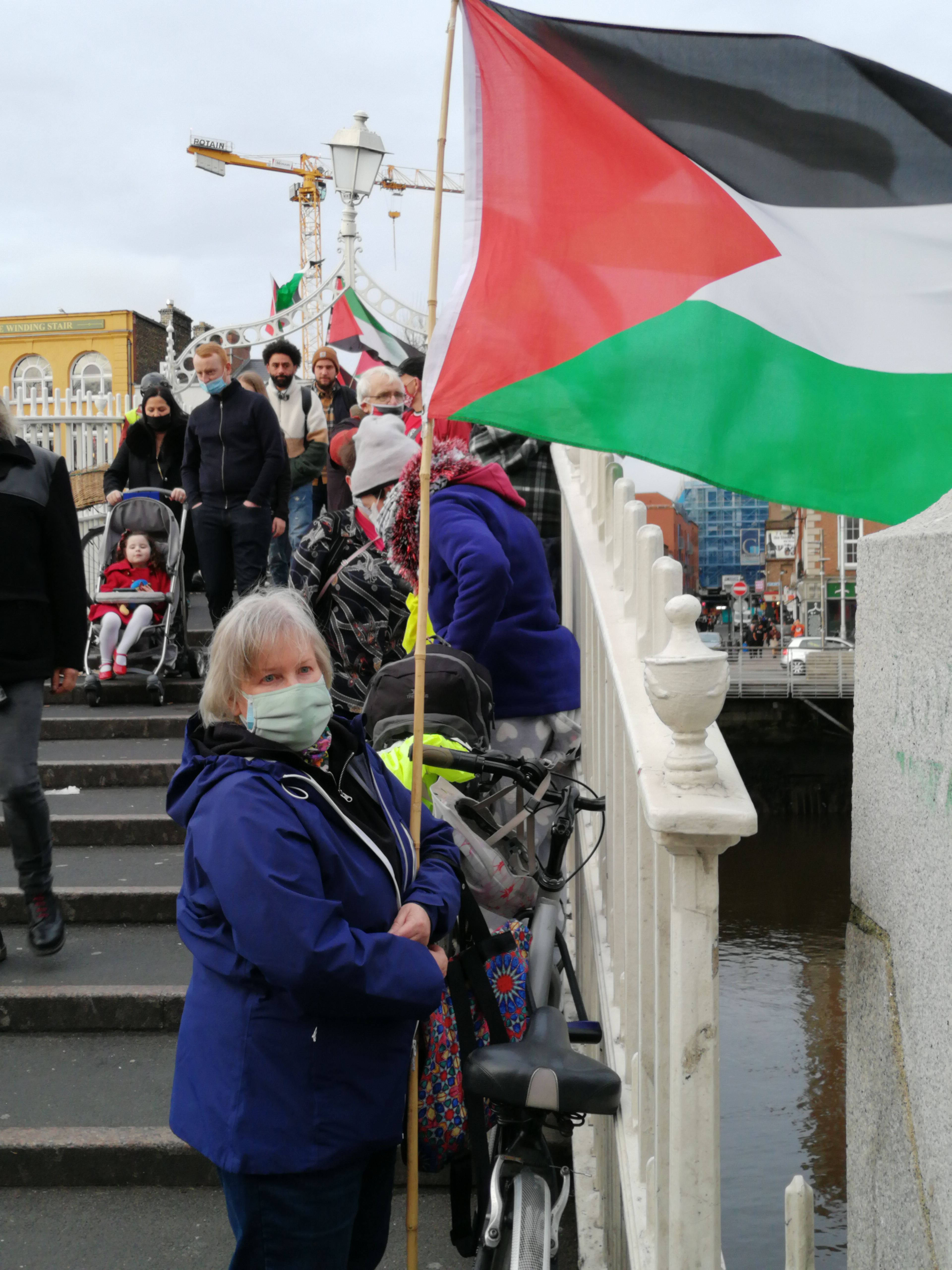
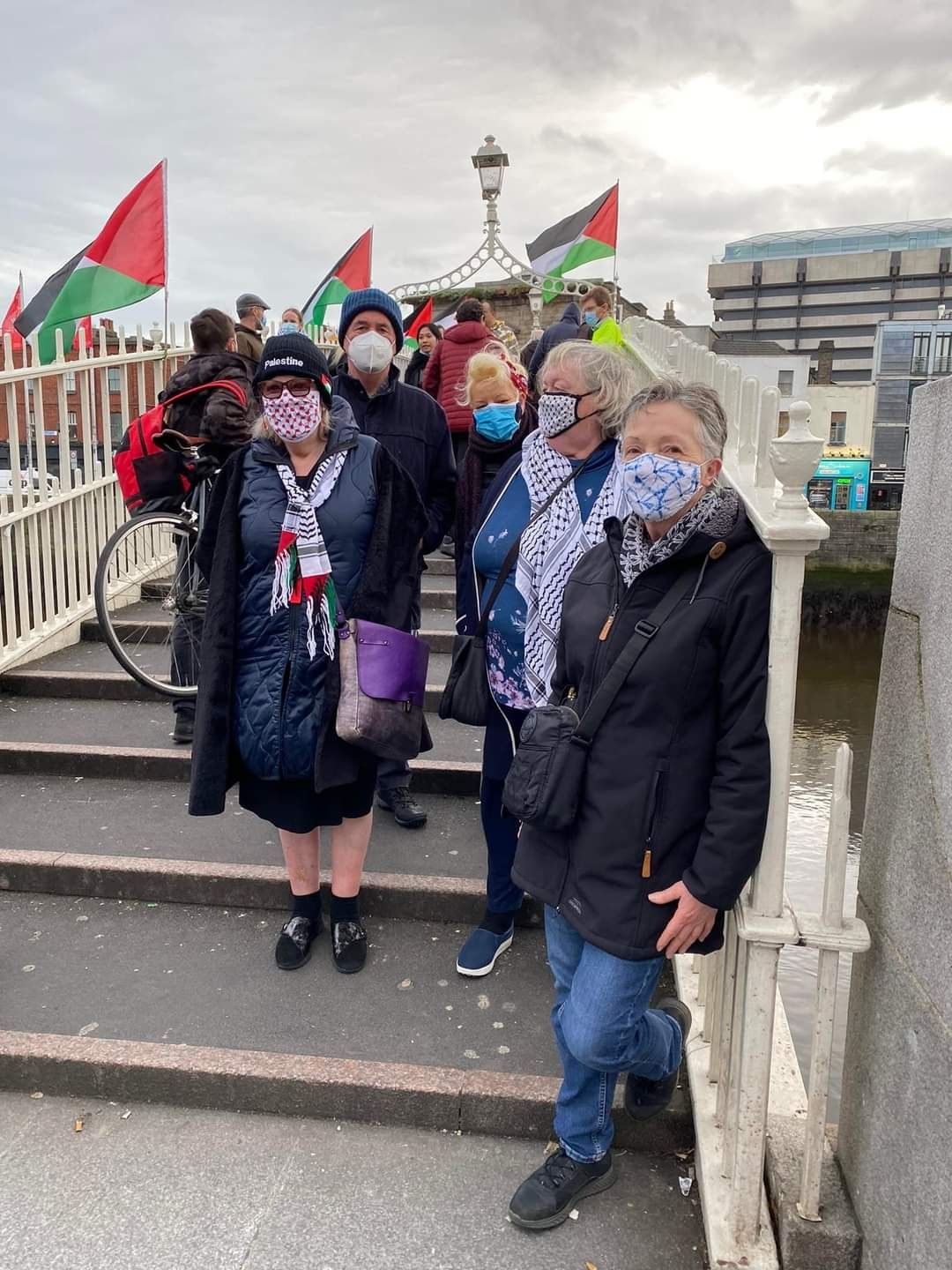
Palestinian flags fluttered in the breeze over the iconic Ha’penny Bridge in Dublin City centre, while banners festooned its length on New Year’s Eve. The numbers were down from previous years, more likely from the soaring Covid19 infection rate than from any lessening of the long-running Ireland solidarity with the oppressed Palestinians. This was ironic since, unlike previous years, this was not a rally braving sleet, snow, rain or icy wind – in fact, the very mild weather raised only the amount of breeze necessary to set the flags fluttering.
(Photo by Tamin Al Fatin, IPSC)
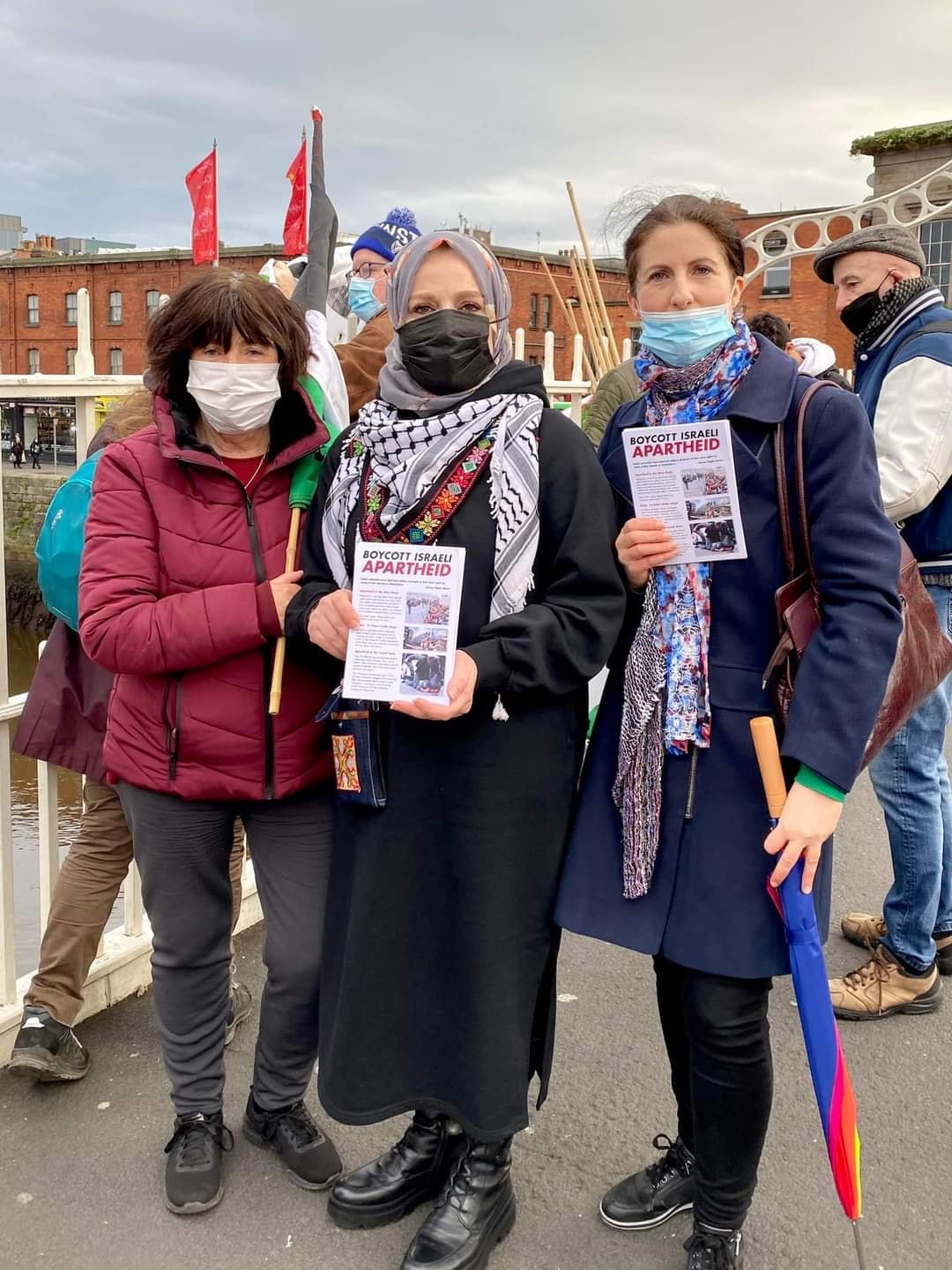
Tamin Al Fatin, IPSC Chairperson, centre photo (Photo by IPSC))
The event is organised every year for New Year’s Eve at the same location by the Ireland Palestine Solidarity Campaign and supporters, among which were Irish and Palestinians, handed out leaflets encouraging BDS (boycott, divestment and sanctions) of Israel, an apartheid ste. Martin Quigley, for the IPSC led some chants on a megaphone, which were taken up by people on the pedestrian Bridge, among which were that “Israel is a terrorist state”, that “Palestine will be free” and in solidarity that “we are ALL Palestinians”.
Each year more Palestinian land is stolen, more of their homes demolished or under threat of eviction, in Gaza they have periods without electricity, they are restricted in importing fuel for heating or cooking (never mind transport), or building materials (so much has been destroyed by the Israeli bombardments), they continue to be harassed and made have lengthy waits at checkpoints, their inshore sea is polluted, their fishing boats further out are attacked and harassed ….
(Photo by Tamin Al Fatin, IPSC)
As of 2019, more than 5.6 million Palestinians were registered with UNRWA as refugees, of which more than 1.5 million live in UNRWA-run camps.
According to prisoners’ rights group Addameer, there are currently (2021) 4,650 Palestinians held in Israeli jails in Israel and the occupied territories. Palestinians view them as political prisoners attempting to end Israel’s illegal occupation. Of those: 520 are being held without charge or trial.
At the end of September 2020, 157 Palestinian minors were held in Israeli prisons as security detainees and prisoners, at least two of whom were held in administrative detention. Another 2 Palestinian minors were held in Israel Prison Service facilities for being in Israel illegally. The IPS considers these minors – both detainees and prisoners – criminal offenders. In addition, a small number of minors are held in IDF-run facilities for short periods of time. (And the Israeli Prison Service since October 2020 has been refusing to publish figures or to supply Palestinian human rights groups with them).
BIG POWERS BACKING ISRAELI ZIONISM
The United States is the major power backing the Israeli Zionists and partly because of its position in the world and partly also for their own economic or political interests, most of the European states back the Zionists too.
In 2018 Donald Trump, as US President, moved the US Embassy for Israel into Jerusalem, endorsing the Zionist claim that the multi-faith city is Jewish and Zionist, although it is an occupied city even in international law. Shortly before he reluctantly left the office of the US Presidency, Donald Trump also endorsed Morocco’s illegal occupation of Western Sahara in exchange for Morocco recognising Israel. So far, Joe Biden, Trump’s successor, has not reversed either of those decisions.
(Photo by D.Breatnach)
THE PEOPLE OF THE WORLD SUPPORT THE PALESTINIANS
As is usually the case, it is the ordinary people in Ireland and around the world that support the Palestinians, while the big capitalists and imperialists, while occasionally criticising the Israeli Zionists, continue to support them politically, economically, culturally and militarily. Even in the United Nations, an organisation controlled by the big powers, a majority condemned the Zionist state in 17 separate motions in 2020 and last year formally ratified another six resolutions criticising Israel.
So why has international action not been taken against this terrorist state? The answer is that although the UN has 193 member states, only its Security Council decisions have to be carried out and there are only five permanent members of the Security Council: USA, UK, France, Russia and China. And what’s more, their decisions have to be unanimous.
(Photo by Tamin Al Fatin, IPSC)
On the other hand, so many civil organisations around the world have declared themselves in solidarity with the Palestinians and in Ireland. Hundreds of thousands have marched in so many countries and sports people, many popular culture stars and academics have refused to perform or attend conferences in Israel. One can no longer find Israeli goods in most shops or supermarkets (and when on occasion they are on sale, their country of origin is not marked on the product).
At this time of year, using a parasitic plant as an excuse — and in spite of Covid19 transmission danger — many kisses will be given. The plant in question is of course the mistletoe and people buy sprigs or clumps of it to hang in strategic places to trap the unwary, ambushing them into receiving the sign of affection (or lust). Although the plant is native across Europe it is not so to Ireland1, though it can be found growing in widely-separated places here, believed to be the result of “garden escapes” but could also have been imported with saplings (for example of apple varieties).
IN FOLKLORE AND MYTHOLOGY
According to Wikipedia, the whole kissing-under-mistletoes custom was popularised by courting couples among servants of middle and upper classes during the reign of the English Queen Victoria. How that arose is not explained but there has been an association of the berries with fertility since antiquity, possibly through sympathetic magic, since the berries were thought to resemble sperm. Indeed, one of its medicinal uses historically has been in treatment of infertility, along with arthritis, high blood pressure and epilepsy. To the Celts, mistletoe represented the semen of Taranis, their god of thunder2, while the Ancient Greeks referred to mistletoe as “oak sperm”.
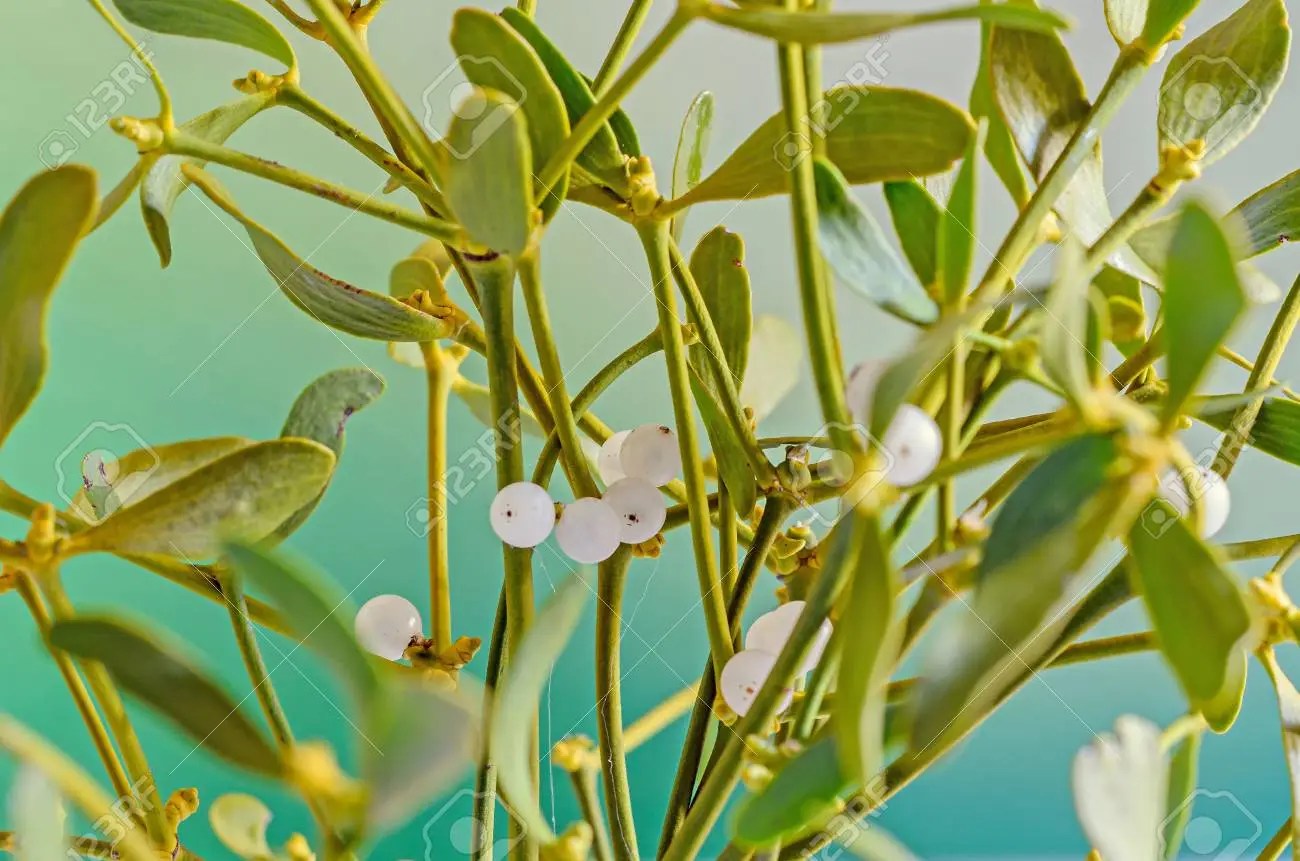
Closeup of Viscum album, the north European mistletoe, leaves and white berries. (Photo sourced: Internet)
Modern medicine does not ascribe scientific value to treatments with misteltoe and instead points to the toxicity of the plants, with Tyramine, the active agent, causing blurred vision, diarrhoea, nausea and vomiting and, more rarely, seizures, hypertension and even cardiac arrest. The toxic agent is maximally concentrated in the fruits and leaves. Fatalities among adult humans are rare but children and pets are more vulnerable.
Mistletoe on tree in January 2017, Dublin area (possibly Botanic Gardens). (Photo: D.Breatnach)
In Ancient Rome it was customary to attach a sprig of the plant above the door to bring love and peace to the household while elsewhere it has also been seen as protection against evil spirits. What of the common belief that it was ingested by the druids, as in a “ceremony of the oak and mistletoe” with sacrifice of white bulls? We have only Pliny as an ancient source of that alleged ceremony and historians seem to dislike relying on him, seeing him as a historian who liked to please the patricians in Rome with his descriptions. Wiki comments: “Evidence taken from bog bodies makes the Celtic use of mistletoe seem medicinal rather than ritual. It is possible that mistletoe was originally associated with human sacrifice and only became associated with the white bull after the Romans banned individual human sacrifices.”3
Is mistletoe harmful to trees? Although it is not in the long-term interests of a parasite to kill its host, some species do appear to be taking over their host bush or tree but we don’t seem to have come to that pass in Ireland and indeed may never do so. Wikipedia notes a number of studies that have ascribed ecological importance to some species, as a food source, nesting material and even encouraging the spread of juniper through birds attending parasitised juniper trees and eating the mistletoe and juniper berries together, to pass through the gut unharmed and be deposited elsewhere.4
THE PLANT SPREADING IN IRELAND?
“The word ‘mistletoe’ derives from the older form ‘mistle’ adding the Old English word tān (twig). ‘Mistle’ is common Germanic (Old High German mistil, Middle High German mistel, Old English mistel, Old Norse mistil). Further etymology is uncertain, but may be related to the Germanic base for ‘mash’.”5 Its family Solanthacea (agreed in 2003) includes about 1,000 species in 43 genera. Many have reported traditional and cultural uses, including as medicine.6
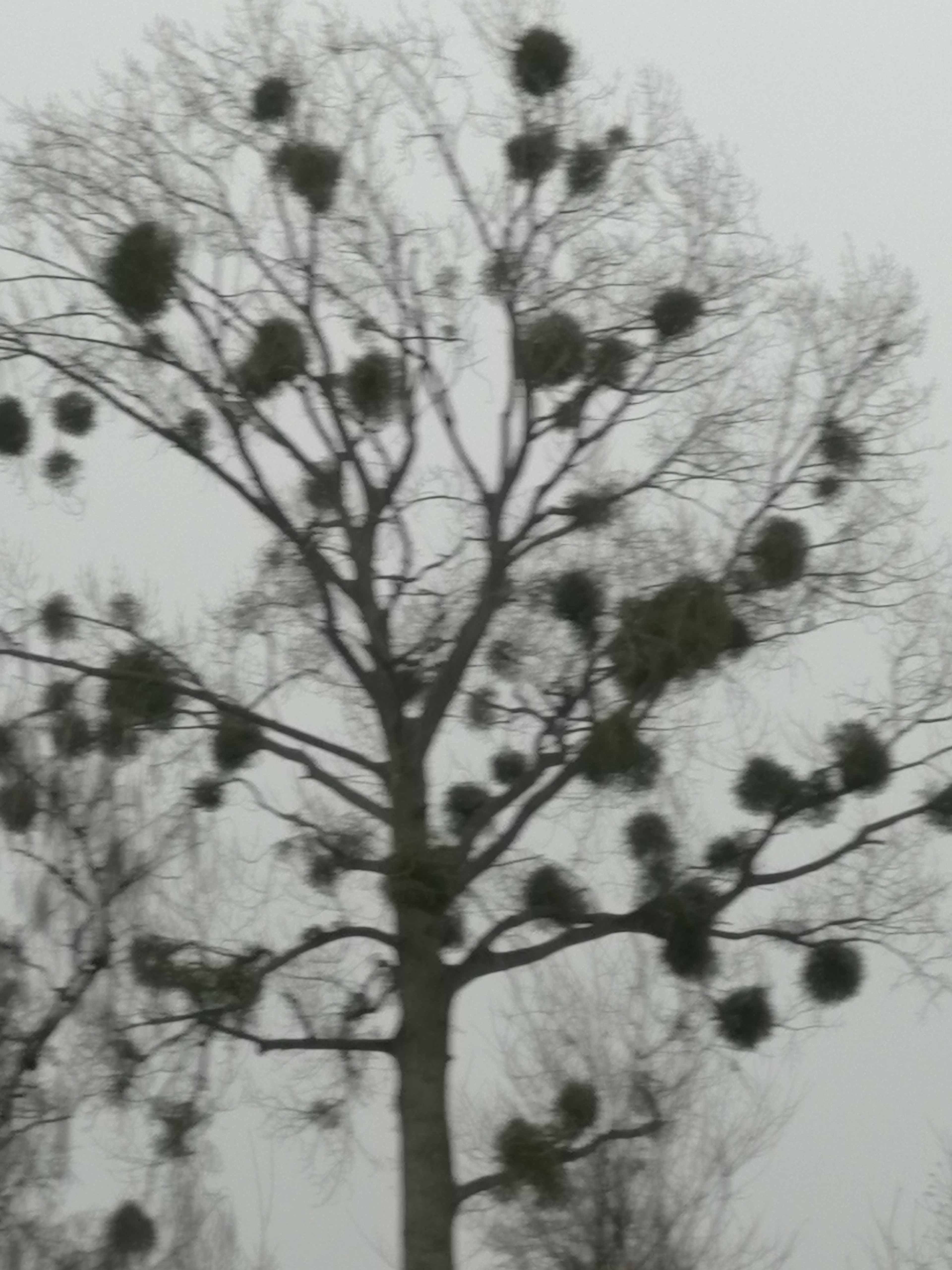
Clumps of Drualus (mistletoe) on unidentified tree, Botanic Gardens, Dublin, October 2020. (Photo: D.Breatnach)
In Ireland, apart from its scientific name Viscum alba, the perennial plant has a number of names: Sú Dara, Uile Íce, Drua-Lus and it typically roots itself in the bark of trees such as Hawthorn, Lime, Apple, Poplar and Willow but according to its Wikipedia entry, “successfully parasitizes more than 200 tree and shrub species” (though probably much less in Ireland). Once established its roots tap its host’s sap for water and nutrients but it also carries out photosynthesis, processing sunshine through its fleshy leaves — which has it classified as a hemiparasite, ie. it does part of its own work. The tree also gives it elevation where it can catch the sun’s rays without too much obstruction.
A distribution map with the Wildflowers of Ireland entry shows it widespread throughout England and Wales and localised in Scotland and Ireland, possibly through the deforestation in those nations. Although imported deliberately or accidentally to Ireland and then escaping beyond its source, once established it can be be spread, largely probably by birds.
Smólach Mór (Mistle Thrush), Griffiths Park, Glasnevin-Drumcondra, June 2021. (Photo: D.Breatnach)
The Mistle Thrush (Smólach Mór/ Turdus viscivorus) is particularly associated with the plant by name and the bird is said to include the berries in its winter diet when invertebrate animals, its preferred food the rest of the year, are rarely about7. The bird is described as squeezing the berries in its beak, ejecting the seeds sideways and, to clean its beak, wiping it against a tree trunk. The seeds, being covered with sticky liquid adhere to the tree bark and the liquid hardens, maintaining a strong grip.
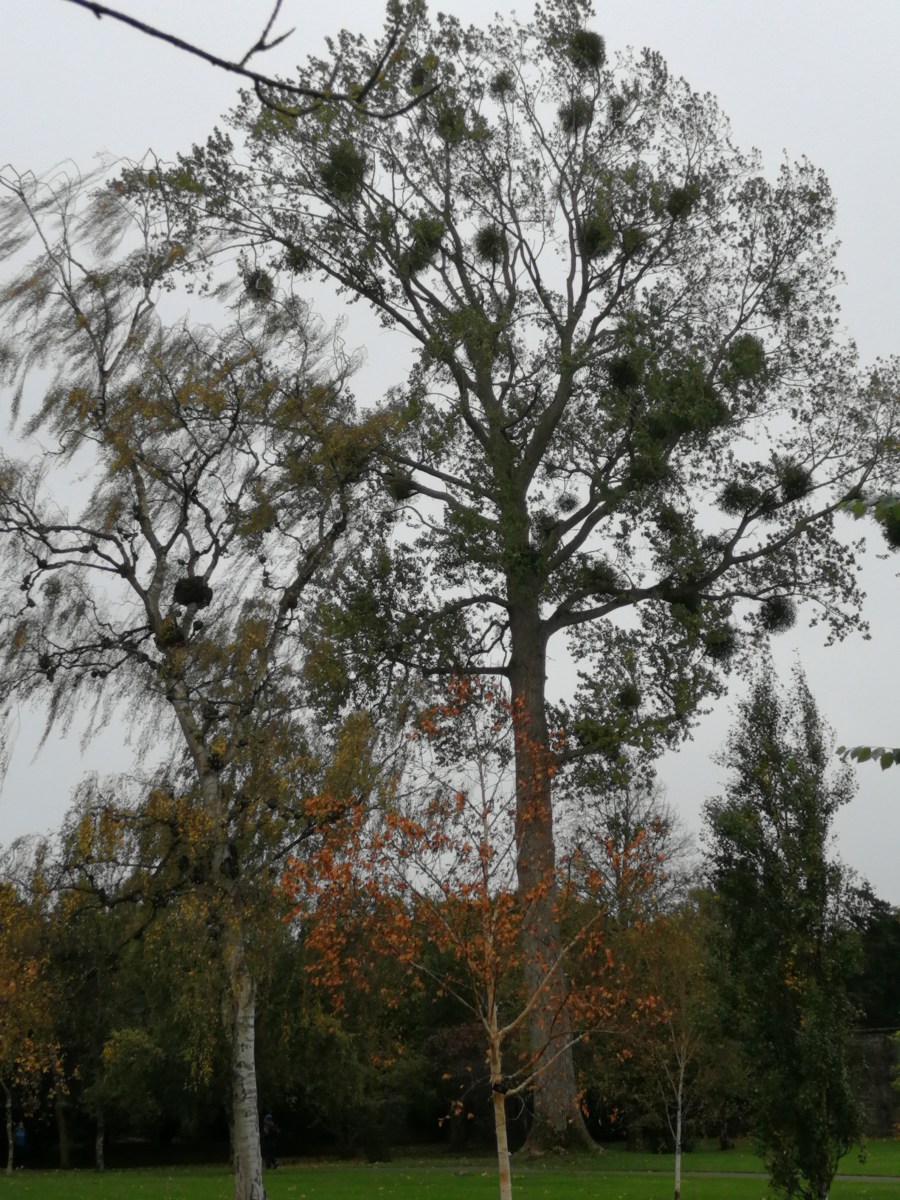
Clumps of Irish mistletoe on a north American Poplar, Botanic Gardens, Dublin, 19th December 2021. (Photo: D.Breatnach)Nameplate on the bark of the poplar tree parasitised by the mistletoe picture above. (Photo: D.Breatnach)
The parasitic plant has long been in evidence in the National Botanic Gardens in Dublin and to a lesser extent in the adjacent Glasnevin Cemetery and I wondered at times why it (along with the grey squirrels) did not make its way into Griffiths Park, only minutes away on foot and connected by the Tolka River. However, walking through that park the other day, I did indeed spy the tell-tale clump high up in a tree.
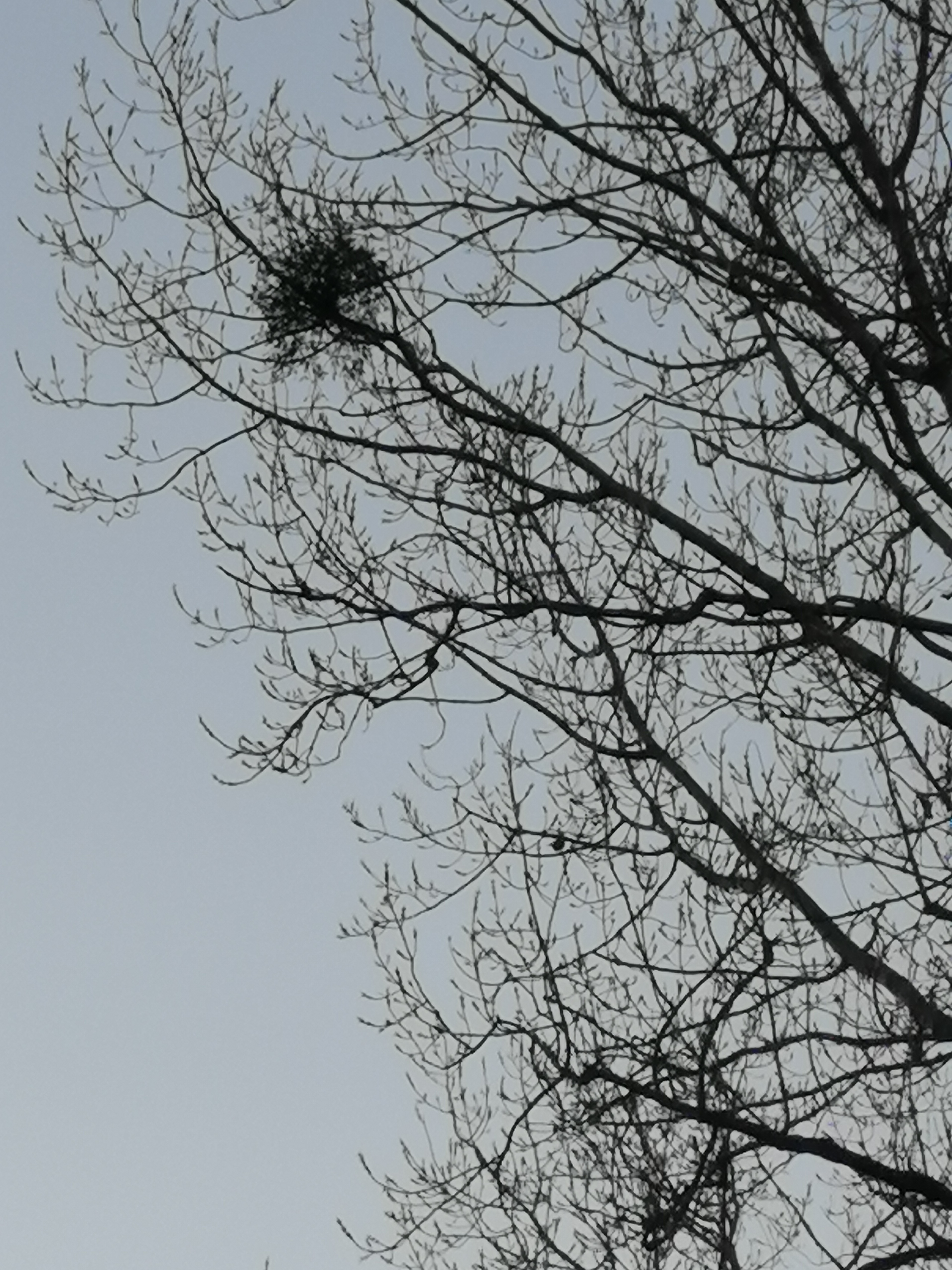
One of two clumps of mistletoe on a poplar tree in Griffiths Park in January 2022 (Photo: D.Breatnach)
7While the Wikipedia entry on the bird states that it eats mistletoe berries along with those of ivy and yew (all poisonous to humans), the Birdwatch Ireland web page states only that it eats berries in winter, without specifying which ones.
7While the Wikipedia entry on the bird states that it eats mistletoe berries along with those of ivy and yew (all poisonous to humans), the Birdwatch Ireland web page states only that it eats berries in winter, without specifying which ones.
Amidst festive season lights, passing Santa Clauses on horse-drawn carriages and hungry people being fed by volunteers in the Dublin city centre, Irish Republicans and Socialists gathered to send a public message of solidarity to political prisoners in Ireland and elsewhere.
Photo: Rebel Breeze
The event is an annual one organised by the Anti-Internment Group of Ireland, an independent non-aligned group raising awareness that internment without trial continues in Ireland, through revoking of licence of ex-prisoners and through refusal of bail in the no-jury courts both sides of the British Border. The Dublin committee of the AIGI holds monthly public awareness-raising pickets in the city centre.
The annual picket on Thursday early evening was supported by activists of the Irish Republican Prisoners’ Welfare Association and of the Anti-Imperialist Action organisation, along with some independents and took place in front of the iconic GPO building, on Dublin’s main street.
Photo: Rebel Breeze
The picketers and passers-by were addressed by a representative of the Anti-Internment Group outlining the participants’ presence to send solidarity greeting to political prisoners in Ireland and around the world. The speaker drew particular attention to three prisoners: Leonard Peltier, Native American, 45 years in jail and Black American Mumia Al Jamaal, 40 years in prison, both framed by police in the USA. Also highlighted was the case of Ali Osman Kose, 37 years in jail, 21 of which he has spent in solitary confinement. The speaker informed the audience that those three political prisoners, apart from their very long years of incarceration, have multiple health issues and should be released, he said on humanitarian grounds alone. “But no ….. they want them to die in jail”, he said.
Photo: Rebel Breeze
Going on to speak about political prisoners in Ireland, the speaker said that they and hostages had existed almost from the moment Ireland had been invaded by its neighbour and from the defeated United Irishmen up to the Fenians, had included not only dungeons and prison cells but also penal colonies on the other side of the world, after which they had been confined in special prisons and concentrations camps.
The creation of the Irish State on a partitioned Irish country a century ago this month had not brought freedom nor an end to the struggle, the speaker said and pointed out that the Irish State had executed 80 Irish Republicans during the years of the Civil War, which was more than the British had done during the War of Independence preceding it.
Photo: Rebel Breeze
“Whether we are religious or not ….. in our culture at this time of year we expect to be with our families, our partner, children and friends,” the AIGI representative said but pointed out that this opportunity is not available to the prisoners, which makes this a particularly difficult time of year for them, which is why the Group and others hold this event every year.
The speaker then called a young boy forward “to send a message to the prisoners from this younger generation who hopefully will see a free and united Ireland with social justice and equality. The young boy stepped forward and through the PA, asked all at this time of year to think of the Republican prisoners.
Photo: AIGI
The Starry Plough, the Palestinian flag and the Basque Ikurrina were flown by participants and among the banners of the IRPWA and Dublin Committee of the AIGI there was also one displaying the Carlos Latuff graphic of Palestinian and Irish Republican prisoner solidarity. The centrepiece in the picket line was the word Saoirse (‘freedom’ in Irish) picked out by lights on a dark background. Appropriate music was also played during the picket from a PA system, except while being addressed by the speaker.
The event concluded with thanks to all the attendance and the singing the first verse and chorus of the battle-song Amhrán na bhFiann (The Soldiers’ Song in Irish, which is also the National Anthem).
It is understood that seasonal greeting cards have also been sent by AIGI to political prisoners in prisons in the Irish state and in the colonial statelet.
End.
Photo: Rebel BreezeSigning Christmas cards for the prisoners. (Photo: AIGI)Photo: Rebel Breeze
A young Dublin man, out to see something of the world, arrived in Franco’s Spain just a few years after WWII. At a reception at the German Embassy in Madrid (foreign press invited and anywhere for a free meal) he met a tall attractive half-Basque, half-German woman. Lucila Hellmann de Menchaca was multi-lingual – bilingual in German and Spanish through her upbringing, she had also learned English and French. She knew only a few words in Euskera – her mother’s side of the family was not very patriotic and in any case, since the victory of Franco’s military-fascist coup in ‘39, the language was forbidden. They conversed mostly through English.
Deasún, tall with grey-blue eyes and dark curly hair and thin moustache, had been raised only with English language but was learning Irish and Spanish, the latter out of necessity and the former by choice.
They were attracted to one another and began dating; within around six months they were married and soon afterwards on their way to Tangiers, where Deasún had a job waiting for him writing copy for a USA radio broadcasting company. The Moroccan city was an “international zone” city according to the Tangier Protocol, which meant that it was effectively ruled by the British, Spanish and French and, inevitably, full of liberation political activists, smugglers, spies and double-agents.
In that multi-lingual society with the Muezzin calling the faithful to prayer five times a day in Arabic and Berber heard in the street along with European languages, Luci was soon pregnant and, as her time neared, went back to Madrid to be near her family. Luci and Deasún first’s child was born in the German hospital in that city; then back to Tangiers soon afterwards, of course.
Their big guard dog, named Bran after one of Fionn Mac Cumhaill’s famous wolfhounds, occasionally takes off to return days later with scratches and bite-marks. He was watchful of the child and one day complains, whimpering to Deasún who, when he goes to investigate, finds the crawling child stuffing the dog’s dinner into his mouth.
Deasún watches his son speaking his first words in Spanish from Luci and some in Irish from himself. Increasingly he feels the need to have his son develop his speech in Ireland; soon the couple are back in the Spanish state and, after a short interlude, visiting the Basque Country of Luci’s youth, crossing the border into the French state by train to the coast and boat to England. A short stay with a cousin there and they and their child are on the way to Deasún’s native Dublin by train and boat.
Some years later in Dublin, his family of sons and a daughter growing up speaking Spanish and Irish in the home and English in the street, Deasún composes the piece of music which he calls “An Ghailseach” (the Foreign Woman”). Luci and Deasún’s youngest son, Cormac, an accomplished flute and whistle player, learns the piece. Some years later again, in the Club an Chonnradh with his father, Cormac plays the air and Deasún is amazed to learn that the piece he likes so much was actually composed by himself.
An Ghaillseach, composed by Deasún Breatnach, played on low whistle by Cormac Breatnach; Garry Ó Briain accompanying on guitar and keyboard, mastered by Seán McErlaine, uploaded by Féilim Breatnach.
Cormac records the piece and it is played on an Irish-language radio programme to mark a century since the birth of Deasún. On the morning of the broadcast Cormac cannot listen to it for he is on his way to Stockholm, where the Amerghin Ensemble of which he is a part have an engagement to perform their music. The older son listens to the program just before he is due in the Dublin city centre on a historical conservation commitment. The tears spring to his eyes from the sheer painful beauty of the piece.
Luci and Deasún are years gone (they died within days of one another in 2007) but An Ghailseach has joined the extremely rich and varied body of traditional Irish music, where it will outlast yet other generations to come.