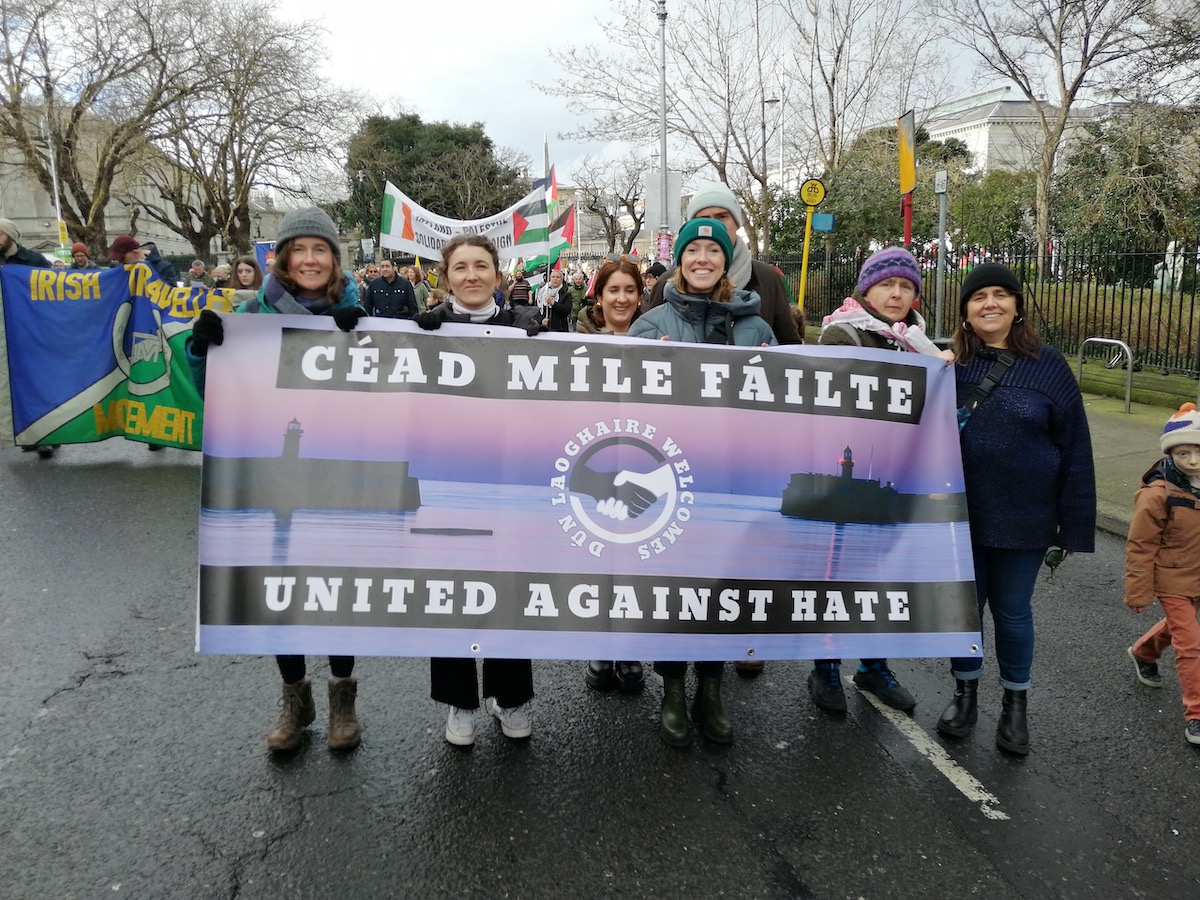
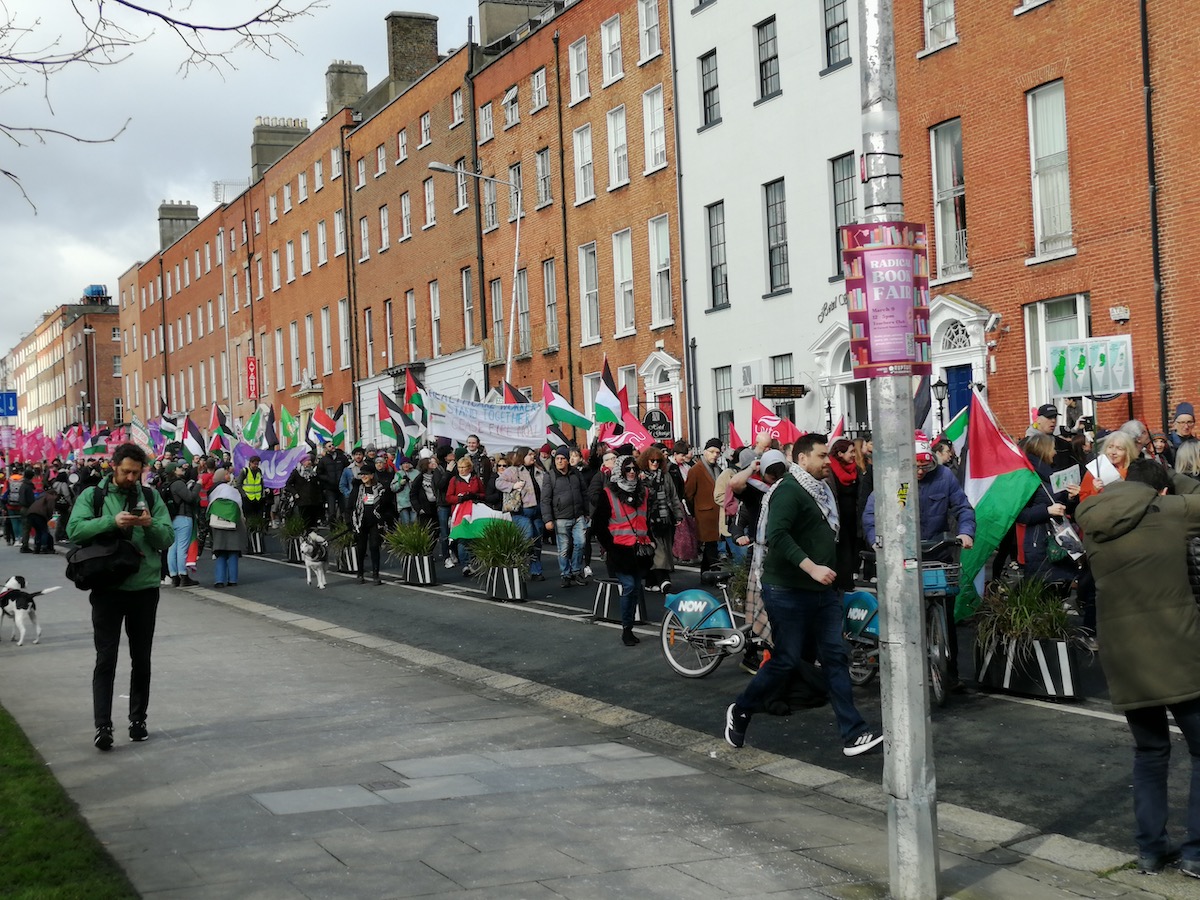
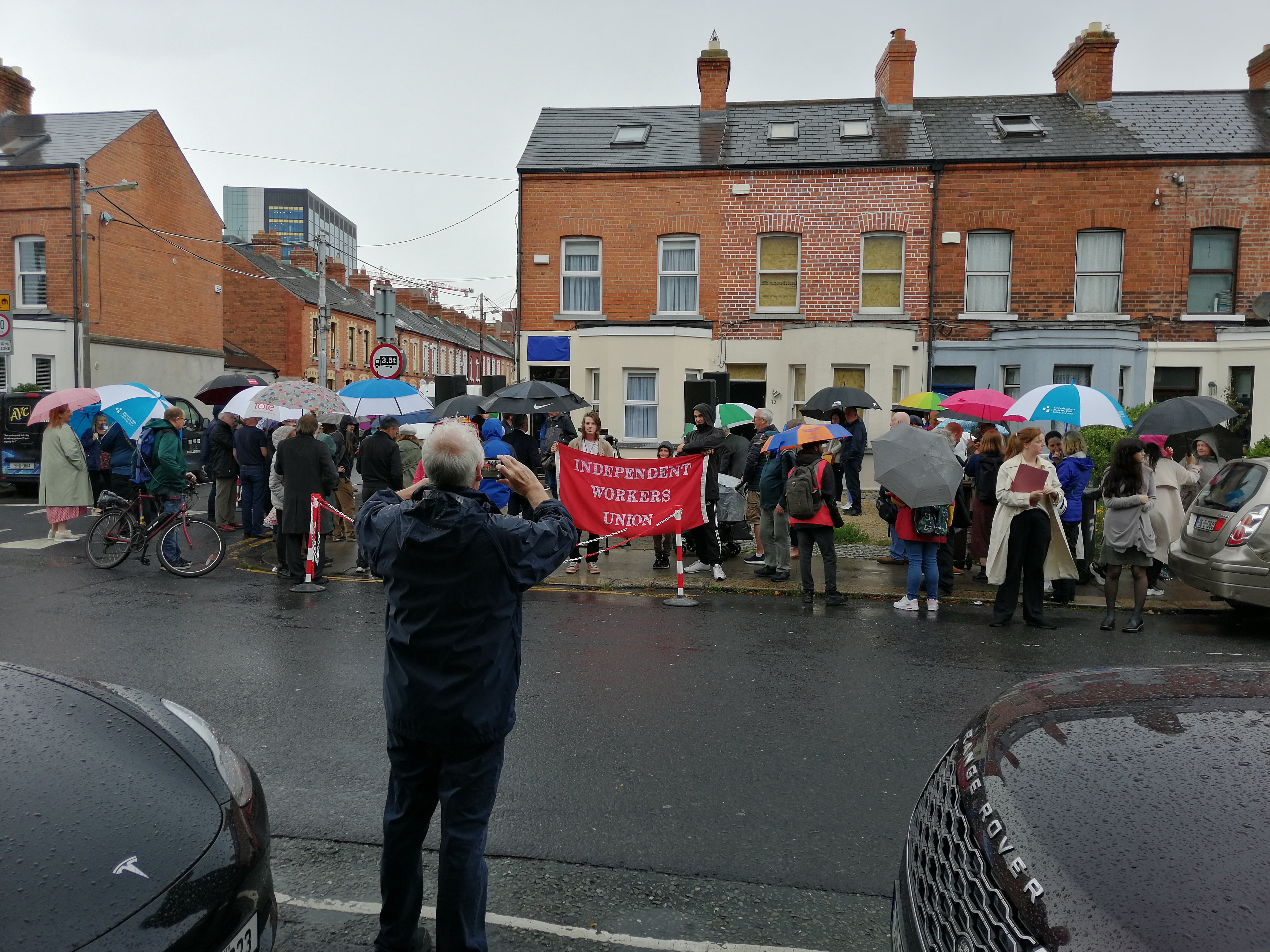
A large number of people gathered in Dublin on 2nd March in what was advertised as a “Stand Together” march for “Homes, Health & Rights for All”; “Against Racism, Hate & War”; to “Share Wealth and End Inequality”.
A large part of the context in which the event was organised is a high number of arson attacks on properties intended (or thought to be) for housing refugees and asylum seekers, along with an increase in mobilisations of people by the far-Right and outright fascists.
(Photo: D.Breatnach)
In that context, the advertising poster for the march was insipid in colouring, using pastel shades reminiscent of a certain type of sweets. On some versions the clenched fist appeared but it was missing from many others shared on social media.
Le Chéile, the main organising or coordinating body, was formed some years ago at a time when the Far-Right was becoming increasingly visible in street events they organised and on occasion countering progressive events and a number of clashes had taken place.
The main organisers not only had been absent from most of those confrontations but deliberately chose to exclude from the founding of Le Chéile the majority of those among Irish Republicans, Socialists, Anarchists etc who had already been counter-protesting the far-Right.
Banners of CATU and Drogheda For All on the march soon after starting in Parnell Square (Photo: D.Breatnach)On the march soon after starting in Parnell Square (Photo: D.Breatnach)
This may account for the absence of most Irish Republican organisations from the march (if so I understand but disagree with the decision). Dublin Communities Against Racism however contain some veteran antifascists and were present as were a group of Italian antifascists.
There was a big turnout of Traveller groups which would be welcome any time, in particular as the longest-racialised minority in Ireland, but more welcome in recent years when the far-Right have been making efforts to recruit some from that community against migrants.
Banners of Irish Traveller organisations on the march soon after starting in Parnell Square (Photo: D.Breatnach)(Photo: D.Breatnach)
Given the ongoing genocide of Palestinians by the Israeli Zionist state, many Palestine flags were naturally enough seen on the march — and not only within the Ireland Palestine Solidarity Campaign’s contingent.
Groups of marchers from a number of trade unions were good to see too, though the numbers were not great and the spread of unions small. One might expect trade unions to be to the fore in combating the harmful divisiveness of racism but their record is poor even on straight pay issues.
Flags of Palestinian solidarity, Unite the union (Photo: D.Breatnach)
A number of political parties were present too: People Before Profit, Sinn Féin, Social Democrats, as were a couple of faith-based groups.
Banners of religious groups and coming up behind, some trade union banners Banners of CATU and Drogheda For All on the march soon after starting in Parnell Square (Photo: D.Breatnach)
Anti-fascist fans of Dublin soccer team Shamrock Rovers marched behind their banner with their green-and-white flags and at one point a green smoke flare was set off in their midst. The colours of some of the 134 Gaelic Athletic Clubs based in Dublin would have been good to see there also.
The earlier announced route of the march, to end at Custom House Quay, was changed for some reason and without announcement, at least from O’Connell Street and eventually ended up in north Merrion Square, with a stage set up across the street at the eastern end.
Banner of fans of Shamrock Rovers FC on the march (Photo: D.Breatnach)On stage at the rally (Photo: D.Breatnach)Poet performer at the rally (Photo: D.Breatnach)
The MC of the event on the stage, a man of colour, greeted participants in English and Irish but shocked antifascists present by advising any who felt unsafe to approach a steward or a Garda (!). There are few more likely to make people feel unsafe than that members of that very force.
Speakers from both indigenous and migrant backgrounds addressed the crowd and the cultural performances were by people from both backgrounds.
The MC at one point drew in the war in Ukraine in parallel with the Israeli genocide, which was inappropriate even if one were a supporter of US/NATO’s proxy war against Russia using the puppet Ukrainian state (which I am not).
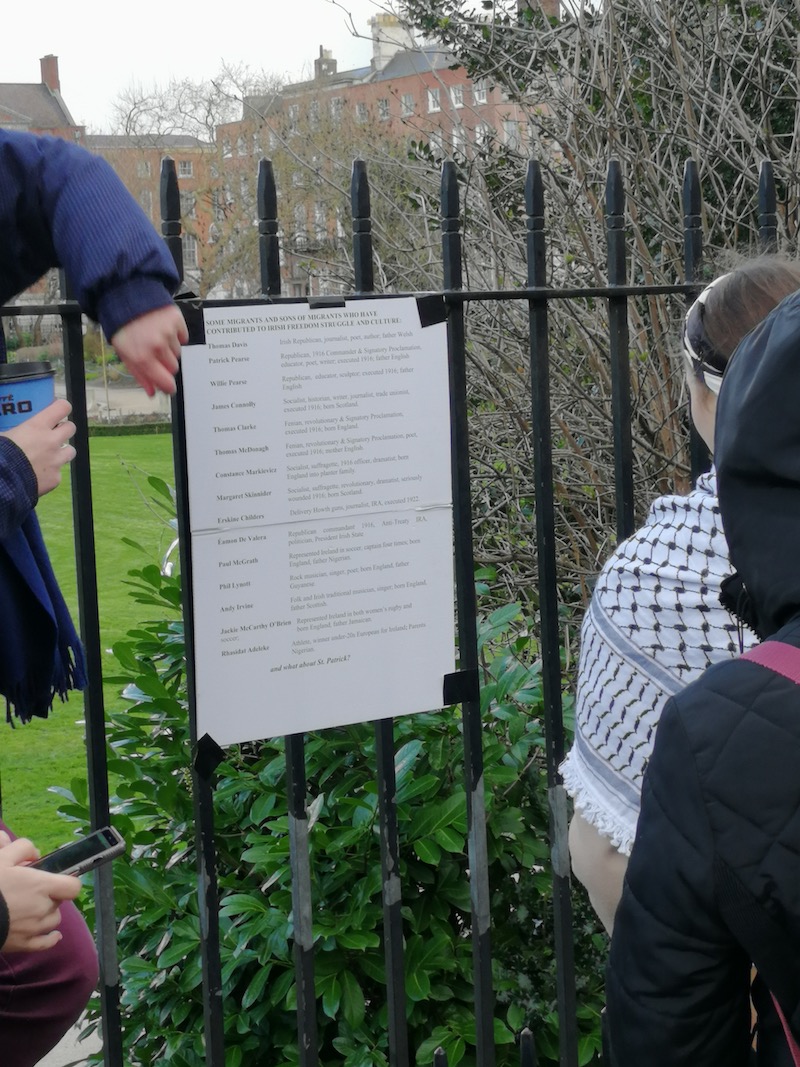
One of the participants reads the List Of Some Migrants and Sons of Migrants who contributed to Ireland. (Photo: D.Breatnach)
Also the PBP know that their view on this is hotly refuted through much of the Left and a great many of those on the march.
In the time I was there, though speakers attacked the divisiveness of racists and fascists and on occasion pointed to the real culprits in manufacturing a housing crisis, none pointed to the capitalist class need for dividing the working class and particularly so when their system is in difficulty.
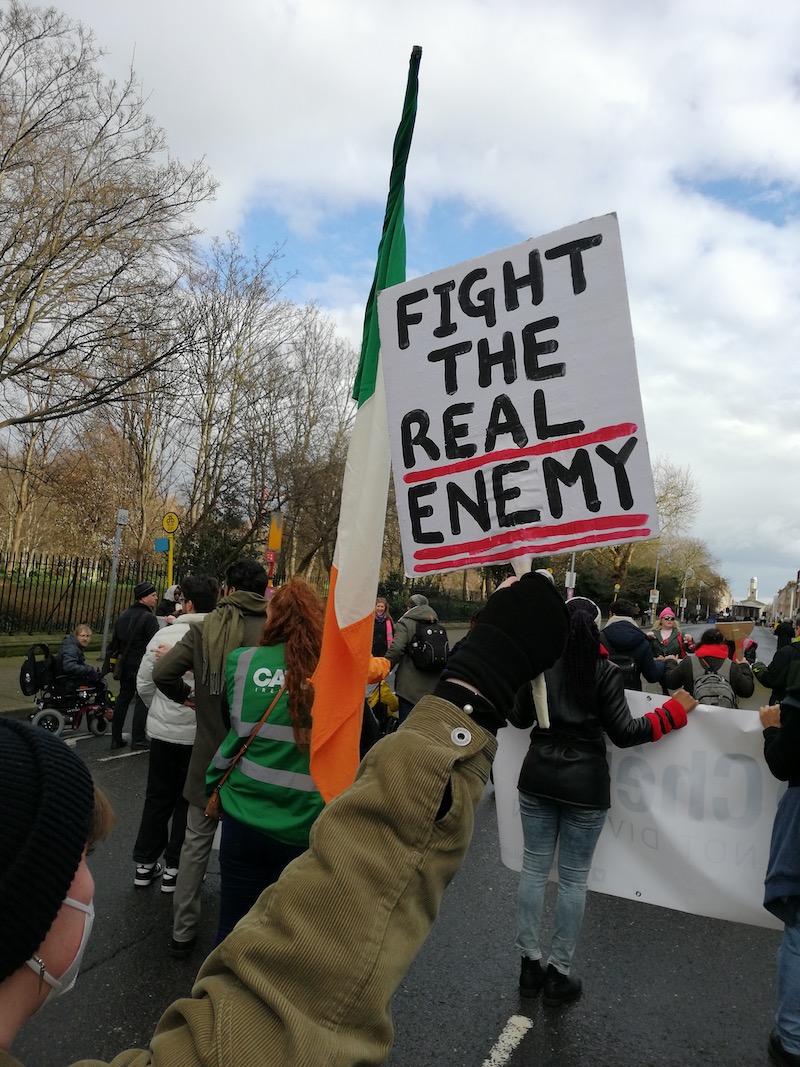
(Photo: D.Breatnach)A noble call but the organisation whose placard this is did not do so and furthermore when a certain organisation, Revolutionary Housing League were actually doing so, neither this nor other organisations mobilised in support. (Photo: D.Breatnach)
Not to speak of how we might organise to “Share the Wealth”, which means socialist revolution, surely, unless it refers to some liberal pipe-dream? The far-Right have risen to prominence in Ireland is because most of those who claim socialist policies have failed to fight for them.
Fighting for socialist policies means actually fighting which means going into all the battlegrounds and organising the people, providing revolutionary education and example and inevitably will mean suffering because the ruling class will not just sit back and watch.
(Photo: D.Breatnach)
While some benefit can be obtained from representation in the parliaments and local authority councils, they can never be the main battleground. Street demonstrations are an improvement but nor can they be the main area for revolutionary effort.
In the clear context of general elections widely speculated to take place later this year, a speaker asked the crowd not to vote for anti-immigration candidates. Since the likelihood of anyone there doing so was nil, the inference was clearly to encourage voting for the current parliamentary parties.
In conclusion it is hard to imagine this organisation or any similar kind of coordination providing strong organisation or leadership to counter fascism and racism effectively.
This is not the kind of organisation that would have fought the Blueshirts in the 1930s or even prevented the Islamophobic Pegida founding a branch in Dublin, which a militant antifascist mobilisation succeeded in doing in February 2016.
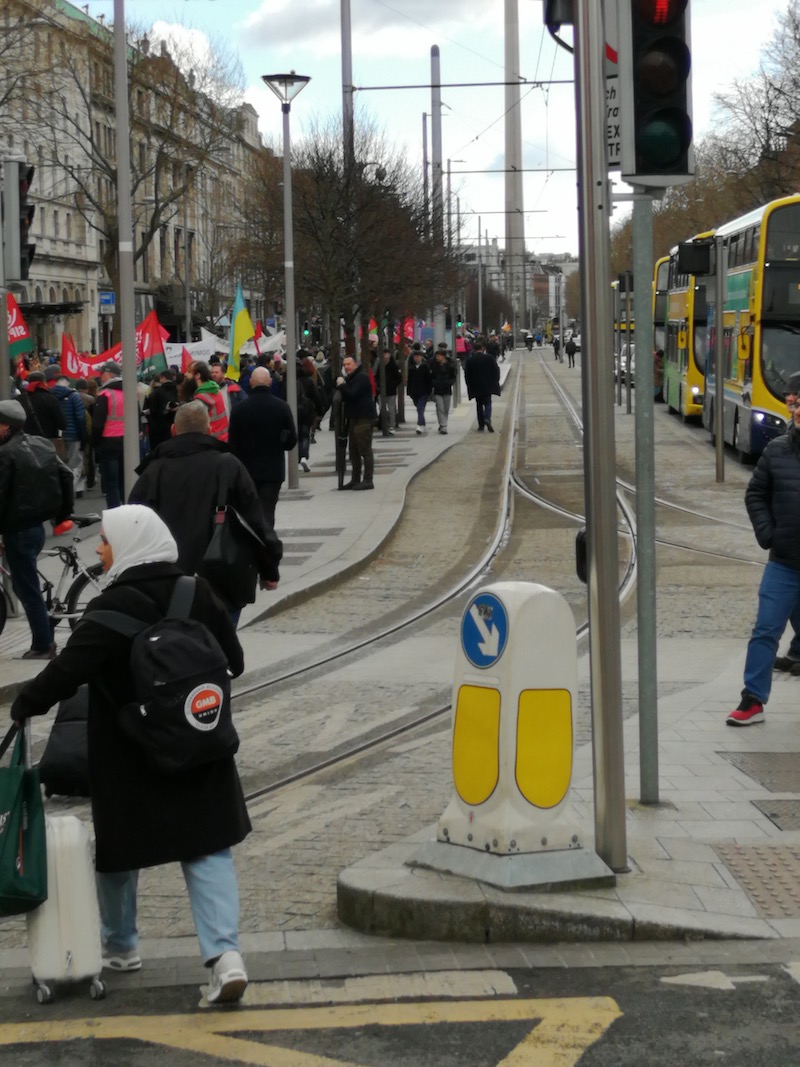
Section of the march viewed from the Parnell Monument southward (Photo: D.Breatnach)
Anti-NATO Picket Rescues Palestine Flag from Fascist Provocateur
A more militant antifascist attitude was seen in Dublin a few hours later when a fascist grabbed a Palestine flag from a participant in an anti-NATO picket outside the GPO, the iconic building housing the headquarters staff of the 1916 Rising.
The picketers were standing peacefully with banners and flags, including Palestinian and Irish Starry Plough, distributing leaflets and engaging passers-by in conversation. The incident occurred some time into the event, the man shouting in an Irish accent, grabbing the flag and running.
Anti-NATO picket organised by the Anti-Imperialist Action organisation outside the GPO in Dublin’s main street. (Photo: D.Breatnach)
The surge forward in response might have caught him by surprise but, though the flag was rapidly retrieved, he continued to be aggressive in words and, as is described in slang, “throwing shapes”, behaviour that ended with his sitting in the road.
Though the population of Ireland is overwhelmingly in sympathy with the plight of the Palestinians and many in solidarity with their struggle, many in the far-Right here object to displays of that solidarity and call the solidarity activists “traitors” and demand they act for Ireland only.
Ironically, many of those same people acting in Palestine solidarity have also over the years agitated for affordable housing, against social provision cuts and British colonial occupation, in support of Irish political prisoners – while the far-Right’s only ‘contribution’ is to agitate against migrants.
Fascists in Ireland also collude with Loyalists and with British fascists; it is they who are the traitors, to the nation and to the working class, hiding behind flags the meaning of which their leaders secretly despise and which some of their lumpen followers do not understand.
End.
(Photo: D.Breatnach)List of some migrants and sons of migrants who have contribute to Ireland (including fighting and in some cases dying for her freedom) (Photo: O.Dunne)
In Dublin’s south docklands the property developers and the corporations dominate city planning and therefore the landscape. And the working class community there feel that they’re being squeezed out.
I’ve met with some concerned people from parts of this community in the past to report on their situation and concerns for Rebel Breeze and did so again recently.
A view eastward of a section of the south Liffey riverfront, showing a very small amount of more traditional buildings squashed between or loomed over by the “glass cages that spring up along the quay”. (Photo 1 March 2024: D.Breatnach)
YOUNG PEOPLE – education, training, socialising
“There’s nothing here for our young people” said one, expressing concern over the attraction for teenagers of physical confrontations with other teens from across the river which have taken place on the Samuel Beckett Bridge over the Liffey.
A young man training as an apprentice in engineering attends a mixed martial arts club but has to go miles away to another area to attend there. Between his industrial training, travel and athletic training he has little time to spare for socialising.
I comment that those sporting activities tend to concentrate on male youth and only some of those also but he tells me that nearly half the regular membership of his club is female. A community centre could provide space and time for such training but they say they have no such centre.
St. Andrew’s Hall is a community centre in the area and there are mixed opinions in the group about it but I know from my own enquiries that the available rooms are committed to weekly booked activities (and our meeting had to take place in a quiet corner of an hotel bar).
As a former youth worker and in voluntary centre management, I know that a community centre can serve all ages across the community, from parents and toddlers through youth clubs to sessions for adults and elders.
Discussing youth brings the talk into education and training. As discussed in a previous report of mine, the youth are not being trained in information technology, which is the employment offered in most of the corporations in “the glass cages that spring up along the quay.”1
Section of the south Liffey docks showing some of the few remaining older buildings as they are swamped by the “glass cages”. The building on the far right of photo, very near to Tara Street DART station, once an arts centre, is already targeted for demolition and replacement with commercial building. (Photo sourced: Internet)
“If they’re lucky, they’ll get work in the buildings as cleaners or serving lattes and snack in the new cafes”. Some opined that the corporations in the area should be providing their youth with the training while others thought Trinity College should be doing so.
HOUSING – price and air quality
Universal municipal housing in the area has declined due to privatisation of housing stock and refusal to build more. A former municipal block in Fenian Street, empty for years is now to be replaced but the “affordable” allocation has been progressively reduced, ending now at zero.
Pearse House in south Liffey docklands, believed earmarked for demolition and site sold to property speculators. (Photo 1 March 2024: D.Breatnach)
Property speculators (sorry, “developers”) with banker support are building office blocks and apartment blocks in the areas, the latter units priced beyond the range of most local people. The average rent for a two-bed apartment in the area is €2,385;2 to buy a 3-bedroom house €615,000.3
The Joyce House site and attached ground area could provide housing and a community centre but appears planned to go to speculators.
Continuation of ‘Pearse House site’ in south Liffey docklands, believed earmarked for demolition and site sold to property speculators. (Photo 1 March 2024: D.Breatnach)
The Markievicz swimming pool near Tara Street has been closed and the local people are told they can go to Ringsend for swimming, an area which already has better community facilities than are available to the communities further west along docklands
A huge amount of traffic goes through the area and one person stated that Macken Street tested as having the worst air quality in Ireland. “I have to close my windows to keep out the noise and pollution,” said another; “the curtains would be black.”
Townsend Street side of ‘Pearse House site’ in south Liffey docklands, believed earmarked for demolition and site sold to property speculators (prospective property speculators must be salivating). The gambling advertisement coincidentally erected there seems to show the likely social types to benefit from these kinds of deals. (Photo 1 March 2024: D.Breatnach)
‘They want us out’
If some town planner were intending to establish a community somewhere, s/he would plan for housing, obviously, so the people would have somewhere to live. But a proper plan would provide also for education and training, along with social facilities — and employment.
But if someone were intending instead to get rid of a community, s/he would target exactly the same elements, whittling them down or removing them altogether. This what some local people feel is intended for their community.
“We feel we’re not wanted here,” said one and others agreed, “They want us to move out.” “But we’re not going! We’re staying,” said another, to grim nodding of heads around.
HISTORY of struggle … and of neglect
In the late 1800s and early 1900s, Dublin had the worst housing in the United Kingdom and many of its elected municipal representatives – including a number of Nationalists of Redmond’s party – were themselves slum landlords.
When the Irish Transport and General Workers Union was formed by Jim Larkin with assistance from James Connolly and the Irish Women Workers’ Union founded by Delia Larkin, many of the dockers, carters and Bolands Mill workers who joined them came from the south docklands.
And when the employers’ consortium led by William Martin Murphy set out to break the ITGWU in 1913, many of those workers
… Stood by Larkin and told the bossman We’d fight or die but we would not shirk. For eight months we fought And eight months we starved, We stood by Larkin through thick and thin …4
And the women of Bolands’ Mill were the last to return to work, which they did singing, in February 1914.
They also formed part of the Irish Citizen Army, the first workers’ army in the world,5 to defend the striking and locked-out workers from the attacks of the Dublin Metropolitan Police and which later fought prominently in the 1916 Easter Rising.6
Many also joined the larger Irish Volunteers which later became the IRA, along with Cumann na mBan,7 fighting in the Rising, the War of Independence and the Civil War, supporting resistance of class and nation for decades after.
The Irish Republican Brotherhood (the Fenians) was founded in the area; Peadar Macken8 was from here and has a street named after him; Elizabeth O’Farrell9 is from the area too with a small park named after her and Constance Markievicz10 also lived locally.
The Pearse family lived in the area too and Willie Pearse and his father both worked on monumental sculpture at the same address; Connolly and his family for a while lived in South Lotts.
Home of the Pearse family and monumental sculpting business (Photo: Dublin Civic Trust)
The working class communities in urban Ireland suffered deprivation throughout the over a century of the existence of the Irish state and the colonial statelet. The communities in dockland suffered no less, traditional work gone, public and private housing in neglect in a post-industrial wasteland.
The population of Ireland remained static from the mid-1800s until the 1990s, despite traditionally large families — emigration in search of employment kept the numbers level. Married couples lived with parents and in-laws while waiting for a house or flat – or emigrated.
In the 1980s, like many parts of the world, Ireland fell prey to what has been described as the “heroin epidemic” and the neglected urban working class worst of all, with the State assigning resources to fight not so much the drug distributors as the anti-drug campaigners.
One of those in the meeting became outwardly emotional when he talked of “the squandered potential” of many people in the local community.
A workers’ day out trip on the Liffey ferry (Photo sourced: Dockers’ Preservation Trust)
The heirs of these then are the marginalised and abandoned that are targeted with disinformation and manipulated by the far-Right and fascists, to twist their anger and despair not against the causes of their situation but against harmless and vulnerable people.
But the Left has to take a share of the blame, for leaving them there in that situation, for not mobilising them in resistance. After all, issues like housing, education and employment are supposed to be standard concerns for socialists, of both the revolutionary and the reformist varieties.
Republicans cannot avoid the pointing finger either. These communities provided fighters and leaders not only in the early decades of the 20th Century but again from the late 1960s and throughout the 30 years war.
The Republicans led them in fighting for the occupied Six Counties but largely ignored their own economic, social and educational needs at home. Perhaps this is why the people are now organising themselves.
Protest placard by housing block in Macken Street protesting noise and dirt from nearby construction (Photo: Macken Street resident)
“THEY DON’T VOTE”
A number of the local people to whom I spoke quote a local TD (Teachta Dála, elected representative to the Irish parliament) who commented that most of the local residents don’t vote in elections.
Whether he meant, as some have interpreted, that therefore they don’t matter or, that without voting, they cannot effect change, is uncertain. However, community activism is not necessarily tied to voting in elections.
Protest placard by housing block in Macken Street protesting noise and dirt from nearby construction. (Photo: Macken Street resident)
As we know from our history and that of others around the world, voting is not the only way to bring about change and, arguably, not even the most effective one.
Whatever about that question, people are getting organised in these communities and those who hold the power may find that they are in for a fight.
End.
The landscape (and airscape) viewed from a housing block in Macken Street (Photo: Macken Street resident).
FOOTNOTES
1From song by Pet St. John, Dublin in the Rare Aul’ Times.
4From The Larkin Ballad, about the Lockout and the Rising, by Donagh McDonagh, whose father was one of the fourteen shot by British firing squad after the 1916 Rising.
5Formed in Dublin in 1913 to defend strikers and locked-out workers from the Dublin Metropolitan Police; members were required to be trade union members. The ICA was unique for another reason in its time: it recruited women and some of them were officers, commanding men and women.
6Historian Hugo McGuinness based on the other side of the Liffey believes that the reason the British troops sent to suppress the Rising disembarked at Dún Laoghaire rather than in the Dublin docks was because they feared the landing being opposed by the Irish Citizen Army and its local supporting communities.
7Republican Female military organisation, formed 1914.
8Fenian, socialist, trade unionist, house painter who learned and taught Irish language, joined the Irish Volunteers, fought in the Rising and was tragically shot by one of the Bolands Mill Garrison who went homicidally insane (and was himself shot dead).
9Member of the GPO Garrison in the 1916 Rising, subsequently negotiator of the Surrender in Moore Street/ Parnell Street and courier for the 1916 leadership to other fighting posts.
10Member of multiple nationalist organisations, also ICA and in the command echelon of the Stephens Green/ College of Surgeons Garrison. Also first woman elected to the British Parliament and first female Labour Minister in the world.
Thousands on Saturday (24th) witnessed Palestine supporters demonstrating outside the Israeli Embassy in Dublin’s Ballsbridge, their reactions for the most part ranging from neutral to applause, some having their photos taken alongside the picketers.
On this Saturday there was no Palestine solidarity march in Dublin and some instead attended a picket of the Zionist Embassy.
There were also a handful of hostile provocative reactions, ranging from mention of “the hostages” to cheering “Israel” and one who tried to make an issue of Jewishness but was firmly told that opposition to Zionism has nothing to do with anti-semitism.
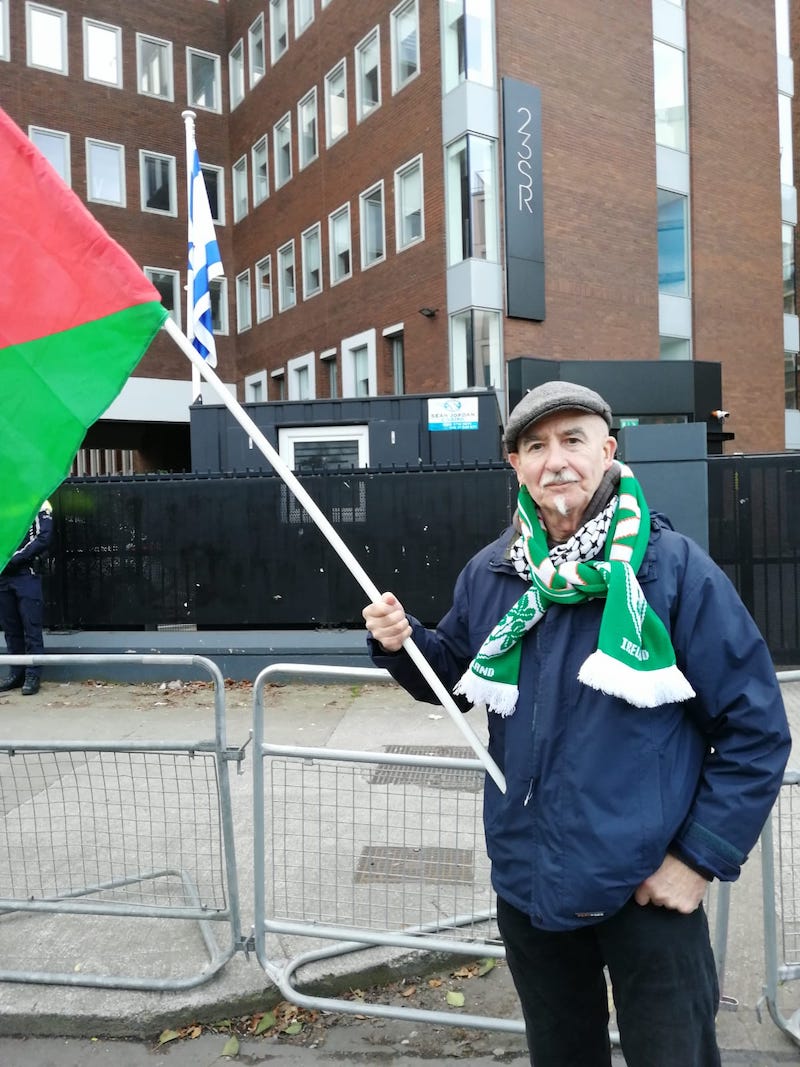
Palestinian solidarity flag displaying designed by Brazilian political cartoonist Carlos Latuf during an earlier attack by the Zionist State on Palestinians.The building housing the Israeli Embassy is in the background. (Photo:Rebel Breeze)
Those who mention “the hostages” refer only to the 130 or so prisoners taken by the Palestinian resistance in their operation of October 7th, never to the thousands of civilians, including children, taken prisoner by the Zionist state and, if judicially processed, tried in Israeli military courts.
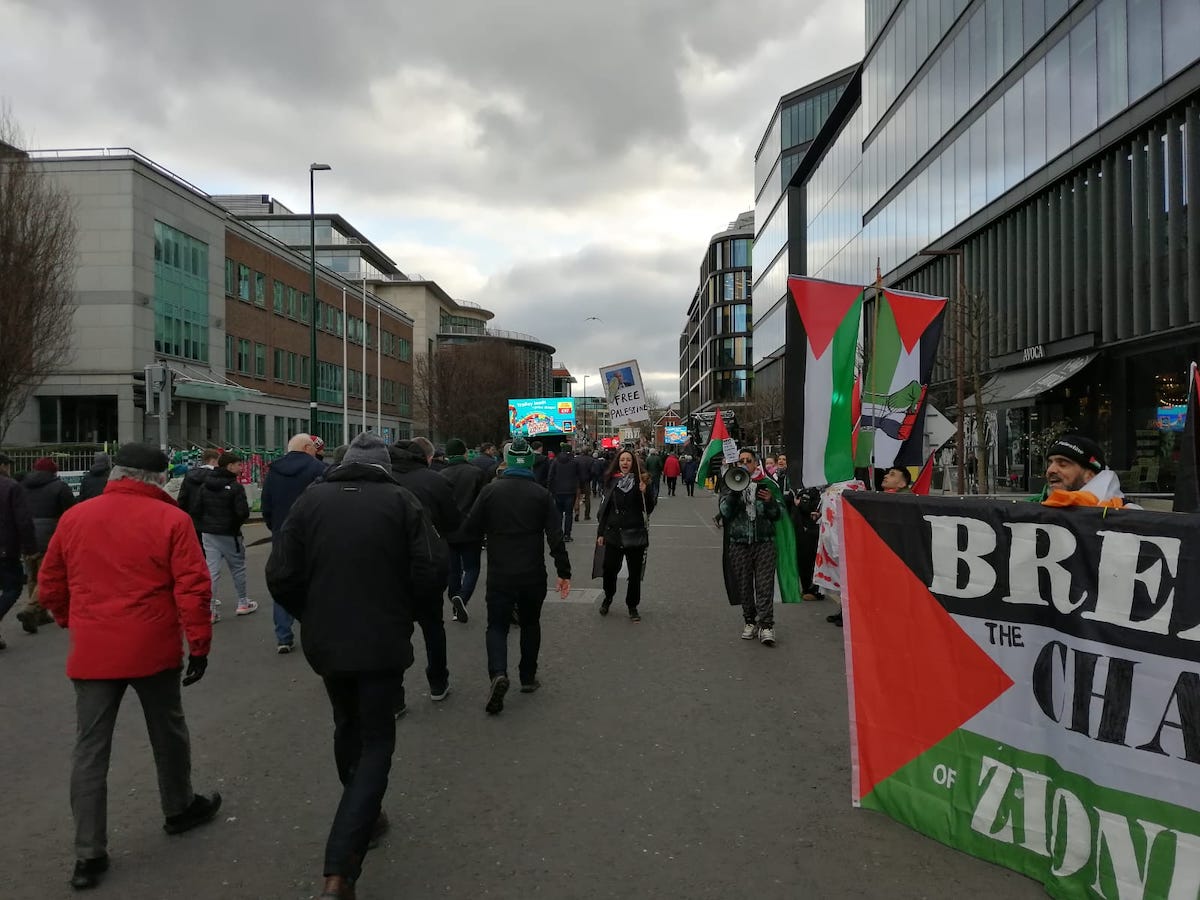
Initially the crowds leaving the Rugby game between the Irish and Welsh teams, seemed neutral as they passed the picketers but gradually grew warmer.
The handful of passersby who expressed support for the Zionist state were militantly denounced by the picketers as “Genocide supporters” but much more common from the crowds were signs of approval such as applause, thumbs-up and occasional cheers and clenched-fist gestures.
A few in the crowd also shook hands with or gave a fist-bump to a demonstrator and some also thanked the picketers.
Some asked to have their photos taken alongside a picketer, one also waving a borrowed Palestinian flag. A woman approached one of the demonstrators, removed her Ireland rugby colours scarf and wrapped it around the picketer’s neck, saying “We support you” before walking away.
One of the Palestine solidarity picketers wearing the Irish rugby colours scarf with which he was presented by one of the Irish team’s fans returning from the game. (Photo: Rebel Breeze)
The nearly non-stop chants of the picketers, led by a young man of Middle Eastern appearance in a keffiyeh were directed at solidarity with the Palestinians and denunciation of the Israeli State, including calls for boycott and sanctions and the expulsion of the Israeli Ambassador.
One of the female demonstrators, a regular at the site, is garbed in white “blood-stained shroud.” At least half the picketers appeared Irish by appearance and accent. A majority were female, which seems to be the pattern in pickets, rallies and marches in solidarity with Palestine.
The thousands who passed the picketers were in contrast to the earlier near-deserted Shelbourne Road, as the Gardaí had closed the road to vehicular traffic in the vicinity of the Aviva Stadium where the Ireland rugby team was playing the Welsh one.
A fragment of the rugby fans leaving the Aviva Stadium after the game and passing the picketers. (Photo: Rebel Breeze)
The Israeli Embassy moved in 2019 to its current location on the fifth floor of a multiple-business-occupied building at 23 Shelbourne Road. Formerly the zionist embassy occupied an upper floor at Carrisbrook House, Northumberland Road, with every other floor unoccupied.
Some of the occupants of the current building, which is protected by a Garda presence, have reportedly asked their landlord to remove the Embassy but the request was denied.
When Gardaí reopened the road a senior Garda officer directed the demonstrators, ‘for their safety’, to remove from the road in front of the Embassy building to the side. However, it is the Gardaí who have barricaded off the entire section of pedestrian pavement in front of the building.
It seems likely that this will become an issue at some point in the future.
The scene outside the Israeli Embassy in Dublin shortly before the commencement of the protest, showing the pedestrian footpath completely fenced off by Garda barricades. (Photo: Rebel Breeze)
THE RUGBY
The Irish team beat the Welsh one 31-7 on Saturday. The Irish rugby team is a 32-County team, unlike soccer, where the Irish state and the colony each has their own ‘national’ team and are obliged to compete against one another internationally.
However, the song played for the Irish rugby team is the anodyne Ireland’s Call and not Amhrán na bhFiann/ The Soldiers Song, which is played for the Irish soccer team and in Gaelic Athletic games.
Rugby has gained in wider popularity in Ireland in recent decades but formerly in most parts of Ireland was considered a game for Anglophiles or “West Brits”.
Also, with the exception of Limerick, socially a game of the upper middle class, being played in Anglican colleges and in Catholic colleges of the English public school model.
Until the advent of the now-defunct Irish Press(1931-1995), neither of the main national newspapers, TheIrish Times nor TheIrish Independent reported on Gaelic Athletic Association games, reporting instead on the minority rugby, hockey and cricket matches.
Videos doing the rounds of social media sites show a brief intervention by Palestinians at a Sinn Féin-organised meeting in Belfast about Palestine followed by the party’s heavies evicting them to applause from many in the audience.
The event at the Europa Hotel on Thursday evening was intended, according to the party’s National Chairperson, “… as an opportunity to demonstrate that Ireland stands with the people of Gaza and the West Bank and to reiterate calls for an immediate ceasefire, and an end to the occupation.”1
Actually Ireland is already – except for the Unionists — well behind the Palestinians as shown by attendance at marches and opinion surveys. What is needed is a) clarity on what we are calling for and b) direct action to put the States and companies under greater pressure.
The video of the intervention I’ve seen began with an apology for interrupting the Palestinian Ambassador, Dr. Jilan Wahba Abdalmajid, as “a mouthpieceof the Palestinian Authority” which, the challenger said, is an undemocratic organisation which has not had an election since 2006.
Boos and cries of objection followed from the audience as the Palestinian asked to be listened to, pointed out that those doing the intervention were all Palestinians but the party’s security men were soon hustling them out and periodically trying to block the phone camera.
When people don’t want to examine the issues or are feeling guilty about them, it’s always tempting to blame the critics, suggest they’re dissidents, trouble-makers, etc. That way the pointing finger is turned around and the actual issues don’t need to be thought about.
Of course this time some SF supporters commented along those lines, accusing their critics of being Loyalists, or as they have in the past outsiders, ultra-leftists, intelligence service agents, dissidents, malcontents, trouble-makers … or just plain Utopians.
“MOUTHPIECE OF … AN UNDEMOCRATIC ORGANISATION”
The intervention from the floor was challenging but what of the content? Palestinian Ambassadors are appointed and employed by the Palestinian Authority which, though never intended as a government is acting like one. So “mouthpiece for the PA”? Blunt — but entirely accurate.
Palestinian Ambassador to Ireland of the undemocratic and corrupt Palestinian Authority at a Sinn Féin meeting (note SF President Mary Lou McDonald applauding in the background). (Sourced: Internet)
The PA “has not had an election in 18 years”? Accurate also – though they’re supposed to have one every five years. The last time there were elections in Palestine was 2006 and Hamas won overall throughout Palestine. However Fatah, the losers, refused to give up their seats.
In 2007 in Gaza, Hamas moved against Fatah and after a short struggle, took the seats to which the electorate had voted them. However, they chose not to do that in the West Bank, where the PA’s HQ is and where EU and USA money comes flowing in to Abbas and his unelected cronies.
The reason for not holding elections is that Hamas would almost certainly win again. Meanwhile, “democratic Israel” refused to recognise the Gaza administration or the elected representatives of the Palestinians while the US, EU and UK followed suit and ‘Israel’ blockaded Gaza.
The Palestinian Authority, as well as being undemocratic, deeply corrupt, unrepresentative and repressive2 is also actively colluding with the Zionist state and feeding its masters intelligence on the Palestinian opposition and resistance while it represses their supporters.
That’s what most Palestinians think about the PA and, as is widely known and even tacitly admitted by the USA3, whether in the West Bank or in Gaza, Palestinians have no confidence in the institution.4
Some of the comments on the circulating videos criticised SF’s bad management of the event, opining that the Palestinians should have been allowed to speak and then the meeting could have proceeded as the organisers planned and the challenge would have got little publicity.
True … but SF is used to throttling dissent inside its party or in the communities it controls and managing dissent – rather than crushing it — is just not its style.
In any case, is ‘bad management’ the main issue with regard to SF and Palestine? More important than supporting partition of Palestine, the institutionalisation of a Bantustan “Palestinian State” under the guns of the Zionists – and the PA’s collusion with those same Zionists?
The Provisionals weren’t always pro-Palestinian; though it might shock some people, they originally mirrored Irish society’s position of support for Israel, the perceived ‘underdog’ up to the mid-1960s, Hollocaust survivors (Zionists) who had fought the British police and army.5
THE PROVO LEADERSHIP AND PALESTINE
For a while pieces by a Fred Burns O’Brien apparently based in the USA were featured in the Provos’ newspaper but some time after he revealed himself as a Zionist he was ‘let go’, probably through internal pressure from those who thought the Palestinians were the natural ally.6
One of the problems with taking a political position, physically or ideologically, is that you might get called on it someday. This is why bourgeois politicians try to give themselves wriggle and even retreat room in their statements – lots of good-sounding bites with little content.
The Provisionals owe a debt to some Palestinians but it’s a very bad one. I don’t mean when they got some arms for the struggle7 but rather their following Fatah/PLO down the pacification process, for which Fatah and the ANC sent fraternal delegates to SF’s Ard-Fheiseanna (annual congresses).
Subsequently, Ireland and South Africa were used as promotional examples of the pacification process and their delegates travelled as kinds of sales representatives8 — but Palestine got dropped from 2000 onwards because of the Second Intifada, when Palestinians rejected Fatah’s deal.
You can’t sell a process as ‘working’ when the youth have overwhelmingly rejected it and are fighting the Occupation in the street.
“ORGANISE YOUR OWN EVENT”
One prominent member of SF in the British colony told the Palestinian protesters they should have organised “their own event.” Er – was this event not advertised as being for solidarity with Palestine? But ‘Palestinians not welcome’? Or only zionist-collaborating Palestinians?
Imagine if back in the day some political party had been having a meeting about Ireland and were inviting an Irish State or British colonial minister as a speaker, would anyone have been shocked to see and hear SF activists challenging or even heckling the speakers during the meeting?
Would we not be reading statements from SF talking about ‘no right of colonialists to represent the Irish people’ and about ‘censorship of Irish voices’?
Cartoon by DB.
Gerry Adams, former President of the party was quoted as saying the calls are “inconsistent” because they are not making the same call with regard to the UK though “the Brits are up to their neck in this” and what is important for SF in the USA is Irish-America.
But SF long ago accommodated itself to the colonialist “Brits”, including its royalty. Irish politicians don’t flock to London for St. Patrick’s Day. Anyway the primary financial and military supplier – and political backer of the Zionist state in the UN Security Council — is the USA.
Why is the diaspora in the USA so important to Sinn Féin but not the diaspora in Britain or in Australia? It must be because the USA is the “boss of the world” and pathetic Irish gombeen politicians think their diaspora gives them them some kind of weight with the imperialists.
What would really help with the Irish diaspora would be if SF were to address the Irish-Americans and ask them to push their political representatives to call for the USA to stop supporting genocide in Palestine.
But of course there is no chance of them doing that because 1) some Irish Americans oppose imperialism from Britain but support it from the USA; also 2) because Irish gombeens, the political class to which SF aspire, are pro-western imperialism.
INTERNATIONALIST SOLIDARITY AND THE HOME STRUGGLE
I have commented in the past that the level of commitment to internationalist solidarity is one of the indicators as to whether an organisation is going to carry through its own revolution or instead is going to finish up in liberalism and abandon its struggle, ending in actual collusion.
It seems some others have the same idea.
As she was being evicted, the Palestinian woman called out for SF not to attend Washington on St. Patrick’s Day and also shouted, though she may have meant it the other way around: “There will not be a free Palestine without a united Ireland!”
Electronic Intifada co-founder Ali Abunimah put it quite succintly: “If you can’t say NO to the White House in the middle of a genocide, then you’d never be able to stand up, not even for Ireland.”
2“The PA has actively helped Israel to keep tight control over the Palestinian population. Many perceive the body as a tool of the Israeli security apparatus, its US-trained forces not only targeting those suspected of planning attacks on Israelis, but also arresting union figures, journalists and critics on social media.” (Al Jazeera – see Sources)
3Hence the USA’s post-war plan for Gaza, as expressed by Blinken, is to have it run by a “revamped PA”, i.e one that might have some credibility among Palestinians.
4“Today, a staggering 87 percent of Palestinians in the West Bank and Gaza believe that the PA is corrupt, 78 https://en.wikipedia.org/wiki/King_David_Hotel_bombingpercent want Abbas to resign, and 62 percent believe that the PA is a liability.” (Washington Institute — see Sources).
5On 22 July 1946, Zionist militias bombed the King David Hotel in Jerusalem, in which the British Mandate administration had offices including its police intelligence department, killing 91: “49 were second-rank clerks, typists and messengers, junior members of the Secretariat, employees of the hotel and canteen workers; 13 were soldiers; 3 policemen; and 5 were bystanders. By nationality, there were 41 Arabs, 28 British citizens ….” Forty-six were injured. https://en.wikipedia.org/wiki/King_David_Hotel_bombing
6The same kind of pressure from the support base that caused the SF leadership recently to reestablish their ‘expel the Israeli Ambassador’ position that Mary Lou had announced they were abandoning.
7In 1977 a consignment of arms allegedly from the PLO bound for Ireland was seized by the authorities at Antwerp.
8To the Basque Country, Kurdish Turkey, Colombia, Sri Lanka, Philippines etc.
A call has gone out for Irish politicians, as part of pressure on the USA to stop supporting Israeli genocidal attacks on the Palestinians, not to attend friendship ceremonies with the President of the USA on St. Patrick’s Day this year.1
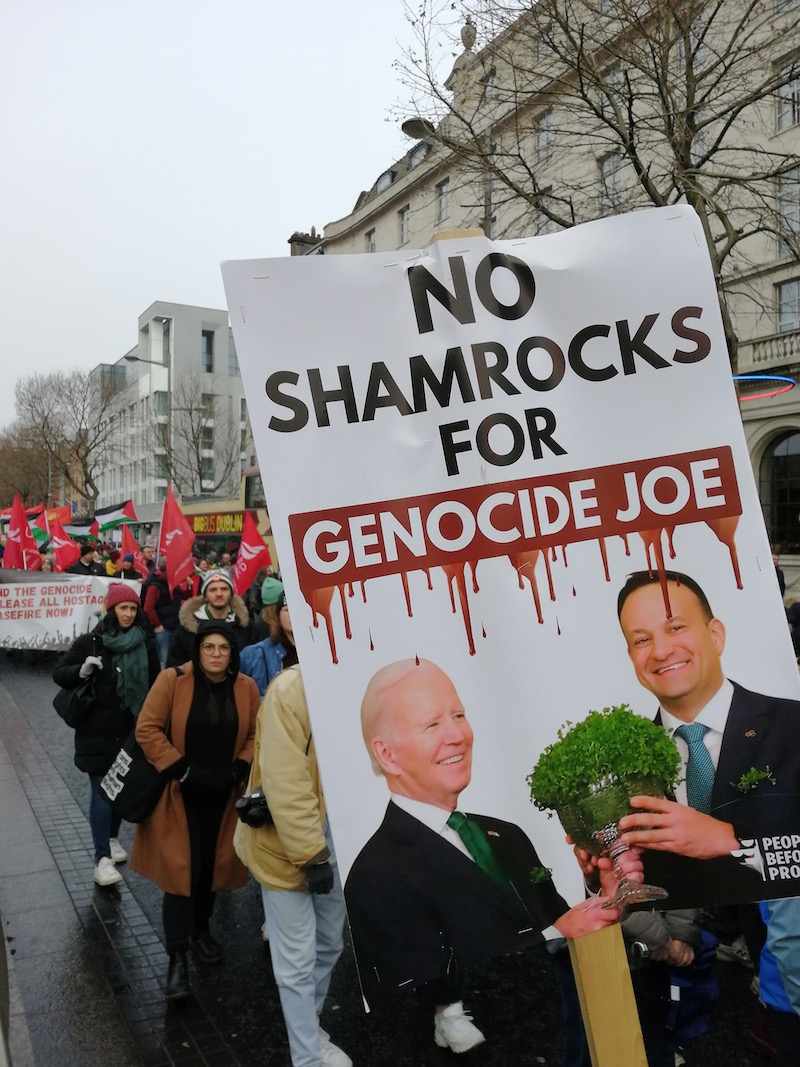
With the US Presidential election scheduled for September, “Genocide Joe” Biden will still be in office on March 17th, a man who apart from representing the major imperialist power in the world, ordered his state’s veto in the UN against a call for a humanitarian ceasefire.
A man who repeated ridiculous Zionist propaganda against the Palestinians of beheading children and rapes, who said that if Israel had not existed the US would have had to invent it, who received more Zionist lobby for his campaigns as Congressman than any other in the whole USA.2
Even without his personal history, after a US-supported slaughter so far of 25,000 Palestinians, mostly women and children and displacement of 85% of Palestinians, you’d think that this would be what UStaters call “a slam dunk”, that Irish politicians would feel too disgusted to make the trip.
Placard carried by a Palestine solidarity marcher in Dublin on 28 October. (Photo: D.Breatnach)
Sadly this revulsion is not felt among most politicians in Ireland, who from from Varadkar in the Government to Mary Lou MacDonald of Sinn Féin in the Opposition have indicated that they have no intention of foregoing this annual pilgrimage to the Boss of the World
What is this strange Irish obsession with the United States of America anyway? Yes, of course, it is a (or the) major world power and yes, a number of people of Irish antecedence have become its Presidents – including the first Roman Catholic to reach that office.3
But really, what has the US concretely done for Ireland? Did it send us troops to help drive the English from our land? No, the Spanish Kingdom did that once and the French did it twice, once as Kingdom and again as Republic. But the US? Never.
It might be protested that the USA permitted Irish to emigrate there but a) it did so for many others too and b) only in order to populate its European colonisation of the Indigenous land and c) to compete against other European colonial powers – in particular the Spanish, French and Dutch.
It is true that it has on occasion served as a haven for Irish ‘on the run’ from British jurisdiction but so did France and in any event, those cases were nearly always when the USA was at war or in diplomatic conflict with the United Kingdom in the USA’s own interests.
WHEN THE USA COULD HAVE REALLY HELPED THE IRISH STRUGGLE
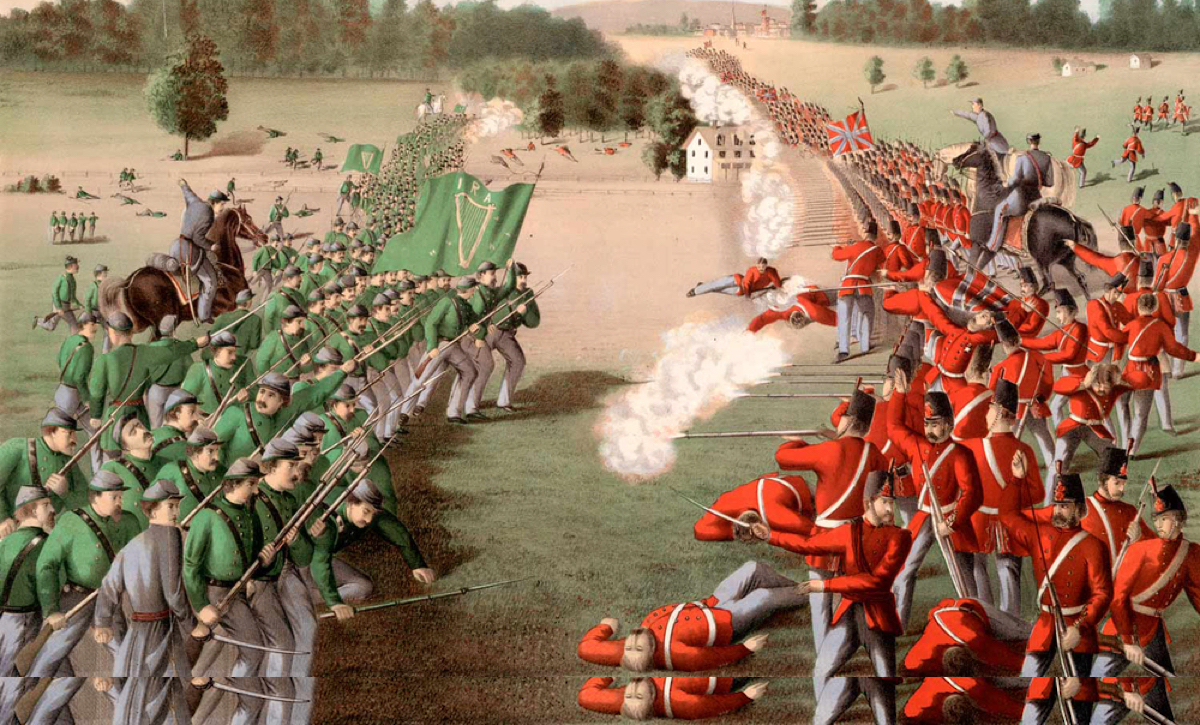
When the US-based Fenians raised an army to invade British colonial Canada in 18664, they had hopes that the government of the US would at least not impede them. The British had supported the Confederacy in the American Civil War which had cost 650,000-800,000 lives.5
That number represented the highest number of US dead in any military conflict before that (or since), fought to eliminate slavery, which the UK had abolished 50 years earlier6 – yet it supported the Confederacy7 in a number of ways including building warships for them.
The charge of the Fenians (wearing green uniforms) under Colonel John O’Neill at the Battle of Ridgeway, near Niagara, Canada West, on June 2, 1866. In reality, the Fenians had their own green flags but wore a very mixed bag of Union and Confederate uniforms (if they still had them, or parts of them left over from the Civil War), or civilian garb, with strips of green as arm or hat bands to distinguish themselves. (library and archives canada, c-18737)
The USA closed the border with Canada and arrested Fenian war veterans under arms8 waiting to cross but only after (perhaps to make a point with the British) an advance Fenian force had already entered British Canada, seized Fort Erie and defeated British soldiers of the line and militia.
The US President, Andrew Johnson issued the border closure and arrest of Fenians by Executive Order on June 5th 1866, which was enforced under orders from General Ulysses Grant9 and put an end to the operation, as the US did to subsequent attempts.
The British subsequently paid $15.5 million in 1872 for damage caused by the British-built Confederate warship, the Alabama, after which both states entered into friendly relations.10
The USA did not support the Irish insurrection of 1916 nor the War of Independence. After WWI, while the victorious imperialists held their “Peace Conference” to discuss the new world order and re-divide up the world, US President Wilson declined to meet the Irish Republican delegation.11
The USA did not support the Irish in the War of Independence (1919-1921) nor support the Republican side in the Civil War (1922-1923). Nor again during the Border Campaign, nor during the Civil Rights Campaign followed by armed struggle (1968-1998).
In 1992, after a long legal and political battle, IRA Volunteer Joe Doherty, in the US since 1983 was finally extradited to the Six Counties despite a) the political nature of his charge and b) the well-known low proof standards of the political courts in the British colony.12
It is true of course that, in deference to the feelings of its large Irish-American population and their representation in the US polity, that it has permitted certain Irish solidarity activities on US soil and, at times, issued statements of concern over British actions in Ireland – but nothing more.
The Irish-American political representation is for the most part US first and Irish second, i.e US Imperialist first and foremost. Ireland is also used by US monopolies as a side door into the markets of the EU and, through registering head offices in Ireland, for avoiding taxes in the USA.
NEO-COLONIAL ASPIRANTS TO THE GOMBEEN CLUB
So what is all this US homage in the Irish official polity about — and in particular among Sinn Féin? How can leaders of the party correctly criticise the genocidal actions of the Israeli State and yet speak no word against the main backer of the zionist state, i.e the USA?
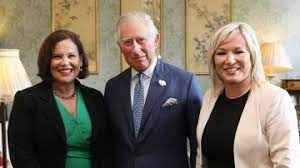
It’s a new SF – two of the party’s leaders, Mary Lou MacDonald and Michelle O’Neill, smiling in joint photo with the Commander-in-Chief of the armed forces occupying part of Ireland (and engaged in imperialist actions elsewhere) and a hereditary monarch. (Photo cred.: Irish Times)
The answer is simply that the new SF, which was never overall socialist nor even particularly anti-imperialist throughout the Provisionals phase, is now neo-colonialist and knocking on the doors of the established gombeens,13 asking for admittance, which they are sure to receive in time.
They are not the first to make the transition from revolutionary Irish Republicans to gombeen party. Fianna Fáil, representing some of the leadership of the losing IRA side in the Irish Civil War, was an Irish ‘constitutional’ party and became the preferred choice of the gombeen ruling class.
Fianna Fáil has been in government more often than any other party in the history of the Irish State and is there now, sharing government with their former binary opposition party, Fine Gael, along with the Greens. The FF party too considered the friendship of the USA to be important.
For the SF party leadership however the US is important also based on their perception of it being a guarantor in the Irish pacification process. In their twisted reality, US imperialism is forcing British imperialism and colonialism to do – what?
Remove the British colonialists? Remove the sectarian colonial government? Stop the penetration of the Irish economy by foreign multinationals, including those of the USA?
Of course not and in the unlikely event that thoughts of doing so ever crossed the minds of US imperialists, they would discard them instantly in favour of the continued alliance with the imperialist UK as their junior partner.
NO SOAKING THE SHAMROCK IN PALESTINIAN BLOOD
Although there are many other complicit states, the USA is the major supporter of the Israeli State, financially, militarily and politically, using its position as one of the five Permanent Members of the UN Security Council to veto resolutions proposed against the Zionist state.
The Israeli State represents a western imperialist foothold for the USA in the Middle East, the only one that is entirely safe from either internal national liberation or fundamentalist islamist uprising and it has continued to support Israel throughout the state’s genocidal history.
The role of the US in this conflict is to defend and supply the Zionist state but also to manage client states in the region and around the world get them to support ‘Israel’ (or at least to limit their opposition to the state), alongside preventing or hampering assistance reaching the Palestinians.
Placard produced in support of the demand, seen on recent Palestine solidarity march in Dublin. (Photo: D.Breatnach)
Sinn Féin called recently for the Zionist Ambassador to be expelled from Ireland but initially, Mary Lou had declined to do so, saying it would not be helpful. She came under strong pressure from within the party’s membership and had to join the call for the person’s expulsion.
However, that’s easy to explain to Biden as the necessity of staying on top of a troublesome horse in order to bring it eventually under control. After all, the Government wasn’t going to expel the Ambassador, no matter what anybody said, was it?
There is a statement applicable here from the Christian Bible which has since become a proverb (if it was not already one at the time of writing), that “one cannot serve two masters”. One of the ‘masters’ is usually understood to mean money but that’s not what I mean here.14
The SF leadership cannot serve both Palestinian solidarity and US imperialism but there’s no danger of their even trying to do so – they know who their real master is. The Palestinian solidarity posturing is for their supporters and to show they can play their required role in the world.
Their President, Mary Lou did so when she offered the Irish pacification process as an example for the Palestinians15 and the whole of the SF leadership does so in supporting the imperialist “two-state solution” (sic) in which a colonial Palestinian state is to be set up under Israeli guns.
And on 40% or less of their original land, with the least water.
Neither the SF leadership nor the other politicians have any intention of missing the event in the USA in March when they offer their allegiance along with the symbolic tribute, the bowl of leaders’ shamrock which now, however, is soaked in Palestinian blood.
We should at least make it difficult for them by signing the petition and in other opportunities as may arise between now and that date.
11Or even to reply to their correspondence although interestingly he did reply to that of a young Ho Chi Minh of Vietnam in ‘French’ Indo-China (according to research presented in Dublin some years ago and noted by me)
12He had been a member of a unit in Belfast that killed a captain of an SAS undercover unit attempting to surround them.
13From the Irish language “gaimbíneachas”, a pejorative term describing the practice of those Irish with capital who took advantage of the hardships of the Great Hunger to appropriate land holdings and businesses, something similar to the disdained “carpetbaggers” in the defeated states of the American Confederacy. The term is now applied to Irish politicians and business people who facilitate foreign exploitation of Irish natural resources, labour, infrastructure and housing need.
14Although in that sense too the saying is applicable to the SF leadership.
Among Christmas shopping crowds in Dublin’s city centre, the calls for freedom of political prisoners rang out, while the Irish, Palestinian and Basque flags fluttered in the wind among festive lights and projected light-show.
The Ireland Anti-Internment Campaign was holding its annual political prisoner solidarity picket in the busy O’Connell street, supported by socialist Republican groups and independent activists.
View of picket line looking southward. (Photo: Rebel Breeze)
December is a traditional month in Ireland for focus on Republican prisoners. However, the IAIC campaign has always made a point of remembering political prisoners elsewhere too, with Palestinian and Basque flags erected on its regular pickets.
This year the Campaign had especially requested Palestinian flags and these were present, both the national flag and that of the Peoples Front for the Liberation Palestine, fluttering alongside Basque flags and the green-and-gold Starry Plough.1
In addition, one of the IAIC’s banner displayed a large copy of an image depicting a Palestinian’s arm extended through prison bars to grasp the hand of an Irish Republican prisoner’s hand also from nearby bars, from the original by political cartoonist Carlos Latuf,.
A black banner had been rigged with lights to spell “Saoirse”, the Irish word for “freedom” and the picketers set up in a line with other banners and flags facing the GPO building.2
Political prisoners sometimes have their family visits cancelled as a punishment and during the Covid pandemic prevention period it was used as an excuse to prevent Republican prisoners’ family visits. (Photo: Rebel Breeze)
SHOUTS
A speaker using a megaphone informed passers-by that internment without trial had not ceased in Ireland and that Republicans were being charged and then refused bail by non-jury courts on both sides of the British Border, spending two years in jail regardless of their trials’ outcomes.
All the Republican prisoners, the IAIC speaker said, had been convicted in non-jury special courts. Palestinians were also being convicted in special courts, he said, military courts and many were in jail – in “administrative detention”, i.e interned without ever having been convicted or tried.
Over 3,000 had been arrested in Israeli Army raids since October 7th,3 the speaker said through the megaphone, bringing the overall number of Palestinians in jail to over 7,000.4
(Photo: Rebel Breeze)
The recent exchange of prisoners between the Zionist state and the Palestinian resistance had resulted in liberty for 240 Palestinians, of which 1075 were children and 68 women.
There was regular chanting from the picket line including: “From Ireland to Palestine – Free all political prisoners!” “When there is occupation – Resistance is an obligation!” and “Free political prisoners – Free them now!”
At one point some kind of religious procession was briefly enacted in front of the GPO building and an elderly woman in apparent religious garb approached the picketers shouting something at them which they largely ignored, maintaining their solidarity slogans.
(Photo: Rebel Breeze)
In addition to interested people taking photos or filming video of the protest on their devices, some approached the participants to ask questions and to receive a leaflet, after which a number actually joined the protest line for a while (some until the end).
Occasional passing traffic also sounded their horns in solidarity.
The pavement in front of the GPO showing shoppers and people queuing for food distribution. (Photo: Rebel Breeze)
STATEMENT
As the end of the event’s allocated period approached, a representative of the IAIC asked the participants to gather around and spoke about how resistance brings repression and oppression brings resistance, resistance being the “crime” for which political activists are jailed.
The participants were thanked for their support, whether independents or activists of Ireland Anti-Imperialist Action and Saoirse Don Phalaistín organisations.
The event ended with the acapella singing of “The H-Block Song” by Diarmuid Breatnach, in an adaptation of the original air to the lyrics of what is “still a good song” he said, composed by a man who, along with his party, “no longer supported Republican prisoners”.6
(Photo: Rebel Breeze)
The lyrics recall the struggle of Republican prisoners in the late 1970s against the removal of their ‘Special Category’ political status, which began with refusal to wear prisoner uniform. The struggle escalated to the “no-wash protests” and to hunger strikes in 1980 with ten martyrs in 1981.
As the protesters collected their flags and wrapped up their banners, the nature of current Irish society was underlined by the queues forming up across the road for free food being distributed by charitable organisations.
Early view of picketers, looking northward. (Photo: Rebel Breeze)
INDEPENDENT AND OPEN DEMOCRATIC ORGANISATION
The IAIC is “an independent organisation and open democratic organisation” of ten years’ existence and although it has held events for specific cases such as the framed Craigavon Two,7 its main activity has been regular public pickets in Dublin to highlight ongoing internment in Ireland.
The Campaign group encourages participation by democratic people in its regular pickets, regardless of political organisation affiliation or none and, according to one of the organisers, expects to hold its next one in Dublin in January or February.
The IAIC expects also to take part again in the annual Bloody Sunday Commemoration march in Derry on Sunday 29th January 2024.
end.
Unintentionally impressionistic image, photo taken from the east side of O’Connell Street (Photo: Rebel Breeze)
APPENDIX: ANNIVERSARY OF HANGING OF IRISH REPUBLICAN
Though not mentioned in the discourse, the above event took place within days of the anniversary of the British colonial execution of an Irishman in revenge for his killing of an ex-Republican who had turned informer.
James Carey, in the midst of a ‘witness protection program’ provided as a reward for his betrayal of his comrades in giving evidence in court to ensure the jailing of some and hanging of five others, was killed in a gunfight with Pat O’Donnell.
Carey had been a leading member of the National Invincibles’ (a split from the Fenians) cell in Dublin, and had given the signal for the fatal stabbing of British Under-Secretary Burke and Chief Secretary Lord Frederick Cavendish in Phoenix Park on 6th May 1882.
However, Carey turned “Queen’s Evidence” to testify ensuring the conviction of his former colleagues and even gloated in court at their fate. His reward, but for O’Donnell, would have been a new life with pension under an assumed name with wife and children in the South African colony.
O’Donnell was an independent Republican from the Irish-speaking Gweedore area in Donegal but had been to the USA, where he had cousins who were prominent in the “Molly Maguires”, an Irish-led resistance organisation among miners in the USA.
O’Donnell was hanged on 17th December 1883 but is commemorated in the satirical song “Monto” and also in the serious “Ballad of Pat O’Donnell”. His home town of Gweedore also holds a monument in his honour.
end.
FOOTNOTES
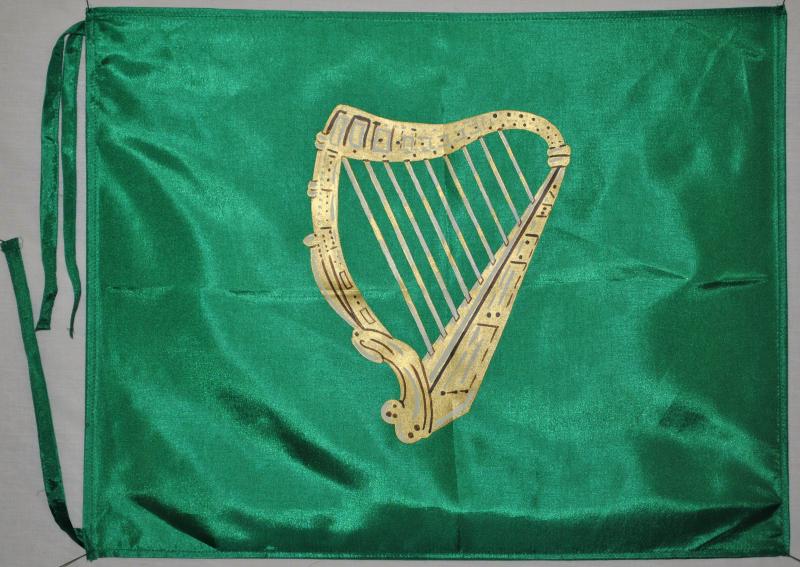
1Flag of the Irish Citizen Army, the first workers’ army in the world, founded to protect workers from the police during the Dublin Lockout/ Strike of 1913.
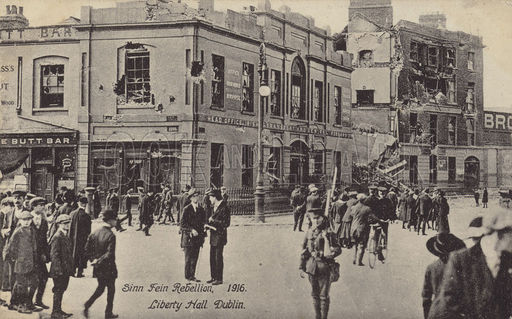
2The General Post Office, iconic building on Dublin’s O’Connell Street, which was the HQ of the leadership of the 1916 Rising, left a shell by fire from British artillery bombardment but rebuilt later.
6Francis Brolly (1938-1920) of Provisional Sinn Féin, composed the song which was released in 1976. PSF abandoned the struggle in the imperialist-promoted pacification process towards the end of the last century and most of their prisoners were released under licence. However those who made public their disagreement with the colonial occupation and the pacification process were on occasion returned to jail while new “dissidents” were charged and refused bail in special no-jury courts, with tacit support of the PSF.
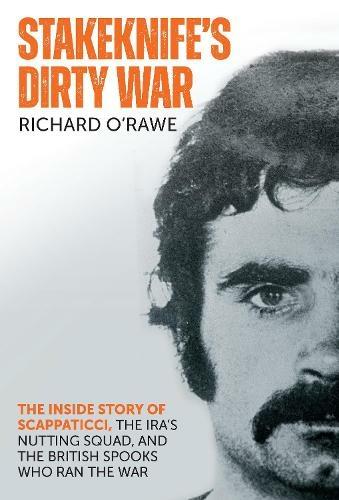
Richard O’ Rawe’s Stakeknife’s Dirty War is a timely book, coming as it does after the death, or supposed death of Stakeknife in England and what looks like a thwarting of the intent and findings of Boutcher’s Kenova Inquiry into the affair.
It is now accepted by all that IRA Volunteer Scappaticci was also the British agent known as Stakeknife.
O’Rawe had access to IRA volunteers and former intelligence operatives and weaves together aspects of Scappaticci’s life and role into a narrative that is convincing and despite the nature of the subject matter, torture, murder and betrayal it is an easy read.
O’Rawe also introduces us to Scappaticci the person. The person however, isn’t any more likeable than the British agent, torturer and murderer. In fact, it would seem they are flip sides of the same coin. Scappaticci was an industrious character, always on the make, running private tax scams.
He was used to money long before he became a paid British agent. His fortune earned from murders on behalf of the British and the IRA, though the IRA weren’t giving him anything like the sum the British did, is estimated to be in the region of a million pounds in pay-outs.
He also had various properties. Scappaticci was also a lowlife thug long before the British and the IRA gave him carte blanche to murder and torture his way through republican ranks. Some of things he did, had he not been in the IRA would have led to him being kneecapped by the IRA.
A man called Collins made the mistake of publicly calling the area in Twinbrook in which Scappaticci lived ‘Provie Corner’. Scappaticci did not like that and decided that Collins had to pay for his transgression.
He knocked on Collins’ door and, when it was answered, the informer battered the older man multiple times over the head with a sock containing a brick. Only when Collins collapsed did Scappaticci walk away.
This is the type of low life thuggish behaviour that the IRA was willing to tolerate and perhaps even encourage from people like Scappaticci. In a genuinely political movement, a thug like Scappaticci would have been out on his ear. But not in the IRA nor in Sinn Féin.
He was, to paraphrase the Yanks when talking about the Nicaraguan dictator Somoza, “he may be a son of a bitch, but he is our son of a bitch”, though in this case it would seem that not only was he theirs he had just the qualities that both the IRA and the British valued, ruthless thuggish qualities.
Scappaticci the person and agent are intimately related it would seem though O’Rawe doesn’t explicitly say so. He does however, give us ample material with which to draw that conclusion.
One of the issues never dealt with it in the press and not really fully covered here is what type of organisation recruits, tolerates and promotes such people. He was a reprobate who should never have graced the ranks of the IRA. That he did so, is down to Adams and co.
That is also clear from the book. It is not an aspersion on Adams or on McGuinness either to question their role.
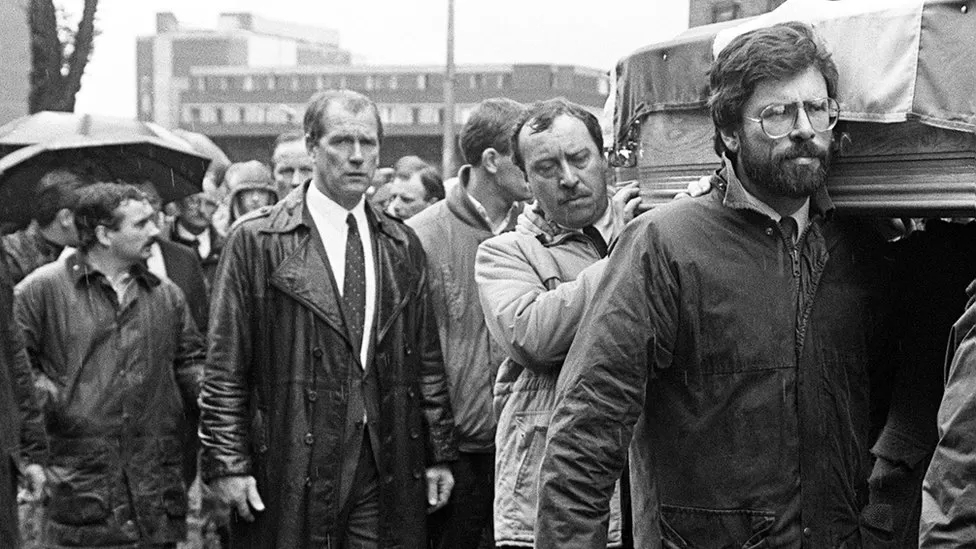
Republican funeral, Scappaticci on left photo, Adams on right (Photo cred: Pacemakers)
The latter of the two comes in for some questioning in the book regarding his role and O’Rawe goes into some detail and also explains in the epilogue that before beginning his research he was unaware of the level of unease amongst republicans about McGuinness’ trustworthiness.
Though he does point out earlier that if McGuinness was a tout, why was it necessary for the British to have a spy such as Willie Carlin get close to him. The same could also be said of Adams.
The British had an agent, Denis Donaldson, whispering sweet nothings in Adam’s ear over many years, shaping Adam’s view of the world and reporting back to the British how successful he had been in his endeavours.
The Peace Process, in that regard, was partially the result of what ideas the British planted in Adam’s and McGuinness’ minds through their various agents. However, it does seem unlikely either of them were touts in the classical sense of the word.
They didn’t need to be, they were at a different level. They were both on the same side as Scappaticci in winding down the war, they just had different methods of going about it.
It is possible that at some stage they had dealings with the British security services in pursuit of common aims. O’ Rawe is not the first to question McGuinness either.
Ed Moloney has put forward the idea that the reprehensible proxy bombs that provoked so much revulsion were signed off on, precisely because they would strengthen the hands of those who sought to wind up the war.
O’Rawe gives many examples of what Scappaticci and the other British agents in the Internal Security Unit did. It wasn’t limited to executing alleged informers or those the British thought should be removed for various reasons under the guise of them being informers.
They were also in a position to give information on operations which led to the British either arresting or killing the Volunteers involved. The book opens with an account of one such operation, where fortunately they were able to pull back from it without the planned British ambush going ahead.
There were of course other incidents, one of them being Loughall where the British ambushed an entire unit of the IRA. Scappaticci and his ilk did great harm to the IRA, but they were not the reason the IRA lost the war, and O’Rawe doesn’t argue it was either.
However, others have made this point. But the IRA was never going to win the war, they weren’t going to outgun the Brits ever.
Another part of the problem of course, is related to Scappaticci. A movement so highly infiltrated would always have problems, but it is telling of the political weakness of the IRA and Sinn Féin that a thug like Scappaticci could rise through the ranks and remain at the top for so long.
That says more about their weaknesses, than anything else.
That Denis Donaldson, a British agent was the chief advisor to the IRA and Sinn Féin on strategy, for so long, shaping policy, whilst Scappaticci weeded out of the ranks anyone who would oppose it, says more about the weakness of republican politics than whether operations went ahead or not.
O’Rawe, however, is more interested in what happened and who bears responsibility for it.
He is quite clear that the IRA are to blame and is equally clear that those in the intelligence services who allowed Scappaticci and other British agents in the ISU to murder their way through republican ranks are also to blame.
He is not wrong in that, Danny Morrison described Scappaticci as Number 10’s murderer(1) and that he was, he was also the IRA and Sinn Féin’s murderer.
Adam’s infamously justified in a blasé fashion the IRA murder of alleged informer Charles McIlmurray in 1987 when he said that “like anyone else living in West Belfast [he] knows the consequence for informing is death.”(2)
Neither the British, the IRA, Sinn Féin and Gerry Adams in particular, get to wash their hands of the affair.
This book is an important contribution to uncovering the truth of Troubles, one which will neither please Sinn Féin nor the British and Irish governments written from the perspective of a former IRA volunteer.
It deserves to be read and kept on the book shelf as the issue is not going away any time soon.
People who have lived for generations in the Dublin dockyards have been getting the feeling for some time that the city planners don’t want them there and that as in Ewan McColl’s song they’d “better get born somewhere else” and “go, move, shift!”1
Recently I met with a small group of people, men and women from the Dublin docklands area south of the Liffey2 as they discussed their difficulties and what they might do about them. They wanted an article written on the issues for circulation among their communities.
Artist’s impression of the “Two Fingers” tower blocks planned by property speculator Johnny Ronan amidst existing “glass cages”. The tower blocks were ultimately denied planning permission but many others got the go-ahead. (Image sourced: Internet)
They observe their areas being taken over by high-tech and service industries, accommodation blocks built for those who can work for the high-tech corporations and pay the high rents but their own class largely employable only in low-earning service work for the corporations.
They see in this a process being facilitated by the State, the municipal authority, the banks and of generally little concern to the political class, who either benefit from the process direct or indirectly or at best, view it as regrettable but inevitable.
Wallace’s coal depot, Ringsend Road, Great Canal Basin circa 1950s perhaps. Imported coal was unloaded mechanically or by physical labour and stored here to be delivered to smaller depots and large establishments in lorry loads, or to houses and more modest commercial establishments by physical labour (coal-heavers) working from horse and cart or, later, lorries. (Photo: Toírdhealach Ó Braoin)
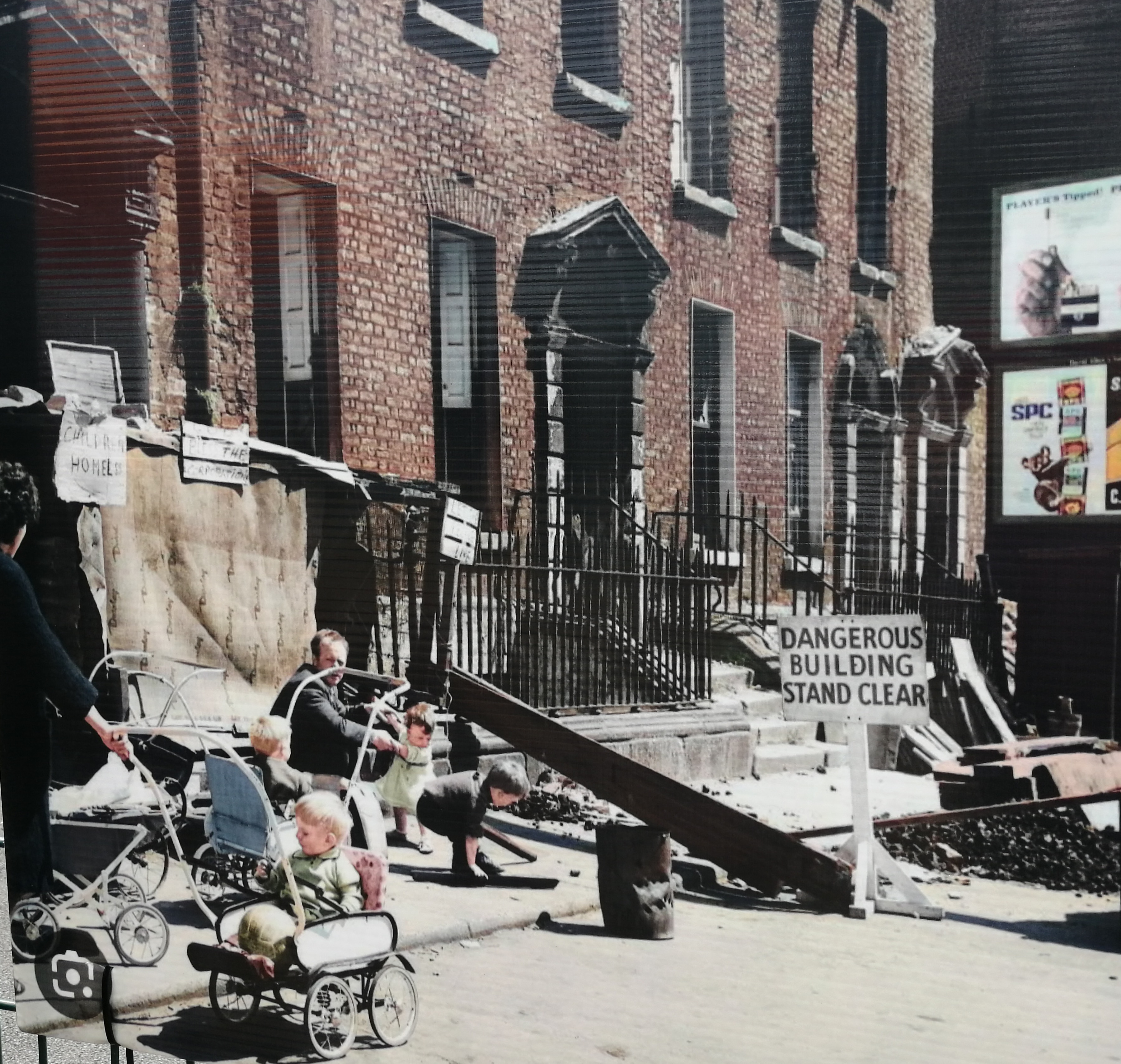
One only has to consult living memory or to compare photographs of some scenes in the past with “the new glass cages that spring up along the quay”3 in the same locations today to see that they are not imagining things or unduly exaggerating them.
Contemporary photo: This is the only traditional pub left and one of the few traditional-type buildings on the South Dublin Docks once Butt Bridge is passed. (Source photo: Dublin Dock Workers Preservation Society)
FURTHER BACK
Previously the docklands both sides of the river were, for the most part working class areas. The employment available for men was labouring on the docks, unloading and loading ships and delivering or distributing those loads by horse and cart.
There were also small industries and warehouses and even small animal enclosures or yards, including even a couple of tiny dairies.
The major work for women was in the home, raising large families but with some outside work available in food processing such as in bakeries, factories such as Boland’s Mill, clothes-making, mending and laundry. Second-hand clothes were sold too and fresh farm food, fish and shellfish.
Another coal importing company with an unloading and storage space on the south Dublin quays, circa 1950s. (Source photo: Dublin Dock Workers Preservation Society)
It was in these areas that Jim Larkin and James Connolly mostly made their mark in the first decade of the last century, forming the largely unorganised ‘unskilled’4 workers into the Irish Transport & General Workers’ Union, winning wage rises and improvements in working conditions.
It was surely no accident that the ITGWU’s headquarters, the original “Liberty Hall”, was located in dockland, just off Eden Quay in Beresford Place and across the road from the Custom House.
When the union began to impinge on William Martin Murphy’s commercial empire in 1913, Murphy began to build a union of employers determined to break the workers’ union.
The working class of Dublin, whether ITGWU members or not, … Stood by Larkin and told the Boss man We’d fight or die but we would not shirk.”
For eight months we fought And eight months we starved – We stood by Larkin through thick and thin; But foodless homes and the cry of children, They broke our hearts and we could not win.”5
In the 1913 Lockout the employers had the main mass media on their side: the anglophile Irish Times, the nationalist Irish Independent and Freemans Journal. The church hierarchies, Catholic and Protestant, stood with the employers; the Legion of Mary refused help to strikers’ dependents.
Mass meeting of workers and children (some of the children also workers, e.g the newsboys) on a Dublin quayside during the 1913 Lockout. “Murphy” refers to William Martin Murphy, prominent capitalist, owner of the Dublin Tram Company, Irish Independent and the Imperial Hotel in the Clery’s building. (Photo sourced: Internet)
The magistrates fined and jailed strikers and supporters, while the Dublin Metropolitan Police clubbed them. After two workers were fatally injured by police batons on Eden Quay,6 the ITGWU formed the Irish Citizen Army, the first army in the world of workers for the working class.
People with few economic and financial resources find it difficult to sustain long struggles and eight months would be a very long industrial struggle even today.
In the Dublin of 1916 and with the living conditions of the working class of the time, and mostly with previously unorganised workers, it was a heroic effort.
The ITGWU was temporarily defeated – Connolly called it “a draw” – but the working class remained. Those that were not sucked into the butchery of WWI continued living in the area and tried to find work where they could.
Despite that defeat and emigration or British Army WWI recruitment, the Irish Citizen Army was able to field 120 disciplined fighters, male and female, in the 1916 Rising and fought in a number of engagements. By 1919 the union’s recruitment surpassed that of 1913.
Over years the docks area saw slow decline as shipping traffic decreased. Emigration soared and, despite large families, the Irish population remained stable7. The working class population of Dublin city centre’s tenements was cleared and moved to large housing schemes on the city’s outskirts.
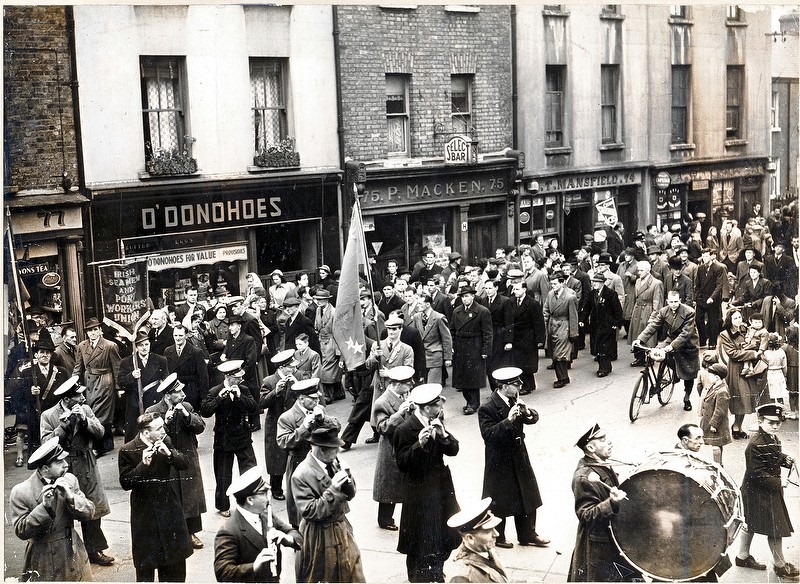
Men, women and children in a march of the Irish Seamen & Port Workers’ Union (now amalgamated into others) along south Liffey dockland some time before 1955. Note the medals on elderly man front left, possibly IRA medals from the the 1916 Rising and/ or War of Independence. (Source photo: Dublin Dock Workers Preservation Society).Another view including the flute and drum band, Starry Plough Flag (the Tricolour is being carried on the far right of photo) and trade union standard. (Source photo: Dublin Dock Workers Preservation Society).
Those who remained received some municipal housing in pockets, often neglected by the municipality, their children educated but very rarely to university8 level, their traditional work largely disappearing. And a significant minority turning from lack of hope to substance misuse.9
Houses in danger of collapse after an already collapse, Fenian Street, south Liffey dockland, 1963 (Photo source: Display at Andrew’s Court commemorative event of 1963 building collapse that killed two girls).
SOLUTIONS
Inclusion was a key word brought to the discussion I was invited to hear, with a number saying that “social inclusion” had been listed among objectives of a number of plans for the area but which failed to be achieved despite its listing.
The character of the area is of course changing with a certain amount of gentrification and some people even feeling they were looked at as though not welcome in the park they had played in as children and teenagers, or not welcome in local pubs under new management or new cafes.
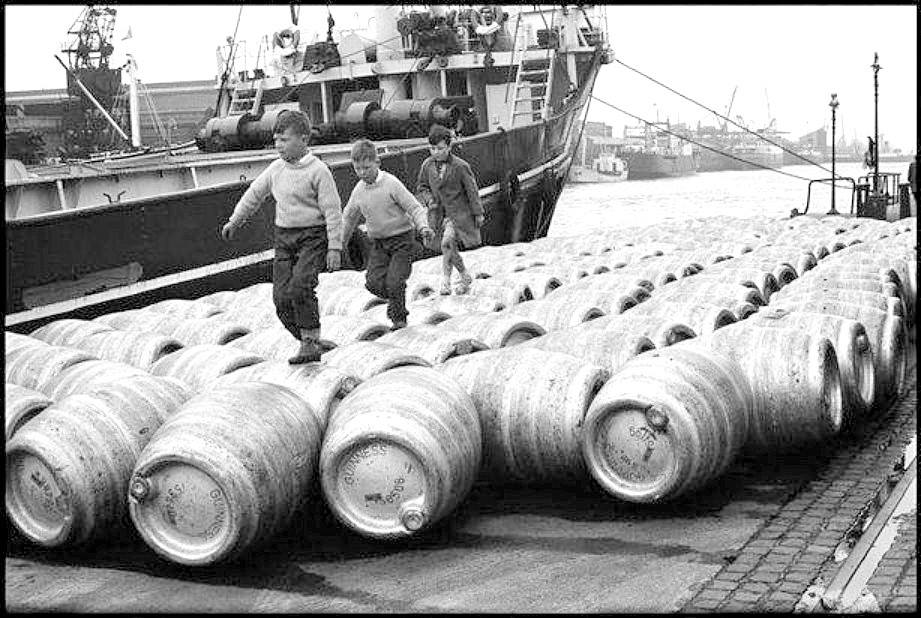
Children balancing on Guinness aluminium kegs beside docked ship on south Dublin quay with ships docked on the north quays also, circa 1950s. (Source photo: Dublin Dock Workers Preservation Society)
The kind of education working class people receive was discussed as an important factor with the mention of STEM, an educational program to prepare primary and secondary students for college, graduate study and careers in the fields of science, technology, engineering and mathematics.
Without that kind of preparation and qualifications, the group felt that children from their area had no chance of employment with the corporations now basing themselves in the docklands.
One of the group stated there is an annual special STEM seminar run at the RDS; however none of the others had heard of the seminar.
Another described a “Speed-date-type” careers advice session attended once, where students could spend a short time at one career table and move on to another. Another talked about career-planning advice for parents with which to to help their children.
Circa 1950s, family group, Gasometer in background [note also the old gas street lamppost behind man on the right]. (Source photo: Dublin Dock Workers Preservation Society)
The feeling of a lack of corporate responsibility for the people of the area in which the corporations have set up was clear.
The Ballybofey urban regeneration project was mentioned as a possible model along with Our Town urban centre projects.
If education is the key for integrating the local working class into most of the employment available locally, I wondered aloud, how would that work without housing? One of the group has already had to move out of the area for an affordable home and is intending to move further out still.
Already this means use of private transport and hours added to the working week, increasing the further out is the next home. Another said a survey found that the employment of 88% of the community was outside the area, while only 12% was local (with the carbon footprint involved).
Two-storey housing in good condition on South Lotts in south Liffey docklands – photo shows July commemoration of socialist revolutionary James Connolly and his family living there 1910-1911 (Photo: D.Breatnach)
COMMENT
My own feeling is that the first requirement is that homes need to be available for working class people in their area and that, I also feel, has to entail a local construction program of affordable public housing, ideally by a State or municipal building company.
But if people are not to have to travel outside their areas to work, as 88% are doing currently (according to the aforementioned survey figures), then they must have local employment and in turn that, in the main means with the hi-tech corporations, for which they need to be trained.
The group was very clear and in agreement on this point, whether the training is to be delivered by the corporations, by the State or by a mixture of the two.
When area developments or redevelopments are being undertaken, it is essential that the local communities are part of the process; otherwise tree-planting, city squares and delicatessen-cafes become not so much an addition to the people’s lives, as markers for their class’ replacement.
Whether in the end I agree with the way the group sees the solutions or don’t is not I feel the most important thing, which IS that they are wanting to organise and to take their future into their own hands. It is in that act alone that there can be hope for the future.
End.
FOOTNOTES
1A song about the persecution of the nomadic people, e.g Romany Gypsies and Travellers.
2Basically from the Pearse Street and Ringsend areas.
3Line from Dublin In the Rare Aul’ Times song by Pete St.John.
4A term often applied but rarely understood – labourers quickly become skilled in their work or they lose employment or become injured or killed at work. What the term really means is “manual worker who does not have a recognised qualification in at least one manual trade”. I have worked at both ends of that spectrum.
5 The Larkin Ballad by Donagh Mac Donagh, son of executed 1916 commander Tomás Mac Donagh, executed after the surrender of the 1916 Rising by British firing squad.
630th August, the first month of the dispute by DMP baton-charge on mass meeting around Liberty Hall. The following day (Bloody Sunday 1913, wrongly accounting for the two fatalities in many on-line sources), the DMP rioted again in O’Connell Street but most of the ITGWU had avoided it by rallying at their Fairview premises.
7The Irish population – though habitually of large families – remained largely stable for roughly a century after the Great Hunger’s death toll and mass emigration had reduced the island’s population by three million – until the upswing of the ‘Celtic Tiger’ economy began to increase it through immigration and reduction in emigration.
8Indeed, until 1966 most working class children left school at fourteen years of age, since secondary-level schooling was only ‘free’ (not for books, equipment, uniforms) up to that age.
9Middle and ruling class people misuse substances too – indeed some drugs, such as cocaine are much more used by “professional” classes – but they have living conditions varying from comfortable to luxurious and a range of choices for themselves and their children – not to mention expensive rescue services when they fall.
Currently the Garda Representative Association is in a public struggle with the body’s most senior officer and nearly 99% in a high-participation poll of GRA members voted as having no confidence in Drew Harris, the Commissioner.1
The real issue for the GRA (Garda Representative Association) is that they enjoyed the rosters adopted by the Garda Síochána during the Covid pandemic and don’t want to abandon them. Of course not. Four days off after four days on shift must be nice and would we all had that.
But for that, the Gardaí would be required to work 12-hour shifts on their four days on and they are not complaining about that all – they are clamouring to do it. The workers’ movement fought hard for the 8-hours day and in in 1886 Anarchists in Chicago were martyred in that struggle.2
Not so long ago in the West, 12-hours was a usual shift for a worker thoughfor six days (“seventy hours was his weekly chore”).3 There is a well-known close association of fatigue with harmful incidents (as remarked upon by James Connolly)4 — and also with shoddy work.
Most Gardaí working 12-hour shifts will adapt themselves to the long hours by taking care to stretch themselves as little as possible but always being available for short energetic work, i.e evictions, intimidating industrial pickets, batoning protest marches and conducting raids.5
Justice Minister Helen McEntee says that she will not interfere in the dispute though at the same time expressed support for Harris and mildly criticised the threatened strike action by the GRA. Naturally the ruling class does not want to alienate their first line of physical defence.
But Sinn Fein TD Pearse Doherty last Thursday attacked the Government and Fine Gael in particular over what he called a “hands off” approach to the dispute by the Justice Minister. According to SF the Gardaí are a service valued and needed by communities.
This benevolent SF attitude to the Gardaí even extends to “specialist groups”.
Doherty and his party leaders now choose to forget that Irish Republicans, including thousands of their own supporters when it was a Republican party, have been spied upon, harassed, threatened, raided, beaten up, framed and perjured against in order to see them jailed.
Sinn Féin’s attitude to the Gardaí is a clear illustration of its change from revolutionary opposition to accommodation with the Gombeen capitalist system — and when in government they will use the Gardaí against any resistance to the system as currently they are using the PSNI.
GARDAI – A LONG REACTIONARY HISTORY
The Gardaí, as the first line of physical defence of the Irish Gombeen class has a long anti-working class, anti-Republican and anti-Left history. The intelligence branch CID worked with the National (sic) Army in identifying Republicans to kidnap, torture and murder.6
ANTI-REPUBLICAN
After the defeat of the Irish Republican Movement by the State forces armed and equipped by British imperialism, the Irish neo-colonial state used the Gardaí to harass Republicans.
Eoin O’Duffy, the second Garda Commissioner (1922-1933) of the Irish State, hounded Irish Republicans and socialists during the Civil War and after, one of the causes of political emigration from Ireland and in 1932 (still in his post) founded the Irish fascist Blueshirt organisation.7
Eoin O’Duffy reviewing his fascist “Blueshirts” in the 1930s – he founded them while still the second Garda Commissioner of the Irish State (1922-1933). (Photo sourced: Internet)
O’Duffy and his Blueshirts attempted to prepare a coup against the De Valera government of Fianna Fáil and after partial suppression by the government, went on to combine with another two reactionary political organisations to form the Fine Gael Party in 1933.8
Ned Broy, appointed third Garda Commissioner (1933-1938) created the Special Branch9 (nicknamed “Broy’s Harriers”10 after a Bray dog hunting pack) to repress the fascist movement. However, he filled the unit with ex-military who had been anti-Republican during the Civil War.
Subsequently, “Broy’s Harriers” also carried out repression against the Republican movement opposed to De Valera and Fianna Fáil.
In the long line of Garda Commissioners that followed, all have presided over repression of the Irish Republican and Left movements, as well as against Travellers and LGBT11 people and even in persecution of people providing contraception prevention.
Some Commissioners have resigned or retired in controversy: Patrick McLaughlin (1978-1983), retired in the wire-tapping scandal and Patrick Callinan (2010-2014`), over the phone-tapping GSOC and penalty points corruption scandal.
Noirin O’Sullivan (2014-’17) during the breath-testing corruption and persecution of Garda whistleblower controversy, resigned the post and disturbingly, walked into a job as Director of Strategic Partnerships for Europe at the International Association of Chiefs of Police.
Then Garda Commissioner Martin Callinan speaks privately to then Deputy Commissioner Noirin O’Sullivan; she succeed him when he resigned in controversy, herself resigning in a separate controversy not long afterwards (Photo cred: Eamonn Farrell in The Journal)
Republican prisoner solidarity pickets are frequently harassed and subject to attempted intimidation and individual activists are followed, stopped and questioned etc.
The no-jury political Special Criminal Court regularly jails Republicans on charges of “membership of an illegal organisation”, sending people to jail largely on the word of a Garda officer at the rank of Superintendent and above, who never reveal their alleged sources.
In 1976, the Irish State tried to smash the Irish Republican Socialist Party by pinning the Sallins Mail Train Robbery on them, though they knew the robbery wasn’t theirs. Forty homes were raided and false confessions beaten out of victims by the special Garda “Heavy Gang” unit.12
Three innocent activists were sentenced to 12 years in jail as a result and some of the special unit went on to frame others with false confessions also, including Joanna Hayes and family in the “Kerry Babies” case, as outlined in the Crimes and Confessions RTÉ series.
The last time the Gardai took unofficial industrial action by phoning in ‘sick’ was during the “blue flu” of 1998, when however their Special Branch remained very active indeed.
Foiling an attempted robbery by a Real IRA unit, the Special Branch Gardaí shot and killed Volunteer Ronan McLoughlin in the back while he was driving away from them. Despite the victim posing no threat to anyone when he was killed, the Gardaí were judged ‘innocent’.13
ANTI-PROGRESSIVE, ANTI-WORKING CLASS
The long-overdue second inquest into the fatalities of the 1981 Stardust Fire is underway as this piece is being written and in 1983, Garda Special Branch raided the launch of Christy Moore’s vinyl LP An Ordinary Man to seize the record after Stardust owners objected to a song in it.14
Over the years of the State the Gardaí have attacked protests and demonstrations, including with particular infamy those of the 1981 Hunger Strikes solidarity march15 and Regain the Streets in 200216 in Dublin and the Corrib Pipeline protests17 against British Petroleum in Mayo.
Gardaí also harassed and assaulted some of the since-famous Dunne’s Stores anti-apartheid strikers and again the more recent Debenhams sacked workers’ pickets.18
Video online of Gardaí using Covid restrictions to harass picketing sacked Debenhams workers. Later they used violence to remove picketers so Debenhams, defaulting on redundancy payments owed to workers, could remove stock from their closed stores.
The Gardaí have on numerous occasions displayed their tolerance of fascists, even to the extent of tolerating abuse from them and flagrant violation of Covid19 regulations.19 Conversely Gardaí have threatened and attacked antifascist counter demonstrators on many occasions.
In February 2016 a mass mobilisation of anti-fascists and anti-racists prevented the fascist islamophobic organisation Pegida from launching itself in Dublin. Gardaí attacked the antifascists and batoned an RTÉ cameraman in the face.
Gardaí threatening antifascists after the latter had been attacked by armed fascists on Custom House Quay and Gardaí had then attacked the antifascists, pushing and shoving them on to Butt Bridge. (Photo: Rebel Breeze)
On a number of occasions outside the GPO, Gardaí witnessed fascist assaults on opponents without even taking names of perpetrators but on 22nd August 2020 they went much further in showing their true colours as armed fascist thugs attacked a counter protest on Custom House Quay.
The Gardaí briefly separated the combatants and then the Public Order Unit attacked the unarmed antifascists, threatening them with raised batons and pushing and shoving them away on to Butt Bridge. Later they lied to the media, pretending that no serious violence had occurred.20
Three weeks later, on 12th September, an LGBT activist and a couple of friends were observing a rally of the fascist National Party when they were mobbed, threatened and shoved and one was struck on the head with a wooden club which had a Tricolour wrapped around it.
The Gardaí again lied to the media and said there had been no violent incidents. However video of the attack and of a Garda confronting the victim with blood streaming from her head and waving her away, circulated widely and the Gardaí had to change their story.
Ms Izzy Kamikaze being pushed by Gardaí down Kildare Street after being struck on the head with a club by a fascist (Photo sourced: Internet )
It took the victim to swear out a formal complaint and a month’s delay before the specific wooden club assailant was charged. Last year he pleaded guilty and was sentenced to three years prison.21
In the face of criticisms about their failure to prevent random violent assaults in Dublin’s city centre this year, the Gardaí claimed that they did not have enough personnel to prevent them. However it seems they can always find huge numbers to repress people’s resistance.
Early in June 2022, 100 Gardaí, including an armed unit and a helicopter, took part in the eviction of two activists of the Revolutionary Housing League, who had taken over for the homeless a large empty property on Eden Quay, Dublin. (That building remains empty at the time of writing).22
Garda vehicles in their eviction operation against a building occupied by the Revolutionary Housing League in Berkely Road 11 July this year (Source: RHL)
In early July this year, a similarly large number of Gardaí with a helicopter in attendance blocked two ends of Berkely Road in Dublin in order to evict four RHA activists holding a three-storey empty building in which they had recently housed some homeless people.23
Gardaí have acted against a number of housing campaign actions, in one documented case sending an armed response unit. While acting against housing activists, they have at the same time permitted illegal evictions without intervening (except against protesting housing activists).24
On yet others, masked Gardaí have colluded with masked thugs to evict housing activists.25
Masked Gardaí working with masked private thugs in carrying out an eviction in Dublin 2018. (Photo sourced: Internet)
Although Gardaí were nearly invisible on the huge anti-extra-water-tax demonstrations, they were present and active on many of the smaller and more local anti-water-privatisation protests opposing the water meter installations for Denis O’Brien’s Uisce Éireann, assaulting and arresting people.
During the long decades of church sexual predation and other abuse by members of (mostly) Catholic Church institutions, complaints to the Gardaí were routinely ignored. Indeed, the Gardaí often seized escaped victims in order to return them to the institutions.26
It is old news that the Gardaí have abused their power against members of the public but less known is that members have done so for sexual advantage or in the course of their personal domestic relationships. Of course this is not surprising since abuse of power reaches everywhere.27
Terence Wheelock’s28 relatives and their supporters are not the only ones accusing the Gardaí of having killed someone in their custody and Vicky Conway (recently deceased) quoted the figure of an annual average of 15 deaths around Garda custody from 2017 to 2021.29
Corruption in the Gardaí has come to light a number of times, including most recently the false reporting of drink-driving checks and the failure to charge a number of people who were actually found to be driving “under the influence”.
In the course of the above a number of whistleblowers within the Gardaí were intimidated, harassed and in one case an attempt was made to frame a prominent one for abuse of a child.30
CURRENT STRUGGLE BETWEEN THE GRA AND THE COMMISSIONER
Irish Republicans have long held a particular enmity towards Drew Harris, given his previous employment as Assistant Commissioner of the colonial gendarmerie in the Six Counties.31 They regularly refer to him as of MI5, the British Intelligence department operating in the UK.
This is understandable and, in fact, it is less natural that other sections of the Irish polity seem to have had no issue with Harris’ provenance. But in fact, the State’s own senior Gardaí have long been in service, and not always indirectly, to British imperialism, witness Edmund Garvey.32
Former Garda Commisioner Edmund Garvey outside the Four Courts 11/10/1978. (Part of the Independent Newspapers Ireland/NLI Collection). (Photo by Independent News and Media/Getty Images)
The revolutionary Left, socialist republican or just socialist, have no reason to side with the Garda Representative Association in their campaign for a different roster or against Drew Harris. Nor of course do we owe Harris any support either.
Unlike Sinn Féin, our position should be opposition to all of the State’s repressive institutions.
Chief among those institutions and regularly confronting us in repression or exercising its power against working class communities is the Gardaí Síochána, with its long anti-working class, anti-democratic, anti-Republican and anti-Socialist reactionary history.
4Competent investigators, for instance, have found that the greatest number of accidents occur at two specific periods of the working day – viz., in the early morning and just before stopping work at evening. In the early morning when the worker is still drowsy from being aroused too early from his slumbers, and has not had time to settle down properly to his routine of watchfulness and alertness, or, as the homely saying has it, “whilst the sleep is still in his bones”, the toll of accidents is always a heavy one.
After 9 a.m. they become less frequent and continue so until an hour after dinner. Then they commence again and go on increasing in frequency as the workers get tired and exhausted, until they rise to the highest number in the hour or half-hour immediately before ceasing work. How often do we hear the exclamation apropos of some accident involving the death of a worker: “He had only just started”, or “he had only ten minutes to go before stopping for the day”? And yet the significance of the fact is lost on most.
9Now known as the Special Detective Unit; however the “Special Branch” name had a history in Britain, where Scotland Yard formed its Special Irish Branch in 1833 to spy on the Fenian movement among the huge Irish diaspora in the cities of Victorian Britain – and several of its members were Irish. Police services in a number of British present and ex-colonies have also carried on the “Special Branch” name, as far apart as the Six Counties colony and the British Bahamas.
13And McLoughlin’s inquest was delayed for decades.
14 The LP included Moore’s They Never Came Home which alleged that fire exits were chained shut, a matter with which the current inquest is dealing and about which I do not wish to say more at this point. The following account discussing the banning does not mention the Branch raid but I know of it from people who were present: https://theblackpoolsentinel.com/2021/01/11/christy-moore-and-the-stardust-tragedy/
15The marchers were frustrated that they were being prevented from even reaching the British Embassy in Merrion Road, attempted to push through and a battle ensued. Many were injured on both sides but the police baton-charged the whole crowd and even threatened journalists, though most subsequent media reports were either supportive of the Gardaí or blaming both sides; this brief report and photo being the exception: https://www.reportdigital.co.uk/reportage-photo-garda-baton-charging-national-h-blocks-committee-protest—18-jul-image00138214.html
18Indeed in one afternoon, uniformed Gardaí hassled the Dunne Stores picketers in Henry Street under Covid19 pandemic regulations, although all were masked and maintaining social distancing, while around the corner the far-Right were demonstrating mask-less and packed together, without the least interference from the Gardaí. A 100 yards or so down the road, the plain-clothes Special Branch (SDU), the political police, were harassing an anti-internment and political prisoner solidarity picket.
19Occasionally Garda patience snapped and one can see the incredulity in the reaction of the Far-Rightists on those occasions, as they had become so used to doing nearly anything they wanted.
31Previously the Royal Ulster Constabulary (and RIC before that), the PSNI is the armed colonial (and sectarian) police force of the UK State.
32Ned Garvey was ‘outed’ as a British Intelligence ‘asset’ (code name ‘Badger’) by disaffected MI6 handler Fred Holroyd. Garvey denied he was an agent for the British but the Barron Report found that that Holroyd had visited Garvey in his office in 1975 and that he had not made his superiors aware of this. The incoming FF government in 1978 sacked Garvey as having no confidence in him but as a result of not following disciplinary procedures Garvey was able to sue the State and retain his pension. While Garvey was Assistant to Patrick Malone, Garda Commissioner during the British Intelligence/ Loyalist Dublin and Monaghan Bombing in 1974 bomb remains were sent to the Six Counties for forensic analysis. No-one was ever even arrested for the bombing, never mind convicted and the widely-suspected British proxy Glennane Gang went on to murder many more, mostly civilians (see Cadwaller, Lethal Allies).
A post-Irish-Republican party prints a revisionist statement from a prominent British Republican at a festival it promotes.
Jeremy Corbyn spoke at the recent Féile an Phobail in West Belfast and Sinn Féin’s publication reported uncritically on his quoting of some words of James Connolly’s out of context:
“No Irish revolutionist worth his salt would refuse to lend a hand to the Social Democracy of England in the effort to uproot the social system of which the British Empire is the crown and apex.
And in like manner no English Social Democrat fails to recognise clearly that the crash which would betoken the fall of the ruling classes in Ireland would sound the tocsin for the revolt of the disinherited in England”.
James Connolly, quoted out of context by opportunists who ignore the rest of his writing. (Photo sourced: Internet)
People often pick and choose from revolutionary writings to find what they want and then quote out of context.1 In 1909 Connolly wrote the words Corbyn quoted at the Féile, clearly thinking that the large organised workers’ movement in Britain might bring about a revolution.
And also of the opinion that the revolution there would open the gates to a revolution in Ireland – or vice versa. Those are of course still possible outcomes but it seems to me more likely to occur with the Irish revolution giving the impetus to a British one.
In 1920 Lenin too recommended British revolutionaries to vote for Labour “as a rope supports a hanging man”.
That quotation has been repeated by social-democrats and some Trotskyists out of context and ad nauseam too, right up to the present. Lenin at no time argued that people should support the government of an imperialist state.
I think Lenin was mistaken because the British Labour Party had confirmed the imperialist ideology of its leaders at least six years earlier.
In 1914 most social-democratic parties overturned their earlier agreed declarations against war and supported their own national capitalist classes who were sending hundreds of thousands of working people out to slaughter the working people of other countries.
Connolly in Ireland, John MacClean in Scotland and the Bolsheviks in Russia were among the few who stuck to the flags planted earlier.
John MacLean photographed during a strike in 1919. The same year he visited Ireland which had a profound effect on the development of his revolutionary thinking. MacLean was one of the few European leaders of the social-democratic movement who, like Connolly and Lenin, stuck to the anti-war revolutionary stance during WWI. (Photo sourced: Internet)
THE BRITISH LABOUR PARTY’S ACTUAL RECORD
The British Labour Party leadership was represented in the WWI War Government and thus colluded in the suppression of the 1916 Rising in Ireland and the execution of 16 leaders, the news of which a number of Labour MP’s cheered in Parliament.
It might have been interesting to hear Corbyn commenting on that and on the subsequent history of the Labour Party. And has British social democracy uprooted “the social system of … the British Empire”? Not in the least, in fact propping it up time and again.
Since 1914 up to the present the party has shown itself, whenever it was not its actual executive, to be the social prop of the imperialist British bourgeoisie. But actually it has often been in government sending troops to suppress national liberation struggles in many parts of the world.
The struggles include those in Vietnam (recruiting Japanese POWs to fight the Viet Minh) so as to hand the country over to French colonialism, which they did. They rearmed Japanese POWs in the Dutch East Indies too in a bloody war against the national movement.
Because of how little-known this war is, I do not apologise from quoting extensively on it from socialist historian John Newsinger.2
Once again, British troops began arriving after Labour had taken office, and found themselves confronting a well-armed nationalist movement that had taken control of most of the country.
Fighting was so fierce that the British turned to the Japanese prisoners-of-war, rearming thousands of them and deploying them against the rebels.
The city of Semarang was taken by Japanese forces, using both tanks and artillery, killing over 2,000 rebel fighters and civilians, and driving the survivors out.
According to one account, ‘Truck loads of Indonesian prisoners with their hands tied behind their backs were driven into the countryside and never seen again.
When the Japanese handed over to the British on 20 October 1945, the British were so impressed that the Japanese commander, a Major Kido, was recommended for the Distinguished Service Order (DSO).
Such an award would, of course, have been political dynamite at a time when British prisoners were being liberated from Japanese camps and would have drawn unwelcome attention to the Labour government’s policy of imperial restoration.
Indeed, both Attlee and Ernest Bevin, the Foreign Secretary, lied to the House of Commons about the extent of the use of Japanese troops. The heaviest fighting took place in the port-city of Surabaya where some 4,000 British troops came under attack towards the end of October.
Over 200 British and Indian soldiers were killed, including their commander, Brigadier Mallaby. Reinforcements were poured into the city and on 9 November a full-scale assault, involving 24,000 troops supported by twenty-four tanks, was launched.
Surabaya was shelled by both land and sea and bombed from the air. On the first day of the assault, over 500 bombs were dropped on the city including 1,500 pounders. Two cruisers and three destroyers joined in pounding the city.
It was, according to one account, ‘one of the largest single engagements fought by British troops since the end of the Second World War’. Only after three weeks of heavy fighting were the nationalist forces driven from the city, suffering some 10,000 casualties in the process.
At the end of the fighting, ‘90 percent of the city’s population were now refugees’. Even today, this major battle is virtually unknown in Britain, although in Indonesia the first day of the British attack, 10 November, is still celebrated as ‘Heroes Day’ … (in) the Indonesian struggle for independence.
Although the Churchill Coalition sent troops and airforce to suppress the Greek Communist resistance after defeat of the Axis troops there, Labour in government continued the policy of restoring the discredited and largely unwanted Greek King against popular resistance.
In Malaya the British banning of strikes and opening fire on unarmed demonstrations of former allies led to armed resistance and war. In Kenya too, treatment of the people led to a war of resistance and British troops committed atrocities in both theatres, including rape and torture.
Later, the UK sent troops to fight in Korea, Cyprus, Aden, Oman, Afghanistan and Iraq and bombed Libya, always with Labour Party support whenever the party was not in the actual executive, i.e in government.
Now, perhaps the author of the article in SF’s publication is weak on international history (clearly the party has never spent any great effort in educating their membership in such areas).
But surely he would be familiar with the events of 1969 in Ireland and of the following three decades there?
Yes, it was a Labour Government that sent troops into the colony in 1969 to crush the struggle for civil rights there, civil rights by the way that were guaranteed by law in every part of Britain.
It was a Labour Government once again that brought in the Prevention (sic) of Terrorism Act in 1974, repressive legislation against the Irish community in Britain which led to intimidation and harassment of thousands of Irish people, raids on homes and deportations.
Under a Labour Government a score of innocent Irish people were framed on extremely serious charges in 1974 and the first antifascist on a demonstration was killed by police – coincidentally of Irish descent too (Kevin Gately, from Leeds, Red Lion Square, London).
In addition to the crimes abroad of British Labour while in government, it supported all the major crimes committed under a Conservative Government, including most definitely those in Ireland.
WHY DO THEY QUOTE THEM?
If social democrats and liberals politicians truly respect those revolutionaries they quote, why do they not follow their teachings? Because in reality, they fear revolution.
But why, in that case, do politicians quote revolutionaries in the first place, even if out of context? It’s because they know that the people love and honour the memory of those revolutionaries and they hope to use them to enlist the people in their reactionary projects.
Jeremy Corbyn, former leader of the British Labour Party with Gerry Adams, former leader of Provisional Sinn Féin, photographed at Féile an Phobail in West Belfast this year. (Photo sourced: Internet)
It should not surprise us to see promotion of British social democracy by a party that shares in the administration of a British colony and which is itself dabbling in social democracy — but it is sickening to see them welcoming the use of James Connolly in the course of that.
Connolly was quite clear on his attitude which set it down in song lyrics in Songs of Freedom, published in 1907 in New York3:
Some men, faint-hearted, ever seek Our program to retouch; And will insist, whene’er they speak That we demand too much. ’Tis passing strange, yet I declare Such statements give me mirth For our demands most moderate are: “We only want the Earth.”
“Be moderate,” the trimmers cry Who dread the tyrants’ thunder; “You ask too much and people fly From you aghast in wonder.” ’Tis passing strange, for I declare Such statements give me mirth For our demands most moderate are: “We only want the Earth.”
Our masters all, a godly crew Whose hearts throb for the poor; Their sympathies assure us, too If our demands were fewer. Most generous souls! But please observe What they enjoy from birth Is all we ever had the nerve To ask, that is, the Earth.
The Labour fakir, full of guile Base doctrine ever teaches And whilst he bleeds the rank and file Tame moderation preaches4. Yet in his despite we’ll see the day When with sword in their girths Workers5 will march in war array To claim their own, the Earth.
For workers1 long with sighs and tears To their oppressors knelt; Yet never yet to aught save fears Did heart of tyrant melt. We need not kneel, our cause is high, Of true hearts there’s no dearth And our victorious rallying cry Shall be: ‘We want the Earth!’
End.
FOOTNOTES
1It is even said that “the Devil can quote Scripture”.
2 Newsinger: War, Empire and the Attlee government 1945–1951 65
3No air was indicated for the song; in England I heard it sung to the air of A Nation Once Again, which gives the opportunity for a chorus of “We only want the Earth” etc and of all the airs to which I have heard it sung I believe that one suits it best.
4In my singing, I have reversed the order of ‘preaches’ and ‘teaches’ which to me seems more appropriate, particularly in this era.
5I inserted ‘workers’ rather than ‘labour’ for what should be obvious reasons.