LARGE RALLY ON HISTORICAL 1916 RISING SITE THREATENED BY SPECULATORS

Clive Sulish

(Reading time: 7 mins.)

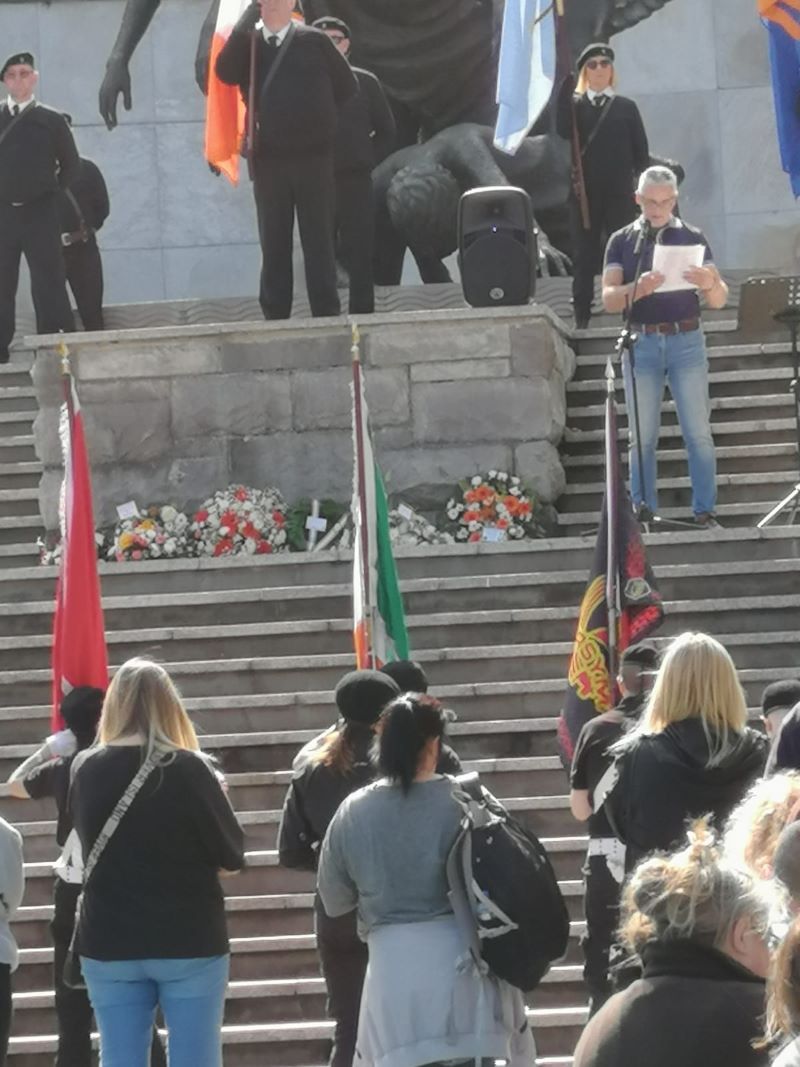
Large numbers attending a rally Sunday afternoon were addressed by a number of speakers from a platform in the centre of the 1916 Terrace organised by the Moore Street Preservation Trust on part of the very site they wished to preserve.

Fintan Warfield, a Sinn Féin Senator (and cousin of Derek and Brian Warfield of the Wolfe Tones) came on stage to perform Come Out Yez Black ‘n Tans followed by Grace, about Grace Gifford’s wedding to Vol. Joseph Plunkett hours before his execution by British firing squad.

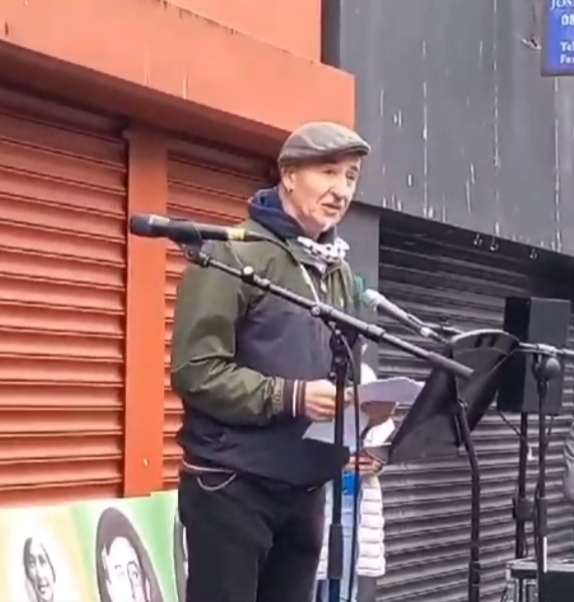
Fintan Warfield performing at the event, behind him the portraits of two of the Moore Street Garrison in 1916 may be seen. (Photo: R. Breeze)

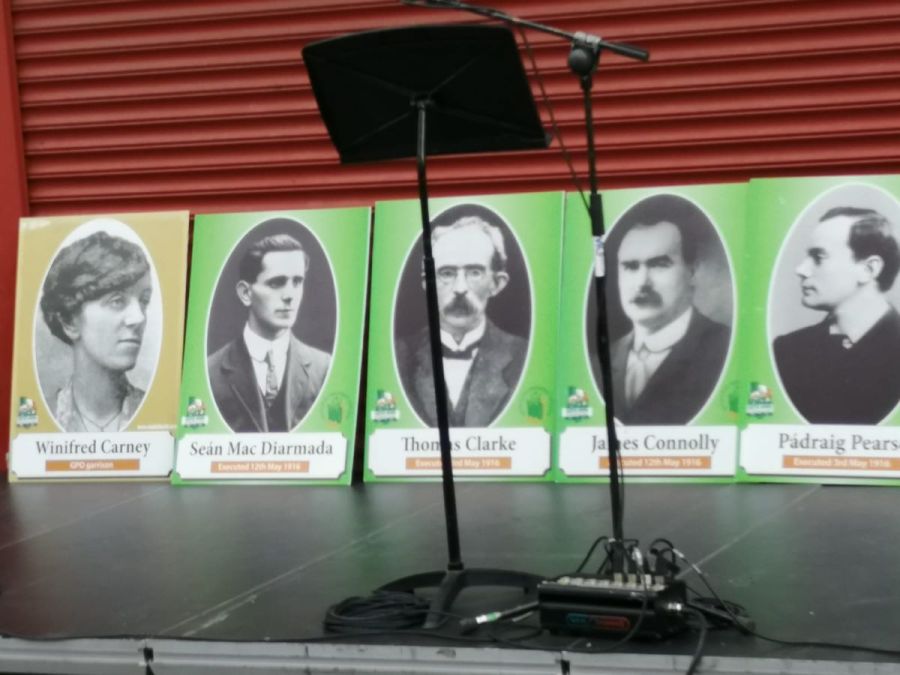
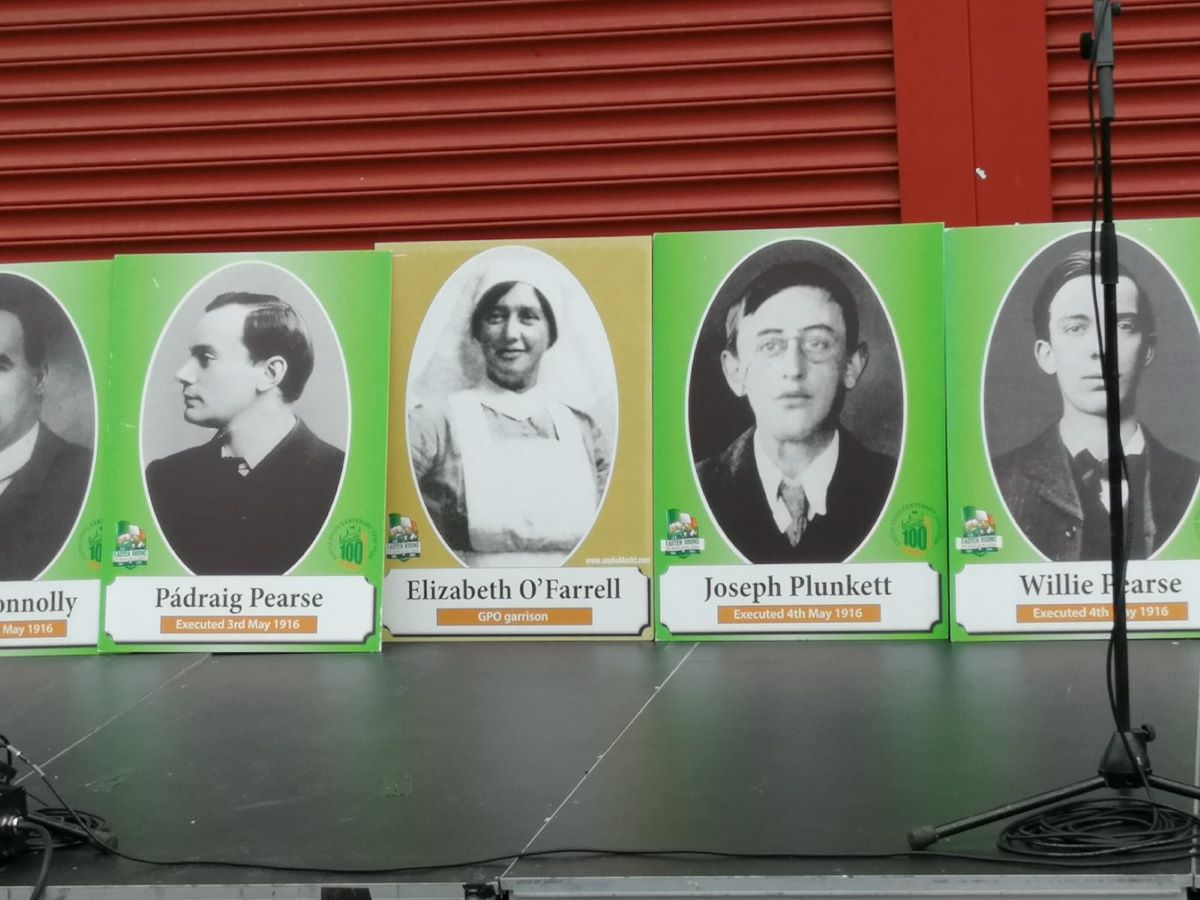
Warfield performed in front of a number of large board posters bearing the images of a number of leaders of the 1916 Rising who had occupied Moore Street in 1916 and Vols. Elizabeth O’Farrell and Winifred Carney, two of the three women Volunteers who had been part of the garrison.

The start of the rally however was delayed, apparently awaiting the arrival of Mary Lou Mac Donald, billed as the principal speaker on the Moore Street Preservation Trust’s pre-rally publicity.

Eventually Mícheál Mac Donncha, Secretary of the Trust and a Sinn Féin Dublin City councillor came on the stage to promote some MSPT merchandise (some of it for free) and to introduce the MC for the event, Christina McLoughlin, a relative of Comdt. Seán McLoughlin.

Christina McLoughline, MC of the event. (Photo: R. Breeze)

Vol. Seán McLoughlin had been appointed Dublin Commandant General by James Connolly during the GPO evacuation and was about to lead a charge on the British Army barricade in Parnell Street when the decision was taken to cancel after which he organised the surrender.

He later became a communist and was never acknowledged at Commandant level by the War Pensions Dept. of the State under De Valera, despite his rank in Moore Street and later also in the Civil War in Cork.

Sean’s relative Christina McLoughlin welcomed Mary Lou Mac Donald on to the stage.

Mac Donald’s appearance on the stage received strong applause. In fairness, many present, if not most, were of the party faithful. Despite the presence of some younger people, the general age profile was decidedly from the 40s upwards, indeed many being clearly in the later third.

Mary Lou Mac Donald, President of the Sinn Fein party, speaking at the event. (Photo: R. Breeze)

Mac Donald, who is not an Irish speaker, read the beginning of the address well in Irish before going on to talk in English about the importance of Moore Street site in the history of the 1916 Rising and in Irish history generally and how her party in government would save it.

After the applause for Mac Donald, the MC called Proinnsias Ó Rathaille, a relative of Vol. Michael The O’Rahilly, who was mortally wounded leading a charge up Moore Street against a British Army barricade in Parnell Street and who died in the nearby lane that now bears his name.

Ó Rathaille’s address was heavy in the promotion of the Sinn Féin party and, in truth rather wandering so that he had to return to the microphone after he’d concluded, to announce Evelyn Campell to perform a song she had composed: The O’Rahilly Parade (the lane where he died).

Evelyn Campbell performing her composition O’Rahilly’s Parade at the event. (Photo: R. Breeze)
Campell is a singer-songwriter and has performed in Moore Street on previous occasions, the first being at the invitation of the Save Moore Street From Demolition group who were the only group to campaign to have the O’Rahilly monument finally signposted by Dublin City Council.

McLoughlin announced Deputy Mayor Donna Cooney to speak, a relative of Vol. Elizabeth O’Farrell, one of the three women who were part of the insurrectionary forces occupying Moore Street. Cooney is a Green Party Councillor and a long-standing campaigner for the conservation of Moore Street.

Deputy Dublin Lord Mayor and Green Party councillor Donna Cooney speaking at the event. (Photo: R. Breeze)

While speaking about the importance of Moore Street conservation for its history and street market, Cooney also alluded to its deserving UNESCO World Heritage status, adding that the approval of the Hammerson plan for the street was in violation of actual planning regulations.

Next to speak was Diarmuid Breatnach, also a long-time campaigner, representing the Save Moore Street From Demolition campaign group which, as he pointed out has been on the street every Saturday for over a ten years and is independent of any political party or organisation.

Diarmuid Breatnach speaking at event on behalf of the independent Save Moore Street From Demolition campaign group. (Photo: R. Breeze)

Breatnach also raised the UNESCO world heritage importance, as the SMSFD group were first to point out and have been doing for some years, based on a number of historical “firsts” in world history, including the 1916 Rising having been the first anti-colonial uprising of that century.

The Rising was also the first ever against world war, Breatnach said. He told his audience that the Irish State has applied for UNESCO heritage status for Dublin City, but only because of its Victorian architecture and that it had once been considered “the second city of the British Empire”.

Stephen Troy, a traditional family butcher on the street, was next to speak. He described the no-notice-for-termination arrangements which many phone shops in the street had from their landlord and how Dublin City Planning Department had ignored the many sub-divisions of those shops.

Stephen Troy, owner of family butcher shop on the street and campaigner, speaking at the rally. (Photo: R. Breeze)

Troy’s speech was probably the longest of all as he covered official attempts to bribe the street traders to vote in favour of the Hammerson plan and what he alleged was the subversion of the Moore Street Advisory Group which had been set up by the Minister for Heritage.

It began to rain as Troy was drawing to a close but fortunately did not last long.

Jim Connolly Heron, a descendant of James Connolly and also a long-time campaigner for Moore Street preservation was then called. Speaking on behalf of the Trust, Connolly began by reading out a list of people who had supported the conservation but had died along the way.

Connolly Heron went on to promote the Trust’s Plan for the street which had been promoted by a number of speakers and to announce the intention of the Trust to take a case to the High Court for a review of the process of An Bord Pleanála’s rejection of appeals against planning permission.

Jim Connolly Heron, great-grandson of James Connolly and prominent member of the Moore Street Preservation Trust, speaking at the event. (Photo: R. Breeze)

The MC acknowledged the presence in the crowd of SF Councillor Janice Boylan, with relatives among the street traders and standing for election as TD and Clare Daly, also standing for election but as an Independent TD in the Dublin Central electoral area.

MOORE STREET, PAST AND PRESENT

Moore Street is older than O’Connell Street and the market is the oldest open-air street market in Ireland (perhaps in Europe). It became a battleground in 1916 as the GPO Garrison occupied a 16-house terrace in the street after evacuating the burning General Post Office.

At one time there were around 70 street stalls in the Moore Street area selling fresh fruit, vegetables and fish and there were always butchers’ shops there too. But clothes, shoes, furniture, crockery and vinyl discs were sold there too, among pubs, bakeries and cafés.

Dublin City Planning Department permitted the development of the ILAC shopping centre on the western side of the street centre and the Lidl supermarket at the north-east end of the street, along with a Dealz as the ILAC extended to take over the space on its eastern side.

While many Irish families turned to supermarkets, people with backgrounds in other countries kept the remaining street traders in business; but the property speculators ran down the street in terms of closing down restaurants and neglecting the upkeep of buildings.

The authorities seem to have colluded in this as antisocial behaviour that would not be tolerated for a minute in nearby Henry Street is frequently seen in Moore Street.

The new craft and hot food stalls Monday-Saturday run counter to this but are managed by the private Temple Bar company which can pull out in a minute. On Sunday, the street is empty of stalls and hot food or drinks are only available in places that are part of the ILAC shopping centre.

The O’Reilly plan was for a giant ‘shopping mall’ extending to O’Connell Street and was paralysed by an objectors’ occupation of a week followed by a six-week blockade of the site, after which a High Court judgment in 2016 declared the whole area to be a National Historical Monument.

A judge’s power to make such a determination was successfully challenged by then-Minister of Heritage Heather Humphries in February of 2017. NAMA permitted O’Reilly to transfer his assets to Hammerson who abandoned the ‘shopping mall’ plan as not profitable enough.

The Hammerson plan, approved by DCC and by ABP is for a shopping district no doubt of chain stores like Henry Street or Grafton Street, also an hotel and a number of new streets, including one cutting through the 1916 central terrace out to O’Connell Street from the ILAC.

In the past dramatist Frank Allen organised human chains in at least three ‘Arms Around Moore Street’ events and the Save Moore Street 2016 coalition organised demonstrations, re-enactments, pickets and mock funerals of Irish history (i.e under Minister Humphries).

The preservation campaigning bodies still remaining in the field are the SF-backed Moore St. Preservation Trust and the independent Save Moore St. From Demolition group. The former is only a couple of years in existence and the latter longer than ten years.

However, both groups contain individuals who have been campaigning for years before that. The MSPT tends to hold large events sporadically; the SMSFD group has a campaign stall on the street every Saturday from 11.30am-1.30pm. Both have social media pages.

Fully in view, four prominent members of the Moore Street Garrison (L-R): Patrick Pearse, Commander-in-Chief; Vol. Elizabth O’Farrell, of Cumann na mBan; Vol. Joseph Plunkett, one of the planners of the insurrection; Vol. Willie Pearse, Adjutant to his brother Patrick. All but O’Farrell were tried by British court martial, sentenced to death and shot by British firing squad in Kilmainham Jail. (Photo: R. Breeze)

LEGISLATION & COURT CASES

2007 Nos. 14-17 Moore Street declared a National Historical Monument (but still owned by property developer Joe O’Reilly of Chartered Land)

2015 Darragh O’Brian TD (FF) – Bill Moore Street Area Development and Renewal Bill – Passed First Reading but failed Second in Seanad on 10th June 2015 by 22 votes against 16.

2015 – Colm Moore application — 18th March 2016: High Court judgement that the whole of the Moore Street area is a national historical monument.

2017 – February – Minister of Heritage application to Court of Appeal – judgement that High Court Judge cannot decide what is a national monument.

2021 — Aengus Ó Snodaigh TD (SF) – 1916 Cultural Quarter Bill – reached 3rd Stage of process; Government did not timetable its progress to Committee Stage and therefore no progress.

2024 – Property Developer Hammerson application to High Court Vs. Dublin City Council in objection to decision of elected Councillors that five buildings in the Moore Street area should receive Protected Structure status as of National Historical Heritage. Hammerson states that the decision is interfering with their Planning Permission. Case awaits hearing.

Five prominent members of the Moore Street Garrison (L-R): Vol. Winifred Carney of Irish Citizen Army and Cumann na mBan; Vol. Sean Mac Diarmada, one of the planners of the insurrection; Vol. Tom Clarke, one of the insurrection’s planners; revolutionary socialist James Connolly, Irish Citzen Army and Commandant General of the Rising (especially of Dublin); Patrick Pearse, Commander-in-Chie. All but Carney were tried by British court martial, sentenced to death and shot by British firing squad in Kilmainham Jail. (Photo: R. Breeze)

POSTSCRIPT

Someone commented later that in general the rally, from the content of most of the speeches, had been at least as much (if not more) of a Sinn Féin election rally as one for the conservation of Moore Street.

That should have been no surprise to anyone who knows that any position taken by Sinn Féin activists tends to be for the party first, second and third. And with the Irish general elections only weeks away, well …

And while Mac Donald spoke in Dublin of the importance of Ireland’s insurrectionary history and the need to conserve such sites, her second-in-command Michelle O’Neil was laying a wreath in Belfast in commemoration of the British who were killed in the First imperialist World War.

End.

SOLIDARITY WITH THE RESISTANCE ON DUBLIN PALESTINIAN SOLIDARITY MARCH

Clive Sulish

(Reading time: 3 mins.)

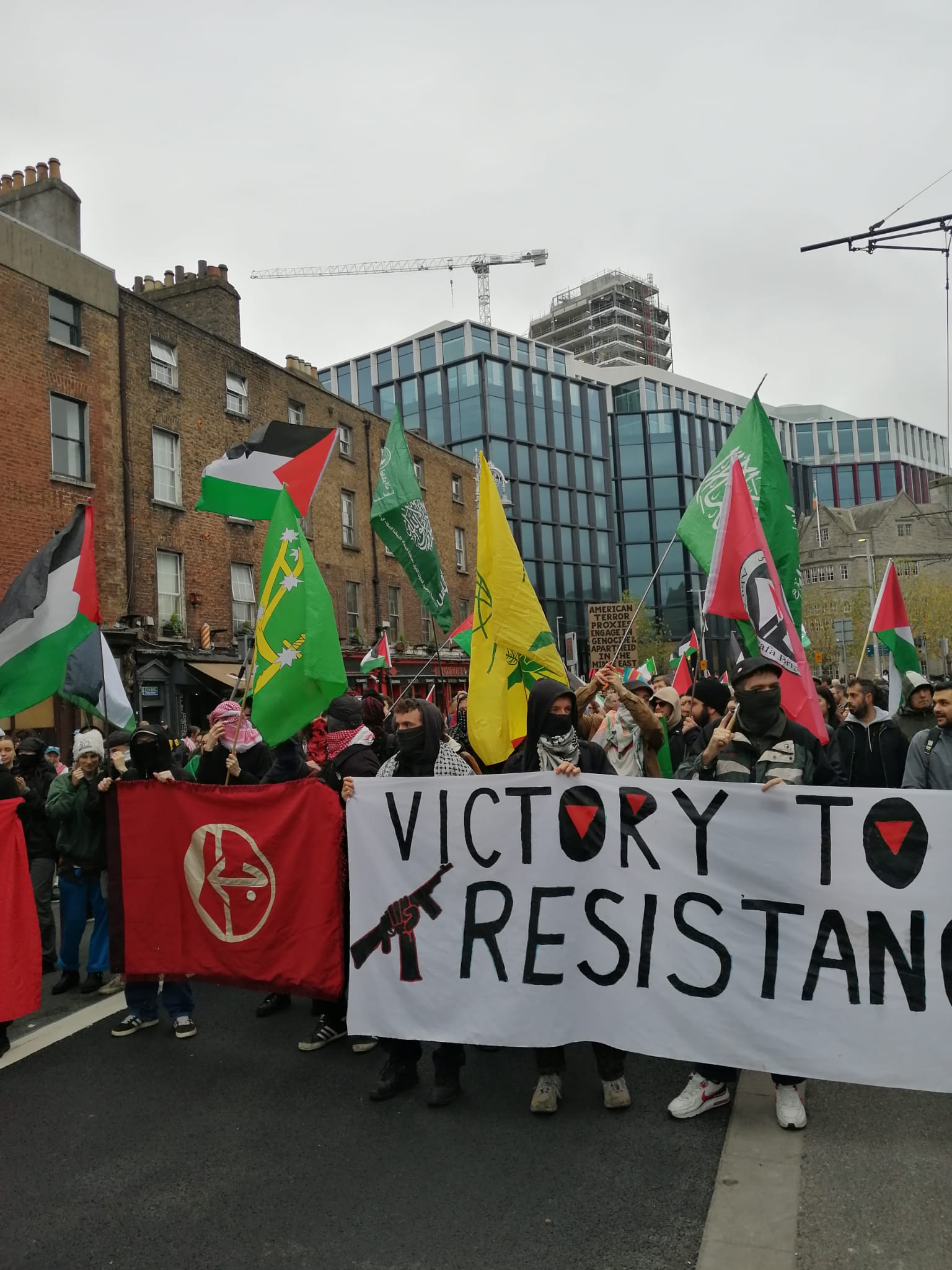
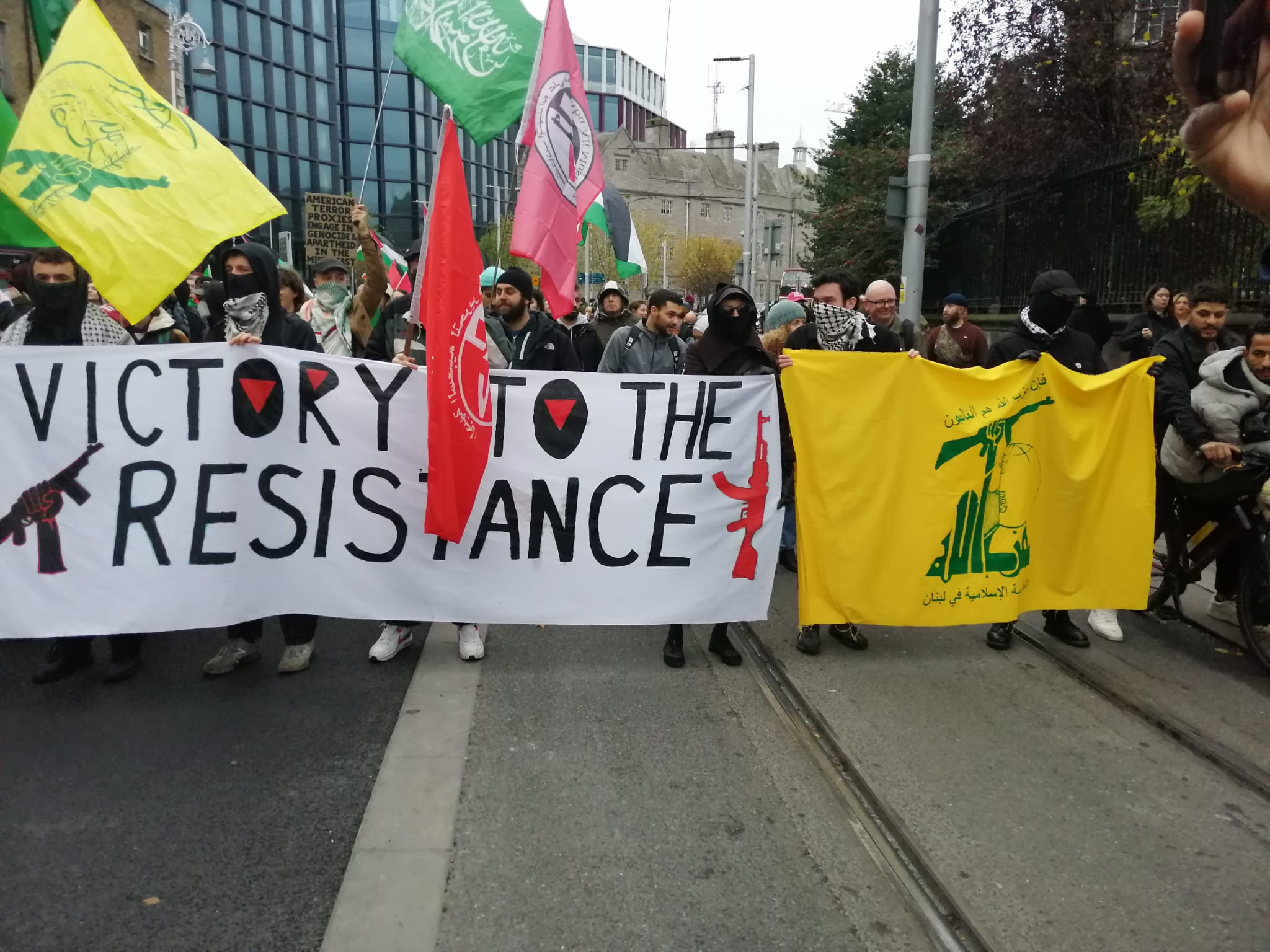
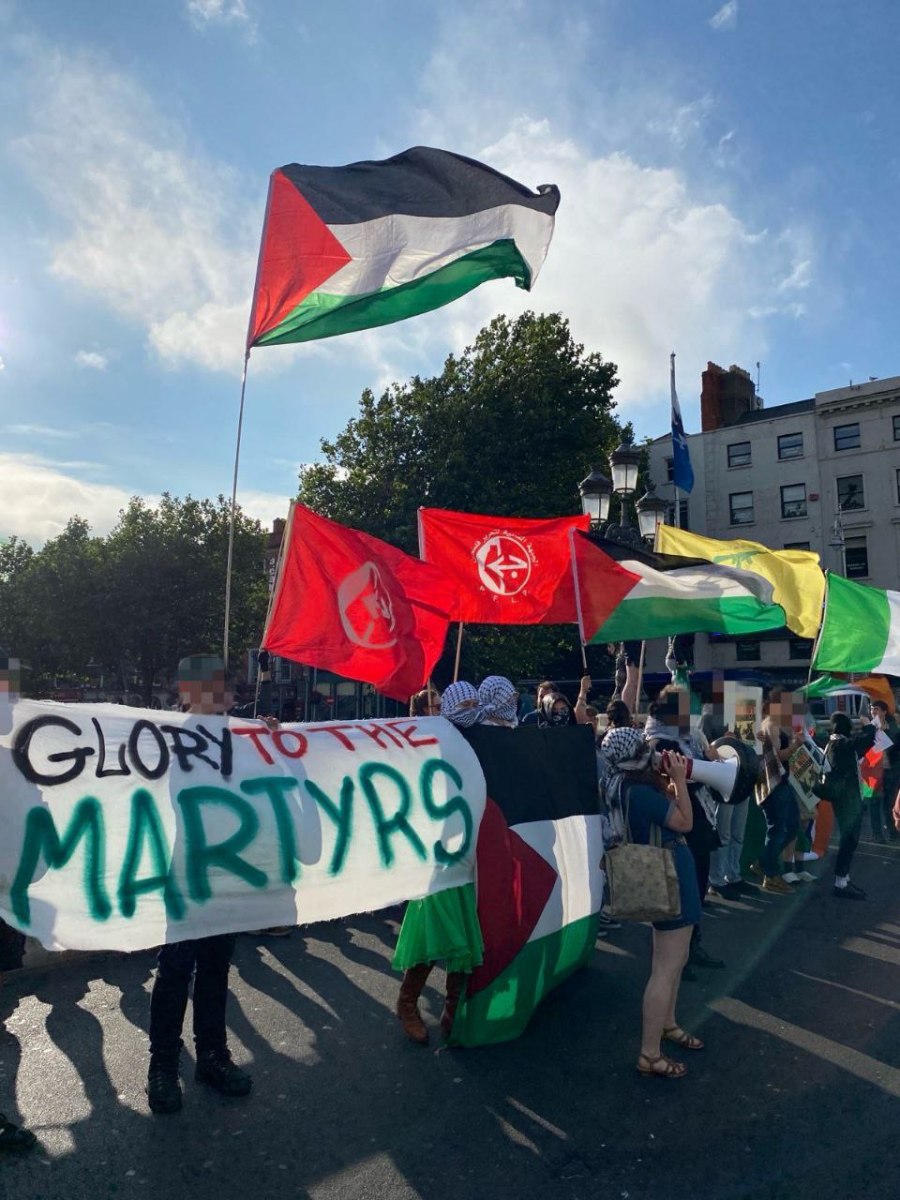
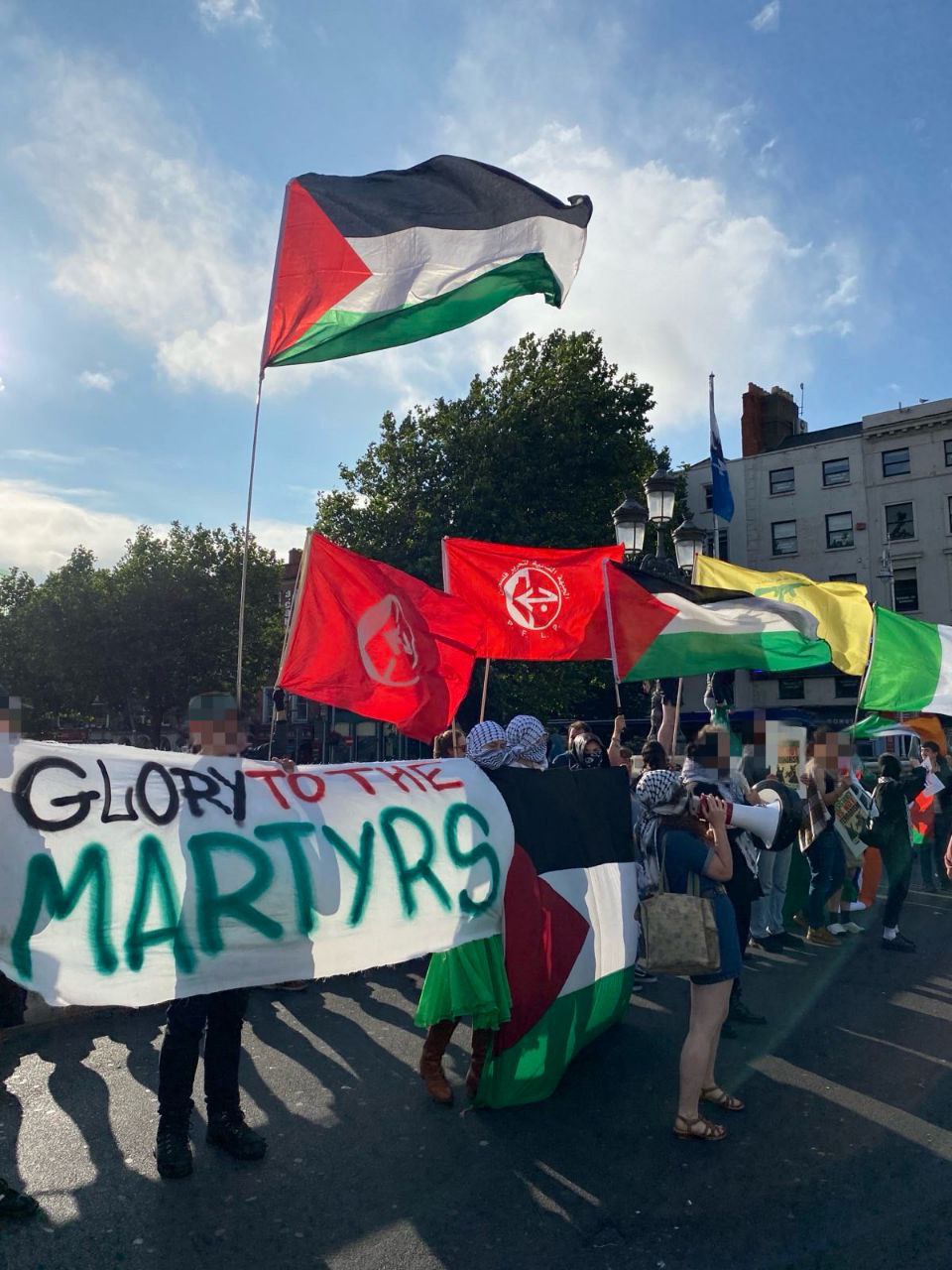
While thousands marched once again in Palestine solidarity in Dublin, a section of the demonstration marched as a bloc in specific solidarity with the Palestinian Resistance with banners, flags and slogans declaring their position.

The Ireland Palestine Solidarity Campaign with a number of branches has been for many years the major organiser of Palestinian solidarity events and had once again called for a national march in Dublin, again to Leinster House, home of the Irish Parliament.

Section of the front of the Palestinian Resistance Solidarity Bloc in Dublin on Saturday. In this photo may be seen the flags of three factions of the Palestinian Resistance and, left foreground, the flag of Irish revolutionary socialist Republicanism, the Starry Plough (Photo: R.Breeze)

This has become a pattern of the main IPSC street activity in Dublin, along with holding a rally on the central pedestrian reservation in Dublin’s O’Connell Street, with occasional marches to the Department of Foreign Affairs (though in the past it organised boycott pickets of ‘Israeli’ products).

The US Embassy seems to have become out of bounds for the IPSC. This is despite the clear responsibility of the USA for supplying most of the armament, political and financial backing for the genocide being carried out by the Zionist state against the Palestinians.

Some believe that the IPSC leadership is complying with the wishes of the Irish police, the Gardaí, not to have Palestine solidarity marches go to the US Embassy. The offices of the EU, Germany and the UK, major contributors to the genocide, have also been given in effect a waiver.

The national march called by the IPSC at its destination in Molesworth Street last Saturday. The photo is taken from the platform and PA lorry facing the crowd, with its back to Leinster House (of the Irish Parliament) which also has crowd barriers erected behind it. (Photo sourced: IPSC)

Neither the march last Saturday nor any organised before it by the IPSC was going to promote solidarity with the Resistance, despite their former chairperson having once said of them in public that they are ‘freedom fighters’. Of course, to the ‘Israelis’ and EU they are ‘terrorists’.

Section of the front of the Palestinian Resistance Solidarity Bloc in Dublin on Saturday (Photo: R.Breeze)

The IPSC has organised only one public meeting during this year’s genocide to highlight the terrible conditions of the thousands of Palestinian political prisoners in ‘Israeli’ jails and rarely mentions them, nor in solidarity with the Samidoun1 organisation being banned in USA and Canada.

In October last year, as this phase of the genocide began, the IPSC dithered over whether to call for the expulsion of the ‘Israeli’ Ambassador to Ireland, as did the Sinn Féin leadership until a near revolt of the party’s members forced them to return to their previous position. As did the IPSC.

Clearly the IPSC leadership is trying to keep itself somewhere around the ‘middle road’ in Palestinian solidarity, probably in order — as it sees it – to remain with influence among the ruling circles. However, the actual results among those circles do not bear testimony to their effectiveness.

NO CHANGE

The Irish state continues to permit US military planes and personnel to violate the State’s nominal independence through Shannon International Airport, to permit Zionist armament overflights of its air space (similarly with the RAF) and to permit British Navy docking in Irish ports.

The relatively mild Occupied Territories Bill, long approved through Leinster House, remains not brought into force, blocked by the Coalition Government of Fianna Fáil, Fine Gael and the Green Party. It could not be clearer that the ruling class in Ireland do not feel under enough pressure.

This is despite a clear popular feeling among the public in Ireland of solidarity with Palestine and revulsion at their genocidal attacks by the Zionist state.

There is a long-established train of thought that maintains that solidarity with the Palestinians is not just calling for the genocide to stop – that alone is charity and that actual solidarity means solidarity with the people’s resistance and the political prisoners.

If the IPSC were to adopt that position they might find it easier to support more radical action to pressure the Irish state to break with the western powers’ consensus of support for the ‘Israeli’ state and consequently for its genocide against the Palestinians.

Perhaps that is one of the very reasons that the IPSC leadership will not take that stand and that its stewards have at times even tried to convince people to remove their flags supporting various Resistance factions.

Section of the front of the Palestinian Resistance Solidarity Bloc in Dublin on Saturday (Photo: R.Breeze)

On Saturday independent activists joined those of Saoirse Don Phalaistín, Anti-Imperialist Action Ireland and Queers For Palestine in forming a sizeable bloc on the march with banners, flags and call-and-answer slogans advertising its solidarity with the Resistance.

This seems a welcome trend likely to grow.

End.

FOOTNOTE

1Palestinian political prisoner support and advocacy organisation.

Dublin demonstration in solidarity with Hezbollah and the Lebanese people.

As the Zionist state followed up its communication device terrorism with aerial bombing … (Report from AIAI- For National Liberation and Socialist Revolution):

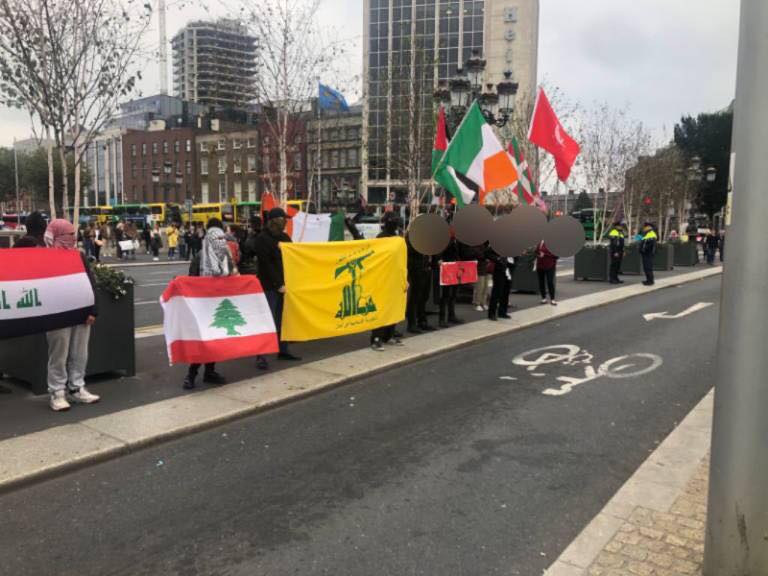
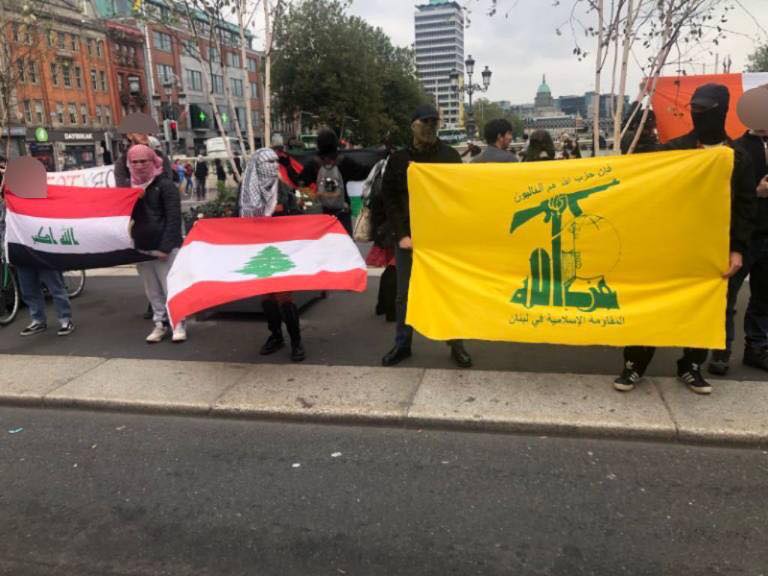
On Friday September 20, Anti-Imperialist Action Ireland and Saoirse Don Phalaistín held an emergency solidarity demonstration with Hezbollah and the Lebanese people on O’Connell Bridge in Dublin.

(Photo sourced: AIA social media page)

Although called at short notice, there was a great turn out, demonstrating the support of Irish Revolutionaries for the Anti Zionist Resistance.

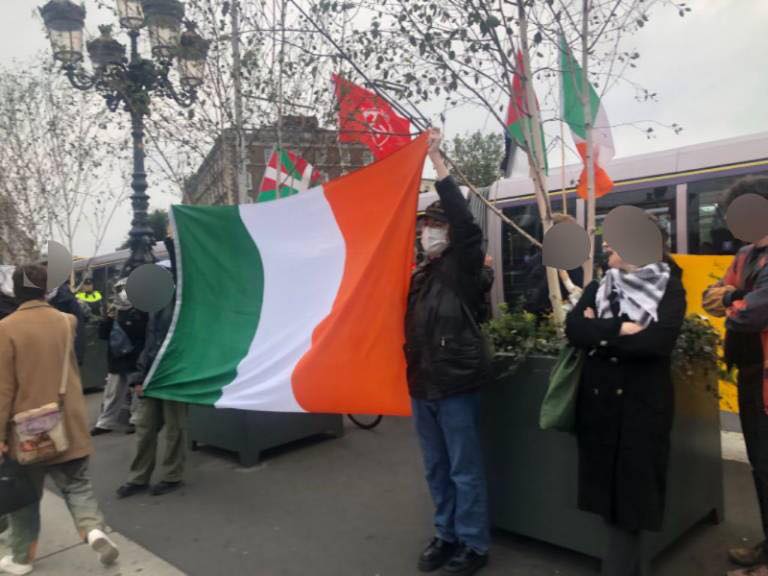
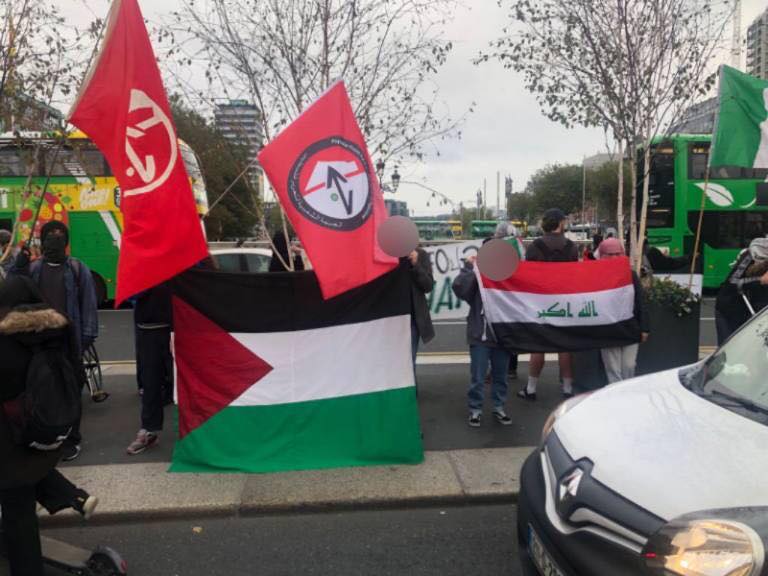
A large Hezbollah flag was the centrepiece of the demonstration and flew proudly beside Irish Republican flags including the Tricolour and Green Starry Plough of the Irish Citizen Army, Palestine, Lebanese, Iraqi and Basque national flags and the flags of the Popular Front for the Liberation of Palestine.

Chants at the demonstration included From Ireland to Palestine – Occupation is a crime! and Hands off Lebanon!. As it was culture night, two singers gave renditions of ‘We only want the earth’ by James Connolly and ‘Go on Home British and Zionist Soldiers’, a twist on the Republican classic linking the fights for Freedom in Ireland and Palestine.

(Photo sourced: AIA social media page)

The demonstration was monitored by the special branch who took photos of the participants but their presence could not stop the solidarity action with Hezbollah and the Lebanese People.

Irish Republicans will always stand with our international anti imperialist comrades in the fight against Imperialism and Zionism. AIA and SDP will continue to organise events and actions to increase our solidarity with the Anti Zionist Resistance.

(Photo sourced: AIA social media page)

Additional comment – Clive Sulish: The event was also filmed by a well-known Irish Zionist who regularly tries to intimidate Palestine solidarity activists and also tries to get the Gardaí to arrest those carrying flags of Palestinian resistance organisations.

O’Connell Bridge crosses the Liffey river dividing the north from the south Dublin city centres and is directly passed by north and southbound traffic but also closely by west and eastbound traffic along the quays.

There were many expressions of appreciation from passersby on foot, in vehicles or on bicycle.

End
.

(Photo sourced: AIA social media page)

INDEPENDENT HUNGER STRIKE COMMEMORATION DUBLIN GETS BROAD PARTICIPATION

Diarmuid Breatnach

(Reading time: 3 mins.)

Irish Republican hunger strikers were commemorated in Dublin with a march and rally on 24th August. The event was organised by Dublin Independent Republicans and attracted representation from many groups in addition to independent activists.

Those ten Irish Republicans who died on hunger strike in 1981 are still remembered well in the general Irish population, most of all their leader Bobby Sands. However another twelve died on hunger strike in earlier days, going back to 1917, before the War of Independence (1919-’21).

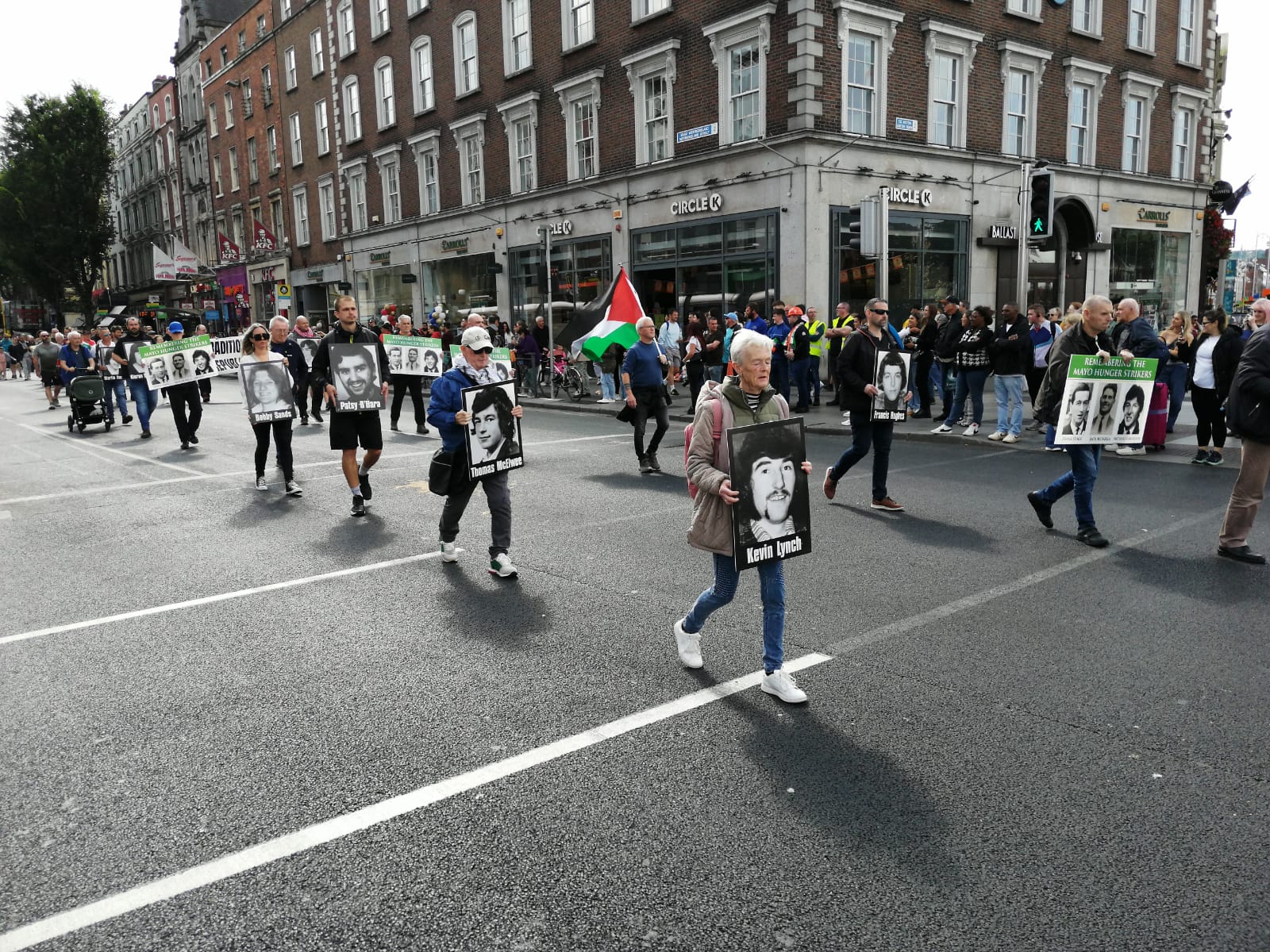
Marchers in Westmoreland Street carrying images of the hunger-strike martyrs on the return to the Garden of Remembrance. (Photo: D.Breatnach)

For over a century, hunger strikes have been one of the traditional methods of protest and struggle by Irish Republican prisoners in jails of the British and also of the Irish State.

Those Republican prisoners who died on hunger strike in 1981 did so from the effects of starvation but some died through force-feeding also, which was the case with Vols. Thomas Ashe (1917), Michael Gaughan (1974) and Frank Stagg (1976).1

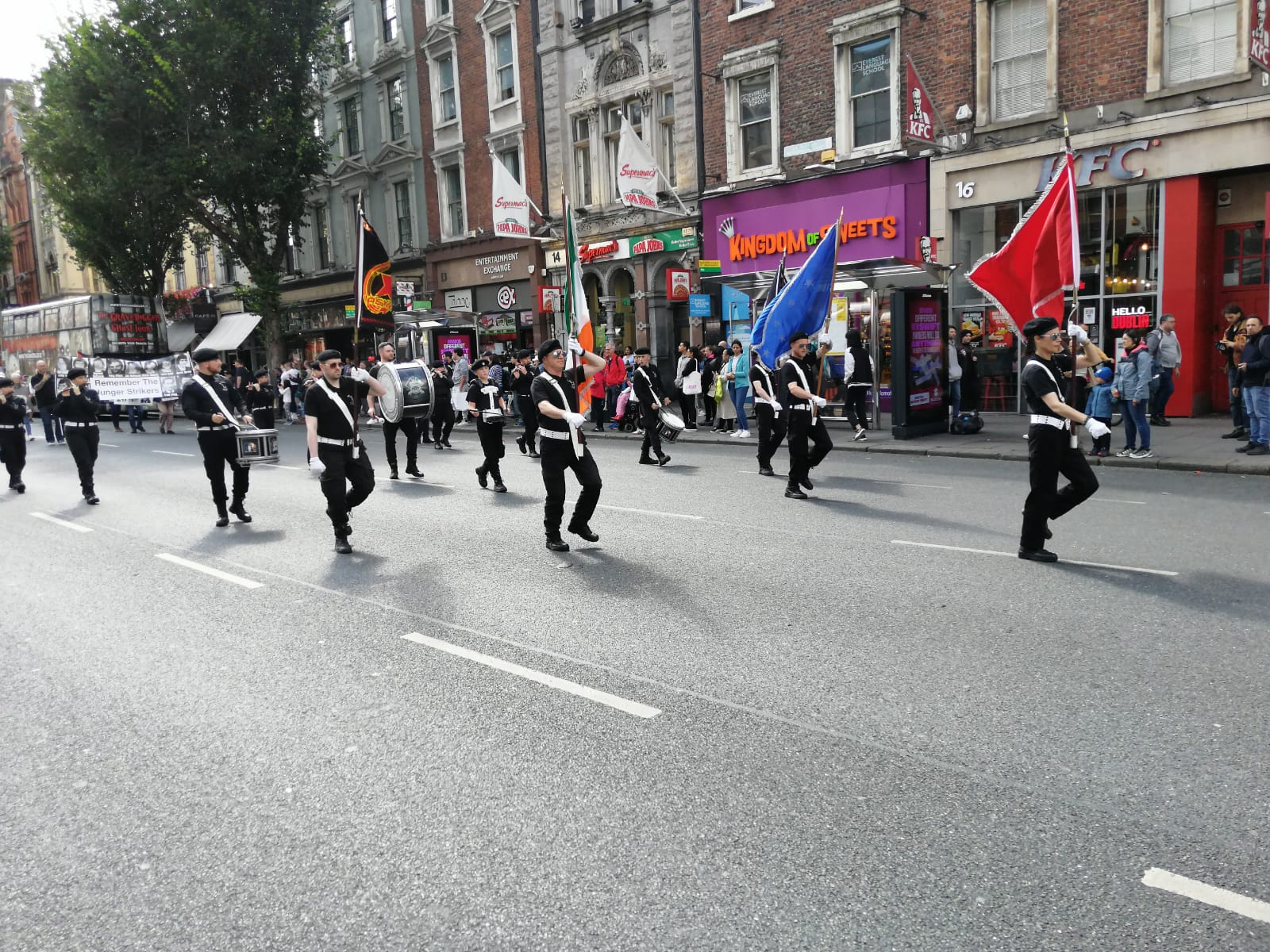
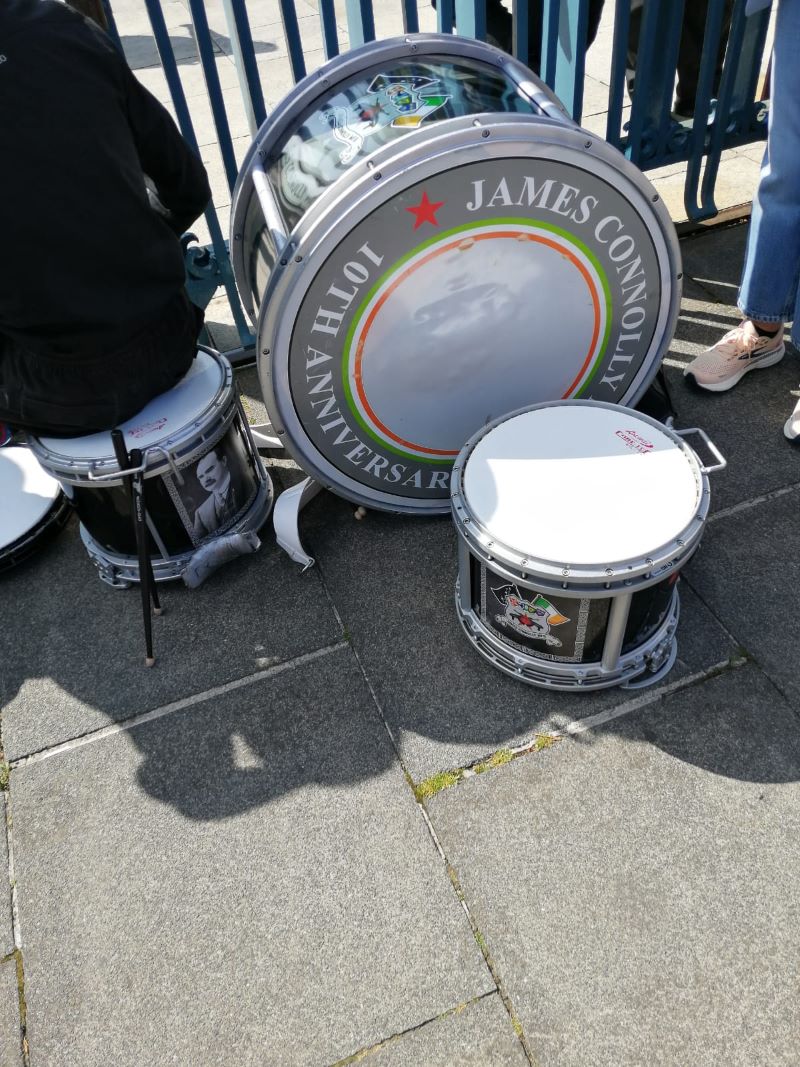
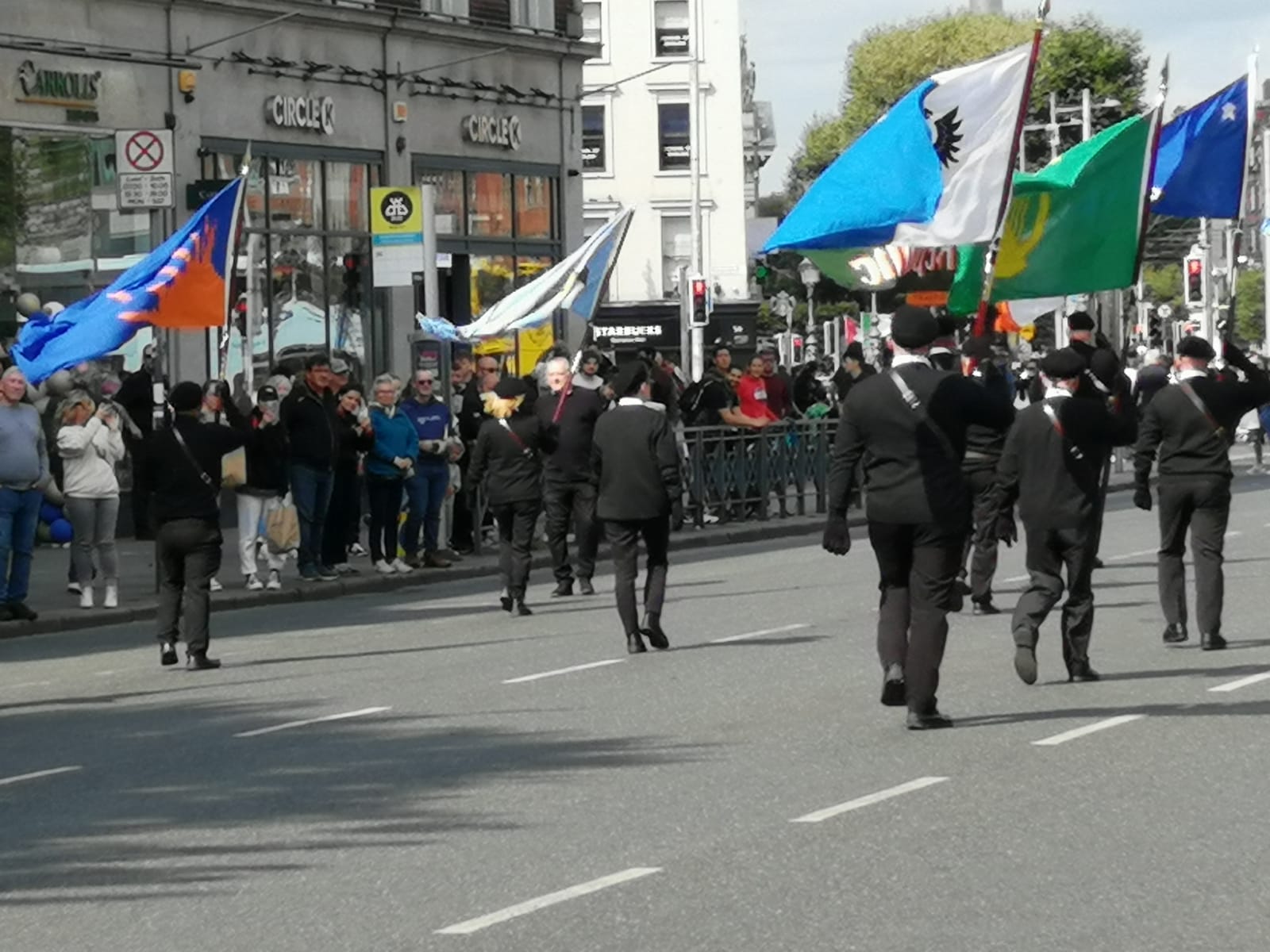
James Connolly Memorial Band with their own colour party in Westmoreland Street on the return to the Garden of Remembrance. (Photo: D.Breatnach)

PARADE THROUGH CITY CENTRE AND RALLY

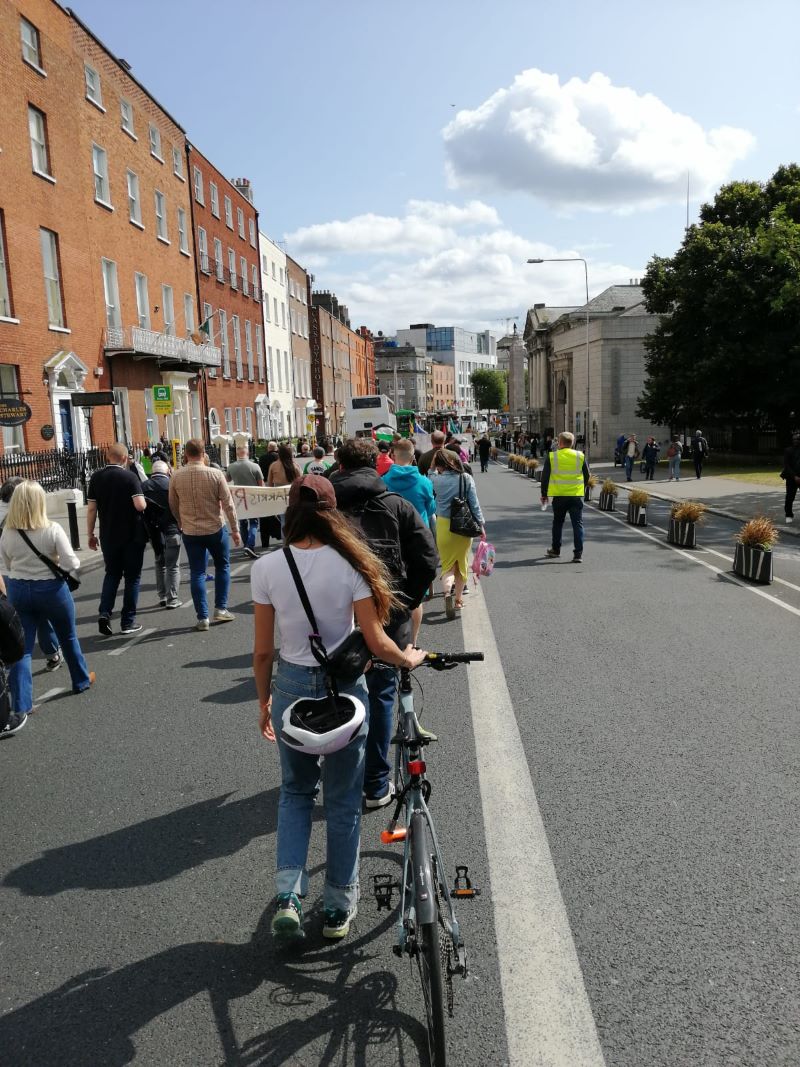
Led by a colour party,2 the parade set off in two columns3 from the Garden of Remembrance in Parnell Square with the James Connolly Memorial Republican Flute Band leading and along the City’s main thoroughfare, O’Connell Street, crossed the Liffey to ‘touch’ Trinity College and back again.

Marchers setting off from the Garden of Remembrance in Parnell Square. (Photo: D.Breatnach)

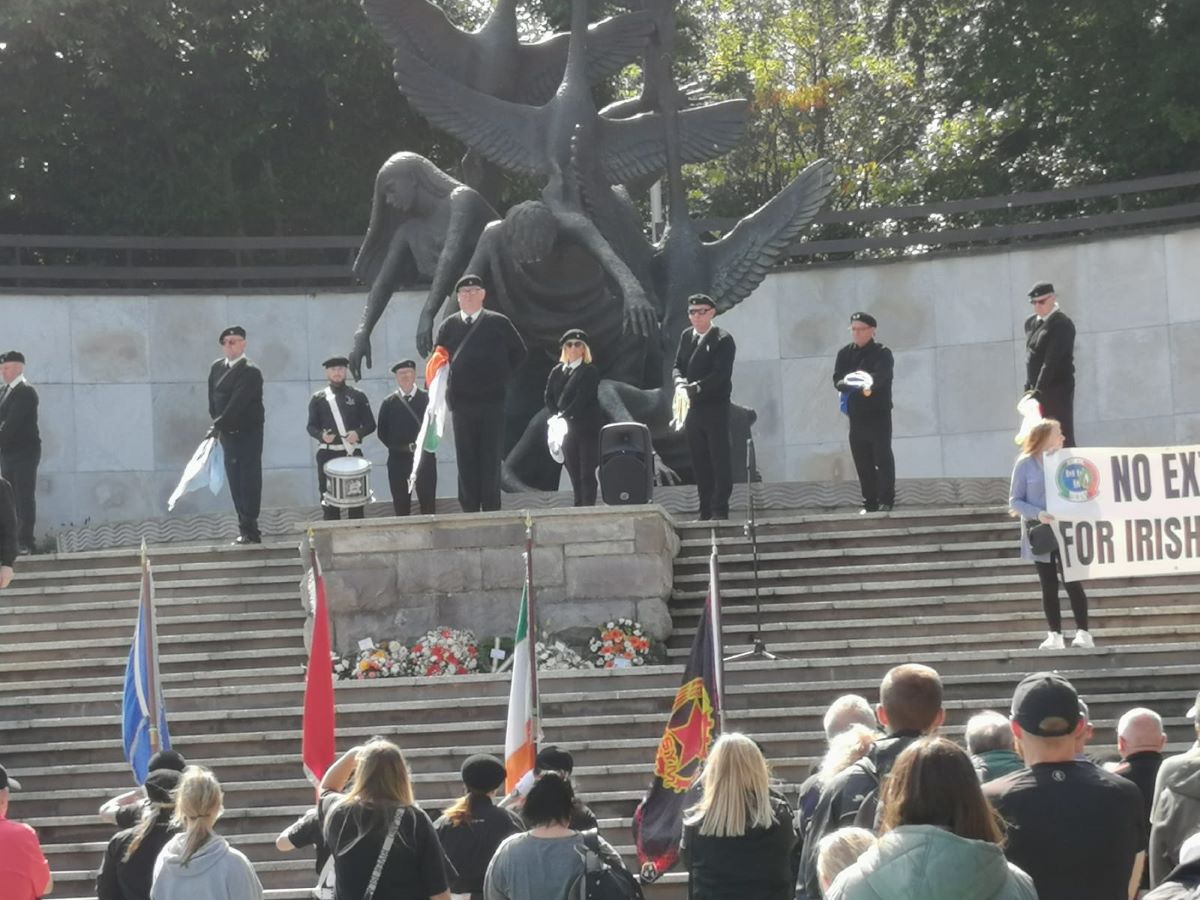
Upon returning to the Garden of Remembrance, the banners and band took up position in front of the memorial with the audience facing them, where Ado Perry as MC for the event welcomed all.

As well as recalling the struggles of Republican prisoners within the jails and deaths on hunger strike, Perry also took some time to denounce the Zionist genocide in Palestine and to express the Palestinian solidarity of Republicans (and of the majority of the Irish people).

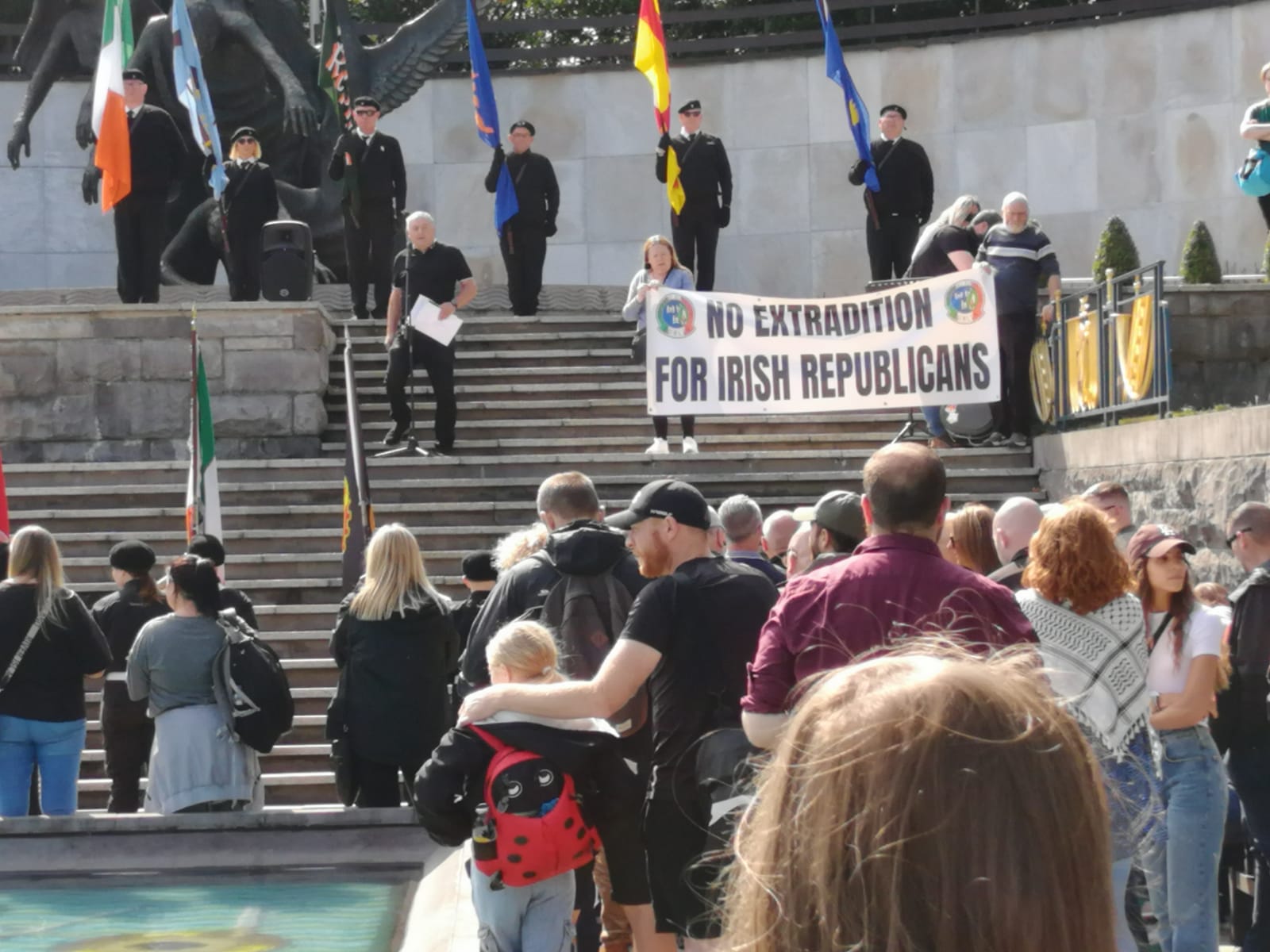
Ado Perry as MC of the rally in the Garden of Remembrance, flanked by the No Extraditions banner, the colour party behind and behind them, the Monument to those who fell in the struggle for Irish freedom. (Photo: D.Breatnach)

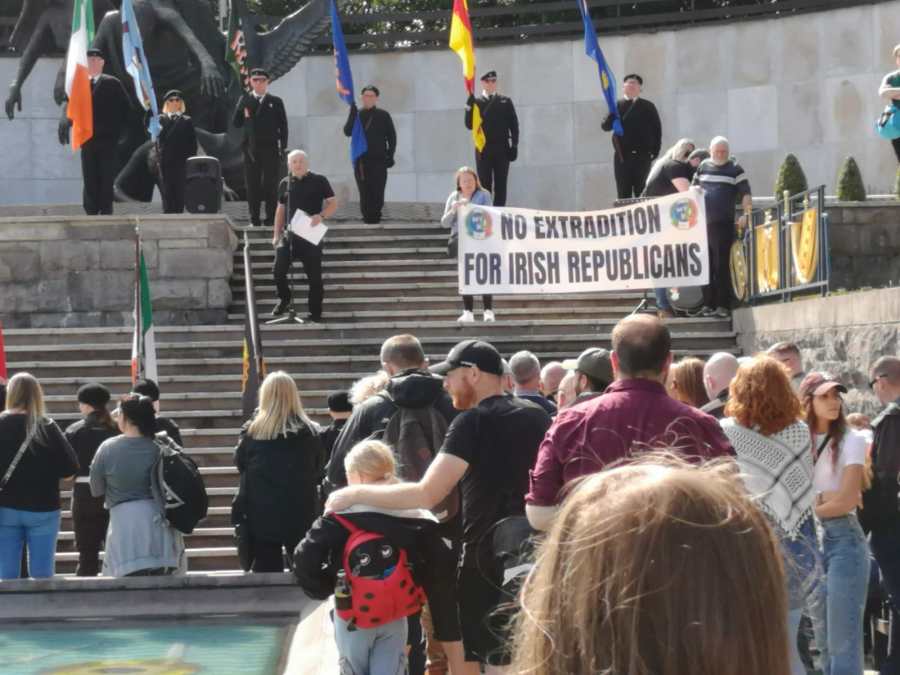
Perry also condemned the planned extradition of Irish Republican prisoners to British jurisdiction and called for Irish Republicans to unite in opposition, recalling the struggles against extradition over the years.

Floral tributes were laid at the Monument and Cáit Inglis read the names of the 22 who died on hunger strike, before the MC called on Cathal Graham for a song. Graham performed Wrap the Green Flag Around Me, a song that seems to have fallen somewhat in popularity in recent years.

Frankie Quinn giving his speech at the rally. (Photo: D.Breatnach)

The main speaker for the day was Frankie Quinn, a long-time Republican, community activist and ex-political prisoner who spoke first in Irish before turning to English. Quinn too condemned the genocide in Palestine and expressed solidarity with the Palestinian resistance.

In a reference to recent racist mobilisations in Ireland, Quinn made it clear that those people had nothing in common with Republicans or with the Irish national struggle for a socialist republic. (A known racist female activist had reportedly been encouraged to leave the scene a little earlier.)

The speaker was vigorously applauded and was followed by Gráinne Gibson who performed hunger strike martyr Bobby Sands’ poem The Rythm of Time.

(Photo: D.Breatnach)

Cathal Graham returned to perform The Time Has Come, a representation of hunger strike martyr Patsy O’Hara’s plea to his mother not to withdraw him from the fast when he lost consciousness, unless their demands were conceded. The colour party lowered their flags in respect to the martyrs.

Perry thanked all for their attendance in particular the marching band, colour party, performers and stewards, once again emphasising the need for united action to prevent the extradition of Irish Republicans to British jurisdiction, then called the band to perform Amhrán na bhFiann.4

The colour party leading the march out of Westmoreland to cross the river to the rally in the Garden of Remembrance. (Photo: D.Breatnach)

There was broad support for the event as shown by the participation of a number of different organisation and individual activists, which is a hopeful sign for the future. The real test however will be whether the disparate elements will act in unity as called for by Perry and Quinn.

End.

The lowering of the flags in honour of the martyrs in the struggle. (Photo: D.Breatnach)

Footnotes

1Their deaths under medically-supervised force-feeding caused the British Medical Association to oppose force-feeding of any hunger-striker in possession of normal cognition.

2The flag composition of Irish Republican colour parties varies but when flags and members are available traditionally are composed of the Irish Tricolour, the Starry Plough (blue or green version), the Sunburst and the flags of the Four Provinces. I have also seen on occasion the inclusion of a Scottish Saltere and on another, the Palestinian flag.

3More or less two columns – outside of the Six Counties marchers are unaccustomed to that formation and stewards were hard-pressed to ensure marchers kept to either one column or the other, a difficulty I remember well myself from my capacity as chief steward on a Dublin march against internment of Marion Price years ago.

4Irish language translation of The Soldiers’ Song by Peadar Kearney and Patrick Heeney, the air of the chorus which is the official National Anthem of the Irish State. At commemorations and such events it is usual for the air of both the verses and the chorus to played. In the 26 Counties it is common for people to sing along to the air played (or to a solo singer) but not in the 26 Counties. Unusually with cases of songs with versions in both langauges, it is the translated lyrics into Irish which most people know.

Useful Link

Independent Irish Republicans: https://www.facebook.com/profile.php?id=100090801607007

THAT FLAG IS NOT THEIRS – BUT IT’S NOT YOURS EITHER!

Diarmuid Breatnach

(Reading time: 6 mins.)

The Irish Tricolour has been in the news recently in an unhappy circumstance. The flag was featured borne in a group of anti-immigration racists carrying a banner declaring Coolock Says No,1 next to Union Jacks2 and Loyalist flags at a Belfast riot.

This was a bizarre juxtaposition given that Loyalists are hostile to any signs of Irish Republicanism, of which the Tricolour is chief among its historical symbols. Furthermore, the Unionist state banned its public display in most situations between 1954 and 1987 leading to resistance and arrests.3

In the sectarian society created by the British in its occupied Six County colony, the Tricolour is burned annually on British Loyalist bonfires and is reviled by Unionism and its more extreme progeny, Loyalism, which in turn is associated with state-sanctioned sectarian murder gangs.4

The strange juxtaposition was remarked upon in mass media not only in Ireland (both sides of the Border) but even in Britain — and Irish State Taoiseach (prime minister) Simon Harris remarked that he found the flag in association with racism to be “repugnant”.5

But does Harris have the moral right to make that comment?

Origin and History of the Irish Tricolour

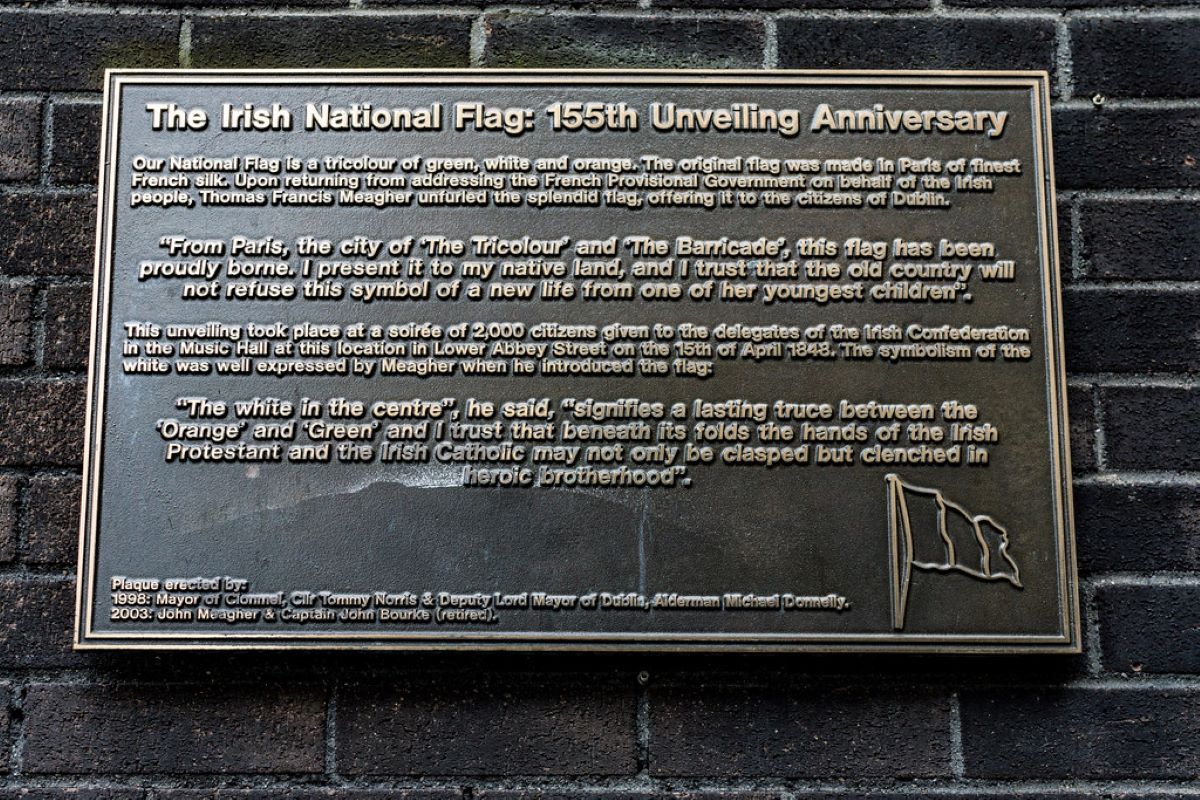
The Tricolour as we know it and its use dates from its sewing in silk by revolutionary women in Paris in 1848 and presentation to a delegation of the Young Irelanders, a revolutionary Irish Republican group of that period and its subsequent unfurling in Ireland by Thomas Meagher.

Thomas Francis Meagher as captain in the Union Army (Source: Drawing in Library of Congress, USA)

Irish revolutionary Thomas Francis Meagher was convicted by the English Occupation of sedition during trials around the planning and carrying out of the Irish Rising of 1848 and, with death sentence commuted, transported to Australia as a felon, from which he escaped to the USA in 1852.

As the American Civil War approached, Meagher, along with most of the Irish in the USA took the side of the Union, leaving only a rump following Mitchell, formerly a comrade of the Young Irelanders, to side with the slave-owning Confederacy in the conflict.

Meagher not only fought in the Union Army in the American Civil War against the slave-owning Confederacy, gaining the rank of Brigadier but he and his wife raised a regiment, the 69th New York Infantry, unofficially called The Irish Brigade or even Mrs. Meagher’s Own.

Plaque in Lower Abbey Street (opp. side of Abbey Theatre) to the first unveiling of the Irish Tricolour in Dublin, 1848. (Source: Internet)

The Young Irelanders were Republicans and the Tricolour was always seen not only as embodying the unity of all in Ireland, regardless of origin, against the British occupation but also for national liberation, against Monarchy and for complete separation of Church and State.

In addition, it had a strong internationalist element in that it was associated with revolution throughout Europe, presented to us in solidarity by French revolutionary women and flown alongside French Tricolours in Ireland at celebrations of the French revolution of 1848.

It was the principal flag of Irish anti-fascism too in the 1930s when Irish Republicans fought the fascist Blueshirts on Irish streets and a number of them went to fight in defence of the Spanish Republic against the fascist military coup of Franco and his Nazi German and Italian Fascist allies.

More recently when Irish Republicans and socialists mobilised against the attempts of the Irish ruling class to promote NATO and to ease cooperation with that alliance of Western imperialism, Harris also ranted against supporters of Anti-Imperialist Action flying of the Irish Tricolour.

The Tricolour among Loyalists was of course newsworthy and was covered by Irish mainstream media and Unionist mouthpiece The Belfast Telegraph along with photos by The Guardian on line. But all without comment on its presence in Palestine solidarity events in London.

Irish Tricolours have been flown at every current Palestine solidarity march in London (ten of them at the most recent London march) and, along with Saoirse Don Phalaistín printed on the Palastinian flag, have been seen also at university solidarity encampments and at events to free Julian Assange.

Section of Palestine solidarity protest at Barclays Bank, Tottenham Road, London on 24th April this year, showing Irish Tricolour and Saoirse Don Phalaistín flags. Zionists and British fascists are united in opposition to them across the road. (Photo cred: Northern Times)

The Tricolour Flown by Racists and Fascists?

Given its origins and history, why is the Tricolour being flown by fascists?

In recent years it seemed that whenever one saw a crowd with Tricolours among them, it was most likely a fascist or at least racist-led event. One reason for this is that the fascists historically try to portray themselves as nationalists, i.e organising ‘for the nation’.

In all cases historically, the “nation” represented by the fascists turned out to be that of the ruling class, the financial and industrial elite – never that of the working people, not even of those sections of the lower middle class that supported the rise of fascist movements.

Fascists however have also frequently colluded with the invader of their nation, for example with the Nazis in Europe, particularly in France, Greece, Yugoslavia, Ukraine.6 The fascists in Ireland today represent the neo-colonial,7 colonial and imperialist financial-industrial interests in Ireland.

Racist group from Dublin suburb finds common cause with British Loyalists in Belfast anti-immigration demonstration and riots 3 August 2024 (Photo cred: Irish News)

In that context, the unity of fascists from the Twenty-Six Counties with Loyalists from the Six Counties is not surprising, nor even with notorious English fascist Tommy Robinson. Prominent Irish fascists have had friendly interactions with Loyalist Jim Dowson and British fascist Farrage.

Portraying themselves as saviours of the nation, as moral guardians etc., just as the German Nazis did in the 1930s is hypocritical but absolutely necessary for them. If they revealed the class interests they represent and the kind of regime they really want, where would they get supporters?

The fascists are few and need those supporters, their easily-led mobs and stormtroopers. It is among sections of the down-trodden in society that they will find them, the ignorant, marginalised, abandoned by the capitalist system but all too often by the liberals and the Left also.

Substance addiction, mental illness, crime and cultural poverty is rife in these communities and it is sections of those who are presented with false enemies – migrants, LGBT people, muslims – by false saviours masquerading as patriots. Many in those communities are ripe for manipulation.

But the attempted takeover of the Tricolour and subversion has not occurred by Fascist manipulation and through historical and political ignorance alone.

When antifascists mobilise, rarely is the Tricolour seen amongst them, assisting the impression that it is the racists and fascists that are representing the nation. Understandably, Anarchists may not wish to fly the flag of a state and socialists may feel that the flag is representing a capitalist state.

Often too in the past, Republicans have been absent from antifascist mobilisations but on occasion too went to them ready for physical confrontation and therefore without flags. But what message do antifascists think is presented by Palestinian flags among them and Tricolours on the other side?8

Invited to speak at a conference on anti-fascism in Dublin some years ago, I raised the question of the appropriation of the Tricolour by fascists and how it was necessary for the antifascists to show it among themselves also but my recommendation did not win approval9.

It is depressing to see that the situation has not noticeably improved in this regard some years later.

A welcome recent exception to the rule: a number of Irish flags including the Tricolour among antifascists outnumbering fascists and racists in Dundalk, Co. Louth on 4 August 2024 (the day following the Belfast racist riots). The fascists and racists had to be escorted out of town by the Public Order Unit of the Gardaí (Source photo: Anti-Imperialist Action FB site)

The Irish state and the Tricolour

It took some time for the Tricolour to be adopted as the national flag in the Republican movement until its fluttering above the GPO at the Henry Street Corner during the 1916 Rising.10 Thereafter it represented the forces of national liberation in the War of Independence (1991-’21).

The Irish Tricolour (Photo cred.: Getty Images)

Facing treason and counter-revolution in 1922, it was the flag of the Anti-Treaty forces, the neo-colonial traitors only flying it in order to deny it to the Irish Republicans. Despite that fact it has remained the flag of Irish Republicanism, irreconcilable with neo-colonialism, racism or fascism.

Republican women activists of Cumann na mBan designed ‘Easter Lilly’ paper lapel pins to raise funds for dependants of Republicans imprisoned or killed during the Civil War and they did so in the colours of the Irish Tricolour: Green, White and Orange. The emblem is worn to this day.

The counter-revolutionary faction that spawned the fascist Blueshhirts11 did not formally adopt the Tricolour as the State flag in law, that was done by the next wave of counter-revolution, Fianna Fáil,12 while in government, situating it in the 1937 Constitution.

The Tricolour is in a sense the flag of everyone in Ireland who does not reject it or defile it but evidently too, in its origins and among those who bore it forward, it is anathema to racism.

Furthermore, it is symbolically anathema to colonialism, loyalism, neo-colonialism and monarchy. Clearly the Tricolour is not legitimately the flag of racists and fascists but neither is it of the gombeen regime that flies it; Harris and the neo-colonial State claiming it is also repugnant.

Effigy of Simon Harris showing the bloody hands of collusion in the ‘Israeli’ genocide against Palestinians at a Palestine solidarity protest last weekend (organised by Mothers Against Genocide, North Wicklow Against Genocide, Arklow Against Zionism) at the annual Bray Air Show which features UK Military fliers. (Photo cred: Aisling Hudson)

End.

FOOTNOTES

1Coolock (from the Irish place-name An Chúlóg) is a Dublin city suburban district that has seen riots and arson recently against plans to house refugees in a disused factory building there.

2Common name for the flag of the United Kingdom, more derogatorily known as ‘The Butcher’s Apron’, featuring heraldic cross and salterres of the nations of England, Scotland and Ireland (Wales had already been conquered and incorporated into the Kingdom of England).

3https://en.wikipedia.org/wiki/Flags_and_Emblems_(Display)_Act_(Northern_Ireland)_1954

4Such as the Ulster Defence Association and the Ulster Volunteer Force (see also ‘the Glennane Gang’) which targeted most of their victims on the assumption of their being of the Catholic faith but also occasionally those from the Protestant community they considered disloyal (see ‘the Shankill Butchers’) or with which they were in competition around gang crime. All operated with colonial police and British Army assistance.

5https://www.irishtimes.com/ireland/2024/08/04/cafe-and-supermarket-burnt-out-after-anti-immigration-protests-in-belfast/

6These fascist groups supplied police and auxiliary units to the Nazi occupation, collecting information on the antifascist Resistance and on fugitive Jews and Roma. In some cases, as in Ukraine, they also acted as prison and concentration camp guards (but their chief leader, Stepan Bandera, was nominated as a national hero by the current Kiyv regime).

7Sometimes called ‘comprador capitalist’ or ‘client regime’, a term describing a state that is nominally independent but is under the actual domination of an external state or states. The Irish state has been in turn dominated by Britain, the USA and the EU imperialists.

8This is an issue on Palestine solidarity marches and pickets upon which I have also commented before.

9A speaker from a very sectarian migrant group ridiculed the idea but no-one else spoke up in support.

10Incidentally, at the other corner of the GPO above Princes Street in 1916 flew the green flag with the words “Irish Republic” inscribed upon it in white and gold letters, which had been created for the occasion in the home of Constance Markievicz, socialist revolutionary of a settler landowning family and born in London. And the man who erected it was Argentinian-born-and-raised Eamon Bulfin. It is ironical in the extreme that this flag also is sometimes brandished by Irish racists opposing immigration.

11Irish fascist organisation officially called the Army Comrades Association (later The National Guard), led by former Gárda Commissioner Eoin O’ Duffy which later joined with two conservative parties to form the current Fine Gael, currently in the Coalition Government with its erstwhile opposition Fianna Fáil and the Green Party.

12A major split from Sinn Féin in the early 1930s, currently in the Coalition Government with its erstwhile opposition Fine Gael and the Green Party.

SOURCES

https://en.wikipedia.org/wiki/Flags_and_Emblems_(Display)_Act_(Northern_Ireland)_1954

https://en.wikipedia.org/wiki/Shankill_Butchers

References to the Tricolour at Belfast racist riots: https://www.irishtimes.com/ireland/2024/08/04/cafe-and-supermarket-burnt-out-after-anti-immigration-protests-in-belfast/

https://www.belfasttelegraph.co.uk/news/northern-ireland/far-right-irish-thugs-spent-night-drinking-with-uda-in-belfast-loyalist-bar/a1541636214.html

Origin & History of the Irish Tricolour: https://www.1916rising.com/cms/history/leaders-soldiers-and-poets/history-of-the-irish-flag/

“Long live the Intifada!” in Dublin as ‘Israel’s’ Genocidal War Reaches 300 Days

Clive Sulish

(Reading time:4 mins.)

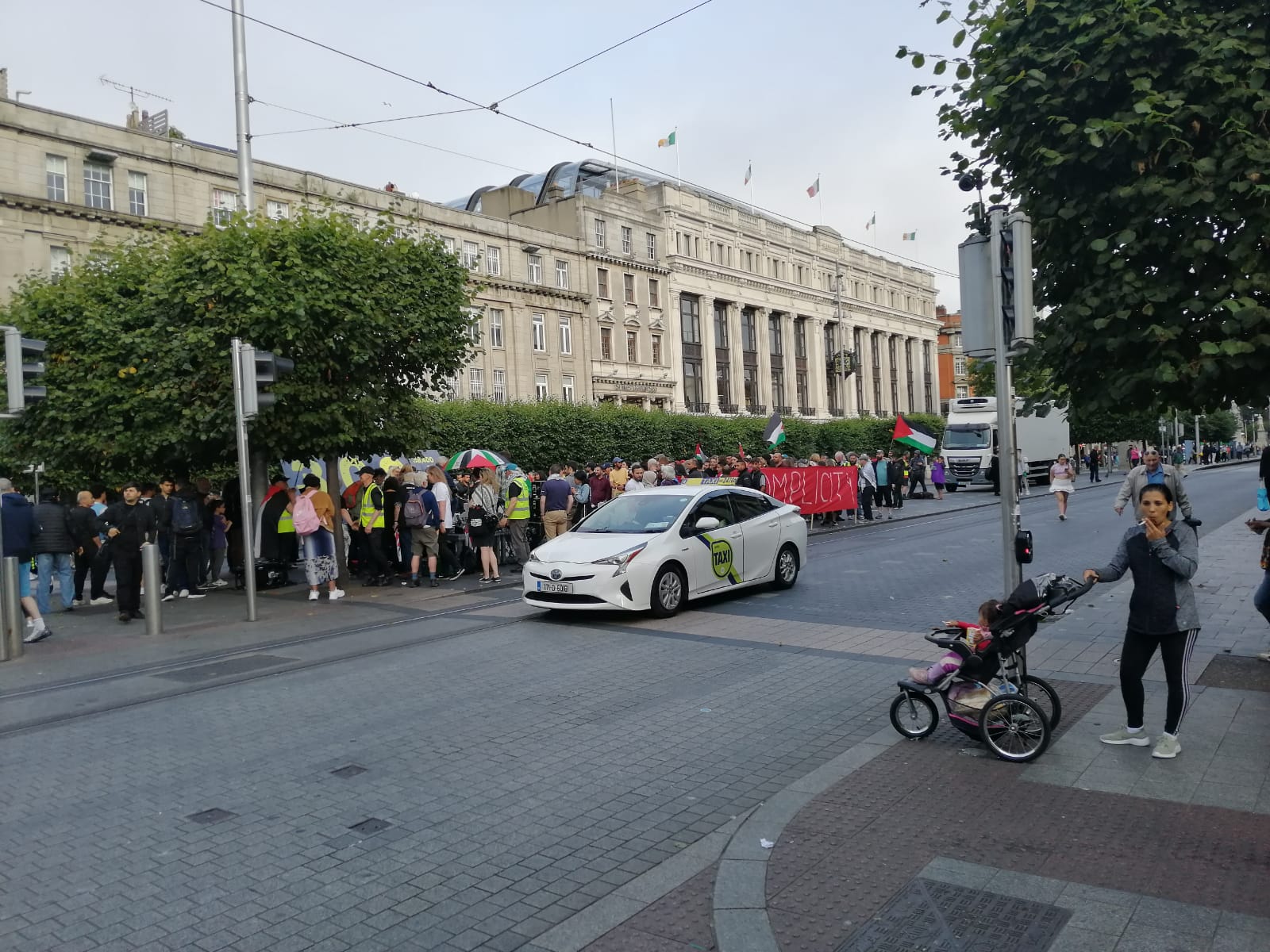
On Friday 2nd August two events of Palestine solidarity advertised at short notice took place a couple of hundred metres apart in Dublin City centre, attracting up to a couple of thousand participants overall.

The larger event by far was organised by the Ireland Palestine Solidarity Campaign and focused on the 300th day of the Genocidal war on the people of Gaza by the Israeli state. The smaller, approaching a hundred participants, concentrated on the assassination of leaders of the Resistance.

The IPSC-organised vigil on O’Connell Street (Source photo: R.Breeze)

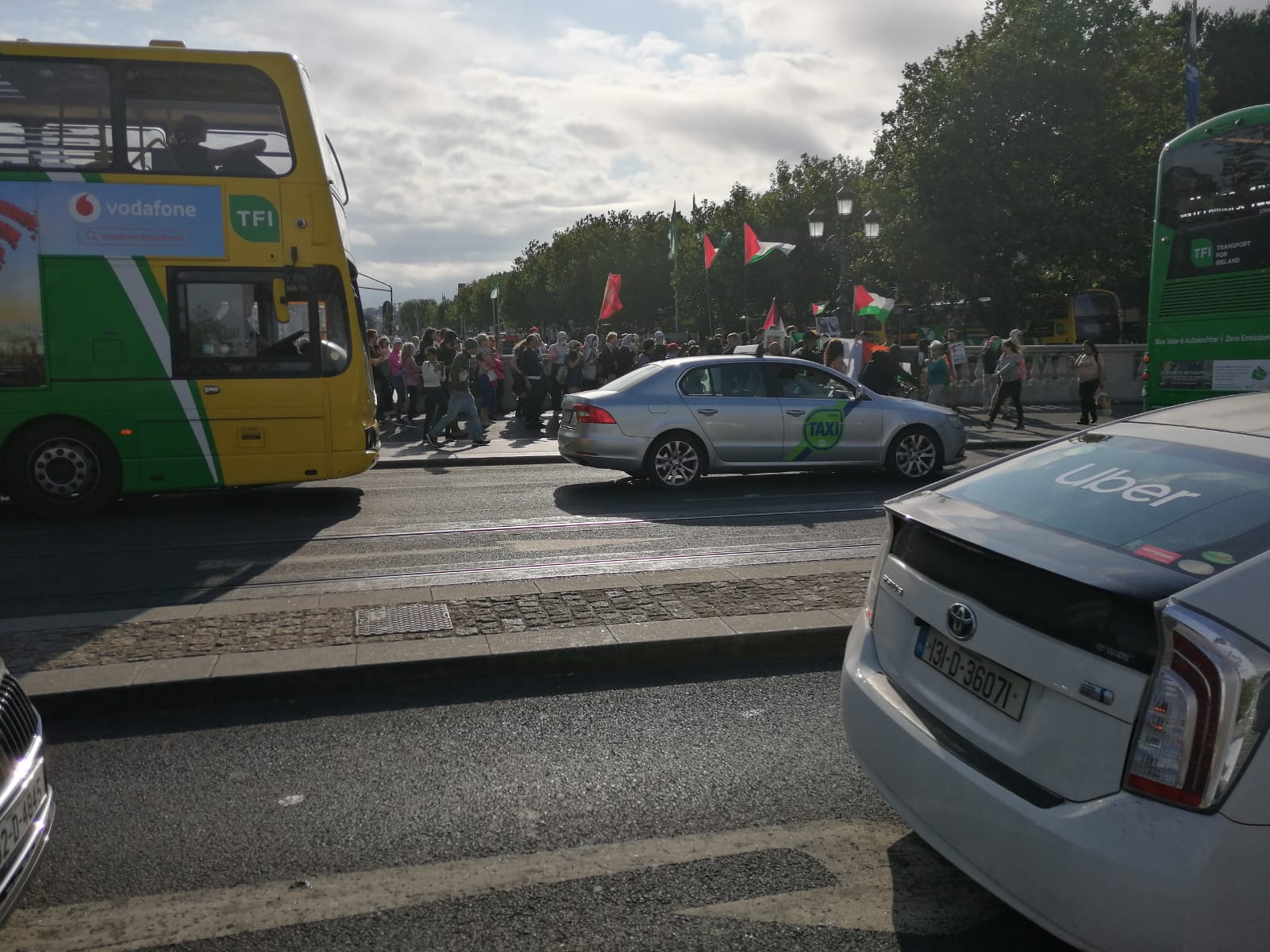
The IPSC occupied the space to which they have become accustomed in front of the GPO, the other, organised by Anti-Imperialism Action and the Saoirse Don Phalaistín coalition, took up position on the west side of O’Connell Bridge, where flags of the PFLP, Hamas and Hezbollah could be seen.

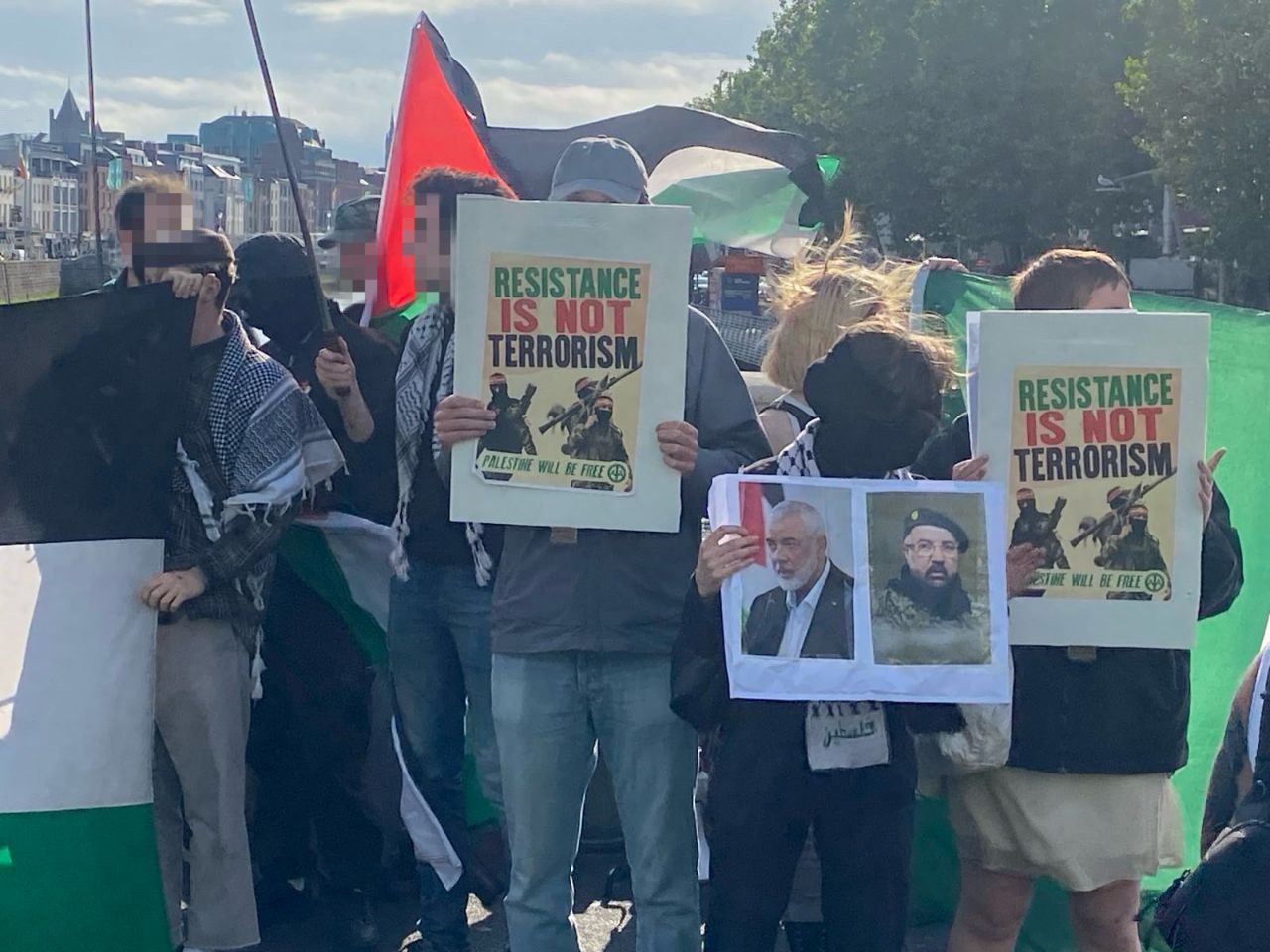
Some carried portraits of martyred Resistance leaders Haniyeh and Fouad; among the usual Palestinian national flags and resistance faction flags, a number of Irish Tricolours could also be seen, along with a green-and-gold Starry Plough.

Close-up section of the AIA-SDP protest on O’Connell Bridge (Source photo: AIA)

Some printed placards stated that Resistance Is Not Terrorism, while a couple of home-made placards stated that ‘Israel’ and US/NATO are the real terrorists! and a home-made banner declared Glory to the Resistance!

An almost constant stream of slogans were called by young people taking turns (one male and two females) and answered by the crowd, “Long live the Intifada” and “In the face of occupation, resistance is an obligation” in particular leaving no doubt where their sympathies lay.

Shot taken early as protest was getting started (Source photo: R.Breeze)

The crowds passing by were either openly supportive or non-committal but a few hostile comments were thrown and one middle-aged man shoved the loudhailer into the mouth of a young Palestinian woman who was calling out slogans for the crowd’s response.

She reacted immediately to the hostile act and was quickly supported by a group of young women who pushed the man away. Three Gardaí who were watching from the central reservation then came across to the group and took the man to one side but also demanded the Palestinian woman’s ID.

One of two placards with the same message displayed on the AIA-SDP protest on O’Connell Bridge. (Source photo: R.Breeze)

Unaware of her rights, she gave them that information. The Gardaí said they had not seen the man’s action, only that of the women pushing him along the Bridge. He claimed that the megaphone had been blaring in his ears but the suspicion is that he had been expressing his hostility to the cause.

The opinion of some people was that there would be no subsequent police action against the woman but some others gave her precautionary advice and also contact numbers for witnesses.

A Garda jeep and number of uniformed Gardaí had taken up station on the east side of the Bridge and a couple of Special Branch (plain-clothes political police) were also noted observing and videoing from the central reservation but none approached the demonstrators.

Two Special Branch officers immediately after their arrival on the central pedestrian reservation on O’Connell Bridge. (Source photo: R.Breeze)

A sinister individual who met the SB men on the central reservation, constantly on his phone and at times directing the SB where to film, may have been Mossad, the ‘Israeli’ foreign secret service, well-known for assassinations such as that of Palestinian Mahmoud Al-Mabhouh in Dubai in 2010.

Possible Zionist agent seen here near the SB officers on the central pedestrian reservation on O’Connell Bridge. (Source photo: AIA)

The photographs of 26 of his suspected assassins and their aliases were circulated by Interpol and Dubai police found that 12 of the suspects used British passports, along with six Irish, four French, one German, and three Australian passports; this causing some diplomatic storm at the time.

Approximately an hour after the start of the event on the Bridge, it was concluded while in front of the GPO, the other event was still continuing.

Section of the IPSC-organised vigil in O’Connell St. (Source photo: R.Breeze)
Close-up of section of the AIA-SDP organised protest on O’Connell Bridge. (Source photo: AIA)

End.

A New Wave of Censorship and Repression

Gearóid Ó Loingsigh 18 April 2024

(Reading time: 6 mins.)

There is no doubt that the ghost of Joseph McCarthy wanders the earth through many a hallowed university hall, newspaper editorial room, police headquarters around the world and of course the cabinets of many western governments.

Censorship when it raises its ugly head, does so in a similar fashion to its past incarnations, though with new twists and turns that perhaps take us by surprise.

However, it should come as no surprise to see that voices on Palestine are being shut down, though the recent German police assault on an international conference in Berlin was a major escalation in government attempts to criminalise those critical of the genocidal regime that holds sway in Tel Aviv and the white supremacist philosophy that is Zionism.(1)

Various issues are thrown into the mix.

Palestine and Palestinian demands are presented as hate speech by governments and right-wing media, but so too is any defence of women’s spaces, though in this latter case the right-wing governments find some support from sectors of the Left.

These think that when they argue for censorship and the suppression of freedom of speech that somehow it will never be applied to them.

The German police stormed the three-day event as the first speaker was addressing it.

They claimed they did so to prevent antisemitic statements being made i.e. not only are we in McCarthyite land of criminalising certain ideas by labelling them as antisemitic but we are in the land of Minority Report(2) where thought crimes can be punished in advance, before they have been committed.

This is not that far removed at all from the Irish Hate Speech Bill that some on the Left have given support to, as the Police may inspect computers and phones and you may be charged with possession of material that may be used to commit hate speech.

It was laughable and ironic that one of the photos of the police intervention of the Berlin event was the arrest of a young Jewish man, wearing a kippa, who was there in solidarity with Palestinians. Following the event a number of Jews were charged with antisemitism.

Not only that but some of the speakers were banned from entering the country, amongst them Dr Ghassan Abu-Sittah who was an eyewitness to what was happening in Gaza and is also the Rector of the University of Glasgow.

The former Greek politician Yanis Varoufakis was also banned from entering Germany and both were warned that they could not participate even by Zoom from another jurisdiction, an unlawful extension of German jurisdiction and a suspension of the free movement of European citizens within the EU.

This is part of a wider criminalisation of protest and the criminalisation of thought.

Though some on the Left in Ireland such as People Before Profit T.Ds like Paul Murphy who support hate speech legislation believed in the benevolence of capitalist leaders when restricting commentary on women’s rights would never be extended to them, it has and for obvious reasons.

Most right-wing governments, particularly those that claim some liberal kudos on certain social issues have taken advantage of the defeat of workers, critical thinking and any opposition at all to capitalism to advance right-wing hate speech legislation and restrictions on academic freedom.

This includes the dismissal of staff, limitations on the right to voice opinions that go against government policy and in the process have garnered the support of many liberal currents and of course major NGOs who depend on government largesse to finance themselves.

The German event is not an isolated incident. Over the years various lecturers in the US have been suspended or not had their contracts renewed for speaking out about Palestine.

Zionists were the original cancel culture specialists who managed to turn spoilt students whining into action, getting staff sacked and silencing other students.

Recently, a professor of 30 years standing at Hobart and William Smith Colleges in the US was suspended over a contribution made to a blog.

In their suspension of the employee the president stated that “I find her comments repugnant, condemn them unequivocally, and want to make clear that these are her personal views and not those of our institution.”(3)

It was liberals, the wokerati and even some Marxists who pushed for employers to take action against employees for their personal views and activities outside of the workplace and now it has come back to bite some of them, though not all, as many liberals and wokerati in the US are Zionists.

Some of those who had been targeted were vile racists who shouted “Jews will not replace us” as they marched with torches. But you fight Fascism, you don’t give employers control over employees’ lives, ever.

As Trotsky once quipped, if you can’t convince a Fascist, acquaint their head with the pavement. He didn’t say give your boss and the state more control over you and beseech them to act in your interests.

A few days prior to that, Columbia University had suspended six students for allegedly participating in a panel discussion on Palestine.(4)

And in a further sign that jackboots are once again goose-stepping through Germany, the University of Cologne rescinded a job offer to Nancy Fraser, a Jewish American professor of philosophy, over her condemnation of killings in Gaza.(5)

They will not stop at that and it is not limited to issues such as genocide, but even local domestic politics.

In April 2023, a French journalist Ernest Moret was arrested by British anti-terrorist police due to his involvement in protests in France against the Macron government’s pension proposals.

He refused to give the police access to pass codes for his electronic devices and was charged with obstruction.(6)

There are other precedents for this, one of them being the arrest of David Miranda, Glen Greenwald’s now deceased partner, in Britain when returning from a meeting with another journalist who had also worked on the files released by Edward Snowden.(7)

The courts later upheld his detention to be lawful. Police held him and demanded access to his electronic devices.

Then there is the jailing and punishing of Julian Assange. The charges against Assange were dressed up in various disguises.

The first of them was the now discredited rape charges in Sweden which were dropped and also espionage charges when the real reason for jailing Assange is that he, as a journalist, exposed US war crimes in Iraq.

The message is clear, censorship is the order of the day as is the hounding of journalists who hold unpopular views and expose the crimes of the state. Assange did not receive the support he should have, due to the trumped-up rape charges, with many on the Left, like cowards running for cover.

Even today, when the rape charges have been exposed for the lies they were and have been dropped there are those who refuse to speak out on his behalf for this very reason.

There is no world in which right wing governments suppress freedom of speech, academic freedom, freedom of assembly and criminalise broad opinions that they label as hate speech and don’t target the Left. It has never happened and never will.

When they stood aside on Assange, they prepared the way for the assault on the Berlin Conference. When they harassed and tried to silence women defending women’s spaces they prepared the ground for the assault.

When they advocated and supported right-wing governments’ attempts at introducing hate speech legislation they paved the way for the criminalisation of solidarity with Palestine.

When the Hate Speech Bill comes back before the Irish parliament, they should take note and do the correct thing and oppose it, unequivocally.

Leftists who advocated employers taking control of employees lives and opinions, those that demanded that JK Rowling and others like her be hounded from the public sphere and that what they termed hate speech, in reality thought crimes, should be punished in law have aided and abetted right-wing governments in getting us to where we are now, which is that it is now very easy to criminalise pro-Palestinian voices.

All you have to say is “Hate Speech!” Meanwhile Rushi Sunak in Britain is pushing ahead with a very broad and loose definition of extremism which will see almost everyone who does not support Sunak or Starmer in the dock.

Notes

(1)  See interview with Yanis Varoufakis  https://www.democracynow.org/2024/4/16/germany_palestine

(2)  Minority Report is a Tom Cruise film in which three mutants can see the future and predict who will commit crimes and they are arrested, charged and sentenced in advance before the crime is committed.  In the film the system unravels.

(3)  WXXI News (16/04/2024) Hobart and William Smith Colleges professor suspended for comments on Israel-Hamas war. Noelle E.C. Evans.  https://www.wrvo.org/2024-04-16/hobart-and-william-smith-colleges-professor-suspended-for-comments-on-israel-hamas-war

(4)  WSWS (09/04/2024) Columbia University suspends and evicts pro-Palestinian students.  Tim Avery. https://www.wsws.org/en/articles/2024/04/09/yimz-a09.html

(5)  The Guardian (10/04/2024) German university rescinds Jewish American’s job offer over pro-Palestinian letter.  Kate Connolly. https://www.theguardian.com/education/2024/apr/10/nancy-fraser-cologne-university-germany-job-offer-palestine

(6)  The Guardian (18/04/2023) French publisher arrested in London on terrorism charge.  Matthew Weaver.  https://www.theguardian.com/uk-news/2023/apr/18/french-publisher-arrested-london-counter-terrorism-police-ernest-moret

(7)  The Guardian (19/08/2013) Glenn Greenwald’s partner detained at Heathrow airport for nine hours. https://www.theguardian.com/world/2013/aug/18/glenn-greenwald-guardian-partner-detained-heathrow

The Influence of the Working Class on the 1916 Rising

Diarmuid Breatnach

(Reading time: 9 mins.)

The 1916 Rising is usually seen as a nationalist Rising of Irish Republicans with perhaps some socialist involvement. Even Connolly is often portrayed as a patriot only (see the song James Connolly the Irish Rebel) with socialist views.

Of the six organisations that participated actively in the 1916 Rising1 only one of them was specifically of the Irish working class. Perhaps that’s why the great influence of the working class on the Rising tends to be generally overlooked.

As is well-known, James Connolly is one of the Seven Signatories2 of that wonderful and progressive document, the 1916 Proclamation of Independence. However, Connolly only became part of the planning committee for the Rising a very short time before the scheduled date.3

That is true but we should ask ourselves why they included him at all. The Irish Volunteers had a nationwide organisation with the also nationwide Cumann na mBan as auxiliaries, whereas Connolly could perhaps mobilise a couple of hundred fighters.

(Photo sourced: Internet)

It is said he was brought on board because the IRB believed that his constant demand for a Rising during WWI and the military exercises of the Irish Citizen Army indicated that Connolly was likely to lead the ICA to rise on their own and would spoil their schedule.

How likely was he to do that? It’s true that as a socialist Connolly was horrified by the slaughter of war, where workers of one state are sent to kill and be killed by workers4 of another and perusal of his writings do show that he thought an uprising to sabotage war was desperately needed.

Would he have gone ahead alone with the roughly 250 men and women of the Irish Citizen Army, hoping perhaps to inspire a popular upsurge and to encourage the Irish Volunteers to join it, in spite of even their leaders?5 It’s hard to believe so but of course it’s possible.

However, from the moment the Republican planners of the Rising took Connolly on board, we can see a significant organisational shift towards the working class in Dublin and nowhere more so than around Liberty Hall, where the first flag for an uprising was hoisted and the Proclamation printed.

Liberty Hall was of course the headquarters of the Irish Transport & General Workers’ union,of which James Connolly was the leader at that time and also editor of its newspaper,The Irish Worker.

And for a person brought in to the planning so recently, how extraordinary that Connolly was given the rank of Commandant General! A responsibility he took seriously, sending couriers around the country and attempting to direct defence preparations around the various Dublin garrisons.

The first battle flag of the Rising

A week before the Rising Connolly and the Irish Citizen Army had an Irish Republican flag raised above Liberty Hall as a flag of war and the one chosen to do the raising was a girl of 16 years, Molly O’Reilly.6

The associated circumstances are worth retelling, if only to illustrate the difference between the Liberty Hall of then and today. Adults took classes in Irish language and cultural activities there while their children and those of union activists waited for their parents, took dancing classes or played.

In playing, Molly O’Reilly accidentally broke a window and in terror and shame, ran home.

When Connolly sent a message to her home that he wanted to see her, she went to Liberty Hall expecting a severe telling off. Instead he told her not to worry and what he was asking of her. She was proud to do it but so small she had to stand on a chair to pull the cord raising the flag.

Remnant of the flag raised on Liberty Hall (Image sourced: National Museum)
Commemoration ceremony “Women of 1916” with relatives of Molly O’Reilly in place of honour (note the uniforms are of Irish Volunteers rather than Irish Citizen Army).(Photo: D.Breatnach)

Of course we know that flag was not of the revolutionary workers but instead the harp on green which was that of the early Fenians and was very similar to that of the United Irishmen, the first revolutionary Irish Republican organisation.7

Those early Fenians were mostly composed of working class members and their 1867 proclamation to the world was largely proletarian in outlook. In Britain, the Fenians formed part of the First International Workingmen’s Association which was led by Marx and Engels.

Their flag was flown over at least one of the 1916 Rising garrisons, I believe at theJameson Distillery in Marrowbone Lane.

Similar flag to that hoisted over Liberty Hall (Photo sourced: Internet)

The other flags of the Rising included the Tricolour, presented to the Irish Republicans of the ‘Young Irelanders’ by women in revolutionary Paris in 1848, which was one of two flown on the roof of the GPO, the headquarters of the Rising.

Sharing the GPO roof with the Tricolour was the flag made only days before from domestic material and painted with the words “Irish Republic” in the house of Constance Markievicz, an officer in the Irish Citizen Army, shortly before the Rising.

The Irish Citizen Army’s own flag, the Starry Plough, flew over the Clery’s building facing the GPO. Sadly today most Irish people do not know that flag, though awareness of it and its background is growing among the indigenous Irish and the migrant community.

The design of the Starry Plough, flag of the ICA as it was in 1916 (Image sourced: Internet)

The first workers’ army in the world8

The Irish Citizen Army was formed as a workers’ militia during the great Lockout and strike of 1913-1914, to defend against the attacks of the police, the physical repressive front line of the capitalist class; the ICA’s flag was placed above Murphy’s Imperial Hotel in Clery’s.9

The Irish Citizen Army on exercises at their grounds near what is Fairview today (Photo sourced: Internet)

Though its constitution was more nationalist than socialist, the ICA was in its membership and purpose the first workers’ army in the world and when reorganised a few years later, represented also working class feminism, recruiting women, some of whom were officers commanding men.

Once the preparations for the Rising were in tatters with MacNeil’s countermanding order, where did organisers gather to discuss what to do? In Liberty Hall, the building of the Irish Transport and General Workers Union and it was there that the decision to rise on Monday instead was taken.

It is hard to overstate the importance of the fact that the decision to go ahead with insurrection was taken in the building which had become de facto the HQ of the revolutionary working class in Dublin, with an illegal flag of rebellion flying and where the Proclamation was to be printed.

The writing and text of the Proclamation

The wording of the Proclamation is thought largely composed by Pearse but influenced by Connolly, including its address to “Irish men and Irish women” and perhapsWe declare the right of the people of Ireland to the ownership of Ireland, and to the unfettered control of Irish destinies”.

Another section which could bear Connolly’s fingerprint reads: The Republic guarantees religious and civil liberty, equal rights and equal opportunities to all its citizens, and declares its resolve to pursue the happiness and prosperity of the whole nation and of all its parts, cherishing all the children of the nation equally.

(Image sourced: Internet)

But, whoever composed or influenced the Proclamation text, it was printed in Liberty Hall. An Irish Citizen Army member went to Stafford Street (Wolfe Tone St. today) to borrow the print type from a printer there to bring back to Liberty Hall, which was under daily 24-hour armed guard.

Having printed the Proclamation in Liberty Hall under armed guard and having decided there to rise on Easter Monday, where did the assault groups for Stephens Green, Castle and the GPO, including the Headquarters Battalion, meet on the morning of the Rising? …. Again, at Liberty Hall.

An early non-combatant casualty of the Rising was Ernest Kavanagh,10 who drew cartoons for the newspaper of the ITGWU, The Irish Worker. For some reason he went to Liberty Hall on Tuesday and was shot dead on the steps of the union building, presumably by a British Army sniper.

The working class in armed resistance

Once the Rising was in motion, the Irish Citizen Army had primary responsibility for two areas, the Stephens Green/ College of Surgeons garrison and the Dublin Castle/ City Hall garrison but also fought in other areas, for example on Annesley Bridge and in the GPO/ Moore Street area.

All who fought alongside them commented on their courage and discipline. After the surrender, many, along with Irish Volunteers were sentenced to death, most being commuted to life imprisonment. But two leaders of the Irish Citizen Army were shot by firing squad.

One of the areas from which the British forces were sniped at for days after the Rising was the docks area, then predominantly surrounded by working class residential areas.

A question we should ask ourselves is why the forces coming from Britain to suppress the Rising landed at Dún Laoghaire, from where they had to march nearly 12 km (approaching eight miles) to Dublin city centre, instead of at the excellent Dublin docks on the Liffey.

Hugo McGuinness, who specialises in history of the North Wall area, believes that the British expected Dublin to be in the hands of the working class resistance and that it was simply too dangerous to land British troops there, though gunboats could fire from the Liffey.

Certainly, the British believed Liberty Hall and buildings along Eden Quay were occupied as fighting posts by the Irish Citizen Army and they fired artillery at the union building from Tara Street, as photos of shell holes in that building and right through to the next testify.

Photo shell-damage Liberty Hall (first building with corner towards the camera, viewed northwards from Butt Bridge) as one of a set of commemorative postcards. (Photo sourced: Internet)
Another postcard with closeup of shelling damage to Liberty Hall and to the building next to it. Interestingly, in this one Liberty Hall is labeled “the Rebel Headquarters”. (Photo sourced: Internet)

Much is made in some historical accounts of the opposition to the Rising from sections of the Dublin population, during and immediately after the Rising. The city was the capital of a British colony, only just over a century earlier spoken of as “the second city of the British Empire”.

A substantial proportion of the wealthy and middle classes were Loyalist, including some Catholics; even ‘nationalist’ sections were committed to supporting the UK in WWI and John Redmond, leader of the ‘nationalist’ political party had openly recruited for the British Army.

Also, among the working class and the lumpen elements, many were depending on “Separation Allowances” with regard to males serving in the British Army. It is true that the insurgents in some places had to threaten, club or even shoot some civilians who tried to obstruct the Rising.11

These incidents during the Rising were not many but afterwards there were insults and other things thrown at prisoners being marched to imprisonment (or firing squad). The city was under martial law but even so a Canadian journalist reported the insurgents being cheered in working class areas.

There were also other individual witness accounts, such as a man on a tram saluting prisoners in Parnell Street until threatened by soldier escorts and a firefighter in the GPO doing likewise. A year later most of even the earlier hostility had changed to admiration and pride in the fighters.

Leadership of the working class

James Connolly wrote and said many things of importance but surely, with regard to the struggle for Irish national independence, the greatest of these was: “Only the Irish working class remains as the incorruptible inheritors of the fight for freedom in Ireland.”

By that he meant — and I agree — that all other social classes can gain something from selling out the interests and resources of Irish nationhood but that the working class can gain nothing from that.

The Irish working class staked their claim on the struggle for Irish independence in 1916 but have not succeeded in leading it and because of that, that struggle remains to be won.

Today and in other days, remembering that long struggle and the class whose leadership revolutionary socialists seek to represent and to uphold, we declare the need for that leadership over a broad front of all others who wish to struggle to advance.

In doing so, we declare that far from the working class having to wait for socialism, in the course of national struggle it must also shape its own demands around the economy, natural resources, infrastructure, social services, social questions, culture and, above all, to the fruits of its labour.

End.

FOOTNOTES

1Irish Republican Brotherhood, Irish Volunteers, Irish Citizen Army, Cumann na mBan, Na Fianna Éireann, Hibernian Rifles.

2All of which were executed by British firing squad, along with another seven in Dublin and yet another in Cork. The 16th execution was by hanging in London.

3(See Sources: Cooption of James Connolly etc) Connolly was a lifelong socialist and a revolutionary throughout his adult life, author, historian, journalist, song-writer, trade union organiser; active politically in Scotland, Ireland, New York and back in Ireland.

4The international socialist movement viewed the imperialists’ movement towards war with horror and in international conferences vowed to oppose it with all their might, including turning war resistance into revolution (“War against war”). However, once imperialist war was declared that resolve collapsed in most states, Russia, Germany and Ireland being notable exceptions and each saw a rising against war, in Ireland’s being the first.

5Joseph E.A. O’Connell (Jnr.) suggests a possible intention of goading of the State into attacking him and the ICA which might spark the general rising.

6(See Sources)

7The harp on the United Men’s flag was more ornate and was inscribed with the words “It is newly-strung and shall be heard”.

8https://www.connollybooks.org/product/irishcitizenarmy

9It was a good central location but more than that – the Hotel was one of the businesses of William Martin Murphy, chief organiser of the employers’ bloc to break the Irish Transport & General Workers’ Union.

10Kavanagh was a supporter of the workers, of votes for women and against participation in the imperialist war, contributing cartoons also to the Irish Citizen, Fianna and Irish Freedom publications, also to accompany poems of his sister, Maeve Cavanagh McDowell.

11I do not include in this the three members of the Dublin Metropolitan Police who were a force for the British occupation and also for the Dublin capitalists. The Irish Citizen Army in particular had good reason to settle accounts with them for attacks on them including inflicting mortal baton injuries on two workers during a charge on a union meeting on 30th September 1913 on Eden Quay and beating people and smashing up furniture in Corporation Street a little later.

SOURCES

Co-option of James Connolly to the Military Council planning the Rising: https://www.historyireland.com/connollys-kidnapping/

Raising the flag on Liberty Hall: https://microsites.museum.ie/1916objectstories/ObjectDetail/remains-of-irish-flag
Molly O’Reilly breaking a window incident: https://www.independent.ie/irish-news/ladies-day-for-1916-heroines/26528456.html

Printing of the Proclamation of Independence: https://libguides.ucc.ie/1916Proclamation
https://www.dublincity.ie/library/blog/printing-1916-proclamation-transcript

Decision taken to go ahead with the Rising on Easter Monday: https://www.irishtimes.com/culture/heritage/easter-rising-uneasy-calm-before-the-storm-1.2575638
https://www.nli.ie/1916/exhibition/en/content/risingsites/libertyhall/

“Only the Irish working class remains the incorruptible heirs …” (end second sentence from last): https://www.marxists.org/archive/connolly/1910/lih/foreword.htm

Stand Together but How? And Militant Response to Fascist Provocation

Diarmuid Breatnach

(Reading time: 5 mins.)

A large number of people gathered in Dublin on 2nd March in what was advertised as a “Stand Together” march for “Homes, Health & Rights for All”; “Against Racism, Hate & War”; to “Share Wealth and End Inequality”.

A large part of the context in which the event was organised is a high number of arson attacks on properties intended (or thought to be) for housing refugees and asylum seekers, along with an increase in mobilisations of people by the far-Right and outright fascists.

(Photo: D.Breatnach)

In that context, the advertising poster for the march was insipid in colouring, using pastel shades reminiscent of a certain type of sweets. On some versions the clenched fist appeared but it was missing from many others shared on social media.

Le Chéile, the main organising or coordinating body, was formed some years ago at a time when the Far-Right was becoming increasingly visible in street events they organised and on occasion countering progressive events and a number of clashes had taken place.

The main organisers not only had been absent from most of those confrontations but deliberately chose to exclude from the founding of Le Chéile the majority of those among Irish Republicans, Socialists, Anarchists etc who had already been counter-protesting the far-Right.

Banners of CATU and Drogheda For All on the march soon after starting in Parnell Square (Photo: D.Breatnach)
On the march soon after starting in Parnell Square (Photo: D.Breatnach)

This may account for the absence of most Irish Republican organisations from the march (if so I understand but disagree with the decision). Dublin Communities Against Racism however contain some veteran antifascists and were present as were a group of Italian antifascists.

There was a big turnout of Traveller groups which would be welcome any time, in particular as the longest-racialised minority in Ireland, but more welcome in recent years when the far-Right have been making efforts to recruit some from that community against migrants.

Banners of Irish Traveller organisations on the march soon after starting in Parnell Square (Photo: D.Breatnach)
(Photo: D.Breatnach)

Given the ongoing genocide of Palestinians by the Israeli Zionist state, many Palestine flags were naturally enough seen on the march — and not only within the Ireland Palestine Solidarity Campaign’s contingent.

Groups of marchers from a number of trade unions were good to see too, though the numbers were not great and the spread of unions small. One might expect trade unions to be to the fore in combating the harmful divisiveness of racism but their record is poor even on straight pay issues.

Flags of Palestinian solidarity, Unite the union (Photo: D.Breatnach)

A number of political parties were present too: People Before Profit, Sinn Féin, Social Democrats, as were a couple of faith-based groups.

Banners of religious groups and coming up behind, some trade union banners Banners of CATU and Drogheda For All on the march soon after starting in Parnell Square (Photo: D.Breatnach)

Anti-fascist fans of Dublin soccer team Shamrock Rovers marched behind their banner with their green-and-white flags and at one point a green smoke flare was set off in their midst. The colours of some of the 134 Gaelic Athletic Clubs based in Dublin would have been good to see there also.

The earlier announced route of the march, to end at Custom House Quay, was changed for some reason and without announcement, at least from O’Connell Street and eventually ended up in north Merrion Square, with a stage set up across the street at the eastern end.

Banner of fans of Shamrock Rovers FC on the march (Photo: D.Breatnach)
On stage at the rally (Photo: D.Breatnach)
Poet performer at the rally (Photo: D.Breatnach)

The MC of the event on the stage, a man of colour, greeted participants in English and Irish but shocked antifascists present by advising any who felt unsafe to approach a steward or a Garda (!). There are few more likely to make people feel unsafe than that members of that very force.

Speakers from both indigenous and migrant backgrounds addressed the crowd and the cultural performances were by people from both backgrounds.

The MC at one point drew in the war in Ukraine in parallel with the Israeli genocide, which was inappropriate even if one were a supporter of US/NATO’s proxy war against Russia using the puppet Ukrainian state (which I am not).

One of the participants reads the List Of Some Migrants and Sons of Migrants who contributed to Ireland. (Photo: D.Breatnach)

Also the PBP know that their view on this is hotly refuted through much of the Left and a great many of those on the march.

In the time I was there, though speakers attacked the divisiveness of racists and fascists and on occasion pointed to the real culprits in manufacturing a housing crisis, none pointed to the capitalist class need for dividing the working class and particularly so when their system is in difficulty.

(Photo: D.Breatnach)
A noble call but the organisation whose placard this is did not do so and furthermore when a certain organisation, Revolutionary Housing League were actually doing so, neither this nor other organisations mobilised in support. (Photo: D.Breatnach)

Not to speak of how we might organise to “Share the Wealth”, which means socialist revolution, surely, unless it refers to some liberal pipe-dream? The far-Right have risen to prominence in Ireland is because most of those who claim socialist policies have failed to fight for them.

Fighting for socialist policies means actually fighting which means going into all the battlegrounds and organising the people, providing revolutionary education and example and inevitably will mean suffering because the ruling class will not just sit back and watch.

(Photo: D.Breatnach)

While some benefit can be obtained from representation in the parliaments and local authority councils, they can never be the main battleground. Street demonstrations are an improvement but nor can they be the main area for revolutionary effort.

In the clear context of general elections widely speculated to take place later this year, a speaker asked the crowd not to vote for anti-immigration candidates. Since the likelihood of anyone there doing so was nil, the inference was clearly to encourage voting for the current parliamentary parties.

In conclusion it is hard to imagine this organisation or any similar kind of coordination providing strong organisation or leadership to counter fascism and racism effectively.

This is not the kind of organisation that would have fought the Blueshirts in the 1930s or even prevented the Islamophobic Pegida founding a branch in Dublin, which a militant antifascist mobilisation succeeded in doing in February 2016.

Section of the march viewed from the Parnell Monument southward (Photo: D.Breatnach)

Anti-NATO Picket Rescues Palestine Flag from Fascist Provocateur

A more militant antifascist attitude was seen in Dublin a few hours later when a fascist grabbed a Palestine flag from a participant in an anti-NATO picket outside the GPO, the iconic building housing the headquarters staff of the 1916 Rising.

The picketers were standing peacefully with banners and flags, including Palestinian and Irish Starry Plough, distributing leaflets and engaging passers-by in conversation. The incident occurred some time into the event, the man shouting in an Irish accent, grabbing the flag and running.

Anti-NATO picket organised by the Anti-Imperialist Action organisation outside the GPO in Dublin’s main street. (Photo: D.Breatnach)

The surge forward in response might have caught him by surprise but, though the flag was rapidly retrieved, he continued to be aggressive in words and, as is described in slang, “throwing shapes”, behaviour that ended with his sitting in the road.

Though the population of Ireland is overwhelmingly in sympathy with the plight of the Palestinians and many in solidarity with their struggle, many in the far-Right here object to displays of that solidarity and call the solidarity activists “traitors” and demand they act for Ireland only.

Ironically, many of those same people acting in Palestine solidarity have also over the years agitated for affordable housing, against social provision cuts and British colonial occupation, in support of Irish political prisoners – while the far-Right’s only ‘contribution’ is to agitate against migrants.

Fascists in Ireland also collude with Loyalists and with British fascists; it is they who are the traitors, to the nation and to the working class, hiding behind flags the meaning of which their leaders secretly despise and which some of their lumpen followers do not understand.

End.

(Photo: D.Breatnach)
List of some migrants and sons of migrants who have contribute to Ireland (including fighting and in some cases dying for her freedom) (Photo: O.Dunne)

Sources

Le Chéile: https://www.facebook.com/LeCheileDND

Anti-Imperialist Action: https://t.me/aiaireland

Dunnes Stores, South Africa, Gaza: A Tale of Two Boycotts

Gearóid Ó Loingsigh

29 February 2024

Anti-apartheid activist Nimrod Sejake with some of the Dunnes Stores striker.

Reference has been made on a number of occasions to the heroic actions of the Dunnes Stores Anti-Apartheid strikers in 1984 who spent nigh on three years on strike because they refused to handle South African merchandise.

It has been pointed to as a success story for boycotts and one to emulate. The real story of the strike points to the difficulties we now face in implementing a real boycott of Israel.

I used to go down to the picket line at the Dunnes branch in Henry Street every Wednesday, as we had a half day at school and on Saturdays when there was no school and then more regularly once I had sat my Leaving Cert exam and was, like many young people in 1980s Ireland, unemployed.

So, I recently bought a copy of Mary Manning’s autobiographical account of the strike, Striking Back: The Untold Story of an Anti-Apartheid Striker (Collins Press).

The book brought to mind many of the instances and difficulties that they faced and it raises many questions for those who wish to point to them as an example to follow.

The strikers were implementing a trade union resolution, and at first knew little of the reality of South Africa, something they corrected relatively quickly, thanks in no small part to a South African exile, Nimrod Sejake, who turned up to join them on the picket line.

Sejake was an activist who had been arrested as part of the infamous Treason Trial. Mary Manning is full of praise for Nimrod and rightly so.

Others do not come out so well and it is worth remembering the reality of that strike as it tells us some of the things that need to happen if we want to see similar action in relation to Israel.

The first thing that jumps out of the pages, early on, is that the trade bureaucracy did not give them any support and even their own trade union, IDATU (now called Mandate) was very reluctant to support them.

What support they got was down to their official Brendan Archbold who was a stalwart in supporting them and the then head of the union John Mitchell. At every twist and turn they had to fight the executive of IDATU, whilst the rest of the trade union movement ran for cover.

There will be no similar type of action around the Zionists unless it is put to the bureaucracy and they are challenged over their inaction in the midst of a genocide.

Karen Gearon, the shop steward at Dunnes Store made a call at the National March in Dublin on February 17th for the trade union movement to stop talking and take action. It is not something that has been seriously echoed by others.

Neither People Before Profit TDs or the IPSC have ever made a clear call for action from the trade union movement. It should be a central part of any boycott movement now.

It is all well and good picketing Starbucks, but stopping the importation of Israeli goods would be more important and will only happen if the bureaucracy is pushed to it. The history of PbP is one of cowering in the shadow of the bureaucrats and never putting it up to them on any issue.

They frequently share polite platforms with the bureaucrats and never challenge them. Their calls, when made are generic and are in passing. Their website and the IPSC site is limited to a consumer boycott with calls for the government, not workers, to take action.

I was also reminded by the book how the great and good in Irish society stood by whilst these workers were on strike. The Minister for Labour at the time was Ruairí Quinn, a member of the Irish Anti-Apartheid Movement (IAAM) and yet he did nothing.

He was not the only mealy-mouthed figure in Irish society, nor indeed in the Irish Anti-Apartheid Movement.

The head of the Catholic Bishops Aid Agency, Trócaire, Bishop Eamon Casey privately wrote to IDATU early on describing the strike as ‘economically harmful to the already impoverished Black South Africans.’

The strikers’ request for support from the Catholic Church was described as impertinent and just in case anyone doubted how he saw himself, he was of the view that both he and Trócaire should have been consulted before the strike took place.

Their currency now is much devalued in Ireland but there are others like them who also think they have a veto on decisions.

He was later forced to publicly back the strike having been embarrassed by Archbishop Desmond Tutu’s decision to present two strikers to the world at his London press conference en route to pick up his Nobel Peace Prize.

Though that took a while and meantime nuns proudly scabbed and crossed the picket line. Casey’s attempts at sabotage and his later hypocrisy in belatedly supporting the strike, should not be forgotten.

At the time he was seen as a moral guardian, his plundering of church funds to keep his lover and his child comfortable was not known.

There are lots of other figures like him around now, who we might expect to support workers implementing a boycott, but might not when faced with the reality of it.

Another figure who comes out badly in it is Kader Asmal, the head of the IAAM. After three months of strike action, he met with John Mitchell and Brendan Archbold and told them to call off the strike, that it had served its purpose and that he was pulling his support.

When Desmond Tutu invited the strikers to South Africa he privately told them he would not support them going as it was a breach of the cultural boycott of South Africa.

Their trip to the country and the refusal of the Apartheid regime to let them in along with their detention at the airport was a pivotal moment in the strike.

Upon their return to Ireland, Asmal was one of the people to rush to the airport and give interviews and bask in the glory, as his position opposing the trip was never made public. He comes across very badly in the book.

I recall him asking me for information on South African goods coming through the port where I had begun working and Brendan Archbold telling me not to trust him, that he was a sleiveen and would hang me out to dry. He was, and like him there are others just like that on the issue of Gaza.

The contrast with Nimrod Sejake could not have been greater.

Sejake was a working class militant who suffered greatly and enjoyed none of the middle class trappings of Kader Asmal’s life in Ireland and unlike Asmal he had never crossed a picket line, something Asmal did in Trinity College where he worked, scabbing during a strike there.

There are Palestinian equivalents to Asmal and also to Sejake. The IPSC pretends otherwise.

So, what are the lessons of the Dunnes Stores strike?

One is that it wasn’t just a consumer boycott, it was a workers’ boycott and they were left high and dry by many of those who would have been expected to support them.

If we are going to call for workers action, various people and bodies need to be challenged and would have to commit themselves publicly to it. So far this is absent. PbP and the IPSC are not putting it up to any of the institutions.

View of the protest outside Axa Insurance 14 December 2023 while others inside carried out a protest sit-in. (Photo: D.Breatnach)

In fact, the UNITE union complained about a sit-in at Axa Insurance company saying it was harmful to the workers. The sit-in was not organised by the IPSC but by CATU and Dublin for Gaza.

It turns out that UNITE is a bit like IDATU.

The union has also passed resolutions supporting the campaign of BDS and yet “according to union insiders, Axa is Unite’s insurer in Ireland – and Unite’s designated provider of hotel accommodation is the Leonardo hotel group, which is part-owned by the Israeli Fattal group.”(1)

UNITE members taking action would most likely be shunned by their own union. Just like the head of the IAAM, Kader Asmal had tried to undermine the Dunnes Stores strike, there are those in the IPSC who would run for the hills were workers to take action against Israel.

So, we do need to emulate the Dunnes Stores strikers, but we need to be clear about the challenges and the opposition we would face from the trade union movement itself, the Catholic Church (they never went away either) and sectors of the IPSC.

It is time for action, but it is also high time that both PbP and the IPSC made clear calls for action and workers are not left hung out to dry, should they take action.

Notes

(1)Skwakbox (15/12/2023) Outrage builds over Unite’s use of Israel-linked firms as protestors occupy Axa Dublin office
https://skwawkbox.org/2023/12/15/outrage-builds-over-unites-use-of-israel-linked-firms-as-protesters-occupy-axa-dublin-office/