Amidst the horror of the daily zionist genocide of Palestinians, actively aided or condoned by the western states, it is easy to feel helpless (although there isalways somethingwe can do) and despondent. We offer this from the Electronic Intifada as an antidote.
On a day when the Israeli state killed more than 30 Palestinians, as usual including children,1 millions around the world gave physical expression to the slogan: “In our thousands, in our millions, we are ALL Palestinians!”
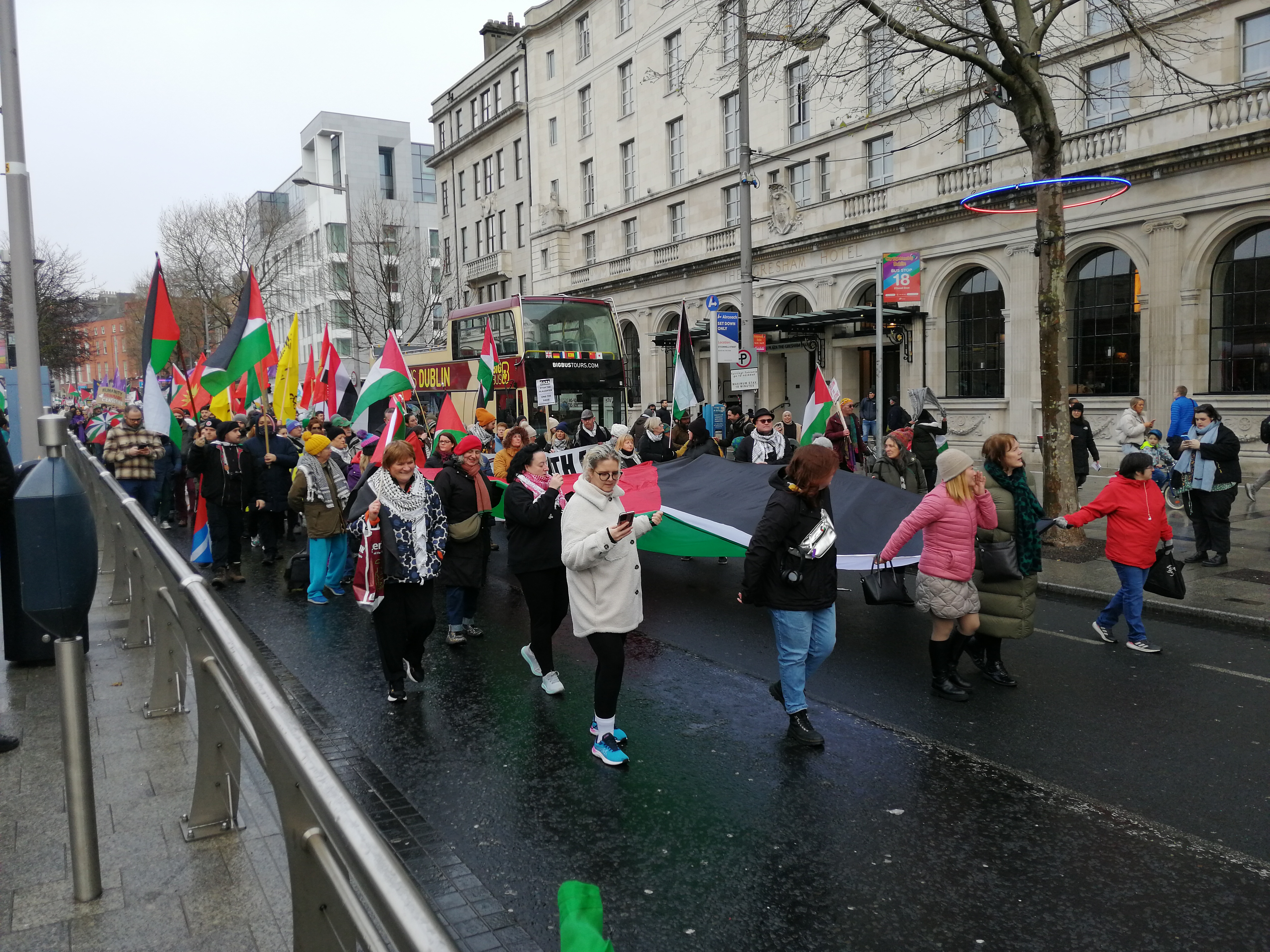
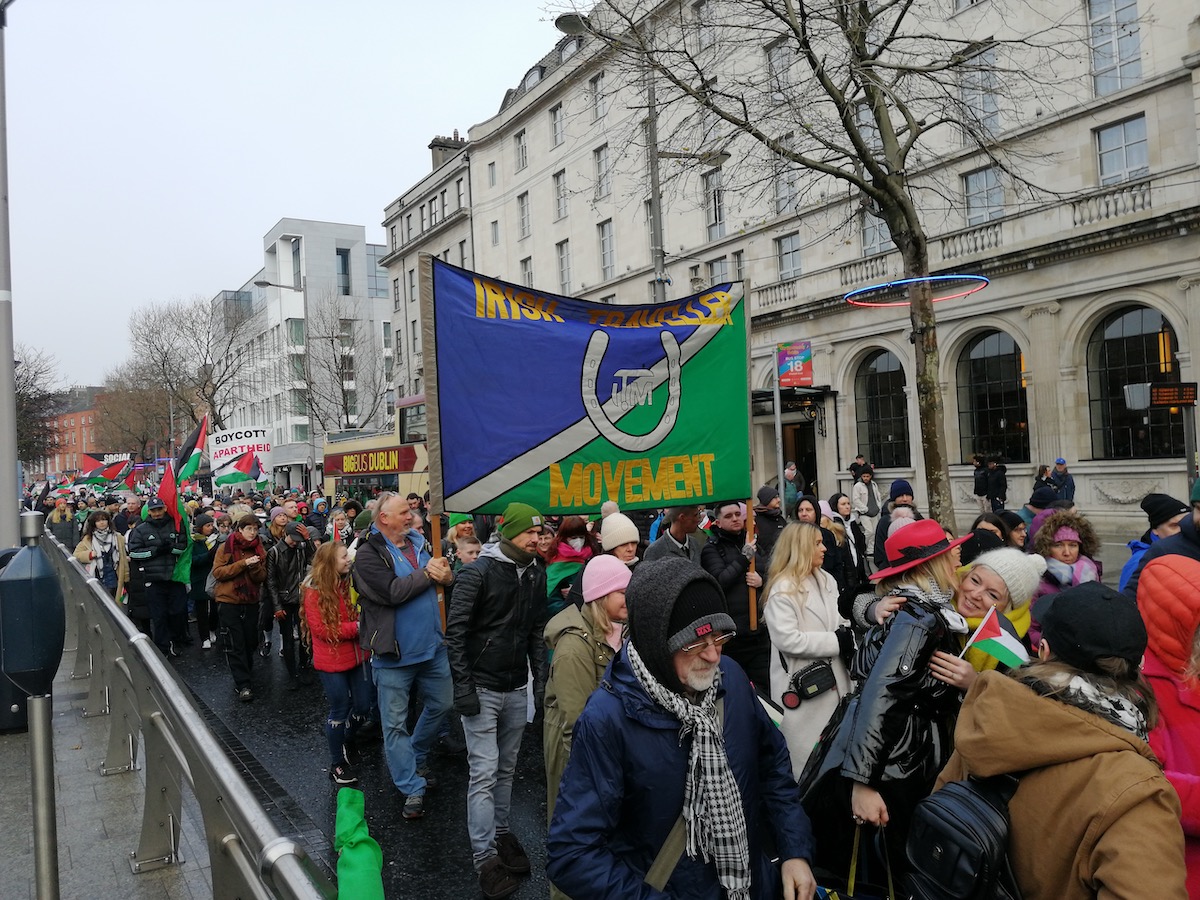
The Ireland Palestine Solidarity Campaign, along with organisations in many countries,2 chose Saturday 13th to display Palestinian solidarity, calling a national demonstration to march in Dublin on Saturday afternoon.
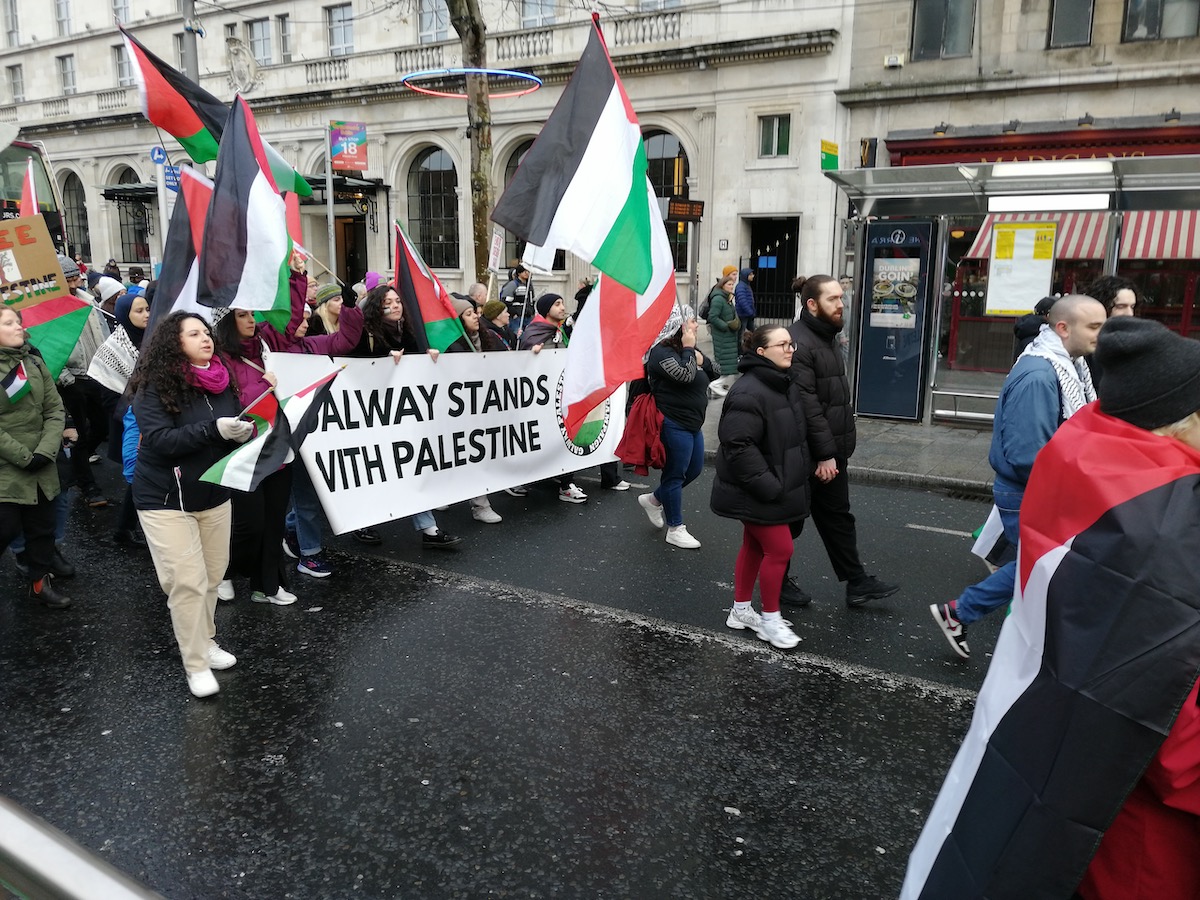
“Galway stands with Palestine” banner in O’Connell Street on Saturday. (Photo: D.Breatnach)
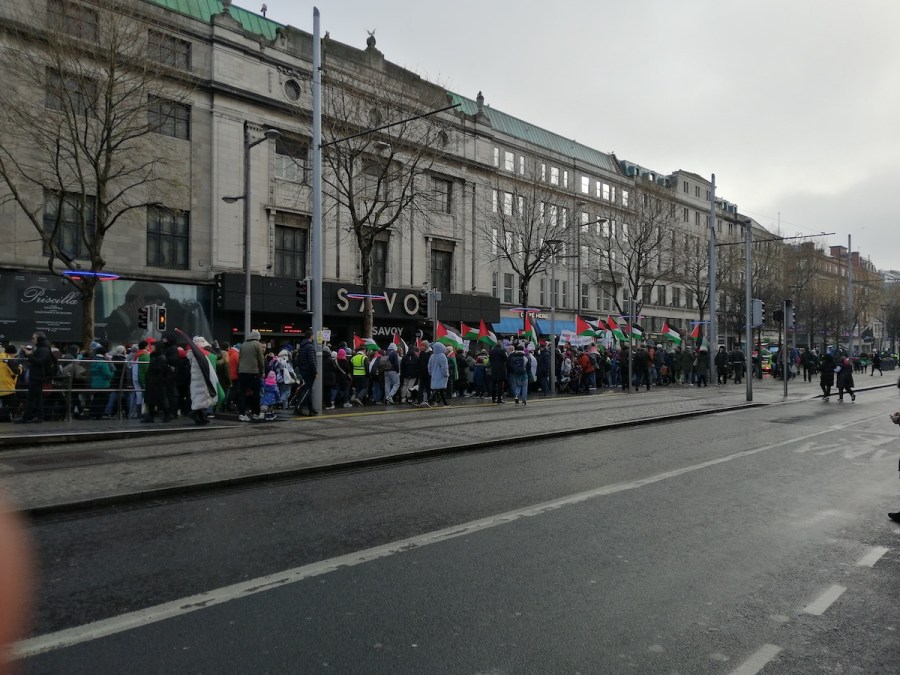
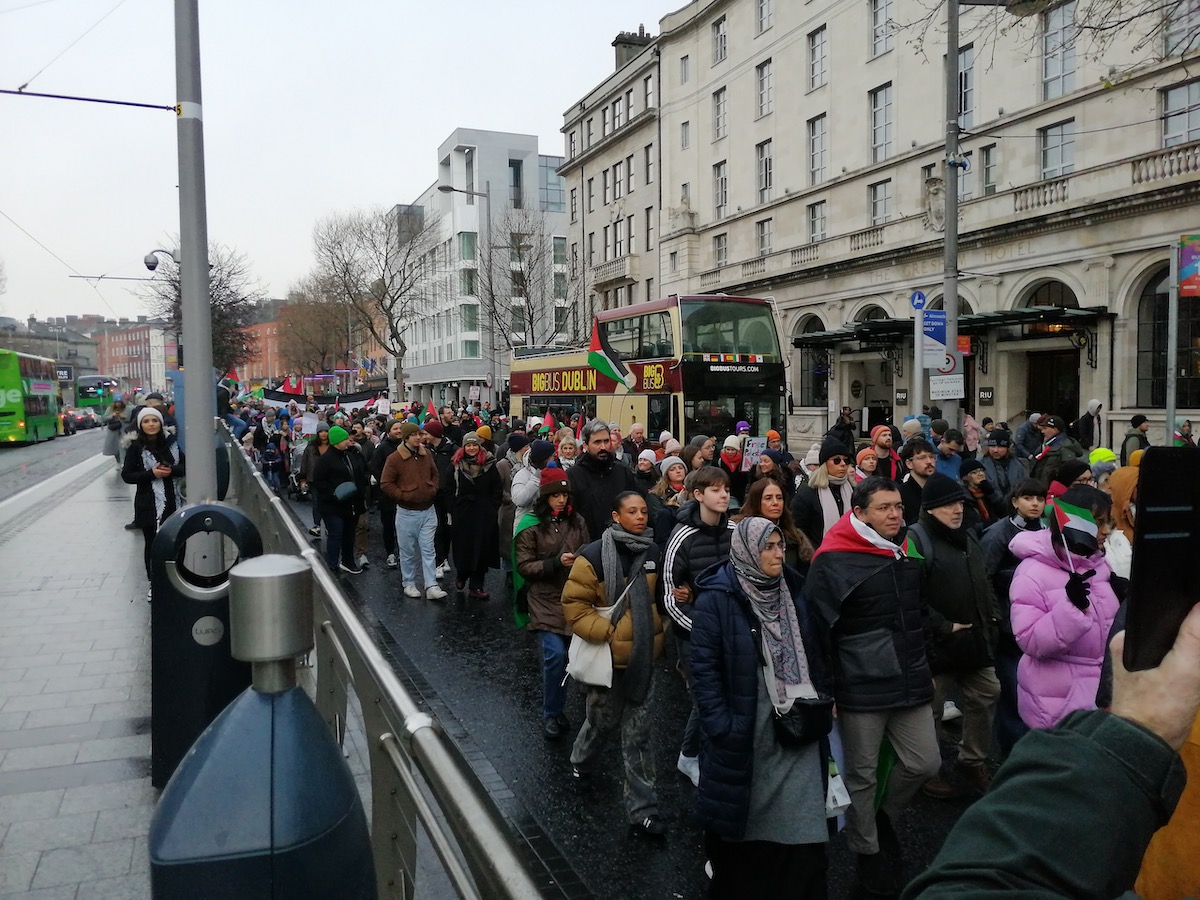
In Dublin, on a cold Saturday after periods of icy drizzle, the event commenced from the Garden of Remembrance in Parnell Square in the north city centre and set off marching to rally at the Irish Dept. of Foreign Affairs on Stephens Green in the south city centre.
In a tightly-packed mass, the end of the demonstration was just leaving the vicinity of the Garden of Remembrance when the head of the march had crossed O’Connell Bridge and reached the end of Westmoreland Street, a distance of one kilometre.
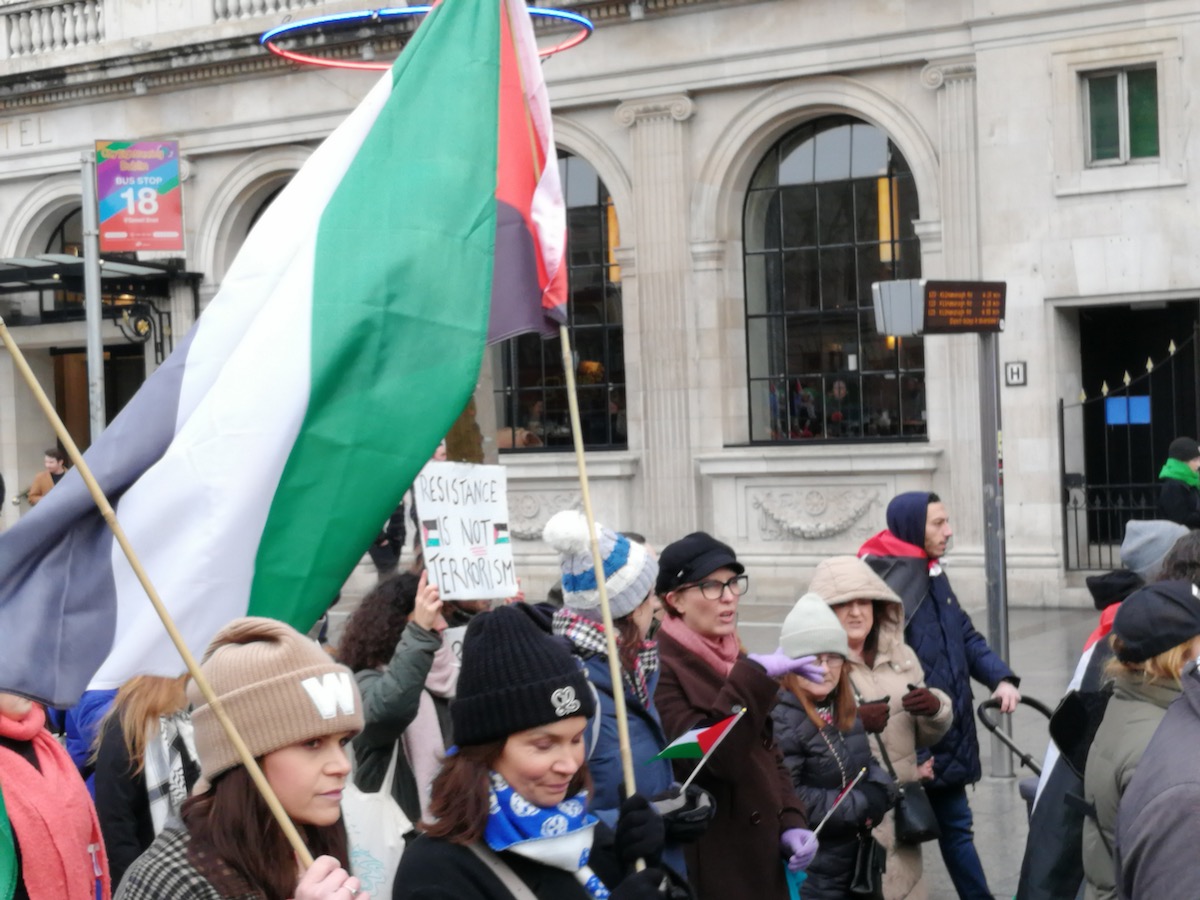
Women carrying a giant Palestine flag in O’Connell Street on Saturday. (Photo: D.Breatnach)
From Cork at the southern end of Ireland, from Tyrone and Belfast in the North, from Wicklow and Wexford in the South-east and from Galway in the West, groups and individuals had travelled to Dublin to participate in the nation’s statement of solidarity with the Palestinians.
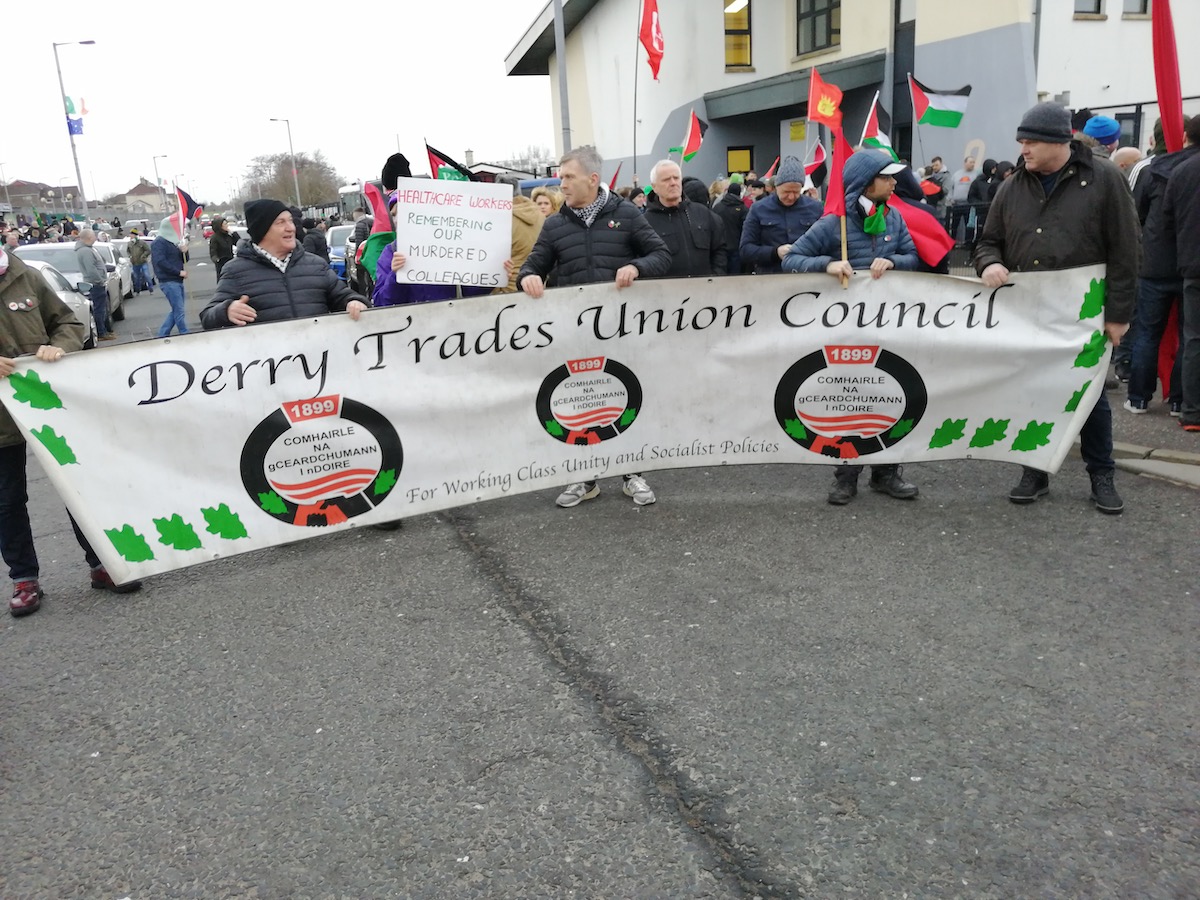
One hundred thousand marched in Dublin. Despite this, other demonstrations took place in towns and cities across Ireland too, including large ones in Derry in Cork, with other smaller ones in Carrick-on Shannon, Clonakilty, Cashel, Ennis, Kilorglin, Longford and Tipperary.3
Seen in O’Connell Street Saturday. (Photo: D.Breatnach)
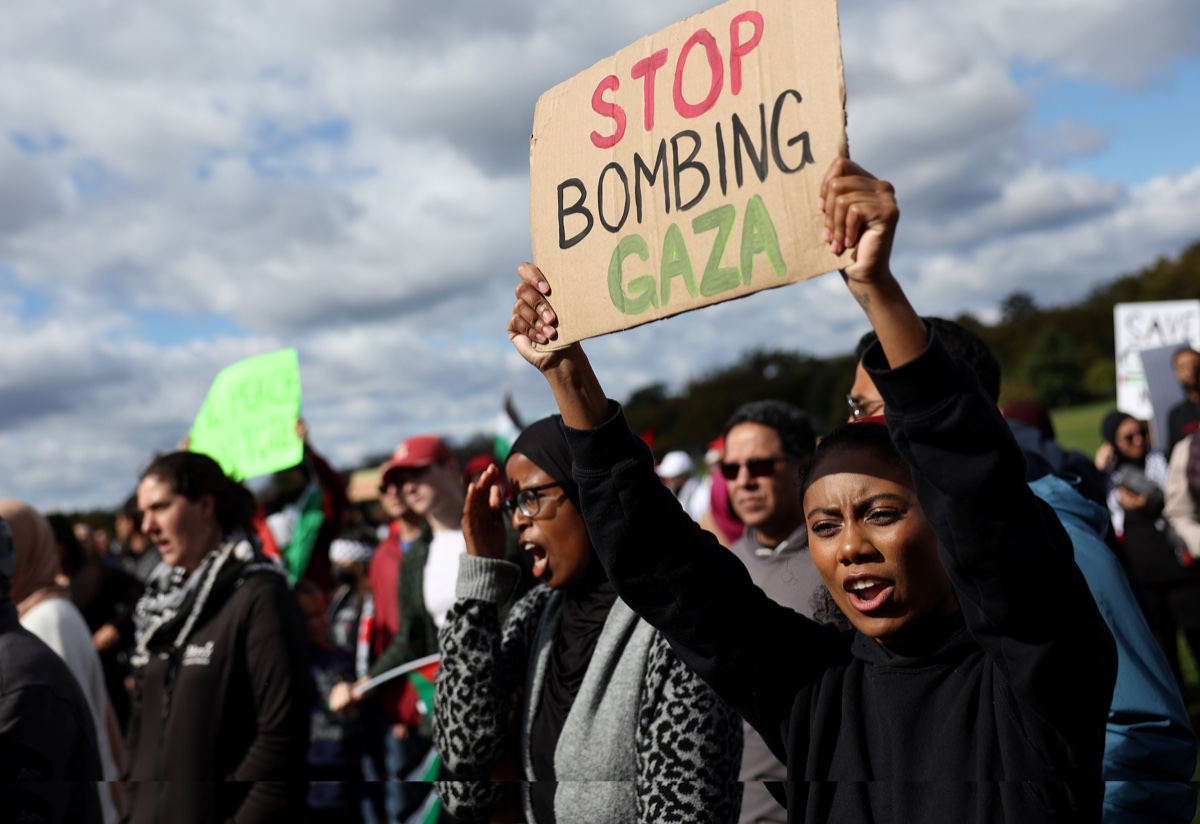
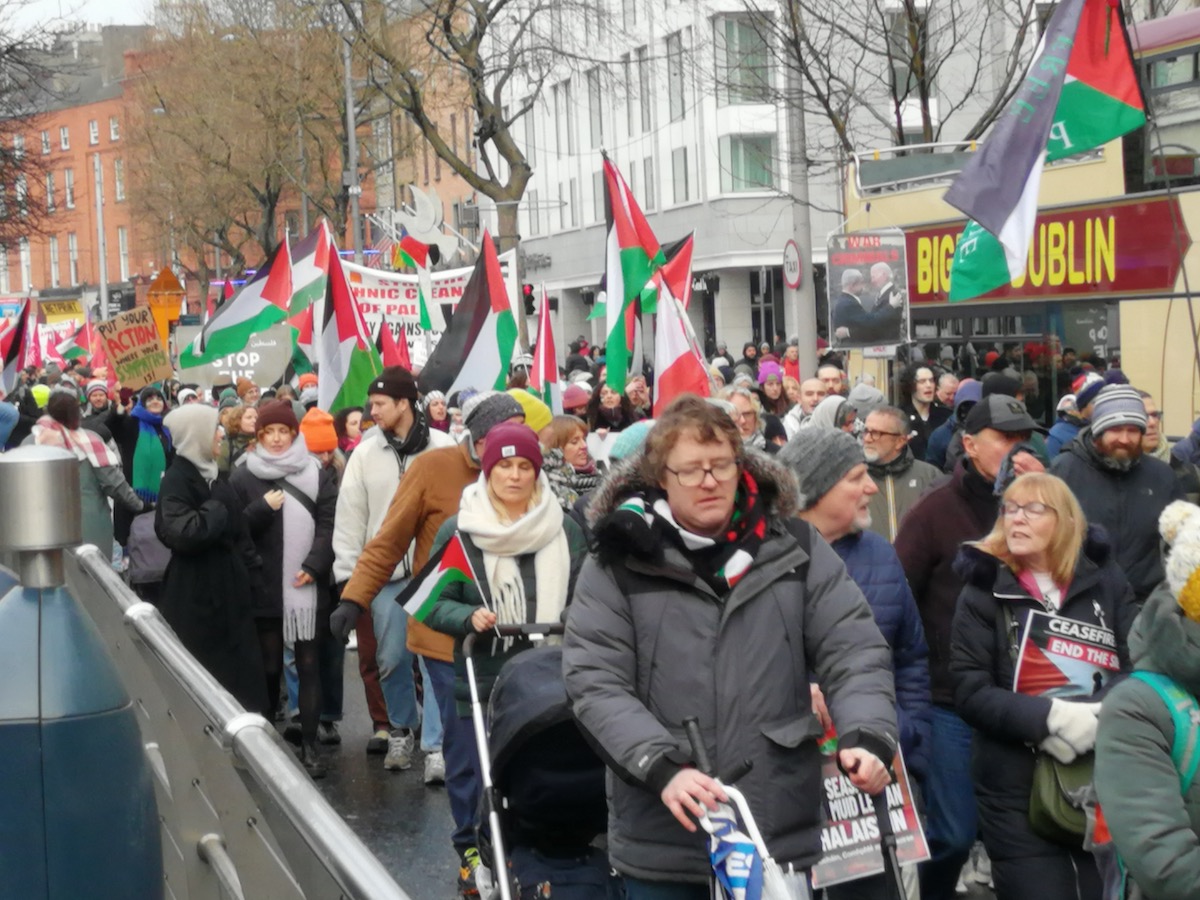
The Dublin march was striking in its cross-gender composition with women perhaps even in the majority. Accompanied children were in evidence and youth, the latter in particular female of ages ranging across the teens to young adulthood, vocal in condemnation of Israel.
Many participants were apparently migrant or of migrant background, both female and male, there too many were young, even to children and teens.
Seen in O’Connell Street Saturday. (Photo: D.Breatnach)
The slogans shouted were for the most part the regularised call-and-answer chants of Palestinian solidarity: Free, free – Palestine! From the River to the Sea – Palestine will be free! In our thousands, in our millions – we are ALL Palestinians!
Some regular slogans also targeted Zionism and its supporters: One, 2, 3, 4 – occupation no more! Five, 6,7, 8 – Israel is a terrorist state!Netanyahu, USA – how many kids have you killed today? Zionist Ambassador – out, out, out! Joe Biden, you can’t hide – you’re supporting genocide!
Another section of the crow in O’Connell Street Saturday. (Photo: D.Breatnach)
Boycott – Israel! was of often heard and the common cry of Ceasefire now! was subtly altered in at least one location to End the bombing – end it now!4And End the Occupation – end it now!
Less widespread but supported here and there was: There is only one solution – intifada revolution! Also: Resistance is an obligation – in the face of occupation.
Seen in O’Connell Street on Saturday (Photo: D.Breatnach)
The Irish language, an Ghaeilge, was visibly sprinkled throughout the march, with chants of Saoirse don Phalaistín! but much more often seen on placards, occasional Palestinian flags and T-shirts. That slogan is clearly taking some root among the indigenous Irish and migrant communities.
One group of solidarity marchers was evidently organised around expression of solidarity through Irish, with banners, placards and slogan-chanting in the national language.
Translation: (You are) the shame of the world, Netanyahu! Placard photographed at the rally along Stephens Green. (Photo: D.Breatnach)
When the march reached the rally outside the Department of Justice, the area in front of the speakers’ stage was soon packed and people still arriving or stopped further back had difficulty in following the speakers even with the PA full on.
There would seem scope for smaller meetings with speakers further away from the main stage and it seems curious that this has not been attempted, at least in Dublin, to date. Many participants began to drift away, whether for refreshments or to connect with their transport mode homewards.
“Put your Action where your Sympathy is” placard to extreme left of photo while centre right a partly-obscured “Seasann muid leis an Phalaistín” (We stand with Palestine) placard may be seen. (Photo: D.Breatnach)
Naturally, many chose to walk through Stephen’s Green, where a person in a hi-viz jacket was observed locking one of the gates on the park’s southern side, to angry comments from some of the exiting marchers.5
In Grafton Street, people also chanted Boycott Starbucks! as they passed the Seattle-based café chain and a little further, passing a fast food chain business: MacDonald’s, you can’t hide – you’re supporting genocide! Both businesses have been documented supporting Israeli zionism.
Over the 24 hours, Israel had killed another 135 Palestinians in Gaza.
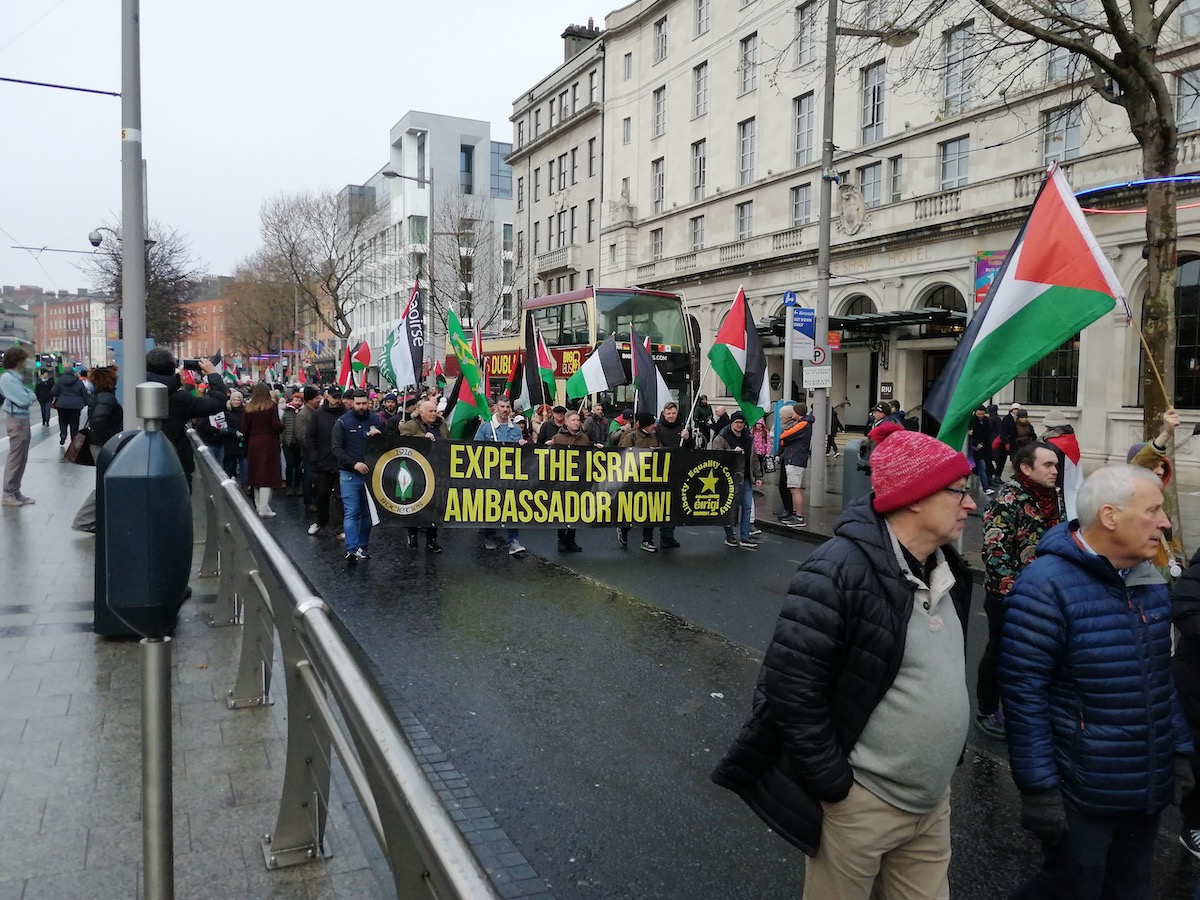
The march underway in O’Connell Street heading southward. (Photo: D.Breatnach)Meanwhile the end of the march is still making its way out of Parnell Square. (Photo: D.Breatnach)
THE COURT OF CRIMINAL JUSTICE
The march took place at the end of a week in which the South African government at the International Court of Justice had accused the Israeli State of genocide against the Palestinians and millions watched the case presentation by a team of barristers including an Irishwoman.6
The case listed well-established genocidal acts and words of the Zionist polity against the Palestinians, in particular but not exclusively since October last year. In addition, relevant case history in which the ICJ had adjudicated on genocide was quoted.7
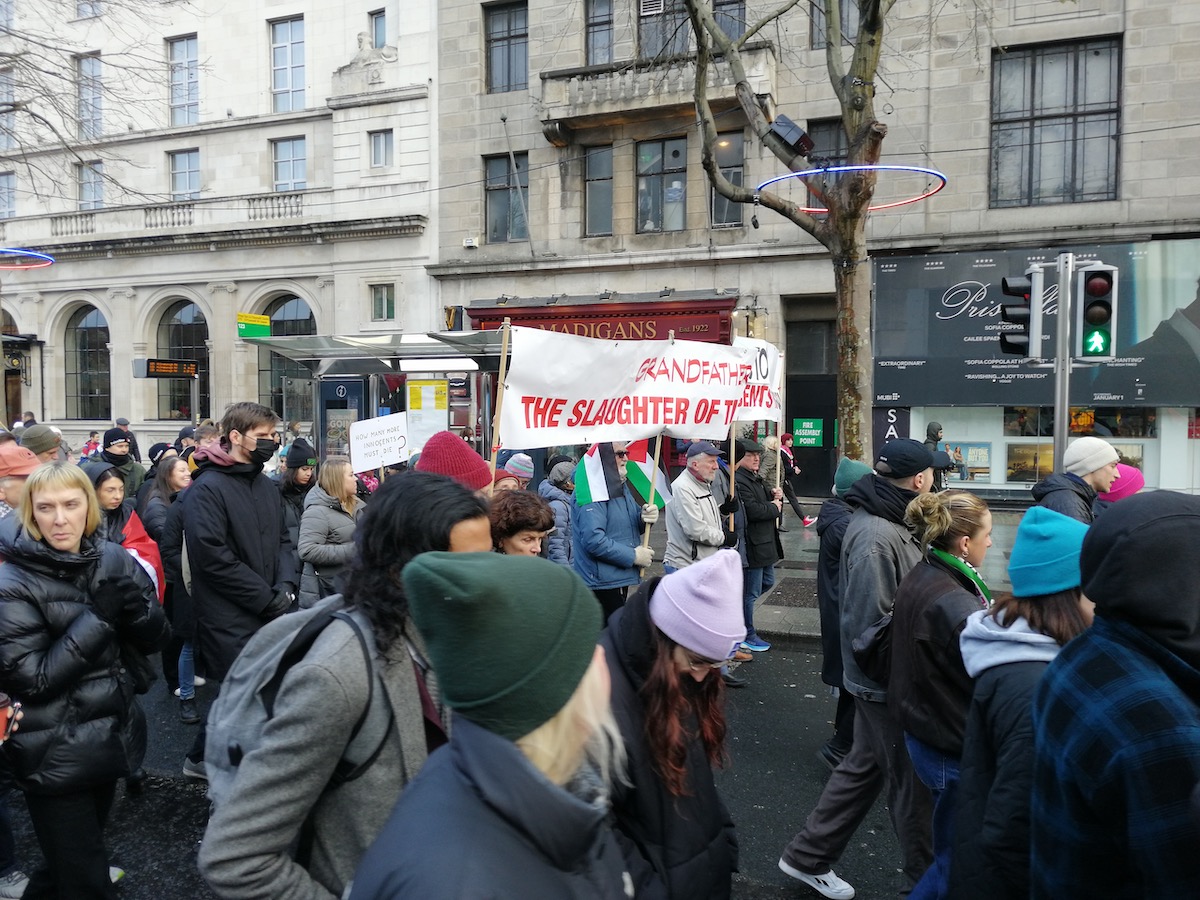
“Grandfathers against the slaughter of the innocents” banner in O’Connell Street on Saturday as the march gets underway. (Photo: D.Breatnach)
South Africa sought an early interim Court instruction for cessation of Israeli bombing of and ground assault on Palestinians. The Israeli team’s response was to state that ending their bombing would be to hand victory to Palestinian resistance8 and an existential threat to the Zionist state.
The Israeli team’s arrogance was clear in that they turned truth on its head, presenting themselves as the victims, repeating their propaganda lies and disdaining to quote case law or to explain how the appalling death toll of Palestinians and destruction constitutes necessary defence.
Placard seen at the rally along Stephens Green on Saturday. (Photo: D.Breatnach)
The Zionist Prime Minister, Netanyahu, seemed to indicate that the Government would not obey any restriction to the killing ordered by the ICJ and boasted that no-one could force compliance upon the Zionist state9 (which, as long as it is supported by the USA, is a disturbing fact).
The death toll now stands at 23,843 with another perhaps 9,000 missing (most of them believed buried under rubble of buildings collapsed by Israeli bombing).10 The number of injured is quoted as surpassing 60,000 while 85% of the Palestinian population are displaced refugees.11
“One child killed every 10 minutes in Gaza” placard seen on Saturday in this section of the rally along Stephens Green, outside the Irish Department of Foreign Affairs. (Photo: D.Breatnach)
According to a new data set from the Israeli military on its operations in Gaza, it claims killing “about 9,000” Palestinian fighters in the enclave since its assault began. Even if true that would be about 37% of the total number of 23,968 people killed there since October 7.12
In other words, the Zionist state is de facto, based on its own numbers, admitting to the killing of nearly 15,000 civilians!
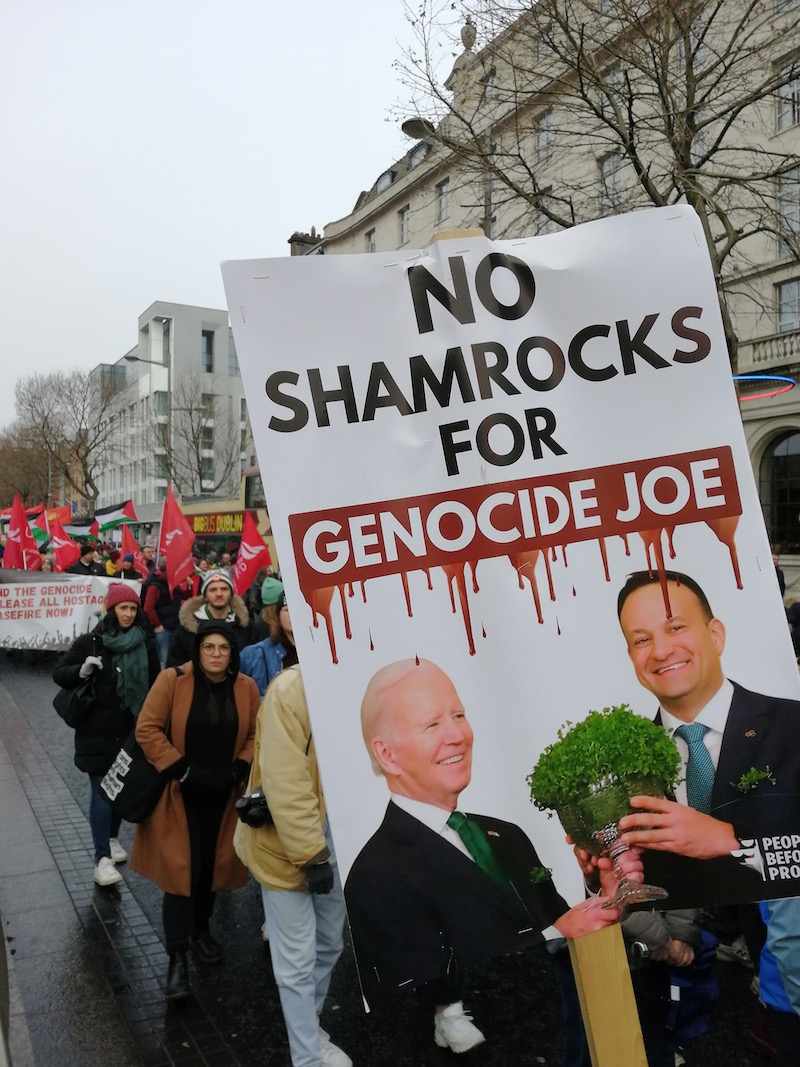
Part of a campaign asking Irish politicians not to do their usual junket this year of going to the USA to mix with politicians for St. Patrick’s Day. (Photo: D.Breatnach)
Whatever the true figure of Palestinian fighters killed, it has not been without cost as the spokesman for Hamas’s Qassam Brigades says that since October 7, they’ve “destroyed or disabled 1,000 Israeli military vehicles, and carried out hundreds of operations against the occupation”.13
“All the weapons we use are ones Qassam has made itself,” he added and a video released earlier showed projectiles and weapons being constructed in what seems to be an underground workshop, using modern milling and drilling machinery.
“Resistance is not terrorism” placard seen in O’Connell Street on Saturday. (Photo: D.Breatnach)
The Irish parliamentary opposition parties of Sinn Féin, the Social Democrats, People Before Profit and the Labour Party last week publicly called on the Irish Government to support the South African case in the Hague, which Taoiseach Leo Varadkar has declined to do.
That the Irish Government coalition of Fianna Fáil, Fine Gael and the Greens feels under pressure from the public response to the Israeli genocide in Palestine is indicated by the statement of Eamon Ryan that points in the “South African genocide case against Israel are irrefutable”.14
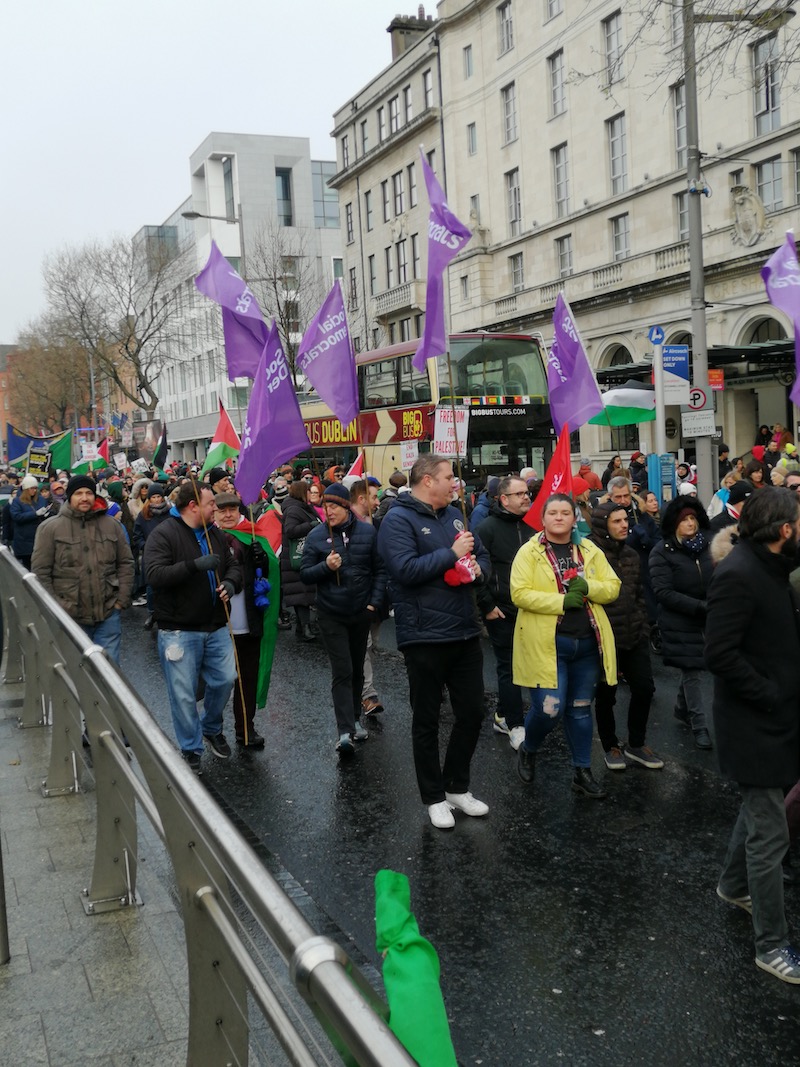
Social Democrats party flags in O’Connell Street on Saturday. (Photo: D.Breatnach)
Meanwhile a huge portion of the population and nearly a generation of young people in Ireland have been exposed to horrific crimes abroad, to impressive internationalist solidarity and to the shameful collusion of the Irish ruling class and its political representation in Leinster House.15
end.
Seen in O’Connell Street Saturday. (Photo: D.Breatnach)
4Some argue that the call for a ceasefire a) suggests that this is a war between equally-armed antagonists and b) that a ceasefire is laid on all combatants whereas, they say, no-one has a right to limit Palestinian resistance against their genocidal occupiers.
5They were heard remarking that this had occurred also during a Palestinian demonstration in Merrion Square
7None before now have been against a Western or Western-allied power; terrible though they were, none approached the severity of the case in point.
8Throughout, in common with earlier statements in collusion with many heads of state and persistent misrepresentation in most mass media reporting, this was presented only as “Hamas”, which is only one of a number of Palestinian resistance organisations actively fighting the Zionist attack. In addition, the Palestinian death and injury statistics and visual evidence of the destruction visited upon Gaza (a city approximately the size of Dublin but twice as densely populated) illustrate that the Israeli state’s attack is largely on Palestinian non-combatants.
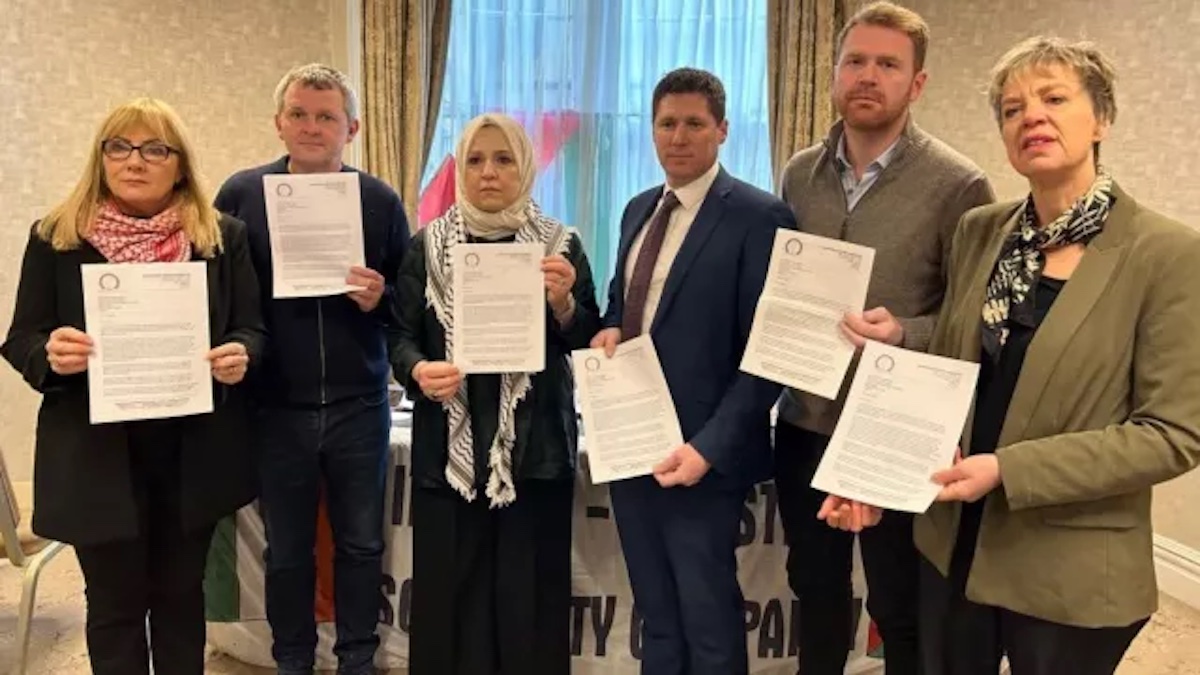
The main political opposition parties in the Irish parliament have made a united call on the Irish Government, a Coalition of Fianna Fáil, Fine Gael and Greens, to join in the genocide case against the Israeli state at the International Court of Justice.
The original case was opened recently by the South African government and the Israeli Government, to some surprise, indicated it would attend and defend itself. It is due to begin public hearing 11-12 January.
The Irish Opposition parties represented in the call on the Irish Government represent a cross-section politically: Sinn Féin, Social Democrats, the Irish Labour Party and People Before Profit. Other smaller parties have one TD1 and there are many Independent TDs of varying hues.
Accompanying the party representatives at a press conference were Frances Black, independent Senator who moved the Occupied Territories Bill to ban products from those regions, also Fatin al Tamimi, from Palestine and Chairperson of the Ireland Palestine Solidarity Campaign.
Some of these parties have moved motions in Leinster House, home of the Irish Parliament, for the expulsion of the Israeli Ambassador to Ireland. The Irish government successfully opposed that motion and also opposes joining the South African motion.
The motivation of the concerned party representatives may well mirror their own personal or political feelings, some more than others but it is undeniable that it reflect the feeling across most of Ireland (with the notable exception of Loyalist areas in the British colony).
That has been the general case for decades but has grown enormously since the Zionist State’s genocidal bombardment of Gaza. Every week has seen large marches, rallies and smaller pickets in solidarity with Palestine in Irish cities and towns.
The Department of Foreign Affairs’ main office was paint-bombed in red, the company leasing the Israeli Ambassador’s offices was occupied, as was a hotel bought with a loan from an Israeli bank and also Axa Insurance, the Embassy was briefly occupied and is regularly picketed.
MacDonald’s and Starbucks have also been picketed in various areas and supermarkets have seen regular protests over their sale of goods from the Zionist State. Drivers regularly beep their horns in support as they pass Palestinian solidarity demonstrations.
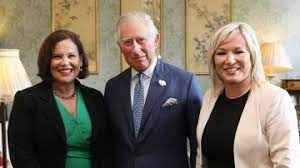
Photographed at the press conference announcing their joint call, from left to right: Senator Frances Black (Independent), Richard Boyd Barrett (PBP), Fatin al Tamimi (Chair IPSC), Matt Carthy (Sinn Féin), Gary Gannon (Progressive Democrats), Ivana Bacik (Labour Party). (Photo from: Breaking News report)
THE PARLIAMENTARY PARTIES SUPPORTING THE CALL
The number and pitch of the protests and the numbers involved have definitely pushed some of the parties forward in parliamentary action, in particular Sinn Féin, widely expected to form the next Irish government coalition (though with whom remains to be seen).
Though the party was quick to ride the earlier anti-Russian publicity and call for the Russian Ambassador’s expulsion, it initially balked at doing the same with regard to the Israel one; however it had to support the call in answer to popular opinion and no doubt within its own membership.
The position of the Social Democrats on the question has been surprisingly strong and it was their leader who moved the Ambassador expulsion motion in Leinster House.2 The Labour Party3 has not been generally vocal on the issue though supported the expulsion call.
People Before Profit4 has always had a strong pro-Palestine stand but one of its leading members and TDs5 also attacked the Palestinian incursion on October 7th. Later the party developed the slogan for demonstrations that “In the face of occupation, resistance is an obligation!”
The South African case of genocide against the Israeli State seems to be gaining some support but few governments have so far joined it, despite the Deputy Prime Minister of Belgium and others advocating its support. The EU itself has hardly blinked in its support for the Israeli State.
THE INTERNATIONAL COURT OF JUSTICE
The ICJ is an organ of the United Nations and, like the International Criminal Court, with which it is often confused, is based in the Hague, Netherlands. There have been criticisms of its effectiveness and its likelihood of bias according to the state origin of each Judge.
At this moment, the main benefit of the legal charge against is the Zionist state is of public opinion against its genocidal bombing but the ICJ can also impose interim restrictions. Whether the Israeli State will obey those or indeed accept an eventual ruling against it is another matter entirely.
The Israeli state’s founding philosophy of Zionism is a genocidal one as is also its very nature of a white European settler occupation of a land already occupied by indigenous populations. It is difficult to imagine how it can tolerate condemnation of its very essence.
Nevertheless, for the moment the case and increased support for it has publicity value. However, the solidarity movement cannot afford to relax on iota and in fact needs to up the pressure on the Zionist entity and all its supporters, be they states or corporations.
End.
Footnotes
1TD = Teachta Dála, elected Parliamentary representative.
2Her speech to the rally outside Leinster House the evening of the debate was more militant than Sinn Féin’s representative.
3The party, though founded by militant syndicalist Jim Larkin and revolutionary James Connolly, has been in coalition government a few times, mostly with the right-wing Fine Gael and was noted for attacks on the working class, despite its trade union support base.
4Like its namesake in Britain, it is mainly a version of the Irish iteration of the Socialist Workers’ Party, founded in the UK.
We need to be careful when elevating people from our ranks to the status of heroes – especially if they are alive and can renounce or betray the principles they originally fought for.1
And we have the right to be suspicious when those heroes are also acclaimed by the capitalists and imperialists, those who are certainly not our friends. But most of all, it is by their fruits that we can best evaluate people, whatever their past actions.
The society bequeathed after years of heroic struggle to the South African masses is broken. Housing and homelessness crisis,2 unemployment, poverty,3 prostitution, lack of medical care, inadequate sanitation and soaring crime, including violent crime – is not what the people fought for.
And this is occurring in a country rich in natural resources4 which are being extracted daily by imperialism, while the few on top — the earlier white settler bosses now joined by the corrupt black bourgeoisie – live in luxury.
(Image sourced: Research Gate)
CRIME & POLICING
Anton Koen, a former police officer who now runs a private security firm that specialises in tracking and recovering hijacked and stolen vehicles believes that “It’s not getting better, it is getting worse”, with the murder rate the highest it’s been in 20 years.
(Photo cred: AP)
In crime-ridden societies, the poor suffer the most and are of course also recruited into crime.
There were 27,494 killings in South Africa in the year to February 2023, compared with 16,213 in 2012-2013. South Africa’s homicide rate in 2022-2023 was 45 per 100,000 people, compared with a rate of 6.3 in the US and around one in most European countries.
Those who can afford it, hire private security, which is a booming business with South Africa’s security industry — one of the largest in the world, with more than 2.7 million registered private security officers registered in the country, according to the regulating agency, the PSIRA.5
“People with money make up a very small percentage of South Africa, said Chad Thomas, an organised crime expert who has worked more than 30 years in police work and now in private security.6
“That means that the vast majority of South Africans don’t really benefit from this security industry … If you live in a traditional township environment, or if you live in an informal settlement …7 security patrols in those areas are few and far between because they don’t have paying customers.”
Thomas, like many, ties the high levels of violent crime in South Africa to anger over the country’s deep problems of poverty.8
Private security companies are paid a monthly fee to patrol neighbourhoods and for providing armed response to their clients’ alarm systems. Tracking and car recovery can be part of the service, often resulting in getting involved in high-speed chases of car thieves and hijackers.
According to the PSIRA, the number of security businesses in South Africa grew by 43 per cent in the past decade, while the number of registered security officers has increased by 44 per cent. Meanwhile there are 150,000 police officers for the country’s 62 million people.
It is hardly surprising that the SA police force has difficulty in recruiting numbers. It is a force used to violently repress people9 and culpable in the worst massacre of working people in South Africa’s modern history, killing 40 striking miners over a couple of days.
That slaughter occurred in 2012 at the British-owned Lonmin platinum mine in Marikana, when miners wished create a new union and to leave the National Union of Mineworkers which, they said, was more in favour of their employers than the workers.10
Cyril Ramaphosa, the millionaire ex-President of the NUM was widely suspected of having organised the massacre and he’s now President of the ANC and of the South African Government. At the time, Jacob Zuma was President, now in the process of being tried for financial corruption.
But Mandela was still alive and at liberty when the massacre occurred and did not condemn the atrocity nor those responsible. Long-time anti-apartheid campaigner (and Mandela’s friend) Bishop Tutu once famously commented that “The ANC stopped the gravy train – long enough to get on it.”11
IMPORTANT
Is it important whether this person or that were truly the heroes they are reputed to have been? I think it is, not only because we tend to erect them as models for our behaviour but also because their lives and their choices present us with historical lessons.
The South African regime during the struggle was a white European settler state and like all of those, undemocratic and racist too. The masses rose up several times against it but people did not risk beatings, torture, imprisonment and death merely for the right to vote.
The struggles were so strong and the minority settler regime so emphatically opposed to reforms that its imperialist partners felt it vulnerable to revolution. They eventually convinced the regime to enfranchise the majority black population.
But what if the black masses went on kick out the imperialists?
The change had to be managed and the leadership of the ANC, the NUM and the Communist Party of South Africa proved willing to control their supporters. However, something else was needed, as in similar circumstances: a known face, a hero, to be the figurehead before the masses.
Representative of USA, chief imperialist country and Nelson Mandela after latter’s release.
Mandela proved to be that man, not only for his long imprisonment for guerrilla action but because he had been tested among the political prisoners on Roben Island and was judged the most suitable, so he had been separated from the other political prisoners to a new jail for grooming.
Mandela, after a huge publicity buildup around the world, was released in 1990 and began a series of negotiations with the settler minority’s leadership. In 1994, with universal suffrage, Mandela was easily elected head of the ANC and of the new government of South Africa.
Of the wave of pacification processes that swept around the world starting in the very early 90s with Al Fatah in Palestine, the South African process turned out to be the only one that delivered any of the objectives of what was promised12 — and that was the vote for everyone.
But it had the potential beyond that gain: of national liberation, the possession of all its natural resources and of a progressive social order, a beacon for the rest of Africa. It was important for imperialism to prevent all that and, with the help of the leaders of the ANC, NUM and CPSA, they did so.
The immediate result was a drop even further in the standard of living of the masses and an increase in the rapacious grip of imperialism on the natural resources, while municipal services declined further and crime at the bottom took off, matching corruption at the top.
The broken society there now is the cumulative result and should serve as a lesson about pacification processes, negotiations during struggle and our choices of heroes – or those chosen for us.
End.
FOOTNOTES
1As we in Ireland can testify, with the lionisation of Michael Collins, for example, for his role in the War of Independence (1919-1921) but who, a little later, acted on behalf of the Irish colonial bourgeoisie and their British masters to launch the Civil War (1922-1923) to prevent the establishment of a 32-County Republic.
3 As of 2023, around 18.2 million people in South Africa are living in extreme poverty, with the poverty threshold at1.90 U.S. dollars daily (see Statista in Sources & References).
10It was notable that those popular organisations deeply implicated in pacification processes either reported with great restraint on the massacre or failed, like the Left-Nationalist Basque trade union LAB, to comment on it at all (to say nothing of sending a solidarity message to the striking workers or denouncing the State).
Yes, you peace-loving liberals, we told you but you wouldn’t listen. Told you that Zionism means racism, colonial settler expansion and, ultimately, genocide. But you wouldn’t listen. And you’re not listening now.
There just had to be a way of resolving things so everyone got something and then there would be peace, you all said.
People like you think all that has to happen for peace is that both sides sit down and talk. But what if what one wants is irreconcilable with what the other wants? Well, then you say, they both have to give up something.
The problem with that is that it’s always the oppressed who have to give up the most – or even everything. However, that’s necessary, because that’s how we get peace, you say. But would you apply it to yourselves as easily?
If a thief got your wallets, would you suggest sitting down and talking it over with him or her? Maybe suggesting s/he only stole half the contents? Well, you might, I suppose. But what if they got your cars, your houses and emptied your bank accounts?
You’d very quickly resort to violence! Oh, not you personally, of course not! You’d get the police to use force for you and a judge to use force to put them in jail and prison officers to use force to keep them in jail for an allotted time, to try and ensure they didn’t steal from you again.
We told you that the only peace the Zionists could achieve would be the peace of the Palestinian cemetery; but as many graves as the Zionists dug for the Palestinians, more would rise up fighting and they would never give up their land or agree to be kept down.
Every time the Zionists carried out a massacre or another atrocity, we told you: the only solution to this conflict is a unitary democratic state of Palestine, “from the River to the Sea”. But you wouldn’t listen.
And even now, as you begin to talk about “peace again” “after Gaza”, it’s clear you haven’t learned. The massacre of 22,600, including over 9,000 children, the ruins of Gaza, refugee camps, hospitals, mosques, water and sewage treatment plants have taught you nothing.
Because here you are again, proposing something other than the rational solution, in this case re-marketing the two-state plan. All the imperialists agree and you’ll get Abbas and the corrupt Al Fatah to go along as before of course but the Palestinian people as a whole will never do so.
The irony is that by pushing your kind of ‘peace’ measure and avoiding real peace, you are effectively advocating the conditions for war without end – or wiping out/ expulsion of the Palestinians. Really, it would be better if you just shut up and stop trying to ‘help’.
Because the only ones you’re helping are the genocidal Zionists and their imperialist backers.
Frank Kitson, a leading terrorist and General in the British Army, died today at the age of 97.
As the national liberation struggle of the Occupied 6 Counties began, Kitson was appointed as commander of British forces in Belfast in 1970. He organised “countergang” death squads such as the Military Reaction Force and the Force Research Unit.
These units bombed and randomly targeted innocent nationalists, attempting to place the blame on the IRA. He promoted infiltration of and psyops against the Republican movement. He emboldened and directed Loyalist death squads and deployed the Paras to massacre nationalists.
Kitson was a leading figure in the British counterinsurgency campaigns in Malysia and Kenya. It was here he developed his theories on how to crush national liberation and communist struggles.
He advocated for massive population control and terror to deprive struggles of support. He advocated for forming paramilitary groups that were free to terrorise and assassinate at will, as well as spread doubt among natives. He drew from these campaigns and deployed them in occupied Ireland.
As an advocate of psyops, Kitson used the mainstream media to spread malicious lies about the Republican movement, including absurd propaganda such as claiming that the IRA were found to be worshipping Satan.
Under his command and through his recommendations prisoners were tortured, civilians brutalised and countless were interned.
While Kitson was removed from his position in 1972, his theories and the framework he established in Belfast came to be adopted by the British imperialists in Ireland for decades.
Many of the terror strategies he developed are used in Ireland and in imperialist occupations around the world today as part of “low intensity operations”.
Frank Kitson was a crusader for Empire and he was well rewarded for his campaign of murder and terrorism. He also lauded by the British press and given countless awards.
It is shameful that he never faced the People’s Justice for his crimes. That this man was allowed to retire and live out his life in peace is a symptom of the deep sickness in British society. That this man dies with full honours shows that collusion, terror and murder were official British state policy in Ireland.
As the imperialists have developed their tactics and strategies, so have the people. No matter what new innovations in subversion, terror and brutality the enemy comes up with they will be overcome. The struggle of the Palestinian Resistance today has taught the imperialists that lesson once again.
The struggle for the All Ireland Republic continues despite the best efforts of British imperialism. One day soon the British Empire will be buried along with Frank Kitson.
British TV personality Rachel Riley shared with the media that she is feeling sombre on New Year’s eve with reference to the conflict in Gaza. We could all empathise with that were it not for her further elucidation.
So, what makes you “somber” Rachel, is the number of Israeli settlers killed on October 7th– not the genocidal slaughter of thousands of Palestinian civilians, including women and children?
From some points of view, it is entirely understandable that should be making you somber three months later. But what is not understandable in any sense of humanity, Rachel, is that you are not in the least somber about the genocide being carried out every day.
A genocide that in just three months has taken the lives of tipping at 23,000, destroyed refugee camps, clinics, hospitals, ambulances, mosques, schools, bakeries, water treatment plants, whole neighbourhoods, fishing boats, and left a dislocated 1.9 million to starve and die from disease.
It is recorded that you give talks on a genocide committed nearly a century ago – for which you have been awarded an imperialist honour — but apparently the one occurring now does not move you.
Even for someone with Zionist credentials1 that seems shocking — but perhaps we shouldn’t be shocked, for genocide is both the excuse, the aim and the practice of Zionism.
In an Instagram post on Sunday, you wrote that “Holocaust education feels present and urgent” since the attack by Hamas on October 7th. We agree — but not in the way you meant it, which was as a justification for the holocaust being visited upon the Palestinians.
Which would be bad enough if they had been the ones who carried out the other genocide, the one (the only one, apparently) which concerns you, but they aren’t. No, in fact, many of those states that carried out the genocide against the Jews are the very ones endorsing and supplying this slaughter.
Yes, the Palestinian offensive on 7th October last year was brutal – it was a military operation. But how does it compare in scale and number of occasions to the brutal massacres carried out by the ‘Israeli’ state in the expulsion of 750,000 Palestinians from their very land and ever since?
You claimed that “As a result (of the Palestinian attack), incidents of anti-Jewish hate are surging around the world”. Of course, we know that Zionists constantly try to conflate anti-Zionism with anti-semitism, even accusing anti-Zionist Jews of being “self-hating.”
But if anti-semitic incidents are indeed on the rise, do you not think that the bestial genocidal acts of the Zionist state might be a more likely source for such incidents? Along with the feeling of powerlessness engendered by the complicity of the major powers in the genocide?
You expressed a wish “for an end to the violence in Gaza and the region as soon as possible that allows for stable and safe home for everyone there to be able to live in peace.” We might be able to join you in that wish, “as every decent person” might, if we didn’t know what you really mean.
What homes remain to the people in Gaza, Rachel? What you mean is the ‘peace’ in ‘Israel’ before 7th October last year.
What you want is the ‘peace’ of the end of Palestinian resistance to the wholesale robbery of their land, to the expulsion of refugees, to the thousands of indignities heaped upon a people made second-class denizens in their own land, where they cannot even be citizens.
Expelled from houses in Jerusalem, houses elsewhere demolished, water and sewage treatment plants ruined, fishermen forbidden beyond their polluted shores and harassed even there. Prisons full of Palestinians, even children, sentenced by military courts and many not even convicted.
Constantly under pressure from the encroachment of armed zealot European settlers even into the ‘reservations’ the State allows the Palestinians with the Gaza open prison deliberately kept at subsistence level, with no legal way in or out except by Zionist permission under Zionist guns.
We note that you were a forefront campaigner against the left-social-democrat Jeremy Corbyn. As a revolutionary I have more than one bone to pick with him but your campaign and that of the others with you was a complete fraud: there was no more anti-semitism there than anywhere else.
In fact, once again, it was the conflation of anti-Zionism with anti-semitism which was the real issue and shamelessly used by Corbyn’s enemies and competition within the imperialist British Labour Party to overthrow his leadership.
MATHEMATICS
It is recorded that you are a qualified mathematician so I have some questions for you around numbers and statistics: how many Palestinians is it justified to kill to avenge the “around 1,200” claimed killed by the Palestinian incursion operation?
Or how many Palestinian civilians is it justifiable to kill for those Israelis killed? The Zionist state improbably claims it has killed 8,500 Palestinian fighters and if we deduct that figure from the overall number of those killed, 23,000, it still means the killing of 14,500 civilians since October.
On the other hand, from an analyst’s estimated death toll of 3,500 Palestinian fighters,2 that means that the Zionist death toll of Palestinian civilians is 19,500. How do you justify that as payback for the revised figure of 1,200 Israeli civilians killed in the Palestinian operation of 7th October?
But even that figure is false, isn’t it? Because many of those killed were Israeli soldiers, right? And most military age Israelis are either serving soldiers or reservists, like the ones called up to take part in the current genocide.
And now Bituah Leumi, Israel’s social security agency on its website lists 695 people killed during the attack, over half of which were Israeli security personnel, with names and the alleged circumstances of their deaths (but of course the media will keep repeating the old numbers).
And then even those can’t all be added to the total Israelis killed by Palestinian fighters on that day, since we know from Israeli civilian and army testimonies that many of the Israelis were killed by the IOF in panic, in crossfire or in deliberate shelling according to the “Hannibal” doctrine.3
So, after a quick “countdown” of which you are surely capable, Riley, how many indigenous Palestinian lives may justifiably be taken for each Israel settler in the Zionist colony? And what would happen, though I do not encourage it, if the Palestinians were to reverse the ratios?
End.
FOOTNOTES
1In case of confusion let me state clearly that has everything to do with your political outlook and next to nothing to do with your ethnic group or your mother’s.
We often hear people talk of the need for unity in progressive and revolutionary movements, which is understandable since the movements are often weakened by divisions – in other words, by disunity.
We may often hear the plaintive cry from someone that “we all want the same thing so why don’t we all just unite”? Clearly the issue is more complicated than it seems at first glance; there are factors working in favour of disunity also.
It is clear that calls for unity alone have not achieved it and much less often do we hear any serious attempt to define the conditions for unity, its principles and the obstacles to overcome, nor at times, the pitfalls in unity for the revolutionary movement, for there are those too. 1
And it does not necessarily mean that if our organisations call for the same thing that what all actually want is the same. We know from experience the widely different meanings that are routinely understood by “democracy”, for example – or even “republic”.
(Image sourced: Internet)
Starting with practice
It has long seemed to me that not only the real test of unity but also its best starting point is in action. That can be in a joint decision to take some specific action (such as a picket or an occupation) or a range of actions but also in joining in an action or actions organised by others.
Not only is action the real test of the expressed desire for action but in the course of action unexpected problems and opportunities arise, posing further questions at the time and for discussion and reflection afterwards.
Practice shines a light on both the conscious intentions and the unconscious reactions to events of activists and organisations.
It is sometimes suggested that what we need is a conference of all those who are in struggle for an objective (or range of objectives), where we can hammer out an agreed statement of aims. I believe that stage should arise after those interested have taken joint action, not before.
For one thing, those who are not really interested in action can attend such a conference and play a disruptive or distracting role in the proceedings. Secondly, those who make great statements of desire for commitment to unity can only be tested in practice, so why not begin with that?
(Image sourced: Internet)
Practical rules
There are certain rules in united action that hardly need discussion but should be understood.
Each component organisation should promote the action either publicly or within close circles as agreed and maintain the agreed confidentiality both before and after the agreed action.
Arrival and departure should be at place and time as agreed.
No distracting event should be planned by any of the component organisations to take place in the vicinity or near the date of the agreed joint action.
The choice of speakers should be agreed beforehand and adhered to.
It is good practice for the action to be reviewed afterwards not only internally but jointly by the participants also, as far as is practicable, to agree on the lessons to be drawn and to be applied.
Publicity before and reports afterwards should list the participating organisations and also mention the presence of independent activists.
Criticism of participating organisations or of individual comrades of such should be taken up with the responsible organisations concerned through private channels before any response is publicised and careful thought given to alternatives and possible consequences of criticism in public.
Revolutionaries should remember and constantly remind themselves that no matter how militant and ideologically correct an organisation may be thought to be, it is not infallible. Furthermore, it does not come at a value above that of the revolutionary and progressive movement.
Consequently, it is not necessarily or always true that what benefits the party or organisation benefits the movement, nor will the reverse always be the case.
Explanation of or expansion on the above:
Late arrival may disrupt the action planned or leave those who arrive on time unnecessarily exposed. On the other hand arrival too early so as to appear in photos or video to be the only ones participating is disrespectful and harmful to unity.
It is not unknown for an organisation to plan its own publicised activity to take place a day or two before that agreed jointly with another organisation, thereby weakening the joint action, a shortsighted promotion of an organisation above the cause of revolutionary unity.
This is often a difficult area in planning joint events as each organisation often wants its own representative speaking or an organisation may want an independent speaker or indeed may have reasons against a nominated speaker. 2
If we do not review the action afterwards we are removing the possibility of learning positive and negative lessons from it.3 On the other hand, if we do not review jointly, we may draw different and even contradictory lessons from the experience.
Listing the participating organisations and the presence of independent activists shares credit, which is good for unity.
Premature publication of criticism will be poison to a united front.
When an organisation takes an incorrect position as is practically unavoidable at some point, or fails to take a correct position that the situation calls for, the existence of those who can criticise it internally and externally is essential for the progress of the revolutionary movement.
However, taking the party or organisation’s health as a measure of that of the movement overall is more likely to benefit the organisation’s leaders than that of the movement, something demonstrated time and again in history.
Possible negative aspects of united fronts
We can take it as read that the courses considered have not only possible positive outcomes (which is why we take them) but also possible negative ones, of which we should be aware and take into consideration, for example with a “Plan B” or with flexibility to adapt to the emerging situation.
A partner organisation may fail to uphold its agreed contribution
Having to consult others outside after internal discussion may delay intended actions
Our plans may be intentionally or unintentionally (through bad security measures) betrayed
An action or statement of a partner organisation may cause us embarrassment
We may be exposed to greater attack by actions not agreed upon taken by a partner organisation or by lack of those upon which we agreed
A part of the united front may attack us publicly or even physically, as has occurred a number of times in history.4
The start of the Irish Civil War/ Counterrevolution: Free State soldiers bombarding Republican stronghold in the Four Courts with British cannon under the orders of Michael Collins, 1922. The Republicans refused unity with the Free State government of a divided country under British dominion. (Image source: Internet)
In Conclusion
The enemies of the people, capitalism, colonialism and imperialism being everywhere strong,5 we need united fronts in order to succeed in overthrowing them. It is important for us to be aware that broad fronts are temporary and that unity is relative, so that we are prepared for eventualities.
For the creation of a broad front there needs to be agreement not only on objectives but also on the practical components, the principles and rules of operation. There may be an overall revolutionary united front but also smaller united fronts on disparate issues.6
Participation in a broad front does not necessarily entail agreement with all the people who are part of that front. We may join in a broad front (for example anti-imperialism) with one organisation that we may not find in another broad front (for example in demand of public housing).
Each component organisation or independent activist of the broad front needs to be able and permitted to retain a certain independence as a matter of democracy but also of diversity of experience in struggle from which we can all learn.
End.
FOOTNOTE
1All trends of the radical and revolutionary Left and a number of Irish Republican sources have written on the question of the formation of the broad front but I have refrained from quoting or listing them since, apart from difficulties of selection, I do not think it appropriate to do so in an article aimed at all elements that may combine in broad fronts. I would advise the reader to do their own research and not to rely on one source or even one tendency.
2The latter was the case for example with Hunger Strike commemorations in London when some political trends wanted a speaker from the Provisionals, which refused to speak at the event if the IRSP also had a speaker scheduled. More than one big planned event collapsed or was not repeated on that issue. Also an independent speaker may outline a position publicly to which a participating organisation may take severe exception.
3This is one of the purposes of exercises, not just the familiarisation of personnel with the practice. In a team in which I worked, the introduction of unannounced fire drills, particularly with an observer following the staff and noting factors, revealed unforeseen serious problems which we were then able to plan to overcome.
4The Communist Party of China had an alliance with the Chinese national movement which broke down twice, the first time resulting in the Shanghai Massacre of between 5,000-10,000 communists and leftists on 12th April 1927. In 1921, after two years of the War of Independence, the alliance of various forces in the Irish national liberation movement fractured and the national bourgeoisie and Catholic Church hierarchy opted for neo-colonial government and partition of Ireland, which in turn in 1922 led to civil war between the new State, supported by the UK, and the Republican forces, which ended in defeat for the latter in 1923.
5Relatively speaking, of course and only so long as they do not face the mobilised masses, resolutely led.
6In Ireland for example these might be for public housing, national independence, against military blocs, for revolutionary history commemoration, promotion of the language, against LGBT discrimination, for trade union democracy and against State restrictions, for urban or rural community planning needs, internationalist solidarity (at the moment particularly with the Palestinians), etc.
If we truly want to help the Palestinians, we need to stop calling for a “ceasefire” and also stop calling for implementation of the “two state” option.
A ceasefire is a temporary measure agreed between or imposed on all the belligerents in an armed conflict and indeed the Irish word for it, sos comhraic, conveys that perfectly: “a break/ rest during conflict”.
The Israeli attack on Gaza is nothing like an armed conflict between two sides that are in any kind of balance: the Palestinians have no air force, no navy and only a guerrilla resistance. And overwhelmingly, in their thousands, it is Palestinian civilians who are being targeted.
Drawing of Palestinian fighter by political cartoonist Carlos Latuff (Image sourced: Internet)
Nor is there any question about the justice of competing claims: the Palestinians are the indigenous people on the land for centuries1 whilst the Israeli state is a European colonial occupation of Palestinian land, practicing genocide upon the indigenous people and backed by imperialism.
If what we want is to save lives, in particular civilian lives, we want the Israeli State to stop bombing the Palestinians by bombs and missiles, right? So surely the most accurate and least mixed messages demand would be “Stop the bombing! Now!”?
No ambivalence there at all.
But if we only want a temporary ceasefire so some food and medicine can be delivered to people who will be killed in the following days, well then “Ceasefire now!” is the one for us.
Or if we think the two sides are evenly balanced militarily, or we’re confused about whose cause is just and don’t necessarily think the Palestinians have the right to wage armed struggle against an armed occupier, well then “Ceasefire now!” by all means.
And if we think the Palestinians don’t have the right to resist invasion and occupation, then we can demand the contradictory “permanent ceasefire now” which is a binding on both the occupied and the occupier.2
Dozens killed in 1st November Israeli air attack on Jabalia refugee camp in Gaza. (Photo sourced: Internet). The camp had been hit four times before this from October 9th and was hit again on six different occasions afterwards in November, then another 11 separate times in December so far.https://en.wikipedia.org/wiki/Jabalia_refugee_camp_airstrikes,_2023
So, as an endgame, what about the “two state option”? The rulers of most of the Middle Eastern Arab states support it, as do the leaders of the USA, China, UK and all the EU States.3 And so does the Al Fatah organisation, which runs the Palestinian Government.4
Well yes, but most Palestinians don’t! And at least a sizeable chunk of Israelis don’t either.5 It is the only “solution” being proposed by most commentators and is in complete contradiction to the only real solution, which is a unitary democratic state with right to return of Palestinian refugees.
“Well, that’s a non-starter!” we might be told. “The rulers of Israel will never agree to that. Nor will the rulers of the USA, UK and EU states.” The implication there is that they, rather than the Palestinians, are the ones who can set the red lines.
And if we outside Palestine promote this option, we are saying that colonial occupation and genocide is OK. Presumably the next step would be to condemn the “dissidents” who are “rejecting peace”, even though those “dissidents”, political and military, represent the majority view.
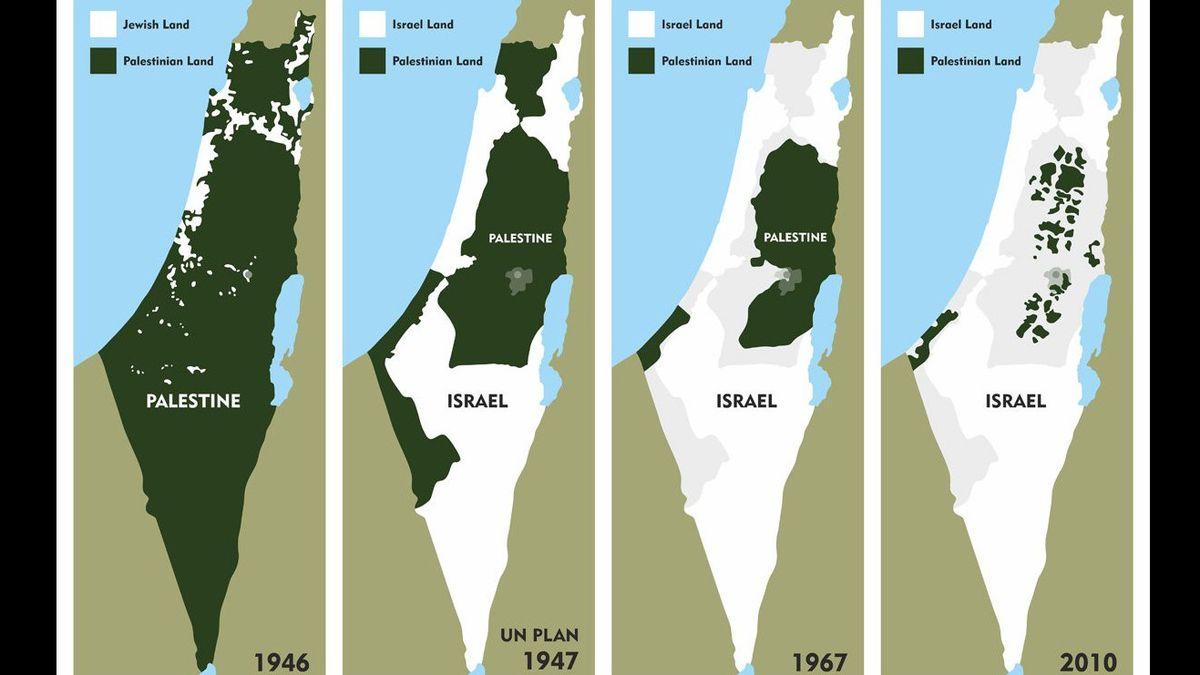
And we’d be saying that the Palestinians should be glad to accept less than 40% of their land, the worst of it with the least water and under Zionist guns forever.
It also happens to be unworkable, with the thousands of Zionist settlers who have “illegally” occupied the territory. But making much of that factor is a mistake since firstly it is not the point and secondly can give rise to pointless and unprincipled discussion about how to make it viable.6
But of course, this discussion is about slogans, which are important in pointing out direction. But they are also, as the Irish language origin of the word7 suggests, a call to action. And if we want to help Palestine, we must act – and continue in effective actions.
STOP THE BOMBING – NOW! END THE OCCUPATION – NOW!
FROM THE RIVER TO THE SEA – PALESTINE WILL BE FREE!
End.
FOOTNOTES
1The Palestinian population before the founding of the Zionist state, even with Zionist-organised immigration, was less that 10% Jewish, with smaller percentages of Christian etc, the vast majority Muslim. They were mostly Arab with smaller groups of Berber.
2Although as we have seen, no power currently on Earth is capable – or in cases of capability, such as the EU and USA, willing – to force the Israeli Zionists to stick to any agreement.
4The most popular resistance organisations in Palestine were the secular ones, Al Fatah first and PFLP second. Al Fatah jumped at the ‘two state’ proposal which gave them, through the Palestine National Authority, their own government to run, funded by the EU and USA with greater opportunities for corruption. Their corruption and collusion with Israel was so pronounced that in the 2006 elections, Hamas got most votes and seats, ruling Gaza as a result but not the West Bank, despite their majority. There have been no elections since but funds are still flowing in to the PNA and Al Fatah.
5Most Israelis perhaps for different reasons than those of the Palestinians who reject it.
It has been said that with one phone call from Joe Biden to Netanyahu the genocide in Gaza could be halted.
Comparisons have been made to Reagan doing just that with the Irgun terrorist, Menachem Begin, who was the Israeli Prime Minister during the siege of Beirut in 1982 or Obama in later years.
Little has been said of the European Union’s equal capacity to make a similar call and bring an end to the slaughter. The EU is not a minor player in the region, and Israel is as much dependent on the EU as it is on the USA, though in a slightly different manner.
From the start the EU decided to support Israel, come hell or high water, and hell it was to be, for the Palestinians. Ursula von der Leyen stated that Israel had the right to defend itself against what she termed terrorism and that “Europe stands with Israel”.1
Ursula von der Leyen, taken at a time when EU staffers complained about her bias in favour of Israel (Photo credit: EPA-EFE/JULIEN WARNAND)
A month later, as the gravity of Israeli plans were clear for all to see, she continued to talk about the Hamas attack on October 7th, much of which has now been proven to be false (there were no decapitated babies, many of the dead were Israeli military not civilians and furthermore Israel itself killed many of the civilians).
She made no condemnation of Israeli bombings of civilians. She and the EU still stood by Israel.2
But on October 20th 842 staffers at the EU signed a letter condemning her position and pointing out she was legitimising a war crime in Gaza, and pointed to her support for the blockade of food and water in Gaza.3
But Von der Leyen continued as before and still stands by Israel and its “right to self-defence”, despite the evidence that what Israel is engaged in, is genocide and multiple war crimes.
Some have made reference to the Nazi past of her family, and though interesting, it is not the reason for her support nor that of the EU, though it may affect the tone of her statements.
In evaluating her behaviour we should, of course, bear in mind her aristocratic and Nazi past, of which she is apparently very proud of and has made reference to.
But they are just anecdotes, others with a clean family tree have also supported Israel.
The reason why the EU supports Israel is one of naked self-interest. Like the USA, the EU has decided that Israel is also its very own Forward Operating Base to keep in check the Arab masses and ensure the flow of oil.
The EU was in a position to halt the genocide from the word go. Von der Leyen could have told Israel to back off and it would have. Without the EU, the Israeli economy collapses.
A ban on exporting to or importing from Israel would see the modern-day Babylon collapse overnight with little effect on Europe itself. Israel is the EU’s 25th largest trading partner, way behind Turkiye which is the EU’s sixth largest trading partner.
However, the reverse does not hold. The EU is a significant trading partner for Israel.
According to the European Commission’s Office in Israel (Von der Leyen & Co.) 31.9% of Israeli imports come from the EU and 25.6% of Israel’s exports go to the EU with total trade amounting to €46.8 billion in 2022.
Israeli imports of services amounted to €16.7 billion in 2021 with exports representing €9.8 billion. Further the EU invested €60.5 billion in 2021. Israel depends on the EU.4 One phone call is all it would have taken to put Netanyahu in his place and stop the genocide.
European complicity in the genocide is not limited to its economic role. Between 2012 and 2022, Israel received just over 5.4 billion US dollars in arms transfers, from three sources. Unsurprisingly, the USA was the primary supplier.
But Germany supplied Israel with $1.475 billion and Italy supplied a further $261 million. In the same period, Israel exported $7.458 billion to a range of countries, including the UK, bastions of democracy such as Azerbaijan ($854 million), Turkiye ($60 million).
But by far the biggest recipient was India which received $2.879 billion.5
The type of weaponry received is important. Israel received $2.734 billion in aircraft, $609 million in armoured vehicles, $752 million in missiles, just the type of weaponry it has used to reduce Gaza to rubble and carry out its genocide.
Israeli Merkava 4 tank in exercise on occupied ground in the Golan Heights 2016; it and other armoured vehicles carry German engines, according to arms watch organisation SIPRI which believes them to be in operation in Gaza now. (Photo: Ariel Schalit/AP)
All of those regimes who supplied Israel with weaponry are as guilty as the Israelis. After Operation Cast Lead (December 2008 – January 2009) it was obvious what type of regime held sway in Tel Aviv.
They have repeated this type of operation on many occasions since then, with major interventions and also a number of smaller, though still deadly attacks.
The nature of the Zionist regime was laid bare to the world, and yet the EU continued to export the type of weapons needed to carry out a genocide.
Hopefully, some day in the future we can hold a Nuremberg-style tribunal to judge those responsible. The 1948 Convention on the Prevention and Punishment of the Crime of Genocide, places obligations on states and gives them the authority to try people for the crime of Genocide.6
To be clear about what genocide is, the convention to which most states are signatories defines it in Article II as:
In the present Convention, genocide means any of the following acts committed with intent to destroy, in whole or in part, a national, ethnical, racial or religious group, as such:
(a) Killing members of the group;
(b) Causing serious bodily or mental harm to members of the group;
(c) Deliberately inflicting on the group conditions of life calculated to bring about its physical destruction in whole or in part;
(d) Imposing measures intended to prevent births within the group;
(e) Forcibly transferring children of the group to another group.7
Israel was one of the first signatories to it and has made no reservations on any aspect of it, unlike the USA which has placed some caveats on its jurisdiction in relation to the USA.8
Photo of Nuremberg defendants during the Nuremberg Trials. Will there one day be such a tribunal sitting on the Israeli war criminals and their international accomplices? (Photo sourced: Internet)
Following WWII not only were the Nazis tried at Nuremberg, other Nazis were tried by individual states in the subsequent years. Countries such as France, Germany, Israel, Norway and others brought Nazis to trial after the Nuremberg Trials.
In Hungary alone, around 26,000 people were tried for treason, war crimes and crimes against humanity. In Czechoslovakia around 32,000 people met a similar fate. Some 100,000 Germans and Austrians were tried in Western Europe and in the Soviet Union another 26,000 were also tried.9
Any nation can place those accused of genocide on trial. To date it has been a question of power. The US won the war in the East and so were not charged for Hiroshima and Nagasaki.
Nearly all those tried for crimes against humanity have been on the losing side of a conflict in which the US and Europe wished to punish one side.
It is entirely conceivable that the powers that make up the BRICS10 could detain war criminals and place them on trial in a national or supranational court convened by them. It is possible though unlikely.
It is however necessary. International law is dead, buried under the rubble of churches, mosques and hospitals in Gaza.
Netanyahu and the entire High Command of the IDF should stand trial like Göring and others did and should face the same consequences as Eichmann who the Israelis tried and executed by hanging.
Ten top ranking Nazis were executed, with Göring committing suicide the night before his scheduled execution. Others should meet another fate as did those lower ranking Nazis in subsequent trials. Various EU leaders should also be tried.
Von der Leyen is a key case and should meet the fate her Nazis family escaped from. Keir Starmer, Macron, Merkel, Rushi Sunak and others should all be put on trial and at the very least imprisoned. Europe is as much to blame for the current genocide as the USA and Israel itself.
6 See Article IV Persons committing genocide or any of the other acts enumerated in article III shall be punished, whether they are constitutionally responsible rulers, public officials or private individuals. Article V The Contracting Parties undertake to enact, in accordance with their respective Constitutions, the necessary legislation to give effect to the provisions of the present Convention, and, in particular, to provide effective penalties for persons guilty of genocide or any of the other acts enumerated in article III. Article VIII Any Contracting Party may call upon the competent organs of the United Nations to take such action under the Charter of the United Nations as they consider appropriate for the prevention and suppression of acts of genocide or any of the other acts enumerated in article III.