WHAT ARE WORDS? “MILITANT” AND “DISSIDENT”

Diarmuid Breatnach

Recently someone objected to my use of the word “militant” to describe a movement with which I am in solidarity, saying that the word implied “violent”. My initial reaction was that I disagreed.

          I understand “militant” to mean “determined, assertive, courageous, not awed by confrontation” and that one could even be a “militant pacifist”.

But I decided to look up some dictionary definitions online. The first two or three did indeed include violence as a possibility but not necessarily integral. Another two came closer to my way of thinking:
“aggressively active (as in a cause) : COMBATIVE “(Miriam-Webster).

You use militant to describe people who believe in something very strongly and are active in trying to bring about political or social change, often in extreme ways that other people find unacceptable.
Militant mineworkers in the Ukraine have voted for a one-day stoppage next month.
…one of the most active militant groups.
Collins Dictionary.

The meaning of words shifts from language to language, culture to culture and across time. One of the most obvious and startling examples of this is the word “gay”, up to the 1970s probably understood in English by most people as meaning “happy, light-hearted” etc but now, the first interpretation in the English-speaking world would be “homosexual” (in a non-pejorative way).

Tramp” was a verb in the 19th Century to the extent that a famous marching song of the Union Army in the American Civil War was known as “Tramp, tramp, tramp”1. By the 20th Century its use as a verb was in decline but it was becoming better known as a noun, the meaning of which was understood variously as “vagrant” or even “beggar”.

And one could fill volumes with similar examples, I am sure.

“MILITANT”

          But returning to “militant”, was I the only one who understood its meaning in the way that I had? Well, apparently not, as Wikipedia showed, for example in descriptions of “militant trade unionists” and even a political organisation within the British Labour Party before its expulsion, calling its group “Militant Labour” and its newspaper “Militant”, probably drawing a parallel with those very same trade unionists2.

It would not take much pondering to guess that “militant” had some relation to “military” and apparently the word does indeed have such an origin, from Latin “miles”, ‘a soldier.3 But over the years, as with many other words, its meaning has changed.

But apparently, violence is again becoming associated with the word, more so than in the second half of the 20th Century. How did this happen? I am not sure but it appears to have been a spin-off from the more recent imperialist wars of, in particular, the United States. It seems that organisations resisting USA control or dominance in the Middle East, most of which were Muslim in religion, began to be termed “militant” in US and western reporting. Why this became so seems hard to fathom – it was not a word that these organisations applied to themselves — but it has had that spinoff effect on the word “militant”, so that “militant trade unionists” and “militant feminists”, for example, are now likely to be associated with violence, i.e the use of physical force.

How loaded and partisan usage of the word can become is well illustrated in the definition supplied by the Oxford living Dictionary: Favouring confrontational or violent methods in support of a political or social cause.
the army are in conflict with militant groups’.

The example given is very interesting. Conflict requires, one supposes, at least two parties and both sides are listed in that quoted phrase. But the impression given is one where “the army” is an authoritative, legitimate force which is being opposed by groups that are none of those things. One almost feels that the source of “the conflict” is the “militant groups” (especially with the current loading of ‘violence’ into definition of the word “militant”).

The ‘army’ is an armed organisation at the very least latently violent (training with deadly weapons) and in this context, almost certainly practicing violence by invasion. Yet it is portrayed as somehow neutral and the opposition as violent. This is further accentuated when the army and armed police are termed “security forces”. How could one be against security? Don’t we all want to be secure? Obviously quite a lot of people don’t want whatever security is being offered by these military and militarised forces and the question of “security for whom?” is hardly ever explored in such discourse, leaving us with the impression that the good guys are the army and police, deserving of our support, while whoever opposes them must be bad and we should line up against them.

As the meaning of words shifts, we have to decide whether to stick with the meaning we had and insist on its primacy, or to adapt and move with it. Up until the 1960s it was generally considered ill-mannered among white and black people to refer to people of noticeable African descent as “black” or as “negro” and Martin Luther King’s campaigning organisation was called the National Association for the Advancement of Coloured People. Back earlier, in the 18th and early 20th centuries, “negro” would have been acceptable to most. Nowadays, “coloured” or “negro” would generally be considered either offensive or ignorant and “black” is the word, unless one is to use the Africa-derived word, e.g Afro-American, Afro-Caribbean, etc.

And in a strange reversal, whether in self-mockery or appropriation, many Afro-Americans began in the 1970s and 80s describing themselves with the word “nigger”, a word long associated with racism4.

DISSIDENTS”

          Leaving those examples and dealing with Ireland, a number of organisations advocating Irish independence and unity and denying the legitimacy of the administrations of either side of the partition Border, would happily term themselves and one another “Irish Republicans”. That term came first to exclude the supporters of the Irish Free State, who waged a Civil War against those who would not accept the British terms, including Partition, of the 1921 Treaty. Not much over a decade later, it excluded also the Fianna Fáil party, which had split from Sinn Féin, got elected into government and at different times interned Republicans without trial, executed some and passed emergency-type legislation against them.

Subsequent splits in later years were still all described, along with various versions of the Sinn Féin party, as “Irish Republicans”. After the Good Friday Agreement was endorsed by what had been Provisional Sinn Féin and they subsequently became part of the administration of the British colony of the Six Counties, all those Irish Republicans who did not agree with them on that came to be called “dissidents” in the media and in much political discourse.

Those who are called “dissidents” however did not, for the most part, agree with the term. As far as they are concerned, they are sticking to the “official line” or at least the original one and it is the Provisional Sinn Féin (which now terms itself just Sinn Féin) which has diverged from the line and furthermore, departed from the ranks of Irish Republicans.

Let’s do a trawl for definitions similar to what I did with “militant” but this time for “dissident”.

Wiktionary:A person who formally opposes the current political structure, the political group in power, the policies of the political group in power, or current laws.

(Christianity) One who disagrees or dissents; one who separates from the established religion.”

Mirriam-Webster:disagreeing especially with an established religious or political system, organization, or belief

dissident elements in the armed forces”.

Collins:people who disagree with and criticize their government, especially because it is undemocratic.

Dissident people disagree with or criticize their government or a powerful organization they belong to”

Oxford:A person who opposes official policy, especially that of an authoritarian state.

a dissident who had been jailed by a military regime’”.

And one I hadn’t used before, but which caught my eye, Vocabulary.com: If you are a dissident, you are a person who is rebelling against a government. Dissidents can do their work peacefully or with violence.

Dissident is closely related to the word, dissent, which means objecting. People who are dissidents show their dissent5. Catholic priests who advocate allowing women into the priesthood could be called dissidents, as could the Puritans who left England to live in colonial America. As an adjective, a dissident member of a group is one who disagrees with the majority of members.”

Since it is not a religious movement, one who separates from the established religion” would seem non-applicable (though when one sees how many Republicans cling to certain practices like non-recognition of the court trying them, or refusal to stand in elections, it is tempting to think of those prohibitions as religious dogma rather than tactics for particular times and place).

Most Irish Republicans would consider themselves as in opposition to the “established (political) order” of the country, i.e Ireland partitioned, with one part run by an anti-Republican Irish ruling class and the other by a colonial ruling class. They would consider the relevant governments as “authoritarian” and “undemocratic”, certainly in their treatment of Irish Republicans by harassment, intimidation, detention, subjecting them to special emergency-type legislation, non-jury courts and prison.

In that sense of “dissident”6, the Sinn Party in its various encarnations has until recently always been a party of dissidents, first against a foreign monarchy subjecting Ireland without an Irish king (the party founded by Arthur Griffiths), then to a Republican party campaigning against British rule (the coalition that was the reformed post-Rising party 1918-1921), after that a party against the Irish Free State Government and the colonial administration of the Six Counties, subsequently a Republican socialist party opposing the same forces, then after a split, a Republican party with similar objectives but supporting an armed resistance to the the British occupation. To that can be added the existence of the Republican Sinn Féin party from a split and at least one other group of similar construction for a time but with more socialist emphasis.

Clearly (formerly Provisional) Sinn Féin can no longer legitimately describe itself as dissident, should it want to, as it is now party to that repressive colonial government to which it was previously vehemently opposed and also now straining to become part of a coalition in government of the Irish state.

Many people who left the SF party did so precisely because they opposed those policies and actions7 and on most terms could legitimately claim to be “dissidents” – if they wished to. Not just dissidents recently within the party but dissidents against the State and British colonialism.

Clearly then descriptions such as rebelling against a government” and disagree with and criticize their government, especially because it is undemocratic” are not going to be the problem and formally opposes the current political structure, the political group in power, the policies of the political group in power, or current laws” seems just tailor-made for Irish Republicans.

The objection to the appellation of “dissident” then must surely be based on either a misunderstanding of the meaning of the word or a concept of some kind of historical Irish Republican authority. If the latter, then the SF party can been seen as having gone against that authority and those Irish Republicans not following the SF path as being the true and loyal followers, faithful to that historical authority. This would be an entirely understandable attitude – but is it helpful? Aren’t the most important things the aims that Irish Republicans have and how they conduct themselves in working towards them, rather than whether they are called “dissidents” or not? After all, there is nothing fundamentally pejorative in the term.

There is no doubt that “dissidents” is a handy catch-all term to describe Republicans who belong to a number of political groups or who are independent activists (the latter of which Ireland and especially Dublin has a great many) but is it conferring some kind of implicit legitimacy on the collaborationist and now constitutionalist Sinn Féin party? And if so, legitimacy in the eyes of whom? Remember how one time there was an “Official Sinn Féin” (and IRA) and the “Provisional Sinn Féin (and IRA) who split from them? It was the latter that went on to gain dominance in the Republican movement while the “Official” organisation split again and shrank to a tiny remnant.

If I were to count myself among the ranks of Irish Republicans8, would I object to the term of “dissident”? I don’t think so.

End.

SOURCES AND REFERENCES

Meaning of “militant”:

https://en.oxforddictionaries.com/definition/militant

https://www.merriam-webster.com/dictionary/militant

https://www.collinsdictionary.com/dictionary/english/militant

https://en.wikipedia.org/wiki/Militant

https://en.wiktionary.org/wiki/militant

Tramp! Tramp! Tramp!: https://en.wikipedia.org/wiki/Tramp!_Tramp!_Tramp!

Meaning of “dissident”:

https://www.merriam-webster.com/dictionary/dissident

https://en.oxforddictionaries.com/definition/dissident

https://www.collinsdictionary.com/dictionary/english/dissident

https://en.wiktionary.org/wiki/dissident

https://www.vocabulary.com/dictionary/dissident

FOOTNOTES

1Coincidentally, the word “gay” is employed in its older sense in the lyrics of the song. A lot of interesting information is contained in the Wikipedia page on this song (see link in Sources and References).

2This was an organisation run by the entryist British Trotskyist organisation which later became the Socialist Party (like its great rival, the Socialist Workers Party, it too has an offshoot in Ireland).

3Through Latin into French and from there into English. However, the word may have been of an older root, possibly Celtic: “ ‘Míle’, word in Irish, meaning ‘a warrior, a champion, a hero’” given p.23 in How the Irish Invented Slang, Daniel Cassidy (2007).

4The term is not accepted equally among black people: I recall a black workmate of mine telling me that he had punched another black man who had referred to him as “nigger”.

5Actually, as Wiktionary tells us, it means more correctly “not in agreement” and comes from the Latin word for “to sit apart”

6Lest it be thought that I dissent from this opinion, let me put on record that this is one of the things about which I entirely agree with Irish Republicans. I suspect however that this definition is generally only used by media and mainstream commentators to describe regimes other than the ‘western democracies’.

7Some people had left that party already by that time, some because they perceived its direction and some because they objected to procedures within the party, especially those they considered undemocratic. Others left over time due to decisions to contest elections in the Irish state or to take their seats in the parliaments if elected, or because of rapprochement with the colonial police, over alleged harassment, party promotions or personal reasons.

8“Irish Republican” is a specific political designation and does not describe me, although I am Irish and I do aspire to a Republic of social equality. I am a revolutionary and a socialist as well as being anti-imperialism; I am many other things as well but that will do as a basic platform on which to seek others of like mind. In the course of struggles I do of course join in a front of one or the other of those tendencies but always with an eye to the full objective. Or so I try, at least.

SPANISH FASCISM EXTENDS ITS CLAWS

Diarmuid Breatnach

This weekend fascist activities took place across the Spanish state with some more to follow next week. In Madrid fascists demonstrated on two different occasions, i.e to commemorate the dictator Franco and the founder of the fascist Falange, Primo Rivera. They also demonstrated for the unity of the current Spanish state territory and against any interference in General Franco’s shrine. These demonstrators flew Spanish fascist flags, gave fascist salutes and shouted fascist slogans – all illegal under Spanish law — but the Spanish police stood quietly by. Wait! They did intervene — to remove antifascist Femen demonstrators (see El Nacional photo and NBC video link)!

          The weekend included anti-fascist events also. On Saturday afternoon there was a march organised by Dignidad Antifascista (‘Antifascist Dignity’), with a rally on Sunday at the entrance to the fascist shrine, the Valley of the Fallen, called by the campaign #NiValleNiAlmudena (‘Neither Valley nor Almudena’, i.e that Franco be buried neither in the Valley nor in the Almudena, the largest cemetery in Madrid).

Fascist Spanish-nationalist regalia and fascist salutes during the Primo Rivera homage on Friday evening in Madrid. Much of this is illegal according to Spanish law but, as usual, the police take no action. (Photo source: Internet)

The specific occasion for the fascist (and hence, the anti-fascist) events are the anniversaries of the deaths on 20th November of the dictator Franco (1975) and of Primo Rivera (1936), the founder of the Spanish fascist organisation, the Falange.

The Falange began with their traditional march of homage to Rivera (yes, the fascist Falange have “traditional” public events in the Spanish state), leaving Madrid around 9pm on Friday night to arrive at the Valley on Saturday morning.

Fascist women in the uniform of the Falange during the Primo Rivera homage on Friday evening in Madrid.
(Photo source: Internet)

“The Falange returns to the streets to show that the flag of the Homeland and Social Justice is upheld and is more necessary than ever,” they declared in a statement.

On Saturday, the Madrid Antifascist Coordination held its own anti-fascist traditional march under the slogan of Dignidad Antifascista, changing their route to start from Plaza del Sol to arrive at Plaza de España, apparently because of the location of the neo-Nazi group Hogar Social Madrid (Social Home Madrid) in the former HQ of the Comisiones Obreras trade union (see History of the Spanish State Appendix), Plaza de España (see video in media link).

Illegal fascist salutes but as usual no action from Spanish police on Friday evening in Madrid.
(Photo source: Internet)

On Sunday a number of groups gathered at the entrance to the Valley of the Fallen to call for “the removal of the tombs of Francisco Franco and José Antonio Primo de Rivera, the withdrawal of fascist symbols from the Sierra de Madrid, the converting of the site into an anti-fascist memorial and the dismantling of the Cross of the Valley,” according to a statement by the Forum for the Memory (historical) of the Madrid Region in a statement. This action is part of the campaign #NiValleNiAlmudena and it was the thirteenth time that the Forum for (historical) Memory and the Social Forum of the Sierra have demonstrated against the graves of Franco and Primo de Rivera in the Valley of the Fallen.

On the other hand, the Abbey of the Valley of the Fallen organised a praying of the holy rosary also on Sunday, at 10.30a.m in the basilica, “for the hope of youth and family in Spain,” as they do every Sunday (this might seem harmless but these are specifically traditional concerns of fascists, the traditional patriarchal family and a fascist youth movement). Also, the (fascist) Association for the Repeal of the Historical Memory (Law) convened a demonstration at 11.30a.m on Sunday to take place between Callao and the Plaza de Oriente, to hold their traditional act of Franco homage. A Femen group who tried to disrupt this demonstration, stripped to the waist and with anti-fascist statements painted on their upper bodies were violently thrown to the ground by fascists in the crowd and repeatedly kicked and punched while the women shouted defiance. Spanish police removed the anti-fascist Femen demonstrators and took no action against the fascists.

Masses will be celebrated throughout Spain for the soul of the dictator and, in Madrid, a “Legionary Mass” (i.e for a fascist organisation descended from the Spanish Foreign Legion) is scheduled to take place in the church of Santiago on Tuesday the 20th and the same day at 8:00 pm in the parish of San Francisco de Borja on Serrano Street, as reported by the Francisco Franco Foundation on its website, in which they also announced an annual dinner on November 30th somewhere in El Pardo.

WHAT DOES IT ALL MEAN?

          Is all this just the strutting of some crackpots we don’t need to worry about, as some liberals and social-democrats think? Or the last gasps of a dying creed as some others believe?

Some of the participants may be crackpots and the creed may be expiring but that does not make it less dangerous – the lashings of a dying monster’s tail are capable of killing and maiming many people. And it may not be dying.

Fascism has been part of the Spanish State since the 1930s (see following section) and only underwent an essentially cosmetic transformation (or “Transition”) in the 1970s but now it feels itself threatened by important counter-trends within the state. Chief among these in practical content is undoubtedly the strong grassroots Catalan independentist movement but in symbolic content, the democratic demand that Franco’s tomb be removed and his current resting place ended as a rallying shrine for Spanish fascists (hence the events that took place around it this weekend) is huge.

Symbols are important for all peoples and movements and Franco’s mausoleum at the Valle de Los Caidos is one very important for Spanish fascists. For anti-fascists, it is an abomination, built through the sweat of half-starved and abused political prisoners to the glory of their oppressor, an unknown number of which died doing so.

The bunch of arrows and that double-headed eagle on their version of the Spanish flag are also symbols of Spanish fascism, as is the straight-arm salute. Accordingly, these were made illegal in the Spanish state, not without some resistance but everyone knowing that no action was going to be taken against the actual fascists. And so it has proven. The Spanish fascists march, display their fascists symbols, give their fascist salutes, shout fascist slogans and they are never arrested for doing so.

On the other hand anti-fascists, revolutionaries, independentists are constantly under surveillance, often detained and tortured and from time to time jailed for long sentences, often for comparatively minor offences or actions or words that would not be classed as a criminal act anywhere else in Europe.

But of course, Europe is growing more fascist too, in governments in the East and in the rise of fascist movements across most of Europe. And Spanish fascism will inevitably give encouragement to those movements as well as drawing encouragement from them.

Across the Spanish state there are streets named after fascists and monuments to them and some of the regular events glorifying fascism there were listed earlier. Add to that a section of the national media that is very right-wing and legal organisations that are fascist in all but name and most of the support structures for a fascist state are in place. All, if one adds the military and police.

The main Spanish police forces, the Guardia Civil and the Policía Nacional, have a history of brutality on the street and torture in their police stations. The GC is actually a militarised police force. The military itself has a history of violent suppression of colonial resistance and, according to the Constitution, is the guarantor of the territorial integrity of the State. And that integrity is threatened by the pro-independence movements of Catalonia and of the southern Basque Country.

“Long live the Unity of Spain” slogan on Spanish flag colours at the Primo Rivera homage on Friday evening in Madrid. The Spanish Right and much of the Left share this objective which is opposed by some of the Left and the Catalan and Basque independence movements.
(Photo source: Internet)

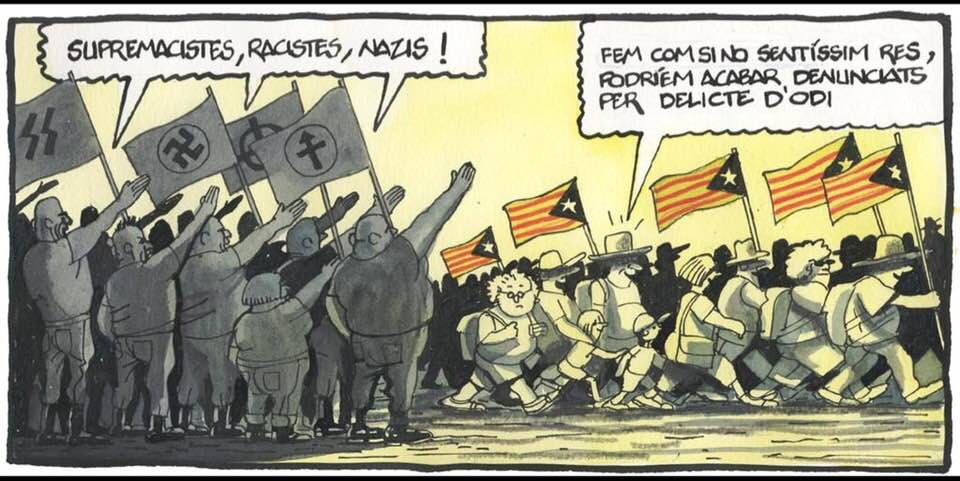
The Spanish fascists are not just defending their symbols and history but also the integrity of the State of the whole Spanish ruling class. And fear, dislike or even hate the fascists as they may, many on the Spanish Left find themselves here on the same side as the fascists. Neither the PSOE, nor Podemos, nor the CPE, nor many sections of Izquierda Unida (the misnamed “United Left”) support the independentist movements, whether from “the good of the economy” or from the credo of “the unity of the working class”. And many of them go further, accusing the independentists of being “nazis”, an accusation which is also thrown, hilariously, by the Spanish Right.

This of course makes any genuine resistance to the fascist movement very complicated for large sections of the Spanish Left, i.e those that actually agree with them on one central plank of Spanish fascism – the territorial unity of the Spanish state.

End.

APPENDIX: SHORT HISTORY OF THE MODERN SPANISH STATE

          Like within a number of European states, fascism was the chosen way to go of the majority of the Spanish bourgeoisie, the ruling class, in the 1920s and 1930s. At first this involved military coups and dictatorships but in 1936, a full-blown military-fascist uprising against the elected Government of the state took place, with sections of the Basque and Catalan middle and ruling classes in support. Other sections of Catalan and southern Basque Country society stood by the Republican elected government and fought hard against the military-fascist coup. And the anti-fascists would have won but for the assistance of transport, bombers, weapons and men from Nazi Germany and Fascist Italy, while the other European states (apart from the USSR) enforced a “non-interventionist” blockade of the fighting Republic.

The Republic overthrown, there followed a period of intense repression of any form of leftist or democratic ideology as well as of the Basque and Catalan languages and national aspirations and, though the intensity faded in time, the repression was always very much there during the 40 years of the Franco dictatorship (and increased in the Basque Country).

The Franco-fascist repression was not only physical, with imprisonment, torture and executions; was not only against national cultures but also moral and political, intensely patriarchal and pro-fascist and with the very enthusiastic support and at times leadership of the Spanish Catholic Church hierarchy and most of its clergy, monks and nuns, imposed through school and church. And of course the judicial and legal system.

As Franco’s life-term was clearly drawing towards its end, concern began to be raised about his successor and how Spain would be ruled afterwards. These concerns were expressed not only internally but also from abroad, especially by the USA which was building military bases across the state and by the EU, which was concerned to have an ultimately unstable state on its southern flank. Franco had designated Admiral Carrero Blanco as his successor and Juan Carlos, of the Bourbon royal dynasty, to be King. In 1973 ETA, the Basque armed leftist national liberation organisation, assassinated Carrero Blanco in Madrid and a few years later, in 1975, Franco died.

The rush was on now by modernist elements of the Spanish ruling class, in particular advised internally by Opus Dei, to carry the State through this crisis. This was achieved by the legalisation of the banned political parties, the social-democratic PSOE and the Communist Party, which was absolutely necessary for the project since they controlled the two biggest trade unions, the Unión General de Trabajadores and the Comisiones Obreras (these were being legalised too). And Juan Carlos was made king of a country that had been without one for over four decades with the agreement of both those formerly republican parties.

The Basque and Catalan nationalist parties were also legalised but, although the new Constitution being pressed on the people was accepted overall, it was rejected by majority in the Basque Country. The Constitution made secession illegal without a majority in the Spanish Parliament in favour.

And this “Transition” was also accompanied by repression, including even the murder of its union lawyers which the CPE tolerated.

Subsequently the PSOE got elected into Government, replacing the Francoist party but showed itself fit to govern an essentially unreconstructed fascist state by running assassinations squads (“GAL, BVE”) against the Basque independence movement. And of course implementing whatever economic measures required by the Spanish ruling class.

The UGT and Comisiones Obreras are the main trade unions in the Spanish State, the largest in membership everywhere but in Galicia and the Basque Country, with their leaderships generally following the social-democratic lead, colluding with the ruling class, mounting mostly show strikes from time to time but no real resistance. One can expect somewhat more resistance from them when the other main political party, the formerly Francoist Partido Popular, is in government, but as soon as the PSOE is back in, even that dies down.

SOURCES AND REFERENCES

https://www.infolibre.es/noticias/politica/2018/11/16/manifestaciones_muy_distinto_signo_discurriran_por_madrid_este_fin_semana_por_20n_88913_1012.html

https://www.elnacional.cat/es/politica/incidentes-manifestacion-fascista-madrid_325803_102.html

Video of fascist demonstration and disruption by anti-fascists (including violence towards them by fascists and no police action against them): https://www.facebook.com/NBCNews/videos/517780425363019/

Short media report which includes video of anti-fascist demonstration on Saturday in downtown Madrid: https://www.presstv.com/Detail/2018/11/18/580334/Spain-Antifa-march-on-Madrid-ahead-of-anniversary-of-Francos-death

RECENT HISTORY: DEEP SOUTH & DEEP NORTH

Report by Diarmuid Breatnach

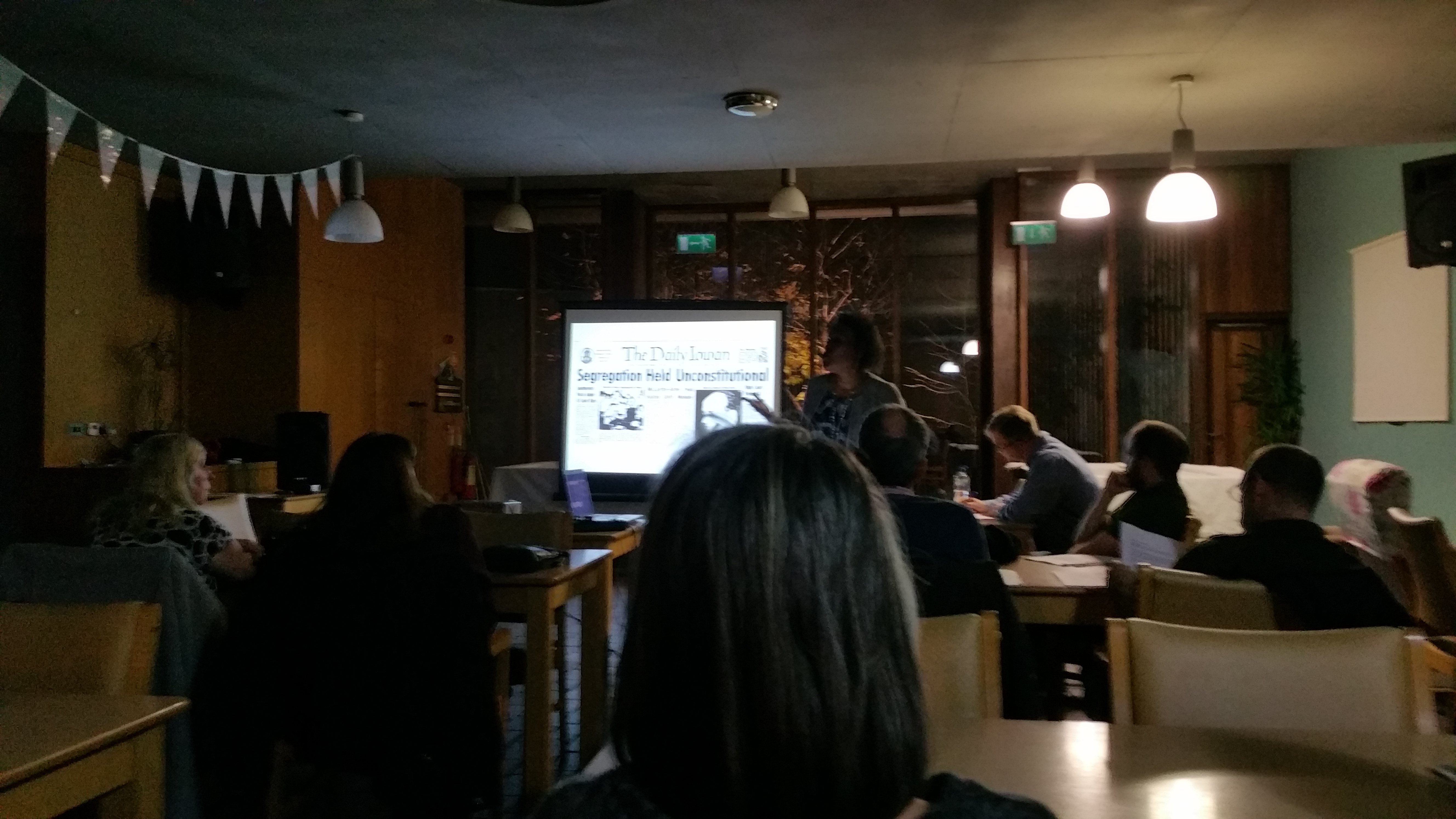
Two very interesting talks were given last night as part of a series of history talks at the Sean O’Casey Community Centre in East Wall, Dublin. The theme was black civil rights in the USA and Catholic civil rights in the Six Counties of Ireland (‘Northern Ireland’ according to some).

Joe Mooney of the East Wall History Society introduced the speakers and chaired the question-and-answer session afterwards.

The session opened at 8pm and Cecilia Hartsell had a lot of ground to cover. She spoke on the history of the Civil Rights movement of blacks in the USA, going through the history of seminal events, illustrated with Powerpoint slides and recordings of two White House phone calls between President JF Kennedy and Ross Barnett, Governor of Mississippi and key figure trying to prevent the historic enrollment of James Meredith, a black man, into the University of Mississippi.

Cecilia Hartsell delivering her talk on the black civil rights movement in the USA

Recalling that in the first two years of his term, JF Kennedy had little to say about black civil rights but was focusing on other issues,Cecilia Hartsell somewhat undermined the (incorrect) image we tend to have in Ireland of Kennedy as an ardent civil rights fighter. In fact he was enforcing Federal legislation on equality and trying to go slowly, while the black campaigners were pushing the agenda along and white racist reaction was holding the USA up to international ridicule and opprobrium during the Cold War with the Soviet Union.

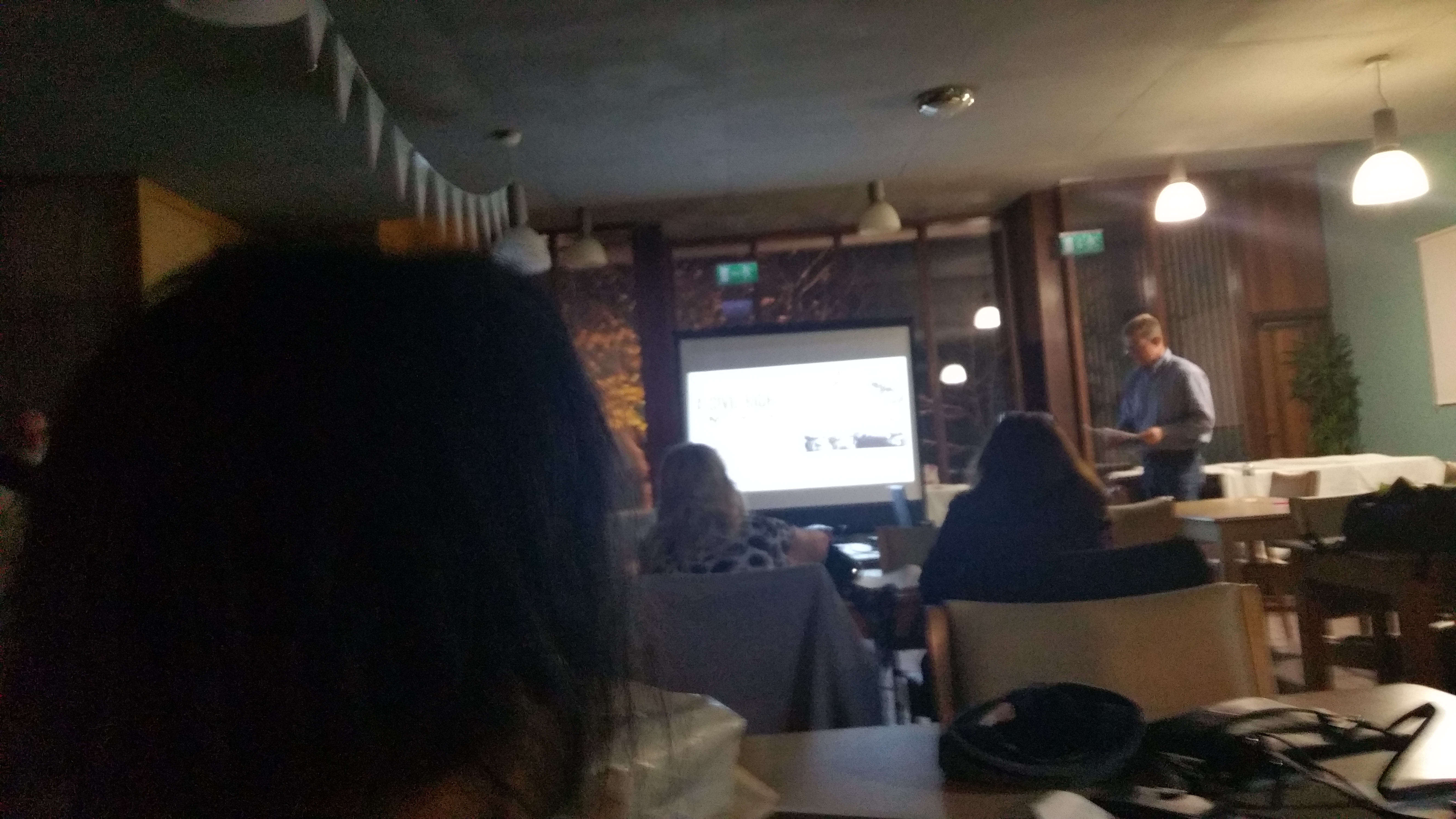
When Brian Hanley took the floor for his talk he fairly zipped along, which he does very well. Hanley undermined some myths or wrong impressions too. Early organisers of the civil rights marches and other events such as the Dungannon house occupation were Irish Republicans; Loyalists had killed four people before the first Civil Rights march. The rhetoric of SDLP and Labour Party notables was much more militant in the early years and Fine Gael was agitating more about issues of discrimination in the Six Counties than was Fianna Fáil, the party in government. And FF had been pushing a referendum to do away with the proportional representation electoral system at the same time that the PR system was among the demands of civil rights campaigners in the Six Counties.

Brian Hanley delivering his talk on the civil rights movement in the Six Counties.

In the session for questions, answers and contributions later, Hanley pointed out that the Southern Democratic Party was the pro-slavery party historically and, after the Civil War, anti-integration and civil rights, whereas the Republican Party was anti-slavery (debunking another false image we tend to have in Ireland).

Both historians made the point that a hundred years is not as long as some might think (this is especially true in ‘historical memory’).  The 1940s, when some historians would say, as Hartsell told us, is the date from which to date the renewed fight for black equality in the USA, as surviving black soldiers returned from WWII, was only 80 years from when Federal troops were withdrawn from the former Confederate states.  The partitioning of Ireland had been carried out less than 50 years before the Civil Rights protests broke out in the Six Counties, Hanley reminded his audience and many Catholics still lived who remembered vividly the fierce repression that had accompanied it.

It also emerged that albeit there were many similarities, there were also profound differences between the two movements. The black campaigners in the USA were saying that they were citizens of the USA State and demanding the same rights as other citizens, they often marched with the Stars and Stripes flag and even called for the intervention of US troops to defend their rights. The Catholics marching for civil rights in the Six Counties mostly saw themselves as Irish citizens and would never march with the Union Jack. Some did call for the intervention of British troops but many did not; it was mostly Irish troops they hoped would intervene.

The importance of the presence of news photographers at events and their covering in newspaper reports and on television broadcasts was an important factor in both struggles.

USA soldiers facing unarmed marchers for black civil rights.  (Source: Internet).

Cecilia Hartsell did not feel that the Black Power movement could have survived Southern racist repression in the 1940s, ’50s and early ’60s and most of the big gains on desegregation of education, public transport, eateries and voter registration and effective right to vote in the Southern States were won during those years with peaceful marches and pickets and legislation (which however were met by much racist violence, including a number of murders). By the time the Black Power movement was coming on to the political stage, so was the Vietnam War and huge changes were taking place in the US, including many mass violent struggles on race and other issues.

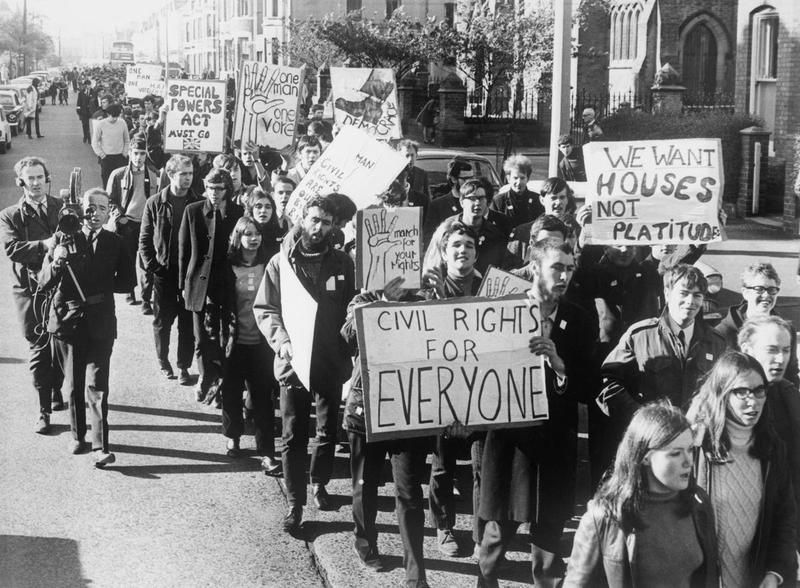
Section of march for civil rights in the Six Counties (Source: Internet).

TERMINOLOGY AND DEEPER MEANING

Wikipedia: “Though often used in history books to refer to the seven states that originally formed the Confederacy, the term “Deep South” did not come into general usage until long after the Civil War ended. Up until that time, “Lower South” was the primary designation for those states. When “Deep South” first began to gain mainstream currency in print in the middle of the 20th century, it applied to the states and areas of Georgia, southern Alabama, Florida, Mississippi, north Louisiana, and East Texas, all historic areas of cotton plantations and slavery. This was the part of the South many considered the “most Southern”.”

Later, the general definition expanded to include all of South Carolina, Georgia, Alabama, Mississippi, and Louisiana, and often taking in bordering areas of East Texas and North Florida. In its broadest application today, the Deep South is considered to be “an area roughly coextensive with the old cotton belt from eastern North Carolina through South Carolina west into East Texas, with extensions north and south along the Mississippi”.

Lower South” probably originally referred to its location on the typical north-orientated map of the USA. But I speculate that “Deep” has another meaning – a deeper psychological one, in fact. It suggests that this is a place difficult to understand for people not from there, which means most people. Different rules apply there, we might believe.

I speculate further that after the initial first years of the Civil Rights movement in the Six Counties, that area and the people living in it came to be seen as “different” too. Of course, it was different in that it was a colony (as had the whole country been only 50 years earlier) and that it was run along blatantly sectarian lines, the Catholics a minority there, unlike in the rest of Ireland. And of course, people in a different environment respond differently. But they were still people and the substantial Catholic minority were so clearly oppressed in a statelet into which the Irish ruling class had delivered them. For many people in the 26 Counties it became easier to think of them as somehow foreign in a foreign kind of land, hence my description as “Deep North”.

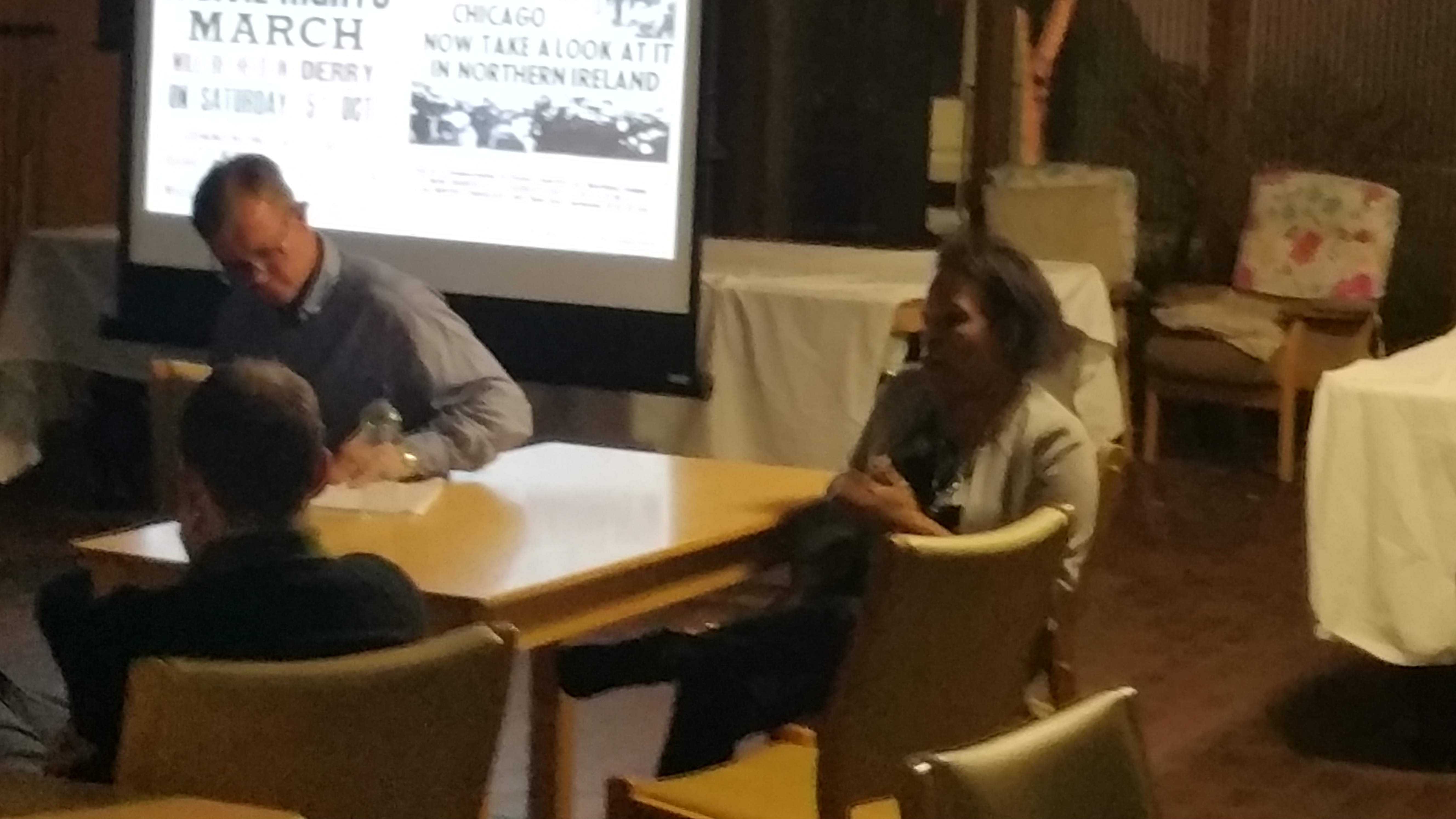
Cecilia Hartsell and Brian Hanley during the question-and-answer session.

THE SPEAKERS (as posted by EWHG)

Cecelia Hartsell is a researcher of American history. She has been a contributor to the RTE History Show and Radio Kerry on topics in U.S. history and frequently gives U.S. history talks for the Dublin Festival of History and in the Dublin Public Libraries. Cecelia has a Masters degree in U.S. history from Fordham University and a Masters degree in History from UCD.

Brian Hanley is an historian and author. He is currently a Research Fellow at the School of Classics, History and Archaeology, University of Edinburgh . He has lectured at a number of major Irish universities and was Historian in Residence at Dublin City Library and Archives . His books include “A Documentary History of the IRA, 1916-2005” (Dublin, Gill and MacMillan, 2010) with his most recent being “The impact of the Troubles on the Republic of Ireland, 1968-79: boiling volcano?” (Manchester University Press, 2018).

NEXT HISTORY TALK

There will be another talk in the series next week when Dr. Mary Muldowney will present a talk on “The 1918 Election – the Woman Who Stood for a Worker’s Republic.”

SPANISH TV CHANNEL COMPARES CATALAN INDEPENDENCE MOVEMENT WITH NAZI POGROM

Diarmuid Breatnach


On the anniversary of Kristalnacht, the Spanish TV channel Telecinco showed a program about the Nazi attack on Jewish premises and people on 9-10 November 1938 which, because of the breaking of shop windows and looting, came to be be known by that name, which translates as Broken Glass Night. In showing the program, they inserted shots of Catalan independentist events, drawing a clear parallel between the two.


A journalist at a German television channel denounced the Spanish TV station for this and challenged them to explain their actions.

https://www.elnacional.cat/ca/politica/esbroncada-periodista-tele5-senyeres-nazis_323184_102.html

KRISTALLNACHT: NAZI ANTI-SEMITIC GENOCIDAL POGROM

Wikipedia: Estimates of the number of fatalities caused by the pogrom have varied. Early reports estimated that 91 Jews were murdered during the attacks. Modern analysis of German scholarly sources by historians …. puts the number much higher. When deaths from post-arrest maltreatment and subsequent suicides are included, the death toll climbs into the hundreds. Additionally, 30,000 Jewish men were arrested and incarcerated in concentration camps.

Jewish homes, hospitals, and schools were ransacked, as the attackers demolished buildings with sledgehammers. The rioters destroyed 267 synagogues throughout Germany, Austria, and the Sudetenland, and over 7,000 Jewish businesses were either destroyed or damaged.

SPANISH UNIONISTS CALLING CATALAN INDEPENDENTISTS “NAZIS”

Spanish unionists have often accused the Catalan independentist movement of being Nazi or Fascist. No evidence has ever emerged of the Catalan pro-independence movement being anti-semitic or even right wing. A few years ago the Catalan Parlament, with a pro-independence majority, passed a law to give migrants equal access to health care with Catalan nationals but the Spanish High Court ruled the law illegal. The Parlament passed the law again this year. Giving migrants equal rights in health services hardly sounds typical of fascists.

But logic has nothing to do with this. Nor has history.

In accusing the Catalan movement of being fascist in nature, Spanish unionists not only exhibit their ignorance of the nature of Catalan society and the independence movement, but also their ignorance of the history of the Spanish State.

It is in fact the Spanish unionist forces which have a very close connection with fascism.

It was the military coup and fascist forces in the Spanish Civil War (or more correctly, the Anti-Fascist War) which sought the overthrow of the democratically-elected Popular Front Government and which, in order to succeed, called in the German Nazis and Italian Fascists for military assistance. Catalonia ndependentists were a major component of the anti-fascist alliance but Barcelona eventually fell to the fascist forces and a fascist dictatorship under General Franco followed. After Franco died, the right-wing forces put together a political party to participate in forthcoming ‘democratic’ elections and named it the Partido Popular.

Franco & Hitler reviewing fascist troops in the northern Basque Country during the Iberian Antifascist War
(Image source: Internet)

This party gathered most of the old regime and die-hard fascists into it and is one of the two main political parties of the Spanish state. From December 2011 until it was unseated recently in a no-confidence vote due to corruption scandals, the PP was in Government of the Spanish state. It was that Government that sent Spanish police searching for referendum ballot boxes in September last year and on 1st August 2017 to attack voters with truncheons, boots, fists and rubber bullets. It was the PP Government which charged and jailed without bail Catalan independence activists and began proceedings against hundreds of others including a great many Catalan town mayors, which the current PSOE Government is processing.

The PP has been nearly eliminated electorally in Catalonia but another political party with similar ideology is strong there, also Spanish unionist, criticising the Catalan independence movement at every opportunity and supporting Spanish repression of the movement.

There are also actual openly-fascist organisations in the Spanish state which have representation inside the police and military and which regularly flaunt their banned fascist emblems, salutes and slogans with impunity. As well as being anti-semitic and otherwise racist, Spanish state unity is a central them with these too.

(Source of image: Internet)

All of these elements – along with many Spanish unionists of other political types, such as many in the PSOE – have denied the democratic right to self-determination of the Catalan people and supported fascist-type attacks on their activists and movement.

In summary then, although of course one may – as anywhere else – find some anti-semites and nazi types in Catalan society, even in the independence movement, the greatest number and natural home of this type is to be found in the Spanish unionist movement and its various political parties – the very ones who are accusing the Catalans of being fascists.

But drawing parallels, no matter how irrational, between the Nazi Kristalnacht and the democratic Catalan independence movement is a new low, even for them.

End


REFERENCES

https://en.wikipedia.org/wiki/Telecinco

Short news report on the issue: https://www.elnacional.cat/ca/politica/esbroncada-periodista-tele5-senyeres-nazis_323184_102.html


TRUE WORDS FROM A RIGHT-WING EX-MINISTER

Diarmuid Breatnach


Quite a few pro-Catalan independence people have expressed horror and indignation at the statements of Spanish politician José Manuel García-Margallo in an interview recently. They should instead that be grateful that he spoke much of the truth and dispelled unrealistic illusions about the way forward for Catalonia.

Ex-Foreign Minister of the Spanish State José Garcia-Margallo, photographed recently.
(Photo source: VilaWeb)

Did he threaten the independence movement with violence? Yes and not too subtly. That was no doubt his purpose as well as perhaps reassuring Spanish unionists, whether fascist or otherwise.  But nevertheless, he spoke an important truth.

Spanish ex-Foreign Minister José Manuel García-Margallo said that Spain would not withdraw ‘peacefully’ from the Principality. ‘It will not deliver the keys to the dependencies and furl up the flag’, he told ‘El morn de Catalunya Ràdio’. He expressed support for the accusations of ‘rebellion’ against the Government of Puigdemont, President Forcadell, Jordi Cuixart, Jordi Sànchez and the General Secretary of ERC, Marta Rovira. According to him, the unilateral way to achieve independence ‘necessarily’ implies violence.

His statement may be listened to on the link.

https://www.vilaweb.cat/noticies/audio-lex-ministre-margallo-amenaca-que-lestat-no-es-retirara-mai-pacificament-de-catalunya/?fbclid=IwAR0aUcpJzPkLdVhJ3g-qakPXRrjq36stNhcJ2_TYUteBm0ta2Yys9Wgw_3Y

Margallo was raised in a family with close military relatives, two of which died in the anti-colonial Rif uprising, one of whom was a colonial Governor of a town there. The ex-Minister of Foreign Affairs was educated (and presumably brought up in) a part of the occupied Basque Country which must have helped condition him and his early adult life was spent under the Franco dictatorship. His early political career was there too and took shape during the Transition and since.

His statement may be listened to on the link.

http://https://www.vilaweb.cat/noticies/audio-lex-ministre-margallo-amenaca-que-lestat-no-es-retirara-mai-pacificament-de-catalunya/?fbclid=IwAR0aUcpJzPkLdVhJ3g-qakPXRrjq36stNhcJ2_TYUteBm0ta2Yys9Wgw_3Y

Translation of the transcript of the excerpt below:

-Mónica Terribas: Crime of ‘rebellion’, does it exist there are or not, José Manuel? (DB: one of the charges against the Catalan activists but which requires the use of violence).

-García-Margallo: I think there is a crime of rebellion. I share the theses of Llarena, that is, I believe that what we saw on the streets during the course of the (events outside the) Ministry of Economy was violent. I think that, by definition, unilateral secession can only be achieved by violence. That is, I say that hypothetically this leads to violence. Because? We have discussed it many times and we all agree: the Constitution does not allow secession. Therefore there will be no referendum agreed. Secondly, the Spanish state will not withdraw peacefully, that is, it will not deliver the keys to the dependencies and furl up the flag. So how is the Catalan Republic proclaimed? If it cannot be by agreement and it can not be by unilateral abandonment, then it will have to be by violence. And that necessarily leads to rebellion.”

Margallo’s political party, the Partido Popular is of course a coalition of a number of Franco-fascist organisations, put together to operate in the ‘new’ Spanish state. But the greater truth about the Spanish ruling class is more important than all this.

The Dictatorship ruled as the only face available of the Spanish ruling class – representing “old money”, from the expropriation of the labour power of workers and the plunder of its colonies but also “new money”, appropriated from the losers in the Spanish Anti-Fascist War.

In the 1960s and 1970s the Spanish State began to receive substantial US and other investment, particularly in military form. But the concern of investors was that with the rise of national liberation movements and the upsurge of the youth and student movement around the world, that an unyielding dictatorship would lead to revolution, so pressure began to be applied, although it was understood that attempts at reform after so much repression could also precipitate a revolution. Given the prevailing circumstances within the Spanish state, such a revolution could only be a socialist one.

When General Franco died in November 1975 two years and one month after his chosen successor Admiral Carerro Blanco had been assassinated, the reformers got room to move (internally Opus Dei and externally the US and others, especially the EU or Common Market as it was then). Reform and normalisation of control meant bringing on board of the ship of State two significant political forces with their corresponding large trade unions, illegal until then: the social-democratic PSOE with their UGT trade union and the Marxist CPE with their more militant Comisiones Obreras union. And imposing a Monarchy.

Both those illegal opposition forces agreed, accepted the monarchy and were legalised; then controlled and even sacrificed their own members. They pushed for agreement of the monarchist and unionist Constitution of 1978, in which the majority of a dazed and hopeful population of the state (but not in the Basque Country) voted in favour of it (and which is now being used to illegalise Catalan bids for independence).

Subsequently the PSOE gained an electoral majority and while in government in the 1980s ran assassination squads against the Basques (chiefly GAL and BVE groups, although foreign fascist gunmen were also brought in for individual jobs).

Under alternating governments of the PSOE and of the PP, the State forces regularly used repression, particularly in the Basque Country, including torture of detainees and jailing people on the basis of ‘confessions’ tortured from them and which they repudiated in court. And they dispersed political prisoners throughout the jails of the State, hundreds or thousands of kilometres from their families.

This Spanish State is one that had at one time ruled much of the world and never ceded territory without a fight — with the English, the French, the Dutch, the North Americans; with native resistance and liberation movements from the Canaries to the Caribbean, to America, the Philippines and Africa. As a monarchy and feudal system, it overthrew the Arab colony of generations and expelled Arabs and Jews, brought in the terror of the Inquisition (the worst of all the states that had it), suppressed the rising of the Comuneros and resistance of the Basque and Catalan nations. As a semi-feudal capitalist monarchy, it overthrew a Republic and then raised a military coup with foreign fascist aid to overthrow another.

So this José Manuel García-Margallo is being on the whole brutally honest here and shattering the illusions many people had, especially those of a liberal or social-democratic turn of mind, that somehow Catalonia would win genuine independence without having to fight a Spanish military repression. But they should look on his utterances as doing them a favour, forcing them to look at reality.

In fact, for all that I have recounted about the particular nature of the Spanish State and its history, the more general historic truth is also that NO capitalist state (not to mention an imperialist one) is going to stand by and see itself being dismembered and losing huge chunks of what it considers its territory and economy.

Nations that won true independence had to fight for it. In the last century alone, how did Algiers win independence from the French? How did Kenya in Africa and Aden in the Middle East expel the British occupation forces? How did the Vietnamese expel the French occupation forces and defeat the US aggressors? How were the Nazi and Italian fascist and Japanese invaders of so many countries defeated?

People who hear the truth, no matter how bitter it tastes, should spend no time in bewailing it but instead concentrate on preparation.

End.

SPANISH POLICE RAIDS ON BARCELONA REMEMBERED A YEAR LATER IN DUBLIN

Diarmuid Breatnach

     On 20th September 2017 Spanish police raided Catalan Government offices in Barcelona, arrested some officials and representatives and also besieged the city’s offices of the CUP political party. A documentary film of the events, the spontaneous mobilisation of thousands of Catalans, the management of the event by “the two Jordis” and the CUP resistance was shown in Dublin on 22nd September to an appreciative audience and afterwards a panel of speakers contributed opinions and replied to questions.

Chair of the proceedings for the CDR (Photo: D.Breatnach)

The video, called 20 S – the Documentary follows many of the events of that day and its screening was organised by CDR Dublin. The CDRs, abbreviation for Comites de Defensa de la Republica, were set up after the Spanish police attacks on people voting in the Referendum on October 1st and arrests of independence activists afterwards and may be found in various places in Catlalunya and around the world.

Spontaneously thousands of Catalans gathered in Barcelona on 20th September a year ago to protest the raids but the leaders of the two grassroots organisations of Omnium and ANC respectively, Jordi Cuixart and Jordi Sanchez managed to keep the resistance peaceful while the CUP prevented entry to their offices. The leaders of the Catalan independence movement believe it important to maintain resistance active but peaceful in the face of Spanish police provocation and have been largely successful in maintaining this line to date. The police force invading the Catalan Government offices was the Spanish paramilitary police force of the Guardia Civil, while those besieging the CUP offices were the other Spanish State force of the Policía Nacional.

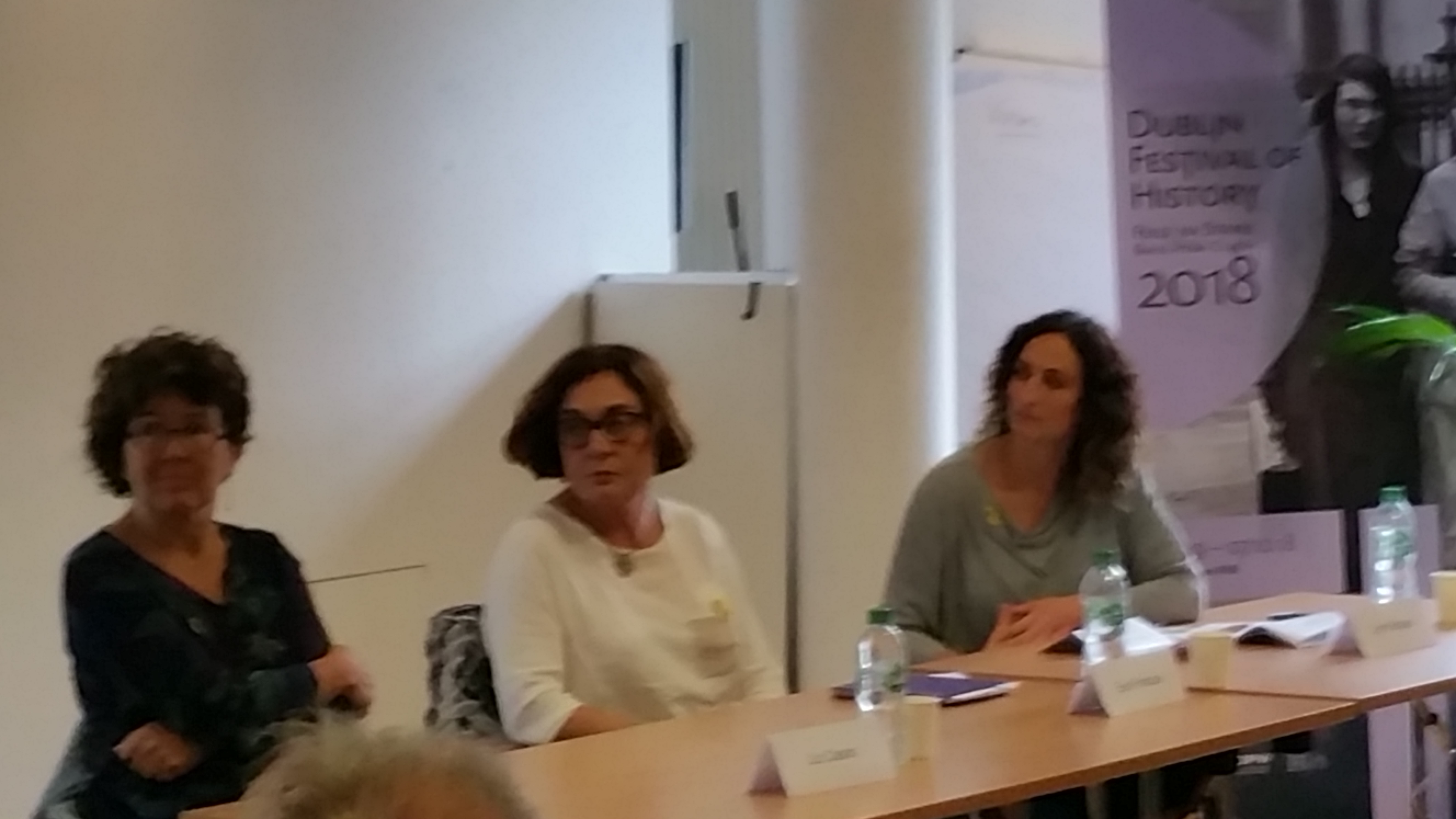
Panel of speakers (L-R): Liz Castro, Eva Fantova, Clare Boylan.
(Photo: D.Breatnach)

The film is remarkable in that parts of it follow both Jordis as they try to negotiate with the police and at the same time inform the crowd and keep it under peaceful. One can see that many in the crowd are reluctant to disperse when asked to by the Jordis. One also sees when they are shocked to learn from demonstrators that police have left firearms in one of the unattended Guardia Civil vehicles parked outside Catalan Government offices.

The viewer also sees the CUP leaders refusing to allow access to their offices to the Policía Nacional who claim they have search warrants but fail to produce them, despite which they remain besieging for hours, with CUP activists barricaded inside the building.

The film of the action is interrupted at times with later commentary from a number of independence activists, including journalists.

Poster for the event organised by CDR Dublin.

The film demonstrated the mass nature of the Catalan pro-independence movement and the nerve and skillful crisis management of a number of its leaders. The extremely prominent role of the leaders of Omnium (Omnium Cultural) and the ANC (Asamblea Nacional de Catalunya) demonstrated eloquently that despite the concentration of news media on the leaders of political parties, it is the grassroots organisations that really hold the mobilising power (a fact demonstrated once again the demonstrations and general strike in Catalunya in the celebration of the Diada on September 11th last year, the Catalan National Day and again this year when police estimates of the pro-independence demonstration in Barcelona put the attendance at one million marchers).

Aerial view of the Diada marchers for independence this year in Barcelona (Photo sourced: Internet)

Despite their clear activity to prevent violence towards the police and to manage the crowd, in October “the two Jordis” were among the Catalan pro-independence activists arrested for “Rebellion” and “Sedition” and have been kept in jail without bail since, awaiting trial (which might not now be held this year). Other Catalan activists, including elected representatives, are in exile.

The showing of the film was well received by the audience in the Pearse Library, Pearse Street and sustained applause broke out as the credits scrolled down the screen.

Section of crowd on one side of the auditorium. (Photo: D.Breatnach)

When the lights came on a representative of Dublin CDR introduced the panel:

Liz Castro, USA Journalist writing much on the Spanish state and Catalunya, Eva Fantova of the ANC (who had appeared in th film, particularly as a commentator) and Clare Boylan, Sinn Féin MEP (member of the European Parliament).

In questions directed towards them by the CDR representative and later by members of the audience, all the panel speakers were clear that they did not expect justice from the Spanish courts for the Catalan independentists and did not believe that a separation between Government and Judiciary existed in the Spanish State.

Both Fantova and Castro referred to the case of the youth from the Basque town of Altsasu who had been sentenced to nine years jail over a late night brawl in a bar with off-duty Spanish police in which the maximum injury was a fractured ankle. The youth had been detained without bail awaiting trial with the State Prosecutor seeking to have them tried under “anti-terror” legislation, with a possible sentence of 30 years jail. However, even under ordinary Spanish criminal law, they had still received nine years in jail. Meanwhile a group of men, two of which were members of State forces, accused of gang-raping a young woman and filming the act, were out on bail while they appealed their short sentences.

With regard to what could be expected from the new Prime Minister and the social-democratic PSOE currently in minority government, the ANC representative commented that the PSOE is a Spanish unionist party also and when in opposition supported the Spanish State and Government’s actions against the Catalan independence movement.

A member of the audience commented that after Franco’s death, the Spanish ruling class had brought both the PSOE and the Spanish Communist Party (PCE), both illegal under Franco, into the State under condition that they accepted the status quo, the union and the monarchy that was being imposed on the people in the state. Their importance was great since each of those parties controlled a large trade union, also previously banned, and together they constitute the vast majority of unionised workers in the Spanish state. Since then those parties worked to control the people’s resistance and prevent any serious change.

A number of questions about what might be expected from the European Union Parliament and from the Irish Parliament were directed towards Clare Boylan, as an MEP and as a member of the Sinn Féin party, which has 22 elected members in the Dáil, the Irish Parliament (out of a total of 158 seats). She said that both the main Spanish Parties belong to the two largest EU Parliamentary Groups, the PP to the Christian Democrats/ Conservatives and the PSOE to Social Democrats, which makes it difficult to get a motion against the Spanish Government agreed in the EU.

With regard to the Irish Government, Boylan expressed pessimism on having them declare in favour of Catalan independence, whatever their personal opinions might be, with no evident support showing among most of the governments of EU countries.

Asked about getting more coverage of the Catalan situation in the world’s media, Liz Castro expressed her puzzlement at the low level of interest generally outside of the Spanish state. Boylan reported that the Irish national broadcaster RTÉ had sent no-one to cover the Catalan independence Referendum of October 1st and when it had been attacked by the Spanish police, as she had been in Catalunya with party colleagues to monitor and to support the Catalan movement, RTÉ had been reduced to phoning her to ask what was happening.

A member of the audience commented that he had no faith in either the Irish Government or the EU and that the first had justified his lack of faith since its creation and that the second was dominated by neo-liberal parties. He did not believe that the lack of interest of the media had to do with lack of space since they managed to cover all kinds of irrelevant gossip about personalities. He said that we need to be our own media to the extent that we can, pointing out that Catalan solidarity organisations CDR Dublin and With Catalonia/ Leis an Chatalóin each have Facebook pages on which news is posted and Casals Catalá d’Irlanda, a cultural organisation, also has a Facebook page and we should be posting information to those pages and sharing some of the information from there on to our own personal pages. The video they had seen was also available on the internet and should be shared.  The ANC and Omnium had shown the importance of grassroots movements in Catalunya and we should replicate that in the small way that we can here in Ireland, he said. This contribution was greeted with applause.

The meeting concluded soon after, the speakers and audience being thanked for their attendance and contributions responding with applause for the organisers, the CDC Dublin and for the speakers.

End.

NOTE ON CATALAN POLITICAL PARTIES

The Catalan Govern (Government) is a pro-independence coalition of a left-republican party and a conservative party, both of which themselves are coalitions:

ERC (Esquerra Republicana de Catalunya – Republican Left of Catalonia) and JxCat (Junts per Catalunya – Together for Catalonia).

A further Catalan pro-independence party is the CUP (Canditura d’Unitat Popular – Popular Unity Candidature) in opposition but in support of the Government on independence and against the unionist opposition.

The Spanish unionist opposition to the Government is composed of a number of Catalan sections of parties of the Spanish conservative Right and social democracy:

Cs or Ciutadans (Partido del la Ciudadanía – Citizens’ Party) with currently the most seats; PSC (Partido Socialista de Catalunya – Socialist Party of Catlanunya), Catalan iteration of the PSOE, currently in government of the Spanish state; Partido Popular (Spanish right-wing party recently in government of the Spanish state).

There is also a coalition of groups including the Catalan version of Podemos the actual policy towards independence of which is difficult to nail down. In the Spanish state the Podemos (We Can) party has supported the right of self-determination but opposed its exercise in favour of independence, arguing instead for a social-democratic kind of Spanish federal republic.

LINKS FOR FURTHER INFORMATION

CDR Dublin: https://www.facebook.com/CDRDublin/

With Catalonia/ Leis an Chatalóin: https://www.facebook.com/WithCataloniaIreland/

For cultural information and events: Casal Catala d’Irlanda https://www.facebook.com/groups/CatalansIrlanda/

Catalan News (10-minute daily roundup on video): catalannews.com

SPEAKING TRUTH TO POWER – REALLY?

Diarmuid Breatnach

Again and again we come across activists, journalists, musicians and other artists who are lauded for “speaking truth to power”. They are often praised for that, even idolised. “Speaking truth to power” seems to be brave thing to do. And an important thing. But is it really?

First of all, let us think of who are those usually thought of as “Power”: governments, big companies, military dictators, church leaders, powerful individuals in the media or in the arts …..

Why is it considered a good thing to speak truth to them? It may well be brave to do so and often is. People who spoke the truth in certain situations throughout history and currently have had their careers destroyed, been the subject of all kinds of horrible allegations, been marginalised, lost their families and friends, been framed on charges, jailed as a result or just automatically, tortured, killed and “disappeared”. Yes, we could hardly deny the courage of many of those who chose to take that step. But whether it’s an important thing to do is another thing completely.

What? A courageous act against power not important? What can I be suggesting!

Let’s look at those in power again, taking for examples a government, a military dictatorship and the CEO of a powerful company. In our example, we set out to “speak truth” to them.

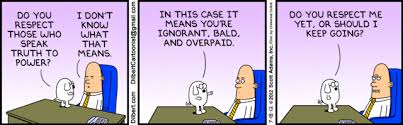
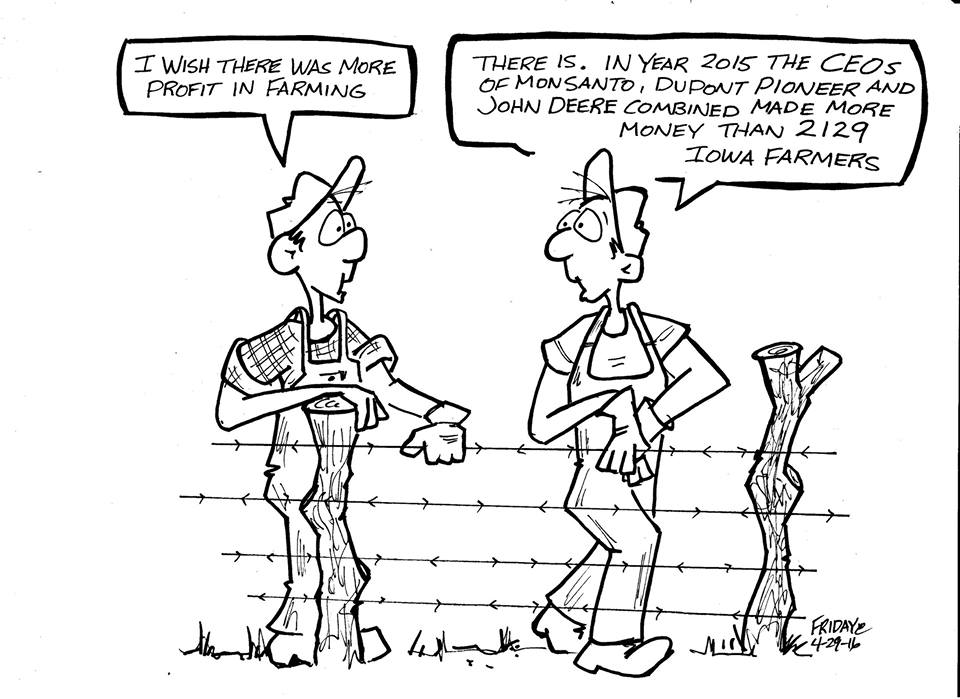
For the government, we send them an email, or a letter because there are too many Ministers and Secretaries to address verbally – unless of course we are in some kind of privileged position. They in turn ignore us or send us a dismissive reply (possibly tailored to be quoted) or they have us subjected to surveillance, just in case we should turn out to be a real problem in future. And any government in the world is capable of putting citizens under surveillance.

(Cartoon strip source: Internet)

We send the military dictator a letter and he has us arrested, detained for torture and questioning. Or we accost him when he is somewhere in public …. and his security guards shoot us dead. Or arrest us for torture and questioning.

With regard to the CEO, we send him an email. He ignores it but may have us put under surveillance – just in case. And he’ll have our employment and tax records, families and friends checked out too. Like governments, the CEOs of big companies can easily put people under surveillance and run background checks on them. And CEOs likely last longer in the power position than most governments. Or he might reply dismissively. Or he might have his legal services people threaten us with legal action which, as well as shutting us up, would cost us a lot of money we don’t have, probably bankrupting us.

This is the illusion of liberals and social-democrats but the reality is very different.
(Image sourced: Internet)
(image source: Internet)

In the military dictator’s case, we are out of the picture. In the case of the other two, nothing further may happen if we shut up now. But if not, well …. there’s that list of bad outcomes I listed above. Brave? Certainly – but to what effect? Have we changed anything?

Some people think we can change the essence of the way those in Power think by Speaking the Truth to them. If only we can say it powerfully enough. Nonsense. Those in the Power have already chosen who they want to be, what side they are on and understood the basic dynamics or been taught them along the way. Many choices made have confirmed them in their roles and ideology.  Furthermore they know that to break ranks with their own is a dangerous thing to do which can result in bad outcomes for them too and also expose them to painful and even fatal thrusts from their competitors or rivals. Remember the 1983 film Trading Places? Remember how the main hero falls at first, is shunned, loses his privileges, friends and associates? Unlike the film’s ending, there is no coming back from there.

If those CEOs and company owners ever took a progressive step it was because they were shown it would increase their profitability or at very least were shown it wouldn’t hurt it ….. or they were forced to do so by people’s resistance. Not ever by having “Truth Spoken” to them. Unless it was the truth of resistance (and we’ll come back to that).

I don’t see the point of Speaking Truth to Power … except in very exceptional situations. For example, if we are being sentenced in court, even if the public gallery has been cleared or packed with cops (which has happened even in this state on occasion), we might wish to raise a clenched fist and yell “Death to Fascism!” before the guards jump on us and bundle us to the cells, giving us a few punches on the way.

Or being tortured, if we are capable of it (and while we are still capable) we might want to shout something similar or just plain “Fuck you!” Or in front of a firing squad, to shout “Long live the revolution!” before the order comes to “Fire!”

Will it do any good, make any difference? Without an audience apart from those in Power, almost certainly not. It might affect some soldiers or police in the firing squad or some jailers but such results are usually negligible. But in doing so, we assert our humanity, our spirit against them and it is for ourselves alone, at that moment, that we Speak Truth to Power. Otherwise, there is no point, none at all.

I don’t want to Speak Truth to Power and what’s more, question why anyone else would. Is he or she suffering from some kind of liberal illusion that such words make a difference, can convert or subvert Power? Or from an inflated ego that convinces him or her that they have the gift, the eloquence, the importance to make Power change? Or that somehow, by force of their excellent will, they can overcome history and change reality?

Or even worse, are they signaling to the Power that they are articulate, eloquent even with “alternative” credentials and that they are worth recruiting by the Power?

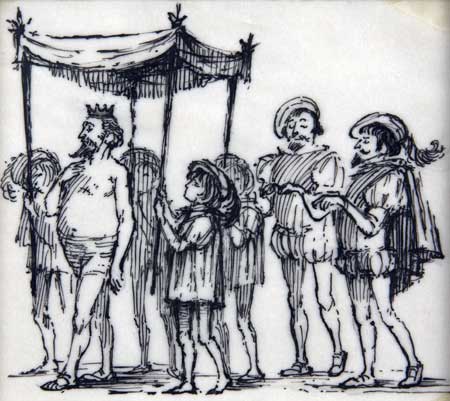
The Naked Emperor. In Hans Christian Andersen’s subversive tale, an undoctrinated child remarks that, contrary to royal propaganda, the Emperor is naked and the people can then admit this to themselves. The child spoke Truth — but to the People.
(image source: Internet)
Speaking truth among the people. (Cartoon source: Internet)

I repeat: I don’t want to Speak Truth to Power. I want to Speak Truth alright … but to the PowerLESS! I want to expose the Powerful to the people. I want to show them the long list of the crimes of the Power and that it is unreformable. But I don’t want to just read the people a horror story; I want to show them how I think the monster can be killed. I want to show the people that THEY CAN DO IT! The people can grasp power with which to overthrow the Power. I want to show the people what their forebears have done in rebellions, uprisings, revolution, creation of resistance organisations, art, discovery of science, production ….. I want to share what I think with them, argue with them, encourage them, criticise them. And the only time I want to Speak Truth to Power is when they, the People, are listening, or reading what I am saying. Because then, it’s not to Power, in reality, that I’ll be Speaking Truth; the important audience is not Power at all.

So, Speaking Truth to the People is the thing to do. And will those who do so be safe from painful outcomes, that list given earlier? Having careers destroyed, being the subject of all kinds of horrible allegations, being marginalised, losing families and friends, being framed on charges, jailed as a result or just automatically, tortured, killed and “disappeared”? Alas, no, each of those is a distinct possibility: all have happened even to the people of our small island and nearly all of them fairly recently. Some very recently and even ongoing.

There is no safe way to Speak Truth. But at least this way, there is a chance that Speaking Truth will have some effect, will make a difference. It might even make a big difference. We hope so.

And the final Truth is that words, for all their power on people’s minds, don’t change the real world. People do that, through action.

End

(image source: Internet)

Spanish Minister would rather free Catalan political prisoners on bail but is totally against independence

Diarmuid Breatnach

This is a short report of very interesting interview of Spain’s Foreign Minister, Josep Borrell, who is both a Catalan and a convinced Spanish unionist.

He says that
§ he would rather have the Catalan political prisoners released on bail;
§ Catalonia is a nation, not a region (but does not have the right to self-determination in violation of the Spanish Constitution);
§ there is no automatic international right to national self-determination and
§ Scotland does not have the legal right to hold a referendum without the permission of the UK Parliament (for which he provides a very convincing argument).


Comment:

Borrelll is no friend of Catalan independence (he would hardly have been chosen by the Spanish Government as its Foreign Minister if he were) and has made some very disparaging remarks about the movement (liking it to “an infection”) and some individuals. He is no democrat either. However it is interesting that he is prepared to express a difference from Spanish Government policy.

His remark about Scotland will not be liked by many Catalan independentists who are fond of quoting Scotland and the referendum there as a model. But I think he is correct, both in his explanation and the situation at the time. It seems to me that the British conceded a referendum, expecting it to fail. It did fail but the result was closer than they expected. But, like self-determination of the occupied Six Counties of Ireland, any vote in favour would have to be ratified by the UK Parliament.

The main difference between the UK and the Spanish State on this is that the UK allowed a referendum but expected it to lose. The Spanish State will not permit a referendum because they know it would succeed.

The Catalan activists, politicians and intellectuals need to stop looking elsewhere for easy examples for comparison. They would be much better served, in my opinion, by examining the general history of imperialist-colonialist states against the struggles of subjugated nations and of course the history of the state in which they find themselves.

No imperialist or colonialist state has ever given up what it considered its property without resorting to violence.  When that desire for separation and independence comes from a part of what it considers its own base, the resistance is even stronger and violence highly predictable.  And the history of the Spanish State itself?  Violent acquisition of all of its neighbouring lands –until Portugal broke away and stopped at the French border (another major thief).  Violent suppression of peasants and workers and the overthrow of two democratically-elected Republican governments, followed by violent repression.  War conducted against the Basque independentists.  The Spanish state will use much more violence than it did on October 1st last year, repressing the Referendum on Catalan independence.  The only questions are § when and
§ will the Catalans be prepared for it.

End

http://www.thenational.scot/news/16835507.spains-foreign-minister-calls-for-government-to-bail-political-prisoners/?ref=fbshr

FASCISTS MARCH DEMANDING SPANISH UNITY

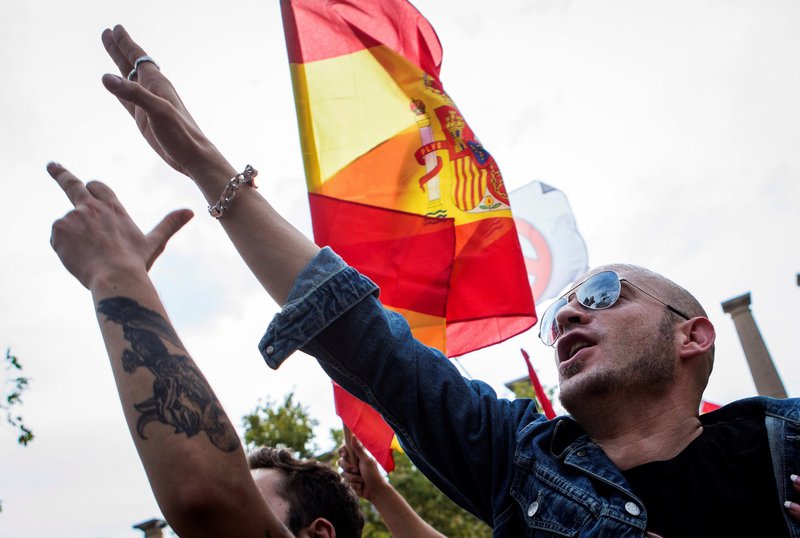
Death threat, fascist salute and Franco’s version of the Spanish flag, all illegal and displayed with impunity at this demonstration against Catalan independence and many other fascist events. (Photo credit: EFE/ Enric Fontcuberta 4651#Agencia EFE)

Some 2,000 people (according to the Urban Police) demonstrated this Sunday in Barcelona to reject any negotiation with Catalan sovereignty and in support of the unity of Spain.

(Translation from Catalan newspaper report — see link below end translation — by D.Breatnach)

The protest, called by real estate entrepreneur and former Guardia Civil (spanish state police — Trans) member Juan Manuel Opazo with the support of the ultra-royalist party Vox, crossed the Avenida del Paralelo under the slogan “No [pacts] with either terrorists or separatists.” Sixty associations and movements such as the Catalan Civic Convivencia, the Catalan Association of Victims of Terrorism, Catalonian Employers or Somatemps supported the event.

At the top of Avenida Mistral the demonstration came in sight of an anti-fascist protest called by anti-fascist movements and booing booing was exchanged from both sides. The Mossos (Catalan Police) kept both groups apart.

The march ended on Avenida María Cristina, where the Parliament is situated. Many of there asked the Spanish Prime Minister, Pedro Sánchez, to not negotiate “with separatists” and to convene elections.

Coaches from 30 cities throughout Spain, such as Alicante, Malaga, Bilbao or Valladolid, among others, brought supporters to the protest.

Photo: Unionist march supporters give the fascist salute and threaten shooting at the anti-fascists and carry Spanish fascist symbols.


COMMENT (D. Breatnach):

The comparatively small size of the march and the fact that it was only possible by bussing in supporters from other parts of the state may be taken as an indication of how small the support base is for this far-right variety of Spanish unionism.

The monster march for independence Diada (Catalan National Day) on Tuesday will provide a useful comparison: one million marchers are expected.

The list of organisations supporting the march gives the lie to their frequent representations as “concerned citizens” who are “opposed to terrorism” etc, particularly the Catalan chapter of the “Association of Victims of Terrorism”, an organisation which for years has been hounding Basque independentist organisations with the assistance of the Spanish courts. To outsiders it might seem like a legitimate organisation held together in solidarity against terrorism but it is well known to be an extremely right-wing organisation, composed of ex-military and Spanish police (and no doubt serving members too) and their relatives. Some of them were indeed victims of armed Basque actions but it has to be acknowledged that was in a war which the Spanish state first launched against the Basques themselves, not only during Franco’s time but for decades afterwards too.

The impunity of fascists breaking the laws against fascist symbols, gestures, slogans and against threats, which has often been remarked upon throughout the Spanish state, was once again demonstrated. On the other hand even rap words, a poster, video or a verbal argument with police officers coming from a left-wing or independentist perspective can and have resulted in prison sentences.

Spanish unionism has a number of types and the one displayed in the reported march is the most extreme – the type that led to the creation of the fascist Falange, a military uprising, massacres of surrendered prisoners and civilians, rapes and other tortures and Franco’s dictatorship. But this could not exist on its own. With the collusion of the leaderships of the social-democratic PSOE and the Communist Party of Spain – and their respective trade unions – after the death of Franco, torture and all kinds of undemocratic laws and court rulings continued with the addition of death squads to force a rejected monarchy on the people and the obligatory unity of the state in the Constitution now in force. All of this together is what now confronts the Catalan independentist movement. But it also confronts any Spanish democrat and should call them to mobilise against Spanish unionism which is inextricably bound up with fascist ideology.

Report translated from: http://www.elpuntavui.cat/politica/article/17-politica/1464111-unes-2-000-persones-marxen-a-barcelona-per-la-unitat-d-espanya.html


NEWS AS PROPAGANDA

Diarmuid Breatnach

Very recently, a large and high-status media organisation published a news report with a headline to which a minister of state objected. The Minister made it an official complaint and the media organisation changed the headline. Nothing so startling in any of that, right? Wrong.

There are many things wrong with this scenario. Firstly, should a government minister be able to change news reporting by a media organisation? Isn’t media supposed to be independent? So they tell us, anyway.

Well, the media organisation in question, the British Broadcasting Corporation, is government-funded. Yes but at the same time it proclaims its independence nevertheless.

Anyway, the government to which the complaining Minister belonged wasn’t even the British Government – it was Israel’s.

So a minister of Israel’s Government made a complaint about a British Broadcasting Corporation’s news headline, and the BBC changed the headline to accommodate him and the Israeli Government? Yes, it happened on 9th August this year.

Well, maybe the complaint was justified? If so, the BBC should respond appropriately.

Perhaps they should – IF it was justified. But it wasn’t.

Firstly, the complaint was that the headline was inaccurate – and the complaint actually said that it was a lie! In other words, not just inaccurate but deliberately so.

Israeli war jet — Israel has 252 attack fighters and 48 attack helicopters. Palestinians have none.
(Source: https://www.globalfirepower.com/country-military-strength-detail.asp?country_id=israel)

So what was the headline? It was as follows:

Israeli air strikes ‘kill woman and baby’”

Untrue, whether deliberate or not? No, it was completely true and attested to by reports of many other media, including Israel’s own. On 9th August, Inas Muhammed Khamash (9 months pregnant according to some reports) and her 18-month daughter Bayan Khamash were killed when, according to the Israeli Army, Israel bombed 140 sites in Gaza.  Not only that but the Health Ministry of Gaza confirmed the death of 20-year old Ali Al-Ghandour in the attack and the hospitalisation of another 12, two of which are in critical condition.

The Israeli Minister wanted included in the BBC headline that the Israeli bombing which did kill a mother and child, that it had been in response to rockets fired at Israel. Context is important, right?

 The message sent to the BBC on 9th August:

Emmanuel Nahshon

@EmmanuelNahshon

.@BBCWorld this is a formal complaint by @IsraelMFA .This title is a deliberate misrepresentation of reality ( that’s the polite equivalent of “ this is a LIE”, if you don’t get it). Israelis were targeted by Hamas and IDF acts to protect them.Change it IMMEDIATELY!!! @IsraelMFA


CONTEXT IN NEWS REPORTING

Well yes, of course context is important but one cannot always include context in a headline. Imagine putting context into a number of news headlines down through history: “Nazi invading army surrounded after failure to take Stalingrad due to courageous resistance for over five months and Red Army counterattack” instead of “Nazi Army surrounded at Stalingrad – five-month siege lifted.” Or “Banks bailed out with debts guaranteed by Government prepared to implement austerity cuts on most of the population” instead of “Banks bailout – who will pay?” The context can be provided within the story.

However, if the Israeli Minister wants context in headlines or even in stories, how about including in a report of any Palestinian demonstration or rocket attack the following information as to what gave rise to the action:

  • Zionists colonised a land in which Jews were about 10% of the population and created a State from which through terrorism they expelled thousands of non-Jewish Palestinians

  • The Zionist State extended its lands on which it plants Zionist settlers, stealing further Palestinian land and water

  • Zionist state law allow for any Jewish person in the world, with no connection whatsoever with the land, to become an Israeli citizen while banning original non-Jewish Palestinian exiles or their descendants from returning or from Israeli citizenship. And it has now legislated that Israel is a Jewish state, officially discriminating against the 20% of its non-Jewish citizens who are born and raised within the state.

  • Zionists are steadily making Jerusalem, a city holy to Christians, Muslims and Jews, a Jewish city by appropriation of buildings and areas and intimidation of Palestinian residents and worshippers of other faiths.

  • Palestinians are second-class citizens in their own land held up at Israeli checkpoints for hours

  • The Zionist state disagreed with the Palestinian election results years ago and made of Gaza what many have called “the largest concentration camp in the world”.

  • The Zionist Armed forces bombed Gaza several times with huge loss of Palestinian life including many children

  • The Zionist Armed forces bombed water treatment plants and much infrastructure in Gaza

  • The Zionist Armed forces bombed a hospital

  • The Zionist Armed forces regularly shoot unarmed demonstrators

  • The Zionist state has many children in jail and

  • holds adults for months on end without trial or even charge in “administrative detention”

  • The Zionist state attacked Palestinian places of culture and worship

Yes, there’s plenty there for context alright, if that’s what the Israeli Zionists want. And if the media corporations carried even a little of that, how would it weigh against the two fundamental, often-repeated lines of Zionist context:

  • God gave Palestine to the Jews

  • The Israelis are only defending themselves against Palestinians rocket attacks

Well, about the first one I have to say that I deny the validity of a document at most recent 300 years BCE (BC), commonly called the Old Testament (even if it were not full of the contradictions that exist within it) – and calling on an extra-terrestial being for its authority — to settle a question of ownership of land on Earth in the 20th and 21st Centuries CE (AD).

And I deny the validity of anyone, including an extra-terrestial being, to justify oppression, racism and murder. Of course, the extra-terrestial being in question has been silent for centuries and it is living men and women with human intentions that are using his alleged words and interpreting them to their advantage (and ignoring those who quote the same being to oppose them).

THE DEADLY ROCKETS

But what about the Palestinian rockets – they’re real, are they not? Yes, the rockets – let’s deal with that one now.

Given the way those rockets are commonly treated in reporting, one would imagine Israel suffering something like the London Blitz during WWII or the Allied bombing of Germany. How many Israelis have been killed by Palestinian rockets? Due to reporting methods of the Zionists and much of the Western media, it is not immediately easy to answer that question.

In an analysis of figures by Phan Nguyen of violent fatalities by Palestinian missiles for the Mondoweiss site, the total from 2000, when the Second Intifada began until 2014, were 44 Israeli fatalities, of which 14 were military and another two were civilians at an Army post. That is a rate of 3.1 Israeli fatalities per year from this fearsome weapon which requires the Israelis to slaughter tens of hundreds of Palestinians! In addition, only 23 deaths were caused by rockets, the rest being by mortars. In statistics of all homicides of the conflict for this year (2018) up to July 26 (given by a pro-Israeli site jewishvirtuallibrary.org), though 11 Israelis were injured, not a single Israeli has been killed by Palestinian rocket or mortar fire; during the same period, according to the Palestinian Ministry of Health in Gaza, Israel killed 155 Palestinians (of whom 23 were under 18) and injured many others. And after that date they killed another thirteen.1

The most recent Israeli killed by a Palestinian, according to the IsraelPalestineTimeline database, was on July 27th this year (2018), father-of-two Yotam Ovadia and he was not killed by a Palestinian rocket. Yotam Ovadia was stabbed by a Palestinian who apparently managed to climb the security fence surrounding one of the many Israeli settlements on stolen Palestinian land, declared illegal by international law and by the United Nations.

The most recent Palestinian killed by an Israeli according to the same database was on 12th August this year, 30-year old Wisam Yousez Hijazi. He had been an unarmed demonstrator at the Great Return March and was shot by an Israeli soldier on 14th May, needed specialist treatment unavailable in Gaza and died near the Rafah Crossing into Egypt before he could get through the Egyptian blockade of Gaza.

Those two deaths typify the conflict in some ways: an Israeli participant in theft of Palestinian land (even according to the UN) and a Palestinian demonstrating against the theft of their land and denial of right of return to Palestinians. A Palestinian killed by an Israeli soldier using a modern firearm and an Israeli killed by a Palestinian civilian with a knife. And the Palestinian perpetrator will be jailed but nothing will happen to the Israeli perpetrator (unless he is commended for service to Israel).

But it is far from one for one. In fact the whole statistic table of homicides is hugely favourable to the Israeli Zionists, which is not surprising as they have an air force, a sophisticated land army and a navy with missiles, while all the military force the Palestinians have to fight back with are various groups of guerrillas (many not Hamas, incidentally) and some rockets and mortars the sites of which, once they fire, can be located and wiped out by the Israelis. And of course, the Palestinians have their own bodies: the unarmed demonstrators (on occasion, rioters), those who rush to help the victims of an Israeli munitions strike and are caught in the second strike and other civilians who just happen to be passing by or living where an Israeli bomb or missile strikes.

Violent deaths of Palestinians and Israelis from 2000-2014
(Source: Phan Nguyen, Mondoweiss.net)

And the imbalance in numbers of children killed is even more horrific – not that one would want to see a balance of any children killed (the israelpalestinetimeline site provides a number of other statistical charts).

TONE OF THE COMPLAINT AND BBC ACQUIESENCE

Having explored the issue of context sufficiently, I think, let us return to the Israeli Minister’s complaint and, setting aside the content, look at the tone of it:

Verified account

Emmanuel Nahshon‏ @EmmanuelNahshon

More

.@BBCWorld this is a formal complaint by @IsraelMFA .This title is a deliberate misrepresentation of reality ( that’s the polite equivalent of “ this is a LIE”, if you don’t get it). Israelis were targeted by Hamas and IDF acts to protect them.Change it IMMEDIATELY!!!

This suggests to the reader an arrogant figure, one in authority, ordering an underling. The arrogance may or may not have arisen through the individual’s life experience or through his position in Israeli society or through his culture – but what does he think gives him the authority to talk down this way to a world media corporation belonging to a major imperialist power?

I would speculate that the answer is that Zionist Israel knows that it is supported by an even bigger imperialist power than the one whose media organisation the Minister is addressing. Israel is backed by the USA, currently the biggest and strongest imperialist power in the world. And furthermore, since British imperialism lost its position at the top after WWII and later gave up or set aside its dream of returning to that elevation, it determined to partner the USA. This has been clear in its contribution of troops to Korea, in putting no obstacle to Australian troops to Vietnam, in contribution of troops and/ or military resources to the bombing of Libya and the invasions of Iraq and Afghanistan and war in Syria.

The Israeli Minister seems to assume that he is speaking to one of his protector’s minor employees – and who can blame him for that? In addition, British imperialism has been, on the whole, backing US imperialist ambitions, strategy and tactics in Israel and in the Middle East, only very occasionally disagreeing on even tactics.

And when the BBC caved in, it confirmed that Israeli Minister’s opinion and, furthermore, made it the opinion of many others too!

And all of this will compound the belief among anti-imperialists around the world and among Arabs and Muslims, that news is propaganda, and that western media news is mostly anti-Palestinian, anti-Arab and anti-Muslim propaganda.

18-Month Bayan Khammash is carried in a funeral procession with the body of her pregnant Mother, Inas Muhammed Khammash, all killed by Israeli bombing of Gaza on August 9th.
(Photo source: Internet)

So how did the BBC amend their headline in the end? They changed it to Gaza airstrikes ‘kill woman and child’ after rockets hit Israel”.

So there you have it now: Gaza fired rockets at Israel and killed a woman and child, presumably in Israel!

End.

SOURCES:

Original event on which the BBC was reporting

https://www.middleeastmonitor.com/20180809-israel-air-strikes-kill-3-including-pregnant-mother-toddler-in-gaza/

Reporting on the change of headline

https://www.telesurtv.net/english/news/BBC-Changes-Headline-After-Israeli-Complaint-20180809-0027.html

https://morningstaronline.co.uk/article/bbc-condemned-for-changing-headline-after-israeli-spokesman-demands-it

A Scottish take on the issue:

http://www.heraldscotland.com/news/16410049.bbc-switch-off-campaign-goes-viral-but-is-the-publicly-funded-broadcaster-really-biased/

Statistics

https://www.jewishvirtuallibrary.org/palestinian-rocket-and-mortar-attacks-against-israel

https://mondoweiss.net/2014/07/rocket-deaths-israel/

https://israelpalestinetimeline.org/charts/

https://israelpalestinetimeline.org/yotam-ovadia/

https://israelpalestinetimeline.org/wisam-yousef-hijazi/

FOOTNOTES

1These figures were quoted by Wikipedia which is given to quoting Israeli propaganda, including statistics, without verification but can no doubt in this case be checked by going to the source.