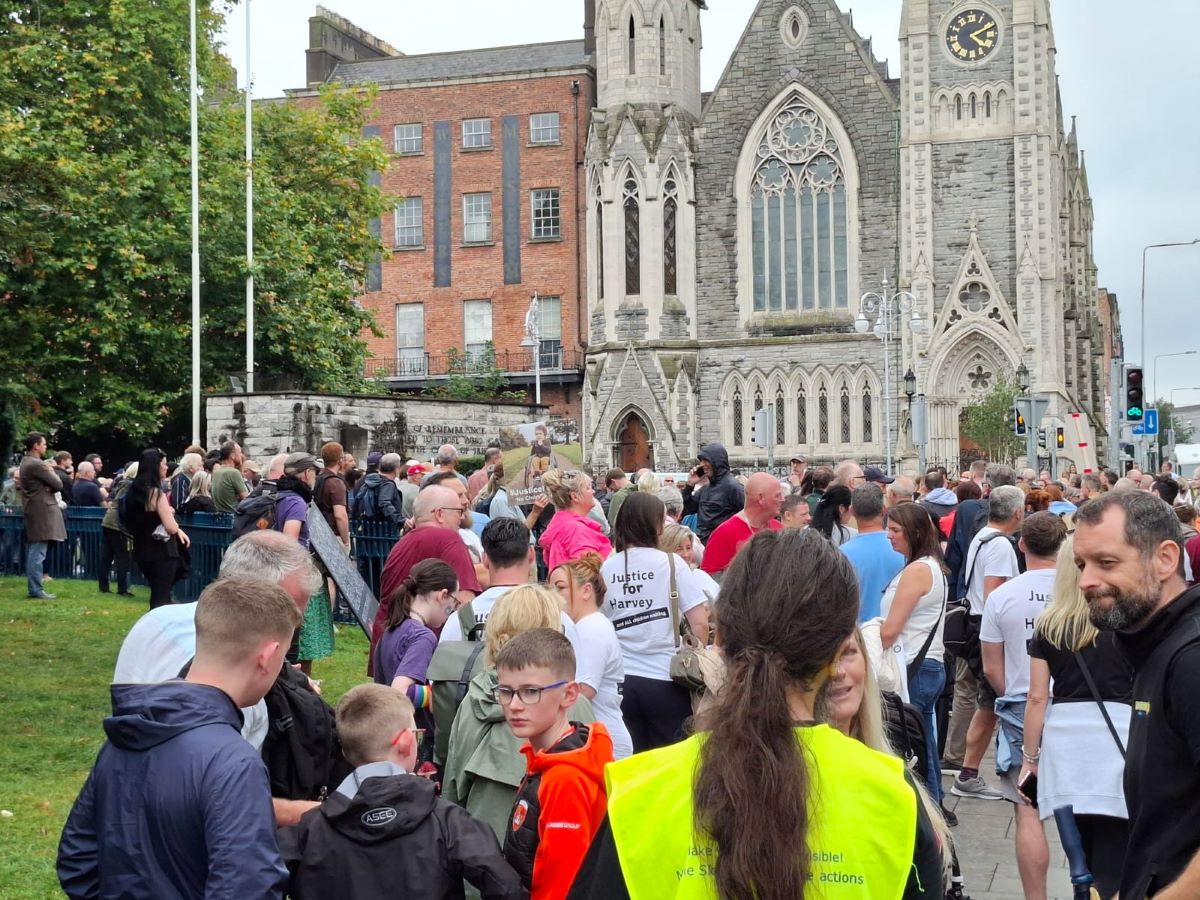
Dublin city centre on Saturday saw two marches scheduled to start at the same time from the Garden of Remembrance, both of which were drenched by heavy showers, as were fans attending the Robbie Williams concert in nearby Croke Park stadium.
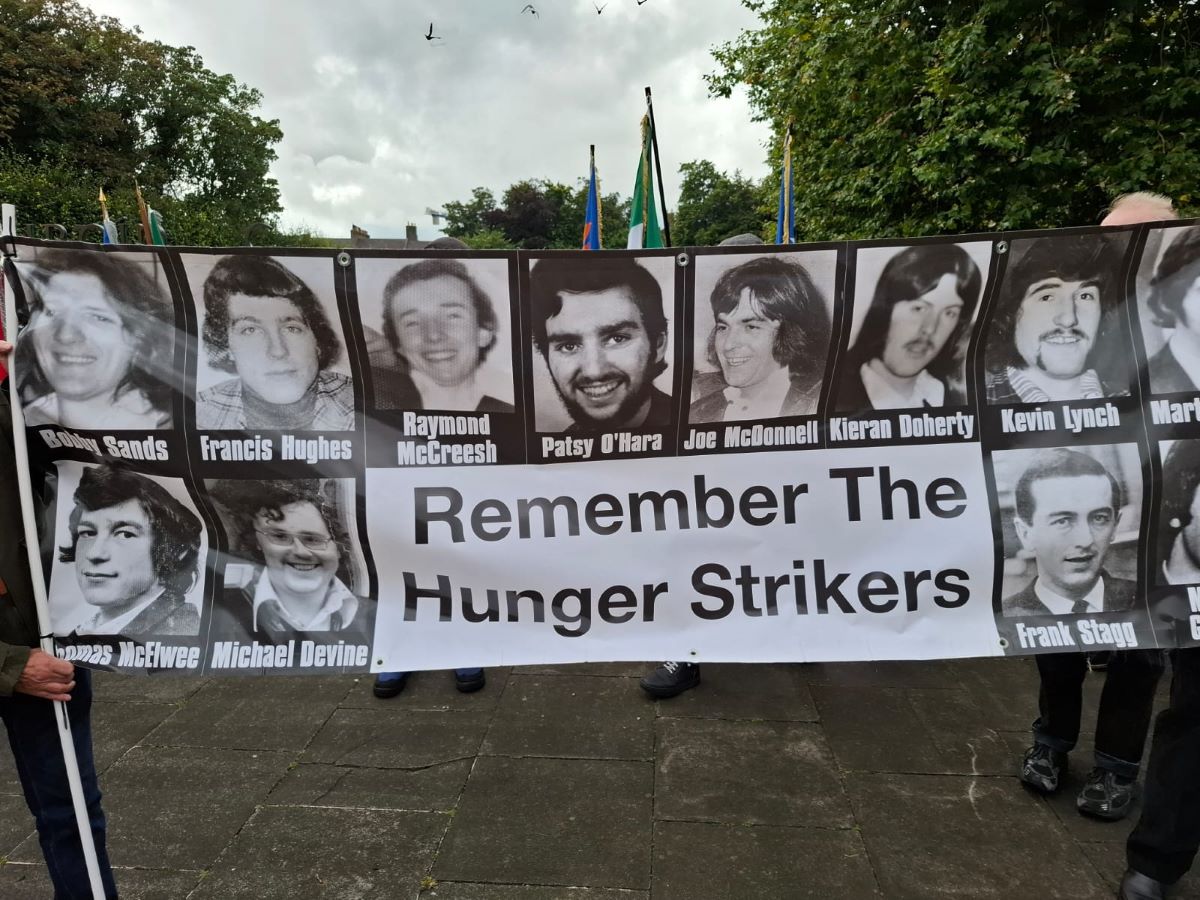
The first march to set off was the largest, the Harvey Morrison protest, the Hunger Strike Commemoration organised by Dublin Independent Republicans waiting for the space to clear in order to assemble theirs, with pipers, band and various banners forming up.
Supporters of both marches are mingled here though the majority are there for the Harvey Morrison march. (Photo: R.Breeze)
The Harvey Morrison protest was about the long wait the named boy had for appropriate treatment from the Irish health service for his condition of spina bifada and scoliosis. As he waited, his spine continued to curve causing him pain and though underwent surgery last year died on July 29th.
It emerged last year that Harvey had been removed from Children’s Health Ireland’s (CHI) urgent scoliosis surgery waiting list, without his family being informed. In 2017 Simon Harris declared that no child would wait for more than four months for scoliosis treatment.
Apart from those requiring specialist treatment for rarer medical conditions, people with much more common complaints face many hours in A & E before being seen by a doctor or having an X-ray taken, with an average of 500 people admitted to hospital on trolleys daily awaiting beds.1
Seven different speakers addressed them at their rally on Custom House Quay, being well received by the crowd with a small exception, which was when a participant shouted ‘Traitor!’at Mary Lou Mac Donald, President of the Sinn Fein party, before being told by march stewards to keep quiet.
Calling SF (and any in Government) politicians ‘traitor’ is a frequent position of those on the Far-Right2 in the Irish State, for racist reasons. Indeed, a number of Far-Right activists were spotted among the marchers but it seems they were unable to dominate the event.
THE HUNGER STRIKE MARTYRS COMMEMORATION
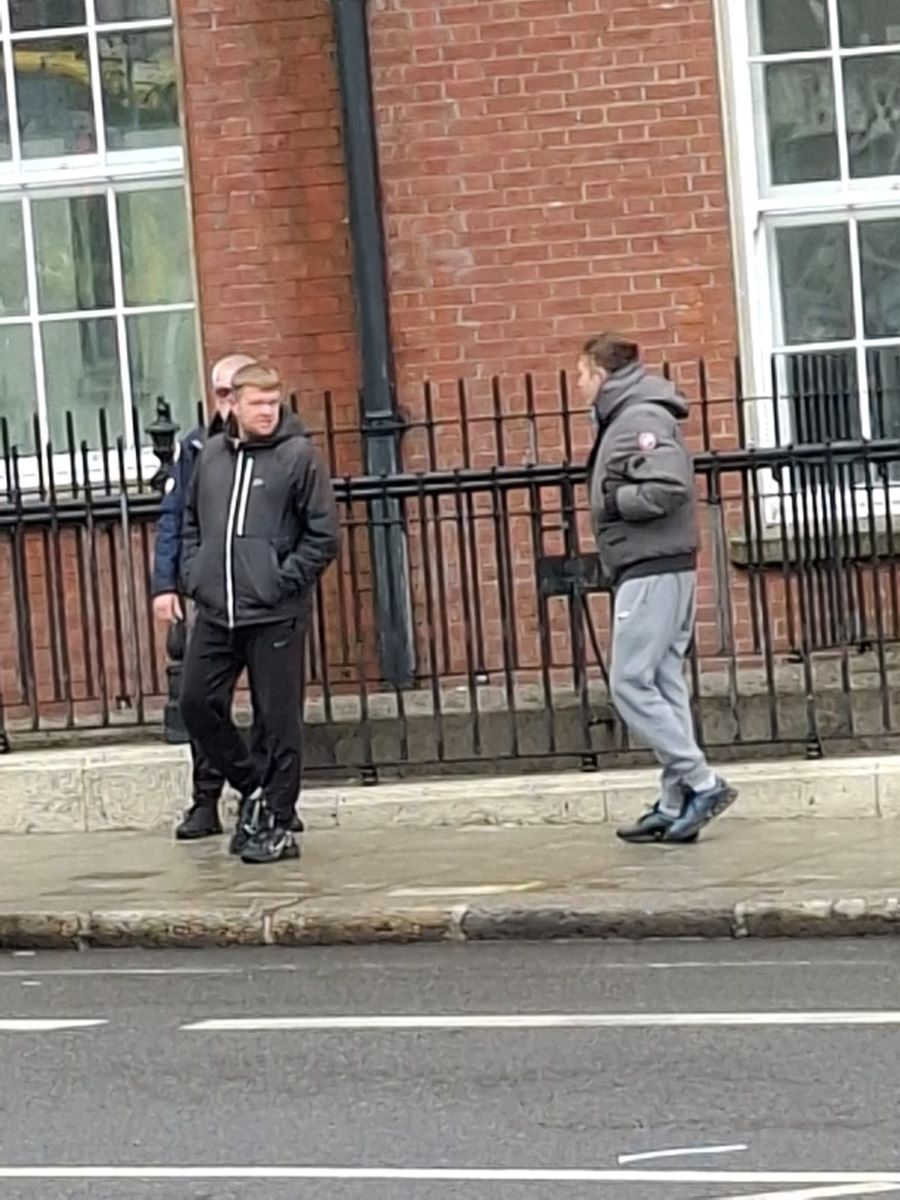
A handful of fascists were also observed watching the Hunger Strike martyrs’ commemoration gather and photographing them but when some of their targets began to photograph them in turn, they walked away, presumably to go and promote themselves and their lies on social media.
Fascists who had been filming the Hunger Strike Commemoration moving off as a camera turns on them. (Photo: R.Breeze)
Irish Republicans, who are opposed to (and by) the Far-Right, also call Sinn Féin ‘traitors’ but for the reason that they consider the party has left the struggle and colludes with the neo-colonial ruling class of the state and with the English occupation in the Six Counties.
The pipers prior to setting off on the march. (Photo: R.Breeze)
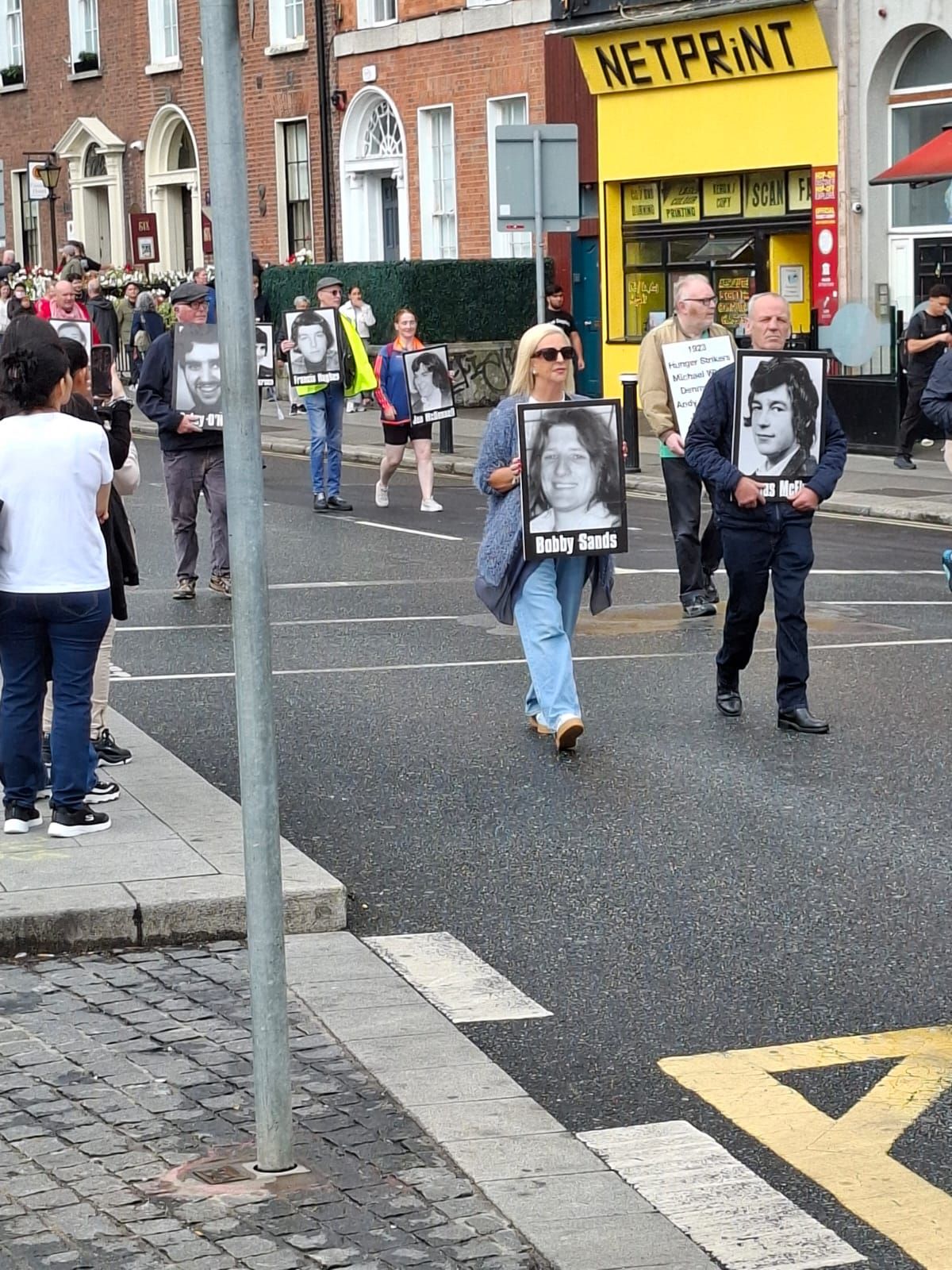
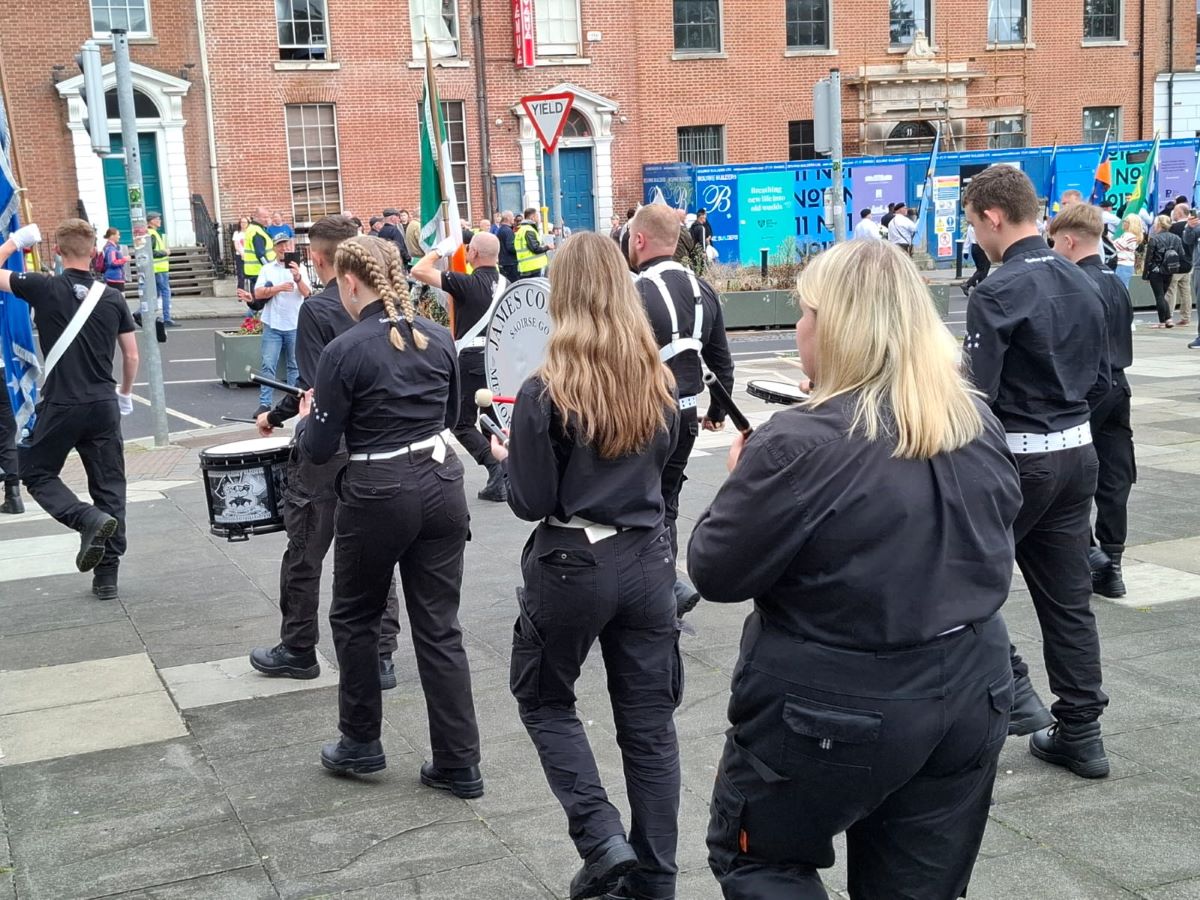
Two pipers led off the Hunger Strike commemoration organised by Independent Dublin Republicans followed by a full colour party and the James Connolly Republican Flute Band, from Derry. In traditional two lines style they marched through onlooking crowds in O’Connell Street.
The march crossed the Liffey into D’Olier Street, back up O’Connell Street and after a pause at the Government-threatened GPO, into Parnell Street, then around the western and northern sides of the Square and back into the Remembrance Garden for the commemoration ceremony.
The Hunger Strike Commemoration march proceeding down from the Garden of Remembrance and just about to enter Dublin’s main thoroughfare, O’Connell Street. (Photo: R.Breeze)
And it rained – it poured down rain. Which was bad enough on the audience but much much worse on the colour party in shirt and trousers, the RFB members and those holding the portraits of the ten hunger strike martyrs and a number of banners.
Dixie Elliot was introduced as the main speaker, well-known in Republican circles, former member of the Provisional IRA, an ex-POW and ‘Blanketman’.3
(Photo: R.Breeze)
Seemingly undeterred by the pouring rain, Elliot spoke at substantial length though whether through lack of projection or faulty amplifier, much of what he said was lost to many in the audience. From snatches he could be heard going through the history of the recent three decades’ war.
The targets of his condemnation were not alone the British occupation and the Irish State’s complicity but also the leadership of the Irish Republican movement who had abandoned the struggle and become part of the colonial administration in the Six Counties.
(Photo: R.Breeze) (Photo: R.Breeze)
Expressing solidarity with the Palestinian struggle and against imperialism, Elliot also condemned the far-Right in Ireland who claim to be ‘patriots’ in order to promote their racism and he counter-posed the example of Bobby Sands’ internationalism in his poem The Rhythm of Time.
The Connolly Memorial Republican Flute Band setting out on the march from Garden of Remembrance. (Photo: R.Breeze)
Both Elliot and the Chairperson called for solidarity with Irish Republican political prisoners and the framed Craigavon Two, convicted in a no-jury political Occupation court and still in jail 16 years later.
Finally chairperson Ado Perry thanked people for their attendance, the colour party and audience stood to attention and the piper played the air to the chorus of the song generally known as Amhrán na bhFiann (and of which the chorus melody is also the ‘National Anthem’ of the Irish State).
(Photo: R.Breeze)
CROKE PARK CONCERT
The Gaelic Athletic Association stadium in Croke Park was the venue for a Robbie Williams concert in Dublin and the fans were flocking into town in rainproof macs that the marchers could have done with. The previous weekend it had been the Manchester Gallaghers, i.e. Oasis there.
The finals in Gaelic football for men and women and in hurling have been played in Croke Park in previous weekends and now it seems it’s rock concerts season.
The far-Right protested the couple of occasions that the stadium was rented to celebrate the Muslim feast day of Eid. Apparently English musicians and bands playing there are are not problematic for them. But then nor are the banks and property speculators causing the housing crisis.4
End.
(Photo: R.Breeze) (Photo: R.Breeze) (Photo: R.Breeze)Main speaker, Dixie Elliot, speaking at rally in Garden of Remembrance at end of Hunger Strike Commemoration march. (Photo: R.Breeze)
3One of the Irish Republican ‘blanket protester’ prisoners who resisted the attempt of the colonial prison service to make them wear regulation prison uniform, wearing underwear and a blanket instead. This condition degenerated into the ‘no wash’ and ‘dirty protests’ which the prisoners sought to overcome with the hunger strikes of 1980 and 1981 when 10 prisoners died.
The Oasis rock band are performing on 16 and 17 August in Croke Park, the Gaelic sports stadium in Dublin, to a sold out capacity of 82,300. Brothers Liam and Noel Gallagher are the two leading members of the band.
Oasis-marked t-shirts and caps are being sold from stalls in the city and posters announcing the forthcoming concerts adorned shop windows and lampposts but how many fans know the Gallaghers’ background?
Liam and Noel Gallagher of Oasis (Source imag: Internet)
Liam and Noel were born in Manchester to Irish migrant parents but their mother Peggy split from her abusive husband and moved elsewhere in Manchester, taking the kids with her. Liam dedicated Stand by Me to her on Saturday night and gave a shout-out to her her birthplace in Co. Mayo.1
Ireland fed the British ‘industrial revolution’ and the Irish have a long association with Manchester. In 1845 the city’s factories were already attracting Irish workers and its farms probably also agricultural workers to replace English labourers deserting the farms for the factories.
Friedrich Engels wrote The Condition of the Working Class in England,2 published in 1845 (the first year of the Great Hunger) and mentioned the Irish migrants not too favourably. He was writing mostly about Salford, the subject of Ewan McColl’s Dirty Old Town,3 just outside the city then.
By the time Engels’ book was published, the Great Starvation was gearing up. Uncomplimentary references to the Jews can also be found in that work but whatever about that ethnic minority,4 Engels changed his mind radically about the Irish in Britain and came to admire them greatly.
Instrumental in learning about the Irish for Engels were two Irish sisters living in Manchester, Lizzie and Mary Burns, illiterate but intelligent and militant mill workers. Mary and Friedrich became life partners and, after her death, Friedrich became Lizzie’s partner thereafter.
The Irish, as the natives and diaspora of what is often referred to as “England’s first colony” were of considerable interest to the revolutionary partnership of Engels and Karl Marx and more so still as the Fenian movement, the Irish Republican Brotherhood, spread throughout Britain.5
Karl Marx and Frederick Engels, leading theoreticians and activists of the revolutionary socialist movement. (Source: Workers Liberty)
A largely proletarian movement, the Fenians were admitted to the First International Workingmen’s Association6; no doubt the Irish struggle against British domination greatly influenced the political opinions of Marx and Engels in relation to nations under colonialist rule by capitalist states.
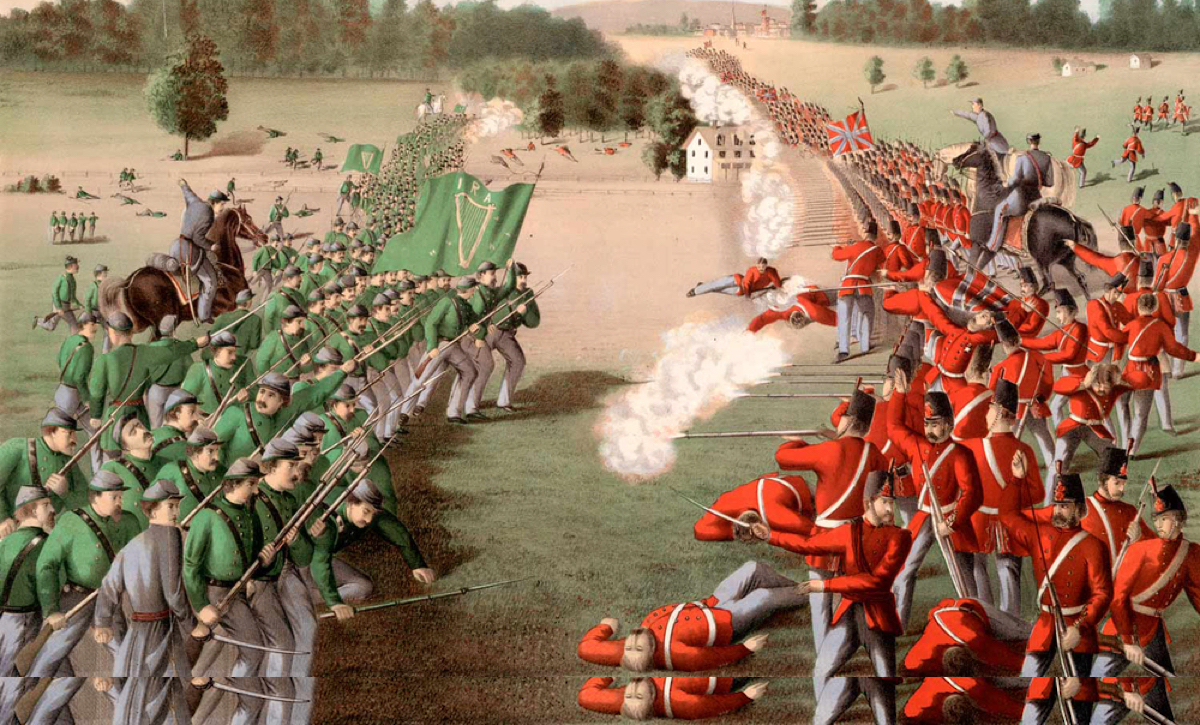
The struggle spilled over from Ireland into the Irish diaspora, particularly that in North America, Australia and Britain. In Australia the Fenians’ role seems to have been mostly in facilitating and escaping British jails there7 while in America, they invaded the British colony of Canada.8
The charge of the Fenians (wearing green uniforms) under Colonel John O’Neill at the Battle of Ridgeway, near Niagara, Canada West, on June 2, 1866. In reality, the Fenians had their own green flags but wore a very mixed bag of Union and Confederate uniforms (if they still had them, or parts of them left over from the Civil War), or civilian garb, with strips of green as arm or hat bands to distinguish themselves. (library and archives canada, c-18737)
In Britain itself, the Fenians went to war against the ruling class with dynamite. To spy on them, Scotland Yard created the Irish Special Branch which evolved into the Special Branch, the political police in Britain and in any colony the British had since then.9
The activities of the US Fenians intersected with those of Britain-based Fenians when two of the former, Thomas J. Kelly and Timothy Deasy, American Civil War veterans, were arrested in England. On their prison van’s journey to jail it was ambushed10 and both officers spirited away.
Artists’ impression of the rescue of the Fenian prisoners. (Image source: Internet)
Unfortunately and entirely unintentionally, Constable Brett was killed during the breakout. Refusing to hand over the keys from inside the wagon, he was bending to look through the keyhole when in order to release the prisoners one of the Fenians fired at the lock, the bullet entering Brett’s brain.11
The British police swept vengefully through the Irish quarters of Manchester and Salford arresting at least 28 people but eventually sending five for trial on ‘murder’ charges. Three were hanged, all innocent of intentional killing and at least two probably not even present at the scene.
As sentence of death was passed upon them, all five cried “God save Ireland!” Although the sentences on two were commuted, Timothy Sullivan used those words for his ballad about The Manchester Martyrs, as the executed three became known among the Irish at home and abroad.
The song travelled quickly and became an unofficial national anthem of Ireland and the Irish until it was decisively supplantedafter the 1916 Rising by Peadar Kearney’s The Soldiers Song (latertranslated: Amhrán na bhFiann).12 A memorial to the three was erected in Mostyn Cemetery.
Artist’s impression of the trial of the five convicted including the three Manchester Martyrs. (Image source: Internet)
Manchester continued to be a destination for Irish migrants, for factories still, including motor car production but also post-WW2 reconstruction and motorway building.
Manchester United FC, along with a number of other British soccer teams, recruited Irish players and Irishman Liam Whelan was one of the eight players killed in the Munich air crash of 1958. Another 30 Irish have played for the club at one time or another, some quite famous.13
The city is one of a number of British cities that has a name in the Irish language; Mancunians would probably be delighted to know that their city’s name in Irish is Manchuin.
From the late 1960s to late 1990s the city was host to an active branch of the Troops Out Movement in solidarity with Ireland, also from 1980s to an active branch of the Irish in Britain Representation Group; the Special Branch was active in monitoring and, from time to time, harassing their activists.
The Provisional IRA bombed the city in 1996 as part of its campaign against the British State and — despite a 90-minute warning — 212 were injured.
Today Manchester, alongside South Asian ethnic influences, continues its Irish ethnic presence with Irish traditional cultural activities14 and no doubt the sons and daughters of Manchester’s Irish diaspora will continue to contribute to other sport and artistic culture in Britain and in the world.
8https://www.irishcentral.com/roots/history/irish-fenian-invasion-canada Unlike many other accounts easily available this one gives a reasonable assessment of the rationale for the invasion, including its potential and the reasons of its ultimate failure, the interests of the ruling class of the USA, which the Irish Republican movement should have learned from forever afterwards – but failed to do.
9Often referred to simply as ‘the Branch’ or ‘Branchmen’ (though the organisation of course also recruits women).
10The location, by an arch under a railway bridge, is still unofficially known as “Fenian Arch.”
14Manchester has a Comhaltas Ceoltóirí Éireann club (for Irish traditional music) and informal music sessions, also an Irish dancing school https://www.facebook.com/profile.php; Gaelic Athletic Association clubs including St Brendan’s, St Peter’s, Oisín, and St. Lawrence’s.
Reprinted in full from G.Ó.L’s substack and formatted for the Rebel Breeze blog.
Feminism used to be associated with pacifist anti-militarist movements, but times have changed and now there are feminists who call for war, whilst they still continue to blame all wars on men. It is an enormous contradiction.
For the last two years Gaza has lived under a siege and a genocide, supported by some sectors of feminism and in the midst of the conflict with Iran, once again feminist voices come out with a clamour for war. The reason is their supposed rush to free the women of Iran.
Four female political prisoners in Evin prison in Tehran (before it was bombed by Israel), conscious of the cynicism of some feminist groups in the West issued a communiqué denouncing the war and those who support it.
They stated that Israel wanted a submissive and weak Middle East and they opted to continue their own struggle against the government in Tehran without allying themselves with Yankee imperialism.
Our liberation…from the dictatorship ruling the country is possible through the struggle of the masses and by resorting to social forces – not by clinging to foreign powers or placing hopes in them.
The powers that have always brought destruction to the countries of the region through exploitation and colonisation, by inciting wars and killing in pursuit of greater benefits, will have no way out for us except for new destruction and exploitation.[1]
The four women are pro-Kurdish and also women detained in the protests following the death of Masha Amini at the hands of the Morality Police in 2022. One of them fought against ISIS in Syria. They are not coffee house feminists.
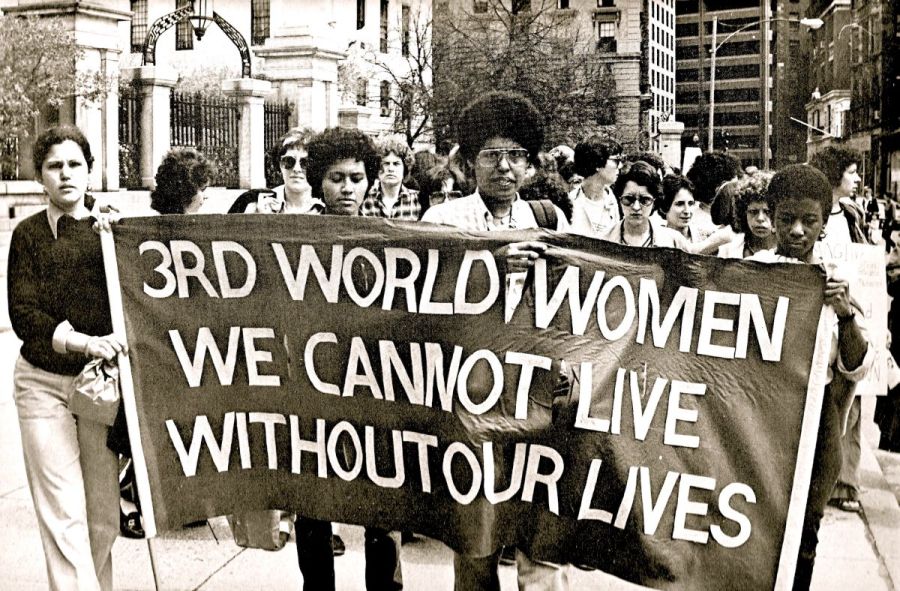
Women ‘of colour’ probably of the Combahee Collective with banner in what seems to be a general women’s liberation demonstration in the early 1970s. (Photo sourced: Internet)
They branded as traitors those Iranian who have called for war, amongst them the son of the despotic Mohammad Reza Pahlavi, the Shah imposed by the USA in 1953 following the CIA coup.
He ruled with an iron hand murdering and torturing the opposition, both the Left and Right, men and women. His son wants to go back to robbing the country’s coffers.
Traitors to Iran and traitors to the peoples of the Middle East and traitors to the people’s years of freedom-seeking struggles against oppression will know that their betrayal and disdain will be recorded in the memory of the Iranian people and in history.
Future generations will remember with shame those who stand on the corpses of defenceless people and trample them.[2]
Whilst these women who did actually rise up against the regime are opposed to the war, in the West there are those bourgeois feminists who in between their macchiatos ask for more attacks on Iran, in order to “free” the women.
They only think of Iran when a US president or the Nazis in Tel Aviv want to attack the country. They believe that the sexual predator who acts as US president is going to fight for the women. Maybe the way he did in Syria by installing ISIS.
One of the first to invoke the repression of women was none other than Netanyahu,[3] a man who has bombed maternity hospitals in Gaza killing women and children all around.
The US said something similar about Afghanistan and various bourgeois feminists came out to justify the war, deliberately ignoring that without US support the Taliban would never have existed.
It was Jimmy Carter and then Reagan who started to finance the troglodytes of the Mujahadeen and later the Taliban i.e. the bourgeois feminists too.
I should clarify that many of those feminists are not bourgeois in the sense of their social class, they have no capital, they are not rich, though there is no lack of those who are.
They are bourgeois in an ideological sense, although they use terms such as liberal, radical, separatist etc., but what unites them is their defence of capitalism and the bourgeoisie.
You could say right wing feminists but many of them like to present themselves as progressive when they are bourgeois, or in the case of the less wealthy ones, acolytes of the bourgeoisie.
Hillary Clinton, a bourgeois feminist (both in the ideological sense and also in terms of her bank balance) who has her hands stained with the blood of women in Libya and other parts is one of the spokeswomen for bourgeois feminism.
Much though they may shout, down with patriarchy! Their favourite slogan is Long Live Capitalism and Imperialism! This includes feminist intellectuals like Julie Bindel.
They kept silent about the genocide in Gaza and now believe that whoever criticises the war against Iran supports the regime. I suppose this includes the political prisoners who don’t sip macchiatos in their cells.
Bindel writing in The Sun said that those who criticise the war support Iran and the oppression of women. She repeated the usual lies about October 7th, mixed with some truths about Iran with the aim of supporting the war.[4] Bindel has kept silent about the massacres of women in Gaza.
She doesn’t support the women of Iran, but rather the West. It is worth pointing out that the owner of the paper, where she writes, has supported reactionary governments around the world, including in Great Britain where Bindel lives.
It is a misogynist, homophobic paper that frequently runs campaigns against the poor and migrants. Bindel is not alone, Kelly Jay Keen shares videos of the son of the Shah, perhaps to indicate that she supports the monarchy.[5]
The bourgeois feminists, like all of the bourgeoise in practice see other cultures as inferior ones. They use the same imperialist language to justify wars as did Rudyard Kipling, the author of the infamous poem The White Man’s Burden. They boast about the White Woman’s Burden.
It should be remembered that Kipling wrote that poem to seek and to justify the US invasion of the Philippines.
Take up the White Man’s burden The savage wars of peace Fill full the mouth of Famine And bid the sickness cease; And when your goal is nearest The end for others sought, Watch Sloth and heathen Folly Bring all your hopes to nought.
Then they say that men are to blame for wars and not their dear capitalist system. Over and again the bourgeois feminists call for war.
But if they want wars and invasions, well why not ask for the US to be invaded, where women are pursued fleeing from one state to another to obtain an abortion, or where access to sex education is restricted and deficient as is access to contraceptives,[6] where women earn less than men and are under-represented in a wide range of fields.
Afghanistan is a country where women are more repressed than in any other part of the world. Throughout the conflict the US financed the Mujahadeen and later the Taliban.
They had the option of supporting organisations such as the Revolutionary Association of the Women of Afghanistan, a women’s organisation that opposed the Islamists and also the Russians and later the US invasion.[7]
No, between one macchiato and another our dear bourgeois feminists let the men in the Carter, Reagan, Bush and Clinton support the Taliban troglodytes.
They said the same in Iraq. I am sure more than one reader is asking themselves what Iraq has to do with it all. It was a secular country, that promoted women’s education and participation.
However, one of the reasons bandied about by Bush was that he was rescuing and defending women and he compared their situation to that of Afghanistan, despite Saddam promoting women’s education.[8]
In fact, under Saddam, 30% of faculty staff were women, trained in Europe and the USA with full funding from the government. It is no longer like that, in fact there is no intellectual world in Iraq, the bombs the bourgeois feminists asked for, put paid to that.[9]
In the US the bourgeois feminists paid to go to universities, but Iraq promoted women as a state policy, something the Yanks have never done. In Britain, just 31% of the lecturers were women.
Iraq almost beat them, but in-between macchiatos the bourgeois feminists called for a war to improve the situation of women in Iraq and of course their investment portfolios.
Now the drums of war are beating again and the bourgeois feminists once more give themselves over to the war, despite believing that wars are a male product rather than a capitalist one.
They are not going to analyse their own participation, whilst a refugee from one of their wars prepares another macchiato for them.
As the female political prisoners in Evin said, it will be the Iranian people and the Iranian women who will free Iran and the Iranian women and not the bourgeois with the macchiatos, wine and caviar.
They are just as much the enemy of the women of Iran as the male bourgeois and are as deserving of our contempt.
There is no lack of Iranian voices asking for war and not just the son of the despot Pahlevi. Masih Alinejad is an exiled journalist. She took part in the movement against the obligatory use of head coverings in Iran and other things.
So far so good, unlike others she has fought against the oppression of women in the country.
But in exile, she turned out to be a Zionist and in the first Trump government met with the hawk Mike Pompeo and also worked at the official US propaganda radio station, Voice of America, transmitting programmes in Farsi.
Masih Alinejad & Jake Sullivan, Intelligence Adviser to US President Biden 2021 2025. (Source: Wikipedia)
Now she criticises Netanyahu, but not for bombing Iran and killing civilians but because of his bad timing. She believes he should have waited for protests against the government and attacked at that time. Of course the bombs were not going to fall on her, safe in New York.
Those feminists who keep silent about the genocide in Gaza do not seek the liberation of women in Iran, but rather a geopolitical reorganisation of the region and the victory of Zionism.
But that slogan doesn’t sound too good and you can easier convince the dozy in the world by talking about the rights of women in Iran. Meanwhile they have little to say about why their governments installed and recognised the Islamists from ISIS in Syria.
It is an exercise in public relations rather than real concern for the future of women in Iran. At the end of the day bourgeois feminists defend the bourgeoisie more than they defend women.
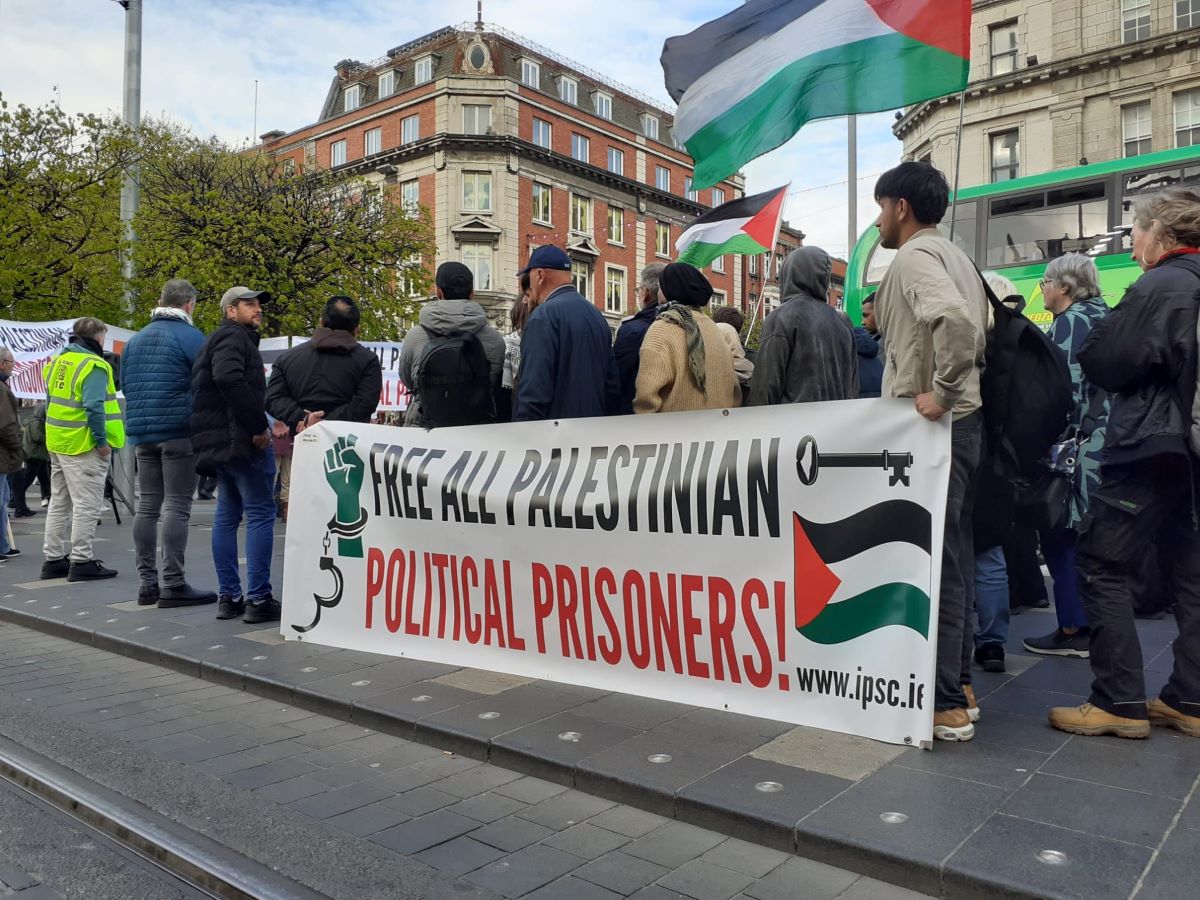
April 17th is the annual Palestinian political Prisoners’ Day and it was marked in O’Connell Street, the main street of Dublin’s city centre, by an event with speeches, banners and chants organised by the Ireland Palestine Solidarity Campaign.
Palestine national flags fluttered about the crowd being addressed by a number of speakers with occasional toots of solidarity from passing traffic – a common occurrence at Palestine solidarity events in most of Ireland.
View of eastward of section of the crowd at the event (Photo sourced: IPSC)
Dáithí Doolan was one of the speakers and though saying some progressive things about solidarity with Palestine and the terrible situation in which the occupiers have them, soon revealed the political poverty and lack of solidarity with resistance of his Sinn Féin party.
Doolan reminded his audience of when there were political prisoners in Ireland, as though this was no longer the case, presumably because the prisoners now are not of his party. Nor did he mention the current attempts to extradite Irish Republicans to British administrations.
The SF speaker went on to extol the South African process, perhaps not caring about the betrayal of the struggle and sacrifice of the masses there, the deepening grip of imperialism on the rich natural resources, the corruption and repression of the ANC regime and the massacre at Marikana.1
If Doolan thought about it he must have hoped that his audience did not remember that the South African process had a twin, the Palestinian one at Oslo which sabotaged the Palestinian struggle and brought into being the corrupt Palestinian Authority2, the Israeli proxy in the West Bank.
Sinn Féin has achieved a somewhat similar position in the Six Counties colony and has been working hard to reach a corresponding role in the Irish state. And why not, when it endorses the “Two State solution” giving the Palestinians 20% of their land under Zionist eyes and guns.
The very least, Doolan said, that the Irish Government could do to help the Palestinians, would be to enact the Occupied Territories Bill but he proposed nothing further, not even the ban on US military flights through Shannon Airport or on Israeli arms flights through Irish airspace.
Darragh Adelaide from the People Before Profit party spoke too about Palestine and solidarity but also about the Palestine refugees that have had to sleep in tents on Irish streets and the attacks on them both by the authorities and by fascists and other racists.
Palestinian prisoner conditions
A woman gave a detailed list of statistics relating to Palestinian political prisoners but also went through the tortures and terrible conditions in which they are kept. She concluded reminding her audience that each prisoner is a human being, a parent, a child, a sibling and not a number.
View of the crowd southward from behind a speaker (Photo sourced: IPSC)
In a year and a half, more than 15,800 Palestinians have been arrested, including 500 women, 1200 children, and thousands of detainees who were placed under arbitrary administrative detention. 64 Palestinians have died in prison since October 2024, including a child.3
The prison administration’s special units have carried out violent raids on prisoners’ cells, administering severe beatings, torture, and ill-treatment.4
Prisoners have suffered power and water cuts, and all of their belongings—including clothes, electrical appliances, and hygiene items—have been confiscated.5
They have been placed under complete isolation, family visits have been completely banned, and the International Committee of the Red Cross has been prevented from visiting them inside prisons.
Additionally, a policy of starvation has been implemented against thousands of prisoners, who are being provided with only two extremely poor-quality and quantity meals a day.6
The MC of the event led chants in which he called out Palestinian political prisoners! and the audience responded with Free them all! Similarly with Free the children prisoners — Free them all! and Free the women prisoners! — Free them all!
Symbolising the Palestinian political prisoners (Photo sourced: IPSC)
He also referred to the woman arrested outside the Irish Embassy in Berlin for speaking in Irish and, in defiance, led the audience in a chant in Irish expressing solidarity with the Palestinian people: Saoirse don Phalaistín! (Freedom for Palestine!)7
What was notable in its total absence from all the speeches was any call to step beyond the marches and similar measures which have been supported by thousands in Ireland over more than 18 months but which have not succeeded in moving the Government even to enforcing its formal neutrality.
This is replicated in most solidarity events across the state, leaving those few who take action to increase greater pressure on the ruling class to face the repression of the Irish State, as with 23 men and women in three different events over a four-day period in Dublin recently.8
Political prisoners from the armed resistance
The Joe McDonnell Ballad9 would have been most appropriately performed at this event, in particular the chorus line: You dare to call me a terrorist, while you look down your guns … But the IPSC would hardly endorse the singing of that song nor wish to be associated with it in public.
There were two large prisoners’ solidarity banners of the IPSC at this event but it is remarkable how rarely one sees them on the IPSC’s national marches. The problem with the prisoners for liberal organisations is that some of them, at least, have been armed fighters of the Resistance.
This, combined with ignorance perhaps, accounts for the comparatively low numbers at this event. However, it has to be said that known revolutionary organisations were also visibly absent.
View south-westwards with the iconic GPO (General Post Office) building in the background. (Photo sourced: IPSC)
Doolan’s party was a problem for liberals when many of the political prisoners here had been armed Irish Republican resistance fighters; it’s still a problem for them today — but also for Doolan and his party now that the current Irish political prisoners are no longer associated with them.
If solidarity does not embrace resistance then it’s charity, not solidarity. And if resistance is to be embraced then it should be so for all its expressions, artistic, cultural, mass mobilisations, strikes, boycotts … and armed. Including solidarity with those who, because of resistance, end up in jails.
Free them all!
End.
NOTES
1Culminating on 16th August 2012 (while Mandela still lived) the police of the ANC Government carried out a massacre of over 40 striking miners over a period of three days. The massacre was to suppress a strike in a platinum mine of the Canadian Lonmin company, repressing also a breakaway union from theANC-allied National Union of Mineworkers. The massacre is widely believed to have been organised by Cyril Ramaphosa, then a millionaire and vice-President of the ANC Government and recent leader of the NUM, now President of South Africa.
2Which also beats and incarcerates Palestinians resisting the Occupation (exact figures are difficult to obtain) and has murdered some.
7This slogan has now become well known in Ireland in voice but also in writing, appearing on flags, banners and placards. It represents a partial success for those of us who have tried to insert a measure of the Irish language into Palestine solidarity, in the belief that it is important for the Irish language to be present in progressive movements.
9By Brian Warfield of the Wolfe Tones band in honour of Volunteer Joe McDonnell of the Provisional IRA who died on hunger strike in 1981; the song also names other hunger strike martyrs of the Provisionals Vols. Bobby Sands, Francis Hughes, McCreesh but adds Vol. Patsy O’Hara of the Irish National Liberation Army. In total, seven of the Provisionals and three of INLA died on hunger strike in 1981.
The CCJ (Criminal Courts of Justice) in Parkgate Street, Dublin, are seeing an increase in political cases in recent weeks with activists in housing and Palestine solidarity as well as Irish Republicans fighting extradition to the British colony.
Eoghan Ó Loingsigh, who made the mistake of asking a Garda for his badge number while they were carrying out an eviction, appeared there in February only to see his case thrown forward to June.
Picket anti-extradition display by Anti-Imperialism Action outside Heuston Station in February. (Photo: R.Breeze)
Another housing activist’s charge of attempting to break into an empty property was dismissed. The property in question, empty for a number of years is leased to the Salvation Army and three years ago two RHL1 activists were evicted from it by 100 Gardaí (some armed) with helicopter support.
Jack Brazil, a Palestine solidarity activist whom the Gardaí are trying, believe it or not, to tie into the racist and criminal riots of November last year, had yet another appearance in court without trial as he’s still trying for CCTV footage from Gardaí to support his alibi for the night.
At least the remaining bail restriction on Brazil was lifted: at the outset he had to sign on at Mountjoy Garda station once every week, observe a curfew of 12am-6am and not to loiter at any point in the Dublin city centre (D1 and D2). His case is now remanded to 26 March.
Jack Brazil (in the suit) and other Palestine solidarity activists outside the CCJ after Brazil’s most recent appearance there. (Photo: R.Breeze)
Jim Deneghan had a number of court appearances fighting extradition to the Six Counties on foot of charges alleging an act during the 30 Years War there – fifty years ago. He was unsuccessful and it appears that the only avenue open to him now would be to challenge it in the High Court.
Should they even grant him leave to do that which is not always the case.
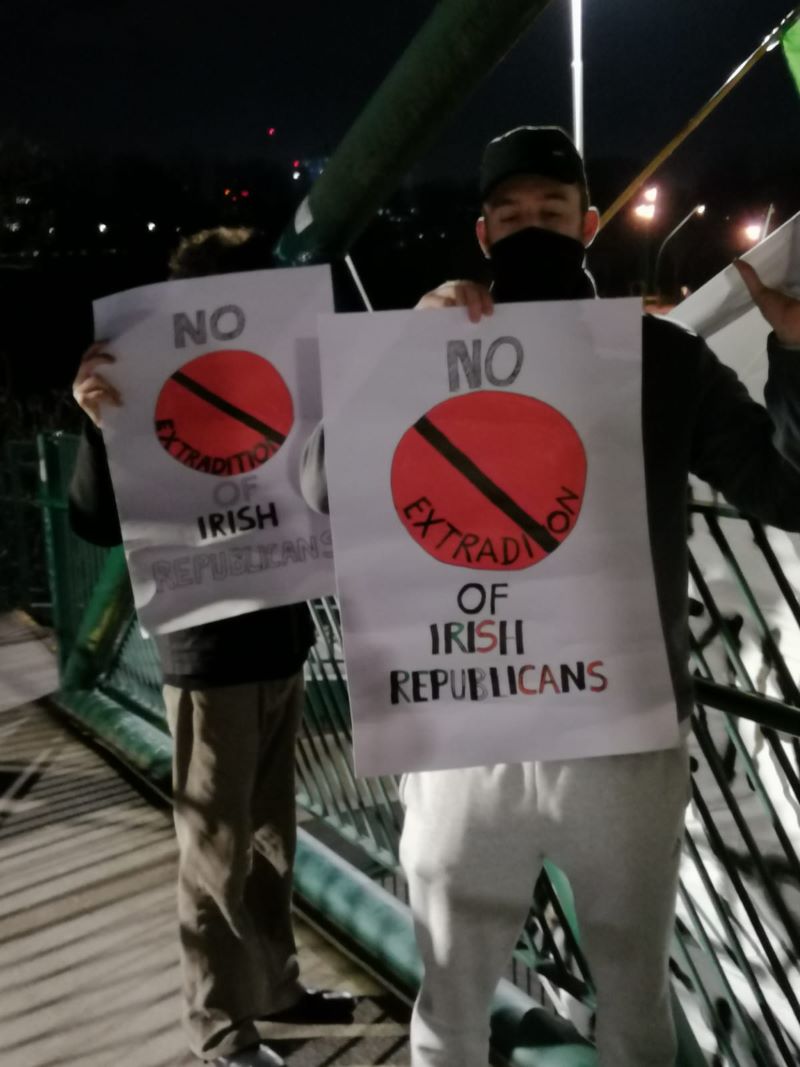
Some of the AIA-organised anti-extradition banner drop on the Fairview pedestrian bridge hold up placards against extradition. (Photo: R.Breeze)
Another extradition case has been dealt with in the Special Criminal Court, which is located within the same building as the CCJ, distinguished from other courts by the glass-enclosed reception ‘box’ through which one must pass to gain entry, first satisfying ‘security’ provisions.2
Sean Walsh has been fighting extradition to the UK’s Irish colony, the Six Counties on a charge of membership of an armed Republican organisation, which is deemed illegal on both sides of the British Border. He is in custody in Portlaoise awaiting a decision from the ECHR in Brussels.
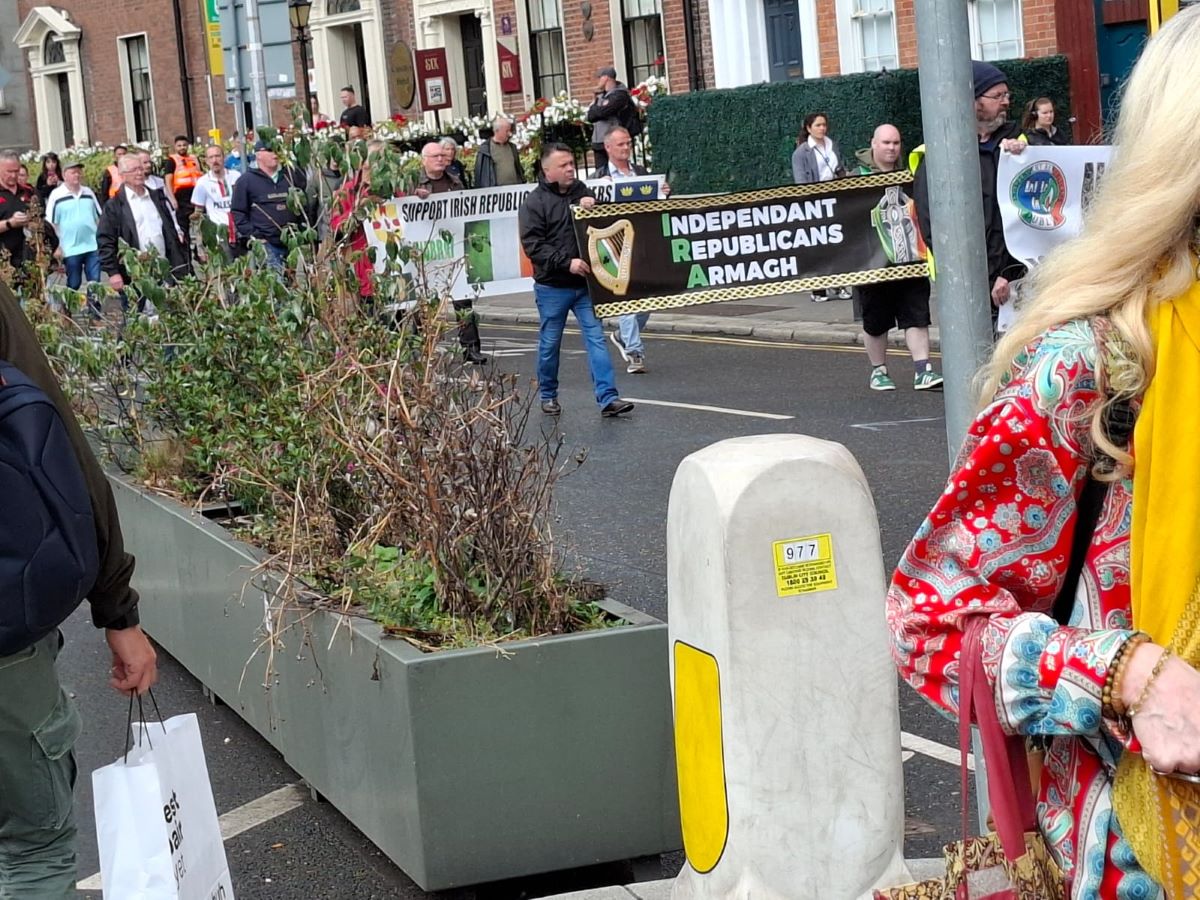
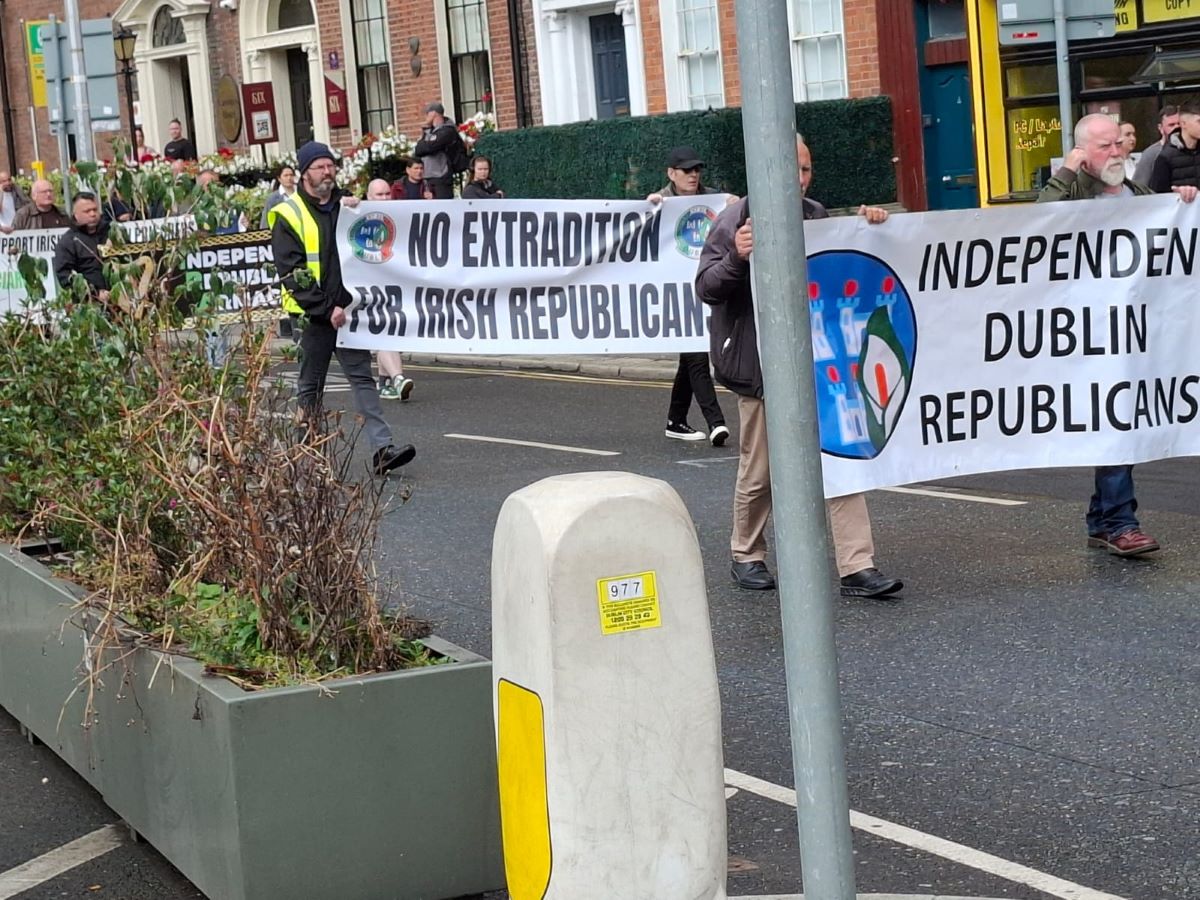
Independent Dublin Republicans organised solidarity pickets outside the court on the mornings of Denneghan’s appearances, while Anti-Imperialist Action held a picket against extradition outside the nearby Heuston Train Station and a more recent banner drop on the Fairview Pedestrian Bridge.
Picket organised by Independent Dublin Republicans outside court where extradition of Jim Deneghan (Centre, next to State Harp) was being decided in February. (Photo sourced: IDR Facebook page)
The CCJ courts, in particular those on the ground floor are extremely busy with what seems at times like industrial-scale processing of setting further dates for court appearances, granting or refusing bail, requiring ‘discovery’ and other documentation from the Gardaí and some sentencing.
The human subjects of these proceedings are mostly from what might be termed the under-class of Dublin with some migrants added for good measure. Most face charges of possession of drugs, anti-social behaviour, threatening behaviour, theft and breach of bail conditions.
A huge amount of court, lawyer and Garda time is taken up with processing people accused under these charges. On the other hand the processes also interfere hugely with the normal lives of those charged and in addition, in the case of political activists, disrupt some of their legal activity.
And can cost them loss of pay and even threaten their employment. Which might be deliberate on the part of the system or if not, at least something those who manage it will not regret.
Banner drop by AIA from Fairview pedestrian footbridge. (Photo: R.Breeze)
The sheer number of that social group being processed through the courts daily is an indication of something really wrong with Irish society and which worsens even through generations, while the major reaction of the State is to maintain the social conditions and repress its victims.
By and large the middle class only come into contact with that element of society when they are prosecuting or defending them in court, or professionally dealing with them in hospital or social services environments.
It is also where many of those who are trying to change the prevailing social and economic conditions, i.e political activists, will first rub shoulders with that group while next to them on court seating benches. Unless the political repression goes a step further and they meet in jail.
End.
1Revolutionary Housing League which had renamed the building, on Eden Quay, ‘James Connolly House’.
2The non-jury SCC was established under an Amendment to the Offences Against the State Act, pushed through Leinster House by Fianna Fáil amidst collapse of its opposition during a panic caused by (British Intelligence) terrorist bombing of Dublin in 1972 killing two and maiming many. The scene of many unjust decisions, its most famous was the conviction of the innocent ‘Sallins Four’ when the SCC was based at Green Street, appropriately enough the scene of many injustices under the British occupation, including the death sentence on Robert Emmet after his famous speech. The existence of the SCC is opposed by Amnesty International and Irish civil rights organisations and, until a few years ago, by the majority political party in Ireland, Sinn Féin, which no longer opposes it.
Myself and my sister, Brenda went on the Rebel Women’s Tour in the General Post Office on Saturday, 1st February 2025. Our Guide was Kim.
Two women’s groups were highlighted: Inghinidhe na hÉireann which was founded by Maud Gonne in 1900 and inspired Cumann na mBan. Inghinide na hÉireann is Irish for “Daughters of Ireland”. It was founded solely for women and adopted Saint Brigid as their patron saint.
Cumann na mBan:
In 1914, Inghinide (modern spelling ‘Iníní’) na hÉireann was merged with Cumann na mBan (abbreviated C na mBan, translated in English as the “Women’s League”). It was formed in Wynn’s Hotel on Lower Abbey Street on the 2nd of April 1914.
Brenda’s husband’s grandmother, Christina Caffrey, was a member. Our Grand Aunt, Theresa Rudkins nee Byrne was also a member as was also an old neighbour of our sister Eileen, Mary Breslin. Cumann na mBan was then led by Kathleen Lane O’Kelley.
One key member whom we are all familiar with is Countess Constance Markiewicz who took an active role in the 1916 Easter Rising which I will come to later.
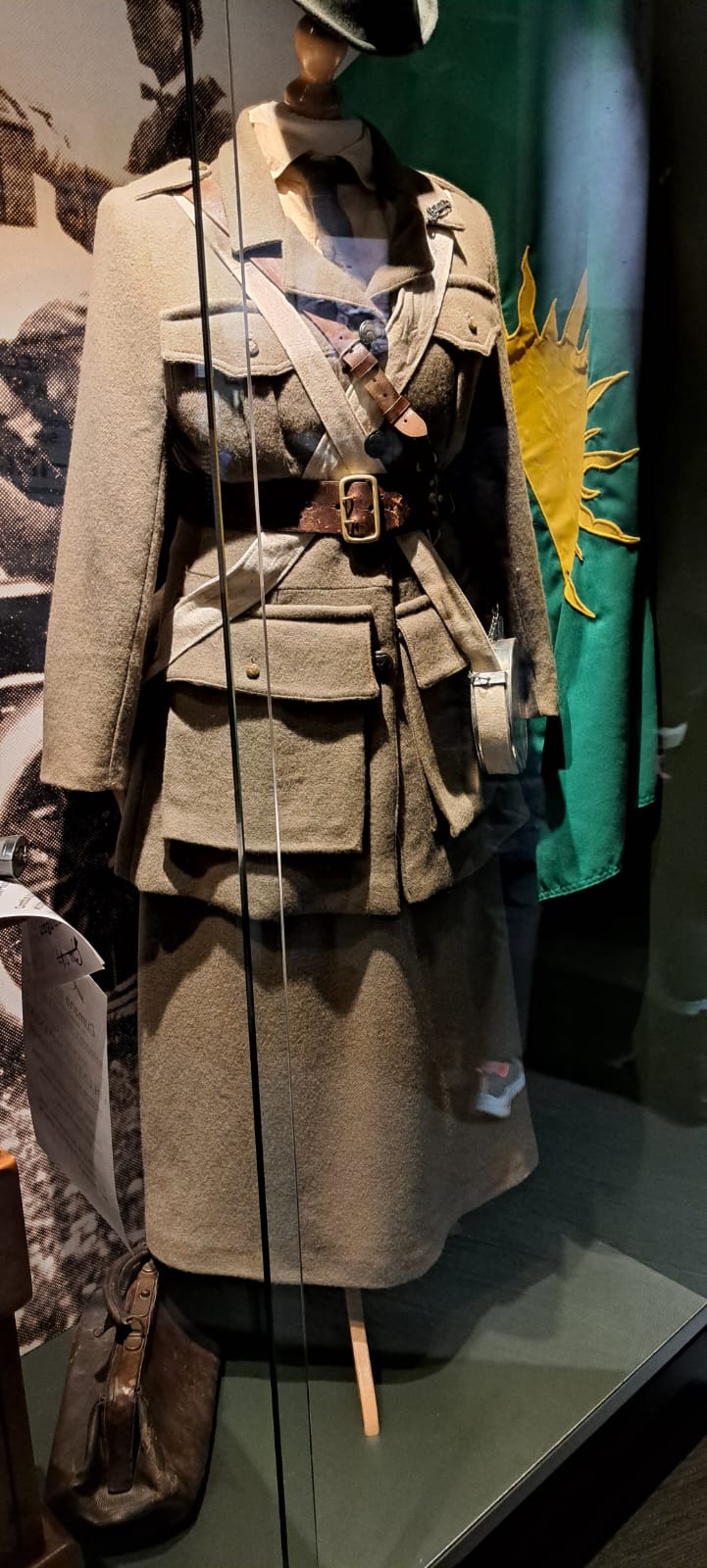
Cumann na mBan uniform on display in the GPO Museum (Photo: O. Dunne)
1913 Lockout:
During the 1913 Lockout by an employers’ consortium, women including Dr Kathleen Lynn, Helena Moloney, Delia Larkin (sister of Jim Larkin) and Rosie Hackett opened soup kitchens at Liberty Hall to assist struggling workers and families.
The 1916 Easter Rising:
It is estimated that approximately 200 women took part in the Rising and 77 were imprisoned. The only woman sentenced to death was Countess Markiewicz who was second-in-command to Commandant Michael Mallin in St. Stephen’s Green.
Constance Markievicz (colourised) in ICA uniform (Source photo: Internet)
However due to her being female, it was then changed to life imprisonment. She subsequently served 13 months in prison in both Ireland and England. She was outraged that she would not be executed.
Winifred Carney:
Winifred Carney was named as the first woman to enter the GPO on Easter Monday 1916. It is thought that she entered the building wielding a typewriter and revolver.
Winifred Carney (Source photo: Internet)
Elizabeth O’Farrell:
Elizabeth O’Farrell was one of the last three women to remain with the GPO garrison along with Julia Grennan and Winifred Carney and all three spent their last days of freedom in Moore Street. Ms O’Farrell accompanied Patrick Pearse on his journey of surrender to the British forces.
Elizabeth O’Farrell(colourised) after release from jail (Source photo: Internet)
There is a photograph of this and all that can be seen of her are her feet and the end of her dress, as she stood at the far end of Pearse from the photographer.
Julia Grennan (Source photo: Internet)
WOMEN DURING THE WAR OF INDEPENDENCE:
Women also played a significant part during the War of Independence. Over 300 women are believed to have assisted by smuggling weapons and ammunition into Ireland and relaying messages from area to area.
WOMEN DURING THE IRISH CIVIL WAR:
The Irish Civil War lasted for almost one year from June 1922 to May 1923 and again women participated in the struggle, believed to have been mainly on the Anti-Treaty side. Female members of the Irish Citizen Army were armed.
Grace Gifford (colourised) with paintbrush and easel (Source photo: Internet)
One such example is Grace Gifford Plunkett who married her beloved fiance, Joseph Mary Plunkett in May 1916 just hours before his execution. She herself was incarcerated in February 1923 in Kilmainham Gaol for her part in the Civil War.
While there she painted a copy of Mary and Child on the wall of the cell.
Swiss police have arrested and detained Palestinian journalist and Executive Director of the popular Electronic Intifada website. According to reports he was interrogated for an hour at the airport after his arrival and released but arrested a day later.
Abunimah was due to give a series of talks in Switzerland and that fact, in addition to his journalistic work in writing for and organising weekly podcasts from the Electronic Intifada website give the context for his arrest which is simply pro-Zionist and pro-imperialist censorship.
The EI (Electronic Intifada) carries articles from its reporters inside Gaza and the weekly podcasts on YouTube provide analysis and discussion, along with interviews with commentators, writers and activists. Military expert Jon Elmer gives a roundup covering actions of the Resistance.
On a personal note, the weekly EI podcasts on Wednesday (now Thursday) evenings on YouTube became not only compulsory watching for me but also emotional therapy in the midst of the Zionist genocide in Gaza.
Ali Abunimah (Image cred: Al Jazeera screengrab)
Abunimah is a US citizen of Palestinian descent, fluent in Arabic, English and conversant with Hebrew. Founded in 2001, the EI website associate editors are Maureen Clare Murphy, Nora Barrows-Friedman, Michael Brown, David Cronin, Tamara Nassar and Asa Winstanley.
The site’s editors are no strangers to attempted and actual repression: Germany banned Abunimah from entering last year, while UK police raided Asa Winstanley’s home and confiscated his computer equipment, which they are still holding weeks later but without charging him.1
Palestinian solidarity activists in Switzerland have protested Abunimah’s detetion.
The UN Special Rapporteur on freedom of opinion and expression, Irene Khan, called Abunimah’s arrest “shocking news” and urged his release while Francesca Albanese, UN Special Rapporteur on human rights in the occupied territories bemoaned the European “toxic … climate” for free speech.
When free speech in one area of discourse is attacked, freedom of speech on all subjects is endangered so even those who are not very supportive of Palestine should protest Abunimah’s arrest in this blatant act of censorship and repression.
End.
Footnotes:
1 Winstanley is a member of the weekly broadcasting team as well as an author of articles on the site.
(Article originally written for the Political Prisoners Collective Asociación Arrakala)
Gearóid Ó Loingsigh January 19 2025 (Reading time: 6 mins.)
NB: Edited by RB from original article for formatting purposes
Who and what is a political prisoner is controversial, though it shouldn’t be. Once upon a time we all knew or recognised a political prisoner. It was obvious, evident.
But two centuries of legislative changes, the work of the press and more than one NGO seeking to please its master i.e. those who finance it, has disfigured the political prisoner and its corollary outside, the rebel, the dissident, the activist.
Before trying to vindicate the figure of the political prisoner we should be clear that the prison itself has not been a constant in history.
There have always been places of reclusion, but they were transitory, provisional, where the prisoner was held whilst they awaited their sentence, be it execution, or exile, the confiscation of assets or in the case to debtors’ prison, the payment of the debt or the taxes owed.
The idea of a prison as somewhere you serve a term of a number of years as a prisoner according to the gravity of the crime is novel. It is about 250 years old.
The seriousness of the crime and the proportionality of the sentence are not obvious. In many jurisdictions a bank robbery is more serious than the rape of a woman.
Historically, crimes against property were more severely punished than crimes against the person. There are exceptions to that but in general, in all judicial systems crimes against property are more severely punished.
Of course, murder usually carries a stiff sentence, but countries with long sentences or even life sentences usually consider such sentences for crimes against property and other crimes. In the USA that possibility exists in various states.
In a number of countries the crimes punishable by death include, blasphemy, adultery, prostitution, spying, bribery, corruption, drug trafficking, homosexuality.
Political crimes are also severely punished with harsh sentences and the death penalty, depending on the country. Such punishment for political crimes only disappeared where it was abolished for all crimes.
Political crimes
Margaret Thatcher the British prime minister (1979-1990) once declared that there was no political crime, only criminal offences. She said in relation to IRA and INLA militants in prison in Ireland that political murder, political attacks nor any political violence existed.
With this she aimed to ignore not just the long history of such crimes in national laws in many countries but also International Humanitarian Law.
The preamble to the UN Universal Declaration of Human Rights recognizes rebellion as the last legitimate resort in the face of human rights abuses.
“Whereas disregard and contempt for human rights have resulted in barbarous acts which have outraged the conscience of mankind… if man is not to be compelled to have recourse, as a last resort, to rebellion against tyranny and oppression, that human rights should be protected by the rule of law.”[1]
The Geneva Conventions, the basis of IHL in common article 3 to the four conventions reads “In the case of armed conflict not of an international character occurring in the territory of one of the High Contracting Parties, each Party to the conflict shall be bound to apply, as a minimum, the following provisions…”[2]
And goes on to explain the provisions that apply. With this the Geneva Conventions acknowledge the existence of organised and armed rebellion against a state as something more than criminality. Otherwise, it wouldn’t attempt to govern the behaviour of the parties to the conflict.
Though it is worth pointing out that the IHL never clearly defined what was an internal armed conflict nor a war of national liberation. However, it is clear that it can’t be reduced to mere violence.
There are those that raise high the figure of Prisoner of Conscience, not just as the highest expression of a political prisoner but as the only one. According to Amnesty International such a prisoner is in jail for their ideas without having used or advocated violence.
It is an absurd definition. For years they praised Mandela as a prisoner of conscience, but Nelson Mandela led an organisation with an armed wing and ended up in jail for conspiracy to overthrow the state. He was no pacifist.
The definition Amnesty uses can be summarised as They who opine but do not act are political prisoners, those who think but do not apply their thinking are political prisoners.
This excludes great figures from Colombian history such as Policarpa or José Antonio Galán who were executed following their capture. According to this definition José Martí was a political prisoner when he wrote, but a criminal when he returned to Cuba to free it.
But this is not correct, a political prisoner may be a person who never even raised a rock, not to mention a rifle. They may even be pacifists. It is not necessarily a person linked to armed groups, though neither does it exclude them.
There are various types of political prisoners in Colombia.
· There are the militants of guerrilla groups, the majority of them in prison for armed actions, though there are those who played a political role in such groups, what the courts refer to as ideologues.
· There are also those who are victims of frame ups, the majority of them militants of one or other unarmed Left group, social organisation, trade union etc. The state imprisons them through frame-ups in order to limit their political work.
· Then there are those who are prisoners for things related to their political activity i.e. people who in the midst of protests, strikes, occupations of buildings break some law and are arrested, such as those who carry out pickets that are not permitted.
Amongst this group there are also the youths of the Frontline of the National Strike. Yes, throwing a stone is a crime in and of itself but these youths threw stones in response to state violence during the protests.
But, what distinguishes political prisoner from a common prisoner? Brandishing weapons or throwing stones is done by lots of people from narcos to drunks on a Saturday night. Pablo Escobar attacked the state with weapons and car bombs, but he was never a political prisoner.
He was always a criminal.
The first point is the political prisoner is captured in the struggle for a better world.
They seek changes in society that benefit a broad section of the population when their struggle is national in character or large group when the struggle is local or in the neighbourhood with specific demands.
So, a right-wing paramilitary could never be a political prisoner because they seek the status quo, or even a worsening of the conditions of the people.
A political prisoner acts altruistically, seeking no personal benefit though they may end up benefiting from the changes they seek for peasants, youths or neighbours because they are from that community.
But they never seek personal benefit for themselves but rather for society or a particular group in society. Once again neither the paramilitaries, nor the narcos or the Uribistas could ever be political prisoners because what they seek is always for their own personal benefit or small powerful group.
So a guerrilla may be a political prisoner, as may be the youths from the National Strike and similar protests. The environmentalist that blocks the entry of a mining company’s machinery is also one, even if they commit a crime such as damaging or destroying the company’s installations.
In 1976 eighty intellectuals and figures from the world of culture met in Algiers and proclaimed the Algiers Declaration – Universal Declaration of the Rights of Peoples. The document is entirely political and does not have the force of law but was and continues to be a moral reference point.
In Article 28 it states:
Any people whose fundamental rights are seriously disregarded has the right to enforce them, specially by political or trade union struggle and even, in the last resort by the use the force.[3]
Political prisoners are those who comply with this article.
Though the methods used, whether they are violent or pacific may have some influence, they do not determine who are political prisoners.
Of course, in the case of guerrillas, a war crime may wrest credibility from their status as a political prisoner, but in general the use or not of violence is not what determines who is a political prisoner.
It is the demands and the selfless commitment of the militant to the cause that defines whether they are political prisoners or not. Those who deny this are the ones who benefit from the capitalist system.
Their denial is nothing more than publicity and public relations for Julio Mario Santodomingo, Juan Manuel Santos, Gustavo Petro and the large NGOs. Colombia is full of political prisoners and those who deny this also deny the reality of capitalism in the country.
By Nicki Jameson13 January 2025 (Reading time: 12 mins.)
(NB: An unconnected article with very similar title about the Irish organisation IPSC, rather than the English one as this is, was published on this blog in December 2023)
The below speech was delivered by Nicki Jameson at a Revolutionary Communist Group public meeting in London on 12 December 2024 titled ‘Defend the right to defend Palestine: fight back against state repression and media lies’.It is reprinted here from its publication in the RCG’s Fight Racism Fight Imperialism newspaper with permission and reformatted by RB for publication.
The genocidal Zionist onslaught which followed the 7 October 2023 Al Aqsa Flood operation caused a crisis for the imperialist ruling class. In both the US and Britain this was reflected in election results, for example.
Whatever now happens in the aftermath of this week’s events in Syria, and what splits in the solidarity movement this may lead to, it remains the case that international support for the resilient Palestinian struggle is widespread and not diminishing.
In this context, the British government, both under the previous Conservative administration and now under Labour, has sought to contain and limit the effectiveness of the protest movement.
It does not want to be seen to ban protests entirely, but it has aimed to render them impotent and tokenistic.
While it would, of course deny this, the role of the national Palestine Solidarity Campaign (PSC) is to facilitate this limitation.
It does this by ensuring that anger against the Zionist genocide is channelled into ‘safe’ slogans such as the demand for a ceasefire, and formulaic A to B marches, organised on terms dictated by the police, culminating with a passive crowd listening to anodyne speeches from the usual suspects.
Contained as they are, that PSC marches nonetheless constitute a regular expression of solidarity with the Palestinian struggle by a significant section of the British public is way too much for some in the political establishment.
And also for the vocal cohort of Zionists whose angry social media presence is used to decry ‘hate marches’ and demand greater policing and more arrests.
The police themselves vacillate between different approaches, dependent on the whims of the Home Secretary of the moment and Zionist political pressure.
Palestine protests
The very first protests in early October 2023 after the AAF operation were lightly policed. On 9 October we stood directly outside the Israeli embassy with no conditions or attempt to prevent the demo.
Within a very short period of time this had changed dramatically and the then weekly protests organised by PSC were subject to heavy policing.
Zionist keyboard warriors on twitter began immediately to play a role in fingering people, posting video footage of alleged crimes, with the demand that people be arrested. The police duly obliged.
While total overall arrest figures seem hard to track down, between October 2023 and March 2024 there were 305 arrests under the Metropolitan Police’s Operation Brocks – the policing operation related to Palestine protests in London.
This included 89 far-right counter protesters arrested on Remembrance Day, when – riled up by then Home Secretary Suella Braverman – they came to ‘defend the cenotaph’ from a non-existent attack.
During this period eight people were arrested on FRFI contingents in London. Their experience is fairly typical of those targeted at the time.
London police making an arrest on Palestine solidarity march 13 January 2024 (Photo cred: FRFI)
In the main they were profiled by Zionists on twitter, who flagged up to the compliant police that the comrades either had placards bearing the words ‘Victory to the Intifada’ or were using that slogan.
A young person was also arrested on the spurious pretext that he was wearing a symbol of a proscribed organisation, although the PFLP is not in fact proscribed in this country. He was subsequently de-arrested but not before those who came to his aid were also swept up.
Of this eight, only one person was charged. This was subsequently thrown out of court. Of the others, all but one have been definitively told they will not be charged.
A ninth comrade, arrested in a dawn-raid on their home remains on bail under the Terrorism Act in relation to a speech made 15 months ago.
It was clear from police interviews, that the cops in Operation Brocks had no idea what Intifada actually meant and had been given a script by their political masters.
We take the exoneration of those arrested to mean that VICTORY TO THE INTIFADA, a call for solidarity with the uprisings of Palestinians against Zionist oppression, is entirely legitimate and in no way criminal.
Spurious arrests continue to take place, using the now tried and tested process of Zionist twitter posts highlighting the offensive words or item, prompting either immediate arrest or the publishing of a police ‘wanted’ notice.
Following the lack of any prosecution for slogans such as ‘From the river to the sea’ or ‘Victory to the Intifada’, the most common ‘crime’ is comparison of Israeli genocide to the Nazi holocaust.
Although no-one has been successfully prosecuted along these lines, Zionists continue to claim it is an anti-Semitic hate crime.
Many of these arrests are farcical.
People will remember the arrest, charging, trial and not guilty verdict of Marieha Hussain, who had depicted Conservative politicians Rishi Sunak and Suella Braverman as coconuts on a homemade placard she took to a protest on 11 November 2023.
In May 2024, four activists from Camden Friends of Palestine were arrested under the Terrorism Act for holding a banner depicting a dove flying through the Israeli apartheid wall.
Police claimed that as the banner depicted ‘a clear blue sky with no clouds’ and there had been similar weather on 7 October, this showed obvious support for Hamas. After 3 months on bail they were told that there would be no charges.
A tremendous amount of police time and money is being spent on this process with what would appear to be no tangible reward in terms of convictions or imprisonment.
However, what simply looking at the charge or conviction rates fails to show is the way these arrests are used as harassment and interference both in people’s ability to protest and their everyday lives.
Those described here have had bail conditions which specified variously that they could not enter the borough of Westminster, could not enter university premises other than for study and must surrender their passports and not leave the country.
Arrestees from the CPGB-ML were banned for the duration of their bail from attending protests and distributing literature. People flagged for arrest by Zionist twitter have also been reported to their employers, professional bodies and universities in an attempt to ruin their ability to work or study.
While most early arrests were under Public Order police powers, there is increasing use of the Terrorism Act (TA) 2003 to criminalise solidarity with Palestine, targeting both protesters on the streets and what people say on line.
Journalists and youtubers, such as Richard Medhurst, Sarah Wilkinson and Asa Winstanley have been subject to arrests and house raids.
The TA was brought in by the last Labour government at a time when Keir Starmer was Director of Public Prosecutions.
On 27 November, the Met Police used the TA to raid the premises of the Kurdish Community Centre in Haringey, north London, arresting six people and placing the centre under siege.
Anti-Zionist blogger/activist Tony Greenstein will be in court next week on a charge under section 12 of the TA, for responding over a year ago to a Zionist tweet accusing him of being a Hamas supporter with the words: ‘I support the Palestinians, that is enough and I support Hamas against the Israeli army.’
Anti-imperialist Jewish and Palestine Solidarity activist Tony Greenstein, who is being persecuted by the British police. (Photo sourced: Internet)
The aim is to create a climate of fear in which people become scared to attend even the most peaceful and routine of protests, where we censor our own slogans, placards and behaviour in order to evade the eyes of the on-line harassers and the police.
Palestine Action and Elbit
Alongside all this has run another process in which the brave participants show no fear in the way they exercise their solidarity with the Palestinian struggle.
Palestine Action was set up in 2020 by activists who were frustrated by the PSC’s lack of direct action to enforce BDS – Boycott, Divestment and Sanctions.
Since then it has primarily targeted the British operation of Israeli arms company, Elbit Systems, as well as other companies collaborating with Elbit or are otherwise implicated in the arming of the Zionist war machine or sale of its ‘battle tested’ technology to other countries’ militaries.
Palestine Action’s tactics mainly consist of occupations, blockades and drenching premises in red paint to symbolise the blood on the hands of these profiteering companies.
Until recently, although a lot of these actions led to arrests, very few Palestine Action activists ended up behind bars. This has changed since Keir Starmer’s Labour government came to power. There are currently 18 Palestine Action activists in prison in England, along with 2 in Scotland.
One of the Scottish prisoners is the last of the group known as the Thales 5, who were convicted of occupying the roof of the Glasgow premises of French company Thales in 2022. Thales was working with Elbit to produce Watchkeeper drones for the British military.
The prisoners in England have not been convicted and are all held on remand, having been refused bail by the courts. The majority were arrested in relation to actions against the Filton arms factory in Bristol. Ten people were remanded in August and a further eight in November.
Although none have been charged with terrorism offences, the TA was used to effect their arrests, allowing the police more powers to detain pre-charge, raid homes and generally act in a heavy-handed manner.
In the latest arrests in November, flatmates and families were evicted from their homes, sometimes for several days while the police searched premises. In one raid, the mother and younger brother of the person arrested were both handcuffed, despite not being accused of any offence.
In prison, those on remand for pro-Palestine direct action have come in for special scrutiny and additional intrusive measures on top of those which all prisoners are forced to deal with.
The six women detained in Bronzefield prison in August were all allocated to separate wings and deliberately prevented from associating with one another. Their mail has been heavily censored.
Four male prisoners in Wormwood Scrubs, although not subject to the same separation regime, have also had their correspondence held up, censored and returned to sender, with supporters being served with notices to the effect that no communication between them is permitted.
FRFI successfully appealed against such a notice in relation to our sending the paper to the prisoners, although the prison claims it still has a right to withhold the paper or other publications if the censors decide they are ‘inappropriate for a prison setting’.
The purpose of all this is clearly to scare those it is directly targeting it and to deter others from coming forward to join Palestine Action’s activities.
As Palestine Action carries out more actions against Elbit, including repeatedly blockading the UAV Engines site at Shenstone in the Midlands, which manufactures engines for Elbit, it is clear that the repression is not succeeding.
Palestine solidarity demonstration Downing Street 14 December 2024. (Source photo: Internet)
In addition to the litany of his war crimes, he will be remembered for authoring the text book Low Intensity Operations – Subversion, Insurgency and Peace-keeping (1971), a manual for dealing with subversive and recalcitrant populations, both at home and abroad.
Kitson’s work continues to form a central plank of British strategy for policing dissent and his disciples are clearly leading policing operations against pro-Palestine protesters.
In Kitson’s book, he details how ‘psychological operations’ should be used to isolate ‘subversives’ from the people while building links with and strengthening support for moderate elements who do not oppose the state but disagree on certain policies.
This technique was used both abroad in Britain’s colonies, and at home to police, for example, the Irish solidarity movement of the 1970s-80s.
Today’s ‘moderates’ take the form of the PSC, Stop the War and similar organisations. PSC marches are negotiated with the police, with strict conditions imposed on the protests.
The PSC has provided no support for people arrested on its demonstrations, citing the low arrest rates as proof of how respectable their protests are, while distancing itself from those who have been targeted.
While the PSC opposes Zionist massacres of the Palestinian people, it does not support the resistance of those under attack.
Consequently it does not complain when the British police uses Terrorism Act powers to criminalise people for supporting the right of Palestinians to resist their oppressors through armed struggle.
This treachery puts the PSC on the wrong side of international law – oppressed nations successfully fought for the right to self-defence by means of armed struggle to be enshrined in UN resolutions in 1974 and 1982.
Fighting back, building solidarity
For some of us, the culture around supporting our arrested comrades was drilled into us many years ago. A whole new generation has had to learn these lessons.
It is positive to see that, although the PSC and such organisations continue not to want to get their hands dirty with supporting anyone targeted by the police, a different attitude is also widespread and ‘arrestee support’, prison solidarity letter-writing etc are common currency among activists.
At the same time there is an element of this solidarity which is depoliticised. For example, the provision of a constant presence at a police station to monitor things and be there when arrestees are released is a good thing and the support organisations which provide this do an invaluable job.
However, when we have comrades under arrest, we want to do more than legal monitoring and instead turn the police station into a focus for protest. The same with courts and prisons.
It’s very positive to see Palestine Action, the SOAS encampment and others also doing this to great effect, thus ensuring that the focus is not just on the Israeli companies who are their principle targets, but also on the British criminal justice machinery which is being marshalled against those who take a stand.
Our task, as always, here in the belly of the imperialist beast, remains to protest against the British government and British corporations’ complicity in the Zionist genocide.
And to show unconditional solidarity with those who fight back against the Zionist war machine by whatever means are at their disposal.
Supporting the resistance and opposing the British state cannot fail to bring us into conflict with that same state and we must continue to stand alongside everyone who is criminalised for their solidarity.
There were also others: the Guildford Four, Maguire Seven and Judith Ward, all innocent and all convicted in separate cases, mostly in 1974, in the same year that the Prevention of Terrorism Act was passed to silence the Irish community.
Yet others continue being framed, including the Craigavon Two.
There were also others: the Guildford Four, Maguire Seven and Judith Ward, all innocent and all convicted in separate cases, mostly in 1974, in the same year that the Prevention of Terrorism Act was passed to silence the Irish community.
Paddy Hill in 2017 outside the Dublin court where the Jobstown case was being tried (Photo sourced: Internet)
The agitation for civil rights for the community of Catholic background in the British colony of the Six Counties in Ireland began in the last years of the 1960s and very soon people in Britain were marching in solidarity with those facing violent colonial repression in the Six Counties.
The Irish were the most numerous and longest-established migrant community in Britain and had become active in many social, trade union and political circles with the potential to educate and strongly affect the host community.1 This was a problem for the British ruling class.
The jailing of so many people, in many cases obviously innocent, hundreds of arrests, thousands of detentions and interrogations with desertion by much of the British liberal and Left sector terrorised the Irish community so that many stepped away from solidarity campaigning.
That repression muted the Irish community’s solidarity actions until the 1981 Hunger Strikes brought them out again in thousands.
After his release in March 1991 Paddy Hill founded Mojo to campaign for framed innocent people and supported the campaign to free the Graigavon Two, another case that bears many of the hallmarks of a frame-up for political reasons, as famous barrister Michael Mansfield2 commented:
“There is nothing more particular about it (the Craigavon Two case) than in all the other miscarriages and the same features appear in all these things.”3
PSNI Constable Steven Carroll was shot dead by an AK47 bullet on 9th March 2009 in Craigavon, Armagh while responding to a fake crime call, the “dissident” group the Continuity IRA claiming responsibility.4 The arrests of John Paul Wooton and Brendan McConville followed.
Political cases in the Six Counties almost invariably are tried by the no-jury Diplock Court and the judge there refused both men bail. This might seem normal except that they did not go to trial until three years later – and kept in jail throughout the period.
Shortly before the eventual trial a man approached the PSNI saying he had seen McConville near the scene and on the evening of the killing of the Constable. This man was the only witness for the PSNI Prosecution but his partner, with him on the evening in question, refused to confirm his tale.
The night was raining and dark and the eyesight of the alleged witness was exposed as weak by the Defence. The coat he alleged McConville to be wearing was a different type, length and colour to that which the Prosecution was alleging McConville had been wearing on the night in question.
This ‘witness’ was also described by his father as having ‘a Walter Mitty character’ and the PSNI admitted paying him as an informant. An AK47 was recovered near the scene of the killing and the one fingerprint recovered from it did not match those of either Wooton or McConville.
Craigavon Two
Brendan McConville and Paul Wooton, taken in 2017. (Photo sourced: Petition for the release of the Craigavon Two)
There was no evidence against either man of having even handled the weapon never mind fired it, no evidence placing either at the scene apart from the dubious testimony placing one of them nearby. Incredibly, it might seem, nevertheless they were found guilty on 12th May 2012.
McConville was sentenced to 25 years and Wooton to ten. Their appeal two years after conviction in May 2014 was unsuccessful and in fact the Prosecution used it to add another four years to Wooton’s sentence.
Paddy Hill of the Birmgham Six and Gerry Conlon of the Guildford Four, both sadly deceased, both innocent but served long years in jail, both supported the campaign of the Craigavon Two. (Photo sourced: Internet)
Paddy Hill was not the only former framed prisoner to support the campaign to free the Craigavon Two. Gerry Conlon was asked to examine the case and became a convinced and dedicated campaigner for the men, speaking out about it as late as a week before his untimely death.5
Paddy Hill and the rest of the Birmingham Six were framed by the British system and served 18 years in jail. In May this year McConville and Wooton will have reached their 16th in jail. For how much longer will they and their close ones be tortured?
End.
Footnotes
1The Irish diaspora in Britain had provided the British working class with its anthem (The Red Flag), its classic novel (The Ragged-Trousered Philanthropists) and two leaders of its first mass movement, the Chartists (Fergus O’ Connor and Bronterre O’Brien) and had also formed a strng section of the First International Workingmen’s Association led by Marx and Engels. In 1974 people of Irish background were estimated to form up to 10% of the population of some British cities.
2Mansfield led the appeal cases of the Birmingham Six and of the Guildford Four.





















 rebelbreeze