Swiss Zionist Censors Arrest Palestinian Journalist

Diarmuid Breatnach

(Reading time: 2 mins.)

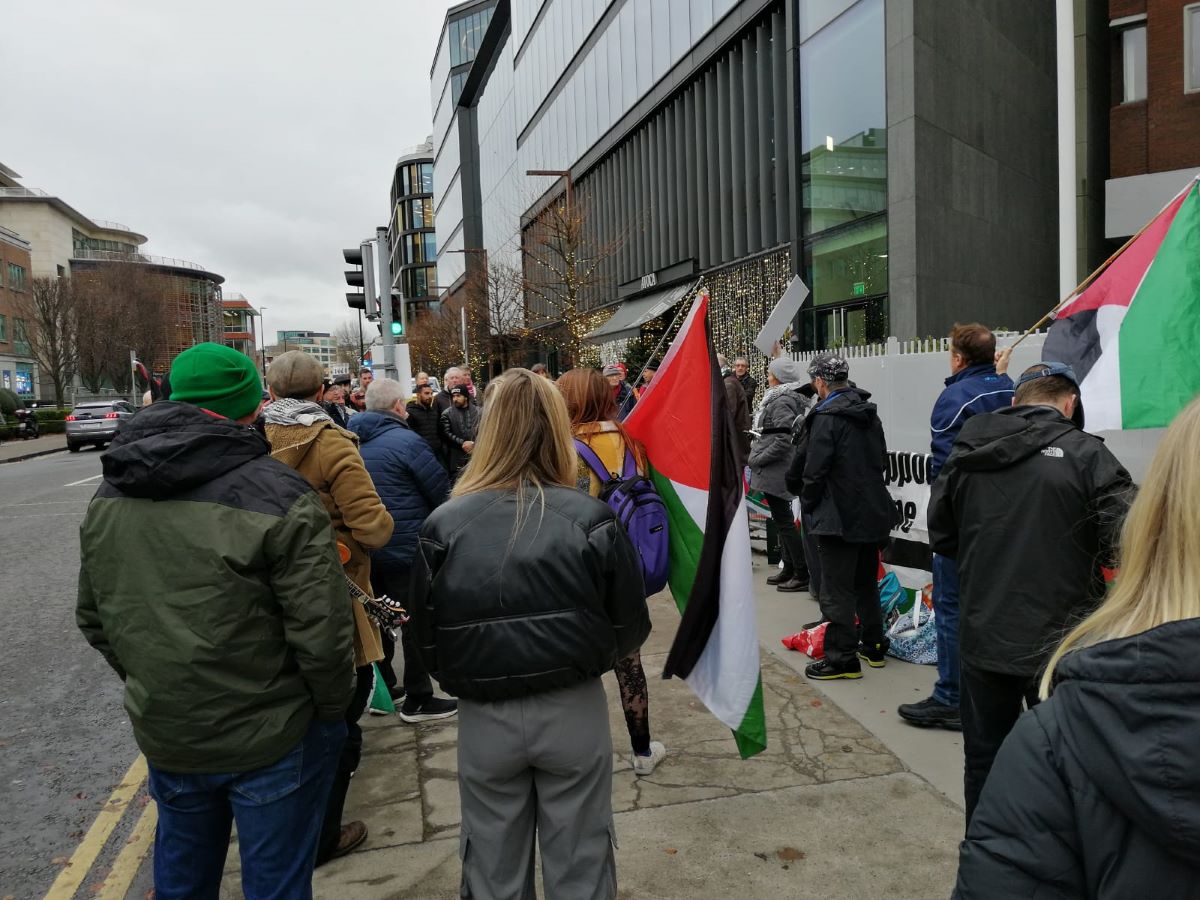
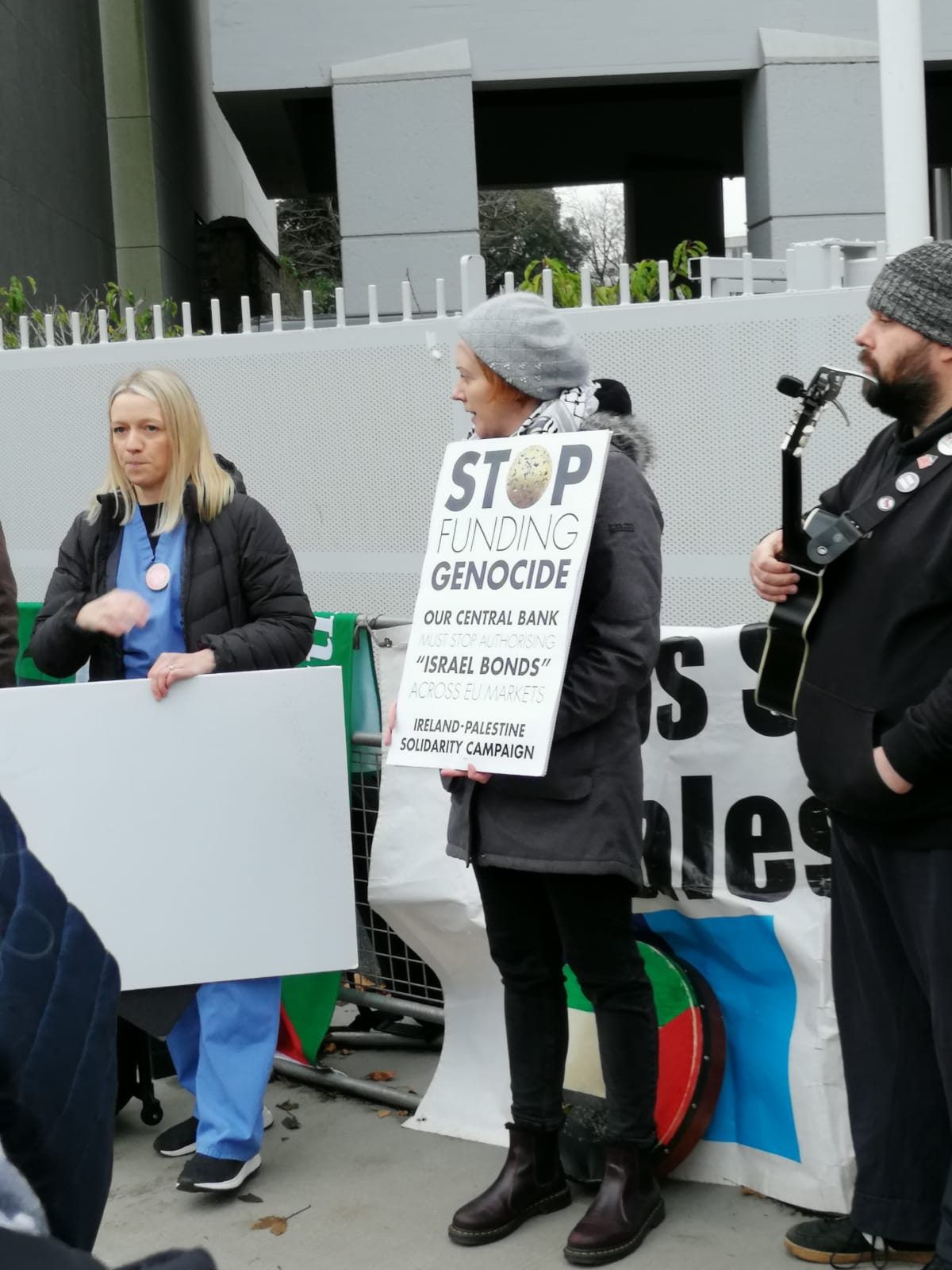
Swiss police have arrested and detained Palestinian journalist and Executive Director of the popular Electronic Intifada website. According to reports he was interrogated for an hour at the airport after his arrival and released but arrested a day later.

Abunimah was due to give a series of talks in Switzerland and that fact, in addition to his journalistic work in writing for and organising weekly podcasts from the Electronic Intifada website give the context for his arrest which is simply pro-Zionist and pro-imperialist censorship.

The EI (Electronic Intifada) carries articles from its reporters inside Gaza and the weekly podcasts on YouTube provide analysis and discussion, along with interviews with commentators, writers and activists. Military expert Jon Elmer gives a roundup covering actions of the Resistance.

On a personal note, the weekly EI podcasts on Wednesday (now Thursday) evenings on YouTube became not only compulsory watching for me but also emotional therapy in the midst of the Zionist genocide in Gaza.

Ali Abunimah (Image cred: Al Jazeera screengrab)

Abunimah is a US citizen of Palestinian descent, fluent in Arabic, English and conversant with Hebrew. Founded in 2001, the EI website associate editors are Maureen Clare Murphy, Nora Barrows-Friedman, Michael Brown, David Cronin, Tamara Nassar and Asa Winstanley.

The site’s editors are no strangers to attempted and actual repression: Germany banned Abunimah from entering last year, while UK police raided Asa Winstanley’s home and confiscated his computer equipment, which they are still holding weeks later but without charging him.1

Palestinian solidarity activists in Switzerland have protested Abunimah’s detetion.

The UN Special Rapporteur on freedom of opinion and expression, Irene Khan, called Abunimah’s arrest “shocking news” and urged his release while Francesca Albanese, UN Special Rapporteur on human rights in the occupied territories bemoaned the European “toxic … climate” for free speech.

When free speech in one area of discourse is attacked, freedom of speech on all subjects is endangered so even those who are not very supportive of Palestine should protest Abunimah’s arrest in this blatant act of censorship and repression.

End.

Footnotes:

1 Winstanley is a member of the weekly broadcasting team as well as an author of articles on the site.

Sources:

https://www.aljazeera.com/news/2025/1/27/un-experts-slam-palestinian-journalist-ali-abunimahs-arrest-in-switzerland

https://electronicintifada.net/content/eis-ali-abunimah-arrested-switzerland/50333

Who are the political prisoners in Colombia?

(Article originally written for the Political Prisoners Collective Asociación Arrakala)

Gearóid Ó Loingsigh January 19 2025 (Reading time: 6 mins.)

NB: Edited by RB from original article for formatting purposes

Who and what is a political prisoner is controversial, though it shouldn’t be. Once upon a time we all knew or recognised a political prisoner. It was obvious, evident.

But two centuries of legislative changes, the work of the press and more than one NGO seeking to please its master i.e. those who finance it, has disfigured the political prisoner and its corollary outside, the rebel, the dissident, the activist.

Before trying to vindicate the figure of the political prisoner we should be clear that the prison itself has not been a constant in history.

There have always been places of reclusion, but they were transitory, provisional, where the prisoner was held whilst they awaited their sentence, be it execution, or exile, the confiscation of assets or in the case to debtors’ prison, the payment of the debt or the taxes owed.

The idea of a prison as somewhere you serve a term of a number of years as a prisoner according to the gravity of the crime is novel. It is about 250 years old.

The seriousness of the crime and the proportionality of the sentence are not obvious. In many jurisdictions a bank robbery is more serious than the rape of a woman.

Historically, crimes against property were more severely punished than crimes against the person. There are exceptions to that but in general, in all judicial systems crimes against property are more severely punished.

Of course, murder usually carries a stiff sentence, but countries with long sentences or even life sentences usually consider such sentences for crimes against property and other crimes. In the USA that possibility exists in various states.

In a number of countries the crimes punishable by death include, blasphemy, adultery, prostitution, spying, bribery, corruption, drug trafficking, homosexuality.

Political crimes are also severely punished with harsh sentences and the death penalty, depending on the country. Such punishment for political crimes only disappeared where it was abolished for all crimes.

Political crimes

Margaret Thatcher the British prime minister (1979-1990) once declared that there was no political crime, only criminal offences. She said in relation to IRA and INLA militants in prison in Ireland that political murder, political attacks nor any political violence existed.

With this she aimed to ignore not just the long history of such crimes in national laws in many countries but also International Humanitarian Law.

The preamble to the UN Universal Declaration of Human Rights recognizes rebellion as the last legitimate resort in the face of human rights abuses.

“Whereas disregard and contempt for human rights have resulted in barbarous acts which have outraged the conscience of mankind… if man is not to be compelled to have recourse, as a last resort, to rebellion against tyranny and oppression, that human rights should be protected by the rule of law.”[1]

The Geneva Conventions, the basis of IHL in common article 3 to the four conventions reads “In the case of armed conflict not of an international character occurring in the territory of one of the High Contracting Parties, each Party to the conflict shall be bound to apply, as a minimum, the following provisions…”[2] 

And goes on to explain the provisions that apply. With this the Geneva Conventions acknowledge the existence of organised and armed rebellion against a state as something more than criminality. Otherwise, it wouldn’t attempt to govern the behaviour of the parties to the conflict.

Though it is worth pointing out that the IHL never clearly defined what was an internal armed conflict nor a war of national liberation. However, it is clear that it can’t be reduced to mere violence.

There are those that raise high the figure of Prisoner of Conscience, not just as the highest expression of a political prisoner but as the only one. According to Amnesty International such a prisoner is in jail for their ideas without having used or advocated violence.

It is an absurd definition. For years they praised Mandela as a prisoner of conscience, but Nelson Mandela led an organisation with an armed wing and ended up in jail for conspiracy to overthrow the state. He was no pacifist.

The definition Amnesty uses can be summarised as They who opine but do not act are political prisoners, those who think but do not apply their thinking are political prisoners.

This excludes great figures from Colombian history such as Policarpa or José Antonio Galán who were executed following their capture. According to this definition José Martí was a political prisoner when he wrote, but a criminal when he returned to Cuba to free it.

But this is not correct, a political prisoner may be a person who never even raised a rock, not to mention a rifle. They may even be pacifists. It is not necessarily a person linked to armed groups, though neither does it exclude them.

There are various types of political prisoners in Colombia.

· There are the militants of guerrilla groups, the majority of them in prison for armed actions, though there are those who played a political role in such groups, what the courts refer to as ideologues.

· There are also those who are victims of frame ups, the majority of them militants of one or other unarmed Left group, social organisation, trade union etc. The state imprisons them through frame-ups in order to limit their political work.

· Then there are those who are prisoners for things related to their political activity i.e. people who in the midst of protests, strikes, occupations of buildings break some law and are arrested, such as those who carry out pickets that are not permitted.

Amongst this group there are also the youths of the Frontline of the National Strike. Yes, throwing a stone is a crime in and of itself but these youths threw stones in response to state violence during the protests.

But, what distinguishes political prisoner from a common prisoner? Brandishing weapons or throwing stones is done by lots of people from narcos to drunks on a Saturday night. Pablo Escobar attacked the state with weapons and car bombs, but he was never a political prisoner.

He was always a criminal.

The first point is the political prisoner is captured in the struggle for a better world.

They seek changes in society that benefit a broad section of the population when their struggle is national in character or large group when the struggle is local or in the neighbourhood with specific demands.

So, a right-wing paramilitary could never be a political prisoner because they seek the status quo, or even a worsening of the conditions of the people.

A political prisoner acts altruistically, seeking no personal benefit though they may end up benefiting from the changes they seek for peasants, youths or neighbours because they are from that community.

But they never seek personal benefit for themselves but rather for society or a particular group in society. Once again neither the paramilitaries, nor the narcos or the Uribistas could ever be political prisoners because what they seek is always for their own personal benefit or small powerful group.

So a guerrilla may be a political prisoner, as may be the youths from the National Strike and similar protests. The environmentalist that blocks the entry of a mining company’s machinery is also one, even if they commit a crime such as damaging or destroying the company’s installations.

In 1976 eighty intellectuals and figures from the world of culture met in Algiers and proclaimed the Algiers Declaration – Universal Declaration of the Rights of Peoples. The document is entirely political and does not have the force of law but was and continues to be a moral reference point.

In Article 28 it states:

Any people whose fundamental rights are seriously disregarded has the right to enforce them, specially by political or trade union struggle and even, in the last resort by the use the force.[3]

Political prisoners are those who comply with this article.

Though the methods used, whether they are violent or pacific may have some influence, they do not determine who are political prisoners.

Of course, in the case of guerrillas, a war crime may wrest credibility from their status as a political prisoner, but in general the use or not of violence is not what determines who is a political prisoner.

It is the demands and the selfless commitment of the militant to the cause that defines whether they are political prisoners or not. Those who deny this are the ones who benefit from the capitalist system.

Their denial is nothing more than publicity and public relations for Julio Mario Santodomingo, Juan Manuel Santos, Gustavo Petro and the large NGOs. Colombia is full of political prisoners and those who deny this also deny the reality of capitalism in the country.

End.
NB: For more articles by Gearóid see https://gearoidloingsigh.substack.com

NOTES

[1] UN (1948) Universal Declaration of Human Rights. https://www.ohchr.org/sites/default/files/eng.pdf

[2] See https://ihl-databases.icrc.org/en/ihl-treaties/gci-1949/article-3?activeTab=1949GCs-APs-and-commentaries

[3] See Declaration of Algiers https://permanentpeoplestribunal.org/algiers-charter/?lang=en

Policing Palestine Solidarity

By Nicki Jameson 13 January 2025 (Reading time: 12 mins.)

(NB: An unconnected article with very similar title about the Irish organisation IPSC, rather than the English one as this is, was published on this blog in December 2023)

The below speech was delivered by Nicki Jameson at a Revolutionary Communist Group public meeting in London on 12 December 2024 titled ‘Defend the right to defend Palestine: fight back against state repression and media lies’. It is reprinted here from its publication in the RCG’s Fight Racism Fight Imperialism newspaper with permission and reformatted by RB for publication.

The genocidal Zionist onslaught which followed the 7 October 2023 Al Aqsa Flood operation caused a crisis for the imperialist ruling class.  In both the US and Britain this was reflected in election results, for example. 

Whatever now happens in the aftermath of this week’s events in Syria, and what splits in the solidarity movement this may lead to, it remains the case that international support for the resilient Palestinian struggle is widespread and not diminishing.

In this context, the British government, both under the previous Conservative administration and now under Labour, has sought to contain and limit the effectiveness of the protest movement. 

It does not want to be seen to ban protests entirely, but it has aimed to render them impotent and tokenistic.

While it would, of course deny this, the role of the national Palestine Solidarity Campaign (PSC) is to facilitate this limitation.

It does this by ensuring that anger against the Zionist genocide is channelled into ‘safe’ slogans such as the demand for a ceasefire, and formulaic A to B marches, organised on terms dictated by the police, culminating with a passive crowd listening to anodyne speeches from the usual suspects.

Contained as they are, that PSC marches nonetheless constitute a regular expression of solidarity with the Palestinian struggle by a significant section of the British public is way too much for some in the political establishment.

And also for the vocal cohort of Zionists whose angry social media presence is used to decry ‘hate marches’ and demand greater policing and more arrests.

The police themselves vacillate between different approaches, dependent on the whims of the Home Secretary of the moment and Zionist political pressure. 

Palestine protests

The very first protests in early October 2023 after the AAF operation were lightly policed.  On 9 October we stood directly outside the Israeli embassy with no conditions or attempt to prevent the demo. 

Within a very short period of time this had changed dramatically and the then weekly protests organised by PSC were subject to heavy policing. 

Zionist keyboard warriors on twitter began immediately to play a role in fingering people, posting video footage of alleged crimes, with the demand that people be arrested. The police duly obliged. 

While total overall arrest figures seem hard to track down, between October 2023 and March 2024 there were 305 arrests under the Metropolitan Police’s Operation Brocks – the policing operation related to Palestine protests in London.

This included 89 far-right counter protesters arrested on Remembrance Day, when – riled up by then Home Secretary Suella Braverman – they came to ‘defend the cenotaph’ from a non-existent attack.

During this period eight people were arrested on FRFI contingents in London. Their experience is fairly typical of those targeted at the time.

London police making an arrest on Palestine solidarity march 13 January 2024 (Photo cred: FRFI)

In the main they were profiled by Zionists on twitter, who flagged up to the compliant police that the comrades either had placards bearing the words ‘Victory to the Intifada’ or were using that slogan. 

A young person was also arrested on the spurious pretext that he was wearing a symbol of a proscribed organisation, although the PFLP is not in fact proscribed in this country.  He was subsequently de-arrested but not before those who came to his aid were also swept up. 

Of this eight, only one person was charged. This was subsequently thrown out of court.  Of the others, all but one have been definitively told they will not be charged.

A ninth comrade, arrested in a dawn-raid on their home remains on bail under the Terrorism Act in relation to a speech made 15 months ago.

It was clear from police interviews, that the cops in Operation Brocks had no idea what Intifada actually meant and had been given a script by their political masters. 

We take the exoneration of those arrested to mean that VICTORY TO THE INTIFADA, a call for solidarity with the uprisings of Palestinians against Zionist oppression, is entirely legitimate and in no way criminal.

Spurious arrests continue to take place, using the now tried and tested process of Zionist twitter posts highlighting the offensive words or item, prompting either immediate arrest or the publishing of a police ‘wanted’ notice.

Following the lack of any prosecution for slogans such as ‘From the river to the sea’ or ‘Victory to the Intifada’, the most common ‘crime’ is comparison of Israeli genocide to the Nazi holocaust.

Although no-one has been successfully prosecuted along these lines, Zionists continue to claim it is an anti-Semitic hate crime. 

Many of these arrests are farcical.

People will remember the arrest, charging, trial and not guilty verdict of Marieha Hussain, who had depicted Conservative politicians Rishi Sunak and Suella Braverman as coconuts on a homemade placard she took to a protest on 11 November 2023. 

In May 2024, four activists from Camden Friends of Palestine were arrested under the Terrorism Act for holding a banner depicting a dove flying through the Israeli apartheid wall.

Police claimed that as the banner depicted ‘a clear blue sky with no clouds’ and there had been similar weather on 7 October, this showed obvious support for Hamas. After 3 months on bail they were told that there would be no charges.

A tremendous amount of police time and money is being spent on this process with what would appear to be no tangible reward in terms of convictions or imprisonment.

However, what simply looking at the charge or conviction rates fails to show is the way these arrests are used as harassment and interference both in people’s ability to protest and their everyday lives.

Those described here have had bail conditions which specified variously that they could not enter the borough of Westminster, could not enter university premises other than for study and must surrender their passports and not leave the country.

Arrestees from the CPGB-ML were banned for the duration of their bail from attending protests and distributing literature. People flagged for arrest by Zionist twitter have also been reported to their employers, professional bodies and universities in an attempt to ruin their ability to work or study.

While most early arrests were under Public Order police powers, there is increasing use of the Terrorism Act (TA) 2003 to criminalise solidarity with Palestine, targeting both protesters on the streets and what people say on line.

Journalists and youtubers, such as Richard Medhurst, Sarah Wilkinson and Asa Winstanley have been subject to arrests and house raids.

The TA was brought in by the last Labour government at a time when Keir Starmer was Director of Public Prosecutions.

On 27 November, the Met Police used the TA to raid the premises of the Kurdish Community Centre in Haringey, north London, arresting six people and placing the centre under siege.

Anti-Zionist blogger/activist Tony Greenstein will be in court next week on a charge under section 12 of the TA, for responding over a year ago to a Zionist tweet accusing him of being a Hamas supporter with the words: ‘I support the Palestinians, that is enough and I support Hamas against the Israeli army.’  

Anti-imperialist Jewish and Palestine Solidarity activist Tony Greenstein, who is being persecuted by the British police. (Photo sourced: Internet)

The aim is to create a climate of fear in which people become scared to attend even the most peaceful and routine of protests, where we censor our own slogans, placards and behaviour in order to evade the eyes of the on-line harassers and the police.

Palestine Action and Elbit

Alongside all this has run another process in which the brave participants show no fear in the way they exercise their solidarity with the Palestinian struggle.

Palestine Action was set up in 2020 by activists who were frustrated by the PSC’s lack of direct action to enforce BDS – Boycott, Divestment and Sanctions. 

Since then it has primarily targeted the British operation of Israeli arms company, Elbit Systems, as well as other companies collaborating with Elbit or are otherwise implicated in the arming of the Zionist war machine or sale of its ‘battle tested’ technology to other countries’ militaries.

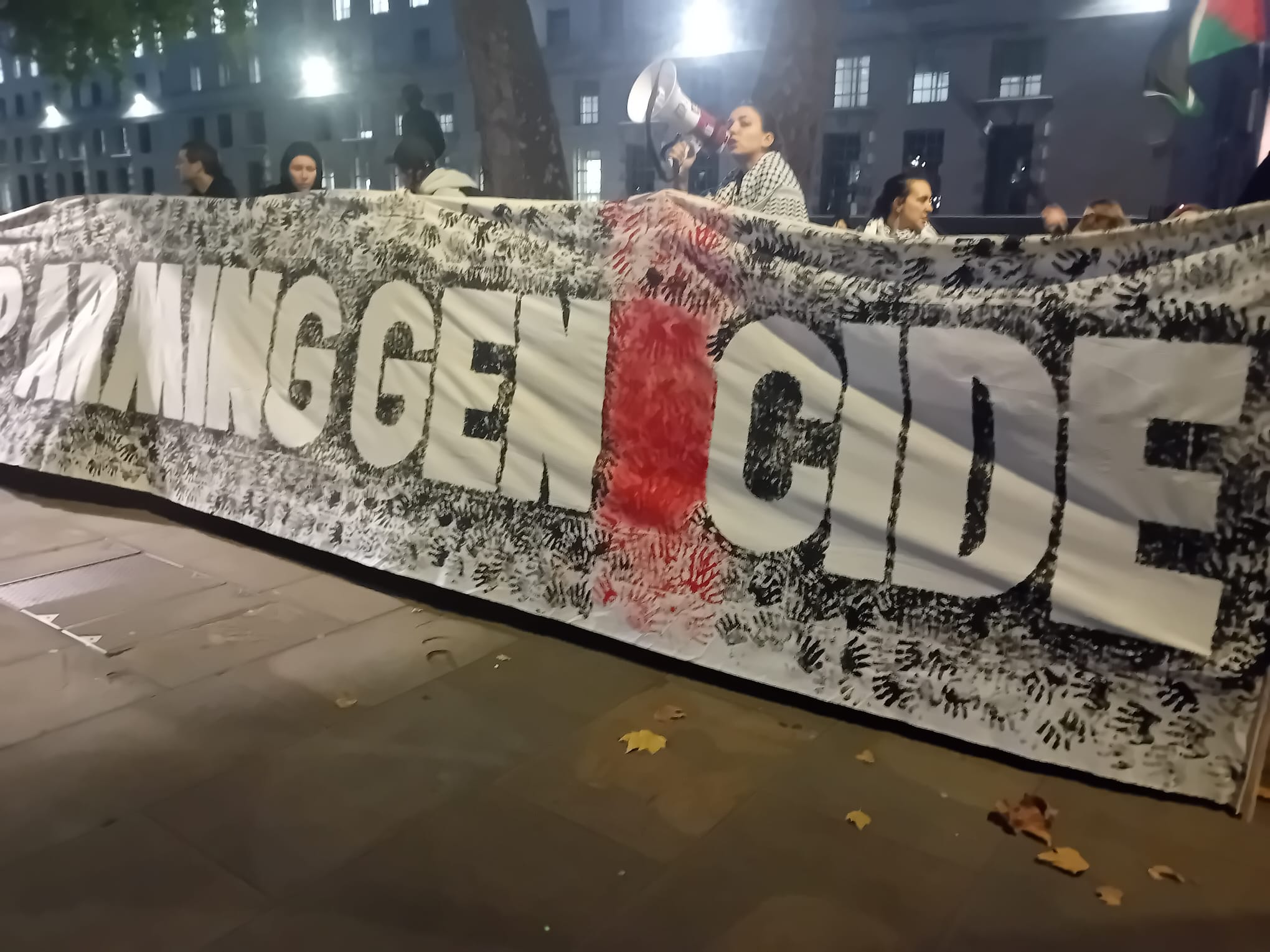
Daily Stop Arming Genocide banner outside Houses of Parliament, Westminster, London. (Source photo: Internet)

Palestine Action’s tactics mainly consist of occupations, blockades and drenching premises in red paint to symbolise the blood on the hands of these profiteering companies.

Until recently, although a lot of these actions led to arrests, very few Palestine Action activists ended up behind bars. This has changed since Keir Starmer’s Labour government came to power. There are currently 18 Palestine Action activists in prison in England, along with 2 in Scotland.

One of the Scottish prisoners is the last of the group known as the Thales 5, who were convicted of occupying the roof of the Glasgow premises of French company Thales in 2022. Thales was working with Elbit to produce Watchkeeper drones for the British military.

The prisoners in England have not been convicted and are all held on remand, having been refused bail by the courts.  The majority were arrested in relation to actions against the Filton arms factory in Bristol. Ten people were remanded in August and a further eight in November. 

Although none have been charged with terrorism offences, the TA was used to effect their arrests, allowing the police more powers to detain pre-charge, raid homes and generally act in a heavy-handed manner. 

In the latest arrests in November, flatmates and families were evicted from their homes, sometimes for several days while the police searched premises.  In one raid, the mother and younger brother of the person arrested were both handcuffed, despite not being accused of any offence.

In prison, those on remand for pro-Palestine direct action have come in for special scrutiny and additional intrusive measures on top of those which all prisoners are forced to deal with.

The six women detained in Bronzefield prison in August were all allocated to separate wings and deliberately prevented from associating with one another. Their mail has been heavily censored.

Four male prisoners in Wormwood Scrubs, although not subject to the same separation regime, have also had their correspondence held up, censored and returned to sender, with supporters being served with notices to the effect that no communication between them is permitted.

FRFI successfully appealed against such a notice in relation to our sending the paper to the prisoners, although the prison claims it still has a right to withhold the paper or other publications if the censors decide they are ‘inappropriate for a prison setting’.

The purpose of all this is clearly to scare those it is directly targeting it and to deter others from coming forward to join Palestine Action’s activities.

As Palestine Action carries out more actions against Elbit, including repeatedly blockading the UAV Engines site at Shenstone in the Midlands, which manufactures engines for Elbit, it is clear that the repression is not succeeding.

Palestine solidarity demonstration Downing Street 14 December 2024. (Source photo: Internet)

Kitson methodology

General Sir Frank Edward Kitson died on 2 January 2024, aged 97, after a long and illustrious career as a dedicated servant of British imperialism.

In addition to the litany of his war crimes, he will be remembered for authoring the text book Low Intensity Operations – Subversion, Insurgency and Peace-keeping (1971), a manual for dealing with subversive and recalcitrant populations, both at home and abroad.

Kitson’s work continues to form a central plank of British strategy for policing dissent and his disciples are clearly leading policing operations against pro-Palestine protesters.

In Kitson’s book, he details how ‘psychological operations’ should be used to isolate ‘subversives’ from the people while building links with and strengthening support for moderate elements who do not oppose the state but disagree on certain policies.

This technique was used both abroad in Britain’s colonies, and at home to police, for example, the Irish solidarity movement of the 1970s-80s.

Today’s ‘moderates’ take the form of the PSC, Stop the War and similar organisations. PSC marches are negotiated with the police, with strict conditions imposed on the protests.

The PSC has provided no support for people arrested on its demonstrations, citing the low arrest rates as proof of how respectable their protests are, while distancing itself from those who have been targeted.

While the PSC opposes Zionist massacres of the Palestinian people, it does not support the resistance of those under attack. 

Consequently it does not complain when the British police uses Terrorism Act powers to criminalise people for supporting the right of Palestinians to resist their oppressors through armed struggle.

This treachery puts the PSC on the wrong side of international law – oppressed nations successfully fought for the right to self-defence by means of armed struggle to be enshrined in UN resolutions in 1974 and 1982.

Fighting back, building solidarity

For some of us, the culture around supporting our arrested comrades was drilled into us many years ago.  A whole new generation has had to learn these lessons. 

It is positive to see that, although the PSC and such organisations continue not to want to get their hands dirty with supporting anyone targeted by the police, a different attitude is also widespread and ‘arrestee support’, prison solidarity letter-writing etc are common currency among activists. 

At the same time there is an element of this solidarity which is depoliticised. For example, the provision of a constant presence at a police station to monitor things and be there when arrestees are released is a good thing and the support organisations which provide this do an invaluable job.

However, when we have comrades under arrest, we want to do more than legal monitoring and instead turn the police station into a focus for protest.  The same with courts and prisons. 

It’s very positive to see Palestine Action, the SOAS encampment and others also doing this to great effect, thus ensuring that the focus is not just on the Israeli companies who are their principle targets, but also on the British criminal justice machinery which is being marshalled against those who take a stand.

Our task, as always, here in the belly of the imperialist beast, remains to protest against the British government and British corporations’ complicity in the Zionist genocide.

And to show unconditional solidarity with those who fight back against the Zionist war machine by whatever means are at their disposal.

Supporting the resistance and opposing the British state cannot fail to bring us into conflict with that same state and we must continue to stand alongside everyone who is criminalised for their solidarity.

End.

SOURCE

PADDY HILL, THE BIRMINGHAM SIX AND THE CRAIGAVON TWO

Diarmuid Breatnach

(Reading time: 3 mins.)

There were also others: the Guildford Four, Maguire Seven and Judith Ward, all innocent and all convicted in separate cases, mostly in 1974, in the same year that the Prevention of Terrorism Act was passed to silence the Irish community.

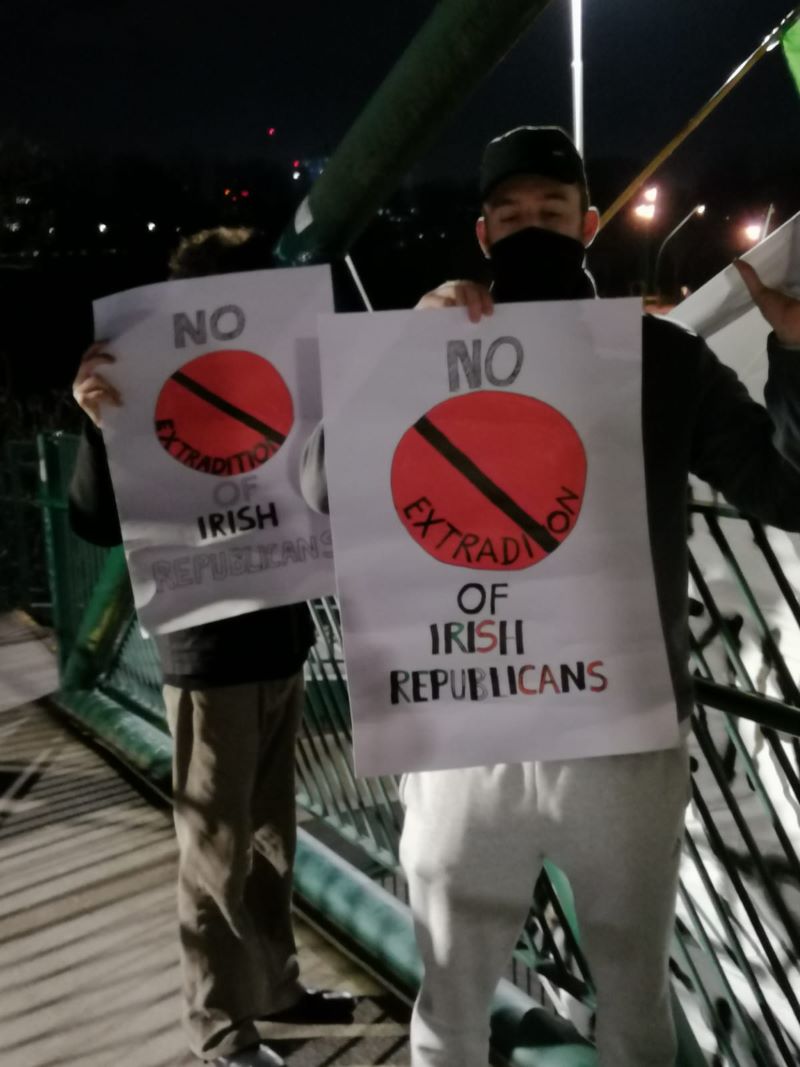
Yet others continue being framed, including the Craigavon Two.

There were also others: the Guildford Four, Maguire Seven and Judith Ward, all innocent and all convicted in separate cases, mostly in 1974, in the same year that the Prevention of Terrorism Act was passed to silence the Irish community.

Paddy Hill in 2017 outside the Dublin court where the Jobstown case was being tried (Photo sourced: Internet)

The agitation for civil rights for the community of Catholic background in the British colony of the Six Counties in Ireland began in the last years of the 1960s and very soon people in Britain were marching in solidarity with those facing violent colonial repression in the Six Counties.

The Irish were the most numerous and longest-established migrant community in Britain and had become active in many social, trade union and political circles with the potential to educate and strongly affect the host community.1 This was a problem for the British ruling class.

The jailing of so many people, in many cases obviously innocent, hundreds of arrests, thousands of detentions and interrogations with desertion by much of the British liberal and Left sector terrorised the Irish community so that many stepped away from solidarity campaigning.

That repression muted the Irish community’s solidarity actions until the 1981 Hunger Strikes brought them out again in thousands.

After his release in March 1991 Paddy Hill founded Mojo to campaign for framed innocent people and supported the campaign to free the Graigavon Two, another case that bears many of the hallmarks of a frame-up for political reasons, as famous barrister Michael Mansfield2 commented:

There is nothing more particular about it (the Craigavon Two case) than in all the other miscarriages and the same features appear in all these things.”3

PSNI Constable Steven Carroll was shot dead by an AK47 bullet on 9th March 2009 in Craigavon, Armagh while responding to a fake crime call, the “dissident” group the Continuity IRA claiming responsibility.4 The arrests of John Paul Wooton and Brendan McConville followed.

Political cases in the Six Counties almost invariably are tried by the no-jury Diplock Court and the judge there refused both men bail. This might seem normal except that they did not go to trial until three years later – and kept in jail throughout the period.

Shortly before the eventual trial a man approached the PSNI saying he had seen McConville near the scene and on the evening of the killing of the Constable. This man was the only witness for the PSNI Prosecution but his partner, with him on the evening in question, refused to confirm his tale.

The night was raining and dark and the eyesight of the alleged witness was exposed as weak by the Defence. The coat he alleged McConville to be wearing was a different type, length and colour to that which the Prosecution was alleging McConville had been wearing on the night in question.

This ‘witness’ was also described by his father as having ‘a Walter Mitty character’ and the PSNI admitted paying him as an informant. An AK47 was recovered near the scene of the killing and the one fingerprint recovered from it did not match those of either Wooton or McConville.

Craigavon Two

Brendan McConville and Paul Wooton, taken in 2017. (Photo sourced: Petition for the release of the Craigavon Two)

There was no evidence against either man of having even handled the weapon never mind fired it, no evidence placing either at the scene apart from the dubious testimony placing one of them nearby. Incredibly, it might seem, nevertheless they were found guilty on 12th May 2012.

McConville was sentenced to 25 years and Wooton to ten. Their appeal two years after conviction in May 2014 was unsuccessful and in fact the Prosecution used it to add another four years to Wooton’s sentence.

Paddy Hill of the Birmgham Six and Gerry Conlon of the Guildford Four, both sadly deceased, both innocent but served long years in jail, both supported the campaign of the Craigavon Two. (Photo sourced: Internet)

Paddy Hill was not the only former framed prisoner to support the campaign to free the Craigavon Two. Gerry Conlon was asked to examine the case and became a convinced and dedicated campaigner for the men, speaking out about it as late as a week before his untimely death.5

Paddy Hill and the rest of the Birmingham Six were framed by the British system and served 18 years in jail. In May this year McConville and Wooton will have reached their 16th in jail. For how much longer will they and their close ones be tortured?

End.

Footnotes

1The Irish diaspora in Britain had provided the British working class with its anthem (The Red Flag), its classic novel (The Ragged-Trousered Philanthropists) and two leaders of its first mass movement, the Chartists (Fergus O’ Connor and Bronterre O’Brien) and had also formed a strng section of the First International Workingmen’s Association led by Marx and Engels. In 1974 people of Irish background were estimated to form up to 10% of the population of some British cities.

2Mansfield led the appeal cases of the Birmingham Six and of the Guildford Four.

3Quoted in the campaign petition https://www.change.org/p/ccrc-the-craigavon-2-deserve-justice-now

4The same organisation had claimed the killing of two British soldiers at the Massarene Barracks, also in Co. Armagh, only days previously.

521 June 2014, a few months after his 60th birthday.

Further information and petition

Petition: https://www.change.org/p/ccrc-the-craigavon-2-deserve-justice-now

ZIONIST DUBLIN EMBASSY CLOSES TO REGRETS AND CELEBRATIONS

Diarmuid Breatnach

(Reading time: 3 mins.)

The Zionist state announced the closure of its embassy in Dublin, accusing the Irish Government of being anti-Israel.1 The broad Palestine solidarity movement celebrated the announcement while Harris for the Irish Government expressed regret.

The Zionist Embassy at 28 Shelbourne Road, Ballsbridge, Dublin has been without an Ambassador since she left Ireland last May in protest after the Irish Government, along with the Spanish and Norwegian governments, officially recognised the state of Palestine.2

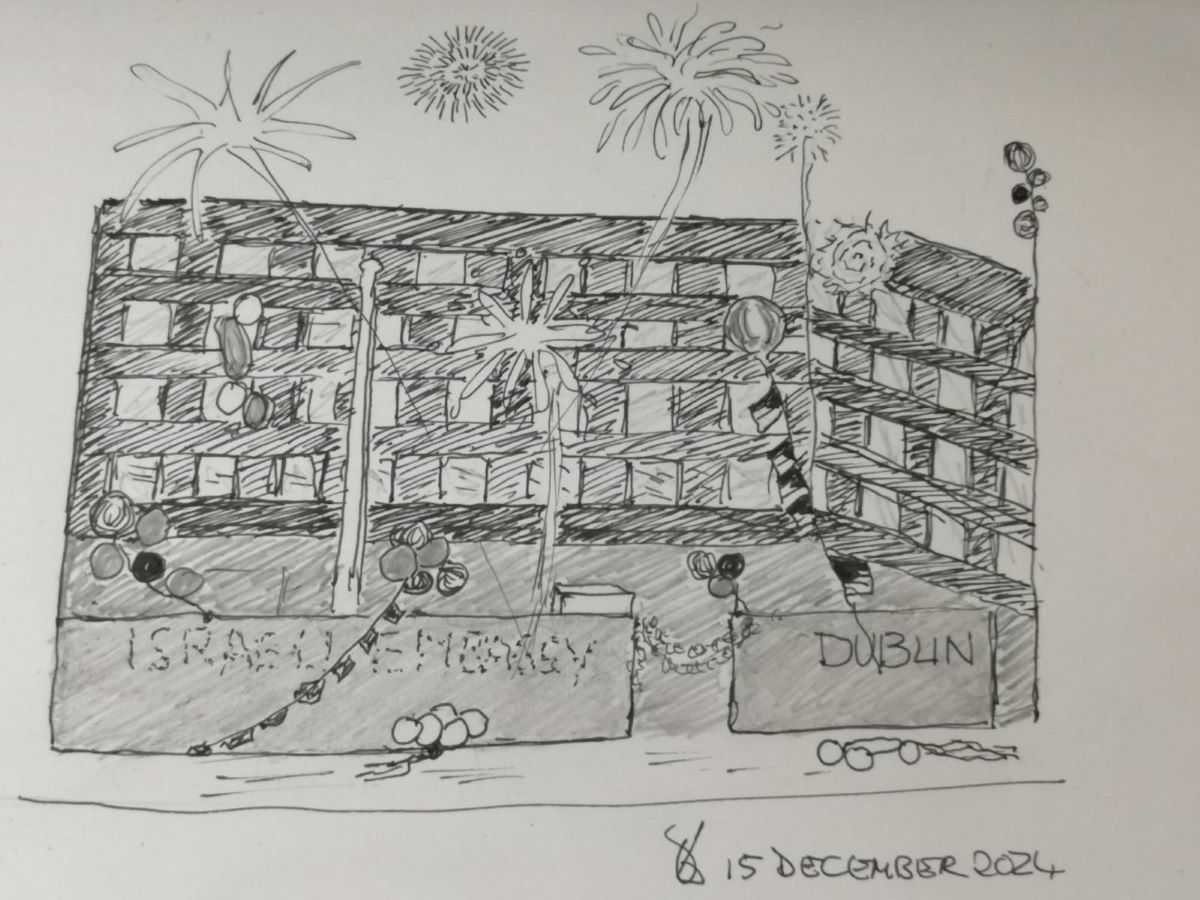
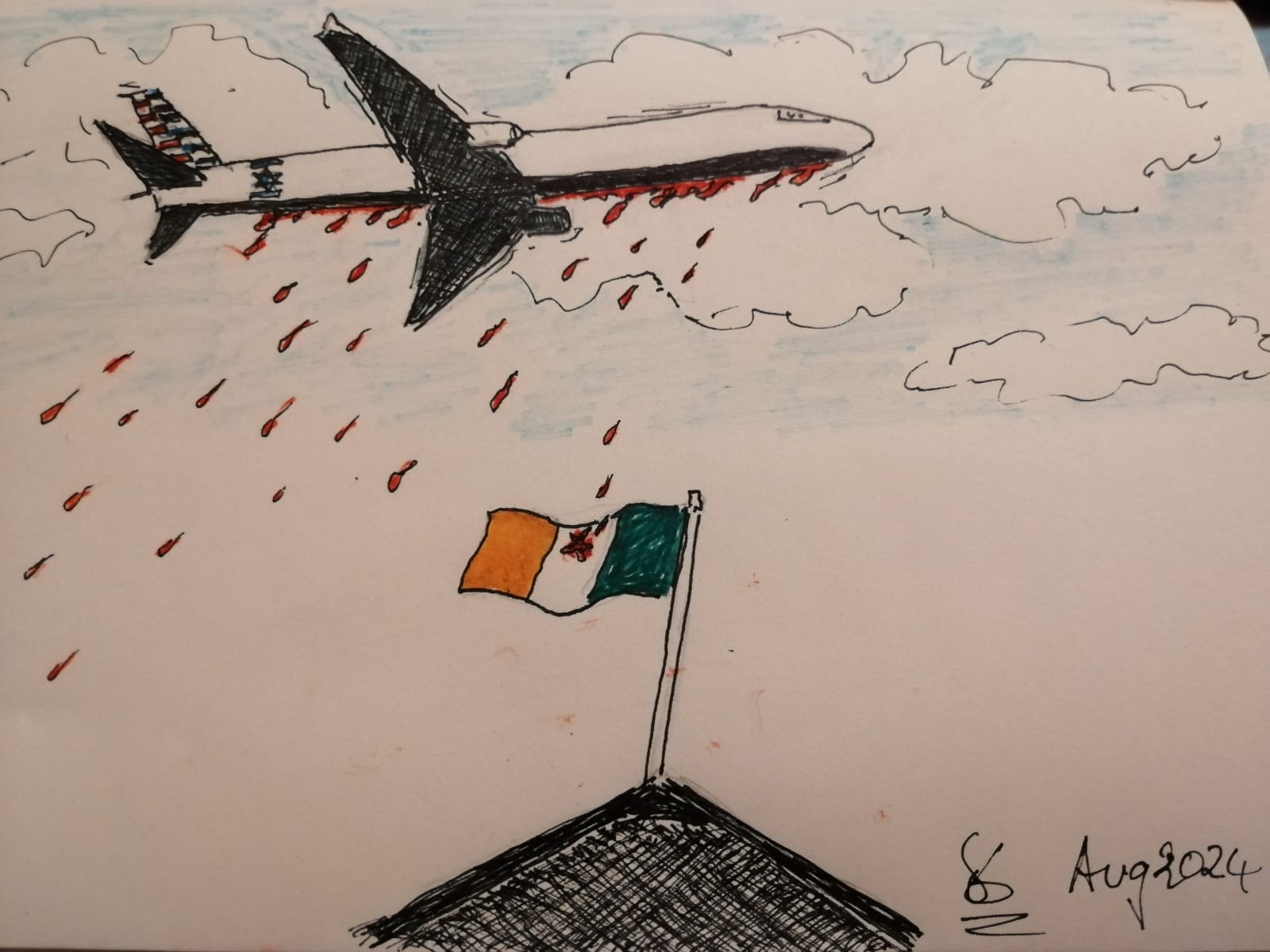
D.B cartoon drawing of celebrations outside the block in which the Zionist Embassy was located (and under 24-hour Garda protection). Many of the other users of the building will be relieved at the departure also.

However the Irish State’s recent decision to join South Africa’s case against Israel at the International Court of Justice3 seems to have prompted the closure of the Embassy and led once again to allegations of “anti-semitism” in Ireland which the President called a “gross slander”.4

Simon Harris, Taoiseach (prime minister equivalent) of the outgoing Irish Government5 expressed his regret at the ‘Israeli’ decision while at the same time rejecting vigorously the allegation that the Government is anti-Israel. He is absolutely correct in doing so.

Irish Governments have consistently been pro-Israel and colluding with Zionism, in contradiction to Irish popular opinion. The outgoing government6 has allowed military supplies for ‘Israel’ to fly through Irish airspace and the US military to land and depart from Shannon Airport.

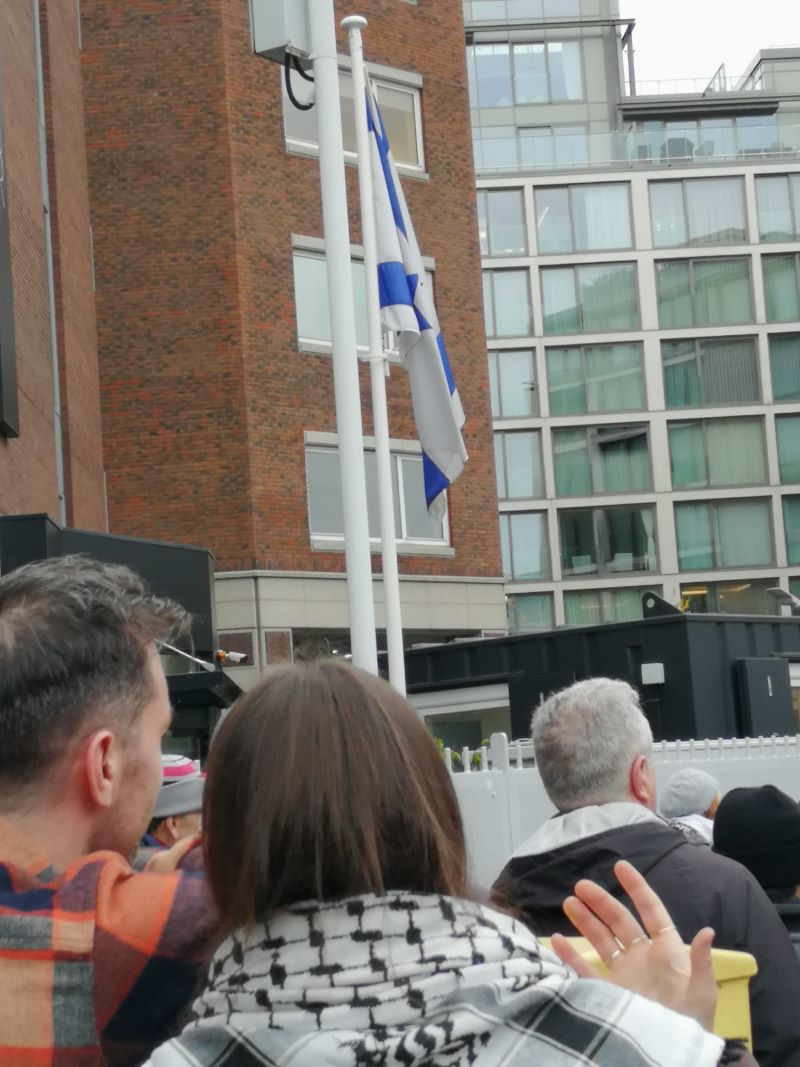
One of the participants outside the Israeli Embassy yesterday celebrating its imminent departure. (Photo: D.Breatnach)

The Irish Government has also held up for years the relatively mild UN-compliant Occupied Territories Bill. These points were well made in an Al Jazeera Inside Story7 program by Mícheál Mac Donncha, Sinn Féin Dublin City Councillor and by Zoe Lawlor, IPSC8 Chairperson.

Both did well outlining the general attitude of the Irish people to which the government was – to an extent – responding and in refuting the slur of anti-semitism on the Irish people. Lawlor pointed to the Irish history of resistance as a motivator but appears unaware that we once supported Israel.

This is important (and I have written about it9) because it shows that we are capable of changing our position to a better one when presented with the evidence of the need to do so, which task the Zionist themselves carried out for us.

However both speakers failed to answer the interviewer’s question of why the Irish government did not go further.

This is an essential question for us and the answer makes sense of the current political landscape with crucial import beyond the issues of Palestine and Zionism. Mac Donncha seemed to avoid the question entirely and chose instead to talk about actions that the Government should take.

The interviewer however put it bluntly to Lawlor that the reason was a reluctance to offend the USA, though presenting it as a fear of putting off US corporations’ investments. Lawlor correctly replied that corporations make decisions based on profit but avoided giving the political answer.

The Irish ruling class is a neo-colonial one and responds to requirements of its masters. These have been firstly the UK, followed by the US and more recently the EU. All of these are imperialist states and bound up with the interests of the colonial fort in the Middle East which is the Zionist State.

(Photo: D.Breatnach)

I am sure that Mac Donncha is aware of those facts and pretty sure that Lawlor is too but both declined to provide the explanation being asked for. One must suspect in Mac Donncha’s case the reason is that his party, Sinn Féin, is busily making itself acceptable to that very ruling class.

And Lawlor probably wants to keep the clean image for the ruling class which the IPSC leadership has been at pains to develop, particularly during this current genocidal offensive.

While the IPSC leadership has played an important role in mobilising national demonstrations much of the activism has been and continues to be by organisations on the ground. The Embassy itself was invaded some time back by such groups and has seen militant blockades.

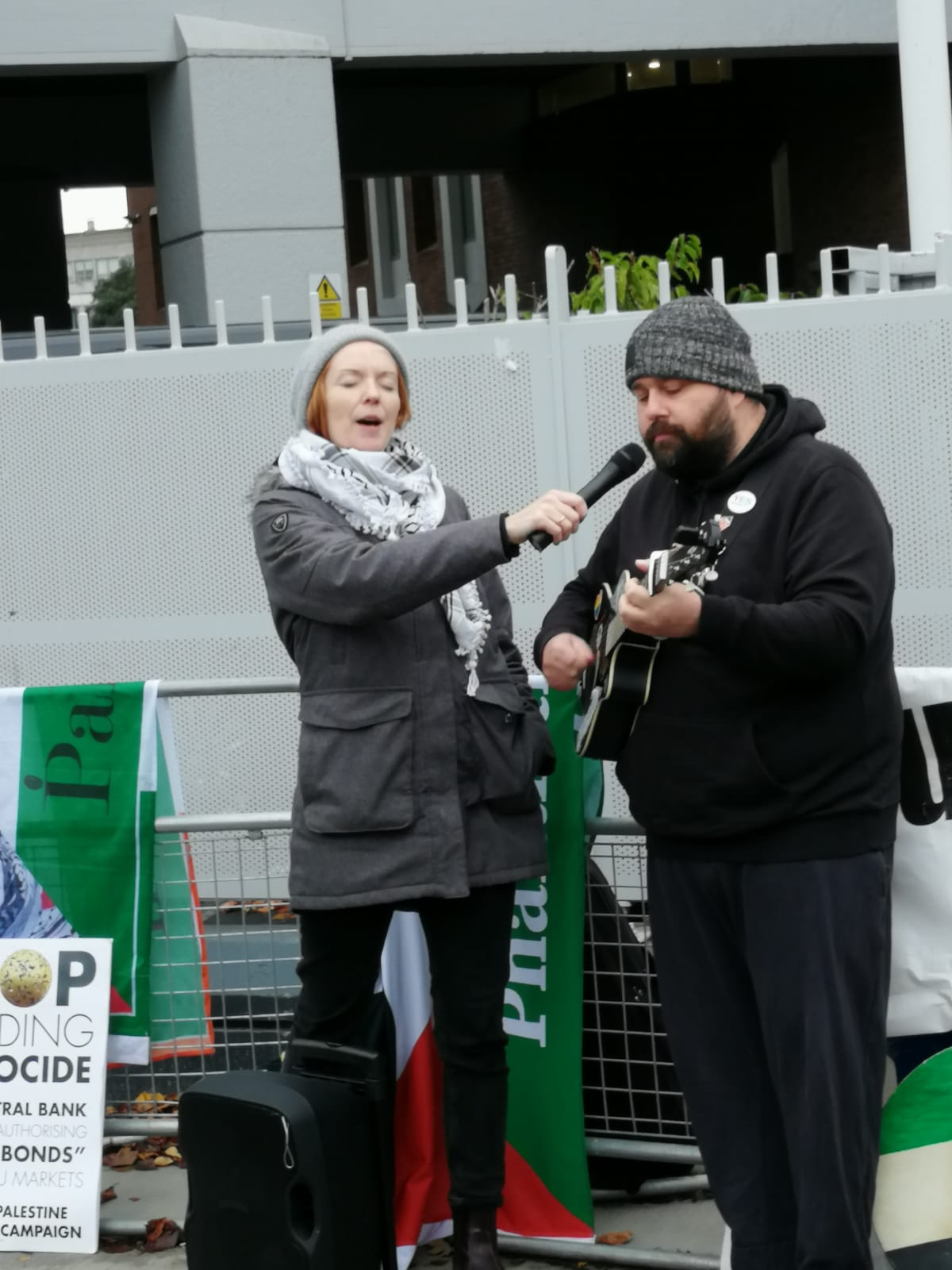
Jimi Cullen yesterday performing his composition “We Are All Palestinians” during a modest celebration outside the Zionist Embassy. Cullen has been performing outside there for an hour every Wednesday afternoon for 41 weeks. (Photo D.Breatnach)

Axa Insurance has been picketed frequently and occupied at least once and the Foreign Affairs Department was splattered with red paint while the Department of Transport was occupied. The US Embassy was picketed for three days in a row by organisations from Galway without IPSC support.

Only one IPSC march since October last year had the US Embassy as destination and on that occasion the march was led up quiet suburban streets to the stage set up next to police barricades blocking access to the Embassy gates and the main road into Dublin.

Section of the crowd yesterday afternoon celebrating its imminent departure outside the Zionist Embassy. (Photo D.Breatnach)

The general Irish public and in particular of course the activists in solidarity with Palestine can justly celebrate the departure of the Zionist Embassy. It is their symbolic victory.

However, there is no doubt that the Irish ruling class needs to be put under much heavier pressure than has heretofore been the case, if we are to shut down the collusion of the Irish Gombeen state with the Zionist genocide of Palestinians.

Outside the Zionist Embassy yesterday, an Irish healthworker calls for more effective solidarity with the Palestinians, in particular with the healthworkers being targeted by the IOF in Gaza. (Photo: D.Breatnach)

End.

FOOTNOTES

1https://www.theguardian.com/world/2024/dec/15/israel-to-close-dublin-embassy-after-ireland-supports-icj-genocide-petition

2https://www.gov.ie/en/press-release/71936-ireland-recognises-the-state-of-palestine. While the decision of those states has enraged the Zionist state, it is not as progressive as may seem at first glance. The ‘state’ that is being recognised is a) in addition to the state of Israel, i.e “the two-state solution” (sic); b) grants the Palestinians around 20% of Palestine which would be under the constant eyes and guns of the Zionists and c) is widely considered not realisable due to the proliferation of Zionist settlements and their special roads connecting them. Currently the only ‘government’ of such a state is the undemocratic, repressive and corrupt Fatah-controlled Palestinian Authority.

3Again this decision too has its deeply negative side since the Attorney General of the Irish State in his submission to the Preliminary Hearings on Genocide at the ICJ repeated the many times debunked Zionist propaganda of “mass rape by Hamas” during its breakout attack on October 7th.

4See Sources for link to the report,

5The elections of 29 November did not return any party with an absolute majority and discussions on forming a coalition government have been ongoing since the election results were confirmed.

6And many previous Irish governments too.

7See Sources for link to the program.

8Ireland Palestine Solidarity Campaign.

9https://villagemagazine.ie/opinion-ireland-and-palestine-a-late-love-affair/

SOURCES

https://www.theguardian.com/world/2024/dec/15/israel-to-close-dublin-embassy-after-ireland-supports-icj-genocide-petition

https://www.aljazeera.com/program/inside-story/2024/12/16/why-is-israel-shutting-its-embassy-in-ireland

https://www.irishexaminer.com/news/politics/arid-41538359.html

NEITHER ELECTING ONE DALY NOR FIFTY

Diarmuid Breatnach

(Reading time: 3 mins.)

Clare Daly stood for election in the 2024 elections of the Irish State, in the Dublin Central parliamentary constituency, one with a tradition of independent representation going back to Maureen O’Sullivan and Tony Gregory before her.

Daly was standing as one of the loose Left coalition of Independents for Change in a heavy competition for the four-seat constituency.

Clare Daly has a track record as elected public representative and socialist political activist, also as a prominent Socialist Party activist, with which organisation she partedcompany in August 2012.

She was elected MEP for the Dublin constituency from July 2019 to July 2024, TD1 for Fingal from Feb. 2016-July 1999 and TD Dublin North Feb. 2011-2019; in recent years Daly has been better known outside Ireland due to her public interventions in the European Parliament.

Daly and her partner Wallace were both vilified by pro-imperialist liberals and ‘Left’ for publicly opposing US/NATO/ EU imperialist campaigns against Islamic regimes and the Russian Federation, being subjected to a host of unfounded allegations contrary to their actual record.

Tik Tok clips of Daly’s biting attacks on the EU’s complicity in the US-backed ‘Israeli’ genocide provided relief for many around the world from the Zionist sycophancy and insincere and ineffective concern for the victims of that daily genocide prevalent in the EU Parliament.

And who can forget Daly’s calling German politician and EU Commission President Ursula Van Der Leyen out as ‘Frau Genocide’ in the European Parliament in December last year!2

While an MEP, Daly also intervened in the discussion around the Irish Gombeen3 class’ attempt to push us towards NATO, further undermining a quite tattered Irish neutrality. And while a TD, she and her partner Mick Wallace TD were arrested protesting the foreign militarisation of Shannon.

To their credit both risked jail by refusing to pay the fines imposed but the Gombeen ruling class decided to restrict the damage of its exposure of collusion with US imperialism by also reducing the punishment of both to a few hours in captivity.

Daly has been one of the few TDs prepared to speak in public against the repression of Irish Republicans and to visit some of the consequent victims in jail.

In the EU Parliament, Daly also denounced the Spanish State’s police invasion of Barcelona and violence against voters there on 1st October 2017 during the referendum on Catalunya’s independence.

2024 Dublin Central election poster for Clare Daly.

In Ireland today

In her election flyer here Daly highlighted representation independent of political party for her electoral area, housing, health service, cost of living, Palestine, the endangered climate and Irish neutrality without any indication of how these issues might be effectively addressed.

Daly’s election flyer did not mention capitalism or imperialism, nor did she campaign on a platform of overthrowing the current neo-colonial and neo-liberal capitalist system in force, instead indicating her wish to “hold to account the people who’ve got us into this mess.”

“Holding to account” is something to which Daly is accustomed doing and does it well, eloquently, with passion and fluently, scarcely having to refer to her notes while doing so. But like ‘speaking truth to power’, it has little effect on those who are in control of the political-social system.

It can indeed have an effect on the victims of the system but we are left with the question of what to do about the situation. Refreshing as it may be to hear her again in Leinster House, neither voting Daly in — nor fifty Dalys — is going to change any of the conditions under which we suffer.

BY THE WAY,

in case anyone’s interested, I gave my first preference vote to Daly and hope she does get elected.

End.

1Teachta Dála, the title of a public representative elected to the parliament of the Irish State.

2Imperialist politician and proven plagiarist in her doctoral thesis.

3Vernacular term in Ireland for huckster, carpet-bagger-type capitalists, derived from the Irish language gaimbíneachas, profiteering, nowadays used to describe the neo-colonial Irish capitalist class.

SOLIDARITY WITH THE RESISTANCE ON DUBLIN PALESTINIAN SOLIDARITY MARCH

Clive Sulish

(Reading time: 3 mins.)

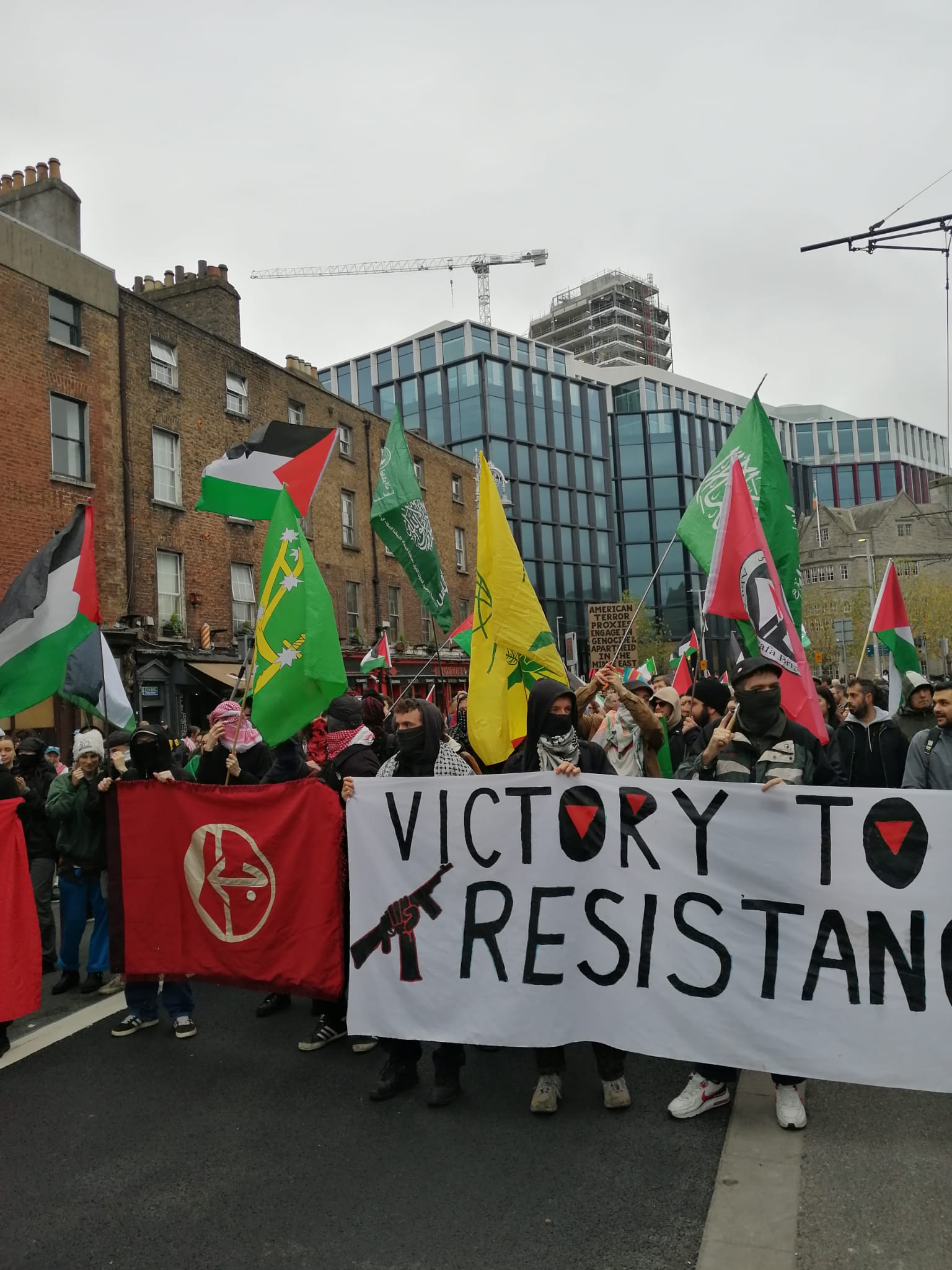
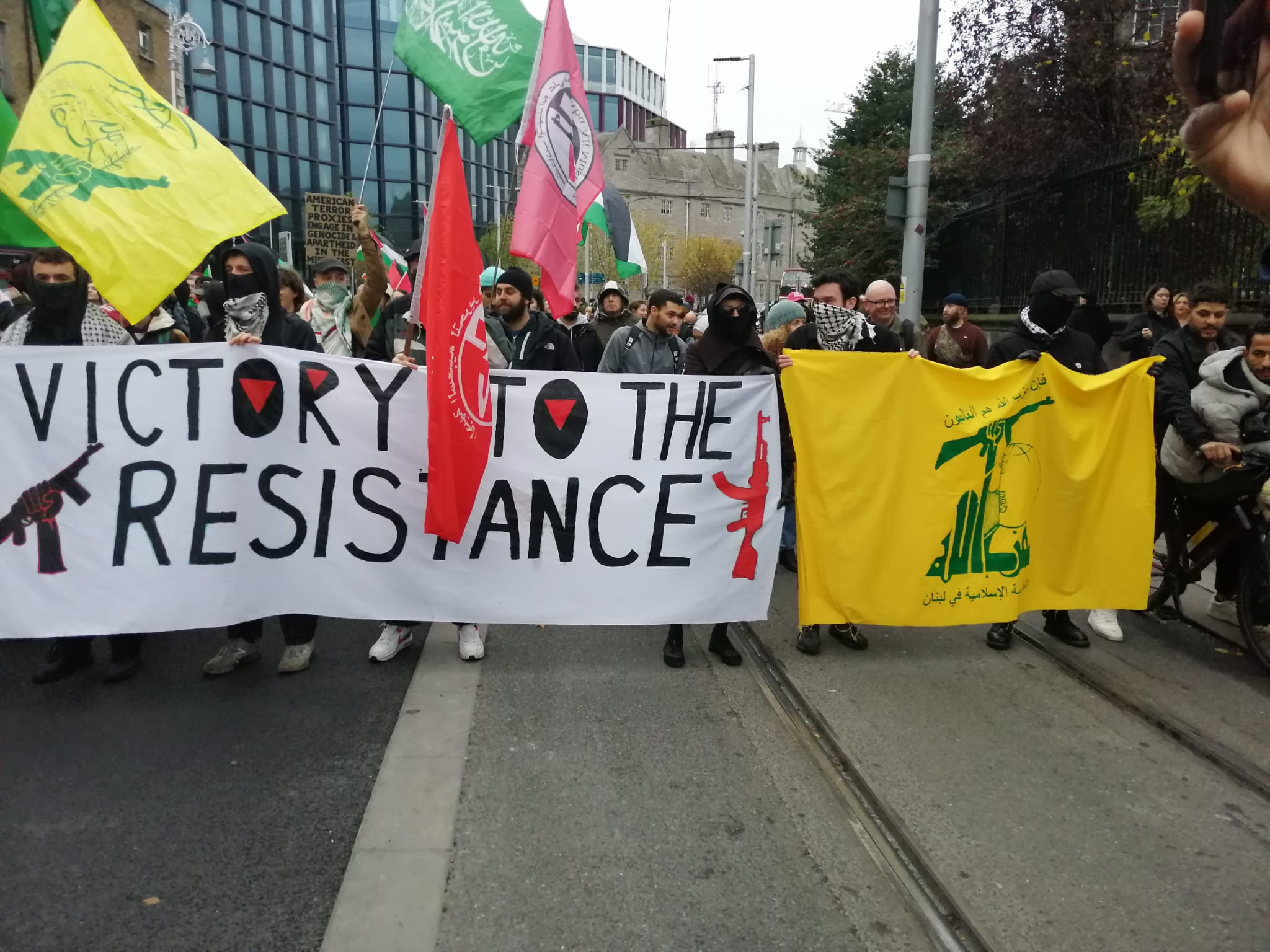
While thousands marched once again in Palestine solidarity in Dublin, a section of the demonstration marched as a bloc in specific solidarity with the Palestinian Resistance with banners, flags and slogans declaring their position.

The Ireland Palestine Solidarity Campaign with a number of branches has been for many years the major organiser of Palestinian solidarity events and had once again called for a national march in Dublin, again to Leinster House, home of the Irish Parliament.

Section of the front of the Palestinian Resistance Solidarity Bloc in Dublin on Saturday. In this photo may be seen the flags of three factions of the Palestinian Resistance and, left foreground, the flag of Irish revolutionary socialist Republicanism, the Starry Plough (Photo: R.Breeze)

This has become a pattern of the main IPSC street activity in Dublin, along with holding a rally on the central pedestrian reservation in Dublin’s O’Connell Street, with occasional marches to the Department of Foreign Affairs (though in the past it organised boycott pickets of ‘Israeli’ products).

The US Embassy seems to have become out of bounds for the IPSC. This is despite the clear responsibility of the USA for supplying most of the armament, political and financial backing for the genocide being carried out by the Zionist state against the Palestinians.

Some believe that the IPSC leadership is complying with the wishes of the Irish police, the Gardaí, not to have Palestine solidarity marches go to the US Embassy. The offices of the EU, Germany and the UK, major contributors to the genocide, have also been given in effect a waiver.

The national march called by the IPSC at its destination in Molesworth Street last Saturday. The photo is taken from the platform and PA lorry facing the crowd, with its back to Leinster House (of the Irish Parliament) which also has crowd barriers erected behind it. (Photo sourced: IPSC)

Neither the march last Saturday nor any organised before it by the IPSC was going to promote solidarity with the Resistance, despite their former chairperson having once said of them in public that they are ‘freedom fighters’. Of course, to the ‘Israelis’ and EU they are ‘terrorists’.

Section of the front of the Palestinian Resistance Solidarity Bloc in Dublin on Saturday (Photo: R.Breeze)

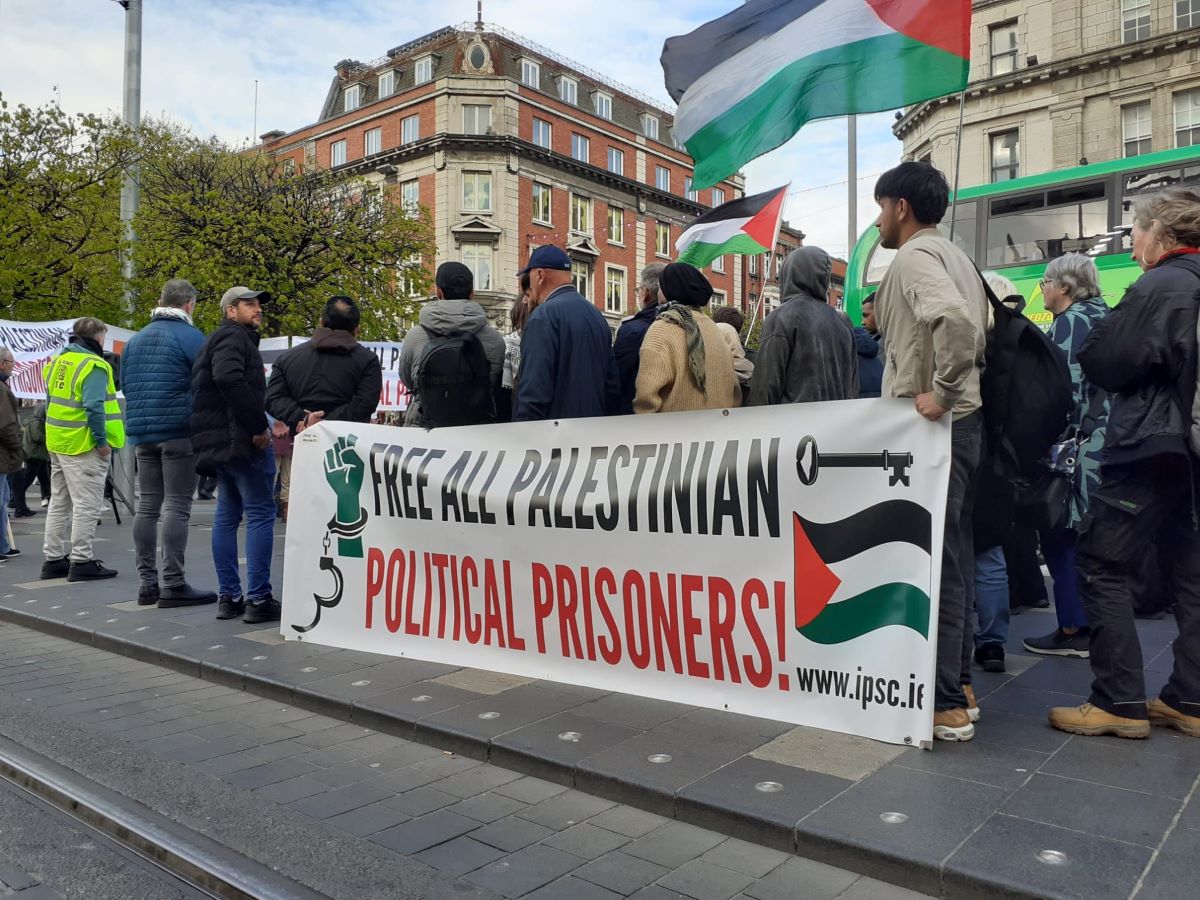
The IPSC has organised only one public meeting during this year’s genocide to highlight the terrible conditions of the thousands of Palestinian political prisoners in ‘Israeli’ jails and rarely mentions them, nor in solidarity with the Samidoun1 organisation being banned in USA and Canada.

In October last year, as this phase of the genocide began, the IPSC dithered over whether to call for the expulsion of the ‘Israeli’ Ambassador to Ireland, as did the Sinn Féin leadership until a near revolt of the party’s members forced them to return to their previous position. As did the IPSC.

Clearly the IPSC leadership is trying to keep itself somewhere around the ‘middle road’ in Palestinian solidarity, probably in order — as it sees it – to remain with influence among the ruling circles. However, the actual results among those circles do not bear testimony to their effectiveness.

NO CHANGE

The Irish state continues to permit US military planes and personnel to violate the State’s nominal independence through Shannon International Airport, to permit Zionist armament overflights of its air space (similarly with the RAF) and to permit British Navy docking in Irish ports.

The relatively mild Occupied Territories Bill, long approved through Leinster House, remains not brought into force, blocked by the Coalition Government of Fianna Fáil, Fine Gael and the Green Party. It could not be clearer that the ruling class in Ireland do not feel under enough pressure.

This is despite a clear popular feeling among the public in Ireland of solidarity with Palestine and revulsion at their genocidal attacks by the Zionist state.

There is a long-established train of thought that maintains that solidarity with the Palestinians is not just calling for the genocide to stop – that alone is charity and that actual solidarity means solidarity with the people’s resistance and the political prisoners.

If the IPSC were to adopt that position they might find it easier to support more radical action to pressure the Irish state to break with the western powers’ consensus of support for the ‘Israeli’ state and consequently for its genocide against the Palestinians.

Perhaps that is one of the very reasons that the IPSC leadership will not take that stand and that its stewards have at times even tried to convince people to remove their flags supporting various Resistance factions.

Section of the front of the Palestinian Resistance Solidarity Bloc in Dublin on Saturday (Photo: R.Breeze)

On Saturday independent activists joined those of Saoirse Don Phalaistín, Anti-Imperialist Action Ireland and Queers For Palestine in forming a sizeable bloc on the march with banners, flags and call-and-answer slogans advertising its solidarity with the Resistance.

This seems a welcome trend likely to grow.

End.

FOOTNOTE

1Palestinian political prisoner support and advocacy organisation.

WHAT WE’VE LEARNED FROM SINWAR’S DEATH

Diarmuid Breatnach

(Reading time main text: 4 mins.)

Yahya Sinwar, head of the Palestinian resistance organisation Hamas, was killed in action by an Israeli Occupation Force in what was for them a routine operation in Gaza on 16th October, his last moments captured on video and broadcast widely.

From that event alone there is much for us to learn about Hamas and the Palestinian Resistance in general as well as about Sinwar himself — but also about the IOF, the way it fights and the extent of its self-discipline.

For the bare details as publicly shared, Sinwar was in military outfit, in tac vest, armed with a pistol and automatic rifle and accompanied by two local Hamas commanders in the Tal as-Sultan, Rafah area of Gaza patrolled by the IOF, very close to the semi-permanent IOF front lines.1

One may assume Sinwar was on a reconnaissance operation.

Sinwar with Hamas comrades in 2021 (photo cred: John Michillo)

Something gave away their position to a passing patrol in an area where, as far as the IOF were concerned, nothing should be alive except themselves. Pursued, they split up, local commanders in one building and Sinwar into another so the patrol called a tank to fire into each.

The patrol attempted to enter the building into which the individual fighter had gone but two grenades beat them back, injuring one soldier,2 so they retreated and called for a tank to put another shell in the building.

Still wary in the aftermath, they sent a surveillance drone into the building and the image it captured was what was seen in the widely-circulated video: a Palestinian fighter, apparently unarmed, right hand mangled. As they watched, he threw a stick at the drone with his left hand but missed.

So the IOF patrol had another tank round fired into the building and they went on their way.3

The last image of Hamas chief Yahya Sinwar alive. Right arm mangled he stares at the IOF drone videoing him in house ruined by IOF bombing in Tal Al-Sultan, Rafah, before throwing a stick at it. Moments later the IOF call a tank to put a shell in the building, collapsing it on top of him.

But unusually,4 they came back. Perhaps someone thought they recognised Sinwar in the camera video? It was then they discovered that one of the three fighters they had killed was Yaha Sinwar, confirmed by test results matching his DNA records they had from his years in captivity.

According to ‘Israeli’ postmortem, although he’d been hit by shrapnel and his right hand was mangled, what killed Sinwar was a bullet to the brain – which raises other questions.5

Whatever he was doing at that time, it was clear that he was there as a commander and Resistance fighter, armed and dressed for combat in a highly dangerous area, regularly patrolled by the IOF and only a short distance from their secured front lines.

That alone spoke of courage but also his and his comrades’ resistance in the face of superior numbers declared their courage and determination. But Sinwar’s continuing to resist while badly wounded and his comrades dead, spoke of heroism.

Although only weeks from his 62nd birthday and after 22 years in a Zionist jail, Sinwar seems to have been quite fit. However, according to the results of a postmortem examination carried out by the IOF, Yahya Sinwar had not eaten in 72 hours prior to his death – a period of three days.6

The event was revealing in outlining how the IOF infantry is accustomed to fighting. They are fine with killing civilians but when confronted with armed resistance fighters, they hold for a short while if at all before retreating and calling up artillery or air strikes.

Their dead and wounded are picked up by helicopter and rushed to undamaged ‘Israeli’ hospitals, well equipped and staffed less than an hour away, a journey that is never fired upon by the Palestinian Resistance.

The contrast could not be starker, as the IOF fire on Palestinian paramedics and their vehicles, blockade Palestinian hospitals from receiving fuel and other essential supplies, even bombing and occupying them, kidnapping and killing medical personnel.

What people saw in the video of Sinwar’s last moments exposed Israeli lying propaganda about Sinwar, accusing him of living safe and well inside the tunnels and never emerging or, if he does, going about in a burka, disguised as a woman, also of intending to flee to Egypt with ‘hostages’.7

Iconic photo of Yahya Sinwar in May 2021, sitting in an armchair outside his home in Gaza, ruined by IOF bombardment. He went there directly after concluding an interview with words to the effect that he did not fear assassination by the IOF, that they knew who he was and the route he would take and if they wanted to kill him “Be my guest … I won’t bat an eyelid.”

The quick circulation of the video by the IOF exposed also the renowned indiscipline of their military and their total lack of comprehension of the mental and emotional processes of the people they have been occupying and oppressing for seven decades.

Their indiscipline is attested to by the thousands of videos on social media posted by the IOF during their genocidal operations as, contrary to orders, they film themselves blowing up buildings including a university, humiliating and brutalising prisoners, even on occasion raping them.

The IOF are renowned too for leaving graffiti inside occupied houses and for prancing around houses they have destroyed, often wearing the intimate underclothing of Palestinian women, whom they have at least turned into refugees and may have killed.

In those circumstances their release of the video before discussing it with their intelligence and propaganda department is not surprising but doing so underlines their failure to understand their enemy. They thought that killing Sinwar would undermine Palestinian morale.

They, colonialists and other oppressors in general fail to take account of the human will to resist and the potency of the memory and example of martyrs. This is an aspect we understand well in Ireland.

The Zionist intelligence services would surely have preferred not to have Sinwar’s last moments shared publicly and possibly would have liked the opportunity to lie about them.

Yahya Sinwar gives the victory sign with both hands while speaking from a rally in Gaza.

Sinwar was clearly a remarkable individual, Palestinian Resistance fighter, thinker and leader but the IOF made him a martyr and in their arrogance showed his heroism not just to the Palestinians — nor to Arabs alone — but to the world.

End.

APPENDIX: HIGHLY ABBREVIATED BIOGRAPHY (Reading time: 2 mins.)

Yahya Ibrahim Hassan Sinwar (Arabic: يحيى إبراهيم حسن السنوار, romanizedYaḥyá Ibrāhīm Ḥasan al-Sinwār; 29 October 1962 – 16 October 2024) was a Palestinian resistance fighter, former political prisoner and subsequently politician who was killed in action.

Sinwar served as chairman of the Hamas Political Bureau from August 2024 and as the leader of Hamas in the Gaza Strip from February 2017, until his death in October 2024, succeeding Ismail Haniyeh (assassinated by Israeli strike while on a fraternal visit to Iran) in both roles.

He was born in the Khan Yunis refugee camp in Egypt-ruled Gaza in 1962 to a family who were refugees from Majdal (Hebrew: Ashkelon) during the 1948 Palestine War. He gained a bachelor’s degree in Arabic studies at the Islamic University of Gaza.8

Sinwar’s first arrest was in 1982 for ‘subversive activities’, serving several months in the Far’a prison where he met other Palestinian activists and dedicated himself to the Palestinian cause. Though arrested again in 1985, upon his release he continued his organising trajectory.

Israeli propaganda has claimed that during this period his work in internal security against Zionist agents and informers earned him the nickname “Butcher of Khan Younis” but no-one who knew him or seriously studied him even heard of that alleged nickname until after his death.9

Ismail Haniyeh, leader of the Hamas politburo, welcomes Sinwar with a kiss after the latter’s release from jail in the prisoner exchange of 21 October 2021 (Photo cred: Abed Rahim Khatib/ Flash 90)

Sentenced to four life sentences in 1989, Sinwar spent 22 years in prison until his release among 1,026 others in a 2011 prisoner exchange for Israeli soldier Gilad Shalit. According to John Elmer10 Sinwar wanted others released before him but the prisoners insisted he be one of those leaving.

The prisoners had elected Sinwar as their leader in the prison11 and he was known for encouraging prisoners to use their time productively and to study – in particular to study the enemy. He certainly practised what he preached, becoming fluent in Hebrew and studying IOF tactics.

And also, incredibly, in writing a political novel, The Thorn and the Carnation.12

Sinwar (centre photo) photographed carrying the son of Mazen Faqha, a Hamas leader who was shot dead by unidentified gunmen in Gaza at martyrs’ memorial 27 March 2017. Another photo of Sinwar shows him carrying the child and an automatic rifle; yet another, carrying an automatic rifle and a child who might be a girl, perhaps the child of another martyred fighter. The child and the gun may be seen as symbolising the future through resistance.

On 21 November 2011, a month after his release, Sinwar married Samar Muhammad Abu Zamar and the couple had three children. Sinwar’s wife received a master’s degree in theology from the Islamic University of Gaza. His brother Mohamed remains active in the resistance and is being sought by the IOF.

Re-elected as Hamas leader in 2021, Sinwar survived an ‘Israeli’ assassination attempt that same year.

FOOTNOTES

1At their ‘Philadelphi Corridor’

2According to Jon Elmer, admittedly only days after the event, this is not mentioned in most reports or discussion on line. https://www.youtube.com/watch?v=Dj43mbQ3AiE

3All of this is according to the Israeli Occupation Force.

4 According to Jon Elmer, blogger and weekly podcast military analyst for the Electronic Intifada, also in discussion with Justin Podur https://www.youtube.com/watch?v=Dj43mbQ3AiE (at 1.23.3), that was so unusual because the IOF don’t usually go back to carry out battle analyses for intelligence.

5https://www.firstpost.com/explainers/hamas-leader-yahya-sinwar-death-autopsy-report-idf-israel-13827027.html Not that carrying out field executions would be any stranger to the IOF

6https://www.firstpost.com/explainers/hamas-leader-yahya-sinwar-death-autopsy-report-idf-israel-13827027.html

7https://thecradle.co/articles/netanyahu-aide-arrested-over-intel-leak-used-to-sabotage-gaza-ceasefire

8 Often attacked by the IOF and once by Fatah, its campus was bombed and its buildings destroyed on the night of 10 October 2023.

9This is admitted even in the hostile Wikipedia page about Sinwar.

10Discussion Justin Podur and Jon Elmer on https://www.youtube.com/watch?v=Dj43mbQ3AiE

11This seems not unusual among political prisoners:Irish Republican prisoners also elected their OC in the British Occupation jails: Mairead Farrell had been O/C in Armagh Jail and, before he entered his fatal hunger strike, Bobby Sands had been O/Cof the H-Blocks.

12https://books.google.ie/books/about/The_Thorn_and_the_Carnation_Part_I.html

THERE WILL BE NO RED LINES

Diarmuid Breatnach

(Reading time: 4 mins.)

In future, there will be no red lines in attacking your country.

Yes, I do mean YOUR country, wherever you are. In whatever war it’s in. And in this imperialist world, it’s a safe bet your country will be part of a war, directly or a little indirectly, sometime in your lifetime. Or in your kids’ lifetimes.

The Adversary will be able to carpet-bomb your residential areas, your hospitals and medical centres, schools and universities, places of religious worship, markets, restaurants, coffee shops, bars, bakeries, internet access sites, gyms, your infrastructures and municipal authorities.

There might be some condemnations at high levels abroad, even threats of court cases but nothing will be actually done in practice.

The Adversary will be able to attack your food stores, blockade you from food and fuel imports, bomb your farms and fishing fleets. It will be able to call down aerial strikes on people in their homes, in vehicles or shoot them by snipers or drones as they walk in the street.

Your cities’ food delivery trucks, construction and rubble-clearing and heavy lifting vehicles will be targeted, along with their drivers and operators. That is so that your people will have to dig with your hands to find victims under the rubble of bombed buildings.

Your ambulances and paramedics will be targeted so that picking up wounded or even corpses becomes a high-risk job and your hospitals will be bombed, shot at and invaded to reduce the life chances of any bombing victim found alive in the rubble or on the street.

Your country’s infrastructures of electricity generation and supply, water supply, sewage collection and treatment, waste collection and treatment, telecommunication and public transport will be bombed and bombed and bombed again.

Your reporters will be shot on the street and their homes bombed, as will your media networks offices. That hardly seems necessary anyway since no-one who sees any of the atrocities, no-one with power anyway, will even try to stop what is being done to you and your people.

That’s because there are no red lines anymore.

Your populations will be refugees in your own land and their tents and shacks will be bombed and fire-bombed. They will be bombed wherever they go and they will be bombed on the way there. They will be told some areas are safe and then they’ll be bombed and shot at there also.

Food, fuel, water and medicine supplies will be blocked, blockaded and even bombed. Many of you will be hungry, thirsty and cold. The weaker ones, also the very young and the elderly, will die prematurely of diseases and ailments or untreated wounds and sores.

People with special medical needs will die from lack of specialised medical treatment, procedures, equipment or medication.

Your children will be denied education, safety and even life. Your young and middle-aged men and women will be denied work, safety and even life. Your elders will be denied safety in retirement — and even life.

Some of you will resist, of course. Those the Adversary can catch will be put in prisons; mostly not even a trial will be required but when it does, it will be a mockery of standard judicial procedure. In jail they will be beaten, humiliated, tortured, degraded, half-starved, raped and die.

Some of your resistors will be shot after they’ve been captured. Random civilians will be shot by snipers or drones, thrown into graves and earth pushed over them, perhaps even while alive; other bodies will lie in the street to make you sick with terror and the smell of their decomposing bodies.

Other civilians – including children – will be used as human screens or shields for the Invader’s troops and even their armoured vehicles. They will be used to test mines, booby traps and IEDs.

You will be taught how little your lives matter and how easily they can be wiped out.

There is no longer humanitarian international law, no Geneva Convention; there are no longer any red lines.

It will happen because …

The Zionist state has committed all the crimes listed above and has done so while being photographed, filmed and even live-streamed by reporters, victims, witnesses and even by the Zionist soldiers themselves, in thousands of boastful videos and photographs.

Jabalia, North Gaza, IOF rounding up Palestinian civilians after destroying their neighbourhoods.

Their military leaders, politicians and media have proclaimed their intentions and followed them up in practice.

There have been some high-level international complaints and criticisms and even court cases but nothing in practice has been done by the relevant international bodies to physically stop the Zionist genocide or even to deprive them of the weapons and finance to carry out that genocide.

Yes, we know that there have been many human rights violations committed by Western powers in other wars: Dresden, Hiroshima/ Nagasaki, Korea, Algeria, Vietnam, Ireland, Lebanon, Iraq … And some of them were photographed too.

But never before has there been such blatant and daily violation of all principles of international law at so many levels to be seen live on our screens while Western powers leaders justified it and all international institutions were either complicit or helpless.1

So now that the unthinkable has been done there, it is no longer unthinkable anywhere. And if not unthinkable, then history shows us that it will indeed be thought of. History shows us too that what is thought of will also be done.

What hasn’t been done yet?

Poisoning your water supplies? Why not? So long as there be a water supply for the invading soldiers and good clean water for the occupiers, the settlers. Germ warfare? Why not? As long as the invaders and settlers are immune or the pathogens die out in time for occupation.

There are no red lines any longer and you can expect none when war comes to your country.

Anything goes.

End.

Footnotes

1And people who protested it in western states were maligned, hounded in work and academia, beaten on the street, arrested …

DAY OF THE PATRIOT SOLDIER

Diarmuid Breatnach

(Reading time: 4 mins.)

In the Basque Country the Day of the Patriot Soldier is commemorated on two different dates: by the Basque Nationalist Party on October 28th and by the Patriotic Left on September 27th. Each date marks different events but each is anti-fascist in character.

On October 28th one of the many atrocities of the Spanish Civil War/ Anti-Fascist War was enacted by the Spanish fascist military when they executed 42 captured Basque soldiers of the Eusko Gudarastea, a Basque antifascist militia opposing the military-fascist coup of Franco and another three generals.

Section of the crowd at the Gudari Eguna commemoration in Arrigorriaga, Bizkaia province, southern Basque Country. (Photo: D.Breatnach)

This atrocity occurred in 1937, when that war had another two years to run. The Basque Nationalist Party (PNV) was then the main political party in that part of the Basque Country1 and many of its politicians and administrative officials were executed by the Franco regime too.

Commemoration of the PNV´s Day of the Patriotic Soldier (Gudari Eguna) was carried out clandestinely during the four decades of the fascist Franco regime but was permitted in the post-Franco arrangement in the Spanish State, when the PNV were legalised.

The PNV became the dominant force politically in the two provinces that had declared for the Spanish Republic, which was the largest part of the Basque Autonomous Region. Nafarroa however was given a separate autonomous government which split the nation administratively in at least four.2

A DIFFERENT DATE TO COMMEMORATE

However in the 1960s a large part of the PNV´s youth wing had become disenchanted with the party and, entering into alliance with a Basque socialist movement, formed ETA, a mainly political organisation but, existing under a fascist-military regime, inclined also towards armed resistance.

The platform at the Gudari Eguna commemoration organised by Jarki with the event’s speaker/ chairperson addressing the participants. (Photo: D.Breatnach)

ETA grew in support and in actions, military but not only, the Left Patriotic movement (Izquierda Abertzale) widening to fight on a number of fronts, linguistic, social, trade unionist and political with the armed section carrying out many actions.

The last political executions of the Franco regime were in 1975 of two members of ETA and three of FRAP3; the two Basques were Juan “Txiki” Paredes4 and Angel Otaegui. All five, despite huge international solidarity mobilisations and appeals for clemency, were shot by firing squads.

Today, the Patriotic Left´s Gudari Eguna is commemorated by different groups and not all together. As has occurred in Ireland, the accommodation of the leadership of the Basque Patriotic Left to the Spanish electoral system and abandonment of armed struggle has resulted in fragmentation.

A protest in Arrigorriaga I passed by on my way to the Gudari Eguna commemoration. I did not stop to enquire as to the purpose; I had made an error on the journey, was late and in a hurry. From the arrows design I understand these to be the Sare group doing their last Friday of the month picket in solidarity with the prisoners. ‘Giltzak’ means ‘keys’ as the graphic banner design shows and so the aim is probably to have them all leave jail. That is also the aim of the ‘dissident’ group Amnestia but they seek complete amnesty for the political prisoners whereas Etxerat, Sare and EH Bildu normally refrain from even calling them ‘political prisoners’ since, according to the Spanish State, that amounts to ‘supporting terrorism.’ (Photo: D.Breatnach)

The political party EH Bildu commemorated the executions but so did the dissenting Jarki and Tinko/Amnistia and the historical memory organisation, Ahaztuak. They did not do so together nor, naturally with the PNV on the different date.

In Arrigorriaga Jarki organised their event in the birthplace and home of Argala, nom-de-guerre of José Miguel Beñaran Ordeñana, a theoretician and activist of great importance in the development of ETA and assassinated by the state-sponsored GAL terrorists.

The attendance at the event listened to the event’s MC addressing them, after which a group of youth carrying flaming torches came on stage. The MC ended her talk with calls for a free and socialist Basque Country, after each which the audience chanted “Gora!” (‘Up!’).

She then led them in singing the Eusko Gudariak with clenched fist in the air, followed by introducing the Internationale in Basque, the revolutionary socialist song that emerged from the Paris Commune of 1871, the audience joining in (though not everyone as well-versed as with the previous song).

I sang the chorus in French, the only language other than English in which I know the chorus, sadly.

HISTORICAL MEMORY & THE MARTYRS

The martyrs of the people´s struggles around the world are remembered organically and kept close to their hearts by the people from which they came, at least for a few generations. Initiatives of conserving and transmitting historical memory keep those commemorations going further.

Section of the crowd at the commemoration of Gudari Eguna, organised by the Jarki organisation. (Photo: D.Breatnach)

In Ireland we know that commemorating the risings of the United Irishmen (1798 and 1803) fed into the struggles of the Young Irelanders a half-century later, their memory in turn contributing to the Fenians which again became part of the history of future generations and of several armed struggles.

Counter-movements, recognising the potency of historical memory, try to appropriate it and adapt it to their political program or to diminish its importance and even deny it. Both those counter-currents can be seen in many parts of the world, including in Ireland and in the Basque Country

However, the ongoing revolutionary streams and their commemorations will always be closest to the real meaning of those events in the historical memory of the people, in the real social and political meaning of martyrdom.

Patrick Pearse remarked on this process in his famous oration over the grave of O´Donovan Rosa: Life springs from death and from the graves of patriot men and women spring living nations.

Footnotes:

1The Basque Country is composed of seven provinces, four on the Spanish state´s side of its northern border and three on the French state´s side. The Anti-Fascist War split the southern Basque Country with principally two provinces, Gipuzkoa and Bizkaia, taking the side of the Spanish Republic, which at the last minute granted them national autonomy. Nafarroa (Navarre) mostly took the fascist-military side and murdered around 3,000 antifascists and Alava province took that side too.

2Two separate autonomous regions in the Spanish state and the provinces on the French side in different French regional administrative areas.

3Frente Revolucionario Antifascista y Patriota (Revolutionary Anti-Fascist & Patriotic Front); the three were: José Luis Sánchez-Bravo Sollas, José Humberto Baena Alonso and Ramón García Sanz. 

4According to his brother who, despite being misdirected arrived as Paredes was being shot by the Guardia Civil, who were shooting at different parts of his body, Txiki Paredes continued to sing Eusko Gudariak (‘Soldiers of the Basque Country’) until he finally died.

Sources:

https://es.wikipedia.org/wiki/Gudari_Eguna