SUPPORT THE RESISTANCE, CONDEMN THE COLLABORATORS

Diarmuid Breatnach

(Reading time: 4 mins.)

Not only our internationalist duty but also our longer-term practical interests are with supporting the Resistance. If so, then it is surely even more required of us that we condemn the collusion of the collaborators.

This is based on the fact of the Resistance opposing colonialism, occupation, imperialism, fascism, exploitation and so on. It is not based on whether the Resistance embraces all of our particular ideology or objectives. But that also means that we do not necessarily offer unconditional support.

Karl Marx, who from Britain not only went to some lengths to support the Irish Resistance to colonialism1 but advised the working class in Britain to do likewise,2 also remarked that it was not to be expected that British workers would support themselves being blown up for Irish freedom.3

I say that internationalist solidarity is not only a question of a kind of moral duty, but also a practical one. If we examine our own situation here in Ireland and our hopes for a united independent and socialist republic, we must also look to what happens when we achieve it.

The lessons of struggles in the world have surely taught us that we cannot hope that the imperialist countries around us will allow us to nationalise our resources and infrastructures which they’ve appropriated in full or in part, close their military bases and wish us good fortune!

Or that they will allow a positive example of the potential of socialist society to exist for the encouragement of their own working classes or for those they exploit elsewhere.

No, we will need movements of solidarity, especially in the states which will be the quickest to threaten us, i.e the western imperialist states. And, whether by coincidence or not, those are in great part the very states that are at this moment attacking Palestine and independence in the Middle East.

We think in that respect first of the United States, UK, Germany but also France, Italy, Spain, Netherlands, Sweden (even Switzerland4). Of course, we’ll be dealing with their interventions of various kinds before we even reach our independent, united socialist republic.

PA Security Forces attacking a demonstrator (Photo cred: Getty Images)

COLLABORATORS AND COLLUSION

Naturally, if we support the Resistance, we must have a corresponding attitude to those who collaborate and collude with colonialism, occupation, imperialism, fascism, exploitation and so on, not only in our own immediate struggle but also in those we support internationally.

The genocidal attacks of the ‘Israeli’ Zionist state could not last a week without the financial, military and material support in particular of the USA, but also without those from Germany, the UK and France, nor in turn without the collusion of many Arab states of the Middle East.

That is a collusion in many cases of the regimes and not supported by most of their own populations. Most dangerous of all of course are those agencies of collusion among the oppressed people themselves and we have experienced those throughout our history of anti-colonial struggle.

Our historical culture is full of contemptuous references to them, even to terms such as “Castle Catholics”; Marx too was scathing in reference to Daniel O’Connell, who sought only Irish autonomy within the British Empire, as did John Redmond, later rejected by the population.5

Many other struggles around the world have had such temporisers and actual collaborators in their midst. Indeed after liberation from fascism in countries in WWII, many of them were executed, some such as “Quisling” and “Vichy” becoming bywords in treachery and collusion.6

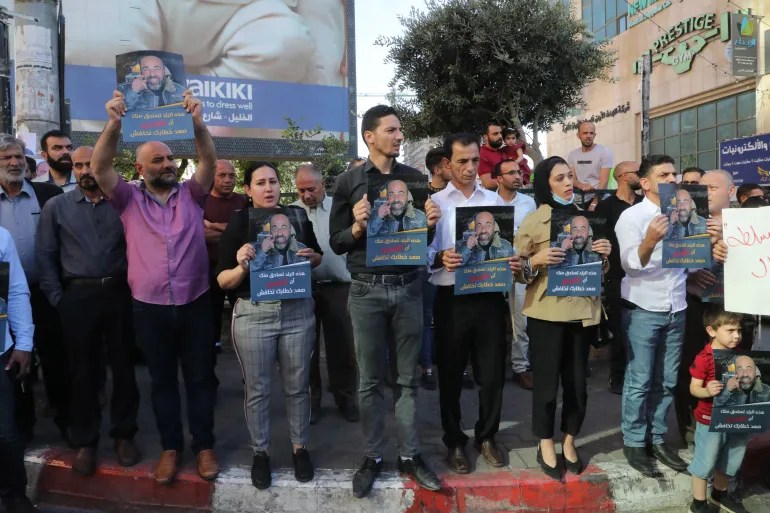
Palestinians hold posters depicting human rights activist Nizar Banat during a protest triggered by the violent arrest and death in custody of Banat, in his hometown of Hebron in the occupied West Bank, on June 27, 2021. [ Photo cred: Mosab Shawer/AFP]
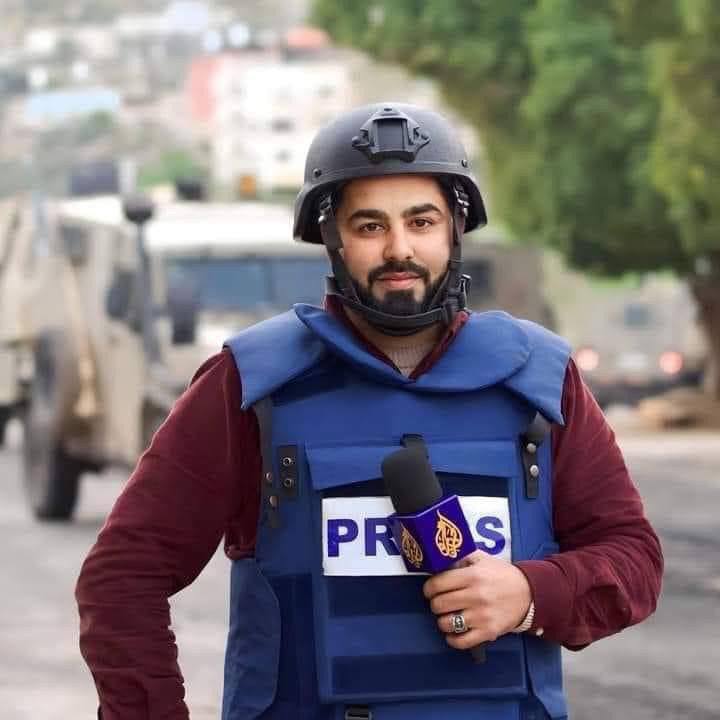
Al Jazeera correspondent Laith Jaar, beaten up by PA officer while covering the Tulkarem massacre by the IOF, then jailed when he complained to the PA. [Photo sourced: Internet]

Well then, how is that we tolerate the presentation of the ‘Palestine Authority’ as a representation of the Palestinian people? This corrupt agency with its ‘security force’ beating up and jailing critics and freedom fighters, some of which it also shoots? And dismantling defensive anti-IOF bombs?

This agency which in the Oslo Accords gave up the struggle in exchange for corrupt control of 20% of Palestinian land, which has held no elections since 2006 because the Palestinian people across the political and religious spectrum rejected the Fatah party then and elected Hamas instead.

It is no surprise then that the western imperialist countries claim the PA to be the legitimate representation of the Palestinian people and that some of them fund it, that Palestine ‘embassies’ are PA-run and that Palestine ‘Ambassadors’ are employed by the PA.7

But how is that the PA is not publicly denounced by the wide Palestine solidarity movements in the Western countries? Why this conspiracy of silence and spreading of ignorance?

It is not easy in on-line searches to find how many political prisoners the PA has in its jails or wounded or shot dead – and of course the amount of information about the Resistance passed on to the Zionists and the US awaits some historical investigations in a free Palestine of the future.

What we do know is that the PA holds over 100 political prisoners, that it arrests freedom fighters (even invading hospitals to arrest wounded fighters), that it tortures prisoners, beats up critics and demonstrators and clears the way of explosives for IOF invasion of West Bank communities.

Very recently, Palestinian journalist Laith Jaar, after reporting on the Palestinian Resistance in Tulkarem, was beaten up while covering the massacre there by Ahmed Ghassan Qawzah, an officer of the PA’s security force. When the journalist went to complain to the PA, they threw him in jail.

The Palestinian Resistance periodically denounces the PA, calling on it to support the people, threatens it when the PA’s actions are particularly egregious but refrains from using arms against it. I admit that I cannot understand that degree of forbearance, even for temporary tactical reasons.

But what about us? How is that only one protest against the PA’s Ambassador to Ireland took place and that the protesters were ejected by alleged Irish supporters of the Palestinian people? How is that only one small protest to date has taken place outside the PA’s Dublin Embassy?

How can we stomach this collusion in what is effectively a conspiracy of silence?

End.

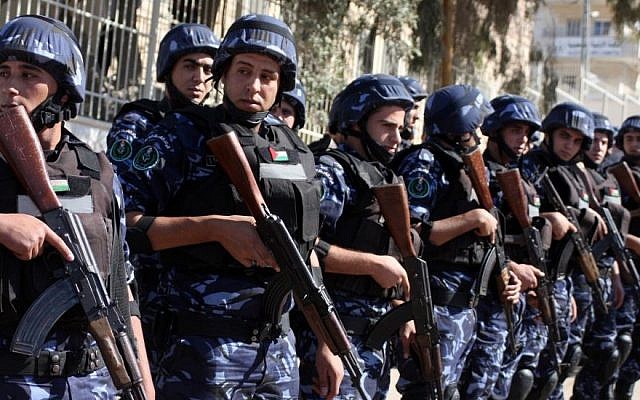
Palestinian Police – their firearms are for opposing the Palestinian Resistance (Photo cred: Issame Ravi/ Flash90)

FOOTNOTES

1Marx and Engels had led the International Workingmen’s Association (later known as the “First International”) in not only supporting the Fenian movement but also accepting Fenians in Britain into the organisation.

2Not out of altruism but in their own interest! As to the Irish question….The way I shall put forward the matter next Tuesday is this: that quite apart from all phrases about “international” and “humane” justice for Ireland – which are to be taken for granted in the International Council – it is in the direct and absolute interest of the English working class to get rid of their present connection with Ireland.And this is my most complete conviction, and for reasons which in part I cannot tell the English workers themselves. For a long time I believed that it would be possible to overthrow the Irish regime by English working class ascendancy. I always expressed this point of view in the New York Tribune.Deeper study has now convinced me of the opposite. The English working class will never accomplish anythingbefore it has got rid of Ireland. The lever must be applied in Ireland. That is why the Irish question is so important for the social movement in general.

3Karl Marx, then living in London, observed: The London masses, who have shown great sympathy towards Ireland, will be made wild and driven into the arms of a reactionary government. One cannot expect the London proletarians to allow themselves to be blown up in honour of Fenian emissaries.Marx was commenting on the reaction to the disastrous explosion attempt to liberate Fenian prisoners from Clerkenwell Jail in London, on 13 December 1867, when 12 mostly working class people were unintentionally killed and around 120 injured.

https://marxists.architexturez.net/archive/marx/works/1867/letters/67_12_14.htm

4https://www.bloomberg.com/news/articles/2023-03-07/swiss-arms-exports-jump-29-as-industry-laments-neutrality

5That was the essence of the O’Connell’s constitutional Repeal Movement objective of the 1840s and of the Home Rule promised by the UK ruling class to the Irish Parliamentary Party in 1914, against which the 1916 Rising took place. In the British General Election of 1918 in Ireland, Redmond’s party was all but annihilated.

6Nazi collaborator Prime Minister in occupied Norway and the French collaborator government under Petain and Lavalle.

7It should perhaps be a surprise that certain parties in Europe, including Ireland, also support the PA but then, perhaps not. Not a year has passed since a meeting hosting the ‘Palestine Ambassador’ for Ireland in Belfast was protested by Palestinians who were ejected among cheers by ‘Irish Republicans’.

SOURCES

Marx on need for the British workers to support the Irish struggle: https://www.marxists.org/archive/marx/works/1869/letters/69_12_10-abs.htm

Broader discussion on Marx and need for solidarity to progress revolution in general: https://www.developmentresearch.eu/?p=1347

Marx’s brief comment on the problematic effect of the Clerkenwell Bombing on Irish solidarity in Britain: https://marxists.architexturez.net/archive/marx/works/1867/letters/67_12_14.htm

The ‘Palestine Authority’ prisoners:

(1999) https://www.jewishvirtuallibrary.org/political-detainees-in-the-palestinian-authority

(also 1999) https://www.amnesty.org/es/wp-content/uploads/2021/06/mde210071999en.pdf

https://www.aljazeera.com/opinions/2021/7/14/pa-security-forces-are-not-serving-the-palestinian-people

PA attacks on Resistance fighters:

PA dismantling Resistance explosives for defence against IOF invasions:

Periodic reports also on Resistance News Network

Britain secretly helped Chile’s military intelligence after Pinochet coup

John McEvoy 5 September2023

(Reading time: 6 mins.)

NB: Rebel Breeze shares this near the anniversary of the fascist military coup in Chile, the same date as the Twin Towers massacre years later.. The article is a year old but relevant as long as British imperialism exists.

As the Pinochet regime rounded up and murdered its political opponents after the 1973 coup, a UK Foreign Office propaganda unit passed material to Chile’s military intelligence and MI6 connived with a key orchestrator of the coup, newly declassified files show.

  • Foreign Office helped Pinochet regime to develop a counter-insurgency strategy based on British military campaigns in Southeast Asia
  • MI6 officer David Spedding was attached to British embassy in Santiago in 1972-4, and had relations with a key member of the military junta

The UK government assisted Chile’s military intelligence in the aftermath of the brutal 1973 coup against elected president Salvador Allende, newly declassified files show.

The assistance was authorised by the Information Research Department (IRD), a secret Foreign Office propaganda unit which worked closely with Britain’s secret intelligence service, MI6.

Foreign and Commonwealth Office building, Whitehall, London. Many a dark deed was planned here. (Photo accessed: Internet)

The IRD had long seen Allende as a political threat. As Declassified previously revealed, throughout the 1960s, the unit had sought to prevent Allende from ever becoming president through election interference and covert propaganda operations.

After Allende was elected in 1970, the IRD’s distribution of propaganda material became “strictly limited”, with the British embassy having fewer reliable contacts in the Chilean government. 

This all changed after the coup.

In January 1974, the IRD began to “extend the distribution” of its material, which was now passed “to the Chilean Ministry of Foreign Affairs, Government information organisations” and, crucially, the dictatorship’s “military intelligence” services.

At this time, Chile’s security forces – including the country’s intelligence apparatus – were responsible for massive human rights violations, including the widespread use of torture as a political weapon.

The UK government was under no illusions about this. As Foreign Office official Christopher Crabbie noted three months after the coup in December 1973, “I do not think that anyone seriously doubts that torture is going on in Chile”. 

Reliable figures indicate that, between 1973 and 1988, Chilean state agents were responsible for over 3,000 deaths or disappearances and tens of thousands of cases of torture and political arrests. This was in a country which, in 1973, had a population of only 10 million people.

Our major interest is copper’: Britain backed Pinochet’s bloody coup…

Chile Army 1973 coup soldiers watch detainees – many were shot, many more tortured then shot, many more still ‘disappeared’, probably tortured and shot. Many, many more were jailed where they were also tortured; young children were also abducted and given to fascist childless couples. (Photo accessed: Internet)

Hearts and minds’

The nature of the information passed to Chile’s military intelligence remains unclear, though the files suggest it may have included material for use in propaganda, research reports on left-wing activity, and even manuals on domestic security operations.

For instance, newly declassified files show how the UK government secretly helped the Chilean authorities to develop a counter-insurgency strategy, using techniques refined during Britain’s colonial interventions in Southeast Asia.

The idea for such assistance was first raised during the visit of British navy chief Sir Michael Pollock to Chile in late November 1973, two months after the coup. 

The timing of Pollock’s visit was “politically tricky”, noted the British ambassador in Santiago, Reginald Secondé, since there was “much critical attention” being given “to the Chilean Government’s treatment of their political opponents”.

However, there were “two frigates and two submarines for the Chilean Navy under construction in British yards” – an arms deal worth around £50m – and “this was not a moment to prejudice the historic tradition of Anglo-Chilean naval friendship”. 

“This was not a moment to prejudice the historic tradition of Anglo-Chilean naval friendship”

In Santiago, Pollock and Secondé met with a number of regime officials, including navy chief José Toribio Merino Castro, defence minister Patricio Carvajal Prado, and foreign minister Ismael Huerta.

With Huerta, the British officials spoke about the UK government’s “hearts and minds” campaign in Northern Ireland, a counter-insurgency strategy inspired by Britain’s war in Malaya (1948-60).

Huerta “seemed impressed with the concept”, and Secondé “later twice heard him muttering to himself ‘hearts and minds’”.

Subsequent meetings were held between Secondé, British information officer Tony Walters, and Captain Carlos Ashton, the director of overseas information in Chile’s Ministry of Foreign Affairs.

Like Huerta, Ashton was “very receptive to the idea that this kind of approach to Chilean security problems might be the right answer”, and requested “details of what practical measures a ‘hearts and minds’ exercise would involve”.

Exclusive: Secret cables reveal Britain interfered with elections in Chile

Counter-insurgency advice

Ashton’s request for assistance was forwarded to Rosemary Allott, the head of the IRD’s Latin American desk.

In a letter dated 15 February 1974 and marked ‘secret’, Allott agreed to provide the Chilean regime with counter-insurgency advice, but limited this to material on Britain’s past colonial interventions.

“In view of the delicate political considerations involved”, Allott wrote, “it would be best to confine, at this stage at least, the material we send you of insurgencies of the past, rather than those currently preoccupying HMG” such as Northern Ireland.

The Pinochet regime was soon issued with three books on British counter-insurgency strategy, alongside a “Manual of Counter Insurgency Studies”. 

“Britain agreed to share its colonial policing methods with the Chilean junta”

Allott also tracked down “various official reports on Malaya” including “The Fight Against Communist Terrorism in Malaya”, the “Review of the Emergency in Malaya (1948-57)”, and “two booklets on the Philippines insurrection”. 

Britain’s military campaign in Malaya involved the “resettlement” of over 500,000 civilians, aerial bombardment, and an intensive propaganda operation. 

Embassy officials suggested that they were teaching Chilean officers “tactics of tolerance and magnanimity”. However, brutal repression often lay behind the UK government’s rhetoric about “winning hearts and minds”, and the Chilean authorities were only sharpening their repressive techniques.

None of the material given to the Pinochet regime was “for attribution to HMG”. This meant that the Chilean authorities could use the information but not source it to the UK government. 

The extent to which Britain’s advice was acted upon remains unclear; the Pinochet regime was certainly not lacking in support from the CIA. 

Nonetheless, it is clear that Britain agreed to share its colonial policing methods with the Chilean junta, with the goal of stabilising Pinochet’s regime against domestic opposition.

MI6 in Chile

Evidence of British assistance to Chile’s intelligence services raises further questions about what Britain’s own secret intelligence service, MI6, was doing in Chile. 

In 1972, MI6 officer David Spedding was attached to the British embassy in Santiago – his only foreign posting outside of the Middle East throughout his career. 

This was not Spedding’s first visit to Chile. As a postgraduate student at Oxford University during the mid-1960s, Spedding had spent his gap year in Santiago and found work as an assistant in the British embassy’s press office. 

Spedding’s first role in the diplomatic service was thus in the same British embassy that had been directing covert propaganda operations against Allende throughout the 1960s. The job gave him “an entrée into SIS [MI6]”, historian Nigel West noted.

Spedding remained in Chile until September 1974. He was subsequently made responsible for MI6 operations across the Middle East, and would go on to become MI6 chief between 1994 and 1999.

Our relationship with Admiral Merino’

Spedding’s name rarely appears in declassified Foreign Office files on Chile.

Yet in one file, dated 4 December 1973, Spedding informed the Foreign Office that 2,800 civilians and 700 armed forces personnel had been killed during and after the coup. 

“In order to protect our relationship with Admiral Merino”, Spedding noted, “we would not like these figures to be quoted, at least for the time being”. 

Admiral Merino was one of the key orchestrators of the 1973 coup. He was head of the Chilean navy in September 1973, and remained in post until the fall of the dictatorship in 1990. Merino claimed responsibility for convincing Pinochet to join the coup.

Some of the culprits saluting (Photo accessed: Internet)

One of Spedding’s roles, then, was to ensure close collaboration with the Chilean junta by covering up its responsibility for massive political repression and human rights violations. 

The MI6 station in Santiago was only closed down in 1974 amid the UK Labour Party’s return to government.

It would not be surprising if MI6 played a supporting role to the CIA’s covert operations against Allende during the early 1970s. It was recently revealed that the Australian Secret Intelligence Service (ASIS) had “opened a base in Santiago to assist in the US Central Intelligence Agency’s destabilisation of the Chilean government” in 1971.

Britain’s secret assistance to the Pinochet regime was consistent with the UK government’s position on the coup. 

The Conservative government under Edward Heath had welcomed the coup and rushed to give diplomatic recognition and arms to the Chilean junta, with the Foreign Office noting that it had “infinitely more to offer British interests than the one which preceded it”.

The coup against Allende inaugurated a 17-year dictatorship under General Augusto Pinochet, who only left office in 1990.

end.

John McEvoy is co-directing a forthcoming documentary investigating Britain’s hidden role in the death of Chile’s democracy and rise of the Pinochet dictatorship. You can support the film’s production here.

INDEPENDENT HUNGER STRIKE COMMEMORATION DUBLIN GETS BROAD PARTICIPATION

Diarmuid Breatnach

(Reading time: 3 mins.)

Irish Republican hunger strikers were commemorated in Dublin with a march and rally on 24th August. The event was organised by Dublin Independent Republicans and attracted representation from many groups in addition to independent activists.

Those ten Irish Republicans who died on hunger strike in 1981 are still remembered well in the general Irish population, most of all their leader Bobby Sands. However another twelve died on hunger strike in earlier days, going back to 1917, before the War of Independence (1919-’21).

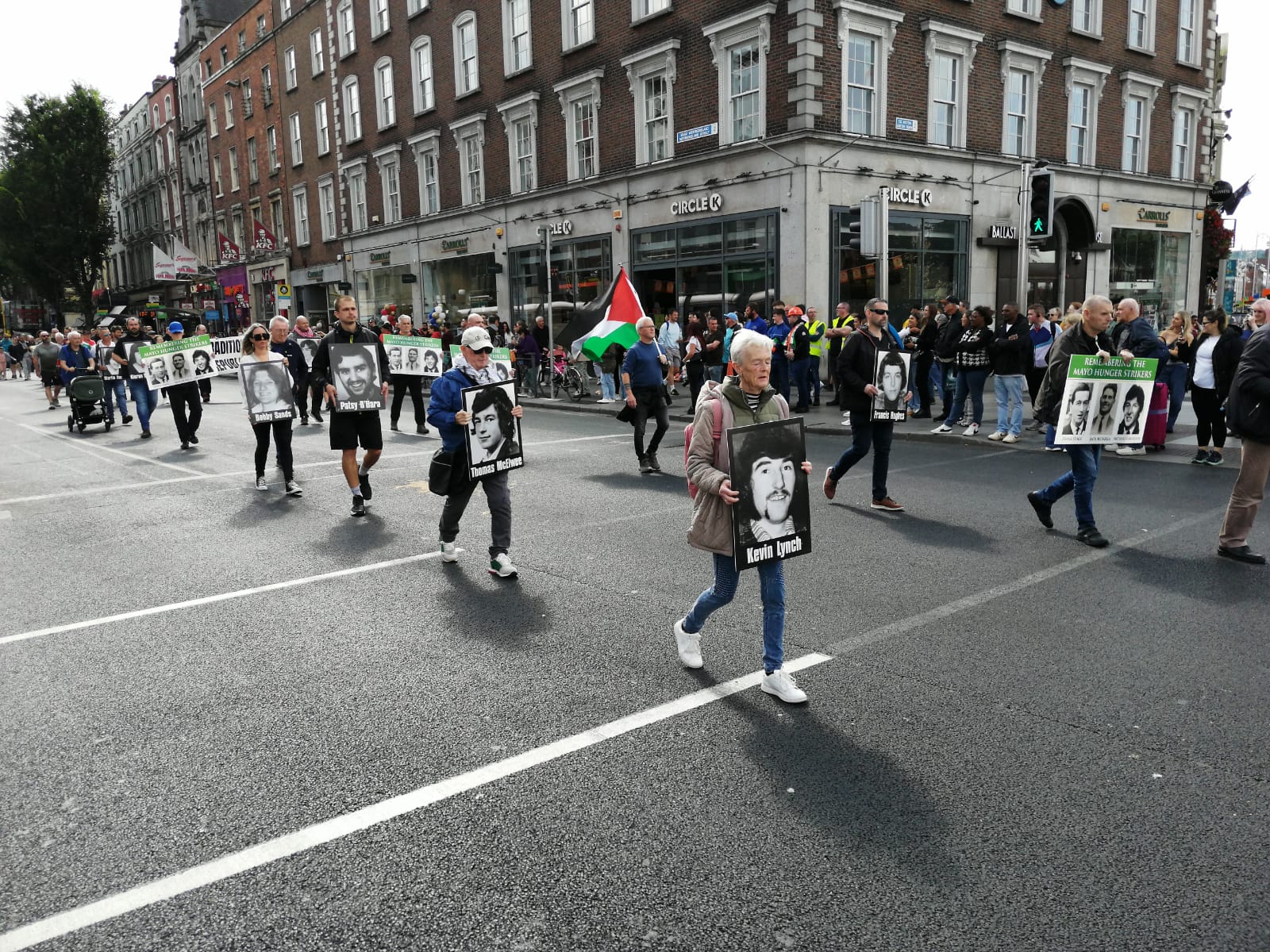
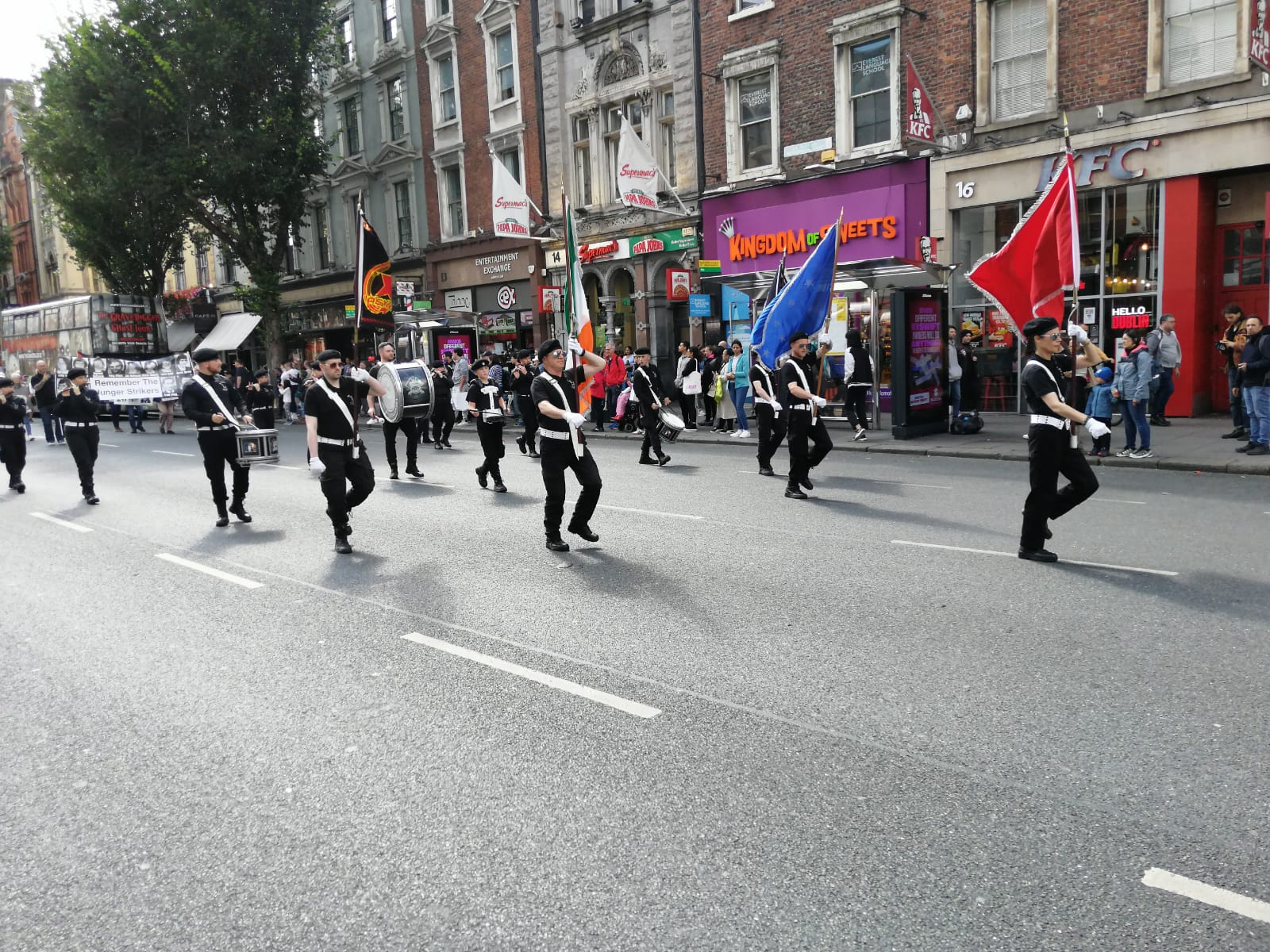
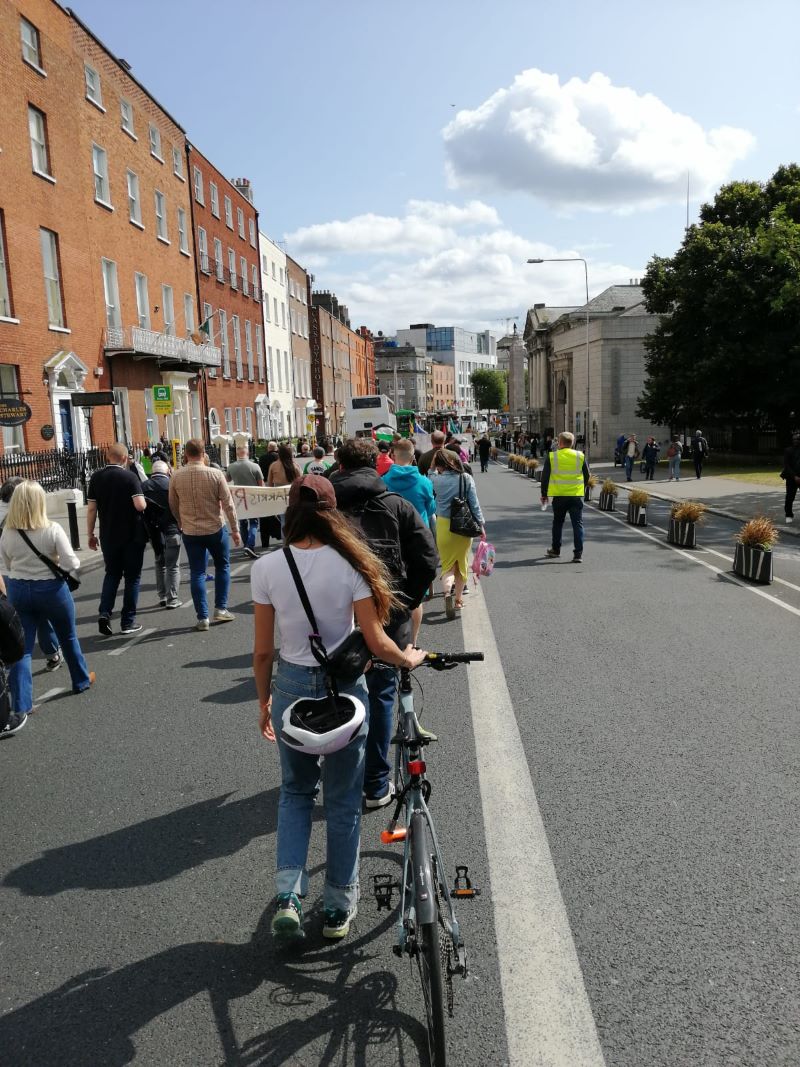
Marchers in Westmoreland Street carrying images of the hunger-strike martyrs on the return to the Garden of Remembrance. (Photo: D.Breatnach)

For over a century, hunger strikes have been one of the traditional methods of protest and struggle by Irish Republican prisoners in jails of the British and also of the Irish State.

Those Republican prisoners who died on hunger strike in 1981 did so from the effects of starvation but some died through force-feeding also, which was the case with Vols. Thomas Ashe (1917), Michael Gaughan (1974) and Frank Stagg (1976).1

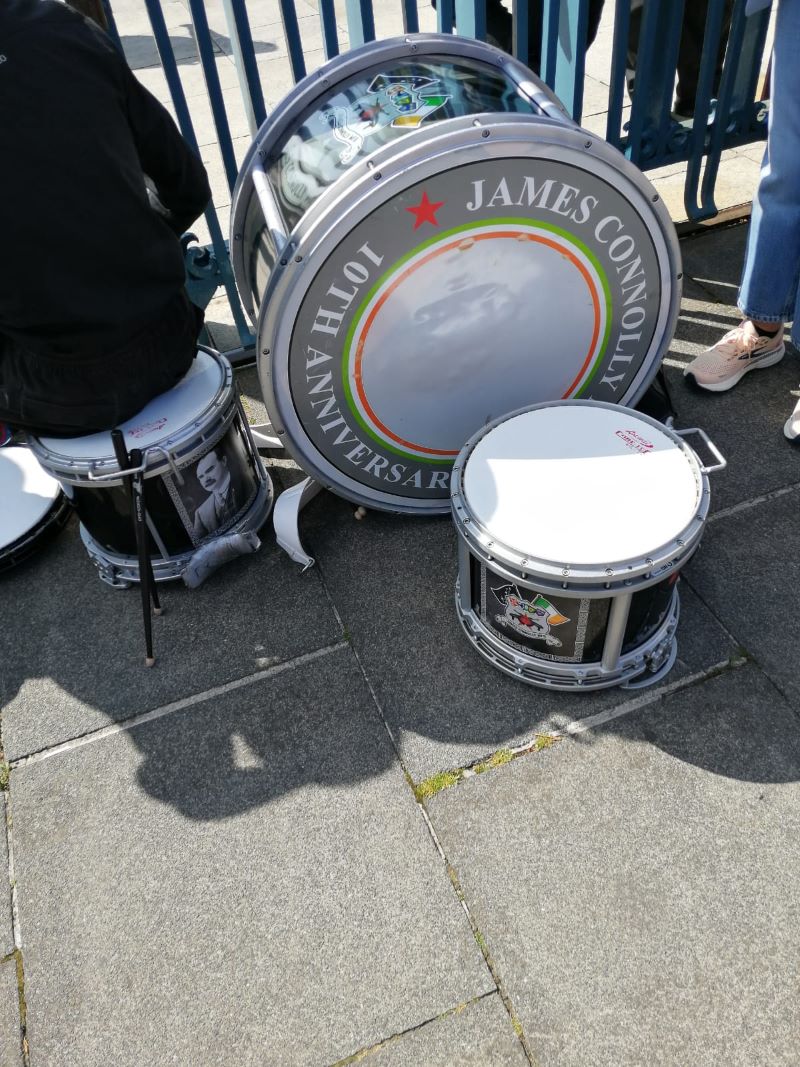
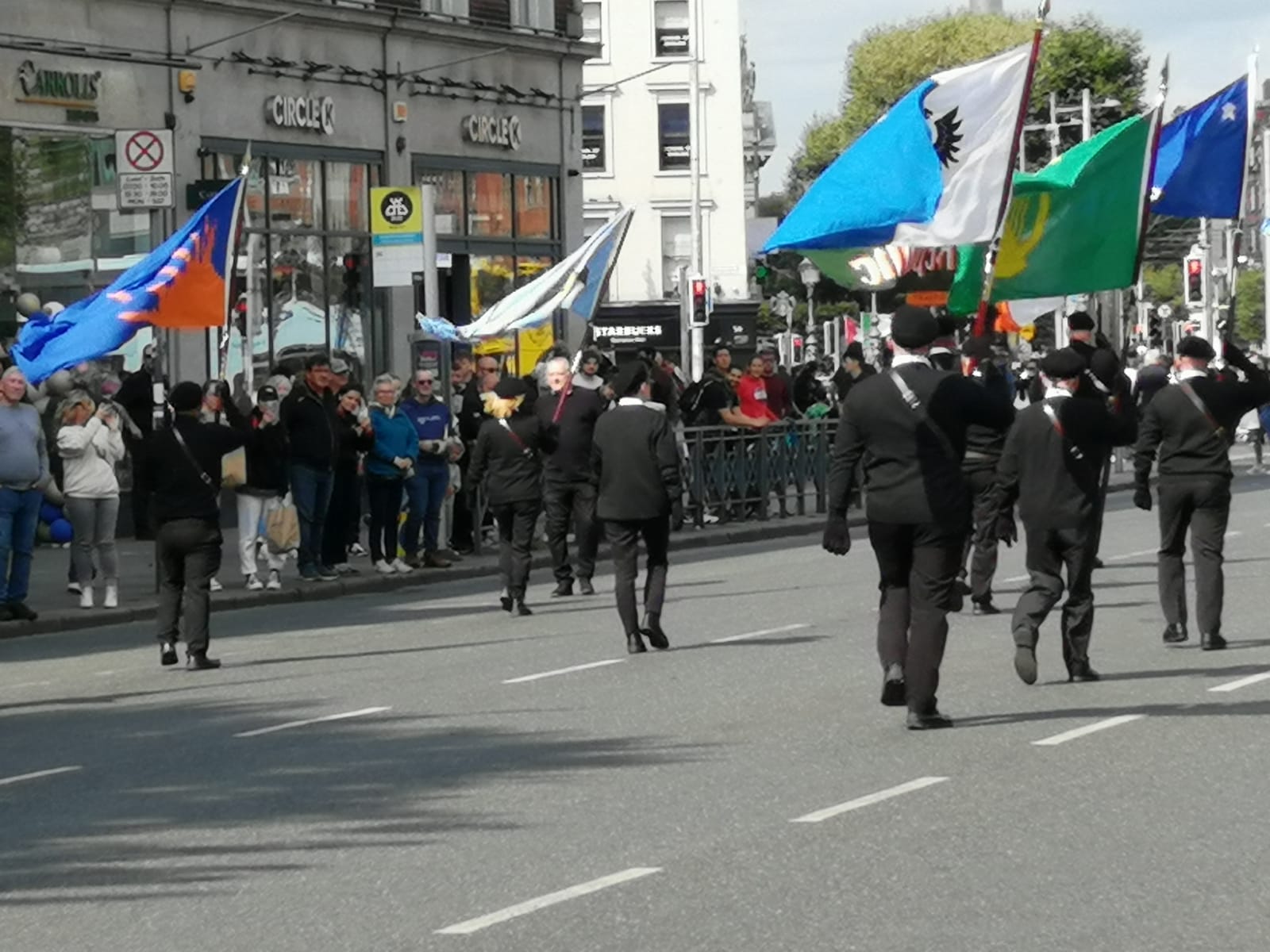
James Connolly Memorial Band with their own colour party in Westmoreland Street on the return to the Garden of Remembrance. (Photo: D.Breatnach)

PARADE THROUGH CITY CENTRE AND RALLY

Led by a colour party,2 the parade set off in two columns3 from the Garden of Remembrance in Parnell Square with the James Connolly Memorial Republican Flute Band leading and along the City’s main thoroughfare, O’Connell Street, crossed the Liffey to ‘touch’ Trinity College and back again.

Marchers setting off from the Garden of Remembrance in Parnell Square. (Photo: D.Breatnach)

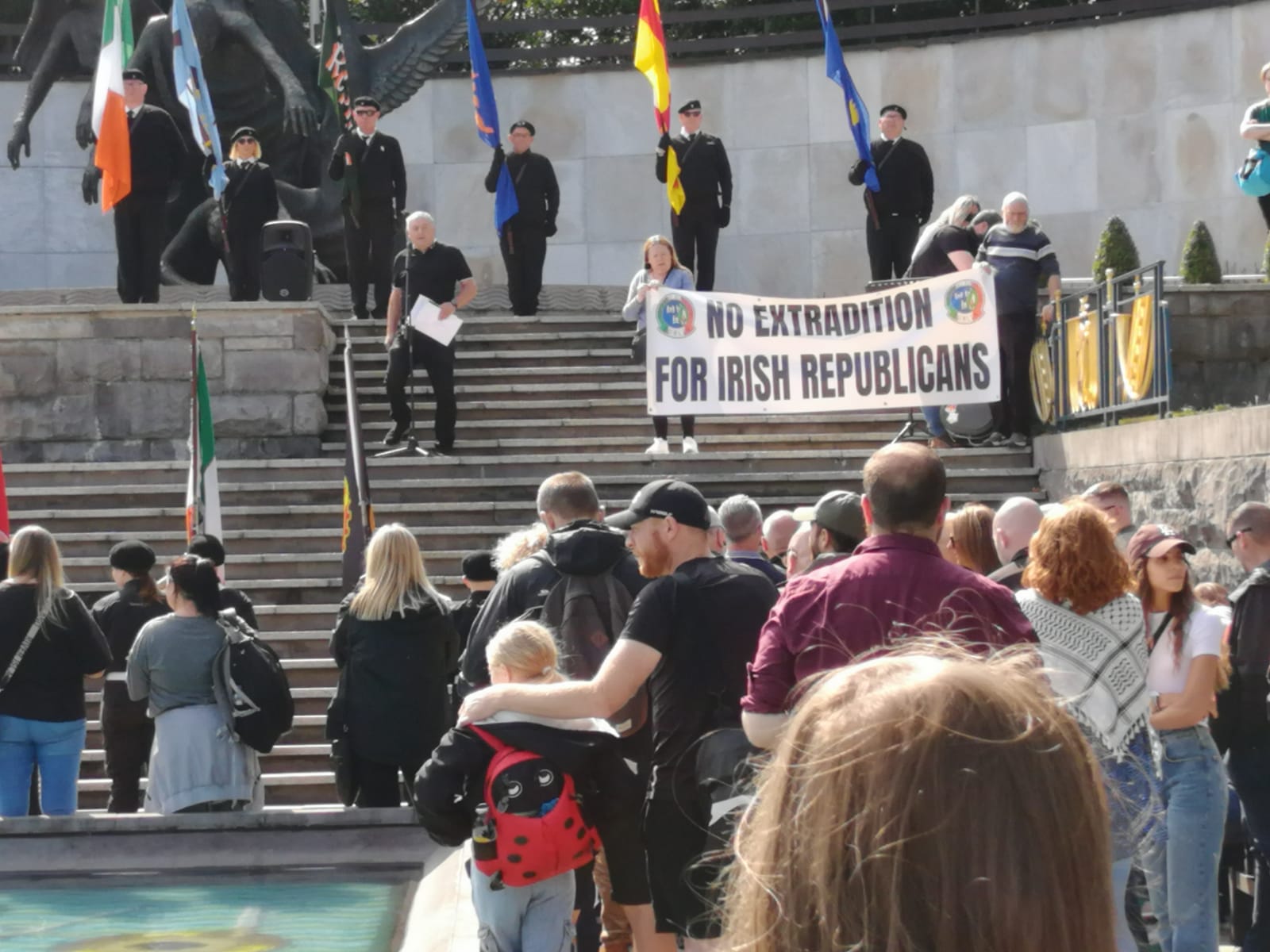
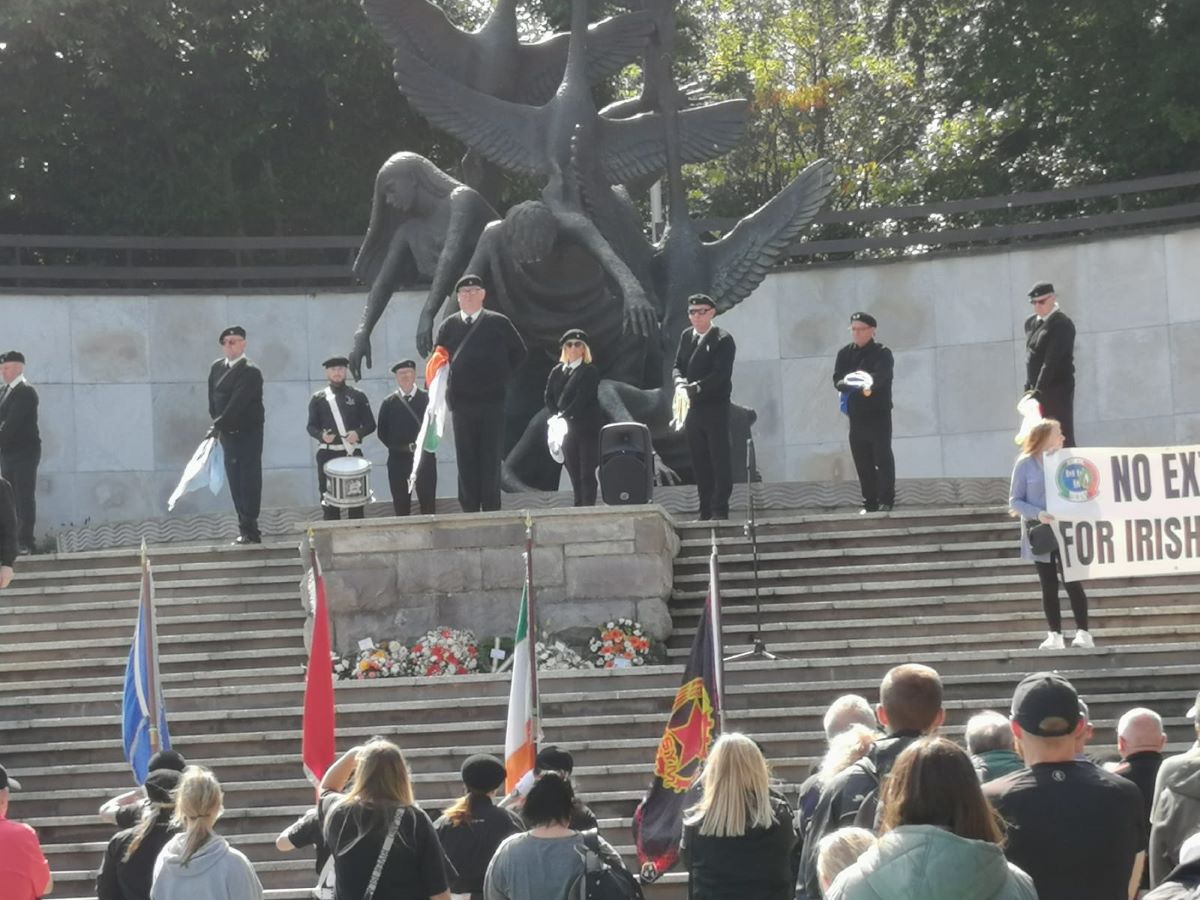
Upon returning to the Garden of Remembrance, the banners and band took up position in front of the memorial with the audience facing them, where Ado Perry as MC for the event welcomed all.

As well as recalling the struggles of Republican prisoners within the jails and deaths on hunger strike, Perry also took some time to denounce the Zionist genocide in Palestine and to express the Palestinian solidarity of Republicans (and of the majority of the Irish people).

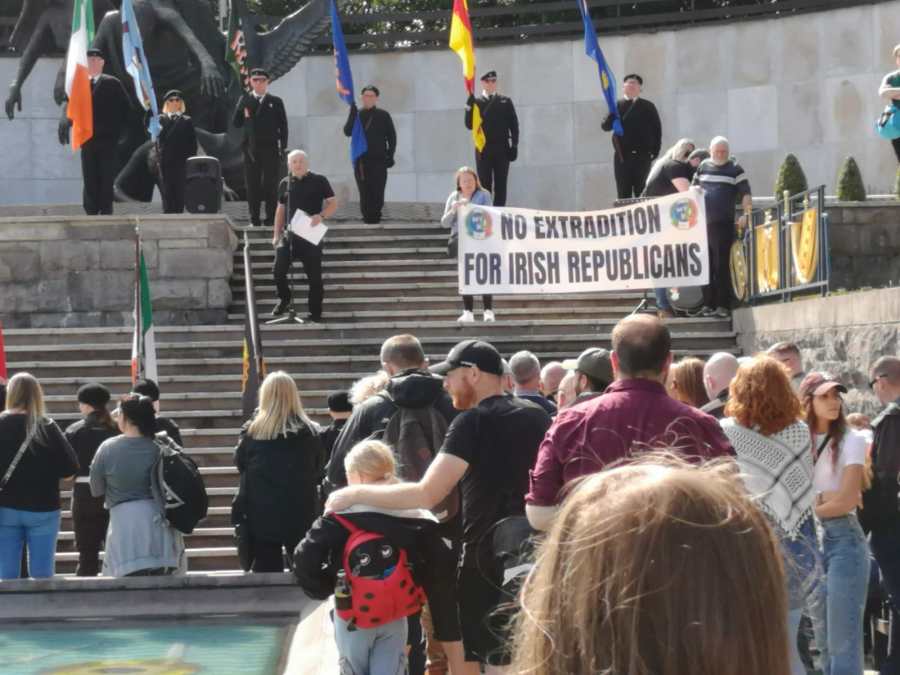
Ado Perry as MC of the rally in the Garden of Remembrance, flanked by the No Extraditions banner, the colour party behind and behind them, the Monument to those who fell in the struggle for Irish freedom. (Photo: D.Breatnach)

Perry also condemned the planned extradition of Irish Republican prisoners to British jurisdiction and called for Irish Republicans to unite in opposition, recalling the struggles against extradition over the years.

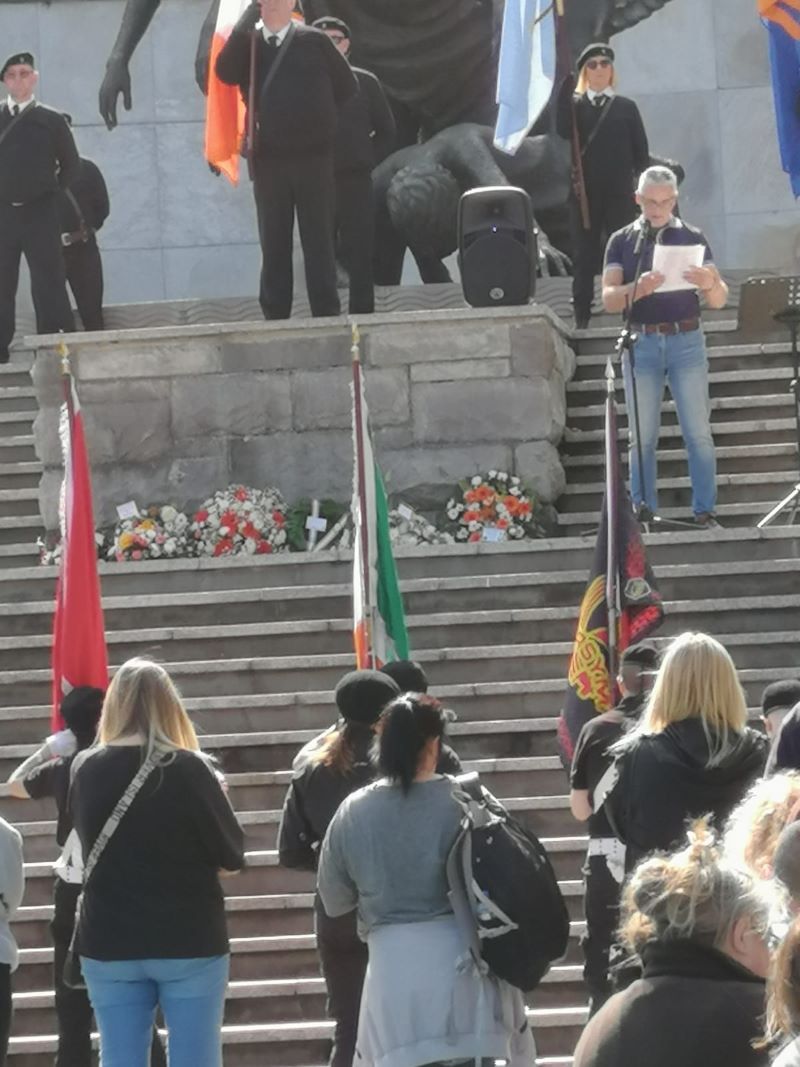
Floral tributes were laid at the Monument and Cáit Inglis read the names of the 22 who died on hunger strike, before the MC called on Cathal Graham for a song. Graham performed Wrap the Green Flag Around Me, a song that seems to have fallen somewhat in popularity in recent years.

Frankie Quinn giving his speech at the rally. (Photo: D.Breatnach)

The main speaker for the day was Frankie Quinn, a long-time Republican, community activist and ex-political prisoner who spoke first in Irish before turning to English. Quinn too condemned the genocide in Palestine and expressed solidarity with the Palestinian resistance.

In a reference to recent racist mobilisations in Ireland, Quinn made it clear that those people had nothing in common with Republicans or with the Irish national struggle for a socialist republic. (A known racist female activist had reportedly been encouraged to leave the scene a little earlier.)

The speaker was vigorously applauded and was followed by Gráinne Gibson who performed hunger strike martyr Bobby Sands’ poem The Rythm of Time.

(Photo: D.Breatnach)

Cathal Graham returned to perform The Time Has Come, a representation of hunger strike martyr Patsy O’Hara’s plea to his mother not to withdraw him from the fast when he lost consciousness, unless their demands were conceded. The colour party lowered their flags in respect to the martyrs.

Perry thanked all for their attendance in particular the marching band, colour party, performers and stewards, once again emphasising the need for united action to prevent the extradition of Irish Republicans to British jurisdiction, then called the band to perform Amhrán na bhFiann.4

The colour party leading the march out of Westmoreland to cross the river to the rally in the Garden of Remembrance. (Photo: D.Breatnach)

There was broad support for the event as shown by the participation of a number of different organisation and individual activists, which is a hopeful sign for the future. The real test however will be whether the disparate elements will act in unity as called for by Perry and Quinn.

End.

The lowering of the flags in honour of the martyrs in the struggle. (Photo: D.Breatnach)

Footnotes

1Their deaths under medically-supervised force-feeding caused the British Medical Association to oppose force-feeding of any hunger-striker in possession of normal cognition.

2The flag composition of Irish Republican colour parties varies but when flags and members are available traditionally are composed of the Irish Tricolour, the Starry Plough (blue or green version), the Sunburst and the flags of the Four Provinces. I have also seen on occasion the inclusion of a Scottish Saltere and on another, the Palestinian flag.

3More or less two columns – outside of the Six Counties marchers are unaccustomed to that formation and stewards were hard-pressed to ensure marchers kept to either one column or the other, a difficulty I remember well myself from my capacity as chief steward on a Dublin march against internment of Marion Price years ago.

4Irish language translation of The Soldiers’ Song by Peadar Kearney and Patrick Heeney, the air of the chorus which is the official National Anthem of the Irish State. At commemorations and such events it is usual for the air of both the verses and the chorus to played. In the 26 Counties it is common for people to sing along to the air played (or to a solo singer) but not in the 26 Counties. Unusually with cases of songs with versions in both langauges, it is the translated lyrics into Irish which most people know.

Useful Link

Independent Irish Republicans: https://www.facebook.com/profile.php?id=100090801607007

PICKETING THE PALESTINIAN AUTHORITY IN DUBLIN

Clive Sulish

(Reading time: 3 mins.)

The Palestinian Authority had a small protest against it in Dublin on the afternoon of Friday 23rd August 2024. This seems to be the first protest that has taken place outside the Palestinian Embassy at 66 Lower Leeson Street.

It would perhaps have been the first protest against the PA in Ireland, were it not for the Palestinian solidarity activists who attempted to convey the Palestinian reality in contrast to the Ambassador’s speech at a public meeting in Belfast in February, before being evicted by Sinn Féin supporters.

Palestinian solidarity activists protesting the Palestinian Authority and Embassy?

At first sight that seems bizarre but as some solidarity activists and most people of Middle Eastern origin know, the PA is not only widely considered unrepresentative and corrupt – and in fact has not held elections since 2006 – but also represses protests in the West Bank against ‘Israel’.

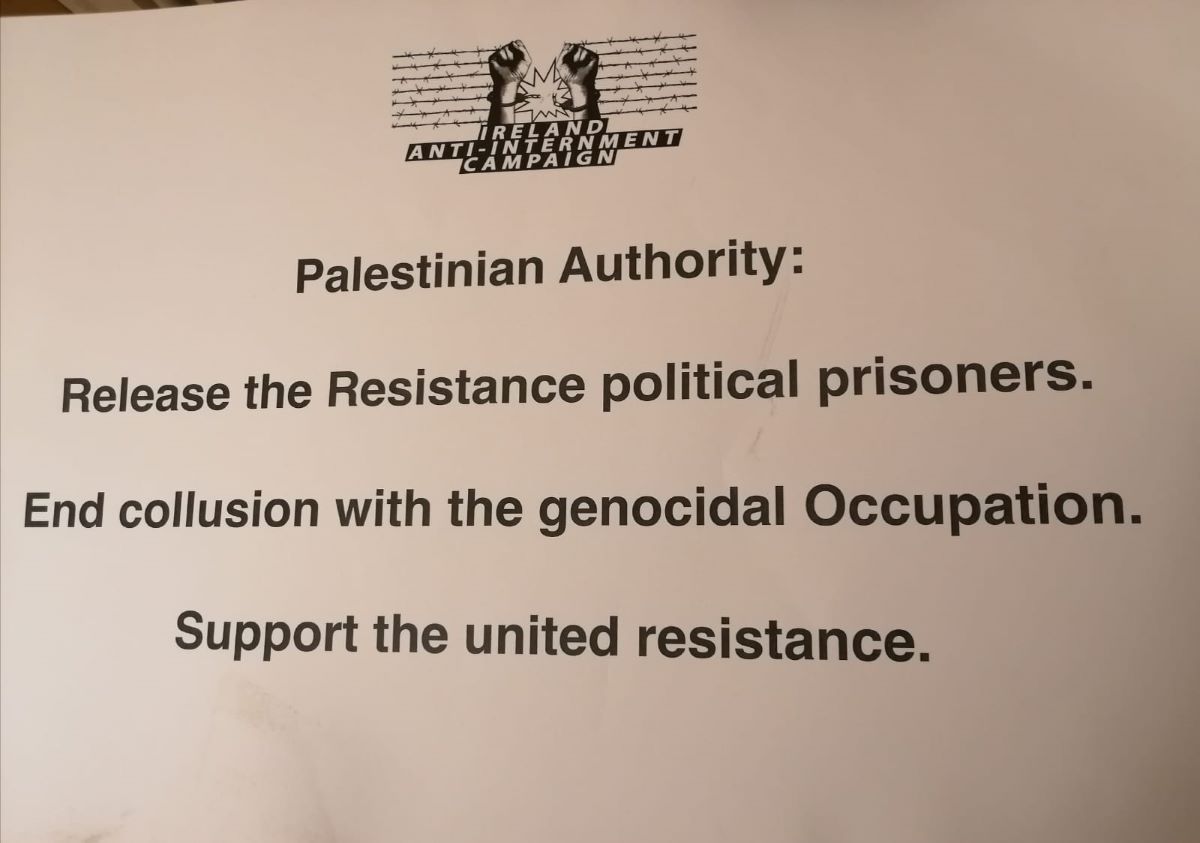
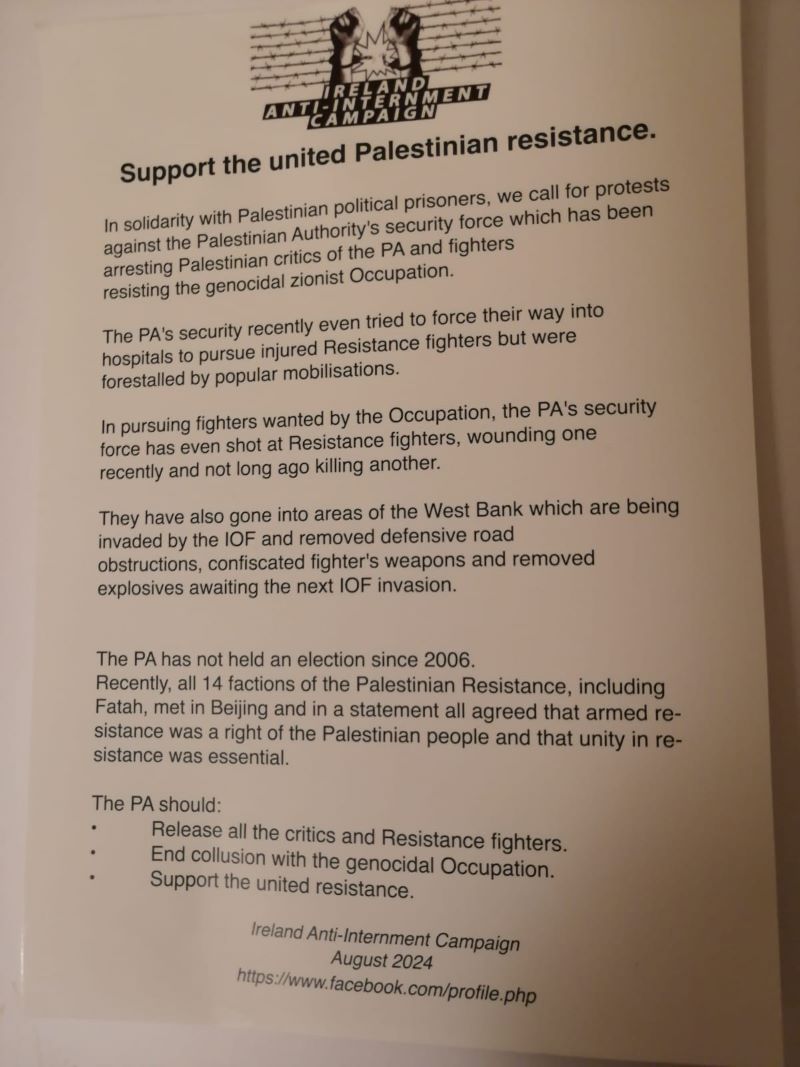
However, the Ireland Anti-Internment Campaign says that its main purpose in calling the protest was to raise awareness of the harm the PA is doing to the Palestinian Resistance, in arresting Resistance fighters and disrupting resistance defence against ‘Israeli’ army incursions.

Photo of placard being displayed outside the Palestine Embassy today. (Photo: R.Breeze)

The IAIC’s leaflet handed out at the event points out that the PA’s security force shot and wounded and even killed Resistance fighters, also attempting to enter hospital in force to arrest fighters on two occasions recently, their attempts being frustrated by large mobilisations.

Could a picket on the Palestinian Authority and its Embassy be considered divisive? “Not with justification,” replied an IAIC spokesperson. “It’s the actions of the PA that are divisive. We are supporting the broad resistance there, not one faction or another.”

He points out – as did their leaflet – that 14 Resistance factions including Fatah met in Beijing recently and agreed that the Palestinians have a right to resist, including with weapons and called for unity of all the resistance organisations. “The PA is acting against that unity”, he said.

But why is it that the IAIC called this protest and not one of the Palestinian solidarity organisations? “You’d need to ask them that,” says the spokesperson. “We regularly fly a Palestinian flag on our anti-internment in Ireland pickets; the PA was overdue to be done but nobody else was doing it.”

(Photo: R.Breeze)

The IAIC was founded a decade ago to raise awareness about ongoing internment of Irish Republican activists by revoking ex-prisoners’ licence and through refusal of bail by special no-jury courts. In those cases it can take two years for a case to come to trial.

However the IAIC has organised or participated in other events also, such as those around framed prisoners like the Craigavon Two in the Six Counties and the Munir family in England. It has also called two of its pickets since October 2024 to specifically highlight Palestinian prisoners.

Will the group be regularly picketing the Palestinian Authority now? “Probably not. It’s not what we were set up for but we felt the ice needed breaking on this. Others need to step forward now,” replied their spokesperson, though signalling that they would support others in doing it.

Photo of copy of the leaflet being distributed outside the Palestine Embassy today. (Photo: R.Breeze)

It is probable that a representative of the PA will be welcomed soon by the Irish Government as part of its recognition of the ‘Palestinian State’. One wonders how this reception of a corrupt and Occupation-collusive organisation will be mediated in the Palestinian solidarity sector in Ireland.

The Governments of the EU, including Ireland’s, formally recognise the PA but not only that – so does Sinn Féin in Ireland, EH Bildu in the Basque Country and Esquerra Republicana in Catalonia. This corresponds across the board also to support for ‘the Two-State Solution’ (sic).

What that entails is allocating the Palestinians less than 20% of their homeland weaving around illegal zionist settlements, with least water and some of the worst land, under the permanent watchtowers and guns of their genocidal neighbour.

Organisations and individuals within the broad Palestinian solidarity movement will need to decide exactly what their solidarity with Palestine actually means, especially for the Palestinians themselves.

End.

Reference

Ireland Anti-Internment Campaign: https://www.facebook.com/p/Ireland-Anti-Internment-Campaign-100063166633467/

PALESTINE AUTHORITY PREVENTED FROM ARRESTING RESISTANCE FIGHTER IN HOSPITAL

Clive Sulish

(Reading time: 3 mins.)

Conflict with security forces of the Palestinian Authority broke out in Tulkarm city in the West Bank today as they tried to seize Palestinian Resistance commander Abu Sujaa (Mohamed Jaber), who was receiving treatment in Thabet Thabet Hospital.

According to reports the PA fired tear gas and used pepper spray inside the Hospital grounds, also striking with batons at protesters including women. Shots were fired at the PA’s HQ and protesters are calling the PA “traitors” and “collaborators”.

After a tense stand-off the PA forces eventually had to leave empty-handed.

Abu Sujaa is a commander of the Tulkarm Brigade, Soraya Al-Quds (Islamic Jihad), one of the main organisations of the Resistance. It is reported that he was injured while handling explosives and taken to hospital; when the PA learned of his presence there they sent forces to capture him.

The arrest attempt by the PA and treatment of protesters has been condemned Soraya Al-Quds and by a number of other Palestinian Resistance organisations including the Al Aqsa Martyrs Brigade coalition, Mujahadeen Movement, PFLP, Hamas and Popular Resistance Committees.

A statement also condemning the PA’s action by students at Birzeit University was signed off by the student movements of Hamas, PFLP, DFLP, PPSF, and PPP.

The point was also made that Abdul Nasser, one of the own PA’s employees, a security officer in uniform, was filmed executed by the IOF recently in cold blood in front of their headquarters in Tubas “without any action, condemnation, or denunciation” by the PA’s leaders.

Abu Sujaa is far from being the first Palestinian Resistance fighter targeted by the PA which holds many prisoners but has also killed fighters, including Ahmed Abu Al-Ful in early May1 and Motasim Al-Arif a month later, on that occasion also while trying to capture Abu Shujaa.2

Two Palestinian civil society activists recently went on hunger strike in protest at their detention by the PA, Fakri Jaradat being released after a week of hunger strike (but 16 days detention) but Ghassan Al-Saadi was transferred to Al-Razi Hospital in Jenin in deteriorated health condition.

This evening, according to local sources quoted on Resistance News Network, PA Security Forces stormed the city of Tubas, apparently in order to assassinate the resistance fighter Omar Meselmani who is wanted by the Occupation, since they shot at him directly.

Palestinian unity?

The Palestinian representative bodies recognised internationally are the PA and the PLO,3 both dominated by the Fatah leadership. The latter were represented at the Beijing Palestinian Unity conference last weekend at which all 14 factions agreed on the need for a unity government.

The PLO excludes Islamist organisations from membership, though both the PFLP and the DFLP delegates stated at the conference that they wished to admit those resistance organisations to the PLO, no such decision was recorded (presumably blocked by Fatah) in the conference decisions.

One might have thought that in the circumstances of the Beijing Agreement, the PA would be keeping a low profile or at least certainly steering clear of conflict with Resistance organisations. On the contrary however, the PA seems to be intent on exacerbating divisions.

Islamic Jihad, possibly divining the PA’s intentions, has declared it will not be drawn into a civil war with the organisation, despite its actions and collusion with the Occupation. But can that posture be maintained if the PA continues persecuting and even shooting its fighters?

Perhaps the PA is doing its best, in order to avoid its being sidelined and as an aid to the beleaguered Israeli occupation, to ensure that civil war breaks out among the Palestinians.

End.

FOOTNOTES

SOURCES & FURTHER INFORMATION

PA arrests of Resistance fighters and other opponents of the Occupation:

https://www.jewishvirtuallibrary.org/political-detainees-in-the-palestinian-authority

https://en.wikipedia.org/wiki/Palestinian_Authority

1https://x.com/PALMENA_IC/status/1786005323565633947

2(https://t.me/PalestineResist/34391)

3Palestine Liberation Organisation

Important Call for a United Resistance Front

Diarmuid Breatnach

(Reading time article: 3 mins.)

Earlier this month there was an oration delivered at the grave of Wolfe Tone1 which contained some important elements which deserve inspection and discussion.

The path to rebuild our struggle is the development of an Anti Imperialist Broad Front – said the speaker. – A United Front of Revolutionary republicans, working in cooperation to advance our common republican objectives and to achieve a common republican programme.

Looking around us at the parties and groups in the socialist and republican spectrum, the ostensibly revolutionary varieties, we see that for many of them, building up their own organisation takes precedence over anything else, including revolution – for them the revolution IS their party.

Speaker giving oration at Wolfe Tone’s grave in front of the monument, faced by colour party. (Photo: RSM)

The call given in this oration runs counter to that kind of thinking. “But we’ve heard all that about ‘unity’ before,” a reader might say. Yes we have and often “unity” meant only “unity” around that particular party or, even more often, around this or that leadership.

There is nothing of that to be found in this address “recognising and respectful of the autonomy and independence of the groups and independents involved”. “Hmmm,” the reader might say “but is it a genuine intention?” Given our experience, it’s a valid and important question.

The most dependable test is in the practice. The speaker of the oration at its annual Wolfe Town Commemoration2 was representing the Socialist Republican Movement organisation (more often manifested publicy in recent years in the form of the Anti-Imperialist Action broad group3)

As an independent revolutionary activist for many years I have often participated in AIA’s actions and at times they have supported actions of which I had been part of organising. I have found that their practice matches their words and there is no truer test.

The speaker followed with practical suggestions for the implementation of the broad front: Trust and co-operation must be developed … through activism and the development of National Republican Campaigns that can be taken up by all Republican groups and independents …

There are many campaigns that could be developed from support for POWs to opposing internment and extradition, environmental campaigns such as (overcoming) the unacceptable situation at Lough Neagh, to campaigns that oppose the British and NATO presence in Ireland.

One of the banners in the crowd at the event in Bodenstown. (Photo: RSM)

Such a Republican Broad Front would be a fitting tribute to our Patriot Dead, the speaker added, to martyrs like Cathal Brugha,4 who gave his all in fighting for the sovereign, Independent Irish Republic and gave his life on this day in 1922 as a hero in the war in defence of the Republic.

In many of the pleas for unity of the fragmented resistance in Ireland, individuals have called for a conference to form a united front, others called for a unity document of principles around which to unite while in at least one case, two distinct organisations merged.

I have for years spoken out against such endeavours and advocated as a first step unity in practice. If organisations and individuals are not capable of that step, what kind of unity can they achieve around discussion of documents? Unity in practice also helps to break down distrust.

The speaker at the Wolfe Tone commemoration takes the same line, presumably speaking for the SRM when he does so and one supposes that this will continue to be the approach of the AIA in campaigns such as against internment, in solidarity with political prisoners5 or with Palestine.6

The above piece discussed two elements of the oration given by the SRM earlier this month which I believe to be of great revolutionary importance and in need of application in Ireland, one in advocating a principle and the other in suggesting avenues for practical application.

Later I will be taking a look at some other elements in that talk (the text of which, as published by the SRM, I attach as an appendix).

Beirimís bua.

(Image sourced: Internet)

End.

FOOTNOTES

1Wolfe Tone, born into settler stock and of the Establishment Anglican congregation, was a leading figure in the formation of the revolutionary republican organisation The Society of United Irishmen, seeking “to unite Catholic, Protestant (i.e Anglican) and Dissenter” (i.e the other sects, Presbyterian, Methodist, Unitarian, Quaker etc.) to “break the connection with England. In 1798, the year of the Unitedmen uprising, the first of many Irish Republican uprisings and campaigns, Tone was captured by the British Navy on a French warship and, despite his French officer rank, tried and sentenced to death.

Tone died in jail some months before his brother Matthew was taken prisoner during the surrender at Ballinamuck (Baile na Muc) in Co. Longford of another French expedition to Ireland, late and too small, at the tail end of the Rising that year. Also ignoring his officer POW status, he was hanged in Dublin and his body reputedly thrown into the mass grave at Croppies’ Acre in Dublin city.

2Since even earlier than Thomas Davis’ (1814-1845) song In Bodenstown Churchyard, Irish Republican organisations and individuals have been making the pilgrimage to that grave in County Meath, at times with thousands in attendance.

3Also for an intense time as the Revolutionary Housing League in its attempt to spark a movement of occupation of empty properties to overcome the widely-acknowledged housing crisis in Ireland.

4Cathal Brugha (nee Burgess), son of a mixed Catholic-Protestant marriage, was a leading figure in Irish nationalist movement and in Republican rebellion in the last decades of the 19th and early decades of the 20th Centuries, learned Irish as a member of the Gaelic League, member of the Irish Republican Brotherhood (which he later left, considering it undemocratic), officer in the Irish Volunteer, 2nd in command in the South Dublin Union in 1916 served as Minister for Defence in the revolutionary government from 1919 to 1922, Ceann Comhairle of Dáil Éireann in January 1919 and its first president from January 1to April 1919, Chief of Staff of the IRAfrom 1917 to 1918. He served as a TD (electe parliamentary representative) from 1918 to 1922. He was mortally wounded by Irish Government troops in the early days of the Irish Civil War.

5Both on their own and for example in support of the Ireland Anti-Internment Campaign.

6Both on their own and for example as part of the Saoirse Don Phalaistín broad front.

APPENDIX

The following is the text of the main oration of which some sections are discussed in the preceding article and more to be discussed anon. It was delivered at the annual Wolfe Tone Commemoration at Bodenstown, organised by the Revolutionary Irish Socialist Republican Movement on Sunday July 7, 2024 and published on its Telegram page.

A Chairde is a chomrádaithe,

Táimid anseo i relig bodenstown ag uaimh ár n-athair, Wolfe Tone agus táimid ag rá go bhfuil an gluaisteacht a bhunaigh sé fós beo, agus tá sé ag fás arís.

Wolfe Tone is the father of Irish Republicanism. We come here each year not just for commemoration, but like Pearse, Connolly, Mellows and Costello before us, we come because we believe that the ideas and the vision that Tone put forward of a free independent Ireland is as relevant today as they were in the 1790s and because we believe that by remaining true to the teachings of Wolfe Tone we can build a revolutionary movement that will successfully free our country. Maybe not today, but our freedom is inevitable.

Tone’s most important belief was that we must ‘break the connection with England’ by any means necessary. It is for this reason that he established revolutionary military-political organisation the United Irishmen in 1791 and led a mass armed uprising in 1798 against British Rule in Ireland.

Tone was also clear that the revolutionary struggle could only be successful if it was based on the masses of the Irish People, stating that, ‘Our Strength shall come from that great and respectable class, the men of no property’.

And in these two simple quotes from Wolfe Tone, we have two of the most important teachings for the Revolutionary Republican Movement today. Firstly, that Republicans must work as a priority for National Liberation by any means we decide necessary.

That we must break the connection with England and defeat all forms of Imperialism in Ireland to establish a sovereign, Independent, Irish Republic.

And secondly, we learn from Tone that the fight for our Republic is a class struggle and that the driving force of that struggle will be the working class fighting for their own liberation.

These are two key teachings that when deviated from lead to compromise and the selling out of our revolution.

It is the duty of all of us here today and of all Republicans across Ireland, to ensure that the struggle for national liberation is kept at the fore of our revolutionary republican objectives and that we work tirelessly to achieve it and to ensure that our movement remains centred on and driven by the working class.

Some other key points laid down by Tone include that Republicanism is Anti Imperialist and it is Internationalist. Our struggle in Ireland is part of a wider international struggle of oppressed people against occupation, colonialism and imperialism.

Tone understood this when he looked to Revolutionary France to support the 1798 uprising. Today, Republicans must fight our struggle while also supporting Liberation struggles around the world in the belief that every blow struck against imperialism brings our victory closer.

So from Palestine to the Philippines and from India to the Basque Country, and everywhere people take a stand against NATO, the Revolutionary Republican movement must raise our cries in solidarity. The tide of revolution is rising in the world and there is much to be optimistic about.

But as revolutionaries we also have to be realistic. Since the time of Wolfe Tone the tide of revolutionary Republicanism has ebbed and flowed.

After the days of Tone and Emmet and the final defeat of the United Irishmen in 1805, Republicanism was reduced to an ember, spoken about in quiet corners until the birth of Young Ireland and the uprisings of 1848 and 1849 when revolutionaries such as Thomas Davis, Fintan Lalor, James Stephens and John O’Mahony would carry forward the vision of Tone, take up the hard work of rebuilding the Republican Movement and become the spark that would renew the Revolutionary fire, giving birth to Fenianism and the struggle that has carried us until today.

And today, we are 26 years on from the surrender of 1998, a surrender that had a devastating effect on the movement. Later this month it will be 19 years since the Provisionals ended their armed campaign.

These two great betrayals have led to the situation where the movement is fractured and split.

The revolutionary forces, though active, are scattered and there is mistrust between Republicans, whether in different groups or independents across Ireland, and this mistrust and division is exploited by our enemies.

It is a situation that all Republicans want to reverse and one of the revolutionary priorities in this phase of our struggle to overcome.

Comrades, like the revolutionary republicans after the defeat of the United Irishmen and Young Ireland, we find ourselves with the hard and gruelling task of rebuilding and reasserting the revolutionary republican struggle.

And the path to rebuild our struggle is the development of an Anti Imperialist Broad Front. A United Front of Revolutionary republicans, recognising and respectful of the autonomy and independence of the groups and independents involved, working in cooperation to advance our common republican objectives and to achieve a common republican programme. This is what our enemies most fear.

But again, this will not just happen overnight.

Trust and co-operation must be developed and we assert that this will be best achieved through activism and the development of National Republican Campaigns that can be taken up by all Republican groups and independents in a unity of purpose, that shows the real and forgotten strength of the Republican Movement.

There are many campaigns that could be developed from support for POWs to opposing internment and extradition, environmental campaigns such as the unacceptable situation at Lough Neagh, to campaigns that oppose the British and NATO presence in Ireland.

Such a Republican Broad Front would be a fitting tribute to our Patriot Dead, to martyrs like Cathal Brugha, who gave his all in fighting for the sovereign, Independent Irish Republic and gave his life on this day in 1922 as a hero in the war in defence of the Republic.

Over the last seven years we have put down a solid foundation as a movement. We have reasserted Irish Socialist Republicanism as the driving force of Revolution in Ireland.

We have recruited a new generation of republicans not damaged by the 1998 surrender who are now working with more experienced republicans to drive the struggle on.

While we can be happy with these achievements, the Republic needs more from each and every one of us and we all need to ask what we as individuals can do to carry the struggle forward.

Now is the time to move to the next phase of development in our revolutionary struggle, unsurprisingly by taking it back to Tone. Now is the time to strengthen and embed ourselves in the people of no property and to engage in systematic Republican Community work across the country.

In doing so, we would do well to return to Seamus Costello and the oration that he delivered from this spot in 1966, signalling the rise of Socialist Republicanism within the Movement. Costello outlined how it was the duty of all republicans to be active in our community.

How we should be involved in community groups, trade unions, tenants and residents associations, sporting, cultural and educational organisations and how we must take and assert our revolutionary republican position within them.

This is a task for all revolutionary republicans. Look at the groups in your area and see which ones your involvement in would advance the strengthening of Socialist Republicanism in your community.

Where no such groups exist, establish them. Where help is needed reach out to us as we have experienced comrades who excel in this area that would be happy to help in this work.

To conclude the comrades, this is a brief outline of our tasks in the time ahead.

While these plans will be deepened with discussion and debate within the movement, no one should leave this graveyard thinking there is no work for them to do, and the responsibility is on you to come forward and volunteer instead of waiting for others to come and ask you.

Our work is to free Ireland and our people by any means necessary to establish the 32 county All Ireland Socialist Republic, sovereign, independent, Gaelic and free, and we will not be stopped.

Redouble your efforts comrades, onwards to the Republic of 1916.

Beir Bua,

Tiocfaidh Ár Lá

CATALANS DENOUNCE A TORTURE POLICE STATION

R. Breeze

(Reading time: 3 mins.)

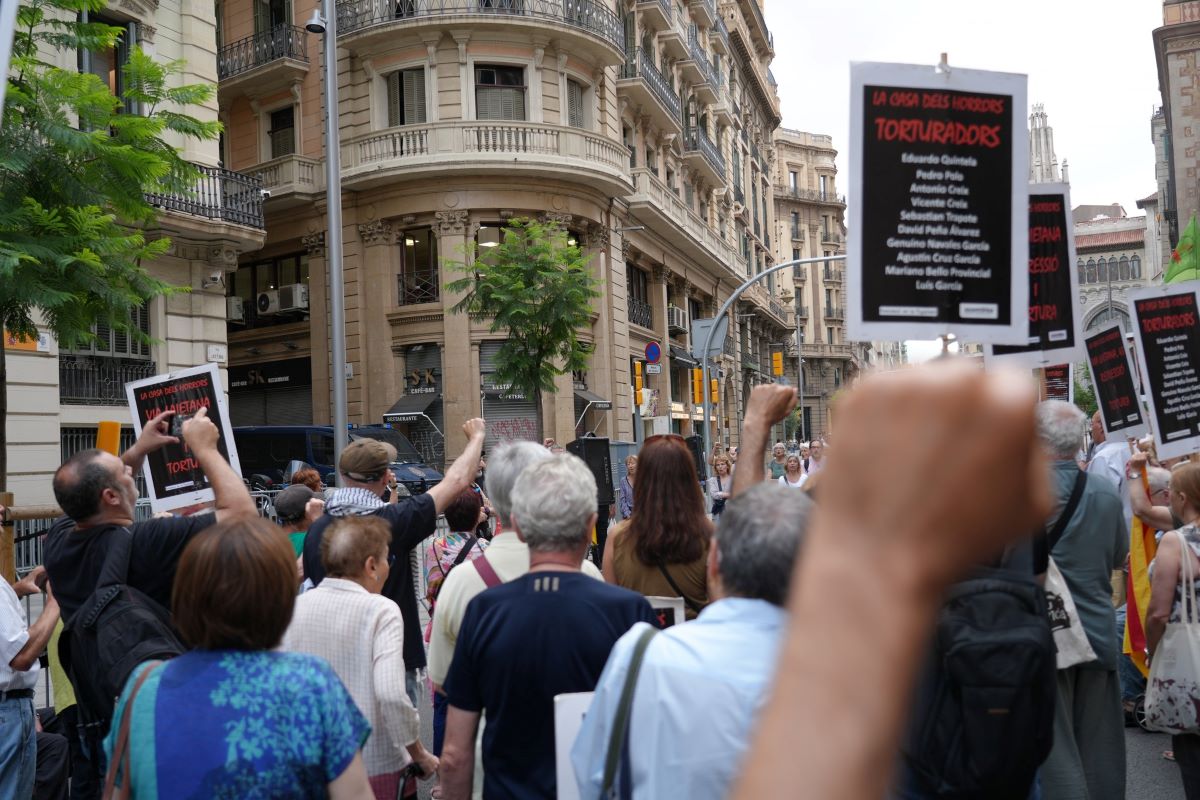
On July Tuesday evening, a number of uniformed police officers watch the people in the road outside their police station on Via Laietana in Barcelona, the Catalan capital, many in the crowd holding placards protesting torture and impunity and a number carrying a banner.

The MC, a slim elderly woman, approaches the microphone stand, her back to the police station. Speaking in Catalan she reviews the reason for their rally which is to renew the historical memory of the Spanish State’s repression of dissent through torture with impunity.

The MC at the event speaking briefly (Photo cred: D.Breatnach)

A number of torture survivors address the crowd, sometimes experiencing difficulty in reading some passages of their notes. The crowd, mostly middle-aged or elderly, listen in silence. Some of them were victims too, many knew victims personally, many of the latter now dead.

For the past three years, the campaigners have been coming here every two weeks, renewing the historical memory and campaigning for a change of use in this building on one of the main roads of their city.

One of the torture survivors displaying the Vermella, the socialist version of the Catalan independence flag. (Photo cred: Albert Bergadá Corso)
Torture survivor speaking (Photo cred: Albert Bergadá Corso)
Another torture survivor speaking, Catalan independence flag visible in the crowd. (Photo cred: D.Breatnach)

REPRESSION AND TORTURE HEADQUARTERS

During the Franco fascist Dictatorship (1936-1975), this police station was the Barcelona HQ of repression and torture, its victims ranging from democrats to anarchists, republicans and communists. The Resistance methods were also varied: unarmed, industrial or armed.

The crowd takes to the street in front of the police station

After Franco’s death, repression continued through the period known as the Transition with torture as a standard police practice continuing for decades afterwards. Claims of torture were routinely ignored by judges who sentenced activists on the basis of their retracted admissions.1

On the few occasions when torture claims were investigated, it was done cursorily and on the much rarer occasions of trial and conviction for torture, the perpetrators as a rule saw no jail time.

The police station with a history of torture on Via Laietana, Barcelona, as demonstrators begin to gather in front. (Photo cred: D.Breatnach)
Commemorative plaque near the police station, regularly defaced and regularly repaired. (Photo cred: D.Breatnach)

The methods are known by police and military torturers across the world: punches, slaps and baton blows through towels (causing pain but leaving no marks), forced stress positions, electrical shocks of particularly sensitive areas, simulated asphyxiation through plastic bags, simulated drowning …

In the past these included suspending victims upside down by their ankles or upright balanced on toes. Of course all tortures are also accompanied by threats to the victims and their families, humiliation (including nakedness), sometimes sexual threats and even actual penetrations.2

Crowd gathering to begin their event. (Photo cred: D.Breatnach)

IRISH SONG IN THE STREET

The MC returns to the microphone at the conclusion of the witness testimonies and asks the crowd to welcome an activist, writer and singer from Ireland. The Irishman says he is honoured to speak at a location of struggle and even more so to bring solidarity from one nation’s struggle to another.

Though the fact is routinely overlooked or even denied, he says there are political prisoners in Ireland and because of the recent mistreatment of one of those in a prison in the British colony, all his comrades protested and were in turn supported by political prisoners in the Irish state jail.

Wearing a Palestinian scarf, speaking in Spanish, having apologised for his lack of anything but a few words in Catalan, the Irishman highlights the role of police stations as local centres of repression on behalf of the bourgeoisie, the repression all too often including torture.

The Irishman applauds the protesters’ upholding of historical memory and also their campaign to have the building reappointed as a social centre, before continuing to introduce his choice of two short songs of resistance from his homeland, one in English and the other in Irish.

The Irishman singing (Photo cred: Albert Bergadá Corso)

The first song he sings is Four Green Fields,3 which he has explained symbolises the four provinces of Ireland, the nation represented by an elderly woman. This is followed by Gráinne Mhaol,4 the nation again represented by a woman but younger, a warrior and pirate clan chieftain.

Following the applause, the MC returns and begins to read out a long list of known police and military individuals, after each one the crowd roaring “Torturadors!”

Crowd singing L’Estaca (Photo cred: Albert Bergadá Corso)

The event concludes with the singing of L’Estaca (The Stake – a song of resistance composed by Catalan Lluis Llach during the Franco dictatorship), many doing so with clenched fists raised. Soon afterwards, the crowd begins to break up, the road open to traffic once more, shoppers and tourists going by.

Section of the crowd at the anti-police-torture event with the Cathedral of Barcelona, destination of many tourists, visible in the background. (Photo cred: Albert Bergadá Corso)
(Photo cred: Albert Bergadá Corso)

End.

FOOTNOTES
1A number of cases alleging torture found their way to the European Court of Human Rights but the Spanish State has never been found guilty of torture there (although in the case of one Basque woman, awarding her damages payment for failure of the State to investigate her allegations, the judges concluded almost in an aside that she had probably been tortured). It seems that the Strasbourg Court required the kind of evidence that could not reasonably be produced by the alleged victims. A number of judgements and payments have been recorded against the Spanish State on failure to investigate allegations of torture against political activists.

2 In the latter category two cases are well known, each suffered by Basques, one a woman and the other a man.

3 Composed by Tommy Makem who regularly performed with the Clancy Brothers folk group.

4 Composed by Pádraig Mac Piarais/ Patrick Pearse but structurally based on a much older Irish traditional song welcoming a bride to her new home. The heroine of his song is Gráinne Ní Mháille, a 17C clan chief in Co. Mayo.

SOURCES AND USEFUL LINKS

The campaigners may be followed on X (Twitter)
@comissdignitat
@p_represaliades

Torture in the Spanish state: https://www.amnesty.org/es/wp-content/uploads/2021/06/eur410011993en.pdf

https://www.omct.org/en/resources/blog/spain-reversing-the-long-lasting-impunity-for-torture

https://www.coe.int/en/web/cpt/-/anti-torture-committee-publishes-2020-visit-report-on-police-and-prisons-in-spain

IF WE DON’T SUPPORT THE RESISTANCE

Diarmuid Breatnach

(Reading time: 5 mins.)

In an anti-imperialist struggle, if we don’t support the Resistance, what are we doing?

Among the Left – and even among many liberals — the importance of internationalist solidarity is generally accepted as taken for granted. However, as with many principles, it is in its application that we find substantial disparity.

After the October 7th breakout from the Zionist siege of Gaza the leading elements of the western world rushed to condemn the Palestinian resistance led by the Hamas group. Atrocity propaganda created by the Zionists abounded.1

Hamas2 and Islamic Jihad3 had planned and carried out the breakout operation in which they knocked out the Zionist surveillance and automatic firing defences, damaged communications, went through and over the apartheid wall and overran the Golani Brigade4 forces.5

The Resistance killed many of the IOF6 and captured others. In addition, the Resistance captured a number of civilians in order to exchange them for the huge number of Palestinian political prisoners held by the Zionist authorities.

Some Left groups joined the anti-Resistance chorus immediately while others took a little longer but then did so too. In Ireland, for example, leading figures in People Before Profit and the Socialist Party condemned Hamas, seen as the leading Palestinian element in the operation.

So too did the leadership of the formerly revolutionary Irish Republican political party Sinn Féin.7

Of the Left Zionists in ‘Israel’ (in so far as they can be called ‘Left’), they too joined the chorus. The Israeli state’s presidency has had representation from the Labour Party without interruption from 1948 to 1977 and most of the settlement expansions took place under a Labour government.8

Saoirse Don Phalaistín solidarity group banner (bearing logo of the People’s Front for the Liberation of Palestine on right of photo) after Palestine solidarity march in Dublin 27 January 2024. Also visible in addition to the Palestinian national flag perhaps are two versions of the Starry Plough flag of the Irish Citizen Army, the Republican Congress version at extreme left and the original version above the banner. (Photo: D.Breatnach)

CIVILIANS

Some of the western ‘Left’ organisations stated that it was not the armed breakout of the Palestinians to which they objected but instead the killing of civilians. The liberals and media also made much of the issue of ‘civilians’ – to an extent never accorded to Palestinian civilians.

It is important to note that the adult civilians in the ‘Israeli’ state are, apart from tourists, settlers. They are colonising land from which the indigenous Palestinians have been ethnically cleansed. In addition military service is required of all ‘citizens’9 and a great many are armed anyway.

This is similar to what the Indigenous people of the Americas and Antipodes faced from European settlers from the 18th to the 20th Centuries or the Irish during the various plantations from the 17th Century onwards and the Land War during the 19th.

One baby was killed on October 7th quite likely by excessive heat in a burning building and another 13 children were killed, according to ‘Israeli’ social services. But by whom? By Palestinians or by indiscriminate Hellfire missiles from IOF helicopters and at least one tank firing into a building?10

Civilians may have been deliberately killed knowing they were civilians or by crossfire or by Israeli counterattack. Certainly there was at least one teenager taken captive, the daughter of the Irishman settler who infamously said he would rather his daughter were dead than captured by Hamas.

We’d like to know, of course, which case and how many. But in terms of solidarity principle, it’s beside the point: While we are not required by internationalist solidarity basic principles to approve of every one of its actions, we ARE required to be in solidarity with the Resistance.

A number of Palestinian armed resistance groups displaying unity in the struggle (Photo sourced: Iran News)

BUT, ISLAMIST…!

Many in western society are secular in their politics, many of agnostic or atheist position. So, that is our choice. Others belong quite strongly to one religious belief or another. What is different about Islamists (or fundamentalist Christians) is that they aspire to a society run in accordance with their religious beliefs.

We may not agree with that objective. We should not agree with the subordinate social and political status accorded to women in some religious cultures nor to the outlawing of LGBT sexuality. But even so, we should support the Resistance, Islamist or otherwise, in resisting repression.

Basque society was largely conservative Catholic while resisting Spanish State fascism up to the 1970s; Welsh mining society was often conservative Methodist in the struggles of the miners in the 1930s. The Irish Republican movement was permeated by Catholic symbolism and ideology.

We could have been, should have been capable of supporting the resistance in each of those cases while not supporting the religious conservative, reactionary or fundamentalist beliefs or conduct of participants or leaders in those struggles.

For revolutionaries, the general principles or internationalist solidarity are not of the kind from which one can pick and choose, while rejecting others. We are however entitled to accord ‘favoured status’ to an organisation the ideology and practice of which we most approve.

We may for example prefer a secular or even socialist resistance organisation (e.g the People’s Front for the Liberation of Palestine). We may carry its flags, promote its statements, share its social media postings. But we do so while also expressing solidarity with the Resistance as a whole.

That is reasonable and honourable. It is neither to participate in attempts to break up whatever unity exists among the organisations of the resistance.

During the 30 Years War in Ireland, there were those in Britain who participated in those activities – people who colluded for example with SF refusing to share a platform with the IRSP11 on Hunger Strike commemorations, threatening refusal to attend if their wishes were not acceded to.

No doubt that seemed justified to the Provisionals in their promotion of their organisation above any other choice but that activity split commemoration committees, disheartened activists and killed some solidarity events on the annual calendar.12

HOW BEST TO DO IT … AND IN PUBLIC

We often hear people ask a speaker from the resistance movement what we should do in solidarity. This is in general incorrect behaviour because we have our own revolutionary program and we best know our own circumstances and capabilities.

It is a different thing to ask what are the things that the resistance movement needs: medicines, weapons, representation, contacts, publicity etc. But we still have to decide how well to fit the effort of obtaining those within our capabilities or even whether the objective is worth the energy expanded.13

The Resistance can tell us what they need but the decision on which solidarity actions to take is ours. However whether to express solidarity is not a choice for revolutionaries – it is an obligation.

As revolutionaries we have a public position and part of that should be public solidarity with the Resistance. It is not unknown for some to claim to support a resistance organisation but to decline to do so publicly.

An African National Congress speaker in London years ago told me privately that they supported the Palestinian and Irish resistance but would not do so publicly as it might undermine support they were receiving from UK and other western bourgeois organisations.

I argued with him against this.14 Relating the discussion to a senior SF activist later I was astounded at the response that they would do the same if required.

Solidarity with the Resistance means also solidarity with those incarcerated during the struggle, the resistance in the jails. Again, though an organisation may think differently, we are not required to support the specific organisation to which the prisoners owe allegiance.

Nor does any Resistance organisation have the right to dictate to us whether we may or may not express solidarity with political prisoners who are aligned with that organisation. Over the years, the Ireland Anti-Internment Campaign has faced down attempted coercion along those lines.

So also did the Irish Political Status Committee in London. And both groups remained independent. Unfortunately the Troops Out Movement of the day was unable to do so and after a brief period of asserting independence, eventually succumbed to domination by Provisional Sinn Féin.15

Supporting political prisoners is an act of necessary solidarity with the resistance and also one of self-defence in the longer term but it does not necessarily mean expressing support with the actions or organisation of the prisoners before or indeed after they were jailed.

Banners and flags presumably at Celtic FC home stadium during the current episode of the Zionist genocidal war. (Photo sourced: Internet).

SUMMARY

We are entitled if we wish to prioritise support for a specific organisation or its program but not obliged to do so, nor to accept their advice on how to conduct our solidarity work. Nor is it required of us to condone every action of the Resistance in general.

But we are required to publicly support the Resistance in general and not to join in public condemnations. And that’s the minimum to do if we are going to claim being in solidarity with a struggle.

For any revolutionary struggle, internationalist solidarity is an important factor, in encouragement to the Resistance, in de-legitimising the repression and in practical terms of supplies to the resistance, also in hampering the repression through blockades, boycotts or industrial action.

If we don’t support the Resistance, how can we claim to be in solidarity with Palestinians? Charity is not the same as solidarity. Pity is not the same as support. Outrage at the crimes of the oppressor is not the same as solidarity with the Resistance.

Furthermore, why should we expect solidarity with our struggles, now and in the future, if we cannot express that solidarity with the struggles of others?

End.

POSTCRIPT

Some will have searched in vain for a reference from Lenin, Mao, Trotsky, Luxemburg – or Connolly or even a famous Irish Republican leader – to justify the principles I have discussed here. At the end of the day, people should stand by principles because they have been tried and tested and are aligned with revolutionary experience but should also test them on their own experience in struggle.

In presenting some credentials towards giving these principles some consideration I can only say that I have thought about them and sought to practise them over decades of activism in Britain and Ireland.

Among the areas of Resistance and of political prisoners which have claimed my activity have been Ireland, Palestine, S. and SW Africa, Vietnam, Housing struggle, US Indigenous and African American people, organised Workers, Anti-Fascism & Anti-Racism, Kurdistan, the Basque Country, Syria, Haiti, Western Sahara, Catalunya, the Donbas …

FOOTNOTES

1All since thoroughly debunked though still repeated on occasion: “‘Israeli’ babies beheaded, torn from a womb and stabbed, women raped, people and houses burned.” These fake atrocity stories were repeated in the western media and by some politicians, including Biden and helped create an atmosphere assisting genocide by the ‘Israeli’state.

2Hamas began as an Islamist community organisation which then became a political party and developed an armed wing (like most Palestinian political groups, in response to the armed Zionist State and its settlers). In 2006 the party won the Palestinian legislative elections but the defeated Fatah (widely acknowledged as corrupt) administration in Gaza refused to give way and, in a short conflict, the Fatah armed group was defeated by that of Hamas. They chose not to do the same in the West Bank, presumably to avoid civil war from which the ‘Israeli’ state would benefit but from that moment onwards the Zionist State blockaded Gaza and the organisation was labelled a “terrorist” group in the west and financial support went instead to the Fatah-run Palestinian Authority in the West Bank (which has refused to run new elections in two decades).

3Palestinian Islamic Jihad was formed in 1981. The armed wing of PIJ is Al-Quds Brigades (also known as “Saraya”), also formed in 1981, which is active in the West Bank and the Gaza Strip, with its main strongholds in the West Bank being the cities of Hebron and Jenin. In addition to this organisation and Hamas there exist a number of other resistance factions, some of which are secular, all working together as a broad armed resistance front with organisational autonomy but ofen in joint operations also.

4The Golani Brigade of the Gaza Division is the most highly decorated IOF Brigade, having taken part in all of the state’s major ethnic cleansing and genocidal operations. On October 7th hey were overrun in minutes and 72 killed with an unknown number captured (‘unknown’ because many, along with their Palestinian fighter captors were burned to death in their cars by ‘Israeli’ Apache helicopter Hellfire missiles).

5 The Palestinian operation went deep, passing Golani’s 3rd defensive line.

6‘Israeli’ Occupation Forces, aka the official but misnomer IDF (“Israeli Defence Forces”).

7The current iteration of Sinn Féin abandoned its revolutionary anti-colonial and anti-imperialist path in embracing the pacification process in1999. It stood down its armed wing, the IRA and largely dissolved it, also having their weapons decommissioned, since when it has participated in the administration of the colony and in recruitment of the colonial police force.

8Yet for years the Socialist Party have opposed boycotting the Zionist State, calling instead for unity with the “Israeli Left”.

9With the exception of most ‘Israeli’ Palestinians and all ultra-Orthodox ‘Israelis’ but for the latter is in the process of change https://www.aljazeera.com/news/2024/6/11/israels-knesset-advances-contentious-ultra-orthodox-conscription-law

10Documented by military and survivor sources on ‘Israeli’ media.

11The Irish Republican Socialist Party with an armed wing up to the 1990s, the Irish National Liberation Army, which contributed three Volunteers to the 10 martyrs who died on hunger strike in 1981.

12And what, in the end, did the Provisionals achieve with the supremacy gained?

13The Resistance organisation may ask us to arrange meeting for them to address our state’s parliament, or for interviews with the media … Or even to restrict our propaganda from solidarity to self-interest for people, as Sinn Féin did in England in the 1980s when they were promoting Time To Go: “Push the issue of the expenditure on troops, better spent on the health and social services.@

14If to do so incurred a legal penalty would have been a different situation, of course.

15And from that moment onwards became a less broad and less effective, eventually ceasing to exist as a solidarity organisation.

SOURCES

Including a discussion on the importance of solidarity with the Resistance: https://youtu.be/yj9hQaqeeio?si=z1oSOAYGX8z-Ney8

Ireland Anti-Internment Campaign: https://www.facebook.com/p/Ireland-Anti-Internment-Campaign-100063166633467/

BOBBY SANDS – FREEDOM FIGHTER AND BEACON FOR THE DIASPORA

Diarmuid Breatnach

(Reading time: 6 mins.)

The anniversary on Sunday of the death on hunger strike of IRA Volunteer Bobby Sands was marked with a number of posts on social media. I would like to add an Irish migrant’s1 perspective and some analysis of his legacy.

The Irish diaspora was a powerful sector in solidarity for the Irish struggle not only because of their cultural background but also because of their numbers. Some British cities had an estimated diaspora population of 10% (Irish-born and 1st and 2nd generations).

Furthermore, the higher proportion of those in turn was of the working class, a section of society which, although they in no way had their hands on the standard levers of power, certainly had a strong potential of the kind the British ruling class had learned to fear.

Irish Republicans of course formed part of that sector and organised within it but on the other hand the IRA’s bombing campaign in Britain was of no help at all. The popular fear of being caught in an explosion greatly enabled the Government to tighten the screws under the guise of “security”.

Karl Marx, a strong supporter of Irish freedom had commented after the Clerkenwell prison bombing of 18672 that “One cannot expect the London proletarians to allow themselves to be blown up in honour of the Fenian emissaries” (i.e who they were trying to free from the jail).

In 1974 the Labour Government had repressive legislation ready and on 29 November, using hysteria arising from the Birmingham and Guildford pub-bombings they rushed through the Prevention of Terrorism Act (1974) which permitted the holding of suspects for two days without charge.

An underground cell in London’s Paddington Green police station – this is where Irish detainees under the Prevention of Terrorism Act might be kept and interrogated for seven days without visitors or access to solicitor. “The old cells were 12-foot square, contained no windows and were reportedly too hot in the summer and too cold in winter(Wikipedia).(Photo: Posted in 2020 on Internet by Green Anti-Capitalist Front who occupied the empty building intending to turn it into community centre.)

That could be extended for another five days – and often enough was — by application to the Home Secretary. Access to solicitor was usually denied and though not lawful, the fact of the detention itself was often denied to concerned people making enquiries of the police station.

The prospect of disappearing for seven days into police custody somewhere was naturally terrifying and a ‘suspect’ could also be deported without trial to Ireland – even to the British colony of the Six Counties, which amounted according to their law to “internal exile”.

Snapshot of London police harassment and intimidation of Irish solidarity activists in 1981. (Photo sourced: Internet)

The framing of a score of innocent Irish people3 in five different trials4 with very heavy sentences added to the intended terrorising of the Irish community in Britain, the “suspect community”5, many of whom believed the victims to be not only innocent but most not even politically active.6

Irish solidarity activity in Britain diminished greatly after 1974 as state repression impacted across the Irish community. But the hunger strikes and concerns to save the lives of the strikers in 1981 broke the hold of state terror as people took to the streets in their thousands once again.

They were unsuccessful but never returned to that state of immobilising fear that had settled over the community.

The Irish in Britain Representation Group got its initial start in 1981 which happened as follows: the bourgeois Federation of Irish Societies had its AGM in May 1981 and one of the members proposed that a motion of sympathy to the Sands family be recorded when he died.

IBRG and Irish Republican POW Support Committee banners on march Birmingham 1984 (Source: Mullarkey Archive)

The meeting’s Chairperson ruled the proposal out of order and ‘the Fed’ continued with their ordinary business. The then Editor of the Irish Post7, writing in his “Dolan” column, found this disturbing and suggested there might be a need for a new type of Irish community association.

A number of individuals wrote in and the ball got rolling, though it took until 1983 to set up the branch-based organisation with a constitution and democratic safeguards in operational rules. The IBRG soon had a number of branches in London and others in the North and Midlands.

For the next two decades the organisation campaigned for the release of the framed prisoners, against the Prevention of Terrorism Act, strip-searching, all racism but in particular the anti-Irish and anti-Traveller varieties, for Irish representation in education, services, Census category, etc.

Lewisham Irish Centre Management Committee and Staff, possibly 1994. The Centre was campaigned for and won by the Lewisham Branch of the IRBG in conjunction with the Lewisham Irish Pensioners’ Association (which the IBRG had also founded).

The IBRG also called for British departure from Ireland and collaborated with other organisations in marches, demonstration, pickets, conferences, producing also a number of important report documents. The organisation’s officers were drawn from migrant Irish and those born in Britain.

THE LARK8 – a poem

Last night, from afar, I watched the Lark die

and inside me, began to cry,

and outside, a little too.

There’s nothing more that can now be done,

to save the life of this toilers’ son;

another martyr – Bobby, adieu.

Imperialism takes once more its toll,

another name joins the martyrs’ roll

and a knife of sadness runs us through.

But sorrow we must watch,

for it can still,

yes, it can kill

the song that Bobby listened to.

And if his death be not in vain,

let’s fuel our anger with the pain

and raise the fallen sword anew;

and this sword to us bequeathed:

let its blade be never sheathed

’till all our foes be ground to dust

and their machines naught but rust ….

Then will the servant be the master

and our widening horizons ever-vaster

and our debt

to Bobby

paid

as due.

(D.Breatnach, May 1981, London)

Bobby Sands Mural on gable end of a house in Belfast (Photo cred: Brooklyn Street Art)

REPRESENTATION OF BOBBY SANDS

Bobby Sands was a man of great courage whose leadership qualities were recognised by his fellow political prisoners when they elected him as their Officer Commanding in the H-Blocks. He was also an accomplished writer and poet.

When the British reneged on the agreement that ended the 1980 hunger strike and a new one was planned, Sands insisted on being first on the list, which also meant that in the event of resulting deaths, his would be the earliest.

Bobby Sands (front left, colour party), Andersonstown Road,1976. (Photo: Gérard Harlay Archive)

Most people will agree easily with all the above evaluation of the man but from that point onwards, his representation is manipulated to suit different agendas, in particular those of pacifists, social democrats, liberals and a variety of opportunists.

Some of them love above all his quotation that “Our revenge shall be the laughter of our children”. They forget many other things he wrote and seek to turn him into an angel or saint of pacifism.

Since they embraced the pacification process, Sinn Féin try to represent Sands as an advocate for and proof of the effectiveness of participating in the parliamentary electoral system, based on his success in a 1981 Westminster by-election with 30,492 votes, 51.2% of the total of valid votes.

What both these groups fail to recognise is that Sands was an IRA volunteer and was sentenced for possession of handguns in 1972 and again in 1976. If he was an angel, it was of the Archangel type, fighting against what he considered evil.

He was proposed in the Fermanagh-South Tyrone by-election mainly in order to support the campaign of the prisoners against criminalisation and for the political status recognition that they had previously. Saving the lives of the hunger strikers was of course part of the plan too.

Nine protesting Republican prisoners contested the general election in the Irish State in June. Kieran Doherty and Paddy Agnew (who was not on hunger strike) were elected in Cavan-Monaghan and Louth respectively, and Joe McDonnell narrowly missed election in Sligo-Leitrim.

But that is a long way from proving that the electoral process is a viable way of dislodging the ruling class and their system and, in fact, history has proven the opposite.

Nobody knows what position Sands and the other nine would have taken on the electoral process had they lived. Possibly some would have gone along with the SF leadership on that and some others would now be reviled as “dissidents” (as are indeed some H-Block survivors).

All we can say for certain is that they were men of courage in that all of them had joined the armed struggle for Irish national liberation. They had even higher courage of a level hard to imagine, to risk and then experience slow physical disintegration and death by the day and by the hour.

Long after their erstwhile prominent enemies are forgotten, their names will shine in our history and Bobby Sands’s, the brightest of them all.

End.

FOOTNOTES

1At the time I was living and working in England.

2A bomb was planted against the prison wall to free a member of their group who was being held on remand awaiting trial at Clerkenwell Prison, London. The explosion damaged nearby houses, killed 12 civilians and wounded 120; no prisoners escaped and the attack was a failure. Michael Barrett was found guilty of the bombing despite his claim supported by witness testimony of having been in Glasgow during the bombing and was hanged on Tuesday 26 May 1868 outside Newgate Prison, the last man to be publicly hanged in England (the practice was ended from 29 May 1868 by the Capital Punishment Amendment Act 1868). https://en.wikipedia.org/wiki/Clerkenwell_explosion.

3Carole Richardson of the Guildford Four was not Irish but she was the girlfriend of one of three Irishmen.

4Birmingham Six, Guidford Four, Giuseppe Conlon, Maguire Seven and Judith Ward. They were not acquitted and released until decades later, by which time Giuseppe Conlon had died in jail.

5Suspect Community by Paddy Hillyard, Pluto Press (1993)

6Believing them innocent and not active worked even better to terrorise because if the likes of those could be framed and jailed, no-one was safe. But perhaps safest was to do absolutely nothing to draw the attention of the State.

7Brendán Mac Lua, co-founder of the Irish community newspaper in 1970 which is now a very different periodical.

8The lark is associated with Sands because he wrote a story about a man who had captured a skylark, a bird that unusually sings in flight. In the cage the bird would not sing so the man draped the cage with cloth and still the bird would not sing, nor would it do so when he refused it food and water until eventually, it died in the dark, silent to the last.

REFERENCES

Powers under the Prevention of Terrorism Act: https://cain.ulster.ac.uk/hmso/pta1974.htm

LESSONS THE PALESTINIANS AND THE ISRAELI ZIONISTS HAVE TAUGHT US (Part 2)

The past six months of an almost incredible level of Israeli genocide and Palestinian resistance have taught the world some valuable lessons but particularly perhaps those of us living among the Western powers.

PART TWO: LESSONS FROM THE ISRAELI ZIONISTS

Diarmuid Breatnach

(Reading time: 5 mins.)

  • The Nature of Zionism

The Zionists have taught us the nature of Zionism as an ideology upholding a people allegedly chosen by religion to occupy a land and to repress or expel the indigenous occupants of that land.

  • Nature of settler states

As Zionism is a variant of occupier-settler ideology we have, by extension, learned to recognise the nature of all settler states. To be fair, the evidence of that nature was clearly before us but we had perhaps learned to push it to the backs of our minds.

The European settler states of USA and Canada practiced genocide against their native indigenous peoples, of which only discriminated fractions remain from “California” to “Newfoundland”, from Pacific to Atlantic coasts. Both those states have diligently supported the Zionist settler project.

Lithograph image of aftermath of the Wounded Knee massacre of Indigenous people, USA, 29 December 1890 (Image sourced: Internet)

Those Northern American territories were primarily English colonies1 as were Australia and New Zealand, both also practicing genocide and discrimination against their indigenous populations and both those states too have supported the Zionist settler project.

European coloniser collection of New Zealand Indigenous heads 1895 (Photo source: Khamen.ir)

Less unanimous have been the mainly Spanish and Portuguese settler colonies of what is now called “Latin America”, from Brazil to Argentina to Mexico. Their indigenous populations too were ethnically cleansed and subjected to genocide, although to varying degrees of intensity.2

The Caribbean islands have all been settler and imported slave colonies of the states of England, Spain and France3, all now having nominal independence but, with the exception of Cuba,4 remaining within the imperial ambit of the USA (mostly) and France and have responded accordingly.

  • Nature of the zionist state

The Zionist State has demonstrated to us the true outcome of the Israeli zionist ideology, expansionist and prepared to inflict any horror upon the indigenous people in order to achieve its aims, descending to depths of inhumanity unimaginable only if Nazism were forgotten history.

An early mass grave of Palestinians killed by the Israeli military in Gaza back in November 2023 as the cemeteries were already full (Photo cred: Mohammed Salem/ Reuters)

Currently the Israelis’ toll of Palestinians is at least 34,049 dead and 76,901 wounded, with an estimated further 8,000 under rubble in Gaza, nearly 2 million displaced (many several times), all medical, educational and social facilities and infrastructure degraded if not totally destroyed.5

And with at least 9,500 prisoners (i.e hostages) reportedly ill-treated, humiliated and even tortured, of which an Israeli-admitted 27 have died during these six months alone and 3,660 are held without trial or release date in “administrative detention”.6

  • Brazen Truth and Lies

We have also learned from the Zionist state its brazen genocidal intentions towards the Palestinians, expressed for internal Israeli consumption, alongside its outlandish lies for the international public about October 7th: beheaded babies, mass rapes, disfigurements, burning alive, etc.

All of those have been debunked and the recorded statistics alone (but also backed by evidence of other agencies) expose the lies that the Israeli army is attacking only7 the Palestinian resistance, that it is not applying collective punishment and using starvation as a weapon.

False Israeli Zionist propaganda about the Palestinian resistance “beheading babies” repeated by US President Joe Biden in press statement, claiming he had seen photos. His aides later ‘clarified’ that he was relying on reports from the Israeli state and had not seen actual photos. (Photo sourced: Internet)

Not bothering to give excuses for its demolition of universities and museums, schools and places of Muslim and Christian worship, ‘Israel’ has claimed the existence of tunnel entrances in them as excuses for the total elimination of Palestine’s main hospitals and degradation of all others.

It has done this despite its lack of evidence of such use of the hospitals, despite denials of hospital staff and organisations and without having to explain how such claims, even if they were true, could justify siege of hospitals, killing patients and staff and their destruction as functioning hospitals.

(Three before-and-after images of Israeli military destruction of Al Shifa Hospital, internally and externally)
https://www.instagram.com/reel/C5XQ2YQIQwP/
  • Impunity from world legal order

What Israel and the western imperialist states have shown us to date is that Israel has impunity to carry on its genocide. Not only will it not be boycotted, much less blockaded, not to even mention invaded, it will continue to be supplied with weapons, money and political support.

Even after the ICJ judgement in favour of S. Africa that Israel was “plausibly committing genocide” and restrictions imposed on Israel by the court, the genocide continued without pause and without any serious international repercussions by any western state.

Israel has given us a clear demonstration in practice of the hollowness of western institutional democracy and liberalism, not only in its continued support for the genocidal state but in the repression by western states of those who have supported the Palestinians in word or deed.

Demonstrations and pickets have been forbidden8, protesters threatened and arrested9, academics hounded and sacked,10 artists and public speakers cancelled, social media profiles hampered or blocked. In fact, all the kinds of undemocratic actions of which some other states are often accused.

  • Exposure of the world order of legal democratic institutions

The exposure of these institutions was almost complete. The United Nations of 193 states was shown powerless to act without the authorisation of the five Permanent Members11 of the Security Council — which itself was shown nullified by a veto of even one Member.12

United nations

United Nations building with approach flanked by national flags of member states(Photo sourced: Internet)

The International Court of Justice, a sub-institution of the UN itself, with a history of never even trying a western power, though judging Israel plausibly guilty of genocide,13 failed in its judgement on 26th January to order an immediate cease to the state’s attacks on the Gaza population.

The ICJ failed even to take action on Israel’s non-compliance with the interim measures it ordered, viz: “to take all measures to prevent any acts that could be considered genocidal according to the 1948 Genocide Convention”, other than to issue another non-complied order on 28th March.14

The United Nations failed to defend its own aid organisation for the relief of Palestinians (both in Palestine and as refugees in other parts) from unsupported Israeli allegations of the participation of 0.04% of its staff in the Palestinian resistance operation of October 7th 2023.

The UNWRA chiefs responded by failing to stand up to Israeli bullying and by sacking nine of their own workers without any evidence presented against them and without a right to a hearing or appeal. It also for a time failed to denounce Israel for reported torture of the agency’s employees.15

The UN failed to defend the staff of UNWRA from unproven allegations, unfair internal treatment and Israeli intimidation and murder or to maintain the essential funding of UNWRA essential for the Palestinians, or to insist on the regular and protected entry of aid trucks safe from Israeli attack.

The European Union refused to even call for a ceasefire; continued to act as Israel’s biggest export market; some of its members withdrew UNRWA funding and continued to supply the genocidal state with arms, while many states repressed their own citizens acting in solidarity with Palestine.

  • The need for revolutionary resistance

The Zionist state and its imperialist backers and, to be fair to it, our own Irish state too, have demonstrated to us the fragile and temporary nature of western liberalism and democracy on the one hand and the need, by implication, of revolutionary resistance and organisation on the other.

IN CONCLUSION

It remains to us to learn those hard-earned lessons, to internalise them and to apply them externally. We owe that to the Palestinians and to ourselves.

End.

Part of Gaza after Israeli bombardment back July 2014; now of course it is much, much worse. (Image sourced: Internet)

FOOTNOTES

SOURCES

https://www.voanews.com/a/7577969.html

https://www.addameer.org/statistics

https://en.wikipedia.org/wiki/South_Africa_v._Israel_(Genocide_Convention)

https://www.unrwa.org

https://en.wikipedia.org/wiki/Israeli_allegations_against_UNRWA

1The Dutch also colonised the north-east of what is now the USA and the French particularly Louisiana, in what is now the USA and Quebec in what is now Canada. What is now SW USA was part of the Spanish colonial empire, subsequently part of the Mexican Empire and gained by the USA in two wars with Mexico.

2The disparity in approach of these states is underlined by for example on the one hand El Salvador unreservedly supporting the zionist state and by Nicaragua on the other hand taking Germany to the International Court of Justice in accusation of being complicit in the Israeli genocide by supporting the state with weapons and finance.

3Without overlooking the fact that each of those states (England now as the United Kingdom) contains other dominated nations within it.

4During the existence of the USSR Cuba was often described as being under Soviet colonial influence but remains today the only truly independent (though part-occupied) state in the whole of the Caribbean.

5https://www.voanews.com/a/7577969.html, a pro-Israeli source.

6 At the time of writing Adameer, the Palestinian prisoner and human rights organisation reports 9,500 Palestinian prisoners of which 3,660 are “administrative detainees”, 200 children and 80 women. Seventeen of the prisoners are elected Legislative Council members (similar to MPs or TDs) https://www.addameer.org/statistics. These figures have changed regularly during the 6 months of zionist genocide and the trend is always upward except for a brief period during the truce and exchange of hostages.

7In fact, not even mainly.

8Particularly in Germany and France

9Particularly in Britain

10Particularly in the USA

11UK, France, USA, Russia, China

12Most often and recently in the case of Israel/ Palestine several time by the USA but at times also by the UK and France.

13In a case taken by South Africa lodged at the end of December 2023. https://en.wikipedia.org/wiki/South_Africa_v._Israel_(Genocide_Convention)

14In response to application of South Africa again. https://en.wikipedia.org/wiki/South_Africa_v._Israel_(Genocide_Convention)

15https://en.wikipedia.org/wiki/Israeli_allegations_against_UNRWA