GOING THROUGH THE SOLIDARITY MOTIONS

Diarmuid Breatnach

(Reading time: 4 mins.)

The week before last in Ireland we were led through motions of Palestine solidarity actions once more, motions without practical effect, first by the Irish trade unions, followed the following day by the Ireland Palestine Solidarity Campaign.

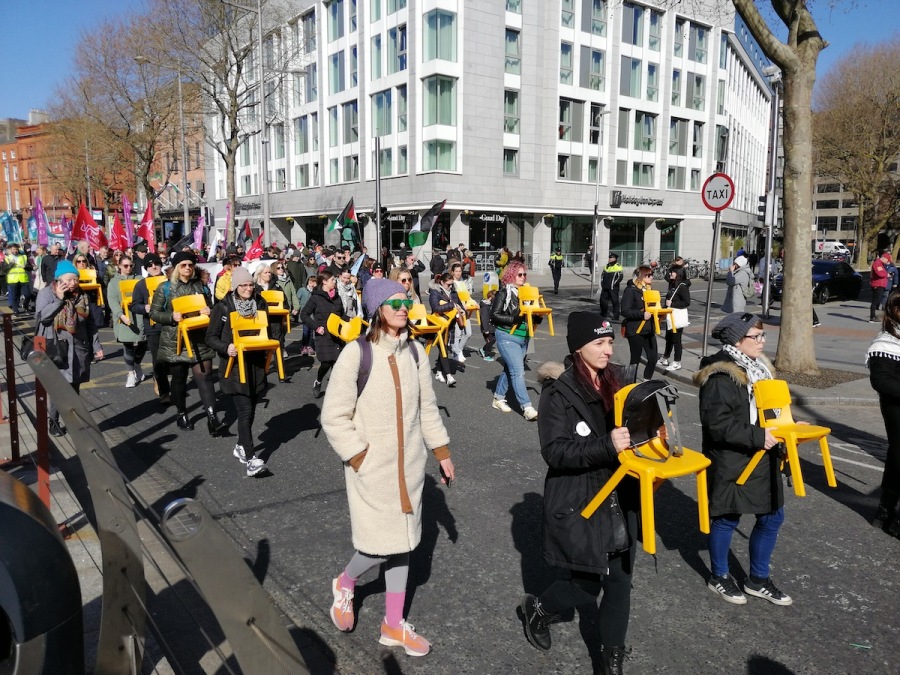
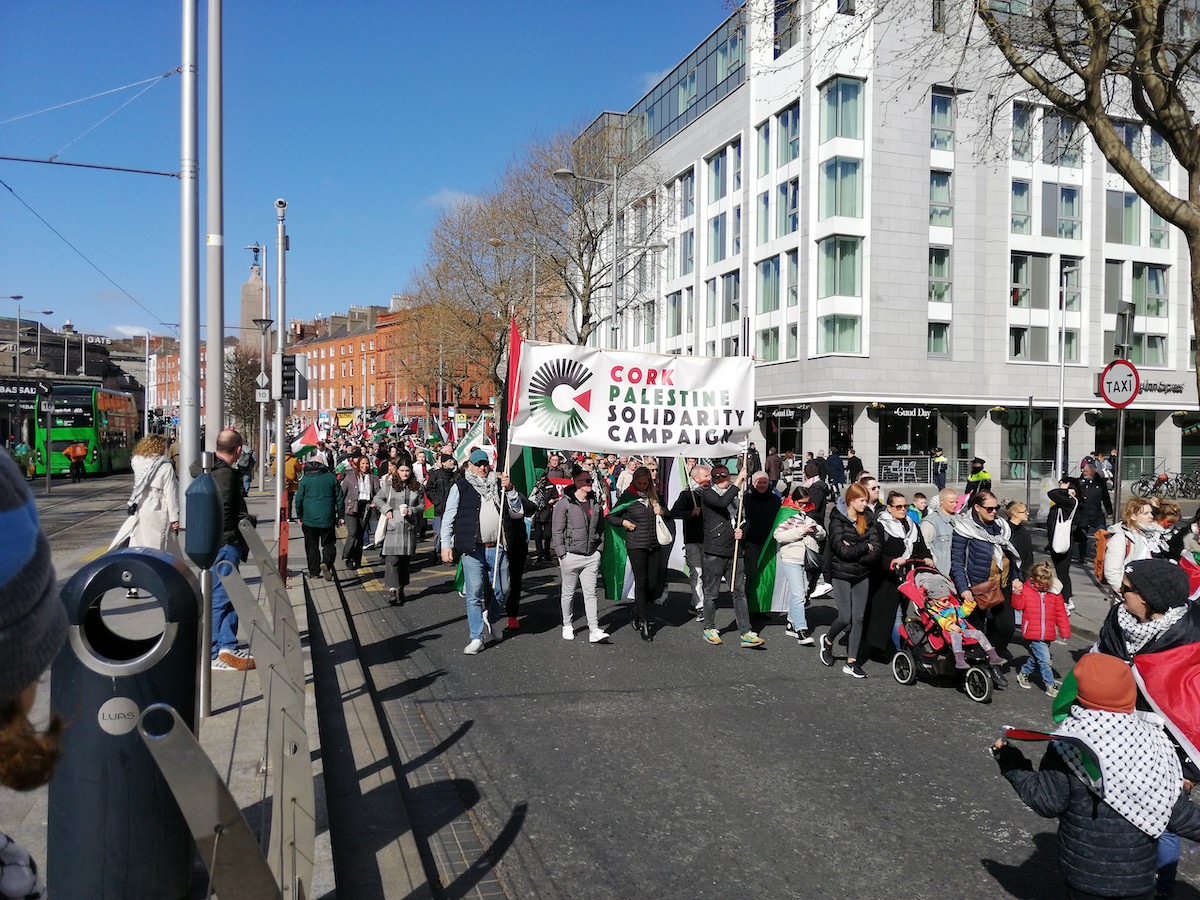
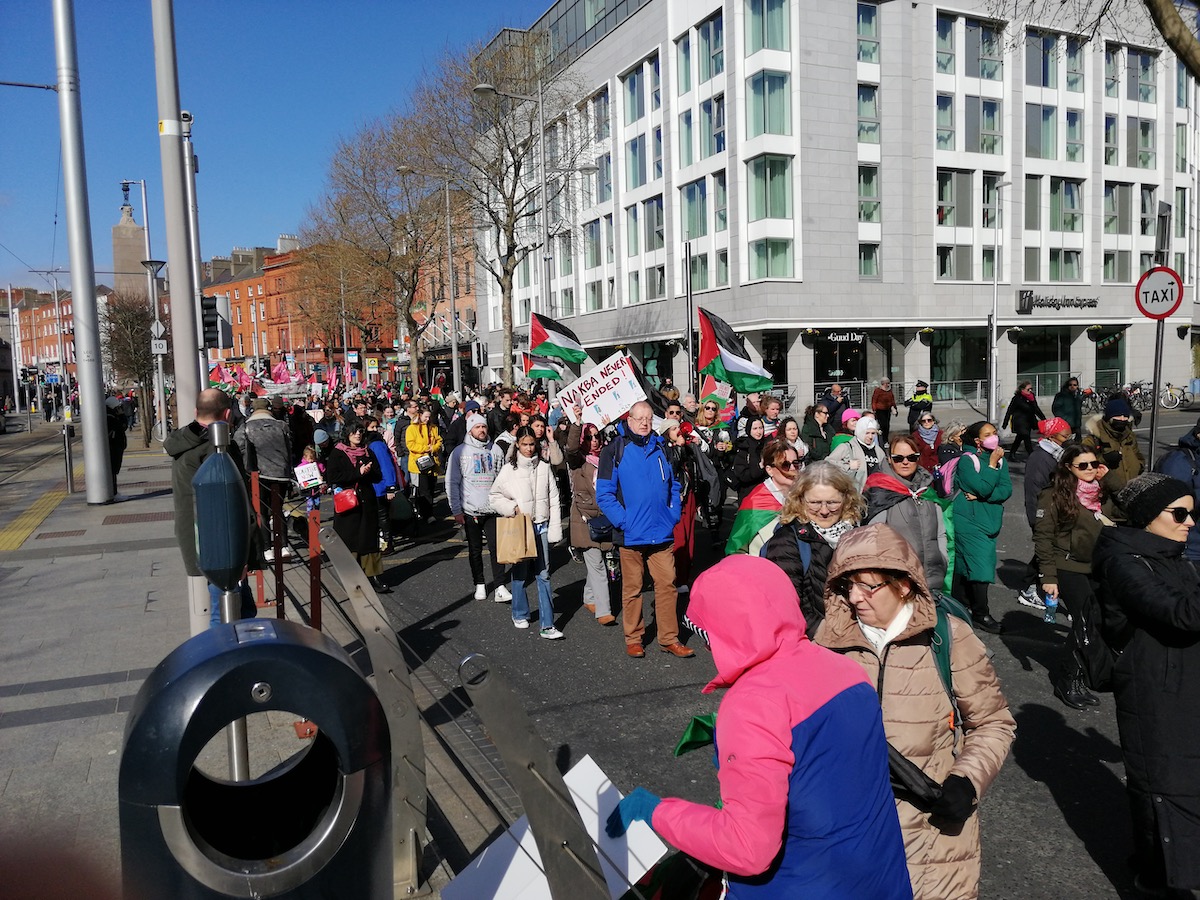
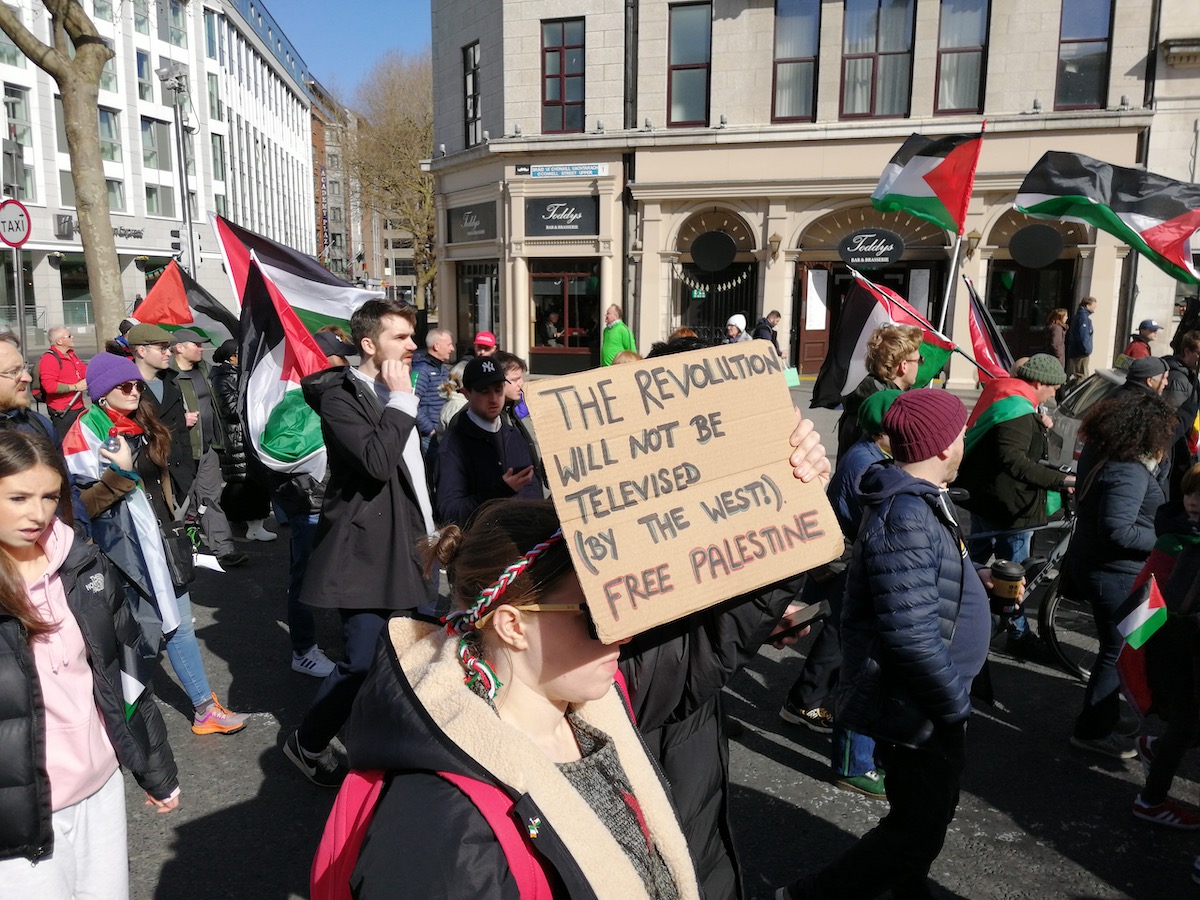
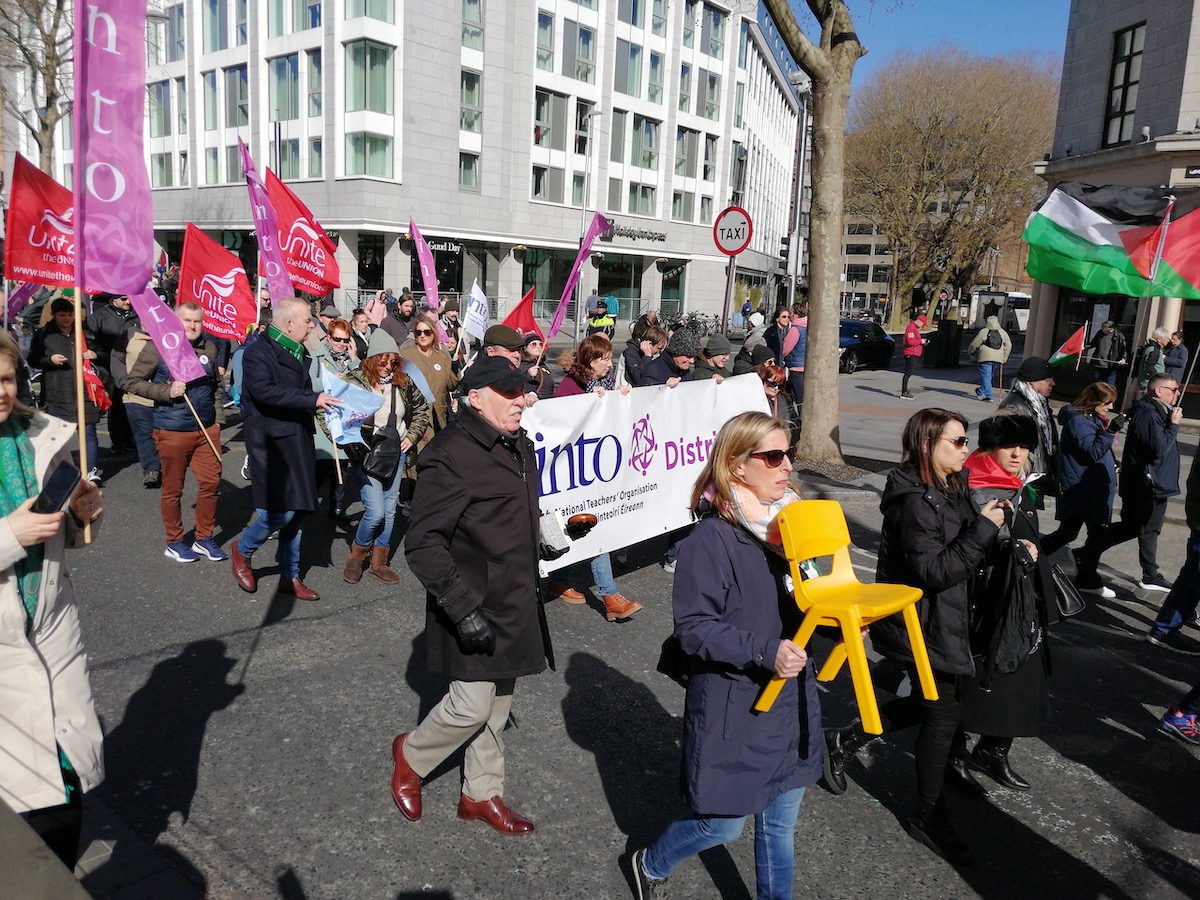
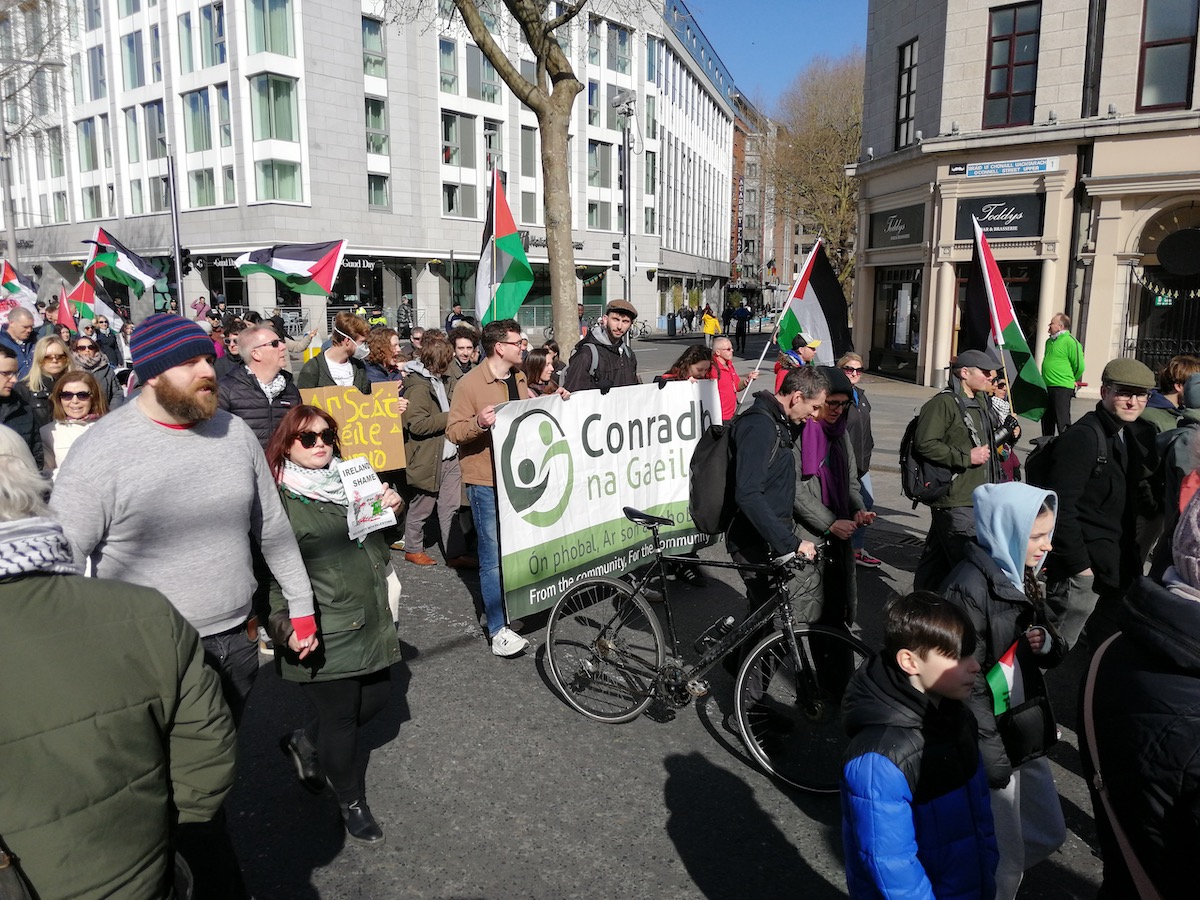
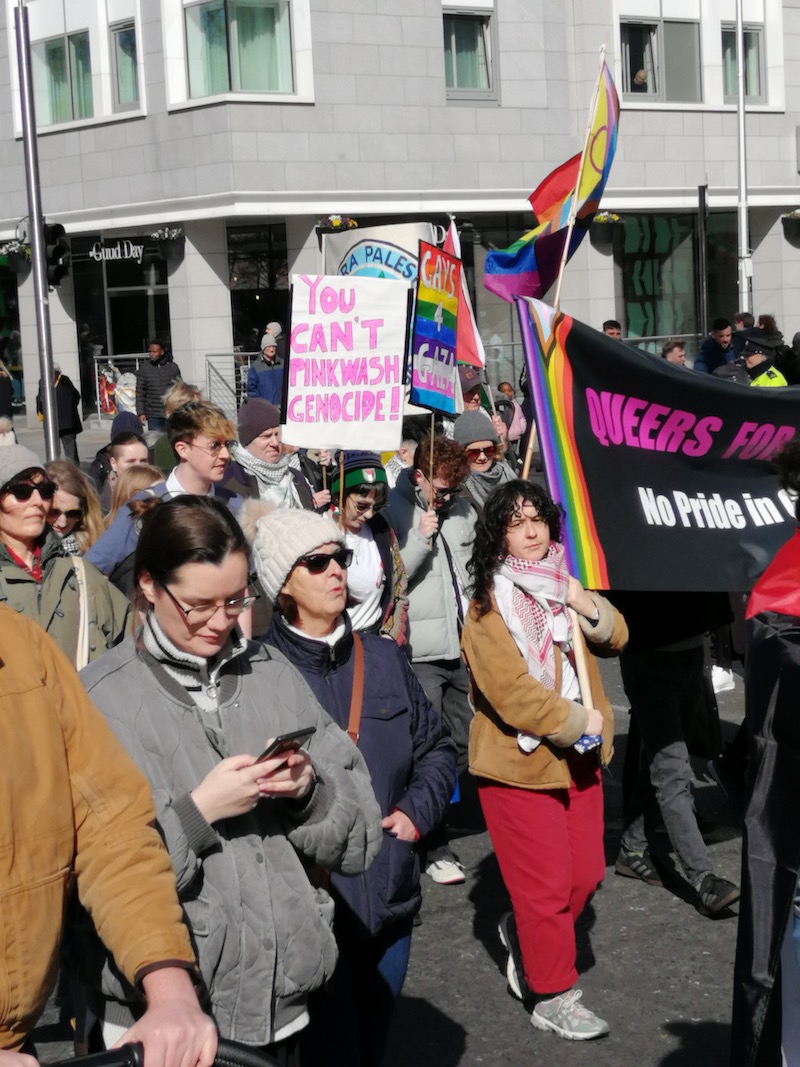
Seen on the IPSC National march (Photo by: Participant)

On Friday, the unions announced a ‘stand out for Palestine’ day – well, not a day exactly, more like a lunch break. It was not a strike, not even a work stoppage, rather some dedicated employees surrendering their lunch break to stand with Palestinian flags etc in front of their workplaces.

Not even a work stoppage of one day, half-day, or even an hour. The union leaderships, in most cases, organised nothing, leaving it up to their members to get together and to sacrifice their lunch breaks.

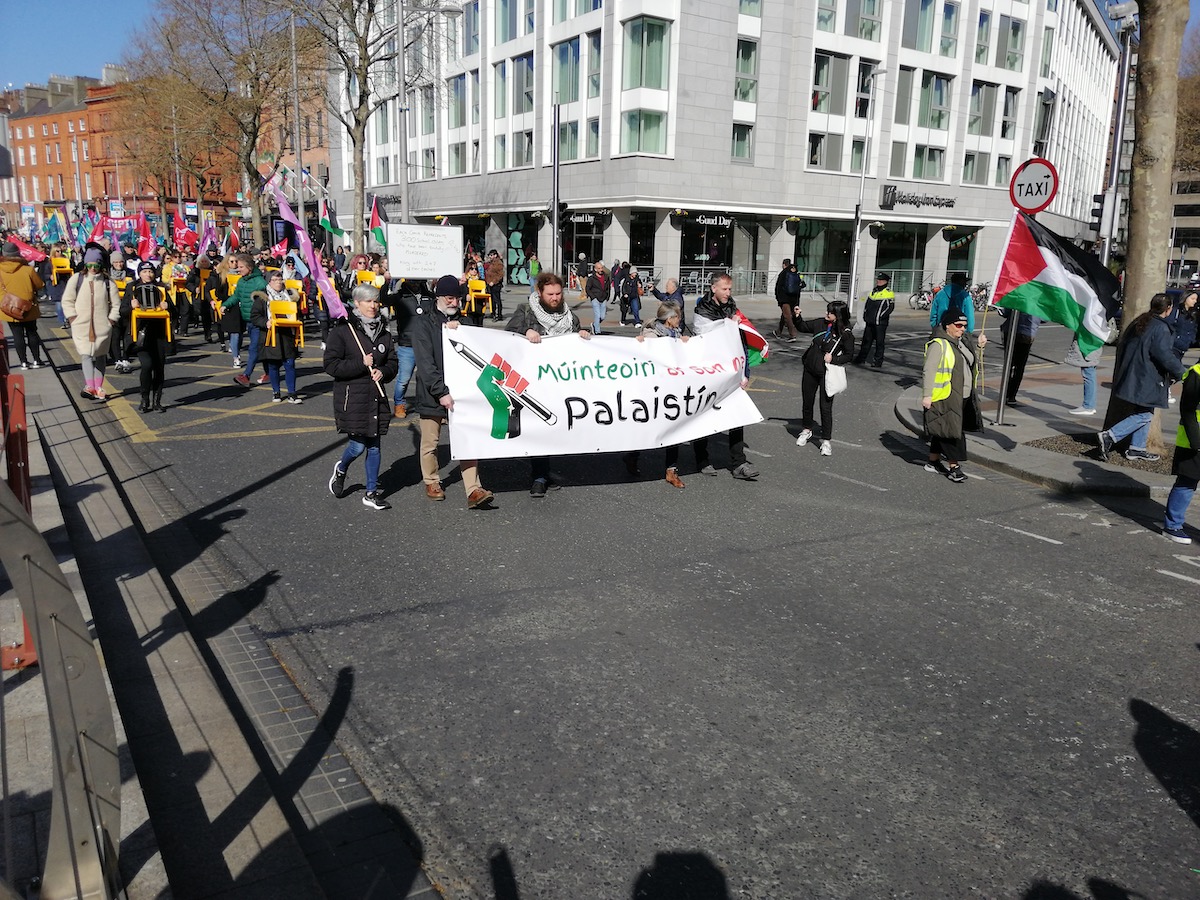
More of us went through the motions again on Saturday 29 November. From the Garden of Remembrance, down O’Connell Street, across the river, around by Trinity College, up Dawson Street and into Molesworth Street, facing Leinster House.

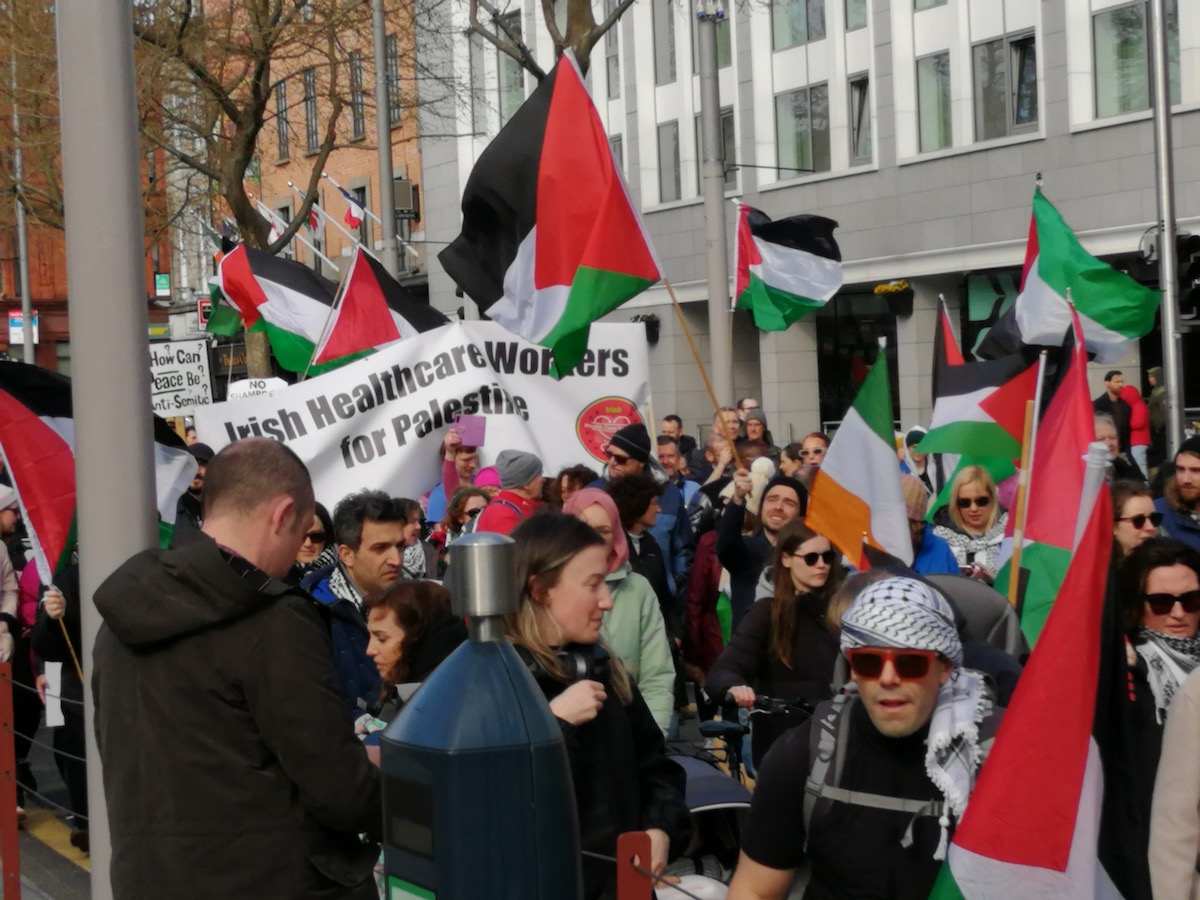
Seen on the IPSC National march (Photo by: Participant)

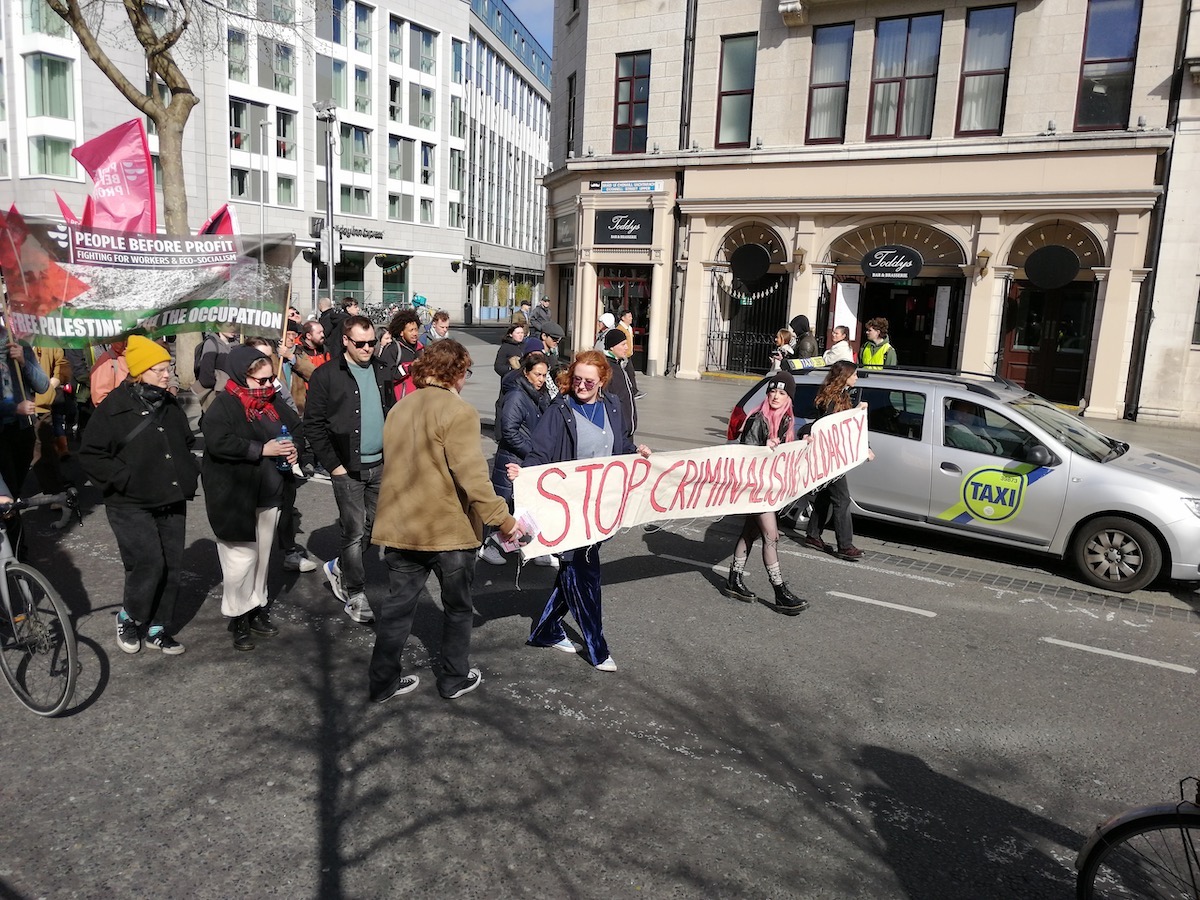
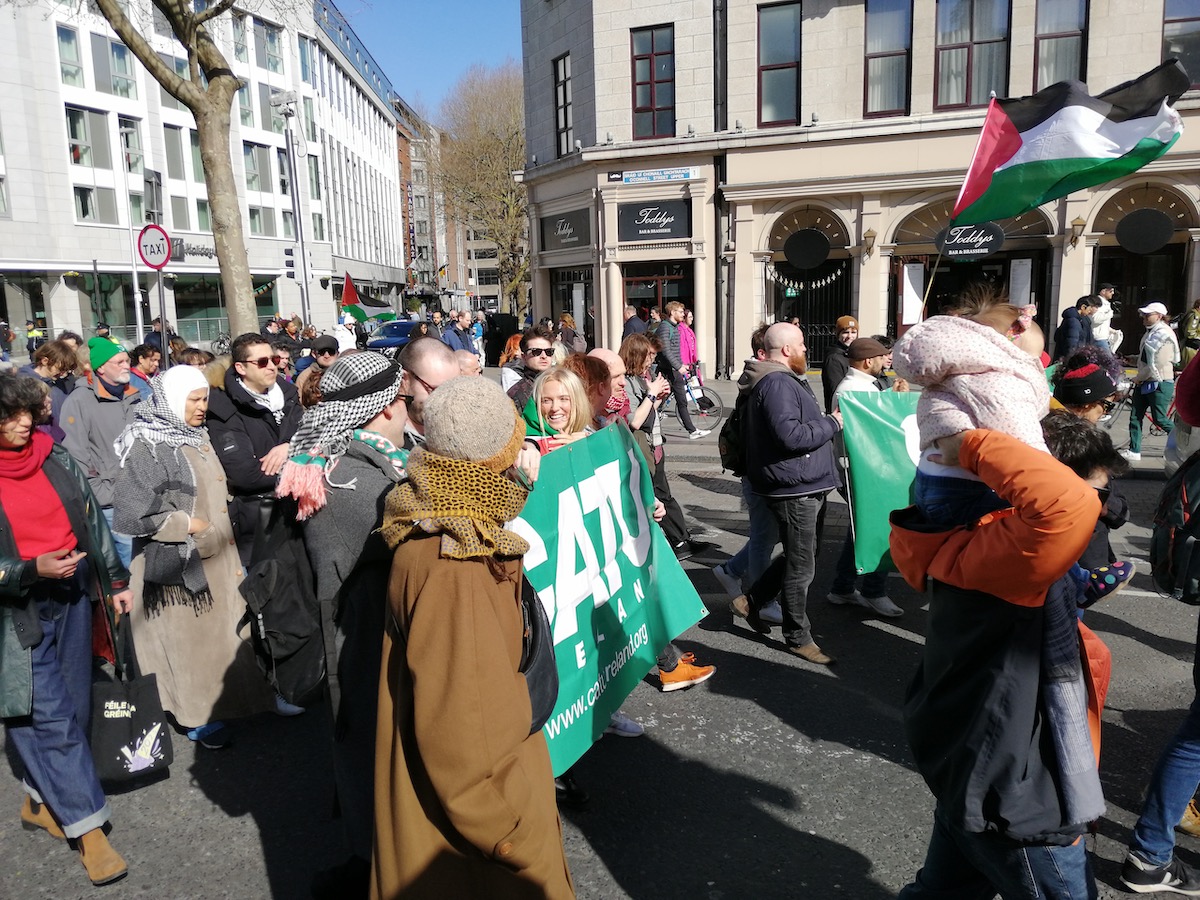
The Ireland Palestine Solidarity Campaign organised this ‘National Demonstration’ as it does roughly every month. It is supposed, presumably, to impress the Government with its numbers and pressure them to end their collusion with the ongoing genocide of Palestinians.

It has not done so — nor did it in any month or any year in the life of the IPSC, the longest-active Palestine solidarity organisation in Ireland. Nor have the monthly marches brought about any change in Irish Government collusion since the genocide of Gaza began in October 2023.

That is not the fault of the IPSC. What they are to be blamed for is not recognising that and adjusting appropriately to actions of greater pressure. Or, perhaps they recognised it indeed but nevertheless refused to change towards any effective pressurising methods.

The IPSC was for a long time near the ‘middle of the road’ but it has moved further into that position as the genocidal actions of the Zionist colony became worse and as awareness of Israeli crimes spread and grew in Ireland (which it did in part thanks indeed to the work of the IPSC).

Section of the IPSC National march (Photo by: Participant)

Solidarity work however is not about education in the abstract, raising awareness without using that awareness to bring about change. I am sure the IPSC leadership is aware of that and would wish much change but they do not adapt their actions, rather continuing with the monthly motions.

Probably they do not increase the pressure out of fear of losing their influence with the political class. Which would perhaps be well and good if the political class were delivering on ending collusion with the genocidal state – but they are not, nor is there any indication that they will.

Ireland remains the biggest single importer of Israeli products next to the USA and the biggest in the EU. The Irish Government permits military consignments to fly to Israel through ‘neutral’ Irish airspace and USA aircraft and military personnel to stopover and refuel at Shannon Airport.

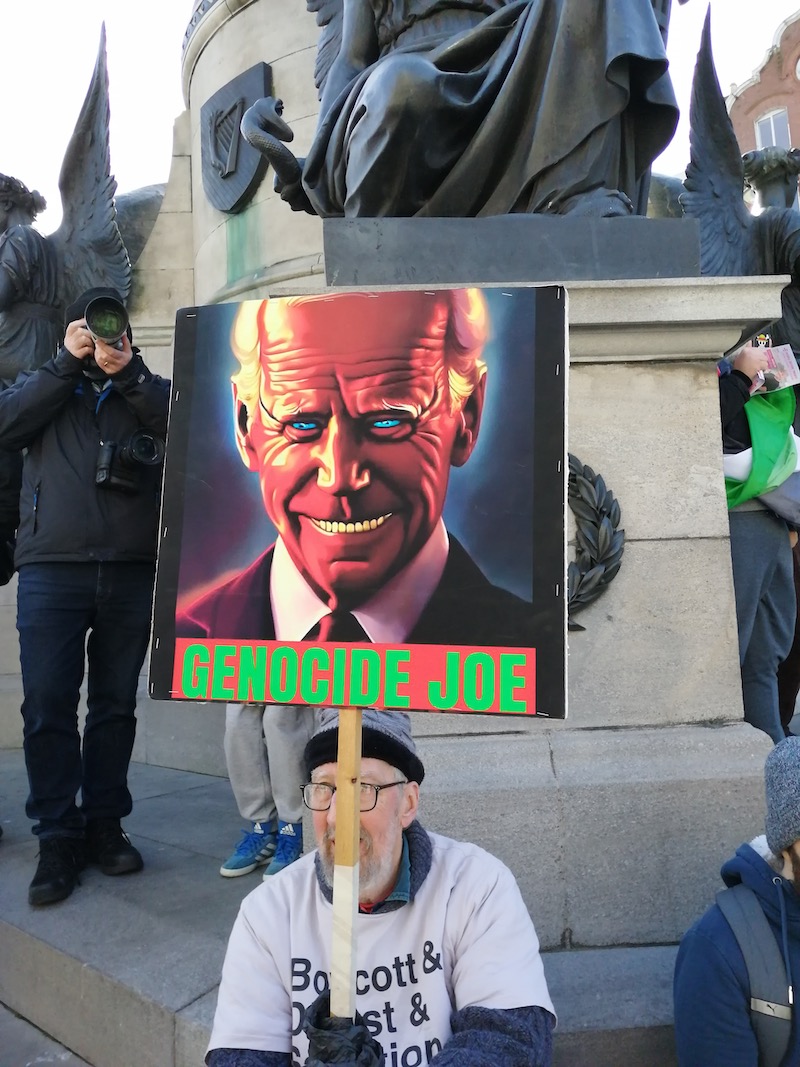
Seen on the IPSC National march as passing O’Connell monument (Photo by: Participant)

Occupying the ground near the middle is only a good thing if it can be used to support action for change; it is a hindrance if the act of being there comes to be more important than the end objective: an end to genocide and the Occupation, with freedom and independence for Palestine.

The IPSC could use its mass base to blockade Dublin Port, through which Israeli products come into the country. It could also blockade other major stocking and distribution points.

The IPSC could organise mass days of action against retail and tech outlets handling Israeli exports and mobilise pickets in support of retail workers refusing to handle Israeli products, such as a Tesco worker currently facing disciplinary procedures (i.e punishment) for that very ‘crime’.

The worker in question, employed by Tesco in Newcastle, Co. Down is a member of the IWW and also of USDAW, main union for retail workers in the UK (as in the colony) but while the word is that his union is defending them, it is not seeking to extend and widen the boycott.

Defending a worker’s right not to act against their conscience is an individual and personal issue.1 It is understood that the motivation of this worker is one of solidarity with the Palestinian people and against genocide, which is what the trade unions need to be promoting and mobilising.

Union leaderships become bureaucracies with buildings and paid officials, employing administrative staff, growing more and more cautious and afraid of State action (particularly against their funds), moving further away from the ethos that first led to the unions’ creation.

Organised workers in Italy have shown the potential in dock strikes and mass mobilisations but again it was not the mainstream unions that led the action. Canadian provincial trade union Federations have marked all ‘Israel’ goods and services as ‘hot’2 and not to be handled.

Union membership in Ireland has declined as union leadership collusion with management and government escalated from the 1980s and resistance actions decreased; an increase in militant action is likely to boost recruitment but in any case organising resistance is the supposed role of trade unions.

Questions around solidarity with Palestine bring many other underlying issues to the fore: media partiality, government collusion, imperialist and colonialist influence, effective means of applying pressure, appropriate leadership, resistance to oppression, solidarity with prisoners.

We have been taught lessons of great importance – but at a terrible cost; we owe it to the Palestinians and to ourselves to apply them.

End.

Note: If you found this article of interest, why not register with Rebel Breeze for free, so that you will be notified by email of subsequent articles. You can de-register any time you wish.

FOOTNOTES

SOURCES & FURTHER INFORMATION

APPENDIX

From The Cradle news updates on Telegram 6 December 2025:

Ontario’s largest labor federation backs ‘hot cargo’ boycott of Israeli goods

The Ontario Federation of Labour has become the fourth provincial labor federation in Canada to adopt a “hot cargo” resolution against Israeli goods and services.

The move designates all trade ties with Israel as products and services workers will refuse to handle due to their connection to exploitation and oppression. The OFL’s decision follows growing momentum across the country as labor groups escalate solidarity actions.

The New Brunswick Federation of Labour first set the precedent in May when it voted to stop handling weapons destined for Israel. Similar resolutions soon followed in Nova Scotia and Newfoundland and Labrador, culminating in Ontario’s endorsement last week.

Together, these federations represent a significant portion of Canada’s organized labor movement.

The OFL’s stance signals a widening labor-led boycott effort, reinforcing a broader push within Canadian unions to apply economic pressure and support calls for accountability over Israel’s war crimes.

1Individual ‘conscience’ can object to many things we consider necessary, for example to give contraception methods information, or about pregnancy termination, to deal politely with migrants, to serving people in the national language, to sending children to integrated education or even to any school, etc. etc.

2‘Blacked’ was a common term for such cases in the recent past, as was ‘tainted’ further back still (á la Larkin and Connolly) – see Appendix.

Occupied Territories Bill: Too Little, Too Late, if Ever.

Gearóid Ó Loingsigh (18/07/2025)

(Reformatted entire for publishing in Rebel Breeze from article of same title in his Substack

(Reading time: 6 mins.)

The saga of the Occupied Territories Bill (OTB) has been dragging on for years now. It was first put forward by Senator Frances Black in 2018 and was approved by both houses of the Oireachtas (parliament) but never enacted.

The Irish capitalist class that is resolutely on the side of the Israelis, despite the illusions of many and the odd PR stunt, dragged its heels on the issue, even boasting that it had effectively blocked it.

Simon Coveney who was the Minister for Foreign Affairs at the time said during a visit to the Zionist state in 2019 that:

We don’t believe that it is legally sound because trade issues are EU competence as opposed to national competence in Ireland. And because we don’t believe it’s legally sound we have effectively blocked the legislation from moving through parliament as it normally would…

It’s essentially frozen in the process and it isn’t making progress. And I don’t expect that it will make progress, either, unless the government supports it, and the government won’t be supporting it.1

A demonstration outside Leinster House, parliament of the Irish State recently. (Image chosen and sourced: by RBreeze on line)

This came as no surprise to anyone paying attention. Ireland is not an independent capitalist state; it is what Marxists term a neo-colony with 88% of all corporate tax paid by foreign companies and just three companies accounting for 38% of all corporate tax.
Foreign corporate tax in turn represents 29% of the total tax take in the country.2 It is entirely dependent on the US and also the British state.
Many months prior to Coveney’s boast, the then Taoiseach (prime minister), Leo Varadkar had written a grovelling letter to Joe Biden to apologise for the behaviour of Irish politicians who had voted for the bill. In it he stated:

The Government has consistently and strongly opposed the Bill on both political and legal grounds and will continue to do so… Can I take the opportunity to reiterate my deep appreciation for the strong bonds of friendship between Ireland and the US, including our growing and mutually economic ties.3

There is no world in which the Irish state will stand up to the US. It won’t stop US planes shipping arms to Israel through Shannon Airport, just like it allowed the US to use the airport during the Iraq war.

Putting the OTB to parliament was not a bad idea, believing that is how we would achieve something concrete was.

They are now attempting to water it down further and exclude services from its remit, limiting it to only goods. (Note: at the time this article was written campaigners were still fighting an attempt to limit the bill in that way – Rebel Breeze)

IBEC (the Irish Business and Economic Confederation) came out with a statement that it would harm the Irish economy to enact the bill, whilst paradoxically accepting that trade in goods with Israeli “settlements” in the West Bank only amounted to €240,000.4

On the radio the Government reminded us that we are a trading nation, as if any of us thought that everything we buy in the country was made here and we exported nothing.

The reason they can make these statements of course, is because of the limited scope of the bill itself and the intentions of those pushing for its enactment.

The Irish government was at great pains to say that it would only apply to the territories occupied in 1967 and not to Israel itself i.e. not to the territories occupied in 1948 during the Nakba and the foundation of the Zionist state.

If you accept the legitimacy of the state of Israel or if you are one of those liberals still prattling on about a Two State Solution then all of this makes sense. It could have even been argued when it was first proposed that it was a stepping stone to a wider boycott of Israel, not that any of them said that.

For those who believe in the two-state solution (sic) the map shows what’s available for a Palestinian State (sic). (Image chosen and sourced: by RBreeze on line)

Events have overtaken our liberal friends and they shudder at the consequences. There is no longer any case to be made for a bill that limits business dealings with modern Zionist invasions of the West Bank.

Francesca Albanese in her recent report made it abundantly clear that many companies doing business with Israel are profiting from or contributing to the genocide.5 Now is not that time for half measures. Israel, just like the Nazis is carrying out a genocide.

Asking for a boycott of goods from the Warsaw Ghetto, rather than Nazi Germany would have seemed stupid at the time and actual calls for a boycott of the Nazis were portrayed as anti-German.

Some Jewish organisations opposed the boycott and the US government response to violence against German Jews was that the

U.S. Secretary of State Cordell Hull issued a mild statement to the American ambassador to Berlin complaining that “unfortunate incidents have indeed occurred and the whole world joins in regretting them.” He expressed his personal belief, however, that the reports of anti-Jewish violence were probably exaggerated.6

We know how this ended. The Nazis in the face of the timorous and timid response from the US and other western powers would eventually enclose Jews in ghettos, then camps and then push six million of them through the ovens.

Now is not the time to repeat history but to be bold and decisive. Now it is equally ridiculous to meekly petition, those who grovelled to Genocide Joe in 2019, to restrict goods from the West Bank.

In the midst of a genocide there is only one option on the table: a complete and total severance of all trade, military and diplomatic ties with Israel. There are no “settlements” without the Nazis in Tel Aviv, without the Israeli military, without the companies that keep Israel going.

A Banner on the IPSC National March 19th April 2025 in Dublin, appearing to show a believed organic connection between the enacting of the OTB and ending the Zionist genocide in Palestine. (Image sourced and chosen: R.Breeze)

Total isolation of the entire regime is needed. Not an orange, not a single electronic component, not a kilobyte of software. Such isolation should continue not just till the acts of genocide have ceased.

They will cease when the repugnant reality that Israel has run out of Palestinians to murder comes to pass.

Israel should be isolated until all those involved have been tried, had all their assets confiscated, given lengthy prison sentences or hung until dead, depending on the actual degree of participation.

This is not an outrageous proposal, it is what was theoretically done at Nuremberg, though many of the businessmen were given back their assets after a number of years and only a handful of Nazis got the actual death penalty and most never saw the inside of a jail.

No such leniency should be shown to the Zionists.

Those campaigning on the OTB will never make such a call. They will continue to petition the government. They do have another weapon to hand in fighting the Nazis in Tel Aviv, but they won’t call for that either.

The Irish Council of Trade Unions denounced the government’s handling of the OTB and called on the Oireachtas to reject the “business lobby scaremongering” and to pass the OTB.7

Of course, the unions don’t need to persuade the Zionists who dominate the coalition parties, they could just have told their members in 2018 to refuse to handle all products coming from the Occupied Territories, or indeed the entire Zionist state and that would have settled it.

They would have to organise that and back all their members who engaged in such boycotts. But under no circumstances will the fat cat bureaucrats ever confront the government over this issue.

If they are not prepared to fight for decent wages, a proper health system, public housing etc, all of which directly affect their members, less still will they fight for Palestinians. They are traitors to their class and also betrayers of the Palestinian people, despite all their lofty statements.

The OTB was a nice propaganda measure whose time has passed. It is, in the midst of a genocide, no longer fit for purpose, neither is a solidarity movement which limits itself to half measures. We need to be bolder.

End.

NB: For more articles by Gearóid see https://gearoidloingsigh.substack.com

NOTES

1 The Times of Israel (03/12/2019) Visiting Israel, Irish FM says he’s open for ‘new thinking’ on peace process. Raphael Ahren. https://www.timesofisrael.com/visiting-israel-irish-fm-says-hes-open-for-new-thinking-on-peace-process/

2 Reuters (30/04/2025) Ireland’s reliance on foreign multinational taxes grew in 2024. https://www.reuters.com/markets/europe/irelands-reliance-foreign-multinational-taxes-grew-2024-2025-04-30/

3 The Irish Times (22/03/2019) Economics should not trump ethics when it comes to Occupied Territories Bill. Suzanne Mulligan. https://www.irishtimes.com/opinion/economics-should-not-trump-ethics-when-it-comes-to-occupied-territories-bill-1.3834221

4 The Irish Times (17/07/2025) ‘No real evidence’ Ocuppied Territories Bill would cost Ireland dearly, Amnesty Chief says. Colm Keena & Mark Henessy. https://www.irishtimes.com/ireland/2025/07/17/ibec-head-labels-occupied-territories-bill-symbolism-and-moral-positioning/

5 UN (2025) From economy of occupation to economy of genocide: Report of the Special Rapporteur on the situation of human rights in the Palestinian territories occupied since 1967. Francesca Albanese. https://www.ohchr.org/sites/default/files/documents/hrbodies/hrcouncil/sessions-regular/session59/advance-version/a-hrc-59-23-aev.pdf

6 Feldberg, M. (n/d) U.S. Policy During World War II: The Anti-Nazi Boycott. Jewish Virtual Library. https://www.jewishvirtuallibrary.org/1933-anti-nazi-boycott

7 ICTU (17/07/2025) Oireachtas must reject business lobby scaremongering and pass the Occupied Territories Bill. https://ictu.ie/news/oireachtas-must-reject-business-lobby-scaremongering-and-pass-occupied-territories-bill

Don’t Change the System – Just the Parties in Government

Diarmuid Breatnach

(Reading time: 2 mins.)

I was relieved by my attendance at the Raise the Roof housing demonstration in Molesworth Street in Dublin City Centre. That was because I learned from speakers that just by voting in ‘a Left Government’ we could receive the housing we need.

Raise the Roof is a coalition of trade unions with its address at the Labour Party-orientated ICTU and a number of housing NGOs. The coalition also contains political parties: Sinn Féin; Labour Party; People Before Profit/ Solidarity; Social Democrats; Independents4Change.1

A view of the protest in Molesworth St. Leinster House is in the background across Kildare Street with access prevented by police barriers at the end of Molesworth St with a special gate to allow entry and exit for customers of the hotel on the corner. (Photo: D.Breatnach)

Previously I’d thought that either we’d need a revolution or a country-wide campaign of direct action occupying empty properties. This is because the housing crisis is deliberately constructed for the benefit of profits for big landlords, vulture funds and the banks that finance them.

And since they keep making massive profits out of the situation, they won’t want it to change as it would if, for example, were the State to seize empty properties2 for conversion to housing along with a massive public housing for rent construction campaign.

And if the profiteers don’t want that, naturally their (sorry, ‘our’) government will make sure not to do anything of the sort.

So it was great to learn that we won’t have to really fight and break the law, going to jail and all that. Phew! Just change the parties in the Government at the next election! Elect a Left Government!

Visual accidental irony comment in the same street. (Photo: D.Breatnach)

But… lately I have to admit I’ve been having doubts about this solution. First of all, there’s the question of numbers of TDs available to form this aspired-to government. There are overall 174 TDs in Leinster House (the Parliament of the Irish State) and a fragile majority requires 88.

The Sinn Féin party has 39 TDs and People Before Profit/ Rise/ Solidarity five in total, a combination of 44 still needing another 44 to reach the 88 minimum. FG and FF, formerly opposition parties but now in government have 86 votes between them and needed some extras to run the Government.

But I’ve got a much bigger doubt really, and that’s whether SF will stand up to the bankers and property magnates.

SF has for decades being setting out its stall that it is safe pair of hands to run the system, in other words that the profiteers have nothing to worry about. And to tell the truth, I believe them. Though some of their followers think SF is fooling the system, I think it’s the followers being fooled.

View of the Raise the Roof protest in Molesworth street. (Photo: D.Breatnach)

So … after further consideration, it really does look like a revolution will be required to end the housing crisis — or at least something so near as to make the managers of the system believe that unless they resolve the housing crisis, there will be a revolution. So I’m worried again.

Anyway, it was interesting seeing the amount of Tricolours in what was predominantly a left-wing rally of hundreds (despite a small contingent holding an Aontú banner) and there was some nice music with singers including Lisa O’Neill and Jimi Cullen (with his Homes for All composition).

I still left early, however.

End.

Footnotes

1https://www.raisetheroof.ie/about-raise-the-roof

2https://www.socialjustice.ie/article/vacancy-and-dereliction-ireland

Trump, Ramaphosa and White Power

Gearóid Ó Loingsigh (reprinted intact from his substack and reformatted for Rebel Breeze)

(Reading time: 5 mins.)

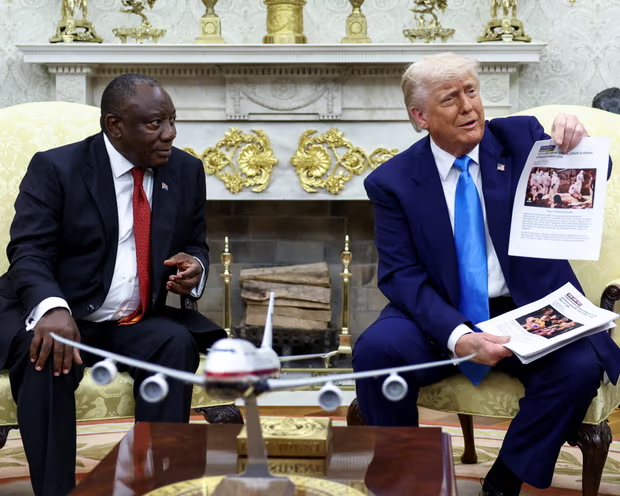
Once more Trump has acted like the lunatic he is and ambushed the president of South Africa, Cyril Ramaphosa, stating that the country was undergoing a real genocide of whites.

Many have commented on the effrontery of Trump to talk of a fictitious genocide of whites in South Africa, whilst his main ally Israel is carrying out one in real time every day on the news shows.

Trump used images from the Democratic Republic of Congo, a country more than 4,500 kilometres away, to show that they were killing whites in South Africa.

Trump also lied about the land question in the country, accusing the government of stealing the whites’ lands when the reality is that the whites continue to be the owners of the greatest part of the land in the country.

It is worth saying that Ramaphosa defended himself partially, and only partially as behind the new legislation on the matter there is the hidden failure of the peace process when it comes to resolving the land question.

When the Apartheid regime was ended, the country was one of the most unequal on the planet and the whites were the owners of the greatest part of the agricultural lands. Around 60,000 whites were the owners of 86% of all the agricultural lands, some 82 million hectares.[1] 

The agrarian reform proposed by the ANC in its White Paper of 1997 was a market-driven reform, i.e. the voluntary sale and purchase with some help from the government without the government being a buyer.[2] Blacks could also ask for the restitution of lands stolen by racist laws since 1913.

A whole land bureaucracy was set up, not unlike what Colombia has, Land Claims Courts where all those who registered could make their case with three possible outcomes, the restitution of the land, the handover of alternative land or a financial compensation.

In 1992, the ANC had put forward a document in which they argued for the expropriation of lands and other non-land market mechanisms. But by 1997 they had accepted neoliberal discourse and adopted the land market as the cornerstone of their policy.[3]

Initially the ANC government had proposed handing over 30% of the agricultural lands held by whites to blacks within five years. But they kept postponing it.

By March 2011, they had handed over 6.27 million hectares, and of that 45% was not agrarian reform, properly speaking, but rather land restitution.[4] The government didn’t just fail regarding land, but on everything. Inequality rose since the fall of Apartheid.

The Gini[5] rose following the end of Apartheid in 1994 and now is situated in 0,67 making it the most unequal country on the planet in terms of income, where just 3,500 people own 15% of all the wealth of the country.[6] 

SA President Ramaphosa looks on while US President ambushes him publicly with alleged ‘evidence’ of persecution of white people in S. Africa (Photo cred: Kevin Lamarque Reuters)

There is also a high concentration of land. “Currently 72% of farms and agricultural holdings are owned by white individuals, who make up 7.3% of the population, while black Africans, constituting 81.4% of the population, own only 4% of the land.”[7]

The whites continue to be the owners of the land, the black middle class through Black Economic Empowerment programmes reached agreements with those whites and the companies in the agricultural sector to integrate themselves into the neoliberal economy.

This is the so-called ‘white capitalism’ and South Africa became a leading country in the agribusiness sector of the continent. In 2015, of the 10 largest agribusiness companies on the continent, eight were South African.[8]

Ramaphosa himself is an excellent example of the new South African businessmen, the former fighters against capitalism who now profit from the blood and sweat of those who were once the grassroots militants of the organisations they led.

Between 1994 and 1998 he acquired a portfolio of more than 40 million Rand[9] (some 8 million dollars at the time) and ended up as an extremely wealthy man (some 700 million dollars) thanks to his controversial investments and acquisitions in the mining sector.

Ramaphosa is also the owner of the McDonalds franchise in the country. The former leader of the National Union of Mineworkers became a magnate in the sector.

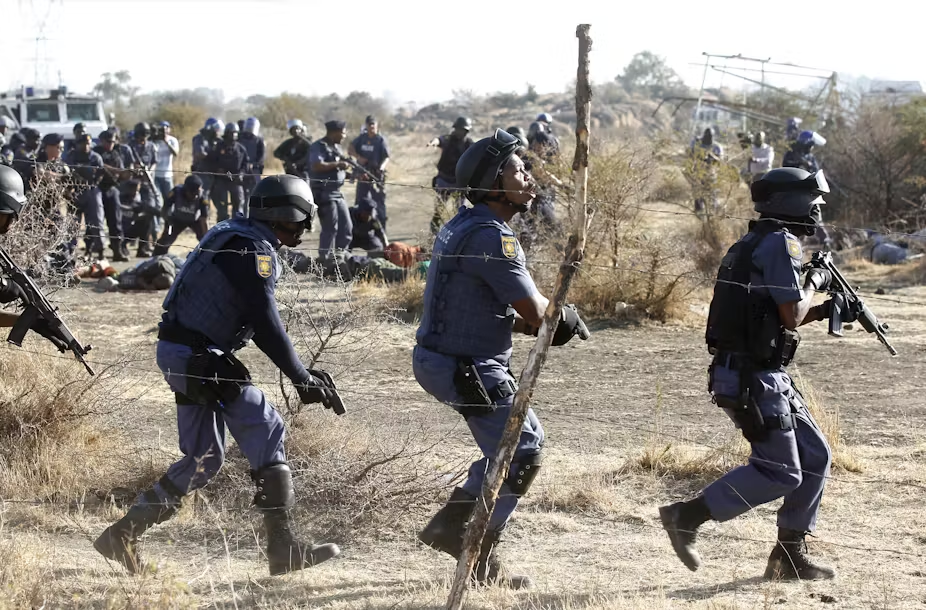
In 2013 the Police murdered 34 miners in the midst of a strike at Lonmin, one of the companies where he was a director, being the owner of 9.1% of the company. [10] 

South African police move forward to kill more striking miners at Lonmin 2012 while in background other police stand over miners killed already(Photo cred: Sephiwe Lebeko/ Reuters)

And just like in the times of Apartheid, the Farlam Commission, those charged with investigating the Marikana Massacre found nobody guilty. Nobody! Blood is washed from the hands of a black capitalist just as easy from those of a white capitalist.

When he took over the presidency of the country, there hadn’t been any great advances made regarding agrarian reform there. The failure to meet the promises of the transition and the political programme of the ANC cost them electoral support.

So much so that they now govern the black masses with the support of a white party, the Democratic Alliance, a right-wing party that strongly opposes any expropriation of land without compensation and in practice is opposed to any great change in land policy.

It is in this context that Ramaphosa launched his new campaign and new land law. The ANC say they want to implement the Freedom Charter, but it is not so. Mandela himself had discounted that in his speech to Davos.[11] 

He didn’t explicitly refer to the document but he never again spoke of the nationalisation of resources such as mines and land.

Ramaphosa’s law proposes various measures that already exist in almost all capitalist countries, the expropriation of property with compensation for public purposes or where there is a public interest i.e. the compulsory purchase or as they say in the USA, the heart of capitalism, eminent domain.

These norms exist in almost the entire world. As is the case in many capitalist countries, it also includes elements to reduce the amount of compensation or not pay it.

It is another thing to believe that Ramaphosa aims to do what the ANC never wanted to since the first government. He does not want to fight with so-called white capitalism as he knows that so-called black capitalism is the same thing and one depends on the other.

What Ramaphosa is about is a public relations manoeuvre to strengthen a weakened and discredited ANC. There will almost certainly be more such initiatives. But the ghosts of Marikana tell us that this traitor has no intention of doing anything for the black masses.

Trump talks of a genocide that only exists in the sick mind of Elon Musk and of a land theft that Ramaphosa does not want. If he steals the whites’ lands, who will he sip cognac with then? White power is still in control of South Africa.

It dominates the economy in alliance with the not so new black bourgeoisie, the black apparatchiks that control the scaffolding of the state, and the growing presence of foreign capital.

We all recognise Trump as the enemy and idiot that he is. The problem is that sometimes we acknowledge those he attacks as friends when in reality they are the same enemies, except some are more intelligent, cultured and refined.

Ramaphosa when he was a trade union leader said “There is no such thing as the liberal bourgeois. They are all the same. They use fascist methods to destroy workers’ lives.”[12]

Workers’ blood is washed from the hands of all the capitalists, blacks, whites, Russians, Arabs or Yanks: Ramaphosa in Marikana or Trump everywhere. The whites in South Africa, the Elon Musks have no reason to fear their friend Ramaphosa, despite the stupidities from Trump.

End.

NB: For more articles by Gearóid see https://gearoidloingsigh.substack.com

NOTES

[1] Lahiff, E. & Li, G. (2012) Land Redistribution in South Africa: A Critical Review. WB.p.3 https://openknowledge.worldbank.org/server/api/core/bitstreams/28ccc35a-31cd-58ba8d0e-1b65b74b275c/content

[2] Ibíd., p.5

[3] Ibíd., p.8

[4] Ibíd., p.9

[5] The Gini is a measure of inequality where 0 = absolute equality and 1 = absolute inequality.

[6] Valodia, I (2023) South Africa can’t crack the inequality curse. Why and what can be done. https://actsa.org/the-facts-land-reform-in-south-africa/

[7] Actsa (19/02/2025) The Facts: Land Reform in South Africa. https://actsa.org/the-facts-land-reform-in-south-africa/

[8] See ACB (2015) Africa an El Dorado for South Africa’s Agribusiness Giants. https://safsc.org.za/wp-content/uploads/2015/09/SA-Agribusiness.pdf

[9] Bond, Patrick (2000) Elite Transition: From Apartheid to Neoliberalism in South Africa, London & South Africa, Pluto Press and UNP, End Note No. 7, Chapter 2 page 266.

[10] The documentary Miners Shot Down can be seen at https://www.youtube.com/watch

[11] See https://www.weforum.org/stories/2013/12/nelson-mandelas-address-to-davos-1992/

[12] Cited in Miners Shot Down.

PKK FINALLY SWALLOWS THE PACIFICATION PILL

Diarmuid Breatnach

(Reading time: 4 mins.)

The Kurdish group, the PKK announced on Monday that it has disbanded its armed organisation of the last nearly 50 years.1 The change was carried out on instruction or request of their leader Abdullah Ocalan who’s been in a Turkish jail since 1999.

Supporters in Dusseldorf November last year defy German ban to demonstrate and call for release from Turkish jail of Abdullah Ocalan, leader of the PKK (Photo credit: AP)

The marxist-leninist PKK set up its armed organisation in 1978 to resist the Turkish state repression of the Kurdish independence movement. The Kurdish area is of huge strategic importance, encompassing parts of what are now Turkey, Iraq, Syria, Iran and Azerbaijan.

The population of Kurdistan is estimated at between 30 and 45 million, with up to another two million in its diaspora. The PKK waged armed struggle in Turkey until 1999 then again as the YPG and SDF in Syria, against the Assad regime and against ISIS.

PERSONAL CONNECTION

I was for a time in London myself active in solidarity with the Kurdish national liberation struggle and, as a result, part of a trade union delegation to Turkish Kurdistan around 1991/92, organised through a Kurdish community centre in North London.

The trade union activists participating were required to raise the money for the flights from their union organisations and I was successful in obtaining the necessary funds through the Lewisham Nalgo/ Unison local government branch and through the Nalgo/ Unison Irish Workers Group.2

Our delegation flew to Istanbul and from there to Batman province where the driver, supplied by the Petro-Is trade union took the three of us and our interpreter and photographer to many parts in the region, including to the border with Syria and seeing the oil being smuggled across the Iraq border.

Evidence of the ongoing war between the PKK and the Turkish State was plentiful, including Turkish gendarmerie checkpoints, bullet-riddled walls in towns and a shell hole in the wall of my bedroom in one hotel in which we stayed.

Much worse was the visit to an outlying village house burned by German flame-throwing tank of the Turkish Army and viewing the photos of the children immolated inside.

Turkish secret police visited our driver’s house while he was away, commented to staff of one hotel that we were not tourists (declaring ourselves a trade union delegation would have been asking for trouble) and on our last day kept driving past us and even followed us on to the plane.

Even then I was very concerned at what seemed to me like near deification of Ocalan. Years later, in Bilbao as part of a panel of speakers on national liberation struggles, off the platform the speakers on the Irish, Palestinian and Kurdish resistance discussed issues in the liberation movements.

The Palestinian and I became concerned by the almost violent agreement of the Kurd with everything that Ocalan did or said. We had to abandon all attempts to discuss and debate with him.

PACIFICATION PROCESSES

Pacification processes of various types have been around for centuries but a particular wave of them began to be deployed in the early 1990s, starting with South Africa and Palestine,3 then spreading to Ireland, the Basque Country and Colombia, each affected subject infecting in turn the next.

Typically the subject was told they had to disarm and disband their armed organisation, after which they would be accepted into the system and could organise politically for admission to the ruling political circles through the standard electoral process.

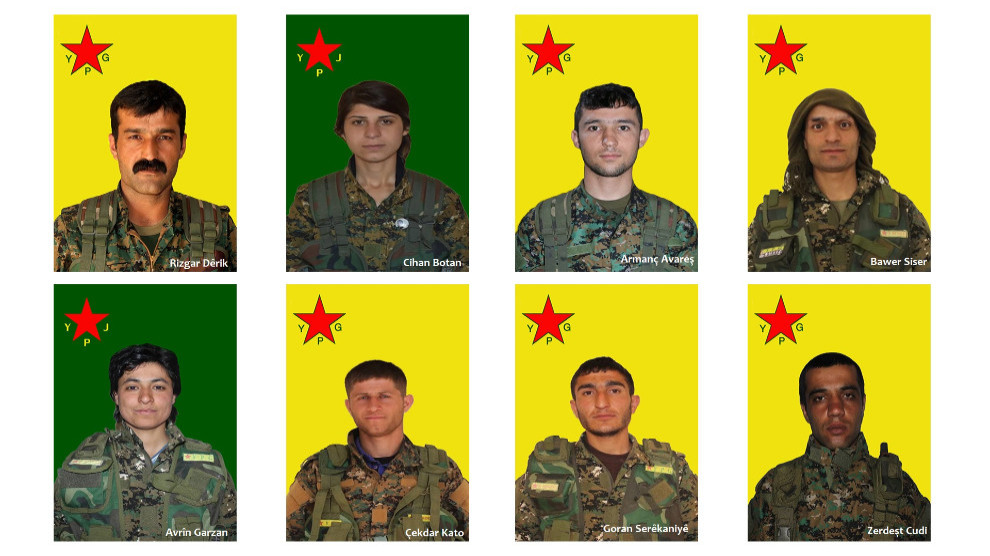
Portraits of eight martyrs of the YPG announced fallen in battle in Afrin against ISIS (note two are female) December 2019 (Source: YPG media)

Of course each subject would have to renounce even the idea of armed struggle or revolution. And would be required to control their own fighters and denounce their dissidents.

It is somewhat surprising that it has taken this long for imperialism to land the PKK fish since Ocalan swallowed the baited hook back in the late 1990s. The war in Syria I suppose extended their armed organisation’s life for a while beyond that which it would have had if confined to Turkey alone.

But their role in Syria in the YPG, whether it began as an independent Kurdish national liberation struggle or not, soon degenerated into leading a US/NATO proxy force, the SDF.4

This March the SDF agreed to integrate into the imperialist proxies’ army of ISIS types led by Ahmad al Shaara (i.e the ‘former’ ISIS leader Jolani), currently being embraced by imperialist leaders while his forces continue to carry out sectarian murders of Syrian Alawites and Druzes.

More recent reports have them, while agreeing to disarmament in Turkey, refusing it in Syria, which makes sense from a self-preservation stance alone, given the nature of the new state’s forces.

We can imagine the imperialist-driven virtual “Pacification Express” in the late 1990s and early 2000s, as it left South Africa and Oslo-Palestine, calling on Ireland and from there to the Basque Country and outward bound to Colombia. Turkish Kurdistan was one of the planned stops.

In not one of the areas of national liberation struggle passed through by the Pacification Express did the liberation organisation win that for which they had declared they were fighting, or indeed anything apart from in some cases the freeing of political prisoners.5

In S. Africa they did at least get ‘majority rule’, so that the leadership of the liberation organisations could form a corrupt imperialist-serving government.6 The Irish travelling on that Express got their prisoners freed but the Kurds and Basques on board did not receive even that.

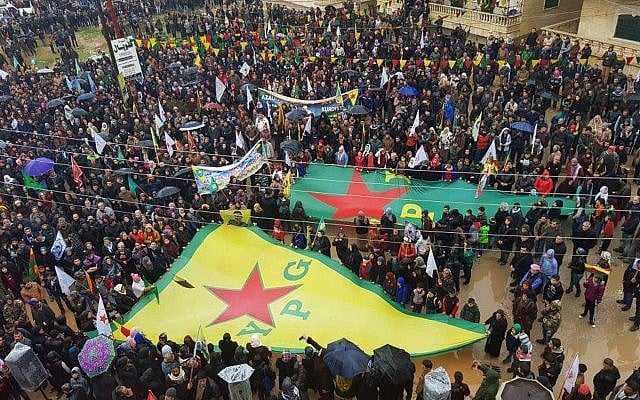
Supporters YPG and other militias and parties protest threats from Turkey in Afrin, Aleppo province, north Syria 18 Jan 2018 (Source: YPG Press Office/AP)

Whoever the leaders of the Kurds are now, they claim that they continue on the track to democracy and Kurdish national liberation.

Of course they do. The passengers on the Pacification Express always declare that sovereignty and self-determination are the train’s destinations, even if it shows no sign of heading there. And that some of the stations passed on the way are quite clearly on another line completely.

end.

Footnotes

1https://apnews.com/article/turkey-kurdish-militants-disarm-9f4347a04cba48ceb509d2e82023a19e

2This was one of the self-organised groups of NALGO (National Association of Local Government Officers), now subsumed into UNISON but which the union’s leadership refused to recognise and worked to undermine. I had been a founding member. The union leadership tried to get us to change our founding principle of self-determination for the whole of Ireland and when we refused, they worked against us.

3The ‘Oslo process’ which set up the Palestine Authority and the popular rejection of which led to the Second Intifada.

4Even though some anarchist groupings and at least one Irish socialist Republican group refused to see this and focused instead exclusively on the YPG’s anti-ISIS fighting and their federal administration of ‘liberated’ Rojava.

5But not in Turkey or in the Basque Country, nor of the ELN in Colombia.

6As Bishop Tutu, who supported the Process said of Mandela’s ANC: “They stopped the gravy train long enough to get on it.”

Sources

https://apnews.com/article/turkey-kurdish-militants-disarm-9f4347a04cba48ceb509d2e82023a19e

https://thekurdishproject.org/kurdish-ypg-to-lead-new-syrian-democratic-forces/

WHAT OUR TRADE UNIONS COULD DO FOR PALESTINE

Diarmuid Breatnach

(Reading time: 4 mins.)

Irish trade unions could play a significant role in Palestine solidarity but they are not doing it. They are well-placed to do so by virtue of the crucial role of their members in production and distribution.

Union members are also members of families, neighbourhood communities, sports fans, social groups, clubs ……………

Every trade union or joint unions in a workplace could form committees to plan and organise Palestine solidarity activity both within their workplaces but also more generally, forming links with community solidarity groups where these exist or helping to create them where they do not.

Every workplace trade union notice board – which employees are entitled to have installed – should carry updated information on the genocide and on solidarity actions such as boycotts, marches, pickets etc.

Every union could mobilise its members to support Palestine solidarity actions and in the case of demonstrations, marches etc., to organise strong contingents to attend, marked out by banners, flags and in some cases by clothing (hi-viz vests, surgical scrubs for health service workers, etc.)

INFORMATION, PROPAGANDA, MEDIA

The trade unions in the media could help the campaign against genocide by countering the dominant western propaganda narrative, e.g. that “Israel has a right to self-defence”, that the Palestinian resistance are “terrorists”, that the “Hamas rampage” (sic) on 7th October 2024 started the genocide.

Those unions could take protest industrial action, pay for advertisements in the media, produce their own database and news detailing media misrepresentation and censorship and update their members on the reality of the situation in Palestine through a newsletter or social media group.

Their members could hold pickets protesting against disinformation, Zionist propaganda and censorship and in solidarity with the almost two hundred of their counterparts murdered by the Zionist military in Palestine in a little over a year.

SUPPLIES, DISTRIBUTION, BOYCOTTS

Unions involved in transportation and deliveries could refuse to transport goods from or to the State of Israel, as well as maintaining a database of products and companies identified as boycott targets.

Pickets could be placed on centres of sale of boycotted goods, such as supermarkets and chain stores, also of distribution centres at haulage firms, docks and airports. Pickets on chain stores in local areas would attract local people to support and widen the net of active solidarity.

Irish healthcare workers in solidarity with healthcare workers and people in Palestine, marching in an IPSC national march on 31 August 2024. But where is their trade union? (Photo: D.Breatnach)

MOBILISATION

Every union national HQ or regional HQ, or Palestine solidarity committee could mobilise its union members to support Palestine solidarity actions and in the case of demonstrations, marches etc, to organise strong contingents to attend, marked out by banners, flags or hi-viz vests,

Health workers could march in solidarity with Palestinian health workers who are threatened and prevented from reaching victims of IOF bombing or shooting, other health workers shot or bombed, ambulances targeted, health workers kidnapped to the terrible ‘Israeli’ jails and possibly tortured.

Education workers could march in solidarity with their counterparts in the bombed universities and schools of Gaza, of the teachers and students bombed and shot. Athletes and sport workers might identify their solidarity with Palestinian athletes bombed, shot or maimed for life.

Construction workers might be organised to express their solidarity with Palestinians’ destroyed homes, roads and facilities, while civil defence and municipal workers march in support of their counterparts in Palestine, deliberately targeted by the IOF.

The destruction of Palestinian olive groves, fruit trees, farms and grow-tunnels could be protested by union members in agriculture and food processing. Workers in fishing and fish-processing might protest the blockading, harassment and even shooting of Palestinian fishermen.

Sanitation and water supply workers could increase public awareness of the deliberate destruction of those types of infrastructure in Gaza, while workers in telecommunication might protest regular cutting of access to the Internet and also the weaponisation of handheld communicators.

Banners of two main Irish trade union contingents marching in solidarity with people in Palestine, in an IPSC national march on 20 July 2024. But FÓRSA has a membership of “88,000” and SIPTU of “around 200,000” — it does not appear as though these unions made any attempt to mobilise their members to support the march. (Photo: D.Breatnach)

OBJECTIONS

There might be some – and not only among the paid officials of the trade unions — who would say that internationalist solidarity is all very well but that it’s a distraction of from domestic bread-and-butter issues, or fighting closures of workplaces, casualisation of work contracts etc.

Others might object to anything that might smack of illegality, such as industrial action of a solidarity nature or ‘political’ actions by a trade union. They might also point out trade unions in Ireland are much reduced in membership and strength.

Indeed. Unions did not come into being without facing anti-union laws, or indeed police batons, courts and jail. Collusion with the system exemplified by twenty years of Social Partnership has weakened the unions to the degree that many workers do not even understand their relevance.

History teaches us that solidarity work does not weaken organisations, least of all militant ones. It makes them stronger. And visibly active and fighting trade unions will surely attract the interest and appreciation of lapsed or as yet non-unionised workers.

The Irish trade unions on the whole, with some exceptions such as primary school teachers, are not doing this Palestine solidarity work. But are people of Palestinian solidarity minds organising in their trade unions to bring any of that work forward? If they are not to do it, then who?

The founding of workplace Palestine solidarity action committees is probably the place to start, the first small step with many and bigger steps to follow.

End.

Cartoon by D.Breatnach depicting the general inactivity in Palestinian solidarity by most Irish trade unions, despite traditions of internationalist solidarity and the daily genocide by the Israeli Zionists.

TENS OF THOUSANDS IN PALESTINE SOLIDARITY IN DUBLIN MARCH – AND ZIONIST PROVOCATION

Diarmuid Breatnach

(Reading time: 7 mins.)

Numbers approaching 100 thousand marched in Palestine solidarity in Dublin on Saturday as the Ireland Palestine Solidarity Campaign held its 5th national march since October, attended by people from Donegal to Cork and from the 6-County British colony.

It took place in a week in which the genocidal zionist settler state exercised its “right to defence” by its fourth attack on the Al-Shifa Hospital, massacring over 170 unarmed civilians including women and children and using others as human shields.

(Photo: D.Breatnach)

In addition the zionists executed the Chief of the Gaza police and a Deputy (along with the latter’s family), claiming them to be guerrillas but apparently in retaliation for their successful organisation of a recent flour delivery without riots or any civilians murdered by the Occupation Forces.

Meanwhile, the response of the colonial and zionist collaborator, the Palestine Authority, was to continue its repression of Palestinians in parts of the West Bank and to open fire on the funeral of three martyrs1 of the heroic latest battle of Jenin, a scene of many past battles.

The front of the march begins to enter Dublin’s main street, O’Connell Street (Photo: D.Breatnach)

The official figure for Palestinians killed in this latest genocide on screens and before the eyes of the world is now nearing 33,000 dead with well over 74,000 injured and an estimated 8,000 buried under rubble from Israeli bombing in the zionist state’s “right to defence”.

None of the leaders of the Western imperialist states seem to ask themselves whether, if this is truly the necessary cost to Israel’s ‘defence’, does that state deserve to exist at all?

“Nakba never ended” placard seen in this section of the march in O’Connell Street (Photo: D.Breatnach)

MARCH AND ZIONIST PROVOCATION

The march began as has become customary at the Garden of Remembrance2 in the north side of the capital city from where it eventually began to make its way down through the city’s main street, its end taking nearly half an hour to pass through and to cross the river to the south side.

From there, chanting slogans that have since become well-known in solidarity of the Palestinians and their right to self-determination, in outrage at the actions of the zionist state and its imperialist supporters, the marchers made their way to rally outside the Department of Foreign Affairs.

(Photo: D.Breatnach)

Here many listened to speeches and performances but significant numbers shortly peeled away to make their ways back home or to relax in the city’s cafes and restaurants (after all, what were they going to hear that they had not heard and read before?).

Irish Republican organisations were not noticeably present, even those few that had been visibly present on recent demonstrations; difficult to guess at the reason, even with preparations for 1916 commemorations no doubt being undergone for next weekend and afterwards.

As usual on large demonstrations, the marchers had not experienced the insults and bizarre shouts of “Traitors!”3 by far-Rightists and racists to which smaller solidarity pickets are often subjected but, as part of the march neared Cuffe Street, a man with a large Israeli flag passed them.

From near me shouts of “Zionist! Baby-killers!” arose but he passed. Later he was seen being escorted by a Garda from the rally with his Zionist flag but also a Palestinian flag which people speculated he had taken from a demonstrator.4 Some more Gardaí gathered around the Zionist.

Shortly thereafter, he was permitted/ encouraged to leave the area with at least his flag pole5. Many commented that the outcome would have been very different if it had been a case of a Palestinian supporter provoking a Zionist rally and, indeed, I have witnessed such some years ago.

(Photo: D.Breatnach)

When I lived in London I regularly saw Zionists provoking Palestinian supporters and dancing Israeli dances near them. Whenever outraged demonstrators drew near to challenge them, the Palestine supporters were attacked by the London Metropolitan Police.

At a parallel Palestine solidarity march on Saturday in London, a small group of Zionists waved Israeli and Union Jack flags but were soon swamped by Palestinian and Irish – yes Irish! – flags. In London at least there have been Irish flags on every Palestinian solidarity march since October 8th.

(Photo: D.Breatnach)

TRADE UNIONS

Banners and flags of Irish-based trade unions were well-represented on the march but with at most a couple of dozen marching behind them. Specific worker groups such as “Health Workers for Palestine” replied to my enquiry that they had organised the group without support from their unions.

Banners of INTO, the largest teaching union in Ireland (primary level in the state and primary and post levels in the colony) precedes some flags of the UNITE union. (Photo: D.Breatnach)
(Photo: D.Breatnach)

Where are the militant actions by the trade union brothers and sisters of murdered Palestinian medical staff including paramedics, journalists (for which job Palestine is the most dangerous place in the world), food distribution workers, poets and writers?

It is well past the time when it was sufficient for Irish trade unions to bring banners and flags on to the street every couple of weeks with a dozen members or so marching behind them. In October they should have been leading their members to the marches in at least their hundreds.

By November last year at least, the trade unions should have been planning actions to take in physical solidarity, moving beyond marches and pickets to sit-downs and other kinds of solidarity action. How do Israeli goods come into Ireland and how are they sold?

(Photo: D.Breatnach)

Clearly they are handled and administered by workers and some of those at least6 are unionised. Union-backed boycott actions would put pressure not only on the Israeli economy but also on other companies colluding with them, as with the supermarkets who stock their products.

Pressure on the latter would translate into pressure not only on the Israeli state but on the political management of the economic bases of states and also on the political management of the countries where they are operating, for example in Ireland.

Who knows, the unions might even boost their recruitment with such action, in a country where once most would not dream of crossing a picket line but where now many youth do not even comprehend the nature or purpose of a trade union.

(Photo: D.Breatnach)

REPRESSION

Meanwhile, those who ARE taking action in solidarity with Palestine are experiencing repression, not yet to the extent that is occurring in the French and German states, but repression nevertheless. Some marchers on Saturday carried a banner protesting the criminalisation of solidarity.

(Photo: D.Breatnach)

In recent months a number of people have experienced dawn house raids by the police, in addition to arrests in the course of demonstrations or pickets. Defence of people victimised for solidarity actions has always been an important part of solidarity movements.

Most of the political parties nor the IPSC will be organising or even calling for such defence and it is up to the ordinary people in the solidarity movement to mobilise to attend and protest the court cases and attend pickets in solidarity with victimised activists.

(Photo: D.Breatnach)

In the months ahead, those victimised up to now and quite possibly more still will be attending court on separate dates as their cases are scheduled to be heard. It is also important as a general principle that activists refuse to agree to refrain from solidarity actions as a condition of bail.

A number of Palestine solidarity activists recently had a private meeting with officials of the Irish Council for Civil Liberties and the organisation also held a recent day of sessions and workshops on civil rights for protesters.

Campaigning organisation for housing and against evictions (Photo: D.Breatnach)

SHAMEFUL SHAMROCKS

Saturday’s march took place a week after St. Patrick’s Day when to the disgust of many people in Ireland, representatives of the Irish Government and even of a number of Opposition political parties attended in Washington to celebrate the day with President Biden and others.

As a result, no doubt, the presence of the Sinn Féin party on the march was small and muted and the flags of the Social Democrats absent, a party recently prominent in pressure on the Irish Government to join the ICJ case against the Israeli State and even to expel their Ambassador.

One supposes that those who are in a queue to manage the Gombeen state have to show their fitness for doing so by bowing before the leader of western imperialism; whatever their private feelings may be, they need to show that they have the stomach to do what the system requires of its servants.

“No shamrocks for Genocide Joe” placard in this section of the march (Photo: D.Breatnach)

LESS SLOGANS and LESS IRISH?

It seemed to me that there were in general less slogans being chanted on this demonstration and that that their range was less than usual. Possibly this reflects a feeling that the demonstrations are becoming more routine and less capable of stirring emotion.

Possibly too, the sheer daily weight of zionist atrocities is oppressing people and wearing down their capacity for outrage. In either case it would seem that in addition to giant demonstrations, other actions are needed to release the latent emotional energy of the people.

(Photo: D.Breatnach)

On this demonstration there was much less Irish language seen in placards, flags or banners than has been the case recently and which had been growing over the months, as I’ve been commenting upon in previous reports. This is regrettable and hopefully will be remedied.

The Irish language NGO Connradh na Gaeilge had a group and banner on the march as has been the case for months, shouting among other slogans “Saoirse don Phalaistín!” A small group also had a banner in Irish declaring that they were Múinteoirí (teachers) ar son na Palestíne.

(Photo: D.Breatnach)

ART AGAINST GENOCIDE

(Photo: D.Breatnach)

The lines of baby romper suits or baby-grows made their appearance on the march again as did the bloody butcher image of Prime Minister Netanyahu, with a diabolical Biden on the reverse of the placard. A large ‘puppet’ of Biden with bloody hands was carried riding above the march.

Tail end of Mothers Against Genocide followed by puppet of bloody-hands US President Joe Biden (Photo: D.Breatnach)
LGBT section denounces Israeli state’s attempt to paint itself as liberal through decriminalising the LGBT community (Photo: D.Breatnach)

The A2-size beautiful coloured image of Palestinian resistance solidarity was seen again but however overall the variety and ingenuity of home-made placards seen previously had diminished.

The Mothers Against Genocide group carried their white bundles depicting the slaughter of Palestinian children and sang sentences in Arabic and Irish from Róisín Elsafty and Sharon Shannon’s song “An Phalaistín”, effectively interspersed with slogans.

(Photo: D.Breatnach)

The sight that brought a hush over all witnessing it was the section carrying many yellow infant school chairs, a grim reminder of the huge daily ongoing Zionist genocide inflicted on the Palestinian children in Gaza.

End.

FOOTNOTES

1Mohammed Al-Fayed, Ahmed Barakat, Mahmoud Al-Fayeed (Resistance News Network on Telegram, 20/3/’24)

2Originally dedicated to those who fought for Irish freedom since the first Republican uprising in 1798 it has since been recognised as commemorating all those who gave their lives in the nation’s struggle for self-determination (though certainly officialdom would disagree with honouring those who fought that struggle since the founding of the current Irish state in 1921).

3These elements claim it is ‘treason’ for Irish people to support any other struggle than the Irish national one, which they conceive of as attacking immigrants and LBGT people. Their concept of “national struggle” has never included struggling against foreign occupation, supporting Republican prisoners, opposing multinationals’ exploitation of national resources and infrastructure or fighting for universal affordable housing.

4He might also have carried it concealed all along, with the intention of destroying it in front of the marchers; how it came into his possession is unknown to me at this point. He may have departed carrying both flags in his coat etc.

5It did not seem from a distance that the Gardaí had confiscated his Israeli flag but more likely he had been told to remove it from the pole while leaving the area.

6Despite the huge drop in the percentage of unionised workers in Ireland over recent decades.

SOME SOURCES

Latest statistics on zionist genocide: https://www.aa.com.tr/en/middle-east/-palestinians-killed-by-israel-in-gaza-since-last-oct-7-near-32-000/3169468

PA Security fired on funeral of Jenin martyrs: Resistance News Network on Telegram (20/3/’24)

Al Shifa Hospital massacre: https://www.aljazeera.com/news/2024/3/20/israeli-military-says-90-people-killed-in-gazas-al-shifa-hospital-raid

https://reliefweb.int/report/occupied-palestinian-territory/international-community-must-act-immediately-stop-israeli-armys-massacre-palestinians-al-shifa-hospital-enar

https://www.breakingnews.ie/israel-hamas/fleeing-palestinians-describe-israeli-raid-on-gaza-strip-hospital-1605671.html

Dunnes Stores, South Africa, Gaza: A Tale of Two Boycotts

Gearóid Ó Loingsigh

29 February 2024

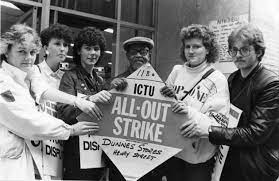
Anti-apartheid activist Nimrod Sejake with some of the Dunnes Stores striker.

Reference has been made on a number of occasions to the heroic actions of the Dunnes Stores Anti-Apartheid strikers in 1984 who spent nigh on three years on strike because they refused to handle South African merchandise.

It has been pointed to as a success story for boycotts and one to emulate. The real story of the strike points to the difficulties we now face in implementing a real boycott of Israel.

I used to go down to the picket line at the Dunnes branch in Henry Street every Wednesday, as we had a half day at school and on Saturdays when there was no school and then more regularly once I had sat my Leaving Cert exam and was, like many young people in 1980s Ireland, unemployed.

So, I recently bought a copy of Mary Manning’s autobiographical account of the strike, Striking Back: The Untold Story of an Anti-Apartheid Striker (Collins Press).

The book brought to mind many of the instances and difficulties that they faced and it raises many questions for those who wish to point to them as an example to follow.

The strikers were implementing a trade union resolution, and at first knew little of the reality of South Africa, something they corrected relatively quickly, thanks in no small part to a South African exile, Nimrod Sejake, who turned up to join them on the picket line.

Sejake was an activist who had been arrested as part of the infamous Treason Trial. Mary Manning is full of praise for Nimrod and rightly so.

Others do not come out so well and it is worth remembering the reality of that strike as it tells us some of the things that need to happen if we want to see similar action in relation to Israel.

The first thing that jumps out of the pages, early on, is that the trade bureaucracy did not give them any support and even their own trade union, IDATU (now called Mandate) was very reluctant to support them.

What support they got was down to their official Brendan Archbold who was a stalwart in supporting them and the then head of the union John Mitchell. At every twist and turn they had to fight the executive of IDATU, whilst the rest of the trade union movement ran for cover.

There will be no similar type of action around the Zionists unless it is put to the bureaucracy and they are challenged over their inaction in the midst of a genocide.

Karen Gearon, the shop steward at Dunnes Store made a call at the National March in Dublin on February 17th for the trade union movement to stop talking and take action. It is not something that has been seriously echoed by others.

Neither People Before Profit TDs or the IPSC have ever made a clear call for action from the trade union movement. It should be a central part of any boycott movement now.

It is all well and good picketing Starbucks, but stopping the importation of Israeli goods would be more important and will only happen if the bureaucracy is pushed to it. The history of PbP is one of cowering in the shadow of the bureaucrats and never putting it up to them on any issue.

They frequently share polite platforms with the bureaucrats and never challenge them. Their calls, when made are generic and are in passing. Their website and the IPSC site is limited to a consumer boycott with calls for the government, not workers, to take action.

I was also reminded by the book how the great and good in Irish society stood by whilst these workers were on strike. The Minister for Labour at the time was Ruairí Quinn, a member of the Irish Anti-Apartheid Movement (IAAM) and yet he did nothing.

He was not the only mealy-mouthed figure in Irish society, nor indeed in the Irish Anti-Apartheid Movement.

The head of the Catholic Bishops Aid Agency, Trócaire, Bishop Eamon Casey privately wrote to IDATU early on describing the strike as ‘economically harmful to the already impoverished Black South Africans.’

The strikers’ request for support from the Catholic Church was described as impertinent and just in case anyone doubted how he saw himself, he was of the view that both he and Trócaire should have been consulted before the strike took place.

Their currency now is much devalued in Ireland but there are others like them who also think they have a veto on decisions.

He was later forced to publicly back the strike having been embarrassed by Archbishop Desmond Tutu’s decision to present two strikers to the world at his London press conference en route to pick up his Nobel Peace Prize.

Though that took a while and meantime nuns proudly scabbed and crossed the picket line. Casey’s attempts at sabotage and his later hypocrisy in belatedly supporting the strike, should not be forgotten.

At the time he was seen as a moral guardian, his plundering of church funds to keep his lover and his child comfortable was not known.

There are lots of other figures like him around now, who we might expect to support workers implementing a boycott, but might not when faced with the reality of it.

Another figure who comes out badly in it is Kader Asmal, the head of the IAAM. After three months of strike action, he met with John Mitchell and Brendan Archbold and told them to call off the strike, that it had served its purpose and that he was pulling his support.

When Desmond Tutu invited the strikers to South Africa he privately told them he would not support them going as it was a breach of the cultural boycott of South Africa.

Their trip to the country and the refusal of the Apartheid regime to let them in along with their detention at the airport was a pivotal moment in the strike.

Upon their return to Ireland, Asmal was one of the people to rush to the airport and give interviews and bask in the glory, as his position opposing the trip was never made public. He comes across very badly in the book.

I recall him asking me for information on South African goods coming through the port where I had begun working and Brendan Archbold telling me not to trust him, that he was a sleiveen and would hang me out to dry. He was, and like him there are others just like that on the issue of Gaza.

The contrast with Nimrod Sejake could not have been greater.

Sejake was a working class militant who suffered greatly and enjoyed none of the middle class trappings of Kader Asmal’s life in Ireland and unlike Asmal he had never crossed a picket line, something Asmal did in Trinity College where he worked, scabbing during a strike there.

There are Palestinian equivalents to Asmal and also to Sejake. The IPSC pretends otherwise.

So, what are the lessons of the Dunnes Stores strike?

One is that it wasn’t just a consumer boycott, it was a workers’ boycott and they were left high and dry by many of those who would have been expected to support them.

If we are going to call for workers action, various people and bodies need to be challenged and would have to commit themselves publicly to it. So far this is absent. PbP and the IPSC are not putting it up to any of the institutions.

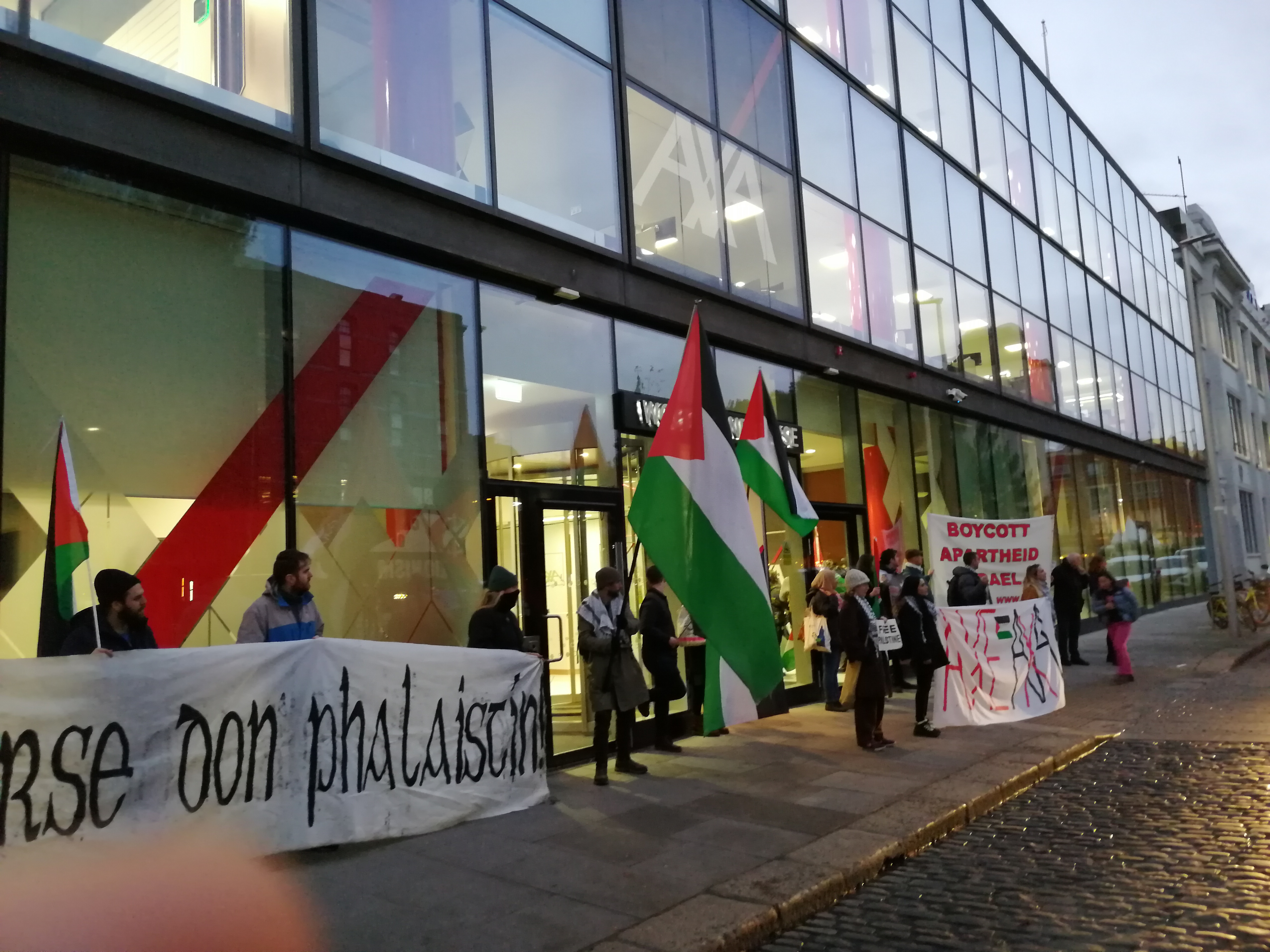
View of the protest outside Axa Insurance 14 December 2023 while others inside carried out a protest sit-in. (Photo: D.Breatnach)

In fact, the UNITE union complained about a sit-in at Axa Insurance company saying it was harmful to the workers. The sit-in was not organised by the IPSC but by CATU and Dublin for Gaza.

It turns out that UNITE is a bit like IDATU.

The union has also passed resolutions supporting the campaign of BDS and yet “according to union insiders, Axa is Unite’s insurer in Ireland – and Unite’s designated provider of hotel accommodation is the Leonardo hotel group, which is part-owned by the Israeli Fattal group.”(1)

UNITE members taking action would most likely be shunned by their own union. Just like the head of the IAAM, Kader Asmal had tried to undermine the Dunnes Stores strike, there are those in the IPSC who would run for the hills were workers to take action against Israel.

So, we do need to emulate the Dunnes Stores strikers, but we need to be clear about the challenges and the opposition we would face from the trade union movement itself, the Catholic Church (they never went away either) and sectors of the IPSC.

It is time for action, but it is also high time that both PbP and the IPSC made clear calls for action and workers are not left hung out to dry, should they take action.

Notes

(1)Skwakbox (15/12/2023) Outrage builds over Unite’s use of Israel-linked firms as protestors occupy Axa Dublin office
https://skwawkbox.org/2023/12/15/outrage-builds-over-unites-use-of-israel-linked-firms-as-protesters-occupy-axa-dublin-office/

The Martyrdom of Gaza: A Never Ending Saga

Gearóid Ó Loingsigh

16 November 2023


Israel uses white phosphorus munitions in Gaza during Operation Cast Lead.

Norman Finkelstein published a book a number of years ago entitled Gaza: An Inquest Into Its Martyrdom.

In it he looked at various major episodes in the long bloody onslaught on the people of Gaza, amongst them Operation Cast Lead and also the attack on the boat Mavi Marmara and the Goldstone Report, amongst other issues.

He could have written it yesterday about the current genocidal plans of the Israeli state.

The Israel Defense Forces fired at least three white phosphorus shells above this UN-run school in Beit Lahiya on January 17, 2009, killing two and wounding 14. The school was housing about 1,600 displaced persons at the time. The IDF have used these munitions a number of times since. © 2009 Getty Images

The current Israeli offensive is just one more in a long line of massacres. This is not a review of Finkelstein’s book, though any book by him is worth reading and should be read. Rather I just want to use the book to show that what is happening now is not new, it is just more intense.

Israel has murdered before, it has lied, it has committed war crimes and it has always received the support of western states.

Above all we should be clear that we are where we are partly due to the Oslo Accord and also the role played by the Palestinian Authority and the PLO. They cannot wash their hands of the affair.

“One of the meanings of Oslo,” former Israeli foreign minister Shlomo Ben-Ami observed, “was that the PLO was . . . Israel’s collaborator in the task of stifling the intifada and cutting short . . . an authentically democratic struggle for Palestinian independence.”

Rabin (left) and Arafat shake hands on the Oslo Accords under the management of then US President Clinton. (Photo sourced: Internet)

In particular, Israel contrived to reassign to Palestinian surrogates the sordid tasks of occupation. “The idea of Oslo,” former Israeli minister Natan Sharansky acknowledged, “was to find a strong dictator to . . . keep the Palestinians under control.”

“The Palestinians will be better at establishing internal security than we were,” Israeli prime minister Yitzhak Rabin told skeptics in his ranks, “because they will not allow appeals to the Supreme Court and will prevent the Association for Civil Rights in Israel from criticizing the conditions there. . .

They will rule by their own methods, freeing, and this is most important, the Israeli soldiers from having to do what they will do.”(1)

In other words, Gaza has bled under the passive gaze of the bureaucrats of the Palestinian authorities and of course of the reactionary Arab regimes that have never lifted a finger to help their Palestinian brothers and sisters.

They have not even threatened to cut off the supply of oil to the West, something they could do right now, but won’t. It has also happened under the gaze of those on the Left who run around shouting Implement Oslo! Two State Solution!

They ignore the fact that Oslo represented an ideological, political and military defeat for the Palestinians. The PLO accepted its role as puppet, administrator of a small urban city-like council and as chief repressor of those who continued to fight for Palestinian freedom.

A look at the Oslo II Accord, signed in September 1995 and spelling out in detail the mutual rights and duties of the contracting parties to the 1993 agreement, suggests what loomed largest in the minds of Palestinian negotiators.

Whereas four full pages are devoted to “Passage of [Palestinian] VIPs” (the section is subdivided into “Category 1 VIPs,” “Category 2 VIPs,” “Category 3 VIPs,” and “Secondary VIPs”), less than one page—the very last—is devoted to “Release of Palestinian Prisoners and Detainees,” who numbered in the many thousands…

The barely disguised purpose of Oslo’s protracted interim period was not confidence building to facilitate an Israeli-Palestinian peace but collaboration building to facilitate a burden-free Israeli occupation.(2)

However, Israel is now militarily weak. Finkelstein points to a number of attacks where it has shown its weakness. Its predilection is for attacks on the civilian population that can’t fight back.

In 2006, it opted to bomb civilians in Lebanon rather than engage in a proper fight with Hezbollah “terrorizing Lebanese civilians appeared to be a low-cost method of “education.”(3)

In Gaza in Operation Cast Lead in 2008/9, it followed a similar path of aerial bombardments of civilians rather than land invasions, that would see its troops face the wrath of Hamas and other armed organisations. So first they relentlessly bombed Gaza before any troops went in.

When the troops went in, the civilian population was their preferred target then as it is now. The murder of civilians is not new. It is part of an Israeli strategy of claiming easy victories.

An Israelicombatant remembered a meeting with his brigade commander and others where the “rules of engagement” were “essentially” conveyed as, “if you see any signs of movement at all you shoot.”

Other soldiers recalled, “If the deputyBattalionCommander thought a house looked suspect, we’d blow it away. If the infantrymen didn’t like the looks of that house—we’d shoot” (unidentified soldier); “If you face an area that is hidden by a building—you take down the building.”

Questions such as ‘who lives in that building[?]’ are not asked” (soldier recalling hisBrigadeCommander’s order);

“As for rules of engagement, the army’s working assumption was that the whole area would be devoid of civilians … Anyone there, as far as the army was concerned, was to be killed” (unidentified soldier);

“We were told: ‘any sign of danger, open up with massive fire” (member of a reconnaissance company); “We shot at anything that moved” (Golani Brigade fighter); “Despite the fact that no one fired on us, the firing and demolitions continued incessantly” (gunner in a tank crew).

“Essentially, a person only need[ed] to be in a ‘problematic’ location,” a Haaretz reporter found, “in circumstances that can broadly be seen as suspicious, for him to be ‘incriminated’ and in effect sentenced to death.”(4)

In all around 1,400 Palestinians were murdered in Operation Cast Lead, with 80% of them being civilians including 350 children. Israeli casualties were risible in comparison, just 10 combatants were killed, four of whom were killed by friendly fire.(5)

Then as now, Israel wheeled out the old trope of “human shields”. Amnesty International found no evidence of that,(6) in fact, it found evidence of Israel using children as human shields.(7)

It also found that Israel used then, as it does now, white phosphorous against schools, hospitals and even the UNRWA.(8) Furthermore, 99% of the air attacks were accurate.(9) If they murdered civilians, it is because the civilians were the target.

Following the operation, the Goldstone Report was published. It surprised no-one when it found evidence of Israeli war crimes and to a lesser extent of Hamas. It is a salutary lesson for those who now place their confidence in the International Criminal Court (ICC).

Goldstone made various recommendations.

Individual states in the international community were exhorted to “start criminal investigations in national courts, using universal jurisdiction, where there is sufficient evidence of the commission of grave breaches of the Geneva Conventions of 1949.

“Where so warranted following investigation, alleged perpetrators should be arrested and prosecuted in accordance with internationally recognized standards of justice.”(10)

We know that nothing of the sort happened. In fact, the western governments paid little heed to the report. Goldstone was forced to recant on the conclusions to his report.

Netanyahu for his part announced that he wanted to amend the rules of war leading to Israeli historian Zeev Sternhell asking “What is it that Israel wants … Permission to fearlessly attack defenseless population centers with planes, tanks and artillery?”(11)

Exactly.

And here we are today, with Israel unilaterally amending the rules of war, with the green light from the EU and the USA, amongst others. They murder civilians and no one proposes doing anything.

In Operation Cast Lead, the harshest sentence emitted by an Israeli court was seven and a half months to a soldier who had stolen a credit card!(12) Minor financial crimes are of greater concern than war crimes or crimes against humanity.

After this genocide in Gaza, we can’t expect much from the ICC.

Throughout its history the ICC has opened just 31 cases, including one for genocide. All of them against African leaders. This does not mean that those leaders did not deserve to be judged for their crimes, but that the ICC is just the legal arm of imperialism.

It has never attempted to put on trial the powerful in the West and despite everything even less so Israel. This year it issued a communiqué announcing that it would issue an arrest warrant for Vladimir Putin for war crimes and did so on its own initiative.(13)

In the case of Gaza, it will do nothing of the sort. Those who place their trust in the ICC or in the Palestinian Authority are fooling themselves. This situation is the result of turning a blind eye to Israel for many years whilst it commits all sorts of crimes.

It didn’t act before and it won’t do so now. Neither will the Arab regimes do much, unless their own populations force them. They fear the Palestinians and their own people as they know that the struggle against Zionism is also a struggle against them.

The more revolutionary Palestinian groups used to say that the path to Jerusalem went through Amman and Damascus. They were right, it does pass through those capital cities and also Beirut, Riyadh, Cairo and all the others and not through the ICC.

In fact, one day the judges and prosecutors of that body should be put on trial for their complicity in Israel’s war crimes and crimes against humanity through their inaction and omission.

It is beyond the scope of this article to deal with the role of Amnesty International in its own reports on Palestine.

They are what Finkelstein refers “as far from being the exception that proved the rule, Amnesty actually constituted a variant of the rule: instead of falling silent on Israeli crimes during Protective Edge, Amnesty whitewashed them.”(14)

I will leave it to the reader to look at the book for more information on that particular betrayal. Suffice to say, we can expect little from such organisations. At best they gather data we can sometimes use.

Notes

(1) Finkelstein, N. G. (2018) Gaza: An Inquest Into Its Martyrdom. California. California University Press. pp 6 & 7

(2) Ibíd.p.10

(3) Ibíd. p.26

(4) Ibíd.p.45

(5) Ibíd. p.70

(7) Ibíd. p.71

(8) Ibíd., p. 75

(9) Ibíd., p. 204

(10) Ibíd., p. 91 & 92

(11) Ibíd., p.93

(12) Ibíd., p.101.
 
(13) See https://www.icc-cpi.int/news/situation-ukraine-icc-judges-issue-arrest-warrants-against-vladimir-vladimirovich-putin-and

(14) Finkelstein, N.G. (2018) Op. Cit. p.238
 

LOOKING BACK AT UKRAINE AND PALESTINE CONFLICTS 2014

Bill O’Brien, text of speech delivered at Athens conference in 2014; first published in The Pensive Quill blog and sent to Rebel Breeze.

(Reading time main text: 4 mins.)

In May 2014, the week following the Odessa massacre, a small group of mostly non-aligned antifascists in Ireland organized through word of mouth and through social media a successful demonstration in Dublin.

We rallied against the fascist atrocity and described it as part of an imperialist anti-Russian agenda in the EU and we called for support in Ireland for the struggle against the Ukrainian army in Donbas. 

There was very little reporting on the atrocity in the mainstream media.

Unfortunately, it was complemented by virtual silence from nominally anti-imperialist, socialist organizations in the country, despite the fact that a massacre had occurred the day after Mayday, the historical day of workers’ solidarity and that it was committed by openly fascist groups inside a trade union hall.

Fascists and far-right Ukrainian nationalists besieged anti-fascists in Odessa trade union building on May 2nd 2014 and set fire to the building. Nearly 40 were confirmed killed, often by the mob as they jumped to escape the flames and a great many were injured. (Photo cred: Reuters)

What seemed surprising to us at the time was the fact that the Irish trade unions had issued no statements at all on the tragic event of May 2nd.

There were no messages sympathising with the loss of life or condolences to grieving families sent by the union hierarchy, no expression of solidarity as one would have expected.

There was no condemnation, or even any acknowledgement from the trades union movement that a horrendous crime had been committed against young anti-fascists who had sought refuge from an armed fascist mob in the Odessa House of Trade Unions.

When we raised the question of this silence with members of groups associated with the Left in Ireland, we found that most were hardly interested in addressing a threat that even some right-wing commentators had been drawing attention to – i.e. the re-appearance of Nazism and the support fascism was receiving from the Ukraine government – in a part of Europe that was aspiring to join the EU.

To the extent that these leftists mentioned Odesa at all, they argued that the massacre took place in the context of a war in Ukraine between forces aligned with two equally regressive imperialist regimes.

That is between supporters of the EU / NATO on the one hand and supporters of a paramilitary Russian nationalism aligned to Russian “imperialism”, which was attempting to redraw the Ukrainian borders.

Those who died or suffered injury in the Odessa massacre were portrayed, when they were mentioned at all, as unfortunate victims of inter-imperialist rivalry.

The successful resistance and defeat of fascist brigades in Donbas earlier this year – by “tractor drivers and miners” as Putin put it – halted a march to the right that was taking place across the whole of Europe. That defence gave the world time to face reality.

Social media and non-Western media sources have allowed us the space to counter much of the propaganda. We have received support from trades unionists as well as from those political groups that are not tied to the pro-UK line followed by most of the official Irish media.

But we have found that attempts to oppose a pro-imperialist narrative are too often treated as affronts to the unity of the Left political project in Ireland. Political discourse of the sort that insists on a precise understanding of the meaning of words is too often dismissed as sectarian or divisive.

In the lexicon of much of the Left, the concretely understood word “imperialism” has been replaced by words taken from the language of “humanitarian” intervention that has been promoted by groups such as Amnesty.

When we say that Russia is not an imperialist country for instance we get accused of introducing what are termed “sectarian ideological squabblings.” Bono’s latest political musings seem to outdate Lenin’s formulation on any matter!

According to the humanitarian Left words like ” imperialism” get in the way of a united strategy that should be aimed at electing progressive left-wing representatives to the Irish parliament institution that is largely powerless in the face of austerity measures dictated by international finance.

Left unity that is based on the abandonment of principles can only weaken the fight against imperialism. This has been demonstrated in the Irish “humanitarian” Left’s responses to the present conflict in Syria and the current refugee crisis.

The influential Washington-based Foreign Policy magazine wrote correctly this month about how Russian involvement in Syria is inextricably linked to the ongoing conflict in Ukraine.

Such links have to be understood and taken fully into account in the building of a genuine internationalist movement against imperialism.

The Odessa massacre, as we know, occurred on May 2, 2014. Sightly over a month later, the Zionist onslaught against Gaza began – on 7 July 2014.

The responses in Ireland to the two events were totally different – almost as if two tragedies were simultaneously taking place on different stages on different planets.

In response to Gaza, a pro-Palestine demonstration was called in Ireland’s capital city, Dublin, for Gaza; it was attended by something in the order of 10,000 people. Those ordinary citizens at the march had undoubtedly been moved by an act of incredible brutality by a Western-backed regime on a defenceless Palestinian people.

Those speaking on the Save Gaza platform did not ever mention the Ukraine bombardment of civilian areas – supported by the US and its allies – that was taking place in Donbas at exactly the same time as the Israeli military strikes on Gaza were occurring.

The same people had supported the Maidan coup. The bombardment of Donbas was also supported by the US and its allies so wouldn’t it have been sensible for the Gaza rally organizers to mention Donbas?

At exactly the same time as Gaza and East Ukraine were under attack, the US and its allies were organizing proxy “rebel” forces in Syria aimed at the destruction of the nation’s secular state and its replacement by a pliant regime.

The Syrian crisis did not get mentioned at the Gaza rally either on account of the opportunist alliances between leftists who dominate the anti-war movement in Ireland and the Muslim Brotherhood.

We have been working since 2014 with members of the Ukraine and Russian communities in Ireland and called demos in support of Donbas.

We visited trades union headquarters in Ireland and helped Russian and Ukrainian leftists in Ireland bring the Odesa massacre photo exhibition to the country’s major cities – Dublin, Cork and Belfast.

We have held events to coincide with the showing of the photos, which have been attended by sympathetic trades union leaders, members of the Russian and Ukrainian communities and Irish republicans and socialists.

We were very pleased that our limited endeavours in Ireland have been well-matched across Europe and beyond and we draw strength from this international solidarity.

End.

Rebel Breeze COMMENT:

The events in Ukraine were well known at the time, following a US-instigated coup in 2014 (the true date of the start of the armed conflict, not February 2022).

The USA wanted Ukraine to join NATO, its bloc against Russia but the Ukraine government was more interested in staying connected to the East and in particular to Russia, having lots of linguistic and other cultural connections there.

The coup launched not only a change of government but a wide-scale attack on supporters of the previous government and on Russian-speaking communities across Ukraine, particularly in Eastern Ukraine (Donbas and Crimea).

Monuments of the War Against Fascism were torn down wherever the fascists got control.

Communities in most of the threatened areas mobilised to defend themselves against the armed attacks of the Right Sektor and the Azov Battalion (now incorporated into the Ukraine’s National Army), some with more success than others .

Mariupol fell to fascist forces but was retaken by Russian forces last year.

Anti-fascist mobilisation in Eastern Ukraine, 2014 (Image sourced: Internet)

Crimea defended itself successfully, called an early referendum and as a result joined Russia. Other areas that were not overrun remained in defensive fighting for the next eight years, mostly with no running water or electricity, under artillery bombardment until the Russian invasion.

The demonstrations, public meetings and exhibitions to raise awareness in Ireland of the Ukrainian fascist attacks in 2014 were successful to a degree but not enough to move the major part of the Irish Left, in particular the PBP and the SP – or the trade union leaderships.

Their inability to see the true nature of events there has intensified since the Russian invasion.

A national hero of the Ukrainian state now, which Right Sektor and Azov were promoting even before 2014 is not one of the Ukrainian partisans who fought the Nazi invasion and occupation.

No, it is Stepan Bandera, not only an anti-semitic anti-gypsy fascist but a Nazi collaborator during WW2, an allied organisation of his responsible for massacres which peaked in July and August 1943.

“The massacres were exceptionally brutal and affected primarily women and children.[7][2] The UPA’s actions resulted in up to 100,000 deaths.[8][9][1]

“Other victims of the massacres included several hundred Armenians, Jews, Russians, Czechs, Georgians, and Ukrainians who were part of Polish families or opposed the UPA and sabotaged the massacres by hiding Polish escapees.” (Wikipedia).

The following reference is posted to show that the attacks and their fascist connections were well known across the West but also to show how the report twists what happened to make the victims appear as the causes of the attacks.

https://www.theguardian.com/world/2014/may/02/ukraine-dead-odessa-building-fire