30th Anniversary of Irish Centre Celebrated in London Irish Embassy

Diarmuid Breatnach

(Main text reading time: 16 mins.)

In September this year, a commemoration was organised to take place in the Irish Embassy in London. As founder-member and Chairperson of the Lewisham Irish Centre for nearly a decade, I was invited to be one of the speakers.

The LIC was founded in the 1980s, difficult years for the Irish in Britain. The seemingly unlikely vision of its founders was rewarded but there were some challenging and even dangerous years experienced by its supporters.

The event opened with an introduction to the proceedings followed by the Ambassador, Martin Fraser, giving a brief welcome to the packed audience and in a modest speech handing out praise for the Centre’s achievements and longevity, who then introduced me to speak next.
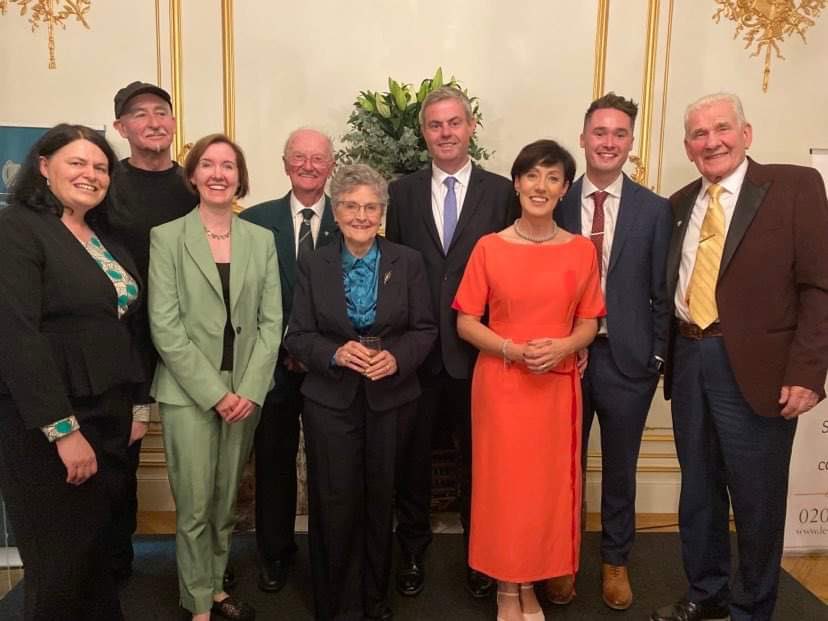
Speakers and performers: L-R Kathleen Sheridan, Diarmuid Breatnach, Jean Kelly, Denis Costello, Eileen Doyle, Ambassador Martin Fraser and Deirdre Fraser, Colm Mackey and Larry Bruce. (Photo sourced: lewishamirish.org with thanks).

SPEECH OF FORMER AND LONGEST-SERVING CHAIRPERSON

Ba mhaith liom buíochas a ghabháil as an gcuireadh ón Ambasadóir chun a bheith i láthair ar an gcomóradh seo, agus d’fhoireann na hAmbasáide as an t-ullmhúchán don ócáid.

I’d like to thank the Ambassador for the invitation to attend and the Embassy’s team for its preparations for the event. Agus don chomhluadar as a bheith i láthair – and to the general attendance here now in which I include my daughter Sorcha, her husband Irwin and my son Kevin.
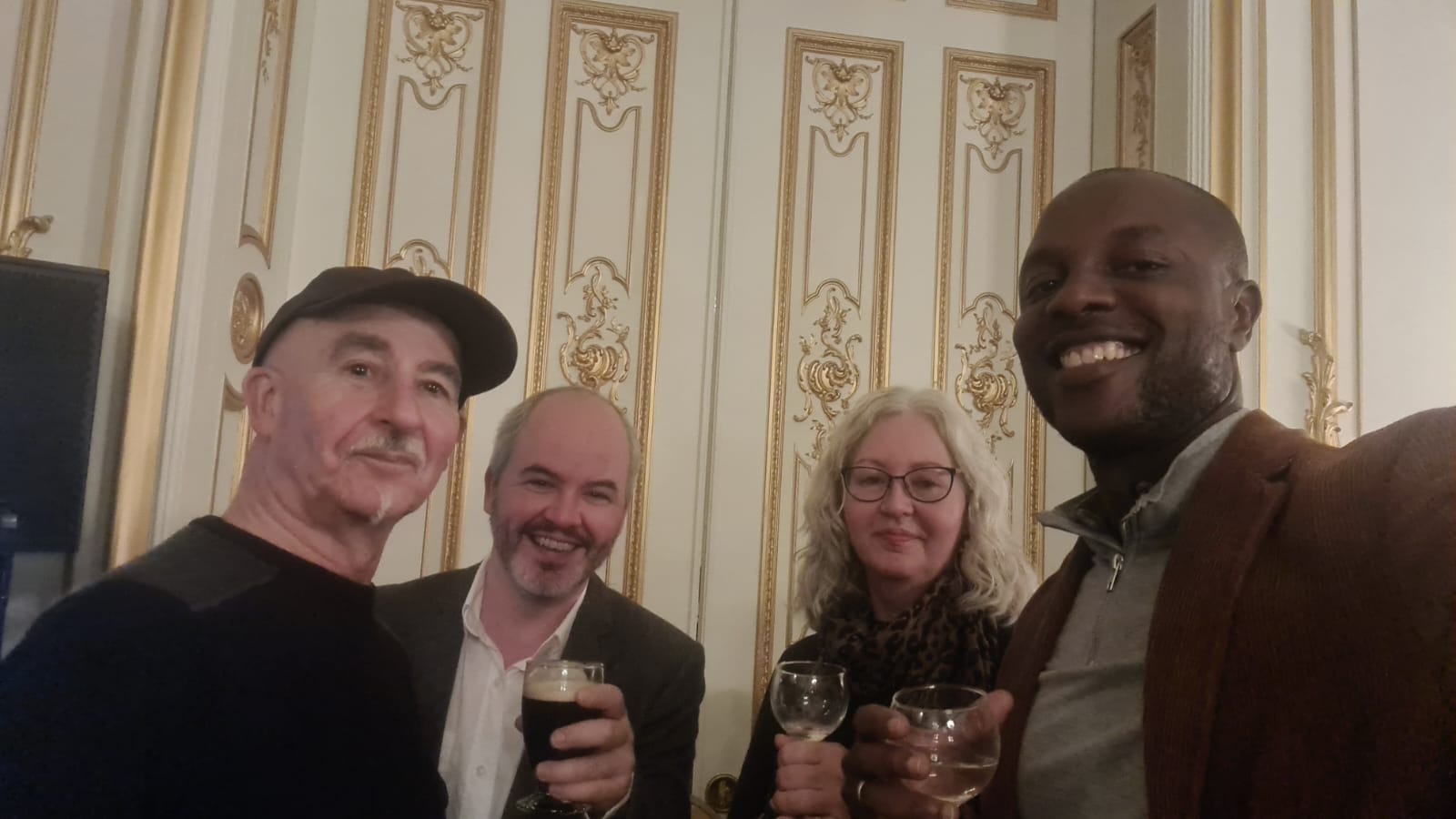
Diarmuid, Kevin, Sorcha, Irwin.

The founding of the Lewisham Irish Centre, Lár-Ionad na nGael as it came to be called, was an initiative of the Lewisham branch of the Irish in Britain Representation Group, a vibrant group formed in 19811.

The IBRG was founded as the Irish community began to shake off the repressive fear of the Prevention of Terrorism Act of 1974 – a year in which a score of innocent people from our community were jailed in four different cases2 and were to spend decades incarcerated.

I myself didn’t join the IBRG until 1986 which was the same year that its Lewisham branch was founded and I was elected Secretary of the branch. At the same meeting, a number of objectives were set out, which included the obtaining of a centre for our community.

AN IRISH CENTRE IN 1980s BRITAIN

Setting out to win an Irish Centre in 1980s Britain could be viewed as a daunting task. Blatant anti-Irish racism seemed to be everywhere and was considered acceptable in the media and in many quarters of British society3. And of course the war was still going on – very much so.

True, in London we had the Greater London Council4 which had helped the Irish community open centres and projects in a number of places in North and West London — and there was an Irish project in Greenwich – but there was no Irish centre in the whole of South London.

Furthermore, although Lewisham had an Irish ethnic minority population in significant numbers, it was not anecdotally known for such, despite containing for many years the Harp dance hall and many Irish pubs, some with weekly Irish trad music sessions.

The Irish were not then recognised as an ethnic minority by Lewisham Council or by the local Race Equality Forum or, indeed, as a diaspora, by the British Race Relations Board. Nor practically by the first Race Relations Act of 1965, which made it illegal to spread racial hatred — but not racial contempt and ridicule.

The next Race Relations Act, of 1968, made discrimination in employment and housing illegal, arguably the principal areas in which Irish and black people faced discrimination — but it was to be some time before an Irish person succeeded in a case taken under the Act.

The Race Relations Act of 1976 extended the prohibition of discrimination to provision of training and provision of facilities and services.

Throughout, the dissemination of lies, ridicule and contempt continued to be legal and also one could not take a case on behalf of the injured community, only on behalf of an individual.

The first time an ethnicity question was included in the UK Census – as distinct from “place of birth” – was in 1991 and the Irish were excluded, despite being the longest-established and largest ethnic minority within Britain.

The exclusion was also despite lobbying by the IBRG and by a number of Irish community projects.

It wasn’t until 2001 that “Irish” and “Irish Traveller” became available as ethnic categories on the UK census forms, by which time the IBRG had most local authorities in Britain signed up to agreement on ethnic monitoring with an Irish category.
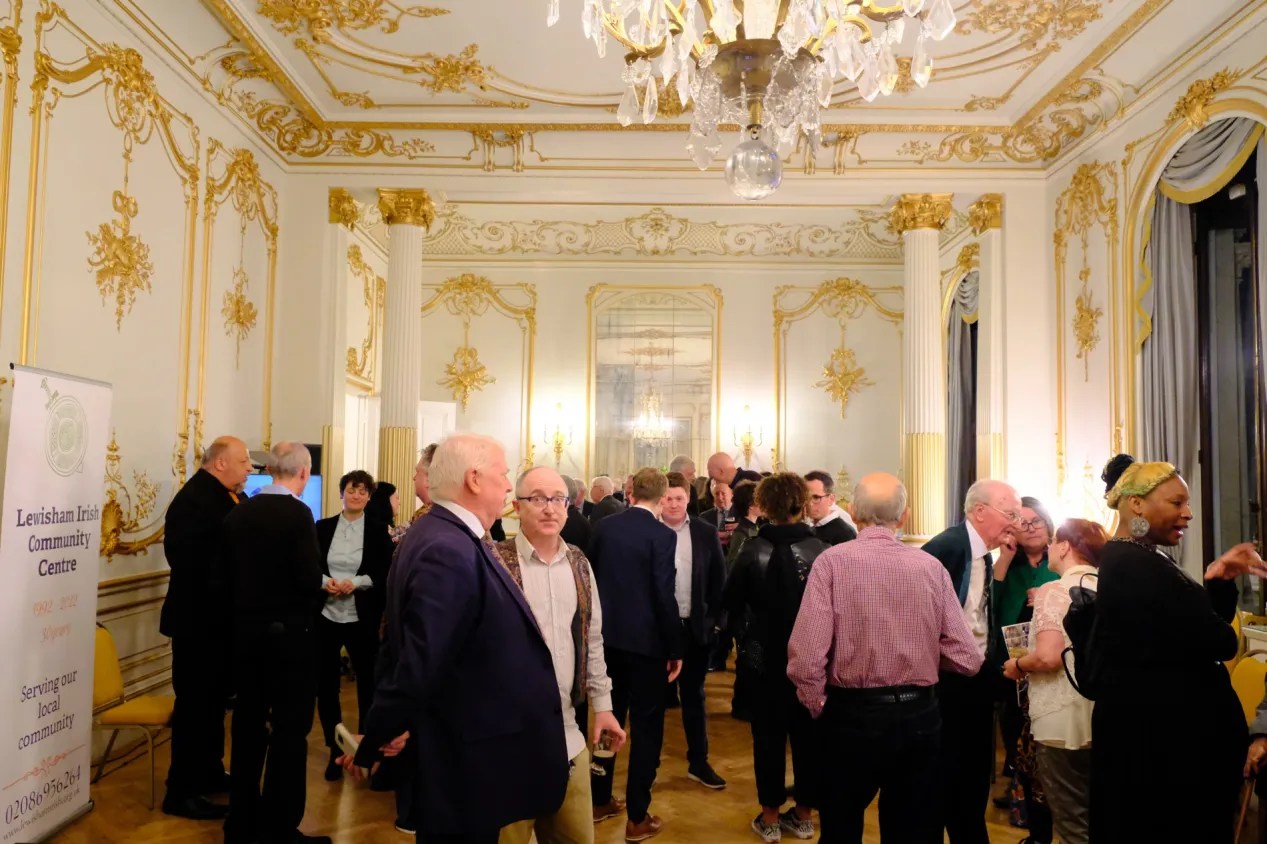
Section of the crowd at the event (Photo sourced: lewishamirish.org with thanks)

MY PERSONAL INVOLVEMENT

Back in 1986 I had returned to live in the Lewisham borough after an absence of a few years and, after Thatcher’s abolition of the Inner London Education Authority, I was transferred as a part-time youthworker to Lewisham Council’s Education Department5.

I was also active in the local branch of the trade union NALGO, later to become after a number of mergers, UNISON. As I said earlier, that was also the year I joined Lewisham IBRG.

The Lewisham branch of the Irish in Britain Representation Group, to further its aim of obtaining an Irish Community Centre, set up an Irish Centre Steering Group in which a number of Irish pensioners and younger members took part and I was elected its Chairperson.

Given its origins, the original Steering Group was 100% composed of IBRG members.

Meanwhile, the IBRG branch got on with other work, including getting Lewisham’s Adult Education department to provide classes in Irish culture, including language, dance and history, lobbying the Council on services and other issues.

These included opposing anti-Irish racism (and indeed any other kind of racism) and campaigning for the abolition of the Prevention of Terrorism Act6.

LÁR-IONAD NA NGAEL
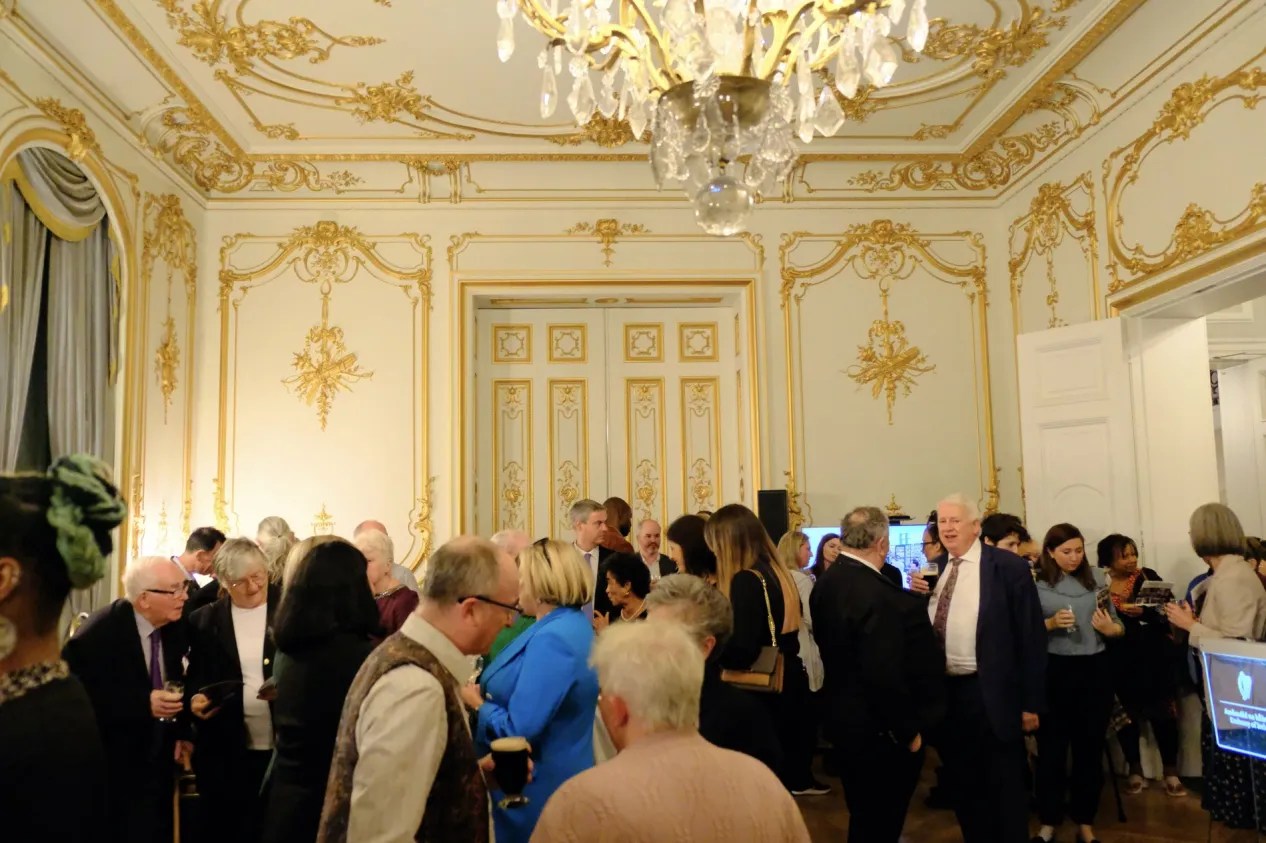
Another section of the crowd at the event (Photo sourced: lewishamirish.org with thanks)

Nearly six years later, largely I think through lobbying led by Teresa Burke, an active Labour Party member, a member of the IBRG and of the Lewisham Irish Pensioners’ Association, which the IBRG had founded, the long-disused building of Davenport Hall in Catford was made available by Lewisham Council to the Irish community.

For weeks and months the Steering Group debated a constitution, discussed the facilities, looked at design plans, watched the original budget get cut – twice – and stipulated wire screens on all the windows7, discussed staffing and placed job advertisements.

The Group also processed applications, interviewed applicants, drew up funding applications and agreed a logo — for which I’m proud to say my design was accepted.

Logo of the Lár-Ionad na nGael/ Lewisham Irish Centre, designed by D.Breatnach

Six years after the initial meeting of the Lewisham branch of the IBRG, the Centre had its grand opening to a capacity (some might say over-capacity!) invitation-only crowd in 1992 and among those present were Joseph Small, the Irish Ambassador of the time.

Also there were then Labour MEPs Jim Dowd and Richard Balfe (now Conservative member of the House of Lords) and local labour MP Joan Ruddock. The then Mayor of Lambeth attended and of course a number of Lewisham Councillors, many if not all of Irish descent.

And the Chair and Vice-Chair of Meath Urban District Council in Ireland, birthplace of Jim Connell, author of the lyrics of the Red Flag, who came to present a piece of stone from Connell’s home.

Jim Connell was living in Stondon Park in Lewisham when he composed the lyrics and there’s a plaque on his house commemorating that fact — which we also had a hand in doing8.

Plaque on home of Jim Connell from Meath. The Lewisham Branch of the IBRG requested adding the words “Irish Republican” but the latter word did not make it on to the plaque. (Photo: D.Breatnach)

After the speeches, the Irish music and Irish dancing exhibition, we got down to managing the centre. The Steering Group had six months to go before an AGM of members of the newly-opened centre would elect a management committee.

That was a democratic stipulation we had set ourselves, seeking as wide a representation as possible from the community.

When the six months were up, the AGM was held and surprise surprise, more or less the same people from the Steering Group were elected on to the new Management Committee. The Committee members in turn, did me the honour of electing me again as Chairperson.

I was elected annually to that position until about 2001 I think when, after two attempts I finally managed to get out of it — but remained on the Management Committee until I returned to Ireland in the summer of 2003 to manage a hostel for street drinkers.

By that time Lewisham IBRG had proposed that the Irish Pensioners’ sub-group become independent, which it did and affiliated to the Lár-Ionad in its own right, as did also the IBRG branch.

Both groups were the original community groups affiliated to the Centre and were followed afterwards by an Irish step-dancing school that held classes in the Lár-Ionad.

For most of those years, those were all the affiliated groups although later and for a short while, a local Irish accordion marching band also affiliated.

OVERVIEW OF EVENTS & SERVICES

The Lár-Ionad held or facilitated a plethora of activities and events: Irish step-dance classes through Tony Tyrel; set-dancing classes9; social functions including céilíthe and the Sth. London St. Patrick’s Day Parade for a number of years, each one with a different theme.
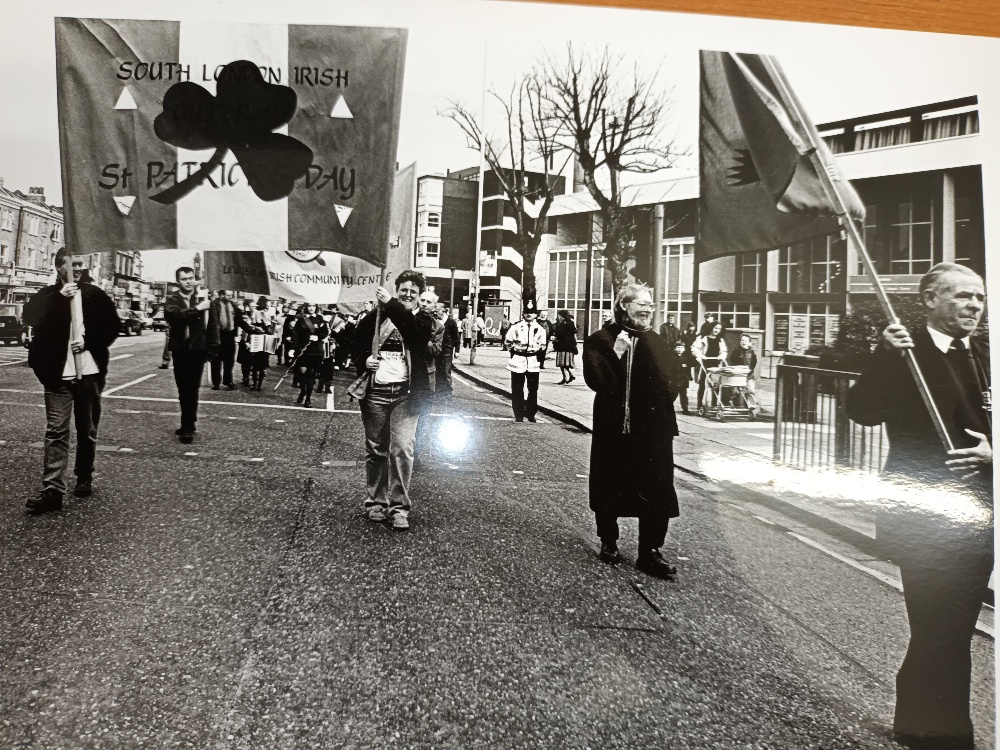
Photo of the South London St. Patrick’s Day Parade which ran for four years. It is shown parading through Lewisham on its way back to the Irish Centre passing the public baths building. (Photo sourced LIC archives with thanks)

It also founded Lewisham Irish Week and ran activities during it; a weekly advice service; weekly pensioners’ social meetings; conferences on issues affecting the Irish community; meetings; lobbying for an Irish ethnic minority category ….

The IBRG branch organised a weekly Children’s Irish Art & History Group and produced two plays, ran an annual Children’s Irish Hallowe’en Party and also organised historical commemorations and talks.

In addition the hire of the hall was made available for other communities and organisations though quite early on we stipulated there be no religious services of any kind in the hall.
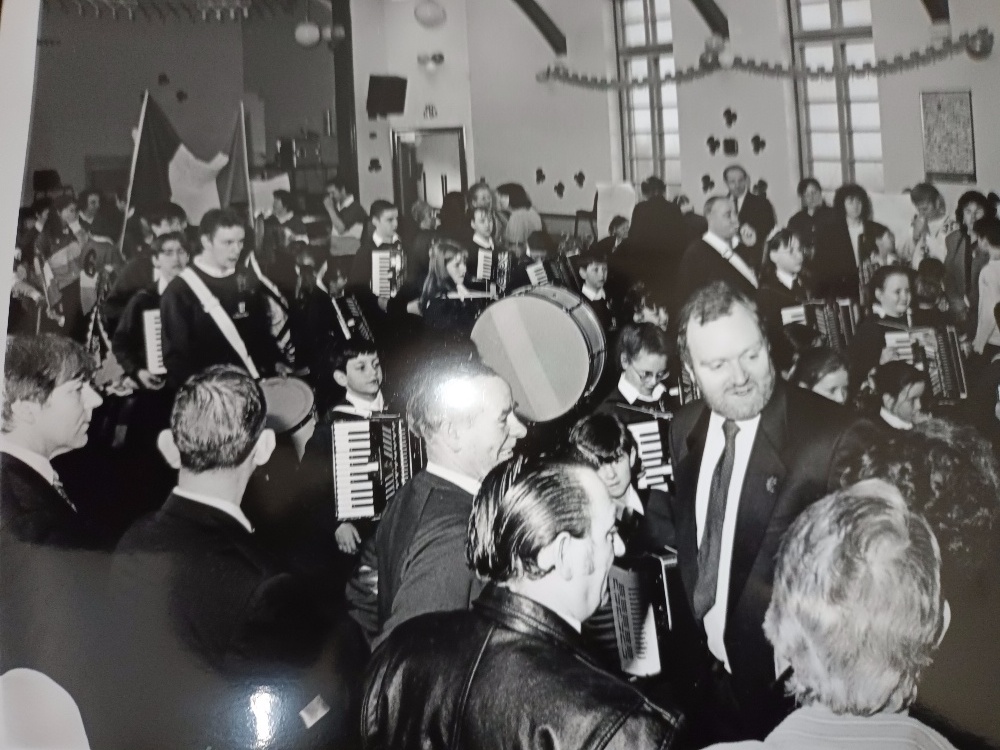
The Celtic Cross Accordion Band back at the LIG after participating in the SL St. Patrick’s Parade (Photo sourced: lewishamirish.org with thanks)

CHALLENGES

Work in any community will have its rewards and challenges and any migrant community in the 1980s and 1990s would have those as well as ones related to being an Irish community.

There were tensions with sections of the local Irish community who saw the Irish Centre perhaps as upstarts, or might have felt they should control the Centre. There were at times too of tensions within the management committee itself, which is not surprising.

However twice during the early years I felt obliged to threaten resignation as Chairperson if proposals which I felt went against our Constitution were carried10.

I was of course accused of blackmail but a Chairperson is, above all other committee members, a guardian of the constitution and I was glad the proposals were withdrawn.

Most of the time we got along very well and did an enormous amount of work, really, looking back on it now.
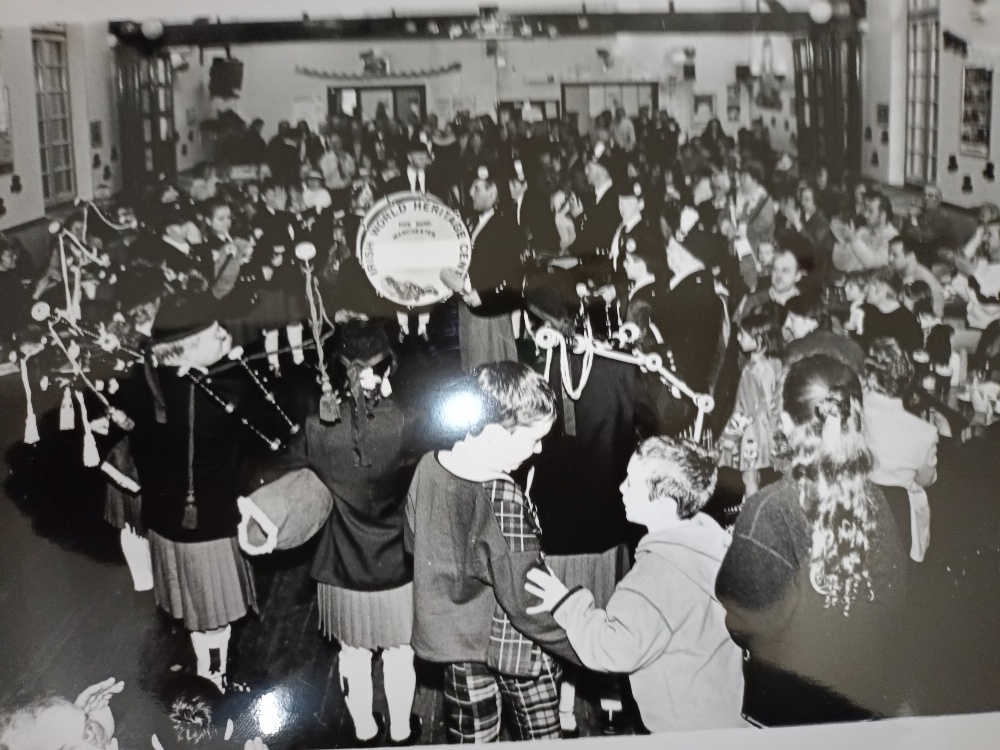
The Irish World Heritage pipe band back at the LIG after the South London St. Patrick’s Parade (Photo sourced: lewishamirish.org with thanks)

THREATS – ARSON AND FUNDING WITHDRAWAL

The other threats we faced were external. One year the advertised annual 1916 Rising commemoration event held in the Centre11 came to the attention of an individual who had tragically lost a son in the Omagh bombing.

He called the Centre’s Manager to have the event cancelled, which he naturally declined to do, after which the man rang the Council and not getting the response he wished, got on to the media.

I received a phone call from the centre’s Manager at my job, then managing a hostel12 in the Kings Cross area, that we were in the evening newspaper supposedly holding an “IRA commemoration” and had to leave work hurriedly to get back to Lewisham.

The Council spokesperson had by now panicked and was promising the media an investigation of the Centre’s funding13. The band hired to play at the commemoration also exhibited an absence of backbone and pulled out.

However, the event went ahead – albeit under our high security conditions – and everyone in attendance indignantly refused to have their ticket money refunded and organised their own entertainment from musicians in attendance.14

Subsequently we had an arson attack which burned a hole in the building’s front door and I was so glad I had insisted on wire mesh screens for the windows.

We faced a period of our intruder alarm being repeatedly set off, requiring attendance by key-holding members of the Management Committee, and had to lobby the council to install CCTV cameras on the exterior. Which they did and the alarm-setting ceased.

The next external threat was the later and unrelated round of savage council funding cuts throughout the Lewisham NGO sector. The removal of the funding for our Manager – our only full-time member of staff — would have crippled the Centre.

We lobbied the Councillors by letter and by attending Council meetings, also held rallies outside the Town Hall and had Irish step-dancers in attendance in full costume, which of course made interesting photos for the local newspapers.

I am glad that the threat of cuts was finally withdrawn from the Centre, though it certainly could do with — and deserves — more funding. Hopefully it will never be threatened again.

Lewisham Council does now recognise the Irish as an ethnic minority within the borough and collects statistics on its representation in the Council’s employment and service take-up.
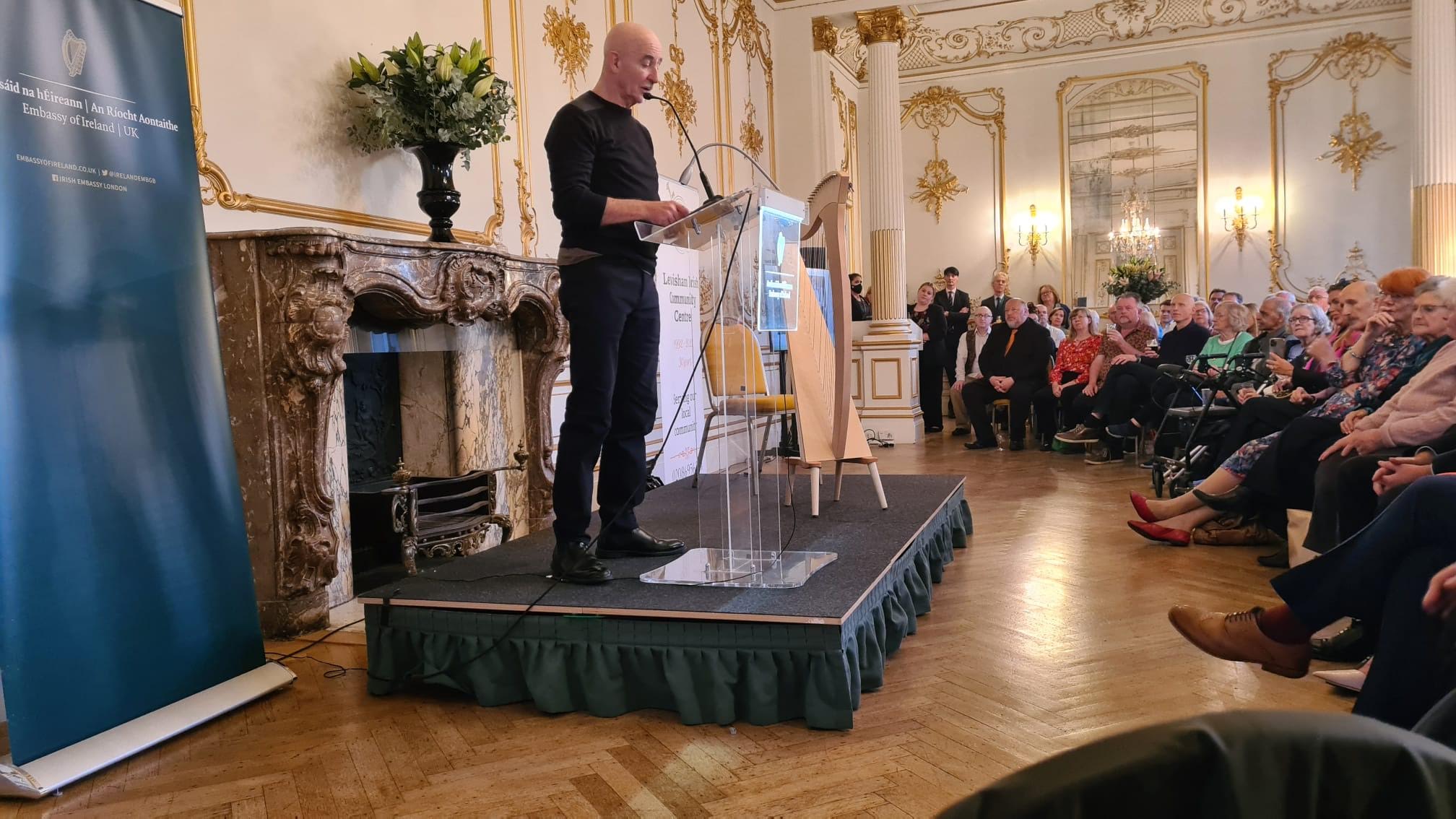
Diarmuid Breatnach speaking at the event (Photo sourced: Sorcha Ford with thanks)

PERSONAL NOTE

In conclusion, I want to put on record my earnest go raibh míle maith agaibh to the Lár-Ionad’s Staff, for their sticking with the Centre, in particular our first and wonderful Centre Manager, Brendan O’Rourke15 and our first caretaker Michael Naughton.

Also our first advice worker Tom Devine and subsequent and current advice worker Kathleen Sheridan(who is somehow these days managing that job at the same time as managing the Centre!). And who did a great job in liaison with the Embassy for this commemoration.

I’d like to pay tribute to the early members of the Irish Lewisham Pensioners’ Association, Irish Centre Steering Group and later Management Committee.

Muriel Perry, Ellen Baczor, Kathleen Henry, Molly Kennedy, Peter Sexton, and especially Teresa Burke, those survivors of Irish emigration to Britain in the 1930s and 40s, all now passed on, who worked hard, often in jobs considered menial.

They paid their taxes in Britain and still sent money home to their families in Ireland. From the 1940s up to the 1960s, those remittances formed a significant portion of the economy of the Irish state.

I remember some of their stories: Kathleen Henry, a Presbyterian by religion, telling me that her forebears “were out” in the 1798 Uprising; Teresa Burke failing to catch a bus in wartime Lewisham and seeing a Nazi bomb blow it up further down the road.

Muriel Perry telling me that Catholics in her Belfast area during the same war were refused dole and encouraged to go to England.

Teresa Burke again, arguing with me that I should vote Labour and, at her husband’s funeral, bursting out laughing to see me in a suit for the first time in all the years she had known me.

As we say back home, I lift a stone to place on each of their cairns.

I want to acknowledge also later management committee members — and hopefully all surviving — Patrick Codd, Raymond Barnes, Brian Fitzgerald and Tony Urquhart16.

Also to raise a symbolic glass to the broad Irish community, with all its exasperations but also its persistence and in many ways, heroism, to activists of the now-defunct Irish in Britain Representation Group, both nationally and in Lewisham.

Also to my part-time Lewisham youth-work boss Malcolm Ball, recently taken well before his time, who understood my commitment to the Irish community and accommodated it.

This is only the second time I have attended an event at the Embassy …. I was indeed more often outside it, protesting actions or inaction of the Irish Government17.

I was inside the Embassy once another time getting emergency help with a temporary passport18 when the Embassy official kindly attended on a weekend to sort me out. A thousand thanks to him too, wherever he may be now.

Mar fhocal scoir, ba mhaith liom buíochas a ghabháil arísleis an Ambasadóir, an t-Uasal Martin Fraser agus le foireann na hAmbasáide as an t-ullmhúchán don ócáid.

Finally, I’d like to thank again the Ambassador for the invitation to attend and the Embassy’s team for its preparations for the event. And to you all for listening.

Sin a bhfuil uaimse anois – that’s all from me now, you’ll no doubt be glad to hear.

OTHER CONTRIBUTIONS

CHAIR OF THE TRUSTEES

Colum Mackey gave a report on the financial situation of the Centre and its services, in terms of donations and grants received. He also reported on activities and organisations with which the Centre is now connected and also thanked staff and the membership of centre’s Board of Trustees (the management committee as trustees of its charity status).

CEO (CURRENT MANAGER AND ADVICE WORKER)

Kathleen Sheridan began her talk with an Irish-language proverb: Ní neart go cur le chéile (meaning that strength comes from united effort) and continued in a warm acknowledgement of the work of employees and volunteers, naming so many of them, and also the Meals on Wheels voluntary service in the area and the Southwark Irish groups with which they had relations.

HARPIST AND SINGERS

Jean Kelly gave a warm and interesting address relating how during the Covid lockdown she had found a Friday morning Zoom session with people in the Centre so very rewarding. She then went on to perform Jimmy a Stór and The Last Rose of Summer on the harp.

Three pensioners – Denis Costello, Eileen Doyle & Larry Bruce — succeeded one another on to the stage to render a song: The Bold Thady O’Quill, When Irish Eyes Are Smiling and Dublin In the Rare Aul’ Times.

PERSONAL REFLECTION

My family members were impressed by the whole event and I received some compliments on my speech, including from the Ambassador; the latter’s wife Deirdre was most gracious.

Some decades ago I am sure that in the unlikely event of my having received a similar invitation, the reception would have been a good deal frostier.

It was curious how many people, including those who had been members or even in management of the Centre in succeeding years, said that they had been unaware of the events to which I referred in my speech.
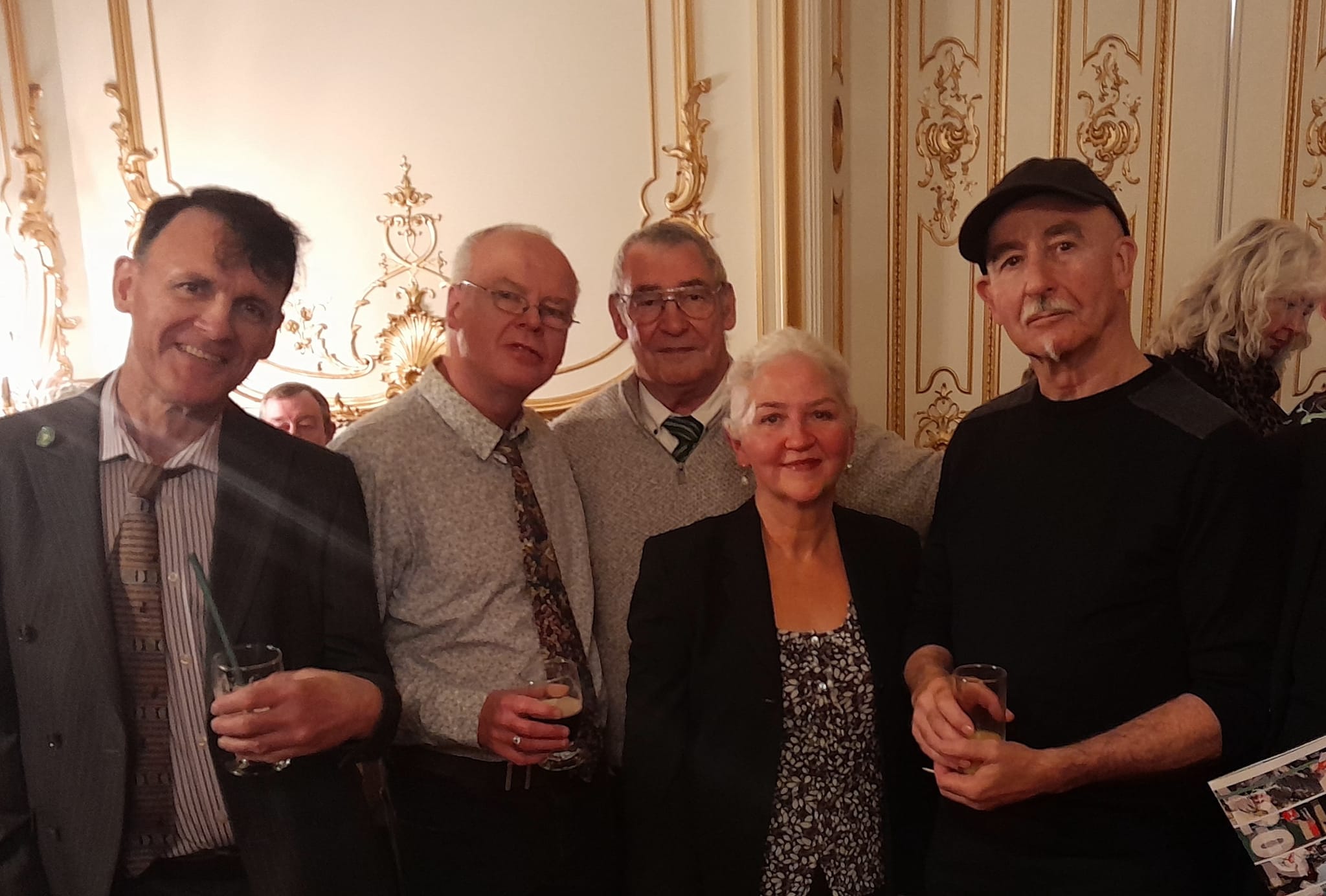
Old friends and colleagues meet for the first time in decades: Brendan O’Rourke, Raymond Barnes, Brian Fitzgerald, Elizabeth Nicholls, Diarmuid Breatnach. (Photo sourced: Raymond Barnes with thanks)

This was of course sufficient reason on its own for relating them but it is sad how communities can lose their history or have it obscured.

It was great to briefly catch up with people I knew but eventually had to tear myself away and depart with my family members.

End.

FOOTNOTES

1 I didn’t relate this but it was fairly well known at the time that the Federation of Irish Societies, a bourgeois and conservative Irish association (and the one with which the Embassy of the time preferred to have dealings) had their AGM in May 1981, during which the death of Volunteer (and MP) Bobby Sands became known. An attempt to have the meeting record a vote of sympathy for Sands’ family was ruled out of order by the Chair. Subsequently, Breandán Mac Alua, then Editor of the Irish community newspaper The Irish Post, wrote in his Dolan column that perhaps there was a need in Britain for a different and more assertive type of Irish community organisation. Subsequently community activists got together and formed the Irish in Britain Representation Group which, at its height, had a number of branches in London and individual branches in Birmingham, Brighton, Bristol, Coventry, Leeds, Manchester and NE Lancs. The Irish Post was very supportive of the IBRG during Mac Alua’s editorship.

2 The Birmingham Six, Guildford Four, Maguire Seven and Judith Ward were the most prominent of those.

3 Many incidents of anti-Irish racism were recorded and no doubt hundreds of thousands of others went unrecorded during this period and earlier. The Comedians TV series regularly featured ‘comic’ material belittling the Irish, newspapers including dailies did so too, including brutish caricatures, while TV soaps and drama series regularly included a violent Irish character (usually the only Irish character in the episode). And of course the ongoing war was reported with heavy anti-‘Nationalist’ bias and much violence towards that community unreported. The Prevention of Terrorism (sic) Act was specifically aimed at terrorising the Irish community to disrupt its activities of solidarity with the Irish struggle.

4 Led by Ken Livingstone with John McDonnell as Deputy, it was abolished by Thatcher in 1986, who then went on to abolish the Inner London Education Authority four years later in 1990.

5 I had already been working as a part-time youthworker in Lewisham but under the ILEA and had also worked in Haringey. As a part-time adult education tutor the ILEA had also employed me in Lewisham, briefly in Haringey and Southwark, while the London Borough of Newham (outside the ILEA) also employed me in that capacity. At times some of those posts were concurrent but not all.

6 It also included asking Councillors to oppose the then strip-searching of Volunteers Ella O’Brien and Martina Anderson and, as part of the overall IBRG, campaigning for Irish solidarity and British withdrawal, against plastic bullets, transfer for Irish political prisoners to Ireland and other issues. However, I left those out of my speech.

7 This was an especially strong recommendation by myself – the windows were tall on one side of the hall of which the floorboards were in wood. We were to have reason to be grateful for those wire screens.

8 For a while the LB of Lewisham employed a decent man as local historian archivist and he proposed the placing of the plaque on the house (with the permission of the owners) and notified Lewisham IBRG of the intention and wording. We responded and asked him to include “Irish Republican and author”, all of which — excluding the words “Republican” — were duly included. On the day of its unveiling a very small group attended to hear Gordon Brown MP give a speech and hear the Tannenbaum air played by trumpet. I jumped up on a nearby low wall and addressed them too, pointing out that as well as being a communist, Jim Connell had been an Irish Republican and would have strongly opposed the war against Irish people being conducted by British governments. I sent an account to the Irish Post which wrote it up in its Dolan column.

9 For those who might not know, Irish set-dancing is a form requiring four (or multiples of) pairs, dancing to different Irish traditional airs and completing patterns, taking a short rest and commencing on the next pattern. Originating with the quadrilles of Napoleonic France, set-dances have reached as far as Cuba, though of course to different bodies of music. Although one would usually encounter perhaps only between five of them, an enthusiast once told me that there are 50 different Irish set dances!

10 At this point I can only remember one of those: Some leading members of a local Irish group had been bad-mouthing the Centre and at least one Management Committee member wanted the organisation’s application for membership of the Centre refused. I did not agree with the action proposed and was also sure our Constitution gave no right to refuse membership of an organisation due to the behaviour of some of its members.

11 Lewisham IBRG had been commemorating that event since 1987 and at Lár-Ionad na nGael, as an affiliated organisation, since 1983, without any difficulties.

12 For active drug-users.

13 The IBRG branch called on Lewisham Council to apologise and retract their remarks; they never replied nor apologised. We also wrote to the Irish Post denouncing the Council’s reaction but I had to use an assumed name so as not to implicate the Management Committee, of which I was not only a member but Chairperson and Trustee.

14 The response of the attendance was heart-warming. There was a sequel to this a few days later when I and Brian Fitzgerald confronted and shamed the band at a gig they were playing in a pub not far away. I have written about this separately.

15 It was wonderful to see Brendan in attendance.

16 The latter three were very much alive and indeed in attendance.

17 For example, extradition of Republicans from the Irish state to the Six Counties colony or to Britain (e.g Dessie Ellis and Róisín McAlliskey).

18 One does not require a passport for entry into Britain from the Irish state, only acceptable forms of ID (as with the EU). Some carriers however, such as Ryanair, insist on a passport for travellers.

LINKS

lewishamirish.org.uk

BROADLY SPEAKING

Diarmuid Breatnach

(Reading time: One min.)

“Unity Is Strength” (Image sourced: Internet)

Oh, hey! We’ve started a broad front to fight this struggle.

Oh, who’s running it?

Just some of us. Independents mostly. How about you and your party joining it?

Is that (xxxxxxx redacted) party in your broad front?

They’re thinking about it.

We couldn’t join it if they were in it.

Funnily enough, the guy I spoke to said the same thing about your party.

Well, there you go.

What do you mean “there you go”? Are you interested in joining a broad front or not?

Yes, of course but ….

But only if your party is in charge, is that it?

Now, hold on! I didn’t say …..

….. ….. ….. ….. …..

Hey, we’ve started a broad front to fight this struggle. Lots of people are joining. How about you and your party?

Hmm … Who’s in it?

(xxxxxxxxxxxxxxxxxxx redacted).

Those Lefties are in it? They’re not serious – just middle class young people mostly, going through a stage ….

But weren’t you saying just last week that we need a united front? Of all kinds of people?

Yeah but not with the likes of them! It would be a waste of time.

….. ….. ….. ….. …..

We’ve started a broad front to fight this struggle. It would be good if you and your party joined it.

Those Republicans are in it, right? Some of them are being investigated for trying to organise an armed group.

Doesn’t mean they really are doing that, though. Besides, it’s their open political group that joined it.

No sorry, we can’t be associated with them.

But haven’t you been telling me for ages that we need a united front? Really need one?

Yeah but not with the likes of them! That would be too dangerous.

End.

IMPERIALIST NARRATIVE IN ‘OBJECTIVE REPORTING’

Diarmuid Breatnach

(Reading time main text: 4 mins.)

“Palestinian gunman wounds two Israelis in Jerusalem shooting” proclaims the headline. We don’t have to worry trying to figure out whose side we’re expected to be on, who’s in the wrong and who in the right. It’s right there in the headline.

“Gunman” is a heavy clue and the fact that the two he wounded are just “Israelis” – we are led to believe just ordinary civilians – does the rest of the job. That is, if indeed we are not somehow already prejudiced against Palestinians and in favour of Israelis.

However, should we bother to read further, we find that two of the wounded were far from being harmless civilians but in fact an Israeli soldier and a security guard, certainly armed for their job (even Israeli Jewish civilians are routinely permitted to carry firearms).1

The2 report tells us that the soldier was a woman. Why is this relevant? Like male soldiers, she was a serving member of the Israeli Zionist occupation armed forces, misleadingly named “Defence Forces”. Zionist female soldiers are present at all levels and all theatres of war.3

It is difficult to avoid the suspicion that this is being inserted in order to mitigate the impact of revelation that it was a soldier who was shot, which might possibly lessen sympathy for the victims on that score.

Perhaps the fact that the Palestinian in question appears to have initiated the incident justifies the appellation of “gunman”? OK, when Israeli armed forces initiate an action, do we ever see “Israeli gunmen open fire on Palestinians”?

Scene of shooting of two Israeli Zionist armed forces on Saturday in Jerusalem, one fatally (Photo credit: PA Images)

Certainly not in mainstream western media. And not just because of bias towards state armed forces, because even when the shooters are Israeli Zionist civilians, they are never called “gunmen”. And such incidents occurred on a monthly basis recently.4

MOTIVE, BACKGROUND, CONTEXT

Moving away from the actual incident, what about the background and context? “Israel already has been carrying out daily arrest raids in the occupied West Bank since a series of Palestinian attacks last spring killed 19 Israelis” the report informs us.

So the Palestinian “gunman” could have had an understandable motive in responding to Israeli Zionist oppression and repression but in case we should sympathise with him, we are reminded that “Palestinian attacks last spring killed 19 Israelis.”

After conditioning with that paragraph, the report gives us more recent possible motivation for the attack (even then, note the attempted justification for actions of “Israeli forces” fighting “gunmen” and “militants”).

“Earlier on Saturday, the Israeli military shot and killed two Palestinian teenagers during an arrest raid in the Jenin refugee camp, the site of repeated clashes between Israeli forces and local gunmen and residents. The camp is known as a stronghold of Palestinian militants.”

Body of 16-year-old Palestinian Ahmad Daraghmeh killed by Zionist Israeli soldiers carried in protest mourning. Also killed with him were Mahmoud as-Sous, 18. (Photo credit: Agence France Press)

“Palestinian officials said soldiers entered the camp early on Saturday and surrounded a house. In videos circulated on social media, exchanges of fire could be heard. The Palestinian Health Ministry reported two dead and 11 wounded, three of them critically.”

And let’s put that “killing of 19 Israelis” last spring in context too: Last year, “as a result of the violence, at least 256 Palestinians, including 66 children, were killed … In Israel, at least 13 people were killed, including two children”5. A search of any year will find a similar or worse story.

SOME OF THE TRUTH

Occasionally, we are supplied with truth, as when the report informs us that “Israel captured east Jerusalem in the 1967 Middle East war and annexed the area in a move that is not recognised internationally.”

“It considers the entire city, including east Jerusalem, home to the city’s most important holy sites, to be its capital. The Palestinians claim east Jerusalem as the capital of a future state.” Nor is East Jerusalem the only area occupied by Israel judged illegally by “international law”.6

But even this is partial truth because, whether “recognised internationally” or not, the whole territory of the state of Israel is an occupation by force of Palestinian land by European settlers in 1948, backed by some world superpowers and a constant source of conflict there ever since.

MAKING SENSE OF CONFLICTS

Context is crucial to understanding events but justification is a moral and practical judgement7 according to the standpoint of those doing the judging and evaluation. Clearly the standpoint of an occupier and a person displaced — an occupier and the oppressor – can never be the same.

It follows that those who support the occupier and more certainly invest in its support, are going to be biased against the displaced, the oppressed and repressed. The world’s biggest superpower, the USA, supports Israel hugely militarily, financially and politically.

The states of the world and their controlling elites are well aware of the balance of power and, for the moment, most support the superpower. This is even more so in the case of the geo-political area designated “the West”, location of most mainstream media agencies’ headquarters.

The bias is clear if we take the trouble to analyse and we’ll find it not only in the reporting on the Israeli Zionist state and the Palestinians but on all other conflicts, to greater or lesser degree. What stand we take depends on whether we align ourselves with the oppressor or the oppressed.

End.

FOOTNOTES

1See “Gun-carrying for Israeli citizens” in Sources.

2She has since died and headlines are now including her gender.

3“ … today women make up only about 40% of conscript soldiers and 25% of the office (sic officer?) corps.” This despite Orthodox Jewish men objecting to serve in the company of female soldiers https://jwa.org/encyclopedia/article/israel-defense-forces

4See “Absence of “gunman” when an Israeli Zionist civilian is the shooter” in Sources. Note that all these reports were taken from media sources one might suppose not sympathetic to Israeli Zionism; a quick search of Reuters only brought up a 2012 reference to such an incident and of Associated Press, not even one on the first search page.

5https://en.wikipedia.org/wiki/2021_Israel%E2%80%93Palestine_crisis#:~:text=As%20a%20result%20of%20the,were%20killed%2C%20including%20two%20children.

6Syria’s Golan Heights are one such as are the settlements on lands grabbed after the founding of the Israeli state: https://www.ohchr.org/en/press-releases/2022/03/israels-55-year-occupation-palestinian-territory-apartheid-un-human-rights

7Moral, as in do we think it wrong or right according to moral principles; practical as in whether we can show it works.

SOURCES

The report being analysed: https://www.breakingnews.ie/world/palestinian-gunman-wounds-two-israelis-in-jerusalem-shooting-1374673.html

Gun-carrying for Israeli citizens: https://www.ojp.gov/ncjrs/virtual-library/abstracts/israel-has-successful-gun-control-policy-gun-control-p-248-251-1992

https://www.aljazeera.com/news/2018/9/12/israels-eased-gun-laws-palestinian-fear-over-new-gun-permits

Absence of “gunman” when an Israeli Zionist civilian is the shooter: https://www.dci-palestine.org/israeli_settler_soldier_shoot_and_kill_palestinian_boy

https://english.wafa.ps/Pages/Details/130104

https://www.middleeasteye.net/news/palestinian-boy-shot-dead-israeli-settler-east-ramallah

https://www.reuters.com/article/uk-palestinians-israel-violence-idUKBRE84P0BE20120526

Female Israeli Zionist soldiers: https://www.lawfareblog.com/female-service-idf-challenge-integrated-army

Recent background to current incident report: https://www.bbc.com/news/world-middle-east-62445951

REVOLUTIONARY BLOC AS PART OF HUGE COST OF LIVING PROTEST

Clive Sulish

(Reading time: 4mins.)

Many thousands marched through Dublin’s city centre yesterday in protest against the soaring cost of living, pushed in particular by rising energy costs. Most mass media avoided estimating numbers except the ridiculous ‘estimate’ of 3,000 by the Irish Times daily1.

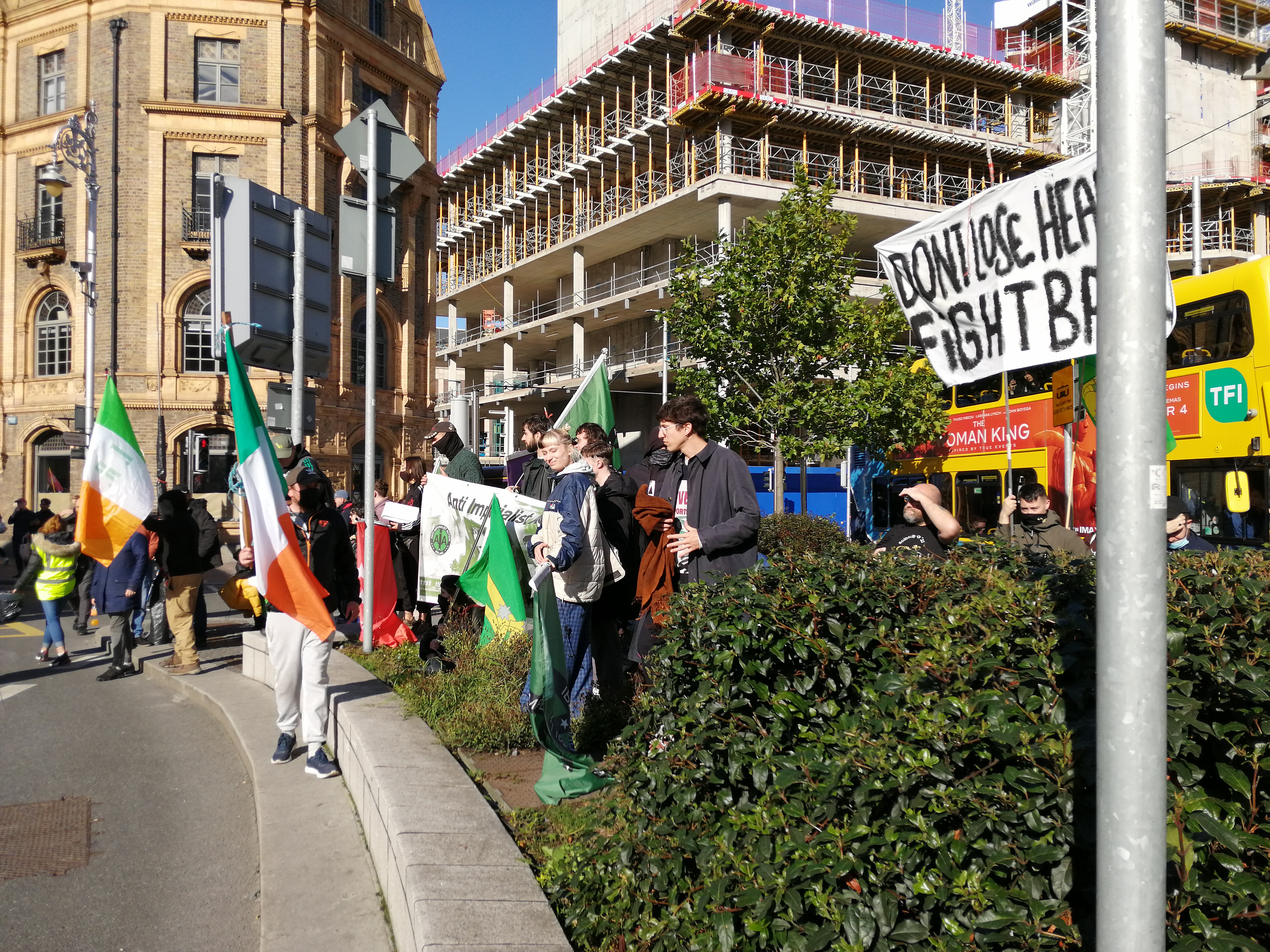
As the Cost of Living Coalition convened a mass protest demonstration in Dublin, the Anti-Imperialist Action organisation called for a Revolutionary Bloc to meet at the James Connolly monument2 in Beresford Place.

In mid-July, statistics published showed the average cost of living had risen above 9%. The average figure conceals the higher percentage rise in daily consumables such as food and drink that will rise higher still with price hikes by energy supply companies.

Companies are raising their prices steeply across at least the western world in a trend that began, despite much media discourse, prior to the Russian invasion of the Ukraine. But Ireland emerges as the most expensive country in the EU with Dublin the most expensive city there by far3.

(Photo: Rebel Breeze)

SPEECHES FOR REVOLUTION & AGAINST REPRESSION

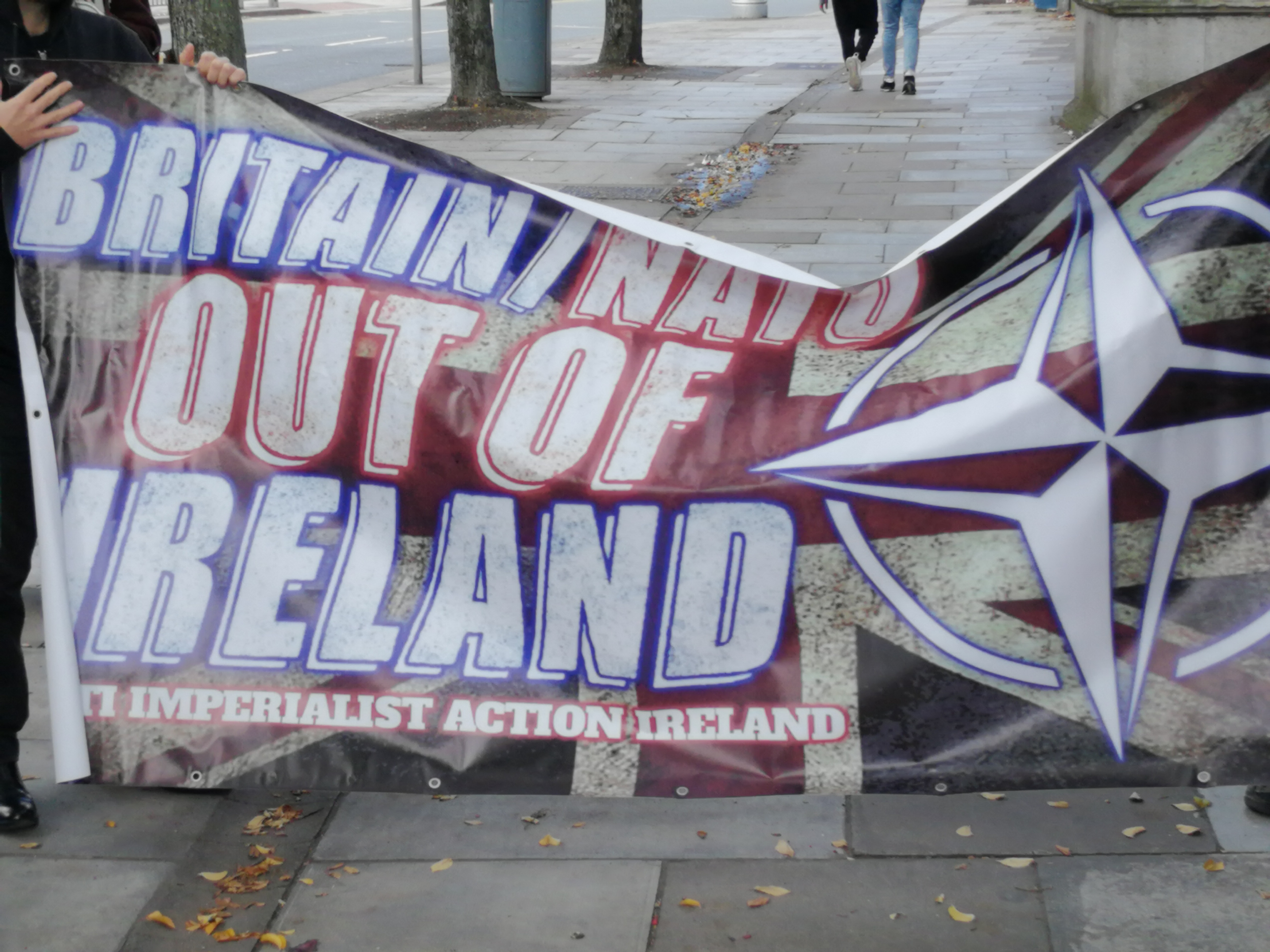
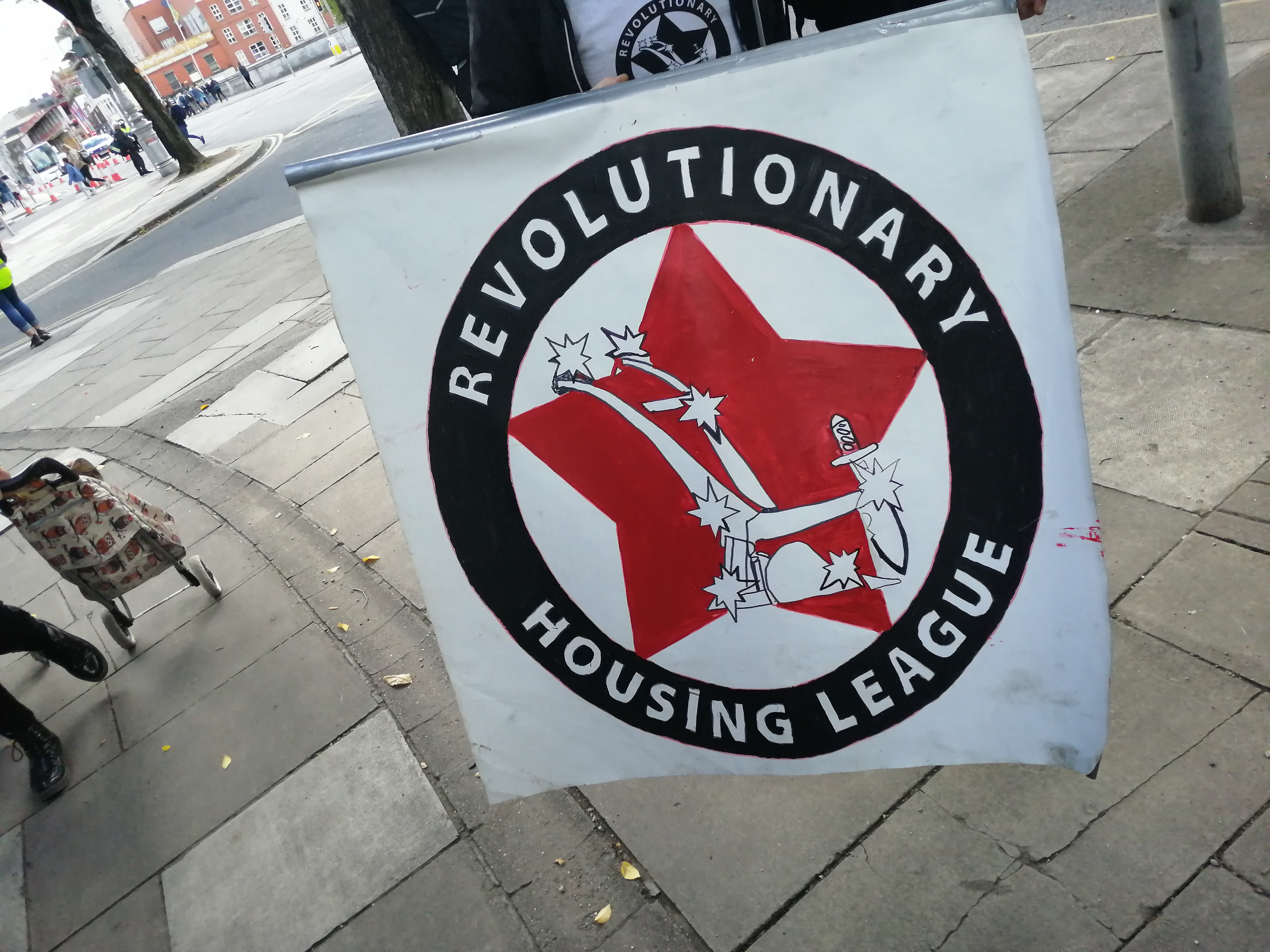
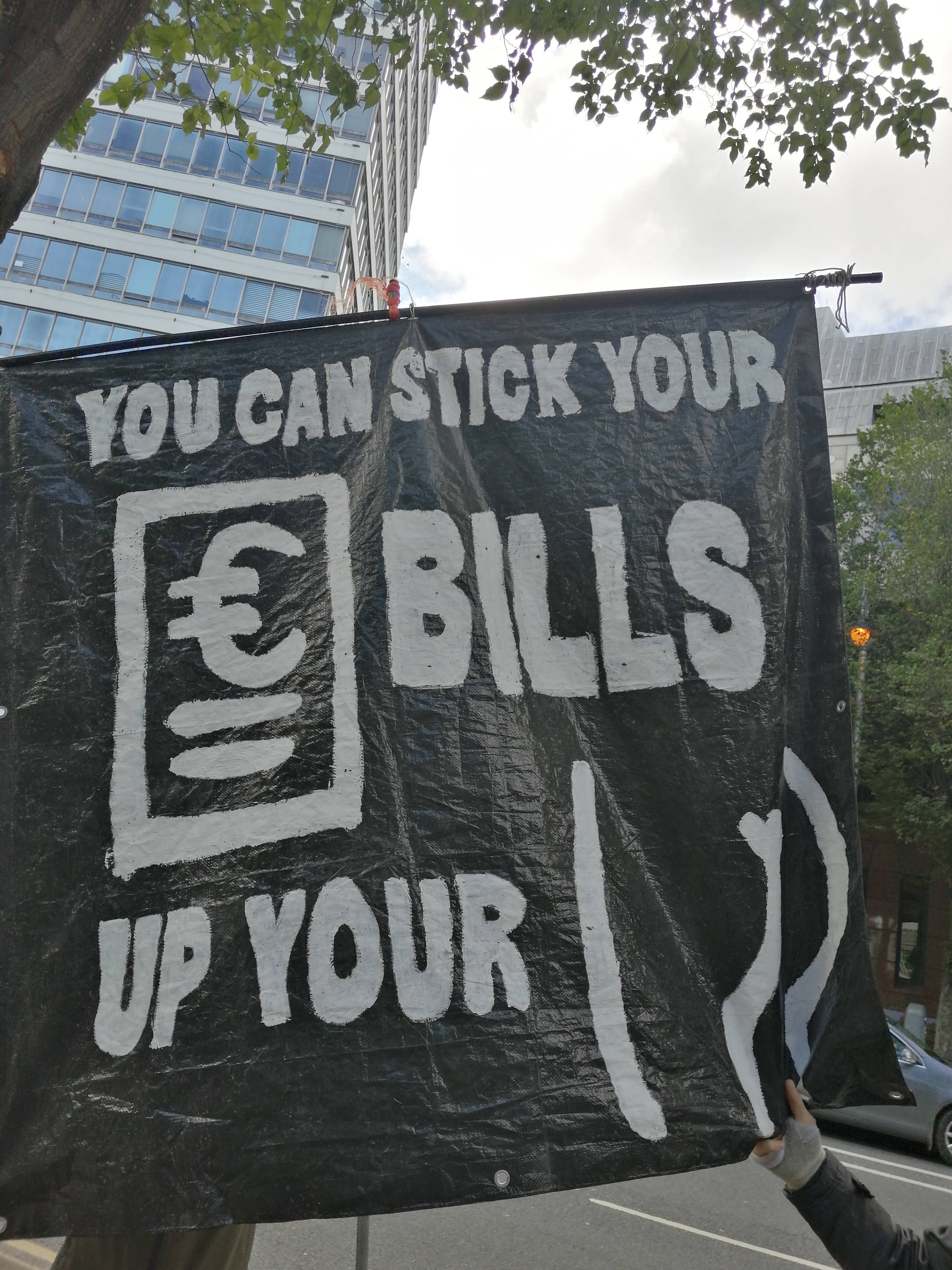
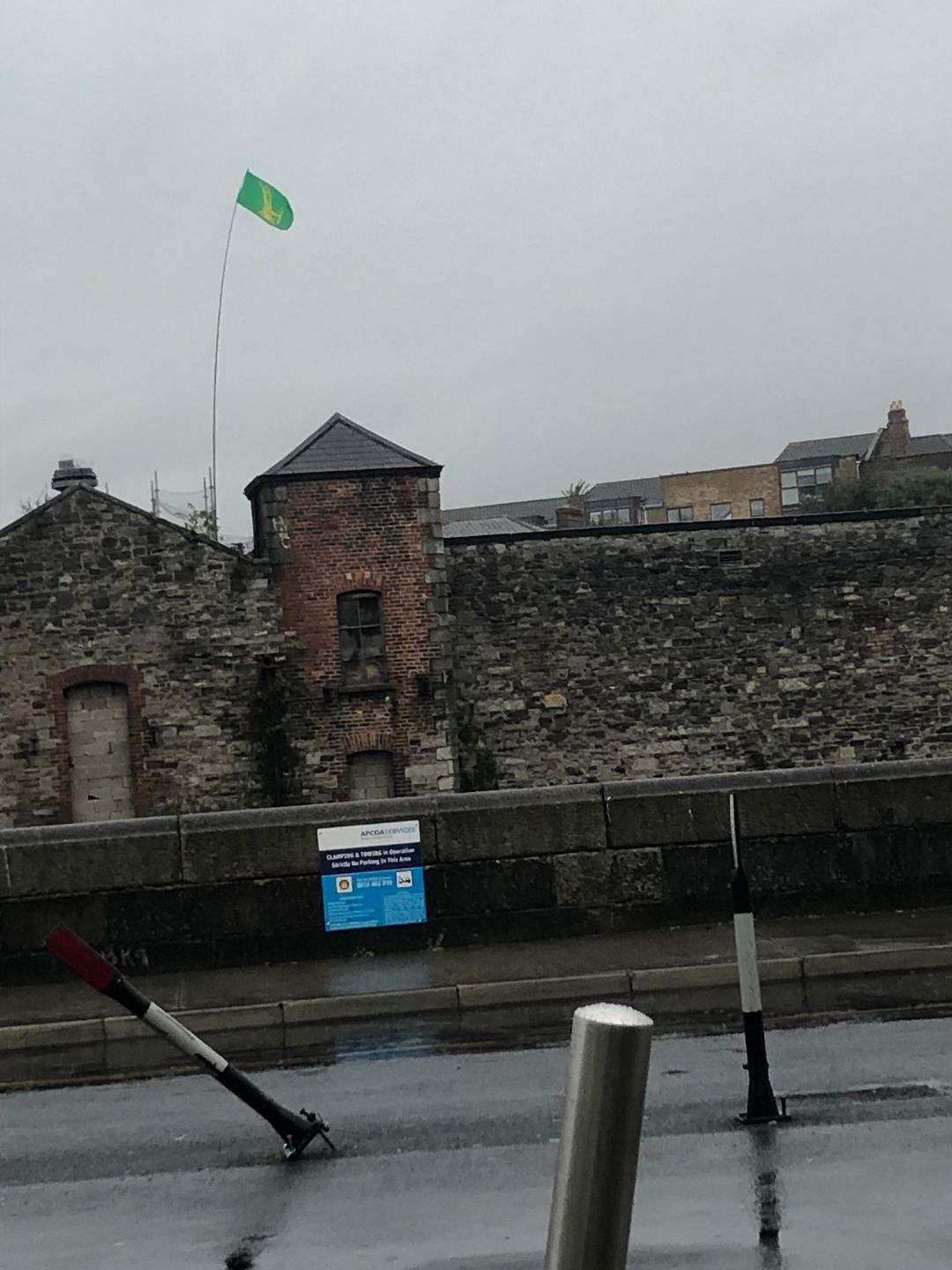
At the Connolly monument, people gathered with banners about the housing struggle and against NATO, along with placards and flags, of which latter the most common was the green-and-gold version of the “Starry Plough”, flag of the Irish Citizen Army4.

The cathaoirleach (chairperson) welcomed people, introduced the purpose of the meeting as being to protest the soaring cost of living and introduced the first speaker, from the Revolutionary Housing League. The RHL speaker outlined their program of direct action.

(Photo: Rebel Breeze)

“What can be more direct than to occupy empty buildings?” he asked those assembled. He recounted some of the recent actions of the RHL and said that they are attracting attention and support, ending by calling on others to get involved5.

The second speaker, introduced as a revolutionary socialist anti-imperialist, went through a list of ills brought by the capitalist system, including lack of housing, selling off our resources and infrastructure, disregard for our language, environmental destruction and danger of nuclear war.

For all said the speaker, the Irish national bourgeoisie are guilty, “the Gombeens, a class unable even to free their own country”. “We need broad fronts to fight all these attacks of class war”, he said “but they must be directed openly against capitalism and imperialism.”

(Photo: Rebel Breeze)

The final speaker, a socialist Republican, represented the newly-formed End State Repression campaign group. Those wanting to oppose rising prices, he emphasised, could not share their struggle with those intending to enter a coalition with Fiann Fáil or Fine Gael.

He also recalled how when protests against the bank bailouts and student fee hikes were getting going in 2010, they were met with state violence through the Gardaí. As the resistance builds, it will get attacked, he said but “we can’t allow them to drive us off the streets again.”

(Photo: Rebel Breeze)

Many drivers passing the rally in vehicles, private and of work – including public transport — sounded their horns in solidarity, giving rise to cheers from the protesters.

MARCH TO BLACKWATER

The assembled then set off in two lines along Custom House Quay, across Talbot Memorial Bridge and then eastward along the quays. On the way they shouted slogans including “One, two, three, four – Housing crisis no more!” and “Only solution: Revolution!”

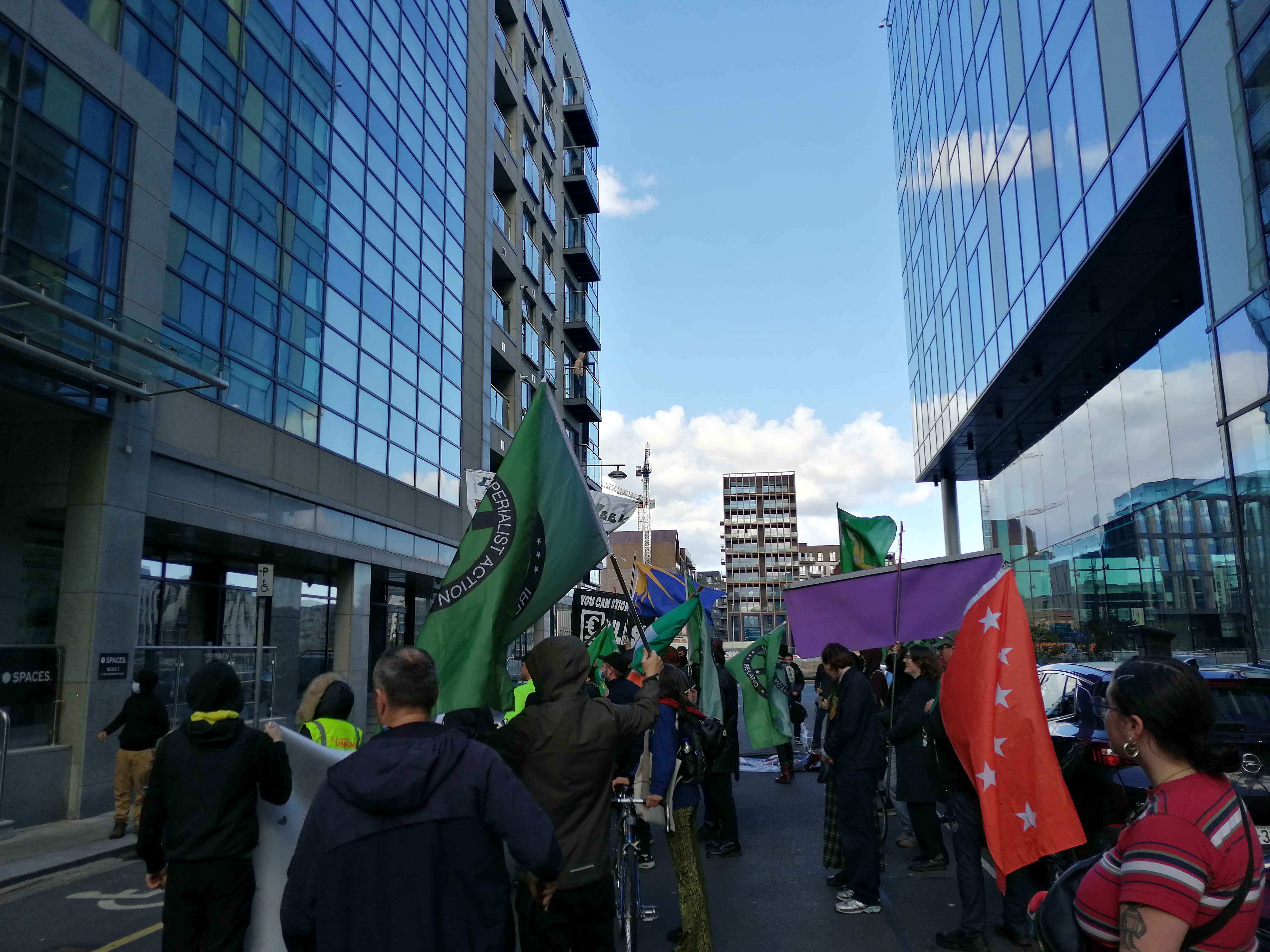
Revolutionary Bloc outside Blackwater’s offices (Photo: Rebel Breeze)

Other slogans include “Whose streets? Our streets!” “Whose Republic? Our Republic!” and “High rent, high taxes – fight back!”

The marchers stopped upon reaching the offices Blackwater Asset Management Company which boasts its background in “coming from the following sectors, Police Force, Legal Profession, Defence Forces, Financial Services & Private Security sectors”.

(Photo: Rebel Breeze)

The crowd expressed its disapproval of the actions of this company. A speaker assured all that any attack on housing activists will be met with resistance. Two songs were sung there too, including Connolly’s Be Moderate/ We Only Want the Earth.6

THE BLOC MEETS THE MAIN MARCH

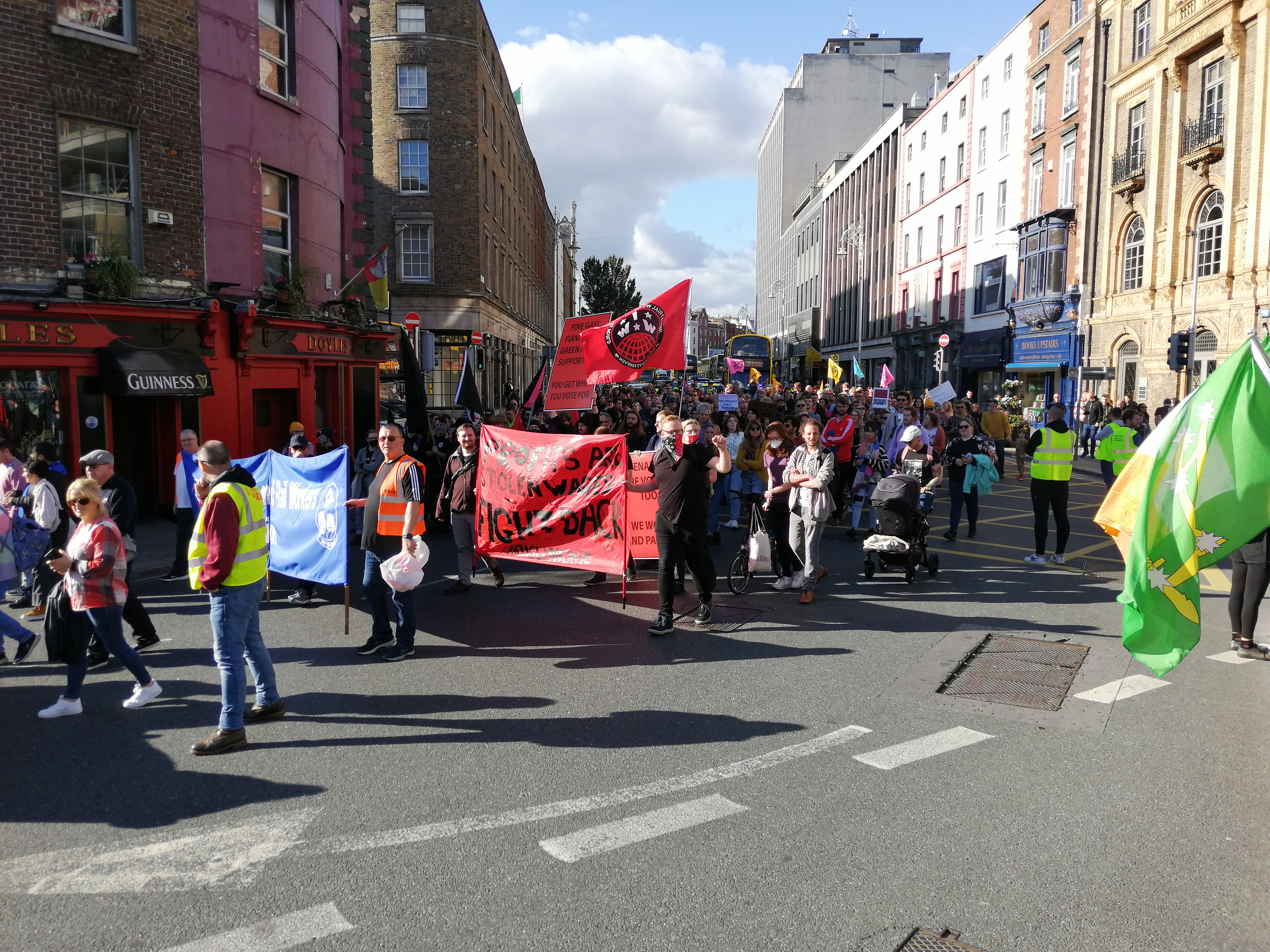
The Bloc marchers passed through the high-rise apartment blocs in the area before going on to Pearse Street and marching to the junction with D’Olier Street, where they met the main march of many thousands7 rounding Trinity College and still coming down from O’Connell Street.

Here the revolutionary bloc displayed their banners and placards and chanted some slogans. Many in the crowd marching past gave signs of appreciation and people in an anarchist bloc shouted “Solidarity”, raising clenched fists, giving rise to equal response from the Bloc8.

Section of the main cost of living protest march in D’Olier Street and rounding junction with Pearse Street. (Photo: Rebel Breeze)

The large Sinn Féin9 section aroused shouts of “No Collusion! One Solution! Revolution!” from the Bloc. The earlier slogan of “1,2,3,4 – Housing crisis no more!” segued for awhile into “5,6,7,8 – Smash the Free State!”

The main Dublin march was organised by the Cost of Living Coalition of 30 organisations, including People Before Profit but also Sinn Féin, which is on a clear trajectory to enter Government in the near future but in coalition with traditional neo-liberal capitalist political parties.

Revolutionary Bloc meets main march at junction Pearse Street and D’Olier Street. (Photo: Rebel Breeze)

The CLC also includes trade unions which many accused of not mobilising for the protest.

Derry city saw a small protest against the rising cost of living also.

A far-Right march in Cork which was addressed by a representative of the fascist National Party attracted little more than 150. Ostensibly against the housing crisis, speakers of course attacked immigration despite it having no connection to the State failure to build affordable public housing.

FB speeded up video of entire main march (recommend mute the sound): https://www.facebook.com/michael.caul.56/videos/3279662202295870

A marcher in Dublin carrying a placard calling for an end to immigration until the housing crisis were solved gave rise to a chorus of “Home for All!” from the Revolutionary Bloc, calls echoed by some among the passing marchers.

Anarchist section in the main march indicating solidarity with the Revolutionary Bloc. (Photo: Rebel Breeze)

Gardaí on foot and in patrol cars tailing the main march were greeted, as they passed the Revolutionary Bloc, with shouts linking Drew Harris10, Commissioner of the police force of the Irish State, to the British Intelligence Service MI5.

A notable feature of both marches was the patience with the interruption to their journeys of private and public transport drivers and, indeed, the signs of support from many, including beeping of horns and hand signals such as the ‘thumbs-up’ and even the occasional clenched fist.

end.

(Photo: Rebel Breeze)

FOOTNOTES

1The Irish Times has a track record of drastically reducing the estimated numbers in reports of anti-government demonstrations, demonstrated most strikingly during the giant water protest marches. It gave the figure 3,000 in leading paragraph to its original twitter report but more recently amended that on line to “several thousand”. The Sunday Mirror reported 20,000 and supporters estimated between 15,000 and 20,000.

2The monument includes a representation in bronze of the Scottish-Irish revolutionary James Connolly, across the road from where he had his office in Liberty Hall (the two-storey building was destroyed by British shelling in 1916 and has since been replaced by a tall man-storey building, HQ of the SIPTU union. Connolly was one of 16 executed by the British in 1916 after the Rising that year.

3See statistics in Useful Links, including https://www.independent.ie/business/personal-finance/irelands-cost-of-living-soars-above-eu-average-as-new-report-reveals-just-how-much-prices-are-rising-41774596.html

4The ICA was formed to defend striking workers from police attacks during the 1913 Lockout in Dublin. It was based on trade union membership and took a prominent role in the 1916 Rising, with a much-reduced one in the War of Independence (1919-1921) and the ensuing Civil War (1922-1923). The ICA recruited women as well as men and some of the women held officer positions, possibly the first revolutionary organisation, certainly the first socialist-based one to do so.

5See https://rebelbreeze.com/2022/09/22/concert-in-occupied-building-murals-pickets-and-court-cases-the-revolutionary-housing-league-spreads-the-fight/

6The lyrics were composed by James Connolly and published in hist Songs of Freedom in New York in 1907. The title was the ironic “Be Moderate” but has come to be known from the refrain as “We Only Want the Earth”. Furthermore, arranged to the air of “A Nation Once Again”, it provides a chorus of “We Only Want the Earth!”

7Most media would only state “thousands” or “many thousands”, but the Irish Times had the audacity to claim the ridiculously low number of 3,000! Estimates by participants varied from 10,000 to 20,000 (latter also figure of the Sunday Mirror).

8It seemed likely that had the Revolutionary Bloc been widely publicised earlier that it would have been supported by many individuals and at some other organisations.

9The former revolutionary republican party rarely mobilises its large membership for street protests as these days it is more concerned with votes in elections. However, SF is part of the Cost of Living Coalitionand SF’s President, Mary Lou MacDonald, was one of the scheduled speakers at the main march rally.

10Immediately prior to his current appointment, Drew Harris was Deputy Chief Constable of the sectarian British colonial gendarmerie, the Police Force of Northern Ireland which, until 2001, was the Royal Ulster Constabulary.

USEFUL LINKS

Anti-Imperialist Action:

End State Repression campaign:

Mass media march reports: https://www.irishmirror.ie/news/irish-news/cost-living-protest-live-updates-28070843

https://www.sundayworld.com/news/irish-news/crowd-of-20000-march-through-dublin-city-centre-in-massive-protest-over-cost-of-living-crisis/1154985225.html

Other reports: https://www.facebook.com/michael.caul.56/videos/3279662202295870

Cost of living statistics: https://www.expatistan.com/cost-of-living/country/ireland

https://www.independent.ie/business/personal-finance/irelands-cost-of-living-soars-above-eu-average-as-new-report-reveals-just-how-much-prices-are-rising-41774596.html

https://www.irishtimes.com/business/economy/2022/07/14/inflation-hits-38-year-peak-of-91-as-cost-of-living-crisis-worsens/

THE REVOLUTIONARY HOUSING LEAGUE SPREADS THE FIGHT — concert in occupied building, murals, pickets and court appearances

Diarmuid Breatnach

(Reading time: 6 mins.)

For a group that first came into public view on May 1st with an occupation of a building empty for two years, the Revolutionary Housing League has certainly been busy. At least two further acquisitions1 have followed since.

In addition, a hundred police with vehicles and helicopter have been videoed in one eviction of two activists; four activists have appeared defiantly in court in different cases and the High Court has granted injunction to companies against activists.

As I write this another eviction is being planned, resistance is being organised and further repression through courts and jail seem certain. The RHL are fighting the system, fighting a fundamental social wrong acknowledged by almost everyone.

SHORT HISTORY OF THE REVOLUTIONARY HOUSING LEAGUE

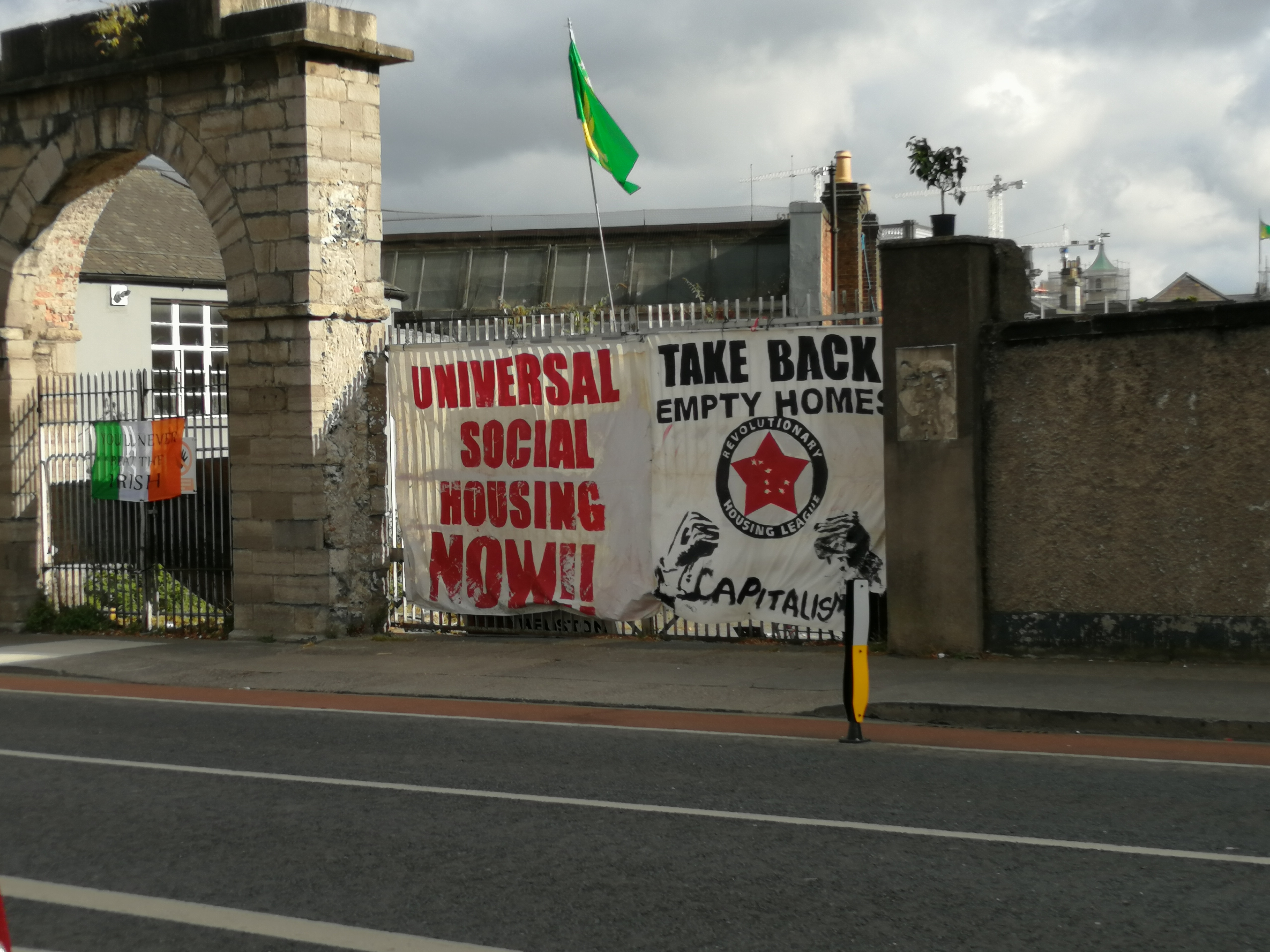
In 1st May 2022 activists acquired Lefroy House on Dublin’s Eden Quay, formerly used by the religious-based NGO, the Salvation Army to provide night-beds for young homeless people but empty for two years. The activists renamed the building Connolly2 House.

A decorated tile at the door of Connolly House in May/June 2022 (Photo: D.Breatnach)

At that time the occupiers were calling themselves the Revolutionary Workers’ Union though their council subsequently formed the Revolutionary Housing League.

The Salvation Army took the occupants to court, claiming the SA had been renovating the house in order to accommodate Ukrainian refugees. Despite the absence of evidence of any renovation work and the presence of a leaky roof (fixed by the activists!), the court granted the injunction.

The occupiers called for a rally against eviction on 2nd June and a large crowd of people of various political backgrounds, organisations and independents, arrived to support but of course, the eviction forces could wait and choose their time.

Musician performing and section of crowd at rally against eviction outside Connolly House (Photo: D.Breatnach)

On June 9th at 5.45 a.m early passers-by were amazed to see 100 Gardaí3 with a number of vehicles, supported by a helicopter, including armed police4, assault the building to take possession of it for the SA and to arrest two activist occupants. A video of the event taken by a passer-by went viral.

Eviction video: https://www.facebook.com/JamesConnollyHouse/videos/2172514896242639

Both activists were later released on their own surety bail to await court process and the building was fortified against being retaken. To this date it remains empty.

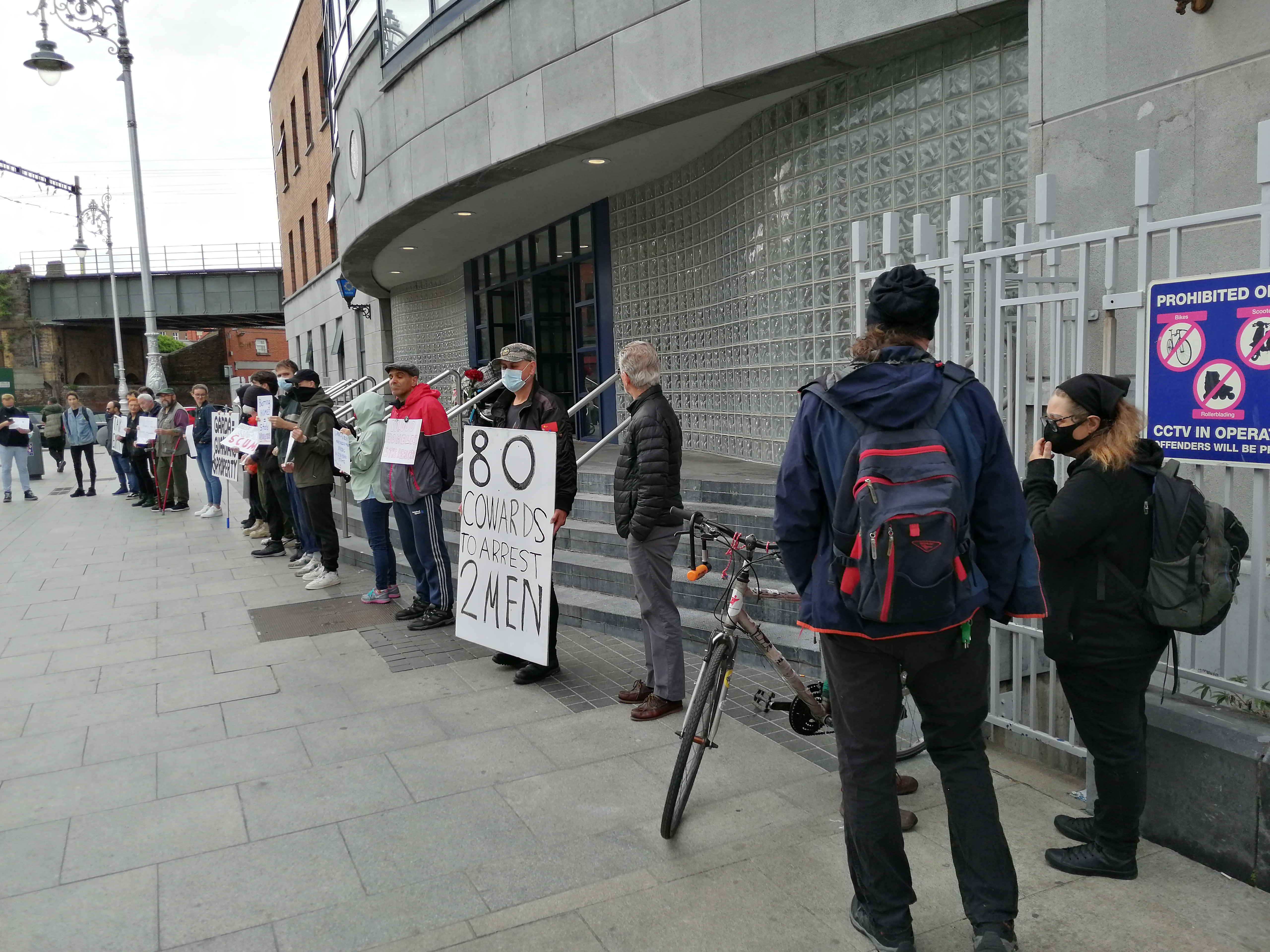
On 13th June, the housing activists convened a protest picket outside Store Street Garda station.

Picket on Store Street Garda Station following eviction of James Connolly House (Photo: D.Breatnach)

Story of Connolly House: https://www.youtube.com/watch?v=rSL453gVHAg

The RHL had acquired another site5, this one having been a building for homeless people of the municipality, Dublin City Council, but also empty for a long period. On June 10th Gardaí arrested two activists near the building and they too are being processed by the courts.

After that, the RHL occupied a large warehouse-type building on the very north bank of the Liffey by Sean Heuston Bridge which they named, naturally enough, Ionad6 Seán Heuston. They opened it as emergency accommodation and held talks and discussions within it.

Parkgate Street front of Ionad Seán Heuston in early September 2022 (Photo: D.Breatnach)

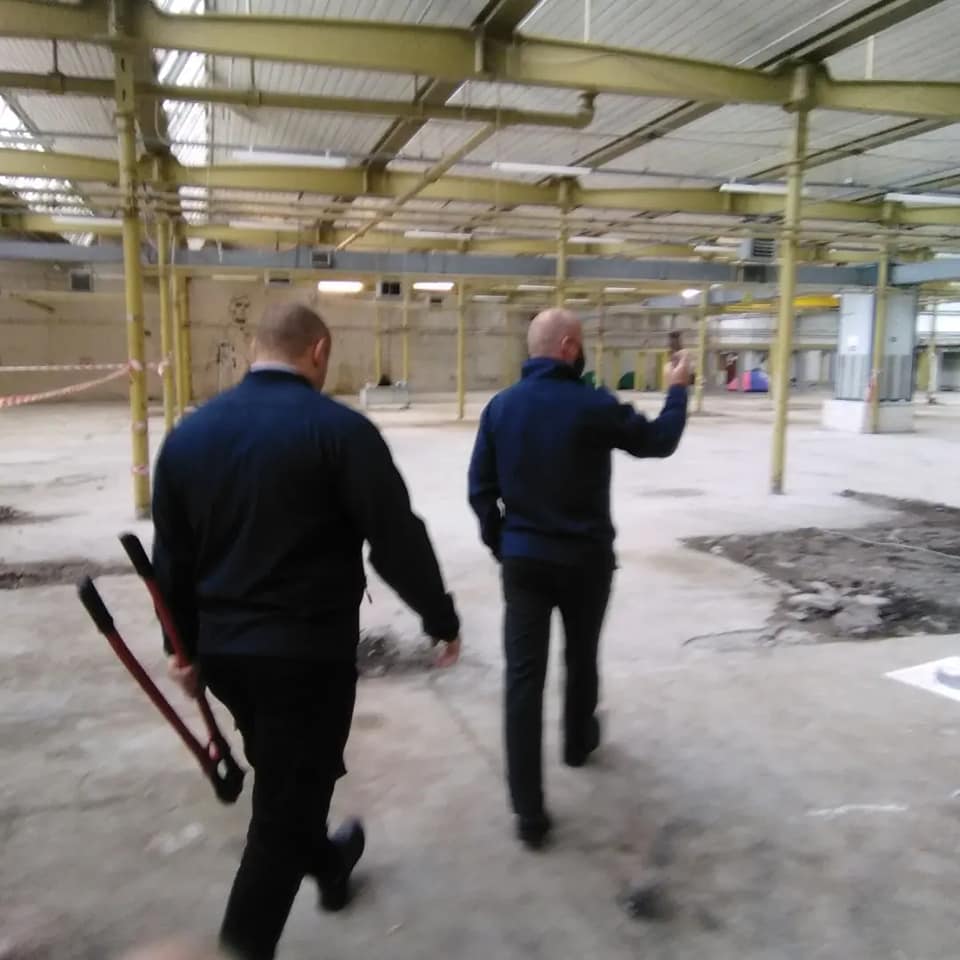
Employees of Pinnacle Security company with bolt-cutters entered the site on 3rd September but failed to evict residents and on the 5th September RHL activists picketed the company which, as a consequence, withdrew from acting as security for Chartered Land, owners of the site.

Pinnacle Security staff, one armed with bolt-cutters, entered Ionad Seán Heuston on 3rd September but failed to intimidate the residents into leaving. Two days later, RHL picketed their HQ and were given a written undertaking that the company would no longer carry out security for Chartered Land on the site. (Photo: Revolutionary Housing League)

The building owner’s interests are managed by Davy Platform ICAV, acting on behalf of its sub-fund the Phoenix Sub-fund but ultimately, the owner is Chartered Land which intends to build high-rental apartments on the site.

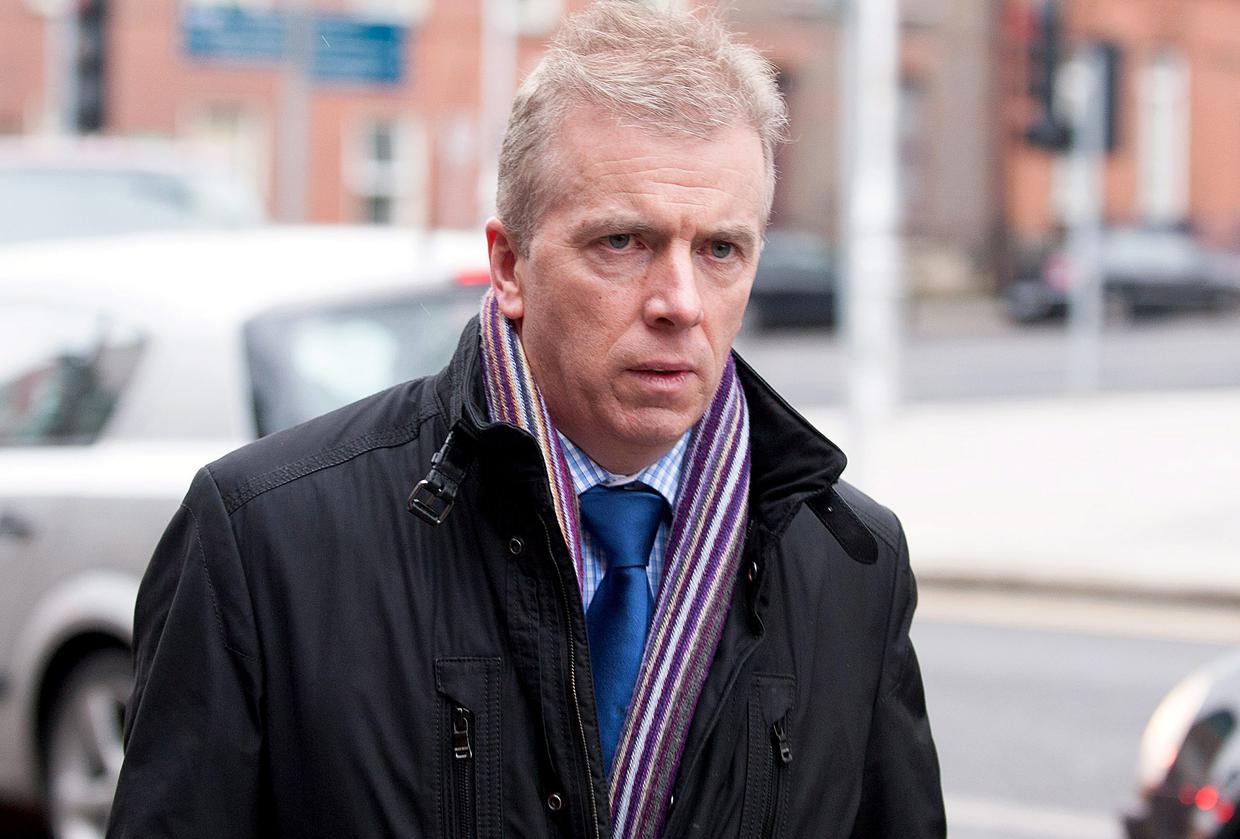
Joe O’Reilly is the property speculator tycoon behind Chartered Land, once the biggest debtor to NAMA whose responsible officer Conor Owens permitted O’Reilly to transfer his Moore Street, ILAC and Dundrum Shopping Centre holdings to Hammerson, a British-based property company.

Plan of Joe O’Reilly’s mansion while he owed NAMA €3 Billion which paid him a salary of €200,000 to ‘order his affairs’ (Image source:https://www.dailymail.co.uk/news/article-2063815/3bn-debtor-living-life-OReilly-Developer-sprawling-Dublin-mansion.html)
Joe O’Reilly after appearing as a witness in criminal court in 2015 (Photo: Irish Independent)

That transfer gave Hammerson control of properties O’Reilly’s planning permission from Dublin City Council for a giant “shopping mall” there which they have now changed but again approved by DCC’s Planning Officer and which is under appeal to An Bord Pleanála.

Conor Owens is now Ireland Director for Hammerson.

Lawyers for O’Reilly named a number of individuals as being in occupation of the property, at least two of them apparently on the basis of photographs of the interior shared by the them on social media. Last Thursday a number appeared in court on applications for injunctions against them.

One who had not been named, a homeless individual, made an emotional appeal for he and his partner to be allowed to stay and the occupants to provide services to more homeless people. Another denied he had been an occupant but had merely shared photos on social media.

That latter individual had the injunction against him removed but was asked to sign an undertaking he would not enter the building, which he declined to do, remarking that he should not even have had to attend the High Court in the first place.

Sean Doyle of the RHL declared that the action they were taking was necessary and quoted James Connolly: We believe in constitutional action in normal times; we believe in revolutionary action in exceptional times. “These are certainly exceptional times”, Doyle remarked.

The judge went ahead and granted the injunction and required all occupants to evacuate building by Wednesday 21st (i.e as this piece was being concluded).

The RHL organised a picket and temporary protest occupation of Davy stockbrokers, who were handling procedures for Joe O’Reilly, the property tycoon owner of the site of Ionad Seán Heuston.

RHL picket and temporary occupation of Davy stockbrokers (Photo: Revolutionary Housing League)

Last weekend the RHL organised a solidarity concert at Ionad Seán Heuston with somewhere between 150 to 200 in attendance and with at least two bands posting on social media their delight at having performed there.

O’Reilly’s legal team claimed “a flagrant breach of the court order”.

The RHL have called a solidarity rally against the eviction at the site for tomorrow at 10am.

Band performing to crowd at Ionad Seán Heuston — “a flagrant breach of court order” according to property tycoon’s lawyers. (Photo: Revolutionary Housing League)

THE FUTURE

Whatever the outcome of the eviction intended for this particular building or the eventual result of court cases, it seems clear that the RHL are on a collision course with the State and its protection of landlords and property speculators.

While some may look askance at such a contest, one may ask legitimately what other course of action is effective and viable?

Marches and short-term symbolic occupations of individual buildings, including the high-profile Apollo House one supported by prominent individuals in December 2016, though possibly raising awareness, have not made a single dent in the homeless crisis.

Section of the crowd at rally outside Apollo House 11 January 2016. Events such as these mobilised opinion but did not change the situation as indeed it worsened (Photo: D.Breatnach)

Indeed, the situation seems to have got steadily worse – at least for those seeking accommodation; while on the other hand clearly landlords, letting agencies, property speculators, vulture funds and the very banks are raking in their profits.

OVER 10,000 HOMELESS INCLUDING 2,503 CHILDREN

Earlier this year the State admitted that homeless figures had passed ten thousand, for the first time since the covid pandemic7, a statistic that includes the shocking figure of 2,503 children.8

And a recent report states that the levels of homelessness are under-estimated because of the accounting system used by the State, which focuses on rough sleepers and those accessing emergency accommodation9.

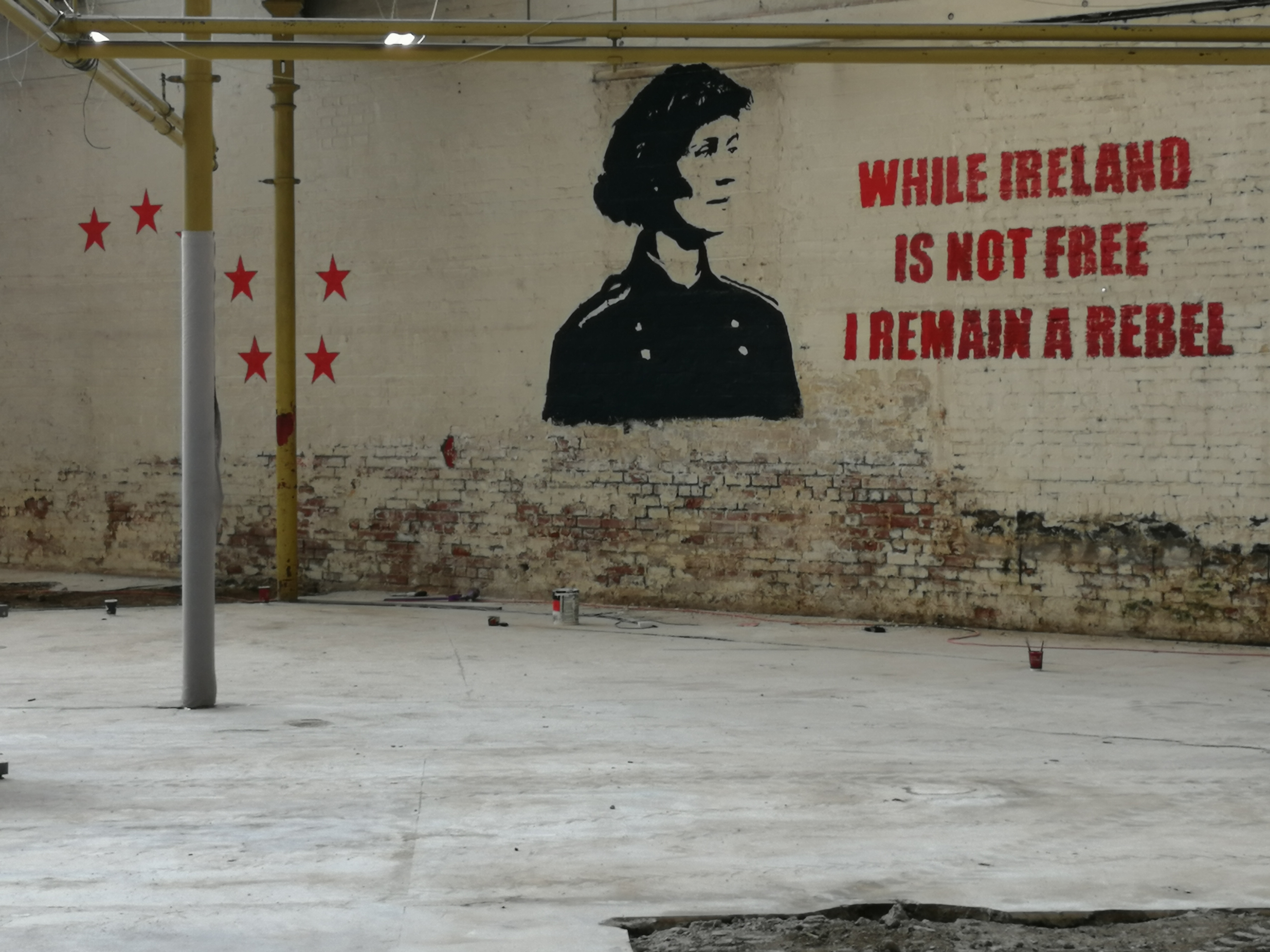
Mural representing revolutionary Irish socialist Republican Constance Markievicz and the outline in red stars of “the Starry Plough” (Ursa mayor), one of the impressive murals inside Ionad Seán Heuston (Photo: Rebel Breeze).

Sofa-surfing, rotating between friends and family, precarious rental arrangements all figure in homelessness but are not measured or accounted for by the State. Indeed these features of homelessness have been known for decades.

Clearly too, the obvious solution, the release of substantial funds by the State to local authorities to build public housing for affordable rent, is not favoured by any of the Government political parties.10

Apart from the general inclination of the ‘political class’ to serve big business many have direct interests in the housing situation, as an audit of TDs (member of the Irish Parliament) found over 80, i.e more than half, are landlords or own property – or both.11

Faced with such a situation it is clear that only a very substantial shock to the political system has any hope of having a serious impact on the housing crisis. Though the solution need not be revolutionary, all the evidence is that the methods do indeed have to be so12.

An interesting side-aspect of the RHL’s occupation has been the use of innovative and highly-effective art in banners and murals. Also the holding of a concert and some trad music sessions in acquired buildings, along with educational talks, discussions and Irish language classes.

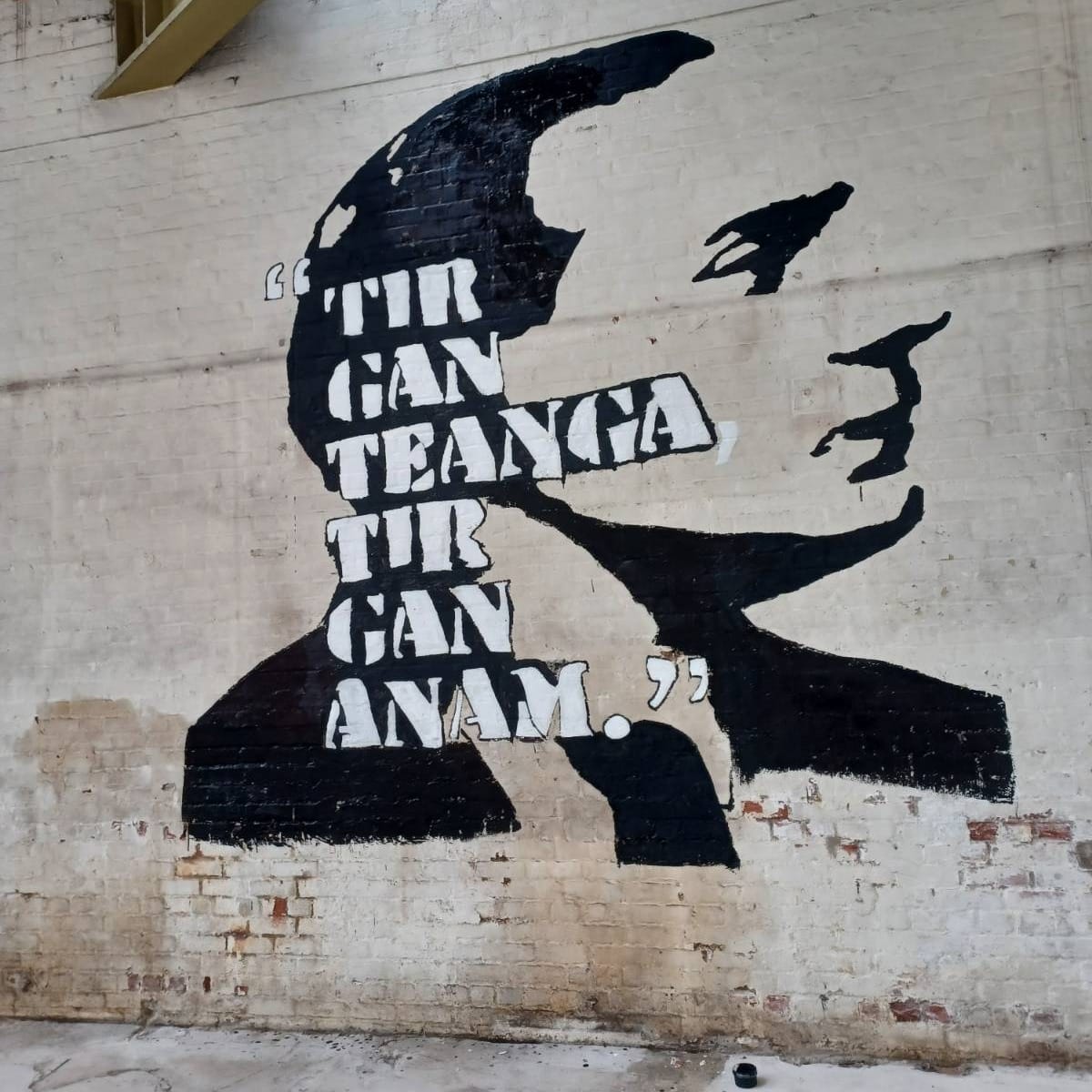
Another of the murals in Ionad Seán Heuston, a representation of the profile of Pádraig Mac Piarais/ Patrick Pearse, revolutionary Irish Republican, writer, educator, executed by British firing squad in 1916. His slogan translates as: “A country with out its language (is) a country without a soul”. (Photo: Revolutionary Housing League)

The RHL is a small organisation fighting the State Goliath which is representing the Philistines of property speculators, vulture funds and banks. They deserve our support in whatever measure we are able to give, in attending events and spreading the word.

Indeed, they have called for wider action – the RHL has on a number of occasions called on people to do what they are doing, to occupy the thousands of empty buildings which, if people did, would transform this struggle into a mass movement.

With no other viable solution in sight, surely we should support the RHL? Do we not owe it to those on the street or struggling to pay mortgages or high rents? Do we not owe to the children now, the future generation that will be blighted unless we act?

End.

The Starry Plough flag of the Irish Citizen Army in the early decades of the 20th Century flies above Ionad Seán Heuston (Photo credit Revolutionary Housing League, taken from Seán Heuston Bridge)

FOOTNOTES

1The RHL call their taking of empty properties “acquisitions” in the name of the people.

2After notable socialist revolutionary, trade union organiser, journalist, historian and writer James Connolly, executed by British firing squad in 1916.

3The police force of the Irish State is called An Garda Síochána and the plural of its members, “Gardaí”, singular “Garda”.

4The Garda Síochána is essentially an unarmed police force with an armed response section, the latter which however seems to be growing and more in evidence in different situations.

5They named that one Liam Mellows House in honour of socialist Irish Republican and former member of the Irish parliament, the Dáil, executed during the Civil War by the Irish State in retaliation on 8th December 1922.

6Ionad in Irish means “place/ location/situation”.

7https://www.breakingnews.ie/ireland/over-10000-people-homeless-in-ireland-for-first-time-since-pandemic-1311934.html

8https://www.independent.ie/news/homeless-figures-rise-to-10325-including-3028-children-41787023.html

9https://www.breakingnews.ie/ireland/narrow-definition-of-homelessness-failing-to-respond-to-true-nature-of-crisis-1365817.html

10Sinn Féin’s latest housing policy indicates a crash building program for “affordable homes” but unclear whether to rent or own. Election promises tend to be taken with a pinch of salt by commentators; SF Councillors on Dublin City Council voted public land sold to developers. In addition, a future government including SF would almost certainly include a former government party in the coalition.

11https://www.irishtimes.com/politics/2022/08/24/almost-80-tds-and-senators-are-landlords-property-owners-or-both/

12The State has the power to put empty properties to use to eliminate all homelessness immediately and the Government can divert funds towards starting a big housing construction program which would give everyone good quality affordable homes in a couple of years. It does not do so because that would upset the profits of the property speculators, property management companies and the banks, their lenders.

SOURCES & FURTHER INFORMATION

Revolutionary Housing League: https://www.facebook.com/JamesConnollyHouse

on Twitter: https://twitter.com/rhlireland/status/1562495657814138880

Video interview as RHL awaits eviction force: https://www.facebook.com/JamesConnollyHouse/videos/435978475290460

Official homeless figures: https://www.breakingnews.ie/ireland/over-10000-people-homeless-in-ireland-for-first-time-since-pandemic-1311934.html

https://www.independent.ie/news/homeless-figures-rise-to-10325-including-3028-children-41787023.html

A total of 115 homeless people died in Dublin 2021, more than double the number who died in 2019: https://www.irishexaminer.com/news/arid-40853996.html

Discussion of number of empty buildings per homeless people: https://www.thejournal.ie/factcheck-16-vacant-homes-per-homeless-person-ireland-5801978-Jul2022/

https://www.thejournal.ie/200-asylum-seekers-without-accommodation-ireland-5862168-Sep2022/?

Narrow definition of homelessness by Irish State: https://www.breakingnews.ie/ireland/narrow-definition-of-homelessness-failing-to-respond-to-true-nature-of-crisis-1365817.html

RWG/ RHL acquisition of Connolly House: https://www.irishtimes.com/news/social-affairs/workers-group-occupying-eden-quay-property-to-defy-court-order-1.488610

Property speculator seeks eviction of occupants Seán Heuston House: https://www.breakingnews.ie/ireland/high-court-injunction-sought-for-alleged-illegal-occupation-of-dublin-building-1361850.html

Joe O’Reilly (Chartered Land): https://www.dailymail.co.uk/news/article-2063815/3bn-debtor-living-life-OReilly-Developer-sprawling-Dublin-mansion.html

Property Speculator seeks further legal action agains RHL: https://www.thejournal.ie/high-court-revolutionary-housing-league-parkgate-house-5871136-Sep2022/

Concert a “flagrant breach of court order”: https://www.msn.com/en-ie/news/newsireland/concert-held-in-property-occupied-by-homeless-campaigners-a-flagrant-breach-of-court-order/ar-AA122xZA?li=BBr5KbJ

Ex-NAMA senior officer now Director of Hammerson Ireland: https://europe-re.com/hammerson-appoints-connor-owens-as-director-of-ireland/68421#:~:text=Hammerson%20has%20appointed%20Connor%20Owens,ILAC%20Centre%2C%20and%20Swords%20Pavilions.

Previous high-profile housing activist occupations:

Apollo House December 2016: https://www.thejournal.ie/apollo-house-glen-hansard-hozier-performance-homeless-3151048-Dec2016/

Frederick Street: https://www.irishtimes.com/news/social-affairs/what-happened-who-is-involved-and-why-are-activists-occupying-vacant-properties-1.3627980

“Almost 80 TDs are landlords, landowners or both”: https://www.facebook.com/JamesConnollyHouse/photos/a.104667018908396/149716974403400/

https://www.irishtimes.com/politics/2022/08/24/almost-80-tds-and-senators-are-landlords-property-owners-or-both/

DUBLIN ANTI-MONARCHY DEMONSTRATION DURING LONDON ROYAL FUNERAL

Clive Sulish

(Reading time: 4 mins.)

On Monday, as the remains of Queen Elizabeth II were being conducted in State funeral in London, Socialist Republicans rallied against monarchy in front of the James Connolly1 monument in Dublin.

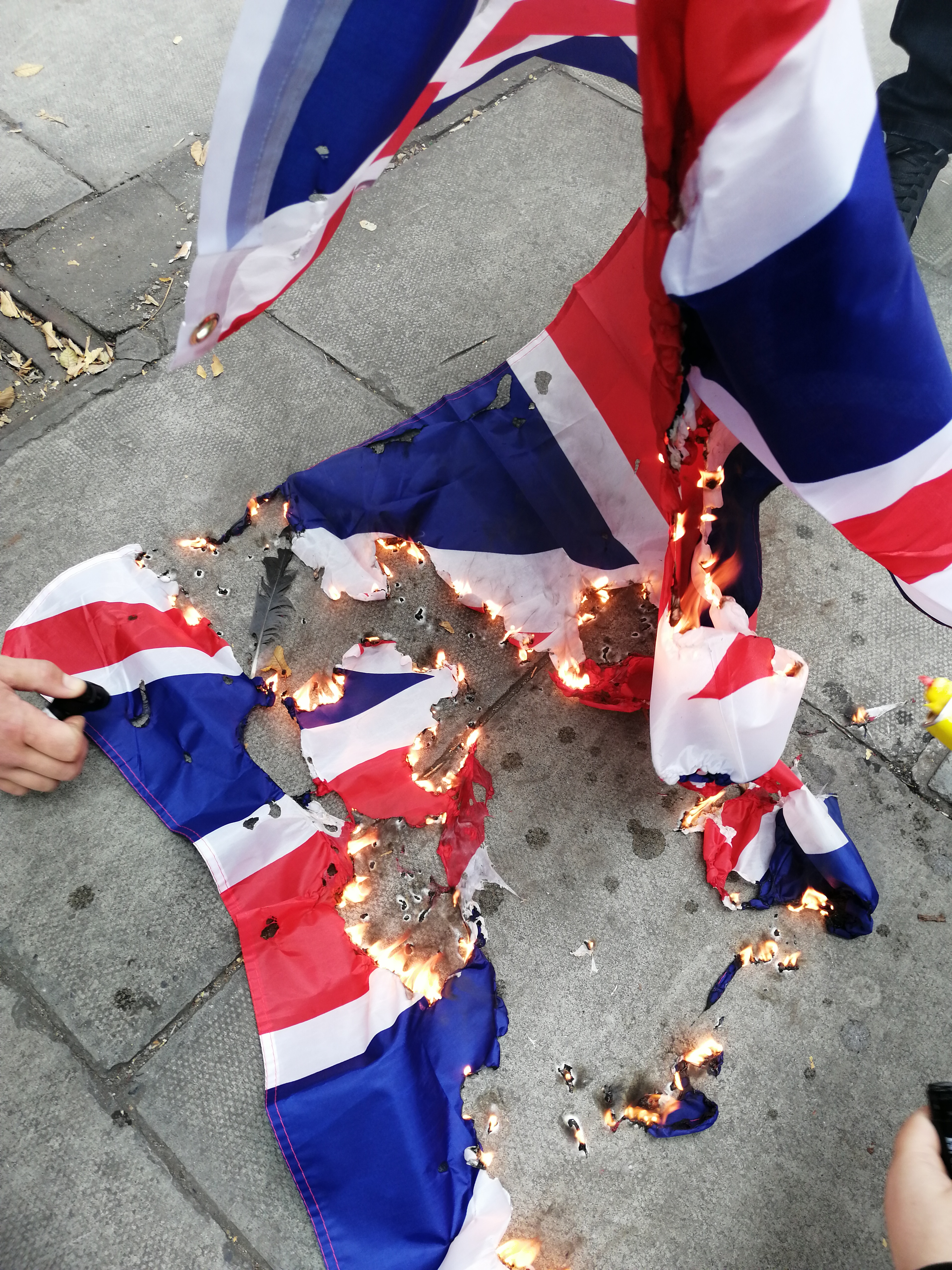
They displayed flags and placards, heard speeches and burned the flag of the UK.

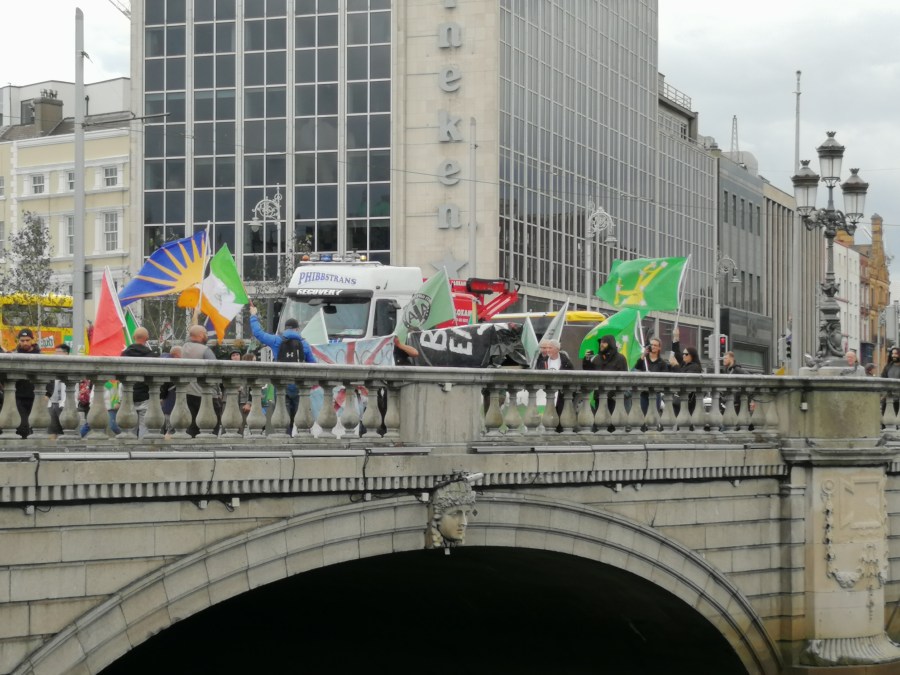
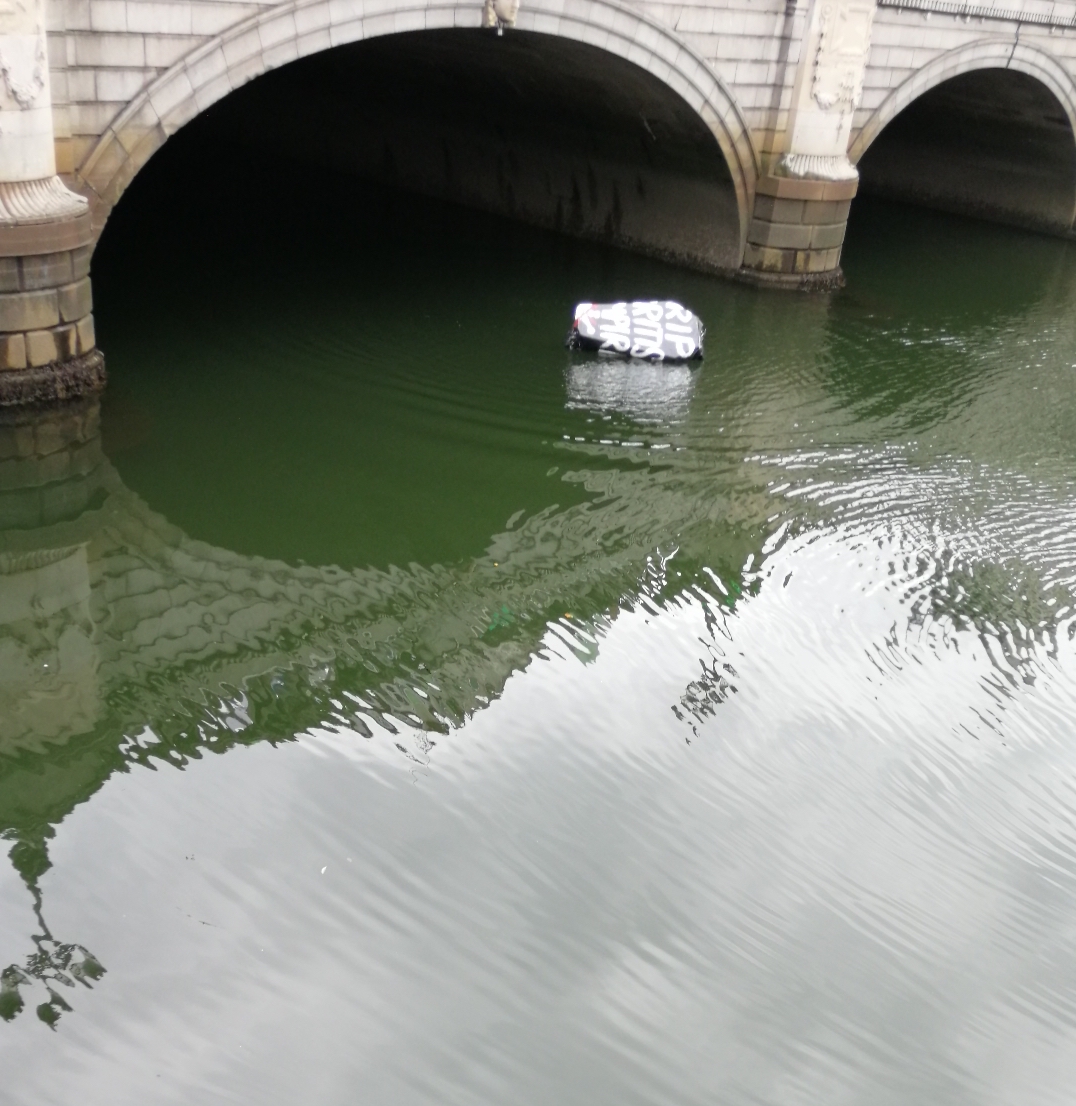
They then marched to O’Connell Bridge carrying a “coffin” bearing the words “British Empire RIP”, dumped it into the Liffey and marched on to the General Post Office building, where a large force of Irish state police prevented their entry.

Bob Marley’s lyrics applied to the situation on a home-made placard at the event (Photo: Rebel Breeze)

The actions occurred as the royal funeral was taking place in London. In a move that drew public criticism from presenter of independent program Newstalk, national broadcaster RTÉ sent a crew to cover the funeral in London to film it in realtime for Irish national television.

Taoiseach (equivalent of Prime Minister) Mícheál Martin and President Michael D. Higgins in persons represented the Irish State at the British royal funeral.

Many Irish politicians (including leaders of the Sinn Féin political party) and public figures had sent fulsome messages of condolence and praise of the late British Queen.

“DOWN WITH THE MONARCHY!”

The chairperson of the event and speakers lambasted the “sycophancy” of Irish Government figures and other politicians and public figures. They drew attention of the past record of British Royalty and to the ongoing British occupation of Ireland.

The “RIP British Empire” ‘coffin’ parked temporarily next to James Connolly Monument (Photo: Rebel Breeze)

The event had been publicised on social media under the slogan of “Down with the Monarchy!” and that was very much the tone of the event as occupants in a police van watched from across the street.

The chairperson opened proceedings by reminding the attendance of Connolly’s slogan at the outbreak of WWI that “We serve neither King nor Kaiser but Ireland.” Passing vehicles occasionally tooted their horns in approval.

Police van surveilling events across street at James Connolly Monument (Photo: Rebel Breeze)

A young socialist Republican read out Connolly’s article in The Workers’ Republic of March 1902 on the occasion of the coronation of Edward VIII.

Connolly stated that to Socialists the replacement of one exploiter by another hardly mattered and would excite little comment.

But although we would rather treat the matter thus philosophically, we find that the machinations of those in power do not leave us that possibility; with them, and because of them, the festivities attending the Coronation have taken on the aspect not merely of a huge parade of pomp and magnificence – cloaking the festering sores of that slave society on which it is built – but have also become an elaborately contrived and astutely worked piece of Royalist and Capitalist propaganda, designed to captivate the imagination of the unthinking multitude, and thus lead them to look askance upon every movement which would set up as an ideal to work for something less gorgeously spectacular, even if more solidly real.

The evil effects of private ownership of industries is thus illustrated once more in a manner that ought to appeal to those patriots in our midst who still dread the innovating effects of Socialism on the National spirit of the Irish people2.”

A home-made banner carried by participants at the event (Photo: Rebel Breeze)

DIVINE RIGHT AND WORKERS’ RIGHT

Diarmuid Breatnach quoted John Ball, a leader of the English Peasant’s Revolt of 1381 who, addressing the crowd in reference to the Christian Bible story of Adam and Eve, enquired: “When Adam delved (dug) and Eve span, who then was the gentleman?”

For that challenge to divine right to rule or right by birth, Breatnach related, King Richard II had John Ball hanged, drawn and quartered, his head stuck on a pike on London Bridge and a quarter of his body displayed at each of four different towns in England.

Breatnach contrasted this to the right of workers, who he said produce all things, to the ownership of all things and called on working people to take their place in history as conscious beings.

(Photo: Rebel Breeze)

Another speaker, on behalf of Spirit of Irish Freedom Republican Society and the Michael Fagan Fenian Society based in Westmeath also spoke and included the Sinn Féin leadership in his denunciation of Irish politicians who had accepted and praised British Royalty.

Seán Doyle spoke about the attitude of servility which works its way into many different aspects of life, for example into accepting the laws of the capitalist system and the housing crisis.

Doyle likened the acceptance of this right of capitalism to acceptance of the divine right to rule and stated that workers had to break from this acceptance, which is what the Revolutionary Housing League was advocating and practicing in action.

UNION JACK IN FLAMES AND COFFIN INTO THE RIVER

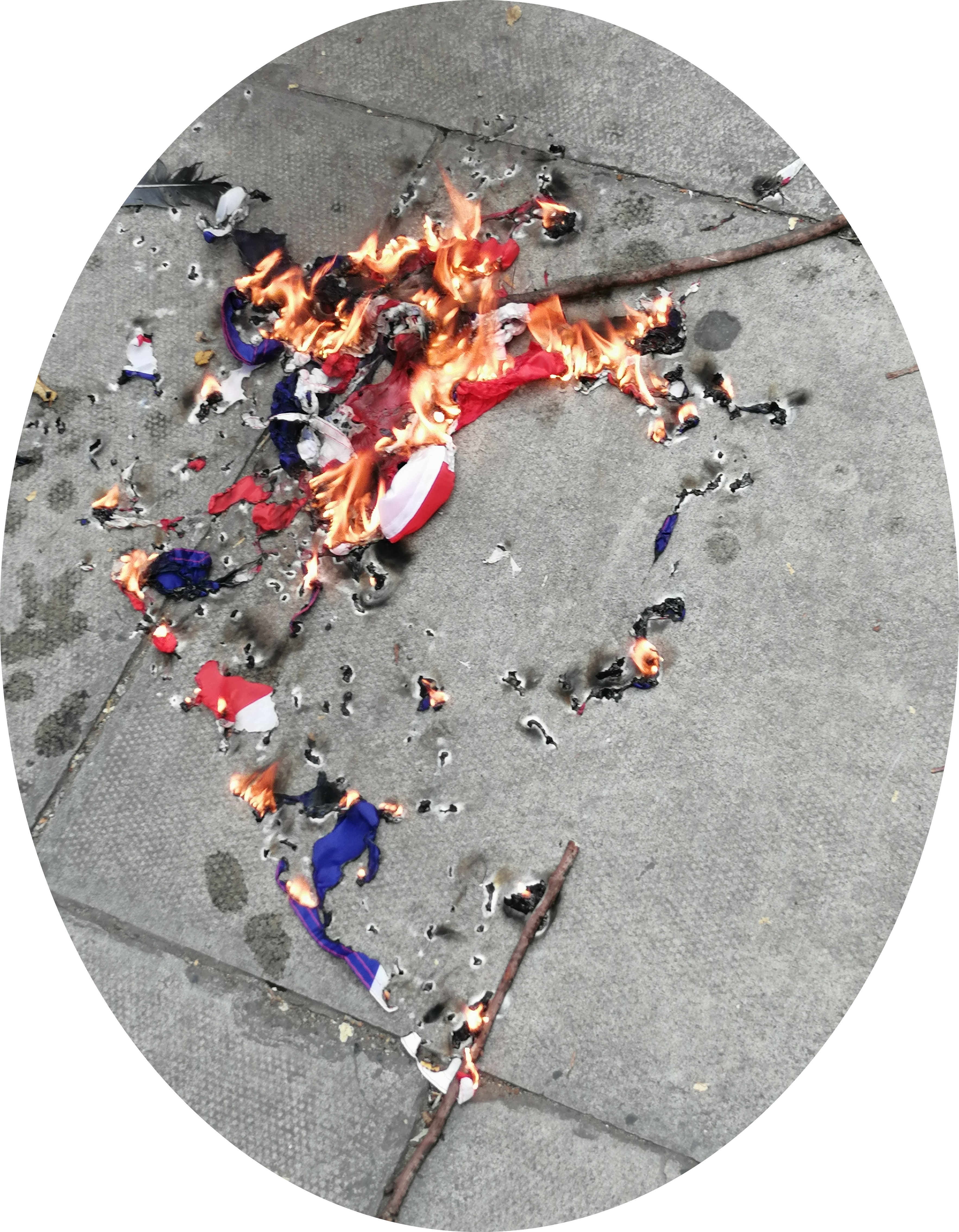
After the speeches a copy of the “Union Jack” flag was set on fire to symbolise the future of the forced union of nations — including a part of Ireland — under England rule.

(Photo: Rebel Breeze)

Participants formed up into two columns flying flags, headed by four persons carrying a large pseudo-coffin. Taking to the road, they crossed Butt Bridge, turned right along the quay until they reached O’Connell Bridge.

There Gardaí and three Public Order Vehicles awaited them. Undeterred, the marchers cheered a short speech and chanted some slogans. Then at the count of “a h-aon, a dó, a trí” the “coffin” was heaved over the parapet into the Liffey river.

Marchers led by four carrying the “British Empire” ‘coffin’ crossing Butt Bridge (Photo: Rebel Breeze)

This action emulated a similar one carried out by James Connolly and revolutionary socialists in 1897 during Queen Victoria’s visit to Dublin.

It is worth recording too that Queen Victoria visited again in 1900 to affirm Ireland as part of the UK and to help recruit more Irish to go and fight the Boers in South Africa.

In response to that occasion, Iníní na hÉireann (Daughters of Ireland) led over 50 women in organising a Children’s Patriotic Party on the Sunday after the Wolf Tone Commemoration in July of that year.

Over 30,000 children had paraded from Beresford Place to Clonturk Park in north Dublin where they were served picnic lunches and listened to anti-recruitment speeches.

The marchers on O’Connell Bridge just before the “British Empire” ‘coffin’ is thrown into the Liffey (Photo: Rebel Breeze)

After disposing of the “coffin” of the “British Empire” on Monday, the marchers proceeded to the General Post Office where the building had been closed and a strong force of Gardaí also prevented access.

The GPO was the HQ of the insurrectionary forces during the 1916 Rising and many considered it insulting to their memory that the Irish tricolour above the building was lowered to half-mast in respect for the British monarchy.

March concluding at the GPO in Dublin’s main street — the police are blocking the doorway to the left of photo (Photo: Rebel Breeze)

The event concluded with cheers from passers-by and without any arrests.

End.

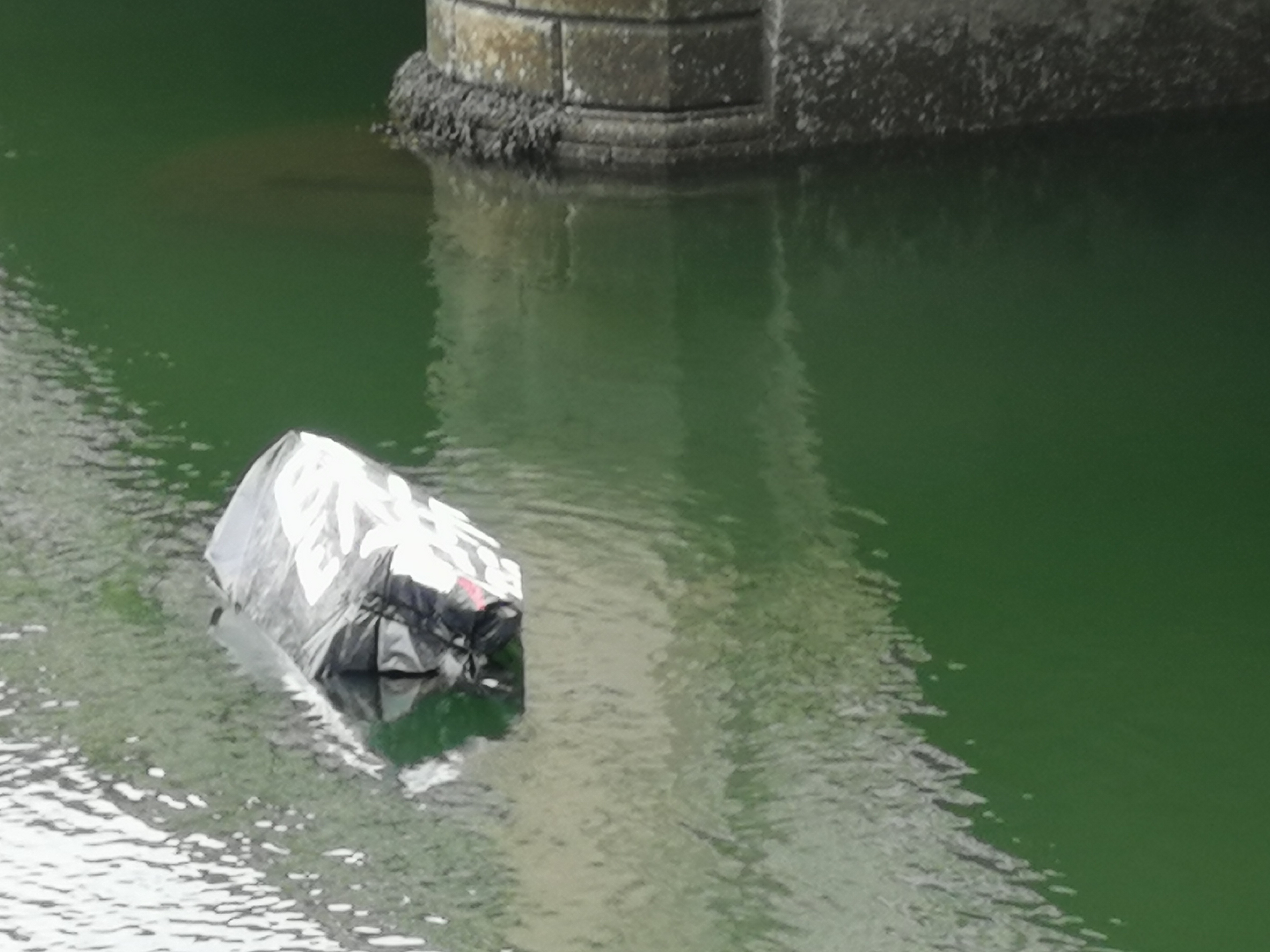
“British Empire RIP” ‘coffin’ immediately after being thrown over the bridge into the Liffey. (Photo: Rebel Breeze)
The ‘coffin’ emerging on the east side of the Bridge on its journey seaward. (Photo: Rebel Breeze)

FOOTNOTES

1The James Connolly monument in Dublin is located in Beresford Place, across the street from what was the old Liberty Hall, the HQ of the Irish Transport and General Workers’ union (now replaced by SIPTU).

2See Sources & Further Information for a link to the full text.

SOURCES & FURTHER INFORMATION

Connolly on occasion coronation Edward VII: https://www.marxists.org/archive/connolly/1902/xx/coronkng.htm

Irish newscaster slams Irish broadcasting team sent to cover royal funeral: teahttps://economictimes.indiatimes.com/news/international/uk/elizabeth-is-not-our-queen-irish-presenter-slams-tv-coverage-of-monarchs-funeral/articleshow/94281107.cms

ITV report and photo: https://www.itv.com/news/utv/2022-09-19/coffin-thrown-into-river-at-march-against-monarchy?fbclid=IwAR3HeY6N5jI5Kol0dgOhm3P1DCOzielCC_KVMyMPvi_3c5n5Z15-B1YCNs4

Anti-Imperialism Action Ireland: https://www.facebook.com/AIAI-For-National-Liberation-and-Socialist-Revolution-101829345633677

BELLA CIAO – ORIGINS AND CONTROVERSY

Main article by CHEMA MOLINA@CHEMAMOLINAA in Publico.es, translation and comment by Diarmuid Breatnach

(Reading time entire: 4 mins.)

The origin of the Bella Ciao song is uncertain and there are different theories about how this mythical popular song came about.

Over the years it has acquired a meaning closely related to the anti-fascist protest movements and in defence of democracy.

However, the Italian artist Laura Pausini refused to sing it during the El Hormiguero1 (show), reasoning that it is “very political”.

The piece has a clear political nature that goes beyond the success which the Money Heist series has given it and that has made it one of the most listened-to Italian songs in the world.

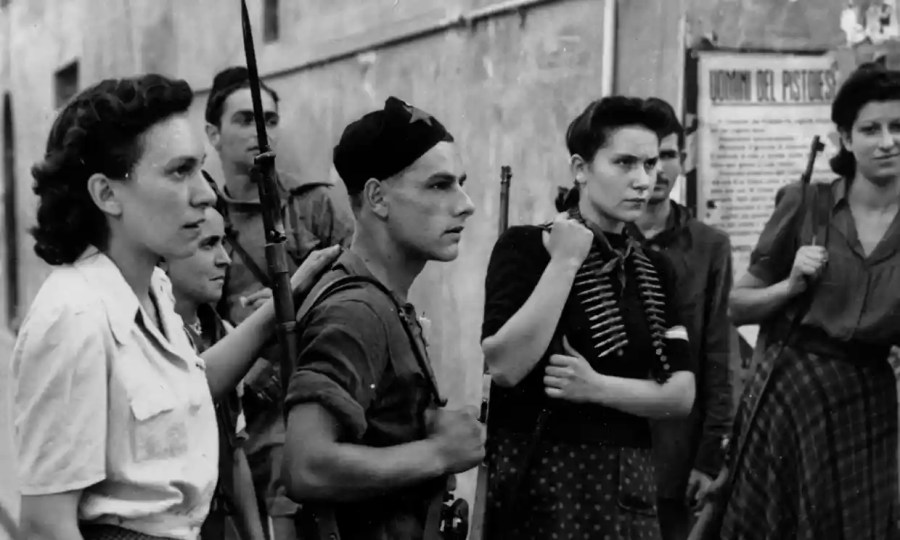
Italian partisans had already employed verses of this hymn against Mussolini’s fascism and the Nazi occupation during World War II.

Armed Italian anti-fascist Partisans in Pistoia, Tuscany (central Italy) Dec 1944 (Photo credit: Keystone/Getty Images)

Specifically, it was the partisans of the Maiella Brigade, in the Abruzzo region (east of Rome), and the Garibaldi Brigade, in the Marche area, a territory located between the Apennine mountains and the Adriatic Sea, who began to sing it, mixing traditional melodies with militant lyrics.

But there are other theories that suggest that the beginning of this song dates back to the 19th century.

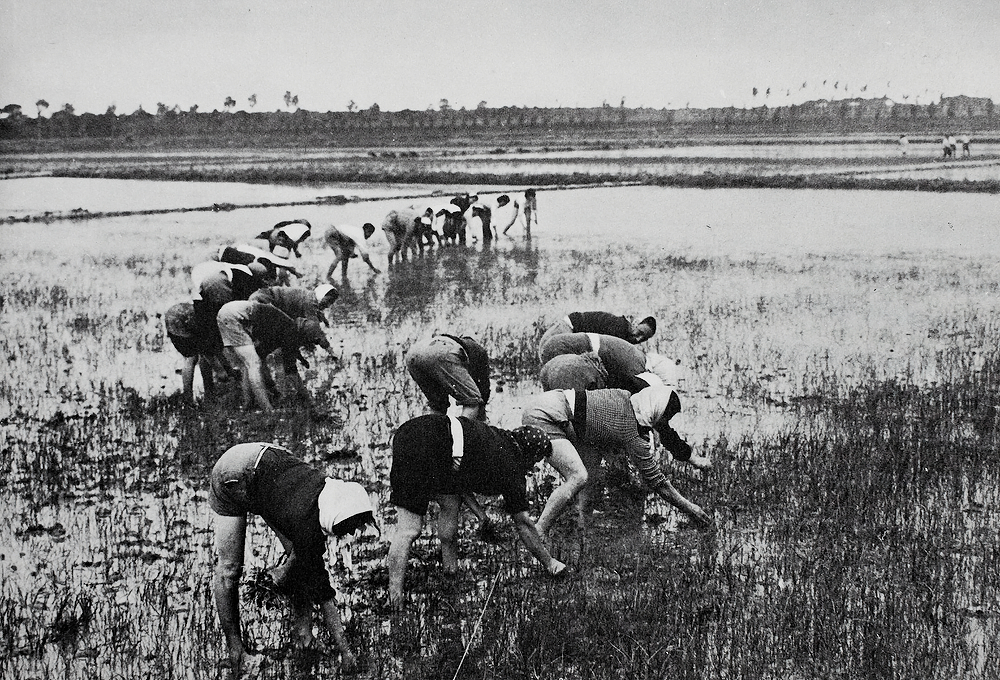
Line of Mondinas at their back-breaking work (Photo sourced: Internet)

The Mondinas, women who worked in the rice fields of northern Italy, recited the lyrics of this song as a sign of protest against the harsh working conditions they experienced every day.

In fact, the historian Cesare Bermani explains that the origin of Bella Ciao comes from a song called Fior di tomba (Flower of the grave) and that the poet Costantino Nigra had previously mentioned it in the second half of the 19th century.

One of the versions of this song reached the Mondinas of the provinces of Vercelli and Novara, both in the Piedmont region.

The Mondines’ (Italian female rice workers) song.

Another theory points out that the anthem could have Ukrainian roots. The musician Mishka Ziganoff, born in Odessa in 1889, moved to New York and composed a piece that could have been the origin of the start of the Bella Ciao air2.

Later, Italian migrants spread the air of this song when they returned to their country3.

Apart from its origin, the song began to become popular and to take on a political meaning due to the festivals organized by communist youth in different European countries. In the summer of 1947, the World Festival of Youth and Students took place.

There, the partisan version of the anthem was promoted, which later reached the Festival of the Two Worlds (also called the Spoleto Festival) in 1964.

The Bella Ciao show was performed at that event, organised by the Italian group Il Nuovo Canzoniere Italiano. The singer-songwriter Giovanna Marini, an artist who also helped to popularise the song, participated in the performance.

Bella Ciao has crossed borders and has been translated into many languages. In Spanish, one of the best known versions is that by the author Diego Moreno, who published his interpretation in 2014 on the album Bella Ciao! Adios Comandante!

COMMENT

THERE IS NO NEUTRAL POSITION ON FASCISM by Diarmuid Breatnach

The current controversy over a prominent Italian singer’s refusal to sing Bella Ciao at a kind of game show was predated by controversy over the origin of the song.

Most authorities now seem to refute the popular belief that it had been sung by Italian partisans, instead dating its emergencer as an antifascist song soon after WWII.

All are agreed however that it was predated by “Alla mattina appena alzata” a song with different lyrics of women rice-planting labourers, the Mondines, bewailing their extremely hard working conditions, their exploitation and expressing their hope in liberation.

Its origins therefore in women workers’ resistance is noble but so also is the antifascist sense in which it is usually sung today.

Woman Singing ‘Bella Ciao’ from window in Bologna Italy on Liberation Day 2020 (Photo credit FTimes)

Laura Pausini, when declining to sing the song, excused herself by saying that “it is very political”. Yes, it is and Pausini needs to realise that neither in the world of today nor in the past is there, nor has there ever been, a neutral position on exploitation of labour or on fascism.

The responses to Pausini recorded by Publico on Twitter were mostly negative towards her decision and rationale but also revealed a fair amount of confusion.

Laura Pausini in 2009 (Photo sourced: Internet)

The most common critical response was along the lines that anti-fascism is fundamental to democracy and therefore above politics, one commentator going so far as to state that Pausini is confusing position or stance on the one hand with ideology, on the other.

Fascism is a political ideology and so therefore is anti-fascism. Of course, anti-fascism is normally associated with the Left of the political spectrum but some conservative individuals and groups have been known in history to be actively anti-fascist too.

However that does not change the fact that anti-fascism is a political position whether ascribed to by revolutionary communists and anarchists, social-democrats or conservatives.

As the world capitalist system in crisis turns to making the workers pay more through rising costs of essentials and wage controls, along with cuts in state social services, the masses will resist. In many states, it is then that the ruling class turns to fascism to repress the resistance.

Neither Pausini nor anyone else can rise above that struggle. One may certainly attempt to be neutral but circumstances will not permit it, will certainly frustrate the attempt. Objectively one’s actions and words will either favour fascism or work against it.

End.

FOOTNOTES

1El Homiguero (“The Anthill”) is a Spanish television program with a live audience focusing on comedy, science and guest interviews running since September 2006 https://en.wikipedia.org/wiki/El_Hormiguero

2Without listening to the air, I am unable to venture an opinion on this. However, thinking about it, Bella Ciaodoes evoke Eastern European Jewish music to me. According to Wikipedia, Ziganoff was a Christian Roma from Odessa, Ukraine but well familiar with Yiddish and Klezmer music. https://en.wikipedia.org/wiki/Mishka_Ziganoff

3This is a well-known process of the dissemination of song airs and even lyrics by migrant workers or sailors (or even soldiers). For example the air of the ballad Once I Had a True Love may be found on an Alan Lomax collection of traditional songs from Extremadura, central-western part of Spain.

SOURCES

Original Publico article: https://www.publico.es/sociedad/origen-bella-ciao-tema-laura-pausini-rechazo-cantar-hormiguero.html?

https://en.wikipedia.org/wiki/Mishka_Ziganoff

The Mondines (women workers): https://en.wikipedia.org/wiki/Mondina

Pausini controversy: https://www.wantedinrome.com/news/italy-laura-pausini-refusal-to-sing-bella-ciao.html

The Hormiguero show: https://en.wikipedia.org/wiki/El_Hormiguero

The Money Heist (La Casa de Papel): https://en.wikipedia.org/wiki/Money_Heist

SO SORRY, YOUR MAJESTY

Nearly completely reprint from Rebel Breeze eight years ago

(Reading time: 2 mins.)

Your Most Exalted Majesty, Queen of the United Kingdom of Britain and Northern Ireland, Commander-in-Chief of the UK Armed Forces, Head of the Church of England, Queen of the Commonwealth.

We trust this letter finds your Highness well, as we do also with regard to Your Highness’ large family and of course your trusted corgis.

I am tasked with writing to yourselves in order to make some embarrassing admissions and to ask your Royal forgiveness.

No doubt your family carries the memory of an uprising in Dublin in 1916? Yes, of course one’s family does, as your Highness says.

Well …. the embarrassing thing is this ……. it’s so difficult to say but no amount of dressing up is going to make it better so I’d best just come out with it: that was us. Well, our forebears. Yes, it’s true.

Not just us, of course. There were a load of Reds in green uniforms too, Connolly and Markievicz’s lot. And of course our female auxiliaries, and the youth group.

But most of that rebellious band was us, the Irish Volunteers (that became the IRA). I can’t adequately express to your Highness how ashamed we are of it all now.

Your government of the time was quite right to authorise the courts-martial of hundreds of us and to sentence so many to death. Your magnanimity is truly astounding in that only fifteen were shot by firing squads and that Casement fellow hanged.

But were we grateful? Not a bit of it! Does your Highness know that some people still go on about that Red and trade union agitator, James Connolly, being shot in a chair? What would they have your Army do? Shoot him standing up? Sure he had a shattered ankle and gangrene in his leg!

One can’t please some people – damned if one does something and damned if one doesn’t. If the Army hadn’t kindly lent him a chair, those same people would be saying that the British wouldn’t even give him a chair to sit on while they shot him.

And how did we repay your Highness’ kindness and magnanimity in only executing sixteen? And in releasing about a thousand after only a year on dieting rations?

By campaigning for independence almost immediately afterwards and starting a guerrilla war just three years after that Rising! A guerrilla war that went on for no less than three years. Your Majesty, we burn with shame just thinking of it now!

Our boys chased your loyal police force out of the countryside, shot down your intelligence officers in the streets of Dublin, ambushed your soldiers from behind stone walls and bushes ….. but still your Highness did not give up on us.

Some people still go on and on about the two groups of RIC specials and auxiliaries and the things they did, referring to them by the disrespectful nicknames of “Black and Tans” (after a pack of hunting dogs) and “Auxies”. They exaggerate the number of murders, tortures, arson and theft carried out by them.

Of course, your Highness, we realise now, though it’s taken a century for us to come to that realisation, that sending us that group of police auxiliaries was a most moderate response by yourself. But we were too blind to see that then and shot at them as well!

That fellow Barry and his Flying Column of West Cork hooligans wiped out a whole column of them. Your Highness will no doubt find it hard to believe this, but some troublemaker even went so far as to compose a song in praise of that cowardly ambush! Oh yes, indeed!

And some people still sing it today – in fact they sing songs about a lot of regrettable things we did, even going back as far as when we fought against your Royal ancestors Henry and Elizabeth 1st! Truly I don’t know how your Highness keeps her patience.

Then we went on and declared a kind of independence for most of the country but …. some of us weren’t even satisfied with that! It was good of your Grandfather George V to have your Army lend Collins a few cannon and armoured cars to deal with those troublemakers.

King George V of the UK, who kindly lent Collins some of His Army weapons and transports.

And then some time later, even after those generous loans, some of us declared a Republic and pulled the country (four fifths of it, at any rate), out of the Commonwealth. Left the great family of nations that your Highness leads! Words fail me ….well almost, but I must carry on, painful though it is to do so.

A full confession must be made – nothing less will do. And then, perhaps …. forgiveness.

Of course your government held on to six counties …. You were still caring for us, even after all our ingratitude! It was like hanging on to something left behind by someone who stormed off in an argument – giving them an excuse to come back for it, so there can be a reconciliation.

How incredibly generous and far-sighted of your Majesty to leave that door open all that time!

Fifty years after that shameful Rising, it was celebrated here with great pomp and cheering, even going so far as to rename railway stations that had perfectly good British names, giving them the names of rebel leaders instead.

Then just a few years later, some of our people up North started making a fuss about civil rights and rose up against your loyal police force, forcing your government to send in your own Army. And was that enough for the trouble-makers?

Of course not – didn’t they start a war with your soldiers and police that lasted three decades!

No doubt your Majesty will have noted that some of those troublemakers have changed their ways completely and are in your Northern Ireland government now.

They’ve been helping to pass on the necessary austerity measures in your government’s budgets, campaigning for the acceptance of the police force and for no protests against yourself.

Indeed, their Martin McGuinness has shaken your hand and rest assured were it not considered highly inappropriate and lacking in decorum, he would have been glad to kiss your cheek, as he did with Hillary Clinton when she visited. Or both cheeks, in your Majesty’s case!

Your Majesty can see, I hope, that we can be reformed.

Our crimes are so many, your Highness; and we have been so, so ungrateful. But we were hoping, after you’d heard our confession, our humble apologies, after your Highness had seen how desperately sorry we are, that you’d forgive us.

And if it’s not too much to hope for, that you’d take us back into the United Kingdom. Reunite us with those six counties, and so into the Commonwealth. Is there even a tiniest chance? Please tell us what we have to do and we’ll do it, no matter how demeaning. Please?

Your most humble servant,

P. O’Neill Jnr.

SINN FÉIN: BECOMING WHAT THEY IMITATE

Diarmuid Breatnach

(Reading time: 5 mins.)

Quite a few animals have developed a skill to imitate something else in order to extend their life and procreation options. However, they remain in essence what they are, just disguised or camouflaged.

Human beings and their political parties, on the other hand, are quite capable of becoming what they imitate and thus transforming themselves, as we can see with Sinn Féin, for example.

In fact, when humans imitate something different to what they are, they often can’t help the process of becoming what they mimicked, even should they want to. This is often not understood by the party’s followers, who think the act’s only a temporary tactic.

One of the many species of Hover Fly in Ireland, mimicking a wasp but harmless to humans. (Image sourced: Internet)

Hovering over shrubbery or flowers at this time of year, we might see a small fly, its black-banded yellow body evoking the bee or wasp. The hover-fly however has no sting at all, having developed the “keep away, I’m dangerous” colours for its protection.

The stick insect imitates stems of foliage not only in colour but in shape, in order to hide itself from predators. The praying mantis also imitates foliage but mainly in order to remain concealed in ambush before grabbing its prey.

Stick insect (Image sourced: Internet)

There’s a spider that imitates an ant, holding two of its eight legs over its head to resemble the antennae of the six-legged insect and has been known even to imitate the ant’s halting scurrying gait. A stonefish imitates a stone on the sea bed while it lies in wait for its prey.

But for all their amazing expertise, they have not – nor can they – become the actual thing they imitate. The stick insect remains an insect, a mantis a mantid, the spider an arachnid, the stonefish a fish.

On the other hand, Sinn Féin, which some years ago began to imitate a political party of the neo-liberal, neo-colonial Irish ruling class, the Gombeens, is becoming what it imitated, transcending what it was into what it wants to be.

People who say that the SF party doesn’t stand for or believe in anything, do it an injustice. The party leaders do indeed stand for something – they stand for getting into government. And they believe in that very strongly indeed, dropping more and more of their old form to do so.

But what do they want to get into government for? Well, just to be the governmentthat’s it. And if not the current government at any point in time, to be in the wings to replace it soon afterwards.

This, of course, entails adopting the dominant colouration and shape of the Irish ruling class environment: neo-liberal capitalist and neo-colonial, i.e foreign-dependent.

FROM NATIONAL LIBERATION TO GOMBEEN PARTY

If we were able to look back through the evolutionary history of animal mimics, we might be able to see stages, a time for example when the mantis and stick insects were beginning to be green and brown but didn’t quite look the part yet.

Dead Leaf Mantis (Image sourced: Internet)

Perhaps the stonefish, though it had not quite got there yet, was beginning to look kind of lumpy. The hover-fly might have been developing dark bands but was not yet showing bright yellow in between them.

With Sinn Féin we can however look back over its evolution from a national liberation organisation to an aspiring gombeen party. I would disagree with those who pinpoint the start of the change with the party deciding in 1986 to stand candidates in Irish state parliamentary elections.

Whether to stand in bourgeois parliamentary elections or not isn’t, in my opinion, a question of principle but rather of tactics. The important issues are the reasons for doing so, the hoped-for objectives and how one goes about the election campaign and after election, if successful.

Certainly however taking part in a government, i.e the executive or management board of the ruling class, is a different question completely.

And when that government is a colonial one, the party cannot even claim to be of a nationalist bourgeois type – it is managing the colony for the colonialist, the highest political level of collusion.

That then for me was the defining shift in Sinn Féin. To be sure, there were many signs along the journey to that point, but that was a step about which there could be no equivocation. And from which there could be no turning back.

One of number of species of Stone Fish (Image sourced: Internet)

A JOURNEY OF MANY SIGNIFICANT STEPS

That step was followed by many others: first calling on people not to oppose and then actually welcoming to both administrations of Ireland the British Queen, the commander-in-chief of the occupying forces; then also supporting recruitment to the colonial gendarmerie.

Abandoning the annual Bloody Sunday commemoration in Derry was an earlier stage, when Martin McGuinness claimed that the results of the Saville Inquiry, establishing that the victims were unarmed (a fact already known to all of Ireland and probably most of the world) were sufficient.1

Refusing to preclude going in to coalition government with gombeen parties was another step on that journey, as was abandoning its annual opposition to the no-jury Special Criminal Courts2 in the Irish state – whether because it wants to show its loyalty to the Gombeens or plans to use it against its dissidents in future is not clear.

Another step was the honouring in Belfast of those who were killed in the British armed forces in WWI, a straightforward imperialist war during which the Provos’ political ancestors, far from supporting the British State, rose up in arms against it in 1916.

The stand taken by the SF leadership towards the British Monarch and Royal Family is another significant change of the party’s position and was marked publicly by statements of sympathy for the death of the Royal Consort, Prince Phillip last year.

At the same time, the leadership apologised for the assassination in 1979 of leading member of the Royal Family and life-long colonialist and imperialist, Lord Mountbatten.

Just recently, another step was taken when condolences were sent to England on the death of the Monarch, Elizabeth Windsor, and Irish people were instructed to be “respectful” to the institution while the media was awash with monarchist propaganda and servile nonsense.

One might wonder why an erstwhile Irish Republican party would seek to accommodate itself with another state’s Royal Family, never mind one which also includes the head of the State which is in armed occupation of a sixth of Irish territory. But SF’s purpose is entirely logical.

In this, the SF party leadership is adapting itself to the nature of the class it seeks to join and represent. The Irish bourgeoisie has been foreign-dependent since its independent nationalist aspirations were smashed in 1798 and 1803.

The Irish capitalist class confirmed its client nature in the process of the creation of the Irish State through 1921 to 1922, in its civil war 1922-1923, armed by the colonial power against the forces for independence ….. and forever since.

The foreign master was first British capitalism and colonialism, later US imperialism and more recently EU capitalism and imperialism. That is the loyal club that SF is preparing to join by imitating its existing members.

End.

Sinn Féin party leadership photographed at funeral in Belfast of ex-IRA political prisoner Bobby Storey in 2020 (Photo sourced: Internet)

FOOTNOTES

1The Bloody Sunday Massacre, one of a series of British Army massacres in the Six Counties (Ballymurphy, Springhill and Derry), was always claimed as the result of a battle with armed insurgents. The timing of the Saville Inquiry (established in 1998) suggests that it was a part of the Good Friday Agreement (also 1988) deal with the Provos: in exchange for their giving up armed struggle, their members in the jails would be released and, for the wider nationalist population of the Six Counties, the British would end up admitting the Derry victims were unarmed. Provisional SF abandoned the annual march on the strength of that verdict but no-one was ever prosecuted for the murders, even when Lord Saville stated that some of the soldiers had lied in their evidence.

2The special political trial courts in both administrations have no juries; in the Six Counties the Diplock Court and in the Irish State, the Special Criminal Courts.

SOURCES

Mimicry: https://www.sciencedirect.com/topics/earth-and-planetary-sciences/mimicry#:~:text=Mimicry%20occurs%20when%20one%20species,otherwise%20capture%20and%20eat%20it.
https://a-z-animals.com/blog/10-animals-that-use-mimicry-to-survive/

Stonefish: https://en.wikipedia.org/wiki/Synanceia

Spider mimicking ant: https://en.wikipedia.org/wiki/Ant_mimicry
https://www.antwiki.org/wiki/Ant-Mimicking_Spiders

SF welcoming British Queen to Ireland: https://www.bbc.com/news/uk-northern-ireland-59489930
https://www.irishtimes.com/news/politics/sinn-fein-and-a-tale-of-two-state-visits-1.1599356

SF supporting recruitment to colonial police force: https://www.irishtimes.com/news/crime-and-law/sinn-fein-presence-at-psni-recruitment-event-seismic-and-historic-1.4161267

SF condolences on death of Royal Constort, Prince Phillip: https://www.newsletter.co.uk/news/politics/top-sinn-fein-figures-lead-effusive-tributes-to-prince-philip-praising-his-public-service-and-support-for-the-queen-3198149
https://www.independent.ie/news/sinn-fein-leader-mary-lou-mcdonald-has-written-to-queen-elizabeth-to-formally-express-condolences-over-death-ofprince-philip-40336994.html

SF no longer opposing the the no-jury Special Criminal Court: https://www.thejournal.ie/special-criminal-court-review-2-5803404-Jun2022/
https://www.irishtimes.com/news/politics/sinn-fein-drops-opposition-to-special-criminal-court-1.4715275

SF on British Army dead of WWI: https://www.bbc.com/news/uk-northern-ireland-62008152

SF on death of British Queen: https://www.sinnfein.ie/contents/64262

A RELEVANT BLAST FROM THE PAST – WAR PROPAGANDA IN IRELAND 1918

Diarmuid Breatnach

(Reading time main text: 6 mins.)

Propaganda is employed in wars and finds its most widescale application through the mass media. The belligerents want their own populations to support their war effort and to have other states support them.

IRISH REPORTING ON THE SPANISH CIVIL WAR

The hierarchy of the Catholic Church infamously mirrored the propaganda of their corresponding religious officials in the Spanish State in backing the fascist-military uprising against the elected Popular Front Government in 1936.

Irish newspapers and radio reporting on the whole followed the line of the Church hierarchy. The resulting conflict gave the Spanish state the greatest number of known mass graves in Europe and anywhere in the world, in fact, outside of Cambodia.

Clipping from Irish Press, not a fascist sympathising editorial line, November 1936 (Image sourced: Irish Newspaper Archives, Irish Press)

The Catholic hierarchy declared the fascist-military to be fighting a religious crusade against “Godless communism”, repeated propaganda of the fascist side, denounced real and imagined crimes of the Republican side.

They denied or ignored news of crimes of the fascists, which occurred from the first days and for years after Franco’s victory, in the course of which they denounced even priests who spoke out about the fascist crimes.

Whether the Spanish Republican Government had its own propaganda (I’m sure it did) or whether all its supporters were squeaky clean or not is besides the point. The overwhelmingly pro-fascist forces propaganda affected us in Ireland and most of it was fallacious.

Even the Irish Press, paper of De Valera who had banned the Blueshirts earlier: …. “These idealistic young men also saw their participation in the Spanish Civil War as helping to solve political divisions in Ireland and ultimately Irish unity. Interviewed in Dublin prior to his departure for Spain, Capt. P. Quinn from county Kilkenny, made the following statement: I believe that if an Irish Brigade succeed in reaching Spain, and there fights against Communism and all its terrors ….”

This had a practical effect in Ireland at the time and later, assisting religious and other fascists to attack socialists, communists and other progressives.

It helped create the atmosphere in which alternative writers were censored and hounded and the Irish State could actually expel an Irish citizen – Jimmy Grailton – for the crime of being a socialist community activist.

In turn, this anti-socialist, anti-communist atmosphere created a poisonous environment for social progress, whether championed by revolutionaries or social democrats.

It also helped create a wall shielding the ongoing endemic mental and physical – including sexual — abuse of women and children which seemed impermeable to control or even criticism for decades.

BRITISH WWI PROPAGANDA

The British imperial cant of “defence of small nations” or of “defending civilisation” in its war against Germany during WW1 while simultaneously suppressing the 1916 Rising and repressing many peoples around the world is well known.

The media related invented German atrocities, gave one-sided reporting, censored or demonised alternative views (I know, beginning to sound familiar).

That is the general, well-established picture. However, I’d like to focus on a specific incident and how it was treated: the sinking by German submarine (U-Boat) of the Howth fishing trawlers St. Michan and Geraldine on 31st of March 1918, with the loss of five Irish lives.

A Howth fishing vessel in past years
(Photo sourced: Internet)

No question of who’s in the wrong there, you’d think. The Irish unionist media (admittedly under war powers control) jumped to accuse the German Uboat crew of a “Howth atrocity”, an “Act of Murder” and that they “Shelled without warning”1.

I am grateful to Phillip O’Connor for his exploration of the incident) in his Road to Independence (2016) [Howth Free Press] on the involvement of Howth, Sutton and Baldoyle communities in the struggle for independence and social progress (and his source on the incident, Seán T. Rickard’s MA).

WAR CONTEXT OF INCIDENT

WWI was fought on land, air (even then) and sea. The British Navy was the most powerful in the world and imposed a naval blockade on Germany, bottling up the latter’s navy but also preventing supplies of any kind entering by sea. Unusually, the blockade included foods.

Germany took the position that Britain was trying to starve the German population and responded with its submarines attacking UK shipping which at the time included Ireland’s.

The British responded by concealing guns on merchant ships so that a German submarine surfacing and demanding surrender could in turn by sunk by the merchant ship in question. Indeed the British used fishing boats as mine-sweepers and even armed some too.

This had the effect of encouraging German Uboat captains on occasion to sink merchant ships without warning rather than run the risk of being sunk themselves.

However the U90, the submarine in question concerning the Irish trawlers in March 1918, appeared not to have been doing that and O’Connor quotes the case of the Greek ship SS Salaminia, of which the entire crew had been given time to get into lifeboats before being sunk.

Indeed, the eight captain and crew of the Michan all got into their “punt” and were picked up alive by a British Navy patrol. Tragically, the Geraldine had no additional boat, having set some of its crew ashore on Lambay Island to gather whelk for long-line hook-baiting.

Whether Captain Jess of the U90 believed the Geraldine was being defiant, playing for time or anything else is not known but his Uboat sank the vessel and there were no survivors.

The dominant newspapers in Ireland at the time condemned the German Uboat along the lines outlined above but also went further to make political capital out of it against the Republican movement.

They – and politicians they quoted – used the incident to attack Irish Republicanism, one going so far as to refer sarcastically to the Republicans’ “gallant allies”, lifting the quotation from the 1916 Proclamation of Independence.

There were rules of war agreed at the Hague Convention of 1907. Attacks on civilians are ruled as a war crime by the Geneva Convention but that was not composed and agreed until 1949.

However, its applicability to all the situations of conflict at sea were not codified until much later and, even then, are not binding on the signatories2.

It needs also to be noted that violations of humanitarian regulations and laws by most states have been documented during their wars with other states and in suppressing uprisings. The British did arm merchant ships during WW1 and also used them in a mine-sweeping capacity.

Looks like a drawing of the sinking RMS Leinster produced for a newspaper of the time (image sourced: https://www.postalmuseum.org/blog/the-centenary-of-the-sinking-of-rms-leinster/)

Also the Leinster, for example, sunk by German Uboat torpedoes on 10th October the same year as the Howth fishing boats, was carrying military personnel and armament and therefore in war terms a legitimate target.3

However, it is difficult to see how the fishing boats could be suspected of being armed merchantmen or even as ships supplying Britain and therefore equal to any ships attacked for breaching the Royal Navy blockade of Germany.

I am grateful to O’Connor for supplying me with the reference4 to the UK’s war-time restrictions obliging fishermen to ply their trade at 15 miles or further from its main ports, which included Dún Laoghaire and Dublin and therefore affected the Howth fishing fleet.

The U90’s captain may have suspected the British were using them as “spotters” for submarines in the area but even so, it is difficult to justify sinking without verifying radio equipment on board and especially without a dinghy to take the crew to safety ….!

German UC-1 class submarine surfaced with crew (Photo sourced: Internet)

In that respect it seems the U90 might have been in violation of agreed measures for the protection of civilians at sea in time of war by destroying civilian fishing vessels.

On the question of warning, although there were no survivors of the Geraldine, the available evidence is that the Captain of the U90 did warn before sinking shipping and had done so in a number of cases including another fishing boat on the same day.

But all was grist to the British war propaganda media and even, especially in the case of Ireland, to its colonial purposes in attacking its main anti-colonial opponents of the time, Irish Republicans.

Of course too, left unmentioned was the fact that the UK was attacking German civilians through blockading food imports5 and threatening and impounding any blockade-breaking ships (except those of the USA6).

Blockades and sanctions have cost many lives over the years – the UK blockaded the Spanish Republic during the Anti-Fascist War which did not impede Nazi Germany and Fascist Italy hugely supplying arms, aircraft and men to the military-fascist troops.

The USA imposed sanctions on Cuba for decades and Iraq for some years; in the latter case, by 1996 an estimated half million children had died as a result, a figure justified by Madeleine Albright, then USA Ambassador to the UN7.

Israel is permanently blockading Gaza in Palestine by land, air and sea – Egypt is participating too with its control over one gate. NATO sanctioned Russia which is now retaliating with some measures also.

Interestingly, O’Connor records that British war propaganda had little effect in 1918 on majority Irish opinion and even the Howth fishermen’s representative condemned the UK Admiralty for the mortal danger in obliging fishermen to ply their trade beyond 15 miles from shore8.

The UK General Election results in Ireland six weeks later would be a convincing illustration of how the vast majority of the population was thinking.

End.

FOOTNOTES

1It would be interesting to know whether it entered the heads of any editors that the British military had bombarded the city centre of Dublin with a number of land and sea-born artillery pieces just two years earlier, without any attempt of warning to the civilian population whatsoever.

2https://casebook.icrc.org/law/naval-warfare

3The Wikipedia entry on the sinking of the the Leinster, while acknowledging the nearly 500 military personnel on board, does not common on this negation of the ship’s civilian status. It does not mention the gun mounted on it either, which is noted in this record https://www.rmsleinster.com/sinking/sinking.htm

4See Appendix for details on this (thanks to Phillip O’Connor).

5The 1994 San Remo Manual states:

102. The declaration or establishment of a blockade is prohibited if:
a) it has the sole purpose of starving the civilian population or denying it other objects essential for its survival.

103. If the civilian population of the blockaded territory is inadequately provided with food and other objects essential for its survival, the blockading party must provide for free passage of such foodstuffs and other essential supplies.

6Vide O’Connor The Road to Independence (2016) [Howth Free Press]

7https://www.newsweek.com/watch-madeleine-albright-saying-iraqi-kids-deaths-worth-it-resurfaces-1691193

8The Road to Independence (2016) [Howth Free Press], p.52.

SOURCES

The Road to Independence (2016) [Howth Free Press]

British naval blockade of Germany: https://en.wikipedia.org/wiki/Blockade_of_Germany#:~:text=The%20British%2C%20with%20their%20overwhelming,to%20be%20a%20war%20zone%2C

https://en.wikipedia.org/wiki/Geneva_Conventions

Merchant shipping in wartime: https://casebook.icrc.org/glossary/merchant-shipping

https://casebook.icrc.org/law/naval-warfare

Sinking of the Leinster: https://en.wikipedia.org/wiki/RMS_Leinster
https://www.rmsleinster.com/sinking/sinking.htm

APPENDIX

   To regulate the security risk of fishing around Ireland during the war the Admiralty thought it necessary to divide the coasts into security zones. These zones had various levels of regulation and protection. Areas were either licensed by special permit, which allowed fishermen to fish these areas under restriction or were simply designated as areas where fishing was prohibited. Orders directly issued by the Admiralty were passed on to the fishermen through the D.A.T.I. via Notices to Mariners (NA G/12 (1917) & G/20/5 (1918). 

Fishing was generally prohibited several miles from headlands, as it was a favourite spot for lurking U-boats. It was also prohibited around minefields, which were used to protect the coast and divert traffic into safer zones for escorts. It was also prohibited around naval bases and near convoy meeting points. And traditionally it was always prohibited in sea-lanes where there was heavy sea traffic. It was prohibited in many areas between sunset and sunrise, (a term still used in modern Rules Of the Road) and also known as “dark hours”. If any security measure presented itself, fishing could also be prohibited at short notice for whatever reason by word of mouth on the local naval authority shoreside or naval authority at sea. The Admiralty also had the right to commandeer vessels and/or cargo space also at short notice. The Admiralty later ordered that if the fishermen sighted enemy submarines they were to stop their fishing activity and go immediately to inform the closest naval authority whether at sea or ashore. This made fishing more difficult, costly and dangerous and particularly annoying to Irish fishermen with national sentiments.

The Admiralty even warned that a failure to comply might lead them to be fired on by naval vessels. Immediately affecting Howth fishermen was the prohibition of fishing within fifteen miles of Kingstown. This area roughly to the NW of Kingstown and roughly a few miles off Howth Head was a favourite bait procurement ground for Howth fishermen but also fell within range of most of their local fishing grounds.

     In March 1917 the following rules affected fishermen fishing the East coast of Ireland but in particular Howth fishermen were as follows:

All decked and motorboats fishing anywhere between Ballywalter, Co. Down, and Howth, or anywhere between Wicklow Head and Loop Head, must carry official permits to fish. Between Ballywalter, the Isle of Man, and Howth, such boats may fish by day and by night at any distance from land within the limits of their permits.

They are forbidden to be stopped in or to pass during dark hours through waters where no fishing is allowed.

Moored nets may be left out at night, provided that the head ropes are kept five feet or more below the surface.

(Department of Agriculture and Technical Instruction for Ireland. Notice to Fishermen. Effective 1 March 1917. Wt.-865. 250. 2/17)

     Later rules came into effect in 1918 for the locality, one of which was fishing could only be conducted within daylight hours in this area.