NEITHER ELECTING ONE DALY NOR FIFTY

Diarmuid Breatnach

(Reading time: 3 mins.)

Clare Daly stood for election in the 2024 elections of the Irish State, in the Dublin Central parliamentary constituency, one with a tradition of independent representation going back to Maureen O’Sullivan and Tony Gregory before her.

Daly was standing as one of the loose Left coalition of Independents for Change in a heavy competition for the four-seat constituency.

Clare Daly has a track record as elected public representative and socialist political activist, also as a prominent Socialist Party activist, with which organisation she partedcompany in August 2012.

She was elected MEP for the Dublin constituency from July 2019 to July 2024, TD1 for Fingal from Feb. 2016-July 1999 and TD Dublin North Feb. 2011-2019; in recent years Daly has been better known outside Ireland due to her public interventions in the European Parliament.

Daly and her partner Wallace were both vilified by pro-imperialist liberals and ‘Left’ for publicly opposing US/NATO/ EU imperialist campaigns against Islamic regimes and the Russian Federation, being subjected to a host of unfounded allegations contrary to their actual record.

Tik Tok clips of Daly’s biting attacks on the EU’s complicity in the US-backed ‘Israeli’ genocide provided relief for many around the world from the Zionist sycophancy and insincere and ineffective concern for the victims of that daily genocide prevalent in the EU Parliament.

And who can forget Daly’s calling German politician and EU Commission President Ursula Van Der Leyen out as ‘Frau Genocide’ in the European Parliament in December last year!2

While an MEP, Daly also intervened in the discussion around the Irish Gombeen3 class’ attempt to push us towards NATO, further undermining a quite tattered Irish neutrality. And while a TD, she and her partner Mick Wallace TD were arrested protesting the foreign militarisation of Shannon.

To their credit both risked jail by refusing to pay the fines imposed but the Gombeen ruling class decided to restrict the damage of its exposure of collusion with US imperialism by also reducing the punishment of both to a few hours in captivity.

Daly has been one of the few TDs prepared to speak in public against the repression of Irish Republicans and to visit some of the consequent victims in jail.

In the EU Parliament, Daly also denounced the Spanish State’s police invasion of Barcelona and violence against voters there on 1st October 2017 during the referendum on Catalunya’s independence.

2024 Dublin Central election poster for Clare Daly.

In Ireland today

In her election flyer here Daly highlighted representation independent of political party for her electoral area, housing, health service, cost of living, Palestine, the endangered climate and Irish neutrality without any indication of how these issues might be effectively addressed.

Daly’s election flyer did not mention capitalism or imperialism, nor did she campaign on a platform of overthrowing the current neo-colonial and neo-liberal capitalist system in force, instead indicating her wish to “hold to account the people who’ve got us into this mess.”

“Holding to account” is something to which Daly is accustomed doing and does it well, eloquently, with passion and fluently, scarcely having to refer to her notes while doing so. But like ‘speaking truth to power’, it has little effect on those who are in control of the political-social system.

It can indeed have an effect on the victims of the system but we are left with the question of what to do about the situation. Refreshing as it may be to hear her again in Leinster House, neither voting Daly in — nor fifty Dalys — is going to change any of the conditions under which we suffer.

BY THE WAY,

in case anyone’s interested, I gave my first preference vote to Daly and hope she does get elected.

End.

1Teachta Dála, the title of a public representative elected to the parliament of the Irish State.

2Imperialist politician and proven plagiarist in her doctoral thesis.

3Vernacular term in Ireland for huckster, carpet-bagger-type capitalists, derived from the Irish language gaimbíneachas, profiteering, nowadays used to describe the neo-colonial Irish capitalist class.

RTE’s Biased Coverage of Palestine and Sinn Féin’s Call for a Review

Gearóid Ó Loingsigh (25 November 2024)

(Reading time: 8 mins.)

NB: Edited by RB from original article for formatting purposes

Sinn Féin has said that it would ask for a review of the national broadcaster RTE’s biased coverage of Palestine and other international conflicts.  They were criticised by almost all and sundry for doing so. 

They were accused of censorship and their own use of lawsuits to silence critics was raised once again.[1] 

The National Union of Journalists (NUJ) came out with guns blazing, claiming it would be in breach “of the principles of the European Media Freedom Act and would set a dangerous precedent in terms of direct and indirect State interference in the remit of the existing regulatory body.”[2]

The NUJ has rarely challenged what it sees as state or private interference in the media before and less still at RTE.  RTE’s board is made up of cronies and business interests, people whose interest is served by limited coverage of financial and other issues. 

Many of them come from the financial sector.  Six of the eleven board members are appointed by the Minister for Communications, so there is already government interference in RTE.

The NUJ itself would not come out well of such a review, if the review were honest. For decades it implemented Section 31 of the Broadcasting Act, censoring Sinn Féin, even when the party was standing in elections.

A brave RTE journalist Jenny McGeever was sacked because she broadcast one sentence from Martin McGuinness, “If that is ok with the Police, that is ok with us”, in reference to arrangements for the transport of three IRA volunteers’ bodies back to Belfast.[3] 

It was an innocuous statement.  The NUJ did next to nothing to defend her.  They did not defend her just as they meekly accepted the sacking of the RTE Authority in 1972.  Colum Kenny commenting on his time at RTE remarked that:

During my years at RTÉ, I became for a period what is known as ‘The Father’, or chairman, of the Programmes Chapel of the National Union of Journalists. I found no great appetite among its members, or indeed among the membership of another union representing many producers, for industrial action aimed at drawing public attention to the existence of the gagging Order known as Section 31.[4]

In other words, neither the union nor the members did anything about it.  They either agreed with it or decided the truth was not that important, not as important as their careers. 

The union will not look well, if coverage on Palestine is looked at, nor will it come out shining if coverage of Ukraine is also included, as on this issue, the union itself intervened directly in helping to shape a narrative at odds with reality.

It is as clear as day that on Palestine, Irish coverage has been very biased, in terms of who it gave interviews to, the issues it refers to and the kid gloves that apologists for genocide such as the Israeli Ambassador have been treated with. 

It is clear even in the language used.  The word ‘genocide’ is never used in reporting, unless quoting someone and even then, sparingly.  It is referred to as ‘the war’, ‘the conflict’ etc. 

It has mainly used the term when reporting on the case taken to the International Court of Justice and gave a succinct but incorrectly limited definition of what genocide is. 

It stated “In short, genocide is the intentional destruction of a people in whole or in part.”[5]  The definition is actually a lot broader than that and Gaza fits the bill on various counts.[6]

When reporting on the murder of civilians in Palestine, it never uses such terms.  It says ‘killed’ and the casualty figures are always referred to as “According to the Hamas-run Ministry of Health”. 

The message is clear, that these figures come from an organisation that is considered to be a terrorist group and therefore the figures are not reliable.  But it is actually the elected government. 

The last time there was an election in Palestine, Hamas won, both in Gaza and in the West Bank, though it only assumed power in Gaza with the Vichy Palestine Authority appointed by Mahmoud Abbas undemocratically taking control of the West Bank. 

So, of course the Ministry of Health is run by the elected government.  This language is never used in relation to Israel, we are never told “according to the Likud-run Ministry of Defence”.  In fact, such caveats are almost never used, not even when quoting the most vile dictatorships in the world.

  At best, they state “according to an official government communiqué”, which is technically correct and does not have the same moral =laden judgement contained within it.

In Lebanon, they engage in a similar sleight of hand, referring to attacks on “Hezbollah strongholds”, which is the type of language they hope will give some justification to the bombings.  But what are Hezbollah strongholds?  They are areas in which the organisation has mass support.

You would be hard pressed to find in the media, in general, and RTE in particular any significant explanation of what Hezbollah is. 

Many viewers hearing about strongholds being bombed would not know and are never informed that what this means is areas in which the organisation has a support base, which is also electoral. 

We know which areas are Hezbollah strongholds because they are the areas where people voted for them.  It is an electoral and military force, increasing its number of parliamentary seats in the 2022 elections from 13 to 15, though its allies in parliament lost seats. 

But the point is, it is a force with a huge popular base.

Likewise, when Israel told Irish UN soldiers to leave, the President of Ireland described it as a threat — but the media was more hesitant. 

When Israel then used UN compounds as shields in their attacks, the resulting damage was described as damage caused by the exchange of fire between the two.  You would never guess that one of the sides deliberately used them as protective shields.

In terms of RTE bias and coverage, whilst it has reported on Palestine over the years, once October 7th happened, the official discourse emanating from RTE and most other media outlets was that history began on October 7th. 

No attempt was made to look at the history of the region, nor the context of Israeli aggression and crimes against humanity prior to October 7th.  Previous Israeli attacks and crimes were rarely if ever mentioned. 

It made one attempt at explaining what Hezbollah was in an article published on its site.[7] 

The article recognises that it has political support, but constantly refers to the fact that it is designated as a terrorist organisation by the US and that other bastion of democracy, Saudi Arabia, whose leaders have never been elected. 

Saudi Arabia, despite having a nominal parliament is led by a bunch of royal head-chopping kleptocrats.  Though RTE quotes them favourably as a source of analysis on the nature of Hezbollah. 

The organisation is according to RTE nothing more than a group that “…has risen from a shadowy faction to a heavily armed force with major sway over the Lebanese state. The United States, some Western governments and others deem it a terrorist organisation.”

The headline on the piece reduces Hezbollah to just being a group that supports Hamas. And that was about it from RTE on the nature of the organisation.

Likewise in Ukraine, though RTE had reported on the country previously, once again history started on a particular date, this time February 22nd 2022. 

They ignored the 2014 Maidan Coup, the breaking of the Minsk Accords by Ukraine, the repression of non-Ukrainian cultures, which included not just Russians but also gypsies and others. 

The promotion of WWII fascist Stepan Bandera, the fascist nature of the Azov Battalion were all ignored to favour a simplistic account.  Previous acts such as the burning to death of trade unionists in Odessa by fascists in 2014 were never mentioned again. 

RTE presenters even questioned why NATO wasn’t pushing for all-out war with Russia, and they included in that the possibility of going to the brink of nuclear war. 

The Irish Times has recently doubled down on this, basically resurrecting the “Russia will invade and attack everyone scenario” so common when the war began.

It argued in a piece written by Kier Gillespie from the right-wing think tank Chatham House that Ireland should abandon its “neutrality” and Europe should get ready for all-out war with Russia.[8]  Incidentally, a sentiment echoed to some degree by the “pro NATO left” in the Irish parliament.

The NUJ for its part, whose members push the narrative on Palestine and Ukraine were not content with the complicity of its members in a particular narrative but organised a protest to skew the debate altogether. 

Shortly after the war started the NUJ organised a protest at the Russian Embassy to protest the lack of press freedom and attacks on journalists by the Russian state.  The Russian state has a dreadful record on the matter, but so does Ukraine. 

Moreover, in its attempt to portray the Russians as the only threat to freedom of the press the NUJ invited ambassadors from other countries to join in with it at the protest. 

Fine, except with one exception, those ambassadors represented countries with a poor record in the matter, such as Georgia, Poland and Ukraine coming in 89th, 66th and 106th respectively in Reporters Without Borders Press Freedom Index for the year 2022. 

By doing this the NUJ set a narrative that the only threat to press freedom was Putin and whitewashed a number of regimes with dubious records themselves. 

Whilst it has condemned the deaths of journalists in Gaza it did not protest at the Israeli Embassy but held a vigil instead at an art gallery.[9]  You couldn’t make such cowardice up.

So, an investigation of bias in the coverage of conflicts would be welcome.  Neither Sinn Féin, RTE, nor the NUJ would come out of it well.  But the problem is political. 

The reason why RTE does that, is that it gets away with it because there is no challenge to its bias. Sinn Féin and the Irish left represented by such stalwarts of mediocrity like People Before Profit, applauded and egged on the push for war and bias about Ukraine.

They now find the media supporting those same reactionary forces (NATO, US, EU) in their assault on Palestine.  The penny has almost dropped for them, but not quite.  RTE was biased on Ukraine and they agreed with it, now it is biased on Palestine and it is too late. 

But RTE and the Irish media in general represent the interests of the Irish state and so it should come as no surprise that it is biased. 

This does not mean we should accept it lying down, but you can’t call for bias on one issue in favour of a NATO proxy (Ukraine) and against bias in favour of another proxy, Israel.  The two are linked.

In the case of Palestine, the NUJ is passive, passing resolutions and issuing communiqués. 

As with the Irish censorship law Section 31, the union is content to not take any industrial action on the issue and let its members lie, downplay the seriousness of it all, treat the Israelis with kid gloves and use language that deliberately distorts what is happening. 

Their role in echoing Their Master’s Voice should be exposed, though Sinn Féin is not the best -placed organisation to do so, given its prioritising of its relations with Washington and its own attempts to censor Palestinians in Ireland who did not follow the Palestine Authority line.

NB: For more articles by Gearóid see https://gearoidloingsigh.substack.com


[1] Irish Examiner (19/11/2024) LIVE: Election 2024 — Sinn Féin promises ‘peer review’ of RTÉ’s Gaza coverage if elected. Paul Hosford and Cianan Brennan. https://www.irishexaminer.com/news/politics/arid-41519792.html

[2] RTE (20/11/2024) McDonald defends Sinn Féin plan to review RTÉ’s Gaza coverage.  Tommy Meskill. https://www.rte.ie/news/election-24/2024/1120/1481906-ireland-politics/

[3] Sunday Business Post (20/04/2003) How RTE censored its censorship. Niall Meehan.  Archived at CAIN https://cain.ulster.ac.uk/othelem/media/meehan/meehan03.htm

[4] Colum Kenny (2005 ) Chapter 5 Censorship, Not ‘Self-Censorship’ https://doras.dcu.ie/24076/1/Kenny,%20Colum.pdf

[5] RTE (11/01/2024) Explained: Ireland’s position on the genocide case against Israel. Juliette Gash. https://www.rte.ie/news/2024/0111/1425974-genocide-case/

[6] See Genocide Convention https://ihl-databases.icrc.org/en/ihl-treaties/genocide-conv-1948/article-2?activeTab=undefined

[7] RTE (31/10/2023) What is Hezbollah, the group backing Hamas against Israel? https://www.rte.ie/news/world/2023/1031/1413861-hezbollah-lebanon/

[8] Irish Times (23/11/2024) If Russia is indeed planning an attack against a Nato state, distance and neutrality will provide no defence.  Keir Gillespie.  https://www.irishtimes.com/opinion/2024/11/23/if-russia-is-indeed-planning-an-attack-against-a-nato-state-distance-and-neutrality-will-provide-no-defence/?fbclid=IwY2xjawGxRsdleHRuA2FlbQIxMQABHVXgrcEEXPDpG2Am4EF_a_67yPZPmEio-r1l3dlQxOftB3W7EWIxEl8S_w_aem_LGtv72o-qvSLNNgSLdrWrw

[9] NUJ (30/04/2024) Dublin vigil for slain journalists. https://www.nuj.org.uk/resource/dublin-vigil-for-slain-journalists.html

TO VOTE FOR WHOM OR NOT – AND DOES IT MATTER?

Diarmuid Breatnach

(Reading time: 7 mins.)

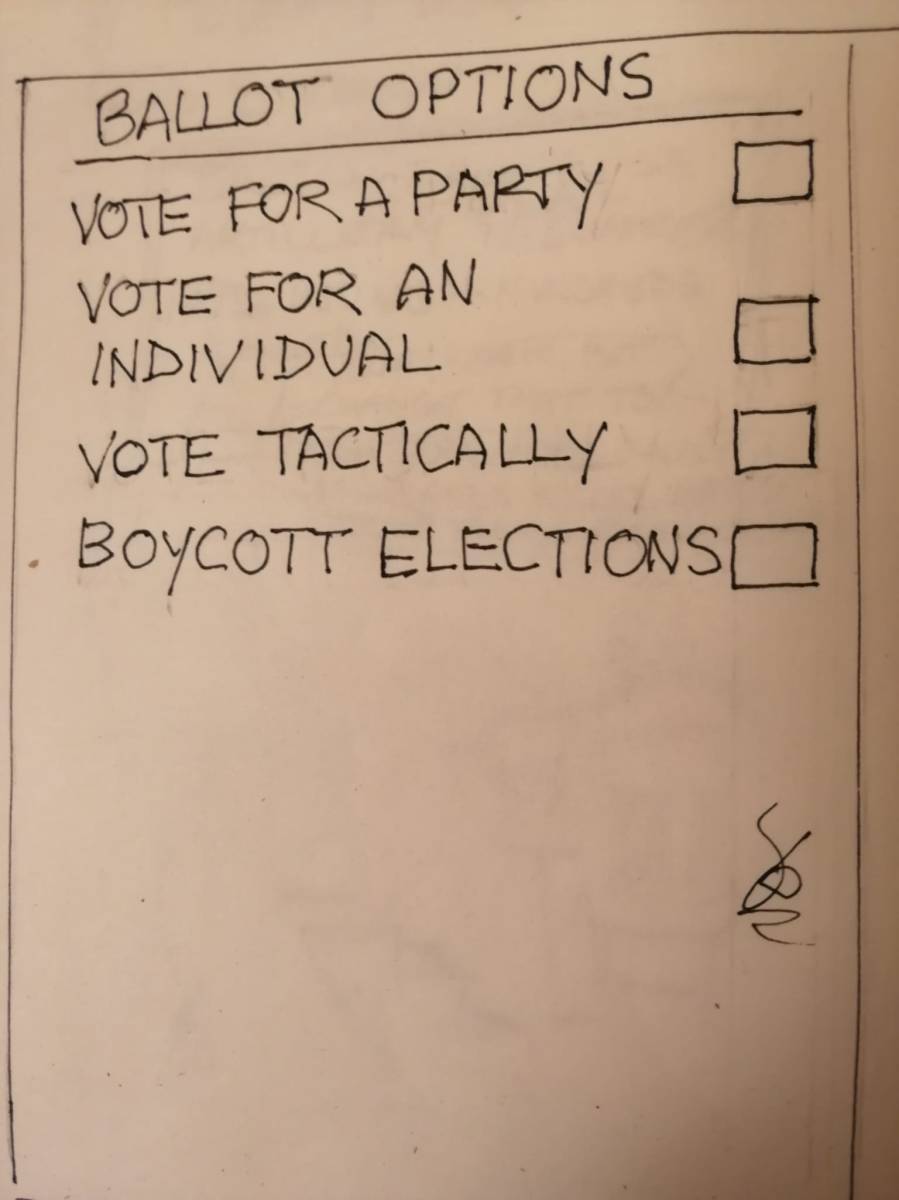
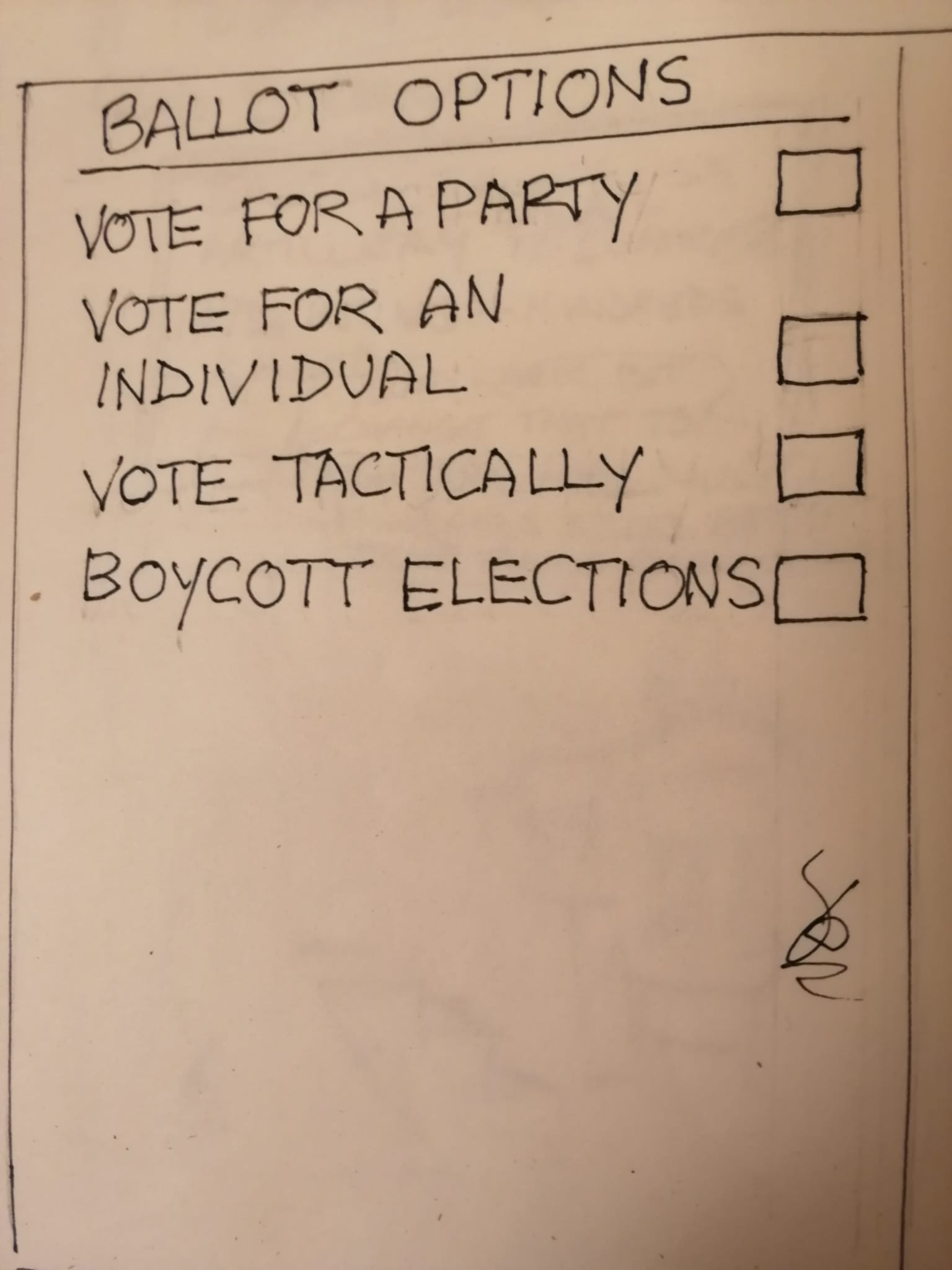
The elections for a government in the 26-County state are only days away now and, while many are advocating a vote for this or that party or candidate, some are opposed to voting at all.

ARGUMENTS AGAINST VOTING

An amusing take on abstention advises: Don’t vote – it only encourages them! Anarchists have long been opposed to voting in national elections and I recall a poster in Britain exhorting people to Vote for Guy Fawkes – the only man ever to enter Parliament with honest intentions. 1

Revolutionary marxists have also often called for a boycott of elections.

The position that they hold in common is that changing this or that party in government does not change the system and that it is that which is in need of change; as Connolly2 famously declared capitalist governments to be “committees of the rich to manage the affairs of the capitalist class.”

However, it is possible to hold that opinion but yet to vote – and even to advocate voting – in some circumstances. However among some Irish Republican circles there has been a trend maintaining that voting in these elections is a recognition or acceptance of their alleged legitimacy.

A massive spoiling of ballot papers is often advocated by those who wish to ensure that the boycott may not be interpreted as apathy among the electorate. The number of spoiled ballot papers is supposed to be recorded and the papers available for inspection.

ARGUMENTS FOR

Those arguing in favour of voting in elections come at the question from a variety of points, including that voting is a democratic right for which our ancestors fought; that if we fail to vote we have no right to complain about government actions (or inaction).

They may maintain that not voting for some parties is equivalent to voting in favour of their opponents; or that voting a particular party into power can be used to overturn undesired legislation or conversely to promote desired legislation or to put them in power so that they may be exposed.3

The reformists and social democrats (often presenting themselves as revolutionaries) advocate for reforming or at least controlling capitalism under a Left Government. Despite the impracticability of the latter in many historical experiments, the hopeful and deluded keep advocating it.

Then of course, there is the ‘Lesser Evil’ argument, which is probably the most seductive; we witnessed that during the Harris-Trump USA Presidency competition. The Greens in Europe even appealed to Stein of the USA Greens, running against Harris on an anti-Genocide ticket, to desist.4

The claim that we might as well use our votes to elect a ‘lesser evil’ government is seductive precisely when we feel that no other option is available, combined with fear of worse economic and social conditions to be imposed upon us by the ‘worse evil’ party or candidate.

To follow the ‘lesser evil’ road is not only to perpetuate the system in one form or another but also fail to recognise our potential strength as the producers of all wealth; to fail to strengthen our energies to break firstly the mental chains, then the physical ones; to make fundamental choices.

THE TACTICAL VARIANT

Some argue that although in general national elections don’t change the system, they can be used at times to effect a tactical change: show rejection of a specific government position or individual.

They sometimes argue in favour of voting to put a specific individual or group of individuals into parliament for tactical reasons.

Can it be of use to have a few individuals in the Irish parliament who will attack the government and ruling class in speeches? Or to put specific issues forward on which to expose the ruling elite? Or to ask questions to gather government information? I am sure that it can and has been at times.

Can it be useful to have a handful of individuals elected to the Irish parliament who are prepared to seek entry to prisons to talk to political prisoners? Or who will head an investigation into some kinds of abuses and publish the results? Such can be and has been of use at times.

The important thing is to ensure that the message we give is that useful though such people and positions may be at times, they are not the solution, which can only be the overthrow of the system and the establishment of a socialist system with power in the hands of the working people.

ELECTIONS IN A CAPITALIST DEMOCRACY

What are known as ‘democracies’ are states concentrated across ‘Western’ regions, i.e western Europe and its former colonies of the USA, Canada, Australia and New Zealand, with varying degrees of effect upon states on the African and Asian continents, along with ‘Latin America’.5

These are without exception, regardless of variety, systems of governing their working people without having to resort to wide-scale constant repression and suppression. For that project, the illusion of choice is essential, hence the regular elections and different political parties.

But the illusion of any fundamental choice is failing. Increasingly, governments in many European ‘democracies’ are becoming coalitions between a number of political parties and in Ireland, the main Government-Opposition parties for decades have exposed the reality by governing together.6

The effect of such exposure of the lack of real choice is impacting upon the consciousness of the populations concerned so that progressively less of them are willing to participate in the charade. In Ireland now more than one-third of the population do not vote.

This situation is of great concern to the ruling classes and to their intellectuals who are busy trying to devise schemes to offset the drift such as advocating voting from home, spectacles such as televised confrontations between competitors and ‘Citizenship’ programs in schools.

Clearly revolutionaries should not assist in any attempt to justify the system or to perpetuate the illusion of elections in capitalist ‘democracy’ being anything else than a periodic choice for slaves between the overseers employed by their masters.

DOES IT MATTER ANYWAY?

The nub of the question as to whether to vote boils down to what we hope to achieve and its prospects. If there were a massive abstention from the polls then of course that would be seen as a huge vote of no confidence in the parties standing and perhaps in the system itself – but from what perspective?

From the Right? From the Left? From apathy? In any case at the moment that looks like a moot question since there’s a likelihood of a turnout of around 60% of the registered voters.7

Will abstention make people more politically aware or conversely will participation in the elections turn people away from the possibilities of organising on the ground and ultimately of revolution? Perhaps for some – but overall, I think not many in either case, not on a longer-term basis.

From a revolutionary point of view, does it matter whether people vote or not? Or even sometimes who they vote for? Surely what matters is organising and supporting the movement for fundamental progressive change? Can that be done by people who vote as well as by those who don’t?

I’d say that is at least as likely.

During capitalist state elections the best we can do, I think, is to point out the inadequacy of the choices presented to us and to advocate stronger and more militant organisation as an alternative to the calls to vote for one party or another.

Whatever party or individual gets elected to Leinster House, the principal struggles remain: for a free united independent Ireland, for a socialist system, against the imperialist world system, against environmental destruction. It is on that we need to concentrate.

The newly-elected management committee of the capitalist class should be savaged mercilessly for its inevitably broken promises and its continuing attacks upon the economic and social conditions of the working people, and on Irish national neutrality.

Most of all, we need to improve our organising, strengthen our ranks and find ways to strike blows against the system to win victories in our march towards the overthrow of the neo-liberal and neo-colonial Gombeen ruling class and its foreign masters.

End.

1While amusing as a caption, given that Guido Fawkes plotted to blow up the English Parliament on 5th November 1605, upholding Guido Fawkes as some kind of historical hero is problematic, as he was a militant Catholic and the date of capture, Guy Fawkes’ Day, was a regular occasion for the exhibition of anti-Catholic prejudice even into the 20th Century in Protestant Britain, which more often than not, manifested itself as anti-Irish racism.

2James Connolly (1868-1916), revolutionary socialist activist, theoretician, journalist, writer and trade unionist, leading participant in the 1916 Irish Rising for which he was sentenced to death and shot by British firing squad.

3Lenin famously advocated voting the British Labour Party into government for the first time to ensure their exposure, supporting them “as a rope supports a hanging man”, advice misused by social democrats and others on the electoral Left and about which revolutionaries have argued ever since.

4https://www.theguardian.com/us-news/2024/nov/01/european-greens-ask-jill-stein-to-stand-down-and-endorse-kamala-harris

5And of Eastern Europe.

6Throughout the existence of the Irish State, the Fianna Fáil party has been the longest in government, with Fine Gael second, both socially conservative parties with strong loyal electoral bases. However now they are governing in coalition, along with the Greens. It is worth noting that there has not been a government of absolute majority by any party in the Irish state since 1981, when Irish Republicans stood as H-Block (e.g. hunger strike) candidates and two were elected with another having a near miss.

7Despite a trend of dropping percentages of the potential voters actually participating, in 2020 the turnout was a little over 62%.

ENTITLEMENT, OPPORTUNITY & PROTECTION

Diarmuid Breatnach

(Reading time: 3 mins.)

The news about the sexual predations of Mohammed Al Fayed, owner of Harrods and Chelsea Football Club, was not news to many. His predilections, we learn now, were well-known in his circles. Yet only after his death are these stories made public.

Again and again we learn these stories of sexual predators, even paedophiles, whose predations come to the attention of the public only after their deaths. Entertainers such as Rolf Harris and Jimmy Saville, for example, who preyed on children.

Fayed wasn´t an entertainer but he was very rich and preyed on young women – in this world in which we live, some entertainers are often very rich too. With wealth comes protection, not just of the privately-hired variety but of the public kind also – the police force.

Their victims, at least the adult ones, knew that their words would count less with the police than would those of the rich. In the end, the police know instinctively who are their employers. The government ministers and senior police officers mix in the same circles as some of the rich.

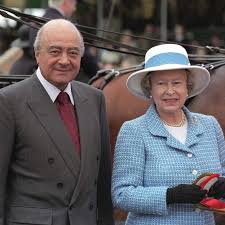
Mohamed Al-Fayed demonstrating his access to power and influence, posed next to the late British monarch, Queen Elizabeth. His son Dodi was friendly with Princess Diane and died in a car crash with her – at the time she was married to the former Prince Charles, now King of the UK. Jimmy Saville, paedophile, we may recall, was also close to the Royal Family as were the Epstein-Maxwell couple, who procured at least one underage female for Prince Andrew. (Photo sourced: Internet)

The victims are aware of how the vertical power structure in society is constructed. They know or are soon taught that the rich have not only direct protection but retribution for those who offend also. There are penalties beyond police harassment or lack of police response to complaints.

There is the jeopardising of employment for the employee, lacking of job reference, unfavourable comment in another employer´s ear … The employers also have a network of mutual interest.

HR managers of one company will wish to further their career progression through the capitalist network. Players know how the game is played.

WHY AND HOW

The predators do not do what they do merely because they like to – there are many temptations in people´s heads that are not acted upon, that remain in internal fantasy or perhaps acted out only with consensual partners.

The famous predators functioned out of a sense of entitlement – like their wealth which they felt they deserved,1 they believed also that they were entitled to do what they wanted to “lesser” beings because they themselves were famous and rich (like Harris and Saville) – or just rich, like Mayed.

Just as their wealth was the accumulation of the wealth created by the work of many others, with their sense of entitlement went also the reality of their ability to do what they wanted. They did it because they could.

Jeffrey Epstein and Ghislaine Maxwell were eventually arrested and went to jail, Epstein dying there. Far from being a vindication of the justice of the system, their victims were initially ignored by the police and even harassed – and Epstein died in mysterious circumstances before trial.

All around the world people are suffering these kinds of abuses to one degree or another, have done so for centuries and will continue to do so. Yes, even with the occasional exposure of this or that person.

For as long as the system of status, wealth and privilege exists. Which means at least for as long as the capitalist system exists – and even beyond that, perhaps.

So in organising to overthrow the capitalist system we must ensure that we do not replace a system of unquestionable authority and power with another.

Yes, well, that´s for the future, right? No. It starts now. In our treatment of one another. In how we conduct ourselves. In ensuring we do not claim a special entitlement or the right not to be be questioned.

And when we err, individually or organisationally, to act to correct and remedy the ill.2

End.

FOOTNOTES

1Let us remember here too that no-one can get rich by their own work, no matter how hard – it requires the work of many others to make one person wealthy.

2Let us not forget the one example among many: the past history of the ostensibly revolutionary socialist organisation of the former Workers Revolutionary Party. Its General Secretary Gerry Healy was accused of the sexual abuse of 26 young female activists in the organisation. A painfully honest description of the replication of systems of unquestioned privilege in the former Party and the process of the expulsion of Gerry Healy and of his defence (for example by famous film actors Corin and Vanessa Redgrave) can be found here: https://libcom.org/article/break-wrp-horses-mouth-simon-pirani

ELECTORAL DYSFUNCTION ANXIETY

Diarmuid Breatnach

(Reading time: 5 mins.)

Like that similar-sounding ailment affecting some males, most of us are not rising, at least not to the expectations of the electoral commission. Furthermore the problem appears to be no respecter of gender.

The issue, according to the Independent Electoral Commission, is that not enough of us are voting in elections. Only 49% turned out to vote in the Irish local (municipal) and European Parliament elections which means that more than half of registered voting age didn’t bother.

Well, so what? Why is that is troubling the IEC? It seems that generally, the authorities like to see a good turnout because it appears to signify that people believe that they really have a democratic choice through the electoral system and are actually exercising it.

If they don’t believe that they have a choice – or if the appearance of choice is not matched by the reality they perceive, the people might turn to other methods of deciding how the country should be run. And that might result in an outcome unwelcome to the ruling elite.

THE TWEEDLES

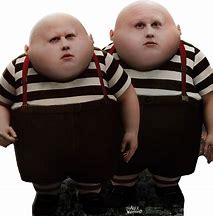
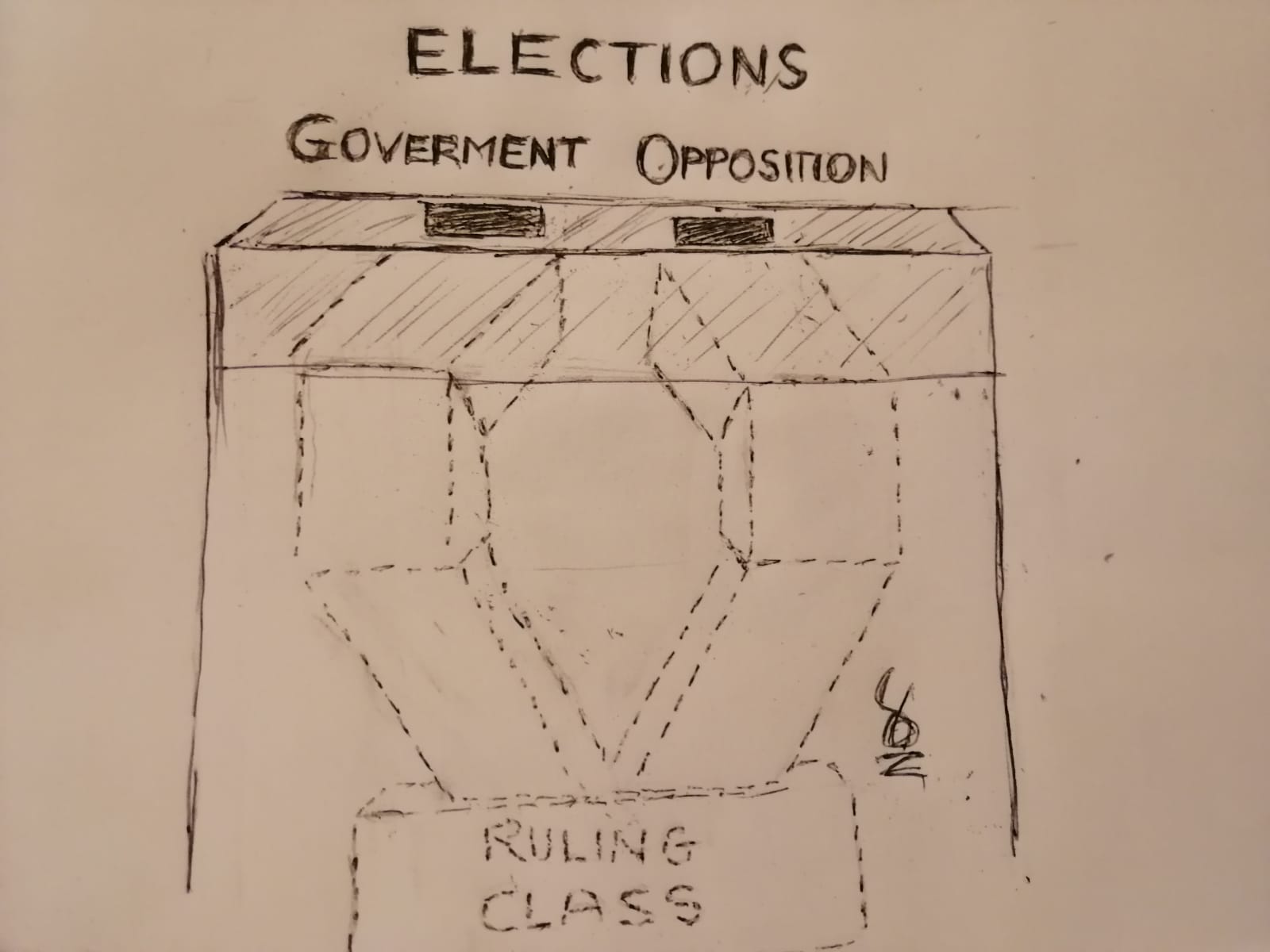
The Tweedledum and Tweedledee parties appear to give the electorate alternatives and though whichever party wins the capitalist system remains, it appears to give a choice – but a bet choosing between two horses of the same owner in a two-horse race.

Like both Tweedles in the folk nursery rhyme and in Lewis Carroll’s Alice Through the Looking Glass (1871), Tweedledum and Tweedledee are brothers and though they appear to be preparing for war with one another, they don’t actually fight, not in Western ‘democracies’.

Tweedledum and Tweedledee (or is it the other way around?). (Image sourced: Internet)

There are, after all, plenty of spoils to share between their masters. The creators of that wealth need to be controlled, fooled and, if necessary from time to time, repressed. “Red” social democrats and “Blue” conservatives have alternated to share power in the Western world for over a century.

In Ireland, the only European state which is a neo-colony and part of its land a direct colony, its national liberation unfinished, the Tweedles have been blue or green.

But for decades now the illusion of choice has been crumbling. There has not been a majority party government in Ireland since 1981, when Irish Republicans were elected during the hunger-strike campaign. All Irish governments since have been a coalition of one kind or another.

The Irish Labour Party, founded by Connolly and Larkin and far from their thinking for many a long year, has been in government a number of times but always in coalition – usually with the conservative Fine Gael, itself the product of a coalition that included the fascist Blueshirts.

Those years of government participation for Labour have thoroughly rubbed off the red paint of socialist opposition from the party. The Green Party, mixing a brand of concerns for the environment with those for society, has met a similar fate in coalitions.

Since 2020 the Irish state has had what is essentially a ‘national government’, a coalition of opposing parties normally only seen in times of war or under a fascist regime. The alleged political poles have joined in order to run the system for the Gombeen ruling class.

Though this gives stability for the Gombeen’s system their problem is that it has removed the illusion of choice. They might restore that illusion through the promotion of a third major party in opposition and the formerly revolutionary Sinn Féin has worked hard to fill that space.

In the 2019 General Election SF got the most representatives elected but insufficient to form a majority government, after which the Tweedles united, along with the Greens to make up the numbers to manage the State. But the Gombeens will hold SF in reserve, I’m thinking.

Harris of Fine Gael and Taoiseach (equivalent of Prime Minister) of the Coalition Government, commented on the closeness of his party and former Opposition party Fianna Fáil in votes, predicting “a Government of equals”1– but it’s not just in votes that they resemble one another.

Yes, I know I misspelled Government but I want to get this article out of the way. I’ll redo the cartoon sometime later and replace it.

RESULTS

I don’t think there is a great deal to be said about the actual results of the recent local and EU Parliamentary elections in Ireland but no doubt some commentators will be saying it anyway.

Of unwelcome interest is that five fascists of different groups got elected, three of them to Dublin City Council. The electoral Left lost some and gained some without big changes.

Independent socialists (and couple) Clare Daly and Mick Wallace both lost their EU seats but perhaps they and in particular Daly in Ireland would be more of an asset to the Left. Luke ‘Ming’ Flanagan in Midlands North West, another left Independent, kept his EU seat comparatively easily.

Sinn Féin had what was for them a disappointing run but had some new people elected to local councils and two seats in the EU Parliament, losing an existing one. Many of their enemies in the Republican ambit, often former comrades, rejoiced in their misfortunes.

Understandable though that may be one wonders how those who have some faith in the party at the moment are to be disabused of their illusions without having seen them in government. On the other hand their twists and turns on the road there may have disenchanted many already.

IT’S NOT A CHANGE OF PARTIES IN GOVERNMENT WE NEED

For most of my life I have been aware that it is not a change between political parties but between socio-political systems that is the issue. But I do vote sometimes in order to help keep a useful and decent voice in a parliament or a local authority.

An Irish community activist pensioner years ago in London, Co. Galway Teresa Burke, was a member of the British Labour Party. After a General Election, she asked me had I voted. I replied that I hadn’t; I’d not seen a candidate that stood anywhere close to that in which I believed.

“Well then, you must take responsibility for everything the Tories do if they get in!” Teresa remarked angrily.

“I’ll do that, Teresa,” I replied, “if you’ll take responsibility for everything Labour does in Ireland if they get in!”

Teresa’s lips twitched slightly. She knew as well as did I that the British Labour Party had sent the troops into the Irish colony to quell the struggle for civil rights in 1969 and supported the Tories in introducing internment in 1971 and massacres that year and in 1972.

In 1974 police under a Labour Government had killed the first anti-fascist on a demonstration,2 framed a score of Irish people in four separate cases for heavy jail sentences3 and had passed the fascist Prevention of Terrorism (sic) Act.

Whichever party is in government, the social-political-economic system is run by the capitalist class which it benefits and they will fight tooth and nail to maintain that system.

The alternative-party-within-the-system idea, so dear to social democrats, has failed time and time again. It betrayed its supporters by becoming like what it opposed, or consistently failed to get elected or was undermined, betrayed and destroyed, like Syriza in Greece, for example.

But in the unlikely event that route should ever show signs of being successful, for the ruling class there remains the military coup.4

end.

FOOTNOTES

1https://www.breakingnews.ie/ireland/election-results-raise-prospect-of-another-coalition-of-equals-varadkar-1638692.html

2Kevin Gately, son of Irish immigrants, a student at Leeds University, died from injuries received from a mounted police baton during an antifascist demonstration in Red Lion Square, London on 15th June 1974.

3The Guildford Four, Birmingham Six, Maguire Seven, Judith Ward.

4The serialised for TV A Very British Coup (1988) with Irish actor Ray McAnally from the Chris Mullins novel (1982) is well worth watching for this scenario.

SOURCES

https://www.thejournal.ie/irelands-voter-turnout-is-below-eu-averages-6299507-Feb2024/

https://www.thejournal.ie/readme/election-turnout-6409113-Jun2024/

https://en.wikipedia.org/wiki/Tweedledum_and_Tweedledee

https://www.breakingnews.ie/ireland/election-results-raise-prospect-of-another-coalition-of-equals-varadkar-1638692.html

Colombia: The murder of Narciso Beleño

Gearóid Ó Loingsigh

26 April 2024 (Reading time: 3 mins.)


Narciso Beleño

On the 21st of April as he reached his house paramilitaries murdered Narciso Beleño, the leader in Southern Bolívar, Colombia, just two years after the murder of two other leaders Teo Acuña and Jorge Tafur.

I knew Narciso Beleño. Our paths crossed many times, on occasion on literal paths in the countryside as Narciso travelled the country in his struggle to defend rural communities in Colombia.

But I don’t want to talk too much about Narciso, the person, as there are others who can pay greater tribute to him in that regard, though his name always made me curious: Narciso (Narcissus).

Narcissus was a figure in Greek/Roman mythology who as a punishment from the gods fell in love with his own reflection. It is where we get the word narcissist from. But unlike the Greek/Roman figure, our Narciso was kind, caring, generous and selfless.

There are thousands of people, whole communities that can testify to his qualities as a person, a fighter and a leader.

When he was murdered the President, Gustavo Petro tweeted that “we failed Narciso”. But who failed Narciso? The communities? His comrades in Fedeagromisbol? Or were they the youths from the Front Line who are still in jail? Tell us who! A generic “We doesn’t do it, it is a lie.”

He should explain who failed him, how and why and Petro should also tell us what he intends to do prevent there being more murders of leaders.

Once upon a time we never doubted to putting a name and surname to the matter. We didn’t hesitate in naming the company, the board of directors, the landlord, the local politician. Sometimes we even ran the risk of putting a name and military rank to the affair.

A long time ago a gradual process began whereby some stopped naming them. And now under the Petro government it is not thought well to name them. Once upon a time we all named Fedegan, the cattle ranchers’ association, as backing the paramilitaries.

The Fedegan functionaries even acknowledged this. Now one of the representatives of that association, which is currently involved in refounding paramilitary structures, represents the State in the dialogues with the ELN.

Once upon a time we named the mining companies that have been trying for decades to take control of the gold in Southern Bolivar and other regions. It is worth remembering that Narciso travelled the country. More than one mining company had it in for him.

In Science Fiction and Fantasy novels, evil and magic lose their power over mortals when they are named by their real name and so the best kept secret is their real name. In real life something similar happens. Paramilitaries as something dark, shadowy and hidden defeats us.

When we name those behind this black magic with their real names, it begins to lose its power over us. They are not unknown to us. We withdraw cash from their ATMs every day, we purchase their services, we drink their products, we work in their companies and the odd eejit votes for them.

No company will say, “buy my product we are the murderers of social leaders” or “vote for me, I have murdered thousands.” They hide this for a reason and for that same reason we should expose their dark souls to the light of day.

The best tribute Petro can pay is to explain who failed and name the murderers just like he used to do before he was President. They are the usual suspects. Petro likes to say he governs but does not have power.

Well, tell us who holds that power that he don’t have, with names and surnames, economic group, foreign company. If we all failed, then nobody failed, if he was murdered by those who cannot be named, then nobody murdered him.

We usen’t to hesitate in talking about paramilitaries, the economic and political interests and reasons behind their actions. We named the business associations, the megaprojects in each region, we proved it.

Some sought justice in international tribunals, others in Russell style tribunals of opinion. We have to pay tribute to Narciso and other victims of the paramilitaries and name the murderers. Uribe tried to fool us with the Bacrim (Criminal Gang) euphemism. Neither Gulf Clan or anything else.

The same ones who disappeared Edgar Quiroga and Gildardo Fuentes in 1999 (in Southern Bolívar) murdered Narciso 25 years later. Say it loud and clear, Mr. President.

Hasta siempre Narciso!

“THEY WANT US TO MOVE OUT – BUT WE’RE STAYING”

Diarmuid Breatnach

(Reading time: 6 mins.)

In Dublin’s south docklands the property developers and the corporations dominate city planning and therefore the landscape. And the working class community there feel that they’re being squeezed out.

I’ve met with some concerned people from parts of this community in the past to report on their situation and concerns for Rebel Breeze and did so again recently.

A view eastward of a section of the south Liffey riverfront, showing a very small amount of more traditional buildings squashed between or loomed over by the “glass cages that spring up along the quay”. (Photo 1 March 2024: D.Breatnach)

YOUNG PEOPLE – education, training, socialising

“There’s nothing here for our young people” said one, expressing concern over the attraction for teenagers of physical confrontations with other teens from across the river which have taken place on the Samuel Beckett Bridge over the Liffey.

A young man training as an apprentice in engineering attends a mixed martial arts club but has to go miles away to another area to attend there. Between his industrial training, travel and athletic training he has little time to spare for socialising.

I comment that those sporting activities tend to concentrate on male youth and only some of those also but he tells me that nearly half the regular membership of his club is female. A community centre could provide space and time for such training but they say they have no such centre.

St. Andrew’s Hall is a community centre in the area and there are mixed opinions in the group about it but I know from my own enquiries that the available rooms are committed to weekly booked activities (and our meeting had to take place in a quiet corner of an hotel bar).

As a former youth worker and in voluntary centre management, I know that a community centre can serve all ages across the community, from parents and toddlers through youth clubs to sessions for adults and elders.

Discussing youth brings the talk into education and training. As discussed in a previous report of mine, the youth are not being trained in information technology, which is the employment offered in most of the corporations in “the glass cages that spring up along the quay.”1

Section of the south Liffey docks showing some of the few remaining older buildings as they are swamped by the “glass cages”. The building on the far right of photo, very near to Tara Street DART station, once an arts centre, is already targeted for demolition and replacement with commercial building. (Photo sourced: Internet)

“If they’re lucky, they’ll get work in the buildings as cleaners or serving lattes and snack in the new cafes”. Some opined that the corporations in the area should be providing their youth with the training while others thought Trinity College should be doing so.

HOUSING – price and air quality

Universal municipal housing in the area has declined due to privatisation of housing stock and refusal to build more. A former municipal block in Fenian Street, empty for years is now to be replaced but the “affordable” allocation has been progressively reduced, ending now at zero.

Pearse House in south Liffey docklands, believed earmarked for demolition and site sold to property speculators. (Photo 1 March 2024: D.Breatnach)

Property speculators (sorry, “developers”) with banker support are building office blocks and apartment blocks in the areas, the latter units priced beyond the range of most local people. The average rent for a two-bed apartment in the area is €2,385;2 to buy a 3-bedroom house €615,000.3

The Joyce House site and attached ground area could provide housing and a community centre but appears planned to go to speculators.

Continuation of ‘Pearse House site’ in south Liffey docklands, believed earmarked for demolition and site sold to property speculators. (Photo 1 March 2024: D.Breatnach)

The Markievicz swimming pool near Tara Street has been closed and the local people are told they can go to Ringsend for swimming, an area which already has better community facilities than are available to the communities further west along docklands

A huge amount of traffic goes through the area and one person stated that Macken Street tested as having the worst air quality in Ireland. “I have to close my windows to keep out the noise and pollution,” said another; “the curtains would be black.”

Townsend Street side of ‘Pearse House site’ in south Liffey docklands, believed earmarked for demolition and site sold to property speculators (prospective property speculators must be salivating). The gambling advertisement coincidentally erected there seems to show the likely social types to benefit from these kinds of deals. (Photo 1 March 2024: D.Breatnach)

They want us out’

If some town planner were intending to establish a community somewhere, s/he would plan for housing, obviously, so the people would have somewhere to live. But a proper plan would provide also for education and training, along with social facilities — and employment.

But if someone were intending instead to get rid of a community, s/he would target exactly the same elements, whittling them down or removing them altogether. This what some local people feel is intended for their community.

“We feel we’re not wanted here,” said one and others agreed, “They want us to move out.” “But we’re not going! We’re staying,” said another, to grim nodding of heads around.

HISTORY of struggle … and of neglect

In the late 1800s and early 1900s, Dublin had the worst housing in the United Kingdom and many of its elected municipal representatives – including a number of Nationalists of Redmond’s party – were themselves slum landlords.

When the Irish Transport and General Workers Union was formed by Jim Larkin with assistance from James Connolly and the Irish Women Workers’ Union founded by Delia Larkin, many of the dockers, carters and Bolands Mill workers who joined them came from the south docklands.

And when the employers’ consortium led by William Martin Murphy set out to break the ITGWU in 1913, many of those workers

… Stood by Larkin and told the bossman
We’d fight
or die but we would not shirk.
For eight months we fought
And eight months we starved,
We stood by Larkin through thick and thin …4

And the women of Bolands’ Mill were the last to return to work, which they did singing, in February 1914.

They also formed part of the Irish Citizen Army, the first workers’ army in the world,5 to defend the striking and locked-out workers from the attacks of the Dublin Metropolitan Police and which later fought prominently in the 1916 Easter Rising.6

Many also joined the larger Irish Volunteers which later became the IRA, along with Cumann na mBan,7 fighting in the Rising, the War of Independence and the Civil War, supporting resistance of class and nation for decades after.

The Irish Republican Brotherhood (the Fenians) was founded in the area; Peadar Macken8 was from here and has a street named after him; Elizabeth O’Farrell9 is from the area too with a small park named after her and Constance Markievicz10 also lived locally.

The Pearse family lived in the area too and Willie Pearse and his father both worked on monumental sculpture at the same address; Connolly and his family for a while lived in South Lotts.

Home of the Pearse family and monumental sculpting business (Photo: Dublin Civic Trust)

The working class communities in urban Ireland suffered deprivation throughout the over a century of the existence of the Irish state and the colonial statelet. The communities in dockland suffered no less, traditional work gone, public and private housing in neglect in a post-industrial wasteland.

The population of Ireland remained static from the mid-1800s until the 1990s, despite traditionally large families — emigration in search of employment kept the numbers level. Married couples lived with parents and in-laws while waiting for a house or flat – or emigrated.

In the 1980s, like many parts of the world, Ireland fell prey to what has been described as the “heroin epidemic” and the neglected urban working class worst of all, with the State assigning resources to fight not so much the drug distributors as the anti-drug campaigners.

One of those in the meeting became outwardly emotional when he talked of “the squandered potential” of many people in the local community.

A workers’ day out trip on the Liffey ferry (Photo sourced: Dockers’ Preservation Trust)

The heirs of these then are the marginalised and abandoned that are targeted with disinformation and manipulated by the far-Right and fascists, to twist their anger and despair not against the causes of their situation but against harmless and vulnerable people.

But the Left has to take a share of the blame, for leaving them there in that situation, for not mobilising them in resistance. After all, issues like housing, education and employment are supposed to be standard concerns for socialists, of both the revolutionary and the reformist varieties.

Republicans cannot avoid the pointing finger either. These communities provided fighters and leaders not only in the early decades of the 20th Century but again from the late 1960s and throughout the 30 years war.

The Republicans led them in fighting for the occupied Six Counties but largely ignored their own economic, social and educational needs at home. Perhaps this is why the people are now organising themselves.

Protest placard by housing block in Macken Street protesting noise and dirt from nearby construction (Photo: Macken Street resident)

THEY DON’T VOTE”

A number of the local people to whom I spoke quote a local TD (Teachta Dála, elected representative to the Irish parliament) who commented that most of the local residents don’t vote in elections.

Whether he meant, as some have interpreted, that therefore they don’t matter or, that without voting, they cannot effect change, is uncertain. However, community activism is not necessarily tied to voting in elections.

Protest placard by housing block in Macken Street protesting noise and dirt from nearby construction. (Photo: Macken Street resident)

As we know from our history and that of others around the world, voting is not the only way to bring about change and, arguably, not even the most effective one.

Whatever about that question, people are getting organised in these communities and those who hold the power may find that they are in for a fight.

End.

The landscape (and airscape) viewed from a housing block in Macken Street (Photo: Macken Street resident).

FOOTNOTES

1From song by Pet St. John, Dublin in the Rare Aul’ Times.

2https://www.statista.com/

3https://www.dublinlive.ie/

4From The Larkin Ballad, about the Lockout and the Rising, by Donagh McDonagh, whose father was one of the fourteen shot by British firing squad after the 1916 Rising.

5Formed in Dublin in 1913 to defend strikers and locked-out workers from the Dublin Metropolitan Police; members were required to be trade union members. The ICA was unique for another reason in its time: it recruited women and some of them were officers, commanding men and women.

6Historian Hugo McGuinness based on the other side of the Liffey believes that the reason the British troops sent to suppress the Rising disembarked at Dún Laoghaire rather than in the Dublin docks was because they feared the landing being opposed by the Irish Citizen Army and its local supporting communities.

7Republican Female military organisation, formed 1914.

8Fenian, socialist, trade unionist, house painter who learned and taught Irish language, joined the Irish Volunteers, fought in the Rising and was tragically shot by one of the Bolands Mill Garrison who went homicidally insane (and was himself shot dead).

9Member of the GPO Garrison in the 1916 Rising, subsequently negotiator of the Surrender in Moore Street/ Parnell Street and courier for the 1916 leadership to other fighting posts.

10Member of multiple nationalist organisations, also ICA and in the command echelon of the Stephens Green/ College of Surgeons Garrison. Also first woman elected to the British Parliament and first female Labour Minister in the world.

SOURCES & FURTHER READING

Biography Peadar Macken: https://www.dib.ie/biography/macken-peter-paul-peadar-a5227

AN PHOBLACHT ABÚ CALLS FOR BROAD UNITY IN STRUGGLE

Diarmuid Breatnach

(Reading time: 4 mins.)

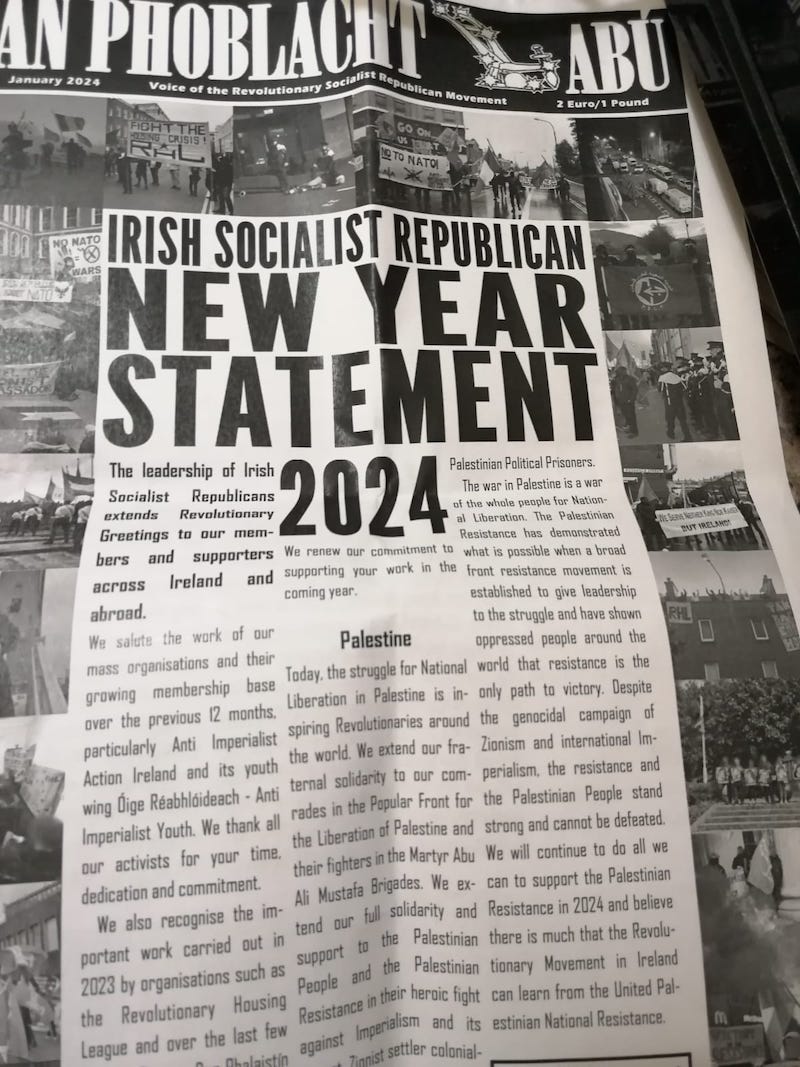
The first edition of the socialist republican weekly newspaper An Phoblacht Abú for 2024 has been available in hard copy from sellers now for several weeks; I am reviewing it here as I have done on occasion with another few issues during 2023.

APA is a hard-copy newspaper of usually 12 x A4 sides, produced monthly from I believe the last months of 2022, including articles on anti-imperialism, anti-fascism, recent Irish history, internationalist solidarity and sometimes on older history, culture and reports on events, selling at €2/£1 per issue.

Hard-copy revolutionary papers are important as a means of distribution to those who don’t wish – or are unlikely — to seek it online but more than that, they also provide the opportunity to make contact on a personal and organisational level with people with whom to discuss events.

Masthead image taken from the An Phoblacht Abú Facebook page.

However, back issues are also available electronically, I’m told, from the producers.

This particular issue reports on the Palestinian struggle and the solidarity movement in Ireland, featuring a report of an occupation of the Israeli Embassy on 19th December with a following picket and blockade of the gates to the building which hosts it for many hours.

Another page carries a report on Palestine solidarity actions across the country and a “Hands Off Iran & Iraq” item, also an obituary on the death of a recent comrade of the organisers. Separately there is a report and comment on the death of an Irishman in the conflict in Ukraine.

Political prisoners in Ireland and the Basque Country are also covered, the latter focussing on the ‘non-compliant’ Basque prisoners and their support network, in contrast to the colluding “official leadership” and the great majority of prisoners who have come under their influence.

An article comments on the upcoming Referendum on Article 41 of the Constitution of the Irish State, condemns the treatment of women historically by the Irish ruling class and, without recommending how to vote, calls for the destruction of the State.

Commemorations of historical events, including martyrs, are an important part of the culture of all peoples in struggle and APA reports on some. A statement on the escape from justice by natural death of war criminal Brigadier Kitson was widely shared in appreciation on social media.

NEW YEAR CALL FOR BROAD FRONT UNITY

Organisations traditionally issue New Year statements, perhaps reflecting on the past year but always looking to the coming year. The ISR NY Statement covered three pages and called attention to all the struggles discussed in the reports, along with some others.

The one theme in the Statement dominating all others was the call for united action in developing a broad anti-imperialism united front to work for unity “around common Republican principles” while at the same time maintaining “the autonomy and independence of different groups.”

In furtherance, ISR proposes that a “Broad Front Congress” be organised before the end of this year and called on those interested to contact them “to turn the demand of the Republican base into action.”

COMMENT

The importance of revolutionary newspapers is underlined historically by the preparations of the British Government prior to the General Strike of 1926, when they purchased all stocks of newsprint paper to deny them to revolutionaries and other strikers.

Governments today can close down social media transmission and reception over an area and even nation-wide.

The APA editorial is undoubtedly correct in its call for a broad front while stipulating independence of organisations within that front. A congress may further this aim but I wonder if it will, without some advance agreement on working principles (about which I have written previously).

I find it striking that in the New Year’s message which mentions working class communities, there is nothing about workplace organisation, or trade unionism, to give it another name. Working class people do not live in communities alone – they also work many hours outside them.

And in the most commonly-imagined scenario for revolution in western countries, revolution is preceded by a general strike. To organise and carry out such a strike and maintain it against external repression and internal undermining, requires leadership deep and wide within the movement.

How this is to be achieved is an issue, the resolution of which can only follow of course from recognition of its necessity. Across the Left and Socialist Republican movement I see no sign of this recognition.

The founding of this newspaper for socialist republicanism and its monthly production and distribution is a great achievement and to their credit for a young and still relatively small organisation.

Some typographical errors persist in APA which could be removed by greater editorial checking. The reproduction of images might be improved substantially too, space made for enlargement possibly by reduction in the area covered by print, increasing the visual attractiveness of the page.

However, APA is right to concentrate on the written word and the spread of themes, the reporting of actions and the reasoning behind them. A regular revolutionary newspaper has long been needed but missing and monthly production at least is needed for its effectiveness.

Fáilte uaimse roimh an nuachtán míosúil réabhlóideach seo, An Phoblacht Abú!

end.

Note: Back copies of An Phoblacht Abú are available electronically from isrmedia@protonmail.com

LEGACY OF MANDELA AND THE ANC – A BROKEN SOCIETY

News & Views No. 14   Diarmuid Breatnach

(Reading time: 6 mins.)

We need to be careful when elevating people from our ranks to the status of heroes – especially if they are alive and can renounce or betray the principles they originally fought for.1

And we have the right to be suspicious when those heroes are also acclaimed by the capitalists and imperialists, those who are certainly not our friends. But most of all, it is by their fruits that we can best evaluate people, whatever their past actions.

The society bequeathed after years of heroic struggle to the South African masses is broken. Housing and homelessness crisis,2 unemployment, poverty,3 prostitution, lack of medical care, inadequate sanitation and soaring crime, including violent crime – is not what the people fought for.

And this is occurring in a country rich in natural resources4 which are being extracted daily by imperialism, while the few on top — the earlier white settler bosses now joined by the corrupt black bourgeoisie – live in luxury.

(Image sourced: Research Gate)

CRIME & POLICING

Anton Koen, a former police officer who now runs a private security firm that specialises in tracking and recovering hijacked and stolen vehicles believes that “It’s not getting better, it is getting worse”, with the murder rate the highest it’s been in 20 years.

(Photo cred: AP)

In crime-ridden societies, the poor suffer the most and are of course also recruited into crime.

There were 27,494 killings in South Africa in the year to February 2023, compared with 16,213 in 2012-2013. South Africa’s homicide rate in 2022-2023 was 45 per 100,000 people, compared with a rate of 6.3 in the US and around one in most European countries.

Those who can afford it, hire private security, which is a booming business with South Africa’s security industry — one of the largest in the world, with more than 2.7 million registered private security officers registered in the country, according to the regulating agency, the PSIRA.5

People with money make up a very small percentage of South Africa, said Chad Thomas, an organised crime expert who has worked more than 30 years in police work and now in private security.6

That means that the vast majority of South Africans don’t really benefit from this security industry … If you live in a traditional township environment, or if you live in an informal settlement …7 security patrols in those areas are few and far between because they don’t have paying customers.”

Thomas, like many, ties the high levels of violent crime in South Africa to anger over the country’s deep problems of poverty.8

Private security companies are paid a monthly fee to patrol neighbourhoods and for providing armed response to their clients’ alarm systems. Tracking and car recovery can be part of the service, often resulting in getting involved in high-speed chases of car thieves and hijackers.

According to the PSIRA, the number of security businesses in South Africa grew by 43 per cent in the past decade, while the number of registered security officers has increased by 44 per cent. Meanwhile there are 150,000 police officers for the country’s 62 million people.

It is hardly surprising that the SA police force has difficulty in recruiting numbers. It is a force used to violently repress people9 and culpable in the worst massacre of working people in South Africa’s modern history, killing 40 striking miners over a couple of days.

That slaughter occurred in 2012 at the British-owned Lonmin platinum mine in Marikana, when miners wished create a new union and to leave the National Union of Mineworkers which, they said, was more in favour of their employers than the workers.10

Cyril Ramaphosa, the millionaire ex-President of the NUM was widely suspected of having organised the massacre and he’s now President of the ANC and of the South African Government. At the time, Jacob Zuma was President, now in the process of being tried for financial corruption.

But Mandela was still alive and at liberty when the massacre occurred and did not condemn the atrocity nor those responsible. Long-time anti-apartheid campaigner (and Mandela’s friend) Bishop Tutu once famously commented that “The ANC stopped the gravy train – long enough to get on it.”11

IMPORTANT

Is it important whether this person or that were truly the heroes they are reputed to have been? I think it is, not only because we tend to erect them as models for our behaviour but also because their lives and their choices present us with historical lessons.

The South African regime during the struggle was a white European settler state and like all of those, undemocratic and racist too. The masses rose up several times against it but people did not risk beatings, torture, imprisonment and death merely for the right to vote.

The struggles were so strong and the minority settler regime so emphatically opposed to reforms that its imperialist partners felt it vulnerable to revolution. They eventually convinced the regime to enfranchise the majority black population.

But what if the black masses went on kick out the imperialists?

The change had to be managed and the leadership of the ANC, the NUM and the Communist Party of South Africa proved willing to control their supporters. However, something else was needed, as in similar circumstances: a known face, a hero, to be the figurehead before the masses.

Representative of USA, chief imperialist country and Nelson Mandela after latter’s release.

Mandela proved to be that man, not only for his long imprisonment for guerrilla action but because he had been tested among the political prisoners on Roben Island and was judged the most suitable, so he had been separated from the other political prisoners to a new jail for grooming.

Mandela, after a huge publicity buildup around the world, was released in 1990 and began a series of negotiations with the settler minority’s leadership. In 1994, with universal suffrage, Mandela was easily elected head of the ANC and of the new government of South Africa.

Of the wave of pacification processes that swept around the world starting in the very early 90s with Al Fatah in Palestine, the South African process turned out to be the only one that delivered any of the objectives of what was promised12 — and that was the vote for everyone.

But it had the potential beyond that gain: of national liberation, the possession of all its natural resources and of a progressive social order, a beacon for the rest of Africa. It was important for imperialism to prevent all that and, with the help of the leaders of the ANC, NUM and CPSA, they did so.

The immediate result was a drop even further in the standard of living of the masses and an increase in the rapacious grip of imperialism on the natural resources, while municipal services declined further and crime at the bottom took off, matching corruption at the top.

The broken society there now is the cumulative result and should serve as a lesson about pacification processes, negotiations during struggle and our choices of heroes – or those chosen for us.

End.

FOOTNOTES

1As we in Ireland can testify, with the lionisation of Michael Collins, for example, for his role in the War of Independence (1919-1921) but who, a little later, acted on behalf of the Irish colonial bourgeoisie and their British masters to launch the Civil War (1922-1923) to prevent the establishment of a 32-County Republic.

2https://www.monitor.co.ug/uganda/news/fire-engulfs-illegal-housing-block-killing-73-in-south-africa-4353926

3 As of 2023, around 18.2 million people in South Africa are living in extreme poverty, with the poverty threshold at1.90 U.S. dollars daily (see Statista in Sources & References).

4See Sources & References

5The Private Security Industry Regulatory Agency.

6https://www.breakingnews.ie/world/private-security-firms-fill-void-in-crime-riddled-south-africa-1572546.html

7Ibid.

8Ibid.

9For examples see series of articles in https://www.saferspaces.org.za/understand/entry/police-brutality-in-south-africa

10It was notable that those popular organisations deeply implicated in pacification processes either reported with great restraint on the massacre or failed, like the Left-Nationalist Basque trade union LAB, to comment on it at all (to say nothing of sending a solidarity message to the striking workers or denouncing the State).

11https://www.independent.co.uk/news/world/anc-boards-the-gravy-train-john-carlin-in-johannesburg-on-the-underdogs-who-have-become-fat-cats-in-a-few-months-1379001.html

12For example Palestine, Ireland, the Basque Country, Turkish Kurdistan, Colombia, Sri Lanka …

SOURCES & REFERENCES

Crime and private security firms: https://www.breakingnews.ie/world/private-security-firms-fill-void-in-crime-riddled-south-africa-1572546.html

SA police: https://www.saferspaces.org.za/understand/entry/police-brutality-in-south-africa

SA Housing: https://rebelbreeze.com/2023/09/30/pacification-kills-too/

https://www.monitor.co.ug/uganda/news/fire-engulfs-illegal-housing-block-killing-73-in-south-africa-4353926

SA Poverty: https://www.statista.com/statistics/1263290/number-of-people-living-in-extreme-poverty-in-south-africa

ANC corruption: https://www.independent.co.uk/news/world/anc-boards-the-gravy-train-john-carlin-in-johannesburg-on-the-underdogs-who-have-become-fat-cats-in-a-few-months-1379001.html

THE PRINCIPLES AND PRICE OF UNITY

Diarmuid Breatnach

(Reading time: 5 mins.)

We often hear people talk of the need for unity in progressive and revolutionary movements, which is understandable since the movements are often weakened by divisions – in other words, by disunity.

We may often hear the plaintive cry from someone that “we all want the same thing so why don’t we all just unite”? Clearly the issue is more complicated than it seems at first glance; there are factors working in favour of disunity also.

It is clear that calls for unity alone have not achieved it and much less often do we hear any serious attempt to define the conditions for unity, its principles and the obstacles to overcome, nor at times, the pitfalls in unity for the revolutionary movement, for there are those too. 1

And it does not necessarily mean that if our organisations call for the same thing that what all actually want is the same. We know from experience the widely different meanings that are routinely understood by “democracy”, for example – or even “republic”.

(Image sourced: Internet)

Starting with practice

It has long seemed to me that not only the real test of unity but also its best starting point is in action. That can be in a joint decision to take some specific action (such as a picket or an occupation) or a range of actions but also in joining in an action or actions organised by others.

Not only is action the real test of the expressed desire for action but in the course of action unexpected problems and opportunities arise, posing further questions at the time and for discussion and reflection afterwards.

Practice shines a light on both the conscious intentions and the unconscious reactions to events of activists and organisations.

It is sometimes suggested that what we need is a conference of all those who are in struggle for an objective (or range of objectives), where we can hammer out an agreed statement of aims. I believe that stage should arise after those interested have taken joint action, not before.

For one thing, those who are not really interested in action can attend such a conference and play a disruptive or distracting role in the proceedings. Secondly, those who make great statements of desire for commitment to unity can only be tested in practice, so why not begin with that?

(Image sourced: Internet)

Practical rules

There are certain rules in united action that hardly need discussion but should be understood.

Each component organisation should promote the action either publicly or within close circles as agreed and maintain the agreed confidentiality both before and after the agreed action.

  1. Arrival and departure should be at place and time as agreed.
  2. No distracting event should be planned by any of the component organisations to take place in the vicinity or near the date of the agreed joint action.
  3. The choice of speakers should be agreed beforehand and adhered to.
  4. It is good practice for the action to be reviewed afterwards not only internally but jointly by the participants also, as far as is practicable, to agree on the lessons to be drawn and to be applied.
  5. Publicity before and reports afterwards should list the participating organisations and also mention the presence of independent activists.
  6. Criticism of participating organisations or of individual comrades of such should be taken up with the responsible organisations concerned through private channels before any response is publicised and careful thought given to alternatives and possible consequences of criticism in public.
  7. Revolutionaries should remember and constantly remind themselves that no matter how militant and ideologically correct an organisation may be thought to be, it is not infallible. Furthermore, it does not come at a value above that of the revolutionary and progressive movement.
  8. Consequently, it is not necessarily or always true that what benefits the party or organisation benefits the movement, nor will the reverse always be the case.

Explanation of or expansion on the above:

  1. Late arrival may disrupt the action planned or leave those who arrive on time unnecessarily exposed. On the other hand arrival too early so as to appear in photos or video to be the only ones participating is disrespectful and harmful to unity.
  2. It is not unknown for an organisation to plan its own publicised activity to take place a day or two before that agreed jointly with another organisation, thereby weakening the joint action, a shortsighted promotion of an organisation above the cause of revolutionary unity.
  3. This is often a difficult area in planning joint events as each organisation often wants its own representative speaking or an organisation may want an independent speaker or indeed may have reasons against a nominated speaker. 2
  4. If we do not review the action afterwards we are removing the possibility of learning positive and negative lessons from it.3 On the other hand, if we do not review jointly, we may draw different and even contradictory lessons from the experience.
  5. Listing the participating organisations and the presence of independent activists shares credit, which is good for unity.
  6. Premature publication of criticism will be poison to a united front.
  7. When an organisation takes an incorrect position as is practically unavoidable at some point, or fails to take a correct position that the situation calls for, the existence of those who can criticise it internally and externally is essential for the progress of the revolutionary movement.
  8. However, taking the party or organisation’s health as a measure of that of the movement overall is more likely to benefit the organisation’s leaders than that of the movement, something demonstrated time and again in history.

Possible negative aspects of united fronts

We can take it as read that the courses considered have not only possible positive outcomes (which is why we take them) but also possible negative ones, of which we should be aware and take into consideration, for example with a “Plan B” or with flexibility to adapt to the emerging situation.

  1. A partner organisation may fail to uphold its agreed contribution
  2. Having to consult others outside after internal discussion may delay intended actions
  3. Our plans may be intentionally or unintentionally (through bad security measures) betrayed
  4. An action or statement of a partner organisation may cause us embarrassment
  5. We may be exposed to greater attack by actions not agreed upon taken by a partner organisation or by lack of those upon which we agreed
  6. A part of the united front may attack us publicly or even physically, as has occurred a number of times in history.4
The start of the Irish Civil War/ Counterrevolution: Free State soldiers bombarding Republican stronghold in the Four Courts with British cannon under the orders of Michael Collins, 1922. The Republicans refused unity with the Free State government of a divided country under British dominion. (Image source: Internet)

In Conclusion

The enemies of the people, capitalism, colonialism and imperialism being everywhere strong,5 we need united fronts in order to succeed in overthrowing them. It is important for us to be aware that broad fronts are temporary and that unity is relative, so that we are prepared for eventualities.

For the creation of a broad front there needs to be agreement not only on objectives but also on the practical components, the principles and rules of operation. There may be an overall revolutionary united front but also smaller united fronts on disparate issues.6

Participation in a broad front does not necessarily entail agreement with all the people who are part of that front. We may join in a broad front (for example anti-imperialism) with one organisation that we may not find in another broad front (for example in demand of public housing).

Each component organisation or independent activist of the broad front needs to be able and permitted to retain a certain independence as a matter of democracy but also of diversity of experience in struggle from which we can all learn.

End.

FOOTNOTE

1All trends of the radical and revolutionary Left and a number of Irish Republican sources have written on the question of the formation of the broad front but I have refrained from quoting or listing them since, apart from difficulties of selection, I do not think it appropriate to do so in an article aimed at all elements that may combine in broad fronts. I would advise the reader to do their own research and not to rely on one source or even one tendency.

2The latter was the case for example with Hunger Strike commemorations in London when some political trends wanted a speaker from the Provisionals, which refused to speak at the event if the IRSP also had a speaker scheduled. More than one big planned event collapsed or was not repeated on that issue. Also an independent speaker may outline a position publicly to which a participating organisation may take severe exception.

3This is one of the purposes of exercises, not just the familiarisation of personnel with the practice. In a team in which I worked, the introduction of unannounced fire drills, particularly with an observer following the staff and noting factors, revealed unforeseen serious problems which we were then able to plan to overcome.

4The Communist Party of China had an alliance with the Chinese national movement which broke down twice, the first time resulting in the Shanghai Massacre of between 5,000-10,000 communists and leftists on 12th April 1927. In 1921, after two years of the War of Independence, the alliance of various forces in the Irish national liberation movement fractured and the national bourgeoisie and Catholic Church hierarchy opted for neo-colonial government and partition of Ireland, which in turn in 1922 led to civil war between the new State, supported by the UK, and the Republican forces, which ended in defeat for the latter in 1923.

5Relatively speaking, of course and only so long as they do not face the mobilised masses, resolutely led.

6In Ireland for example these might be for public housing, national independence, against military blocs, for revolutionary history commemoration, promotion of the language, against LGBT discrimination, for trade union democracy and against State restrictions, for urban or rural community planning needs, internationalist solidarity (at the moment particularly with the Palestinians), etc.

SOURCES & FURTHER READING

Breakdown of broad fronts between the Chinese nationalists of the Kuomintang and the Chinese Communist Party: https://www.khanacademy.org/humanities/whp-1750/xcabef9ed3fc7da7b:unit-8-end-of-empire-and-cold-war/xcabef9ed3fc7da7b:8-2-end-of-empire/a/chinese-communist-revolution-beta:

https://en.wikipedia.org/wiki/Shanghai_massacre:

.