Yes we do – or at least most of us do. There are a few who do not.
Some people think that those few who do not want change are our rulers, the big capitalists — but they are mistaken. The capitalist class forced change to overthrow the feudal system, which was hampering their growth and the development of industry and commerce. And capitalists know that change is inevitable, so it is better to go with it than to try to stop it. That is why they set up courses such as those called “Change Management” — if change is inevitable, then manage it, the thinking goes. Manage it so that it comes out to capitalist advantage, naturally.
(Source Internet, using “change management” as search words)
Change Management courses, particularly those dealing with personnel, emphasise managing change as smoothly as possible, making it non-traumatic. In that way, it is assumed, there will be less reaction against the change, less opposition.
But in fact, sometimes capitalism wants the exact opposite – it wants change to be as traumatic as possible. These are the situations described under the title “Shock Doctrine” by economic/ environmental activist and theorist Naomi Klein (2007). This has two mechanisms: in the first, the shocking change taking place disarms people from the psychological ability to organise resistance; in the second, the speed of the shock (or shocks) of the economic and political manoeuvres of the capitalists moves faster than the opposition can organise, achieving their goals before opposition can coordinate an effective resistance.
Klein has described how huge natural disasters such as earthquake (Haiti), tsunami (Thailand, Indonesia) and flood (New Orleans, USA) are used to force foreign or native private takeovers of sectors of the national economy while the people and the regime in power are reeling under the impact of the disaster.
Political and economic disasters are also used in this model, such as the military coup in Chile and the collapse of the USSR (in the case of Poland), the economic collapse in Bolivia, the invasion of Iraq, the financial collapse of the “Tiger economies” of SE Asia. Even a potentially beneficial change of great magnitude may be used, such as the collapse of white minority rule in South Africa, during which the black majority won formal equality and citizenship but lost control of most of the economy (and lost a lot more which I do not intend to discuss here).
There is in fact a military precursor to this which has been called, in the context of US military strategy, “Shock and Awe”. This doctrine was described by its authors, Harlan K. Ullman and James P. Wade (1996), as “attempting to impose this overwhelming level of Shock and Awe against an adversary on an immediate or sufficiently timely basis to paralyze its will to carry on … [to] seize control of the environment and paralyze or so overload an adversary’s perceptions and understanding of events that the enemy would be incapable of resistance at the tactical and strategic levels”.
Of course there were many elements of this in the Blitzkrieg of the Nazi German army in its invasions of other countries and even the medieval invasions by the Huns and of the Mongols. Cromwell employed elements of it in Ireland in his army’s massacres at Wexford and Drogheda.
Aside from needing change to overcome feudalism, managing change to its advantage and use of shock doctrine to facilitate changes it wants, the capitalist system itself promotes change as part of its system. Small capitalists combine and form conglomerates, in which big capitalists come to power and, in turn, eat up smaller capitalists in order to dominate their sphere of economic activity. We have seen the growth of supermarkets and the decline of small shops, the rise of chain stores killing independent clothes shops, chain cafes and eateries driving indpendent cafes and restaurants out of business.
Capitalists also promote inventions and discoveries so as to increase their wealth but also in order to stay in front of the competition – a capitalist concern that stays at its original level will be taken over or driven out of business by its competitors. Our grandparents hardly knew about the possibility of mobile phones and computers, let alone small hand-held audio-visual connections to the Internet; our children today play with visual electronic games, films and music before they learn to talk. To be sure, monopolies also suppress inventions but they can only do so to an extent as some capitalist somewhere will break the embargo or consensus (if the discovery can be used to make sufficient profits making the attempt worth the risk).
OK, but we want change too and, we think, what we want is not the capitalist kind of change we’ve been talking about until now, although innovations and discoveries should continue and in fact accelerate – but for the benefit of the people, not the capitalists. Technological advances and innovations that do not make big profits may nevertheless be very valuable to us for all kinds of reasons.
So, yes, we want change. But what kind of change? Change to what? Change how? There a vast panorama opens.
We want to eliminate homelessness; have an efficient universally affordable health service; not to have to struggle for a decent standard of living in food, housing and small luxuries; to enjoy universal and affordable access to education at all levels; not to harm the environment; to have the positive aspects of our cultural inheritance, including history, valued and promoted. We want equal rights and respect between people regardless of race or ethnicity, gender, sexuality, ability … and freedom of choice.
In 1930s Germany, people wanted those things too, except that a lot of people were convinced that the contents of the last sentence above were harmful and not what they wanted. But there were many, many people who did want those contents too. The issue was in doubt for awhile.
In the 1928 elections the Nazi Party achieved just 12 seats (2.6% of the vote) in the Reichstag (German Parliament) and in three areas the Nazi Party failed to gain even 1% of the vote. In the Presidential elections of March 1929, the Nazi candidate Erich Ludendorff gained only 1.1% of votes cast, and was the only candidate to poll fewer than a million votes.
We know that elections are not everything – but still.
Five years later, the Nazis were in power — but even after the Communist Party was declared illegal their candidates polled a million votes.
The people definitely wanted change and the established ‘democratic’ parties were unable or unwilling to deliver it. The change the people ended up with was not probably what most had imagined and for some time it spelt disaster for Germany – and unbelievable suffering for large parts of the rest of the world … and also for millions of German citizens.
To look closer to home, people wanted change here too and from 1917 onwards they showed that electorally by voting for the newly-reorganised Sinn Féin party. From 1919 a significant section of the populace took to arms to pursue change and had the active or tacit support of a huge part of the population. But in 1921 the movement and the people split about what kind of change they wanted. A civil war followed with a heavy level of brutality against civilians and combatants, particularly by the State side, which won the contest — and we ended up with the State we now have.
Bombardment of Republican-held Four Courts in Dublin by Free State forces from the bottom of Winetavern Street (with British artillery on loan) starts the Civil War on 28 June 1922 (Source image: Internet)
It is well to be fairly clear about the change we want and what we do not want. There was no such general clarity in the ranks of those fighting for change from 1916 to 1921. It turned out that many who were fighting for change were fighting for different things.
Differences must have come up over the years of struggle and we know from some evidence that they did. We also must assume from the political nature of prominent people in the struggle that there were differences. Even within the IRB itself, only one of the organisations involved, there were differences that surfaced in attitude to the 1913 Lockout, the control of the Volunteers in 1914 and the Treaty of 1922.
Of course, we need maximum unity against the principal enemy. But that is unity in action only. If we put unity in thought, principles or political or social program first, as some organisations have and some others claim to do, we end up with small organisations unable to effectively counter the resistance of the ruling class to the change we want and, in the end, unable to overcome that resistance. On the other hand, if we sacrifice everything to unity against the enemy, we leave ourselves hostages to events in the future and to what kind of society will emerge from the struggle.
Somewhere between those two is where we need to be, preserving the freedom to discuss, explore and proclaim differences of opinion and social program, while avoiding unnecessary squabbles and maintaining unity in action. It is a difficult balance to strike but it needs to be done. In the midst of fighting the common enemy and striving for unity in action against it, we must fight for that freedom also inside the resistance movement, the freedom to discuss, explore and yes, also to criticise.
A high-pitched but hoarse scream cuts through the night. Again and again it is heard, then is silent. A frightening sound, perhaps of a person being attacked …. But no, it is a vixen, a female red fox (Vulpes vulpes). Why is she screaming? Is she in pain? Not exactly — she is informing dog-foxes in the area that she is ready to mate and where they can find her.
Vixen screaming (sourced on Internet)
But this is December and, according to Internet site after site dealing with foxes in Britain and in Ireland, she is at least a month early1. Perhaps she is a rare exception, this vixen in the Drumcondra area but it seems to me more likely that the sites have it wrong: either urban foxes breed earlier or the breeding pattern of foxes is changing. Actually, a combination of both is likely.
A vixen breeding in January would give birth to her cubs just over 50 days later, when in rural areas the earth is warming up in the Spring and when lambs are born, hares are boxing, eggs are being laid, greens are growing and being eaten by rabbits – in other words, food is becoming available for the vixen. Obviously vixens breeding in February or March will have yet more food available in April or May but may also find greater competition, in food and for a mate.
Say this rural vixen conceived on 1st January, then she would give birth on or around 22nd February. She will need feeding just before that and probably up to24th March, a task falling to the dog fox and to unmated young females who may be part of the community. The cubs need the warmth of the mother’s body for up to three weeks after birth and she cannot leave the den. One month after giving birth the mother vixen may go hunting while the “aunts” look after the cubs, who are now venturing out of the den or “earth” (but staying very close to it).
The food brought to the young is carried inside the hunters’ bellies and regurgitated for the young to consume along with their mother’s milk which they will suckle until six weeks of age. After weaning, the cubs will eat solid food but cannot yet hunt for it themselves until perhaps mid-late Summer and, if males, will leave to establish their own territories in the Autumn.2Males become sexually mature at one year of age.
A vixen breeding in December in an Irish rural area might have difficulty receiving enough sustenance in January or even early February, especially in decades past when winters were usually harder. However, with changing seasonal weather patterns tending to warmer winters – and in urban areas where a lot of food tends to be available for scavenging all year round – these problems are substantially reduced and so breeding in December should present little difficulties. So the thinking goes among the vixens in Drumcondra, anyway and, I suspect, in many other Irish and British urban areas.
The male or ‘dog’ fox can be heard sometimes too in a staccato bark, normally three (but occasionally four) rapid barks: bak, bak, bak!
THE URBAN FOX
The urban fox is a relatively new phenomenon in Ireland3, as far as we know, although in Bristol, for example, they have been recorded since the 1930s. Up to fairly recently, a number of experts maintained that the fox populations of city and countryside had little contact with one another. But in January 2014 “it was reported that “Fleet”, a relatively tame urban fox tracked as part of a wider study by the University of Brighton in partnership with the BBC’s Winterwatch, had travelled 195 miles in 21 days from his neighbourhood in Hove, at the western edge of East Sussex, across rural countryside as far as Rye, at the eastern edge of the county. He was still continuing his journey when the GPS collar stopped transmitting, due to suspected water damage.”4
and the Country Foxes
Decades before I heard of this I often fancifully imagined a conversation between a fox, now settled in the “big city”, and his country relations when he returned on a visit. After the initial customary welcoming, sniffing, licking etc are over, the conversation might go like this:
“So, Darkie, tell us, what is life like in the big city?”
“Ah, it was scary at first, with cars and buses and lorries going all day. You wouldn’t believe the noise.”
(Sympathetic whine from the audience).
“But I’m used to it now, Redthree, I have to say. And the food! You could not imagine!”
“Good, is it?”
“Lovely, Whitepatch, absolutely delicious.”
(Sounds of salivating all around).
“Chicken, beef, lamb, fish, potatoes, bread, rice, vegetables, fruit – just left out there to be eaten!”
“Ah, you’re havin’ us on, Darkie. We might be “Culchies” but we’re not stupid! You expect us to believe the humans feed you like they do their dogs, do you?”
“No, of course not, Greymuzzle. Well, actually a few do leave out food on purpose for us but no, this is mostly food that humans are throwing away. We find it in plastic bags and metal containers.”
“They throw away food?”
“They do and huge amounts of it too. Then big lorries come and take away what we have not eaten ourselves.”
“Where do they take it?”
“I am not sure. I’ve never troubled to find out because, to be honest, I have all the food I need nearby.”
(Silence while country foxes imagine a huge mountain of food somewhere).
“Er …. Darkie, so you never hunt now?”
“Oh, yes, some – the city rats and mice eat the discarded food too and they grow plump and big. Yes, I catch and eat them too.”
“Well now, what about all the humans?”
“What about them, Lighteyes? They don’t bother us.”
“Don’t the humans have guns in the city?”
“Some of them do, Lighteyes. But they don’t shoot foxes with them.”
“Really? What do they shoot with their guns then?”
“Other humans, Lighteyes, just other humans.”
(Noises of amazement and disbelief)
THE INNER CITY FOX
The Internet sites all agree that foxes are more likely in suburbia than in the inner city but I think they ignore some important features of the inner city which foxes can frequent in relative safety and around which they are likely to find sufficient food: railroad lines and their banks, canal and river banks, parks, allotments, cemeteries and derelict sites. One can’t get much closer to Dublin’s inner city than Parnell Square, yet I have seen foxes in a laneway off there and also squeezing through the railings to enter the Garden of Remembrance. They have been photographed near the Irish Parliament, the Dáil (though some people might say that’s less surprising with the number of scavengers nearby :–). I’d be surprised if they are not to be found along the banks of the Dodder, the Liffey, the Tolka and both canals, also along the railway lines and in Glasnevin and other cemeteries.
Fox in Leinster House (Irish Parliament building) car park in the winter of 2013 (Source: Sasko Lazarov via Photocall Ireland, reproduced in Journal.ie)
According to one Internet site5, the urban fox population in Dublin may be growing too big for its own health, as the ready availability of food allows unhealthy individuals to exist, diseased and covered in mange infestation (mites that denude patches of fur). I would need to explore this argument before I could accept it.
I am familiar with the overpopulation argument in the case of grazing animals or rodents, where too many individuals consume the available resources and the whole population suffers – a fate usually occurring when natural predators are not present to thin out the weaker individuals and thereby unconsciously preserve the general population in a healthier state.
But how would this work with regard to Dublin foxes? It seems unlikely that the food available is being reduced yet and if and when it is, one presumes healthier foxes will outcompete their sicker species members. Also, sick and undernourished foxes are less likely to come into oestrous and should they do so and conceive, to be able to raise their young. It seems to me most likely that what is occurring is that foxes that would normally have been winnowed out in the struggle of survival are now able to sustain themselves, which might be distressing to see but which will not necessarily have any effect on the healthy population.6 And will healthy individuals necessarily succumb to mange infection from infested individuals? And if they do now, might they not in time learn to chase infected individuals away?
Theories of overpopulation and scare stories about foxes attacking babies, cats and so on seem prompted by the intention to cull foxes, as Boris Johnson, Mayor of London, proposed. Johnson seems unwilling to learn from history, as “there was a large and expensive effort to reduce the number of urban foxes across the UK in the 1970s, but the population subsequently bounced right back.”7The average litter now may be four cubs but vixens have been known to bear up to a dozen and with a low population-to-high-food-sources ratio, are likely to bear a greater number of cubs. And a recent National Health Service survey in the UK indicated that nearly 60% of all stings and bites admitted to emergency rooms were inflicted by dogs8but anyone suggesting a cull of urban dogs would probably find a gathering bearing pitchforks and burning torches outside their home.
Boris Johnson, Mayor of London, was proposing a cull of London foxes (source photo: Internet)
There have been claims that foxes kill and eat lambs, cats, other domestic pets and poultry. Most experts have concluded that if indeed a fox killed a lamb, such incidents are very rare. A ewe is capable of protecting a lamb from a fox, an animal not much larger than a cat. However, foxes have been found to eat the afterbirths of lambs and would of course eat a stillborn lamb or one that died soon after birth, after which its mother would leave and the opportunist would move in; such incidents may have convinced some people in rural areas that the fox was the cause of the lamb’s death.
The Foxwatch study program in Bristol city filmed a number of confrontations between urban foxes and cats and found that in all cases, it was the fox that backed down. This makes sense, for a predator does not usually take on another predator of similar size except in defence of its young, its own life or, at times, its kill.
Yes of course foxes will kill poultry if they can get at them and are often accused in such situations of going on a killing spree. Foxes do kill and gather more food than they need at times and, like many other animals, hide it for recovery later, marking the spot with their scent. But when a fox breaks into a poultry pen and kills its inhabitants, it usually has to leave with what it can carry and will not be permitted to return for the rest. The answer for humans is to build secure pens into which to bring the poultry at night – and that applies also to rabbits kept as pets or for the table, etc. — or keep a dog outside, unleashed.
Scare stories and unscientific suggestions to one side, wild animal populations living alongside humans frequently do need management. All species of bats are protected in Ireland and Britain and should you find them in your attic you are not permitted to remove them but must instead notify the appropriate authorities. Some people have suggested that the red fox should be granted protected species status but it is difficult to see the rationale for this, since it is on the species of “least concern” list of the International Union for the Conservation of Nature. Pigeons receive no protection and, though often fed by people who consider them cute or pretty, do have a negative effect on our urban environment and, in the case of seagulls, who are protected, may be responsible for the disappearance of the many species of ducks that once were common in Stephens’ Green. Rats and mice are not deliberately fed or considered cute by most people (though I have kept both myself and found the individuals tame and harmless and, in the case of rats, quite intelligent) and humanity wages war upon them with traps and poison.
Do urban foxes require management? Zoologist Dave Wall9, who has studied Dublin’s urban foxes for some years, thinks not. In his opinion, the fox population in Dublin has remained constant since the 1980s.According to statistics regularly quoted but never referenced that I can find, Dublin fox families occupy on average 1.04 Km². 10 Given a rough and probably low estimate of six individuals per fox family (a mated pair and two unmated females and two cubs) and a Dublin City area of 115 km² would give us a fox population of 663 in the city. That might seem a lot, until one hears that London holds an estimated 10,000.
Given statistics of that sort, and information that the average litter is of four cubs, one may wonder why most urban dwellers see them but rarely and also why urban foxes are not a massively growing population. There are a number of controlling influences, ranging from the need to establish territory and fight to hold it, which may cost in injuries or even death, to deaths by traffic, the most common cause of fox death according to Internet sites (although how often do we see a dead fox on the road?). A common non-captive life-span of from two to four years and a fertility “window” of only three days for a vixen would be population-controlling factors and yet the allegedly stable population is puzzling, to me at least.
The rural fox tends to inhabit, widening when necessary, burrows already excavated by rabbits and badgers. In urban areas, the fox may have to excavate its own – under buildings and sheds and into railroad banks, for example – but will also use and expand other holes and gaps.
Many urban human dwellers, probably most, never see urban foxes, although they are becoming increasingly visible. They are active mostly at dusk and shortly before dawn and are mostly likely to be seen by people who rise very early for work, or who work at night or who are returning from late night socialising on foot, by bicycle or on foot.
In the Lewisham area of South-East London where I lived for some decades, I regularly saw them on the roads while cycling home from a late music session or a friend’s house. Lewisham would be considered midway between being city and suburban in nature and contained parks, cemeteries, allotments, streams or rivers and railway lines, houses with gardens but also high-rise blocks of local authority housing and very busy roads. I once passed about three yards near to an adult fox on the housing estate I lived on for awhile between Grove Park and Eltham (also in SE London). On my allotment in Catford, if I worked until dusk (which I did often enough when I managed to find the time), they would come out and play and dig for food less than ten yards away from me. And I frequently found trainers (running shoes) and balls they had taken from outside local houses and gardens, discarded on my allotment.
A number of theories have been forwarded for the penetration of urban areas by the fox, including the shameful wiping out of rabbit populations by state-inflicted plagues of myxomatosis but the real reasons are probably the same as those of the pigeon, rat and mouse – availability of food and home provided by humans and the adaptability of the species themselves.
THE MOST WIDESPREAD CARNIVORE ON EARTH
Indeed, the red fox has proved an adaptable animal – much like ourselves. She is an omnivore, as are we and can take her prey from animals as large as a goose to those as small as beetles or earthworms, also frequently eating wild fruit, especially in the Autumn. Studies in the former Soviet Union found that up to 300 animal and a few dozen plant species were known to be consumed by her11. Mice and rats are frequently on her menu and her ancestors are thought to have developed as specialist rodent hunters in Eurasia five million years ago but her kind is now the most widespread carnivore on Earth, with 46 recognised subspecies.
The fox has binocular vision which is particularly effective at night, excellent hearing over distance, including the ability to detect the squeaking of mice at about 100 metres (330 ft) and capable of locating sounds to within one degree at 700–3,000 Hz, though less accurately at higher frequencies12, compensated for by an ability to hear at very low frequencies, including a rustle in grass or leaves and the burrowing of rodents underground. It has evolved many tactics for hunting, including tracking, ambush, stalking, leaping, pouncing and digging.
The fox can also run at a speed of 42 km/ hour, climb some trees, leap high and swim well. Considering the latter, its absence from many islands near to mainlands may come as a surprise but I think that is easy to explain through eradication by human agency.
The red fox is to be found everywhere in Europe (where she is thought to have reached 400,000 years ago) and in North America, Canada, China, Japan and Indochina. Sadly, in the mid-19th Century her species was introduced to Australia by European settlers (at first for sport and later perhaps to control the rabbit, also introduced there by Europeans), where a population of 7.2 million red foxes now is wreaking damage among rarer indigenous wildlife and is considered responsible for the extinction of a number of species. It is classified as the most harmful invasive species in Australia and eradication and population control measures are adopted against it there, as are also against feral domestic cats and dogs, also imported by Europeans.
The dingo is regarded as a controlling agent on red fox population growth in Australia though not totally effective due to the fox’s habit of burrowing; this is interesting for a number of reasons: firstly, the dingo (Canis lupus dingo) is itself a wild dog most likely imported from Asia by Aborigine settlers somewhere between 4,500 and 10,000 years ago and secondly, the red fox in Ireland and Britain does not tend to excavate its own burrows but rather to enlarge existing ones and then generally only for mating and rearing cubs. The Red Foxiscurrently absent from Iceland, Greenland, South America and sub-Saharan Africa.
The fox has been hunted by humans primarily for its fur, especially in winter when it is thicker and from foxes in the far north its silkiness is considered very valuable.
Reynard (one of the names traditionally given to the fox) has also been hunted for sport, usually by the aristocracy or country gentry, on horseback with hounds, an activity which gave rise to one of Oscar Wilde’s many memorable phrases: “The English country gentleman galloping after a fox – the unspeakable in pursuit of the inedible.” Of course, it was not only the English who did this but also the Anglo-Irish Ascendancy (from which Wilde’s father himself came) and the upwardly-climbing Irish who aped them, ag sodar i ndiaidh na nuaisle.13There have been numerous attempts to get fox-hunting banned and direct action such as protests and sabotage of hunts but it is still legal in Ireland and in Britain, though substantially reduced from a century ago.
Gamekeepers have also hunted the foxin order to keep it from killing ground-nesting birds such as wild pheasants, grouse and partridge, so that the landowner and his friends could shoot these birds down later14. Finally, the farmer has taken his toll, sending specially-bred dogs such as cairn terriers down earths to kill a hiding fox and in particular the cubs. The farmer wishes to protect his poultry but avoid the cost of building secure pens and so hunts foxes down; he could let his dogs roam his poultry area which would keep foxes away but dogs do often go chasing sheep too, which will also represent a loss to the farmer, either because the sheep are his or because his neighbours will claim compensation from him.
AN MAIDRÍN RUA and tradition
In Ireland, the fox was known as Sionnach, Madagh Rua (“red dog”) or Maidrín Rua (“little red dog”) and has given its name to a number of places, eg Cnoc an tSionnaigh (Fox Hill, Co. Mayo; another as a street name in Co. Laois); Oileán an tSionnaigh (Fox Island, Co. Galway); Carraig an tSionnaigh (Foxrock, Co. Dublin); possibly Léim an Mhadaigh, (Limavady, Co. Derry) and Lag an Mhadaigh (Legamaddy, Co. Down); possibly Ráth Sionnaigh (Rashenny, Co. Donegal), etc.15
Fox is also a family name and the Irish language version of it is Mac an tSionnaigh (literally “Fox’s son”). The Maidrín Rua or Sionnach features in a number of songs in Irish and in English and here is one from the Irish language tradition of song but in a non-traditional choral arrangement: https://www.youtube.com/watch?v=6bJyqbPxTwU.
Widely represented in folklore from China to Ireland, the fox is also mentioned in the Old Testament Bible and in Greek stories such as the fables of Aesop as well as among the Indigenous people of the Northern Americas. He is never stupid but his intelligence or cunning is also often portrayed as devious, tricky and even malicious. On the other hand, let us not forget that the anti-feudal Mexican hero created by USA writer Johnston McCulley(February 2, 1883 – November 23, 1958), who fights for the downtrodden and indigenous people and mocks the Mexican aristocracy and large landowners, always escaping them, used the nom-de-guerre of “El Zorro”, the fox.
There is a sexual connection too in the representation for the fox: for example in English a “foxy lady” is one with a high level of sexual attraction and in Castillian (Spanish) a “zorra” (vixen) isa pejorative term for a woman trading in sexual favours or “of low morals”16. Have we come around in a circle to where we began, to the vixen’s scream? I think so, but loaded now with a patriarchal outlook. Men can openly want and enjoy sex, of course, that is natural – but a woman? Surely not … or, if she does, she must be bad!
6Other feature which makes this claim suspect are a number of scare items in the article: a) the sensationalist reference to the alleged danger to a baby from a fox in a bedroom and a link to the article reporting this event. Such an event, supposing it occurred, must be on a level of likelihood way below the danger to babies from, for example, pet cats and dogs. Also b) the reference to the danger of contracting roundworm (Toxocara canis), which can cause toxocariasis in children, while not however mentioning how low that risk is and that infection for children is most likely to be encountered from dogs and cats.
9Dave Wall B.A. is a postgraduate researcher in zoology at UCD. He has studied otters, marine mammals and Alpine badgers as well as studying Dublin’s urban foxes for the past few years. He is a Director of the Irish Whale and Dolphin Group.
13“Trotting after the nobles”, a derogatory phrase in Irish.
14Gamekeepers in Ireland and Britain also shot, poisoned or trapped badgers, otters, pine martens, stoats, escaped mink, eagles, hawks, buzzards, crows and magpies and often hung their carcasses in near their lodges to display their diligence in their tasks
A generation is passing. Actually they have been passing for some time, the generation of the fighting years of the late 1960s, the 1970s, the 1980s and even the 1990s.
They campaigned variously for social housing; civil rights north and south; for human rights; against Church domination; against Unionist sectarianism; for free access to contraception; for right to divorce; for an end to censorship; for national self-determination; for Gaeltacht civil rights; for Irish language rights and Irish on TV; in support of political prisoners; the rights of women; for Irish Traveller rights; protection of heritage and environment; solidarity with many struggles around the world, including Cuba, Vietnam, Rhodesia, South Africa, Chile, the Black Panthers; against drug dealers; for freedom to choose lifestyle; decriminalisation of gay and lesbian life; for community projects in deprived areas including youthwork and, let’s not forget, organised, fought in and supported strikes.
That generation fought many battles, some of which they won and some which built bases for later battles and their story is told only in bits and pieces here and there. They organised, marched, sat in, occupied, wrote, made placards, painted slogans, put up posters and some fired guns; they were watched, raided, beaten, fined, jailed, calumnied, sacked, expelled, kept unemployed, derided from pulpit, press and judge’s bench, some were shot, and not just they but their families made to suffer too.
I am not referring to people of any specific age but of all those who were any age from young to old and active during those years. The causes of death have been many, from simple old age and life lived out to the death penalty.
But the death penalty was not in force in Ireland in the 1960s, you may think? Actually it was, it wasn’t abolished until 1990 in this state. But you’d be kind of correct as in practice no formal execution has been carried out by this state since 1954.
So, then what am I talking about? Maybe referring to the ‘United Kingdom’, since six counties of Ireland are included in that state? Yes, and no. The death sentence still exists in the UK only for “Arson in Her Majesty’s shipyards” but it was abolished in Britain for the crime of murder in 1965 and, in fact, no-one had been formally executed there from the year before. If the judicial death penalty had still been in force, the people in charge of that state might’ve been been spared the embarrassment of seeing nearly a score of Irish people they had wrongly convicted in 1974 walk free decades later as judges eventually had to find them ‘Not Guilty’.
A bit late for Giuseppe Conlon, against whom there had not even been a shred of doubtful evidence, but never mind. But had they all died in prison or been executed, people might not have worked so hard to see their convictions in court overturned – people among whom Joe Kelly, who died this week and who was cremated on Saturday, stands tall.
But the death penalty was not removed from the judges’ arsenal in that bastion of reaction, Six Counties state, until 1973, when the 30 Years’ War had entered its early years (somebody from the British state clearly had to sit down with the Unionist bigots and explain, although of course they sympathised with their loyal brethren, how bad it would be for Britain and the Queen if they started sentencing and executing IRA and INLA fighters).
There are more ways to skin a cat …. yes, and to kill too. The orange and SAS and MRF death squads killed more against whom there was not even a court conviction. And some of the Republicans killed one another too. And twelve died on hunger strike, one each in 1974 and in ’76 and ten in 1981. Actually, considering the brutality of force-feeding, it’s surprising there weren’t more deaths – Marian and Dolours Price were force-fed 167 times over 203 days in 1973 and it was the publicity around their case and the deaths of Gaughan and Stagg that ended the practice of force-feeding, ensuring that the Hunger Strikers of 1980 and ’81 at least did not have to endure that experience.
But there are more ways to kill …. Many of that generation of fighters died from ‘natural’ causes but died early – cancers, heart attacks, liver damage, despair ….. ah, yes, that brings to mind suicide, of which some also died. But despair also can drive you to drink, even more easily if it has been part of your experience of socialising and alcohol is one of the top killers in the world. And some died of drugs …. or drugs and alcohol …. or infections from unsafe drug injection …. But most who died early did so in summary from the wear and tear of struggle, of prison, of separation, of relationship breakdowns, of betrayal, despair.
Not all died, even those who are not among the fighters today. Some walked away from the struggle and though I can’t imagine being in their shoes, I do not begrudge them. So long as they didn’t betray any on their way out or make a living out of spitting on their former comrades and causes afterwards. But some, a very few, did exactly that and you can read what they have to say quite often in their articles or hear them quoted in the newspapers or on TV or radio.
Some found other ways to betray and did it in secret, feeding information to their handlers and some even diverting attention from themselves by accusing others, some innocent and some of a lesser grade of betrayal than that of the accusers. We know of some of them but may never learn about them all.
Joe Kelly
Poster displayed at memorial in Teacher’s Club (photo accessed from a Facebook posting)
A few have survived and are still around, fighting the struggle, whether in organisations or as independents. Joe Kelly was one in both categories, in a sense. I knew him but did not know him well and met him only in the last decade, after I had returned from decades living and working in London. I am given to understand that he had passed through a number of political organisations, including Fianna Fáil and the Labour Party. A strange CV, one might think, for a radical left-wing social and political activist. The last political group with which I had associated Joe was People Before Profit, on a local level, around Phibsboro. Joe invited me to attend a quiz they were running and I did so mainly to return a favour – he had attended, to contribute to the singing at my invitation, an evening of the Clé Club where I had been “Fear a’Tí” for that night. I was amazed to win a Blackberry at the quiz (sorry, Joe, I still haven’t gotten around to learning and using it!). Last I heard, he wasn’t with the PBP.
Somebody told me years back that he had been a central organiser of a solidarity event in Dublin for the Birmingham Six in which lights had been floated down the Liffey. Of course I was impressed – on a political/ human rights level but also for the poetic vision involved. I have found little about that event since and Joe, who I found a modest man, didn’t give me much in response to my pressing. A couple of searches on the Internet yielded me only a passing reference to the River Parade, of 1990, a year before the Birmingham Six were finally cleared in court and released. Likely I have not been asking the right people or looking in the right corners.
I met Joe by arrangement for a coffee a couple of times, while I tried to get him into something I was doing and he tried to get me into something he was working at – neither of us succeeding in our efforts to recruit the other. Since Joe was working for awhile in the community sector I also approached him to explore possibilities for me when, despite a long track record in the fields of working in homeless shelters and addiction as well as other community activism I was out of work, but he wasn’t able to help me.
And of course I bumped into him on demonstrations, as in those in solidarity with Palestine or against the Water Tax or against the Lisbon Treaty. For awhile we were active together in the Dublin branch of the Ireland Palestine Solidarity Committee and I believe he left like me after witnessing some nasty in-fighting years ago, though we both often turned up to protest pickets and demonstrations and public meetings called by the organisation. We would also meet at events in solidarity with the Cuban people.
I heard him described at his funeral service, by someone who should know, as a Republican. Certainly Joe was very proud of his father and uncle who had both fought in the 1916 Rising, the first in the GPO and the second in Bolands’ Mill and proudly displayed his father’s medal at a public event in the Teachers’ Club in Dublin.
Joe Kelly displaying and talking about his father’s 1916 service medal at a 1916 commemoration event (photo: D.Breatnach)
However, he was among the number that I invited but failed to get to events over the last decade to highlight the plight of Irish Republicans being hounded by the State and imprisoned without trial. That did puzzle me, for I knew Joe to have a track record of fighting for human rights. And this was shown not only in his campaigning for the Birmingham Six.
Joe fought for the rights of divorce and choice of abortion, as well for the right to freedom from partner abuse, in particular through the movement for women’s refuges, what many people still refer to as “battered wives hostels”. He was active in the campaign for the right to gay marriage, so amazingly successful in Ireland. And Joe was also active in campaigns against racism towards migrants.
“Conas atú tú?” or “Dia dhuit”, Joe would invariably greet me whenever we met. I would not call him exactly fluent but he could understand and speak Irish. I suppose I assumed he had some affection for the language and was also paying me, a known native speaker, the courtesy of addressing me in Irish and speaking awhile in the language. At his funeral service, I learned it went further than that. I heard his grandchildren say that he frequently spoke to them in Irish and when they did not understand him, would translate what the words meant. Some people in the audience chuckled to hear this. I felt sad and somewhat angry too, that a question so important to our cultural identity, an aspect so threatened today, should be treated so apparently lightly by some and that the only words to be spoken at his funeral service in Irish were those in the final sentence spoken by his brother, Jim, in his eulogy: “Slán leat, Joe”. In the booklet produced for the occasion and freely available at Club na Múinteoirí, there was however one dedication in Irish (and I have since learned that one of the speeches at the Teacher’s Club was in Irish) and I note that both grandchildren who spoke bear Irish-language names.
Paying respects and memorial service
On Saturday, laid out in the lovely Room 2 in the Teacher’s Club (sin Club na Múinteoirí, Joe) in Dublin’s Parnell Square, a venue often used for social, cultural and political events, in a closed wicker basket coffin, Joe received his visitors. And they were MANY. Feminists, Palestine solidarity activists, Cuba solidarity activists, community activists, independent political activists and a sprinkling of activists in various parties all attended and many contributed their memories or words dedicated to him while he was laid out there. (I took many photos here and some at Mount Jerome but somehow seem to have lost them all).
Attending first another funeral (of another singer) that morning in Howth, then travelling into Dublin to take part in the Moore Street Awareness weekly table, I had to miss some of that. I spelled a comrade while he attended to pay his respects, then attended later while he took over back at the table.
Room No. 2 was still packed but so was the whole bar lounge area. I had missed all the eulogies and reminiscences and even singing – “The Foggy Dew” I was told. Had anyone sung “The Parting Glass”, I asked. No, apparently not. So then to ask his sister if it would be alright to do it, then the MC, his long-time collaborator, comrade and friend, Brendan Young. It would be welcome, I was told. And Fergus Russell (also his second funeral that day) and I did three verses together, using a mic so it might carry through to the lounge and, though we took turns at fluffing a line, not too badly. It is a great song for such occasions and each verse was particularly appropriate to Joe.1
A little later, the Internationale was sung by all (copies of the words of a verse and the chorus distributed beforehand), the wicker coffin (I must have one of those when my time comes!) was lifted on to shoulders by family and friends and brought through the respectful lines while Joe’s daughter sang The Night They Brought Old Dixie Down.2
Then the hearse came out and led the cortege to Mount Jerome cemetery. I didn’t know the protocol regarding cycling in a funeral cortege but followed anyway, managing to get temporarily lost on the way and arriving just as the hearse arrived at the cemetery. Again, the chapel was packed.
The ceremony was non-religious and officiated by Therese Caherty, ex-partner and friend. In turn Therese herself, his brother, his bereaved current partner, relatives and his comrade and friend Brendan Young all gave their moving eulogies and often funny anecdotes. Brendan emphasised that for Joe, the process of the conduct of a struggle was as important as the end to be reached, which I knew to be true from our time together in the Dublin IPSC and I’d be in agreement with Joe on that.
There were, despite the many I did see during those events, some faces I did not see in the congregation or at the Club na Múinteoirí before the service or later, when many returned to the Club to free sandwiches and soup laid on by the management there. It was their loss.
I never saw him dance but am told he loved it and taught his grandchildren not only to sing but to dance too. I did know he’d learned to tango. He’s left this dance floor now and gone on to another and whatever “one steps and two steps and the divil knows what new steps”3 they are dancing there, I’m sure Joe is learning them and probably teaching a few of his own.
Slán leat, Joe – árdaigh iad!
A chríoch.
FOOTNOTES
1 “Of all the money that e’er I had, I spent it in good company
And all the harm that e’er I’ve done, alas, it was to none but me
And all I’ve done for want of wit to memory now I can’t recall
So fill to me the parting glass, good night and joy be with you all
“If I had money enough to spend and leisure time to sit awhile
There is a fair maid in this town, that sorely has my heart beguiled
Her rosy cheeks and ruby lips I own, she has my heart enthralled
So fill to me the parting glass, good night and joy be with you all
“Of all the comrades that e’er I’ve had, they are sorry for my going away
And all the sweethearts that e’er I’ve had,
they would wish me one more day to stay
But since it falls unto my lot that I should rise and you should not
I’ll gently rise and I’ll softly call good night and joy be with you all”
2 This song of nostalgia for the American Confederacy has a haunting melody but its ideology is often ignored by those who sing it.
On Sunday 8th May a working-class hero was commemorated in the East Wall area in which he lived. Walter Carpenter was a native of Kent, in SE England and came to Ireland to help found the Socialist Party of Ireland 1 with James Connolly in 1909 in Dublin. Among other activities a campaigner around housing issues for the Dublin working class, he reared his sons in socialist belief so that it was no surprise that both Wally (Walter jnr) and Peter joined the Irish Citizen Army and fought in the 1916 Rising. As a result of the repression of the Rising, one son ended up in Frongoch concentration camp in Wales, while the other was in hiding. Later, both brothers also fought against the Free State in the Irish Civil War; Wally was interned and went on hunger strike.
Assembling to march outside the Sean O’Casey Community Centre
Jailed for opposing British Royal visit to Dublin
Rising to be Secretary of the Dublin Branch of the SPI in 1911, Walter Carpenter was jailed for a month for the production while speaking on a public platform of Connolly’s leaflet attacking the Royal visit that same year. Soon afterwards he was an organiser for the newly-formed Irish & Transport Workers’ Union. During the Lockout, he was sent by Connolly to Britain to rally the support of trade unionists for the struggle of the Dublin workers and was apparently an effective speaker there. That same year Walter Carpenter was elected General Secretary of the Tailors, Machinists and Pressers’ trade union, generally known as “the Jewish Union” due to the preponderance of its members being from that background.
United in purpose but fragmented in marching
Walter also became active in municipal politics, striving to make Dublin City Council meet its housing regulation responsibilities in the terrible housing conditions of the city of that time. There were many other sides to this campaigner too, which a read of Ellen Galvin’s pamphlet will reveal.
The East Wall History Group had earlier had a plaque erected on the wall of the house where he had lived, No.8 Caledon Road and organised an event around its unveiling on Sunday. The event began with a gathering at the Sean O’Casey Community Centre in East Wall, where an introduction to the event and to Walter Carpenter’s importance in the revolutionary and radical social history of Ireland was given by Joe Mooney, one of the organisers of the event. As well as local historians, socialists and Republicans, the event was attended by his surviving grandson, great-grandchildren and partners and their children. Also present was Ellen Galvin, who wrote a booklet on his life which was launched after the unveiling, back in the Sean O’Casey Centre.
Joe Mooney with a few preliminary words about Walter Carpenter and the history of the area
Misfortune struck the event before it had even begun, with the news that Christy O’Brien, the piper who was to lead a march to the unveiling, had his pipes stolen from his car that very morning. Christy gives his service as a piper to many commemorative events, funerals etc. and, with the announcement of the misfortune, Joe Mooney also called for the spreading of the news in order to aid the recovery of the instrument. A set of bagpipes will cost thousands to buy or have made but it would be a rare musician or pawnshop that would negotiate for a stolen set (one which furthermore might be recognised at a musical event in the future).
(see also https://www.facebook.com/eastwallhistory/photos/a.593335330735681.1073741828.580261572043057/1042532349149308/?type=3&theater)
March to plaque past previous addresses of Irish resistance fighters
The march set off from the Sean O’Casey Centre without the piper, led by supporters carrying the banner of the East Wall History Group, a Tricolour and a Starry Plough (original green and gold version). Walking alongside were two Gárdaí and one wit commented that not only were descendants of the Irish Citizen Army present but also of the Dublin Metropolitan Police! 2
Caitríona Ní Casaidthe presiding over the plaque unveilingDeputy Dublin Mayor Cieran Perry in the march — he also spoke at the unveiling.
Joe Mooney had told the crowd before the march began that they would pass a number of locations where fighters for Irish and working-class freedom had lived. These were: St Marys Road, Tim O’Neill at No.8 and father and daughter Patrick Kavanagh and May Kavanagh at No.24. Christy Byrne lived at No.45 and his brother Joseph Byrne was from Boland’s Cottages off Church Road, where also Christopher Carberry lived on Myrtle Terrace on Church Rd. All these were Irish Volunteers, while May was in Cumann na mBan. In Northcourt Avenue (now demolished, roughly where the Catholic Church stands), Patrick & William Chaney were in the Irish Citizen Army and in Hawthorn Terrace lived James Fox (Irish Volunteer) and Willie Halpin (ICA).
Joe added that at the junction of St. Mary’s Road and Church Street, the local Irish Volunteers had mustered to participate in the Rising, 100 years ago and also reminded the gathering that that very day, the 8th of May, was the centenary of the executions by British firing squad of Michael Mallin of the Irish Citizen Army and of Irish Volunteers Eamonn Ceannt, Sean Heuston and Con Colbert.
Eamon Carpenter, 94, grandson of Walter Carpenter (Photo D.Breatnach)
Upon reaching No. 8 Caledon Road, the former home of Walter Carpenter, Caitríona Ní Chasaide of the East Wall History Group introduced Eamon Carpenter, 94 years of age and a grandson of Walter Carpenter, who addressed the crowd in thanks and also about the life of his grandfather.
“The struggles of the past are not merely for commemoration”
Next Caitríona introduced the Deputy Mayor of Dublin, Cieran Perry, who pointed out the parallels between the dire housing situation in the early part of the last century, which Walter Carpenter had campaigned against, and the housing crisis in Dublin today. He castigated the officials of Dublin City Council who, despite the votes of elected Left Councillors, refused to use all the land available to them on a number of sites to build social housing and were instead preparing it for private development with a only fraction for social housing. For as little as 5% of the €4 billion of Minister Kelly’s oft-repeated proposed finance for social housing. i.e. €200 million, Dublin City Council could build over 1,300 homes. The struggles of the past are not merely for commemoration, Cieran went on to say, but are for celebration and for continuation, as he concluded to applause.
Caitríona then called on James Carpenter to unveil the plaque, which he did, to loud applause.
After relatives and others had taken photos and been photographed in turn by the plaque and/or beside James Carpenter, Joe Mooney called on Diarmuid Breatnach to sing The Felons Of Our Land. Joe explained that Walter Carpenter had been fond of singing that son, that in the course of their participation in the struggle he and his son had also been felons, as had Larkin and many others. Joe also informed the gathering that Sean O’Casey related that during his childhood, there had been a tram conductor who had been fond of singing patriotic songs, including the Felons Of Our Land, of which Casey’s mother had disapproved. It had been an revelation for O’Casey that one could be a Protestant and an Irish patriot too.
Diarmuid, dressed in approximation of period clothing, stepped forward and sang the four verses, of which the final lines are:
Diarmuid Breatnach singing “Felons of Our Land” outside former home of Walter Carpenter. (Photo East Wall History Group)
Let cowards sneer and tyrants frown O! little do we care– A felon’s cap’s the noblest crown An Irish head can wear. And every Gael in Innisfail (Who scorns the serf’s vile brand) From Lee to Boyne would gladly join The felons of our land.
The crowd then marched back to the Sean O’Casey Centre to attend the launch of the booklet on Carpenter’s life.
Launch of book on Walter Carpenter by his granddaughter and grandson of his comrade
On the stage in the Centre’s theatre, were seated the author of the booklet, Ellen Galvin, alongside Michael O’Brien of O’Brien Press.
Ellen Galvin on stage at the Sean O’Casey Community Centre theatre and Michael O’Brien launching the book about Walter Carpenter. (Photo D.Breatnach)
Michael O’Brien, addressing the audience, said he had wondered what qualification he might have to launch the book but on investigation discovered that he had not a few connections. His own grandfather, who was Jewish, had been a founder member of the Tailors, Machinists and Pressers’ Union, of which Carpenter had been the General Secretary until his retirement and so they must have known one another at least fairly well.
Also, Bill O’Brien’s father, Thomas, had been a communistand was active with Walter Carpenter in the Republican Congress in the 1930s. Walter Carpenter and Thomas O’Brien had both also been active in the Bacon Shops’ Strike of the early 1930s. Thomas O’Brien had been jailed during that strike along with Jack Nalty and Dinny Coady, both of whom had East Wall connections; subsequently Thomas went to fight Franco and fascism in Spain, where Nalty and Coady were both killed.
Tommy Seery singing “The Bold Labour Men” about the 1913 Lockout (Photo D.Breatnach)
Ellen Galvin spoke about Walter Carpenter’s life and his dedication to the advance of the working class and the struggle for justice. Walter had been a supporter of equality for all, including gender, a man who read much and widely, who apparently learned Irish and campaigned for allotments for rent on Council-owned land while it was unused for housing. He was against the consumption of alcohol but sympathised with people driven to its use by terrible housing conditions.
Joe then called on Diarmuid Breatnach to sing Be Moderate, written by James Connolly, to illustrate what it was that people like Connolly and those of the Irish Citizen Army fought for and for which some had given their lives. Diarmuid took the stage and explained that the song had been published in New York in 1910, the same year that he had returned to Ireland from the USA. There had been no indication of an air to accompany the lyrics, as a result of which it has been sung to a number of airs. Diarmuid heard it sung in London by an English communist to the air of a Nation Once Again 3 and at least one good thing about this is that it provides a chorus, with which he encouraged the audience to join in. He then sang the song, of which the final lines are:
For workers long, with sighs and tears, To their oppressors knelt. But never yet, to aught save fears, Did heart of tyrant melt. We need not kneel, our cause is high Of true hearts 4 there’s no dearth And our victorious rallying cry Shall be “We want the Earth!”
Many in the audience joined in on the chorus: We only want the Earth, We only want the Earth, And our demands most moderate are: We only want the Earth!
Eamon Carpenter delivered an impromptu tribute to Ellen Galvin, who he told the audience had lost her mother at the age of 13 years of age, from which time she had taken over the mother’s role for her younger siblings, ensuring the were fed, dressed and cared for. This tribute was warmly applauded while Ellen seemed embarrassed but also pleased.
This was another successful commemoration of the revolutionary history and, in particular, of the working class history of their area by the East Wall History Group. It is of great importance that the working class be appraised of their own history as distinct from the dominant historical narratives and that their revolutionary traditions be remembered, not as something dead and in the past but as part of a continuum of struggle for the emancipation of the class.
If there is a weakness in a number of such commemorations it is the lack of participation by local adolescent youth in these events – which may also imply a lack of engagement by this age-group. Nevertheless, should they go searching at some future date for the information and their connection to the history of place and class, they will find a treasure trove waiting for them in the work of this History Group.
1 There exists today an organisation called the Socialist Party of Ireland (which often organises under the banner of the Anti-Austerity Alliance) but it is not directly descended from the party founded in Ireland in 1909; rather it is closer to being an offshoot of the Socialist Party of England and Wales, with which it has close fraternal relations.
2 The Dublin Metropolitan Police gained particular notoriety for the violence against organised workers on behalf of Dublin employers, especially during the 1913 Lockout, during which they killed a number of workers with their truncheons. In later years, the force became a Dublin police force under the Free State, which was later subsumed into the Garda Síochána, a fact not generally known.
3 Written by Thomas Davis, first published in The Nation, Dublin, 1844.
The struggle for the preservation of Moore Street that is currently in the news (but has been going on for fifteen years) is one not only for nationalists and Republicans, but for socialists too. And for socialists of revolutionary ideology as well as for radical social democrats. But currently these sectors, apart from individuals independent of political party (and one or two belonging to parties), are keeping away from the issue. In this they are seriously mistaken and are doing the working class in Ireland and indeed internationally a disservice.
Aerial view of Moore Street in the days when the speculators and supermarkets had only just begun to reduce it (Photo from Internet)
BACKGROUND TO MOORE STREET STRUGGLE
For those who may not be aware of the historical background, roughly 300 men and women of the GPO garrison in 1916, having to evacuate the burning building, made their way to Moore Street and occupied the terrace from the junction with Henry Place to what is now O’Rahilly Parade, entering at No.10 and tunneling through up to No.25 at the end of the terrace. On the following day, the decision was taken to surrender. Despite its historical status, nothing was done by the State to protect the ‘1916 Terrace’ for decades, although a small commemorative plaque was put on No.16 in 1966, when a number of such plaques were erected at sites throughout the city.
Fifteen years ago a campaign was started, by the National Graves Association and mostly by descendants of people who participated in the 1916 Rising, to have an appropriate historical monument on the site. In 2007 the State named buildings No.14-17 as a ‘National Monument’ but would take no steps regarding the other twelve buildings in the Terrace. By that time the four buildings belonged to a property speculator who allowed them to deteriorate but compliance with maintenance and upkeep obligations to a national monument were not enforced by the State. Also, shortly afterwards, the speculator put in a planning application for a huge shopping centre entailing the demolition of 12 houses of the Terrace and the State approved it.
Paul O’Toole, who played a number of sets at an “Arms Around Moore Street event in June 2015, including singing some songs of his own composition. The event was organised by Save Moore Street From Demolition group.
Other threats emerged later, such as planning applications to extend the ILAC centre further into Moore Street and to build a tall budget hotel at the Moore Lane/ O’Rahilly Parade intersection; these were approved by Dublin City Council’s Planning Department although the majority of the Councillors have voted to preserve the 1916 Terrace and indeed the Historical Quarter.
Donna Cooney, great grandniece of Elizabeth O’Farrell, speaking on behalf of the 1916 Relatives’ Association, at an “Arms Around Moore Street, event in June 2015. To her left is Mel Mac Giobúin, one of the principal organisers of the SMSFD group.
At the end of 2015 the State bought the four houses of the ‘national monument’ from the speculator, paying him €1 million each for them and proposed to knock down houses either side of it. As soon as the intention to proceed with imminent demolitions became clear, emergency demonstrations were called in the street by a newer group, Save Moore Street From Demolition (founded in September 2014). A five-day occupation of the buildings ensued, ending only on foot of an order of the Court that no demolition take place while a High Court challenge to the Dept. of Heritage was awaited.
Section of the January march to save Moore Street, organised by the Save Moore Street 2016 umbrella group. In photo foreground, two of the principal organisers of the SMSFD group, (L-R) Mel Mac Giobúin and Diarmuid Breatnach. (Also in shot, Dave Swift, supporter of the campaign, in Irish Citizen Army uniform). (Photo source: Donal Higgins)
A number of protest actions have taken place since then including a street concert and a march from Liberty Hall to Moore Street ending in a rally at the GPO. The struggle continues at the time of writing with further events planned and the SMSFD group have joined with others, including people who occupied the buildings, to form the ‘Save Moore Street 2016’ group. It is a broad group containing activists from a number of Republican organisations and independents of community action, socialist and Republican background.
In a separate development, a High Court challenge against the process undertaken by the State to buy the properties and demolish others on either side opened on February 9th and has been adjourned a number of times since, apparently due to the State not having got its papers together.
NATIONAL HISTORY
Socialists may argue that the cause lying behind the struggle is one of preservation of Republican or even nationalist history. I would argue that is only partly true – but what if it were so? Who actually makes history? It is the masses of people that make history, even if individuals among all classes at certain times are thrust – or throw themselves – upon the stage. In that sense, ALL history of progressive social history belongs to the working class.
Furthermore, the underlying historical reason for which many are seeking to preserve the 1916 Terrace and, indeed, the Moore Street historical quarter, is because it related to a struggle against colonialism, against an immense colonial empire. Are socialists to say that they take no interest in anti-colonial struggles and their history? Or is it that they do, so long as they be in some other part of the world? And if the latter be their position, what possible political justification could they offer for it?
STREET MARKET – SOCIAL HISTORY
In the development of this city, Dublin, street traders have played a part – as indeed they have in the development of probably every city in the world. Working people and small-time entrepreneurs, working hard from dawn to dusk in all weathers to feed themselves and their families, a link between town and country or between coast and inner city. They brought fresh food to the city dwellers of all classes and brought colour to what was often a drab environment, colour to the eye and to the ear also.
Moore Street is the last remaining street of a traditional street market centuries old, the rest of which now lies buried under the ILAC centre and which even now threatens to extend further into Moore Street, squeezing the market street still further. This street market and its history as well as being physically threatened by the proposed extension of the ILAC, squeezed commercially by Dunne’s and Lidl, is threatened also by a planned budget hotel building of many floors and of course the giant shopping centre plan of Chartered Land/ Hammerson. Have the socialist groups nothing to say about this or, if they are against this monopoly capitalist assault, why do they distain to take their place in the ranks of the resistance?
AGAINST WORLD WAR
Some of the Volunteers undoubtedly planned the Rising to take place during the first imperialist World War purely on the basis of the maxim that ‘England’s difficulty is Ireland’s opportunity’. But others, including the revolutionary socialist leader James Connolly, also clearly wanted a rising against the slaughter of workers in a war between imperialists. Connolly wrote a number of articles denouncing this slaughter which socialists of his time had pledged themselves to fight but which few had actually done, when it came to the crunch. However, that position remains the correct one for the working class: in a situation where your masters wish to send you out to fight your class brothers abroad, turn your guns on your masters instead. The 1916 Rising stands as an example of this, the first of the 20th Century and world history would have to wait until the following year for another example in Europe.
WORKERS’ HISTORY
All the Irish socialist groups, as far as I’m aware, right across the spectrum from Anarchist to Communist, hold the memory of James Connolly and of the Irish Citizen Army in high esteem. And so do the radical social democrats.
James Connolly led the Irish Citizen Army into alliance with the Irish Volunteers, Cumann na mBan and na Fianna. The ICA, a trade union-based militia, had been formed to defend demonstrating and picketing workers against the attacks of the Dublin Metropolitan Police in 1913. When the ICA went out in the 1916 Rising, Ireland was the first country in the world that century for a workers’ armed unit to fight in its own uniforms and under its own leaders.
Irish Citizen Army on parade at the Irish Transport & General Workers’ Union building and grounds in Fairview, Dublin. (Photo source: Internet)
The ICA were allocated the Stephens Green and Dublin Castle areas but also had members in the GPO garrison. So when the GPO garrison retreated from the burning building, ICA members were part of that retreat. At least one died on that journey, struck down in Henry Place by British Army bullets at the intersection with what is now Moore Lane.
When the GPO garrison took possession of the 16 houses of the Terrace in Moore Street, tunneling from house to house, the ICA were part of that. And when the decision to surrender was taken, the ICA laid down their arms with the rest.
The 1916 Rising and the occupation of the Moore Street terrace and backyards is part of the ICA’s history and is therefore part of the history of the Irish working class and, indeed, of the international working class. If the socialist groups don’t wish to celebrate that episode in the history of the class, why? If, on the other hand, they do celebrate it, why then do they not join the struggle to have the place of their last stand preserved from demolition and to have the ICA’s place in history marked by a fitting monument?
The lack of engagement of most of the revolutionary and radical left with the Moore Street struggle has also meant no noticeable pressure within the trade unions, where the left have some influence, to even declare verbally for the preservation of the 1916 Terrace. To date, only one section of one trade union, the Construction Section of SIPTU, has declared in favour of saving the Terrace.
WOMEN
The struggle for gender equality is an important part of the struggle for the emancipation of the working class, i.e. for socialism: women represent slightly over one-half of the human race and this is true also for the working class. In addition, the oppression of one part of the class serves as a wedge into the solidarity of the class as a whole.
In 1916 women served as auxiliaries in Cumann na mBan and as equals in the Irish Citizen Army. That year was the first in the World in which women participated in an insurrection in a unit of their own, wearing a uniform of their own and under their own female officers, as was the case with Cumann na mBan. It was also the first time in the 20th Century in which women had formal equality with men in an armed workers’ organisation, as they did in the Irish Citizen Army.
Constance Markievicz, ICA officer, fighting in the Stephen’s Green area. She poses here with a gun prior to the Rising to underline her position that women can and should take part in armed revolutionary struggle, on a par with the men. (Photo source: Internet)
The Proclamation was the first insurrectionary call to arms to address itself specifically to women alongside men (“Irish men and Irish women …”, it begins) and had been signed in secret a little earlier by the seven male signatories (or by most of them) in the alternative cafe and agricultural product cooperative run by Jenny Wyse Power at No.21 Henry Street.
Women of Cumann na mBan and ICA who participated in the 1916 Rising in a group photo a year later (photo sourced Internet)
CAPITALISM & THE STATE
The campaign for the saving and appropriate renovation of the 1916 Terrace first of all confronted the capitalist property speculator Joe Reilly and his Chartered Land company, while it lobbied the State to take over the Terrace.
When in 2007 the State declared four houses in the Terrace to be a ‘national monument’, the campaign continued confronting the speculator but now calling, without success, on the State to oblige Mr. O’Reilly to comply with his maintenance obligations to a national monument. When the State granted, with some changes, planning permission for the speculator’s giant shopping centre, the campaign moved into confrontation with the State, a confrontation which intensified after the State purchased the four buildings and prepared to demolish the buildings on either side.
The whole saga was an object demonstration of the function of the State in facilitating capitalist property speculation and furthermore, of the neo-colonial nature of a capitalist class unable to consider saving such a national historical treasure even with the support of the vast majority of the population.
In such a struggle, with people with democratic objectives on one side and, on the other, rapacious property speculators and a capitalist State facilitating those speculators, where does the duty of socialists lie? It is clear on which side they should stand if they should stand on the issue at all. And they should take a stand on it – how can the development of that struggle do anything but strengthen the democratic movement in general, including the movement for socialism, and harm its opponents, the State and capitalism in Ireland? And surely in the course of that struggle, with socialists side by side with Republicans, alliances would be formed which could be built upon for more ambitious projects later?
Monument in Dublin to James Connolly, revolutionary sociailist writer, historian, theorist, union organiser, publisher — his last location of freedom was the Moore Street 1916 Terrace, before he was shot by British firing squad (Photo source: Internet)
IN CONCLUSION:
For all the reasons given above, its social history, its anti-colonial history, the history of the common people as well as that of intellectuals, the history of the working class to assert its independence and dominance of the movement for liberation, the history of women’s struggles, and the current struggle of people against property speculator capital and State, the place of socialists, revolutionary and radical, is right there with the Moore Street 1916 Terrace campaigners. But where are they?
With the exception of a few honourable exceptions, they are notable by their absence. Yet, they will wonder at times why the mass of people do not follow them; why, for the most part, they regard them and their organisations as an irrelevance.
That was the subject of a debate between historians Tim Pat Coogan and Liam Kennedy on Wednesday 20th, organised by the 1916 Societies’ San Heuston branch and held in Club na Múinteoirí, Parnell Square, Dublin.
Coogan has a long track record as a journalist and historian of a nationalist/ Republican perspective: for nearly two decades Editor of the now-defunct nationalist daily Irish Press, broadcasterand author of many works including The IRA, Ireland Since the Rising and biographies of Michael Collins and Éamonn De Valera. Kennedy is Professor Emeritus of Economic and Social History at Queen’s University, Belfast. He is the author of a number of articles and of books, most of the latter collaborations, including (with L.A. Clarkson et al), Mapping the Great Irish Famine (Dublin: Four Courts Press, 1999). His most recent, on his own, is Unhappy the Land: The Most Oppressed People Ever, the Irish?(Dublin: Irish Academic Press, 2015).
“Irish Famine Memorial/ Leacht Cuimneacháin na nGael” in Philadelphia. USA (Photo from Internet)
Given that the Great Hunger or Famine is a subject on which historians tend to take oppositional sides and with at least one prominent historian on the panel, I would have expected a very large turnout. Therefore when I arrived and looked at the seats in the large hall of Club na Múinteoirí, I was surprised to see that although there was a respectable number in attendance, some of the seats laid out were unoccupied.
I had got the start time wrong (yes, even though I had shared the poster for the event on my Facebook page!) and so missed some of Tim Pat Coogan’s presentation (but a friend told me Coogan had mistaken the subject and began to talk about the 1916 Rising until he came back on track). When I entered, Coogan was dealing with the Great Hunger’s death toll and referring to the “accelerated deaths” method of calculating population loss that took into account further likely births had early deaths of potential parents not occurred. By that method, Coogan estimated the deaths at two million, not counting those who died on the “coffin ships” or after arrival at their destination.
Tim Pat Coogan (Photo from Internet)
Coogan said that New York State included study of the Great Hunger under “Holocaust Studies” which he thought entirely appropriate and concluded by stating that the Great Hunger was indeed genocide.
Liam Kennedy
Liam Kennedy then took the floor and began with a personal anecdote of the unveiling of a stained glass window in Belfast, dedicated to the Famine, at which he had been invited to speak some years ago. It was a somewhat rambling story through which his audience sat quietly, awaiting his arrival at the question up for debate.
During his anecdote, Kennedy related that he had, in the course of his speech, referred to punishment shootings and “exiling” (instructions to leave the country) carried out by both Republican and Loyalist paramilitaries, which had angered in particular his Republican audience, including Gerry Adams (which he described but did not name). So of course, in retelling, he was once again referring to it – in a debate about whether the Great Hunger was genocide or not. Kennedy related this in the alleged context of showing that the Hunger is a controversial subject – of course it is, so it hardly needs any other controversial subjects dragged into the discussion.
Kennedy went on to allude to “amnesia” around the subject of the Great Hunger, which he compared to a similar “amnesia” which he believed attached to the issue of the thousands of Irishmen who had “fought for the Empire (or he may have said “England”, or “the UK”) and for Ireland during WWI.” Yes, it seem to me that he was engaging in a certain amount of coat-trailing in front of his audience which, given the Dublin location and the 1916 Societies host, he must have assumed to have many Republicans in its midst.
Eventually he got the job for which he had been invited and began, helpfully, by quoting part of a definition of “Genocide”. I cannot recall which authority he quoted but a search reveals many definitions, most of which entail intent. One of the most recent authorities is Article 6 of the Rome Statute which provides that “ “genocide” means any of the following acts committed with intent to destroy, in whole or in part, a national, ethnical, racial or religious group …” and goes on to describe a number of means of carrying that out.
It was clear that Kennedy was going to rely on denying the intention to cause, rather than to deny the effect of the catastrophe; this was entirely as I expected and it is the stock approach of genocide deniers and colonial apologists (not always the same thing). But in reality he had little to say on this subject, other than to point at the “laissez-faire” nature of the UK Government’s economic policy at the time and the weakness of the Whig party in power, managing a minority government. To be fair, it is extremely difficult to prove lack of intent but all the same I would have expected something better.
In its absence, Liam Kennedy went on to talk about culpability, which is not the same thing – one might be to blame for something which one didn’t, however, intend. And Kennedy spread the net of blame pretty wide, throwing it not only over the British Government but on the Irish middle class (could have done more), the Catholic and Protestant Churches (opposition to emigration and continued church-building), the Irish landlords (absentee or callous), the Young Irelanders (had no solutions), O’Connell’s 40 MPs at Westminster (didn’t raise much trouble at Westminster, although they were supporting the minority government).
Kennedy didn’t stint however on the severity of the Great Hunger nor on its huge impact on Ireland and on its diaspora. On that he said he agreed with Coogan, although his estimate of deaths was closer to 1.5 than two million. Any disaster in which one in seven died was an extremely severe one — it was the worst disaster in Irish history and one of the worst internationally, Kennedy stated. And it was most severe on the poor – and here Kennedy quoted a sentence of Karl Marx – and proportionally struck hardest at the Irish-speaking areas.
THE DEBATE OPENED TO THE FLOOR
When Kennedy finished, the Chairperson Kevin Keane summed up the main points elaborated by each speaker and the meetings was thrown open to questions and contributions from the floor. I wanted to get my comment in early, as I was scheduled to sing as soon as the questions and answers were over; since for a moment no-one stirred, my hand was the first up. Handed the roving microphone, I thanked both speakers and remarked that the question of intentionality did not relate only to the Government of the time but also to the ruling class of the time – the British capitalist class. An analysis of their opinions as expressed in correspondence and in their media of the time, for example editorials in the London Times, has indeed revealed the intention to get rid of the Irish cottier class and, to a degree, the Irish landlord class too. They wanted most Irish agricultural land turned to grazing and deliberately used the opportunity to do so.
Other contributors talked about food leaving Ireland while people starved, the low numbers of Irish permitted to vote; another countered the criticism of the Young Irelanders by pointing to the Rising they attempted in 18481. Yet another contributor pointed to comparisons with famine in other areas due to the potato blight such as the Highlands of Scotland, Belgium and the Netherlands – but did not express an opinion from those studies on the question being debated here. One contributor amusingly took Kennedy to task on standard academic grounds relating to questions on examination papers: “Read the question carefully, prepare your answers, ensure they are relevant …”
RESPONSES OF THE SPEAKERS
Returning to both speakers for the final responses, Kennedy admitted that the Government had wanted to get rid of the Irish cottier class but not by famine and disease. The “coffin ships” were only relevant to one year of the Great Hunger, he maintained and also that the Irish had, according to statistics, survived the journey in better health than for example the Germans, who had a much higher mortality rate during the journey and on arrival. On hearing that, I wondered whether he was taking into account the giant graveyard of Grosse Isle on the St. Lawrence, where “5,424 persons who fleeing from Pestilence and Famine in Ireland in the year 1847 found in America but a Grave.”2
Grosse Isle Memorial bilingual notice, Quebec — 5,424 Irish people got no further than this spot, where they died and were buried, in 1847
The island mass graveyard of Grosse Isle, Quebec, from a distance (Photo from Internet)
Kennedy returned again to the question of the “laissez-faire” economic doctrine and maintained that the rulers of the UK at that time were convinced that government interference in economics was not only undesirable but would make things ultimately worse. He also stated that we should not judge the people of then by the knowledge and beliefs of today – another argument often put forward by bourgeois historians (and to which I was going to reply in a very short poem I had written on the subject).
Tim Pat Coogan had the final say in the debate and wandered somewhat while however displaying the breadth of his learning. With regard to the Catholic Church he related that the Papacy in Rome had dictated to the Irish Church that they should continue building churches during the Great Hunger and he went on to criticise Rome in terms that might come as a surprise to those familiar with Irish nationalists/ Republicans of Coogan’s generation. He accused the Papacy, through a certain Cardinal, of instructing the Bishops in the Church to cover up cases of abuse, by the Cardinal’s admonition that the Bishops were to act as fathers to the priests and not as policemen.3 Coogan also defended O’Connell who was already sick then, dying in 1847, and the Irish MPs, having to go to Westminster, where they were in a small minority, to put their case and to where letters from Ireland could take a week to arrive.
Returning to the subject under discussion, Coogan made the trenchant point that the Government runs the country and ultimately responsibility lies with it; if it does not, then there is in fact no responsibility for anything, he implied. It was a good point with regard to culpability and he went on to deal with intentionality. He drew attention to a London gentlemen’s club whose members were influential in forming Government economic opinion, and a discussion reported among two members that one million deaths would be required to bring Ireland to a healthy economic state while the other disagreed, saying that two million would be required. “The potato blight gave them the opportunity and they took it”, said Coogan. “It was genocide.”
IN CONCLUSION
Poster for the event (image from 1916 Societies)
Some points which did not get a response in my opinion were the issues of “bad Irish landlords” and “chaotic land tenancy” and perhaps the others “to blame” apart, of course, from the British ruling class and their Government. Briefly, who was to blame for the absentee landlord situation in Ireland? Who stole the land for them and then protected them and their agents with soldiers and police? Who bought out the Irish Parliament in 1800, giving the political class even less reason to hang around in Ireland? This was the result of invasion, colonisation, planting, repression and bribery – the principal culprit all along was English colonialism.
Yes the peasantry (and landless tenantry’s) situation was chaotic and yes they depended too much on the potato crop. Whose fault was that? Who organised the land in that way (and refused security of tenancy, penalised tenants for improvements by raising the rents, etc)? Who stifled profitable Irish industry if it competed with English and taxed Irish production for the English Crown? Again, British colonialism. Could the country’s economics have been differently organised, to support that population (and even larger) in reasonable comfort? Of course it could — but at that point in history, it would have needed an independent national capitalist class to organise it, something Ireland did not have (and has not had since that section of it she had in 1798 was beaten by Crown forces).
In the last analysis, it does not matter how badly one group or another behaved during the failure of the potato crop – the British Government was the principal body with the power to act to avert catastrophe and the real power behind them, the British ruling class, were the ones with the interest in doing nothing to avert the disaster.
Finally, a thought worth considering: would the British ruling class have tolerated a disaster on this scale in Britain? Laissez-faire economics or not, I am pretty sure they would not.
The 1916 Societies and in particular their Sean Heuston branch have been putting on talks and debates on important Irish historical questions for some time, some of which I have been fortunate to attend. The Great Hunger debate was worth having and the contenders were well known with a track record in historical studies and public fame – the debate promised to be interesting. Despite this however, I found the event overall somewhat flat. Kennedy’s presentation manner was hesitant in speech and devoid of liveliness; Coogan wandered off the core subject too often. One cannot blame the 1916 Societies for that, however.
HISTORY AND “SKIBBEREEN”
I was called up to the stage to sing my song which had been announced earlier; by now there were about half the audience remaining. I explained that the song I was going to sing was called “Skibbereen”, published in Boston in 1880, not far from the time of the Great Hunger, and attributed to Patrick Carpenter, a poet and native of Skibereen. The song is in the form of a dialogue between a migrant father and his son but I sing it as though his dialogue is with his daughter. I also intended to omit a verse, one which has the man’s wife dying in shock during the eviction – I felt that women were much stronger than that.
“That’s revisionist!” interjected Tim Pat Coogan.
“That’s right,” I replied, “but progressive revisionism.”
“It’s revisionist!” Coogan said again.
I felt like reminding him that I had not heckled him during his public speaking. Instead I said
“All history is revisionist. The issue is what kind of revisionism.” “No it’s not – not good history!” Coogan replied.
Reading the short poem “History” (Tim Pat Coogan in background) (photo Denis Finegan)
I turned from him and read a short poem.
ALL our history is important,
not just 1916,
teaching us what we are
and what we have been.
How we came to reach the now;
of those who fought
or those who bowed,
through bloody pages,
down through the ages;
it relives the struggle to be free
and whispers soft what we might yet be.
(Diarmuid Breatnach, January 2016)
Singing “Skibbereen”. In the background, L-R: Liam Kennedy, Kevin Keane and Tim Pat Coogan. (photo Denis Finegan)
I then sang Skibbereen.
As I leaned over to hand back the microphone after finishing the song, Coogan told me his mother had loved that song. I took this as a peace overture and smiled, murmuring something about it being a good song to love. But no, I was mistaken: “And she liked that verse”, he added.
“Well, that was her opinion,” I replied, “and this is mine,” and left the stage.
Liam Kennedy was much more polite. Up in the bar, in passing, he thanked me for the song and added that he had heard the slogan “Revenge for Skibbereen” (also an alternate title for the song) alright but never the song. I expressed amazement at this, since the song is well known and even more so among people of his generation. Kennedy was born “in rural Tipperary” and, I believe, raised there too. There must have been many a kitchen and pub where that song was sung in Tipperary, surely?
End.
1In a longer debate, I could have pointed out that James Connolly himself had criticised the Young Irelanders’ response the the Hunger but that his solution would not have pleased Kennedy either – Connolly wrote that the Young Irelanders should have led the people in breaking open the granaries, feeding the starving and preventing food from leaving the country.
3Actually, a highly secret instruction, including requirement of vows of secrecy and threats of excommunication for whistle-blowers, had been circulated by the Papacy to bishops around the world as far back 1962 http://www.theguardian.com/world/2003/aug/17/religion.childprotection
British Embassy Dublin petrol bombed in rage at Bloody Sunday, Derry 1972Some of the wonderful children’s artistic impressions of the Rising on display at the launch of “Our Rising”.
The terrace of houses in Moore Street, No.s 10–25, in the Irish capital of Dublin, much in the news of late, is of great importance to the world and should be recognised as such by Irish people and internationally. The terrace is of great importance in terms of being
an urban WWI battlefield
of opposition to imperialist war
of the struggle of the working class
of women’s struggle for equality
of the struggle of the world’s people against colonialism and
a surviving centuries-old European street market.
In this article I intend to develop this argument and these points.
In the closing days of Easter Week, in the cancelled and hurriedly rescheduled Easter Rising in Dublin, after five days of fighting, siege and a number of days of artillery bombardment, the garrison of the General Post Office, the Headquarters of the Rising, evacuated their burning building and occupied a terrace of sixteen houses in Moore Street. They broke into No.10 and tunneled from house to house up to No.25, until the whole of the terrace and back yards had been occupied.
Meanwhile, a charge of a dozen Volunteers on the British Army barricade at the northern end of that street, at the junction with Parnell Street, had failed to reach its objective; machine-gun fire had injured some and killed others. The leader of that charge, mortally wounded in a side-street, wrote a note to his wife as he lay dying there (the words are reproduced on a plaque in the laneway named after him: O’Rahilly Parade).
That history, and of it as a market in childhood memory, is what engages many people — perhaps most – of those campaigning for the preservation of that terrace of houses and of the thousands who support their efforts. But there are aspects of international importance to that 1916 Rising not usually alluded to and which deserve to be noted, celebrated and commemorated.
A RISING AGAINST WORLD WAR
James Connolly, the revolutionary socialist or communist and trade union leader, had been calling for an uprising for years and his public exhortations intensified with the onset of WWI. A section of the Irish Republican Brotherhood was also anxious to engineer an uprising during that War — “England’s difficulty is Ireland’s opportunity” was a well-known saying among Irish nationalists. But for Connolly, the issue was much more than that – the dispute between some capitalists about which of them would control the Earth’s resources and markets was sending millions to die, workers fighting workers in battlefields in which the instigators of the slaughter would never set foot. While millions died, those big capitalists would continue to make great profits, supplying armies with weapons, transport and equipment, fuel, clothing, food …..
A declaration of war against war — banner on the old Liberty Hall, HQ of the Irish Transport & General Workers’ Union. A parade of a section of the Irish Citizen Army is drawn up in front of it. (Photo from Internet)
A few years earlier, an international socialist conference had threatened revolution on their capitalist masters should they dare to start a world war. Indeed, some revolutionary socialists saw war as anopportunity to instigate socialist revolution. Unfortunately they were outnumbered by social democrats who, despite their earlier militant words, when it came to the crunch, lined up the workers of each country behind their capitalist masters against their own class brothers in other countries.
There were few socialist parties and prominent socialists that took the opposite stand but one of those who did was James Connolly. Among the other things that characterised the 1916 Rising was that it was the first significant uprising of the 20th Century against World War. The next uprisings of that kind would be the 1917 Revolutions of February and October in Russia, with another in Germany in 1918.
“IRISHWOMEN”
The Proclamation of the insurgents in 1916 addressed itself to “Irishmen and Irishwomen”. Although not one of the seven signatories was a woman, there were a number of them prominent in the command structures of the Rising and in the preparations also. And also of course in the lower ranks during the Rising itself.
Constance Markievicz (nee Gore-Booth) of the ICA was, despite her planter family and quasi-aristocratic background, third-in-command of the Stephens Green/ College of Surgeons area. Kathleen Lynne, also of the ICA was Chief Medical Officer for the Dublin insurrectionary forces and third in command in the Dublin Castle/City Hall garrison. It was at the premises of Cumann na mBan founder member Jenny Wyse-Power, No.21 Henry Street, that the 1916 Proclamation was signed in secret a week before the Rising.
Constance Markievicz, Irish Citizen Army, second-in-command of the Stephen’s Green/ College of Surgeons garrison
Kathleen Clarke was de facto a member of the IRB, work and powers delegated to her on the eve of the Rising by her husband, Tom Clarke, one of the architects of the Rising and first of the seven signatories. Elizabeth O’Farrell was one of the Cumann na mBan nurses accompanying the men in the GPO and one of three to proceed to occupy Moore Street; she carried the short truce communications to the British and back to the leaders on the Rising surrender day, accompanied Pearse to the surrender point in Parnell Street and then carried Pearse’s and Connolly’s surrender instructions to a number of garrisons in Dublin. And Winifred Carney, James Connolly’s secretary, was in the GPO and later Moore Street with her typewriter and a Webley revolver.
Winifred Carney was the first woman into the GPO, accompanying Connolly and carrying a typewriter and a Webley revolver
It is difficult for us today perhaps to realise how progressive it was for any general public document 16 years into the 20th Century to address itself specifically to “Irishwomen”. No country in the whole world had given all its women the right to vote by 1916 although the suffragette movement was in full flow throughout most of Europe and in the European colonies. While it is true that New Zealand gave European women the right to vote as far back as 1893, it was for European settlers only and also linked to a reform movement against the sale and consumption of alcohol. Elsewhere in the world outside the colonial Antipodes and the Scandinavian democracies, the extension of the franchise to women did not seem close in 1916. Nevertheless, in Canada, women got the vote in 1917 – but again, women of European descent only. In Britain, women did not receive full rights to vote until 1928. Yet in a large part of the United Kingdom, a cross-section of people making a bid for independent nationhood, were ostensibly recognising women as citizens with equal voting rights as early as 1916.
Given the preponderance of males in all organisations of all shades of Republican and Nationalist outlook, the inclusion of women in the address had to have been agreed by the men in the top leadership. No doubt women, through their agitation for full franchise as well as by their active participation in so many facets of the movement, helped to convince the men. Connolly is often credited with responsibility for this inclusion but there is no reason to believe others among the signatories would not have taken that position themselves (although Kathleen Clarke did allege that one of those would not). Patrick Pearse had previously supported the vote for women and a number of men in the leadership had female partners who were active on that issue, as for example was Grace Gifford, Joseph Plunkett’s fiancee. The 1916 Proclamation was the first insurrectionary proclamation of the 20th Century (and almost first ever) to specifically include women in its address on a basis of gender equality.
The participation of women in the Rising however had a much sharper illustration than their inclusion in the Proclamation – they were present in most of the fighting posts throughout the Rising, whether as members of Cumann na mBan or of the Irish Citizen Army – several were killed or injured, many were arrested and one was sentenced to death (though sentence was commuted later).
The participation of Cumann na mBan made the 1916 Rising the first uprising of the 20th Century (and probably prior to that) in which women participated in their own organisation, in their own uniform.
The participation of women in the Irish Citizen Army, where they shared equal status with men, made the 1916 Rising the first uprising of the 20th Century (and almost first ever) in which women participated in an armed and uniformed organisation, and in equal status with their male comrades.
HOPE AND ENCOURAGEMENT TO THE PEOPLE OF THE COLONIES
The British Empire in 1916 was huge – around 13 million square miles of territory in 1916, nearly a quarter of the world’s area. It was said that the “sun never set” upon the Empire because at any moment during 24 hours, some part of the Empire would be receiving light from the sun. Around 450 million people were under the Empire’s dominion.
Map of the British Empire in 1914 (of course the British ruling class had dominant influence over many other areas, for example over much of Latin America). (Image sourced from Internet)
And of course, there had been resistance. Even after resistance had been beaten, there had been further uprisings – in fact, some areas such as that of the present-day Afghanistan were in almost constant rebellion. But rebellions were mostly localised and even when they took on a more sweeping character, such as the Mahdist War of 1881-’89 in the Sudan or the Boxer Uprising in northern China in 1900, they had been crushed by British military might.
The news of the Easter Rebellion in Dublin ran around all parts of the British colonial world, from the nearer to the most remote. And some of the news was carried by the Irish in the British armed forces. Tom Barry, later to be undefeated guerrilla leader in the War of Independence in West Cork, read about the Rising while serving in the British Army in Mesopotamia (now Iraq). The Connaught Rangers, hundreds of which were to mutiny in India in 1920, were also in Mesopotamia in 1916. These Irish units of the British Army and Irish men in British units serving outside the United Kingdom, served not just next to English, Welsh and Scottish soldiers but also next to soldiers drawn from colonial peoples; they were often serviced too by colonial people in auxiliary roles and mixed to a degree with the colonial populations among which they were stationed, in markets, eating houses, bars and sex-houses. Just four years later, during the mutiny of the Connaught Rangers, it is recorded that Irish rebels in British Army uniforms had communicated their mutiny and their reasons to the Indian traders.
The 1916 Rising took place in what had been considered, the previous century, the second city of the British Empire. Now past those ‘glory days’, Dublin was still a city of the Empire’s “home base”, the United Kingdom. And the Empire’s Army had been obliged to shell one of the UK’s own cities in order to suppress that Rising! To many a colonial subject contemplating resistance or even outright revolt, it must have seemed like a signaling bonfire, one that proclaimed that the end of the Empire was nigh and called the peoples under subjugation to revolt, to finish it off. And, indeed during the War of Independence, the Nehru and Ghandi families were to make contact with Irish Republicans and Ho Chi Minh is reported to have been inspired by the Irish struggle.
Nor was it only those colonial people in the British Empire who were inspired but those in the French, Dutch, Belgian, Portuguese and Spanish colonies too. Ho Chi Minh, as a Vietnamese, was under the French empire and led his people in armed resistance to the Japanese and French occupation in 1941. Over the three decades following the Easter Rising, anti-colonial struggles around the world intensified and pushed the former colonial powers into “de-colonisation” — i.e. imperialism and neo-colonialism.
WORKERS OF THE WORLD
The Irish Citizen Army had been founded in 1913 as a workers’ armed organisation to defend against the attacks of the Dublin Metropolitan Police. The DMP carried no firearms then, though they were well able to kill and maim with their truncheons, a fact they demonstrated during the 1913 Lockout. But it was clear that Connolly at least knew that at some point the workers would come up against the full force of the State which, at that time, meant the British empire and the Colonial regime in Ireland. He called publicly for the ICA to train in and to carry firearms. The Royal Irish Constabulary, policing the rest of the colony outside Dublin, was indeed armed. And British Army units were stationed across the country, many of the garrisons in Dublin alone.
The ICA fell into a kind of disrepair after the workers’ defeat in the Lockout but was soon enough dusted off and reorganised. WWI began the same year the last striking workers of the Lockout, the Jacobs girls and women, marched back to work. It was certain that Connolly would try to stage a rising during the war and suspected that the Republicans, or “advanced nationalists” as they were called then, would do so too. As the war dragged on and the bodies heaped higher, Connolly grew increasingly impatient, contemptuous and even desperate, berating the “nationalists” for not rising and threatened to bring out the couple of hundred ICA on their own.
Irish Citizen Army on the roof of Liberty Hall during a flag-raising activity (Photo sourced from Internet)
But the Irish Republican Brotherhood had been planning to rise and in late January 1916, alarmed by Connolly’s threats, brought him into secret negotiations. When he emerged a few days later after what many thought had been his kidnapping, he had been sworn into the IRB and was part of the Military Council, planning the Rising for the Easter weekend. And that would mean that the ICA would also commit to the Rising.
On Easter Monday morning, around 220 men and women of the Irish Citizen Army marched out of Liberty Hall or mobilised elsewhere in Dublin. Two of the important fighting areas in Dublin were given over to their command, Dublin Castle and Stephens Green. ICA members fought elsewhere too, including the GPO. One account has them as the first to occupy the top of the GPO’s roof and another as hoisting the “Starry Plough” on top of William Martin Murphy’s Imperial Hotel in Clery’s building (the last flag of the Rising to remain flying). At least one was killed in the fighting evacuation of the GPO and a number took part in the occupation of the 1916 Terrace in Moore Street. The 1916 Rising was the first occasion of the 20th Century when a workers’ unit rose in their own units, in their own uniforms and under their own commanders.
SURVIVING STREET OF A CENTURIES-OLD MARKET QUARTER
Authorisation was granted for the development of a market in the Moore Street area by the Dublin and General Markets Act of 1831. But the Act mentioned the location as being around “Coles Lane market”, which means there was already a street market in the area. It is probable that street trading had been going on in that area for centuries before that. Moore Street was something of a modern street of its time in the area, laid down around 1763 (and, it is worth noting, before the Great Hunger and earlier than the city’s main street, O’Connell Street), mainly as a residential street with some businesses. In following decades Moore Street would become the main street of a whole market area which included the aforementioned Coles Lane along with many other streets, laneways, cul-de-sacs (“turnings”) and mews.
The streets and lanes of the old street market quarter now buried under the ILAC (Image cropped by Save Moor Street From Demolition from J Roques Map 1754, sourced on Internet). In 1754 the street across the top was called “Great Britain Street” but by 1916 it had been renamed “Parnell Street”.
All of that was demolished and buried by the 1970s ILAC “development” of Irish Life ltd.(later joined by Chartered Land, which dispossessed the households, shops, stalls and workers for a paltry compensation, to the benefit not only of the ILAC partners but also of Dunne’s Stores and Debenhams. All that remains of that street market quarter is Moore Street, with street traders struggling in difficult circumstances to make a living, harassed by Dublin City Council officials, along with small shops, granted short leases or expensive longer ones by Chartered Land or the ILAC – and under constant threat of demolition or of ILAC expansion.
CONCLUSION
Since the 1916 Rising has all those aspects of international importance listed above, clearly the Moore Street terrace also embodies them all, being the last fighting place of the Rising’s HQ garrison and containing around 300 men of the Irish Citizen Army, the Irish Volunteers and three members of Cumann na mBan.
On the basis of those points alone, the site should be a recognised world heritage site. That the terrace and surrounding streets are, according to the National Museum of Ireland ‘the most important historic site in modern Irish history’and ‘a surviving urban WWI battleground … beyond price’ (as stated by the Imperial War Museum) and they include the last street of a centuries-old European street market adds icing to the cake – a cake that should be made available for the world to share.
End.
Documents consulted include
various accounts of the 1916 Rising,
including biographies and Witness Statements of participants (latter now available on line),
along with Moore Street – the story of Dublin’s market district (2012) by Barry Kennerc and
Breandán Mac Cionnaith, Erdelan Baran, Clare Daly and Brian Leeson took turns to address a meeting in Wynne’s hotel on Saturday. The speakers addressed a large audience in the open part of the conference following the internal Ard-Fheis (annual congress) of the Éirigí Irish Republican party and covered the Garvaghy Road campaign, the history of the Orange Order, the Kurdish struggle (in general and in Rojava/ Kobane in particular), Garda corruption, military use of Shannon airport by US imperialism, theft of Ireland’s natural resources, international imperialism and capitalism versus socialism. The meeting was chaired by Angie McFall.
Main banner in the meeting room. located behind the panel during the meeting
Breandán Mac Cionnaith is General Secretary of the éirigí party and prominent as a residents’ activist and leader in resisting Loyalist parades through nationalist areas, in particular the Garvaghy and Ormeau Roads and with regard to the Drumcree siege. Until 2007 he was prominent in Sinn Féin but left the party that year after SF had agreed to support the colonial police force, the PSNI (formerly the RUC).
Preceded by the screening of a video of resistance to Loyalist marches in the Garvaghy Road, Mac Cionnaith gave an account of the formation of the Orange Order and its role from the inception of the Order and through its development. He also gave a detailed account of the long history of Orange marches through the Garvaghy Road and other areas, the siege of Drumcree and the people’s resistance, answered by sectarian murders of Catholics in the area.
Ardoyne protest 12th July 2000
The talk revealed that the Orange Order had been created at a time of revolutionary unity between sections of Protestants and of Catholics and that its purpose was to fracture that unity, which it carried out. It was from the beginning a sectarian, reactionary organisation serving the interests of the colonial ruling class in Ireland.
Along with its allied organisations such as the Apprentice Boys, the Order has a long history of provocation of Catholic areas through triumphalist marching, a practice defended by the colonial police force and in modern times until recently by the British Army. In one confrontation, Mac Cionnaith used available statistics to demonstrate that two British soldiers had been deployed for every resident of the area.
People protesting Loyalist marches on Garvaghy Road being attacked by the RUC (forerunners of the PSNI) in 19977
After the break, the Cathaoirleach welcomed and introduced Erdelan Baran, a representative of the Kurdish National Congress. Erdelan’s command of English is excellent and he presented his talk well, using a few slides on an electronic display to emphasise his points, including a map showing the Kurdish population and its spread over the borders of the states of Turkey, Iraq, Syria and Iran.
The audience heard that the religion of most Kurds had been Zoroastrianism but that this had been reduced by Islamicisation. The Kurds had not been recognised as a separate nation or even really as a separate ethnic group by regimes ruling them and had suffered much repression in each of those states.
Erdelan Baran focused in particular on the development of the PKK, a party founded in 1978 by Kurdish students led by Abdullah Ocalan in a village not very far from the Kurdish city of Diyarbakir in the south-east of the Turkish state. The party named itself The Workers’ Party of Kurdistan and combined communist ideology with struggle for an independent state. It was subject to repression which increased dramatically after the 1980 right-wing military coup d’état, with imprisonment and executions of its activists and others fleeing to Syria.
Women unit fighters of the PKK during the 1980s
The PKK developed its armed struggle which included women’s units (Erdelan showed a slide of PKK women in uniform bearing arms).
Oҫalan was captured in 1999 and imprisoned on an island in the Turkish state. He since called for a change in objectives, i.e for the movement to seek confederalism instead of a state, a system of self-determination for each area and not based on any ethnic group or national territory. Erdelan pointed towards the administrations which had been set up in Rocajava as an example of this and also of equality towards women – 80% of representation was required to be in equal gender balance.
Since the emergence and attacks of ISIL in Syria, the YPG, a development of the PKK, has been fighting fierce battles against ISIL and established liberated areas in which other groups such as the Yazidis and Turkmen have taken part in defence and administration.
Erdelan mentioned very briefly the peace process espoused by the PKK and the refusal of the Turkish government to engage in it.
Female YPG fighters in the Rojava area
Erdelan finished his presentation to strong applause and the Cathaoirleach indicated that there was limited time for questions. Four people addressed comments and questions from the floor one of which criticised aspects of the PKKs policy and three of which were complimentary (see final part including Comment for further details), to all of which Erdelan responded,
A break was called again by the Cathaoirleach and when the conference reconvened, she announced that Clare Daly and Brian Leeson would speak one after the other, without time for questions from the floor.
THE BARREL OF ROTTEN APPLES
A short video about popular opposition to the water charges was played showing éirigí in action before the Cathaoirleach introduced Clare Daly as the next speaker, referring to her as an Independent socialist TD. Daly took the lectern, joking that she was obviously “a warm-up act for Brian Leeson”.
Clare Daly spoke with passion about a long history of cases of Garda corruption, saying that an earlier perception of there being perhaps “a few rotten apples in the Garda barrel” had changed over the years and that now perhaps instead people believed that there might be a few good apples in a rotten barrel. Daly pointed towards the forced resignations of Alan Shatter (as Minister for Justice) and of senior Garda officers and to the whistle-blowers within the force who had used the issue of exemptions on penalty points to highlight corruption within the Gardaí. She predicted that there would be further scandals.
Clare Daly (centre, in denims) and Mick Wallace (end right) on picket line recently outside Dept. of Justice, Dublin
Daly commented on how when in the Dáil she and Mick Wallace began to expose Garda corruption they were treated as some kind of shockingly disgusting people and that even those TDs concerned with civil liberties counseled them not to take on the Gardaí. But the perception of the Gardaí publicly has now changed and this has had its impact on the Dáil. It was the struggles of the people – in particular perhaps around the water charge – and the behaviour of the Gardaí against local communities resisting – which had led to the general change of public opinion. This had facilitated and been strengthened by the exposure of a number of scandals.
Turning to the use of Shannon Airport by the US Military on its way to invasions of Afghanistan and Iraq, in violation of Irish neutrality, Daly gave examples of some of the evidence available, not only from observers outside the airport but also from staff inside. One of these declared that he had stolen a gun from a plane in US military use at Shannon and of course, he could not be arrested for that since “How could he have stolen a gun from a plane the Irish Government claims is not carrying any weapons?” The planes in use are not only military planes but also chartered civilian ones and Daly gave statistics on the huge amount of US military traffic of weapons and soldiers through the airport, quoting also from a US document (part of the Wikileaks) confirming the importance of Shannon airport to their Middle Eastern military operations.
Daly accused the Irish Government of complicity with US imperialism and its war crimes. A lot of the evidence outlined and more was presented in the trial of Daly and Wallace following their arrest on 22nd July 2014 as they went on to restricted areas of the airport without permission from the authorities. They were there to carry out an inspection of US planes but were arrested and despite the evidence, in April were fined €1,000 each or 30 days in prison. Both declared then and Daly reaffirmed in her talk that they had no intention of paying the fine and await their arrest at any moment.
“There’s not much a small group of left-wing TDs can do in the Dáil to change what’s happening in the country”, said Daly, although she declared herself satisfied with the opportunity to use that forum to publicly expose a lot of what has been going on. Daly declared however that it was with the people that real impetus lay and hailed their resistance, including that of people in the room, in recent years.
THE NEED FOR SOCIALISM
Clare Daly finished her talk to a storm of applause as Brian Leeson, introduced by the Cathaoirleach as Chairperson of the éirigí party, rose to take her place at the lectern, joking that rather than being “a warm-up act” for him, Daly had “stolen his thunder”.
Leeson began his speech by outlining the need for a socialist society and suggested those who say that “Socialism doesn’t work” should be asked whether they think capitalism is working. He pointed to continual economic and financial crises, unemployment, housing crises in various forms, cuts in social welfare and health care …. and war. Wars, Leeson declared, were an inevitable part of imperialism, which is capitalism’s struggle to control natural resources and markets.
Brian Leeson speaking at an earlier meeting
“This hotel and these rooms have an important place in our history” said Leeson, relating that a decision to found the Irish Volunteers had been taken in Wynne’s hotel in 1913 and in 1914 Cumann na mBan had been founded there. Commenting on recent and forthcoming centenary commemorations, Leeson said that it was people like those in the room and outside in resistance who had made that history and that the state set up in on the back of those struggles did not represent either the ideals the people had fought for or the wishes of the majority of people in the country now.
Going on to attack the economic policies of the Northern Executive in the Six Counties, Leeson castigated Sinn Féin and the SDLP who he said had given up the only area of financial control that they had and passed the buck on to the British Government. They had the opportunity, he said, to stand resolutely for a budget against social welfare and health care cuts but they passed the buck to the British Government, which implemented those cuts instead. It was essential that the Northern Irish Executive should not collapse, apparently. Leeson questioned why this should be thought so – surely the only justifiable reason to be in any government or Executive was to represent the ordinary people and the disadvantaged!
Leeson also talked about the theft and giving away of our natural resources such as oil and the planned privatisation of water which he said belonged to the people and that no government had the right to give them away nor any company the right to own them.
Leeson paid tribute to Clare Daly who was prepared to advocate for Irish Republicans in prison and had given much support to Stephen Murney and Ursula Ní Shionnaigh. He also made a particular point of welcoming Erdelan Baran and of supporting the struggle of the Kurdish people.
Commenting on discussion around a forthcoming general election in the Irish state (the 26 Counties), Leeson criticised those who talked of campaigns to elect some kind of left-wing alliance. The conditions did not exist for that to be viable project, he said, and to raise people’s hopes only to dash them was cruel and would be demoralising. People should continue their resistance and éirigí would continue their part in that as they had done up until now.
The audience gave Brian Leeson strong applause as he concluded his speech.
There were no questions and answers called for afterwards and the meeting concluded, people standing around talking, purchasing from the merchandise stall, departing or retiring to the nearby bar which had just opened.
COMMENT
Attendance, Organisation, Speeches, Participation
The room was large and full, with accents to be heard from across the country and éirigí will probably be pleased with the level of attendance. The public meeting appeared to be well organised with door security (an invited/ registered list on which my name was not but thankfully I was recognised by several and that formality waived) just outside the meeting while inside, merchandise stall, chairperson, ushers, seating, projector and screen for videos and slides, sound amplification, and professional banners (one bilingual and one in Irish only).
I saw only one photographer whom I assumed to be éirigí’s and, thinking other photos of the attendance might not be permitted, restrained myself to photographing the banners only.
Mac Cionnaith’s talk was somewhat over-long in my opinion and he is also softly spoken, which makes parts difficult to hear – and I was in one of the front seats. He also speaks without a great deal of inflection or emphasis in his delivery which militates against giving him continuing close attention. This is a pity because the content was extremely interesting and contained a lot that was new to me. I was also impressed by the amount of information that he clearly had in his head, since he rarely had to consult his notes.
Such a long talk however is unlikely to be followed by questions and answers and this proved to be the case, with the Cathaoirleach calling a break at the conclusion of Mac Cionnaith’s talk, to be followed by the next speaker on resumption of the conference.
Mac Cionnaith told me later that he usually gives this talk in two parts and with a break between them. I urged him to write and publish it as a pamphlet and I sincerely hope he does so.
Clare Daly’s and Leeson’s talks were clearly audible and well-presented and the meeting was in general well-chaired. I would offer the criticism that the time-tabling did not permit sufficient audience participation in terms of questions and answers or contributions which only occurred, briefly, after the Kurdish speaker – i.e none after the other three speakers.
All the speeches had interesting content and were relevant to political life in Ireland today. Given the organisation’s policy on abortion I would not have expected a talk on that subject, albeit the issue is a very important ongoing one in Ireland. A stranger important omission I thought was the issue of repression of Irish Republican activists both outside and inside the prisons, including the practice of internment by false charge and remand. Stephen Murney, himself an éirigí activist in Newry, had been an important example of victims of this abuse of civil rights.
Another factor was the total absence of spoken Irish from the panel of speakers or the Cathaoirleach (even to the ritual “cúpla focal”) and I am aware that some éirigí activists did express their disappointment at that (both Leeson and McPhall are Irish speakers) after the meeting.
Ideology & Political Policy
The internal part of the meeting had taken place earlier and I was not present at that so these comments refer only to the open public part of the meeting.
It was understandable perhaps that, addressing a conference organised by a party known to have rejected that process in Ireland, the Kurdish speaker skated quickly over the question of Ocalan’s and the PKK’s espousal of a “peace” process. What is less understandable is that from éirigí, no-one rose to criticise it, that being done only by one contributor from the floor, who – after thanking Erdelan in Kurdish — pointed out that such processes do not bring peace and are instead pacification processes, traveling from people in struggle from one country to those in another, subverting their struggles as with South Africa, Palestine, Ireland and now being proposed for the Kurdish people, the Basques, the Colombians, Filipinos …1
The same contributor, while expressing his great admiration for the struggle of the Kurdish people over the years, in support of which he had travelled to Kurdistan in the early 1990s as part of a trade union delegation, raised another two issues of concern to him, which were what he perceived as the elevation of Abdullah Ocalan to iconic status within the main Kurdish movement and that the YPG had declared themselves in alliance with the western coalition in Syria. Making it clear that he was not a supporter of Assad, the contributor asked the speaker whether he thought the imperialists would hand over control of the country when their current enemy had been defeated?
The contributor’s remarks and question were greeted with scattered applause from the audience.
,Erdelan made no reply at all on the issue of a peace process but replied at length to the issue of Ocalan’s leadership and the use of his image and to a lesser extent to question of alliance with the imperialist coalition.
“Ocalan does not seek to be a leader,” said Erdelan, “and has often said ‘If anyone else wants to take on this job let him have it.’” Aside from the fact that Ocalan’s leadership per se had not been criticised except in promotion of a peace process, this reply and subsequent arguments did not address the issue of the proliferation of Ocalan’s image within the movement, the issue that had been raised by the contributor from the floor. Furthermore, the Kurdish speaker must have been aware that Ocalan had publicly argued against his threatened execution by saying that a peace process was necessary with the Turkish state and that only he could lead the movement towards it. Going on to talk about Ocalan’s 15 political publications, as Erdelan did if anything served only to confirm the adulation in which his person is held by many in the movement. The policy of confederalism is also one developed by Ocalan while in captivity, after he renounced the policy of seeking a Kurdish marxist-leninist state and, subsequently, also renouncing the policy he developed of seeking Kurdish regional autonomy within the Turkish state.
In his reply on the issue of alliance with imperialists, Erdelan was likewise quite disingenuous. He emphasised the success of the fight against ISIL and the gender equality which their administration had brought to their liberated areas, which had been in part lauded already by the contributor from the floor but which did not directly address the issue in any case. Moving on, he referred to the need for survival of the Kurds and beleaguered people and their need for weapons.
After some more of this the contributor objected to the “arms for defence line”, saying that the overall military commander in the Rojava area had publicly stated that the YPG were not only joining the coalition for arms for survival but were going to join in an offensive to overthrow the Assad Government. At this point the Cathaoirleach silenced the contributor from the floor, pointing out not unreasonably that there were others waiting to speak.
The next contributor from the floor welcomed Erdelan to Ireland. He lauded the struggle of the Kurds and the leadership of Ocalan and stated that he and a few others had picketed the Turkish Embassy when the Kurdish leader was under sentence of death. He stated that in Ireland we also often display images of leaders and heroes such as James Connolly and that we do that in order to display our support for their ideals. He lauded the administration of the Rojava areas and stated that he wished to disassociate himself from the comments the previous contributor from the floor had made. He received strong applause.
A visual affirmation of the Irish language displayed at the Ard Fheis this year.
This contributor seemed unaware of the difference between the way and the degree to which images of James Connolly are displayed in Ireland and the way in which images of Ocalan are displayed among Kurdish supporters of the PKK. He also missed the most important difference – Connolly is dead and Ocalan is alive. Whatever errors a dead leader made he can make no further ones whereas a living leader can make many more (as history in general and ours in particular has shown) and the iconisation of a living leader makes challenging his/her mistakes within a movement extremely difficult and viewed as something in the order of sacrilege.
Another contributor from the floor asked for some more explanation of the policy of confederalism. In the course of his reply, Erdelan said that it was a democratic system that would preclude territorial expansion and that, for example, the issue of whether someone wanted a nuclear reactor in their area would be entirely a local decision. This reply in fact outlined one of the problems of confederalism in this stage of history since if local people voted in favour, for example with promises of safety and cheap power, the decision would nevertheless potentially affect everyone within a radius of thousands of kilometres – but no-one seemed to pick up on that.
The same member of the audience, responding, enthusiastically commended the Kurdish organisation on their confederalism policy and said that we should have the same here in Ireland. He (and certainly at least some in the audience) appeared unaware that a type of confederalism had been a central part of Sinn Féin’s and Provisional IRA’s progam for many years. The “Éire Nua” was such a program, originally proposed by then SF’s President Ruairí Ó Brádaigh and Dáithí Ó Conaill and strongly supported in practice by Des Fennel. This policy had encountered some opposition within the Provisional movement, particularly from supporters in the Six Counties who feared being left under regional domination of — or in constant contention with — Unionists.
The “Éire Nua” policy was overturned at the 1982 Ard-Fheis (annual conference) of Sinn Féin in what was seen by many as a victory of the Adams group within the leadership over the Ó Bradaigh one. Subsequently the policy of Sinn Féin has been for a united 32-County state and that is also part of éirigí’s policy today. Only Republican Sinn Féin and Cumann na mBan among Republican organisations in Ireland today retain a federal policy.
Overall, it seemed that the majority of the audience either did not feel equipped to engage with the issues in a critical fashion or felt that they would be going against their party (or hosts) to do so. It was highly unlikely that the majority supported the aspiration for a peace process and there must have been at least some disquiet on the issue of joining an imperialist coalition. But they remained silent. There was also of course the cultural issue of hospitality to an invited guest which may have played a part.
However, these are serious questions affecting the revolutionary movements around the world and need to be engaged with critically.
End.
FOOTNOTE
1 Is mise a rinneadh sin. I also took part in actions for the removal of the execution threat to Ocalan while having a number of discussions with Kurdish activists on the issue of iconisation. In general I worked for a number of years in London in Kurdish solidarity with people who supported the PKK and some who did not, including submitting motions to trade union branches and going on that delegation around much of northern Kurdistan in the early 1990s when it was still a war zone there. In Ireland I took part in a few pickets with Kurdish comrades and was discussing setting up a solidarity network here but some of the principal activists left the country.
While I was conscious that some others who I know would have had similar views to the concerns I expressed kept away from me, some activists did approach me during the break to express their approval of my comments, in particular on the issue of making an icon of a living leader. They had experienced a similar process with the promotion of Gerry Adams within Sinn Féin before leaving the organisation to join éirigí or to become independent activists. Nobody likes isolation and I was grateful not only for their comments but for visibly approaching me in the meeting area in view of anyone who cared to see.





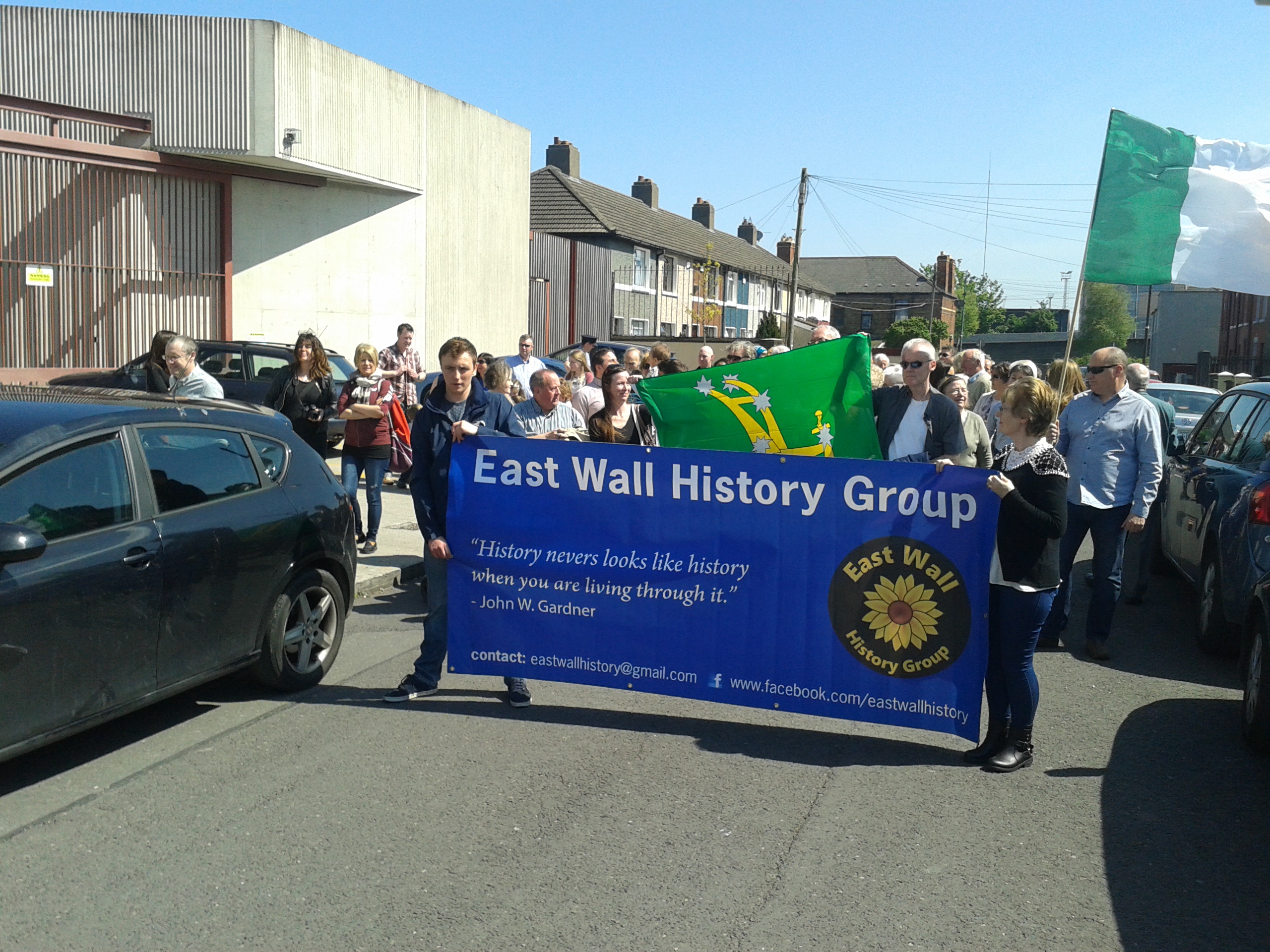

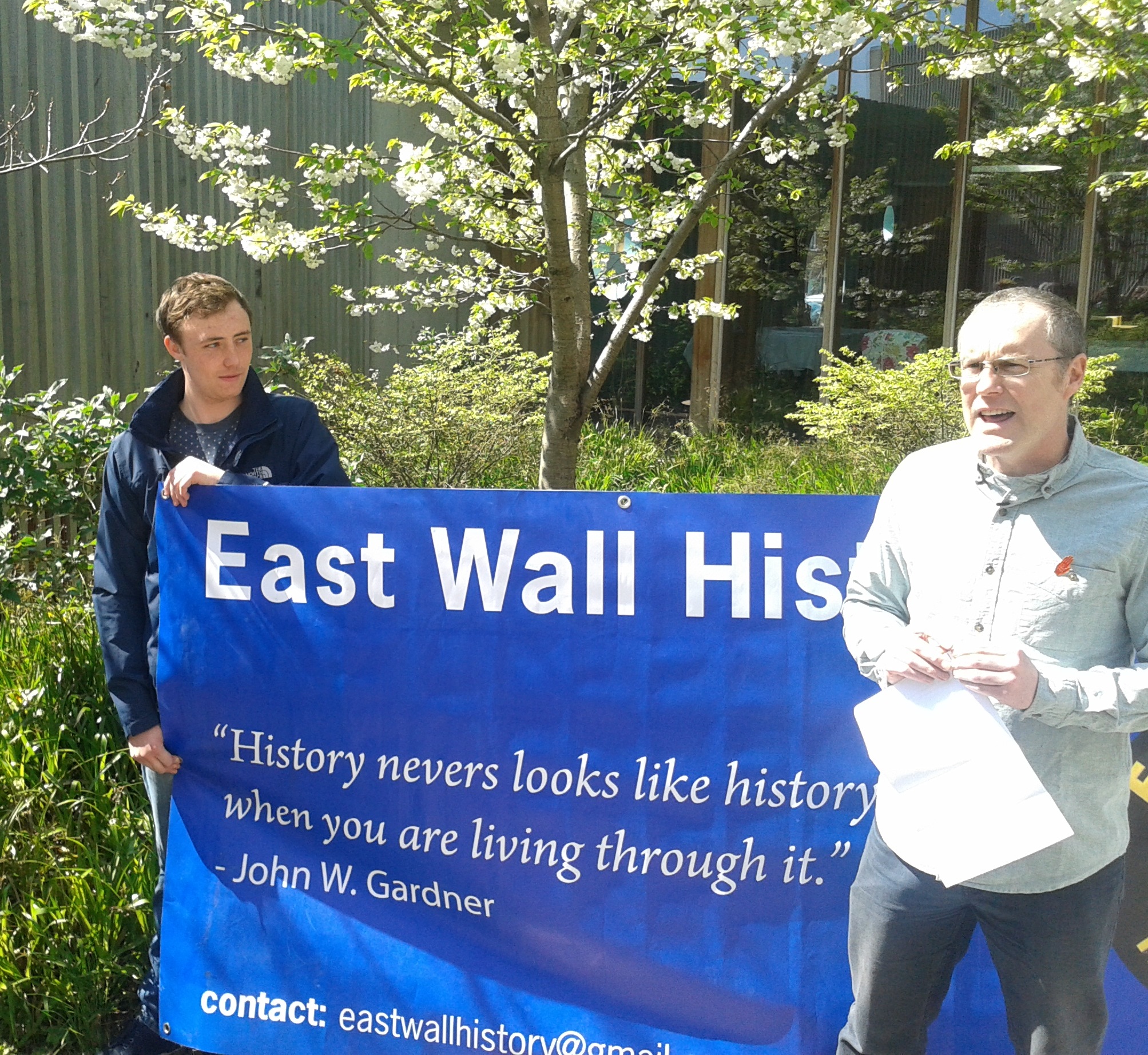
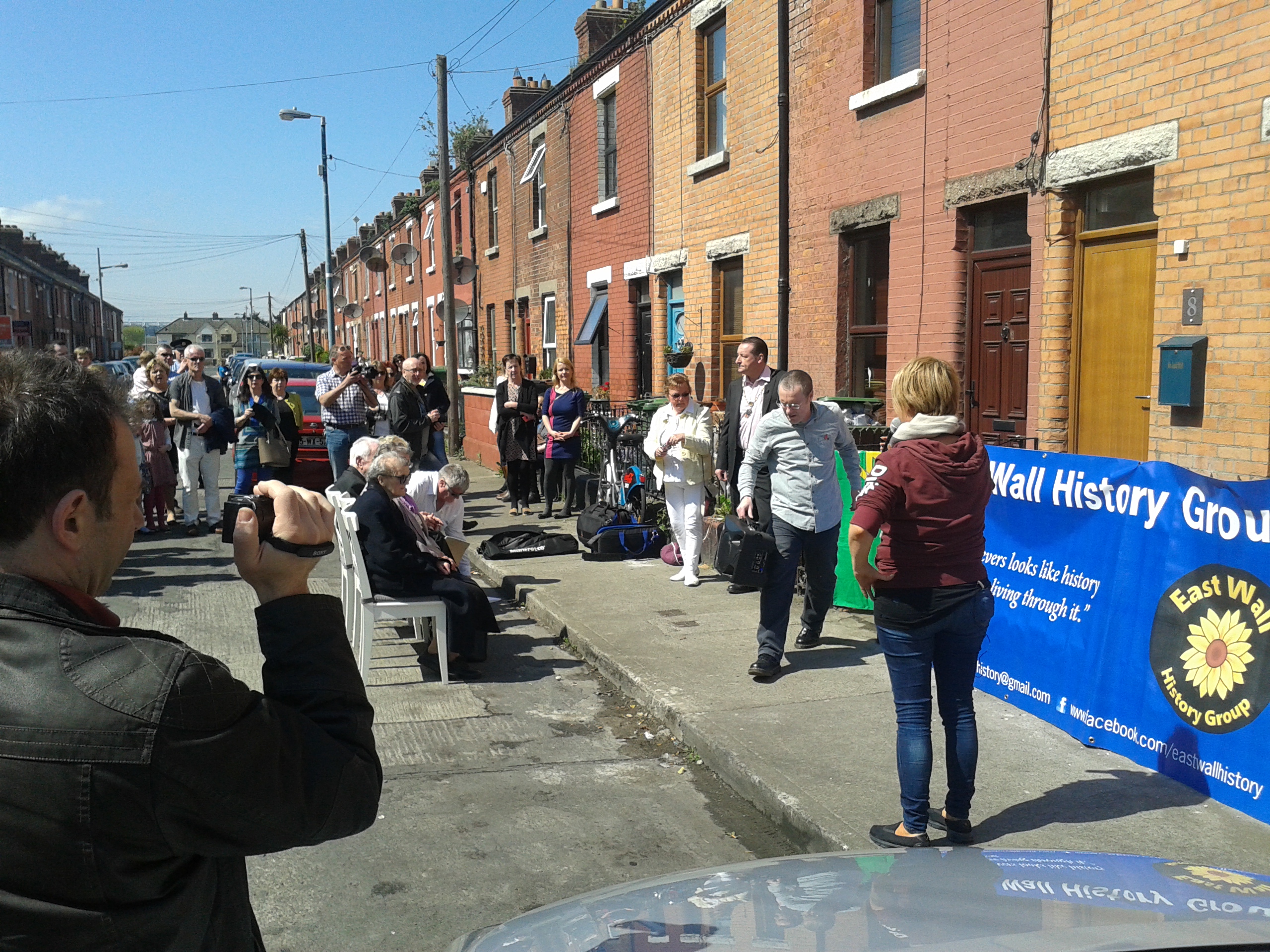
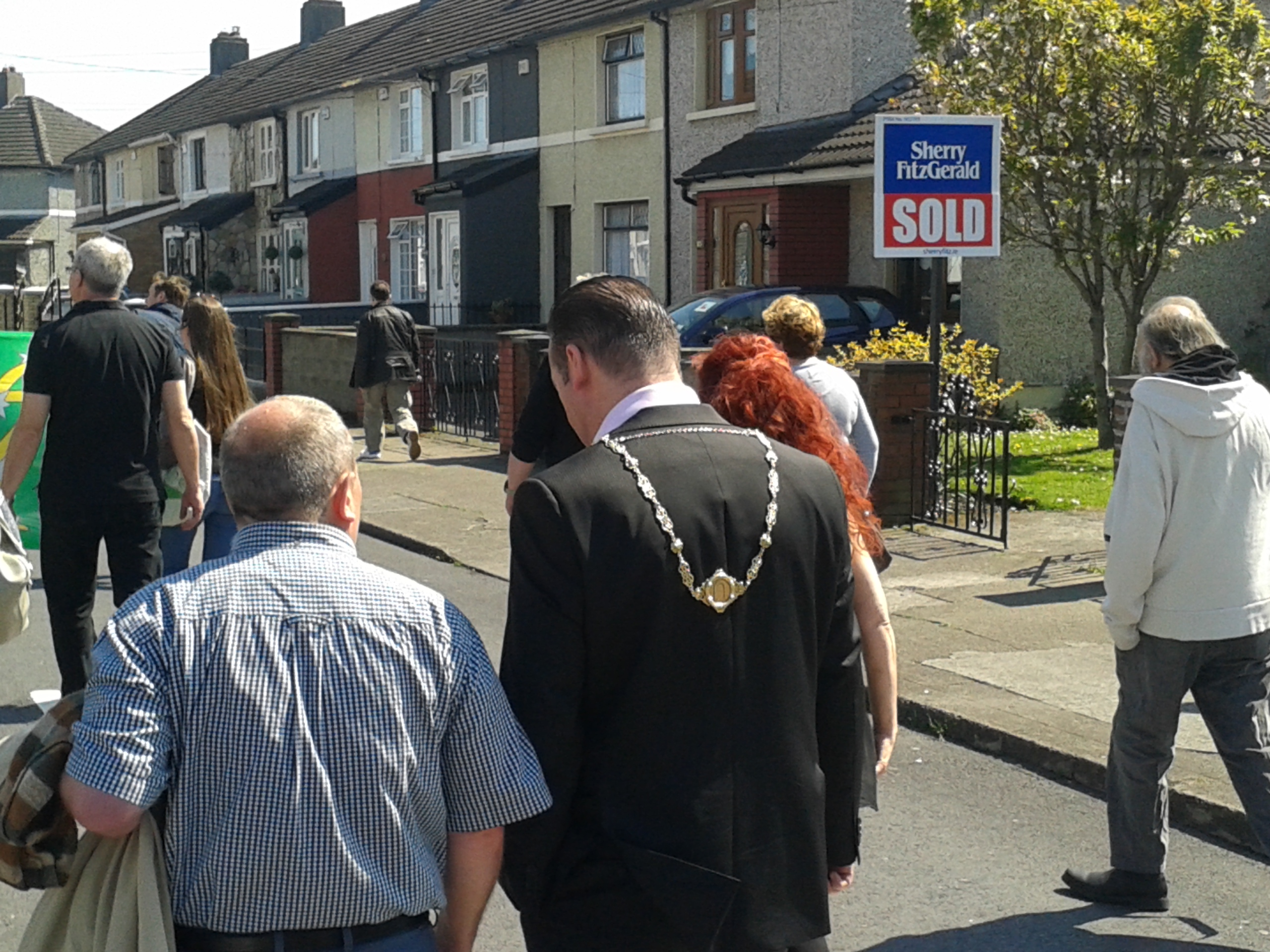


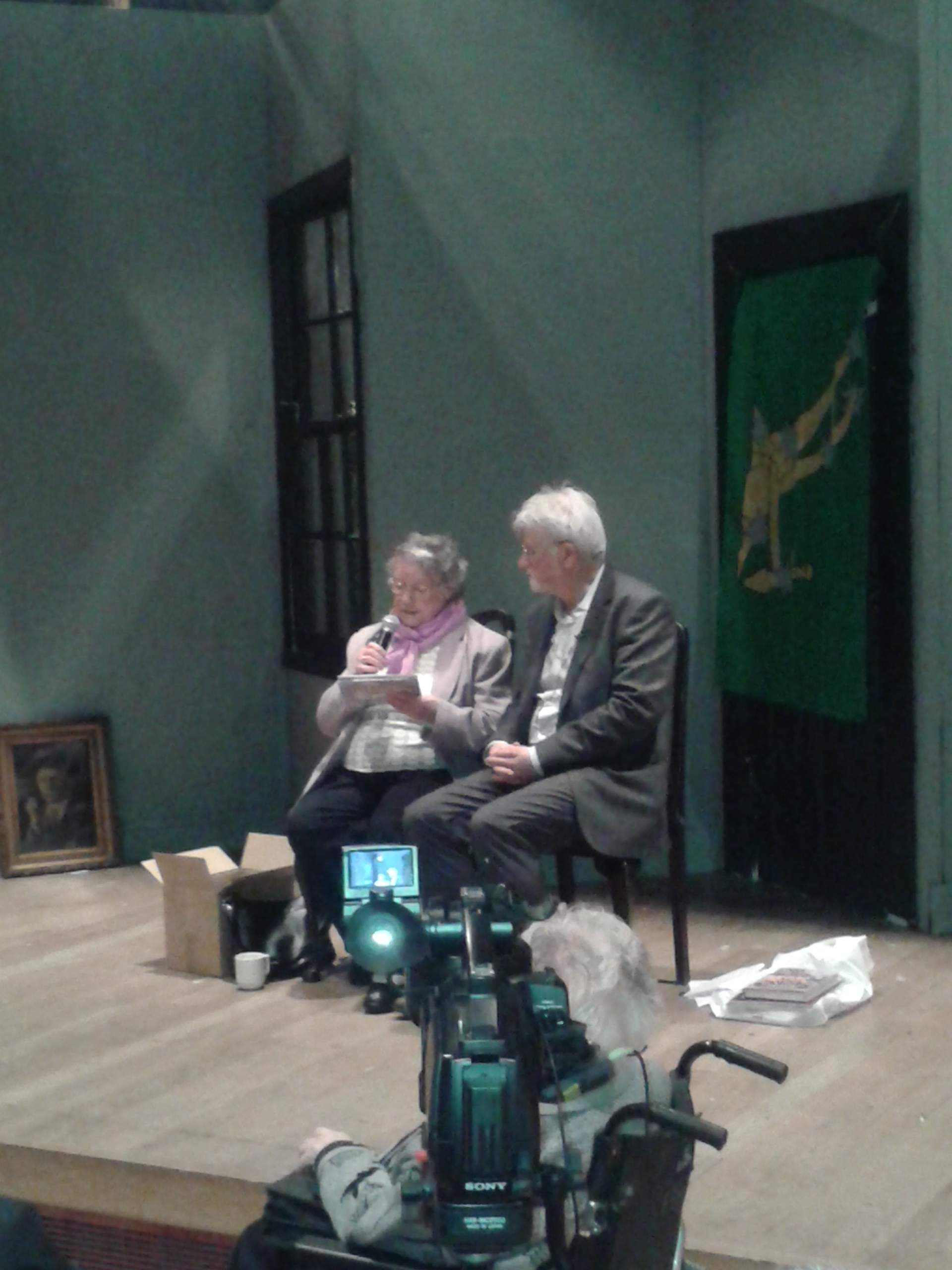
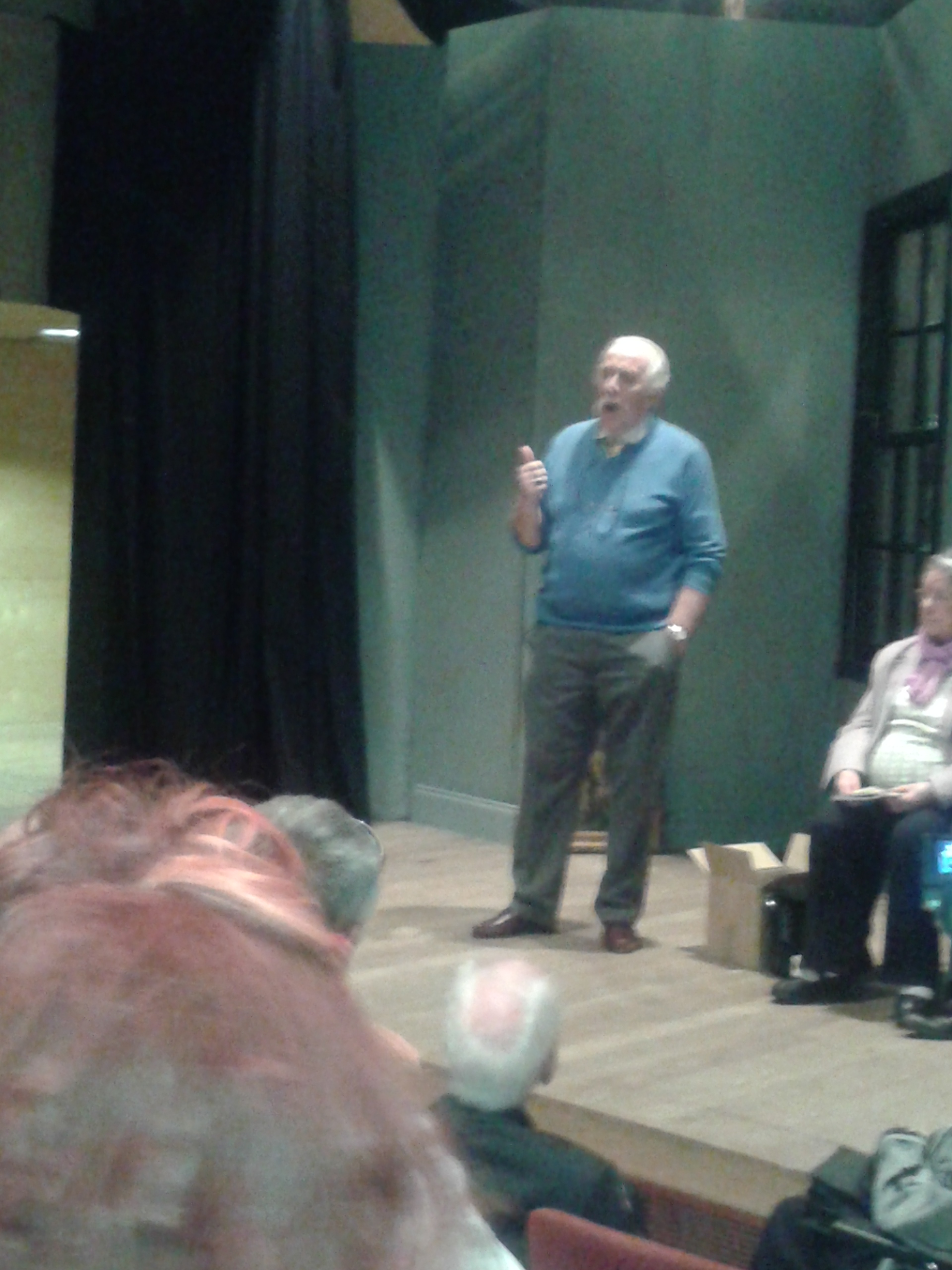


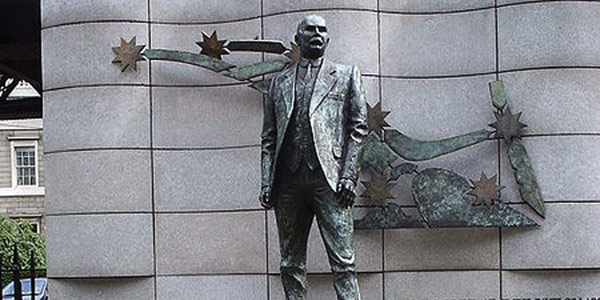


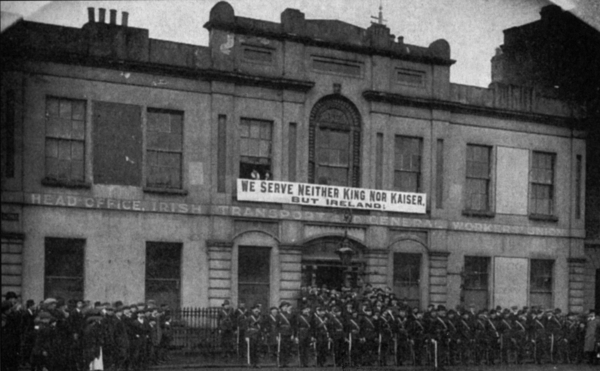

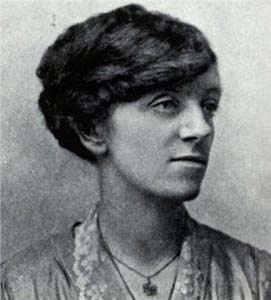
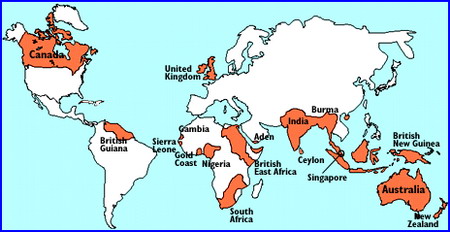

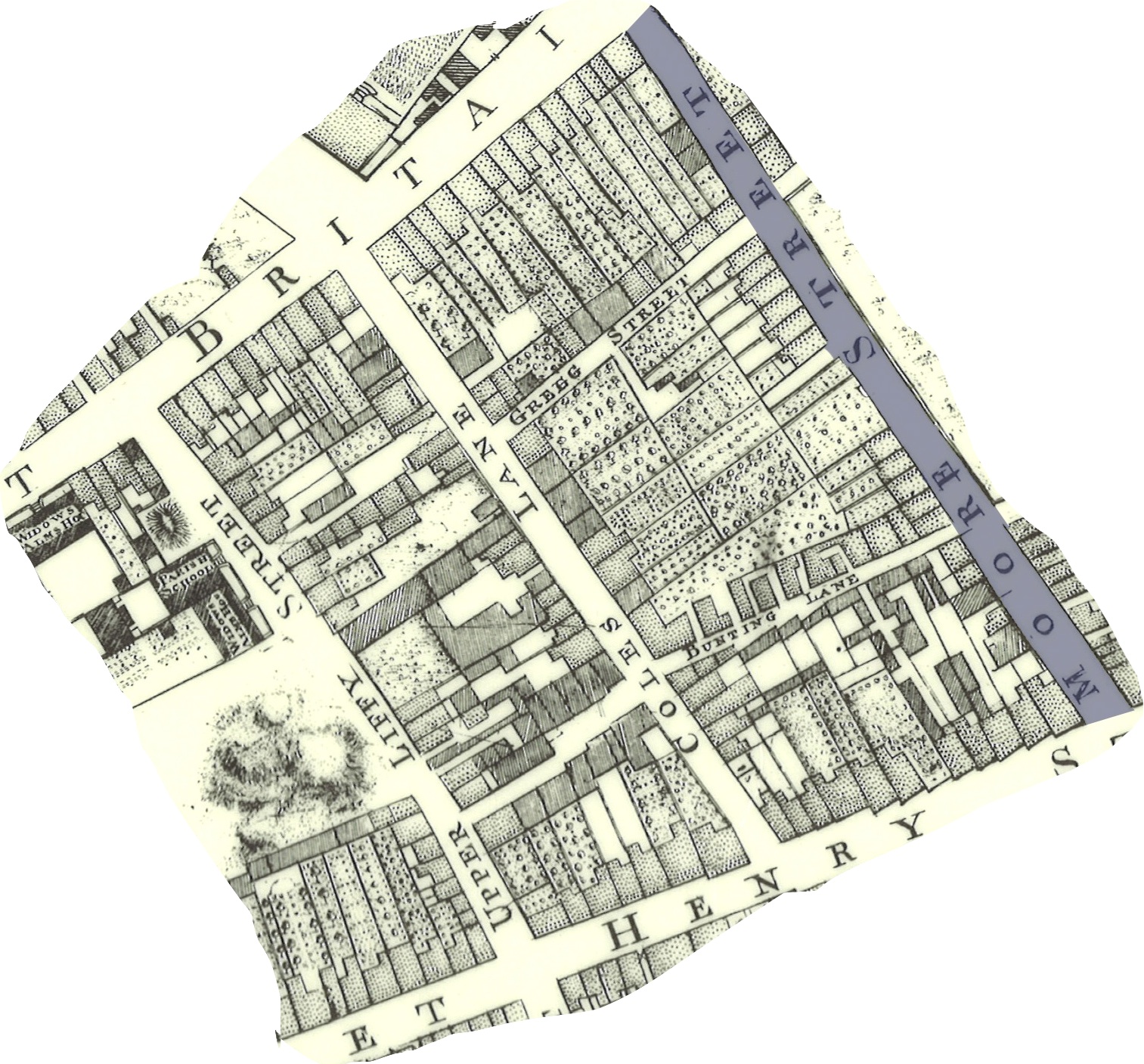


 rebelbreeze