That’s how the brief conversation started, with the elderly woman in front of me in the queue for a service desk asking me that question.
“Yes,” I replied, thinking she might be from abroad and looking for information of some sort.
She wasn’t from abroad and she wasn’t looking for information but was seeking my solidarity with her viewpoint.
“These fucking foreigners,” she began and I didn’t hear the rest because I interrupted her.
“I don’t want to hear anything more about ‘these fucking foreigners’. Thousands, no millions of Irish people have been ‘fucking foreigners’ in other countries around the world and I don’t have any problem with migrants coming here.”
“You don’t?” (looking at me aggressively).
“No.”
“I know what I’m talking about,” she says.
“So do I. I’ve been a ‘fucking foreigner’ myself for decades.”
“You must have your head up your arse.”
“If you continue insulting me, madam, I will call security and have you removed. So if I were you, I’d button it.” (miming zipping mouth shut).
Eyeball to eyeball confrontation continues in silence for a few minutes before she turns to her companion and begins muttering to him. He might be her son and he appears emotionally challenged, his head bowed. He doesn’t seem to have a choice about whether to listen to her or not.
One service attendant, who is white and sounds Irish, is dealing with a couple who might be migrants; the other attendant is black and he is dealing with an elderly white woman. He is answering her questions and explaining things without any sign of impatience or condescension – possibly about a deal. I’m a little ashamed to admit it but I wish he’d hurry up.
The couple with the other attendant seem satisfied, shake hands with him and leave. The racist lady in front of me moves into place and begins to talk to the white, maybe Irish attendant.
I don’t hear what she is saying – she has her back to me – but I can hear snatches of what he is replying: “No madam ….. the company employs all different nationalities ….. No ….. No, Madam, sorry about that …. No, that’s how it is, madam ….. sorry about that …. There’s another service station of our company at xxxxxx, you might wish to try there. Yes, goodbye now.”
I move up to the desk and tell the Irish attendant my experience with the racist woman (the other attendant is now dealing with someone else) and he explains that at first, she had been next to be served by the black attendant but had refused, insisting on her “right” to be served by an Irish person – and had rejoined the queue to do so!
Meanwhile, the Irish attendant was telephoning their service shop at xxxxxx to warn them the racist was on the way, explaining briefly what her problem with the service was and, when I chipped in, that she had been insulting another customer. Then he sorted out what I needed done, we shook hands and I left.
Maybe I handled it wrongly. Maybe this is what I should have said:
“Yes, madam, I am Irish and no, I don’t wish to hear your unkind from a humanitarian aspect, as well as scientifically, statistically and financially incorrect statements emanating from a prejudiced outlook you have acquired by some strange process and with which you might make many people unhappy, were you ever to get some power but which instead are much more likely to make you deeply unhappy for what remains of your sad life.”
(Reading time: Introduction, one minute; Part One: 5 mins; Part Two 2 mins: Part Three: 3 mins; Part Four: 2 mins; Total: 13 mins.)
Diarmuid Breatnach
INTRODUCTION:
Although I often think about the big questions – and am generally guided by my philosophy on them, my mind and energy are usually too occupied with specific struggles to focus on them for long. Recently however I had the opportunity and the need to think about the war, the one we have yet to win.
The Storming of the Bastille (translation), French Revolution, 1789 by Jean-Pierre Houel. (Image sourced: Internet)
But to which war am I referring? The Irish war of national liberation that has been flaring up for centuries, being lost each time before flaring up again? Or the class war, which has had a few sharp Irish episodes but has been, for the most part in Ireland, in abeyance? The answer is BOTH, though it may seem that my emphasis in the discussion, certainly in the early part, is on the national liberation war.
In order to imagine how we might win, it is helpful to examine past struggles and analyse what went wrong with them. Pessimists love to focus on those things I know – but in order to push us towards reformism or just surrender; my approach instead is from a revolutionary perspective.
Generally, Socialists analysing the class struggle don’t even ask themselves why we have not had a revolution yet. From week to week, month to month, they tend to focus on this or that particular trade union or social struggle but without going into the big picture. It seems as though they can’t even imagine a socialist uprising in Ireland, it’s just too far away to think about, apparently. But if one can’t even imagine such a revolution, how could one consider the necessary steps to get there?
Communards at barricade, Paris Commune 1871. (Image source: Internet)
Irish Republicans on the other hand are often thinking in terms of revolution, usually including armed struggle. However it seems to me that Irish Republicans don’t like analysing past failures of the movement but when they do, their verdicts tend to be that the leaders betrayed the struggle or that taking part in public elections corrupted the movement; or that infiltration, spies and informers was the problem. And some other reasons. The thing is, although all those things played a particular part, they are not the fundamental reason.
“Defeat of the Rebels at Vinegar Hill” by George Cruikshanks, i.e United Irishmen last major position in Wexford overrun, 1798.
PART ONE: THE THIRTY-YEARS’ WAR – DOOMED TO LOSE
(Reading time this section: less than 5 minutes)
Derry Monument and Mural of the Civil Rights struggle which preceded the armed struggle in the Six Counties. (Image sourced: Internet)
The national liberation war that began in 1969 in the Six Counties and ended in 1998 (though some armed incidents continue from time to time) began as a civil rights struggle and changed into a war of communal defence and of national liberation. The military part of the struggle for the most part took place in the occupied Six Counties. The political element of the struggle was waged all over Ireland (and abroad) but in the main consisted of support for the struggle in the Six occupied Counties.
Fought in that way, the struggle was bound to lose. It could never win. How could anyone imagine that they could win a struggle fought against a world power in one-sixth of the country, where even the population there was divided against them? What could they have been thinking?
To my mind, there are only two possible sane replies to that question, which is that they believed: 1) that the British ruling class would get worn down by struggle and leave and/ or 2) that the Irish ruling class would intervene in some way to assist the struggle and make continued British occupation untenable.
1) ‘The British ruling class would get worn down and leave’: This theory must have depended on British repression being condemned abroad and being unpopular at home but had to rest fundamentally on the British having no great stake in continuing its possession of its colony there.
Anyone who thought that (and there were many who did and still many who do, not just Irish Republicans) made a fundamental error. Time and again the British ruling class has shown its determination to hang on to what might be considered its first colony, even as the ruling class’ composition changed from feudal-colonialist to capitalist-imperialist and as the world changed around it.
Mural in nationalist area in the Six Counties (Image sourced: Internet)
Even when the British ruling class, weakened by WW1 and facing an Irish guerrilla war which enjoyed the support of the vast majority of Irish people, with national liberation uprisings breaking out across its Empire and with its repression in Ireland increasingly unpopular at home, entered into negotiations with the Irish resistance, it held on to a foothold, the Six Counties.
Subsequently, it had that colony managed in a permanent state of emergency laws, with institutionalised sectarian discrimination at all official levels and outbreaks of pogroms in the street and workplace.
That became even more exposed during the civil rights struggle and the national liberation war that followed when the British State compromised whatever good international reputationremained to its Armed Forces, its judiciary, its legal establishment, its media and its very legal framework.
Even now, when many believe that the Good Friday Agreement means that a 50% plus-one-vote in favour in the Six Counties will be sufficient to end Partition, they do not realise that such a decision will have to also obtain a majority in the British Parliament and be endorsed by the British Monarch. They are also forgetting the broken promises that surrounded Partition in the first place.
British Army in Belfast 1969 (bayonets and guns pointed towards nationalist area). (Image sourced: Internet)
When analysing what holding on to the Six Counties has cost the British State in terms of reputation, military and financial contributions, one can only rationally assume that continuing to hold on to that foothold is of great importance to the British State. One may speculate as to the reasons underlying that but the central fact cannot be denied.
2) ‘The Irish ruling class would intervene in some way to assist the struggle and make continued British occupation untenable’:
There was some basis for this belief in that a section of Fianna Fáil, a party that had emerged from a split in Sinn Féin in the 1930s and had become one of the mainstream parties in the Irish state, had retained some traditional commitment to seeking a united Ireland. However it was a thin enough basis on which to depend in a national liberation struggle since that section had no majority within the party itself, to say nothing of the foreign-dependent nature of the Irish native capitalist class, the Gombeens, as a whole.
The question came to a trial of strength in the Arms Crisis of 1970, in which at least two Fianna Fáil Government Ministers were involved in secretly buying arms for the defence of nationalist areas in the Six Counties (since the IRA had insufficient weapons at the time) from rampaging Loyalist mobs and the Royal Ulster Constabulary (including the part-time B-Specials). The Ministers alleged that they had acted in the full knowledge of the rest of the Government. By the time the whole affair was over, two Ministers had been sacked and another two resigned in protest.
If it had not been clear before that the Gombeens, the native Irish capitalist class was no patriotic capitalist class but rather a neo-colonial one, it should have been clear after that. But the armed struggle in the Six Counties intensified, especially after the massacres of unarmed civilians carried out by British Paratroopers the following year, 1971 in Belfast and again in Derry in 1972. And the war lasted until 1998.
If, as had been demonstrated to be the case that the British ruling class were determined to hold on to the Six Counties and the Irish ruling class was not going to seriously challenge that possession, did the Republican movement have any other option than to fight on a war that they could not possibly win?
I am clear that it did.
Clearly, in order to have a chance of success, the war had to be extended to the other five-fifths of the country, which is to say into the territory under the control of the Irish native capitalist class. This class had seized power after the War of Independence (1919-1921) and had beaten and suppressed its opposition duringand afterthe Civil War (1922-1923) and furthermore was supported by a powerful ally, the Irish Catholic Church. Since the founding of the first Irish Republican organisation, the United Irishmen of the late 1790s, the Catholic Church hierarchy had opposed Irish Republicanism; it had condemned four Irish priests who participated in the uprising of 1798, excommunicated the Fenians, had at first condemned the 1916 Rising and the War of Independence only to latch on to it at the end along with the Gombeen class.
The general Irish population likely would not have supported or sustained an armed struggle in the 1970s against the Gombeen class but that class could have been fought politically, through agitation and mobilisation, on many social, political and economic fronts. Without going into the specific details of each, these were:
against the huge wastage of Irish youth through emigration
to remedy the shortage of affordable housing (which in part contributed to the above)
to end unemployment (also contributing hugely to emigration)
to raise the level of wages and lower wage earners’ taxation
for the right to divorce
for equality for women in law
for the right to contraception devices and medication for men and women
against decriminalisation and for equal rights for gay and lesbians
to halt the decline of the Irish language, in particular of the rural Irish-speaking areas
to improve services for the rural areas
to oppose the open-door policy for foreign multinationals to exploit Irish natural and human resources
to secularise the education service
and the health service.
to remove the privileged status of the Catholic Church within the state.
Irish women photographed at Connolly Station 1971, about to board train to Belfast to purchase contraceptives to bring back to the Irish state, illegal at the time. There was no right to abortion either or divorce and a husband’s signed permission was necessary to take out a hire purchase agreement. (Image sourced: Internet)
The Republican movement in general, with some exceptions, declined to take on any of those struggles. They did not organise in the trade union movement, left the social struggles to others and most of all, declined to take on the Catholic Church on any issue except its opposition to the national liberation struggle. Even there, it was happy to publicly avail of the services of members of the Church clergy who supported them. Republicanism was, from its very beginning, as well as anti-monarchist, about separation of Church and State but it was difficult to see that in the Irish Republican movement, particularly after the War of Independence.
A full half of those fourteen points above (nos. 5,6, 7, 8, 12, 13 and 14) would have meant taking on the Church head-on and no doubt the hierarchy would have hindered the struggle over most of the others too, due to its strong links with the State and its ruling class.
Because of its tactical and no doubt ideological refusal to take up those struggles, the Republican movement could do little more in the 26-County state than to agitate for solidarity with the beleaguered nationalist population inside the British colony.
Though this could be effective for a time it could not become a mass movement, nor survive a long struggle, without any remedy being sought for the issues facing the population within the state.
The wonder is not that the majority leadership of the Republican Movement threw in the towel on the military struggle in 1998 but that they had waited so long to do it. Of course, they never admitted the true nature of what they were doing: abandoning the armed struggle and revolution in total and instead, using their negotiating position to advance themselves politically – not in the economic, social and political struggle envisioned above but rather in a political struggle to find themselves a place among the Gombeen political class in the Irish state and as accomplices in the governing of the colonial state.
PART 2: COLLECTING THE FORCES FOR REVOLUTION
(Reading time this section: 2 minutes)
A successful revolution in Ireland, as in most places, would require the involvement of a mass movement. That mass movement would be unlikely to be one that had national self-determination as its only aim – certainly not in the 26 Counties (the Irish state). Mass movements arise at times around different issues and exist as long as the issue does or instead until the movement gets worn down or broken up. Such movements arose around the Household Tax and, later, around the additional Water Charges.
Section of protest against water charges, O’Connell Street, Dublin, 29 Aug. 2015 (Image source: Internet)
Even though the objectives of such movements are often not revolutionary, the participation in them by revolutionaries is necessary if, in the future, there is to be a revolution. Revolutionary activists can make contacts and prove themselves by the way they participate whilst at the same time pointing out that a revolution is necessary in order to resolve all these issues completely and permanently. Such activists can also influence the movement (or sections of it) to act in more revolutionary ways, so that the movement can be guided by – and imbued with — revolutionary spirit.
Working people in struggles come up against concrete problems which need to be resolved in order to move forward. Prior to 1913 in Ireland, workers learned the need for unity in struggle which was emphasised by the employers’ attempts to break the Irish Transport and General Workers’ Union in August 1913. The attacks on them by the Dublin Metropolitan Police illustrated the need for organised defence and Larkin and Connolly called for the formation of what became the Irish Citizen Army, which later also fought prominently in the 1916 Rising.
Members and supporters of the Irish Transport & General Workers’ Union cheering outside the union’s HQ, Liberty Hall, August 1913. Later the union formed the ICA to defend themselves from the DMP; the ICA took a prominent part in the 1916 Rising. (Image source: Internet)
Trade unions are the only mass organisations of the working class in Ireland and it is necessary for revolutionaries to be active within them. Currently, other than social democrats, it is mainly members of both trotskyist parties and independent activists who engage politically with the trade unions. Those members are mostly in clerical work and their political work tends to concentrate on employment demands around wages and working conditions. When they introduce politics it is generally to get some motion passed by their branch. Also at times, they will campaign to get a perceived left-wing candidate elected to some position within the trade union bureaucracy.
None of the above are without value but they remain disjointed in terms of program and often confined to just one trade union. Not only that, but often the Left party involved will engage in order to recruit some new members and in order also to retain their own members by providing them with activity. When broad front trade union groups are formed, they tend to become an arena where the dominant trotskyist parties compete for dominance.
If we are to have a successful revolution – and in particular a socialist one – participation in the struggles of workers in the trade union movement is absolutely necessary. But participation should be primarily among the rank and file of the trade union and also across trade unions, focused on providing solidarity to members of whichever union is in struggle – in addition to encouraging unorganised workers to organise and become active. The objective is not to help make one trade union or one section more militant but rather to create a militant workers‘ solidarity movement within the whole trade union movement. It is essential to have members in the ‘blue-collar’ work unions or departments as well as in the clerical unions or sections. And the cross-union organisation I advocated should be independent — the preserve of no political party.
Participation in such struggles provides an opportunity for revolutionaries to make contact with people who are activists but not yet revolutionaries and to give those people an opportunity to evaluate the revolutionaries in terms of their actual practice. Revolutionaries can support the people struggling for worthwhile reforms while at the same time pointing to their partial and temporary nature. Revolutionary activists can play an educational role in the mass movements while at the same time becoming educated themselves by the daily reality faced by the masses in this system.
PART 3: THE ABSOLUTE NEED FOR UNITY – BUT WHAT KIND?
(Reading time this section: 3 minutes)
It is, most people would think, a ‘no-brainer’ (i.e an obvious truth) that unity is necessary in the struggle to overthrow the current system. It might be thought surprising, therefore, that disunity is more the rule among those who aspire to revolution.
Generally, those who claim to be revolutionary socialists will not unite with Irish Republicans. In addition, those socialists of one party will often fail to unite with those of a different party. The same dynamic is to be seen among Irish Republicans also.
There have been many attempts to overcome this problem. In the 1930s the Republican Congress sought to unite Irish Republicans with revolutionary socialists. In the face of hostility within the mainstream Republican movement and also with divisions among the communist element in Ireland at the time, faced in addition with anti-communist hysteria whipped up by the Catholic Church, the experiment failed. The leadership of the Sinn Féin and the IRA of the later 1960s tried to combine socialism and republicanism within one party and military organisation, an attempt that crashed when it was discovered that the arms necessary to defend ‘nationalist’ community areas in the Six Counties, particularly in Belfast, were unavailable, leading to an acrimonious split in the movement. A subsequent attempt to combine the socialist and republican elements in another organisation survived a little longer but also failed for a number of reasons, some internal and also due to Irish State repression.
Socialist Republicans, members of Republican Congress from Shankhill Road, marching to annual Wolfe Tone commemoration, Bodenstown 1934. They were attacked by conservative Republicans. (Photo source: Internet)
There have been some attempts to unite the non-republican Left itself also, which usually failed due in part to ideological differences but also to political sectarianism and personality clashes. Currently both trotskyist parties have an uneasy working relationship, the small grouping of Independents for Change exists also, the Communist Party is very small too and the anarchists are scattered and unable for years now, for the most part, to mount united action.
Attempts to unite the various parts of the Irish Republican movement have, in general, focused on creating a new organisation or absorbing activists unhappy with one organisation into another.
A frequent approach has been for some people to sit down and produce what they consider solid policy and a constitution, then to propose this format to others around which to unite. Even when accepting amendments from the elements they seek to recruit, these attempts too have largely failed.
It seems a rational approach: if we want unity, surely first we have to agree on what for, how, etc, etc before we can go into action? I believe, contrary though it may seem, that actually we should unite in action first. Uniting in action tends to break down barriers of mistrust that are built on hearsay or suspicions fostered by sectarian elements. Action also tends to clarify certain questions that until then are theoretical only. Of course, at some point, action will need to be guided by worked out policy but initially the action itself can be sufficient guide, especially since approaching the question the other way around has been so generally unproductive.
The question then arises: with whom to unite? In general, I would say that the answer is: with all with whom we can, in actual practice, unite: different types of revolutionary socialists (including anarchists), Irish Republicans, Left social democrats, human and civil rights activists.
There are some exceptions I think necessary to mention: fascists, racists, religious sectarians and parties that participate in Government. Fascists seek to impose an undemocratic regime completely hostile to the interests of working people and, far from our uniting with them, need to be defeated; racists and religious sectarians seek to divide the movement along lines of ethnicity or religious affiliation. Revolutionaries need to draw a clear line of distinction between the movements of resistance and those who participate in a native capitalist or colonial government, i.e the management organisations of the enemy.
Many issues lend themselves to united action but perhaps none more so, and none are more essential, than against repression.
PART FOUR: UNITY AGAINST REPRESSION
(Reading time this section: 3 minutes)
All revolutionary movements – and many that are progressive but not revolutionary – face repression at some point in their existence. Not to recognise that fact and to have some kind of preparation for it, even if very basic, is indicative of a non-revolutionary attitude to the State. Nor have we any reason in Ireland to be complacent on this question.
The Irish State turned to military suppression in the first year of its existence as did also the colonial statelet. Detentions, torture, murders and official executions were carried out by Free State forces over a number of years, followed by censorship and arrests, all facilitated by emergency repressive legislation. In the Six Counties, in addition to similar even more repressive legislation, there were two sectarian militarised police forces and sectarian civilian organisations.
After a change of government, the Irish State introduced internment without trial during the Emergency (1939-1946), the Offences Against the State Act in 1939, Special Criminal (sic) Courts in 1972 and the Amendment to the OAS in that same year.
Poster for 2014 Commemoration of Bloody Sunday massacre, Derry 1972. The poster calls for unity. (Image source: Internet)
The Six County statelet had the Special Powers Act (1922) and brought in internment without trial in 1971 (the Ballymurphy Massacre that year and the Derry Massacre the following year, both by the Parachute Regiment, were of people protesting the introduction of internment). The statelet also introduced the Emergency Provisions Act and the no-jury Diplock Courts in 1973 and, though technically abolished in 2007, non-jury trials can and do take place up to today.
The British state targeted the Irish diaspora in Britain in 1974 with the Prevention of Terrorism (sic) Act and that same year and the following, framed and convicted nearly a score of innocent people of bombings in five different cases – had the death penalty not been previously abolished for murder, most of them would have been executed. It took the victims over 15 years to win their freedom, by which time one had died in jail. Brought in as a temporary measure, the PTA continued in force until 1989 but a general Terrorism Act was brought into British Law in 2000 and remains in force today.
Photos of the Birmingham Six, Irishmen resident in England, showing bruises from police beatings after their arrest in 1974; they were also beaten by jailers. Also arrested, brutalised, framed and convicted were the Guildford Four, Maguire Seven and Giuseppe Conlon and Judith Ward. (Photo source: Internet)
State repression rarely targets the whole population and, particularly in a capitalist “democracy” focuses on particular groups which it fears or feels it can safely persecute. However, we should also recall Pastor Niemoller’s words about the creeping repression which even the German Nazi state instituted, going after first one group, then another, and another …. Among the list of groups targeted eventually by the Nazis were Jews, Roma, Communists, Socialists, Anarchists, Social Democrats, Jehova’s Witnesses, Free Masons, Gays and Lesbians, Mentally Ill or challenged, physically challenged ….
It is in the interests of the vast majority of the population to oppose repression of different groups, whether those groups be based on ethnicity, gender, sexuality, citizenship status or democratic politics. Not everyone recognises this of course but one might expect that political activists challenging the status quo would do so. Sadly, experience shows that they do not in practice (though they may acknowledge it intellectually).
Anti-Internment and political prisoner solidarity picket September 2016 at Kilmainham Jail, Dublin (a former place of detention and execution for political prisoners under both the British occupation and the Irish State, now a museum). (Photo source: Rebel Breeze)
With some periodic exceptions, socialist groups in Ireland do not support protests against repression of republicans. Furthermore, some republican groups will not support others when the latter are subjected to repression. Yet at any time, Republicans of any group can be and are regularly harassed in public or raided at home; their employers may be warned about them by the political police; they may be detained on special repressive legislation, denied bail, effectively interned; they can be easily convicted in the non-jury Special Criminal Courts or Diplock Courts; ex-prisoners released on licence in the Six Counties can be returned to jail without any charge or possibility of defence.
The Irish State’s non-jury Special Criminal Court is a tempting facility for putting away people whom the State finds annoying and it is widely thought it was considered for the trials of the Jobstown protesters. The result of the trial, where the jury clearly took a different view to the presiding judge, may well have justified the opinion of those in the State who considered sending the defendants to the SCC.
Unity against repression is a fundamental need of a healthy society and of movements that challenge the status quo. Practical unity in any kind of action also tends to break down barriers and assists general revolutionarybroad unity. Unity against repression is so basic a need that agreement with this or that individual is unnecessary, nor with this or that organisation in order to defend them against repression. Basic democratic rights were fought for by generations and have to be defended; in addition they give activists some room to act without being jailed. On this basis, all must unite in practice and political sectarianism has no place in that.
Without some basic unity in practice across the sector challenging the status quo, there can be no revolution. But more than that: we stand together against repression ….. or we go to jail separately.
End.
Diarmuid Breatnach is a veteran independent revolutionary activist, currently particularly active in committees against repression, in some areas of internationalist solidarity and in defence of historical memory.
Well, I can see that it would be for Britain, to leave the European Union, the European Economic Community, the Common Market …… It will impact in particular on trade and they’ll have to leave the euro currency ….. no, wait, they never joined that anyway, kept their own currency throughout. In fact, British ruling circles were never that keen to join a “community” that they were not in charge of and, even worse, that Germany was.
And I can see that the Brexit drama has has had quite an unsettling effect on the leadership of the Conservative Party (sorry, Conservative and Unionist parties), with one Prime Minister getting sacrificed so an apparently worse one can step into the vacancy.
I can also see that it has rocked the shaky Union, with the majority of Scotland and the Six Counties voting to stay in the EU and (unproven) concerns among many in Britain that the vote in favour of leaving was dominated by right-wing, jingoistic and even racist elements.
But why is it a problem for the population of Ireland, as we keep being told it is – or will be?
Well, apparently we might get a “hard Border” around the British colony of one-sixth of our nation. There might be customs and military controls, checkpoints, watch towers ….. And this will all undermine the Good Friday Agreement. Apparently.
Why would it? Apparently the illusion of normality around the armed occupation of our country will disappear, once we have to go through checkpoints and pay tax on shopping from one side of the Border or the other. Once that illusion is swept away, those “dissident” Republicans will take arms and launch another war of resistance, or campaign of terrorism, according to how you feel about it.
Really? Border checkpoints will do that? Amazing!
So, was that what started the last three decades or so of armed conflict in what some geography-challenged people call “Northern Ireland”? Well, no, not really. Firstly, it was that fifty years earlier, those six counties (hence the title of “The Six Counties”) had been hijacked when the rest of the nation was being given a measure of independence, then had been put under a police state run by sectarian religious bigots. Yes I know it’s not nice to say that but when you go into a hardware shop to buy a spade, you don’t ask for “a spoon”.
And then those people who were at the receiving end of that bigotry and police state treatment felt a wind of change blowing around the world and had the temerity to demand an end to sectarianism in the allocation of work, housing and voting rights, along with wanting ordinary civil rights that were available in the rest of the UK but not for the people in the Six Counties, despite the colony being, we were told, “as British as Finchley”.
Naturally the police and the sectarian bigots set upon those marchers with batons, rocks and toxic tear gas – and even live rounds – but still couldn’t get them to give up their outrageous demands. The poor cops were getting worn down so, naturally again, the colonial power sent in the troops, with guns and fixed bayonets. And so the war started.
It wasn’t the checkpoints that led to war, honestly. It was other things completely.
Of course, it is possible that something different from before might trigger another war. That’s the thing about occupation forces and indigenous populations – the relationship usually begins with violence, has a number of recurrent bouts of violence …. and is ended by violence.
British colonial police force, the PSNI, harassing an Irish Republican in Newry. If armed struggle breaks out anew, it is more likely to be about regular incidents such as these rather than the customs checkpoints of a “hard Border”!
So, the Good Friday Agreement – a great achievement, right. Er … why? Oh, it brought peace. Actually no, it didn’t. It brought a pause in the armed resistance struggle is what it did. And that’s only something like peace if it holds. I don’t think it will, nor do I think border controls are what will undermine it. And even if it stayed as it is, it would be pacification, not peace.
The Good Friday Agreement amounts to this, in crude essence:
Colonising power: We can kill you and you can kill ours – but you can’t send ours to prison for decades and make their families suffer. We can’t beat you but we can outlast you and outhurt you.
Republican organisation: We will resist.
CP: Yes, you have been. But you are not going to win. Why not do a deal?
RO: What deal is on offer?
CP: Peace process.
RO: What does it involve?
CP: 1. We get to keep the colony. 2. You stop fighting. 3. You destroy your weapons.
RO: What do we get out of it?
CP: 1. You get your prisoners out (but under licence of good behaviour). 2. You get to build a political career, if you want it. 3. And if you do, one day you could help us manage this colony.
RO: Hmmm. OK, we’ll take it.
In all the discussion about the Brexit question, particularly by mass media pundits and establishment politicians (and wannabe establishment politicians like SF’s), when do we hear it being said that the Six Counties is a colony occupied by force?
This isn’t another country with which we happen to have a border, such as between Germany and the French state, for example, or between the French and Spanish states. They aren’t people of another nation on the other side of that Border — they are Irish. It is a part of our country and for nearly eight centuries the British invaders and colonisers saw it as one country too — until they had to pull out and decided it was important to keep a foothold in it.
So, coming back to the question of the people in Ireland, why should we be too concerned, one way or another with regard to Brexit? Apart from people in the Border areas who need to travel regularly across it and are going to be greatly inconvenienced by it, I don’t think we should.
Maybe we can find some real problems for us to deal with instead. Apart from the colonial status of those Six Counties, along with its continuing dominant sectarianism and bigotry, which is not even mentioned in the dominant discourse, we have a continuing bank bailout debt, a massive social housing deficit, a crumbling health service, public services and natural resources being plundered and a corrupt police force …..
(Part of series “HOW TO WIN THE WAR — GETTING INTO POSITION”. See also INTRODUCTION; PART 1: THE THIRTY-YEARS’ WAR – DOOMED TO LOSE; PART 2: COLLECTING THE FORCES FOR REVOLUTION; PART 4: UNITY AGAINST REPRESSION)
It is, most people would think, a ‘no-brainer’ (i.e an obvious truth) that unity is necessary in the struggle to overthrow the current system. It might be thought surprising, therefore, that disunity is more the rule among those who aspire to revolution.
Generally, those who claim to be revolutionary socialists will not unite with Irish Republicans. In addition, those socialists of one party will often fail to unite with those of a different party. The same dynamic is to be seen among Irish Republicans also.
There have been many attempts to overcome this problem. In the 1930s the Republican Congress sought to unite Irish Republicans with revolutionary socialists. In the face of hostility within the mainstream Republican movement and also with divisions among the communist element in Ireland at the time, faced in addition with anti-communist hysteria whipped up by the Catholic Church, the experiment failed. The leadership of the Sinn Féin and the IRA of the later 1960s tried to combine socialism and republicanism within one party and military organisation, an attempt that crashed when it was discovered that the arms necessary to defend ‘nationalist’ community areas in the Six Counties, particularly in Belfast, were unavailable, leading to an acrimonious split in the movement. A subsequent attempt to combine the socialist and republican elements in another organisation survived a little longer but also failed for a number of reasons, some internal and also due to Irish State repression.
Socialist Republicans, members of Republican Congress from Shankhill Road, marching to annual Wolfe Tone commemoration, Bodenstown 1934. They were attacked by conservative Republicans. (Photo source: Internet)
There have been some attempts to unite the non-republican Left itself also, which usually failed due in part to ideological differences but also to political sectarianism and personality clashes. Currently both trotskyist parties have an uneasy working relationship, the small grouping of Independents for Change exists also, the Communist Party is very small too and the anarchists are scattered and unable for years now, for the most part, to mount united action.
Attempts to unite the various parts of the Irish Republican movement have, in general, focused on creating a new organisation or absorbing activists unhappy with one organisation into another.
A frequent approach has been for some people to sit down and produce what they consider solid policy and a constitution, then to propose this format to others around which to unite. Even when accepting amendments from the elements they seek to recruit, these attempts too have largely failed.
It seems a rational approach: if we want unity, surely first we have to agree on what for, how, etc, etc before we can go into action? I believe, contrary though it may seem, that actually we should unite in action first. Uniting in action tends to break down barriers of mistrust that are built on hearsay or suspicions fostered by sectarian elements. Action also tends to clarify certain questions that until then are theoretical only. Of course, at some point, action will need to be guided by worked out policy but initially the action itself can be sufficient guide, especially since approaching the question the other way around has been so generally unproductive.
The question then arises: with whom to unite? In general, I would say that the answer is: with all with whom we can, in actual practice, unite: different types of revolutionary socialists (including anarchists), Irish Republicans, Left social democrats, human and civil rights activists.
There are some exceptions I think necessary to mention: fascists, racists, religious sectarians and parties that participate in Government. Fascists seek to impose an undemocratic regime completely hostile to the interests of working people and, far from our uniting with them, need to be defeated; racists and religious sectarians seek to divide the movement along lines of ethnicity or religious affiliation. Revolutionaries need to draw a clear line of distinction between the movements of resistance and those who participate in a native capitalist or colonial government, i.e the management organisations of the enemy.
Many issues lend themselves to united action but perhaps none more so, and none are more essential, than against repression.
Diarmuid Breatnach is a veteran independent revolutionary activist, currently particularly active in committees against repression, in some areas of internationalist solidarity and in defence of historical memory.
PART THREE: THE ABSOLUTE NEED FOR UNITY – BUT HOW AND WHAT KIND? WITH WHOM?
PART FOUR: UNITY AGAINST REPRESSION
The national liberation war that began in 1969 in the Six Counties and ended in 1998 (though some armed incidents continue from time to time) began as a civil rights struggle and changed into a war of communal defence and of national liberation. The military part of the struggle for the most part took place in the occupied Six Counties. The political element of the struggle was waged all over Ireland (and abroad) but in the main consisted of support for the struggle in the Six occupied Counties.
Derry Monument and Mural of the Civil Rights struggle which preceded the armed struggle in the Six Counties. (Image sourced: Internet)
Fought in that way, the struggle was bound to lose. It could never win. How could anyone imagine that they could win a struggle fought against a world power in one-sixth of the country, where even the population there was divided against them? What could they have been thinking?
To my mind, there are only two possible sane replies to that question, which is that they believed: 1) that the British ruling class would get worn down by struggle and leave and/ or 2) that the Irish ruling class would intervene in some way to assist the struggle and make continued British occupation untenable.
1) ‘The British ruling class would get worn down and leave’: This theory must have depended on British repression being condemned abroad and being unpopular at home but had to rest fundamentally on the British having no great stake in continuing its possession of its colony there.
Anyone who thought that (and there were many who did and still many who do, not just Irish Republicans) made a fundamental error. Time and again the British ruling class has shown its determination to hang on to what might be considered its first colony, even as its ruling class’ composition changed from feudal-colonialist to capitalist-imperialist and as the world changed around it.
Mural in nationalist area in the Six Counties (Image sourced: Internet)
Even when the British ruling class, weakened by WW1 and facing an Irish guerrilla war with the support of the vast majority of Irish people, with national liberation uprisings breaking out across its Empire and with its repression in Ireland increasingly unpopular at home, entered into negotiations with the Irish resistance, it held on to a foothold, the Six Counties.
Subsequently, it had that colony managed in a permanent state of emergency laws, with institutionalised sectarian discrimination at all official levels and outbreaks of pogroms in the street and workplace.
That became even more exposed during the civil rights struggle and the national liberation war that followed when the British State compromised whatever good international reputation its Armed Forces had, its judiciary, its legal establishment, its media and its very legal framework.
Even now, when many believe that the Good Friday Agreement means that a 50% plus one vote in favour in the Six Counties will be sufficient to end Partition, they do not realise that such a decision will have to also obtain a majority in the British Parliament and be endorsed by the British Monarch. They are also forgetting the broken promises that surrounded Partition in the first place.
When analysing what holding on to the Six Counties has cost the British State in terms of reputation, military and financial contributions, one can only rationally assume that continuing to hold on to that foothold is of great importance to the British State. One may speculate as to the reasons underlying that but the central fact cannot be denied.
2) that the Irish ruling class would intervene in some way to assist the struggle and make continued British occupation untenable:
There was some basis for this belief in that a section of Fianna Fáil, a party that had emerged from a split in Sinn Féin in the 1930s and had become one of the mainstream parties in the Irish state, had retained some traditional commitment to seeking a united Ireland. However it was a thin enough basis on which to depend in a national liberation struggle since that section had no majority within the party itself, to say nothing of the foreign-dependent nature of the Irish native capitalist class, the Gombeens, as a whole.
British Army in Belfast 1969 (bayonets and guns pointed towards nationalist area). (Image sourced: Internet)
The question came to a trial of strength in the Arms Crisis of 1970, in which at least two Fianna Fáil Government Ministers were involved in secretly buying arms for the defence of nationalist areas in the Six Counties (since the IRA had insufficient weapons at the time) from rampaging Loyalist mobs and the Royal Ulster Constabulary (including the part-time B-Specials). The Ministers alleged that they had acted in the full knowledge of the rest of the Government. By the time the whole affair was over, two Ministers had been sacked and another two resigned in protest.
If it had not been clear before that the Gombeens, the native Irish capitalist class was no patriotic capitalist class but rather a neo-colonial one, it should have been clear after that. But the armed struggle in the Six Counties intensified, especially after the massacres of unarmed civilians carried out by British Paratroopers the following year, 1971 in Belfast and again in Derry in 1972. And the war lasted until 1998.
If, as had been demonstrated to be the case that the British ruling class were determined to hold on to the Six Counties and the Irish ruling class was not going to seriously challenge that possession, did the Republican movement have any other option than to fight on a war that they could not possibly win?
I am clear that they did.
Clearly, in order to have a chance of success, the war had to be extended to the other five-fifths of the country, which is to say into the territory under the control of the Irish native capitalist class. This class had seized power after the War of Independence 1919-1921 and had beaten and suppressed its opposition during the Civil War (1922-1923) and after and furthermore was supported by a powerful ally, the Irish Catholic Church. Since the founding of the first Irish Republican organisation, the United Irishmen of the late 1790s, the Catholic Church hierarchy had opposed Irish Republicanism; it had condemned four Irish priests who participated in the uprising of 1798, excommunicated the Fenians, had at first condemned the 1916 Rising and the War of Independence only to latch on to it at the end along with the Gombeen class.
The general Irish
population likely would not have supported or sustained an armed struggle in the 1970s against the Gombeen class but that class could have been fought politically, through agitation and mobilisation, on many social, political and economic fronts. Without going into the specific details of each, these were:
against the huge wastage of Irish youth through emigration
to remedy the shortage of affordable housing (which in part contributed to the above)
to end unemployment (also contributing hugely to emigration)
to raise the level of wages and lower wage earners’ taxation
for the right to divorce
for equality for women in law
for the right to contraception devices and medication for men and women
against decriminalisation and for equal rights for gay and lesbians
to halt the decline of the Irish language, in particular of the rural Irish-speaking areas
to improve services for the rural areas
to oppose the open-door policy for foreign multinationals to exploit Irish natural and human resources
to secularise the education service
and the health service.
to remove the privileged status of the Catholic Church within the state.
The Republican movement in general, with some exceptions, declined to take on any of those struggles. They did not organise in the trade union movement, left the social struggles to others and most of all, declined to take on the Catholic Church on any issue except its opposition to the national liberation struggle. Even there, it was happy to publicly avail of the services of members of the Church clergy who supported them. Republicanism was, from its very beginning, as well as anti-monarchist, about separation of Church and State but it was difficult to see that in the Irish Republican movement, particularly after the War of Independence.
Irish women photographed at Connolly Station 1971, about to board train to Belfast to purchase contraceptives to bring back to the Irish state, illegal at the time. There was no right to abortion either or divorce and a husband’s signed permission was necessary to take out a hire purchase agreement. (Image sourced: Internet)
A full half of those fourteen points above (nos. 5,6, 7, 8, 12, 13 and 14) would have meant taking on the Church head-on and no doubt the hierarchy would have hindered the struggle over most of the others too, due to its strong links with the State and its ruling class.
Because of its tactical and no doubt ideological refusal to take up those struggles, the Republican movement could do little more in the 26-County state than to agitate for solidarity with the beleaguered nationalist population inside the British colony.
Though this could be effective for a time it could become a mass movement, nor survive a long struggle, without any remedy being sought to the issues facing the population within the state.
The wonder is not that the majority leadership of the Republican Movement threw in the towel on the military struggle in 1998 but that they had waited so long to do it. Of course, they never admitted the true nature of what they were doing: abandoning the armed struggle and revolution in total and instead, using their negotiating position to advance themselves politically – not in the economic, social and political struggle envisioned above but rather in a political struggle to find themselves a place among the Gombeen political class in the Irish state and as accomplices in the governing of the colonial state.
Diarmuid Breatnach is a veteran independent revolutionary activist, currently particularly active in committees against repression, in some areas of internationalist solidarity and in defence of historical memory.
Published by kind permission of Dublin Anti-Internment Committee from their Facebook page End Internment
INTERNATIONAL FLAVOUR ON IRISH ANTI-INTERNMENT PICKET
Clive Sulish
The Dublin Anti-Internment Committee was out again on Saturday 13 July (the day before Bastille Day, which marks the French Revolution, the taking of the Bastille prison in Paris in 1789 and the freeing of political prisoners by revolutionary forces).
The campaigners were out on their monthly picket to raise awareness that, as their leaflet headline says: INTERNMENT CONTINUES IN IRELAND BUT BY OTHER NAMES. When political activists (at the moment Irish Republicans) are arrested and refused bail, that is effectively internment without trial. When political ex-prisoners released under the Good Friday Agreement have their licenses revoked and are taken to jail without charge or hearing, that is also effectively internment.
The picketers lined up with their banners and some placards outside the St. Stephen’s Green Shopping Centre which is at the top of Grafton Street and facing the main entrance arch to the Stephen’s Green park. The official name of this monument is Fusiliers’ Arch as it carries the names of many of the Dublin Fusiliers who were killed in the Second Boer War fighting for the British; for the same reason it also widely known as Traitors’ Arch.
Stephen’s Green Shopping Centre in backgrounBasque couple joins the protestCatalan supporter inlcuded in photo with west side of Stephen’s Green Park in the backgroundDAIC supporter hands out leaflets to passers-by (part of Fusiliers’/ Traitors’ Arch in background)
Stephen’s Green also contains monuments to people who were political prisoners in their time: Ó Donnobháin Rosa, a Fenian who survived where many died as a result of the conditions of their long imprisonment; United Irishmen Emmet and Tone, both before execution and ICA officer Markievicz, who was an officer in the 1916 Rising Garrison here (and whose death sentence was commuted).
Just over a hundred years ago, this whole area was a battleground under the command of the Irish Citizen Army, the workers’ army created in 1913 to defend striking workers from the Dublin Metropolitan Police. Some of the structures here carry the marks of many bullet impacts.
The area chosen for the picket on Saturday is a very busy one with a constant flow of pedestrians shopping in Grafton Street and Stephen’s Green Centre, tourists and people relaxing walking through, going to and coming from the Green. Many leaflets were distributed.
The protester were joined today by the Abolish the Special Courts campaign and appropriately so, since many Republican activists are charged and taken before these courts where they may be denied bail and kept in jail until their trial so that in the unlikely event of their being found not guilty by these no-jury political courts a couple of years later, they will already have spent that time in jail anyway. The Special “Criminal” Courts are the Irish state’s equivalent of the Diplock Court in the Six County colony.
There was something of an international flavour to the picket on Saturday, with a Catalan comrade supporting the picket and distributing leaflets and briefly a Basque couple supporting it too.
The Dublin Anti-Internment Committee expects to be at another location in Dublin town in some weeks’ time and welcomes support from across the democratic spectrum.
DUBLIN AUDIENCE AT AFRI PUBLIC MEETING CHARMED AND INSPIRED BY FORMER MEMBERS OF USA ARMED FORCES WHO ARE ON TRIAL FOR BREACH OF SHANNON AIRPORT SECURITY ZONE.
Veterans for Peace Members Ken Mayers and Tarak Kauff,US-based anti-war campaigners, last Wednesday evening clearly impressed members of a Dublin audience by their dedication. Both men are awaiting trial in Ireland for exposing U.S. war crimes and the violation of Irish neutrality at Shannon Airport and are at liberty only within the jurisdiction of the Irish State on a combined bail of €5,000.
The bail was paid by anti-war campaigner Ed Horgan, a former army commandant and UN peace keeper and the sum is twice the amount of criminal damage they are accused of having caused to the airport’s perimeter fence, as well as unlawfully trespassing into a taxiway. They did so in order to inspect a US plane to ensure it was not carrying war material or personnel, in violation of Ireland’s Constitutional neutrality. Campaigners have long demanded that the Irish State itself carry out these inspections but despite evidence that the State’s neutrality is indeed being violated by US Planes landing at Shannon, successive Irish governments have insisted in taking USA Government denials on trust.
Tarak Kauff addressing the audience at the public meeting organised by Afri.
The public meeting was opened by Joe Murray, Coordinator of Afri and Emer Lynam, newly-elected Vice-Chairperson of Afri Ireland, introduced the speakers.
The elderly campaigners, in their “Veterans for Peace” sweatshirts, addressed the audience about the reasons for their actions and their commitment to opposing US militarism which they stated was a major cause of misery around the world, including to serving members of the military themselves (quoting a figure of 22 suicides per day), along with being a major cause of world pollution. Ken Mayers explained that the USA has 800 military bases around the world in addition to its 400 on its own territory, the infrastructure, fuel expenditure and waste of the total which he stated is a major cause of pollution. (This is presumably without even taking into account the use of nuclear-generated power and disposal of radioactive material, or depleted uranium projectiles, such as used in Iraq or the Agent Orange defoliant used in the Vietnam War.)
Both men belong to an organisation called Veterans for Peace which campaigns against the US militarisation of the economy, war, interference in the affairs of other states and for better treatment of veterans. Recently they also supported a campaign against concentration camps for migrants along the US-Mexico border.
13 DAYS IN JAIL THEN BAIL ON CONDITION THEY DON’T APPROACH ANY AIRPORTS
Ken Mayers, 82 years of age and Tarak Kauff 77, spent 13 days on remand in Limerick jail, where their toilet did not flush unless they poured buckets of water into it. Other than that, they said they were treated well and the other prisoners treated them “like celebrities”.
The reason for their bail being refused during that period was Garda objections that they would flee the jurisdiction. Tarak Kauff exposed the illogicality of this ‘fear‘ to the Dublin audience, explaining that they had taken their action at Shannon knowing that they would be arrested and wanting to use the trial to expose what was going on at Shannon airport: “For us not to attend that trial, they would have to physically drag us away from there!”
Ken Mayer of US Veterans for Peace, addressing the public meeting
They were eventually granted bail on condition they remain within the Irish state and having to surrender their passports, due to Garda objections again that they might flee, also not to approach any airports. On July 10th the High Court turned down their appeal against these conditions, though the judge said that he might review that decision if the case were to be moved to the Dublin District Court, where the waiting list was much longer. The defendants and their solicitor, Michael Finucane, will be seeking to have the case heard outside Clare, where it is believed a fair trial relating to a Shannon protest is unlikely. A trial date is expected in September or October.
“THEY POSTPONED MY HONEYMOON”
Ed Horgan took the floor after Mayers and Kauff to speak about the one million total of children killed in the Middle East as a result of war and sanctions and urged action to prevent further loss of children’s lives.
Then Emer Lynam opened the meeting to questions.
In reply to questions from the audience about the cost to themselves, Ken Mayers revealed he was due to be on his honeymoon by now with his bride.
Ken Mayers was born in New York City and grew up on Long Island. From Princeton University he entered the US military as a Second Lieutenant in the US Marine Corps, rising to Major until he left the organisation in 1966 in disgust with US foreign policy. In Berkeley University, California he gained a PhD in political science where, according to the AFRI event page, he became a peace and justice activist, which he has been ever since and six years on the Veterans For Peace (USA) Board of Directors, five of them as national treasurer.
Tarak Kauff, ex-military too and also from New York, said that he missed his wife and daughter but both were supportive of what he was doing, being activists also (see short letter from his wife in Links and References). According to Afri’s FB page, he’s a former U.S. Army paratrooper (1959 – 1962), a member of Veterans For Peace, the managing editor of VFP’s quarterly newspaper Peace in Our Times and was a member of the VFP National Board of Directors for six years. He has organized and led delegations of veterans to Okinawa; Jeju Island, South Korea; Palestine; Ferguson, Missouri; Standing Rock …. and Ireland.
Asked what kept them going, they stated the importance to act against injustice. Kauff in particular declared that “to resist is human” and that he wished to be fully human. He said that no-one could tell another what he or she could do but one only had have the courage to ask oneself that question …. and then the courage to act upon the answer.
Section of audience at the public meeting
“IRISH PEOPLE JUST COME UP AND SHAKE OUR HANDS, THANK US FOR WHAT WE ARE DOING”
Both expressed gratitude and a degree of amazement at the warmth of their welcome and appreciation by members of the Irish public. Kauff gave an instance of the Lisdoonvarna pub where the management would not accept payment for their food and drinks. “People just come up to us and shake our hands and thank us for what we’re doing,” the veteran said, “and we don’t get that in the USA.”
Donations from the public fund them and, at the moment, they live in student accommodation at Limerick University, rent free – though they will need to find alternative accommodation in September.
Emer Lynam, Vice-Chairperson Afri.
Asked about popular feeling in the USA, Ken Mayer explained that the US public are exposed to a systematic system of propaganda and misinformation. However their anti-war organisation is very wide with many members and that there were optimistic signs with popular protest about the treatment of migrants along the US-Mexican border and fuel pipeline resistance in New York State and in Standing Rock. However, a little later, Tarak Kauff said that the outlook was not promising but that not resisting was no choice — even if he knew the world was going to end next week, he would feel he had to resist in order to fulfill his human potential.
Earlier in their presentations, Kauff alluded to Ireland’s historic struggle to overthrow its powerful oppressor and called people to oppose the most powerful enemy in the world today – the US State. He said that a stance taken by the Irish Government today would have a strong progressive ripple-effect around the world.
RESISTANCE IN MUSIC AND SONG
Music for the evening was provided by veteran campaigner John Maguire who sang a song he had composed back at the first demonstration at Shannon airport, with a chorus that the audience soon got the hang of and joined in.
Musical accompaniment on the evening, l-r: Paul O’Toole, Nimal Blake, RoJ (Roger Whelan).
RoJ performed a song also of his own composition, accompanied by Paul O’Toole on guitar and Nimal Blake on cajón. Later, O’Toole also sang a song of his own, about the child who lost both his arms to US imperialist ‘smart-targeted’ bombing, then going on to sing one of Dylan’s numbers. Both RoJ and O’Toole are long-time professional performers and have produced CDs of their material.
All performers were warmly applauded.
The evening was a fund-raiser and it could be seen that the collection bucket, although covered, was stuffed with notes. Ken and Tarak also have a Fund Me appeal and Afri is also receiving some donations for them through the Internet.
End.
A line up of activists, military veterans and musicians
Wee bonfire in Avoniel, 11th July 2019. (Photo: Internet)
“It is highly unlikely that that happened”, said Assistant Chief Constable Gray of the PSNI, responding to an allegation that information on the names of contractors was leaked by the colonial police force. Firms contracted to remove the pallets from a stack prepared for Loyalist 11th July bonfire withdrew after their names were displayed on the bonfire stack.
“In the first place, no police officer would ever leak information to anyone outside the Force,” she said. “That would be just so unprofessional. In the second place, it is well established that has never, ever been any collusion between the police force here and Loyalist paramilitaries.”
Health & Safety warning to contractors hired by Belfast City Council ((Photo: Internet)
Asked why police did not move against the bonfire builders when the council asked the PSNI to investigate allegations of aggravated trespass, Ms Gray said police had “no powers to remove anybody.” She frowned as some reporters from nationalist areas burst into laughter and became incoherent. Eventually someone asked did that apply to members of Republican groups also.
“Not if they’re dissidents,” she snapped, indicating the questioner to nearby PSNI officers with a nod of her head.
UVF and flags of Six Counties, Salterre of Scotland and English Cross of St. George flying on light poles outside the Avoniel Leisure Centre, Belfast. The Scottish Salterre being the flag associaed with Scottish independence is an irony perhaps lost on the erectors … (Photo: Internet)
Assistant Chief Constable Gray added that any police action also had to be “proportionate”. At this, uncontrolled laughter broke out again from a section of the reporters present. ASC Gray said what sounded like “Loughisland” and indicated the offending group to some police officers present, who began to film them, at which point the reporters became very quiet.
Responding to suggestions that the burning of posters of people and flags of a country might be seen as offensive, racist and threatening, Ms Gray said the offensive material on the bonfire in Lisburn was related to election campaigns and was therefore alright.
A man who identified himself as an Avoniel community worker said that the bonfire was just “Protestants celebrating our culture” and they only had a couple of weeks a year to do it now. “Things were much simpler in the old days,” he said, “when we just did what we liked. And we had a wider choice of activities, such as chasing Taigues out of the shipyards, burning Fenian houses …. But now houses have been built near bonfires so that complaints can be made by people pretending to be scared of a wee bit of fire. After all, there was bonfires afore there was houses,” he stated. “And there was roads for us to march through Catholic areas afore there was Catholic houses …. er … anyways, it’s our culture! Our British culture!”
“But they don’t do that in Britain, do they?” someone called out, refusing to be intimidated by the man’s tattoos and his UVF and Paratrooper badges, or by Ms. Gray’s glare.
“Well, maybe not,” said the community worker. “But we’ll be British even if they won’t.”
“It was the United Irishmen who lit celebratory bonfires”, another Belfast man interjected. “Like to celebrate the defeat of the English in the War of American Independence. They lit them on the hills, not beside people’s houses. And they were mostly Presbyterians!”
At this last declaration, the community worker, who had begun to froth at the mouth, screamed “Sacrilege!” and made for his tormentor. The latter seemed ready to stand up to him until he caught sight of a squad of PSNI heading for him too, at which point he upended a few chairs and made his retreat through a side entrance.
Assistant Chief Constable Gray called the press conference to an end at that point.
Around 60 people viewed the film “My Land” on Sunday morning (23/ 06/ 2019) in the Irish Film Institute in Dublin, scheduled at the decidedly un-prime time of 11.30 am on a Sunday morning. “In this revealing documentary, Anthony Monaghan, an Irish filmmaker now living in the United States, takes a hard look at economic migration, mass evictions, and the growing homeless crisis that plague Ireland today. In search of answers, he travels the nation and interviews Irish people from all walks of life” (the description on the FB page for the event).
One of a number of versions of title photos for the film (Photo source: advertisement for the film)
The film opens focused on heavily-built man in shorts with a broad somewhat weathered face, wearing a straw stetson-type hat, brim turned up both sides and overall looking quite like a middle-aged man of the American Indigenous people. The rhythms of his speech and accent soon however reveal a mixture of western Irish and USA. The man parks his construction company pickup truck, gets out and we watch him walk on to a bridge, to look down upon a river, possibly the Missouri, where he stands looking for awhile before turning to the camera and beginning to speak.
Monaghan photo?
DEVASTATION OF RURAL AREAS
Anthony Monaghan is from Erris, County Mayo and went to work in England when he was 15 years of age as many others around his age did too, especially in that area with an absence of industries and therefore of employment. Later, he emigrated to the USA. Later still, he returned and took out a mortgage on a house but, as we learn later, the bank took it from him and he has now returned to Missouri USA, where he decided to make the documentary.
We hear the sound-track of Lovely Blacksod Bay, a song about the ‘return’ of the son of an emigrant to Mayo.
View of Termon, Blacksod Bay. The English version of the place-name comes from the irish original “An Tearmann”, meaning “the sanctuary” (several place-names of this kind in Ireland). (Photo: Internet).
Interspersed with beautiful scenery shots, interviewees talk about the problems of the Belmullet area, principally of lack of employment and consequent emigration. Included among those interviewed are Rose Conway-Walsh, Sinn Féin Senator from Bellmullet, Mayo, whose grown-up children had to move away. Another a former male emigrant who returned to the area in the early 1980s now sees his children moved away to work in England, his grandchildren there, returning twice a year, which brings excitement as they arrive and sadness as they leave. Another ‘returned’ migrant, a writer, came to the area from the Irish diaspora in London, brought as a child by his parents. He too had to emigrate for a while – now, back again, he expects his daughters to leave also.
As we accompany Monaghan to the local graveyard overlooking the sea, he points to the name of a brother on a headstone, a sibling who did not return alive from emigration.
The film shifts to a young woman, possibly Irish-UStater, accompanying herself on auto-harp while singing Noreen Bawn (Nóirín Bán), a sentimental song about tragedy in emigration.
John McGuinness, TD for Kilkenny-Carlow area, is also interviewed as is a FG member of the legal profession. Peter McVerry, of an NGO working with the homeless, also speaks, as does a local businessman.
The talk is of the devastation suffered by rural communities by unemployment and emigration, then the cutbacks on services to the areas, the closing of post offices, the isolation and vulnerability of the elderly, the long journeys to medical services ….
At a harbour, Monaghan talks to a man who fishes from a boat for a living, who says that kind of livelihood is gone, with big boats competing with the smaller ones. He sees no future for the younger generation making a living from the sea as he has done.
DUBLIN AND HOMELESSNESS
A homeless couple sleeping rough
The film shots switch to Dublin streets and homeless people sleeping rough or begging. Among the interviewed now are the same people as before but more are added, including actor-author and former homeless person Glen Gannon and radio broadcaster Marion Shanley who, with three children, had faced eviction from her home. Tony Walsh, former homeless man and organiser of a food-serving service to homeless and other persons in need was also interviewed, as was bankrupt property developer Tom Hardy, author of “Waiting for the Sheriff”. Along with those was a young Dubliner, currently homeless.
A number of people, including the young Dublin homeless man, point out the profits that are being made by landlords. Tom Hardy reels off statistics in the profits being made there and also by the vulture funds in “buying” mortgage debts from banks at knockdown prices which the banks would not offer their debtors. A woman talks about the horror of having to raise one’s children in the hotel rooms in which homeless services place them, where they are cramped and cannot cook food. She talks about what this is doing to the children and wonders psychological problems are in store for them in future. “Why don’t the Government declare a housing emergency?” she almost wails. Clearly it is a housing emergency but as Gannon points out, they won’t declare it. It is not in their interests to do so. And according to the woman quoted earlier, a tsunami of evictions is on the way.
McVerry commented that there is a section of the population in Ireland who are doing quite well and who have no stake in any radical change in society. A number of the interviewees made reference to the wealth of the country, including several who said it was the fifth wealthiest state in the EU. I failed to find confirmation of that particular statistic and istead found a wide variety of rankings. Of course, the wealth of a state is not necessarily reflected in its people or, to be more exact, among the majority. While the problems of lack of affordable decent housing and employment, along with emigration cause suffering among a large section of people, revealed in rising rates of suicide, the number of wealthy are rising fast, with 83,000 people in Ireland whose income exceeds more than one million dollars per year (see References at end of review). It’s hard to believe that the misery of the struggling does not have some relationship to the soaring wealth of a tiny minority.
“Homes not hostels” banner on the side of Apollo House, a protest occupation of some weeks in December 2016 which attracted much support and media attention. But the homeless crisis has got much worse since. (Photo: D.Breatnach)
SOLUTIONS
All the interviewees, to one degree or another, placed the blame for the situation on the Government. Most of them also blamed the banks and the vulture funds. Some pointed to vested interests of TDs who are rental landlords while other went as far as to allege corruption and in effect an integrated system of banks-landlords-vulture funds-district courts-TDs- Government.
Some of the interviewees alleged that the Irish are too accepting, too meek. One who did so was a Ginley (or McGinley), who said that the Irish had fought for the British and for the USA but had never fought for themselves. He seemed either ignorant or dismissive of the long Irish history of resistance and also of the fact that not only the Irish who fought in the British and US armies were not “fighting for themselves” but neither were the British and US working people alongside them!
Marion Shanley was one who upheld the Irish history of resistance and pointed out that in war, to which she hoped it would not come, incidents of suicide tended to almost disappear.
Given the size of the problems and the combination of political and financial interests, it was going to be interesting to see what solutions were advocated.
Anthony Monaghan wished to see some kind of combination of workers and business people to sort out the problems and hoped “the fighting Irish” would come to the fore.
TD McGuinness stated it was important for the politicians to come closer to the people and asked for greater leniency from the district courts in house repossession cases. Senator Conway-Walsh also wanted to see greater leniency from the courts but tighter legislation against vulture funds too. The homeless young Dubliner put forward the radical solution of having members of the Government spend a week in the conditions of homeless people.
Only Glen Gannon baldly put forward the clear solution, the only one possible, given the interlinking of financial and political interests: Revolution.
DANGERS
There is a vacuum of leadership, as a couple of interviewees remarked.
During his interview, the man I remembered as Ginley (or McGinley), referred to Ben Gilroy as a champion “of our own”, an electoral candidate who had been failed by the electorate and whose “vote was derisory” in the recent elections. However Gilroy (who was present at the screening, as were a number of interviewees), had in the past posted an islamophobic rant on social media and had shared leadership of the recently-defunct Irish Yellow Vests with a racist, anti-emigration, anti-gay and lesbian islamophobe.
This points to a possible danger, not only that we might continue to be driven downwards but that in desperation, we might turn to fascism and racism, as other people have done in difficult times. And in precisely those kinds of times, the ruling capitalist class has not usually been shy of finding their champions to push those kinds of ‘solutions’, splitting the working class and diverting attention from the real problems.
And one form of fascism has been indeed to seek the unity of workers and businessmen sought by Monaghan (though that should not of course be taken as a suggestion that he is himself a fascist). In such “unities” there is no question of which sector will be in command.
In a film about the Ireland of today, it was interesting to see no images or hear any reference to immigration other than that of the Irish diaspora. It could have been that the makers wanted to keep the narrative simple …. or there could have been another reason for it.
Anthony Monaghan said at one point that although he knew that was not possible, he’d like to go back 20 years. At the turn of the century, i.e twenty years ago, the false Irish economy bubble was about to burst.
SPIRITUALITY IN RESISTANCE
In one scene, the camera follows Anthony Monaghan going down into a holy well (St. Dervla’s) near his original home and blessing himself with some of the water there. Remarking that although he does not condone the scandals that have come out of the church in recent decades, he regrets the Irish turning away from the Catholic faith, which he feels sustained us in years past and bound us together.
One of Monaghan’s interviewees points out that the worst thing about the scandals in the Church was not the abuses themselves but the cynical covering them up by those in authority, exposing more people still to abuse and suffering.
Talking about Catholicism as a binding agent of the Irish while almost in the next breath about our martyrs and heroes of the past, ignores a very important part of that very history of resistance which Monaghan upholds. The Catholic Church, from the moment Penal Laws began to be lifted, worked might and main against that Irish resistance. Its leadership condemned the United Irishmen (in particular the few priests who joined them), the Land League actions, the Fenians and the IRA in nearly every period and in all of its manifestations. In addition, the founders of the United Irishmen were Protestants, as were nearly all the prominent people of the Young Irelanders; Protestants were to be found too among the founders of the Volunteers, the Fianna, Ininí na hÉireann and the Irish Citizen Army.
In fact, history was sorely missing in all the analyses, since no-one pointed out that the State had been set up in a counterrevolution, an alliance of Catholic Church and Gombeen capitalist class under the old master’s tutelage. There seemed to be no acknowledgement that the Irish state is a neo-colony, run by a Gombeen capitalist and political class, its natural resources to be plundered by foreign multinationals, its services to be sold to the same, its own natural industries to be run down.
Human beings do have a spiritual sense, whatever anyone may say against that – but that is not necessarily about religion, contrary though that statement may seem. A sense of who we are as Irish people, as workers, as human beings, as part of life on earth, can be both practical and spiritual. It can be conveyed in language, song, poetry, visual art …. and in a knowledge of living history.
In that respect, it was strange that in a film about Ireland made by a man from Erris, by the Belmullet Peninsula and a large part of which figures in the narrative and images, there were only five words in Irish to be heard. For Béal Muirthead is a Gaeltacht, an Irish-speaking area, though shrinking under pressure from English-speaking monoglots.
Pub in Erris with name (“Harbourside”) in Irish (Photo sourced: Internet)
IN CONCLUSION,
it was an interesting film from the point of view of presenting the issues and gathering some opinions about them.
But as well as who were interviewed, it was interesting to note who were not. No active revolutionaries — socialist, communist, republican …. no activists in recent or current movements of resistance. And no reference to the mass mobilisations against the water charges and the local battles resisting meter installation. Nor of the demonstrations protesting homelessness. Not even a mention of the titanic (or biblical Davidian) struggle in Rossport, Mayo, against Shell BP.
The last song I remember hearing on the film’s soundtrack was James Connolly, not the song about the revolutionary socialist and trade union organiser he was (see below) but instead one which portrays him as an “Irish rebel” out of context, without mention of class or of the Irish Citizen Army, of which he was the leader.
Dublin Castle, located in the south city centre, has been the centre of the British occupation of Ireland since 1171 until 1921 (and even after that, some would say).The site offers one-hour guided tours to the public for much of the day, at approximately an hour apart, seven days a week and last year claimed a visitor total of nearly half a million. As a Dubliner interested in history and a walking tour guide, I was well overdue to take an official guided tour of the place, which I did recently.
Overall the State Rooms Tour was interesting and I did learn some things but I was also aware of many gaps. Was this unavoidable in a tour of one hour covering more than eleven hundred years (given that Viking Dublin was also covered) of history? Of course – but in the choices of what to leave out, was there an ideology at play, one that sought to diminish the repressive history of the institution and the struggle against it?
An artist’s impression of Viking Dublin in 9th Century
The first presentation to us by the tour guide was of Viking Dublin, the settlement of which took place in the 7th Century. The Vikings had a confrontational occupation of England but this had not been the case here, we were told – the Vikings settled amongst us, intermarried, introduced personal and family names, place-names, etc.
Well, somehow the tour spiel had ignored the many battles between the Vikings and the natives in Ireland even after the settlement in Dublin (and other areas), leading up the famous Battle of Clontarf in 1014, fought on what is now the north side of Dublin city. The 12-hour battle was important enough to be recorded elsewhere in Europe and in a Viking saga. Yes, it had also been an inter-Irish battle, in particular between the King of Leinster and the High King of Ireland but Viking Dublin played an important part, as did Viking allies and mercenaries from Manx and the Orkneys – and its result had ended forever any possibility of a Viking takeover of Ireland.
A noticeable gap in Irish-Viking history of Dublin to omit it, one might say.
Nevertheless, the tour guide gave us interesting information about the Viking settlement and a map showed an artist’s impression of how it would have looked.
Down in the base of what had been the Powder Tower, it was interesting to see the stone work, to hear the guide talk about the foundation of the Viking wall below us and how the cement used to bind the stones was a mixture of sand, oxblood, horsehair and eggshells. To me it was also interesting to see the stone course lines of one pointed arch above a curved one but unsure what I was looking at — and we were a big group, the tour guide some distance away to ask.
Powder Tower base incorporating some of the original Viking wall.Two separate arch stone courses, one above the other in the base of the Powder Tower.
Down below the walkway, where water lay on the ground a couple of inches deep, some green plant was growing in the lights illuminating the work. This was above the route of the Poddle, I supposed, which once fed the Linn Dubh (black pool) and which now runs underneath Castle and city before emptying into the Liffey.
“BEYOND THE PALE”
The Normans reached Dublin in 1171 after landing in Wexford in 1169, our guide informed us but we were not told that in the process they defeated Irish resistance and the Dublin Vikings and, most curiously, there was no mention of the Pale. That would have been an interesting explanation to visitors of the origin of the expression “beyond the Pale” and what it implied1.
The guide did tell us later in the St. Patrick’s Hall (the State banquet room) that the paintings on the ceiling were to demonstrate to the Irish that all the civilising influences had come from the English to the Irish savages, that if the Irish were now civilised, their ranking was definitely below the English.
One of the ceiling paintings in St. Patrick’s Hall, where the Uachtarán is inaugurated and which is also the State’s banqueting hall
That might have been an appropriate time to mention of the Statutes of Killkenny 1366, nearly two centuries after the Norman invasion and how the Irish Normans had, outside Dublin, adopted ‘uncivilised’ Gaelic tongue, custom and even law, so that their cousins in England were now calling them “the degenerate English” who had become “more Irish than the Irish themselves”.
If the English Reformation got a mention I must have missed it but certainly there was nothing said about the imposition of the new religion on Ireland, colonists and natives alike and the many wars that resulted. Anglicanism had become the religion of the English State, with its monarch at the head of the Church but none of the Irish natives and most of the colonists did not wish to adopt that religion. So it led to many uprisings, first notably from the Irish Normans (Gall-Ghael), then by the Irish and a number of major wars, including the Cromwellian and Williamite ones, also to the Penal Laws. That State religion was the reason that Elizabeth I had founded Trinity College, so that the sons of the colonists would be educated in the “true faith”. Religion had been used by the coloniser to try to undermine unity among the inhabitants of Ireland and had been employed to physically divide the island in 1922, which had also led to a much more recent war of nearly three decades.
The Reformation and its effects seemed a quite significant portion to leave out of Irish history in general and of Dublin history in particular.
Apparently a Lord Lieutenant of Tudor times riding out of (or returning to) the Castle with his knights and soldiers to deal (or having dealt) with the troublesome Irish natives (a representation on display in the Castle).
As the Castle had briefly been acknowledged as being, among other things, a prison, it seemed strange to omit the escape after four years of captivity of Red Hugh O’Donnel and two O’Neill brothers in 1592 — particularly so since the whole experience had left O’Donnell with a seething hatred of the English occupation which only ended years later in a poisoned death in Spain at the hands of an English agent. Aodh Ruadh Ó Domhnaill, as he was known then to most of Ireland (and Scotland), fought the English occupation from 1591 to 1602. Apart from being an important part of the Castle’s history one would have thought it would make an exciting and interesting story for tourists.
Aodh Rua Ó Domhnaill monument (Photo source: Internet)
However, the story was omitted – but then so were the tortures carried out in the Castle, the severed heads erected on spikes on Castle walls and, although it was said that it took the English 400 years to conquer the rest of Ireland, this was apparently because “there were no roads and there were lots of bogs”!
Commenting on later medieval Dublin city, the guide told us about the many diseases that were endemic, due to lack of sanitation in the city, along with blood-letting being the major medical treatment. It was strange that she did not mention the effects of the Black Death or Bubonic Plaque, which travelled through Ireland in 1634. The plague, carried by fleas on the black rat, affecting almost alone the city populations, almost wiped out the English colony in Ireland.
Artist’s impression of medieval Dublin City (perhaps 17th Century?). The guide told us it would have been pretty smelly.
IRISH WOOD, FAKE STONE COLUMNS
Chapel main stained glass window, looking east
In the Chapel, the guide pointed out the names and coats of arms on each side as being those of Lord Lieutenants of Ireland, i.e the representatives of the English monarch in governing Ireland. There were of course no native Irish names among them and few even of the Gall-Ghael.
One that took my attention, near the doorway, was that of Cornwallis, dated 1798. Lord Cornwallis (“Cornwall’” in the traditional ballad The Croppy Boy) was in charge of the suppression of the United Irishmen uprising in 1798, at which he was successful but less so in the Thirteen Colonies of North America, which he lost to rebellious colonists, some of whom were relatives and friends of the beaten republicans in Ireland.
Among the other Lord Lieutenants of Ireland, Lord Cornwallis’ coat of arms; he was suppressor of the 1798 Rising in Ireland but lost the war against the 13 Colonies of North America.The ‘fake stone’ columns and one line of coats of arms of former Lord Lieutenants of Ireland.
In response to an enquiry as to whether there were any questions, I asked who were represented by the sculpted heads along the chapel wall on the outside. Some represented Christian saints and some kings, such as Brian Boru2, she replied. Is there a list available of who they all are? No, I was told, only of some of them and I could consult that later.
Amazingly, only the floor and walls in the chapel were stone. The columns, she told us, were Irish oak plastered over to look like stone.
Section of ceiling and columns in the Chapel.
MONARCHS AND PRESIDENTS
In her introduction to the tour, our guide had informed us that Lords, Kings, Queens and Presidents had visited the Castle. The creation of the role of President in the 1937 Constitution, she told us later, had been to replace that of the English Monarch. I had not been aware of that. She told us that he commanded the Army, which was news to me too (or I had forgotten) and it turns out to be true, though more so in form than in substance for, as she informed us, real power is vested in the Taoiseach (Prime Minister).
An extremely heavy chandelier in the Throne Room, mostly solid brass, with the emblems of the English Rose, the Scottish Thistle and the Irish Shamrock worked into it.The ceremonial throne upon which Queen Victoria had to be lifted.
In the Throne Room we were told that Queen Victoria had visited Ireland 1n 1849 and had to be lifted up to the Throne, as she was so small (bit of a deflater for the lines in the “Monto” song!3).
In her visit to Ireland the guide told us, the Monarch had been shocked by the scenes of hunger during the “Famine” (the Great Hunger) and that aid to the starving improved after her visit. Well, perhaps but the effects of the Great Hunger were covered in newspapers and appeals long before 1849 and the worst of the holocaust was over before then, the statistics of which the guide gave us; in our folk history Victoria is referred to as “the Famine Queen”.
The guide made much of the fact that Queen Elizabeth II (who might be known in a republic as: “Ms. Elizabeth Windsor”), had visited the Castle, had spoken in Irish at the reception banquet and how this was the first time an English monarch had spoken English at a State occasion, though Elizabeth I she told us knew a few Irish phrases.4 The guide attached no little importance to Elizabeth I’s gesture and to the whole visit as an act of reconciliation and we know that no less than the Irish President at the time, Mary Mac Aleese, had looked around mouthing “Wow!” when the monarch spoke five words in Irish: “A Uachtaráin agus a chairde … (“President and friends” …).
Such is the sycophancy of the Castle Irish mentality, that five words in the native language of a country being visited by a head of a foreign state should evoke such wonder and gratitude in their hearts. Forgetting that the very colonial regime of that state had for centuries worked to stamp out that language, barring it from all public arenas and educational institutions. One must wonder that a monarch whose armed forces are in occupation of one-sixth of the nation’s territory should be so honoured by the head of this state and other dignitaries from the areas of politics and visual, written and performing arts!5
I could have commented that during the Monarch’s visit, huge areas of the city centre had been barred to traffic by the police force of this “republic” in a huge negation of civil liberties; that police had been taking down posters against the visit and ripping even Irish tricololour flags from the hands of protester to stuff them in rubbish bins and truck; that Dublin City Council workmen had been removing anti-Royal graffiti while workers’ housing estates had been waiting for years for a cleanup service.
Guiding a small Latin American tour through the Castle grounds a few days before the scheduled banquet-reception, we were accosted by secret police who required us to state and prove our identities, state our reasons for being there (!) and the tour group to hand over their cameras for the agents to scroll through their histories. And the agents seemed surprised when I failed to agree with them that their actions had been reasonable.
I could have said that during Elizabeth Windsor’s reception banquet I had been with others in Thomas Street protesting her Castle reception and that at the corner with Patrick Street, we had been prevented by lines of riot Gardai from proceeding any further – not out of concern for her security but so that Her Majesty should not even hear any sound or see anything to disturb the serenity of her visit.
I did not say any of that – I still had a tour to finish and, besides, no doubt this is the Castle Tour Discourse, not to be blamed on one guide.
We were shown too the two banquet halls, the original and the one for state visits nowadays as the original was “too small”.6 And the sights of hunger outside the Castle walls in 1849 had not seemed to intrude on the guests enjoying the five-course meal served at Victoria’s welcoming banquet.
St. Patrick’s Hall, where the Uachtarán is inaugurated and which is also the State banquet room.
Seeming somewhat out of place, there was also an exhibition of Irish painting of the modernist school.
Portraits of the Presidents of the Irish State lined the corridor through which we passed to St. Patrick’s Hall (also the Irish State banquet room) and I could not help but contemplate that of the nine Presidents to date, one had been a founder of an organisation banned by the British occupation, another two had been soldiers against the British occupation but had since taken part in the suppression of their erstwhile comrades.
Portrait of Erskine Childers, one of the past Presidents of Ireland. His mother was a UStater, his father, also Erskine, was English and ran guns into Howth for the Irish Volunteers and later joined to fight for Ireland in the War of Independence. In the Irish Civil War he fought against the State, which captured and executed him.
Another was the son of an Englishman who became an Irish Republican and was executed by the Irish state and another had resigned after being insulted in the Dáil by a Minister of the Government.
Not surprisingly, perhaps, nothing was said about any of that, either.
NO CASTLE CATHOLICS OR COPS?
Coming into more modern times, the I916 Rising got a reference, unsurprisingly as a detachment of the Irish Citizen Army had besieged the Castle for a couple of days, mostly from the nearby City Hall; the ICA’s leader, ironically, had been brought a wounded prisoner from Moore Street and treated in the Castle too. That was James Connolly and he was mentioned — though the ICA was not, nor were we informed that he was a revolutionary socialist. We were told we could visit the room named after him in which he had been held and treated on a bed there. After the end of the guided tour I went there and although it was an experience to enter the room of course the actual display was disappointingly sparse.
View of the Connolly Room with the supposed hospital bed on which he was treated for gangrene and also courtmartialed prior to being taken to Kilmainham Gaol and shot. (Photo source: Internet)
As headquarters of the British occupation of Ireland and necessarily of repression of resistance, the Castle always had soldiers stationed or passing through there. But it also held a police force, the secret service of the Dublin Metropolitan Police. Usually unarmed with more than a truncheon up until 1916, the uniformed DMP maintained order and bourgeois public morality in Dublin but also repressed public resistance to the British occupation. Not only sex workers and drunks were arrested but so were singers of patriotic ballads, protesters and public speakers. During times of Fenian activity, the DMP also worked to counter the influence of Irish patriots in the city and the plain-clothes G Division was created in 1874 to recruit informers and hunt down active Fenians.
A section of the Fenians were however prepared to counter this with assassinations of informers, some DMP and attempts on the lives of senior DMP officials in the city7 during the mid 19th Century. In the early years of the 20th Century it was G Division which also spied on activists in the trade union and labour movement, nationalists, republicans, the Irish language movement and suffragettes and it was they who identified Irish insurgent prisoners captured by the British Army in 1916, ensuring the death sentence for many (though 14 were eventually executed in Dublin).
The DMP, mostly the uniformed officers, could in fact be credited with being the inspiration to form the Irish Citizen Army: the vicious and sometimes murderous attacks of the DMP on workers’ assemblies during the 1913 Dublin Lockout had decided James Connolly and Jim Larkin to call for the creation of the workers’ militia. During the Rising, it seems that three DMP were shot dead, all by members of the ICA, one of them being at the Dublin Castle entrance.
On Bloody Sunday 1920, during the War of Independence, two IRA officers and an Irish language enthusiast prisoners were tortured and killed in Dublin Castle by police, including the specially-recruited terrorists of the Auxiliary Division. In order to cover up their actions, the police staged photos which they claimed depicted the prisoners not properly guarded and then jumping their guards to seize their weapons, which is how they came by their deaths, according to the cover story.
Plaque commemorating the police murder of three prisoners on Bloody Sunday (erected by the independent National Graves Association).
Soon after that, G Division detectives were being killed in various parts of the city by Collins’ Squad and the Dublin IRA. In fact, a number of the officers and of British Army spies took up residence in the Castle itself, for protection.
After the creation of the Irish Free State in 1921, the independence movement split and in the following Civil War (1922-1923) the repression of the continuing resistance was mostly the work of the Irish National Army. However, when the Irish police force was established, the Gardaí Síochána, their Special Branch detectives were again based in Dublin Castle,8 though they are based elsewhere now.
First in the series of staged photos allegedly showing the three prisoners and their guards on Bloody SundayThe second of the staged photos to cover up the police murders, even more ridiculous than the first.
Since there was no mention of any this on our tour, a significant part of Castle history was being omitted.
CASTLE CATHOLIC IDEOLOGY?
There existed during the British occupation a social group — or perhaps more than one — that in the commentary of most Irish, perhaps, were referred to as “Castle Catholics”. This was not a reference to Catholics who owned a castle but to those of the native and Norman-Irish stock, i.e nearly all Catholics who, while maintaining their religion, bowed to the English occupation in everything else. And particularly the more elevated echelons among that group, for whom attendance at functions in the Castle were the high point of their social calendars and indeed their lives. Ag sodar i ndiaidh na n-uaisle9, as the Irish have it in their native tongue.
With some exceptions, I thought the tour and commentary, although interesting and of course catering to the expectations of foreign tourists, had more than a little of “Castle Catholic” or, better said, “Castle Irish” to it.
And it therefore lost a lot in the telling.
End.
FOOTNOTES:
1Effectively an English anti-Irish racist term: “The Pale” referred at first to the areas enclosed by the Normans by an earthworks surmounted by a wooden palisade, i.e the area of colonist control. “Beyond the Pale” were the areas still under control of the Irish clans, uncivilised in the viewpoint of the colonists and the expression survives in English today to describe something as being a horror.
2A missed opportunity to mention the Battle of Clontarf and the defeat of the Dublin Viking and Irish Leinster forces!
4Apparently Elizabeth I had a fair bit of linguistic ability, being fluent in English, Latin and French. It is believed by some that she knew more than a few phrases of Irish, having been taught by a tutor she recruited.
5Among them were the musicians The Chieftains and the poet laureate Heaney who had, some decades earlier written that “no glass was ever raised in our house to an English King or Queen”!
6There were 172 dinner guests at the banquet to welcome Elizabeth I of the UK.
7For a good atmospheric account of the struggle between the two forces, see The Shadow of the Brotherhood – the Temple Bar shootings by Barry Kennerc, Mercer (2010)
8An Irish Republican ballad of the early 1970s based on an earlier song had it thus:
“Oh the Special Branch in Dublin,
They’re something for to see:
They crawl out from the Castle
To inform on you and me.
But the day is coming soon me boys
And the rifles they will bark –


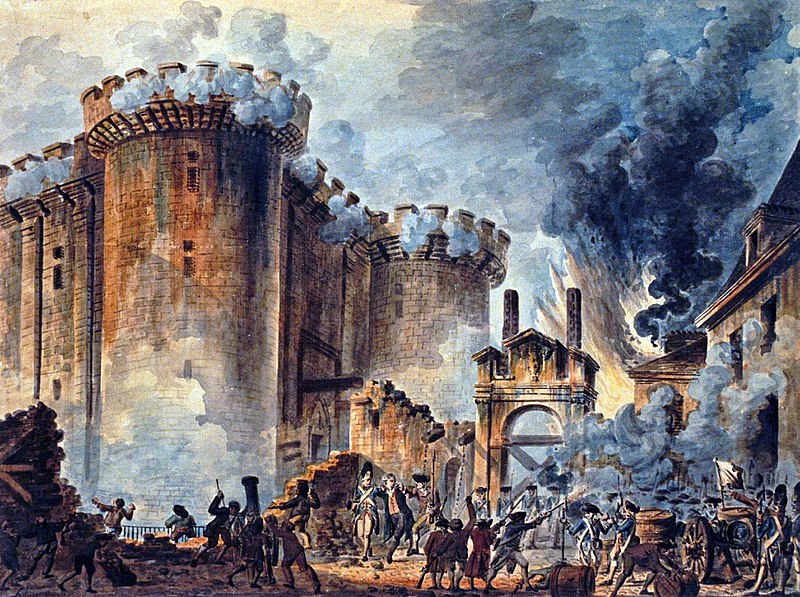

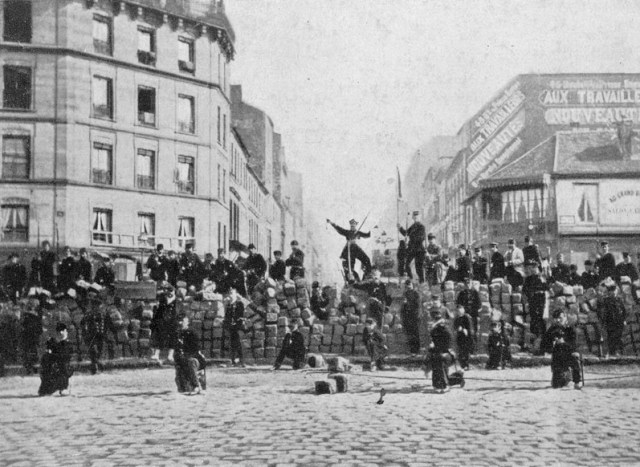


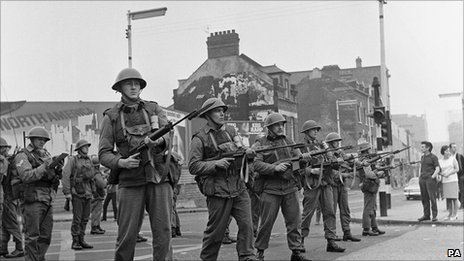
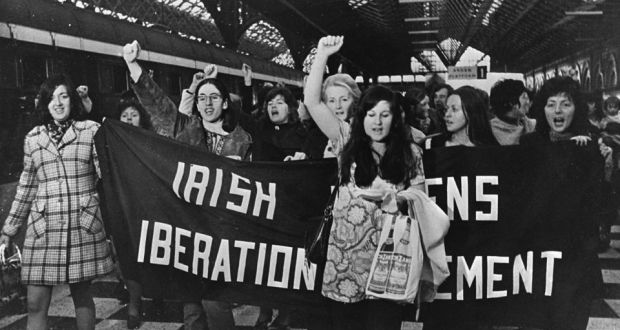


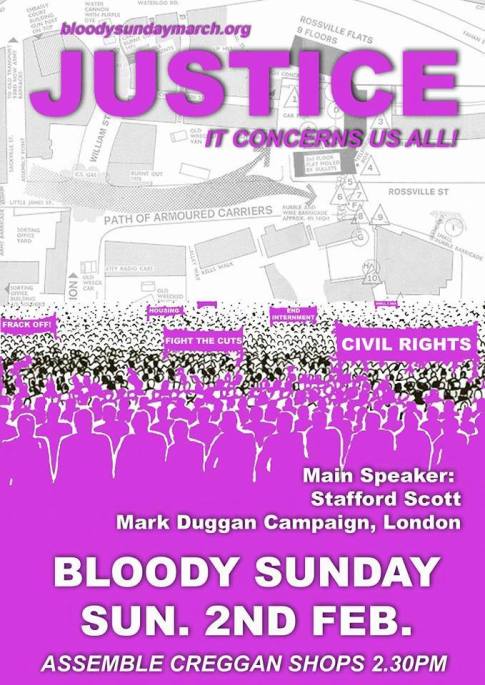
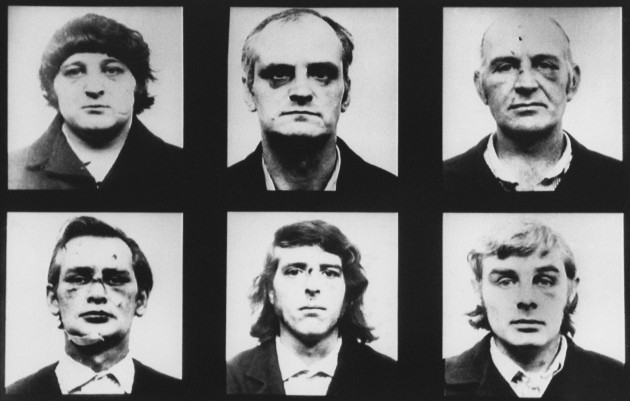
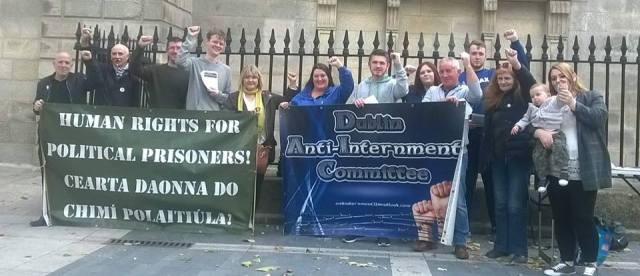


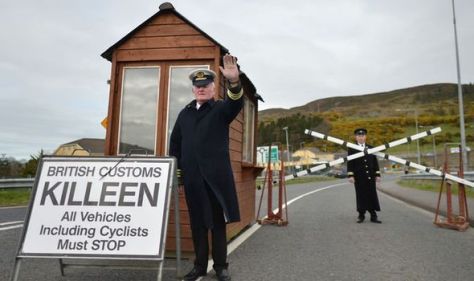


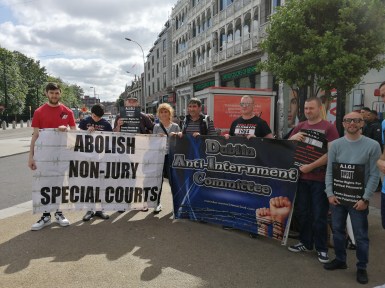


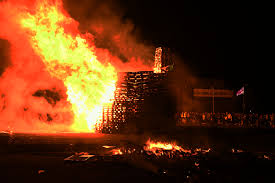

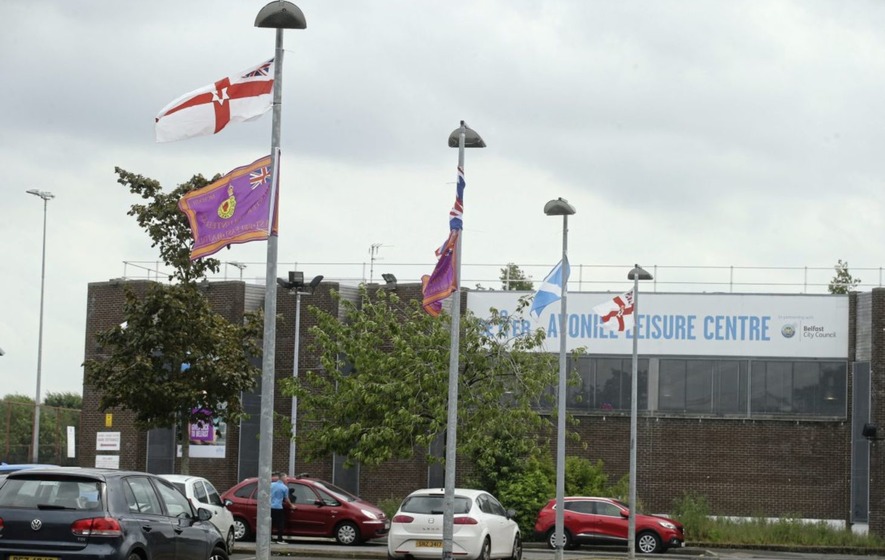




 rebelbreeze