When the votes are counted after today, we will either have a new clause inserted into our Bunreacht (Constitution) or we will not. If we do not, many of the “Vote Yes” campaign and opinion will be despondent. The revolutionaries among them should not be so but should instead reflect on their weakness as a force and on how to make that force stronger.
Should the vote result in a change in the Constitution, it will be probably the biggest blow so far to the power of the Catholic Church in lay society, a power it has enjoyed and abused even before 1921 but certainly since. Some, on both sides of the question, will see it as a blow against the Catholic religion itself but that is not necessarily so. Christianity and its Catholic variant survived and even thrived without State support in the past – indeed when its followers were discriminated against in every conceivable way by State power, a situation its faithful endured for centuries in Ireland as a whole and continue to do today, to a lesser extent, in the Six Counties.
What is the issue upon which we were being called to vote today? Although the NO campaign has tried to make us think it is, it is clearly not about whether two-gender households are better for raising children, whether surrogate birthing is right or wrong. It is not about whether we approve or homosexuality or not – although I suspect that is the real issue at base with many of the NO campaigners. In fact, it seems to me that it would be quite possible to disapprove of homosexuality and still to vote “Tá”, a question I will return to later. This might seem illogical, until we examine the actual issue upon which we are voting: do we agree with inserting a clause into the Bunreacht (Constitution) which states that a couple has a right to marryregardless of gender.
Presented with this question, which is a legal and Constitutional one, a number of issues arise, I think.
What does the Bunreacht say at the moment about this question?
What right has the State to define anything about sexual relationships?
Are we in favour of equal civil rights for people?
1. It may come as a surprise to people that our Bunreacht, our Constitution, currently says nothing about the gender issue in marriage. There is nothing actually in our Bunreacht to prevent same-sex marriage. But the prohibition does exist in law. In other words, legislators at some point decided to propose and pass a law which confined the right (and rite) of marriage to heterosexual couples alone. Why did they do so if it was not an issue at that time? It seems to me that they were aware that same sex relationships did exist and strove to exclude those people from the rights enjoyed by others. This was the point of a number of other pieces of legislation against homosexuality which were not finally overturned until 1993 in this State (1982 in the Six Counties, 1980 in Scotland, 1967 in England and Wales) – five years after the European Court of Human Rights ruled that this state’s laws against male homosexual acts violated human rights.
According to the Catholic Church (and most other churches), despite the current legal situation with regard to homosexuality at the moment, it is still wrong. Well, the Catholic Church – and before them the established Anglican Church of Ireland – can have their views but they are not entitled, nor is any other church, to impose those on lay society, neither by legislation nor by other means. They are, of course, entitled to express their opinion – just like any other organisation.
“God and Nature say NO” was the caption on this placard paraded in O’Connell St. near the Spire, some weeks prior to the Referendum. Some young people are arguing with the placard-holder.One of the many badges worn in support of a vote to insert the clause into the Irish Constitution. There was also an English-language one and each were to be seen nearly everywhere in public in the weeks prior to the Referendum.
So, going back to the beginning of the legal status of heterosexual marriage within our current legal system, it was introduced as an excluding measure, at a time when male homosexuality was illegal and subject to heavy punishment and when lesbianism was frowned upon (though not actually illegal for complicated reasons). In other words, a law excluding a group of people was passed at a time when any man who declared himself to be one of those people was subject to prison sentence and any woman who did so was subject to extreme opprobrium in society. What chance was there for their point of view to be represented? In the absence of such representation and informed opinion-making, how can any democrat defend the laws passed at that time?
2. Turning now to the question of what right the State has to make a ruling of any kind upon a sexual relationship between any two people, of either gender, it must be difficult indeed for anyone to justify that without recourse to church canon or prejudice. Those who do so tend to bring up questions of childcare, inheritance and taxation – in fact just about the same questions that were brought up in the Irish referendum on divorce in 1995. But childcare, or at least the financial aspect of it, can be regulated by the State without any interference whatsoever in the sexual relationship between the parents. Whether it does so fairly at the moment is another question which has no bearing on the concept. And inheritance – ignoring for a moment whether we agree with a political economy where land and other wealth may be appropriated by individuals or families and then legally handed on through their following generations — can also be managed without recourse to State regulation of marriage. Taxation, similarly. Were we to have a socialist society, one based on other principles than that which we now have, even those current excuses for state interference should no longer be even a consideration. In fact, it is difficult to see any reason why even now the State continues to have a role in the formalisation of a sexual contract between two individuals or, indeed, in its dissolution, except perhaps in ensuring fair divisions of belongings.
3. Those opposed to insertion of the new clause into the Bunreacht have done so from a number of perspectives of opposition: to lesbianism and homosexuality on religious or other grounds; to formalising same sex relationships; to the alleged undermining of the “sanctity of marriage” or of “romance”; in opposition to surrogate child-bearing and raising of children by gay and lesbian parents ….
Those supporting the new clause have defended the naturally-occurring continuum of sexual preference; maintained that the “sanctity of marriage” will be the same between same-sex couples, as will “romance”; denied that it opens the way to or encourages surrogate child-bearing and raising of children within a gay or lesbian household ….
Who is right and who is wrong? There is no doubt that as long as cultural beliefs and practices have been recorded, homosexuality and lesbianism have existed within societies — sometimes tolerated, often repressed, on rare occasions celebrated. We see homosexuality occurring too among animals. If there is such a thing as “sanctity of marriage” and “romance”, why should same-sex couples have any less of it than heterosexuals? Surrogate child-bearing is already possible and the hugely unequal distribution of wealth in our society – and between even our society and many others – ensures it can and will continue while the rewards are financial. Raising of children within a same-sex household is already happening, even without surrogacy. It is more difficult for gay men at present, but in the case of a gay man having custody of his children through widowhood (yes, some gay men do marry women), or the mother deserting the children or being deemed unfit by a court to have custody, a gay man may bring up his children within a homosexual parent household.
But will this change in the Constitution (and therefore also in the law) make surrogacy and child-rearing by gay couples more likely to happen? Will it increase the frequency of its occurrence? I think the answer to that, logically, must be yes – despite all the denials of the “Vote Yes” camp. And I think some of them must know that. Slowly perhaps and who knows by how much – but logically it must tend to increase the chances. But is that so awful? I find the idea of surrogacy in general distasteful but isn’t that just a prejudiced reaction? Probably. Will children reared by same-sex parents experience uncertainty about their own sexuality? Some will probably and some won’t. And if they do, why should they not be able to resolve that in time – as children reared in heterosexual relationships also find themselves having to do? Is uncertainty about sexuality such a terrible thing? In a judgmental, prohibitive and penalising society, it can be – so let’s create a society that is the opposite.
However, I have to say that I think all those questions and considerations are beside the point. If marriage is to be a legal status, then it is a civil right for everyone who is at the age of consent (and of sufficient mental ability to know to what they are consenting — in so much as any one of us was or does!). The right to same-sex marriage, as a civil right, should be supported even by people who do not approve of homosexuality, or marriage, or surrogacy, of child-rearing in a homosexual household. As for myself, someone who seeks revolutionary social, economic and political change, who wishes to see the overthrow of this State, a revolutionary as opposed to a reformist, I must nevertheless support reforms that extend civil rights, even when not led from below …. and so I voted “TÁ”.
Politics is about the present and the future, obviously … but it is also about the past.
Different political interests interpret and/or represent the past in different ways, emphasising or understating different events or aspects or even ignoring or suppressing them entirely. There is choice exercised in whom (and even what particular pronouncement) to quote and upon what other material to rely. And by “political interests” I mean not only groups, formal (such as political parties) or informal, but also individuals. Each individual is political in some way, having opinions about some aspects of questions that are political or at least partly-political. For example, one often hears individuals say today that they have no interest in politics, yet express strong opinions of one kind or another about the right to gay and lesbian marriage, the influence of the Catholic Church, and how the country is being run by Governments.
So when an individual writes a history book, there are going to be political interpretations, although not all writers admit to their political position, their prejudices or leanings, in advance or even in the course of their writing. One historian who does so is Padraig Yeates, author of a number of historical books: Lockout –Dublin 1913 (a work unlikely to be ever equalled on the subject of the title), A City In Wartime — 1914-1919, A City in Turmoil – 1919-1921and his latest, A City in Civil War – Dublin 1921-’24. The latter was launched on Tuesday of this week, 12th May and therefore much too early for people for who did not receive an earlier copy to review it. So it is not on the book that I am commenting here but rather on the speeches during the launch, which were laden with overtly political references to the past and to the present. If a review is what you wanted, this would be an appropriate moment to stop reading and exit – and no hard feelings.
The launch had originally been intended to take place at the new address at 17 D’Olier Street, D2, of Books Upstairs. However the interest indicated in attending was so great that Padraig Yeates, realising that the venue was going to be too small, went searching for a larger one. Having regard to how short a time he then had to find one and with his SIPTU connections, Liberty Hall would have been an obvious choice. Whether he had earlier been asked to speak at the launch I do not know but, having approached Jack O’Connor personally to obtain the use of Liberty Hall, in the latter’s role of President of SIPTU, the owners of that much-underused theatre building, it was inevitable too that O’Connor would be asked to speak and act as the MC for the event.
O’Connor’s introduction was perhaps of medium length as these things go. He talked about the author’s work in trade unions, as a journalist and as an author of books about history. O’Connor’s speech however contained much political comment. Speaking of the period of the Civil War (1919-1923), he said it had “formed what we have become as a people”. That is a statement which is of dubious accuracy or, at very least, is open to a number of conflicting interpretations. The Civil War, in which the colonialism-compromising Irish capitalist class defeated the anti-colonial elements of the nationalist or republican movement, formed what the State has become – not the people. The distinction between State and People is an essential one in our history and no less so in Ireland today.
Talking about the State that had been created in 1921 (and not mentioning once the creation of the other statelet, the Six Counties) and referring to the fact that alone among European nations, our population had not risen during most of the 20th Century and remained lower than it had been up to nearly the mid-Nineteenth, a state of affairs due to constant emigration, O’Connor laid the blame on the 26-County State and in passing, on the capitalist class which it served. He was undoubtedly correct in blaming the State for its failure to create an economic and social environment which would stop or slow down the rate of emigration – but he did not explain why it was in the interests of the capitalists ruling the state to do so. Nor did he refer to the cause of the original drastic reduction in Ireland’s population and the start of a tradition of emigration – the Great Hunger 1845-’49.
The Great Hunger memorial on Dublin’s Custom House Quay. The Great Hunger and its immediate aftermath initiated mass Irish emigration.
Even allowing for the fact that O’Connor wished to focus on the responsibility of the 26-County State, the Great Hunger was surely worthy of some mention in the context of Irish population decline. Just a little eastward along the docks from Liberty Hall is the memorial to that start of mass Irish emigration. It was the colonial oppression of the Irish people which had created the conditions in which the organism Phytophthora infestans could create such devastation, such that in much less than a decade, Ireland lost between 20% and 25% of its population, due to death by starvation and attendant disease and due also to emigration (not forgetting that many people emigrating died prematurely too, on the journey, upon reaching their destination and subsequently). Phytophthora devastated potato crops in the USA in 1843 and spread throughout Europe thereafter, without however causing such a human disaster as it did in Ireland. In Mitchell’s famous words: “The Almighty, indeed, sent the potato blight, but the English created the famine.” And that is what makes that period of population decline uncomfortable for some historical commentators.
Indeed, O’Connor did not mention British colonialism once, nor Partition, nor imperialism. And nor did either of the other two speakers, nor the author. I remarked on this to an Irish Republican present, to which he responded with a rhetorical question: “Did you expect them to?” Well, yes, perhaps naively, I did. While not expecting an Irish Republican analysis from Padraig Yeates and perhaps not either from anyone he would consider appropriate to speak at the launch of one of his books, dammit, we are talking about history. The presence of Norman/English/British Colonialism for 800 years prior to the creation of the Irish Free State, and its influence on that state’s creation and on subsequent events in Ireland, is worthy of at least a mention in launching a book about the Civil War. Not to mention its continuing occupation of one-fifth of the nation’s territory.
Colonialism and Imperialism and, in particular, the Irish experience of the British variant, were not so much ‘the elephant in the room‘ at the launch as a veritable herd of pachyderms. They overshadowed us at the launch and crowded around us, we could hear them breathing and smell their urine and excreta – but no-one mentioned them. The date of the launch was the anniversary of the execution of James Connolly 99 years ago, a man whom the Labour Party claims as its founder (correctly historically, if not politically), a former General Secretary of the ITGWU, forerunner of SIPTU and the HQ building of which, Liberty Hall, was a forerunner too of the very building in which the launch was taking place. His name and the anniversary was referred to once, though not by O’Connor, without a mention of Sean Mac Diarmada, executed in the same place on the same day. And most significantly of all, no mention of who had Connolly shot and under which authority.
That circumspection, that avoidance, meant that a leader of Dublin capitalists, William Martin Murphy, could not be mentioned with regard to Connolly’s death either — i.e. his post-Rising editorial in the Irish Independent calling for the execution of the insurgents’ leaders. But of course he did get a mention, or at least the class alliance he led in 1913 did, in a bid to smash the ITGWU, then under the leadership of Larkin and Connolly. This struggle, according to O’Connor and, it must be said also to Padraig Yeates, was the real defining struggle of the early years of the 20th Century, not the 1916 Rising, the War of Independence nor yet the Irish Civil War. It was in 1913 that “the wrong side won”.
One-eyed as that historical vision must be, we have to question whether it is even partially correct. The Lockout was a great defeat for the ITGWU and for the leading elements in the Irish workers’ movement. But the Lockout did not break the trade union and, in fact, it later began to grow in membership and in branches. Other trade unions also survived and some expanded. So in what manner was 1913 decisive in ensuring that “the wrong side won” in later years? The Irish trade union movement was still able to organise a general strike against conscription in April 1918 and the class to organise a wave of occupations of workplaces in April 1919.
True, the Irish working class had lost one of its foremost theoreticians and propagandists by then, in the person of James Connolly. And who was it who had him shot? Not Murphy (though he’d have had no hesitation in doing so) nor the rest of the Irish capitalist class. In fact, worried about the longer-term outcome, the political representatives of the Irish ‘nationalist‘ capitalist class for so long, the Irish Parliamentary Party, right at the outset and throughout, desperately called for the executions to halt. General Maxwell, with the support of British Prime Minister Asquith, ordered and confirmed the executions of Connolly and Mallin of the Irish Citizen Army and British Army personnel pulled the triggers; in essence it was British colonialism that executed them, along with the other fourteen.
For the leaders of the Labour Party and of some of the trade unions, and for some authors, Padraig Yeates among them, the participation of Connolly and the Irish Citizen Army in the Rising was an aberration. For these social democrats, the struggle should have been against the Irish capitalist class only (and preferably by an unarmed working class). It is an inconvenient fact that Ireland was under colonial occupation of a state that had strangled much of the nation’s economic potential (and therefore of the growth of the working class) in support of the interests of the British capitalist class. It is an inconvenient fact that the Irish capitalist class had been divided into Unionist and Nationalist sections, the former being descendants of planter landowners and entrepreneurs whose interests were completely bound up in Union with Britain. It is an inconvenient fact that the British and the Unionists had suppressed the last truly independent expression of the Irish bourgeoisie, the United Irishmen and, in order to do so effectively, had created and enhanced sectarian divisions among the urban and rural working and middle classes. It is also an inconvenient fact that the British cultivated a client “nationalist” capitalist class in Ireland and that the police and military forces used to back up Murphy’s coalition in 1913 were under British colonial control.
To my mind, a good comprehensive analysis of the decline inprominence of the Irish working class on the political stage from its high point in early 1913 and even in 1916, has yet to be written. One can see a number of factors that must have played a part and the killing of Connolly was one. But something else happened between 1913 and 1916 which had a negative impact on the working class, not just in Ireland but throughout the World. In July 1914, WW1 started and in rising against British colonialism in Ireland, Connolly also intended to strike a blow against this slaughter. As the Lockout struggle drew to its close at the end of 1913 and early 1914, many union members had been replaced in their jobs and many would find it hard to regain employment, due to their support for the workers and their resistance to the campaign to break the ITGWU. It is hard to avoid the conclusion that many joined the British Army or went to work in war industries in Britain. Although the Irish capitalist class supported the British in that War (up to most of 1917 at any rate) it was imperialism which had begun the war and British Imperialism which recruited Irish workers into its armed forces and industries.
Reaching back in history but to different parts of Europe, Padraig Yeates, in his short and often amusing launch speech, cracked that “for years many people thought Karl Kautsky’s first name was ‘Renegade’ ” — a reference to the title of one of Lenin’s pamphlets: The Proletarian Revolution and the Renegade Kautsky. Yeates apparently admires Kautsky and quoted him on Ireland. But Kautsky advocated no uprisings against imperialism or colonialism in the belief that “super-imperialism” (also called “Hyper Imperialism”) would regulate itself peacefully, letting socialists get on with the task of evolving socialism. Two World Wars since then and current developments have negated Kautsky’s theory but more to the point, to advocate his theory as a guiding principle at the time he did was a major ideological threat to proletarian revolution and to the evolving anti-colonial struggles of the world and therefore he was a renegade to any variant of genuine socialism and socialist struggle.
This is relevant in analysing the position of the trade union leaders and the Irish Labour Party today. They are social democrats and their central thesis is that it is possible to reform capitalism, by pressure on and by involvement in the State. They deny what Lenin and others across the revolutionary socialist spectrum declare, that the state serves the ruling class and cannot be coopted or taken over but for socialism to succeed, must be overthrown.
It is the social-democratic analysis that underpinned decades of the trade union leaders’ social partnership with the employers and the State, decades that left them totally unprepared, even if they had been willing, to declare even one day’s general strike against the successive attacks on their members, the rest of the Irish working class and indeed the lower middle class too since 2011. Indeed Padraig Yeates, speaking at a discussion on trade unions at the Anarchist Bookfair a year or two ago, conceded that social partnership had “gone too far”. Can Jack or any other collaborationist trade union leader blame that on the transitory defeat of the 1913 Lockout? They may try to but it is clear to most people that the blame does not lie there.
Two other speakers addressed the audience at the launch, Katherine O’Donnell and Caitriona Crowe. Catriona Crowe is Head of Special Projects at the National Archives of Ireland and, among other responsibilities, is Manager of the Irish Census Online Project, an Editor of Documents on Irish Foreign Policy, Vice-President of the Irish Labour History Society. She is also Chairperson of the SAOL Project, a rehabilitation initiative for women with addiction problems, based in the North Inner City. It was her, I think, who made the only mention of “Blueshirts” and her also that mentioned the anniversary of James Connolly. Although her speech was overlong in my opinion for a book launch in which she had already been preceded by two longish speeches, strangely I can remember very little of what she had to say.
Katherine O’Donnell’s contribution however made a considerable impression upon me. She declared herself early in the speech to be lesbian and a campaigner for gay and lesbian rights and is Director of the Women’s Studies Centre at the School of Social Justice at UCD. O’Donnell began by praising Padraig Yeates’ work, of which she declared herself “a fan”. In a speech which at times had me (and sometimes others too) laughing out loud, she discussed the contrast in the fields of historical representation between some historians and those who construct historical stories through the use of imagination as well as data; she denounced the social conservatism of the state, including the parameters of the upcoming referendum on same-sex marriage, the legal status of marriage in general and the climate of fear of prosecution engendered by the shameful capitulation of RTE to the Iona Institute on the accusation of “homophobia” (she did not mention them specifically but everyone knew to what she was referring).
After the launch speeches — (L-R) Padraig Yeates, Katherine O’Donnell, Caitriona Crowe.
Jack O’Connor, between speeches, made a reference to a giant banner hanging off Liberty Hall which had the word “NO” displayed prominently, saying that they had received congratulatory calls from people who thought it was against same-sex marriage. The banner was however against privatisation of bus services. The current banner on Liberty Hall says “YES” to the proposal in the forthcoming referendum and he said that now busmen were calling them up complaining …. to laughter, O’Connor commented that “it’s hard to the right thing, sometimes”. Presumablywhat he meant was that it is hard to know what the right thing to do is, or perhaps to please everybody.
It is indeed hard to please everybody but I’d have to say that it is not hard to know that the purpose of and‘the right thing to do’ for a trade union, is to fight effectively and with commitment for its members and for the working class in general. And that is precisely the responsibility which has been abrogated by Jack
In the background to this photograph of a Reclaim the Streets demonstration in 2002 is Liberty Hall, draped in a hug “Vote Labour” banner. SIPTU has maintained that position through a number of coalition governments in which Labour has participated and that have attacked the living standards and rights of workers.
O’Connor personally, along with other leaders of most of the trade unions, including the biggest ones for many years, SIPTU and IMPACT. And also by the Irish Congress of Trade Unions. That is why Jack O’Connor gets booed now if he ever dares stand on a public platform related to trade union struggle, a treatment received also by David Beggs before he retired from the Presidency of ICTU.
Back in 2011, another giant banner hung from Liberty Hall – that time it urged us to VOTE LABOUR, as did leaders of other trade unions. Stretching magnanimity, we might give the trade union leaders the benefit of the doubt and say they had forgotten that the Labour Party had only ever been in Government in coalition, most often with the right-wing Blueshirt Fine Gael party and that its most recent spell sharing power had given us one of the most repressive governments in the history of the State. Let us imagine for a moment that these social-democratic union leaders had forgotten all that. But, after February 2011, as Labour and Fine Gael went into coalition and both reneged on their election promises, as the Coalition government began to attack the working class and the lower middle class, what is their excuse then? When did they denounce the Labour Party to their members, publicly disaffiliating from the party? No, never, and the fact that those disgusting connections continue was underlined by the presence at the book launch of a Labour Party junior Government Minister and the late arrival of noneother than Joan Burton, Minister for Social Constriction …. er, sorry, Protection.
Plaques in Glasnevin’s Republican Plot recording the names of 77 of the 81 Irish Volunteers officially executed by the Free State between November 1922 and May 1923. Their police and military killed about another 150 without judicial procedure.
Considering that the book being launched was about the Civil War, it is really extraordinary that no speaker mentioned the repression by the Free State during and after that war. I am certain that Padraig Yeates has not glossed over that, he is much too honest and too good a historian to do so. But that only one speaker at the launch (Catriona Crowe) should mention the sinister Oriel House and none the at least 25 murders its occupants organised, nor the 125 other murders by Irish Free State soldiers and police, nor the 81 state executions between November 1922 and January 1923, sets one wondering at just how much self-hypnosis sections of our political and academic classes are capable.
Start of the march in Dame Street after rally in Central Plaza
On Saturday 21 February, at two days’ notice, somewhere between eight and ten thousand people gathered in Dublin in solidarity with those water tax protesters jailed by the State and those recently arrested. They marched to Mountjoy Prison and packed the road outside it and in front of the local Garda (police station).
The march gets going in Dame Street. Photo shows only the front of the march.
Parnell Square West from Granby Place. The front of the march has turned into Dorset Street and is marching there but the end has yet to come around the corner into the square from Parnell Street
The crowd were addressed by relatives and friends of the jailed, anti-Water Tax campaigners as well as by Paul Murphy, Joan Collins and Clare Daly (both TDs of the United Left) and Dessie Ellis (TD of Sinn Fein).
All of the speakers denounced the politicians and the State for the jailing of the protesters while the bankers and politicians who created the crisis and colluded in the bank bailout went free. Most speakers called on the crowd not to pay the water tax and to build resistance on the streets. Dessie Ellis, in keeping with his party’s position, did not call for non-payment, though he did call for “unity of the Left”. The march was notable for the absence of SF banners and placards — apparerently they were having their own protest at Leinster House.
One of the protesters made an emotional appeal on behalf of two of the five who received jail sentences, who have gone on hunger strike, and on behalf of another, Derek Byrne, also on hunger strike, but who has declared his intention of refusing to take fluids from Monday if he is not released. (NB: Since posting that paragraph it has emerged that the demand of all three hunger-strikers is a return to Mountjoy [they had been separated and sent off to a prison facility near Clondalkin] and an end to 23-hour lockup in their cells. These are basic human rights.)
Large sections of the crowd seemed taken aback by this information and unsure how to react.
Paul Murphy pointed out that this use of the police to attack people protesting injustice has been a feature of the State since its creation and mentioned the threats of jail to striking workers, the jailing of the Rossport Five and of Margaretta D’Arcy. Clare Daly asked the Gardaí which side they were on, that of the polticians and bankers or of the people, saying that if they chose the former it is they who would become isolated, not the protesters. Joan Collins, Murphy and Daly all pointed to the need to create a socialist society. They also, along with most other speakers, called for a build up and huge turn out of support for the demonstration scheduled for March. Many speakers declared that the increased repression is a sign of the Government’s or the system’s weakness, not of their strength and called on the movement not to falter now.
Robert Ballagh, who also spoke, called for the release of the five and pointed out that the class of people who rule and profit out of this society are not those who find themselves in jails.
Section of the march in Dorset Street, looking west (another section is behind the camera — see next photo — but a large section of the march has yet to come around the corner from Parnell Square.)
The same road, photo taken a few seconds later but looking east.
The mood of the crowd in general was of good-humoured determination. The composition seemed to cross social groupings, ages and genders and a number had brought their children along. Some had come from other parts of the country.
Crowd outside Mountjoy. some have left and many are still further down the north Circular Road (the Mater Hospital is to the right of photo).
CATHERINE BYRNE, DUBLIN TD, SAID “WE SHOULD TAKE BACK OUR FLAG”. MAYBE SHE’S RIGHT ….
Dublin South-Central TD Catherine Byrne was warmly applauded when she said that they should ”take back our flag” from people who have been using it in protests against water charges and other issues. She made the statement at the Fine Gael political party’s two-day conference in Castlebar, Co. Mayo, held under strict security.
Arts Minister Heather Humphreys supported that view and told delegates in a secret session on the 1916 commemorations (a session which exposed divisions in the party): ”Some have used our flag to portray a different message – it’s time to reclaim our flag.”
“What should I do?” The anguish reached out to me; I felt it empathically. The cry of a person who is prepared to act and wants to change things for the better, to resist what is wrong around us on so many fronts – and that’s the problem.
There so many issues: the Water Tax, the persecution of Republican activists including framing and jailing them, the harassment and torture of Republican prisoners, the threat of fracking, privatisation of resources and services, cuts in services, cuts in salaries, high cost of private accommodation and low social housing provision causing homelessness, the decline of the Irish language and of the Gaeltacht …. and others. And that’s without mentioning international solidarity – and not because I don’t consider that essential, either.
Of course, we can put all these problems down to capitalism and, in the case of repression of Republicans (and with regard to international solidarity), to imperialism …. so let’s just overthrow those systems and then we can sort out those problems! But that leads to the question of “How” which in turn brings one back again to that anguished question, or to its variant “Which problem should I prioritise?”
Indeed, it is a question that cuts to the heart of the matter. For the issues call to us to act and since we can’t be everywhere at once we have to make choices. It is a question as old as class society and speeches are always being made recommending this choice or that while books have been written attempting to answer it. Lenin wrote a series of articles in the revolutionary newspaper Iskra (“Spark”) and published later as a booklet under a title that echoes that very cry above: What Is to Be Done? It had a subtitle too: “Burning questions of our movement” (by which he meant the socialist movement in Russia at the time).
Whether we choose to believe that work was absolutely correct, partly correct or completely wrong is in some ways irrelevant, for it was written for the movement in Russia in 1902 and published in 1905. I happen to think that it contains many useful ideas, although I am aware that there is a view that it has been mistranslated but, even so, in many ways, all that is beside the point. The fact is that today we have no blueprint and nothing more than perhaps the equivalent of a trouble-shooting manual: “for this problem, try this; if that doesn’t work, try that; while doing so beware of that other.” And that manual is cobbled together from older and more recent history of struggles, of analyses of the capitalist system and of how it behaves.
Scary, surely, to go up against a system that has ruled for around four centuries, that has spread across the world, that controls education, mass media, the State with its police, judges, prison and armed forces – and all without us having a blueprint. Well, if it’s any consolation, the capitalists don’t have a blueprint either … or if they do, they keep having to ignore it and react to events which they have not been able to predict, as well as to the extent of resistance for which they were unprepared. And they clearly make mistakes. Still, 400 years is a long time … a long time for them to learn tactics and strategy and to get comfortable in control and a long time to make us think that we can’t defeat them.
We can defeat them, of course and the indications from history and the internal workings of capitalism — and of its offshoot imperialism — are that we will. But what to do to make that happen? Yes, back to that question. And to the one that logically follows it: which issue to prioritise? For none of us is capable of being everywhere at once and even stretching over a few issues at a time begins to tear at our fabric.
The Marxist-Leninist approach argues for the creation of a revolutionary party that will make decisions on prioritisation and allocate resources to those struggles it chooses as it does so. Of course, the party will make mistakes from time to time and it will learn from those, getting better as it goes along. That’s the theory anyway. In application, or in alleged application, the results have not vindicated the theory – not in the long run, or even in the medium-term. Sure, we have been at it for less than 200 years: the first time workers captured a city was in 1871 and the first successful overthrow of the State was in Russia in 1917, very nearly a century ago. Much less time to learn, to make mistakes and to correct them but still ….
Of course, the alternative method of organising has even less to recommend it on results: amorphous, disparate collectives have not ever successfully overthrown a State and even their success in capturing a city (Barcelona, 1936) is debatable.
So, what is to be done? How to decide which struggle to prioritise? This is not a question I think can be answered by pointing and saying “That one and no other” or even, except at rare junctures, “That one and no other for the moment”. Individuals, collectives and parties will need to choose from the selection as a painter chooses from a palette: “this colour now, then that, no, scrub that one, now mix this with that, no, a bit more light …” and so on, always working towards the desired result which, although in the head, is also taking place on the canvas and making its own demands as it does so.
The truth is that all of those issues I mentioned in passing at the start of this piece, all of those, need addressing. All of them need people to fight in them. That is because they are all part of the same problem and also because we can’t just allow a cancer to grow unchecked in one part of the body while we address the tumours in another. Some individuals and perhaps even collectives are better suited to fight on some issues than on others: for example, a factory shop committee is probably not best placed to lead the struggle against fracking in a rural area, while a rural environmental collective is probably not in the best position to lead the struggle against the Water Tax. Individuals will need to pick and choose according to their own situation, their locality, their own knowledge.
And that would be fine, if the resistance movement as a whole were integrated enough to make creative use of that disparity – for particular struggles to be able to call for temporary additional resources and to be heard by the whole resistance movement, so that it could try to allocate those resources to one or other sector as seemed appropriate. But the resistance movement is far from integrated – it is fragmented and, even worse, it suffers from something akin to schizophrenia.
There a number of ways to imagine schizophrenia and the most popular is to see it as the development of two or more personalities in the one individual. But another is to see it as a disintegration of the personality – where the various aspects in our minds break free and appear as distinct personalities in themselves. The voices that speak in our heads to say things like “You shouldn’t have done that” or “Please make that happen” break free and seem to become different personalities. At times they conflict with one another while the central core personality tries to make sense of what is going on. Something like that, anyway. It is in that sense that I think the resistance movement in Ireland suffers from schizophrenia.
The splitting off of aspects of the revolutionary movement in Ireland has been towards two major poles of attraction: the Socialist one and the Republican. Of course there are some elements who incorporate both to one degree or another but I think examining them as distant poles of attraction is useful and much closer to their concrete manifestation within the revolutionary movement. In order to examine them as opposite poles I think it is also useful to imagine a stereotype individual inhabiting each pole. Let us then imagine a stereotypical Irish Republican and a stereotypical Irish Socialist.
The Irish Republican is probably working class or maybe lower middle class; he may or may not have done well at secondary education but in any case he is unlikely to have gone to university. He sees himself in a tradition of resistance to British Colonialism and Imperialism stretching back at least to the United Irishmen and perhaps even back to the Norman conquest which began in 1169. His priority is the removal of the British from Ireland. He experiences “political policing” (of which some socialists are now complaining) practically from the moment he becomes publicly active – he has had his name and address taken by Special Branch and/or RUC/PSNI and they have opened a file on him. The Republican’s recent predecessors have been jailed (as are some of his contemporaries now), beaten or even shot dead; they were engaged in armed struggle against the colonial and imperial armed forces in the Six Counties for 30 years and perhaps he looks forward to take the gun up again some day, to strike back at the colonial overlord. He will turn out on demonstrations and pickets against repression of Republican activists, in support of Republican prisoners, including framed ones. He will almost certainly attend mass demonstrations against the Water Tax and may participate in local direct action against it. The Republican’s idealogues are Wolf Tone, Patrick Pearse and Bobby Sands.
The Irish socialist is probably medium or lower middle class and has finished secondary education; she has almost certainly gone on to university. She sees herself as belonging to a tradition of only a couple of centuries, with an Irish tradition going back to the early part of the 20th Century, in particular to the 1913 Lockout and the Limerick Soviet of 1919. She may or may not give a high place in her history to the Irish Citizen Army in the 1916 Rising. Her priority is the defeat of the capitalist class, probably in Ireland first but will turn out in demonstrations against racism, gender discrimination and homophobia in Ireland. The Irish Socialist aspires to a general strike giving rise to a revolutionary take over of the State; in the interim she may or may not think electing left-wing TDs or trade union officials an important activity. She probably can’t conceive of taking up a gun. The Irish Socialist has never had her name taken by the Special Branch or been framed by the RUC/PSNI and may never even have been detained by the police, though she has probably been pushed around by them. She will almost certainly attend mass demonstrations against the Water Tax and may participate in local direct action against this Tax. Her idealogues are Karl Marx, Lenin, possibly Trotsky and James Connolly.
Granted these are stereotypes but they are not so far from reality as to be unhelpful in describing in turn many and perhaps most Irish Republicans and Socialists and therefore in identifying one of the principal fracture lines in the Irish movement of resistance.
If the Republican and the Socialist parts of the Irish resistance movement were to be combined, or at the very least to work on a more collaborative basis, the “What should I do?” question would be easier to answer. It would be simpler to be on a picket for prisoners one week and resisting water meters the next, even if one’s main sphere of activity were among Republicans. The socialist could attend a picket against cuts one week and one for the human rights of Republican prisoners on another, even if her main sphere of activity was among Socialists. But that is not the situation that exists at the moment and, though a number of attempts have been made to combine the two trends in one organisation, they have not met with any great success to date.
So, I have not yet answered the question, have I? Am I saying that what we should be doing is creating some kind of synthesis or at least a collaborative alliance between the the socialist and republican parts of the resistance movement? Well, yes, certainly. But also, and as a contribution to that, as individuals we should try and spread our activity between the areas of greatest concern of each of those sections of the resistance movement. We should, I think, take some time to support resistance to the water tax, demonstrations against cuts etc. in their own right but also find some time to support resistance to British colonialism and its repression of Republican political activists. “If we are not part of the solution, then we are part of the problem” may be a glib truism but it is particularly applicable in this case.
So, how will we find the time to spread ourselves around? How do we ever? We balance and juggle priorities between our politically active and our social lives, with employment thrown in when we have a job. Or upskilling or studying. And possibly cultural or sporting or other activities. But how to choose, how to prioritise? Each of us has to make those decisions herself and himself. Not a very helpful answer? Well, I did state earlier on that there wasn’t a blueprint, so I couldn’t have one myself, could I? This however I feel fairly confident in predicting: if we don’t find a way to support both those parts of the resistance movement to some degree, it will always be fractured. And while it is so, it cannot be successful in either ridding Ireland of our capitalist classes or in finally throwing off the colonial yoke.
British colonial police in Ireland, Auxilliaries and RIC in Dublin raid during War of Independence 1920 or 1921.Drawing depicting Cromwellian troops massacre at Drogheda 1649
A little bit rough in places but think I should get it out now and hopefully get people singing it ASAP. I am surprised no-one seems to have used this tune, The Sea Around Us, and the mention of “water”, already. Thanks to Ruairi O’Broin at the February session of Song Central for suggesting the “bank guarantee” line in the chorus, much better than what I had there originally.
Amended a little again since I wrote the above but still not sat down and really consistently worked at it. Amended yet again slightly in 2020.
THEY’RE STEALING OUR WATER
Diarmuid Breatnach (To the air of “The Sea Around Us”, also known as “The sea, Oh the sea”)
Chorus:
The sea, oh the sea, a ghrá gheal mo chroí,
‘though long it may roll between England and me,
We’ve still got our gombeens* with a bank guarantee
and they’re trying to steal our own water!
(The chorus can go in after each verse, or each second, as people prefer).
1.
The Norse came to Ireland right outa’ the blue,
took us as slaves and plundered and slew;
But their days were all numbered from Clontarf they knew
— they never troubled us much for the after.
2.
Then the English came over our patience to try,
our land for to steal and our culture deny
And they took all that we had … I tell you no lie —
but at least they left us our water!
3.
‘Twas many a hard battle with the English we fought,
as used be our wont and indeed so we ought;
but as time went by, it all came to naught
and they put poor aul’ Éire in a halter.
4.
But we rose up once more and again and again —
we had stalwart youth and women and men;
We fought them in city and mountain and glen
and forced them their plans for to alter.
5.
Then those who at our struggle took fright
stepped in and took over the fruits of our fight;
The Gombeens and Church turned our dawn into night
and in a wink we were back under the halter!
6.
The parasites live off our sweat and our blood —
they’d tax the very air that we breathe if they could;
But our media says to resist is not good …
and compliance would get us much further.
7.
Our resources are for the people to share in —
is linne ar fad é, uisce na hÉireann;
and it’s now the baton and prison we’re darin’ —
they’ll not steal from our sons and our daughters!
8.
The people are standing firm and steady —
they know that we’ve paid for the water already!
Our banners unfurled and more things ready:
You can be sure this time we won’t falter!
February 2015.
Denis O’Brien, a billionaire widely believed to have plans to buy Irish Water if/when it becomes privatised. He is a major shareholder in Sierra Construction, the company installing water meters and also in Independent Newspapers. The Moriarty Tribunal found that he had benefited from information from the Irish Minister for telecommunications whom O’Brien had paid €50,000 through circuitous channels. The information had assisted him in bidding for the mobile phone contract, which he later sold at a personal profit of €317 a few years later.Brian Cowen, former Taoiseach (equivalent to Prime Minister) in the Fianna Fáil-Green Party coalition Government 2011, which began the bank bailout.Joan Burton (Labour), Minister for Social Protection in the Labour-Fine Gael coalition Government at time of writing
Enda Kenny (Fine Gael), Taoiseach (equivalent to Prime Minister) in the Labour-Fine Gael coalition Government at time of writing
!
* “Gombeen”, from the Irish “Gaimbíneach” is a profiteer, a venal person, a moneylender, a capitalist.
The final resting place of Patsy o’Connor at Plot UE 18 St.. Paul’s Glasnevin.
The following story and research is by local Dublin historian Jason Walsh-McLean. Thanks to Jason for sending in this excellent account of the life and death of Patsy O’Connor and his own journey in uncovering the remarkable tale of this brave Fianna scout. We have featured Patsy before on this page a number of times. Here is his story:
It was during the Lockout centenary year of 2013 that I finally got around to reading Pádraig Yeates’ seminal work on the subject Lockout – Dublin 1913. It had been purchased as a birthday present for me some years previously by my Mother. Being a bit of a “trivia buff” when it comes to these things, I noticed upon completing the book that there was no mention of Patsy O’Connor of Na Fianna Éireann, whose name…
A younger James Connolly than we usually see. Connolly published his songbook in New York in 1907 — included among the songs was We Only Want the Earth.
Incredibly, I only discovered this recording a few days ago. I first heard this song sung by Cornelius Cardew whom I knew in London through political activism and interest in revolutionary culture. Years later I learned the lyrics and sing it now to the same tune, more or less, i.e. that of A Nation Once Again. Admittedly, it sounds great with a reggae or ska backbeat. I came across this recording while looking for a recording of me singing the song at a talk by Portuguese socialists given in Dublin last year.
The lyrics were composed by James Connolly and were published in the James Connolly Songbook in 1907 in New York with a foreword by Connolly:
“No revolutionary movement is complete without its poetical expression. If such a movement has caught hold of the imagination of the masses, they will seek a vent in song for the aspirations, the fears and hopes, the loves and hatreds engendered by the struggle. Until the movement is marked by the joyous, defiant, singing of revolutionary songs, it lacks one of the distinctive marks of a popular revolutionary movement; it is a dogma of a few, and not the faith of the multitude”.
Cornelius Cardew was a respected composer as well as a revolutionary, a central member of the English Communist Party (marxist-leninist). This small organization had a good track record on a number of fronts, including solidarity with the Irish struggle.
Cornelius Cardew, from a Guardian obituary photo
I remember the shock when hearing of his death 13 December 1981, the victim of a hit-and-run driver near his London home in Leyton. The driver was never found. It might have been an accident but he was not the only political activist to die in mysterious circumstances in Britain in those years, particularly if involved in Irish solidarity.
What tactics should we use in political resistance struggle? Physical action or not? If we think physical action is valid, what type do we support and when should we employ it? On the other hand, the same questions arise with regard to non-physical action ….
For most people in this country, the closest they come to physical action in politics is to present themselves at the polling booth. One of the primary declared objectives of most political groups, in fact, is to deepen the involvement in political action of the majority of the population of the country (although what each means by this and to what degree they are serious about it differs greatly).
Something of an ideological struggle has been taking part in the movement against austerity measures as to how best to increase public involvement in effective resistance. Some advocate participation in demonstrations and pickets as their main activity, with perhaps a sprinkling of public meetings. Others advocate civil disobedience and/or disruption as the most effective tactics. Curiously, most agree with participation in on-line petitions and “liking” particular ideological Facebook pages. Many agree with voting for candidates perceived to be in opposition to austerity measures, while some do not. For some, membership of a political party is an important step while for others it is of no value at all. Faced with this lack of general agreement across the spectrum opposed to the status quo, how are we to make decisions, to make reasonable choices?
I’d like to attempt to answer this question but first I’d like to give an example from which to learn, a parable, if you will.
ONCE UPON A TIME ….
Let us imagine a country called Awtaegin. Across the world in the 1960s and 1970s, youth and students were in a ferment, disenchanted with the dominant system as they perceived it and in this Awtaegin was far from being an exception. This disenchantment with the dominant system also extended to many of the oppositional political parties, such as the main social democratic opposition party (which we can call the “Labour Party”) and the USSR-aligned Communist Party (which we can call the UCP).
A number of organisations arose which were opposed not only to the existing order but also to those aforementioned political parties which they considered to be no more than a slightly alternative way to manage the same system and order to which they were opposed, in the case of the Labour Party and a hindrance to mobilising for real change, in the case of the UCP.
One of the opposition organisations to arise was a communist group advocating revolution but which did not support the system in the USSR, which it considered oppressive and imperialist. This group in fact supported the system in China and the politics of its leader at the time, Mao Tse Tung. At that time this leader and his country were very popular among revolutionary communist and national liberation organisations around the world. Let us call this group the MCP.
In its early days, the MCP was something of an object of derision for most of the Left organisations including those advocating revolution in Awtaegin. It was very small and put a lot of store in the Red Book of Mao’s sayings. The MCP popularised Chinese posters. The leaflets and newspapers produced by the MCP tended to contain many quotations from “Chairman Mao” (but also from Lenin and Marx, which the other revolutionary organisations liked to quote too) and the party insisted on using revolutionary political terminology which had gone somewhat out of fashion in Awtaegin.
No-one could deny that the members and supporters of the MCP were hard-working. They went on to the streets and door to door in working class areas with their newspapers and leaflets, attended demonstrations and strike pickets, held internal discussion meetings, organised public meetings, put up posters. Nor could anyone deny that they had guts – their activists often vigorously resisted arrest, they carried their political struggle into the courts instead of, as had become the norm, just trying to be found “not guilty” or to receive the least possible punishment. It was not long before some of them found themselves being sent to jail by the State and there too they often continued their struggle.
If the members and supporters of the other revolutionary organisations had a sneaking respect for those of the MCP, they did not show it. The commitment to work and resistance exhibited by the MCP was explained as fanaticism.
The MCP had built links with a loose network of ethnic minorities in Awtaegin, most but not all students. Mao and China were very popular among many of these ethnic minorities, particularly among the students from Africa, Asia and Latin America, whether on grounds of the national liberation of their home countries from imperialism and colonialism or on the grounds of overthrowing capitalism and of building socialism. Many of these students were organised into a broad organisation which we can call the Progressive Afro-Asian Association (PAAA).
The MCP developed fraternal links with the PAA, which had quite a large network. Through reading, through internal discussions and discussions with the PAA, the MCP developed a theory on racism and its relation to fascism in application to conditions in Awtaegin. In that country at that time racist ideology was dominant and also a number of organisations with an openly racist agenda were on the rise.
The MCP theorised racism as a product of and justification for colonialism and imperialism and also as a method of dividing the working class to facilitate capitalist exploitation. They characterised the organisations with a racist agenda as fascist, as both a concentrated reflection of the dominant racist ideology in Awtaegin and as organisations encouraged to attack revolutionary and progressive people and to intimidate ethnic minority people, in particular settled and migrant ethnic minority workers. MCP articles also analysed and criticised racist writings and statements by politicians and authors.
Although some of these attitudes were to be found in the rest of the revolutionary organisations to some extent, there was a general agreement among them that the racist organisations could not be termed “fascist” and the MCP was criticised for adopting the position that they were. The opposition to the MCP however arose to fever pitch when the party put forward the political position that “Fascists have no right to speak” and advocated this with regard to authors and politicians. The rest of the Left at this time was largely split into two camps: those who thought the racists should be ignored and those who thought they should be defeated in public argument.
But the MCP and PAA applied this policy in action, refusing public debate with racists and those they considered fascists and disrupting lectures, book launches and public meetings that featured speakers they considered racist or otherwise fascist. These disruptions tended to take place mostly in institutions of higher education, where space was being provided for racist and fascist idealogues but also where the PAAA had many members and supporters. The disruptive actions of the PAAA and MCP were criticised by both pro-establishment figures and by most of the Left in Awtaegin. But many people began to consider seriously the arguments put forward by the MCP and the PAA. In time, the position of “Fascists have no right to speak” became popularised as “No platform for fascists” and gained widespread acceptance across the Left spectrum in Awtaegin – it was even adopted as official policy for a year or two by the Students’ Union in that country.
The MCP had been studying, as related earlier, and attempting to popularise the teachings of Mao Tse Tung but they had also studied and discussed other writings and had examined specific contemporary conditions in Awtaegin about which Mao had written nothing. The MCP also investigated the history of earlier struggles against fascism and racism. They uncovered and popularised the history of the resistance to fascism and racism (mostly anti-Jewish racism in those years) in Awtaegin, which had been led for a period by the UCP, the same party that in the more modern struggle was leading people away from confrontation with racist organisations. In the 1930s, the anti-fascists had fought fierce battles with the fascists and with their police protectors.
A barricade against a fascist march in Awtaegin in 1936. The alliance of ethnic minorities, communists and anarchists fought off thousands of police spearheading the intended fascist march. One main barricade was breached but no others were and the fascist march had to retreat (being harassed along the way).
The policy of “fascists have no right to speak” was applied by the MCP to the racist organisations organising outside the institutions of higher education. The public meetings of racist organisations were beginning to be picketed and their rallies met with counter-demonstrations. Such opposition now had to be taken into account by racist organisations planning public meetings and rallies, as well as by local authorities and other bodies considering hiring out venues to such organisations. By now the disruptive response was becoming popular among the revolutionary Left, with the exception of the UCP which generally tried to outnumber the racist organisations in counter-demonstrations but then lead a march away from them so as to avoid clashes. Another exception included some libertarians, who thought it wrong to deny even racists the right to free speech.
The policy of confrontation with racist organisations, now becoming widespread in the Awtaegin revolutionary movement and even among radical and democratic anti-racist sections of society, was largely confined in practice to peaceful demonstrations and pickets, with the exception of some ethnic minority youth taking actions into their own hands and opportunist physical attack by some members of the Awtaegin Left.
But the MCP took their policy to its logical conclusion and openly advocated physical attack on fascists in the street. When they could, the MCP also physically attacked members and supporters of the racist organisations, particularly during counter-demonstrations to fascist ones. Once again, the MCP appeared to be isolating itself from the rest of the revolutionary movement in Awtaegin. However, their position found favour with many in the PAAA and with ethnic minorities who were under attack by racist organisations, the racist state police force and by racist immigration legislation. In time, the MCP’s position was adopted by the fringes of some of the revolutionary organisations too (some of which were expelled or split from their parties as a result) and the broad anti-fascist and anti-racist ‘physical force’ organisations that arose at that time spent the next decade or so successfully beating the fascist organisations off the streets. The threat of fascist organisations gaining dominance in Awtaegin did not resurface for another two decades.
So what are we to make of this history of the MCP and of the revolutionary movement and the racist organisations at that time? First of all, is it true? Yes, it is, though a little simplified and with names of country and organisations changed.
WHY WERE THEY SUCCESSFUL?
Why and how did the MCP succeed in having their political line with regard to fascism and racism, at first so widely disparaged, adopted so widely later? It certainly was not due to the influence of numbers as the MCP was a very small party. Even with the support of the PAAA, their numbers were smaller than some other revolutionary Left organisations and the PAAA split and diminished after a few years anyway, leaving the MCP to depend totally upon itself.
The MCP had very few individuals within it who had fame as intellectuals or a personal following of any kind – any influence the MCP had came about as a result of their work. Revolutionary organisations opposed to the MCP’s line included in their membership well-known journalists, actors and public speakers.
I can see no reasonable alternative to the judgement that the MCP’s line of physical opposition to racist organisations and idealogues gained popularity because it was the correct one, at least for its time and that implementing it also proved effective, giving victories in the short term to the anti-fascist anti-racist movement.
OK, so if we can agree on that, how was it that the MCP came up with this correct line when so much of the rest of the revolutionary and radical Left in Awtaegin were in disagreement with it? Was it because the MCP’s political ideological position was so generally advanced that they could not help but be correct on the question of fascism and racism? Hardly – they were followers of Mao’s and his ideology has been rejected by most of the revolutionary Left today; China has become a state facilitating internal capitalist expansion and foreign imperialist penetration within a few years of the death of Mao. In Europe, the MCP supported Albania under Enver Hoxha’s leadership, a state the collapse of which took mere days with the bankruptcy of its political line exposed to the world. In fact, the MCP itself is no longer in existence and in real terms lasted little more than a decade after the death of Mao.
It seems to me that the MCP was correct on the question of fascism and racism in the 1970s in Awtaegin because they started from a position of ‘commitment to revolution, whatever it takes’. In that regard, their “fanaticism” worked in their favour. In addition, they studied not only the writings of Mao but also those of other writers on the topic and discussed their opinions internally and with other progressive people. Then they also studied the history of the world’s people in struggles against fascism and racism and that of Awtaegin in particular. Finally, they had the courage (or arrogance) to advocate their line publicly and to put it into practice when the opportunity presented. They used research, investigation and analysis to develop their theoretical position and they progressed it to practical application.
The MCP could have decided that the task of convincing the rest of the movement was too great and either abandoned it or thrown themselves into it in isolation. What they did was take on the task of convincing the rest of the movement with polemics and historical example and also putting it into practice themselves, seeking allies who agreed with that approach without necessarily agreeing with the rest of their ideology.
TODAY, IN IRELAND
So, in deciding what are correct tactics in struggles in Ireland today, I suggest that we should use the same overall approach as did the MCP in the example given. Study writings on revolutionary tactics, research and study our own class and national history, study current circumstances, discuss ….. then advocate publicly and, when appropriate, apply in practice.
If we look around us in Ireland at the moment, we see that the majority of the population, as observed earlier, is not engaged in political struggle. The sector in opposition to the status quo that has the most people in it, with however a wide spread in ideology, is the Republican movement. This sector has revolutionary and non-revolutionary parts; the major part of it has become non-revolutionary and the rest of it is struggling with fragmentation and ideological confusion. Traditionally, with some exceptions, the Republican movement has concentrated on the struggle against British colonialism and left the rest of the political, social and economic issues more or less alone. As a movement, the revolutionary rump of the Republican movement has given virtually no leadership to — and organised little participation in — the current and recent mass struggles against the Household and Property Taxes and the Water Charge (though its members are clearly in sympathy with the resistance).
In the historically small Socialist sector in Ireland, revolutionaries and radicals sometimes occupy the fringes of the social democratic Labour Party while the rest operate as independents or belong to a number of small revolutionary Left organisations. Chief in size of the latter, although comparatively still very small indeed, are the Socialist Party and Socialist Workers’ Party, with their respective front organisations, the Anti-Austerity Alliance and People Before Profit. While these organisations exhibit little interest in the Irish anti-colonial struggle (other than to condemn periodically those engaged in it) or in the struggle against the repression of the anti-colonial movement, they have concerned themselves very much with social and economic issues.
Both the SWP and the SP have concentrated their activities in opposition to the recent and current taxes and water charge in trying to build large protest mobilising organisations and in electoral campaigns. The mobilising organisations for mass demonstrations and pickets have also been seen as areas of contention between the SP and the SWP. The electoral campaigning is also intended to promote one party or the other, as well as promoting the resistance to the economic and financial attacks upon the working people.
The mass mobilisation has yielded numbers which at first surprised even the activists, growing in thousands succesively from the first demonstration in October to the next in November and many predict even larger numbers this week, on the 10th December. These numbers have forced some recognition of the level of public dissatisfaction by the mass media along with significant initial water charge reductions from the Government. The latter concessions are clearly intended to mollify public discontent and reduce the oppostion to the water charge while the State and the media concentrate on driving a wedge between the general opposition to the charge and some of its more active elements.
Meanwhile, some activists, mostly independent of any political party, have been organising physical opposition to the instalation of water meters. Let us remember that mass non-registration coupled with the threat of non-payment defeated the Household Tax but that the Property Tax replaced it, with the change in the law permitting the Revenue Department of the State to collect the tax through people’s salaries and pensions. In order to levy a charge on water consumption, however, in the absence of a blanket same-for-everyone charge, the State has to install water meters. Currently this work is being undertaken by a private company on behalf of the State with widespread speculation that capitalists involved in that company (such as Denis O’Brien) will eventually buy the water “industry” cheaply from the State.
The resistance to the instalation of the water meters has been taking the form of groups of people turning out in some communities where the meter instalation teams are in operation and physically impeding them in carrying out that work. The tactics have involved parading slowly in front of the company’s vehicles, slowing down their progress enormously and also by physically blocking with their own bodies access to the spots outside houses or estates where the meters are planned.
The Irish state has responded to these physical but peaceful tactics in some cases by postponement of instalation but mainly by a physical repression of the resistance with methods varying from deployment of sufficiently large numbers of police to force the resisters aside, to assaults on those resisting. In one area in Clonmel, even armed police were deployed for a while. In addition, the State issued court injunctions against a number of activists but for the moment has suspended them, for fear of giving the movement some martyrs in jail and augmenting the resistance. This fear is a realistic one, given that public condemnations of the water meter resisters by two Government Ministers, backed up by a compliant media, have resulted mainly in antagonizing public opinion against the Government and the police. Detecting political opportunity in the changing breeze, a number of political parliamentary representatives, notably Sinn Féin TDs, who previously announced they were going to pay the Water Charge but under protest, have now indicated they will not be paying (though however being careful not to advocate a general campaign of non-payment and thereby ruining their party’s chances of integration into the system).
To sum up: the SP and SWP, to varying degrees, are concentrating on two main approaches, building mass demonstrations and electoral campaigning. A group of non-aligned individuals are concentrating on physical opposition to the instalation of meters. Which should we support?
The mass demonstration mobilisation approach is already idealogically split between insistence on non-payment one the one hand and on the other, a broader church tolerating payment under protest by its numbers. Increasing numbers at the cost of an important tactic such as non-payment, particularly at a time when the opposition to the meters is growing, seems a particularly retrograde step. On the other hand it seems tactically unsound, in the absence of a convincingly large presence in the resistance movement, to split on this issue rather than to remain inside it fighting for the line of non-payment.
It is hard to avoid the suspicion that the SWP, through its front PBP, has agreed to tolerate in the ranks of the mobilising organisation those who refuse to advocate non-payment, like for example Sinn Féin and the Unite trade union, even to dropping or muting the SWP’s own line of non-payment, in order to be the left-wing of a larger campaign – i.e. political opportunism. Since the SP and the AAA do not have anything like the numbers or connections necessary to have a significant impact on the resistance movement from a lone position, it is also hard to avoid the suspicion that they have left the broader campaign in order to posture at being more revolutionary than the SWP and, perhaps, if the broad resistance movement continues to grow, to gain in recruitment from its more militant Left members.
However, the general strategy of both the SP and the SWP is in any case wrong. Large demonstrations have a morale-building effect, of course; they give the resistance a physical presence representing many who could not be present and they strengthen the hopes of the resistance – up to a point. But building successively larger demonstrations will not in itself change the ruling class’ determination to make the people pay for the financial crisis. And at some point, demonstrations may peak and then begin to reduce in numbers as people perceive that nothing will be changed through this tactic. This in fact occurred a couple of years ago when the SWP tried to organise a programme of escalating demonstrations against austerity measures. The demonstrations then have a demoralising effect as those who continue to attend see them getting smaller.
The “Pink Ladies” in Coolock protest Garda violence against water meter resisters November 2014. A similar demonstration took place in Tallaght. (Photo John Ayres, published in The Broadsheet – see link for the issue and more photos).
Those who advocate physical resistance with regard to the meter installation seem to me to be on the right track but they are too few in numbers to have a decisive impact. They need the support of the rest of the resistance movement. It is the meter resisters who have widely exposed the connection between the State and private company installing the meters and the degree to which the State is willing to go in order to push its program through. They have done this through their actions and through filming police violence and disseminating the videos through the Internet. It is they who have rattled the Ministers into making ill-considered statements which in turn have deepened the mood of resistance. The rest of the resistance movement needs to find ways to support the physical resistance, physically if possible and ‘morally’ when not, e.g. by statements of support, pickets of news media demonising physical resisters as for example recently against Independent Newspapers and protest pickets of the police, as the “pink ladies” did for example in Coolock and in Tallaght (photos: http://www.broadsheet.ie/2014/11/20/the-pink-ladies/)
In the long run, of course, the Irish capitalist class can content itself with installing meters where it can do so without difficulty, then later isolating each area of resistance in turn, swamping it with police and installing the meters. But if the meter installation resistance were to be combined with large demonstration mobilisations and identified with by the broader movement, then the State would risk the development of a situation that could threaten its very existence unless it abandoned its Water Charge plan and thinks again about how to finance its debt. That is far from being all that revolutionaries would want but that kind of victory, transitory though it may be in the longer term, would provide a welcome respite for the people. It would also give rise to a huge boost in confidence for the ordinary people and lessons in effective tactics of resistance, as well as a sorting through of who are worthy to lead future struggles and who are not.

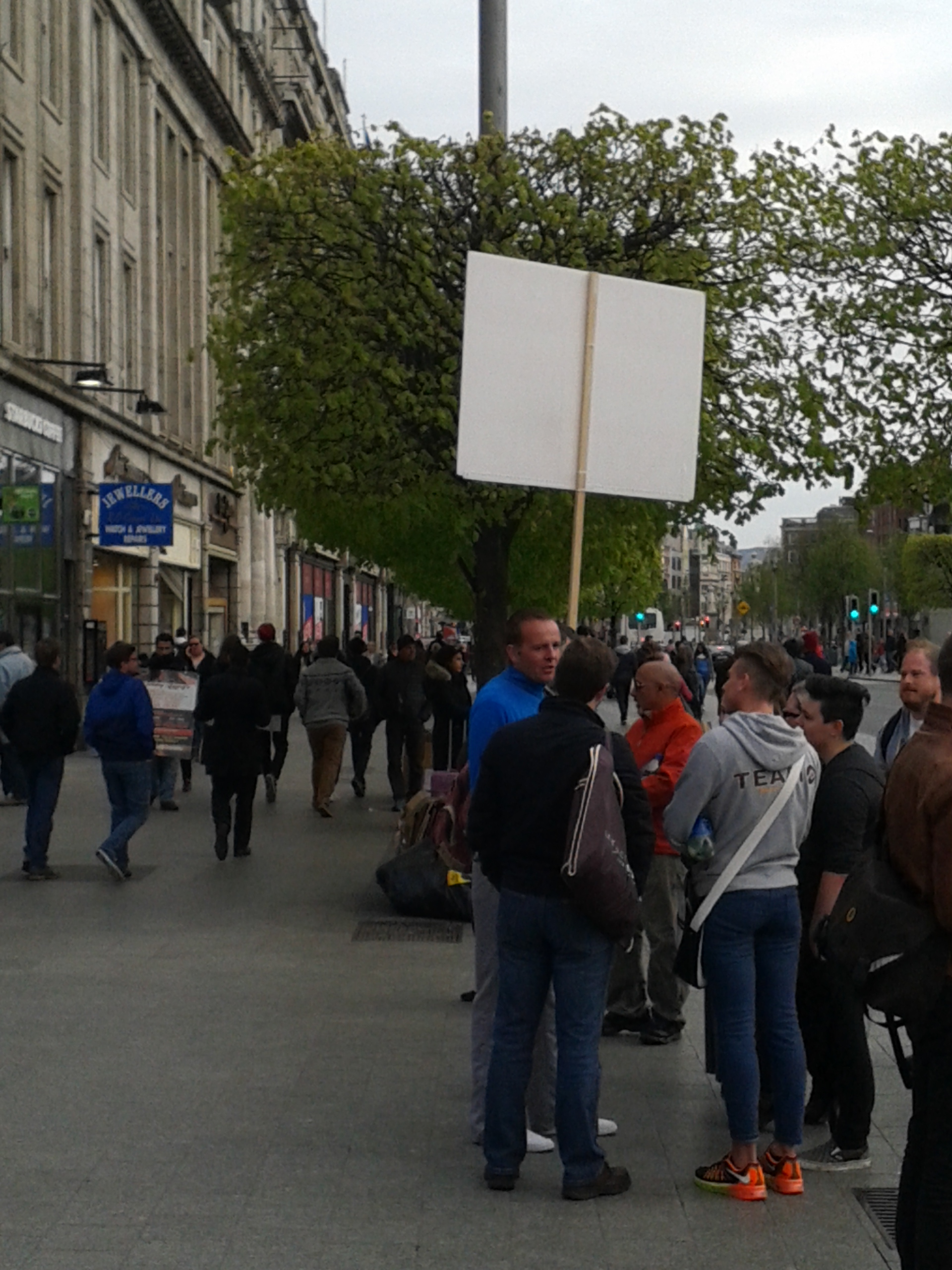
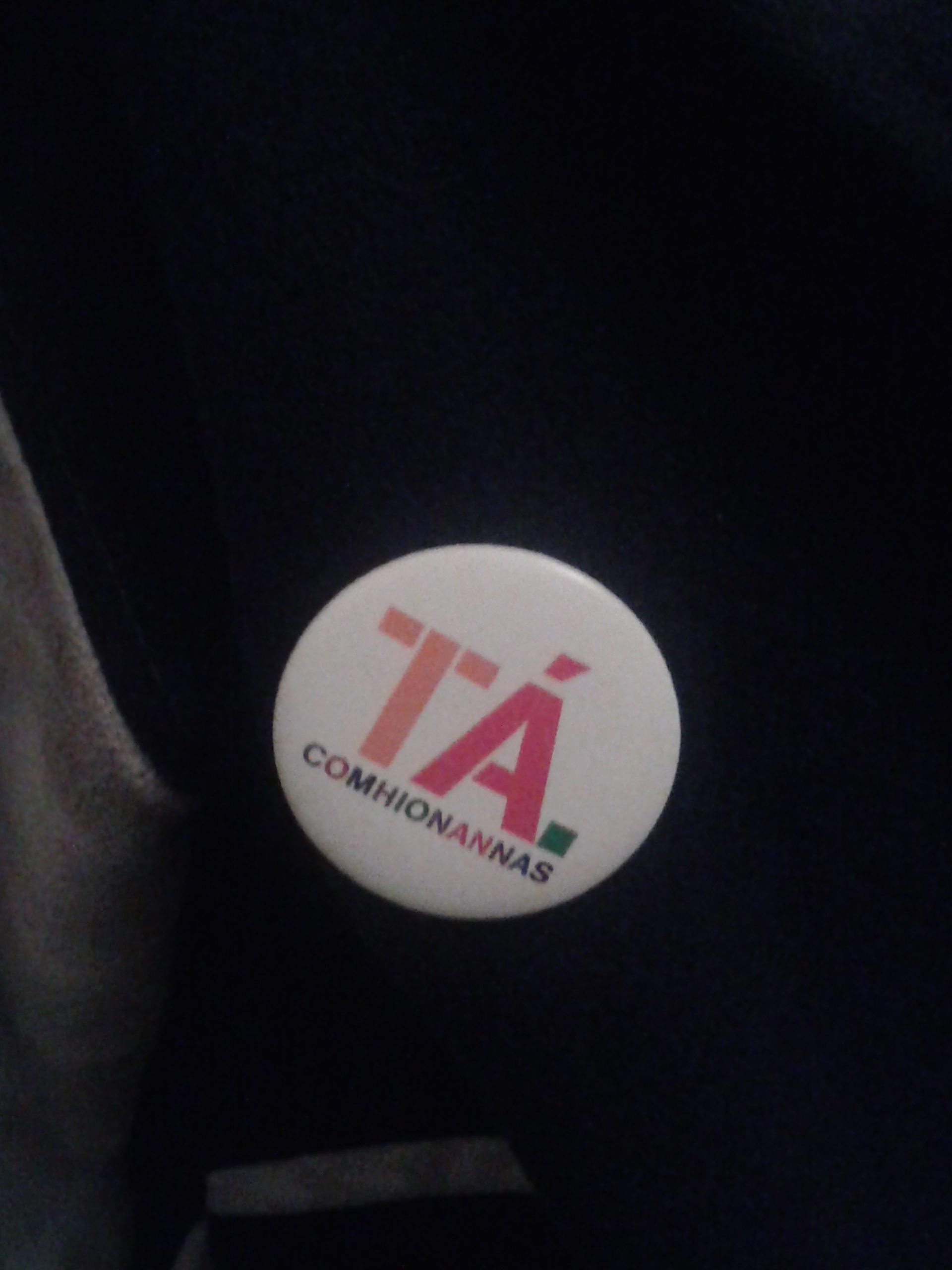

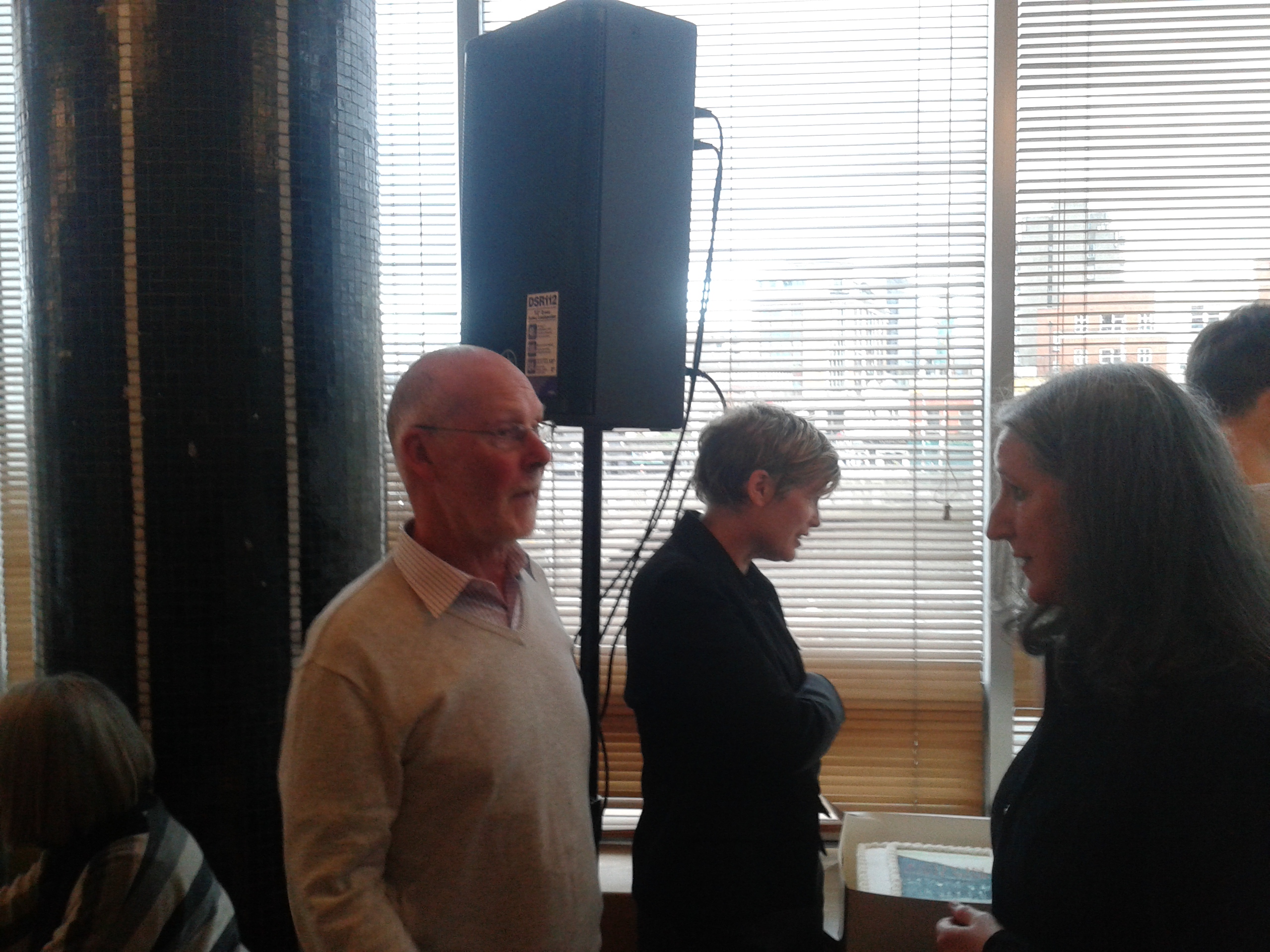
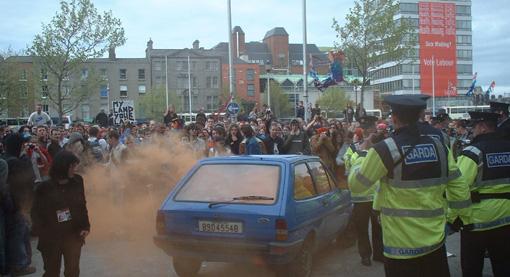

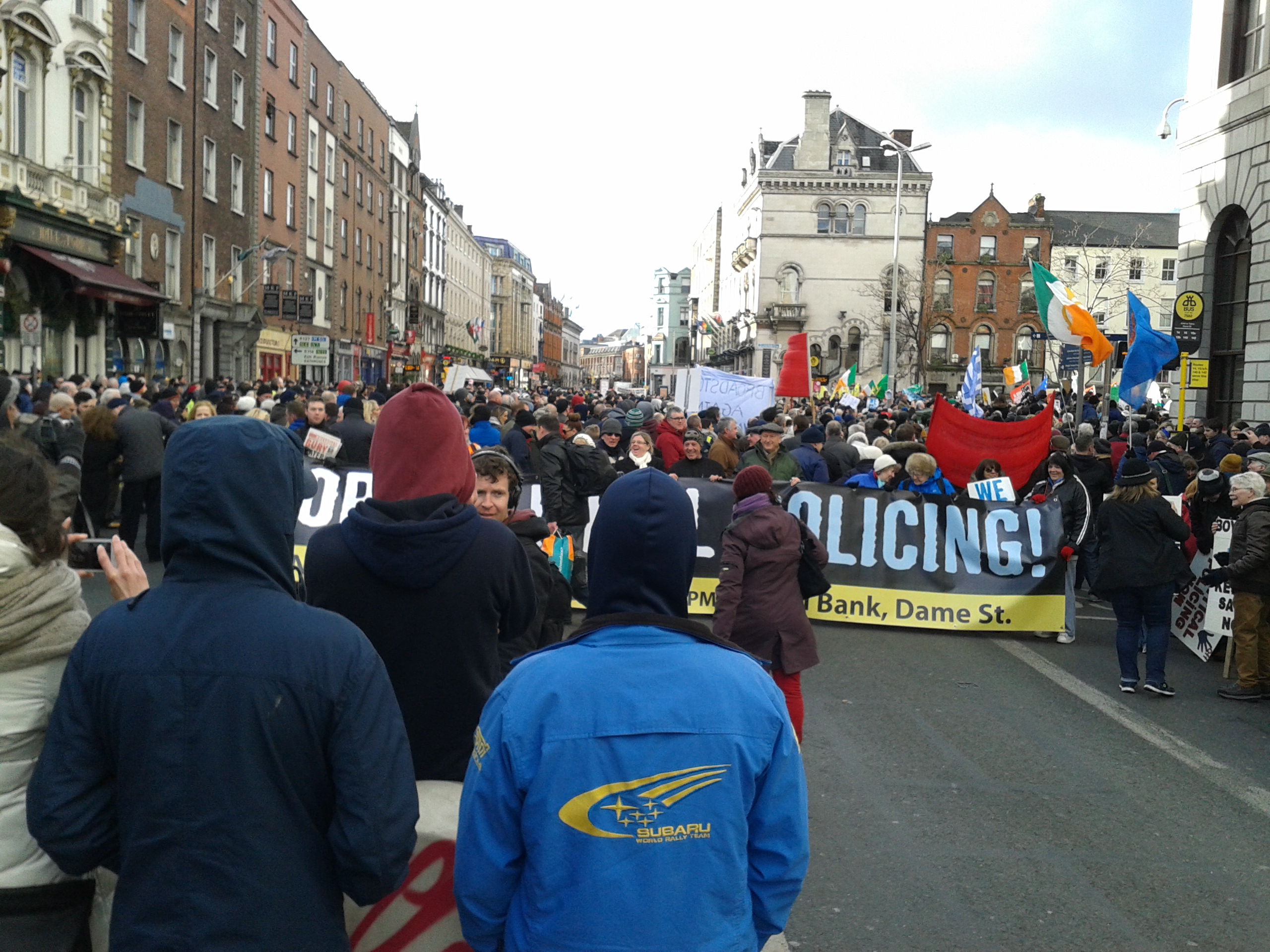



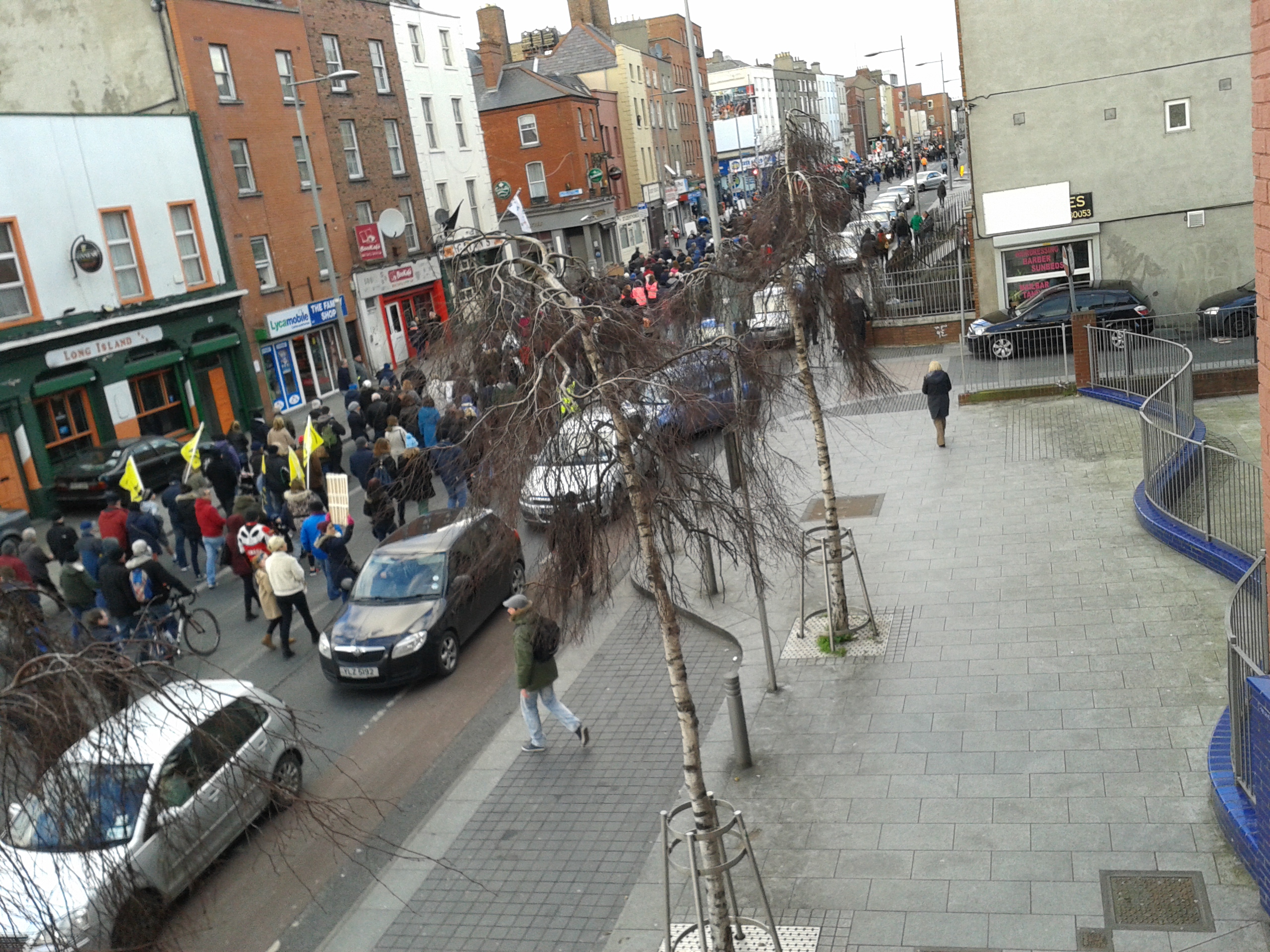
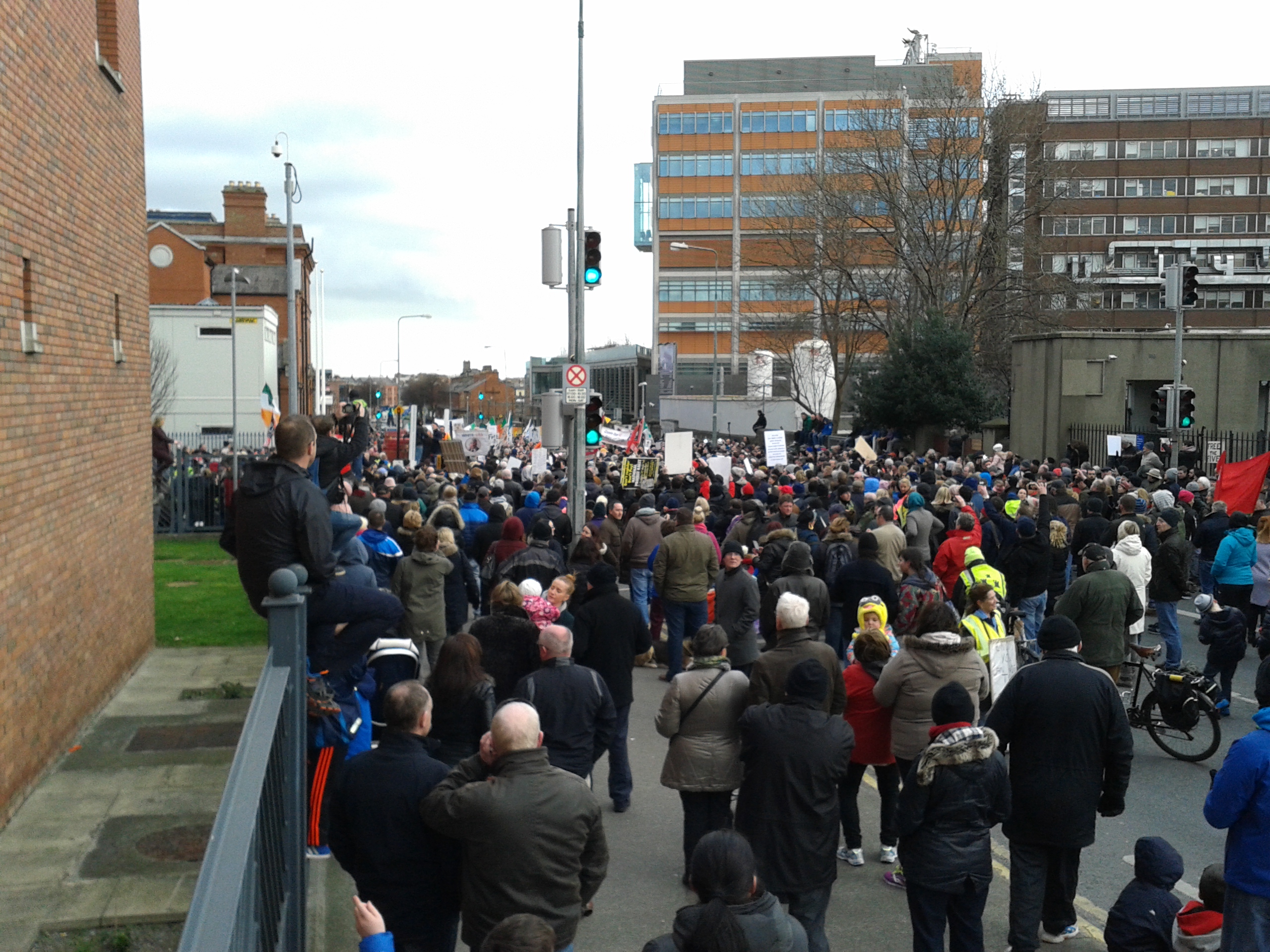





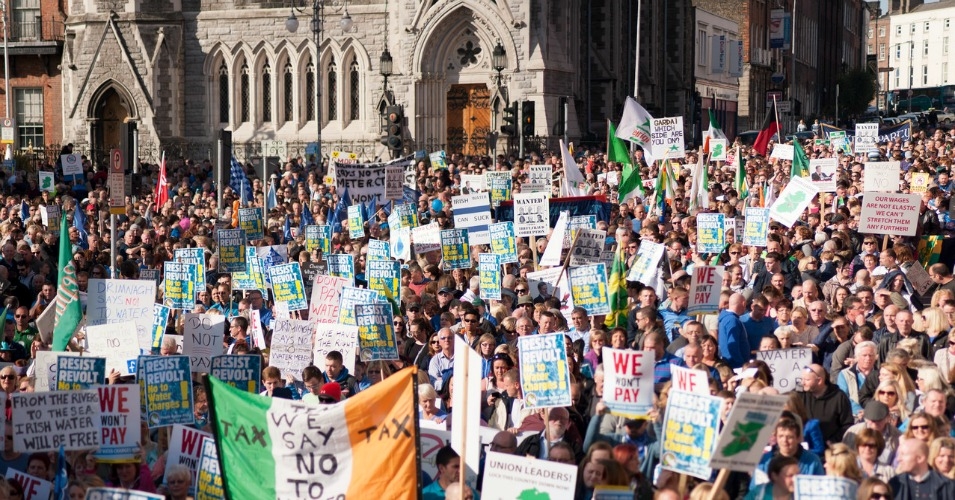


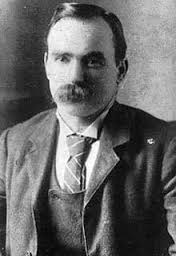

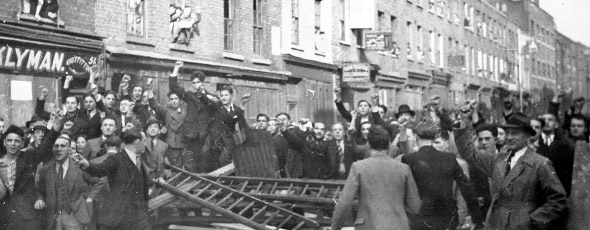

 rebelbreeze