AN EASTER STORY


Diarmuid Breatnach

There are many different kinds of Easter stories – religious ones, or about Easter parades and processions, ones about family reunions, Easter egg hunts, even holidays …. this isn’t one of those.

The man, let’s call him Jeremiah or Jerry for short, stood outside the pub on a Sunday afternoon and struggled to quell the apprehension threatening to flood his mind and body. It had to be done. He turned to his companion, who seemed to view everything through laughing eyes and was no different now. Brian had three teenage kids with him, two of his own and a friend of one of them. Hardly ideal, but Brian had turned up with them a little while ago and there was no-one to leave them with. Well, they’d be all right – Jerry would be the target and, after him, Brian. They wouldn’t touch the kids.

Best give me the bag, Brian,” he said and, receiving it, checked inside. The stuff was there. Of course. Jerry folded the bag and stuck it under his jumper, under his coat.

He was focused on the tasks ahead but the trail that led them here had started days earlier. And, in some ways, years before that.

He squared his shoulders, turned and entered the pub. Brian and the kids followed.

**** **** ****

He had been at work on Friday afternoon when the call came from the Manager of the Irish Community Centre. Of course, he asked the staff to put it through to his office.

Do you know your event is in the newspapers?”

Something in the Manager’s voice alerts him that he is not being congratulated on the publicity.

The Easter Rising commemoration?”

Yes. It’s in the Evening Standard.”

Well, that answered the second question he had in mind.

No, I didn’t know. What are they saying?”

He knows what the British media are like and he’s got a sinking feeling.

It transpires that an Irish Republican organisation had put the event on their website, which had been noted by an Englishman who lost his son in the Omagh bombing of 1998. There are many questions to be answered about that bombing, both within the Republican and the State side, but for many years, not unnaturally, the father had been focused on the Republican group allegedly connected to the Real IRA, who had placed the bomb. In addition to his son, the bomb had killed 28 other people, the second-highest death toll for any day during the war in Ireland, the highest being the Dublin-Monaghan bombing of 1974, with a toll of 34. Jerry was aware that the 1974 bombings did not attract anything like the same media attention and understood the reason – they had been carried out by Loyalists under British Intelligence Service direction.

But what had all this to do with the Irish in Britain Representation Group in South London, and their Easter Rising Commemoration? Or with the Irish Community Centre? Well, the grieving father had noted the posting by the Irish organisation, noted the venue and rang, demanding that the event be cancelled.

I told him the commemoration is an annual event organised by an Irish community organisation and that there’s never been any trouble at it. I told him it has nothing to do with that Republican organisation …. it doesn’t, does it?”

No, it’s just us, the local Irish in Britain Representation Group branch. But surely any organisation is entitled to advertise the event?” replies Jerry.

Jerry is noting doubt in the Centre Manager’s voice responding to him. He is on the receiving end of huge pressure, working in his office, alone.

He wanted me to cancel the booking and I said I couldn’t do that,” said the Manager.

The grieving father had got on to the local authority, who replied that the event was the business of the Irish Centre. The father then contacted the media, who rang the local authority again and this time, instead of sticking to their original line and weathering what would be a short-lived storm, and without phoning the Centre Manger, their spokesperson condemned the event and stated they would be asking hard questions of the Centre, which they part-funded.

Jerry reads all this again when he slips out to get a newspaper. He feels for the beleaguered Centre Manager but can do nothing. It’s too late to contact the newspapers because the story is published. The event is to be held that evening. It has been advertised in the local area and in the Irish Post, the main newspaper at the time for the Irish diaspora in Britain. And in any case, one cannot – should not – give in to intimidation, coercion. The community had mostly caved under the Prevention of Terrorism Act in 1974 and had not really rallied again until the Hunger Strikes of 1981. The event must go on.

Jerry heads home, thinking about additional security needed on the door for the event, composing replies to the local authority, a letter in the newspaper ….

The IBRG Ard-Choiste, its governing body, had withdrawn its support of the Time To Go coalition in Britain some years earlier because of undemocratic maneuvering by some left Labour politicians, along with the sidelining of specific Irish community concerns. They had not been alone: Stop the Strip Searches Campaign and the Troops Out Movement had pulled out also, leaving the tiny Labour Committee on Ireland, the Socialist Workers Party and Communist Party of Great Britain to be supported by only the Wolfe Tone Association (SF support group in London) and the Connolly Association (linked to the CPGB) among the Irish campaigners .

Later, in 1998, the IBRG had been divided on the Good Friday Agreement. It was not the issue of continuing or ceasing the armed actions of the IRA that had been the source of the division, rather the acceptance of colonial rule, albeit claimed to be for tactical reasons only. A majority within the IBRG came out against the Agreement and that was in accordance with Jerry’s position too.

Although he supports none of the Republican groups opposing Sinn Féin, he has heard whispers in the Irish community at various times associating him with this or that group. This might well be feeding doubts in the Centre Manager’s mind.

Jerry is in a more difficult position than might seem. He is not only Secretary of the local IBRG branch that has organised the event and is affiliated to the Community Centre, but also the Chairperson of the Irish Centre’s Management Committee itself. The Management Committee is the Centre Manager’s employer and has a duty of care to him. And after nearly a decade of campaigning for the provision of the Centre and the meagre funding it receives, no-one on the Committee would want to antagonise the local authority.

But it was the IBRG branch itself and in particular the Irish Pensioners’ Association which was then a part of it, which had won the provision for the community in the end. And Jerry had been part of the campaign, elected as Chairperson of the Steering Group in the years while renovations of the building and available funding were discussed, elected Chairperson for the first six months after the Centre opened and at the Annual General Meeting for every year afterwards. In fact, recently Jerry had been trying unsuccessfully to step down, to ease a replacement into his position.

On the train from London Bridge on the last leg of his journey home, Jerry reflects ruefully that this controversy might cause his stepping down, which was hardly the way he had anticipated his leaving. No stepping back slowly, supporting someone new in position and easing himself out. No – thrown out instead! That would of course imply he had done something wrong, which he hadn’t and that the IBRG had been wrong to commemorate the Rising, which they hadn’t either. Ironically, if moves were made now to replace him, he’d have to fight them.

**** **** ****

Before he arrives at the Irish Community Centre, Jerry looks carefully around the mostly residential street. Nothing seems threatening but can one be sure? He is carrying the IBRG’s branch’s banner, wrapped up in black bin liners, which makes him a visible target if someone’s searching. On the other hand, one of the poles of the banner is loose within the bundle, in case of need ….

He drops the Centre’s keys in his nervousness and enters, disabling the alarm and turning quickly to retrieve the keys and lock the door. Then, into the hall, to begin arranging some of the material ….

He is anxious for some of the IBRG members to arrive but jumps when the doorbell rings. Checking through the fish-eye spyhole, he is surprised to see one of the Irish Pensioners, who lives locally.

Opening the door and ushering her in, he locks the door behind her, saying apologetically “There’s only myself here so far.”

Are others coming?” she asks – she has read the newspaper and unerringly touches Jerry’s main fear at the moment.

I’m sure they are, Ellie. What are you doing here so early?’

I thought you might need some help.”

Jerry is touched straight through to his heart but has to refuse. He can’t have her here if there’s an attack with no-one else but himself to defend her.

Oh no, Ellie that’s very kind of you. But I kind of know what I have to do and explaining it to others will just take longer and make me flustered. You know how it is. Thanks a lot. Besides the others will be here soon. Come back when we’re open …..” he trails off guiltilly.

Still, she goes and he heaves a sigh of relief, at the same time feeling shame.

But there’s work to be done.

A scattering of volunteers arrives over the next half hour. The reception table is set up in the lobby, to sell tickets and distribute leaflets. Hidden behind, are the lengths of wood in case of attack by one of the British fascist groups. Up goes the green-white-&-orange bunting, portraits of the executed 1916 leaders, enlarged copies of the 1916 Proclamation. At the back of the stage, facing the hall, the large artwork Jerry made a few years ago of green, white and orange flames bursting from the date 1916. And the IBRG branch banner.

The stage is ready for the band, a group called The Mc ____ Brothers, who play Irish ballads, including Republican material. Water jug and glasses for the speakers. Tables and chairs rearranged on the hall floor (the part-time Caretaker had laid them out but Jerry always prefers a more “club” arrangement, of smaller tables spaced apart surrounded by some chairs).

By the time the opening hour arrives, Jerry is sweating but it is the sweat of work, not of fear or apprehension. The hall looks good. People are starting to arrive. Maybe he can relax now. Maybe. Brian is on the door with others close by.

The event is a bring-your-own-alcohol one and Jerry and others in the lobby spend some time directing people to the nearest off-licence, so that people are coming in, going out, coming in, sitting in the hall …. Jerry is scanning their faces, looking for possible sources of trouble.

An hour later and the band has not arrived. Pol phones them but gets no reply. Phones their manager but no reply either. Another hour later, the reality dawns on the organisers. The band will not be coming. They have seen the newspaper and decided to look after their safety. But they haven’t even bothered to tell them.

The organisers confer, after which Jerry mounts the stage, calls for attention and begins to speak.

A Chairde Gael agus a chairde ó thíortha eile, go raibh míle maith agaibh for coming here tonight to commemorate the 1916 Easter Rising with us. This is a hugely important event in Irish history and indeed in the history of the world and the local branch of the IBRG has been not just commemorating but publicly celebrating this historic event every year for some time now.

But we are very sorry to say that we have some bad news for you now. Some of you will know that very recently pressure was put on us to cancel this event but that we refused to do so. Pressure was put on the Irish Centre to cancel the event which they also and rightly refused to do.

That the British media would attack us is no surprise, they have been doing that for years. But that the local authority’s spokesperson should bow down to them and, without consulting with us, imply that we are doing something wrong here, that the Centre should not have taken our booking, is something else.

And worst of all, that an Irish band, which makes a living playing Irish ballads, should allow themselves to be scared off and not even have the decency to ring us – well, I don’t really have the words to tell you what I think about that.

So, a chairde, we offer you your money back and no questions and our sincere apologies. However, those of you who wish to remain are welcome to do so and we’ll make our own entertainment with a few songs …. we have a guitar player here …. another man plays a whistle …. But please, you are entitled to your money back and those who wish to please go to the table in the lobby now.”

As though he had been primed to do so (but Jerry knew he had not), a middle-aged Irishman at a table nearer the stage jumps up and shouts: “NO! We will not ask for our money back! We’re not going to be chased out by no British newspapers!”

A round of applause from the audience and a few cheers greet his outburst. And just like that, the evening is saved.

The guitarist plays some numbers and sings. Jerry gives an abbreviated oration and sings a few ballads. The whistle player plays some tunes. People sing along to songs. They drink, chat and buy raffle tickets. One of the raffle prizes is auctioned by the winner, a local publican Jerry had been surprised to see in the audience. The money goes into the takings. At the end of the evening, as they finally cajole the last of the audience out of the Centre (still with a wary eye on the street) and finish cleaning and tidying up, they count the takings. Financially, it has been their most successful evening ever, especially since they didn’t have to pay a band.

But the band ….. their action and lack of notification have left a sour taste in the mouths of the organisers. And during the evening, they learned that the Mc___ Brothers are booked to play at an Irish pub, on Sunday afternoon, just two days away. And only a five minutes’ drive from the Irish Centre.

**** **** ****

A council of war decides that the bar will be visited, Jerry will mount the stage (“you’re our best speaker”) and present the band with white feathers, symbolising cowardice. Some can’t be there. One or two think it will be dangerous. Brian, Pol and Jerry think it’s a good plan — so then they just need some white feathers. How hard can it be to get some?

Visits to duck pond parks yield none. The quaysides along the Thames show no seagull feathers. Brian drives to the coast and walks some beaches – and finds a couple of wispy ones. In desperation on Sunday morning, they burst open a pillow and drag out a handful of feathers. They are small, not at all like the large ones they had envisaged presenting to the band but they are white and they are feathers. Into the plastic bag they go and then Brian is driving Jerry and the kids to the pub. Brian has remarkable personal resources and has been through some very serious situations so this might be small potatoes to him …. but Jerry’s guts are churning.

Some faces in the pub turn to look at them as they enter. Jerry has been here before only once but a number of the clientele are known to him from other pubs and events. And he is probably known to more of them, as Chairperson of the Irish Centre. A few catch his eye and he nods at them, keeping his face impassive.

Do they know that the band playing here let down the audience two days ago? Of course they do …. or at least many would. This is the Irish community in SE London. Besides, the Manager of this bar, Kate, until recently worked for the publican who auctioned the raffle prize at the event on Friday night. At least one of them was there that night too.  Are they wondering what Jerry intends to do?

The band, which Brian has taken to calling the “McChicken Brothers”, is already playing on stage. Jerry had meant to get here before they got on but the feather search had been a delay. To get in front of them now might be resented by the audience and anyway, the band’s control of the microphones could drown out what needs to be said. Jerry goes to the bar, orders pints for himself and Brian and soft drinks for the kids, stitches a smile on his face and chats to Brian. And they wait.

Eventually the band takes a break and Jerry waits tensely for the indication that they are returning for the second half of their gig. When he sees them coming he nods to Brian, whose job is to fend off anyone attacking him before he has finished.

Just as the band reach the low stage but have yet to mount it, Jerry jumps up on it and begins to speak in a loud voice.

Ladies and gentlemen, your attention for a moment please!” EVERYBODY turns to look.

These musicians here were booked to play at an Easter Rising commemoration at the Irish Community Centre on Friday. They didn’t turn up. They left the audience (ok, bump up the figures a little!, he thinks) — 200 people – and the organisers stranded. And they didn’t even have the decency to tell us they weren’t coming. They ran scared, my friends, from lies in the British press.”

Jerry has the plastic bag in his hand and now dips into it, withdrawing a handfull of fluffy little white feathers.

Shame on you!” he says, facing the band members. “And this is what we think of you!”

So saying, he tries to throw the bunch of feathers at them but they erupt in a cloud between them, some clinging to Jerry’s hands. No matter, it is done. He steps off the stage and heads for the door, hoping to make it before anyone tries to stop him, before Brian has to get into physical stuff.

Surprisingly, someone shouted “Hear, hear!” and there had been a scattered round of applause.

Outside, they head for Brian’s car. A man comes running out and Brian steps forward to confront him, Jerry getting ready too, the kids behind him. Kate, the Manager, comes running out too and grabs the man. She says some things to him and he goes back in reluctantly, Jerry thinking the man doesn’t know how lucky he is that he didn’t tangle with Brian. Then Kate comes up to Jerry, shaking with anger, her face white.

You had NO right, NO right to do that in my pub!” she says.

We couldn’t let them get away with that, Kate,” Jerry replies.

Anywhere else. Not in my pub,” she says again.

The adrenaline is now seeping away and Jerry knows that his leg will start to shake soon. He feels a little sorry for Kate but needs to get away.

Sorry, Kate, that’s where they were,” Jerry replies and turns to go.

Don’t ever come in my pub again,” she calls out at his back.

**** **** ****

Many things were probably said in the local Irish community about the IBRG branch before and after that incident but probably that action contributed to an estimation that whatever you might think of them, they stood up for themselves and didn’t back down. That and their annual Children’s Irish Hallowe’en Party, their weekly Children’s Irish Art and History Group, their participation in the South London St. Patrick’s Day Parade and their occasional dramatic productions earned the small group a kind of respect in the local Irish community, a community often quite conservative in social outlook, often insular, often riven by jealousies and back-biting.

One night two weeks after the 1916 commemoration, there was a crude arson attempt on the Centre – a bottle with accelerant leaned against the front door and set alight. It burned a hole in the door and set off the fire alarms. Jerry, as a keyholder, got a call to attend from Ellie. The police were already there and Jerry dealt with them politely. Any enemies? they asked. Jerry wondered whether he should give them a list.

My guess is some British far-right group”, he replied, very glad that back in the Steering Group days, he had insisted on all the windows being covered with wire mesh panels, thinking of possible rock or even petrol bomb attack.

The police suggested they look through a list of recent attendance at the Centre. Jerry politely refused. Security provisions were made at the Centre.  Nothing came of whatever investigations the police carried out and Jerry was not surprised.

Media attention went away and the local authority didn’t take the matter further. Jerry wrote a letter to the Irish Post, denouncing the pressure applied against the IBRG and the Irish Centre and which might even have encouraged the arson attack. He did so under an assumed name because, as Chairperson, he wished not to implicate the Centre in his denunciation of the craven action of the local authority spokesperson. The beleaguered Centre Manager did not see it that way, assuming that Jerry was trying to have his say while avoiding responsibility.

When, a number of years later, in a heavy round of cuts in expenditure, the Centre’s main funding, the Manager’s and caretakers’ salaries were targeted in the local authority’s budget, Jerry led the Management Committee in a campaign of resistance. They picketed Council meetings and drew up lists of elected Councillors to lobby. Irish musicians and children in Irish dancing school costumes were brought to perform in front of the Council offices, leading to photographs in the local press. The Pensioners’ Association, amicably separated some years earlier from the IBRG branch, played a prominent part once more. Some local English people came forward to support the Centre’s case. Jerry prepared a submission for the IBRG branch and spoke to it at a Council meeting. Eventually, their meagre funding, the removal of which would have meant the closing of the Centre except for sporadic events, was saved.

Jerry didn’t go back to that bar where he had confronted the “McChicken Brothers” for about a year after that incident. When he did, he wondered whether he’d be served. He was — but it was another two years before Kate spoke to him again.

End.

SHOOT-OUT IN DUBLIN ON MARCH 14 LEAVES SEVEN DEAD

SHOOT-OUT IN DUBLIN ON MARCH 14 LEAVES SEVEN DEAD1

By John Dorney

(Re-published from The Irish Story, History webpage http://www.theirishstory.com/2015/01/26/the-pearse-street-ambush-dublin-march-14-1921/#.WN6_Ukvb-_s by kind permission of John Dorney)

Dublin awoke on the morning to March 14th 1921 to the news that six IRA Volunteers, captured in an ambush at Drumcondra two months before, had been hanged.

The gates of Mountjoy Gaol were opened at 8:25 am and news of the executions was read out to the distraught relatives of the dead. As many as 40,000 people had gathered outside and many mournfully said the rosary for the executed men.

On the morning of March 14 1921 six IRA Volunteers were hanged in Mountjoy Gaol.

Crowds of protesters outside Mountjoy Jail being held back by British troops and a tank (image from Dorney’s article)

The labour movement called a half-day general strike in the city in protest at the hangings. The clandestine Republican Government declared a day of national mourning. All public transport came to a halt and republican activists made sure the strike was observed. IRA officer Frank Henderson recalled:

Patrick Sweeney, Vice Commandant of the 2nd Battalion, and other members of the Battalion paraded the Battalion area during the hours of public mourning to ensure that shops were closed. With the exception of one or two public houses which had to be cleared, the order to cease work was loyally obeyed by the citizens.”

By evening, the streets cleared rapidly as the British-imposed curfew came into effect at 9pm each night. The city must have been a fearful place, patrolled by regular British troops and the much-feared paramilitary police, or Auxiliaries, as people scurried home and awaited IRA retaliation for the hangings. This was not long in coming.

Pearse Street, or Great Brunswick Street as it then was, nestles just south of the river Liffey, running from Ringsend, an old fishing port, to the city centre. Number 144 housed the company headquarters of the Dublin IRA’s 3rd Battalion at St Andrews Catholic Hall. It had been used for this purpose since before insurrection of 1916.

On the evening of March 14, their captain Peadar O’Meara sent them out to attack police or military targets. As many as 34 IRA men prowled the area, armed with the standard urban guerrilla arms of easily-hidden handguns and grenades. One young Volunteer, Sean Dolan threw a grenade at a police station on nearby Merrion Square, which bounced back before it could explode, blowing off his own leg.

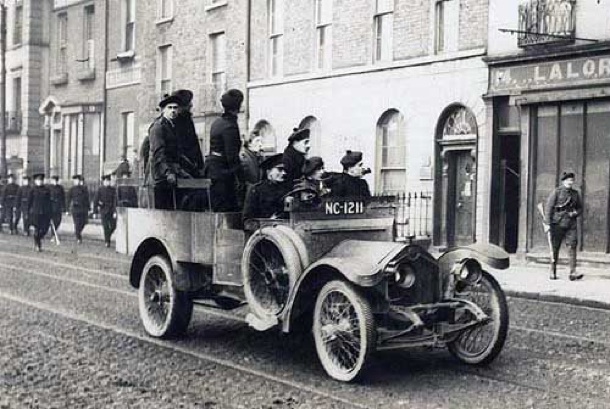
Auxiliaries on a raid c.1920 (image sourced on Internet)

It was about 8 o’clock. The curfew was approaching. A company of Auxiliaries, based in Dublin Castle was sent to the area to investigate the explosion. It consisted of one Rolls Royce armoured car and two tenders (trucks) holding about 16 men. Apparently the Auxiliaries had some inside information as they made straight for the local IRA headquarters at 144 Pearse Street. One later testified in court that – “I had been notified there were a certain number of gunmen there”.

But the IRA were also waiting. As soon as the Auxiliaries approached the building, fire was opened on them from three sides.

What the newspapers described as ‘hail of fire’ tore into the Auxiliaries’ vehicles. Five of the eight Auxiliaries in the first tender were hit in the opening fusillade. Two of them were fatally injured, including the driver (an Irishman named O’Farrell) and an Auxiliary named L. Beard.

But the IRA fighters were seriously outgunned. The Rolls Royce armoured car was impervious to small arms fire (except its tyres, which were shot out) but mounted a Vickers heavy machine gun, which sprayed the surrounding houses with bullets. The unwounded Auxiliaries also clambered out of their tenders and returned fire at the gun flashes from street corners and rooftops.

Civilian passersby flung themselves to the ground to avoid the bullets but four were hit, by which side it was impossible to tell. The British military court of inquiry into the incident found that the civilians had been killed by persons unknown; if by the IRA then they were ‘murdered’, if hit by Auxiliaries the shootings were ‘accidental’ — which, aside from demonstrating the court’s bias, shows us that no one was sure who had killed them.

Firing lasted for just five minutes but in that time seven people (including the two Auxiliaries) were killed or fatally wounded and at least six more wounded. A young man, Bernard O’Hanlon aged just 18, originally from Dundalk, lay sprawled, dead, outside number 145, his ‘bull-dog’ revolver under him which had five chambers, two of which contained expended rounds and three live rounds – indicating he had got off just two shots before being cut down.

Another IRA Volunteer, Leo Fitzgerald was also killed outright. Two more guerrillas were wounded, one in the hip and one in the back. They, along with Sean Dolan who had been wounded by his own grenade were spirited away by sympathetic Fire Brigade members and members of Cumann na mBan and treated in the nearby Mercer’s hospital.

Three civilians lay dead on the street. One, Thomas Asquith was a 68 year-old caretaker, another, David Kelly was a prominent Sinn Fein member and head of the Sinn Fein bank. His brother, Thomas Kelly was a veteran Sinn politician and since 1918 a Member of Parliament. The third, Stephen Clarke, aged 22, was an ex-soldier and may have been the one who had tipped off the Auxiliaries about the whereabouts of the IRA meeting house. An internal IRA report noted that he was ‘under observation… as he was a tout for the enemy’.

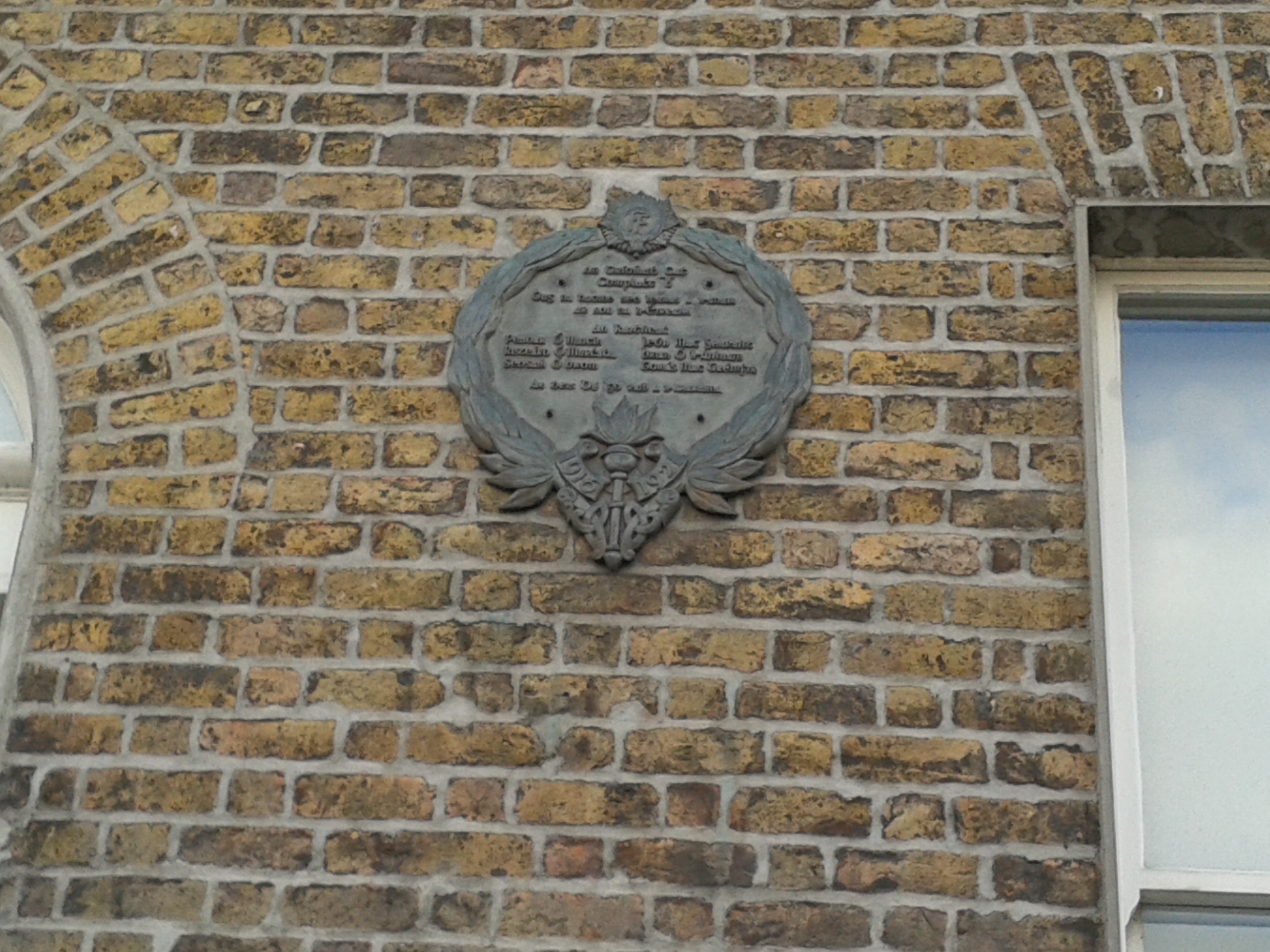
Location of the plaque on house near to Library in Pearse St. (formerly Gt. Brunswick St.) commemorating the fight. The plaque is in the 3 o’clock position on the photo. (photo D.Breatnach this year)

In five minutes of intense gunfire, seven people were mortally wounded; two IRA Volunteers, two Auxiliaries and three civilians.

Two IRA men were captured as they fled the scene, one, Thomas Traynor a 40 year-old veteran of the Easter Rising, was carrying an automatic pistol but claimed to have had no part in the ambush itself. He had, he maintained, simply been asked to bring in the weapon to 144 Great Brunswick Street. The other was Joseph Donnelly a youth of just 17.

As most of the IRA fighters got away through houses, over walls and into backstreets, the Auxiliaries ransacked St Andrew’s Catholic Hall at number 144, but found little of value. Regular British Army troops quickly arrived from nearby Beggars Bush barracks and cordoned off the area, but no further arrests were made. Desultory sniping carried on in the city for several hours into the night.

The plaque closer.
(Photo sourced Internet)

Footnotes

1The title is our own, i.e of Rebel Breeze blog

MOORE STREET AND 1916 RISING — OF GREAT INTERNATIONAL SIGNIFICANCE

Diarmuid Breatnach

(This is another part of my personal submission to the Minister of Heritage’s Consultative Group on Moore Street. Some others may be found on https://rebelbreeze.wordpress.com/2017/02/15/the-1916-history-of-moore-street/https://rebelbreeze.wordpress.com/2017/02/10/the-moore-street-market-a-possible-future/https://rebelbreeze.wordpress.com/2017/03/21/personal-recommendations-for-the-moore-street-quarter/ and https://rebelbreeze.wordpress.com/2017/03/22/moore-street-mus…tourists-account/.

I have tackled the particular subject of the International Importance of the 1916 Rising and therefore of the Moore St. Quarter on a number of occasions elsewhere and at some greater length on Rebel Breeze here https://rebelbreeze.wordpress.com/2016/01/20/the-moore-street-terrace-a-world-heritage-site/ )

The 1916 Rising, to which Moore Street is so closely linked, represented some very important events for the people of the world and it impacted on people in all populated continents of the globe.

FOR DEMOCRACY, EQUALITY

The 1916 Proclamation, printed in Liberty Hall and signed in No.21 Henry Street, just around the corner from Moore Street, is a document not only of clear patriotic and anti-colonial expression but also a democratic and inclusive one. At a time when hardly a state anywhere in the world permitted women to vote in elections, the document specifically addressed “Irishmen and Irish women”. It also clearly expressed the wish of the insurgents to overcome the religious sectarianism which had played such an important part in securing continued colonial rule: “ … religious and civil liberty … oblivious of the differences carefully fostered by an alien Government, which have divided a minority from the majority in the past.” 

Site of signing of 1916 Proclamation, 21 Henry St, almost opposite end of Moore Street.  At the time the business premises and cafe of Jennie Wyse Power of Cumann na mBan was there (plaque erected in 1919 by the 1916-1921 Club). 

The Rising had expressed the gender equality intentions of the insurgents in more than the words of its address: women fought in the Rising and, in two garrison areas, commanded for awhile. The British colonial authorities recognised the role of some of those women by sentencing one to death, albeit a sentence later commuted, and keeping a number of them in prison even after many men had been released.

Headline of 1916 Proclamation and specific mention address to Irish women (sourced oh Internet)

FOR GENDER EQUALITY

Irish women organised for and acted in the Rising in two separate organisations: Cumann na mBan and the Irish Citizen Army.

The women founded as an auxiliary force to the Irish Volunteers, Cumann na mBan, later to assert considerable organisational independence, wore their own uniforms and had their own female officers. Women had participated in many insurrections and resistance movements across the world but no insurrectionary force in history ever before had such a consciously women-organised force.

The women in the Irish Citizen Army had formally equal status with men and a number carried arms in the Rising and fired them at the enemy. Men acted on orders from women officers in at least two garrison areas and, in medical matters, also in at least a third.

Such a situation was of great significance in the struggle for women’s rights and gender equality, not only in Ireland but in the world.

FOR WORKERS AND SOCIALISM

Captain White & Irish Citizen Army on parade on their grounds at Croydon House, Fairview, N. Dublin City. (Sourced on Internet)

The Irish Citizen Army was founded in 1913 as a workers’ defence force by trade unionists and socialists and later as a workers’ army and, despite its strongly anti-colonial stance, until the 1916 Rising, maintained a strict separation from the nationalist republican organisations of the Irish Volunteers and Cumann na mBan. As detailed earlier, it formally recognised women within the organisation as of equal status with men.

Workers’ organisations had existed before, including armed ones but nowhere had such an armed organisation existed outside of armed conflict for so long (1913-1916), led by socialists and with equal status for men and women. In the history of socialist organisation and particularly of a revolutionary and insurgent kind, this was a development of enormous importance.

AGAINST WAR

The 1916 Rising took place in the middle of the first of two huge international conflicts that were later called World Wars. WW1 was a struggle for markets, resources and strategic positions and bases between a number of states ruled by capitalists and those states recruited heavily from among the nations they had colonised; in Britain’s case, that included Ireland.

To many nationalist Republicans, the War represented an opportunity, expressed in the maxim that “England’s difficulty is Ireland’s opportunity”. But to many socialists around the world, the War represented a disastrous pitting of the working people under one Power against the working people of another, as well as an excuse for the suppression of demands to fulfill the needs of their workers while the capitalists gathered huge profits. James Connolly was one of those socialists.

“WE SERVE NEITHER KING NOR KAISER banner on Liberty Hall (prior wartime repressive legislation), HQ of the IT&GWU, the WUI and of the ICA. (Sourced on Internet)

Connolly, Edinburgh-born Irish revolutionary socialist, formerly Acting General Secretary of the Irish Transport & General Worker’s Union, had joined the International Workers of the Word, the hugely influential in the USA syndicalist organisation. As well as being an energetic organiser, Connolly was a historian and revolutionary theoretician. Connolly took to heart the resolution formally adopted by representatives of the vast majority of European socialists to oppose war and, should it come, to turn it into class war against their rulers. In the event, Connolly was one of the few European socialist leaders to live up to that resolution: as Commandant of the Irish Citizen Army, GPO Garrison commander in a rising against Ireland’s British colonial masters, James Connolly was also striking a blow against imperial and colonial war.

That aspect of the Rising, of being consciously or unconsciously against War, predated the February Russian Revolution of 1917, also in part an anti-war uprising, by ten months. And of course, predated the October Socialist Revolution in Russia by seventeen months and the nearest uprising geographically to Ireland, also in part an anti-war one, the German socialist uprising in November 1918, by two-and-a-half years. For all these reasons, the 1916 Rising, the Headquarters of which were in the GPO and later removed to Moore Street, was and remains of enormous significance in the world-wide history of people’s movements against war.

AGAINST COLONIALISM IN THE WORLD

The 1916 Rising reverberated around the world. It took place in what had a century earlier been widely regarded as the second city of the British Empire and, when it erupted, did so against the largest empire, in terms of directly-controlled areas and population numbers ruled, that the world has ever known. How can such an event be of other than huge interest, not only to other peoples under British colonial rule but also to those under the colonial rule of France, Belgium, Germany, Holland, Portugal, Spain, Russia and the United States? How could it not have been of considerable interest to socialist revolutionaries everywhere?

Lenin speaking in Red Square in October 1918. He was among Russian revolutionaries who commented on the 1916 Rising. (Sourced on Internet)
Map of world empires, colonies and territories in 1914 (Sourced on Internet)


Socialists around the world discussed the Rising, at first often criticising it, while Lenin, of huge importance in the socialist movement at that time and some others commented favourably upon it. Consequently, the Rising and the War of Independence was to play an important part in the development of a revolutionary theory around the world that advocated the linking of the struggles of worker, peasant and small farmer, of anti-imperialism and anti-colonialism with struggle for a socialist republic.

August 4, 1916: From left: Irish American labor leaders Timothy Healy, William B. Fitzgerald, William D. Mahon, Hugh Frayne (general organizer in New York for the American Federation of Labor), and Louis Fridiger. Fitzgerald, Mahon, and Fridiger represented the Amalgamated Association of Street Railway Employees of America. (Source http://irishamerica.com/2016/02/hand-in-hand-for-freedom-u-s-labor-and-irish-rebels/

The Rising was a topic of great discussion in the United States and in Australia, and in the USA of financial and other support, as is well known. Connolly had been active there and had published his songbook in New York in 1910; Larkin was actually there in 1916. For a number of reasons, including the sentencing to death of Eamon Bulfin for his role in the GPO and in Moore Street, a sentence later commuted and Bulfin deported to Buenos Aires, the Rising was discussed in Argentina and in other Latin American countries (where, at that time, the British were the main imperialist power).

Eamon Bulfin, born in Argentina and exiled there after 1916, his photo in Australian paper the Southern Cross that year. (Sourced on Internet)
Members of 1st Battalion Connaught Rangers including the leader of the 1920 mutiny in the Punjab, James Daly. (Sourced on Internet)

It was certainly discussed in the huge country of India (which at that time included what is now the states of Pakistan and Bangladesh), whose revolutionary nationalists had contact with Fenian revolutionaries from decades earlier. The Connaught Ranger mutiny in the British Army was a direct result of the Rising and the War of Independence and, before the mutiny was crushed, the soldiers and oppressed Indians had begun to make movement towards reciprocal solidarity. And we know, from history and the writings of Indian nationalists and socialists, that the Rising and the War of Independence which organically followed the Rising influenced the struggles against colonialism and imperialism in India right up to the Second World War. We are also aware of correspondence between the Nehru and Ghandi families and the McSwineys.

A young Ho Chi Minh (not his name then) at Marseilles conference in 1919
(Sourced on Internet)

We know also that the War of Independence influenced African uprisings and Ho Chi Minh, later leader of successful wars against Japanese invasion and French colonialism. In South Africa, the Rising must have been a subject of discussion too, at least among the whites. John McBride, sentenced to death ostensibly for his role in Rising was probably in reality being shot for having organised and led an Irish Brigade to fight the British in the Second Boer War, which had ended but fourteen years earlier.

In Britain itself, the Rising influenced the huge Irish diaspora in England, Scotland and Wales and a significant proportion of the insurgent forces in Dublin had actually come from there. The Rising and especially the War of Independence caused a crises of a kind in British socialist thinking, threatening an irrevocable rupture between revolutionary socialists and even sections of radical social democrats on the one hand and pro-imperial social democracy on the other.

This is not the place to discuss this further but that situation, allied to anti-colonial struggles around the world, huge dissatisfaction and mutinies in the British armed forces and a growing strike movement in Britain, provided great opportunities for an Irish revolutionary movement to influence the history of the world in a direction other than that which it has taken.

For all the reasons outlined above, the Moore Street quarter should be of recognised World Heritage Status.

UNESCO WORLD HERITAGE AND OTHER CONSERVATION STATUS

The Irish State ratified the World Heritage Convention in 1991, which qualifies Ireland to apply for that status for the Moore Street quarter. Up to US$1 million is available from the World Heritage fund for the saving and development of a World Heritage site and funds are also available for urgent works to save it. World Heritage status attracts considerable tourist interest and substantial revenue is of course also available to the State and businesses surrounding the area from such tourist interest.

Currently Ireland has only two sites which have been accorded full World Heritage status (one of archaelogical and the other or natural, mainly geological, importance). However, another seven sites are under “Tentative” categorisation since 2010 and Dublin City is one of those. The Moore Street battleground could be afforded that full World Heritage status in its own right, which I believe its history deserves but it can also be used to strengthen the case for full such status for Dublin City.

The ten grounds on which UNESCO currently relies in order to examine the “the unique importance” of a site is admittedly rather restricted in the category of historical importance, particularly in the development of social movements. However, even under the existing list, I would submit that the Moore Street battleground meets four of the criteria: 2, 4, 6 and 8. The USA has the Statue of Liberty and Independence Hall building as World Heritage sites.

Registering under EU programs may also be possible, in particular Horizon 2020.

THE SHAMROCK AND THE COLOUR GREEN – NATIVE OR FOREIGN IMPORTS INTO IRISH ICONOGRAPHY?

Diarmuid Breatnach

We are long accustomed to the association of these two symbols with Irish ethnicity and nationalism, the shamrock and the colour green — but historically can they be shown to be authentically Irish?

Shamrock closeup
(Photo sourced at Internet)


The shamrock symbol has been used by a number of products and services, including Aer Lingus, formerly the Irish national airline and now a subsidiary of the International Airways Group1. Both as a plant and a living symbol it is now being sold on the streets and in shops in preparation for the celebration of the male patron saint of Ireland, St. Patrick on March 17th.

St. Patrick himself was a foreign import, albeit one seized unwillingly by Irish raiders. The son of a Romanised Celt it seems and probably from Wales, Patricius was kept as slave labour herding sheep until his escape but he returned as a Christian missionary and became one of the founders of the Celtic Christian Church in Ireland. 

We may view this as an amazing feat in itself – Ireland was one of the few European countries which went from the old multi-gods religion to the monotheism of Judeo-Christianity in a largely peaceful transition. However the Celtic Church at least tolerated and many would say condoned many of the laws and customs of the old culture, including marriage of priests, the right to divorce by men or women and a higher status for women than was common in an increasingly feudal Europe.

The word “shamrock” is an Anglic corruption of the Irish seamróg, itself a contraction of seamair óg, meaning a sprig of young — or more likely small –clover. The Irish shamrock is usually the species Trifolium dubium (lesser clover; Irish: seamair bhuí), with yellow flowers or the white-flowered Trifolium repens (white clover; Irish: seamair bhán) with the bias towards the yellow-flowered.

Children at schools influenced by the Catholic clergy in Ireland (which was and still is in control of the vast majority of the schools within the Irish state) were taught that St. Patrick used the shamrock to illustrate the existence of the Christian Holy Trinity of the Father, Jesus Christ and the Holy Ghost, i.e. explaining how there may be three different aspects in one entity, as in the three leaves on the one stem of the shamrock.

A charming story but clearly without any foundation whatsoever – not only is it not mentioned in what is believed by historians to be Patrick’s autobiography but the story only emerged much later. However, the crucial case against the veracity of the story is that neither the Gaels nor the Celts in general2 had any need to be convinced of the existence of trinities of gods: in Ireland we already had the Morrigan, a female trinity of Badhb, Macha and Anand and of course the Celts had the ubiquitous triskele symbol (surviving as the national symbol of Manx) to illustrate a trinity, religious or otherwise. 

The first clear association of the shamrock with St. Patrick in Ireland comes in an account by an English traveller to occupied Ireland, Thomas Dineley, who described in 1681 Irish people on St. Patrick’s Day wearing green on their clothes, including the shamrock. But the first account of St. Patrick’s use of the shamrock is not seen until 1726, when it appears in a work by Caleb Threlkeld, a botanist.

But what of the colour green? Surely that at least is authentically Irish? Well, it certainly has a longer pedigree. Dineley’s account in 1681 associates wearing green with the celebration of the feast day of St. Patrick’s, one of the three patron saints of Ireland3 (yet another trinity?). But the Catholic Confederacy of 1642-1652, an alliance of Gaelic chieftains with Norman-Irish aristocracy against the Reformation being imposed upon them, also flew a green flag, with a gold harp upon it.

The symbol of Ulster was the Red Hand from an ancient Irish myth of arrival but what was the background? Both the O’Neills and O’Donnells, dominant clans of Ulster, have designs in red and blue against a white background. Only Leinster province has a design in green and yellow.

BLUE?

The colour of an old design for Meath is blue. There is an old heraldic design for Ireland of three crowns on a blue background and although this was the arms granted by Richard II of England to Robert de Vere as Lord of Ireland in 13864, over two centuries after the Norman invasion, it may have drawn on the colour of an existing Irish flag or design.

The Wikipedia page on the Coat of arms of Ireland, although commenting that heraldry is a feudal practice suggests an older inspiration:

The colour of the field is sometimes called ‘St. Patrick’s blue’, a name applied to shades of blue associated with Ireland. In current designs, used by the UK and Irish states (sic), the field is invariably a deep blue. The use of blue in the arms has been associated with Gormfhlaith, a Gaelic mythological personification of Ireland. The word Gormfhlaith is a compound of the Irish words gorm (“blue”) and flaith (“sovereign”); it is noted in early Irish texts as the name of several queens closely connected with dynastic politics in the 10th and 11th century Ireland. The National Library of Ireland, in describing the blue background of the arms, notes that in early Irish mythology the sovereignty of Ireland (Irish: Flaitheas Éireann) was represented by a woman often dressed in a blue robe.”

The designers of the Cumann na mBan flag may have been aware of the ancient claim of the colour blue when they made that the background colour of their own flag.  Markievicz and Hobson would even more likely have been aware of it as well as the blue with an orange, golden or silver sunburst, alleged flag of the legendary band of warriors na Fianna, when they made that the flag of the Republican youth organisation they founded, Na Fianna Éireann.

THE GREEN FLAG

But what about the United Irishmen’s flag of green, with a golden harp? When talking about the United Irishmen we need to remember from where they received their ideological influences. These were mostly from radical and republican thinkers and agitators in Britain, the USA and France. The United Irishmen organisation was founded by Anglicans and Presbyterians, mostly colonists and settlers or their descendants and most of their leadership in the uprisings of 1798 and 18035 came from from among that section of Irish society. That goes a long way to explaining why most of the revolutionary texts of the time are in the English language, in a country where the majority even then still spoke Irish and with a rich literary and oral tradition in the Irish language.

United Irishmen harp motif with motto.
(Photo sourced at Internet)

There is a historical trend among colonists to feel disadvantaged with regard to their compatriots back in “the mother country”, to resent levels of taxation, to complain of inadequate representation and of corrupt or inefficient government. This occurred in English-speaking America and led to the American Revolution and the creation of the United States. It also occurred in the other America, where the Spanish-speaking colones developed conflicts with the Spanish Kingdom and eventually rose in rebellion against it across South and Central America, eventually gaining independence for a number of states.

A similar process was taking place in Ireland, where the disaffected who belonged to the established church, the Anglican or Church of Ireland, understood that to create a strong autonomous nation, even as part of the English-ruled unity of nations, they would need to bring into government the greater majority, the Presbyterians 6 and even the overwhelming majority, the Catholics (i.e the native Irish).

Henry Grattan attempted this by trying to get the excluded denominations admitted to the Irish Parliament but Crown bribery, sectarianism or fear of having to return lands grabbed by their grandparents or others, combined to have a majority vote the proposals down. That ensured that the organisers of the United Irishmen would realise that no progress to their objectives was possible without revolution.

Irish nationalists among the descendants of colonists often adopted Irish symbols and some other Irish identifiers as a sign of difference from the English. There was some interest in the Irish language but it does not appear to have been widely studied by most Irish Republicans of the time as witnessed by the incorrect appellation of “Erin” for Ireland – any Irish-speaker would know that Éire is the nominative form for the country and ‘Éireann’ is employed in the genitive and dative cases. United Irishmen were involved in organising the Belfast Harp Festival of 1792, while folk-song collectors and antiquarians dug among the people and archives for survivals of an older Irish culture.

The Harp, an ancient Irish musical instrument employed also to accompany poetry recitation was employed as a symbol by the Unitedmen — often with the motto “ ‘Tis new-strung and shall be heard”. In addition, the English had long recognised the instrument as a symbol for Ireland, albeit under the Crown.

THE COLOUR GREEN

But where did the colour green come from to be associated with Irish nationalism? This question could do with more research than I have the time or other facilities to devote to it but one may comment what green is not: it is neither the Red of Royal England nor the Blue of Royal France. Nor is it the red with a white saltire of the Order of St. Patrick, another colonial creation and clearly of Royal and colonial origin and patronage, created at the time of a bubbling of the nationalist pot in Ireland and only sixteen years before the 1798 Uprising.

Interestingly, the Irish Brigade (1688–1791) of the French Army did include the colour green in its flag design, four quarters alternately green and red, with a crown in each. And the standard of Napoleon’s La Légion Irlandaise in 1841 is described as of “emerald green”.

Regimental colours of one of the irish Regiments of the French Royal Amy, De Berwick, until 1791. (Photo sourced at Flags of Ireland — see Further Reading for link)


William Drennan (1754–5 February 1820), United Irishman, is credited with first use of the description “Emerald Isle” in his poem When Erin First Rose and it was much later re-used in the ballad Bold Robert Emmet. John Sheils, a Drogheda Presbyterian and United Irishman, employed the harp, the colour green, St. Patrick, Erin (sic) and the shamrock all in his song The Rights of Man, which he composed some years prior to the 1798 Rising. The “three-leaved plant” which is “three in one” is used in Sheils’ song:

to prove its unity in that community

that holds with impunity to the Rights of Man”

The trinity there is clearly the political one desired by the Unitedmen of Protestant (Anglican), Catholic and Dissenter (Presbyterian and other sects).

Green was widely worn by people with United Irish sympathies and particularly during repression by Orange militia, people wearing green were targeted. However, if one wanted to wear a suspect nationalist colour, how safer than to do so than on the feast day of the alleged founder of Christianity in Ireland and acknowledged by Protestant, Sects and Catholics alike?

From the United Irishmen onwards, green has been unarguably associated with Irish nationalism and Irish Republicanism, in the flags of the Fenians, the Irish Volunteers and even of the Irish Citizen Army, also part of the tricolour flag awarded by Parisian revolutionary women to the Young Irelanders which is now the national flag of the Irish state. Green was also the colour of the flag of the St. Patrick’s Battalion that fought for Mexico against the invasion by the USA (1846-’48) and of ceremonial uniforms of some Irish formations during the American Civil War along with the main colour of some of their regimental flags, also of the flags of the Fenian veterans of that war invading Canada in 1866.

Flag of the Irish Brigade (later the Fighting 69th) in the Union Army, American Civil War.
(Photo sourced at Internet)

Does it matter whether green is authentically an ancient Irish colour or not? Would Irish Republicanism or nationalism be de-legitimised if it could be proven the colour they are using was of dubious origin or of comparatively recent political significance for Ireland? I don’t think so. But it is good to be aware of the different origins of symbols and to question and even challenge what is handed to us as unquestionably authentic.

However, enough people have now fought under the green in eight uprisings in Ireland and struggles abroad; enough people have laid down their lives under the colour and indeed, once it became a symbol of Irishness, enough Irish have been persecuted, prosecuted and even executed for wearing it, to ensure that “wherever green is worn” can be Irish. And in that representation, the shamrock too, which of course happens to be green, and could be passed off as a devotional symbol to suspicious authorities and murderously insecure and sectarian minorities of colonial origin, has its place.

Painting depicting the Battle of Ridgeway, Fenian invasion of Canada, 1866. (Photo sourced at Wikipedia)
The Wearing o’ the Green

(by John Keegan “Leo” Casey (1846 – March 17, 1870). Keegan, known as the Poet of the Fenians, was an Irish poet, orator and republican who was famous for authorship of this song, apparently written when he was 15 and also as the writer of the song “The Rising of the Moon” (to the same air), also as one of the central figures in the Fenian Rising of 1867. He was imprisoned by the English and by a huge irony died on St. Patrick’s Day in 1870 at the age of 24).

O Paddy dear, and did ye hear the news that’s goin’ round?

The shamrock is by law forbid to grow on Irish ground!

No more Saint Patrick’s Day we’ll keep, his colour can’t be seen

For there’s a cruel law ag’in the Wearin’ o’ the Green.”

I met with Napper Tandy7, and he took me by the hand

And he said, “How’s poor old Ireland, and how does she stand?”

“She’s the most distressful country that ever yet was seen

For they’re hanging men and women there for the Wearin’ o’ the Green.”

So if the colour we must wear be England’s cruel red

Let it remind us of the blood that Irishmen have shed

And pull the shamrock from your hat, and throw it on the sod

But never fear, ’twill take root there, though underfoot ’tis trod.

When laws can stop the blades of grass from growin’ as they grow

And when the leaves in summer-time their colour dare not show

Then I will change the colour too I wear in my caubeen

But till that day, please God, I’ll stick to the Wearin’ o’ the Green.

But if, at last, her colours should be torn from Ireland’s heart

Her sons, with shame and sorrow, from the dear old soil will part;

I’ve heard whispers of a Country that lies far beyond the sea,

Where rich and poor stand equal, in the light of Freedom’s day!

O Erin! must we leave you driven by the tyrant’s hand!

Must we ask a Mother’s blessing, in a strange but happy land,

Where the cruel Cross of England’s thralldom’s never to be seen:

But where, thank God! we’ll live and die, still Wearing of the Green!

End.

John ‘Leo’ Keegan Casey monument, Glasnevin Cemetery, Dublin (Photo sourced at Wikipedia)

FURTHER READING

An undated interesting article about the origins of Irish national symbols (also giving a list of additional reading) http://www.gov.ie/en/essays/symbols.html

https://en.wikipedia.org/wiki/List_of_flags_of_Ireland

https://en.wikipedia.org/wiki/Coat_of_arms_of_Ireland

Reference to colour green in the standard of Napoleon’s Irish unit La Légion Irlandaise http://www.irishtimes.com/culture/heritage/enlisting-for-my-enemy-s-enemy-1.1779145

and in some uniforms and flags of Irish formations in the Union Army in the American Civil War https://www.abebooks.com/book-search/title/new-yorks-fighting-sixty-ninth-regimental/author/john-mahon/ and

https://www.amazon.com/Rising-Moon-Peter-Berresford-Ellis/dp/0312006764

https://en.wikipedia.org/wiki/Shamrock

About Leo Casey http://www.irishidentity.com/extras/gaels/stories/leocasey.htm

FOOTNOTES

1A consortium of Iberia, Vueling and ironically, British Airways.

2Nor indeed other cultures such as the Hindi or the classical Greeks

3Sts. Patrick, Bridget and Columcille

4It continued in use until 1541

5 And even many of the leaders, journalists and poets of the Young Irelanders and of the Fenians.

6And other “Dissenters” such as Unitarians, Methodists, Society of Friends (Quakers) etc.

7Napper Tandy was a United Irishman who lived in Dublin; his home is mentioned in the most common versions of the well-known Dublin song, The Spanish Lady.

A VERBAL HANGING IN DUBLIN’S THOMAS STREET

Clive Sulish

While eastbound drivers in Thomas Street on Friday 3rd March gawped, traffic slowed in the westbound lane to allow az small procession pushing a gallows, trundling along on wheels. There were surprisingly few witty comments, even the notoriously quick Dubliners too surprised to come up with a witty bon mot (or even a focal maith).

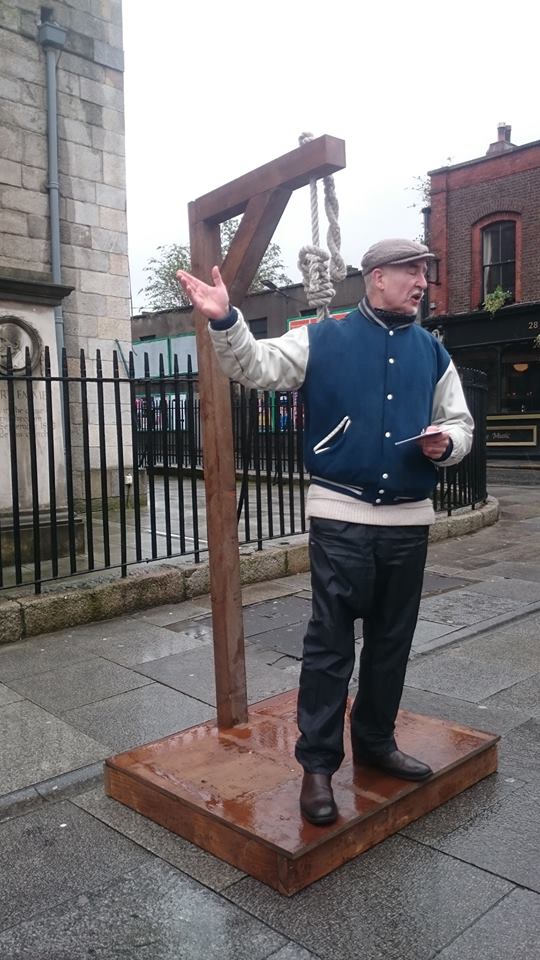
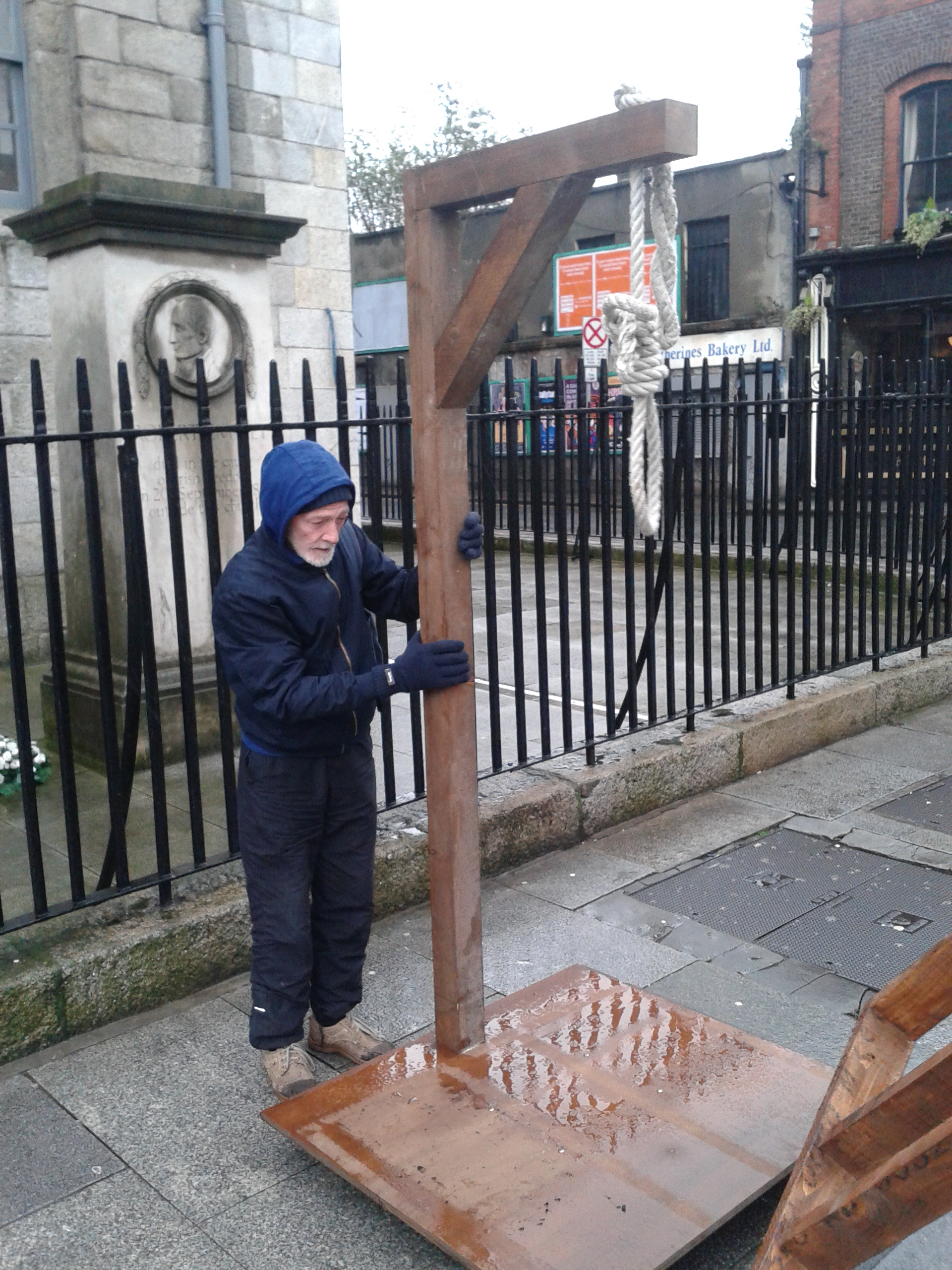
Diarmuid Breatnach outside St. Catherine’s Church, Thomas Street.
(Photo: /////)

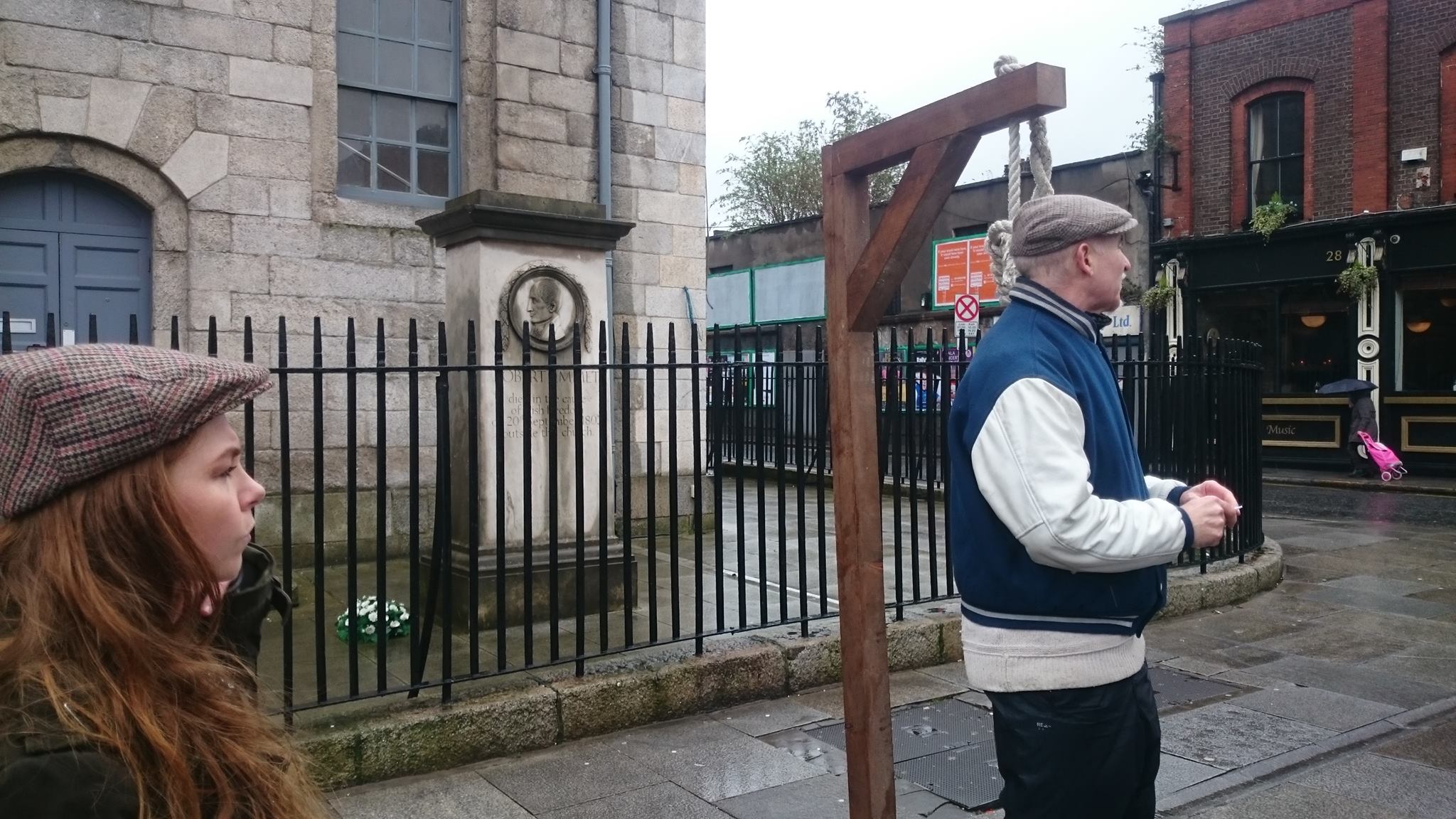
The procession stopped at the Robert Emmet plaque, in the railing wall of the former Protestant St. Catherine’s Church, approximate place of execution of Robert Emmet on 20th December 1803.

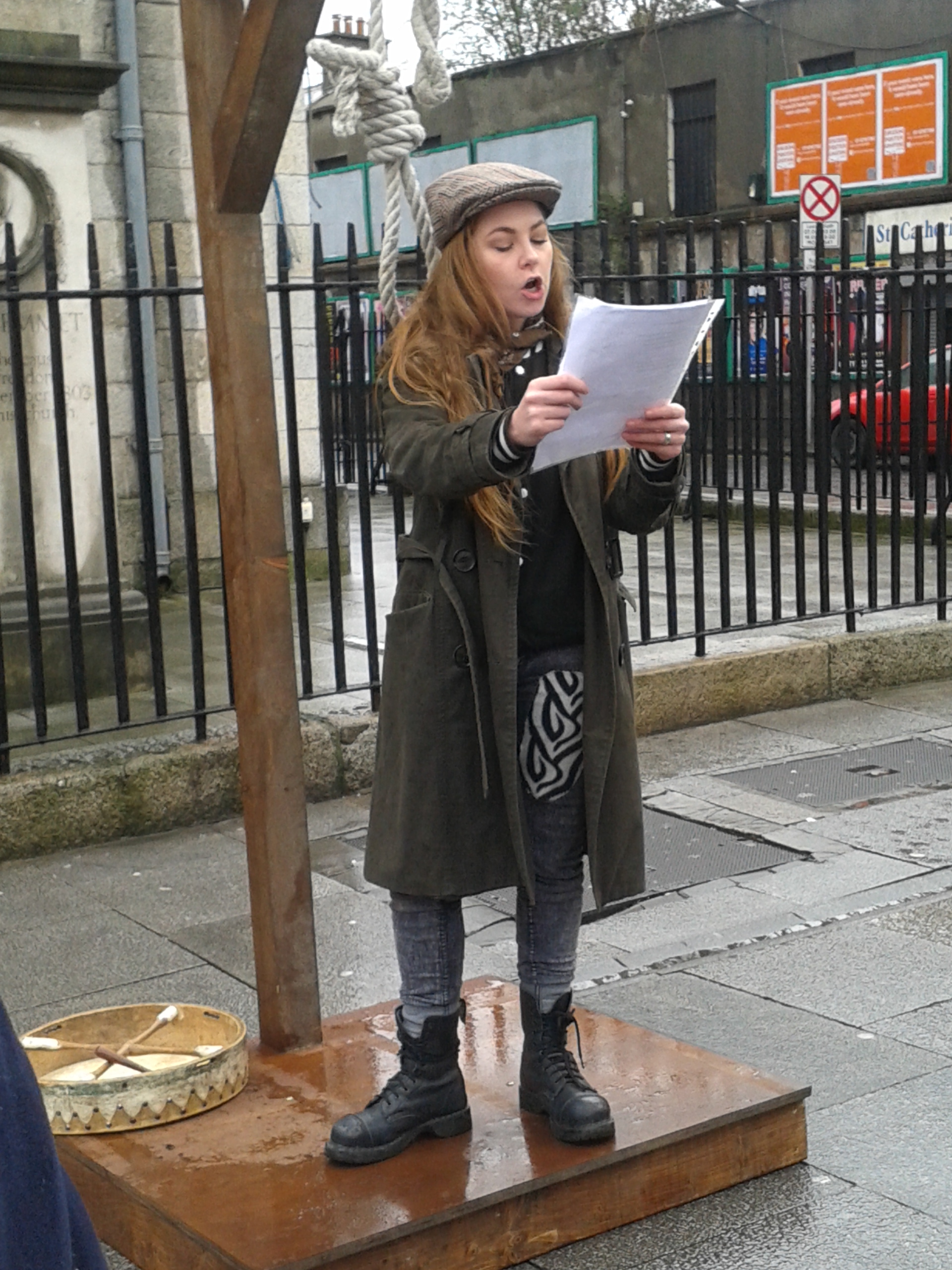
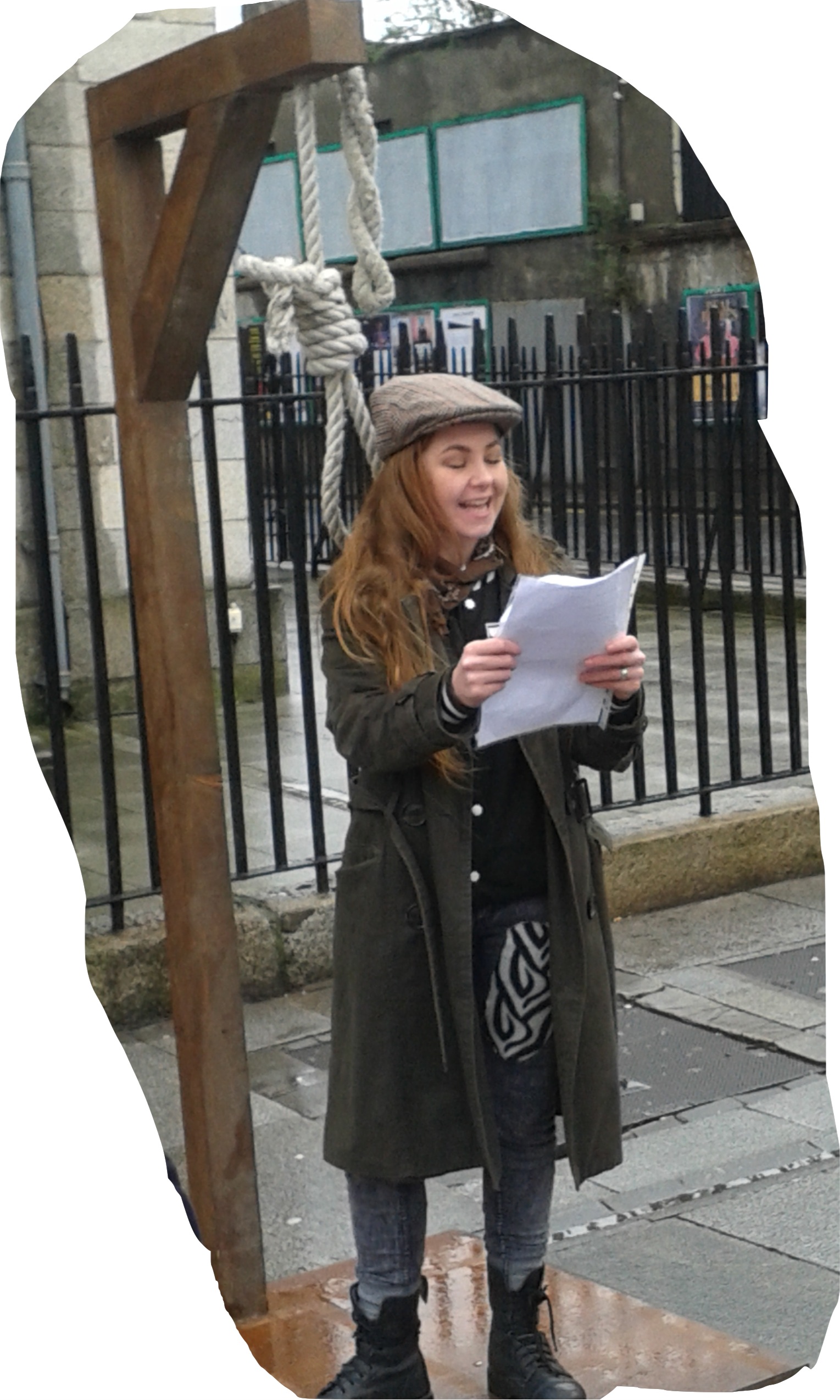
Elayne Harrington, aka Temperamental MiscElaynous performing her piece outside St. Catherine’s Church, Thomas Street.
(Photo: D.Breatnach)

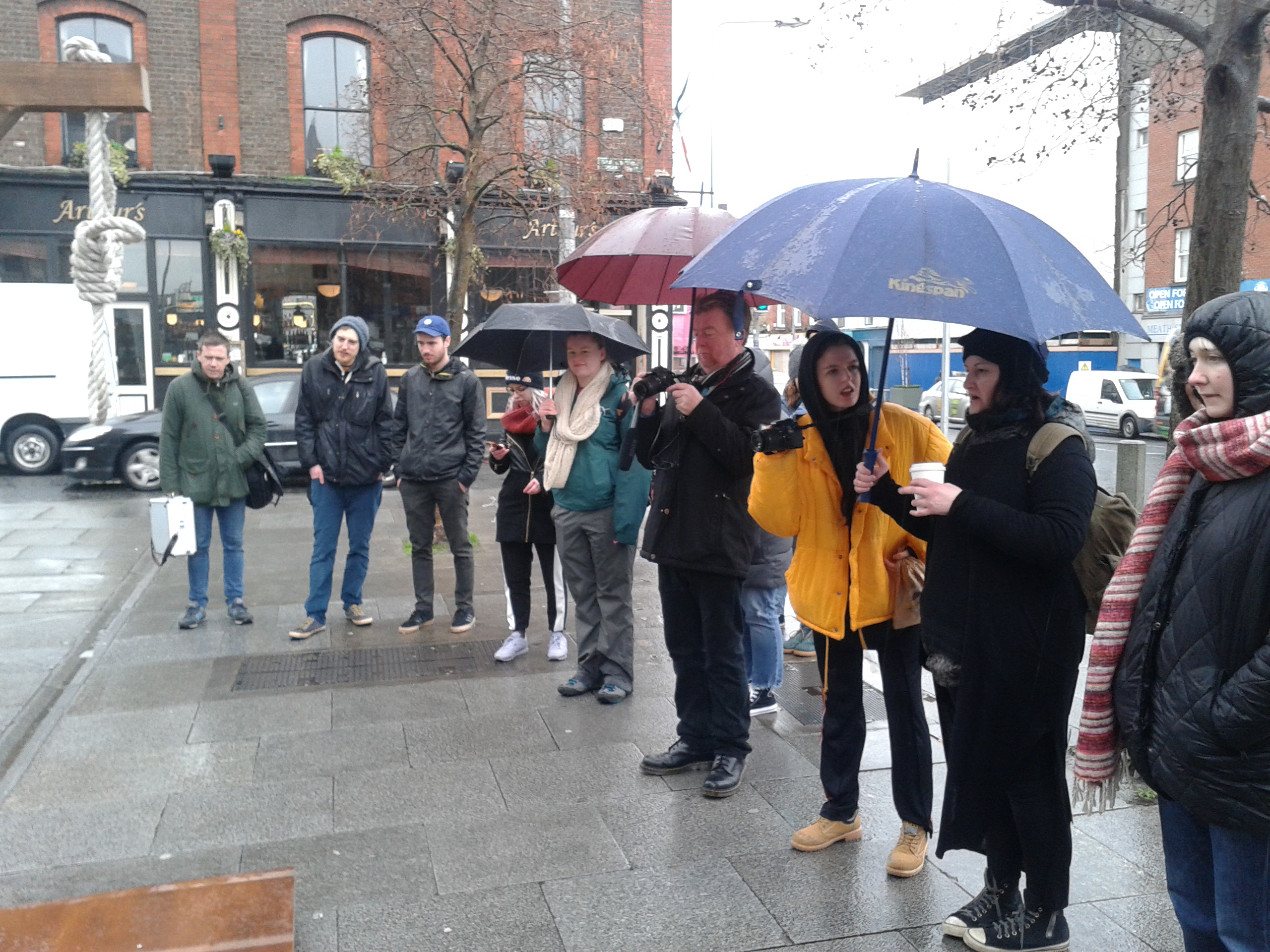
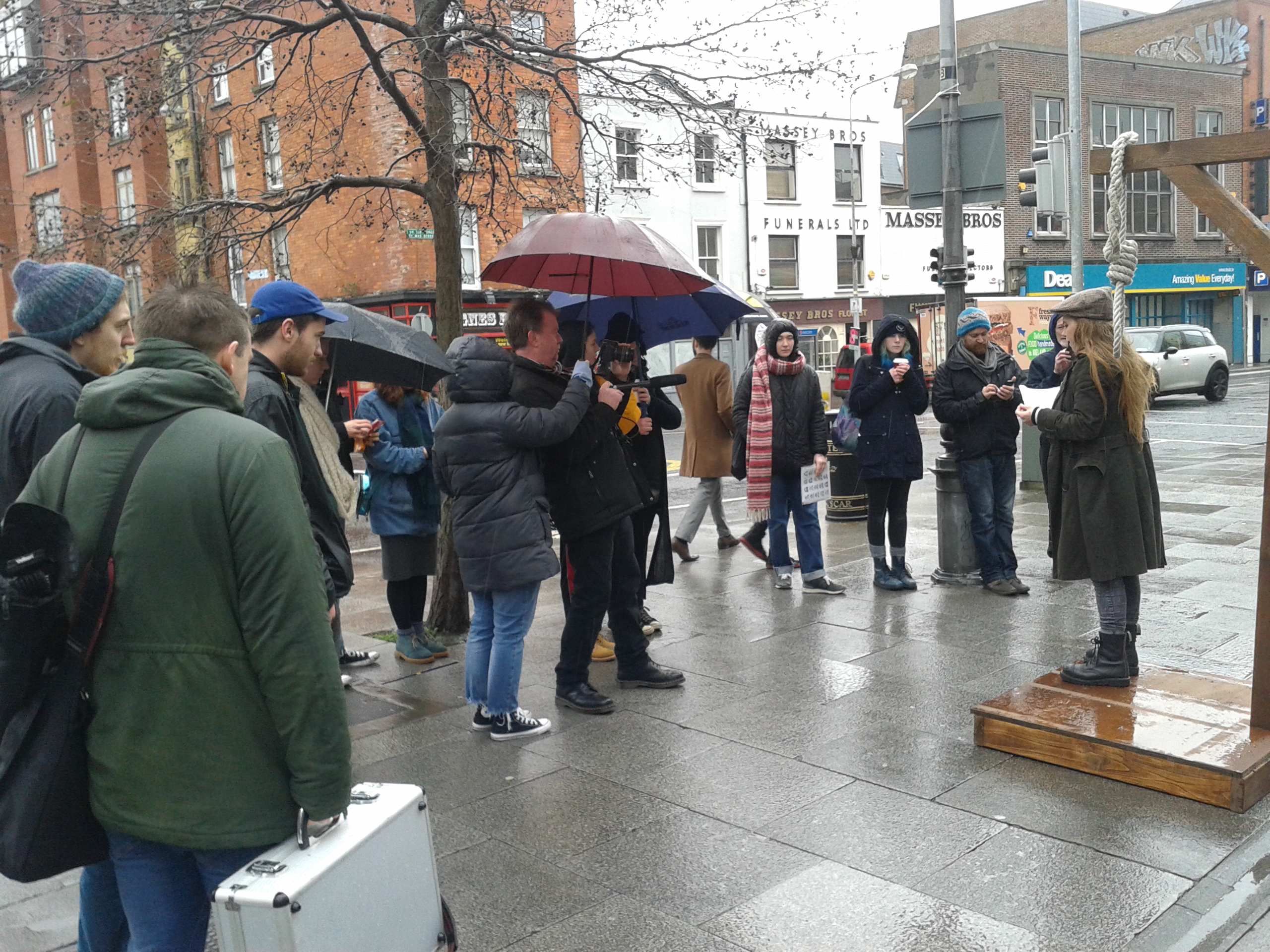
Despite continuous rain a small crowd had gathered on the pavement in front of the monument and the gallows, with a small platform less than a foot high, was placed facing them. Dublin artist Elayne Harrington, also known as the well-established street poet/ rapper artist from Finglas, Temperamental MiscElayneous, stood on the platform to announce that the event was to honour Robert Emmet and was a project as part of the Liberties Street Project, a continuation of the IPIP (In Public In Particular) program at the National College of Art and Design, Thomas Street, Dublin 8.

Harrington thanked people for attending despite the weather and, after outlining the program for the event, announced Diarmuid Breatnach, who took up position with the gallows and hanging noose just behind him.

Breatnach is best known as a co-founder of the Save Moore Street From Demolition campaign, maintaining a campaign table with a petition and leaflets on the market street for a few hours every Saturday but is also known as an acapella singer, particularly in Dublin traditional-folk circles.

Section of the crowd at the event outside St. Catherine’s Church, Thomas Street.
(Photo: D.Breatnach)

After thanking MiscElayneous for the invitation and the crowd for attendance, Breatnach proceeded to reiterate that the event was taking place very near the spot where, at the age of 25, Robert Emmet had been hung and then decapitated by the British colonial administration in 1803.

Harrington reminded him to stand on the low platform which Breatnach did, drawing a laugh from the crowd when he indicated the hanging noose and commented: “Me Ma always said I’d end up like this.”

Breatnach asked the audience to imagine the scene of the execution in 1803 and referred them to a painting of the scene available on the Internet, showing a huge crowd, with people looking out of windows in nearby buildings and mounted redcoats keeping the crowd back from the gallows. Many of in the crowd would have been supporters but the better-known would not have been there – they were in jail or in hiding.

The execution was carried out there, Breatnach said, because the whole Thomas Street and Liberties was known as a revolutionary area, which Breatnach went on to describe (see video below).

Elayne Harrington, aka Temperamental MiscElaynous performing her piece outside Stl Catherine’s Church, Thomas Street.
(Photo: D.Breatnach)

Executions, said Breatnach, have been carried out down through the ages on Irish people resisting invasion, colonialism and imperialism and fighting for social justice. The gallows have become an enduring image in Irish history and a number of songs (Breatnach mentioned ten from the 19th century up to the present) refer to it.

The state we have now, said Breatnach, set up in 1922, preferred shooting, which was the method by which it eliminated its opponents at the time, 81 of them in official executions. Hanging remained however in this state but the last execution was in 1954.

Breatnach stated that we are often taught history as a dead subject, something in the past to which we are largely unrelated but he believed history to be a living thing, in the stones of walls and streets, in the air and in the words people have left us. And in our songs.

Breatnach selected three songs that mentioned Robert Emmet: The Three Flowers, written early last Century by Norman G. Reddin (two verses); Bold Robert Emmet perhaps by Tom Maguire around 1916 but certainly published in 1934; and Anne Devlin in recent decades by Pete St. John. Breatnach sang the three songs one after the other with MiscElayneous accompanying on her bodhrán.

Diarmuid Breatnach outside St. Catherine’s Church, Thomas Street, talking about the radical revolutionary history of the area.
(Photo: ////)

During the applause which greeted the end of Breatnach’s performance, Elayne Harrington replaced him on the stage, thanked him and introduced herself as Temperamental Miscellaneous and spoke about her contribution, which was to be an extract of Emmet’s famous speech from the dock in the Green Street Courthouse, but re-worked into more modern Dublin idiom. Harrington then launched into a spirited rendition of her piece (see video below for the full performance).

No matter what words I utter, it’ll fail to change your mind and I wouldn’t have it any other way. You’ve made me a bed and I’ll lie in it. ………….

There’s plenty I could tell why my reputation should be kept clean from the utter lies and slander which’ve been lashed upon it. ……………

I wouldn’t dream that I could impress upon a court as trapped in its own self and corrupted, a fair impression of my character. …………………….

If merely dying was the case, after being deemed in the wrong and you in the right I’d take it on the chin and I wouldn’t breathe a word but that same law that not only wants to get rid of me also aims at filthying my name and sullying the memory of me. ……………..

In the hope that my memory won’t fade and that it might retain its honour among my brothers and sisters, I’ll stand up for myself and my integrity and weaken those charges against me. ……………

…. our cloths are entwined, mine and the martyred heroes of the gallows and battlefield, consecrated by sacrifice … for protection and guardianship of their homestead and their righteousness. ………..

This is what I hope: for my memory and name to serve those who live on by it being a source of empowerment …. witness the malignant malicious government that gains its false riches through sin alone, that treats a people as wolves to be domesticated and blooded to the taste of their fellows, to dance to their tune and to the death knell ……………..

Concluding the event, Harrington thanked the attendance and invited them to place small pots of growing flowers she had provided in front of the monument, which they did.

Stablising the scaffold outside St. Catherine’s Church, Thomas Street.
(Photo: D.Breatnach)

WHY THE EVENT?

What had led Elayne Harrington to choose this act as part of her course?

“I was interested in Robert Emmet and his uprising ever since I heard a Dublin tour guide dismiss Robert Emmet while briefly mentioning his uprising”, explained the rapper from Finglas.

“I came to think that although Emmet failed in his objective, he had attempted a brave and good thing and his speech was really impressive. His uprising attempt took place in the area where my college is and he was executed just down the road, so that’s how I came to think of this event.

“I’m thankful to my course tutor and fellow students for supporting me in this act and to another tutor who helped me with the construction of the gallows. I am grateful to Diarmuid Breatnach also, who has been very supportive and contributed to the performance and I was really glad that my Da was able to be here and help today too.”

Why did Harrington call this “the first of the verbal execution series”?

“I see this as an event that can be brought to other places – like the gallows I built, it is transportable” she says with a grin but then turns serious. “The performances can be adapted also to other occasions of which Irish history is full.”

We’ll be watching this space!

Elayne Harrington and section of audience outside St. Catherine’s Church, Thomas Street, looking eastward (in the direction of Dublin Castle, ten minute’s walk away).
(Photo: D.Breatnach)

VIDEO OF EVENT

(complete event outside St. Catherine’s)

https://www.youtube.com/watch?v=wJmb553yKf8


DUBLIN FIRE BRIGADE AMBULANCE PROTEST AT CITY HALL

Diarmuid Breatnach

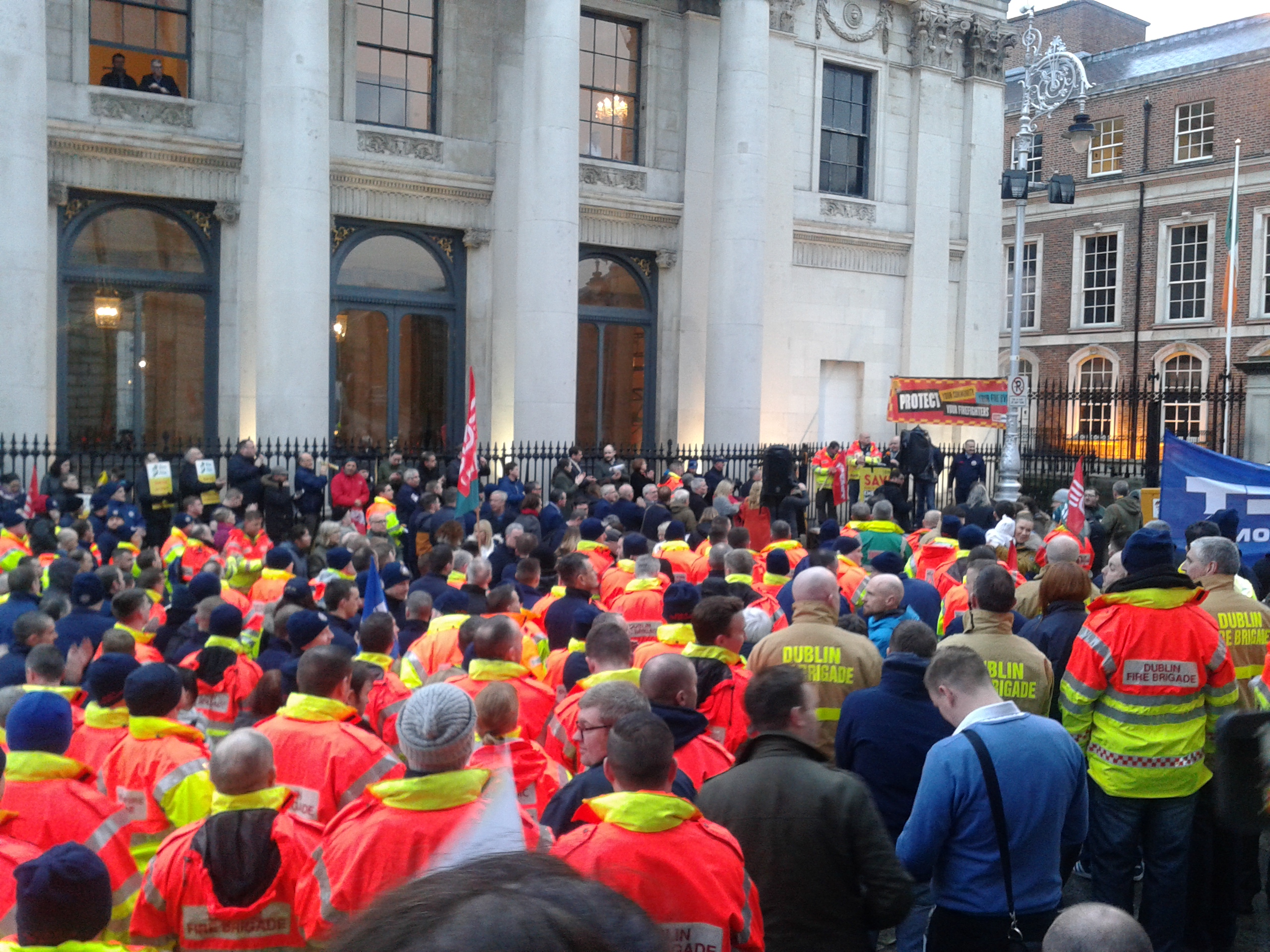
DUBLIN FIRE BRIGADE AMBULANCE SERVICE WORKERS PROTEST AT CITY HALL — hundreds of workers protest Dublin City Council Executive Officer’s plan to “outsource” their service.

Gathering to hear the speakers on Cork Hill, outside the side entrance of Dublin City Hall (left of photo).
(Photo: DBreatnach)

The monthly meeting of the elected representatives of Dublin City Council is often an occasion for protest, with placards and banners, of a number of campaigns protesting measures of the Council’s administrators or for calling on City Councillors for support ffor the campaigners’ objectives.

The March meeting of the Council on Monday night this week was no different in that respect but on this occasion, unusually, there were hundreds of protesters outside, the majority of them in uniform, filling the Cork Hill space in front of City Hall’s side entrance, up to the ceremonial entrance gates of Dublin Castle.

Several hundred thronged the area, most of them in either the dark blue of the Dublin Fire Brigade or in red-and-yellow or tan-and-yellow jackets, also bearing the legend “Dublin Fire Brigade”. Dotted among the crowd too were others in ordinary street clothes, presumably members of the public and a few with young children, probably relations to fire fighters or paramedics.

A young supporter of the fire-fighters’ struggle
(Photo: D.Breatnach)

The protest meeting was seeking the support of elected Dublin City Councillors in their dispute with the Chief Executive of the Council, Owen Keegan. The highest officer in the Council does not want the local authority responsible for funding the Dublin Fire Brigade’s ambulance service call-and-dispatch service and announced two years ago that it would be transferred from the Tara Street centre and put under the control of the HSE at their national control centre in Tallaght.

However, his plan ran into trouble not only with the fire-fighters themselves but with a large number of the elected public representatives and as a result a consultative forum was set up. Its eventual recommendations were not however what Keegan wished for, proposing instead a technological linkup between the HSE’s and the DFB ambulance services and as a result Keegan and other DCC senior management pulled out of the consultative forum in January. Brendan Kenny, second-in-command at DCC said that there was no point in continuing with the forum since it did not carry out the task it was set up to do but came up with different recommendations.


STRIKE NOTICE

View from the steps of City Hall (State Entrance gates to Dublin Castle to the extreme left of photo). (photo: D.Breatnach)

Since the intention of the City’s management was clearly to proceed with their plan, both the main trade unions affected, SIPTU and IMPACT, balloted their members for strike action and obtained an overwhelming majority in February: 93% to 7% in favour of strike action and 97% to 3% in favour of industrial action. On Monday SIPTU served strike notice on Dublin City Council management and IMPACT did likewise the following day.

The strikes are due to take place from 9am on Saturday, March 18th and Monday, March 27th.

The demonstration on Monday night was addressed by a number of speakers, including many elected Councillors. However, first to address them was SIPTU’s Brendan O’Brien who expressed regret that “SIPTU members in Dublin Fire Brigade have been forced into conducting these work stoppages” which he said was a result of his “members’ total commitment to providing the best emergency services possible to the residents of Dublin” and the intransigence of DCC management, headed by Owen Keegan.

Speaking to the press, he said that “These firefighters are withdrawing their labour to indicate, in the strongest manner open to them, their complete opposition to an attempt by senior management in Dublin City Council to break up the DFB Emergency Medical Service by removing its ambulance call and dispatch function.”

Before speakers addressed the crowd: top section of the crowd, approaching the State Entrance gates of Dublin City Castle
(photo: D.Breatnach)

Addressing the demonstration on Monday evening, O’Brien said that if the strikes were not sufficient to make DCC management see reason, “make no mistake, this fight will become a national one.”

A number of Councillors addressed the crowd, representing most of the political groupings on the Council. Christy Burke, ex-Lord Mayor (2015), representing a group of Independent councillors, stated that DCC management had refused to let them use the power in the nearby building for amplification for speakers. Burke drew cheers when he quipped that what the Management did not realise was that “the power is not in there, it is out here on the street.”

Burke also stated that the DFB Ambulance Service was working well and asked rhetorically “why fix something that isn’t broken”, a theme taken up by a number of other speakers. The Sinn Féin speaker made the point that she was representing the largest political party in the Council, totally supported the Fire Fighters and would be seeking legal advice on Keegan’s plan and the other speakers likewise promised support to the fire-fighters.


OTHER UNDERLYING ISSUES IN THE DUBLIN FIRE-BRIGADE AMBULANCE SERVICE PROTEST

Although speakers for the fire-fighters a number of times expressed support for the colleagues employed by the Health Servive Executive, their members must be concerned at the prospect of coming under the management of an organisation so under-funded and reportedly often mismanaged as has been the HSE for decades now.

Another element playing itself out here is the recurring conflict between many elected City Councillors and the unelected City Management. The political colouring of the public representation in the Council changed considerably with the local elections in 2014, when Sinn Féin with 16 seats and Independents with 12 became the groups most represented. Next in numbers of Councillors is Fianna Fáil with 9 seats, while Fine Gael and Labour each have 8 each and People Before Profit have 5. The remaining 5 are divided between the Greens, Anti-Austerity Alliance and United Left.

This struggle between many of the elected and the appointed few has broken out on a number of issues previously, most notably perhaps on the Moore Street Quarter issue, with Keegan and Jim Keoghan, formerly second-in-command and head of the Planning Department, proposing a deal with a property developer for a ‘land swap’ involving Council buildings on Moore Street, a plan which mobilised significant campaigning opposition and which was defeated by a large majority of Councillors voting in November 2014. The Councillors were however unable to prevent Keoghan’s “executive action” in agreeing a number of property speculator planning applications and the most controversial extension of the ‘giant shopping mall’ permission towards the end of last year.

This level of conflict between the elected Dublin public representatives and the appointed senior officials has perhaps not been seen since the War of Independence (1919-1921), when an Irish Republican and Labour majority on the Council, after the 1920 Local Government elections, found itself in recurring confrontation with officials appointed under a colonial administration.


BACKGROUND

According to Dublin Council’s website, “The Fire Brigade has provided the citizens of Dublin City and County with a fire and rescue service since 1862. This service was enhanced in1898 by the addition of an emergency ambulance service. In 2007 with 12 emergency ambulances DFB responded to 78,864 ambulance incidents, with the figure growing each year.

Dublin Fire Brigade provides an emergency ambulance service to the citizens and visitors of Dublin. Dublin Fire Brigade is the only Brigade in the country to provide an Emergency Ambulance Service. Dublin Fire Brigade operates 12 emergency ambulances with one ambulance operating from each full time station with the exception of Dun Laoghaire.

DFB’s Firefighters are trained to Paramedic level and are registered as practitioners with the pre-hospital Emergency Care Council (PHECC), meaning there are over 100 Paramedics available on a 24/7 basis in the event of a major emergency. All operational firefighters rotate between Fire and Rescue to Emergency Ambulance duties. Dublin Fire Brigade Ambulance Service has achieved accreditation under the ISO 9001/2000 Quality Management System.”

Lively ladies active in the Campaign for social housing Irish Glass Bottle site, Ringsend.
(photo: D.Breatnach)
Banner of campaign for social housing Irish Glass Bottle site, Ringsend.
(photo: D.Breatnach)


OTHER CITY HALL PROTESTS

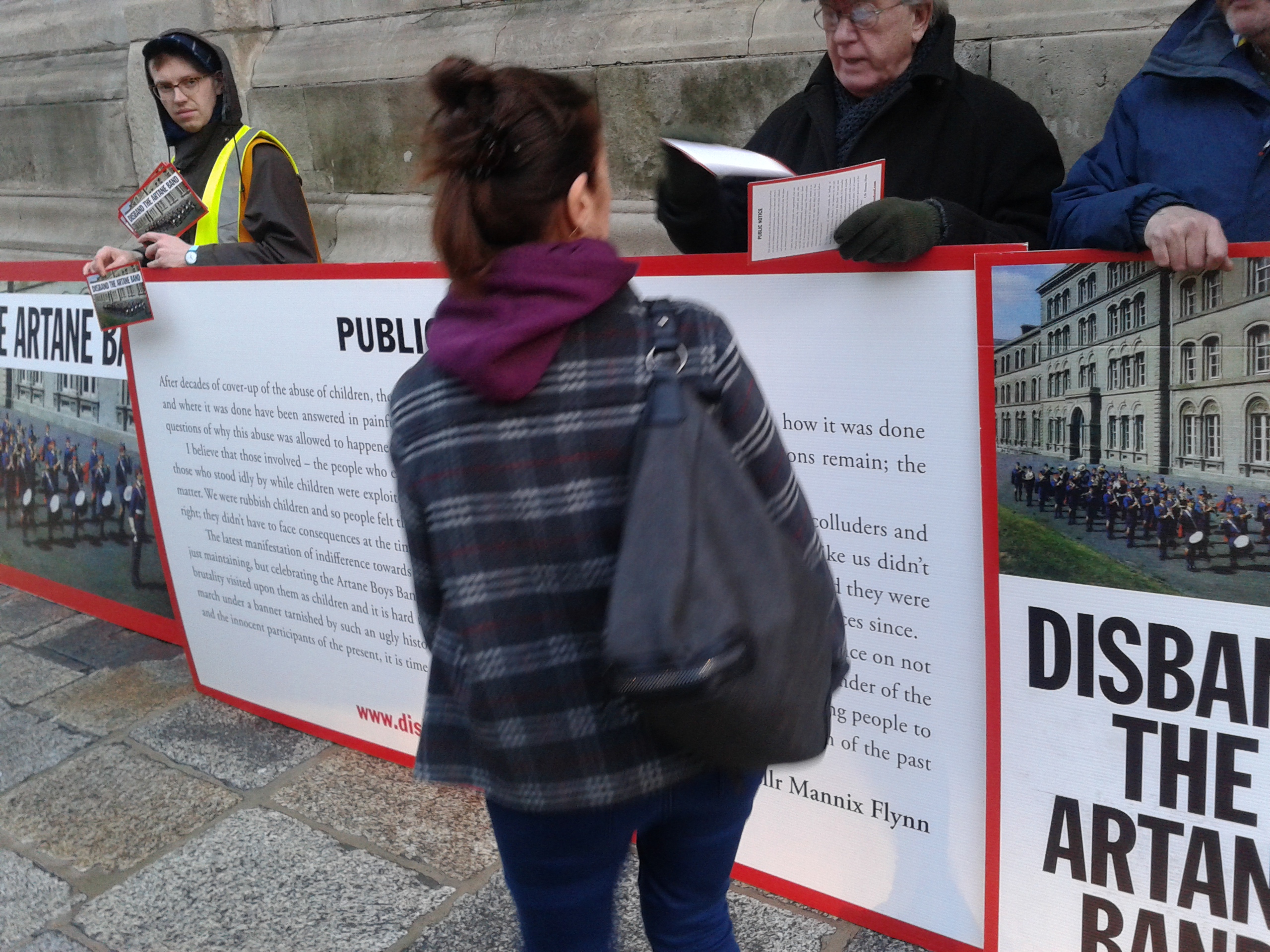
Also protesting outside City Hall (see photos) were lively and good-humoured campaigners for social housing on the former Glass Bottle company site in Ringsend and others calling for the renaming of the Artane Band (it is hoped to cover these campaigns in a little more detail in future reports).

Campaigners to rename the Artane Band because of the abuse that went on in the Artane Industrial School, which formed the original Artane Boys’ Band.
(photo: D.Breatnach)


WE WANT CHANGE?


Diarmuid Breatnach

Yes we do – or at least most of us do. There are a few who do not.

Some people think that those few who do not want change are our rulers, the big capitalists — but they are mistaken. The capitalist class forced change to overthrow the feudal system, which was hampering their growth and the development of industry and commerce. And capitalists know that change is inevitable, so it is better to go with it than to try to stop it. That is why they set up courses such as those called “Change Management” — if change is inevitable, then manage it, the thinking goes. Manage it so that it comes out to capitalist advantage, naturally.

(Source Internet, using "change management" as search words)
(Source Internet, using “change management” as search words)

Change Management courses, particularly those dealing with personnel, emphasise managing change as smoothly as possible, making it non-traumatic. In that way, it is assumed, there will be less reaction against the change, less opposition.

But in fact, sometimes capitalism wants the exact opposite – it wants change to be as traumatic as possible. These are the situations described under the title “Shock Doctrine” by economic/ environmental activist and theorist Naomi Klein (2007). This has two mechanisms: in the first, the shocking change taking place disarms people from the psychological ability to organise resistance; in the second, the speed of the shock (or shocks) of the economic and political manoeuvres of the capitalists moves faster than the opposition can organise, achieving their goals before opposition can coordinate an effective resistance.

Klein has described how huge natural disasters such as earthquake (Haiti), tsunami (Thailand, Indonesia) and flood (New Orleans, USA) are used to force foreign or native private takeovers of sectors of the national economy while the people and the regime in power are reeling under the impact of the disaster.

Political and economic disasters are also used in this model, such as the military coup in Chile and the collapse of the USSR (in the case of Poland), the economic collapse in Bolivia, the invasion of Iraq, the financial collapse of the “Tiger economies” of SE Asia. Even a potentially beneficial change of great magnitude may be used, such as the collapse of white minority rule in South Africa, during which the black majority won formal equality and citizenship but lost control of most of the economy (and lost a lot more which I do not intend to discuss here).

Internet source http://sinkers.org/stage/?p=536

There is in fact a military precursor to this which has been called, in the context of US military strategy, “Shock and Awe”. This doctrine was described by its authors, Harlan K. Ullman and James P. Wade (1996), as “attempting to impose this overwhelming level of Shock and Awe against an adversary on an immediate or sufficiently timely basis to paralyze its will to carry on … [to] seize control of the environment and paralyze or so overload an adversary’s perceptions and understanding of events that the enemy would be incapable of resistance at the tactical and strategic levels”.

Of course there were many elements of this in the Blitzkrieg of the Nazi German army in its invasions of other countries and even the medieval invasions by the Huns and of the Mongols. Cromwell employed elements of it in Ireland in his army’s massacres at Wexford and Drogheda.

Aside from needing change to overcome feudalism, managing change to its advantage and use of shock doctrine to facilitate changes it wants, the capitalist system itself promotes change as part of its system. Small capitalists combine and form conglomerates, in which big capitalists come to power and, in turn, eat up smaller capitalists in order to dominate their sphere of economic activity. We have seen the growth of supermarkets and the decline of small shops, the rise of chain stores killing independent clothes shops, chain cafes and eateries driving indpendent cafes and restaurants out of business.

Capitalists also promote inventions and discoveries so as to increase their wealth but also in order to stay in front of the competition – a capitalist concern that stays at its original level will be taken over or driven out of business by its competitors. Our grandparents hardly knew about the possibility of mobile phones and computers, let alone small hand-held audio-visual connections to the Internet; our children today play with visual electronic games, films and music before they learn to talk. To be sure, monopolies also suppress inventions but they can only do so to an extent as some capitalist somewhere will break the embargo or consensus (if the discovery can be used to make sufficient profits making the attempt worth the risk).

OK, but we want change too and, we think, what we want is not the capitalist kind of change we’ve been talking about until now, although innovations and discoveries should continue and in fact accelerate – but for the benefit of the people, not the capitalists. Technological advances and innovations that do not make big profits may nevertheless be very valuable to us for all kinds of reasons.

So, yes, we want change. But what kind of change? Change to what? Change how? There a vast panorama opens.

We want to eliminate homelessness; have an efficient universally affordable health service; not to have to struggle for a decent standard of living in food, housing and small luxuries; to enjoy universal and affordable access to education at all levels; not to harm the environment; to have the positive aspects of our cultural inheritance, including history, valued and promoted. We want equal rights and respect between people regardless of race or ethnicity, gender, sexuality, ability … and freedom of choice.

In 1930s Germany, people wanted those things too, except that a lot of people were convinced that the contents of the last sentence above were harmful and not what they wanted. But there were many, many people who did want those contents too. The issue was in doubt for awhile.

In the 1928 elections the Nazi Party achieved just 12 seats (2.6% of the vote) in the Reichstag (German Parliament) and in three areas the Nazi Party failed to gain even 1% of the vote. In the Presidential elections of March 1929, the Nazi candidate Erich Ludendorff gained only 1.1% of votes cast, and was the only candidate to poll fewer than a million votes.

We know that elections are not everything – but still.

Five years later, the Nazis were in power — but even after the Communist Party was declared illegal their candidates polled a million votes.

The people definitely wanted change and the established ‘democratic’ parties were unable or unwilling to deliver it. The change the people ended up with was not probably what most had imagined and for some time it spelt disaster for Germany – and unbelievable suffering for large parts of the rest of the world … and also for millions of German citizens.

To look closer to home, people wanted change here too and from 1917 onwards they showed that electorally by voting for the newly-reorganised Sinn Féin party. From 1919 a significant section of the populace took to arms to pursue change and had the active or tacit support of a huge part of the population. But in 1921 the movement and the people split about what kind of change they wanted. A civil war followed with a heavy level of brutality against civilians and combatants, particularly by the State side, which won the contest — and we ended up with the State we now have.

Bombardment of Republican-held Four Courts in Dublin by Free State forces from the bottom of Winetavern Street (with British artillery on loan) starts the Civil War on 28 June 1922 (Source Internet)
Bombardment of Republican-held Four Courts in Dublin by Free State forces from the bottom of Winetavern Street (with British artillery on loan) starts the Civil War on 28 June 1922 (Source image: Internet)

It is well to be fairly clear about the change we want and what we do not want. There was no such general clarity in the ranks of those fighting for change from 1916 to 1921. It turned out that many who were fighting for change were fighting for different things.

Differences must have come up over the years of struggle and we know from some evidence that they did. We also must assume from the political nature of prominent people in the struggle that there were differences. Even within the IRB itself, only one of the organisations involved, there were differences that surfaced in attitude to the 1913 Lockout, the control of the Volunteers in 1914 and the Treaty of 1922.

Of course, we need maximum unity against the principal enemy. But that is unity in action only. If we put unity in thought, principles or political or social program first, as some organisations have and some others claim to do, we end up with small organisations unable to effectively counter the resistance of the ruling class to the change we want and, in the end, unable to overcome that resistance. On the other hand, if we sacrifice everything to unity against the enemy, we leave ourselves hostages to events in the future and to what kind of society will emerge from the struggle.

Somewhere between those two is where we need to be, preserving the freedom to discuss, explore and proclaim differences of opinion and social program, while avoiding unnecessary squabbles and maintaining unity in action. It is a difficult balance to strike but it needs to be done. In the midst of fighting the common enemy and striving for unity in action against it, we must fight for that freedom also inside the resistance movement, the freedom to discuss, explore and yes, also to criticise.

End.

ANTI-INTERNMENT CONVOY AND MARCH HARASSED BY IRISH POLITICAL POLICE


Clive Sulish


A convoy of cars set off from the Six Counties to Dublin on Saturday morning, arriving in Dublin that afternoon to join in a short march through the city centre, to highlight the ongoing internment of Irish Republican activists.  The event was organised by two organisations independent of political parties or organisations: Duleek Independent Republicans and Anti-Internment Group of Ireland.

Convoy passing through Dundalk (photo from )
Convoy passing through Dundalk (photo: S. Lynch )

The convoy set out on Saturday morning at 11am am from Newry and passed in turn through the towns of Dundalk, Drogheda, Julianstown and Whitehall to conclude at the Garden of Remembrance in Dublin city centre. Unusually for such events, the convoy received no harassment in the Six Counties from the RUC/ PSNI – that work was left to their counterparts in the Twenty-Six Counties.

Supporters of the Dublin march began to gather at the Garden of Rembrance around 1.15pm and from then on every arrival was stopped by Irish Special Branch asking them their names and addresses. Some refused to give them.

The political police also asked for the driving licences of three of the convoy cars that arrived at the Garden of Rembrance (others had parked elsewhere in the city).

Garda Special Branch harassing convoy arrivals near Garden of Remembrance (photo D.Breatnach)

All of this harassment was exceeding the legal powers of the Gardaí and some of those they targeted told them so and refused to cooperate with them.

The march set off from its mustering point and proceeded down Dublin’s main street, O’Connell Street, passed by the Larkin Monument and the location of Bloody Sunday 1913, on to pass the O’Connell Monument (which still bears bullet holes from the 1916 Rising and possibly from the Civil War also) and across O’Connell Bridge.

Then D’Olier Street going south, turning right at the wall of Trinity College then right again at the Bank of Ireland building (until 1800 the Irish Parliament, from which Catholics and Presbyterians were barred).

The march turned right again into Westmoreland Street and headed back across the bridge to the GPO, along the same route as so many British artillery shells and rifle and machine gun bullets had poured one hundred years ago.

The march attracted considerable attention from people along its short route with many audible exclamations about internment still being in existence in Ireland.

Duleek Independent Republicans in O'Connell Street with their new banner (photo: T..Conlon)
Duleek Independent Republicans in O’Connell Street with their new banner (photo: S. Lynch )

SPEAKERS AT THE GPO

At the GPO building (the Headquarters of the Rising in 1916) the marchers gathered around to hear speakers. Diarmuid Breatnach from the Anti-Internment Group of Ireland greeted the marchers and other listeners briefly in Irish and then went on in English to note that internment without trial, which people believed had ended decades ago, continues still being used against Republican activists.

Breatnach recalled that one Republican had been sent to jail without trial for four years in the Six Counties. Another Republican activist had spent two years in jail on remand only to have the case against him collapse and he had been set free – however, having spent two years in jail already. Breatnach then introduced Cait Trainor, an Independent Republican.

Cait Trainor speaking at rally at GPO (Photo: T. Conlon)

Speaking in a strong carrying voice, Trainor pointed out that the Good Friday Agreement had not brought an end to political prisoners in Ireland and that among the crowd there that day there were “family members of Irish political prisoners and indeed some who have been prisoners themselves in the not-so-distant past.”

Trainor pointed out that different forms of internment have emerged over the years, including internment by remand, where activists are held in jail for long periods of time before coming to trial or sometimes the charges are dropped before they even get a chance to have their say in court but “in the meantime the person could have done the equivalent of a five-year sentence”. Moving on to another type of internment, that reserved for prisoners released “under licence”, Trainor mentioned that for example Martin Corey, Marion Price and currently Tony Taylor do not get to trial nor to see the reason they are being put in prison, it being a secret which will only be heard in a court hearing also held in secret.

“Every man was a right to know his accuser and to know at least what he is accused of,” Trainor pointed out.

Front of the march in O'Connell Street (photo: S. Lynch
Front of the march in O’Connell Street (Photo: T.Conlon)

Speaking to those who believe that there are no political prisoners in Ireland, Trainor asked how they explain “the scores of men currently in Roe House and Maghaberry Gaol”? Trainor stated that “while there has been British occupation of Ireland there has always been resistance to it, that did not end with the Good Friday Agreement.”

“The Freestate Government is no better,” stated Trainor and referred to the case of Dónal Ó Coisdealbha remanded in custody since May 2015 and convicted, not on anything he has done but on what he has said in conversation. To that has been added “the usual trumped-up charge of membership of an illegal organisation” and the state broadcaster RTÉ added the fabrication that he was in court on explosives charges.

At the GPO (Photo: D.Breatnach)
At the GPO
(Photo: D.Breatnach)

Referring to special legislation in the 26 Counties by which the word of a Garda Superintendent is sufficient to secure a conviction on a charge of membership of an illegal organisation, Trainor highlighted the cases of five men from Sligo and three from Dublin so charged and reminded her listeners that these Gardaí are part of a force “rotten with corruption as Garda whistle-blowers will attest to.”

Trainor pointed out that December is traditionally prisoners’-focus month for Republicans and called for unity around the issue of prisoners, stating that in the future it will be only through the ridding Ireland of British occupation that there will be no political prisoners.

At the GPO (Photo: D.Breatnach)
At the GPO
(Photo: D.Breatnach)

After the applause had died down, Breatnach referred to the special powers of the Offences Against the State Act in the Irish state and reminded listeners that a few days previously had been the day on which in 1972, British agents had exploded two bombs in Dublin City Centre in order to help the state push through the amendment to that legislation. Two years later they had exploded another two bombs in Dublin and one in Monaghan, killing more people in one day than any other explosion during the conflict. Yet little is said about those explosions, because they were not caused by Republicans.

Breatnach referred also to another point made by Trainor, saying that the Irish state is also becoming increasingly repressive and using its courts against people resisting the water tax and evictions. But those victims of the State appear not to see themselves as sharing the fate of Irish Republicans. “If we do not stand together we will fall,” said Breatnach, “but if we unite against repression we can defeat it.” In that context Breatnach regretted that “Irish socialists are not yet marching with us against internment.”

Breatnach then introduced Dave Hopkins, of the Irish Republican Socialist Party.

hopkins-photo-for-cropping
David Hopkins, who spoke at the rally on behalf of IRSP ( Cropped from photo by: T.Conlon)

Hopkins addressed some of the points that had earlier been made by Cait Trainor and stated that “even being in the company of a known dissenting voice could be deemed reason enough to charge a person with ‘membership’ now in this failed statelet.”

Turning to the Six Counties, Hopkins attacked the “stop and search tactics” being used by the PSNI (“the unreformed RUC”) to harass activists.

As Trainor had earlier, Hopkins also referred to the wrongful conviction of John Paul Wooton and Brendan McConville (the Craigavon Two) and to previous cases of wrongful conviction such as the Birmingham Six, the Maguire Seven and the Guildford Four and pointed out that it had taken decades for these to clear their names.

Hopkins went on to discuss further repressive legislation which will “ensure further abuses of power and lead to more and more people becoming victims of injustice.” Hopkins referred to the “Investigatory Powers Act 2016” introduced by the Westminster Government which gives intelligence agencies …. the powers to track, monitor and use in evidence web browsing and internet use against all kinds of individuals.”

“What London does, Dublin will surely follow,” said Hopkins.

At the rally GPO (Photo: T.Conlon)
At the rally GPO
(Photo: T.Conlon)

Following the applause at the end of Hopkins’ speech, Breatnach thanked both speakers on behalf of the Anti-Internment Group of Ireland and Duleek Independent Republicans, also pointing out that both organisations are independent of any political party or organisation, thanked all who had come to support the event, also the speakers and wished them all a “Slán abhaile.”

End

Irony intrudes (photo: T. Conlon)
Family of supporters leaving Garden of Remembrance ad tail end of march
Family of supporters leaving Garden of Remembrance ad tail end of march (Photo: T. Conlon)
A bunch of them
A bunch of an Craoibhín Slíbhín
Special Branch harassment at work (but don't like being photographed)
Special Branch harassment at work (but don’t like being photographed)

UNITY – IS IT A GOOD THING?

Diarmuid Breatnach

One often hears it said that we need more unity, that “unity is strength” and on the other side the despairing wail (and sometimes facile sneer) that “the Left (or Republicans) are too disunited to do anything”. But rarely does one see the question analysed. Unity with whom? On what basis? For how long? Can unity actually contribute to weakness instead of strength?

I have five siblings and at times we quarreled among ourselves, especially the older ones. I remember my mother telling me about a father (or it might have been a mother), who asked his five sons (who presumably also quarreled) to bring him ten sticks as long as their hands and as thick as their thumbs. Of they went, probably quarreling about where would be the best place to get them, who should be in charge, what kind of wood etc……. But eventually, they arrived and produced the ten sticks.

The father handed one stick to each son and then asked them to snap it in two. Puzzled, each one tried and, of course, succeeded easily. Then the father picked up the remaining five sticks and tied them together in a bundle. He handed the bundle over to his youngest son and asked him to snap the bundle in two. The youngest son tried until sweat broke out on his brow but was unable to break them.

Hand the bundle over to your brother,” said the father, indicating the next youngest of the brothers. The son shamefacedly handed over the bundle. But he cheered up when he saw that brother couldn’t break it either. And so it went, the bundle passing up the line until it came to the eldest and though he sweated and strained, he also failed.

Do you see,” asked the father, “how easy it was to break any one of you on your own? And how impossible when you were all together?”

My mother had adapted an old European story attributed to a Greek slave called Aesop in the 4th or 5th century BCE but we didn’t know that then. As we grew older the story seemed to reflect a truism, one that had been incorporated into movements of resistance including defensive ones such as trade unions.1

The bundle of sticks motif on advertisement by union banner artists, with the motto “Unity Is Strength” (Source: Internet)

But of course, we also saw movements and organisations grow and split. I witnessed a lot of such activity (and participated in some of it) while working in London and some of my siblings passed through Sinn Féin, Official Sinn Féin and the IRSP and another passed through Sinn Féin and Provisional Sinn Féin (as did my father before he left that and joined Republican Sinn Féin).

And always the wailing cry all around – if only we were all united! The call for unity seems so intuitive, so basic that one rarely gets to hear any of the harmful effects of unity. But is that because there are no harmful effects? On the contrary!

IRELAND AND CHINA

The nationalist Irish Volunteers organisation was formed in 1913, ostensibly in response to the formation of the Ulster Volunteers the previous year with a declared aim of preventing Home Rule (a kind of national autonomy similar to that of the Dominion territories then) which had been promised to the nationalists (broadly-speaking, the vast majority of the Irish population). The Irish Republican Brotherhood, the moving force behind the foundation of the Irish Volunteers, had plans to use it in insurrection against Britain.

The nationalist Irish Parliamentary Party, the preferred conservative, constitutionalist and even pro-Empire party of the Catholic Irish bourgeoisie, at first ignored the movement. But when it grew to 100,000 members amid enormous enthusiasm, the IPP became worried it might oppose them politically and John Redmond, the party leader, demanded an additional 25 places for nominees of theirs on the Volunteers’ 25-member executive, even though it already contained some supporters of theirs. The IRB, who despised Redmond as a collaborator with British rule, held a meeting among themselves and agreed to vote against accepting that pressure. Most of them did vote against but some changed their mind and, along with some non-IRB nationalists on the executive voted in favour, so that the Redmonites were admitted on to the organisation’s controlling body.

At that time, the IPP was the largest Irish nationalist party and no other party came even close in winning the votes of Catholic men eligible to vote. It is easy to see what the majority on the executive must’ve thought when they voted to accept them: “We’ll be stronger after this, more united; the Catholic Church and the Catholic media will be friendly towards us and encourage even more recruitment. Britain will have to give us Home Rule and we can have an argument later about what kind of politics we want for Ireland when we have our own Dáil” (Parliament). On the other hand, they might have thought that unity with Redmond and his IPP would be far better than being opposed by them.

IRB men Thomas Clarke and Seán Mac Diarmada and others were furious – they foresaw a time in the future when Redmond and his IPP would use their positions, along with allies they had made on the Executive, to try to sabotage the project of Irish independence, upon which the IRB had set its mind and heart. Such an event came to pass after the outbreak of the First World War when John Redmond made his speech on 20th September 1914, on the occasion of reviewing a Volunteer troop at Woodenbridge, Co. Wicklow, encouraging the Volunteers to enlist in the British Army.

That call, and the resistance to it from within the movement and its executive body, led to a split which reduced the Irish Volunteers from the 170,000 membership which it had reached to a force of 12,300, the majority siding with Redmond and many going on to the war slaughter on the Continent.

The IRB continued to organise in secret among the remaining Volunteers but a number of the Volunteers’ founding executive had always been non-IRB, such as Eoin Mac Neill and The O’Rahilly, and that continued to be the case. When they learned at the last moment that the IRB nucleus planned to proceed with an uprising on Easter Sunday 1916 and calling out the Volunteers to join, Eoin Mac Neill and The O’Rahilly2 did everything they could to halt it. They succeeded only in sabotaging it sufficiently that only about on third of the Volunteers mobilised, and they mostly in Dublin, on Easter Monday instead.

The above lines in these examples are not typed to suggest that thousands of Irish would not have gone to join the British Army in 1914 or even that the whole of the Irish Volunteers would have taken part in the Rising were it not for a) Redmond’s split and b) the cancellation by Mac Neill. I reproduce them only to show that unity can have harmful effects too.

After the 1916 Rising, the survivors of Cumann na mBan, Irish Volunteers, Fianna Éireann and some from the Irish Citizen Army reformed their military organisation which in time came to be called the Irish Republican Army and fought the War of Independence from 1919-1921 against the British. The IRA and the party that had grown around them, Sinn Féin, was also a coalition of people of different ideologies and, when the British offered a partial compromise of a partitioned Dominion status “independence”, the movement split again, out of which emerged the State and its vicious Civil War, with the execution of 83 Republicans by the new State and many unofficial murders carried out by its security forces.

L-R: Chiang Kai Shek, Mao Zedong, photographed in 1945 during short-lived repetition of Chinese Nationalist-Communist alliance against Japanese invasion (photo: Jack Wilkes, Internet)

Let us go a bit further in geography though not so far in time to the unity between the Communist Party of China and the Kuomintang of Chiang Kai Check, a national bourgeois party, against feudal warlords and the plunder of their country by foreign imperialists. The First United Front, also known as the KMT–CPC Alliance, was formed in 1923. Together, they formed the National Revolutionary Army and set out in 1926 on the Northern Expedition. The alliance fell apart due to factors and incidents we need not go into but the result was an anti-communist purge of Communists and the Shanghai massacre of 1927, in which between 300 and 400 were purged and 5,000 communist and trade union militants disappeared. It took the Communist Party two decades to recover their strength and begin to build their influence.

Again, recounting this history is not necessarily in order to prove that the Communists were wrong in their attempt at unity but merely to show the disastrous effect of the way in which events turned out for them and how vulnerable they were because of that unity at that time. In the 1940s, on the other hand, another unity worked out better for the Communist-led patriotic forces, though Chiang Kai Shek had to be forced into that alliance.

THE PEOPLE, UNITED, CAN NEVER BE …”

In Chile in the early 1970s, a left-wing democratic anti-imperialist movement grew. It had many different components: nationalistic and/ or social democratic petit-bourgeoisie; revolutionary communists; revolutionary socialists of other types; masses of supporters of unclear ideology but focused on social justice and opportunity to make more of their lives and the lives of their children. Its party was the Popular Unity party and the leader of this coalition was Salvador Allende, essentially a social-democrat, who was elected President.

The United States ruling class, the major imperialist power in the area, not only seriously disliked many of the policies of the new Chilean regime but also feared that the ideas might catch on in other parts of the world or, even worse, that people outside Chile in Latin America would gain hope and confidence from what was going on in Chile and attempt the same in their own countries. The problem was that the Chilean people had voted by majority for the Allende option. Well, not so much of a problem for the USA – they had disposed of democratically-elected governments in the under-developed world before. Obviously a coup was what was needed – and the CIA began to work for one.

The CIA or even 50 CIAs cannot overthrow a government – to do so they need an army of some sort. It might be by US military invasion, as they did in Nicaragua in 1912, Haiti in 1915, or Dominican Republic in 1916. Or it might be by invasion of a neighbouring region, as they did by supporting and instigating the invasion of Guatemala from Honduras in 1954 or of Iran by Iraq in 1980. The Iraq-Iran war lasted eight years but the Iranian government did not fall and Iraq was defeated. Or it might be by a “rebel” army, such as the infamous Bay of Pigs US-funded invasion of Cuba in 1961 or the Contras, funded and trained by the USA, against the Sandinista Nicaraguan Government from 1979 to the early 1990s. Or it might be the army of the very State they want to subvert — and so it was in Chile in 1973.

Now, how was it that Allende didn’t see that coming? Was he stupid? Far from it – Allende knew the history of the USA in Latin America and he knew that the commanders of Chile’s Army, Navy, Air Force and Police, and most if not all of the higher ranks of the three services too, were right-wing in ideology, some downright fascist in outlook.

Allende’s options were to try and deal with the senior military ranks and hope they would remain loyal, or to dismiss them and appoint others more trustworthy, from lower ranks. But dismissing them might precipitate the very thing he was trying to avoid – a right-wing military coup. However, that threat could be met by arming the workers.

On the other hand, arming the workers might provoke the military and police.

Both options were risky. To a revolutionary, I would think, relying on the loyalty of the military was the riskiest while the second, much less so. But Allende was a social-democrat, not a revolutionary. He chose to hope that the military would not revolt and when the coup came, it was not just he who paid with his life but thousands of his followers and others on the Left. They didn’t have enough arms with which to resist for long and arrest, torture and death awaited them. The toll of the coup was over 3,000 dead or missing, thousands of prisoners tortured, and 200,000 Chileans forced into exile.

Poster bearing the alternative slogan, sourced on Internet.
It was produced by the Ad Hoc Committee to Establish Solidarity With Resistance in Chile, on the occasion of the Speaking and Fund Raising Tour Across Canada by a Representative of the People’s Front of Chile.

Before the coup, a slogan that had become popular in Allende’s Chile declared: “El pueblo, unido, jamás sera vencido”. It has been changed by socialists abroad to “The workers, united, will never be defeated”, as though saying “workers” instead of “people” made the slogan more revolutionary. But a large swathe of the people in Chile were united, and even more united were the workers — they had marched and voted for the Allende option and were eagerly awaiting the benefits of a different regime. And still they were defeated – by a much smaller but much better armed and much more ruthless enemy.

A different slogan came into being after the coup (and perhaps it had been around earlier too but got drowned out by the other): “El pueblo, armado, jamás sera aplastado” (the armed people will never be crushed). People may argue that is simplistic and they may be right – but it contains a lot more truth and sophistication than the slogan it replaced.

IRELAND TODAY

We are constantly being urged today in Ireland towards “unity of the Left” and “unity of Irish Republicans” and, before we nod our heads in reflex action and shake them in despair, it would be worthwhile to look at this proposition a little more closely.

Firstly, what is the unity for? As a minimum it can only be, if we are to consider it a serious proposition, to strengthen our resistance and to defeat austerity measures and state repression.

Then, who are we to unite with? “The Left” means different things to different people and that too needs some exploring. For example, is the Labour Party to be included? Some would say “yes”, including many trade union leaders and activists.

Yet the Labour Party is part of a Government that is heaping austerity upon working people and of a State that is using its police, courts and jails to repress resistance. How can we unite with that? And if the Party is not the same as its members in the Government, why doesn’t the Party denounce and disown those Ministers? No, this cannot be – we cannot have unity with those who work with our enemies.

Others would include Sinn Féin in the list of groups with which we should join for “unity of the Left”. But in what way can Sinn Féin be seriously considered to be part of the Left? In the Six Counties, it is part of a Government of a colonial state and has imposed austerity on the working people there. It has also colluded in State repression of Republicans. SF is mounting no serious opposition to any austerity measure either side of the Border although it often makes the appropriate noises. It does not support the necessary and appropriate action of civil disobedience, never mind organise it. Its mantra is “Vote for us and we’ll see everything is made ok”. That is not a suitable partner in any “unity of the Left”.

Excluding Sinn Féin and the Labour Party removes the largest party and the most TDs from the proposed “united Left” and that is one reason some do not wish to exclude them. However it would be dangerously stupid to try to build unity with these and, even if temporarily successful in some imagined scenario of the future, both elements would desert and even betray us at a crucial moment when we would be preparing a campaign of serious disobedience, to say nothing of revolution.

PRINCIPLES AND TACTICS OF UNITY

Who does that leave? Well, tiny parties and even smaller groups of independent TDs and local authority Councillors, a wide variety of independent activists and a number of campaigns of varying size. Well, better small than rotten at the core, right? And there are millions of others out there yet for us to draw support from in future!

But having unity across that broad mass of individuals and organisations? How? Shall we draw up a constitution and get everyone to agree? They never will and we’ll waste valuable time on the project. Is it all hopeless then?

Not at all. What we need is agreement upon a few fundamentals – the bare necessities, as in the title of Terry Gilkison’s lyrics in the 1967 Disney film “Jungle Book”. Let’s imagine we have come together to discuss cultivating a field. We dropped the Labour Party from our work force because they had been sowing fields with weedkiller. We dropped Sinn Féin because they had sowed a part of the field with weedkiller and were arguing that we didn’t need to clear stones and weeds or dig in the rest of it.

That’s not to say that we won’t have any problems with any of those left but let’s see, eh?

So all the remainder agree that the field needs cultivating, that stones and weeds need removing and digging needs doing. There might be some who don’t (or won’t) agree on what crops to sow and when but at the moment we have the maximum unity, admittedly on paper, for the minimum tasks required.

It might be that on the first day some turn up at the appointed time, 8am and others straggle in at 9, 10, 11 …. OK, it’s early days yet. But those who didn’t turn up at all? They are on notice of dismissal. That is fair – we all agreed that this work needed doing and they are not contributing to it at all.

Now, it turns out that some got tired or bored at noon and left the job, while others worked on to 8pm. Some of those who worked until later are those who turned up later so, although not in the way we expected and agreed, they have put in their hours (and twice that of some who turned up at 8am and were gone by noon). We don’t expect people to work 12 hour shifts every day but we will set a minimum – a realistic one according to our numbers and our people.

Probably, when we started we set up a committee to administer and organise the work – organise tools, meals, accommodation, allocate work to different areas, organise delivery of fertilizer …. And later, decisions will need to be made about what seeds to sow and seasonal work priorities but we can make those at a democratic assembly. And assemblies can elect the members of the administration too – but as individuals, not as the slates of parties or coalitions.

As the year progresses, more will join the work and some will leave or be expelled – but the decision will be made on the basis of the minimum necessary work for the minimum task. If the project succeeds or is seen to be doing well, others will become interested and some of those will join. And they will see who works well and who does not, whom they feel they can trust and who not. And they will also learn to organise, propose solutions or questions, join in collective decision-making.

We may lose the small political parties along the way and some will wail at the loss. But what we have noticed about the parties up to now is that on the whole they put the Party first and the struggle (which also means the people) second. Of course not all ego-trippers, glory-hunters, niche-seekers and petty dictators are in political parties and we’ll have to deal with those individuals too, and their cliques. And not everyone in a party is a party hack. But the work decides (or it doesn’t and we learn from our mistakes) and the decisions are democratic, by popular vote of people involved in the work.

When the work required for the day or week is done or in quiet seasons we should run courses on agriculture. There will be different schools of agricultural thought – OK, fine, let each set up a school, or run workshops, print manuals, newsletters, run FB pages, etc, etc.

It seems to me that is a practical unity, one that can work. We can and I think need to tolerate differences of opinion. But anyone found spreading weedkiller on crop-ground – well, that needs dealing with very firmly. And those who don’t want to dig, remove stones, pull weeds? Their choice — but they won’t be in our workforce or eat from our field.

So, the principles developed in the example were:

  • The maximum unity on the minimum task

  • Unity in practice more than in words

  • Equal rights for all who contribute (and no special rights for anyone)

  • Freedom of speech and press (subject to the basic safeguards) for all who contribute

  • Open to all who join on the same basis

  • Democratic decision-making

It seems to me that kind of unity will indeed be strength. Unity on other bases? Disaster waiting to happen, early or late.

FOOTNOTES

1 In doing a snap piece of research for this article I note that the Nottinghamshire Miners’ Association had the fable represented on their banner – ironically or perhaps of necessity, considering the fractured history of the miners in that area. It was also on a Durham trade union banner, according to Wikipedia.

2 The O’Rahilly, seeing the Rising going ahead despite his efforts, joined it and presented his car for use in a barricade. On the Friday of Easter Week, he was mortally wounded leading a charge against rifles and a machine-gun behind a British Army barricade at the Parnell Street end of Moore Street. He died in a nearby laneway which now bears the name O’Rahilly Parade and where there is a monument to him, including a copy  of his farewell letter to his wife in his own words script.

MARXISM 2016 AND STATE REPRESSION OF IRISH REPUBLICANS


Diarmuid Breatnach

The Sunday November 6th meeting of Marxism 20161 on the theme “When Governments Lie” hosted as speakers four women campaigners and Eamon McCann, a male campaigner, addressing the packed downstairs hall of the Club na Múinteoirí. A number of cancellations of speakers had taken place, including Gareth Pierce who sent a message which was read out to the meeting.

hillsborough-speaker-when-gvts-lie-marxism-2016
Brid Smith of the SWP (centre photo) chairing the meeting When Governments Lie public meeting at Marxism 2016 weekend (Photo: I.O’Kelly)

On the podium, taking turns to speak, were Sheila Coleman of the Hilsborough Justice Campaign, Kate Nash of the Bloody Sunday Justice Campaign, Joanne Donnelly of the Justice for the Craigavon Two Campaign, and Antoinette Keegan of the Justice for Stardust/ 48 Never Came Home Campaign (summary of these campaigns below).

After being introduced by Bríd Smith, chairing the event, Joe Black with guitar, accompanied wonderfully by a musician on bazouki (if I can get his name will insert it here), launched the evening with Black’s powerful song about Giuseppe Conlon, father of Gerry Conlon of the Guildford Four. The Guildford Four were wrongly convicted in 1975 of IRA bombings and served fourteen years before they were cleared. Giuseppe Conlon, who went to England to clear his son, was also jailed, as were his relatives the Maguire family. The Maguire1 Seven were cleared in 1991 but by that time Giuseppe had died in prison, an event that, along with his own imprisonment, devastated his son and affected him for his remaining years until he died in 2004 at the age of only sixty years.

All of the speakers emphasised that the State’s officials lied with regard to their respective cases and concealed evidence and most speakers also accused the media of complicity. In the cases of Bloody Sunday, the Craigavon Two and Hillsborough, the British state was placed in the dock by the speakers while the Stardust fire cover-up was laid at the feet of the Irish state.

Most of the speakers also warned people in similar circumstances to beware of establishment party politicians who try to flatter campaigners and decide which are the “reasonable” ones to deal with, always at the price of reducing the objectives being sought. The speakers for the Bloody Sunday and Hillsborough campaigns in particular warned against this element, Kate Nash singling out Sinn Féin as the party that acted that way with regard to Bloody Sunday (Kate Nash’s brother was killed that day and her father shot and injured) and how they tried to bring the campaign to an end with an apology from the then British Prime Minister, while no senior officer or government official was held to account and while one of the unarmed dead remained accused of carrying a nail bomb.

Brid Smith of the SWP (also SWP/AAA) addressing When Governments Lie public meeting at Marxism 2016 weekend (Photo D.Breatnach)
Sheila Coleman of the Hillsborough Justice Campaign addressing When Governments Lie public meeting at Marxism 2016 weekend (Photo D.Breatnach)

Eamon McCann, who was on the march in Derry on Bloody Sunday 1972, finished the evening with one of the rants for which he is famous, going beyond his allocated time by a fair bit and despite the Chairperson’s frequent reminders. McCann located the similarities of the cases within the class system – most of those injustices represented were about repression of working class communities, or ignoring the damage done to them and the lies were told to protect the system and its supporters – big businessmen, politicians, the police, the Army.

The meeting ended to sustained applause but without any opportunity to ask questions or to make contributions, to the regret certainly of a number of Republicans and campaigners against what they consider to be ongoing internment without trial. All however seemed agreed that the talks had been interesting and educating in at least some aspect of the issues and events covered.

WHY SO LONG?

It is good that this meeting about State injustice and lies was held by an Irish socialist organisation. It is the duty of socialist organisations to point out the injustice of the State even when the victims are not socialists – or not socialists in the way that socialist organisations think they should be. Prominent socialists Karl Marx and Frederick Engels were not Fenians but they campaigned for the release of Fenian prisoners being held in English jails (where, by the way, it said that one third of them died and one third went insane).

It is said that we learn more from our mistakes than we do from our successes and certainly, if we are to bring about a revolution and the society we want, we must learn from our failures. And in that spirit, I must ask: why has it taken so long for Irish socialist organisations, particularly in Dublin, to wake up to the repression being exercised against Irish Republicans?

Five years ago Marian Price, a former Republican prisoner released under licence as part of the Good Friday Agreement, had her licence revoked and was taken to Maghaberry jail, kept for months without charge or bail, eventually charged and kept in jail without bail, sick, until her mental and physical health was broken. In Dublin the socialist organisations sent a couple of representatives to one demonstration for her freedom and never attended a picket about her case afterwards.

After the Marian Price campaign ended with her release in 2013 on “compassionate (sic) grounds”, some of those involved in Dublin launched a campaign against “internment by other names”, a process by which ex-prisoners released on licence are returned to jail without even a trial in the no-jury courts of the Six Counties2 and other Republican political activists are harassed and arrested and refused bail on spurious charges which eventually collapse after the accused have been held for months or years in jail3.

I must ask again: why has it taken so long for Irish socialist organisations, particularly in Dublin where the major part of their organisation is located and most of their activities organised, to wake up to the repression being exercised against Irish Republicans?

Is it perhaps because the socialists feared to be painted with the nationalist brush? But did they not fear being daubed with complicity with imperialism instead? It is a strange kind of socialist organisation that can’t make common cause with Republicans against the tyranny of the colonial statelet and capitalist State! In that failure, it misses the opportunity to unite forces against its enemies’ state and also to disseminate its ideas among Republican activists. One might also remark that a failure of people who are prepared at times to unite with social democrats for reforms, to unite with Irish Republicans against a capitalist state is a strange indication of revolutionary socialism!

Or is it purely because they didn’t care – it wasn’t happening to them – that Irish socialist organisations haven’tt campaigned against State repression of Irish Republicans, or even protested in solidarity with them? If so, they will by the seed of their inactivity one day certainly reap a harvest of repression for themselves too. Solidarity against State attacks is not only a noble thing with a long tradition; it is a necessity for revolutionaries.

So now that this “Marxism” weekend is over, when its organisers are taking a deserved rest, or writing it up for the British and Irish version of their newspaper, or compiling their recruitment slips to see how many new members or at least mailing list contacts they have gained – will they do anything different?

Will we see the highlighting, from time to time, of the almost everyday harassment of Irish Republicans in the leaflets and newspaper of the SWP and PBP? Will their TDs in the Dáil raise these issues where they might get some bourgeois media coverage? Are we going to see PBP and SWP militants on the regular pickets organised by the Anti-Internment Group of Ireland anywhere and, in particular on those called by the Dublin Anti-Internment Committee?

We can hope, I suppose.

Diarmuid Breatnach

APPENDIX: THE CAMPAIGNS

Hillsborough Justice Campaign seeks vindication that the original disaster was due to crowd mismanagement by the South Yorkshire Police and that some of the subsequent deaths were also due to their mismanagement of some still-breathing victims and lack of coordination of the emergency services. The disaster took place at Hillsborough football stadium in Sheffield, England, UK, on 15 April 1989, during the 1988–89 FA Cup semi-final game between Liverpool and Nottingham Forest. With 96 fatalities and 766 injured it is the worst disaster in British sporting history. Originally, the Liverpool football fans were blamed for the disaster but subsequently it became clear that the blame lay elsewhere.

Bloody Sunday Justice Campaign seeks a proper accounting of the deaths of 14 and injury of at least 14 after British troops opened fire on unarmed people demonstrating in Derry on 30th January 1972 against Internment. Originally, the British Army and Government claimed that they had shot “terrorists” in “returning fire” after being first fired on and a British enquiry backed them on this and claimed to have evidence that some of the dead had been handling weapons.

The campaign organises a march every year on the Sunday nearest to the date of the massacre https://www.facebook.com/BloodySundayMarch/?fref=ts.

Justice for the Craigavon Two Campaign https://www.facebook.com/JFTC2

Founded in 2012, a campaign to overturn the clearly unjust convictions in May 2012 of John Paul Wooton and Brendan McConville for the killing of a member of the British colonial police force, the PSNI, in March 2009.

The forensic evidence was contradictory and in a number of cases even pointed to the innocence of the accused, electronic surveillance equipment had been interfered with by the British Army; the State produced no witnesses to the incident and only one who placed one of the accused at the scene – this witness came forward a year after the arrests of the two, his account of his movements that evening were not supported by his wife; a close family relative called him a habitual liar and then this family member was arrested and subjected to intimidation by the colonial police after he had given a statement to the accused’s legal team..

(see also forthcoming fundraiser in Dublin https://www.facebook.com/events/705695282938993/)

Justice for Stardust/ 48 Never Came Home Campaign https://www.facebook.com/JusticefortheStardust48/?fref=ts

In the early hours of 14 February 48 young people died in a fire at a disco at the Stardust nightclub in Artane, Dublin and 214 were injured.

The campaign seeks to shift the blame from alleged “arsonists” to a fault in the premises wiring and other factors within the responsibility of the club’s management and owners, including blocked emergency exits. The allegation is that there has been a cover-up connived at by the Irish Government to exonerate businessmen friends, who to add insult to injury, received substantial financial compensation for the loss of the building. An ongoing controversy over inquiry findings and ignoring of important pieces of evidence have lent increasing credence to the version of the campaigners.

1This is organised annually in Dublin, Ireland by the Socialist Workers’ Party

2A prominent example in the past has been Martin Corey of Republican Sinn Féin; a current example is Tony Taylor

3For example Stephen Murney of the éirigí political party and the independent activist Colin Duffy and members of his family